<?xml version="1.0" encoding="ISO-8859-1"?><article xmlns:mml="http://www.w3.org/1998/Math/MathML" xmlns:xlink="http://www.w3.org/1999/xlink" xmlns:xsi="http://www.w3.org/2001/XMLSchema-instance">
<front>
<journal-meta>
<journal-id>0034-7744</journal-id>
<journal-title><![CDATA[Revista de Biología Tropical]]></journal-title>
<abbrev-journal-title><![CDATA[Rev. biol. trop]]></abbrev-journal-title>
<issn>0034-7744</issn>
<publisher>
<publisher-name><![CDATA[Universidad de Costa Rica]]></publisher-name>
</publisher>
</journal-meta>
<article-meta>
<article-id>S0034-77442001000200032</article-id>
<title-group>
<article-title xml:lang="en"><![CDATA[Within-tree distribution of Ecdytolopha torticornis (Lepidoptera: Tortricidae) oviposition on macadamia nuts]]></article-title>
</title-group>
<contrib-group>
<contrib contrib-type="author">
<name>
<surname><![CDATA[Blanco-Metzler]]></surname>
<given-names><![CDATA[Helga]]></given-names>
</name>
<xref ref-type="aff" rid="A01"/>
</contrib>
<contrib contrib-type="author">
<name>
<surname><![CDATA[Watt]]></surname>
<given-names><![CDATA[Allan D.]]></given-names>
</name>
<xref ref-type="aff" rid="A02"/>
</contrib>
<contrib contrib-type="author">
<name>
<surname><![CDATA[Cosens]]></surname>
<given-names><![CDATA[Derek]]></given-names>
</name>
<xref ref-type="aff" rid="A03"/>
</contrib>
</contrib-group>
<aff id="A01">
<institution><![CDATA[,Universidad de Costa Rica Centro de Investigación en Protección de Cultivos-Estación Experimental Fabio Baudrit Moreno ]]></institution>
<addr-line><![CDATA[San José ]]></addr-line>
<country>Costa Rica</country>
</aff>
<aff id="A02">
<institution><![CDATA[,Banchory Research Station  ]]></institution>
<addr-line><![CDATA[ Banchory]]></addr-line>
<country>Scotland</country>
</aff>
<aff id="A03">
<institution><![CDATA[,The University of Edinburgh Institute of Cell, Animal and Population Biology ]]></institution>
<addr-line><![CDATA[Edimburgh ]]></addr-line>
<country>Scotland</country>
</aff>
<pub-date pub-type="pub">
<day>00</day>
<month>06</month>
<year>2001</year>
</pub-date>
<pub-date pub-type="epub">
<day>00</day>
<month>06</month>
<year>2001</year>
</pub-date>
<volume>49</volume>
<numero>2</numero>
<fpage>697</fpage>
<lpage>702</lpage>
<copyright-statement/>
<copyright-year/>
<self-uri xlink:href="http://www.scielo.sa.cr/scielo.php?script=sci_arttext&amp;pid=S0034-77442001000200032&amp;lng=en&amp;nrm=iso"></self-uri><self-uri xlink:href="http://www.scielo.sa.cr/scielo.php?script=sci_abstract&amp;pid=S0034-77442001000200032&amp;lng=en&amp;nrm=iso"></self-uri><self-uri xlink:href="http://www.scielo.sa.cr/scielo.php?script=sci_pdf&amp;pid=S0034-77442001000200032&amp;lng=en&amp;nrm=iso"></self-uri><abstract abstract-type="short" xml:lang="en"><p><![CDATA[Vertical distribution of eggs of the macadamia nutborer Ecdytolopha torticornis Meyrick (Lepidoptera: Tortricidae) and its preference of oviposition sites within and between macadamia cultivars were studied in Turrialba, Cartago, Costa Rica, in 1992 (N = 6 939). E. torticornis eggs were found throughout the foliar parts of the tree, but fewer eggs were laid in the crown top than in the mid or lower crown. Differences in the horizontal distribution of the eggs were not significant, albeit more eggs were found in the outer positions. The numbers of eggs found within the crowns of different clones were similar, implying that the nutborer has no preference for a particular cultivar.]]></p></abstract>
<abstract abstract-type="short" xml:lang="es"><p><![CDATA[Se determinó la distribución vertical de los huevos del barrenador de la nuez de macadamia Ecdytolopha torticornis Meyrick (Lepidoptera: Tortricidae) y los sitios de preferencia de oviposición en los árboles y entre clones de macadamia. Se detectó la presencia de huevos de E. torticornis en todo el árbol, sin embargo, se encontró un menor número de huevos en la parte alta de la corona que en la parte media e inferior. La diferencia en la distribución horizontal de los huevos fue no significativa, a pesar de encontrarse un mayor número de huevos en las posiciones externas. El número de huevos entre clones fue similar, sugiriendo que la polilla del barrenador no tiene preferencias de oviposición entre clones.]]></p></abstract>
<kwd-group>
<kwd lng="la"><![CDATA[Ecdytolopha torticornis]]></kwd>
<kwd lng="en"><![CDATA[oviposition]]></kwd>
<kwd lng="en"><![CDATA[sampling]]></kwd>
<kwd lng="en"><![CDATA[macadamia]]></kwd>
<kwd lng="es"><![CDATA[Costa Rica]]></kwd>
</kwd-group>
</article-meta>
</front><body><![CDATA[ <center><b><font face="Arial"><font size=-1>Within-tree distribution of <i>Ecdytolopha torticornis </i>(Lepidoptera:</font></b>     <br><b><font face="Arial">Tortricidae) oviposition on macadamia nuts</font></b>     <p><font face="Arial"><font size=-1><b>Helga Blanco-Metzler<a NAME="1"></a></b><sup><a href="#1a">1</a>&nbsp;&nbsp;</sup><b> Allan D.Watt<a NAME="2"></a></b><sup><a href="#2a">2</a></sup><b>&nbsp;&nbsp; Derek Cosens<a NAME="3"></a></b><sup><a href="#3a">3</a></sup></font></font>     <p><font face="Arial"><font size=-1>Recibido 22-II-2000. Corregido 27-IX-2000. Aceptado 17-I-2000.</font></font></center>      <p><b><font face="Arial"><font size=-1>Abstract</font></font></b>     <p><font face="Arial"><font size=-1>Vertical distribution of eggs of the macadamia nutborer <i>Ecdytolopha torticornis </i>Meyrick (Lepidoptera: Tortricidae) and its preference of oviposition sites within and between macadamia cultivars were studied in Turrialba, Cartago, Costa Rica, in 1992 (N = 6 939). <i>E. torticornis </i>eggs were found throughout the foliar parts of the tree, but fewer eggs were laid in the crown top than in the mid or lower crown. Differences in the horizontal distribution of the eggs were not significant, albeit more eggs were found in the outer positions. The numbers of eggs found within the crowns of different clones were similar, implying that the nutborer has no preference for a particular cultivar.</font></font>     <br>&nbsp;     <p><b><font face="Arial"><font size=-1>Key words</font></font></b>     <p><font face="Arial"><font size=-1><i>Ecdytolopha torticornis, </i>oviposition, sampling, macadamia, Costa Rica.</font></font>     <br>&nbsp;     ]]></body>
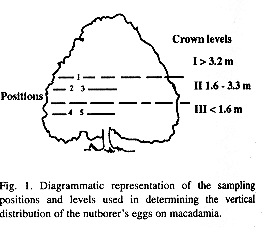
<body><![CDATA[<p><font face="Arial"><font size=-1>Since it was first recorded in Costa Rica (F. Lara 1987 unpublished) the nutborer <i>Ecdytolopha torticornis </i>Meyrick (Lepidoptera: Tortricidae), has been responsible for an increase in damage to the nuts of <i>Macadamia</i> <i>integrifolia </i>Maiden and Betche (Proteaceae) from a loss in yield of 16 % in 1987 (Lara 1987), to 28% in 1990 (C.E Mas&iacute;s and L.F Campos 1990 unpublished), and 39 % in 1992 (Blanco-Metzler <i>et al. </i>1994).</font></font>     <p><font face="Arial"><font size=-1>The <i>E. torticornis </i>female lays its eggs singly on the middle zone of macadamia nuts and, usually, in the narrow space between adjacent nuts within a cluster. Upon emergence the larva bores into the nut and feeds on the husk, if the nut shell has not hardened the larva will bore through, and feed on the kernel (Blanco <i>et al.</i> 1993). The biology of <i>E</i>. <i>torticornis closely</i> resembles that of the koa seedworm <i>Cryptophlebia illepida </i>(Butler) (Lepidoptera: Tortricidae), and the litchi fruit moth, C. <i>ombrodelta </i>(Lower) (Jones and Caprio 1992). <i>E.</i> <i>torticornis </i>moths have been reported to be poor fliers (Chamberlain 1989) living in the tree canopy (Blanco-Metzler 1994), and since the larvae feed inside the nut, they are limited in their ability to disperse. Thus, the distribution of larvae and hence nut damage are largely determined by egg distribution.</font></font>     <p><font face="Arial"><font size=-1>The oviposition behaviour of the nutborer within the host plant has provided useful and necessary information for the development of sampling methods. A survey of total egg mass is one of the methods used in determining pest abundance in many horticulturas crops as <i>Diaphania nitidalis </i>(Stoll) (Lepidoptera: Pyralidae) in cucumber (Blanco-Metzler 1983); <i>Helicoverpa zea </i>(Boddie) (Lepidoptera: Noctuidae) in maize (Hoffmann <i>et al. </i>199l), and in forest pests such as the gypsy moth, <i>Lymantria</i> <i>dispar </i>(L.) (Lepidoptera: Lymantriidae) in birch trees (Higashiura 1989, Thorpe and Ridgway 1992) or the<b> </b>spruce budworm, <i>Choristoneura</i> <i>fumiferana </i>(Clem.) (Lepidoptera: Tortricidae) in spruce trees (Lysyk 1990). The aim of this study was to investigate the<b> </b>within-tree distribution of the nutborer by recording its oviposition sites, and to determine whether moths showed ovipositional preferences between cultivars.</font></font>     <br>&nbsp;     <p><b><font face="Arial"><font size=-1>Materials and Methods</font></font></b>     <p><font face="Arial"><font size=-1>The study site was located at Oriented Farm, Turrialba, Costa Rica, at elevations ranging from 620 to 700 m above sea leves. The vertical distribution of <i>E. torticornis </i>eggs was studied in a mixed stand planted in 1978 of four of the most commonly planted cultivars in Costa Rica: Keahou (HAES 246), Kau (HAES 344), Kakea (HAES 508) and Keaau (HAES 660) with a height ranging from 4.5 m to 6 m. The study period was from July to December 1992. The nuts were examined in the laboratory (23&deg;C, 80% RH) at CATIE (Tropical Agronomical Research and Higher Education Centre, Turrialba), and the following variables were evaluated: the number of eggs per nut; the number of fertile and infertile eggs and empty chorions; and the number of nutborer holes per nut. The number of holes was included as an indication of multiple, successful ovipositions. Some nuts were found to have holes but no chorions were present perhaps because they had been disloged by rain, blown away by wind, or eaten by predators. The same trees were sampled every month. Trees were divided into tree crown levels <a href="#img1">(Fig. 1)</a>: I, crown top, 3.2 m from the ground to the top of the tree crown position l); II, mid-crown, 1.6 - 3.2 m from the ground (positions 2 and 3); III, lower-crown, 0 - 1.6 m from the ground (positions 4 and 5). The height of level III corresponded to that of the first author. Levels II and III were each divided into two positions: positions 3 and 5 = nuts sampled in an area up to 1 m horizontally from the tree trunk; posidons 2 and 4 = nuts sampled in an area up to 1 m horizontally from the end of the branches. Twenty nuts (over 0.8 cm in diameter) per crown level were collected at random; ten nuts per position for crown levels II and III.</font></font>     <p><font face="Arial"><font size=-1>The data were submitted to Analysis of Variance and T tests (LSD) (Anonymous, 1985). The experimental design used was a split split plot where the tree was the big plot, the combination of levels and positions was the split plot and the time (6 months, July to December) was the split split plot. Data were transformed by sqrt (x + 0.5) as many nuts were free of eggs. Nuts were collected every month from five trees per clone, 20 trees in total. In the statistical analysis, crown level I was compared with levels II and III together; level II versus level III; and the inner sampling positions (3 and 5) were compared with the outer sampling positions (2 and 4).</font></font>     <center><a NAME="img1"></a><img SRC="/img/fbpe/rbt/v49n2/1031i1.GIF" height=227 width=262></center>      
<p><b><font face="Arial"><font size=-1>Results</font></font></b>     <p><font face="Arial"><font size=-1>A total of 6 939 nuts were inspected. Newly laid eggs were frequently observed on nuts already bearing eggs or bore-holes. The number of eggs laid per nut varied from cero to eight with a mean of 0.8 (n = 201 nuts). No significant differences were found in the number of eggs per cultivar (F = 0.69; d.f. = 3; p = 0.57).</font></font>     ]]></body>
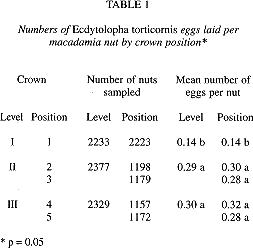
<body><![CDATA[<p><font face="Arial"><font size=-1>Eggs were found on macadamia trees at all heights; however, they were significantly more abundant in crown levels II and III than in level I (p &lt; 0.001). The mean number of eggs per nut in top level I was 0. 14; in mid level II: 0.29; and in bottom level III: 0.30. There was no significant difference between the number of eggs found on nuts from the lower two levels (F = 0.22; d.f. = 1; p = 0.64); nor between the mean number of eggs found on nuts on the inner and outer parts of the branches (F = 2.0; d.f. = 1; p = 0. 16) <a href="#tab1">(Table 1</a>), While fewer eggs were found on the inner sampling positions (3 and 5) than on the outer sampling positions (2 and 4), no statistical difference was found between the number of eggs in either positions for levels II and III (F = 0.22; g.1. <i>= </i>1; p = 0.64).</font></font>     <center>     <p><a NAME="tab1"></a><img SRC="/img/fbpe/rbt/v49n2/1031ta1.GIF" height=248 width=253></center>      
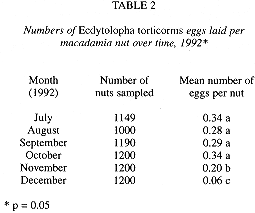
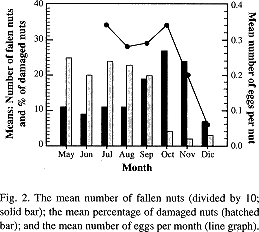
<p><font face="Arial"><font size=-1>There was a significant difference (p &lt; 0.0001) in the number of eggs per nut over the six months of sampling <a href="#tab2">(Table 2)</a>. The number of eggs per nut was highest from July to October, decreased in November (0.2) and dropped steeply to a minimum (0.06) in December <a href="#img2">(Fig. 2</a>). The decline in the number of eggs per nut paralleled the decline in nut production, but not the decline in the number of damaged nuts which occurred approximately one month earlier <a href="#img2">(Fig 2</a>).</font></font>     <center>     <p><a NAME="tab2"></a><img SRC="/img/fbpe/rbt/v49n2/1031ta2.GIF" height=213 width=255>     
<br>&nbsp;     <p><a NAME="img2"></a><img SRC="/img/fbpe/rbt/v49n2/1031i2.GIF" height=232 width=259></center>      
<p><b><font face="Arial"><font size=-1>Discussion</font></font></b>     <p><font face="Arial"><font size=-1>Oviposition site selection is one of the most important aspects of habitat selection in insects. It varies with insect species and is closely related to offspring survival. The observed habit of laying eggs on nuts</font></font>     ]]></body>
<body><![CDATA[<p><font face="Arial"><font size=-1>already containing eggs or on damaged nuts (Blanco-Metzler <i>et. al. </i>1993) might give the larvae the advantage of escaping from parasitoids and predators, or prevent them from being dislodged by the rain. Blanco-Metzler (1994) reported that it took a larva approximately fifty minutes from emerging from the egg to completely bore through the husk. T'herefore, if an entrance to the nut has already been made, the first instar larva is more likely to evade detrimental enviromnental factors and increase its survivorship. Conversely, the females' habit of laying eggs on damaged nuts may lead to intra-specific larval competition for food and/or space. Moreover, larval mortality might increase due to early nut-drop (Blanco-Metzler <i>et. al. </i>1992; Blanco-Metzler 1994). Sinclair (1979) observed that <i>Cryptophlebia</i> <i>ombrodelta, </i>also tended to lay its eggs preferentially on damaged macadamia nuts; he concluded that this behaviour lowered the chances of survival of the larvae in dense populations due to cannibalism and early nutfall. However, cannibalism was not observed in <i>E. torticornis: </i>yet early nut-fall was observed and concomitant enhanced larvas predation (Blanco-Metzler <i>et al. </i>in preparation).</font></font>     <p><font face="Arial"><font size=-1>Oviposition in insects has been reported to be influenced by physical properties of the host such as shape of the trees and nuts, colour of leaves and nuts, surface texture of fruits (Prokopy and Bush 1973) and chemical stimulants of the host (Renwick and Radke 1983; Hedin and McCarty 1990). Since no differences were found in the number of eggs between cultivars it is unlikely that during oviposition females were influenced by cultivar variation in shape, size, and colour of die nuts. Thus, the differences in nut damage for cultivars 246, 344, 508 and 660 (C.E. Mas&iacute;s and L.F. Campos 1990; Blanco-Metzler, <i>et. al. </i>1992; Blanco-Metzler 1994) might rather reflect differences in larval survival resulting from cultivar differences in food quality due to variation in secondary plant compounds and husk toughness. Indeed, damage was found to decrease with nut maturation because as the nut dries it provides food of a poorer quality and quantity.</font></font>     <p><font face="Arial"><font size=-1>The tendency of finding most eggs in the outer bottom level of the tree crown, followed by the outer middle level, could be because nut production is highest in this part of the tree (Diego P&eacute;rez, personal communication), and therefore, the moths lay their eggs where food abundance is highest to ensure the best possible food supply for their offspring. Also, since <i>E. torticornis </i>has been reported as probably being a poor flyer (Chamberlain 1989), the adults reach this part of the tree more readily from the weeds where they are believed to feed. Thus during the period of oviposition, they do not have to fly far to find their host and lay their eggs. In Oriente Farm weed control is limited as they have found that weeding increases root fungi problems and soil erosion (Diego P&eacute;rez, personal communication).</font></font>     <p><font face="Arial"><font size=-1>There are three probable reasons that could explain the differences in the number of eggs per nut found over time. First, during the period September to November nut production was high and females found plenty of oviposition sites: as time passed and fewer nuts (oviposition sites) were available and, thus, were thus harder to find. Secondly, a reduction in the number of nuts restricts the available larval food resource and in turn the larvas population, hence fewer adults will eventually emerge. Thirdly, the seasonal increase in the abundance of parasitoids (Blanco-Metzler 1994) is also likely to cause a decline in the size of the nutborer population.</font></font>     <p><font face="Arial"><font size=-1>Although <i>Cryptophlebia </i>females show no preference for laying eggs at different heights in the tree crowns (Jones and Tome 1992) <i>E</i>. <i>torticornis </i>females do prefer to oviposit on nuts growing within the first tree metres of the ground. We reaffirm comments by Southwood (1978) and Horn (1988) that the identification of host characteristics relevant to oviposition behaviour and insect distribution (both within and between host plants) is important for the design of sampling programmes, the forecasting of insect damage, and for assessment of the effectiveness of control programmes.</font></font>     <br>&nbsp;     <p><b><font face="Arial"><font size=-1>Aknowledgements</font></font></b>     <p><font face="Arial"><font size=-1>This research was supported by theBritish Council, AID-ROCAP, the Tropical Agronomical Research and Higher Education Centre (CATIE) and Macadamia de Costa Rica.</font></font>     <br>&nbsp;     <p><b><font face="Arial"><font size=-1>Resumen</font></font></b>     ]]></body>
<body><![CDATA[<p><font face="Arial"><font size=-1>Se determin&oacute; la distribuci&oacute;n vertical de los huevos del barrenador de la nuez de macadamia <i>Ecdytolopha torticornis</i> Meyrick (Lepidoptera: Tortricidae) y los sitios de preferencia de oviposici&oacute;n en los &aacute;rboles y entre clones de macadamia. Se detect&oacute; la presencia de huevos de <i>E. torticornis </i>en todo el &aacute;rbol, sin embargo, se encontr&oacute; un menor n&uacute;mero de huevos en la parte alta de la corona que en la parte media e inferior. La diferencia en la distribuci&oacute;n horizontal de los huevos fue no significativa, a pesar de encontrarse un mayor n&uacute;mero de huevos en las posiciones externas. El n&uacute;mero de huevos entre clones fue similar, sugiriendo que la polilla del barrenador no tiene preferencias de oviposici&oacute;n entre clones.</font></font>     <br>&nbsp;     <p><b><font face="Arial"><font size=-1>References</font></font></b>     <!-- ref --><p><font face="Arial"><font size=-1>Anonymous. 1985. SAS user's guide: statistics, version 5. l. Cary, North Carolina, SAS Instituto.</font></font>    &nbsp;&nbsp;&nbsp;&nbsp;&nbsp;&nbsp;&nbsp;&nbsp;[&#160;<a href="javascript:void(0);" onclick="javascript: window.open('/scielo.php?script=sci_nlinks&ref=1351488&pid=S0034-7744200100020003200001&lng=','','width=640,height=500,resizable=yes,scrollbars=1,menubar=yes,');">Links</a>&#160;]<!-- end-ref --><p><font face="Arial"><font size=-1>Blanco-Metzier, H. 1983. Distribuci&oacute;n de oviposici&oacute;n de <i>Diaphania nitidalis </i>(Stoll) y <i>D. hyalinata </i>(L.)</font></font>     <br><font face="Arial"><font size=-1>(Lepidoptera. Pyralidae) en pepino. Ing. Agr. Thesis. University of Costa Rica, San Jos&eacute;. 35 p.</font></font>     <p><font face="Arial"><font size=-1>Blanco-Metzler, H. 1994. The biology and ecology of the macadamia nutborer, <i>Ecdytolopha torticornis</i></font></font>     <br><font face="Arial"><font size=-1>Meyrick (Lepidoptera: Tortricidae) in Costa Rica. Ph.D. Thesis, University of Edinburgh, Scotland. 131 p.</font></font>     <p><font face="Arial"><font size=-1>Blanco-Metzler, H., A.D Watt &amp; Cosens, D. 1992. Dynamics of macadamia nut damage by <i>Ecdytolopha</i></font></font>     <br><font face="Arial"><font size=-1><i>torticornis</i> Meyrick (Lep: Tortricidae) and parasitism by <i>Apanteles</i> spp. <i>In</i> Individuals, Patterns, and</font></font>     ]]></body>
<body><![CDATA[<br><font face="Arial"><font size=-1>Populations (Norwich, England, 7- 10 September, 1992).</font></font>     <!-- ref --><p><font face="Arial"><font size=-1>Blanco-Metzler, H., A.D Watt &amp; Cosens, D. 1993. Ciclo de vida y comportamiento de oviposici&oacute;n de <i>Ecdytolophatorticornis </i>Meyrick (Lepidoptera: Tortricidae), barrenador de la nuez de macadamia. Rev. Manejo Integr. Plagas (Costa Rica) No. 29: 36-39.</font></font>    &nbsp;&nbsp;&nbsp;&nbsp;&nbsp;&nbsp;&nbsp;&nbsp;[&#160;<a href="javascript:void(0);" onclick="javascript: window.open('/scielo.php?script=sci_nlinks&ref=1351496&pid=S0034-7744200100020003200005&lng=','','width=640,height=500,resizable=yes,scrollbars=1,menubar=yes,');">Links</a>&#160;]<!-- end-ref --><p><font face="Arial"><font size=-1>Chamberlain, D.J. 1989. Fieid studies on the distribution and damage attributable to a macadamia nutborer, <i>(Ecdylolopha torticornis </i>Meyrick). <i>In</i> D. Chamberlain, P.S. Beevor &amp; A. Cork (eds.). Preliminary investigations on the biology and pheromone identification of a new nutborer pest of macadamia in Costa</font></font>     <br><font face="Arial"><font size=-1>Rica conducted in 1989. Overseas Development Natural Resources Institute, Kent, U.K.</font></font>     <!-- ref --><p><font face="Arial"><font size=-1>Hedin, P.A., &amp; J.C. McCarty. 1990. Possible roles of cotton bud sugars and terpenoids in oviposition by the boll weevil. J. Chem. Ecol. 16: 757-722.</font></font>    &nbsp;&nbsp;&nbsp;&nbsp;&nbsp;&nbsp;&nbsp;&nbsp;[&#160;<a href="javascript:void(0);" onclick="javascript: window.open('/scielo.php?script=sci_nlinks&ref=1351499&pid=S0034-7744200100020003200007&lng=','','width=640,height=500,resizable=yes,scrollbars=1,menubar=yes,');">Links</a>&#160;]<!-- end-ref --><!-- ref --><p><font face="Arial"><font size=-1>Higashiura, Y. 1989. Survival of eggs in the gypsy moth <i>Lymantria dispar. </i>II. Oviposition site selection in changing environments. J. Anim. Ecol. 58: 413-426.</font></font>    &nbsp;&nbsp;&nbsp;&nbsp;&nbsp;&nbsp;&nbsp;&nbsp;[&#160;<a href="javascript:void(0);" onclick="javascript: window.open('/scielo.php?script=sci_nlinks&ref=1351500&pid=S0034-7744200100020003200008&lng=','','width=640,height=500,resizable=yes,scrollbars=1,menubar=yes,');">Links</a>&#160;]<!-- end-ref --><!-- ref --><p><font face="Arial"><font size=-1>Hoffmann, M., L.T. Wilson, F.G. Zalom &amp; R.J. Hilton. 1991. Dynamic sequential sampling plan for <i>Helicoverpa zea </i>(Lep: Noctuidae) eggs in processing tomatoes: parasitism and temporal patterns. Env.Entomol. 20: 1005-1012.</font></font>    &nbsp;&nbsp;&nbsp;&nbsp;&nbsp;&nbsp;&nbsp;&nbsp;[&#160;<a href="javascript:void(0);" onclick="javascript: window.open('/scielo.php?script=sci_nlinks&ref=1351501&pid=S0034-7744200100020003200009&lng=','','width=640,height=500,resizable=yes,scrollbars=1,menubar=yes,');">Links</a>&#160;]<!-- end-ref --><!-- ref --><p><font face="Arial"><font size=-1>Horn, D.J. 1988. Ecological approach to pest management. Guilford Press, New York. 285 p.</font></font>    &nbsp;&nbsp;&nbsp;&nbsp;&nbsp;&nbsp;&nbsp;&nbsp;[&#160;<a href="javascript:void(0);" onclick="javascript: window.open('/scielo.php?script=sci_nlinks&ref=1351502&pid=S0034-7744200100020003200010&lng=','','width=640,height=500,resizable=yes,scrollbars=1,menubar=yes,');">Links</a>&#160;]<!-- end-ref --><!-- ref --><p><font face="Arial"><font size=-1>Jones, VP. &amp; L.C. Caprio. 1992. Damage estimates and population trends of insects attacking seven macadamia cultivars in Hawaii. J. Econ. Entomol. 85: 1884-1890.</font></font>    &nbsp;&nbsp;&nbsp;&nbsp;&nbsp;&nbsp;&nbsp;&nbsp;[&#160;<a href="javascript:void(0);" onclick="javascript: window.open('/scielo.php?script=sci_nlinks&ref=1351503&pid=S0034-7744200100020003200011&lng=','','width=640,height=500,resizable=yes,scrollbars=1,menubar=yes,');">Links</a>&#160;]<!-- end-ref --><!-- ref --><p><font face="Arial"><font size=-1>Jones, V.P. &amp; C.H.M. Tome. 1992. Effect of husk feeding by <i>Cryptophlebia </i>spp. on macadamia in Hawaii. In Proccedings of the First International Macadanda Research Conference, July 28-30, 1992. Honolulu, University of Hawaii at Manoa.</font></font>    &nbsp;&nbsp;&nbsp;&nbsp;&nbsp;&nbsp;&nbsp;&nbsp;[&#160;<a href="javascript:void(0);" onclick="javascript: window.open('/scielo.php?script=sci_nlinks&ref=1351504&pid=S0034-7744200100020003200012&lng=','','width=640,height=500,resizable=yes,scrollbars=1,menubar=yes,');">Links</a>&#160;]<!-- end-ref --><!-- ref --><p><font face="Arial"><font size=-1>Lysyk, T.J. 1990. Relationships between spruce budworm (Lep: Tortricidae) egg mass density and resultant defoliation of balsam fir and white spruce. Can. Entomol. 122: 253-262.</font></font>    &nbsp;&nbsp;&nbsp;&nbsp;&nbsp;&nbsp;&nbsp;&nbsp;[&#160;<a href="javascript:void(0);" onclick="javascript: window.open('/scielo.php?script=sci_nlinks&ref=1351505&pid=S0034-7744200100020003200013&lng=','','width=640,height=500,resizable=yes,scrollbars=1,menubar=yes,');">Links</a>&#160;]<!-- end-ref --><!-- ref --><p><font face="Arial"><font size=-1>Prokopy, R.J. &amp; G.L. Bush. 1973. Oviposition responses to different sizes of artificial fruit by flies of <i>Rhagoletis pomonella</i> species group. Ann. Entomol. Soc. Amer. 66: 927-929.</font></font>    &nbsp;&nbsp;&nbsp;&nbsp;&nbsp;&nbsp;&nbsp;&nbsp;[&#160;<a href="javascript:void(0);" onclick="javascript: window.open('/scielo.php?script=sci_nlinks&ref=1351506&pid=S0034-7744200100020003200014&lng=','','width=640,height=500,resizable=yes,scrollbars=1,menubar=yes,');">Links</a>&#160;]<!-- end-ref --><!-- ref --><p><font face="Arial"><font size=-1>Renwick, J.A.A. &amp; C.D. Radke. 1983 Chemical recognition of host plants for oviposition by the cabbage butterfly, <i>Pieris rapae </i>(Lepidoptera: Pieridae). Env. Entomol. 12: 446- 450.</font></font>    &nbsp;&nbsp;&nbsp;&nbsp;&nbsp;&nbsp;&nbsp;&nbsp;[&#160;<a href="javascript:void(0);" onclick="javascript: window.open('/scielo.php?script=sci_nlinks&ref=1351507&pid=S0034-7744200100020003200015&lng=','','width=640,height=500,resizable=yes,scrollbars=1,menubar=yes,');">Links</a>&#160;]<!-- end-ref --><!-- ref --><p><font face="Arial"><font size=-1>Sinclair, E.R. 1979. Parasites of <i>Cryptophlebia ombrodelta</i> (Lower) (Lep: Tortricidae) in Southeast Queensland. J. Aust. Entomol. Soc. 18: 329-335.</font></font>    &nbsp;&nbsp;&nbsp;&nbsp;&nbsp;&nbsp;&nbsp;&nbsp;[&#160;<a href="javascript:void(0);" onclick="javascript: window.open('/scielo.php?script=sci_nlinks&ref=1351508&pid=S0034-7744200100020003200016&lng=','','width=640,height=500,resizable=yes,scrollbars=1,menubar=yes,');">Links</a>&#160;]<!-- end-ref --><!-- ref --><p><font face="Arial"><font size=-1>Southwood, T.R.E. 1978. Ecological methods with particular references to the study of insect populations. 2nd. ed. London, Chapman and Hall. 524 p.</font></font>    &nbsp;&nbsp;&nbsp;&nbsp;&nbsp;&nbsp;&nbsp;&nbsp;[&#160;<a href="javascript:void(0);" onclick="javascript: window.open('/scielo.php?script=sci_nlinks&ref=1351509&pid=S0034-7744200100020003200017&lng=','','width=640,height=500,resizable=yes,scrollbars=1,menubar=yes,');">Links</a>&#160;]<!-- end-ref --><!-- ref --><p><font face="Arial"><font size=-1>Thorpe, K.W. &amp; R.L: Ridgway. 1992. Gypsy moth (Lep: Lymantriidae) egg mass distribution and sampling in a residential setting. Eny. Entomol. 21: 722-730.</font></font>    &nbsp;&nbsp;&nbsp;&nbsp;&nbsp;&nbsp;&nbsp;&nbsp;[&#160;<a href="javascript:void(0);" onclick="javascript: window.open('/scielo.php?script=sci_nlinks&ref=1351510&pid=S0034-7744200100020003200018&lng=','','width=640,height=500,resizable=yes,scrollbars=1,menubar=yes,');">Links</a>&#160;]<!-- end-ref --><br>&nbsp;     <p><a NAME="1a"></a><font face="Arial"><font size=-1><sup><a href="#1">1</a></sup> Centro de Investigaci&oacute;n en Protecci&oacute;n de Cultivos-Estaci&oacute;n Experimental Fabio Baudrit Moreno,</font></font>     <br><font face="Arial"><font size=-1>Universidad de Costa Rica, Facultad de Agronom&iacute;a, San Jos&eacute;, Costa Rica, Fax (506) 433-9086,</font></font>     <br><font face="Arial"><font size=-1>E-mail: hblanco@cariari.ucr.ac.cr</font></font>     ]]></body>
<body><![CDATA[<p><a NAME="2a"></a><font face="Arial"><font size=-1><sup><a href="#2">2</a></sup> Banchory Research Station, Hill of Brathens, Glassel, Banchory AB31 4BY, Scotland, UK</font></font>     <br><font face="Arial"><font size=-1>E-mail: adw@wpo.nerc.ac.uk</font></font>     <p><a NAME="3a"></a><font face="Arial"><font size=-1><sup><a href="#3">3</a></sup> Institute of Cell, Animal and Population Biology, The University of Edinburgh, Ashworth Laboratories,</font></font>     <br><font face="Arial"><font size=-1>West Mains Road, Edimburgh EH9 3JT, Scotland, UK E. Mail: Derek.Cosens@ed.ac.uk</font></font>      ]]></body><back>
<ref-list>
<ref id="B1">
<nlm-citation citation-type="book">
<person-group person-group-type="author">
<name>
</name>
<name>
</name>
</person-group>
<source><![CDATA[SAS user's guide: statistics, version 5. l]]></source>
<year>1985</year>
<publisher-loc><![CDATA[North Carolina ]]></publisher-loc>
<publisher-name><![CDATA[SAS Instituto]]></publisher-name>
</nlm-citation>
</ref>
<ref id="B2">
<nlm-citation citation-type="">
<person-group person-group-type="author">
<name>
<surname><![CDATA[Blanco-Metzier]]></surname>
<given-names><![CDATA[H.]]></given-names>
</name>
</person-group>
<source><![CDATA[Distribución de oviposición de Diaphania nitidalis (Stoll) y D. hyalinata (L.) (Lepidoptera. Pyralidae) en pepino]]></source>
<year>1983</year>
<page-range>35</page-range></nlm-citation>
</ref>
<ref id="B3">
<nlm-citation citation-type="">
<person-group person-group-type="author">
<name>
<surname><![CDATA[Blanco-Metzler]]></surname>
<given-names><![CDATA[H.]]></given-names>
</name>
</person-group>
<source><![CDATA[The biology and ecology of the macadamia nutborer, Ecdytolopha torticornis Meyrick (Lepidoptera: Tortricidae) in Costa Rica]]></source>
<year>1994</year>
<page-range>131</page-range></nlm-citation>
</ref>
<ref id="B4">
<nlm-citation citation-type="book">
<person-group person-group-type="author">
<name>
<surname><![CDATA[Blanco-Metzler]]></surname>
<given-names><![CDATA[H.]]></given-names>
</name>
<name>
<surname><![CDATA[Watt]]></surname>
<given-names><![CDATA[A.D]]></given-names>
</name>
<name>
<surname><![CDATA[Cosens]]></surname>
<given-names><![CDATA[D.]]></given-names>
</name>
</person-group>
<article-title xml:lang="en"><![CDATA[Dynamics of macadamia nut damage by Ecdytolopha torticornis Meyrick (Lep: Tortricidae) and parasitism by Apanteles spp]]></article-title>
<source><![CDATA[Individuals, Patterns, and Populations]]></source>
<year>1992</year>
<month>7-</month>
<day> 1</day>
<publisher-name><![CDATA[Norwich]]></publisher-name>
</nlm-citation>
</ref>
<ref id="B5">
<nlm-citation citation-type="journal">
<person-group person-group-type="author">
<name>
<surname><![CDATA[Blanco-Metzler]]></surname>
<given-names><![CDATA[H.]]></given-names>
</name>
<name>
<surname><![CDATA[Watt]]></surname>
<given-names><![CDATA[A.D]]></given-names>
</name>
<name>
<surname><![CDATA[Cosens]]></surname>
<given-names><![CDATA[D.]]></given-names>
</name>
</person-group>
<article-title xml:lang="es"><![CDATA[Ciclo de vida y comportamiento de oviposición de Ecdytolophatorticornis Meyrick (Lepidoptera: Tortricidae), barrenador de la nuez de macadamia]]></article-title>
<source><![CDATA[Rev. Manejo Integr. Plagas]]></source>
<year>1993</year>
<volume>29</volume>
<page-range>36-39</page-range></nlm-citation>
</ref>
<ref id="B6">
<nlm-citation citation-type="book">
<person-group person-group-type="author">
<name>
<surname><![CDATA[Chamberlain]]></surname>
<given-names><![CDATA[D.J.]]></given-names>
</name>
</person-group>
<article-title xml:lang="en"><![CDATA[Fieid studies on the distribution and damage attributable to a macadamia nutborer, (Ecdylolopha torticornis Meyrick)]]></article-title>
<person-group person-group-type="editor">
<name>
<surname><![CDATA[Chamberlain]]></surname>
<given-names><![CDATA[D.]]></given-names>
</name>
<name>
<surname><![CDATA[Beevor]]></surname>
<given-names><![CDATA[P.S.]]></given-names>
</name>
<name>
<surname><![CDATA[Cork]]></surname>
<given-names><![CDATA[A.]]></given-names>
</name>
</person-group>
<source><![CDATA[Preliminary investigations on the biology and pheromone identification of a new nutborer pest of macadamia in Costa Rica conducted in 1989]]></source>
<year>1989</year>
<publisher-loc><![CDATA[Kent ]]></publisher-loc>
<publisher-name><![CDATA[Overseas Development Natural Resources Institute]]></publisher-name>
</nlm-citation>
</ref>
<ref id="B7">
<nlm-citation citation-type="journal">
<person-group person-group-type="author">
<name>
<surname><![CDATA[Hedin]]></surname>
<given-names><![CDATA[P.A.]]></given-names>
</name>
<name>
<surname><![CDATA[McCarty]]></surname>
<given-names><![CDATA[J.C.]]></given-names>
</name>
</person-group>
<article-title xml:lang="en"><![CDATA[Possible roles of cotton bud sugars and terpenoids in oviposition by the boll weevil]]></article-title>
<source><![CDATA[J. Chem. Ecol.]]></source>
<year>1990</year>
<volume>16</volume>
<page-range>757-722</page-range></nlm-citation>
</ref>
<ref id="B8">
<nlm-citation citation-type="journal">
<person-group person-group-type="author">
<name>
<surname><![CDATA[Higashiura]]></surname>
<given-names><![CDATA[Y.]]></given-names>
</name>
</person-group>
<article-title xml:lang="en"><![CDATA[Survival of eggs in the gypsy moth Lymantria dispar. II. Oviposition site selection in changing environments]]></article-title>
<source><![CDATA[J. Anim. Ecol]]></source>
<year>1989</year>
<volume>58</volume>
<page-range>413-426</page-range></nlm-citation>
</ref>
<ref id="B9">
<nlm-citation citation-type="">
<person-group person-group-type="author">
<name>
<surname><![CDATA[Hoffmann]]></surname>
<given-names><![CDATA[M.]]></given-names>
</name>
<name>
<surname><![CDATA[Wilson]]></surname>
<given-names><![CDATA[L.T.]]></given-names>
</name>
<name>
<surname><![CDATA[Zalom]]></surname>
<given-names><![CDATA[F.G.]]></given-names>
</name>
<name>
<surname><![CDATA[Hilton]]></surname>
<given-names><![CDATA[R.J.]]></given-names>
</name>
</person-group>
<source><![CDATA[]]></source>
<year></year>
</nlm-citation>
</ref>
<ref id="B10">
<nlm-citation citation-type="book">
<person-group person-group-type="author">
<name>
<surname><![CDATA[Horn]]></surname>
<given-names><![CDATA[D.J.]]></given-names>
</name>
</person-group>
<source><![CDATA[Ecological approach to pest management]]></source>
<year>1988</year>
<page-range>285</page-range><publisher-loc><![CDATA[New York ]]></publisher-loc>
<publisher-name><![CDATA[Guilford Press]]></publisher-name>
</nlm-citation>
</ref>
<ref id="B11">
<nlm-citation citation-type="journal">
<person-group person-group-type="author">
<name>
<surname><![CDATA[Jones]]></surname>
<given-names><![CDATA[VP.]]></given-names>
</name>
<name>
<surname><![CDATA[Caprio]]></surname>
<given-names><![CDATA[L.C.]]></given-names>
</name>
</person-group>
<article-title xml:lang="en"><![CDATA[Damage estimates and population trends of insects attacking seven macadamia cultivars in Hawaii]]></article-title>
<source><![CDATA[J. Econ. Entomol.]]></source>
<year>1992</year>
<volume>85</volume>
<page-range>1884-1890</page-range></nlm-citation>
</ref>
<ref id="B12">
<nlm-citation citation-type="confpro">
<person-group person-group-type="author">
<name>
<surname><![CDATA[Jones]]></surname>
<given-names><![CDATA[V.P.]]></given-names>
</name>
<name>
<surname><![CDATA[Tome]]></surname>
<given-names><![CDATA[C.H.M.]]></given-names>
</name>
</person-group>
<article-title xml:lang="en"><![CDATA[Effect of husk feeding by Cryptophlebia spp. on macadamia in Hawaii]]></article-title>
<source><![CDATA[]]></source>
<year>1992</year>
<conf-name><![CDATA[ First International Macadanda Research Conference]]></conf-name>
<conf-date>July 28-30, 1992</conf-date>
<conf-loc>Honolulu </conf-loc>
</nlm-citation>
</ref>
<ref id="B13">
<nlm-citation citation-type="journal">
<person-group person-group-type="author">
<name>
<surname><![CDATA[Lysyk]]></surname>
<given-names><![CDATA[T.J.]]></given-names>
</name>
</person-group>
<article-title xml:lang="en"><![CDATA[Relationships between spruce budworm (Lep: Tortricidae) egg mass density and resultant defoliation of balsam fir and white spruce]]></article-title>
<source><![CDATA[Can. Entomol.]]></source>
<year>1990</year>
<volume>122</volume>
<page-range>253-262</page-range></nlm-citation>
</ref>
<ref id="B14">
<nlm-citation citation-type="journal">
<person-group person-group-type="author">
<name>
<surname><![CDATA[Prokopy]]></surname>
<given-names><![CDATA[R.J.]]></given-names>
</name>
<name>
<surname><![CDATA[Bush]]></surname>
<given-names><![CDATA[G.L.]]></given-names>
</name>
</person-group>
<article-title xml:lang="en"><![CDATA[Oviposition responses to different sizes of artificial fruit by flies of Rhagoletis pomonella species group]]></article-title>
<source><![CDATA[Ann. Entomol. Soc. Amer]]></source>
<year>1973</year>
<volume>66</volume>
<page-range>927-929</page-range></nlm-citation>
</ref>
<ref id="B15">
<nlm-citation citation-type="journal">
<person-group person-group-type="author">
<name>
<surname><![CDATA[Renwick]]></surname>
<given-names><![CDATA[J.A.A.]]></given-names>
</name>
<name>
<surname><![CDATA[Radke]]></surname>
<given-names><![CDATA[C.D.]]></given-names>
</name>
</person-group>
<article-title xml:lang="en"><![CDATA[Chemical recognition of host plants for oviposition by the cabbage butterfly, Pieris rapae (Lepidoptera: Pieridae)]]></article-title>
<source><![CDATA[Env. Entomol.]]></source>
<year>1983</year>
<volume>12</volume>
<page-range>446- 450</page-range></nlm-citation>
</ref>
<ref id="B16">
<nlm-citation citation-type="journal">
<person-group person-group-type="author">
<name>
<surname><![CDATA[Sinclair]]></surname>
<given-names><![CDATA[E.R.]]></given-names>
</name>
</person-group>
<article-title xml:lang="en"><![CDATA[Parasites of Cryptophlebia ombrodelta (Lower) (Lep: Tortricidae) in Southeast Queensland]]></article-title>
<source><![CDATA[J. Aust. Entomol. Soc.]]></source>
<year>1979</year>
<volume>18</volume>
<page-range>329-335</page-range></nlm-citation>
</ref>
<ref id="B17">
<nlm-citation citation-type="book">
<person-group person-group-type="author">
<name>
<surname><![CDATA[Southwood]]></surname>
<given-names><![CDATA[T.R.E.]]></given-names>
</name>
</person-group>
<source><![CDATA[Ecological methods with particular references to the study of insect populations]]></source>
<year>1978</year>
<edition>2nd.</edition>
<page-range>524</page-range><publisher-loc><![CDATA[London ]]></publisher-loc>
<publisher-name><![CDATA[Chapman and Hall]]></publisher-name>
</nlm-citation>
</ref>
<ref id="B18">
<nlm-citation citation-type="journal">
<person-group person-group-type="author">
<name>
<surname><![CDATA[Thorpe]]></surname>
<given-names><![CDATA[K.W.]]></given-names>
</name>
<name>
<surname><![CDATA[Ridgway]]></surname>
<given-names><![CDATA[R.L.]]></given-names>
</name>
</person-group>
<article-title xml:lang="en"><![CDATA[Gypsy moth (Lep: Lymantriidae) egg mass distribution and sampling in a residential setting]]></article-title>
<source><![CDATA[Eny. Entomol.]]></source>
<year>1992</year>
<volume>21</volume>
<page-range>722-730</page-range></nlm-citation>
</ref>
</ref-list>
</back>
</article>