<?xml version="1.0" encoding="ISO-8859-1"?><article xmlns:mml="http://www.w3.org/1998/Math/MathML" xmlns:xlink="http://www.w3.org/1999/xlink" xmlns:xsi="http://www.w3.org/2001/XMLSchema-instance">
<front>
<journal-meta>
<journal-id>0034-7744</journal-id>
<journal-title><![CDATA[Revista de Biología Tropical]]></journal-title>
<abbrev-journal-title><![CDATA[Rev. biol. trop]]></abbrev-journal-title>
<issn>0034-7744</issn>
<publisher>
<publisher-name><![CDATA[Universidad de Costa Rica]]></publisher-name>
</publisher>
</journal-meta>
<article-meta>
<article-id>S0034-77442001000200028</article-id>
<title-group>
<article-title xml:lang="en"><![CDATA[Effect of food plants on the volume of repellent secretion obtained in adult Zonocerus variegatus (Orthoptera: Pyrgomorphidae)]]></article-title>
</title-group>
<contrib-group>
<contrib contrib-type="author">
<name>
<surname><![CDATA[Babatunde Idowu]]></surname>
<given-names><![CDATA[A.]]></given-names>
</name>
<xref ref-type="aff" rid="A01"/>
</contrib>
<contrib contrib-type="author">
<name>
<surname><![CDATA[Idowu]]></surname>
<given-names><![CDATA[O.A.]]></given-names>
</name>
<xref ref-type="aff" rid="A01"/>
</contrib>
</contrib-group>
<aff id="A01">
<institution><![CDATA[,University of Agriculture Dept of Biological Sciences ]]></institution>
<addr-line><![CDATA[Abeokuta ]]></addr-line>
<country>Nigeria</country>
</aff>
<pub-date pub-type="pub">
<day>00</day>
<month>06</month>
<year>2001</year>
</pub-date>
<pub-date pub-type="epub">
<day>00</day>
<month>06</month>
<year>2001</year>
</pub-date>
<volume>49</volume>
<numero>2</numero>
<fpage>679</fpage>
<lpage>684</lpage>
<copyright-statement/>
<copyright-year/>
<self-uri xlink:href="http://www.scielo.sa.cr/scielo.php?script=sci_arttext&amp;pid=S0034-77442001000200028&amp;lng=en&amp;nrm=iso"></self-uri><self-uri xlink:href="http://www.scielo.sa.cr/scielo.php?script=sci_abstract&amp;pid=S0034-77442001000200028&amp;lng=en&amp;nrm=iso"></self-uri><self-uri xlink:href="http://www.scielo.sa.cr/scielo.php?script=sci_pdf&amp;pid=S0034-77442001000200028&amp;lng=en&amp;nrm=iso"></self-uri><abstract abstract-type="short" xml:lang="en"><p><![CDATA[The volume of secretion obtained from adult Zonocerus variegatus (Orthoptera: Pyrgomorphidae)was influenced by the type of food plants. Insects fed on leaves of cassava Manihot esculenta, bitter leaves Vernonia amygdalina, and a mixture of M. esculenta and Acalypha wilkesiana gave a good volume of secretion while Chromolaena odorata, Elaeis guinensis, Aspilia africana and Citrus sinensis did not favour secretion production. No significant difference was recorded in the volume of secretion obtained from Z. variegatus from the two seasons irrespective of the food plant. Similarly, food plants gave no significant difference on the volume of secretion between the two seasons.]]></p></abstract>
<abstract abstract-type="short" xml:lang="es"><p><![CDATA[El volumen de secreción obtenida de adultos de Zonocerus variegatus (Orthoptera: Pyrgomorphidae) fue influenciado por el tipo de planta de alimento. Los insectos alimentados de hojas de casava Manihot esculenta, hojas ácidas de Vernonia amygdalina y una mezcla de M.esculenta y Acalypha wilkesiana dieron un voulumen bueno de secreción, mientras que Chromolaena odorata, Elaeis guinensis, Aspilia africana y Citrus sinensis no favorecieron la producción de secreción. No se encontró diferencia significativa en el volumen de secreción obtenida de Z. variegatus en las dos estaciones independientemente de la planta de alimento. Similarmente, las plantas de alimento no dieron diferencia significativa en el volumen de secreción entre las dos estaciones.]]></p></abstract>
<kwd-group>
<kwd lng="la"><![CDATA[Zonocerus variegatus]]></kwd>
<kwd lng="en"><![CDATA[secretion]]></kwd>
<kwd lng="en"><![CDATA[food plants]]></kwd>
</kwd-group>
</article-meta>
</front><body><![CDATA[ <center>  <b><font face="Arial,Helvetica"><font size=-1>Effect of food plants on the volume of repellent secretion obtained in adult <i>Zonocerus variegatus</i> (Orthoptera:&nbsp; Pyrgomorphidae)</font></font></b></center>      <center><font face="Arial,Helvetica"><font size=-1><b>A. Babatunde Idowu&nbsp;&nbsp;&nbsp;&nbsp;&nbsp;&nbsp;&nbsp; O.A. Idowu<a NAME="1"></a></b><sup><a href="#1a">1</a></sup></font></font>     <p><font face="Arial,Helvetica"><font size=-1>Received&nbsp; 18-II-2000.&nbsp;&nbsp; Corrected&nbsp; 10-X-2000.&nbsp;&nbsp; Accepted&nbsp;&nbsp; 10-X-2000</font></font></center>      <p><b><font face="Arial,Helvetica"><font size=-1>Abstract</font></font></b>     <p><font face="Arial,Helvetica"><font size=-1>The volume of secretion obtained from adult <i>Zonocerus</i> <i>variegatus</i> (Orthoptera:&nbsp; Pyrgomorphidae)was influenced by the type of food plants. Insects fed on leaves of cassava <i>Manihot esculenta</i>, bitter leaves <i>Vernonia amygdalina</i>, and a mixture of <i>M. esculenta</i> and <i>Acalypha wilkesiana</i> gave a good volume of secretion while <i>Chromolaena odorata, Elaeis guinensis, Aspilia africana</i> and<i> Citrus sinensis</i> did not favour secretion production. No significant difference was recorded in the volume of secretion obtained from<i> Z. variegatus</i> from the two seasons irrespective of the food plant. Similarly, food plants gave no significant difference on the volume of secretion between the two seasons.</font></font>     <br>&nbsp;     <p><b><font face="Arial,Helvetica"><font size=-1>Keywords</font></font></b>     <p><font face="Arial,Helvetica"><font size=-1><i>Zonocerus variegatu</i>s, secretion, food plants.</font></font>     <br>&nbsp;     <p><font face="Arial,Helvetica"><font size=-1><i>Zonocerus variegatus </i>(L) (Orthoptera : Pyrgomorphidae)&nbsp; has a repellent gland which is situated in the 1st and 2nd&nbsp; abdominal segments. It is present in all instars (Idowu 1995). The gland stores secretion in its lumen (reservoir) and discharge of the secretion following any disturbance is a function of the size and volume of the gland lumen (Idowu 1996). The secretion which is ejected in the form of a jet-like spray, is colourless to whitish, volatile, soluble in water, rich in chemical constituents (Idowu and Modder, 1998) and has a very strong odour which is unrelated to the odour of the insect`s food plant (Idowu 1997). Reports showed that the odour of the secretion can be percieved by man from a distance of about 40 cm. Thus, the grasshopper avoid being preyed upon by vertebrate and invertebrate predators (Idowu 1997).</font></font>     ]]></body>
<body><![CDATA[<p><font face="Arial,Helvetica"><font size=-1><i>Z. variegatus </i>is a polyphagous insect (Modder 1986). Nevertheless, it exhibits distinct preferences. However, preference does not necessarily reflect survival. Bernays <i>et al.&nbsp;</i> (1975) and Tamu (1990) have shown that not all the food plants eaten by <i>Z. variegatus</i> are adequate for survival and development. Its food plants include wild plants&nbsp; and cultivated plants (Chapman <i>et al.&nbsp;</i> 1986). For example cassava, <i>Manihot</i> <i>esculenta</i> (Crantz) (Bernays <i>et al.&nbsp;</i> 1975, McCaffery <i>et al.&nbsp;</i> 1978; Tamu, 1990) and <i>Vernonia amygdalina</i> (Shreb) (Tamu 1990) have been shown to support growth and development of <i>Z. variegatus</i>.&nbsp; On the other hand, <i>Citrus </i>spp only supports growth while <i>Chromolaenaodorata</i> and <i>Aspilia</i> <i>africana</i>(L) do not support the survival of the insects (Bernays <i>et al.&nbsp;</i> 1975, McCaffery <i>et al.&nbsp;</i> 1978).</font></font>     <p><font face="Arial,Helvetica"><font size=-1>The possible effect of food plants eaten by dry - and wet - season adult <i>Z. variegatus</i> on the production of its repellent secretion was examined.</font></font>     <br>&nbsp;     <p><b><font face="Arial,Helvetica"><font size=-1>Materials and Methods</font></font></b>     <p><font face="Arial,Helvetica"><font size=-1>Newly hatched 1st instar nymphs of <i>Z.variegatus</i> were collected at the uncultivated land adjoining the lake at the International Institute of Tropical Agriculture (IITA), Ibadan. The insects were reared in&nbsp; wire cages (30 x 30 x 45 cm), and fed daily&nbsp; fresh leaves of&nbsp;<i> Acalypha wilkesiana </i>(L) and<i> M. esculenta</i>. The period of collection and rearing was from November to March for the dry season population and April to October for the wet season population.</font></font>     <p><font face="Arial,Helvetica"><font size=-1>At the start of the experiment, newly moulted and already milked (emptied gland) adult&nbsp; <i>Zonocerus</i> were picked from the stock cages containing the nymphs of the grasshopper and divided into cages. For this experiment, the dry-season population were fed with <i>M. esculenta</i> (Crantz), <i>A. wilkesiana</i> (L), mixture of <i>A.wilkesiana</i> and <i>M. esculenta</i> while the wet-season population were fed with <i>M.esculenta, A. wilkesiana, A. africana</i> (Thuars)<i>, Vernonia amygdalina</i> (Schreb), mixture of <i>A. wilkesiana</i> and <i>M. esculenta, C. odorat </i>(L), <i>Citrus sinesis</i> (L), <i>Elaeis guinensis</i> (Jacq) and <i>Jussiciea abysinica</i> (L). The insects were fed daily on fresh&nbsp; excised leaves of the plants while some were left without food. The choice of food plants was based on their availability in the field during the seasons and their ability to support growth and development as reported by Bernays <i>et al.&nbsp;</i> (1975), McCaffery <i>et al.&nbsp;</i> (1978) and Tamu (1990).</font></font>     <p><font face="Arial,Helvetica"><font size=-1>&nbsp; The number of grasshoppers in each of the cages at the start&nbsp; of the experiment was 100. On each day of the experiment, three insects were randomly picked from the different cages, milked and the volume of secretion obtained recorded. At the same time, the number of dead insects in the cages was recorded only for the wet-season population. After the duration of the experiment, the data obtained were analysed statistically using the analysis of variance (ANOVA). Duncan`s multiple range test was also used.</font></font>     <p><font face="Arial,Helvetica"><font size=-1><b>Collection of secretion:&nbsp;</b> A pipette, calibrated in microlitres( m l), was used for collecting the secretion ("milking") from the repellent gland, through the orifice on the dorsal surface of the insect.</font></font>     <br>&nbsp;     <p><b><font face="Arial,Helvetica"><font size=-1>Results</font></font></b>     ]]></body>
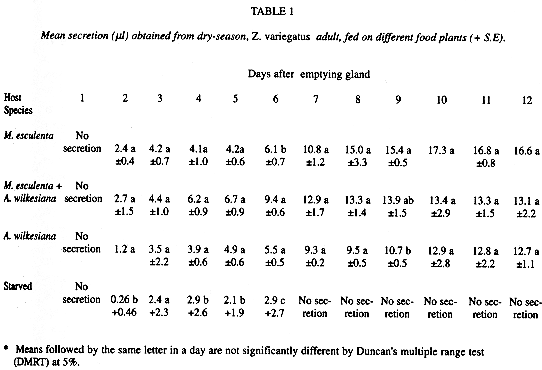
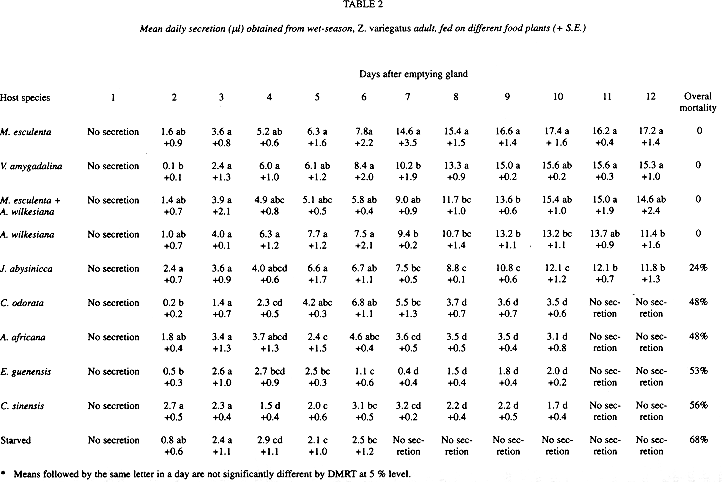
<body><![CDATA[<p><font face="Arial,Helvetica"><font size=-1>The initial trial effect of plants on secretion using dry-season adult <i>Z. variegatus</i> showed that the plants:&nbsp; <i>M.esculenta, A. wilkesiana</i> and the mixture of <i>M.esculenta</i> and <i>A. wilkesiana</i> all supported secretion production <a href="#tab1">(Table 1</a>). No secretion was obtained on the first day of the experiment. From days 8-12, <i>Z. variegatus</i> fed on <i>M. esculenta</i> recorded the highest mean daily secretion followed by those fed on <i>M.esculenta </i>and <i>A. wilkesiana</i> together while others fed on <i>A. wilkesiana</i> had the least for all the days. However, there was no significant differences in the mean daily secretion of dry-season adults fed on the three sets of plant except on days 6 and 9. Starved <i>Z.variegatus </i>secretion was low; inconsistent and there was no record for secretion from day 7 because of mortality of the starved insects. No death was recorded in the cages of insects with food plants.</font></font>     <p><font face="Arial,Helvetica"><font size=-1>On the other hand, there was relatively large variation in the volume of secretion of wet-season adult <i>Z. variegatus</i> fed on different plant species (<a href="#tab2">Table. 2)</a>. Thus, the plants could be placed into two broad categories (i) those that supported secretion namely <i>M. esculenta, A. wilkesiana, V. amygdalina, M. esculenta + A. wilkesiana </i>and<i> J. abysinica</i>, and (ii) those that did not favour secretion production:&nbsp; <i>C. odorata,&nbsp; A. africana, E.&nbsp; guinensis</i> and<i> C. sinenisis</i>. No secretion was obtained on the first day of the experiment Variation was recorded in the volume of secretion obtained from <i>Z. variegatus</i> fed on plants that supported secretion production as from day 8 with <i>M. esculenta</i> having the highest recorded volume of secretion, <i>A.wilkesiana</i> and <i>J. abysinica</i> had the lowest while <i>V. amygdalina</i> and <i>M. esculenta + A. wilkesiana</i> fed <i>Z. variegatus</i> were intermediate (<a href="#tab2">Table 2</a>). There was a consistent pattern in the volume of secretion,which gradually increased and reached a peak on the 10</font><sup><font size=-2>th</font></sup><font size=-1> day (<a href="#tab2">Table 2</a>). No secretion could be recorded for starved<i> Z. variegatus</i> from day 7-12 and those fed on <i>C. odorata, A. africana, E. guinensis</i> and <i>C. sinensis</i> on days 11 and 12 due to mortality (<a href="#tab2">Table 2)</a>. No mortality was recorded in population of grasshopper fed on <i>M. esculenta, V. amygdalina</i> and the mixed plants while mortality recorded for <i>A. wilkesiana</i> and <i>J. abysinica</i> was lower than those recorded for <i>C. odorata, A. africana, E. guinensis</i> and <i>C. sinensis</i>.</font></font>     <p><font face="Arial,Helvetica"><font size=-1>A comparison of mean volume of secretion obtained from adult <i>Z. variegatus</i> fed on <i>M. esculenta, A. wilkesiana</i> and mixture of <i>M. esculenta</i> and <i>A. wilkesiana</i> in both dry-and wet-seasons was carried out by means of ANOVA. Statistical analysis&nbsp; showed that there is no significant difference (P>0.05) in the volume of secretion of grasshopper of the two seasons fed on the different food plants except on days 8 and 9. Also, there was no significant difference in the volume of the daily secretion of adult <i>Z. variegatus</i> from wet- and dry seasons fed on the same set of plants when subjected to T-test analysis (P>0.05). Also season and food plants interaction on secretion was not significant (P>0.05).</font></font>     <center>     <p><a NAME="tab1"></a><img SRC="/img/fbpe/rbt/v49n2/1027ta1.GIF" height=370 width=542>     
<p><a NAME="tab2"></a><img SRC="/img/fbpe/rbt/v49n2/1027ta2.GIF" height=482 width=722></center>      
<p><b><font face="Arial,Helvetica"><font size=-1>Discussion</font></font></b>     <p><font face="Arial,Helvetica"><font size=-1>In the present study, a differential effect of food plants on the volume of secretion obtained from adult <i>Z.variegatus</i> was observed. This is in line with the findings of Bernays <i>et al. </i>(1975), McCaffery <i>et al.&nbsp;</i> (1978), and Tamu (1990) that food-plants have differential effect on the growth and post-embryonic development of <i>Z.variegatus.</i>This study has also shown that food plants also affect the production of secretion by the repellent gland of the insect. Plants that supported growth and development of the grasshopper also gave good secretion of repellent fluid, these plants include <i>M. esculenta,V. amygdalina,</i> mixture of <i>M. esculenta</i> and A. <i>wilkesiana; A. wilkesiana</i> and <i>J. abysnica</i> (<a href="#tab1">Table 1</a><a href="/revistas/49-2/idowu1/tablas.html">,</a><a href="#tab2">2)</a>. On the other hand, the present findings of low secretion and high mortality of <i>Z.variegatus</i> fed on <i>C. odorata,</i> <i>C. sinensis,A. africana, E. guinensis</i> agree with the postulation of McCaffery<i>et.al</i>. (1978) that the survival and development of grasshopper on these food plants used is poor. The results of differences obtained in the volume of secretion from adult <i>Z.variegatus</i> fed on different food plants may be linked to the efficiency of conversion of food materials to body substances. McCaffery <i>et.al.</i>(1978) had earlier reported that&nbsp; <i>Zonocerus </i>fed on<i> M. esculenta</i> had a greater efficiency of conversion of digested food to body substances, particularly during oocyte growth, than similar insects fed with other food plants such as <i>Citrus</i> and <i>Aspilia</i>. The efficiency of conversion of food substances to protein was amply demonstrated by the work of Tamu (1990) who found that <i>Zonocerus</i> fed on  <i>M. esculenta</i>, <i>V.amygdalina</i> had more protein in their haemolymph than those fed on <i>A.wilkesiana</i> or <i>C.odorata</i>.</font></font>     <p><font face="Arial,Helvetica"><font size=-1>In a related study, the analysis of the repellent secretion of insects fed on different food plants showed that the chemical constituents of the grasshopper`s secretion were similar (Idowu, in press). For example, a major constituents of the secretion, alkaloid was present irrespective of whether the chemical was present or absent in the food plant eaten by the insect. This contrary to the present study in which variation in the volume of secretion by <i>Zonocerus</i> fed on different food plants was observed. This probably indicate that the chemical constitution of the food plants might not have any necessary effect on the suitability of the plants as a favourable food for the production of secretion by thy repellent gland of&nbsp; <i>Z.variegatus.</i></font></font>     <p><font face="Arial,Helvetica"><font size=-1><i>M.esculenta </i>,<i> A.wilkesiana</i>, <i>C.sinesis</i> and <i>C.odorata</i> are among the commonest plants during the dry- and wet seasons in southern Nigeria. Studies have shown that <i>M.esculenta</i> growing in the field is not an acceptable food for <i>Zonocerus</i> at all developmental stages because of its distasteful hydrogen cyanide content. However, survival of all stages was found to be better, growth was faster and adult produced larger number of eggs within a shorter time when fed on excised cassava (Chapman <i>et.al</i>.1986). Although <i>C.odorata</i> thicket in the field is one of the favoured sites for oviposition by <i>Z.variegatus</i> and the insect is highly attracted to the inflorescenes of the exotic weed (Modder 1984), it is not a suitable food for the growth and the development of the grasshopper (McCaffery <i>et.al.</i>1978). No research work has been done on the suitability of the ornamental plant, <i>A.wilkesiana</i> growing in the field as a food plants of <i>Z.variegatus</i>. Laboratory feeding of <i>Zonocerus</i> on excised A.wilkesiana has shown that the plant supports the survival and the development of the insect (Modder W.W.D., pers.comm.).</font></font>     ]]></body>
<body><![CDATA[<p><font face="Arial,Helvetica"><font size=-1>The result of this present work confirms that not only does excised <i>M.esculenta</i> and <i>A.wilkesiana</i> support the survival of the insects, but also they support the production of repellent secretion of <i>Z.variegatus</i>.( McCaffery, <i>et.al. </i>1978) had earlier suggested that the success of the large dry season population of <i>Zonocerus</i> in southern Nigeria is probably due to the increase in cassava cultivation.</font></font>     <p><font face="Arial,Helvetica"><font size=-1>There was no difference in the volume of secretion obtained daily from dry- and wet-season adults of <i>Z.variegatus</i> fed on<i> M.esculenta</i>, <i>A.wilkesiana</i> and a mixture and a mixture of the two. The results indicated that the production of&nbsp; secretion by the repellent gland of <i>Zonocerus </i>fed on these food plants is similar whatever the season or the food plants.</font></font>     <p><font face="Arial,Helvetica"><font size=-1>The production of secretion by the repellent gland of <i>Zonocerus</i> is an important factor in the survival of the grasshopper as the repulsiveness of the secretion shield the grasshopper from invertebrate and vertebrate predators (Idowu 1997). The rate of recovery of the repellent secretion following a discharge is a key factor in the efficiency of the secretion as a defensive weapon. Thus, it is&nbsp; of a great adaptive significance for the grasshopper to feed on plants such as <i>M.esculenta</i> that will aid the refilling of its resevoir not long after a discharge.</font></font>     <br>&nbsp;     <p><b><font face="Arial,Helvetica"><font size=-1>Resumen</font></font></b>     <p><font face="Arial,Helvetica"><font size=-1>El volumen de secreci&oacute;n obtenida de adultos de <i>Zonocerus variegatus</i> (Orthoptera: Pyrgomorphidae) fue influenciado por el tipo de planta de alimento. Los insectos alimentados de hojas de casava Manihot esculenta, hojas &aacute;cidas de<i> Vernonia amygdalina</i> y una mezcla de <i>M.esculenta y Acalypha wilkesiana</i> dieron un voulumen bueno de secreci&oacute;n, mientras que <i>Chromolaena odorata</i>,<i> Elaeis guinensis, Aspilia africana y Citrus sinensis</i> no favorecieron la producci&oacute;n de secreci&oacute;n. No se encontr&oacute; diferencia significativa en el volumen de secreci&oacute;n obtenida de Z. variegatus en las dos estaciones independientemente de la planta de alimento. Similarmente, las plantas de alimento no dieron diferencia significativa en el volumen de secreci&oacute;n entre las dos estaciones.</font></font>     <br>&nbsp;     <p><font face="Arial,Helvetica"><font size=-1><b>References</b></font></font></p>     <!-- ref --><p><font face="Arial,Helvetica"><font size=-1>Bernays E.A., R.I. Chapman, A.G. Cook, L.G. McVeigh &amp; W.W. Page.1975. Food plants in the survival and development of <i>Zonocerus variegatus</i> (L) Acrida 4: 33-46.</font></font>&nbsp;&nbsp;&nbsp;&nbsp;&nbsp;&nbsp;&nbsp;&nbsp;[&#160;<a href="javascript:void(0);" onclick="javascript: window.open('/scielo.php?script=sci_nlinks&ref=1349919&pid=S0034-7744200100020002800001&lng=','','width=640,height=500,resizable=yes,scrollbars=1,menubar=yes,');">Links</a>&#160;]<!-- end-ref --><!-- ref --><p><font face="Arial,Helvetica"><font size=-1>Chapman R.F., W.W. Page &amp;&nbsp; A.R. McCaffery. 1986. Bionomics of the variegatus grasshopper (<i>Zonocerus variegatus</i>) in West and Central Africa. Ann. Rev. Entomol. 31: 479 -505.</font></font>&nbsp;&nbsp;&nbsp;&nbsp;&nbsp;&nbsp;&nbsp;&nbsp;[&#160;<a href="javascript:void(0);" onclick="javascript: window.open('/scielo.php?script=sci_nlinks&ref=1349920&pid=S0034-7744200100020002800002&lng=','','width=640,height=500,resizable=yes,scrollbars=1,menubar=yes,');">Links</a>&#160;]<!-- end-ref --><!-- ref --><p><font face="Arial,Helvetica"><font size=-1>Idowu, A. B.1994. Structural and Physiological studies on the repellent gland of the African pest grasshopper, <i>Zonocerus variegatus</i> (Orthoptera: Pyrgomorphidae).Ph.D. Thesis. University of Ibadan, Nigeria 212 p.</font></font>&nbsp;&nbsp;&nbsp;&nbsp;&nbsp;&nbsp;&nbsp;&nbsp;[&#160;<a href="javascript:void(0);" onclick="javascript: window.open('/scielo.php?script=sci_nlinks&ref=1349921&pid=S0034-7744200100020002800003&lng=','','width=640,height=500,resizable=yes,scrollbars=1,menubar=yes,');">Links</a>&#160;]<!-- end-ref --><!-- ref --><p><font face="Arial,Helvetica"><font size=-1>Idowu, A. B.1995. Structure of the repellent gland of <i>Zonocerus variegatus.</i> J. African Zool. 109: 247 -252.</font></font>    &nbsp;&nbsp;&nbsp;&nbsp;&nbsp;&nbsp;&nbsp;&nbsp;[&#160;<a href="javascript:void(0);" onclick="javascript: window.open('/scielo.php?script=sci_nlinks&ref=1349922&pid=S0034-7744200100020002800004&lng=','','width=640,height=500,resizable=yes,scrollbars=1,menubar=yes,');">Links</a>&#160;]<!-- end-ref --><!-- ref --><p><font face="Arial,Helvetica"><font size=-1>Idowu, A. B. 1996. The growth pattern of the repellent gland of <i>Zonocerus variegatus</i>. Biosci. Res. Comm. 8: 1 -6.</font></font>    &nbsp;&nbsp;&nbsp;&nbsp;&nbsp;&nbsp;&nbsp;&nbsp;[&#160;<a href="javascript:void(0);" onclick="javascript: window.open('/scielo.php?script=sci_nlinks&ref=1349923&pid=S0034-7744200100020002800005&lng=','','width=640,height=500,resizable=yes,scrollbars=1,menubar=yes,');">Links</a>&#160;]<!-- end-ref --><!-- ref --><p><font face="Arial,Helvetica"><font size=-1>Idowu, A.B. 1997. The defensive mechanism of <i>Zonocerus variegatus</i> (L). J. Afr. Zool.111: 199 -203.</font></font>    &nbsp;&nbsp;&nbsp;&nbsp;&nbsp;&nbsp;&nbsp;&nbsp;[&#160;<a href="javascript:void(0);" onclick="javascript: window.open('/scielo.php?script=sci_nlinks&ref=1349924&pid=S0034-7744200100020002800006&lng=','','width=640,height=500,resizable=yes,scrollbars=1,menubar=yes,');">Links</a>&#160;]<!-- end-ref --><!-- ref --><p><font face="Arial,Helvetica"><font size=-1>Idowu, A. B. &amp; W.W.D. Modder. 1998. Preliminary analyses of the chemical constituents of the repellent secretion of <i>Zonocerus variegatus</i> (L) (Orthoptera: Pyrgomorphidae). Insect Sci. Appl. 18: 107 -113</font></font>    &nbsp;&nbsp;&nbsp;&nbsp;&nbsp;&nbsp;&nbsp;&nbsp;[&#160;<a href="javascript:void(0);" onclick="javascript: window.open('/scielo.php?script=sci_nlinks&ref=1349925&pid=S0034-7744200100020002800007&lng=','','width=640,height=500,resizable=yes,scrollbars=1,menubar=yes,');">Links</a>&#160;]<!-- end-ref --><!-- ref --><p><font face="Arial,Helvetica"><font size=-1>Caffery A.R., A.G.Cook, W.W. Page &amp; T.J. Perfect. 1978. Utilization of food by <i>Zonocerus variegatu </i>(L) (Orthoptera: Acridoidea). Bull. Entomol. Res. 58: 589 -606.</font></font>    &nbsp;&nbsp;&nbsp;&nbsp;&nbsp;&nbsp;&nbsp;&nbsp;[&#160;<a href="javascript:void(0);" onclick="javascript: window.open('/scielo.php?script=sci_nlinks&ref=1349926&pid=S0034-7744200100020002800008&lng=','','width=640,height=500,resizable=yes,scrollbars=1,menubar=yes,');">Links</a>&#160;]<!-- end-ref --><!-- ref --><p><font face="Arial,Helvetica"><font size=-1>Modder, W.W.D. 1986. An integrated pest management strategy for the African grasshopper <i>Zonocerus variegatus</i>. Nigerian Field. 51: 41 -52.</font></font>    &nbsp;&nbsp;&nbsp;&nbsp;&nbsp;&nbsp;&nbsp;&nbsp;[&#160;<a href="javascript:void(0);" onclick="javascript: window.open('/scielo.php?script=sci_nlinks&ref=1349927&pid=S0034-7744200100020002800009&lng=','','width=640,height=500,resizable=yes,scrollbars=1,menubar=yes,');">Links</a>&#160;]<!-- end-ref --><!-- ref --><p><font face="Arial,Helvetica"><font size=-1>Tamu, G. 1990. Studies on feeding and food selection and oviposition in African pest grasshopper, <i>Zonocerus variegatus</i> (L) and possible strategies for its control. Ph.D.Thesis, University of Ibadan, Nigeria.</font></font>    &nbsp;&nbsp;&nbsp;&nbsp;&nbsp;&nbsp;&nbsp;&nbsp;[&#160;<a href="javascript:void(0);" onclick="javascript: window.open('/scielo.php?script=sci_nlinks&ref=1349928&pid=S0034-7744200100020002800010&lng=','','width=640,height=500,resizable=yes,scrollbars=1,menubar=yes,');">Links</a>&#160;]<!-- end-ref --><p><a NAME="1a"></a><font face="Arial,Helvetica"><font size=-1><sup><a href="#1">1</a></sup> Dept of&nbsp; Biological Sciences, University of Agriculture, Abeokuta,&nbsp; Nigeria. Fax:&nbsp; 234-39-242700; <a href="mailto:idowuab@unaab.edu.ng">idowuab@unaab.edu.ng</a></font></font>      ]]></body><back>
<ref-list>
<ref id="B1">
<nlm-citation citation-type="journal">
<person-group person-group-type="author">
<name>
<surname><![CDATA[Bernays]]></surname>
<given-names><![CDATA[E.A.]]></given-names>
</name>
<name>
<surname><![CDATA[Chapman]]></surname>
<given-names><![CDATA[R.I.]]></given-names>
</name>
<name>
<surname><![CDATA[Cook]]></surname>
<given-names><![CDATA[A.G.]]></given-names>
</name>
<name>
<surname><![CDATA[McVeigh]]></surname>
<given-names><![CDATA[L.G.]]></given-names>
</name>
<name>
<surname><![CDATA[Page]]></surname>
<given-names><![CDATA[W.W.]]></given-names>
</name>
</person-group>
<article-title xml:lang="en"><![CDATA[Food plants in the survival and development of Zonocerus variegatus (L)]]></article-title>
<source><![CDATA[Acrida]]></source>
<year>1975</year>
<volume>4</volume>
<page-range>33-46</page-range></nlm-citation>
</ref>
<ref id="B2">
<nlm-citation citation-type="journal">
<person-group person-group-type="author">
<name>
<surname><![CDATA[Chapman]]></surname>
<given-names><![CDATA[R.F.]]></given-names>
</name>
<name>
<surname><![CDATA[Page]]></surname>
<given-names><![CDATA[W.W.]]></given-names>
</name>
<name>
<surname><![CDATA[McCaffery]]></surname>
<given-names><![CDATA[A.R.]]></given-names>
</name>
</person-group>
<article-title xml:lang="en"><![CDATA[Bionomics of the variegatus grasshopper (Zonocerus variegatus) in West and Central Africa]]></article-title>
<source><![CDATA[Ann. Rev. Entomol.]]></source>
<year>1986</year>
<volume>31</volume>
<page-range>479 -505</page-range></nlm-citation>
</ref>
<ref id="B3">
<nlm-citation citation-type="">
<person-group person-group-type="author">
<name>
<surname><![CDATA[Idowu]]></surname>
<given-names><![CDATA[A. B.]]></given-names>
</name>
</person-group>
<source><![CDATA[Structural and Physiological studies on the repellent gland of the African pest grasshopper, Zonocerus variegatus (Orthoptera: Pyrgomorphidae)]]></source>
<year>1994</year>
<page-range>212</page-range></nlm-citation>
</ref>
<ref id="B4">
<nlm-citation citation-type="journal">
<person-group person-group-type="author">
<name>
<surname><![CDATA[Idowu]]></surname>
<given-names><![CDATA[A. B.]]></given-names>
</name>
</person-group>
<article-title xml:lang="en"><![CDATA[Structure of the repellent gland of Zonocerus variegatus]]></article-title>
<source><![CDATA[J. African Zool.]]></source>
<year>1995</year>
<volume>109</volume>
<page-range>247 -252</page-range></nlm-citation>
</ref>
<ref id="B5">
<nlm-citation citation-type="journal">
<person-group person-group-type="author">
<name>
<surname><![CDATA[Idowu]]></surname>
<given-names><![CDATA[A. B.]]></given-names>
</name>
</person-group>
<article-title xml:lang="en"><![CDATA[The growth pattern of the repellent gland of Zonocerus variegatus]]></article-title>
<source><![CDATA[Biosci. Res. Comm.]]></source>
<year>1996</year>
<volume>8</volume>
<page-range>1 -6</page-range></nlm-citation>
</ref>
<ref id="B6">
<nlm-citation citation-type="journal">
<person-group person-group-type="author">
<name>
<surname><![CDATA[Idowu]]></surname>
<given-names><![CDATA[A.B.]]></given-names>
</name>
</person-group>
<article-title xml:lang="en"><![CDATA[The defensive mechanism of Zonocerus variegatus (L)]]></article-title>
<source><![CDATA[J. Afr. Zool.]]></source>
<year>1997</year>
<volume>111</volume>
<page-range>199 -203</page-range></nlm-citation>
</ref>
<ref id="B7">
<nlm-citation citation-type="journal">
<person-group person-group-type="author">
<name>
<surname><![CDATA[Idowu]]></surname>
<given-names><![CDATA[A. B.]]></given-names>
</name>
<name>
<surname><![CDATA[Modder]]></surname>
<given-names><![CDATA[W.W.D.]]></given-names>
</name>
</person-group>
<article-title xml:lang="en"><![CDATA[Preliminary analyses of the chemical constituents of the repellent secretion of Zonocerus variegatus (L) (Orthoptera: Pyrgomorphidae)]]></article-title>
<source><![CDATA[Insect Sci. Appl.]]></source>
<year>1998</year>
<volume>18</volume>
<page-range>107 -113</page-range></nlm-citation>
</ref>
<ref id="B8">
<nlm-citation citation-type="journal">
<person-group person-group-type="author">
<name>
<surname><![CDATA[Caffery]]></surname>
<given-names><![CDATA[A.R.]]></given-names>
</name>
<name>
<surname><![CDATA[Cook]]></surname>
<given-names><![CDATA[A.G.]]></given-names>
</name>
<name>
<surname><![CDATA[Page]]></surname>
<given-names><![CDATA[W.W.]]></given-names>
</name>
<name>
<surname><![CDATA[Perfect]]></surname>
<given-names><![CDATA[T.J.]]></given-names>
</name>
</person-group>
<article-title xml:lang="en"><![CDATA[Utilization of food by Zonocerus variegatu (L) (Orthoptera: Acridoidea)]]></article-title>
<source><![CDATA[Bull. Entomol. Res.]]></source>
<year>1978</year>
<volume>58</volume>
<page-range>589 -606</page-range></nlm-citation>
</ref>
<ref id="B9">
<nlm-citation citation-type="journal">
<person-group person-group-type="author">
<name>
<surname><![CDATA[Modder]]></surname>
<given-names><![CDATA[W.W.D.]]></given-names>
</name>
</person-group>
<article-title xml:lang="en"><![CDATA[An integrated pest management strategy for the African grasshopper Zonocerus variegatus]]></article-title>
<source><![CDATA[Nigerian Field]]></source>
<year>1986</year>
<volume>51</volume>
<page-range>41 -52</page-range></nlm-citation>
</ref>
<ref id="B10">
<nlm-citation citation-type="">
<person-group person-group-type="author">
<name>
<surname><![CDATA[Tamu]]></surname>
<given-names><![CDATA[G.]]></given-names>
</name>
</person-group>
<source><![CDATA[Studies on feeding and food selection and oviposition in African pest grasshopper, Zonocerus variegatus (L) and possible strategies for its control]]></source>
<year>1990</year>
</nlm-citation>
</ref>
</ref-list>
</back>
</article>