<?xml version="1.0" encoding="ISO-8859-1"?><article xmlns:mml="http://www.w3.org/1998/Math/MathML" xmlns:xlink="http://www.w3.org/1999/xlink" xmlns:xsi="http://www.w3.org/2001/XMLSchema-instance">
<front>
<journal-meta>
<journal-id>0034-7744</journal-id>
<journal-title><![CDATA[Revista de Biología Tropical]]></journal-title>
<abbrev-journal-title><![CDATA[Rev. biol. trop]]></abbrev-journal-title>
<issn>0034-7744</issn>
<publisher>
<publisher-name><![CDATA[Universidad de Costa Rica]]></publisher-name>
</publisher>
</journal-meta>
<article-meta>
<article-id>S0034-77442001000200027</article-id>
<title-group>
<article-title xml:lang="en"><![CDATA[The attraction of Zonocerus variegatus (Orthoptera: Pyrgomorphidae) to different types of lure]]></article-title>
</title-group>
<contrib-group>
<contrib contrib-type="author">
<name>
<surname><![CDATA[Babatunde Idowu]]></surname>
<given-names><![CDATA[A.]]></given-names>
</name>
<xref ref-type="aff" rid="A01"/>
</contrib>
<contrib contrib-type="author">
<name>
<surname><![CDATA[Akinsete]]></surname>
<given-names><![CDATA[Alfred]]></given-names>
</name>
<xref ref-type="aff" rid="A02"/>
</contrib>
</contrib-group>
<aff id="A01">
<institution><![CDATA[,Department of Biological Sciences  ]]></institution>
<addr-line><![CDATA[ ]]></addr-line>
</aff>
<aff id="A02">
<institution><![CDATA[,University of Agriculture Department of Mathematical Science ]]></institution>
<addr-line><![CDATA[Abeokuta ]]></addr-line>
<country>Nigeria</country>
</aff>
<pub-date pub-type="pub">
<day>00</day>
<month>06</month>
<year>2001</year>
</pub-date>
<pub-date pub-type="epub">
<day>00</day>
<month>06</month>
<year>2001</year>
</pub-date>
<volume>49</volume>
<numero>2</numero>
<fpage>673</fpage>
<lpage>678</lpage>
<copyright-statement/>
<copyright-year/>
<self-uri xlink:href="http://www.scielo.sa.cr/scielo.php?script=sci_arttext&amp;pid=S0034-77442001000200027&amp;lng=en&amp;nrm=iso"></self-uri><self-uri xlink:href="http://www.scielo.sa.cr/scielo.php?script=sci_abstract&amp;pid=S0034-77442001000200027&amp;lng=en&amp;nrm=iso"></self-uri><self-uri xlink:href="http://www.scielo.sa.cr/scielo.php?script=sci_pdf&amp;pid=S0034-77442001000200027&amp;lng=en&amp;nrm=iso"></self-uri><abstract abstract-type="short" xml:lang="en"><p><![CDATA[Zonocerus variegatus is a common grasshopper in parts of west and equtorial Africa.The distribution in Nigeria extends from the lowland rainforest zone to the savannah in the north. The influence of lure on the behaviour of grasshopper inside cages (120 insect per cage) was investigated. Nymphs and adults of Zonocerus variegatus responded positively to intact leaves,crushed leaves and inflorescence of the common compositae weed Chromolaena odorata inside muslin bags, and intact plants. There were significant differences in the attraction recorded for starved nymphs, fed nymphs and starved adults. Attraction was more to intact leaves and is by olfaction. The increase in the attraction of starved nymphs is time dependent. Attraction to plant parts ceased after the plants were dried for 24 and 48 hours at room temperature and when plants were placed in transparent polythene bags. Gut motility and gut activity were higher during the day than at night. Nymphs, adults and egg pods placed separately inside muslin bags were not attractive to adults or nymphs.]]></p></abstract>
<abstract abstract-type="short" xml:lang="es"><p><![CDATA[Zococerus variegatus es un saltamontes común en partes de Africa ecuatorial y oeste. La distribución en Nigeria se extiende desde la zona baja del bosque lluvioso hasta la sabana en el norte. La influencia del cebo sobre el comportamiento del saltamontes dentro de las jaulas (120 insectos por jaula) fue investigada. Las ninfas y los adultos de Z. variegatus respondieron positivamente a hojas intactas, hojas aplastadas e inflorescencias de la hierba común compuesta Chromolaena odorata dentro de bolsas de muselina y a plantas intactas. Hubo diferencias significativas en la atracción registrada en ninfas mantenidas con hambre, ninfas alimentadas y adultos mantenidos con hambre. La atracción fue más hacia hojas intactas y fue por olfato. El aumento en la atracción de ninfas mantenidas con hambre fue tiempo-dependiente. La atracción a partes de plantas paró luego de que las plantas fueron secadas por 24 y 48 hr a temperatura ambiente y cuando las plantas fueron puestas en bolsas transparentes de polietileno. La motilidad y actividad del intestino fue más alta durante el día que la noche. La ninfas, adultos y masa de huevos puestos separadamente dentro de bolsas de muselina no fueron atractivos para adultos o ninfas.]]></p></abstract>
<kwd-group>
<kwd lng="la"><![CDATA[Z. variegatus]]></kwd>
<kwd lng="en"><![CDATA[attraction]]></kwd>
<kwd lng="en"><![CDATA[nymphs]]></kwd>
<kwd lng="en"><![CDATA[adult]]></kwd>
<kwd lng="en"><![CDATA[instars]]></kwd>
<kwd lng="la"><![CDATA[Chromoleana odorata]]></kwd>
<kwd lng="en"><![CDATA[behaviour]]></kwd>
</kwd-group>
</article-meta>
</front><body><![CDATA[ <center><b><font face="Arial,Helvetica">The attraction of <i>Zonocerus variegatus</i> (Orthoptera:&nbsp; Pyrgomorphidae) to different types of lure</font></b>     <p><b><font face="Arial,Helvetica"><font size=-1><sup>&nbsp;</sup>A. Babatunde Idowu&nbsp;<a NAME="1"></a></font></font></b><font face="Arial,Helvetica"><font size=-1><sup><a href="#1a">1</a></sup><b>&nbsp;&nbsp;&nbsp;&nbsp;&nbsp;&nbsp;&nbsp; Alfred Akinsete&nbsp;<a NAME="2"></a></b><sup><a href="#2a">2</a></sup></font></font>     <p><font face="Arial,Helvetica"><font size=-1>Received&nbsp; 9-XI-2000.&nbsp;&nbsp; Corrected&nbsp; 24-VIII-2000.&nbsp;&nbsp; Accepted&nbsp; 27-X-2000</font></font></center>      <p><b><font face="Arial,Helvetica"><font size=-1>Abstract</font></font></b>     <p><font face="Arial,Helvetica"><font size=-1><i>Zonocerus variegatus</i> is a common grasshopper in parts of west and equtorial Africa.The distribution in Nigeria extends from the lowland rainforest zone to the savannah in the north. The influence of lure on the behaviour of grasshopper inside cages (120 insect per cage) was investigated. Nymphs and adults of <i>Zonocerus variegatus</i> responded positively to intact leaves,crushed leaves and inflorescence of&nbsp; the common compositae weed <i>Chromolaena odorata</i> inside muslin bags, and intact plants. There were significant differences in the attraction recorded for starved nymphs, fed nymphs and starved adults. Attraction was more to intact leaves and is by olfaction.&nbsp; The increase in the attraction of starved nymphs is time dependent. Attraction to plant parts ceased after the plants were dried for 24 and 48 hours at room temperature and when plants were placed in transparent polythene bags. Gut motility and gut activity were higher during the day than at night. Nymphs, adults and egg pods placed separately inside muslin bags were not attractive to adults or nymphs.</font></font>     <p><b><font face="Arial,Helvetica"><font size=-1>Key words</font></font></b>     <p><font face="Arial,Helvetica"><font size=-1><i>Z. variegatus,</i> attraction, nymphs, adult, instars, <i>Chromoleana odorata</i>, behaviour.</font></font>     <br>&nbsp;     <p><font face="Arial,Helvetica"><font size=-1>Laboratory and field studies have provided evidence that plant volatiles could cause attraction and host plant recognition by insects either in situ or in vivo as extracts (Landotl 1993, Hossaert <i>et al.&nbsp;&nbsp; </i>1994). Attraction to the food plants is mostly by olfaction for long and short distances (Landolt 1993, Hossaert <i>et al.&nbsp;&nbsp; </i>1994). Evidences also abound that pheromones are important both in long-range and close-range mate choice; parapheromones may be very useful in pest management because of their influence on male mating success (Boake <i>et al.&nbsp;&nbsp; </i>1996).</font></font>     <p><font face="Arial,Helvetica"><font size=-1><i>&nbsp;Zonocerus variegatus,</i> like some other members of the family Pyrgomorphidae, is aposematically coloured, sequesters toxic chemicals from plants, and commonly lives in dense groups (Chapman <i>et al.&nbsp;&nbsp;</i> 1986). The insect feeds on a wide range of crops from plantation crops such as coffee and banana as well as a wide variety of subsistence crops, notably cassava and some weed plants (Chapman <i>et al.&nbsp;&nbsp; </i>1986). <i>Z variegatus</i> begins feeding in the morning when the temperature reaches about 26</font><sup><font size=-2>o</font></sup><font size=-1>C&nbsp; (Okere 1980) or 23</font><sup><font size=-2>o</font></sup><font size=-1>Cwith a slowing down at temperature over 35</font><sup><font size=-2>o</font></sup><font size=-1>C (Kaufmann 1965). Modder (1983) found out that confined nymphs of <i>Z.&nbsp; variegatus</i> have the ability to start active feeding in the morning at a temperature as low as 17<sup>o</sup>C and at the extreme massive feeding was recorded at 34<sup>o</sup>C. Later in the day (mostly in the evening), they have the ability of ascending to the tops of their food plants to roost.</font></font>     ]]></body>
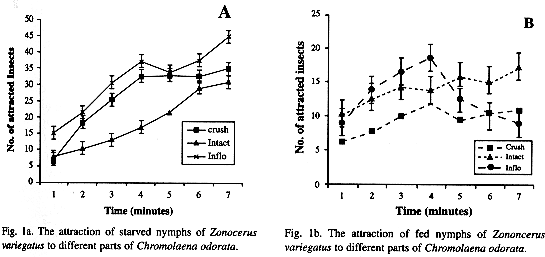
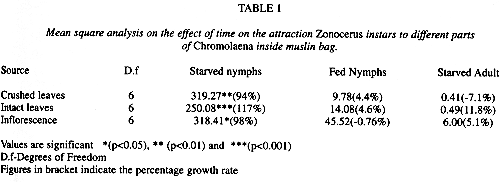
<body><![CDATA[<p><font face="Arial,Helvetica"><font size=-1>The result of the relationship between the Compositae weed, <i>Chromolaena odorata</i> and <i>Z. variegatus</i> supports that olfaction functions over short distances (Modder 1984). On the other hand, Kaufmann (1965) observed that <i>Z. variegatus</i> were attracted to vertically placed objects without discrimination between palatable and unpalatable plants provided they were within 7cm from where the objects were placed. She also observed that <i>Z. variegatus</i> is positively phototrophic and follows the movement of the sun in the cage. The present studies are aimed at determining the attraction of <i>Z. variegatus</i> to different parts of <i>Chromolaena odorata</i> (a plant that is fed upon by nymphs and serves as oviposition plants for adult <i>Z. variegatus</i> (Chapman <i>et al.&nbsp; </i>1986). The effect of certain factors on the attraction of the insects to plants will also be looked into.</font></font>     <br>&nbsp;     <p><b><font face="Arial,Helvetica"><font size=-1>Materials and Methods</font></font></b>     <p><font face="Arial,Helvetica"><font size=-1>Nymphs and adult instars of <i>Zonocerus variegatus</i> were collected from different sites inside the campus of University of Ibadan, Ibadan. The insects were kept in wire mesh cages (30 x 30 x 45cm) and fed daily on fresh leaves of <i>Acalypha wilkesiana</i> and <i>Manihot esculenta</i>. The insects were maintained at the natural photoperoids under room temperature of 29+ 2</font><sup><font size=-2>o</font></sup><font size=-1>C and normal relative humidity (79 – 85%). Egg pods of Z.<i>variegatus</i> were collected from the oviposition site at Ayepe in Oyo State and kept inside a polythene bag. Prior to the start of the experiment, the insects were starved for a minimum of twelve hours. Plants used for the experiments were collected 5-10 min before the from the field and kept inside a polythene bag before use. The egg pods were separated from adhering soil particles before use.</font></font>     <p><font face="Arial,Helvetica"><font size=-1>&nbsp;In the 1</font><sup><font size=-2>st</font></sup><font size=-1> set of experiments, the plant parts were placed in a muslin bag (7cm x 4cm) tied to the mouth with a thread and suspended along the outside of the cage farthest from the light. For the other experiment, the plants were placed inside a transparent polythene bag, tied also at the mouth and placed vertically inside a beaker, which was later placed inside the cage containing the insects. The egg pods, nymphs and adults were also placed separately inside muslin bags and suspended outside the cage. The experiment normally commenced at 10 a.m or 2 p.m, which coincide with the start of the feeding period of <i>Z. variegatus</i> (Modder 1983). Each experiment lasted for 30 min. The number of insects at the start of all the experiment was 120 and the number found at the site of the lure were counted and recorded at the interval of 5 min. The site in which the bag containing the lure was hanged represented the whole side of the cage.</font></font>     <p><font face="Arial,Helvetica"><font size=-1>In the 2</font><sup><font size=-2>nd</font></sup><font size=-1> set of experiments, <i>Zonocerus </i>attracted to the site of a lure were picked immediately as they arrived and kept inside a specimen bottle, containing 70% alcohol. At the end of the experiment equal number of non-attracted grasshoppers were picked and stored inside another bottle containing 70% alcohol. The insects were later dissected using a dissecting microscope and the content of the foregut noted. Foregut of insect was scored as either 4, 3, 2 or 1 depending on its degree of fullness. The state of the foregut fullness of <i>Zonocerus</i> instars in relation to period of the day was also carried out. Equal number of insects was collected from two cages, in one there was food and in the other were insects starved overnight. The insects were also dissected at the end of the experiment and the state/content of the foregut recorded. Other experiments included:&nbsp; (1) The response of <i>Zonocerus</i> to plants dried for 24 hr and 48 hr at room temperature and used as lure. (2) Intraspecific attraction in which either egg pods, nymphs or adults were placed inside muslin bag and used in attracting other insects.</font></font>     <br>&nbsp;     <p><b><font face="Arial,Helvetica"><font size=-1>Results</font></font></b>     <p><font face="Arial,Helvetica"><font size=-1>There was an immediate response of the starved nymphal instars of <i>Zonocerus variegatus</i> to the site of the lure containing different parts of <i>Chromolaena odorata</i> <a href="#img1ab">(Fig.1</a>). A steady increase in the number of insects that visited the site of the different lures during the course of the experiment was observed. There were significant differences in the numbers and accumulation&nbsp; of starved nymphs observed at the site of the different lures <a href="#tab1">(Table1</a>). Ranking by the numbers of insect that visited the lure and level of significance is as follows:&nbsp;&nbsp; intact leaves> crushed leaves> inflorescence <a href="#tab1">(Table 1</a>). ANOVA analysis of the result also showed that time was found to be positively and significantly associated with the number of starved nymphs attracted to the site of the different lures <a href="#tab1">(Table 1)</a>.</font></font>     <br>&nbsp;     ]]></body>
<body><![CDATA[<p>    <br>     <center>     <p><a NAME="img1ab"></a><img SRC="/img/fbpe/rbt/v49n2/1026i1ab.GIF" height=257 width=545>     
<p><a NAME="img1c"></a><img SRC="/img/fbpe/rbt/v49n2/1026i1c.GIF" height=241 width=489>     
<p><a NAME="tab1"></a><img SRC="/img/fbpe/rbt/v49n2/1026ta1.GIF" height=182 width=499>     
<p><a NAME="tab2"></a><img SRC="/img/fbpe/rbt/v49n2/1026ta2.GIF" height=124 width=357></center>      
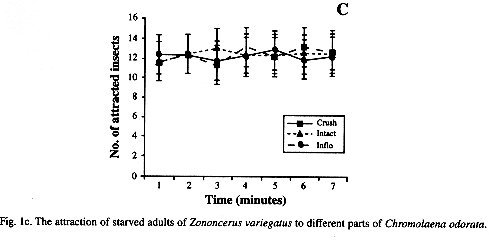
<p>    <br>     <p><font face="Arial,Helvetica"><font size=-1>Both fed nymphs and starved adults of <i>Z. variegatus</i> responded to the presence of the lures placed at the side of their cages at 0 hr. <a href="#img1c">(Fig.1)</a>. For the fed nymphal instars, there was a gradual increase in the number of insects at the site of the lures until the 15</font><sup><font size=-2>th</font></sup><font size=-1> minute when a drop was observed for the inflorescence and crushed leaves (<a href="#img1ab">Fig.1)</a>. The number of fed nymphs attracted to the crushed leaves later increased, while that of the inflorescence declined until the end of the experiment. There was no positive effect of time on the number of insects observed for fed nymphs and starved adults <a href="#tab1">(Table1)</a>.&nbsp; There was no significant difference in the number of fed nymphs and starved adults that visited the site of the lures <a href="#tab1">(Table 1)</a>.&nbsp; A comparison of the responses obtained from the three groups (starved nymphs, fed nymphs and starved adults) for each treatment showed significant differences (<a href="#tab2">Table 2).</a></font></font>     ]]></body>
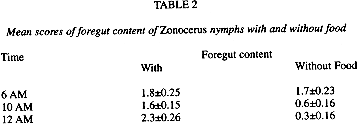
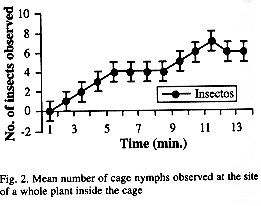
<body><![CDATA[<p><font face="Arial,Helvetica"><font size=-1>Nymphs and adults<i>, Zonocerus</i> were not attracted to the site of food plants like <i>Aspilia africana</i>, <i>Acalypha wilkesiana, Manihot esculenta</i> and <i>C. odorata</i> placed in transparent polythene bag. Attraction to these food plants ceased when they were dried for 24 hr. and 48 hr.</font></font>     <p><font face="Arial,Helvetica"><font size=-1>&nbsp;Eggpods, nymphs and adults placed separately in muslin bags did not cause the attraction of adults and nymphs. Initially, there was no response by the nymphs of <i>Zonocerus</i> to the uncovered whole plant placed inside a beaker in their cage. First visit was recorded from the 5</font><sup><font size=-2>th</font></sup><font size=-1> min and subsequently increased <a href="#img2">(Fig.2)</a>.</font></font>     <p><font face="Arial,Helvetica"><font size=-1>The contents of the foregut of non-attracted nymphs and adults were significantly higher than those of attracted nymphs and adults (P>0.005) Mean score was 1.6&plusmn;0.19 and 1.5&plusmn;0.28 for attracted nymphs and adults respectively while that of non-attracted nymphs and adults was 2.4&plusmn;0.25 and 2.6&plusmn;0.26. No significant difference existed between attracted nymphs and adults and also non–attracted nymphs and adults (t – test, P>/0.05).&nbsp; Scores of foregut of insects with and without food at 6 a.m were not significantly different (t – test, P>/0.05) <a href="#tab2">(Table 2)</a>.&nbsp; There was however a significant difference in the foregut content of nymphs with and without food picked separately at 10 a.m and 12 noon <a href="#tab2">(Table 2)</a>. A striking observation on Table 2 is that the scores of the foreguts of nymphs without food decreased with time.</font></font>     <center>     <p><a NAME="img2"></a><img SRC="/img/fbpe/rbt/v49n2/1026i2.GIF" height=206 width=261></center>      
<p><b><font face="Arial,Helvetica"><font size=-1>Discussion</font></font></b>     <p><font face="Arial,Helvetica"><font size=-1>The present study indicates that both nymphs and adults of <i>Zonocerus variegatus</i> whether starved or fed were attracted to the different parts of the plant <i>Chromolaena odorata</i> placed inside a muslin bag <a href="#img1ab">(Fig. 1)</a>. The attraction is olfactory. Studies have also shown that insects like <i>Rhipicephalus appendiculatus</i> (Hassan <i>et al.&nbsp; </i>1994) and <i>Trichogramma chilonis</i> (Boo and Yang 1998) were attractive to the odour of plants. Boo and Yang (1998) reported significant differences in the attraction of <i>T. chilonis</i> to the parts of the plants used as also observed in this study.&nbsp; Crushing of the leaves of <i>C. Odorata</i> did not have a significant effect on the attraction of the grasshopper just as it was observed for the attraction of <i>Trichoplusia </i>ni to cabbage leaves (Landolt 1993). Result of present studies showed that starvation had a positive impact on the attraction of <i>Zonocerus</i> nymphs to the different lures <a href="#tab1">(Table 1 </a><a href="/revistas/49-2/idowu2/tabla1.html">a</a><a href="#tab2">nd 2)</a>. Torr <i>et al.&nbsp; </i>(1995) had earlier reported that starvation has an increasing effect on the attraction of tsetseflies to plant odours.</font></font>     <p><font face="Arial,Helvetica"><font size=-1>&nbsp;Although, the nature of the chemical causing attraction to <i>C. odorata</i> is not known (Modder 1984), the plant is known to produce pyrrolizidine alkaloids (PAS) (Smith <i>et al.&nbsp; </i>1981). The ability of <i>Zonocerus</i> in sequestering PAS from their food plant has been reported (Bernays <i>et al</i>, 1977).&nbsp; Recent studies showed that the repellent secretion of <i>Z</i>. <i>variegatus</i> contains alkaloids biosynthesised in its repellent gland is similar to those found in the extracts of <i>C. odorata</i> (Idowu and Modder 1998). Based on these facts, it is possible to suggest that the main attractant of <i>Z. variegatus</i> to <i>C. odorata</i> is the alkaloid content which it later employs for its defense (Idowu 1997). The vertically placed plant in the cage supports the observation of Kaufman (1965) that grasshopper are attracted to vertically placed objects.</font></font>     <p><font face="Arial,Helvetica"><font size=-1>Our study also confirmed that gut motility and gut activity were higher during the day than the night (Modder 1983). It is doubtful if digestion occurs maximally at night as reported by Modder (1983) since no significant difference was observed in the score of the foregut content of nymphs with and without food overnight collected at 6 a.m <a href="#tab2">(Table 2</a>).</font></font>     <p><font face="Arial,Helvetica"><font size=-1>No pheromone attraction was observed in the present studies. Laboratory and fields studies had revealed lack of evidence for pheromone-mediated secondary attraction in the fir engraver, <i>Scolytus ventralis</i> (Macias-Samano <i>et al.&nbsp; </i>1998). Similarly, no pheromone attraction was demonstrated in <i>Cis glabratus</i>, in which males and females were both equally attracted to the odour of their host plant (Jonsson <i>et al. </i>1997).</font></font>     ]]></body>
<body><![CDATA[<p><font face="Arial,Helvetica"><font size=-1>The results of these studies are consistent with the alternative hypothesis that host selection and aggregation by <i>Z. variegatus</i> are mediated solely by primary attractants from the host plant as reported for <i>S. ventralis</i> (Macias-Samano <i>et al.&nbsp; </i>1998). It is concluded that the volatiles of <i>C</i>. <i>odorata</i> are important in host plant recognition by <i>Z. variegatus</i> and could be exploited as a tool in the biological control of the grasshopper.</font></font>     <br>&nbsp;     <p><b><font face="Arial,Helvetica"><font size=-1>Resumen</font></font></b>     <p><font face="Arial,Helvetica"><font size=-1><i>Zococerus variegatus</i> es un saltamontes com&uacute;n en partes de Africa ecuatorial y oeste. La distribuci&oacute;n en Nigeria se extiende desde la zona baja del bosque lluvioso hasta la sabana en el norte. La influencia del cebo sobre el comportamiento del saltamontes dentro de las jaulas (120 insectos por jaula) fue investigada. Las ninfas y los adultos de <i>Z. variegatus</i> respondieron positivamente a hojas intactas, hojas aplastadas e inflorescencias de la hierba com&uacute;n compuesta <i>Chromolaena odorata</i> dentro de bolsas de muselina y a plantas intactas. Hubo diferencias significativas en la atracci&oacute;n registrada en ninfas mantenidas con hambre, ninfas alimentadas y adultos mantenidos con hambre. La atracci&oacute;n fue m&aacute;s hacia hojas intactas y fue por olfato. El aumento en la atracci&oacute;n de ninfas mantenidas con hambre fue tiempo-dependiente. La atracci&oacute;n a partes de plantas par&oacute; luego de que las plantas fueron secadas por 24 y 48 hr a temperatura ambiente y cuando las plantas fueron puestas en bolsas transparentes de polietileno. La motilidad y actividad del intestino fue m&aacute;s alta&nbsp; durante el d&iacute;a que la noche. La ninfas, adultos y masa de huevos puestos separadamente dentro de bolsas de muselina no fueron atractivos para adultos o ninfas.</font></font>     <br>&nbsp;     <p><b><font face="Arial,Helvetica"><font size=-1>References</font></font></b>     <!-- ref --><p><font face="Arial,Helvetica"><font size=-1>Bernays E.A., R.F. Chapman, L.J. McVeigh L. J.&amp; W.W. Page. 1975. Food plants in the survival and development of <i>Zonocerus </i>v<i>ariegatus </i>(L). Acrida. 4:&nbsp; 33 – 46</font></font>    &nbsp;&nbsp;&nbsp;&nbsp;&nbsp;&nbsp;&nbsp;&nbsp;[&#160;<a href="javascript:void(0);" onclick="javascript: window.open('/scielo.php?script=sci_nlinks&ref=1348975&pid=S0034-7744200100020002700001&lng=','','width=640,height=500,resizable=yes,scrollbars=1,menubar=yes,');">Links</a>&#160;]<!-- end-ref --><!-- ref --><p><font face="Arial,Helvetica"><font size=-1>Bernays, E.A., R.F.Chapman,E.M. Leather,A.R. McCaffery &amp; W.W.D. Modder. 1977. There lationship of <i>Zonocerus variegtus</i> (L) (Acrodoidea:&nbsp; Pyrgomorphidae) with cassava (<i>Manihot esculeuta</i>) Bull. Entomol. Res. 67:&nbsp; 391 –404</font></font>    &nbsp;&nbsp;&nbsp;&nbsp;&nbsp;&nbsp;&nbsp;&nbsp;[&#160;<a href="javascript:void(0);" onclick="javascript: window.open('/scielo.php?script=sci_nlinks&ref=1348976&pid=S0034-7744200100020002700002&lng=','','width=640,height=500,resizable=yes,scrollbars=1,menubar=yes,');">Links</a>&#160;]<!-- end-ref --><!-- ref --><p><font face="Arial,Helvetica"><font size=-1>Boake C.R.B., T.E. Shelly &amp; K.Y. Kaneshiro. 1996. Sexual selection in relation to pest-management strategies Ann. Rev. Entomol. 41: 211-229</font></font>    &nbsp;&nbsp;&nbsp;&nbsp;&nbsp;&nbsp;&nbsp;&nbsp;[&#160;<a href="javascript:void(0);" onclick="javascript: window.open('/scielo.php?script=sci_nlinks&ref=1348977&pid=S0034-7744200100020002700003&lng=','','width=640,height=500,resizable=yes,scrollbars=1,menubar=yes,');">Links</a>&#160;]<!-- end-ref --><!-- ref --><p><font face="Arial,Helvetica"><font size=-1>Boo,&nbsp; K.S</font>`<font size=-1>., &amp;&nbsp; J.P. Yang. 1998. Olfactory response of <i>Trichogramma chilonis</i> to <i>Capsicum annuum</i> J. Asia Pacific Entomol. 1: 2, 123 -129.</font></font>    &nbsp;&nbsp;&nbsp;&nbsp;&nbsp;&nbsp;&nbsp;&nbsp;[&#160;<a href="javascript:void(0);" onclick="javascript: window.open('/scielo.php?script=sci_nlinks&ref=1348978&pid=S0034-7744200100020002700004&lng=','','width=640,height=500,resizable=yes,scrollbars=1,menubar=yes,');">Links</a>&#160;]<!-- end-ref --><!-- ref --><p><font face="Arial,Helvetica"><font size=-1>Chapman R.F., W.W. Page &amp;&nbsp; A. R. MacCaffery. 1986. Bionomics of the variegated grasshopper <i>Zonocerus variegatus</i> in west and central Africa. Ann. Rev. Entomol. 31:&nbsp; 479 – 505</font></font>    &nbsp;&nbsp;&nbsp;&nbsp;&nbsp;&nbsp;&nbsp;&nbsp;[&#160;<a href="javascript:void(0);" onclick="javascript: window.open('/scielo.php?script=sci_nlinks&ref=1348979&pid=S0034-7744200100020002700005&lng=','','width=640,height=500,resizable=yes,scrollbars=1,menubar=yes,');">Links</a>&#160;]<!-- end-ref --><!-- ref --><p><font face="Arial,Helvetica"><font size=-1>Hassan, S.M., O.O. Dipeolu &amp; M.M. Malonza. 1994. Natural attraction of livestock ticks by the leaves of a shrub. Trop. Anim. Health Produc. 26: 87-91</font></font>    &nbsp;&nbsp;&nbsp;&nbsp;&nbsp;&nbsp;&nbsp;&nbsp;[&#160;<a href="javascript:void(0);" onclick="javascript: window.open('/scielo.php?script=sci_nlinks&ref=1348980&pid=S0034-7744200100020002700006&lng=','','width=640,height=500,resizable=yes,scrollbars=1,menubar=yes,');">Links</a>&#160;]<!-- end-ref --><!-- ref --><p><font face="Arial,Helvetica"><font size=-1>Hossaert M., M. Gibernau &amp; J.E. Frey. 1994. Chemosensory attraction of figs wasps to substances produced by respective figs. Entomol. Exp. Appl. 70: 185-191</font></font>    &nbsp;&nbsp;&nbsp;&nbsp;&nbsp;&nbsp;&nbsp;&nbsp;[&#160;<a href="javascript:void(0);" onclick="javascript: window.open('/scielo.php?script=sci_nlinks&ref=1348981&pid=S0034-7744200100020002700007&lng=','','width=640,height=500,resizable=yes,scrollbars=1,menubar=yes,');">Links</a>&#160;]<!-- end-ref --><!-- ref --><p><font face="Arial,Helvetica"><font size=-1>Idowu A.B. 1997. The defensive mechanism <i>of Zonocerus variegatus </i>(L).&nbsp; J. Afr. Zool. 111:&nbsp; 199 -203</font></font>    &nbsp;&nbsp;&nbsp;&nbsp;&nbsp;&nbsp;&nbsp;&nbsp;[&#160;<a href="javascript:void(0);" onclick="javascript: window.open('/scielo.php?script=sci_nlinks&ref=1348982&pid=S0034-7744200100020002700008&lng=','','width=640,height=500,resizable=yes,scrollbars=1,menubar=yes,');">Links</a>&#160;]<!-- end-ref --><!-- ref --><p><font face="Arial,Helvetica"><font size=-1>Idowu A.B. &amp; W.W.D. Modder. 1998. Preliminary analyses of the chemical constituents of the repellent secretion of <i>Zonocerus variegatus</i> (Orthoptera:&nbsp; Prygomorphidae<i>). </i>Insect Sci. Appl.<i> </i>18: 107-113.</font></font>    &nbsp;&nbsp;&nbsp;&nbsp;&nbsp;&nbsp;&nbsp;&nbsp;[&#160;<a href="javascript:void(0);" onclick="javascript: window.open('/scielo.php?script=sci_nlinks&ref=1348983&pid=S0034-7744200100020002700009&lng=','','width=640,height=500,resizable=yes,scrollbars=1,menubar=yes,');">Links</a>&#160;]<!-- end-ref --><!-- ref --><p><font face="Arial,Helvetica"><font size=-1>&nbsp;Idowu, A.B. &amp; O.A. Idowu. 2000. The mode of action of the repellent gland of <i>Zonocerus variegatus </i>(Orthoptera:&nbsp; Prygomorphidae) Biosci. Res. Comm.: in press.</font></font>    &nbsp;&nbsp;&nbsp;&nbsp;&nbsp;&nbsp;&nbsp;&nbsp;[&#160;<a href="javascript:void(0);" onclick="javascript: window.open('/scielo.php?script=sci_nlinks&ref=1348984&pid=S0034-7744200100020002700010&lng=','','width=640,height=500,resizable=yes,scrollbars=1,menubar=yes,');">Links</a>&#160;]<!-- end-ref --><!-- ref --><p><font face="Arial,Helvetica"><font size=-1>Jonsson M., G. Nordlander &amp;&nbsp; M. Jonsell. 1997. Pheromones affecting flying beetles colonising the polypores <i>Fomes fomentarius</i> and <i>Fomitopsis pinicola</i> Entomol. Fennica. 8: 162-165.</font></font>    &nbsp;&nbsp;&nbsp;&nbsp;&nbsp;&nbsp;&nbsp;&nbsp;[&#160;<a href="javascript:void(0);" onclick="javascript: window.open('/scielo.php?script=sci_nlinks&ref=1348985&pid=S0034-7744200100020002700011&lng=','','width=640,height=500,resizable=yes,scrollbars=1,menubar=yes,');">Links</a>&#160;]<!-- end-ref --><!-- ref --><p><font face="Arial,Helvetica"><font size=-1>&nbsp;Kaufmann T. 1965. Observation on aggregation, migration and feeding habits of <i>Zonocerus variegatus </i>in Ghana (Orthoptera; Acrididae<u>)</u> Ann. Entomol. Soc. Ann. 58:&nbsp; 426 – 36.</font></font>    &nbsp;&nbsp;&nbsp;&nbsp;&nbsp;&nbsp;&nbsp;&nbsp;[&#160;<a href="javascript:void(0);" onclick="javascript: window.open('/scielo.php?script=sci_nlinks&ref=1348986&pid=S0034-7744200100020002700012&lng=','','width=640,height=500,resizable=yes,scrollbars=1,menubar=yes,');">Links</a>&#160;]<!-- end-ref --><!-- ref --><p><font face="Arial,Helvetica"><font size=-1>&nbsp;Landolt, P.J. 1993. Effects of host plant leaf damage on cabbage looper moth attraction and oviposition. Entomol. Exp. App. 67: 79 -85.</font></font>    &nbsp;&nbsp;&nbsp;&nbsp;&nbsp;&nbsp;&nbsp;&nbsp;[&#160;<a href="javascript:void(0);" onclick="javascript: window.open('/scielo.php?script=sci_nlinks&ref=1348987&pid=S0034-7744200100020002700013&lng=','','width=640,height=500,resizable=yes,scrollbars=1,menubar=yes,');">Links</a>&#160;]<!-- end-ref --><!-- ref --><p><font face="Arial,Helvetica"><font size=-1>&nbsp;Loughrin J.H., D.A Potter &amp; T.R Hamilton-Kemp.1998. Attraction of Japanese beetles (Coleoptera:&nbsp; Scarabaeidae) to host plant volatiles in field trapping experiments. Envir. Entomol. 27: 395-400.</font></font>    &nbsp;&nbsp;&nbsp;&nbsp;&nbsp;&nbsp;&nbsp;&nbsp;[&#160;<a href="javascript:void(0);" onclick="javascript: window.open('/scielo.php?script=sci_nlinks&ref=1348988&pid=S0034-7744200100020002700014&lng=','','width=640,height=500,resizable=yes,scrollbars=1,menubar=yes,');">Links</a>&#160;]<!-- end-ref --><!-- ref --><p><font face="Arial,Helvetica"><font size=-1>Macias-Samano, J.E., J.H. Borden, R. Gries, H.D Jr.Pierce &amp; G. Gries. 1998. Lack of evidence for pheromone-mediated secondary attraction in the fir engraver, <i>Scolytus ventralis</i> (Coleoptera:&nbsp; Scolytidae). J. Entomol. Soc. British Columbia 95: 117-125.</font></font>    &nbsp;&nbsp;&nbsp;&nbsp;&nbsp;&nbsp;&nbsp;&nbsp;[&#160;<a href="javascript:void(0);" onclick="javascript: window.open('/scielo.php?script=sci_nlinks&ref=1348989&pid=S0034-7744200100020002700015&lng=','','width=640,height=500,resizable=yes,scrollbars=1,menubar=yes,');">Links</a>&#160;]<!-- end-ref --><!-- ref --><p><font face="Arial,Helvetica"><font size=-1>&nbsp;McCaffery A. R.,&nbsp; A. G. Cook,&nbsp; W. W Page &amp;&nbsp; T. J. Perfect. 1978. Utilization of food by <i>Zonocerus variegatus</i> (L) (Orthoptera: Acrididea).Bull. Entomol. Res. 68:&nbsp; 589&nbsp; -606</font></font>    &nbsp;&nbsp;&nbsp;&nbsp;&nbsp;&nbsp;&nbsp;&nbsp;[&#160;<a href="javascript:void(0);" onclick="javascript: window.open('/scielo.php?script=sci_nlinks&ref=1348990&pid=S0034-7744200100020002700016&lng=','','width=640,height=500,resizable=yes,scrollbars=1,menubar=yes,');">Links</a>&#160;]<!-- end-ref --><!-- ref --><p><font face="Arial,Helvetica"><font size=-1>&nbsp;Modder, W.W.D. 1984. The attraction of <i>Zonocerus variegatus</i> (L) (Orthoptera:&nbsp; pyrgomorphidae) to the weed <i>Chromoleana odorata</i> and associated feeding behaviour. Bull. Entomol. Res. 74:&nbsp; 239 –247</font></font>    &nbsp;&nbsp;&nbsp;&nbsp;&nbsp;&nbsp;&nbsp;&nbsp;[&#160;<a href="javascript:void(0);" onclick="javascript: window.open('/scielo.php?script=sci_nlinks&ref=1348991&pid=S0034-7744200100020002700017&lng=','','width=640,height=500,resizable=yes,scrollbars=1,menubar=yes,');">Links</a>&#160;]<!-- end-ref --><!-- ref --><p><font face="Arial,Helvetica"><font size=-1>&nbsp;Modder W. W. D. 1983. Diurnal variation in feeding and gut activity in nymphs of the African pest, grasshopper <i>Zonocerus variegatus</i>. Insects. Sci. Appli. 5: 527 – 531</font></font>    &nbsp;&nbsp;&nbsp;&nbsp;&nbsp;&nbsp;&nbsp;&nbsp;[&#160;<a href="javascript:void(0);" onclick="javascript: window.open('/scielo.php?script=sci_nlinks&ref=1348992&pid=S0034-7744200100020002700018&lng=','','width=640,height=500,resizable=yes,scrollbars=1,menubar=yes,');">Links</a>&#160;]<!-- end-ref --><!-- ref --><p><font face="Arial,Helvetica"><font size=-1>Okere A. N. 1980. Studies on the biology of <i>Zonocerus variegatus</i> (L) (Orthoptera; Acridoidea) Ph. D Thesis, University of Ibadan, Nigeria</font></font>    &nbsp;&nbsp;&nbsp;&nbsp;&nbsp;&nbsp;&nbsp;&nbsp;[&#160;<a href="javascript:void(0);" onclick="javascript: window.open('/scielo.php?script=sci_nlinks&ref=1348993&pid=S0034-7744200100020002700019&lng=','','width=640,height=500,resizable=yes,scrollbars=1,menubar=yes,');">Links</a>&#160;]<!-- end-ref --><!-- ref --><p><font face="Arial,Helvetica"><font size=-1>Smith L. W., C. C. J. Culvenor. 1981. Plant sources of hepalotic pyrrolizidine alkaloids. J. Natur. Prod. 44: 129 - 52</font></font>    &nbsp;&nbsp;&nbsp;&nbsp;&nbsp;&nbsp;&nbsp;&nbsp;[&#160;<a href="javascript:void(0);" onclick="javascript: window.open('/scielo.php?script=sci_nlinks&ref=1348994&pid=S0034-7744200100020002700020&lng=','','width=640,height=500,resizable=yes,scrollbars=1,menubar=yes,');">Links</a>&#160;]<!-- end-ref --><!-- ref --><p><font face="Arial,Helvetica"><font size=-1>&nbsp;Torr S.J., D.R. Hall, J.L Smith. 1995. Responses of tsetseflies (Diptera: Glossinidae) to natural and synthetic ox odours. Bull. Entomo.l Res. 85: 157-166.</font></font>    &nbsp;&nbsp;&nbsp;&nbsp;&nbsp;&nbsp;&nbsp;&nbsp;[&#160;<a href="javascript:void(0);" onclick="javascript: window.open('/scielo.php?script=sci_nlinks&ref=1348995&pid=S0034-7744200100020002700021&lng=','','width=640,height=500,resizable=yes,scrollbars=1,menubar=yes,');">Links</a>&#160;]<!-- end-ref --><p><a NAME="1a"></a><font face="Arial,Helvetica"><font size=-1><sup><a href="#1">1</a></sup>Department of Biological Sciences.</font></font>     <p><a NAME="2a"></a><sup><font face="Arial,Helvetica"><font size=-1><a href="#2">2</a> </font></font></sup><font face="Arial,Helvetica"><font size=-1>Department of Mathematical Science, University of Agriculture, Abeokuta, Nigeria.&nbsp; Fax:&nbsp;&nbsp; 234-39-242700&nbsp; E-mail: idowuab@unaab.edu.ng</font></font>      ]]></body><back>
<ref-list>
<ref id="B1">
<nlm-citation citation-type="journal">
<person-group person-group-type="author">
<name>
<surname><![CDATA[Bernays]]></surname>
<given-names><![CDATA[E.A.]]></given-names>
</name>
<name>
<surname><![CDATA[Chapman]]></surname>
<given-names><![CDATA[R.F.]]></given-names>
</name>
<name>
<surname><![CDATA[McVeigh]]></surname>
<given-names><![CDATA[L.J.]]></given-names>
</name>
<name>
<surname><![CDATA[Page]]></surname>
<given-names><![CDATA[W.W.]]></given-names>
</name>
</person-group>
<article-title xml:lang="en"><![CDATA[Food plants in the survival and development of Zonocerus variegatus (L)]]></article-title>
<source><![CDATA[Acrida]]></source>
<year>1975</year>
<volume>4</volume>
<page-range>33 - 46</page-range></nlm-citation>
</ref>
<ref id="B2">
<nlm-citation citation-type="journal">
<person-group person-group-type="author">
<name>
<surname><![CDATA[Bernays]]></surname>
<given-names><![CDATA[E.A.]]></given-names>
</name>
<name>
<surname><![CDATA[Chapman]]></surname>
<given-names><![CDATA[R.F.]]></given-names>
</name>
<name>
<surname><![CDATA[Leather]]></surname>
<given-names><![CDATA[E.M.]]></given-names>
</name>
<name>
<surname><![CDATA[McCaffery]]></surname>
<given-names><![CDATA[A.R.]]></given-names>
</name>
<name>
<surname><![CDATA[Modder]]></surname>
<given-names><![CDATA[W.W.D.]]></given-names>
</name>
</person-group>
<article-title xml:lang="en"><![CDATA[There lationship of Zonocerus variegtus (L) (Acrodoidea: Pyrgomorphidae) with cassava (Manihot esculeuta)]]></article-title>
<source><![CDATA[Bull. Entomol. Res.]]></source>
<year>1977</year>
<volume>67</volume>
<page-range>391 -404</page-range></nlm-citation>
</ref>
<ref id="B3">
<nlm-citation citation-type="journal">
<person-group person-group-type="author">
<name>
<surname><![CDATA[Boake]]></surname>
<given-names><![CDATA[C.R.B.]]></given-names>
</name>
<name>
<surname><![CDATA[Shelly]]></surname>
<given-names><![CDATA[T.E.]]></given-names>
</name>
<name>
<surname><![CDATA[Kaneshiro]]></surname>
<given-names><![CDATA[K.Y.]]></given-names>
</name>
</person-group>
<article-title xml:lang="en"><![CDATA[Sexual selection in relation to pest-management strategies]]></article-title>
<source><![CDATA[Ann. Rev. Entomol.]]></source>
<year>1996</year>
<volume>41</volume>
<page-range>211-229</page-range></nlm-citation>
</ref>
<ref id="B4">
<nlm-citation citation-type="journal">
<person-group person-group-type="author">
<name>
<surname><![CDATA[Boo]]></surname>
<given-names><![CDATA[K.S]]></given-names>
</name>
<name>
<surname><![CDATA[Yang]]></surname>
<given-names><![CDATA[J.P.]]></given-names>
</name>
</person-group>
<article-title xml:lang="en"><![CDATA[Olfactory response of Trichogramma chilonis to Capsicum annuum]]></article-title>
<source><![CDATA[J. Asia Pacific Entomol.]]></source>
<year>1998</year>
<volume>1</volume>
<page-range>2, 123 -129</page-range></nlm-citation>
</ref>
<ref id="B5">
<nlm-citation citation-type="journal">
<person-group person-group-type="author">
<name>
<surname><![CDATA[Chapman]]></surname>
<given-names><![CDATA[R.F.]]></given-names>
</name>
<name>
<surname><![CDATA[Page]]></surname>
<given-names><![CDATA[W.W.]]></given-names>
</name>
<name>
<surname><![CDATA[MacCaffery]]></surname>
<given-names><![CDATA[A. R.]]></given-names>
</name>
</person-group>
<article-title xml:lang="en"><![CDATA[Bionomics of the variegated grasshopper Zonocerus variegatus in west and central Africa]]></article-title>
<source><![CDATA[Ann. Rev. Entomol.]]></source>
<year>1986</year>
<volume>31</volume>
<page-range>479 - 505</page-range></nlm-citation>
</ref>
<ref id="B6">
<nlm-citation citation-type="journal">
<person-group person-group-type="author">
<name>
<surname><![CDATA[Hassan]]></surname>
<given-names><![CDATA[S.M.]]></given-names>
</name>
<name>
<surname><![CDATA[Dipeolu]]></surname>
<given-names><![CDATA[O.O.]]></given-names>
</name>
<name>
<surname><![CDATA[Malonza]]></surname>
<given-names><![CDATA[M.M.]]></given-names>
</name>
</person-group>
<article-title xml:lang="en"><![CDATA[Natural attraction of livestock ticks by the leaves of a shrub]]></article-title>
<source><![CDATA[Trop. Anim. Health Produc.]]></source>
<year>1994</year>
<volume>26</volume>
<page-range>87-91</page-range></nlm-citation>
</ref>
<ref id="B7">
<nlm-citation citation-type="journal">
<person-group person-group-type="author">
<name>
<surname><![CDATA[Hossaert]]></surname>
<given-names><![CDATA[M.]]></given-names>
</name>
<name>
<surname><![CDATA[Gibernau]]></surname>
<given-names><![CDATA[M.]]></given-names>
</name>
<name>
<surname><![CDATA[Frey]]></surname>
<given-names><![CDATA[J.E.]]></given-names>
</name>
</person-group>
<article-title xml:lang="en"><![CDATA[Chemosensory attraction of figs wasps to substances produced by respective figs]]></article-title>
<source><![CDATA[Entomol. Exp. Appl.]]></source>
<year>1994</year>
<volume>70</volume>
<page-range>185-191</page-range></nlm-citation>
</ref>
<ref id="B8">
<nlm-citation citation-type="journal">
<person-group person-group-type="author">
<name>
<surname><![CDATA[Idowu]]></surname>
<given-names><![CDATA[A.B.]]></given-names>
</name>
</person-group>
<article-title xml:lang="en"><![CDATA[The defensive mechanism of Zonocerus variegatus (L)]]></article-title>
<source><![CDATA[J. Afr. Zool]]></source>
<year>1997</year>
<volume>111</volume>
<page-range>199 -203</page-range></nlm-citation>
</ref>
<ref id="B9">
<nlm-citation citation-type="journal">
<person-group person-group-type="author">
<name>
<surname><![CDATA[Idowu]]></surname>
<given-names><![CDATA[A.B.]]></given-names>
</name>
<name>
<surname><![CDATA[Modder]]></surname>
<given-names><![CDATA[W.W.D.]]></given-names>
</name>
</person-group>
<article-title xml:lang="en"><![CDATA[Preliminary analyses of the chemical constituents of the repellent secretion of Zonocerus variegatus (Orthoptera: Prygomorphidae)]]></article-title>
<source><![CDATA[Insect Sci. Appl]]></source>
<year>1998</year>
<volume>18</volume>
<page-range>107-113</page-range></nlm-citation>
</ref>
<ref id="B10">
<nlm-citation citation-type="journal">
<person-group person-group-type="author">
<name>
<surname><![CDATA[Idowu]]></surname>
<given-names><![CDATA[A.B.]]></given-names>
</name>
<name>
<surname><![CDATA[Idowu]]></surname>
<given-names><![CDATA[O.A.]]></given-names>
</name>
</person-group>
<article-title xml:lang="en"><![CDATA[The mode of action of the repellent gland of Zonocerus variegatus (Orthoptera: Prygomorphidae) Biosci]]></article-title>
<source><![CDATA[Res. Comm]]></source>
<year>2000</year>
</nlm-citation>
</ref>
<ref id="B11">
<nlm-citation citation-type="journal">
<person-group person-group-type="author">
<name>
<surname><![CDATA[Jonsson]]></surname>
<given-names><![CDATA[M.]]></given-names>
</name>
<name>
<surname><![CDATA[Nordlander]]></surname>
<given-names><![CDATA[G.]]></given-names>
</name>
<name>
<surname><![CDATA[Jonsell]]></surname>
<given-names><![CDATA[M.]]></given-names>
</name>
</person-group>
<article-title xml:lang="en"><![CDATA[Pheromones affecting flying beetles colonising the polypores Fomes fomentarius and Fomitopsis pinicola]]></article-title>
<source><![CDATA[Entomol. Fennica]]></source>
<year>1997</year>
<volume>8</volume>
<page-range>162-165</page-range></nlm-citation>
</ref>
<ref id="B12">
<nlm-citation citation-type="journal">
<person-group person-group-type="author">
<name>
<surname><![CDATA[Kaufmann]]></surname>
<given-names><![CDATA[T.]]></given-names>
</name>
</person-group>
<article-title xml:lang="en"><![CDATA[Observation on aggregation, migration and feeding habits of Zonocerus variegatus in Ghana (Orthoptera; Acrididae)]]></article-title>
<source><![CDATA[Ann. Entomol. Soc. Ann.]]></source>
<year>1965</year>
<volume>58</volume>
<page-range>426 - 36</page-range></nlm-citation>
</ref>
<ref id="B13">
<nlm-citation citation-type="journal">
<person-group person-group-type="author">
<name>
<surname><![CDATA[Landolt]]></surname>
<given-names><![CDATA[P.J.]]></given-names>
</name>
</person-group>
<article-title xml:lang="en"><![CDATA[Effects of host plant leaf damage on cabbage looper moth attraction and oviposition]]></article-title>
<source><![CDATA[Entomol. Exp. App.]]></source>
<year>1993</year>
<volume>67</volume>
<page-range>79 -85</page-range></nlm-citation>
</ref>
<ref id="B14">
<nlm-citation citation-type="journal">
<person-group person-group-type="author">
<name>
<surname><![CDATA[Loughrin]]></surname>
<given-names><![CDATA[J.H.]]></given-names>
</name>
<name>
<surname><![CDATA[Potter]]></surname>
<given-names><![CDATA[D.A]]></given-names>
</name>
<name>
<surname><![CDATA[Hamilton-Kemp]]></surname>
<given-names><![CDATA[T.R]]></given-names>
</name>
</person-group>
<article-title xml:lang="en"><![CDATA[Attraction of Japanese beetles (Coleoptera: Scarabaeidae) to host plant volatiles in field trapping experiments]]></article-title>
<source><![CDATA[Envir. Entomol.]]></source>
<year>1998</year>
<volume>27</volume>
<page-range>395-400</page-range></nlm-citation>
</ref>
<ref id="B15">
<nlm-citation citation-type="journal">
<person-group person-group-type="author">
<name>
<surname><![CDATA[Macias-Samano]]></surname>
<given-names><![CDATA[J.E.]]></given-names>
</name>
<name>
<surname><![CDATA[Borden]]></surname>
<given-names><![CDATA[J.H.]]></given-names>
</name>
<name>
<surname><![CDATA[Gries]]></surname>
<given-names><![CDATA[R.]]></given-names>
</name>
<name>
<surname><![CDATA[Jr.Pierce]]></surname>
<given-names><![CDATA[H.D]]></given-names>
</name>
<name>
<surname><![CDATA[Gries]]></surname>
<given-names><![CDATA[G.]]></given-names>
</name>
</person-group>
<article-title xml:lang="en"><![CDATA[Lack of evidence for pheromone-mediated secondary attraction in the fir engraver, Scolytus ventralis (Coleoptera: Scolytidae)]]></article-title>
<source><![CDATA[J. Entomol. Soc. British Columbia]]></source>
<year>1998</year>
<volume>95</volume>
<page-range>117-125</page-range></nlm-citation>
</ref>
<ref id="B16">
<nlm-citation citation-type="journal">
<person-group person-group-type="author">
<name>
<surname><![CDATA[McCaffery]]></surname>
<given-names><![CDATA[A. R.]]></given-names>
</name>
<name>
<surname><![CDATA[Cook]]></surname>
<given-names><![CDATA[A. G.]]></given-names>
</name>
<name>
<surname><![CDATA[Page]]></surname>
<given-names><![CDATA[W. W]]></given-names>
</name>
<name>
<surname><![CDATA[Perfect]]></surname>
<given-names><![CDATA[T. J.]]></given-names>
</name>
</person-group>
<article-title xml:lang="en"><![CDATA[Utilization of food by Zonocerus variegatus (L) (Orthoptera: Acrididea)]]></article-title>
<source><![CDATA[Bull. Entomol. Res.]]></source>
<year>1978</year>
<volume>68</volume>
<page-range>589 -606</page-range></nlm-citation>
</ref>
<ref id="B17">
<nlm-citation citation-type="journal">
<person-group person-group-type="author">
<name>
<surname><![CDATA[Modder]]></surname>
<given-names><![CDATA[W.W.D.]]></given-names>
</name>
</person-group>
<article-title xml:lang="en"><![CDATA[The attraction of Zonocerus variegatus (L) (Orthoptera: pyrgomorphidae) to the weed Chromoleana odorata and associated feeding behaviour]]></article-title>
<source><![CDATA[Bull. Entomol. Res.]]></source>
<year>1984</year>
<volume>74</volume>
<page-range>239 -247</page-range></nlm-citation>
</ref>
<ref id="B18">
<nlm-citation citation-type="journal">
<person-group person-group-type="author">
<name>
<surname><![CDATA[Modder]]></surname>
<given-names><![CDATA[W. W. D.]]></given-names>
</name>
</person-group>
<article-title xml:lang="en"><![CDATA[Diurnal variation in feeding and gut activity in nymphs of the African pest, grasshopper Zonocerus variegatus. Insects]]></article-title>
<source><![CDATA[Sci. Appli.]]></source>
<year>1983</year>
<volume>5</volume>
<page-range>527 - 531</page-range></nlm-citation>
</ref>
<ref id="B19">
<nlm-citation citation-type="">
<person-group person-group-type="author">
<name>
<surname><![CDATA[Okere]]></surname>
<given-names><![CDATA[A. N.]]></given-names>
</name>
</person-group>
<source><![CDATA[Studies on the biology of Zonocerus variegatus (L) (Orthoptera; Acridoidea)]]></source>
<year>1980</year>
</nlm-citation>
</ref>
<ref id="B20">
<nlm-citation citation-type="journal">
<person-group person-group-type="author">
<name>
<surname><![CDATA[Smith]]></surname>
<given-names><![CDATA[L. W.]]></given-names>
</name>
<name>
<surname><![CDATA[Culvenor]]></surname>
<given-names><![CDATA[C. C. J.]]></given-names>
</name>
</person-group>
<article-title xml:lang="en"><![CDATA[Plant sources of hepalotic pyrrolizidine alkaloids]]></article-title>
<source><![CDATA[J. Natur. Prod]]></source>
<year>1981</year>
<volume>44</volume>
<page-range>129 - 52</page-range></nlm-citation>
</ref>
<ref id="B21">
<nlm-citation citation-type="journal">
<person-group person-group-type="author">
<name>
<surname><![CDATA[Torr]]></surname>
<given-names><![CDATA[S.J.]]></given-names>
</name>
<name>
<surname><![CDATA[Hall]]></surname>
<given-names><![CDATA[D.R.]]></given-names>
</name>
<name>
<surname><![CDATA[Smith]]></surname>
<given-names><![CDATA[J.L]]></given-names>
</name>
</person-group>
<article-title xml:lang="en"><![CDATA[Responses of tsetseflies (Diptera: Glossinidae) to natural and synthetic ox odours]]></article-title>
<source><![CDATA[Bull. Entomo.l Res]]></source>
<year>1995</year>
<volume>85</volume>
<page-range>157-166</page-range></nlm-citation>
</ref>
</ref-list>
</back>
</article>