<?xml version="1.0" encoding="ISO-8859-1"?><article xmlns:mml="http://www.w3.org/1998/Math/MathML" xmlns:xlink="http://www.w3.org/1999/xlink" xmlns:xsi="http://www.w3.org/2001/XMLSchema-instance">
<front>
<journal-meta>
<journal-id>0034-7744</journal-id>
<journal-title><![CDATA[Revista de Biología Tropical]]></journal-title>
<abbrev-journal-title><![CDATA[Rev. biol. trop]]></abbrev-journal-title>
<issn>0034-7744</issn>
<publisher>
<publisher-name><![CDATA[Universidad de Costa Rica]]></publisher-name>
</publisher>
</journal-meta>
<article-meta>
<article-id>S0034-77442001000200026</article-id>
<title-group>
<article-title xml:lang="en"><![CDATA[Cetacean strandings in Costa Rica (1966-1999)]]></article-title>
</title-group>
<contrib-group>
<contrib contrib-type="author">
<name>
<surname><![CDATA[Rodríguez-Fonseca]]></surname>
<given-names><![CDATA[Javier]]></given-names>
</name>
<xref ref-type="aff" rid="A01"/>
</contrib>
<contrib contrib-type="author">
<name>
<surname><![CDATA[Cubero-Pardo]]></surname>
<given-names><![CDATA[Priscilla]]></given-names>
</name>
<xref ref-type="aff" rid="A01"/>
</contrib>
</contrib-group>
<aff id="A01">
<institution><![CDATA[,Centro de Proyección del Ambiente Marino  ]]></institution>
<addr-line><![CDATA[San José ]]></addr-line>
<country>Costa Rica</country>
</aff>
<pub-date pub-type="pub">
<day>00</day>
<month>06</month>
<year>2001</year>
</pub-date>
<pub-date pub-type="epub">
<day>00</day>
<month>06</month>
<year>2001</year>
</pub-date>
<volume>49</volume>
<numero>2</numero>
<fpage>667</fpage>
<lpage>672</lpage>
<copyright-statement/>
<copyright-year/>
<self-uri xlink:href="http://www.scielo.sa.cr/scielo.php?script=sci_arttext&amp;pid=S0034-77442001000200026&amp;lng=en&amp;nrm=iso"></self-uri><self-uri xlink:href="http://www.scielo.sa.cr/scielo.php?script=sci_abstract&amp;pid=S0034-77442001000200026&amp;lng=en&amp;nrm=iso"></self-uri><self-uri xlink:href="http://www.scielo.sa.cr/scielo.php?script=sci_pdf&amp;pid=S0034-77442001000200026&amp;lng=en&amp;nrm=iso"></self-uri><abstract abstract-type="short" xml:lang="en"><p><![CDATA[Cetacean strandings in Costa Rica are reported for a period of 33 years, with a total of 35 strandings, 13 species and 247 individuals involved. The vast majority of documented strandings occurred on the Pacific coast and correspond to single individuals (32 and 28 strandings respectively). The highest stranding number was in the period from 1990 to 1999 (n=24). Physeter catodon (cachalot or sperm whale) is the species with the highest frequency of strandings (n=8) and the family Delphinidae has the majority of species (n=8) and strandings (n=22). No other general tendencies were determined with the existing data.]]></p></abstract>
<abstract abstract-type="short" xml:lang="es"><p><![CDATA[Se informan los casos de encallamientos de cetáceos en Costa Rica. Un total de 35 casos conocidos para 13 especies involucradas y un total de 247 individuos. La gran mayoría de los casos provienen de la costa Pacífica (32) y 28 corresponden a encallamientos individuales. El cachalote, Physeter catodon, es la especie con mayor frecuencia de encallamientos (8) y la familia Delphinidae abarca la mayor cantidad de especies involucradas (8) y de casos de encallamientos (22). No se determinó ninguna otra tendencia general con la información disponible.]]></p></abstract>
<kwd-group>
<kwd lng="en"><![CDATA[Cetacea]]></kwd>
<kwd lng="en"><![CDATA[strandings]]></kwd>
<kwd lng="es"><![CDATA[Costa Rica]]></kwd>
</kwd-group>
</article-meta>
</front><body><![CDATA[ <center>  <b><font face="Arial,Helvetica"><font size=-1>Cetacean strandings in Costa Rica (1966-1999)</font></font></b></center>      <center><font face="Arial,Helvetica"><font size=-1><b>Javier Rodr&iacute;guez-Fonseca&nbsp;&nbsp; y&nbsp;&nbsp;&nbsp; Priscilla Cubero-Pardo<a NAME="1"></a></b><sup><a href="#1a">1</a></sup></font></font></center> &nbsp;.     <center><font face="Arial,Helvetica"><font size=-1>Received 22-VI-1999.&nbsp; Corrected 5-VI-2000.&nbsp; Accepted&nbsp; 23-X-2000</font></font></center>      <p><b><font face="Arial,Helvetica"><font size=-1>Abstract</font></font></b>     <p><font face="Arial,Helvetica"><font size=-1>Cetacean strandings in Costa Rica are reported for a period of 33 years, with a total of 35 strandings, 13 species and 247 individuals involved. The vast majority of documented strandings occurred on the Pacific coast and correspond to single individuals (32 and 28 strandings respectively). The highest stranding number was in the period from 1990 to 1999 (n=24). <i>Physeter catodon</i> (cachalot or sperm whale) is the species with the highest frequency of strandings (n=8) and the family Delphinidae has the majority of species (n=8) and strandings (n=22). No other general tendencies were determined with the existing data.</font></font>     <br>&nbsp;     <p><b><font face="Arial,Helvetica"><font size=-1>Key words</font></font></b>     <p><font face="Arial,Helvetica"><font size=-1>Cetacea, strandings, Costa Rica.</font></font>     <br>&nbsp;     <p><font face="Arial,Helvetica"><font size=-1>The act of cetaceans (whales and dolphins), sirenians (manatee) and pinnipeds (seals, sea lions and their relatives) coming on to land, dead or alive, accidental or intentional, is known as a stranding (Jefferson <i>et al. </i>1994). Several factors can cause such events.</font></font>     ]]></body>
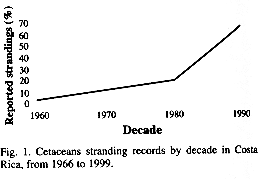
<body><![CDATA[<p><font face="Arial,Helvetica"><font size=-1>Endoparasitic infestation (mainly those of ear and brain), viral infections, brain neural degeneration, as well as a bewildered group’s guide, sick or hurt animals, calves that lost their mother, weather conditions and discontinuous or variable Earth’s magnetic lines are usually listed among the most probable causes (Evans 1987, Cebrian 1995, L&oacute;pez-Fern&aacute;ndez 1998, Regidor <i>et al.&nbsp;</i> 1998).&nbsp; Anthropogenic causes such as pollution, entanglements or injuries caused by ships or boats are also among the main causes of stranding (Davis <i>et al.&nbsp; </i>1993).&nbsp; However, it is not clear which of such factors is the most common or if there is a combination of several causes.&nbsp; Strandings sometimes can be of hundreds of animals, most commonly in the cases of the false orca (<i>Pseudorca crassidens</i>) and the pilot “whale” (<i>Globicephala</i> spp.) (Odell 1980, Jefferson <i>et al.&nbsp; </i>1994).</font></font>     <p><font face="Arial,Helvetica"><font size=-1>Strandings are a very valuable source of biological and scientific data.&nbsp; They not only contribute to a better explanation of the phenomenon itself, but they also provide new information about the species involved in terms of health, population dynamics and management (Odell <i>et al.&nbsp;</i> 1980, Walsh <i>et al.&nbsp;</i> 1991, Woodhouse 1991, Mignucci-Giannoni <i>et al.&nbsp; </i>1993, 1998, Goodall <i>et al.&nbsp;</i> 1999).&nbsp; The United States and Puerto Rico are among the few countries in the American Continent that have a well developed stranding network including research programs (Reynolds III and Odell 1991, Mignucci-Giannoni 1998).</font></font>     <p><font face="Arial,Helvetica"><font size=-1>Scientific attention to strandings has increased in different countries in the last decade (Pimental <i>et al.&nbsp;</i> 1993, Poole 1993, Mora-Pinto <i>et al.&nbsp;</i> 1995, Chou <i>et al.&nbsp; </i>1998, Krivokhizhin and Birkun 1998, Mignucci-Giannoni 1998, Bola&ntilde;os and Villaroel 1999).&nbsp; However, Central American cetaceans are still poorly understood including stranding phenomena; even though it is now known that the group is highly diverse in the area, especially in Costa Rica (Huertas 1994, Rodr&iacute;guez F. 1998).&nbsp; In November 1998, the Costa Rican Marine Mammal Rescue Network was established<i> (Red Costarricense de Rescate de Mam&iacute;feros Marinos</i>-RECORMA) providing the possibility of beginning a systematic collection and analysis of data concerning strandings.</font></font>     <p><font face="Arial,Helvetica"><font size=-1>&nbsp;The purpose of this paper is to report all known strandings in Costa Rica on both coasts, since the first one documented in 1966.</font></font>     <p><b><font face="Arial,Helvetica"><font size=-1>Materials and Methods</font></font></b>     <p><font face="Arial,Helvetica"><font size=-1><b>&nbsp;</b>Data came from different sources such as literature, local press (including photographs and videos) and unpublished data from different people and the authors.&nbsp; For the last ones no references are specified. Strandings information from the period of 1997 to 1999 came from field data.&nbsp; Based on Jefferson <i>et al.&nbsp;</i> (1994), when the stranding included three or more individuals, it was considered a mass stranding <a href="#apen">(Appendix 1</a>).</font></font>     <br>&nbsp;     <p><b><font face="Arial,Helvetica"><font size=-1>Results</font></font></b>     <p><font face="Arial,Helvetica"><font size=-1>A total of 35 strandings, involving 13 species (52% of the 27 known species for Costa Rica, Rodr&iacute;guez F. 1998) and 247 individuals, are reported.&nbsp; Of these, 68.6% of the cases (24) belong to the decade from 1990 to 1999 <a href="#img1">(Fig. 1)</a> and 91.4% (32) are reported for the Pacific coast.&nbsp; Along the Pacific coast 45.7% of the strandings (16) came from the north Pacific, 20.0% (7) from the central Pacific and 22.9% (8) from the south Pacific.&nbsp; Only 8.6% of the strandings were registered from the Caribbean coast.</font></font>     <p><font face="Arial,Helvetica"><font size=-1>An analysis made in terms of the Costa Rican National System of Conservation Areas<i> (</i>SINAC) revealed that 22.9% of the cases (8) belonged to both Osa (ACOSA) and Tempisque (ACOT) Conservation Areas, while 20.0% (7) of the strandings occurred in the Central Pacific Conservation Area (ACOPAC), and 17.1% in Guanacaste Conservation Area (ACOGE).&nbsp; Only 20.0% of the strandings (7) represented mass strandings.&nbsp; In 14.3% of the strandings (5), species could not be determined.</font></font>     ]]></body>
<body><![CDATA[<center>     <p><a NAME="img1"></a><img SRC="/img/fbpe/rbt/v49n2/1025i1.GIF" height=179 width=261></center>      
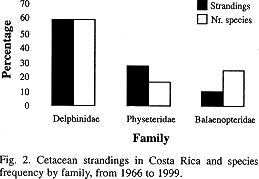
<p><font face="Arial,Helvetica"><font size=-1>On the other hand, 88.6% (31) of the strandings were from odontocetes (toothed “whales”) and 8.6% (3) from misticetes (baleen or true whales).&nbsp; Of the four families of cetaceans known for the country, the one that accounted more for species and strandings was Delphinidae with 61.5% (8) and 62.9% (17) respectively, and only Ziphiidae had no cases at all <a href="#img2">(Fig. 2)</a>.</font></font>     <center>     <p><a NAME="img2"></a><img SRC="/img/fbpe/rbt/v49n2/1025i2.GIF" height=179 width=259></center>      
<p><font face="Arial,Helvetica"><font size=-1>The species with the greatest numbers of strandings was <i>Physeter catodon</i> (cachalot, sperm “whale”) with 22.9% (8) of the cases, all of them being single ones.&nbsp; A mass stranding of great proportions was reported for <i>Peponocephala electra</i> (“ballena” cabeza de mel&oacute;n, melon headed “whale”), with more than 200 animals stranded at Playa Tambor (Pen&iacute;nsula de Nicoya, North Pacific) in 1976 (Janzen and Wilson 1983).</font></font>     <br>&nbsp;     <p><b><font face="Arial,Helvetica"><font size=-1>Discussion</font></font></b>     <p><font face="Arial,Helvetica"><font size=-1>Composition of stranded species along Costa Rican coasts is ecologically heterogeneous.&nbsp; <i>Stenella coeruleoalba </i>(striped dolphin), <i>Globicephala macrorhynchus </i>(pilot “whale”), <i>Tursiops truncatus</i>, <i>Stenella longirostris</i> (spinner dolphin), <i>Physeter catodon</i> and <i>Balaenoptera edeni </i>(Bryde’s whale) are common species.&nbsp; <i>Orcinus orca</i> (orca, “killer whale”) is an uncommon species (although reports of these species have increased in the last few years) and <i>Balaenoptera physalus </i>(fin whale) is very rare. On the other hand, there are no stranding records of very common species in offshore waters, such as <i>Delphinus delphis </i>(common dolphin) and <i>Grampus griseus</i> (Risso’s dolphin) and <i>Pseudorca crassidens </i>(false “killer whale”).&nbsp; Species that are common in Costa Rican waters (Rodr&iacute;guez F. 1998) as well as common as stranding species in other areas, such as <i>Pseudorca crassidens&nbsp;</i> and <i>Ziphius cavirostris </i>(Cuvier’s beaked&nbsp; “whale”) (Jefferson <i>et al. </i>1993, Mignucci-Giannoni 1998, Rosario-Delestre 1999), are not registered either.</font></font>     <p><font face="Arial,Helvetica"><font size=-1>&nbsp;Of all the strandings of <i>P. catodon</i> most individuals (87.5%) did not exceed 12 m in lenght.&nbsp; This is consistent with the prevalence of females, calves and juveniles of this species in tropical waters (Evans 1987).</font></font>     ]]></body>
<body><![CDATA[<p><font face="Arial,Helvetica"><font size=-1>&nbsp;The stranding of a calf of <i>B. physalus </i>in<i> </i>1995 became the first known record in the country for a baleen whale, while the stranding of <i>Megaptera novaeangliae</i> was the first record from the Pacific coast of Costa Rica.&nbsp; In general, strandings of balenopterid whales are uncommon (Klinowska 1989).&nbsp; The stranding of a male <i>Stenella coeruleoalba</i> in Puntarenas was the first attempt to rehabilitate a stranded marine mammal in Costa Rica (<a href="#apen">Appendix 1</a>).</font></font>     <p><font face="Arial,Helvetica"><font size=-1>&nbsp;There was not enough data to determine general tendencies of strandings with respect to time of year, kind of coastal habitat, age, sex or size.&nbsp; Even though the number of stranded animals with net remains was low (3 cases) it is important to study the real impact of interactions between cetaceans and fisheries along the coastal areas.&nbsp; Palacios and Gerrodette (1996) estimated an annual mortality of 16 000 dolphins due to fisheries related activities.</font></font>     <p><font face="Arial,Helvetica"><font size=-1>&nbsp;The beginning of a systematic program for monitoring strandings and entanglements, as is the case of RECORMA, is a basic step to establish a network for the whole country and to provide a better panorama for research, management and educational policies regarding marine mammals in Costa Rica.</font></font>     <br>&nbsp;     <p><b><font face="Arial,Helvetica"><font size=-1>Acknowledgements</font></font></b>     <p><font face="Arial,Helvetica"><font size=-1>We thank everyone who gave us their unpublished data:&nbsp; the late Douglas Robinson (Escuela de Biolog&iacute;a, Universidad de Costa Rica), Jorge Ballestero and Andr&eacute;s Vega (Escuela de Biolog&iacute;a, Universidad de Costa Rica), Jos&eacute; A. Vargas (Centro de Investigaciones en Ciencias del Mar y Limnolog&iacute;a-CIMAR, Universidad de Costa Rica), Michelle Montoya (CEDARENA, Costa Rica), Oldemar Arias (Golfito, Puntarenas), William Flores (Naval de Puntarenas), Carlos L&oacute;pez (Ministerio del Ambiente y Energ&iacute;a-MINAE), Cecilia Ovares (Rinc&oacute;n de Osa, Puntarenas), Andr&eacute;s Rodr&iacute;guez (ACOSA-MINAE), Steven Wofford (Planet Dolphin, Quepos), Jason B&ouml;rner (Fundaci&oacute;n Tercera Voz, Puerto Jim&eacute;nez, Puntarenas), Ronald Hern&aacute;ndez (Flamingo, Guanacaste), and Ruth Tiffer (Area de Conservaci&oacute;n Guanacaste-MINAE). The Laboratorio de Biolog&iacute;a Marina, Universidad Nacional at Puntarenas, brought the facilities for the attempt of rehabilitation of a stranded striped dolphin in 1999. Greivin Moya and Danny Gonz&aacute;lez (Canal 7, Costa Rica) gave us the video of the <i>B. physalus</i> stranding. The World Society for the Protection of Animals (WSPA) has supported RECORMA since 1999.&nbsp; Paul Hanson (Escuela de Biolog&iacute;a, Universidad de Costa Rica) made the final review of the manuscript.</font></font>     <br>&nbsp;     <p><b><font face="Arial,Helvetica"><font size=-1>Resumen</font></font></b>     <p><font face="Arial,Helvetica"><font size=-1>Se informan los casos de encallamientos de cet&aacute;ceos en Costa Rica. Un total de 35 casos conocidos para 13 especies involucradas y un total de 247 individuos. La gran mayor&iacute;a de los casos provienen de la costa Pac&iacute;fica (32) y 28 corresponden a encallamientos individuales. El cachalote, <i>Physeter catodon</i>, es la especie con mayor frecuencia de encallamientos (8) y la familia Delphinidae abarca la mayor cantidad de especies involucradas (8) y de casos de encallamientos (22). No se determin&oacute; ninguna otra tendencia general con la informaci&oacute;n disponible.</font></font>     <br>&nbsp;  <font face="Arial,Helvetica"><font size=-1><b>Reference</b></font></font>     ]]></body>
<body><![CDATA[<!-- ref --><p><font face="Arial,Helvetica"><font size=-1>Anonymous. 1983. Ballena muerta. La Naci&oacute;n, San Jos&eacute;, Costa Rica, 23 de febrero.</font></font>&nbsp;&nbsp;&nbsp;&nbsp;&nbsp;&nbsp;&nbsp;&nbsp;[&#160;<a href="javascript:void(0);" onclick="javascript: window.open('/scielo.php?script=sci_nlinks&ref=1346671&pid=S0034-7744200100020002600001&lng=','','width=640,height=500,resizable=yes,scrollbars=1,menubar=yes,');">Links</a>&#160;]<!-- end-ref --><!-- ref --><p><font face="Arial,Helvetica"><font size=-1>Anonymous. 1987. Localizan cachalote muerto en Parrita. La Naci&oacute;n, San Jos&eacute;, Costa Rica, 6 de febrero.</font></font>&nbsp;&nbsp;&nbsp;&nbsp;&nbsp;&nbsp;&nbsp;&nbsp;[&#160;<a href="javascript:void(0);" onclick="javascript: window.open('/scielo.php?script=sci_nlinks&ref=1346672&pid=S0034-7744200100020002600002&lng=','','width=640,height=500,resizable=yes,scrollbars=1,menubar=yes,');">Links</a>&#160;]<!-- end-ref --><!-- ref --><p><font face="Arial,Helvetica"><font size=-1>Bola&ntilde;os, J. &amp; A.J. Villaroel. 1999. Stranding records and mortality causes of cetaceans in Venezuela: 1911-1999, p. 20. <i>In</i> Abstracts of the 13</font><sup><font size=-2>th</font></sup><font size=-1> Biennial Conference on the Biology of Marine Mammals. Maui, Hawaii. .</font></font>    &nbsp;&nbsp;&nbsp;&nbsp;&nbsp;&nbsp;&nbsp;&nbsp;[&#160;<a href="javascript:void(0);" onclick="javascript: window.open('/scielo.php?script=sci_nlinks&ref=1346673&pid=S0034-7744200100020002600003&lng=','','width=640,height=500,resizable=yes,scrollbars=1,menubar=yes,');">Links</a>&#160;]<!-- end-ref --><!-- ref --><p><font face="Arial,Helvetica"><font size=-1>Cebrian, D. 1995. The striped dolphin, <i>Stenella coeruleoalba</i>, epizootic in Greece 1991-1992. Biol. Conserv. 74: 142-145.</font></font>    &nbsp;&nbsp;&nbsp;&nbsp;&nbsp;&nbsp;&nbsp;&nbsp;[&#160;<a href="javascript:void(0);" onclick="javascript: window.open('/scielo.php?script=sci_nlinks&ref=1346674&pid=S0034-7744200100020002600004&lng=','','width=640,height=500,resizable=yes,scrollbars=1,menubar=yes,');">Links</a>&#160;]<!-- end-ref --><!-- ref --><p><font face="Arial,Helvetica"><font size=-1>Chou, L.S., C.R. Yao, J.Y. Wang, Y.L. Hsieh &amp; P.F. Lee. 1998. Stranding records of cetaceans from 1990 to 1997 in Taiwan, p. 26. <i>In </i>Abstracts of the World Marine Mammal Science Conference. Monaco.</font></font>    &nbsp;&nbsp;&nbsp;&nbsp;&nbsp;&nbsp;&nbsp;&nbsp;[&#160;<a href="javascript:void(0);" onclick="javascript: window.open('/scielo.php?script=sci_nlinks&ref=1346675&pid=S0034-7744200100020002600005&lng=','','width=640,height=500,resizable=yes,scrollbars=1,menubar=yes,');">Links</a>&#160;]<!-- end-ref --><!-- ref --><p><font face="Arial,Helvetica"><font size=-1>Davis, J.W., G.G. Salata, J. Sericano &amp; T. Wade. 1993. An analysis of tissues for total PCB and planar PCB concentrations in marine mammals stranded along the Gulf of Mexico, p. 40. <i>In</i> Abstracts of The 10</font><sup><font size=-2>th</font></sup><font size=-1> Biennal Conference on the Biology of Marine Mammals. Galveston, Texas.</font></font>    &nbsp;&nbsp;&nbsp;&nbsp;&nbsp;&nbsp;&nbsp;&nbsp;[&#160;<a href="javascript:void(0);" onclick="javascript: window.open('/scielo.php?script=sci_nlinks&ref=1346676&pid=S0034-7744200100020002600006&lng=','','width=640,height=500,resizable=yes,scrollbars=1,menubar=yes,');">Links</a>&#160;]<!-- end-ref --><!-- ref --><p><font face="Arial,Helvetica"><font size=-1>Evans, P.G.H. 1987. The Natural History of Whales and Dolphins. Facts on File, New York. 343 p.</font></font>    &nbsp;&nbsp;&nbsp;&nbsp;&nbsp;&nbsp;&nbsp;&nbsp;[&#160;<a href="javascript:void(0);" onclick="javascript: window.open('/scielo.php?script=sci_nlinks&ref=1346677&pid=S0034-7744200100020002600007&lng=','','width=640,height=500,resizable=yes,scrollbars=1,menubar=yes,');">Links</a>&#160;]<!-- end-ref --><!-- ref --><p><font face="Arial,Helvetica"><font size=-1>Goodall, R.N.P., A.C.M. Schiavini, S.V. Macnie &amp; C.C. Boy. 1999. Hidden cycles? The value of opportunistic research, p. 70. <i>In</i> Abstracts of The 13</font><sup><font size=-2>th</font></sup><font size=-1> Biennial Conference on the Biology of Marine Mammals. Maui, Hawaii. .</font></font>    &nbsp;&nbsp;&nbsp;&nbsp;&nbsp;&nbsp;&nbsp;&nbsp;[&#160;<a href="javascript:void(0);" onclick="javascript: window.open('/scielo.php?script=sci_nlinks&ref=1346678&pid=S0034-7744200100020002600008&lng=','','width=640,height=500,resizable=yes,scrollbars=1,menubar=yes,');">Links</a>&#160;]<!-- end-ref --><!-- ref --><p><font face="Arial,Helvetica"><font size=-1>Huertas, G. 1994. Diagn&oacute;stico regional sobre el estado de los mam&iacute;feros marinos en el Pac&iacute;fico Centroamericano. Comisi&oacute;n Permanente del Pac&iacute;fico Sur-CPPS/Programa de las Naciones Unidas para el Ambiente-PNUMA. 85 p.</font></font>    &nbsp;&nbsp;&nbsp;&nbsp;&nbsp;&nbsp;&nbsp;&nbsp;[&#160;<a href="javascript:void(0);" onclick="javascript: window.open('/scielo.php?script=sci_nlinks&ref=1346679&pid=S0034-7744200100020002600009&lng=','','width=640,height=500,resizable=yes,scrollbars=1,menubar=yes,');">Links</a>&#160;]<!-- end-ref --><!-- ref --><p><font face="Arial,Helvetica"><font size=-1>Janzen, D.H. &amp; D. E. Wilson. 1983. Mammals, p. 439-456. <i>In</i> D.H. Janzen (ed.). Costa Rican Natural History. Chicago University, Chicago, Illinois..</font></font>    &nbsp;&nbsp;&nbsp;&nbsp;&nbsp;&nbsp;&nbsp;&nbsp;[&#160;<a href="javascript:void(0);" onclick="javascript: window.open('/scielo.php?script=sci_nlinks&ref=1346680&pid=S0034-7744200100020002600010&lng=','','width=640,height=500,resizable=yes,scrollbars=1,menubar=yes,');">Links</a>&#160;]<!-- end-ref --><!-- ref --><p><font face="Arial,Helvetica"><font size=-1>Jefferson, T.A., S. Leatherwood &amp; M.A. Webber. 1994. Marine Mammals of the World. FAO Species Identification Guide. FAO/UNEP, Rome. 320 p.</font></font>    &nbsp;&nbsp;&nbsp;&nbsp;&nbsp;&nbsp;&nbsp;&nbsp;[&#160;<a href="javascript:void(0);" onclick="javascript: window.open('/scielo.php?script=sci_nlinks&ref=1346681&pid=S0034-7744200100020002600011&lng=','','width=640,height=500,resizable=yes,scrollbars=1,menubar=yes,');">Links</a>&#160;]<!-- end-ref --><!-- ref --><p><font face="Arial,Helvetica"><font size=-1>Krivokhizhin, S.V. &amp; A.A. Birkun Jr. 1998. Strandings of cetaceans along the coasts of Crimean Peninsula (Ukraine) in 1989-1996, p 75. <i>In</i> Abstracts of The World Marine Mammal Science Conference. Monaco.</font></font>    &nbsp;&nbsp;&nbsp;&nbsp;&nbsp;&nbsp;&nbsp;&nbsp;[&#160;<a href="javascript:void(0);" onclick="javascript: window.open('/scielo.php?script=sci_nlinks&ref=1346682&pid=S0034-7744200100020002600012&lng=','','width=640,height=500,resizable=yes,scrollbars=1,menubar=yes,');">Links</a>&#160;]<!-- end-ref --><!-- ref --><p><font face="Arial,Helvetica"><font size=-1>Klinowska, M. 1989. Strandings-Fact and Fiction, p. 216-229. <i>In</i> R. Harrison y M.M. Bryden (eds). Whales, Dolphins and Porpoises. Facts on File, Nueva York.</font></font>    &nbsp;&nbsp;&nbsp;&nbsp;&nbsp;&nbsp;&nbsp;&nbsp;[&#160;<a href="javascript:void(0);" onclick="javascript: window.open('/scielo.php?script=sci_nlinks&ref=1346683&pid=S0034-7744200100020002600013&lng=','','width=640,height=500,resizable=yes,scrollbars=1,menubar=yes,');">Links</a>&#160;]<!-- end-ref --><!-- ref --><p><font face="Arial,Helvetica"><font size=-1>L&oacute;pez-Fern&aacute;ndez, A., X. Valeiras, S. Pascual, E. Abollo &amp; J.I. Daeaz. 1998. Skull lessions associated with <i>Crassicauda</i> spp. (Nematoda: Crassicaudidae) in cetaceans stranded on the Galician Coast (NW&nbsp;&nbsp; Spain), p. 82. <i>In</i> Abstracts of The World Marine Mammal Science Conference. Monaco.</font></font>    &nbsp;&nbsp;&nbsp;&nbsp;&nbsp;&nbsp;&nbsp;&nbsp;[&#160;<a href="javascript:void(0);" onclick="javascript: window.open('/scielo.php?script=sci_nlinks&ref=1346684&pid=S0034-7744200100020002600014&lng=','','width=640,height=500,resizable=yes,scrollbars=1,menubar=yes,');">Links</a>&#160;]<!-- end-ref --><!-- ref --><p><font face="Arial,Helvetica"><font size=-1>Mignucci-Giannoni, A.A. 1998. Analysis of marine mammal strandings in Puerto Rico and the Virgin Islands, p 91. <i>In</i> Abstracts of The World Marine Mammal Science Conference. Monaco.</font></font>    &nbsp;&nbsp;&nbsp;&nbsp;&nbsp;&nbsp;&nbsp;&nbsp;[&#160;<a href="javascript:void(0);" onclick="javascript: window.open('/scielo.php?script=sci_nlinks&ref=1346685&pid=S0034-7744200100020002600015&lng=','','width=640,height=500,resizable=yes,scrollbars=1,menubar=yes,');">Links</a>&#160;]<!-- end-ref --><!-- ref --><p><font face="Arial,Helvetica"><font size=-1>Mignucci-Giannoni, A. A., B. Pinto-Rodr&iacute;guez, R.A. Montoya-Ospina, D. P. Moore &amp; E. H. Williams. 1993. Strandings and mortality assesment of marine mammals in Puerto Rico and Virgin Islands, p. 77. In Abstracts of the Tenth Biennial Conference&nbsp; on the Biology of Marine Mammals. Galveston, Texas.</font></font>    &nbsp;&nbsp;&nbsp;&nbsp;&nbsp;&nbsp;&nbsp;&nbsp;[&#160;<a href="javascript:void(0);" onclick="javascript: window.open('/scielo.php?script=sci_nlinks&ref=1346686&pid=S0034-7744200100020002600016&lng=','','width=640,height=500,resizable=yes,scrollbars=1,menubar=yes,');">Links</a>&#160;]<!-- end-ref --><!-- ref --><p><font face="Arial,Helvetica"><font size=-1>Mora M., W. 1986. La &uacute;ltima morada de un cachalote. La Naci&oacute;n, San Jos&eacute;, Costa Rica, 26 de julio.</font></font>    &nbsp;&nbsp;&nbsp;&nbsp;&nbsp;&nbsp;&nbsp;&nbsp;[&#160;<a href="javascript:void(0);" onclick="javascript: window.open('/scielo.php?script=sci_nlinks&ref=1346687&pid=S0034-7744200100020002600017&lng=','','width=640,height=500,resizable=yes,scrollbars=1,menubar=yes,');">Links</a>&#160;]<!-- end-ref --><!-- ref --><p><font face="Arial,Helvetica"><font size=-1>Mora-Pinto, D.M., M.F. Mu&ntilde;oz-Hincapi&eacute;, A.A. Mignucci-Giannoni &amp; A. Acero-Pizarro. 1995. Marine mammal mortality and strandings along the Pacific Coast of Colombia. Rep.Internat. Whaling Comm. 0: 427-429</font></font>    &nbsp;&nbsp;&nbsp;&nbsp;&nbsp;&nbsp;&nbsp;&nbsp;[&#160;<a href="javascript:void(0);" onclick="javascript: window.open('/scielo.php?script=sci_nlinks&ref=1346688&pid=S0034-7744200100020002600018&lng=','','width=640,height=500,resizable=yes,scrollbars=1,menubar=yes,');">Links</a>&#160;]<!-- end-ref --><!-- ref --><p><font face="Arial,Helvetica"><font size=-1>Odell, D.K., E.D. Asper, J. Baucom &amp; L.H. Cornell. 1980. A recurrent mass stranding of the false killer whale, <i>Pseudorca crassidens</i>, in Florida. Fish. Bull. 78: 171</font></font>    &nbsp;&nbsp;&nbsp;&nbsp;&nbsp;&nbsp;&nbsp;&nbsp;[&#160;<a href="javascript:void(0);" onclick="javascript: window.open('/scielo.php?script=sci_nlinks&ref=1346689&pid=S0034-7744200100020002600019&lng=','','width=640,height=500,resizable=yes,scrollbars=1,menubar=yes,');">Links</a>&#160;]<!-- end-ref --><!-- ref --><p><font face="Arial,Helvetica"><font size=-1>Palacios, D.M. &amp; T. Gerrodette. 1996. Potential impact of artisanal gillnet fisheries on small cetacean populations in the Eastern Tropical Pacific. Southwest Fisheries Science Center. La Jolla, California. Administrative Report LJ-96-11. 17 p.</font></font>    &nbsp;&nbsp;&nbsp;&nbsp;&nbsp;&nbsp;&nbsp;&nbsp;[&#160;<a href="javascript:void(0);" onclick="javascript: window.open('/scielo.php?script=sci_nlinks&ref=1346690&pid=S0034-7744200100020002600020&lng=','','width=640,height=500,resizable=yes,scrollbars=1,menubar=yes,');">Links</a>&#160;]<!-- end-ref --><!-- ref --><p><font face="Arial,Helvetica"><font size=-1>Pimental, G.P., R.F. Barbosa, R.T. Almeida, D.S. Pimental &amp; K.M. Magalaes. 1993. Cetaceans strandings at Northeastern Brazil (1989-1993), p. 86. <i>In</i> Abstracts of The 10</font><sup><font size=-2>th</font></sup><font size=-1> Biennal Conference on the Biology of Marine Mammals. Galveston, Texas.</font></font>    &nbsp;&nbsp;&nbsp;&nbsp;&nbsp;&nbsp;&nbsp;&nbsp;[&#160;<a href="javascript:void(0);" onclick="javascript: window.open('/scielo.php?script=sci_nlinks&ref=1346691&pid=S0034-7744200100020002600021&lng=','','width=640,height=500,resizable=yes,scrollbars=1,menubar=yes,');">Links</a>&#160;]<!-- end-ref --><!-- ref --><p><font face="Arial,Helvetica"><font size=-1>Poole, M.M. 1993. A sighting/stranding network in French Polinesia, p. 87. <i>In</i> Abstracts of The 10</font><sup><font size=-2>th</font></sup><font size=-1> Biennal Conference on the Biology of Marine Mammals. Galveston, Texas.</font></font>    &nbsp;&nbsp;&nbsp;&nbsp;&nbsp;&nbsp;&nbsp;&nbsp;[&#160;<a href="javascript:void(0);" onclick="javascript: window.open('/scielo.php?script=sci_nlinks&ref=1346692&pid=S0034-7744200100020002600022&lng=','','width=640,height=500,resizable=yes,scrollbars=1,menubar=yes,');">Links</a>&#160;]<!-- end-ref --><!-- ref --><p><font face="Arial,Helvetica"><font size=-1>Regidor, J., M. Andr&eacute;, J. Or&oacute;s, V. Martin, J.A. Ram&iacute;rez-Gonz&aacute;lez, P. Castro &amp; A. Fern&aacute;ndez. 1998. Cerebral neurodegeneration in dolphins, another cause for stranding?, p. 111. <i>In</i> Abstracts of The World Marine Mammal Science Conference. Monaco.</font></font>    &nbsp;&nbsp;&nbsp;&nbsp;&nbsp;&nbsp;&nbsp;&nbsp;[&#160;<a href="javascript:void(0);" onclick="javascript: window.open('/scielo.php?script=sci_nlinks&ref=1346693&pid=S0034-7744200100020002600023&lng=','','width=640,height=500,resizable=yes,scrollbars=1,menubar=yes,');">Links</a>&#160;]<!-- end-ref --><!-- ref --><p><font face="Arial,Helvetica"><font size=-1>Reynolds, J.E. &amp; D.K. Odell (eds).1991. Marine Mammal Strandings in the United States. NOAA Technical Report NMFS 98. Silver Spring, Maryland. 157 p.</font></font>    &nbsp;&nbsp;&nbsp;&nbsp;&nbsp;&nbsp;&nbsp;&nbsp;[&#160;<a href="javascript:void(0);" onclick="javascript: window.open('/scielo.php?script=sci_nlinks&ref=1346694&pid=S0034-7744200100020002600024&lng=','','width=640,height=500,resizable=yes,scrollbars=1,menubar=yes,');">Links</a>&#160;]<!-- end-ref --><!-- ref --><p><font face="Arial,Helvetica"><font size=-1>Rodr&iacute;guez F., J. 1998. Diversidad y distribuci&oacute;n de Cet&aacute;ceos en Costa Rica. Memorias del I Seminario Internacional sobre Manejo de Delfines y otros Cet&aacute;ceos en Actividades de Rescate, Rehabilitaci&oacute;n y Turismo en Costa Rica. Centro de Proyecci&oacute;n del Ambiente Marino-PROMAR/Fundaci&oacute;n Amigos Isla del Coco-FAICO. San Jos&eacute;, Costa Rica. 48 p.</font></font>    &nbsp;&nbsp;&nbsp;&nbsp;&nbsp;&nbsp;&nbsp;&nbsp;[&#160;<a href="javascript:void(0);" onclick="javascript: window.open('/scielo.php?script=sci_nlinks&ref=1346695&pid=S0034-7744200100020002600025&lng=','','width=640,height=500,resizable=yes,scrollbars=1,menubar=yes,');">Links</a>&#160;]<!-- end-ref --><!-- ref --><p><font face="Arial,Helvetica"><font size=-1>Walsh, M.T., D.O. Beusse, W.G. Young, J.D. Lynch, E.D. Asper &amp; D.K. Odell. 1991. Medical findings in a mass stranding of pilot whales (<i>Globicephala macrorhynchus</i>) in Florida, p. 75 -84. <i>In</i> J.E. Reynolds III y D.K. Odell (eds). Marine Mammal Strandings in the United States. Proceedings of the Second Marine Mammal Stranding Workshop, Miami, Florida (1987). USDC/NOAA/NMFS.</font></font>    &nbsp;&nbsp;&nbsp;&nbsp;&nbsp;&nbsp;&nbsp;&nbsp;[&#160;<a href="javascript:void(0);" onclick="javascript: window.open('/scielo.php?script=sci_nlinks&ref=1346696&pid=S0034-7744200100020002600026&lng=','','width=640,height=500,resizable=yes,scrollbars=1,menubar=yes,');">Links</a>&#160;]<!-- end-ref --><!-- ref --><p><font face="Arial,Helvetica"><font size=-1>Woodhouse, C.D. 1991. Marine mammals beachings as indicators of population events, p. 111-116. <i>In</i> J.E. Reynolds III and D.K. Odell (eds). Marine Mammal Strandings in the United States. Proceedings of the Second marine Mammal Stranding Workshop. Miami, Florida (1987). USDC/NOAA/NMFS.</font></font>    &nbsp;&nbsp;&nbsp;&nbsp;&nbsp;&nbsp;&nbsp;&nbsp;[&#160;<a href="javascript:void(0);" onclick="javascript: window.open('/scielo.php?script=sci_nlinks&ref=1346697&pid=S0034-7744200100020002600027&lng=','','width=640,height=500,resizable=yes,scrollbars=1,menubar=yes,');">Links</a>&#160;]<!-- end-ref --><br>&nbsp;     <p><a NAME="1a"></a><font face="Arial,Helvetica"><font size=-1><sup><a href="#1">1</a></sup> Centro de Proyecci&oacute;n del Ambiente Marino (PROMAR). Apt. 11709-1000 San Jos&eacute;, Costa Rica; Fax:&nbsp; 227-5856; <a href="mailto:promar@iname.com">promar@iname.com</a></font></font>     <br>&nbsp;     ]]></body>
<body><![CDATA[<center> <h3> <a NAME="apen"></a><font face="Arial,Helvetica"><font size=-1><a href="/revistas/49-2/rodriguez/apendice.html">Apendix 1. Cetacean strandings in costa Rica 1996- 1999</a></font></font></h3></center> <font face="Arial,Helvetica"><font size=-1>Delphinie</font></font>     <br><font face="Arial,Helvetica"><font size=-1><i>Orcinus orca </i>(orca)</font></font>     <br><font face="Arial,Helvetica"><font size=-1>1993: Playa Llorona, Pen&iacute;nsula de Osa (South Pacific). 3 individuals, all died (M. Montoya pers. comm.)</font></font>     <p><font face="Arial,Helvetica"><font size=-1><i>Globicephala macrorhynchus </i>(ballenato, pilot "whale")</font></font>     <br><font face="Arial,Helvetica"><font size=-1>1995: Playa Ostional (North Pacific). 1 female ( released), 1 male (died), 1 calf (released) J. Ballestero pers.comm.)</font></font>     <p><i><font face="Arial,Helvetica"><font size=-1>Peponocephala electra</font></font></i>     <br><font face="Arial,Helvetica"><font size=-1>1970: North Pacific. 1 individual (D.Robinson pers.comm.)</font></font>     <br><font face="Arial,Helvetica"><font size=-1>1970: North Pacific. 1 individual (D.Robinson pers. comm)</font></font>     <br><font face="Arial,Helvetica"><font size=-1>1976: Playa Tambor, Pen&iacute;nsula de Nicoya ( North Pacific). + 200 individuals, ~ 80 died (Janzen and Wilson 1983, Huertas 1994)</font></font>     <p><i><font face="Arial,Helvetica"><font size=-1>Sotalia Fluviatilis (tucuxi)</font></font></i>     ]]></body>
<body><![CDATA[<br><font face="Arial,Helvetica"><font size=-1>1997: Playa Manzanillo (South Atlantic). 1 individual, died (C. L&oacute;pez pers. comm)</font></font>     <p><i><font face="Arial,Helvetica"><font size=-1>Tursiops truncatus (bufeo, bottlenose dolphin)</font></font></i>     <br><font face="Arial,Helvetica"><font size=-1>1986: Punta Morales, Golfo de Nicoya (north Pacific). 1 individual, died (J.A Vargas pers. comm.)</font></font>     <br><font face="Arial,Helvetica"><font size=-1>1997: Playa Zancudo, Golfo Dulce (South Pacific). 1 individual, net remains; died (O. Arias pers. comm.)</font></font>     <br><font face="Arial,Helvetica"><font size=-1>1998: Playa Rinc&oacute;n, Golfo Dulce (South Pacific). 1 individual, died (C. Ovares pers. comm.)</font></font>     <br><font face="Arial,Helvetica"><font size=-1>1998: Golfo Dulce (Sout Pacific). 1 individual</font></font>     <br><font face="Arial,Helvetica"><font size=-1>1998: Puerto Quepos (Central Pacific). 1 femele 2.75 m long, died because of pulmonary infection.</font></font>     <br><font face="Arial,Helvetica"><font size=-1>1988: Playa Palma, Parrita (Central Pacific). 1 individual, died (A. Vega pers. comm.)</font></font>     <br><font face="Arial,Helvetica"><font size=-1>1999: Playa Sirena, osa (South Pacific). 1 individual (J. B&ouml;rner, pers. comm.)</font></font>     <p><font face="Arial,Helvetica"><font size=-1><i>Stella attenuata</i> (delf&iacute;n manchado, spotted dolphin)</font></font>     ]]></body>
<body><![CDATA[<br><font face="Arial,Helvetica"><font size=-1>1998: Playa Flamingo, Bah&iacute;a potrero (North Pacific). 1 juvenile (J. B&ouml;rner pers. comm.)</font></font>     <br><font face="Arial,Helvetica"><font size=-1>1999: Playa Jac&oacute;, Puntarenas (Central Pacific). 1 female. All indivudual collected. Blood clots in the lungs.</font></font>     <br><font face="Arial,Helvetica"><font size=-1>Viral origin. Two others went back to the sea.</font></font>     <p><font face="Arial,Helvetica"><font size=-1>Stenella&nbsp; longirostris (delf&iacute;n tornillo, spinner dolphin)</font></font>     <br><font face="Arial,Helvetica"><font size=-1>1999: Puntarenas, Golfo Dulce (North Pacific) 1 individual, 1 .5 m, bruises on the belly; died (W. Flores pers. comm.)</font></font>     <p><font face="Arial,Helvetica"><font size=-1><i>Stenella coeruleoalba</i> (delfin rayado)</font></font>     <br><font face="Arial,Helvetica"><font size=-1>1999: Playa Leona, Golfo Dulce (South Pacific.) 1 individual, propeler injuries, released (A. Rodr&iacute;guez pers.comm.)</font></font>     <br><font face="Arial,Helvetica"><font size=-1>1999: Puntarenas. 1 individual. Male, alive. Received treatment during 5 days until he died. Blood clots in the lungs, viral origin.</font></font>     <br><font face="Arial,Helvetica"><font size=-1>1999: San Isidro, Puntarenas. 1 individual. Dead. Skull was collected.</font></font>     <p><font face="Arial,Helvetica"><font size=-1>Physeteridae</font></font>     ]]></body>
<body><![CDATA[<br><font face="Arial,Helvetica"><font size=-1><i>Physeter catodon</i> (cachalote, sperm "whale")</font></font>     <br><font face="Arial,Helvetica"><font size=-1>1966: Playa del Coco, Papagayo (North Pacific). 1 individual, skull 2m long (D. Robinson pers. comm.)</font></font>     <br><font face="Arial,Helvetica"><font size=-1>1986: Playa Sierpe (South Pacific). 1 individual, 13 m long, died (J. Mora 1986)</font></font>     <br><font face="Arial,Helvetica"><font size=-1>1987: Playa Palma, Parrita (Central Pacific). 1 individual, 12 m long, died (La Naci&oacute;n 1987).</font></font>     <br><font face="Arial,Helvetica"><font size=-1>1987: Caldera , Golfo de Nicoya (North Pacific). 1 individual, 9.6 m long, died.</font></font>     <br><font face="Arial,Helvetica"><font size=-1>1998: Playa Potrero, Bah&iacute;a Potrero (North Pacific). 1 individual 10 m long, died.</font></font>     <br><font face="Arial,Helvetica"><font size=-1>1991: Pen&iacute;nsula de Santa Elena (North Pacific). 1 individual 8.9 m long, died (R. Tiffer pers. comm.)</font></font>     <br><font face="Arial,Helvetica"><font size=-1>1995: Mo&iacute;n, Lim&oacute;n (Central Caribbean). 1 individual (J. Arce, pers. comm.)</font></font>     <br><font face="Arial,Helvetica"><font size=-1>1997: Chomes, Golfo de Nicoya (North Pacific). 1 individual 8 m long with net remains, released.</font></font>     <p><font face="Arial,Helvetica"><font size=-1><i>Kogia simus</i> (cachalote pigmeo, pigmy sperm "whale")</font></font>     ]]></body>
<body><![CDATA[<br><font face="Arial,Helvetica"><font size=-1>1993: Pacific Coast, six individuals (Huertas 1994)</font></font>     <p><font face="Arial,Helvetica"><font size=-1>Balaenopteridae</font></font>     <br><font face="Arial,Helvetica"><font size=-1><i>Balaenopteridae physalus</i> (ballena, fin whale)</font></font>     <br><font face="Arial,Helvetica"><font size=-1>1995: Playa Tortuguero (North Atlantic). 1 individual (calf) 8.9 m long, died (G. Moya pers. comm.)</font></font>     <p><font face="Arial,Helvetica"><font size=-1>Balaenopteridae</font></font>     <br><font face="Arial,Helvetica"><font size=-1><i>B. edeni</i> (ballena, Bryde`s whale)</font></font>     <br><font face="Arial,Helvetica"><font size=-1>1999: Playa Bandera, Parrita (Central Pacific). 1 female, 14 m long, died.</font></font>     <p><font face="Arial,Helvetica"><font size=-1><i>Megaptera novaengliae</i> (ballena, humpback whale)</font></font>     <br><font face="Arial,Helvetica"><font size=-1>1998: Playa Flamingo, Bah&iacute;a Potrero (Pac&iacute;fico Norte). 1 calf, died (R. Hern&aacute;ndez pers. comm.)</font></font>     <p><font face="Arial,Helvetica"><font size=-1>Unidentified</font></font>     ]]></body>
<body><![CDATA[<br><font face="Arial,Helvetica"><font size=-1>1983: Bah&iacute;a Santa Elena (North Pacific). Whale 12 long, died (La Naci&oacute;n 1983).</font></font>     <br><font face="Arial,Helvetica"><font size=-1>1997: Playa Esterillos (Central Pacific). 7 dolphins, net remains.</font></font>     <br><font face="Arial,Helvetica"><font size=-1>1999: Playa Manuel Antonio (Central Pacific). 2 dead dolphins, the tide brought the animals back to the sea (S. Wofford pers. com.)</font></font>      ]]></body><back>
<ref-list>
<ref id="B1">
<nlm-citation citation-type="journal">
<person-group person-group-type="author">
<name>
</name>
<name>
</name>
</person-group>
<article-title xml:lang="es"><![CDATA[Ballena muerta]]></article-title>
<source><![CDATA[La Nación]]></source>
<year>1983</year>
<month>23</month>
<day> d</day>
<publisher-loc><![CDATA[San José ]]></publisher-loc>
</nlm-citation>
</ref>
<ref id="B2">
<nlm-citation citation-type="journal">
<person-group person-group-type="author">
<name>
</name>
<name>
</name>
</person-group>
<article-title xml:lang="es"><![CDATA[Localizan cachalote muerto en Parrita]]></article-title>
<source><![CDATA[La Nación]]></source>
<year>1987</year>
<month>6 </month>
<day>de</day>
<publisher-loc><![CDATA[San José ]]></publisher-loc>
</nlm-citation>
</ref>
<ref id="B3">
<nlm-citation citation-type="confpro">
<person-group person-group-type="author">
<name>
<surname><![CDATA[Bolaños]]></surname>
<given-names><![CDATA[J.]]></given-names>
</name>
<name>
<surname><![CDATA[Villaroel]]></surname>
<given-names><![CDATA[A.J.]]></given-names>
</name>
</person-group>
<article-title xml:lang="en"><![CDATA[Stranding records and mortality causes of cetaceans in Venezuela: 1911-1999]]></article-title>
<source><![CDATA[Abstracts]]></source>
<year>1999</year>
<conf-name><![CDATA[13th Biennial Conference on the Biology of Marine Mammals]]></conf-name>
<conf-loc>Maui </conf-loc>
<page-range>20</page-range></nlm-citation>
</ref>
<ref id="B4">
<nlm-citation citation-type="journal">
<person-group person-group-type="author">
<name>
<surname><![CDATA[Cebrian]]></surname>
<given-names><![CDATA[D.]]></given-names>
</name>
</person-group>
<article-title xml:lang="en"><![CDATA[The striped dolphin, Stenella coeruleoalba, epizootic in Greece 1991-1992]]></article-title>
<source><![CDATA[Biol. Conserv.]]></source>
<year>1995</year>
<volume>74</volume>
<page-range>142-145</page-range></nlm-citation>
</ref>
<ref id="B5">
<nlm-citation citation-type="confpro">
<person-group person-group-type="author">
<name>
<surname><![CDATA[Chou]]></surname>
<given-names><![CDATA[L.S.]]></given-names>
</name>
<name>
<surname><![CDATA[Yao]]></surname>
<given-names><![CDATA[C.R.]]></given-names>
</name>
<name>
<surname><![CDATA[Wang]]></surname>
<given-names><![CDATA[J.Y.]]></given-names>
</name>
<name>
<surname><![CDATA[Hsieh]]></surname>
<given-names><![CDATA[Y.L.]]></given-names>
</name>
<name>
<surname><![CDATA[Lee]]></surname>
<given-names><![CDATA[P.F.]]></given-names>
</name>
</person-group>
<article-title xml:lang="en"><![CDATA[Stranding records of cetaceans from 1990 to 1997 in Taiwan]]></article-title>
<source><![CDATA[Abstracts]]></source>
<year>1998</year>
<conf-name><![CDATA[ World Marine Mammal Science Conference]]></conf-name>
<conf-loc>Monaco </conf-loc>
<page-range>26</page-range></nlm-citation>
</ref>
<ref id="B6">
<nlm-citation citation-type="confpro">
<person-group person-group-type="author">
<name>
<surname><![CDATA[Davis]]></surname>
<given-names><![CDATA[J.W.]]></given-names>
</name>
<name>
<surname><![CDATA[Salata]]></surname>
<given-names><![CDATA[G.G.]]></given-names>
</name>
<name>
<surname><![CDATA[Sericano]]></surname>
<given-names><![CDATA[J.]]></given-names>
</name>
<name>
<surname><![CDATA[Wade]]></surname>
<given-names><![CDATA[T.]]></given-names>
</name>
</person-group>
<article-title xml:lang="en"><![CDATA[An analysis of tissues for total PCB and planar PCB concentrations in marine mammals stranded along the Gulf of Mexico]]></article-title>
<source><![CDATA[Abstracts]]></source>
<year>1993</year>
<conf-name><![CDATA[10th Biennal Conference on the Biology of Marine Mammals]]></conf-name>
<conf-loc>Galveston Texas</conf-loc>
<page-range>p. 40</page-range></nlm-citation>
</ref>
<ref id="B7">
<nlm-citation citation-type="">
<person-group person-group-type="author">
<name>
<surname><![CDATA[Evans]]></surname>
<given-names><![CDATA[P.G.H.]]></given-names>
</name>
</person-group>
<source><![CDATA[The Natural History of Whales and Dolphins]]></source>
<year>1987</year>
<page-range>343</page-range><publisher-loc><![CDATA[New York ]]></publisher-loc>
</nlm-citation>
</ref>
<ref id="B8">
<nlm-citation citation-type="confpro">
<person-group person-group-type="author">
<name>
<surname><![CDATA[Goodall]]></surname>
<given-names><![CDATA[R.N.P.]]></given-names>
</name>
<name>
<surname><![CDATA[Schiavini]]></surname>
<given-names><![CDATA[A.C.M.]]></given-names>
</name>
<name>
<surname><![CDATA[Macnie]]></surname>
<given-names><![CDATA[S.V.]]></given-names>
</name>
<name>
<surname><![CDATA[Boy]]></surname>
<given-names><![CDATA[C.C.]]></given-names>
</name>
</person-group>
<article-title xml:lang="en"><![CDATA[Hidden cycles? The value of opportunistic research]]></article-title>
<source><![CDATA[Abstracts]]></source>
<year>1999</year>
<conf-name><![CDATA[13th Biennial Conference on the Biology of Marine Mammals]]></conf-name>
<conf-loc>Maui </conf-loc>
<page-range>70</page-range></nlm-citation>
</ref>
<ref id="B9">
<nlm-citation citation-type="book">
<person-group person-group-type="author">
<name>
<surname><![CDATA[Huertas]]></surname>
<given-names><![CDATA[G.]]></given-names>
</name>
</person-group>
<source><![CDATA[Diagnóstico regional sobre el estado de los mamíferos marinos en el Pacífico Centroamericano]]></source>
<year>1994</year>
<page-range>85</page-range><publisher-name><![CDATA[Comisión Permanente del Pacífico Sur-CPPS/Programa de las Naciones Unidas para el Ambiente-PNUMA]]></publisher-name>
</nlm-citation>
</ref>
<ref id="B10">
<nlm-citation citation-type="book">
<person-group person-group-type="author">
<name>
<surname><![CDATA[Janzen]]></surname>
<given-names><![CDATA[D.H.]]></given-names>
</name>
<name>
<surname><![CDATA[Wilson]]></surname>
<given-names><![CDATA[D. E.]]></given-names>
</name>
</person-group>
<article-title xml:lang="en"><![CDATA[Mammals]]></article-title>
<person-group person-group-type="editor">
<name>
<surname><![CDATA[Janzen]]></surname>
<given-names><![CDATA[D.H.]]></given-names>
</name>
</person-group>
<source><![CDATA[Costa Rican Natural History]]></source>
<year>1983</year>
<page-range>439-456</page-range><publisher-loc><![CDATA[Chicago^eIllinois Illinois]]></publisher-loc>
<publisher-name><![CDATA[Chicago University]]></publisher-name>
</nlm-citation>
</ref>
<ref id="B11">
<nlm-citation citation-type="book">
<person-group person-group-type="author">
<name>
<surname><![CDATA[Jefferson]]></surname>
<given-names><![CDATA[T.A.]]></given-names>
</name>
<name>
<surname><![CDATA[Leatherwood]]></surname>
<given-names><![CDATA[S.]]></given-names>
</name>
<name>
<surname><![CDATA[Webber]]></surname>
<given-names><![CDATA[M.A.]]></given-names>
</name>
</person-group>
<source><![CDATA[Marine Mammals of the World]]></source>
<year>1994</year>
<page-range>320</page-range><publisher-loc><![CDATA[Rome ]]></publisher-loc>
<publisher-name><![CDATA[FAO/UNEP]]></publisher-name>
</nlm-citation>
</ref>
<ref id="B12">
<nlm-citation citation-type="confpro">
<person-group person-group-type="author">
<name>
<surname><![CDATA[Krivokhizhin]]></surname>
<given-names><![CDATA[S.V.]]></given-names>
</name>
<name>
<surname><![CDATA[Birkun Jr]]></surname>
<given-names><![CDATA[A.A.]]></given-names>
</name>
</person-group>
<article-title xml:lang="en"><![CDATA[Strandings of cetaceans along the coasts of Crimean Peninsula (Ukraine) in 1989-1996]]></article-title>
<source><![CDATA[Abstracts]]></source>
<year>1998</year>
<conf-name><![CDATA[ The World Marine Mammal Science Conference]]></conf-name>
<conf-loc>Monaco </conf-loc>
<page-range>75</page-range></nlm-citation>
</ref>
<ref id="B13">
<nlm-citation citation-type="">
<person-group person-group-type="author">
<name>
<surname><![CDATA[Klinowska]]></surname>
<given-names><![CDATA[M.]]></given-names>
</name>
</person-group>
<article-title xml:lang="en"><![CDATA[Strandings-Fact and Fiction]]></article-title>
<person-group person-group-type="editor">
<name>
<surname><![CDATA[Harrison]]></surname>
<given-names><![CDATA[R.]]></given-names>
</name>
<name>
<surname><![CDATA[Bryden]]></surname>
<given-names><![CDATA[M.M.]]></given-names>
</name>
</person-group>
<source><![CDATA[Whales, Dolphins and Porpoises]]></source>
<year>1989</year>
<page-range>. 216-229</page-range><publisher-loc><![CDATA[Nueva York ]]></publisher-loc>
</nlm-citation>
</ref>
<ref id="B14">
<nlm-citation citation-type="confpro">
<person-group person-group-type="author">
<name>
<surname><![CDATA[López-Fernández]]></surname>
<given-names><![CDATA[A.]]></given-names>
</name>
<name>
<surname><![CDATA[Valeiras]]></surname>
<given-names><![CDATA[X.]]></given-names>
</name>
<name>
<surname><![CDATA[Pascual]]></surname>
<given-names><![CDATA[S.]]></given-names>
</name>
<name>
<surname><![CDATA[Abollo]]></surname>
<given-names><![CDATA[E.]]></given-names>
</name>
<name>
<surname><![CDATA[Daeaz]]></surname>
<given-names><![CDATA[J.I.]]></given-names>
</name>
</person-group>
<article-title xml:lang="en"><![CDATA[Skull lessions associated with Crassicauda spp. (Nematoda: Crassicaudidae) in cetaceans stranded on the Galician Coast (NW Spain)]]></article-title>
<source><![CDATA[Abstracts]]></source>
<year>1998</year>
<conf-name><![CDATA[ The World Marine Mammal Science Conference]]></conf-name>
<conf-loc>Monaco </conf-loc>
<page-range>82</page-range></nlm-citation>
</ref>
<ref id="B15">
<nlm-citation citation-type="confpro">
<person-group person-group-type="author">
<name>
<surname><![CDATA[Mignucci-Giannoni]]></surname>
<given-names><![CDATA[A.A.]]></given-names>
</name>
</person-group>
<article-title xml:lang="en"><![CDATA[Analysis of marine mammal strandings in Puerto Rico and the Virgin Islands]]></article-title>
<source><![CDATA[Abstracts]]></source>
<year>1998</year>
<conf-name><![CDATA[ The World Marine Mammal Science Conference]]></conf-name>
<conf-loc>Monaco </conf-loc>
</nlm-citation>
</ref>
<ref id="B16">
<nlm-citation citation-type="confpro">
<person-group person-group-type="author">
<name>
<surname><![CDATA[Mignucci-Giannoni]]></surname>
<given-names><![CDATA[A. A.]]></given-names>
</name>
<name>
<surname><![CDATA[Pinto-Rodríguez]]></surname>
<given-names><![CDATA[B.]]></given-names>
</name>
<name>
<surname><![CDATA[Montoya-Ospina]]></surname>
<given-names><![CDATA[R.A.]]></given-names>
</name>
<name>
<surname><![CDATA[Moore]]></surname>
<given-names><![CDATA[D. P.]]></given-names>
</name>
<name>
<surname><![CDATA[Williams]]></surname>
<given-names><![CDATA[E. H.]]></given-names>
</name>
</person-group>
<article-title xml:lang="en"><![CDATA[Strandings and mortality assesment of marine mammals in Puerto Rico and Virgin Islands]]></article-title>
<source><![CDATA[Abstracts]]></source>
<year>1993</year>
<conf-name><![CDATA[Tenth Biennial Conference on the Biology of Marine Mammals]]></conf-name>
<conf-loc>Galveston Texas</conf-loc>
<page-range>77</page-range></nlm-citation>
</ref>
<ref id="B17">
<nlm-citation citation-type="journal">
<person-group person-group-type="author">
<name>
<surname><![CDATA[Mora]]></surname>
<given-names><![CDATA[M., W.]]></given-names>
</name>
</person-group>
<article-title xml:lang="es"><![CDATA[La última morada de un cachalote]]></article-title>
<source><![CDATA[La Nación]]></source>
<year>1986</year>
<month>26</month>
<day> d</day>
<publisher-loc><![CDATA[San José ]]></publisher-loc>
</nlm-citation>
</ref>
<ref id="B18">
<nlm-citation citation-type="journal">
<person-group person-group-type="author">
<name>
<surname><![CDATA[Mora-Pinto]]></surname>
<given-names><![CDATA[D.M.]]></given-names>
</name>
<name>
<surname><![CDATA[Muñoz-Hincapié]]></surname>
<given-names><![CDATA[M.F.]]></given-names>
</name>
<name>
<surname><![CDATA[Mignucci-Giannoni]]></surname>
<given-names><![CDATA[A.A.]]></given-names>
</name>
<name>
<surname><![CDATA[Acero-Pizarro]]></surname>
<given-names><![CDATA[A.]]></given-names>
</name>
</person-group>
<article-title xml:lang="en"><![CDATA[Marine mammal mortality and strandings along the Pacific Coast of Colombia]]></article-title>
<source><![CDATA[Rep.Internat. Whaling Comm]]></source>
<year>1995</year>
<volume>0</volume>
<page-range>427-429</page-range></nlm-citation>
</ref>
<ref id="B19">
<nlm-citation citation-type="journal">
<person-group person-group-type="author">
<name>
<surname><![CDATA[Odell]]></surname>
<given-names><![CDATA[D.K.]]></given-names>
</name>
<name>
<surname><![CDATA[Asper]]></surname>
<given-names><![CDATA[E.D.]]></given-names>
</name>
<name>
<surname><![CDATA[Baucom]]></surname>
<given-names><![CDATA[J.]]></given-names>
</name>
<name>
<surname><![CDATA[Cornell]]></surname>
<given-names><![CDATA[L.H.]]></given-names>
</name>
</person-group>
<article-title xml:lang="en"><![CDATA[A recurrent mass stranding of the false killer whale, Pseudorca crassidens, in Florida]]></article-title>
<source><![CDATA[Fish. Bull.]]></source>
<year>1980</year>
<volume>78</volume>
<page-range>171</page-range></nlm-citation>
</ref>
<ref id="B20">
<nlm-citation citation-type="book">
<person-group person-group-type="author">
<name>
<surname><![CDATA[Palacios]]></surname>
<given-names><![CDATA[D.M.]]></given-names>
</name>
<name>
<surname><![CDATA[Gerrodette]]></surname>
<given-names><![CDATA[T.]]></given-names>
</name>
</person-group>
<source><![CDATA[Potential impact of artisanal gillnet fisheries on small cetacean populations in the Eastern Tropical Pacific]]></source>
<year>1996</year>
<page-range>17</page-range><publisher-loc><![CDATA[La Jolla^eCalifornia California]]></publisher-loc>
<publisher-name><![CDATA[Southwest Fisheries Science Center]]></publisher-name>
</nlm-citation>
</ref>
<ref id="B21">
<nlm-citation citation-type="confpro">
<person-group person-group-type="author">
<name>
<surname><![CDATA[Pimental]]></surname>
<given-names><![CDATA[G.P.]]></given-names>
</name>
<name>
<surname><![CDATA[Barbosa]]></surname>
<given-names><![CDATA[R.F.]]></given-names>
</name>
<name>
<surname><![CDATA[Almeida]]></surname>
<given-names><![CDATA[R.T.]]></given-names>
</name>
<name>
<surname><![CDATA[Pimental]]></surname>
<given-names><![CDATA[D.S.]]></given-names>
</name>
<name>
<surname><![CDATA[Magalaes]]></surname>
<given-names><![CDATA[K.M.]]></given-names>
</name>
</person-group>
<article-title xml:lang="en"><![CDATA[Cetaceans strandings at Northeastern Brazil (1989-1993)]]></article-title>
<source><![CDATA[Abstracts]]></source>
<year>1993</year>
<conf-name><![CDATA[10th Biennal Conference on the Biology of Marine Mammals]]></conf-name>
<conf-loc>Galveston Texas</conf-loc>
<page-range>86</page-range></nlm-citation>
</ref>
<ref id="B22">
<nlm-citation citation-type="confpro">
<person-group person-group-type="author">
<name>
<surname><![CDATA[Poole]]></surname>
<given-names><![CDATA[M.M.]]></given-names>
</name>
</person-group>
<article-title xml:lang="en"><![CDATA[A sighting/stranding network in French Polinesia]]></article-title>
<source><![CDATA[Abstracts]]></source>
<year>1993</year>
<conf-name><![CDATA[10th Biennal Conference on the Biology of Marine Mammals]]></conf-name>
<conf-loc>Galveston Texas</conf-loc>
<page-range>87</page-range></nlm-citation>
</ref>
<ref id="B23">
<nlm-citation citation-type="confpro">
<person-group person-group-type="author">
<name>
<surname><![CDATA[Regidor]]></surname>
<given-names><![CDATA[J.]]></given-names>
</name>
<name>
<surname><![CDATA[André]]></surname>
<given-names><![CDATA[M.]]></given-names>
</name>
<name>
<surname><![CDATA[Orós]]></surname>
<given-names><![CDATA[J.]]></given-names>
</name>
<name>
<surname><![CDATA[Martin]]></surname>
<given-names><![CDATA[V.]]></given-names>
</name>
<name>
<surname><![CDATA[Ramírez-González]]></surname>
<given-names><![CDATA[J.A.]]></given-names>
</name>
<name>
<surname><![CDATA[Castro]]></surname>
<given-names><![CDATA[P.]]></given-names>
</name>
<name>
<surname><![CDATA[Fernández]]></surname>
<given-names><![CDATA[A.]]></given-names>
</name>
</person-group>
<article-title xml:lang="en"><![CDATA[Cerebral neurodegeneration in dolphins, another cause for stranding?]]></article-title>
<source><![CDATA[Abstracts]]></source>
<year>1998</year>
<conf-name><![CDATA[ The World Marine Mammal Science Conference]]></conf-name>
<conf-loc>Monaco </conf-loc>
<page-range>111</page-range></nlm-citation>
</ref>
<ref id="B24">
<nlm-citation citation-type="journal">
<person-group person-group-type="author">
<name>
<surname><![CDATA[Reynolds]]></surname>
<given-names><![CDATA[J.E.]]></given-names>
</name>
<name>
<surname><![CDATA[Odell]]></surname>
<given-names><![CDATA[D.K.]]></given-names>
</name>
</person-group>
<article-title xml:lang="en"><![CDATA[Marine Mammal Strandings in the United States]]></article-title>
<source><![CDATA[NOAA Technical Report NMFS]]></source>
<year>1991</year>
<volume>98</volume>
<page-range>157</page-range><publisher-loc><![CDATA[Silver Spring ]]></publisher-loc>
</nlm-citation>
</ref>
<ref id="B25">
<nlm-citation citation-type="confpro">
<person-group person-group-type="author">
<name>
<surname><![CDATA[Rodríguez]]></surname>
<given-names><![CDATA[F., J.]]></given-names>
</name>
</person-group>
<source><![CDATA[Diversidad y distribución de Cetáceos en Costa Rica]]></source>
<year>1998</year>
<conf-name><![CDATA[I Seminario Internacional sobre Manejo de Delfines y otros Cetáceos en Actividades de Rescate, Rehabilitación y Turismo en Costa Rica]]></conf-name>
<conf-loc>San José </conf-loc>
<page-range>48</page-range></nlm-citation>
</ref>
<ref id="B26">
<nlm-citation citation-type="confpro">
<person-group person-group-type="author">
<name>
<surname><![CDATA[Walsh]]></surname>
<given-names><![CDATA[M.T.]]></given-names>
</name>
<name>
<surname><![CDATA[Beusse]]></surname>
<given-names><![CDATA[D.O.]]></given-names>
</name>
<name>
<surname><![CDATA[Young]]></surname>
<given-names><![CDATA[W.G.]]></given-names>
</name>
<name>
<surname><![CDATA[Lynch]]></surname>
<given-names><![CDATA[J.D.]]></given-names>
</name>
<name>
<surname><![CDATA[Asper]]></surname>
<given-names><![CDATA[E.D.]]></given-names>
</name>
<name>
<surname><![CDATA[Odell]]></surname>
<given-names><![CDATA[D.K.]]></given-names>
</name>
</person-group>
<article-title xml:lang="en"><![CDATA[Medical findings in a mass stranding of pilot whales (Globicephala macrorhynchus) in Florida]]></article-title>
<person-group person-group-type="editor">
<name>
<surname><![CDATA[Reynolds III]]></surname>
<given-names><![CDATA[J.E.]]></given-names>
</name>
<name>
<surname><![CDATA[Odell]]></surname>
<given-names><![CDATA[D.K.]]></given-names>
</name>
</person-group>
<source><![CDATA[Marine Mammal Strandings in the United States]]></source>
<year>1991</year>
<conf-name><![CDATA[Second Marine Mammal Stranding Workshop]]></conf-name>
<conf-date>1987</conf-date>
<conf-loc>Miami Florida</conf-loc>
<page-range>75 -84</page-range></nlm-citation>
</ref>
<ref id="B27">
<nlm-citation citation-type="confpro">
<person-group person-group-type="author">
<name>
<surname><![CDATA[Woodhouse]]></surname>
<given-names><![CDATA[C.D.]]></given-names>
</name>
</person-group>
<article-title xml:lang="en"><![CDATA[Marine mammals beachings as indicators of population events]]></article-title>
<person-group person-group-type="editor">
<name>
<surname><![CDATA[Reynolds III]]></surname>
<given-names><![CDATA[J.E.]]></given-names>
</name>
<name>
<surname><![CDATA[Odell]]></surname>
<given-names><![CDATA[D.K.]]></given-names>
</name>
</person-group>
<source><![CDATA[Marine Mammal Strandings in the United States]]></source>
<year>1991</year>
<conf-name><![CDATA[Second marine Mammal Stranding Workshop]]></conf-name>
<conf-loc>Miami Florida</conf-loc>
<page-range>111-116</page-range></nlm-citation>
</ref>
</ref-list>
</back>
</article>