<?xml version="1.0" encoding="ISO-8859-1"?><article xmlns:mml="http://www.w3.org/1998/Math/MathML" xmlns:xlink="http://www.w3.org/1999/xlink" xmlns:xsi="http://www.w3.org/2001/XMLSchema-instance">
<front>
<journal-meta>
<journal-id>0034-7744</journal-id>
<journal-title><![CDATA[Revista de Biología Tropical]]></journal-title>
<abbrev-journal-title><![CDATA[Rev. biol. trop]]></abbrev-journal-title>
<issn>0034-7744</issn>
<publisher>
<publisher-name><![CDATA[Universidad de Costa Rica]]></publisher-name>
</publisher>
</journal-meta>
<article-meta>
<article-id>S0034-77442001000200024</article-id>
<title-group>
<article-title xml:lang="en"><![CDATA[Impacts of Oreochromis mossambicus (Perciformes: Cichlidae) upon habitat segregation among cyprinodontids (Cyprinodontiformes) of a species flock in Mexico]]></article-title>
</title-group>
<contrib-group>
<contrib contrib-type="author">
<name>
<surname><![CDATA[Fuselier]]></surname>
<given-names><![CDATA[Linda]]></given-names>
</name>
<xref ref-type="aff" rid="A01"/>
</contrib>
</contrib-group>
<aff id="A01">
<institution><![CDATA[,University of Kentucky Center for Ecology ]]></institution>
<addr-line><![CDATA[Lexington KY]]></addr-line>
<country>USA</country>
</aff>
<pub-date pub-type="pub">
<day>00</day>
<month>06</month>
<year>2001</year>
</pub-date>
<pub-date pub-type="epub">
<day>00</day>
<month>06</month>
<year>2001</year>
</pub-date>
<volume>49</volume>
<numero>2</numero>
<fpage>647</fpage>
<lpage>656</lpage>
<copyright-statement/>
<copyright-year/>
<self-uri xlink:href="http://www.scielo.sa.cr/scielo.php?script=sci_arttext&amp;pid=S0034-77442001000200024&amp;lng=en&amp;nrm=iso"></self-uri><self-uri xlink:href="http://www.scielo.sa.cr/scielo.php?script=sci_abstract&amp;pid=S0034-77442001000200024&amp;lng=en&amp;nrm=iso"></self-uri><self-uri xlink:href="http://www.scielo.sa.cr/scielo.php?script=sci_pdf&amp;pid=S0034-77442001000200024&amp;lng=en&amp;nrm=iso"></self-uri><abstract abstract-type="short" xml:lang="en"><p><![CDATA[Five species of Cyprinodon in Laguna Chichancanab, Yucatan, Mexico comprise a young species flock whose ecology and evolution has not been thoroughly studied, but whose existence is threatened with extinction. Species flocks evolve in isolated areas where predators and competitors are absent. Since the description of the Chichancanab flock, Oreochromis mossambicus, a species introduced into the lake for which I examined habitat in the 1980’s, has become common throughout the basin. I assessed relative abundance of flock species in the lake. examined habitat use and segregation among the three most common flock species and examined the affects of O. mossambicus upon flock species habitat use. Cyprinodon beltrani was the most abundant flock species in 1997, followed by C. maya and C. labiosus; C. verecundus and C. simus were rare. Cyprinodon beltrani was found in shallow water, nearshore, over thick beds of submerged Chara, and little emergent vegetation Cyprinodon beltrani exhibited diurnal variation in nearshore habitat use. In the field, the habitat use of C. beltrani and O. mossambicus broadly overlapped. In aquarium experiments, three flock species exhibited habitat use segregation and C. beltrani and C. labiosus showed agonistic behaviors that strengthened segregation. Cyprinodon maya differed from C. beltrani and C. labiosus by its greater dispersion of individuals and use of areas higher in the water column. The presence of O. mossambicus caused a shift in habitat use by C. maya and C. labiosus that put these species into habitat occupied by C. beltrani. The presence of introduced species has caused a significant perturbation of the conditions that fomented speciation of the Chichancanab flock 8000 years ago.]]></p></abstract>
<abstract abstract-type="short" xml:lang="es"><p><![CDATA[Cinco especies de Cyprinodon en la Laguna Chichancanab, Yucatán, México comprenden un cardumen jóven de especies cuya ecología y evolución no ha sido estudiada a fondo, pero cuya existencia está siendo amenazada con la extinción. Los cardúmenes de peces evolucionan en áreas aisladas donde los depredadores y los competidores están ausentes. Desde la descripción del cardumen de Chichancanab, Oreachromis mossambicus, una especie introducida al lago de la cual yo examiné el hábitat en los 80's, se ha vuelto común en toda la laguna. Yo evalué la abundancia relativa de especies del cardumen en el lago y uso de hábitat y segregación entre la especies del cardumen más comunes y examiné los efectos de O. mossambicus en el uso de hábitat de las especies del cardumen. Cyprinodon beltrani fué la especie de cardumen más abundante en 1997, seguida por C. maya y C. labiosus; C. verecundus y C. simus fueron muy raras. Cyprinodon beltrani fue encontrada en aguas someras, cerca de la costa, sobre lechos densos de Chara y poca vegetación emergente. Cyprinodon beltrani exhibió variación diurna en el uso del hábitat cerca de la costa. En el campo, el uso de hábitat de C. beltrani y O. mossambicus se traslapaban ampliamente. En experimentos en acuarios, tres especies de cardumen exhibieron segregación de uso de hábitat y C. beltrani y C. labiosus mostraron comportamientos agonísticos que fortalecen la segregación. Cyprinodon maya se diferencia de C. beltrani y C. labiosus por su mayor dipersión de individuos y uso de áreas más altas en la columna de agua. La presentación de O. mossambicus causó un cambio en el uso de hábitat de C. maya y C. labiosus que puso a estas especies dentro del hábitat ocupado por C. beltrani. La presencia de esta especie introducida ha ausado una perturbación significante de las condiciones que fomentaron especiación de cardumen de Chichancanab hace 8 000 años.]]></p></abstract>
<kwd-group>
<kwd lng="en"><![CDATA[Habitat segregation]]></kwd>
<kwd lng="en"><![CDATA[Laguna Chichancanab]]></kwd>
<kwd lng="la"><![CDATA[Cyprinodon]]></kwd>
<kwd lng="la"><![CDATA[species flock]]></kwd>
<kwd lng="es"><![CDATA[Yucatan]]></kwd>
<kwd lng="es"><![CDATA[Mexico]]></kwd>
</kwd-group>
</article-meta>
</front><body><![CDATA[ <center>  <b><font face="Arial,Helvetica"><font size=-1>Impacts of <i>Oreochromis mossambicus</i> (Perciformes:&nbsp; Cichlidae) upon habitat segregation among cyprinodontids (Cyprinodontiformes) of a species flock in Mexico.</font></font></b></center>      <center><font face="Arial,Helvetica"><font size=-1><b>Linda Fuselier&nbsp;<a NAME="1"></a></b><sup><a href="#1a">1</a></sup></font></font>     <p><font face="Arial,Helvetica"><font size=-1>Received&nbsp; 17-III-2000.&nbsp;&nbsp; Corrected&nbsp; 17-X-2000.&nbsp;&nbsp; Accepted&nbsp; 31-X-2000</font></font></center>      <p><b><font face="Arial,Helvetica"><font size=-1>Abstract</font></font></b>     <p><font face="Arial,Helvetica"><font size=-1><b>&nbsp;</b>Five species of <i>Cyprinodon</i>&nbsp; in Laguna Chichancanab, Yucatan, Mexico comprise a young species flock whose ecology and evolution has not been thoroughly studied, but whose existence is threatened with extinction.&nbsp; Species flocks evolve in isolated areas where predators and competitors are absent.&nbsp; Since the description of the Chichancanab flock, <i>Oreochromis mossambicus</i>, a species introduced into the lake for which I examined habitat in the 1980’s, has become common throughout the basin.&nbsp; I assessed relative abundance of flock species in the lake. examined habitat use and segregation among the three most common flock species and examined the affects of <i>O. mossambicus </i>upon flock species habitat use.&nbsp; <i>Cyprinodon beltrani </i>was the most abundant flock species in 1997, followed by <i>C. maya </i>and <i>C. labiosus</i>;&nbsp; <i>C. verecundus </i>and <i>C. simus </i>were rare.&nbsp; <i>Cyprinodon beltrani</i> was found in shallow water, nearshore, over thick beds of submerged <i>Chara</i>, and little emergent vegetation Cyprinodon beltrani exhibited diurnal variation in nearshore habitat use.&nbsp; In the field, the habitat use of <i>C. beltrani</i> and <i>O. mossambicus </i>broadly overlapped.&nbsp; In aquarium experiments, three flock species exhibited habitat use segregation and <i>C. beltrani</i> and <i>C. labiosus</i> showed agonistic behaviors that strengthened segregation. <i>Cyprinodon maya </i>differed from <i>C. beltrani </i>and <i>C. labiosus</i> by its greater dispersion of individuals and use of areas higher in the water column.&nbsp;&nbsp; The presence of <i>O. mossambicus </i>caused a shift in habitat use by <i>C.&nbsp; maya</i> and <i>C. labiosus</i> that put these species into habitat occupied by <i>C. beltrani</i>.&nbsp; The presence of introduced species has caused a significant perturbation of the conditions that fomented speciation of the Chichancanab flock 8000 years ago.</font></font>     <br>&nbsp;     <p><b><font face="Arial,Helvetica"><font size=-1>Key words</font></font></b>     <p><font face="Arial,Helvetica"><font size=-1>Habitat segregation, Laguna Chichancanab, <i>Cyprinodon</i>, species flock, Yucatan, Mexico</font></font>     <br>&nbsp;     <p><font face="Arial,Helvetica"><font size=-1>The Laguna Chichancanab species flock is an exceptional group of species whose study provides insights into rapid speciation events but whose existence is threatened by an introduced exotic species.&nbsp; Species flocks are not formed from sequential invasions, basin capture or other aggregations of species into one lake, but rather result from speciation that occurs within a lake basin boundary (Greenwood 1984) in the absence of predators or competitors (Masters and Rayner 1993, Dieckman and Doekli 1999).&nbsp; The five species of <i>Cyprinodon </i>in Laguna Chichancanab, <i>(C. beltrani, C. labiosus, C. maya, C. simus</i> and <i>C. verecundus</i>) constitute a young species flock thought to have diverged from its sister species as recently as 8000 years ago and to have speciated sympatrically within the Chichancanab basin.&nbsp; When Humphries and Miller (1981) described the Chichancanab species flock, the sole constituents of the lake ichthyofauna were the five flock species, four of which were very abundant, and <i>Gambusia sexradiata</i>. The recent introduction of <i>Oreochromis mossambicus</i> (Strecker <i>et al.&nbsp;</i> 1996, Schmitter-Soto and Caro 1997) threatens the continued existence of the flock.</font></font>     ]]></body>
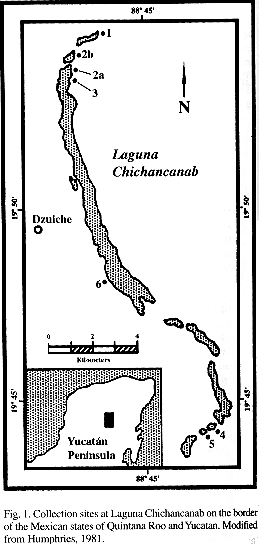
<body><![CDATA[<p><font face="Arial,Helvetica"><font size=-1>Extinction of endemic flock species caused by the introduction of exotic species is well documented (Witte <i>et al.&nbsp;</i> 1992). Over 200 species were lost in Lake Victoria after the introduction of the Nile perch and an entire species flock in Lake Lanao went extinct in the wake of a number of introductions, including <i>O. mossambicus</i> (Witte <i>et al.&nbsp;</i> 1992, Cohen 1994).&nbsp; The status of the Chichancanab flock since the introduction of <i>O. mossambicus</i> in the 1980’s, and the impacts of the introduction upon the flock species have not been determined.&nbsp; The impacts of <i>O. mossambicus</i> upon habitat segregation among flock species are of particular interest because habitat segregation may have played a important role in the evolution of the Chichancanab flock (Humphries 1981). If <i>O. mossambicus</i> overlaps in habitat use with flock species, detection of shifts in habitat use by flock species may provide insights into the mechanisms originally driving segregation among the species.</font></font>     <p><font face="Arial,Helvetica"><font size=-1>I surveyed fishes in Laguna Chichancanab in December, 1996 to:&nbsp;&nbsp; describe nearshore habitat use by flock species (pupfishes) and <i>O. mossambicus</i>, determine the degree to which these species overlapped in habitat use, and describe the status of the flock after the introduction of <i>O. mossambicus</i>.&nbsp; The results from this initial survey provided the framework for aquarium experiments that I conducted in November, 1997 to determine differences in microhabitat use among three of the flock species and to investigate the effects of <i>O. mossambicus</i> upon microhabitat use by these flock species.</font></font>     <br>&nbsp;     <p><b><font face="Arial,Helvetica"><font size=-1>Materials and Methods</font></font></b>     <p><font face="Arial,Helvetica"><font size=-1>Laguna Chichancanab is located in the interior of the Yucatan peninsula on the border of the Mexican states of Quintana Roo and Yucatan (<a href="#img1">Figure 1)</a>. Covich and Stuiver (1974) and Humphries (1981) provide detailed descriptions of the lake basin.&nbsp; The following experimental methods have been abbreviated but a detailed description of methods is available from the author.</font></font>     <center>     <p><a NAME="img1"></a><img SRC="/img/fbpe/rbt/v49n2/1023i1.GIF" height=544 width=259></center>      
<p><font face="Arial,Helvetica"><font size=-1>To assess relative abundances of lake fishes, I fished unbaited minnow traps at sites 1 - 4 sampled by Humphries (1981; Figure 1).&nbsp; To assess abundance of <i>C. simus</i>, a limnetic dweller, I seined, dip-netted and snorkeled areas at site 2a and b.&nbsp; To describe differences in nearshore habitat use among fishes, I fished 24 unbaited minnow traps, stacked to fill the vertical water column,&nbsp; at 0.5-m intervals on transects stretching from shore into the lake to a depth of 1 m.&nbsp; I checked traps every 3 - 4 hours throughout a 24-hr period then moved the transects to another location, and repeated the 24 hr survey at five different locations at station 2b (Figure 1).&nbsp; The following variables were recorded for each trap set:&nbsp;&nbsp; water depth at trap opening, presence of emergent and submerged vegetation, and distance to nearest shore.</font></font>     <p><font face="Arial,Helvetica"><font size=-1><b>Aquarium Experiments</b><i>—</i> Experiments using <i>Cyprinodon beltrani, C. labiosus, C. maya</i>,&nbsp; and <i>O. mossambicus</i> were conducted in a continuous-flow system of four fiberglass tanks with an observation window marked with a 2-dimensional grid.&nbsp; Each trial and tank contained a different group of randomly selected fishes.&nbsp; I used <i>O. mossambicus </i>between 28 mm and 69 mm total length because this size was within the range of <i>O. mossambicus </i>most commonly captured with pupfishes in the lake.&nbsp; I conducted two trials of each of five experimental treatments to examine habitat use by single species of pupfishes, by a group of congeneric pupfishes and by flock species in the presence of <i>O. mossambicus</i>.&nbsp; A trial consisted of a 15-minute observation period, during which a count of the number of fishes of each species within each tank grid location was recorded every minute.&nbsp; As a measure of dispersion, I recorded the number of different areas in which fish of the same species were found at the 1-minute observation mark.&nbsp; The treatments were as follows:&nbsp; the first treatment was a single-species control designed to show that fishes did not exhibit a tank-side preference.&nbsp; Only gravel substrate was present in a tank that included five individuals of a single species.&nbsp; Treatment 2 was a single-species treatment used to examine microhabitat use for the species and provided a “control” with vegetation present with which to compare multi-species treatments.&nbsp; There were five individuals of the same species in a tank with half gravel and half submerged vegetation (SV) substrate. Treatment 3 was an “intruder” treatment where five individual pupfish of the same species and one <i>O. mossambicus</i> were in a tank with half gravel and half SV substrate.&nbsp; Treatment 4, a multiple-intruder treatment,&nbsp; included five conspecific cyprinodontids and five <i>O. mossambicus</i>.</font></font>     <p><font face="Arial,Helvetica"><font size=-1><b>Analyses</b><i> - </i>I used SAS for all statistical analyses (SAS Institute 1988) and adjusted the probability of acceptance to 0.05 divided by the number of tests examined.&nbsp; I used a general linear model (PROC GLM) for an unbalanced ANOVA and least squared means comparisons to identify differences in habitat use by fishes collected on lake transects.&nbsp; For aquarium experiments, I used t-tests to determine if fishes showed a tank side preference.&nbsp; I used analyses of covariance (ANCOVA) with time of day as a covariable and least-squared means to compare average locations of species within the tanks and to examine microhabitat preferences for the species. I used the log transformed values of the average number of occurrences of each species in each tank location for each trial for seven of the eight possible tank locations, and dispersion in an ANCOVA.&nbsp;&nbsp; The area nearest the water surface, on the non-vegetated tank side was omitted from analyses so the possible tank positions would be independent.&nbsp; I examined planned comparisons based on <i>a priori </i>hypotheses.&nbsp; I predicted that <i>C. beltrani</i> and<i> C. labiosus</i> would use areas nearest, or within vegetation more often when <i>O. mossambicus </i>were present,&nbsp; with the highest use coinciding with the highest density of<i> O. mossambicus</i>.&nbsp; I predicted that <i>C.</i> <i>maya</i> would use areas closer to the bottom of the tank on either tank side when <i>O. mossambicus </i>were present because <i>C. maya</i> were not commonly encountered in nearshore minnow traps.</font></font>     ]]></body>
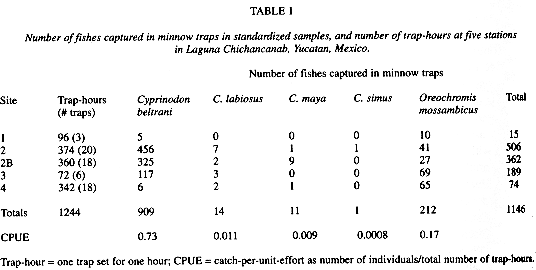
<body><![CDATA[<p><font face="Arial,Helvetica"><font size=-1><b>Agonistic Behaviors</b><i>—</i>In separate aquarium trials, I quantified the numbers of&nbsp; interspecific and intraspecific “agonistic encounters” between two male-female pairs of <i>C. beltrani </i>and <i>C. labiosus </i>in tanks with gravel substrate that included two small stones (10 x 5 cm) as focal points (Kodric-Brown 1995).&nbsp; A “charge” was defined as an aggressive approach by one individual that resulted in the receiver moving away from the charger.&nbsp; I used a 2x2 contingency analysis and Chi-square distribution to compare the numbers of interspecific and intraspecific charges.</font></font>     <br>&nbsp;     <p><b><font face="Arial,Helvetica"><font size=-1>Results</font></font></b>     <p><font face="Arial,Helvetica"><font size=-1><b>Relative abundance</b><i>—Cyprinodon beltrani</i> was the most abundant flock species, <i>C. labiosus</i>,the second and <i>C. maya</i>, was the third most abundant flock species in minnow trap samples from stations 1 - 4 <a href="#tab1">(Table 1)</a>.  <i>Oreochromis</i> <i>mossambicus</i> outnumbered all flock species except <i>C. beltrani</i>.&nbsp; Only one individual <i>C. simus</i> was collected in a minnow trap at site 2; a site where Humphries (1981) collected all five species in 1978.&nbsp; No<i> C. simus</i> were observed during snorkeling surveys or in seine hauls and no definitively identified <i>C. verecundus </i>were collected in systematic samples.&nbsp; The most abundant fishes observed in snorkeling surveys were <i>O. mossambicus</i> and large schools (30 - 80 individuals) of <i>Astyanax aeneus</i>.&nbsp; Both <i>G. sexradiata </i>and <i>A.&nbsp;</i> <i>aeneus</i> were underrepresented in minnow trap samples, but abundant in seine hauls.&nbsp; I considered <i>A. aeneus</i> the species of <i>Astyanax </i>present in the lake based on Schmitter-Soto (1998).</font></font>     <p><font face="Arial,Helvetica"><font size=-1><b>Nearshore habitat use</b><i>—</i> Transects were trapped for 1244 trap-hours and 120 traps were fished.&nbsp; There were no <i>C. labiosus, C. simus, C. verecundus</i>,<i> G. sexradiata </i>or <i>A. aeneus</i> collected in traps on transects.<i>Cyprinodon beltrani</i> was found in shallow water, nearshore, over thick beds of SV, and little emergent vegetation.&nbsp; This species inhabited these areas early in the morning but moved out of the nearshore area in the evening. Traps that contained <i>C. beltrani</i> were:&nbsp;&nbsp; (1)&nbsp; in areas with less emergent vegetation (<i>P</i>=0.003);&nbsp; (2)&nbsp; were checked earlier in the day (<i>P</i>=0.004);&nbsp; (3)&nbsp; were closer to the nearest shore (<i>P</i>=0.01); and (4)&nbsp; had more <i>O. mossambicus</i> present in the same trap (<i>P</i>=0.01) compared to traps without <i>C. beltrani</i>. There were no differences in habitat characteristics in areas where <i>C. beltrani</i> was present versus where it was absent for two variables:&nbsp;&nbsp; presence of submerged <i>Chara</i> and trap depth.</font></font>     <p><font face="Arial,Helvetica"><font size=-1>Habitat use of adult <i>C. beltrani</i> and <i>O. mossambicus</i> between 30 - 81 mm total length&nbsp; broadly overlapped.&nbsp; Of the total traps set, twenty-seven percent contained both <i>C. beltrani </i>and <i>O. mossambicus</i>.&nbsp; Forty percent of the traps containing <i>C. beltrani</i> also contained <i>O. mossambicus</i> individuals, and both <i>C. beltrani</i> and <i>O. mossambicus</i> were observed together during snorkeling surveys.&nbsp; Low capture rates of flock species other than <i>C. beltrani</i> prevented the quantification of habitat use for most of the flock species.&nbsp; There were significantly more <i>O. mossambicus</i> captured in traps with <i>C. maya</i> (P=0.0001), but this was likely an artifact of small sample size because only 15 traps contained <i>C. maya</i>.</font></font>     <center>     <p><a NAME="tab1"></a><img SRC="/img/fbpe/rbt/v49n2/1023ta1.GIF" height=270 width=536></center>      
<p>    <br>     ]]></body>
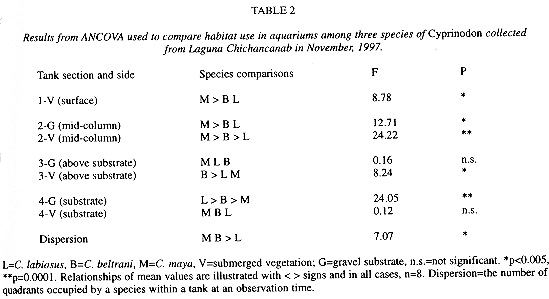
<body><![CDATA[<p><font face="Arial,Helvetica"><font size=-1><b>Single-species treatments</b><i>—</i> There was no difference in tank side use for either of the three species(P > 0.20).&nbsp; Presence of submerged vegetation affected pupfish habitat use in single-species trials and species dispersed differently within tanks <a href="#tab2">(Table 2)</a>. <i>Cyprinodon maya</i> used areas nearer the water surface more than the other two flock species and used the area just above the vegetation less often than <i>C.</i> <i>beltrani</i>.&nbsp; Both <i>C. labiosus</i> and <i>C. beltrani</i> were found more often on the unvegetated substrate and just above the SV substrate more often than <i>C. maya</i> (P &lt; 0.006).<i> Cyprinodon maya</i> tended to remain more widely dispersed within a tank than <i>C. labiosus</i> (P = 0.005) and <i>C. beltrani, </i>though not significantly in the latter case.</font></font>     <center>     <p><a NAME="tab2"></a><img SRC="/img/fbpe/rbt/v49n2/1023ta2.GIF" height=299 width=549></center>      
<p><font face="Arial,Helvetica"><font size=-1><b>Intruder treatments</b><i>—</i>Contrary to my predictions, neither <i>C. beltrani </i>nor <i>C. labiosus </i>used areas in or near the SV more often in the presence of <i>O. mossambicus.&nbsp; Cyprinodon labiosus</i> was found more often on the gravel substrate in intruder trials compared to single-species trials and had higher dispersion values in the single-intruder compared to single-species and multiple-intruder treatments (F = 3.83, r</font><sup><font size=-2>2</font></sup><font size=-1> = 0.31, P = 0.03).&nbsp; <i>Cyprinodon beltrani</i> showed no differences in dispersion pattern in single species and intruder treatments.</font></font>     <p><font face="Arial,Helvetica"><font size=-1><i>Cyprinodon maya</i> shifted its habitat use from lower in the water column in single-species treatments to higher in the water column in the single-intruder treatment, and changed its dispersion pattern.&nbsp;&nbsp; <i>Cyprinodon maya</i> was more often at the water surface above the gravel substrate in the multi-intruder treatment compared to the single-intruder and single-species treatments (F = 7.07, r</font><sup><font size=-2>2</font></sup><font size=-1> = 0.49, P = 0.005) and less often at the water surface above the vegetation in single-species compared to single-intruder treatments. <i>Cyprinodon maya</i> also had significantly lower dispersion values in the multi-intruder treatment compared to its single-species and single-intruder treatments (F = 7.11, r</font><sup><font size=-2>2</font></sup><font size=-1> = 0.43, P = 0.005).</font></font>     <p><font face="Arial,Helvetica"><font size=-1><b>Agonistic behaviors</b><i>—</i>More charges (59.9%) were initiated by <i>C. labiosus </i>(</font><font size=-2>&macr;</font><font size=-1>x = 11.5 per trial) and received by <i>C. beltrani </i>than any other combination of interactions between and within species in 19 trials.&nbsp; The Chi-square statistic was significant for the 2 x 2 contingency analysis (X</font><sup><font size=-2>2</font></sup><font size=-1> = 11.142, P = 0.001) and indicated there were more interspecific charges (n = 264) delivered compared to intraspecific (n = 112) charges.</font></font>     <br>&nbsp;     <p><b><font face="Arial,Helvetica"><font size=-1>Discussion</font></font></b>     <p><font face="Arial,Helvetica"><font size=-1>The introduction of <i>O.mossambicus</i> and its subsequent dispersal throughout the Chichancanab basin has significantly negatively impacted the flock of species of <i>Cyprinodon</i> in the basin.&nbsp; Compared to descriptions of large schools of flock species observed in 1978 (Humphries and Miller 1981, Stevenson 1992), four of the five flock members have decreased in abundance since their initial description.&nbsp; Humphries and Miller (1981) described schools of ranging from 50-1000 adult <i>C. simus</i> at station 2b in 1978.&nbsp; In contrast to my difficulty in collecting most flock species, in 1978 in one 10-m seine haul at station 2b, Humphries (1981) collected 33 <i>C. beltrani</i>, 26 <i>C. labiosus</i>, 11 <i>C. maya</i> and 2 <i>C. simus.</i>&nbsp; Of the four readily identifiable cyprinodontids, <i>C. beltrani</i> was abundant during my study, but <i>C. labiosus </i>and <i>C. maya</i> and <i>C. simus</i> were rare.&nbsp; Very few <i>C. verecundus </i>were confidently identified in this study but their abundance was assumed to also have declined.&nbsp;&nbsp; I quantified abundance of fishes in only one season but because flock species breed year-round (Strecker and Kodric-Brown 1999) and additional, unpublished visits to the lake yielded the same low numbers, I assume that the low abundances are not seasonal in nature. The pattern of decreased abundance of Chichancanab flock species parallels that observed in Lake Victoria (Witte <i>et al.&nbsp;</i> 1992) where the less abundant species disappeared first (Cohen 1994).&nbsp; In Chichancanab, the originally less abundant species have experienced declines since 1978 whereas <i>Cyprinodon beltrani </i>remained abundant.</font></font>     <p><font face="Arial,Helvetica"><font size=-1>The nature of the negative impacts of <i>O. mossambicus</i> upon flock species was investigated here by examining microhabitat use of pupfishes alone and in the presence of <i>O. mossambicus</i>.&nbsp; Initial characterization of habitat use by flock species was important because hypotheses of flock speciation involve ecological segregation.&nbsp; Although Humphries and Miller (1981) and Stevenson (1992) qualitatively described habitat used by flock species, they did not quantify microhabitat differences among them.&nbsp; Results of&nbsp; my field surveys and laboratory experiments indicated that species of <i>Cyprinodon</i> in Chichancanab were segregated by microhabitat and behavioral differences and that the presence of <i>O. mossambicus</i> caused a shift in microhabitat use by <i>C. maya</i> and<i> C. labiosus</i>.</font></font>     ]]></body>
<body><![CDATA[<p><font face="Arial,Helvetica"><font size=-1>In nearshore habitats of the lake, <i>O. mossambicus</i> overlapped in habitat use with <i>C. beltrani</i> and possibly <i>C. maya</i>.&nbsp; Characters that typified habitat used by <i>C. beltrani</i> in nearshore areas included presence of submerged vegetation, proximity to shore and time of day.&nbsp; Diel variation in nearshore habitat use by <i>C. beltrani</i> was likely related to water temperature fluctuations (Barlow 1958, Humphries and Miller 1981) and may also correspond to foraging periods (Stevenson 1992).</font></font>     <p><font face="Arial,Helvetica"><font size=-1>In aquarium experiments, <i>C. maya </i>was most distinct in microhabitat use compared to <i>C. beltrani </i>and <i>C. labiosus</i>.&nbsp; Generally, <i>C. maya</i> used areas higher in the water column rather than just above or within vegetation beds.&nbsp; This species exhibited higher dispersion compared to <i>C. beltrani </i>and <i>C. labiosus</i>, which tended to travel in groups.&nbsp; These results were consistent with observations made by Humphries and Miller (1981) who described <i>C. maya</i> as a lone forager compared to the other species of <i>Cyprinodon</i> that moved in large schools.</font></font>     <p><font face="Arial,Helvetica"><font size=-1><i>Cyprinodon beltrani </i>and <i>C. labiosus</i> overlapped in habitat use more so than either overlapped with <i>C. maya</i>, but distinctions in habitat use between <i>C. beltrani</i> and <i>C. labiosus</i> were evident.&nbsp; <i>Cyprinodon labiosus</i> used areas higher in the water column less than <i>C. beltrani</i>, and<i> C. beltrani </i>individuals showed greater dispersion than did <i>C. labiosus</i>.</font></font>     <p><font face="Arial,Helvetica"><font size=-1>Segregation among species of the Chichancanab flock may have a behavioral component as well as a habitat use component.&nbsp; <i>Cyprinodon beltrani </i>and <i>C. labiosus </i>displayed more interspecific agonistic behaviors compared to intraspecific encounters.&nbsp; Humphries and Miller (1981) observed males of both <i>C. beltrani and C. labiosus </i>guarding territories and described <i>C. beltrani </i>defense of feeding pits.&nbsp; The construction and defense of feeding pits has been observed in other cyprinodontids (Barlow 1961) and may result in spatial segregation of individuals.</font></font>     <p><font face="Arial,Helvetica"><font size=-1>In the presence of <i>O. mossambicus</i>, <i>C. beltrani</i> did not differ in its habitat use or dispersion in the tank.&nbsp; However, <i>C. labiosus</i> and <i>C. maya</i> both shifted habitat use via increased dispersion, and use of areas near the substrate, respectively.&nbsp; These shifts forced <i>C.</i> <i>labiosus</i> and <i>C. maya</i> out of preferred habitat an in closer proximity to <i>C. beltrani,</i> which was found more often in groups near the substrate.</font></font>     <p><font face="Arial,Helvetica"><font size=-1>Differences in microhabitat use among flock species that I observed are concordant with genetic (Strecker <i>et al.&nbsp;</i> 1996) and dietary (Stevenson 1992) differences among the species.&nbsp; <i>Cyprinodon labiosus </i>and <i>C. beltrani&nbsp;</i> shared a mtDNA haplotype whereas, <i>C. maya </i>exhibited a unique haplotype (Strecker <i>et al.&nbsp;</i> 1996).&nbsp; The genetically most distinct flock species, <i>C. maya,</i> was also distinct in its ability to recognize congeneric mates (Strecker and Kodric-Brown 1999), its diverse diet (Stevenson 1992) and among congeners in its microhabitat use.&nbsp; This species consumed less detritus than <i>C. labiosus </i>or <i>C. beltrani</i> and uniquely included large arthropods and fish in its diet (Stevenson 1992). <i>Cyprinodon beltrani</i> fed mainly on blue-green algae and slightly less so on those organisms that constituted the largest percentage of the diet of <i>C. labiosus.</i></font></font>     <p><font face="Arial,Helvetica"><font size=-1>If habitat segregation was integral to the evolution of the Chichancanab flock, displacement of flock species into marginal habitats may impede the divergence process by disrupting life history characteristics involved in maintenance of segregation of the species.&nbsp;&nbsp; This is not to suggest habitat use was the only factor that contributed to divergence of the flock species.&nbsp; Behaviors related to species recognition and postmating isolation are also implicated as driving divergence of sympatric species.&nbsp;<i> </i>Small scale spatial segregation, home territory affinity (Owen <i>et al.&nbsp;</i> 1990, Ribbink 1991) and cues involved in sexual selection (Seehausen <i>et al.&nbsp;</i> 1997) were considered influential in the speciation processes that led to the divergence of numerous trophic morphs within the African Great Lakes.&nbsp;&nbsp; In Chichancanab, <i>C. beltrani</i> showed little interspecific mate recognition (Strecker and Kodric Brown 1999).&nbsp; If <i>O. mossambicus</i> forces <i>C. maya </i>and <i>C. labiosus</i> into habitat occupied by <i>C. beltrani, </i>this shift may result in genetic introgression and loss of rare phenotypes through the breakdown of premating segregation mechanisms.</font></font>     <p><font face="Arial,Helvetica"><font size=-1>Other changes in the Chichancanab basin not studied here may contribute to the decline in abundance of flock species outside of the habitat displacement caused by <i>O. mossambicus</i>.&nbsp; First, <i>O.&nbsp; mossambicus, </i>if not a scavenger on,<i> </i>may be direct predator of the flock species.&nbsp; I found remains of&nbsp; cyprinodontids in gut contents of <i>O. mossambicus</i> collected in seine samples from the lake and observed agonistic encounters between <i>C. beltrani </i>and <i>O. mossambicus </i>during snorkeling surveys.&nbsp; Secondly, compared to alcohol preserved specimens from 1978, over 90% of all flock species collected in 1997 were heavily infested with nematode parasites.&nbsp;&nbsp; Finally, the presence of <i>A. aeneus</i> may be involved in shifts of habitat use or other interactions that affect segregation among flock species.&nbsp; This species is common in interior cenotes of Yucatan (Scholz <i>et al.&nbsp;</i> 1995, Schmitter-Soto and Gamboa-P&eacute;rez 1996) and was likely artificially introduced by local aquarists (Schmitter-Soto, pers. comm.).</font></font>     <p><font face="Arial,Helvetica"><font size=-1>In the Chichancanab basin, precarious conditions of an ichthyofauna devoid of predators and competitors that fomented the evolution of the species flock has been significantly altered.&nbsp; Based on impacts caused by exotic species in similar systems (Stiassny 1996),&nbsp; further declines in cyprinodontid populations in Laguna Chichancanab are likely.</font></font>     <br>&nbsp;     ]]></body>
<body><![CDATA[<p><b><font face="Arial,Helvetica"><font size=-1>Acknowledgements</font></font></b>     <p><font face="Arial,Helvetica"><font size=-1>This project was supported by grants from:&nbsp;&nbsp; the University of Kansas Natural History Museum (KUNHM), Panorama Society, the Tinker Foundation, The Explorer’s Club, the American Museum Theodore Roosevelt Memorial Fund, and the National Security Education Program.&nbsp; The University of Kansas Department of Systematics and Ecology contributed supporting funds;&nbsp; W. Dimmick and E.O. Wiley provided facilities, supplies, and transportation to Mexico in 1996.&nbsp; Peter Runyan and J. Penrose conducted field work in 1996. Julian Humphries made his field notes field and specimens available.&nbsp; Kevin Tang produced figures, S. Stevenson helped with field logistics.&nbsp; Victor Vidal and M. E. Vega-Cendejas provided assistance in all aspects of my lab work including laboratory facilities, supplies, transportation and collection permits in Mexico.&nbsp; CINVESTAV parasitology students provided assistance with aquarium investigations and 1997 collections and J. J. Schmitter-Soto and H. Y. Yan provided helpful review of the manuscript.</font></font>     <br>&nbsp;     <p><b><font face="Arial,Helvetica"><font size=-1>Resumen</font></font></b>     <p><font face="Arial,Helvetica"><font size=-1>Cinco especies de <i>Cyprinodon </i>en la Laguna Chichancanab, Yucat&aacute;n, M&eacute;xico comprenden un cardumen j&oacute;ven de especies cuya ecolog&iacute;a y evoluci&oacute;n&nbsp; no ha sido estudiada a fondo, pero cuya existencia est&aacute; siendo amenazada con la extinci&oacute;n. Los card&uacute;menes de peces evolucionan en &aacute;reas aisladas donde los depredadores y los competidores est&aacute;n ausentes. Desde la descripci&oacute;n del cardumen de Chichancanab, <i>Oreachromis mossambicus,</i> una especie introducida al lago de la cual yo examin&eacute; el h&aacute;bitat en los 80&acute;s, se ha vuelto com&uacute;n en toda la laguna. Yo evalu&eacute; la abundancia relativa de especies del cardumen en el lago y uso de h&aacute;bitat y segregaci&oacute;n entre la especies del cardumen m&aacute;s comunes y examin&eacute; los efectos de <i>O. mossambicus</i> en el uso de h&aacute;bitat de las especies del cardumen. <i>Cyprinodon beltrani</i> fu&eacute; la especie de cardumen m&aacute;s abundante en 1997, seguida por <i>C. maya </i>y<i> C. labiosus; C. verecundus </i>y<i> C. simus </i>fueron muy raras.&nbsp; <i>Cyprinodon beltrani </i>fue encontrada en aguas someras, cerca de la costa, sobre lechos densos de <i>Chara</i> y poca vegetaci&oacute;n emergente. <i>Cyprinodon beltrani </i>exhibi&oacute; variaci&oacute;n diurna en el uso del h&aacute;bitat cerca de la costa. En el campo, el uso de h&aacute;bitat de <i>C. beltrani y O. mossambicus</i> se traslapaban ampliamente. En experimentos en acuarios, tres especies de cardumen exhibieron segregaci&oacute;n de uso de h&aacute;bitat&nbsp; y <i>C. beltrani</i> y <i>C. labiosus</i> mostraron comportamientos agon&iacute;sticos que fortalecen la segregaci&oacute;n. <i>Cyprinodon maya</i> se diferencia de <i>C. beltrani</i> y <i>C. labiosus</i> por su mayor dipersi&oacute;n de individuos y uso de &aacute;reas m&aacute;s altas en la columna de agua. La presentaci&oacute;n de <i>O. mossambicus</i> caus&oacute; un cambio en el uso de h&aacute;bitat de<i> C. maya</i> y <i>C. labiosus </i>que puso a estas especies dentro del h&aacute;bitat ocupado por<i> C. beltrani. </i>La presencia de esta especie introducida ha ausado una perturbaci&oacute;n significante de las condiciones que fomentaron especiaci&oacute;n de cardumen de Chichancanab hace 8 000 a&ntilde;os.</font></font>     <br>&nbsp;     <p><b><font face="Arial,Helvetica"><font size=-1>References</font></font></b>     <!-- ref --><p><font face="Arial,Helvetica"><font size=-1>Barlow, G. W. 1958. Daily movements of desert pupfish, <i>Cyprinodon macularius</i>, in shore pools of the Salton Sea, California. Ecology 39: 580-587.</font></font>    &nbsp;&nbsp;&nbsp;&nbsp;&nbsp;&nbsp;&nbsp;&nbsp;[&#160;<a href="javascript:void(0);" onclick="javascript: window.open('/scielo.php?script=sci_nlinks&ref=1350786&pid=S0034-7744200100020002400001&lng=','','width=640,height=500,resizable=yes,scrollbars=1,menubar=yes,');">Links</a>&#160;]<!-- end-ref --><!-- ref --><p><font face="Arial,Helvetica"><font size=-1>Barlow, G. W. 1961. Social behavior of the desert pupfish, <i>Cyprinodon macularius</i>, in the field &amp; in the aquarium. Am. Midl. Naturalist 65: 339-359.</font></font>    &nbsp;&nbsp;&nbsp;&nbsp;&nbsp;&nbsp;&nbsp;&nbsp;[&#160;<a href="javascript:void(0);" onclick="javascript: window.open('/scielo.php?script=sci_nlinks&ref=1350787&pid=S0034-7744200100020002400002&lng=','','width=640,height=500,resizable=yes,scrollbars=1,menubar=yes,');">Links</a>&#160;]<!-- end-ref --><!-- ref --><p><font face="Arial,Helvetica"><font size=-1>Cohen, A.S. 1994. Extinction in ancient lakes: biodiversity crises and conservation 40 years after J.L. Brooks. Arch. Hydrobiol. Beih. Ergebn. Limnol. 44: 451-479.</font></font>    &nbsp;&nbsp;&nbsp;&nbsp;&nbsp;&nbsp;&nbsp;&nbsp;[&#160;<a href="javascript:void(0);" onclick="javascript: window.open('/scielo.php?script=sci_nlinks&ref=1350788&pid=S0034-7744200100020002400003&lng=','','width=640,height=500,resizable=yes,scrollbars=1,menubar=yes,');">Links</a>&#160;]<!-- end-ref --><!-- ref --><p><font face="Arial,Helvetica"><font size=-1>Covich, A. &amp; M. Stuiver. 1974. Changes in oxygen 18 as a measure of long-term fluctuations in tropical lake levels and molluscan populations. Limnol. Oceanogr. 19: 682-691.</font></font>    &nbsp;&nbsp;&nbsp;&nbsp;&nbsp;&nbsp;&nbsp;&nbsp;[&#160;<a href="javascript:void(0);" onclick="javascript: window.open('/scielo.php?script=sci_nlinks&ref=1350789&pid=S0034-7744200100020002400004&lng=','','width=640,height=500,resizable=yes,scrollbars=1,menubar=yes,');">Links</a>&#160;]<!-- end-ref --><!-- ref --><p><font face="Arial,Helvetica"><font size=-1>Dieckmann, U. &amp; M. Doebeli. 1999. On the origin of species by sympatric speciation. Nature 400: 354-357.</font></font>    &nbsp;&nbsp;&nbsp;&nbsp;&nbsp;&nbsp;&nbsp;&nbsp;[&#160;<a href="javascript:void(0);" onclick="javascript: window.open('/scielo.php?script=sci_nlinks&ref=1350790&pid=S0034-7744200100020002400005&lng=','','width=640,height=500,resizable=yes,scrollbars=1,menubar=yes,');">Links</a>&#160;]<!-- end-ref --><!-- ref --><p><font face="Arial,Helvetica"><font size=-1>Greenwood, P.H. 1984. What is a species flock?, p. 10-19. In A. Echelle &amp; I. Kornfield (eds.). Evolution of Fish Species Flocks. University of Maine, Orono.</font></font>    &nbsp;&nbsp;&nbsp;&nbsp;&nbsp;&nbsp;&nbsp;&nbsp;[&#160;<a href="javascript:void(0);" onclick="javascript: window.open('/scielo.php?script=sci_nlinks&ref=1350791&pid=S0034-7744200100020002400006&lng=','','width=640,height=500,resizable=yes,scrollbars=1,menubar=yes,');">Links</a>&#160;]<!-- end-ref --><!-- ref --><p><font face="Arial,Helvetica"><font size=-1>Hodell, D. A., J. H. Curtis &amp; M. Brenner. 1995. Possible role of climate in the collapse of classic Maya civilization. Nature 375: 391-394.</font></font>    &nbsp;&nbsp;&nbsp;&nbsp;&nbsp;&nbsp;&nbsp;&nbsp;[&#160;<a href="javascript:void(0);" onclick="javascript: window.open('/scielo.php?script=sci_nlinks&ref=1350792&pid=S0034-7744200100020002400007&lng=','','width=640,height=500,resizable=yes,scrollbars=1,menubar=yes,');">Links</a>&#160;]<!-- end-ref --><!-- ref --><p><font face="Arial,Helvetica"><font size=-1>Humphries, J. M. 1981. The evolution of a species flock in the genus <i>Cyprinodon </i>(Pisces: Cyprinodontidae). Ph.D. Thesis, University of Michigan, Ann Arbor, Michigan. 233 p.</font></font>    &nbsp;&nbsp;&nbsp;&nbsp;&nbsp;&nbsp;&nbsp;&nbsp;[&#160;<a href="javascript:void(0);" onclick="javascript: window.open('/scielo.php?script=sci_nlinks&ref=1350793&pid=S0034-7744200100020002400008&lng=','','width=640,height=500,resizable=yes,scrollbars=1,menubar=yes,');">Links</a>&#160;]<!-- end-ref --><!-- ref --><p><font face="Arial,Helvetica"><font size=-1>Humphries, J. M. 1984. Genetics of speciation in pupfishes from Laguna Chichancanab, Mexico, p. 129-139. In A. Echelle &amp; I. Kornfield (eds.). Evolution of Fish Species Flocks. University of Maine, Orono.</font></font>    &nbsp;&nbsp;&nbsp;&nbsp;&nbsp;&nbsp;&nbsp;&nbsp;[&#160;<a href="javascript:void(0);" onclick="javascript: window.open('/scielo.php?script=sci_nlinks&ref=1350794&pid=S0034-7744200100020002400009&lng=','','width=640,height=500,resizable=yes,scrollbars=1,menubar=yes,');">Links</a>&#160;]<!-- end-ref --><!-- ref --><p><font face="Arial,Helvetica"><font size=-1>Humphries, J. M. 1984b. <i>Cyprinodon verecundus</i>, n. sp., a fifth species of pupfish from Laguna Chichancanab. Copeia 1984: 58-68.</font></font>    &nbsp;&nbsp;&nbsp;&nbsp;&nbsp;&nbsp;&nbsp;&nbsp;[&#160;<a href="javascript:void(0);" onclick="javascript: window.open('/scielo.php?script=sci_nlinks&ref=1350795&pid=S0034-7744200100020002400010&lng=','','width=640,height=500,resizable=yes,scrollbars=1,menubar=yes,');">Links</a>&#160;]<!-- end-ref --><!-- ref --><p><font face="Arial,Helvetica"><font size=-1>Humphries, J. M. &amp; R. R. Miller. 1981. A remarkable species flock of pupfishes, genus <i>Cyprinodon</i>, from Yucatan, Mexico.</font></font> <font face="Arial,Helvetica"><font size=-1>Copeia 1981 : 52-64</font></font>    &nbsp;&nbsp;&nbsp;&nbsp;&nbsp;&nbsp;&nbsp;&nbsp;[&#160;<a href="javascript:void(0);" onclick="javascript: window.open('/scielo.php?script=sci_nlinks&ref=1350796&pid=S0034-7744200100020002400011&lng=','','width=640,height=500,resizable=yes,scrollbars=1,menubar=yes,');">Links</a>&#160;]<!-- end-ref --><!-- ref --><p><font face="Arial,Helvetica"><font size=-1>Kodric-Brown, A. 1995. Does past reproductive history predict competitive interactions and male mating success in pupfish? Anim. Behav. 50: 1433-1440.</font></font>    &nbsp;&nbsp;&nbsp;&nbsp;&nbsp;&nbsp;&nbsp;&nbsp;[&#160;<a href="javascript:void(0);" onclick="javascript: window.open('/scielo.php?script=sci_nlinks&ref=1350797&pid=S0034-7744200100020002400012&lng=','','width=640,height=500,resizable=yes,scrollbars=1,menubar=yes,');">Links</a>&#160;]<!-- end-ref --><!-- ref --><p><font face="Arial,Helvetica"><font size=-1>Masters, J.C. &amp; R.J. Rayner. 1993. Competition and macroevolution: the ghost of competition yet to come? Biol. J. Linn. Soc. 49: 87-98.</font></font>    &nbsp;&nbsp;&nbsp;&nbsp;&nbsp;&nbsp;&nbsp;&nbsp;[&#160;<a href="javascript:void(0);" onclick="javascript: window.open('/scielo.php?script=sci_nlinks&ref=1350798&pid=S0034-7744200100020002400013&lng=','','width=640,height=500,resizable=yes,scrollbars=1,menubar=yes,');">Links</a>&#160;]<!-- end-ref --><!-- ref --><p><font face="Arial,Helvetica"><font size=-1>Owen, R. B., R. Crossley, T. C. Johnson, D. Tweddle, I. Kornfield, S. Davison, D. H. Eccles &amp; D. E. Engstrom. 1990. Major low levels of Lake Malawi and their implications for speciation rates in cichlid fishes. Proc. Roy. Soc. London, B 240: 519-553.</font></font>    &nbsp;&nbsp;&nbsp;&nbsp;&nbsp;&nbsp;&nbsp;&nbsp;[&#160;<a href="javascript:void(0);" onclick="javascript: window.open('/scielo.php?script=sci_nlinks&ref=1350799&pid=S0034-7744200100020002400014&lng=','','width=640,height=500,resizable=yes,scrollbars=1,menubar=yes,');">Links</a>&#160;]<!-- end-ref --><!-- ref --><p><font face="Arial,Helvetica"><font size=-1>Ribbink, A. J. 1991. Distribution and ecology of the cichlids of the African Great Lakes. p. 36-59. In M.H.A. Keenleyside (ed.) Cichlid fishes, behaviour, ecology and evolution. Chapman &amp; Hall, London, England.</font></font>    &nbsp;&nbsp;&nbsp;&nbsp;&nbsp;&nbsp;&nbsp;&nbsp;[&#160;<a href="javascript:void(0);" onclick="javascript: window.open('/scielo.php?script=sci_nlinks&ref=1350800&pid=S0034-7744200100020002400015&lng=','','width=640,height=500,resizable=yes,scrollbars=1,menubar=yes,');">Links</a>&#160;]<!-- end-ref --><!-- ref --><p><font face="Arial,Helvetica"><font size=-1>SAS Institute1988. SAS/Stat user’s guide, release 6.03. SAS Institute. Cary, North Carolina. 1028 p.</font></font>    &nbsp;&nbsp;&nbsp;&nbsp;&nbsp;&nbsp;&nbsp;&nbsp;[&#160;<a href="javascript:void(0);" onclick="javascript: window.open('/scielo.php?script=sci_nlinks&ref=1350801&pid=S0034-7744200100020002400016&lng=','','width=640,height=500,resizable=yes,scrollbars=1,menubar=yes,');">Links</a>&#160;]<!-- end-ref --><!-- ref --><p><font face="Arial,Helvetica"><font size=-1>Schmitter-Soto, J. J. 1998. Diagnosis of <i>Astyanax altior </i>(Characidae), with a morphometric analysis of <i>Astyanax </i>in the Yucatan Peninsula. Ichthyol. Explor. Freshwaters 8: 349-358.</font></font>    &nbsp;&nbsp;&nbsp;&nbsp;&nbsp;&nbsp;&nbsp;&nbsp;[&#160;<a href="javascript:void(0);" onclick="javascript: window.open('/scielo.php?script=sci_nlinks&ref=1350802&pid=S0034-7744200100020002400017&lng=','','width=640,height=500,resizable=yes,scrollbars=1,menubar=yes,');">Links</a>&#160;]<!-- end-ref --><!-- ref --><p><font face="Arial,Helvetica"><font size=-1>Schmitter-Soto, J. J. &amp; C. Caro. 1997. Distribution of tilapia, <i>Oreochromis mossambicus </i>(Perciformes: Cichlidae) and water body characteristics in Quintana Roo, Mexico. Rev. Biol. Trop. 45: 1257-1261.</font></font>    &nbsp;&nbsp;&nbsp;&nbsp;&nbsp;&nbsp;&nbsp;&nbsp;[&#160;<a href="javascript:void(0);" onclick="javascript: window.open('/scielo.php?script=sci_nlinks&ref=1350803&pid=S0034-7744200100020002400018&lng=','','width=640,height=500,resizable=yes,scrollbars=1,menubar=yes,');">Links</a>&#160;]<!-- end-ref --><!-- ref --><p><font face="Arial,Helvetica"><font size=-1>Schmitter-Soto, J. J. &amp; H. C. Gamboa-P&eacute;rez. 1996. Composici&oacute;n y distribuci&oacute;n de peces continentales en el sur de Quintana Roo, Pen&iacute;nsula de Yucatan, Mexico. Rev. Biol. Trop. 44: 199-212.</font></font>    &nbsp;&nbsp;&nbsp;&nbsp;&nbsp;&nbsp;&nbsp;&nbsp;[&#160;<a href="javascript:void(0);" onclick="javascript: window.open('/scielo.php?script=sci_nlinks&ref=1350804&pid=S0034-7744200100020002400019&lng=','','width=640,height=500,resizable=yes,scrollbars=1,menubar=yes,');">Links</a>&#160;]<!-- end-ref --><!-- ref --><p><font face="Arial,Helvetica"><font size=-1>Scholz, T., J. Vargas-V&aacute;squez, F. Moravec, C. Vivas-Rodr&iacute;guez &amp; E. Mendoza-Franco. 1995. Cenotes (sinkholes) of the Yucatan Peninsula, Mexico, as a habitat of adult trematodes of fish. Folia Parasit. 42: 37-47.</font></font>    &nbsp;&nbsp;&nbsp;&nbsp;&nbsp;&nbsp;&nbsp;&nbsp;[&#160;<a href="javascript:void(0);" onclick="javascript: window.open('/scielo.php?script=sci_nlinks&ref=1350805&pid=S0034-7744200100020002400020&lng=','','width=640,height=500,resizable=yes,scrollbars=1,menubar=yes,');">Links</a>&#160;]<!-- end-ref --><!-- ref --><p><font face="Arial,Helvetica"><font size=-1>Seehausen, O., van Alpen, J..M. &amp; Witte, F. 1997. Cichlid fish diversity threatened by eutrophication that curbs sexual selection. Science 277: 1808-1811.</font></font>    &nbsp;&nbsp;&nbsp;&nbsp;&nbsp;&nbsp;&nbsp;&nbsp;[&#160;<a href="javascript:void(0);" onclick="javascript: window.open('/scielo.php?script=sci_nlinks&ref=1350806&pid=S0034-7744200100020002400021&lng=','','width=640,height=500,resizable=yes,scrollbars=1,menubar=yes,');">Links</a>&#160;]<!-- end-ref --><!-- ref --><p><font face="Arial,Helvetica"><font size=-1>Stiassny, M. L., 1996. An overview of freshwater biodiversity with some lessons from African fishes. Fisheries 21: 7-13.</font></font>    &nbsp;&nbsp;&nbsp;&nbsp;&nbsp;&nbsp;&nbsp;&nbsp;[&#160;<a href="javascript:void(0);" onclick="javascript: window.open('/scielo.php?script=sci_nlinks&ref=1350807&pid=S0034-7744200100020002400022&lng=','','width=640,height=500,resizable=yes,scrollbars=1,menubar=yes,');">Links</a>&#160;]<!-- end-ref --><!-- ref --><p><font face="Arial,Helvetica"><font size=-1>Stevenson, M. M. 1992. Food habits within the Laguna Chichancanab <i>Cyprinodon</i> (Pisces: Cyprinodontidae) species flock. Southwest. Naturalist 37: 337-343.</font></font>    &nbsp;&nbsp;&nbsp;&nbsp;&nbsp;&nbsp;&nbsp;&nbsp;[&#160;<a href="javascript:void(0);" onclick="javascript: window.open('/scielo.php?script=sci_nlinks&ref=1350808&pid=S0034-7744200100020002400023&lng=','','width=640,height=500,resizable=yes,scrollbars=1,menubar=yes,');">Links</a>&#160;]<!-- end-ref --><!-- ref --><p><font face="Arial,Helvetica"><font size=-1>Strecker, U. &amp; A. Kodric-Brown. 1999. Mate recognition systems in a species flock of Mexican pupfish. J. Evol. Biol. 12: 927-935.</font></font>    &nbsp;&nbsp;&nbsp;&nbsp;&nbsp;&nbsp;&nbsp;&nbsp;[&#160;<a href="javascript:void(0);" onclick="javascript: window.open('/scielo.php?script=sci_nlinks&ref=1350809&pid=S0034-7744200100020002400024&lng=','','width=640,height=500,resizable=yes,scrollbars=1,menubar=yes,');">Links</a>&#160;]<!-- end-ref --><!-- ref --><p><font face="Arial,Helvetica"><font size=-1>Strecker, U., C. G. Meyer, C. Sturmbauer &amp; H. Wilkens. 1996. Genetic divergence and speciation in an extremely young species flock in Mexico formed by the genus <i>Cyprinodon</i> (Cyprinodontidae, Teleostei). Molec. Phyl. Evol. 6: 143-149.</font></font>    &nbsp;&nbsp;&nbsp;&nbsp;&nbsp;&nbsp;&nbsp;&nbsp;[&#160;<a href="javascript:void(0);" onclick="javascript: window.open('/scielo.php?script=sci_nlinks&ref=1350810&pid=S0034-7744200100020002400025&lng=','','width=640,height=500,resizable=yes,scrollbars=1,menubar=yes,');">Links</a>&#160;]<!-- end-ref --><!-- ref --><p><font face="Arial,Helvetica"><font size=-1>Witte, F. T., Goldschmidt, J. H. Wanink, M. J. P. van Oijen, P. C. Goudswaard, E. L. M. Witte-Maas &amp; N. Bouton. 1992. The destruction of an endemic species flock: quantitative data on the decline of the haplochromine species of the Mwanza Gulf of Lake Victoria. Environ. Biol. Fishes 34: 1-28.</font></font>    &nbsp;&nbsp;&nbsp;&nbsp;&nbsp;&nbsp;&nbsp;&nbsp;[&#160;<a href="javascript:void(0);" onclick="javascript: window.open('/scielo.php?script=sci_nlinks&ref=1350811&pid=S0034-7744200100020002400026&lng=','','width=640,height=500,resizable=yes,scrollbars=1,menubar=yes,');">Links</a>&#160;]<!-- end-ref --><p><a NAME="1a"></a><font face="Arial,Helvetica"><font size=-1><sup><a href="#1">1</a></sup> The University of Kansas<b> </b>Department of Systematics and Ecology, Lawrence, KS 66045 USA</font></font>     <br><font face="Arial,Helvetica"><font size=-1>(Present address:&nbsp; University of Kentucky, Center for Ecology, Evolution and Behavior, Lexington, KY 40506 USA FAX:&nbsp; 606-257-1717 E-mail:&nbsp; <a href="mailto:lcfuse0@pop.uky.edu">lcfuse0@pop.uky.edu</a>)</font></font>      ]]></body><back>
<ref-list>
<ref id="B1">
<nlm-citation citation-type="journal">
<person-group person-group-type="author">
<name>
<surname><![CDATA[Barlow]]></surname>
<given-names><![CDATA[G. W.]]></given-names>
</name>
</person-group>
<article-title xml:lang="en"><![CDATA[Daily movements of desert pupfish, Cyprinodon macularius, in shore pools of the Salton Sea, California]]></article-title>
<source><![CDATA[Ecology]]></source>
<year>1958</year>
<volume>39</volume>
<page-range>580-587</page-range></nlm-citation>
</ref>
<ref id="B2">
<nlm-citation citation-type="journal">
<person-group person-group-type="author">
<name>
<surname><![CDATA[Barlow]]></surname>
<given-names><![CDATA[G. W.]]></given-names>
</name>
</person-group>
<article-title xml:lang="en"><![CDATA[Social behavior of the desert pupfish, Cyprinodon macularius, in the field & in the aquarium]]></article-title>
<source><![CDATA[Am. Midl. Naturalist]]></source>
<year>1961</year>
<volume>65</volume>
<page-range>339-359</page-range></nlm-citation>
</ref>
<ref id="B3">
<nlm-citation citation-type="journal">
<person-group person-group-type="author">
<name>
<surname><![CDATA[Cohen]]></surname>
<given-names><![CDATA[A.S.]]></given-names>
</name>
</person-group>
<article-title xml:lang="en"><![CDATA[Extinction in ancient lakes: biodiversity crises and conservation 40 years after J.L. Brooks]]></article-title>
<source><![CDATA[Arch. Hydrobiol. Beih. Ergebn. Limnol.]]></source>
<year>1994</year>
<volume>44</volume>
<page-range>451-479</page-range></nlm-citation>
</ref>
<ref id="B4">
<nlm-citation citation-type="journal">
<person-group person-group-type="author">
<name>
<surname><![CDATA[Covich]]></surname>
<given-names><![CDATA[A.]]></given-names>
</name>
<name>
<surname><![CDATA[Stuiver]]></surname>
<given-names><![CDATA[M.]]></given-names>
</name>
</person-group>
<article-title xml:lang="en"><![CDATA[Changes in oxygen 18 as a measure of long-term fluctuations in tropical lake levels and molluscan populations]]></article-title>
<source><![CDATA[Limnol. Oceanogr]]></source>
<year>1974</year>
<volume>19</volume>
<page-range>682-691</page-range></nlm-citation>
</ref>
<ref id="B5">
<nlm-citation citation-type="journal">
<person-group person-group-type="author">
<name>
<surname><![CDATA[Dieckmann]]></surname>
<given-names><![CDATA[U.]]></given-names>
</name>
<name>
<surname><![CDATA[Doebeli]]></surname>
<given-names><![CDATA[M.]]></given-names>
</name>
</person-group>
<article-title xml:lang="en"><![CDATA[On the origin of species by sympatric speciation]]></article-title>
<source><![CDATA[Nature]]></source>
<year>1999</year>
<volume>400</volume>
<page-range>354-357</page-range></nlm-citation>
</ref>
<ref id="B6">
<nlm-citation citation-type="book">
<person-group person-group-type="author">
<name>
<surname><![CDATA[Greenwood]]></surname>
<given-names><![CDATA[P.H.]]></given-names>
</name>
</person-group>
<article-title xml:lang="en"><![CDATA[What is a species flock?]]></article-title>
<person-group person-group-type="editor">
<name>
<surname><![CDATA[Echelle]]></surname>
<given-names><![CDATA[A.]]></given-names>
</name>
<name>
<surname><![CDATA[Kornfield]]></surname>
<given-names><![CDATA[I.]]></given-names>
</name>
</person-group>
<source><![CDATA[Evolution of Fish Species Flocks]]></source>
<year>1984</year>
<publisher-loc><![CDATA[Orono ]]></publisher-loc>
<publisher-name><![CDATA[University of Maine]]></publisher-name>
</nlm-citation>
</ref>
<ref id="B7">
<nlm-citation citation-type="journal">
<person-group person-group-type="author">
<name>
<surname><![CDATA[Hodell]]></surname>
<given-names><![CDATA[D. A.]]></given-names>
</name>
<name>
<surname><![CDATA[Curtis]]></surname>
<given-names><![CDATA[J. H.]]></given-names>
</name>
<name>
<surname><![CDATA[Brenner]]></surname>
<given-names><![CDATA[M.]]></given-names>
</name>
</person-group>
<article-title xml:lang="en"><![CDATA[Possible role of climate in the collapse of classic Maya civilization]]></article-title>
<source><![CDATA[Nature]]></source>
<year>1995</year>
<volume>375</volume>
<page-range>391-394</page-range></nlm-citation>
</ref>
<ref id="B8">
<nlm-citation citation-type="">
<person-group person-group-type="author">
<name>
<surname><![CDATA[Humphries]]></surname>
<given-names><![CDATA[J. M.]]></given-names>
</name>
</person-group>
<source><![CDATA[The evolution of a species flock in the genus Cyprinodon (Pisces: Cyprinodontidae)]]></source>
<year>1981</year>
<page-range>233</page-range></nlm-citation>
</ref>
<ref id="B9">
<nlm-citation citation-type="book">
<person-group person-group-type="author">
<name>
<surname><![CDATA[Humphries]]></surname>
<given-names><![CDATA[J. M.]]></given-names>
</name>
</person-group>
<article-title xml:lang="en"><![CDATA[Genetics of speciation in pupfishes from Laguna Chichancanab, Mexico]]></article-title>
<person-group person-group-type="editor">
<name>
<surname><![CDATA[Echelle]]></surname>
<given-names><![CDATA[A.]]></given-names>
</name>
<name>
<surname><![CDATA[Kornfield]]></surname>
<given-names><![CDATA[I.]]></given-names>
</name>
</person-group>
<source><![CDATA[Evolution of Fish Species Flocks]]></source>
<year>1984</year>
<publisher-loc><![CDATA[Orono ]]></publisher-loc>
<publisher-name><![CDATA[University of Maine]]></publisher-name>
</nlm-citation>
</ref>
<ref id="B10">
<nlm-citation citation-type="journal">
<person-group person-group-type="author">
<name>
<surname><![CDATA[Humphries]]></surname>
<given-names><![CDATA[J. M.]]></given-names>
</name>
</person-group>
<article-title xml:lang="en"><![CDATA[Cyprinodon verecundus, n. sp., a fifth species of pupfish from Laguna Chichancanab]]></article-title>
<source><![CDATA[Copeia]]></source>
<year>1984</year>
<volume>1984</volume>
<page-range>58-68</page-range></nlm-citation>
</ref>
<ref id="B11">
<nlm-citation citation-type="journal">
<person-group person-group-type="author">
<name>
<surname><![CDATA[Humphries]]></surname>
<given-names><![CDATA[J. M.]]></given-names>
</name>
<name>
<surname><![CDATA[Miller]]></surname>
<given-names><![CDATA[R. R.]]></given-names>
</name>
</person-group>
<article-title xml:lang="en"><![CDATA[A remarkable species flock of pupfishes, genus Cyprinodon, from Yucatan, Mexico]]></article-title>
<source><![CDATA[Copeia]]></source>
<year>1981</year>
<volume>1981</volume>
<page-range>52-64</page-range></nlm-citation>
</ref>
<ref id="B12">
<nlm-citation citation-type="journal">
<person-group person-group-type="author">
<name>
<surname><![CDATA[Kodric-Brown]]></surname>
<given-names><![CDATA[A.]]></given-names>
</name>
</person-group>
<article-title xml:lang="en"><![CDATA[Does past reproductive history predict competitive interactions and male mating success in pupfish?]]></article-title>
<source><![CDATA[Anim. Behav.]]></source>
<year>1995</year>
<volume>50</volume>
<page-range>1433-1440</page-range></nlm-citation>
</ref>
<ref id="B13">
<nlm-citation citation-type="journal">
<person-group person-group-type="author">
<name>
<surname><![CDATA[Masters]]></surname>
<given-names><![CDATA[J.C.]]></given-names>
</name>
<name>
<surname><![CDATA[Rayner]]></surname>
<given-names><![CDATA[R.J.]]></given-names>
</name>
</person-group>
<article-title xml:lang="en"><![CDATA[Competition and macroevolution: the ghost of competition yet to come?]]></article-title>
<source><![CDATA[Biol. J. Linn. Soc.]]></source>
<year>1993</year>
<volume>49</volume>
<page-range>87-98</page-range></nlm-citation>
</ref>
<ref id="B14">
<nlm-citation citation-type="journal">
<person-group person-group-type="author">
<name>
<surname><![CDATA[Owen]]></surname>
<given-names><![CDATA[R. B.]]></given-names>
</name>
<name>
<surname><![CDATA[Crossley]]></surname>
<given-names><![CDATA[R.]]></given-names>
</name>
<name>
<surname><![CDATA[Johnson]]></surname>
<given-names><![CDATA[T. C.]]></given-names>
</name>
<name>
<surname><![CDATA[Tweddle]]></surname>
<given-names><![CDATA[D.]]></given-names>
</name>
<name>
<surname><![CDATA[Kornfield]]></surname>
<given-names><![CDATA[I.]]></given-names>
</name>
<name>
<surname><![CDATA[Davison]]></surname>
<given-names><![CDATA[S.]]></given-names>
</name>
<name>
<surname><![CDATA[Eccles]]></surname>
<given-names><![CDATA[D. H.]]></given-names>
</name>
<name>
<surname><![CDATA[Engstrom]]></surname>
<given-names><![CDATA[D. E.]]></given-names>
</name>
</person-group>
<article-title xml:lang="en"><![CDATA[Major low levels of Lake Malawi and their implications for speciation rates in cichlid fishes]]></article-title>
<source><![CDATA[Proc. Roy. Soc. London]]></source>
<year>1990</year>
<volume>240</volume>
<page-range>519-553</page-range></nlm-citation>
</ref>
<ref id="B15">
<nlm-citation citation-type="book">
<person-group person-group-type="author">
<name>
<surname><![CDATA[Ribbink]]></surname>
<given-names><![CDATA[A. J.]]></given-names>
</name>
</person-group>
<article-title xml:lang="en"><![CDATA[Distribution and ecology of the cichlids of the African Great Lakes]]></article-title>
<person-group person-group-type="editor">
<name>
<surname><![CDATA[Keenleyside]]></surname>
<given-names><![CDATA[M.H.A.]]></given-names>
</name>
</person-group>
<source><![CDATA[Cichlid fishes, behaviour, ecology and evolution]]></source>
<year>1991</year>
<page-range>36-59</page-range><publisher-loc><![CDATA[London ]]></publisher-loc>
<publisher-name><![CDATA[Chapman & Hall]]></publisher-name>
</nlm-citation>
</ref>
<ref id="B16">
<nlm-citation citation-type="book">
<collab>SAS Institute</collab>
<source><![CDATA[SAS/Stat user’s guide, release 6.03]]></source>
<year>1988</year>
<page-range>1028</page-range><publisher-loc><![CDATA[Cary^eNorth Carolina North Carolina]]></publisher-loc>
<publisher-name><![CDATA[SAS Institute]]></publisher-name>
</nlm-citation>
</ref>
<ref id="B17">
<nlm-citation citation-type="journal">
<person-group person-group-type="author">
<name>
<surname><![CDATA[Schmitter-Soto]]></surname>
<given-names><![CDATA[J. J.]]></given-names>
</name>
</person-group>
<article-title xml:lang="en"><![CDATA[Diagnosis of Astyanax altior (Characidae), with a morphometric analysis of Astyanax in the Yucatan Peninsula]]></article-title>
<source><![CDATA[Ichthyol. Explor. Freshwaters]]></source>
<year>1998</year>
<volume>8</volume>
<page-range>349-358</page-range></nlm-citation>
</ref>
<ref id="B18">
<nlm-citation citation-type="journal">
<person-group person-group-type="author">
<name>
<surname><![CDATA[Schmitter-Soto]]></surname>
<given-names><![CDATA[J. J.]]></given-names>
</name>
<name>
<surname><![CDATA[Caro]]></surname>
<given-names><![CDATA[C.]]></given-names>
</name>
</person-group>
<article-title xml:lang="en"><![CDATA[Distribution of tilapia, Oreochromis mossambicus (Perciformes: Cichlidae) and water body characteristics in Quintana Roo, Mexico]]></article-title>
<source><![CDATA[Rev. Biol. Trop]]></source>
<year>1997</year>
<volume>45</volume>
<page-range>1257-1261</page-range></nlm-citation>
</ref>
<ref id="B19">
<nlm-citation citation-type="journal">
<person-group person-group-type="author">
<name>
<surname><![CDATA[Schmitter-Soto]]></surname>
<given-names><![CDATA[J. J.]]></given-names>
</name>
<name>
<surname><![CDATA[Gamboa-Pérez]]></surname>
<given-names><![CDATA[H. C.]]></given-names>
</name>
</person-group>
<article-title xml:lang="es"><![CDATA[Composición y distribución de peces continentales en el sur de Quintana Roo, Península de Yucatan, Mexico]]></article-title>
<source><![CDATA[Rev. Biol. Trop]]></source>
<year>1996</year>
<volume>44</volume>
<page-range>199-212</page-range></nlm-citation>
</ref>
<ref id="B20">
<nlm-citation citation-type="journal">
<person-group person-group-type="author">
<name>
<surname><![CDATA[Scholz]]></surname>
<given-names><![CDATA[T.]]></given-names>
</name>
<name>
<surname><![CDATA[Vargas-Vásquez]]></surname>
<given-names><![CDATA[J.]]></given-names>
</name>
<name>
<surname><![CDATA[Moravec]]></surname>
<given-names><![CDATA[F.]]></given-names>
</name>
<name>
<surname><![CDATA[Vivas-Rodríguez]]></surname>
<given-names><![CDATA[C.]]></given-names>
</name>
<name>
<surname><![CDATA[Mendoza-Franco]]></surname>
<given-names><![CDATA[E.]]></given-names>
</name>
</person-group>
<article-title xml:lang="en"><![CDATA[Cenotes (sinkholes) of the Yucatan Peninsula, Mexico, as a habitat of adult trematodes of fish]]></article-title>
<source><![CDATA[Folia Parasit]]></source>
<year>1995</year>
<volume>42</volume>
<page-range>37-47</page-range></nlm-citation>
</ref>
<ref id="B21">
<nlm-citation citation-type="journal">
<person-group person-group-type="author">
<name>
<surname><![CDATA[Seehausen]]></surname>
<given-names><![CDATA[O.]]></given-names>
</name>
<name>
<surname><![CDATA[van Alpen]]></surname>
<given-names><![CDATA[J.]]></given-names>
</name>
<name>
<surname><![CDATA[Witte]]></surname>
<given-names><![CDATA[F.]]></given-names>
</name>
</person-group>
<article-title xml:lang="en"><![CDATA[Cichlid fish diversity threatened by eutrophication that curbs sexual selection]]></article-title>
<source><![CDATA[Science]]></source>
<year>1997</year>
<volume>277</volume>
<page-range>1808-1811</page-range></nlm-citation>
</ref>
<ref id="B22">
<nlm-citation citation-type="journal">
<person-group person-group-type="author">
<name>
<surname><![CDATA[Stiassny]]></surname>
<given-names><![CDATA[M. L.]]></given-names>
</name>
</person-group>
<article-title xml:lang="en"><![CDATA[An overview of freshwater biodiversity with some lessons from African fishes]]></article-title>
<source><![CDATA[Fisheries]]></source>
<year>1996</year>
<volume>21</volume>
<page-range>7-13</page-range></nlm-citation>
</ref>
<ref id="B23">
<nlm-citation citation-type="journal">
<person-group person-group-type="author">
<name>
<surname><![CDATA[Stevenson]]></surname>
<given-names><![CDATA[M. M.]]></given-names>
</name>
</person-group>
<article-title xml:lang="en"><![CDATA[Food habits within the Laguna Chichancanab Cyprinodon (Pisces: Cyprinodontidae) species flock]]></article-title>
<source><![CDATA[Southwest. Naturalist]]></source>
<year>1992</year>
<volume>37</volume>
<page-range>337-343</page-range></nlm-citation>
</ref>
<ref id="B24">
<nlm-citation citation-type="journal">
<person-group person-group-type="author">
<name>
<surname><![CDATA[Strecker]]></surname>
<given-names><![CDATA[U.]]></given-names>
</name>
<name>
<surname><![CDATA[Kodric-Brown]]></surname>
<given-names><![CDATA[A.]]></given-names>
</name>
</person-group>
<article-title xml:lang="en"><![CDATA[Mate recognition systems in a species flock of Mexican pupfish]]></article-title>
<source><![CDATA[J. Evol. Biol.]]></source>
<year>1999</year>
<volume>12</volume>
<page-range>927-935</page-range></nlm-citation>
</ref>
<ref id="B25">
<nlm-citation citation-type="journal">
<person-group person-group-type="author">
<name>
<surname><![CDATA[Strecker]]></surname>
<given-names><![CDATA[U.]]></given-names>
</name>
<name>
<surname><![CDATA[Meyer]]></surname>
<given-names><![CDATA[C. G.]]></given-names>
</name>
<name>
<surname><![CDATA[Sturmbauer]]></surname>
<given-names><![CDATA[C.]]></given-names>
</name>
<name>
<surname><![CDATA[Wilkens]]></surname>
<given-names><![CDATA[H.]]></given-names>
</name>
</person-group>
<article-title xml:lang="en"><![CDATA[Genetic divergence and speciation in an extremely young species flock in Mexico formed by the genus Cyprinodon (Cyprinodontidae, Teleostei)]]></article-title>
<source><![CDATA[Molec. Phyl. Evol.]]></source>
<year>1996</year>
<volume>6</volume>
<page-range>143-149</page-range></nlm-citation>
</ref>
<ref id="B26">
<nlm-citation citation-type="journal">
<person-group person-group-type="author">
<name>
<surname><![CDATA[Witte]]></surname>
<given-names><![CDATA[F. T.]]></given-names>
</name>
<name>
<surname><![CDATA[Goldschmidt]]></surname>
</name>
<name>
<surname><![CDATA[Wanink]]></surname>
<given-names><![CDATA[J. H.]]></given-names>
</name>
<name>
<surname><![CDATA[van Oijen]]></surname>
<given-names><![CDATA[M. J. P.]]></given-names>
</name>
<name>
<surname><![CDATA[Goudswaard]]></surname>
<given-names><![CDATA[P. C.]]></given-names>
</name>
<name>
<surname><![CDATA[Witte-Maas]]></surname>
<given-names><![CDATA[E. L. M.]]></given-names>
</name>
<name>
<surname><![CDATA[Bouton]]></surname>
<given-names><![CDATA[N.]]></given-names>
</name>
</person-group>
<article-title xml:lang="en"><![CDATA[The destruction of an endemic species flock: quantitative data on the decline of the haplochromine species of the Mwanza Gulf of Lake Victoria]]></article-title>
<source><![CDATA[Environ. Biol. Fishes]]></source>
<year>1992</year>
<volume>34</volume>
<page-range>1-28</page-range></nlm-citation>
</ref>
</ref-list>
</back>
</article>