<?xml version="1.0" encoding="ISO-8859-1"?><article xmlns:mml="http://www.w3.org/1998/Math/MathML" xmlns:xlink="http://www.w3.org/1999/xlink" xmlns:xsi="http://www.w3.org/2001/XMLSchema-instance">
<front>
<journal-meta>
<journal-id>0034-7744</journal-id>
<journal-title><![CDATA[Revista de Biología Tropical]]></journal-title>
<abbrev-journal-title><![CDATA[Rev. biol. trop]]></abbrev-journal-title>
<issn>0034-7744</issn>
<publisher>
<publisher-name><![CDATA[Universidad de Costa Rica]]></publisher-name>
</publisher>
</journal-meta>
<article-meta>
<article-id>S0034-77442001000200015</article-id>
<title-group>
<article-title xml:lang="en"><![CDATA[Impact of logging on a mangrove swamp in South Mexico: cost / benefit analysis]]></article-title>
</title-group>
<contrib-group>
<contrib contrib-type="author">
<name>
<surname><![CDATA[Tovilla Hernández]]></surname>
<given-names><![CDATA[Cristian]]></given-names>
</name>
<xref ref-type="aff" rid="A01"/>
</contrib>
<contrib contrib-type="author">
<name>
<surname><![CDATA[de la Lanza Espino]]></surname>
<given-names><![CDATA[Guadalupe]]></given-names>
</name>
<xref ref-type="aff" rid="A02"/>
</contrib>
<contrib contrib-type="author">
<name>
<surname><![CDATA[Orihuela Belmonte]]></surname>
<given-names><![CDATA[D. Edith]]></given-names>
</name>
<xref ref-type="aff" rid="A03"/>
</contrib>
</contrib-group>
<aff id="A01">
<institution><![CDATA[,El Colegio de la Frontera Sur Unidad Tapachula ]]></institution>
<addr-line><![CDATA[ ]]></addr-line>
</aff>
<aff id="A02">
<institution><![CDATA[,UNAM Instituto de Biología ]]></institution>
<addr-line><![CDATA[ ]]></addr-line>
</aff>
<aff id="A03">
<institution><![CDATA[,Universidad Autónoma de Sinaloa Facultad de Biología Marina ]]></institution>
<addr-line><![CDATA[ ]]></addr-line>
</aff>
<pub-date pub-type="pub">
<day>00</day>
<month>06</month>
<year>2001</year>
</pub-date>
<pub-date pub-type="epub">
<day>00</day>
<month>06</month>
<year>2001</year>
</pub-date>
<volume>49</volume>
<numero>2</numero>
<fpage>571</fpage>
<lpage>580</lpage>
<copyright-statement/>
<copyright-year/>
<self-uri xlink:href="http://www.scielo.sa.cr/scielo.php?script=sci_arttext&amp;pid=S0034-77442001000200015&amp;lng=en&amp;nrm=iso"></self-uri><self-uri xlink:href="http://www.scielo.sa.cr/scielo.php?script=sci_abstract&amp;pid=S0034-77442001000200015&amp;lng=en&amp;nrm=iso"></self-uri><self-uri xlink:href="http://www.scielo.sa.cr/scielo.php?script=sci_pdf&amp;pid=S0034-77442001000200015&amp;lng=en&amp;nrm=iso"></self-uri><abstract abstract-type="short" xml:lang="en"><p><![CDATA[Environmental changes caused by logging in a mangrove swamp were studied in Barra de Tecoanapa, Guerrero, Mexico. Original forest included Rhizophora mangle, Laguncularia racemosa, Avicennia germinans and halophytic vegetation, and produced wood (164.03 m3/ha) and organic matter (3.9 g/m2/day). A total of 3.5 tons of wood per year were harvested from this area. Later, an average of 2 555 kg of maize per planting cycle were obtained (market value of 88 USD). Succession when the area was abandoned included strictly facultative and glycophyte halophytes (16 families, Cyperaceae and Poaceae were the best represented). After logging, temperatures increased 13 °C in the soil and 11°C in the air, whereas salinity reached 52 psu in the dry season. These modified soil color and sand content increased from 42.6 to 63.4%. Logging was deleterious to species, habitat, biogeochemical and biological cycles, organic matter production, seeds, young plants, genetic exchange conservation of soil and its fertility, coastal protection, and aesthetic value; 3 000 m2 had eroded as the river advanced towards the deforested area (the cost/benefit analysis showed a ratio of 246: 1). There was long-term economic loss for the community and only 30% of the site has recovered after five years.]]></p></abstract>
<abstract abstract-type="short" xml:lang="en"><p><![CDATA[En el presente trabajo se estudian los cambios causados por la deforestación de un manglar al sureste de México. La vegetación original incluia a R. mangle, L. racemosa y A. germinas. Se registró una sucesión apareciendo halofitas estrictas, facultativas así como glicófitas. En la época seca la temperatura aumentó 13 °C en el suelo y 11°C en el aire, y la salinidad alcanzó hasta 52 ups; además, se modificó la fauna y los ciclos biogeoquímicos; cambiaron las condiciones estéticas, se presentó una fuerte erosión y por lo tanto una pérdida económica. El área se ha recuperado en un 30% después de cinco años.]]></p></abstract>
<kwd-group>
<kwd lng="en"><![CDATA[cost/benefit]]></kwd>
<kwd lng="en"><![CDATA[evaluation]]></kwd>
<kwd lng="en"><![CDATA[habitat]]></kwd>
<kwd lng="en"><![CDATA[halophytes]]></kwd>
<kwd lng="en"><![CDATA[logging]]></kwd>
<kwd lng="en"><![CDATA[mangrove]]></kwd>
<kwd lng="en"><![CDATA[succession]]></kwd>
</kwd-group>
</article-meta>
</front><body><![CDATA[ <center>  <font face="Arial,Helvetica"><font size=-1><b>Impact of logging on a mangrove swamp in South Mexico: Cost/benefit analysis</b></font></font></center>      <center><font face="Arial,Helvetica"><font size=-1><b>Cristian Tovilla Hern&aacute;ndez<a NAME="1"></a></b><sup><a href="#1a">1</a><b>&nbsp;&nbsp;&nbsp;</b></sup><b> Guadalupe de la Lanza Espino<a NAME="2"></a></b><sup><a href="#2a">2</a></sup><b>&nbsp;&nbsp;&nbsp;&nbsp; D. Edith Orihuela Belmonte<a NAME="3"></a></b><sup><a href="#3a">3</a></sup></font></font>     <p><font face="Arial,Helvetica"><font size=-1>Received 11-VIII-2000.&nbsp;&nbsp;&nbsp;&nbsp; Corrected 31-VIII-2000.&nbsp;&nbsp;&nbsp; Accepted&nbsp; 9-X-2000</font></font></center>      <p><b><font face="Arial,Helvetica"><font size=-1>Abstract</font></font></b>     <p><font face="Arial,Helvetica"><font size=-1>Environmental changes caused by logging in a mangrove swamp were studied in Barra de Tecoanapa, Guerrero, Mexico. Original&nbsp; forest included <i>Rhizophora mangle</i>, <i>Laguncularia racemosa</i>, <i>Avicennia germinans </i>and halophytic vegetation, and produced wood (164.03 m</font><sup><font size=-2>3</font></sup><font size=-1>/ha) and organic matter (3.9 g/m</font><sup><font size=-2>2</font></sup><font size=-1>/day). A total of 3.5 tons of wood per year were harvested from this area. Later, an average of 2 555 kg of maize per planting cycle were obtained (market value of 88 USD). Succession when the area was abandoned included strictly facultative and glycophyte halophytes (16 families, Cyperaceae and Poaceae were the best represented). After logging, temperatures increased 13&ordm;C in the soil and 11&ordm;C in the air, whereas salinity reached 52 psu in the dry season. These modified soil color and sand content increased from 42.6 to 63.4%. Logging was deleterious to species, habitat, biogeochemical and biological cycles, organic matter production, seeds, young plants, genetic exchange conservation of soil and its fertility, coastal protection, and aesthetic value; 3 000 m</font><sup><font size=-2>2</font></sup><font size=-1> had eroded as the river advanced towards the deforested area (the cost/benefit analysis showed a ratio of 246: 1). There was long-term economic loss for the community and only 30% of the site has recovered after five years.</font></font>     <br>&nbsp;     <p><font face="Arial,Helvetica"><font size=-1><b>Key words</b>:</font></font>     <p><font face="Arial,Helvetica"><font size=-1>&nbsp;cost/benefit, evaluation, habitat, halophytes, logging, mangrove, succession.</font></font>     <br>&nbsp;     <p><font face="Arial,Helvetica"><font size=-1>Small areas of swamp are being felled at a constant rate in many areas along the coasts of Mexico. These losses are as harmful as those caused by the oil industry, roads construction, and aquaculture (Serrano <i>et al.&nbsp;</i> 1995, Botero and Mancera-Pineda 1996). Mangrove logging along the state of Guerrero coast has increased because of primitive agriculture and cattle ranching caused by an economic crisis (Tovilla and Gonz&aacute;lez 1994). However, there are no records on<b> </b>mangrove destruction or cost/benefit (including long-term environmental changes). Countries such as Costa Rica, Cuba, and Puerto Rico have quantified this phenomenon during the last decade and established land management plans and regulations for mangrove, with notable advances in the conservation of this important ecosystem (Jim&eacute;nez and Soto 1985, Jim&eacute;nez 1994).</font></font>     ]]></body>
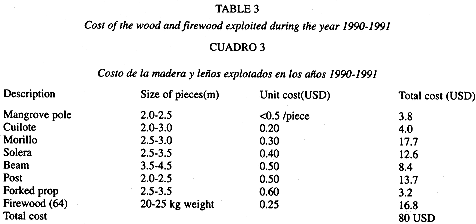
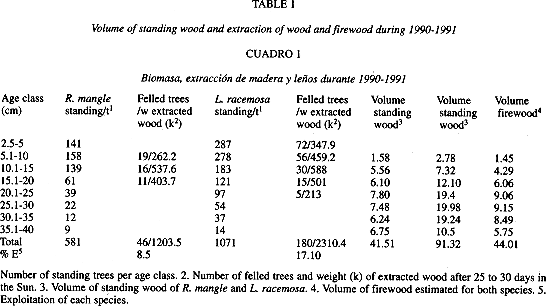
<body><![CDATA[<p><font face="Arial,Helvetica"><font size=-1>Litterfall and structure of mangrove forests in Barra de Tecoanapa, Guerrero, Mexico were studied from June&nbsp; 1990 to November 1991 by Tovilla (1998). The present study is part of that study, here we quantified the amount of organic matter provided by the forest to the estuarine system, as well as the amount&nbsp; of wood and fire-wood extracted during that period. At the mouth of the Quetzala river,&nbsp; 3.5 ha of mangroves were felled and burned by the resident community in February of 1992, i.e., after the&nbsp; aforementioned study, which allowed us to study the environmental changes caused by the elimination of the original vegetation cover, as well as the succession of plants that sprouted in the time the land was used for maize crops, and after being abandoned. This study was aimed at estimating the cost/benefit ratio obtained from two crop cycles and the loss of forestry, fishery, and wild fauna resources along the last six years.</font></font>     <br>&nbsp;     <p><b><font face="Arial,Helvetica"><font size=-1>Materials and Method</font></font></b>     <p><font face="Arial,Helvetica"><font size=-1>The present study was performed in the wetlands of Barra de Tecoanapa, at the mouth of the Quetzala River (16&ordm; 30’ 07’’ N, 98&ordm; 45’ 11’’ W) in the state of Guerrero, on the Pacific coast of Mexico. It includes approximately 2 105 ha, of which 915 are covered with mangroves. The climate is type Aw3’’(f) warm, semi-dry, with two well marked seasons in the year:&nbsp; the rainy season from June to September, with maximum rainfall in June and September (&lt;1 000 mm/year), and the dry season from October to May, with an average temperature of 28 to 30&ordm;C. The study area was described in detail by Tovilla and de la Lanza (1999).</font></font>     <p><font face="Arial,Helvetica"><font size=-1>Three sets of aerial photographs of the Barra de Tecoanapa area were used (1: 75 000, 1: 50 000, 1: 20 000 Anonymous, 1997) and interpreted to reconstruct the history of human activity at the site. Production of litterfall and extraction of wood and fire wood was quantified during a period of 18 months (June 1990 to November 1991) following the criteria established by Cintr&oacute;n and Schaeffer-Novelli (1981, 1984) and Birkenhager (1988). Interstitial salinity, atmosphere and soil temperatures at the site and in the remaining adjacent forest, changes in sand, silt, clay, and organic matter proportion, soil compactness and color were measured monthly, from April 1992 to February 1994, following the criteria established by Cintr&oacute;n and Schaeffer-Novelli (1981). Economic losses from reductions in fisheries were estimated following the criteria of Bardecki (1988). Data on the capture of wild fauna were provided by Tovilla (1998<b>). </b>For the cost/benefit analysis, the value of the products extracted from the deforested area was calculated according to supply and demand in local markets, direct use, and intrinsic value according to the criteria determined by Azqueta (1994a; b).<i> </i>Interviews with the farmers of the felled and planted area provided cost/benefit ratios during the planting cycles. Succession of plants that sprouted in the site was collected and identified in 1993 and 1994.</font></font>     <br>&nbsp;     <p><b><font face="Arial,Helvetica"><font size=-1>Results</font></font></b>     <p><font face="Arial,Helvetica"><font size=-1><b>History, structural characteristics and exploitation of the altered site:&nbsp;</b> The aerial photographs indicate that, in 1975, the area was covered by a very compact 20-22 m high mangrove forest. Later, in 1979, the original trees had been eliminated by human activity. As a result, secondary succession of terrestrial plants including <i>Laguncularia racemosa, Avicennia germinans</i>, <i>Prosopis juliflora</i>, <i>Hibiscus tiliaceus,</i> and <i>Cocus nucifera</i> were observed at the periphery and interior regions of the study site. Six years later, in 1985, the area had recovered completely and appeared to be covered by a reasonably dense mangrove forest and terrestrial vegetation. In June of 1990, when this study was started, the site was covered by a dense forest. This forest recovered in 11 or 12 years, up to the point of having 18-20 m high and 32 cm thick trees. The site bordered by the Quetzala river and a 2.5 m wide and 0.9 m deep tidal canal on the right side. This canal flooded up to 40% of a riverine/basin type forest during the rainy seasons and at high tides. The land was covered by a plant community, 21.5 % belonged to <i>Rhizophora mangle</i>-<i>Laguncularia racemosa</i> association, distributed from the edge of the canal to the limit of the permanently flooded area. <i>L. racemosa</i>-<i>A. germinans</i> association covered 52% of the area and occupied the seasonally flooded areas. The rest of the area was covered by <i>A. germinans</i> and other terrestrial vegetation. The soil was originally 32.9% silt, 24.5% clay, and 42.6% sand. The forest was young, about to reach maturity and composed of <i>L. racemosa</i> (1071 trees/ha), <i>R. mangle</i> (581 trees/ha), <i>A. germinans</i> (65 trees/ha) and terrestrial vegetation (39 trees/ha). Exploitation took place in 1.7 ha from January to May 1991 and wood extraction affected 13.6 % of the standing trees. The species used for wood and fire wood were <i>L. racemosa</i> (16.8%) and <i>R. mangle</i> (7.9%). <i>A. germinans</i> was not exploited.</font></font>     <p><font face="Arial,Helvetica"><font size=-1>The community of Barra de Tecoanapa used the mangrove wood primarily to make poles (2.5-3.5 cm diameter) for domestic use and enclosures for animals. Other uses include the “cuilotes” and “morrillos”, which are pieces of wood (4-7.5 and 6-8 cm) used to reinforce fences and build small bridges and piers, as well as the “soleras” and beams or “vigas” (8-10 and 10 cm) used in the construction of adobe walls and to support the roofs of the community houses. The thicker trunks were used as posts and forked props <a href="#tab1">(Table 1</a>). The total volume of the standing wood within the site was 164.03 m</font><sup><font size=-2>3</font></sup><font size=-1>, with 41.51 m</font><sup><font size=-2>3</font></sup><font size=-1> of <i>R. mangle</i>, 91.32 m</font><sup><font size=-2>3</font></sup><font size=-1> of <i>L. racemosa</i>, 27.6 m</font><sup><font size=-2>3</font></sup><font size=-1> of <i>A. germinans</i>, and only 3.6 m</font><sup><font size=-2>3</font></sup><font size=-1> of terrestrial vegetation. Considering the volume of the standing wood, the availability of fire wood was 44.01 m</font><sup><font size=-2>3</font></sup><font size=-1>. However, during the present study, the inhabitants extracted only 1.4 m</font><sup><font size=-2>3</font></sup><font size=-1>/year of fire wood.</font></font>     <center>     ]]></body>
<body><![CDATA[<p><a NAME="tab1"></a><img SRC="/img/fbpe/rbt/v49n2/1014ta1.GIF" height=307 width=546></center>      
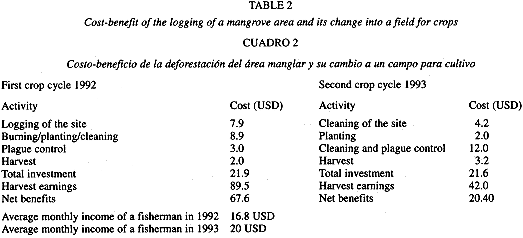
<p><font face="Arial,Helvetica"><font size=-1><b>Litterfall production:&nbsp;</b> Daily and monthly dry weight production of litterfall were 3.9 and 117.2 g/m</font><sup><font size=-2>2</font></sup><font size=-1>, respectively, i.e., 14.2 ton/ha/year of litter deposit on the forest floor. Transformation of this production into units of organic carbon, using Brow and Lugo’s (1981) conversion factor of 2 g dry weight organic matter/1.8 = 1.1 g C, resulted in a value of 7.8 ton C/year in the felled 3.5 ha<b>. </b>This amount of organic matter was therefore lost to the system when the area was felled.<b> </b>Part of the organic matter produced is exported to the sea where it contributes to the trophic chain. Odum (1970) stated that 10 to 15 % of the organic matter exported by mangrove forests to the sea is transformed into fish, crustacea, molluscs, polychaetes, and isopod tissue, and of this fraction, no less than 20 % is caught in commercial fisheries.<b> </b>If this were the case, 1.9 tons of live tissue of a variety of organisms would have been obtained from the lost carbon and from that, 380 kg of fish, crustaceans, and molluscs were not caught at sea the following year. If an average value of USD1.26/kg were to be assigned, the fishery would have been reduced by 480 USD (<a href="#tab6">Table 6</a>).</font></font>     <p><font face="Arial,Helvetica"><font size=-1><b>Recorded environmental changes:&nbsp;</b> An accelerated salinisation process occurred in December 1992, together with an increase in temperature. In 1994, the river invaded 30 m of the uncovered margin, eroding a surface of approximately 1800 m</font><sup><font size=-2>2</font></sup><font size=-1>. In 1996 and 1997, an additional 0.8 ha area&nbsp; was eliminated when hurricanes Olaf, Nora, Paulina, and Ricki struck the area. Environmental changes observed in the soil of the mangrove forest adjacent to the felled area were minimal, with a temperature gradient of only 5&ordm;C (17-22&ordm;C). The maximum temperature of 22&ordm;C was recorded in April and May 1993, and the minimum of 17&ordm;C occurred during August and September 1993. The air temperature within the forest varied between 22 to 26&ordm;C, with extreme temperatures from April to July 1993. In contrast, the minimum temperature in the soil of the felled area was 29&ordm;C during September and October 1992 and the maximum was 36&ordm;C in April 1994. The minimum atmospheric temperature of 31&ordm;C was recorded in October 1992 and the maximum of 39&ordm;C during May 1993. The lack of plant cover caused a temperature increase of up to 13&ordm;C in the soil and of 11&ordm;C in the air. These variations induced changes in soil color, permeability, and compactness. The color changed from black or dark brown to a reddish grey. Permeability increased via lixiviation and decomposition of organic matter, with a resulting increase in the amount of sand (42.6 to 63.4%). Strong changes in atmospheric and soil humidity (94% in July 1992 to 53% in March of 1993) and less than 10 cm of water in the soil during the rainy season were also recorded. Interstitial salinity in the soil of the adjacent forest varied from 0 psu (practical salinity units) in August and September 1993 to 22 psu during April-May 1993-94). In contrast, salinity was low (12 psu) in September 1992 and high (52) in April 1994 in the felled area. Average salinity varied from 11.8 psu in the forest to 29.6 psu in the area without any vegetation. Additionally, 3 000 m</font><sup><font size=-2>2</font></sup><font size=-1> of soil were lost from upsetting the fragile estuarine balance at the mouth of the Quetzala river.</font></font>     <p><font face="Arial,Helvetica"><font size=-1><b>Cost-benefit of the change in the use of the soil:&nbsp;</b> A total of 3.5 ha were planted with maize from June to November 1992, of which an average yield of 540 kg/ha was obtained at a value of 0.45 cents USD /kg of maize. In total the farmers made 89 USD besides the expenses on labor, planting, and weed and pest control. The site was again planted in 1993; however the yield was reduced to 190 kg/ha of maize, at a value of 0.60<b> </b>cents/kg and an income of 42 USD (<a href="#tab2">Table 2</a>). The site was abandoned in 1994. Economically, felling of 3.5 ha of mangrove forest produced a loss to the community of an annual contribution of wood for construction and firewood, with an estimated cost of 80 USD/ha for a total of $1 295.4 and 1.7 ha (136 USD) (<a href="#tab3">Table 3)</a>.</font></font>     <center>     <p><a NAME="tab2"></a><img SRC="/img/fbpe/rbt/v49n2/1014ta2.GIF" height=238 width=523></center>      
<p><font face="Arial,Helvetica"><font size=-1>The lost forest destroyed the natural beauty of the river mouth, which used to be&nbsp; a holiday site and meeting point for the inhabitants of the community and for a&nbsp; large numbers of visitors during the Holy Week and over New Year, providing an important income for the local economy. Other losses include a refuge, nesting and feeding place of a great number of aquatic and beach birds such as herons, ducks, pelicans, cormorants, frigate-birds and fishing eagles that inhabited the estuary. Part of the beauty and attraction of the area was precisely the great number of birds that congregated to rest in the shallows of the estuary. In addition<b> </b>to the lost birds<b>,</b> other communities were eliminated,&nbsp; such as the crabs <i>Cardisoma crassum</i>, <i>C. quadrata</i>, <i>Gecarcinus quadrata</i>, <i>Goniopsis pulchra and</i> <i>Aratus pisonii</i>, and the molluscs <i>Polymesoda inflata</i>, <i>Tangelus longisimuatus,</i> and <i>Theodoxus luteofasciatus</i>.</font></font>     <center>     <p><a NAME="tab3"></a><img SRC="/img/fbpe/rbt/v49n2/1014ta3.GIF" height=224 width=476></center>      
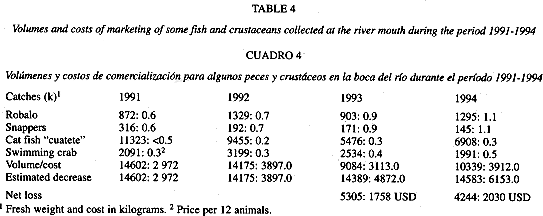
<p><font face="Arial,Helvetica"><font size=-1>Between 1993-94, a 32.5% reduction in estuarine fisheries occurred, primarily because of the destruction of the refuge, reproduction sites, and fishery areas of species such as<i>Centropomus robalito</i> and <i>C. nigrescens</i> (“robalos”), snappers <i>Lutjanus argentiventris</i>, the cat fish <i>Galeichthys caerulescens,</i> and the crabs <i>Callinectes toxotes</i> and <i>C. sapidus</i> along 200 m of the felled river margin, these species represent 79% of the fisheries at the river mouth. Tovilla (1998) collected data on the fisheries in the estuary and within the forest, and on the cost of marketing the fresh product <a href="#tab4">(Table 4)</a>. The loss of the mangrove forest also caused silting of the deepest part of the river (2.5-4 m) used as a refuge by these organisms.</font></font>     ]]></body>
<body><![CDATA[<center>     <p><a NAME="tab4"></a><img SRC="/img/fbpe/rbt/v49n2/1014ta4.GIF" height=216 width=543></center>      
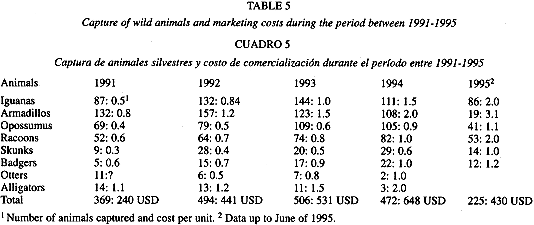
<p><font face="Arial,Helvetica"><font size=-1>This was particularly critical in 1993. The fishery yield of 1991-1993 was averaged, and the average for each species was multiplied by the price of the kilogram of fresh product in the market and compared to the 1994 yield. Losses for the community, recorded as volume and income for the years 1993 and 1994 are presented in <a href="#tab4">Table 4</a>. Althoughother factors might have affected the decrease in catches, the fact is that the records showed a decrease from 5 305 kg to 4 244 kg of fresh product for 1993-94, which averaged 1 758 USD and 2 030 USD. Catches recovered in 14.7% and 17.3% in 1995 and 1996, except for "robalos", but&nbsp; never reached the yield of 1991-92.</font></font>     <p><font face="Arial,Helvetica"><font size=-1>Wild animals from the mangrove forests are hunted for self-consumption. The wild fauna is an important protein source for the inhabitants and, contrary to general opinion, the number of animals caught in this wetland is high<b>, </b>as shown by Tovilla (1998), who recorded the capture and sale price of eight species of animals during the 1991-1995 period <a href="#tab5">(Table 5)</a>. The number of animals decreased as a result of the habitat's destruction and its fragmentation through felling, as has happened on the opposite side of the river, where hunting has decreased by 18%. Data obtained on the capture of wild fauna indicate that 82% of catches takes place on the right side of the river, in 401 ha of mangrove forest. The average number of animals captured within the mangrove forest results in a catch of 1.03 animals/ha. However, losses may be even greater, according to the<b> </b>degree of complexity, structure and maturity of the altered forest and the type of animal. Considering these numbers, up to three times more herbivorous and omnivorous animals such as iguanas, opossums, and skunks, five times more armadillos, racoons, and badgers, and up to eight times more specific carnivores such as alligators and otters will disappear per felled hectare of forest. The animal losses would average 5.3 animals/ha felled, i.e., 19 animals of those counted must have run away or died when the area was felled. In monetary terms, 56 USD would have been lost in 1993 and 123 USD in 1995 <a href="#tab5">(Table 5)</a>.</font></font>     <center>     <p><a NAME="tab5"></a><img SRC="/img/fbpe/rbt/v49n2/1014ta5.GIF" height=225 width=534></center>      
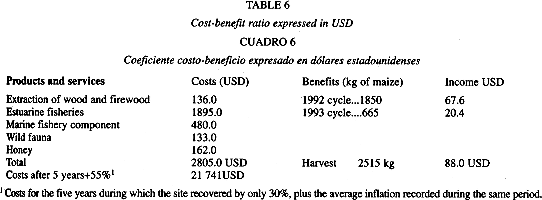
<p><font face="Arial,Helvetica"><font size=-1>In the original forest, seven wild bee hives had been recorded in <i>A. germinans</i> (4) and <i>L. racemosa</i> (3) trees, with a production potential of 4-7 liters of honey/beehive/season, equivalent to 77 l/year of honey, which, marketed at a cost of USD 2.10/l, would have provided 162 USD to the community<i>.</i></font></font>     <p><font face="Arial,Helvetica"><font size=-1>An estimation of the total cost caused by logging with respect to the benefits obtained by the farmers indicates a ratio of 32: 1, which is excessively high for the community and is magnified when calculated for the last five years (246: 1)<b> </b>(21 741.03: 88.05 USD)<b> </b>taking into consideration the recorded accumulated average inflation of 55% (INEGI 1997) <a href="#tab6">(Table 6)</a>. However, the most deplorable costs are the environmental ones.</font></font>     <center>     <p><a NAME="tab6"></a><img SRC="/img/fbpe/rbt/v49n2/1014ta6.GIF" height=200 width=542></center>      
]]></body>
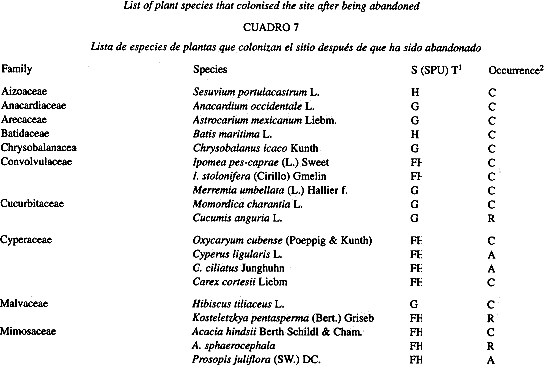
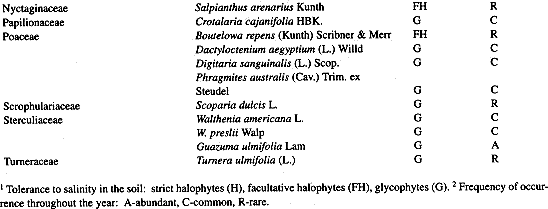
<body><![CDATA[<p><font face="Arial,Helvetica"><font size=-1><b>Plant succession:&nbsp;</b> The mangrove forest did not recover when the site was abandoned, and in its place a great number of primary and secondary plant species sprouted. A total of 30 species of herbaceous and bushy plants of 16 families were recorded (<a href="/revistas/49-2/tovilla/tables.html">Table </a>7). Cyperaceae, Poaceae, Convolvulaceae, Mimosaceae and Sterculiaceae were the best represented families. Of the recorded species, <i>Sesuvium portulacastrum</i> and <i>Batis maritima</i> were classified as strict halophytes (H) due to their ability to withstand high concentrations of salt in the soil (>40 psu), 12 were facultative halophytes (FH) and the rest were terrestrial glycophytes (G). Four species, <i>Cyperus ligularis</i>, <i>C. ciliatus</i>, <i>Prosopis juliflor,</i> and <i>Guazuma ulmifolia,</i> were the most abundant within the site and were present throughout the year; 18 species were classified as common inhabitants, occurring mainly during the rains, and eight species showed up rarely during the year <a href="#tab7a">(Table 7)</a><b>.</b></font></font>     <center>     <p><a NAME="tab7a"></a><img SRC="/img/fbpe/rbt/v49n2/1014ta7.GIF" height=366 width=544>     
<br><a NAME="tab7"></a><img SRC="/img/fbpe/rbt/v49n2/1014ta7b.GIF" height=209 width=548></center>      
<p>    <br>     <p><b><font face="Arial,Helvetica"><font size=-1>Discussion</font></font></b>     <p><font face="Arial,Helvetica"><font size=-1>The recovery capacity shown by the experimental site after the first felling episode (1979) was surprising, but was not repeated after the second episode during the 1994-1998 period. Due to this latter alteration&nbsp; and the effects of the tropical storms and hurricanes that struck the area, the river mouth became more erratic and an accelerated process of erosion set in, as documented by Tovilla (1998). Similar changes in temperature and salinity have been observed in other localities where mangrove cover has been eliminated (Soto 1988). These changes may have been so drastic that they inhibited recovery of the mangrove forest and in its place a low diversity plant community without any economic value was established, including species resistant to hypersalinity conditions. A recovery of only 30 % was recorded in 1998 after five years.</font></font>     <p><font face="Arial,Helvetica"><font size=-1>Inhabitants use the wood only for construction and fuel, occasionally extracting wood to send outside the community for the construction of beach huts, as Tovilla (1998) found in a detailed study of the extraction of wood and firewood throughout the swamp. Records from other Latin American countries such as Venezuela, Costa Rica, and Cuba show similar uses (Luna-Lugo 1976, Chong 1988, Men&eacute;ndez and Priego 1994). Litterfall production recorded in this study is matched only by that produced in mangrove swamps on the Equator, in<b> </b>Colombia, Ecuador, New Guinea, and Malaysia (Hern&aacute;ndez and Mullen 1975, Sasekumar and Loi 1983). The importance of the mangrove forests in Barra de Tecoanapa is evidenced by their very high production rates despite their location in an area of low rainfall (&lt;1 000 mm/year), as shown byTovilla and Gonz&aacute;lez (1994) and Tovilla (1998). Several studies have shown that commercially important fishes, such as snappers, perch, robalo, red snapper, and mojarra depend on the detritus provided by mangrove forests (Cardoso 1980, Ley <i>et al.&nbsp;</i> 1994, Pinto and Punchihewa 1996). Turner (1977) recorded a significant correlation between the amount of shrimp collected at sea and the extension of adjacent mangrove forests.</font></font>     <p><font face="Arial,Helvetica"><font size=-1>In Mexico, no attention has been paid to the exploitation of wild animals and honey in mangrove swamps. These resources, although considered as subsistence or low quality products, could be of great benefit to the economy of local residents. For example, in Cuba and Costa Rica, large quantities of honey are extracted annually. Cuba is an exceptional case, as every year between May and July up to 45 000 beehives are placed under mangrove trees (Bradbear 1990, Anonymous 1994).</font></font>     ]]></body>
<body><![CDATA[<p><font face="Arial,Helvetica"><font size=-1>The present analysis exemplifies the events occurring along the coasts of Mexico, without any environmental regulation from federal, state, and municipal authorities. Environmental destruction results from diverse factors, the most important are poverty and excessive growth of human population along the coasts, lack of adequate regulations to control the use of these resources, and lack of counseling and education&nbsp; in regard to&nbsp; the viability of changes in land use. Population growth must be reduced in the following years to minimize these costs. The lack of adequate methods to assess mangroves in economic terms has caused people to consider them wastelands with no value and as risky unhealthy areas that should be adapted for an alternative and more lucrative use. According to Odum and Campbell (1994), there are at present at least four methods to estimate the contributions made by mangroves to economic activities. However, their application in Latin America is still limited and sometimes excessively complicated (Ag&uuml;ero 1994). These methods have been developed as a response to the needs of developed countries in which the cultural and socio-economic conditions are very different from ours.</font></font>     <br>&nbsp;     <p><b><font face="Arial,Helvetica"><font size=-1>Acknowledgments</font></font></b>     <p><font face="Arial,Helvetica"><font size=-1>We thank Eladio Gonz&aacute;lez Angelito, Enoch Gonz&aacute;lez Angelito, Hip&oacute;lito Bibiano, Salvador Hern&aacute;ndez Pulido, and Minerva P&eacute;rez for field assistance.</font></font>     <br>&nbsp;     <p><b><font face="Arial,Helvetica"><font size=-1>Resumen</font></font></b>     <p><font face="Arial,Helvetica"><font size=-1>En el presente trabajo se estudian los cambios causados por la deforestaci&oacute;n de un manglar al sureste de M&eacute;xico. La vegetaci&oacute;n original incluia a <i>R. mangle, L. racemosa </i>y <i>A. germinas</i>. Se registr&oacute; una sucesi&oacute;n apareciendo halofitas estrictas, facultativas as&iacute; como glic&oacute;fitas. En la &eacute;poca seca&nbsp; la temperatura aument&oacute; 13&deg;C en el suelo y 11&deg;C en el aire, y la salinidad alcanz&oacute; hasta 52 ups; adem&aacute;s, se modific&oacute; la fauna y los ciclos biogeoqu&iacute;micos; cambiaron las condiciones est&eacute;ticas, se present&oacute; una fuerte erosi&oacute;n y por lo tanto una p&eacute;rdida econ&oacute;mica. El &aacute;rea se ha recuperado en un 30% despu&eacute;s de cinco a&ntilde;os.</font></font>     <br>&nbsp;     <p><b><font face="Arial,Helvetica"><font size=-1>References</font></font></b>     <!-- ref --><p><font face="Arial,Helvetica"><font size=-1>Ag&uuml;ero, M. N. 1994. Como estimar el valor econ&oacute;mico de los manglares: un m&eacute;todo y un ejemplo. <i>In</i>: Ecosistema de Manglar en Am&eacute;rica Tropical: Estructura, Funci&oacute;n y Manejo. Serie Cient&iacute;fica No. 3. EPOMEX Programa de Ecolog&iacute;a, Pesquer&iacute;as y Oceanograf&iacute;a del Golfo de M&eacute;xico. Universidad Aut&oacute;noma de Campeche.</font></font>    &nbsp;&nbsp;&nbsp;&nbsp;&nbsp;&nbsp;&nbsp;&nbsp;[&#160;<a href="javascript:void(0);" onclick="javascript: window.open('/scielo.php?script=sci_nlinks&ref=1357188&pid=S0034-7744200100020001500001&lng=','','width=640,height=500,resizable=yes,scrollbars=1,menubar=yes,');">Links</a>&#160;]<!-- end-ref --><!-- ref --><p><font face="Arial,Helvetica"><font size=-1>Anonymous, Organizaci&oacute;n de las Naciones Unidas para la Agricultura y la Alimentaci&oacute;n. 1994. Directrices para la organizaci&oacute;n de los manglares: Estudio FAO Montes 117. Servicio Forestal del Depto. Agricultura de E.U.A. Roma, Italia.</font></font>    &nbsp;&nbsp;&nbsp;&nbsp;&nbsp;&nbsp;&nbsp;&nbsp;[&#160;<a href="javascript:void(0);" onclick="javascript: window.open('/scielo.php?script=sci_nlinks&ref=1357189&pid=S0034-7744200100020001500002&lng=','','width=640,height=500,resizable=yes,scrollbars=1,menubar=yes,');">Links</a>&#160;]<!-- end-ref --><!-- ref --><p><font face="Arial,Helvetica"><font size=-1>Anonymous, Instituto Nacional de Estad&iacute;stica, Geograf&iacute;a e Inform&aacute;tica. 1997. Algunas Variables de la Econom&iacute;a Nacional en la Ultima D&eacute;cada. Anexo II, Inflaci&oacute;n. p. 45-78. M&eacute;xico.</font></font>    &nbsp;&nbsp;&nbsp;&nbsp;&nbsp;&nbsp;&nbsp;&nbsp;[&#160;<a href="javascript:void(0);" onclick="javascript: window.open('/scielo.php?script=sci_nlinks&ref=1357190&pid=S0034-7744200100020001500003&lng=','','width=640,height=500,resizable=yes,scrollbars=1,menubar=yes,');">Links</a>&#160;]<!-- end-ref --><p><font face="Arial,Helvetica"><font size=-1>Azqueta, D. 1994a. La problem&aacute;tica de la gesti&oacute;n &oacute;ptima de los recursos naturales: aspectos institucionales, p. 51-72. In D. Azqueta &amp; A. Ferreiro (eds.) An&aacute;lisis econ&oacute;micos y gesti&oacute;n de recursos naturales. Alianza , Madrid Espa&ntilde;a.</font></font>     <!-- ref --><p><font face="Arial,Helvetica"><font size=-1>Azqueta, D. 1994b. Aplicaciones del an&aacute;lisis costo-beneficio a modificaciones en la calidad del agua. p. 311-343.<i> </i>In D. Azqueta y A. Ferreiro (eds.) An&aacute;lisis econ&oacute;micos y gesti&oacute;n de recursos naturales. Alianza , Madrid, Espa&ntilde;a.</font></font>    &nbsp;&nbsp;&nbsp;&nbsp;&nbsp;&nbsp;&nbsp;&nbsp;[&#160;<a href="javascript:void(0);" onclick="javascript: window.open('/scielo.php?script=sci_nlinks&ref=1357192&pid=S0034-7744200100020001500005&lng=','','width=640,height=500,resizable=yes,scrollbars=1,menubar=yes,');">Links</a>&#160;]<!-- end-ref --><!-- ref --><p><font face="Arial,Helvetica"><font size=-1>Bardecki, M. J. 1988. Exploitation vs conservation: the economics of wetlands. p. 55-64. In INIREB (ed.), Instituto Nacional de Investigaci&oacute;n sobre Recursos Bi&oacute;ticos, Divisi&oacute;n Tabasco y Gobierno del Estado de Tabasco. Memorias: Ecolog&iacute;a y Conservaci&oacute;n del Delta de los r&iacute;os Usumacinta y Grijalva. Memoria.</font></font>    &nbsp;&nbsp;&nbsp;&nbsp;&nbsp;&nbsp;&nbsp;&nbsp;[&#160;<a href="javascript:void(0);" onclick="javascript: window.open('/scielo.php?script=sci_nlinks&ref=1357193&pid=S0034-7744200100020001500006&lng=','','width=640,height=500,resizable=yes,scrollbars=1,menubar=yes,');">Links</a>&#160;]<!-- end-ref --><!-- ref --><p><font face="Arial,Helvetica"><font size=-1>Birkenh&auml;ger, B. 1988. Assessment of Ma-Swar/Ribi River Mangrove Area Wood Resource. FAO/FO/SIL/84/003, Field Document No. 16, FAO, Freetown, Sierra Leona.</font></font>    &nbsp;&nbsp;&nbsp;&nbsp;&nbsp;&nbsp;&nbsp;&nbsp;[&#160;<a href="javascript:void(0);" onclick="javascript: window.open('/scielo.php?script=sci_nlinks&ref=1357194&pid=S0034-7744200100020001500007&lng=','','width=640,height=500,resizable=yes,scrollbars=1,menubar=yes,');">Links</a>&#160;]<!-- end-ref --><!-- ref --><p><font face="Arial,Helvetica"><font size=-1>Botero, L. &amp; J. E. Mancera-Pineda. 1996. Sintesis de los cambios de origen antr&oacute;pico ocurridos en los &uacute;ltimos 40 a&ntilde;os en la Ci&eacute;naga de Santa Martha (Colombia). Rev. Acad. Colomb. Cienc. 20: 465-474.</font></font>    &nbsp;&nbsp;&nbsp;&nbsp;&nbsp;&nbsp;&nbsp;&nbsp;[&#160;<a href="javascript:void(0);" onclick="javascript: window.open('/scielo.php?script=sci_nlinks&ref=1357195&pid=S0034-7744200100020001500008&lng=','','width=640,height=500,resizable=yes,scrollbars=1,menubar=yes,');">Links</a>&#160;]<!-- end-ref --><!-- ref --><p><font face="Arial,Helvetica"><font size=-1>Bradbear, N. 1990. Beekeeping in Rural Development. International Bee Research Association, Cardiff, Great Britain.</font></font>    &nbsp;&nbsp;&nbsp;&nbsp;&nbsp;&nbsp;&nbsp;&nbsp;[&#160;<a href="javascript:void(0);" onclick="javascript: window.open('/scielo.php?script=sci_nlinks&ref=1357196&pid=S0034-7744200100020001500009&lng=','','width=640,height=500,resizable=yes,scrollbars=1,menubar=yes,');">Links</a>&#160;]<!-- end-ref --><!-- ref --><p><font face="Arial,Helvetica"><font size=-1>Brow, S. &amp; A. E. Lugo. 1981. The storage and production of organic matter in tropical forests and their role in the global carbon cycle. Biotropica 14: 161-187.</font></font>    &nbsp;&nbsp;&nbsp;&nbsp;&nbsp;&nbsp;&nbsp;&nbsp;[&#160;<a href="javascript:void(0);" onclick="javascript: window.open('/scielo.php?script=sci_nlinks&ref=1357197&pid=S0034-7744200100020001500010&lng=','','width=640,height=500,resizable=yes,scrollbars=1,menubar=yes,');">Links</a>&#160;]<!-- end-ref --><!-- ref --><p><font face="Arial,Helvetica"><font size=-1>Cardoso, R. D. R. 1980. Exploracao pesqueira em Santa Catarina e na Regiao Sudeste/Sur do Brasil. p. 75-96. In Sierra, D.L., B. Beck y G. Ledo-G&oacute;mez (eds). O Mar e Seus Recursos. Univ. Federal de Santa Catarina, Ilha de Anhatomirim, Florianopolis, Santa Catalina, Brazil.</font></font>    &nbsp;&nbsp;&nbsp;&nbsp;&nbsp;&nbsp;&nbsp;&nbsp;[&#160;<a href="javascript:void(0);" onclick="javascript: window.open('/scielo.php?script=sci_nlinks&ref=1357198&pid=S0034-7744200100020001500011&lng=','','width=640,height=500,resizable=yes,scrollbars=1,menubar=yes,');">Links</a>&#160;]<!-- end-ref --><!-- ref --><p><font face="Arial,Helvetica"><font size=-1>Cintr&oacute;n, G. &amp; Y. Shaeffer-Novelli. 1981. Roteiro para estudio dos recursos de marismas e manguezais. Int. Oceanog. Sao Paulo 10: 1-13.</font></font>    &nbsp;&nbsp;&nbsp;&nbsp;&nbsp;&nbsp;&nbsp;&nbsp;[&#160;<a href="javascript:void(0);" onclick="javascript: window.open('/scielo.php?script=sci_nlinks&ref=1357199&pid=S0034-7744200100020001500012&lng=','','width=640,height=500,resizable=yes,scrollbars=1,menubar=yes,');">Links</a>&#160;]<!-- end-ref --><!-- ref --><p><font face="Arial,Helvetica"><font size=-1>Cintr&oacute;n, G. &amp; Y. Shaeffer-Novelli. 1984. Methods for studying mangrove structure. p. 91-113 <i>In</i> Snedaker, S. C. and J. G. Snedaker (eds). The mangrove ecosystem: research methods. UNESCO, Paris, Francia.</font></font>    &nbsp;&nbsp;&nbsp;&nbsp;&nbsp;&nbsp;&nbsp;&nbsp;[&#160;<a href="javascript:void(0);" onclick="javascript: window.open('/scielo.php?script=sci_nlinks&ref=1357200&pid=S0034-7744200100020001500013&lng=','','width=640,height=500,resizable=yes,scrollbars=1,menubar=yes,');">Links</a>&#160;]<!-- end-ref --><!-- ref --><p><font face="Arial,Helvetica"><font size=-1>Chong, P. W. 1988. Proposed Integrated Forest Management, Planning and Utilization of Mangrove Resources in the Terrab-Sierpe Reserve, Costa Rica. Proj. FAO/TCP/6652. Technical Report 2. 150 p.</font></font>    &nbsp;&nbsp;&nbsp;&nbsp;&nbsp;&nbsp;&nbsp;&nbsp;[&#160;<a href="javascript:void(0);" onclick="javascript: window.open('/scielo.php?script=sci_nlinks&ref=1357201&pid=S0034-7744200100020001500014&lng=','','width=640,height=500,resizable=yes,scrollbars=1,menubar=yes,');">Links</a>&#160;]<!-- end-ref --><!-- ref --><p><font face="Arial,Helvetica"><font size=-1>Hern&aacute;ndez, A. &amp; K. P. Mullen. 1975. Observaciones sobre la productividad primaria neta en un sistema de manglar-estuarino (Guapi-Colombia). p. 89-98. <i>In</i> Mem. II Simposio Latinoamericano de Oceanograf&iacute;a Biol&oacute;gica Cuman&aacute;, Venezuela.</font></font>    &nbsp;&nbsp;&nbsp;&nbsp;&nbsp;&nbsp;&nbsp;&nbsp;[&#160;<a href="javascript:void(0);" onclick="javascript: window.open('/scielo.php?script=sci_nlinks&ref=1357202&pid=S0034-7744200100020001500015&lng=','','width=640,height=500,resizable=yes,scrollbars=1,menubar=yes,');">Links</a>&#160;]<!-- end-ref --><!-- ref --><p><font face="Arial,Helvetica"><font size=-1>Jim&eacute;nez, J. A. 1994. El Manejo de los Manglares en el Pac&iacute;fico de Centroam&eacute;rica: Usos tradicionales y Potenciales. Ecosistema de Manglar en Am&eacute;rica Tropical: Estructura, Funci&oacute;n y Manejo. Serie Cient&iacute;fica No. 3. EPOMEX Programa de Ecolog&iacute;a, Pesquer&iacute;as y Oceanograf&iacute;a del Golfo de M&eacute;xico. Universidad Aut&oacute;noma de Campeche.</font></font>    &nbsp;&nbsp;&nbsp;&nbsp;&nbsp;&nbsp;&nbsp;&nbsp;[&#160;<a href="javascript:void(0);" onclick="javascript: window.open('/scielo.php?script=sci_nlinks&ref=1357203&pid=S0034-7744200100020001500016&lng=','','width=640,height=500,resizable=yes,scrollbars=1,menubar=yes,');">Links</a>&#160;]<!-- end-ref --><!-- ref --><p><font face="Arial,Helvetica"><font size=-1>Jim&eacute;nez, J. A. &amp; R. Soto. 1985. Patrones regionales en la estructura y composici&oacute;n flor&iacute;stica de los manglares de la costa Pac&iacute;fica de Costa Rica. Rev. Biol. Trop. 33: 25-37.</font></font>    &nbsp;&nbsp;&nbsp;&nbsp;&nbsp;&nbsp;&nbsp;&nbsp;[&#160;<a href="javascript:void(0);" onclick="javascript: window.open('/scielo.php?script=sci_nlinks&ref=1357204&pid=S0034-7744200100020001500017&lng=','','width=640,height=500,resizable=yes,scrollbars=1,menubar=yes,');">Links</a>&#160;]<!-- end-ref --><!-- ref --><p><font face="Arial,Helvetica"><font size=-1>Ley, J. A., L. Montague &amp; C. C. McIvor. 1994. Food habits of mangrove fishes: A comparison along estuarine gradients in northeastern Florida Bay. Bull. Mar. Sci. 54: 881-899.</font></font>    &nbsp;&nbsp;&nbsp;&nbsp;&nbsp;&nbsp;&nbsp;&nbsp;[&#160;<a href="javascript:void(0);" onclick="javascript: window.open('/scielo.php?script=sci_nlinks&ref=1357205&pid=S0034-7744200100020001500018&lng=','','width=640,height=500,resizable=yes,scrollbars=1,menubar=yes,');">Links</a>&#160;]<!-- end-ref --><!-- ref --><p><font face="Arial,Helvetica"><font size=-1>Luna-Lugo, A. 1976. Manejo de Manglares en Venezuela. Instituto Forestal Latinoamericano de Investigaci&oacute;n y Capacitaci&oacute;n. M&eacute;rida, Venezuela, 50: 41-56.</font></font>    &nbsp;&nbsp;&nbsp;&nbsp;&nbsp;&nbsp;&nbsp;&nbsp;[&#160;<a href="javascript:void(0);" onclick="javascript: window.open('/scielo.php?script=sci_nlinks&ref=1357206&pid=S0034-7744200100020001500019&lng=','','width=640,height=500,resizable=yes,scrollbars=1,menubar=yes,');">Links</a>&#160;]<!-- end-ref --><!-- ref --><p><font face="Arial,Helvetica"><font size=-1>Men&eacute;ndez, L. C. &amp; A. S. Priego. 1994. Los manglares en Cuba: Ecolog&iacute;a. p. 85-98. In Suman, D.O. (ed.). El Ecosistema de Manglar en Am&eacute;rica Latina y la Cuenca del Caribe: su Manejo y Conservaci&oacute;n.. Rosenstiel School of Marine and Atmospheric Science. Universidad de Miami, Florida and The Tinker Foundation New York.</font></font>    &nbsp;&nbsp;&nbsp;&nbsp;&nbsp;&nbsp;&nbsp;&nbsp;[&#160;<a href="javascript:void(0);" onclick="javascript: window.open('/scielo.php?script=sci_nlinks&ref=1357207&pid=S0034-7744200100020001500020&lng=','','width=640,height=500,resizable=yes,scrollbars=1,menubar=yes,');">Links</a>&#160;]<!-- end-ref --><!-- ref --><p><font face="Arial,Helvetica"><font size=-1>Odum, H. T. &amp; D. E. Campell. 1994. El valor de los ecosistemas de manglares en una econom&iacute;a en desarrollo. FARO: Revista para la Administraci&oacute;n de Zonas Costeras en Am&eacute;rica Latina. II Semestre 1: 12-15.</font></font>    &nbsp;&nbsp;&nbsp;&nbsp;&nbsp;&nbsp;&nbsp;&nbsp;[&#160;<a href="javascript:void(0);" onclick="javascript: window.open('/scielo.php?script=sci_nlinks&ref=1357208&pid=S0034-7744200100020001500021&lng=','','width=640,height=500,resizable=yes,scrollbars=1,menubar=yes,');">Links</a>&#160;]<!-- end-ref --><!-- ref --><p><font face="Arial,Helvetica"><font size=-1>Odum, W. E. 1970. Pathways of energy flow in a south Florida Estuary. Ph.D. Thesis. Univ. of Miami, Florida.</font></font>    &nbsp;&nbsp;&nbsp;&nbsp;&nbsp;&nbsp;&nbsp;&nbsp;[&#160;<a href="javascript:void(0);" onclick="javascript: window.open('/scielo.php?script=sci_nlinks&ref=1357209&pid=S0034-7744200100020001500022&lng=','','width=640,height=500,resizable=yes,scrollbars=1,menubar=yes,');">Links</a>&#160;]<!-- end-ref --><!-- ref --><p><font face="Arial,Helvetica"><font size=-1>Pinto, L. &amp; N. N. Punchihewa. 1996. Utilization of mangroves and seagrasses by fishes in The Negombo estuary, Sri Lanka. Mar. Biol. 126: 333-345.</font></font>    &nbsp;&nbsp;&nbsp;&nbsp;&nbsp;&nbsp;&nbsp;&nbsp;[&#160;<a href="javascript:void(0);" onclick="javascript: window.open('/scielo.php?script=sci_nlinks&ref=1357210&pid=S0034-7744200100020001500023&lng=','','width=640,height=500,resizable=yes,scrollbars=1,menubar=yes,');">Links</a>&#160;]<!-- end-ref --><!-- ref --><p><font face="Arial,Helvetica"><font size=-1>Sasekumar, A. &amp; J. J. Loi. 1983. Litter production in the three mangrove forest zones in the Malay Peninsular. Aquat. Bot. 17: 283-290.</font></font>    &nbsp;&nbsp;&nbsp;&nbsp;&nbsp;&nbsp;&nbsp;&nbsp;[&#160;<a href="javascript:void(0);" onclick="javascript: window.open('/scielo.php?script=sci_nlinks&ref=1357211&pid=S0034-7744200100020001500024&lng=','','width=640,height=500,resizable=yes,scrollbars=1,menubar=yes,');">Links</a>&#160;]<!-- end-ref --><!-- ref --><p><font face="Arial,Helvetica"><font size=-1>Serrano, L. A. D., L. Botero, P. Cardona &amp; J. E. Mancera–Pineda. 1995. Estructura del manglar en el delta exterior del R&iacute;o Magdalena-Cienega de Santa Martha, una zona tensionada por alteraciones del equilibrio h&iacute;drico. An. Inst. Invest. Mar. Punta Bet&iacute;n 24: 135-164.</font></font>    &nbsp;&nbsp;&nbsp;&nbsp;&nbsp;&nbsp;&nbsp;&nbsp;[&#160;<a href="javascript:void(0);" onclick="javascript: window.open('/scielo.php?script=sci_nlinks&ref=1357212&pid=S0034-7744200100020001500025&lng=','','width=640,height=500,resizable=yes,scrollbars=1,menubar=yes,');">Links</a>&#160;]<!-- end-ref --><!-- ref --><p><font face="Arial,Helvetica"><font size=-1>Soto, S. R. 1988. Deforestaci&oacute;n y otros tipos de perturbaciones en los manglares del Pac&iacute;fico de Costa Rica, pp 177-200. In INIREB (ed.), Instituto Nacional de Investigaci&oacute;n sobre Recursos Bi&oacute;ticos, Divisi&oacute;n Tabasco y Gobierno del Estado de Tabasco. Memorias: Ecolog&iacute;a y Conservaci&oacute;n del Delta de los r&iacute;os Usumacinta y Grijalva. Memoria.</font></font>    &nbsp;&nbsp;&nbsp;&nbsp;&nbsp;&nbsp;&nbsp;&nbsp;[&#160;<a href="javascript:void(0);" onclick="javascript: window.open('/scielo.php?script=sci_nlinks&ref=1357213&pid=S0034-7744200100020001500026&lng=','','width=640,height=500,resizable=yes,scrollbars=1,menubar=yes,');">Links</a>&#160;]<!-- end-ref --><!-- ref --><p><font face="Arial,Helvetica"><font size=-1>Tovilla, H. C. &amp; A. E. Gonz&aacute;lez. 1994. Producci&oacute;n de hojarasca del manglar en tres sistemas lagunares del Golfo de M&eacute;xico y el Pac&iacute;fico. p 2: 87-103 In Grandes Temas de la Hidrobiolog&iacute;a: Los Sistemas Litorales. UAM-I, UNAM, M&eacute;xico.</font></font>    &nbsp;&nbsp;&nbsp;&nbsp;&nbsp;&nbsp;&nbsp;&nbsp;[&#160;<a href="javascript:void(0);" onclick="javascript: window.open('/scielo.php?script=sci_nlinks&ref=1357214&pid=S0034-7744200100020001500027&lng=','','width=640,height=500,resizable=yes,scrollbars=1,menubar=yes,');">Links</a>&#160;]<!-- end-ref --><p><font face="Arial,Helvetica"><font size=-1>Tovilla, H. C. 1998. Ecolog&iacute;a de los bosques de manglar y algunos aspectos socioecon&oacute;micos de la zona costera de Barra de Tecoanapa, Guerrero, M&eacute;xico. Tesis Doctoral. Facultad de Ciencias, UNAM. M&eacute;xico.</font></font>     <!-- ref --><p><font face="Arial,Helvetica"><font size=-1>Tovilla, H. C. &amp; E. G. de la Lanza. 1999. Ecolog&iacute;a, producci&oacute;n y aprovechamiento de mangle <i>Conocarpus erectus</i> L., en Barra de Tecoanapa Guerrero, M&eacute;xico. Biotropica 31: 121-134.</font></font>    &nbsp;&nbsp;&nbsp;&nbsp;&nbsp;&nbsp;&nbsp;&nbsp;[&#160;<a href="javascript:void(0);" onclick="javascript: window.open('/scielo.php?script=sci_nlinks&ref=1357216&pid=S0034-7744200100020001500029&lng=','','width=640,height=500,resizable=yes,scrollbars=1,menubar=yes,');">Links</a>&#160;]<!-- end-ref --><!-- ref --><p><font face="Arial,Helvetica"><font size=-1>Turner, E. R. 1977. Intertidal vegetation and commercial yields of penaeid shrimp. Trans. Amer. Fis. Soc., 106: 411-416.</font></font>    &nbsp;&nbsp;&nbsp;&nbsp;&nbsp;&nbsp;&nbsp;&nbsp;[&#160;<a href="javascript:void(0);" onclick="javascript: window.open('/scielo.php?script=sci_nlinks&ref=1357217&pid=S0034-7744200100020001500030&lng=','','width=640,height=500,resizable=yes,scrollbars=1,menubar=yes,');">Links</a>&#160;]<!-- end-ref --><br>&nbsp;     ]]></body>
<body><![CDATA[<p><a NAME="1a"></a><font face="Arial,Helvetica"><font size=-1><sup><a href="#1">1</a></sup>El Colegio de la Frontera Sur (ECOSUR), Unidad Tapachula, Fax 525 962 811 15 E-mail <a href="mailto:ctovilla@tap-ecosur.edu.mx">ctovilla@tap-ecosur.edu.mx</a>.&nbsp;<a NAME="2a"></a><sup><a href="#2">2</a></sup>Instituto de Biolog&iacute;a, UNAM e-mail gdlle@servidor.unam.mx.<a NAME="3a"></a><sup><a href="#3">3</a></sup>Facultad de Biolog&iacute;a Marina, Universidad Aut&oacute;noma de Sinaloa.</font></font>      ]]></body><back>
<ref-list>
<ref id="B1">
<nlm-citation citation-type="book">
<person-group person-group-type="author">
<name>
<surname><![CDATA[Agüero]]></surname>
<given-names><![CDATA[M. N.]]></given-names>
</name>
</person-group>
<article-title xml:lang="es"><![CDATA[Como estimar el valor económico de los manglares: un método y un ejemplo]]></article-title>
<source><![CDATA[Ecosistema de Manglar en América Tropical: Estructura, Función y Manejo]]></source>
<year>1994</year>
<publisher-name><![CDATA[EPOMEX Programa de Ecología, Pesquerías y Oceanografía del Golfo de México]]></publisher-name>
</nlm-citation>
</ref>
<ref id="B2">
<nlm-citation citation-type="book">
<person-group person-group-type="author">
<name>
</name>
<name>
</name>
</person-group>
<collab>Organización de las Naciones Unidas para la Agricultura y la Alimentación</collab>
<source><![CDATA[Directrices para la organización de los manglares: Estudio FAO Montes 117]]></source>
<year>1994</year>
<publisher-loc><![CDATA[Roma ]]></publisher-loc>
<publisher-name><![CDATA[Servicio Forestal del Depto. Agricultura de E.U.A]]></publisher-name>
</nlm-citation>
</ref>
<ref id="B3">
<nlm-citation citation-type="">
<person-group person-group-type="author">
<name>
</name>
<name>
</name>
</person-group>
<collab>Instituto Nacional de Estadística, Geografía e Informática</collab>
<source><![CDATA[Algunas Variables de la Economía Nacional en la Ultima Década: Anexo II, Inflación]]></source>
<year>1997</year>
<page-range>45-78</page-range></nlm-citation>
</ref>
<ref id="B4">
<nlm-citation citation-type="book">
<person-group person-group-type="author">
<name>
<surname><![CDATA[Azqueta]]></surname>
<given-names><![CDATA[D.]]></given-names>
</name>
</person-group>
<article-title xml:lang="es"><![CDATA[La problemática de la gestión óptima de los recursos naturales: aspectos institucionales]]></article-title>
<person-group person-group-type="editor">
<name>
<surname><![CDATA[Azqueta]]></surname>
<given-names><![CDATA[D.]]></given-names>
</name>
<name>
<surname><![CDATA[Ferreiro]]></surname>
<given-names><![CDATA[A.]]></given-names>
</name>
</person-group>
<source><![CDATA[Análisis económicos y gestión de recursos naturales]]></source>
<year>1994</year>
<page-range>51-72</page-range><publisher-loc><![CDATA[Madrid ]]></publisher-loc>
<publisher-name><![CDATA[Alianza]]></publisher-name>
</nlm-citation>
</ref>
<ref id="B5">
<nlm-citation citation-type="book">
<person-group person-group-type="author">
<name>
<surname><![CDATA[Azqueta]]></surname>
<given-names><![CDATA[D.]]></given-names>
</name>
</person-group>
<article-title xml:lang="es"><![CDATA[Aplicaciones del análisis costo-beneficio a modificaciones en la calidad del agua]]></article-title>
<person-group person-group-type="editor">
<name>
<surname><![CDATA[Azqueta]]></surname>
<given-names><![CDATA[D.]]></given-names>
</name>
<name>
<surname><![CDATA[Ferreiro]]></surname>
<given-names><![CDATA[A.]]></given-names>
</name>
</person-group>
<source><![CDATA[Análisis económicos y gestión de recursos naturales]]></source>
<year>1994</year>
<page-range>311-343</page-range><publisher-loc><![CDATA[Madrid ]]></publisher-loc>
<publisher-name><![CDATA[Alianza]]></publisher-name>
</nlm-citation>
</ref>
<ref id="B6">
<nlm-citation citation-type="">
<person-group person-group-type="author">
<name>
<surname><![CDATA[Bardecki]]></surname>
<given-names><![CDATA[M. J.]]></given-names>
</name>
</person-group>
<article-title xml:lang="en"><![CDATA[Exploitation vs conservation: the economics of wetlands]]></article-title>
<collab>INIREB</collab>
<source><![CDATA[Memorias: Ecología y Conservación del Delta de los ríos Usumacinta y Grijalva]]></source>
<year>1988</year>
<page-range>55-64</page-range></nlm-citation>
</ref>
<ref id="B7">
<nlm-citation citation-type="book">
<person-group person-group-type="author">
<name>
<surname><![CDATA[Birkenhäger]]></surname>
<given-names><![CDATA[B.]]></given-names>
</name>
</person-group>
<source><![CDATA[Assessment of Ma-Swar/Ribi River Mangrove Area Wood Resource]]></source>
<year>1988</year>
<publisher-loc><![CDATA[Freetown^eSierra Leona Sierra Leona]]></publisher-loc>
<publisher-name><![CDATA[FAO]]></publisher-name>
</nlm-citation>
</ref>
<ref id="B8">
<nlm-citation citation-type="journal">
<person-group person-group-type="author">
<name>
<surname><![CDATA[Botero]]></surname>
<given-names><![CDATA[L.]]></given-names>
</name>
<name>
<surname><![CDATA[Mancera-Pineda]]></surname>
<given-names><![CDATA[J. E.]]></given-names>
</name>
</person-group>
<article-title xml:lang="es"><![CDATA[Sintesis de los cambios de origen antrópico ocurridos en los últimos 40 años en la Ciénaga de Santa Martha (Colombia)]]></article-title>
<source><![CDATA[Rev. Acad. Colomb. Cienc]]></source>
<year>1996</year>
<volume>20</volume>
<page-range>465-474</page-range></nlm-citation>
</ref>
<ref id="B9">
<nlm-citation citation-type="book">
<person-group person-group-type="author">
<name>
<surname><![CDATA[Bradbear]]></surname>
<given-names><![CDATA[N.]]></given-names>
</name>
</person-group>
<source><![CDATA[Beekeeping in Rural Development]]></source>
<year>1990</year>
<publisher-loc><![CDATA[Cardiff ]]></publisher-loc>
<publisher-name><![CDATA[International Bee Research Association]]></publisher-name>
</nlm-citation>
</ref>
<ref id="B10">
<nlm-citation citation-type="journal">
<person-group person-group-type="author">
<name>
<surname><![CDATA[Brow]]></surname>
<given-names><![CDATA[S.]]></given-names>
</name>
<name>
<surname><![CDATA[Lugo]]></surname>
<given-names><![CDATA[A. E.]]></given-names>
</name>
</person-group>
<article-title xml:lang="en"><![CDATA[The storage and production of organic matter in tropical forests and their role in the global carbon cycle]]></article-title>
<source><![CDATA[Biotropica]]></source>
<year>1981</year>
<volume>14</volume>
<page-range>161-187</page-range></nlm-citation>
</ref>
<ref id="B11">
<nlm-citation citation-type="book">
<person-group person-group-type="author">
<name>
<surname><![CDATA[Cardoso]]></surname>
<given-names><![CDATA[R. D. R.]]></given-names>
</name>
</person-group>
<article-title xml:lang="pt"><![CDATA[Exploracao pesqueira em Santa Catarina e na Regiao Sudeste/Sur do Brasil]]></article-title>
<person-group person-group-type="editor">
<name>
<surname><![CDATA[Sierra]]></surname>
<given-names><![CDATA[D.L.]]></given-names>
</name>
<name>
<surname><![CDATA[Beck]]></surname>
<given-names><![CDATA[B.]]></given-names>
</name>
<name>
<surname><![CDATA[Ledo-Gómez]]></surname>
<given-names><![CDATA[G.]]></given-names>
</name>
</person-group>
<source><![CDATA[O Mar e Seus Recursos]]></source>
<year>1980</year>
<page-range>75-96</page-range><publisher-loc><![CDATA[Florianopolis^eSanta Catalina Santa Catalina]]></publisher-loc>
<publisher-name><![CDATA[Univ. Federal de Santa Catarina, Ilha de Anhatomirim]]></publisher-name>
</nlm-citation>
</ref>
<ref id="B12">
<nlm-citation citation-type="journal">
<person-group person-group-type="author">
<name>
<surname><![CDATA[Cintrón]]></surname>
<given-names><![CDATA[G.]]></given-names>
</name>
<name>
<surname><![CDATA[Shaeffer-Novelli]]></surname>
<given-names><![CDATA[Y.]]></given-names>
</name>
</person-group>
<article-title xml:lang="pt"><![CDATA[Roteiro para estudio dos recursos de marismas e manguezais]]></article-title>
<source><![CDATA[Int. Oceanog. Sao Paulo]]></source>
<year>1981</year>
<volume>10</volume>
<page-range>1-13</page-range></nlm-citation>
</ref>
<ref id="B13">
<nlm-citation citation-type="book">
<person-group person-group-type="author">
<name>
<surname><![CDATA[Cintrón]]></surname>
<given-names><![CDATA[G.]]></given-names>
</name>
<name>
<surname><![CDATA[Shaeffer-Novelli]]></surname>
<given-names><![CDATA[Y.]]></given-names>
</name>
</person-group>
<article-title xml:lang="en"><![CDATA[Methods for studying mangrove structure]]></article-title>
<person-group person-group-type="editor">
<name>
<surname><![CDATA[Snedaker]]></surname>
<given-names><![CDATA[S. C.]]></given-names>
</name>
<name>
<surname><![CDATA[Snedaker]]></surname>
<given-names><![CDATA[J. G.]]></given-names>
</name>
</person-group>
<source><![CDATA[The mangrove ecosystem: research methods]]></source>
<year>1984</year>
<page-range>91-113</page-range><publisher-loc><![CDATA[Paris ]]></publisher-loc>
<publisher-name><![CDATA[UNESCO]]></publisher-name>
</nlm-citation>
</ref>
<ref id="B14">
<nlm-citation citation-type="">
<person-group person-group-type="author">
<name>
<surname><![CDATA[Chong]]></surname>
<given-names><![CDATA[P. W.]]></given-names>
</name>
</person-group>
<source><![CDATA[Proposed Integrated Forest Management, Planning and Utilization of Mangrove Resources in the Terrab-Sierpe Reserve, Costa Rica]]></source>
<year>1988</year>
<page-range>150</page-range></nlm-citation>
</ref>
<ref id="B15">
<nlm-citation citation-type="confpro">
<person-group person-group-type="author">
<name>
<surname><![CDATA[Hernández]]></surname>
<given-names><![CDATA[A.]]></given-names>
</name>
<name>
<surname><![CDATA[Mullen]]></surname>
<given-names><![CDATA[K. P.]]></given-names>
</name>
</person-group>
<source><![CDATA[Observaciones sobre la productividad primaria neta en un sistema de manglar-estuarino (Guapi-Colombia)]]></source>
<year>1975</year>
<conf-name><![CDATA[II Simposio Latinoamericano de Oceanografía Biológica Cumaná]]></conf-name>
<conf-loc> </conf-loc>
<page-range>89-98</page-range></nlm-citation>
</ref>
<ref id="B16">
<nlm-citation citation-type="book">
<person-group person-group-type="author">
<name>
<surname><![CDATA[Jiménez]]></surname>
<given-names><![CDATA[J. A.]]></given-names>
</name>
</person-group>
<source><![CDATA[El Manejo de los Manglares en el Pacífico de Centroamérica: Usos tradicionales y Potenciales]]></source>
<year>1994</year>
<publisher-name><![CDATA[EPOMEX Programa de Ecología, Pesquerías y Oceanografía del Golfo de México]]></publisher-name>
</nlm-citation>
</ref>
<ref id="B17">
<nlm-citation citation-type="journal">
<person-group person-group-type="author">
<name>
<surname><![CDATA[Jiménez]]></surname>
<given-names><![CDATA[J. A.]]></given-names>
</name>
<name>
<surname><![CDATA[Soto]]></surname>
<given-names><![CDATA[R.]]></given-names>
</name>
</person-group>
<article-title xml:lang="es"><![CDATA[Patrones regionales en la estructura y composición florística de los manglares de la costa Pacífica de Costa Rica]]></article-title>
<source><![CDATA[Rev. Biol. Trop]]></source>
<year>1985</year>
<volume>33</volume>
<page-range>25-37</page-range></nlm-citation>
</ref>
<ref id="B18">
<nlm-citation citation-type="journal">
<person-group person-group-type="author">
<name>
<surname><![CDATA[Ley]]></surname>
<given-names><![CDATA[J. A.]]></given-names>
</name>
<name>
<surname><![CDATA[Montague]]></surname>
<given-names><![CDATA[L.]]></given-names>
</name>
<name>
<surname><![CDATA[McIvor]]></surname>
<given-names><![CDATA[C. C.]]></given-names>
</name>
</person-group>
<article-title xml:lang="en"><![CDATA[Food habits of mangrove fishes: A comparison along estuarine gradients in northeastern Florida Bay]]></article-title>
<source><![CDATA[Bull. Mar. Sci.]]></source>
<year>1994</year>
<volume>54</volume>
<page-range>881-899</page-range></nlm-citation>
</ref>
<ref id="B19">
<nlm-citation citation-type="book">
<person-group person-group-type="author">
<name>
<surname><![CDATA[Luna-Lugo]]></surname>
<given-names><![CDATA[A.]]></given-names>
</name>
</person-group>
<source><![CDATA[Manejo de Manglares en Venezuela]]></source>
<year>1976</year>
<volume>50</volume>
<page-range>41-56</page-range><publisher-loc><![CDATA[Mérida ]]></publisher-loc>
<publisher-name><![CDATA[Instituto Forestal Latinoamericano de Investigación y Capacitación]]></publisher-name>
</nlm-citation>
</ref>
<ref id="B20">
<nlm-citation citation-type="book">
<person-group person-group-type="author">
<name>
<surname><![CDATA[Menéndez]]></surname>
<given-names><![CDATA[L. C.]]></given-names>
</name>
<name>
<surname><![CDATA[Priego]]></surname>
<given-names><![CDATA[A. S.]]></given-names>
</name>
</person-group>
<article-title xml:lang="es"><![CDATA[Los manglares en Cuba: Ecología]]></article-title>
<person-group person-group-type="editor">
<name>
<surname><![CDATA[Suman]]></surname>
<given-names><![CDATA[D.O.]]></given-names>
</name>
</person-group>
<source><![CDATA[El Ecosistema de Manglar en América Latina y la Cuenca del Caribe: su Manejo y Conservación]]></source>
<year>1994</year>
<page-range>85-98</page-range><publisher-loc><![CDATA[New York ]]></publisher-loc>
<publisher-name><![CDATA[Rosenstiel School of Marine and Atmospheric Science. Universidad de Miami]]></publisher-name>
</nlm-citation>
</ref>
<ref id="B21">
<nlm-citation citation-type="journal">
<person-group person-group-type="author">
<name>
<surname><![CDATA[Odum]]></surname>
<given-names><![CDATA[H. T.]]></given-names>
</name>
<name>
<surname><![CDATA[Campell]]></surname>
<given-names><![CDATA[D. E.]]></given-names>
</name>
</person-group>
<article-title xml:lang="es"><![CDATA[El valor de los ecosistemas de manglares en una economía en desarrollo. FARO]]></article-title>
<source><![CDATA[Revista para la Administración de Zonas Costeras en América Latina]]></source>
<year>1994</year>
<volume>1</volume>
<page-range>12-15</page-range></nlm-citation>
</ref>
<ref id="B22">
<nlm-citation citation-type="">
<person-group person-group-type="author">
<name>
<surname><![CDATA[Odum]]></surname>
<given-names><![CDATA[W. E.]]></given-names>
</name>
</person-group>
<source><![CDATA[Pathways of energy flow in a south Florida Estuary]]></source>
<year>1970</year>
</nlm-citation>
</ref>
<ref id="B23">
<nlm-citation citation-type="journal">
<person-group person-group-type="author">
<name>
<surname><![CDATA[Pinto]]></surname>
<given-names><![CDATA[L.]]></given-names>
</name>
<name>
<surname><![CDATA[Punchihewa]]></surname>
<given-names><![CDATA[N. N.]]></given-names>
</name>
</person-group>
<article-title xml:lang="en"><![CDATA[Utilization of mangroves and seagrasses by fishes in The Negombo estuary, Sri Lanka]]></article-title>
<source><![CDATA[Mar. Biol]]></source>
<year>1996</year>
<volume>126</volume>
<page-range>333-345</page-range></nlm-citation>
</ref>
<ref id="B24">
<nlm-citation citation-type="journal">
<person-group person-group-type="author">
<name>
<surname><![CDATA[Sasekumar]]></surname>
<given-names><![CDATA[A.]]></given-names>
</name>
<name>
<surname><![CDATA[Loi]]></surname>
<given-names><![CDATA[J. J.]]></given-names>
</name>
</person-group>
<article-title xml:lang="en"><![CDATA[Litter production in the three mangrove forest zones in the Malay Peninsular]]></article-title>
<source><![CDATA[Aquat. Bot.]]></source>
<year>1983</year>
<volume>17</volume>
<page-range>283-290</page-range></nlm-citation>
</ref>
<ref id="B25">
<nlm-citation citation-type="journal">
<person-group person-group-type="author">
<name>
<surname><![CDATA[Serrano]]></surname>
<given-names><![CDATA[L. A. D.]]></given-names>
</name>
<name>
<surname><![CDATA[Botero]]></surname>
<given-names><![CDATA[L.]]></given-names>
</name>
<name>
<surname><![CDATA[Cardona]]></surname>
<given-names><![CDATA[P.]]></given-names>
</name>
<name>
<surname><![CDATA[Mancera-Pineda]]></surname>
<given-names><![CDATA[J. E.]]></given-names>
</name>
</person-group>
<article-title xml:lang="es"><![CDATA[Estructura del manglar en el delta exterior del Río Magdalena-Cienega de Santa Martha, una zona tensionada por alteraciones del equilibrio hídrico]]></article-title>
<source><![CDATA[An. Inst. Invest. Mar. Punta Betín]]></source>
<year>1995</year>
<volume>24</volume>
<page-range>135-164</page-range></nlm-citation>
</ref>
<ref id="B26">
<nlm-citation citation-type="">
<person-group person-group-type="author">
<name>
<surname><![CDATA[Soto]]></surname>
<given-names><![CDATA[S. R.]]></given-names>
</name>
</person-group>
<article-title xml:lang="es"><![CDATA[Deforestación y otros tipos de perturbaciones en los manglares del Pacífico de Costa Rica]]></article-title>
<collab>INIREB</collab>
<source><![CDATA[Memorias: Ecología y Conservación del Delta de los ríos Usumacinta y Grijalva: Memoria]]></source>
<year>1988</year>
<page-range>177-200</page-range></nlm-citation>
</ref>
<ref id="B27">
<nlm-citation citation-type="book">
<person-group person-group-type="author">
<name>
<surname><![CDATA[Tovilla]]></surname>
<given-names><![CDATA[H. C.]]></given-names>
</name>
<name>
<surname><![CDATA[González]]></surname>
<given-names><![CDATA[A. E.]]></given-names>
</name>
</person-group>
<article-title xml:lang="es"><![CDATA[Producción de hojarasca del manglar en tres sistemas lagunares del Golfo de México y el Pacífico]]></article-title>
<source><![CDATA[Grandes Temas de la Hidrobiología: Los Sistemas Litorales]]></source>
<year>1994</year>
<page-range>87-103</page-range><publisher-name><![CDATA[UNAM]]></publisher-name>
</nlm-citation>
</ref>
<ref id="B28">
<nlm-citation citation-type="">
<person-group person-group-type="author">
<name>
<surname><![CDATA[Tovilla]]></surname>
<given-names><![CDATA[H. C.]]></given-names>
</name>
</person-group>
<source><![CDATA[Ecología de los bosques de manglar y algunos aspectos socioeconómicos de la zona costera de Barra de Tecoanapa, Guerrero, México]]></source>
<year>1998</year>
</nlm-citation>
</ref>
<ref id="B29">
<nlm-citation citation-type="journal">
<person-group person-group-type="author">
<name>
<surname><![CDATA[Tovilla]]></surname>
<given-names><![CDATA[H. C.]]></given-names>
</name>
<name>
<surname><![CDATA[de la Lanza]]></surname>
<given-names><![CDATA[E. G.]]></given-names>
</name>
</person-group>
<article-title xml:lang="es"><![CDATA[Ecología, producción y aprovechamiento de mangle Conocarpus erectus L., en Barra de Tecoanapa Guerrero, México]]></article-title>
<source><![CDATA[Biotropica]]></source>
<year>1999</year>
<volume>31</volume>
<page-range>121-134</page-range></nlm-citation>
</ref>
<ref id="B30">
<nlm-citation citation-type="journal">
<person-group person-group-type="author">
<name>
<surname><![CDATA[Turner]]></surname>
<given-names><![CDATA[E. R.]]></given-names>
</name>
</person-group>
<article-title xml:lang="en"><![CDATA[Intertidal vegetation and commercial yields of penaeid shrimp]]></article-title>
<source><![CDATA[Trans. Amer. Fis. Soc.]]></source>
<year>1977</year>
<volume>106</volume>
<page-range>411-416</page-range></nlm-citation>
</ref>
</ref-list>
</back>
</article>