<?xml version="1.0" encoding="ISO-8859-1"?><article xmlns:mml="http://www.w3.org/1998/Math/MathML" xmlns:xlink="http://www.w3.org/1999/xlink" xmlns:xsi="http://www.w3.org/2001/XMLSchema-instance">
<front>
<journal-meta>
<journal-id>0034-7744</journal-id>
<journal-title><![CDATA[Revista de Biología Tropical]]></journal-title>
<abbrev-journal-title><![CDATA[Rev. biol. trop]]></abbrev-journal-title>
<issn>0034-7744</issn>
<publisher>
<publisher-name><![CDATA[Universidad de Costa Rica]]></publisher-name>
</publisher>
</journal-meta>
<article-meta>
<article-id>S0034-77442001000200010</article-id>
<title-group>
<article-title xml:lang="en"><![CDATA[Effect of storage temperaturas on growth and survival of Escherichia coli 0157: H7 inoculated in foods from a neotropical environment]]></article-title>
</title-group>
<contrib-group>
<contrib contrib-type="author">
<name>
<surname><![CDATA[Arias]]></surname>
<given-names><![CDATA[María Laura]]></given-names>
</name>
<xref ref-type="aff" rid="A01"/>
</contrib>
<contrib contrib-type="author">
<name>
<surname><![CDATA[Monge-Rojas]]></surname>
<given-names><![CDATA[Rafael]]></given-names>
</name>
<xref ref-type="aff" rid="A02"/>
</contrib>
<contrib contrib-type="author">
<name>
<surname><![CDATA[Chaves]]></surname>
<given-names><![CDATA[Carolina]]></given-names>
</name>
<xref ref-type="aff" rid="A01"/>
</contrib>
<contrib contrib-type="author">
<name>
<surname><![CDATA[Antillón]]></surname>
<given-names><![CDATA[Florencia]]></given-names>
</name>
<xref ref-type="aff" rid="A01"/>
</contrib>
</contrib-group>
<aff id="A01">
<institution><![CDATA[,Universidad de Costa Rica Facultad de Microbiología ]]></institution>
<addr-line><![CDATA[San José ]]></addr-line>
<country>Costa Rica</country>
</aff>
<aff id="A02">
<institution><![CDATA[,Instituto Costarricense de Investigación y Enseñanza en Nutrición y Salud  ]]></institution>
<addr-line><![CDATA[Tres Ríos ]]></addr-line>
</aff>
<pub-date pub-type="pub">
<day>00</day>
<month>06</month>
<year>2001</year>
</pub-date>
<pub-date pub-type="epub">
<day>00</day>
<month>06</month>
<year>2001</year>
</pub-date>
<volume>49</volume>
<numero>2</numero>
<fpage>517</fpage>
<lpage>524</lpage>
<copyright-statement/>
<copyright-year/>
<self-uri xlink:href="http://www.scielo.sa.cr/scielo.php?script=sci_arttext&amp;pid=S0034-77442001000200010&amp;lng=en&amp;nrm=iso"></self-uri><self-uri xlink:href="http://www.scielo.sa.cr/scielo.php?script=sci_abstract&amp;pid=S0034-77442001000200010&amp;lng=en&amp;nrm=iso"></self-uri><self-uri xlink:href="http://www.scielo.sa.cr/scielo.php?script=sci_pdf&amp;pid=S0034-77442001000200010&amp;lng=en&amp;nrm=iso"></self-uri><abstract abstract-type="short" xml:lang="en"><p><![CDATA[Escherichia coli 0157: H7 has emerged as a new pathogen and is found worldwide. We studied the effect of several storage temperatures on the survival of this bacterium in common foods from a neotropical environment (Costa Rica) because at least seven clinical cases have been reported from the country, and no epidemiological link or probable food association has been described. High (106- 108 CFU/ml) and low (104-106 CFU/ml) populations of E. coli were inoculated (three replications) in ground meat, chopped cabbage, chicken giblets and pasteurized milk and incubated at 0, 6 and 12 °C for 24, 48 and 72 h. Vegetables and milk were also stored at 22 °C for the sarne periods.The E. coli 0157: H7 enumeration was done according to the methodology describes in the Bacteriological Analytical Manual. Populations of E. coli 0157: H7 showed either an increasing or decreasing trend, according to temperature, time or food base. Our data indicate that E. coli 0157: H7 is capable of surviving and growing in meat, cabbage, milk and chicken giblets; food items commonly consunied by Costa Ricans.]]></p></abstract>
<abstract abstract-type="short" xml:lang="es"><p><![CDATA[Escherichia coli 0157, H7 ha emergido como un nuevo patógeno y se encuentra mundialmente. En Costa Rica, por lo menos ha informado de siete casos clínicos, y no se ha encontrado un lazo epidemiológico o asociación con alimentos. El propósito de este estudio fue determinar el efecto de diferentes temperaturas de almacenamiento sobre la sobrevivencia de esta bacteria en alimentos de uso común. Una población alta de E. Coli (106- 108 UFC/ml) y una baja (104-106 UFC/ml) fueron inoculadas (tres réplicas) en carne picada, repollo picado, vísceras de pollo y leche pasteurizada e incubadas a 0, 6 y 1 °C por 24, 48 y 72 h. Los vegetales y la leche también fueron incubados a 22 °C por los mismos períodos. La enumeración de E. Coli 0157: H7 se realizó de acuerdo a la metodología descrita en el Bacteriological Analytical Manual. Las poblaciones de E. coli mostraron tendencias a aumentar o disminuir, dependiendo de la temperatura, tiempo y base alimenticia. Nuestros datos indican que la E. coli 0157: H7 es capaz de sobrevivir y crecer en carne, repollo, leche y vísceras de pollo, alimentos de uso común en Costa Rica.]]></p></abstract>
<kwd-group>
<kwd lng="en"><![CDATA[Escherichia coli 0157: H7]]></kwd>
<kwd lng="en"><![CDATA[meat]]></kwd>
<kwd lng="en"><![CDATA[milk]]></kwd>
<kwd lng="en"><![CDATA[cabbage]]></kwd>
<kwd lng="en"><![CDATA[chicken giblets]]></kwd>
<kwd lng="en"><![CDATA[survival]]></kwd>
</kwd-group>
</article-meta>
</front><body><![CDATA[ <center><b><font face="Arial">Effect of storage temperaturas on growth and survival of <i>Escherichia coli</i></font></b>     <br><b><font face="Arial">0157: H7 inoculated in foods from a neotropical environment</font></b>     <p><font face="Arial"><font size=-1><b>Mar&iacute;a Laura Arias<a NAME="1"></a></b><sup><a href="#1ab">1</a></sup><b> Rafael Monge-RojaS<a NAME="2"></a></b><sup><a href="#2a">2</a></sup><b> Carolina Chaves<a NAME="1a"></a></b><sup><a href="#1ab">1</a><b> </b></sup><b>Florencia Antill&oacute;n<a NAME="1b"></a></b><sup><a href="#1ab">1</a></sup></font></font>     <p><font face="Arial"><font size=-1>Received 19-VI-2000. Corrected 24-X-2000. Accepted 27-X-2000.</font></font></center>      <p><font face="Arial"><font size=-1><b>Abstract</b>:</font></font>     <p><font face="Arial"><font size=-1><i>Escherichia coli 01</i>57: H7 has emerged as a new pathogen and is found worldwide. We studied the effect of several storage temperatures on the survival of this bacterium in common foods from a neotropical environment (Costa Rica) because at least seven clinical cases have been reported from the country, and no epidemiological link or probable food association has been described. High (10</font><sup><font size=-2>6</font></sup><font size=-1>- 10</font><sup><font size=-2>8</font></sup><font size=-1> CFU/ml) and low (10</font><sup><font size=-2>4</font></sup><font size=-1>-10</font><sup><font size=-2>6</font></sup><font size=-1> CFU/ml) populations of <i>E. coli </i>were inoculated (three replications) in ground meat, chopped cabbage, chicken giblets and pasteurized milk and incubated at 0, 6 and 12&deg;C for 24, 48 and 72 h. Vegetables and milk were also stored at 22&deg;C for the sarne periods.The <i>E. coli </i>0157: H7 enumeration was done according to the methodology describes in the Bacteriological Analytical Manual. Populations of <i>E. coli </i>0157: H7 showed either an increasing or decreasing trend, according to temperature, time or food base. Our data indicate that <i>E. coli </i>0157: H7 is capable of surviving and growing in meat, cabbage, milk and chicken giblets; food items commonly consunied by Costa Ricans.</font></font>     <br>&nbsp;     <p><b><font face="Arial"><font size=-1>Key words</font></font></b>     <p><font face="Arial"><font size=-1><i>Escherichia coli </i>0157: H7, meat, milk, cabbage, chicken giblets, survival.</font></font>     <br>&nbsp;     ]]></body>
<body><![CDATA[<p><font face="Arial"><font size=-1>The epidemiology of food-born diseases has changed widely in the last decades. New pathogens have emerged and spread worldwide; <i>Escherichia coli </i>0157: H7 is an example. This bacterium was first recognized as a food born pathogen in 1982, when it was associated with two food related outbreaks of haemorrhagic colitis in the United States (Riley <i>et al. </i>1983). It currently appears to occur worldwide and has three different manifestations: haemorrhagic colitis, hemolytic uremic syndrome and thrombotic thrombocytopenic purpura (Doyle and Palhye 1989, Doyle 1991, Anonumous 1995).</font></font>     <p><font face="Arial"><font size=-1>The intestinal tract of ruminants is its prime reservoir. Therefore, food of animal origin has been linked as a vehicle. Nevertheless, this bacterium has also been associated with illness caused by dairy products, vegetables, salads, apple juice and even water (Wilshaw <i>et al. </i>1994). Person to person spread also occurs.</font></font>     <p><font face="Arial"><font size=-1>Recovery frequency from food is low (Sekla et al. 1990), as is the contamination levels of food associated with outbreaks (10-6200 CFU/g) (Todd <i>et al. </i>1988). At the sarne time, its infecting dose has been described as low, in some cases, two cells / 25 g of food have been known to cause illness (Sekla <i>et al. </i>1990) and a high acidic tolerance has also been described (Wilkinson 1997). Strict commercial regulations have been developed worldwide, including a zero tolerance level for food imported by the US (Anonymous 1997).</font></font>     <p><font face="Arial"><font size=-1>Human infection with <i>E. coli </i>0157 has been reported from over 30 countries in six continents. Annual incidence rates of 8 per 100 000 population or greater have been described from the USA, Canada and Argentina, in regions characterized for having four seasons. Developing countries, especially those from the tropical belt of the planet, have climatic conditions that favor the proliferation of contaminating bacteria, a fact reflected in the high prevalence of diarrheic diseases, thus, the incidence of <i>E. coli </i>0157: H7 should be higher in the tropics than in temperate regions. Maybe because of the recent emergence of tus agent, there are almost no reports of its isolation in tropical countries. In Costa Rica at least seven clinical cases in children, two of them fatal, have been reported, but no epidemiological link or food association has been described (Herrera 1998). There are no reports from the country evaluatig <i>E. coli </i>0157: H7 in risky food: it is vital to evaluate bacterial behavior at different storage conditions, to minimize transmission by food.</font></font>     <p><font face="Arial"><font size=-1>The purpose of this study was to detemine the effect of different storage temperaturas on the survival of <i>E. coli </i>0157: H7 in milk, beef, vegetables and chicken giblets.</font></font>     <br>&nbsp;     <p><b><font face="Arial"><font size=-1>Materials and Methods</font></font></b>     <p><font face="Arial"><font size=-1><b>Foods: </b>Meat, pasteurized milk, packaged chopped cabbage and chicken giblets were purchased from a retail grocer in San Jos&eacute;, Costa Rica. All foods were kept at 2 to 5&deg;C between the time of purchase and initiation of experiments, which never exceeded 4 h. Meat was chopped aseptically to avoid the great bacterial charge present in ground meat and standardizing the size and extent of variables.</font></font>     <p><font face="Arial"><font size=-1><b>Inoculum preparation: </b>A human isolated strain of <i>E. coli </i>0157: H7 was used. Stock cultures were maintained at -70&deg;C on tryptic soy agar slants (Oxoid) and ac&uacute;vated in tryptic soy broth (pH 7.0) at 35&deg;C. Culture was transferred by loop inocula twice at 24 h intervals to 100 ml of tryptic soy broth in 250 ml Erlenmeyer flasks. The last culture was considered as the large-population suspension (106 to 108 CFU/ml) of <i>E.</i> <i>coli </i>0157: H7 for inoculating test foods. A low-population suspension (10<sup>4</sup>-10<sup>6</sup> CFUml) was prepared by adding 1 ml of the large-population suspension to 99 ml of tryptic soy broth.</font></font>     <p><font face="Arial"><font size=-1><b>Procedure for inoculating foods: </b>Approximately 1 kg of ground meat, chopped cabbage and chicken giblets and 1 L of pasteurized milk was separately placed in a sterile poIyethylene bag and inoculated with 50 ml of large-population suspension of enterohaemorrbagic <i>E. Coli. E</i>ach food was homogenized in a Stomacher for 2 min. Immediately, three 200 g (or ml) samples of each food were taken and incubated at 0, 6 and 12&deg;C for 24, 48 and 72 h. Vegetables and milk were also stored at 22&deg;C for the same periods. A 25g sample of each food was taken before incubation in order to perform an initial count of <i>E. coli </i>0157: H7.</font></font>     ]]></body>
<body><![CDATA[<p><font face="Arial"><font size=-1>The same procedure was used with another 1 000 g of ground meat, chopped cabbage and chicken giblets and another 1 000 ml of pasteurized milk<b> </b>inoculated with 50 ml of small-population suspension.</font></font>     <p><font face="Arial"><font size=-1>Three independent trials were performed for each food. For each trial, a non-inoculated sample was used as control.</font></font>     <p><b><font face="Arial"><font size=-1>Procedures for enumeration of <i>E</i>. coli 0157: H7: </font></font></b><font face="Arial"><font size=-1>Immediately after each incubation period, 25 g samples were taken and combined with 225 ml of sterile peptonated water 0. 1 % in a sterile polyethylene bag and pummeled with a Stomacher for 2 min. Wash fluid was serially (1: 10) diluted and surface plated (0,1 ml) on duplicate sorbitol McConkey agar (SMA) (Oxoid). The SMA plates were incubated at 35&deg;C for 20 to 22 h before colonies of <i>E. coli</i> 0157: H7 were counted. The same procedure was used with the control samples (Anonymous 1995).</font></font>     <p><font face="Arial"><font size=-1><b>pH measurements: </b>The pH of the primary diluent in which food samples were pummeled was measured at each microbiological analysis.</font></font>     <p><font face="Arial"><font size=-1><b>Statistical analysis: </b>A Duncan multiple range test was used. Each value represents the mean of six values (duplicate values for each sample analyzed from three independent trials).</font></font>     <center>     <p><a NAME="img1"></a><img SRC="/img/fbpe/rbt/v49n2/1009i1.GIF" height=254 width=546></center>      
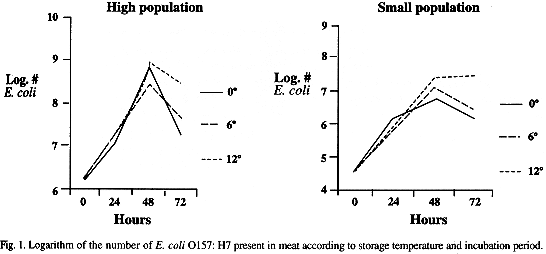
<p><b><font face="Arial"><font size=-1>Results</font></font></b>     <p><font face="Arial"><font size=-1><b>Meat: </b>Populations of <i>E. coli </i>0157: H7 on ground meat stored at 0, 6 and 12&deg;C increased significantly</font></font>     <p><font face="Arial"><font size=-1>(p&lt; 0.05) during the f&iacute;rst 48 hours, whereas the populations decreased around 1 logarithm within 72 hours at the same storage conditions<a href="#img1"> (Fig. 1)</a>. The averaged pH showed a slight drop during the storage period (6.1 to 5.4)</font></font>     ]]></body>
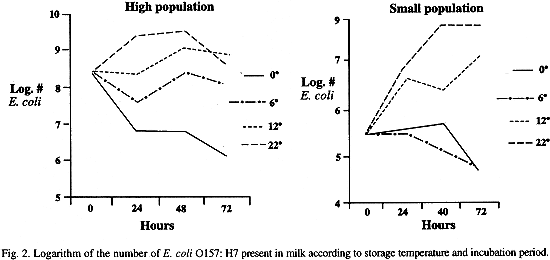
<body><![CDATA[<p><font face="Arial"><font size=-1><b>Milk: </b>Unlike the studies of ground meat, populations of <i>E coli </i>0157: H7 declined significandy (p&lt;0.05) within 24 hours when milk inifially containing 10</font><sup><font size=-2>8</font></sup><font size=-1> CFU/ml was kept at 0 and 6&deg;C. However, increases were detected within 48 hours of storage at 6 and 12&deg;C <a href="#img2">(Fig. 2)</a>. Within 72 hours of incubation at 0 and 6&deg;C, a significant decrease of E <i>coli 0</i>157: H7 was detected in milk samples containing a low-population inoculum. On the contrary, populations of E. <i>coli</i> 0157: H7 on milk stored at 12 and 22&deg;C increased significantly (p&lt;0.05) after 48 h.</font></font>     <br>&nbsp;     <p>    <br>     <center>     <p><a NAME="img2"></a><img SRC="/img/fbpe/rbt/v49n2/1009i2.GIF" height=260 width=550></center>      
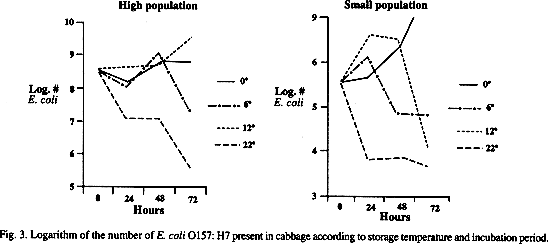
<p><font face="Arial"><font size=-1><b>Cabbage: </b>Populations of <i>E. coli </i>0157: H7 decreased significantly on chopped cabbage stored at 22&deg;C after 24 hours, decreasing 3 log within 72 hours. An increase after 48 h of storage at 6&deg;C was followed by significant (p&lt;0.05) decrease at 72 h in the chopped cabbage initially containing a large inoculum (108 CFU/g). On the other hand, populations on cabbage stored at 12&deg;C increased significantly within 72 h. A significant increase (p&lt;0.05) of <i>E coli</i> population was detected on chopped cabbage initially containing a low inoculum (105 CFU/g) after 72 h of storage at O&deg;C. On the contrary, a significant decrease was observed in cabbage stored at 6 and 12&deg;C for 72 h <a href="#img3">(Fig. 3)</a>. The shift in pH at 0, 6 and 12&deg;C ranged between 7.5 to 6.0; the most marked rate of decrease in pH occurred in vegetables stored at 22&deg;C (7.5 to 5.3).</font></font>     <br>&nbsp;     <p>    <br>     ]]></body>
<body><![CDATA[<center>     <p><a NAME="img3"></a><img SRC="/img/fbpe/rbt/v49n2/1009i3.GIF" height=244 width=548></center>      
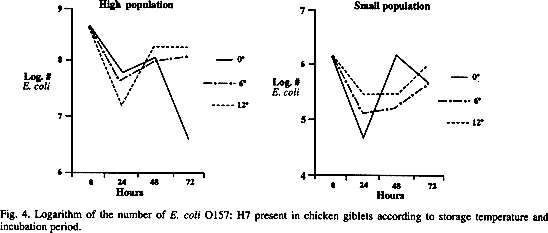
<p><font face="Arial"><font size=-1><b>Chicken giblets: </b>Populations of <i>E. coli</i> 0157: H7 decreased significantly in chicken giblets stored at 0, 6 and 12&deg;C for 24 h, in samples initially containing low and large inoculum. Within<b> </b>48 h incubation of storage at 12&deg;C a significant increase of <i>E. coli </i>0157: H7 was detected in chicken giblets initially</font></font>     <p><font face="Arial"><font size=-1>inoculated with a large population. A similar behavior was observed in chicken giblets containing low inoculum within 48 h of storage at O&deg;C. Populations in low and large inoculum samples stored at O&deg;C declined significantly after 48h <a href="#img4">(Fig. 4).</a> The pH shifted between 6.5-5.9.</font></font>     <br>&nbsp;     <p>    <br>     <center>     <p><a NAME="img4"></a><img SRC="/img/fbpe/rbt/v49n2/1009i4.GIF" height=233 width=548></center>      
<p><b><font face="Arial"><font size=-1>Discussion</font></font></b>     ]]></body>
<body><![CDATA[<p><font face="Arial"><font size=-1>Foods of animal origin have been described as primary sources of enterohaemorrhagic <i>Escherichia coli </i>(EHEC) infections (AbdulRaouf <i>et al. </i>1993) and meat has been describes as the principal vehicle of transmission of this bacterium to human beings (Szaho <i>et al. </i>1990, Roberts <i>et al. </i>1995). <i>E. coli </i>0157: H7 has been isolated from dairy cattle, calves, chickens, swine and even from sheep, and from their retail meat (Doyle and Schoeni 1987, Merimelstein 1993, An-Hung <i>et al. </i>1995). Several authors have described its survival in ground beef during frozen storage (Doyle and Schoeni 1987). Our results coincide with these observations, independently of the population inoculated to meat, or the storage temperature, the numbers of <i>E. coli </i>increased significantly (p&lt;0.05) during the first 48 hours of incubation.</font></font>     <p><font face="Arial"><font size=-1>Our results also show survival and multiplicative capability in chicken giblets stored at 0, 6 and 12&deg;C. Griffin and Tauxe (1991) did not recover this bacterium from raw chicken, but our results show that contaminated or cross contaminated chicken giblets may harbor important numbers.</font></font>     <p><font face="Arial"><font size=-1>Consumption of unpasteurized milk has also been associated with <i>E. coli </i>0157: H7 outbreaks (Borczyk <i>et al. </i>1987, Bielaszewska et al. 1997). Behavior of this bacterium at several incubation temperatures and times shows important resistance to low temperaturas, and multiplication especially when stored at 12 and 22&deg;C; the shift in pH also failed to inhibit growth. These results paralel those of Massa et al. (1999) who report increase in the viable population of EHEC inoculated into milk and stored at 8&deg;C.</font></font>     <p><font face="Arial"><font size=-1>On the other hand, our results, like those of Ruscisa and Sobol (1995) show that <i>E coli</i> 0157: H7 can grow on refrigerated packed vegetables, as has been reported for Li<i>steriamonocytogenes (Berrang et aL </i>1989, Beuchat and Bracket 1990, Monge and Arias 1997), Salmonella (Rosas <i>et al. </i>1984) and Aeromonas hydrophila (Berrant <i>et al. </i>1989). During the first 24 hours, <i>E. coli </i>incubated at 0, 6 and 12'C showed an increase in number, nevertheless, at 22&deg;C it presented a significant decrease in numbers probably due to competition and the important pH change (7,5-5,3). The decrease in pH can be attributed to the fermentative capability of this microorganism and to competition, including lactic bacteria. Similar results have been obtained by Faith <i>et al.</i> (1997) who found reductions in number of bacteria of 2-4 log 10 CFU/g when stored in pepperoni at 21&deg;C for 14 days.</font></font>     <p><font face="Arial"><font size=-1>Vegetables and fruits can become contaminated through cattle manure used in soil or through the use of contaminated water for irrigation or washing (Cieslat <i>et al. </i>1993). At the same time, usual maintenance of packed vegetables is at refrigeration temperatures (8-10&deg;C), that have no effect on this bacterium. Richert <i>et al. </i>(2 000) report similar results, since they observed survival of EHEC on produce held at 4&deg;C and growth at 15&deg;C.</font></font>     <p><font face="Arial"><font size=-1>A recent outbreak of enterohaemorrhagic infection in kindergarten children from Japan is evidence of bacterial survival and multiplication on vegetables. The contaminated food was identified as a potato salad (Makino <i>et al. </i>1997).</font></font>     <p><font face="Arial"><font size=-1>Increased attention to hygiene would be useful, but better risk reduction can be achieved through controlling points of potential contamination in the field and during the processing and handling of the products.</font></font>     <p><font face="Arial"><font size=-1>Findings made in this study indicate that <i>E. coli </i>0157: H7 is capable of surviving and growing in common food: meat, cabbage, milk and chicken giblets under the conditions that are normal in tropical countries such as Costa Rica.</font></font>     <br>&nbsp;     <p><b><font face="Arial"><font size=-1>Acknowledgements</font></font></b>     ]]></body>
<body><![CDATA[<p><font face="Arial"><font size=-1>We thank Laura Villalobos for her cooperation, W. Bussing for correcting the English grammar and several anonymous reviewers for their useful comments. This work received support from Oxoid and the Vice President of Research, Universidad de Costa Rica, project 430-99-214.</font></font>     <br>&nbsp;     <p><b><font face="Arial"><font size=-1>Resumen</font></font></b>     <p><font face="Arial"><font size=-1><i>Escherichia coli </i>0157, H7 ha emergido como un nuevo pat&oacute;geno y se encuentra mundialmente. En Costa Rica, por lo menos ha informado de siete casos cl&iacute;nicos, y no se ha encontrado un lazo epidemiol&oacute;gico o asociaci&oacute;n con alimentos. El prop&oacute;sito de este estudio fue determinar el efecto de diferentes temperaturas de almacenamiento sobre la sobrevivencia de esta bacteria en alimentos de uso com&uacute;n. Una poblaci&oacute;n alta de <i>E. Coli (</i>10</font><sup><font size=-2>6</font></sup><font size=-1>- 10</font><sup><font size=-2>8</font></sup><font size=-1> UFC/ml) y una baja (10</font><sup><font size=-2>4</font></sup><font size=-1>-10</font><sup><font size=-2>6</font></sup><font size=-1> UFC/ml) fueron inoculadas (tres r&eacute;plicas) en carne picada, repollo picado, v&iacute;sceras de pollo y leche pasteurizada e incubadas a 0, 6 y I&deg;C por 24, 48 y 72 h. Los vegetales y la leche tambi&eacute;n fueron incubados a 22&deg;C por los mismos per&iacute;odos. La enumeraci&oacute;n de <i>E. Coli </i>0157: H7 se realiz&oacute; de acuerdo a la metodolog&iacute;a descrita en el Bacteriological Analytical Manual. Las poblaciones de <i>E. coli </i>mostraron tendencias a aumentar o disminuir, dependiendo de la temperatura, tiempo y base alimenticia. Nuestros datos indican que la <i>E. coli </i>0157: H7 es capaz de sobrevivir y crecer en carne, repollo, leche y v&iacute;sceras de pollo, alimentos de uso com&uacute;n en Costa Rica.</font></font>     <br>&nbsp;     <p><b><font face="Arial"><font size=-1>References</font></font></b>     <p><font face="Arial"><font size=-1>Abdul-Raouf, U., L. Beuchat &amp; S. Ammar. 1993. Survival and growth of <i>Escherichia coli </i>0157: H7 in</font></font>     <br><font face="Arial"><font size=-1>ground, roasted beef as affected by pH, acidulants and temperatura. Appl. Environ. Microbiol. 59: 2364-</font></font>     <br><font face="Arial"><font size=-1>2368.</font></font>     <!-- ref --><p><font face="Arial"><font size=-1>Anonymous. 1995. Bacteriological Analytical Manual. AOAC International, Maryland, p 400-429.</font></font>    &nbsp;&nbsp;&nbsp;&nbsp;&nbsp;&nbsp;&nbsp;&nbsp;[&#160;<a href="javascript:void(0);" onclick="javascript: window.open('/scielo.php?script=sci_nlinks&ref=1338952&pid=S0034-7744200100020001000002&lng=','','width=640,height=500,resizable=yes,scrollbars=1,menubar=yes,');">Links</a>&#160;]<!-- end-ref --><p><font face="Arial"><font size=-1>Anonymous. 1995. Consensus conference statement: <i>Escherichia coli </i>0157: H7 infections. An emerging</font></font>     <br><font face="Arial"><font size=-1>national health crisis. Gastroenterology 108: 1923-1934.</font></font>     <!-- ref --><p><font face="Arial"><font size=-1>Anonymous. 1997. Modernas t&eacute;cnicas de control de la calidad de alimenntos procesados. Procesador 16: 47-52.</font></font>    &nbsp;&nbsp;&nbsp;&nbsp;&nbsp;&nbsp;&nbsp;&nbsp;[&#160;<a href="javascript:void(0);" onclick="javascript: window.open('/scielo.php?script=sci_nlinks&ref=1338955&pid=S0034-7744200100020001000004&lng=','','width=640,height=500,resizable=yes,scrollbars=1,menubar=yes,');">Links</a>&#160;]<!-- end-ref --><p><font face="Arial"><font size=-1>An-Hung Fu, J. Sebranek &amp; E. Murano. 1995. Survival of Li<i>steria monocylogenes, Yersinia enterocolitica</i></font></font>     <br><font face="Arial"><font size=-1><i>and</i> <i>Escherichia coli </i>0157: H7 and quality changes after irradiation of beef steaks and ground beef. J. Food</font></font>     <br><font face="Arial"><font size=-1>Sci. 60: 972-977.</font></font>     <p><font face="Arial"><font size=-1>Berrang, M., R. Bracket &amp; L. Beuchat. 1989. Growth of <i>Aeromonas hydrophila </i>on fresh vegetables stofed</font></font>     <br><font face="Arial"><font size=-1>under controlled atmosphere. Appl. Environ. Microbiol. 55: 2167-2171.</font></font>     <p><font face="Arial"><font size=-1>Beuchat, L. &amp; R. Brackett. 1990. Survival and growth of Li<i>steria monocytogenes </i>on lettuce as influenced</font></font>     <br><font face="Arial"><font size=-1>by shredding, chlorine treatment modified atmosphere packaging and temperatura. J. Food Sci. 55: 755</font></font>     ]]></body>
<body><![CDATA[<br><font face="Arial"><font size=-1>758.</font></font>     <p><font face="Arial"><font size=-1>Bielaszewska, M. J. Janda, K. Blahora, H. Minarikova, E. Jikova &amp; M. Karmali. 1997. Human <i>Escherichia</i></font></font>     <br><font face="Arial"><font size=-1><i>coli </i>0157: H7 infection associated with the consumption of unpasteurized goat's milk. Epidemiol. Infect.</font></font>     <br><font face="Arial"><font size=-1>119: 200-305.</font></font>     <p><font face="Arial"><font size=-1>Borczyk, A., M. Kannali, H. Lior &amp; L. Duncan. 1987. Bovine reservoir for verotoxin-producing <i>Escherichia</i></font></font>     <br><font face="Arial"><font size=-1><i>coli </i>0157: H7. Lancet. ii: 98.</font></font>     <p><font face="Arial"><font size=-1>Cieslak, P.R., T. Barrett, P. Griffin, K. Gensheimer, G. Beckett, J. Buffington &amp; M. Smith. 1993.</font></font>     <br><font face="Arial"><font size=-1><i>Escherichia coli </i>0157: H7 infection from a manured garden. Lancet ii: 367.</font></font>     <p><font face="Arial"><font size=-1>Doyle, M. 1991. <i>Escherichia </i>coli 0157: H7 and its significance in foods. Int. J. Food Microb. 12:</font></font>     <br><font face="Arial"><font size=-1>289-302.</font></font>     ]]></body>
<body><![CDATA[<p><font face="Arial"><font size=-1>Doyle, M. &amp; V. Padhye. 1989<i>. Escherichia coli, </i>p. 235-281, In M.P. Doyle (ed). Foodborne Bacterial</font></font>     <br><font face="Arial"><font size=-1>Pathogens, Marcel Dekker, New York.</font></font>     <p><font face="Arial"><font size=-1>Doyle, M. &amp; J. Schoeni. 1987. isolation of <i>Escherichia</i> <i>coli </i>0157: H7 from retail fresh meats and poultry</font></font>     <br><font face="Arial"><font size=-1>Appl. Environ. Microbiol. 53: 2394-2396.</font></font>     <!-- ref --><p><font face="Arial"><font size=-1>Faith, N.G., N. Parniere, T. Larson, T. Lorang &amp; J. Luchansky. 1997. Viability of <i>Escherichia coli </i>0157: H7 in pepperoni during the manufacture of sticks and the subsequent storage of slices at 21,4 and -20 degrees C under air, vacuum and C0</font><sub><font size=-2>2</font></sub><font size=-1>. Int. J. Food Microbiol. 37: 47-54.</font></font>    &nbsp;&nbsp;&nbsp;&nbsp;&nbsp;&nbsp;&nbsp;&nbsp;[&#160;<a href="javascript:void(0);" onclick="javascript: window.open('/scielo.php?script=sci_nlinks&ref=1338977&pid=S0034-7744200100020001000014&lng=','','width=640,height=500,resizable=yes,scrollbars=1,menubar=yes,');">Links</a>&#160;]<!-- end-ref --><p><font face="Arial"><font size=-1>Griffin, P. &amp; R. Tauxe. 1991. The epidemiology of infection caused by <i>Escherichia coli </i>0157: H7, other</font></font>     <br><font face="Arial"><font size=-1>Enterohaemorrhagic E. coli and the associated haemolytic uraemic syndrome. Epidemiol. Rev. 13: 60-98.</font></font>     <!-- ref --><p><font face="Arial"><font size=-1>Herrera, M.L. 1998. Incidencia de casos de <i>Escherichia coli </i>0157: H7 en Costa Rica. Laboratorio de Bacteriolog&iacute;a Hospital Nacional de Ni&ntilde;os. 56 p.</font></font>    &nbsp;&nbsp;&nbsp;&nbsp;&nbsp;&nbsp;&nbsp;&nbsp;[&#160;<a href="javascript:void(0);" onclick="javascript: window.open('/scielo.php?script=sci_nlinks&ref=1338980&pid=S0034-7744200100020001000016&lng=','','width=640,height=500,resizable=yes,scrollbars=1,menubar=yes,');">Links</a>&#160;]<!-- end-ref --><p><font face="Arial"><font size=-1>Makino, S., H. Asakura T. Shirahatu, T. lkeda, K. Takeshi, H. Nagano, S. Yano &amp; N. Fujii. 1997.</font></font>     <br><font face="Arial"><font size=-1>Enterohaemorrhagic<i> Escherichia coli </i>0157 outbreak in Obihiro city- biological and molecular</font></font>     ]]></body>
<body><![CDATA[<br><font face="Arial"><font size=-1>characteristics among 0157 isolates. Kansenshogaku-Zasshi. 71:1131-1136.</font></font>     <p><font face="Arial"><font size=-1>Massa, S., E. Goffredo, C. Altieri &amp; K. Natola. 1999. Fate of <i>Escherichia coli </i>0157: H7 in unpasteurized</font></font>     <br><font face="Arial"><font size=-1>milk stored at 8 degrees C. Lett. Appi. Microbiol. 28: 89-92.</font></font>     <!-- ref --><p><font face="Arial"><font size=-1>Mermelstein, N.H. 1993. Controlling <i>Escherichia coli </i>0157: H7 in meat. Food Tech. 47: 90-91.</font></font>    &nbsp;&nbsp;&nbsp;&nbsp;&nbsp;&nbsp;&nbsp;&nbsp;[&#160;<a href="javascript:void(0);" onclick="javascript: window.open('/scielo.php?script=sci_nlinks&ref=1338986&pid=S0034-7744200100020001000019&lng=','','width=640,height=500,resizable=yes,scrollbars=1,menubar=yes,');">Links</a>&#160;]<!-- end-ref --><!-- ref --><p><font face="Arial"><font size=-1>Monge, R. &amp; M.L. Arias. 1997. Survival of Li<i>steria</i> <i>monocytogenes </i>after addition of lemon juice or sodium hypochlorite to fresh chopped cabbage salad. Rey. Biol Trop. 45: 23-27.</font></font>    &nbsp;&nbsp;&nbsp;&nbsp;&nbsp;&nbsp;&nbsp;&nbsp;[&#160;<a href="javascript:void(0);" onclick="javascript: window.open('/scielo.php?script=sci_nlinks&ref=1338987&pid=S0034-7744200100020001000020&lng=','','width=640,height=500,resizable=yes,scrollbars=1,menubar=yes,');">Links</a>&#160;]<!-- end-ref --><!-- ref --><p><font face="Arial"><font size=-1>Richert, K., J. Albrecht, L. Bullerman &amp; S. Sumner. 2000. Survival and growth of <i>Escherichia coli </i>0157: H7 on broccoli, cucumber and green pepper. Dairy Food Env. Sanit. 20: -24-28.</font></font>    &nbsp;&nbsp;&nbsp;&nbsp;&nbsp;&nbsp;&nbsp;&nbsp;[&#160;<a href="javascript:void(0);" onclick="javascript: window.open('/scielo.php?script=sci_nlinks&ref=1338988&pid=S0034-7744200100020001000021&lng=','','width=640,height=500,resizable=yes,scrollbars=1,menubar=yes,');">Links</a>&#160;]<!-- end-ref --><!-- ref --><p><font face="Arial"><font size=-1>Riley, L.W., R. Remis, S. Hengerson, H. McGee, J. Wells, B. Davis, R. Herbert, E. Olcott, L. Johnson, N. Hangrett, P. Blake &amp; M. Coher. 1983. Hemorrhagic colitis associated with a rare <i>Escherichia coli</i> serotype. N. Engl. J. Med. 308: 681-685.</font></font>    &nbsp;&nbsp;&nbsp;&nbsp;&nbsp;&nbsp;&nbsp;&nbsp;[&#160;<a href="javascript:void(0);" onclick="javascript: window.open('/scielo.php?script=sci_nlinks&ref=1338989&pid=S0034-7744200100020001000022&lng=','','width=640,height=500,resizable=yes,scrollbars=1,menubar=yes,');">Links</a>&#160;]<!-- end-ref --><!-- ref --><p><font face="Arial"><font size=-1>Roberts, C.L., P. Mshar, M. Cartter, J. Hardler, D. Sasin, P. Hayes &amp; T. Barrett. 1995. The role of heightened surveillance in an outbreak of <i>Escherichia coli </i>0157: H7. Epidem. Infect. 115: 447-454.</font></font>    &nbsp;&nbsp;&nbsp;&nbsp;&nbsp;&nbsp;&nbsp;&nbsp;[&#160;<a href="javascript:void(0);" onclick="javascript: window.open('/scielo.php?script=sci_nlinks&ref=1338990&pid=S0034-7744200100020001000023&lng=','','width=640,height=500,resizable=yes,scrollbars=1,menubar=yes,');">Links</a>&#160;]<!-- end-ref --><!-- ref --><p><font face="Arial"><font size=-1>Rosas, I., A. B&aacute;ez &amp; M. Couti&ntilde;o. 1984. Bacteriological quality of crops irrigated with wastewater in the Xochimilco plots, M&eacute;xico City, M&eacute;xico. Appl. Environ. Microbiol. 47: 1074-1079.</font></font>    &nbsp;&nbsp;&nbsp;&nbsp;&nbsp;&nbsp;&nbsp;&nbsp;[&#160;<a href="javascript:void(0);" onclick="javascript: window.open('/scielo.php?script=sci_nlinks&ref=1338991&pid=S0034-7744200100020001000024&lng=','','width=640,height=500,resizable=yes,scrollbars=1,menubar=yes,');">Links</a>&#160;]<!-- end-ref --><p><font face="Arial"><font size=-1>Ruscisa, M.G. &amp; R. Sobol. 1995. <i>Escherichia coli </i>enterohemorr&aacute;gica. La alimentaci&oacute;n Latinoamericana</font></font>     ]]></body>
<body><![CDATA[<br><font face="Arial"><font size=-1>208: 35-40.</font></font>     <p><font face="Arial"><font size=-1>Sekla, L., D. Milley, W. Stackiw, J. Sisler, J. Drew &amp; D. Sargent. 1990. Verotoxin-producing <i>Escherichia</i></font></font>     <br><font face="Arial"><font size=-1><i>coli</i> in ground beef. Manitoba Can. Dis. Weekly Rep. 16: 103-105.</font></font>     <p><font face="Arial"><font size=-1>Szabo, R., E. Todd, J. Mackenzie, L. Parrington &amp; A. Armstrong. 1990. Increased sensitivity of the rapid</font></font>     <br><font face="Arial"><font size=-1>bydrophobic grid membrane filter enzyme-labeled antibody procedure for <i>Escherichia coli </i>0157: H7</font></font>     <br><font face="Arial"><font size=-1>detection in foods and bovine feces. Appl. Environ. Microbiol. 56: 3546-3549.</font></font>     <p><font face="Arial"><font size=-1>Todd, E., R. Szaho, P. Peterkin, A. Sharpe, L. Parrington, D. Bundle, M. Gidney &amp; M. Perry. 1988. Rapid</font></font>     <br><font face="Arial"><font size=-1>hydrophobic grid membrane filter-enzyme-labeled antibody procedure for identification and enumeration of</font></font>     <br><font face="Arial"><font size=-1><i>Escherichia coli </i>0157: H7 in foods. Appl. Environ. Microbiol. 54: 2536-2540.</font></font>     <!-- ref --><p><font face="Arial"><font size=-1>Wilkinson, S.L. 1997. Aliment&aacute;ndose con seguridad en un mundo sucio. Chem. Eng. News 11: 24.</font></font>    &nbsp;&nbsp;&nbsp;&nbsp;&nbsp;&nbsp;&nbsp;&nbsp;[&#160;<a href="javascript:void(0);" onclick="javascript: window.open('/scielo.php?script=sci_nlinks&ref=1339002&pid=S0034-7744200100020001000029&lng=','','width=640,height=500,resizable=yes,scrollbars=1,menubar=yes,');">Links</a>&#160;]<!-- end-ref --><p><font face="Arial"><font size=-1>Wilshaw, G.A., J. Thirwell, A. Jones, S. Parry, R. Salmon &amp; M. Hickey. 1994. Letts. Appl. Microbiol. 19:</font></font>     <br><font face="Arial"><font size=-1>423-439.</font></font>     <br>&nbsp;     <p><a NAME="1ab"></a><font face="Arial"><font size=-1><sup><a href="#1">1</a></sup>Facultad de Microbiolog&iacute;a, Universidad de Costa Rica, 2060 San Jos&eacute;, Costa Rica, fax (506) 207 5440, mlarias@cariari.ucr.ac.cr</font></font>     <p><a NAME="2a"></a><font face="Arial"><font size=-1><sup><a href="#2">2</a></sup> Instituto Costarricense de Investigaci&oacute;n y Ense&ntilde;anza en Nutrici&oacute;n y Salud, Aptd 4-2250, Tres R&iacute;os.</font></font>      ]]></body><back>
<ref-list>
<ref id="B1">
<nlm-citation citation-type="journal">
<person-group person-group-type="author">
<name>
<surname><![CDATA[Abdul-Raouf]]></surname>
<given-names><![CDATA[U.]]></given-names>
</name>
<name>
<surname><![CDATA[Beuchat]]></surname>
<given-names><![CDATA[L.]]></given-names>
</name>
<name>
<surname><![CDATA[Ammar]]></surname>
<given-names><![CDATA[S.]]></given-names>
</name>
</person-group>
<article-title xml:lang="en"><![CDATA[Survival and growth of Escherichia coli 0157: H7 in ground, roasted beef as affected by pH, acidulants and temperatura]]></article-title>
<source><![CDATA[Appl. Environ. Microbiol.]]></source>
<year>1993</year>
<volume>59</volume>
<page-range>2364- 2368</page-range></nlm-citation>
</ref>
<ref id="B2">
<nlm-citation citation-type="book">
<person-group person-group-type="author">
<name>
</name>
<name>
</name>
</person-group>
<source><![CDATA[Bacteriological Analytical Manual]]></source>
<year>1995</year>
<page-range>400-429</page-range><publisher-loc><![CDATA[Maryland ]]></publisher-loc>
<publisher-name><![CDATA[AOAC International]]></publisher-name>
</nlm-citation>
</ref>
<ref id="B3">
<nlm-citation citation-type="journal">
<person-group person-group-type="author">
<name>
</name>
<name>
</name>
</person-group>
<article-title xml:lang="en"><![CDATA[Consensus conference statement: Escherichia coli 0157: H7 infections. An emerging national health crisis]]></article-title>
<source><![CDATA[Gastroenterology]]></source>
<year>1995</year>
<volume>108</volume>
<page-range>1923-1934</page-range></nlm-citation>
</ref>
<ref id="B4">
<nlm-citation citation-type="journal">
<person-group person-group-type="author">
<name>
</name>
<name>
</name>
</person-group>
<article-title xml:lang="es"><![CDATA[Modernas técnicas de control de la calidad de alimenntos procesados]]></article-title>
<source><![CDATA[Procesador]]></source>
<year>1997</year>
<volume>16</volume>
<page-range>47-52</page-range></nlm-citation>
</ref>
<ref id="B5">
<nlm-citation citation-type="journal">
<person-group person-group-type="author">
<name>
<surname><![CDATA[An-Hung]]></surname>
<given-names><![CDATA[Fu]]></given-names>
</name>
<name>
<surname><![CDATA[Sebranek]]></surname>
<given-names><![CDATA[J.]]></given-names>
</name>
<name>
<surname><![CDATA[Murano]]></surname>
<given-names><![CDATA[E.]]></given-names>
</name>
</person-group>
<article-title xml:lang="en"><![CDATA[Survival of Listeria monocylogenes, Yersinia enterocolitica and Escherichia coli 0157: H7 and quality changes after irradiation of beef steaks and ground beef]]></article-title>
<source><![CDATA[J. Food Sci]]></source>
<year>1995</year>
<volume>60</volume>
<page-range>972-977</page-range></nlm-citation>
</ref>
<ref id="B6">
<nlm-citation citation-type="journal">
<person-group person-group-type="author">
<name>
<surname><![CDATA[Berrang]]></surname>
<given-names><![CDATA[M.]]></given-names>
</name>
<name>
<surname><![CDATA[Bracket]]></surname>
<given-names><![CDATA[R.]]></given-names>
</name>
<name>
<surname><![CDATA[Beuchat]]></surname>
<given-names><![CDATA[L.]]></given-names>
</name>
</person-group>
<article-title xml:lang="en"><![CDATA[Growth of Aeromonas hydrophila on fresh vegetables stofed under controlled atmosphere]]></article-title>
<source><![CDATA[Appl. Environ. Microbiol]]></source>
<year>1989</year>
<volume>55</volume>
<page-range>2167-2171</page-range></nlm-citation>
</ref>
<ref id="B7">
<nlm-citation citation-type="journal">
<person-group person-group-type="author">
<name>
<surname><![CDATA[Beuchat]]></surname>
<given-names><![CDATA[L.]]></given-names>
</name>
<name>
<surname><![CDATA[Brackett]]></surname>
<given-names><![CDATA[R.]]></given-names>
</name>
</person-group>
<article-title xml:lang="en"><![CDATA[Survival and growth of Listeria monocytogenes on lettuce as influenced by shredding, chlorine treatment modified atmosphere packaging and temperatura]]></article-title>
<source><![CDATA[J. Food Sci]]></source>
<year>1990</year>
<volume>55</volume>
<page-range>755 758</page-range></nlm-citation>
</ref>
<ref id="B8">
<nlm-citation citation-type="journal">
<person-group person-group-type="author">
<name>
<surname><![CDATA[Bielaszewska]]></surname>
<given-names><![CDATA[M.]]></given-names>
</name>
<name>
<surname><![CDATA[Janda]]></surname>
<given-names><![CDATA[J.]]></given-names>
</name>
<name>
<surname><![CDATA[Blahora]]></surname>
<given-names><![CDATA[K.]]></given-names>
</name>
<name>
<surname><![CDATA[Minarikova]]></surname>
<given-names><![CDATA[H.]]></given-names>
</name>
<name>
<surname><![CDATA[Jikova]]></surname>
<given-names><![CDATA[E.]]></given-names>
</name>
<name>
<surname><![CDATA[Karmali]]></surname>
<given-names><![CDATA[M.]]></given-names>
</name>
</person-group>
<article-title xml:lang="en"><![CDATA[Human Escherichia coli 0157: H7 infection associated with the consumption of unpasteurized goat's milk]]></article-title>
<source><![CDATA[Epidemiol. Infect.]]></source>
<year>1997</year>
<volume>119</volume>
<page-range>200-305</page-range></nlm-citation>
</ref>
<ref id="B9">
<nlm-citation citation-type="journal">
<person-group person-group-type="author">
<name>
<surname><![CDATA[Borczyk]]></surname>
<given-names><![CDATA[A.]]></given-names>
</name>
<name>
<surname><![CDATA[Kannali]]></surname>
<given-names><![CDATA[M.]]></given-names>
</name>
<name>
<surname><![CDATA[Lior]]></surname>
<given-names><![CDATA[H.]]></given-names>
</name>
<name>
<surname><![CDATA[Duncan]]></surname>
<given-names><![CDATA[L.]]></given-names>
</name>
</person-group>
<article-title xml:lang="en"><![CDATA[Bovine reservoir for verotoxin-producing Escherichia coli 0157: H7]]></article-title>
<source><![CDATA[Lancet]]></source>
<year>1987</year>
<volume>ii</volume>
<page-range>98</page-range></nlm-citation>
</ref>
<ref id="B10">
<nlm-citation citation-type="journal">
<person-group person-group-type="author">
<name>
<surname><![CDATA[Cieslak]]></surname>
<given-names><![CDATA[P.R.]]></given-names>
</name>
<name>
<surname><![CDATA[Barrett]]></surname>
<given-names><![CDATA[T.]]></given-names>
</name>
<name>
<surname><![CDATA[Griffin]]></surname>
<given-names><![CDATA[P.]]></given-names>
</name>
<name>
<surname><![CDATA[Gensheimer]]></surname>
<given-names><![CDATA[K.]]></given-names>
</name>
<name>
<surname><![CDATA[Beckett]]></surname>
<given-names><![CDATA[G.]]></given-names>
</name>
<name>
<surname><![CDATA[Buffington]]></surname>
<given-names><![CDATA[J.]]></given-names>
</name>
<name>
<surname><![CDATA[Smith]]></surname>
<given-names><![CDATA[M.]]></given-names>
</name>
</person-group>
<article-title xml:lang="en"><![CDATA[Escherichia coli 0157: H7 infection from a manured garden]]></article-title>
<source><![CDATA[Lancet]]></source>
<year>1993</year>
<volume>ii</volume>
<page-range>367</page-range></nlm-citation>
</ref>
<ref id="B11">
<nlm-citation citation-type="journal">
<person-group person-group-type="author">
<name>
<surname><![CDATA[Doyle]]></surname>
<given-names><![CDATA[M.]]></given-names>
</name>
</person-group>
<article-title xml:lang="en"><![CDATA[Escherichia coli 0157: H7 and its significance in foods]]></article-title>
<source><![CDATA[Int. J. Food Microb]]></source>
<year>1991</year>
<volume>12</volume>
<page-range>289-302</page-range></nlm-citation>
</ref>
<ref id="B12">
<nlm-citation citation-type="book">
<person-group person-group-type="author">
<name>
<surname><![CDATA[Doyle]]></surname>
<given-names><![CDATA[M.]]></given-names>
</name>
<name>
<surname><![CDATA[Padhye]]></surname>
<given-names><![CDATA[V.]]></given-names>
</name>
</person-group>
<person-group person-group-type="editor">
<name>
<surname><![CDATA[Doyle]]></surname>
<given-names><![CDATA[M.P.]]></given-names>
</name>
</person-group>
<source><![CDATA[Foodborne Bacterial Pathogens]]></source>
<year>1989</year>
<publisher-loc><![CDATA[New York ]]></publisher-loc>
<publisher-name><![CDATA[Marcel Dekker]]></publisher-name>
</nlm-citation>
</ref>
<ref id="B13">
<nlm-citation citation-type="journal">
<person-group person-group-type="author">
<name>
<surname><![CDATA[Doyle]]></surname>
<given-names><![CDATA[M.]]></given-names>
</name>
<name>
<surname><![CDATA[Schoeni]]></surname>
<given-names><![CDATA[J.]]></given-names>
</name>
</person-group>
<article-title xml:lang="en"><![CDATA[isolation of Escherichia coli 0157: H7 from retail fresh meats and poultry]]></article-title>
<source><![CDATA[Appl. Environ. Microbiol]]></source>
<year>1987</year>
<volume>53</volume>
<page-range>2394-2396</page-range></nlm-citation>
</ref>
<ref id="B14">
<nlm-citation citation-type="journal">
<person-group person-group-type="author">
<name>
<surname><![CDATA[Faith]]></surname>
<given-names><![CDATA[N.G.]]></given-names>
</name>
<name>
<surname><![CDATA[Parniere]]></surname>
<given-names><![CDATA[N.]]></given-names>
</name>
<name>
<surname><![CDATA[Larson]]></surname>
<given-names><![CDATA[T.]]></given-names>
</name>
<name>
<surname><![CDATA[Lorang]]></surname>
<given-names><![CDATA[T.]]></given-names>
</name>
<name>
<surname><![CDATA[Luchansky]]></surname>
<given-names><![CDATA[J.]]></given-names>
</name>
</person-group>
<article-title xml:lang="en"><![CDATA[Viability of Escherichia coli 0157: H7 in pepperoni during the manufacture of sticks and the subsequent storage of slices at 21,4 and -20 degrees C under air, vacuum and C02]]></article-title>
<source><![CDATA[Int. J. Food Microbiol]]></source>
<year>1997</year>
<volume>37</volume>
<page-range>47-54</page-range></nlm-citation>
</ref>
<ref id="B15">
<nlm-citation citation-type="journal">
<person-group person-group-type="author">
<name>
<surname><![CDATA[Griffin]]></surname>
<given-names><![CDATA[P.]]></given-names>
</name>
<name>
<surname><![CDATA[Tauxe]]></surname>
<given-names><![CDATA[R.]]></given-names>
</name>
</person-group>
<article-title xml:lang="en"><![CDATA[The epidemiology of infection caused by Escherichia coli 0157: H7, other Enterohaemorrhagic E. coli and the associated haemolytic uraemic syndrome]]></article-title>
<source><![CDATA[Epidemiol. Rev]]></source>
<year>1991</year>
<volume>13</volume>
<page-range>60-98</page-range></nlm-citation>
</ref>
<ref id="B16">
<nlm-citation citation-type="book">
<person-group person-group-type="author">
<name>
<surname><![CDATA[Herrera]]></surname>
<given-names><![CDATA[M.L.]]></given-names>
</name>
</person-group>
<source><![CDATA[Incidencia de casos de Escherichia coli 0157: H7 en Costa Rica]]></source>
<year>1998</year>
<page-range>56</page-range><publisher-name><![CDATA[Laboratorio de Bacteriología Hospital Nacional de Niños]]></publisher-name>
</nlm-citation>
</ref>
<ref id="B17">
<nlm-citation citation-type="journal">
<person-group person-group-type="author">
<name>
<surname><![CDATA[Makino]]></surname>
<given-names><![CDATA[S.]]></given-names>
</name>
<name>
<surname><![CDATA[Asakura]]></surname>
<given-names><![CDATA[H.]]></given-names>
</name>
<name>
<surname><![CDATA[Shirahatu]]></surname>
<given-names><![CDATA[T.]]></given-names>
</name>
<name>
<surname><![CDATA[lkeda]]></surname>
<given-names><![CDATA[T.]]></given-names>
</name>
<name>
<surname><![CDATA[Takeshi]]></surname>
<given-names><![CDATA[K.]]></given-names>
</name>
<name>
<surname><![CDATA[Nagano]]></surname>
<given-names><![CDATA[H.]]></given-names>
</name>
<name>
<surname><![CDATA[Yano]]></surname>
<given-names><![CDATA[S.]]></given-names>
</name>
<name>
<surname><![CDATA[Fujii]]></surname>
<given-names><![CDATA[N.]]></given-names>
</name>
</person-group>
<article-title xml:lang="en"><![CDATA[Enterohaemorrhagic Escherichia coli 0157 outbreak in Obihiro city- biological and molecular characteristics among 0157 isolates]]></article-title>
<source><![CDATA[Kansenshogaku-Zasshi]]></source>
<year>1997</year>
<volume>71</volume>
<page-range>1131-1136</page-range></nlm-citation>
</ref>
<ref id="B18">
<nlm-citation citation-type="journal">
<person-group person-group-type="author">
<name>
<surname><![CDATA[Massa]]></surname>
<given-names><![CDATA[S.]]></given-names>
</name>
<name>
<surname><![CDATA[Goffredo]]></surname>
<given-names><![CDATA[E.]]></given-names>
</name>
<name>
<surname><![CDATA[Altieri]]></surname>
<given-names><![CDATA[C.]]></given-names>
</name>
<name>
<surname><![CDATA[Natola]]></surname>
<given-names><![CDATA[K.]]></given-names>
</name>
</person-group>
<article-title xml:lang="en"><![CDATA[Fate of Escherichia coli 0157: H7 in unpasteurized milk stored at 8 degrees C]]></article-title>
<source><![CDATA[Lett. Appi. Microbiol]]></source>
<year>1999</year>
<volume>28</volume>
<page-range>89-92</page-range></nlm-citation>
</ref>
<ref id="B19">
<nlm-citation citation-type="journal">
<person-group person-group-type="author">
<name>
<surname><![CDATA[Mermelstein]]></surname>
<given-names><![CDATA[N.H.]]></given-names>
</name>
</person-group>
<article-title xml:lang="en"><![CDATA[Controlling Escherichia coli 0157: H7 in meat]]></article-title>
<source><![CDATA[Food Tech]]></source>
<year>1993</year>
<volume>47</volume>
<page-range>90-91</page-range></nlm-citation>
</ref>
<ref id="B20">
<nlm-citation citation-type="journal">
<person-group person-group-type="author">
<name>
<surname><![CDATA[Monge]]></surname>
<given-names><![CDATA[R.]]></given-names>
</name>
<name>
<surname><![CDATA[Arias]]></surname>
<given-names><![CDATA[M.L.]]></given-names>
</name>
</person-group>
<article-title xml:lang="en"><![CDATA[Survival of Listeria monocytogenes after addition of lemon juice or sodium hypochlorite to fresh chopped cabbage salad]]></article-title>
<source><![CDATA[Rey. Biol Trop]]></source>
<year>1997</year>
<volume>45</volume>
<page-range>23-27</page-range></nlm-citation>
</ref>
<ref id="B21">
<nlm-citation citation-type="journal">
<person-group person-group-type="author">
<name>
<surname><![CDATA[Richert]]></surname>
<given-names><![CDATA[K.]]></given-names>
</name>
<name>
<surname><![CDATA[Albrecht]]></surname>
<given-names><![CDATA[J.]]></given-names>
</name>
<name>
<surname><![CDATA[Bullerman]]></surname>
<given-names><![CDATA[L.]]></given-names>
</name>
<name>
<surname><![CDATA[Sumner]]></surname>
<given-names><![CDATA[S.]]></given-names>
</name>
</person-group>
<article-title xml:lang="en"><![CDATA[Survival and growth of Escherichia coli 0157: H7 on broccoli, cucumber and green pepper]]></article-title>
<source><![CDATA[Dairy Food Env. Sanit]]></source>
<year>2000</year>
<volume>20</volume>
<page-range>24-28</page-range></nlm-citation>
</ref>
<ref id="B22">
<nlm-citation citation-type="journal">
<person-group person-group-type="author">
<name>
<surname><![CDATA[Riley]]></surname>
<given-names><![CDATA[L.W.]]></given-names>
</name>
<name>
<surname><![CDATA[Remis]]></surname>
<given-names><![CDATA[R.]]></given-names>
</name>
<name>
<surname><![CDATA[Hengerson]]></surname>
<given-names><![CDATA[S.]]></given-names>
</name>
<name>
<surname><![CDATA[McGee]]></surname>
<given-names><![CDATA[H.]]></given-names>
</name>
<name>
<surname><![CDATA[Wells]]></surname>
<given-names><![CDATA[J.]]></given-names>
</name>
<name>
<surname><![CDATA[Davis]]></surname>
<given-names><![CDATA[B]]></given-names>
</name>
<name>
<surname><![CDATA[Herbert]]></surname>
<given-names><![CDATA[R.]]></given-names>
</name>
<name>
<surname><![CDATA[Olcott]]></surname>
<given-names><![CDATA[E.]]></given-names>
</name>
<name>
<surname><![CDATA[Johnson]]></surname>
<given-names><![CDATA[L.]]></given-names>
</name>
<name>
<surname><![CDATA[Hangrett]]></surname>
<given-names><![CDATA[N.]]></given-names>
</name>
<name>
<surname><![CDATA[Blake]]></surname>
<given-names><![CDATA[P.]]></given-names>
</name>
<name>
<surname><![CDATA[Coher]]></surname>
<given-names><![CDATA[M.]]></given-names>
</name>
</person-group>
<article-title xml:lang="en"><![CDATA[Hemorrhagic colitis associated with a rare Escherichia coli serotype]]></article-title>
<source><![CDATA[N. Engl. J. Med]]></source>
<year>1983</year>
<volume>308</volume>
<page-range>681-685</page-range></nlm-citation>
</ref>
<ref id="B23">
<nlm-citation citation-type="journal">
<person-group person-group-type="author">
<name>
<surname><![CDATA[Roberts]]></surname>
<given-names><![CDATA[C.L.]]></given-names>
</name>
<name>
<surname><![CDATA[Mshar]]></surname>
<given-names><![CDATA[P.]]></given-names>
</name>
<name>
<surname><![CDATA[Cartter]]></surname>
<given-names><![CDATA[M.]]></given-names>
</name>
<name>
<surname><![CDATA[Hardler]]></surname>
<given-names><![CDATA[J.]]></given-names>
</name>
<name>
<surname><![CDATA[Sasin]]></surname>
<given-names><![CDATA[D.]]></given-names>
</name>
<name>
<surname><![CDATA[Hayes]]></surname>
<given-names><![CDATA[P.]]></given-names>
</name>
<name>
<surname><![CDATA[Barrett]]></surname>
<given-names><![CDATA[T.]]></given-names>
</name>
</person-group>
<article-title xml:lang="en"><![CDATA[The role of heightened surveillance in an outbreak of Escherichia coli 0157: H7]]></article-title>
<source><![CDATA[Epidem. Infect]]></source>
<year>1995</year>
<volume>115</volume>
<page-range>447-454</page-range></nlm-citation>
</ref>
<ref id="B24">
<nlm-citation citation-type="journal">
<person-group person-group-type="author">
<name>
<surname><![CDATA[Rosas]]></surname>
<given-names><![CDATA[I.]]></given-names>
</name>
<name>
<surname><![CDATA[Báez]]></surname>
<given-names><![CDATA[A.]]></given-names>
</name>
<name>
<surname><![CDATA[Coutiño]]></surname>
<given-names><![CDATA[M.]]></given-names>
</name>
</person-group>
<article-title xml:lang="en"><![CDATA[Bacteriological quality of crops irrigated with wastewater in the Xochimilco plots, México City, México]]></article-title>
<source><![CDATA[Appl. Environ. Microbiol.]]></source>
<year>1984</year>
<volume>47</volume>
<page-range>1074-1079</page-range></nlm-citation>
</ref>
<ref id="B25">
<nlm-citation citation-type="journal">
<person-group person-group-type="author">
<name>
<surname><![CDATA[Ruscisa]]></surname>
<given-names><![CDATA[M.G.]]></given-names>
</name>
<name>
<surname><![CDATA[Sobol]]></surname>
<given-names><![CDATA[R.]]></given-names>
</name>
</person-group>
<article-title xml:lang="en"><![CDATA[Escherichia coli enterohemorrágica]]></article-title>
<source><![CDATA[La alimentación Latinoamericana]]></source>
<year>1995</year>
<volume>208</volume>
<page-range>35-40</page-range></nlm-citation>
</ref>
<ref id="B26">
<nlm-citation citation-type="journal">
<person-group person-group-type="author">
<name>
<surname><![CDATA[Sekla]]></surname>
<given-names><![CDATA[L.]]></given-names>
</name>
<name>
<surname><![CDATA[Milley]]></surname>
<given-names><![CDATA[D.]]></given-names>
</name>
<name>
<surname><![CDATA[Stackiw]]></surname>
<given-names><![CDATA[W.]]></given-names>
</name>
<name>
<surname><![CDATA[Sisler]]></surname>
<given-names><![CDATA[J.]]></given-names>
</name>
<name>
<surname><![CDATA[Drew]]></surname>
<given-names><![CDATA[J.]]></given-names>
</name>
<name>
<surname><![CDATA[Sargent]]></surname>
<given-names><![CDATA[D.]]></given-names>
</name>
</person-group>
<article-title xml:lang="en"><![CDATA[Verotoxin-producing Escherichia coli in ground beef]]></article-title>
<source><![CDATA[Manitoba Can. Dis. Weekly Rep]]></source>
<year>1990</year>
<volume>16</volume>
<page-range>103-105</page-range></nlm-citation>
</ref>
<ref id="B27">
<nlm-citation citation-type="journal">
<person-group person-group-type="author">
<name>
<surname><![CDATA[Szabo]]></surname>
<given-names><![CDATA[R.]]></given-names>
</name>
<name>
<surname><![CDATA[Todd]]></surname>
<given-names><![CDATA[E.]]></given-names>
</name>
<name>
<surname><![CDATA[Mackenzie]]></surname>
<given-names><![CDATA[J.]]></given-names>
</name>
<name>
<surname><![CDATA[Parrington]]></surname>
<given-names><![CDATA[L.]]></given-names>
</name>
<name>
<surname><![CDATA[Armstrong]]></surname>
<given-names><![CDATA[A.]]></given-names>
</name>
</person-group>
<article-title xml:lang="en"><![CDATA[Increased sensitivity of the rapid bydrophobic grid membrane filter enzyme-labeled antibody procedure for Escherichia coli 0157: H7 detection in foods and bovine feces]]></article-title>
<source><![CDATA[Appl. Environ. Microbiol]]></source>
<year>1990</year>
<volume>56</volume>
<page-range>3546-3549</page-range></nlm-citation>
</ref>
<ref id="B28">
<nlm-citation citation-type="journal">
<person-group person-group-type="author">
<name>
<surname><![CDATA[Todd]]></surname>
<given-names><![CDATA[E.]]></given-names>
</name>
<name>
<surname><![CDATA[Szaho]]></surname>
<given-names><![CDATA[R.]]></given-names>
</name>
<name>
<surname><![CDATA[Peterkin]]></surname>
<given-names><![CDATA[P.]]></given-names>
</name>
<name>
<surname><![CDATA[Sharpe]]></surname>
<given-names><![CDATA[A.]]></given-names>
</name>
<name>
<surname><![CDATA[Parrington]]></surname>
<given-names><![CDATA[L.]]></given-names>
</name>
<name>
<surname><![CDATA[Bundle]]></surname>
<given-names><![CDATA[D.]]></given-names>
</name>
<name>
<surname><![CDATA[Gidney]]></surname>
<given-names><![CDATA[M.]]></given-names>
</name>
<name>
<surname><![CDATA[Perry]]></surname>
<given-names><![CDATA[M.]]></given-names>
</name>
</person-group>
<article-title xml:lang="en"><![CDATA[Rapid hydrophobic grid membrane filter-enzyme-labeled antibody procedure for identification and enumeration of Escherichia coli 0157: H7 in foods]]></article-title>
<source><![CDATA[Appl. Environ. Microbiol]]></source>
<year>1988</year>
<volume>54</volume>
<page-range>2536-2540</page-range></nlm-citation>
</ref>
<ref id="B29">
<nlm-citation citation-type="journal">
<person-group person-group-type="author">
<name>
<surname><![CDATA[Wilkinson]]></surname>
<given-names><![CDATA[S.L.]]></given-names>
</name>
</person-group>
<article-title xml:lang="en"><![CDATA[Alimentándose con seguridad en un mundo sucio]]></article-title>
<source><![CDATA[Chem. Eng. News]]></source>
<year>1997</year>
<volume>11</volume>
<page-range>24</page-range></nlm-citation>
</ref>
<ref id="B30">
<nlm-citation citation-type="journal">
<person-group person-group-type="author">
<name>
<surname><![CDATA[Wilshaw]]></surname>
<given-names><![CDATA[G.A.]]></given-names>
</name>
<name>
<surname><![CDATA[Thirwell]]></surname>
<given-names><![CDATA[J.]]></given-names>
</name>
<name>
<surname><![CDATA[Jones]]></surname>
<given-names><![CDATA[A.]]></given-names>
</name>
<name>
<surname><![CDATA[Parry]]></surname>
<given-names><![CDATA[S.]]></given-names>
</name>
<name>
<surname><![CDATA[Salmon]]></surname>
<given-names><![CDATA[R.]]></given-names>
</name>
<name>
<surname><![CDATA[Hickey]]></surname>
<given-names><![CDATA[M.]]></given-names>
</name>
</person-group>
<source><![CDATA[Letts. Appl. Microbiol]]></source>
<year>1994</year>
<volume>19</volume>
<page-range>423-439</page-range></nlm-citation>
</ref>
</ref-list>
</back>
</article>