<?xml version="1.0" encoding="ISO-8859-1"?><article xmlns:mml="http://www.w3.org/1998/Math/MathML" xmlns:xlink="http://www.w3.org/1999/xlink" xmlns:xsi="http://www.w3.org/2001/XMLSchema-instance">
<front>
<journal-meta>
<journal-id>0034-7744</journal-id>
<journal-title><![CDATA[Revista de Biología Tropical]]></journal-title>
<abbrev-journal-title><![CDATA[Rev. biol. trop]]></abbrev-journal-title>
<issn>0034-7744</issn>
<publisher>
<publisher-name><![CDATA[Universidad de Costa Rica]]></publisher-name>
</publisher>
</journal-meta>
<article-meta>
<article-id>S0034-77442001000200008</article-id>
<title-group>
<article-title xml:lang="en"><![CDATA[Volatile essential oil constituents of Alpinia smithiae (Zingiberaceae)]]></article-title>
</title-group>
<contrib-group>
<contrib contrib-type="author">
<name>
<surname><![CDATA[Joseph]]></surname>
<given-names><![CDATA[Roy]]></given-names>
</name>
<xref ref-type="aff" rid="A01"/>
</contrib>
<contrib contrib-type="author">
<name>
<surname><![CDATA[Joseph]]></surname>
<given-names><![CDATA[Tessy]]></given-names>
</name>
<xref ref-type="aff" rid="A01"/>
</contrib>
<contrib contrib-type="author">
<name>
<surname><![CDATA[Joseph]]></surname>
<given-names><![CDATA[Jose]]></given-names>
</name>
<xref ref-type="aff" rid="A02"/>
</contrib>
</contrib-group>
<aff id="A01">
<institution><![CDATA[,National University of Singapore Department of Biological Sciences ]]></institution>
<addr-line><![CDATA[Kent Ridge Crescent ]]></addr-line>
<country>Singapore</country>
</aff>
<aff id="A02">
<institution><![CDATA[,Sacred Heart College Department of Botany ]]></institution>
<addr-line><![CDATA[Kerala ]]></addr-line>
<country>India</country>
</aff>
<pub-date pub-type="pub">
<day>00</day>
<month>06</month>
<year>2001</year>
</pub-date>
<pub-date pub-type="epub">
<day>00</day>
<month>06</month>
<year>2001</year>
</pub-date>
<volume>49</volume>
<numero>2</numero>
<fpage>509</fpage>
<lpage>512</lpage>
<copyright-statement/>
<copyright-year/>
<self-uri xlink:href="http://www.scielo.sa.cr/scielo.php?script=sci_arttext&amp;pid=S0034-77442001000200008&amp;lng=en&amp;nrm=iso"></self-uri><self-uri xlink:href="http://www.scielo.sa.cr/scielo.php?script=sci_abstract&amp;pid=S0034-77442001000200008&amp;lng=en&amp;nrm=iso"></self-uri><self-uri xlink:href="http://www.scielo.sa.cr/scielo.php?script=sci_pdf&amp;pid=S0034-77442001000200008&amp;lng=en&amp;nrm=iso"></self-uri><abstract abstract-type="short" xml:lang="en"><p><![CDATA[The composition of leaf and rhizome essential oils of Alpinia smithiae that grow wild in the Western Ghats of Kerala (South India) was analysed by gas chromatography. The major components were <IMG SRC="http:/img/fbpe/rbt/v49n2/Beta.GIF" WIDTH=12 HEIGHT=19>-caryophyllene, sabinene, myrcene and 1,8-cineole in both samples, but variation in the yield of oil as well as the major components between the two plant parts was observed.]]></p></abstract>
<abstract abstract-type="short" xml:lang="es"><p><![CDATA[La composición de los aceites escenciales de hojas y rizomas de Alpinia smithiae, que crece silvestre en Ghats Occidental de Kerala (sur de India), fue analizada por cromatografía de gases. Los principales componentes en ambas muestras fueron <IMG SRC="http:/img/fbpe/rbt/v49n2/Beta.GIF" WIDTH=12 HEIGHT=19>-cariofileno, sabinero, mirceno y 1,8-cinole, pero fue observada la existencia de variación entre las dos partes de la planta en la capa de aceite así como en los princiapales componentes.]]></p></abstract>
<kwd-group>
<kwd lng="la"><![CDATA[Alpinia smithiae]]></kwd>
<kwd lng="la"><![CDATA[Zingiberaceae]]></kwd>
<kwd lng="en"><![CDATA[essential oil]]></kwd>
<kwd lng="en"><![CDATA[GC-MS]]></kwd>
<kwd lng="en"><![CDATA[terpenoid]]></kwd>
</kwd-group>
</article-meta>
</front><body><![CDATA[   <i><font face="Arial"><font size="-1">Communication</font></font></i>      <center></center>        <center><b><font face="Arial">Volatile essential oil constituents of <i>Alpinia  smithiae </i>(Zingiberaceae)    <br> &nbsp; &nbsp;    <br> </font></b></center> &nbsp;     <center></center>        <center><font face="Arial"><font size="-1"><b>Roy Joseph<a name="1*"></a> </b><sup><a href="#1*a">1*</a> </sup><b> Tessy Josephl<a name="1"></a> </b><sup><a href="#1*a">1</a> </sup><b> Jose Joseph<a name="2"></a> </b><sup><a href="#2a">2    <br>     <br> </a> </sup></font></font></center> &nbsp;     <center></center>        ]]></body>
<body><![CDATA[<center><font face="Arial"><font size="-1">&nbsp; &nbsp; &nbsp;     <br> Received 27-IV-2000. Corrected 1-IX-2000. Accepted 9-X-2000.</font></font></center>         <p><b><font face="Arial"><font size="-1">Abstract</font></font></b>  </p>     <p><font face="Arial"><font size="-1">The composition of leaf and rhizome  essential oils of <i>Alpinia smithiae </i>that grow wild in the Western Ghats of Kerala (South India) was analysed by gas chromatography. The major components were&nbsp;<img src="/img/fbpe/rbt/v49n2/Beta.GIF" height="19" width="13" align="Center"> -caryophyllene, sabinene, myrcene and 1,8-cineole in both samples, but variation in the yield of oil as well as the major components between the two plant parts was observed.</font></font>     
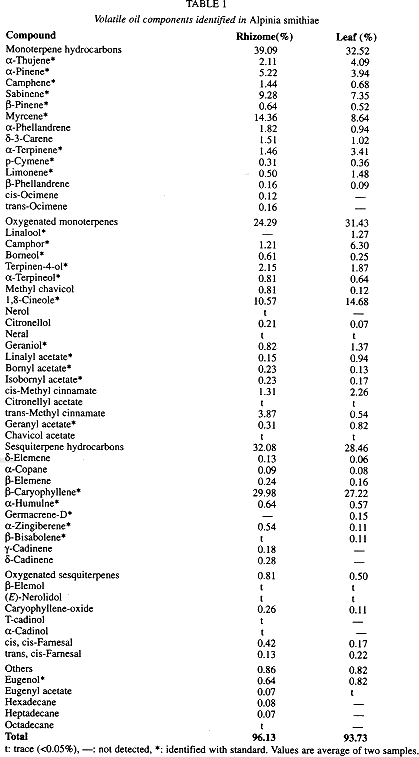
<br> &nbsp;  </p>     <p><b><font face="Arial"><font size="-1">Key words</font></font></b>  </p>     <p><font face="Arial"><font size="-1"><i>Alpinia smithiae, </i>Zingiberaceae,  essential oil, GC-MS, terpenoid.</font></font>     <br> &nbsp;  </p>     <p><font face="Arial"><font size="-1"><i>Alpinia smithiae </i>Sabu &amp; Mangaly belongs to the family Zingiberaceae, which has only recently been reported and describes from South India as an endangered species native to the evergreen forests in the Western Ghats of Kerala (Sabu and Mangaly 1991). It is a perennial rhizomatous herb growing in shady habitats at 300-400 m elevation and characterized by the possession of a tuberous and creeping rhizome with an aerial shoot (pseudostem) covered by sheathing leaf bases. In Kerala, tribal natives use the plant for making folk medicines and remedies for men and cattle (Sabu 1991). Most of the species of the genus <i>Alpinia </i>are economically important, since they are being used in the treatment of various ailments (Jitoe <i> et al. </i>1992), in flavoring various food and curry preparations (Heywood 1993) and as ornamental plants (Criley 1988).</font></font>  </p>     <p><font face="Arial"><font size="-1"><i>Alpinia </i>species are characterized  by a wide range of volatile compounds and have been the subject of numerous  phytochemical studies (Fujita <i>et al. </i>1994, De Pooter <i>et al.</i>  1995, Kuster <i>et al. </i>1999). The present study is the first in which  the volatile components of A. <i>smithiae </i>have been studied extensively.</font></font>   </p>     ]]></body>
<body><![CDATA[<p><font face="Arial"><font size="-1">Two germplasm collections were carried  out in June and December 1996, from the Attappadi Hills, Palakkad District  of Kerala, India. Voucher specimens were deposited in the herbarium of Sacred Heart College, Thevara, Cochin, Kerala, India (SHH 96-442). All individuals were grown in the experimental garden under same agro-climatic conditions.</font></font>   </p>     <p><font face="Arial"><font size="-1">The essential oil was obtained from  dried, flaked and powdered rhizomes and leaves by hydro-distillation in a modified Clevenger apparatus for 3-4 h at 100&deg;C. For the isolated oil samples, the physico-chemical, qualitative and quantitative analyses were made. A Hewlett Packard 5890 series 11 GC equipped with a 30m x 0.25 mm id. glass capillary colum, DB-5 (J &amp; W Scientific, Folsome, California) and fiarne ionization detector was used for the analysis of samples. Results were reported on a HP 3396 Integrator. Analytical conditions were: split 1: 60; injector and detector temperatura, 250&deg;C; oven temperatura was programmed from initial 50&deg;C for 2 min, increased to 150&deg;C at 2&deg; min</font><sup><font size="-2"> -1</font></sup><font size="-1"> and subjected to a final temperature of 280&deg;C for 10 min. Flow rates for the gases were: He, 17 mm sec</font><sup><font size="-2"> -1</font></sup><font size="-1">; H </font><sub><font size="-2">2</font></sub><font size="-1"> , 35ml min</font><sup><font size="-2">-1</font></sup><font size="-1">; Air 350 ml min</font><sup><font size="-2">-1</font></sup><font size="-1">.</font></font>   </p>     <p><font face="Arial"><font size="-1">For GC-MS analysis, a Hewlett Packard  5890 series Il GC equipped with a Hewlett Packard 5970 MS was used. Conditions  for the GC were the same as those described above. For MS: Scan mode from  50 to 300 amu; El ionization voltage, 7OeV; multiplier voltage 1600 V. Each compound tentatively identified by comparing retention indices and spectral data from those published in the literature (Adams 1995) and Wiley electronic libraries. For positive identification, standard compounds were used in some cases to match GC retention times and MS spectra.</font></font>  </p>     <p><font face="Arial"><font size="-1">The percentage yield of essential oil  for rhizome was 0.83, whereas for leaves it was 0.33. The physico-chemical  properties of the oil samples were as follows. For rhizome oil: d</font><sup><font size="-2"> 25</font></sup><font size="-1">=0.8658; </font></font><font face="Symbol"><font size="-1"> h</font></font><font face="Arial"><sup><font size="-2">25</font></sup><font size="-1"><sub> D</sub>=1.5217; solubility: in 2 volumes of 80% alcohol; color: yellowish to brown; odor: fresh green and spicy, woody odor with a medicinal top note; flavor: warm, bitter, harsh and spicy with an unpleasant aftertaste. For leaf oil: d</font><sup><font size="-2">25</font></sup><font size="-1">=0.8462;  </font></font><font face="Symbol"><font size="-1">h</font></font><font face="Arial"><sup><font size="-2"> 25</font></sup><font size="-1"><sub>D</sub> =1.4968; solubility: in 2 volumes of 80% alcohol; color: pale yellowish green; odor: fresh green, spicy and woody odor with a cineole top note; flavor: bitter, harsh, spicy and slightly irritating with an unpleasant aftertaste.</font></font>  </p>     <p><font face="Arial"><font size="-1">GC and GC-MS analysis of essential oil enabled us to identify fifty-five volatile components <a href="#tab1">(Table  1)</a>  from both plant parts. In the volatile extract different group of terpenoid compounds were present, such as hydrocarbons, alcohols, aldehydes, ketones, esters and others. The monoterpenes are represented mainly by monocyclic compounds of the p-cymene group, such as limonene, terpinene, phellandrenes and the oxide 1,8-cineole. The bicyclic monoterpenes comprised mainly compounds of the cainphane group, such as camphene, borneol, bornyl acetate, isobornyl acetate, the<b> </b>saturated ketone like camphor; carene, pinenes, together with sabinene. Acyclic monoterpenoids such as myrcene, geraniol, citronellol, linalool as well as their derivatives were also present in the genus <i>Alpinia</i> . Sesquiterpenes like bisabolene, zingiberene, cadinene, caryophyllene, caryophyllene oxide, humulene, germacrene-D and elemene were also present in the<b> </b> volatile oil.</font></font>  </p>     <p><font face="Arial"><font size="-1">Even though the main components of both oil samples were the same, there was variation in the percentage quantity  for these components between the two samples.&nbsp;<img src="/img/fbpe/rbt/v49n2/Beta.GIF" height="19" width="13" align="Center"> -Caryophyllene (29.98%),&nbsp;<img src="/img/fbpe/rbt/v49n2/Beta.GIF" height="19" width="13" align="Center"> -pinene (5.22%), sabinene (9.28%), myrcene (14.36%) and 1,8-cineole (10.57%) were the major components of the rhizome oil and the oil is characterized by the presence of large amounts of monoterpene hydrocarbons (39.09%). Whereas&nbsp;<img src="/img/fbpe/rbt/v49n2/Beta.GIF" height="19" width="13" align="Center"> -Caryophyllene (27.22%), sabinene (7.35%), myrcene (8.64%), and 1,8-cineole (14.68%) along with camphor (6.30%) were the major components in the leaf oil. In the leaf essential oil monoterpene hydrocarbons, oxygenated monoterpenes and sesquiterpene hydrocarbons were almost present in equal amounts. Among  the sesquiterpenoids, hydrocarbons were detected in higher concentrations  than the oxygenated ones in both samples analyzed.</font></font>  </p>     
<p><font face="Arial"><font size="-1">The medicinal properties and biological  activities of plants are usually due to their chemical profile. Therefore,  reports on medicinal, pharmacological and pesticidal activity of crude extracts of this plant have little value if the chemotype has not been determined. The information on essential oil profile can be used for the possible exploitation of this species for various research and pharmaceutical purposes. Moreover, the chemical data may give complementary information to the taxonomy of this species.</font></font> </p>     <center></center>        <center><a name="tab1"></a> <img src="/img/fbpe/rbt/v49n2/1007ta1.GIF" height="757" width="419"> </center>         
<p><b><font face="Arial"><font size="-1">Resumen</font></font></b>  </p>     ]]></body>
<body><![CDATA[<p><font face="Arial"><font size="-1">La composici&oacute;n de los aceites  escenciales de hojas y<i> </i>rizomas de <i>Alpinia smithiae, </i>que crece  silvestre en Ghats Occidental de Kerala (sur de India), fue analizada por  cromatograf&iacute;a de gases. Los principales componentes en ambas muestras  fueron&nbsp;<img src="/img/fbpe/rbt/v49n2/Beta.GIF" height="19" width="13" align="Center"> -cariofileno, sabinero, mirceno y 1,8-cinole, pero fue observada la existencia de variaci&oacute;n entre las dos partes de la planta en la capa de aceite as&iacute; como en los princiapales componentes.</font></font>     
<br> &nbsp;  </p>     <p><b><font face="Arial"><font size="-1">References</font></font></b> </p>     <!-- ref --><p><font face="Arial"><font size="-1">Adams,<b> </b>R. 1995. Identification of essential oil components by gas chromatography/mass spectrometry.</font></font> <font face="Arial"><font size="-1">Allured, Carol Stream, Illinois.</font></font>   &nbsp;&nbsp;&nbsp;&nbsp;&nbsp;&nbsp;&nbsp;&nbsp;[&#160;<a href="javascript:void(0);" onclick="javascript: window.open('/scielo.php?script=sci_nlinks&ref=1347138&pid=S0034-7744200100020000800001&lng=','','width=640,height=500,resizable=yes,scrollbars=1,menubar=yes,');">Links</a>&#160;]<!-- end-ref --><!-- ref --><p><font face="Arial"><font size="-1">Criley R.A. 1988. Propagation of tropical  cut flowers: <i>Strelitzia, Alpinia and Heliconia. </i>Acta Hort. 226:</font></font> <font face="Arial"><font size="-1">509-517.</font></font>  &nbsp;&nbsp;&nbsp;&nbsp;&nbsp;&nbsp;&nbsp;&nbsp;[&#160;<a href="javascript:void(0);" onclick="javascript: window.open('/scielo.php?script=sci_nlinks&ref=1347139&pid=S0034-7744200100020000800002&lng=','','width=640,height=500,resizable=yes,scrollbars=1,menubar=yes,');">Links</a>&#160;]<!-- end-ref --><!-- ref --><p><font face="Arial"><font size="-1">De Pooter H., E. aboutabl &amp; E.L.  Shabrawy. 1995. Chemical composition and antimicrobial activity of</font></font> <font face="Arial"><font size="-1">essential oil of leaf, stem and rhizome  of <i>Alpinia</i> <i>speciosa </i>(J. C. Wendl.) K. Schum. grown in Egypt.</font></font> <font face="Arial"><font size="-1">Flavour Fragrance J. 10: 63-67.</font></font>   &nbsp;&nbsp;&nbsp;&nbsp;&nbsp;&nbsp;&nbsp;&nbsp;[&#160;<a href="javascript:void(0);" onclick="javascript: window.open('/scielo.php?script=sci_nlinks&ref=1347140&pid=S0034-7744200100020000800003&lng=','','width=640,height=500,resizable=yes,scrollbars=1,menubar=yes,');">Links</a>&#160;]<!-- end-ref --><!-- ref --><p><font face="Arial"><font size="-1">Fujita T., H. Nishimura, K. Kaburagi  &amp; J. Mizutani. 1994. Plant growth inhibiting&nbsp;<img src="http:/img/fbpe/rbt/v49n2/Beta.GIF" height="19" width="13" align="Center"> -pirones from <i>Alpinia</i></font></font> <font face="Arial"><font size="-1"><i>speciosa. </i>Phytochemistry 36: 23-27.</font></font>   &nbsp;&nbsp;&nbsp;&nbsp;&nbsp;&nbsp;&nbsp;&nbsp;[&#160;<a href="javascript:void(0);" onclick="javascript: window.open('/scielo.php?script=sci_nlinks&ref=1347141&pid=S0034-7744200100020000800004&lng=','','width=640,height=500,resizable=yes,scrollbars=1,menubar=yes,');">Links</a>&#160;]<!-- end-ref --><!-- ref --><p><font face="Arial"><font size="-1">Heywood, V. H. 1993. Flowering plants  of the world. Batsford, London. 298 p.</font></font>  &nbsp;&nbsp;&nbsp;&nbsp;&nbsp;&nbsp;&nbsp;&nbsp;[&#160;<a href="javascript:void(0);" onclick="javascript: window.open('/scielo.php?script=sci_nlinks&ref=1347142&pid=S0034-7744200100020000800005&lng=','','width=640,height=500,resizable=yes,scrollbars=1,menubar=yes,');">Links</a>&#160;]<!-- end-ref --><!-- ref --><p><font face="Arial"><font size="-1">Jitoe A., T. Masuda, I.G.P. Tengah,  D.N. Suprapta, I.W. Gara &amp; N. Nakatani. 1992. Antioxidant activity of</font></font> <font face="Arial"><font size="-1">tropical ginger extracts and analysis of the contained curcuminoids. J.<b> </b>Agr. Food Chem. 40: 1337-1340.</font></font>   &nbsp;&nbsp;&nbsp;&nbsp;&nbsp;&nbsp;&nbsp;&nbsp;[&#160;<a href="javascript:void(0);" onclick="javascript: window.open('/scielo.php?script=sci_nlinks&ref=1347143&pid=S0034-7744200100020000800006&lng=','','width=640,height=500,resizable=yes,scrollbars=1,menubar=yes,');">Links</a>&#160;]<!-- end-ref --><!-- ref --><p><font face="Arial"><font size="-1">Kuster R.M., M.A.<b> </b>Mpalantinos,  M.C. de Holanda, P. Lima, E.T. Brand &amp; J.P. Parente. 1999. GCMS-Determination  of kava-pyrones in <i>Alpinia</i> <i>zerumbet </i>leaves. J.<b> </b>High Resolution Chromatogr. 22: 129-130.</font></font>  &nbsp;&nbsp;&nbsp;&nbsp;&nbsp;&nbsp;&nbsp;&nbsp;[&#160;<a href="javascript:void(0);" onclick="javascript: window.open('/scielo.php?script=sci_nlinks&ref=1347144&pid=S0034-7744200100020000800007&lng=','','width=640,height=500,resizable=yes,scrollbars=1,menubar=yes,');">Links</a>&#160;]<!-- end-ref --><!-- ref --><p><font face="Arial"><font size="-1">Sabu, M. 1991. A taxonomic and phylogenetic  study of South Indian Zingiberaceae. Ph. D. Thesis,</font></font> <font face="Arial"><font size="-1">University of Calicut, India.</font></font>   &nbsp;&nbsp;&nbsp;&nbsp;&nbsp;&nbsp;&nbsp;&nbsp;[&#160;<a href="javascript:void(0);" onclick="javascript: window.open('/scielo.php?script=sci_nlinks&ref=1347145&pid=S0034-7744200100020000800008&lng=','','width=640,height=500,resizable=yes,scrollbars=1,menubar=yes,');">Links</a>&#160;]<!-- end-ref --><!-- ref --><p><font face="Arial"><font size="-1">Sabu, M. &amp; J.K. Mangaly. 1991. <i> Alpinia smithiae</i>: new species Zingiberaceae from South India.</font></font> <font face="Arial"><font size="-1">Edinburgh J. Bot. 48: 69-72.</font></font>  &nbsp;  &nbsp;&nbsp;&nbsp;&nbsp;&nbsp;&nbsp;&nbsp;&nbsp;[&#160;<a href="javascript:void(0);" onclick="javascript: window.open('/scielo.php?script=sci_nlinks&ref=1347146&pid=S0034-7744200100020000800009&lng=','','width=640,height=500,resizable=yes,scrollbars=1,menubar=yes,');">Links</a>&#160;]<!-- end-ref --><p><a name="1*a"></a> <font face="Arial"><sup><font size="-2"><a href="#1*">1</a> </font></sup><font size="-1"> Department of Biological Sciences, National University of Singapore, 10 Kent Ridge Crescent, Singapore-119260, Fax: 65 7743854; scip8295@nus.edu.sg</font></font>  </p>     <p><a name="2a"></a> <font face="Arial"><font size="-1"><sup><a href="#2">2</a> </sup> Department of Botany, Sacred Heart College, Cochin-682013, Kerala, India. Fax: 0091 484 312813</font></font> </p>      ]]></body><back>
<ref-list>
<ref id="B1">
<nlm-citation citation-type="book">
<person-group person-group-type="author">
<name>
<surname><![CDATA[Adams]]></surname>
<given-names><![CDATA[R]]></given-names>
</name>
</person-group>
<source><![CDATA[Identification of essential oil components by gas chromatography/mass spectrometry]]></source>
<year>1995</year>
<publisher-loc><![CDATA[Carol Stream^eIllinois Illinois]]></publisher-loc>
<publisher-name><![CDATA[Allured]]></publisher-name>
</nlm-citation>
</ref>
<ref id="B2">
<nlm-citation citation-type="journal">
<person-group person-group-type="author">
<name>
<surname><![CDATA[Criley]]></surname>
<given-names><![CDATA[R.A.]]></given-names>
</name>
</person-group>
<article-title xml:lang="en"><![CDATA[Propagation of tropical cut flowers: Strelitzia, Alpinia and Heliconia]]></article-title>
<source><![CDATA[Acta Hort]]></source>
<year>1988</year>
<volume>226</volume>
<page-range>509-517</page-range></nlm-citation>
</ref>
<ref id="B3">
<nlm-citation citation-type="journal">
<person-group person-group-type="author">
<name>
<surname><![CDATA[De Pooter]]></surname>
<given-names><![CDATA[H.]]></given-names>
</name>
<name>
<surname><![CDATA[aboutabl]]></surname>
<given-names><![CDATA[E.]]></given-names>
</name>
<name>
<surname><![CDATA[Shabrawy]]></surname>
<given-names><![CDATA[E.L.]]></given-names>
</name>
</person-group>
<article-title xml:lang="en"><![CDATA[Chemical composition and antimicrobial activity of essential oil of leaf, stem and rhizome of Alpinia speciosa (J. C. Wendl.) K. Schum. grown in Egypt]]></article-title>
<source><![CDATA[Flavour Fragrance J.]]></source>
<year>1995</year>
<volume>10</volume>
<page-range>63-67</page-range></nlm-citation>
</ref>
<ref id="B4">
<nlm-citation citation-type="journal">
<person-group person-group-type="author">
<name>
<surname><![CDATA[Fujita]]></surname>
<given-names><![CDATA[T.]]></given-names>
</name>
<name>
<surname><![CDATA[Nishimura]]></surname>
<given-names><![CDATA[H.]]></given-names>
</name>
<name>
<surname><![CDATA[Kaburagi]]></surname>
<given-names><![CDATA[K.]]></given-names>
</name>
<name>
<surname><![CDATA[Mizutani]]></surname>
<given-names><![CDATA[J.]]></given-names>
</name>
</person-group>
<article-title xml:lang="en"><![CDATA[Plant growth inhibiting ?-pirones from Alpinia speciosa]]></article-title>
<source><![CDATA[Phytochemistry]]></source>
<year>1994</year>
<volume>36</volume>
<page-range>23-27</page-range></nlm-citation>
</ref>
<ref id="B5">
<nlm-citation citation-type="">
<person-group person-group-type="author">
<name>
<surname><![CDATA[Heywood]]></surname>
<given-names><![CDATA[V. H.]]></given-names>
</name>
</person-group>
<source><![CDATA[Flowering plants of the world]]></source>
<year>1993</year>
<page-range>298</page-range><publisher-loc><![CDATA[Batsford^eLondon London]]></publisher-loc>
</nlm-citation>
</ref>
<ref id="B6">
<nlm-citation citation-type="journal">
<person-group person-group-type="author">
<name>
<surname><![CDATA[Jitoe]]></surname>
<given-names><![CDATA[A.]]></given-names>
</name>
<name>
<surname><![CDATA[Masuda]]></surname>
<given-names><![CDATA[T.]]></given-names>
</name>
<name>
<surname><![CDATA[Tengah]]></surname>
<given-names><![CDATA[I.G.P.]]></given-names>
</name>
<name>
<surname><![CDATA[Suprapta]]></surname>
<given-names><![CDATA[D.N.]]></given-names>
</name>
<name>
<surname><![CDATA[Gara]]></surname>
<given-names><![CDATA[I.W.]]></given-names>
</name>
<name>
<surname><![CDATA[Nakatani]]></surname>
<given-names><![CDATA[N.]]></given-names>
</name>
</person-group>
<article-title xml:lang="en"><![CDATA[Antioxidant activity of tropical ginger extracts and analysis of the contained curcuminoids]]></article-title>
<source><![CDATA[J. Agr. Food Chem]]></source>
<year>1992</year>
<volume>40</volume>
<page-range>1337-1340</page-range></nlm-citation>
</ref>
<ref id="B7">
<nlm-citation citation-type="journal">
<person-group person-group-type="author">
<name>
<surname><![CDATA[Kuster]]></surname>
<given-names><![CDATA[R.M.]]></given-names>
</name>
<name>
<surname><![CDATA[Mpalantinos]]></surname>
<given-names><![CDATA[M.A.]]></given-names>
</name>
<name>
<surname><![CDATA[de Holanda]]></surname>
<given-names><![CDATA[M.C.]]></given-names>
</name>
<name>
<surname><![CDATA[Lima]]></surname>
<given-names><![CDATA[P.]]></given-names>
</name>
<name>
<surname><![CDATA[Brand]]></surname>
<given-names><![CDATA[E.T.]]></given-names>
</name>
<name>
<surname><![CDATA[Parente]]></surname>
<given-names><![CDATA[J.P.]]></given-names>
</name>
</person-group>
<article-title xml:lang="en"><![CDATA[GCMS-Determination of kava-pyrones in Alpinia zerumbet leaves]]></article-title>
<source><![CDATA[J. High Resolution Chromatogr]]></source>
<year>1999</year>
<volume>22</volume>
<page-range>129-130</page-range></nlm-citation>
</ref>
<ref id="B8">
<nlm-citation citation-type="">
<person-group person-group-type="author">
<name>
<surname><![CDATA[Sabu]]></surname>
<given-names><![CDATA[M.]]></given-names>
</name>
</person-group>
<source><![CDATA[A taxonomic and phylogenetic study of South Indian Zingiberaceae]]></source>
<year>1991</year>
</nlm-citation>
</ref>
<ref id="B9">
<nlm-citation citation-type="journal">
<person-group person-group-type="author">
<name>
<surname><![CDATA[Sabu]]></surname>
<given-names><![CDATA[M.]]></given-names>
</name>
<name>
<surname><![CDATA[Mangaly]]></surname>
<given-names><![CDATA[J.K.]]></given-names>
</name>
</person-group>
<article-title xml:lang="en"><![CDATA[Alpinia smithiae: new species Zingiberaceae from South India]]></article-title>
<source><![CDATA[Edinburgh J. Bot]]></source>
<year>1991</year>
<volume>48</volume>
<page-range>69-72</page-range></nlm-citation>
</ref>
</ref-list>
</back>
</article>