<?xml version="1.0" encoding="ISO-8859-1"?><article xmlns:mml="http://www.w3.org/1998/Math/MathML" xmlns:xlink="http://www.w3.org/1999/xlink" xmlns:xsi="http://www.w3.org/2001/XMLSchema-instance">
<front>
<journal-meta>
<journal-id>0034-7744</journal-id>
<journal-title><![CDATA[Revista de Biología Tropical]]></journal-title>
<abbrev-journal-title><![CDATA[Rev. biol. trop]]></abbrev-journal-title>
<issn>0034-7744</issn>
<publisher>
<publisher-name><![CDATA[Universidad de Costa Rica]]></publisher-name>
</publisher>
</journal-meta>
<article-meta>
<article-id>S0034-77442001000200001</article-id>
<title-group>
<article-title xml:lang="en"><![CDATA[Smut fungi (Ustilaginomycetes and Microbotryales, Basidiomycota) in Panama]]></article-title>
</title-group>
<contrib-group>
<contrib contrib-type="author">
<name>
<surname><![CDATA[Piepenbring]]></surname>
<given-names><![CDATA[Meike]]></given-names>
</name>
<xref ref-type="aff" rid="A01"/>
</contrib>
</contrib-group>
<aff id="A01">
<institution><![CDATA[,Universität Tübingen Botanisches Institut Lehrstuhl Spezielle Botanik/Mykologie]]></institution>
<addr-line><![CDATA[Tübingen ]]></addr-line>
<country>Germany</country>
</aff>
<pub-date pub-type="pub">
<day>00</day>
<month>06</month>
<year>2001</year>
</pub-date>
<pub-date pub-type="epub">
<day>00</day>
<month>06</month>
<year>2001</year>
</pub-date>
<volume>49</volume>
<numero>2</numero>
<fpage>411</fpage>
<lpage>428</lpage>
<copyright-statement/>
<copyright-year/>
<self-uri xlink:href="http://www.scielo.sa.cr/scielo.php?script=sci_arttext&amp;pid=S0034-77442001000200001&amp;lng=en&amp;nrm=iso"></self-uri><self-uri xlink:href="http://www.scielo.sa.cr/scielo.php?script=sci_abstract&amp;pid=S0034-77442001000200001&amp;lng=en&amp;nrm=iso"></self-uri><self-uri xlink:href="http://www.scielo.sa.cr/scielo.php?script=sci_pdf&amp;pid=S0034-77442001000200001&amp;lng=en&amp;nrm=iso"></self-uri><abstract abstract-type="short" xml:lang="en"><p><![CDATA[This is the first publication dedicated to the diversity of smut fungi in Panama bases on field work, the study of herbarium specimens, and referentes taken from literatura. It includes smuts parasitizing cultivated and wild plants. The latter are mostly found in rural vegetation. Among the 24 species cites here, 14 species are recorded for the first time for Panama. One of them, Sporisorium ovarium, is observes for the first time in Central America. Entyloma spilanthis is found on the host species Acmella papposa var. macrophylla (Asteraceae) for the first time. Entyloma costaricense and Entyloma ecuadorense are considered synonyms of Entyloma compositarum and Entyloma spilanthis respectively. For the new conbination Sponsorium panamensis see note at the end of this publication. Descriptions of the species are complemented by some illustrations, a checklist, and a key.]]></p></abstract>
<abstract abstract-type="short" xml:lang="es"><p><![CDATA[Esta es la primera publicación dedicada a la diversidad de carbones en Panamá. Tiene su base en trabajo de campo, estudio de especímenes herborizados y referencias de la literatura. Se incluyen carbones patógenos de plantas cultivadas y silvestres. Las últimas se encontraron sobre todo en zonas rurales. Entre las 24 especies citadas en este estudio, 14 especies son primeros registros para Panamá y una de éstas, Sporisorium ovarium, para América Central. Se encontró Entyloma spilanthis por primera vez en la planta hospedera Acmella papposa var.macrophylla (Asteraceac). Entyloma costaricense y Entyloma ecuadorense son sinónimos de Entyloma compositarum y Entyloma spilanthis respectivamente. "Sphacelotheca" panamensis es una especie dudosa. Se complementan las descripciones de las especies con algunas ilustraciones, una lista de especies y una clave.]]></p></abstract>
<kwd-group>
<kwd lng="en"><![CDATA[Checklist]]></kwd>
<kwd lng="en"><![CDATA[neotropics]]></kwd>
<kwd lng="en"><![CDATA[Panama]]></kwd>
<kwd lng="en"><![CDATA[smut fungi]]></kwd>
<kwd lng="la"><![CDATA[Sponsorium panamensis]]></kwd>
<kwd lng="en"><![CDATA[Tilletiales]]></kwd>
<kwd lng="en"><![CDATA[Ustilaginales]]></kwd>
</kwd-group>
</article-meta>
</front><body><![CDATA[ <CENTER><B><FONT FACE="Arial">Smut fungi (Ustilaginomycetes and Microbotryales, Basidiomycota)</FONT></B></CENTER>      <CENTER><B><FONT FACE="Arial,Helvetica">in Panama</FONT></B></CENTER>      <CENTER>&nbsp;</CENTER>      <CENTER>&nbsp;</CENTER>      <CENTER><FONT FACE="Arial,Helvetica"><FONT SIZE=-1><B>Meike Piepenbring&nbsp;<A NAME="1"></A></B><SUP><A HREF="#1a">1</A></SUP></FONT></FONT></CENTER>      <CENTER>&nbsp;</CENTER>      <CENTER>&nbsp;</CENTER>      <CENTER><FONT FACE="Arial,Helvetica"><FONT SIZE=-1>Received 6-V-2000. Corrected 30-X-2000. Accepted 31-X-2000.</FONT></FONT></CENTER> &nbsp;      <P><B><FONT FACE="Arial,Helvetica"><FONT SIZE=-1>Abstract</FONT></FONT></B>      <P><FONT FACE="Arial,Helvetica"><FONT SIZE=-1>This is the first publication dedicated to the diversity of smut fungi in Panama bases on field work, the study of herbarium specimens, and referentes taken from literatura. It includes smuts parasitizing cultivated and wild plants. The latter are mostly found in rural vegetation. Among the 24 species cites here, 14 species are recorded for the first time for Panama. One of them, <I>Sporisorium ovarium, </I>is observes for the first time in Central America. <I>Entyloma spilanthis </I>is found on the host species <I>Acmella papposa var. macrophylla </I>(Asteraceae) for the first time. <I>Entyloma costaricense and Entyloma ecuadorense </I>are considered synonyms of <I>Entyloma compositarum</I> and <I>Entyloma spilanthis res</I>pectively. For the new conbination <I>Sponsorium panamensis </I>see note at the end of this publication. Descriptions of the species are complemented by some illustrations, a checklist, and a key.</FONT></FONT>     ]]></body>
<body><![CDATA[<BR>&nbsp;     <BR><B><FONT FACE="Arial,Helvetica"><FONT SIZE=-1>Key words</FONT></FONT></B>      <P><FONT FACE="Arial,Helvetica"><FONT SIZE=-1>Checklist, neotropics, Panama, smut fungi, <I>Sponsorium panamensis, </I>Tilletiales, Ustilaginales</FONT></FONT>     <BR>&nbsp;      <P><FONT FACE="Arial,Helvetica"><FONT SIZE=-1>Smut fungi (Ustilaginomycetes and Microbotryales, Urediniomycetes; Basidiomycota; Bauer <I>et al. </I>1997, 2001) are parasites of plants, especially herbs belonging to the Poaceae and Cyperaceae. Species causing economic losses on crops, <I>e.g. Tilletia barclayana </I>(Bref.) Sacc. &amp; Syd. on rice, <I>Ustilago maydis </I>(DC.) Corda on corn, and <I>Ustilago scitaminea </I>Syd. on sugar cane, are well known, but the majority of species of smut fungi which parasitize plants growing in the wild have rarely been studied, especially in tropical regions.</FONT></FONT>      <P><FONT FACE="Arial,Helvetica"><FONT SIZE=-1>Checklists of smut fungi for neotropical countries are published for Mexico (Dur&aacute;n 1987; 125 species), Costa Rica (Piepenbring 1996a-c; 54 species), Colombia (Molina-Valero 1980; 40 species), and Cuba (Piepenbring and Rodr&iacute;g</FONT></FONT>uez 1998 a-b; <FONT FACE="Arial,Helvetica"><FONT SIZE=-1>Piepenbring 1999; 39 species). For Panama, the records of 10 species of smut fungi were found scattered in the literatura (Zundel 1939, 1953, Toler <I>et aL </I>1959, Dennis 1970, Comstock <I>et aL </I>1983).</FONT></FONT>      <P><FONT FACE="Arial,Helvetica"><FONT SIZE=-1>The check list in the present publication is far from complete, heing based on only about two months of field work by the author and some data taken from the literatura. This investigation is part of extensive studies on smut fungi in the neotropics, carried out to elaborase a volume of the Flora Neotropica on smut fungi. With this publication the author hopes to stimulate further research on Panamanian smut fungi, which will yield many interesting results since the flora of Panarna is highly diverse.</FONT></FONT>     <BR>&nbsp;     <BR>&nbsp;      <P><B><FONT FACE="Arial,Helvetica"><FONT SIZE=-1>Materials and Methods</FONT></FONT></B>      ]]></body>
<body><![CDATA[<P><FONT FACE="Arial,Helvetica"><FONT SIZE=-1>The author spent about two months looking for smut fungi in different provinces of Panama during collecting trips in 1994 to 1998. In addition to the recently collected specimens, which were herbarium-dried like higher plants, some smut fungi were found on specimens of their host plants deposited in PMA (Herbario de la Universidad Nacional de Panam&aacute;, Ciudad de Panam&aacute;, Panam&aacute;).</FONT></FONT>      <P><FONT FACE="Arial,Helvetica"><FONT SIZE=-1>Specimens collected in Panama are kept in PMA (Herbario del Departamento de Bot&aacute;nica, Universidad de Panam&aacute;, Panam&aacute;), in USJ (Herbario de la Escuela de Biolog&iacute;a, Universidad de Costa Rica, San Jos&eacute;, Costa Rica), and in the personal herbarium of the author.</FONT></FONT>      <P><FONT FACE="Arial,Helvetica"><FONT SIZE=-1>Herbarium-dried spores were measured by light microscopy (LM) in lactophenol after heating. Spore measures include two size ranges, <I>i.e</I>. the smaller and the larger diameter, for globose spores and for flattened ones the thickness as well as the smaller and the larger diameter of the spores, as seen in plane view. The values of size ranges are the means of at least 20 spores &plusmn; 1 S.D. Extreme values are given in brackets. Spore measurements include ornamentation, but not hyaline appendages.</FONT></FONT>      <P><FONT FACE="Arial,Helvetica"><FONT SIZE=-1>For scanning electron microscopy (SEM), herbarium-dried spores were dusted onto double-sided adhesive tape, fixed on specimen stubs, and sputter coated with gold-palladium, <I>ca </I>20 nm. The spores were studied with a Cambridge Stereoscan 250 MK 2.</FONT></FONT>      <P><FONT FACE="Arial,Helvetica"><FONT SIZE=-1>Germinations of teliospores were obtained on 1 % water agar (WA) supplemented with the antibiotic tetracycline. Germinating spores were observed using LM on sections of WA covered by a cover slip. Times of gerinination given in the legends refer to how much time had passed from the moment when the teliospores were spread in the petri dishes until the drawing was executed.</FONT></FONT>      <P><FONT FACE="Arial,Helvetica"><FONT SIZE=-1>Species are presented according to the classification proposed by Bauer <I>et al. </I>(1997, 2001). Synonyms are placed in angular brackets ([]). The "!" following the acronym of a herbarium means that the respective specimen has been studied by the author.</FONT></FONT>     <BR>&nbsp;      <P><FONT FACE="Arial,Helvetica"><FONT SIZE=-1>RESULTS AND DISCUSSIONS OF SPECIES</FONT></FONT>      <P><B><FONT FACE="Arial,Helvetica"><FONT SIZE=-1>1. Ustilaginomycetes</FONT></FONT></B>      <P><B><FONT FACE="Arial,Helvetica"><FONT SIZE=-1>1.1 Ustilaginomycetidae</FONT></FONT></B>     ]]></body>
<body><![CDATA[<BR><B><FONT FACE="Arial,Helvetica"><FONT SIZE=-1>1.1.1 Ustilaginales</FONT></FONT></B>     <BR><B><FONT FACE="Arial,Helvetica"><FONT SIZE=-1>1.1.1.1 Ustilaginaceae</FONT></FONT></B>     <BR>&nbsp;      <P><B><FONT FACE="Arial,Helvetica"><FONT SIZE=-1>1<I>.</I>Cintractia axicola (Berk.)</FONT></FONT></B><FONT FACE="Arial,Helvetica"><FONT SIZE=-1> Cornu, Ann. Sci. Nat. Bot. VI 15: 279. 1883; <I>Ustilago</I> <I>axicola </I>Berk., Ann. Mag. Nat. Hist. II 9: 200. 1852. Type. On <I>Fimbristylis dichotoma (L.)</I> Vahl (some scirpoid plant). Santo Domingo. <I>Sall&eacute; </I>74; Herb. Berkeley 4 745 (holotype, K!).</FONT></FONT>      <P><FONT FACE="Arial,Helvetica"><FONT SIZE=-1><I>Ustilago peribebuyensis </I>Speg., Anales Soc. Ci. Argent. 17: 89. 1884; <I>Cintractia</I> <I>peribebuyensis </I>(Speg.) Speg., Anales Soc. C&iexcl;. Argent. 26: 11. <I>1888; Cintractia peribebuyensis</I> (Speg.) Sawada, Dept. Agric. Gov&acute;t. Res. Inst. Formosa Report 2: 80. 1922; <I>Cintractia axicola</I> (Berk.) Cornu <I>f. peribebuyensis (Speg.)</I> Zambett., Bull. Soc. Mycol. France 95: 414. 1979 (the material he studied was <I>C. limitata). </I>Type. On <I>Fimbristylis dichotoma [F. diphylla]</I> <I>(Cyperus). </I>Paraguay. Cordillera de Peribebuy, 25 Mar 1883, Balansa 3 775 (holotype, LPS!).</FONT></FONT>      <P><FONT FACE="Arial,Helvetica"><FONT SIZE=-1><I>Sori </I>around the bases of peduncles, sometimes around the axes of spikelets or around floral organs; when young, covered by whitish brown, early rupturing peridia. <I>Spore mass</I> agglutinated; dark. <I>Spores </I>single; globose, mostly flattened; 10- 12 x 2-14(-16) x (12-)14-17(-18) m m; light to medium reddish brown. Wall ca 1 m m thick; as seen by LM, smooth to finely warty; as seen by SEM, covered by irregular, dense, fine warts. <I>Germination </I>with phragmobasidia; basidial cells mostly conjugate and develop two large, dikaryotic conidia or basidial cells develop basidiospores.</FONT></FONT>      <P><FONT FACE="Arial,Helvetica"><FONT SIZE=-1>In Panama on<B> <I>Fimbristylis dichotoma</I></B><I> </I>[F. <I>annua </I>(All.) Roemer &amp; Schultes, F. <I>diphylla</I> (Retz.) Vahl] (Cyperaceae):</FONT></FONT>      <P><FONT FACE="Arial,Helvetica"><FONT SIZE=-1><B>Cocl&eacute;:</B> La Pintada, <I>alt. ca </I>420 m, 14 Feb <I>1995, Piepenbring and Dom&iacute;nguez 1 462 </I>(PMA, USJ 53 534); El Ca&ntilde;o, <I>alt. ca. 50 </I>m, 29 Nov <I>1996, Piepenbring &amp; Dom&iacute;nguez </I>2 211 (PMA).</FONT></FONT>      <P><FONT FACE="Arial,Helvetica"><FONT SIZE=-1><B>Col&oacute;n</B>: Ciudad Col&oacute;n, Barriada Sagrada Resurrecci&oacute;n, <I>alt. ca. </I>50 m, 15 Feb 1995, <I>Piepenbring &amp; Dom&iacute;nguez 1 480 </I>(PMA).</FONT></FONT>      <P><FONT FACE="Arial,Helvetica"><FONT SIZE=-1><B>Panam&aacute;:</B> Canal zone, 1.5 km NW of Para&iacute;so, <I>alt. ca </I>70 m, 17 Nov 1994, <I>Piepenbring1 231 </I>(PMA); 1 km S of Jard&iacute;n Bot&aacute;nico Summit, <I>alt. ca. </I>70 m, 17 Sept 1994, <I>Piepenbring 1 234, 1 235 </I>(PMA); Jard&iacute;n Bot&aacute;nico Summit, <I>alt. ca. </I>80 m, 18 Nov 1994, <I>Piepenbring 1265 </I>(PMA); Jard&iacute;n Bot&aacute;nico Summit, <I>alt. ca </I>80 m, 27 Sept 1996, <I>Piepenbring &amp; Stein (formerly Wiech) 2 208</I> (PMA).</FONT></FONT>      ]]></body>
<body><![CDATA[<P><FONT FACE="Arial,Helvetica"><FONT SIZE=-1>Reported for Panama by Zundel (1953) and Dennis (1970). The host species <I>Scirpus</I> <I>brizoides </I>Benth, mentioned by Dennis (1970), is doubtful.</FONT></FONT>      <P><FONT FACE="Arial,Helvetica"><FONT SIZE=-1><B><I>2. Cintractia fimbristylicola</I></B>Pavgi &amp; Mundk., Indian Phytopathol. 1: 108. 1949. Type. On <I>Fimbristylis complanata </I>(Retz.) Link. India. Near Chatrapur, Ganjain, Orissa, 30 Aug 1904, Butler (type, ND, n. v.).</FONT></FONT>      <P><FONT FACE="Arial,Helvetica"><FONT SIZE=-1><I>Sori </I>few to numerous in an infected inflorescence; around ovaries; when young, covered by whitish brown, early rupturing peridia. <I>Spore mass </I>agglutinated; dark. <I>Spores</I> single; spherical to globose, sometimes flattened or bluntly angular; (7-)8- 0 x (9-)10-12(-13) m m; light reddish brown. Wall ca 1 m m thick; as seen by LM, irregularly warty; as seen by SEM, warts partly confluent forming an irregular reticulum. <I>Gemination </I>with phragmobasidia carrying basidiospores on sterigmata or growing with hyphae.</FONT></FONT>      <P><FONT FACE="Arial,Helvetica"><FONT SIZE=-1>In Panama on <I><B>Fimbristylis spadicea</B> </I>(L.) Vahl (Cyperaceae):</FONT></FONT>      <P><FONT FACE="Arial,Helvetica"><FONT SIZE=-1><B>Herrera:</B> Parque Nacional Sarigua, <I>alt. ca.</I> 5 m, 30 Sep 1996, <I>Piepenbring &amp; Dom&iacute;nguez 2</I> <I>213 </I>(PMA).</FONT></FONT>      <P><I><FONT FACE="Arial,Helvetica"><FONT SIZE=-1><B>3.</B> <B>Cintractia limitata</B></FONT></FONT></I><FONT FACE="Arial,Helvetica"><FONT SIZE=-1>G. P. Clinton, Proc. Boston Soc. Nat. Hist. <B>31:</B> 399. 1904; <I>Cintractia utriculicola </I>(Henn.) G. P. Clinton var. <I>limitata </I>(G. P. Clinton) Hirschh, Farlowia<B> 3</B>: 82. 1947. Type. On <I>Cyperus ligularis </I>L. Puerto Rico. Mayag&uuml;ez, 23 Apr <I>1904, Clinton s. n. </I>(holotype, BPI, according to Ling 1950, n. v; isotypes, M!, NY!).</FONT></FONT>      <P><FONT FACE="Arial,Helvetica"><FONT SIZE=-1><I>Sori </I>around the bases of peduncles, sometimes around the axes of spikelets or around floral organs; when young, covered by whitish brown, early rupturing peridia. <I>Spore</I> ma<I>ss </I>agglutinated; dark. <I>Spores </I>single; globose, mostly flattened; (7-) 8-9 (- 10) x 8-10 (-12) x (9-) 11-13 (-14) m m; medium reddish brown. Wall ca 1 m m thick; as seen by LM, almost smooth; as seen by SEM, covered by irregular, dense, fine warts. <I>Germination</I> with phragmobasidia; basidial cells mostly conjugase and develop two large, dikaryotic conidia, or basidial cells develop basidiospores.</FONT></FONT>      <P><FONT FACE="Arial,Helvetica"><FONT SIZE=-1>In Panama on <B><I>Cyperus ligularis</I> </B>(Cyperaceae):</FONT></FONT>      <P><FONT FACE="Arial,Helvetica"><FONT SIZE=-1><B>Los Santos:</B> 1 km W of Playa Monagre, <I>alt. ca. </I>5 m, 1 Oct 1996, <I>Piepenbring &amp;Dom&iacute;nguez 2 221 </I>(PMA).</FONT></FONT>     <BR><B><FONT FACE="Arial,Helvetica"><FONT SIZE=-1><I>On Cyperus rotundas </I>L.:</FONT></FONT></B>     ]]></body>
<body><![CDATA[<BR><FONT FACE="Arial,Helvetica"><FONT SIZE=-1><B>Cocl&eacute;:</B> El Ca&ntilde;o, <I>alt. ca. </I>50 m, 29 Sep <I>1996, Piepenbring &amp; Dom&iacute;nguez 2 212</I> (PMA).</FONT></FONT>      <P><FONT FACE="Arial,Helvetica"><FONT SIZE=-1><B>Los Santos:</B> Las Tablas, <I>alt. ca. </I>15 m, 1 Oct <I>1996, Piepenbring &amp; Dom&iacute;nguez 2 219 </I>(PMA).</FONT></FONT>      <P><FONT FACE="Arial,Helvetica"><FONT SIZE=-1><B>Panam&aacute;</B>:La Chorrera, <I>alt. ca. 1 </I>300 m, 25 Sep 1994, <I>Piepenbring 1 </I>310 (PMA).</FONT></FONT>      <P><FONT FACE="Arial,Helvetica"><FONT SIZE=-1><B><I>4. Farysia chardoniana</I></B>Zundel, Mycologia 35: 171. 1943. Type. On <I>Carex </I>sp. Venezuela. Carabobo, mountain above Hacienda Cura, <I>Chard&oacute;n and Alsten </I>(type, BPI 2 772!).</FONT></FONT>     <BR><FONT FACE="Arial,Helvetica"><FONT SIZE=-1><I>Sori </I>in few to severas spikelets of an infected plant; when young, covered by whitish, early rupturing peridia. <I>Spore mass </I>powdery; brown; permeated by strands of multicellular, dirty white bundles of sterile hyphae (elaters). <I>Spores single;</I> globose or subangular; (5-)6-7 x 6-8 m m; olivebrown. Wall <I>ca 1 m</I>m; covered by dense, fine, less than 0.5 m m high warts, which often fuse forming spirally arranged rows. <I>Germination </I>with phragmobasidia developing basidiospores; threecelled apical parts of the basidia often separate from the rest of the basidium.</FONT></FONT>      <P><FONT FACE="Arial,Helvetica"><FONT SIZE=-1>In Panama on <B><I>Carex polystachya </I></B>Sw. ex Wahlenb. (Cyperaceae):</FONT></FONT>      <P><FONT FACE="Arial,Helvetica"><FONT SIZE=-1><B>Chiriqu&iacute;:</B> East of Boquete, along road to Cerro Azul, <I>alt. ca. 1 </I>300-1 500 m, 1 1 Aug 1974, <I>Croat 26 765 </I>(on PMA 10 160, PMA); At the road to the top of the volcano Bar&uacute;, alt. <I>ca. 2 </I>100 m, 9 Feb 1995, <I>Piepenbring &amp; Cueva</I> <I>1 </I>407 (PMA, USJ 53 531l).</FONT></FONT>      <P><B><FONT FACE="Arial,Helvetica"><FONT SIZE=-1><I>5. </I>Leucocintractia scleriae</FONT></FONT></B><FONT FACE="Arial,Helvetica"><FONT SIZE=-1> (DC.) M. Piepenbr., Begerow &amp; Oberw., Mycologia <B>91</B>: 497. 1999; <I>Uredo scleriae </I>DC., in Poir., Encycl. meth. bot.<B> 8</B>: 228. 1808; <I>Ustilago?scleriae </I>(DC.) Tul. &amp; C. Tul., Ann. Sci. Nat. Bot. III <B>7</B>: 89. 1847; <I>Cintractia scleriae (DC.)</I> L. Ling, Mycologia <B>43</B>: 314. 1951. Type. On <I>Rhynchospora corymbosa </I>(L.) Britton (quelques esp&eacute;ces de <I>Scleria). </I>French Guiana. Cayenne (no further data) (holotype, G!).</FONT></FONT>      <P><FONT FACE="Arial,Helvetica"><FONT SIZE=-1><I>Sori </I>around all the peduncles of a rudimentary inflorescence; cylindrical, often curved; when young, covered by thick, shining white, relalively late rupturing peridia. <I>Sporemass </I>agglutinated; dark. <I>Spores </I>single; globose to flattened; (9-)10-15 x (11-)12-16(-17) m m; light reddish brown. Wall 0.5-1 m m thick; covered by irregular, coarse warts and labyrinthiform to reticulate ridges in a band around the spore. <I>Germination</I> with phragmobasidia developing basidiospores; two-to four-celled apical parts of the basidia usually separate from the spore.</FONT></FONT>      <P><FONT FACE="Arial,Helvetica"><FONT SIZE=-1>In Panama on <B><I>Rhynchospora corymbosa</I></B> <I>[R. aurea </I>Vahl] (Cyperaceae):</FONT></FONT>      ]]></body>
<body><![CDATA[<P><FONT FACE="Arial,Helvetica"><FONT SIZE=-1><B>Col&oacute;n: </B>Ciudad Col&oacute;n, Billa Catharina, <I>alt. ca </I>60 m, 16 Feb 1995, <I>Piepenbring andDom&iacute;nguez 1 </I>476 (PMA, USJ 53 536); Puerto Pil&oacute;n, <I>alt. ca </I>20 m, 17 Feb 1995, <I>Piepenbring</I> <I>and Dom&iacute;nguez 1 487 </I>(PMA).</FONT></FONT>      <P><B><I><FONT FACE="Arial,Helvetica"><FONT SIZE=-1>On Rhynchospora sp.:</FONT></FONT></I></B>     <BR><FONT FACE="Arial,Helvetica"><FONT SIZE=-1>Mindi (?), 28 Feb 1905, <I>Cowell 188 </I>(NY!) (incomplete and badly written label).</FONT></FONT>      <P><FONT FACE="Arial,Helvetica"><FONT SIZE=-1>Reported for Panama by Zundel (1953) and Dennis (1970) as <I>Cintractia leucoderma</I> (Berk.) Henn. on <I>Rhynchospora corymbosa. </I>They certainly refer to <I>Leucocintractia scleriae because Cintractia leucoderma, now</I> <I>Leucocintractia leucoderma </I>(Berk.) M. Piepenbr., does not infect <I>R, corymbosa</I> (Piepenbring 2000). For the delimitation of the <I>genus Leucocintractia </I>from the genus <I>Cintractia </I>see Piepenbring <I>et al. </I>(1999).</FONT></FONT>      <P><B><FONT FACE="Arial,Helvetica"><FONT SIZE=-1>6. <I>"Sphacelotheca "panamensis</I></FONT></FONT></B><FONT FACE="Arial,Helvetica"><FONT SIZE=-1> Zundel and Dunlap, in Zundel, N. Amer. fl. 7: 995. 1939. Type. On <I>Cymbopogon sp. </I>Panam&aacute;. Chiriqu&iacute; (Cherique): near "El Bogrete" (= Boquete?), Sep - Oct 1911, <I>Hitchcock s. n. (type ubi?, </I>not in BPI).</FONT></FONT>      <P><FONT FACE="Arial,Helvetica"><FONT SIZE=-1><I>Sori </I>in the ovaries; hidden by enveloping glumes; about 3 mm long; with peridia, which rupture disclosing the spore mass and a slender-pointed columella. <I>Spore mass </I>dusty. <I>Spores </I>single; chiefly subspheric or spheric; 14-18 m m; reddish-brown. Wall thin; smooth to minutely granular, as seen by LM. (Description based on the diagnosis)</FONT></FONT>      <P><FONT FACE="Arial,Helvetica"><FONT SIZE=-1>In Panama on <B><I>Cymbopogon </I>sp</B>. (Poaceae). This species is known only from the type specimen collected in Panama. The identification of the host species is very doubtful, because <I>Cymbopogon citratus (DC.)</I> Stapf &iexcl;s the only species of <I>Cymbopogon</I> known from Panama and it flowers only rarely (Davidse and Pohl 1994). In addition to this, the type material, which could not yet be checked, is meagre (Zundel 1939) and the species is only known from the type collection. The validity of this species is therefore very doubtful.</FONT></FONT>      <P><FONT FACE="Arial,Helvetica"><FONT SIZE=-1>This species belongs to the genus <I>Sporisorium </I>because it is describes from a species of Poaceae and because species of <I>Sphacelotheca </I>infect only dicotyledons (Langdon and Fullerton 1978, V&aacute;nky 1987).</FONT></FONT>      <P><B><FONT FACE="Arial,Helvetica"><FONT SIZE=-1><I>7. </I>Sporisorium <I>holwayi</I></FONT></FONT></B><FONT FACE="Arial,Helvetica"><FONT SIZE=-1>(G. P. Clinton and Zundel) V&aacute;nky, Mycotaxon <B>48</B>: 40. 1993; <I>Sphacelotheca holwayi </I>G. P. Clinton &amp; Zundel, in Zundel, Mycologia <B>22</B>: 143. 1930. Type. On <I>Andropogon bicomis </I>L. Bolivia. Sur Yungas: Villa Aspiazu, 31 May 1920, W <I>E. D. &amp; M. M.</I> <I>Holway 686 </I>(type, BPI 177 831!).</FONT></FONT>      <P><FONT FACE="Arial,Helvetica"><FONT SIZE=-1><I>Sori </I>in dense groups in congested partial inflorescences (witches' brooms); long cylindiical, curved; 0.7 x 15-40 mm; a single sorus has one central columella of host tissue and an early rupturing peridium. <I>Spore mass </I>powdery; <I>dark. Spores </I>single; spherical to globose or cylindrical; (9-)10-12(-13) x (1 1-)12-15(-17) m m; dark reddish-brown. Wall 1.5-2.5 m m; with gern pore and ca 0.5 m m high warts; seen by SEM, with srialler warts between the large ones. <I>Germination </I>with phragmobasidia developing basidiospores.</FONT></FONT>      ]]></body>
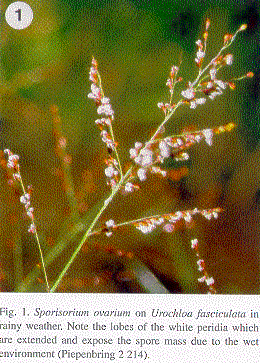
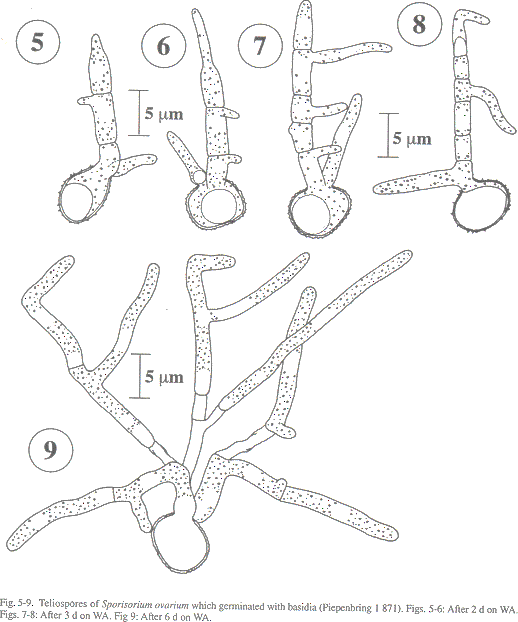
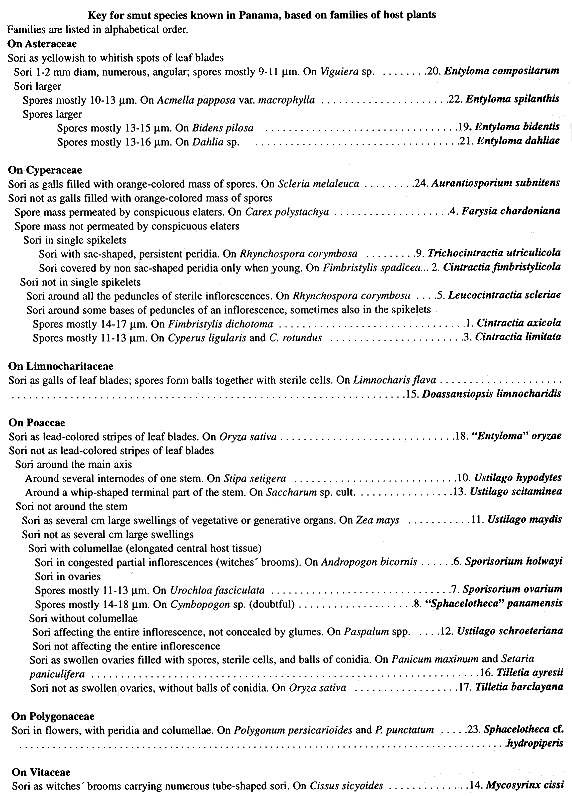
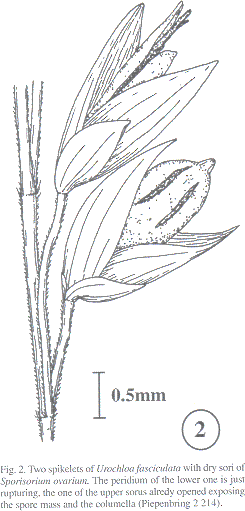
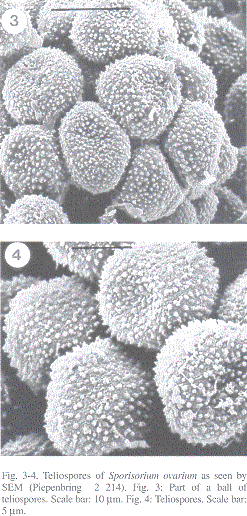
<body><![CDATA[<P><FONT FACE="Arial,Helvetica"><FONT SIZE=-1>In Panama on <B><I>Andropogon bicornis</I></B> (Poaceae):</FONT></FONT>      <P><FONT FACE="Arial,Helvetica"><FONT SIZE=-1><B>Chiriqu&iacute;</B>: Road from Gualaca to Chiriqui Grande, <I>alt. ca. </I>650 m, 22 Aug 1998, <I>Piepenbring, Arrocha, Caballero and C&aacute;ceres</I> <I>2 385 </I>(PMA).</FONT></FONT>      <P><FONT FACE="Arial,Helvetica"><FONT SIZE=-1><B>Cocl&eacute;:</B> La Pintada, Corregimiento Harino, El Cop&eacute;, 2-4 km N of La Chata, <I>alt.ca. </I>400 m, 22 Sep 1994, <I>Piepenbring &amp;</I> <I>Lorenzo 1 </I>271 (PMA, USJ 44 251); La Pintada, Corregimiento Harino, El Cop&eacute;, close to El Alto, Aserradero, <I>alt. ca. </I>780 m, 23 Sep <I>1994, Piepenbring &amp; Dom&iacute;nguez 1 282</I> (PMA); El Cop&eacute;, from El Cop&eacute; to Alto Calvario 5-7.2 km, <I>alt. ca. 800-1 </I>100 m, 13 Feb 1995, <I>Piepenbring and Dom&iacute;nguez 1 451 -1 453 (1 </I>451-1 453 PMA, 1 452 USJ 53 533); El Cop&eacute;, 1 km N of Alto Calvario, <I>alt. ca.</I> 1 160 m, 13 Feb 1995, <I>Piepenbring &amp;</I> <I>Dom&iacute;nguez 1 454 </I>(PMA); La Pintada, 4-5 km behind the entrance of Coclecito on the way to Bolteadero, <I>alt. ca. </I>500-600 m, 14 Feb 1995, <I>Piepenbring and Dom&iacute;nguez 1 458-1459 </I>(PMA); Valle de Ant&oacute;n, <I>alt. ca. </I>660 m, 15 Feb 1995, <I>Piepenbring &amp; Dom&iacute;nguez</I></FONT></FONT>      <P><FONT FACE="Arial,Helvetica"><FONT SIZE=-1><I>1 </I>470 (PMA).</FONT></FONT>      <P><FONT FACE="Arial,Helvetica"><FONT SIZE=-1><B>Col&oacute;n</B>: Ciudad Col&oacute;n, Santa Rita Arriba, <I>alt. ca. </I>260 m, 15 Feb 1995, <I>Piepenbring &amp;Dom&iacute;nguez 1 473 </I>(PMA).</FONT></FONT>      <P><FONT FACE="Arial,Helvetica"><FONT SIZE=-1><B>Panam&aacute;</B>: 2.6 km N from the Interamerican highway direction Cerro Campana, <I>alt. ca.</I> 450 m, 23 Feb 1995, <I>Piepenbring 1 493 </I>(PMA); Chic&aacute;, 4.4 km N of INRENARE direction Cerro Campana, <I>alt. ca. </I>800 m, 23 Feb 1995, <I>Piepenbring 1 494 </I>(PMA).</FONT></FONT>      <P><FONT FACE="Arial,Helvetica"><FONT SIZE=-1><B><I>8. Sporisorium ovapium </I></B>(Griffiths) V&aacute;nky, Mycotaxon<B> 65</B>: 138. 1997; <I>Sorosporiumovarium </I>Griffiths, Bull. Torrey Bot. Club <B>34:</B> 209. 1907. Lectotype (designated by Zundel 1953) en <I>Urochloa reptans (L.) </I>0. Stapf in Prain <I>[Brachiaria reptans </I>(L.) C. Gardner and C. E. <I>Hubb., Panicum caespitosum </I>Sw.]. Mexico. Dublan, Hidalgo, 9 Sep 1905, <I>Griffiths (type,</I> BPI 180 088!).</FONT></FONT>      <P><FONT FACE="Arial,Helvetica"><FONT SIZE=-1><I>Sori </I>usually in all the spikelets of an inflorescence (<A HREF="#img1">Fig. 1</A>); globose to cylindrical; 3-5 mm long; a single sorus with one central columella of host tissue and a longitudinally rupturing peridium <A HREF="#img2">(Fig. 2)</A>, which opens in wet environment exposing the spore mass (<A HREF="#img1">Fig. 1</A>, comp. Piepenbring <I>et al. 1998). Spore mass</I> mixed with sterile cells; powdery; dark brown. <I>Spores </I>in loose groups <A HREF="#img3-4">(Fig. 3)</A>; single spores globose or subangular; (8-)10-12 x 11-13 m m; light reddish-brown. Wall ea 0.8 m m; covered by <I>ca </I>0.7 m m high warts; seen by SEM, with smaller warts between the large ones <A HREF="#img3-4">(Fig. 4)</A>. <I>Germination </I>with phragmobasidia of three to numerous cells forming hyphal branches without prior conjugation (Figs. 5-9).</FONT></FONT>     <BR>&nbsp;     <BR>&nbsp;     ]]></body>
<body><![CDATA[<CENTER><A NAME="img1"></A><IMG SRC="/img/fbpe/rbt/v49n2/1000i1.GIF" HEIGHT=363 WIDTH=260></CENTER>       
<P><FONT FACE="Arial,Helvetica"><FONT SIZE=-1>In Panama on<B> <I>Urochloa fasciculata</I></B><I> </I>(Sw.) R. Webster <I>[Brachiaria fasciculata </I>(Sw.) Parodi]</FONT></FONT>      <P><FONT FACE="Arial,Helvetica"><FONT SIZE=-1>(Poaceae):</FONT></FONT>      <P><FONT FACE="Arial,Helvetica"><FONT SIZE=-1><B>Herrera:</B> Parque Nacional Sarigua, alt. <I>ca. 5 </I>m, 30 Sep 1996, <I>Piepenbring &amp;</I> <I>Dom&iacute;nguez 2 214 </I>(PMA).</FONT></FONT>      <P><FONT FACE="Arial,Helvetica"><FONT SIZE=-1>Further material illustrated: Mexico. <B>Yucat&aacute;n</B>: Sisal, 7 Oct 1995, <I>Piepenbring 1 871</I> (XAL).</FONT></FONT>      <P><FONT FACE="Arial,Helvetica"><FONT SIZE=-1><I>Sporisorium ovarium </I>was hitherto only known from Mexico (see type; Dur&aacute;n 1987). This is its first observation in Central America.penbring 2 214). <A HREF="#img3-4">Fig. 3</A>: Patl of a ball of teliospores. Scale bar: 10 pm. <A HREF="#img3-4">Fig. 4:</A> Teliospores.</FONT></FONT>     <BR>&nbsp;     <BR>&nbsp;     <CENTER><A NAME="img2"></A><A HREF="img2"><IMG SRC="/img/fbpe/rbt/v49n2/1000i2.GIF" BORDER=0 HEIGHT=511 WIDTH=245></A><A NAME="img3-4"></A><IMG SRC="/img/fbpe/rbt/v49n2/1000i3.GIF" BORDER=0 HEIGHT=516 WIDTH=247></CENTER>      
<CENTER>&nbsp;</CENTER>      ]]></body>
<body><![CDATA[<CENTER>&nbsp;</CENTER>      <CENTER><A NAME="img5-9"></A><IMG SRC="/img/fbpe/rbt/v49n2/1000i4.GIF" HEIGHT=622 WIDTH=518></CENTER> &nbsp;     
<BR>&nbsp;     <BR>&nbsp;     <BR>&nbsp;     <BR>&nbsp;     <BR>&nbsp;      <P><FONT FACE="Arial,Helvetica"><FONT SIZE=-1><B><I>9. Trichocintractia utriculicola </I></B>(Henn.) M. Piepenbr., Canad. J. Bot.<B> 73:</B> 1095. 1995; <I>Cintractia leucoderma </I>(Berk.) Henn. f. <I>utriculicola </I>Henn., Hedwigia <B>34</B>: 336. 1895; <I>Cintractia utriculicola </I>(Henn.) G. P. Clinton, J. Mycol. <B>8:</B> 143. 1902. Type. On <I>Rhynchosporagigantea </I>Link. Brazil. Santa Catharina: Blumenau, <I>M&ouml;ller 293 </I>(type probably lost).</FONT></FONT>     <BR><FONT FACE="Arial,Helvetica"><FONT SIZE=-1><I>Sori </I>in some spikelets of an infected inflorescence; globose to egg-shaped; 2-2.5 x 3-5 mm; with greyish white, persistent peridia which rupture with several lobes and forrn sacs. <I>Spore mass </I>dark brown; powdery; permeated by groups of long sterile fungal cells in the basal part. <I>Spores </I>single; spherical to globose; (9-)10-13 x (10-)11-15(-17) m m; light ochre-brown to dark brown. Wall 1-2.5 m m; two-layered; covered by fine warts. <I>Germination </I>with phragmobasidia; often twocelled parts of the basidia separate from the rest of the basidium, and plasma left in the teliospore germinates again; basidial cells develop basidiospores or hyphae.</FONT></FONT>      <P><FONT FACE="Arial,Helvetica"><FONT SIZE=-1>In Panama on <I><B>Rhynchospora corymbosa</B> </I>(L.) Britton [R. <I>aurea </I>Vahl] (Cyperaceae):</FONT></FONT>      ]]></body>
<body><![CDATA[<P><FONT FACE="Arial,Helvetica"><FONT SIZE=-1><B>Bocas del Toro: </B>4 km SW of Chiriqu&iacute; Grande, <I>alt. ca. 5 </I>m, 10 Feb 1995. <I>Piepenbring 1 </I>437 (material lost).</FONT></FONT>      <P><FONT FACE="Arial,Helvetica"><FONT SIZE=-1><B>Col&oacute;n:</B> Ciudad Col&oacute;n, Billa Catharina, alt. <I>ca. </I>60 m, 16 Feb 1995, <I>Piepenbring &amp;Dom&iacute;nguez 1 475 </I>(PMA, USJ 53 535); Ciudad Col&oacute;n, Puerto Pil&oacute;n, alt. ca. 20 m, 17 Feb 1995, Piepenbring and Dom&iacute;nguez 1 486 (PMA).</FONT></FONT>      <P><B><FONT FACE="Arial,Helvetica"><FONT SIZE=-1><I>10.</I> Ustilago hypodytes</FONT></FONT></B><FONT FACE="Arial,Helvetica"><FONT SIZE=-1> (Schltdl.) Fr., Syst. Mycol. <B>3:</B> 518. 1832; <I>Caeoma hypodytes</I> Schltdl, FI. berol. <B>2:</B> 129. 1824; <I>Erysibe</I> <I>hypodytes </I>(Schltdl.) Wallr., FI. crypt. Gern. 2: 216. 1833; <I>Uredo hypodytes </I>(Schltdl.) Desm., Ann. Sci. Nat. Bot. II <B>13:</B> 182. 1840; <I>Cintractia hypodytes </I>(Schltdl.) Maire, Bull. Soc. Bot. France <B>53</B>: 198. 1906. Lectotype (sel. by Hirschhorn, Farlowia <B>3:</B> 74. 1947). On <I>Elymus arenarius </I>L. Germany. Near Berlin, "Meso Marchia", Oct 1884, <I>P Sydow s. n.</I> (lectotype ubi?, isolectotypes in Rabenh., Fungi. eur. No. 3201, <I>e. g. </I>in H.U.V., the personal herbarium of K. V&aacute;nky, T&uuml;bingen).</FONT></FONT>      <P><FONT FACE="Arial,Helvetica"><FONT SIZE=-1>Sori surrounding the internodes of culms; starting just below the node and extending almost down to the next node; when young, hidden by sheaths of leaves; upper internodes and leaves usually stunted; infected plants sterile. <I>Spore mass </I>dark brown; semi-agglutinated to powdery. <I>Spores </I>single; mostly globose, subglobose to globose; 3.5-5.5 x 4-6(-7) m m; medium to dark olive-brown. Wall ca 0.5 m m; smooth. <I>Gemination </I>with phragmobasidia.</FONT></FONT>      <P><FONT FACE="Arial,Helvetica"><FONT SIZE=-1>In Panama on <B><I>Stipa setigera</I> </B>Presl, according to Zundel (1953).</FONT></FONT>      <P><B><FONT FACE="Arial,Helvetica"><FONT SIZE=-1><I>11.</I> Ustilago maydis</FONT></FONT></B><FONT FACE="Arial,Helvetica"><FONT SIZE=-1> (DC.) Corda, Icon. fung. 5: 3. 1842; <I>Uredo maydis </I>DC., FI. fran&ccedil;.<B> 6:</B> 77. 1815 ' Type. On <I>Zea mays </I>L. Europe (type ubi?).</FONT></FONT>      <P><FONT FACE="Arial,Helvetica"><FONT SIZE=-1><I>Sori </I>single to numerous in one plant; in vegetative and generative organs, <I>e. g. </I>partial inflorescences, kernels, or organs of male flowers; galls formed by hypertrophic, parenchymatic host tissue; sometimes more than 10 cm large; yellow-white to reddish; later rupturing. <I>Spore mass </I>powdery; dark brown. <I>Spores </I>single; spherical to globose; (9-)10-12(-13) m; light reddish-brown. Wall ca 1 m m; covered by ca 0.5 m m high warts, smaller warts between the high cone-shaped ones, as seen by SEM. Germination with three- to four-celled phragmobasidia; two or three cells of a basidium can separate from the rest of the basidium.</FONT></FONT>      <P><FONT SIZE=-1><FONT FACE="Arial,Helvetica">In Panama on <B><I>Zea mays </I></B>(cult.) (Poacea</FONT><FONT FACE="Arial">e):</FONT></FONT>      <P><FONT FACE="Arial"><FONT SIZE=-1><B>Cocl&eacute;: </B>Corregimiento Harino, below El Cop&eacute;, <I>alt. ca. </I>190 m, 24 Sep 1994, <I>Piepenbring &amp; Dom&iacute;nguez 1 </I>300 (PMA).</FONT></FONT>      <P><FONT FACE="Arial"><FONT SIZE=-1><I>Ustilago maydis i</I>s reported for Pamana by Toler <I>et al. </I>(1959), being of minor economic importance. Young white galls can be eaten after cooking (called "huitlacoche" in nahuat, Mexico; <I>e. g. </I>Valverde <I>et al. </I>1995).</FONT></FONT>      ]]></body>
<body><![CDATA[<P><FONT FACE="Arial"><FONT SIZE=-1><B><I>12. Ustilago schroeteriana </I></B>Henn., Hedwigia <B>35: </B>215. 1896. Type. On <I>Paspalum</I> sp. Brazil. Santa Catharina: near Itajahy, Sep 1887, <I>Ule 1 615 </I>(type, CH, n. v.).</FONT></FONT>      <P><FONT SIZE=-1><FONT FACE="Arial"><I>Sori </I>usually destroying all the spikelets of an inflorescence including tissue of the inflorescence axis; first covered by host tissue which flakes away. <I>Spore mass </I>powdery; dark brown. <I>Spores </I>single; spherical to globose; (11-) 1 5-17(-20) </FONT><FONT FACE=Symbol>m</FONT><FONT FACE="Arial"> m;<B> </B>light reddish-brown. Wall 1-1.5 </FONT><FONT FACE=Symbol>m</FONT><FONT FACE="Arial"> m; often thinner and lighter at one spot; covered by dense, 0.8 </FONT><FONT FACE=Symbol>m</FONT><FONT FACE="Arial"> m high warts; smaller warts between the large warts, as seen by <I>SEM. Germination </I>with phragmobasidia forming basidiospores on short sterigmata.</FONT></FONT>      <P><FONT FACE="Arial"><FONT SIZE=-1>In Panama on <B><I>Paspalum virgatum </I></B>L. (Poaceae):</FONT></FONT>      <P><FONT FACE="Arial"><FONT SIZE=-1><B>Chiriqu&iacute;: </B>Ciudad David, <I>alt. ca. </I>200 m, 30 Aug 1998, <I>Piepenbring &amp; C&aacute;ceres 2 388</I> (PMA).</FONT></FONT>      <P><FONT FACE="Arial"><FONT SIZE=-1>Reported for Panama by Zundel (1953) on <I>Paspalum repens Bergius [P paniculatum</I> Walter].</FONT></FONT>     <BR><FONT FACE="Arial"><FONT SIZE=-1><B><I>13. Ustilago scitaminea </I></B>Syd., Ann. Mycol. <B>22: </B>281. 1924. Lectotype. On <I>Saccharum</I> <I>officinarum </I>(sel. by V&aacute;nky, Mycotaxon <B>41: </B>492. 1991). India. Bhagalpur, Bengal, 26 Aug 1907, <I>Butler (lectotype </I>ubi?; isolectotypes in Sydow, Ustilagineen 384, <I>e. g. </I>H.U.V 4 454, in the personal herbarium of K. V&aacute;nky, T&uuml;bingen).</FONT></FONT>      <P><FONT SIZE=-1><FONT FACE="Arial"><I>Sorus </I>as whip-shaped, elongated main axis; infected plants sterile; whip often more than 1 m long, the diameter decreasing from ca. 1 cm at the base to few millimeters in the distal part; young spore mass covered by host tissue which flakes away. <I>Spore mass </I>mixed with sterile cells; powdery; dark brown. <I>Spores </I>single; spherical to globose; (5-)6-7(-8) </FONT><FONT FACE=Symbol>m</FONT><FONT FACE="Arial"> m; reddish-brown. Wall ca. 0.8 </FONT><FONT FACE=Symbol>m</FONT><FONT FACE="Arial"> m;<B> </B>covered by few low warts; wall between the warts smooth, as seen by SEM. Sterile cells scattered between the spores; mostly in irregular groups of chains; larger than the spores; hyaline. Wall 1-1.5 </FONT><FONT FACE=Symbol>m</FONT><FONT FACE="Arial"> m, smooth. <I>Germination </I>with phragmobasidia; basidial cells often conjugase; dikaryotic cells grow with hyphae elaborating elongated dikaryotic blastoconidia.</FONT></FONT>      <P><FONT FACE="Arial"><FONT SIZE=-1>In Panama on <B><I>Saccharum </I></B>sp. cult. (Poaceae):</FONT></FONT>      <P><FONT FACE="Arial"><FONT SIZE=-1><B>Chiriqu&iacute;: </B>Distrito Alanje, Corregimiento Alanje, Central Azucarera de Alanje, 21 Mar 2000, <I>L. de Castillo s. n. (Piepenbring 2 733,</I> PMA).</FONT></FONT>      <P><FONT FACE="Arial"><FONT SIZE=-1><I>Ustilago scitaminea </I>can cause economic losses in sugar cane plantations, especially on susceptible cultivars. It is reported for <B>Panama</B> by Comstock <I>et al. </I>(1 983).</FONT></FONT>      ]]></body>
<body><![CDATA[<P><B><FONT FACE="Arial"><FONT SIZE=-1>1.1.1.2 Mycosyringaceae</FONT></FONT></B>      <P><B><FONT FACE="Arial"><FONT SIZE=-1><I>14. Mycosyrinx </I>cissi</FONT></FONT></B><FONT FACE="Arial"><FONT SIZE=-1> (DC.) Beck, Ann. K. K. Naturhist. Hofmus. <B>9: </B>123. 1894; <I>Uredocissi (cyssi) </I>DC., in Poir., Encycl. meth. bot. <B>8: </B>228. 1808; <I>Ustilago? cissi </I>(DC.) Tul. and</FONT></FONT>     <BR><FONT SIZE=-1><FONT FACE="Arial">C. Tul., Ann. Sci. Nat. Bot. III <B>7: </B>92. 1847. <I>Schroeteria cissi </I>De Toni, in Sacc., Syll. fung. <B>7: </B>501. <I>1888; Geminella exotica var. </I>de <I>candollei </I>A. A. Fischer v. Waldh. (nomen novum illegit.), Aper</FONT><FONT FACE="Lucida Console">&ccedil;</FONT><FONT FACE="Arial">u syst. Ustilag., p. 43. 1877. Type. On <I>Cissus sicyoides L.</I> Dominican Republic (Santo Domingo). <I>Poiteaux s. n. </I>(type <I>ubi?).</I></FONT></FONT>     <BR><FONT SIZE=-1><FONT FACE="Arial"><I>Sori </I>in witches' brooms with numerous branches; often more than 1 m long; sori 1-2 x 5-30 mm; tubes of host tissue enclose the spore mass; old tubes rupture laterally disclosing the spores. <I>Spore mass dark;</I> powdery. <I>Spores </I>in firmly united pairs; the two outer halves of the cells semi-spherical, the halves directed towards the contact point fiat cone-shaped; one spore seen from the side 7-8(-9) x 12-13(-14) </FONT><FONT FACE=Symbol>m</FONT><FONT FACE="Arial"> m; dark olive-brown. Wall ca 1.5 </FONT><FONT FACE=Symbol>m</FONT><FONT FACE="Arial"> m; on the spherical half finely granular, on the conical side smooth. <I>Germination </I>with basidiospores successively developing directly from the teliospore; basidiospores folded and partly thickened; probably up to four basidiospores originate from one spore cell.</FONT></FONT>      <P><FONT FACE="Arial"><FONT SIZE=-1>In Panama on <B><I>Cissus sicyoides</I></B>(Vitaceae):</FONT></FONT>      <P><FONT FACE="Arial"><FONT SIZE=-1><B>Col&oacute;n: </B>Portobelo, Nuevo Toros&iacute;, on the way to More, R&iacute;o Sucio, <I>alt. ca. </I>10 m, 17 Feb <I>1995, Piepenbring, Dom&iacute;nguez &amp; Gir&oacute;n 1 488</I> (PMA, USJ 53 538).</FONT></FONT>      <P><FONT FACE="Arial"><FONT SIZE=-1><B>Dari&eacute;n: </B>R&iacute;o Cocalito, on river island, 7 Feb 1982, <I>Whitefoord &amp; Eddy 67 </I>(on PMA 35 383, PMA).</FONT></FONT>      <P><FONT FACE="Arial"><FONT SIZE=-1>Reported for Panama by Zundel (1953).</FONT></FONT>     <BR><B><FONT FACE="Arial"><FONT SIZE=-1>1.1.2 Urocystales</FONT></FONT></B>     <BR><B><FONT FACE="Arial"><FONT SIZE=-1>1.1.2.1 Doassansiopsaceae</FONT></FONT></B>      ]]></body>
<body><![CDATA[<P><B><FONT FACE="Arial"><FONT SIZE=-1><I>15.</I> Doassansiopsis limnocharidis</FONT></FONT></B><FONT FACE="Arial"><FONT SIZE=-1><I>(Cif.) </I>V&aacute;nky, Mycotaxon <B>43:</B> 424. 1992; <I>Doassansia limnocharidis </I>Cif., Ark. Bot. <B>23(A): </B>23. 1931. Type. On <I>Limnocharis flava </I>(L.) Buchenau. Dominican Republic. La Vega: Cordillera Central, Bonao, Aug 1929, <I>Ciferri2 529 (type ubi?).</I></FONT></FONT>     <BR><FONT SIZE=-1><FONT FACE="Arial"><I>Sori </I>as thickened leaf spots; often in rows parallel to the midrib; round to ovoid; <I>ca </I>15 mm diam; when dry, brown; when old, breaking out of the leaf. <I>Spore balls </I>mostly in the air canals of the mesophyll; globose; flattened at contact to adjacent balls; 100-200 </FONT><FONT FACE=Symbol>m</FONT><FONT FACE="Arial"> m; firmly composed of central sterile pseudoparenchyma and a layer of fertile cells covered by a layer of sterile cortical cells. <I>Fertile cells </I>(teliospores) globose; their longest axis 11 - 14 </FONT><FONT FACE=Symbol>m</FONT><FONT FACE="Arial"> m; yellowish. Wall slightly thicker than the wall of sterile cells. <I>Centralcells</I> very irregularly isodiametric. <I>Cortical cells </I>radially flattened; often collapsed. <I>Germination </I>of fertile cells with holobasidia carrying apically numerous filiform basidiospores; basidiospores develop yeast-like cells or hyphae.</FONT></FONT>      <P><FONT FACE="Arial"><FONT SIZE=-1>In Panama on <B><I>Limnocharis flava</I></B> (Limnocharitaceac):</FONT></FONT>      <P><FONT FACE="Arial"><FONT SIZE=-1><B>Bocas del Toro: </B>Chiriqu&iacute; Grande, close to the ferry station, <I>alt. ca. </I>2 m, 11 Feb 1995, <I>Piepenbring 1 438 </I>(PMA, USJ 53 532).</FONT></FONT>     <BR><B><FONT FACE="Arial"><FONT SIZE=-1>1.2 Exobasidiomycetidae</FONT></FONT></B>      <P><B><FONT FACE="Arial"><FONT SIZE=-1>1.2.1 Tilletiales</FONT></FONT></B>     <BR><B><FONT FACE="Arial"><FONT SIZE=-1>1.2.1.1 Tilletiaecae</FONT></FONT></B>      <P><FONT FACE="Arial"><FONT SIZE=-1><B><I>16. Tilletia ayresii </I></B>Berk., in Massee, Buil. Misc. Inform. <B>1899:</B> 146. 1899; <I>Conidiosporomyces ayresii </I>(Berk.) V&aacute;nky, in V&aacute;nky &amp; R. Bauer, Mycotaxon 43: 429. 1992. Type on <I>Panicum maximum </I>Jacq. Mauritius. Mountains above Port Louis, <I>Ayres 4 754, </I>in Herb. Berkeley (type, K, n. v.).</FONT></FONT>     <BR>&nbsp;      <P><FONT FACE="Arial"><FONT SIZE=-1><I>Sori </I>in several to numerous flowers of an inflorescence; sack-shaped galls formed by ovary tissue; when young, closed; early rupturing apically with stellate lobes; <I>ca </I>3 x 3-5 mm;</FONT></FONT>      ]]></body>
<body><![CDATA[<P><FONT FACE="Arial"><FONT SIZE=-1>apically gray, at the base reddish. <I>Spore mass</I> powdery; olive; composed of spores, single sterile cells, and groups of conidia. <I>Spores</I> single; spherical; (12-)14-15(-16) &micro;m; brown. Wall 2.5-3.5 &micro;m; covered by up to 2 &micro;m high warts. <I>Sterile single </I>cells spherical to globose; (9-)11-16(-19) x (10-)12-18(-21) &micro;m; colorless. Wall 2 &micro;m; covered by 1 &micro;m high, dense warts. Transitonal forms between single sterile cells and spores are present. <I>Groups of conidia</I> globose; up to 40 x 70 &micro;m. <I>Conidia </I>loosely joined; mostly "y" -shaped; up to 20 &micro;m long; hyaline; wall thin; smooth. <I>Germination of the</I> <I>spores </I>after severas days; with holobasidia apically carrying numerous filiform basidiospores. <I>Germination of conidia </I>within one day; with hyphae, ballisto-, and blastoconidia.</FONT></FONT>      <P><FONT FACE="Arial"><FONT SIZE=-1>In Panama on <B><I>Panicum maximum</I></B> (Poaceae):</FONT></FONT>      <P><FONT FACE="Arial"><FONT SIZE=-1><B>Chiriqu&iacute;: </B>David, <I>alt. ca. 50 </I>m, 6 Feb <I>1995, Piepenbring 1 390 </I>(PMA); Boquete, Volcancito, 12 Mar 2000, <I>Piepenbring,</I> <I>C&aacute;ceres and students 2 717 </I>(PMA).</FONT></FONT>      <P><FONT FACE="Arial"><FONT SIZE=-1><B>Cocl&eacute;: </B>La Pintada, Corregimiento Harino, El Cop&eacute;, La Chata, <I>alt. ca. </I>390 m, 22 Sep 1994,</FONT></FONT>      <P><FONT FACE="Arial"><FONT SIZE=-1><I>Piepenbring &amp; Lorenzo 1 </I>273 (PMA); Penonom&eacute;, El Chorrillo, <I>alt. ca </I>70 m, 29 Sep <I>1996, Piepenbring &amp; Dom&iacute;nguez 2 210 </I>(PMA).</FONT></FONT>      <P><FONT FACE="Arial"><FONT SIZE=-1><B>Col&oacute;n: </B>Ciudad Col&oacute;n, Billa Catharina, alt. ca. 60 m, 16 Feb 1995, <I>Piepenbring &amp;</I> <I>Dom&iacute;nguez 1 479 </I>(PMA, USJ 53 537).</FONT></FONT>      <P><FONT FACE="Arial"><FONT SIZE=-1><B>Herrera: </B>Road to the Parque Nacional Sarigua, <I>alt. ca. </I>15<B> </B>m, 30 Sep 1996, <I>Piepenbring &amp; Dom&iacute;nguez 2 218 </I>(PMA).</FONT></FONT>      <P><FONT FACE="Arial"><FONT SIZE=-1><B>Los Santos: </B>Las Tablas, <I>alt. ca. </I>15<B> </B>m, 1 Oct 1996, <I>Piepenbring &amp; Dom&iacute;nguez 2 220</I> (PMA).</FONT></FONT>      <P><FONT FACE="Arial"><FONT SIZE=-1><B>Panam&aacute;: </B>Jard&iacute;n Bot&aacute;nico Summit, <I>alt.<B> </B></I>ca. 80 m, 15 Sep 1994, <I>Piepenbring 1 </I>229 (PMA); 1.5 km NW Para&iacute;so, <I>alt. ca. </I>70 m, 17 Sep <I>1994, Piepenbring 1 232 </I>(PMA).</FONT></FONT>      <P><FONT FACE="Arial"><FONT SIZE=-1><I>On </I><B>Setaria paniculifera </B>(Steudel) Fourn. (Poaceae):</FONT></FONT>      ]]></body>
<body><![CDATA[<P><FONT FACE="Arial"><FONT SIZE=-1><B>Cocl&eacute;: </B>La Pintada, Corregimiento Harino, El Cop&eacute;, La Chata, 22 Sep 1994, <I>Piepenbring &amp;Lorenzo 1 </I>275 (sparse material only in USJ 44 245).</FONT></FONT>      <P><B><FONT FACE="Arial"><FONT SIZE=-1>17. <I>Tilleda barclayana</I> </FONT></FONT></B><FONT FACE="Arial"><FONT SIZE=-1>(Bref.) Sacc. &amp; Syd., in Sacc., Syll. fung. <B>14: </B>422. 1899; <I>Neovossiabarclayana</I> Bref., Unters. Gesammtgeb. Mykol. <B>12: </B>170. 1895. Type on <I>Pennisetum triflorum </I>Nees. India. Himalaya, Simla, <I>Barclay s. n. </I>(type <I>ubi?).</I></FONT></FONT>      <P><FONT FACE="Arial"><FONT SIZE=-1><I>Tilletia horrida </I>Tak., Bot. Mag. Tokyo <B>10:</B> 20. 1896; <I>Neovossia horrida </I>(Tak.) Padw. and</FONT></FONT>     <BR><FONT FACE="Arial"><FONT SIZE=-1>A. Khan, Imp. Mycol. Inst. Mycol. Papers <B>10</B>: 2. 1944. Type on Oryza <I>sativa. </I>Japan. Kyoto, 1895 (type ubi?). (Synonym according to Tullis &amp; Johnson 1952)</FONT></FONT>      <P><FONT FACE="Arial"><FONT SIZE=-1><I>Sori </I>in some to all the ovaries of an inflorescence; concealed by glumes. <I>Spore mass</I> powdery; black. <I>Spores </I>single; globose; ca (20)23-32 &micro;m; dark olive brown. Wall covered by spines, ca 2.5-4 &micro;m high; covered by hyaline sheath. <I>Germination </I>with holobasidia carrying numerous filiform basidiospores.</FONT></FONT>      <P><FONT FACE="Arial"><FONT SIZE=-1>In Panama on <B><I>Oryza saliva </I></B>L. (Poaceae), according to Toler <I>et al. </I>(1959).</FONT></FONT>      <P><FONT FACE="Arial"><FONT SIZE=-1>This species, called kernel smut or anublo del grano, is reported for Panama by Cralley (1954, cited in Toler <I>et al. </I>1959) as <I>Neovossia</I> <I>barclayana. Toler et al. </I>(1959) and Panamanian phytopathologists consulted by the author consider it to be of minor economic importance in Panama. However, as rice from areas with infection by T. <I>barclayana </I>is imported to Panama, constant survey &iexcl;s necessary to detect infection as early as possible.</FONT></FONT>      <P><FONT FACE="Arial"><FONT SIZE=-1>The delimitation of the genus <I>Neovossia</I> from the genus <I>Tilletia </I>is difficult, because the sets of character states of the different species show a morphologic continuum. Until further data are available, species of <I>Neovossia </I>other than the type species of the genus, <I>N. moliniae </I>K&ouml;rn., are better cited in the genus <I>Tilletia.</I></FONT></FONT>      <P><B><FONT FACE="Arial"><FONT SIZE=-1>1.2.2 Georgefischeriales</FONT></FONT></B>     <BR><B><FONT FACE="Arial"><FONT SIZE=-1>1.2.2.1 Eballistraceae</FONT></FONT></B>      ]]></body>
<body><![CDATA[<P><FONT FACE="Arial"><FONT SIZE=-1><B><I>18. Ebailistra oryzae </I></B>(Syd. and R Syd.) Bauer <I>et al.</I>, Mycol. Res. in press. <I>Entylomaoryzae Syd. </I>&amp; P Syd., Ann. Mycol. <B>12: </B>197. 1914. Type. On <I>Oryza sativa </I>L. Philippines.</FONT></FONT>     <BR><FONT FACE="Arial"><FONT SIZE=-1>Laguna: Los Ba&ntilde;os, 10 Dec 1913, <I>Raimundo 2 </I>202 (last number almost iIlegible), Baker</FONT></FONT>     <BR><FONT FACE="Arial"><FONT SIZE=-1>2 203 (holotype, B Pl 176 14 1!).</FONT></FONT>      <P><FONT FACE="Arial"><FONT SIZE=-1><I>Sori </I>as spots on leaf blades and sheaths; numerous; 0.2-0.3 mm x 0.5-2 (-4) mm and larger by fusion; linear-rectangular by adjacent veins; on both sides of the leaf lead-colored; slightly raised; covered by the epidermis. <I>Spore</I> <I>mass </I>firmly agglutinated; dark. <I>Spores</I> adhere in irregular masses; mostly polyhedral by compression, subglobose, or flattened; (5) 7-9 (-10) x (6-) 8-11 &micro;m<B>; </B>light olive-greyish. Wall 0.5-1 &micro;m; smooth.</FONT></FONT>      <P><FONT FACE="Arial"><FONT SIZE=-1>In Panama on <B><I>Oryza sativa </I></B>(Poaceae) according to Cralley (1954, cited in Toler <I>et al.</I> 1959), not affecting yields.</FONT></FONT>      <P><B><FONT FACE="Arial"><FONT SIZE=-1>1.2.3 Entylomatales</FONT></FONT></B>     <BR><B><FONT FACE="Arial"><FONT SIZE=-1>1.2.3.1 Entylomataceae</FONT></FONT></B>      <P><FONT FACE="Arial"><FONT SIZE=-1><B><I>19. Entyloma bidentis </I></B>Henn., in Engl., Pflanzenw. Ost-Afrikas C, p. 49. 1895. Type. <I>On Bidens pilosa </I>L. East Africa: Marangu, near the Kilimanjaro, Tanganyika Terr., 1 580 m, <I>Volk 2 283 (type ubi?).</I></FONT></FONT>      <P><FONT FACE="Arial"><FONT SIZE=-1><I>Sori </I>as leaf spots; few to several on a single leaf; circular; sometimes convex but not thickened; diam 1-2(-3) mm, sometimes larger by fusion; when fresh, yellow-greenish, sometimes with violet centre; when old, brown. <I>Spores </I>single; densely packed between the host cells; spherical to globose, sometimes subangular; (9-)11-13(-14) x (12-)13-15(-18) &micro;m; hyaline or yellowish-brown. Wall two-layered; the inner layer 1 &micro;m, the outer 1-2 &micro;m; smooth. <I>Germination </I>with holobasidia carrying apically few sessile basidiospores; basidiospores and basidial cell conjugate and develop sickle-shaped and filiform conidia.</FONT></FONT>     <BR><FONT FACE="Arial"><FONT SIZE=-1>In Panama on <B><I>Bidens pilosa </I></B>(Asteraceae):</FONT></FONT>     ]]></body>
<body><![CDATA[<BR><FONT FACE="Arial"><FONT SIZE=-1><B>Chiriqu&iacute;: </B>Road from Gualaca to Chiriqu&iacute; Grande, <I>alt. ca </I>840 m, 22 Aug 1998, <I>Piepenbring,Arrocha, Caballero &amp; C&aacute;ceres 2 383 </I>(PMA).</FONT></FONT>      <P><FONT FACE="Arial"><FONT SIZE=-1><B><I>20. </I></B>Entyloma compositarum Farlow, Bot. Gaz. <B>8: </B>275. 1883. Type. On <I>Aster puniceus L.</I> USA. Massachusetts: White Montains, Woods' Hole, Sep 1881, <I>Trelease 1 </I>085 (holotype BPI 195048!).</FONT></FONT>      <P><FONT FACE="Arial"><FONT SIZE=-1><I>Entyloma costaricense </I>Cif, Nuovo Giorn. Bot. Ital. <B>40: </B>259. 1933. Type. On <I>Viguiera</I> <I>sylvatica </I>Klatt. Costa Rica. Alajuela: Grecia, 13 Jan 1925, H. <I>Sydow 383 </I>(lectotype, M!; isolectotypes BPI 175119! and BPI 175120!; designated here).</FONT></FONT>      <P><FONT FACE="Arial"><FONT SIZE=-1><I>Sori </I>as leaf spots; numerous on a single leaf, angular by adjacent veins; diam 1-2(-2.5) mm; when fresh, whitish; when dry, adaxially green (almost invisible) and abaxially whitish-green. <I>Spores </I>single; not densely packed between the host cells; spherical to globose; (7) 8- 10(-11) x (7-)9-11(-12) &micro;m; hyaline. Wall, as seen by LM, mostly one-layered; ca 1 &micro;m; smooth. <I>Germination </I>with holobasidia carrying apically few sessile basidiospores; basidiospores and basidial cell conjugate and develop hyphae with retraction septae.</FONT></FONT>      <P><FONT FACE="Arial"><FONT SIZE=-1>In Panama on <B><I>Viguiera </I>sp</B>. (Asteraceae):</FONT></FONT>      <P><FONT FACE="Arial"><FONT SIZE=-1><B>Chiriqu&iacute;: </B>Road from Gualaca to Chiriqui Grande, <I>alt. ca. </I>840 m, 22 Aug 1998, <I>Piepenbring, Arrocha, Caballero &amp; C&aacute;ceres</I> <I>2 384 </I>(PMA).</FONT></FONT>     <BR><FONT FACE="Arial"><FONT SIZE=-1><I>Entyloma costaricense </I>is a synonym of <I>E.</I> <I>compositarum </I>because the size and the shape of the sori as well as characteristics of the teliospores are similar in both species (comp. Sydow 1926, Savile 1947).</FONT></FONT>      <P><FONT FACE="Arial"><FONT SIZE=-1><B><I>21. Entyloma dahliae </I></B>Syd. and P. Syd., Ann. Mycol. <B>10:</B> 36. 1912. Type. On <I>Dahlia</I> <I>variabilis </I>Desf. (cult.). South<B> </B>Africa. Natal, Harden Heights, 11 Apr 1911, <I>Pole-Evans s. n.</I> (type, S!).</FONT></FONT>      <P><FONT FACE="Arial"><FONT SIZE=-1><I>Sori </I>as leaf spots; few to several on a single leaf, subcircular; limits mostly fading, rarely angular by adjacent veins; diam <I>ca </I>10 mm, variable depending on the age and degree of fusion with adjacent spots; when fresh, adaxially light green and abaxially whitishgreen; when old, brown to whitish-ochre, abaxially sometimes with whitish centre. <I>Spores </I>single; densely packed between the host cells; spherical to globose or irregularly shaped, subangular by contact to other spores; (11-)12-14(-16) x (11-)13-16(-17) &micro;m; light yellow to brown. Wall two-layered; inner layer 0.7 &micro;m;<B> </B>the outer up to 3.5 &micro;m; smooth. <I>Germination </I>with holobasidia carrying apically few sessile basidiospores; basidiospores and basidial cell conjugate and develop sickle-shaped and filiform conidia.</FONT></FONT>      <P><FONT FACE="Arial"><FONT SIZE=-1>In Panama on <B><I>Dahlia </I></B>sp. cult. (Asteraceae):</FONT></FONT>      ]]></body>
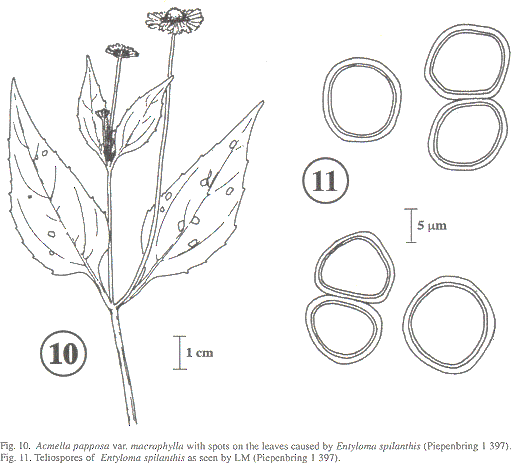
<body><![CDATA[<P><FONT FACE="Arial"><FONT SIZE=-1><B>Chiriqu&iacute;: </B>Bajo Boquete, <I>alt. ca. 1 </I>500 m, 23 Aug 1998, <I>Piepenbring, C&aacute;ceres, Cueva &amp;Esquivel 2 386 </I>(PMA).</FONT></FONT>      <P><FONT FACE="Arial"><FONT SIZE=-1><B><I>22. Entyloma spilanthis </I></B>Speg., Anales Mus. Nac. Hist. Nat. Buenos Aires <B>12: </B>292. 1909. Type. On <I>Spilanthes leptophylla DC. [S.</I> <I>arnicoides </I>DC.]. Argentina. Ensenada, La Plata, 28 Oct 1906 (type, LPS 3 351!, no sori could be found).</FONT></FONT>      <P><FONT FACE="Arial"><FONT SIZE=-1><I>Entyloma ecuadorense </I>Syd., Ann. Mycol. <B>37: </B>328. 1939. Type. On <I>Acmella oppositifolia</I> (Lam.) R. K. Jansen var. <I>oppositifolia</I> <I>[Spilanthes americana </I>(Mutis) Hieron.]. Ecuador Tungurahua: Hacienda San Antonio, near Ba&ntilde;os, 1 Dec 1937, H. <I>Sydow 410</I> (lectotype, H.U.V. 819!, designated by Piepenbring 1996a: 66); 4 Dec 1937, <I>H. Sydow</I> 435 (paratype).</FONT></FONT>      <P><FONT FACE="Arial"><FONT SIZE=-1><I>Sori </I>as leaf spots <A HREF="#img10-11">(Fig. 10)</A>; irregularly circular or angular by adjacent veins; diam 1-4 mm; when fresh, light yehow-green to brownish; when dry, <I>ochre. Spores (<A HREF="#img10-11">Fig. </A></I><A HREF="#img10-11">11</A>) single; densely packed between the host cells; spherical, globose, or subangular; (9-)10-13(-16) &micro;m; colorless, sometimes yellowish brown. Wall two-layered; inner layer ca 0.7 &micro;m; the outer up to 2 &micro;m; smooth. <I>Germination </I>with holobasidia carrying apically few sessile basidiospores; basidiospores and basidial cell conjugase and develop hyphae.</FONT></FONT>     <BR><FONT FACE="Arial"><FONT SIZE=-1>In Panama on <B><I>Acmella papposa </I></B>(Hemsl.) R. K. Jansen <B>var. <I>macrophylla</I> </B>(Greenm.) R.</FONT></FONT>      <P><FONT FACE="Arial"><FONT SIZE=-1>K. Jansen (Asteraceae):</FONT></FONT>     <BR><FONT FACE="Arial"><FONT SIZE=-1><B>Chiriqu&iacute;: </B>Boquete, Alto Chiquero, alt. <I>ca. 2 </I>000 m, 7 Feb 1995, <I>Piepenbring and</I> <I>Cueva1 </I>397 (PMA, USJ 53 529); Boquete, Alto Quiel, 12 Mar 2000, <I>Piepenbring, C&aacute;ceres and students 2 716 </I>(PMA).</FONT></FONT>     <BR>&nbsp;     <BR>&nbsp;     <CENTER><A NAME="img10-11"></A><IMG SRC="/img/fbpe/rbt/v49n2/1000i5.GIF" HEIGHT=463 WIDTH=511></CENTER>       
]]></body>
<body><![CDATA[<P><FONT FACE="Arial"><FONT SIZE=-1><I>Entyloma spilanthis </I>is known on <I>Acmella</I> <I>oppositifolia var. oppositifolia </I>from Costa Rica (Piepenbring 1996a) as <I>E. ecuadorense. </I>Soral morphology and the size of the spores [(9)10-12 x (10-)11-13 &micro;m] of the infection found on A. <I>papposa var. macrophylla are</I> very similar to those on A. <I>oppositifolia var.</I> <I>oppositifolia. Acmella</I> <I>papposa</I> var. <I>macrophylla </I>is therefore a new host species.</FONT></FONT>      <P><FONT FACE="Arial"><FONT SIZE=-1>Sydow described <I>E. ecuadorense </I>as a new species differing from <I>E. spilanthis </I>Speg. by larger sori, slightly smaller spores (E. <I>spilanthis: </I>11-14(-16) &micro;m, <I>E. ecuadorense:</I> 11-14 &micro;m),<B> </B>and a hyaline, ca 1 &micro;m thick spore wall. According to him, the sori of E. <I>spilanthis </I>are very small and difficult to detect on herbarium material, the walls of its spores are yellow-brown and 1.5-1.8 &micro;m thick. The author could not check soral morphology or the size of the spores of the type of E. <I>spilanthis </I>without destroying too much of the type specimen.</FONT></FONT>      <P><FONT FACE="Arial"><FONT SIZE=-1>Material collected by the author in Costa Rica and Panama corresponds to E. <I>ecuadorense </I>by relatively large, conspicuous spots on the leaves and to <I>E. spilanthis </I>by the size of the spores and lhe thickness of the spore walls. The color of the spore walls varies from hyaline to slightly yellowish and definitely yellowish brown. It seems to be impossible to distinguish <I>E. ecuadorense from E. spilanthis,</I> so they are considered synonyms.</FONT></FONT>      <P><B><FONT FACE="Arial"><FONT SIZE=-1>2 Urediniomycetes</FONT></FONT></B>     <BR><B><FONT FACE="Arial"><FONT SIZE=-1>2.1 Microbotryales</FONT></FONT></B>     <BR><B><FONT FACE="Arial"><FONT SIZE=-1>2.1.1 Microbotryaceae</FONT></FONT></B>      <P><B><FONT FACE="Arial"><FONT SIZE=-1><I>23.</I> Sphacelotheca cf. hydropiperis </FONT></FONT></B><FONT FACE="Arial"><FONT SIZE=-1>(Schumach.) de Bary, Vergl. Morph. Biol. Pilze, p. 187. 1884; <I>Uredo hydropiperis</I> Schumach., Enum. pl. Saell. <B>2:</B> 234. 1803; <I>Ustilago hydropiperis </I>(Schumach.) J. Schr&ouml;ter, in Cohn, Beitr. Biol. Pflanzen 2: 355. 1877. Type. On <I>Polygonum hydropiper </I>L. Denmark, Sjaelland (type <I>ubi?).</I></FONT></FONT>      <P><FONT FACE="Arial"><FONT SIZE=-1><I>Sori </I>in some to numerous flowers of an inflorescence; a single sorus with one central columella and a peridium, both made of fungal cells; columellae <I>ca</I> 4-7 mm long; peridia dirty white to brownish, rupturing with 3-4 lobes. <I>Spore mass </I>powdery; brown-violet. <I>Spores</I> single or in chains; spherical to globose; 8- 10 x 10-14(-18) &micro;m; reddish-brown; with 2(-3) short appendices, mostly on opposite sides of a spore. Wall <I>ca </I>1.5 &micro;m; covered by dense, fine, 0.5 &micro;m high warts, which can fuse forming a more or less complete reticulation, visible only by SEM. <I>Germination </I>with phragmobasidia with sessile basidiospores, which can conjugate.</FONT></FONT>      <P><FONT FACE="Arial"><FONT SIZE=-1>In Panama on <B><I>Polygonum punctatum</I></B> Elliott (Polygonaceae):</FONT></FONT>      <P><FONT FACE="Arial"><FONT SIZE=-1><B>Chiriqu&iacute;: </B>Boquete, Bajo Chorro, <I>alt. ca.</I> <I>1 </I>850 m, 8 Feb 1995, <I>Piepenbring and Cueva</I></FONT></FONT>      ]]></body>
<body><![CDATA[<P><FONT FACE="Arial"><FONT SIZE=-1><I>1 </I>400 (PMA, USJ 53 530); Bajo Boquete, alt. <I>ca. 1 </I>500 m, 23 Aug 1998, <I>Piepenbring,</I> <I>C&aacute;ceres, Cueva &amp; Esquivel 2 387 </I>(PMA).</FONT></FONT>      <P><FONT FACE="Arial"><FONT SIZE=-1><I>On </I><B>Polygonum persicarioides </B><I>Humb.,</I> Bonpl. and Kunth:</FONT></FONT>      <P><FONT FACE="Arial"><FONT SIZE=-1>Close to Ba&ntilde;os, Hacienda San Antonio, 10 Dec 1937, H. <I>Sydow; Sydow, Fungi exotici</I> <I>exsiccati 1 043 ("Sphacelotheca hydro</I> <I>piperis", M!).</I></FONT></FONT>      <P><FONT FACE="Arial"><FONT SIZE=-1>According to V&aacute;nky &amp; Oberwinkler (1994), these specimens should be called <I>Sphacelotheca koordersiana </I>(Bref.) Zundel because they differ from typical S. <I>hydropiperis </I>by having sori in only some flowers of an inflorescence and warts on the spores mostly united in rows. Further investigation is necessary to ascertain whether these differences are enough to merit an additional species.</FONT></FONT>      <P><B><FONT FACE="Arial"><FONT SIZE=-1>2.1.2 Ustilentylomataceae</FONT></FONT></B>     <BR>&nbsp;     <LI> <FONT FACE="Arial"><FONT SIZE=-1><B><I>Aurantiosporium subnitens </I></B>(J. Schr&ouml;ter and Henn.) M. Piepenbr., V&aacute;nky and Oberw., Pl. Syst. Evol. <B>199: </B>62. 1996; <I>Ustilago</I> <I>subnitens </I>J. Schr&ouml;ter &amp; Henn., in Henn., Hedwigia <B>35: </B>215. 1896; <I>Cintractia subnitens (J. </I>Schr&ouml;ter and Henn.) Castell. &amp; Cif., Prodr. mycofl. Afric. Orient. Ital., p. 29. 1937. Type. On <I>Scleria melaleuca </I>Reichb. ex Schltdl. and Cham. [S. cf. <I>pratensis </I>Lindl. ex Nees]. Brazil. Rio de Janeiro: May 1887, Ule <I>1 604 </I>(the type specimen in BPI does not contain any spores; holotype, HBG!).</FONT></FONT></LI>      <BR><FONT FACE="Arial"><FONT SIZE=-1><I>Sori </I>in groups of spikelets of an inflorescence; as swellings of the pedicel in pisfillate spikelets and as swollen rhachillae in staminate spikelets; when young, green, when old, orange colored; in old sori, vascular strands are visible as ramified threads. <I>Spore mass </I>crumbly; orange. <I>Spores </I>in irregular, subglobose to elongated groups, 30-70 x 50-110 &micro;m, or single; a single teliospore mostly subglobose or blundy angled; (8-)10-12(-13) x (10-)13-17(-19) &micro;m; young light yellow; old orange colored. Wall <I>ca 2</I> &micro;m thick; in LM two-layered; in SEM with an &iacute;rregularly folded surface. <I>Germination </I>with phragmobasidia with sessile basidiospores.</FONT></FONT>      <P><FONT FACE="Arial"><FONT SIZE=-1>In Panama on <B><I>Scleria melaleuca</I></B> (Cyperaceae):</FONT></FONT>      <P><FONT FACE="Arial"><FONT SIZE=-1><B>Panam&aacute;: </B>N of Ipet&iacute;, <I>alt. ca. </I>110 m, 19 Feb <I>1995, Piepenbring &amp; Dom&iacute;nguez 1 490 </I>(PMA, USJ 53 539).</FONT></FONT>     ]]></body>
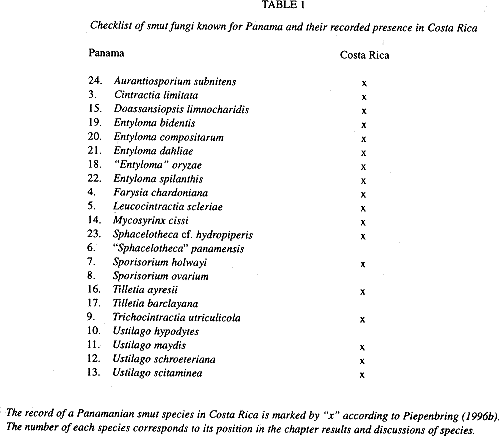
<body><![CDATA[<BR>&nbsp;      <P><B><FONT FACE="Arial"><FONT SIZE=-1>Discussion</FONT></FONT></B>      <P><FONT FACE="Arial"><FONT SIZE=-1>This first account of smut fungi in Panama includes four species based only on literatura and 20 species collected by the author. Among the latter are 14 new records for Panama, constituing 6 1 % of the total of 24 species cited here. This high percentage is not surprising, because hitherto nobody had studied the diversity of Panamanian smut fungi.</FONT></FONT>      <P><FONT FACE="Arial"><FONT SIZE=-1>Most wild host species of smuts grow in rural plant communities, mostly at roadsides and close to human settlements. This was also the case in Costa Rica (Piepenbring 1996b).</FONT></FONT>      <P><FONT FACE="Arial"><FONT SIZE=-1><I>Tilletia ayresii, </I>the most often collected smut species in Costa Rica, is also one of the most common smut species in Panama. <I>Sporisorium</I> <I>holwayi, </I>however, was only rarely collected in Costa Rica (Piepenbring 1996a), while it was often collected at the pacific slopes of the Panamanian Cordillera.</FONT></FONT>      <P><FONT FACE="Arial"><FONT SIZE=-1>In comparison with the lists of smut fungi for other neotropical countries (comp. introduction) the list of the species known for Panama is short and includes only four species which are not also known for Costa Rica <A HREF="#tab1">(Table 1<I>)</I></A><I>. Sphaceloteca panamensis </I>is known only for Panama. The small size of the checklist of Panamanian smut fungi is mainly due to the very short time spent for the investigation of this group in Panama. The high similarity with the smut diversity in Costa Rica and the lack of new species in the present publication may be caused by the fact that the author finds species already known to her more easily than new ones. lt may also be related to the fact that immigration of terrestrial species to Panainanian grounds was limited by the ocean covering most of it until the latter Tertiary (ca. 3.5 mio. yrs ago), when the mesoainerican land-bridge closed in the area of Panama (Stanley 1994). The high diversity of its present flora, however, is the best guarantee for interesting results which will be obtained by a more thorough investigation on Panamanian smut fungi.</FONT></FONT>     <BR>&nbsp;     <BR>&nbsp;     <CENTER><A NAME="tab1"></A><IMG SRC="/img/fbpe/rbt/v49n2/1000ta1.GIF" HEIGHT=436 WIDTH=502></CENTER>      
<CENTER>&nbsp;</CENTER>      ]]></body>
<body><![CDATA[<CENTER><IMG SRC="/img/fbpe/rbt/v49n2/1000ta2.GIF" HEIGHT=796 WIDTH=572></CENTER> &nbsp;     
<BR>&nbsp;     <BR>&nbsp;     <BR>&nbsp;      <P><B><FONT FACE="Arial"><FONT SIZE=-1>Acknowledgements</FONT></FONT></B>      <P><FONT FACE="Arial"><FONT SIZE=-1>Q. Dom&iacute;nguez and further members of the INRENARE (now ANAM) and P. Caballero, C. Arrocha, and 0. C&aacute;ceres from the UNACHI (Universidad Aut&oacute;noma de Chiriqui) are thanked for help with organization and company during the field work in Panama. M. Correa supported this study as director of the herbarium PMA. In Germany, Y Uhle-Schneider is thanked for mounting the drawings, H. Schoppmann and F. Albrecht for technical assistance. R. Cropper is thanked for revising the English and S. T. Garnica for revising the Spanish of the manuscript. Curators of cited herbaria are thanked for loans of specimens. The DAAD (Deutscher Akademischer Austauschdienst) is thanked for financial support.</FONT></FONT>     <BR>&nbsp;      <P><B><FONT FACE="Arial"><FONT SIZE=-1>Resumen</FONT></FONT></B>      <P><FONT FACE="Arial"><FONT SIZE=-1>Esta es la primera publicaci&oacute;n dedicada a la diversidad de carbones en Panam&aacute;. Tiene su base en trabajo de campo, estudio de espec&iacute;menes herborizados y referencias de la literatura. Se incluyen carbones pat&oacute;genos de plantas cultivadas y silvestres. Las &uacute;ltimas se encontraron sobre todo en zonas rurales. Entre las 24 especies citadas en este estudio, 14 especies son primeros registros para Panam&aacute; y una de &eacute;stas, <I>Sporisorium ovarium,</I> para Am&eacute;rica Central. Se encontr&oacute; <I>Entyloma spilanthis por</I> primera vez en la planta hospedera <I>Acmella papposa var.macrophylla (Asteraceac). Entyloma costaricense y</I> <I>Entyloma ecuadorense </I>son sin&oacute;nimos de <I>Entyloma</I> <I>compositarum y Entyloma spilanthis </I>respectivamente. <I>"Sphacelotheca" panamensis </I>es una especie dudosa. Se complementan las descripciones de las especies con algunas ilustraciones, una lista de especies y una clave.</FONT></FONT>     <BR>&nbsp;      ]]></body>
<body><![CDATA[<P><B><FONT FACE="Arial"><FONT SIZE=-1>Note</FONT></FONT></B>      <P><FONT FACE="Arial"><FONT SIZE=-1>The type of <I>"Sphaceloteca" panamensis </I>was recendy located in BPI. It differs from other species known on <I>Cymbopongon </I>and related genera of Poaceae by the precense of sori in spikelets and relatively large teliospores with several germ areas each. lt belongs to the genus <I>Sporisorium </I>because of columellae and fungal peridia in the sori.</FONT></FONT>      <P><FONT FACE="Arial"><FONT SIZE=-1><B><I>Sporisorium panamensis </I></B>(Zundel &amp; Dulap) M.</FONT></FONT>      <P><FONT FACE="Arial"><FONT SIZE=-1>Piepenbr., <B>comb. nov.</B></FONT></FONT>      <P><FONT FACE="Arial"><FONT SIZE=-1>Basionym: <I>Sphaccioreca panamensis </I>Zundel and Dulap, in Zundel, N. Amer. fi. 7: 995. 1939. Type. On <I>Cymbopogon citratus </I>(DC.) Stapf. Panam&aacute;. Chiriqu&iacute;, <I>Hitchcock 8295 </I>(holotype, BPI 190260!).</FONT></FONT>     <BR>&nbsp;      <P><B><FONT FACE="Arial"><FONT SIZE=-1>References</FONT></FONT></B>      <!-- ref --><P><FONT FACE="Arial"><FONT SIZE=-1>Bauer, R., F. Oberwinkler &amp; K. V&aacute;nky. 1997. Ultrastructural markers and systematics in smut fungi and allied taxa. Canad. J. Bot. 75: 1 273-1 314.</FONT></FONT>    &nbsp;&nbsp;&nbsp;&nbsp;&nbsp;&nbsp;&nbsp;&nbsp;[&#160;<a href="javascript:void(0);" onclick="javascript: window.open('/scielo.php?script=sci_nlinks&ref=1347391&pid=S0034-7744200100020000100001&lng=','','width=640,height=500,resizable=yes,scrollbars=1,menubar=yes,');">Links</a>&#160;]<!-- end-ref --><!-- ref --><P><FONT FACE="Arial"><FONT SIZE=-1>Bauer, R., D. Begerow, F. Oberwinkler, M. Piepenbring &amp; M. L. Berbee. 2001. Ustilaginomycetes, p. 57-83. In D. McLaughlin, E. McLaughlin and Lemke (eds.). Mycota VII. Systematics and Evolution. Springer, Berlin.</FONT></FONT>    &nbsp;&nbsp;&nbsp;&nbsp;&nbsp;&nbsp;&nbsp;&nbsp;[&#160;<a href="javascript:void(0);" onclick="javascript: window.open('/scielo.php?script=sci_nlinks&ref=1347392&pid=S0034-7744200100020000100002&lng=','','width=640,height=500,resizable=yes,scrollbars=1,menubar=yes,');">Links</a>&#160;]<!-- end-ref --><!-- ref --><BR><FONT FACE="Arial"><FONT SIZE=-1>Comstock, J.C., S.A. Ferreira &amp; T.L. Tew. 1983. Hawaii's approach to control of sugarcane smut. Plant Dis. 67: 452-457.</FONT></FONT>    &nbsp;&nbsp;&nbsp;&nbsp;&nbsp;&nbsp;&nbsp;&nbsp;[&#160;<a href="javascript:void(0);" onclick="javascript: window.open('/scielo.php?script=sci_nlinks&ref=1347393&pid=S0034-7744200100020000100003&lng=','','width=640,height=500,resizable=yes,scrollbars=1,menubar=yes,');">Links</a>&#160;]<!-- end-ref --><!-- ref --><P><FONT FACE="Arial"><FONT SIZE=-1>Davidse, G. &amp; R.W. Pohl. 1994. 161. <I>Cymbopogon</I> Sprengel, p. 390-391. <I>In: </I>G. Davidse, M. Sousa S., &amp; A. 0. Chater (eds.). Flora Mesoaniericana, Vol. 6, Alismataceae a Cyperaceae. Universidad Nacional Aut&oacute;noma de M&eacute;xico, M&eacute;xico.</FONT></FONT>    &nbsp;&nbsp;&nbsp;&nbsp;&nbsp;&nbsp;&nbsp;&nbsp;[&#160;<a href="javascript:void(0);" onclick="javascript: window.open('/scielo.php?script=sci_nlinks&ref=1347394&pid=S0034-7744200100020000100004&lng=','','width=640,height=500,resizable=yes,scrollbars=1,menubar=yes,');">Links</a>&#160;]<!-- end-ref --><!-- ref --><P><FONT FACE="Arial"><FONT SIZE=-1>Dennis, R.W.G. 1970. Fungus flora of Venezuela and adjacent countries. Kew Bull. Add. Ser. 3: 1-531.</FONT></FONT>    &nbsp;&nbsp;&nbsp;&nbsp;&nbsp;&nbsp;&nbsp;&nbsp;[&#160;<a href="javascript:void(0);" onclick="javascript: window.open('/scielo.php?script=sci_nlinks&ref=1347395&pid=S0034-7744200100020000100005&lng=','','width=640,height=500,resizable=yes,scrollbars=1,menubar=yes,');">Links</a>&#160;]<!-- end-ref --><!-- ref --><P><FONT FACE="Arial"><FONT SIZE=-1>Dur&aacute;n, R. 1987. Ustilaginales of Mexico. Taxonomy, symptomatology, spore germination, and basidial cytology. Washington State University, Pullman, Washington. 331 p.</FONT></FONT>    &nbsp;&nbsp;&nbsp;&nbsp;&nbsp;&nbsp;&nbsp;&nbsp;[&#160;<a href="javascript:void(0);" onclick="javascript: window.open('/scielo.php?script=sci_nlinks&ref=1347396&pid=S0034-7744200100020000100006&lng=','','width=640,height=500,resizable=yes,scrollbars=1,menubar=yes,');">Links</a>&#160;]<!-- end-ref --><!-- ref --><P><FONT FACE="Arial"><FONT SIZE=-1>Langdon, R.F.N. &amp; R.A. Fullerton. 1978. The genus <I>Sphacelotheca </I>(Ustilaginales): criteria for its delimitation and the consequences thereof. Mycotaxon 6: 421-456.</FONT></FONT>    &nbsp;&nbsp;&nbsp;&nbsp;&nbsp;&nbsp;&nbsp;&nbsp;[&#160;<a href="javascript:void(0);" onclick="javascript: window.open('/scielo.php?script=sci_nlinks&ref=1347397&pid=S0034-7744200100020000100007&lng=','','width=640,height=500,resizable=yes,scrollbars=1,menubar=yes,');">Links</a>&#160;]<!-- end-ref --><!-- ref --><P><FONT FACE="Arial"><FONT SIZE=-1>Ling, L. 1950. Studies in die genus <I>Cintractia. </I>II. Cintractia axicola and related species. Mycologia 42: 646-653.</FONT></FONT>    &nbsp;&nbsp;&nbsp;&nbsp;&nbsp;&nbsp;&nbsp;&nbsp;[&#160;<a href="javascript:void(0);" onclick="javascript: window.open('/scielo.php?script=sci_nlinks&ref=1347398&pid=S0034-7744200100020000100008&lng=','','width=640,height=500,resizable=yes,scrollbars=1,menubar=yes,');">Links</a>&#160;]<!-- end-ref --><!-- ref --><BR><FONT FACE="Arial"><FONT SIZE=-1>Molina-Valero, L.A. 1980. Los hongos de Colombia - VI. Reconocimiento e identificaci&oacute;n de Ustilaginales en Colombia. Caldasia 13: 49-96.</FONT></FONT>    &nbsp;&nbsp;&nbsp;&nbsp;&nbsp;&nbsp;&nbsp;&nbsp;[&#160;<a href="javascript:void(0);" onclick="javascript: window.open('/scielo.php?script=sci_nlinks&ref=1347399&pid=S0034-7744200100020000100009&lng=','','width=640,height=500,resizable=yes,scrollbars=1,menubar=yes,');">Links</a>&#160;]<!-- end-ref --><!-- ref --><P><FONT FACE="Arial"><FONT SIZE=-1>Piepenbring, M. 1996a. Smut fungi (Ustilaginales and Tilletiales) in Costa Rica. Beih. Nova Hedwigia 113: 1-155.</FONT></FONT>    &nbsp;&nbsp;&nbsp;&nbsp;&nbsp;&nbsp;&nbsp;&nbsp;[&#160;<a href="javascript:void(0);" onclick="javascript: window.open('/scielo.php?script=sci_nlinks&ref=1347400&pid=S0034-7744200100020000100010&lng=','','width=640,height=500,resizable=yes,scrollbars=1,menubar=yes,');">Links</a>&#160;]<!-- end-ref --><!-- ref --><P><FONT FACE="Arial"><FONT SIZE=-1>Piepenbring, M. 1996h. Ecology, seasonal variation, and altitudinal distribution of Costa Rican smut fungi (Basidiomycetes: Ustilaginales and Tilletiales). Rev. Biol. Trop. 44 (Suppl. 4): 115-123.</FONT></FONT>    &nbsp;&nbsp;&nbsp;&nbsp;&nbsp;&nbsp;&nbsp;&nbsp;[&#160;<a href="javascript:void(0);" onclick="javascript: window.open('/scielo.php?script=sci_nlinks&ref=1347401&pid=S0034-7744200100020000100011&lng=','','width=640,height=500,resizable=yes,scrollbars=1,menubar=yes,');">Links</a>&#160;]<!-- end-ref --><!-- ref --><P><FONT FACE="Arial"><FONT SIZE=-1>Piepenbring, M. 1996c. Two new <I>, Entyloma </I>species (Ustilaginales) in Central America. Sydowia 48: 241-249.</FONT></FONT>    &nbsp;&nbsp;&nbsp;&nbsp;&nbsp;&nbsp;&nbsp;&nbsp;[&#160;<a href="javascript:void(0);" onclick="javascript: window.open('/scielo.php?script=sci_nlinks&ref=1347402&pid=S0034-7744200100020000100012&lng=','','width=640,height=500,resizable=yes,scrollbars=1,menubar=yes,');">Links</a>&#160;]<!-- end-ref --><!-- ref --><P><FONT FACE="Arial"><FONT SIZE=-1>Piepenbring, M.1999. New and poorly known smut fungi in Cuba. Mycol. Res.103: 459-467.</FONT></FONT>    &nbsp;&nbsp;&nbsp;&nbsp;&nbsp;&nbsp;&nbsp;&nbsp;[&#160;<a href="javascript:void(0);" onclick="javascript: window.open('/scielo.php?script=sci_nlinks&ref=1347403&pid=S0034-7744200100020000100013&lng=','','width=640,height=500,resizable=yes,scrollbars=1,menubar=yes,');">Links</a>&#160;]<!-- end-ref --><!-- ref --><P><FONT FACE="Arial"><FONT SIZE=-1>Piepenbring, M. 2000. The species of <I>Cintractia s. </I>1. (Ustilaginales. Basidiomycota). Nova Hedwigia 70: 289-372.</FONT></FONT>    &nbsp;&nbsp;&nbsp;&nbsp;&nbsp;&nbsp;&nbsp;&nbsp;[&#160;<a href="javascript:void(0);" onclick="javascript: window.open('/scielo.php?script=sci_nlinks&ref=1347404&pid=S0034-7744200100020000100014&lng=','','width=640,height=500,resizable=yes,scrollbars=1,menubar=yes,');">Links</a>&#160;]<!-- end-ref --><!-- ref --><P><FONT FACE="Arial"><FONT SIZE=-1>Piepenbring, M. &amp; M. Rodr&iacute;guez. 1998a. Carbones (Fungi: Ustilaginomycetes) de Cuba. I parte. Rev. Jard. Bot. Nac. (Cuba) 19: 121-131.</FONT></FONT>    &nbsp;&nbsp;&nbsp;&nbsp;&nbsp;&nbsp;&nbsp;&nbsp;[&#160;<a href="javascript:void(0);" onclick="javascript: window.open('/scielo.php?script=sci_nlinks&ref=1347405&pid=S0034-7744200100020000100015&lng=','','width=640,height=500,resizable=yes,scrollbars=1,menubar=yes,');">Links</a>&#160;]<!-- end-ref --><!-- ref --><P><FONT FACE="Arial"><FONT SIZE=-1>Piepenbring, M. &amp; M. Rodr&iacute;guez. 1998b. Carbones (Fungi: Ustilaginomycetes) de Cuba. Il parte. Revista Jard. Bot. Nac. (Cuba) 19: 132-146.</FONT></FONT>    &nbsp;&nbsp;&nbsp;&nbsp;&nbsp;&nbsp;&nbsp;&nbsp;[&#160;<a href="javascript:void(0);" onclick="javascript: window.open('/scielo.php?script=sci_nlinks&ref=1347406&pid=S0034-7744200100020000100016&lng=','','width=640,height=500,resizable=yes,scrollbars=1,menubar=yes,');">Links</a>&#160;]<!-- end-ref --><!-- ref --><P><FONT FACE="Arial"><FONT SIZE=-1>Piepenbring, M., G. Hagedom and F. Oberwinkler. 1998. Spore liberation and dispersal in smut fungi. Bot. Acta 111: 444-460.</FONT></FONT>    &nbsp;&nbsp;&nbsp;&nbsp;&nbsp;&nbsp;&nbsp;&nbsp;[&#160;<a href="javascript:void(0);" onclick="javascript: window.open('/scielo.php?script=sci_nlinks&ref=1347407&pid=S0034-7744200100020000100017&lng=','','width=640,height=500,resizable=yes,scrollbars=1,menubar=yes,');">Links</a>&#160;]<!-- end-ref --><!-- ref --><P><FONT FACE="Arial"><FONT SIZE=-1>Piepenbring, M., D. Begerow &amp; F. Oberwinkler. 1999. Molecular sequence data assess the value of morphological characteristics for a phylogenetic classification of species of <I>Cintractia. </I>Mycologia 91: 485-498.</FONT></FONT>    &nbsp;&nbsp;&nbsp;&nbsp;&nbsp;&nbsp;&nbsp;&nbsp;[&#160;<a href="javascript:void(0);" onclick="javascript: window.open('/scielo.php?script=sci_nlinks&ref=1347408&pid=S0034-7744200100020000100018&lng=','','width=640,height=500,resizable=yes,scrollbars=1,menubar=yes,');">Links</a>&#160;]<!-- end-ref --><!-- ref --><P><FONT FACE="Arial"><FONT SIZE=-1>Savile, D.B.O. 1947. A study of the species of <I>Entyloma on</I> North American composites. Canad. J. Res., C, 25: 105-120.</FONT></FONT>    &nbsp;&nbsp;&nbsp;&nbsp;&nbsp;&nbsp;&nbsp;&nbsp;[&#160;<a href="javascript:void(0);" onclick="javascript: window.open('/scielo.php?script=sci_nlinks&ref=1347409&pid=S0034-7744200100020000100019&lng=','','width=640,height=500,resizable=yes,scrollbars=1,menubar=yes,');">Links</a>&#160;]<!-- end-ref --><!-- ref --><P><FONT FACE="Arial"><FONT SIZE=-1>Stanley, S.M. 1994. Historische Geologie. Spektrum Akademischer, Heidelberg. 632 p.</FONT></FONT>    &nbsp;&nbsp;&nbsp;&nbsp;&nbsp;&nbsp;&nbsp;&nbsp;[&#160;<a href="javascript:void(0);" onclick="javascript: window.open('/scielo.php?script=sci_nlinks&ref=1347410&pid=S0034-7744200100020000100020&lng=','','width=640,height=500,resizable=yes,scrollbars=1,menubar=yes,');">Links</a>&#160;]<!-- end-ref --><!-- ref --><P><FONT FACE="Arial"><FONT SIZE=-1>Sydow, H. 1926. Fungi in itinere costaricensi collecti. Ann. Mycol. 24: 283-426.</FONT></FONT>    &nbsp;&nbsp;&nbsp;&nbsp;&nbsp;&nbsp;&nbsp;&nbsp;[&#160;<a href="javascript:void(0);" onclick="javascript: window.open('/scielo.php?script=sci_nlinks&ref=1347411&pid=S0034-7744200100020000100021&lng=','','width=640,height=500,resizable=yes,scrollbars=1,menubar=yes,');">Links</a>&#160;]<!-- end-ref --><!-- ref --><P><FONT FACE="Arial"><FONT SIZE=-1>Toler, R.W., R. Cuellar and J.B. Ferrer. 1959. Preliminary survey of plant diseases in the Republic of Panama, 1955-1958. PI. Dis. Reporter 43: 1 201-1 203.</FONT></FONT>    &nbsp;&nbsp;&nbsp;&nbsp;&nbsp;&nbsp;&nbsp;&nbsp;[&#160;<a href="javascript:void(0);" onclick="javascript: window.open('/scielo.php?script=sci_nlinks&ref=1347412&pid=S0034-7744200100020000100022&lng=','','width=640,height=500,resizable=yes,scrollbars=1,menubar=yes,');">Links</a>&#160;]<!-- end-ref --><!-- ref --><P><FONT FACE="Arial"><FONT SIZE=-1>Tuilis, E.C. &amp; A.G. Johnson. 1952. Synonymy of <I>Tilletia</I> <I>horrida and Neovossia barclayana. </I>Mycologia 44: 773-788.</FONT></FONT>    &nbsp;&nbsp;&nbsp;&nbsp;&nbsp;&nbsp;&nbsp;&nbsp;[&#160;<a href="javascript:void(0);" onclick="javascript: window.open('/scielo.php?script=sci_nlinks&ref=1347413&pid=S0034-7744200100020000100023&lng=','','width=640,height=500,resizable=yes,scrollbars=1,menubar=yes,');">Links</a>&#160;]<!-- end-ref --><!-- ref --><P><FONT FACE="Arial"><FONT SIZE=-1>Valverde M.E., 0. Paredes-L&oacute;pez, J.K. Pataky &amp; F. GuevaraLara. 1995. Huitiacoche <I>(Ustilago maydis) </I>as a food source - biology, composition, and production. CRC Crit. Rev. Food Sci. Nutr. 35: 191-229.</FONT></FONT>    &nbsp;&nbsp;&nbsp;&nbsp;&nbsp;&nbsp;&nbsp;&nbsp;[&#160;<a href="javascript:void(0);" onclick="javascript: window.open('/scielo.php?script=sci_nlinks&ref=1347414&pid=S0034-7744200100020000100024&lng=','','width=640,height=500,resizable=yes,scrollbars=1,menubar=yes,');">Links</a>&#160;]<!-- end-ref --><!-- ref --><P><FONT FACE="Arial"><FONT SIZE=-1>V&aacute;nky, K. 1987. Illustrated genera of smut fungi. Gustav Fischer, Stuttgart. 159 p.</FONT></FONT>    &nbsp;&nbsp;&nbsp;&nbsp;&nbsp;&nbsp;&nbsp;&nbsp;[&#160;<a href="javascript:void(0);" onclick="javascript: window.open('/scielo.php?script=sci_nlinks&ref=1347415&pid=S0034-7744200100020000100025&lng=','','width=640,height=500,resizable=yes,scrollbars=1,menubar=yes,');">Links</a>&#160;]<!-- end-ref --><!-- ref --><P><FONT FACE="Arial"><FONT SIZE=-1>V&aacute;nky, K. &amp; F. Oberwinkler. 1994. Ustilaginales on Polygonaceae- a taxonomic revision. Beih. Nova Hedwigia 107:1-96.</FONT></FONT>    &nbsp;&nbsp;&nbsp;&nbsp;&nbsp;&nbsp;&nbsp;&nbsp;[&#160;<a href="javascript:void(0);" onclick="javascript: window.open('/scielo.php?script=sci_nlinks&ref=1347416&pid=S0034-7744200100020000100026&lng=','','width=640,height=500,resizable=yes,scrollbars=1,menubar=yes,');">Links</a>&#160;]<!-- end-ref --><!-- ref --><P><FONT FACE="Arial"><FONT SIZE=-1>Zundel, G.L.1939. Additions and coffections to Ustilaginales. North Amer. Flora 7: 971-1045.</FONT></FONT>    &nbsp;&nbsp;&nbsp;&nbsp;&nbsp;&nbsp;&nbsp;&nbsp;[&#160;<a href="javascript:void(0);" onclick="javascript: window.open('/scielo.php?script=sci_nlinks&ref=1347417&pid=S0034-7744200100020000100027&lng=','','width=640,height=500,resizable=yes,scrollbars=1,menubar=yes,');">Links</a>&#160;]<!-- end-ref --><!-- ref --><P><FONT FACE="Arial"><FONT SIZE=-1>Zundel, G.L. 1953. The Ustilaginales of the world. Pennsylvania State Coll. School Agric. Dept. Bot. Contr. 176: I-XI, 1-410.</FONT></FONT>    &nbsp;&nbsp;&nbsp;&nbsp;&nbsp;&nbsp;&nbsp;&nbsp;[&#160;<a href="javascript:void(0);" onclick="javascript: window.open('/scielo.php?script=sci_nlinks&ref=1347418&pid=S0034-7744200100020000100028&lng=','','width=640,height=500,resizable=yes,scrollbars=1,menubar=yes,');">Links</a>&#160;]<!-- end-ref --><BR>&nbsp;      <P><A NAME="1a"></A><FONT FACE="Arial,Helvetica"><FONT SIZE=-1><SUP><A HREF="#1">1</A></SUP> Lehrstuhl Spezielle Botanik/Mykologie, Botanisches Institut, Universit&auml;t T&uuml;bingen, Auf der Morgenstelle 1, 72076 T&uuml;bingen, Germany. Fax: 0049 7071 295344</FONT></FONT>     <BR><FONT FACE="Arial,Helvetica"><FONT SIZE=-1>E-mail: <A HREF="mailto:meike.piepenbring@uni-tuebingen.de">meike.piepenbring@uni-tuebingen.de</A></FONT></FONT>      ]]></body><back>
<ref-list>
<ref id="B1">
<nlm-citation citation-type="journal">
<person-group person-group-type="author">
<name>
<surname><![CDATA[Bauer]]></surname>
<given-names><![CDATA[R.]]></given-names>
</name>
<name>
<surname><![CDATA[Oberwinkler]]></surname>
<given-names><![CDATA[F.]]></given-names>
</name>
<name>
<surname><![CDATA[Vánky]]></surname>
<given-names><![CDATA[K.]]></given-names>
</name>
</person-group>
<article-title xml:lang="en"><![CDATA[Ultrastructural markers and systematics in smut fungi and allied taxa]]></article-title>
<source><![CDATA[Canad. J. Bot]]></source>
<year>1997</year>
<volume>75</volume>
<page-range>1 273-1 314</page-range></nlm-citation>
</ref>
<ref id="B2">
<nlm-citation citation-type="">
<person-group person-group-type="author">
<name>
<surname><![CDATA[Bauer]]></surname>
<given-names><![CDATA[R.]]></given-names>
</name>
<name>
<surname><![CDATA[Begerow]]></surname>
<given-names><![CDATA[D.]]></given-names>
</name>
<name>
<surname><![CDATA[Oberwinkler]]></surname>
<given-names><![CDATA[F.]]></given-names>
</name>
<name>
<surname><![CDATA[Piepenbring]]></surname>
<given-names><![CDATA[M.]]></given-names>
</name>
<name>
<surname><![CDATA[Berbee]]></surname>
<given-names><![CDATA[M. L.]]></given-names>
</name>
</person-group>
<article-title xml:lang="en"><![CDATA[Ustilaginomycetes]]></article-title>
<person-group person-group-type="editor">
<name>
<surname><![CDATA[McLaughlin]]></surname>
<given-names><![CDATA[D.]]></given-names>
</name>
<name>
<surname><![CDATA[McLaughlin]]></surname>
<given-names><![CDATA[E.]]></given-names>
</name>
<name>
<surname><![CDATA[Lemke]]></surname>
</name>
</person-group>
<source><![CDATA[]]></source>
<year>2001</year>
<page-range>57-83</page-range></nlm-citation>
</ref>
<ref id="B3">
<nlm-citation citation-type="journal">
<person-group person-group-type="author">
<name>
<surname><![CDATA[Comstock]]></surname>
<given-names><![CDATA[J.C.]]></given-names>
</name>
<name>
<surname><![CDATA[Ferreira]]></surname>
<given-names><![CDATA[S.A.]]></given-names>
</name>
<name>
<surname><![CDATA[Tew]]></surname>
<given-names><![CDATA[T.L.]]></given-names>
</name>
</person-group>
<article-title xml:lang="en"><![CDATA[Hawaii's approach to control of sugarcane smut]]></article-title>
<source><![CDATA[Plant Dis]]></source>
<year>1983</year>
<volume>67</volume>
<page-range>452-457</page-range></nlm-citation>
</ref>
<ref id="B4">
<nlm-citation citation-type="book">
<person-group person-group-type="author">
<name>
<surname><![CDATA[Davidse]]></surname>
<given-names><![CDATA[G.]]></given-names>
</name>
<name>
<surname><![CDATA[Pohl]]></surname>
<given-names><![CDATA[R.W.]]></given-names>
</name>
</person-group>
<article-title xml:lang="en"><![CDATA[Cymbopogon Sprengel]]></article-title>
<person-group person-group-type="editor">
<name>
<surname><![CDATA[Davidse]]></surname>
<given-names><![CDATA[G.]]></given-names>
</name>
<name>
<surname><![CDATA[Sousa S.]]></surname>
<given-names><![CDATA[M.]]></given-names>
</name>
<name>
<surname><![CDATA[Chater]]></surname>
<given-names><![CDATA[A. 0.]]></given-names>
</name>
</person-group>
<source><![CDATA[Flora Mesoaniericana, Vol. 6, Alismataceae a Cyperaceae]]></source>
<year>1994</year>
<page-range>390-391</page-range><publisher-name><![CDATA[Universidad Nacional Autónoma de México]]></publisher-name>
</nlm-citation>
</ref>
<ref id="B5">
<nlm-citation citation-type="journal">
<person-group person-group-type="author">
<name>
<surname><![CDATA[Dennis]]></surname>
<given-names><![CDATA[R.W.G.]]></given-names>
</name>
</person-group>
<article-title xml:lang="en"><![CDATA[Fungus flora of Venezuela and adjacent countries]]></article-title>
<source><![CDATA[Kew Bull. Add. Ser]]></source>
<year>1970</year>
<volume>3</volume>
<page-range>1-531</page-range></nlm-citation>
</ref>
<ref id="B6">
<nlm-citation citation-type="book">
<person-group person-group-type="author">
<name>
<surname><![CDATA[Durán]]></surname>
<given-names><![CDATA[R.]]></given-names>
</name>
</person-group>
<source><![CDATA[Ustilaginales of Mexico: Taxonomy, symptomatology, spore germination, and basidial cytology]]></source>
<year>1987</year>
<page-range>331</page-range><publisher-loc><![CDATA[Pullman^eWashington Washington]]></publisher-loc>
<publisher-name><![CDATA[Washington State University]]></publisher-name>
</nlm-citation>
</ref>
<ref id="B7">
<nlm-citation citation-type="journal">
<person-group person-group-type="author">
<name>
<surname><![CDATA[Langdon]]></surname>
<given-names><![CDATA[R.F.N.]]></given-names>
</name>
<name>
<surname><![CDATA[Fullerton]]></surname>
<given-names><![CDATA[R.A.]]></given-names>
</name>
</person-group>
<article-title xml:lang="en"><![CDATA[The genus Sphacelotheca (Ustilaginales): criteria for its delimitation and the consequences thereof]]></article-title>
<source><![CDATA[Mycotaxon]]></source>
<year>1978</year>
<volume>6</volume>
<page-range>421-456</page-range></nlm-citation>
</ref>
<ref id="B8">
<nlm-citation citation-type="journal">
<person-group person-group-type="author">
<name>
<surname><![CDATA[Ling]]></surname>
<given-names><![CDATA[L.]]></given-names>
</name>
</person-group>
<article-title xml:lang="en"><![CDATA[Studies in die genus Cintractia. II. Cintractia axicola and related species]]></article-title>
<source><![CDATA[Mycologia]]></source>
<year>1950</year>
<volume>42</volume>
<page-range>646-653</page-range></nlm-citation>
</ref>
<ref id="B9">
<nlm-citation citation-type="journal">
<person-group person-group-type="author">
<name>
<surname><![CDATA[Molina-Valero]]></surname>
<given-names><![CDATA[L.A.]]></given-names>
</name>
</person-group>
<article-title xml:lang="es"><![CDATA[Los hongos de Colombia - VI. Reconocimiento e identificación de Ustilaginales en Colombia]]></article-title>
<source><![CDATA[Caldasia]]></source>
<year>1980</year>
<volume>13</volume>
<page-range>49-96</page-range></nlm-citation>
</ref>
<ref id="B10">
<nlm-citation citation-type="journal">
<person-group person-group-type="author">
<name>
<surname><![CDATA[Piepenbring]]></surname>
<given-names><![CDATA[M.]]></given-names>
</name>
</person-group>
<article-title xml:lang="en"><![CDATA[Smut fungi (Ustilaginales and Tilletiales) in Costa Rica]]></article-title>
<source><![CDATA[Beih. Nova Hedwigia]]></source>
<year>1996</year>
<volume>113</volume>
<page-range>1-155</page-range></nlm-citation>
</ref>
<ref id="B11">
<nlm-citation citation-type="journal">
<person-group person-group-type="author">
<name>
<surname><![CDATA[Piepenbring]]></surname>
<given-names><![CDATA[M]]></given-names>
</name>
</person-group>
<article-title xml:lang="en"><![CDATA[Ecology, seasonal variation, and altitudinal distribution of Costa Rican smut fungi (Basidiomycetes: Ustilaginales and Tilletiales)]]></article-title>
<source><![CDATA[Rev. Biol. Trop]]></source>
<year>1996</year>
<volume>44</volume>
<numero>^s4</numero>
<issue>^s4</issue>
<supplement>4</supplement>
<page-range>115-123</page-range></nlm-citation>
</ref>
<ref id="B12">
<nlm-citation citation-type="journal">
<person-group person-group-type="author">
<name>
<surname><![CDATA[Piepenbring]]></surname>
<given-names><![CDATA[M.]]></given-names>
</name>
</person-group>
<article-title xml:lang="en"><![CDATA[Two new , Entyloma species (Ustilaginales) in Central America]]></article-title>
<source><![CDATA[Sydowia]]></source>
<year>1996</year>
<volume>48</volume>
<page-range>241-249</page-range></nlm-citation>
</ref>
<ref id="B13">
<nlm-citation citation-type="journal">
<person-group person-group-type="author">
<name>
<surname><![CDATA[Piepenbring]]></surname>
<given-names><![CDATA[M.]]></given-names>
</name>
</person-group>
<article-title xml:lang="en"><![CDATA[New and poorly known smut fungi in Cuba]]></article-title>
<source><![CDATA[Mycol. Res]]></source>
<year>1999</year>
<volume>103</volume>
<page-range>459-467</page-range></nlm-citation>
</ref>
<ref id="B14">
<nlm-citation citation-type="journal">
<person-group person-group-type="author">
<name>
<surname><![CDATA[Piepenbring]]></surname>
<given-names><![CDATA[M.]]></given-names>
</name>
</person-group>
<article-title xml:lang="en"><![CDATA[The species of Cintractia s. 1. (Ustilaginales. Basidiomycota)]]></article-title>
<source><![CDATA[Nova Hedwigia]]></source>
<year>2000</year>
<volume>70</volume>
<page-range>289-372</page-range></nlm-citation>
</ref>
<ref id="B15">
<nlm-citation citation-type="journal">
<person-group person-group-type="author">
<name>
<surname><![CDATA[Piepenbring]]></surname>
<given-names><![CDATA[M.]]></given-names>
</name>
<name>
<surname><![CDATA[Rodríguez]]></surname>
<given-names><![CDATA[M.]]></given-names>
</name>
</person-group>
<article-title xml:lang="es"><![CDATA[Carbones (Fungi: Ustilaginomycetes) de Cuba: I parte]]></article-title>
<source><![CDATA[Rev. Jard. Bot. Nac.]]></source>
<year>1998</year>
<volume>19</volume>
<page-range>121-131</page-range></nlm-citation>
</ref>
<ref id="B16">
<nlm-citation citation-type="journal">
<person-group person-group-type="author">
<name>
<surname><![CDATA[Piepenbring]]></surname>
<given-names><![CDATA[M.]]></given-names>
</name>
<name>
<surname><![CDATA[Rodríguez]]></surname>
<given-names><![CDATA[M.]]></given-names>
</name>
</person-group>
<article-title xml:lang="es"><![CDATA[Carbones (Fungi: Ustilaginomycetes) de Cuba: Il parte]]></article-title>
<source><![CDATA[Revista Jard. Bot. Nac.]]></source>
<year>1998</year>
<volume>19</volume>
<page-range>132-146</page-range></nlm-citation>
</ref>
<ref id="B17">
<nlm-citation citation-type="journal">
<person-group person-group-type="author">
<name>
<surname><![CDATA[Piepenbring]]></surname>
<given-names><![CDATA[M.]]></given-names>
</name>
<name>
<surname><![CDATA[Hagedom]]></surname>
<given-names><![CDATA[G.]]></given-names>
</name>
<name>
<surname><![CDATA[Oberwinkler]]></surname>
<given-names><![CDATA[F.]]></given-names>
</name>
</person-group>
<article-title xml:lang="en"><![CDATA[Spore liberation and dispersal in smut fungi]]></article-title>
<source><![CDATA[Bot. Acta]]></source>
<year>1998</year>
<volume>111</volume>
<page-range>444-460</page-range></nlm-citation>
</ref>
<ref id="B18">
<nlm-citation citation-type="journal">
<person-group person-group-type="author">
<name>
<surname><![CDATA[Piepenbring]]></surname>
<given-names><![CDATA[M.]]></given-names>
</name>
<name>
<surname><![CDATA[Begerow]]></surname>
<given-names><![CDATA[D.]]></given-names>
</name>
<name>
<surname><![CDATA[Oberwinkler]]></surname>
<given-names><![CDATA[F.]]></given-names>
</name>
</person-group>
<article-title xml:lang="en"><![CDATA[Molecular sequence data assess the value of morphological characteristics for a phylogenetic classification of species of Cintractia]]></article-title>
<source><![CDATA[Mycologia]]></source>
<year>1999</year>
<volume>91</volume>
<page-range>485-498</page-range></nlm-citation>
</ref>
<ref id="B19">
<nlm-citation citation-type="journal">
<person-group person-group-type="author">
<name>
<surname><![CDATA[Savile]]></surname>
<given-names><![CDATA[D.B.O.]]></given-names>
</name>
</person-group>
<article-title xml:lang="en"><![CDATA[A study of the species of Entyloma on North American composites]]></article-title>
<source><![CDATA[Canad. J. Res., C]]></source>
<year>1947</year>
<volume>25</volume>
<page-range>105-120</page-range></nlm-citation>
</ref>
<ref id="B20">
<nlm-citation citation-type="book">
<person-group person-group-type="author">
<name>
<surname><![CDATA[Stanley]]></surname>
<given-names><![CDATA[S.M.]]></given-names>
</name>
</person-group>
<source><![CDATA[Historische Geologie]]></source>
<year>1994</year>
<page-range>632</page-range><publisher-loc><![CDATA[Heidelberg ]]></publisher-loc>
<publisher-name><![CDATA[Spektrum Akademischer]]></publisher-name>
</nlm-citation>
</ref>
<ref id="B21">
<nlm-citation citation-type="journal">
<person-group person-group-type="author">
<name>
<surname><![CDATA[Sydow]]></surname>
<given-names><![CDATA[H.]]></given-names>
</name>
</person-group>
<article-title xml:lang="en"><![CDATA[Fungi in itinere costaricensi collecti]]></article-title>
<source><![CDATA[Ann. Mycol]]></source>
<year>1926</year>
<volume>24</volume>
<page-range>283-426</page-range></nlm-citation>
</ref>
<ref id="B22">
<nlm-citation citation-type="journal">
<person-group person-group-type="author">
<name>
<surname><![CDATA[Toler]]></surname>
<given-names><![CDATA[R.W.]]></given-names>
</name>
<name>
<surname><![CDATA[Cuellar]]></surname>
<given-names><![CDATA[R.]]></given-names>
</name>
<name>
<surname><![CDATA[Ferrer]]></surname>
<given-names><![CDATA[J.B.]]></given-names>
</name>
</person-group>
<article-title xml:lang="en"><![CDATA[Preliminary survey of plant diseases in the Republic of Panama, 1955-1958]]></article-title>
<source><![CDATA[PI. Dis. Reporter]]></source>
<year>1959</year>
<volume>43</volume>
<page-range>1 201-1 203</page-range></nlm-citation>
</ref>
<ref id="B23">
<nlm-citation citation-type="journal">
<person-group person-group-type="author">
<name>
<surname><![CDATA[Tuilis]]></surname>
<given-names><![CDATA[E.C.]]></given-names>
</name>
<name>
<surname><![CDATA[Johnson]]></surname>
<given-names><![CDATA[A.G.]]></given-names>
</name>
</person-group>
<article-title xml:lang="en"><![CDATA[Synonymy of Tilletia horrida and Neovossia barclayana]]></article-title>
<source><![CDATA[Mycologia]]></source>
<year>1952</year>
<volume>44</volume>
<page-range>773-788</page-range></nlm-citation>
</ref>
<ref id="B24">
<nlm-citation citation-type="journal">
<person-group person-group-type="author">
<name>
<surname><![CDATA[Valverde]]></surname>
<given-names><![CDATA[M.E.]]></given-names>
</name>
<name>
<surname><![CDATA[Paredes-López]]></surname>
<given-names><![CDATA[0.]]></given-names>
</name>
<name>
<surname><![CDATA[Pataky]]></surname>
<given-names><![CDATA[J.K.]]></given-names>
</name>
<name>
<surname><![CDATA[GuevaraLara]]></surname>
<given-names><![CDATA[F.]]></given-names>
</name>
</person-group>
<article-title xml:lang="en"><![CDATA[Huitiacoche (Ustilago maydis) as a food source - biology, composition, and production]]></article-title>
<source><![CDATA[CRC Crit. Rev. Food Sci. Nutr.]]></source>
<year>1995</year>
<volume>35</volume>
<page-range>191-229</page-range></nlm-citation>
</ref>
<ref id="B25">
<nlm-citation citation-type="book">
<person-group person-group-type="author">
<name>
<surname><![CDATA[Vánky]]></surname>
<given-names><![CDATA[K.]]></given-names>
</name>
</person-group>
<source><![CDATA[Illustrated genera of smut fungi]]></source>
<year>1987</year>
<page-range>159</page-range><publisher-loc><![CDATA[^eStuttgart Stuttgart]]></publisher-loc>
<publisher-name><![CDATA[Gustav Fischer]]></publisher-name>
</nlm-citation>
</ref>
<ref id="B26">
<nlm-citation citation-type="journal">
<person-group person-group-type="author">
<name>
<surname><![CDATA[Vánky]]></surname>
<given-names><![CDATA[K]]></given-names>
</name>
<name>
<surname><![CDATA[Oberwinkler]]></surname>
<given-names><![CDATA[F.]]></given-names>
</name>
</person-group>
<article-title xml:lang="en"><![CDATA[Ustilaginales on Polygonaceae- a taxonomic revision]]></article-title>
<source><![CDATA[Beih. Nova Hedwigia]]></source>
<year>1994</year>
<volume>107</volume>
<page-range>1-96</page-range></nlm-citation>
</ref>
<ref id="B27">
<nlm-citation citation-type="journal">
<person-group person-group-type="author">
<name>
<surname><![CDATA[Zundel]]></surname>
<given-names><![CDATA[G.L.]]></given-names>
</name>
</person-group>
<article-title xml:lang="en"><![CDATA[Additions and coffections to Ustilaginales]]></article-title>
<source><![CDATA[North Amer. Flora]]></source>
<year>1939</year>
<volume>7</volume>
<page-range>971-1045</page-range></nlm-citation>
</ref>
<ref id="B28">
<nlm-citation citation-type="journal">
<person-group person-group-type="author">
<name>
<surname><![CDATA[Zundel]]></surname>
<given-names><![CDATA[G.L.]]></given-names>
</name>
</person-group>
<article-title xml:lang="en"><![CDATA[The Ustilaginales of the world]]></article-title>
<source><![CDATA[Pennsylvania State Coll. School Agric Dept. Bot. Contr.]]></source>
<year>1953</year>
<volume>176</volume><volume>I-XI</volume>
<page-range>1-410</page-range></nlm-citation>
</ref>
</ref-list>
</back>
</article>