<?xml version="1.0" encoding="ISO-8859-1"?><article xmlns:mml="http://www.w3.org/1998/Math/MathML" xmlns:xlink="http://www.w3.org/1999/xlink" xmlns:xsi="http://www.w3.org/2001/XMLSchema-instance">
<front>
<journal-meta>
<journal-id>0034-7744</journal-id>
<journal-title><![CDATA[Revista de Biología Tropical]]></journal-title>
<abbrev-journal-title><![CDATA[Rev. biol. trop]]></abbrev-journal-title>
<issn>0034-7744</issn>
<publisher>
<publisher-name><![CDATA[Universidad de Costa Rica]]></publisher-name>
</publisher>
</journal-meta>
<article-meta>
<article-id>S0034-77442001000100035</article-id>
<title-group>
<article-title xml:lang="en"><![CDATA[Coastal waterbirds of El Chorro and Majahuas, Jalisco, México, during the non-breeding season, 1995-1996]]></article-title>
</title-group>
<contrib-group>
<contrib contrib-type="author">
<name>
<surname><![CDATA[Hernández-Vázquez]]></surname>
<given-names><![CDATA[Salvador]]></given-names>
</name>
<xref ref-type="aff" rid="A01"/>
</contrib>
<contrib contrib-type="author">
<name>
<surname><![CDATA[Mellink]]></surname>
<given-names><![CDATA[Eric]]></given-names>
</name>
<xref ref-type="aff" rid="A02"/>
</contrib>
</contrib-group>
<aff id="A01">
<institution><![CDATA[,Universidad de Guadalajara Centro de Ecología Costera ]]></institution>
<addr-line><![CDATA[Jalisco ]]></addr-line>
<country>México</country>
</aff>
<aff id="A02">
<institution><![CDATA[,Centro de Investigación Científica y de Educación Superior de Ensenada  ]]></institution>
<addr-line><![CDATA[Baja California ]]></addr-line>
<country>México</country>
</aff>
<pub-date pub-type="pub">
<day>00</day>
<month>03</month>
<year>2001</year>
</pub-date>
<pub-date pub-type="epub">
<day>00</day>
<month>03</month>
<year>2001</year>
</pub-date>
<volume>49</volume>
<numero>1</numero>
<fpage>359</fpage>
<lpage>367</lpage>
<copyright-statement/>
<copyright-year/>
<self-uri xlink:href="http://www.scielo.sa.cr/scielo.php?script=sci_arttext&amp;pid=S0034-77442001000100035&amp;lng=en&amp;nrm=iso"></self-uri><self-uri xlink:href="http://www.scielo.sa.cr/scielo.php?script=sci_abstract&amp;pid=S0034-77442001000100035&amp;lng=en&amp;nrm=iso"></self-uri><self-uri xlink:href="http://www.scielo.sa.cr/scielo.php?script=sci_pdf&amp;pid=S0034-77442001000100035&amp;lng=en&amp;nrm=iso"></self-uri><abstract abstract-type="short" xml:lang="en"><p><![CDATA[We studied how waterbirds used two small estuaries during the non-breeding season of 1995-1996. These estuaries, El Chorro and Majahuas, were located in the middle of a large span of non-wetland habitat along the Pacific coast of México. Whereas El Chorro was basically a large and open waterbody, Majahuas was a long and narrow corridor flanked by mangroves. The two estuaries had 77 species throughout our study, but shared only 58, due to differences in their habitat. Seabirds comprised 66% of all the birds; grebes, ducks and rails 16%; shorebirds 12% and herons and egrets 5%. During late winter and early spring a very reduced number of migratory species accounted for the dominance of seabirds. Sterna hirundo and Phalacrocorax brasilianus accounted for 40 and 33%, respectively, of all the seabirds. Opening or closure of the estuary mouth at El Chorro affected the bird communities at both sites, by exposing or inundating a large mudflat in that estuary. Overall, however, time of the year was more important in the composition of the bird assemblages. Both estuaries should be considered as a single unit.]]></p></abstract>
<abstract abstract-type="short" xml:lang="es"><p><![CDATA[Durante la estación no reproductiva de 1995-1996 estudiamos las aves acuáticas de los estuarios El Chorro y Majahuas, Jalisco, México. El Chorro es un cuerpo de agua más abierto, mientras que Majahuas está formado por canales rodeados por manglares. Registramos 77 especies de aves. Las aves marinas comprendieron el 66%, los patos y similares el 16%, las aves playeras el 12% y las garzas el 5%. Sterna hirundo y Phalacrocorax brasilianus representaron el 40 y 33%, respectivamente, del total de aves marinas. El que la bocabarra de El Chorro estuviera abierta o cerrada influyó en la concentración de aves en los dos esteros, debido a la exposición o inundación de áreas lodosas y arenosas. A pesar de las diferencias entre los dos estuarios, la época del año fue más importante en la composición de las comunidades de aves. Ambos esteros deben considerarse como una sola entidad ecológica.]]></p></abstract>
<kwd-group>
<kwd lng="en"><![CDATA[Coastal waterbirds]]></kwd>
<kwd lng="en"><![CDATA[Jalisco]]></kwd>
<kwd lng="en"><![CDATA[México]]></kwd>
<kwd lng="en"><![CDATA[seasonality]]></kwd>
<kwd lng="es"><![CDATA[Aves acuáticas costeras]]></kwd>
<kwd lng="es"><![CDATA[Jalisco]]></kwd>
<kwd lng="es"><![CDATA[México]]></kwd>
<kwd lng="es"><![CDATA[estacionalidad]]></kwd>
</kwd-group>
</article-meta>
</front><body><![CDATA[ <CENTER><B><FONT FACE="Arial,Helvetica">Coastal waterbirds of El Chorro and Majahuas, Jalisco, M&eacute;xico, during the non-breeding season, 1995-1996</FONT></B></CENTER>      <DIV class="MsoBodyText" style="LINE-HEIGHT: normal"><FONT FACE="Arial,Helvetica"><FONT SIZE=-1>&nbsp;</FONT></FONT>     <BR><FONT FACE="Arial,Helvetica"><FONT SIZE=-1>&nbsp;</FONT></FONT></DIV> <FONT FACE="Arial,Helvetica"><FONT SIZE=-1>Salvador Hern&aacute;ndez-V&aacute;zquez <SUP><A HREF="#A1">1</A></SUP> and Eric Mellink&nbsp;<A NAME="R1"></A><SUP><A HREF="#A1">2</A></SUP></FONT></FONT>     <BR>&nbsp;     <BR><FONT FACE="Arial,Helvetica"><FONT SIZE=-1>&nbsp;</FONT></FONT>     <BR><FONT FACE="Arial,Helvetica"><FONT SIZE=-1>Recibido&nbsp;&nbsp;&nbsp; 19-I-2000.&nbsp;&nbsp; Corregido&nbsp;&nbsp; 3-VIII-2000.&nbsp;&nbsp; Aceptado&nbsp;&nbsp; 19-IX-2000</FONT></FONT>     <BR><FONT FACE="Arial,Helvetica"><FONT SIZE=-1>&nbsp;</FONT></FONT>     <BR><FONT FACE="Arial,Helvetica"><FONT SIZE=-1>&nbsp;</FONT></FONT>     <BR><B><FONT FACE="Arial,Helvetica"><FONT SIZE=-1>Abstract</FONT></FONT></B>     <BR><B><FONT FACE="Arial,Helvetica"><FONT SIZE=-1>&nbsp;</FONT></FONT></B>     ]]></body>
<body><![CDATA[<BR><FONT FACE="Arial,Helvetica"><FONT SIZE=-1>We studied how waterbirds used two small estuaries during the non-breeding season of 1995-1996. These estuaries, El Chorro and Majahuas, were located in the middle of a large span of non-wetland habitat along the Pacific coast of M&eacute;xico. Whereas El Chorro was basically a large and open waterbody, Majahuas was a long and narrow corridor flanked by mangroves. The two estuaries had 77 species throughout our study, but shared only 58, due to differences in their habitat. Seabirds comprised 66% of all the birds; grebes, ducks and rails 16%; shorebirds 12% and herons and egrets 5%. During late winter and early spring a very reduced number of migratory species accounted for the dominance of seabirds. <I>Sterna hirundo</I> and <I>Phalacrocorax brasilianus</I> accounted for 40 and 33%, respectively, of all the seabirds. Opening or closure of the estuary mouth at El Chorro affected the bird communities at both sites, by exposing or inundating a large mudflat in that estuary. Overall, however, time of the year was more important in the composition of the bird assemblages. Both estuaries should be considered as a single unit.</FONT></FONT>      <P><FONT FACE="Arial,Helvetica"><FONT SIZE=-1><B>Key words:</B>&nbsp;&nbsp; Coastal waterbirds, Jalisco, M&eacute;xico, seasonality</FONT></FONT>     <BR><FONT FACE="Arial,Helvetica"><FONT SIZE=-1>&nbsp;</FONT></FONT>     <BR><FONT FACE="Arial,Helvetica"><FONT SIZE=-1>&nbsp;</FONT></FONT>     <BR><FONT FACE="Arial,Helvetica"><FONT SIZE=-1>Coastal waterbirds depend on coastal wetlands, either permanent or seasonal, during an important part of the year. Many of these birds are migratory, and during their migration rely on a chain of specific, irreplaceable sites to feed and store energy to fly to their next stop (<A HREF="#Myers87">Myers <I>et al.&nbsp;&nbsp;</I> 1987</A>). The disparity between the extensive breeding areas and the much smaller sites used during migration can result in enormous concentrations of birds in small coastal estuaries (<A HREF="#Myers83">Myers 1983</A>), where they use available food to its maximum (<A HREF="#Goss">Goss-Custard 1977</A>, <A HREF="#Clark">Clark <I>et al. </I>1993</A>). Adequate environmental conditions and feeding resources in these areas are fundamental for the survival of such birds (<A HREF="#Senner">Senner 1979</A>, <A HREF="#Blem">Blem 1980</A>, <A HREF="#Myers83">Myers 1983</A>, <A HREF="#Morrison">Morrison 1984</A>, <A HREF="#Myers87">Myers <I>et al.&nbsp;&nbsp;</I> 1987</A>).</FONT></FONT>      <P><FONT FACE="Arial,Helvetica"><FONT SIZE=-1>Although M&eacute;xico has the longest coastline among Latin American countries, valorization of most of its coastal wetlands for migrating or wintering birds has been neglected (<A HREF="#Saunders">Saunders &amp; Saunders 1981</A>, <A HREF="#Scott">Scott &amp; Carbonell 1986</A>). This is particularly true for small wetlands, which nevertheless might be important sites along a migratory route. Along the Pacific coast of M&eacute;xico, between Marismas Nacionales, Nayarit and the center of the state of Guerrero, a span of roughly 1150 Km, there is only one group of large coastal wetlands:&nbsp; Laguna de Cuyutl&aacute;n and associated wetlands, in state of Colima. The few, small, isolated, wetlands between Laguna de Cuyutl&aacute;n and that of Marismas Nacionales, may play an important role in the migration of waterbirds, and the objective of this work was to document the use by waterbirds of two such wetlands:&nbsp;&nbsp; El Chorro, and Majahuas, during the non-breeding season. Although nearby Play&oacute;n de Mismaloya, an important sea turtle hatching beach, has been under close scrutinity and protection for many years, use by waterbirds of the local wetlands had never been evaluated.</FONT></FONT>     <BR><FONT FACE="Arial,Helvetica"><FONT SIZE=-1>&nbsp;</FONT></FONT>     <BR><B><FONT FACE="Arial,Helvetica"><FONT SIZE=-1>Materials and methods</FONT></FONT></B>     <BR><B><FONT FACE="Arial,Helvetica"><FONT SIZE=-1>&nbsp;</FONT></FONT></B>     <BR><B><FONT FACE="Arial,Helvetica"><FONT SIZE=-1>Study area</FONT></FONT></B>      ]]></body>
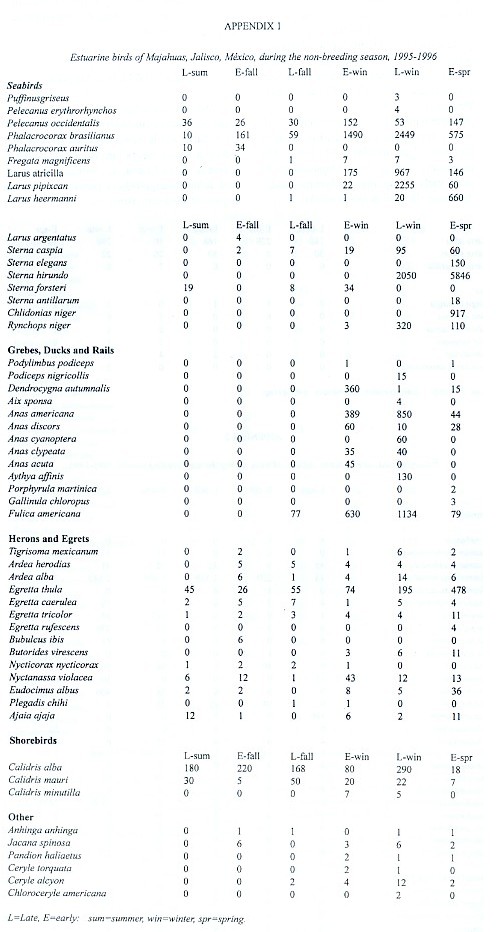
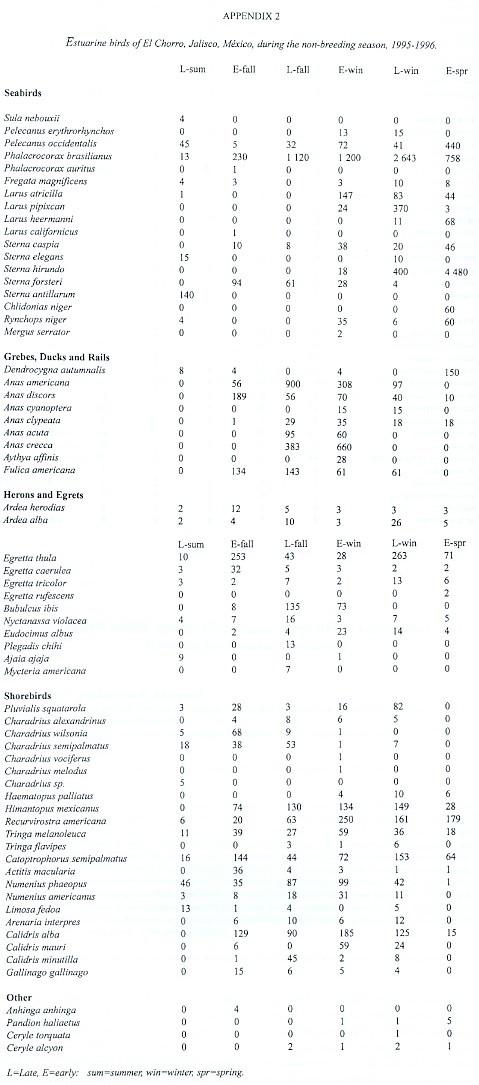
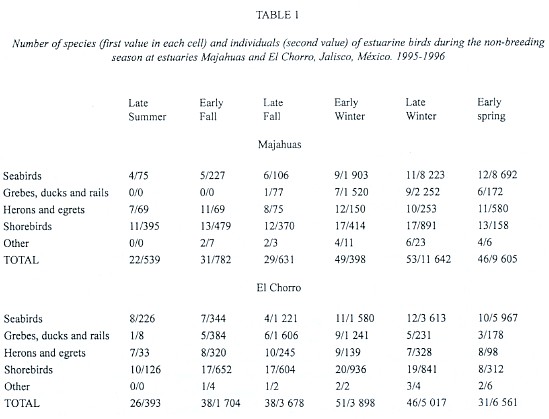
<body><![CDATA[<P><FONT FACE="Arial,Helvetica"><FONT SIZE=-1>El Chorro (132.22 ha) and Majahuas (72.39 ha) are located on the coast of Jalisco, western M&eacute;xico (19&deg;52’ N, 105&deg;23' W). El Chorro receives fresh water mostly from La Tigra and Cabeza de Otate creeks. Its coastal lagoon is separated from the sea by a 50 m-wide and 2.5 m-high barrier beach, but sea waves, rain, and most often fishermen open it periodically, allowing the wetland to empty into the sea, which causes the exposure of about 40 ha of mudflats. One side of the estuary has 7 m-high sand dunes with patches of thornscrub and low deciduous tropical forest. The area closest to the sea is vegetated with <I>Pectis arenaria</I>, <I>Okenia hypogaea</I>, <I>Tephrosia leiocarpa</I> var<I>. costenya</I>, <I>Chamaecrista chamaecristoides</I>, <I>Zinnia maritima</I>, <I>Ipomea pes-caprae</I> and <I>Jouvea pilosa</I>. The upper reaches of the sand dunes and sandy ca&ntilde;adas are covered with xerophitic scrub, which includes <I>Opuntia excelsa</I>, <I>Acacia</I> spp. and <I>Heliocereus </I>spp. The waterbody is surrounded mostly by <I>Conocarpus erectus</I> and, to a lesser degree, <I>Laguncularia racemosa</I>, <I>Hibiscus pernambucensis</I>, <I>Cenchrus brownii</I>, <I>Jouvea straminea</I>, and other grasses.</FONT></FONT>      <P><FONT FACE="Arial,Helvetica"><FONT SIZE=-1>Majahuas is 7 km SE of El Chorro. To the sides of the estuary, there are long channels along the coast separated from the sea by a 2.5 m-high barrier beach, that is about 80 m-wide near the mouth of the estuary. Fresh water comes mostly from Tomatl&aacute;n river, and the estuary is connected to the sea during most of the year. Majahuas is dominated by mangroves (63.03 ha). The channels SE of the main waterbody are dominated by<I> H. pernambucensis</I>, along with <I>Sarcostemma clausum</I>, and aquatic low-salinity vegetation, such as <I>Eichhornia crassipes</I>, <I>Crinum erubecens</I> and <I>Phragmites australis</I>, in addition to coconut palms. Along the NE channels<I> L. racemosa</I>, with small patches of<I> H. pernambucensis</I>, are the dominant vegetation, whereas <I>Ipomea pes-caprea</I> is the main plant on sand dunes. Some areas near the estuaries have been cleared for production of banana, watermelon, mango, lime, chile, corn, papaya, rice, and coconuts, or for the establishment of pasturelands.</FONT></FONT>      <P><B><FONT FACE="Arial,Helvetica"><FONT SIZE=-1>Methods</FONT></FONT></B>      <P><FONT FACE="Arial,Helvetica"><FONT SIZE=-1>Between 1 September 1995 and 25 April 1996, we visited both estuaries every 15 days. From each of five observation points (per estuary) we identified and counted all the birds in sight, with the help of 10x binoculars and a spotting telescope (60x). On each sampling date we did one count when the tide began to ebb and one when it started to rise. Each census took about three hours. The channels in Majahuas were surveyed from an fiberglass skiff with a out-of-board motor. The visits were arranged in six periods:&nbsp;&nbsp; late summer (3-15 Sep. 1995), early and late autumn (1 Oct.-3 Nov., and 17 Nov.-18 Dec., 1995, respectivity), early and late winter (5 Jan.-3 Feb., and 18&nbsp; Feb.-18 Mar., 1996, respectively), and early spring (8-25 Apr. 1996). For each species, we considered the highest tally within a period as its best estimator. The two estuaries were compared in terms of their species richness and bird abundance with chi-2 test.</FONT></FONT>     <BR><FONT FACE="Arial,Helvetica"><FONT SIZE=-1>&nbsp;</FONT></FONT>     <BR><B><FONT FACE="Arial,Helvetica"><FONT SIZE=-1>Results</FONT></FONT></B>     <BR><B><FONT FACE="Arial,Helvetica"><FONT SIZE=-1>&nbsp;</FONT></FONT></B>     <BR><FONT FACE="Arial,Helvetica"><FONT SIZE=-1><B>Wetland characteristics</B>:&nbsp;&nbsp; Two relevent differences occured between the two sites. El Chorro was basically a large and open waterbody, Majahuas a long and narrow corridor flanked by mangroves. Whereas the estuary mouth of Majahuas was kept mostly open by river discharge (except on 3 January and 16 February when it was closed), El Chorro’s mouth alternated between open and close (Open on 1 Sep., 16 Oct., 1 Nov., 15 Nov., 16 Jan., 16 Feb., 2 Mar., 8 Apr., and 24 Apr. Closed on 15 Sep., 1 Oct., 17 Dec., 3 Jan., 2 Feb., and 17 Mar). At El Chorro, during the first half of the study water flow was not sufficient to fill the coastal lagoon, even when the mouth was closed, allowing for the exposure of a large mudflat that was protected by mangrove communities and sand dunes.</FONT></FONT>      <P><FONT FACE="Arial,Helvetica"><FONT SIZE=-1><B>Species:&nbsp;&nbsp; </B>Using the high values of each period we tallied 48 848 birds of 77 species (<A HREF="#table1">Table 1</A>, Appendixes 1 and 2). Both sites were clearly dominated by seabirds, with grebes, ducks and rails, and shorebirds following with modest numbers (Table 1). Herons and egrets exhibited low numbers and “other waterbirds” where almost non-present. As a reflection of the differences in their characteristics, both estuaries shared only 58 species, and they were significantly different with respect to each other in the number of species of grebes, ducks and rails, and that of shorebirds (<A HREF="#table1">Table 1</A>, X<SUP>2</SUP>, a&lt;0.05, in both cases), and in the number of individuals in all groups (a&lt;0.01), except “other waterbirds”, which were not analized.</FONT></FONT>      <P><FONT FACE="Arial,Helvetica"><FONT SIZE=-1>The much greater abundance of seabirds was restricted to late winter and later. Moreover, the total numbers of seabirds were due to two species:&nbsp;&nbsp; <I>Sterna hirundo</I>, which accounted for 40% of all seabirds (of which 81% were tallied in a single period), and <I>Phalacrocorax brasilianus</I>, with 33% of the individuals. Of the 20 species of seabirds we never recorded more than 12 in any single period.</FONT></FONT>      ]]></body>
<body><![CDATA[<P><FONT FACE="Arial,Helvetica"><FONT SIZE=-1><I>Sterna hirundo</I> is a common species along the Mexican Pacific during fall and winter (<A HREF="#Schaldach">Schaldach 1963</A>, <A HREF="#Binford">Binford 1989</A>, <A HREF="#Howell">Howell &amp; Webb 1995</A>). We found it feeding at sea and resting on sandy areas on the barrier beach. Although there were almost twice as many <I>Sterna hirundo</I> in Majahuas as in El Chorro, the proportion of this species among the seabirds was similar at both localities (41 and 38%, respectively). <I>Phalacrocorax brasilianus</I> is a widesprad resident of the region (<A HREF="#Howell">Howell &amp; Webb 1995</A>). It fed within the coastal lagoons, and rested on sandy areas. It was proportionately more abundant at El Chorro where it accounted for 46% of all seabirds present (vs. 25% in Majahuas). Among the other common seabirds, the gulls preferred Majahuas, where they used the sandy areas.</FONT></FONT>     <CENTER><A NAME="table1"></A><IMG SRC="/img/fbpe/rbt/v49n1/2353i01.JPG" HEIGHT=419 WIDTH=549></CENTER> <FONT FACE="Arial,Helvetica"><FONT SIZE=-1>&nbsp;</FONT></FONT>     
<BR><FONT FACE="Arial,Helvetica"><FONT SIZE=-1>Seabirds exhibited a strong seasonal variation, and they gradually increased from less than 1% of the total birds tallied in late summer, to 46% in early spring. To a large degree this reflects the increase of <I>Sterna hirundo</I> during this last period. It is also notable that the <I>Phalacrocorax brasilianus</I>, despite being a local resident, was most abundant during late winter. <I>Larus heermanni</I> had their largest numbers in early spring, but the other seabird species had their maximum numbers in late winter.</FONT></FONT>      <P><FONT FACE="Arial,Helvetica"><FONT SIZE=-1>Throughout the study we observed 14 species of grebes, ducks and rails. In late summer we recorded only <I>Dendrocygna autumnalis</I>, a regional resident, and migratory species began to arrive in the fall until ten species were found in early winter. After that, species began to dissapear, and in early spring there were only seven. Number of individuals followed a similar pattern. Two species accounted for the majority of birds in this:&nbsp;&nbsp; <I>Anas americana</I> (34% of all grebes, ducks and rails) and <I>Fulica americana</I> (30%). Both are common in the area outside the breeding season, and both preferred the waterbody.</FONT></FONT>      <P><FONT FACE="Arial,Helvetica"><FONT SIZE=-1>We identified 15 species of herons and egrets throughout the study, and there were from nine to 13 species in each individual period. <I>Egretta thula</I> accounted for 64% of all herons and egrets. This species preferred mangrove associations and mudflats to rest, and shallow waters to feed. It was common throughout the study, but there was a clear reduction in numbers in late summer. This suggests that the areas are used by a number of wintering birds, but that there might also be a local breeding population. <I>Bubulcus ibis</I> had a clear concentration in late fall. At other locations along the coast of southern M&eacute;xico, this species also exhibits high numbers in the fall, and later move to cattle pastures to forage (<A HREF="#Mellink">Mellink <I>et al.</I> 1998</A>). Different species of herons and egrets had differences in the timing of the highest tallies:&nbsp;&nbsp; <I>Ardea herodias</I> and <I>Egretta caerulea</I> had their greatest abundance during early fall; <I>Plegadis chihi</I> and <I>Bubulcus ibis </I>in late fall; <I>Nyctanassa violacea</I> in early winter; <I>Ardea alba</I> in late winter; and the other species in early spring. <I>Egretta tricolor</I> was equally abundant the last two study periods. Some of these data should be taken with care, because of the low numbers involved.</FONT></FONT>      <P><FONT FACE="Arial,Helvetica"><FONT SIZE=-1>We tallied 6 178 shorebirds of 22 species throughout the study. However, two species accounted for almost half of all individuals:&nbsp;&nbsp; <I>Calidris alba</I> (24%) and <I>Himantopus mexicanus</I> (21%), with two other species having moderate numbers:&nbsp;&nbsp; <I>Catoptrophorus semipalmatus</I> and <I>Recurvirostra americana</I> (12% each). <I>Calidris alba</I> preferred the sandy habitats, such as the outside beaches of the barrier beach, and sand flats at the mouth of the estuary, while <I>Himantopus mexicanus</I>, <I>Catoptrophorus semipalmatus</I>, and <I>R. americana</I> fed in shallow waters, mudflats, and sandflats.</FONT></FONT>      <P><FONT FACE="Arial,Helvetica"><FONT SIZE=-1>Abundance of shorebirds was bimodal, with peaks in early fall and late winter, reflecting the general migration pattern of shorebirds. However, not all species of shorebirds exhibited both peaks. Those that did were the <I>Calidris mauri</I>, <I>Charadrius alexandrinus</I>, <I>C. alba</I>, <I>Catoptrophorus semipalmatus</I>, <I>H. mexicanus</I>, and <I>Pluvialis squatarola</I>. The peaks of <I>C. mauri </I>abundance were in late summer and early winter, those of <I>C. alexandrinus </I>in late summer and late winter. The other species with two peaks had one in early fall and one in late winter. <I>Actitis macularia</I>, <I>Charadrius semipalmatus</I>, <I>Charadrius wilsonia</I>, and <I>Gallinago gallinago</I> had only one peak, in in early fall. <I>Calidris minutilla</I> and T<I>ringa melanoleuca</I>, one peak in late fall; <I>Numenius americanus</I>, <I>Numenius phaeopus</I>, and <I>R. americana </I>one peak in early winter; and <I>Calidris mauri</I> and <I>Haematopus palliatus</I> one peak in late winter. The remaining species exhibited no clear peak in their abundance.</FONT></FONT>      <P><FONT FACE="Arial,Helvetica"><FONT SIZE=-1>We recoded six additional waterbirds during the study (<A HREF="#APEN1">Appendixes 1</A> and <A HREF="#APEN2">2</A>). However, their numbers were to low to merit discussion.</FONT></FONT>     <BR><FONT FACE="Arial,Helvetica"><FONT SIZE=-1>&nbsp;</FONT></FONT>     <BR><B><FONT FACE="Arial,Helvetica"><FONT SIZE=-1>Discussion</FONT></FONT></B>     ]]></body>
<body><![CDATA[<BR><B><FONT FACE="Arial,Helvetica"><FONT SIZE=-1>&nbsp;</FONT></FONT></B>     <BR><FONT FACE="Arial,Helvetica"><FONT SIZE=-1>The two estuaries summed 77 species throughout our study, 48% of all the waterbird species potentially present in the area (<A HREF="#Howell">Howell &amp; Webb 1995</A>). The avifauna at both estuaries were dominated by seabirds, especially by a very reduced number of migratory species during late winter and early spring. The two estuaries had a similar variation in the number of species of seabirds. However, the differences in habitat caused <I>Pelecanus erythrorhynchos</I>, <I>Sula nebouxii</I> and a single <I>Mycteria americana </I>to use El Chorro, only. Majahuas had a more abrupt and later increase in its richness of grebes, ducks and rails, and less variation in shorebirds than El Chorro (<A HREF="#table1">Table 1</A>). Overall, during the first four periods El Chorro had a similar, or larger, number of birds than Majahuas, but during the last two periods Majahuas greatly outnumbered it, except for the shorebirds. The seabird species that were shared by both sites either preferred Majahuas or had similar numbers in both places, except the <I>P. brasilianus</I>, which was slightly more abundant at El Chorro. This later preference was due to the conjunction of mangrove with open relatively deep, waters. The preference of most larids for Majahuas was a function of its very shallow waters in which they could stand. A similar preference has been found in wetlands of the Costa Chica of Oaxaca (<A HREF="#Mellink">Mellink <I>et al. </I>1998</A>).</FONT></FONT>      <P><FONT FACE="Arial,Helvetica"><FONT SIZE=-1>The late winter change in preference by <I>A. americana </I>appears to have been the result of the exposure of the mudflat at El Chorro. The <I>D. autumnalis </I>change from Majahuas to El Chorro in early spring might reflect its wandering behavior (<A HREF="#Howell">Howell &amp; Webb 1995</A>).</FONT></FONT>      <P><FONT FACE="Arial,Helvetica"><FONT SIZE=-1>Only two species of herons and egrets clearly preferred one of the sites. The preference of the <I>B. ibis </I>for El Chorro and its near-abscence from Majahuas is puzzling as this is a very common occupant of other well vegetated tropical wetlands (<A HREF="#Mellink">Mellink <I>et al. </I>1998</A>). Although the <I>E. thula </I>preferred Majahuas, this preference developed only after the water level of El Chorro rised inundating habitat it had been using.</FONT></FONT>      <P><FONT FACE="Arial,Helvetica"><FONT SIZE=-1>The preference of mid-sized and large shorebirds, except <I>H. mexicanus </I>(and, in this species because of one event of high abundance), and several small shorebirds (<I>A. macularia</I>, <I>Arenaria interpres</I>, <I>C. minutilla</I>, <I>Charadrius semipalmatus</I>, <I>C. wilsonia</I> and, and <I>P. squatarola</I>) for El Chorro, appeared to be a response to its larger mudflats. The preference of <I>C. alba</I>, <I>C. mauri</I>, and <I>C. alexandrinus</I> for Majahuas was due to its sandier habitat.</FONT></FONT>      <P><FONT FACE="Arial,Helvetica"><FONT SIZE=-1>Despite the differences between both estuaries, the migratory birds that used them produced a seasonal pattern, more than a locality pattern. The importance of resident species, which have more defined habitat preferences, was swamped by the numbers of the migratory birds. The high dynamism of the avifauna of the two estuaries was a function of the migration of the species that used them, but also of the status of the mouth of one estuary, which caused changes in the availability of certain habitats inside the estuary and according movements of birds between estuaries. So, rather than two different estuaries, they should be considered, and managed, as a single, coherent unit.</FONT></FONT>     <BR><FONT FACE="Arial,Helvetica"><FONT SIZE=-1>&nbsp;</FONT></FONT>     <BR><B><FONT FACE="Arial,Helvetica"><FONT SIZE=-1>Acknowledgments</FONT></FONT></B>     <BR><B><FONT FACE="Arial,Helvetica"><FONT SIZE=-1>&nbsp;</FONT></FONT></B>     <BR><FONT FACE="Arial,Helvetica"><FONT SIZE=-1>We acknowledge support or assistance from Manoment Birds Observatory, Francisco de A. Silva and E. Santana-Castell&oacute;n, the Cooperativa "Roca Negra" in Valle de Majahuas. Horacio de la Cueva, C. Valadez Gonz&aacute;lez, and Juli&aacute;n Monge-N&aacute;jera provided important comments and criticisms.</FONT></FONT>     ]]></body>
<body><![CDATA[<BR><FONT FACE="Arial,Helvetica"><FONT SIZE=-1>&nbsp;</FONT></FONT>     <BR><B><FONT FACE="Arial,Helvetica"><FONT SIZE=-1>Resumen</FONT></FONT></B>      <P><FONT FACE="Arial,Helvetica"><FONT SIZE=-1>Durante la estaci&oacute;n no reproductiva de 1995-1996 estudiamos las aves acu&aacute;ticas de los estuarios El Chorro y Majahuas, Jalisco, M&eacute;xico.&nbsp; El Chorro es un cuerpo de agua m&aacute;s abierto, mientras que Majahuas est&aacute; formado por canales rodeados por manglares. Registramos 77 especies de aves. Las aves marinas comprendieron el 66%, los patos y similares el 16%, las aves playeras el 12% y las garzas el 5%. <I>Sterna hirundo</I> y <I>Phalacrocorax brasilianus</I> representaron el 40 y 33%, respectivamente, del total de aves marinas. El que la bocabarra de El Chorro estuviera abierta o cerrada influy&oacute; en la concentraci&oacute;n de aves en los dos esteros, debido a la exposici&oacute;n o inundaci&oacute;n de &aacute;reas lodosas y arenosas. A pesar de las diferencias entre los dos estuarios, la &eacute;poca del a&ntilde;o fue m&aacute;s importante en la composici&oacute;n de las comunidades de aves. Ambos esteros deben considerarse como una sola entidad ecol&oacute;gica.</FONT></FONT>      <P><FONT FACE="Arial,Helvetica"><FONT SIZE=-1><B>Palabras clave:&nbsp;</B>&nbsp; Aves acu&aacute;ticas costeras, Jalisco, M&eacute;xico, estacionalidad</FONT></FONT>     <BR><FONT FACE="Arial,Helvetica"><FONT SIZE=-1>&nbsp;&nbsp;</FONT></FONT>     <BR><B><FONT FACE="Arial,Helvetica"><FONT SIZE=-1>References</FONT></FONT></B>     <BR><B><FONT FACE="Arial,Helvetica"><FONT SIZE=-1>&nbsp;</FONT></FONT></B>     <!-- ref --><BR><A NAME="Binford"></A><FONT FACE="Arial,Helvetica"><FONT SIZE=-1>Binford, L.C. 1989. A distributional survey of the birds of the Mexican state of Oaxaca. Ornithol. Monog. 43: 1-412.</FONT></FONT>    &nbsp;&nbsp;&nbsp;&nbsp;&nbsp;&nbsp;&nbsp;&nbsp;[&#160;<a href="javascript:void(0);" onclick="javascript: window.open('/scielo.php?script=sci_nlinks&ref=1348517&pid=S0034-7744200100010003500001&lng=','','width=640,height=500,resizable=yes,scrollbars=1,menubar=yes,');">Links</a>&#160;]<!-- end-ref --><!-- ref --><P><A NAME="Blem"></A><FONT FACE="Arial,Helvetica"><FONT SIZE=-1>Blem, C. R. 1980. The energetics of migration, p.175-224 <I>In</I> Gauthreaux (ed.), Animal migration, orientation, and navigation. Academic, New York.</FONT></FONT>    &nbsp;&nbsp;&nbsp;&nbsp;&nbsp;&nbsp;&nbsp;&nbsp;[&#160;<a href="javascript:void(0);" onclick="javascript: window.open('/scielo.php?script=sci_nlinks&ref=1348518&pid=S0034-7744200100010003500002&lng=','','width=640,height=500,resizable=yes,scrollbars=1,menubar=yes,');">Links</a>&#160;]<!-- end-ref --><!-- ref --><P><A NAME="Clark"></A><FONT FACE="Arial,Helvetica"><FONT SIZE=-1>Clark, K.E., L.J. Niles &amp; J. Burger. 1993. Abundance and distribution of migrant shorebirds in Delaware Bay. Condor 95:&nbsp; 604-705.</FONT></FONT>    &nbsp;&nbsp;&nbsp;&nbsp;&nbsp;&nbsp;&nbsp;&nbsp;[&#160;<a href="javascript:void(0);" onclick="javascript: window.open('/scielo.php?script=sci_nlinks&ref=1348519&pid=S0034-7744200100010003500003&lng=','','width=640,height=500,resizable=yes,scrollbars=1,menubar=yes,');">Links</a>&#160;]<!-- end-ref --><!-- ref --><P><A NAME="Goss"></A><FONT FACE="Arial,Helvetica"><FONT SIZE=-1>Goss-Custard, J.D. 1977. The ecology of the Wash. III. Density related behaviour and the possible effects of a loss of feeding grounds on wading birds (Charadrii). J. Appl. Ecol. 14: 721-739.</FONT></FONT>    &nbsp;&nbsp;&nbsp;&nbsp;&nbsp;&nbsp;&nbsp;&nbsp;[&#160;<a href="javascript:void(0);" onclick="javascript: window.open('/scielo.php?script=sci_nlinks&ref=1348520&pid=S0034-7744200100010003500004&lng=','','width=640,height=500,resizable=yes,scrollbars=1,menubar=yes,');">Links</a>&#160;]<!-- end-ref --><!-- ref --><P><A NAME="Howell"></A><FONT FACE="Arial,Helvetica"><FONT SIZE=-1>Howell, S.N.G. &amp; S. Webb. 1995. A guide to the birds of Mexico and northern Central America. Oxford University. New York. 851 pp.</FONT></FONT>    &nbsp;&nbsp;&nbsp;&nbsp;&nbsp;&nbsp;&nbsp;&nbsp;[&#160;<a href="javascript:void(0);" onclick="javascript: window.open('/scielo.php?script=sci_nlinks&ref=1348521&pid=S0034-7744200100010003500005&lng=','','width=640,height=500,resizable=yes,scrollbars=1,menubar=yes,');">Links</a>&#160;]<!-- end-ref --><!-- ref --><P><A NAME="Mellink"></A><FONT FACE="Arial,Helvetica"><FONT SIZE=-1>Mellink, E., J. Lu&eacute;vano &amp; I. Zuria. 1998. Nota sobre los pelecaniformes, ciconiiformes, gallitos marinos (Sterninae) y rayadores (Rynchopinae) de la Costa Chica de Oaxaca, M&eacute;xico. Ciencias Marinas. 24: 367-388.</FONT></FONT>    &nbsp;&nbsp;&nbsp;&nbsp;&nbsp;&nbsp;&nbsp;&nbsp;[&#160;<a href="javascript:void(0);" onclick="javascript: window.open('/scielo.php?script=sci_nlinks&ref=1348522&pid=S0034-7744200100010003500006&lng=','','width=640,height=500,resizable=yes,scrollbars=1,menubar=yes,');">Links</a>&#160;]<!-- end-ref --><!-- ref --><P><A NAME="Morrison"></A><FONT FACE="Arial,Helvetica"><FONT SIZE=-1>Morrison, R.I.G. 1984. Migration systems of some New World shorebirds, Behav. Mar. Anim. 6: 125-202.</FONT></FONT>    &nbsp;&nbsp;&nbsp;&nbsp;&nbsp;&nbsp;&nbsp;&nbsp;[&#160;<a href="javascript:void(0);" onclick="javascript: window.open('/scielo.php?script=sci_nlinks&ref=1348523&pid=S0034-7744200100010003500007&lng=','','width=640,height=500,resizable=yes,scrollbars=1,menubar=yes,');">Links</a>&#160;]<!-- end-ref --><!-- ref --><P><A NAME="Myers83"></A><FONT FACE="Arial,Helvetica"><FONT SIZE=-1>Myers, J.P. 1983. Conservation of migrating shorebirds:&nbsp; Staging areas, geographic bottlenecks, and regional movements. Amer. Birds 37: 23-25.</FONT></FONT>    &nbsp;&nbsp;&nbsp;&nbsp;&nbsp;&nbsp;&nbsp;&nbsp;[&#160;<a href="javascript:void(0);" onclick="javascript: window.open('/scielo.php?script=sci_nlinks&ref=1348524&pid=S0034-7744200100010003500008&lng=','','width=640,height=500,resizable=yes,scrollbars=1,menubar=yes,');">Links</a>&#160;]<!-- end-ref --><P><A NAME="Myers87"></A><FONT FACE="Arial,Helvetica"><FONT SIZE=-1>Myers, J.P., R.I.G. Morrison, P.Z. Antas, B.A. Harrington, T.E. Lovejoy, M. Sallaberry, S.E. Senner &amp; A.Tarak. 1987. Conservation strategy for migratory species. Amer. Scient. 75: 18-26.</FONT></FONT>      <!-- ref --><P><A NAME="Saunders"></A><FONT FACE="Arial,Helvetica"><FONT SIZE=-1>Saunders, G.B. &amp; D.Ch. Saunders. 1981. Waterfowl and their wintering grounds in M&eacute;xico 1937-64. Fish and Wildlife Service Resource Publication 138. Washington, D.C. 151 pp.</FONT></FONT>    &nbsp;&nbsp;&nbsp;&nbsp;&nbsp;&nbsp;&nbsp;&nbsp;[&#160;<a href="javascript:void(0);" onclick="javascript: window.open('/scielo.php?script=sci_nlinks&ref=1348526&pid=S0034-7744200100010003500010&lng=','','width=640,height=500,resizable=yes,scrollbars=1,menubar=yes,');">Links</a>&#160;]<!-- end-ref --><!-- ref --><P><A NAME="Schaldach"></A><FONT FACE="Arial,Helvetica"><FONT SIZE=-1>Schaldach, W.J., Jr. 1963. The avifauna of Colima and adjacent Jalisco, Mexico. Proc. W. Found. Verteb. Zool. 1: 1-100.</FONT></FONT>    &nbsp;&nbsp;&nbsp;&nbsp;&nbsp;&nbsp;&nbsp;&nbsp;[&#160;<a href="javascript:void(0);" onclick="javascript: window.open('/scielo.php?script=sci_nlinks&ref=1348527&pid=S0034-7744200100010003500011&lng=','','width=640,height=500,resizable=yes,scrollbars=1,menubar=yes,');">Links</a>&#160;]<!-- end-ref --><!-- ref --><P><A NAME="Scott"></A><FONT FACE="Arial,Helvetica"><FONT SIZE=-1>Scott, D.A. &amp; M. Carbonell. 1986. A Directory of neotropical wetlands. International Union for Conservation of Nature and Natural Resources and International Waterfowl Research Bureau. Cambridge, U.K.</FONT></FONT>    &nbsp;&nbsp;&nbsp;&nbsp;&nbsp;&nbsp;&nbsp;&nbsp;[&#160;<a href="javascript:void(0);" onclick="javascript: window.open('/scielo.php?script=sci_nlinks&ref=1348528&pid=S0034-7744200100010003500012&lng=','','width=640,height=500,resizable=yes,scrollbars=1,menubar=yes,');">Links</a>&#160;]<!-- end-ref --><!-- ref --><P><A NAME="Senner"></A><FONT FACE="Arial,Helvetica"><FONT SIZE=-1>Senner, S.E. 1979. An evaluation on the Copper River delta as critical habitat for migrating shorebirds, en F.A. Pitelka (ed.). Stud. Avian Biol. 2: 131-146.</FONT></FONT>    &nbsp;&nbsp;&nbsp;&nbsp;&nbsp;&nbsp;&nbsp;&nbsp;[&#160;<a href="javascript:void(0);" onclick="javascript: window.open('/scielo.php?script=sci_nlinks&ref=1348529&pid=S0034-7744200100010003500013&lng=','','width=640,height=500,resizable=yes,scrollbars=1,menubar=yes,');">Links</a>&#160;]<!-- end-ref --><BR><FONT FACE="Arial,Helvetica"><FONT SIZE=-1>&nbsp;</FONT></FONT>     <BR><FONT FACE="Arial,Helvetica"><FONT SIZE=-1>&nbsp;</FONT></FONT>     <BR><A NAME="A1"></A><FONT FACE="Arial,Helvetica"><FONT SIZE=-1><SUP><A HREF="#R1">1</A></SUP> Centro de Ecolog&iacute;a Costera, Universidad de Guadalajara. G&oacute;mez Far&iacute;as No.82. 48980 San Patricio Melaque, Municipio de Cihuatl&aacute;n, Jalisco, M&eacute;xico. Fax: 52 (335) 56331. <A HREF="mailto:sahernan@costera.melaque.udg.mx.">sahernan@costera.melaque.udg.mx.</A></FONT></FONT>      <P><FONT FACE="Arial,Helvetica"><FONT SIZE=-1><SUP><A HREF="#R1">2</A></SUP> Centro de Investigaci&oacute;n Cient&iacute;fica y de Educaci&oacute;n Superior de Ensenada. Apdo. Postal 2732. Ensenada, Baja California, M&eacute;xico.<U> <A HREF="mailto:emellink@cicese.mx">emellink@cicese.mx</A></U>&nbsp;</FONT></FONT>     <BR>&nbsp;     <CENTER><A NAME="APEN1"></A><IMG SRC="/img/fbpe/rbt/v49n1/2353i02.JPG" HEIGHT=932 WIDTH=496></CENTER>      
<CENTER>&nbsp;</CENTER>      <CENTER><A NAME="APEN2"></A><IMG SRC="/img/fbpe/rbt/v49n1/2353i03.JPG" HEIGHT=1085 WIDTH=479></CENTER>      
 ]]></body><back>
<ref-list>
<ref id="B1">
<nlm-citation citation-type="journal">
<person-group person-group-type="author">
<name>
<surname><![CDATA[Binford]]></surname>
<given-names><![CDATA[L.C]]></given-names>
</name>
</person-group>
<article-title xml:lang="en"><![CDATA[A distributional survey of the birds of the Mexican state of Oaxaca]]></article-title>
<source><![CDATA[Ornithol. Monog]]></source>
<year>1989</year>
<volume>43</volume>
<page-range>1-412</page-range></nlm-citation>
</ref>
<ref id="B2">
<nlm-citation citation-type="book">
<person-group person-group-type="author">
<name>
<surname><![CDATA[Blem]]></surname>
<given-names><![CDATA[C. R]]></given-names>
</name>
</person-group>
<article-title xml:lang="en"><![CDATA[The energetics of migration]]></article-title>
<person-group person-group-type="editor">
<name>
<surname><![CDATA[Gauthreaux]]></surname>
</name>
</person-group>
<source><![CDATA[Animal migration: orientation, and navigation]]></source>
<year>1980</year>
<page-range>175-224</page-range><publisher-loc><![CDATA[New York ]]></publisher-loc>
<publisher-name><![CDATA[Academic]]></publisher-name>
</nlm-citation>
</ref>
<ref id="B3">
<nlm-citation citation-type="journal">
<person-group person-group-type="author">
<name>
<surname><![CDATA[Clark]]></surname>
<given-names><![CDATA[K.E]]></given-names>
</name>
<name>
<surname><![CDATA[Niles]]></surname>
<given-names><![CDATA[L.J]]></given-names>
</name>
<name>
<surname><![CDATA[Burger]]></surname>
<given-names><![CDATA[J]]></given-names>
</name>
</person-group>
<article-title xml:lang="en"><![CDATA[Abundance and distribution of migrant shorebirds in Delaware Bay]]></article-title>
<source><![CDATA[Condor]]></source>
<year>1993</year>
<volume>95</volume>
<page-range>604-705</page-range></nlm-citation>
</ref>
<ref id="B4">
<nlm-citation citation-type="journal">
<person-group person-group-type="author">
<name>
<surname><![CDATA[Goss-Custard]]></surname>
<given-names><![CDATA[J.D]]></given-names>
</name>
</person-group>
<article-title xml:lang="en"><![CDATA[The ecology of the Wash. III. Density related behaviour and the possible effects of a loss of feeding grounds on wading birds (Charadrii)]]></article-title>
<source><![CDATA[J. Appl. Ecol]]></source>
<year>1977</year>
<volume>14</volume>
<page-range>721-739</page-range></nlm-citation>
</ref>
<ref id="B5">
<nlm-citation citation-type="book">
<person-group person-group-type="author">
<name>
<surname><![CDATA[Howell]]></surname>
<given-names><![CDATA[S.N.G]]></given-names>
</name>
<name>
<surname><![CDATA[Webb]]></surname>
<given-names><![CDATA[S]]></given-names>
</name>
</person-group>
<source><![CDATA[A guide to the birds of Mexico and northern Central America]]></source>
<year>1995</year>
<page-range>851</page-range><publisher-loc><![CDATA[New York ]]></publisher-loc>
<publisher-name><![CDATA[Oxford University]]></publisher-name>
</nlm-citation>
</ref>
<ref id="B6">
<nlm-citation citation-type="journal">
<person-group person-group-type="author">
<name>
<surname><![CDATA[Mellink]]></surname>
<given-names><![CDATA[E]]></given-names>
</name>
<name>
<surname><![CDATA[Luévano]]></surname>
<given-names><![CDATA[J]]></given-names>
</name>
<name>
<surname><![CDATA[Zuria]]></surname>
<given-names><![CDATA[I]]></given-names>
</name>
</person-group>
<article-title xml:lang="es"><![CDATA[Nota sobre los pelecaniformes, ciconiiformes, gallitos marinos (Sterninae) y rayadores (Rynchopinae) de la Costa Chica de Oaxaca, México]]></article-title>
<source><![CDATA[Ciencias Marinas]]></source>
<year>1998</year>
<volume>24</volume>
<page-range>367-388</page-range></nlm-citation>
</ref>
<ref id="B7">
<nlm-citation citation-type="journal">
<person-group person-group-type="author">
<name>
<surname><![CDATA[Morrison]]></surname>
<given-names><![CDATA[R.I.G]]></given-names>
</name>
</person-group>
<article-title xml:lang="en"><![CDATA[Migration systems of some New World shorebirds]]></article-title>
<source><![CDATA[Behav. Mar. Anim]]></source>
<year>1984</year>
<volume>6</volume>
<page-range>125-202</page-range></nlm-citation>
</ref>
<ref id="B8">
<nlm-citation citation-type="journal">
<person-group person-group-type="author">
<name>
<surname><![CDATA[Myers]]></surname>
<given-names><![CDATA[J.P]]></given-names>
</name>
</person-group>
<article-title xml:lang="en"><![CDATA[Conservation of migrating shorebirds: Staging areas, geographic bottlenecks, and regional movements]]></article-title>
<source><![CDATA[Amer. Birds]]></source>
<year>1983</year>
<volume>37</volume>
<page-range>23-25</page-range></nlm-citation>
</ref>
<ref id="B9">
<nlm-citation citation-type="journal">
<person-group person-group-type="author">
<name>
<surname><![CDATA[Myers]]></surname>
<given-names><![CDATA[J.P]]></given-names>
</name>
<name>
<surname><![CDATA[Morrison]]></surname>
<given-names><![CDATA[R.I.G]]></given-names>
</name>
<name>
<surname><![CDATA[Antas]]></surname>
<given-names><![CDATA[P.Z]]></given-names>
</name>
<name>
<surname><![CDATA[Harrington]]></surname>
<given-names><![CDATA[B.A]]></given-names>
</name>
<name>
<surname><![CDATA[Lovejoy]]></surname>
<given-names><![CDATA[T.E]]></given-names>
</name>
<name>
<surname><![CDATA[Sallaberry]]></surname>
<given-names><![CDATA[M]]></given-names>
</name>
<name>
<surname><![CDATA[Senner]]></surname>
<given-names><![CDATA[S.E]]></given-names>
</name>
</person-group>
<article-title xml:lang="en"><![CDATA[Conservation strategy for migratory species]]></article-title>
<source><![CDATA[Amer. Scient]]></source>
<year>1987</year>
<volume>75</volume>
<page-range>18-26</page-range></nlm-citation>
</ref>
<ref id="B10">
<nlm-citation citation-type="">
<person-group person-group-type="author">
<name>
<surname><![CDATA[Saunders]]></surname>
<given-names><![CDATA[G.B]]></given-names>
</name>
<name>
<surname><![CDATA[Saunders]]></surname>
<given-names><![CDATA[D.Ch]]></given-names>
</name>
</person-group>
<source><![CDATA[Waterfowl and their wintering grounds in México 1937-64]]></source>
<year>1981</year>
<volume>138</volume>
<page-range>151</page-range><publisher-loc><![CDATA[Washington, D.C ]]></publisher-loc>
</nlm-citation>
</ref>
<ref id="B11">
<nlm-citation citation-type="journal">
<person-group person-group-type="author">
<name>
<surname><![CDATA[Schaldach]]></surname>
<given-names><![CDATA[W.J]]></given-names>
</name>
</person-group>
<article-title xml:lang="en"><![CDATA[The avifauna of Colima and adjacent Jalisco, Mexico]]></article-title>
<source><![CDATA[Proc. W. Found. Verteb. Zool]]></source>
<year>1963</year>
<volume>1</volume>
<page-range>1-100</page-range></nlm-citation>
</ref>
<ref id="B12">
<nlm-citation citation-type="book">
<person-group person-group-type="author">
<name>
<surname><![CDATA[Scott]]></surname>
<given-names><![CDATA[D.A]]></given-names>
</name>
<name>
<surname><![CDATA[Carbonell]]></surname>
<given-names><![CDATA[M]]></given-names>
</name>
</person-group>
<source><![CDATA[A Directory of neotropical wetlands]]></source>
<year>1986</year>
<publisher-loc><![CDATA[Cambridge ]]></publisher-loc>
<publisher-name><![CDATA[International Union for Conservation of Nature and Natural Resources and International Waterfowl Research Bureau]]></publisher-name>
</nlm-citation>
</ref>
<ref id="B13">
<nlm-citation citation-type="journal">
<person-group person-group-type="author">
<name>
<surname><![CDATA[Senner]]></surname>
<given-names><![CDATA[S.E]]></given-names>
</name>
</person-group>
<article-title xml:lang="en"><![CDATA[An evaluation on the Copper River delta as critical habitat for migrating shorebirds, en F.A. Pitelka (ed.)]]></article-title>
<source><![CDATA[Stud. Avian Biol]]></source>
<year>1979</year>
<volume>2</volume>
<page-range>131-146</page-range></nlm-citation>
</ref>
</ref-list>
</back>
</article>