<?xml version="1.0" encoding="ISO-8859-1"?><article xmlns:mml="http://www.w3.org/1998/Math/MathML" xmlns:xlink="http://www.w3.org/1999/xlink" xmlns:xsi="http://www.w3.org/2001/XMLSchema-instance">
<front>
<journal-meta>
<journal-id>0034-7744</journal-id>
<journal-title><![CDATA[Revista de Biología Tropical]]></journal-title>
<abbrev-journal-title><![CDATA[Rev. biol. trop]]></abbrev-journal-title>
<issn>0034-7744</issn>
<publisher>
<publisher-name><![CDATA[Universidad de Costa Rica]]></publisher-name>
</publisher>
</journal-meta>
<article-meta>
<article-id>S0034-77442001000100029</article-id>
<title-group>
<article-title xml:lang="es"><![CDATA[Plantas hospederas de Aphis gossypii (Aphididae), vector de virus del melón Cucumis melo (Cucurbitaceae) en Costa Rica]]></article-title>
</title-group>
<contrib-group>
<contrib contrib-type="author">
<name>
<surname><![CDATA[Sánchez]]></surname>
<given-names><![CDATA[M.V.]]></given-names>
</name>
<xref ref-type="aff" rid="A01"/>
</contrib>
<contrib contrib-type="author">
<name>
<surname><![CDATA[Agüero]]></surname>
<given-names><![CDATA[R.]]></given-names>
</name>
<xref ref-type="aff" rid="A02"/>
</contrib>
<contrib contrib-type="author">
<name>
<surname><![CDATA[Rivera]]></surname>
<given-names><![CDATA[C.]]></given-names>
</name>
<xref ref-type="aff" rid="A01"/>
</contrib>
</contrib-group>
<aff id="A01">
<institution><![CDATA[,Universidad de Costa Rica Centro de Investigación en Biología Celular y Molecular ]]></institution>
<addr-line><![CDATA[San José ]]></addr-line>
<country>Costa Rica</country>
</aff>
<aff id="A02">
<institution><![CDATA[,Universidad de Costa Rica Instituto de Investigaciones Agronómicas ]]></institution>
<addr-line><![CDATA[San José ]]></addr-line>
<country>Costa Rica</country>
</aff>
<pub-date pub-type="pub">
<day>00</day>
<month>03</month>
<year>2001</year>
</pub-date>
<pub-date pub-type="epub">
<day>00</day>
<month>03</month>
<year>2001</year>
</pub-date>
<volume>49</volume>
<numero>1</numero>
<fpage>305</fpage>
<lpage>311</lpage>
<copyright-statement/>
<copyright-year/>
<self-uri xlink:href="http://www.scielo.sa.cr/scielo.php?script=sci_arttext&amp;pid=S0034-77442001000100029&amp;lng=en&amp;nrm=iso"></self-uri><self-uri xlink:href="http://www.scielo.sa.cr/scielo.php?script=sci_abstract&amp;pid=S0034-77442001000100029&amp;lng=en&amp;nrm=iso"></self-uri><self-uri xlink:href="http://www.scielo.sa.cr/scielo.php?script=sci_pdf&amp;pid=S0034-77442001000100029&amp;lng=en&amp;nrm=iso"></self-uri><abstract abstract-type="short" xml:lang="en"><p><![CDATA[Plant species associated with commercial melon crops and surrounding areas were examined to identity the natural host plants of Aphis gossypii Glover. The study was conducted in two farms located in different melon production areas and plant life zones of Costa Rica. Plant species diversity, percent coverage and distribution over time were recorded during one year. Differences between locations were observed. A total of 86 plant species (49 families) and 72 plant species (40 families) were identified associated to the crop in farms A and B, respectively. In both farms a total of 24 species plants (16 families) were colonized by A. gossypii and 16 (10 families) are new reports of host plant species for this aphid. The new reports are: Justicia comata, Tetramerium nervosum, Alternanthera pubiflora, Cassia massoni, C. reticulata, Cleome viscosa, C. spinosa, Croton argenteus, Caperonia palustris, Chamaesyce gyssopilopia, Phyllantus amarus, Sida decumbens, Ludwigia erecta, Passiflora foetida, Guazuma ulmifolia and Corchorus orinocensis.]]></p></abstract>
<abstract abstract-type="short" xml:lang="es"><p><![CDATA[Se identificaron las especies hospederas naturales de Aphis gossypii Glover (Aphididae: Homoptera) en plantaciones comerciales de melón para la exportación en Costa Rica. El estudio se realizó en dos fincas, ubicadas una en la provincia de Guanacaste y la otra en la provincia de Puntarenas, correspondientes a dos zonas de vida vegetal diferentes. Se identificaron como especies hospederas del áfido todas aquellas especies vegetales en las que se observó la presencia del áfido en su forma áptera. En ambas fincas el estudio se realizó en los alrededores y dentro del cultivo de melón. En la finca A en cinco diferentes comunidades vegetales (cultivo, canal de drenaje, charral, potrero mejorado y semi-bosque) previamente seleccionadas y en la finca B en cuatro comunidades vegetales (cultivo, charral, pastizal natural y semi-bosque). Especímenes de las plantas colonizadas por áfidos y los áfidos colonizadores de cada especie fueron recolectadas para su identificación. Los áfidos se preservaron en alcohol al 70% v/v e identificaron utilizando las claves taxonómicas para áfidos, confirmándose como especie dominante a A. gossypii. La diversidad, cobertura y época de aparición de las especies de plantas hospederas fue monitoreada durante un año calendario en las diferentes comunidades vegetales presentes en ambas fincas, observándose diferencias entre las dos fincas estudiadas. En la finca A se observaron 86 diferentes especies vegetales, pertenecientes a 49 familias, asociadas al cultivo del melón, mientras que en la finca B se identificaron 72 especies de 40 familias. En conjunto para ambas fincas, un de 24 especies de plantas (16 familias) estaban colonizadas por el áfido A. gossypii. De éstas, 16 especies de 10 familias, son reportes nuevos de plantas hospederas para este áfido: Justicia comata, Tetramerium nervosum, Alternanthera pubiflora, Cassia massoni, C. reticulata, Cleome viscosa, C. spinosa, Croton argenteus, Caperonia palustris, Chamaesyce gyssopilopia, Phyllantus amarus, Sida decumbens, Ludwigia erecta, Passiflora foetida, Guazuma ulmifolia y Corchorus orinocensis.]]></p></abstract>
<kwd-group>
<kwd lng="en"><![CDATA[Cucurbitaceae]]></kwd>
<kwd lng="en"><![CDATA[aphids host plants]]></kwd>
<kwd lng="en"><![CDATA[papaya ringspot virus]]></kwd>
<kwd lng="en"><![CDATA[watermelon mosaic virus-2]]></kwd>
<kwd lng="en"><![CDATA[cucumber mosaic virus]]></kwd>
<kwd lng="en"><![CDATA[zucchini mosaic virus]]></kwd>
</kwd-group>
</article-meta>
</front><body><![CDATA[ <CENTER><B><FONT FACE="Arial,Helvetica">Plantas hospederas de <I>Aphis gossypii</I> (Aphididae), vector de virus del mel&oacute;n <I>Cucumis melo </I>(Cucurbitaceae) en Costa Rica</FONT></B></CENTER> <FONT FACE="Arial,Helvetica"><FONT SIZE=-1>&nbsp;</FONT></FONT>     <BR><FONT FACE="Arial,Helvetica"><FONT SIZE=-1>&nbsp;</FONT></FONT>     <BR><FONT FACE="Arial,Helvetica"><FONT SIZE=-1>M.V. S&aacute;nchez<A NAME="R1"></A><SUP><A HREF="#A1">1</A></SUP>, R. Ag&uuml;ero<SUP><A HREF="#A1">2</A></SUP> y C. Rivera<SUP><A HREF="#A1">1</A></SUP>.</FONT></FONT>     <BR><FONT FACE="Arial,Helvetica"><FONT SIZE=-1>&nbsp;</FONT></FONT>     <BR><FONT FACE="Arial,Helvetica"><FONT SIZE=-1>Recibido&nbsp;&nbsp; 14-II-2000.&nbsp;&nbsp;&nbsp; Corregido&nbsp;&nbsp; 10-VII-2000.&nbsp;&nbsp; Aceptado&nbsp; 31-VII-2000.</FONT></FONT><FONT FACE="Arial,Helvetica"><FONT SIZE=-1></FONT></FONT>      <P><B><FONT FACE="Arial,Helvetica"><FONT SIZE=-1>Abstract</FONT></FONT></B>     <BR><B><FONT FACE="Arial,Helvetica"><FONT SIZE=-1>&nbsp;</FONT></FONT></B>     <BR><FONT FACE="Arial,Helvetica"><FONT SIZE=-1>Plant species associated with commercial melon crops and surrounding areas were examined to identity the natural host plants<B> </B>of<I> Aphis gossypii </I>Glover. The study was conducted in two farms located in different melon production areas and plant life zones of Costa Rica. Plant species diversity, percent coverage and distribution over time were recorded during one year. Differences between locations were observed. A total of 86 plant species (49 families) and 72 plant species (40 families) were identified associated to the crop in farms A and B, respectively.&nbsp; In both farms a total of 24 species plants (16 families) were colonized by<I> A. gossypii </I>and 16 (10 families) are new reports of<I> </I>host plant species for this aphid. The new reports are:&nbsp;<I> Justicia comata, Tetramerium nervosum, Alternanthera pubiflora, Cassia massoni, C. reticulata, Cleome viscosa, C. spinosa, Croton argenteus, Caperonia palustris, Chamaesyce gyssopilopia, Phyllantus amarus, Sida decumbens, Ludwigia erecta, Passiflora foetida, Guazuma ulmifolia </I>and<I> Corchorus orinocensis</I>.</FONT></FONT><FONT FACE="Arial,Helvetica"><FONT SIZE=-1></FONT></FONT>      <P><FONT FACE="Arial,Helvetica"><FONT SIZE=-1><B>Key words:&nbsp;</B> Cucurbitaceae, aphids host plants, papaya ringspot virus, watermelon mosaic virus-2, cucumber mosaic virus, zucchini mosaic virus.</FONT></FONT>     <BR><FONT FACE="Arial,Helvetica"><FONT SIZE=-1>&nbsp;</FONT></FONT><FONT FACE="Arial,Helvetica"><FONT SIZE=-1></FONT></FONT>      ]]></body>
<body><![CDATA[<P><FONT FACE="Arial,Helvetica"><FONT SIZE=-1>Los virus del mosaico del pepino (cucumber mosaic virus, CMV) (<A HREF="#Francki">Francki <I>et al.&nbsp;</I> 1979</A>), de la mancha anular de la papaya (papaya ringspot virus, PRSV) (<A HREF="#Purcifull84b">Purcifull <I>et al.&nbsp; </I>1984b</A>), del mosaico de la sand&iacute;a 2 (watermelon mosaic virus 2, WMV 2) (<A HREF="#Purcifull84a">Purcifull <I>et al.&nbsp; </I>1984a</A>) y del mosaico amarillo del zapallo italiano (zucchini yellow mosaic virus, ZYMV) (<A HREF="#Lisa">Lisa &amp; Lecoq 1984</A>) son importantes limitaciones para la producci&oacute;n de mel&oacute;n en Costa Rica (<A HREF="#Rivera">Rivera <I>et al.&nbsp;</I> 1993</A>). Estos virus son transmitidos en el campo en forma no persistente por varias especies de &aacute;fidos (<A HREF="#Francki">Francki <I>et al.&nbsp;</I> 1979</A>; <A HREF="#Lisa">Lisa &amp; Lecoq 1984</A>; <A HREF="#Purcifull84a">Purcifull <I>et al.&nbsp; </I>1984</A>). <I>Aphis gossypii</I> es la especie vector m&aacute;s abundante y prevaleciente en las zonas productoras de mel&oacute;n de exportaci&oacute;n de las provincias de Guanacaste y Puntarenas en Costa Rica y es una especie colonizadora de este cultivo. Otras especies de &aacute;fidos conocidas como vectores de alguno de estos virus se encuentran espor&aacute;dicamente y sus poblaciones son muy escasas, por lo que no se consideran importantes en la diseminaci&oacute;n de los virus de mel&oacute;n en Costa Rica (<A HREF="#Rivera">Rivera <I>et al.&nbsp; </I>1993</A>).</FONT></FONT>     <BR><FONT FACE="Arial,Helvetica"><FONT SIZE=-1>&nbsp;</FONT></FONT>     <BR><FONT FACE="Arial,Helvetica"><FONT SIZE=-1>Para que ocurra la diseminaci&oacute;n de virus transmitidos de manera no persistente, es necesario que existan en el campo las fuentes de in&oacute;culo primario de los virus, los &aacute;fidos vectores y aquellas especies vegetales que los hospedan (<A HREF="#Matthews">Matthews 1991</A>). Debido a que el mel&oacute;n para exportaci&oacute;n se cultiva en Costa Rica principalmente durante la estaci&oacute;n seca (finales de noviembre a finales de mayo) el cultivo no parece ser la fuente de in&oacute;culo inicial de virus para la siembra del a&ntilde;o siguiente. Diecis&eacute;is especies de plantas, hospederas de al menos uno de los virus CMV, PRSV, WMV-2 y ZYMV se identificaron dentro y alrededor de los campos de mel&oacute;n en Costa Rica, algunas de estas especies persisten durante ciertas &eacute;pocas del a&ntilde;o y otras durante todo el a&ntilde;o, de forma tal que proveen en conjunto las condiciones necesarias para el establecimiento y sobrevivencia de varios virus de mel&oacute;n durante los per&iacute;odos en que este cultivo no se encuentra en el campo (<A HREF="#Sanchez">S&aacute;nchez <I>et al.&nbsp; </I>1998</A>). En otros pa&iacute;ses donde cultivan mel&oacute;n se ha informado de un amplio &aacute;mbito de plantas hospederas para <I>A. gossypii</I> (<A HREF="#Edwardson">Edwardson &amp; Christie 1986</A>), mientras que para Costa Rica no existe informaci&oacute;n sobre ellas.</FONT></FONT>     <BR><FONT FACE="Arial,Helvetica"><FONT SIZE=-1>&nbsp;</FONT></FONT>     <BR><FONT FACE="Arial,Helvetica"><FONT SIZE=-1>En el presente trabajo se identifican las plantas hospederas de <I>A. gossypii</I> en diferentes comunidades vegetales aleda&ntilde;as y dentro del &aacute;rea de cultivo del mel&oacute;n en dos fincas de Costa Rica, en cinco &eacute;pocas diferentes durante un a&ntilde;o calendario. Esta investigaci&oacute;n se realiz&oacute; simult&aacute;neamente con la identificaci&oacute;n de las plantas hospederas naturales de los virus m&aacute;s importantes que infectan el mel&oacute;n en Costa Rica (<A HREF="#Sanchez">S&aacute;nchez <I>et al.&nbsp; </I>1998</A>).</FONT></FONT><FONT FACE="Arial,Helvetica"><FONT SIZE=-1></FONT></FONT>      <P><B><FONT FACE="Arial,Helvetica"><FONT SIZE=-1>Materiales y m&eacute;todos</FONT></FONT></B>     <BR><FONT FACE="Arial,Helvetica"><FONT SIZE=-1>&nbsp;</FONT></FONT>     <BR><FONT FACE="Arial,Helvetica"><FONT SIZE=-1><B>Caracter&iacute;sticas de las fincas:&nbsp; </B>El estudio se realiz&oacute; en dos plantaciones comerciales de mel&oacute;n para la exportaci&oacute;n. La finca A ubicada en Filadelfia, provincia de Guanacaste, con una extensi&oacute;n de 480 ha, corresponde a una zona de vida vegetal “Bosque Tropical Seco de Bajura y Transici&oacute;n a H&uacute;medo” (<A HREF="#Holdridge">Holdridge 1978</A>). La finca B ubicada en Caldera, provincia de Puntarenas, con una extensi&oacute;n de 48 ha, corresponde a una zona de vida vegetal “Bosque Tropical H&uacute;medo de Bajura y Transici&oacute;n a Premontano” (<A HREF="#Holdridge">Holdridge 1978</A>).</FONT></FONT><FONT FACE="Arial,Helvetica"><FONT SIZE=-1></FONT></FONT>      <P><FONT FACE="Arial,Helvetica"><FONT SIZE=-1><B>Selecci&oacute;n de los cuadrantes de muestreo:&nbsp;</B> En cada finca se identificaron, seleccionaron y ubicaron las diferentes comunidades vegetales existentes que formaban parte del &aacute;rea de cultivo y sus linderos (<A HREF="#CUADRO1">Cuadro 1</A>).&nbsp; Cada comunidad se dividi&oacute; en cuatro partes iguales, escogi&eacute;ndose aleatoriamente una de ellas como cuadrante de muestreo. Posteriormente se cuantificaron las especies vegetales presentes en un transecto en forma de equis (X), de aproximadamente 1 m de ancho a lo largo de cada comunidad vegetal, para comprobar que los cuadrantes seleccionados para el muestreo representaran las especies de plantas silvestres que formaban cada comunidad vegetal. El tama&ntilde;o de cada cuadrante se determin&oacute; por el criterio de &aacute;rea m&iacute;nima, la que se define como el &aacute;rea en la cual est&aacute;n presentes la totalidad de las especies que representan esa comunidad y en donde al aumentar el &aacute;rea no aumenta el n&uacute;mero de especies diferentes. El n&uacute;mero de cuadrantes de muestreo se determin&oacute; con base en el &aacute;rea de cada comunidad (menor de 15 ha, tres cuadrantes, entre 15 y 60 ha., cinco cuadrantes, y mayor de 60 ha., diez cuadrantes (<A HREF="#Soto">Soto &amp; Ag&uuml;ero 1992</A>) (<A HREF="#CUADRO1">Cuadro 1</A>).</FONT></FONT>     <BR><FONT FACE="Arial,Helvetica"><FONT SIZE=-1>&nbsp;</FONT></FONT>     ]]></body>
<body><![CDATA[<CENTER><A NAME="CUADRO1"></A><FONT FACE="Arial,Helvetica"><FONT SIZE=-1>CUADRO 1</FONT></FONT></CENTER>      <CENTER><FONT FACE="Arial,Helvetica"><FONT SIZE=-1>Cuadrantes seleccionados y &aacute;rea total muestreada en cada comunidad vegetal.</FONT></FONT></CENTER>      <CENTER><FONT FACE="Arial,Helvetica"><FONT SIZE=-1>&nbsp;</FONT></FONT></CENTER>      <CENTER><FONT FACE="Arial,Helvetica"><FONT SIZE=-1>TABLE 1</FONT></FONT></CENTER>      <CENTER><FONT FACE="Arial,Helvetica"><FONT SIZE=-1>Selected quadrats and total area sampled in each type of plant community.</FONT></FONT></CENTER> <FONT FACE="Arial,Helvetica"><FONT SIZE=-1></FONT></FONT>&nbsp;     <CENTER><TABLE BORDER=0 CELLSPACING=2 CELLPADDING=0 > <TR> <TD VALIGN=TOP WIDTH="200" class="Normal"><FONT FACE="Arial,Helvetica"><FONT SIZE=-1>Comunidad vegetal</FONT></FONT></TD>  <TD VALIGN=TOP WIDTH="129" class="Normal"><FONT FACE="Arial,Helvetica"><FONT SIZE=-1>No. de cuadrantes</FONT></FONT></TD>  <TD VALIGN=TOP WIDTH="108" class="Normal"><FONT FACE="Arial,Helvetica"><FONT SIZE=-1>&Aacute;rea total (m<SUP>2</SUP>)</FONT></FONT></TD> </TR>  <TR> <TD VALIGN=TOP COLSPAN="3" WIDTH="437" class="Normal"><FONT FACE="Arial,Helvetica"><FONT SIZE=-1>Finca A</FONT></FONT></TD> </TR>  <TR> <TD VALIGN=TOP WIDTH="200" class="Normal"><FONT FACE="Arial,Helvetica"><FONT SIZE=-1>&Aacute;rea de cultivo</FONT></FONT></TD>  <TD VALIGN=TOP WIDTH="129" class="Normal"><FONT FACE="Arial,Helvetica"><FONT SIZE=-1>10</FONT></FONT></TD>  <TD VALIGN=TOP WIDTH="108" class="Normal"><FONT FACE="Arial,Helvetica"><FONT SIZE=-1>1 000</FONT></FONT></TD> </TR>  <TR> <TD VALIGN=TOP WIDTH="200" class="Normal"><FONT FACE="Arial,Helvetica"><FONT SIZE=-1>Charral o tacotal</FONT></FONT></TD>  <TD VALIGN=TOP WIDTH="129" class="Normal"><FONT FACE="Arial,Helvetica"><FONT SIZE=-1>4</FONT></FONT></TD>  <TD VALIGN=TOP WIDTH="108" class="Normal"><FONT FACE="Arial,Helvetica"><FONT SIZE=-1>1 720</FONT></FONT></TD> </TR>  <TR> <TD VALIGN=TOP WIDTH="200" class="Normal"><FONT FACE="Arial,Helvetica"><FONT SIZE=-1>Canal de drenaje</FONT></FONT></TD>  <TD VALIGN=TOP WIDTH="129" class="Normal"><FONT FACE="Arial,Helvetica"><FONT SIZE=-1>2</FONT></FONT></TD>  <TD VALIGN=TOP WIDTH="108" class="Normal"><FONT FACE="Arial,Helvetica"><FONT SIZE=-1>&nbsp;&nbsp; 315</FONT></FONT></TD> </TR>  <TR> <TD VALIGN=TOP WIDTH="200" class="Normal"><FONT FACE="Arial,Helvetica"><FONT SIZE=-1>Semi-bosque</FONT></FONT></TD>  <TD VALIGN=TOP WIDTH="129" class="Normal"><FONT FACE="Arial,Helvetica"><FONT SIZE=-1>2</FONT></FONT></TD>  <TD VALIGN=TOP WIDTH="108" class="Normal"><FONT FACE="Arial,Helvetica"><FONT SIZE=-1>&nbsp;&nbsp;&nbsp; 600</FONT></FONT></TD> </TR>  <TR> <TD VALIGN=TOP WIDTH="200" class="Normal"><FONT FACE="Arial,Helvetica"><FONT SIZE=-1>Potrero mejorado</FONT></FONT></TD>  <TD VALIGN=TOP WIDTH="129" class="Normal"><FONT FACE="Arial,Helvetica"><FONT SIZE=-1>2</FONT></FONT></TD>  <TD VALIGN=TOP WIDTH="108" class="Normal"><FONT FACE="Arial,Helvetica"><FONT SIZE=-1>1 725</FONT></FONT></TD> </TR>  <TR> <TD VALIGN=TOP COLSPAN="3" WIDTH="437" class="Normal"><FONT FACE="Arial,Helvetica"><FONT SIZE=-1>Finca B</FONT></FONT></TD> </TR>  <TR> <TD VALIGN=TOP WIDTH="200" class="Normal"><FONT FACE="Arial,Helvetica"><FONT SIZE=-1>&Aacute;rea de cultivo</FONT></FONT></TD>  <TD VALIGN=TOP WIDTH="129" class="Normal"><FONT FACE="Arial,Helvetica"><FONT SIZE=-1>5</FONT></FONT></TD>  <TD VALIGN=TOP WIDTH="108" class="Normal"><FONT FACE="Arial,Helvetica"><FONT SIZE=-1>&nbsp;&nbsp; 500</FONT></FONT></TD> </TR>  <TR> <TD VALIGN=TOP WIDTH="200" class="Normal"><FONT FACE="Arial,Helvetica"><FONT SIZE=-1>Charral o tacotal</FONT></FONT></TD>  <TD VALIGN=TOP WIDTH="129" class="Normal"><FONT FACE="Arial,Helvetica"><FONT SIZE=-1>3</FONT></FONT></TD>  <TD VALIGN=TOP WIDTH="108" class="Normal"><FONT FACE="Arial,Helvetica"><FONT SIZE=-1>&nbsp;&nbsp; 340</FONT></FONT></TD> </TR>  <TR> <TD VALIGN=TOP WIDTH="200" class="Normal"><FONT FACE="Arial,Helvetica"><FONT SIZE=-1>Pastizal natural</FONT></FONT></TD>  <TD VALIGN=TOP WIDTH="129" class="Normal"><FONT FACE="Arial,Helvetica"><FONT SIZE=-1>1</FONT></FONT></TD>  <TD VALIGN=TOP WIDTH="108" class="Normal"><FONT FACE="Arial,Helvetica"><FONT SIZE=-1>&nbsp;&nbsp; 100</FONT></FONT></TD> </TR>  <TR> <TD VALIGN=TOP WIDTH="200" class="Normal"><FONT FACE="Arial,Helvetica"><FONT SIZE=-1>Semi-bosque</FONT></FONT></TD>  <TD VALIGN=TOP WIDTH="129" class="Normal"><FONT FACE="Arial,Helvetica"><FONT SIZE=-1>1</FONT></FONT></TD>  <TD VALIGN=TOP WIDTH="108" class="Normal"><FONT FACE="Arial,Helvetica"><FONT SIZE=-1>&nbsp;&nbsp; 300</FONT></FONT></TD> </TR> </TABLE></CENTER> <FONT FACE="Arial,Helvetica"><FONT SIZE=-1>&nbsp;</FONT></FONT>     <BR><FONT FACE="Arial,Helvetica"><FONT SIZE=-1>En cada cuadrante se hizo un inventario total de plantas silvestres (arbustos y herb&aacute;ceas, excluyendo ciper&aacute;ceas y gram&iacute;neas) en cinco &eacute;pocas distribuidas en un a&ntilde;o calendario (en la &eacute;poca seca, febrero y abril, cuando hay mel&oacute;n sembrado en el campo, al inicio de la &eacute;poca lluviosa en junio, y durante la &eacute;poca lluviosa en setiembre, cuando no hay cultivo en el campo; y al final de la &eacute;poca lluviosa, en&nbsp; noviembre, poco antes de iniciarse la siembra del mel&oacute;n (<A HREF="#Sanchez">S&aacute;nchez <I>et al.&nbsp; </I>1998</A>).</FONT></FONT><FONT FACE="Arial,Helvetica"><FONT SIZE=-1></FONT></FONT>      <P><FONT FACE="Arial,Helvetica"><FONT SIZE=-1><B>Identificaci&oacute;n de &aacute;fidos y sus plantas hospederas:&nbsp;&nbsp; </B>Se identificaron como especies de plantas hospederas de los &aacute;fidos o colonizadas por ellos, todas aquellas especies vegetales en las que se observ&oacute; la presencia del &aacute;fido en su forma &aacute;ptera (<A HREF="#Ullman">Ulman <I>et al.&nbsp;</I> 1991</A>, <A HREF="#Kishaba">Kishaba <I>et al.&nbsp;</I> 1992</A>). Espec&iacute;menes de plantas colonizadas por &aacute;fidos fueron recolectadas para su identificaci&oacute;n. Tambi&eacute;n se recolectaron grupos de los &aacute;fidos colonizadores de cada especie de planta, se preservaron en alcohol al 70% v/v e identificaron utilizando las claves taxon&oacute;micas para &aacute;fidos (<A HREF="#Holman">Holman 1974</A>, <A HREF="#Martin">Martin 1983</A>, <A HREF="#Cermeli">Cermeli 1986</A>). Las recolectas se realizaron simult&aacute;neamente en las cinco &eacute;pocas del a&ntilde;o con las descritas por <A HREF="#Sanchez">S&aacute;nchez <I>et al.&nbsp; </I>(1998)</A><I>.</I></FONT></FONT><FONT FACE="Arial,Helvetica"><FONT SIZE=-1></FONT></FONT>      <P><FONT FACE="Arial,Helvetica"><FONT SIZE=-1><B>Determinaci&oacute;n del porcentaje de cobertura vegetal y abundancia a trav&eacute;s del tiempo:&nbsp; </B>Las<B> </B>especies de plantas identificadas como hospederas de &aacute;fidos vectores se clasificaron de acuerdo a su porcentaje de cobertura vegetal (porci&oacute;n de terreno ocupado por la proyecci&oacute;n perpendicular de las partes a&eacute;reas de los individuos de la especie considerada (<A HREF="#Matteucci">Matteucci &amp; Colma 1982</A>) y por su abundancia durante las cinco &eacute;pocas del a&ntilde;o, seg&uacute;n la metodolog&iacute;a descrita por <A HREF="#Soto">Soto y Ag&uuml;ero (1992)</A>.</FONT></FONT>     <BR><FONT FACE="Arial,Helvetica"><FONT SIZE=-1>&nbsp;</FONT></FONT>     ]]></body>
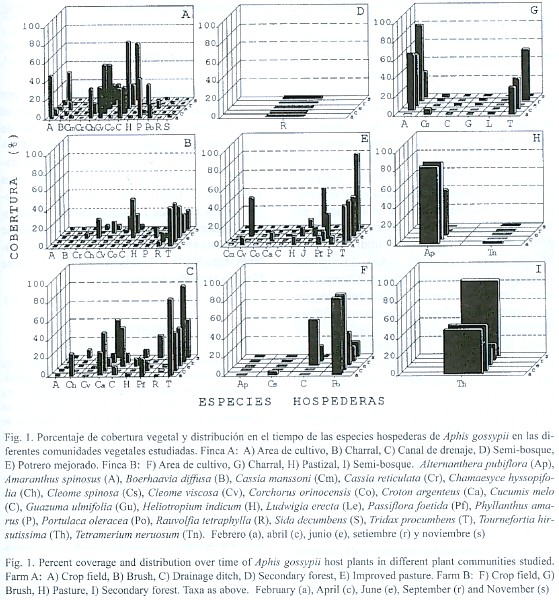
<body><![CDATA[<BR><B><FONT FACE="Arial,Helvetica"><FONT SIZE=-1>Resultados</FONT></FONT></B>     <BR><FONT FACE="Arial,Helvetica"><FONT SIZE=-1>&nbsp;</FONT></FONT>     <BR><FONT FACE="Arial,Helvetica"><FONT SIZE=-1><B>Especies de &aacute;fidos vectores identificadas.</B>&nbsp; Se identific&oacute; a <I>A. gossypii</I> como el &uacute;nico &aacute;fido colonizador del mel&oacute;n, y de las plantas silvestres dentro del &aacute;rea de cultivo y sus linderos en las dos fincas estudiadas.</FONT></FONT><FONT FACE="Arial,Helvetica"><FONT SIZE=-1></FONT></FONT>      <P><B><FONT FACE="Arial,Helvetica"><FONT SIZE=-1>Especies de plantas silvestres identificadas como hospederas de <I>A. gossypii:.</I></FONT></FONT></B><FONT FACE="Arial,Helvetica"><FONT SIZE=-1> En la finca A se identificaron un total de 86 especies de plantas, distribuidas en 49 familias, de las cuales 17 especies de 14 familias se observaron colonizadas por <I>A. gossypii</I>.&nbsp; En la finca B, de un total de 72 especies distribuidas en 40 familias de plantas, nueve especies de nueve familias aparecieron tambi&eacute;n colonizadas por <I>A. gossypii</I>.&nbsp; Del total de las especies encontradas como hospederas de <I>A. gossypii</I>; 11 especies se identificaron previamente como hospederas de al menos uno de los cuatro virus que afectan mel&oacute;n en Costa Rica (<A HREF="#CUADRO2">Cuadro 2</A>).</FONT></FONT><FONT FACE="Arial,Helvetica"><FONT SIZE=-1></FONT></FONT>      <P><FONT FACE="Arial,Helvetica"><FONT SIZE=-1>En ambas fincas se identificaron especies hospederas del &aacute;fido no informadas previamente en la literatura (<A HREF="#CUADRO2">Cuadro 2</A>).</FONT></FONT><FONT FACE="Arial,Helvetica"><FONT SIZE=-1></FONT></FONT>      <P><FONT FACE="Arial,Helvetica"><FONT SIZE=-1><B>Porcentaje de cobertura vegetal y abundancia a trav&eacute;s del tiempo</B>. Se observaron<B> </B>diferencias en la diversidad, cobertura vegetal, abundancia y &eacute;poca de aparici&oacute;n en el campo de las especies identificadas como hospederas de <I>A. gossypii</I> en las diferentes comunidades vegetales (<A HREF="#fig1">Fig. 1</A>). En la finca A se observaron cinco especies perennes, mientras que en la finca B aparecen solamente tres especies de este grupo. La mayor&iacute;a de las especies perennes presentaron una cobertura mayor.</FONT></FONT><FONT FACE="Arial,Helvetica"><FONT SIZE=-1></FONT></FONT>     <CENTER><A NAME="CUADRO2"></A><FONT FACE="Arial,Helvetica"><FONT SIZE=-1>CUADRO 2</FONT></FONT></CENTER>      <CENTER><FONT FACE="Arial,Helvetica"><FONT SIZE=-1>Especies hospederas de <I>A. gossypii</I> identificadas en ambas fincas.</FONT></FONT></CENTER>      <CENTER><FONT FACE="Arial,Helvetica"><FONT SIZE=-1>&nbsp;</FONT></FONT></CENTER>      <CENTER><FONT FACE="Arial,Helvetica"><FONT SIZE=-1>TABLE 2</FONT></FONT></CENTER>      ]]></body>
<body><![CDATA[<CENTER><FONT FACE="Arial,Helvetica"><FONT SIZE=-1><I>A. gossypii</I> host plants identified in both farms</FONT></FONT></CENTER> <FONT FACE="Arial,Helvetica"><FONT SIZE=-1>&nbsp;</FONT></FONT>     <CENTER><TABLE BORDER=0 CELLSPACING=2 CELLPADDING=0 WIDTH="73%" > <TR> <TD VALIGN=TOP WIDTH="161" class="Normal"><FONT FACE="Arial,Helvetica"><FONT SIZE=-1>Familia&nbsp;</FONT></FONT></TD>  <TD VALIGN=TOP COLSPAN="2" WIDTH="463" class="Normal">     <DIV style="LINE-HEIGHT: normal; TEXT-ALIGN: left"><FONT FACE="Arial,Helvetica"><FONT SIZE=-1>Nombre cient&iacute;fico</FONT></FONT></DIV> </TD> </TR>  <TR> <TD VALIGN=TOP WIDTH="161" class="Normal"><FONT FACE="Arial,Helvetica"><FONT SIZE=-1>&nbsp;</FONT></FONT></TD>  <TD VALIGN=TOP WIDTH="236" class="Normal">     <DIV style="LINE-HEIGHT: normal; TEXT-ALIGN: left"><FONT FACE="Arial,Helvetica"><FONT SIZE=-1>Finca A</FONT></FONT></DIV> </TD>  <TD VALIGN=TOP WIDTH="227" class="Normal"><FONT FACE="Arial,Helvetica"><FONT SIZE=-1>Finca B</FONT></FONT></TD> </TR>  <TR> <TD VALIGN=TOP WIDTH="161" class="Normal"><FONT FACE="Arial,Helvetica"><FONT SIZE=-1>Acanthaceae</FONT></FONT></TD>  <TD VALIGN=TOP WIDTH="236" class="Normal"><I><FONT FACE="Arial,Helvetica"><FONT SIZE=-1>Justicia comata **</FONT></FONT></I></TD>  <TD VALIGN=TOP WIDTH="227" class="Normal"><I><FONT FACE="Arial,Helvetica"><FONT SIZE=-1>Tetramerium nervuosum**</FONT></FONT></I></TD> </TR>  <TR> <TD VALIGN=TOP WIDTH="161" class="Normal"><FONT FACE="Arial,Helvetica"><FONT SIZE=-1>Amaranthaceae</FONT></FONT></TD>  <TD VALIGN=TOP WIDTH="236" class="Normal"><I><FONT FACE="Arial,Helvetica"><FONT SIZE=-1>Amaranthus spinosus<SUP> </SUP></FONT></FONT></I><SUP><FONT FACE="Arial,Helvetica"><FONT SIZE=-1>1, 3, 4</FONT></FONT></SUP></TD>  <TD VALIGN=TOP WIDTH="227" class="Normal"><I><FONT FACE="Arial,Helvetica"><FONT SIZE=-1>Alternanthera pubiflora**</FONT></FONT></I></TD> </TR>  <TR> <TD VALIGN=TOP WIDTH="161" class="Normal"><FONT FACE="Arial,Helvetica"><FONT SIZE=-1>Apocynaceae</FONT></FONT></TD>  <TD VALIGN=TOP WIDTH="236" class="Normal"><FONT FACE="Arial,Helvetica"><FONT SIZE=-1><I>Rauwolfia tetraphylla </I><SUP>4</SUP></FONT></FONT></TD>  <TD VALIGN=TOP WIDTH="227" class="Normal"><FONT FACE="Arial,Helvetica"><FONT SIZE=-1>&nbsp;</FONT></FONT></TD> </TR>  <TR> <TD VALIGN=TOP WIDTH="161" class="Normal"><FONT FACE="Arial,Helvetica"><FONT SIZE=-1>Asteraceae</FONT></FONT></TD>  <TD VALIGN=TOP WIDTH="236" class="Normal"><I><FONT FACE="Arial,Helvetica"><FONT SIZE=-1>Tridax procumbens<SUP> </SUP></FONT></FONT></I><SUP><FONT FACE="Arial,Helvetica"><FONT SIZE=-1>2, 3</FONT></FONT></SUP></TD>  <TD VALIGN=TOP WIDTH="227" class="Normal"><FONT FACE="Arial,Helvetica"><FONT SIZE=-1>&nbsp;</FONT></FONT></TD> </TR>  <TR> <TD VALIGN=TOP WIDTH="161" class="Normal"><FONT FACE="Arial,Helvetica"><FONT SIZE=-1>Boraginaceae</FONT></FONT></TD>  <TD VALIGN=TOP WIDTH="236" class="Normal"><I><FONT FACE="Arial,Helvetica"><FONT SIZE=-1>Heliotropium indicum</FONT></FONT></I></TD>  <TD VALIGN=TOP WIDTH="227" class="Normal"><I><FONT FACE="Arial,Helvetica"><FONT SIZE=-1>Tournefortia hirsutissima</FONT></FONT></I></TD> </TR>  <TR> <TD VALIGN=TOP WIDTH="161" class="Normal"><FONT FACE="Arial,Helvetica"><FONT SIZE=-1>Caesalpinaceae</FONT></FONT></TD>  <TD VALIGN=TOP WIDTH="236" class="Normal"><FONT FACE="Arial,Helvetica"><FONT SIZE=-1><I>Cassia massoni **</I>&nbsp;</FONT></FONT><FONT FACE="Arial,Helvetica"><FONT SIZE=-1></FONT></FONT>      <P><I><FONT FACE="Arial,Helvetica"><FONT SIZE=-1>Cassia reticulata **</FONT></FONT></I></TD>  <TD VALIGN=TOP WIDTH="227" class="Normal"><FONT FACE="Arial,Helvetica"><FONT SIZE=-1>&nbsp;</FONT></FONT></TD> </TR>  <TR> <TD VALIGN=TOP WIDTH="161" class="Normal"><FONT FACE="Arial,Helvetica"><FONT SIZE=-1>Capparidaceae</FONT></FONT></TD>  <TD VALIGN=TOP WIDTH="236" class="Normal"><FONT FACE="Arial,Helvetica"><FONT SIZE=-1><I>Cleome viscosa ** </I><SUP>2, 3, 4</SUP></FONT></FONT></TD>  <TD VALIGN=TOP WIDTH="227" class="Normal">     <DIV style="LINE-HEIGHT: normal"><FONT FACE="Arial,Helvetica"><FONT SIZE=-1>Cleome spinosa** <SUP>2, 4</SUP></FONT></FONT></DIV> </TD> </TR>  <TR> <TD VALIGN=TOP WIDTH="161" class="Normal"><FONT FACE="Arial,Helvetica"><FONT SIZE=-1>Cucurbitaceae</FONT></FONT></TD>  <TD VALIGN=TOP WIDTH="236" class="Normal"><FONT FACE="Arial,Helvetica"><FONT SIZE=-1><I>Cucumis melo * </I><SUP>1, 2, 3, 4</SUP></FONT></FONT></TD>  <TD VALIGN=TOP WIDTH="227" class="Normal"><FONT FACE="Arial,Helvetica"><FONT SIZE=-1><I>Cucumis melo* </I><SUP>1, 2, 3, 4</SUP></FONT></FONT></TD> </TR>  <TR> <TD VALIGN=TOP WIDTH="161" class="Normal"><FONT FACE="Arial,Helvetica"><FONT SIZE=-1>Euphorbiaceae</FONT></FONT></TD>  <TD VALIGN=TOP WIDTH="236" class="Normal"><FONT FACE="Arial,Helvetica"><FONT SIZE=-1><I>Croton argenteus**</I><SUP>3</SUP><I> Chamaesyce gyssopifolia** Phyllantus amarus**</I></FONT></FONT></TD>  <TD VALIGN=TOP WIDTH="227" class="Normal"><FONT FACE="Arial,Helvetica"><FONT SIZE=-1><I>Caperonia palustris** </I><SUP>3,<I> </I>4</SUP></FONT></FONT></TD> </TR>  <TR> <TD VALIGN=TOP WIDTH="161" class="Normal"><FONT FACE="Arial,Helvetica"><FONT SIZE=-1>Malvaceae</FONT></FONT></TD>  <TD VALIGN=TOP WIDTH="236" class="Normal"><I><FONT FACE="Arial,Helvetica"><FONT SIZE=-1>Sida decumbens **</FONT></FONT></I></TD>  <TD VALIGN=TOP WIDTH="227" class="Normal"><FONT FACE="Arial,Helvetica"><FONT SIZE=-1>&nbsp;</FONT></FONT></TD> </TR>  <TR> <TD VALIGN=TOP WIDTH="161" class="Normal"><FONT FACE="Arial,Helvetica"><FONT SIZE=-1>Nyctaginaceae</FONT></FONT></TD>  <TD VALIGN=TOP WIDTH="236" class="Normal"><FONT FACE="Arial,Helvetica"><FONT SIZE=-1><I>Boerhaavia diffusa </I><SUP>1, 4</SUP></FONT></FONT></TD>  <TD VALIGN=TOP WIDTH="227" class="Normal"><FONT FACE="Arial,Helvetica"><FONT SIZE=-1>&nbsp;</FONT></FONT></TD> </TR>  <TR> <TD VALIGN=TOP WIDTH="161" class="Normal"><FONT FACE="Arial,Helvetica"><FONT SIZE=-1>Onagraceae</FONT></FONT></TD>  <TD VALIGN=TOP WIDTH="236" class="Normal"><FONT FACE="Arial,Helvetica"><FONT SIZE=-1>&nbsp;</FONT></FONT></TD>  <TD VALIGN=TOP WIDTH="227" class="Normal"><I><FONT FACE="Arial,Helvetica"><FONT SIZE=-1>Ludwigia erecta**</FONT></FONT></I></TD> </TR>  <TR> <TD VALIGN=TOP WIDTH="161" class="Normal"><FONT FACE="Arial,Helvetica"><FONT SIZE=-1>Passifloraceae</FONT></FONT></TD>  <TD VALIGN=TOP WIDTH="236" class="Normal"><FONT FACE="Arial,Helvetica"><FONT SIZE=-1><I>Passiflora foetida ** </I><SUP>1</SUP></FONT></FONT></TD>  <TD VALIGN=TOP WIDTH="227" class="Normal"><FONT FACE="Arial,Helvetica"><FONT SIZE=-1>&nbsp;</FONT></FONT></TD> </TR>  <TR> <TD VALIGN=TOP WIDTH="161" class="Normal"><FONT FACE="Arial,Helvetica"><FONT SIZE=-1>Portulacaceae</FONT></FONT></TD>  <TD VALIGN=TOP WIDTH="236" class="Normal"><I><FONT FACE="Arial,Helvetica"><FONT SIZE=-1>Portulaca oleracea</FONT></FONT></I></TD>  <TD VALIGN=TOP WIDTH="227" class="Normal"><I><FONT FACE="Arial,Helvetica"><FONT SIZE=-1>Portulaca oleracea</FONT></FONT></I></TD> </TR>  <TR> <TD VALIGN=TOP WIDTH="161" class="Normal"><FONT FACE="Arial,Helvetica"><FONT SIZE=-1>Sterculiaceae</FONT></FONT></TD>  <TD VALIGN=TOP WIDTH="236" class="Normal"><FONT FACE="Arial,Helvetica"><FONT SIZE=-1>&nbsp;</FONT></FONT></TD>  <TD VALIGN=TOP WIDTH="227" class="Normal">     <DIV style="LINE-HEIGHT: normal"><FONT FACE="Arial,Helvetica"><FONT SIZE=-1>Guazuma ulmifolia** <SUP>4</SUP></FONT></FONT></DIV> </TD> </TR>  <TR> <TD VALIGN=TOP WIDTH="161" class="Normal"><FONT FACE="Arial,Helvetica"><FONT SIZE=-1>Tiliaceae</FONT></FONT></TD>  <TD VALIGN=TOP WIDTH="236" class="Normal"><I><FONT FACE="Arial,Helvetica"><FONT SIZE=-1>Corchorus orinocensis **</FONT></FONT></I></TD>  <TD VALIGN=TOP WIDTH="227" class="Normal"><FONT FACE="Arial,Helvetica"><FONT SIZE=-1>&nbsp;</FONT></FONT></TD> </TR> </TABLE></CENTER> <FONT FACE="Arial,Helvetica"><FONT SIZE=-1>&nbsp;</FONT></FONT>     <BR><FONT FACE="Arial,Helvetica"><FONT SIZE=-1>* Mel&oacute;n voluntario= F<SUB>2</SUB> de la variedad de mel&oacute;n inicialmente cultivada,&nbsp; ** Especie hospedera no registrada previamente en la literatura,&nbsp;&nbsp; <SUP>1-4</SUP> Especie de plantas informadas por <A HREF="#Sanchez">S&aacute;nchez <I>et al.&nbsp;</I> (1998)</A> como hospederas de los virus:&nbsp;&nbsp; <SUP>1 </SUP>CMV, <SUP>2</SUP> WMV-2, <SUP>3 </SUP>PRSV, <SUP>4 </SUP>ZYMV</FONT></FONT>     <BR><FONT FACE="Arial,Helvetica"><FONT SIZE=-1>&nbsp;</FONT></FONT>     <CENTER><A NAME="fig1"></A><IMG SRC="/img/fbpe/rbt/v49n1/2347i03.JPG" HEIGHT=600 WIDTH=559></CENTER> <FONT FACE="Arial,Helvetica"><FONT SIZE=-1>&nbsp;</FONT></FONT>     
]]></body>
<body><![CDATA[<BR><B><FONT FACE="Arial,Helvetica"><FONT SIZE=-1>Discusi&oacute;n</FONT></FONT></B>     <BR><FONT FACE="Arial,Helvetica"><FONT SIZE=-1>&nbsp;</FONT></FONT>     <BR><FONT FACE="Arial,Helvetica"><FONT SIZE=-1>En esta investigaci&oacute;n, se determinaron las plantas hospederas del &aacute;fido<I> A. gossypii</I>, en los linderos aleda&ntilde;os al cultivo del mel&oacute;n, de las dos fincas (A y B) ubicadas en diferentes zonas de vida de Costa Rica. Este &aacute;fido fue previamente registrado como el vector m&aacute;s importante de los cuatro virus encontrados en cultivares de mel&oacute;n durante 1988 a 1991 en el pa&iacute;s (<A HREF="#Rivera">Rivera <I>et al.&nbsp;</I> 1993</A>) e informado previamente como un eficiente vector de PRSV, WMV-2, CMV y ZYMV (<A HREF="#Lecoq">Lecoq <I>et al.&nbsp;</I> 1979</A>, <A HREF="#Nameth">Nameth <I>et al.&nbsp; </I>1986</A>, <A HREF="#Ullman">Ullman <I>et al.&nbsp; </I>1991</A>, <A HREF="#Fereres">Fereres <I>et al. </I>1992</A>). Las especies de &aacute;fidos <I>Myzus persicae</I>, <I>Rhopalosiphum maidis</I>, <I>Rhopalosiphum padi</I>, <I>Aphis spiricola</I>, <I>Pentalonia nigronervosa</I> son conocidas como vectores de<B> </B>CMV, PRSV, WMV-2 y ZYMV, por otros autores (<A HREF="#Edwardson">Edwardson &amp; Christie 1986</A>) y encontradas previamente en forma espor&aacute;dica y en bajas poblaciones en Costa Rica (<A HREF="#Rivera">Rivera <I>et al.&nbsp;</I> 1993</A>), no se encontraron colonizando las especies de plantas silvestres dentro del cultivo y sus linderos en este estudio.&nbsp; Este resultado indica la poca importancia que parecen tener esas especies en la diseminaci&oacute;n de los virus de mel&oacute;n en las zonas estudiadas.</FONT></FONT><FONT FACE="Arial,Helvetica"><FONT SIZE=-1></FONT></FONT>      <P><FONT FACE="Arial,Helvetica"><FONT SIZE=-1>Del total de especies de plantas silvestres colonizadas por <I>A. gossypii</I> encontradas en ambas finca (26 especies)<I>, </I>16<I> </I>especies se informan, en este trabajo, por primera vez como hospederas de este &aacute;fido. La aparici&oacute;n de estas nuevas especies hospederas, no es de sorprender debido a los pocos estudios que se han realizado con este prop&oacute;sito en una regi&oacute;n tan rica en diversidad vegetal como lo es el tr&oacute;pico. Adem&aacute;s, <I>A. gossypii</I> es un insecto pol&iacute;fago con gran capacidad de adaptarse a diferentes condiciones ambientales, de manera que puede sobrevivir, durante pr&aacute;cticamente todo el a&ntilde;o, en una gran diversidad de especies vegetales.</FONT></FONT><FONT FACE="Arial,Helvetica"><FONT SIZE=-1></FONT></FONT>      <P><FONT FACE="Arial,Helvetica"><FONT SIZE=-1>La metodolog&iacute;a utilizada en este trabajo permiti&oacute; identificar las plantas hospederas del vector, determinar su ubicaci&oacute;n, comparar y observar diferencias en cuanto a su cobertura, distribuci&oacute;n y persistencia en las diferentes comunidades vegetales representativas, previamente seleccionadas (<A HREF="#fig1">Fig. 1</A>).&nbsp; Algunas especies persisten durante todo el a&ntilde;o con gran abundancia relativa y amplia distribuci&oacute;n, como fue el caso de <I>Tridax procumbens</I>, mientras otras persisten durante per&iacute;odos cortos, y presentan una abundancia y distribuci&oacute;n muy variable. Sin embargo, la diversidad, abundancia y permanencia de algunas de las especies parecen garantizar la subsistencia de <I>A. gossypii</I> en el campo, aunque no haya mel&oacute;n sembrado.</FONT></FONT><FONT FACE="Arial,Helvetica"><FONT SIZE=-1></FONT></FONT>      <P><FONT FACE="Arial,Helvetica"><FONT SIZE=-1>Otra diferencia observada fue en cuanto a la diversidad de especies de plantas hospederas del &aacute;fido entre las fincas estudiadas. En la finca B un n&uacute;mero total menor de especies vegetales y un n&uacute;mero menor de especies hospederas del &aacute;fido fueron identificadas que en la finca A. Estas diferencias en la diversidad de las especies podr&iacute;an explicarse con base en la diferente localizaci&oacute;n geogr&aacute;fica y subsecuente zona de vida, a las diferencias en extensi&oacute;n, as&iacute; como a los diferentes usos que se le ha dado a la tierra en los &uacute;ltimos a&ntilde;os y a las diferencias en el manejo cultural de cada una de ellas.</FONT></FONT><FONT FACE="Arial,Helvetica"><FONT SIZE=-1></FONT></FONT>      <P><FONT FACE="Arial,Helvetica"><FONT SIZE=-1>Por otro lado el haber realizado simult&aacute;neamente la b&uacute;squeda y recolecta de las plantas hospederas de &aacute;fidos y de las plantas hospederas de los virus, en las mismas comunidades vegetales, usando la misma metodolog&iacute;a de muestreo, permiti&oacute; la posterior comparaci&oacute;n de los resultados.&nbsp; As&iacute;, al comparar las especies hospederas de virus informadas por <A HREF="#Sanchez">S&aacute;nchez <I>et al.&nbsp;</I> (1998)</A>, y las hospederas de <I>A. gossypii</I> encontradas en este estudio, se observ&oacute; que algunas especies como <I>Amaranthus spinosus, Heliotropium indicum, Cleome spinosa, Cleome viscosa, C. melo, Croton argentus, Caperonia palustris, Boerhaavia diffusa, Passiflora foetida, Guazuma ulmifolia, Rauwolfia tetraphylla </I>y<I> T. procumbens</I> sirven simult&aacute;neamente de hospederas a uno o m&aacute;s de los cuatro virus estudiados y al &aacute;fido vector.&nbsp; Por ejemplo, <I>T. procumbens</I> y <I>C. melo</I> adem&aacute;s de ser hospederas de <I>A. gossypii,</I> son hospederas de PRSV y WMV-2, y de los cuatro virus respectivamente<I> </I>(<A HREF="#Sanchez">S&aacute;nchez <I>et al.&nbsp; </I>1998</A>).&nbsp; Estas especies de plantas hospederas, tanto del virus como del vector, parecen facilitar la supervivencia y diseminaci&oacute;n posterior de los virus en el campo hacia nuevas siembras de mel&oacute;n.</FONT></FONT><FONT FACE="Arial,Helvetica"><FONT SIZE=-1></FONT></FONT>      <P><FONT FACE="Arial,Helvetica"><FONT SIZE=-1>El conocer los reservorios naturales de <I>A. gossypii, </I>el vector m&aacute;s importante de los virus que infectan el mel&oacute;n de exportaci&oacute;n en Costa Rica y los reservorios de los virus, permitir&aacute;n desarrollar y probar diferentes medidas de control preventivo para las virosis que transmiten. El control de las poblaciones de &aacute;fidos, la erradicaci&oacute;n de plantas hospederas de &aacute;fidos y de los virus en el &aacute;rea de cultivo y sus linderos durante todo el a&ntilde;o, as&iacute; como la utilizaci&oacute;n de las plantas hospederas del &aacute;fido como plantas trampa son algunas de las medidas utilizadas en otros pa&iacute;ses para reducir las fuentes naturales de in&oacute;culo inicial.&nbsp; En general, para realizar el control de las virosis no es suficiente la aplicaci&oacute;n de una sola medida de control preventivo, sino m&aacute;s bien, la utilizaci&oacute;n de una serie de medidas que deben aplicarse simult&aacute;neamente.</FONT></FONT>     <BR><FONT FACE="Arial,Helvetica"><FONT SIZE=-1>&nbsp;</FONT></FONT>     <BR><B><FONT FACE="Arial,Helvetica"><FONT SIZE=-1>Agradecimientos</FONT></FONT></B>     ]]></body>
<body><![CDATA[<BR><B><FONT FACE="Arial,Helvetica"><FONT SIZE=-1>&nbsp;</FONT></FONT></B>     <BR><FONT FACE="Arial,Helvetica"><FONT SIZE=-1>Esta investigaci&oacute;n fue financiada por CINDE (Coalici&oacute;n Costarricense de Iniciativas para el Desarrollo) y la C&aacute;mara Nacional de Exportadores y Productores de Mel&oacute;n de Costa Rica.&nbsp; Fue realizado como parte del Programa de Caracterizaci&oacute;n y Diagn&oacute;stico de Virus y Viroides en Cultivos de Importancia Econ&oacute;mica del Centro de Investigaciones en Biolog&iacute;a Celular y Molecular de la Universidad de Costa Rica (PCDV – CIBCM, UCR). Los autores agradecen a Lisela Moreira y Melanie Hord la revisi&oacute;n del manuscrito.</FONT></FONT>     <BR><FONT FACE="Arial,Helvetica"><FONT SIZE=-1>&nbsp;</FONT></FONT>     <BR><B><FONT FACE="Arial,Helvetica"><FONT SIZE=-1>Resumen</FONT></FONT></B>     <BR><B><FONT FACE="Arial,Helvetica"><FONT SIZE=-1>&nbsp;</FONT></FONT></B>     <BR><FONT FACE="Arial,Helvetica"><FONT SIZE=-1>Se identificaron las especies hospederas naturales de <I>Aphis gossypii</I> Glover (Aphididae:&nbsp; Homoptera) en plantaciones comerciales de mel&oacute;n para la exportaci&oacute;n en Costa Rica. El estudio se realiz&oacute; en dos fincas, ubicadas una en la provincia de Guanacaste y la otra en la provincia de Puntarenas, correspondientes a dos zonas de vida vegetal diferentes. Se identificaron como especies hospederas del &aacute;fido todas aquellas especies vegetales en las que se observ&oacute; la presencia del &aacute;fido en su forma &aacute;ptera.&nbsp; En ambas fincas el estudio se realiz&oacute; en los alrededores y dentro del cultivo de mel&oacute;n. En la finca A en cinco diferentes comunidades vegetales (cultivo, canal de drenaje, charral, potrero mejorado y semi-bosque) previamente seleccionadas y en la finca B en cuatro comunidades vegetales (cultivo, charral, pastizal natural y semi-bosque). Espec&iacute;menes de las plantas colonizadas por &aacute;fidos y los &aacute;fidos colonizadores de cada especie fueron recolectadas para su identificaci&oacute;n.&nbsp; Los &aacute;fidos se preservaron en alcohol al 70% v/v e identificaron utilizando las claves taxon&oacute;micas para &aacute;fidos, confirm&aacute;ndose como especie dominante a <I>A. gossypii</I>.&nbsp; La diversidad, cobertura y &eacute;poca de aparici&oacute;n de las especies de plantas hospederas fue monitoreada durante un a&ntilde;o calendario en las diferentes comunidades vegetales presentes en ambas fincas, observ&aacute;ndose diferencias entre las dos fincas estudiadas. En la finca A se observaron 86 diferentes especies vegetales, pertenecientes a 49 familias, asociadas al cultivo del mel&oacute;n, mientras que en la finca B se identificaron 72 especies de 40 familias.&nbsp; En conjunto para ambas fincas, un de 24 especies de plantas (16 familias) estaban colonizadas por el &aacute;fido<I> A. gossypii.&nbsp;</I> De &eacute;stas, 16 especies de 10 familias, son reportes nuevos de plantas hospederas para este &aacute;fido:&nbsp; <I>Justicia comata, Tetramerium nervosum, Alternanthera pubiflora, Cassia massoni, C. reticulata, Cleome viscosa, C. spinosa, Croton argenteus, Caperonia palustris, Chamaesyce gyssopilopia, Phyllantus amarus, Sida decumbens, Ludwigia erecta, Passiflora foetida, Guazuma ulmifolia </I>y<I> Corchorus orinocensis.</I></FONT></FONT>     <BR><FONT FACE="Arial,Helvetica"><FONT SIZE=-1>&nbsp;</FONT></FONT>     <BR><B><FONT FACE="Arial,Helvetica"><FONT SIZE=-1>Referencias</FONT></FONT></B>     <BR><B><FONT FACE="Arial,Helvetica"><FONT SIZE=-1>&nbsp;</FONT></FONT></B>     <!-- ref --><BR><A NAME="Cermeli"></A><FONT FACE="Arial,Helvetica"><FONT SIZE=-1>Cermeli, M. 1986. Afidos que atacan a los c&iacute;tricos en Venezuela. FONAIAP Centro Nacional de Investigaciones Agropecuarias, Instituto de Investigaciones Agron&oacute;micas. No. 5-02 Maracay, Venezuela. 44 p.</FONT></FONT><FONT FACE="Arial,Helvetica"><FONT SIZE=-1></FONT></FONT>    &nbsp;&nbsp;&nbsp;&nbsp;&nbsp;&nbsp;&nbsp;&nbsp;[&#160;<a href="javascript:void(0);" onclick="javascript: window.open('/scielo.php?script=sci_nlinks&ref=1353477&pid=S0034-7744200100010002900001&lng=','','width=640,height=500,resizable=yes,scrollbars=1,menubar=yes,');">Links</a>&#160;]<!-- end-ref --><!-- ref --><P><A NAME="Edwardson"></A><FONT FACE="Arial,Helvetica"><FONT SIZE=-1>Edwardson, J.R. &amp; G. Christie. 1986. Viruses infecting Forage Legumes. Vol. 1 Monograph (14). Agricultural Experiment Stations. Institute of Food and Agricultural Sciences. University of Florida, Gainesville, Florida. 246 p.</FONT></FONT><FONT FACE="Arial,Helvetica"><FONT SIZE=-1></FONT></FONT>    &nbsp;&nbsp;&nbsp;&nbsp;&nbsp;&nbsp;&nbsp;&nbsp;[&#160;<a href="javascript:void(0);" onclick="javascript: window.open('/scielo.php?script=sci_nlinks&ref=1353478&pid=S0034-7744200100010002900002&lng=','','width=640,height=500,resizable=yes,scrollbars=1,menubar=yes,');">Links</a>&#160;]<!-- end-ref --><!-- ref --><P><A NAME="Fereres"></A><FONT FACE="Arial,Helvetica"><FONT SIZE=-1>Fereres, A., M.J. Blua &amp; T.M. Perring. 1992. Retention and transmission characteristics of Zucchini Yellow Mosaic Virus by <I>Aphis gossypii </I>and <I>Myzus persicae </I>(Homoptera: Aphididae). J. Econ. Entomol. 85: 759-765.</FONT></FONT><FONT FACE="Arial,Helvetica"><FONT SIZE=-1></FONT></FONT>    &nbsp;&nbsp;&nbsp;&nbsp;&nbsp;&nbsp;&nbsp;&nbsp;[&#160;<a href="javascript:void(0);" onclick="javascript: window.open('/scielo.php?script=sci_nlinks&ref=1353479&pid=S0034-7744200100010002900003&lng=','','width=640,height=500,resizable=yes,scrollbars=1,menubar=yes,');">Links</a>&#160;]<!-- end-ref --><P><A NAME="Francki"></A><FONT FACE="Arial,Helvetica"><FONT SIZE=-1>Francki, R.I.B., D.W. Mossop &amp; T. Hatta. 1979. Cucumber mosaic virus. <I>In</I> Harrison, B.D. &amp; A.F. Murant (eds.). Description of Plant Viruses. Commonwealth Mycological Institute and Association of Applied Biologist. Slough, Inglaterra. No. 213</FONT></FONT><FONT FACE="Arial,Helvetica"><FONT SIZE=-1></FONT></FONT>      <!-- ref --><P><A NAME="Holdridge"></A><FONT FACE="Arial,Helvetica"><FONT SIZE=-1>Holdridge, L.P. 1978. Ecolog&iacute;a basada en las zonas de vida. IICA, San Jos&eacute;, Costa Rica. 77 p.</FONT></FONT><FONT FACE="Arial,Helvetica"><FONT SIZE=-1></FONT></FONT>    &nbsp;&nbsp;&nbsp;&nbsp;&nbsp;&nbsp;&nbsp;&nbsp;[&#160;<a href="javascript:void(0);" onclick="javascript: window.open('/scielo.php?script=sci_nlinks&ref=1353481&pid=S0034-7744200100010002900004&lng=','','width=640,height=500,resizable=yes,scrollbars=1,menubar=yes,');">Links</a>&#160;]<!-- end-ref --><!-- ref --><P><A NAME="Holman"></A><FONT FACE="Arial,Helvetica"><FONT SIZE=-1>Holman, J. 1974. Los &aacute;fidos de cuba. La Habana. Instituto Cubano del Libro, La Habana. 304 p.</FONT></FONT><FONT FACE="Arial,Helvetica"><FONT SIZE=-1></FONT></FONT>    &nbsp;&nbsp;&nbsp;&nbsp;&nbsp;&nbsp;&nbsp;&nbsp;[&#160;<a href="javascript:void(0);" onclick="javascript: window.open('/scielo.php?script=sci_nlinks&ref=1353482&pid=S0034-7744200100010002900005&lng=','','width=640,height=500,resizable=yes,scrollbars=1,menubar=yes,');">Links</a>&#160;]<!-- end-ref --><!-- ref --><P><A NAME="Kishaba"></A><FONT FACE="Arial,Helvetica"><FONT SIZE=-1>Kishaba, A.N., S.J. Castle &amp; D. L. Coundriet. 1992. Virus transmission by <I>Aphis</I> <I>gossypii</I> Glover to Aphid-resistant and susceptible muskmelons. J. Amer. Soc. Hort. Sci. 117: 248-254.</FONT></FONT><FONT FACE="Arial,Helvetica"><FONT SIZE=-1></FONT></FONT>    &nbsp;&nbsp;&nbsp;&nbsp;&nbsp;&nbsp;&nbsp;&nbsp;[&#160;<a href="javascript:void(0);" onclick="javascript: window.open('/scielo.php?script=sci_nlinks&ref=1353483&pid=S0034-7744200100010002900006&lng=','','width=640,height=500,resizable=yes,scrollbars=1,menubar=yes,');">Links</a>&#160;]<!-- end-ref --><!-- ref --><P><A NAME="Lecoq"></A><FONT FACE="Arial,Helvetica"><FONT SIZE=-1>Lecoq, H., S. Cohen, M. Pitrat &amp; A. Labonne. 1979. Resistance cucumber mosaic virus transmission by aphids in <I>Cucumis melo.</I> Phytopathology. 69: 1223-1225.</FONT></FONT><FONT FACE="Arial,Helvetica"><FONT SIZE=-1></FONT></FONT>    &nbsp;&nbsp;&nbsp;&nbsp;&nbsp;&nbsp;&nbsp;&nbsp;[&#160;<a href="javascript:void(0);" onclick="javascript: window.open('/scielo.php?script=sci_nlinks&ref=1353484&pid=S0034-7744200100010002900007&lng=','','width=640,height=500,resizable=yes,scrollbars=1,menubar=yes,');">Links</a>&#160;]<!-- end-ref --><P><A NAME="Lisa"></A><FONT FACE="Arial,Helvetica"><FONT SIZE=-1>Lisa, V. &amp; H. Lecoq. 1984. Zucchini yellow mosaic virus. <I>In</I> Harrison, B.D. &amp; A.F. Murant (eds.). Description of Plant Viruses. Commonwealth Mycological Institute and Association of Applied Biologist. Slough, Inglaterra. No. 282</FONT></FONT><FONT FACE="Arial,Helvetica"><FONT SIZE=-1></FONT></FONT>      <!-- ref --><P><A NAME="Martin"></A><FONT FACE="Arial,Helvetica"><FONT SIZE=-1>Martin, J.H. 1983. The Identification of common aphid pests of tropical agriculture. Tropical Pest Manag. 29: 395-411.</FONT></FONT><FONT FACE="Arial,Helvetica"><FONT SIZE=-1></FONT></FONT>    &nbsp;&nbsp;&nbsp;&nbsp;&nbsp;&nbsp;&nbsp;&nbsp;[&#160;<a href="javascript:void(0);" onclick="javascript: window.open('/scielo.php?script=sci_nlinks&ref=1353486&pid=S0034-7744200100010002900008&lng=','','width=640,height=500,resizable=yes,scrollbars=1,menubar=yes,');">Links</a>&#160;]<!-- end-ref --><!-- ref --><P><A NAME="Matthews"></A><FONT FACE="Arial,Helvetica"><FONT SIZE=-1>Matthews, R.E.F. 1991. Plant virology. Academic, San Diego, California. 835 p.</FONT></FONT><FONT FACE="Arial,Helvetica"><FONT SIZE=-1></FONT></FONT>    &nbsp;&nbsp;&nbsp;&nbsp;&nbsp;&nbsp;&nbsp;&nbsp;[&#160;<a href="javascript:void(0);" onclick="javascript: window.open('/scielo.php?script=sci_nlinks&ref=1353487&pid=S0034-7744200100010002900009&lng=','','width=640,height=500,resizable=yes,scrollbars=1,menubar=yes,');">Links</a>&#160;]<!-- end-ref --><P><A NAME="Matteucci"></A><FONT FACE="Arial,Helvetica"><FONT SIZE=-1>Matteucci, S.D. &amp; A. Colma. 1982. Metodolog&iacute;a para el estudio de la vegetaci&oacute;n. Secretar&iacute;a General de la Organizaci&oacute;n de los Estados Americanos. Programa Regional de Desarrollo Cient&iacute;fico y Tecnol&oacute;gico. Washington, D.C. 163 p.</FONT></FONT><FONT FACE="Arial,Helvetica"><FONT SIZE=-1></FONT></FONT>      <!-- ref --><P><A NAME="Nameth"></A><FONT FACE="Arial,Helvetica"><FONT SIZE=-1>Nameth, S.T., J.A. Dodds, A.O. Paulus &amp; F.F. Laemmlen. 1986. Cucurbit viruses of California: An ever-changing problem. Plant Dis. 70: 8-12.</FONT></FONT><FONT FACE="Arial,Helvetica"><FONT SIZE=-1></FONT></FONT>    &nbsp;&nbsp;&nbsp;&nbsp;&nbsp;&nbsp;&nbsp;&nbsp;[&#160;<a href="javascript:void(0);" onclick="javascript: window.open('/scielo.php?script=sci_nlinks&ref=1353489&pid=S0034-7744200100010002900010&lng=','','width=640,height=500,resizable=yes,scrollbars=1,menubar=yes,');">Links</a>&#160;]<!-- end-ref --><!-- ref --><P><A NAME="Purcifull84a"></A><FONT FACE="Arial,Helvetica"><FONT SIZE=-1>Purcifull, D. E., E. Hiebert &amp; J. Edwardson.. 1984a. Watermelon mosaic virus 2. <I>In</I> Harrison, B.D. &amp; A.F. Murant (eds.). Description of Plant Viruses. Commonwealth Mycological Institute and Association of Applied Biologist. Slough, Inglaterra. No. 293</FONT></FONT><FONT FACE="Arial,Helvetica"><FONT SIZE=-1></FONT></FONT>    &nbsp;&nbsp;&nbsp;&nbsp;&nbsp;&nbsp;&nbsp;&nbsp;[&#160;<a href="javascript:void(0);" onclick="javascript: window.open('/scielo.php?script=sci_nlinks&ref=1353490&pid=S0034-7744200100010002900011&lng=','','width=640,height=500,resizable=yes,scrollbars=1,menubar=yes,');">Links</a>&#160;]<!-- end-ref --><P><A NAME="Purcifull84b"></A><FONT FACE="Arial,Helvetica"><FONT SIZE=-1>Purcifull, D. E., J. Edwardson., E. Hiebert &amp; D. Gonsalves. 1984b. Papaya ringspot virus. <I>In</I> Harrison, B.D. &amp; A.F. Murant (eds.). Description of Plant Viruses. Commonwealth Mycological Institute and Association of Applied Biologist. Slough, Inglaterra. No. 292</FONT></FONT><FONT FACE="Arial,Helvetica"><FONT SIZE=-1></FONT></FONT>      <P><A NAME="Rivera"></A><FONT FACE="Arial,Helvetica"><FONT SIZE=-1>Rivera, C., W. Villalobos., M.V. S&aacute;nchez., C. Zumbado &amp; C.M. Rodr&iacute;guez. 1993. Identification and distribution of melon-infecting virus and their vectors in two provinces of Costa Rica. Turrialba 43: 210-215.</FONT></FONT><FONT FACE="Arial,Helvetica"><FONT SIZE=-1></FONT></FONT>      <!-- ref --><P><A NAME="Sanchez"></A><FONT FACE="Arial,Helvetica"><FONT SIZE=-1>S&aacute;nchez, M.V., R. Ag&uuml;ero &amp; C. Rivera. 1998. Plantas hospederas de los virus m&aacute;s importantes que infectan el mel&oacute;n, <I>Cucumis melo</I> (Cucurbitaceae) en Costa Rica. Rev. Biol. Trop. 46: 13-25.</FONT></FONT><FONT FACE="Arial,Helvetica"><FONT SIZE=-1></FONT></FONT>    &nbsp;&nbsp;&nbsp;&nbsp;&nbsp;&nbsp;&nbsp;&nbsp;[&#160;<a href="javascript:void(0);" onclick="javascript: window.open('/scielo.php?script=sci_nlinks&ref=1353493&pid=S0034-7744200100010002900012&lng=','','width=640,height=500,resizable=yes,scrollbars=1,menubar=yes,');">Links</a>&#160;]<!-- end-ref --><!-- ref --><P><A NAME="Soto"></A><FONT FACE="Arial,Helvetica"><FONT SIZE=-1>Soto, A &amp; R. Ag&uuml;ero. 1992. Combate qu&iacute;mico de malezas en el cultivo del arroz. Universidad de Costa Rica. San Jos&eacute;, Costa Rica. 81p.</FONT></FONT><FONT FACE="Arial,Helvetica"><FONT SIZE=-1></FONT></FONT>    &nbsp;&nbsp;&nbsp;&nbsp;&nbsp;&nbsp;&nbsp;&nbsp;[&#160;<a href="javascript:void(0);" onclick="javascript: window.open('/scielo.php?script=sci_nlinks&ref=1353494&pid=S0034-7744200100010002900013&lng=','','width=640,height=500,resizable=yes,scrollbars=1,menubar=yes,');">Links</a>&#160;]<!-- end-ref --><!-- ref --><P><A NAME="Ullman"></A><FONT FACE="Arial,Helvetica"><FONT SIZE=-1>Ullman, D.E., J.J. Cho &amp; T. L. German. 1991. Occurrence and distribution of cucurbit viruses in the Hawaiian Islands. Plant Dis. 75: 367-370.</FONT></FONT><FONT FACE="Arial,Helvetica"><FONT SIZE=-1></FONT></FONT>    &nbsp;&nbsp;&nbsp;&nbsp;&nbsp;&nbsp;&nbsp;&nbsp;[&#160;<a href="javascript:void(0);" onclick="javascript: window.open('/scielo.php?script=sci_nlinks&ref=1353495&pid=S0034-7744200100010002900014&lng=','','width=640,height=500,resizable=yes,scrollbars=1,menubar=yes,');">Links</a>&#160;]<!-- end-ref --><P><A NAME="A1"></A><FONT FACE="Arial,Helvetica"><FONT SIZE=-1><SUP><A HREF="#R1">1</A></SUP> Centro de Investigaci&oacute;n en Biolog&iacute;a Celular y Molecular (CIBCM), Universidad de Costa Rica, San Jos&eacute;, Costa Rica, fax (506) 207 3190, email<A HREF="mailto:crivera@sol.racsa.co.cr">crivera@sol.racsa.co.cr</A></FONT></FONT><FONT FACE="Arial,Helvetica"><FONT SIZE=-1></FONT></FONT>      <P><SUP><FONT FACE="Arial,Helvetica"><FONT SIZE=-1><A HREF="#R1">2</A> </FONT></FONT></SUP><FONT FACE="Arial,Helvetica"><FONT SIZE=-1>Instituto de Investigaciones Agron&oacute;micas (IIA), Universidad de Costa Rica, San Jos&eacute;, Costa Rica.</FONT></FONT>     ]]></body>
<body><![CDATA[ ]]></body><back>
<ref-list>
<ref id="B1">
<nlm-citation citation-type="book">
<person-group person-group-type="author">
<name>
<surname><![CDATA[Cermeli]]></surname>
<given-names><![CDATA[M]]></given-names>
</name>
</person-group>
<source><![CDATA[Afidos que atacan a los cítricos en Venezuela]]></source>
<year>1986</year>
<page-range>44</page-range><publisher-loc><![CDATA[Maracay ]]></publisher-loc>
<publisher-name><![CDATA[FONAIAP Centro Nacional de Investigaciones Agropecuarias]]></publisher-name>
</nlm-citation>
</ref>
<ref id="B2">
<nlm-citation citation-type="book">
<person-group person-group-type="author">
<name>
<surname><![CDATA[Edwardson]]></surname>
<given-names><![CDATA[J.R]]></given-names>
</name>
<name>
<surname><![CDATA[Christie]]></surname>
<given-names><![CDATA[G]]></given-names>
</name>
</person-group>
<source><![CDATA[Viruses infecting Forage Legumes. Vol. 1 Monograph (14). Agricultural Experiment Stations]]></source>
<year>1986</year>
<page-range>246</page-range><publisher-loc><![CDATA[Gainesville^eFlorida Florida]]></publisher-loc>
<publisher-name><![CDATA[Institute of Food and Agricultural Sciences]]></publisher-name>
</nlm-citation>
</ref>
<ref id="B3">
<nlm-citation citation-type="journal">
<person-group person-group-type="author">
<name>
<surname><![CDATA[Fereres]]></surname>
<given-names><![CDATA[A]]></given-names>
</name>
<name>
<surname><![CDATA[Blua]]></surname>
<given-names><![CDATA[M.J]]></given-names>
</name>
<name>
<surname><![CDATA[Perring]]></surname>
<given-names><![CDATA[T.M]]></given-names>
</name>
</person-group>
<article-title xml:lang="en"><![CDATA[Retention and transmission characteristics of Zucchini Yellow Mosaic Virus by Aphis gossypii and Myzus persicae (Homoptera: Aphididae)]]></article-title>
<source><![CDATA[J. Econ. Entomol]]></source>
<year>1992</year>
<volume>85</volume>
<page-range>759-765</page-range></nlm-citation>
</ref>
<ref id="B4">
<nlm-citation citation-type="book">
<person-group person-group-type="author">
<name>
<surname><![CDATA[Holdridge]]></surname>
<given-names><![CDATA[L.P]]></given-names>
</name>
</person-group>
<source><![CDATA[Ecología basada en las zonas de vida]]></source>
<year>1978</year>
<page-range>77</page-range><publisher-loc><![CDATA[San José ]]></publisher-loc>
<publisher-name><![CDATA[IICA]]></publisher-name>
</nlm-citation>
</ref>
<ref id="B5">
<nlm-citation citation-type="book">
<person-group person-group-type="author">
<name>
<surname><![CDATA[Holman]]></surname>
<given-names><![CDATA[J]]></given-names>
</name>
</person-group>
<source><![CDATA[Los áfidos de cuba. La Habana]]></source>
<year>1974</year>
<page-range>304</page-range><publisher-loc><![CDATA[La Habana ]]></publisher-loc>
<publisher-name><![CDATA[Instituto Cubano del Libro]]></publisher-name>
</nlm-citation>
</ref>
<ref id="B6">
<nlm-citation citation-type="journal">
<person-group person-group-type="author">
<name>
<surname><![CDATA[Kishaba]]></surname>
<given-names><![CDATA[A.N]]></given-names>
</name>
<name>
<surname><![CDATA[Castle]]></surname>
<given-names><![CDATA[S.J]]></given-names>
</name>
<name>
<surname><![CDATA[Coundriet]]></surname>
<given-names><![CDATA[D. L]]></given-names>
</name>
</person-group>
<article-title xml:lang="en"><![CDATA[Virus transmission by Aphis gossypii Glover to Aphid-resistant and susceptible muskmelons]]></article-title>
<source><![CDATA[J. Amer. Soc. Hort. Sci]]></source>
<year>1992</year>
<volume>117</volume>
<page-range>248-254</page-range></nlm-citation>
</ref>
<ref id="B7">
<nlm-citation citation-type="journal">
<person-group person-group-type="author">
<name>
<surname><![CDATA[Lecoq]]></surname>
<given-names><![CDATA[H]]></given-names>
</name>
<name>
<surname><![CDATA[Cohen]]></surname>
<given-names><![CDATA[S]]></given-names>
</name>
<name>
<surname><![CDATA[Pitrat]]></surname>
<given-names><![CDATA[M]]></given-names>
</name>
<name>
<surname><![CDATA[Labonne]]></surname>
<given-names><![CDATA[A]]></given-names>
</name>
</person-group>
<article-title xml:lang="en"><![CDATA[Resistance cucumber mosaic virus transmission by aphids in Cucumis melo]]></article-title>
<source><![CDATA[Phytopathology]]></source>
<year>1979</year>
<volume>69</volume>
<page-range>1223-1225</page-range></nlm-citation>
</ref>
<ref id="B8">
<nlm-citation citation-type="journal">
<person-group person-group-type="author">
<name>
<surname><![CDATA[Martin]]></surname>
<given-names><![CDATA[J.H]]></given-names>
</name>
</person-group>
<article-title xml:lang="en"><![CDATA[The Identification of common aphid pests of tropical agriculture]]></article-title>
<source><![CDATA[Tropical Pest Manag]]></source>
<year>1983</year>
<volume>29</volume>
<page-range>395-411</page-range></nlm-citation>
</ref>
<ref id="B9">
<nlm-citation citation-type="book">
<person-group person-group-type="author">
<name>
<surname><![CDATA[Matthews]]></surname>
<given-names><![CDATA[R.E.F]]></given-names>
</name>
</person-group>
<source><![CDATA[Plant virology]]></source>
<year>1991</year>
<page-range>835</page-range><publisher-loc><![CDATA[San Diego ]]></publisher-loc>
<publisher-name><![CDATA[Academic]]></publisher-name>
</nlm-citation>
</ref>
<ref id="B10">
<nlm-citation citation-type="journal">
<person-group person-group-type="author">
<name>
<surname><![CDATA[Nameth]]></surname>
<given-names><![CDATA[S.T]]></given-names>
</name>
<name>
<surname><![CDATA[Dodds]]></surname>
<given-names><![CDATA[J.A]]></given-names>
</name>
<name>
<surname><![CDATA[Paulus]]></surname>
<given-names><![CDATA[A.O]]></given-names>
</name>
<name>
<surname><![CDATA[Laemmlen]]></surname>
<given-names><![CDATA[F.F]]></given-names>
</name>
</person-group>
<article-title xml:lang="en"><![CDATA[Cucurbit viruses of California: An ever-changing problem]]></article-title>
<source><![CDATA[Plant Dis]]></source>
<year>1986</year>
<volume>70</volume>
<page-range>8-12</page-range></nlm-citation>
</ref>
<ref id="B11">
<nlm-citation citation-type="book">
<person-group person-group-type="author">
<name>
<surname><![CDATA[Purcifull]]></surname>
<given-names><![CDATA[D. E]]></given-names>
</name>
<name>
<surname><![CDATA[Hiebert]]></surname>
<given-names><![CDATA[E]]></given-names>
</name>
<name>
<surname><![CDATA[Edwardson]]></surname>
<given-names><![CDATA[J]]></given-names>
</name>
</person-group>
<article-title xml:lang="en"><![CDATA[Watermelon mosaic virus 2]]></article-title>
<person-group person-group-type="editor">
<name>
<surname><![CDATA[Harrison]]></surname>
<given-names><![CDATA[B.D]]></given-names>
</name>
<name>
<surname><![CDATA[Murant]]></surname>
<given-names><![CDATA[A.F]]></given-names>
</name>
</person-group>
<source><![CDATA[Description of Plant Viruses]]></source>
<year>1984</year>
<publisher-loc><![CDATA[Slough ]]></publisher-loc>
<publisher-name><![CDATA[Commonwealth Mycological Institute and Association of Applied Biologist]]></publisher-name>
</nlm-citation>
</ref>
<ref id="B12">
<nlm-citation citation-type="journal">
<person-group person-group-type="author">
<name>
<surname><![CDATA[Sánchez]]></surname>
<given-names><![CDATA[M.V]]></given-names>
</name>
<name>
<surname><![CDATA[Agüero]]></surname>
<given-names><![CDATA[R]]></given-names>
</name>
<name>
<surname><![CDATA[Rivera]]></surname>
<given-names><![CDATA[C]]></given-names>
</name>
</person-group>
<article-title xml:lang="es"><![CDATA[Plantas hospederas de los virus más importantes que infectan el melón, Cucumis melo (Cucurbitaceae) en Costa Rica]]></article-title>
<source><![CDATA[Rev. Biol. Trop]]></source>
<year>1998</year>
<volume>46</volume>
<page-range>13-25</page-range></nlm-citation>
</ref>
<ref id="B13">
<nlm-citation citation-type="book">
<person-group person-group-type="author">
<name>
<surname><![CDATA[Soto]]></surname>
<given-names><![CDATA[A]]></given-names>
</name>
<name>
<surname><![CDATA[Agüero]]></surname>
<given-names><![CDATA[R]]></given-names>
</name>
</person-group>
<source><![CDATA[Combate químico de malezas en el cultivo del arroz]]></source>
<year>1992</year>
<page-range>81</page-range><publisher-loc><![CDATA[San José ]]></publisher-loc>
<publisher-name><![CDATA[Universidad de Costa Rica]]></publisher-name>
</nlm-citation>
</ref>
<ref id="B14">
<nlm-citation citation-type="journal">
<person-group person-group-type="author">
<name>
<surname><![CDATA[Ullman]]></surname>
<given-names><![CDATA[D.E]]></given-names>
</name>
<name>
<surname><![CDATA[Cho]]></surname>
<given-names><![CDATA[J.J]]></given-names>
</name>
<name>
<surname><![CDATA[German]]></surname>
<given-names><![CDATA[T. L]]></given-names>
</name>
</person-group>
<article-title xml:lang="en"><![CDATA[Occurrence and distribution of cucurbit viruses in the Hawaiian Islands]]></article-title>
<source><![CDATA[Plant Dis]]></source>
<year>1991</year>
<volume>75</volume>
<page-range>367-370</page-range></nlm-citation>
</ref>
</ref-list>
</back>
</article>
