<?xml version="1.0" encoding="ISO-8859-1"?><article xmlns:mml="http://www.w3.org/1998/Math/MathML" xmlns:xlink="http://www.w3.org/1999/xlink" xmlns:xsi="http://www.w3.org/2001/XMLSchema-instance">
<front>
<journal-meta>
<journal-id>0034-7744</journal-id>
<journal-title><![CDATA[Revista de Biología Tropical]]></journal-title>
<abbrev-journal-title><![CDATA[Rev. biol. trop]]></abbrev-journal-title>
<issn>0034-7744</issn>
<publisher>
<publisher-name><![CDATA[Universidad de Costa Rica]]></publisher-name>
</publisher>
</journal-meta>
<article-meta>
<article-id>S0034-77442001000100027</article-id>
<title-group>
<article-title xml:lang="es"><![CDATA[Latencia en semillas de Stylosanthes hamata (Leguminosae) y su relación con la morfología de la cubierta seminal]]></article-title>
</title-group>
<contrib-group>
<contrib contrib-type="author">
<name>
<surname><![CDATA[Castillo]]></surname>
<given-names><![CDATA[Rosana]]></given-names>
</name>
<xref ref-type="aff" rid="A01"/>
</contrib>
<contrib contrib-type="author">
<name>
<surname><![CDATA[Guenni]]></surname>
<given-names><![CDATA[Orlando]]></given-names>
</name>
<xref ref-type="aff" rid="A02"/>
</contrib>
</contrib-group>
<aff id="A01">
<institution><![CDATA[,Universidad Simón Bolívar Departemento de Estudios Ambientales ]]></institution>
<addr-line><![CDATA[Caracas ]]></addr-line>
<country>Venezuela</country>
</aff>
<aff id="A02">
<institution><![CDATA[,Universidad Central de Venezuela Facultad de Agronomía ]]></institution>
<addr-line><![CDATA[Maracay ]]></addr-line>
<country>Venezuela</country>
</aff>
<pub-date pub-type="pub">
<day>00</day>
<month>03</month>
<year>2001</year>
</pub-date>
<pub-date pub-type="epub">
<day>00</day>
<month>03</month>
<year>2001</year>
</pub-date>
<volume>49</volume>
<numero>1</numero>
<fpage>287</fpage>
<lpage>299</lpage>
<copyright-statement/>
<copyright-year/>
<self-uri xlink:href="http://www.scielo.sa.cr/scielo.php?script=sci_arttext&amp;pid=S0034-77442001000100027&amp;lng=en&amp;nrm=iso"></self-uri><self-uri xlink:href="http://www.scielo.sa.cr/scielo.php?script=sci_abstract&amp;pid=S0034-77442001000100027&amp;lng=en&amp;nrm=iso"></self-uri><self-uri xlink:href="http://www.scielo.sa.cr/scielo.php?script=sci_pdf&amp;pid=S0034-77442001000100027&amp;lng=en&amp;nrm=iso"></self-uri><abstract abstract-type="short" xml:lang="en"><p><![CDATA[The seed of Stylosanthes hamata is characterized by it's a high level of dormancy, which is imposed by seed-coat impermeability to water entry (harseededness or hard-seed condition). The level of hardseededness between upper and lower articulations of seven diploid and five tetraploid accessions was studied under tropical conditions. Germination tests on naked seeds (relative humidity: 55-65%, constant temperature: 27-30º C, photoperiod: 12/12 hr) showed that hard-seed percentage was, in most cases, over 85% independent of ploidy level and seed position within the fruit. Histochemical analysis indicated that hardseededness in this species was associated with a completely sealed microphile and hilum. This feature was also associated to: a) an epidermis consisting of a palisade-like layer of macrosclereids, b) a like-line at the outermost region of these cells and c) a high concentration of hydrophobic compounds located all across the seed-coat.]]></p></abstract>
<abstract abstract-type="short" xml:lang="es"><p><![CDATA[La semilla de Stylosanthes hamata (L.) Taub. se caracteriza por presentar un alto grado de latencia asociada a una restricción a la absorción de humedad (semilla dura). En esta investigación, se estudió la dureza de semillas distales y basales de siete líneas diploides y cinco líneas tetraploides, cultivadas bajo condiciones tropicales. Las pruebas pruebas de germinación (HR: 55-65%, temperatura constante: 27-30&ordm; C, fotoperíodo: 12/12 hr) llevadas a cabo en semillas desprovistas de vaina indicaron que el grado de dureza seminal estuvo en casi todos los casos por encima del 85%, independientemente del nivel de ploidia y de la posición de la semilla en el fruto. Así mismo, se realizó una caracterización morfo-anatómica de la cubierta seminal a través del uso del microscopio óptico y de barrido. Esta caracterización fue complementada con un estudio histoquímico para determinar la ubicación de compuestos hidrofóbicos en la cubierta seminal. Los resultados de estas pruebas señalaron que la dureza seminal estuvo relacionada con la presencia de un micropilo y un hilo totalmente cerrados, una epidermis compuesta por macroesclereidas en empalizada con una línea lúcida en las paredes más externas de estas células y a una alta concentración de compuestos hidrofóbicos en todos los tejidos que conforman la cubierta seminal.]]></p></abstract>
<kwd-group>
<kwd lng="en"><![CDATA[Stylosanthes hamata]]></kwd>
<kwd lng="en"><![CDATA[hard-seed]]></kwd>
<kwd lng="en"><![CDATA[hardseededness]]></kwd>
<kwd lng="en"><![CDATA[dormancy]]></kwd>
<kwd lng="en"><![CDATA[morpho-anatomical features]]></kwd>
<kwd lng="en"><![CDATA[germination]]></kwd>
<kwd lng="en"><![CDATA[seed-coat]]></kwd>
</kwd-group>
</article-meta>
</front><body><![CDATA[ <CENTER><B><FONT FACE="Arial,Helvetica">Latencia en semillas de <I>Stylosanthes hamata</I> (Leguminosae) y su relaci&oacute;n con la morfolog&iacute;a de la cubierta seminal</FONT></B></CENTER> <FONT FACE="Arial,Helvetica"><FONT SIZE=-1>&nbsp;</FONT></FONT>     <BR><FONT FACE="Arial,Helvetica"><FONT SIZE=-1>&nbsp;</FONT></FONT>     <BR><FONT FACE="Arial,Helvetica"><FONT SIZE=-1>Rosana Castillo&nbsp;<A NAME="R1"></A><SUP><A HREF="#A1">1</A></SUP> y Orlando Guenni <SUP><A HREF="#A1">2</A></SUP>.</FONT></FONT>     <BR><FONT FACE="Arial,Helvetica"><FONT SIZE=-1>&nbsp;</FONT></FONT>     <BR><FONT FACE="Arial,Helvetica"><FONT SIZE=-1>&nbsp;</FONT></FONT>     <BR><FONT FACE="Arial,Helvetica"><FONT SIZE=-1>Recibido&nbsp;&nbsp; 26-IV-2000.&nbsp; Corregido&nbsp;&nbsp; 20-VI-2000.&nbsp; Aceptado&nbsp; 19-IX-2000.</FONT></FONT>     <BR><B><FONT FACE="Arial,Helvetica"><FONT SIZE=-1>&nbsp;</FONT></FONT></B>     <BR><B><FONT FACE="Arial,Helvetica"><FONT SIZE=-1>Abstract</FONT></FONT></B><FONT FACE="Arial,Helvetica"><FONT SIZE=-1></FONT></FONT>      <P><FONT FACE="Arial,Helvetica"><FONT SIZE=-1>The seed of <I>Stylosanthes hamata</I> is characterized by it&acute;s a high level of dormancy, which is imposed by seed-coat impermeability to water entry (harseededness or hard-seed condition). The level of hardseededness between upper and lower articulations of seven diploid and five tetraploid accessions was studied under tropical conditions. Germination tests on naked seeds (relative humidity:&nbsp; 55-65%, constant temperature:&nbsp; 27-30&ordm; C, photoperiod:&nbsp; 12/12 hr) showed that hard-seed percentage was, in most cases, over 85% independent of ploidy level and seed position within the fruit. Histochemical analysis indicated that hardseededness in this species was associated with a completely sealed microphile and hilum. This feature was also associated to:&nbsp; a) an epidermis consisting of a palisade-like layer of macrosclereids, b) a like-line at the outermost region of these cells and c) a high concentration of hydrophobic compounds located all across the seed-coat.</FONT></FONT>     <BR><FONT FACE="Arial,Helvetica"><FONT SIZE=-1>&nbsp;</FONT></FONT>     ]]></body>
<body><![CDATA[<BR><FONT FACE="Arial,Helvetica"><FONT SIZE=-1><B>Key words</B>:&nbsp; <I>Stylosanthes hamata</I>, hard-seed, hardseededness, dormancy, morpho-anatomical features, germination, seed-coat.</FONT></FONT>     <BR><FONT FACE="Arial,Helvetica"><FONT SIZE=-1>&nbsp;</FONT></FONT>     <BR><FONT FACE="Arial,Helvetica"><FONT SIZE=-1>&nbsp;</FONT></FONT>     <BR><FONT FACE="Arial,Helvetica"><FONT SIZE=-1>El g&eacute;nero <I>Stylosanthes</I> se distribuye amplia y naturalmente en las zonas tropicales y subtropicales de Am&eacute;rica (<A HREF="#Williams">Williams <I>et al.&nbsp;</I> 1984</A>) y constituye una excelente fuente proteino-energ&eacute;tica para la alimentaci&oacute;n animal (<A HREF="#Edye83">Edye &amp; Grof 1983</A>, <A HREF="#Lascano90">Lascano &amp; Plazas 1990</A>, <A HREF="#Lascano91">Lascano 1991</A>). En este sentido varias especies del g&eacute;nero se han venido utilizando para reemplazar sabanas nativas en Venezuela, Colombia y otros pa&iacute;ses, pues presentan un alto potencial adaptativo y productivo en condiciones de suelos &aacute;cidos y de baja fertilidad como lo son los Oxisoles y Ultisoles comunes a las sabanas de Am&eacute;rica tropical (<A HREF="#Burt">Burt <I>et al.&nbsp;</I> 1983</A>).</FONT></FONT><FONT FACE="Arial,Helvetica"><FONT SIZE=-1></FONT></FONT>      <P><FONT FACE="Arial,Helvetica"><FONT SIZE=-1>Dentro de <I>Stylosanthes hamata</I> se reconocen dos niveles de ploid&iacute;a:&nbsp; las l&iacute;neas diploides localizadas en un amplio ambito de altitud (100 - 1 600 msnm), con reg&iacute;menes de precipitaci&oacute;n entre 500 - 1 700 mm anuales; y las l&iacute;neas tetraploides que se distribuyen en regiones m&aacute;s bajas (menos de 1 000 msnm) pero con un amplio rango de variaci&oacute;n en cuanto a precipitaci&oacute;n anual se refiere (500 –&nbsp; 2 300 mm). Sin embargo, al norte de Suram&eacute;rica ambos niveles de ploidia se localizan fundamentalmente en zonas &aacute;ridas y semi&aacute;ridas comprendidas entre los ocho y doce grados de latitud norte (<A HREF="#Edye88">Edye 1988</A>, <A HREF="#Guenni92">Guenni 1992</A>).</FONT></FONT><FONT FACE="Arial,Helvetica"><FONT SIZE=-1></FONT></FONT>      <P><FONT FACE="Arial,Helvetica"><FONT SIZE=-1>La semilla de <I>S. hamata </I>as&iacute; como la de otras leguminosas se caracteriza por presentar en general un alto grado de latencia impuesta por la cubierta seminal. Este tipo de latencia obedece a una restricci&oacute;n en la absorci&oacute;n de agua asociada a la composici&oacute;n qu&iacute;mica y a las caracter&iacute;sticas morfo-anat&oacute;micas de la cubierta. Tal y como lo informa <A HREF="#Werker80">Werker (1980/81)</A> en el caso particular de las leguminosas, varias partes de la epidermis han sido sugeridas como responsables de la impermeabilidad, entre ellas una cut&iacute;cula cerosa, la l&iacute;nea l&uacute;cida, paredes celulares cutinizadas o suberizadas y la presencia de material semejante al corcho en el tap&oacute;n estrofiolar.</FONT></FONT><FONT FACE="Arial,Helvetica"><FONT SIZE=-1></FONT></FONT>      <P><FONT FACE="Arial,Helvetica"><FONT SIZE=-1>No obstante, dentro de <I>S. hamata</I> se ha observado que el grado de dureza puede variar de acuerdo al nivel de ploid&iacute;a y al origen clim&aacute;tico del genotipo (<A HREF="#Guenni92">Guenni 1992</A>). Desde el punto de vista ecol&oacute;gico tal caracter&iacute;stica reviste mucha importancia puesto que permite la incorporaci&oacute;n de la semilla al banco de semillas del suelo, desempe&ntilde;ando as&iacute; un papel fundamental en cuanto a la perpetuidad de la especie en un h&aacute;bitat determinado y al mantenimiento de los bancos naturales de germoplasma (<A HREF="#Baskin">Baskin &amp; Baskin 1989</A>).</FONT></FONT><FONT FACE="Arial,Helvetica"><FONT SIZE=-1></FONT></FONT>      <P><FONT FACE="Arial,Helvetica"><FONT SIZE=-1>Dada la importancia que la latencia representa dentro de la especie, la presente investigaci&oacute;n tuvo como fin el determinar la relaci&oacute;n existente entre la latencia asociada a la restricci&oacute;n de la entrada de humedad y las caracter&iacute;sticas morfo-anat&oacute;micas e histoqu&iacute;micas que presenta la cubierta seminal en la semilla de <I>S. hamata</I> desarrollada bajo condiciones tropicales.</FONT></FONT>     <BR><FONT FACE="Arial,Helvetica"><FONT SIZE=-1>&nbsp;</FONT></FONT>     <BR><B><FONT FACE="Arial,Helvetica"><FONT SIZE=-1>Materiales y m&eacute;todos</FONT></FONT></B>     ]]></body>
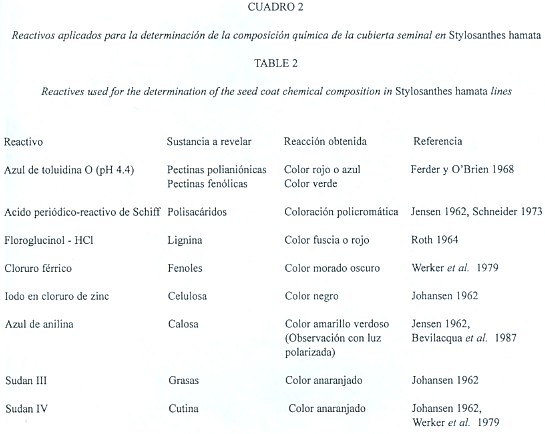
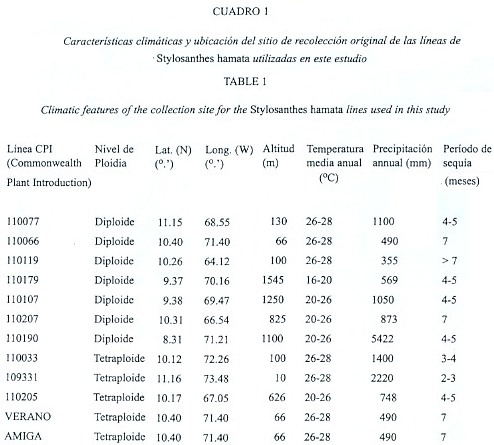
<body><![CDATA[<BR><FONT FACE="Arial,Helvetica"><FONT SIZE=-1>&nbsp;</FONT></FONT>     <BR><FONT FACE="Arial,Helvetica"><FONT SIZE=-1>Para la presente investigaci&oacute;n se seleccionaron doce l&iacute;neas de <I>S. hamata</I>, identificadas por el Commonwealth Plant Introduction (CPI), Australia, como siete diploides y cinco tetraploides; consideradas representativas de la amplia variabilidad en cuanto al grado de distribuci&oacute;n natural de la especie al norte de Suram&eacute;rica (<A HREF="#cuadro1">Cuadro 1</A>). La semilla se obtuvo del banco de germoplasma del Laboratorio de Ecolog&iacute;a Agr&iacute;cola de la Facultad de Agronom&iacute;a, Universidad Central de Venezuela.</FONT></FONT><FONT FACE="Arial,Helvetica"><FONT SIZE=-1></FONT></FONT>      <P><FONT FACE="Arial,Helvetica"><FONT SIZE=-1>Las plantas fueron cultivadas en condiciones de invernadero en Maracay, Venezuela (10<SUP>o</SUP>15’&nbsp; N, 67<SUP>o</SUP>39’ W), utilizando un suelo franco-arenoso de mediana fertilidad. Los potes fueron regados cada 48 horas hasta drenar, mientras se aplic&oacute; fertilizante cada 15 d&iacute;as con una soluci&oacute;n nutritiva comercial (Bayfolan, Bayer <SUP>MR</SUP>). A los 120 d&iacute;as de crecimiento, la semilla fue cosechada y almacenada bajo condiciones de laboratorio (<U>+</U> 25 &ordm;C), durante 60 d&iacute;as, hasta superar el per&iacute;odo de latencia embrionaria propio de la especie (<A HREF="#Gardener">Gardener 1975</A>). La semilla almacenada se separ&oacute; de acuerdo a su posici&oacute;n en&nbsp; fruto y posteriormente se procedi&oacute; a la realizaci&oacute;n de las siguientes pruebas:</FONT></FONT><FONT FACE="Arial,Helvetica"><FONT SIZE=-1></FONT></FONT>      <P><FONT FACE="Arial,Helvetica"><FONT SIZE=-1>a)<B>&nbsp; Porcentaje de dureza</B>:&nbsp; Para tal fin&nbsp; 50 semillas distales y basales de c/u de las 12 l&iacute;neas desprovistas de la vaina se colocaron en placas de “Petri” que conten&iacute;an 40 ml de agar al 1%. Dichas placas (4 por l&iacute;nea y posici&oacute;n dentro del fruto) fueron llevadas a una c&aacute;mara de germinaci&oacute;n durante diez d&iacute;as. Las semillas fueron expuestas diariamente a una humedad relativa entre 55 y 65%, y a una temperatura que oscil&oacute; entre 27 y 30 &ordm;C. La luz fue suministrada mediante dos bombillos de luz blanca fluorescente (110 W) con un fotoper&iacute;odo de doce horas. Se contaron diariamente las semillas germinadas y al final de la prueba las que no germinaron&nbsp; fueron seccionadas en su porci&oacute;n apical (<A HREF="#Mott">Mott 1979</A>) para facilitar la entrada de humedad. Al cabo de 48 horas se contaron las semillas duras germinadas, determinando as&iacute; el total de semillas duras en funci&oacute;n al total de semillas viables.</FONT></FONT><FONT FACE="Arial,Helvetica"><FONT SIZE=-1></FONT></FONT>      <P><FONT FACE="Arial,Helvetica"><FONT SIZE=-1>b)<B>&nbsp; Determinaci&oacute;n del sitio de entrada de humedad</B>:&nbsp; Un total de 40 semillas distales y basales sin vaina de c/u de las 12 l&iacute;neas se colocaron en soluci&oacute;n de sulfato ferroso de amonio 0.003 M (<A HREF="#Ballard">Ballard 1973</A>). El sitio de la cubierta seminal ennegrecido por el contacto con la soluci&oacute;n indic&oacute; el lugar de entrada de humedad. Se realizaron observaciones cada 24 horas durante doce d&iacute;as, para seguir el patr&oacute;n de imbibici&oacute;n y cuantificar el total de semillas ennegrecidas.</FONT></FONT><FONT FACE="Arial,Helvetica"><FONT SIZE=-1></FONT></FONT>      <P><FONT FACE="Arial,Helvetica"><FONT SIZE=-1>c)&nbsp; <B>Determinaci&oacute;n de las caracter&iacute;sticas morfo-anat&oacute;micas</B>:&nbsp; Para la realizaci&oacute;n del estudio morfo-anat&oacute;nico de la semilla se consideraron algunos de los caracteres se&ntilde;alados por <A HREF="#Escala">Escala (1994)</A> como de valor diagn&oacute;stico y que a su vez pudieran estar asociados con la dureza de la semilla, a saber:&nbsp; c.1. <B>Morfol&oacute;gicos</B>:&nbsp; Para el color y la forma se emple&oacute; una lupa estereosc&oacute;pica. Un microscopio electr&oacute;nico de barrido (Phillips XL-40) fue empleado para estudiar el tama&ntilde;o (largo x ancho), las ornamentaciones de la cubierta seminal, longitud de la regi&oacute;n hilar y longitud del estrofiolo. El t&eacute;rmino estrofiolo se refiere aqu&iacute; a la depresi&oacute;n longitudinal de la cubierta seminal ubicada en el rafe entre el hilo y la chalaza (<A HREF="#Werker80">Werker 1980/81</A>, <A HREF="#Argel">Argel y Humprhyes 1983</A>, <A HREF="#Serrato93">Serrato-Valenti<B> </B><I>et al. </I>1993</A>). Este t&eacute;rmino (estrofiolo) es equivalente a la palabra “Lens” empleada com&uacute;nmente por otros autores (<A HREF="#Ballard">Ballard 1975</A>, <A HREF="#Werker80">Werker 1980/81</A>, <A HREF="#Argel">Argel y Humphryes 1983</A>, <A HREF="#Serrato93">Serrato-Valenti <I>et al. </I>1993</A>). A tal fin el material fue fijado en un portamuestras y metalizado con oro-paladio a 40 nm. Las observaciones se realizaron entre cinco y 10 kilovoltios, para luego obtener las respectivas impresiones fotogr&aacute;ficas.&nbsp; c.2. <B>Anat&oacute;micos</B>:&nbsp; Grosor de la cubierta seminal, presencia y grosor de la cut&iacute;cula, grosor de la epidermis, forma y tama&ntilde;o de las osteoesclereidas (hipodermis), grosor del mes&oacute;filo, hilo (longitud de las c&eacute;lulas invertidas y tama&ntilde;o de la isla de traqueidas), estrofiolo (largo de las c&eacute;lulas del tap&oacute;n estrofiolar). Algunas semillas fueron a su vez fijadas en FAA por 24 horas, luego deshidratadas en una serie creciente de terbutanol e incluidas en parafina con punto de fusi&oacute;n 56-58&ordm;C. Mediante el uso de un microtomo de rotaci&oacute;n se obtuvieron secciones transversales de un grosor de 13 *m para posteriormente proceder a la tinci&oacute;n de las muestras con safranina-fastgreen (<A HREF="#Johansen">Johansen 1940</A>) y su observaci&oacute;n con un microscopio &oacute;ptico a 4, 10 y 40X.</FONT></FONT><FONT FACE="Arial,Helvetica"><FONT SIZE=-1></FONT></FONT>      <P><FONT FACE="Arial,Helvetica"><FONT SIZE=-1>d)&nbsp; <B>Determinaci&oacute;n de las caracter&iacute;sticas histoqu&iacute;micas</B>:&nbsp; Para el estudio histoqu&iacute;mico fueron empleadas semillas previamente ablandadas por calentamiento (tres minutos en agua hirviendo). Las secciones se realizaron a mano alzada y de inmediato se aplicaron los reactivos se&ntilde;alados en el <A HREF="#cuadro2">Cuadro 2</A>. Las muestras empleadas para el reconocimiento de calosa y polisac&aacute;ridos fueron sometidas a una extracci&oacute;n en serie de pectinas y de hemicelulosa empleando para ello oxalato de amonio al 0.5% por seis horas a 90 &ordm;C e hidr&oacute;xido de sodio al 4% por seis horas a 25 &ordm;C (modificado de <A HREF="#Bevilacqua">Bevilacqua <I>et al.&nbsp; </I>1987</A>). Las muestras fueron luego observadas en un microscopio de luz polarizada a 25X.</FONT></FONT><FONT FACE="Arial,Helvetica"><FONT SIZE=-1></FONT></FONT>      <P><FONT FACE="Arial,Helvetica"><FONT SIZE=-1>El dise&ntilde;o experimental empleado para comparar las distintas l&iacute;neas fue un factorial 12x2 con efecto anidado. Los doce factores considerados fueron las doce l&iacute;neas (siete diploides y cinco tetraploides) con dos niveles:&nbsp;&nbsp; posici&oacute;n:&nbsp; distal y basal. Cuando se compararon los dos niveles de ploidia el dise&ntilde;o fue igualmente un factorial, pero en este caso 2 x 2 y tambi&eacute;n con efecto anidado. En ambos casos se utiliz&oacute; un arreglo completamente aleatorizado. Los resultados fueron sometidos a pruebas de normalidad y varianza y, cuando no se obtuvo normalidad en los datos obtenidos, se recurri&oacute; a la prueba no param&eacute;trica de Kruskal-Wallis (<A HREF="#Zar">Zar 1984</A>).</FONT></FONT>     <BR><FONT FACE="Arial,Helvetica"><FONT SIZE=-1></FONT></FONT>&nbsp;<FONT FACE="Arial,Helvetica"><FONT SIZE=-1></FONT></FONT>     <CENTER><A NAME="cuadro1"></A><IMG SRC="/img/fbpe/rbt/v49n1/2345i3.JPG" HEIGHT=445 WIDTH=494></CENTER>      
]]></body>
<body><![CDATA[<CENTER>&nbsp;</CENTER>      <CENTER><A NAME="cuadro2"></A><IMG SRC="/img/fbpe/rbt/v49n1/2345i04.JPG" HEIGHT=434 WIDTH=545></CENTER> <FONT FACE="Arial,Helvetica"><FONT SIZE=-1></FONT></FONT>     
<CENTER><FONT FACE="Arial,Helvetica"><FONT SIZE=-1>&nbsp;</FONT></FONT><A NAME="fig1"></A><A NAME="fig1"></A><IMG SRC="/img/fbpe/rbt/v49n1/2345i01.JPG" HEIGHT=347 WIDTH=544></CENTER>      
<CENTER><FONT FACE="Arial,Helvetica"><FONT SIZE=-1>&nbsp;</FONT></FONT></CENTER>      <CENTER><A NAME="fig2"></A><IMG SRC="/img/fbpe/rbt/v49n1/2345i02.JPG" HEIGHT=721 WIDTH=556></CENTER> <FONT FACE="Arial,Helvetica"><FONT SIZE=-1></FONT></FONT>      
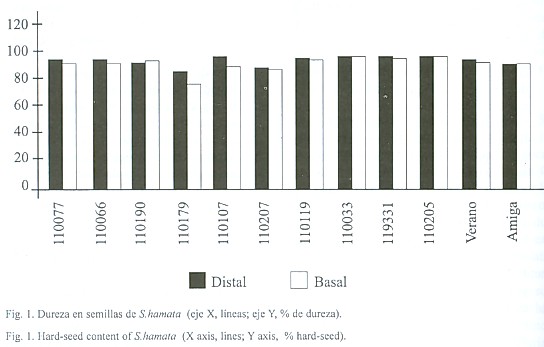
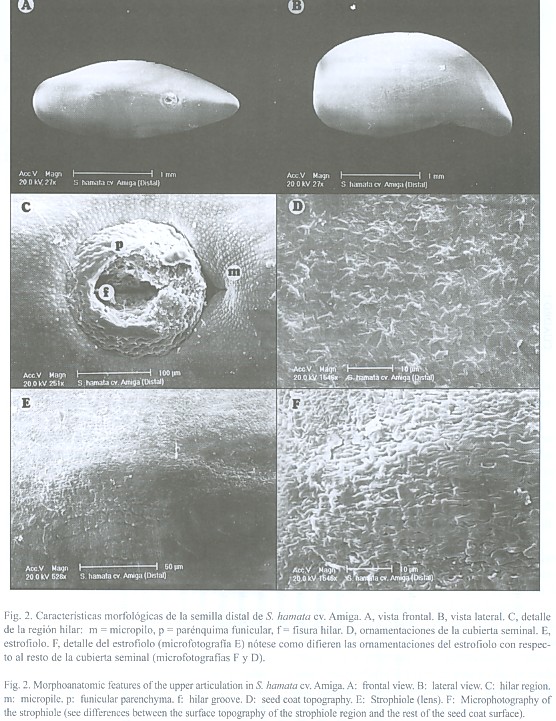
<P><B><FONT FACE="Arial,Helvetica"><FONT SIZE=-1>Resultados</FONT></FONT></B>     <BR><FONT FACE="Arial,Helvetica"><FONT SIZE=-1>&nbsp;</FONT></FONT>     <BR><FONT FACE="Arial,Helvetica"><FONT SIZE=-1><B>Dureza de la semilla en funci&oacute;n a la viabilidad</B>:&nbsp; La <A HREF="#fig1">Figura 1</A> muestra los porcentajes de dureza obtenidos para las doce l&iacute;neas de <I>S. hamata</I> estudiadas. El promedio de dureza para las l&iacute;neas diploides fue de&nbsp; 94.7% <U>+</U> 6.0 en la semilla distal, con una de variaci&oacute;n entre 88% (CPI 110179) y 100% (CPI 110077, 110107). En la semilla basal el promedio de dureza fue de 88.9% <U>+</U> 11.5, con valores oscilando entre 64 (CPI 110179) y 97% (CPI 110077, 110190). En las l&iacute;neas tetraploides&nbsp; la semilla distal alcanz&oacute; un porcentaje de dureza de 98.5% <U>+</U> 2.1 y la basal de 97.8% <U>+</U> 2.5, con un &aacute;mbito de variaci&oacute;n para las dos posiciones entre 95% (cv. Amiga) y 100% (CPI 110033, 110205). No se encontraron diferencias estad&iacute;sticamente significativas entre niveles de ploidia ni entre posiciones dentro del fruto, aunque el an&aacute;lisis estad&iacute;stico demostr&oacute; un clara interacci&oacute;n entre estos dos factores. Dentro de las l&iacute;neas solo se encontraron diferencias significativas entre posiciones para CPI 110077 (p=0.005) y CPI 110179 (p=0.003), teniendo en ambos casos la semilla distal un mayor grado de dureza que la basal.</FONT></FONT><FONT FACE="Arial,Helvetica"><FONT SIZE=-1></FONT></FONT>      <P><FONT FACE="Arial,Helvetica"><FONT SIZE=-1><B>Sitio de entrada de humedad</B>:&nbsp; En todas las semillas blandas, independientemente de su nivel de ploid&iacute;a como de su posici&oacute;n en el fruto, la entrada de humedad se llev&oacute; a cabo a trav&eacute;s del hilo, puesto que al colocar la semilla en la soluci&oacute;n de sulfato ferroso de amonio, fue &eacute;sta la &uacute;nica regi&oacute;n de la cubierta seminal ennegrecida por el contacto con la soluci&oacute;n. Por otra parte, en las semillas duras no se observ&oacute; cambio en la coloraci&oacute;n de la cubierta seminal.</FONT></FONT><FONT FACE="Arial,Helvetica"><FONT SIZE=-1></FONT></FONT>      <P><FONT FACE="Arial,Helvetica"><FONT SIZE=-1><B>Caracter&iacute;sticas morfol&oacute;gicas de la semilla</B>:&nbsp; El comparar la semilla de las distintas l&iacute;neas y posiciones permiti&oacute; determinar que la semilla de <I>S. hamata</I> es una semilla polim&oacute;rfica, fue en general de forma ovoidea, cuyas dimensiones estuvieron por debajo de los 2 mm de largo por 1 mm de ancho por lo que se considera peque&ntilde;a (<A HREF="#fig2">Fig. 2</A>) y su color vari&oacute; de casta&ntilde;o claro a casta&ntilde;o oscuro casi negro. Se apreci&oacute; una superficie rugosa, observ&aacute;ndose una mayor rugosidad y mayor compactaci&oacute;n celular en las semillas distales que en las basales (<A HREF="#fig2">Fig. 2</A>).</FONT></FONT><FONT FACE="Arial,Helvetica"><FONT SIZE=-1></FONT></FONT>      ]]></body>
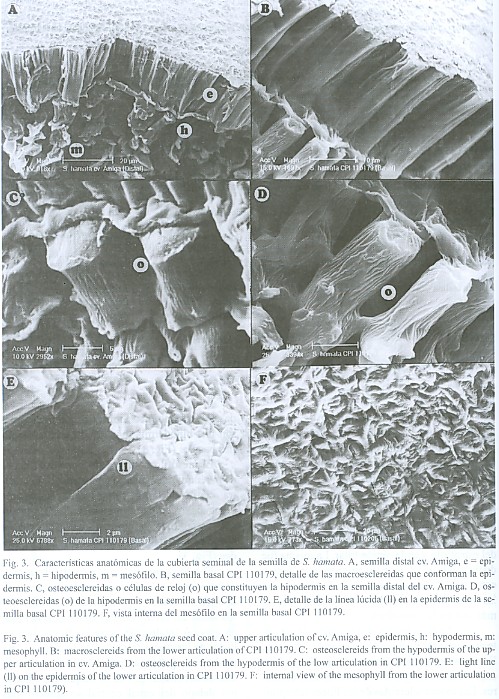
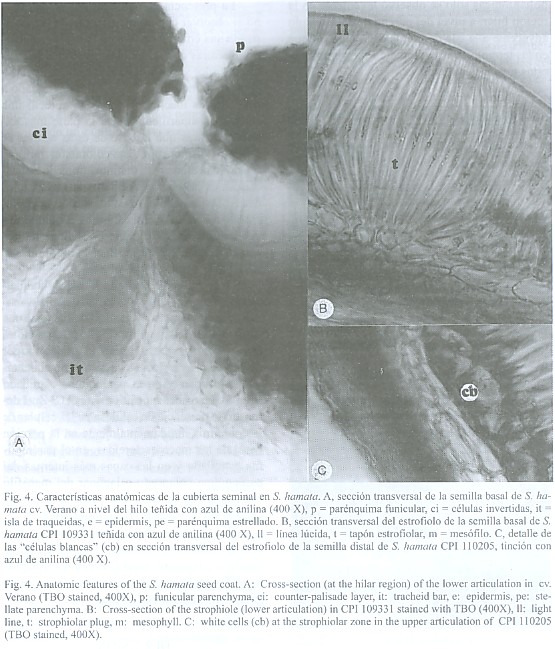
<body><![CDATA[<P><FONT FACE="Arial,Helvetica"><FONT SIZE=-1>En la regi&oacute;n hilar destacaron:&nbsp; a) el micropilo, el cual se observ&oacute; como una depresi&oacute;n deltoide, generalmente cerrado y ubicado por encima del hilo; b) el hilo, ubicado en la porci&oacute;n apical, de color marr&oacute;n oscuro y de forma circular, parcialmente cubierto por restos de par&eacute;nquima funicular, sin halo distinguible y con un canal central cerrado, y c) el estrofiolo, de color casta&ntilde;o, m&aacute;s oscuro que el resto de la cubierta seminal ubicado en la porci&oacute;n opuesta al micropilo. El estrofiolo se destac&oacute; por ser una estructura prominente y de forma elipsoidal. En &eacute;sta &uacute;ltima estructura la superficie de las c&eacute;lulas fue totalmente diferente al resto de la cubierta seminal. En tal sentido se observ&oacute; que las macroesclereidas del estrofiolo no presentaron rugosidad.</FONT></FONT><FONT FACE="Arial,Helvetica"><FONT SIZE=-1></FONT></FONT>      <P><FONT FACE="Arial,Helvetica"><FONT SIZE=-1><B>Caracter&iacute;sticas anat&oacute;micas de la cubierta seminal</B>:&nbsp; Se observ&oacute; una cut&iacute;cula delgada y una epidermis uniestratificada de macroesclereidas en empalizada o c&eacute;lulas de Malpighi, con paredes engrosadas y radialmente alargadas. En la misma destac&oacute; la presencia de la l&iacute;nea l&uacute;cida, la cual est&aacute; ubicada en la parte m&aacute;s externa de las macroesclereidas. La l&iacute;nea l&uacute;cida se apreci&oacute; en toda la epidermis, a nivel del estrofiolo y en la regi&oacute;n hilar. La misma fue distinguible tanto con el microscopio &oacute;ptico como con el electr&oacute;nico de barrido (<A HREF="#fig3">Fig. 3</A>). En las l&iacute;neas tetraploides la l&iacute;nea l&uacute;cida se apreci&oacute; m&aacute;s que en las diploides.</FONT></FONT><FONT FACE="Arial,Helvetica"><FONT SIZE=-1></FONT></FONT>      <P><FONT FACE="Arial,Helvetica"><FONT SIZE=-1>La hipodermis esta constituida por osteoesclereidas o c&eacute;lulas columnares o de reloj. Es uniestratificada y posee c&eacute;lulas de paredes engrosadas con grandes espacios intercelulares. Las osteoesclereidas de las l&iacute;neas tetraploides se apreciaron menos estilizadas, con menores espacios intercelulares y menos ornamentadas. As&iacute; mismo, las semillas distales presentaron una hipodermis m&aacute;s gruesa que las semillas basales (<A HREF="#fig3">Fig. 3</A>).</FONT></FONT><FONT FACE="Arial,Helvetica"><FONT SIZE=-1></FONT></FONT>      <P><FONT FACE="Arial,Helvetica"><FONT SIZE=-1>El mes&oacute;filo conformado por varias capas de par&eacute;nquima lagunar o colapsado, se encuentra constituido por c&eacute;lulas tangencialmente elongadas y de paredes engrosadas. En las l&iacute;neas tetraploides se apreci&oacute; que esta capa de tejido es m&aacute;s delgada que en las l&iacute;neas diploides (<A HREF="#fig3">Fig. 3</A>).</FONT></FONT><FONT FACE="Arial,Helvetica"><FONT SIZE=-1></FONT></FONT>      <P><FONT FACE="Arial,Helvetica"><FONT SIZE=-1>El hilo present&oacute; una doble capa de c&eacute;lulas de Malpighi, la superior invertida y superpuesta sobre la inferior. Ambas capas se ubican a los lados del canal central (fisura hilar) el cual se apreci&oacute; totalmente cerrado. En la semilla distal de las l&iacute;neas tetraploides se observ&oacute; una tendencia a presentar esta estructura en forma m&aacute;s desarrollada. La isla de traqueidas ubicada por debajo del canal central se apreci&oacute; m&aacute;s alargada en la semilla distal de las l&iacute;neas tetraploides (<A HREF="#fig4">Fig. 4</A>).</FONT></FONT><FONT FACE="Arial,Helvetica"><FONT SIZE=-1></FONT></FONT>      <P><FONT FACE="Arial,Helvetica"><FONT SIZE=-1>El estrofiolo estuvo constituido por macroesclereidas mucho m&aacute;s largas y delgadas que el resto de las macroesclereidas que conforman la cubierta seminal. Se destac&oacute; la presencia de peque&ntilde;as c&eacute;lulas bien diferenciadas ubicadas a los lados de las macroesclereidas que conforman el tap&oacute;n estrofiolar. Estas c&eacute;lulas denominadas “c&eacute;lulas blancas” (<A HREF="#fig4">Fig. 4</A>) fueron descritas por <A HREF="#Serrato95">Serrato-Valenti <I>et al.&nbsp; </I>(1995)</A> en el estrofiolo de la semilla de <I>Leucaena leucocephla</I>.</FONT></FONT>     <BR><FONT FACE="Arial,Helvetica"><FONT SIZE=-1></FONT></FONT>&nbsp;<FONT FACE="Arial,Helvetica"><FONT SIZE=-1></FONT></FONT>     <CENTER><A NAME="fig3"></A><IMG SRC="/img/fbpe/rbt/v49n1/2345i05.JPG" HEIGHT=699 WIDTH=499></CENTER>      
<CENTER>&nbsp;</CENTER>      <CENTER><A NAME="fig4"></A><IMG SRC="/img/fbpe/rbt/v49n1/2345i06.JPG" HEIGHT=649 WIDTH=555></CENTER> <FONT FACE="Arial,Helvetica"><FONT SIZE=-1></FONT></FONT>      
]]></body>
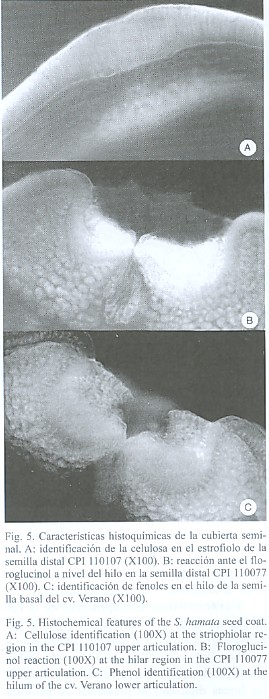
<body><![CDATA[<P><FONT FACE="Arial,Helvetica"><FONT SIZE=-1><B>Caracter&iacute;sticas histoqu&iacute;micas de la cubierta seminal:&nbsp; </B>La coloraci&oacute;n verde intensa pero moment&aacute;nea en la isla de traqueidas en todas las l&iacute;neas estudiadas demostr&oacute; la presencia de pectinas fen&oacute;licas en esta estructura. En las l&iacute;neas diploides la presencia de pectinas poliani&oacute;nicas s&oacute;lo se observ&oacute; levemente en la regi&oacute;n hilar, a nivel del par&eacute;nquima estrellado adyacente a la isla de traqueidas, mientras que en las tetraploides la coloraci&oacute;n fue verdosa en estas mismas estructuras.</FONT></FONT><FONT FACE="Arial,Helvetica"><FONT SIZE=-1></FONT></FONT>      <P><FONT FACE="Arial,Helvetica"><FONT SIZE=-1>La presencia de polisac&aacute;ridos se determin&oacute; al observar con el microscopio de luz polarizada una coloraci&oacute;n roja en la isla de traqueidas mientras que las c&eacute;lulas invertidas se ti&ntilde;eron de color verde y el par&eacute;nquima funicular y el par&eacute;nquima estrellado de color anaranjado a rojo. En las macroesclereidas se apreci&oacute; una coloraci&oacute;n amarillenta hacia la parte m&aacute;s externa mientras que la base de estas c&eacute;lulas se observ&oacute; de color rojo. Esta coloraci&oacute;n m&uacute;ltiple revel&oacute; la presencia de distintos tipos de polisac&aacute;ridos en la cubierta seminal. Las observaciones realizadas con el microscopio de luz polarizada indicaron que la calosa es el compuesto que determina la presencia de la l&iacute;nea l&uacute;cida, encontr&aacute;ndose que en las l&iacute;neas tetraploides la reacci&oacute;n fue mucho m&aacute;s intensa.</FONT></FONT><FONT FACE="Arial,Helvetica"><FONT SIZE=-1></FONT></FONT>      <P><FONT FACE="Arial,Helvetica"><FONT SIZE=-1>La lignina se detect&oacute; en la isla de traqueidas al observarse una coloraci&oacute;n de rojo a morado y en las c&eacute;lulas invertidas al obtenerse una coloraci&oacute;n rosada intensa (<A HREF="#fig5">Fig. 5</A>). Los fenoles estuvieron presentes en toda la epidermis por debajo de la l&iacute;nea l&uacute;cida, excepto a nivel del tap&oacute;n estrofiolar y en el par&eacute;nquima estrellado (<A HREF="#fig5">Fig. 5</A>). La reacci&oacute;n positiva ante el Cl-Zn-I demostr&oacute; la presencia de celulosa en las c&eacute;lulas de la epidermis, fundamentalmente en la porci&oacute;n basal de las macroesclereidas, en el par&eacute;nquima estrellado y en las capas m&aacute;s internas del par&eacute;nquima colapsado o lagunar del mes&oacute;filo (<A HREF="#fig5">Fig. 5</A>). De igual manera se observ&oacute; la presencia de este compuesto en la hipodermis.</FONT></FONT><FONT FACE="Arial,Helvetica"><FONT SIZE=-1></FONT></FONT>      <P><FONT FACE="Arial,Helvetica"><FONT SIZE=-1>Con respecto a la reacci&oacute;n de las muestras ante el sudan III y el sudan IV, s&oacute;lo se obtuvo una leve coloraci&oacute;n en el par&eacute;nquima colapsado del mes&oacute;filo revelando as&iacute; la presencia de grasas y cutina en este tejido.</FONT></FONT>     <BR><FONT FACE="Arial,Helvetica"><FONT SIZE=-1>&nbsp;</FONT></FONT>     <CENTER><FONT FACE="Arial,Helvetica"><FONT SIZE=-1>&nbsp;</FONT></FONT><A NAME="fig5"></A><IMG SRC="/img/fbpe/rbt/v49n1/2345i07.JPG" HEIGHT=699 WIDTH=269></CENTER> <FONT FACE="Arial,Helvetica"><FONT SIZE=-1></FONT></FONT>      
<P><B><FONT FACE="Arial,Helvetica"><FONT SIZE=-1>Discus&oacute;n</FONT></FONT></B><FONT FACE="Arial,Helvetica"><FONT SIZE=-1></FONT></FONT>      <P><FONT FACE="Arial,Helvetica"><FONT SIZE=-1>La presente investigaci&oacute;n ha demostrado que la semilla de <I>S. hamata</I> (L.) Taub. desarrollada en condiciones tropicales de altas temperaturas (> 25 &ordm;C) presenta un alto grado de dureza (>85%) y que el porcentaje de dureza en la semilla fue, en la mayor&iacute;a de los casos, independiente del nivel de ploidia y de la posici&oacute;n de la semilla en el fruto (<A HREF="#fig1">Fig. 1</A>). Estos resultados confirman los obtenidos por <A HREF="#Argel">Argel y Humphreys (1983)</A> y <A HREF="#Guenni94">Guenni <I>et al.&nbsp;</I><B> </B>(1994)</A>. Sin embargo, se observ&oacute; una tendencia en algunas l&iacute;neas diploides a presentar un porcentaje mas bajo de semillas duras, tal como fue el caso de la l&iacute;nea CPI 110179 cuyos valores de dureza en la semilla basal fueron inferiores al promedio obtenido para la especie.</FONT></FONT><FONT FACE="Arial,Helvetica"><FONT SIZE=-1></FONT></FONT>      <P><FONT FACE="Arial,Helvetica"><FONT SIZE=-1>Desde un punto de vista ecol&oacute;gico, este tipo de latencia representa una propiedad adaptativa que promueve la sobrevivencia de las plantas bajo condiciones adversas y por lo tanto, es de suma importancia en t&eacute;rminos evolutivos. La misma representa una ventaja para la especie cuando las condiciones ambientales para la germinaci&oacute;n no son las m&aacute;s favorables. La dureza seminal es en consecuencia un mecanismo por medio del cual la germinaci&oacute;n puede distribuirse tanto en el tiempo como en el espacio, aumentando as&iacute; las posibilidades de &eacute;xito en el establecimiento de poblaciones sucesivas de plantas dentro de una misma especie (<A HREF="#Guenni92">Guenni 1992</A>). Este tipo de latencia asegura entonces, la permanencia de la semilla en el banco de semillas del suelo y la supervivencia de la especie a largo plazo (<A HREF="#Bewley">Bewley &amp; Black 1982</A>, <A HREF="#Rice">Rice 1989</A>).</FONT></FONT><FONT FACE="Arial,Helvetica"><FONT SIZE=-1></FONT></FONT>      <P><FONT FACE="Arial,Helvetica"><FONT SIZE=-1>En <I>S. hamata</I>, al igual que en otras especies de leguminosas, este tipo de latencia est&aacute; altamente asociada a las caracter&iacute;sticas morfo-anat&oacute;micas e histoqu&iacute;micas de las estructuras o tejidos que conforman la cubierta seminal.</FONT></FONT><FONT FACE="Arial,Helvetica"><FONT SIZE=-1></FONT></FONT>      ]]></body>
<body><![CDATA[<P><FONT FACE="Arial,Helvetica"><FONT SIZE=-1>En el presente estudio el hecho de haberse encontrado para <I>S. hamata</I> un conjunto de caracter&iacute;sticas particulares en la cubierta seminal, le confieren a la semilla su car&aacute;cter impermeable, tal y como lo han informado distintos autores para otras leguminosas (<A HREF="#Werker79">Werker <I>et al.&nbsp;</I> 1979</A>, <A HREF="#Hanna">Hanna 1983</A>, <A HREF="#Serrato89">Serrato-Valenti <I>et al. </I>1989</A>, <A HREF="#Serrato92">Serrato-Valenti <I>et al. </I>1992</A>, <A HREF="#Serrato94">Serrato-Valenti <I>et al.&nbsp;</I> 1994</A>, <A HREF="#Serrato95">Serrato-Valenti <I>et al.&nbsp; </I>1995</A>). Entre estas caracter&iacute;sticas se destacan la presencia de un micropilo e hilo totalmente cerrados y una epidermis rica en compuestos hidrof&oacute;bicos como los fenoles y conformada a su vez por macroesclereidas en empalizada muy compactadas. Igualmente se destac&oacute; en la epidermis la presencia de una l&iacute;nea l&uacute;cida producto de la deposici&oacute;n de calosa en las paredes m&aacute;s externas de este tejido. Aunado a esto, la existencia de compuestos hidrof&oacute;bicos tales como lignina, polisac&aacute;ridos y pectinas fen&oacute;licas en la isla de traqueidas, y la presencia de lignina y calosa en las c&eacute;lulas invertidas contribuyen a determinar el car&aacute;cter impermeable de la cubierta seminal. Resultados similares fueron infromados por <A HREF="#Argel">Argel y Humphreys (1983)</A> en <I>S. hamata</I> cv. Verano. En este cultivar el alto nivel de dureza en la semilla se asoci&oacute; igualmente a un mayor desarrollo de la cut&iacute;cula y una relaci&oacute;n hemicelulosa/celulosa mucho m&aacute;s alta en las c&eacute;lulas de la epidermis. En <I>S. scabra</I>, <A HREF="#Serrato93">Serrato-Valenti <I>et al.&nbsp;</I> (1993)</A> observaron igualmente un patr&oacute;n de composici&oacute;n qu&iacute;mica y de configuraci&oacute;n anat&oacute;mica de la cubierta seminal muy semejante al encontrado en este estudio.</FONT></FONT><FONT FACE="Arial,Helvetica"><FONT SIZE=-1></FONT></FONT>      <P><FONT FACE="Arial,Helvetica"><FONT SIZE=-1>Por otra parte, se pudo determinar que la semilla de la especie estudiada posee un polimorfismo marcado en cuanto al tama&ntilde;o y color. Este polimorfismo fue observado tanto entre l&iacute;neas diploides y tetraploides, como entre semillas distales y basales dentro de una misma l&iacute;nea. La presente variabilidad fenot&iacute;pica relacionada con la morfolog&iacute;a de la semilla tambi&eacute;n se ha observado en <I>Vigna ungiculata</I> (<A HREF="#Lush">Lush &amp; Evans 1980</A>), <I>S. hamata</I> cv. Verano (<A HREF="#Argel">Argel &amp; Humphreys 1983</A>) y <I>Lupinus angustifolius</I> (<A HREF="#Serrato89">Serrato-Valenti<B> </B><I>et al. </I>1989</A>). Sin embargo, en <I>S. hamata</I> esta caracter&iacute;stica no parece estar asociada a la dureza, pues la tendencia general observada fue que independientemente del tama&ntilde;o de la semilla, tanto las de color claro como las de color oscuro se comportaron como semillas duras.</FONT></FONT>     <BR><FONT FACE="Arial,Helvetica"><FONT SIZE=-1>&nbsp;</FONT></FONT>     <BR><B><FONT FACE="Arial,Helvetica"><FONT SIZE=-1>Agradecimiento</FONT></FONT></B>     <BR><FONT FACE="Arial,Helvetica"><FONT SIZE=-1>&nbsp;</FONT></FONT>     <BR><FONT FACE="Arial,Helvetica"><FONT SIZE=-1>Esta investigaci&oacute;n form&oacute; parte de la Tesis de Maestr&iacute;a de la primera autora y fue parcialmente financiada por la Fundaci&oacute;n para el Desarrollo de la Ciencia y la Tecnolog&iacute;a del Estado Aragua, (FUNDACITE-Aragua), Venezuela. Agradecemos a los dos revisores an&oacute;nimos por sus valiosos comentarios en la elaboraci&oacute;n final del manuscrito.</FONT></FONT>     <BR><FONT FACE="Arial,Helvetica"><FONT SIZE=-1>&nbsp;</FONT></FONT>     <BR><B><FONT FACE="Arial,Helvetica"><FONT SIZE=-1>Resumen</FONT></FONT></B>     <BR><FONT FACE="Arial,Helvetica"><FONT SIZE=-1>&nbsp;</FONT></FONT>     <BR><FONT FACE="Arial,Helvetica"><FONT SIZE=-1>La semilla de <I>Stylosanthes hamata</I> (L.) Taub. se caracteriza por presentar un alto grado de latencia asociada a una restricci&oacute;n a la absorci&oacute;n de humedad (semilla dura). En esta investigaci&oacute;n, se estudi&oacute; la dureza de semillas distales y basales de siete l&iacute;neas diploides y cinco l&iacute;neas tetraploides, cultivadas bajo condiciones tropicales. Las pruebas pruebas de germinaci&oacute;n (HR:&nbsp; 55-65%, temperatura constante:&nbsp; 27-30&ordm; C, fotoper&iacute;odo:&nbsp; 12/12 hr) llevadas a cabo en semillas desprovistas de vaina indicaron que el grado de dureza seminal estuvo en casi todos los casos por encima del 85%, independientemente del nivel de ploidia y de la posici&oacute;n de la semilla en el fruto. As&iacute; mismo, se realiz&oacute; una caracterizaci&oacute;n morfo-anat&oacute;mica de la cubierta seminal a trav&eacute;s del uso del microscopio &oacute;ptico y de barrido. Esta caracterizaci&oacute;n fue complementada con un estudio histoqu&iacute;mico para determinar la ubicaci&oacute;n de compuestos hidrof&oacute;bicos en la cubierta seminal. Los resultados de estas pruebas se&ntilde;alaron que la dureza seminal estuvo relacionada con la presencia de un micropilo y un hilo totalmente cerrados, una epidermis compuesta por macroesclereidas en empalizada con una l&iacute;nea l&uacute;cida en las paredes m&aacute;s externas de estas c&eacute;lulas y a una alta concentraci&oacute;n de compuestos hidrof&oacute;bicos en todos los tejidos que conforman la cubierta seminal.</FONT></FONT>     ]]></body>
<body><![CDATA[<BR><FONT FACE="Arial,Helvetica"><FONT SIZE=-1>&nbsp;</FONT></FONT>     <BR><B><FONT FACE="Arial,Helvetica"><FONT SIZE=-1>Referencias</FONT></FONT></B>     <BR><FONT FACE="Arial,Helvetica"><FONT SIZE=-1>&nbsp;</FONT></FONT>     <!-- ref --><BR><A NAME="Argel"></A><FONT FACE="Arial,Helvetica"><FONT SIZE=-1>Argel, P.J. &amp; L.R. Humphryes. 1983. Enviroment effects on the seed development and the hardseededness in <I>Stylosanthes hamata</I> cv. Verano. I. Temperature. Aust. J. Agric. Res. 34:261-270.</FONT></FONT><FONT FACE="Arial,Helvetica"><FONT SIZE=-1></FONT></FONT>    &nbsp;&nbsp;&nbsp;&nbsp;&nbsp;&nbsp;&nbsp;&nbsp;[&#160;<a href="javascript:void(0);" onclick="javascript: window.open('/scielo.php?script=sci_nlinks&ref=1360482&pid=S0034-7744200100010002700001&lng=','','width=640,height=500,resizable=yes,scrollbars=1,menubar=yes,');">Links</a>&#160;]<!-- end-ref --><!-- ref --><P><A NAME="Ballard"></A><FONT FACE="Arial,Helvetica"><FONT SIZE=-1>Ballard, L.T.A. 1973. Physical barries to germination. Seed. Tech. 1: 285-303</FONT></FONT><FONT FACE="Arial,Helvetica"><FONT SIZE=-1></FONT></FONT>    &nbsp;&nbsp;&nbsp;&nbsp;&nbsp;&nbsp;&nbsp;&nbsp;[&#160;<a href="javascript:void(0);" onclick="javascript: window.open('/scielo.php?script=sci_nlinks&ref=1360483&pid=S0034-7744200100010002700002&lng=','','width=640,height=500,resizable=yes,scrollbars=1,menubar=yes,');">Links</a>&#160;]<!-- end-ref --><P><A NAME="Baskin"></A><FONT FACE="Arial,Helvetica"><FONT SIZE=-1>Baskin, C. &amp;J. Baskin. 1989. Physiology of dormancy and germination in relation seed bank ecology. p. 553-556. <I>In</I>:M.A. Leck, V.T. Parker &amp; R.L. Simpson (eds). Ecology of soil seed banks. California.</FONT></FONT><FONT FACE="Arial,Helvetica"><FONT SIZE=-1></FONT></FONT>      <!-- ref --><P><A NAME="Bevilacqua"></A><FONT FACE="Arial,Helvetica"><FONT SIZE=-1>Bevilacqua, L., F. Fossati &amp; G. Dondero. 1987. “Calosa” in the impermeable seed coat of <I>Sesbania punicea</I>. Ann. Bot. 59:335-341</FONT></FONT><FONT FACE="Arial,Helvetica"><FONT SIZE=-1></FONT></FONT>    &nbsp;&nbsp;&nbsp;&nbsp;&nbsp;&nbsp;&nbsp;&nbsp;[&#160;<a href="javascript:void(0);" onclick="javascript: window.open('/scielo.php?script=sci_nlinks&ref=1360485&pid=S0034-7744200100010002700003&lng=','','width=640,height=500,resizable=yes,scrollbars=1,menubar=yes,');">Links</a>&#160;]<!-- end-ref --><!-- ref --><P><A NAME="Bewley"></A><FONT FACE="Arial,Helvetica"><FONT SIZE=-1>Bewley, J.D. &amp; M. Black. 1982. Physiology and biochemistry of seeds in relation to germination. Vol. 2. Viability, dormancy and environmental control. Springer-Verlag, Berl&iacute;n. 375 p.</FONT></FONT><FONT FACE="Arial,Helvetica"><FONT SIZE=-1></FONT></FONT>    &nbsp;&nbsp;&nbsp;&nbsp;&nbsp;&nbsp;&nbsp;&nbsp;[&#160;<a href="javascript:void(0);" onclick="javascript: window.open('/scielo.php?script=sci_nlinks&ref=1360486&pid=S0034-7744200100010002700004&lng=','','width=640,height=500,resizable=yes,scrollbars=1,menubar=yes,');">Links</a>&#160;]<!-- end-ref --><P><A NAME="Burt"></A><FONT FACE="Arial,Helvetica"><FONT SIZE=-1>Burt, R.L., D.G. Cameron, D.F. Cameron, L. T’Mannetje &amp; J. Lenne. 1983. <I>Stylosanthes</I>. p. 141-181. <I>In</I>:R.L. Burt, P.P. Rotar, J.L. Walker &amp; M.W. Silvey (eds.) The role of<I>Centrosema</I>, <I>Desmodium</I> and <I>Stylosanthes</I> in proving tropical pastures. Colorado.</FONT></FONT><FONT FACE="Arial,Helvetica"><FONT SIZE=-1></FONT></FONT>      <P><A NAME="Castillo"></A><FONT FACE="Arial,Helvetica"><FONT SIZE=-1>Castillo, R. 1997. Estudio de la dureza en semillas de <I>Stylosanthes hamata</I> (L.) Taub. y su realaci&oacute;n con las caracter&iacute;sticas morfo-anat&oacute;micas de la cubierta seminal. Tesis de Maestr&iacute;a. Facultad de Agronom&iacute;a. Universidad Central de Venezuela. Maracay. Venezuela.</FONT></FONT><FONT FACE="Arial,Helvetica"><FONT SIZE=-1></FONT></FONT>      ]]></body>
<body><![CDATA[<!-- ref --><P><A NAME="Edye83"></A><FONT FACE="Arial,Helvetica"><FONT SIZE=-1>Edye, L.A. &amp; B. Groft. 1983. Selecting cultivars from naturally ocurring genotypes:evaluating <I>Stylosanthes </I>species. p. 217-232. <I>In</I>:J.G. McIvor y R.A. Bray (eds). Genetic resources of forage plants. CSIRO, Melbourne.</FONT></FONT><FONT FACE="Arial,Helvetica"><FONT SIZE=-1></FONT></FONT>    &nbsp;&nbsp;&nbsp;&nbsp;&nbsp;&nbsp;&nbsp;&nbsp;[&#160;<a href="javascript:void(0);" onclick="javascript: window.open('/scielo.php?script=sci_nlinks&ref=1360489&pid=S0034-7744200100010002700005&lng=','','width=640,height=500,resizable=yes,scrollbars=1,menubar=yes,');">Links</a>&#160;]<!-- end-ref --><!-- ref --><P><A NAME="Edye88"></A><FONT FACE="Arial,Helvetica"><FONT SIZE=-1>Edye, L.A. 1988. <I>Stylosanthes</I> collecting in Colombia and Venezuela. 16/01/86 to 05/09/86. Final Report. CSIRO, Townsville, Australia. 28 p.</FONT></FONT><FONT FACE="Arial,Helvetica"><FONT SIZE=-1></FONT></FONT>    &nbsp;&nbsp;&nbsp;&nbsp;&nbsp;&nbsp;&nbsp;&nbsp;[&#160;<a href="javascript:void(0);" onclick="javascript: window.open('/scielo.php?script=sci_nlinks&ref=1360490&pid=S0034-7744200100010002700006&lng=','','width=640,height=500,resizable=yes,scrollbars=1,menubar=yes,');">Links</a>&#160;]<!-- end-ref --><P><A NAME="Escala"></A><FONT FACE="Arial,Helvetica"><FONT SIZE=-1>Escala, M. 1994. Estudio morfoanat&oacute;mico de frutos y semillas de leguminosas de los altos llanos centrales de Venezuela (Estaci&oacute;n Biol&oacute;gica de los Llanos de la Sociedad Venezolana de Ciencias Naturales) Bol. Soc. Venezolana. Cien. Natur. 44(148): 259-316.</FONT></FONT><FONT FACE="Arial,Helvetica"><FONT SIZE=-1></FONT></FONT>      <!-- ref --><P><A NAME="Ferder"></A><FONT FACE="Arial,Helvetica"><FONT SIZE=-1>Ferder, N &amp; T.P. O’Brien. 1968. Plant microtechnique, some principles and new methods. Amer. J. Bot. 55 (1): 123-142.</FONT></FONT><FONT FACE="Arial,Helvetica"><FONT SIZE=-1></FONT></FONT>    &nbsp;&nbsp;&nbsp;&nbsp;&nbsp;&nbsp;&nbsp;&nbsp;[&#160;<a href="javascript:void(0);" onclick="javascript: window.open('/scielo.php?script=sci_nlinks&ref=1360492&pid=S0034-7744200100010002700007&lng=','','width=640,height=500,resizable=yes,scrollbars=1,menubar=yes,');">Links</a>&#160;]<!-- end-ref --><!-- ref --><P><A NAME="Gardener"></A><FONT FACE="Arial,Helvetica"><FONT SIZE=-1>Gardener, C.J. 1975. Mechanism regulating germination in seed of <I>Stylosanthes</I>. Aust. J. Agric. Res. 26: 281-294</FONT></FONT><FONT FACE="Arial,Helvetica"><FONT SIZE=-1></FONT></FONT>    &nbsp;&nbsp;&nbsp;&nbsp;&nbsp;&nbsp;&nbsp;&nbsp;[&#160;<a href="javascript:void(0);" onclick="javascript: window.open('/scielo.php?script=sci_nlinks&ref=1360493&pid=S0034-7744200100010002700008&lng=','','width=640,height=500,resizable=yes,scrollbars=1,menubar=yes,');">Links</a>&#160;]<!-- end-ref --><!-- ref --><P><A NAME="Guenni92"></A><FONT FACE="Arial,Helvetica"><FONT SIZE=-1>Guenni, O. 1992. Phenotypic variability within <I>Stylosanthes hamata</I> in relation to seed dormancy, growth and reproductive hehaviour. PhD Tesis. Griffith University. Australia. p. 86-123</FONT></FONT><FONT FACE="Arial,Helvetica"><FONT SIZE=-1></FONT></FONT>    &nbsp;&nbsp;&nbsp;&nbsp;&nbsp;&nbsp;&nbsp;&nbsp;[&#160;<a href="javascript:void(0);" onclick="javascript: window.open('/scielo.php?script=sci_nlinks&ref=1360494&pid=S0034-7744200100010002700009&lng=','','width=640,height=500,resizable=yes,scrollbars=1,menubar=yes,');">Links</a>&#160;]<!-- end-ref --><!-- ref --><P><A NAME="Guenni94"></A><FONT FACE="Arial,Helvetica"><FONT SIZE=-1>Guenni O, D.F. Cameron, L.A. Edye &amp; C. Rose. 1994. Germinaci&oacute;n y dureza en<I> Stylosanthes hamata</I> (Leguminosae). Ecotr&oacute;picos. 7(1): 1-12.</FONT></FONT><FONT FACE="Arial,Helvetica"><FONT SIZE=-1></FONT></FONT>    &nbsp;&nbsp;&nbsp;&nbsp;&nbsp;&nbsp;&nbsp;&nbsp;[&#160;<a href="javascript:void(0);" onclick="javascript: window.open('/scielo.php?script=sci_nlinks&ref=1360495&pid=S0034-7744200100010002700010&lng=','','width=640,height=500,resizable=yes,scrollbars=1,menubar=yes,');">Links</a>&#160;]<!-- end-ref --><!-- ref --><P><A NAME="Hanna"></A><FONT FACE="Arial,Helvetica"><FONT SIZE=-1>Hanna, P.J. 1983. Anatomical features of the seed-coat of <I>Acacia kempeana</I> (Muelier) which relate to increaseed germination reta induced by heat treatment. New Phytol. 96: 23-29.</FONT></FONT><FONT FACE="Arial,Helvetica"><FONT SIZE=-1></FONT></FONT>    &nbsp;&nbsp;&nbsp;&nbsp;&nbsp;&nbsp;&nbsp;&nbsp;[&#160;<a href="javascript:void(0);" onclick="javascript: window.open('/scielo.php?script=sci_nlinks&ref=1360496&pid=S0034-7744200100010002700011&lng=','','width=640,height=500,resizable=yes,scrollbars=1,menubar=yes,');">Links</a>&#160;]<!-- end-ref --><!-- ref --><P><A NAME="Jensen"></A><FONT FACE="Arial,Helvetica"><FONT SIZE=-1>Jensen, W.A. 1962. Botanical histochemistry. W.H. Freeman and Company. San Francisco. P. 23-56.</FONT></FONT><FONT FACE="Arial,Helvetica"><FONT SIZE=-1></FONT></FONT>    &nbsp;&nbsp;&nbsp;&nbsp;&nbsp;&nbsp;&nbsp;&nbsp;[&#160;<a href="javascript:void(0);" onclick="javascript: window.open('/scielo.php?script=sci_nlinks&ref=1360497&pid=S0034-7744200100010002700012&lng=','','width=640,height=500,resizable=yes,scrollbars=1,menubar=yes,');">Links</a>&#160;]<!-- end-ref --><!-- ref --><P><A NAME="Johansen"></A><FONT FACE="Arial,Helvetica"><FONT SIZE=-1>Johansen, D.A. 1940. Plant microtechnique. McGraw-Hill.New York. p. 14-45</FONT></FONT><FONT FACE="Arial,Helvetica"><FONT SIZE=-1></FONT></FONT>    &nbsp;&nbsp;&nbsp;&nbsp;&nbsp;&nbsp;&nbsp;&nbsp;[&#160;<a href="javascript:void(0);" onclick="javascript: window.open('/scielo.php?script=sci_nlinks&ref=1360498&pid=S0034-7744200100010002700013&lng=','','width=640,height=500,resizable=yes,scrollbars=1,menubar=yes,');">Links</a>&#160;]<!-- end-ref --><!-- ref --><P><A NAME="Lascano91"></A><FONT FACE="Arial,Helvetica"><FONT SIZE=-1>Lascano, C.E. 1991. Managing the grazing resource for animal production in savannas of tropical america. Trop. Grasslands. 25: 66-72</FONT></FONT><FONT FACE="Arial,Helvetica"><FONT SIZE=-1></FONT></FONT>    &nbsp;&nbsp;&nbsp;&nbsp;&nbsp;&nbsp;&nbsp;&nbsp;[&#160;<a href="javascript:void(0);" onclick="javascript: window.open('/scielo.php?script=sci_nlinks&ref=1360499&pid=S0034-7744200100010002700014&lng=','','width=640,height=500,resizable=yes,scrollbars=1,menubar=yes,');">Links</a>&#160;]<!-- end-ref --><P><A NAME="Lascano90"></A><FONT FACE="Arial,Helvetica"><FONT SIZE=-1>Lascano, C.E. &amp; C. Plazas. 1990. Banco de proteina y energ&iacute;a para complementar sabanas en los llanos de Colombia. Anais da 12a. Reuniao da Alpas. 22-27 Julho. Campinas, Sao Paulo, Brazil. p. 117</FONT></FONT><FONT FACE="Arial,Helvetica"><FONT SIZE=-1></FONT></FONT>      <!-- ref --><P><A NAME="Lush"></A><FONT FACE="Arial,Helvetica"><FONT SIZE=-1>Lush, W.M. &amp; L.T. Evans. 1980. The seed coats of <I>Cowpeas</I> and the order grain legumes:Structure in relation of the funtion. Fiel Crops Res. 3: 267-286.</FONT></FONT><FONT FACE="Arial,Helvetica"><FONT SIZE=-1></FONT></FONT>    &nbsp;&nbsp;&nbsp;&nbsp;&nbsp;&nbsp;&nbsp;&nbsp;[&#160;<a href="javascript:void(0);" onclick="javascript: window.open('/scielo.php?script=sci_nlinks&ref=1360501&pid=S0034-7744200100010002700015&lng=','','width=640,height=500,resizable=yes,scrollbars=1,menubar=yes,');">Links</a>&#160;]<!-- end-ref --><!-- ref --><P><A NAME="Mott"></A><FONT FACE="Arial,Helvetica"><FONT SIZE=-1>Mott, J.J. 1979. High temperature contac tratament of hard seed in <I>Stylosanthes</I>. Aust. J. Agric. Res. 30: 845-874.</FONT></FONT><FONT FACE="Arial,Helvetica"><FONT SIZE=-1></FONT></FONT>    &nbsp;&nbsp;&nbsp;&nbsp;&nbsp;&nbsp;&nbsp;&nbsp;[&#160;<a href="javascript:void(0);" onclick="javascript: window.open('/scielo.php?script=sci_nlinks&ref=1360502&pid=S0034-7744200100010002700016&lng=','','width=640,height=500,resizable=yes,scrollbars=1,menubar=yes,');">Links</a>&#160;]<!-- end-ref --><P><A NAME="Rice"></A><FONT FACE="Arial,Helvetica"><FONT SIZE=-1>Rice, K.J. 1989. Impacts of seed banks on grassland community structure and population dynamics. p. 211-230. <I>In</I>:M.A. Leck, V.T. Parker &amp; R.L. Simpson (eds). Ecology of soil seed banks. Chap. 10. Part 3. California.</FONT></FONT><FONT FACE="Arial,Helvetica"><FONT SIZE=-1></FONT></FONT>      <P><A NAME="Roth"></A><FONT FACE="Arial,Helvetica"><FONT SIZE=-1>Roth, I. 1964. Microtecnia vegetal. Ediciones de la Biblioteca de la Universidad Central de Venezuela. Caracas. p. 17-34.</FONT></FONT><FONT FACE="Arial,Helvetica"><FONT SIZE=-1></FONT></FONT>      <P><A NAME="Schneider73"></A><FONT FACE="Arial,Helvetica"><FONT SIZE=-1>Schneider, H. 1973. Methods for Botanical Sciences. p. 192-212. <I>In</I>:G. Clark (eds) Staining procedures used by the Biological stain Commision. 3th edition. The Williams &amp; Wilkins Co. Baltimore, USA.</FONT></FONT><FONT FACE="Arial,Helvetica"><FONT SIZE=-1></FONT></FONT>      <!-- ref --><P><A NAME="Serrato89"></A><FONT FACE="Arial,Helvetica"><FONT SIZE=-1>Serrato-Valenti. G., L. Melone, F. Ferro &amp; A. Bozzini. 1989. Comparative studies on the testa structure of hard-seed and soft-seed varieties of <I>Lupinus angustifolius</I> L. (Leguminosae) and mechanims of water entry. Seed Sci. &amp; Technolog. 17: 563-581</FONT></FONT><FONT FACE="Arial,Helvetica"><FONT SIZE=-1></FONT></FONT>    &nbsp;&nbsp;&nbsp;&nbsp;&nbsp;&nbsp;&nbsp;&nbsp;[&#160;<a href="javascript:void(0);" onclick="javascript: window.open('/scielo.php?script=sci_nlinks&ref=1360506&pid=S0034-7744200100010002700017&lng=','','width=640,height=500,resizable=yes,scrollbars=1,menubar=yes,');">Links</a>&#160;]<!-- end-ref --><!-- ref --><P><A NAME="Serrato92"></A><FONT FACE="Arial,Helvetica"><FONT SIZE=-1>Serrato-Valenti,G. L. Cornara, S. Lotito &amp; L. Quagliotti. 1992. Seed coat structure and histochemistry of <I>Abelmoschus esculentus</I> chalazal region and water entry. Ann. Bot. 69: 313-321</FONT></FONT><FONT FACE="Arial,Helvetica"><FONT SIZE=-1></FONT></FONT>    &nbsp;&nbsp;&nbsp;&nbsp;&nbsp;&nbsp;&nbsp;&nbsp;[&#160;<a href="javascript:void(0);" onclick="javascript: window.open('/scielo.php?script=sci_nlinks&ref=1360507&pid=S0034-7744200100010002700018&lng=','','width=640,height=500,resizable=yes,scrollbars=1,menubar=yes,');">Links</a>&#160;]<!-- end-ref --><!-- ref --><P><A NAME="Serrato93"></A><FONT FACE="Arial,Helvetica"><FONT SIZE=-1>Serrato-Valenti, G. L. Cornara, M. Ferrando &amp; P. Modensi. 1993. Structural and histochemical features of<I> Stylosanthes scabra</I> (Leguminosae-Papilionoideae) seed-coat as related to water entry. Can. J. Bot. 71: 834-840</FONT></FONT><FONT FACE="Arial,Helvetica"><FONT SIZE=-1></FONT></FONT>    &nbsp;&nbsp;&nbsp;&nbsp;&nbsp;&nbsp;&nbsp;&nbsp;[&#160;<a href="javascript:void(0);" onclick="javascript: window.open('/scielo.php?script=sci_nlinks&ref=1360508&pid=S0034-7744200100010002700019&lng=','','width=640,height=500,resizable=yes,scrollbars=1,menubar=yes,');">Links</a>&#160;]<!-- end-ref --><!-- ref --><P><A NAME="Serrato94"></A><FONT FACE="Arial,Helvetica"><FONT SIZE=-1>Serrato-Valenti, G. L. Cornara, P. Ghisellini &amp; M. Ferrando. 1994. Testa structure and histochemistry related to water uptake in <I>Leucaena leucocephala</I> Lam (De Wit). Ann. Bot. 73: 513-537.</FONT></FONT><FONT FACE="Arial,Helvetica"><FONT SIZE=-1></FONT></FONT>    &nbsp;&nbsp;&nbsp;&nbsp;&nbsp;&nbsp;&nbsp;&nbsp;[&#160;<a href="javascript:void(0);" onclick="javascript: window.open('/scielo.php?script=sci_nlinks&ref=1360509&pid=S0034-7744200100010002700020&lng=','','width=640,height=500,resizable=yes,scrollbars=1,menubar=yes,');">Links</a>&#160;]<!-- end-ref --><!-- ref --><P><A NAME="Serrato95"></A><FONT FACE="Arial,Helvetica"><FONT SIZE=-1>Serrato-Valenti, G. M. De Vries &amp; L. Cornara. 1995. The region hilar in <I>Leucaena leucocephala</I> Lam (De Wit) seed:structure, histochemistry and the role of lens in germination. Ann. of Bot. 73:569-574</FONT></FONT><FONT FACE="Arial,Helvetica"><FONT SIZE=-1></FONT></FONT>    &nbsp;&nbsp;&nbsp;&nbsp;&nbsp;&nbsp;&nbsp;&nbsp;[&#160;<a href="javascript:void(0);" onclick="javascript: window.open('/scielo.php?script=sci_nlinks&ref=1360510&pid=S0034-7744200100010002700021&lng=','','width=640,height=500,resizable=yes,scrollbars=1,menubar=yes,');">Links</a>&#160;]<!-- end-ref --><!-- ref --><P><A NAME="Werker80"></A><FONT FACE="Arial,Helvetica"><FONT SIZE=-1>Werker, E. 1980/81. Seed dormancy as explained by the anaomy of embryo envelopes. Israel J. Bot. 29: 22-44</FONT></FONT><FONT FACE="Arial,Helvetica"><FONT SIZE=-1></FONT></FONT>    &nbsp;&nbsp;&nbsp;&nbsp;&nbsp;&nbsp;&nbsp;&nbsp;[&#160;<a href="javascript:void(0);" onclick="javascript: window.open('/scielo.php?script=sci_nlinks&ref=1360511&pid=S0034-7744200100010002700022&lng=','','width=640,height=500,resizable=yes,scrollbars=1,menubar=yes,');">Links</a>&#160;]<!-- end-ref --><!-- ref --><P><A NAME="Werker79"></A><FONT FACE="Arial,Helvetica"><FONT SIZE=-1>Werker, E., I. Marbach &amp; A.M. Mayer. 1979. Relation between the antomy of the testa, water permeability and the presence of phenolics in the genus <I>Pisum</I>. Ann. Bot. 43: 765-771</FONT></FONT><FONT FACE="Arial,Helvetica"><FONT SIZE=-1></FONT></FONT>    &nbsp;&nbsp;&nbsp;&nbsp;&nbsp;&nbsp;&nbsp;&nbsp;[&#160;<a href="javascript:void(0);" onclick="javascript: window.open('/scielo.php?script=sci_nlinks&ref=1360512&pid=S0034-7744200100010002700023&lng=','','width=640,height=500,resizable=yes,scrollbars=1,menubar=yes,');">Links</a>&#160;]<!-- end-ref --><P><A NAME="Williams"></A><FONT FACE="Arial,Helvetica"><FONT SIZE=-1>Williams, R., R. Reid, R. Schultze-Kraft, N.M. Sousa-Costa &amp; B.D. Thomas. 1984. Natural distribution of <I>Stylosanthes</I>. p. 73-101. <I>In</I>:H.M. Stace &amp; L.A. Edye (eds). The biology and agronomy of <I>Stylosanthes</I>. Sydney.</FONT></FONT><FONT FACE="Arial,Helvetica"><FONT SIZE=-1></FONT></FONT>      <!-- ref --><P><A NAME="Zar"></A><FONT FACE="Arial,Helvetica"><FONT SIZE=-1>Zar, J.H. 1984. Biostatistical Analisys. Second edition. Prentice-Hall International,New Jersey. 718     &nbsp;&nbsp;&nbsp;&nbsp;&nbsp;&nbsp;&nbsp;&nbsp;[&#160;<a href="javascript:void(0);" onclick="javascript: window.open('/scielo.php?script=sci_nlinks&ref=1360514&pid=S0034-7744200100010002700024&lng=','','width=640,height=500,resizable=yes,scrollbars=1,menubar=yes,');">Links</a>&#160;]<!-- end-ref -->p.</FONT></FONT>     <BR><FONT FACE="Arial,Helvetica"><FONT SIZE=-1>&nbsp;</FONT></FONT>     <BR><FONT FACE="Arial,Helvetica"><FONT SIZE=-1>&nbsp;</FONT></FONT>     <BR><A NAME="A1"></A><SUP><FONT FACE="Arial,Helvetica"><FONT SIZE=-1><A HREF="#R1">1</A> </FONT></FONT></SUP><FONT FACE="Arial,Helvetica"><FONT SIZE=-1>Universidad Sim&oacute;n Bol&iacute;var. Departemento de Estudios Ambientales. Apartado postal 89000, Caracas 1080, Venezuela. Fax 58-2-9063064. e-mail:&nbsp; <A HREF="mailto:rosanacastillo@hotmail.com">mailto:rosanacastillo@hotmail.com</A></FONT></FONT><FONT FACE="Arial,Helvetica"><FONT SIZE=-1></FONT></FONT>      ]]></body>
<body><![CDATA[<P><SUP><FONT FACE="Arial,Helvetica"><FONT SIZE=-1><A HREF="#R1">2</A> </FONT></FONT></SUP><FONT FACE="Arial,Helvetica"><FONT SIZE=-1>Universidad Central de Venezuela. Facultad de Agronom&iacute;a. Instituto de Bot&aacute;nica Agr&iacute;cola. Apartado Postal 4579. Maracay 2101. Edo. Aragua. Venezuela. Fax:&nbsp; 58-43-464143. e-mail:&nbsp; <A HREF="mailto:oguenni@hotmail.com">oguenni@hotmail.com</A></FONT></FONT>     <BR><FONT FACE="Arial,Helvetica"><FONT SIZE=-1>&nbsp;</FONT></FONT>     <BR><FONT FACE="Arial,Helvetica"><FONT SIZE=-1>&nbsp;</FONT></FONT>      ]]></body><back>
<ref-list>
<ref id="B1">
<nlm-citation citation-type="journal">
<person-group person-group-type="author">
<name>
<surname><![CDATA[Argel]]></surname>
<given-names><![CDATA[P.J]]></given-names>
</name>
<name>
<surname><![CDATA[Humphryes]]></surname>
<given-names><![CDATA[L.R]]></given-names>
</name>
</person-group>
<article-title xml:lang="en"><![CDATA[Enviroment effects on the seed development and the hardseededness in Stylosanthes hamata cv. Verano. I. Temperature]]></article-title>
<source><![CDATA[Aust. J. Agric. Res]]></source>
<year>1983</year>
<volume>34</volume>
<page-range>261-270</page-range></nlm-citation>
</ref>
<ref id="B2">
<nlm-citation citation-type="journal">
<person-group person-group-type="author">
<name>
<surname><![CDATA[Ballard]]></surname>
<given-names><![CDATA[L.T.A]]></given-names>
</name>
</person-group>
<article-title xml:lang="en"><![CDATA[Physical barries to germination]]></article-title>
<source><![CDATA[Seed. Tech]]></source>
<year>1973</year>
<volume>1</volume>
<page-range>285-303</page-range></nlm-citation>
</ref>
<ref id="B3">
<nlm-citation citation-type="journal">
<person-group person-group-type="author">
<name>
<surname><![CDATA[Bevilacqua]]></surname>
<given-names><![CDATA[L]]></given-names>
</name>
<name>
<surname><![CDATA[Fossati]]></surname>
<given-names><![CDATA[F]]></given-names>
</name>
<name>
<surname><![CDATA[Dondero]]></surname>
<given-names><![CDATA[G]]></given-names>
</name>
</person-group>
<article-title xml:lang="en"><![CDATA["Calosa" in the impermeable seed coat of Sesbania punicea]]></article-title>
<source><![CDATA[Ann. Bot]]></source>
<year>1987</year>
<volume>59</volume>
<page-range>335-341</page-range></nlm-citation>
</ref>
<ref id="B4">
<nlm-citation citation-type="book">
<person-group person-group-type="author">
<name>
<surname><![CDATA[Bewley]]></surname>
<given-names><![CDATA[J.D]]></given-names>
</name>
<name>
<surname><![CDATA[Black]]></surname>
<given-names><![CDATA[M]]></given-names>
</name>
</person-group>
<source><![CDATA[Physiology and biochemistry of seeds in relation to germination: Viability, dormancy and environmental control]]></source>
<year>1982</year>
<page-range>375</page-range><publisher-loc><![CDATA[Berlín ]]></publisher-loc>
<publisher-name><![CDATA[Springer-Verlag]]></publisher-name>
</nlm-citation>
</ref>
<ref id="B5">
<nlm-citation citation-type="book">
<person-group person-group-type="author">
<name>
<surname><![CDATA[Edye]]></surname>
<given-names><![CDATA[L.A]]></given-names>
</name>
<name>
<surname><![CDATA[Groft]]></surname>
<given-names><![CDATA[B]]></given-names>
</name>
</person-group>
<article-title xml:lang="en"><![CDATA[Selecting cultivars from naturally ocurring genotypes:evaluating Stylosanthes species]]></article-title>
<person-group person-group-type="editor">
<name>
<surname><![CDATA[McIvor]]></surname>
<given-names><![CDATA[J.G]]></given-names>
</name>
<name>
<surname><![CDATA[Bray]]></surname>
<given-names><![CDATA[R.A]]></given-names>
</name>
</person-group>
<source><![CDATA[Genetic resources of forage plants]]></source>
<year>1983</year>
<page-range>217-232</page-range><publisher-loc><![CDATA[Melbourne ]]></publisher-loc>
<publisher-name><![CDATA[CSIRO]]></publisher-name>
</nlm-citation>
</ref>
<ref id="B6">
<nlm-citation citation-type="book">
<person-group person-group-type="author">
<name>
<surname><![CDATA[Edye]]></surname>
<given-names><![CDATA[L.A]]></given-names>
</name>
</person-group>
<source><![CDATA[Stylosanthes collecting in Colombia and Venezuela. 16/01/86 to 05/09/86]]></source>
<year>1988</year>
<page-range>28</page-range><publisher-loc><![CDATA[Townsville ]]></publisher-loc>
<publisher-name><![CDATA[CSIRO]]></publisher-name>
</nlm-citation>
</ref>
<ref id="B7">
<nlm-citation citation-type="journal">
<person-group person-group-type="author">
<name>
<surname><![CDATA[Ferder]]></surname>
<given-names><![CDATA[N]]></given-names>
</name>
<name>
<surname><![CDATA[O’Brien]]></surname>
<given-names><![CDATA[T.P]]></given-names>
</name>
</person-group>
<article-title xml:lang="en"><![CDATA[Plant microtechnique, some principles and new methods]]></article-title>
<source><![CDATA[Amer. J. Bot]]></source>
<year>1968</year>
<volume>55</volume>
<numero>^s1</numero>
<issue>^s1</issue>
<supplement>1</supplement>
<page-range>123-142</page-range></nlm-citation>
</ref>
<ref id="B8">
<nlm-citation citation-type="journal">
<person-group person-group-type="author">
<name>
<surname><![CDATA[Gardener]]></surname>
<given-names><![CDATA[C.J]]></given-names>
</name>
</person-group>
<article-title xml:lang="en"><![CDATA[Mechanism regulating germination in seed of Stylosanthes]]></article-title>
<source><![CDATA[Aust. J. Agric. Res]]></source>
<year>1975</year>
<volume>26</volume>
<page-range>281-294</page-range></nlm-citation>
</ref>
<ref id="B9">
<nlm-citation citation-type="">
<person-group person-group-type="author">
<name>
<surname><![CDATA[Guenni]]></surname>
<given-names><![CDATA[O]]></given-names>
</name>
</person-group>
<source><![CDATA[Phenotypic variability within Stylosanthes hamata in relation to seed dormancy, growth and reproductive hehaviour]]></source>
<year>1992</year>
<page-range>86-123</page-range></nlm-citation>
</ref>
<ref id="B10">
<nlm-citation citation-type="journal">
<person-group person-group-type="author">
<name>
<surname><![CDATA[Guenni]]></surname>
<given-names><![CDATA[O]]></given-names>
</name>
<name>
<surname><![CDATA[Cameron]]></surname>
<given-names><![CDATA[D.F]]></given-names>
</name>
<name>
<surname><![CDATA[Edye]]></surname>
<given-names><![CDATA[L.A]]></given-names>
</name>
<name>
<surname><![CDATA[Rose]]></surname>
<given-names><![CDATA[C]]></given-names>
</name>
</person-group>
<article-title xml:lang="es"><![CDATA[Germinación y dureza en Stylosanthes hamata (Leguminosae)]]></article-title>
<source><![CDATA[Ecotrópicos]]></source>
<year>1994</year>
<volume>7</volume>
<numero>^s1</numero>
<issue>^s1</issue>
<supplement>1</supplement>
<page-range>1-12</page-range></nlm-citation>
</ref>
<ref id="B11">
<nlm-citation citation-type="journal">
<person-group person-group-type="author">
<name>
<surname><![CDATA[Hanna]]></surname>
<given-names><![CDATA[P.J]]></given-names>
</name>
</person-group>
<article-title xml:lang="en"><![CDATA[Anatomical features of the seed-coat of Acacia kempeana (Muelier) which relate to increaseed germination reta induced by heat treatment]]></article-title>
<source><![CDATA[New Phytol]]></source>
<year>1983</year>
<volume>96</volume>
<page-range>23-29</page-range></nlm-citation>
</ref>
<ref id="B12">
<nlm-citation citation-type="book">
<person-group person-group-type="author">
<name>
<surname><![CDATA[Jensen]]></surname>
<given-names><![CDATA[W.A]]></given-names>
</name>
</person-group>
<source><![CDATA[Botanical histochemistry]]></source>
<year>1962</year>
<page-range>23-56</page-range><publisher-loc><![CDATA[San Francisco ]]></publisher-loc>
<publisher-name><![CDATA[W.H. Freeman and Company]]></publisher-name>
</nlm-citation>
</ref>
<ref id="B13">
<nlm-citation citation-type="book">
<person-group person-group-type="author">
<name>
<surname><![CDATA[Johansen]]></surname>
<given-names><![CDATA[D.A]]></given-names>
</name>
</person-group>
<source><![CDATA[Plant microtechnique]]></source>
<year>1940</year>
<page-range>14-45</page-range><publisher-loc><![CDATA[New York ]]></publisher-loc>
<publisher-name><![CDATA[McGraw-Hill]]></publisher-name>
</nlm-citation>
</ref>
<ref id="B14">
<nlm-citation citation-type="journal">
<person-group person-group-type="author">
<name>
<surname><![CDATA[Lascano]]></surname>
<given-names><![CDATA[C.E]]></given-names>
</name>
</person-group>
<article-title xml:lang="en"><![CDATA[Managing the grazing resource for animal production in savannas of tropical america]]></article-title>
<source><![CDATA[Trop. Grasslands]]></source>
<year>1991</year>
<volume>25</volume>
<page-range>66-72</page-range></nlm-citation>
</ref>
<ref id="B15">
<nlm-citation citation-type="journal">
<person-group person-group-type="author">
<name>
<surname><![CDATA[Lush]]></surname>
<given-names><![CDATA[W.M]]></given-names>
</name>
<name>
<surname><![CDATA[Evans]]></surname>
<given-names><![CDATA[L.T]]></given-names>
</name>
</person-group>
<article-title xml:lang="en"><![CDATA[The seed coats of Cowpeas and the order grain legumes:Structure in relation of the funtion]]></article-title>
<source><![CDATA[Fiel Crops Res]]></source>
<year>1980</year>
<volume>3</volume>
<page-range>267-286</page-range></nlm-citation>
</ref>
<ref id="B16">
<nlm-citation citation-type="journal">
<person-group person-group-type="author">
<name>
<surname><![CDATA[Mott]]></surname>
<given-names><![CDATA[J.J]]></given-names>
</name>
</person-group>
<article-title xml:lang="en"><![CDATA[High temperature contac tratament of hard seed in Stylosanthes]]></article-title>
<source><![CDATA[Aust. J. Agric. Res]]></source>
<year>1979</year>
<volume>30</volume>
<page-range>845-874</page-range></nlm-citation>
</ref>
<ref id="B17">
<nlm-citation citation-type="journal">
<person-group person-group-type="author">
<name>
<surname><![CDATA[Serrato-Valenti]]></surname>
<given-names><![CDATA[G]]></given-names>
</name>
<name>
<surname><![CDATA[Melone]]></surname>
<given-names><![CDATA[L]]></given-names>
</name>
<name>
<surname><![CDATA[Ferro]]></surname>
<given-names><![CDATA[F]]></given-names>
</name>
<name>
<surname><![CDATA[Bozzini]]></surname>
<given-names><![CDATA[A]]></given-names>
</name>
</person-group>
<article-title xml:lang="en"><![CDATA[Comparative studies on the testa structure of hard-seed and soft-seed varieties of Lupinus angustifolius L. (Leguminosae) and mechanims of water entry]]></article-title>
<source><![CDATA[Seed Sci. & Technolog]]></source>
<year>1989</year>
<volume>17</volume>
<page-range>563-581</page-range></nlm-citation>
</ref>
<ref id="B18">
<nlm-citation citation-type="journal">
<person-group person-group-type="author">
<name>
<surname><![CDATA[Serrato-Valenti]]></surname>
<given-names><![CDATA[G]]></given-names>
</name>
<name>
<surname><![CDATA[Cornara]]></surname>
<given-names><![CDATA[L]]></given-names>
</name>
<name>
<surname><![CDATA[Lotito]]></surname>
<given-names><![CDATA[S]]></given-names>
</name>
<name>
<surname><![CDATA[Quagliotti]]></surname>
<given-names><![CDATA[L]]></given-names>
</name>
</person-group>
<article-title xml:lang="en"><![CDATA[Seed coat structure and histochemistry of Abelmoschus esculentus chalazal region and water entry]]></article-title>
<source><![CDATA[Ann. Bot]]></source>
<year>1992</year>
<volume>69</volume>
<page-range>313-321</page-range></nlm-citation>
</ref>
<ref id="B19">
<nlm-citation citation-type="journal">
<person-group person-group-type="author">
<name>
<surname><![CDATA[Serrato-Valenti]]></surname>
<given-names><![CDATA[G]]></given-names>
</name>
<name>
<surname><![CDATA[Cornara]]></surname>
<given-names><![CDATA[L]]></given-names>
</name>
<name>
<surname><![CDATA[Ferrando]]></surname>
<given-names><![CDATA[M]]></given-names>
</name>
<name>
<surname><![CDATA[Modensi]]></surname>
<given-names><![CDATA[P]]></given-names>
</name>
</person-group>
<article-title xml:lang="en"><![CDATA[Structural and histochemical features of Stylosanthes scabra (Leguminosae-Papilionoideae) seed-coat as related to water entry]]></article-title>
<source><![CDATA[Can. J. Bot]]></source>
<year>1993</year>
<volume>71</volume>
<page-range>834-840</page-range></nlm-citation>
</ref>
<ref id="B20">
<nlm-citation citation-type="journal">
<person-group person-group-type="author">
<name>
<surname><![CDATA[Serrato-Valenti]]></surname>
<given-names><![CDATA[G]]></given-names>
</name>
<name>
<surname><![CDATA[Cornara]]></surname>
<given-names><![CDATA[L]]></given-names>
</name>
<name>
<surname><![CDATA[Ghisellini]]></surname>
<given-names><![CDATA[P]]></given-names>
</name>
<name>
<surname><![CDATA[Ferrando]]></surname>
<given-names><![CDATA[M]]></given-names>
</name>
</person-group>
<article-title xml:lang="en"><![CDATA[Testa structure and histochemistry related to water uptake in Leucaena leucocephala Lam (De Wit)]]></article-title>
<source><![CDATA[Ann. Bot]]></source>
<year>1994</year>
<volume>73</volume>
<page-range>513-537</page-range></nlm-citation>
</ref>
<ref id="B21">
<nlm-citation citation-type="journal">
<person-group person-group-type="author">
<name>
<surname><![CDATA[Serrato-Valenti]]></surname>
<given-names><![CDATA[G]]></given-names>
</name>
<name>
<surname><![CDATA[De Vries]]></surname>
<given-names><![CDATA[M]]></given-names>
</name>
<name>
<surname><![CDATA[Cornara]]></surname>
<given-names><![CDATA[L]]></given-names>
</name>
</person-group>
<article-title xml:lang="en"><![CDATA[The region hilar in Leucaena leucocephala Lam (De Wit) seed:structure, histochemistry and the role of lens in germination]]></article-title>
<source><![CDATA[Ann. of Bot]]></source>
<year>1995</year>
<volume>73</volume>
<page-range>569-574</page-range></nlm-citation>
</ref>
<ref id="B22">
<nlm-citation citation-type="journal">
<person-group person-group-type="author">
<name>
<surname><![CDATA[Werker]]></surname>
<given-names><![CDATA[E]]></given-names>
</name>
</person-group>
<article-title xml:lang="en"><![CDATA[Seed dormancy as explained by the anaomy of embryo envelopes]]></article-title>
<source><![CDATA[Israel J. Bot]]></source>
<year>1980</year>
<volume>29</volume>
<page-range>22-44</page-range></nlm-citation>
</ref>
<ref id="B23">
<nlm-citation citation-type="journal">
<person-group person-group-type="author">
<name>
<surname><![CDATA[Werker]]></surname>
<given-names><![CDATA[E]]></given-names>
</name>
<name>
<surname><![CDATA[Marbach]]></surname>
<given-names><![CDATA[I]]></given-names>
</name>
<name>
<surname><![CDATA[Mayer]]></surname>
<given-names><![CDATA[A.M]]></given-names>
</name>
</person-group>
<article-title xml:lang="en"><![CDATA[Relation between the antomy of the testa, water permeability and the presence of phenolics in the genus Pisum]]></article-title>
<source><![CDATA[Ann. Bot]]></source>
<year>1979</year>
<volume>43</volume>
<page-range>765-771</page-range></nlm-citation>
</ref>
<ref id="B24">
<nlm-citation citation-type="book">
<person-group person-group-type="author">
<name>
<surname><![CDATA[Zar]]></surname>
<given-names><![CDATA[J.H]]></given-names>
</name>
</person-group>
<source><![CDATA[Biostatistical Analisys]]></source>
<year>1984</year>
<edition>Second edition</edition>
<page-range>718</page-range><publisher-loc><![CDATA[New Jersey ]]></publisher-loc>
<publisher-name><![CDATA[Prentice-Hall International]]></publisher-name>
</nlm-citation>
</ref>
</ref-list>
</back>
</article>