<?xml version="1.0" encoding="ISO-8859-1"?><article xmlns:mml="http://www.w3.org/1998/Math/MathML" xmlns:xlink="http://www.w3.org/1999/xlink" xmlns:xsi="http://www.w3.org/2001/XMLSchema-instance">
<front>
<journal-meta>
<journal-id>0034-7744</journal-id>
<journal-title><![CDATA[Revista de Biología Tropical]]></journal-title>
<abbrev-journal-title><![CDATA[Rev. biol. trop]]></abbrev-journal-title>
<issn>0034-7744</issn>
<publisher>
<publisher-name><![CDATA[Universidad de Costa Rica]]></publisher-name>
</publisher>
</journal-meta>
<article-meta>
<article-id>S0034-77442001000100024</article-id>
<title-group>
<article-title xml:lang="en"><![CDATA[Diterpenes and other constituents from Croton draco (Euphorbiaceae)]]></article-title>
</title-group>
<contrib-group>
<contrib contrib-type="author">
<name>
<surname><![CDATA[Murillo]]></surname>
<given-names><![CDATA[R. M.]]></given-names>
</name>
<xref ref-type="aff" rid="A01"/>
</contrib>
<contrib contrib-type="author">
<name>
<surname><![CDATA[Jakupovic]]></surname>
<given-names><![CDATA[J.]]></given-names>
</name>
<xref ref-type="aff" rid="A02"/>
</contrib>
<contrib contrib-type="author">
<name>
<surname><![CDATA[Rivera]]></surname>
<given-names><![CDATA[J.]]></given-names>
</name>
<xref ref-type="aff" rid="A01"/>
</contrib>
<contrib contrib-type="author">
<name>
<surname><![CDATA[Castro]]></surname>
<given-names><![CDATA[V. H.]]></given-names>
</name>
<xref ref-type="aff" rid="A01"/>
</contrib>
</contrib-group>
<aff id="A01">
<institution><![CDATA[,Universidad de Costa Rica Escuela de Química and CIPRONA ]]></institution>
<addr-line><![CDATA[ ]]></addr-line>
</aff>
<aff id="A02">
<institution><![CDATA[,Technical University of Berlin Institute of Organic Chemistry ]]></institution>
<addr-line><![CDATA[Berlin ]]></addr-line>
<country>Germany</country>
</aff>
<pub-date pub-type="pub">
<day>00</day>
<month>03</month>
<year>2001</year>
</pub-date>
<pub-date pub-type="epub">
<day>00</day>
<month>03</month>
<year>2001</year>
</pub-date>
<volume>49</volume>
<numero>1</numero>
<fpage>259</fpage>
<lpage>264</lpage>
<copyright-statement/>
<copyright-year/>
<self-uri xlink:href="http://www.scielo.sa.cr/scielo.php?script=sci_arttext&amp;pid=S0034-77442001000100024&amp;lng=en&amp;nrm=iso"></self-uri><self-uri xlink:href="http://www.scielo.sa.cr/scielo.php?script=sci_abstract&amp;pid=S0034-77442001000100024&amp;lng=en&amp;nrm=iso"></self-uri><self-uri xlink:href="http://www.scielo.sa.cr/scielo.php?script=sci_pdf&amp;pid=S0034-77442001000100024&amp;lng=en&amp;nrm=iso"></self-uri><abstract abstract-type="short" xml:lang="en"><p><![CDATA[Croton draco (Euphorbiaceae) from Guadalupe, San José, Costa Rica was collected in July 1992 and phytochemically studied (leaves, seeds, wood, bark, sap and flowers separately). Commonly known compounds such as 1-hydroxyjunenol, p-hydroxybenzaldehyde, p-methoxybenzoic acid, 3,4,5-trimethoxycinnamyl alcohol, the coumarin scopoletin, the nor-terpenoids 9-dehydrovomifoliol and 2,3-dihydrovomifoliol were obtained. Taspine, two aporphinic alkaloids, the diterpenes 9(11)-dehydrokaurenic acid, hardwikiic acid, the corresponding new 12-oxo derivative as well as five clerodanes and a phorbol ester were also isolated. Three clerodanes were not previously described and their NMR spectroscopical data and MS fragmentation patterns are reported.]]></p></abstract>
<abstract abstract-type="short" xml:lang="es"><p><![CDATA[Se llevó a cabo un estudio fitoquímico de Croton draco (Euphorbiaceae) (por aparte hojas, corteza, madera, semillas, savia y flores). Se aislaron compuestos comunes como el 1-hidroxijunenol, p-hidroxibenzaldehido, ácido p-metoxubenzoico, alcohol 3,4,5-trimetoxicinámico, escopoletina y los norterpenos 9-dehidrovomifoliol y 2,3 dihidrovomifoliol. Además se aislaron dos alcaloides aporfínicos, taspina, ácido 9(11)-dehidrokaurénico, ácido hardwíkico y su derivado 12-oxo, así como cinco clerodanos y un éster de forbol (el cual fue el único compuesto aislado de las flores). De los compuestos aislados, tres clerodanos no han sido informados en la literatura por lo que se incluye sus datos espectroscópicos y fraccionamientos de la espectrometría de masas.]]></p></abstract>
<kwd-group>
<kwd lng="en"><![CDATA[Croton draco]]></kwd>
<kwd lng="en"><![CDATA[Euphorbiaceae]]></kwd>
<kwd lng="en"><![CDATA[terpenes]]></kwd>
<kwd lng="en"><![CDATA[diterpenes]]></kwd>
<kwd lng="en"><![CDATA[clerodanes]]></kwd>
<kwd lng="en"><![CDATA[alkaloids]]></kwd>
<kwd lng="en"><![CDATA[aromatic compounds]]></kwd>
</kwd-group>
</article-meta>
</front><body><![CDATA[ <CENTER><B><FONT FACE="Arial,Helvetica">Diterpenes and other constituents from <I>Croton draco </I>(Euphorbiaceae)</FONT></B></CENTER> <FONT FACE="Arial,Helvetica"><FONT SIZE=-1>&nbsp;</FONT></FONT>     <BR><FONT FACE="Arial,Helvetica"><FONT SIZE=-1>&nbsp;</FONT></FONT>     <BR><FONT FACE="Arial,Helvetica"><FONT SIZE=-1>R. M. Murillo<SUP><A HREF="#A1">*1</A></SUP> , J. Jakupovic<SUP><A HREF="#A1">2</A></SUP>, J. Rivera<SUP><A HREF="#A1">1</A></SUP>, and V. H. Castro<A NAME="R1"></A><SUP><A HREF="#A1">1</A></SUP></FONT></FONT>     <BR><FONT FACE="Arial,Helvetica"><FONT SIZE=-1>&nbsp;</FONT></FONT>     <BR><FONT FACE="Arial,Helvetica"><FONT SIZE=-1>&nbsp;</FONT></FONT>     <BR><FONT FACE="Arial,Helvetica"><FONT SIZE=-1>Recibido&nbsp; 21-I-2000.&nbsp;&nbsp; Corregido&nbsp; 8-VI-2000.&nbsp;&nbsp; Aceptado&nbsp; 31-VII-2000.</FONT></FONT>     <BR><FONT FACE="Arial,Helvetica"><FONT SIZE=-1>&nbsp;</FONT></FONT><B><FONT FACE="Arial,Helvetica"><FONT SIZE=-1></FONT></FONT></B>      <P><B><FONT FACE="Arial,Helvetica"><FONT SIZE=-1>Abstract</FONT></FONT></B>     <BR><B><FONT FACE="Arial,Helvetica"><FONT SIZE=-1>&nbsp;</FONT></FONT></B>     <BR><FONT FACE="Arial,Helvetica"><FONT SIZE=-1><I>Croton draco</I> (Euphorbiaceae) from Guadalupe, San Jos&eacute;, Costa Rica was collected in July 1992 and phytochemically studied (leaves, seeds, wood, bark, sap and flowers separately). Commonly known compounds such as 1-hydroxyjunenol, <I>p</I>-hydroxybenzaldehyde, <I>p</I>-methoxybenzoic acid, 3,4,5-trimethoxycinnamyl alcohol, the coumarin scopoletin, the nor-terpenoids 9-dehydrovomifoliol and 2,3-dihydrovomifoliol were obtained.&nbsp; Taspine,&nbsp; two aporphinic alkaloids, the diterpenes 9(11)-dehydrokaurenic acid, hardwikiic acid, the corresponding new 12-oxo derivative as well as five clerodanes and a phorbol ester were also isolated. Three clerodanes were not previously described and their NMR spectroscopical data and MS fragmentation patterns are reported.</FONT></FONT><FONT FACE="Arial,Helvetica"><FONT SIZE=-1></FONT></FONT>      ]]></body>
<body><![CDATA[<P><FONT FACE="Arial,Helvetica"><FONT SIZE=-1><B>Key words:&nbsp;</B> <I>Croton draco</I>, Euphorbiaceae, terpenes, diterpenes, clerodanes, alkaloids, aromatic compounds.</FONT></FONT>     <BR><FONT FACE="Arial,Helvetica"><FONT SIZE=-1>&nbsp;</FONT></FONT>     <BR><FONT FACE="Arial,Helvetica"><FONT SIZE=-1>&nbsp;</FONT></FONT>     <BR><FONT FACE="Arial,Helvetica"><FONT SIZE=-1>“Sangre de Draco” of Central and South America is one of the most widely found, known and used medicinal plant resources in the entire hemisphere. Users include native, urban and mestizo populations, as well as urban healers. Medicinal preparation of this plant is extensively sold in Peru and Ecuador. Its most common usages are:&nbsp; internally for cough, flu, diarrhea and stomach ulcers; and topically as a wound healing agent for cuts, open sores, herpes infections, as a germicide after tooth extraction and for oral sores.</FONT></FONT><FONT FACE="Arial,Helvetica"><FONT SIZE=-1></FONT></FONT>      <P><FONT FACE="Arial,Helvetica"><FONT SIZE=-1>In summary,&nbsp; <I>Croton</I> species which form a widespread complex regionally known as “Sangre de Draco” plays a critical role in local and urban traditional medicine of numerous countries throughout Latin America. Medicinal properties of “Sangre de Draco” are well documented in the literature (<A HREF="#Morton">Morton, 1981</A>;&nbsp; <A HREF="#Vlietinck">Vlietinck, 1987</A>).&nbsp; <I>Croton draco</I> (Cham &amp; Schltdl) grows in Central America as a shrub or a small tree, 2 to 12 m high. In Costa Rica, it grows in the rain forest between 100 to 1700 m. altitude. The aerial parts of <I>C. draco</I>, collected in Temascal, Oaxaca, Mexico had been studied. From those works the diterpene draconine, b-sitosterol, stigmasterol, vomifoliol and ergasterol-5a,8a-endoperoxide were isolated (<A HREF="#Rodriguez">Rodr&iacute;guez-Hahn, 1975</A>; <A HREF="#Hernandez">Hern&aacute;ndez, J, 1992</A>). We have isolated several&nbsp; new compounds from a Costa Rican specie of <I>C. draco</I> not published in earlier works. In this paper, we present the results of phytochemical investigation of leaves, bark, wood, sap, seeds and flowers.</FONT></FONT>     <BR><FONT FACE="Arial,Helvetica"><FONT SIZE=-1>&nbsp;</FONT></FONT>     <BR><B><FONT FACE="Arial,Helvetica"><FONT SIZE=-1>Materials and methods</FONT></FONT></B>     <CENTER><FONT FACE="Arial,Helvetica"><FONT SIZE=-1>&nbsp;</FONT></FONT></CENTER> <FONT FACE="Arial,Helvetica"><FONT SIZE=-1>Samples of seeds, wood, bark and sap for this study were collected at El Alto de Guadalupe in San Jose (Costa Rica) in July, 1992. The extractions were carried out separately, as indicated below. HPLC (RP-8) separations were done,&nbsp; solvent:&nbsp; MeOH/H<SUB>2</SUB>O 1: 1 to 9: 1:&nbsp; columns dimensions:&nbsp; 250 x 8 mm (3 ml/min) and 250 x 16 mm (24 ml/min), refractive index and/or TLC (preparative silica gel F<SUB>254</SUB> 25 x 25 cm, thickness 1 mm (100 mg) and silica gel 60 F<SUB>254</SUB> 25 x 25 cm, thickness 0.2 mm). HPLC separations were performed on a Knauer pump 64 system with an RP-8 column; mass spectra were measured on a Varian 711 (70 eV) instrument and NMR spectra were taken on a Bruker AM 400 spectrometer.</FONT></FONT>     <BR><FONT FACE="Arial,Helvetica"><FONT SIZE=-1>&nbsp;</FONT></FONT>     <BR><FONT FACE="Arial,Helvetica"><FONT SIZE=-1>In every case, only those fractions showing NMR signals clearly distinct from the triacylglycerol envelope were considered for further purification. A total of 17 compounds were isolated, three of them not previously reported.</FONT></FONT>     ]]></body>
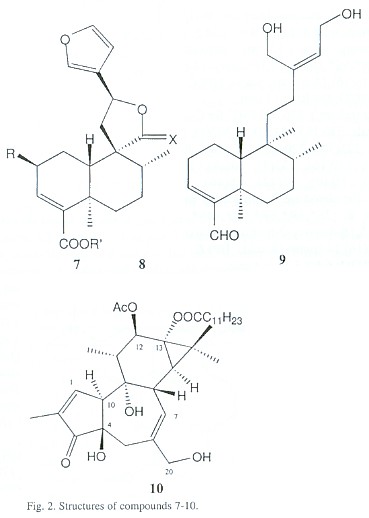
<body><![CDATA[<BR><FONT FACE="Arial,Helvetica"><FONT SIZE=-1>&nbsp;</FONT></FONT>     <BR><FONT FACE="Arial,Helvetica"><FONT SIZE=-1><B>Seed extraction:&nbsp;</B> Fresh seeds (3350 g) were ground and extracted with ethyl ether to afford 82 g of an extract which was filtered through silica gel (35-70 mesh; hexane/Et<SUB>2</SUB>O). Fat was removed with methanol at -20&deg;C from the chosen fractions and the oily mass was chromatographed on a medium-pressure silica gel column, using hexane/Et<SUB>2</SUB>O. Again, fat was removed with methanol from the chosen fractions and these were further chromatographed on a silica gel medium pressure column, using hexane/Et<SUB>2</SUB>O/MeOH. Fractions of interest were separated by HPLC (MeOH/H<SUB>2</SUB>O 6: 4). The components were further purified or by TLC (silica gel F<SUB>254</SUB>); Et<SUB>2</SUB>O/hexane) to give 9-dehydrovomifoliol, 2,3-dihydrovomifoliol, <I>p</I>-hydroxybenzaldehyde, and&nbsp; <I>p</I>-methoxybenzoic acid. The yield was low and was not quantified.</FONT></FONT>     <BR><FONT FACE="Arial,Helvetica"><FONT SIZE=-1>&nbsp;</FONT></FONT>     <BR><FONT FACE="Arial,Helvetica"><FONT SIZE=-1><B>Wood and bark extraction:&nbsp;</B> Wood (2820 g) and&nbsp; bark (1070 g) samples were dried, ground separately and then extracted with ethanol to give 48 g and 22 g of the corresponding oily extracts, which were suspended in water and partitioned successively with hexane and ethyl ether. In each case, the organic extractions were pooled and evaporated to give residues of 3.80 g (wood) and 4.75 g (bark). The remaining aqueous solutions were taken to pH 8 with sodium carbonate and extracted with chloroform to give the alkaloids <B>2</B> and <B>3</B> (12 mg and 9 mg, respectively). The residues of the organic extractions were subjected to filtration on silica gel (35-70 mesh; hexane/Et<SUB>2</SUB>O/MeOH).</FONT></FONT><FONT FACE="Arial,Helvetica"><FONT SIZE=-1></FONT></FONT>      <P><FONT FACE="Arial,Helvetica"><FONT SIZE=-1>Chosen fractions from the bark organic extract were fractionated by medium pressure column chromatography (silica gel, hexane/Et<SUB>2</SUB>O/MeOH) and then preparative HPLC (MeOH/H<SUB>2</SUB>O, 6: 4, or 6.5: 3.5, or 7: 3) or TLC, to afford&nbsp; (5R*,8R*,9S*,10R*)-15,16-epoxy-12-oxocleroda-3,13(16),14-triene-18-acid (<B>6</B>) (12 mg; new), 1b-hydroxyjunenol (4 mg), (2S*,5R*,8R*,9R*,10S*,12S*)-12,20;15,16-diepoxy-2-hydroxy-20-oxocleroda-3,13(16),14-triene-18-acid (<B>8</B>) (2 mg; new) and taspine (<B>1</B>) (137 mg).</FONT></FONT><FONT FACE="Arial,Helvetica"><FONT SIZE=-1></FONT></FONT>      <P><FONT FACE="Arial,Helvetica"><FONT SIZE=-1>Fractions from the wood organic extract were separated by medium pressure column chromatography (silica gel, hexane/ Et<SUB>2</SUB>O/MeOH) or HPLC (MeOH/H<SUB>2</SUB>O, 8.5: 1.5 or 8: 2 or 1: 1) to give hardwickiic acid (<B>5</B>) (6 mg), (5R*,8R*,9S*,10R*)-15,16-dihydroxy-18-oxocleroda-3,13-diene (<B>9</B>) (8 mg), scopoletin (8 mg), kaur-9,16-dien-18-oic acid (<B>4</B>) (12 mg), and&nbsp; taspine (<B>1</B>) (123 mg).</FONT></FONT><FONT FACE="Arial,Helvetica"><FONT SIZE=-1></FONT></FONT>      <P><FONT FACE="Arial,Helvetica"><FONT SIZE=-1>The dried sap (50 g) was fractionated using a DIAION HP-20 column (H<SUB>2</SUB>O, MeOH, CHCl<SUB>3</SUB>). The less polar fractions were combined and concentrated, taken up in water and extracted with butanol. The butanol fraction was partitioned with 5% citric acid in water; the aqueous portion was adjusted to pH 8 with sodium carbonate and extracted with chloroform to give taspine (<B>1</B>) (106 mg). The rest of the fractions of the sap were combined, chromatographed on silica gel (hexane, Et<SUB>2</SUB>O, MeOH, CHCl<SUB>3</SUB>) and HPLC (RP 8, MeOH/H<SUB>2</SUB>O), to give 3,4,5-trimethoxy cinnamic alcohol (3 mg).</FONT></FONT><FONT FACE="Arial,Helvetica"><FONT SIZE=-1></FONT></FONT>      <P><FONT FACE="Arial,Helvetica"><FONT SIZE=-1>Signals of a phorbol-ester were found in some parts of the plant, but it was not possible to isolate this compound, due to its low content. A higher quantity was isolated from the flowers using the normal separations methods making it possible to identify the known diester <B>10</B>.&nbsp; Voucher specimen has been deposited in the Herbario Juvenal Valerio, Universidad Nacional, Heredia.</FONT></FONT>     <CENTER><FONT FACE="Arial,Helvetica"><FONT SIZE=-1>&nbsp;</FONT></FONT></CENTER>      <CENTER><IMG SRC="/img/fbpe/rbt/v49n1/2342i01.JPG" HEIGHT=716 WIDTH=420></CENTER>      
]]></body>
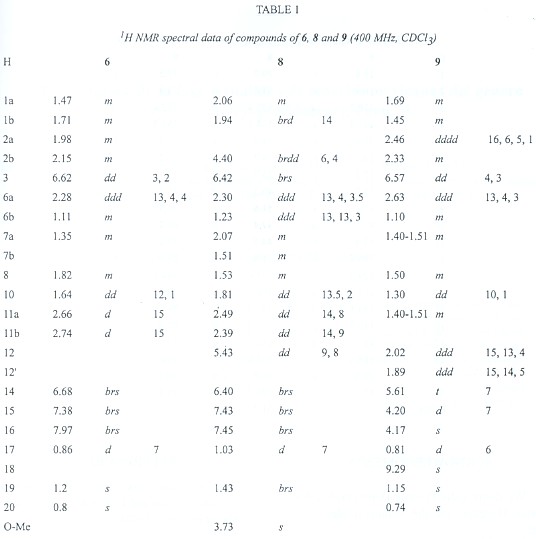
<body><![CDATA[<CENTER><FONT FACE="Arial,Helvetica"><FONT SIZE=-1>&nbsp;</FONT></FONT></CENTER> <B><FONT FACE="Arial,Helvetica"><FONT SIZE=-1>Results</FONT></FONT></B><FONT FACE="Arial,Helvetica"><FONT SIZE=-1></FONT></FONT>      <P><FONT FACE="Arial,Helvetica"><FONT SIZE=-1>Leaves, bark, wood, seeds and flowers extracts of <I>Croton draco</I> afforded the sesquiterpene 1-hydroxyjunenol, the aromatic compounds <I>p</I>-hydroxybenzaldehyde, <I>p</I>-methoxybenzoic acid and 3,4,5-trimethoxycinnamyl alcohol, the coumarin scopoletin, the nor-terpenoids 9-dehydrovomifoliol and 2,3-dihydrovomifoliol, the alkaloids taspine 1 and the aporphines 2 and 3, and the diterpene, 9(11)-dehydrokaurenic acid 4, hardwikiic acid 5, the corresponding new 12-oxo derivative 6 (5R*,8R*,9S*,10R*)-15,16-epoxy-12-oxocleroda-3,13(16),14-triene-18-acid, HPLC (RP8):&nbsp; MeOH/H<SUB>2</SUB>O; 6/4 Rt = 12 min.</FONT></FONT><FONT FACE="Arial,Helvetica"><FONT SIZE=-1></FONT></FONT>      <P><FONT FACE="Arial,Helvetica"><FONT SIZE=-1>m/z (rel. int.):&nbsp; 330.183 [M]<SUP>+</SUP> for C<SUB>20</SUB>H<SUB>26</SUB>O<SUB>4</SUB> (1%) (calc. 330.183), 318(0.5), 302(1), 279(2), 254(4), 225(30), 220(12), 207(14), 205(30), 193(30), 149(10), 133(8), 105(8), 100(44), 99(100), 95(10), 91(12), 86(46), 73(44), 55(32)., the clerodane <B>7</B>, two further new clerodanes <B>8</B> (2S*,5R*,8R*,9R*,10S*,12S*)-12,20;15,16-diepoxy-2-hydroxy-20-oxocleroda-3,13(16),14-triene-18-acid, HPLC (RP8):&nbsp; MeOH/H<SUB>2</SUB>O; 6.5/3.5 Rt = 4 min.</FONT></FONT><FONT FACE="Arial,Helvetica"><FONT SIZE=-1></FONT></FONT>      <P><FONT FACE="Arial,Helvetica"><FONT SIZE=-1>m/z (rel. int.):&nbsp;&nbsp; 374,172 [M]<SUP>+</SUP> for C<SUB>21</SUB>H<SUB>26</SUB>O<SUB>6</SUB> (26%) (calc. 374.172), 356(22), 343(18), 342(25), 325(20), 324(78), 279(25), 229(15), 179(40), 167(41), 149(100), 105(32), 95(78), 81(58), 71(72), 57(98), 56(97) and <B>9 </B>5R*,8R*,9S*,10R*)-15, 16-dihydroxy-18-oxocleroda-3,13-diene, HPLC (RP8):&nbsp; MeOH/H<SUB>2</SUB>O; 7/3; Rt = 9 min., m/z (rel. int.):&nbsp; 320,235 [M]<SUP> +</SUP> for C<SUB>20</SUB>H<SUB>32</SUB>O<SUB>3</SUB> (1%)(calc. 320.235), [M-H<SUB>2</SUB>O]<SUP>+</SUP> 302(10), 289(6), 287(12), 279(10), 205(30), 203(26), 149(75), 135(30), 132(32), 123(35), 121(45), 109(100), 95(56), 91(52), 81(59), 71(56), 69(78).<B>&nbsp;</B> and the known phorboldiester <B>10 </B>(<A HREF="#Hecker">Hecker, E., 1968</A>).</FONT></FONT>     <BR><FONT FACE="Arial,Helvetica"><FONT SIZE=-1>&nbsp;</FONT></FONT>     <CENTER><IMG SRC="/img/fbpe/rbt/v49n1/2342i02.JPG" HEIGHT=518 WIDTH=369></CENTER> <FONT FACE="Arial,Helvetica"><FONT SIZE=-1></FONT></FONT>      
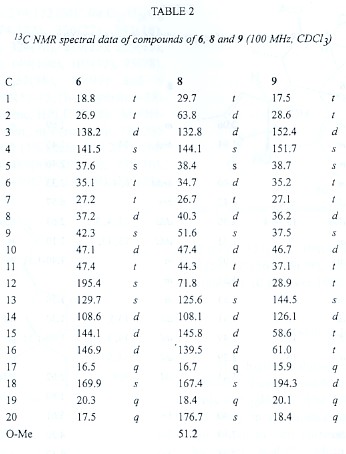
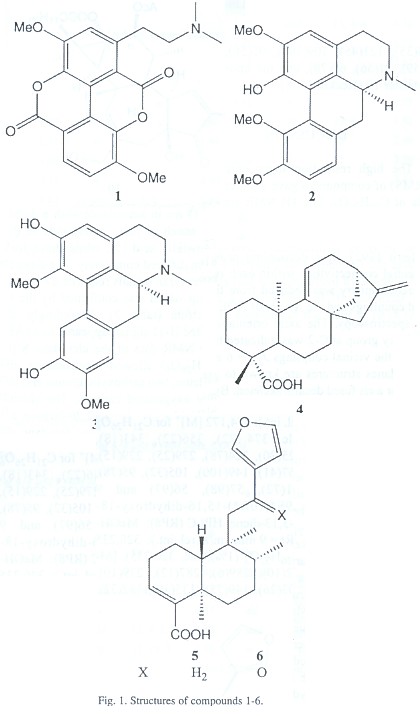
<P><B><FONT FACE="Arial,Helvetica"><FONT SIZE=-1>Discussion</FONT></FONT></B>     <BR><B><FONT FACE="Arial,Helvetica"><FONT SIZE=-1>&nbsp;</FONT></FONT></B>     <BR><FONT FACE="Arial,Helvetica"><FONT SIZE=-1>The high resolution mass spectrometry (HRMS) of compound <B>6</B> gave a molecular formula of C<SUB>20</SUB>H<SUB>26</SUB>O<SUB>4</SUB>. The <SUP>1</SUP>H NMR signals (<A HREF="#table1">table 1</A>) are in accordance with a decalin skeleton which in turn corresponds to the one of hardwikiic acid (<B>5</B>), while those for the side chain differed completely. The downfield shift of the furan signals required a conjugated keto group which was confirmed by the <SUP>13</SUP>C NMR spectrum (<A HREF="#table2">table 2</A>). Accordingly, downfield shifted H-11 signals appeared as an AB-system. The NMR data of the clerodane <B>8</B> (HRMS = C<SUB>21</SUB>H<SUB>26</SUB>O<SUB>6</SUB>) allowed identification of a furan skeleton, two carboxylic groups and two secondary oxygenated carbons. The chemical shift for H-12 pointed to a 12,20-lactone, a common structural feature among clerodane diterpenes (Merrit, A. T, 1992). Spin decoupling provided sequential connectivities within each rings. The stereochemistry was deduced from the observed couplings and the results of NOE difference spectroscopy. The axial orientation of the hydroxy group at C-2 was indicated by the value of the vicinal couplings <I>J</I><SUB>2,3</SUB> = 6 and 4 Hz. Clerodanes structures are known to possess a <I>trans</I> or a <I>cis</I> fused decalin skeleton. By analogy with co-occurring derivatives, a <I>trans</I> clerodane was expected. The splitting of H-10 signal (<I>J</I><SUB>1,10</SUB> = 13.5 and 2 Hz) supported this assumption. This fact was confirmed by a strong NOE between 1,3-positioned H-10 and axial H-6. The weak coupling of the latter to H-18 required their antiperiplanar orientation. Finally, the diol <B>9</B> was obtained. The aldehyde signal and the downfield shifted H-3 pointed to a conjugated system. The nature of side chain was determinated from the results of spin decoupling experiments. The HRMS confirmed the structure.</FONT></FONT>     <BR><FONT FACE="Arial,Helvetica"><FONT SIZE=-1>&nbsp;</FONT></FONT>     ]]></body>
<body><![CDATA[<CENTER><A NAME="table1"></A><IMG SRC="/img/fbpe/rbt/v49n1/2342i03.JPG" HEIGHT=539 WIDTH=536><FONT FACE="Arial,Helvetica"><FONT SIZE=-1></FONT></FONT></CENTER>      
<CENTER><FONT FACE="Arial,Helvetica"><FONT SIZE=-1></FONT></FONT></CENTER>      <CENTER><A NAME="table2"></A><IMG SRC="/img/fbpe/rbt/v49n1/2342i04.JPG" HEIGHT=454 WIDTH=346></CENTER> <B><FONT FACE="Arial,Helvetica"><FONT SIZE=-1>Acknowledgments</FONT></FONT></B>     
<BR><FONT FACE="Arial,Helvetica"><FONT SIZE=-1>&nbsp;</FONT></FONT>     <BR><FONT FACE="Arial,Helvetica"><FONT SIZE=-1>We thank Luis Poveda (Universidad Nacional, Heredia) for the botanical identification.</FONT></FONT>     <BR><FONT FACE="Arial,Helvetica"><FONT SIZE=-1>&nbsp;</FONT></FONT>     <BR><B><FONT FACE="Arial,Helvetica"><FONT SIZE=-1>Resumen</FONT></FONT></B>     <BR><B><FONT FACE="Arial,Helvetica"><FONT SIZE=-1>&nbsp;</FONT></FONT></B>     <BR><FONT FACE="Arial,Helvetica"><FONT SIZE=-1>Se llev&oacute; a cabo un estudio fitoqu&iacute;mico de <I>Croton draco </I>(Euphorbiaceae) (por aparte hojas, corteza, madera, semillas, savia y flores). Se aislaron compuestos comunes como el 1-hidroxijunenol, p-hidroxibenzaldehido, &aacute;cido p-metoxubenzoico, alcohol 3,4,5-trimetoxicin&aacute;mico, escopoletina y los norterpenos 9-dehidrovomifoliol y 2,3 dihidrovomifoliol. Adem&aacute;s se aislaron dos alcaloides aporf&iacute;nicos, taspina, &aacute;cido 9(11)-dehidrokaur&eacute;nico, &aacute;cido hardw&iacute;kico y su derivado 12-oxo, as&iacute; como cinco clerodanos y un &eacute;ster de forbol (el cual fue el &uacute;nico compuesto aislado de las flores). De los compuestos aislados, tres clerodanos no han sido informados en la literatura por lo que se incluye sus datos espectrosc&oacute;picos y fraccionamientos de la espectrometr&iacute;a de masas.</FONT></FONT><FONT FACE="Arial,Helvetica"><FONT SIZE=-1></FONT></FONT>      <P><B><FONT FACE="Arial,Helvetica"><FONT SIZE=-1>References</FONT></FONT></B><FONT FACE="Arial,Helvetica"><FONT SIZE=-1></FONT></FONT>      ]]></body>
<body><![CDATA[<!-- ref --><P><A NAME="Hecker"></A><FONT FACE="Arial,Helvetica"><FONT SIZE=-1>Hecker, E. 1968. Carcinogenic principles from the seed oil of <I>Croton Tiglium</I> and from other Euphorbiaceae. Cancer Res. 28: 2338-2349.</FONT></FONT><FONT FACE="Arial,Helvetica"><FONT SIZE=-1></FONT></FONT>    &nbsp;&nbsp;&nbsp;&nbsp;&nbsp;&nbsp;&nbsp;&nbsp;[&#160;<a href="javascript:void(0);" onclick="javascript: window.open('/scielo.php?script=sci_nlinks&ref=1355075&pid=S0034-7744200100010002400001&lng=','','width=640,height=500,resizable=yes,scrollbars=1,menubar=yes,');">Links</a>&#160;]<!-- end-ref --><!-- ref --><P><A NAME="Hernandez"></A><FONT FACE="Arial,Helvetica"><FONT SIZE=-1>Hern&aacute;ndez, J. &amp; G. Delgado. 1992. Terpenoids from aerial parts of <I>Croton draco</I>. Fitoterapia 63: 377-378.</FONT></FONT><FONT FACE="Arial,Helvetica"><FONT SIZE=-1></FONT></FONT>    &nbsp;&nbsp;&nbsp;&nbsp;&nbsp;&nbsp;&nbsp;&nbsp;[&#160;<a href="javascript:void(0);" onclick="javascript: window.open('/scielo.php?script=sci_nlinks&ref=1355076&pid=S0034-7744200100010002400002&lng=','','width=640,height=500,resizable=yes,scrollbars=1,menubar=yes,');">Links</a>&#160;]<!-- end-ref --><!-- ref --><P><A NAME="Merrit"></A><FONT FACE="Arial,Helvetica"><FONT SIZE=-1>Merrit, A. T. &amp; S. V. Ley. 1992. Clerodane Diterpenoids. Nat. Prod. Rep. 9: 243-287.</FONT></FONT><FONT FACE="Arial,Helvetica"><FONT SIZE=-1></FONT></FONT>    &nbsp;&nbsp;&nbsp;&nbsp;&nbsp;&nbsp;&nbsp;&nbsp;[&#160;<a href="javascript:void(0);" onclick="javascript: window.open('/scielo.php?script=sci_nlinks&ref=1355077&pid=S0034-7744200100010002400003&lng=','','width=640,height=500,resizable=yes,scrollbars=1,menubar=yes,');">Links</a>&#160;]<!-- end-ref --><!-- ref --><P><A NAME="Morton"></A><FONT FACE="Arial,Helvetica"><FONT SIZE=-1>Morton, J. F. 1981. Atlas of medicinal plants of Middle America. Thomas, Illinois.</FONT></FONT><FONT FACE="Arial,Helvetica"><FONT SIZE=-1></FONT></FONT>    &nbsp;&nbsp;&nbsp;&nbsp;&nbsp;&nbsp;&nbsp;&nbsp;[&#160;<a href="javascript:void(0);" onclick="javascript: window.open('/scielo.php?script=sci_nlinks&ref=1355078&pid=S0034-7744200100010002400004&lng=','','width=640,height=500,resizable=yes,scrollbars=1,menubar=yes,');">Links</a>&#160;]<!-- end-ref --><!-- ref --><P><A NAME="Rodriguez"></A><FONT FACE="Arial,Helvetica"><FONT SIZE=-1>Rodr&iacute;guez-Hahn, L., J.J. Rodr&iacute;guez &amp; A. Romo. 1975. Isolation and Structure of Draconin Rev. Lat. Quim. 6: 123-124.</FONT></FONT><FONT FACE="Arial,Helvetica"><FONT SIZE=-1></FONT></FONT>    &nbsp;&nbsp;&nbsp;&nbsp;&nbsp;&nbsp;&nbsp;&nbsp;[&#160;<a href="javascript:void(0);" onclick="javascript: window.open('/scielo.php?script=sci_nlinks&ref=1355079&pid=S0034-7744200100010002400005&lng=','','width=640,height=500,resizable=yes,scrollbars=1,menubar=yes,');">Links</a>&#160;]<!-- end-ref --><!-- ref --><P><A NAME="Vlietinck"></A><FONT FACE="Arial,Helvetica"><FONT SIZE=-1>Vlietinck, A.J. 1987. Biologically active substances from traditional drugs. Chapt. 3. <I>In</I>: A. Hostettmann &amp; P.J. Lea (Eds.), Biologically Active Natural Products. Clarendon, Oxford.</FONT></FONT>    &nbsp;&nbsp;&nbsp;&nbsp;&nbsp;&nbsp;&nbsp;&nbsp;[&#160;<a href="javascript:void(0);" onclick="javascript: window.open('/scielo.php?script=sci_nlinks&ref=1355080&pid=S0034-7744200100010002400006&lng=','','width=640,height=500,resizable=yes,scrollbars=1,menubar=yes,');">Links</a>&#160;]<!-- end-ref --><BR><FONT FACE="Arial,Helvetica"><FONT SIZE=-1>&nbsp;</FONT></FONT>     <BR><FONT FACE="Arial,Helvetica"><FONT SIZE=-1>&nbsp;</FONT></FONT>     <BR><A NAME="A1"></A><SUP><FONT FACE="Arial,Helvetica"><FONT SIZE=-1><A HREF="#R1">1</A> </FONT></FONT></SUP><FONT FACE="Arial,Helvetica"><FONT SIZE=-1>Escuela de Qu&iacute;mica and CIPRONA (Centro de Investigaci&oacute;n de Productos Naturales), Universidad de Costa Rica, 2060, Costa Rica. Fax:&nbsp; +(506)-225-9866;&nbsp; <A HREF="mailto:renato@calzada.equi.ucr.ac.cr">renato@calzada.equi.ucr.ac.cr</A>,.</FONT></FONT><SUP><FONT FACE="Arial,Helvetica"><FONT SIZE=-1></FONT></FONT></SUP>      <P><SUP><FONT FACE="Arial,Helvetica"><FONT SIZE=-1><A HREF="#R1">2</A> </FONT></FONT></SUP><FONT FACE="Arial,Helvetica"><FONT SIZE=-1>Institute of Organic Chemistry, Technical University of Berlin, D-10623 Berlin, Germany.&nbsp; <A HREF="#R1">*</A>Correspondence.</FONT></FONT>     ]]></body>
<body><![CDATA[<BR><FONT FACE="Arial,Helvetica"><FONT SIZE=-1>&nbsp;</FONT></FONT>      ]]></body><back>
<ref-list>
<ref id="B1">
<nlm-citation citation-type="journal">
<person-group person-group-type="author">
<name>
<surname><![CDATA[Hecker]]></surname>
<given-names><![CDATA[E]]></given-names>
</name>
</person-group>
<article-title xml:lang="en"><![CDATA[Carcinogenic principles from the seed oil of Croton Tiglium and from other Euphorbiaceae]]></article-title>
<source><![CDATA[Cancer Res]]></source>
<year>1968</year>
<volume>28</volume>
<page-range>2338-2349</page-range></nlm-citation>
</ref>
<ref id="B2">
<nlm-citation citation-type="journal">
<person-group person-group-type="author">
<name>
<surname><![CDATA[Hernández]]></surname>
<given-names><![CDATA[J]]></given-names>
</name>
<name>
<surname><![CDATA[Delgado]]></surname>
<given-names><![CDATA[G]]></given-names>
</name>
</person-group>
<article-title xml:lang="en"><![CDATA[Terpenoids from aerial parts of Croton draco]]></article-title>
<source><![CDATA[Fitoterapia]]></source>
<year>1992</year>
<volume>63</volume>
<page-range>377-378</page-range></nlm-citation>
</ref>
<ref id="B3">
<nlm-citation citation-type="journal">
<person-group person-group-type="author">
<name>
<surname><![CDATA[Merrit]]></surname>
<given-names><![CDATA[A. T]]></given-names>
</name>
<name>
<surname><![CDATA[Ley]]></surname>
<given-names><![CDATA[S. V]]></given-names>
</name>
</person-group>
<article-title xml:lang="en"><![CDATA[Clerodane Diterpenoids]]></article-title>
<source><![CDATA[Nat. Prod. Rep]]></source>
<year>1992</year>
<volume>9</volume>
<page-range>243-287</page-range></nlm-citation>
</ref>
<ref id="B4">
<nlm-citation citation-type="book">
<person-group person-group-type="author">
<name>
<surname><![CDATA[Morton]]></surname>
<given-names><![CDATA[J. F]]></given-names>
</name>
</person-group>
<source><![CDATA[Atlas of medicinal plants of Middle America]]></source>
<year>1981</year>
<publisher-loc><![CDATA[Illinois ]]></publisher-loc>
<publisher-name><![CDATA[Thomas]]></publisher-name>
</nlm-citation>
</ref>
<ref id="B5">
<nlm-citation citation-type="journal">
<person-group person-group-type="author">
<name>
<surname><![CDATA[Rodríguez-Hahn]]></surname>
<given-names><![CDATA[L]]></given-names>
</name>
<name>
<surname><![CDATA[Rodríguez]]></surname>
<given-names><![CDATA[J.J]]></given-names>
</name>
<name>
<surname><![CDATA[Romo]]></surname>
<given-names><![CDATA[A]]></given-names>
</name>
</person-group>
<article-title xml:lang="en"><![CDATA[Isolation and Structure of Draconin]]></article-title>
<source><![CDATA[Rev. Lat. Quim]]></source>
<year>1975</year>
<volume>6</volume>
<page-range>123-124</page-range></nlm-citation>
</ref>
<ref id="B6">
<nlm-citation citation-type="">
<person-group person-group-type="author">
<name>
<surname><![CDATA[Vlietinck]]></surname>
<given-names><![CDATA[A.J]]></given-names>
</name>
</person-group>
<article-title xml:lang="en"><![CDATA[Biologically active substances from traditional drugs. Chapt. 3]]></article-title>
<person-group person-group-type="editor">
<name>
<surname><![CDATA[Hostettmann]]></surname>
<given-names><![CDATA[A]]></given-names>
</name>
<name>
<surname><![CDATA[Lea]]></surname>
<given-names><![CDATA[P.J.]]></given-names>
</name>
</person-group>
<source><![CDATA[Biologically Active Natural Products]]></source>
<year>1987</year>
<publisher-loc><![CDATA[Clarendon^eOxford Oxford]]></publisher-loc>
</nlm-citation>
</ref>
</ref-list>
</back>
</article>