<?xml version="1.0" encoding="ISO-8859-1"?><article xmlns:mml="http://www.w3.org/1998/Math/MathML" xmlns:xlink="http://www.w3.org/1999/xlink" xmlns:xsi="http://www.w3.org/2001/XMLSchema-instance">
<front>
<journal-meta>
<journal-id>0034-7744</journal-id>
<journal-title><![CDATA[Revista de Biología Tropical]]></journal-title>
<abbrev-journal-title><![CDATA[Rev. biol. trop]]></abbrev-journal-title>
<issn>0034-7744</issn>
<publisher>
<publisher-name><![CDATA[Universidad de Costa Rica]]></publisher-name>
</publisher>
</journal-meta>
<article-meta>
<article-id>S0034-77442001000100023</article-id>
<title-group>
<article-title xml:lang="en"><![CDATA[Population structure and ecology of a tropical rare rhizomatous species of teosinte Zea diploperennis (Gramineae)]]></article-title>
</title-group>
<contrib-group>
<contrib contrib-type="author">
<name>
<surname><![CDATA[Sánchez-Velásquez]]></surname>
<given-names><![CDATA[Lázaro R.]]></given-names>
</name>
<xref ref-type="aff" rid="A01"/>
</contrib>
<contrib contrib-type="author">
<name>
<surname><![CDATA[Jiménez G.]]></surname>
<given-names><![CDATA[R. Genoveva]]></given-names>
</name>
<xref ref-type="aff" rid="A02"/>
</contrib>
<contrib contrib-type="author">
<name>
<surname><![CDATA[Benz]]></surname>
<given-names><![CDATA[Bruce F.]]></given-names>
</name>
<xref ref-type="aff" rid="A03"/>
</contrib>
</contrib-group>
<aff id="A01">
<institution><![CDATA[,Universidad Nacional Autónoma de México Facultad de Ciencias ]]></institution>
<addr-line><![CDATA[ México D.F]]></addr-line>
<country>México</country>
</aff>
<aff id="A02">
<institution><![CDATA[,Universidad de Guadalajara Centro Universitario de la Costa Sur Instituto Manantlán de Ecología y Conservación de la Biodiversidad]]></institution>
<addr-line><![CDATA[ ]]></addr-line>
<country>México</country>
</aff>
<aff id="A03">
<institution><![CDATA[,Texas Wesleyan University Biology Department ]]></institution>
<addr-line><![CDATA[ ]]></addr-line>
</aff>
<pub-date pub-type="pub">
<day>00</day>
<month>03</month>
<year>2001</year>
</pub-date>
<pub-date pub-type="epub">
<day>00</day>
<month>03</month>
<year>2001</year>
</pub-date>
<volume>49</volume>
<numero>1</numero>
<fpage>249</fpage>
<lpage>258</lpage>
<copyright-statement/>
<copyright-year/>
<self-uri xlink:href="http://www.scielo.sa.cr/scielo.php?script=sci_arttext&amp;pid=S0034-77442001000100023&amp;lng=en&amp;nrm=iso"></self-uri><self-uri xlink:href="http://www.scielo.sa.cr/scielo.php?script=sci_abstract&amp;pid=S0034-77442001000100023&amp;lng=en&amp;nrm=iso"></self-uri><self-uri xlink:href="http://www.scielo.sa.cr/scielo.php?script=sci_pdf&amp;pid=S0034-77442001000100023&amp;lng=en&amp;nrm=iso"></self-uri><abstract abstract-type="short" xml:lang="en"><p><![CDATA[One of the objectives of the Sierra de Manantlán Biosphere Reserve (Jalisco, México) is the conservation in situ of the teosinte Zea diploperennis Iltis, Doebley, Guzman & Pazzi. Zea diploperennis is perennial, shade intolerant and its 1-3 m shoots are architecturally similar to maize. Clonal growth is of the phalanx type. Genets are iteroparous (modules semelparous). The demography of seven module and genet populations was studied in seven sites representing three stages of old-field succession. Seven permanent one-meter-square plots were randomly established in each site. All genets initially present and those that became established during our study were mapped and labeled according to year of establishment The magnitude of demographic fluctuations was greater in module populations. Genet population dynamics followed a seasonal rhythm with a maximum population size obtained at the onset of the rainy season. A relation was documented between percent annual mortality of a cohort and its age: the younger the cohort, the greater the mortality. This was a statistically significant relationship, Y=[sin(-0.288x + 1.657)] ² (r = 0.92, p < 0.01), where is proportion annual mortality of genets and is the age of the cohort. The maximum rates of genet mortality occurred during the rainy season when population densities were greatest. As a consequence, we postulate that competition occurs principally during the rainy season. Linear relationships were observed between rate of population increase of genets versus old-field successional stage and soil type. Those areas with poor soil (Ultisol), degraded soil or soils with similar physical characteristics could be rehabilitated by introducing Z. diploperennis. Such rehabilitation would achieve two distinct objectives, promote propagation of this rare endemic and reclaim areas that are susceptible to erosion and further degradation.]]></p></abstract>
<abstract abstract-type="short" xml:lang="es"><p><![CDATA[Se estudió la demografía de Zea diploperennis en siete sitios de cultivo abandonados. La magnitud de las fluctuaciones demográficas fue más grande en las poblaciones de módulos. La dinámica de las poblaciones de genets siguió un ritmo estacional con un tamaño máximo de la población al inicio de la temporada de lluvias; las cohortes más jóvenes presentan la más alta mortalidad, i. e., Y=[ sin(-0.288x + 1.657)] ² , (r = 0.92, p < 0.01), donde es la proporción de la mortalidad anual y es la edad de la cohorte. La máxima tasa de mortalidad de genets ocurrió durante la temporada de lluvias cuando la densidad de la población fue más alta, cuando la competencia parece mayor. Hubo relaciones lineales entre la tasa de incremento de genets y el estado sucesional y el tipo de suelo. Aquellas áreas con suelos pobres degradados o suelos con similares características, pueden ser rehabilitados introduciendo Z. diploperennis, protegiéndola y combatiendo la degradación del suelo.]]></p></abstract>
<kwd-group>
<kwd lng="en"><![CDATA[Initial seedling recruitment]]></kwd>
<kwd lng="en"><![CDATA[Manantlán]]></kwd>
<kwd lng="en"><![CDATA[México]]></kwd>
<kwd lng="en"><![CDATA[population structure]]></kwd>
<kwd lng="en"><![CDATA[rehabilitation]]></kwd>
<kwd lng="en"><![CDATA[teosinte]]></kwd>
<kwd lng="en"><![CDATA[Zea diploperennis]]></kwd>
</kwd-group>
</article-meta>
</front><body><![CDATA[ <CENTER><B><FONT FACE="Arial,Helvetica">Population structure and ecology of a tropical rare rhizomatous species of teosinte <I>Zea diploperennis </I>(Gramineae)</FONT></B></CENTER>      <CENTER><B><FONT FACE="Arial,Helvetica">&nbsp;</FONT></B></CENTER>      <CENTER><B><FONT FACE="Arial,Helvetica">&nbsp;</FONT></B></CENTER> <FONT FACE="Arial,Helvetica"><FONT SIZE=-1>L&aacute;zaro R. S&aacute;nchez-Vel&aacute;squez&nbsp;<A NAME="R1"></A><SUP><A HREF="#A1">1</A>, <A HREF="#A1">2</A></SUP>, R. Genoveva Jim&eacute;nez G.<SUP><A HREF="#A1">2</A></SUP> and Bruce F. Benz <SUP><A HREF="#A1">2</A>, <A HREF="#A1">3</A></SUP></FONT></FONT>     <BR>&nbsp;      <P><FONT FACE="Arial,Helvetica"><FONT SIZE=-1>Recibido&nbsp;&nbsp; 21-XI-1999.&nbsp;&nbsp;&nbsp; Corregido&nbsp;&nbsp; 27-VII-2000.&nbsp;&nbsp; Aceptado&nbsp; 31-VII-2000.</FONT></FONT>     <BR><FONT FACE="Arial,Helvetica"><FONT SIZE=-1>&nbsp;</FONT></FONT>&nbsp;<FONT FACE="Arial,Helvetica"><FONT SIZE=-1>&nbsp;</FONT></FONT>     <BR><B><FONT FACE="Arial,Helvetica"><FONT SIZE=-1>Abstract</FONT></FONT></B>     <BR><FONT FACE="Arial,Helvetica"><FONT SIZE=-1>&nbsp;</FONT></FONT>     <BR><FONT FACE="Arial,Helvetica"><FONT SIZE=-1>One of the objectives of the Sierra de Manantl&aacute;n Biosphere Reserve (Jalisco, M&eacute;xico) is the conservation <I>in situ</I> of the teosinte <I>Zea diploperennis </I>Iltis, Doebley, Guzman &amp; Pazzi. Z<I>ea diploperennis</I> is perennial, shade intolerant and its 1-3 m shoots are architecturally similar to maize. Clonal growth is of the phalanx type. Genets are iteroparous (modules semelparous). The demography of seven module and genet populations was studied in seven sites representing three stages of old-field succession. Seven permanent one-meter-square plots were randomly established in each site. All genets initially present and those that became established during our study were mapped and labeled according to year of establishment The magnitude of demographic fluctuations was greater in module populations. Genet population dynamics followed a seasonal rhythm with a maximum population size obtained at the onset of the rainy season. A relation was documented between percent annual mortality of a cohort and its age:&nbsp; the younger the cohort, the greater the mortality. This was a statistically significant relationship,&nbsp; Y=[ sin(-0.288x + 1.657)]<SUP>2 </SUP>(r = 0.92, p &lt; 0.01), where&nbsp; is proportion annual mortality of genets and&nbsp; is the age of the cohort. The maximum rates of genet mortality occurred during the rainy season when population densities were greatest. As a consequence, we postulate that competition occurs principally during the rainy season. Linear relationships were observed between rate of population increase of genets <I>versus</I> old-field successional stage and soil type. Those areas with poor soil (Ultisol), degraded soil or soils with similar physical characteristics could be rehabilitated by introducing <I>Z. diploperennis</I>. Such rehabilitation would achieve two distinct objectives, promote propagation of this rare endemic and reclaim areas that are susceptible to erosion and further degradation.</FONT></FONT>      <P><FONT FACE="Arial,Helvetica"><FONT SIZE=-1><B>Key words</B>:&nbsp; Initial seedling recruitment, Manantl&aacute;n, M&eacute;xico, population structure, rehabilitation, teosinte, <I>Zea diploperennis</I>.</FONT></FONT>     ]]></body>
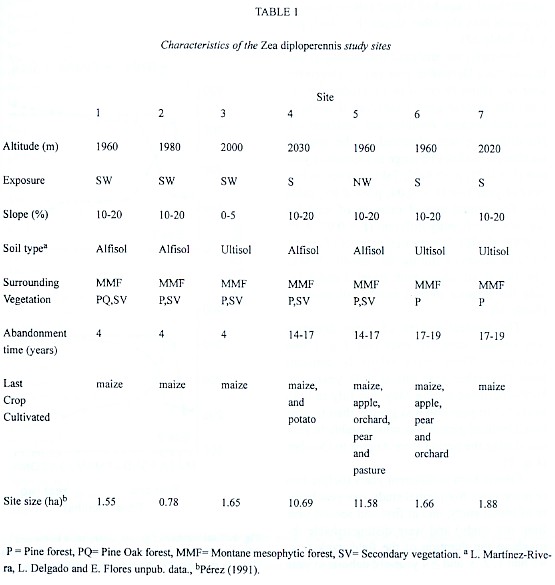
<body><![CDATA[<BR><FONT FACE="Arial,Helvetica"><FONT SIZE=-1>&nbsp;</FONT></FONT>     <BR><FONT FACE="Arial,Helvetica"><FONT SIZE=-1>&nbsp;</FONT></FONT>     <BR><FONT FACE="Arial,Helvetica"><FONT SIZE=-1>Study of an organism’s basic ecology is the first step in conservation planning and decision-making. Such research provides a basis for understanding and documenting critical stages of a species life history. Protecting and maintaining rare and threatened species in their natural habitats is one of the goals of conservation biology (<A HREF="#Lesica">Lesica 1992</A>) and of the Biosphere Reserves in the Man and the Biosphere – United Nations Educational, Scientific and Cultural Organization program (MAB-UNESCO) (<A HREF="#Halffter">Halffter 1988</A>). Species rarity may be caused by evolutionary and historical events that resulted in the present-day distributions, or by existing ecological and genetic factors (<A HREF="#Watson">Watson <I>et al.&nbsp; </I>1994</A>). Investigating the autoecology and natural history of rare species is one area in which ecologists can apply their experience to current problems in conservation biology or recovery plans (<A HREF="#Harvey">Harvey 1985</A>, <A HREF="#Brussard">Brussard 1991</A>, <A HREF="#Boyce">Boyce 1992</A>, <A HREF="#Huenneke">Huenneke 1995</A>, <A HREF="#Tear">Tear <I>et al.&nbsp; </I>1995</A>). However, to be successful, this outlook must be applied in long-term conservation programs. Demographic monitoring of rare plant species is an essential component of an effective species management program (<A HREF="#Gilpin">Gilpin &amp; Soul&eacute; 1986</A>, <A HREF="#Owen">Owen &amp; Rosentreter 1992</A>, <A HREF="#Olmsted">Olmsted &amp; Alvarez-Buylla 1995</A>) in which active manipulations might be part of such a program (<A HREF="#Boyce">Boyce 1992</A>).</FONT></FONT>      <P><FONT FACE="Arial,Helvetica"><FONT SIZE=-1>One of the objectives of the Sierra de Manantl&aacute;n Biosphere Reserve is the conservation <I>in situ</I> of the teosinte <I>Zea diploperennis</I> (<A HREF="#Jardel">Jardel 1992</A>), a rare endemic species narrowly restricted in geographic range to a few hundred hectares (<A HREF="#Rabinowitz">Rabinowitz <I>et al.&nbsp; </I>1986</A>). In spite of the fact that teosintes (wild <I>Zea</I> L. Gramineae) are a potential source of economically valuable germoplasm for maize’s improvement (<A HREF="#Iltis">Iltis <I>et al.&nbsp; </I>1979</A>, <A HREF="#Hoyt">Hoyt 1988</A>, <A HREF="#Sanchez91">S&aacute;nchez-Vel&aacute;squez 1991</A>, <A HREF="#Wilkes">Wilkes 1994</A>), their basic population ecology has not been studied under local natural conditions. <I>Zea diploperennis</I> is a tropical endemic species occurring naturally in patches on approximately 360 hectares in the Sierra de Manantl&aacute;n Biosphere Reserve in Jalisco, M&eacute;xico (<A HREF="#Benz">Benz <I>et al.&nbsp; </I>1990</A>). Growth and development appear to be favored by traditional forms of slash and burn agriculture (<A HREF="#Sanchezet91">S&aacute;nchez-Vel&aacute;squez <I>et al.&nbsp; </I>1991</A>). Z<I>ea diploperennis</I> is a perennial, shade intolerant, rhizomatous grass whose one to three meter shoots are architecturally similar to maize. Clonal growth is of the phalanx type (<A HREF="#Hutchings">Hutchings &amp; Bradbury 1986</A>) where modules (epigeal shoots arising from underground hypogeal rhizome) do not separate themselves from the parent shoot. Genets are iteroparous (but their modules are semelparous), reach sexual maturity and are capable of developing more than one module in the first two years (<A HREF="#Sanchezlo93">S&aacute;nchez-Vel&aacute;squez &amp; Lorente-Adame 1993</A>, <A HREF="#Lorente">Lorente-Adame &amp; S&aacute;nchez-Vel&aacute;squez 1996</A>).</FONT></FONT>      <P><FONT FACE="Arial,Helvetica"><FONT SIZE=-1>This paper reports the descriptive phase of a long-term study whose ultimate goal is to implement a management program to conserve <I>Z. diploperennis in situ</I>. We describe the structure and population flux of genets and modules of seven populations of <I>Z. diploperennis</I>. We also evaluated the relationship between various environmental factors (altitude, exposure, slope, and soil type) and the stage of old field succession, and demographic attributes (rate of increase of genets and modules and genets arrival). In addition, we explored the relation between age and rate of mortality genet.</FONT></FONT>     <BR><FONT FACE="Arial,Helvetica"><FONT SIZE=-1>&nbsp;</FONT></FONT>     <BR><B><FONT FACE="Arial,Helvetica"><FONT SIZE=-1>Materials and methods</FONT></FONT></B>     <BR><B><FONT FACE="Arial,Helvetica"><FONT SIZE=-1>&nbsp;</FONT></FONT></B>     <BR><FONT FACE="Arial,Helvetica"><FONT SIZE=-1>The seven study sites are located in the Las Joyas Scientific Station in the Sierra de Manantl&aacute;n Biosphere Reserve in Jalisco, M&eacute;xico (19&deg;36"N, 104&deg;16'W). Grazing and forest fires have been excluded since 1988 from all sites. All sites are old abandoned maize fields; these are:&nbsp; Coamil 1 (Site 1), Coamil 2 (Site 2), Playas (Site 3), Huiscorol (Site 4), Zarzamoro (Site 5), Asoleaderos (Site 6) and Asoleaderos del Tlacuache (Site 7), which represent three different time intervals since abandonment, i.e. different successional stages (<A HREF="#table1">Table 1</A>). The characteristics of each site and its history are listed in <A HREF="#table1">Table 1</A>.</FONT></FONT>      <P><FONT FACE="Arial,Helvetica"><FONT SIZE=-1>Seven permanent one-meter square plots were randomly established in each of the seven abandoned fields. All genets present initially and those that became established subsequently were mapped and labeled according to the year of establishment (cf. <A HREF="#Sarukhan">Sarukh&aacute;n &amp; Harper 1973</A>). The number of modules per genet was recorded monthly from May to December during year one and year two (except for June and September). In May-year one we could differentiate the genets which were born in one past year because they had one, or rarely two, small modules and one or no inflorescence. Cohorts born during our study were could identified easily:&nbsp; in the first-year, the first leaves to emerge have emarginate apices and in following years have an acuminate apex. Births and deaths were recorded according to age and comparisons of the 1, 2, 3 and <U>></U> 4 year-old cohorts were performed. The number of genets established by themselves, the total number of genets and modules (initial and final), and rate of increase of genets and modules, were compared according to successional stage and environmental factors (altitude, exposure, slope and soil type) using procedure two factors general linear model (GLM) with values previously transformed to ranks (except rate of increase of modules and genets) and <I>a posteriori</I>, multiple comparisons using Tukey&acute;s test from Statistic Analysis Systems (SAS) version 6.03 (<A HREF="#Seaman">Seaman <I>et al.&nbsp; </I>1994</A>). In this case, performing analysis of variance (ANOVA) with values transformed to ranks is more conservative than the corresponding ANOVA without transformation and is frequently more accurate than the non parametric Kruskal-Wallis test (<A HREF="#SAS">SAS 1988</A>). In addition, we used a general linear model procedure to obtain the relationship between proportion annual mortality of genets (these values were previously transformed to their square root and then arcsine were calculated) and age cohorts.</FONT></FONT>     ]]></body>
<body><![CDATA[<BR><FONT FACE="Arial,Helvetica"><FONT SIZE=-1>&nbsp;</FONT></FONT>     <CENTER><A NAME="table1"></A><IMG SRC="/img/fbpe/rbt/v49n1/2341i01.JPG" HEIGHT=585 WIDTH=555></CENTER>      
<CENTER><FONT FACE="Arial,Helvetica"><FONT SIZE=-1>&nbsp;</FONT></FONT></CENTER>      <CENTER><A NAME="table2"></A><IMG SRC="/img/fbpe/rbt/v49n1/2341i03.JPG" HEIGHT=817 WIDTH=558></CENTER> <B><FONT FACE="Arial,Helvetica"><FONT SIZE=-1>Results</FONT></FONT></B>     
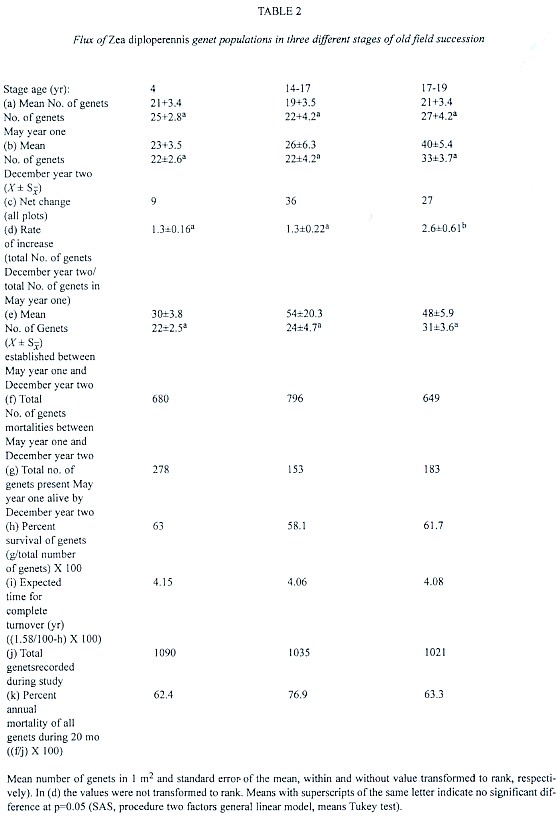
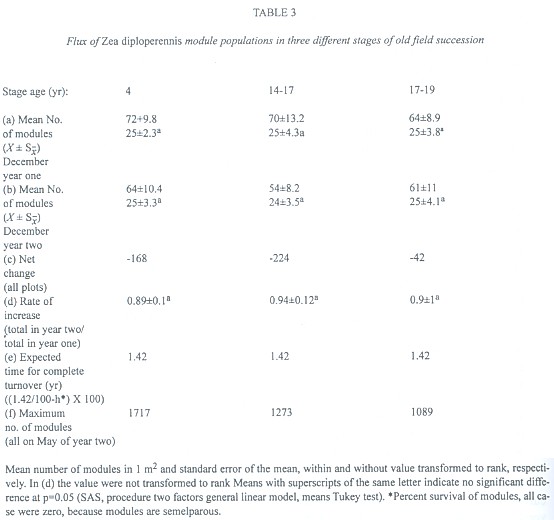
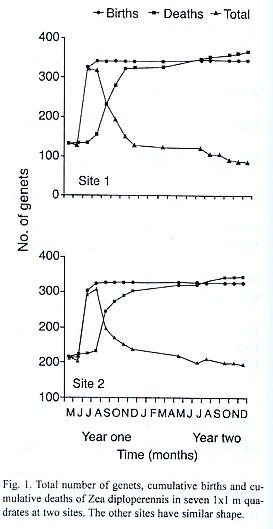
<BR><FONT FACE="Arial,Helvetica"><FONT SIZE=-1>&nbsp;</FONT></FONT>     <BR><FONT FACE="Arial,Helvetica"><FONT SIZE=-1>Population flux of genets was analyzed during two reproductive cycles from May (year one) to December (year two). The initial number of genets (May year one) did not differ significantly among successional stages (F = 0.31, p >> 0.05), nor was there a significant difference among the final number of genets (December year two; F = 3.2, p > 0.05; <A HREF="#table2">Table 2</A>). Furthermore, the difference in the recruitment between them was not significant during May year one and December year two (F = 2.13, p > 0.05; <A HREF="#table2">Table 2e</A>). However, the oldest successional stage had higher rate of increase of genets than the other stages (F = 4.65, p &lt; 0.05; <A HREF="#table2">Table 2d</A>).</FONT></FONT>      <P><FONT FACE="Arial,Helvetica"><FONT SIZE=-1>Similarly, we analyzed the module populations from December year one to December year two (final phase of two reproductive cycles).The percent age of survival of modules was zero because modules are semelparous. No difference was observed in the average number of modules by stage in December year one (F = 0.01, p >> 0.05; <A HREF="#table3">Table 3a</A>) nor in December year two (F = 0.04, p >> 0.05; <A HREF="#table3">Table 3b</A>). The annual rate of increase of modules was not significantly different (F = 0.07, p >> 0.05)(<A HREF="#table3">Table 3d</A>). The greatest number of modules was observed during the month of May year two in all stages, with stages 1 and 2 having the greatest overall number of modules (<A HREF="#table3">Table 3f</A>).</FONT></FONT>      <P><FONT FACE="Arial,Helvetica"><FONT SIZE=-1>The general pattern of genet densities was similar across all sites (see <A HREF="#fig1">Fig. 1</A> two examples). These were relatively constant from December year one to July year two. Births occurred during May and July in both years but in year one was greater than in year two. Death of genets was most notable in year one during the period from August to October (<A HREF="#fig1">Fig. 1</A>).</FONT></FONT>     <CENTER><A NAME="table3"></A><IMG SRC="/img/fbpe/rbt/v49n1/2341i05.JPG" HEIGHT=520 WIDTH=554></CENTER>      
<CENTER><A NAME="fig1"></A><IMG SRC="/img/fbpe/rbt/v49n1/2341i02.JPG" HEIGHT=529 WIDTH=273></CENTER>       
]]></body>
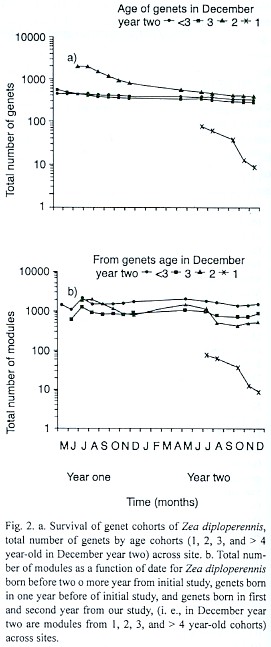
<body><![CDATA[<P><FONT FACE="Arial,Helvetica"><FONT SIZE=-1>Genets born in different years (before two or more years from initial study, one year before of initial study, and at first and second year from our study) and were distinguishable throughout the duration of the field work (<I>i.e</I>., we had 1, 2, 3, and <U>></U> 4 year-old cohorts in year two final). The highest genet mortality rates occurred from August to October and were greatest for cohorts were born in year one (<A HREF="#fig2">Fig. 2a</A>). When young genets initiated growth, more than 50 percent appeared chlorotic and died by damping-off. The remainder disappeared from areas excavated by gophers and due to unknown causes. Genets born before two or more years from initial study showed a greatest mortality from July to October in both years (<A HREF="#fig2">Fig. 2a</A>). Genets mortality appeared to be relatively more stable for all cohorts as time passed.</FONT></FONT>      <P><FONT FACE="Arial,Helvetica"><FONT SIZE=-1>Patterns of module population fluctuations were similar for cohorts of the same age across sites. The number of modules from genets were born in year one was similar to genet survival curves of the same age probably because genets generally begin with a single module. The greatest number of modules was recorded during the months of July from year one and May from year two, and slowly decreased from August to November. The cohort born in year two contributed with a relatively lower number of genets and modules than the previous cohorts (<A HREF="#fig2">Fig. 2b</A>).</FONT></FONT>     <CENTER><A NAME="fig2"></A><IMG SRC="/img/fbpe/rbt/v49n1/2341i04.JPG" HEIGHT=647 WIDTH=271></CENTER>       
<P><FONT FACE="Arial,Helvetica"><FONT SIZE=-1>Genets born in year one and before were most abundant in sites one, two, three, four, five six and seven (Table 4). The most abundant cohorts at site three were genets of two and three year old. Recruitment during year two was zero at sites two, four and five, with the other sites showing very low recruitment. Proportion mortality (from May year one through December year two) among age cohorts was significantly different (F = 123.4, p &lt;&lt; 0.01). The relationship between proportion of genets mortality and age was estimated as: Y= sin(-0,288X + 1.657)<SUP>2</SUP><SUB> </SUB>, where is the proportion of mortality and is the age of the cohort, was significant (r = 0.92, p&lt;&lt; 0.01). Soil type explained significant differences in genets increase rate (Ultisol > Alfisol, 2.31 <U>+</U> 0.4 and 1.2 <U>+</U> 0.1; genets in December year two/genets in May year one respectively; F=8.64, p&lt; 0.01).</FONT></FONT>      <P><B><FONT FACE="Arial,Helvetica"><FONT SIZE=-1>Discussion</FONT></FONT></B>     <BR><FONT FACE="Arial,Helvetica"><FONT SIZE=-1>&nbsp;</FONT></FONT>     <BR><FONT FACE="Arial,Helvetica"><FONT SIZE=-1>Only two partial associations were observed, between rate of population increase of genets <I>versus</I> type of soil and stage old field succession (<A HREF="#table2">Table 2</A>), the genets increase rate was higher in the oldest stage and Ultisols than in younger stages and Alfisols. Ultisols have low fertility and low base content (<A HREF="#Boul">Boul <I>et al.&nbsp; </I>1993</A>). Our results suggest that <I>Z. diploperennis</I> has greater adaptive success in Ultisols than in Alfisols, hence the higher genets increase rate in Ultisols.</FONT></FONT>      <P><FONT FACE="Arial,Helvetica"><FONT SIZE=-1>In all stages of abandonment genets increase rate was greater than one. These rates resulted in high recruitment in year one. Nevertheless, when we estimated genets increase rate from December year one to December year two, the values were lower than one (see <A HREF="#table2">Tables</A> two and four). Our results suggest that it is important to monitor genet flux for a greater length of time because there was high variation in density during both years. Thus appropriate models of population dynamics must be based on numerous years of monitoring in order to adequately conduct projection and population viability analysis.</FONT></FONT>      <P><FONT FACE="Arial,Helvetica"><FONT SIZE=-1>No trends between the successional stage or environmental factors (altitude, exposure, slope and soil type) <I>versus </I>module population parameters were observed (<A HREF="#table3">Table 3</A>). Our results differ from <A HREF="#Benz">Benz <I>et al.&nbsp; </I>(1990)</A> who worked with the same species yet demonstrated a significant positive relationship between number of modules and age stages. Perhaps their trend is a result of having included three sites in each of two localities differing in management history:&nbsp; three sites in San Miguel with very young stages and three others with old stages in Las Joyas.</FONT></FONT>      <P><FONT FACE="Arial,Helvetica"><FONT SIZE=-1>In our study, the net change of modules was negative for all stages (<A HREF="#table3">Table 3c</A>). The oldest stage had a smaller net change of modules. Perhaps this was a consequence of secondary vegetation absence encircling the sites. In this case, there is little potential for invasion by other rhizomatous species.</FONT></FONT>      ]]></body>
<body><![CDATA[<P><FONT FACE="Arial,Helvetica"><FONT SIZE=-1>Module reproduction was synchronized across sites. The greatest number of modules in each site coincides with the month following the first month (June) of the year with precipitation, and the lowest number of modules was observed during the months with less precipitation (October-December). In all plants water availability appears to favor growth and reproduction of other clonal species (<A HREF="#Abrahamson">Abrahamson 1980</A>).</FONT></FONT>      <P><FONT FACE="Arial,Helvetica"><FONT SIZE=-1>The general trend of genet survivorship curves among populations was similar. Survivorship across cohorts of the same age appeared to be more synchronized than across cohorts of different age but from the same site (<A HREF="#fig2">Fig. 2</A>). The mortality in <I>Z. diploperennis</I> genets, as in other rhizomatous species (<A HREF="#Harper">Harper 1977</A>, <A HREF="#Lovett">Lovett Doust 1981</A>), declines with age.</FONT></FONT>      <P><FONT FACE="Arial,Helvetica"><FONT SIZE=-1>The inverse relation between proportional genets mortality and age is likely to be due to asymmetric intraspecific competition (<A HREF="#Crawley">Crawley 1990</A>), where older established individuals are competitively superior to their younger counterparts, as has been demonstrated for <I>Solidago canadensis </I>(<A HREF="#Hartnett">Hartnett &amp; Bazzaz 1985</A>), <I>Fagus crenata</I> populations (Nakashizuka 1987 review of <A HREF="#Crawley">Crawley 1990</A>) and <I>Bouteloua gracilis</I> populations (<A HREF="#Aguilera">Aguilera &amp; Lauenroth 1993</A>). This pattern characterizes species where intraspecific competition appears to be responsible for the suppression of recruitment after the initial colonization (initial seedling recruitment, according to <A HREF="#Eriksson">Eriksson (1993)</A>).</FONT></FONT>      <P><FONT FACE="Arial,Helvetica"><FONT SIZE=-1>As in the case of <I>Ranunculus acris</I> and <I>R. bulbosus</I> (<A HREF="#Sarukhan">Sarukh&aacute;n &amp; Harper 1973</A>), the total number of genets per site in populations of <I>Z. diploperennis</I> exhibited a seasonal rhythm with peaks during spring time and was more evident in year two (<A HREF="#fig1">Fig. 1</A>, <A HREF="#fig2">Fig. 2</A>). The greatest genets mortality occurred during the season of greatest growth, <I>i.e</I>., the rainy seasons (July through September). This is similar to mortality patterns described for <I>R. canadensis</I> (<A HREF="#Hartnett">Hartnett &amp; Bazzaz 1985</A>), <I>Lolium perenne</I> and other clonal grasses (<A HREF="#Langer">Langer <I>et al.&nbsp; </I>1964</A>, <A HREF="#Kays">Kays &amp; Harper 1974</A>). These patterns suggest that intraspecific competition may regulate genet mortality (<A HREF="#Sarukhan">Sarukh&aacute;n &amp; Harper 1973</A>).</FONT></FONT>      <P><FONT FACE="Arial,Helvetica"><FONT SIZE=-1>Growth active of rhizomatous perennial <I>Z. diploperennis </I>occurs immediately after the first rains following a dry season. As a consequence, we postulate that interspecific and intraspecific competition occurs principally during the rainy season, which coincides with the period when the maximum rates of genet mortality occur. Our results concur with the hypothesis offered by <A HREF="#Hartnett">Hartnett &amp; Bazzaz (1985)</A>, that clonal growth and genet survival of herbaceous clonal species (of the initial seedling recruitment type) are inversely related to time of recruitment. That is, long after initial colonization, populations of herbaceous clonal species will be formed mainly by the genets that became established initially, as hypothesized by <A HREF="#Benz">Benz <I>et al.&nbsp; </I>(1990)</A> (see also <A HREF="#Kays">Kays &amp; Harper 1974</A>, <A HREF="#Maddox">Maddox <I>et al.&nbsp; </I>1989</A>, <A HREF="#Eriksson">Eriksson 1993</A>). This implies that reproduction from seeds is unimportant at these stages and might not be a viable alternative for achieving population increase.</FONT></FONT>      <P><FONT FACE="Arial,Helvetica"><FONT SIZE=-1>The degradation of soils in the Sierra de Manantl&aacute;n Biosphere Reserve is caused primarily by forest fires, slash and burn agriculture and cattle grazing (<A HREF="#Pineda">Pineda 1988</A>, <A HREF="#Jardel">Jardel 1991</A>, <A HREF="#Sanchezlo93">S&aacute;nchez-Vel&aacute;squez &amp; Garc&iacute;a-Moya 1993</A>, <A HREF="#Sanchez96">S&aacute;nchez-Vel&aacute;squez <I>et al.&nbsp; </I>1996</A>, <A HREF="#Hernandez">Hern&aacute;ndez 1998</A>). Those areas with poor soil (Ultisol) or soils with similar physical characteristics could be rehabilitated by introducing <I>Z. diploperennis</I>. Such rehabilitation would achieve two distinct objectives, promote propagation of this rare endemic and reclaim areas that are susceptible to erosion and further degradation.</FONT></FONT>     <BR><FONT FACE="Arial,Helvetica"><FONT SIZE=-1>&nbsp;</FONT></FONT>     <BR><B><FONT FACE="Arial,Helvetica"><FONT SIZE=-1>Acnowledgements</FONT></FONT></B>     <BR><B><FONT FACE="Arial,Helvetica"><FONT SIZE=-1>&nbsp;</FONT></FONT></B>     <BR><FONT FACE="Arial,Helvetica"><FONT SIZE=-1>We are grateful to Oscar C&aacute;rdenas Hern&aacute;ndez, Luis Manuel Mart&iacute;nez R., Eduardo Santana, Carlos Palomera and L. E. Goldman for reviewing the manuscript. Fieldwork was assisted by E. Cortez F., A. C&aacute;rdenas T., R. Lorente A., J. Rosales A., O. C&aacute;rdenas, R. Ram&iacute;rez, F. Hern&aacute;ndez and B. Figueroa. Victor S&aacute;nchez provided logistic support. Francisco Santana identified some plant species. This work was supported by grant D112-904275 from the Consejo Nacional de Ciencia y Tecnolog&iacute;a-M&eacute;xico, the University of Guadalajara and the World Wildlife Fund-US. This is a contribution to knowledge of plant ecology within Biosphere Reserves from MAB-UNESCO Program.</FONT></FONT>     ]]></body>
<body><![CDATA[<BR><FONT FACE="Arial,Helvetica"><FONT SIZE=-1>&nbsp;</FONT></FONT>     <BR><B><FONT FACE="Arial,Helvetica"><FONT SIZE=-1>Resumen</FONT></FONT></B>     <BR>&nbsp;     <BR><FONT FACE="Arial,Helvetica"><FONT SIZE=-1>Se estudi&oacute; la demograf&iacute;a de <I>Zea diploperennis</I> en siete sitios de cultivo abandonados. La magnitud de las fluctuaciones demogr&aacute;ficas fue m&aacute;s grande en las poblaciones de m&oacute;dulos. La din&aacute;mica de las poblaciones de <I>genets</I> sigui&oacute; un ritmo estacional con un tama&ntilde;o m&aacute;ximo de la poblaci&oacute;n al inicio de la temporada de lluvias; las cohortes m&aacute;s j&oacute;venes presentan la m&aacute;s alta mortalidad, <I>i. e.</I>, Y=[ sin(-0.288x + 1.657)]<SUP>2 </SUP>, (r = 0.92, p &lt; 0.01), donde es la proporci&oacute;n de la mortalidad anual y es la edad de la cohorte. La m&aacute;xima tasa de mortalidad de genets ocurri&oacute; durante la temporada de lluvias cuando la densidad de la poblaci&oacute;n fue m&aacute;s alta, cuando la competencia parece mayor. Hubo relaciones lineales entre la tasa de incremento de <I>genets</I> y el estado sucesional y el tipo de suelo. Aquellas &aacute;reas con suelos pobres degradados o suelos con similares caracter&iacute;sticas, pueden ser rehabilitados introduciendo <I>Z. diploperennis</I>, protegi&eacute;ndola y combatiendo la degradaci&oacute;n del suelo.</FONT></FONT>      <P><B><FONT FACE="Arial,Helvetica"><FONT SIZE=-1>References</FONT></FONT></B>     <BR><B><FONT FACE="Arial,Helvetica"><FONT SIZE=-1>&nbsp;</FONT></FONT></B>     <BR><A NAME="Abrahamson"></A><FONT FACE="Arial,Helvetica"><FONT SIZE=-1>Abrahamson, W. G. 1980. Demography and vegetative reproduction, p. 89-106. <I>In</I> O. T. Solbrig (ed.). Demography and evolution in plant populations. Blackwell Scientific, Oxford.</FONT></FONT>      <!-- ref --><P><A NAME="Aguilera"></A><FONT FACE="Arial,Helvetica"><FONT SIZE=-1>Aguilera, M. O. &amp; W. K. Lauenroth. 1993. Seedling establishment in adult neighborhoods- intraspecific constraints in the regeneration of the bunchgrass<I> Bouteloua gracilis</I>. J. Ecol. 81: 253-261.</FONT></FONT>    &nbsp;&nbsp;&nbsp;&nbsp;&nbsp;&nbsp;&nbsp;&nbsp;[&#160;<a href="javascript:void(0);" onclick="javascript: window.open('/scielo.php?script=sci_nlinks&ref=1347457&pid=S0034-7744200100010002300001&lng=','','width=640,height=500,resizable=yes,scrollbars=1,menubar=yes,');">Links</a>&#160;]<!-- end-ref --><!-- ref --><P><A NAME="Benz"></A><FONT FACE="Arial,Helvetica"><FONT SIZE=-1>Benz, B. F., L. R. S&aacute;nchez-Vel&aacute;squez &amp; F. Santana-Michel. 1990. Ecology and ethnobotany of <I>Zea diploperennis</I>: Preliminary investigations. Maydica 35: 85-98.</FONT></FONT>    &nbsp;&nbsp;&nbsp;&nbsp;&nbsp;&nbsp;&nbsp;&nbsp;[&#160;<a href="javascript:void(0);" onclick="javascript: window.open('/scielo.php?script=sci_nlinks&ref=1347458&pid=S0034-7744200100010002300002&lng=','','width=640,height=500,resizable=yes,scrollbars=1,menubar=yes,');">Links</a>&#160;]<!-- end-ref --><!-- ref --><P><A NAME="Boul"></A><FONT FACE="Arial,Helvetica"><FONT SIZE=-1>Boul, S. W., F. D. Hole &amp; R. J. McCracken. 1993. Soil Genesis and Classification. Trillas, M&eacute;xico, D. F.</FONT></FONT>    &nbsp;&nbsp;&nbsp;&nbsp;&nbsp;&nbsp;&nbsp;&nbsp;[&#160;<a href="javascript:void(0);" onclick="javascript: window.open('/scielo.php?script=sci_nlinks&ref=1347459&pid=S0034-7744200100010002300003&lng=','','width=640,height=500,resizable=yes,scrollbars=1,menubar=yes,');">Links</a>&#160;]<!-- end-ref --><!-- ref --><P><A NAME="Boyce"></A><FONT FACE="Arial,Helvetica"><FONT SIZE=-1>Boyce, M. S. 1992. Population viability analysis. Ann. Rev. Ecol. Syst. 23: 481-506.</FONT></FONT>    &nbsp;&nbsp;&nbsp;&nbsp;&nbsp;&nbsp;&nbsp;&nbsp;[&#160;<a href="javascript:void(0);" onclick="javascript: window.open('/scielo.php?script=sci_nlinks&ref=1347460&pid=S0034-7744200100010002300004&lng=','','width=640,height=500,resizable=yes,scrollbars=1,menubar=yes,');">Links</a>&#160;]<!-- end-ref --><!-- ref --><P><A NAME="Brussard"></A><FONT FACE="Arial,Helvetica"><FONT SIZE=-1>Brussard, P. F. 1991. The role of ecology in biological conservation. Ecol. Applic. 1: 6-12.</FONT></FONT>    &nbsp;&nbsp;&nbsp;&nbsp;&nbsp;&nbsp;&nbsp;&nbsp;[&#160;<a href="javascript:void(0);" onclick="javascript: window.open('/scielo.php?script=sci_nlinks&ref=1347461&pid=S0034-7744200100010002300005&lng=','','width=640,height=500,resizable=yes,scrollbars=1,menubar=yes,');">Links</a>&#160;]<!-- end-ref --><!-- ref --><P><A NAME="Crawley"></A><FONT FACE="Arial,Helvetica"><FONT SIZE=-1>Crawley, M. J. 1990. The population dynamics of plants. Phil. Trans. Roy. Soc. Lond. 330: 125-140.</FONT></FONT>    &nbsp;&nbsp;&nbsp;&nbsp;&nbsp;&nbsp;&nbsp;&nbsp;[&#160;<a href="javascript:void(0);" onclick="javascript: window.open('/scielo.php?script=sci_nlinks&ref=1347462&pid=S0034-7744200100010002300006&lng=','','width=640,height=500,resizable=yes,scrollbars=1,menubar=yes,');">Links</a>&#160;]<!-- end-ref --><!-- ref --><P><A NAME="Eriksson"></A><FONT FACE="Arial,Helvetica"><FONT SIZE=-1>Eriksson, O. 1993. Dynamics of genets in clonal plants. TREE 8: 313-316.</FONT></FONT>    &nbsp;&nbsp;&nbsp;&nbsp;&nbsp;&nbsp;&nbsp;&nbsp;[&#160;<a href="javascript:void(0);" onclick="javascript: window.open('/scielo.php?script=sci_nlinks&ref=1347463&pid=S0034-7744200100010002300007&lng=','','width=640,height=500,resizable=yes,scrollbars=1,menubar=yes,');">Links</a>&#160;]<!-- end-ref --><P><A NAME="Gilpin"></A><FONT FACE="Arial,Helvetica"><FONT SIZE=-1>Gilpin, M. E.&amp; M. E. Soul&eacute;. 1986. Minimum viable populations: process of species extinction. p. 19-34. <I>In</I> M. E. Soul&eacute; (ed.). Conservation Biology. Sinauer, Massachusetts.</FONT></FONT>      <!-- ref --><P><A NAME="Halffter"></A><FONT FACE="Arial,Helvetica"><FONT SIZE=-1>Halffter, G. 1988. El Concepto de Reserva de la Biosfera. p. 79-111. <I>In</I> P. Reyes-Castillo (ed.). El futuro del hombre en la naturaleza. Instituto de Ecolog&iacute;a, Publicaci&oacute;n No. 24. M&eacute;xico.</FONT></FONT>    &nbsp;&nbsp;&nbsp;&nbsp;&nbsp;&nbsp;&nbsp;&nbsp;[&#160;<a href="javascript:void(0);" onclick="javascript: window.open('/scielo.php?script=sci_nlinks&ref=1347465&pid=S0034-7744200100010002300008&lng=','','width=640,height=500,resizable=yes,scrollbars=1,menubar=yes,');">Links</a>&#160;]<!-- end-ref --><!-- ref --><P><A NAME="Harper"></A><FONT FACE="Arial,Helvetica"><FONT SIZE=-1>Harper, J. L. 1977. Population Biology of Plants. Academic, London.</FONT></FONT>    &nbsp;&nbsp;&nbsp;&nbsp;&nbsp;&nbsp;&nbsp;&nbsp;[&#160;<a href="javascript:void(0);" onclick="javascript: window.open('/scielo.php?script=sci_nlinks&ref=1347466&pid=S0034-7744200100010002300009&lng=','','width=640,height=500,resizable=yes,scrollbars=1,menubar=yes,');">Links</a>&#160;]<!-- end-ref --><!-- ref --><P><A NAME="Hartnett"></A><FONT FACE="Arial,Helvetica"><FONT SIZE=-1>Hartnett, D. H. &amp; F. A. Bazzaz. 1985. The genet and ramet population dynamics of <I>Solidago canadensis</I> in an abandoned field. J. Ecol. 73: 407-413.</FONT></FONT>    &nbsp;&nbsp;&nbsp;&nbsp;&nbsp;&nbsp;&nbsp;&nbsp;[&#160;<a href="javascript:void(0);" onclick="javascript: window.open('/scielo.php?script=sci_nlinks&ref=1347467&pid=S0034-7744200100010002300010&lng=','','width=640,height=500,resizable=yes,scrollbars=1,menubar=yes,');">Links</a>&#160;]<!-- end-ref --><P><A NAME="Harvey"></A><FONT FACE="Arial,Helvetica"><FONT SIZE=-1>Harvey, H. J. 1985. Population biology and the conservation of rare species. p. 111-123. <I>In</I> J. White (ed.). Studies on Plant Demography, 111-123. Academic, London.</FONT></FONT>      <!-- ref --><P><A NAME="Hernandez"></A><FONT FACE="Arial,Helvetica"><FONT SIZE=-1>Hern&aacute;ndez, V. G. 1998. Efecto de la ganader&iacute;a extensiva sobre la regeneraci&oacute;n arb&oacute;rea de los</FONT></FONT> <FONT FACE="Arial,Helvetica"><FONT SIZE=-1>bosques subtropicales de monta&ntilde;a en la Estaci&oacute;n Cient&iacute;fica Las Joyas, Jalisco. Tesis de Biolog&iacute;a, Universidad Veracruzana, Xalapa Veracruz, M&eacute;xico.</FONT></FONT>    &nbsp;&nbsp;&nbsp;&nbsp;&nbsp;&nbsp;&nbsp;&nbsp;[&#160;<a href="javascript:void(0);" onclick="javascript: window.open('/scielo.php?script=sci_nlinks&ref=1347469&pid=S0034-7744200100010002300011&lng=','','width=640,height=500,resizable=yes,scrollbars=1,menubar=yes,');">Links</a>&#160;]<!-- end-ref --><!-- ref --><P><A NAME="Hoyt"></A><FONT FACE="Arial,Helvetica"><FONT SIZE=-1>Hoyt, E. 1988. Conserving the wild relative of crops. International Board of Plant Genetics Resources/World Conservation Union/World Wildlife Fund, Rome.</FONT></FONT>    &nbsp;&nbsp;&nbsp;&nbsp;&nbsp;&nbsp;&nbsp;&nbsp;[&#160;<a href="javascript:void(0);" onclick="javascript: window.open('/scielo.php?script=sci_nlinks&ref=1347470&pid=S0034-7744200100010002300012&lng=','','width=640,height=500,resizable=yes,scrollbars=1,menubar=yes,');">Links</a>&#160;]<!-- end-ref --><!-- ref --><P><A NAME="Huenneke"></A><FONT FACE="Arial,Helvetica"><FONT SIZE=-1>Huenneke, L. F. 1995. Involving academic scientists in conservation research: perspectives of a plant ecologist. Ecol. Appl. 5: 209-214.</FONT></FONT>    &nbsp;&nbsp;&nbsp;&nbsp;&nbsp;&nbsp;&nbsp;&nbsp;[&#160;<a href="javascript:void(0);" onclick="javascript: window.open('/scielo.php?script=sci_nlinks&ref=1347471&pid=S0034-7744200100010002300013&lng=','','width=640,height=500,resizable=yes,scrollbars=1,menubar=yes,');">Links</a>&#160;]<!-- end-ref --><!-- ref --><P><A NAME="Hutchings"></A><FONT FACE="Arial,Helvetica"><FONT SIZE=-1>Hutchings, M. &amp; I. K. Bradbury. 1986. Ecological perspectives on clonal perennial herbs. BioScience 36: 178-182.</FONT></FONT>    &nbsp;&nbsp;&nbsp;&nbsp;&nbsp;&nbsp;&nbsp;&nbsp;[&#160;<a href="javascript:void(0);" onclick="javascript: window.open('/scielo.php?script=sci_nlinks&ref=1347472&pid=S0034-7744200100010002300014&lng=','','width=640,height=500,resizable=yes,scrollbars=1,menubar=yes,');">Links</a>&#160;]<!-- end-ref --><P><A NAME="Iltis"></A><FONT FACE="Arial,Helvetica"><FONT SIZE=-1>Iltis, H. H., J. F. Doebley, R. Guzm&aacute;n &amp; B. Pazy. 1979. <I>Zea diploperennis</I> (Gramineae): A new teosinte from M&eacute;xico. Science 203: 186-188.</FONT></FONT>      <!-- ref --><P><A NAME="Jardel"></A><FONT FACE="Arial,Helvetica"><FONT SIZE=-1>Jardel, P. E. J. 1991. Perturbaciones naturales y antr&oacute;picas y sus influencia en la din&aacute;mica</FONT></FONT> <FONT FACE="Arial,Helvetica"><FONT SIZE=-1>sucesional de los bosques de Las Joyas, Sierra de Manantl&aacute;n. Tiempos de Ciencia 22: 9-26</FONT></FONT>    &nbsp;&nbsp;&nbsp;&nbsp;&nbsp;&nbsp;&nbsp;&nbsp;[&#160;<a href="javascript:void(0);" onclick="javascript: window.open('/scielo.php?script=sci_nlinks&ref=1347474&pid=S0034-7744200100010002300016&lng=','','width=640,height=500,resizable=yes,scrollbars=1,menubar=yes,');">Links</a>&#160;]<!-- end-ref --><P><A NAME="Jardel"></A><FONT FACE="Arial,Helvetica"><FONT SIZE=-1>Jardel, P. E. J. 1992. Estrategia para la conservaci&oacute;n de la Reserva de la Biosfera Sierra de Manantl&aacute;n. Universidad de Guadalajara, Guadalajara Jalisco, M&eacute;xico.</FONT></FONT>      <!-- ref --><P><A NAME="Kays"></A><FONT FACE="Arial,Helvetica"><FONT SIZE=-1>Kays, S. &amp; J. L. Harper. 1974. The relation of plant and tiller density in a grass sward. J. Ecol. 62: 97-105.</FONT></FONT>    &nbsp;&nbsp;&nbsp;&nbsp;&nbsp;&nbsp;&nbsp;&nbsp;[&#160;<a href="javascript:void(0);" onclick="javascript: window.open('/scielo.php?script=sci_nlinks&ref=1347476&pid=S0034-7744200100010002300017&lng=','','width=640,height=500,resizable=yes,scrollbars=1,menubar=yes,');">Links</a>&#160;]<!-- end-ref --><!-- ref --><P><A NAME="Langer"></A><FONT FACE="Arial,Helvetica"><FONT SIZE=-1>Langer, R. H., S. M. Ryle &amp; O. R. Jewis. 1964. The changing plant and tiller populations of</FONT></FONT> <FONT FACE="Arial,Helvetica"><FONT SIZE=-1>timothy and meadow fescue swards. I. Plant survival and the pattern of tillering. J. Ecol. 1: 197-208.</FONT></FONT>    &nbsp;&nbsp;&nbsp;&nbsp;&nbsp;&nbsp;&nbsp;&nbsp;[&#160;<a href="javascript:void(0);" onclick="javascript: window.open('/scielo.php?script=sci_nlinks&ref=1347477&pid=S0034-7744200100010002300018&lng=','','width=640,height=500,resizable=yes,scrollbars=1,menubar=yes,');">Links</a>&#160;]<!-- end-ref --><!-- ref --><P><A NAME="Lesica"></A><FONT FACE="Arial,Helvetica"><FONT SIZE=-1>Lesica, P. 1992. Autoecology of the endangered plant <I>Howellia aquiatilis</I>; implications for management and reserve design. Ecol. Appl. 2: 411-421.</FONT></FONT>    &nbsp;&nbsp;&nbsp;&nbsp;&nbsp;&nbsp;&nbsp;&nbsp;[&#160;<a href="javascript:void(0);" onclick="javascript: window.open('/scielo.php?script=sci_nlinks&ref=1347478&pid=S0034-7744200100010002300019&lng=','','width=640,height=500,resizable=yes,scrollbars=1,menubar=yes,');">Links</a>&#160;]<!-- end-ref --><!-- ref --><P><A NAME="Lorente"></A><FONT FACE="Arial,Helvetica"><FONT SIZE=-1>Lorente-Adame, R. G. &amp; L. R. S&aacute;nchez-Vel&aacute;squez. 1996. Din&aacute;mica estacional del banco de frutos del teocintle <I>Zea diploperennis </I>(Gramineae). Biotropica 28: 267-272.</FONT></FONT>    &nbsp;&nbsp;&nbsp;&nbsp;&nbsp;&nbsp;&nbsp;&nbsp;[&#160;<a href="javascript:void(0);" onclick="javascript: window.open('/scielo.php?script=sci_nlinks&ref=1347479&pid=S0034-7744200100010002300020&lng=','','width=640,height=500,resizable=yes,scrollbars=1,menubar=yes,');">Links</a>&#160;]<!-- end-ref --><!-- ref --><P><A NAME="Lovett"></A><FONT FACE="Arial,Helvetica"><FONT SIZE=-1>Lovett Doust, L. 1981. Population dynamics and local specialization in a clonal perennial</FONT></FONT> <FONT FACE="Arial,Helvetica"><FONT SIZE=-1>(<I>Ranunculus repens</I>): I. The dynamics of ramet in contrasting habitats. J. Ecol. 69: 743-755.</FONT></FONT>    &nbsp;&nbsp;&nbsp;&nbsp;&nbsp;&nbsp;&nbsp;&nbsp;[&#160;<a href="javascript:void(0);" onclick="javascript: window.open('/scielo.php?script=sci_nlinks&ref=1347480&pid=S0034-7744200100010002300021&lng=','','width=640,height=500,resizable=yes,scrollbars=1,menubar=yes,');">Links</a>&#160;]<!-- end-ref --><P><A NAME="Maddox"></A><FONT FACE="Arial,Helvetica"><FONT SIZE=-1>Maddox, G. D., R. E. Cook, P. H. Wimberger &amp; S. Gardescu. 1989. Clone structure in four <I>Solidago altissima</I> (Asteraceae) populations: rhizome connections within genotypes. Amer. J. Bot. 76: 318-326.</FONT></FONT>      <!-- ref --><P><A NAME="Olmsted"></A><FONT FACE="Arial,Helvetica"><FONT SIZE=-1>Olmsted, Y. &amp; E. R. Alvarez-Buylla. 1995. Sustainable harvesting of tropical trees:</FONT></FONT> <FONT FACE="Arial,Helvetica"><FONT SIZE=-1>demography&nbsp;&nbsp; and matrix models of two palm species in Mexico. Ecol. Appl. 5: 484-500.</FONT></FONT>    &nbsp;&nbsp;&nbsp;&nbsp;&nbsp;&nbsp;&nbsp;&nbsp;[&#160;<a href="javascript:void(0);" onclick="javascript: window.open('/scielo.php?script=sci_nlinks&ref=1347482&pid=S0034-7744200100010002300022&lng=','','width=640,height=500,resizable=yes,scrollbars=1,menubar=yes,');">Links</a>&#160;]<!-- end-ref --><!-- ref --><P><A NAME="Owen"></A><FONT FACE="Arial,Helvetica"><FONT SIZE=-1>Owen, W. R. &amp; R. Rosentreter. 1992. Monitoring rare perennial plants: techniques for demographic studies. Nat. Areas. J. 12: 32-38.</FONT></FONT>    &nbsp;&nbsp;&nbsp;&nbsp;&nbsp;&nbsp;&nbsp;&nbsp;[&#160;<a href="javascript:void(0);" onclick="javascript: window.open('/scielo.php?script=sci_nlinks&ref=1347483&pid=S0034-7744200100010002300023&lng=','','width=640,height=500,resizable=yes,scrollbars=1,menubar=yes,');">Links</a>&#160;]<!-- end-ref --><!-- ref --><P><A NAME="Perez"></A><FONT FACE="Arial,Helvetica"><FONT SIZE=-1>P&eacute;rez, S. B. 1991. Estudio fitosociol&oacute;gico de <I>Zea diploperennis</I> en la Estaci&oacute;n Cient&iacute;fica Las Joyas, Sierra de Manantl&aacute;n, Jalisco, M&eacute;xico. Tesis de Biolog&iacute;a, Universidad de Guadalajara, Guadalajara, Jalisco, M&eacute;xico.</FONT></FONT>    &nbsp;&nbsp;&nbsp;&nbsp;&nbsp;&nbsp;&nbsp;&nbsp;[&#160;<a href="javascript:void(0);" onclick="javascript: window.open('/scielo.php?script=sci_nlinks&ref=1347484&pid=S0034-7744200100010002300024&lng=','','width=640,height=500,resizable=yes,scrollbars=1,menubar=yes,');">Links</a>&#160;]<!-- end-ref --><!-- ref --><P><A NAME="Pineda"></A><FONT FACE="Arial,Helvetica"><FONT SIZE=-1>Pineda-L&oacute;pez, Ma. del R. 1988. Efecto de las perturbaciones sobre la estructura y din&aacute;mica de los bosques templados de Las Joyas, Sierra de Manantl&aacute;n”. Tesis de Maestr&iacute;a, Instituto Nacional de Investigaciones sobre Recursos Bi&oacute;ticos, Xalapa, Veracruz, M&eacute;xico.</FONT></FONT>    &nbsp;&nbsp;&nbsp;&nbsp;&nbsp;&nbsp;&nbsp;&nbsp;[&#160;<a href="javascript:void(0);" onclick="javascript: window.open('/scielo.php?script=sci_nlinks&ref=1347485&pid=S0034-7744200100010002300025&lng=','','width=640,height=500,resizable=yes,scrollbars=1,menubar=yes,');">Links</a>&#160;]<!-- end-ref --><!-- ref --><P><A NAME="Rabinowitz"></A><FONT FACE="Arial,Helvetica"><FONT SIZE=-1>Rabinowitz, D., S. Cairs &amp; T. Dillon. 1986. Seven forms of rarity and their frequency in the flora of the British Island. p. 182-204. <I>In</I> M. E. Soul&eacute; (ed.). Conservation Biology. Sinauer, Sunderland, Massachusetts.</FONT></FONT>    &nbsp;&nbsp;&nbsp;&nbsp;&nbsp;&nbsp;&nbsp;&nbsp;[&#160;<a href="javascript:void(0);" onclick="javascript: window.open('/scielo.php?script=sci_nlinks&ref=1347486&pid=S0034-7744200100010002300026&lng=','','width=640,height=500,resizable=yes,scrollbars=1,menubar=yes,');">Links</a>&#160;]<!-- end-ref --><!-- ref --><P><A NAME="Sanchez91"></A><FONT FACE="Arial,Helvetica"><FONT SIZE=-1>S&aacute;nchez-Vel&aacute;squez, L. R. 1991. <I>Zea diploperennis</I>: mejoramiento gen&eacute;tico del ma&iacute;z, ecolog&iacute;a y la conservaci&oacute;n de recursos naturales. Tiempos de Ciencia 24: 1-8.</FONT></FONT>    &nbsp;&nbsp;&nbsp;&nbsp;&nbsp;&nbsp;&nbsp;&nbsp;[&#160;<a href="javascript:void(0);" onclick="javascript: window.open('/scielo.php?script=sci_nlinks&ref=1347487&pid=S0034-7744200100010002300027&lng=','','width=640,height=500,resizable=yes,scrollbars=1,menubar=yes,');">Links</a>&#160;]<!-- end-ref --><P><A NAME="Sanchezet91"></A><FONT FACE="Arial,Helvetica"><FONT SIZE=-1>S&aacute;nchez-Vel&aacute;squez, L. R., Sol&iacute;s, M. A., E. Cort&eacute;z, R. G. Jim&eacute;nez-G, A. C&aacute;rdenas &amp; M. P. Rosales. 1991. Efecto del cultivo tradicional del ma&iacute;z sobre el crecimiento y desarrollo de <I>Zea diploperennis</I>. Biotam 3: 51-58.</FONT></FONT>      <!-- ref --><P><A NAME="Sanchez93"></A><FONT FACE="Arial,Helvetica"><FONT SIZE=-1>S&aacute;nchez-Vel&aacute;squez, L. R. &amp; Garc&iacute;a-Moya. 1993. Sucesi&oacute;n en los bosques mes&oacute;filo de monta&ntilde;a y de <I>Pinus</I> de la Sierra de Manantl&aacute;n, Jalisco, M&eacute;xico. Agrociencia 3: 7-26.</FONT></FONT>    &nbsp;&nbsp;&nbsp;&nbsp;&nbsp;&nbsp;&nbsp;&nbsp;[&#160;<a href="javascript:void(0);" onclick="javascript: window.open('/scielo.php?script=sci_nlinks&ref=1347489&pid=S0034-7744200100010002300028&lng=','','width=640,height=500,resizable=yes,scrollbars=1,menubar=yes,');">Links</a>&#160;]<!-- end-ref --><!-- ref --><P><A NAME="Sanchezlo93"></A><FONT FACE="Arial,Helvetica"><FONT SIZE=-1>S&aacute;nchez-Vel&aacute;squez, L. R. &amp; R. G. Lorente-Adame. 1993. Sobrevivencia de frutos de <I>Zea diploperennis</I> en diferentes h&aacute;bitats. Biotam 5: 29-34.</FONT></FONT>    &nbsp;&nbsp;&nbsp;&nbsp;&nbsp;&nbsp;&nbsp;&nbsp;[&#160;<a href="javascript:void(0);" onclick="javascript: window.open('/scielo.php?script=sci_nlinks&ref=1347490&pid=S0034-7744200100010002300029&lng=','','width=640,height=500,resizable=yes,scrollbars=1,menubar=yes,');">Links</a>&#160;]<!-- end-ref --><!-- ref --><P><A NAME="Sanchez96"></A><FONT FACE="Arial,Helvetica"><FONT SIZE=-1>S&aacute;nchez-Vel&aacute;squez, L. R., J. J. Rosales-Adame, Ma. del R. Pineda-L&oacute;pez &amp; Ma. de los A. Salda&ntilde;a-Acosta. 1996. Descripci&oacute;n cuantitativa de los bosques en la estaci&oacute;n cient&iacute;fica Las Joyas de la Reserva de la Biosfera Sierra de Manantl&aacute;n. Bol. Inst. Bot. U. de G. M&eacute;xico 4: 79-155.</FONT></FONT>    &nbsp;&nbsp;&nbsp;&nbsp;&nbsp;&nbsp;&nbsp;&nbsp;[&#160;<a href="javascript:void(0);" onclick="javascript: window.open('/scielo.php?script=sci_nlinks&ref=1347491&pid=S0034-7744200100010002300030&lng=','','width=640,height=500,resizable=yes,scrollbars=1,menubar=yes,');">Links</a>&#160;]<!-- end-ref --><!-- ref --><P><A NAME="Sarukhan"></A><FONT FACE="Arial,Helvetica"><FONT SIZE=-1>Sarukh&aacute;n, J. &amp; J. L. Harper. 1973. Studies on plant demography: <I>Ranunculus repents</I> L., <I>R. bulbosus</I> L. and <I>R. acris</I> L. I. Population flux and survivorship. J. Ecol. 61: 675-716.</FONT></FONT>    &nbsp;&nbsp;&nbsp;&nbsp;&nbsp;&nbsp;&nbsp;&nbsp;[&#160;<a href="javascript:void(0);" onclick="javascript: window.open('/scielo.php?script=sci_nlinks&ref=1347492&pid=S0034-7744200100010002300031&lng=','','width=640,height=500,resizable=yes,scrollbars=1,menubar=yes,');">Links</a>&#160;]<!-- end-ref --><!-- ref --><P><A NAME="SAS"></A><FONT FACE="Arial,Helvetica"><FONT SIZE=-1>SAS. 1988. SAS Stat user's guide for personal computers, version 6.03. SAS Institute, Cary, North Carolina.</FONT></FONT>    &nbsp;&nbsp;&nbsp;&nbsp;&nbsp;&nbsp;&nbsp;&nbsp;[&#160;<a href="javascript:void(0);" onclick="javascript: window.open('/scielo.php?script=sci_nlinks&ref=1347493&pid=S0034-7744200100010002300032&lng=','','width=640,height=500,resizable=yes,scrollbars=1,menubar=yes,');">Links</a>&#160;]<!-- end-ref --><!-- ref --><P><A NAME="Seaman"></A><FONT FACE="Arial,Helvetica"><FONT SIZE=-1>Seaman, J. W. Jr., S. C. Walls, S. E. Wise &amp; R. G. Jaeger. 1994. Caveat emptor: rank transform methods and Interaction. TREE 9: 261-263.</FONT></FONT>    &nbsp;&nbsp;&nbsp;&nbsp;&nbsp;&nbsp;&nbsp;&nbsp;[&#160;<a href="javascript:void(0);" onclick="javascript: window.open('/scielo.php?script=sci_nlinks&ref=1347494&pid=S0034-7744200100010002300033&lng=','','width=640,height=500,resizable=yes,scrollbars=1,menubar=yes,');">Links</a>&#160;]<!-- end-ref --><!-- ref --><P><A NAME="Tear"></A><FONT FACE="Arial,Helvetica"><FONT SIZE=-1>Tear, T. H., J. M. Scott, P. H. Hayward &amp; B. Griffith. 1995. Recovery plans and the endangered species act: are criticisms supported by data? Cons. Biol. 9: 182-195.</FONT></FONT>    &nbsp;&nbsp;&nbsp;&nbsp;&nbsp;&nbsp;&nbsp;&nbsp;[&#160;<a href="javascript:void(0);" onclick="javascript: window.open('/scielo.php?script=sci_nlinks&ref=1347495&pid=S0034-7744200100010002300034&lng=','','width=640,height=500,resizable=yes,scrollbars=1,menubar=yes,');">Links</a>&#160;]<!-- end-ref --><P><A NAME="Watson"></A><FONT FACE="Arial,Helvetica"><FONT SIZE=-1>Watson, L. E., G. E. Uno, N. A. McCarty &amp; B. Kornkuen. 1994. Conservation biology of a rare plant species, <I>Eriocaulon kornickianum</I> (Eriocaulaceae). Am. J. Bot. 81: 980-986.</FONT></FONT>      <P><A NAME="Wilkes"></A><FONT FACE="Arial,Helvetica"><FONT SIZE=-1>Wilkes, H. G. 1994. El teosinte en M&eacute;xico como modelo para la conservaci&oacute;n in situ: un reto. p. 257-270. <I>In</I> B. F. Benz (ed.). Biolog&iacute;a, ecolog&iacute;a y conservaci&oacute;n del g&eacute;nero <I>Zea</I>, Universidad de Guadalajara, M&eacute;xico.</FONT></FONT>     <BR><FONT FACE="Arial,Helvetica"><FONT SIZE=-1>&nbsp;</FONT></FONT>&nbsp;&nbsp;<FONT FACE="Arial,Helvetica"><FONT SIZE=-1>&nbsp;</FONT></FONT>     <BR><A NAME="A1"></A><SUP><FONT FACE="Arial,Helvetica"><FONT SIZE=-1><A HREF="#R1">1</A> </FONT></FONT></SUP><FONT FACE="Arial,Helvetica"><FONT SIZE=-1>Facultad de Ciencias, Universidad Nacional Aut&oacute;noma de M&eacute;xico, 04510, M&eacute;xico D.F. M&eacute;xico.</FONT></FONT>      ]]></body>
<body><![CDATA[<P><SUP><FONT FACE="Arial,Helvetica"><FONT SIZE=-1><A HREF="#R1">2</A> </FONT></FONT></SUP><FONT FACE="Arial,Helvetica"><FONT SIZE=-1>Instituto Manantl&aacute;n de Ecolog&iacute;a y Conservaci&oacute;n de la Biodiversidad, Centro Universitario de la Costa Sur,</FONT></FONT>      <P><FONT FACE="Arial,Helvetica"><FONT SIZE=-1>Universidad de Guadalajara, Independencia Nacional No. 151. Ap. Postal No. 64, Autl&aacute;n, Jal., 48900, M&eacute;xico; Fax + 338 11425;<A HREF="mailto:lsanchez@cucsur.udg.mx">lsanchez@cucsur.udg.mx</A></FONT></FONT>      <P><FONT FACE="Arial,Helvetica"><FONT SIZE=-1><A HREF="#R1">3</A> Biology Department, Texas Wesleyan University, Fort Worth, TX 76105; e-mail: <A HREF="mailto:benzb@txwes.edu">benzb@txwes.edu</A></FONT></FONT>     <BR><FONT FACE="Arial,Helvetica"><FONT SIZE=-1>&nbsp;</FONT></FONT>      ]]></body><back>
<ref-list>
<ref id="B1">
<nlm-citation citation-type="journal">
<person-group person-group-type="author">
<name>
<surname><![CDATA[Aguilera]]></surname>
<given-names><![CDATA[M. O]]></given-names>
</name>
<name>
<surname><![CDATA[Lauenroth]]></surname>
<given-names><![CDATA[W. K]]></given-names>
</name>
</person-group>
<article-title xml:lang="en"><![CDATA[Seedling establishment in adult neighborhoods- intraspecific constraints in the regeneration of the bunchgrass Bouteloua gracilis]]></article-title>
<source><![CDATA[J. Ecol]]></source>
<year>1993</year>
<volume>81</volume>
<page-range>253-261</page-range></nlm-citation>
</ref>
<ref id="B2">
<nlm-citation citation-type="journal">
<person-group person-group-type="author">
<name>
<surname><![CDATA[Benz]]></surname>
<given-names><![CDATA[B. F]]></given-names>
</name>
<name>
<surname><![CDATA[Sánchez-Velásquez]]></surname>
<given-names><![CDATA[L. R]]></given-names>
</name>
<name>
<surname><![CDATA[Santana-Michel]]></surname>
<given-names><![CDATA[F]]></given-names>
</name>
</person-group>
<article-title xml:lang="en"><![CDATA[Ecology and ethnobotany of Zea diploperennis: Preliminary investigations]]></article-title>
<source><![CDATA[Maydica]]></source>
<year>1990</year>
<volume>35</volume>
<page-range>85-98</page-range></nlm-citation>
</ref>
<ref id="B3">
<nlm-citation citation-type="book">
<person-group person-group-type="author">
<name>
<surname><![CDATA[Boul]]></surname>
<given-names><![CDATA[S. W]]></given-names>
</name>
<name>
<surname><![CDATA[Hole]]></surname>
<given-names><![CDATA[F. D]]></given-names>
</name>
<name>
<surname><![CDATA[McCracken]]></surname>
<given-names><![CDATA[R. J.]]></given-names>
</name>
</person-group>
<source><![CDATA[Soil Genesis and Classification]]></source>
<year>1993</year>
<publisher-loc><![CDATA[^eMéxico, D. F México, D. F]]></publisher-loc>
<publisher-name><![CDATA[Trillas]]></publisher-name>
</nlm-citation>
</ref>
<ref id="B4">
<nlm-citation citation-type="journal">
<person-group person-group-type="author">
<name>
<surname><![CDATA[Boyce]]></surname>
<given-names><![CDATA[M. S]]></given-names>
</name>
</person-group>
<article-title xml:lang="en"><![CDATA[Population viability analysis]]></article-title>
<source><![CDATA[Ann. Rev. Ecol. Syst]]></source>
<year>1992</year>
<volume>23</volume>
<page-range>481-506</page-range></nlm-citation>
</ref>
<ref id="B5">
<nlm-citation citation-type="journal">
<person-group person-group-type="author">
<name>
<surname><![CDATA[Brussard]]></surname>
<given-names><![CDATA[P. F]]></given-names>
</name>
</person-group>
<article-title xml:lang="en"><![CDATA[The role of ecology in biological conservation]]></article-title>
<source><![CDATA[Ecol. Applic]]></source>
<year>1991</year>
<volume>1</volume>
<page-range>6-12</page-range></nlm-citation>
</ref>
<ref id="B6">
<nlm-citation citation-type="journal">
<person-group person-group-type="author">
<name>
<surname><![CDATA[Crawley]]></surname>
<given-names><![CDATA[M. J]]></given-names>
</name>
</person-group>
<article-title xml:lang="en"><![CDATA[The population dynamics of plants]]></article-title>
<source><![CDATA[Phil. Trans. Roy. Soc. Lond]]></source>
<year>1990</year>
<volume>330</volume>
<page-range>125-140</page-range></nlm-citation>
</ref>
<ref id="B7">
<nlm-citation citation-type="journal">
<person-group person-group-type="author">
<name>
<surname><![CDATA[Eriksson]]></surname>
<given-names><![CDATA[O]]></given-names>
</name>
</person-group>
<article-title xml:lang="en"><![CDATA[Dynamics of genets in clonal plants]]></article-title>
<source><![CDATA[TREE]]></source>
<year>1993</year>
<volume>8</volume>
<page-range>313-316</page-range></nlm-citation>
</ref>
<ref id="B8">
<nlm-citation citation-type="book">
<person-group person-group-type="author">
<name>
<surname><![CDATA[Halffter]]></surname>
<given-names><![CDATA[G]]></given-names>
</name>
</person-group>
<article-title xml:lang="es"><![CDATA[El Concepto de Reserva de la Biosfera]]></article-title>
<person-group person-group-type="editor">
<name>
<surname><![CDATA[Reyes-Castillo]]></surname>
<given-names><![CDATA[P]]></given-names>
</name>
</person-group>
<source><![CDATA[El futuro del hombre en la naturaleza]]></source>
<year>1988</year>
<page-range>79-111</page-range><publisher-name><![CDATA[Instituto de Ecología]]></publisher-name>
</nlm-citation>
</ref>
<ref id="B9">
<nlm-citation citation-type="book">
<person-group person-group-type="author">
<name>
<surname><![CDATA[Harper]]></surname>
<given-names><![CDATA[J. L]]></given-names>
</name>
</person-group>
<source><![CDATA[Population Biology of Plants]]></source>
<year>1977</year>
<publisher-loc><![CDATA[London ]]></publisher-loc>
<publisher-name><![CDATA[Academic]]></publisher-name>
</nlm-citation>
</ref>
<ref id="B10">
<nlm-citation citation-type="journal">
<person-group person-group-type="author">
<name>
<surname><![CDATA[Hartnett]]></surname>
<given-names><![CDATA[D. H]]></given-names>
</name>
<name>
<surname><![CDATA[Bazzaz]]></surname>
<given-names><![CDATA[F. A]]></given-names>
</name>
</person-group>
<article-title xml:lang="en"><![CDATA[The genet and ramet population dynamics of Solidago canadensis in an abandoned field]]></article-title>
<source><![CDATA[J. Ecol]]></source>
<year>1985</year>
<volume>73</volume>
<page-range>407-413</page-range></nlm-citation>
</ref>
<ref id="B11">
<nlm-citation citation-type="">
<person-group person-group-type="author">
<name>
<surname><![CDATA[Hernández]]></surname>
<given-names><![CDATA[V. G]]></given-names>
</name>
</person-group>
<source><![CDATA[Efecto de la ganadería extensiva sobre la regeneración arbórea de los bosques subtropicales de montaña en la Estación Científica Las Joyas, Jalisco]]></source>
<year>1998</year>
</nlm-citation>
</ref>
<ref id="B12">
<nlm-citation citation-type="book">
<person-group person-group-type="author">
<name>
<surname><![CDATA[Hoyt]]></surname>
<given-names><![CDATA[E]]></given-names>
</name>
</person-group>
<source><![CDATA[Conserving the wild relative of crops]]></source>
<year>1988</year>
<publisher-loc><![CDATA[Rome ]]></publisher-loc>
<publisher-name><![CDATA[International Board of Plant Genetics Resources/World Conservation Union/World Wildlife Fund]]></publisher-name>
</nlm-citation>
</ref>
<ref id="B13">
<nlm-citation citation-type="journal">
<person-group person-group-type="author">
<name>
<surname><![CDATA[Huenneke]]></surname>
<given-names><![CDATA[L. F]]></given-names>
</name>
</person-group>
<article-title xml:lang="en"><![CDATA[Involving academic scientists in conservation research: perspectives of a plant ecologist]]></article-title>
<source><![CDATA[Ecol. Appl]]></source>
<year>1995</year>
<volume>5</volume>
<page-range>209-214</page-range></nlm-citation>
</ref>
<ref id="B14">
<nlm-citation citation-type="journal">
<person-group person-group-type="author">
<name>
<surname><![CDATA[Hutchings]]></surname>
<given-names><![CDATA[M]]></given-names>
</name>
<name>
<surname><![CDATA[Bradbury]]></surname>
<given-names><![CDATA[I. K]]></given-names>
</name>
</person-group>
<article-title xml:lang="en"><![CDATA[Ecological perspectives on clonal perennial herbs]]></article-title>
<source><![CDATA[BioScience]]></source>
<year>1986</year>
<volume>36</volume>
<page-range>178-182</page-range></nlm-citation>
</ref>
<ref id="B15">
<nlm-citation citation-type="journal">
<person-group person-group-type="author">
<name>
<surname><![CDATA[Iltis]]></surname>
<given-names><![CDATA[H. H]]></given-names>
</name>
<name>
<surname><![CDATA[Doebley]]></surname>
<given-names><![CDATA[J. F]]></given-names>
</name>
<name>
<surname><![CDATA[Guzmán]]></surname>
<given-names><![CDATA[R]]></given-names>
</name>
</person-group>
<article-title xml:lang="en"><![CDATA[Zea diploperennis (Gramineae): A new teosinte from México]]></article-title>
<source><![CDATA[Science]]></source>
<year>1979</year>
<volume>203</volume>
<page-range>186-188</page-range></nlm-citation>
</ref>
<ref id="B16">
<nlm-citation citation-type="journal">
<person-group person-group-type="author">
<name>
<surname><![CDATA[Jardel]]></surname>
<given-names><![CDATA[P. E. J]]></given-names>
</name>
</person-group>
<article-title xml:lang="es"><![CDATA[Perturbaciones naturales y antrópicas y sus influencia en la dinámica sucesional de los bosques de Las Joyas, Sierra de Manantlán]]></article-title>
<source><![CDATA[Tiempos de Ciencia]]></source>
<year>1991</year>
<volume>22</volume>
<page-range>9-26</page-range></nlm-citation>
</ref>
<ref id="B17">
<nlm-citation citation-type="journal">
<person-group person-group-type="author">
<name>
<surname><![CDATA[Kays]]></surname>
<given-names><![CDATA[S]]></given-names>
</name>
<name>
<surname><![CDATA[Harper]]></surname>
<given-names><![CDATA[J. L]]></given-names>
</name>
</person-group>
<article-title xml:lang="en"><![CDATA[The relation of plant and tiller density in a grass sward]]></article-title>
<source><![CDATA[J. Ecol]]></source>
<year>1974</year>
<volume>62</volume>
<page-range>97-105</page-range></nlm-citation>
</ref>
<ref id="B18">
<nlm-citation citation-type="journal">
<person-group person-group-type="author">
<name>
<surname><![CDATA[Langer]]></surname>
<given-names><![CDATA[R. H]]></given-names>
</name>
<name>
<surname><![CDATA[Ryle]]></surname>
<given-names><![CDATA[S. M]]></given-names>
</name>
<name>
<surname><![CDATA[Jewis]]></surname>
<given-names><![CDATA[O. R]]></given-names>
</name>
</person-group>
<article-title xml:lang="en"><![CDATA[The changing plant and tiller populations of timothy and meadow fescue swards. I. Plant survival and the pattern of tillering]]></article-title>
<source><![CDATA[J. Ecol]]></source>
<year>1964</year>
<volume>1</volume>
<page-range>197-208</page-range></nlm-citation>
</ref>
<ref id="B19">
<nlm-citation citation-type="journal">
<person-group person-group-type="author">
<name>
<surname><![CDATA[Lesica]]></surname>
<given-names><![CDATA[P]]></given-names>
</name>
</person-group>
<article-title xml:lang="en"><![CDATA[Autoecology of the endangered plant Howellia aquiatilis; implications for management and reserve design]]></article-title>
<source><![CDATA[Ecol. Appl]]></source>
<year>1992</year>
<volume>2</volume>
<page-range>411-421</page-range></nlm-citation>
</ref>
<ref id="B20">
<nlm-citation citation-type="journal">
<person-group person-group-type="author">
<name>
<surname><![CDATA[Lorente-Adame]]></surname>
<given-names><![CDATA[R. G]]></given-names>
</name>
<name>
<surname><![CDATA[Sánchez-Velásquez]]></surname>
<given-names><![CDATA[L. R]]></given-names>
</name>
</person-group>
<article-title xml:lang="en"><![CDATA[Dinámica estacional del banco de frutos del teocintle Zea diploperennis (Gramineae)]]></article-title>
<source><![CDATA[Biotropica]]></source>
<year>1996</year>
<volume>28</volume>
<page-range>267-272</page-range></nlm-citation>
</ref>
<ref id="B21">
<nlm-citation citation-type="journal">
<person-group person-group-type="author">
<name>
<surname><![CDATA[Lovett Doust]]></surname>
<given-names><![CDATA[L]]></given-names>
</name>
</person-group>
<article-title xml:lang="en"><![CDATA[Population dynamics and local specialization in a clonal perennial (Ranunculus repens): I. The dynamics of ramet in contrasting habitats]]></article-title>
<source><![CDATA[J. Ecol]]></source>
<year>1981</year>
<volume>69</volume>
<page-range>743-755</page-range></nlm-citation>
</ref>
<ref id="B22">
<nlm-citation citation-type="journal">
<person-group person-group-type="author">
<name>
<surname><![CDATA[Olmsted]]></surname>
<given-names><![CDATA[Y]]></given-names>
</name>
<name>
<surname><![CDATA[Alvarez-Buylla]]></surname>
<given-names><![CDATA[E. R]]></given-names>
</name>
</person-group>
<article-title xml:lang="en"><![CDATA[Sustainable harvesting of tropical trees: demography and matrix models of two palm species in Mexico]]></article-title>
<source><![CDATA[Ecol. Appl]]></source>
<year>1995</year>
<volume>5</volume>
<page-range>484-500</page-range></nlm-citation>
</ref>
<ref id="B23">
<nlm-citation citation-type="journal">
<person-group person-group-type="author">
<name>
<surname><![CDATA[Owen]]></surname>
<given-names><![CDATA[W. R]]></given-names>
</name>
<name>
<surname><![CDATA[Rosentreter]]></surname>
<given-names><![CDATA[R]]></given-names>
</name>
</person-group>
<article-title xml:lang="en"><![CDATA[Monitoring rare perennial plants: techniques for demographic studies]]></article-title>
<source><![CDATA[Nat. Areas. J]]></source>
<year>1992</year>
<volume>12</volume>
<page-range>32-38</page-range></nlm-citation>
</ref>
<ref id="B24">
<nlm-citation citation-type="">
<person-group person-group-type="author">
<name>
<surname><![CDATA[Pérez]]></surname>
<given-names><![CDATA[S. B]]></given-names>
</name>
</person-group>
<source><![CDATA[Estudio fitosociológico de Zea diploperennis en la Estación Científica Las Joyas, Sierra de Manantlán, Jalisco, México]]></source>
<year>1991</year>
</nlm-citation>
</ref>
<ref id="B25">
<nlm-citation citation-type="">
<person-group person-group-type="author">
<name>
<surname><![CDATA[Pineda-López]]></surname>
<given-names><![CDATA[Ma. del R]]></given-names>
</name>
</person-group>
<source><![CDATA[Efecto de las perturbaciones sobre la estructura y dinámica de los bosques templados de Las Joyas, Sierra de Manantlán]]></source>
<year>1988</year>
</nlm-citation>
</ref>
<ref id="B26">
<nlm-citation citation-type="book">
<person-group person-group-type="author">
<name>
<surname><![CDATA[Rabinowitz]]></surname>
<given-names><![CDATA[D]]></given-names>
</name>
<name>
<surname><![CDATA[Cairs]]></surname>
<given-names><![CDATA[S]]></given-names>
</name>
<name>
<surname><![CDATA[Dillon]]></surname>
<given-names><![CDATA[T]]></given-names>
</name>
</person-group>
<article-title xml:lang="en"><![CDATA[Seven forms of rarity and their frequency in the flora of the British Island]]></article-title>
<person-group person-group-type="editor">
<name>
<surname><![CDATA[Soulé]]></surname>
<given-names><![CDATA[M. E]]></given-names>
</name>
</person-group>
<source><![CDATA[Conservation Biology]]></source>
<year>1986</year>
<page-range>182-204</page-range><publisher-loc><![CDATA[Sunderland^eMassachusetts Massachusetts]]></publisher-loc>
<publisher-name><![CDATA[Sinauer]]></publisher-name>
</nlm-citation>
</ref>
<ref id="B27">
<nlm-citation citation-type="journal">
<person-group person-group-type="author">
<name>
<surname><![CDATA[Sánchez-Velásquez]]></surname>
<given-names><![CDATA[L. R]]></given-names>
</name>
</person-group>
<article-title xml:lang="es"><![CDATA[Zea diploperennis: mejoramiento genético del maíz, ecología y la conservación de recursos naturales]]></article-title>
<source><![CDATA[Tiempos de Ciencia]]></source>
<year>1991</year>
<volume>24</volume>
<page-range>1-8</page-range></nlm-citation>
</ref>
<ref id="B28">
<nlm-citation citation-type="journal">
<person-group person-group-type="author">
<name>
<surname><![CDATA[Sánchez-Velásquez]]></surname>
<given-names><![CDATA[L. R]]></given-names>
</name>
<name>
<surname><![CDATA[García-Moya]]></surname>
</name>
</person-group>
<article-title xml:lang="es"><![CDATA[Sucesión en los bosques mesófilo de montaña y de Pinus de la Sierra de Manantlán, Jalisco, México]]></article-title>
<source><![CDATA[Agrociencia]]></source>
<year>1993</year>
<volume>3</volume>
<page-range>7-26</page-range></nlm-citation>
</ref>
<ref id="B29">
<nlm-citation citation-type="journal">
<person-group person-group-type="author">
<name>
<surname><![CDATA[Sánchez-Velásquez]]></surname>
<given-names><![CDATA[L. R]]></given-names>
</name>
<name>
<surname><![CDATA[Lorente-Adame]]></surname>
<given-names><![CDATA[R. G]]></given-names>
</name>
</person-group>
<article-title xml:lang="es"><![CDATA[Sobrevivencia de frutos de Zea diploperennis en diferentes hábitats]]></article-title>
<source><![CDATA[Biotam]]></source>
<year>1993</year>
<volume>5</volume>
<page-range>29-34</page-range></nlm-citation>
</ref>
<ref id="B30">
<nlm-citation citation-type="journal">
<person-group person-group-type="author">
<name>
<surname><![CDATA[Sánchez-Velásquez]]></surname>
<given-names><![CDATA[L. R]]></given-names>
</name>
<name>
<surname><![CDATA[Rosales-Adame]]></surname>
<given-names><![CDATA[J. J]]></given-names>
</name>
<name>
<surname><![CDATA[Pineda-López]]></surname>
<given-names><![CDATA[Ma. del R]]></given-names>
</name>
<name>
<surname><![CDATA[Saldaña-Acosta]]></surname>
<given-names><![CDATA[Ma. de los A]]></given-names>
</name>
</person-group>
<article-title xml:lang="es"><![CDATA[Descripción cuantitativa de los bosques en la estación científica Las Joyas de la Reserva de la Biosfera Sierra de Manantlán]]></article-title>
<source><![CDATA[Bol. Inst. Bot. U. de G. México]]></source>
<year>1996</year>
<volume>4</volume>
<page-range>79-155</page-range></nlm-citation>
</ref>
<ref id="B31">
<nlm-citation citation-type="journal">
<person-group person-group-type="author">
<name>
<surname><![CDATA[Sarukhán]]></surname>
<given-names><![CDATA[J]]></given-names>
</name>
<name>
<surname><![CDATA[Harper]]></surname>
<given-names><![CDATA[J. L]]></given-names>
</name>
</person-group>
<article-title xml:lang="en"><![CDATA[Studies on plant demography: Ranunculus repents L., R. bulbosus L. and R. acris L. I. Population flux and survivorship]]></article-title>
<source><![CDATA[J. Ecol]]></source>
<year>1973</year>
<volume>61</volume>
<page-range>675-716</page-range></nlm-citation>
</ref>
<ref id="B32">
<nlm-citation citation-type="book">
<collab>SAS</collab>
<source><![CDATA[SAS Stat user's guide for personal computers]]></source>
<year>1988</year>
<publisher-loc><![CDATA[Cary^eNorth Carolina North Carolina]]></publisher-loc>
<publisher-name><![CDATA[SAS Institute]]></publisher-name>
</nlm-citation>
</ref>
<ref id="B33">
<nlm-citation citation-type="journal">
<person-group person-group-type="author">
<name>
<surname><![CDATA[Seaman]]></surname>
<given-names><![CDATA[J. W]]></given-names>
</name>
<name>
<surname><![CDATA[Walls]]></surname>
<given-names><![CDATA[S. C]]></given-names>
</name>
<name>
<surname><![CDATA[Wise]]></surname>
<given-names><![CDATA[S. E]]></given-names>
</name>
<name>
<surname><![CDATA[Jaeger]]></surname>
<given-names><![CDATA[R. G]]></given-names>
</name>
</person-group>
<article-title xml:lang="en"><![CDATA[Caveat emptor: rank transform methods and Interaction]]></article-title>
<source><![CDATA[TREE]]></source>
<year>1994</year>
<volume>9</volume>
<page-range>261-263</page-range></nlm-citation>
</ref>
<ref id="B34">
<nlm-citation citation-type="journal">
<person-group person-group-type="author">
<name>
<surname><![CDATA[Tear]]></surname>
<given-names><![CDATA[T. H]]></given-names>
</name>
<name>
<surname><![CDATA[Scott]]></surname>
<given-names><![CDATA[J. M]]></given-names>
</name>
<name>
<surname><![CDATA[Hayward]]></surname>
<given-names><![CDATA[P. H]]></given-names>
</name>
<name>
<surname><![CDATA[Griffith]]></surname>
<given-names><![CDATA[B]]></given-names>
</name>
</person-group>
<article-title xml:lang="en"><![CDATA[Recovery plans and the endangered species act: are criticisms supported by data?]]></article-title>
<source><![CDATA[Cons. Biol]]></source>
<year>1995</year>
<volume>9</volume>
<page-range>182-195</page-range></nlm-citation>
</ref>
<ref id="B35">
<nlm-citation citation-type="journal">
<person-group person-group-type="author">
<name>
<surname><![CDATA[Watson]]></surname>
<given-names><![CDATA[L. E]]></given-names>
</name>
<name>
<surname><![CDATA[Uno]]></surname>
<given-names><![CDATA[G. E]]></given-names>
</name>
<name>
<surname><![CDATA[McCarty]]></surname>
<given-names><![CDATA[N. A]]></given-names>
</name>
</person-group>
<article-title xml:lang="en"><![CDATA[Conservation biology of a rare plant species, Eriocaulon kornickianum (Eriocaulaceae)]]></article-title>
<source><![CDATA[Am. J. Bot]]></source>
<year>1994</year>
<volume>81</volume>
<page-range>980-986</page-range></nlm-citation>
</ref>
</ref-list>
</back>
</article>