<?xml version="1.0" encoding="ISO-8859-1"?><article xmlns:mml="http://www.w3.org/1998/Math/MathML" xmlns:xlink="http://www.w3.org/1999/xlink" xmlns:xsi="http://www.w3.org/2001/XMLSchema-instance">
<front>
<journal-meta>
<journal-id>0034-7744</journal-id>
<journal-title><![CDATA[Revista de Biología Tropical]]></journal-title>
<abbrev-journal-title><![CDATA[Rev. biol. trop]]></abbrev-journal-title>
<issn>0034-7744</issn>
<publisher>
<publisher-name><![CDATA[Universidad de Costa Rica]]></publisher-name>
</publisher>
</journal-meta>
<article-meta>
<article-id>S0034-77442001000100015</article-id>
<title-group>
<article-title xml:lang="es"><![CDATA[Revisión taxonómica de especies de las subfamilias Epinephelinae y Serraninae (Pisces: Serranidae) de Chile]]></article-title>
</title-group>
<contrib-group>
<contrib contrib-type="author">
<name>
<surname><![CDATA[Rojas M.]]></surname>
<given-names><![CDATA[José Rodrigo]]></given-names>
</name>
<xref ref-type="aff" rid="A01"/>
</contrib>
<contrib contrib-type="author">
<name>
<surname><![CDATA[Pequeño]]></surname>
<given-names><![CDATA[Germán]]></given-names>
</name>
<xref ref-type="aff" rid="A01"/>
</contrib>
</contrib-group>
<aff id="A01">
<institution><![CDATA[,Universidad Austral de Chile Instituto de Zoología Ernest F. Killian ]]></institution>
<addr-line><![CDATA[Valdivia ]]></addr-line>
<country>Chile</country>
</aff>
<pub-date pub-type="pub">
<day>00</day>
<month>03</month>
<year>2001</year>
</pub-date>
<pub-date pub-type="epub">
<day>00</day>
<month>03</month>
<year>2001</year>
</pub-date>
<volume>49</volume>
<numero>1</numero>
<fpage>157</fpage>
<lpage>171</lpage>
<copyright-statement/>
<copyright-year/>
<self-uri xlink:href="http://www.scielo.sa.cr/scielo.php?script=sci_arttext&amp;pid=S0034-77442001000100015&amp;lng=en&amp;nrm=iso"></self-uri><self-uri xlink:href="http://www.scielo.sa.cr/scielo.php?script=sci_abstract&amp;pid=S0034-77442001000100015&amp;lng=en&amp;nrm=iso"></self-uri><self-uri xlink:href="http://www.scielo.sa.cr/scielo.php?script=sci_pdf&amp;pid=S0034-77442001000100015&amp;lng=en&amp;nrm=iso"></self-uri><abstract abstract-type="short" xml:lang="en"><p><![CDATA[A revision of epinepheline (Epinephelinae) and serranine (Serraninae) fishes from the Eastern Chilean South Pacific is presented, based on collections housed in Chile, Peru and the USA. Four species are recognized: Pseudogramma australis pasquensis; Diplectrum conceptione; Paralabrax humeralis and Serranus huacarii. According to literature Paralabrax semifasciatus, Serranus semifasciatus and Prionodes huascarii are relegated to the synonymy of Paralabrax humeralis and Serranus huascarii respectively. Keys for the identification of genera and species are presented, and for each species we provide a diagnosis, remarks on colors, distribution, number of species in each genus and illustration. The keys use easily observed characters for differentiating the four species of the Eastern South Pacific epinepheline and serranine fishes of Chile.]]></p></abstract>
<abstract abstract-type="short" xml:lang="es"><p><![CDATA[Se presenta una revisión taxonómica de los peces de las Subfamilias Epinephelinae y Serraninae del Pacífico Suroriental Chileno. Se reconocen cuatro especies: Pseudogramma australis pasquensis; Diplectrum conceptione; Paralabrax humeralis y Serranus huascarii. De acuerdo con la literatura, Paralabrax semifasciatus, Serranus semifasciatus y Prionodes huascarii son sinonimos de P. humeralis y S. huascarii respectivamente. Se agregan claves para el reconocimiento genérico y específico. Para cada especie se presentan una diagnosis, ilustraciones y comentarios sobre color, distribución y número de especies en cada género mencionado. Las claves utilizan caracteres fácilmente observables que permiten diferenciar las especies de Epinephelinae y Serraninae del Pacífico Suroriental Chileno.]]></p></abstract>
<kwd-group>
<kwd lng="en"><![CDATA[Serranidae]]></kwd>
<kwd lng="en"><![CDATA[Epinephelinae]]></kwd>
<kwd lng="en"><![CDATA[Serraninae]]></kwd>
<kwd lng="en"><![CDATA[taxonomy]]></kwd>
<kwd lng="en"><![CDATA[systematic]]></kwd>
<kwd lng="en"><![CDATA[Southeast Pacific]]></kwd>
<kwd lng="en"><![CDATA[Chile]]></kwd>
</kwd-group>
</article-meta>
</front><body><![CDATA[ <CENTER><B><FONT FACE="Arial,Helvetica">Revisi&oacute;n taxon&oacute;mica de especies de las subfamilias Epinephelinae y Serraninae (Pisces:&nbsp;&nbsp; Serranidae) de Chile</FONT></B></CENTER>      <CENTER><B><FONT FACE="Arial,Helvetica">&nbsp;</FONT></B></CENTER> <FONT FACE="Arial,Helvetica"><FONT SIZE=-1>&nbsp;</FONT></FONT>     <BR><FONT FACE="Arial,Helvetica"><FONT SIZE=-1>Jos&eacute; Rodrigo Rojas M <SUP><A HREF="#A1">1</A>,<A HREF="#A1">2</A></SUP> &amp; Germ&aacute;n Peque&ntilde;o&nbsp;<A NAME="R1"></A><SUP><A HREF="#A1">1</A></SUP></FONT></FONT>     <BR>&nbsp;     <BR>&nbsp;     <BR><FONT FACE="Arial,Helvetica"><FONT SIZE=-1>Recibido&nbsp;&nbsp; 21-II-2000.&nbsp;&nbsp; Corregido&nbsp;&nbsp; 3-VII-2000.&nbsp;&nbsp; Aceptado&nbsp;&nbsp; 31-VII-2000.</FONT></FONT>     <BR><FONT FACE="Arial,Helvetica"><FONT SIZE=-1>&nbsp;</FONT></FONT>     <BR><B><FONT FACE="Arial,Helvetica"><FONT SIZE=-1>Abstract</FONT></FONT></B>      <P><FONT FACE="Arial,Helvetica"><FONT SIZE=-1>A revision of epinepheline (Epinephelinae) and serranine (Serraninae) fishes from the Eastern Chilean South Pacific is presented, based on collections housed in Chile, Peru and the USA. Four species are recognized:&nbsp;&nbsp; <I>Pseudogramma australis pasquensis</I>; <I>Diplectrum conceptione</I>; <I>Paralabrax humeralis</I> and <I>Serranus huacarii.</I> According to literature <I>Paralabrax semifasciatus</I>, <I>Serranus semifasciatus</I> and <I>Prionodes huascarii</I> are relegated to the synonymy of <I>Paralabrax humeralis</I> and <I>Serranus huascarii</I> respectively. Keys for the identification of genera and species are presented, and for each species we provide a diagnosis, remarks on colors, distribution, number of species in each genus and illustration. The keys use easily observed characters for differentiating the four species of the Eastern South Pacific epinepheline and serranine fishes of Chile.</FONT></FONT>      <P><FONT FACE="Arial,Helvetica"><FONT SIZE=-1><B>Key words:&nbsp;&nbsp; </B>Serranidae, Epinephelinae, Serraninae, taxonomy, systematic, Southeast Pacific, Chile.</FONT></FONT>     ]]></body>
<body><![CDATA[<BR><FONT FACE="Arial,Helvetica"><FONT SIZE=-1>&nbsp;</FONT></FONT>     <BR><FONT FACE="Arial,Helvetica"><FONT SIZE=-1>Los serr&aacute;nidos son peces demersales asociados con fondos rocosos someros de aguas tropicales y subtropicales, que ocurren en las plataformas continentales en profundidades que normalmente no superan los 300 m.</FONT></FONT>      <P><FONT FACE="Arial,Helvetica"><FONT SIZE=-1>La definici&oacute;n de la Familia Serranidae ha sido tema controversial. Seg&uacute;n <A HREF="#Walford37">Walford (1937)</A> este grupo de peces no posee ning&uacute;n rasgo distintivo, consider&aacute;ndolos "peces generalizados cuya definici&oacute;n es complicada". <A HREF="#Thomson">Thomson <I>et al.</I>(1979)</A> coinciden en que los serr&aacute;nidos son peces generalizados con aletas espinosas y con pocas caracter&iacute;sticas diagn&oacute;sticas que les permitan diferenciarse de otros peces Perciformes. Sin embargo los estudios filogen&eacute;ticos (<A HREF="#Johnson75">Johnson 1975</A>, <A HREF="#Baldwin">Baldwin &amp; Johnson 1993</A>) han permitido establecer que la Familia Serranidae es un grupo monofil&eacute;tico (<I>sensu</I> <A HREF="#Hennig">Hennig 1966</A>), debido a cuatro especializaciones. Una innovadora (tres espinas sobre el op&eacute;rculo) y las dem&aacute;s reductivas (ausencia del uroneural posterior, espina procurrente y tercer cart&iacute;lago radial preural) (<A HREF="#Gosline">Gosline 1966</A>, <A HREF="#Johnson75">Johnson 1975, 1983</A>, <A HREF="#Kendall">Kendall 1984</A>).</FONT></FONT>      <P><FONT FACE="Arial,Helvetica"><FONT SIZE=-1>En esta investigaci&oacute;n se adopt&oacute; la m&aacute;s reciente clasificaci&oacute;n propuesta por <A HREF="#Baldwin">Baldwin &amp; Johnson (1993)</A>. Ellos agrupan los serr&aacute;nidos en tres subfamilias:&nbsp;&nbsp; Serraninae, Anthiinae y Epinephelinae. Esta &uacute;ltima, para Chile, ha sido revisada por <A HREF="#Rojaset98">Rojas &amp; Peque&ntilde;o (1998)</A>.</FONT></FONT>      <P><FONT FACE="Arial,Helvetica"><FONT SIZE=-1>La subfamilia Epinephelinae, incluye alrededor de 180 especies distribuidas en cuatro tribus (Epinephelini, Diploprionini, Liopropomi y Grammistini). La mayor&iacute;a de estas son consideradas de importancia comercial. Presentan cuerpo robusto comprimido o elongado; grandes dientes caninos, aleta dorsal VII-XI (10-21), aleta caudal truncada, redondeada o c&oacute;ncava y l&iacute;nea lateral simple (<A HREF="#Heemstra">Heemstra &amp; Randall 1993</A>). Mientras que <A HREF="#Meisler">Meisler (1987)</A> caracteriza a Serraninae como peces con hueso infraorbital (cuando est&aacute; presente) sobre la porci&oacute;n posterior del lacrimal, hueso supramaxilar ausente, radios distales, en la dorsal espinosa, en forma de cu&ntilde;a, f&oacute;rmula vertebral 10 + 14, dorsal generalmente X, 10-16, aleta anal III, 6-8, maxila sin escamas y l&iacute;nea lateral completa.</FONT></FONT>      <P><FONT FACE="Arial,Helvetica"><FONT SIZE=-1>El objetivo de esta investigaci&oacute;n es complementar el estudio taxon&oacute;mico y sistem&aacute;tico de la Familia Serranidae del Pac&iacute;fico Suroriental de Chile, unificando antecedentes dispersos de las subfamilias Epinephelinae y Serraninae mediante una clave de reconocimiento espec&iacute;fica, as&iacute; como actualizar la informaci&oacute;n sobre sinonimias, distribuci&oacute;n y sobre la base del estudio de ejemplares, agregar nuevos caracteres morfom&eacute;tricos y mer&iacute;sticos que faciliten futuros reconocimientos espec&iacute;ficos.</FONT></FONT>     <BR><FONT FACE="Arial,Helvetica"><FONT SIZE=-1>&nbsp;</FONT></FONT>     <BR><B><FONT FACE="Arial,Helvetica"><FONT SIZE=-1>Materiales y m&eacute;todos</FONT></FONT></B>     <BR><FONT FACE="Arial,Helvetica"><FONT SIZE=-1>&nbsp;</FONT></FONT>     <BR><FONT FACE="Arial,Helvetica"><FONT SIZE=-1>Se estudiaron serr&aacute;nidos depositados en las siguientes instituciones: Colecci&oacute;n de Peces Marinos del Instituto de Zoolog&iacute;a de la Universidad Austral de Chile (IZUA-PM), Museo de Zoolog&iacute;a de la Universidad de Concepci&oacute;n (IZUC), Museo Nacional de Historia Natural de Chile (MNHNC.P), Sala de Sistem&aacute;tica de la Pontif&iacute;cia Universidad Cat&oacute;lica de Chile (Santiago), Museo de Historia Natural de Valpara&iacute;so (MHNV), Laboratorio de Zoolog&iacute;a de la Universidad Cat&oacute;lica de Valpara&iacute;so (LZUCV), Museo de la Universidad Cat&oacute;lica del Norte-Coquimbo (MUCNC), Museo de Historia Natural de Per&uacute; (MHN-P), Museo del Condado de Los Angeles (California) (LACM) y Museo Nacional de los Estados Unidos (USNM). Las siglas se presentan de acuerdo a <A HREF="#Leviton">Leviton <I>et al.</I>(1985)</A> y <A HREF="#Pequeno95">Peque&ntilde;o (1995)</A>.</FONT></FONT>      ]]></body>
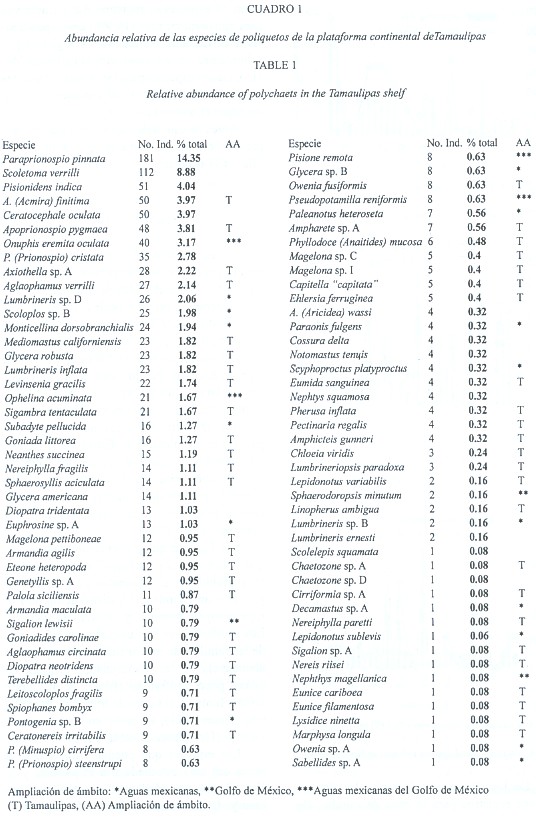
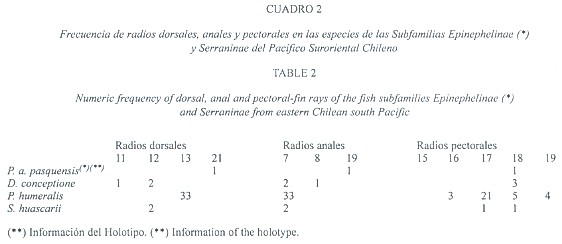
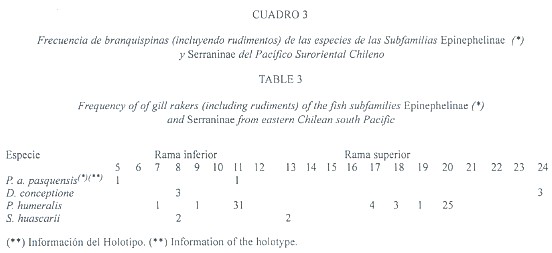
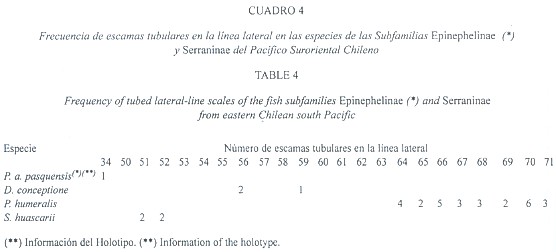
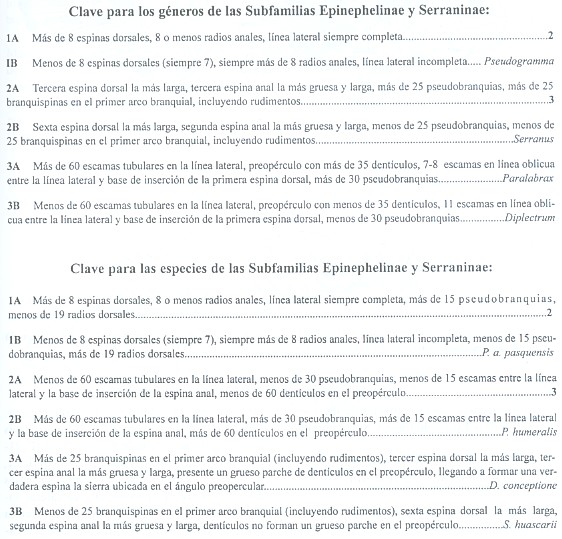
<body><![CDATA[<P><FONT FACE="Arial,Helvetica"><FONT SIZE=-1>Las medidas se hicieron con icti&oacute;metro (0.5 cm) y pi&eacute; de metro (0.05 mm). Los an&aacute;lisis morfom&eacute;tricos y mer&iacute;siticos se presentan de acuerdo con <A HREF="#Randall83">Randall &amp; Ben-Tuvia (1983)</A>. Los patrones de coloraci&oacute;n son descritos de acuerdo con <A HREF="#Heemstra">Heemstra &amp; Randall (1993)</A> y <A HREF="#Rojas98">Rojas (1998)</A>. La longitud est&aacute;ndar (Le) se expresa en mil&iacute;metros. Las medidas son proporciones respecto a la longitud est&aacute;ndar. Se emplearon las siguientes abreviaturas:&nbsp;&nbsp; Le, Longitud est&aacute;ndar; Lc, Longitud cef&aacute;lica; Dp, Distancia preorbital; Lms, Longitud mand&iacute;bula superior; Do, Di&aacute;metro orbital; Dio, Distancia interorbital; Am, Ancho maxilar; Lpd, Longitud predorsal; Lpa, Longitud preanal; Lpp, Longitud prep&eacute;lvica; Ld, Longitud base de la aleta dorsal; La, Longitud base de la aleta anal; Lpel, Longitud de la aleta p&eacute;lvica; Lpec, Longitud de la aleta pectoral; Lpc, Longitud del ped&uacute;nculo caudal; Apc, Ancho del ped&uacute;nculo caudal; Acu, Ancho del cuerpo; Alcu, Alto del cuerpo; LIa-LIIIa, Longitud de las espinas anales; LId-LVd, Longitud de las primeras cinco espinas dorsales. N&uacute;mero de espinas dorsales (ED), anales (EA) y p&eacute;lvicas (EP). N&uacute;mero de radios dorsales (RD), anales (RA), pectorales (Rpec) y p&eacute;lvicos (Rpel). El n&uacute;mero de escamas tubulares en la l&iacute;nea lateral (izquierda y derecha ELLI-ELLD), el n&uacute;mero de branquispinas (incluyendo rudimentos) en la rama superior (BPRS) y rama inferior (BPRI) del primer arco branquial fueron contabilizadas en el lado izquierdo del pez. Mediante radiograf&iacute;as y de acuerdo con lo propuesto por <A HREF="#Ahlstrom">Ahlstrom <I>et al.&nbsp;&nbsp;</I> (1976)</A> se determin&oacute; la f&oacute;rmula de los huesos supraneurales, espinas neurales y pterigi&oacute;foros dorsales (en el texto referido solo como f&oacute;rmula de los huesos predorsales).</FONT></FONT>      <P><B><FONT FACE="Arial,Helvetica"><FONT SIZE=-1>Resultados</FONT></FONT></B>     <BR><FONT FACE="Arial,Helvetica"><FONT SIZE=-1>&nbsp;</FONT></FONT>     <BR><FONT FACE="Arial,Helvetica"><FONT SIZE=-1>Se reconocen para Chile una especie de la Subfamilia Epinephelinae (<I>Pseudogramma australis pasquensis</I> <A HREF="#Randall97">Randall &amp; Baldwin, 1997)</A>, mientras que <I>Diplectrum conceptione</I> (<A HREF="#Valenciennes">Valenciennes, 1828</A>), <I>Paralabrax humeralis</I> (<A HREF="#Valenciennes">Valenciennes, 1828</A>) y <I>Serranus huascarii</I> (<A HREF="#Steindachner00">Steindachner, 1900</A>) constituyen los tres t&aacute;xones reconocidos para la Subfamilia Serraninae. Para el reconocimiento de dichas especies se presenta una clave gen&eacute;rica y otra espec&iacute;fica, as&iacute; como una diagnosis de las caracter&iacute;sticas morfom&eacute;tricas, mer&iacute;sticas, coloraci&oacute;n y distribuci&oacute;n.</FONT></FONT>     <BR><FONT FACE="Arial,Helvetica"><FONT SIZE=-1>&nbsp;</FONT></FONT>     <BR><FONT FACE="Arial,Helvetica"><FONT SIZE=-1>Los antecedentes morfol&oacute;gicos y mer&iacute;sticos de las especies objeto de estudio se resumen en el <A HREF="#cuadro1">Cuadro 1</A>. La frecuencia num&eacute;rica de radios, branquispinas y escamas tubulares en la l&iacute;nea lateral constituyen caracter&iacute;sticas que, combinadas, tambi&eacute;n permiten contribuir al reconocimiento espec&iacute;fico (<A HREF="#cuadro2">Cuadros 2</A>, <A HREF="#cuadro3">3</A>, <A HREF="#cuadro4">4</A>).</FONT></FONT>     <BR>&nbsp;     <CENTER><IMG SRC="/img/fbpe/rbt/v49n1/2333i01.JPG" HEIGHT=539 WIDTH=562></CENTER> &nbsp;     
<CENTER><A NAME="fig1"></A><IMG SRC="/img/fbpe/rbt/v49n1/2333i02.JPG" HEIGHT=451 WIDTH=551></CENTER> &nbsp;     
<BR><B><FONT FACE="Arial,Helvetica"><FONT SIZE=-1>Referencias de las especies de las Subfamilias Epinephelinae y Serraninae:</FONT></FONT></B>     ]]></body>
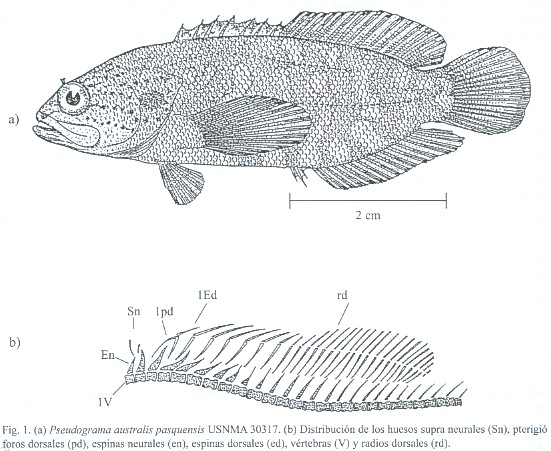
<body><![CDATA[<BR>&nbsp;     <CENTER><I><FONT FACE="Arial,Helvetica"><FONT SIZE=-1>Pseudogramma australis pasquensis<B> </B></FONT></FONT></I><FONT FACE="Arial,Helvetica"><FONT SIZE=-1>Randall &amp; Baldwin, 1997 (<A HREF="#fig1">Fig. 1a</A>).</FONT></FONT></CENTER>       <P><FONT FACE="Arial,Helvetica"><FONT SIZE=-1><I>Rhegma</I> sp. Randall 1976:&nbsp; 52 (Isla de Pascua, Menci&oacute;n).</FONT></FONT>     <BR><I><FONT FACE="Arial,Helvetica"><FONT SIZE=-1>Pseudogramma<B> </B></FONT></FONT></I><FONT FACE="Arial,Helvetica"><FONT SIZE=-1>sp. Randall &amp; Cea 1984:&nbsp; 9 (Nombres nativos de Pascua).</FONT></FONT>     <BR><I><FONT FACE="Arial,Helvetica"><FONT SIZE=-1>Pseudogramma<B> </B>australis</FONT></FONT></I><FONT FACE="Arial,Helvetica"><FONT SIZE=-1> <I>pasquensis</I> Randall &amp; Baldwin 1997:&nbsp; 19-23 (Descripci&oacute;n, figura y distribuci&oacute;n).</FONT></FONT>      <P><FONT FACE="Arial,Helvetica"><FONT SIZE=-1><B>Diagnosis</B>:&nbsp;&nbsp; Los datos incluidos en esta secci&oacute;n corresponden a <I>P. australis</I>, especie que ha sido se&ntilde;alada por Randall &amp; Baldwin (1997), como el holotipo de <I>P</I>.<I> a</I>.<I> pasquensis</I>. La informaci&oacute;n presentada entre par&eacute;ntesis corresponde a la subespecie. Dorsal VII, 21-22. Anal III, 16-19. Pectoral 14-17. P&eacute;lvica I, 5. Caudal 17. Escamas ctenoideas. Grandes escamas sobre el op&eacute;rculo. L&iacute;nea lateral incompleta, 34 (28-39) escamas tubulares en la l&iacute;nea lateral, 13 (12-13) filas oblicuas de escamas entre la l&iacute;nea lateral y la base de la primera espina dorsal; 22 (22-23) escamas bajo la l&iacute;nea lateral y en una fila oblicua hacia la base de la primera espina anal. Boca larga. Ambas mand&iacute;bulas con bandas de dientes villiformes. La mand&iacute;bula inferior sin dientes caninos. V&oacute;mer con 3-4 filas de dientes villiformes en forma de “V”. Lengua larga, delgada, lisa, con peque&ntilde;as papilas. Primer arco branquial con 6+11 (5-6 + 9-11) branquispinas; 12 filamentos pseudobranquiales (paratipo de 22.5 mm con 9, paratipos m&aacute;s grandes con 13). V&eacute;rtebras 26-27 (10+16, 10+17). F&oacute;rmula de los huesos predorsales 0/0/1/1+1 (<A HREF="#fig1">Fig. 1b</A>).</FONT></FONT>      <P><FONT FACE="Arial,Helvetica"><FONT SIZE=-1><B>Color</B>:&nbsp;&nbsp; Cuerpo y cabeza rojizos, con filas longitudinales de manchas blancas en los costados. Manchas rojas en la parte anterior del cuerpo y en la base de las aletas dorsal y anal. Manchas blancas debajo del borde inferior del ojo. Aleta dorsal y anal rojas. Esta &uacute;ltima con una fila vertical de tres manchas gris&aacute;ceas que se interconectan en la base. Ejemplares preservados son p&aacute;lidos, sin manchas (<A HREF="#Randall97">Randall &amp; Baldwin 1997</A>).</FONT></FONT>      <P><FONT FACE="Arial,Helvetica"><FONT SIZE=-1><B>Material examinado</B>:&nbsp;&nbsp; Radiograf&iacute;as del material tipo. USNM 303170.</FONT></FONT>      <P><FONT FACE="Arial,Helvetica"><FONT SIZE=-1><B>Distribuci&oacute;n geogr&aacute;fica</B>:&nbsp;&nbsp; <I>P. a. pasquensis</I> es end&eacute;mica de la Isla de Pascua (27&deg;09' S, 109&deg;23' W).</FONT></FONT>      <P><FONT FACE="Arial,Helvetica"><FONT SIZE=-1><B>Comentario:&nbsp;&nbsp; </B>El g&eacute;nero <I>Pseudogramma</I> se encuentra constituido por 9 especies m&aacute;s:&nbsp;&nbsp; <I>P. australis</I> (Islas Pascua, Pitcairn, Cook y Tonga), <I>P</I>. <I>thaumasium</I> (Golfo de California a Colombia), <I>P</I>. <I>axelrodi</I> (Isla Clipperton), <I>P</I>. <I>gregoryi</I> (Bermuda, Bahamas y Mar Caribe), <I>P</I>. <I>erythreum</I> (Filipinas), <I>P</I>. <I>pectoralis</I> (Isla Palau y Filipinas), <I>P</I>. <I>guineensis</I> (Golfo de Guinea), <I>P</I>. <I>polyacanthum</I> (Indopac&iacute;fico), <I>P</I>. <I>megamycterum</I> (Mar Rojo), <I>P</I>. <I>astigmum</I> (Indopac&iacute;fico) (<A HREF="#Randall97">Randall &amp; Baldwin 1997</A>).</FONT></FONT>     ]]></body>
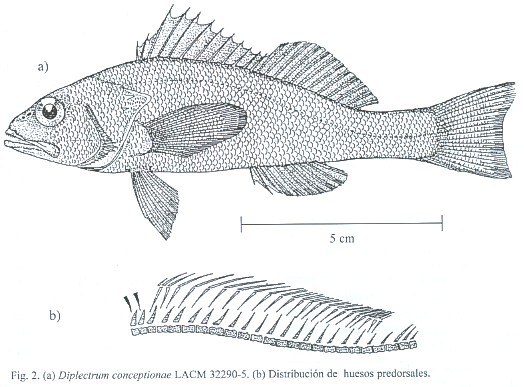
<body><![CDATA[<BR>&nbsp;     <CENTER><FONT FACE="Arial,Helvetica"><FONT SIZE=-1><I>Diplectrum conceptione</I> Valenciennes, 1828 (<A HREF="#fig2">Fig. 2a</A>).</FONT></FONT></CENTER> &nbsp;     <BR><FONT FACE="Arial,Helvetica"><FONT SIZE=-1><I>Serranus conceptionis</I> Valenciennes in Cuvier &amp; Valenciennes 1828:&nbsp; 246 (descripci&oacute;n original a partir de material recolectado en Concepci&oacute;n, Centro-Sur de Chile).</FONT></FONT>     <BR><FONT FACE="Arial,Helvetica"><FONT SIZE=-1>?<I>Plectropoma paytensis</I> Lesson 1830:&nbsp; 233-234 (Descripci&oacute;n original, Per&uacute;); G&uuml;nther 1859:&nbsp; 165 (Cat&aacute;logo).</FONT></FONT>     <BR><FONT FACE="Arial,Helvetica"><FONT SIZE=-1><I>Serranus conceptionis</I> Lesson 1830:&nbsp; 236 (Menci&oacute;n); Reed 1897:&nbsp; 6 (Lista); Porter 1909:&nbsp; 285 (Lista); Bauchot<I><B> </B>et al.&nbsp;&nbsp;</I> 1984:&nbsp; 26 (Cat&aacute;logo).</FONT></FONT>     <BR><FONT FACE="Arial,Helvetica"><FONT SIZE=-1><I>Centropristis conceptionis</I> G&uuml;nther, 1859:&nbsp; 84 (Cat&aacute;logo); Delfin 1899 (Distribuci&oacute;n Chile).</FONT></FONT>     <BR><FONT FACE="Arial,Helvetica"><FONT SIZE=-1><I>Pristipoma conceptionis</I> Steindachner 1874:&nbsp; 448 (Distribuci&oacute;n:&nbsp;&nbsp; Lota y Juan Fern&aacute;ndez, Chile).</FONT></FONT>     <BR><FONT FACE="Arial,Helvetica"><FONT SIZE=-1><I>Diplectrum conceptione</I> Jordan &amp; Eigenmann 1890:&nbsp;&nbsp; 397-399:&nbsp;&nbsp; (Sistem&aacute;tica).</FONT></FONT>     <BR><FONT FACE="Arial,Helvetica"><FONT SIZE=-1><I>Hemilutjanus paytensis</I> Jordan &amp; Eigenmann 1890:&nbsp; 345 (Sistem&aacute;tica).</FONT></FONT>      <P><FONT FACE="Arial,Helvetica"><FONT SIZE=-1><B>Diagnosis</B>:&nbsp;&nbsp; Dorsal X, 11-12. Anal III 7. Pectoral 18. P&eacute;lvica I, 5. Caudal ligeramente c&oacute;ncava, con 17 radios. Escamas ctenoideas. L&iacute;nea lateral con 56-59 escamas tubulares. 11-12 escamas entre la l&iacute;nea lateral y la base de la primera espina dorsal. 6-7 escamas entre la l&iacute;nea lateral y las espinas dorsales centrales. 19-20 escamas entre la l&iacute;nea lateral y la base de la primera espina anal. Las mand&iacute;bulas son aproximadamente del mismo tama&ntilde;o, sobresale levemente el dentario. Dentario con 8-9 caninos a cada lado del hueso. El premaxilar presenta entre 16 y 18 caninos rectos a cada lado del hueso. En la parte anterior de la sinfisis diastemal superior se ubican tres grandes caninos curvados hacia el v&oacute;mer. Palatinos y v&oacute;mer con una delgada banda de dientecillos villiformes. Parche vomerino en forma de V. Lengua larga, gruesa, con punta delgada y sin dientes. Arco branquial superior con 8-9 + 16-18 branquispinas (incluyendo rudimentos). La branquispina m&aacute;s larga se ubica en el &aacute;ngulo de la branquia, supera en longitud al filamento branquial m&aacute;s largo. Preop&eacute;rculo sin espinas antrorsas, margen preop&eacute;rcular con 32 dent&iacute;culos, la m&aacute;s grande ubicada en &aacute;ngulo. Interop&eacute;rculo y subop&eacute;rculo no tienen dent&iacute;culos. 24 v&eacute;rtebras (10 precaudales + 14 caudales). F&oacute;rmula de los huesos predorsales 0/0/2/1+1/1/1 (<A HREF="#fig2">Fig. 2b</A>).</FONT></FONT>      ]]></body>
<body><![CDATA[<P><FONT FACE="Arial,Helvetica"><FONT SIZE=-1><B>Color en fresco</B>:&nbsp;&nbsp; Cabeza oliv&aacute;cea con manchas rojizas. Op&eacute;rculo con manchas rojas y doradas. Dorso y costados verde-oliva oscuro con tres tenues bandas amarillentas. Vientre anaranjado verdoso, con tintes dorados y anaranjado (<A HREF="#Bortone">Bortone 1977</A>). Espec&iacute;menes preservados:&nbsp;&nbsp; Vientre caf&eacute;, dorso gris&aacute;ceo, combinado con nueve barras verticales oscuras que corren en sentido lateral y que terminan en la l&iacute;nea media ventral del cuerpo. Regi&oacute;n gular, dentario y branquiostegales, amarillo p&aacute;lido. Aleta dorsal y anal amarillenta, p&eacute;lvica gris&aacute;cea, pectoral con una l&iacute;nea pigmentada en negro que ocurre a lo largo del eje dorsal de cada radio (<A HREF="#Rojas98">Rojas 1998</A>).</FONT></FONT>      <P><FONT FACE="Arial,Helvetica"><FONT SIZE=-1><B>Distribuci&oacute;n geogr&aacute;fica</B>:&nbsp;&nbsp; Desde la Bah&iacute;a de Concepci&oacute;n, Chile (37&ordm;S) hasta las costas ecuatorianas (3&ordm;15'S) (Bortone 1977).</FONT></FONT>      <P><FONT FACE="Arial,Helvetica"><FONT SIZE=-1><B>Material examinado</B>:&nbsp;&nbsp; LACM 32290-5 (1 ej., 112.4 mm LE); Golfo de Guayaquil, entre Puerto Pizarro y Caleta la Cruz (Per&uacute;), 13 Abr. 1972, en arrastre de camarones. MHN-P 646 (1ej., 142.6 mm LE); Puerto Callao (Per&uacute;), 9 de Ago. 1959. MHN-P 647 (1 ej., 134 mm LE); Puerto Callao (Per&uacute;), 9 de Ago. 1959.</FONT></FONT>      <P><B><FONT FACE="Arial,Helvetica"><FONT SIZE=-1>Comentario:&nbsp;&nbsp;<I> </I></FONT></FONT></B><FONT FACE="Arial,Helvetica"><FONT SIZE=-1>Once especies m&aacute;s conforman este g&eacute;nero:&nbsp;&nbsp; <I>D</I>. <I>formosun</I> (Golfo de M&eacute;xico, Pen&iacute;nsula de Florida, Bahamas, Isla V&iacute;rgenes, S&atilde;o Paulo, Brasil). <I>D. bivittatum</I> (Golfo de M&eacute;xico a Brasil, Cuba, Bermuda, Jamaica, Puerto Rico y Antillas menores). <I>D. radiale</I> (Venezuela a S&atilde;o Paulo, Brasil). <I>D. pacificum</I> (Golfo de California a Per&uacute;). <I>D. rostrum</I> (Golfo de M&eacute;xico hasta Ecuador, incluyendo las islas Gal&aacute;pagos). <I>D. maximum</I> (Bah&iacute;a Magdalena, Colombia hasta Lobos de Tierra, Per&uacute;). <I>D. sciurus</I> (Golfo de California hasta la Bah&iacute;a Magdalena, Colombia). <I>D. euryplectrum</I> (Baja California a Ecuador, incluyendo islas Gal&aacute;pagos). <I>D. labarum</I> (Baja California a Golfo de Panam&aacute;). <I>D. eumelum</I> (Baja California a Ecuador, incluyendo islas Gal&aacute;pagos). <I>D. macropoma</I> (Baja California a Ecuador, incluyendo islas Gal&aacute;pagos) (<A HREF="#Bortone">Bortone 1977</A>).</FONT></FONT>      <P><FONT FACE="Arial,Helvetica"><FONT SIZE=-1>Infructuosos recolectas en Concepci&oacute;n, Valpara&iacute;so y Coquimbo (Sur, Centro y Norte de Chile), durante 1975-1976 (<A HREF="#Bortone">Bortone 1977</A>) y 1996-1997 (<A HREF="#Rojas98">Rojas 1998</A>) acrecientan la controversia sobre la distribuci&oacute;n propuesta. Al respecto Rojas &amp; Peque&ntilde;o (in prep.) consideran que dicho l&iacute;mite distribucional es consecuencia de un severo evento Ni&ntilde;o que favoreciera, tal como ha sido documentado por <A HREF="#Kong85">Kong<I> et al.&nbsp;&nbsp; </I>(1985)</A> y <A HREF="#Kong87">Kong &amp; Bolados (1987)</A>, una fuerte migraci&oacute;n, de ictiofauna t&iacute;picamente tropical, desde el norte hacia el sur del Pac&iacute;fico oriental. Por otro lado, tampoco puede descartarse la presencia de <I>D. conceptione</I> en la localidad tipo, si consideramos la cr&oacute;nica de la expedici&oacute;n cient&iacute;fica de la corbeta “La Coquille”. Dicha nota se&ntilde;ala que el naturalista Ren&eacute; Lesson, entre el 20 de enero y 13 de febrero de 1823, captur&oacute; en las costas de Concepci&oacute;n, un espec&iacute;men, que posteriormente A. Valenciennes lo denomin&oacute; <I>Serranus conceptionis</I>“Le Serran de la Conception”. (<A HREF="#Riveros">Riveros 1949</A>). <A HREF="#Jordan">Jordan &amp; Eigenmann (1890)</A>, en la revisi&oacute;n de serr&aacute;nidos de Am&eacute;rica, lo colocan en el g&eacute;nero <I>D.iplectrum.</I></FONT></FONT>     <CENTER><A NAME="fig2"></A><IMG SRC="/img/fbpe/rbt/v49n1/2333i03.JPG" HEIGHT=387 WIDTH=524></CENTER> &nbsp;     
<CENTER><FONT FACE="Arial,Helvetica"><FONT SIZE=-1><I>Paralabrax humeralis</I>&nbsp; (Valenciennes, 1828) (<A HREF="#fig3">Fig.3a</A>).</FONT></FONT></CENTER>       <P><FONT FACE="Arial,Helvetica"><FONT SIZE=-1><I>Serranus humeralis</I> Valenciennes in Cuvier &amp; Valenciennes, 1828:&nbsp; 183 (Localidad tipo costas de Chile).</FONT></FONT>     <BR><FONT FACE="Arial,Helvetica"><FONT SIZE=-1><I>Paralabrax humeralis</I> Jordan &amp; Eigenmann 1890:&nbsp; 389 (Distribuci&oacute;n, Callao-Per&uacute;).</FONT></FONT>     <BR><FONT FACE="Arial,Helvetica"><FONT SIZE=-1><I>Paralabrax semifasciatus</I> Guichenot 1848:&nbsp;&nbsp; 149 (Distribuci&oacute;n costas de Chile).</FONT></FONT>     ]]></body>
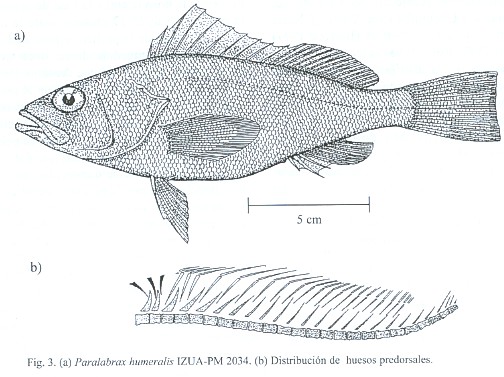
<body><![CDATA[<BR><FONT FACE="Arial,Helvetica"><FONT SIZE=-1><I>Serranus albomaculatus</I> Jenyns 1842:&nbsp; 3 (Menci&oacute;n); G&uuml;nther 1859:&nbsp; 105 (Menci&oacute;n).</FONT></FONT>     <BR><FONT FACE="Arial,Helvetica"><FONT SIZE=-1><I>Serranus semifasciatus</I> Guichenot 1848:&nbsp; 151 (Menci&oacute;n y figura); Reed 1897:&nbsp; 6 (Lista); Delfin 1898:&nbsp; 148 (Menci&oacute;n).</FONT></FONT>      <P><FONT FACE="Arial,Helvetica"><FONT SIZE=-1><B>Diagnosis</B>:&nbsp;&nbsp; Dorsal X, 18-21. Anal III 7-8. Pectoral 14-18. P&eacute;lvica I, 5. Caudal 17. Escamas ctenoideas. 64-72 escamas tubulares en la l&iacute;nea lateral, 8-10 escamas entre la l&iacute;nea lateral y las espinas dorsales centrales; 7-8 escamas entre la l&iacute;nea lateral y la base de la primera espina dorsal; 15-17 escamas entre la l&iacute;nea lateral y la base de la primera espina anal; 20-22 escamas circumped&uacute;nculares. Boca terminal, premaxilar m&aacute;s corto que dentario. Dentario presenta una delgada banda (con al menos dos filas) de dientes caniniformes. Premaxilar con una banda de caninos curvados hacia el v&oacute;mer, adosada a esta banda hay otra de peque&ntilde;os y delgados dientes villiformes. Palatinos con una banda ancha de dientecillos, en algunos espec&iacute;menes esta banda se conecta con la banda de dientes vomerinos. En aquellos espec&iacute;menes en que no hay uni&oacute;n de dichas bandas, el v&oacute;mer presenta forman de “V”. Lengua grande, gruesa, con punta redonda y sin dientes. Primer arco branquial con 9-10 + 18-20 branquispinas (incluyendo rudimentos). La branquispina m&aacute;s larga se ubica en el &aacute;ngulo de la branquia, adem&aacute;s supera en longitud al filamento branquial m&aacute;s largo; 37-39 pseudobranquias. Preop&eacute;rculo sin espinas antrorsas, margen preop&eacute;rcular con 60-65 dent&iacute;culos, la m&aacute;s grande de ellas ubicada en &aacute;ngulo. Op&eacute;rculo con tres espinas, la central es la m&aacute;s desarrollada. Interop&eacute;rculo y subop&eacute;rculo sin dent&iacute;culos; 26 v&eacute;rtebras (10 precaudales + 16 caudales). F&oacute;rmula de los huesos predorsales 0/0/0+2/1+1/1 (<A HREF="#fig3">Fig. 3b</A>).</FONT></FONT>      <P><FONT FACE="Arial,Helvetica"><FONT SIZE=-1><B>Color en fresco</B>:&nbsp;&nbsp; Cabeza con numerosas manchas anaranjadas y rojas sin patr&oacute;n aparente. Entre el borde superior del op&eacute;rculo y la base de la aleta caudal hay otra banda de manchas anaranjadas. Dentario y premaxilar con manchas rojas y anaranjadas. Regi&oacute;n ventral, regi&oacute;n gular y branquistegos gris&aacute;ceos. Aleta pectoral rojiza. Base de la dorsal y p&eacute;lvica con peque&ntilde;as bandas rojo y anaranjadas. La dorsal espinosa caf&eacute; cobrizo. Ojos caf&eacute;, iris rojizo. Espec&iacute;menes, con nueve meses de preservados en alcohol al 70%, presentan los costados y parte dorsal viol&aacute;ceos, base de aletas pectoral, p&eacute;lvica y anal blanquecina, cabeza y huesos del aparato op&eacute;rcular gris&aacute;ceos, ojos blancos con iris negro. Aleta dorsal y aleta caudal azulosos con manchas gris&aacute;ceas. Dentario, regi&oacute;n gular y branquiostegales gris&aacute;ceos (<A HREF="#Rojas98">Rojas 1998</A>).</FONT></FONT>      <P><FONT FACE="Arial,Helvetica"><FONT SIZE=-1><B>Distribuci&oacute;n geogr&aacute;fica:&nbsp;&nbsp; </B><I>P. humeralis</I> se encuentra desde la Rada Quintay (33&ordm;10'S), Valpara&iacute;so (<A HREF="#Yanez">Ya&ntilde;ez 1974</A>) hasta Colombia (W. Bussing com. per. 2000). Sin embargo la similitud vernacular que existe con <I>Sebastes</I> (presente a lo largo de la costa chilena) y <I>Prolatilus</I> (amplia distribuci&oacute;n en el centro sur de Chile) (conocidas popularmente como “cabrillas”), puede ser la causa de que se haya concedido tan amplia distribuci&oacute;n a <I>P</I>. <I>humeralis</I>, incluso reportado m&aacute;s al sur de Puerto Montt (sur de Chile) (<A HREF="#Anonimo">An&oacute;nimo 1997</A>).</FONT></FONT>      <P><FONT FACE="Arial,Helvetica"><FONT SIZE=-1><B>Material examinado</B>:&nbsp;&nbsp; 33 ejemplares. Intervalo de tallas 121.1-297.0 mm Le.</FONT></FONT>      <P><FONT FACE="Arial,Helvetica"><FONT SIZE=-1>IZUA-PM 464 (2 ejs., 186-230 mm Le); Bajo Los Molles, Iquique, 20 Nov. 1975. IZUA-PM 2033 (11 ejs., 204-297 mm Le), Mercado de Antofagasta, 30 Ene. 1997. IZUA-PM 2034 (10 ejs., 175-247 mm Le), Mercado de Iquique, 2 Feb. 1997. MNHNC.P 5831 (2 ejs., 192-216 mm Le), Frente a Arica 18&ordm;30'S, 70&ordm;25'W, 12 Jul. 1977 (30 m). LZUCV 0002 (1 ej., 150 mm Le), Valpara&iacute;so, Ene. 1985. MHNV 0001 (1 ej., 238 mm Le), Puerto Caldera, 1 Oct. 1990. MHNV 0002 (1 ej., 150 mm Le), Puerto Caldera, 8 Dic. 1993. MUCNC 138 (1ej., 229 mm Le), Playa Brava. MUCNC 504877 (1 ej., 251 mm Le), Huaquique-Iquique, 20 Nov. 1975 (Zona Intermareal). UAP195 (1 ej., 175 mm Le), Playa Brava-Iquique (arp&oacute;n). LACM 46027-1 (2 ejs., 121.1-127.7 Le), Antofagasta, Chile, 11 Feb. 1995.</FONT></FONT>      <P><FONT FACE="Arial,Helvetica"><FONT SIZE=-1><B>Comentario:&nbsp;&nbsp; </B>El g&eacute;nero lo complementan ocho especies m&aacute;s:&nbsp;&nbsp; <I>P. dewegeri</I> es la &uacute;nica que se encuentra en el Atl&aacute;ntico (Venezuela), <I>P. callaensis</I> (Per&uacute; y Ecuador), <I>P. albomaculatus</I> (islas Gal&aacute;pagos), <I>P. loro</I> (Mazatl&aacute;n, M&eacute;xico hasta Panam&aacute;), <I>P. auroguttatus</I> y <I>P. maculatofasciatus</I> (sur de California y Golfo de California), <I>P. nebulifer</I> (Baja California y Sur de California, pero no en el Golfo), <I>P. clathratus</I> (Baja California y ocasionalmente al norte de Santa B&aacute;rbara) (<A HREF="#Walford37">Walford 1937</A>, <A HREF="#Evermann">Evermann &amp; Radcliffe 1917</A>, <A HREF="#Chirichigno">Chirichigno 1974</A>, <A HREF="#Allen">Allen &amp; Roberston 1994</A>, <A HREF="#Fischer">Fischer <I>et al.&nbsp;&nbsp;</I> 1995</A>).</FONT></FONT>      <P><FONT FACE="Arial,Helvetica"><FONT SIZE=-1><I>Paralabrax semifasciatus</I> y <I>Serranus semifasciatus</I> (<A HREF="#Guichenot">Guichenot 1848</A>) forman parte de la sinonimia de <I>P</I>.<I> humeralis</I>. Dicha decisi&oacute;n fue propuesta considerando:&nbsp;&nbsp; a) Que las descripciones establecidas por <A HREF="#Guichenot">Guichenot (1848)</A> para ambos t&aacute;xones se asemejan a la establecida para <I>P</I>.<I> humeralis</I>, b) No existe material tipo de <I>P. semifasciatus</I> ni <I>S. semifasciatus</I> que posibilite comparaciones, c) En las localidades tipo sugeridas para ambos t&aacute;xones (Juan Fern&aacute;ndez e Isla de Pascua) nunca se han encontrado espec&iacute;menes que den cuenta de la presencia de dichas especies, sin embargo el supuesto hallazgo fue la raz&oacute;n para que se continuara citando a <I>P. humeralis</I> en dichos territorios insulares (G. Peque&ntilde;o obs. per. 1997).</FONT></FONT>     <BR>&nbsp;     ]]></body>
<body><![CDATA[<CENTER><A NAME="fig3"></A><IMG SRC="/img/fbpe/rbt/v49n1/2333i04.JPG" HEIGHT=377 WIDTH=504></CENTER> &nbsp;     
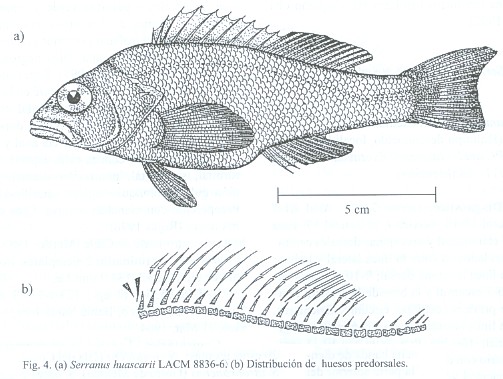
<CENTER><FONT FACE="Arial,Helvetica"><FONT SIZE=-1><I>Serranus</I> <I>huascarii</I> Steindachner,1900 (<A HREF="#fig4">Fig. 4a</A>).</FONT></FONT></CENTER>       <P><FONT FACE="Arial,Helvetica"><FONT SIZE=-1><I>Serranus huascarii</I> Steindachner, 1900:&nbsp; 206-208 (Holotipo desconocido, localidad tipo Per&uacute;). <I>Prionodes huascarii</I> Evermann &amp; Radcliffe 1917:&nbsp; 78 (Menci&oacute;n).</FONT></FONT>      <P><FONT FACE="Arial,Helvetica"><FONT SIZE=-1><B>Diagn&oacute;stico</B>:&nbsp;&nbsp; Dorsal X, 12. Anal III 7. Pectoral 17-18. P&eacute;lvica I, 5. Caudal 17. Escamas ctenoideas, 51-52 escamas tubulares (a ambos lados) en la l&iacute;nea lateral; 4 escamas entre la l&iacute;nea lateral y las espinas dorsales centrales; 6-7 escamas entre la l&iacute;nea lateral y la base de la primera espina dorsal; 9-10 escamas entre la l&iacute;nea lateral y la base de la primera espina anal; 16-17 escamas circumpedunculares. Dentario con dientes caninos con puntas dirigidas hacia el v&oacute;mer. Premaxila con 10-11 caninos (a ambos lados), una ancha banda de dientes villiformes se adosa en la parte anterior del hueso. A nivel de la sinfisis diastemal una gran cantidad de peque&ntilde;os caninos de diferente tama&ntilde;o. Palatinos y v&oacute;mer con una delgada banda de dientecillos. Dientes vomerinos en forma de “V”. Lengua grande, gruesa, con punta delgada y sin dientes. Primer arco branquial con 3-8 + 13 branquispinas (incluyendo rudimentos). La branquispina m&aacute;s larga est&aacute; inmediatamente despu&eacute;s de aquella que se encuentra en el &aacute;ngulo de la branquia, esta espina no supera en longitud al filamento branquial m&aacute;s largo; 22-24 filamentos pseudobranquiales. Regi&oacute;n interorbital c&oacute;ncava. La maxila alcanza el eje central del margen vertical orbital. Preop&eacute;rculo sin espinas antrorsas, margen preop&eacute;rcular con 66 sierras. La m&aacute;s larga se ubica en el &aacute;ngulo. Interop&eacute;rculo y subop&eacute;rculo libre de dent&iacute;culos. Op&eacute;rculo con tres espinas, la m&aacute;s grande es la central. 24 v&eacute;rtebras (10 precaudales + 14 caudales). F&oacute;rmula de los huesos predorsales 0/0/0+2/1+1/1/ (<A HREF="#fig4">Fig. 4b</A>).</FONT></FONT>      <P><FONT FACE="Arial,Helvetica"><FONT SIZE=-1><B>Color en fresco</B>:&nbsp;&nbsp; Cabeza marr&oacute;n, y costados del cuerpo. Aleta caudal amarilla, dorsal, anal, pectorales y p&eacute;lvicas verde y amarillo. Superficie interna de los arcos branquiales amarillo mostaza, paladar posterior gris oscuro con borde amarillo naranja. Ojos negros, iris dorado (<A HREF="#Franke">Franke &amp; Acero 1995</A>). Espec&iacute;menes preservados presentan el cuerpo caf&eacute; en la parte dorsal y ventral. Base de la caudal negra. Aleta dorsal amarillo-oscuro, radios dorsales blandos con machas oscuras. Aleta anal y p&eacute;lvica amarillo-claro, cabeza caf&eacute;, espacio interorbital, suborbital, premaxilar dentario, regi&oacute;n gular y branquiostegales amarillo-claro. Preop&eacute;rculo con manchas oscuras. Ojos caf&eacute;, iris negro (<A HREF="#Rojas98">Rojas 1998</A>).</FONT></FONT>      <P><FONT FACE="Arial,Helvetica"><FONT SIZE=-1><B>Distribuci&oacute;n geogr&aacute;fica</B>:&nbsp; <I>Serranus huascarii</I>, se distribuye desde el Golfo de California hasta el centro-norte de Chile (<A HREF="#Meisler">Meisler 1987</A>).</FONT></FONT>      <P><FONT FACE="Arial,Helvetica"><FONT SIZE=-1><B>Material examinado:&nbsp;&nbsp;</B> 2 ejemplares. Intervalo de tallas 123.1-134.9 mm Le.</FONT></FONT>      <P><FONT FACE="Arial,Helvetica"><FONT SIZE=-1>LACM 8836-6 (2 ejs., 123.1-134.9 mm Le), Golfo de M&eacute;xico, Bah&iacute;a Santa Inez, M&eacute;xico, 11 Mar. 1964.</FONT></FONT>      <P><FONT FACE="Arial,Helvetica"><FONT SIZE=-1><B>Comentario:&nbsp;&nbsp; </B>El g&eacute;nero lo complementan 20 especies m&aacute;s:&nbsp;&nbsp; <I>S</I>. <I>aequidens</I> (Isla del Coco), <I>S</I>. <I>atrobranchus</I> (Golfo de M&eacute;xico), <I>S</I>. <I>huascarii</I> (Chile, Per&uacute;), <I>S</I>. <I>maytagi</I> (Nicaragua, Honduras), <I>S</I>. <I>notospilus</I> (Florida, Brazil), <I>S</I>. <I>novemcinctus</I> (Cabo de Buena Esperanza, Sud&aacute;frica y Sur de Madagascar), <I>S</I>. <I>atricauda</I> (Portugal, Mauritania, Islas Canarias, Madeira y Azores y oeste del Mediterr&aacute;neo), <I>S</I>. <I>cabrilla</I> (Mediterr&aacute;neo, Mar Negro, Mar Rojo y Mar del Norte), <I>S</I>. <I>hepatus</I> (todo Mediterr&aacute;neo), <I>S</I>. <I>heterurus</I> (Guinea, Congo y Ghana)<B>, </B><I>S</I>. <I>accraensis</I><B> </B>(Golfo de Guinea, Ghana y Angola), <I>S</I>. <I>flaviventris</I> (Caribe-Uruguay), <I>S</I>. <I>subligarius</I> (Golfo de M&eacute;xico a Panam&aacute;), <I>S</I>. <I>auriga</I> (Brazil a Argentina), <I>S</I>. <I>annularis</I> (Antillas, Florida hasta Brazil), <I>S</I>. <I>tigrinus</I> (sur de Florida, Bahamas y Bermuda), <I>S</I>. <I>psittacinus</I> (California-Per&uacute;), <I>S</I>. <I>chionaria</I> (Honduras y el Caribe), <I>S</I>. <I>baldwini</I> (Antillas y desde Florida a Brazil), <I>S</I>. <I>scriba</I> (todo el Mediterr&aacute;neo, Azores, Madeira e Islas Canarias) (<A HREF="#Meisler">Meisler 1987</A>).</FONT></FONT>      <P><FONT FACE="Arial,Helvetica"><FONT SIZE=-1>Pese a que <A HREF="#Steindachner00">Steindachner (1900)</A> denomin&oacute; esta especie, en 1917 surge sin ninguna justificaci&oacute;n nomenclatural aparente el nombre de <I>Prionodes huascarii</I> (<A HREF="#Evermann">Evermann &amp; Radcliffe 1917</A>). Sin embargo concordamos con <A HREF="#Robins">Robins &amp; Starck (1961)</A> y <A HREF="#Meisler">Meisler (1987)</A> en que <I>P</I>. <I>huascarii</I> debe ser colocada en el g&eacute;nero <I>Serranus</I>. Esta situaci&oacute;n no fue considerada por muchos a&ntilde;os y err&oacute;neamente se sigui&oacute; utilizando <I>P</I>.<I> huascarii</I> (<A HREF="#Fowler">Fowler 1945</A>, <A HREF="#Hildebrand">Hildebrand 1946</A>, <A HREF="#Mann">Mann 1954</A>, <A HREF="#deBuen">de Buen 1959</A>, <A HREF="#Chirichigno">Chirichigno 1974</A>, <A HREF="#Bahamonde">Bahamonde &amp; Peque&ntilde;o 1975</A> y <A HREF="#Pequeno89">Peque&ntilde;o 1989</A>). Adem&aacute;s en ninguna de estas obras se presenta informaci&oacute;n sobre caracter&iacute;sticas morfol&oacute;gicas y mer&iacute;sticas.</FONT></FONT>     ]]></body>
<body><![CDATA[<BR>&nbsp;     <CENTER><A NAME="fig4"></A><IMG SRC="/img/fbpe/rbt/v49n1/2333i05.JPG" HEIGHT=379 WIDTH=503></CENTER> <FONT FACE="Arial,Helvetica"><FONT SIZE=-1>&nbsp;</FONT></FONT>     
<CENTER><A NAME="cuadro1"></A><IMG SRC="/img/fbpe/rbt/v49n1/2331i05.JPG" HEIGHT=821 WIDTH=536><FONT FACE="Arial,Helvetica"><FONT SIZE=-1></FONT></FONT></CENTER>      
<CENTER>&nbsp;</CENTER>      <CENTER><A NAME="cuadro2"></A><IMG SRC="/img/fbpe/rbt/v49n1/2333i07.JPG" HEIGHT=244 WIDTH=562></CENTER>      
<CENTER>&nbsp;</CENTER>      <CENTER><A NAME="cuadro3"></A><IMG SRC="/img/fbpe/rbt/v49n1/2333i08.JPG" HEIGHT=253 WIDTH=552></CENTER>      
<CENTER>&nbsp;</CENTER>      <CENTER><A NAME="cuadro4"></A><IMG SRC="/img/fbpe/rbt/v49n1/2333i09.JPG" HEIGHT=252 WIDTH=556></CENTER>      
<CENTER>&nbsp;</CENTER> <B><FONT FACE="Arial,Helvetica"><FONT SIZE=-1>Agradecimientos</FONT></FONT></B>      ]]></body>
<body><![CDATA[<P><FONT FACE="Arial,Helvetica"><FONT SIZE=-1>Por las facilidades otorgadas para estudiar espec&iacute;menes de su cuidado, se agradece a V. Jer&eacute;z (MZUC), R. Mel&eacute;ndez, A. Cornejo (MNHNC), P. Ojeda (SSUC), C. Vivar (MHNV) (fallecido), E. de la Hoz (fallecido), (LZUCV), J. V&aacute;squez, E. Acu&ntilde;a (MUCNC), I. Kong (UA), M. Vargas (UAP), H. Ortega (MHN-P), R. Feeney (LACM, USA), W. Bussing (UCR-Costa Rica). En especial a G. Herrera (LACM, Los Angeles), por facilitar descripciones originales, numerosos art&iacute;culos y valiosas sugerencias. Este proyecto ha sido financiado parcialmente por la Direcci&oacute;n de Investigaci&oacute;n de la Universidad Austral de Chile (Proyecto S 96-04) y la Deutscher Akademischer Austauschdienst (DAAD-Alemania), mediante de una beca de estudios doctorales al primer autor.</FONT></FONT>     <BR>&nbsp;     <BR><B><FONT FACE="Arial,Helvetica"><FONT SIZE=-1>Resumen</FONT></FONT></B>      <P><FONT FACE="Arial,Helvetica"><FONT SIZE=-1>Se presenta una revisi&oacute;n taxon&oacute;mica de los peces de las Subfamilias Epinephelinae y Serraninae del Pac&iacute;fico Suroriental Chileno. Se reconocen cuatro especies:&nbsp;&nbsp; <I>Pseudogramma australis pasquensis</I>; <I>Diplectrum conceptione</I>; <I>Paralabrax humeralis</I> y <I>Serranus huascarii</I>. De acuerdo con la literatura, <I>Paralabrax semifasciatus</I>, <I>Serranus semifasciatus</I> y <I>Prionodes huascarii </I>son sinonimos de <I>P. humeralis</I> y <I>S. huascarii</I> respectivamente. Se agregan claves para el reconocimiento gen&eacute;rico y espec&iacute;fico. Para cada especie se presentan una diagnosis, ilustraciones y comentarios sobre color, distribuci&oacute;n y n&uacute;mero de especies en cada g&eacute;nero mencionado. Las claves utilizan caracteres f&aacute;cilmente observables que permiten diferenciar las especies de Epinephelinae y Serraninae del Pac&iacute;fico Suroriental Chileno.</FONT></FONT>      <P><B><FONT FACE="Arial,Helvetica"><FONT SIZE=-1>Referencias</FONT></FONT></B>     <BR><B><FONT FACE="Arial,Helvetica"><FONT SIZE=-1>&nbsp;</FONT></FONT></B>     <!-- ref --><BR><A NAME="Ahlstrom"></A><FONT FACE="Arial,Helvetica"><FONT SIZE=-1>Ahlstrom, E., J. L. Butler &amp; Y. Sumida. 1976.<B> </B>Pelagic stromateoid fishes (Pisces, Perciformes) of the eastern Pacific:&nbsp; kinds, distributions and early life histories and observations of five of these from the northwest Atlantic. Bull. Mar. Sci. 26:&nbsp; 285-402.</FONT></FONT>    &nbsp;&nbsp;&nbsp;&nbsp;&nbsp;&nbsp;&nbsp;&nbsp;[&#160;<a href="javascript:void(0);" onclick="javascript: window.open('/scielo.php?script=sci_nlinks&ref=1353752&pid=S0034-7744200100010001500001&lng=','','width=640,height=500,resizable=yes,scrollbars=1,menubar=yes,');">Links</a>&#160;]<!-- end-ref --><!-- ref --><P><A NAME="Allen"></A><FONT FACE="Arial,Helvetica"><FONT SIZE=-1>Allen, G. &amp; R. Robertson. 1994. Fishes of the tropical Eastern Pacific. Univ. of Hawaii, Honolulu, 332 p.</FONT></FONT>    &nbsp;&nbsp;&nbsp;&nbsp;&nbsp;&nbsp;&nbsp;&nbsp;[&#160;<a href="javascript:void(0);" onclick="javascript: window.open('/scielo.php?script=sci_nlinks&ref=1353753&pid=S0034-7744200100010001500002&lng=','','width=640,height=500,resizable=yes,scrollbars=1,menubar=yes,');">Links</a>&#160;]<!-- end-ref --><!-- ref --><P><A NAME="Anonimo"></A><FONT FACE="Arial,Helvetica"><FONT SIZE=-1>An&oacute;nimo, 1997. Servicio Nacional de Pesca. Anuario Estad&iacute;stico Pesquero 1997. 167 p.</FONT></FONT>    &nbsp;&nbsp;&nbsp;&nbsp;&nbsp;&nbsp;&nbsp;&nbsp;[&#160;<a href="javascript:void(0);" onclick="javascript: window.open('/scielo.php?script=sci_nlinks&ref=1353754&pid=S0034-7744200100010001500003&lng=','','width=640,height=500,resizable=yes,scrollbars=1,menubar=yes,');">Links</a>&#160;]<!-- end-ref --><!-- ref --><P><A NAME="Bahamonde"></A><FONT FACE="Arial,Helvetica"><FONT SIZE=-1>Bahamonde, N. &amp; G. Peque&ntilde;o. 1975. Peces de Chile. Lista Sistem&aacute;tica. Museo Nacional de Historia Natural, Chile, Publi. Oca. 2: 1-20.</FONT></FONT>    &nbsp;&nbsp;&nbsp;&nbsp;&nbsp;&nbsp;&nbsp;&nbsp;[&#160;<a href="javascript:void(0);" onclick="javascript: window.open('/scielo.php?script=sci_nlinks&ref=1353755&pid=S0034-7744200100010001500004&lng=','','width=640,height=500,resizable=yes,scrollbars=1,menubar=yes,');">Links</a>&#160;]<!-- end-ref --><!-- ref --><P><A NAME="Baldwin"></A><FONT FACE="Arial,Helvetica"><FONT SIZE=-1>Baldwin, C. &amp; G. Johnson. 1993. Phylogeny of the Epinephelinae (Teleostei:&nbsp; Serranidae). Bull. Mar. Sci. 52:&nbsp; 240-283.</FONT></FONT>    &nbsp;&nbsp;&nbsp;&nbsp;&nbsp;&nbsp;&nbsp;&nbsp;[&#160;<a href="javascript:void(0);" onclick="javascript: window.open('/scielo.php?script=sci_nlinks&ref=1353756&pid=S0034-7744200100010001500005&lng=','','width=640,height=500,resizable=yes,scrollbars=1,menubar=yes,');">Links</a>&#160;]<!-- end-ref --><P><A NAME="Bauchot"></A><FONT FACE="Arial,Helvetica"><FONT SIZE=-1>Bauchot, M., M. Desouter &amp; J. Randall. 1984. Catalogue critique des types de poissons du Mus&eacute;um National d’Historie Naturelle (Familie des Serranidae). Bull. Mus. Nat. Hist. Nat. Paris 6:&nbsp; 3-82.</FONT></FONT>      <P><A NAME="Bortone"></A><FONT FACE="Arial,Helvetica"><FONT SIZE=-1>Bortone, S. 1977. Revision of the sea basses of the genus <I>Diplectrum</I> (Pisces: Serranidae). NOAA Technical Report NMFS 404:&nbsp; 1- 51.</FONT></FONT>      <P><A NAME="Chirichigno"></A><FONT FACE="Arial,Helvetica"><FONT SIZE=-1>Chirichigno, N. 1974. Clave para identificar los peces marinos del Per&uacute;. Instituto del Mar del Per&uacute;, Callao. Informe 44:&nbsp; 1-387.</FONT></FONT>      <P><A NAME="Cuvier"></A><FONT FACE="Arial,Helvetica"><FONT SIZE=-1>Cuvier, G. 1828, p. 246. <I>In</I>:&nbsp; Cuvier, G. &amp; A. Valenciennes, 1828. Historie naturelle des poissons, tome 2. Paris.</FONT></FONT>      <!-- ref --><P><A NAME="deBuen"></A><FONT FACE="Arial,Helvetica"><FONT SIZE=-1>de Buen, F. 1959. Lampreas, tiburones, rayas y peces en la estaci&oacute;n de Biolog&iacute;a Marina de Montemar, Chile. Rev. Biol. Mar. Valpara&iacute;so 9:&nbsp; 3-305.</FONT></FONT>    &nbsp;&nbsp;&nbsp;&nbsp;&nbsp;&nbsp;&nbsp;&nbsp;[&#160;<a href="javascript:void(0);" onclick="javascript: window.open('/scielo.php?script=sci_nlinks&ref=1353761&pid=S0034-7744200100010001500006&lng=','','width=640,height=500,resizable=yes,scrollbars=1,menubar=yes,');">Links</a>&#160;]<!-- end-ref --><!-- ref --><P><A NAME="Delfin98"></A><FONT FACE="Arial,Helvetica"><FONT SIZE=-1>Delfin, F. 1898. Cat&aacute;logo de los peces de Chile. Rev. Chilena Hist. Nat. 2:&nbsp; 92-163.</FONT></FONT>    &nbsp;&nbsp;&nbsp;&nbsp;&nbsp;&nbsp;&nbsp;&nbsp;[&#160;<a href="javascript:void(0);" onclick="javascript: window.open('/scielo.php?script=sci_nlinks&ref=1353762&pid=S0034-7744200100010001500007&lng=','','width=640,height=500,resizable=yes,scrollbars=1,menubar=yes,');">Links</a>&#160;]<!-- end-ref --><!-- ref --><P><A NAME="Delfin99"></A><FONT FACE="Arial,Helvetica"><FONT SIZE=-1>Delfin, F. 1899. Cat&aacute;logo de los peces de Chile. Rev. Chilena Hist. Nat. 3:&nbsp; 79-85.</FONT></FONT>    &nbsp;&nbsp;&nbsp;&nbsp;&nbsp;&nbsp;&nbsp;&nbsp;[&#160;<a href="javascript:void(0);" onclick="javascript: window.open('/scielo.php?script=sci_nlinks&ref=1353763&pid=S0034-7744200100010001500008&lng=','','width=640,height=500,resizable=yes,scrollbars=1,menubar=yes,');">Links</a>&#160;]<!-- end-ref --><!-- ref --><P><A NAME="Evermann"></A><FONT FACE="Arial,Helvetica"><FONT SIZE=-1>Evermann, B. &amp; L. Radcliffe. 1917. The fishes of the coast of Peru and the Titicaca basin. Proc. U. S. Nat. Mus. 95:&nbsp; 65-80.</FONT></FONT>    &nbsp;&nbsp;&nbsp;&nbsp;&nbsp;&nbsp;&nbsp;&nbsp;[&#160;<a href="javascript:void(0);" onclick="javascript: window.open('/scielo.php?script=sci_nlinks&ref=1353764&pid=S0034-7744200100010001500009&lng=','','width=640,height=500,resizable=yes,scrollbars=1,menubar=yes,');">Links</a>&#160;]<!-- end-ref --><P><A NAME="Fischer"></A><FONT FACE="Arial,Helvetica"><FONT SIZE=-1>Fischer, W., F. Krupp, W. Schneider, C. Sommer, K. Carpenter &amp; V. Niem. 1995. Gu&iacute;a FAO para la identificaci&oacute;n de especies para los fines de pesca. Pac&iacute;fico Centro-Oriental 3:&nbsp; 1201-1813.</FONT></FONT>      ]]></body>
<body><![CDATA[<!-- ref --><P><A NAME="Fowler"></A><FONT FACE="Arial,Helvetica"><FONT SIZE=-1>Fowler, H. 1945. Fishes of Chile. Systematic catalog. Rev. Chilena Hist. Nat. Parts I and II. 171     &nbsp;&nbsp;&nbsp;&nbsp;&nbsp;&nbsp;&nbsp;&nbsp;[&#160;<a href="javascript:void(0);" onclick="javascript: window.open('/scielo.php?script=sci_nlinks&ref=1353766&pid=S0034-7744200100010001500011&lng=','','width=640,height=500,resizable=yes,scrollbars=1,menubar=yes,');">Links</a>&#160;]<!-- end-ref -->p.</FONT></FONT>      <P><A NAME="Franke"></A><FONT FACE="Arial,Helvetica"><FONT SIZE=-1>Franke, R. &amp; A. Acero. 1995. Peces serr&aacute;nidos del Parque Gorgona, Pac&iacute;fico colombiano (Osteichthyes: Serranidae). Rev. Acad. Colomb. Cienc. Exac. Fis. y Nat. 19:&nbsp; 593-600.</FONT></FONT>      <P><A NAME="Gosline"></A><FONT FACE="Arial,Helvetica"><FONT SIZE=-1>Gosline, W. 1966. The limits of the Family Serranidae, with notes on other lower percoids. Proc. Cal. Acad. Sci. 33:&nbsp; 91-112.</FONT></FONT>      <P><A NAME="Guichenot"></A><FONT FACE="Arial,Helvetica"><FONT SIZE=-1>Guichenot, A. 1848. Peces, p. 137-372. <I>In</I>:&nbsp; Claudio Gay, Historia F&iacute;sica y Pol&iacute;tica de Chile. Tomo 2, Reptilia y Pisces. De Moulde &amp; Renov, Paris.</FONT></FONT>      <P><A NAME="Gunther"></A><FONT FACE="Arial,Helvetica"><FONT SIZE=-1>G&uuml;nther, A. 1859. Catalogue of the Acanthopterygian fishes in the collection of the Bristish Museum. London. 547 p.</FONT></FONT>      <!-- ref --><P><A NAME="Heemstra"></A><FONT FACE="Arial,Helvetica"><FONT SIZE=-1>Heemstra, P. &amp; J. Randall. 1993. FAO species catalogue. Groupers of the world (Family Serranidae, Subfamily Epinephelinae). An annotated and illustrated catalogue of the grouper, rockod, hin, coral grouper and lyretail species known to date. FAO Fish. Synop. Rome. 382 p.</FONT></FONT>    &nbsp;&nbsp;&nbsp;&nbsp;&nbsp;&nbsp;&nbsp;&nbsp;[&#160;<a href="javascript:void(0);" onclick="javascript: window.open('/scielo.php?script=sci_nlinks&ref=1353772&pid=S0034-7744200100010001500012&lng=','','width=640,height=500,resizable=yes,scrollbars=1,menubar=yes,');">Links</a>&#160;]<!-- end-ref --><!-- ref --><P><A NAME="Hennig"></A><FONT FACE="Arial,Helvetica"><FONT SIZE=-1>Hennig, W. 1966. Phylogenetic systematics. Univ. Illinois, Urbana, Illinois. 263 p.</FONT></FONT>    &nbsp;&nbsp;&nbsp;&nbsp;&nbsp;&nbsp;&nbsp;&nbsp;[&#160;<a href="javascript:void(0);" onclick="javascript: window.open('/scielo.php?script=sci_nlinks&ref=1353773&pid=S0034-7744200100010001500013&lng=','','width=640,height=500,resizable=yes,scrollbars=1,menubar=yes,');">Links</a>&#160;]<!-- end-ref --><!-- ref --><P><A NAME="Hildebrand"></A><FONT FACE="Arial,Helvetica"><FONT SIZE=-1>Hildebrand, S. 1946. A descriptive catalog of shore fishes of Peru. Bull. U. S. Natl. Mus. 189: 1-530.</FONT></FONT>    &nbsp;&nbsp;&nbsp;&nbsp;&nbsp;&nbsp;&nbsp;&nbsp;[&#160;<a href="javascript:void(0);" onclick="javascript: window.open('/scielo.php?script=sci_nlinks&ref=1353774&pid=S0034-7744200100010001500014&lng=','','width=640,height=500,resizable=yes,scrollbars=1,menubar=yes,');">Links</a>&#160;]<!-- end-ref --><P><A NAME="Jenyns"></A><FONT FACE="Arial,Helvetica"><FONT SIZE=-1>Jenyns, L. 1842. Pisces, p. 1-15 <I>In</I>:&nbsp; Ch. Darwin (Ed.). The zoology of the voyage of H.M.S Beagle, under the command of Captain Fitzroy, R. N., during the years 1832 to 1836. Londres.</FONT></FONT>      ]]></body>
<body><![CDATA[<P><A NAME="Johnson75"></A><FONT FACE="Arial,Helvetica"><FONT SIZE=-1>Johnson, G. 1975. The procurrent spur:&nbsp; an undescribed perciform caudal character and its phylogenetic implications. Occ. Pap. Cal. Acad. Sci. 121:&nbsp; 1-23.</FONT></FONT>      <P><A NAME="Johnson83"></A><FONT FACE="Arial,Helvetica"><FONT SIZE=-1>Johnson, G. 1983. <I>Niphon spinosus</I>:&nbsp; A primitive Epinepheline serranid, with comments on the monophyly and intrarelationships of the Serranidae. Copeia 1983:&nbsp; 777-787.</FONT></FONT>      <P><A NAME="Jordan"></A><FONT FACE="Arial,Helvetica"><FONT SIZE=-1>Jordan, D. &amp; C. Eigenmann. 1890. A review of the genera and species of Serranidae found in the waters of America and Europe. Bull. U. S. Fish. Comm. 8:&nbsp; 329-441.</FONT></FONT>      <!-- ref --><P><A NAME="Kendall"></A><FONT FACE="Arial,Helvetica"><FONT SIZE=-1>Kendall, A. 1984. Serranidae:&nbsp; Development and Relationships, p. 499-510. <I>In</I> H. Moser <I>et al.&nbsp;</I> (eds.) Ontogeny and systematics of fishes. American Society Herpetologist &amp; Ichthyologist. Los Angeles, California.</FONT></FONT>    &nbsp;&nbsp;&nbsp;&nbsp;&nbsp;&nbsp;&nbsp;&nbsp;[&#160;<a href="javascript:void(0);" onclick="javascript: window.open('/scielo.php?script=sci_nlinks&ref=1353779&pid=S0034-7744200100010001500015&lng=','','width=640,height=500,resizable=yes,scrollbars=1,menubar=yes,');">Links</a>&#160;]<!-- end-ref --><!-- ref --><P><A NAME="Kong85"></A><FONT FACE="Arial,Helvetica"><FONT SIZE=-1>Kong, I., J. Tomicic &amp; J. Zegers. 1985. Ictiofauna asociada al fen&oacute;meno del Ni&ntilde;o 1982-83 en la zona norte de Chile. Invest. Pesq. (Chile) 32:&nbsp; 215-233.</FONT></FONT>    &nbsp;&nbsp;&nbsp;&nbsp;&nbsp;&nbsp;&nbsp;&nbsp;[&#160;<a href="javascript:void(0);" onclick="javascript: window.open('/scielo.php?script=sci_nlinks&ref=1353780&pid=S0034-7744200100010001500016&lng=','','width=640,height=500,resizable=yes,scrollbars=1,menubar=yes,');">Links</a>&#160;]<!-- end-ref --><!-- ref --><P><A NAME="Kong87"></A><FONT FACE="Arial,Helvetica"><FONT SIZE=-1>Kong, I. &amp; A. Bolados. 1987. Sinopsis de peces asociados al fen&oacute;meno “El Ni&ntilde;o” 1982-83 en el Norte de Chile. Estud. Oceanol. 6:&nbsp; 25-58.</FONT></FONT>    &nbsp;&nbsp;&nbsp;&nbsp;&nbsp;&nbsp;&nbsp;&nbsp;[&#160;<a href="javascript:void(0);" onclick="javascript: window.open('/scielo.php?script=sci_nlinks&ref=1353781&pid=S0034-7744200100010001500017&lng=','','width=640,height=500,resizable=yes,scrollbars=1,menubar=yes,');">Links</a>&#160;]<!-- end-ref --><!-- ref --><P><A NAME="Lesson"></A><FONT FACE="Arial,Helvetica"><FONT SIZE=-1>Lesson, R. 1830. Voyage autour du monde ex&eacute;cut&eacute; por ordre du Roi sur La Corvette de la Magest&eacute;, La Coquille, pendant les ann&eacute;s 1822, 1823, 1824, et 1825. Zoologie. Paris.</FONT></FONT>    &nbsp;&nbsp;&nbsp;&nbsp;&nbsp;&nbsp;&nbsp;&nbsp;[&#160;<a href="javascript:void(0);" onclick="javascript: window.open('/scielo.php?script=sci_nlinks&ref=1353782&pid=S0034-7744200100010001500018&lng=','','width=640,height=500,resizable=yes,scrollbars=1,menubar=yes,');">Links</a>&#160;]<!-- end-ref --><!-- ref --><P><A NAME="Leviton"></A><FONT FACE="Arial,Helvetica"><FONT SIZE=-1>Leviton, A., R. Gibbs, E. Heal &amp; C. Dawson. 1985. Standards in Herpetology and Ichthyology:&nbsp; Part I. Standard symbolic codes for institutional resource collections in Herpetology and Ichthyology. Copeia 1985:&nbsp; 802-823.</FONT></FONT>    &nbsp;&nbsp;&nbsp;&nbsp;&nbsp;&nbsp;&nbsp;&nbsp;[&#160;<a href="javascript:void(0);" onclick="javascript: window.open('/scielo.php?script=sci_nlinks&ref=1353783&pid=S0034-7744200100010001500019&lng=','','width=640,height=500,resizable=yes,scrollbars=1,menubar=yes,');">Links</a>&#160;]<!-- end-ref --><P><A NAME="Mann"></A><FONT FACE="Arial,Helvetica"><FONT SIZE=-1>Mann, G. 1954. Vida de los peces en aguas chilenas. Univ. Chile e Inst. Inv. Veterinarias, Santiago, 338 p.</FONT></FONT>      <P><A NAME="Meisler"></A><FONT FACE="Arial,Helvetica"><FONT SIZE=-1>Meisler, M. 1987. Limits and relationships of Serranine seabasses, with revisions of <I>Serranus</I> and <I>Mentiperca</I>. (Pisces.Serranidae). PhD. Thesis. University of Southern California, California.</FONT></FONT>      ]]></body>
<body><![CDATA[<P><A NAME="Pequeno89"></A><FONT FACE="Arial,Helvetica"><FONT SIZE=-1>Peque&ntilde;o, G. 1989. Peces de Chile. Lista sistem&aacute;tica revisada y comentada. Rev. Biol. Mar. Valpara&iacute;so 24:&nbsp; 1-132.</FONT></FONT>      <P><A NAME="Pequeno95"></A><FONT FACE="Arial,Helvetica"><FONT SIZE=-1>Peque&ntilde;o, G. 1995. Peces, p. 302-313. <I>In</I> J. Simonetti, M. Arroyo; A. Spottorno y E. Lozada (eds.). Diversidad Biol&oacute;gica de Chile. Comit&eacute; Nacional de Diversidad Biol&oacute;gica, Comisi&oacute;n Nacional de Investigaci&oacute;n Cient&iacute;fica y Tecnol&oacute;gica (CONICYT). Santiago, Chile.</FONT></FONT>      <!-- ref --><P><A NAME="Porter"></A><FONT FACE="Arial,Helvetica"><FONT SIZE=-1>Porter, C. 1909. Enumeraci&oacute;n de las especies importantes comunes a las aguas de Chile i del Per&uacute;. Rev. Chil. Hist. Nat. 13:&nbsp; 280-293.</FONT></FONT>    &nbsp;&nbsp;&nbsp;&nbsp;&nbsp;&nbsp;&nbsp;&nbsp;[&#160;<a href="javascript:void(0);" onclick="javascript: window.open('/scielo.php?script=sci_nlinks&ref=1353788&pid=S0034-7744200100010001500020&lng=','','width=640,height=500,resizable=yes,scrollbars=1,menubar=yes,');">Links</a>&#160;]<!-- end-ref --><!-- ref --><P><A NAME="Randall76"></A><FONT FACE="Arial,Helvetica"><FONT SIZE=-1>Randall, J. 1976. Ichthyological expedition to Easter Island. Nat. Geogr. Soc. Res. Rep. 1968:&nbsp; 333-347.</FONT></FONT>    &nbsp;&nbsp;&nbsp;&nbsp;&nbsp;&nbsp;&nbsp;&nbsp;[&#160;<a href="javascript:void(0);" onclick="javascript: window.open('/scielo.php?script=sci_nlinks&ref=1353789&pid=S0034-7744200100010001500021&lng=','','width=640,height=500,resizable=yes,scrollbars=1,menubar=yes,');">Links</a>&#160;]<!-- end-ref --><!-- ref --><P><A NAME="Randall83"></A><FONT FACE="Arial,Helvetica"><FONT SIZE=-1>Randall, J. &amp; A. Ben-Tuvia. 1983. A review of the groupers (Pisces: Serranidae:&nbsp; Epinephelinae) of the Red Sea, with description of a new species of <I>Cephalopholis</I>. Bull. Mar. Sci. 33:&nbsp; 373-426.</FONT></FONT>    &nbsp;&nbsp;&nbsp;&nbsp;&nbsp;&nbsp;&nbsp;&nbsp;[&#160;<a href="javascript:void(0);" onclick="javascript: window.open('/scielo.php?script=sci_nlinks&ref=1353790&pid=S0034-7744200100010001500022&lng=','','width=640,height=500,resizable=yes,scrollbars=1,menubar=yes,');">Links</a>&#160;]<!-- end-ref --><!-- ref --><P><A NAME="Randall84"></A><FONT FACE="Arial,Helvetica"><FONT SIZE=-1>Randall, J. &amp; A. Cea. 1984. Native names of Easter Island fishes, with comments on the origin of the Rapanui people. Occ. Pap. B. P. Bishop Mus. 25:&nbsp; 1-16.</FONT></FONT>    &nbsp;&nbsp;&nbsp;&nbsp;&nbsp;&nbsp;&nbsp;&nbsp;[&#160;<a href="javascript:void(0);" onclick="javascript: window.open('/scielo.php?script=sci_nlinks&ref=1353791&pid=S0034-7744200100010001500023&lng=','','width=640,height=500,resizable=yes,scrollbars=1,menubar=yes,');">Links</a>&#160;]<!-- end-ref --><!-- ref --><P><A NAME="Randall97"></A><FONT FACE="Arial,Helvetica"><FONT SIZE=-1>Randall, J. &amp; C. Baldwin. 1997. Revision of the Serranid fishes of the Subtribe Pseudogrammina, with descriptions of five new species. Indo-Pacific fishes 26:&nbsp; 1-56.</FONT></FONT>    &nbsp;&nbsp;&nbsp;&nbsp;&nbsp;&nbsp;&nbsp;&nbsp;[&#160;<a href="javascript:void(0);" onclick="javascript: window.open('/scielo.php?script=sci_nlinks&ref=1353792&pid=S0034-7744200100010001500024&lng=','','width=640,height=500,resizable=yes,scrollbars=1,menubar=yes,');">Links</a>&#160;]<!-- end-ref --><!-- ref --><P><A NAME="Reed"></A><FONT FACE="Arial,Helvetica"><FONT SIZE=-1>Reed, E. 1897. Cat&aacute;logo de los peces chilenos. Universidad de Chile, Santiago de Chile. 24     &nbsp;&nbsp;&nbsp;&nbsp;&nbsp;&nbsp;&nbsp;&nbsp;[&#160;<a href="javascript:void(0);" onclick="javascript: window.open('/scielo.php?script=sci_nlinks&ref=1353793&pid=S0034-7744200100010001500025&lng=','','width=640,height=500,resizable=yes,scrollbars=1,menubar=yes,');">Links</a>&#160;]<!-- end-ref -->p.</FONT></FONT>      <!-- ref --><P><A NAME="Riveros"></A><FONT FACE="Arial,Helvetica"><FONT SIZE=-1>Riveros, F. 1949. La exploraci&oacute;n cient&iacute;fica del mar Chileno. El Viaje de la Corbeta “LA COQUILLE” (1822-1825). Rev. Biol. Mar. Valpara&iacute;so 11:&nbsp; 43-67.</FONT></FONT>    &nbsp;&nbsp;&nbsp;&nbsp;&nbsp;&nbsp;&nbsp;&nbsp;[&#160;<a href="javascript:void(0);" onclick="javascript: window.open('/scielo.php?script=sci_nlinks&ref=1353795&pid=S0034-7744200100010001500026&lng=','','width=640,height=500,resizable=yes,scrollbars=1,menubar=yes,');">Links</a>&#160;]<!-- end-ref --><!-- ref --><P><A NAME="Robins"></A><FONT FACE="Arial,Helvetica"><FONT SIZE=-1>Robins, R. &amp; W. Starck. 1961. Materials for a revision of <I>Serranus</I> and related fish genera. Proc. Acad. Nat. Sci. Phila. 113:&nbsp; 259-314.</FONT></FONT>    &nbsp;&nbsp;&nbsp;&nbsp;&nbsp;&nbsp;&nbsp;&nbsp;[&#160;<a href="javascript:void(0);" onclick="javascript: window.open('/scielo.php?script=sci_nlinks&ref=1353796&pid=S0034-7744200100010001500027&lng=','','width=640,height=500,resizable=yes,scrollbars=1,menubar=yes,');">Links</a>&#160;]<!-- end-ref --><!-- ref --><P><A NAME="Rojas98"></A><FONT FACE="Arial,Helvetica"><FONT SIZE=-1>Rojas, J. 1998. Las relaciones biogeogr&aacute;ficas de los peces de la Familia Serranidae del Mar de Chile (Osteichtyes:&nbsp; Perciformes). Tesis Doctoral. Universidad Austral de Chile, Valdivia, Chile.</FONT></FONT>    &nbsp;&nbsp;&nbsp;&nbsp;&nbsp;&nbsp;&nbsp;&nbsp;[&#160;<a href="javascript:void(0);" onclick="javascript: window.open('/scielo.php?script=sci_nlinks&ref=1353797&pid=S0034-7744200100010001500028&lng=','','width=640,height=500,resizable=yes,scrollbars=1,menubar=yes,');">Links</a>&#160;]<!-- end-ref --><!-- ref --><P><A NAME="Rojaset98"></A><FONT FACE="Arial,Helvetica"><FONT SIZE=-1>Rojas J. R. &amp; G. Peque&ntilde;o. 1998. Revisi&oacute;n taxon&oacute;mica de los peces de la Subfamilia Anthiinae del Pac&iacute;fico Suroriental Chileno (Pisces: Serranidae:&nbsp; Anthiinae). Rev. Biol. Mar. &amp; Oceanogr. 33:&nbsp; 163-198.</FONT></FONT>    &nbsp;&nbsp;&nbsp;&nbsp;&nbsp;&nbsp;&nbsp;&nbsp;[&#160;<a href="javascript:void(0);" onclick="javascript: window.open('/scielo.php?script=sci_nlinks&ref=1353798&pid=S0034-7744200100010001500029&lng=','','width=640,height=500,resizable=yes,scrollbars=1,menubar=yes,');">Links</a>&#160;]<!-- end-ref --><!-- ref --><P><A NAME="Steindachner74"></A><FONT FACE="Arial,Helvetica"><FONT SIZE=-1>Steindachner, F. 1874. Ichthyologische Beitrage.(I) Sitzungsb. Kaiserl. Akad. Wiss. Wien 69:&nbsp; 355-370.</FONT></FONT>    &nbsp;&nbsp;&nbsp;&nbsp;&nbsp;&nbsp;&nbsp;&nbsp;[&#160;<a href="javascript:void(0);" onclick="javascript: window.open('/scielo.php?script=sci_nlinks&ref=1353799&pid=S0034-7744200100010001500030&lng=','','width=640,height=500,resizable=yes,scrollbars=1,menubar=yes,');">Links</a>&#160;]<!-- end-ref --><!-- ref --><P><A NAME="Steindachner98"></A><FONT FACE="Arial,Helvetica"><FONT SIZE=-1>Steindachner, F. 1898. Die Fische der Samnlung Plate. Fauna Chilensis. Abhand. Kenntniss Zool. Chiles Samm., Zweit. Heft, L. Plate, 1:&nbsp; 281-338.</FONT></FONT>    &nbsp;&nbsp;&nbsp;&nbsp;&nbsp;&nbsp;&nbsp;&nbsp;[&#160;<a href="javascript:void(0);" onclick="javascript: window.open('/scielo.php?script=sci_nlinks&ref=1353800&pid=S0034-7744200100010001500031&lng=','','width=640,height=500,resizable=yes,scrollbars=1,menubar=yes,');">Links</a>&#160;]<!-- end-ref --><!-- ref --><P><A NAME="Steindachner00"></A><FONT FACE="Arial,Helvetica"><FONT SIZE=-1>Steindachner, F. 1900. Vorla&uuml;fer Bericht &uuml;ber einige w&auml;ahrend einer Reise nach S&uuml;damarika 1898b Gesammelteneue Fische. Anz. Ak. Wiss. 1900: 206-208.</FONT></FONT>    &nbsp;&nbsp;&nbsp;&nbsp;&nbsp;&nbsp;&nbsp;&nbsp;[&#160;<a href="javascript:void(0);" onclick="javascript: window.open('/scielo.php?script=sci_nlinks&ref=1353801&pid=S0034-7744200100010001500032&lng=','','width=640,height=500,resizable=yes,scrollbars=1,menubar=yes,');">Links</a>&#160;]<!-- end-ref --><!-- ref --><P><A NAME="Thomson"></A><FONT FACE="Arial,Helvetica"><FONT SIZE=-1>Thomson, D., L. Findley &amp; A. Kerstitch. 1979. Reef fishes of the Sea of Cortez. John Wiley, Nueva York, 302 p.</FONT></FONT>    &nbsp;&nbsp;&nbsp;&nbsp;&nbsp;&nbsp;&nbsp;&nbsp;[&#160;<a href="javascript:void(0);" onclick="javascript: window.open('/scielo.php?script=sci_nlinks&ref=1353802&pid=S0034-7744200100010001500033&lng=','','width=640,height=500,resizable=yes,scrollbars=1,menubar=yes,');">Links</a>&#160;]<!-- end-ref --><!-- ref --><P><A NAME="Valenciennes"></A><FONT FACE="Arial,Helvetica"><FONT SIZE=-1>Valenciennes, A. 1828. In G. Cuvier and A Valenciennes. Histo&iacute;re Naturelle des Poissons, tome 2. Paris. 490 p.</FONT></FONT>    &nbsp;&nbsp;&nbsp;&nbsp;&nbsp;&nbsp;&nbsp;&nbsp;[&#160;<a href="javascript:void(0);" onclick="javascript: window.open('/scielo.php?script=sci_nlinks&ref=1353803&pid=S0034-7744200100010001500034&lng=','','width=640,height=500,resizable=yes,scrollbars=1,menubar=yes,');">Links</a>&#160;]<!-- end-ref --><!-- ref --><P><A NAME="Walford37"></A><FONT FACE="Arial,Helvetica"><FONT SIZE=-1>Walford, L. 1937. Marine game fishes of the Pacific coast from Alaska to the Ecuador. Univ. California, Berkele,. California.</FONT></FONT>    &nbsp;&nbsp;&nbsp;&nbsp;&nbsp;&nbsp;&nbsp;&nbsp;[&#160;<a href="javascript:void(0);" onclick="javascript: window.open('/scielo.php?script=sci_nlinks&ref=1353804&pid=S0034-7744200100010001500035&lng=','','width=640,height=500,resizable=yes,scrollbars=1,menubar=yes,');">Links</a>&#160;]<!-- end-ref --><!-- ref --><P><A NAME="Yanez"></A><FONT FACE="Arial,Helvetica"><FONT SIZE=-1>Ya&ntilde;ez, E., M. Barbieri &amp; O. Barra. Evaluaci&oacute;n de los principales recursos pel&aacute;gicos explotados en la zona norte de Chile entre 1957 y 1985, p. 183-194. <I>In</I>:&nbsp; P. Arana (Ed.) La pesca en Chile. Escuela de Ciencias del Mar, Universidad Cat&oacute;lica de Valpara&iacute;so, Chile.</FONT></FONT>    &nbsp;&nbsp;&nbsp;&nbsp;&nbsp;&nbsp;&nbsp;&nbsp;[&#160;<a href="javascript:void(0);" onclick="javascript: window.open('/scielo.php?script=sci_nlinks&ref=1353805&pid=S0034-7744200100010001500036&lng=','','width=640,height=500,resizable=yes,scrollbars=1,menubar=yes,');">Links</a>&#160;]<!-- end-ref --><P><A NAME="A1"></A><SUP><FONT FACE="Arial,Helvetica"><FONT SIZE=-1><A HREF="#R1">1</A>,<A HREF="#R1">2</A></FONT></FONT></SUP><FONT FACE="Arial,Helvetica"><FONT SIZE=-1> Instituto de Zoolog&iacute;a "Ernest F. Killian", Universidad Austral de Chile, Casilla 567, Valdivia, Chile.</FONT></FONT>     <BR>&nbsp;     <BR><SUP><FONT FACE="Arial,Helvetica"><FONT SIZE=-1><A HREF="#R1">2</A> </FONT></FONT></SUP><FONT FACE="Arial,Helvetica"><FONT SIZE=-1>Direcci&oacute;n actual:&nbsp;&nbsp; Apartado postal 20-4200, Naranjo-Alajuela, Costa Rica e Instituto de los Recursos Costeros y Marinos de Costa Rica (INRECOSMAR). Fax:&nbsp;&nbsp; 506-2249557; <A HREF="mailto:yoyi66@yahoo.com;">yoyi66@yahoo.com;</A> <A HREF="mailto:gpequeno@uach.cl">gpequeno@uach.cl</A></FONT></FONT>     <BR><FONT FACE="Arial,Helvetica"><FONT SIZE=-1>&nbsp;</FONT></FONT>      ]]></body><back>
<ref-list>
<ref id="B1">
<nlm-citation citation-type="journal">
<person-group person-group-type="author">
<name>
<surname><![CDATA[Ahlstrom]]></surname>
<given-names><![CDATA[E]]></given-names>
</name>
<name>
<surname><![CDATA[Butler]]></surname>
<given-names><![CDATA[J. L]]></given-names>
</name>
<name>
<surname><![CDATA[Sumida]]></surname>
<given-names><![CDATA[Y]]></given-names>
</name>
</person-group>
<article-title xml:lang="en"><![CDATA[Pelagic stromateoid fishes (Pisces, Perciformes) of the eastern Pacific: kinds, distributions and early life histories and observations of five of these from the northwest Atlantic]]></article-title>
<source><![CDATA[Bull. Mar. Sci]]></source>
<year>1976</year>
<volume>26</volume>
<page-range>285-402</page-range></nlm-citation>
</ref>
<ref id="B2">
<nlm-citation citation-type="book">
<person-group person-group-type="author">
<name>
<surname><![CDATA[Allen]]></surname>
<given-names><![CDATA[G]]></given-names>
</name>
<name>
<surname><![CDATA[Robertson]]></surname>
<given-names><![CDATA[R]]></given-names>
</name>
</person-group>
<source><![CDATA[Fishes of the tropical Eastern Pacific]]></source>
<year>1994</year>
<page-range>332</page-range><publisher-loc><![CDATA[Honolulu ]]></publisher-loc>
<publisher-name><![CDATA[Univ. of Hawaii]]></publisher-name>
</nlm-citation>
</ref>
<ref id="B3">
<nlm-citation citation-type="">
<person-group person-group-type="author">
<name>
</name>
<name>
</name>
</person-group>
<source><![CDATA[Servicio Nacional de Pesca. Anuario Estadístico Pesquero 1997]]></source>
<year>1997</year>
<page-range>167</page-range></nlm-citation>
</ref>
<ref id="B4">
<nlm-citation citation-type="journal">
<person-group person-group-type="author">
<name>
<surname><![CDATA[Bahamonde]]></surname>
<given-names><![CDATA[N]]></given-names>
</name>
<name>
<surname><![CDATA[Pequeño]]></surname>
<given-names><![CDATA[G]]></given-names>
</name>
</person-group>
<article-title xml:lang="es"><![CDATA[Peces de Chile. Lista Sistemática. Museo Nacional de Historia Natural]]></article-title>
<source><![CDATA[Publi. Oca]]></source>
<year>1975</year>
<volume>2</volume>
<page-range>1-20</page-range></nlm-citation>
</ref>
<ref id="B5">
<nlm-citation citation-type="journal">
<person-group person-group-type="author">
<name>
<surname><![CDATA[Baldwin]]></surname>
<given-names><![CDATA[C]]></given-names>
</name>
<name>
<surname><![CDATA[Johnson]]></surname>
<given-names><![CDATA[G]]></given-names>
</name>
</person-group>
<article-title xml:lang="en"><![CDATA[Phylogeny of the Epinephelinae (Teleostei: Serranidae)]]></article-title>
<source><![CDATA[Bull. Mar. Sci]]></source>
<year>1993</year>
<volume>52</volume>
<page-range>240-283</page-range></nlm-citation>
</ref>
<ref id="B6">
<nlm-citation citation-type="journal">
<person-group person-group-type="author">
<name>
<surname><![CDATA[de Buen]]></surname>
<given-names><![CDATA[F]]></given-names>
</name>
</person-group>
<article-title xml:lang="es"><![CDATA[Lampreas, tiburones, rayas y peces en la estación de Biología Marina de Montemar, Chile]]></article-title>
<source><![CDATA[Rev. Biol. Mar. Valparaíso]]></source>
<year>1959</year>
<volume>9</volume>
<page-range>3-305</page-range></nlm-citation>
</ref>
<ref id="B7">
<nlm-citation citation-type="journal">
<person-group person-group-type="author">
<name>
<surname><![CDATA[Delfin]]></surname>
<given-names><![CDATA[F]]></given-names>
</name>
</person-group>
<article-title xml:lang="es"><![CDATA[Catálogo de los peces de Chile]]></article-title>
<source><![CDATA[Rev. Chilena Hist. Nat]]></source>
<year>1898</year>
<volume>2</volume>
<page-range>92-163</page-range></nlm-citation>
</ref>
<ref id="B8">
<nlm-citation citation-type="journal">
<person-group person-group-type="author">
<name>
<surname><![CDATA[Delfin]]></surname>
<given-names><![CDATA[F]]></given-names>
</name>
</person-group>
<article-title xml:lang="es"><![CDATA[Catálogo de los peces de Chile]]></article-title>
<source><![CDATA[Rev. Chilena Hist. Nat]]></source>
<year>1899</year>
<volume>3</volume>
<page-range>79-85</page-range></nlm-citation>
</ref>
<ref id="B9">
<nlm-citation citation-type="journal">
<person-group person-group-type="author">
<name>
<surname><![CDATA[Evermann]]></surname>
<given-names><![CDATA[B]]></given-names>
</name>
<name>
<surname><![CDATA[Radcliffe]]></surname>
<given-names><![CDATA[L]]></given-names>
</name>
</person-group>
<article-title xml:lang="en"><![CDATA[The fishes of the coast of Peru and the Titicaca basin]]></article-title>
<source><![CDATA[Proc. U. S. Nat. Mus]]></source>
<year>1917</year>
<volume>95</volume>
<page-range>65-80</page-range></nlm-citation>
</ref>
<ref id="B10">
<nlm-citation citation-type="journal">
<person-group person-group-type="author">
<name>
<surname><![CDATA[Fischer]]></surname>
<given-names><![CDATA[W]]></given-names>
</name>
<name>
<surname><![CDATA[Krupp]]></surname>
<given-names><![CDATA[F]]></given-names>
</name>
<name>
<surname><![CDATA[Schneider]]></surname>
<given-names><![CDATA[W]]></given-names>
</name>
</person-group>
<article-title xml:lang="es"><![CDATA[Guía FAO para la identificación de especies para los fines de pesca]]></article-title>
<source><![CDATA[Pacífico Centro-Oriental]]></source>
<year>1995</year>
<volume>3</volume>
<page-range>1201-1813</page-range></nlm-citation>
</ref>
<ref id="B11">
<nlm-citation citation-type="journal">
<person-group person-group-type="author">
<name>
<surname><![CDATA[Fowler]]></surname>
<given-names><![CDATA[H]]></given-names>
</name>
</person-group>
<article-title xml:lang="en"><![CDATA[Fishes of Chile. Systematic catalog]]></article-title>
<source><![CDATA[Rev. Chilena Hist. Nat. Parts I and II]]></source>
<year>1945</year>
<page-range>171</page-range></nlm-citation>
</ref>
<ref id="B12">
<nlm-citation citation-type="confpro">
<person-group person-group-type="author">
<name>
<surname><![CDATA[Heemstra]]></surname>
<given-names><![CDATA[P]]></given-names>
</name>
<name>
<surname><![CDATA[Randall]]></surname>
<given-names><![CDATA[J]]></given-names>
</name>
</person-group>
<source><![CDATA[FAO species catalogue. Groupers of the world (Family Serranidae, Subfamily Epinephelinae). An annotated and illustrated catalogue of the grouper, rockod, hin, coral grouper and lyretail species known to date]]></source>
<year>1993</year>
<conf-name><![CDATA[ FAO Fish. Synop]]></conf-name>
<conf-loc> </conf-loc>
<page-range>382</page-range><publisher-loc><![CDATA[Rome ]]></publisher-loc>
</nlm-citation>
</ref>
<ref id="B13">
<nlm-citation citation-type="book">
<person-group person-group-type="author">
<name>
<surname><![CDATA[Hennig]]></surname>
<given-names><![CDATA[W]]></given-names>
</name>
</person-group>
<source><![CDATA[Phylogenetic systematics]]></source>
<year>1966</year>
<page-range>263</page-range><publisher-loc><![CDATA[Urbana^eIllinois Illinois]]></publisher-loc>
<publisher-name><![CDATA[Univ. Illinois]]></publisher-name>
</nlm-citation>
</ref>
<ref id="B14">
<nlm-citation citation-type="journal">
<person-group person-group-type="author">
<name>
<surname><![CDATA[Hildebrand]]></surname>
<given-names><![CDATA[S]]></given-names>
</name>
</person-group>
<article-title xml:lang="en"><![CDATA[A descriptive catalog of shore fishes of Peru]]></article-title>
<source><![CDATA[Bull. U. S. Natl. Mus]]></source>
<year>1946</year>
<volume>189</volume>
<page-range>1-530</page-range></nlm-citation>
</ref>
<ref id="B15">
<nlm-citation citation-type="book">
<person-group person-group-type="author">
<name>
<surname><![CDATA[Kendall]]></surname>
<given-names><![CDATA[A]]></given-names>
</name>
</person-group>
<article-title xml:lang="en"><![CDATA[Serranidae: Development and Relationships]]></article-title>
<person-group person-group-type="editor">
<name>
<surname><![CDATA[Moser]]></surname>
<given-names><![CDATA[H]]></given-names>
</name>
</person-group>
<source><![CDATA[Ontogeny and systematics of fishes]]></source>
<year>1984</year>
<publisher-loc><![CDATA[Los Angeles^eCalifornia California]]></publisher-loc>
<publisher-name><![CDATA[American Society Herpetologist & Ichthyologist]]></publisher-name>
</nlm-citation>
</ref>
<ref id="B16">
<nlm-citation citation-type="journal">
<person-group person-group-type="author">
<name>
<surname><![CDATA[Kong]]></surname>
<given-names><![CDATA[I]]></given-names>
</name>
<name>
<surname><![CDATA[Tomicic]]></surname>
<given-names><![CDATA[J]]></given-names>
</name>
<name>
<surname><![CDATA[Zegers]]></surname>
<given-names><![CDATA[J]]></given-names>
</name>
</person-group>
<article-title xml:lang="es"><![CDATA[Ictiofauna asociada al fenómeno del Niño 1982-83 en la zona norte de Chile]]></article-title>
<source><![CDATA[Invest. Pesq]]></source>
<year>1985</year>
<volume>32</volume>
<page-range>215-233</page-range></nlm-citation>
</ref>
<ref id="B17">
<nlm-citation citation-type="journal">
<person-group person-group-type="author">
<name>
<surname><![CDATA[Kong]]></surname>
<given-names><![CDATA[I]]></given-names>
</name>
<name>
<surname><![CDATA[Bolados]]></surname>
<given-names><![CDATA[A]]></given-names>
</name>
</person-group>
<article-title xml:lang="es"><![CDATA[Sinopsis de peces asociados al fenómeno "El Niño" 1982-83 en el Norte de Chile]]></article-title>
<source><![CDATA[Estud. Oceanol]]></source>
<year>1987</year>
<volume>6</volume>
<page-range>25-58</page-range></nlm-citation>
</ref>
<ref id="B18">
<nlm-citation citation-type="">
<person-group person-group-type="author">
<name>
<surname><![CDATA[Lesson]]></surname>
<given-names><![CDATA[R]]></given-names>
</name>
</person-group>
<source><![CDATA[Voyage autour du monde exécuté por ordre du Roi sur La Corvette de la Magesté, La Coquille, pendant les annés 1822, 1823, 1824, et 1825]]></source>
<year>1830</year>
<publisher-loc><![CDATA[Paris ]]></publisher-loc>
</nlm-citation>
</ref>
<ref id="B19">
<nlm-citation citation-type="journal">
<person-group person-group-type="author">
<name>
<surname><![CDATA[Leviton]]></surname>
<given-names><![CDATA[A]]></given-names>
</name>
<name>
<surname><![CDATA[Gibbs]]></surname>
<given-names><![CDATA[R]]></given-names>
</name>
<name>
<surname><![CDATA[Heal]]></surname>
<given-names><![CDATA[E]]></given-names>
</name>
<name>
<surname><![CDATA[Dawson]]></surname>
<given-names><![CDATA[C]]></given-names>
</name>
</person-group>
<article-title xml:lang="en"><![CDATA[Standards in Herpetology and Ichthyology: Part I. Standard symbolic codes for institutional resource collections in Herpetology and Ichthyology]]></article-title>
<source><![CDATA[Copeia]]></source>
<year>1985</year>
<month>19</month>
<day>85</day>
<page-range>802-823</page-range></nlm-citation>
</ref>
<ref id="B20">
<nlm-citation citation-type="journal">
<person-group person-group-type="author">
<name>
<surname><![CDATA[Porter]]></surname>
<given-names><![CDATA[C]]></given-names>
</name>
</person-group>
<article-title xml:lang="en"><![CDATA[Enumeración de las especies importantes comunes a las aguas de Chile i del Perú]]></article-title>
<source><![CDATA[Rev. Chil. Hist. Nat]]></source>
<year>1909</year>
<volume>13</volume>
<page-range>280-293</page-range></nlm-citation>
</ref>
<ref id="B21">
<nlm-citation citation-type="journal">
<person-group person-group-type="author">
<name>
<surname><![CDATA[Randall]]></surname>
<given-names><![CDATA[J]]></given-names>
</name>
</person-group>
<article-title xml:lang="en"><![CDATA[Ichthyological expedition to Easter Island]]></article-title>
<source><![CDATA[Nat. Geogr. Soc. Res. Rep]]></source>
<year>1976</year>
<month>19</month>
<day>68</day>
<page-range>333-347</page-range></nlm-citation>
</ref>
<ref id="B22">
<nlm-citation citation-type="journal">
<person-group person-group-type="author">
<name>
<surname><![CDATA[Randall]]></surname>
<given-names><![CDATA[J]]></given-names>
</name>
<name>
<surname><![CDATA[Ben-Tuvia]]></surname>
<given-names><![CDATA[A]]></given-names>
</name>
</person-group>
<article-title xml:lang="en"><![CDATA[A review of the groupers (Pisces: Serranidae: Epinephelinae) of the Red Sea, with description of a new species of Cephalopholis]]></article-title>
<source><![CDATA[Bull. Mar. Sci]]></source>
<year>1983</year>
<volume>33</volume>
<page-range>373-426</page-range></nlm-citation>
</ref>
<ref id="B23">
<nlm-citation citation-type="journal">
<person-group person-group-type="author">
<name>
<surname><![CDATA[Randall]]></surname>
<given-names><![CDATA[J]]></given-names>
</name>
<name>
<surname><![CDATA[Cea]]></surname>
<given-names><![CDATA[A]]></given-names>
</name>
</person-group>
<article-title xml:lang="en"><![CDATA[Native names of Easter Island fishes, with comments on the origin of the Rapanui people]]></article-title>
<source><![CDATA[Occ. Pap. B. P. Bishop Mus]]></source>
<year>1984</year>
<volume>25</volume>
<page-range>1-16</page-range></nlm-citation>
</ref>
<ref id="B24">
<nlm-citation citation-type="journal">
<person-group person-group-type="author">
<name>
<surname><![CDATA[Randall]]></surname>
<given-names><![CDATA[J]]></given-names>
</name>
<name>
<surname><![CDATA[Baldwin]]></surname>
<given-names><![CDATA[C]]></given-names>
</name>
</person-group>
<article-title xml:lang="en"><![CDATA[Revision of the Serranid fishes of the Subtribe Pseudogrammina, with descriptions of five new species]]></article-title>
<source><![CDATA[Indo-Pacific fishes]]></source>
<year>1997</year>
<volume>26</volume>
<page-range>1-56</page-range></nlm-citation>
</ref>
<ref id="B25">
<nlm-citation citation-type="book">
<person-group person-group-type="author">
<name>
<surname><![CDATA[Reed]]></surname>
<given-names><![CDATA[E]]></given-names>
</name>
</person-group>
<source><![CDATA[Catálogo de los peces chilenos]]></source>
<year>1897</year>
<page-range>24</page-range><publisher-loc><![CDATA[Santiago de Chile ]]></publisher-loc>
<publisher-name><![CDATA[Universidad de Chile]]></publisher-name>
</nlm-citation>
</ref>
<ref id="B26">
<nlm-citation citation-type="journal">
<person-group person-group-type="author">
<name>
<surname><![CDATA[Riveros]]></surname>
<given-names><![CDATA[F]]></given-names>
</name>
</person-group>
<article-title xml:lang="es"><![CDATA[La exploración científica del mar Chileno. El Viaje de la Corbeta "LA COQUILLE" (1822-1825)]]></article-title>
<source><![CDATA[Rev. Biol. Mar. Valparaíso]]></source>
<year>1949</year>
<volume>11</volume>
<page-range>43-67</page-range></nlm-citation>
</ref>
<ref id="B27">
<nlm-citation citation-type="journal">
<person-group person-group-type="author">
<name>
<surname><![CDATA[Robins]]></surname>
<given-names><![CDATA[R]]></given-names>
</name>
<name>
<surname><![CDATA[Starck]]></surname>
<given-names><![CDATA[W]]></given-names>
</name>
</person-group>
<article-title xml:lang="en"><![CDATA[Materials for a revision of Serranus and related fish genera]]></article-title>
<source><![CDATA[Proc. Acad. Nat. Sci. Phila]]></source>
<year>1961</year>
<volume>113</volume>
<page-range>259-314</page-range></nlm-citation>
</ref>
<ref id="B28">
<nlm-citation citation-type="">
<person-group person-group-type="author">
<name>
<surname><![CDATA[Rojas]]></surname>
<given-names><![CDATA[J]]></given-names>
</name>
</person-group>
<source><![CDATA[Las relaciones biogeográficas de los peces de la Familia Serranidae del Mar de Chile (Osteichtyes: Perciformes)]]></source>
<year>1998</year>
</nlm-citation>
</ref>
<ref id="B29">
<nlm-citation citation-type="journal">
<person-group person-group-type="author">
<name>
<surname><![CDATA[Rojas]]></surname>
<given-names><![CDATA[J. R]]></given-names>
</name>
<name>
<surname><![CDATA[Pequeño]]></surname>
<given-names><![CDATA[G]]></given-names>
</name>
</person-group>
<article-title xml:lang="es"><![CDATA[Revisión taxonómica de los peces de la Subfamilia Anthiinae del Pacífico Suroriental Chileno (Pisces: Serranidae: Anthiinae)]]></article-title>
<source><![CDATA[Rev. Biol. Mar. & Oceanogr]]></source>
<year>1998</year>
<volume>33</volume>
<page-range>163-198</page-range></nlm-citation>
</ref>
<ref id="B30">
<nlm-citation citation-type="journal">
<person-group person-group-type="author">
<name>
<surname><![CDATA[Steindachner]]></surname>
<given-names><![CDATA[F]]></given-names>
</name>
</person-group>
<article-title xml:lang="en"><![CDATA[Ichthyologische Beitrage.(I) Sitzungsb. Kaiserl]]></article-title>
<source><![CDATA[Akad. Wiss. Wien]]></source>
<year>1874</year>
<volume>69</volume>
<page-range>355-370</page-range></nlm-citation>
</ref>
<ref id="B31">
<nlm-citation citation-type="journal">
<person-group person-group-type="author">
<name>
<surname><![CDATA[Steindachner]]></surname>
<given-names><![CDATA[F]]></given-names>
</name>
</person-group>
<article-title xml:lang="en"><![CDATA[Die Fische der Samnlung Plate. Fauna Chilensis]]></article-title>
<source><![CDATA[Abhand. Kenntniss Zool. Chiles Samm., Zweit. Heft, L. Plate]]></source>
<year>1898</year>
<volume>1</volume>
<page-range>281-338</page-range></nlm-citation>
</ref>
<ref id="B32">
<nlm-citation citation-type="journal">
<person-group person-group-type="author">
<name>
<surname><![CDATA[Steindachner]]></surname>
<given-names><![CDATA[F]]></given-names>
</name>
</person-group>
<article-title xml:lang="de"><![CDATA[Vorlaüfer Bericht über einige wäahrend einer Reise nach Südamarika 1898b Gesammelteneue Fische]]></article-title>
<source><![CDATA[Anz. Ak. Wiss]]></source>
<year>1900</year>
<month>19</month>
<day>00</day>
<page-range>206-208</page-range></nlm-citation>
</ref>
<ref id="B33">
<nlm-citation citation-type="">
<person-group person-group-type="author">
<name>
<surname><![CDATA[Thomson]]></surname>
<given-names><![CDATA[D]]></given-names>
</name>
<name>
<surname><![CDATA[Findley]]></surname>
<given-names><![CDATA[L]]></given-names>
</name>
<name>
<surname><![CDATA[Kerstitch]]></surname>
<given-names><![CDATA[A]]></given-names>
</name>
</person-group>
<source><![CDATA[Reef fishes of the Sea of Cortez]]></source>
<year>1979</year>
<page-range>302</page-range><publisher-loc><![CDATA[John Wiley^eNueva York Nueva York]]></publisher-loc>
</nlm-citation>
</ref>
<ref id="B34">
<nlm-citation citation-type="">
<person-group person-group-type="author">
<name>
<surname><![CDATA[Valenciennes]]></surname>
<given-names><![CDATA[A]]></given-names>
</name>
</person-group>
<source><![CDATA[Histoíre Naturelle des Poissons]]></source>
<year>1828</year>
<page-range>490</page-range><publisher-loc><![CDATA[Paris ]]></publisher-loc>
</nlm-citation>
</ref>
<ref id="B35">
<nlm-citation citation-type="book">
<person-group person-group-type="author">
<name>
<surname><![CDATA[Walford]]></surname>
<given-names><![CDATA[L]]></given-names>
</name>
</person-group>
<source><![CDATA[Marine game fishes of the Pacific coast from Alaska to the Ecuador]]></source>
<year>1937</year>
<publisher-loc><![CDATA[Berkele^eCalifornia California]]></publisher-loc>
<publisher-name><![CDATA[Univ. California]]></publisher-name>
</nlm-citation>
</ref>
<ref id="B36">
<nlm-citation citation-type="book">
<person-group person-group-type="author">
<name>
<surname><![CDATA[Yañez]]></surname>
<given-names><![CDATA[E]]></given-names>
</name>
<name>
<surname><![CDATA[Barbieri]]></surname>
<given-names><![CDATA[M]]></given-names>
</name>
<name>
<surname><![CDATA[Barra]]></surname>
<given-names><![CDATA[O]]></given-names>
</name>
</person-group>
<article-title xml:lang="es"><![CDATA[Evaluación de los principales recursos pelágicos explotados en la zona norte de Chile entre 1957 y 1985]]></article-title>
<person-group person-group-type="editor">
<name>
<surname><![CDATA[Arana]]></surname>
<given-names><![CDATA[P]]></given-names>
</name>
</person-group>
<source><![CDATA[La pesca en Chile]]></source>
<year></year>
<publisher-name><![CDATA[Escuela de Ciencias del Mar, Universidad Católica de Valparaíso]]></publisher-name>
</nlm-citation>
</ref>
</ref-list>
</back>
</article>