<?xml version="1.0" encoding="ISO-8859-1"?><article xmlns:mml="http://www.w3.org/1998/Math/MathML" xmlns:xlink="http://www.w3.org/1999/xlink" xmlns:xsi="http://www.w3.org/2001/XMLSchema-instance">
<front>
<journal-meta>
<journal-id>0034-7744</journal-id>
<journal-title><![CDATA[Revista de Biología Tropical]]></journal-title>
<abbrev-journal-title><![CDATA[Rev. biol. trop]]></abbrev-journal-title>
<issn>0034-7744</issn>
<publisher>
<publisher-name><![CDATA[Universidad de Costa Rica]]></publisher-name>
</publisher>
</journal-meta>
<article-meta>
<article-id>S0034-77442001000100012</article-id>
<title-group>
<article-title xml:lang="es"><![CDATA[Exogoninae (Polychaeta: Syllidae) del Caribe mexicano con una clave para las especies del Gran Caribe]]></article-title>
</title-group>
<contrib-group>
<contrib contrib-type="author">
<name>
<surname><![CDATA[Ruíz-Ramírez]]></surname>
<given-names><![CDATA[Jennifer D.]]></given-names>
</name>
<xref ref-type="aff" rid="A01"/>
</contrib>
<contrib contrib-type="author">
<name>
<surname><![CDATA[Salazar-Vallejo]]></surname>
<given-names><![CDATA[Sergio I.]]></given-names>
</name>
<xref ref-type="aff" rid="A01"/>
</contrib>
</contrib-group>
<aff id="A01">
<institution><![CDATA[,El Colegio de la Frontera Sur Depto. Ecología Acuática ]]></institution>
<addr-line><![CDATA[ ]]></addr-line>
<country>MEXICO</country>
</aff>
<pub-date pub-type="pub">
<day>00</day>
<month>03</month>
<year>2001</year>
</pub-date>
<pub-date pub-type="epub">
<day>00</day>
<month>03</month>
<year>2001</year>
</pub-date>
<volume>49</volume>
<numero>1</numero>
<fpage>117</fpage>
<lpage>140</lpage>
<copyright-statement/>
<copyright-year/>
<self-uri xlink:href="http://www.scielo.sa.cr/scielo.php?script=sci_arttext&amp;pid=S0034-77442001000100012&amp;lng=en&amp;nrm=iso"></self-uri><self-uri xlink:href="http://www.scielo.sa.cr/scielo.php?script=sci_abstract&amp;pid=S0034-77442001000100012&amp;lng=en&amp;nrm=iso"></self-uri><self-uri xlink:href="http://www.scielo.sa.cr/scielo.php?script=sci_pdf&amp;pid=S0034-77442001000100012&amp;lng=en&amp;nrm=iso"></self-uri><abstract abstract-type="short" xml:lang="en"><p><![CDATA[This paper identifies the Exogoninae (Syllidae) from the Mexican Caribbean coasts and includes a key to identify all the species recorded from the Grand Caribbean Sea. The classification of the family and the composition of Exogoninae are briefly examined; the correct names of the subfamilies are Syllinae Grube, 1850, Eusyllinae Malaquin, 1893, Autolytinae Malaquin, 1893 and Exogoninae Langerhans, 1879. Exogoninae includes Anguillosyllis Day, 1963, Brania de Quatrefages, 1866, Braniella Hartman, 1963, Exogone Ørsted, 1845, Exogonella Hartman, 1961, Exogonoides Day, 1963, Parapionosyllis Fauvel, 1923, Psammosyllis Westheide, 1990, Spermosyllis Claparède, 1864, and Sphaerosyllis Claparède, 1863. Pseudexogone Augener, 1922, formerly included in the group, is not a syllid; it belongs to Pilargidae. We collected 814 specimens belonging to 3 genera, 3 subgenera and 13 species as Brania (4), Exogone (4) and Sphaerosyllis (5); five new species are described: Brania russelli n. sp, Brania uebelackerae n. sp, Brania westheidei n. sp., Exogone (Exogone) bondi n. sp. and Exogone (Parexogone) sanmartini n. sp. For each species, selected references, diagnostic features, observations on morphological variability, distribution and illustrations are provided; new species also have an english diagnosis. Most abundant species were B. uebelackerae n. sp. (295), S. taylori Perkins (169), E. (E.) dispar Webster (76), and E. (E.) bondi n sp. (72).]]></p></abstract>
<abstract abstract-type="short" xml:lang="en"><p><![CDATA[El objetivo de este trabajo fue conocer las especies de exogóninos que se encuentran en el Caribe mexicano y elaborar una clave de identificación para las especies del Gran Caribe. Se examina la clasificación de la familia Syllidae, la subfamilia Exogoninae; la autoría de las subfamilias son Syllinae Grube 1850, Eusyllinae Malaquin 1893, Autolytinae Malaquin 1893 y Exogoninae Langerhans 1879. Se reconocen como exogóninos los géneros Anguillosyllis Day 1963, Brania de Quatrefages 1866, Braniella Hartman 1963, Exogone Ørsted 1845, Exogonella Hartman 1961, Exogonoides Day 1963, Parapionosyllis Fauvel 1923, Psammosyllis Westheide 1990, Spermosyllis Claparède 1864, y Sphaerosyllis Claparède 1863. Pseudexogone Augener 1922, previamente incluido en el grupo, no es un sílido; pertenece a los Pilargidae. Se examinaron 814 ejemplares recolectados en el Caribe Mexicano, éstos se distribuyen en tres géneros, tres subgéneros y 13 especies que corresponden a: Brania (4), Exogone (4) y Sphaerosyllis (5); se incluye la descripción de cinco nuevas especies: Brania russelli n. sp, Brania uebelackerae n. sp., Brania westheidei n. sp. Exogone (Exogone) bondi n. sp. y Exogone (Parexogone) sanmartini n. sp. Para cada especie se incluyen referencias selectas, características, observaciones sobre la variación morfológica, distribución geográfica, ambiente e ilustraciones. Las especies con mayor número de ejemplares fueron: B. uebelackerae n. sp. (295), S. taylori Perkins (169), E. (E.) dispar Webster (76) y E. (E.) bondi n. sp. (72); el resto de las especies contaron con menos ejemplares. Se anexa una clave para identificar las 52 especies de exogóninos del Gran Caribe.]]></p></abstract>
<kwd-group>
<kwd lng="en"><![CDATA[Taxonomy]]></kwd>
<kwd lng="en"><![CDATA[Syllidae]]></kwd>
<kwd lng="en"><![CDATA[Polychaeta]]></kwd>
<kwd lng="en"><![CDATA[Caribbean Sea]]></kwd>
<kwd lng="es"><![CDATA[taxonomía]]></kwd>
<kwd lng="es"><![CDATA[sílidos]]></kwd>
<kwd lng="es"><![CDATA[Polychaeta]]></kwd>
<kwd lng="es"><![CDATA[Caribe]]></kwd>
</kwd-group>
</article-meta>
</front><body><![CDATA[ <CENTER><B><FONT FACE="Arial,Helvetica">Exogoninae (Polychaeta: Syllidae) del Caribe mexicano con una clave para las</FONT></B></CENTER>      <CENTER><B><FONT FACE="Arial,Helvetica">especies del Gran Caribe</FONT></B></CENTER> <FONT FACE="Arial,Helvetica"><FONT SIZE=-1>&nbsp;</FONT></FONT>     <BR><FONT FACE="Arial,Helvetica"><FONT SIZE=-1>&nbsp;</FONT></FONT>     <DIV class="MsoTitle" style="TEXT-ALIGN: justify"><FONT FACE="Arial,Helvetica"><FONT SIZE=-1>Jennifer D. Ru&iacute;z-Ram&iacute;rez&nbsp;<A NAME="R1"></A><SUP><A HREF="#A1">1</A></SUP> y Sergio I. Salazar-Vallejo <SUP><A HREF="#A1">1</A></SUP></FONT></FONT>     <BR><FONT FACE="Arial,Helvetica"><FONT SIZE=-1>&nbsp;</FONT></FONT></DIV> &nbsp;     <BR><FONT FACE="Arial,Helvetica"><FONT SIZE=-1>Recibido&nbsp;&nbsp; 15-XI-1999.&nbsp;&nbsp; Corregido&nbsp;&nbsp; 18-VII-2000.&nbsp;&nbsp;&nbsp; Aceptado&nbsp;&nbsp; 19-IX-2000</FONT></FONT>     <BR><FONT FACE="Arial,Helvetica"><FONT SIZE=-1>&nbsp;</FONT></FONT>&nbsp;&nbsp;<FONT FACE="Arial,Helvetica"><FONT SIZE=-1>&nbsp;</FONT></FONT>     <BR><B><FONT FACE="Arial,Helvetica"><FONT SIZE=-1>Abstract</FONT></FONT></B>     <BR><B><FONT FACE="Arial,Helvetica"><FONT SIZE=-1>&nbsp;</FONT></FONT></B>     <BR><FONT FACE="Arial,Helvetica"><FONT SIZE=-1>This paper identifies the Exogoninae (Syllidae) from the Mexican Caribbean coasts and includes a key to identify all the species recorded from the Grand Caribbean Sea. The classification of the family and the composition of Exogoninae are briefly examined; the correct names of the subfamilies are Syllinae Grube, 1850, Eusyllinae Malaquin, 1893, Autolytinae Malaquin, 1893 and Exogoninae Langerhans, 1879. Exogoninae includes <I>Anguillosyllis </I>Day, 1963,<I> Brania </I>de Quatrefages, 1866, <I>Braniella </I>Hartman, 1963, <I>Exogone</I> &Oslash;rsted, 1845, <I>Exogonella </I>Hartman, 1961, <I>Exogonoides </I>Day, 1963, <I>Parapionosyllis </I>Fauvel, 1923, <I>Psammosyllis </I>Westheide, 1990, <I>Spermosyllis </I>Clapar&egrave;de, 1864, and <I>Sphaerosyllis </I>Clapar&egrave;de, 1863. <I>Pseudexogone </I>Augener, 1922, formerly included in the group, is not a syllid; it belongs to Pilargidae. We collected 814 specimens belonging to 3 genera, 3 subgenera and 13 species as <I>Brania </I>(4), <I>Exogone </I>(4) and <I>Sphaerosyllis </I>(5); five new species are described: <I>Brania russelli n. sp, Brania uebelackerae n. sp, Brania westheidei n. sp.,</I> <I>Exogone (Exogone) bondi n. sp. </I>and<I> Exogone (Parexogone) sanmartini n. sp. </I>For each species, selected references, diagnostic features, observations on morphological variability, distribution and illustrations are provided; new species also have an english diagnosis. Most abundant species were <I>B. uebelackerae n. sp. </I>(295), <I>S. taylori </I>Perkins (169), <I>E. (E.) dispar </I>Webster<I> </I>(76), and <I>E. (E.) bondi n sp.</I> (72).</FONT></FONT>      ]]></body>
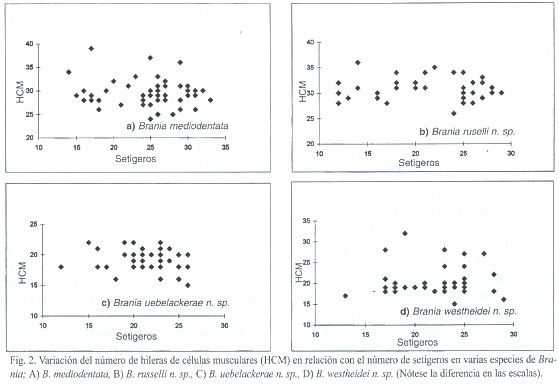
<body><![CDATA[<P><FONT FACE="Arial,Helvetica"><FONT SIZE=-1><B>Key words:</B> Taxonomy, Syllidae, Polychaeta, Caribbean Sea.</FONT></FONT>     <BR><FONT FACE="Arial,Helvetica"><FONT SIZE=-1>&nbsp;</FONT></FONT>     <BR><FONT FACE="Arial,Helvetica"><FONT SIZE=-1>&nbsp;</FONT></FONT>     <BR><FONT FACE="Arial,Helvetica"><FONT SIZE=-1>Los s&iacute;lidos constituyen una de las familias m&aacute;s complejas y con mayor n&uacute;mero de especies entre los poliquetos. Debido a su peque&ntilde;o tama&ntilde;o y a las dificultades que entra&ntilde;a su estudio, su sistem&aacute;tica resulta frecuentemente confusa y complicada. La familia Syllidae se divide en 4 subfamilias: Autolytinae, Eusyllinae, Exogoninae y Syllinae, mismas que se definen por caracter&iacute;sticas morfol&oacute;gicas tales como el grado de fusi&oacute;n de los palpos, la presencia o ausencia de cirro ventral y la forma de las antenas, cirros tentaculares y dorsales (<A HREF="#Garwood91">Garwood 1991</A>). Los s&iacute;lidos viven en h&aacute;bitats cr&iacute;pticos; es com&uacute;n encontrarlos enterrados en sedimentos, en canales de esponjas o hendiduras de piedras, entre corales, hidroides, algas o grava. Son principalmente carn&iacute;voros; usan la faringe armada para atravesar la pared corporal de su presa, tal como invertebrados coloniales y succionando con el bombeo del proventr&iacute;culo los fluidos corporales.</FONT></FONT>      <P><FONT FACE="Arial,Helvetica"><FONT SIZE=-1>Los exog&oacute;ninos son s&iacute;lidos de cuerpo peque&ntilde;o con palpos fusionados dorsalmente m&aacute;s de la mitad de su longitud, tienen uno o dos pares de cirros tentaculares y los dorsales son variables, t&iacute;picamente cortos o de tama&ntilde;o medio - peque&ntilde;o, sin articulaciones; la faringe es recta y tiene un diente simple; por su alimentaci&oacute;n son principalmente sediment&iacute;voros selectivos (<A HREF="#Uebelacker84">Uebelacker 1984</A>). Este trabajo forma parte de la serie que estamos publicando en esta misma revista sobre poliquetos de la regi&oacute;n del Gran Caribe; en esta ocasi&oacute;n presentamos las especies de s&iacute;lidos exog&oacute;ninos encontradas en el Caribe mexicano y anexamos una clave para identificar las especies registradas en el Gran Caribe.</FONT></FONT>     <BR><FONT FACE="Arial,Helvetica"><FONT SIZE=-1>&nbsp;</FONT></FONT>     <BR><B><FONT FACE="Arial,Helvetica"><FONT SIZE=-1>Materiales y m&eacute;todos</FONT></FONT></B>     <BR><FONT FACE="Arial,Helvetica"><FONT SIZE=-1>&nbsp;</FONT></FONT>     <BR><FONT FACE="Arial,Helvetica"><FONT SIZE=-1>Las muestras analizadas pertenecen a la Colecci&oacute;n de Referencia del Laboratorio de Bentos de El Colegio de la Frontera Sur (Registro INE QNR.IN.021.0497), &eacute;stas han sido recolectadas y almacenadas desde 1983 hasta la fecha. Los m&eacute;todos generales fueron indicados en el primer trabajo de la serie (<A HREF="#Salazar96b">Salazar-Vallejo 1996b</A>). En las caracter&iacute;sticas y en una figura se utiliz&oacute; el t&eacute;rmino HCM para indicar hileras de c&eacute;lulas musculares. Para los exog&oacute;ninos hemos analizado la variaci&oacute;n del n&uacute;mero de HCM en el proventr&iacute;culo en relaci&oacute;n con el n&uacute;mero de set&iacute;geros corporales como herramienta para separar las especies vecinas en <I>Brania</I> cuyas especies no se distinguen f&aacute;cilmente y funciona bien, por lo que recomendamos su utilizaci&oacute;n. Por el tama&ntilde;o y caracter&iacute;sticas de cada especie, se elaboraron figuras detalladas. Para ello se realizaron preparaciones semipermanentes y los dibujos se hicieron utilizando una c&aacute;mara clara de un microscopio compuesto; con el objetivo 40X para las partes anteriores y posteriores de los ejemplares y con el de 100X para los detalles de las setas. La nomenclatura para las setas es falc&iacute;gero para las articuladas cuya l&aacute;mina es bidentada y espin&iacute;gero para aquellos casos en que el &aacute;pice es simple, independientemente de su extensi&oacute;n (<A HREF="#Kudenov95">Kudenov &amp; Harris 1995</A>). En todas las figuras, al ilustrar los extremos anterior o posterior se han omitido las setas. De acuerdo con su disponibilidad, se han depositado materiales en el Museum National d’Histoire Naturelle, Paris (MNHN); The Natural History Museum, Londres (BMNH); Zoological Museum of the University of Copenhagen (ZMUC); Zoological Museum of the University of Hamburg (ZMUH); y Natural History Museum of Los Angeles County (LACNHM).</FONT></FONT>     <BR><FONT FACE="Arial,Helvetica"><FONT SIZE=-1>&nbsp;</FONT></FONT>     ]]></body>
<body><![CDATA[<BR><B><FONT FACE="Arial,Helvetica"><FONT SIZE=-1>Resultados y Discusi&oacute;n</FONT></FONT></B>     <CENTER><FONT FACE="Arial,Helvetica"><FONT SIZE=-1><I>Familia Syllidae Grube</I>, 1850</FONT></FONT></CENTER>       <P><FONT FACE="Arial,Helvetica"><FONT SIZE=-1>La familia Syllidae fue establecida para seis g&eacute;neros y 15 especies; en la actualidad contiene m&aacute;s de 60 g&eacute;neros y rebasa las 600 especies (<A HREF="#Kudenov95">Kudenov &amp; Harris 1995</A>). Los g&eacute;neros fueron agrupados en tres tribus por <A HREF="#Langerhans79">Langerhans (1879)</A> cuyos nombres corresponder&iacute;an con tres de las actuales subfamilias, pero no coinciden del todo con su contenido. Los an&aacute;lisis recientes sobre clasificaci&oacute;n y biolog&iacute;a reproductiva (<A HREF="#Garwood91">Garwood 1991</A>, <A HREF="#Nygren99">Nygren 1999</A>) han sido restringidos a los g&eacute;neros cuya informaci&oacute;n est&aacute; disponible o restrictivo para facilitar la construcci&oacute;n de los cladogramas (<A HREF="#Jenner99">Jenner &amp; Schram 1999</A>); muestran que de las cuatro subfamilias reconocidas, s&oacute;lo Eusyllinae no puede reconocerse como grupo monofil&eacute;tico. En general, se presentan paralelismos cuya existencia hab&iacute;a sido comentada por <A HREF="#Malaquin93">Malaquin (1893)</A>. Curiosamente, muchos estudios sobre el grupo (ej. <A HREF="#Salazar89">Salazar-Vallejo 1989</A>, <A HREF="#Nunez92">N&uacute;&ntilde;ez <I>et al. </I>1992</A>, <A HREF="#Lopez94">L&oacute;pez &amp; San Mart&iacute;n 1994</A>, <A HREF="#Paraparet94">Parapar <I>et al. </I>1994</A><I>, </I><A HREF="#Kudenov95">Kudenov &amp; Harris 1995</A>, <A HREF="#Nygren99">Nygren 1999</A>) atribuyen el reconocimiento de las cuatro subfamilias a <A HREF="#Rioja91">Rioja (1925)</A>. Esa afirmaci&oacute;n es inadecuada porque no brind&oacute; detalles ni explicaciones relevantes; en realidad, la propuesta formal de cuatro grupos entre los s&iacute;lidos fue realizada por <A HREF="#Malaquin93">Malaquin (1893)</A>, respaldada por <A HREF="#Fauvel23">Fauvel (1923)</A> y luego usada por <A HREF="#Rioja91">Rioja (1925)</A>. Por desgracia, Fauvel y Rioja omitieron indicar la fuente de dicho arreglo y podr&iacute;a haber discrepancia por la posici&oacute;n jer&aacute;rquica ya que Malaquin us&oacute; tribu en lugar de subfamilia pero esta diferencia en las categor&iacute;as no afecta su reconocimiento (<A HREF="#ICZN">ICZN 2000</A>: 53, 50.3.1).</FONT></FONT>      <P><FONT FACE="Arial,Helvetica"><FONT SIZE=-1>&nbsp;En efecto, el uso de la presencia de cirro ventral, fusi&oacute;n de los palpos y estructura de los cirros dorsales fueron analizados con detalle por <A HREF="#Malaquin93">Malaquin (1893)</A> para proponer su esquema de cuatro subfamilias. As&iacute;, las subfamilias ser&iacute;an Syllinae Grube 1850, Eusyllinae <A HREF="#Malaquin93">Malaquin 1893</A>, Autolytinae <A HREF="#Malaquin93">Malaquin 1893</A>, y Exogoninae <A HREF="#Langerhans79">Langerhans 1879</A>. Esta &uacute;ltima no puede atribuirse a <A HREF="#Malaquin93">Malaquin (1893)</A> porque incluy&oacute; al pil&aacute;rgido <I>Ancistrosyllis</I> McIntosh como exog&oacute;nino y aunque Langerhans agrup&oacute; algunos g&eacute;neros que fueron reconocidos posteriormente como sin&oacute;nimos, us&oacute; la fusi&oacute;n total de los palpos para definir al grupo y consideramos ese car&aacute;cter como el m&aacute;s relevante. N&oacute;tese, sin embargo, que la fusi&oacute;n de los palpos puede ocurrir en otras subfamilias; <I>Sinpalposyllis </I>Hartmann-Schr&ouml;der es un eus&iacute;lino con palpos fusionados completamente y reducidos por completo, de modo que parece carecer de esa estructura (<A HREF="#Hartmann83">Hartmann-Schr&ouml;der 1983</A>).</FONT></FONT>     <BR>&nbsp;     <CENTER><FONT FACE="Arial,Helvetica"><FONT SIZE=-1><I>Exogoninae Langerhans</I> 1879</FONT></FONT></CENTER>       <P><FONT FACE="Arial,Helvetica"><FONT SIZE=-1>Para el reconocimiento de los g&eacute;neros y subg&eacute;neros en Exogoninae modificamos la propuesta de <A HREF="#Kudenov95">Kudenov &amp; Harris (1995)</A> ya que ellos presentaron s&oacute;lo los g&eacute;neros encontrados para su estudio. La propuesta original del contenido de la subfamilia procede de <A HREF="#Fauchald77">Fauchald (1977)</A>, con varias excepciones: <I>Eurysyllis</I> y <I>Plakosyllis</I> tienen trepan y reconocidos como Syllinae por <A HREF="#Perkins81">Perkins (1981)</A>, <I>Exogonita</I> es sin&oacute;nimo menor de <I>Exogone</I> seg&uacute;n <A HREF="#SanMartin90">San Mart&iacute;n &amp; Parapar (1990)</A>, <I>Campesyllis</I> tiene una larga faringe sinuosa y se aproxima m&aacute;s a los Autolytinae, y se incluyen <I>Parapionosyllis</I> cuyo patr&oacute;n de reproducci&oacute;n es del mismo tipo que en exog&oacute;ninos (<A HREF="#Garwood91">Garwood 1991</A>) y <I>Psammosyllis </I>(<A HREF="#Westheide90">Westheide 1990</A>) por la extrema fusi&oacute;n de sus palpos. Consideramos en la subfamilia a <I>Anguillosyllis </I>Day 1963,<I> Brania </I>de Quatrefages 1866, <I>Braniella </I>Hartman 1963, <I>Exogone</I> &Oslash;rsted 1845, <I>Exogonella </I>Hartman 1961, <I>Exogonoides </I>Day 1963, <I>Parapionosyllis </I>Fauvel 1923, <I>Psammosyllis</I> <A HREF="#Westheide90">Westheide 1990</A>, <I>Spermosyllis </I>Clapar&egrave;de 1864, y <I>Sphaerosyllis </I>Clapar&egrave;de 1863. <I>Pseudexogone </I>Augener 1922, con la especie tipo <I>P. backstromi </I>Augener, 1922, es en realidad un miembro de los Pilargidae cuya posici&oacute;n y afinidades ser&aacute;n revisadas en otra contribuci&oacute;n. La descripci&oacute;n original (<A HREF="#Augener">Augener 1922</A>: 191-194, Figs. Text. 7a-c y L&aacute;m. 7, Figs. 4, 4a-b) muestran un pil&aacute;rgido sin&eacute;lmino; esta nueva asignaci&oacute;n debe formalizarse con la revisi&oacute;n del material tipo, misma que ser&aacute; parte de un estudio posterior.</FONT></FONT>      <P><FONT FACE="Arial,Helvetica"><FONT SIZE=-1>Los palpos pueden estar fusionados totalmente, aunque quede una muesca anterior o s&oacute;lo en la mitad de su extensi&oacute;n como en <I>Anguillosyllis</I> y <I>Parapionosyllis</I>. El prostomio presenta por lo general tres antenas aunque puede haber s&oacute;lo una en <I>Spermosyllis </I>o faltar por completo en <I>Exogonella</I>. Hay por lo general un par de cirros tentaculares, pero <I>Brania </I>y <I>Psammosyllis </I>tienen dos pares y faltan por completo en <I>Exogonella</I>; mientras que los cirros dorsales son generalmente cortos, pueden ser largos en <I>Anguillosyllis, Braniella, Parapionosyllis</I> y <I>Psammosyllis </I>o faltar por completo en <I>Exogonella</I>. La mayor&iacute;a tienen cirro ventral pero <I>Exogonoides </I>y <I>Spermosyllis </I>carecen de ellos. La faringe lleva un diente, por lo general en posici&oacute;n anterior, pero el dent&iacute;culo es posterior en <I>Psammosyllis </I>y la faringe es inerme en <I>Braniella </I>y <I>Exogonoides, </I>aunque este &uacute;ltimo semeja <I>Plakosyllis</I> pero se distinguen porque el &uacute;ltimo tiene trepan.</FONT></FONT>      <P><FONT FACE="Arial,Helvetica"><FONT SIZE=-1>De los g&eacute;neros identificados en nuestro material, <I>Brania </I>es un g&eacute;nero compacto y sin subdivisiones ya que las especies se separan por caracter&iacute;sticas que se traslapan como n&uacute;mero y posici&oacute;n de los ojos, posici&oacute;n de las antenas, y n&uacute;mero y tama&ntilde;o de cirros anales. En <I>Exogone </I>hay tres grupos bien definidos (<A HREF="#SanMartin91">San Mart&iacute;n 1991</A>, <A HREF="#Kudenov95">Kudenov &amp; Harris 1995</A>) que se reconocen como subg&eacute;neros: <I>Exogone s.s.</I> cuyos falc&iacute;geros tienen un diente grande proximal, <I>Parexogone, </I>con setas compuestas similares, espin&iacute;geros largos y seta superior sin espina y <I>Sylline, </I>con setas compuestas o seudocompuestas distintas y seta superior con espina. Por otro lado, las especies de <I>Exogone s.l. </I>se distinguen principalmente por tama&ntilde;o y posici&oacute;n de las antenas y por la presencia de cirro dorsal en el segundo set&iacute;gero. Las especies en <I>Sphaerosyllis </I>no pueden agruparse porque los rasgos se superponen y se distinguen por n&uacute;mero y posici&oacute;n de ojos, posici&oacute;n de las antenas, cirro dorsal en el segundo set&iacute;gero, tama&ntilde;o y forma de los falc&iacute;geros y seta acicular (<A HREF="#Kudenov95">Kudenov &amp; Harris 1995</A>).</FONT></FONT>      <P><B><FONT FACE="Arial,Helvetica"><FONT SIZE=-1>Caracterizaci&oacute;n de las Especies</FONT></FONT></B>      ]]></body>
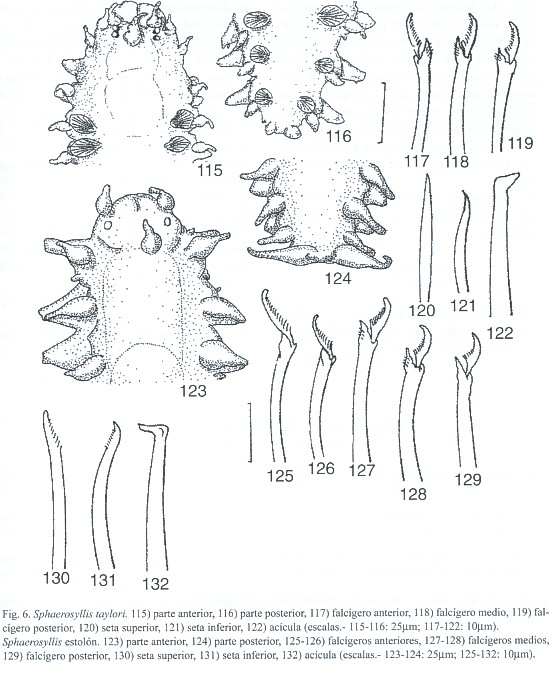
<body><![CDATA[<P><FONT FACE="Arial,Helvetica"><FONT SIZE=-1>Se identificaron 814 organismos del Caribe Mexicano que se distribuyen en tres g&eacute;neros, tres subg&eacute;neros y 13 especies.<I> </I>A continuaci&oacute;n se presentan las caracterizaciones e ilustraciones para cada especie para el Caribe Mexicano, su abundancia, distribuci&oacute;n y h&aacute;bitat. Al final de las descripciones se encuentra la clave para las 52 especies registradas de s&iacute;lidos exog&oacute;ninos del Gran Caribe, incluyendo las tres descritas en este trabajo.</FONT></FONT>     <BR>&nbsp;     <CENTER><FONT FACE="Arial,Helvetica"><FONT SIZE=-1><I>Brania </I>de Quatrefages 1866</FONT></FONT></CENTER>      <CENTER><FONT FACE="Arial,Helvetica"><FONT SIZE=-1><I>Brania mediodentata </I>Westheide 1974</FONT></FONT></CENTER>      <CENTER><FONT FACE="Arial,Helvetica"><FONT SIZE=-1><A HREF="#1FIG1-26">Fig1. (1-10)</A>, <A HREF="#fig2">Fig. 2A</A></FONT></FONT></CENTER>       <P><FONT FACE="Arial,Helvetica"><FONT SIZE=-1><B>Referencias: </B><A HREF="#Westheide74a">Westheide 1974</A>.</FONT></FONT>      <P><FONT FACE="Arial,Helvetica"><FONT SIZE=-1><B>Material Examinado:</B> 52 ejemplares: A4(5), A6(13), A7(10), B17(1), C4(12), D3(1), N59(5), Y9(1), Y16(4).</FONT></FONT>      <P><FONT FACE="Arial,Helvetica"><FONT SIZE=-1><B>Caracter&iacute;sticas: </B>Prostomio semicircular con cuatro ojos medio posteriores en lente, los laterales dos veces mayores que los centrales, dos manchas oculares anteriores poco perceptibles (<A HREF="#1FIG1-26">Fig. 1</A>). Antena media posterior (doblada) hacia atr&aacute;s, laterales anteriores, de la misma longitud, fusiformes. Cirros tentaculares fusiformes, el dorsal ligeramente m&aacute;s largo que el ventral. Cirros dorsales fusiformes, el primero ligeramente m&aacute;s largo que los dem&aacute;s, presentes en todos los set&iacute;geros. Cirro ventral corto, digitiforme, un tercio de la longitud de los dorsales. Seta superior serrada, bidentada, ligeramente curva en set&iacute;geros anteriores (<A HREF="#1FIG1-26">Fig. 8</A>), en los posteriores es lisa, bidentada y curva (<A HREF="#1FIG1-26">Fig. 9</A>). Siete setas compuestas anteriores y tres posteriores; falc&iacute;geros bidentados fuertemente serrados (<A HREF="#1FIG1-26">Figs. 3-7</A>). Seta inferior similar a la superior, pero menor. Ac&iacute;cula en forma de <B>L</B> (<A HREF="#1FIG1-26">Fig. 10</A>). Pigidio con dos cirros anales largos, fusiformes, cuatro veces mayores que los dorsales posteriores (<A HREF="#fig2">Fig. 2</A>). Faringe corta, de un tercio del largo del proventr&iacute;culo. Proventr&iacute;culo largo con 24-36 HCM (<A HREF="#2FIG27-54">Fig. 34A</A>), el promedio es 28.</FONT></FONT>      <P><FONT FACE="Arial,Helvetica"><FONT SIZE=-1><B>Observaciones:</B> Estos ejemplares semejan las descripciones de <A HREF="#Westheide74a">Westheide (1974)</A> para Gal&aacute;pagos y <A HREF="#Russell87">Russell (1987)</A> para Belice, pero difieren de ambas en la longitud de la faringe en relaci&oacute;n con el proventr&iacute;culo; nuestros ejemplares tienen faringe corta mientras que los de Gal&aacute;pagos tienen una faringe ligeramente m&aacute;s larga, en Belice la faringe es de igual longitud. Tambi&eacute;n se asemejan a <I>Brania </I>sp A de Uebelacker (1984 = <I>B. rugulosa</I> Verrill 1900 <I>fide</I> <A HREF="#SanMartin91">San Mart&iacute;n 1991</A>), pero esa especie posee cirros cortos, ovoides. Los ejemplares de la costa mexicana semejan a la ilustraci&oacute;n de Russell en el arreglo, tama&ntilde;o y lentes oculares de los ojos, pero difieren del reportado por Westheide en que los ojos est&aacute;n muy juntos y no se aprecian los lentes oculares. En los ejemplares del Caribe mexicano no se aprecia la “espina” distal de la ac&iacute;cula como la que se observa en la ilustraci&oacute;n de Russell y Westheide.</FONT></FONT>      <P><FONT FACE="Arial,Helvetica"><FONT SIZE=-1><B>Distribuci&oacute;n:</B> Quintana Roo, Belice, Gal&aacute;pagos.</FONT></FONT>      ]]></body>
<body><![CDATA[<P><FONT FACE="Arial,Helvetica"><FONT SIZE=-1><B>H&aacute;bitat:</B> Q. Roo: Arena, arrecife, ra&iacute;ces de mangle, rocas. Otros: arena, fondo somero.</FONT></FONT>     <BR><FONT FACE="Arial,Helvetica"><FONT SIZE=-1>&nbsp;</FONT></FONT>     <CENTER><A NAME="1FIG1-26"></A><IMG SRC="/img/fbpe/rbt/v49n1/2330i01.JPG" HEIGHT=767 WIDTH=553></CENTER>      
<CENTER>&nbsp;</CENTER>      <CENTER><I><FONT FACE="Arial,Helvetica"><FONT SIZE=-1>&nbsp;Brania russelli n. sp.</FONT></FONT></I></CENTER>      <CENTER><FONT FACE="Arial,Helvetica"><FONT SIZE=-1><A HREF="#1FIG1-26">Figs. 1 (11-17)</A>, <A HREF="#fig2">Fig. 2B</A></FONT></FONT></CENTER>       <P><FONT FACE="Arial,Helvetica"><FONT SIZE=-1><B>Material Examinado:</B> 39 ejemplares: A5(2), A6(9), A8(3), C4(13), Y9(11), Y10(1).</FONT></FONT>      <P><FONT FACE="Arial,Helvetica"><FONT SIZE=-1><B>Descripci&oacute;n:</B> Holotipo (MNHN-Poly 55) completo con 24 set&iacute;geros, amarillo trasl&uacute;cido, cuerpo peque&ntilde;o. Prostomio semicircular, ancho; con tres pares de ojos, dos posteriores, dos centrales y dos anteriores (<A HREF="#1FIG1-26">Fig. 11</A>). Antena media en el borde posterior del prostomio, m&aacute;s larga que las anteriores, todas fusiformes. Palpos cortos, fusionados en su longitud. Peristomio corto, fusionado con el prostomio, con dos pares de cirros tentaculares fusiformes cortos, el dorsal ligeramente m&aacute;s largo que el ventral. Cirros dorsales digitiformes, el primero ligeramente m&aacute;s largo que los dem&aacute;s, presentes en todos los set&iacute;geros; el cirro dorsal aumenta en longitud hacia set&iacute;geros posteriores. Par&aacute;podos largos, c&oacute;nicos, casi de la misma longitud que los cirros dorsales. Cirro ventral corto, menor que el dorsal. Seta superior simple, bidentada, delgada, ligeramente curva; seta superior simple en set&iacute;geros medios y posteriores recta, bidentada (<A HREF="#1FIG1-26">Fig. 16</A>). Falc&iacute;geros bidentados cortos, ligeramente curvos, fuertemente serrados (<A HREF="#1FIG1-26">Figs. 13-15</A>). Cinco falc&iacute;geros anteriores y dos posteriores. Seta inferior simple, delgada, de menor tama&ntilde;o y similar a la superior. Ac&iacute;cula capitada (<A HREF="#1FIG1-26">Fig. 17</A>). Pigidio largo, cuadrado, ancho; cirros anales diminutos (<A HREF="#1FIG1-26">Fig. 12</A>). Faringe larga, de menor tama&ntilde;o que el proventr&iacute;culo; diente mediodorsal anterior. Proventr&iacute;culo largo, ancho, con 32 HCM. Los ejemplares poseen 26-36 HCM, el promedio es de 28 (<A HREF="#2FIG27-54">Fig. 34B</A>).</FONT></FONT>      <P><FONT FACE="Arial,Helvetica"><FONT SIZE=-1><B>Localidad tipo:</B> Cayo Cedros, Bah&iacute;a Ascensi&oacute;n, Quintana Roo, M&eacute;xico (19&ordm;37&acute;38.6" N, 87&ordm;31&acute;4.2" W). En epibiota de ra&iacute;z de mangle <I>Rhizophora mangle</I>, 1.0 m, 6 marzo 1987.</FONT></FONT>      <P><FONT FACE="Arial,Helvetica"><FONT SIZE=-1><B>Discusi&oacute;n:</B> <I>Brania russelli n. sp. </I>es similar a<I> B. clavata </I>en la posici&oacute;n de los ojos, antenas, diente mediodorsal anterior, setas bidentadas; pero difiere en la forma de los palpos, tama&ntilde;o del cuerpo, y n&uacute;mero de HCM. <I>Brania clavata </I>posee un cuerpo delgado, largo y tiene 14-24 HCM con c&eacute;lulas grandes, vacuolares, con cierto desorden; <I>Brania russelli n. sp. </I>posee un cuerpo peque&ntilde;o, corto; el n&uacute;mero de HCM es de 26 a 36 con c&eacute;lulas peque&ntilde;as, compactas, con un arreglo paralelo de sus hileras muy marcado.</FONT></FONT>      ]]></body>
<body><![CDATA[<P><FONT FACE="Arial,Helvetica"><FONT SIZE=-1><B>Etimolog&iacute;a:</B> Dedicada al Dr. David E. Russell como reconocimiento por la calidad de sus trabajos sobre poliquetos en general y en especial por sus finos estudios sobre los s&iacute;lidos de Belice.</FONT></FONT>      <P><FONT FACE="Arial,Helvetica"><FONT SIZE=-1><B>Distribuci&oacute;n:</B> Q. Roo: Arrecife, Aventuras, Cayo Cedros y Yalahau-Holbox.</FONT></FONT>      <P><FONT FACE="Arial,Helvetica"><FONT SIZE=-1><B>H&aacute;bitat:</B> Q. Roo: En arena, algas, rocas y ra&iacute;ces de mangle.</FONT></FONT>      <P><FONT FACE="Arial,Helvetica"><FONT SIZE=-1><B>English diagnosis:</B> Three pairs of eyes, placed anteriorly, centrally and posteriorly (<A HREF="#1FIG1-26">Fig. 11</A>). Median antenna close to the posterior margin of prostomium, longer than laterals, all fusiform. Palps short, completely fused. Tentacular cirri short, fusiform, dorsal one slightly longer than ventral one. Dorsal cirri digitate, first one slightly longer than following ones, present throughout the body and becoming longer in posterior setigers. Ventral cirri short, smaller than dorsal one. Superior simple seta thin, bidentate, slightly curved; superior setae in median and posterior setigers straight, bidentate (<A HREF="#1FIG1-26">Fig. 16</A>). Falcigers bidentate, short, straight, serrated (<A HREF="#1FIG1-26">Figs. 13-15</A>). Acicula thin distally swollen (<A HREF="#1FIG1-26">Fig. 17</A>). Pygidium quadrate with minute anal cirri (<A HREF="#1FIG1-26">Fig. 12</A>). Pharynx shorter than proventricle with anterior tooth. Proventricle long with 32 rows of muscular cells; range: 26-36, mean: 28 (<A HREF="#2FIG27-54">Fig. 34B</A>).</FONT></FONT>     <BR><FONT FACE="Arial,Helvetica"><FONT SIZE=-1>&nbsp;</FONT></FONT>     <CENTER><I><FONT FACE="Arial,Helvetica"><FONT SIZE=-1>Brania uebelackerae n. sp</FONT></FONT></I></CENTER>      <CENTER><FONT FACE="Arial,Helvetica"><FONT SIZE=-1><A HREF="#1FIG1-26">Fig. 1 (18-26)</A>, <A HREF="#fig2">Fig. 2C</A></FONT></FONT></CENTER> <FONT FACE="Arial,Helvetica"><FONT SIZE=-1>&nbsp;</FONT></FONT>     <BR><FONT FACE="Arial,Helvetica"><FONT SIZE=-1><B>Material Examinado:</B> 295 ejemplares: A1(17), A2(2), A4(25), A7(1), B16(15), B17(6), B23(5), B25(48), B29(2), B32(5), B36(1), C4(2), C11(10), CV1(4), CV3(4), CV8(1), ITM9(2), LE20(3), LE25(1), N1(1), N38(2), N39(8), N59(2), N61(1), P5(4), PA1(36), PA4(2), PA6(1), PH2(1), PH3(2), PH4(1), PH6(5), PH9(1), PH11(1), PX2(12), PX3(14), PX4(11), PX5(14), PX6(6), S3(1), T1(3), Y8(2), Y9(3), Y10(5), Y11(1), Y15(1).</FONT></FONT>      <P><FONT FACE="Arial,Helvetica"><FONT SIZE=-1><B>Descripci&oacute;n:</B> Holotipo (MNHN-Poly 56) con 25 set&iacute;geros. Prostomio ovalado con dos pares de ojos (<A HREF="#1FIG1-26">Fig. 18</A>) amarillo-naranja, un par de manchas oculares casi imperceptible. Antenas subiguales, la media cerca del borde posterior del prostomio, laterales centrales, todas fusiformes. Cirros tentaculares fusiformes, el dorsal mayor que el ventral. Cirros dorsales fusiformes, el primero m&aacute;s largo que los dem&aacute;s, presentes en todos los set&iacute;geros. Cirro ventral delgado, corto, menor que el dorsal. Seta superior simple bidentada, serrada distalmente (<A HREF="#1FIG1-26">Fig. 23</A>). Siete setas compuestas por par&aacute;podo. Falc&iacute;gero largo, recto y fuertemente serrado (<A HREF="#1FIG1-26">Figs. 20-22</A>); seta inferior simple bidentada, delgada, menor que la superior (<A HREF="#1FIG1-26">Fig. 24</A>). Ac&iacute;cula capitada (<A HREF="#1FIG1-26">Figs. 25-26</A>). Pigidio corto, subtriangular, con dos cirros anales (<A HREF="#1FIG1-26">Fig. 19</A>). Faringe ligeramente menor que el proventr&iacute;culo; este con 14-24 HCM, el promedio es de 18 (<A HREF="#2FIG27-54">Fig. 34C</A>). Embriones en los set&iacute;geros 9 al 21.</FONT></FONT>      <P><B><FONT FACE="Arial,Helvetica"><FONT SIZE=-1>Localidad tipo:</FONT></FONT></B><FONT FACE="Arial,Helvetica"><FONT SIZE=-1> Playa Aventuras, Quintana Roo, M&eacute;xico (20&ordm;20&acute;15.5" N, 87&ordm;20&acute;31.7" W), 0.50 m. Laguna arrecifal, fondo arenoso.</FONT></FONT>      ]]></body>
<body><![CDATA[<P><FONT FACE="Arial,Helvetica"><FONT SIZE=-1><B>Discusi&oacute;n:</B> <I>Brania uebelackerae n. sp.</I> semeja a la descripci&oacute;n e ilustraci&oacute;n de <I>Brania clavata</I> de <A HREF="#Uebelacker84">Uebelacker (1984)</A>; pero difieren en que la primera posee una seta superior bidentada, serrada; el falc&iacute;gero inferior es bidentado, serrado, recto sin espina subdistal como en la ilustraci&oacute;n de Uebelacker; la ac&iacute;cula es capitada. En la especie de Florida la seta superior es unidentada, serrada; el falc&iacute;gero inferior es bidentado, serrado, recto con una espina subdistal; la ac&iacute;cula no la menciona ni aparece en la ilustraci&oacute;n. San Mart&iacute;n opina que la ac&iacute;cula de <I>Brania clavata</I> es aguzada.</FONT></FONT>      <P><FONT FACE="Arial,Helvetica"><FONT SIZE=-1><B>Etimolog&iacute;a:</B> Dedicamos esta especie a la Dra. Joan M. Uebelacker en reconocimiento a sus publicaciones sobre s&iacute;lidos del Gran Caribe, que son de gran utilidad.</FONT></FONT>      <P><FONT FACE="Arial,Helvetica"><FONT SIZE=-1><B>Distribuci&oacute;n:</B> Q. Roo: Akumal, Arrecife, Aventuras, Bah&iacute;a Ascensi&oacute;n, Bocontica, Cayo Cedros, Cayo Valencia, Chiquil&aacute;, Culebras, Isla Holbox, Isla Tres Mar&iacute;as, Laguna Nichupt&eacute;, Punta Allen, Punta Gavil&aacute;n, Punta Gorda, Punta Hualostoc, Punta Xoquem, San Vale, Tulum, Xcacel, Xcayal, Yalahau.</FONT></FONT>      <P><FONT FACE="Arial,Helvetica"><FONT SIZE=-1><B>H&aacute;bitat:</B> Q. Roo: Arena, arrecife, ra&iacute;ces de mangle, en <I>Thalassia.</I></FONT></FONT>      <P><FONT FACE="Arial,Helvetica"><FONT SIZE=-1><B>English diagnosis:</B> Prostomium oval with two pairs of yellow-orange eyes (<A HREF="#1FIG1-26">Fig. 18</A>), anterior eyespots difficult to be seen. Antennae fusiform, subequal; median one posteriorly placed, lateral ones placed at the middle of the prosotmium. Two pairs of tentacular cirri, fusiform, dorsal one longer. Dorsal cirri fusiform, first one longer than following ones present in every setiger. Ventral cirri thin, short, shorter than dorsal ones. Superior seta simple bidentate, distally serrate (<A HREF="#1FIG1-26">Fig. 23</A>). Seven compound setae per setiger. Falciger long, straight and heavily serrate (<A HREF="#1FIG1-26">Figs. 20-22</A>); inferior seta simple bidentate, thin, shorter than dorsalmost one (<A HREF="#1FIG1-26">Fig. 24</A>). Aciculae with knobbed tip (<A HREF="#1FIG1-26">Figs. 25-26</A>). Pygidium short, subtriangular, with two anal cirri (<A HREF="#1FIG1-26">Fig. 19</A>). Pharynx slightly shorter than proventriculum; proventriculum with 14-24 rows of muscular cells, mean is 18 (<A HREF="#2FIG27-54">Fig. 34C</A>). Embryos are seen on setigers 9 to 21.</FONT></FONT>     <BR>&nbsp;     <CENTER><I><FONT FACE="Arial,Helvetica"><FONT SIZE=-1>Brania westheidei n. sp.</FONT></FONT></I></CENTER>      <CENTER><FONT FACE="Arial,Helvetica"><FONT SIZE=-1><A HREF="#3FIG55-86">Figs. 3 (27-33)</A>, <A HREF="#fig2">Fig. 2D</A></FONT></FONT></CENTER>       <P><FONT FACE="Arial,Helvetica"><FONT SIZE=-1><B>Material Examinado: </B>40 ejemplares: A4(7), A6(3), B10(1), B29(1), B36(2), C4(2), C5(4), LE7(1), LE27(2), N58(1), N60(1), P5(2), PH11(1), PX3(1), Y8(1), Y16(10).</FONT></FONT>      <P><FONT FACE="Arial,Helvetica"><FONT SIZE=-1><B>Descripci&oacute;n:</B> Holotipo (MNHN-Poly 57) completo con 24 set&iacute;geros, amarillo pardo. Prostomio oval; tres pares de ojos color naranja, dos posteriores, dos centrales de mayor tama&ntilde;o, dos peque&ntilde;os anteriores cerca del margen (<A HREF="#2FIG27-54">Fig. 27</A>). Antena media cerca del borde posterior del prostomio, laterales anteriores, ambas fusiformes, la media mayor. Palpos medianos, fusionados en su longitud con una peque&ntilde;a muesca frontal. Peristomio corto, fusionado con el prostomio, con dos pares de cirros tentaculares fusiformes, el dorsal m&aacute;s largo que el ventral. Cirros dorsales fusiformes, el primero mucho m&aacute;s largo que los dem&aacute;s, casi dos veces su longitud, presentes en todos los set&iacute;geros. Par&aacute;podos largos, delgados. Cirro ventral corto, delgado, digitado, menor que el dorsal. Seta superior simple, bidentada, delgada, serrada, ligeramente curva (<A HREF="#2FIG27-54">Fig. 32</A>). Cinco falc&iacute;geros anteriores y posteriores. Falc&iacute;gero largo, bidentado, recto, serrado (<A HREF="#2FIG27-54">Figs. 29-31</A>). Seta inferior simple, delgada, de menor tama&ntilde;o y similar a la superior. Ac&iacute;cula capitada (<A HREF="#2FIG27-54">Fig. 33</A>). Pigidio corto, triangular, estrecho; cirro anal largo (uno perdido), dos veces mayor que los cirros dorsales posteriores (<A HREF="#2FIG27-54">Fig. 28</A>). Faringe corta; diente mediodorsal anterior. Proventr&iacute;culo largo, ancho, con 18 HCM. Los ejemplares poseen 15-32 HCM, el promedio es de 19 (<A HREF="#2FIG27-54">Fig. 34D</A>). Embriones en los set&iacute;geros 9 al 21.</FONT></FONT>      ]]></body>
<body><![CDATA[<P><FONT FACE="Arial,Helvetica"><FONT SIZE=-1><B>Localidad tipo: </B>Playa Aventuras, Quintana Roo, M&eacute;xico (20&ordm;20&acute;15.5" N, 87&ordm;20&acute;31.7" W), 0.50 m. Laguna arrecifal, fondo arenoso.</FONT></FONT>      <P><FONT FACE="Arial,Helvetica"><FONT SIZE=-1><B>Discusi&oacute;n:</B> <I>Brania westheidei n. sp. </I>es similar a <I>Brania oculata </I>pero difiere de las descritas por <A HREF="#Hartmann60">Hartmann-Schr&ouml;der (1960, 1974a)</A> para el Mar Rojo o para el sur de Africa; <I>B. westheidei n. sp </I>difiere en la posici&oacute;n de los ojos, lentes oculares y n&uacute;mero de HCM. Las formas del Mar Rojo tienen dos pares de ojos muy juntos y dos manchas oculares (sin lentes) y su proventr&iacute;culo tiene 25 HCM; las del sur de Africa tienen dos pares de ojos separados y solo un par con lentes y 14 HCM en el proventr&iacute;culo. Por otro lado, <I>B. westheidei n. sp. </I>semeja a los de Brasil (<A HREF="#Westheide74b">Westheide 1974b</A>), por la posici&oacute;n de los ojos y el n&uacute;mero de HCM, pero difieren en que en la forma brasile&ntilde;a los tres pares de ojos son lenticulados y est&aacute;n separados, y el proventr&iacute;culo es de 15 HCM; <I>B. westehidei n. sp. </I>posee lentes oculares y el proventr&iacute;culo tiene 15-32 HCM. Las formas halladas por <A HREF="#Russell87">Russell (1987)</A> en Belize (como <I>B. oculata</I>) se acerca m&aacute;s a los ejemplares de la costa mexicana en los ojos lenticulados pero difiere por poseer 13 HCM. Otra especie cercana es <I>B. celiae</I> <A HREF="#Paraparet94">Parapar &amp; San Mart&iacute;n (1994)</A> pero en ella la antena media es central y la seta dorsal simple es unidentada.</FONT></FONT>      <P><FONT FACE="Arial,Helvetica"><FONT SIZE=-1><B>Etimolog&iacute;a:</B> Dedicada al Dr. Wilfried Westheide como homenaje por sus trabajos en la taxonom&iacute;a y evoluci&oacute;n de los poliquetos, en particular por sus publicaciones sobre s&iacute;lidos.</FONT></FONT>      <P><FONT FACE="Arial,Helvetica"><FONT SIZE=-1><B>Distribuci&oacute;n:</B> Quintana Roo y Belice, Caribe noroccidental.</FONT></FONT>      <P><FONT FACE="Arial,Helvetica"><FONT SIZE=-1><B>H&aacute;bitat:</B> Q. Roo: Algas, arena, arrecife y ra&iacute;ces de mangle.</FONT></FONT>      <P><FONT FACE="Arial,Helvetica"><FONT SIZE=-1><B>English diagnosis:</B> Three pairs of orange-color eyes placed posteriorly, centrally (larger), and anteriorly (smaller) (<A HREF="#2FIG27-54">Fig. 27</A>). Median antenna inserted near to the posterior margin of prostomium; lateral antennae inserted anteriorly, all fusiform but median one longer than laterals. Palps completely fused. Two pairs of fusiform tentacular cirri, dorsal one longer than ventral one. Dorsal cirri cirriform, first one almost twice as long as followers, present throughout the body. Ventral cirri short, digitate, smaller than dorsal cirri. Superior seta serrate, bidentate slightly curved (<A HREF="#2FIG27-54">Fig. 32</A>). Falcigers long, straight, serrate, bidentate (<A HREF="#2FIG27-54">Figs. 29-31</A>). Lower seta similar to superior one but smaller. Acicula thin distally swollen (<A HREF="#2FIG27-54">Fig. 33</A>). Pygidium triangular, anal cirri long, twice as long as dorsal cirri in nearby setigers (<A HREF="#2FIG27-54">Fig. 28</A>). Pharynx short with an anterior tooth. Proventriculus with 18 rows of muscular cells; range: 15-32, mean: 19 (<A HREF="#2FIG27-54">Fig. 34D</A>). Embryos in setigers 9 to 21.</FONT></FONT>     <BR><FONT FACE="Arial,Helvetica"><FONT SIZE=-1>&nbsp;</FONT></FONT>     <CENTER><A NAME="fig2"></A><IMG SRC="/img/fbpe/rbt/v49n1/2330i02.JPG" HEIGHT=387 WIDTH=559></CENTER> <FONT FACE="Arial,Helvetica"><FONT SIZE=-1>&nbsp;</FONT></FONT>     
<CENTER><FONT FACE="Arial,Helvetica"><FONT SIZE=-1><I>Exogone </I>&Oslash;rsted 1845</FONT></FONT></CENTER>      <CENTER><FONT FACE="Arial,Helvetica"><FONT SIZE=-1><I>Exogone (Exogone) </I>&Oslash;rsted 1845</FONT></FONT></CENTER>      ]]></body>
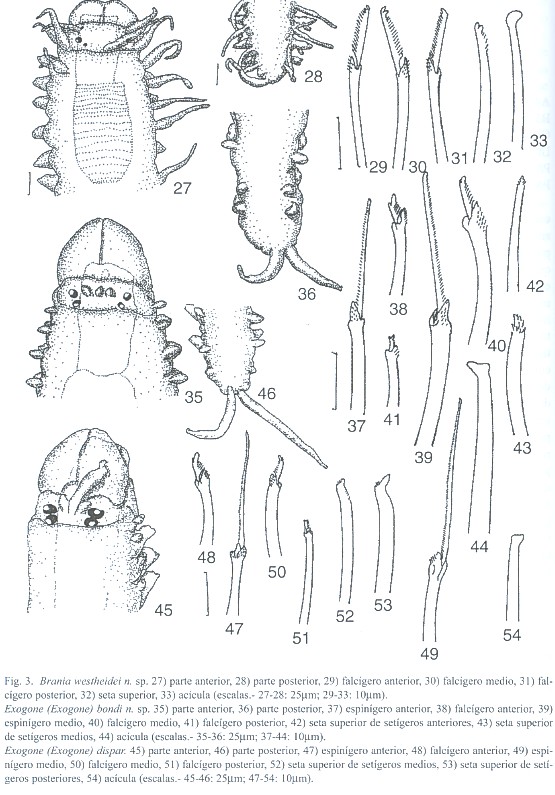
<body><![CDATA[<CENTER><I><FONT FACE="Arial,Helvetica"><FONT SIZE=-1>Exogone (Exogone) bondi n. sp.</FONT></FONT></I></CENTER>      <CENTER><FONT FACE="Arial,Helvetica"><FONT SIZE=-1><A HREF="#3FIG55-86">Fig. 3 (35-44)</A></FONT></FONT></CENTER>       <P><FONT FACE="Arial,Helvetica"><FONT SIZE=-1><B>Material Examinado:</B> 72 ejemplares: A4(6), B16(1), B23(1), B25(7), B29(5), B36(3), CV1(1), CV2(3), CV3(1), CV4(3), CV8(2), LE7(9), LE9(2), LE13(4), LE15(1), LE25(2), N39(1), N50(2), P3(2), PA2(1), PA4(4), PA6(1), PH6(3), PH11(2), PX5(1), PX6(1), T1(2), Y16(1).</FONT></FONT>      <P><FONT FACE="Arial,Helvetica"><FONT SIZE=-1><B>Descripci&oacute;n:</B> Holotipo (MNHN 0000) con prostomio rectangular, con cuatro ojos, los anteriores ligeramente m&aacute;s grandes que los posteriores, color naranja (<A HREF="#2FIG27-54">Fig. 35</A>). Antenas centrales iguales, separadas, en l&iacute;nea recta, ovoides. Cirros tentaculares ligeramente menores que los cirros dorsales y las antenas. Cirros dorsales cortos, ovoides, incrementan su tama&ntilde;o en set&iacute;geros medios a posteriores. Set&iacute;gero dos con cirro dorsal. Cirro ventral m&aacute;s corto que el dorsal, alargado. Ac&iacute;cula en forma de <B>L</B>. (<A HREF="#3FIG55-86">Fig. 44</A>). Seta superior simple, lisa, subdistalmente serrada (<A HREF="#3FIG27-54">Figs. 42-43</A>). Seta inferior similar pero ligeramente curva. Setas compuestas: esp&iacute;nigeros y falc&iacute;geros. Un espin&iacute;gero y cinco falc&iacute;geros anteriores; un espin&iacute;gero y dos falc&iacute;geros posteriores. Espin&iacute;gero serrado, unidentado, con manubrio serrado (<A HREF="#3FIG27-54">Figs. 37, 39</A>). Falc&iacute;gero serrado, diente subdistal m&aacute;s grande que el distal, con manubrio serrado (<A HREF="#3FIG27-54">Figs. 38, 40, 41</A>). Pigidio triangular con cirros anales largos, filiformes, cinco veces la longitud del cirro dorsal (<A HREF="#3FIG27-54">Fig. 36</A>). Faringe de igual tama&ntilde;o que el proventr&iacute;culo; este se extiende entre los set&iacute;geros 2 a 6.</FONT></FONT>      <P><FONT FACE="Arial,Helvetica"><FONT SIZE=-1><B>Localidad tipo:</B> Cayo Valencia, Quintana Roo, M&eacute;xico (19&ordm;41&acute;35.7" N, 87&ordm; 28&acute;6.0" W), profundidad 0.50 m. Epibiota de ra&iacute;ces de mangle; fondo arenoso con rocas aisladas y pasto marino abundante.</FONT></FONT>      <P><FONT FACE="Arial,Helvetica"><FONT SIZE=-1><B>Discusi&oacute;n:</B> Estos ejemplares son similares a los descritos por <A HREF="#Westheide74a">Westheide (1974)</A> para Brasil como <I>E. occidentalis</I>, pero en la ilustraci&oacute;n muestra los manubrios de los falc&iacute;geros lisos y en el Caribe mexicano son serrados. Los descritos por <A HREF="#Russell87">Russell (1987)</A> de Belice tienen una prolongaci&oacute;n posterior de los palpos y en set&iacute;geros posteriores tienen una seta superior similar a las presentes en el subg&eacute;nero <I>Sylline. Exogone (Exogone) bondi </I>n. sp. semeja <I>E. (E.) breviantennata </I>Hartmann-Schr&ouml;der, pero la redescripci&oacute;n del holotipo por <A HREF="#Zottoli00">Zottoli &amp; Long (2000)</A> indica que tiene antenas digitiformes separadas entre s&iacute;, cuatro falc&iacute;geros anteriores (2-4), y que la ac&iacute;cula es visible en algunos set&iacute;geros pero los detalles no son claros. Por otro lado, sus ejemplares de Bahamas tienen antenas m&aacute;s largas, surgen del centro del prostomio, con 1-4 falc&iacute;geros anteriores, y la ac&iacute;cula es lisa con punta redondeada. Nuestros ejemplares tienen antenas ovoides que surgen del centro del prostomio, cinco falc&iacute;geros anteriores y la ac&iacute;cula tiene forma de <B>L</B>. Por lo tanto, es distinta de las dem&aacute;s.</FONT></FONT>      <P><FONT FACE="Arial,Helvetica"><FONT SIZE=-1><B>Etimolog&iacute;a:</B> Dedicada al Sr. Heriberto Bond Alc&aacute;ntara en agradecimiento por todo el apoyo y esfuerzo constantes y durante muchos a&ntilde;os para la coautora.&nbsp;</FONT></FONT>      <P><FONT FACE="Arial,Helvetica"><FONT SIZE=-1><B>Distribuci&oacute;n: </B>Q. Roo: Aventuras, Bah&iacute;a Ascensi&oacute;n, Bocontica, Cayo Valencia, Faro Xcayal, Laguna Nichupt&eacute;, Punta Allen, Punta Hualostoc, Punta Vista Alegre, Punta Xoquem, Rio Indio, Santa Cecilia, Tulum, Xcayal, Yalahau.</FONT></FONT>      <P><FONT FACE="Arial,Helvetica"><FONT SIZE=-1><B>H&aacute;bitat:</B> Q. Roo: Arena, en <I>Turbinaria turbinata, </I>ra&iacute;ces de mangle, <I>Thalassia.</I></FONT></FONT>      <P><FONT FACE="Arial,Helvetica"><FONT SIZE=-1><B>English diagnosis: </B>Anterior eyes slightly larger than posterior ones. Antennae oval-shaped, of similar size, placed in the center of the prosomium. Tentacular cirri slightly shorter than antennae and dorsal cirri. Setiger 2 with dorsal cirri. Aciculum <B>L</B>-shaped. Superior seta simple, smooth, subdistally serrate. Inferior seta similar but slightly bent. Compound spinigers and falcigers. One spiniger and five falcigers in anterior setigers; in posterior ones one spiniger and two falcigers. Spiniger serrate, acute, handle serrate. Falciger serrate, subdistal tooth larger than distal one, handle serrate. Pygidium with long anal cirri, as long as five times the dorsal cirri. Pharynx as long as proventriculum, the latter as long as setigers 2-6.</FONT></FONT>     ]]></body>
<body><![CDATA[<BR>&nbsp;     <CENTER><A NAME="3FIG27-54"></A><IMG SRC="/img/fbpe/rbt/v49n1/2330i03.JPG" HEIGHT=795 WIDTH=555></CENTER>      
<CENTER><I><FONT FACE="Arial,Helvetica"><FONT SIZE=-1>&nbsp;</FONT></FONT></I></CENTER>      <CENTER><FONT FACE="Arial,Helvetica"><FONT SIZE=-1><I>Exogone (Exogone) dispar </I>Webster 1879</FONT></FONT></CENTER>      <CENTER><FONT FACE="Arial,Helvetica"><FONT SIZE=-1><A HREF="#3FIG27-54">Fig. 3 (45-54)</A></FONT></FONT></CENTER> <FONT FACE="Arial,Helvetica"><FONT SIZE=-1><B>Referencias:</B> <A HREF="#Westheide74b">Westheide 1974b</A>&nbsp;</FONT></FONT>      <P><FONT FACE="Arial,Helvetica"><FONT SIZE=-1><B>Material Examinado: </B>76 ejemplares: A3(1), A4(2), A7(1), B1(2), B7(1), B17(1), B20(1), B23(3), B29(6), B36(1), C4(1), CV2(3), CV4(1), CV8(3), LE7(10), LE9(3), LE25(3), LE27(1), N29(1), N38(1), N39(3), N50(3), N52(1), N54(1), P1(1), P3(1), P5(2), P7(2), PA2(1), PA6(2), PH6(1), S1(1), S2(2), X1(1), Y11(2), Y15(2), Y16(4).</FONT></FONT>      <P><FONT FACE="Arial,Helvetica"><FONT SIZE=-1><B>Caracter&iacute;sticas:</B> Prostomio semicircular con cuatro ojos en lente, morados, similares en tama&ntilde;o, subcoalescentes (<A HREF="#3FIG27-54">Fig. 45</A>). Antenas juntas, centrales; la media fusiforme, m&aacute;s larga que las laterales ovoides. Cirros tentaculares menores que los cirros dorsales. Cirros dorsales ovoides, incrementando en tama&ntilde;o hacia set&iacute;geros posteriores. Set&iacute;gero 2 con cirro dorsal. Cirro ventral menor que el dorsal. Ac&iacute;cula ligeramente curva y abultada distalmente (<A HREF="#3FIG27-54">Fig. 54</A>). Seta superior simple (<A HREF="#3FIG27-54">Figs. 52, 53</A>), puntiaguda y serrada; seta inferior similar a la superior, pero menor. Setas compuestas espin&iacute;geros y falc&iacute;geros. Dos espin&iacute;geros y cinco falc&iacute;geros anteriores; un espin&iacute;gero y dos falc&iacute;geros posteriores. Espin&iacute;gero largo, recto, serrado, unidentado, manubrio serrado (<A HREF="#3FIG27-54">Figs. 47, 49</A>). Falc&iacute;gero serrado, el diente subdistal m&aacute;s grande que el distal (<A HREF="#3FIG27-54">Figs. 48, 50, 51</A>). Pigidio c&oacute;nico con un par de cirros anales muy largos, filiformes, 10 a 15 veces la longitud de los cirros dorsales (<A HREF="#3FIG27-54">Fig. 46</A>). Faringe corta, dos tercios la longitud del proventr&iacute;culo; con un diente mediodorsal anterior. Proventr&iacute;culo largo, extendido en los set&iacute;geros 5 al 10.</FONT></FONT>      <P><FONT FACE="Arial,Helvetica"><FONT SIZE=-1>Atoco completo de 37 set&iacute;geros, con embriones en los set&iacute;geros 19 al 31. Se distinguen cinco embriones con grado de desarrollo id&eacute;ntico: masa muscular, cuatro set&iacute;geros sin setas, prostomio con tres antenas; dos cirros anales, se nota el proventr&iacute;culo. Los embriones est&aacute;n fusionados al par&aacute;podo progenitor a la parte posterior del embri&oacute;n. Otro atoco completo de 38 set&iacute;geros, con embriones en los set&iacute;geros 15 al 35. Se distinguen ocho embriones en diversos estadios de desarrollo: masa muscular, ocho set&iacute;geros con setas; en algunos, prostomio con tres antenas, en otros se observa el proventr&iacute;culo. Los embriones est&aacute;n fusionados al par&aacute;podo progenitor a la parte posterior del embri&oacute;n.</FONT></FONT>      <P><FONT FACE="Arial,Helvetica"><FONT SIZE=-1><B>Observaciones:</B> Estos ejemplares son similares a los descritos por <A HREF="#Westheide74b">Westheide (1974b)</A> para Brasil y <A HREF="#Perkins81">Perkins (1981)</A> y <A HREF="#Uebelacker84">Uebelacker (1984)</A> para Florida.</FONT></FONT>      <P><FONT FACE="Arial,Helvetica"><FONT SIZE=-1><B>Distribuci&oacute;n:</B> Atl&aacute;ntico Norte, Gran Caribe y Gal&aacute;pagos; reportada en aguas tropicales y templadas de los 3 oc&eacute;anos principales, por lo que podr&iacute;a ser un complejo de especies.</FONT></FONT>      ]]></body>
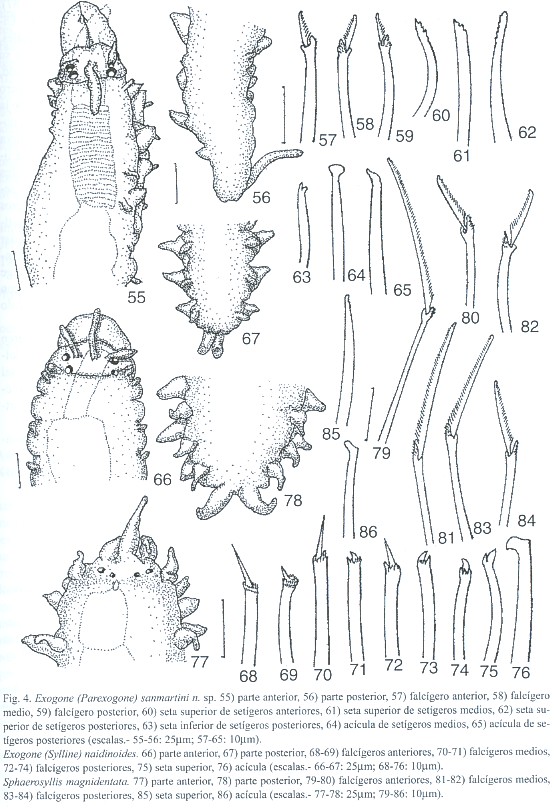
<body><![CDATA[<P><FONT FACE="Arial,Helvetica"><FONT SIZE=-1><B>H&aacute;bitat:</B> Q. Roo: Algas, arena, arrecife, buceo, en <I>Turbinaria turbinata, </I>ra&iacute;ces de mangle. Otros: Arena gruesa a fina.</FONT></FONT>     <BR>&nbsp;     <CENTER><FONT FACE="Arial,Helvetica"><FONT SIZE=-1><I>Exogone (Parexogone) </I>Mesnil &amp; Caullery 1916</FONT></FONT></CENTER>      <CENTER><I><FONT FACE="Arial,Helvetica"><FONT SIZE=-1>Exogone (Parexogone) sanmartini n. sp.</FONT></FONT></I></CENTER>      <CENTER><FONT FACE="Arial,Helvetica"><FONT SIZE=-1><A HREF="#4FIG55-86">Fig. 4 (55-65)</A></FONT></FONT></CENTER>       <P><FONT FACE="Arial,Helvetica"><FONT SIZE=-1><B>Material Examinado:</B> 2 ejemplares: C4(2).</FONT></FONT>      <P><FONT FACE="Arial,Helvetica"><FONT SIZE=-1><B>Localidad tipo: </B>Localidad tipo: Cayo Cedros, Bah&iacute;a Ascensi&oacute;n, Quintana Roo, M&eacute;xico (19&ordm;37&acute;38.6" N, 87&ordm;31&acute;4.2" W). En epibiota de ra&iacute;z de mangle <I>Rhizophora mangle</I>, 1.0 m, 6 marzo 1987.</FONT></FONT>      <P><FONT FACE="Arial,Helvetica"><FONT SIZE=-1><B>Descripci&oacute;n: </B>Holotipo (MNHN-Poly 58) completo con 24 set&iacute;geros, cuerpo delgado, largo, ligeramente abultado en la parte anterior, amarillo pardo. Prostomio rectangular, largo; cuatro ojos juntos del mismo color del cuerpo (<A HREF="#4FIG55-86">Fig. 55</A>). Antenas separadas, centrales, fusiformes; la media mas de dos veces m&aacute;s larga que las laterales. Palpos largos, fusionados, en su longitud. Peristomio corto, estrecho, fusionado con el prostomio; con un par de cirros tentaculares cortos, ligeramente ovoides. Cirros dorsales cortos, ovoides, incrementan su longitud posteriormente. Cirro ventral similar al dorsal, pero de mayor tama&ntilde;o hacia set&iacute;geros posteriores. Set&iacute;gero 2 sin cirro dorsal. Par&aacute;podos cortos, c&oacute;nicos. Ac&iacute;cula delgada, capitada en set&iacute;geros medios (<A HREF="#4FIG55-86">Fig. 64</A>), en forma de <B>L</B> con un &aacute;ngulo recto, en set&iacute;geros posteriores (<A HREF="#4FIG55-86">Fig. 65</A>). Seta superior simple, delgada, distalmente curva y serrada (<A HREF="#4FIG55-86">Figs. 60-62</A>). Seta inferior simple, delgada, menor que la superior, ligeramente curva y bidentada (<A HREF="#4FIG55-86">Fig. 63</A>). Espin&iacute;geros cortos, rectos, serrados, con manubrio serrado (<A HREF="#4FIG55-86">Figs. 57-59</A>). Seis espin&iacute;geros anteriores y cuatro posteriores. Pigidio corto, estrecho, triangular; con dos cirros anales largos, diez veces la longitud de los dorsales (<A HREF="#4FIG55-86">Fig. 56</A>). Faringe larga, de la misma longitud que el proventr&iacute;culo. Diente mediodorsal anterior. Proventr&iacute;culo extendido del set&iacute;gero 2 al 6.</FONT></FONT>      <P><FONT FACE="Arial,Helvetica"><FONT SIZE=-1><B>Discusi&oacute;n:</B> <I>E. (P.) sanmartini n. sp. </I>es similar a <I>E. (P.) parahomoseta</I> <A HREF="#Hartmann74b">Hartmann-Schr&ouml;der (1974b)</A> de Sud&aacute;frica, pero difiere en la longitud de la antena media, forma de los espin&iacute;geros y ac&iacute;cula; en <I>E. (P.) parahomoseta </I>la antena media es un tercio m&aacute;s larga que las laterales, sus espin&iacute;geros son cortos, curvos y la ac&iacute;cula tiene forma de <B>L </B>mientras que en <I>E. (P.) sanmartini n. sp. </I>la antena media es de m&aacute;s del doble de longitud que las laterales, sus espin&iacute;geros son cortos, rectos y la ac&iacute;cula es capitada en set&iacute;geros medios y en forma de <B>L </B>en set&iacute;geros posteriores.</FONT></FONT>      <P><FONT FACE="Arial,Helvetica"><FONT SIZE=-1><B>Etimolog&iacute;a:</B> Dedicada al Dr. Guillermo San Mart&iacute;n por sus trabajos en la taxonom&iacute;a de poliquetos y en especial por sus &uacute;tiles publicaciones sobre s&iacute;lidos; varias de ellas fueron muy valiosas para terminar este trabajo.</FONT></FONT>     ]]></body>
<body><![CDATA[<BR><FONT FACE="Arial,Helvetica"><FONT SIZE=-1>&nbsp;</FONT></FONT>     <BR><FONT FACE="Arial,Helvetica"><FONT SIZE=-1><B>Distribuci&oacute;n:</B> Quintana Roo, Caribe noroccidental.</FONT></FONT>      <P><FONT FACE="Arial,Helvetica"><FONT SIZE=-1><B>H&aacute;bitat:</B> Q. Roo: Ra&iacute;ces de mangle.</FONT></FONT>      <P><FONT FACE="Arial,Helvetica"><FONT SIZE=-1><B>English diagnosis: </B>Four equal-sized eyes of the same color than the body, anterior and posterior ones coalescent (<A HREF="#4FIG55-86">Fig. 55</A>). Antennae separated, centrally incerted, fusiform; median antennae more than twice the length of laterals. Palps long completely fused. One pair of tentacular cirri, short, ovoid. Dorsal cirri short, ovoid, become longer in posterior setigers. Setiger 2 without dorsal cirri. Acicula thin, distally swollen in median setigers (<A HREF="#4FIG55-86">Fig. 64</A>), becomes <B>L-</B>shaped in posterior setigers (<A HREF="#4FIG55-86">Fig. 65</A>). Superior seta thin, distally curved and serrate (<A HREF="#4FIG55-86">Figs. 60-62</A>). Lower seta thin, smaller than dorsal, slightly curved and bidentate (<A HREF="#4FIG55-86">Fig. 63</A>). Spinigers short, straight, serrate, with serrate handle (<A HREF="#4FIG55-86">Figs. 57-59</A>). Pygidium short, triangular with two long anal cirri, about 10 times as long than dorsal cirri in nearby setigers (<A HREF="#4FIG55-86">Fig. 56</A>). Pharynx of the same length than proventriculus with anterior tooth. Proventriculus in setigers 2 to 6.</FONT></FONT>     <BR>&nbsp;     <CENTER><A NAME="4FIG55-86"></A><IMG SRC="/img/fbpe/rbt/v49n1/2330i04.JPG" HEIGHT=809 WIDTH=554></CENTER>      
<CENTER><I><FONT FACE="Arial,Helvetica"><FONT SIZE=-1>&nbsp;</FONT></FONT></I></CENTER>      <CENTER><FONT FACE="Arial,Helvetica"><FONT SIZE=-1><I>Exogone (Sylline) </I>Clapar&egrave;de 1864</FONT></FONT></CENTER>      <CENTER><FONT FACE="Arial,Helvetica"><FONT SIZE=-1><I>Exogone (Sylline) naidinoides </I>Westheide 1974</FONT></FONT></CENTER>      <CENTER><FONT FACE="Arial,Helvetica"><FONT SIZE=-1><A HREF="#4FIG55-86">Fig.4 (66-76)</A></FONT></FONT></CENTER>       ]]></body>
<body><![CDATA[<P><FONT FACE="Arial,Helvetica"><FONT SIZE=-1><B>Referencias:</B> <A HREF="#Westheide74a">Westheide 1974a</A>.</FONT></FONT>      <P><FONT FACE="Arial,Helvetica"><FONT SIZE=-1><B>Material Examinado:</B> 7 ejemplares: A4(1), B23(2), CV1(1), PA6(1), PH6(1), PH11(1).</FONT></FONT>      <P><FONT FACE="Arial,Helvetica"><FONT SIZE=-1><B>Caracter&iacute;sticas:</B> Prostomio semicircular; 4 ojos en lente (<A HREF="#4FIG55-86">Fig. 66</A>). Antenas centrales, separadas, en l&iacute;nea recta, largas, la media m&aacute;s larga que las laterales. Cirros tentaculares similares a los dorsales. Cirros dorsales ovoides. Set&iacute;gero 2 sin cirro dorsal. Cirro ventral ligeramente m&aacute;s largo que el cirro dorsal. Ac&iacute;cula en forma de <B>L </B>(<A HREF="#4FIG55-86">Fig. 76</A>). Seta superior simple bidentada (<A HREF="#4FIG55-86">Fig. 75</A>). Seta inferior curva, bidentada, diente subdistal m&aacute;s grande y pronunciado que el distal. Setas compuestas con l&aacute;minas puntiagudas, cortas, lisas, con manubrios serrados (<A HREF="#4FIG55-86">Figs. 68-74</A>). Tres setas compuestas, similares en n&uacute;mero y tama&ntilde;o en todo el cuerpo. Pigidio con dos cirros anales largos filiformes (<A HREF="#4FIG55-86">Fig. 67</A>). Faringe ligeramente m&aacute;s larga que el proventr&iacute;culo; este se extiende del set&iacute;gero 2 al 4.</FONT></FONT>      <P><FONT FACE="Arial,Helvetica"><FONT SIZE=-1><B>Observaciones:</B> Estos ejemplares son similares a los descritos por <A HREF="#Westheide74a">Westheide (1974a)</A> para Gal&aacute;pagos, pero difieren en la posici&oacute;n de las antenas. Los del litoral Caribe&ntilde;o poseen antenas centrales dispuestas en l&iacute;nea recta, mientras que en el descrito por Westheide la media es central y las laterales son anteriores; <A HREF="#Russell87">Russell (1987)</A> observ&oacute; las antenas similares a las descritas por Westheide. La forma de la seta superior simple difiere tambi&eacute;n de los de Gal&aacute;pagos en poseer m&aacute;s serraciones subdistalmente, pero es similar a la descripci&oacute;n por Russell para Belice.</FONT></FONT>      <P><FONT FACE="Arial,Helvetica"><FONT SIZE=-1><B>Distribuci&oacute;n: </B>Anfiamericana, Caribe noroccidental y Gal&aacute;pagos.</FONT></FONT>      <P><FONT FACE="Arial,Helvetica"><FONT SIZE=-1><B>H&aacute;bitat:</B> Q. Roo: Arena, ra&iacute;ces de mangle. Otros: Rocas coralinas.</FONT></FONT>     <BR>&nbsp;     <CENTER><FONT FACE="Arial,Helvetica"><FONT SIZE=-1><I>Sphaerosyllis</I> Clapar&egrave;de 1863</FONT></FONT></CENTER>      <CENTER><FONT FACE="Arial,Helvetica"><FONT SIZE=-1><I>Sphaerosyllis magnidentata </I>Perkins 1981</FONT></FONT></CENTER>      <CENTER><A HREF="#4FIG55-86"><FONT FACE="Arial,Helvetica"><FONT SIZE=-1>Fig. 4 (77-86</FONT></FONT>)</A></CENTER>       ]]></body>
<body><![CDATA[<P><FONT FACE="Arial,Helvetica"><FONT SIZE=-1><B>Referencias:</B> <A HREF="#Perkins81">Perkins 1981</A></FONT></FONT>      <P><FONT FACE="Arial,Helvetica"><FONT SIZE=-1><B>Material Examinado:</B> 26 ejemplares: A1(1), A4(2), B16(1), B23(2), B25(1), B36(1), C4(3), N39(2), N59(3), P4(1), P5(1), PH2(2), PH6(1), PX6(1), Y10(4).</FONT></FONT>      <P><FONT FACE="Arial,Helvetica"><FONT SIZE=-1><B>Caracter&iacute;sticas:</B> Prostomio ancho. Antenas anteriores, en l&iacute;nea recta, de distinta longitud, la media m&aacute;s larga que las laterales (<A HREF="#4FIG55-86">Fig. 77</A>). Cuatro ojos, color naranja. Cirros tentaculares similares a los dorsales. Cirro dorsal ausente en el set&iacute;gero 2. Cirro dorsal con base bulbosa y aguzado, m&aacute;s largo en set&iacute;geros posteriores. Cirro ventral delgado, de un tercio del largo del cirro dorsal. Ac&iacute;cula en forma de <B>L </B>(<A HREF="#4FIG55-86">Fig. 86</A>). Seta superior simple distalmente serrada, ligeramente curva (<A HREF="#4FIG55-86">Fig. 85</A>). Seta inferior similar pero menor. Siete espin&iacute;geros anteriores y cuatro posteriores. Espin&iacute;geros serrados, con manubrio finamente serrado, similares en todo el cuerpo, pero de menor tama&ntilde;o en set&iacute;geros posteriores (<A HREF="#4FIG55-86">Figs. 79-84</A>). Pigidio semicircular con dos cirros anales largos, semejan los cirros dorsales posteriores, pero de menor tama&ntilde;o (<A HREF="#4FIG55-86">Fig. 78</A>). Faringe corta con un gran diente mediodorsal anterior. El proventr&iacute;culo se extiende desde el set&iacute;gero 3 al 5.</FONT></FONT>      <P><FONT FACE="Arial,Helvetica"><FONT SIZE=-1><B>Observaciones: </B>Estos ejemplares son similares a los descritos por <A HREF="#Perkins81">Perkins (1981)</A> para Florida y <A HREF="#Russell87">Russell (1987)</A> para Belice, pero difieren de ambos; en los de Florida los cirros anales son m&aacute;s cortos que los dorsales mientras que en los de Belice son m&aacute;s largos.</FONT></FONT>     <BR><FONT FACE="Arial,Helvetica"><FONT SIZE=-1>&nbsp;</FONT></FONT>     <BR><FONT FACE="Arial,Helvetica"><FONT SIZE=-1><B>Distribuci&oacute;n:</B> Belice, Florida.</FONT></FONT>      <P><FONT FACE="Arial,Helvetica"><FONT SIZE=-1><B>H&aacute;bitat:</B> Q. Roo: Arena, ra&iacute;ces de mangle, <I>Thalassia</I>. Otros: Arena, conchas, coral con <I>Thalassia, Penicillus y Halimeda.</I></FONT></FONT>     <BR>&nbsp;     <CENTER><A NAME="5FIG87-114"></A>&nbsp;<IMG SRC="/img/fbpe/rbt/v49n1/2330i05.JPG" HEIGHT=812 WIDTH=560></CENTER>      
<CENTER><I><FONT FACE="Arial,Helvetica"><FONT SIZE=-1>&nbsp;</FONT></FONT></I></CENTER>      ]]></body>
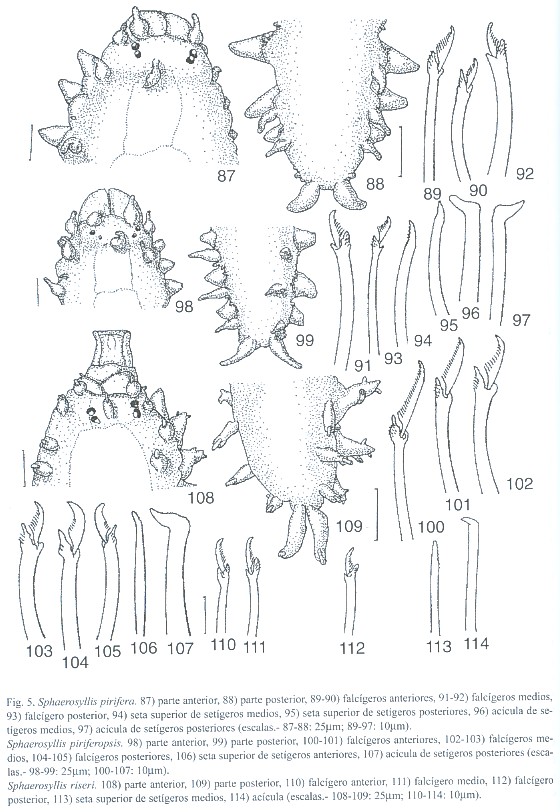
<body><![CDATA[<CENTER><FONT FACE="Arial,Helvetica"><FONT SIZE=-1><I>Sphaerosyllis pirifera </I>Clapar&egrave;de 1868</FONT></FONT></CENTER>      <CENTER><FONT FACE="Arial,Helvetica"><FONT SIZE=-1><A HREF="#5FIG87-114">Fig. 5 (87-97)</A></FONT></FONT></CENTER>       <P><FONT FACE="Arial,Helvetica"><FONT SIZE=-1><B>Referencias:</B> <A HREF="#Hartmann80">Hartmann-Schr&ouml;der 1980</A></FONT></FONT>      <P><FONT FACE="Arial,Helvetica"><FONT SIZE=-1><B>Material Examinado:</B> 5 ejemplares: Y16(5).</FONT></FONT>      <P><FONT FACE="Arial,Helvetica"><FONT SIZE=-1><B>Caracter&iacute;sticas:</B> Prostomio corto. Antenas similares en tama&ntilde;o, laterales anteriores, la media posterior, atr&aacute;s de los ojos (<A HREF="#5FIG87-114">Fig. 87</A>). Cuatro ojos muy cercanos, color naranja. Cirros tentaculares similares a los cirros dorsales. Cirro dorsal ausente en set&iacute;gero 2, pero en su lugar existe una papila. Cirro dorsal aguzado, con base bulbosa. Cirro ventral similar pero con base menos ensanchada, de un tercio de la longitud del dorsal. Ac&iacute;cula en forma de <B>L</B>, notoria (<A HREF="#5FIG87-114">Figs. 96-97</A>). Seta superior simple curva y serrada (<A HREF="#5FIG87-114">Figs. 94-95</A>). Seta inferior simple lisa, menor. Cuatro espin&iacute;geros anteriores, tres posteriores. Espin&iacute;geros cortos, serrados en set&iacute;geros anteriores (<A HREF="#5FIG87-114">Figs. 89-92</A>). Espin&iacute;geros muy cortos, lisos o finamente serrados en set&iacute;geros posteriores (<A HREF="#5FIG87-114">Fig. 93</A>). Pigidio subcircular con dos cirros anales largos, tres veces la longitud de los cirros dorsales (<A HREF="#5FIG87-114">Fig. 88</A>). Faringe de la misma longitud que el proventr&iacute;culo, con un diente mediodorsal anterior. Proventr&iacute;culo extendido desde el set&iacute;gero 3 al 5.</FONT></FONT>      <P><FONT FACE="Arial,Helvetica"><FONT SIZE=-1><B>Observaciones:</B> Estos ejemplares difieren del descrito por <A HREF="#Claparede68">Clapar&egrave;de (1868)</A> para el Golfo de N&aacute;poles porque carecen del cirro dorsal del set&iacute;gero 2. Los ejemplares del Caribe mexicano son similares a los hallados por <A HREF="#Hartmann80">Hartmann-Schr&ouml;der (1980)</A> para el Caribe.</FONT></FONT>      <P><FONT FACE="Arial,Helvetica"><FONT SIZE=-1><B>Distribuci&oacute;n:</B> Anfiamericana (cuestionable); Gran Caribe y Pac&iacute;fico Norte.</FONT></FONT>      <P><FONT FACE="Arial,Helvetica"><FONT SIZE=-1><B>H&aacute;bitat:</B> Q. Roo: Arena. Otros: Arena, rocas coralinas.</FONT></FONT>     <BR>&nbsp;     <CENTER><FONT FACE="Arial,Helvetica"><FONT SIZE=-1><I>&nbsp;Sphaerosyllis piriferopsis </I>Perkins 1981</FONT></FONT></CENTER>      ]]></body>
<body><![CDATA[<CENTER><FONT FACE="Arial,Helvetica"><FONT SIZE=-1><A HREF="#5FIG87-114">Fig. 5 (98-107)</A></FONT></FONT></CENTER> &nbsp;     <BR><FONT FACE="Arial,Helvetica"><FONT SIZE=-1><B>Referencias:</B> <A HREF="#Perkins81">Perkins 1981</A></FONT></FONT>      <P><FONT FACE="Arial,Helvetica"><FONT SIZE=-1><B>Material Examinado:</B> 15 ejemplares: A1(2), A3(2), A4(3), B29(4), D3(3), S2(1).</FONT></FONT>      <P><FONT FACE="Arial,Helvetica"><FONT SIZE=-1><B>Caracter&iacute;sticas:</B> Prostomio ancho. Antenas de la misma longitud, laterales anteriores y la media posterior, atr&aacute;s de los ojos (<A HREF="#5FIG87-114">Fig. 98</A>). Cuatro ojos, color naranja. Cirros tentaculares similares a los dorsales. Cirro dorsal ausente en set&iacute;gero 2; en su lugar hay una papila diminuta. Cirro dorsal aguzado con base bulbosa en set&iacute;geros anteriores; en los posteriores se alargan. Cirro ventral delgado, sin base bulbosa. Ac&iacute;cula en forma de <B>L</B>, notoria (<A HREF="#5FIG87-114">Fig. 107</A>). Seta superior simple recta, distalmente serrada, unidentada (<A HREF="#5FIG87-114">Fig. 106</A>). Seta inferior simple curva, lisa, unidentada, menor que la superior. Cinco setas compuestas anteriores; tres posteriores. Espin&iacute;geros largos, rectos, serrados en set&iacute;geros anteriores (<A HREF="#6FIG115-132">Figs. 100-101</A>) y ligeramente curvos en set&iacute;geros medios (<A HREF="#5FIG87-114">Figs. 102-103</A>); en posteriores son cortos, curvos, lisos o finamente serrados (<A HREF="#5FIG87-114">Figs. 104-105</A>). Pigidio rectangular con dos cirros anales largos, el doble en longitud que los cirros dorsales posteriores (<A HREF="#5FIG87-114">Fig. 99</A>). Faringe larga, de la misma longitud que el proventr&iacute;culo; diente mediodorsal anterior. Proventr&iacute;culo extendido desde los set&iacute;geros 3 al 5.</FONT></FONT>      <P><FONT FACE="Arial,Helvetica"><FONT SIZE=-1><B>Observaciones:</B> Nuestros ejemplares son similares a los descritos por <A HREF="#Perkins81">Perkins (1981)</A> y <A HREF="#Uebelacker84">Uebelacker (1984)</A> para Florida y <A HREF="#Russell87">Russell (1987)</A> para Belice.</FONT></FONT>      <P><FONT FACE="Arial,Helvetica"><FONT SIZE=-1><B>Distribuci&oacute;n:</B> Gran Caribe; Bahamas, Florida, Golfo de M&eacute;xico y Belice.</FONT></FONT>      <P><FONT FACE="Arial,Helvetica"><FONT SIZE=-1><B>H&aacute;bitat:</B> Q. Roo: Arena, ra&iacute;ces de mangle, rocas. Otros: Arena gruesa calc&aacute;rea, conchas y coral con <I>Thalassia, Penicillus y Halimeda.</I></FONT></FONT>     <CENTER><FONT FACE="Arial,Helvetica"><FONT SIZE=-1><I>&nbsp;Sphaerosyllis riseri </I>Perkins 1981</FONT></FONT></CENTER>      <CENTER><A HREF="#5FIG87-114"><FONT FACE="Arial,Helvetica"><FONT SIZE=-1>Fig. 5 (108-114</FONT></FONT>)</A></CENTER>       <P><FONT FACE="Arial,Helvetica"><FONT SIZE=-1><B>Referencias:</B> <A HREF="#Perkins81">Perkins 1981</A>.</FONT></FONT>      ]]></body>
<body><![CDATA[<P><FONT FACE="Arial,Helvetica"><FONT SIZE=-1><B>Material Examinado:</B> 16 ejemplares: A4(4), A6(2), A7(1), A8(1), B29(3), C4(3), X1(1), Y8(1).</FONT></FONT>      <P><FONT FACE="Arial,Helvetica"><FONT SIZE=-1><B>Caracter&iacute;sticas: </B>Prostomio ancho. Antenas cortas, bulbosas, con cirr&oacute;foros; antena media entre los ojos, antenas laterales anteriores (<A HREF="#6FIG115-132">Fig. 108</A>). Cuatro ojos cristalinos, muy juntos, no se distinguen manchas oculares. Cirros tentaculares similares a los dorsales. Cirro dorsal presente en el set&iacute;gero 2. Cirros dorsales con base bulbosa; todos poseen cirr&oacute;foros, los anteriores son m&aacute;s cortos y anchos y se hacen m&aacute;s largos y delgados de la parte media a la posterior del cuerpo. Cirro ventral m&aacute;s corto que el dorsal, delgado, con cirr&oacute;foro. Ac&iacute;cula en forma de <B>L </B>(<A HREF="#5FIG87-114">Fig. 114</A>). Seta superior simple recta, unidentada y serrada (<A HREF="#5FIG87-114">Fig. 113</A>). Seta inferior simple similar a la superior, pero menor. Cinco espin&iacute;geros anteriores y cuatro posteriores. Espin&iacute;geros cortos, rectos, serrados y uno corto, curvo, serrado (<A HREF="#5FIG87-114">Figs. 110-112</A>). Pigidio circular con dos cirros anales largos con cirr&oacute;foros (<A HREF="#5FIG87-114">Fig. 109</A>). Faringe similar en longitud que el proventr&iacute;culo; diente mediodorsal anterior. Proventr&iacute;culo extendido del set&iacute;gero 3 a la mitad del set&iacute;gero 4.</FONT></FONT>      <P><FONT FACE="Arial,Helvetica"><FONT SIZE=-1><B>Observaciones:</B> Estos ejemplares son similares a los descritos por <A HREF="#Perkins81">Perkins (1981)</A> para Florida, pero difieren en el tama&ntilde;o de los cirros anales; en los de Florida los cirros anales son similares a los cirros dorsales previos y en los nuestros son tres veces m&aacute;s largos que los dorsales posteriores. Por otro lado, <A HREF="#Russell87">Russell (1987)</A> menciona que los cirros anales son tan largos como los dorsales posteriores.</FONT></FONT>      <P><FONT FACE="Arial,Helvetica"><FONT SIZE=-1><B>Distribuci&oacute;n:</B> Caribe noroccidental; Florida a Belice.</FONT></FONT>      <P><FONT FACE="Arial,Helvetica"><FONT SIZE=-1><B>H&aacute;bitat:</B> Q. Roo: Arena, arrecife, ra&iacute;ces de mangle. Otros: Arena gruesa calc&aacute;rea a fina, conchas, coral con <I>Thalassia, Penicillus y Halimeda.</I></FONT></FONT>     <CENTER><A NAME="6FIG115-132"></A><IMG SRC="/img/fbpe/rbt/v49n1/2330i06.JPG" HEIGHT=674 WIDTH=555></CENTER>      
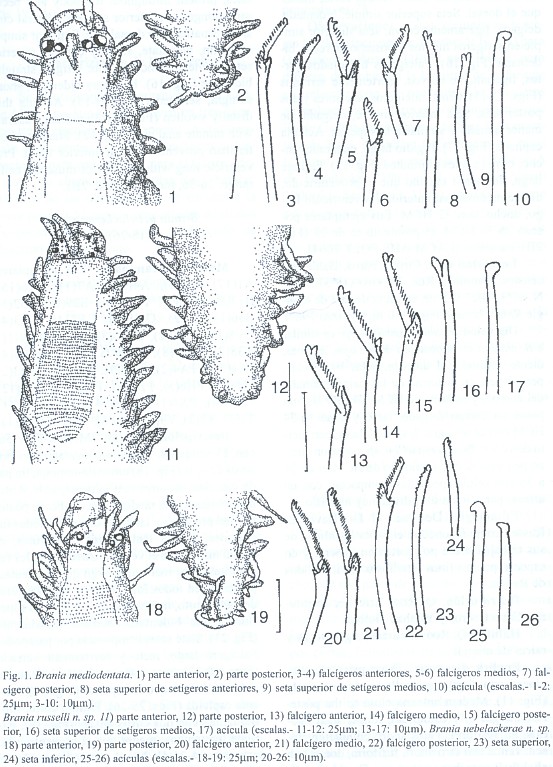
<CENTER><I><FONT FACE="Arial,Helvetica"><FONT SIZE=-1>&nbsp;</FONT></FONT></I></CENTER>      <CENTER><FONT FACE="Arial,Helvetica"><FONT SIZE=-1><I>Sphaerosyllis taylori</I> Perkins 1981</FONT></FONT></CENTER>      <CENTER><FONT FACE="Arial,Helvetica"><FONT SIZE=-1><A HREF="#6FIG115-132">Fig. 6 (115-122)</A></FONT></FONT></CENTER>       <P><FONT FACE="Arial,Helvetica"><FONT SIZE=-1><B>Referencias:</B> <A HREF="#Perkins81">Perkins 1981</A></FONT></FONT>      ]]></body>
<body><![CDATA[<P><FONT FACE="Arial,Helvetica"><FONT SIZE=-1><B>Material Examinado:</B> 169 ejemplares: A6(38), A7(40), B29(1), C4(90).</FONT></FONT>      <P><FONT FACE="Arial,Helvetica"><FONT SIZE=-1><B>Caracter&iacute;sticas:</B> Prostomio ancho. Antenas laterales anteriores de menor longitud que la media, la media posterior, atr&aacute;s de los ojos (<A HREF="#6FIG115-132">Fig. 115</A>). Cuatro ojos en lente color naranja. Cirros tentaculares similares a los dorsales. Cirro dorsal ausente en set&iacute;gero 2. Cirro dorsal piriforme, similar en tama&ntilde;o a lo largo del cuerpo. Cirro ventral corto, digitado. Ac&iacute;cula en forma de <B>L</B> (<A HREF="#6FIG115-132">Fig. 122</A>). Seta superior simple, lisa y recta (<A HREF="#6FIG115-132">Fig. 120</A>). Seta inferior simple menor y curva (<A HREF="#6FIG115-132">Fig. 121</A>). Seis espin&iacute;geros anteriores, cuatro posteriores; los anteriores y medios cortos, ligeramente curvos, serrados (<A HREF="#6FIG115-132">Figs. 117-118</A>); los posteriores cortos, curvos, lisos o serrados (<A HREF="#6FIG115-132">Fig. 119</A>). Con megagl&aacute;ndulas dorsales a partir del set&iacute;gero 4, en forma de abanico circular y estriado. Pigidio angular con dos cirros anales cortos, peque&ntilde;os, la mitad de la longitud que los cirros dorsales (<A HREF="#6FIG115-132">Fig. 116</A>). Faringe de igual tama&ntilde;o que el proventr&iacute;culo; con un diente mediodorsal anterior. Proventr&iacute;culo extendido desde el set&iacute;gero 3 hasta la mitad del set&iacute;gero 4.</FONT></FONT>      <P><FONT FACE="Arial,Helvetica"><FONT SIZE=-1><B>Observaciones: </B>Estos ejemplares son similares a los descritos por <A HREF="#Perkins81">Perkins (1981)</A> para Florida y <A HREF="#Russell87">Russell (1987)</A> para Belice, pero difieren en el tama&ntilde;o de los cirros anales; en el Caribe mexicano poseen dos cirros anales cortos, la mitad de la longitud de los dorsales y en el de Belice son largos, del doble de la longitud de los dorsales posteriores; el ejemplar descrito por <A HREF="#Uebelacker84">Uebelacker (1984)</A> para Florida difiere por poseer cirros anales 1.5 veces la longitud de los dorsales.</FONT></FONT>      <P><FONT FACE="Arial,Helvetica"><FONT SIZE=-1><B>Distribuci&oacute;n: </B>Belice, Florida, Golfo de M&eacute;xico.</FONT></FONT>      <P><FONT FACE="Arial,Helvetica"><FONT SIZE=-1><B>H&aacute;bitat: </B>Q. Roo: Arrecife, ra&iacute;ces de mangle. Otros: Arena gruesa calc&aacute;rea a fina, en pastos marinos.</FONT></FONT>     <BR>&nbsp;     <CENTER><FONT FACE="Arial,Helvetica"><FONT SIZE=-1><I>Sphaerosyllis</I> (juvenil)</FONT></FONT></CENTER>      <CENTER><FONT FACE="Arial,Helvetica"><FONT SIZE=-1><A HREF="#6FIG115-132">Fig. 6 (123-132)</A></FONT></FONT></CENTER>       <P><FONT FACE="Arial,Helvetica"><FONT SIZE=-1><B>Material Examinado:</B> 1 ejemplar: PH6(1).</FONT></FONT>      <P><FONT FACE="Arial,Helvetica"><FONT SIZE=-1><B>Caracter&iacute;sticas:</B> Completo con 19 set&iacute;geros, amarillo transl&uacute;cido. Superficie del cuerpo con papilas diminutas. Prostomio y peristomio no diferenciados totalmente. Antenas de la misma longitud, laterales anteriores y la media posterior (<A HREF="#6FIG115-132">Fig. 123</A>). Un par de ojos transparentes. Sin cirros tentaculares. Cirro dorsal presente en set&iacute;gero 2. Cirros dorsales piriformes, similar en tama&ntilde;o en todo el cuerpo. Cirro ventral peque&ntilde;o. Ac&iacute;cula en forma de<B> L </B>(<A HREF="#6FIG115-132">Fig. 132</A>). Seta superior simple recta, fuertemente serrada (<A HREF="#6FIG115-132">Fig. 130</A>). Seta inferior simple similar pero menor y curva con serraci&oacute;n diminuta (<A HREF="#6FIG115-132">Fig. 131</A>). Cuatro espin&iacute;geros anteriores y posteriores; los anteriores cortos, ligeramente curvos, serrados (<A HREF="#6FIG115-132">Figs. 125-126</A>); los medios y posteriores cortos, curvos, serrados (<A HREF="#6FIG115-132">Figs. 127-129</A>). Pigidio con dos cirros anales, dos veces m&aacute;s grandes que el cirro dorsal (<A HREF="#6FIG115-132">Fig. 124</A>). Faringe y proventr&iacute;culo no distinguibles; sin diente mediodorsal.</FONT></FONT>      ]]></body>
<body><![CDATA[<P><FONT FACE="Arial,Helvetica"><FONT SIZE=-1><B>Observaciones:</B> El ejemplar pertenece a un juvenil del g&eacute;nero Sphaerosyllis.</FONT></FONT>      <P><FONT FACE="Arial,Helvetica"><FONT SIZE=-1><B>Distribuci&oacute;n: </B>Quintana Roo: Punta Hualostoc.</FONT></FONT>      <P><FONT FACE="Arial,Helvetica"><FONT SIZE=-1><B>H&aacute;bitat:</B> Ra&iacute;ces de mangle.</FONT></FONT>      <P><B><FONT FACE="Arial,Helvetica"><FONT SIZE=-1>Clave para especies de exog&oacute;ninos del Gran Caribe</FONT></FONT></B>      <P><FONT FACE="Arial,Helvetica"><FONT SIZE=-1>(seg&uacute;n lista en Salazar-Vallejo 1996a)</FONT></FONT>      <P><FONT FACE="Arial,Helvetica"><FONT SIZE=-1>1) Palpos fusionados basalmente ..........................................................................&nbsp; <I>Parapionosyllis </I>2</FONT></FONT>     <BR><FONT FACE="Arial,Helvetica"><FONT SIZE=-1>- Palpos fusionados en toda su longitud ........................................................................................ 4</FONT></FONT>      <P><FONT FACE="Arial,Helvetica"><FONT SIZE=-1>2(1) Cirros dorsales con dos artejos ..............................................................................&nbsp; <I>P. floridana</I></FONT></FONT>     <BR><FONT FACE="Arial,Helvetica"><FONT SIZE=-1>- Cirros dorsales simples ............................................................................................................ 3</FONT></FONT>      <P><FONT FACE="Arial,Helvetica"><FONT SIZE=-1>3(2) Cuatro ojos grandes coalescentes, sin ocelos anteriores ..................................&nbsp; <I>P. uebelackerae</I></FONT></FONT>     ]]></body>
<body><![CDATA[<BR><FONT FACE="Arial,Helvetica"><FONT SIZE=-1>- Cuatro ojos peque&ntilde;os separados, con ocelos anteriores ...........................................&nbsp; <I>P. longicirrata</I></FONT></FONT>      <P><FONT FACE="Arial,Helvetica"><FONT SIZE=-1>4(1) - Con dos pares de cirros tentaculares; cirro dorsal clavado a digitiforme ......................&nbsp; <I>Brania</I> 5</FONT></FONT>     <BR><FONT FACE="Arial,Helvetica"><FONT SIZE=-1>- Con un par de cirros tentaculares; cirro dorsal piriforme u ovoide.................................................. 6</FONT></FONT>      <P><FONT FACE="Arial,Helvetica"><FONT SIZE=-1>5(4) Faringe con dent&iacute;culo anterior .............................................................................................&nbsp; 7</FONT></FONT>     <BR><FONT FACE="Arial,Helvetica"><FONT SIZE=-1>- Faringe con dent&iacute;culo medio ................................................................................................... 17</FONT></FONT>      <P><FONT FACE="Arial,Helvetica"><FONT SIZE=-1>6(4) Cirro dorsal con forma de cebolla; cuerpo con papilas diminutas ......................&nbsp; <I>Sphaerosyllis</I> 18</FONT></FONT>     <BR><FONT FACE="Arial,Helvetica"><FONT SIZE=-1>- Cirro dorsal ovoide; cuerpo sin papilas ......................................................................&nbsp; <I>Exogone</I> 34</FONT></FONT>      <P><FONT FACE="Arial,Helvetica"><FONT SIZE=-1>7(5) Con un par de ojos; cirro dorsal hinchado; s&oacute;lo espin&iacute;geros largos ........................&nbsp; <I>B. longisetis</I></FONT></FONT>     <BR><FONT FACE="Arial,Helvetica"><FONT SIZE=-1>- Con 2-3 pares de ojos ............................................................................................................. 8</FONT></FONT>      <P><FONT FACE="Arial,Helvetica"><FONT SIZE=-1>8(7) Con dos pares de ojos ........................................................................................................ 9</FONT></FONT>     ]]></body>
<body><![CDATA[<BR><FONT FACE="Arial,Helvetica"><FONT SIZE=-1>- Con tres pares de ojos ........................................................................................................... 13</FONT></FONT>      <P><FONT FACE="Arial,Helvetica"><FONT SIZE=-1>9(8) Set&iacute;gero 2 sin cirro dorsal .................................................................................................. 10</FONT></FONT>     <BR><FONT FACE="Arial,Helvetica"><FONT SIZE=-1>- Set&iacute;gero 2 con cirro dorsal ...................................................................................................... 11</FONT></FONT>      <P><FONT FACE="Arial,Helvetica"><FONT SIZE=-1>10(9) Proventr&iacute;culo largo (ocupa 6 set&iacute;geros), 45 HCM; seta inferior bidentada ................&nbsp; <I>B. gallagheri</I></FONT></FONT>     <BR><FONT FACE="Arial,Helvetica"><FONT SIZE=-1>- Proventr&iacute;culo corto (ocupa 3 set&iacute;geros), 30 HCM; seta inferior unidentada ..............&nbsp; <I>B. wellfleetensis</I></FONT></FONT>      <P><FONT FACE="Arial,Helvetica"><FONT SIZE=-1>11(9) Falc&iacute;geros largos, serrados ............................................................................................. 12</FONT></FONT>     <BR><FONT FACE="Arial,Helvetica"><FONT SIZE=-1>- Falc&iacute;geros cortos, finamente serrados ........................................................................&nbsp; <I>B. limbata</I></FONT></FONT>      <P><FONT FACE="Arial,Helvetica"><FONT SIZE=-1>12(11) Ojos anteriores peque&ntilde;os, posteriores laterales; falc&iacute;geros con manubrio liso, un diente peque&ntilde;o; par&aacute;podos con ac&iacute;cula en punta redondeada pronunciada .............................................................................&nbsp; <I>B. glandulosa</I></FONT></FONT>      <P><FONT FACE="Arial,Helvetica"><FONT SIZE=-1>- Sin ojos anteriores y medios; falc&iacute;geros con manubrio serrado, un diente muy pronunciado; par&aacute;podos con ac&iacute;cula en punta redondeada delgada ...............................................................................................&nbsp; <I>B. subterranea</I></FONT></FONT>      <P><FONT FACE="Arial,Helvetica"><FONT SIZE=-1>13(8) Antena media inserta en el centro del prostomio; set&iacute;gero 2 sin cirro dorsal: falc&iacute;gero curvo, punta no serrada</FONT></FONT>     ]]></body>
<body><![CDATA[<BR><I><FONT FACE="Arial,Helvetica"><FONT SIZE=-1>................................................................................................................................B. swedmarki</FONT></FONT></I>     <BR><FONT FACE="Arial,Helvetica"><FONT SIZE=-1>- Antena media posterior; set&iacute;gero 2 con cirro dorsal; falc&iacute;gero recto, punta serrada .................... 14</FONT></FONT>      <P><FONT FACE="Arial,Helvetica"><FONT SIZE=-1>14(13) Cuatro ojos peque&ntilde;os con dos manchas oculares poco perceptibles ............................... 15</FONT></FONT>     <BR><FONT FACE="Arial,Helvetica"><FONT SIZE=-1>- Cuatro ojos y dos manchas oculares f&aacute;cilmente distinguibles ................................................. 16</FONT></FONT>      <P><FONT FACE="Arial,Helvetica"><FONT SIZE=-1>15(14) Proventr&iacute;culo con 14-24 HCM grandes, vacuolares; cuerpo largo, delgado ............................</FONT></FONT>     <BR><FONT FACE="Arial,Helvetica"><FONT SIZE=-1>............................................................................................................&nbsp; <I>B. uebelackeare n. sp </I><SUP>1</SUP></FONT></FONT>     <BR><FONT FACE="Arial,Helvetica"><FONT SIZE=-1>- Proventr&iacute;culo con 26-36 HCM peque&ntilde;as, compactas; cuerpo corto, ancho ...........&nbsp; <I>B. russelli n. sp.</I></FONT></FONT>      <P><FONT FACE="Arial,Helvetica"><FONT SIZE=-1>16(14) Dos pares de ojos sin lentes, coalescentes ........................................................&nbsp; <I>B. oculata</I></FONT></FONT>     <BR><FONT FACE="Arial,Helvetica"><FONT SIZE=-1>- Dos pares de ojos lenticulados, separados ...................................................&nbsp; <I>B. westheidei n. sp.</I></FONT></FONT>      <P><FONT FACE="Arial,Helvetica"><FONT SIZE=-1>17(5) Cirros anales cortos, ovoides ......................................... <I>B</I>. sp A. Uebelacker (= <I>B</I>. <I>rugulosa</I>)</FONT></FONT>     ]]></body>
<body><![CDATA[<BR><FONT FACE="Arial,Helvetica"><FONT SIZE=-1>Cirros anales largos, filiformes ..........................................................................&nbsp; <I>B. mediodentata</I></FONT></FONT>      <P><FONT FACE="Arial,Helvetica"><FONT SIZE=-1>18(6) Set&iacute;gero 2 con cirro dorsal............................................................................................. 19</FONT></FONT>     <BR><FONT FACE="Arial,Helvetica"><FONT SIZE=-1>- Set&iacute;gero 2 sin cirro dorsal.................................................................................................... 20</FONT></FONT>      <P><FONT FACE="Arial,Helvetica"><FONT SIZE=-1>19(18) Prostomio con 4 ojos; seta superior lisa; ac&iacute;cula curva; cirr&oacute;foro dorsal indistinto... <I>S. brevidentata</I></FONT></FONT>     <BR><FONT FACE="Arial,Helvetica"><FONT SIZE=-1>- Prostomio con 6 ojos; seta superior lisa o finamente serrada; ac&iacute;cula con bulbo subdistal; cirr&oacute;foro dorsal notorio</FONT></FONT>     <BR><I><FONT FACE="Arial,Helvetica"><FONT SIZE=-1>....................................................................................................................................S. riseri</FONT></FONT></I>      <P><FONT FACE="Arial,Helvetica"><FONT SIZE=-1>20(18) Prostomio sin ojos..................................................................................................... 21</FONT></FONT>     <BR><FONT FACE="Arial,Helvetica"><FONT SIZE=-1>- Prostomio con ojos........................................................................................................... 23</FONT></FONT>      <P><FONT FACE="Arial,Helvetica"><FONT SIZE=-1>21(20) Setas compuestas con manubrio liso......................................................................... 22</FONT></FONT>     <BR><FONT FACE="Arial,Helvetica"><FONT SIZE=-1>- Setas compuestas con manubrio serrado.......................................................... <I>S. longilamina</I></FONT></FONT>      ]]></body>
<body><![CDATA[<P><FONT FACE="Arial,Helvetica"><FONT SIZE=-1>22(21) Antena media posterior, laterales en el centro del prostomio ..........................&nbsp; <I>S. renaude</I></FONT></FONT>     <BR><FONT FACE="Arial,Helvetica"><FONT SIZE=-1>- Antenas todas posteriores................................................................................. <I>S. anoculata</I></FONT></FONT>      <P><FONT FACE="Arial,Helvetica"><FONT SIZE=-1>23(20) Con 2 pares de ojos................................................................................................. 24</FONT></FONT>     <BR><FONT FACE="Arial,Helvetica"><FONT SIZE=-1>- Con 3 pares de ojos......................................................................................................... 30</FONT></FONT>      <P><FONT FACE="Arial,Helvetica"><FONT SIZE=-1>24(23) Faringe con diente medio anterior; espin&iacute;geros unidentados; ac&iacute;cula con forma de <B>L</B>...... 25</FONT></FONT>     <BR><FONT FACE="Arial,Helvetica"><FONT SIZE=-1>- Faringe con diente medio posterior; falc&iacute;geros bidentados; ac&iacute;cula con bulbo subdistal ..&nbsp; <I>S. parvoculata</I></FONT></FONT>      <P><FONT FACE="Arial,Helvetica"><FONT SIZE=-1>25(24) Falc&iacute;geros superiores cortos, curvos......................................................................... 26</FONT></FONT>     <BR><FONT FACE="Arial,Helvetica"><FONT SIZE=-1>- Falc&iacute;geros superiores largos, rectos................................................................................. 29</FONT></FONT>      <P><FONT FACE="Arial,Helvetica"><FONT SIZE=-1>26(25) Falc&iacute;geros inferiores lisos........................................................................................ 27</FONT></FONT>     <BR><FONT FACE="Arial,Helvetica"><FONT SIZE=-1>- Falc&iacute;geros inferiores serrados.......................................................................................... 28</FONT></FONT>      ]]></body>
<body><![CDATA[<P><FONT FACE="Arial,Helvetica"><FONT SIZE=-1>27(26) Seta superior simple lisa; con megagl&aacute;ndulas dorsales.................................... <I>S. taylori</I></FONT></FONT>     <BR><FONT FACE="Arial,Helvetica"><FONT SIZE=-1>- Seta superior simple serrada; sin megagl&aacute;ndulas dorsales................................. <I>S. glandulata</I></FONT></FONT>      <P><FONT FACE="Arial,Helvetica"><FONT SIZE=-1>28(26) Con megagl&aacute;ndulas dorsales; con seta acicular; seta superior lisa; falc&iacute;geros finamente serrados</FONT></FONT>     <BR><FONT FACE="Arial,Helvetica"><FONT SIZE=-1>..........................................................................................................................&nbsp; <I>S. aciculata</I></FONT></FONT>     <BR><FONT FACE="Arial,Helvetica"><FONT SIZE=-1>- Sin megagl&aacute;ndulas dorsales ni seta acicular; seta superior serrada; falc&iacute;geros serrados... <I>S. pirifera</I></FONT></FONT>      <P><FONT FACE="Arial,Helvetica"><FONT SIZE=-1>29(25) Falc&iacute;geros con manubrio liso; inferiores lisos y posteriores cortos, curvos......... <I>S. piriferopsis</I></FONT></FONT>     <BR><FONT FACE="Arial,Helvetica"><FONT SIZE=-1>- Falc&iacute;geros con manubrio serrado; inferiores serrados y posteriores largos, rectos ..&nbsp; <I>S. magnidentata</I></FONT></FONT>      <P><FONT FACE="Arial,Helvetica"><FONT SIZE=-1>30(23) Falc&iacute;geros unidentados............................................................................................. 31</FONT></FONT>     <BR><FONT FACE="Arial,Helvetica"><FONT SIZE=-1>- Falc&iacute;geros bidentados.......................................................................................... <I>S. bilobata</I></FONT></FONT>      <P><FONT FACE="Arial,Helvetica"><FONT SIZE=-1>31(30) Falc&iacute;geros con manubrio liso; antenas laterales anteriores .......................................... 32</FONT></FONT>     ]]></body>
<body><![CDATA[<BR><FONT FACE="Arial,Helvetica"><FONT SIZE=-1>- Falc&iacute;geros con manubrio serrado.............................................................. <I>S. centroamericana</I></FONT></FONT>      <P><FONT FACE="Arial,Helvetica"><FONT SIZE=-1>32(31) Antena media central ...............................................................................&nbsp; <I>S. erinaceus</I></FONT></FONT>     <BR><FONT FACE="Arial,Helvetica"><FONT SIZE=-1>- Antena media posterior ................................................................................................... 33</FONT></FONT>      <P><FONT FACE="Arial,Helvetica"><FONT SIZE=-1>33(32) Falc&iacute;geros superiores serrados, unidentados; los inferiores cortos, curvos, serrados; ac&iacute;cula delgada puntiaguda</FONT></FONT>     <BR><FONT FACE="Arial,Helvetica"><FONT SIZE=-1>...........................................................................................................................S<I>. perkinsi </I><SUP>2</SUP></FONT></FONT>      <P><FONT FACE="Arial,Helvetica"><FONT SIZE=-1>- Falc&iacute;geros superiores serrados (parecen bidentados); los inferiores largos, rectos, lisos; ac&iacute;cula con bulbo subdistal</FONT></FONT>     <BR><FONT FACE="Arial,Helvetica"><FONT SIZE=-1>..........................................................................................................................<I>S. belizensis</I></FONT></FONT>      <P><FONT FACE="Arial,Helvetica"><FONT SIZE=-1>34(6) Falc&iacute;geros sin diente proximal..................................................................................... 35</FONT></FONT>     <BR><FONT FACE="Arial,Helvetica"><FONT SIZE=-1>- Falc&iacute;geros con un diente grande proximal........................................................... (<I>Exogone</I>) 36</FONT></FONT>      <P><FONT FACE="Arial,Helvetica"><FONT SIZE=-1>35(34) Setas compuestas similares, espin&iacute;geros largos; seta superior simple sin espina...(<I>Parexogone</I>) 46</FONT></FONT>     ]]></body>
<body><![CDATA[<BR><FONT FACE="Arial,Helvetica"><FONT SIZE=-1>- Setas compuestas o pseudocompuestas distintas, seta superior simple con espina ................ (<I>Sylline</I>)…</FONT></FONT>     <BR><FONT FACE="Arial,Helvetica"><FONT SIZE=-1>.. Set&iacute;gero 2 sin cirro dorsal; antenas largas, surgen en el centro del prostomio, separadas ....</FONT></FONT>     <BR><I><FONT FACE="Arial,Helvetica"><FONT SIZE=-1>......E. (S.) naidinoides</FONT></FONT></I>      <P><FONT FACE="Arial,Helvetica"><FONT SIZE=-1>36(34) Set&iacute;gero 2 con cirro dorsal ........................................................................................ 37</FONT></FONT>     <BR><FONT FACE="Arial,Helvetica"><FONT SIZE=-1>- Set&iacute;gero 2 sin cirro dorsal ................................................................................................&nbsp; 45</FONT></FONT>      <P><FONT FACE="Arial,Helvetica"><FONT SIZE=-1>37(36) Antenas de la misma longitud ................................................................................... 38</FONT></FONT>     <BR><FONT FACE="Arial,Helvetica"><FONT SIZE=-1>- Antenas de distinta longitud ............................................................................................. 40</FONT></FONT>      <P><FONT FACE="Arial,Helvetica"><FONT SIZE=-1>38(37) Antenas frente a los ojos .........................................................................................&nbsp; 39</FONT></FONT>     <BR><FONT FACE="Arial,Helvetica"><FONT SIZE=-1>- Antenas entre los ojos................................................................................... <I>E. (E.) verugera</I></FONT></FONT>     <BR>&nbsp;     ]]></body>
<body><![CDATA[<BR><FONT FACE="Arial,Helvetica"><FONT SIZE=-1>39(38) Antenas digitiformes, 1-4 falc&iacute;geros anteriores, ac&iacute;cula lisa en punta redondeada ..... <I>E. (E.) breviantennata</I></FONT></FONT>     <BR><FONT FACE="Arial,Helvetica"><FONT SIZE=-1>- Antenas ovoides, 5 falc&iacute;geros anteriores, ac&iacute;cula en forma de <B>L</B>..................... <I>E. (E.) bondi n. sp.</I></FONT></FONT>      <P><FONT FACE="Arial,Helvetica"><FONT SIZE=-1>40(37) Antenas separadas................................................................................................... 41</FONT></FONT>     <BR><FONT FACE="Arial,Helvetica"><FONT SIZE=-1>- Antenas juntas................................................................................................................. 42</FONT></FONT>      <P><FONT FACE="Arial,Helvetica"><FONT SIZE=-1>41(40) Espin&iacute;gero con manubrio triangular serrado; seta superior simple bidentada; ac&iacute;cula curva..</FONT></FONT>     <BR><I><FONT FACE="Arial,Helvetica"><FONT SIZE=-1>.................................................................................................................E. (E.) pseudolourei</FONT></FONT></I>     <BR><FONT FACE="Arial,Helvetica"><FONT SIZE=-1>- Espin&iacute;gero con manubrio delgado liso; seta superior simple unidentada; ac&iacute;cula recta ..<I>E. (E.) uniformis</I></FONT></FONT>      <P><FONT FACE="Arial,Helvetica"><FONT SIZE=-1>42(40) Par&aacute;podos anteriores con 1-2 ac&iacute;culas ...................................................................... 43</FONT></FONT>     <BR><FONT FACE="Arial,Helvetica"><FONT SIZE=-1>- Par&aacute;podos anteriores con 3 ac&iacute;culas ................................................................................ 44</FONT></FONT>      <P><FONT FACE="Arial,Helvetica"><FONT SIZE=-1>43(42) Ojos lenticulados ....................................................................................&nbsp; <I>E. (E.) dispar</I></FONT></FONT>     ]]></body>
<body><![CDATA[<BR><FONT FACE="Arial,Helvetica"><FONT SIZE=-1>- Ojos no lenticulados ........................................................................................&nbsp; <I>E. (E.) rolani</I></FONT></FONT>      <P><FONT FACE="Arial,Helvetica"><FONT SIZE=-1>44(42) Seta superior simple sin espina distal ........................................................&nbsp; <I>E. (E.) lourei</I></FONT></FONT>     <BR><FONT FACE="Arial,Helvetica"><FONT SIZE=-1>- Seta superior simple con espina distal bien definida.......................................... <I>E. (E.) arenosa</I></FONT></FONT>      <P><FONT FACE="Arial,Helvetica"><FONT SIZE=-1>45(36) Antenas largas, anteriores; cirros anales cortos ...............................&nbsp; <I>E. (E.) gemmifera <SUP>3</SUP></I></FONT></FONT>     <BR><FONT FACE="Arial,Helvetica"><FONT SIZE=-1>- Antenas centrales, media larga, laterales cortas; cirros anales largos ....&nbsp; <I>E. (E.) longispinulata</I></FONT></FONT>      <P><FONT FACE="Arial,Helvetica"><FONT SIZE=-1>46(35) Set&iacute;gero 2 con cirro dorsal ..................................................................................... 47</FONT></FONT>     <BR><FONT FACE="Arial,Helvetica"><FONT SIZE=-1>- Set&iacute;gero 2 sin cirro dorsal .............................................................................................. 49</FONT></FONT>      <P><FONT FACE="Arial,Helvetica"><FONT SIZE=-1>47(46) Antenas de la misma longitud ............................................................................... 48</FONT></FONT>     <BR><FONT FACE="Arial,Helvetica"><FONT SIZE=-1>- Antenas de distinta longitud ....................................................................&nbsp; <I>E. (P.) longicirris</I></FONT></FONT>      <P><FONT FACE="Arial,Helvetica"><FONT SIZE=-1>48(47) Antenas largas, surgen en el centro del prostomio ....................................&nbsp; <I>E. (P.) wolfi</I></FONT></FONT>     ]]></body>
<body><![CDATA[<BR><FONT FACE="Arial,Helvetica"><FONT SIZE=-1>- Antenas cortas, posteriores ..............................................................&nbsp; <I>E. (P.) exmouthensis</I></FONT></FONT>      <P><FONT FACE="Arial,Helvetica"><FONT SIZE=-1>49(46) Antenas diminutas, todas de la misma longitud ..................................&nbsp; <I>E. (P.) atlantica</I></FONT></FONT>     <BR><FONT FACE="Arial,Helvetica"><FONT SIZE=-1>- Antenas de distinta longitud ........................................................................................... 50</FONT></FONT>      <P><FONT FACE="Arial,Helvetica"><FONT SIZE=-1>50(49) Antenas surgen en el centro del prostomio .............................................................. 51</FONT></FONT>     <BR><FONT FACE="Arial,Helvetica"><FONT SIZE=-1>- Antenas posteriores; la media mucho mayor que las laterales ....................&nbsp; <I>E.(P.) caribensis</I></FONT></FONT>     <BR>&nbsp;     <BR><FONT FACE="Arial,Helvetica"><FONT SIZE=-1>51(50) Antena media un tercio m&aacute;s larga que las laterales; falc&iacute;geros muy cortos, curvos, con manubrio liso</FONT></FONT>     <BR><I><FONT FACE="Arial,Helvetica"><FONT SIZE=-1>.........................................................................................E. (P.) parahomoseta mediterranea</FONT></FONT></I>      <P><FONT FACE="Arial,Helvetica"><FONT SIZE=-1>- Antena media el doble en longitud que las laterales; falc&iacute;geros cortos, rectos, con manubrio serrado</FONT></FONT>     <BR><I><FONT FACE="Arial,Helvetica"><FONT SIZE=-1>.........................................................................................................E. (P.) sanmartini n. sp.</FONT></FONT></I>      ]]></body>
<body><![CDATA[<P><FONT FACE="Arial,Helvetica"><FONT SIZE=-1>1) Algunos registros de <I>B</I>. <I>clavata </I>podr&iacute;an corresponder con esta especie. Algunas diferencias son: la punta de la ac&iacute;cula es capitada, seta superior bidentada, falc&iacute;gero inferior sin espina subdistal en <I>B. uebelackerae </I>n. sp.; y ac&iacute;cula aguzada, seta superior unidentada, falc&iacute;gero inferior con espina subdistal en <I>B. clavata</I>.</FONT></FONT>      <P><FONT FACE="Arial,Helvetica"><FONT SIZE=-1>2)<I> S. longicauda</I> (<A HREF="#Perkins81">Perkins 1981</A>) fue renombrada <I>S. perkinsi </I>por <A HREF="#Riser91">Riser (1991)</A>, porque el nombre ya se hab&iacute;a usado como<I> S. longicauda</I> (Webster &amp; Benedict 1887), descrita originalmente de Nueva Inglaterra.</FONT></FONT>      <P><FONT FACE="Arial,Helvetica"><FONT SIZE=-1>3) <I>E. (E.) gemmifera</I> (Pagenstecher 1862) en Salazar-Vallejo (1996a) est&aacute; considerada dentro del subg&eacute;nero <I>Parexogone</I>, pero las caracter&iacute;sticas taxon&oacute;micas de la especie corresponden al subg&eacute;nero <I>Exogone</I>.</FONT></FONT>     <BR><FONT FACE="Arial,Helvetica"><FONT SIZE=-1>&nbsp;</FONT></FONT>     <BR><B><FONT FACE="Arial,Helvetica"><FONT SIZE=-1>Agradecimientos</FONT></FONT></B>     <BR><B><FONT FACE="Arial,Helvetica"><FONT SIZE=-1>&nbsp;</FONT></FONT></B>     <BR><FONT FACE="Arial,Helvetica"><FONT SIZE=-1>La primera autora agradece a El Colegio de la Frontera Sur por una beca tesis para realizar esta investigaci&oacute;n y a Heriberto Bond Alc&aacute;ntara por su apoyo constante durante el desarrollo de su carrera y durante este trabajo de investigaci&oacute;n. CONACYT financi&oacute; parte de las actividades de un proyecto de investigaci&oacute;n (4120P-9697) que gener&oacute; algunos materiales para esta entrega. ECOSUR brind&oacute; los fondos para presentarlo en una reuni&oacute;n mexicana sobre Zoolog&iacute;a. Frederik Pleijel facilit&oacute; algunas referencias importantes. Rolando Bastida ley&oacute; una versi&oacute;n previa del documento y sus comentarios mejoraron la presentaci&oacute;n final. La revisi&oacute;n de Guillermo San Mart&iacute;n, Jes&uacute;s Angel de Le&oacute;n Gonz&aacute;lez y Leslie Harris, mejoraron la versi&oacute;n final del documento.</FONT></FONT>      <P><B><FONT FACE="Arial,Helvetica"><FONT SIZE=-1>Resumen</FONT></FONT></B>      <P><FONT FACE="Arial,Helvetica"><FONT SIZE=-1>El objetivo de este trabajo fue conocer las especies de exog&oacute;ninos que se encuentran en el Caribe mexicano y elaborar una clave de identificaci&oacute;n para las especies del Gran Caribe. Se examina la clasificaci&oacute;n de la familia Syllidae, la subfamilia Exogoninae; la autor&iacute;a de las subfamilias son Syllinae Grube 1850, Eusyllinae Malaquin 1893, Autolytinae Malaquin 1893 y Exogoninae Langerhans 1879. Se reconocen como exog&oacute;ninos los g&eacute;neros <I>Anguillosyllis </I>Day 1963,<I> Brania </I>de Quatrefages 1866, <I>Braniella </I>Hartman 1963, <I>Exogone</I> &Oslash;rsted 1845, <I>Exogonella </I>Hartman 1961, <I>Exogonoides </I>Day 1963, <I>Parapionosyllis </I>Fauvel 1923,<I> Psammosyllis </I><A HREF="#Westheide90">Westheide 1990</A>, <I>Spermosyllis </I>Clapar&egrave;de 1864, y <I>Sphaerosyllis </I>Clapar&egrave;de 1863. <I>Pseudexogone </I>Augener 1922, previamente incluido en el grupo, no es un s&iacute;lido; pertenece a los Pilargidae. Se examinaron 814 ejemplares recolectados en el Caribe Mexicano, &eacute;stos se distribuyen en tres g&eacute;neros, tres subg&eacute;neros y 13 especies que corresponden a: <I>Brania </I>(4), <I>Exogone </I>(4) y <I>Sphaerosyllis </I>(5); se incluye la descripci&oacute;n de cinco nuevas especies: <I>Brania russelli n. sp, Brania uebelackerae n. sp</I>., <I>Brania westheidei n. sp.</I> <I>Exogone (Exogone) bondi n. sp. </I>y <I>Exogone (Parexogone) sanmartini n. sp. </I>Para cada especie se incluyen referencias selectas, caracter&iacute;sticas, observaciones sobre la variaci&oacute;n morfol&oacute;gica, distribuci&oacute;n geogr&aacute;fica, ambiente e ilustraciones. Las especies con mayor n&uacute;mero de ejemplares fueron: <I>B. uebelackerae n. sp. </I>(295), <I>S. taylori </I>Perkins (169), <I>E. (E.) dispar </I>Webster<I> </I>(76) y <I>E. (E.) bondi </I>n. sp. (72); el resto de las especies contaron con menos ejemplares. Se anexa una clave para identificar las 52 especies de exog&oacute;ninos del Gran Caribe.</FONT></FONT>      <P><FONT FACE="Arial,Helvetica"><FONT SIZE=-1><B>Palabras clave:</B> taxonom&iacute;a, s&iacute;lidos, Polychaeta, Caribe.</FONT></FONT>      ]]></body>
<body><![CDATA[<P><B><FONT FACE="Arial,Helvetica"><FONT SIZE=-1>Referencias</FONT></FONT></B>      <P><A NAME="Augener"></A><FONT FACE="Arial,Helvetica"><FONT SIZE=-1>Augener, H. 1922. Litorale Polychaeten von Juan Fernandez; p 161-218 <I>In </I>The Natural History of Juan Fernandez and Easter Island. C. Skottsberg (ed.), vol. 3, Pt. 2, Almqvist &amp; Wiksell, Uppsala.</FONT></FONT>      <!-- ref --><P><A NAME="Claparede68"></A><FONT FACE="Arial,Helvetica"><FONT SIZE=-1>Clapar&egrave;de, E. 1868. Les Ann&eacute;lides Ch&eacute;topodes du Golfe de Naples. M&eacute;m. Soc. Phys. Hist. Nat. Gen&egrave;ve 19: 313-584</FONT></FONT>    &nbsp;&nbsp;&nbsp;&nbsp;&nbsp;&nbsp;&nbsp;&nbsp;[&#160;<a href="javascript:void(0);" onclick="javascript: window.open('/scielo.php?script=sci_nlinks&ref=1351142&pid=S0034-7744200100010001200002&lng=','','width=640,height=500,resizable=yes,scrollbars=1,menubar=yes,');">Links</a>&#160;]<!-- end-ref --><!-- ref --><P><A NAME="Fauchald77"></A><FONT FACE="Arial,Helvetica"><FONT SIZE=-1>Fauchald, K. 1977. The polychaete worms: definitions and keys to the orders, families and genera. Nat. Hist. Mus. Los Angeles Cty. Sci. Ser. 28: 1-188</FONT></FONT>    &nbsp;&nbsp;&nbsp;&nbsp;&nbsp;&nbsp;&nbsp;&nbsp;[&#160;<a href="javascript:void(0);" onclick="javascript: window.open('/scielo.php?script=sci_nlinks&ref=1351143&pid=S0034-7744200100010001200003&lng=','','width=640,height=500,resizable=yes,scrollbars=1,menubar=yes,');">Links</a>&#160;]<!-- end-ref --><!-- ref --><P><A NAME="Fauvel23"></A><FONT FACE="Arial,Helvetica"><FONT SIZE=-1>Fauvel, P. 1923. Polych&egrave;tes Errantes. Faune de France 5: 1-488.</FONT></FONT>    &nbsp;&nbsp;&nbsp;&nbsp;&nbsp;&nbsp;&nbsp;&nbsp;[&#160;<a href="javascript:void(0);" onclick="javascript: window.open('/scielo.php?script=sci_nlinks&ref=1351144&pid=S0034-7744200100010001200004&lng=','','width=640,height=500,resizable=yes,scrollbars=1,menubar=yes,');">Links</a>&#160;]<!-- end-ref --><!-- ref --><P><A NAME="Garwood91"></A><FONT FACE="Arial,Helvetica"><FONT SIZE=-1>Garwood, P. R. 1991. Reproduction and the classification of the family Syllidae (Polychaeta). Ophelia Suppl. 5: 81-87.</FONT></FONT>    &nbsp;&nbsp;&nbsp;&nbsp;&nbsp;&nbsp;&nbsp;&nbsp;[&#160;<a href="javascript:void(0);" onclick="javascript: window.open('/scielo.php?script=sci_nlinks&ref=1351145&pid=S0034-7744200100010001200005&lng=','','width=640,height=500,resizable=yes,scrollbars=1,menubar=yes,');">Links</a>&#160;]<!-- end-ref --><!-- ref --><P><A NAME="Hartman61"></A><FONT FACE="Arial,Helvetica"><FONT SIZE=-1>Hartman, O. 1961. Polychaetous annelids from California. Allan Hancock Pac. Exped. 25: 1-226</FONT></FONT>    &nbsp;&nbsp;&nbsp;&nbsp;&nbsp;&nbsp;&nbsp;&nbsp;[&#160;<a href="javascript:void(0);" onclick="javascript: window.open('/scielo.php?script=sci_nlinks&ref=1351146&pid=S0034-7744200100010001200006&lng=','','width=640,height=500,resizable=yes,scrollbars=1,menubar=yes,');">Links</a>&#160;]<!-- end-ref --><!-- ref --><P><A NAME="Hartmann60"></A><FONT FACE="Arial,Helvetica"><FONT SIZE=-1>Hartmann-Schr&ouml;der, G. 1960. Polychaeten aus dem Roten Meer. Kiel. Meeresforsch. 16: 69-125.</FONT></FONT>    &nbsp;&nbsp;&nbsp;&nbsp;&nbsp;&nbsp;&nbsp;&nbsp;[&#160;<a href="javascript:void(0);" onclick="javascript: window.open('/scielo.php?script=sci_nlinks&ref=1351147&pid=S0034-7744200100010001200007&lng=','','width=640,height=500,resizable=yes,scrollbars=1,menubar=yes,');">Links</a>&#160;]<!-- end-ref --><!-- ref --><P><A NAME="Hartmann74"></A><FONT FACE="Arial,Helvetica"><FONT SIZE=-1>Hartmann-Schr&ouml;der, G. 1974a. Zur Kenntnis des Eulitorals der afrikanischen Westk&uuml;ste zwischen Angola und Kap der Guten Hoffnung und der afrikanischen Ostk&uuml;ste von S&uuml;dafrika und Mocambique unter besonderer Ber&uuml;cksichtigung der Polychaeten und Ostracoden, 2. Die Polychaeten des Untersuchungsgebietes. Mitt. Hamburg. Zool. Mus. Inst. 69: 95-228.</FONT></FONT>    &nbsp;&nbsp;&nbsp;&nbsp;&nbsp;&nbsp;&nbsp;&nbsp;[&#160;<a href="javascript:void(0);" onclick="javascript: window.open('/scielo.php?script=sci_nlinks&ref=1351148&pid=S0034-7744200100010001200008&lng=','','width=640,height=500,resizable=yes,scrollbars=1,menubar=yes,');">Links</a>&#160;]<!-- end-ref --><!-- ref --><P><A NAME="Hartmann74b"></A><FONT FACE="Arial,Helvetica"><FONT SIZE=-1>Hartmann-Schr&ouml;der, G. 1974b. Zur Polychaetenfauna von Natal (S&uuml;dafrika). Mitt. Hamb. Zool. Mus. Inst. 71: 35-73</FONT></FONT>    &nbsp;&nbsp;&nbsp;&nbsp;&nbsp;&nbsp;&nbsp;&nbsp;[&#160;<a href="javascript:void(0);" onclick="javascript: window.open('/scielo.php?script=sci_nlinks&ref=1351149&pid=S0034-7744200100010001200009&lng=','','width=640,height=500,resizable=yes,scrollbars=1,menubar=yes,');">Links</a>&#160;]<!-- end-ref --><!-- ref --><P><A NAME="Hartmann80"></A><FONT FACE="Arial,Helvetica"><FONT SIZE=-1>Hartmann-Schr&ouml;der, G. 1980. Amsterdam Expeditions to the West Indian Islands, 9. Die Polychaeten der Amsterdam-Expeditionen nach Westindien. Bijdr. Dierk. 50: 387-401.</FONT></FONT>    &nbsp;&nbsp;&nbsp;&nbsp;&nbsp;&nbsp;&nbsp;&nbsp;[&#160;<a href="javascript:void(0);" onclick="javascript: window.open('/scielo.php?script=sci_nlinks&ref=1351150&pid=S0034-7744200100010001200010&lng=','','width=640,height=500,resizable=yes,scrollbars=1,menubar=yes,');">Links</a>&#160;]<!-- end-ref --><!-- ref --><P><A NAME="Hartmann83"></A><FONT FACE="Arial,Helvetica"><FONT SIZE=-1>Hartmann-Schr&ouml;der, G. 1983. Die Polychaeten der antiborealen S&uuml;dwestk&uuml;ste Australiens (zwischen Dunsborough im Norden und Denmark im S&uuml;den). Mitt. Hamb. Zool. Mus. Inst. 80: 123-167</FONT></FONT>    &nbsp;&nbsp;&nbsp;&nbsp;&nbsp;&nbsp;&nbsp;&nbsp;[&#160;<a href="javascript:void(0);" onclick="javascript: window.open('/scielo.php?script=sci_nlinks&ref=1351151&pid=S0034-7744200100010001200011&lng=','','width=640,height=500,resizable=yes,scrollbars=1,menubar=yes,');">Links</a>&#160;]<!-- end-ref --><!-- ref --><P><A NAME="ICZN"></A><FONT FACE="Arial,Helvetica"><FONT SIZE=-1>ICZN (Internation Comission on Zoological Nomenclature). 2000. International Code of Zoological Nomenclature. 4<SUP>th</SUP> Ed., ICZN, Padua, 126 pp.</FONT></FONT>    &nbsp;&nbsp;&nbsp;&nbsp;&nbsp;&nbsp;&nbsp;&nbsp;[&#160;<a href="javascript:void(0);" onclick="javascript: window.open('/scielo.php?script=sci_nlinks&ref=1351152&pid=S0034-7744200100010001200012&lng=','','width=640,height=500,resizable=yes,scrollbars=1,menubar=yes,');">Links</a>&#160;]<!-- end-ref --><!-- ref --><P><A NAME="Jenner99"></A><FONT FACE="Arial,Helvetica"><FONT SIZE=-1>Jenner, R. A. &amp; F. R. Schram. 1999. The grand game of metazoan philogeny: rules and strategies. Biol. Rev. 74: 121-142.</FONT></FONT>    &nbsp;&nbsp;&nbsp;&nbsp;&nbsp;&nbsp;&nbsp;&nbsp;[&#160;<a href="javascript:void(0);" onclick="javascript: window.open('/scielo.php?script=sci_nlinks&ref=1351153&pid=S0034-7744200100010001200013&lng=','','width=640,height=500,resizable=yes,scrollbars=1,menubar=yes,');">Links</a>&#160;]<!-- end-ref --><P><A NAME="Kudenov95"></A><FONT FACE="Arial,Helvetica"><FONT SIZE=-1>Kudenov, J. D. &amp; L. H. Harris. 1995. Family Syllidae Grube, 1850; p. 1-97 <I>In </I>Taxonomic Atlas of the Benthic Fauna of the Santa Maria Basin and Western Santa Barbara Channel. J. A. Blake, B. Hilbig &amp; P. H. Scott (Eds.), The Annelida, Part 2. Santa Barbara Museum of Natural History, Santa Barbara., Vol. 5.</FONT></FONT>      <!-- ref --><P><A NAME="Langerhans79"></A><FONT FACE="Arial,Helvetica"><FONT SIZE=-1>Langerhans, P. 1879. Die Wurmfauna von Madeira. Zeitschrift wissensch. Zool. Leipzig 32: 513-592.</FONT></FONT>    &nbsp;&nbsp;&nbsp;&nbsp;&nbsp;&nbsp;&nbsp;&nbsp;[&#160;<a href="javascript:void(0);" onclick="javascript: window.open('/scielo.php?script=sci_nlinks&ref=1351155&pid=S0034-7744200100010001200015&lng=','','width=640,height=500,resizable=yes,scrollbars=1,menubar=yes,');">Links</a>&#160;]<!-- end-ref --><!-- ref --><P><A NAME="Lopez94"></A><FONT FACE="Arial,Helvetica"><FONT SIZE=-1>L&oacute;pez, E. &amp; G. San Mart&iacute;n. 1994. Syllidae (Polychaeta) recolectados en las Islas de Cabo Verde por la I Expedici&oacute;n Ib&eacute;rica. Rev. Biol. Trop. 42: 129-139.</FONT></FONT>    &nbsp;&nbsp;&nbsp;&nbsp;&nbsp;&nbsp;&nbsp;&nbsp;[&#160;<a href="javascript:void(0);" onclick="javascript: window.open('/scielo.php?script=sci_nlinks&ref=1351156&pid=S0034-7744200100010001200016&lng=','','width=640,height=500,resizable=yes,scrollbars=1,menubar=yes,');">Links</a>&#160;]<!-- end-ref --><!-- ref --><P><A NAME="Malaquin93"></A><FONT FACE="Arial,Helvetica"><FONT SIZE=-1>Malaquin, A. 1893. Recherches sur les Syllidiens: Morphologie, Anatomie, Reproduction, D&eacute;veloppement. M&eacute;m. Soc. Sci. Arts Lille 1: 1-477.</FONT></FONT>    &nbsp;&nbsp;&nbsp;&nbsp;&nbsp;&nbsp;&nbsp;&nbsp;[&#160;<a href="javascript:void(0);" onclick="javascript: window.open('/scielo.php?script=sci_nlinks&ref=1351157&pid=S0034-7744200100010001200017&lng=','','width=640,height=500,resizable=yes,scrollbars=1,menubar=yes,');">Links</a>&#160;]<!-- end-ref --><!-- ref --><P><A NAME="Nunez92"></A><FONT FACE="Arial,Helvetica"><FONT SIZE=-1>N&uacute;&ntilde;ez, J., G. San Mart&iacute;n &amp; M.C. Brito. 1992. Exogoninae (Polychaeta: Syllidae) from the Canary Islands. Sci. Mar. 56: 43-52.</FONT></FONT>    &nbsp;&nbsp;&nbsp;&nbsp;&nbsp;&nbsp;&nbsp;&nbsp;[&#160;<a href="javascript:void(0);" onclick="javascript: window.open('/scielo.php?script=sci_nlinks&ref=1351158&pid=S0034-7744200100010001200018&lng=','','width=640,height=500,resizable=yes,scrollbars=1,menubar=yes,');">Links</a>&#160;]<!-- end-ref --><!-- ref --><P><A NAME="Nygren99"></A><FONT FACE="Arial,Helvetica"><FONT SIZE=-1>Nygren, A. 1999. Phylogeny and reproduction in Syllidae (Polychaeta). Zool. J. Linn. Soc. 126: 365-386.</FONT></FONT>    &nbsp;&nbsp;&nbsp;&nbsp;&nbsp;&nbsp;&nbsp;&nbsp;[&#160;<a href="javascript:void(0);" onclick="javascript: window.open('/scielo.php?script=sci_nlinks&ref=1351159&pid=S0034-7744200100010001200019&lng=','','width=640,height=500,resizable=yes,scrollbars=1,menubar=yes,');">Links</a>&#160;]<!-- end-ref --><!-- ref --><P><A NAME="Parapar94"></A><FONT FACE="Arial,Helvetica"><FONT SIZE=-1>Parapar, J. &amp; G. San Mart&iacute;n. 1994. <I>Grubeosyllis celiae</I>, a new species of Exogoninae (Syllidae: Polychaeta) from off Ceuta, Spain. Proc. Biol. Soc. Wash. 105: 112-115.</FONT></FONT>    &nbsp;&nbsp;&nbsp;&nbsp;&nbsp;&nbsp;&nbsp;&nbsp;[&#160;<a href="javascript:void(0);" onclick="javascript: window.open('/scielo.php?script=sci_nlinks&ref=1351160&pid=S0034-7744200100010001200020&lng=','','width=640,height=500,resizable=yes,scrollbars=1,menubar=yes,');">Links</a>&#160;]<!-- end-ref --><!-- ref --><P><A NAME="Paraparet94"></A><FONT FACE="Arial,Helvetica"><FONT SIZE=-1>Parapar, J., G. San Mart&iacute;n, B. Besteiro &amp; V. Urgorri. 1994. Aspectos sistem&aacute;ticos y ecol&oacute;gicos de las subfamilias Eusyllinae y Exogoninae (Polychaeta, Syllidae) en la R&iacute;a de Ferrol (Galicia, NO Espa&ntilde;a). Bol. R. Soc. Esp. Hist. Nat. (Biol.) 91: 91-101.</FONT></FONT>    &nbsp;&nbsp;&nbsp;&nbsp;&nbsp;&nbsp;&nbsp;&nbsp;[&#160;<a href="javascript:void(0);" onclick="javascript: window.open('/scielo.php?script=sci_nlinks&ref=1351161&pid=S0034-7744200100010001200021&lng=','','width=640,height=500,resizable=yes,scrollbars=1,menubar=yes,');">Links</a>&#160;]<!-- end-ref --><!-- ref --><P><A NAME="Perkins81"></A><FONT FACE="Arial,Helvetica"><FONT SIZE=-1>Perkins, T. H. 1981. Syllidae (Polychaeta), principally from Florida, with descriptions of a new genus and twenty-one new species. Proc. Biol. Soc. Wash. 93: 1080-1172.</FONT></FONT>    &nbsp;&nbsp;&nbsp;&nbsp;&nbsp;&nbsp;&nbsp;&nbsp;[&#160;<a href="javascript:void(0);" onclick="javascript: window.open('/scielo.php?script=sci_nlinks&ref=1351162&pid=S0034-7744200100010001200022&lng=','','width=640,height=500,resizable=yes,scrollbars=1,menubar=yes,');">Links</a>&#160;]<!-- end-ref --><!-- ref --><P><A NAME="Rioja91"></A><FONT FACE="Arial,Helvetica"><FONT SIZE=-1>Rioja, E. 1925. An&eacute;lidos poliquetos de San Vicente de la Barquera (Cant&aacute;brico). Trab. Mus. Nac. Cienc. Nat. Madrid, Zool. 53: 1-62</FONT></FONT>    &nbsp;&nbsp;&nbsp;&nbsp;&nbsp;&nbsp;&nbsp;&nbsp;[&#160;<a href="javascript:void(0);" onclick="javascript: window.open('/scielo.php?script=sci_nlinks&ref=1351163&pid=S0034-7744200100010001200023&lng=','','width=640,height=500,resizable=yes,scrollbars=1,menubar=yes,');">Links</a>&#160;]<!-- end-ref --><!-- ref --><P><A NAME="Riser91"></A><FONT FACE="Arial,Helvetica"><FONT SIZE=-1>Riser, N. W. 1991. An evaluation of taxonomic characters in the genus <I>Sphaerosyllis</I> (Polychaeta: Syllidae). Ophelia Suppl. 5: 09-217.</FONT></FONT>    &nbsp;&nbsp;&nbsp;&nbsp;&nbsp;&nbsp;&nbsp;&nbsp;[&#160;<a href="javascript:void(0);" onclick="javascript: window.open('/scielo.php?script=sci_nlinks&ref=1351164&pid=S0034-7744200100010001200024&lng=','','width=640,height=500,resizable=yes,scrollbars=1,menubar=yes,');">Links</a>&#160;]<!-- end-ref --><!-- ref --><P><A NAME="Russell87"></A><FONT FACE="Arial,Helvetica"><FONT SIZE=-1>Russell, D. 1987. The Taxonomy and Distribution of Syllidae (Annelida: Polychaeta) inhabiting Mangrove and adjacent Shallow-Water Habitats of Twin Cays, Belize. Ph. D. Diss., George Washington University, Washington, 388 p.</FONT></FONT>    &nbsp;&nbsp;&nbsp;&nbsp;&nbsp;&nbsp;&nbsp;&nbsp;[&#160;<a href="javascript:void(0);" onclick="javascript: window.open('/scielo.php?script=sci_nlinks&ref=1351165&pid=S0034-7744200100010001200025&lng=','','width=640,height=500,resizable=yes,scrollbars=1,menubar=yes,');">Links</a>&#160;]<!-- end-ref --><!-- ref --><P><A NAME="Salazar89"></A><FONT FACE="Arial,Helvetica"><FONT SIZE=-1>Salazar-Vallejo, S. I. 1989 (1988). Enrique Rioja y su contribuci&oacute;n al estudio de los poliquetos (Annelida: Polychaeta) en M&eacute;xico. Brenesia 30: 39-65</FONT></FONT>    &nbsp;&nbsp;&nbsp;&nbsp;&nbsp;&nbsp;&nbsp;&nbsp;[&#160;<a href="javascript:void(0);" onclick="javascript: window.open('/scielo.php?script=sci_nlinks&ref=1351166&pid=S0034-7744200100010001200026&lng=','','width=640,height=500,resizable=yes,scrollbars=1,menubar=yes,');">Links</a>&#160;]<!-- end-ref --><!-- ref --><P><A NAME="Salazar96a"></A><FONT FACE="Arial,Helvetica"><FONT SIZE=-1>Salazar-Vallejo, S. I. 1996a. Lista de especies y bibliograf&iacute;a de Poliquetos (Polychaeta) del Gran Caribe. An. Inst. Biol. UNAM, Ser. Zool. 67: 11-50.</FONT></FONT>    &nbsp;&nbsp;&nbsp;&nbsp;&nbsp;&nbsp;&nbsp;&nbsp;[&#160;<a href="javascript:void(0);" onclick="javascript: window.open('/scielo.php?script=sci_nlinks&ref=1351167&pid=S0034-7744200100010001200027&lng=','','width=640,height=500,resizable=yes,scrollbars=1,menubar=yes,');">Links</a>&#160;]<!-- end-ref --><!-- ref --><P><A NAME="Salazar96b"></A><FONT FACE="Arial,Helvetica"><FONT SIZE=-1>Salazar-Vallejo, S. I. 1996b. Filod&oacute;cidos (Polychaeta: Phyllodocidae) del Caribe mexicano con claves para identificar las especies del Gran Caribe. Rev. Biol. Trop. 44: 107-122</FONT></FONT>    &nbsp;&nbsp;&nbsp;&nbsp;&nbsp;&nbsp;&nbsp;&nbsp;[&#160;<a href="javascript:void(0);" onclick="javascript: window.open('/scielo.php?script=sci_nlinks&ref=1351168&pid=S0034-7744200100010001200028&lng=','','width=640,height=500,resizable=yes,scrollbars=1,menubar=yes,');">Links</a>&#160;]<!-- end-ref --><!-- ref --><P><A NAME="SanMartin91"></A><FONT FACE="Arial,Helvetica"><FONT SIZE=-1>San Mart&iacute;n, G. 1991. <I>Grubeosyllis</I> and <I>Exogone</I> (Exogoninae, Syllidae, Polychaeta) from Cuba, the Gulf of Mexico, Florida and Puerto Rico, with a Revision of <I>Exogone. </I>Bull. Mar. Sci. 49: 715-740.</FONT></FONT>    &nbsp;&nbsp;&nbsp;&nbsp;&nbsp;&nbsp;&nbsp;&nbsp;[&#160;<a href="javascript:void(0);" onclick="javascript: window.open('/scielo.php?script=sci_nlinks&ref=1351169&pid=S0034-7744200100010001200029&lng=','','width=640,height=500,resizable=yes,scrollbars=1,menubar=yes,');">Links</a>&#160;]<!-- end-ref --><!-- ref --><P><A NAME="SanMartin90"></A><FONT FACE="Arial,Helvetica"><FONT SIZE=-1>San Mart&iacute;n, G. &amp; J. Parapar. 1990. <I>Exogone acerata </I>(Exogoninae: Syllidae: Polychaeta), a new species without antennae from the Mediterranean Sea. Proc. Biol. Soc. Wash. 103: 687-690.</FONT></FONT>    &nbsp;&nbsp;&nbsp;&nbsp;&nbsp;&nbsp;&nbsp;&nbsp;[&#160;<a href="javascript:void(0);" onclick="javascript: window.open('/scielo.php?script=sci_nlinks&ref=1351170&pid=S0034-7744200100010001200030&lng=','','width=640,height=500,resizable=yes,scrollbars=1,menubar=yes,');">Links</a>&#160;]<!-- end-ref --><P><A NAME="Uebelacker84"></A><FONT FACE="Arial,Helvetica"><FONT SIZE=-1>Uebelacker, J.M. 1984. Family Syllidae Grube 1850; p. 30.1-151 <I>In </I>Taxonomic Guide to the Polychaetes of the Northern Gulf of Mexico. Uebelacker, J. M. &amp; P. G. Johnson (eds.). Barry A. Vittor, Mobile, 7 vols.</FONT></FONT>      <!-- ref --><P><A NAME="Westheide74a"></A><FONT FACE="Arial,Helvetica"><FONT SIZE=-1>Westheide, W. 1974a. Interstitielle Fauna von Galapagos. XI. Pisionidae, Hesionidae, Pilargidae, Syllidae (Polychaeta). Mikrofauna Meeresb. 44: 275 - 315.</FONT></FONT>    &nbsp;&nbsp;&nbsp;&nbsp;&nbsp;&nbsp;&nbsp;&nbsp;[&#160;<a href="javascript:void(0);" onclick="javascript: window.open('/scielo.php?script=sci_nlinks&ref=1351172&pid=S0034-7744200100010001200032&lng=','','width=640,height=500,resizable=yes,scrollbars=1,menubar=yes,');">Links</a>&#160;]<!-- end-ref --><!-- ref --><P><A NAME="Westheide74b"></A><FONT FACE="Arial,Helvetica"><FONT SIZE=-1>Westheide, W. 1974b. Interstitielle Polychaeten aus brasilianischen Sandstr&auml;nden. Mikrofauna Meeresb. 31: 1-16.</FONT></FONT>    &nbsp;&nbsp;&nbsp;&nbsp;&nbsp;&nbsp;&nbsp;&nbsp;[&#160;<a href="javascript:void(0);" onclick="javascript: window.open('/scielo.php?script=sci_nlinks&ref=1351173&pid=S0034-7744200100010001200033&lng=','','width=640,height=500,resizable=yes,scrollbars=1,menubar=yes,');">Links</a>&#160;]<!-- end-ref --><!-- ref --><P><A NAME="Westheide90"></A><FONT FACE="Arial,Helvetica"><FONT SIZE=-1>Westheide, W. 1990. A new genus and species of the Syllidae (Annelida, Polychaeta) from south India. Zool. Scripta 19: 165-167</FONT></FONT>    &nbsp;&nbsp;&nbsp;&nbsp;&nbsp;&nbsp;&nbsp;&nbsp;[&#160;<a href="javascript:void(0);" onclick="javascript: window.open('/scielo.php?script=sci_nlinks&ref=1351174&pid=S0034-7744200100010001200034&lng=','','width=640,height=500,resizable=yes,scrollbars=1,menubar=yes,');">Links</a>&#160;]<!-- end-ref --><!-- ref --><P><A NAME="Zottoli00"></A><FONT FACE="Arial,Helvetica"><FONT SIZE=-1>Zottoli, R. &amp; C. D. Long. 2000. <I>Exogone breviantennata </I>Hartmann-Schr&ouml;der, 1959 (characters emended) (Annelida: Polychaeta: Syllidae), a new record for the Bahamas with a key to selected <I>Exogone </I>species. Proc. Biol. Soc. Wash. 113: 500-513.</FONT></FONT>    &nbsp;&nbsp;&nbsp;&nbsp;&nbsp;&nbsp;&nbsp;&nbsp;[&#160;<a href="javascript:void(0);" onclick="javascript: window.open('/scielo.php?script=sci_nlinks&ref=1351175&pid=S0034-7744200100010001200035&lng=','','width=640,height=500,resizable=yes,scrollbars=1,menubar=yes,');">Links</a>&#160;]<!-- end-ref --><P><A NAME="A1"></A><FONT FACE="Arial,Helvetica"><FONT SIZE=-1><SUP><A HREF="#R1">1</A></SUP> Depto. Ecolog&iacute;a Acu&aacute;tica, El Colegio de la Frontera Sur, Apdo. Postal 424, Chetumal, Q. Roo 77000 MEXICO, Fax 01 (938)2-01-15 ext. 240; <A HREF="mailto:salazar@ecosur-qroo.mx">salazar@ecosur-qroo.mx</A></FONT></FONT>     <BR>&nbsp;      <P><B><FONT FACE="Arial,Helvetica"><FONT SIZE=-1>Ap&eacute;ndice</FONT></FONT></B>      <P><B><FONT FACE="Arial,Helvetica"><FONT SIZE=-1>Datos sobre los materiales revisados</FONT></FONT></B>      ]]></body>
<body><![CDATA[<P><FONT FACE="Arial,Helvetica"><FONT SIZE=-1>A1. Akumal, col. Marco Aguilar, 23 II 86.</FONT></FONT>     <BR><FONT FACE="Arial,Helvetica"><FONT SIZE=-1>A2. Akumal, 12 IV 86.</FONT></FONT>     <BR><FONT FACE="Arial,Helvetica"><FONT SIZE=-1>A3. Aventuras. Punta Allen, E. Donath, 24 II 86.</FONT></FONT>     <BR><FONT FACE="Arial,Helvetica"><FONT SIZE=-1>A4. Aventuras, E. Donath, 18 V 86.</FONT></FONT>     <BR><FONT FACE="Arial,Helvetica"><FONT SIZE=-1>A5. Arrecife E. Donath, 2.5 m., 10 VI 86.</FONT></FONT>     <BR><FONT FACE="Arial,Helvetica"><FONT SIZE=-1>A6. Arrecife, 9.5 m., 10 VI 86.</FONT></FONT>     <BR><FONT FACE="Arial,Helvetica"><FONT SIZE=-1>A7. Arrecife, 10 VI 86.</FONT></FONT>     <BR><FONT FACE="Arial,Helvetica"><FONT SIZE=-1>A8. Aventuras, col. A. Trujillo.</FONT></FONT>     <BR><FONT FACE="Arial,Helvetica"><FONT SIZE=-1>B1. Bah&iacute;a Ascensi&oacute;n, Arrecife, 10 VI 86</FONT></FONT>     <BR><FONT FACE="Arial,Helvetica"><FONT SIZE=-1>B7. Bajo Pepito, Mar. 97.</FONT></FONT>     ]]></body>
<body><![CDATA[<BR><FONT FACE="Arial,Helvetica"><FONT SIZE=-1>B10. Bajo Pepito, Abr. 97.</FONT></FONT>     <BR><FONT FACE="Arial,Helvetica"><FONT SIZE=-1>B16. B. Ascensi&oacute;n, entre Thalassia, 28 I 86.</FONT></FONT>     <BR><FONT FACE="Arial,Helvetica"><FONT SIZE=-1>B17. B. Ascensi&oacute;n, 26-27 II 86.</FONT></FONT>     <BR><FONT FACE="Arial,Helvetica"><FONT SIZE=-1>B20. B. Ascensi&oacute;n, Cayo Xob&oacute;n, RM2, 28 IV 87.</FONT></FONT>     <BR><FONT FACE="Arial,Helvetica"><FONT SIZE=-1>B23. B. Ascensi&oacute;n, Punta Hualostoch, RM1, 28 IV 87.</FONT></FONT>     <BR><FONT FACE="Arial,Helvetica"><FONT SIZE=-1>B25. B. Ascensi&oacute;n, Punta Xoquem, RM2, 28 IV 87.</FONT></FONT>     <BR><FONT FACE="Arial,Helvetica"><FONT SIZE=-1>B29. B. Ascensi&oacute;n, Cayo Valencia, RM3, 29 IV 87.</FONT></FONT>     <BR><FONT FACE="Arial,Helvetica"><FONT SIZE=-1>B32. B. Ascensi&oacute;n, Punta Allen, RM2, 29 IV 87.</FONT></FONT>     <BR><FONT FACE="Arial,Helvetica"><FONT SIZE=-1>B36. Bocontica, M.92, En. 91.</FONT></FONT>     <BR><FONT FACE="Arial,Helvetica"><FONT SIZE=-1>C4. C. Cedros, RM2, 6 III 87.</FONT></FONT>     ]]></body>
<body><![CDATA[<BR><FONT FACE="Arial,Helvetica"><FONT SIZE=-1>C5. Cozumel, col. S. Salazar, 5 VI 96.</FONT></FONT>     <BR><FONT FACE="Arial,Helvetica"><FONT SIZE=-1>C11. Culebras E.Donath, 11 VI 86.</FONT></FONT>     <BR><FONT FACE="Arial,Helvetica"><FONT SIZE=-1>D3. DIF Aventuras, Roca-Mixta, QR-4, 21 IV 92.</FONT></FONT>     <BR><FONT FACE="Arial,Helvetica"><FONT SIZE=-1>P1. Placer Buceo, 26 VII 90.</FONT></FONT>     <BR><FONT FACE="Arial,Helvetica"><FONT SIZE=-1>P3. P. Allen, en E. Turbinata, 27 II 86.</FONT></FONT>     <BR><FONT FACE="Arial,Helvetica"><FONT SIZE=-1>P4. P. Allen E. Donath, 11 VI 86.</FONT></FONT>     <BR><FONT FACE="Arial,Helvetica"><FONT SIZE=-1>P5. P. Gavil&aacute;n, col. I. Pelayo, 15 VII 92.</FONT></FONT>     <BR><FONT FACE="Arial,Helvetica"><FONT SIZE=-1>P7. P. Gorda E, L. T&eacute;rminos, Camp. 27 VII 84.</FONT></FONT>     <BR><FONT FACE="Arial,Helvetica"><FONT SIZE=-1>S1. Sabancuy D, L. T&eacute;rminos, 28 VII 84.</FONT></FONT>     <BR><FONT FACE="Arial,Helvetica"><FONT SIZE=-1>S2. San Carlos M. D. Esquivel M., 21 V 91.</FONT></FONT>     ]]></body>
<body><![CDATA[<BR><FONT FACE="Arial,Helvetica"><FONT SIZE=-1>S3. San Vale E.Donath, 25 II 86.</FONT></FONT>     <BR><FONT FACE="Arial,Helvetica"><FONT SIZE=-1>T1. Tulum, 24 II 86.</FONT></FONT>     <BR><FONT FACE="Arial,Helvetica"><FONT SIZE=-1>X1. Xcacel, col. S. Salazar y L. Carrera, 17 VI 96.</FONT></FONT>     <BR><FONT FACE="Arial,Helvetica"><FONT SIZE=-1>Y8. Yalahau Chiquil&aacute; pp. M.17, En. 91.</FONT></FONT>     <BR><FONT FACE="Arial,Helvetica"><FONT SIZE=-1>Y9. Yalahau Holbox, M. 13, En. 91.</FONT></FONT>     <BR><FONT FACE="Arial,Helvetica"><FONT SIZE=-1>Y10. Yalahau Holbox, m. M.23, En. 91.</FONT></FONT>     <BR><FONT FACE="Arial,Helvetica"><FONT SIZE=-1>Y11. Yalahau Holbox, M. 36, En. 91.</FONT></FONT>     <BR><FONT FACE="Arial,Helvetica"><FONT SIZE=-1>Y15. Yalahau P. Gorda, M.93, En. 91.</FONT></FONT>     <BR><FONT FACE="Arial,Helvetica"><FONT SIZE=-1>Y16. Yalahau P. Vista Alegre, M. 26, En. 91.</FONT></FONT>      <P><B><FONT FACE="Arial,Helvetica"><FONT SIZE=-1>II. Materiales recolectados en Cayo Valencia, en ra&iacute;ces de mangle por J. J. Oliva y M. S. Jim&eacute;nez.</FONT></FONT></B>      ]]></body>
<body><![CDATA[<P><FONT FACE="Arial,Helvetica"><FONT SIZE=-1>CV1. RM1 NI, 28 IV 87.</FONT></FONT>     <BR><FONT FACE="Arial,Helvetica"><FONT SIZE=-1>CV2. RM2 NM, 28 IV 87.</FONT></FONT>     <BR><FONT FACE="Arial,Helvetica"><FONT SIZE=-1>CV3. RM1 NS, 29 IV 87.</FONT></FONT>     <BR><FONT FACE="Arial,Helvetica"><FONT SIZE=-1>CV4. RM1 NM, 29 IV 87.</FONT></FONT>     <BR><FONT FACE="Arial,Helvetica"><FONT SIZE=-1>CV8. RM3 NM, Bah&iacute;a Ascensi&oacute;n, 29 IV 87.</FONT></FONT>      <P><B><FONT FACE="Arial,Helvetica"><FONT SIZE=-1>III. Material recolectado en Islas Tres Mar&iacute;as, en ra&iacute;ces de mangle por J. J. Oliva, M. S. Jim&eacute;nez.</FONT></FONT></B>      <P><FONT FACE="Arial,Helvetica"><FONT SIZE=-1>ITM9. RM3 NS, 28 IV 87.</FONT></FONT>      <P><B><FONT FACE="Arial,Helvetica"><FONT SIZE=-1>IV. Materiales recolectados por J. J. Oliva, M. S. Jim&eacute;nez y S. I. Salazar-Vallejo.</FONT></FONT></B>      <P><FONT FACE="Arial,Helvetica"><FONT SIZE=-1>LE7. Faro Xcayal, B. 110, 4 XI 90.</FONT></FONT>     <BR><FONT FACE="Arial,Helvetica"><FONT SIZE=-1>LE9. R&iacute;o Indio, 4 XI 90.</FONT></FONT>     ]]></body>
<body><![CDATA[<BR><FONT FACE="Arial,Helvetica"><FONT SIZE=-1>LE13. Sta. Cecilia, 4 XI 90.</FONT></FONT>     <BR><FONT FACE="Arial,Helvetica"><FONT SIZE=-1>LE15. Sta. Cecilia, bolsa 101, 4 XI 90.</FONT></FONT>     <BR><FONT FACE="Arial,Helvetica"><FONT SIZE=-1>LE20. Xcacel 13.</FONT></FONT>     <BR><FONT FACE="Arial,Helvetica"><FONT SIZE=-1>LE25. Xcayal, B. 113, 4 XI 90.</FONT></FONT>     <BR><FONT FACE="Arial,Helvetica"><FONT SIZE=-1>LE27. Y-93-9.</FONT></FONT>      <P><B><FONT FACE="Arial,Helvetica"><FONT SIZE=-1>V. Materiales recolectados en Nichupt&eacute;, en Thalassia por J. J. Oliva y M. S. Jim&eacute;nez.</FONT></FONT></B>      <P><FONT FACE="Arial,Helvetica"><FONT SIZE=-1>N1. E1M1T1, 22 IV 88.</FONT></FONT>     <BR><FONT FACE="Arial,Helvetica"><FONT SIZE=-1>N29. E4M6T1, 28 X 87.</FONT></FONT>     <BR><FONT FACE="Arial,Helvetica"><FONT SIZE=-1>N38. E5M7T1, 28 IV 87.</FONT></FONT>     <BR><FONT FACE="Arial,Helvetica"><FONT SIZE=-1>N39. E5M7T1, 28 X 87.</FONT></FONT>     ]]></body>
<body><![CDATA[<BR><FONT FACE="Arial,Helvetica"><FONT SIZE=-1>N50. E7M1T1, 20 IV 88.</FONT></FONT>     <BR><FONT FACE="Arial,Helvetica"><FONT SIZE=-1>N52. E7M3T1, 6 VII 88.</FONT></FONT>     <BR><FONT FACE="Arial,Helvetica"><FONT SIZE=-1>N54. E7M5T1, 6 VII 88.</FONT></FONT>     <BR><FONT FACE="Arial,Helvetica"><FONT SIZE=-1>N58. E8M4TO5, 29 X 87.</FONT></FONT>     <BR><FONT FACE="Arial,Helvetica"><FONT SIZE=-1>N59. E8M5T., 29 X 87.</FONT></FONT>     <BR><FONT FACE="Arial,Helvetica"><FONT SIZE=-1>N60. E8M6T., 29 X 87.</FONT></FONT>     <BR><FONT FACE="Arial,Helvetica"><FONT SIZE=-1>N61. E8M6T1, 29 X 87.</FONT></FONT>      <P><B><FONT FACE="Arial,Helvetica"><FONT SIZE=-1>VI. Materiales recolectados en Punta Allen, en ra&iacute;ces de mangle por J. J. Oliva y M. S. Jim&eacute;nez.</FONT></FONT></B>      <P><FONT FACE="Arial,Helvetica"><FONT SIZE=-1>PA1. RM3 NM, 24 IV 87.</FONT></FONT>     <BR><FONT FACE="Arial,Helvetica"><FONT SIZE=-1>PA2. RM1 NS, 29 IV 87.</FONT></FONT>     ]]></body>
<body><![CDATA[<BR><FONT FACE="Arial,Helvetica"><FONT SIZE=-1>PA4. RM2 NM, 29 IV 87.</FONT></FONT>     <BR><FONT FACE="Arial,Helvetica"><FONT SIZE=-1>PA6. RM3 NM, 29 IV 87.</FONT></FONT>      <P><B><FONT FACE="Arial,Helvetica"><FONT SIZE=-1>VII. Materiales recolectados en Punta Hualostoc, en ra&iacute;ces de mangle por J. J. Oliva y M. S. Jim&eacute;nez.</FONT></FONT></B>      <P><FONT FACE="Arial,Helvetica"><FONT SIZE=-1>PH2. RM1 NM, 28 IV 87.</FONT></FONT>     <BR><FONT FACE="Arial,Helvetica"><FONT SIZE=-1>PH3. RM1 Residuo, 28 IV 87.</FONT></FONT>     <BR><FONT FACE="Arial,Helvetica"><FONT SIZE=-1>PH4. RM3 NS, 28 IV 87.</FONT></FONT>     <BR><FONT FACE="Arial,Helvetica"><FONT SIZE=-1>PH6. RM3 NM, 28 IV 87.</FONT></FONT>     <BR><FONT FACE="Arial,Helvetica"><FONT SIZE=-1>PH9. RM3 NI, 28 IV 87.</FONT></FONT>     <BR><FONT FACE="Arial,Helvetica"><FONT SIZE=-1>PH11.RM1 NM, 2 VII 87.</FONT></FONT>      <P><B><FONT FACE="Arial,Helvetica"><FONT SIZE=-1>VIII. Materiales recolectados en Punta Xoquem, en ra&iacute;ces de mangle por J. J. Oliva y M. S. Jim&eacute;nez.</FONT></FONT></B>      ]]></body>
<body><![CDATA[<P><FONT FACE="Arial,Helvetica"><FONT SIZE=-1>PX2. RM1 NM, 28 IV 87.</FONT></FONT>     <BR><FONT FACE="Arial,Helvetica"><FONT SIZE=-1>PX3. RM1 NI, 28 IV 87.</FONT></FONT>     <BR><FONT FACE="Arial,Helvetica"><FONT SIZE=-1>PX4. RM2 NS, 28 IV 87.</FONT></FONT>     <BR><FONT FACE="Arial,Helvetica"><FONT SIZE=-1>PX5. RM2 NM, 28 IV 87.</FONT></FONT>     <BR><FONT FACE="Arial,Helvetica"><FONT SIZE=-1>PX6. RM2 NI, 28 IV 88.</FONT></FONT>      ]]></body><back>
<ref-list>
<ref id="B1">
<nlm-citation citation-type="book">
<person-group person-group-type="author">
<name>
<surname><![CDATA[Augener]]></surname>
<given-names><![CDATA[H]]></given-names>
</name>
</person-group>
<article-title xml:lang="en"><![CDATA[Litorale Polychaeten von Juan Fernandez]]></article-title>
<person-group person-group-type="editor">
<name>
<surname><![CDATA[Skottsberg]]></surname>
<given-names><![CDATA[C]]></given-names>
</name>
</person-group>
<source><![CDATA[The Natural History of Juan Fernandez and Easter Island]]></source>
<year>1922</year>
<volume>3</volume>
<publisher-loc><![CDATA[Uppsala ]]></publisher-loc>
<publisher-name><![CDATA[Almqvist & Wiksell]]></publisher-name>
</nlm-citation>
</ref>
<ref id="B2">
<nlm-citation citation-type="journal">
<person-group person-group-type="author">
<name>
<surname><![CDATA[Claparède]]></surname>
<given-names><![CDATA[E]]></given-names>
</name>
</person-group>
<article-title xml:lang="fr"><![CDATA[Les Annélides Chétopodes du Golfe de Naples]]></article-title>
<source><![CDATA[Mém. Soc. Phys. Hist. Nat. Genève]]></source>
<year>1868</year>
<volume>19</volume>
<page-range>313-584</page-range></nlm-citation>
</ref>
<ref id="B3">
<nlm-citation citation-type="journal">
<person-group person-group-type="author">
<name>
<surname><![CDATA[Fauchald]]></surname>
<given-names><![CDATA[K]]></given-names>
</name>
</person-group>
<article-title xml:lang="en"><![CDATA[The polychaete worms: definitions and keys to the orders, families and genera]]></article-title>
<source><![CDATA[Nat. Hist. Mus. Los Angeles Cty. Sci. Ser]]></source>
<year>1977</year>
<volume>28</volume>
<page-range>1-188</page-range></nlm-citation>
</ref>
<ref id="B4">
<nlm-citation citation-type="journal">
<person-group person-group-type="author">
<name>
<surname><![CDATA[Fauvel]]></surname>
<given-names><![CDATA[P]]></given-names>
</name>
</person-group>
<article-title xml:lang="en"><![CDATA[Polychètes Errantes]]></article-title>
<source><![CDATA[Faune de France]]></source>
<year>1923</year>
<volume>5</volume>
<page-range>1-488</page-range></nlm-citation>
</ref>
<ref id="B5">
<nlm-citation citation-type="journal">
<person-group person-group-type="author">
<name>
<surname><![CDATA[Garwood]]></surname>
<given-names><![CDATA[P. R]]></given-names>
</name>
</person-group>
<article-title xml:lang="en"><![CDATA[Reproduction and the classification of the family Syllidae (Polychaeta)]]></article-title>
<source><![CDATA[Ophelia Suppl]]></source>
<year>1991</year>
<volume>5</volume>
<page-range>81-87</page-range></nlm-citation>
</ref>
<ref id="B6">
<nlm-citation citation-type="journal">
<person-group person-group-type="author">
<name>
<surname><![CDATA[Hartman]]></surname>
<given-names><![CDATA[O]]></given-names>
</name>
</person-group>
<article-title xml:lang="en"><![CDATA[Polychaetous annelids from California]]></article-title>
<source><![CDATA[Allan Hancock Pac. Exped]]></source>
<year>1961</year>
<volume>25</volume>
<page-range>1-226</page-range></nlm-citation>
</ref>
<ref id="B7">
<nlm-citation citation-type="journal">
<person-group person-group-type="author">
<name>
<surname><![CDATA[Hartmann-Schröder]]></surname>
<given-names><![CDATA[G]]></given-names>
</name>
</person-group>
<article-title xml:lang="de"><![CDATA[Polychaeten aus dem Roten Meer]]></article-title>
<source><![CDATA[Kiel. Meeresforsch]]></source>
<year>1960</year>
<volume>16</volume>
<page-range>69-125</page-range></nlm-citation>
</ref>
<ref id="B8">
<nlm-citation citation-type="journal">
<person-group person-group-type="author">
<name>
<surname><![CDATA[Hartmann-Schröder]]></surname>
<given-names><![CDATA[G]]></given-names>
</name>
</person-group>
<article-title xml:lang="de"><![CDATA[Zur Kenntnis des Eulitorals der afrikanischen Westküste zwischen Angola und Kap der Guten Hoffnung und der afrikanischen Ostküste von Südafrika und Mocambique unter besonderer Berücksichtigung der Polychaeten und Ostracoden, 2. Die Polychaeten des Untersuchungsgebietes]]></article-title>
<source><![CDATA[Mitt. Hamburg. Zool. Mus. Inst]]></source>
<year>1974</year>
<volume>69</volume>
<page-range>95-228</page-range></nlm-citation>
</ref>
<ref id="B9">
<nlm-citation citation-type="journal">
<person-group person-group-type="author">
<name>
<surname><![CDATA[Hartmann-Schröder]]></surname>
<given-names><![CDATA[G]]></given-names>
</name>
</person-group>
<article-title xml:lang="de"><![CDATA[Zur Polychaetenfauna von Natal (Südafrika)]]></article-title>
<source><![CDATA[Mitt. Hamb. Zool. Mus. Inst]]></source>
<year>1974</year>
<volume>71</volume>
<page-range>35-73</page-range></nlm-citation>
</ref>
<ref id="B10">
<nlm-citation citation-type="journal">
<person-group person-group-type="author">
<name>
<surname><![CDATA[Hartmann-Schröder]]></surname>
<given-names><![CDATA[G]]></given-names>
</name>
</person-group>
<article-title xml:lang="de"><![CDATA[Amsterdam Expeditions to the West Indian Islands, 9. Die Polychaeten der Amsterdam-Expeditionen nach Westindien]]></article-title>
<source><![CDATA[Bijdr. Dierk]]></source>
<year>1980</year>
<volume>50</volume>
<page-range>387-401</page-range></nlm-citation>
</ref>
<ref id="B11">
<nlm-citation citation-type="journal">
<person-group person-group-type="author">
<name>
<surname><![CDATA[Hartmann-Schröder]]></surname>
<given-names><![CDATA[G]]></given-names>
</name>
</person-group>
<article-title xml:lang="de"><![CDATA[Die Polychaeten der antiborealen Südwestküste Australiens (zwischen Dunsborough im Norden und Denmark im Süden)]]></article-title>
<source><![CDATA[Mitt. Hamb. Zool. Mus. Inst]]></source>
<year>1983</year>
<volume>80</volume>
<page-range>123-167</page-range></nlm-citation>
</ref>
<ref id="B12">
<nlm-citation citation-type="book">
<collab>ICZN (Internation Comission on Zoological Nomenclature)</collab>
<source><![CDATA[International Code of Zoological Nomenclature]]></source>
<year>2000</year>
<edition>4th Ed</edition>
<page-range>126</page-range><publisher-loc><![CDATA[Padua ]]></publisher-loc>
<publisher-name><![CDATA[ICZN]]></publisher-name>
</nlm-citation>
</ref>
<ref id="B13">
<nlm-citation citation-type="journal">
<person-group person-group-type="author">
<name>
<surname><![CDATA[Jenner]]></surname>
<given-names><![CDATA[R. A]]></given-names>
</name>
<name>
<surname><![CDATA[Schram]]></surname>
<given-names><![CDATA[F. R]]></given-names>
</name>
</person-group>
<article-title xml:lang="en"><![CDATA[The grand game of metazoan philogeny: rules and strategies]]></article-title>
<source><![CDATA[Biol. Rev]]></source>
<year>1999</year>
<volume>74</volume>
<page-range>121-142</page-range></nlm-citation>
</ref>
<ref id="B14">
<nlm-citation citation-type="book">
<person-group person-group-type="author">
<name>
<surname><![CDATA[Kudenov]]></surname>
<given-names><![CDATA[J. D]]></given-names>
</name>
<name>
<surname><![CDATA[Harris]]></surname>
<given-names><![CDATA[L. H]]></given-names>
</name>
</person-group>
<article-title xml:lang="en"><![CDATA[Family Syllidae Grube, 1850]]></article-title>
<person-group person-group-type="editor">
<name>
<surname><![CDATA[Blake]]></surname>
<given-names><![CDATA[J. A]]></given-names>
</name>
<name>
<surname><![CDATA[Hilbig]]></surname>
<given-names><![CDATA[B]]></given-names>
</name>
<name>
<surname><![CDATA[Scott]]></surname>
<given-names><![CDATA[P. H]]></given-names>
</name>
</person-group>
<source><![CDATA[Taxonomic Atlas of the Benthic Fauna of the Santa Maria Basin and Western Santa Barbara Channel. The Annelida, Part 2]]></source>
<year>1995</year>
<volume>5</volume>
<publisher-loc><![CDATA[Santa Barbara ]]></publisher-loc>
<publisher-name><![CDATA[Santa Barbara Museum of Natural History]]></publisher-name>
</nlm-citation>
</ref>
<ref id="B15">
<nlm-citation citation-type="journal">
<person-group person-group-type="author">
<name>
<surname><![CDATA[Langerhans]]></surname>
<given-names><![CDATA[P]]></given-names>
</name>
</person-group>
<article-title xml:lang="de"><![CDATA[Die Wurmfauna von Madeira]]></article-title>
<source><![CDATA[Zeitschrift wissensch. Zool. Leipzig]]></source>
<year>1879</year>
<volume>32</volume>
<page-range>513-592</page-range></nlm-citation>
</ref>
<ref id="B16">
<nlm-citation citation-type="journal">
<person-group person-group-type="author">
<name>
<surname><![CDATA[López]]></surname>
<given-names><![CDATA[E]]></given-names>
</name>
<name>
<surname><![CDATA[San Martín]]></surname>
<given-names><![CDATA[G]]></given-names>
</name>
</person-group>
<article-title xml:lang="es"><![CDATA[Syllidae (Polychaeta) recolectados en las Islas de Cabo Verde por la I Expedición Ibérica]]></article-title>
<source><![CDATA[Rev. Biol. Trop]]></source>
<year>1994</year>
<volume>42</volume>
<page-range>129-139</page-range></nlm-citation>
</ref>
<ref id="B17">
<nlm-citation citation-type="journal">
<person-group person-group-type="author">
<name>
<surname><![CDATA[Malaquin]]></surname>
<given-names><![CDATA[A]]></given-names>
</name>
</person-group>
<article-title xml:lang="fr"><![CDATA[Recherches sur les Syllidiens: Morphologie, Anatomie, Reproduction, Développement]]></article-title>
<source><![CDATA[Mém. Soc. Sci. Arts Lille]]></source>
<year>1893</year>
<volume>1</volume>
<page-range>1-477</page-range></nlm-citation>
</ref>
<ref id="B18">
<nlm-citation citation-type="journal">
<person-group person-group-type="author">
<name>
<surname><![CDATA[Núñez]]></surname>
<given-names><![CDATA[J]]></given-names>
</name>
<name>
<surname><![CDATA[San Martín]]></surname>
<given-names><![CDATA[G]]></given-names>
</name>
<name>
<surname><![CDATA[Brito]]></surname>
<given-names><![CDATA[M.C]]></given-names>
</name>
</person-group>
<article-title xml:lang="en"><![CDATA[Exogoninae (Polychaeta: Syllidae) from the Canary Islands]]></article-title>
<source><![CDATA[Sci. Mar]]></source>
<year>1992</year>
<volume>56</volume>
<page-range>43-52</page-range></nlm-citation>
</ref>
<ref id="B19">
<nlm-citation citation-type="journal">
<person-group person-group-type="author">
<name>
<surname><![CDATA[Nygren]]></surname>
<given-names><![CDATA[A]]></given-names>
</name>
</person-group>
<article-title xml:lang="en"><![CDATA[Phylogeny and reproduction in Syllidae (Polychaeta)]]></article-title>
<source><![CDATA[Zool. J. Linn. Soc]]></source>
<year>1999</year>
<volume>126</volume>
<page-range>365-386</page-range></nlm-citation>
</ref>
<ref id="B20">
<nlm-citation citation-type="journal">
<person-group person-group-type="author">
<name>
<surname><![CDATA[Parapar]]></surname>
<given-names><![CDATA[J]]></given-names>
</name>
<name>
<surname><![CDATA[San Martín]]></surname>
<given-names><![CDATA[G]]></given-names>
</name>
</person-group>
<article-title xml:lang="en"><![CDATA[Grubeosyllis celiae, a new species of Exogoninae (Syllidae: Polychaeta) from off Ceuta]]></article-title>
<source><![CDATA[Spain. Proc. Biol. Soc. Wash]]></source>
<year>1994</year>
<volume>105</volume>
<page-range>112-115</page-range></nlm-citation>
</ref>
<ref id="B21">
<nlm-citation citation-type="journal">
<person-group person-group-type="author">
<name>
<surname><![CDATA[Parapar]]></surname>
<given-names><![CDATA[J]]></given-names>
</name>
<name>
<surname><![CDATA[San Martín]]></surname>
<given-names><![CDATA[G]]></given-names>
</name>
<name>
<surname><![CDATA[Besteiro]]></surname>
<given-names><![CDATA[B]]></given-names>
</name>
<name>
<surname><![CDATA[Urgorri]]></surname>
<given-names><![CDATA[V]]></given-names>
</name>
</person-group>
<article-title xml:lang="es"><![CDATA[Aspectos sistemáticos y ecológicos de las subfamilias Eusyllinae y Exogoninae (Polychaeta, Syllidae) en la Ría de Ferrol (Galicia, NO España)]]></article-title>
<source><![CDATA[Bol. R. Soc. Esp. Hist. Nat]]></source>
<year>1994</year>
<volume>91</volume>
<page-range>91-101</page-range></nlm-citation>
</ref>
<ref id="B22">
<nlm-citation citation-type="journal">
<person-group person-group-type="author">
<name>
<surname><![CDATA[Perkins]]></surname>
<given-names><![CDATA[T. H]]></given-names>
</name>
</person-group>
<article-title xml:lang="en"><![CDATA[Syllidae (Polychaeta), principally from Florida, with descriptions of a new genus and twenty-one new species]]></article-title>
<source><![CDATA[Proc. Biol. Soc. Wash]]></source>
<year>1981</year>
<volume>93</volume>
<page-range>1080-1172</page-range></nlm-citation>
</ref>
<ref id="B23">
<nlm-citation citation-type="journal">
<person-group person-group-type="author">
<name>
<surname><![CDATA[Rioja]]></surname>
<given-names><![CDATA[E]]></given-names>
</name>
</person-group>
<article-title xml:lang="es"><![CDATA[Anélidos poliquetos de San Vicente de la Barquera (Cantábrico)]]></article-title>
<source><![CDATA[Trab. Mus. Nac. Cienc. Nat. Madrid, Zool]]></source>
<year>1925</year>
<volume>53</volume>
<page-range>1-62</page-range></nlm-citation>
</ref>
<ref id="B24">
<nlm-citation citation-type="journal">
<person-group person-group-type="author">
<name>
<surname><![CDATA[Riser]]></surname>
<given-names><![CDATA[N. W]]></given-names>
</name>
</person-group>
<article-title xml:lang="en"><![CDATA[An evaluation of taxonomic characters in the genus Sphaerosyllis (Polychaeta: Syllidae)]]></article-title>
<source><![CDATA[Ophelia Suppl]]></source>
<year>1991</year>
<volume>5</volume>
<page-range>09-217</page-range></nlm-citation>
</ref>
<ref id="B25">
<nlm-citation citation-type="">
<person-group person-group-type="author">
<name>
<surname><![CDATA[Russell]]></surname>
<given-names><![CDATA[D]]></given-names>
</name>
</person-group>
<source><![CDATA[The Taxonomy and Distribution of Syllidae (Annelida: Polychaeta) inhabiting Mangrove and adjacent Shallow-Water Habitats of Twin Cays, Belize]]></source>
<year>1987</year>
<page-range>388</page-range></nlm-citation>
</ref>
<ref id="B26">
<nlm-citation citation-type="journal">
<person-group person-group-type="author">
<name>
<surname><![CDATA[Salazar-Vallejo]]></surname>
<given-names><![CDATA[S. I]]></given-names>
</name>
</person-group>
<article-title xml:lang="es"><![CDATA[Enrique Rioja y su contribución al estudio de los poliquetos (Annelida: Polychaeta) en México]]></article-title>
<source><![CDATA[Brenesia]]></source>
<year>1989</year>
<volume>30</volume>
<page-range>39-65</page-range></nlm-citation>
</ref>
<ref id="B27">
<nlm-citation citation-type="journal">
<person-group person-group-type="author">
<name>
<surname><![CDATA[Salazar-Vallejo]]></surname>
<given-names><![CDATA[S. I]]></given-names>
</name>
</person-group>
<article-title xml:lang="es"><![CDATA[Lista de especies y bibliografía de Poliquetos (Polychaeta) del Gran Caribe]]></article-title>
<source><![CDATA[An. Inst. Biol. UNAM, Ser. Zool]]></source>
<year>1996</year>
<volume>67</volume>
<page-range>11-50</page-range></nlm-citation>
</ref>
<ref id="B28">
<nlm-citation citation-type="journal">
<person-group person-group-type="author">
<name>
<surname><![CDATA[Salazar-Vallejo]]></surname>
<given-names><![CDATA[S. I]]></given-names>
</name>
</person-group>
<article-title xml:lang="es"><![CDATA[Filodócidos (Polychaeta: Phyllodocidae) del Caribe mexicano con claves para identificar las especies del Gran Caribe]]></article-title>
<source><![CDATA[Rev. Biol. Trop]]></source>
<year>1996</year>
<volume>44</volume>
<page-range>107-122</page-range></nlm-citation>
</ref>
<ref id="B29">
<nlm-citation citation-type="journal">
<person-group person-group-type="author">
<name>
<surname><![CDATA[San Martín]]></surname>
<given-names><![CDATA[G]]></given-names>
</name>
</person-group>
<article-title xml:lang="en"><![CDATA[Grubeosyllis and Exogone (Exogoninae, Syllidae, Polychaeta) from Cuba, the Gulf of Mexico, Florida and Puerto Rico, with a Revision of Exogone]]></article-title>
<source><![CDATA[Bull. Mar. Sci]]></source>
<year>1991</year>
<volume>49</volume>
<page-range>715-740</page-range></nlm-citation>
</ref>
<ref id="B30">
<nlm-citation citation-type="journal">
<person-group person-group-type="author">
<name>
<surname><![CDATA[San Martín]]></surname>
<given-names><![CDATA[G]]></given-names>
</name>
<name>
<surname><![CDATA[Parapar]]></surname>
<given-names><![CDATA[J]]></given-names>
</name>
</person-group>
<article-title xml:lang="en"><![CDATA[Exogone acerata (Exogoninae: Syllidae: Polychaeta), a new species without antennae from the Mediterranean Sea]]></article-title>
<source><![CDATA[Proc. Biol. Soc. Wash]]></source>
<year>1990</year>
<volume>103</volume>
<page-range>687-690</page-range></nlm-citation>
</ref>
<ref id="B31">
<nlm-citation citation-type="book">
<person-group person-group-type="author">
<name>
<surname><![CDATA[Uebelacker]]></surname>
<given-names><![CDATA[J.M]]></given-names>
</name>
</person-group>
<article-title xml:lang="en"><![CDATA[Family Syllidae Grube 1850; p. 30.1-151]]></article-title>
<person-group person-group-type="editor">
<name>
<surname><![CDATA[Uebelacker]]></surname>
<given-names><![CDATA[J. M]]></given-names>
</name>
<name>
<surname><![CDATA[Johnson]]></surname>
<given-names><![CDATA[P. G]]></given-names>
</name>
</person-group>
<source><![CDATA[Taxonomic Guide to the Polychaetes of the Northern Gulf of Mexico]]></source>
<year>1984</year>
<publisher-name><![CDATA[Mobile]]></publisher-name>
</nlm-citation>
</ref>
<ref id="B32">
<nlm-citation citation-type="journal">
<person-group person-group-type="author">
<name>
<surname><![CDATA[Westheide]]></surname>
<given-names><![CDATA[W]]></given-names>
</name>
</person-group>
<article-title xml:lang="en"><![CDATA[Interstitielle Fauna von Galapagos. XI. Pisionidae, Hesionidae, Pilargidae, Syllidae (Polychaeta)]]></article-title>
<source><![CDATA[Mikrofauna Meeresb]]></source>
<year>1974</year>
<volume>44</volume>
<page-range>275 - 315</page-range></nlm-citation>
</ref>
<ref id="B33">
<nlm-citation citation-type="journal">
<person-group person-group-type="author">
<name>
<surname><![CDATA[Westheide]]></surname>
<given-names><![CDATA[W]]></given-names>
</name>
</person-group>
<article-title xml:lang="de"><![CDATA[Interstitielle Polychaeten aus brasilianischen Sandstränden]]></article-title>
<source><![CDATA[Mikrofauna Meeresb]]></source>
<year>1974</year>
<volume>31</volume>
<page-range>1-16</page-range></nlm-citation>
</ref>
<ref id="B34">
<nlm-citation citation-type="journal">
<person-group person-group-type="author">
<name>
<surname><![CDATA[Westheide]]></surname>
<given-names><![CDATA[W]]></given-names>
</name>
</person-group>
<article-title xml:lang="en"><![CDATA[A new genus and species of the Syllidae (Annelida, Polychaeta) from south India]]></article-title>
<source><![CDATA[Zool. Scripta]]></source>
<year>1990</year>
<volume>19</volume>
<page-range>165-167</page-range></nlm-citation>
</ref>
<ref id="B35">
<nlm-citation citation-type="journal">
<person-group person-group-type="author">
<name>
<surname><![CDATA[Zottoli]]></surname>
<given-names><![CDATA[R]]></given-names>
</name>
<name>
<surname><![CDATA[Long]]></surname>
<given-names><![CDATA[C. D]]></given-names>
</name>
</person-group>
<article-title xml:lang="en"><![CDATA[Exogone breviantennata Hartmann-Schröder, 1959 (characters emended) (Annelida: Polychaeta: Syllidae), a new record for the Bahamas with a key to selected Exogone species]]></article-title>
<source><![CDATA[Proc. Biol. Soc. Wash]]></source>
<year>2000</year>
<volume>113</volume>
<page-range>500-513</page-range></nlm-citation>
</ref>
</ref-list>
</back>
</article>