<?xml version="1.0" encoding="ISO-8859-1"?><article xmlns:mml="http://www.w3.org/1998/Math/MathML" xmlns:xlink="http://www.w3.org/1999/xlink" xmlns:xsi="http://www.w3.org/2001/XMLSchema-instance">
<front>
<journal-meta>
<journal-id>0034-7744</journal-id>
<journal-title><![CDATA[Revista de Biología Tropical]]></journal-title>
<abbrev-journal-title><![CDATA[Rev. biol. trop]]></abbrev-journal-title>
<issn>0034-7744</issn>
<publisher>
<publisher-name><![CDATA[Universidad de Costa Rica]]></publisher-name>
</publisher>
</journal-meta>
<article-meta>
<article-id>S0034-77442001000100011</article-id>
<title-group>
<article-title xml:lang="en"><![CDATA[Syllinae (Syllidae: Polychaeta) del Parque Nacional de Coiba, Panamá]]></article-title>
</title-group>
<contrib-group>
<contrib contrib-type="author">
<name>
<surname><![CDATA[Capa]]></surname>
<given-names><![CDATA[María]]></given-names>
</name>
<xref ref-type="aff" rid="A01"/>
</contrib>
<contrib contrib-type="author">
<name>
<surname><![CDATA[San Martín]]></surname>
<given-names><![CDATA[Guillermo]]></given-names>
</name>
<xref ref-type="aff" rid="A01"/>
</contrib>
<contrib contrib-type="author">
<name>
<surname><![CDATA[López]]></surname>
<given-names><![CDATA[Eduardo]]></given-names>
</name>
<xref ref-type="aff" rid="A01"/>
</contrib>
</contrib-group>
<aff id="A01">
<institution><![CDATA[,Universidad Autónoma de Madrid Unidad de Zoología Departamento de Biología]]></institution>
<addr-line><![CDATA[Madrid, ]]></addr-line>
<country>España</country>
</aff>
<pub-date pub-type="pub">
<day>00</day>
<month>03</month>
<year>2001</year>
</pub-date>
<pub-date pub-type="epub">
<day>00</day>
<month>03</month>
<year>2001</year>
</pub-date>
<volume>49</volume>
<numero>1</numero>
<fpage>103</fpage>
<lpage>115</lpage>
<copyright-statement/>
<copyright-year/>
<self-uri xlink:href="http://www.scielo.sa.cr/scielo.php?script=sci_arttext&amp;pid=S0034-77442001000100011&amp;lng=en&amp;nrm=iso"></self-uri><self-uri xlink:href="http://www.scielo.sa.cr/scielo.php?script=sci_abstract&amp;pid=S0034-77442001000100011&amp;lng=en&amp;nrm=iso"></self-uri><self-uri xlink:href="http://www.scielo.sa.cr/scielo.php?script=sci_pdf&amp;pid=S0034-77442001000100011&amp;lng=en&amp;nrm=iso"></self-uri><abstract abstract-type="short" xml:lang="en"><p><![CDATA[Four expeditions were made to Coiba National Park between 1996 and 1998 to characterize this part of the poorly known Panamian Pacific polychaete fauna. The samples were collected by SCUBA diving, either by removing 4 kg blocks of dead coral (Pocillopora sp.) or scraping off 25 x 25 cm quadrats of Telesto multiflora or algae (Dyctiota cf. flavellata, Padina cf. durvillaei and another currently unidentified species). This paper deals with the Syllinae from hard substrates. Twenty-two species belonging to six genera of the subfamily Syllinae Grube, 1850 (Syllidae: Polychaeta) are reported. A new species, Syllis castroviejoi, is described. Four species are newly reported for the Eastern Pacific: Syllis beneliahuae (Campoy & Alquézar, 1982), S. botosaneanui (Hartmann-Schröder, 1973), S. corallicola Verrill, 1900 and S. garciai (Campoy, 1982), and, likewise, two species are first reports for the Central American Pacific coast: Branchiosyllis pacifica Rioja, 1941 and Syllis truncata Haswell, 1920. Two species, Syllis magna (Westheide, 1974) and S. pigmentata (Chamberlin, 1919), are newly reported for Panama.]]></p></abstract>
<abstract abstract-type="short" xml:lang="es"><p><![CDATA[Los anélidos poliquetos del Pacífico panameño en general y los sílidos en particular son poco conocidos. En el marco de un inventario faunístico del Parque Nacional de Coiba, entre 1996 y 1998 el grupo del Laboratorio de Biología Marina de la Universidad Autónoma de Madrid realizó cuatro campañas científicas en las que se ha estudiado la poliquetofauna de los fondos duros. Las muestras corresponden a 4 kg de coral muerto (Pocillopora ssp.), raspados de 25 x 25 cm de Telesto multiflora y 25 x 25 cm de algas (Dyctiota cf. flavellata, Padina cf. durvillaei y otras), siempre tomadas por buceadores con escafandra autónoma. Se presentan en este trabajo los resultados del estudio de los poliquetos de la subfamilia Syllinae Grube, 1850 (Syllidae: Polychaeta). Se describe una nueva especie, Syllis castroviejoi. Se citan por primera vez para el Pacífico oriental cuatro especies: Syllis beneliahuae (Campoy & Alquezar, 1982), S. botosaneanui (Hartmann-Schröder, 1973), S. corallicola Verrill, 1900 y S. garciai (Campoy, 1982). Dos especies se citan por primera vez para las costas del Pacífico de América Central: Branchiosyllis pacifica Rioja, 1941 and Syllis truncata Haswell, 1920. Dos especies, Syllis magna (Westheide, 1974) and S. pigmentata (Chamberlin, 1919) son nuevas para Panamá.]]></p></abstract>
<kwd-group>
<kwd lng="en"><![CDATA[Polychaeta]]></kwd>
<kwd lng="en"><![CDATA[Syllidae]]></kwd>
<kwd lng="en"><![CDATA[Syllinae]]></kwd>
<kwd lng="en"><![CDATA[Coiba]]></kwd>
<kwd lng="en"><![CDATA[Panama]]></kwd>
<kwd lng="en"><![CDATA[Pacific]]></kwd>
<kwd lng="en"><![CDATA[new species]]></kwd>
</kwd-group>
</article-meta>
</front><body><![CDATA[ <CENTER><B><FONT FACE="Arial,Helvetica">Syllinae (Syllidae:&nbsp; Polychaeta) del Parque Nacional de Coiba, Panam&aacute;</FONT></B></CENTER> <B><FONT FACE="Arial,Helvetica"><FONT SIZE=-1>&nbsp;</FONT></FONT></B>     <BR><B><FONT FACE="Arial,Helvetica"><FONT SIZE=-1>&nbsp;</FONT></FONT></B>     <BR><FONT FACE="Arial,Helvetica"><FONT SIZE=-1>Mar&iacute;a Capa&nbsp;<A NAME="R1"></A><SUP><A HREF="#A1">1</A></SUP>, Guillermo San Mart&iacute;n <SUP><A HREF="#A1">1</A></SUP> y Eduardo L&oacute;pez <SUP><A HREF="#A1">1</A></SUP>.</FONT></FONT>     <BR><FONT FACE="Arial,Helvetica"><FONT SIZE=-1>&nbsp;</FONT></FONT>     <BR>&nbsp;     <BR><FONT FACE="Arial,Helvetica"><FONT SIZE=-1>Recibido&nbsp; 21-X-1999.&nbsp; Corregido&nbsp; 19-VI-2000.&nbsp; Aceptado&nbsp;&nbsp; 23-VI-2000.</FONT></FONT>      <P><B><FONT FACE="Arial,Helvetica"><FONT SIZE=-1>Abstract</FONT></FONT></B>     <BR><B><FONT FACE="Arial,Helvetica"><FONT SIZE=-1>&nbsp;</FONT></FONT></B>     <BR><FONT FACE="Arial,Helvetica"><FONT SIZE=-1>Four expeditions were made to Coiba National Park between 1996 and 1998 to characterize this part of the poorly known Panamian Pacific polychaete fauna. The samples were collected by SCUBA diving, either by removing 4 kg blocks of dead coral (<I>Pocillopora</I> sp.) or scraping off 25 x 25 cm quadrats of <I>Telesto multiflora</I> or algae (<I>Dyctiota</I> cf. <I>flavellata</I>, <I>Padina</I> cf. <I>durvillaei</I> and another currently unidentified species). This paper deals with the Syllinae from hard substrates. Twenty-two species belonging to six genera of the subfamily Syllinae Grube, 1850 (Syllidae:&nbsp; Polychaeta) are reported. A new species, <I>Syllis castroviejoi</I>, is described. Four species are newly reported for the Eastern Pacific:&nbsp; <I>Syllis beneliahuae</I> (Campoy &amp; Alqu&eacute;zar, 1982), <I>S. botosaneanui</I> (Hartmann-Schr&ouml;der, 1973), <I>S. corallicola</I> Verrill, 1900 and <I>S. garciai</I> (Campoy, 1982), and, likewise, two species are first reports for the Central American Pacific coast:&nbsp; <I>Branchiosyllis pacifica</I> Rioja, 1941 <I>and Syllis truncata</I> Haswell, 1920. Two species, <I>Syllis magna</I> (Westheide, 1974) and<I> S. pigmentata</I> (Chamberlin, 1919), are newly reported for Panama.</FONT></FONT>      <P><FONT FACE="Arial,Helvetica"><FONT SIZE=-1><B>Key words:&nbsp; </B>Polychaeta, Syllidae, Syllinae, Coiba, Panama, Pacific, new species.</FONT></FONT>     ]]></body>
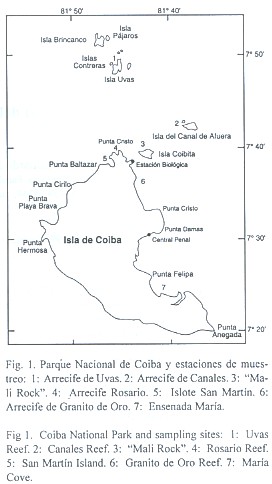
<body><![CDATA[<BR><FONT FACE="Arial,Helvetica"><FONT SIZE=-1>&nbsp;</FONT></FONT>     <BR><FONT FACE="Arial,Helvetica"><FONT SIZE=-1>&nbsp;</FONT></FONT>     <BR><FONT FACE="Arial,Helvetica"><FONT SIZE=-1>El Parque Nacional de Coiba se encuentra situado en el Oc&eacute;ano Pac&iacute;fico, entre los 7&ordm; 10’ y 7&ordm; 53’ N y entre 81&ordm; 32’ y 81&ordm; 56’ W (<A HREF="#fig1">Fig. 1</A>). Est&aacute; formado por un archipi&eacute;lago de numerosas islas e islotes; la mayor es la de Coiba, que da nombre a todo el Parque. La extensi&oacute;n total del Parque mar&iacute;timo terrestre es de 270 125 ha, de las que 216 543 pertenecen al entorno marino, lo que le convierte en uno de los parques nacionales con mayor superficie marina protegida de todo el mundo (<A HREF="#Velayos">Velayos <I>et al.&nbsp;</I> 1997</A>).</FONT></FONT>      <P><FONT FACE="Arial,Helvetica"><FONT SIZE=-1>Los an&eacute;lidos poliquetos del Pac&iacute;fico paname&ntilde;o en general y los s&iacute;lidos en particular son muy poco conocidos. Los escasos trabajos en los que se mencionan s&iacute;lidos existentes en la zona son los de <A HREF="#Monro28">Monro (1928)</A>, que abarca todo el Pac&iacute;fico, <A HREF="#Monro33">Monro (1933)</A>, sobre Panam&aacute; y Gal&aacute;pagos, <A HREF="#Fauchald75">Fauchald &amp; Reiner (1975)</A> y <A HREF="#Fauchald77">Fauchald (1977)</A>, que trabajaron en las dos costas de Panam&aacute;, as&iacute; como el de <A HREF="#Lopez">L&oacute;pez <I>et al.&nbsp;</I> (1997)</A>, en el que se presentan resultados preliminares sobre los poliquetos del Parque Nacional de Coiba. En este &uacute;ltimo trabajo se citan por primera vez en el Pac&iacute;fico de Panam&aacute; algunas de las especies que aparecen en este art&iacute;culo. En los trabajos anteriores, hay algunas citas de s&iacute;lidos en Coiba que no se han encontrado en las campa&ntilde;as realizadas por nuestro equipo. Hay, adem&aacute;s, otros trabajos en los que se citan especies de regiones relativamente pr&oacute;ximas, como los de <A HREF="#Rioja">Rioja (1941 y 1943)</A> del Pac&iacute;fico mexicano, <A HREF="#Hartmann59">Hartmann-Schr&ouml;der (1959)</A> de El Salvador, <A HREF="#Hartman68">Hartman (1968)</A> de California, Westheide (1974) de Gal&aacute;pagos, <A HREF="#Laverde-Castillo">Laverde-Castillo (1986)</A> del Pac&iacute;fico colombiano, <A HREF="#Salazar">Salazar-Vallejo <I>et al.&nbsp;</I> (1988)</A> de M&eacute;xico, <A HREF="#Maurer">Maurer <I>et al.&nbsp;</I> (1988)</A> de Costa Rica, <A HREF="#Gongora">G&oacute;ngora-Garza &amp; Le&oacute;n Gonzalez (1993)</A> del Pac&iacute;fico mexicano y <A HREF="#Kudenov">Kudenov &amp; Harris (1995)</A> de California.</FONT></FONT>      <P><FONT FACE="Arial,Helvetica"><FONT SIZE=-1>Los sutratos duros m&aacute;s caracter&iacute;sticos de este Parque son los fondos coralinos, poco diversos en especies de corales hermat&iacute;picos y constituidos predominantemente por especies del g&eacute;nero <I>Pocillopora</I>, los fondos rocosos cubiertos del telest&aacute;ceo <I>Telesto</I> cf. <I>multiflora </I>y los escasos fondos de algas, la mayor&iacute;a de los cuales est&aacute;n formados por peque&ntilde;as manchas sobre cascajo de coral o sobre rocas.</FONT></FONT>      <P><FONT FACE="Arial,Helvetica"><FONT SIZE=-1>En este trabajo se presentan los resultados del estudio de las especies de s&iacute;lidos (subfamilia Syllinae) asociados a fondos duros, encontradas en las campa&ntilde;as cient&iacute;ficas realizadas en junio de 1996, febrero de 1997, noviembre de 1997 y septiembre de 1998. Estas campa&ntilde;as se hicieron con el objetivo de confeccionar un inventario de flora y fauna marina, dentro de un proyecto de cooperaci&oacute;n entre INRENARE (Instituto de Recursos Natutales Renovables) de Panam&aacute;, ICONA (Instituto para la Conservaci&oacute;n de la Naturaleza) de Espa&ntilde;a y AECI (Agencia Espa&ntilde;ola de Cooperaci&oacute;n Internacional), de inventariar la flora y fauna de Parque Nacional de Coiba.</FONT></FONT>      <P><B><FONT FACE="Arial,Helvetica"><FONT SIZE=-1>Materiales y m&eacute;todos</FONT></FONT></B>     <BR><B><FONT FACE="Arial,Helvetica"><FONT SIZE=-1>&nbsp;</FONT></FONT></B>     <BR><FONT FACE="Arial,Helvetica"><FONT SIZE=-1>Las muestras corresponden a sustratos duros:&nbsp; bloques de coral muerto (<I>Pocillopora</I> spp.), <I>T.</I> cf<I>. multiflora</I>, las algas <I>Dictyota</I> cf. <I>flabellata</I> y <I>Padina</I> cf. <I>durvillaei</I> y algas cespitosas sin identificar<I>.</I> La localizaci&oacute;n de las estaciones de muestreo pueden observarse en la <A HREF="#fig1">fig. 1</A>.</FONT></FONT>     <BR><FONT FACE="Arial,Helvetica"><FONT SIZE=-1>&nbsp;</FONT></FONT>     ]]></body>
<body><![CDATA[<CENTER><A NAME="fig1"></A><IMG SRC="/img/fbpe/rbt/v49n1/2329i01.JPG" HEIGHT=484 WIDTH=272></CENTER> <FONT FACE="Arial,Helvetica"><FONT SIZE=-1>&nbsp;</FONT></FONT>     
<BR><FONT FACE="Arial,Helvetica"><FONT SIZE=-1>Las muestras tomadas son las siguientes:</FONT></FONT>      <P><FONT FACE="Arial,Helvetica"><FONT SIZE=-1>CM2 N97:&nbsp; Arrecife de Granito de Oro, -4.5 m, 4.400 gr, 95% de coral muerto, 75 % recubrimiento algal y epifauna.</FONT></FONT>      <P><FONT FACE="Arial,Helvetica"><FONT SIZE=-1>CM3 N97:&nbsp; Ensenada Mar&iacute;a, -5.8 m, 4.400 gr, 100% coral muerto, 80% de recubrimiento algal.</FONT></FONT>      <P><FONT FACE="Arial,Helvetica"><FONT SIZE=-1>CM4 N97:&nbsp; Arrecife Rosario, -2.5 m, 4.100 gr, 100% coral muerto y recubierto de algas calc&aacute;reas.</FONT></FONT>      <P><FONT FACE="Arial,Helvetica"><FONT SIZE=-1>CM5 N97:&nbsp; Arrecife de Uvas, -6 m, 4.000 gr, 100% coral muerto y totalmente recubierto.</FONT></FONT>      <P><FONT FACE="Arial,Helvetica"><FONT SIZE=-1>CM1 S98:&nbsp; Arrecife Canales, -1m, 3.500 gr, 100% coral muerto cubierto de algas.</FONT></FONT>      <P><FONT FACE="Arial,Helvetica"><FONT SIZE=-1>CM2 S98:&nbsp; Arrecife de Granito de Oro, -2 m, 3000 gr, 100% coral muerto recubierto de algas.</FONT></FONT>      <P><FONT FACE="Arial,Helvetica"><FONT SIZE=-1>CM3 S98:&nbsp; Ensenada Mar&iacute;a, -2 m, 3.600gr, 100% coral muerto sin recubrimiento.</FONT></FONT>      <P><FONT FACE="Arial,Helvetica"><FONT SIZE=-1>CM4 S98:&nbsp; Arrecife Rosario, -1.2 m, 3.900gr, 100% coral muerto recubierto de algas calc&aacute;reas y cespitosas.</FONT></FONT>      ]]></body>
<body><![CDATA[<P><FONT FACE="Arial,Helvetica"><FONT SIZE=-1>CM5 S98:&nbsp; Arrecife de Uvas, -2 m, 6000gr, 100% muerto sin recubrimiento.</FONT></FONT>      <P><FONT FACE="Arial,Helvetica"><FONT SIZE=-1>T1 F97:&nbsp; Islote San Mart&iacute;n, 7-II-97, -16m, 25x25 cm.</FONT></FONT>      <P><FONT FACE="Arial,Helvetica"><FONT SIZE=-1>T2 F97:&nbsp; Islote San Mart&iacute;n, 7-II-97, -12m, 25x25 cm.</FONT></FONT>      <P><FONT FACE="Arial,Helvetica"><FONT SIZE=-1>T1 N97:&nbsp; Mali Rock, 15 m, 25x25 cm.</FONT></FONT>      <P><FONT FACE="Arial,Helvetica"><FONT SIZE=-1>T2 N97:&nbsp; Bajo San&nbsp; Mart&iacute;n, -18 m, 25x25 cm, poca densidad de telest&aacute;ceos.</FONT></FONT>      <P><FONT FACE="Arial,Helvetica"><FONT SIZE=-1>AL1 J96:&nbsp; Granito de Oro, 20-IV-96, -3m, <I>Dictyota</I> cf. <I>flabellata</I>.</FONT></FONT>      <P><FONT FACE="Arial,Helvetica"><FONT SIZE=-1>AL2 J96:&nbsp; Granito de Oro, 20-IV-96, -2m. <I>Padina</I> cf. <I>durvillaei</I>.</FONT></FONT>      <P><FONT FACE="Arial,Helvetica"><FONT SIZE=-1>AL3 J96:&nbsp; Ensenada Mar&iacute;a, 23-IV-96, <I>Padina</I> cf. <I>durvilleai</I>.</FONT></FONT>      <P><FONT FACE="Arial,Helvetica"><FONT SIZE=-1>AL1 F97:&nbsp; Arrecife de Uvas, 6-II-97, -6 m, algas cespitosas.</FONT></FONT>      <P><FONT FACE="Arial,Helvetica"><FONT SIZE=-1>La metodolog&iacute;a de muestreo vari&oacute; en funci&oacute;n del sustrato. Para cada muestra de material arrecifal, dos buceadores con escafandra aut&oacute;noma seleccionaron y<I>,</I> con la ayuda de una piqueta, tomaron bloques de coral muerto del g&eacute;nero <I>Pocillopora </I>con un peso aproximado de 4 kg. El bloque, extra&iacute;do completo, se introdujo en una bolsa estanca para que no escapase ning&uacute;n animal y se traslad&oacute; a tierra para su posterior tratamiento.</FONT></FONT>      ]]></body>
<body><![CDATA[<P><FONT FACE="Arial,Helvetica"><FONT SIZE=-1>El bloque de coral, tras ser pesado, se dej&oacute; en agua de mar durante 24 horas, de forma que, la mayor&iacute;a de los animales m&oacute;viles desalojaron el coral por anoxia. Despu&eacute;s, se procedi&oacute; a la rotura del bloque en piezas peque&ntilde;as que permitieran la extracci&oacute;n de la criptofauna, con ayuda de unas pinzas. La fauna se dividi&oacute; en diferentes fracciones seg&uacute;n su tama&ntilde;o, haci&eacute;ndola pasar por tamices con diferente luz de malla (1mm, 0.5 mm y 0.25 mm). Cada fracci&oacute;n se fij&oacute; en formaldehido al 10% en agua de mar y se guard&oacute; en alcohol al 70% para despu&eacute;s ser estudiada con detenimiento en el laboratorio. Las muestras estudiadas pertenecen a las fracciones mayores (1mm), excepto la muestra CM4 N97, tambi&eacute;n se estudi&oacute; la fracci&oacute;n retenida por el tamiz de luz de malla de 0.5 mm, con el fin de tener una representaci&oacute;n de la fauna de s&iacute;lidos de peque&ntilde;o tama&ntilde;o.</FONT></FONT>      <P><FONT FACE="Arial,Helvetica"><FONT SIZE=-1>Para la toma de muestras de <I>Telesto </I>cf<I>. multiflora </I>se rasparon cuadrados de 25x25 cm sobre rocas cubiertas con este telest&aacute;ceo. Bajo una lupa se separaron los organismos epibiontes, se guardaron en frascos con formaldehido al 10% en agua de mar para su fijaci&oacute;n y se cambiaron despu&eacute;s a alcohol 70% para su conservaci&oacute;n.</FONT></FONT>      <P><FONT FACE="Arial,Helvetica"><FONT SIZE=-1>Finalmente, se tomaron muestras mediante raspado de 25x25 cm en los escasos rodales de algas que se encontraron en la zona:&nbsp; (<I>Dictyota</I> cf. <I>flabellata</I>., <I>Padina</I> cf. <I>durvillaei</I>. y algas cespitosas sin identificar). El tratamiento de fijaci&oacute;n y conservaci&oacute;n es id&eacute;ntico que en las muestras anteriores.</FONT></FONT>      <P><FONT FACE="Arial,Helvetica"><FONT SIZE=-1>Ya en el laboratorio, las muestras fueron separadas por grupos taxon&oacute;micos para repartirlos as&iacute; entre los especialistas correspondientes. Los ejemplares de la familia Syllidae se separaron del resto de las familias de poliquetos para su posterior identificaci&oacute;n. &Eacute;sta se realiz&oacute; con lupa binocular, microscopio &oacute;ptico y microscopio electr&oacute;nico de barrido (SEM) en el caso de ejemplares de la nueva especie, previamente deshidratados (punto cr&iacute;tico) y cubiertos con 30 nm de oro. Las medidas se realizaron usando un microscopio provisto de un sistema interferencial de Nomarsky y los dibujos se realizaron a&ntilde;adiendo al mismo un tubo de dibujo con c&aacute;mara clara. Los ejemplares se conservan en alcohol, excepto algunos ejemplares que se conservan montados en un portaobjetos, en preparaci&oacute;n permanente con gel de glicerina, para su estudio al microscopio. El material estudiado se deposit&oacute; en el Museo Nacional de Ciencia Naturales de Madrid (MNCNM), Espa&ntilde;a.</FONT></FONT>      <P><B><FONT FACE="Arial,Helvetica"><FONT SIZE=-1>Resultados</FONT></FONT></B>      <P><FONT FACE="Arial,Helvetica"><FONT SIZE=-1>En este trabajo se ofrecen los resultados del estudio de la subfamilia Syllinae, dejando las restantes subfamilias para otro posterior. Se han examinado un total de 1 817 ejemplares pertenecientes a 22 especies y 6 g&eacute;neros. De estas especies, las que se citan por primera para el Pac&iacute;fico oriental se se&ntilde;alan con ***, las nuevas citas para el Pac&iacute;fico de Centroam&eacute;rica con ** y las nuevas citas para Panam&aacute; con *.</FONT></FONT>     <CENTER><FONT FACE="Arial,Helvetica"><FONT SIZE=-1>Familia Syllidae Grube, 1850</FONT></FONT></CENTER>      <CENTER><FONT FACE="Arial,Helvetica"><FONT SIZE=-1>Subfamilia Syllinae Grube, 1850</FONT></FONT></CENTER>      <CENTER><FONT FACE="Arial,Helvetica"><FONT SIZE=-1>G&eacute;nero<I> Branchiosyllis</I> Elhers, 1887</FONT></FONT></CENTER>      <CENTER><FONT FACE="Arial,Helvetica"><FONT SIZE=-1><I>Branchiosyllis exilis</I> (Gravier, 1900)</FONT></FONT></CENTER>       ]]></body>
<body><![CDATA[<P><FONT FACE="Arial,Helvetica"><FONT SIZE=-1><I>Syllis (Typosyllis) exilis</I>:&nbsp; Day 1967:&nbsp; 250, fig 12.4h-j.</FONT></FONT>     <BR><FONT FACE="Arial,Helvetica"><FONT SIZE=-1><I>Branchiosyllis exilis</I>:&nbsp; Westheide 1974:&nbsp; 60, fig. 26, Uebelacker 1984:&nbsp; 30-105, fig. 30-105.</FONT></FONT>      <P><FONT FACE="Arial,Helvetica"><FONT SIZE=-1><B>Material examinado</B>:&nbsp; CM2N97(1), CM4N97(13), CM5N97(1), CM2S98(2), CM4S98(2), T1F97(2), T2F97(2), AL2J96(2), AL3J96(1), AL1F97(6).</FONT></FONT>      <P><FONT FACE="Arial,Helvetica"><FONT SIZE=-1><B>Distribuci&oacute;n</B> :&nbsp; Circuntropical.</FONT></FONT>     <CENTER><FONT FACE="Arial,Helvetica"><FONT SIZE=-1>** <I>Branchiosyllis pacifica</I> Rioja, 1941</FONT></FONT></CENTER>       <P><FONT FACE="Arial,Helvetica"><FONT SIZE=-1><I>Branchiosyllis pacifica</I> Rioja, 1941:&nbsp; 698-700, l&aacute;m. IV fig. 1-5.</FONT></FONT>      <P><FONT FACE="Arial,Helvetica"><FONT SIZE=-1><B>Material examinado</B>:&nbsp; CM2N97(1), T2F97(1), AL1F97(2).</FONT></FONT>      <P><FONT FACE="Arial,Helvetica"><FONT SIZE=-1><B>Distribuci&oacute;n</B>:&nbsp; Pac&iacute;fico (M&eacute;xico y Panam&aacute;)</FONT></FONT>     <CENTER><FONT FACE="Arial,Helvetica"><FONT SIZE=-1>G&eacute;nero <I>Haplosyllis</I> Langerhans, 1879</FONT></FONT></CENTER>      <CENTER><FONT FACE="Arial,Helvetica"><FONT SIZE=-1><I>Haplosyllis spongicola</I> (Grube, 1855)</FONT></FONT></CENTER>       ]]></body>
<body><![CDATA[<P><FONT FACE="Arial,Helvetica"><FONT SIZE=-1><I>Haplosyllis spongicola</I>:&nbsp; Monro 1933:&nbsp; 34, Imajima 1966a:&nbsp; 220-221, fig. 38 a-h, Hartman 1968:&nbsp; 433 fig. 1-4, Westheide 1974:&nbsp; 227, fig. 14, Fauchald &amp; Reiner 1975:&nbsp; 83, Fauchald 1977:&nbsp; 19, Uebelacker 1984:&nbsp; 30-109, fig. 30-104, L&oacute;pez <I>et al.&nbsp;</I> 1997:&nbsp; 63.</FONT></FONT>      <P><FONT FACE="Arial,Helvetica"><FONT SIZE=-1><B>Material examinado</B>:&nbsp; CM3N97(2), CM4N97(81), CM5N97(5), CM1S98(1), CM2S98(3), CM3S98(6), CM4S98(4), CM5S98(8), T2F97(6), T2N97(4), AL1F97(16).</FONT></FONT>      <P><FONT FACE="Arial,Helvetica"><FONT SIZE=-1><B>Distribuci&oacute;n</B>:&nbsp; Cosmopolita en mares templados y c&aacute;lidos.</FONT></FONT>      <P><FONT FACE="Arial,Helvetica"><FONT SIZE=-1><B>Discusi&oacute;n</B>:&nbsp; Esta especie presenta una enorme variabilidad de morfolog&iacute;as. Nuestros ejemplares se han comparado con ejemplares de Mallorca (Mediterr&aacute;neo occidental) y Cuba y aparentemente se trata de la misma especie, comparados con la descripci&oacute;n de <A HREF="#Uebelacker">Uebelacker (1984)</A> nuestros ejemplares no tienen una constricci&oacute;n en la ac&iacute;culas y las sedas. Ser&iacute;a de gran importancia realizar una revisi&oacute;n de los diferentes morfotipos de todo el mundo.</FONT></FONT>     <CENTER><FONT FACE="Arial,Helvetica"><FONT SIZE=-1>G&eacute;nero <I>Opisthosyllis</I> Langerhans, 1879</FONT></FONT></CENTER>      <CENTER><FONT FACE="Arial,Helvetica"><FONT SIZE=-1><I>Opisthosyllis brunnea</I> Langerhans, 1879</FONT></FONT></CENTER>       <P><FONT FACE="Arial,Helvetica"><FONT SIZE=-1><I>Opisthosyllis brunnea</I>:&nbsp; Imajima 1966a:&nbsp; 230-233, fig. 42 a-n, Day 1967:&nbsp; 253, fig. 12.5 c-e, Fauchald &amp; Reiner 1975:&nbsp; 183, Fauchald 1977:&nbsp; 20, L&oacute;pez <I>et al.&nbsp;</I> 1997:&nbsp; 63.</FONT></FONT>      <P><FONT FACE="Arial,Helvetica"><FONT SIZE=-1><B>Material examinado</B>:&nbsp; CM4N97(1), CM2S98(8), CM4S98(7), AL3J96(1).</FONT></FONT>      <P><FONT FACE="Arial,Helvetica"><FONT SIZE=-1><B>Distribuci&oacute;n</B>:&nbsp; Atl&aacute;ntico oriental (de Madeira a Rep&uacute;blica Sudafricana); &Iacute;ndico (Mozambique, Somalia); Mediterr&aacute;neo. Pac&iacute;fico (Jap&oacute;n, Corea y Panam&aacute;).</FONT></FONT>     <CENTER><FONT FACE="Arial,Helvetica"><FONT SIZE=-1>G&eacute;nero <I>Parasphaerosyllis</I> Monro, 1937</FONT></FONT></CENTER>      ]]></body>
<body><![CDATA[<CENTER><FONT FACE="Arial,Helvetica"><FONT SIZE=-1><I>Parasphaerosyllis</I> sp.</FONT></FONT></CENTER>       <P><FONT FACE="Arial,Helvetica"><FONT SIZE=-1><B>Material examinado</B>:&nbsp; CM4N97(2).</FONT></FONT>      <P><FONT FACE="Arial,Helvetica"><FONT SIZE=-1><B>Discusi&oacute;n</B>:&nbsp; Ejemplares similares a <I>P.indica</I> Monro, 1937, aunque difieren de esta especie en que los artejos de las sedas de la mitad del cuerpo son unidentados en vez de bidentados.</FONT></FONT>     <CENTER><FONT FACE="Arial,Helvetica"><FONT SIZE=-1>G&eacute;nero <I>Syllis</I> Savigny, 1818</FONT></FONT></CENTER>       <P><FONT FACE="Arial,Helvetica"><FONT SIZE=-1>Para este g&eacute;nero se sigue la sistem&aacute;tica propuesta por <A HREF="#SanMartin84">San Mart&iacute;n (1984 y 1992)</A>.</FONT></FONT>      <P><FONT FACE="Arial,Helvetica"><FONT SIZE=-1><I>Syllis aciculata</I> (Treadwell, 1945)</FONT></FONT>      <P><FONT FACE="Arial,Helvetica"><FONT SIZE=-1><I>Typosyllis aciculata</I>:&nbsp; Reish 1950:&nbsp; 1-5, figs. 1-8, Hartman 1968:&nbsp; 475-476+p. 473, textfigs. 1-7, Fauchald &amp; Reiner 1975:&nbsp; 84.</FONT></FONT>      <P><FONT FACE="Arial,Helvetica"><FONT SIZE=-1><I>Syllis aciculata</I>:&nbsp; G&oacute;ngora-Garza &amp; de Le&oacute;n-Gonz&aacute;lez 1993: 27.</FONT></FONT>      <P><FONT FACE="Arial,Helvetica"><FONT SIZE=-1><B>Material examinado</B>:&nbsp; CM4N97(1).</FONT></FONT>      <P><FONT FACE="Arial,Helvetica"><FONT SIZE=-1><B>Distribuci&oacute;n</B>:&nbsp; California. Pac&iacute;fico de Panam&aacute;.</FONT></FONT>     ]]></body>
<body><![CDATA[<CENTER><FONT FACE="Arial,Helvetica"><FONT SIZE=-1><I>Syllis alternata</I> Moore, 1908</FONT></FONT></CENTER>       <P><FONT FACE="Arial,Helvetica"><FONT SIZE=-1><I>Syllis alternata</I>:&nbsp; Berkeley &amp; Berkeley 1938:&nbsp; 37-38, fig. 3; 1948:&nbsp; 77, fig. 115, Rioja 1941:&nbsp; 691-692, lam. 3 fig. 1-9, L&oacute;pez <I>et al.&nbsp;</I> 1997:&nbsp; 63.</FONT></FONT>      <P><FONT FACE="Arial,Helvetica"><FONT SIZE=-1><I>Syllis (Typosyllis)</I> cf. <I>alternata</I>:&nbsp; Uebelacker 1984:&nbsp; 141-143, fig. 136.</FONT></FONT>      <P><FONT FACE="Arial,Helvetica"><FONT SIZE=-1><I>Syllis (Typosyllis) alternata</I>:&nbsp; Hartman 1968:&nbsp; 479, fig. 1-5, Gardiner 1976:&nbsp; 141, fig. 13 b-c.</FONT></FONT>      <P><FONT FACE="Arial,Helvetica"><FONT SIZE=-1><I>Typosyllis alternata</I>:. Imajima 1966b:&nbsp; 273-275, fig. 58 a-l, Kudenov &amp; Harris 1995:&nbsp; 83-85, fig. 1.32, Licher 1999:&nbsp; 253-255, fig. 106.</FONT></FONT>      <P><FONT FACE="Arial,Helvetica"><FONT SIZE=-1><B>Material examinado</B>:&nbsp; CM2S98(1).</FONT></FONT>      <P><FONT FACE="Arial,Helvetica"><FONT SIZE=-1><B>Distribuci&oacute;n</B>:&nbsp; Pac&iacute;fico oriental (desde Alaska a Panam&aacute;). Atl&aacute;ntico occidental (desde Carolina del norte hasta Cuba). Mediterr&aacute;neo occidental.</FONT></FONT>     <CENTER><FONT FACE="Arial,Helvetica"><FONT SIZE=-1><I>Syllis armillaris</I> (M&uuml;ller, 1771)</FONT></FONT></CENTER>       <P><FONT FACE="Arial,Helvetica"><FONT SIZE=-1><I>Typosyllis (Typosyllis) armillaris</I>:&nbsp; <A HREF="#Hartmann71">Hartmann-Schr&ouml;der 1971</A>:&nbsp; 149-150, fig. 50.</FONT></FONT>      <P><FONT FACE="Arial,Helvetica"><FONT SIZE=-1><I>Syllis armillaris</I>:&nbsp; Berkeley &amp; Berkeley 1948:&nbsp; 72 fig. 104.</FONT></FONT>      ]]></body>
<body><![CDATA[<P><FONT FACE="Arial,Helvetica"><FONT SIZE=-1><I>Typosyllis armillaris</I>:&nbsp; Hartman 1968:&nbsp; 481, fig. 1-5, Licher 1999:&nbsp; 189-196, fig. 84.</FONT></FONT>      <P><FONT FACE="Arial,Helvetica"><FONT SIZE=-1><B>Material examinado</B>:&nbsp; CM2N97(62), CM3N97(26), CM4N97(427), CM5N97(22), CM1S98(91), CM2S98(85), CM3S98(79), CM4S98(124), CM5S98(44), T1F97(6), T2F97(1), T1N97(1), T2N97(7), AL1F97(14).</FONT></FONT>      <P><FONT FACE="Arial,Helvetica"><FONT SIZE=-1><B>Distribuci&oacute;n</B>:&nbsp; Cosmopolita.</FONT></FONT>      <P><FONT FACE="Arial,Helvetica"><FONT SIZE=-1><B>Discusi&oacute;n</B>:&nbsp; Se han comparado los ejemplares de estas muestras con espec&iacute;menes del Mediterrano occidental, Atl&aacute;ntico oriental y con descripciones y dibujos de diferentes localidades, sin haberse encontrado diferencias morfol&oacute;gicas entre las diferentes &aacute;reas geogr&aacute;ficas.</FONT></FONT>     <CENTER><FONT FACE="Arial,Helvetica"><FONT SIZE=-1><I>Syllis bella</I> Chamberlin, 1919</FONT></FONT></CENTER>       <P><FONT FACE="Arial,Helvetica"><FONT SIZE=-1><I>Typosyllis bella</I>:&nbsp; Hartman 1968:&nbsp; 483, Kudenov &amp; Harris: 1995:&nbsp; 85-87, fig. 1.33, L&oacute;pez <I>et al.&nbsp;</I> 1997:&nbsp; 63, Licher 1998:&nbsp; 94-96, fig. 45.</FONT></FONT>      <P><FONT FACE="Arial,Helvetica"><FONT SIZE=-1><B>Material examinado</B>:&nbsp; CM2N97(4), CM3N97(7), CM4N97(3), CM3S98(1), T2F97(2).</FONT></FONT>      <P><FONT FACE="Arial,Helvetica"><FONT SIZE=-1><B>Distribuci&oacute;n</B>:&nbsp; California. Pac&iacute;fico de Panam&aacute;.</FONT></FONT>     <CENTER><FONT FACE="Arial,Helvetica"><FONT SIZE=-1>*** <I>Syllis beneliahuae</I> (<A HREF="#Campoyet82">Campoy y Alquezar, 1982</A>)</FONT></FONT></CENTER>       <P><FONT FACE="Arial,Helvetica"><FONT SIZE=-1><I>Langerhansia beneliahui</I> Campoy &amp; Alqu&eacute;zar, 1982:&nbsp; 124-125, fig. 3 a-p.</FONT></FONT>      ]]></body>
<body><![CDATA[<P><FONT FACE="Arial,Helvetica"><FONT SIZE=-1><I>Syllis beneliahui</I>:&nbsp; San Mart&iacute;n 1992:&nbsp; 183, fig. 1 k-m.</FONT></FONT>      <P><FONT FACE="Arial,Helvetica"><FONT SIZE=-1><I>Typosyllis beneliahuae</I>:&nbsp; Licher 1999:&nbsp; 47, fig.22.</FONT></FONT>      <P><FONT FACE="Arial,Helvetica"><FONT SIZE=-1><I>Syllis heterochaeta</I> non Moore, 1909:&nbsp; L&oacute;pez <I>et al.&nbsp;</I> 1997.</FONT></FONT>      <P><FONT FACE="Arial,Helvetica"><FONT SIZE=-1><B>Material examinado</B>:&nbsp; CM2N97(1), CM3N97(3), CM4N97(10), CM5N97(4), CM1S98(8), CM2S98(4), CM3S98(22), CM4S98(4), CM5S98(20).</FONT></FONT>      <P><FONT FACE="Arial,Helvetica"><FONT SIZE=-1><B>Distribuci&oacute;n</B>:&nbsp; Mediterr&aacute;neo occidental. At&aacute;ntico oriental. Caribe. Pac&iacute;fico de Panam&aacute;.</FONT></FONT>      <P><FONT FACE="Arial,Helvetica"><FONT SIZE=-1><B>Discusi&oacute;n</B>:&nbsp; Los ejemplares paname&ntilde;os no presentan diferencias esenciales de aquellos observados del Mediterr&aacute;neo y coinciden con la descripci&oacute;n original. Algunos ejemplares pesentan una variaci&oacute;n en la longitud de la faringe y proventr&iacute;culo, dependiendo del grado de contracci&oacute;n de estas estructuras pero el n&uacute;mero de filas musculares del proventr&iacute;culo se encuentra entre 32 y 38.</FONT></FONT>     <CENTER><FONT FACE="Arial,Helvetica"><FONT SIZE=-1>*** <I>Syllis botosaneanui</I> (<A HREF="#Hartmann73">Hartmann-Sch&ouml;der, 1973</A>)</FONT></FONT></CENTER>       <P><FONT FACE="Arial,Helvetica"><FONT SIZE=-1><I>Typosyllis (Langerhansia) botosaneanui</I> Hartmann-Schr&ouml;der, 1973:&nbsp; 90-93, Abb. 5-8.</FONT></FONT>      <P><FONT FACE="Arial,Helvetica"><FONT SIZE=-1><I>Typosyllis botosaneanui</I>:&nbsp; Licher 1999:&nbsp; 68-70, fig. 31.</FONT></FONT>      <P><FONT FACE="Arial,Helvetica"><FONT SIZE=-1><B>Material examinado</B>:&nbsp; CM4N97(1), CM2S98(1), CM3S98(1), CM4S98(1).</FONT></FONT>      ]]></body>
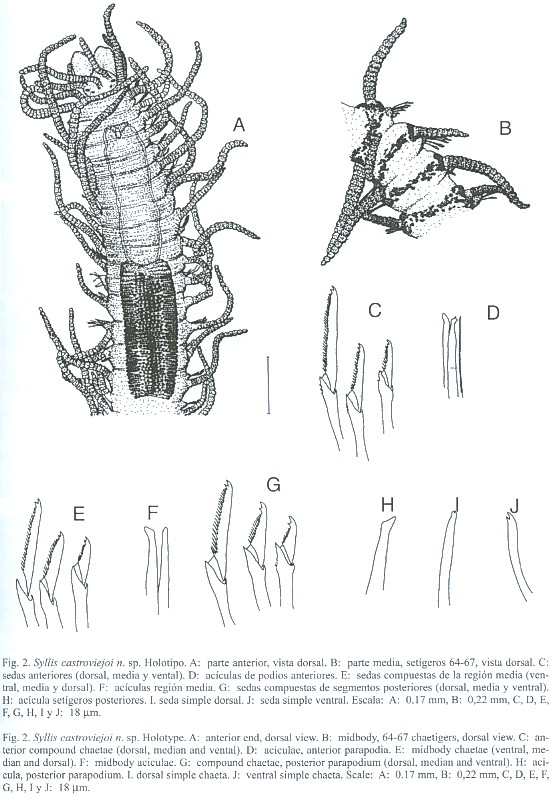
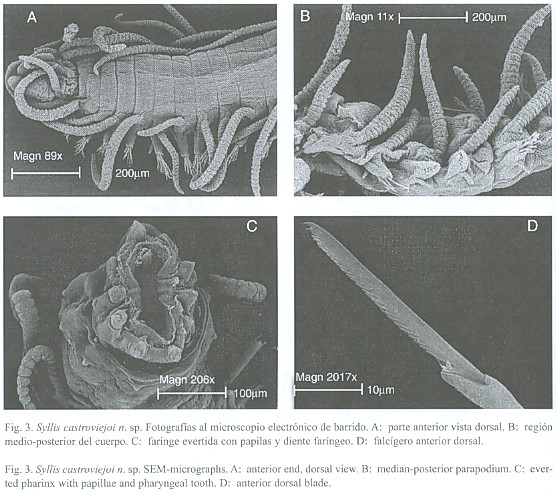
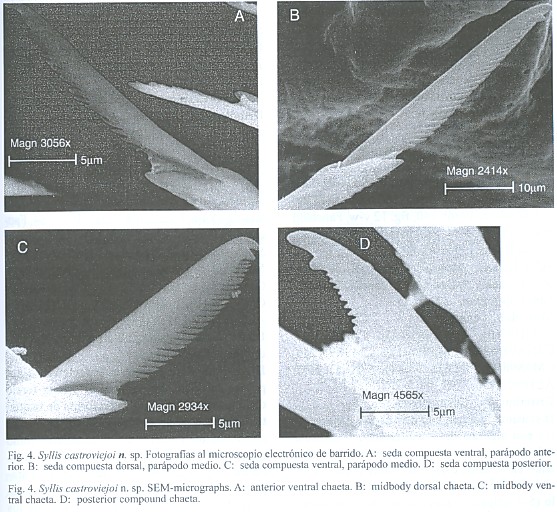
<body><![CDATA[<P><FONT FACE="Arial,Helvetica"><FONT SIZE=-1><B>Distribuci&oacute;n</B>:&nbsp; Caribe. &Iacute;ndico. Atl&aacute;ntico occidental. Pac&iacute;fico de Panam&aacute;.</FONT></FONT>     <CENTER><FONT FACE="Arial,Helvetica"><FONT SIZE=-1><I>Syllis castroviejoi</I> n. sp.</FONT></FONT></CENTER>       <P><FONT FACE="Arial,Helvetica"><FONT SIZE=-1><B>Material examinado</B>:&nbsp; Holotipo:&nbsp; CM4N97 (MNCN.16.01.6100). Paratipos:&nbsp; CM2N97(1), CM3N97(1) (MNCN.16.01.6103), CM4N97(31) (MNCN.16.01.6100), CM5N97(1) (MNCN.16.01.6102), CM1S98(1) (MNCN.16.01.6101), Material adicional:&nbsp; CM4N97 (1), CM3S98(1).</FONT></FONT>      <P><FONT FACE="Arial,Helvetica"><FONT SIZE=-1><B>Descripci&oacute;n</B>:&nbsp; El holotipo mide 11.50 mm de longitud y 0.34 mm de anchura, posee 92 set&iacute;geros. Cuerpo largo y ancho, especialmente en su parte media, ligeramente aplanado dorso-ventralmente. Prostomio pentagonal, m&aacute;s ancho que largo; 4 ojos situados en forma de trapecio abierto anteriormente. Palpos robustos, m&aacute;s largos que anchos. Antenas no muy largas en relaci&oacute;n con los primeros cirros dorsales; antena central inserta entre los ojos posteriores, con 34 artejos. Antenas laterales insertas por delante de los ojos anteriores, m&aacute;s cortas que la antena media, con 18 artejos (<A HREF="#fig2">Fig. 2A</A>, <A HREF="#fig3">3A</A>). Segmento peristomial m&aacute;s corto que el prostomio, con 2 pares de cirros tentaculares, los dorsales m&aacute;s largos que los ventrales, formados por 23 y 15 artejos respectivamente. Cirros dorsales largos en la parte anterior del cuerpo con alternancia de tama&ntilde;os en segmentos consecutivos (<A HREF="#fig2">Fig. 2A</A>, <A HREF="#fig3">3A</A>), con 31 artejos aproximadamente, los cirros m&aacute;s largos y 18 los cortos. A partir de la mitad del cuerpo, los cirros se van engrosando, manteniendo la alternancia en longitud; los cirros largos est&aacute;n formados por unos 22 artejos y los cortos por unos 11. En la parte posterior del cuerpo son muy robustos, muy anchos en la base y estrech&aacute;ndose de forma muy acentuada hacia el extremo, con 15 y 8 artejos respectivamente (<A HREF="#fig2">Fig. 2B</A>, <A HREF="#fig3">3B</A>). Los artejos de los cirros son m&aacute;s ovalados y achatados cuanto m&aacute;s se aproximan al extremo posterior y presentan inclusiones granulares de color verde-amarillento, m&aacute;s patentes a partir de la mitad posterior del cuerpo. Los cirros anales son mo niliformes, finos, con 21 artejos, acompa&ntilde;ados por un peque&ntilde;o ap&eacute;ndice inarticulado en el pigidio. Cirros ventrales digitiformes, algo m&aacute;s largos que el l&oacute;bulo parapodial en los podios anteriores y m&aacute;s corto en los restantes. Sedas compuestas heterogonfas con artejos falc&iacute;geros, claramente bidentados, con el diente proximal ligeramente m&aacute;s peque&ntilde;o que el distal y espinulaci&oacute;n algo gruesa (<A HREF="#fig2">Fig. 2C, E, G</A>, <A HREF="#fig3">3D</A>, <A HREF="#fig4">4A-D</A>). El n&uacute;mero de sedas en podios anteriores es de ocho, en los set&iacute;geros medios es de siete y seis en los posteriores. Gradaci&oacute;n dorso-ventral en la longitud de artejos muy marcada (<A HREF="#fig2">Fig. 2C</A>, E, G). Los artejos dorsal y ventral de los par&aacute;podos anteriores miden 32 y 18,4&nbsp;<IMG SRC="/img/fbpe/rbt/v49n1/u.JPG" HEIGHT=12 WIDTH=11 ALIGN=ABSBOTTOM>m respectivamente (<A HREF="#fig3">Fig. 3D</A>, <A HREF="#fig4">4A</A>), los de los par&aacute;podos medios miden 27.2 y 16<IMG SRC="/img/fbpe/rbt/v49n1/u.JPG" HEIGHT=12 WIDTH=11 ALIGN=ABSBOTTOM>m (<A HREF="#fig4">Fig. 4B, C</A>) y en los segmentos posteriores del animal, 32 y 17.6 mm (<A HREF="#fig4">Fig. 4D</A>). Mangos provistos de unas cinco peque&ntilde;as l&iacute;neas de esp&iacute;nulas (<A HREF="#fig4">Fig. 4B</A>). En cada uno de los segmentos posteriores hay una seda simple dorsal ligeramente bidentada (<A HREF="#fig2">Fig. 2I</A>) y una seda simple ventral bidentada (<A HREF="#fig2">Fig. 2J</A>). Tres ac&iacute;culas en la parte anterior del cuerpo, una de ellas muy fina (<A HREF="#fig2">Fig. 2D</A>); dos ac&iacute;culas en los segmentos de la regi&oacute;n media (<A HREF="#fig2">Fig. 2F</A>), gruesas, una con extremo recto y puntiagudo y la otra con punta afilada, oblicua y engrosada subdistalmente; una sola ac&iacute;cula posterior con la punta oblicua, engrosada subdistalmente (<A HREF="#fig2">Fig. 2H</A>). La faringe ocupa 7 segmentos, el proventr&iacute;culo 6 y est&aacute; formado por 36 filas musculares (<A HREF="#fig2">Fig. 2A</A>). El diente far&iacute;ngeo esta en el comienzo de la faringe, rodeado por 10 papilas en la embocadura de la faringe (<A HREF="#fig3">Fig. 3C</A>).</FONT></FONT>      
<P><FONT FACE="Arial,Helvetica"><FONT SIZE=-1><B>Paratipos</B>:&nbsp; Existen variaciones en algunos caracteres:&nbsp; el tama&ntilde;o en los paratipos var&iacute;a desde 119 set&iacute;geros en el mayor de los ejemplares hasta 74, el n&uacute;mero de set&iacute;geros que ocupan la faringe est&aacute; entre 8 y 13 y en el caso del proventr&iacute;culo es entre 6 y 12, el n&uacute;mero de filas musculares est&aacute; entre 37 y 46. El n&uacute;mero de artejos en antenas laterales es aproximadamente 20 mientras que la antena central var&iacute;a en los ejemplares entre 25 y 34. Los cirros dorsales tambi&eacute;n experimentan variaciones entre los individuos:&nbsp; en la parte anterior los cirro dorsales largos tienen de 38 a 23 artejos, los cortos de 23 a 15 artejos, en la parte media los cirros largos tienen de 30 a 26 artejos y los corto de 16 a 12 y en la parte posterior los cirros dorsales largos poseen entre 20 y 12 artejos y los cortos de 13 a 9. La relaci&oacute;n entre cirros dorsales largos y cortos es aproximadamente el doble en un mismo individuo. Pr&aacute;cticamente en todos los paratipos se conserva coloraci&oacute;n dorsal en la parte anterior del cuerpo, formada por finas l&iacute;neas transversales anaranjadas (<A HREF="#fig2">Fig. 2A</A>), pero en muchos casos es muy tenue; adem&aacute;s, en cada segmento de la parte media posterior los podios y cirros dorsales est&aacute;n llenos de gr&aacute;nulos y en muchos casos existe una banda dorsal transversal formada gr&aacute;nulos por que los recorren los par&aacute;podos de podio a podio (<A HREF="#fig2">Fig. 2B</A>).</FONT></FONT>     <CENTER><A NAME="fig2"></A><IMG SRC="/img/fbpe/rbt/v49n1/2329i02.JPG" HEIGHT=799 WIDTH=552></CENTER>       
<P><FONT FACE="Arial,Helvetica"><FONT SIZE=-1><B>Discusi&oacute;n</B>:</FONT></FONT>      <P><FONT FACE="Arial,Helvetica"><FONT SIZE=-1>Los caracteres diferenciales de la nueva especie son:&nbsp; que los cirros dorsales alternan en tama&ntilde;o de una forma muy marcada, y en la parte posterior son muy gruesos en la base y van estrech&aacute;ndose progresivamente hacia el extremo, as&iacute; como su patr&oacute;n de coloraci&oacute;n constituido por l&iacute;neas anaranjadas transversales en el dorso del animal y los podios y cirros dorsales con gr&aacute;nulos y las ac&iacute;culas nunca son rectas.</FONT></FONT>      <P><FONT FACE="Arial,Helvetica"><FONT SIZE=-1>Dentro del g&eacute;nero, la especie m&aacute;s parecida es <I>Syllis bella</I>; el tama&ntilde;o y coloraci&oacute;n del dorso son semejantes y las sedas son muy similares. Se diferencian en que<I> S. castroviejoi</I> tiene ac&iacute;culas engrosadas subdistalmente y provista de punta oblicua, mientras que <I>S. bella</I> tiene las ac&iacute;culas rectas y puntiagudas. Los cirros dorsales de <I>S. castroviejoi</I> est&aacute;n muy engrosados en la base, en la parte posterior del cuerpo; las antenas y cirros tentaculares tambi&eacute;n son mas cortos en la nueva especie que en <I>S. bella</I>.</FONT></FONT>      <P><FONT FACE="Arial,Helvetica"><FONT SIZE=-1><I>S. aciculata</I> tambi&eacute;n es una especie parecida. En ambas especies las ac&iacute;culas son gruesas, <I>S aciculata</I> tambi&eacute;n posee una ac&iacute;cula recta. Los cirros dorsales en esta especie son muy delgados en comparaci&oacute;n con los de <I>S. castroviejoi</I>.</FONT></FONT>      ]]></body>
<body><![CDATA[<P><FONT FACE="Arial,Helvetica"><FONT SIZE=-1><B>Etimolog&iacute;a</B>:&nbsp; Esta especie est&aacute; dedicada a Santiago Castroviejo, Director Cient&iacute;fico del proyecto Coiba.</FONT></FONT>     <BR><FONT FACE="Arial,Helvetica"><FONT SIZE=-1>&nbsp;</FONT></FONT>     <CENTER><A NAME="fig3"></A><IMG SRC="/img/fbpe/rbt/v49n1/2329i03.JPG" HEIGHT=495 WIDTH=556></CENTER>      
<CENTER>&nbsp;</CENTER>      <CENTER><A NAME="fig4"></A><IMG SRC="/img/fbpe/rbt/v49n1/2329i04.JPG" HEIGHT=512 WIDTH=557></CENTER> <FONT FACE="Arial,Helvetica"><FONT SIZE=-1>&nbsp;</FONT></FONT>     
<BR><FONT FACE="Arial,Helvetica"><FONT SIZE=-1>ENGLISH DESCRIPTION</FONT></FONT>      <P><FONT FACE="Arial,Helvetica"><FONT SIZE=-1><B>Diagnostic features</B>:&nbsp; Mediun size syllin (Holopype 11 mm long). Palps stout. Antennae and tentacular cirri shorter than dorsal cirri. Alternation on length of dorsal cirri in consecutive segments becoming shorter posteriorly (from 22-11 articles to 15-8 in holotype), but keeping the alternation in length. Posterior cirri very wide at their bases, becoming narrower at their tips, with fibrilar inclusions in the articles. Compound chaetae, bearing bidentate, falciger blades; proximal tooth sligtly smaller than distal one. Number of chaeta decreasing progresively from eight in anterior parapodia to six in posterior ones. Strong dorsoventral gradation in lenth of blades (27 to 16 mm in midbody). Posterior parapodia each with one slightly bidentated simple chaeta and a bidentated ventral simple chaeta. Three aciculae in each anterior parapodia decreasing progressively to only one in posterior ones, anterior aciculae straight and provided with acute tip, midbody parapodia each with one straight acicula and another with oblique tip; posterior aciculae with curved tip. Pharynx extending through 8-11 segments, provided with one tooth and 10 papillae located on anterir end. Proventriculus extending througth 6-12 segments, with about 37-46 muscle cell rows.</FONT></FONT>     <BR>&nbsp;     <CENTER><FONT FACE="Arial,Helvetica"><FONT SIZE=-1>*** <I>Syllis corallicola</I> Verrill, 1900</FONT></FONT></CENTER>       <P><FONT FACE="Arial,Helvetica"><FONT SIZE=-1><I>Syllis corallicola</I>:&nbsp; Monro 1933:&nbsp; 249-250, text-fig. 3; San Mart&iacute;n, 1992:&nbsp; 185-186, fig. 1 a-d.</FONT></FONT>      ]]></body>
<body><![CDATA[<P><FONT FACE="Arial,Helvetica"><FONT SIZE=-1><B>Material examinado</B>:&nbsp; CM4N97(3), T1F97(1).</FONT></FONT>      <P><FONT FACE="Arial,Helvetica"><FONT SIZE=-1><B>Distribuci&oacute;n</B>:&nbsp; Atl&aacute;ntico occidental (desde las Islas Bermudas hasta las Antillas) y oriental (desde el N de la Pen&iacute;nsula Ib&eacute;rica hasta las Islas Canarias). Mediterr&aacute;neo. Pac&iacute;fico de Panam&aacute;.</FONT></FONT>     <BR>&nbsp;     <CENTER><FONT FACE="Arial,Helvetica"><FONT SIZE=-1>*** <I>Syllis garciai</I> (Campoy, 1982)</FONT></FONT></CENTER>       <P><FONT FACE="Arial,Helvetica"><FONT SIZE=-1><I>Langerhansia garciai</I> Campoy, 1982:&nbsp; 386, lam. 36-38.</FONT></FONT>      <P><FONT FACE="Arial,Helvetica"><FONT SIZE=-1><I>Syllis garciai</I>:&nbsp; San Mart&iacute;n 1984:&nbsp; 364, fig. 92; San Mart&iacute;n 1992:&nbsp; 180-181, fig. 5 a-d.</FONT></FONT>      <P><FONT FACE="Arial,Helvetica"><FONT SIZE=-1><B>Material examinado</B>:&nbsp; CM1S98(2).</FONT></FONT>      <P><FONT FACE="Arial,Helvetica"><FONT SIZE=-1><B>Distribuci&oacute;n</B>:&nbsp; Pen&iacute;nsula Ib&eacute;rica (costa atl&aacute;ntica y mediterr&aacute;nea). Canarias; Cabo Verde. Cuba. Pac&iacute;fico de Panam&aacute;.</FONT></FONT>      <P><FONT FACE="Arial,Helvetica"><FONT SIZE=-1><B>Discusi&oacute;n</B>:&nbsp; No existen diferencias aparentes entre los ejemplares del Mediterr&aacute;neo, la descripci&oacute;n y figuras de Licher (1999) y nuestros ejemplares.</FONT></FONT>     <CENTER><FONT FACE="Arial,Helvetica"><FONT SIZE=-1><I>Syllis gracilis</I> Grube,1840</FONT></FONT></CENTER>       ]]></body>
<body><![CDATA[<P><FONT FACE="Arial,Helvetica"><FONT SIZE=-1><I>Syllis gracilis</I>:&nbsp; Monro 1933:&nbsp; 30, Hartman 1968: 463, fig. 1-4, Imajima 1966a:&nbsp; 248-250, fig. 49 a-k, Fauchald &amp; Reiner 1975:&nbsp; 83, Fauchald 1977:&nbsp; 20-21, L&oacute;pez <I>et al.&nbsp;</I> 1997:&nbsp; 63.</FONT></FONT>      <P><FONT FACE="Arial,Helvetica"><FONT SIZE=-1><I>Syllis (Syllis) gracilis</I>:&nbsp; Gardiner 1976:&nbsp; 139, fig. 12 l-n, Uebelacker 1984:&nbsp; 30-106 fig. 30-102.</FONT></FONT>      <P><FONT FACE="Arial,Helvetica"><FONT SIZE=-1><B>Material examinado</B>:&nbsp; CM2N97(3), CM3N97(6), CM4N97(153), CM5N97(53), CM1S98(8), CM2S98(4), CM3S98(22), CM4S98(7), CM5S98(2), T2F97(2), T1N97(7), AL1F97(1).</FONT></FONT>      <P><FONT FACE="Arial,Helvetica"><FONT SIZE=-1><B>Distribuci&oacute;n</B>:&nbsp; Cosmopolita en mares c&aacute;lidos y templados.</FONT></FONT>      <P><FONT FACE="Arial,Helvetica"><FONT SIZE=-1><B>Discusi&oacute;n</B>:&nbsp; Los ejemplares recolectados en Coiba son en general de menor tama&ntilde;o que los del Mediterr&aacute;neo (Albor&aacute;n, Islas Columbretes e Ibiza) y con menor n&uacute;mero de segmentos. En todos los ejemplares se observan las caracter&iacute;sticas fundamentales de la especie:&nbsp; sedas compuestas de la mitad del cuerpo con artejos fusionado a los mangos, formando unas gruesas sedas simples. Cirros engrosados y cortos en la parte posterior del cuerpo y ac&iacute;culas acuminadas. Existen variaciones en longitud de faringe y proventr&iacute;culo, filas musculares del proventr&iacute;culo, segmento de aparici&oacute;n de la primera seda con el artejo soldado al mango, coloraci&oacute;n dorsal, etc. incluso dentro de una misma muestra. Sin embargo no se aprecian diferencias entre ejemplares del mismo tama&ntilde;o del Mediterr&aacute;neo y Pac&iacute;fico paname&ntilde;o.</FONT></FONT>     <BR>&nbsp;     <CENTER><FONT FACE="Arial,Helvetica"><FONT SIZE=-1><I>Syllis hyalina</I> Grube, 1863</FONT></FONT></CENTER>       <P><FONT FACE="Arial,Helvetica"><FONT SIZE=-1><I>Typosyllis hyalina</I>:&nbsp; Imajima 1966b:&nbsp; 271-273, text-fig. 57 a-k, Hartman, 1968:&nbsp; 487-488, fig. 1-3, Gardiner 1976:&nbsp; 140, fig. 12 v-w, Fauchald &amp; Reiner 1975:&nbsp; 84, Fauchald 1977:&nbsp; 22, Kudenov &amp; Harris 1995:&nbsp; 87-89, fig. 1.34.</FONT></FONT>      <P><FONT FACE="Arial,Helvetica"><FONT SIZE=-1><I>Syllis hyalina</I>:&nbsp; Monro 1933:&nbsp; 30, Rioja 1941:&nbsp; 692, Berkeley &amp; Berkeley 1948:&nbsp; 74, fig. 107-108, L&oacute;pez <I>et al.&nbsp;</I> 1997:&nbsp; 63.</FONT></FONT>      <P><FONT FACE="Arial,Helvetica"><FONT SIZE=-1><B>Material examinado</B>:&nbsp; CM2N97(1), CM3N97(6), CM4N97(13), CM5N97(3), CM1S98(47), CM2S98(1), CM3S98(21), CM4S98(7), CM5S98(41), AL1J96(1), AL1F97(1).</FONT></FONT>      ]]></body>
<body><![CDATA[<P><FONT FACE="Arial,Helvetica"><FONT SIZE=-1><B>Distribuci&oacute;n</B>:&nbsp; Cosmopolita.</FONT></FONT>      <P><FONT FACE="Arial,Helvetica"><FONT SIZE=-1><B>Discusi&oacute;n</B>:&nbsp; Se han comparado estos ejemplares con algunos del Mediterr&aacute;neo (Pen&iacute;nsula Ib&eacute;rica) y han resultado ser muy parecidos, tanto en tama&ntilde;o, como en la longitud de la faringe (5-7 set&iacute;geros), longitud del proventr&iacute;culo (5-7 set&iacute;geros), n&uacute;mero de filas musculares (30-33), inserci&oacute;n y tama&ntilde;os de las antenas, forma de las sedas, la forma de las ac&iacute;culas y el n&uacute;mero de ellas presentes por par&aacute;podo (2-1).</FONT></FONT>     <BR>&nbsp;     <CENTER><FONT FACE="Arial,Helvetica"><FONT SIZE=-1>** <I>Syllis magna </I>(<A HREF="#Westheide">Westheide, 1974</A>)</FONT></FONT></CENTER>       <P><FONT FACE="Arial,Helvetica"><FONT SIZE=-1><I>Elhersia rosea magna</I> Westheide, 1974:&nbsp; 41-45, fig. 17-18.</FONT></FONT>      <P><FONT FACE="Arial,Helvetica"><FONT SIZE=-1><I>Typosyllis magna:&nbsp;</I> Licher 1999:&nbsp; 49, fig. 23.</FONT></FONT>      <P><FONT FACE="Arial,Helvetica"><FONT SIZE=-1><I>Syllis heterochaeta</I> (non Moore, 1909) L&oacute;pez <I>et al.&nbsp;</I> 1997 (en parte).</FONT></FONT>      <P><FONT FACE="Arial,Helvetica"><FONT SIZE=-1><B>Material examinado</B>:&nbsp; CM2N97(1), CM3N97(1), CM4N97(11), CM5N97(34), CM3S98(10), CM4S98(1), AL1J96(2), AL3J96(1), AL1F97(1).</FONT></FONT>      <P><FONT FACE="Arial,Helvetica"><FONT SIZE=-1><B>Distribuci&oacute;n</B>:&nbsp; Mediterr&aacute;neo. Islas Gal&aacute;pagos, Pac&iacute;fico de Panam&aacute;.</FONT></FONT>     <BR>&nbsp;     ]]></body>
<body><![CDATA[<CENTER><FONT FACE="Arial,Helvetica"><FONT SIZE=-1>* <I>Syllis pigmentata</I> (Chamberlin, 1919)</FONT></FONT></CENTER>       <P><FONT FACE="Arial,Helvetica"><FONT SIZE=-1><I>Syllis pulchra</I>:&nbsp; Berkeley &amp; Berkeley 1948: 73, fig.105, Banse 1972:&nbsp; 212-214, fig.9 a-h.</FONT></FONT>      <P><FONT FACE="Arial,Helvetica"><FONT SIZE=-1><I>Typosyllis pigmentata</I>:&nbsp; Licher 1999:&nbsp; 233-235, fig.98.</FONT></FONT>      <P><FONT FACE="Arial,Helvetica"><FONT SIZE=-1><B>Material examinado</B>:&nbsp; CM2S97(1).</FONT></FONT>      <P><FONT FACE="Arial,Helvetica"><FONT SIZE=-1><B>Distribuci&oacute;n</B>:&nbsp; Pac&iacute;fico (China, Mexico, Panam&aacute;).</FONT></FONT>     <BR>&nbsp;     <CENTER><FONT FACE="Arial,Helvetica"><FONT SIZE=-1><I>Syllis prolifera</I> Krohn, 1852</FONT></FONT></CENTER>       <P><FONT FACE="Arial,Helvetica"><FONT SIZE=-1><I>Typosyllis prolifera</I>:&nbsp; Imajima 1966b:&nbsp; 292-294, text-fig 65 a-n, Fauchald &amp; Reiner 1975:&nbsp; 84, Fauchald 1977:&nbsp; 22, Licher 1999:&nbsp; 135-140, fig. 61.</FONT></FONT>      <P><FONT FACE="Arial,Helvetica"><FONT SIZE=-1><I>Syllis prolifera</I>:&nbsp; L&oacute;pez <I>et al.&nbsp;</I> 1997:&nbsp; 63.</FONT></FONT>      <P><FONT FACE="Arial,Helvetica"><FONT SIZE=-1><B>Material examinado</B>:&nbsp; CM2N97(1), CM3N97(1), CM4N97(11), CM5N97(34), CM3S98(10), CM4S98(1), AL1J96(2), AL3J96(1), AL1F97(1).</FONT></FONT>      ]]></body>
<body><![CDATA[<P><FONT FACE="Arial,Helvetica"><FONT SIZE=-1><B>Distribuci&oacute;n</B>:&nbsp; Cosmopolita en mares templados y c&aacute;lidos.</FONT></FONT>      <P><FONT FACE="Arial,Helvetica"><FONT SIZE=-1><B>Discusi&oacute;n</B>:&nbsp; Esta especie es caracter&iacute;stica por poseer un diente far&iacute;ngeo en el primer tercio de la faringe y las ac&iacute;culas en forma de baqueta. Es una especie cosmopolita en la que se conservan bien determinados caracteres como n&uacute;mero de filas musculares del poventr&iacute;culo (entre 23 y 27), n&uacute;mero de sedas en los par&aacute;podos de las distintas partes del cuerpo, el n&uacute;mero de ac&iacute;culas, el numero de artejos de los cirros dorsales independientemente de la localidad donde se tomen las muestras. (Comparados con ejemplares del Mediterr&aacute;neo occidental y Atl&aacute;ntico oriental)</FONT></FONT>     <BR>&nbsp;     <CENTER><FONT FACE="Arial,Helvetica"><FONT SIZE=-1>* <I>Syllis truncata</I> Haswell, 1920</FONT></FONT></CENTER>       <P><FONT FACE="Arial,Helvetica"><FONT SIZE=-1><I>Syllis (Typosyllis) truncata</I> Haswell, 1920:&nbsp; 94-96, pl. 10, figs. 7-14</FONT></FONT>      <P><FONT FACE="Arial,Helvetica"><FONT SIZE=-1><I>Typosyllis truncata</I>:&nbsp; Licher 1999:&nbsp; 160-162, fig. 71.</FONT></FONT>      <P><FONT FACE="Arial,Helvetica"><FONT SIZE=-1><B>Material examinado</B>:&nbsp; CM2N97(5), CM4N97(10), CM5N97(2), CM3S97(1), T1F97(3), AL1J96(1), AL3J96(2).</FONT></FONT>      <P><FONT FACE="Arial,Helvetica"><FONT SIZE=-1><B>Distribuci&oacute;n</B>:&nbsp; Australia. Pac&iacute;fico (Chile y Panam&aacute;).</FONT></FONT>     <BR>&nbsp;     <CENTER><FONT FACE="Arial,Helvetica"><FONT SIZE=-1><I>Syllis</I> sp.</FONT></FONT></CENTER>       ]]></body>
<body><![CDATA[<P><FONT FACE="Arial,Helvetica"><FONT SIZE=-1><B>Material examinado</B>:&nbsp; CM5N97(1).</FONT></FONT>      <P><FONT FACE="Arial,Helvetica"><FONT SIZE=-1><B>Discusi&oacute;n</B>:&nbsp; &Uacute;nico ejemplar que no coincide con ninguna especie descrita hasta el momento. Sin embargo, es necesario encontrar mas individuos para confirmarlo y, en su caso, describir la especie.</FONT></FONT>     <BR>&nbsp;     <CENTER><FONT FACE="Arial,Helvetica"><FONT SIZE=-1>G&eacute;nero <I>Trypanosyllis</I> Clapar&egrave;de, 1864</FONT></FONT></CENTER>      <CENTER><FONT FACE="Arial,Helvetica"><FONT SIZE=-1><I>Trypanosyllis taeniaeformis</I> (Haswell, 1886)</FONT></FONT></CENTER>       <P><FONT FACE="Arial,Helvetica"><FONT SIZE=-1><I>Trypanosyllis taeniaeformis</I>:&nbsp; Augener 1913:&nbsp; 230; Monro 1933:&nbsp; 35-36; Knox 1960:&nbsp; 105; L&oacute;pez <I>et al.&nbsp;</I> 1997:&nbsp; 63.</FONT></FONT>      <P><FONT FACE="Arial,Helvetica"><FONT SIZE=-1><I>Trypanosyllis (Trypanedenta) teniaeformis</I>:&nbsp; Imajima &amp; Hartman 1964:&nbsp; 127, Imajima 1966a:&nbsp; 239-241, fig. 45 a-i, Fauchald &amp; Reiner 1975:&nbsp; 83, Fauchald 1977: 21.</FONT></FONT>      <P><FONT FACE="Arial,Helvetica"><FONT SIZE=-1><B>Material examinado</B>:&nbsp; CM2N97(3), CM3N97(1), CM4N97(28), CM5N97(1), CM1S98(8), CM2S98(3), CM3S98(12), T1F97(1).</FONT></FONT>      <P><FONT FACE="Arial,Helvetica"><FONT SIZE=-1><B>Distribuci&oacute;n</B>:&nbsp; &Aacute;reas tropicales del Pac&iacute;fico e &Iacute;ndico.</FONT></FONT>     <BR><FONT FACE="Arial,Helvetica"><FONT SIZE=-1>&nbsp;</FONT></FONT>     ]]></body>
<body><![CDATA[<BR><B><FONT FACE="Arial,Helvetica"><FONT SIZE=-1>Agradecimientos</FONT></FONT></B>     <BR><FONT FACE="Arial,Helvetica"><FONT SIZE=-1>&nbsp;</FONT></FONT>     <BR><FONT FACE="Arial,Helvetica"><FONT SIZE=-1>Las campa&ntilde;as cientificas para la toma de muestras fueron financiadas en parte por la Agencia Espa&ntilde;ola de Cooperaci&oacute;n Internacional, a quien agradecemos la oportunidad de poder visitar el Parque Nacional de Coiba y recolectar las muestras que han permitido realizar este trabajo. Nuestro m&aacute;s sincero agradecimiento a Santiago Castroviejo (CSIC), a INRENARE, especialmente a Iv&aacute;n Tu&ntilde;&oacute;n y a Luis Jim&eacute;nez. Finalmente agradecemos a Antonio Laborda&aelig;ha, la participaci&oacute;n en tres de las campa&ntilde;as y colaboraci&oacute;n en la toma de muestras y tratamiento posterior y la inestimable ayuda de C&eacute;sar Pecchio y de Narciso Bastida (Mali-Mali) como gu&iacute;a y colaborador.</FONT></FONT>      <P><B><FONT FACE="Arial,Helvetica"><FONT SIZE=-1>Resumen</FONT></FONT></B>     <BR>&nbsp;     <BR><FONT FACE="Arial,Helvetica"><FONT SIZE=-1>Los an&eacute;lidos poliquetos del Pac&iacute;fico paname&ntilde;o en general y los s&iacute;lidos en particular son poco conocidos. En el marco de un inventario faun&iacute;stico del Parque Nacional de Coiba, entre 1996 y 1998 el grupo del Laboratorio de Biolog&iacute;a Marina de la Universidad Aut&oacute;noma de Madrid realiz&oacute; cuatro campa&ntilde;as cient&iacute;ficas en las que se ha estudiado la poliquetofauna de los fondos duros. Las muestras corresponden a 4 kg de coral muerto (<I>Pocillopora</I> ssp.), raspados de 25 x 25 cm de <I>Telesto multiflora</I> y 25 x 25 cm de algas (<I>Dyctiota</I> cf. <I>flavellata</I>, <I>Padina</I> cf. <I>durvillaei</I> y otras), siempre tomadas por buceadores con escafandra aut&oacute;noma. Se presentan en este trabajo los resultados del estudio de los poliquetos de la subfamilia Syllinae Grube, 1850 (Syllidae:&nbsp; Polychaeta). Se describe una nueva especie, <I>Syllis castroviejoi</I>. Se citan por primera vez para el Pac&iacute;fico oriental cuatro especies:&nbsp; <I>Syllis beneliahuae</I> (Campoy &amp; Alquezar, 1982), <I>S. botosaneanui</I> (Hartmann-Schr&ouml;der, 1973), <I>S. corallicola</I> Verrill, 1900 y <I>S. garciai</I> (Campoy, 1982). Dos especies se citan por primera vez para las costas del Pac&iacute;fico de Am&eacute;rica Central:&nbsp; <I>Branchiosyllis pacifica</I> Rioja, 1941 and <I>Syllis truncata</I> Haswell, 1920. Dos especies, <I>Syllis magna</I> (Westheide, 1974) and <I>S. pigmentata</I> (Chamberlin, 1919) son nuevas para Panam&aacute;.</FONT></FONT>      <P><B><FONT FACE="Arial,Helvetica"><FONT SIZE=-1>Referencias</FONT></FONT></B>      <!-- ref --><P><A NAME="Augener"></A><FONT FACE="Arial,Helvetica"><FONT SIZE=-1>Augener, H. 1913. Die Fauna S&uuml;dwest-Australiens. Polychaeta. Michaelsen &amp; Hartmayer, Jena. 304 p.</FONT></FONT>    &nbsp;&nbsp;&nbsp;&nbsp;&nbsp;&nbsp;&nbsp;&nbsp;[&#160;<a href="javascript:void(0);" onclick="javascript: window.open('/scielo.php?script=sci_nlinks&ref=1350748&pid=S0034-7744200100010001100001&lng=','','width=640,height=500,resizable=yes,scrollbars=1,menubar=yes,');">Links</a>&#160;]<!-- end-ref --><!-- ref --><P><A NAME="Banse"></A><FONT FACE="Arial,Helvetica"><FONT SIZE=-1>Banse, K. 1972. On some species of Phyllodocidae, Syllidae, Nephtydae, Goniadiae, Apistobranchidae and Spionidae (Polychaeta). Pacific Sci. 26: 191-222.</FONT></FONT>    &nbsp;&nbsp;&nbsp;&nbsp;&nbsp;&nbsp;&nbsp;&nbsp;[&#160;<a href="javascript:void(0);" onclick="javascript: window.open('/scielo.php?script=sci_nlinks&ref=1350749&pid=S0034-7744200100010001100002&lng=','','width=640,height=500,resizable=yes,scrollbars=1,menubar=yes,');">Links</a>&#160;]<!-- end-ref --><!-- ref --><P><A NAME="Berkeley38"></A><FONT FACE="Arial,Helvetica"><FONT SIZE=-1>Berkeley, E. &amp; C. Berkeley. 1938. Notes on Polychaeta from the coast of western Canada 2. Syllidae. Ann. Mag. Nat. Hist., ser. 11, 1: 33-49.</FONT></FONT>    &nbsp;&nbsp;&nbsp;&nbsp;&nbsp;&nbsp;&nbsp;&nbsp;[&#160;<a href="javascript:void(0);" onclick="javascript: window.open('/scielo.php?script=sci_nlinks&ref=1350750&pid=S0034-7744200100010001100003&lng=','','width=640,height=500,resizable=yes,scrollbars=1,menubar=yes,');">Links</a>&#160;]<!-- end-ref --><!-- ref --><P><A NAME="Berkeley48"></A><FONT FACE="Arial,Helvetica"><FONT SIZE=-1>Berkeley, E. &amp; C. Berkeley. 1948. Polychaeta Errantia. Canadian Pacific Fauna 9b (1): 1-100. Fish. Res. Bd. Toronto.</FONT></FONT>    &nbsp;&nbsp;&nbsp;&nbsp;&nbsp;&nbsp;&nbsp;&nbsp;[&#160;<a href="javascript:void(0);" onclick="javascript: window.open('/scielo.php?script=sci_nlinks&ref=1350751&pid=S0034-7744200100010001100004&lng=','','width=640,height=500,resizable=yes,scrollbars=1,menubar=yes,');">Links</a>&#160;]<!-- end-ref --><!-- ref --><P><A NAME="Campoy82"></A><FONT FACE="Arial,Helvetica"><FONT SIZE=-1>Campoy, A. 1982. Fauna de Espa&ntilde;a. Fauna de an&eacute;lidos poliquetos de la Pen&iacute;nsula Ib&eacute;rica. Ediciones Universidad de Navarra. Ser. Biologica 7(1) + 7(2): 1-781.</FONT></FONT>    &nbsp;&nbsp;&nbsp;&nbsp;&nbsp;&nbsp;&nbsp;&nbsp;[&#160;<a href="javascript:void(0);" onclick="javascript: window.open('/scielo.php?script=sci_nlinks&ref=1350752&pid=S0034-7744200100010001100005&lng=','','width=640,height=500,resizable=yes,scrollbars=1,menubar=yes,');">Links</a>&#160;]<!-- end-ref --><!-- ref --><P><A NAME="Campoyet82"></A><FONT FACE="Arial,Helvetica"><FONT SIZE=-1>Campoy, A. &amp; E. Alqu&eacute;zar. 1982. An&eacute;lidos poliquetos de las formaciones de <I>Dendropoma petraeum</I> (Monterosato) de las costas del sureste de Espa&ntilde;a, p. 121-137. <I>In</I> Actas del II Simp. Ib&eacute;r. Estud. Bentos Mar., III.</FONT></FONT>    &nbsp;&nbsp;&nbsp;&nbsp;&nbsp;&nbsp;&nbsp;&nbsp;[&#160;<a href="javascript:void(0);" onclick="javascript: window.open('/scielo.php?script=sci_nlinks&ref=1350753&pid=S0034-7744200100010001100006&lng=','','width=640,height=500,resizable=yes,scrollbars=1,menubar=yes,');">Links</a>&#160;]<!-- end-ref --><!-- ref --><P><A NAME="Day"></A><FONT FACE="Arial,Helvetica"><FONT SIZE=-1>Day, J. 1967. A Monograph on the Polychaeta of Southern Africa. Trust. Brit. Mus. (Nat. Hist.) London. 656: 1-458.</FONT></FONT>    &nbsp;&nbsp;&nbsp;&nbsp;&nbsp;&nbsp;&nbsp;&nbsp;[&#160;<a href="javascript:void(0);" onclick="javascript: window.open('/scielo.php?script=sci_nlinks&ref=1350754&pid=S0034-7744200100010001100007&lng=','','width=640,height=500,resizable=yes,scrollbars=1,menubar=yes,');">Links</a>&#160;]<!-- end-ref --><!-- ref --><P><A NAME="Fauchald77"></A><FONT FACE="Arial,Helvetica"><FONT SIZE=-1>Fauchald, K. 1977. Polychaetes from intertidal areas in Panama, with a review of previous shallow-waters records. Smithsonian Contr. Zool. 221: 1-81.</FONT></FONT>    &nbsp;&nbsp;&nbsp;&nbsp;&nbsp;&nbsp;&nbsp;&nbsp;[&#160;<a href="javascript:void(0);" onclick="javascript: window.open('/scielo.php?script=sci_nlinks&ref=1350755&pid=S0034-7744200100010001100008&lng=','','width=640,height=500,resizable=yes,scrollbars=1,menubar=yes,');">Links</a>&#160;]<!-- end-ref --><!-- ref --><P><A NAME="Fauchald75"></A><FONT FACE="Arial,Helvetica"><FONT SIZE=-1>Fauchald, K &amp; A. A. Reiner. 1975. Clave de poliquetos paname&ntilde;os con la inclusi&oacute;n de una clave para todas las familias del mundo. Bol. Inst. Oceanogr. Univ. Oriente 14: 71-94.</FONT></FONT>    &nbsp;&nbsp;&nbsp;&nbsp;&nbsp;&nbsp;&nbsp;&nbsp;[&#160;<a href="javascript:void(0);" onclick="javascript: window.open('/scielo.php?script=sci_nlinks&ref=1350756&pid=S0034-7744200100010001100009&lng=','','width=640,height=500,resizable=yes,scrollbars=1,menubar=yes,');">Links</a>&#160;]<!-- end-ref --><!-- ref --><P><A NAME="Gardiner"></A><FONT FACE="Arial,Helvetica"><FONT SIZE=-1>Gardiner, S. L. 1976. Errant Polychaete Annelids from North Carolina. J. E. Irsha Mitchell. Sci. Soc. 91: 77-220.</FONT></FONT>    &nbsp;&nbsp;&nbsp;&nbsp;&nbsp;&nbsp;&nbsp;&nbsp;[&#160;<a href="javascript:void(0);" onclick="javascript: window.open('/scielo.php?script=sci_nlinks&ref=1350757&pid=S0034-7744200100010001100010&lng=','','width=640,height=500,resizable=yes,scrollbars=1,menubar=yes,');">Links</a>&#160;]<!-- end-ref --><!-- ref --><P><A NAME="Gongora"></A><FONT FACE="Arial,Helvetica"><FONT SIZE=-1>G&oacute;ngora-Garza, G. &amp; J. A. Le&oacute;n-Gonzalez. 1993. Dos nuevos s&iacute;lidos (Polychaeta: Syllidae) y nuevos registros para M&eacute;xico. Con clave para las especies de s&iacute;lidos del Pac&iacute;fico Mexicano. Cah. Biol. Mar. 43: 17-28.</FONT></FONT>    &nbsp;&nbsp;&nbsp;&nbsp;&nbsp;&nbsp;&nbsp;&nbsp;[&#160;<a href="javascript:void(0);" onclick="javascript: window.open('/scielo.php?script=sci_nlinks&ref=1350758&pid=S0034-7744200100010001100011&lng=','','width=640,height=500,resizable=yes,scrollbars=1,menubar=yes,');">Links</a>&#160;]<!-- end-ref --><!-- ref --><P><A NAME="Hartman68"></A><FONT FACE="Arial,Helvetica"><FONT SIZE=-1>Hartman, O. 1968. Atlas of the Errantiate Polychaetous Annelids from California. University of Southern California, Los Angeles. 828 p.</FONT></FONT>    &nbsp;&nbsp;&nbsp;&nbsp;&nbsp;&nbsp;&nbsp;&nbsp;[&#160;<a href="javascript:void(0);" onclick="javascript: window.open('/scielo.php?script=sci_nlinks&ref=1350759&pid=S0034-7744200100010001100012&lng=','','width=640,height=500,resizable=yes,scrollbars=1,menubar=yes,');">Links</a>&#160;]<!-- end-ref --><!-- ref --><P><A NAME="Hartmann59"></A><FONT FACE="Arial,Helvetica"><FONT SIZE=-1>Hartmann-Sch&ouml;der, G. 1959. Zur &Ouml;kologie der Polychaeten des Magrove-Estero-Gebietes von El Salvador. Beitr. neotrop. Fauna 1: 70-183.</FONT></FONT>    &nbsp;&nbsp;&nbsp;&nbsp;&nbsp;&nbsp;&nbsp;&nbsp;[&#160;<a href="javascript:void(0);" onclick="javascript: window.open('/scielo.php?script=sci_nlinks&ref=1350760&pid=S0034-7744200100010001100013&lng=','','width=640,height=500,resizable=yes,scrollbars=1,menubar=yes,');">Links</a>&#160;]<!-- end-ref --><!-- ref --><P><A NAME="Hartmann60"></A><FONT FACE="Arial,Helvetica"><FONT SIZE=-1>Hartmann-Sch&ouml;der, G. 1960. Polychaeten aus dem Roten Meer. Kieler Meersforschungen 16: 69-125.</FONT></FONT>    &nbsp;&nbsp;&nbsp;&nbsp;&nbsp;&nbsp;&nbsp;&nbsp;[&#160;<a href="javascript:void(0);" onclick="javascript: window.open('/scielo.php?script=sci_nlinks&ref=1350761&pid=S0034-7744200100010001100014&lng=','','width=640,height=500,resizable=yes,scrollbars=1,menubar=yes,');">Links</a>&#160;]<!-- end-ref --><!-- ref --><P><A NAME="Hartmann71"></A><FONT FACE="Arial,Helvetica"><FONT SIZE=-1>Hartmann-Sch&ouml;der, G. 1971. Die Tierwelt Deutschlands 58. Annelida, Borstenw&uuml;rmer, Polychaeta. Gustav Fisher, Jena. 594 p.</FONT></FONT>    &nbsp;&nbsp;&nbsp;&nbsp;&nbsp;&nbsp;&nbsp;&nbsp;[&#160;<a href="javascript:void(0);" onclick="javascript: window.open('/scielo.php?script=sci_nlinks&ref=1350762&pid=S0034-7744200100010001100015&lng=','','width=640,height=500,resizable=yes,scrollbars=1,menubar=yes,');">Links</a>&#160;]<!-- end-ref --><!-- ref --><P><A NAME="Hartmann73"></A><FONT FACE="Arial,Helvetica"><FONT SIZE=-1>Hartmann-Sch&ouml;der, G. 1973. Die Polychaeta der Biospeologischen Expedition nach Kuba 1969. R&eacute;sul. Exped. bioesp&eacute;ol.cubano-roum 1: 89-98.</FONT></FONT>    &nbsp;&nbsp;&nbsp;&nbsp;&nbsp;&nbsp;&nbsp;&nbsp;[&#160;<a href="javascript:void(0);" onclick="javascript: window.open('/scielo.php?script=sci_nlinks&ref=1350763&pid=S0034-7744200100010001100016&lng=','','width=640,height=500,resizable=yes,scrollbars=1,menubar=yes,');">Links</a>&#160;]<!-- end-ref --><!-- ref --><P><A NAME="Haswell"></A><FONT FACE="Arial,Helvetica"><FONT SIZE=-1>Haswell, W. A. 1920. Australian Syllidae, Eusyllidae and Autolytidae. J. Linnean Soc. New Soth Wales 45: 90-112.</FONT></FONT>    &nbsp;&nbsp;&nbsp;&nbsp;&nbsp;&nbsp;&nbsp;&nbsp;[&#160;<a href="javascript:void(0);" onclick="javascript: window.open('/scielo.php?script=sci_nlinks&ref=1350764&pid=S0034-7744200100010001100017&lng=','','width=640,height=500,resizable=yes,scrollbars=1,menubar=yes,');">Links</a>&#160;]<!-- end-ref --><!-- ref --><P><A NAME="Imajima66a"></A><FONT FACE="Arial,Helvetica"><FONT SIZE=-1>Imajima, M. 1966a. The Syllidae (Polychaetous Annelids) from Japan (IV). Syllinae (1). Publ. Seto Marine Biol. Lab. 14: 219-252.</FONT></FONT>    &nbsp;&nbsp;&nbsp;&nbsp;&nbsp;&nbsp;&nbsp;&nbsp;[&#160;<a href="javascript:void(0);" onclick="javascript: window.open('/scielo.php?script=sci_nlinks&ref=1350765&pid=S0034-7744200100010001100018&lng=','','width=640,height=500,resizable=yes,scrollbars=1,menubar=yes,');">Links</a>&#160;]<!-- end-ref --><!-- ref --><P><A NAME="Imajima66b"></A><FONT FACE="Arial,Helvetica"><FONT SIZE=-1>Imajima, M. 1966b. The Syllidae (Polychaetous Annelids) from Japan (V). Syllinae (2). Publ. Seto Marine Biol. Lab. 14: 253-294.</FONT></FONT>    &nbsp;&nbsp;&nbsp;&nbsp;&nbsp;&nbsp;&nbsp;&nbsp;[&#160;<a href="javascript:void(0);" onclick="javascript: window.open('/scielo.php?script=sci_nlinks&ref=1350766&pid=S0034-7744200100010001100019&lng=','','width=640,height=500,resizable=yes,scrollbars=1,menubar=yes,');">Links</a>&#160;]<!-- end-ref --><!-- ref --><P><A NAME="Imajima64"></A><FONT FACE="Arial,Helvetica"><FONT SIZE=-1>Imajima, M. &amp; O. Hartman. 1964. The Polychaetous Annelids of Japan. Part I. Allan Hancock Foundation Publ. Occ. Paper 26: 1-237.</FONT></FONT>    &nbsp;&nbsp;&nbsp;&nbsp;&nbsp;&nbsp;&nbsp;&nbsp;[&#160;<a href="javascript:void(0);" onclick="javascript: window.open('/scielo.php?script=sci_nlinks&ref=1350767&pid=S0034-7744200100010001100020&lng=','','width=640,height=500,resizable=yes,scrollbars=1,menubar=yes,');">Links</a>&#160;]<!-- end-ref --><!-- ref --><P><A NAME="Knox"></A><FONT FACE="Arial,Helvetica"><FONT SIZE=-1>Knox, G. A. 1960. Biological results of the Chatham Islands 1954 expedition. Part 3. Polychaeta Errantia. Mem. New Zealand Oceanogr. Inst. 6. 77-143</FONT></FONT>    &nbsp;&nbsp;&nbsp;&nbsp;&nbsp;&nbsp;&nbsp;&nbsp;[&#160;<a href="javascript:void(0);" onclick="javascript: window.open('/scielo.php?script=sci_nlinks&ref=1350768&pid=S0034-7744200100010001100021&lng=','','width=640,height=500,resizable=yes,scrollbars=1,menubar=yes,');">Links</a>&#160;]<!-- end-ref --><!-- ref --><P><A NAME="Kudenov"></A><FONT FACE="Arial,Helvetica"><FONT SIZE=-1>Kudenov, J. A. &amp; L. Harris. 1995. Family Syllidae Grube, 1850, p 1-97. <I>In</I> J. A. Blake, B. Hilbig &amp; P. H. Scott (eds.) Taxonomic Atlas of the Benthic Fauna of the Santa Maria Basin and Western Santa Barbara Channel. Vol 5. The Annelida, Part 2: 1-99. Santa Barbara Museum Nat. Hist. California.</FONT></FONT>    &nbsp;&nbsp;&nbsp;&nbsp;&nbsp;&nbsp;&nbsp;&nbsp;[&#160;<a href="javascript:void(0);" onclick="javascript: window.open('/scielo.php?script=sci_nlinks&ref=1350769&pid=S0034-7744200100010001100022&lng=','','width=640,height=500,resizable=yes,scrollbars=1,menubar=yes,');">Links</a>&#160;]<!-- end-ref --><!-- ref --><P><A NAME="Laverde-Castillo"></A><FONT FACE="Arial,Helvetica"><FONT SIZE=-1>Laverde-Castillo, J. 1986. Lista anotada de los poliquetos (Annelida) registrados para el Pac&iacute;fico Colombiano con notas preliminares de su zoogeograf&iacute;a. Actual. Biol. 15: 123-130.</FONT></FONT>    &nbsp;&nbsp;&nbsp;&nbsp;&nbsp;&nbsp;&nbsp;&nbsp;[&#160;<a href="javascript:void(0);" onclick="javascript: window.open('/scielo.php?script=sci_nlinks&ref=1350770&pid=S0034-7744200100010001100023&lng=','','width=640,height=500,resizable=yes,scrollbars=1,menubar=yes,');">Links</a>&#160;]<!-- end-ref --><!-- ref --><P><A NAME="Licher"></A><FONT FACE="Arial,Helvetica"><FONT SIZE=-1>Licher, F. 1999. Revision der Gattung <I>Typosyllis</I> Langerhans, 1879 (Polychaeta: Syllidae). Morphologie, Taxonomie und Phylogenie. Abh. senckenberg. naturforsch. Ges. 551: 1-336.</FONT></FONT>    &nbsp;&nbsp;&nbsp;&nbsp;&nbsp;&nbsp;&nbsp;&nbsp;[&#160;<a href="javascript:void(0);" onclick="javascript: window.open('/scielo.php?script=sci_nlinks&ref=1350771&pid=S0034-7744200100010001100024&lng=','','width=640,height=500,resizable=yes,scrollbars=1,menubar=yes,');">Links</a>&#160;]<!-- end-ref --><!-- ref --><P><A NAME="Lopez"></A><FONT FACE="Arial,Helvetica"><FONT SIZE=-1>L&oacute;pez, E., G. San Mart&iacute;n, P. Cladera &amp; M. Capa. 1997. La fauna de an&eacute;lidos poliquetos del Parque Nacional de Coiba (Panam&aacute;), p. 57-73 <I>In</I> S. Castroviejo (ed.). Flora y Fauna del Parque Nacional de Coiba (Panam&aacute;). Panam&aacute;.</FONT></FONT>    &nbsp;&nbsp;&nbsp;&nbsp;&nbsp;&nbsp;&nbsp;&nbsp;[&#160;<a href="javascript:void(0);" onclick="javascript: window.open('/scielo.php?script=sci_nlinks&ref=1350772&pid=S0034-7744200100010001100025&lng=','','width=640,height=500,resizable=yes,scrollbars=1,menubar=yes,');">Links</a>&#160;]<!-- end-ref --><!-- ref --><P><A NAME="Maurer"></A><FONT FACE="Arial,Helvetica"><FONT SIZE=-1>Maurer, D., J. Vargas &amp; H. Dean. 1988. Polychaetous Annelids from the Gulf of Nicoya, Costa Rica. Int. Rev. Ges. Hydrobiol. 73: 43-59.</FONT></FONT>    &nbsp;&nbsp;&nbsp;&nbsp;&nbsp;&nbsp;&nbsp;&nbsp;[&#160;<a href="javascript:void(0);" onclick="javascript: window.open('/scielo.php?script=sci_nlinks&ref=1350773&pid=S0034-7744200100010001100026&lng=','','width=640,height=500,resizable=yes,scrollbars=1,menubar=yes,');">Links</a>&#160;]<!-- end-ref --><!-- ref --><P><A NAME="Monro28"></A><FONT FACE="Arial,Helvetica"><FONT SIZE=-1>Monro, C. C. A. 1928. On the Polychaeta collected by Dr. Th. Mortensen off the coast of Panama. Vidensk. Medded. Dansk naturhist. Foren. Copenague 85: 75-103.</FONT></FONT>    &nbsp;&nbsp;&nbsp;&nbsp;&nbsp;&nbsp;&nbsp;&nbsp;[&#160;<a href="javascript:void(0);" onclick="javascript: window.open('/scielo.php?script=sci_nlinks&ref=1350774&pid=S0034-7744200100010001100027&lng=','','width=640,height=500,resizable=yes,scrollbars=1,menubar=yes,');">Links</a>&#160;]<!-- end-ref --><!-- ref --><P><A NAME="Monro33"></A><FONT FACE="Arial,Helvetica"><FONT SIZE=-1>Monro, C. C. A. 1933. The Polychaeta Errantia collected by Dr. C. Crossland at Col&oacute;n in the Panama region and the Galapagos Islands during the expedition of the “St. George”. Proc. Zool. Soc. London 1-96.</FONT></FONT>    &nbsp;&nbsp;&nbsp;&nbsp;&nbsp;&nbsp;&nbsp;&nbsp;[&#160;<a href="javascript:void(0);" onclick="javascript: window.open('/scielo.php?script=sci_nlinks&ref=1350775&pid=S0034-7744200100010001100028&lng=','','width=640,height=500,resizable=yes,scrollbars=1,menubar=yes,');">Links</a>&#160;]<!-- end-ref --><!-- ref --><P><A NAME="Reish"></A><FONT FACE="Arial,Helvetica"><FONT SIZE=-1>Reish, D. J. 1950. Redescription of the polychaetous annelid <I>Typosyllis aciculata</I> Tradwell. Amer. Mus. Novitates. 1466: 1-5.</FONT></FONT>    &nbsp;&nbsp;&nbsp;&nbsp;&nbsp;&nbsp;&nbsp;&nbsp;[&#160;<a href="javascript:void(0);" onclick="javascript: window.open('/scielo.php?script=sci_nlinks&ref=1350776&pid=S0034-7744200100010001100029&lng=','','width=640,height=500,resizable=yes,scrollbars=1,menubar=yes,');">Links</a>&#160;]<!-- end-ref --><!-- ref --><P><A NAME="Rioja"></A><FONT FACE="Arial,Helvetica"><FONT SIZE=-1>Rioja, E. 1941. Estudios anelidol&oacute;gicos III. Datos para el conocimiento de la fauna de poliquetos de la costa del Pac&iacute;fico de M&eacute;xico. An. Inst. Biol. Mexicano 18: 197-220.</FONT></FONT>    &nbsp;&nbsp;&nbsp;&nbsp;&nbsp;&nbsp;&nbsp;&nbsp;[&#160;<a href="javascript:void(0);" onclick="javascript: window.open('/scielo.php?script=sci_nlinks&ref=1350777&pid=S0034-7744200100010001100030&lng=','','width=640,height=500,resizable=yes,scrollbars=1,menubar=yes,');">Links</a>&#160;]<!-- end-ref --><!-- ref --><P><FONT FACE="Arial,Helvetica"><FONT SIZE=-1>Rioja, E. 1943. Estudios anelidol&oacute;gicos. VII. Aportaciones al conocimiento de los Exogoninos (An&eacute;lidos Poliquetos) de las costas mexicanas del Pac&iacute;fico. An. Inst. Biol. M&eacute;xico 14: 207-227.</FONT></FONT>    &nbsp;&nbsp;&nbsp;&nbsp;&nbsp;&nbsp;&nbsp;&nbsp;[&#160;<a href="javascript:void(0);" onclick="javascript: window.open('/scielo.php?script=sci_nlinks&ref=1350778&pid=S0034-7744200100010001100031&lng=','','width=640,height=500,resizable=yes,scrollbars=1,menubar=yes,');">Links</a>&#160;]<!-- end-ref --><!-- ref --><P><A NAME="Salazar"></A><FONT FACE="Arial,Helvetica"><FONT SIZE=-1>Salazar-Vallejo, S. I., J. A. Le&oacute;n-Gonzalez &amp; H. Salaices-Polanco. 1988. Poliquetos (Annelida: Polychaeta) de M&eacute;xico. Universidad Aut&oacute;noma de Baja California Sur. 212 p.</FONT></FONT>    &nbsp;&nbsp;&nbsp;&nbsp;&nbsp;&nbsp;&nbsp;&nbsp;[&#160;<a href="javascript:void(0);" onclick="javascript: window.open('/scielo.php?script=sci_nlinks&ref=1350779&pid=S0034-7744200100010001100032&lng=','','width=640,height=500,resizable=yes,scrollbars=1,menubar=yes,');">Links</a>&#160;]<!-- end-ref --><!-- ref --><P><A NAME="SanMartin84"></A><FONT FACE="Arial,Helvetica"><FONT SIZE=-1>San Mart&iacute;n, G. 1984. Estudio biogeogr&aacute;fico, faun&iacute;stico y sistem&aacute;tico de los poliquetos de la familia s&iacute;lidos (Syllidae: Polychaeta) en Baleares. Tesis Doctoral 187/84, Pubicaciones de la Universidad Complutense de Madrid, Madrid, Espa&ntilde;a. 529 p.</FONT></FONT>    &nbsp;&nbsp;&nbsp;&nbsp;&nbsp;&nbsp;&nbsp;&nbsp;[&#160;<a href="javascript:void(0);" onclick="javascript: window.open('/scielo.php?script=sci_nlinks&ref=1350780&pid=S0034-7744200100010001100033&lng=','','width=640,height=500,resizable=yes,scrollbars=1,menubar=yes,');">Links</a>&#160;]<!-- end-ref --><!-- ref --><P><A NAME="SanMartin92"></A><FONT FACE="Arial,Helvetica"><FONT SIZE=-1>San Mart&iacute;n, G. 1992. <I>Syllis</I> Savigny in Lamark, 1818 (Polychaeta: Syllidae: Syllinae) from Cuba, the Gulf of Mexico, Florida and North Carolina, with a revision of several species described by Verrill. Bull. Mar. Sci. 51: 167-196.</FONT></FONT>    &nbsp;&nbsp;&nbsp;&nbsp;&nbsp;&nbsp;&nbsp;&nbsp;[&#160;<a href="javascript:void(0);" onclick="javascript: window.open('/scielo.php?script=sci_nlinks&ref=1350781&pid=S0034-7744200100010001100034&lng=','','width=640,height=500,resizable=yes,scrollbars=1,menubar=yes,');">Links</a>&#160;]<!-- end-ref --><!-- ref --><P><A NAME="SanMartin97"></A><FONT FACE="Arial,Helvetica"><FONT SIZE=-1>San Mart&iacute;n, G., E. L&oacute;pez, M. S. Redondo, M. Capa, P. Cladera &amp; A. J. Laborda. 1997. El bentos marino del Parque Nacional de Coiba (Panam&aacute;). p. 33-55 <I>In</I> S. Castroviejo (ed.). Flora y Fauna del Parque Nacional de Coiba (Panam&aacute;). Panam&aacute;.</FONT></FONT>    &nbsp;&nbsp;&nbsp;&nbsp;&nbsp;&nbsp;&nbsp;&nbsp;[&#160;<a href="javascript:void(0);" onclick="javascript: window.open('/scielo.php?script=sci_nlinks&ref=1350782&pid=S0034-7744200100010001100035&lng=','','width=640,height=500,resizable=yes,scrollbars=1,menubar=yes,');">Links</a>&#160;]<!-- end-ref --><!-- ref --><P><A NAME="Uebelacker"></A><FONT FACE="Arial,Helvetica"><FONT SIZE=-1>Uebelacker, J. M. 1984. Chapter 30. Family Syllidae. <I>In</I> J. M. Uebelacker &amp; P.. G. Johnson (Eds.) Taxonomic Guide to the Polychaetes of the Northern Gulf of M&eacute;xico 6: 30.1-30.151.</FONT></FONT>    &nbsp;&nbsp;&nbsp;&nbsp;&nbsp;&nbsp;&nbsp;&nbsp;[&#160;<a href="javascript:void(0);" onclick="javascript: window.open('/scielo.php?script=sci_nlinks&ref=1350783&pid=S0034-7744200100010001100036&lng=','','width=640,height=500,resizable=yes,scrollbars=1,menubar=yes,');">Links</a>&#160;]<!-- end-ref --><!-- ref --><P><A NAME="Velayos"></A><FONT FACE="Arial,Helvetica"><FONT SIZE=-1>Velayos, M., C. Monge, F. Posse &amp; S. Castroviejo. 1997. Gu&iacute;a de campo del Parque Nacional de Coiba. Agencia Espa&ntilde;ola de Cooperaci&oacute;n Internacional, Madrid. 213 p.</FONT></FONT>    &nbsp;&nbsp;&nbsp;&nbsp;&nbsp;&nbsp;&nbsp;&nbsp;[&#160;<a href="javascript:void(0);" onclick="javascript: window.open('/scielo.php?script=sci_nlinks&ref=1350784&pid=S0034-7744200100010001100037&lng=','','width=640,height=500,resizable=yes,scrollbars=1,menubar=yes,');">Links</a>&#160;]<!-- end-ref --><!-- ref --><P><A NAME="Westheide"></A><FONT FACE="Arial,Helvetica"><FONT SIZE=-1>Westheide, W. 1974. Interstitielle Fauna Von Galapagos. XI. Pisionidae, Hesionidae, Pilargidae, Syllidae (Polychaeta). Mikrofauna des Meeresbodens 44: 1-146.</FONT></FONT>    &nbsp;&nbsp;&nbsp;&nbsp;&nbsp;&nbsp;&nbsp;&nbsp;[&#160;<a href="javascript:void(0);" onclick="javascript: window.open('/scielo.php?script=sci_nlinks&ref=1350785&pid=S0034-7744200100010001100038&lng=','','width=640,height=500,resizable=yes,scrollbars=1,menubar=yes,');">Links</a>&#160;]<!-- end-ref --><P><FONT FACE="Arial,Helvetica"><FONT SIZE=-1>&nbsp;</FONT></FONT>     <BR><A NAME="A1"></A><FONT FACE="Arial,Helvetica"><FONT SIZE=-1><SUP><A HREF="#R1">1</A></SUP> Departamento de Biolog&iacute;a, Unidad de Zoolog&iacute;a, Facultad de Ciencias, Universidad Aut&oacute;noma de Madrid, Canto Blanco, 28049 Madrid, Espa&ntilde;a. Fax:&nbsp; 34 (1) 397 8344; <A HREF="mailto:maria.capa@adi.uam.es">maria.capa@adi.uam.es</A></FONT></FONT>      ]]></body><back>
<ref-list>
<ref id="B1">
<nlm-citation citation-type="book">
<person-group person-group-type="author">
<name>
<surname><![CDATA[Augener]]></surname>
<given-names><![CDATA[H]]></given-names>
</name>
</person-group>
<source><![CDATA[Die Fauna Südwest-Australiens]]></source>
<year>1913</year>
<page-range>304</page-range><publisher-name><![CDATA[Polychaeta. Michaelsen & Hartmayer]]></publisher-name>
</nlm-citation>
</ref>
<ref id="B2">
<nlm-citation citation-type="journal">
<person-group person-group-type="author">
<name>
<surname><![CDATA[Banse]]></surname>
<given-names><![CDATA[K]]></given-names>
</name>
</person-group>
<article-title xml:lang="en"><![CDATA[On some species of Phyllodocidae, Syllidae, Nephtydae, Goniadiae, Apistobranchidae and Spionidae (Polychaeta)]]></article-title>
<source><![CDATA[Pacific Sci]]></source>
<year>1972</year>
<volume>26</volume>
<page-range>191-222</page-range></nlm-citation>
</ref>
<ref id="B3">
<nlm-citation citation-type="journal">
<person-group person-group-type="author">
<name>
<surname><![CDATA[Berkeley]]></surname>
<given-names><![CDATA[E]]></given-names>
</name>
<name>
<surname><![CDATA[Berkeley]]></surname>
<given-names><![CDATA[C]]></given-names>
</name>
</person-group>
<article-title xml:lang="en"><![CDATA[Notes on Polychaeta from the coast of western Canada]]></article-title>
<source><![CDATA[Syllidae. Ann. Mag. Nat. Hist]]></source>
<year>1938</year>
<volume>1</volume>
<page-range>33-49</page-range></nlm-citation>
</ref>
<ref id="B4">
<nlm-citation citation-type="">
<person-group person-group-type="author">
<name>
<surname><![CDATA[Berkeley]]></surname>
<given-names><![CDATA[E]]></given-names>
</name>
<name>
<surname><![CDATA[Berkeley]]></surname>
<given-names><![CDATA[C]]></given-names>
</name>
</person-group>
<source><![CDATA[Polychaeta Errantia]]></source>
<year>1948</year>
<volume>9b</volume>
<page-range>1-100</page-range></nlm-citation>
</ref>
<ref id="B5">
<nlm-citation citation-type="journal">
<person-group person-group-type="author">
<name>
<surname><![CDATA[Campoy]]></surname>
<given-names><![CDATA[A]]></given-names>
</name>
</person-group>
<article-title xml:lang="es"><![CDATA[Fauna de España. Fauna de anélidos poliquetos de la Península Ibérica]]></article-title>
<source><![CDATA[Ser. Biologica]]></source>
<year>1982</year>
<volume>7(1) + 7(2)</volume>
<page-range>1-781</page-range></nlm-citation>
</ref>
<ref id="B6">
<nlm-citation citation-type="">
<person-group person-group-type="author">
<name>
<surname><![CDATA[Campoy]]></surname>
<given-names><![CDATA[A]]></given-names>
</name>
<name>
<surname><![CDATA[Alquézar]]></surname>
<given-names><![CDATA[E]]></given-names>
</name>
</person-group>
<article-title xml:lang="es"><![CDATA[Anélidos poliquetos de las formaciones de Dendropoma petraeum (Monterosato) de las costas del sureste de España, p. 121-137]]></article-title>
<source><![CDATA[Actas del II Simp. Ibér. Estud. Bentos Mar]]></source>
<year>1982</year>
</nlm-citation>
</ref>
<ref id="B7">
<nlm-citation citation-type="journal">
<person-group person-group-type="author">
<name>
<surname><![CDATA[Day]]></surname>
<given-names><![CDATA[J]]></given-names>
</name>
</person-group>
<article-title xml:lang="en"><![CDATA[A Monograph on the Polychaeta of Southern Africa]]></article-title>
<source><![CDATA[Trust. Brit. Mus. (Nat. Hist.) London]]></source>
<year>1967</year>
<volume>656</volume>
<page-range>1-458</page-range></nlm-citation>
</ref>
<ref id="B8">
<nlm-citation citation-type="journal">
<person-group person-group-type="author">
<name>
<surname><![CDATA[Fauchald]]></surname>
<given-names><![CDATA[K]]></given-names>
</name>
</person-group>
<article-title xml:lang="en"><![CDATA[Polychaetes from intertidal areas in Panama, with a review of previous shallow-waters records]]></article-title>
<source><![CDATA[Smithsonian Contr. Zool]]></source>
<year>1977</year>
<volume>221</volume>
<page-range>1-81</page-range></nlm-citation>
</ref>
<ref id="B9">
<nlm-citation citation-type="journal">
<person-group person-group-type="author">
<name>
<surname><![CDATA[Fauchald]]></surname>
<given-names><![CDATA[K]]></given-names>
</name>
<name>
<surname><![CDATA[Reiner]]></surname>
<given-names><![CDATA[A. A]]></given-names>
</name>
</person-group>
<article-title xml:lang="es"><![CDATA[Clave de poliquetos panameños con la inclusión de una clave para todas las familias del mundo]]></article-title>
<source><![CDATA[Bol. Inst. Oceanogr. Univ. Oriente]]></source>
<year>1975</year>
<volume>14</volume>
<page-range>71-94</page-range></nlm-citation>
</ref>
<ref id="B10">
<nlm-citation citation-type="journal">
<person-group person-group-type="author">
<name>
<surname><![CDATA[Gardiner]]></surname>
<given-names><![CDATA[S. L]]></given-names>
</name>
</person-group>
<article-title xml:lang="en"><![CDATA[Errant Polychaete Annelids from North Carolina]]></article-title>
<source><![CDATA[J. E. Irsha Mitchell. Sci. Soc]]></source>
<year>1976</year>
<volume>91</volume>
<page-range>77-220</page-range></nlm-citation>
</ref>
<ref id="B11">
<nlm-citation citation-type="journal">
<person-group person-group-type="author">
<name>
<surname><![CDATA[Góngora-Garza]]></surname>
<given-names><![CDATA[G]]></given-names>
</name>
<name>
<surname><![CDATA[León-Gonzalez]]></surname>
<given-names><![CDATA[J. A]]></given-names>
</name>
</person-group>
<article-title xml:lang="es"><![CDATA[Dos nuevos sílidos (Polychaeta: Syllidae) y nuevos registros para México. Con clave para las especies de sílidos del Pacífico Mexicano]]></article-title>
<source><![CDATA[Cah. Biol. Mar]]></source>
<year>1993</year>
<volume>43</volume>
<page-range>17-28</page-range></nlm-citation>
</ref>
<ref id="B12">
<nlm-citation citation-type="book">
<person-group person-group-type="author">
<name>
<surname><![CDATA[Hartman]]></surname>
<given-names><![CDATA[O]]></given-names>
</name>
</person-group>
<source><![CDATA[Atlas of the Errantiate Polychaetous Annelids from California]]></source>
<year>1968</year>
<page-range>828</page-range><publisher-loc><![CDATA[Los Angeles ]]></publisher-loc>
<publisher-name><![CDATA[University of Southern California]]></publisher-name>
</nlm-citation>
</ref>
<ref id="B13">
<nlm-citation citation-type="journal">
<person-group person-group-type="author">
<name>
<surname><![CDATA[Hartmann-Schöder]]></surname>
<given-names><![CDATA[G]]></given-names>
</name>
</person-group>
<article-title xml:lang="de"><![CDATA[Zur Ökologie der Polychaeten des Magrove-Estero-Gebietes von El Salvador. Beitr. neotrop]]></article-title>
<source><![CDATA[Fauna]]></source>
<year>1959</year>
<volume>1</volume>
<page-range>70-183</page-range></nlm-citation>
</ref>
<ref id="B14">
<nlm-citation citation-type="journal">
<person-group person-group-type="author">
<name>
<surname><![CDATA[Hartmann-Schöder]]></surname>
<given-names><![CDATA[G]]></given-names>
</name>
</person-group>
<article-title xml:lang="de"><![CDATA[Polychaeten aus dem Roten Meer]]></article-title>
<source><![CDATA[Kieler Meersforschungen]]></source>
<year>1960</year>
<volume>16</volume>
<page-range>69-125</page-range></nlm-citation>
</ref>
<ref id="B15">
<nlm-citation citation-type="book">
<person-group person-group-type="author">
<name>
<surname><![CDATA[Hartmann-Schöder]]></surname>
<given-names><![CDATA[G]]></given-names>
</name>
</person-group>
<source><![CDATA[Die Tierwelt Deutschlands 58. Annelida, Borstenwürmer, Polychaeta]]></source>
<year>1971</year>
<page-range>594</page-range><publisher-loc><![CDATA[Jena ]]></publisher-loc>
<publisher-name><![CDATA[Gustav Fisher]]></publisher-name>
</nlm-citation>
</ref>
<ref id="B16">
<nlm-citation citation-type="journal">
<person-group person-group-type="author">
<name>
<surname><![CDATA[Hartmann-Schöder]]></surname>
<given-names><![CDATA[G]]></given-names>
</name>
</person-group>
<article-title xml:lang="en"><![CDATA[Die Polychaeta der Biospeologischen Expedition nach Kuba 1969]]></article-title>
<source><![CDATA[Résul. Exped. bioespéol.cubano-roum]]></source>
<year>1973</year>
<volume>1</volume>
<page-range>89-98</page-range></nlm-citation>
</ref>
<ref id="B17">
<nlm-citation citation-type="journal">
<person-group person-group-type="author">
<name>
<surname><![CDATA[Haswell]]></surname>
<given-names><![CDATA[W. A]]></given-names>
</name>
</person-group>
<article-title xml:lang="en"><![CDATA[Australian Syllidae, Eusyllidae and Autolytidae]]></article-title>
<source><![CDATA[J. Linnean Soc. New Soth Wales]]></source>
<year>1920</year>
<volume>45</volume>
<page-range>90-112</page-range></nlm-citation>
</ref>
<ref id="B18">
<nlm-citation citation-type="journal">
<person-group person-group-type="author">
<name>
<surname><![CDATA[Imajima]]></surname>
<given-names><![CDATA[M]]></given-names>
</name>
</person-group>
<article-title xml:lang="en"><![CDATA[The Syllidae (Polychaetous Annelids) from Japan (IV). Syllinae (1)]]></article-title>
<source><![CDATA[Publ. Seto Marine Biol. Lab]]></source>
<year>1966</year>
<volume>14</volume>
<page-range>219-252</page-range></nlm-citation>
</ref>
<ref id="B19">
<nlm-citation citation-type="journal">
<person-group person-group-type="author">
<name>
<surname><![CDATA[Imajima]]></surname>
<given-names><![CDATA[M]]></given-names>
</name>
</person-group>
<article-title xml:lang="en"><![CDATA[The Syllidae (Polychaetous Annelids) from Japan (V). Syllinae (2)]]></article-title>
<source><![CDATA[Publ. Seto Marine Biol. Lab]]></source>
<year>1966</year>
<volume>14</volume>
<page-range>253-294</page-range></nlm-citation>
</ref>
<ref id="B20">
<nlm-citation citation-type="book">
<person-group person-group-type="author">
<name>
<surname><![CDATA[Imajima]]></surname>
<given-names><![CDATA[M]]></given-names>
</name>
<name>
<surname><![CDATA[Hartman]]></surname>
<given-names><![CDATA[O]]></given-names>
</name>
</person-group>
<source><![CDATA[The Polychaetous Annelids of Japan]]></source>
<year>1964</year>
<page-range>1-237</page-range><publisher-name><![CDATA[Allan Hancock Foundation Publ]]></publisher-name>
</nlm-citation>
</ref>
<ref id="B21">
<nlm-citation citation-type="journal">
<person-group person-group-type="author">
<name>
<surname><![CDATA[Knox]]></surname>
<given-names><![CDATA[G. A]]></given-names>
</name>
</person-group>
<article-title xml:lang="en"><![CDATA[Biological results of the Chatham Islands 1954 expedition. Part 3. Polychaeta Errantia]]></article-title>
<source><![CDATA[Mem. New Zealand Oceanogr. Inst]]></source>
<year>1960</year>
<volume>6</volume>
<page-range>77-143</page-range></nlm-citation>
</ref>
<ref id="B22">
<nlm-citation citation-type="">
<person-group person-group-type="author">
<name>
<surname><![CDATA[Kudenov]]></surname>
<given-names><![CDATA[J. A]]></given-names>
</name>
<name>
<surname><![CDATA[Harris]]></surname>
<given-names><![CDATA[L]]></given-names>
</name>
</person-group>
<article-title xml:lang="en"><![CDATA[Family Syllidae Grube]]></article-title>
<person-group person-group-type="editor">
<name>
<surname><![CDATA[Blake]]></surname>
<given-names><![CDATA[J. A]]></given-names>
</name>
<name>
<surname><![CDATA[Hilbig]]></surname>
<given-names><![CDATA[B]]></given-names>
</name>
<name>
<surname><![CDATA[Scott]]></surname>
<given-names><![CDATA[P. H]]></given-names>
</name>
</person-group>
<source><![CDATA[Taxonomic Atlas of the Benthic Fauna of the Santa Maria Basin and Western Santa Barbara Channel]]></source>
<year>1995</year>
<publisher-loc><![CDATA[^eCalifornia California]]></publisher-loc>
</nlm-citation>
</ref>
<ref id="B23">
<nlm-citation citation-type="journal">
<person-group person-group-type="author">
<name>
<surname><![CDATA[Laverde-Castillo]]></surname>
<given-names><![CDATA[J]]></given-names>
</name>
</person-group>
<article-title xml:lang="es"><![CDATA[Lista anotada de los poliquetos (Annelida) registrados para el Pacífico Colombiano con notas preliminares de su zoogeografía]]></article-title>
<source><![CDATA[Actual. Biol]]></source>
<year>1986</year>
<volume>15</volume>
<page-range>123-130</page-range></nlm-citation>
</ref>
<ref id="B24">
<nlm-citation citation-type="journal">
<person-group person-group-type="author">
<name>
<surname><![CDATA[Licher]]></surname>
<given-names><![CDATA[F]]></given-names>
</name>
</person-group>
<article-title xml:lang="de"><![CDATA[Revision der Gattung Typosyllis Langerhans, 1879 (Polychaeta: Syllidae)]]></article-title>
<source><![CDATA[Morphologie, Taxonomie und Phylogenie. Abh. senckenberg. naturforsch. Ges]]></source>
<year>1999</year>
<volume>551</volume>
<page-range>1-336</page-range></nlm-citation>
</ref>
<ref id="B25">
<nlm-citation citation-type="">
<person-group person-group-type="author">
<name>
<surname><![CDATA[López]]></surname>
<given-names><![CDATA[E]]></given-names>
</name>
<name>
<surname><![CDATA[San Martín]]></surname>
<given-names><![CDATA[G]]></given-names>
</name>
<name>
<surname><![CDATA[Cladera]]></surname>
<given-names><![CDATA[P]]></given-names>
</name>
<name>
<surname><![CDATA[Capa]]></surname>
<given-names><![CDATA[M]]></given-names>
</name>
</person-group>
<article-title xml:lang="es"><![CDATA[La fauna de anélidos poliquetos del Parque Nacional de Coiba (Panamá)]]></article-title>
<person-group person-group-type="editor">
<name>
<surname><![CDATA[Castroviejo]]></surname>
<given-names><![CDATA[S]]></given-names>
</name>
</person-group>
<source><![CDATA[Flora y Fauna del Parque Nacional de Coiba (Panamá)]]></source>
<year>1997</year>
</nlm-citation>
</ref>
<ref id="B26">
<nlm-citation citation-type="journal">
<person-group person-group-type="author">
<name>
<surname><![CDATA[Maurer]]></surname>
<given-names><![CDATA[D]]></given-names>
</name>
<name>
<surname><![CDATA[Vargas]]></surname>
<given-names><![CDATA[J]]></given-names>
</name>
<name>
<surname><![CDATA[Dean]]></surname>
<given-names><![CDATA[H]]></given-names>
</name>
</person-group>
<article-title xml:lang="en"><![CDATA[Polychaetous Annelids from the Gulf of Nicoya, Costa Rica]]></article-title>
<source><![CDATA[Int. Rev. Ges. Hydrobiol]]></source>
<year>1988</year>
<volume>73</volume>
<page-range>43-59</page-range></nlm-citation>
</ref>
<ref id="B27">
<nlm-citation citation-type="journal">
<person-group person-group-type="author">
<name>
<surname><![CDATA[Monro]]></surname>
<given-names><![CDATA[C. C. A]]></given-names>
</name>
</person-group>
<article-title xml:lang="en"><![CDATA[On the Polychaeta collected by Dr. Th. Mortensen off the coast of Panama]]></article-title>
<source><![CDATA[Vidensk. Medded. Dansk naturhist. Foren]]></source>
<year>1928</year>
<volume>85</volume>
<page-range>75-103</page-range><publisher-loc><![CDATA[Copenague ]]></publisher-loc>
</nlm-citation>
</ref>
<ref id="B28">
<nlm-citation citation-type="journal">
<person-group person-group-type="author">
<name>
<surname><![CDATA[Monro]]></surname>
<given-names><![CDATA[C. C. A]]></given-names>
</name>
</person-group>
<article-title xml:lang="en"><![CDATA[The Polychaeta Errantia collected by Dr. C. Crossland at Colón in the Panama region and the Galapagos Islands during the expedition of the "St. George"]]></article-title>
<source><![CDATA[Proc. Zool. Soc. London]]></source>
<year>1933</year>
<page-range>1-96</page-range></nlm-citation>
</ref>
<ref id="B29">
<nlm-citation citation-type="journal">
<person-group person-group-type="author">
<name>
<surname><![CDATA[Reish]]></surname>
<given-names><![CDATA[D. J]]></given-names>
</name>
</person-group>
<article-title xml:lang="en"><![CDATA[Redescription of the polychaetous annelid Typosyllis aciculata Tradwell]]></article-title>
<source><![CDATA[Amer. Mus. Novitates]]></source>
<year>1950</year>
<volume>1466</volume>
<page-range>1-5</page-range></nlm-citation>
</ref>
<ref id="B30">
<nlm-citation citation-type="journal">
<person-group person-group-type="author">
<name>
<surname><![CDATA[Rioja]]></surname>
<given-names><![CDATA[E]]></given-names>
</name>
</person-group>
<article-title xml:lang="es"><![CDATA[Estudios anelidológicos III. Datos para el conocimiento de la fauna de poliquetos de la costa del Pacífico de México]]></article-title>
<source><![CDATA[An. Inst. Biol. Mexicano]]></source>
<year>1941</year>
<volume>18</volume>
<page-range>197-220</page-range></nlm-citation>
</ref>
<ref id="B31">
<nlm-citation citation-type="journal">
<person-group person-group-type="author">
<name>
<surname><![CDATA[Rioja]]></surname>
<given-names><![CDATA[E]]></given-names>
</name>
</person-group>
<article-title xml:lang="es"><![CDATA[Estudios anelidológicos. VII. Aportaciones al conocimiento de los Exogoninos (Anélidos Poliquetos) de las costas mexicanas del Pacífico]]></article-title>
<source><![CDATA[An. Inst. Biol. México]]></source>
<year>1943</year>
<volume>14</volume>
<page-range>207-227</page-range></nlm-citation>
</ref>
<ref id="B32">
<nlm-citation citation-type="book">
<person-group person-group-type="author">
<name>
<surname><![CDATA[Salazar-Vallejo]]></surname>
<given-names><![CDATA[S. I]]></given-names>
</name>
<name>
<surname><![CDATA[León-Gonzalez]]></surname>
<given-names><![CDATA[J. A]]></given-names>
</name>
<name>
<surname><![CDATA[Salaices-Polanco]]></surname>
<given-names><![CDATA[H]]></given-names>
</name>
</person-group>
<source><![CDATA[Poliquetos (Annelida: Polychaeta) de México]]></source>
<year>1988</year>
<page-range>212</page-range><publisher-name><![CDATA[Universidad Autónoma de Baja California Sur]]></publisher-name>
</nlm-citation>
</ref>
<ref id="B33">
<nlm-citation citation-type="">
<person-group person-group-type="author">
<name>
<surname><![CDATA[San Martín]]></surname>
<given-names><![CDATA[G]]></given-names>
</name>
</person-group>
<source><![CDATA[Estudio biogeográfico, faunístico y sistemático de los poliquetos de la familia sílidos (Syllidae: Polychaeta) en Baleares]]></source>
<year>1984</year>
<page-range>529</page-range></nlm-citation>
</ref>
<ref id="B34">
<nlm-citation citation-type="journal">
<person-group person-group-type="author">
<name>
<surname><![CDATA[San Martín]]></surname>
<given-names><![CDATA[G]]></given-names>
</name>
</person-group>
<article-title xml:lang="en"><![CDATA[Syllis Savigny in Lamark, 1818 (Polychaeta: Syllidae: Syllinae) from Cuba, the Gulf of Mexico, Florida and North Carolina, with a revision of several species described by Verrill]]></article-title>
<source><![CDATA[Bull. Mar. Sci]]></source>
<year>1992</year>
<volume>51</volume>
<page-range>167-196</page-range></nlm-citation>
</ref>
<ref id="B35">
<nlm-citation citation-type="">
<person-group person-group-type="author">
<name>
<surname><![CDATA[San Martín]]></surname>
<given-names><![CDATA[G]]></given-names>
</name>
<name>
<surname><![CDATA[López]]></surname>
<given-names><![CDATA[E]]></given-names>
</name>
<name>
<surname><![CDATA[Redondo]]></surname>
<given-names><![CDATA[M. S]]></given-names>
</name>
<name>
<surname><![CDATA[Capa]]></surname>
<given-names><![CDATA[M]]></given-names>
</name>
<name>
<surname><![CDATA[Cladera]]></surname>
<given-names><![CDATA[P]]></given-names>
</name>
<name>
<surname><![CDATA[Laborda]]></surname>
<given-names><![CDATA[A. J]]></given-names>
</name>
</person-group>
<article-title xml:lang="es"><![CDATA[El bentos marino del Parque Nacional de Coiba (Panamá)]]></article-title>
<person-group person-group-type="editor">
<name>
<surname><![CDATA[Castroviejo]]></surname>
<given-names><![CDATA[S]]></given-names>
</name>
</person-group>
<source><![CDATA[Flora y Fauna del Parque Nacional de Coiba (Panamá)]]></source>
<year>1997</year>
</nlm-citation>
</ref>
<ref id="B36">
<nlm-citation citation-type="">
<person-group person-group-type="author">
<name>
<surname><![CDATA[Uebelacker]]></surname>
<given-names><![CDATA[J. M]]></given-names>
</name>
</person-group>
<article-title xml:lang="en"><![CDATA[Chapter 30. Family Syllidae]]></article-title>
<person-group person-group-type="editor">
<name>
<surname><![CDATA[Uebelacker]]></surname>
<given-names><![CDATA[J. M]]></given-names>
</name>
<name>
<surname><![CDATA[Johnson]]></surname>
<given-names><![CDATA[P.. G]]></given-names>
</name>
</person-group>
<source><![CDATA[Taxonomic Guide to the Polychaetes of the Northern Gulf of México]]></source>
<year>1984</year>
<page-range>30.1-30.151</page-range><publisher-loc><![CDATA[6 ]]></publisher-loc>
</nlm-citation>
</ref>
<ref id="B37">
<nlm-citation citation-type="book">
<person-group person-group-type="author">
<name>
<surname><![CDATA[Velayos]]></surname>
<given-names><![CDATA[M]]></given-names>
</name>
<name>
<surname><![CDATA[Monge]]></surname>
<given-names><![CDATA[C]]></given-names>
</name>
<name>
<surname><![CDATA[Posse]]></surname>
<given-names><![CDATA[F]]></given-names>
</name>
<name>
<surname><![CDATA[Castroviejo]]></surname>
<given-names><![CDATA[S]]></given-names>
</name>
</person-group>
<source><![CDATA[Guía de campo del Parque Nacional de Coiba]]></source>
<year>1997</year>
<page-range>213</page-range><publisher-loc><![CDATA[Madrid ]]></publisher-loc>
<publisher-name><![CDATA[Agencia Española de Cooperación Internacional]]></publisher-name>
</nlm-citation>
</ref>
<ref id="B38">
<nlm-citation citation-type="journal">
<person-group person-group-type="author">
<name>
<surname><![CDATA[Westheide]]></surname>
<given-names><![CDATA[W]]></given-names>
</name>
</person-group>
<article-title xml:lang="en"><![CDATA[Interstitielle Fauna Von Galapagos. XI. Pisionidae, Hesionidae, Pilargidae, Syllidae (Polychaeta)]]></article-title>
<source><![CDATA[Mikrofauna des Meeresbodens]]></source>
<year>1974</year>
<volume>44</volume>
<page-range>1-146</page-range></nlm-citation>
</ref>
</ref-list>
</back>
</article>