<?xml version="1.0" encoding="ISO-8859-1"?><article xmlns:mml="http://www.w3.org/1998/Math/MathML" xmlns:xlink="http://www.w3.org/1999/xlink" xmlns:xsi="http://www.w3.org/2001/XMLSchema-instance">
<front>
<journal-meta>
<journal-id>0034-7744</journal-id>
<journal-title><![CDATA[Revista de Biología Tropical]]></journal-title>
<abbrev-journal-title><![CDATA[Rev. biol. trop]]></abbrev-journal-title>
<issn>0034-7744</issn>
<publisher>
<publisher-name><![CDATA[Universidad de Costa Rica]]></publisher-name>
</publisher>
</journal-meta>
<article-meta>
<article-id>S0034-77442001000100010</article-id>
<title-group>
<article-title xml:lang="es"><![CDATA[Crecimiento del pulpo Octopus maya (Mollusca: Cephalopoda) de la costa de Yucatán, México: un análisis de largo plazo]]></article-title>
</title-group>
<contrib-group>
<contrib contrib-type="author">
<name>
<surname><![CDATA[Nepita Villanueva]]></surname>
<given-names><![CDATA[Marta Rocío]]></given-names>
</name>
<xref ref-type="aff" rid="A01"/>
</contrib>
<contrib contrib-type="author">
<name>
<surname><![CDATA[Defeo]]></surname>
<given-names><![CDATA[Omar]]></given-names>
</name>
<xref ref-type="aff" rid="A01"/>
</contrib>
</contrib-group>
<aff id="A01">
<institution><![CDATA[,CINVESTAV IPN Unidad Mérida Laboratorio de Biología Pesquera ]]></institution>
<addr-line><![CDATA[Mérida Yucatán]]></addr-line>
<country>México</country>
</aff>
<pub-date pub-type="pub">
<day>00</day>
<month>03</month>
<year>2001</year>
</pub-date>
<pub-date pub-type="epub">
<day>00</day>
<month>03</month>
<year>2001</year>
</pub-date>
<volume>49</volume>
<numero>1</numero>
<fpage>93</fpage>
<lpage>101</lpage>
<copyright-statement/>
<copyright-year/>
<self-uri xlink:href="http://www.scielo.sa.cr/scielo.php?script=sci_arttext&amp;pid=S0034-77442001000100010&amp;lng=en&amp;nrm=iso"></self-uri><self-uri xlink:href="http://www.scielo.sa.cr/scielo.php?script=sci_abstract&amp;pid=S0034-77442001000100010&amp;lng=en&amp;nrm=iso"></self-uri><self-uri xlink:href="http://www.scielo.sa.cr/scielo.php?script=sci_pdf&amp;pid=S0034-77442001000100010&amp;lng=en&amp;nrm=iso"></self-uri><abstract abstract-type="short" xml:lang="en"><p><![CDATA[Growth of the octopus (Octopus maya) off Yucatan (Mexico) was estimated from a long-term study (seven years) by the length-based methods ELEFAN, PROJMAT and SLCA. Some 19 251 octopuses with a range of mantle length between 50 and 240 mm were sampled from commercial landings in 1983 - 1987, 1989 and 1992. The jackknife technique was applied to deal with uncertainty in growth estimates resulting from chance variations in sampling design. The growth index <IMG SRC="http:/img/fbpe/rbt/v49n1/O.JPG" WIDTH=12 HEIGHT=17> was used for comparative purposes. Results differed markedly among methods: ELEFAN produced parameter estimates within the range reported in the literature, whereas PROJMAT and SLCA showed problems to converge in an optimum combination of parameters, and tended to underestimate them. Jackknife analysis revealed very low intraannual variability in <IMG SRC="http:/img/fbpe/rbt/v49n1/O.JPG" WIDTH=12 HEIGHT=17> but high variability among years, especially when applying PROJMAT. No significant differences were found in precision parameters -percent error and coefficient of variation- among methods. Estimates of <IMG SRC="http:/img/fbpe/rbt/v49n1/O.JPG" WIDTH=12 HEIGHT=17> derived by ELEFAN varied between 4.19 and 5.23 and agreed with those reported in the literature (between 4.25 and 4.91), whereas PROJMAT and SLCA estimates were significantly lower. We suggest the use of ELEFAN, together with jackknife to estimate growth parameters of Octopus maya.]]></p></abstract>
<abstract abstract-type="short" xml:lang="es"><p><![CDATA[Los parámetros de crecimiento del pulpo (Octopus maya) de las costas de Yucatán (México) fueron estimados en siete años comprendidos entre 1983-1987, 1989 y 1992. A tales efectos se realizó un análisis de frecuencia de tallas de 19 251 pulpos muestreados de la captura comercial, con un intervalo de longitud de manto comprendido entre 50 y 240 mm. Se usaron los métodos indirectos ELEFAN, PROJMAT y SLCA. La incertidumbre de las estimaciones inherente a cada método y derivada del diseño de muestreo fue analizada con la técnica jackknife. Los parámetros de crecimiento L<IMG SRC="http:/img/fbpe/rbt/v49n1/INFINITO.GIF" WIDTH=14 HEIGHT=14> y K se unificaron a efectos comparativos mediante el índice phi prima (<IMG SRC="http:/img/fbpe/rbt/v49n1/O.JPG" WIDTH=12 HEIGHT=17>). El método ELEFAN resultó ser el más adecuado para estimar los parámetros de crecimiento de O. maya, brindando valores en el rango de aquellos previamente reportados en la literatura, mientras que PROJMAT y SLCA mostraron problemas en la convergencia de los parámetros, y tendieron a subestimarlos. Las estimaciones mediante jackknife detectaron poca variabilidad intermensual en <IMG SRC="http:/img/fbpe/rbt/v49n1/O.JPG" WIDTH=12 HEIGHT=17> pero gran variabilidad interanual. Los estimadores de precisión de la técnica jackknife, error porcentual y coeficiente de variación porcentual, no difirieron significativamente entre métodos. Las estimaciones de <IMG SRC="http:/img/fbpe/rbt/v49n1/O.JPG" WIDTH=12 HEIGHT=17> derivadas del ELEFAN variaron entre 4.19 y 5.23, coincidiendo con aquellas reportadas en la literatura (entre 4.25 y 4.91), mientras que PROJMAT y SLCA aportaron valores significativamente menores. Los resultados de dicho métodos condicen además con aspectos de la biología de la especie (e.g., corta longevidad). Sugerimos utilizar el ELEFAN conjuntamente con jackknife para estimar los parámetros de crecimiento de Octopus maya.]]></p></abstract>
<kwd-group>
<kwd lng="en"><![CDATA[Growth]]></kwd>
<kwd lng="en"><![CDATA[length-based methods]]></kwd>
<kwd lng="en"><![CDATA[jackknife]]></kwd>
<kwd lng="en"><![CDATA[uncertainty]]></kwd>
<kwd lng="en"><![CDATA[Octopus maya]]></kwd>
<kwd lng="en"><![CDATA[Yucatan]]></kwd>
</kwd-group>
</article-meta>
</front><body><![CDATA[ <CENTER><B><FONT FACE="Arial,Helvetica">Crecimiento del pulpo <I>Octopus maya&nbsp; </I>(Mollusca: Cephalopoda) de la costa de Yucat&aacute;n, M&eacute;xico: un an&aacute;lisis de largo plazo</FONT></B></CENTER>      <CENTER><B><FONT FACE="Arial,Helvetica">&nbsp;</FONT></B></CENTER>      <CENTER><B><FONT FACE="Arial,Helvetica">&nbsp;</FONT></B></CENTER> <FONT FACE="Arial,Helvetica"><FONT SIZE=-1>Marta Roc&iacute;o Nepita Villanueva&nbsp;<A NAME="R1"></A><SUP><A HREF="#A1">1</A></SUP> y Omar Defeo <SUP><A HREF="#A1">1</A></SUP></FONT></FONT>     <BR><FONT FACE="Arial,Helvetica"><FONT SIZE=-1>&nbsp;</FONT></FONT>     <BR>&nbsp;     <BR><FONT FACE="Arial,Helvetica"><FONT SIZE=-1>Recibido&nbsp; 16-II-2000.&nbsp;&nbsp; Corregido&nbsp;&nbsp; 3-VII-2000.&nbsp;&nbsp; Aceptado&nbsp; 31-VII-2000</FONT></FONT>     <BR><FONT FACE="Arial,Helvetica"><FONT SIZE=-1>&nbsp;</FONT></FONT>     <BR><B><FONT FACE="Arial,Helvetica"><FONT SIZE=-1>Abstract</FONT></FONT></B>     <BR><B><FONT FACE="Arial,Helvetica"><FONT SIZE=-1>&nbsp;</FONT></FONT></B>     <BR><FONT FACE="Arial,Helvetica"><FONT SIZE=-1>Growth of the octopus (<I>Octopus maya</I>) off Yucatan (Mexico) was estimated from a long-term study (seven years) by the length-based methods ELEFAN, PROJMAT and SLCA. Some 19 251 octopuses with a range of mantle length between 50 and 240 mm were sampled from commercial landings in 1983 - 1987, 1989 and 1992. The <I>jackknife</I> technique was applied to deal with uncertainty in growth estimates resulting from chance variations in sampling design. The growth index&nbsp;<IMG SRC="/img/fbpe/rbt/v49n1/O.JPG" HEIGHT=17 WIDTH=13 ALIGN=ABSBOTTOM> was used for comparative purposes. Results differed markedly among methods:&nbsp; ELEFAN produced parameter estimates within the range reported in the literature, whereas PROJMAT and SLCA showed problems to converge in an optimum combination of parameters, and tended to underestimate them. Jackknife analysis revealed very low intraannual variability in&nbsp;<IMG SRC="/img/fbpe/rbt/v49n1/O.JPG" HEIGHT=17 WIDTH=13 ALIGN=ABSBOTTOM> but high variability among years, especially when applying PROJMAT. No significant differences were found in precision parameters -percent error and coefficient of variation- among methods. Estimates of&nbsp;<IMG SRC="/img/fbpe/rbt/v49n1/O.JPG" HEIGHT=17 WIDTH=13 ALIGN=ABSBOTTOM> derived by ELEFAN varied between 4.19 and 5.23 and agreed with those reported in the literature (between 4.25 and 4.91), whereas PROJMAT and SLCA estimates were significantly lower. We suggest the use of ELEFAN, together with <I>jackknife</I> to estimate growth parameters of <I>Octopus maya.</I></FONT></FONT>      
]]></body>
<body><![CDATA[<P><FONT FACE="Arial,Helvetica"><FONT SIZE=-1><B>Key words</B><I>:&nbsp; </I>Growth, length-based methods, <I>jackknife</I>, uncertainty<I>, Octopus&nbsp; maya, </I>Yucatan.</FONT></FONT>     <BR><FONT FACE="Arial,Helvetica"><FONT SIZE=-1>&nbsp;</FONT></FONT>      <P><FONT FACE="Arial,Helvetica"><FONT SIZE=-1>Los pulpos <I>Octopus maya </I>(Voss y Sol&iacute;s, 1966) y <I>Octopus </I>(cf.)<I> vulgaris </I>constituyen el primer recurso pesquero en t&eacute;rminos econ&oacute;micos y el segundo en vol&uacute;menes de captura del Estado de Yucat&aacute;n, M&eacute;xico, situ&aacute;ndose entre las pesquer&iacute;as de oct&oacute;podos con mayor potencial mundial (<A HREF="#Solis94">Sol&iacute;s-Ram&iacute;rez 1994</A>). En el caso particular de <I>O. maya</I>, se ha sugerido un estado de sobreexplotaci&oacute;n (<A HREF="#Solis94">Sol&iacute;s-Ram&iacute;rez 1994</A>, <A HREF="#Chavez">Ch&aacute;vez 1994</A>). A efectos de un adecuado ordenamiento pesquero, se han realizado estudios dirigidos a cuantificar el crecimiento individual (<A HREF="#Van76">Van Heukelem, 1976</A>, <A HREF="#Solis86">Sol&iacute;s-Ram&iacute;rez y Ch&aacute;vez 1986</A>, <A HREF="#Arreguin">Arregu&iacute;n-S&aacute;nchez 1992</A>, <A HREF="#Zambrano">Zambrano 1992</A>), proceso poblacional clave en la din&aacute;mica poblacional de un recurso explotado. Las estimaciones de crecimiento son esenciales como insumos a modelos poblacionales dirigidos a evaluar estrategias de manejo.</FONT></FONT>      <P><FONT FACE="Arial,Helvetica"><FONT SIZE=-1>Los estudios mencionados estuvieron basados en m&eacute;todos indirectos, los cuales analizan la distribuci&oacute;n de frecuencia de longitudes de un stock para estimar los par&aacute;metros de crecimiento. No obstante, en ninguno se realizaron estimaciones alternativas por m&aacute;s de un m&eacute;todo, ni tampoco se cuantific&oacute; la incertidumbre asociada a dichas estimaciones. Esta incertidumbre cobra especial importancia en recursos tropicales, donde ciertas caracter&iacute;sticas del ciclo de vida (<I>e.g., </I>ciclo reproductivo y reclutamiento continuos) impiden una clara progresi&oacute;n de clases modales, lo cual resalta la importancia de determinar la influencia que ejerce cada muestra mensual (<A HREF="#Leonce">Leonce-Valencia y Defeo 1997</A>). Es muy com&uacute;n adem&aacute;s la presencia de errores de medici&oacute;n y sesgos en la obtenci&oacute;n de los datos. En <I>O. maya</I> existe una fuente adicional de incertidumbre dada por el acceso a informaci&oacute;n de capturas comerciales solamente para los cuatro meses y medio (15 agosto a 31 de diciembre) en los cuales opera la pesquer&iacute;a, como resultado de una medida de manejo.</FONT></FONT>      <P><FONT FACE="Arial,Helvetica"><FONT SIZE=-1>Los objetivos principales de este trabajo fueron:&nbsp; (1) estimar los par&aacute;metros de crecimiento de <I>O. maya</I> de la costa de Yucat&aacute;n aplicando los m&eacute;todos indirectos ELEFAN (“Electronic Length Frequency Analysis”:&nbsp; <A HREF="#Gayanilo">Gayanilo <I>et al.&nbsp;</I> 1994</A>), PROJMAT (“Projection Matrix Method”:&nbsp; <A HREF="#Sheperd87a">Shepherd 1987a</A>) y SLCA (“Shepherd’s Length Composition Analysis”:&nbsp; <A HREF="#Shepherd87b">Shepherd 1987b</A>); (2) cuantificar la incertidumbre en los par&aacute;metros resultante de variaciones en la estructura de la base de datos; y (3) comparar nuestras estimaciones con aquellas reportadas en la literatura para <I>O. maya</I>, usando el &iacute;ndice de crecimiento&nbsp;<IMG SRC="/img/fbpe/rbt/v49n1/O.JPG" HEIGHT=17 WIDTH=13 ALIGN=ABSBOTTOM> (<A HREF="#Defeo92a">Defeo <I>et al.&nbsp;</I> 1992a</A>).</FONT></FONT>     
<BR><FONT FACE="Arial,Helvetica"><FONT SIZE=-1>&nbsp;</FONT></FONT>     <BR><B><FONT FACE="Arial,Helvetica"><FONT SIZE=-1>Materiales y m&eacute;todos</FONT></FONT></B>     <BR><FONT FACE="Arial,Helvetica"><FONT SIZE=-1>&nbsp;</FONT></FONT>     <BR><FONT FACE="Arial,Helvetica"><FONT SIZE=-1>Se utilizaron muestras mensuales de <I>O. maya</I> provenientes de muestreos de desembarque en el puerto Celest&uacute;n, Yucat&aacute;n, entre agosto y diciembre de los a&ntilde;os 1983-1987, 1989 y 1992. Los organismos fueron medidos en su longitud de manto, comprendida entre los ojos y el extremo distal del mismo, con 1 mm de precisi&oacute;n. Las frecuencias de tallas fueron agrupadas en un intervalo de clase de 10 mm, siguiendo criterios de <A HREF="#Defeo92b">Defeo <I>et al.&nbsp;</I> (1992b)</A>.</FONT></FONT>      <P><FONT FACE="Arial,Helvetica"><FONT SIZE=-1>Para estimar los par&aacute;metros de crecimiento se aplicaron los m&eacute;todos ELEFAN (<A HREF="#Gayanilo">Gayanilo <I>et al.&nbsp;</I> 1994</A>), PROJMAT (<A HREF="#Sheperd87a">Shepherd 1987a</A>) y SLCA (<A HREF="#Shepherd87b">Shepherd 1987b</A>), los cuales suponen un crecimiento individual descrito por el modelo de von <A HREF="#Bertalanffy">Bertalanffy (1938)</A>. En breve, cada m&eacute;todo funciona como sigue:&nbsp; (1) ELEFAN identifica picos y huecos en las distribuciones de frecuencia de tallas y ajusta en forma iterativa la curva de crecimiento que pasa por el m&aacute;ximo n&uacute;mero de picos, no suponiendo normalidad en dichas distribuciones. Un &iacute;ndice de bondad de ajuste denominado <I>Rn</I> es usado para evaluar la funci&oacute;n obtenida (ver Gayanilo <I>et al.&nbsp;</I> 1994 para detalles). (2) PROJMAT est&aacute; basado en la matriz de proyecci&oacute;n de Leslie y proyecta cada muestra del tiempo t a t+1, usando valores semilla de K y L<IMG SRC="/img/fbpe/rbt/v49n1/INFINITO.GIF" HEIGHT=14 WIDTH=14 ALIGN=CENTER> (<A HREF="#Sheperd87a">Shepherd 1987a</A>). La muestra proyectada es evaluada estad&iacute;sticamente con la observada a trav&eacute;s de un procedimiento de minimizaci&oacute;n de suma de cuadrados de las diferencias entre ambas. Esto es repetido para las <I>n</I> muestras que constituyen la base de datos para un amplio rango de valores de K y L<IMG SRC="/img/fbpe/rbt/v49n1/INFINITO.GIF" HEIGHT=14 WIDTH=14 ALIGN=CENTER>, resultando la mejor curva aquella que minimiza la suma de cuadrados (<A HREF="#Basson">Basson <I>et al.&nbsp;</I> 1988</A>). (3) SLCA est&aacute; basado en el ajuste de una funci&oacute;n coseno&nbsp; independiente del n&uacute;mero y posici&oacute;n de las potenciales modas en la muestra. El ajuste de dicha funci&oacute;n a los datos se realiza considerando los l&iacute;mites superior e inferior de cada intervalo de clase, as&iacute; como la fracci&oacute;n del a&ntilde;o en que cada muestra fue tomada. Una funci&oacute;n de prueba eval&uacute;a la bondad de ajuste de diferentes combinaciones de par&aacute;metros de crecimiento. Detalles de los algoritmos son aportados por <A HREF="#Defeo92a">Defeo <I>et al.&nbsp; </I>(1992a)</A> y <A HREF="#Leonce">Leonce-Valencia y Defeo (1997)</A>.</FONT></FONT>     
]]></body>
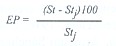
<body><![CDATA[<BR><FONT FACE="Arial,Helvetica"><FONT SIZE=-1>&nbsp;</FONT></FONT>     <BR><FONT FACE="Arial,Helvetica"><FONT SIZE=-1>Se aplic&oacute; la t&eacute;cnica de corte <I>jackknife </I>(<A HREF="#Efron">Efron 1982</A>) para evaluar la influencia de cada muestra en la estimaci&oacute;n de los par&aacute;metros de crecimiento. Para ello se retir&oacute; una muestra (en este caso un mes) secuencialmente y con reemplazo del grupo de las <I>n </I>muestras disponibles en cada a&ntilde;o, a fin de obtener <I>n </I>diferentes combinaciones de par&aacute;metros de crecimiento (<A HREF="#Leonce">Leonce-Valencia y Defeo 1997</A>). El error porcentual (EP) y el coeficiente de variaci&oacute;n porcentual (CV) fueron usados como estimadores de precisi&oacute;n. El primero fue obtenido como:</FONT></FONT>      <P><IMG SRC="/img/fbpe/rbt/v49n1/2328F1.JPG" HEIGHT=46 WIDTH=116>      
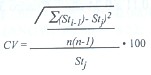
<P><FONT FACE="Arial,Helvetica"><FONT SIZE=-1>donde St es el estimador del par&aacute;metro de crecimiento usando la base de datos anual completa (4 meses), y St<SUB>j</SUB> es el estimador promedio derivado de los <I>n</I> seudovalores <I>jackknife</I>. EP es &oacute;ptimo cuando es igual a 0 (St=St<SUB>j</SUB>). El CV <I>jackknife</I> fue obtenido como:</FONT></FONT>      <P><IMG SRC="/img/fbpe/rbt/v49n1/2328F2.JPG" HEIGHT=75 WIDTH=151>      
<P><FONT FACE="Arial,Helvetica"><FONT SIZE=-1>donde St<SUB>i-1</SUB> es el estimador del par&aacute;metro al omitir una muestra y <I>n</I> es el tama&ntilde;o de la muestra anual (n<I> = </I>4).</FONT></FONT>     <BR><FONT FACE="Arial,Helvetica"><FONT SIZE=-1>&nbsp;</FONT></FONT>     <BR><FONT FACE="Arial,Helvetica"><FONT SIZE=-1>Como criterio para comparar diferentes estimaciones de crecimiento, se utiliz&oacute; el &iacute;ndice de crecimiento est&aacute;ndar f’ = 2log<SUB>10</SUB>(L<IMG SRC="/img/fbpe/rbt/v49n1/INFINITO.GIF" HEIGHT=14 WIDTH=14 ALIGN=CENTER>) + log<SUB>10</SUB>K (<A HREF="#Munro">Munro y Pauly 1983</A>, <A HREF="#Pauly">Pauly y Munro 1984</A>), el cual provee un par&aacute;metro unificado de crecimiento y no muestra variaciones marcadas como L<IMG SRC="/img/fbpe/rbt/v49n1/INFINITO.GIF" HEIGHT=14 WIDTH=14 ALIGN=CENTER> y K en forma individual (<A HREF="#Defeo92a">Defeo <I>et al.&nbsp;</I> 1992a</A>, <A HREF="#Leonce">Leonce-Valencia y Defeo 1997</A>). A fin de evaluar diferencias estad&iacute;sticas, las estimaciones de&nbsp;<IMG SRC="/img/fbpe/rbt/v49n1/O.JPG" HEIGHT=17 WIDTH=13 ALIGN=ABSBOTTOM> derivadas del an&aacute;lisis <I>jackknife</I> fueron sometidas a un an&aacute;lisis de varianza de 2 v&iacute;as, empleando los m&eacute;todos y a&ntilde;os como factores principales. En caso de detectar diferencias, se realiz&oacute; un an&aacute;lisis de comparaciones m&uacute;ltiples empleando la prueba de Newman – Keuls (<A HREF="#Zar">Zar 1996</A>).</FONT></FONT>     
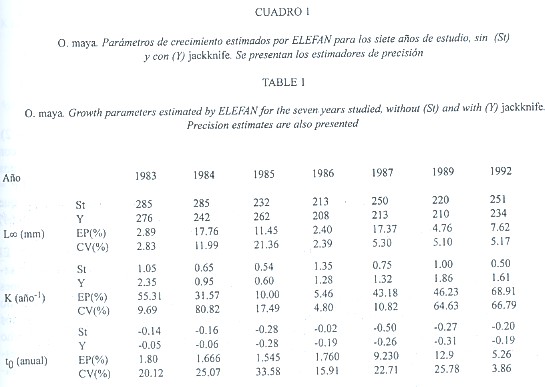
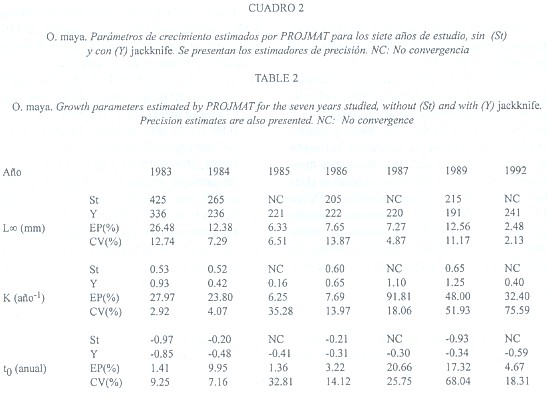
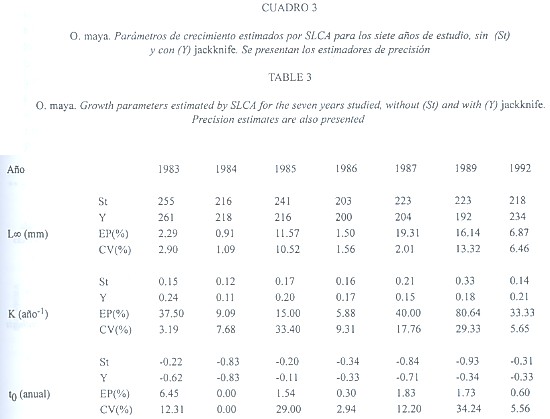
<BR><FONT FACE="Arial,Helvetica"><FONT SIZE=-1>&nbsp;</FONT></FONT>     <BR><FONT FACE="Arial,Helvetica"><FONT SIZE=-1>1) Toda la informaci&oacute;n:&nbsp; ELEFAN convergi&oacute; en una estimaci&oacute;n &oacute;ptima de par&aacute;metros. L<IMG SRC="/img/fbpe/rbt/v49n1/INFINITO.GIF" HEIGHT=14 WIDTH=14 ALIGN=CENTER> vari&oacute; entre 213 y 285 mm y K entre 0.50 y 1.35 a&ntilde;o<SUP>-1 </SUP>(<A HREF="#cuadro1">Cuadro 1</A>). PROJMAT no convergi&oacute; en 3 de los 7 a&ntilde;os analizados (1985, 1987 y 1992) y en los a&ntilde;os restantes present&oacute; amplia variaci&oacute;n en L<IMG SRC="/img/fbpe/rbt/v49n1/INFINITO.GIF" HEIGHT=14 WIDTH=14 ALIGN=CENTER> (205 a 425 mm), mientras que K fluctu&oacute; de 0.52 a 0.65 a&ntilde;o<SUP>-1</SUP> (<A HREF="#cuadro2">Cuadro 2</A>). SLCA aport&oacute; estimaciones poco variables de L<IMG SRC="/img/fbpe/rbt/v49n1/INFINITO.GIF" HEIGHT=14 WIDTH=14 ALIGN=CENTER> (203 a 255 mm) y K (0.12 a 0.33 a&ntilde;o<SUP>–1</SUP>) (<A HREF="#cuadro3">Cuadro 3</A>).</FONT></FONT>     
]]></body>
<body><![CDATA[<BR><FONT FACE="Arial,Helvetica"><FONT SIZE=-1>&nbsp;</FONT></FONT>     <BR><FONT FACE="Arial,Helvetica"><FONT SIZE=-1><B>2) An&aacute;lisis jackknife:&nbsp; </B>La aplicaci&oacute;n del <I>jackknife</I> conjuntamente con ELEFAN, PROJMAT y SLCA mostr&oacute; una fuerte influencia interanual en la estimaciones. La mayor variabilidad fue observada en L<IMG SRC="/img/fbpe/rbt/v49n1/INFINITO.GIF" HEIGHT=14 WIDTH=14 ALIGN=CENTER> (191 a 336 mm) y K (0.16 a 1.25 a&ntilde;o<SUP>-1</SUP>) estimados por PROJMAT (<A HREF="#cuadro2">Cuadro 2</A>),&nbsp; seguidas en orden decreciente por ELEFAN (L<IMG SRC="/img/fbpe/rbt/v49n1/INFINITO.GIF" HEIGHT=14 WIDTH=14 ALIGN=CENTER> de 208 a 276 mm y K de 0.60 a 2.35 a&ntilde;o<SUP>-1</SUP>:&nbsp; <A HREF="#cuadro1">Cuadro 1</A>) y SLCA (L<IMG SRC="/img/fbpe/rbt/v49n1/INFINITO.GIF" HEIGHT=14 WIDTH=14 ALIGN=CENTER> de 192 a 261 mm y K de 0.11 a 0.24 a&ntilde;o<SUP>-1</SUP>:&nbsp; <A HREF="#cuadro3">Cuadro 3</A>).</FONT></FONT>     
<BR><FONT FACE="Arial,Helvetica"><FONT SIZE=-1>&nbsp;</FONT></FONT>     <BR><FONT FACE="Arial,Helvetica"><FONT SIZE=-1>Los estimadores de precisi&oacute;n EP y CV reflejaron una importante variaci&oacute;n intra e interanual, pero no variaron significativamente entre m&eacute;todos (ANOVA 0.08&lt;F<SUB>2,18</SUB>&lt;2.61:&nbsp; P>0.10 en todos los casos). ELEFAN provey&oacute; valores de L<IMG SRC="/img/fbpe/rbt/v49n1/INFINITO.GIF" HEIGHT=14 WIDTH=14 ALIGN=CENTER> con un CV entre 2.39 (a&ntilde;o 1986) y 21.36 (1985), y un EP entre 2.89 y 17.76 en 1983 y 1984 respectivamente, mientras que K present&oacute; un CV de 4.80 a 66.79 y EP entre 5.46 y 68.91 (<A HREF="#cuadro1">Cuadro 1</A>). PROJMAT present&oacute; el mayor valor de EP para L<IMG SRC="/img/fbpe/rbt/v49n1/INFINITO.GIF" HEIGHT=14 WIDTH=14 ALIGN=CENTER> en 1983 (26.48), mientras que el CV fue m&aacute;ximo en 1986 (13.87); los valores de K variaron hasta 91.81 (EP) en el a&ntilde;o 1987 y 75.59 (CV) en 1992 (<A HREF="#cuadro2">Cuadro 2</A>). SLCA present&oacute; la menor variaci&oacute;n con respecto a los otros 2 m&eacute;todos:&nbsp; la m&aacute;xima variaci&oacute;n de L<IMG SRC="/img/fbpe/rbt/v49n1/INFINITO.GIF" HEIGHT=14 WIDTH=14 ALIGN=CENTER> se dio en 1987 (EP = 19.31) y 1989 (CV = 13.32), mientras que para K&nbsp; ocurri&oacute; en 1989 (EP = 80.64) (<A HREF="#cuadro3">Cuadro 3</A>).</FONT></FONT>     
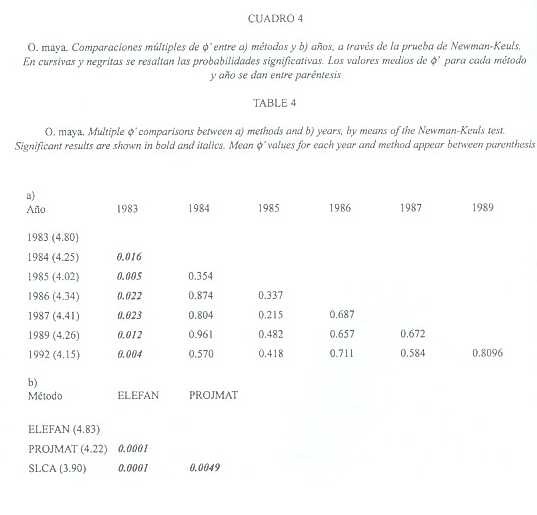
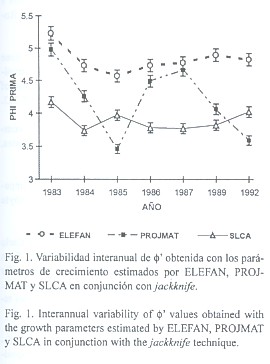
<BR><B><FONT FACE="Arial,Helvetica"><FONT SIZE=-1>&nbsp;</FONT></FONT></B>     <BR><B><FONT FACE="Arial,Helvetica"><FONT SIZE=-1>3)&nbsp; An&aacute;lisis comparativo mediante&nbsp;<IMG SRC="/img/fbpe/rbt/v49n1/O.JPG" HEIGHT=17 WIDTH=13 ALIGN=ABSBOTTOM>:&nbsp;</FONT></FONT></B><FONT FACE="Arial,Helvetica"><FONT SIZE=-1> El an&aacute;lisis de&nbsp;<IMG SRC="/img/fbpe/rbt/v49n1/O.JPG" HEIGHT=17 WIDTH=13 ALIGN=ABSBOTTOM> derivado de la omisi&oacute;n secuencial de muestras mostr&oacute; patrones claramente definidos (<A HREF="#fig1">Fig. 1</A>):&nbsp; a)&nbsp;<IMG SRC="/img/fbpe/rbt/v49n1/O.JPG" HEIGHT=17 WIDTH=13 ALIGN=ABSBOTTOM> no mostr&oacute; la variabilidad individual de los par&aacute;metros individuales K y L<IMG SRC="/img/fbpe/rbt/v49n1/INFINITO.GIF" HEIGHT=14 WIDTH=14 ALIGN=CENTER>, hecho reflejado en una reducida desviaci&oacute;n est&aacute;ndar para cada a&ntilde;o y m&eacute;todo considerados. b) ELEFAN aport&oacute; valores significativamente mayores de&nbsp;<IMG SRC="/img/fbpe/rbt/v49n1/O.JPG" HEIGHT=17 WIDTH=13 ALIGN=ABSBOTTOM> (4.57 a 5.23), seguido en orden decreciente por PROJMAT (3.46 a 4.97) y SLCA (3.74 a 4.66). c)&nbsp;<IMG SRC="/img/fbpe/rbt/v49n1/O.JPG" HEIGHT=17 WIDTH=13 ALIGN=ABSBOTTOM> vari&oacute; significativamente entre m&eacute;todos (F<SUB>2,60</SUB> = 25.87; P&lt;&lt;0.0001) y entre a&ntilde;os (ANOVA F<SUB>6,60</SUB> = 4.52; P&lt;0.001). Las comparaciones m&uacute;ltiples a trav&eacute;s de la prueba de Newman-Keuls para rangos cr&iacute;ticos identific&oacute; diferencias individuales significativas entre m&eacute;todos (<A HREF="#cuadro4">Cuadro 4a</A>) y del a&ntilde;o 1983 con respecto a los dem&aacute;s, presentando mayor&nbsp;<IMG SRC="/img/fbpe/rbt/v49n1/O.JPG" HEIGHT=17 WIDTH=13 ALIGN=ABSBOTTOM> en los tres m&eacute;todos empleados (<A HREF="#fig1">Fig. 1</A>, <A HREF="#cuadro4">Cuadro 4b</A>).</FONT></FONT>     
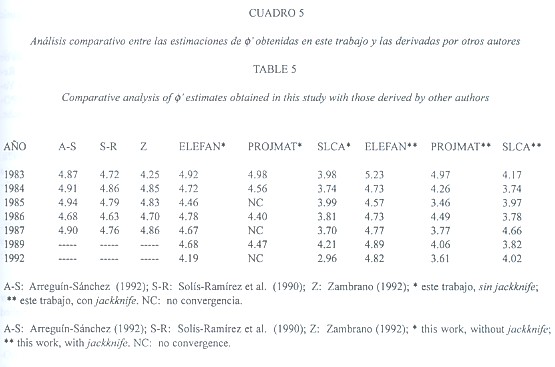
<BR><FONT FACE="Arial,Helvetica"><FONT SIZE=-1>&nbsp;</FONT></FONT>     <BR><FONT FACE="Arial,Helvetica"><FONT SIZE=-1>Los valores de&nbsp;<IMG SRC="/img/fbpe/rbt/v49n1/O.JPG" HEIGHT=17 WIDTH=13 ALIGN=ABSBOTTOM> obtenidos con ELEFAN estuvieron comprendidos en el &aacute;mbito de variaci&oacute;n de aquellos derivados de las combinaciones de K y L<IMG SRC="/img/fbpe/rbt/v49n1/INFINITO.GIF" HEIGHT=14 WIDTH=14 ALIGN=CENTER> reportadas en la literatura, mientras que los de PROJMAT y SLCA fueron menores (<A HREF="#cuadro5">Cuadro 5</A>). Esta tendencia fue v&aacute;lida para todos los a&ntilde;os donde se registraron estimaciones por varias fuentes (<I>i.e</I>., 1983 a 1987), lo cual sugiere una tendencia sistem&aacute;tica de PROJMAT y SLCA a subestimar los par&aacute;metros de crecimiento (<A HREF="#fig1">Fig. 1</A>).</FONT></FONT>     
<BR><FONT FACE="Arial,Helvetica"><FONT SIZE=-1>&nbsp;</FONT></FONT>     <CENTER><A NAME="cuadro1"></A><IMG SRC="/img/fbpe/rbt/v49n1/2328i01.JPG" HEIGHT=387 WIDTH=545></CENTER>      
]]></body>
<body><![CDATA[<CENTER>&nbsp;</CENTER>      <CENTER><A NAME="cuadro2"></A><IMG SRC="/img/fbpe/rbt/v49n1/2328i02.JPG" HEIGHT=400 WIDTH=547></CENTER>      
<CENTER>&nbsp;</CENTER>      <CENTER><A NAME="cuadro3"></A><IMG SRC="/img/fbpe/rbt/v49n1/2328i03.JPG" HEIGHT=419 WIDTH=550></CENTER> <B><FONT FACE="Arial,Helvetica"><FONT SIZE=-1>&nbsp;</FONT></FONT></B>     
<CENTER><A NAME="cuadro4"></A><IMG SRC="/img/fbpe/rbt/v49n1/2328i4.JPG" HEIGHT=515 WIDTH=537></CENTER>      
<CENTER><A NAME="cuadro5"></A><IMG SRC="/img/fbpe/rbt/v49n1/2328i05.JPG" HEIGHT=367 WIDTH=555></CENTER>      
<CENTER>&nbsp;</CENTER>      <CENTER><A NAME="fig1"></A><IMG SRC="/img/fbpe/rbt/v49n1/2328i06.JPG" HEIGHT=364 WIDTH=270></CENTER>       
<P><B><FONT FACE="Arial,Helvetica"><FONT SIZE=-1>Discusi&oacute;n</FONT></FONT></B>     <BR><FONT FACE="Arial,Helvetica"><FONT SIZE=-1>&nbsp;</FONT></FONT>     ]]></body>
<body><![CDATA[<BR><FONT FACE="Arial,Helvetica"><FONT SIZE=-1>El <I>jackknife</I> permiti&oacute; determinar una fuerte variabilidad en los par&aacute;metros individuales de crecimiento para los 3 m&eacute;todos, en especial PROJMAT. SLCA present&oacute; la menor variabilidad en las estimaciones, aunque fuera del rango observado de valores previamente reportados en la literatura. El an&aacute;lisis comparativo de f’ en conjunci&oacute;n con <I>jackknife</I> corrobor&oacute; la suma utilidad de este par&aacute;metro a efectos comparativos, ya que la variabilidad dentro de a&ntilde;os disminuy&oacute; sensiblemente (ver <A HREF="#fig1">Fig. 1</A>). La peque&ntilde;a variaci&oacute;n intermensual mostrar&iacute;a una fuerte coherencia en las estimaciones de crecimiento a la omisi&oacute;n secuencial de muestras. Asimismo, permiti&oacute; cuantificar diferencias estad&iacute;sticamente significativas entre a&ntilde;os y especialmente entre m&eacute;todos, donde se ratific&oacute; la subestimaci&oacute;n de la tasa de crecimiento de <I>O. maya </I>por parte de PROJMAT y SLCA.</FONT></FONT>     <BR><FONT FACE="Arial,Helvetica"><FONT SIZE=-1>&nbsp;</FONT></FONT>     <BR><FONT FACE="Arial,Helvetica"><FONT SIZE=-1>Las estimaciones de crecimiento de <I>O. maya</I> condicen adem&aacute;s con aspectos claves de su biolog&iacute;a, tales como su corta a mediana longevidad, estimada en cautiverio (hasta 12 meses:&nbsp; <A HREF="#Van76">Van Heukelem 1976</A>, <A HREF="#Van77">1977</A>) o con base en muestreos biol&oacute;gicos o de la flota comercial (de 1.5 a 5 a&ntilde;os seg&uacute;n <A HREF="#Solis86">Sol&iacute;s-Ram&iacute;rez y Ch&aacute;vez 1986</A>, ver tambi&eacute;n <A HREF="#Van83">Van Heukelem 1983</A> y <A HREF="#Solis94">Sol&iacute;s-Ram&iacute;rez 1994</A>). La longevidad del pulpo, estimada en este trabajo como el cociente 3/K y usando valores promedio de K derivados del an&aacute;lisis <I>jackknife</I> en el largo plazo, ser&iacute;a cercana a 2.5 a&ntilde;os seg&uacute;n estimaciones del ELEFAN, mientras que a partir de PROJMAT y SLCA ser&iacute;a 6.5 y 17.4 a&ntilde;os. Estos valores est&aacute;n totalmente fuera del contexto biol&oacute;gico de la especie y reafirman su poca utilidad a efectos de estimar el crecimiento en el pulpo.</FONT></FONT>     <BR><FONT FACE="Arial,Helvetica"><FONT SIZE=-1>&nbsp;</FONT></FONT>     <BR><FONT FACE="Arial,Helvetica"><FONT SIZE=-1>En suma, teniendo en cuenta las caracter&iacute;sticas biol&oacute;gicas del recurso, el desempe&ntilde;o de los 3 m&eacute;todos con base en un an&aacute;lisis robusto de largo plazo y la coincidencia de las estimaciones de&nbsp;<IMG SRC="/img/fbpe/rbt/v49n1/O.JPG" HEIGHT=17 WIDTH=13 ALIGN=ABSBOTTOM> con aquellas reportadas en la literatura, se sugiere estimar el crecimiento de pulpo empleando el <I>jackknife</I> conjuntamente con ELEFAN. Las estimaciones de PROJMAT y SLCA generaron valores de&nbsp;<IMG SRC="/img/fbpe/rbt/v49n1/O.JPG" HEIGHT=17 WIDTH=13 ALIGN=ABSBOTTOM> y estimaciones de longevidad no acordes con la biolog&iacute;a del recurso y por tanto no ser&iacute;an recomendables para estimar el crecimiento de <I>O. maya.</I></FONT></FONT>     
<BR><FONT FACE="Arial,Helvetica"><FONT SIZE=-1>&nbsp;</FONT></FONT>     <BR><B><FONT FACE="Arial,Helvetica"><FONT SIZE=-1>Agradecimientos</FONT></FONT></B>     <BR><B><FONT FACE="Arial,Helvetica"><FONT SIZE=-1>&nbsp;</FONT></FONT></B>     <BR><FONT FACE="Arial,Helvetica"><FONT SIZE=-1>Este trabajo forma parte de la tesis de Maestr&iacute;a de R.N.V. en CINVESTAV-IPN Unidad M&eacute;rida, la cual fue realizada con el apoyo de CONACYT. Agradecemos las sugerencias de dos revisores an&oacute;nimos, as&iacute; como el apoyo editorial por parte del Dr. Monge-N&aacute;jera.</FONT></FONT>     <BR><FONT FACE="Arial,Helvetica"><FONT SIZE=-1>&nbsp;</FONT></FONT>     ]]></body>
<body><![CDATA[<BR><B><FONT FACE="Arial,Helvetica"><FONT SIZE=-1>Resumen</FONT></FONT></B>     <BR><B><FONT FACE="Arial,Helvetica"><FONT SIZE=-1>&nbsp;</FONT></FONT></B>     <BR><FONT FACE="Arial,Helvetica"><FONT SIZE=-1>Los par&aacute;metros de crecimiento del pulpo (<I>Octopus maya</I>) de las costas de Yucat&aacute;n (M&eacute;xico) fueron estimados en siete a&ntilde;os comprendidos entre 1983-1987, 1989 y 1992. A tales efectos se realiz&oacute; un an&aacute;lisis de frecuencia de tallas de 19 251 pulpos muestreados de la captura comercial, con un intervalo de longitud de manto comprendido entre 50 y 240 mm. Se usaron los m&eacute;todos indirectos ELEFAN, PROJMAT y SLCA. La incertidumbre de las estimaciones inherente a cada m&eacute;todo y derivada del dise&ntilde;o de muestreo fue analizada con la t&eacute;cnica <I>jackknife</I>. Los par&aacute;metros de crecimiento L<IMG SRC="/img/fbpe/rbt/v49n1/INFINITO.GIF" HEIGHT=14 WIDTH=14 ALIGN=CENTER>&nbsp; y K se unificaron a efectos comparativos mediante el &iacute;ndice phi prima (<IMG SRC="/img/fbpe/rbt/v49n1/O.JPG" HEIGHT=17 WIDTH=13 ALIGN=ABSBOTTOM>). El m&eacute;todo ELEFAN result&oacute; ser el m&aacute;s adecuado para estimar los par&aacute;metros de crecimiento de <I>O. maya, </I>brindando valores en el rango de aquellos previamente reportados en la literatura, mientras que PROJMAT y SLCA mostraron problemas en la convergencia de los par&aacute;metros, y tendieron a subestimarlos. Las estimaciones mediante <I>jackknife</I> detectaron poca variabilidad intermensual en&nbsp;<IMG SRC="/img/fbpe/rbt/v49n1/O.JPG" HEIGHT=17 WIDTH=13 ALIGN=ABSBOTTOM> pero gran variabilidad interanual. Los estimadores de precisi&oacute;n de la t&eacute;cnica <I>jackknife</I>, error porcentual y coeficiente de variaci&oacute;n porcentual, no difirieron significativamente entre m&eacute;todos. Las estimaciones de&nbsp;<IMG SRC="/img/fbpe/rbt/v49n1/O.JPG" HEIGHT=17 WIDTH=13 ALIGN=ABSBOTTOM> derivadas del ELEFAN variaron entre 4.19 y 5.23, coincidiendo con aquellas reportadas en la literatura (entre 4.25 y 4.91), mientras que PROJMAT y SLCA aportaron valores significativamente menores. Los resultados de dicho m&eacute;todos condicen adem&aacute;s con aspectos de la biolog&iacute;a de la especie (<I>e.g.</I>, corta longevidad). Sugerimos utilizar el ELEFAN conjuntamente con <I>jackknife</I> para estimar los par&aacute;metros de crecimiento de <I>Octopus maya.</I></FONT></FONT>      
<P><B><FONT FACE="Arial,Helvetica"><FONT SIZE=-1>Referencias</FONT></FONT></B>     <BR><B><FONT FACE="Arial,Helvetica"><FONT SIZE=-1>&nbsp;</FONT></FONT></B>     <!-- ref --><BR><A NAME="Arreguin"></A><FONT FACE="Arial,Helvetica"><FONT SIZE=-1>Arregu&iacute;n-S&aacute;nchez, F. 1992. Growth and seasonal recruitment of the octopus (<I>Octopus maya</I>) fishery from the Campeche Bank, caught by the artisanal fleet. NAGA, Filipinas 15: 31-34</FONT></FONT>    &nbsp;&nbsp;&nbsp;&nbsp;&nbsp;&nbsp;&nbsp;&nbsp;[&#160;<a href="javascript:void(0);" onclick="javascript: window.open('/scielo.php?script=sci_nlinks&ref=1352624&pid=S0034-7744200100010001000001&lng=','','width=640,height=500,resizable=yes,scrollbars=1,menubar=yes,');">Links</a>&#160;]<!-- end-ref --><BR><FONT FACE="Arial,Helvetica"><FONT SIZE=-1>&nbsp;</FONT></FONT>     <!-- ref --><BR><A NAME="Basson"></A><FONT FACE="Arial,Helvetica"><FONT SIZE=-1>Basson, M., A.A. Rosenberg &amp; J.R. Beddington. 1988. The accuracy and reliability of two new methods for estimating growth parameters from length frequency data. J. Cons. Int. Explor. Mer. 44: 277-285.</FONT></FONT>    &nbsp;&nbsp;&nbsp;&nbsp;&nbsp;&nbsp;&nbsp;&nbsp;[&#160;<a href="javascript:void(0);" onclick="javascript: window.open('/scielo.php?script=sci_nlinks&ref=1352626&pid=S0034-7744200100010001000002&lng=','','width=640,height=500,resizable=yes,scrollbars=1,menubar=yes,');">Links</a>&#160;]<!-- end-ref --><BR><FONT FACE="Arial,Helvetica"><FONT SIZE=-1>&nbsp;</FONT></FONT>     <!-- ref --><BR><A NAME="Bertalanffy"></A><FONT FACE="Arial,Helvetica"><FONT SIZE=-1>Bertalanffy, L. von. 1938. A quantitative theory of organic growth. Human Biol.<B> </B>10: 181-213.</FONT></FONT>    &nbsp;&nbsp;&nbsp;&nbsp;&nbsp;&nbsp;&nbsp;&nbsp;[&#160;<a href="javascript:void(0);" onclick="javascript: window.open('/scielo.php?script=sci_nlinks&ref=1352628&pid=S0034-7744200100010001000003&lng=','','width=640,height=500,resizable=yes,scrollbars=1,menubar=yes,');">Links</a>&#160;]<!-- end-ref --><BR><FONT FACE="Arial,Helvetica"><FONT SIZE=-1>&nbsp;</FONT></FONT>     <!-- ref --><BR><A NAME="Chavez"></A><FONT FACE="Arial,Helvetica"><FONT SIZE=-1>Ch&aacute;vez, E. 1994. Los recursos marinos de la Pen&iacute;nsula de Yucat&aacute;n, p. 1-12. <I>In</I> A. Ya&ntilde;ez-Arancibia (ed.). Recursos faun&iacute;sticos del litoral de la Pen&iacute;nsula de Yucat&aacute;n. Universidad Aut&oacute;noma de Campeche, EPOMEX Serie Cient&iacute;fica 2, Campeche, Campeche, M&eacute;xico.</FONT></FONT>    &nbsp;&nbsp;&nbsp;&nbsp;&nbsp;&nbsp;&nbsp;&nbsp;[&#160;<a href="javascript:void(0);" onclick="javascript: window.open('/scielo.php?script=sci_nlinks&ref=1352630&pid=S0034-7744200100010001000004&lng=','','width=640,height=500,resizable=yes,scrollbars=1,menubar=yes,');">Links</a>&#160;]<!-- end-ref --><BR><FONT FACE="Arial,Helvetica"><FONT SIZE=-1>&nbsp;</FONT></FONT>     <!-- ref --><BR><A NAME="Defeo92a"></A><FONT FACE="Arial,Helvetica"><FONT SIZE=-1>Defeo, O., F. Arregu&iacute;n-S&aacute;nchez &amp; J. S&aacute;nchez. 1992a. Growth study for the yellow clam <I>Mesodesma mactroides: </I>a comparative analysis of three length-based methods. Sci. Mar. 56: 53-59.</FONT></FONT>    &nbsp;&nbsp;&nbsp;&nbsp;&nbsp;&nbsp;&nbsp;&nbsp;[&#160;<a href="javascript:void(0);" onclick="javascript: window.open('/scielo.php?script=sci_nlinks&ref=1352632&pid=S0034-7744200100010001000005&lng=','','width=640,height=500,resizable=yes,scrollbars=1,menubar=yes,');">Links</a>&#160;]<!-- end-ref --><BR><FONT FACE="Arial,Helvetica"><FONT SIZE=-1>&nbsp;</FONT></FONT>     <!-- ref --><BR><A NAME="Defeo92b"></A><FONT FACE="Arial,Helvetica"><FONT SIZE=-1>Defeo, O., E. Ortiz &amp; J.C. Castilla. 1992b. Growth, mortality and recruitment of the yellow clam <I>Mesodesma mactroides</I> in Uruguayan beaches. Mar. Biol. 114: 429-437.</FONT></FONT>    &nbsp;&nbsp;&nbsp;&nbsp;&nbsp;&nbsp;&nbsp;&nbsp;[&#160;<a href="javascript:void(0);" onclick="javascript: window.open('/scielo.php?script=sci_nlinks&ref=1352634&pid=S0034-7744200100010001000006&lng=','','width=640,height=500,resizable=yes,scrollbars=1,menubar=yes,');">Links</a>&#160;]<!-- end-ref --><BR><FONT FACE="Arial,Helvetica"><FONT SIZE=-1>&nbsp;</FONT></FONT>     <!-- ref --><BR><A NAME="Efron"></A><FONT FACE="Arial,Helvetica"><FONT SIZE=-1>Efron, B. 1982. The Jackknife, the Bootstrap and Other Resampling Plans. Society for Industrial and Applied Mathematics, Filadelfia, Pensilvania. 92 p.</FONT></FONT>    &nbsp;&nbsp;&nbsp;&nbsp;&nbsp;&nbsp;&nbsp;&nbsp;[&#160;<a href="javascript:void(0);" onclick="javascript: window.open('/scielo.php?script=sci_nlinks&ref=1352636&pid=S0034-7744200100010001000007&lng=','','width=640,height=500,resizable=yes,scrollbars=1,menubar=yes,');">Links</a>&#160;]<!-- end-ref --><BR><FONT FACE="Arial,Helvetica"><FONT SIZE=-1>&nbsp;</FONT></FONT>     <!-- ref --><BR><A NAME="Gayanilo"></A><FONT FACE="Arial,Helvetica"><FONT SIZE=-1>Gayanilo, F.C. Jr., P. Sparre &amp; D. Pauly. 1994. The FAO-ICLARM Stock Assessment Tools (FISAT) User’s Guide. FAO Comp. Inf. Ser. Fisheries 7, FAO, Roma, 126 p.</FONT></FONT>    &nbsp;&nbsp;&nbsp;&nbsp;&nbsp;&nbsp;&nbsp;&nbsp;[&#160;<a href="javascript:void(0);" onclick="javascript: window.open('/scielo.php?script=sci_nlinks&ref=1352638&pid=S0034-7744200100010001000008&lng=','','width=640,height=500,resizable=yes,scrollbars=1,menubar=yes,');">Links</a>&#160;]<!-- end-ref --><BR><FONT FACE="Arial,Helvetica"><FONT SIZE=-1>&nbsp;</FONT></FONT>     <!-- ref --><BR><A NAME="Leonce"></A><FONT FACE="Arial,Helvetica"><FONT SIZE=-1>Leonce-Valencia, C. &amp; O. Defeo. 1997. Evaluation of three length-based methods for estimaitng growth in tropical fishes: the red snapper <I>Lutjanus campechanus </I>of the Campeche Bank (Mexico). Sci. Mar. 61: 297-303.</FONT></FONT>    &nbsp;&nbsp;&nbsp;&nbsp;&nbsp;&nbsp;&nbsp;&nbsp;[&#160;<a href="javascript:void(0);" onclick="javascript: window.open('/scielo.php?script=sci_nlinks&ref=1352640&pid=S0034-7744200100010001000009&lng=','','width=640,height=500,resizable=yes,scrollbars=1,menubar=yes,');">Links</a>&#160;]<!-- end-ref --><BR><FONT FACE="Arial,Helvetica"><FONT SIZE=-1>&nbsp;</FONT></FONT>     <!-- ref --><BR><A NAME="Munro"></A><FONT FACE="Arial,Helvetica"><FONT SIZE=-1>Munro, J.L. &amp; D. Pauly. 1983. A simple method for comparing the growth of fishes and invertebrates. Fishbyte<B> </B>1: 5-6.</FONT></FONT>    &nbsp;&nbsp;&nbsp;&nbsp;&nbsp;&nbsp;&nbsp;&nbsp;[&#160;<a href="javascript:void(0);" onclick="javascript: window.open('/scielo.php?script=sci_nlinks&ref=1352642&pid=S0034-7744200100010001000010&lng=','','width=640,height=500,resizable=yes,scrollbars=1,menubar=yes,');">Links</a>&#160;]<!-- end-ref --><BR><FONT FACE="Arial,Helvetica"><FONT SIZE=-1>&nbsp;</FONT></FONT>     <!-- ref --><BR><A NAME="Pauly"></A><FONT FACE="Arial,Helvetica"><FONT SIZE=-1>Pauly, D. &amp; J.L. Munro. 1984. Once more on the comparison of growth in fish and invertebrates. Fishbyte<B> </B>2: 21.</FONT></FONT>    &nbsp;&nbsp;&nbsp;&nbsp;&nbsp;&nbsp;&nbsp;&nbsp;[&#160;<a href="javascript:void(0);" onclick="javascript: window.open('/scielo.php?script=sci_nlinks&ref=1352644&pid=S0034-7744200100010001000011&lng=','','width=640,height=500,resizable=yes,scrollbars=1,menubar=yes,');">Links</a>&#160;]<!-- end-ref --><BR><FONT FACE="Arial,Helvetica"><FONT SIZE=-1>&nbsp;</FONT></FONT>     <!-- ref --><BR><A NAME="Rosenberg"></A><FONT FACE="Arial,Helvetica"><FONT SIZE=-1>Rosenberg, A.A. &amp; J.R. Beddington. 1987. Monte-Carlo testing of methods for estimating growth from length-frequency data with general conditions for their applicability, p 283-298. <I>In </I>D. Pauly &amp; G.R. Morgan (ed.). Length-based methods in fisheries research. ICLARM Conf. Proc. 13, Manila.</FONT></FONT>    &nbsp;&nbsp;&nbsp;&nbsp;&nbsp;&nbsp;&nbsp;&nbsp;[&#160;<a href="javascript:void(0);" onclick="javascript: window.open('/scielo.php?script=sci_nlinks&ref=1352646&pid=S0034-7744200100010001000012&lng=','','width=640,height=500,resizable=yes,scrollbars=1,menubar=yes,');">Links</a>&#160;]<!-- end-ref --><BR><FONT FACE="Arial,Helvetica"><FONT SIZE=-1>&nbsp;</FONT></FONT>     <!-- ref --><BR><A NAME="Sheperd87a"></A><FONT FACE="Arial,Helvetica"><FONT SIZE=-1>Sheperd, J. G. 1987a. Towards a method for short-term forecasting of catch rates based on length compositions, p. 167-176. <I>In</I> D. Pauly &amp; G.R. Morgan (ed.). Length-based methods in fisheries research.<B> </B>ICLARM Conf. Proc. 13, Manila.</FONT></FONT>    &nbsp;&nbsp;&nbsp;&nbsp;&nbsp;&nbsp;&nbsp;&nbsp;[&#160;<a href="javascript:void(0);" onclick="javascript: window.open('/scielo.php?script=sci_nlinks&ref=1352648&pid=S0034-7744200100010001000013&lng=','','width=640,height=500,resizable=yes,scrollbars=1,menubar=yes,');">Links</a>&#160;]<!-- end-ref --><BR><FONT FACE="Arial,Helvetica"><FONT SIZE=-1>&nbsp;</FONT></FONT>     <!-- ref --><BR><A NAME="Shepherd87b"></A><FONT FACE="Arial,Helvetica"><FONT SIZE=-1>Shepherd, J.G. 1987b. A weakly parametric method for estimating growth parameters from length composition data, p. 113-119. <I>In </I>D. Pauly &amp; G.R. Morgan (ed.). Length-based methods in fisheries research. ICLARM Conf. Proc. 13, Manila.</FONT></FONT>    &nbsp;&nbsp;&nbsp;&nbsp;&nbsp;&nbsp;&nbsp;&nbsp;[&#160;<a href="javascript:void(0);" onclick="javascript: window.open('/scielo.php?script=sci_nlinks&ref=1352650&pid=S0034-7744200100010001000014&lng=','','width=640,height=500,resizable=yes,scrollbars=1,menubar=yes,');">Links</a>&#160;]<!-- end-ref --><BR><FONT FACE="Arial,Helvetica"><FONT SIZE=-1>&nbsp;</FONT></FONT>     <!-- ref --><BR><A NAME="Solis94"></A><FONT FACE="Arial,Helvetica"><FONT SIZE=-1>Sol&iacute;s-Ram&iacute;rez, M. J. 1994. Mollusca de la Pen&iacute;nsula de Yucat&aacute;n, M&eacute;xico, p. 13-32. <I>In</I> A. Ya&ntilde;ez-Arancibia (ed.). Recursos faun&iacute;sticos del litoral de la Pen&iacute;nsula de Yucat&aacute;n. Universidad Aut&oacute;noma de Campeche. EPOMEX Serie Cient&iacute;fica 2, Campeche, Campeche, M&eacute;xico.</FONT></FONT>    &nbsp;&nbsp;&nbsp;&nbsp;&nbsp;&nbsp;&nbsp;&nbsp;[&#160;<a href="javascript:void(0);" onclick="javascript: window.open('/scielo.php?script=sci_nlinks&ref=1352652&pid=S0034-7744200100010001000015&lng=','','width=640,height=500,resizable=yes,scrollbars=1,menubar=yes,');">Links</a>&#160;]<!-- end-ref --><BR><FONT FACE="Arial,Helvetica"><FONT SIZE=-1>&nbsp;</FONT></FONT>     <!-- ref --><BR><A NAME="Solis86"></A><FONT FACE="Arial,Helvetica"><FONT SIZE=-1>Sol&iacute;s-Ram&iacute;rez, M. J. &amp; E.A. Ch&aacute;vez. 1986. Evaluaci&oacute;n y r&eacute;gimen &oacute;ptimo de pesca del pulpo en la Pen&iacute;nsula de Yucat&aacute;n. An. Inst. Cien. Mar Limnol. UNAM 13: 1-18.</FONT></FONT>    &nbsp;&nbsp;&nbsp;&nbsp;&nbsp;&nbsp;&nbsp;&nbsp;[&#160;<a href="javascript:void(0);" onclick="javascript: window.open('/scielo.php?script=sci_nlinks&ref=1352654&pid=S0034-7744200100010001000016&lng=','','width=640,height=500,resizable=yes,scrollbars=1,menubar=yes,');">Links</a>&#160;]<!-- end-ref --><BR><FONT FACE="Arial,Helvetica"><FONT SIZE=-1>&nbsp;</FONT></FONT>     <!-- ref --><BR><A NAME="Solis90"></A><FONT FACE="Arial,Helvetica"><FONT SIZE=-1>Sol&iacute;s-Ram&iacute;rez, M.J., M.E. G&oacute;nzalez de la Rosa&amp; J. S&aacute;nchez-Ch&aacute;vez. 1990. Coeficientes de la relaci&oacute;n peso-longitud y par&aacute;metros de crecimiento del pulpo <I>Octopus maya</I> (Mollusca: Cephalopoda) de la costa de Yucat&aacute;n. Informe T&eacute;cnico, Centro Regional de Investigaci&oacute;n Pesquera de Yucaltep&eacute;n, Yucat&aacute;n. 10 p.</FONT></FONT>    &nbsp;&nbsp;&nbsp;&nbsp;&nbsp;&nbsp;&nbsp;&nbsp;[&#160;<a href="javascript:void(0);" onclick="javascript: window.open('/scielo.php?script=sci_nlinks&ref=1352656&pid=S0034-7744200100010001000017&lng=','','width=640,height=500,resizable=yes,scrollbars=1,menubar=yes,');">Links</a>&#160;]<!-- end-ref --><BR><FONT FACE="Arial,Helvetica"><FONT SIZE=-1>&nbsp;</FONT></FONT>     <!-- ref --><BR><A NAME="Van76"></A><FONT FACE="Arial,Helvetica"><FONT SIZE=-1>Van Heukelem, W.F. 1976. Growth, bioenergetics and life span of <I>Octopus cyanea</I> and <I>Octopus maya</I>. Tesis de Doctorado, Universidad de Hawaii.</FONT></FONT>    &nbsp;&nbsp;&nbsp;&nbsp;&nbsp;&nbsp;&nbsp;&nbsp;[&#160;<a href="javascript:void(0);" onclick="javascript: window.open('/scielo.php?script=sci_nlinks&ref=1352658&pid=S0034-7744200100010001000018&lng=','','width=640,height=500,resizable=yes,scrollbars=1,menubar=yes,');">Links</a>&#160;]<!-- end-ref --><BR><FONT FACE="Arial,Helvetica"><FONT SIZE=-1>&nbsp;</FONT></FONT>     <!-- ref --><BR><A NAME="Van77"></A><FONT FACE="Arial,Helvetica"><FONT SIZE=-1>Van Heukelem, W.F. 1977. Laboratory maintenance, breeding, rearing and biomedical research potential of the Yucatan octopus (<I>Octopus maya</I>). Lab. Anim. Sci. 27: 852-859.</FONT></FONT>    &nbsp;&nbsp;&nbsp;&nbsp;&nbsp;&nbsp;&nbsp;&nbsp;[&#160;<a href="javascript:void(0);" onclick="javascript: window.open('/scielo.php?script=sci_nlinks&ref=1352660&pid=S0034-7744200100010001000019&lng=','','width=640,height=500,resizable=yes,scrollbars=1,menubar=yes,');">Links</a>&#160;]<!-- end-ref --><BR><FONT FACE="Arial,Helvetica"><FONT SIZE=-1>&nbsp;</FONT></FONT>     <!-- ref --><BR><A NAME="Van83"></A><FONT FACE="Arial,Helvetica"><FONT SIZE=-1>Van Heukelem, W.F. 1983. <I>Octopus maya</I>,<I> </I>p. 311-323. <I>In</I> P.R. Boyle (ed.). Cephalopod life cycles, Vol. 2. Academic, Nueva York.</FONT></FONT>    &nbsp;&nbsp;&nbsp;&nbsp;&nbsp;&nbsp;&nbsp;&nbsp;[&#160;<a href="javascript:void(0);" onclick="javascript: window.open('/scielo.php?script=sci_nlinks&ref=1352662&pid=S0034-7744200100010001000020&lng=','','width=640,height=500,resizable=yes,scrollbars=1,menubar=yes,');">Links</a>&#160;]<!-- end-ref --><BR><FONT FACE="Arial,Helvetica"><FONT SIZE=-1>&nbsp;</FONT></FONT>     <!-- ref --><BR><A NAME="Zambrano"></A><FONT FACE="Arial,Helvetica"><FONT SIZE=-1>Zambrano, G.L. 1992. Contribuci&oacute;n al conocimiento de la mortalidad natural de <I>Octopus maya</I> en la plataforma continental de la Pen&iacute;nsula de Yucat&aacute;n, M&eacute;xico. Tesis de Licenciatura, Facultad de Ciencias UNAM, M&eacute;xico D.F., M&eacute;xico.</FONT></FONT>    &nbsp;&nbsp;&nbsp;&nbsp;&nbsp;&nbsp;&nbsp;&nbsp;[&#160;<a href="javascript:void(0);" onclick="javascript: window.open('/scielo.php?script=sci_nlinks&ref=1352664&pid=S0034-7744200100010001000021&lng=','','width=640,height=500,resizable=yes,scrollbars=1,menubar=yes,');">Links</a>&#160;]<!-- end-ref --><BR><FONT FACE="Arial,Helvetica"><FONT SIZE=-1>&nbsp;</FONT></FONT>     <!-- ref --><BR><A NAME="Zar"></A><FONT FACE="Arial,Helvetica"><FONT SIZE=-1>Zar, J.H., 1996. Biostatistical Analysis. 3a edici&oacute;n, Prentice-Hall, Nueva Jersey. 662 p.</FONT></FONT>    &nbsp;&nbsp;&nbsp;&nbsp;&nbsp;&nbsp;&nbsp;&nbsp;[&#160;<a href="javascript:void(0);" onclick="javascript: window.open('/scielo.php?script=sci_nlinks&ref=1352666&pid=S0034-7744200100010001000022&lng=','','width=640,height=500,resizable=yes,scrollbars=1,menubar=yes,');">Links</a>&#160;]<!-- end-ref --><P><A NAME="A1"></A><FONT FACE="Arial,Helvetica"><FONT SIZE=-1><SUP><A HREF="#R1">1</A></SUP> Laboratorio de Biolog&iacute;a Pesquera. CINVESTAV IPN Unidad M&eacute;rida, A. P. 73 Cordemex, 97310 M&eacute;rida, Yucat&aacute;n, M&eacute;xico; fax 5299-812334; <A HREF="mailto:odefeo@mda.cinvestav.mx">odefeo@mda.cinvestav.mx</A></FONT></FONT>     <BR>&nbsp;     ]]></body>
<body><![CDATA[ ]]></body><back>
<ref-list>
<ref id="B1">
<nlm-citation citation-type="journal">
<person-group person-group-type="author">
<name>
<surname><![CDATA[Arreguín-Sánchez]]></surname>
<given-names><![CDATA[F]]></given-names>
</name>
</person-group>
<article-title xml:lang="en"><![CDATA[Growth and seasonal recruitment of the octopus (Octopus maya) fishery from the Campeche Bank, caught by the artisanal fleet]]></article-title>
<source><![CDATA[NAGA, Filipinas]]></source>
<year>1992</year>
<volume>15</volume>
<page-range>31-34</page-range></nlm-citation>
</ref>
<ref id="B2">
<nlm-citation citation-type="journal">
<person-group person-group-type="author">
<name>
<surname><![CDATA[Basson]]></surname>
<given-names><![CDATA[M]]></given-names>
</name>
<name>
<surname><![CDATA[Rosenberg]]></surname>
<given-names><![CDATA[A.A]]></given-names>
</name>
<name>
<surname><![CDATA[Beddington]]></surname>
<given-names><![CDATA[J.R]]></given-names>
</name>
</person-group>
<article-title xml:lang="en"><![CDATA[The accuracy and reliability of two new methods for estimating growth parameters from length frequency data]]></article-title>
<source><![CDATA[J. Cons. Int. Explor. Mer]]></source>
<year>1988</year>
<volume>44</volume>
<page-range>277-285</page-range></nlm-citation>
</ref>
<ref id="B3">
<nlm-citation citation-type="journal">
<person-group person-group-type="author">
<name>
<surname><![CDATA[Bertalanffy]]></surname>
<given-names><![CDATA[L. von]]></given-names>
</name>
</person-group>
<article-title xml:lang="en"><![CDATA[A quantitative theory of organic growth]]></article-title>
<source><![CDATA[Human Biol]]></source>
<year>1938</year>
<volume>10</volume>
<page-range>181-213</page-range></nlm-citation>
</ref>
<ref id="B4">
<nlm-citation citation-type="book">
<person-group person-group-type="author">
<name>
<surname><![CDATA[Chávez]]></surname>
<given-names><![CDATA[E]]></given-names>
</name>
</person-group>
<article-title xml:lang="es"><![CDATA[Los recursos marinos de la Península de Yucatán]]></article-title>
<person-group person-group-type="editor">
<name>
<surname><![CDATA[Yañez-Arancibia]]></surname>
<given-names><![CDATA[A]]></given-names>
</name>
</person-group>
<source><![CDATA[Recursos faunísticos del litoral de la Península de Yucatán]]></source>
<year>1994</year>
<publisher-loc><![CDATA[Campeche^eCampeche Campeche]]></publisher-loc>
<publisher-name><![CDATA[Universidad Autónoma de Campeche]]></publisher-name>
</nlm-citation>
</ref>
<ref id="B5">
<nlm-citation citation-type="journal">
<person-group person-group-type="author">
<name>
<surname><![CDATA[Defeo]]></surname>
<given-names><![CDATA[O]]></given-names>
</name>
<name>
<surname><![CDATA[Arreguín-Sánchez]]></surname>
<given-names><![CDATA[F]]></given-names>
</name>
<name>
<surname><![CDATA[Sánchez]]></surname>
<given-names><![CDATA[J]]></given-names>
</name>
</person-group>
<article-title xml:lang="en"><![CDATA[Growth study for the yellow clam Mesodesma mactroides: a comparative analysis of three length-based methods]]></article-title>
<source><![CDATA[Sci. Mar]]></source>
<year>1992</year>
<volume>56</volume>
<page-range>53-59</page-range></nlm-citation>
</ref>
<ref id="B6">
<nlm-citation citation-type="journal">
<person-group person-group-type="author">
<name>
<surname><![CDATA[Defeo]]></surname>
<given-names><![CDATA[O]]></given-names>
</name>
<name>
<surname><![CDATA[Ortiz]]></surname>
<given-names><![CDATA[E]]></given-names>
</name>
<name>
<surname><![CDATA[Castilla]]></surname>
<given-names><![CDATA[J.C]]></given-names>
</name>
</person-group>
<article-title xml:lang="en"><![CDATA[Growth, mortality and recruitment of the yellow clam Mesodesma mactroides in Uruguayan beaches]]></article-title>
<source><![CDATA[Mar. Biol]]></source>
<year>1992</year>
<volume>114</volume>
<page-range>429-437</page-range></nlm-citation>
</ref>
<ref id="B7">
<nlm-citation citation-type="book">
<person-group person-group-type="author">
<name>
<surname><![CDATA[Efron]]></surname>
<given-names><![CDATA[B]]></given-names>
</name>
</person-group>
<source><![CDATA[The Jackknife, the Bootstrap and Other Resampling Plans]]></source>
<year>1982</year>
<page-range>92</page-range><publisher-loc><![CDATA[Filadelfia^ePensilvania Pensilvania]]></publisher-loc>
<publisher-name><![CDATA[Society for Industrial and Applied Mathematics]]></publisher-name>
</nlm-citation>
</ref>
<ref id="B8">
<nlm-citation citation-type="book">
<person-group person-group-type="author">
<name>
<surname><![CDATA[Gayanilo]]></surname>
<given-names><![CDATA[F.C]]></given-names>
</name>
<name>
<surname><![CDATA[Sparre]]></surname>
<given-names><![CDATA[P]]></given-names>
</name>
<name>
<surname><![CDATA[Pauly]]></surname>
<given-names><![CDATA[D]]></given-names>
</name>
</person-group>
<source><![CDATA[The FAO-ICLARM Stock Assessment Tools (FISAT) User’s Guide]]></source>
<year>1994</year>
<volume>7</volume>
<page-range>126</page-range><publisher-loc><![CDATA[Roma ]]></publisher-loc>
<publisher-name><![CDATA[FAO]]></publisher-name>
</nlm-citation>
</ref>
<ref id="B9">
<nlm-citation citation-type="journal">
<person-group person-group-type="author">
<name>
<surname><![CDATA[Leonce-Valencia]]></surname>
<given-names><![CDATA[C]]></given-names>
</name>
<name>
<surname><![CDATA[Defeo]]></surname>
<given-names><![CDATA[O]]></given-names>
</name>
</person-group>
<article-title xml:lang="en"><![CDATA[Evaluation of three length-based methods for estimaitng growth in tropical fishes: the red snapper Lutjanus campechanus of the Campeche Bank (Mexico)]]></article-title>
<source><![CDATA[Sci. Mar]]></source>
<year>1997</year>
<volume>61</volume>
<page-range>297-303</page-range></nlm-citation>
</ref>
<ref id="B10">
<nlm-citation citation-type="journal">
<person-group person-group-type="author">
<name>
<surname><![CDATA[Munro]]></surname>
<given-names><![CDATA[J.L]]></given-names>
</name>
<name>
<surname><![CDATA[Pauly]]></surname>
<given-names><![CDATA[D]]></given-names>
</name>
</person-group>
<article-title xml:lang="en"><![CDATA[A simple method for comparing the growth of fishes and invertebrates]]></article-title>
<source><![CDATA[Fishbyte]]></source>
<year>1983</year>
<volume>1</volume>
<page-range>5-6</page-range></nlm-citation>
</ref>
<ref id="B11">
<nlm-citation citation-type="journal">
<person-group person-group-type="author">
<name>
<surname><![CDATA[Pauly]]></surname>
<given-names><![CDATA[D]]></given-names>
</name>
<name>
<surname><![CDATA[Munro]]></surname>
<given-names><![CDATA[J.L]]></given-names>
</name>
</person-group>
<article-title xml:lang="en"><![CDATA[Once more on the comparison of growth in fish and invertebrates]]></article-title>
<source><![CDATA[Fishbyte]]></source>
<year>1984</year>
<volume>2</volume>
<page-range>21</page-range></nlm-citation>
</ref>
<ref id="B12">
<nlm-citation citation-type="">
<person-group person-group-type="author">
<name>
<surname><![CDATA[Rosenberg]]></surname>
<given-names><![CDATA[A.A]]></given-names>
</name>
<name>
<surname><![CDATA[Beddington]]></surname>
<given-names><![CDATA[J.R]]></given-names>
</name>
</person-group>
<article-title xml:lang="en"><![CDATA[Monte-Carlo testing of methods for estimating growth from length-frequency data with general conditions for their applicability]]></article-title>
<person-group person-group-type="editor">
<name>
<surname><![CDATA[Pauly]]></surname>
<given-names><![CDATA[D]]></given-names>
</name>
<name>
<surname><![CDATA[Morgan]]></surname>
<given-names><![CDATA[G.R]]></given-names>
</name>
</person-group>
<source><![CDATA[Length-based methods in fisheries research]]></source>
<year>1987</year>
<publisher-loc><![CDATA[Manila ]]></publisher-loc>
</nlm-citation>
</ref>
<ref id="B13">
<nlm-citation citation-type="">
<person-group person-group-type="author">
<name>
<surname><![CDATA[Sheperd]]></surname>
<given-names><![CDATA[J. G]]></given-names>
</name>
</person-group>
<article-title xml:lang="en"><![CDATA[Towards a method for short-term forecasting of catch rates based on length compositions]]></article-title>
<person-group person-group-type="editor">
<name>
<surname><![CDATA[Pauly]]></surname>
<given-names><![CDATA[D]]></given-names>
</name>
<name>
<surname><![CDATA[Morgan]]></surname>
<given-names><![CDATA[G.R.]]></given-names>
</name>
</person-group>
<source><![CDATA[Length-based methods in fisheries research]]></source>
<year>1987</year>
<publisher-loc><![CDATA[Manila ]]></publisher-loc>
</nlm-citation>
</ref>
<ref id="B14">
<nlm-citation citation-type="">
<person-group person-group-type="author">
<name>
<surname><![CDATA[Shepherd]]></surname>
<given-names><![CDATA[J.G]]></given-names>
</name>
</person-group>
<article-title xml:lang="en"><![CDATA[A weakly parametric method for estimating growth parameters from length composition data]]></article-title>
<person-group person-group-type="editor">
<name>
<surname><![CDATA[Pauly]]></surname>
<given-names><![CDATA[D]]></given-names>
</name>
<name>
<surname><![CDATA[Morgan]]></surname>
<given-names><![CDATA[G.R]]></given-names>
</name>
</person-group>
<source><![CDATA[Length-based methods in fisheries research]]></source>
<year>1987</year>
<publisher-loc><![CDATA[Manila ]]></publisher-loc>
</nlm-citation>
</ref>
<ref id="B15">
<nlm-citation citation-type="book">
<person-group person-group-type="author">
<name>
<surname><![CDATA[Solís-Ramírez]]></surname>
<given-names><![CDATA[M. J]]></given-names>
</name>
</person-group>
<article-title xml:lang="es"><![CDATA[Mollusca de la Península de Yucatán, México]]></article-title>
<person-group person-group-type="editor">
<name>
<surname><![CDATA[Yañez-Arancibia]]></surname>
<given-names><![CDATA[A]]></given-names>
</name>
</person-group>
<source><![CDATA[Recursos faunísticos del litoral de la Península de Yucatán]]></source>
<year>1994</year>
<volume>2</volume>
<publisher-loc><![CDATA[Campeche^eCampeche Campeche]]></publisher-loc>
<publisher-name><![CDATA[Universidad Autónoma de Campeche]]></publisher-name>
</nlm-citation>
</ref>
<ref id="B16">
<nlm-citation citation-type="journal">
<person-group person-group-type="author">
<name>
<surname><![CDATA[Solís-Ramírez]]></surname>
<given-names><![CDATA[M. J]]></given-names>
</name>
<name>
<surname><![CDATA[Chávez]]></surname>
<given-names><![CDATA[E.A]]></given-names>
</name>
</person-group>
<article-title xml:lang="es"><![CDATA[Evaluación y régimen óptimo de pesca del pulpo en la Península de Yucatán]]></article-title>
<source><![CDATA[An. Inst. Cien. Mar Limnol. UNAM]]></source>
<year>1986</year>
<volume>13</volume>
<page-range>1-18</page-range></nlm-citation>
</ref>
<ref id="B17">
<nlm-citation citation-type="book">
<person-group person-group-type="author">
<name>
<surname><![CDATA[Solís-Ramírez]]></surname>
<given-names><![CDATA[M.J]]></given-names>
</name>
<name>
<surname><![CDATA[Gónzalez de la Rosa]]></surname>
<given-names><![CDATA[M.E]]></given-names>
</name>
<name>
<surname><![CDATA[Sánchez-Chávez]]></surname>
<given-names><![CDATA[J]]></given-names>
</name>
</person-group>
<source><![CDATA[Coeficientes de la relación peso-longitud y parámetros de crecimiento del pulpo Octopus maya (Mollusca: Cephalopoda) de la costa de Yucatán]]></source>
<year>1990</year>
<page-range>10</page-range><publisher-loc><![CDATA[Yucatán ]]></publisher-loc>
<publisher-name><![CDATA[Centro Regional de Investigación Pesquera de Yucaltepén]]></publisher-name>
</nlm-citation>
</ref>
<ref id="B18">
<nlm-citation citation-type="">
<person-group person-group-type="author">
<name>
<surname><![CDATA[Van Heukelem]]></surname>
<given-names><![CDATA[W.F]]></given-names>
</name>
</person-group>
<source><![CDATA[Growth, bioenergetics and life span of Octopus cyanea and Octopus maya]]></source>
<year>1976</year>
</nlm-citation>
</ref>
<ref id="B19">
<nlm-citation citation-type="journal">
<person-group person-group-type="author">
<name>
<surname><![CDATA[Van Heukelem]]></surname>
<given-names><![CDATA[W.F]]></given-names>
</name>
</person-group>
<article-title xml:lang="en"><![CDATA[Laboratory maintenance, breeding, rearing and biomedical research potential of the Yucatan octopus (Octopus maya)]]></article-title>
<source><![CDATA[Lab. Anim. Sci]]></source>
<year>1977</year>
<volume>27</volume>
<page-range>852-859</page-range></nlm-citation>
</ref>
<ref id="B20">
<nlm-citation citation-type="book">
<person-group person-group-type="author">
<name>
<surname><![CDATA[Van Heukelem]]></surname>
<given-names><![CDATA[W.F]]></given-names>
</name>
</person-group>
<article-title xml:lang="en"><![CDATA[Octopus maya]]></article-title>
<person-group person-group-type="editor">
<name>
<surname><![CDATA[Boyle]]></surname>
<given-names><![CDATA[P.R]]></given-names>
</name>
</person-group>
<source><![CDATA[Cephalopod life cycles]]></source>
<year>1983</year>
<volume>2</volume>
<publisher-loc><![CDATA[Nueva York ]]></publisher-loc>
<publisher-name><![CDATA[Academic]]></publisher-name>
</nlm-citation>
</ref>
<ref id="B21">
<nlm-citation citation-type="">
<person-group person-group-type="author">
<name>
<surname><![CDATA[Zambrano]]></surname>
<given-names><![CDATA[G.L]]></given-names>
</name>
</person-group>
<source><![CDATA[Contribución al conocimiento de la mortalidad natural de Octopus maya en la plataforma continental de la Península de Yucatán, México]]></source>
<year>1992</year>
</nlm-citation>
</ref>
<ref id="B22">
<nlm-citation citation-type="book">
<person-group person-group-type="author">
<name>
<surname><![CDATA[Zar]]></surname>
<given-names><![CDATA[J.H]]></given-names>
</name>
</person-group>
<source><![CDATA[Biostatistical Analysis]]></source>
<year>1996</year>
<edition>3a edición</edition>
<page-range>662</page-range><publisher-loc><![CDATA[Nueva Jersey ]]></publisher-loc>
<publisher-name><![CDATA[Prentice-Hall]]></publisher-name>
</nlm-citation>
</ref>
</ref-list>
</back>
</article>