<?xml version="1.0" encoding="ISO-8859-1"?><article xmlns:mml="http://www.w3.org/1998/Math/MathML" xmlns:xlink="http://www.w3.org/1999/xlink" xmlns:xsi="http://www.w3.org/2001/XMLSchema-instance">
<front>
<journal-meta>
<journal-id>0034-7744</journal-id>
<journal-title><![CDATA[Revista de Biología Tropical]]></journal-title>
<abbrev-journal-title><![CDATA[Rev. biol. trop]]></abbrev-journal-title>
<issn>0034-7744</issn>
<publisher>
<publisher-name><![CDATA[Universidad de Costa Rica]]></publisher-name>
</publisher>
</journal-meta>
<article-meta>
<article-id>S0034-77442001000100008</article-id>
<title-group>
<article-title xml:lang="en"><![CDATA[Effect of three food types on the population growth of Brachionus calyciflorus and Brachionus patulus (Rotifera: Brachionidae)]]></article-title>
</title-group>
<contrib-group>
<contrib contrib-type="author">
<name>
<surname><![CDATA[Sarma]]></surname>
<given-names><![CDATA[S.S.S.]]></given-names>
</name>
<xref ref-type="aff" rid="A01"/>
</contrib>
<contrib contrib-type="author">
<name>
<surname><![CDATA[Larios Jurado]]></surname>
<given-names><![CDATA[Paula Susana]]></given-names>
</name>
<xref ref-type="aff" rid="A01"/>
</contrib>
<contrib contrib-type="author">
<name>
<surname><![CDATA[Nandini]]></surname>
<given-names><![CDATA[S.]]></given-names>
</name>
<xref ref-type="aff" rid="A02"/>
</contrib>
</contrib-group>
<aff id="A01">
<institution><![CDATA[,UNAM Campus Iztacala Carrera de Biología ]]></institution>
<addr-line><![CDATA[ ]]></addr-line>
<country>México</country>
</aff>
<aff id="A02">
<institution><![CDATA[,CyMA Project  ]]></institution>
<addr-line><![CDATA[ ]]></addr-line>
</aff>
<pub-date pub-type="pub">
<day>00</day>
<month>03</month>
<year>2001</year>
</pub-date>
<pub-date pub-type="epub">
<day>00</day>
<month>03</month>
<year>2001</year>
</pub-date>
<volume>49</volume>
<numero>1</numero>
<fpage>77</fpage>
<lpage>84</lpage>
<copyright-statement/>
<copyright-year/>
<self-uri xlink:href="http://www.scielo.sa.cr/scielo.php?script=sci_arttext&amp;pid=S0034-77442001000100008&amp;lng=en&amp;nrm=iso"></self-uri><self-uri xlink:href="http://www.scielo.sa.cr/scielo.php?script=sci_abstract&amp;pid=S0034-77442001000100008&amp;lng=en&amp;nrm=iso"></self-uri><self-uri xlink:href="http://www.scielo.sa.cr/scielo.php?script=sci_pdf&amp;pid=S0034-77442001000100008&amp;lng=en&amp;nrm=iso"></self-uri><abstract abstract-type="short" xml:lang="en"><p><![CDATA[We compared the population growth of B. calyciflorus and B. patulus using the green alga Chlorella vulgaris, baker’s yeast Saccharomyces cerevisiae or their mixture in equal proportions as food. Food was offered once every 24 h in two concentrations (low: 1x10(6) and high: 3x10(6) ind. ml-1) separately for each species. The experiments were terminated after 15 days. In general, at any food type or concentration, B. patulus reached a higher population density. A diet of Chlorella alone supported a higher population growth of both rotifer species than yeast alone. B. calyciflorus and B. patulus achieved highest population densities (103+8 ind. ml-1 and 296+20 ind. ml-1, respectively) on a diet of Chlorella at 3x10(6) ind. ml-1. When cultured using the mixture of Chlorella and yeast, the maximal population densities of B. calyciflorus were lower than those grown on Chlorella. Under similar conditions, the maximal abundance values of B. patulus were comparable in both food types. Regardless of food type and density the rate of population increase per day (r) for B. calyciflorus varied from 0.13+0.03 to 0.63+0.04. These values for B. patulus ranged from 0.19+0.01 to 0.37+0.01. The results indicated that even though Chlorella was a superior foof for the tested rotifers, yeast can be effectively used at low concentrations to supplement algal requirements in rotifer culture systems.]]></p></abstract>
<abstract abstract-type="short" xml:lang="es"><p><![CDATA[Se comparó el crecimiento poblacional de dos especies planctónicas (B. calyciflorus y B. patulus) desarrolladas con el alga verde Chlorella vulgaris, la levadura de cerveza Saccharomyces cerevisiae y la mezcla de ambas dietas en proporciones iguales. B. patulus alcanzó las mayores densidades con cualquier tipo de alimento utilizado en comparación con B. calyciflorus. La dieta a base de Chlorella vulgaris sola promovió el mayor crecimiento poblacional en relación con la dieta de levadura sola. B. calyciflorus y B. patulus alcanzaron las mayores densidades de 103+8 ind. ml-1 y 296+20 ind. ml-1, respectivamente, con la dieta de Chlorella en 3x10(6) células ml-1. En condiciones similares, los valores máximos de abundancia de B. patulus fueron semejantes para ambos tipos de alimento. La tasa de incremento poblacional por día (r) para B. calyciflorus vario de 0.13+0.03 a 0.63+0.04, sin importar el tipo y densidad de alimento. Los resultados indican que la dieta a base de Chlorella fue mejor para los rotíferos considerados, y que la levadura puede usarse de manera efectiva a concentraciones bajas para complementar los requerimientos algales del sistema de cultivo de rotíferos.]]></p></abstract>
<kwd-group>
<kwd lng="en"><![CDATA[Population growth]]></kwd>
<kwd lng="en"><![CDATA[alga]]></kwd>
<kwd lng="en"><![CDATA[yeast]]></kwd>
<kwd lng="en"><![CDATA[Rotifera]]></kwd>
</kwd-group>
</article-meta>
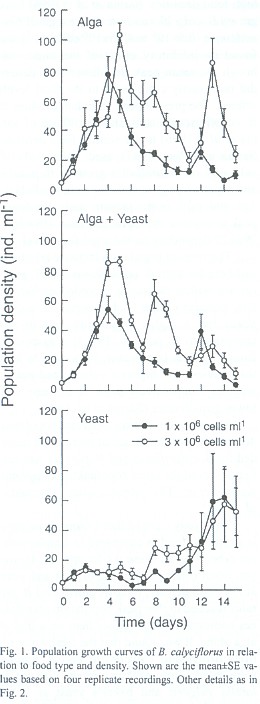
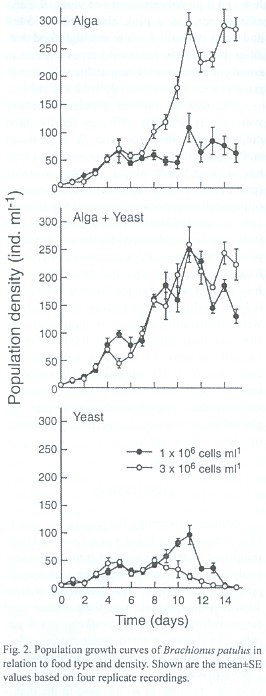
</front><body><![CDATA[ <CENTER><B><FONT FACE="Arial,Helvetica">&nbsp;Effect of three food types on the population growth of <I>Brachionus calyciflorus</I> and <I>Brachionus patulus</I> (Rotifera:&nbsp; Brachionidae)</FONT></B></CENTER> <FONT FACE="Arial,Helvetica"><FONT SIZE=-1>&nbsp;</FONT></FONT>     <BR><FONT FACE="Arial,Helvetica"><FONT SIZE=-1>&nbsp;</FONT></FONT>     <BR><FONT FACE="Arial,Helvetica"><FONT SIZE=-1>S.S.S. Sarma<A NAME="R1"></A><SUP><A HREF="#A1">1</A>,<A HREF="#A1">*</A></SUP>, Paula Susana Larios Jurado<SUP><A HREF="#A1">1</A></SUP> &amp; S. Nandini<SUP><A HREF="#A1">2</A></SUP></FONT></FONT>     <BR>&nbsp;     <BR>&nbsp;     <BR><FONT FACE="Arial,Helvetica"><FONT SIZE=-1>Received&nbsp; 6-XII-1999.&nbsp;&nbsp;&nbsp; Corrected&nbsp;&nbsp; 18-VII-2000.&nbsp;&nbsp;&nbsp; Accepted&nbsp;&nbsp;&nbsp;&nbsp; 31-VII-2000</FONT></FONT>     <BR><FONT FACE="Arial,Helvetica"><FONT SIZE=-1>&nbsp;</FONT></FONT>     <BR><B><FONT FACE="Arial,Helvetica"><FONT SIZE=-1>Abstract</FONT></FONT></B>     <BR><B><FONT FACE="Arial,Helvetica"><FONT SIZE=-1>&nbsp;</FONT></FONT></B>     <BR><FONT FACE="Arial,Helvetica"><FONT SIZE=-1>We compared the population growth of <I>B. calyciflorus</I> and <I>B. patulus</I> using the green alga <I>Chlorella vulgaris</I>, baker’s yeast <I>Saccharomyces cerevisiae</I> or their mixture in equal proportions as food. Food was offered once every 24 h in two concentrations (low:&nbsp; 1x10<SUP>6</SUP> and high:&nbsp; 3x10<SUP>6</SUP> ind. ml<SUP>-1</SUP>) separately for each species. The experiments were terminated after 15 days. In general, at any food type or concentration, <I>B. patulus</I> reached a higher population density. A diet of <I>Chlorella</I> alone supported a higher population growth of both rotifer species than yeast alone. <I>B. calyciflorus</I> and <I>B. patulus</I> achieved highest population densities (103&plusmn;8 ind. ml<SUP>-1</SUP> and 296&plusmn;20 ind. ml<SUP>-1</SUP>, respectively) on a diet of <I>Chlorella</I> at 3x10<SUP>6</SUP> ind. ml<SUP>-1</SUP>. When cultured using the mixture of <I>Chlorella</I> and yeast, the maximal population densities of <I>B. calyciflorus</I> were lower than those grown on <I>Chlorella</I>. Under similar conditions, the maximal abundance values of <I>B. patulus</I> were comparable in both food types. Regardless of food type and density the rate of population increase per day (r) for <I>B. calyciflorus</I> varied from 0.13&plusmn;0.03 to 0.63&plusmn;0.04. These values for <I>B. patulus</I> ranged from 0.19&plusmn;0.01 to 0.37&plusmn;0.01. The results indicated that even though <I>Chlorella</I> was a superior foof for the tested rotifers, yeast can be effectively used at low concentrations to supplement algal requirements in rotifer culture systems.</FONT></FONT>     ]]></body>
<body><![CDATA[<BR><FONT FACE="Arial,Helvetica"><FONT SIZE=-1>&nbsp;</FONT></FONT>     <BR><FONT FACE="Arial,Helvetica"><FONT SIZE=-1><B>Key words</B>:&nbsp; Population growth, alga, yeast, Rotifera.</FONT></FONT>     <BR><FONT FACE="Arial,Helvetica"><FONT SIZE=-1>&nbsp;</FONT></FONT>     <BR><FONT FACE="Arial,Helvetica"><FONT SIZE=-1>&nbsp;</FONT></FONT>     <BR><FONT FACE="Arial,Helvetica"><FONT SIZE=-1>Laboratory cultivation of brachionid rotifers has been successfully done using green algae. In order to supplement the algal quantity, <A HREF="#Hirata">Hirata and Mori (1967)</A> introduced the use of bakers' yeast as food for the saline water species <I>Brachionus plicatilis</I>. Since then a number of investigators have used bakers' yeast as food for this species; rotifers grown in this way have also been nutritionally enriched (<A HREF="#Fernandez">Fernandez-Reiriz and Labarta 1996</A>, <A HREF="#Lie">Lie <I>et al.&nbsp;</I> 1997</A>). A vast majority of researchers used yeast only for <I>B. plicatilis</I> and <I>Brachionus rotundiformis</I>. In aquaculture, in addition to these two species, several other rotifer taxa such as <I>B. calyciflorus</I>, <I>B. rubens</I> and <I>B. patulus</I> are used as starter food (<A HREF="#Rottmann">Rottmann <I>et al.&nbsp;</I> 1991</A>, <A HREF="#Mookerji">Mookerji and Rao 1994</A>).</FONT></FONT>      <P><FONT FACE="Arial,Helvetica"><FONT SIZE=-1>Several algal species have been used while testing the use of freshwater rotifer species. Since algal cultivation under controlled conditions is laborious, time consuming and expensive, alternative food types such as yeast, wastewater from food industry and livestock have been used for mass rotifer cultures (<A HREF="#Klekot">Klekot and Klimowicz 1981</A>). However, controlled laboratory experiments using these food types for rotifers are necessary to compare the population growth with conventional algal diets. It is also not known whether different <I>Brachionus</I> species show different population growth rates when grown on yeast. At the same time, a comparative information about the growth of different rotifers grown on alga, yeast and their mixture separately has rarely been published (<A HREF="#Guevara">Guevara <I>et al.&nbsp;</I> 1996</A>).</FONT></FONT>      <P><FONT FACE="Arial,Helvetica"><FONT SIZE=-1>The aim of this study was to test the effect of different concentrations of green alga and yeast and their mixture on the population growth of two brachionid rotifer species commonly found in freshwater systems.</FONT></FONT>     <BR><FONT FACE="Arial,Helvetica"><FONT SIZE=-1>&nbsp;</FONT></FONT>     <BR><B><FONT FACE="Arial,Helvetica"><FONT SIZE=-1>Materials and methods</FONT></FONT></B>     <BR><B><FONT FACE="Arial,Helvetica"><FONT SIZE=-1>&nbsp;</FONT></FONT></B>     ]]></body>
<body><![CDATA[<BR><FONT FACE="Arial,Helvetica"><FONT SIZE=-1>We used clonal populations of each of the two rotifer species <I>Brachionus calyciflorus </I>and<I> Brachionus patulus </I>maintained at least for 3 months prior to testing. Both the rotifer species were mass-cultured (40 l glass aquaria) using the green algae <I>Chlorella vulgaris</I> as the exclusive food. Two weeks prior to experimentation, the test rotifer species were also offered baker's yeast <I>Saccharomyces cerevisiae</I> in addition to the algal diet. For maintaining mass rotifer cultures we used reconstituted hardwater (EPA) as medium (<A HREF="#Anonymous">Anonymous 1985</A>). This was also used as medium for rotifer growth experiments.</FONT></FONT>      <P><FONT FACE="Arial,Helvetica"><FONT SIZE=-1><I>Chlorella</I> was cultured using Bold-basal medium. Log phase algae were harvested, centrifuged and resuspended in EPA medium. Commercially available baker's yeast was freshly procured, resuspended in EPA medium and filtered using a 20&nbsp;<IMG SRC="/img/fbpe/rbt/v49n1/u.JPG" HEIGHT=12 WIDTH=11 ALIGN=ABSBOTTOM>m mesh to remove clumps. Algal and yeast cell density was estimated using haemocytometer. For each rotifer species we offered food in the following ways: 1. only alga, 2. only yeast, and 3. alga+yeast in equal density.</FONT></FONT>      
<P><FONT FACE="Arial,Helvetica"><FONT SIZE=-1>Each food type was offered in two densities viz. low (1x10<SUP>6</SUP>) and high (3x10<SUP>6</SUP> ind. ml<SUP>-1</SUP>). For each food type and density, we maintained four replicates. Thus for population growth of <I>B. calyciflorus</I>, we maintained a total of 24 plastic jars (3 food types x 2 food concentrations x 4 replicates), each containing 20 ml of EPA medium with appropriate food density. The initial density of rotifers in each test jar was 5 ind. ml<SUP>-1</SUP>. For the population growth of <I>B. patulus</I> also the above design was used. Experiments were conducted at 23&plusmn;2&deg;C.</FONT></FONT>      <P><FONT FACE="Arial,Helvetica"><FONT SIZE=-1>Following inoculation of <I>B. calyciflorus</I> or <I>B. patulus</I>, at every 24 h interval, we counted the number of female rotifers alive under a stereomicroscope. For this we either counted the whole volume of the test vessel or two aliquot samples each of 1-5 ml depending the density of rotifers per container. After estimating the density, the individuals were transferred to fresh EPA medium containing appropriate food type. The transfer of rotifers to fresh medium was done either individually, when the densities were low, or using a 50&nbsp;<IMG SRC="/img/fbpe/rbt/v49n1/u.JPG" HEIGHT=12 WIDTH=11 ALIGN=ABSBOTTOM>m mesh during later stages of the study. Experiments were terminated after 15 days when most populations began to decline. Thoughout this study males were not encountered.</FONT></FONT>      
<P><FONT FACE="Arial,Helvetica"><FONT SIZE=-1>The rotifer population growth was obtained from a mean of 4-5 values during the exponential phase using the equation r = (ln N<SUB>t </SUB>- ln N<SUB>o</SUB>)/t, where, N<SUB>o</SUB> = initial population density, N<SUB>t</SUB> = density of population after time t (days) (<A HREF="#Krebs">Krebs, 1985</A>).</FONT></FONT>     <CENTER><A NAME="fig1"></A><IMG SRC="/img/fbpe/rbt/v49n1/2326i01.JPG" HEIGHT=704 WIDTH=260><A NAME="fig2"></A><IMG SRC="/img/fbpe/rbt/v49n1/2326i02.JPG" HEIGHT=696 WIDTH=266></CENTER>       
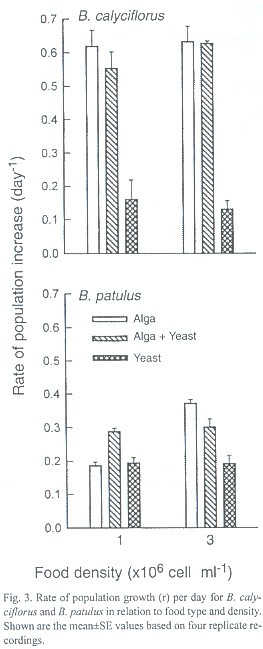
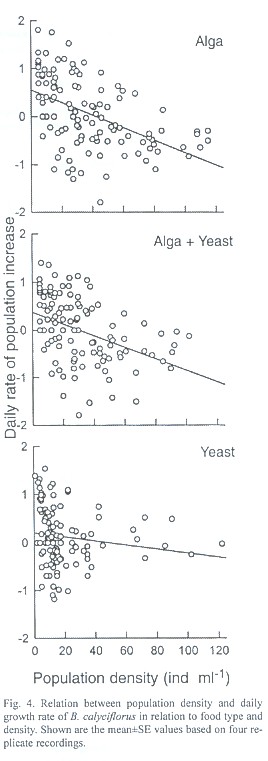
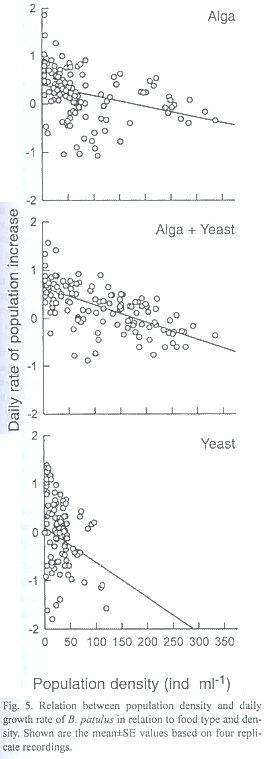
<P><B><FONT FACE="Arial,Helvetica"><FONT SIZE=-1>Results</FONT></FONT></B>     <BR><FONT FACE="Arial,Helvetica"><FONT SIZE=-1>&nbsp;</FONT></FONT>     <BR><FONT FACE="Arial,Helvetica"><FONT SIZE=-1>The population growth curves of <I>B. calyciflorus</I> and <I>B. patulus</I> reared under three food types and two densities are shown in <A HREF="#fig1">Figs. 1</A> and <A HREF="#fig2">2</A>. The maximal population density of <I>B. patulus</I> influenced significantly (p&lt;0.01) by food type, its concentration as well as their interaction but not for <I>B. calyciflorus</I> (p>0.05, ANOVA). In general, at any food type or concentration, <I>B. patulus</I> reached higher population density when compared to <I>B. calyciflorus</I>. In 1x10<SUP>6</SUP> ind. ml<SUP>-1</SUP>, <I>B. calyciflorus</I> reached 77&plusmn;12 ind. ml<SUP>-1</SUP>; at the same food level <I>B. patulus</I> attained 109&plusmn;26 ind. ml<SUP>-1</SUP>. At 3x10<SUP>6</SUP> ind. ml<SUP>-1</SUP> density, <I>B. calyciflorus</I> reached a peak density of 103&plusmn;8 ind. ml<SUP>-1</SUP>. Under comparable conditions, <I>B. patulus</I> reached much higher peak abundance 296&plusmn;20 ind. ml<SUP>-1</SUP>. When yeast was used as exclusive food, the maximal abundance values reached by <I>B. calyciflorus</I> were 62&plusmn;19 and 57&plusmn;25 ind. ml<SUP>-1</SUP> under low (1x10<SUP>6</SUP> ind. ml<SUP>-1</SUP>) low and high (3x10<SUP>6</SUP> ind. ml<SUP>-1</SUP>) food concentrations, respectively. On the other hand, <I>B. patulus</I> showed peak population abundances of 97&plusmn;17 and 50&plusmn;6 ind. ml<SUP>-1</SUP> in low and high concentrations of yeast. <I>B. calyciflorus</I> reached a peak abundance of 54&plusmn;9 and 86&plusmn;3 ind. ml<SUP>-1</SUP> for low and high food densities when both these food types offered in equal concentrations. Comparable values of <I>B. patulus</I> were 251&plusmn;12 and 259&plusmn;32 ind. ml<SUP>-1</SUP>.</FONT></FONT>      <P><FONT FACE="Arial,Helvetica"><FONT SIZE=-1>The day of maximal population density was not significantly different for the food concentrations used for both <I>B. calyciflorus</I> and <I>B. patulus</I> (p>0.05). However, food type had a significant effect on this variable (p&lt;0.01) for both the species. The highest rate of population growth (r) recorded for <I>B. calyciflorus</I> was 0.63&plusmn;0.04 and the lowest r value (0.13&plusmn;0.03) was observed for the same species when grown in high concentration of yeast. Regardless of food type and density the r values of <I>B. patulus</I> ranged from 0.19&plusmn;0.01 to 0.37&plusmn;0.01 (<A HREF="#fig3">Fig. 3</A>). The r values for <I>B. patulus</I> were significantly affected by food type, density and their interaction (p&lt;0.001). For <I>B. calyciflorus</I> only the food type had a significant effect (p&lt;0.01). An inverse relation occurred for both <I>B. calyciflorus</I> and <I>B. patulus</I> when the daily rate of population increase was plotted againt the population density of the same day (<A HREF="#fig4">Figs. 4</A> and<A HREF="#fig5"> 5</A>).</FONT></FONT>     ]]></body>
<body><![CDATA[<BR><FONT FACE="Arial,Helvetica"><FONT SIZE=-1>&nbsp;</FONT></FONT>     <CENTER><A NAME="table1"></A><FONT FACE="Arial,Helvetica"><FONT SIZE=-1>Table 1.</FONT></FONT></CENTER>      <CENTER><FONT FACE="Arial,Helvetica"><FONT SIZE=-1>Rate of population increase (r) per day of selected rotifer species, family Brachionidae.</FONT></FONT></CENTER>      <CENTER><FONT FACE="Arial,Helvetica"><FONT SIZE=-1>&nbsp;</FONT></FONT></CENTER>      <CENTER><TABLE BORDER=0 CELLSPACING=2 CELLPADDING=0 WIDTH="71%" >     <TR>     <TD VALIGN=TOP WIDTH="109" class="Normal"><FONT FACE="Arial,Helvetica"><FONT SIZE=-2>Species</FONT></FONT></TD>     <TD VALIGN=TOP WIDTH="85" class="Normal"><FONT FACE="Arial,Helvetica"><FONT SIZE=-2>Experiment</FONT></FONT></TD>     <TD VALIGN=TOP WIDTH="104" class="Normal"><FONT FACE="Arial,Helvetica"><FONT SIZE=-2>Food     type</FONT></FONT></TD>     ]]></body>
<body><![CDATA[<TD VALIGN=TOP WIDTH="94" class="Normal"><FONT FACE="Arial,Helvetica"><FONT SIZE=-2>Food     level</FONT></FONT></TD>     <TD VALIGN=TOP WIDTH="85" class="Normal"><FONT FACE="Arial,Helvetica"><FONT SIZE=-2>r     value</FONT></FONT></TD>     <TD VALIGN=TOP WIDTH="121" class="Normal"><FONT FACE="Arial,Helvetica"><FONT SIZE=-2>Reference</FONT></FONT></TD>     </TR>     <TR>     <TD VALIGN=TOP WIDTH="109" class="Normal"><I><FONT FACE="Arial,Helvetica"><FONT SIZE=-2>Anuraeopsis     fissa</FONT></FONT></I></TD>     <TD VALIGN=TOP WIDTH="85" class="Normal"><FONT FACE="Arial,Helvetica"><FONT SIZE=-2>Population     ]]></body>
<body><![CDATA[growth</FONT></FONT></TD>     <TD VALIGN=TOP WIDTH="104" class="Normal"><I><FONT FACE="Arial,Helvetica"><FONT SIZE=-2>Scenedesmus     obliquus</FONT></FONT></I></TD>     <TD VALIGN=TOP WIDTH="94" class="Normal"><FONT FACE="Arial,Helvetica"><FONT SIZE=-2>0.5     - 8 x 10<SUP>6</SUP> cells ml<SUP>-1</SUP></FONT></FONT></TD>     <TD VALIGN=TOP WIDTH="85" class="Normal"><FONT FACE="Arial,Helvetica"><FONT SIZE=-2>0.45     - 0.86</FONT></FONT></TD>     <TD VALIGN=TOP WIDTH="121" class="Normal"><FONT FACE="Arial,Helvetica"><FONT SIZE=-2>Dumont     <I>et al. </I>, 1995</FONT></FONT></TD>     </TR>     ]]></body>
<body><![CDATA[<TR>     <TD VALIGN=TOP WIDTH="109" class="Normal"><FONT FACE="Arial,Helvetica"><FONT SIZE=-2>&nbsp;</FONT></FONT></TD>     <TD VALIGN=TOP WIDTH="85" class="Normal"><FONT FACE="Arial,Helvetica"><FONT SIZE=-2>Population     growth</FONT></FONT></TD>     <TD VALIGN=TOP WIDTH="104" class="Normal"><I><FONT FACE="Arial,Helvetica"><FONT SIZE=-2>Scenedesmus     acutus</FONT></FONT></I></TD>     <TD VALIGN=TOP WIDTH="94" class="Normal"><FONT FACE="Arial,Helvetica"><FONT SIZE=-2>0.5     - 40.5 x 10<SUP>6</SUP> cells ml<SUP>-1</SUP></FONT></FONT></TD>     <TD VALIGN=TOP WIDTH="85" class="Normal"><FONT FACE="Arial,Helvetica"><FONT SIZE=-2>0.44     - 0.88</FONT></FONT></TD>     ]]></body>
<body><![CDATA[<TD VALIGN=TOP WIDTH="121" class="Normal"><FONT FACE="Arial,Helvetica"><FONT SIZE=-2>Sarma     <I>et al. </I>, 1996</FONT></FONT></TD>     </TR>     <TR>     <TD VALIGN=TOP WIDTH="109" class="Normal"><FONT FACE="Arial,Helvetica"><FONT SIZE=-2>&nbsp;</FONT></FONT></TD>     <TD VALIGN=TOP WIDTH="85" class="Normal"><FONT FACE="Arial,Helvetica"><FONT SIZE=-2>Life     table</FONT></FONT></TD>     <TD VALIGN=TOP WIDTH="104" class="Normal"><I><FONT FACE="Arial,Helvetica"><FONT SIZE=-2>-</FONT></FONT></I></TD>     <TD VALIGN=TOP WIDTH="94" class="Normal"><FONT FACE="Arial,Helvetica"><FONT SIZE=-2>-</FONT></FONT></TD>     <TD VALIGN=TOP WIDTH="85" class="Normal"><FONT FACE="Arial,Helvetica"><FONT SIZE=-2>0.10</FONT></FONT></TD>     ]]></body>
<body><![CDATA[<TD VALIGN=TOP WIDTH="121" class="Normal"><FONT FACE="Arial,Helvetica"><FONT SIZE=-2>Ooms-Wilms,     1997</FONT></FONT></TD>     </TR>     <TR>     <TD VALIGN=TOP WIDTH="109" class="Normal"><I><FONT FACE="Arial,Helvetica"><FONT SIZE=-2>Brachionus     angularis</FONT></FONT></I></TD>     <TD VALIGN=TOP WIDTH="85" class="Normal"><FONT FACE="Arial,Helvetica"><FONT SIZE=-2>Population     growth</FONT></FONT></TD>     <TD VALIGN=TOP WIDTH="104" class="Normal"><I><FONT FACE="Arial,Helvetica"><FONT SIZE=-2>Stichococcus     bacillaris</FONT></FONT></I></TD>     ]]></body>
<body><![CDATA[<TD VALIGN=TOP WIDTH="94" class="Normal"><FONT FACE="Arial,Helvetica"><FONT SIZE=-2>-</FONT></FONT></TD>     <TD VALIGN=TOP WIDTH="85" class="Normal"><FONT FACE="Arial,Helvetica"><FONT SIZE=-2>0.58</FONT></FONT></TD>     <TD VALIGN=TOP WIDTH="121" class="Normal"><FONT FACE="Arial,Helvetica"><FONT SIZE=-2>Walz,     1993</FONT></FONT></TD>     </TR>     <TR>     <TD VALIGN=TOP WIDTH="109" class="Normal"><I><FONT FACE="Arial,Helvetica"><FONT SIZE=-2>B.     calyciflorus</FONT></FONT></I></TD>     <TD VALIGN=TOP WIDTH="85" class="Normal"><FONT FACE="Arial,Helvetica"><FONT SIZE=-2>Life     table</FONT></FONT></TD>     ]]></body>
<body><![CDATA[<TD VALIGN=TOP WIDTH="104" class="Normal"><I><FONT FACE="Arial,Helvetica"><FONT SIZE=-2>-</FONT></FONT></I></TD>     <TD VALIGN=TOP WIDTH="94" class="Normal"><FONT FACE="Arial,Helvetica"><FONT SIZE=-2>-</FONT></FONT></TD>     <TD VALIGN=TOP WIDTH="85" class="Normal"><FONT FACE="Arial,Helvetica"><FONT SIZE=-2>2.20</FONT></FONT></TD>     <TD VALIGN=TOP WIDTH="121" class="Normal"><FONT FACE="Arial,Helvetica"><FONT SIZE=-2>Wang     and Li, 1997</FONT></FONT></TD>     </TR>     <TR>     <TD VALIGN=TOP WIDTH="109" class="Normal"><FONT FACE="Arial,Helvetica"><FONT SIZE=-2>&nbsp;</FONT></FONT></TD>     <TD VALIGN=TOP WIDTH="85" class="Normal"><FONT FACE="Arial,Helvetica"><FONT SIZE=-2>Population     growth</FONT></FONT></TD>     ]]></body>
<body><![CDATA[<TD VALIGN=TOP WIDTH="104" class="Normal"><I><FONT FACE="Arial,Helvetica"><FONT SIZE=-2>Scenedesmus     acutus</FONT></FONT></I></TD>     <TD VALIGN=TOP WIDTH="94" class="Normal"><FONT FACE="Arial,Helvetica"><FONT SIZE=-2>0.5     - 40.5 x 10<SUP>6</SUP> cells ml<SUP>-1</SUP></FONT></FONT></TD>     <TD VALIGN=TOP WIDTH="85" class="Normal"><FONT FACE="Arial,Helvetica"><FONT SIZE=-2>0.79     -1.49</FONT></FONT></TD>     <TD VALIGN=TOP WIDTH="121" class="Normal"><FONT FACE="Arial,Helvetica"><FONT SIZE=-2>Sarma     <I>et al. </I>, 1996.</FONT></FONT></TD>     </TR>     <TR>     ]]></body>
<body><![CDATA[<TD VALIGN=TOP WIDTH="109" class="Normal"><FONT FACE="Arial,Helvetica"><FONT SIZE=-2>&nbsp;</FONT></FONT></TD>     <TD VALIGN=TOP WIDTH="85" class="Normal"><FONT FACE="Arial,Helvetica"><FONT SIZE=-2>Population     growth</FONT></FONT></TD>     <TD VALIGN=TOP WIDTH="104" class="Normal"><FONT FACE="Arial,Helvetica"><FONT SIZE=-2>Various     types of algae&nbsp;</FONT></FONT></TD>     <TD VALIGN=TOP WIDTH="94" class="Normal"><FONT FACE="Arial,Helvetica"><FONT SIZE=-2>-</FONT></FONT></TD>     <TD VALIGN=TOP WIDTH="85" class="Normal"><FONT FACE="Arial,Helvetica"><FONT SIZE=-2>0.80</FONT></FONT></TD>     <TD VALIGN=TOP WIDTH="121" class="Normal"><FONT FACE="Arial,Helvetica"><FONT SIZE=-2>Rothhaupt,     1990</FONT></FONT></TD>     </TR>     ]]></body>
<body><![CDATA[<TR>     <TD VALIGN=TOP WIDTH="109" class="Normal"><I><FONT FACE="Arial,Helvetica"><FONT SIZE=-2>B.     patulus</FONT></FONT></I></TD>     <TD VALIGN=TOP WIDTH="85" class="Normal"><FONT FACE="Arial,Helvetica"><FONT SIZE=-2>Life     table</FONT></FONT></TD>     <TD VALIGN=TOP WIDTH="104" class="Normal"><I><FONT FACE="Arial,Helvetica"><FONT SIZE=-2>Chlorella</FONT></FONT></I></TD>     <TD VALIGN=TOP WIDTH="94" class="Normal"><FONT FACE="Arial,Helvetica"><FONT SIZE=-2>1-4     x 10<SUP>6</SUP> cells ml<SUP>-1</SUP></FONT></FONT></TD>     <TD VALIGN=TOP WIDTH="85" class="Normal"><FONT FACE="Arial,Helvetica"><FONT SIZE=-2>0.14-0.61</FONT></FONT></TD>     <TD VALIGN=TOP WIDTH="121" class="Normal"><FONT FACE="Arial,Helvetica"><FONT SIZE=-2>Sarma     ]]></body>
<body><![CDATA[and Rao, 1991</FONT></FONT></TD>     </TR>     <TR>     <TD VALIGN=TOP WIDTH="109" class="Normal"><FONT FACE="Arial,Helvetica"><FONT SIZE=-2>&nbsp;</FONT></FONT></TD>     <TD VALIGN=TOP WIDTH="85" class="Normal"><FONT FACE="Arial,Helvetica"><FONT SIZE=-2>Population     growth</FONT></FONT></TD>     <TD VALIGN=TOP WIDTH="104" class="Normal"><I><FONT FACE="Arial,Helvetica"><FONT SIZE=-2>Chlorella</FONT></FONT></I></TD>     <TD VALIGN=TOP WIDTH="94" class="Normal"><FONT FACE="Arial,Helvetica"><FONT SIZE=-2>1-3     x 10<SUP>6</SUP> cells ml<SUP>-1</SUP></FONT></FONT></TD>     <TD VALIGN=TOP WIDTH="85" class="Normal"><FONT FACE="Arial,Helvetica"><FONT SIZE=-2>0.12-0.24</FONT></FONT></TD>     ]]></body>
<body><![CDATA[<TD VALIGN=TOP WIDTH="121" class="Normal"><FONT FACE="Arial,Helvetica"><FONT SIZE=-2>Sarma     and Rao, 1990</FONT></FONT></TD>     </TR>     <TR>     <TD VALIGN=TOP WIDTH="109" class="Normal"><I><FONT FACE="Arial,Helvetica"><FONT SIZE=-2>B.     plicatilis</FONT></FONT></I></TD>     <TD VALIGN=TOP WIDTH="85" class="Normal"><FONT FACE="Arial,Helvetica"><FONT SIZE=-2>Population     growth</FONT></FONT></TD>     <TD VALIGN=TOP WIDTH="104" class="Normal"><I><FONT FACE="Arial,Helvetica"><FONT SIZE=-2>Tetrathelmis     tetrathele</FONT></FONT></I></TD>     ]]></body>
<body><![CDATA[<TD VALIGN=TOP WIDTH="94" class="Normal"><FONT FACE="Arial,Helvetica"><FONT SIZE=-2>0.05     x 10<SUP>6</SUP> cells ml<SUP>-1</SUP></FONT></FONT></TD>     <TD VALIGN=TOP WIDTH="85" class="Normal"><FONT FACE="Arial,Helvetica"><FONT SIZE=-2>0.24     - 0.49</FONT></FONT></TD>     <TD VALIGN=TOP WIDTH="121" class="Normal"><FONT FACE="Arial,Helvetica"><FONT SIZE=-2>Okauchi     and Fukusho, 1984</FONT></FONT></TD>     </TR>     <TR>     <TD VALIGN=TOP WIDTH="109" class="Normal"><FONT FACE="Arial,Helvetica"><FONT SIZE=-2>&nbsp;</FONT></FONT></TD>     <TD VALIGN=TOP WIDTH="85" class="Normal"><FONT FACE="Arial,Helvetica"><FONT SIZE=-2>Population     ]]></body>
<body><![CDATA[growth</FONT></FONT></TD>     <TD VALIGN=TOP WIDTH="104" class="Normal"><I><FONT FACE="Arial,Helvetica"><FONT SIZE=-2>Chlorella</FONT></FONT></I></TD>     <TD VALIGN=TOP WIDTH="94" class="Normal"><FONT FACE="Arial,Helvetica"><FONT SIZE=-2>1.5     x 10<SUP>6</SUP> cells ml<SUP>-1</SUP></FONT></FONT></TD>     <TD VALIGN=TOP WIDTH="85" class="Normal"><FONT FACE="Arial,Helvetica"><FONT SIZE=-2>0.16-0.47</FONT></FONT></TD>     <TD VALIGN=TOP WIDTH="121" class="Normal"><FONT FACE="Arial,Helvetica"><FONT SIZE=-2>Okauchi     and Fukusho, 1984</FONT></FONT></TD>     </TR>     <TR>     <TD VALIGN=TOP WIDTH="109" class="Normal"><I><FONT FACE="Arial,Helvetica"><FONT SIZE=-2>B.     ]]></body>
<body><![CDATA[rubens</FONT></FONT></I></TD>     <TD VALIGN=TOP WIDTH="85" class="Normal"><FONT FACE="Arial,Helvetica"><FONT SIZE=-2>Population     growth</FONT></FONT></TD>     <TD VALIGN=TOP WIDTH="104" class="Normal"><FONT FACE="Arial,Helvetica"><FONT SIZE=-2>Various     types of algae</FONT></FONT></TD>     <TD VALIGN=TOP WIDTH="94" class="Normal"><FONT FACE="Arial,Helvetica"><FONT SIZE=-2>-</FONT></FONT></TD>     <TD VALIGN=TOP WIDTH="85" class="Normal"><FONT FACE="Arial,Helvetica"><FONT SIZE=-2>0.80</FONT></FONT></TD>     <TD VALIGN=TOP WIDTH="121" class="Normal"><FONT FACE="Arial,Helvetica"><FONT SIZE=-2>Rothhaupt,     1990</FONT></FONT></TD>     </TR>     ]]></body>
<body><![CDATA[<TR>     <TD VALIGN=TOP WIDTH="109" class="Normal"><FONT FACE="Arial,Helvetica"><FONT SIZE=-2>&nbsp;</FONT></FONT></TD>     <TD VALIGN=TOP WIDTH="85" class="Normal"><FONT FACE="Arial,Helvetica"><FONT SIZE=-2>Population     growth</FONT></FONT></TD>     <TD VALIGN=TOP WIDTH="104" class="Normal"><I><FONT FACE="Arial,Helvetica"><FONT SIZE=-2>Chlorella</FONT></FONT></I></TD>     <TD VALIGN=TOP WIDTH="94" class="Normal"><FONT FACE="Arial,Helvetica"><FONT SIZE=-2>3     x 10<SUP>6</SUP> cells ml<SUP>-1</SUP></FONT></FONT></TD>     <TD VALIGN=TOP WIDTH="85" class="Normal"><FONT FACE="Arial,Helvetica"><FONT SIZE=-2>0.79</FONT></FONT></TD>     <TD VALIGN=TOP WIDTH="121" class="Normal"><FONT FACE="Arial,Helvetica"><FONT SIZE=-2>Iyer     and Rao, 1993</FONT></FONT></TD>     ]]></body>
<body><![CDATA[</TR>     <TR>     <TD VALIGN=TOP WIDTH="109" class="Normal"><I><FONT FACE="Arial,Helvetica"><FONT SIZE=-2>B.     urceolaris</FONT></FONT></I></TD>     <TD VALIGN=TOP WIDTH="85" class="Normal"><FONT FACE="Arial,Helvetica"><FONT SIZE=-2>Life     table</FONT></FONT></TD>     <TD VALIGN=TOP WIDTH="104" class="Normal"><I><FONT FACE="Arial,Helvetica"><FONT SIZE=-2>-</FONT></FONT></I></TD>     <TD VALIGN=TOP WIDTH="94" class="Normal"><FONT FACE="Arial,Helvetica"><FONT SIZE=-2>-</FONT></FONT></TD>     <TD VALIGN=TOP WIDTH="85" class="Normal"><FONT FACE="Arial,Helvetica"><FONT SIZE=-2>1.32</FONT></FONT></TD>     <TD VALIGN=TOP WIDTH="121" class="Normal"><FONT FACE="Arial,Helvetica"><FONT SIZE=-2>Wang     ]]></body>
<body><![CDATA[and Li, 1997</FONT></FONT></TD>     </TR>     <TR>     <TD VALIGN=TOP WIDTH="109" class="Normal"><I><FONT FACE="Arial,Helvetica"><FONT SIZE=-2>Keratella     cochlearis</FONT></FONT></I></TD>     <TD VALIGN=TOP WIDTH="85" class="Normal"><FONT FACE="Arial,Helvetica"><FONT SIZE=-2>Population     growth</FONT></FONT></TD>     <TD VALIGN=TOP WIDTH="104" class="Normal"><I><FONT FACE="Arial,Helvetica"><FONT SIZE=-2>Cryptomonas     erosa</FONT></FONT></I></TD>     <TD VALIGN=TOP WIDTH="94" class="Normal"><FONT FACE="Arial,Helvetica"><FONT SIZE=-2>0.005-0.01     ]]></body>
<body><![CDATA[x 10<SUP>6</SUP> cells ml<SUP>-1</SUP></FONT></FONT></TD>     <TD VALIGN=TOP WIDTH="85" class="Normal"><FONT FACE="Arial,Helvetica"><FONT SIZE=-2>0.28-0.40</FONT></FONT></TD>     <TD VALIGN=TOP WIDTH="121" class="Normal"><FONT FACE="Arial,Helvetica"><FONT SIZE=-2>Smith     and Gilbert, 1995</FONT></FONT></TD>     </TR>     <TR>     <TD VALIGN=TOP WIDTH="109" class="Normal"><FONT FACE="Arial,Helvetica"><FONT SIZE=-2>&nbsp;</FONT></FONT></TD>     <TD VALIGN=TOP WIDTH="85" class="Normal"><FONT FACE="Arial,Helvetica"><FONT SIZE=-2>Population     growth</FONT></FONT></TD>     <TD VALIGN=TOP WIDTH="104" class="Normal"><I><FONT FACE="Arial,Helvetica"><FONT SIZE=-2>-</FONT></FONT></I></TD>     ]]></body>
<body><![CDATA[<TD VALIGN=TOP WIDTH="94" class="Normal"><FONT FACE="Arial,Helvetica"><FONT SIZE=-2>-</FONT></FONT></TD>     <TD VALIGN=TOP WIDTH="85" class="Normal"><FONT FACE="Arial,Helvetica"><FONT SIZE=-2>0.13</FONT></FONT></TD>     <TD VALIGN=TOP WIDTH="121" class="Normal"><FONT FACE="Arial,Helvetica"><FONT SIZE=-2>Ooms-Wilms,     1997</FONT></FONT></TD>     </TR>     <TR>     <TD VALIGN=TOP WIDTH="109" class="Normal"><I><FONT FACE="Arial,Helvetica"><FONT SIZE=-2>K.     crassa</FONT></FONT></I></TD>     <TD VALIGN=TOP WIDTH="85" class="Normal"><FONT FACE="Arial,Helvetica"><FONT SIZE=-2>Population     growth</FONT></FONT></TD>     ]]></body>
<body><![CDATA[<TD VALIGN=TOP WIDTH="104" class="Normal"><I><FONT FACE="Arial,Helvetica"><FONT SIZE=-2>Cryptomonas     erosa</FONT></FONT></I></TD>     <TD VALIGN=TOP WIDTH="94" class="Normal"><FONT FACE="Arial,Helvetica"><FONT SIZE=-2>0.005-0.01     x 10<SUP>6</SUP> cells ml<SUP>-1</SUP></FONT></FONT></TD>     <TD VALIGN=TOP WIDTH="85" class="Normal"><FONT FACE="Arial,Helvetica"><FONT SIZE=-2>0.32</FONT></FONT></TD>     <TD VALIGN=TOP WIDTH="121" class="Normal"><FONT FACE="Arial,Helvetica"><FONT SIZE=-2>Smith     and Gilbert, 1995</FONT></FONT></TD>     </TR>     <TR>     <TD VALIGN=TOP WIDTH="109" class="Normal"><I><FONT FACE="Arial,Helvetica"><FONT SIZE=-2>K.     ]]></body>
<body><![CDATA[testudo</FONT></FONT></I></TD>     <TD VALIGN=TOP WIDTH="85" class="Normal"><FONT FACE="Arial,Helvetica"><FONT SIZE=-2>Life     table&nbsp;</FONT></FONT></TD>     <TD VALIGN=TOP WIDTH="104" class="Normal"><I><FONT FACE="Arial,Helvetica"><FONT SIZE=-2>-</FONT></FONT></I></TD>     <TD VALIGN=TOP WIDTH="94" class="Normal"><FONT FACE="Arial,Helvetica"><FONT SIZE=-2>-</FONT></FONT></TD>     <TD VALIGN=TOP WIDTH="85" class="Normal"><FONT FACE="Arial,Helvetica"><FONT SIZE=-2>0.15     -0.39</FONT></FONT></TD>     <TD VALIGN=TOP WIDTH="121" class="Normal"><FONT FACE="Arial,Helvetica"><FONT SIZE=-2>Stemberger,     1988</FONT></FONT></TD>     </TR>     ]]></body>
<body><![CDATA[</TABLE></CENTER>     <FONT FACE="Arial,Helvetica"><FONT SIZE=-1>&nbsp;The method of calculation     of r also depends on the source of data and culture conditions. The negative     r values as a result of stress (<I>e.g.</I> toxicant) are not included.</FONT></FONT>     <CENTER>&nbsp;</CENTER>      <CENTER><A NAME="fig3"></A><IMG SRC="/img/fbpe/rbt/v49n1/2326i04.JPG" HEIGHT=649 WIDTH=263><A NAME="fig4"></A><IMG SRC="/img/fbpe/rbt/v49n1/2326i05.JPG" HEIGHT=761 WIDTH=268></CENTER> <FONT FACE="Arial,Helvetica"><FONT SIZE=-1>&nbsp;</FONT></FONT>     
<CENTER><A NAME="fig5"></A><IMG SRC="/img/fbpe/rbt/v49n1/2326i06.JPG" HEIGHT=759 WIDTH=266></CENTER> <B><FONT FACE="Arial,Helvetica"><FONT SIZE=-1>Discussion</FONT></FONT></B>     
<BR><B><FONT FACE="Arial,Helvetica"><FONT SIZE=-1>&nbsp;</FONT></FONT></B>     <BR><FONT FACE="Arial,Helvetica"><FONT SIZE=-1>Studies concerning the population growth of <I>B. patulus</I> using baker's yeast have not been published so far. It is evident from the present study that yeast can be used for culturing <I>B. patulus</I> together with alga. The range of algal food densities chosen here were earlier used for growth studies of <I>B. calyciflorus</I> and <I>B. patulus</I>. As shown in many other studies (<A HREF="#Halbach">Halbach and Halbach-Keup 1974</A>), an increase in <I>Chlorella</I> level from 1x10<SUP>6</SUP> ind. ml<SUP>-1</SUP> to 3x10<SUP>6</SUP> ind. ml<SUP>-1</SUP> resulted in an increase in the maximum population abundance of both <I>B. calyciflorus</I> and <I>B. patulus</I> (<A HREF="#fig1">Figs. 1</A> and <A HREF="#fig2">2</A>). However, when different food types were combined, the maximum peak density of <I>B. calyciflorus</I> was not statistically significant due to similar growth curves of rotifers fed yeast in low and high food densities. <A HREF="#Sarma96">Sarma <I>et al.&nbsp;</I> (1996)</A> have grown <I>B. calyciflorus</I> in a wide range of <I>Scenedesmus</I> (0.5x10<SUP>6</SUP> to 40.5x10<SUP>6</SUP> ind. ml<SUP>-1</SUP>) and found no inhibitory effect of the algae, although the mean peak population abundances did not exactly correspond to the food levels offered. The present peak abundance values of <I>B. calciflorus</I> are comparable to those of <A HREF="#Sarma96">Sarma <I>et al.&nbsp;</I> (1996)</A> under similar food densties. <A HREF="#Sarma873">Sarma and Rao (1987)</A> used 1x10<SUP>6 </SUP>- 4x10<SUP>6</SUP> ind. ml<SUP>-1</SUP> of <I>Chlorella</I> for growing <I>B. patulus</I> and reported peak abundance values of&nbsp; 110 - 325&nbsp; ind. ml<SUP>-1</SUP>. In the present study, we found peak abundance values ranged from 109&plusmn;26 to 296&plusmn;20 depending on the algal food level.</FONT></FONT>      <P><FONT FACE="Arial,Helvetica"><FONT SIZE=-1>The rates of population increase (r) observed here for both <I>B. calyciflorus</I> and <I>B. patulus</I> are within the range recorded earlier for Brachionidae (<A HREF="#table1">Table 1</A>). In general, <I>B. calyciflorus</I> has a higher population growth rate compared to <I>B. patulus</I>. This is also evident from <A HREF="#fig3">Fig. 3</A>. It is however, important to note that species with higher r values need not always be competitively superior to those with lower growth rates (<A HREF="#Sarma99">Sarma <I>et al.&nbsp;</I> 1999</A>).</FONT></FONT>     ]]></body>
<body><![CDATA[<BR><FONT FACE="Arial,Helvetica"><FONT SIZE=-1>&nbsp;</FONT></FONT>     <BR><FONT FACE="Arial,Helvetica"><FONT SIZE=-1>The inverse relation between population density and per capita rate of increase as recorded for <I>B. calyciflurus</I> and <I>B. patulus</I> was earlier observed for other zooplankton (<I>Daphnia</I>:&nbsp; <A HREF="#Kerfoot">Kerfoot <I>et al.&nbsp;</I> 1985</A>, <I>Anuraeopsis</I>:&nbsp; <A HREF="#Dumont">Dumont <I>et al.&nbsp;</I> 1995</A>).</FONT></FONT>     <BR><FONT FACE="Arial,Helvetica"><FONT SIZE=-1>&nbsp;</FONT></FONT>     <BR><FONT FACE="Arial,Helvetica"><FONT SIZE=-1>This study showed that <I>Chlorella vulgaris</I> is a superior food as compared to <I>Saccharomyces cerevisiae</I> for these rotifer species. However, when offered a mixture of alga and yeast at low food density, <I>B. calyciflorus</I> and <I>B. patulus</I> reached higher peak population abundances comparable to or higher than on a diet of alga alone. It was found that the freshwater rotifers <I>Brachionus calyciflorus</I> and <I>B. patulus</I> were able to grow well on a mixed diet of <I>Chlorella vulgaris</I> and baker's yeast at 1x10<SUP>6</SUP> ind. ml<SUP>-1</SUP> density. Only yeast was not suited for both rotifer species under 1x10<SUP>6</SUP> and 3x10<SUP>6</SUP> ind. ml<SUP>-1</SUP> density. Thus, although a diet of yeast alone was not comparable to that of <I>Chlorella</I>, it can be effectively used at low concentrations to supplement algal requirements in rotifer culture systems.</FONT></FONT>      <P><B><FONT FACE="Arial,Helvetica"><FONT SIZE=-1>Acknowledgements</FONT></FONT></B>      <P><FONT FACE="Arial,Helvetica"><FONT SIZE=-1>SSSS and SN thank the National System of Investigators, Mexico (SNI-18723 and 20520, respectively) for support. Jose Luis G. Flores helped with the Spanish summary.</FONT></FONT>     <BR><B><FONT FACE="Arial,Helvetica"><FONT SIZE=-1>&nbsp;</FONT></FONT></B>     <BR><B><FONT FACE="Arial,Helvetica"><FONT SIZE=-1>Resumen</FONT></FONT></B>     <BR><FONT FACE="Arial,Helvetica"><FONT SIZE=-1>&nbsp;</FONT></FONT>     <BR><FONT FACE="Arial,Helvetica"><FONT SIZE=-1>Se compar&oacute; el crecimiento poblacional de dos especies planct&oacute;nicas (<I>B. calyciflorus</I> y <I>B. patulus</I>) desarrolladas con el alga verde <I>Chlorella vulgaris,</I> la levadura de cerveza <I>Saccharomyces cerevisiae</I> y la mezcla de ambas dietas en proporciones iguales. <I>B. patulus</I> alcanz&oacute; las mayores densidades con cualquier tipo de alimento utilizado en comparaci&oacute;n con <I>B. calyciflorus</I>. La dieta a base de <I>Chlorella vulgaris</I> sola promovi&oacute; el mayor crecimiento poblacional en relaci&oacute;n con la dieta de levadura sola. <I>B. calyciflorus</I> y <I>B. patulus</I> alcanzaron las mayores densidades de 103&plusmn;8 ind. ml<SUP>-1</SUP> y 296&plusmn;20 ind. ml<SUP>-1</SUP>, respectivamente, con la dieta de <I>Chlorella</I> en 3x10<SUP>6</SUP> c&eacute;lulas ml<SUP>-1</SUP>. En condiciones similares, los valores m&aacute;ximos de abundancia de <I>B. patulus</I> fueron semejantes para ambos tipos de alimento. La tasa de incremento poblacional por d&iacute;a (r) para <I>B. calyciflorus</I> vario de 0.13&plusmn;0.03 a 0.63&plusmn;0.04, sin importar el tipo y densidad de alimento. Los resultados indican que la dieta a base de <I>Chlorella</I> fue mejor para los rot&iacute;feros considerados, y que la levadura puede usarse de manera efectiva a concentraciones bajas para complementar los requerimientos algales del sistema de cultivo de rot&iacute;feros.</FONT></FONT>     ]]></body>
<body><![CDATA[<BR><FONT FACE="Arial,Helvetica"><FONT SIZE=-1>&nbsp;</FONT></FONT>     <BR><B><FONT FACE="Arial,Helvetica"><FONT SIZE=-1>References</FONT></FONT></B>     <BR><B><FONT FACE="Arial,Helvetica"><FONT SIZE=-1>&nbsp;</FONT></FONT></B>     <!-- ref --><BR><A NAME="Anonymous"></A><FONT FACE="Arial,Helvetica"><FONT SIZE=-1>Anonymous. 1985. Methods of measuring the acute toxicity of effluents to freshwater and marine organisms. US Environment Protection Agency EPA/600/4-85/013.</FONT></FONT>    &nbsp;&nbsp;&nbsp;&nbsp;&nbsp;&nbsp;&nbsp;&nbsp;[&#160;<a href="javascript:void(0);" onclick="javascript: window.open('/scielo.php?script=sci_nlinks&ref=1354591&pid=S0034-7744200100010000800001&lng=','','width=640,height=500,resizable=yes,scrollbars=1,menubar=yes,');">Links</a>&#160;]<!-- end-ref --><!-- ref --><P><A NAME="Dumont"></A><FONT FACE="Arial,Helvetica"><FONT SIZE=-1>Dumont, H. J., S. S. S. Sarma &amp; A. J. Ali. 1995. Laboratory studies on the population dynamics of <I>Anuraeopsis fissa</I> (Rotifera) in relation to food density. Freshwater Biol. 33: 39-46.</FONT></FONT>    &nbsp;&nbsp;&nbsp;&nbsp;&nbsp;&nbsp;&nbsp;&nbsp;[&#160;<a href="javascript:void(0);" onclick="javascript: window.open('/scielo.php?script=sci_nlinks&ref=1354592&pid=S0034-7744200100010000800002&lng=','','width=640,height=500,resizable=yes,scrollbars=1,menubar=yes,');">Links</a>&#160;]<!-- end-ref --><!-- ref --><P><A NAME="Fernandez"></A><FONT FACE="Arial,Helvetica"><FONT SIZE=-1>Fernandez-Reiriz, M. J. &amp; U. Labarta. 1996. Lipid classes and fatty acid composition of rotifers (<I>Brachionus plicatilis</I>) fed two algal diets. Hydrobiologia 330: 73-79.</FONT></FONT>    &nbsp;&nbsp;&nbsp;&nbsp;&nbsp;&nbsp;&nbsp;&nbsp;[&#160;<a href="javascript:void(0);" onclick="javascript: window.open('/scielo.php?script=sci_nlinks&ref=1354593&pid=S0034-7744200100010000800003&lng=','','width=640,height=500,resizable=yes,scrollbars=1,menubar=yes,');">Links</a>&#160;]<!-- end-ref --><!-- ref --><P><A NAME="Guevara"></A><FONT FACE="Arial,Helvetica"><FONT SIZE=-1>Guevara, M., A. G. Gaspar &amp; N. Marin. 1996. The use of microalgae and baker's yeast in the culture of <I>Brachionus plicatilis</I> from the Araya's saline. Acta Cientifica Venezolana 47: 255-261.</FONT></FONT>    &nbsp;&nbsp;&nbsp;&nbsp;&nbsp;&nbsp;&nbsp;&nbsp;[&#160;<a href="javascript:void(0);" onclick="javascript: window.open('/scielo.php?script=sci_nlinks&ref=1354594&pid=S0034-7744200100010000800004&lng=','','width=640,height=500,resizable=yes,scrollbars=1,menubar=yes,');">Links</a>&#160;]<!-- end-ref --><!-- ref --><P><A NAME="Halbach"></A><FONT FACE="Arial,Helvetica"><FONT SIZE=-1>Halbach, U. &amp; G. Halbach-Keup. 1974. Quantitative beziehungen zwischen phytoplankton und der populationsdynamik des rotators <I>Brachionus calyciflorus</I> Pallas. Befunde aus laboratoriumsexperimenten und freilanduntersuchungen. Arch. Hydrobiol. 73: 273-309.</FONT></FONT>    &nbsp;&nbsp;&nbsp;&nbsp;&nbsp;&nbsp;&nbsp;&nbsp;[&#160;<a href="javascript:void(0);" onclick="javascript: window.open('/scielo.php?script=sci_nlinks&ref=1354595&pid=S0034-7744200100010000800005&lng=','','width=640,height=500,resizable=yes,scrollbars=1,menubar=yes,');">Links</a>&#160;]<!-- end-ref --><!-- ref --><P><A NAME="Hirata"></A><FONT FACE="Arial,Helvetica"><FONT SIZE=-1>Hirata, H. &amp; Y. Mori. 1967. Cultivation of the rotifer <I>Brachionus plicatilis</I> fed on a mixed diet of marine <I>Chlorella</I> and baker's yeast. Saibai Gyigyo 5: 36-40.</FONT></FONT>    &nbsp;&nbsp;&nbsp;&nbsp;&nbsp;&nbsp;&nbsp;&nbsp;[&#160;<a href="javascript:void(0);" onclick="javascript: window.open('/scielo.php?script=sci_nlinks&ref=1354596&pid=S0034-7744200100010000800006&lng=','','width=640,height=500,resizable=yes,scrollbars=1,menubar=yes,');">Links</a>&#160;]<!-- end-ref --><!-- ref --><P><A NAME="Iyer"></A><FONT FACE="Arial,Helvetica"><FONT SIZE=-1>Iyer, N. &amp; T. R. Rao. 1993. Effect of the epizoic rotifer <I>Brachionus rubens</I> on the population growth of three cladoceran species. Hydrobiologia 255/256: 325-332.</FONT></FONT>    &nbsp;&nbsp;&nbsp;&nbsp;&nbsp;&nbsp;&nbsp;&nbsp;[&#160;<a href="javascript:void(0);" onclick="javascript: window.open('/scielo.php?script=sci_nlinks&ref=1354597&pid=S0034-7744200100010000800007&lng=','','width=640,height=500,resizable=yes,scrollbars=1,menubar=yes,');">Links</a>&#160;]<!-- end-ref --><!-- ref --><P><A NAME="Kerfoot"></A><FONT FACE="Arial,Helvetica"><FONT SIZE=-1>Kerfoot, W.C., W. R. Demott &amp; C. Levitan. 1985. Non-linearities in competitive interactions: component variables or system response? Ecology 66: 959-965.</FONT></FONT>    &nbsp;&nbsp;&nbsp;&nbsp;&nbsp;&nbsp;&nbsp;&nbsp;[&#160;<a href="javascript:void(0);" onclick="javascript: window.open('/scielo.php?script=sci_nlinks&ref=1354598&pid=S0034-7744200100010000800008&lng=','','width=640,height=500,resizable=yes,scrollbars=1,menubar=yes,');">Links</a>&#160;]<!-- end-ref --><!-- ref --><P><A NAME="Klekot"></A><FONT FACE="Arial,Helvetica"><FONT SIZE=-1>Klekot, L. &amp; H. Klimowicz. 1981. Rotifer communities of ponds supplied with post-waste water. Holarctic Ecol. 4: 1981. 208-214.</FONT></FONT>    &nbsp;&nbsp;&nbsp;&nbsp;&nbsp;&nbsp;&nbsp;&nbsp;[&#160;<a href="javascript:void(0);" onclick="javascript: window.open('/scielo.php?script=sci_nlinks&ref=1354599&pid=S0034-7744200100010000800009&lng=','','width=640,height=500,resizable=yes,scrollbars=1,menubar=yes,');">Links</a>&#160;]<!-- end-ref --><!-- ref --><P><A NAME="Krebs"></A><FONT FACE="Arial,Helvetica"><FONT SIZE=-1>Krebs, C. J. 1985. Ecology. The experimental analysis of distribution and abundance. 3rd edn. Harper and Row, New York. 789 pp.</FONT></FONT>    &nbsp;&nbsp;&nbsp;&nbsp;&nbsp;&nbsp;&nbsp;&nbsp;[&#160;<a href="javascript:void(0);" onclick="javascript: window.open('/scielo.php?script=sci_nlinks&ref=1354600&pid=S0034-7744200100010000800010&lng=','','width=640,height=500,resizable=yes,scrollbars=1,menubar=yes,');">Links</a>&#160;]<!-- end-ref --><!-- ref --><P><A NAME="Lie"></A><FONT FACE="Arial,Helvetica"><FONT SIZE=-1>Lie, O., H. Haaland, G. I. Hemre, A. Maage, E. Lied, G. Rosenlund, K. Sandnes &amp; Y. Olsen. 1997. Nutritional composition of rotifers following a change in diet from yeast and emulsified oil to microalgae. Aquacult. Int. 5: 427-438.</FONT></FONT>    &nbsp;&nbsp;&nbsp;&nbsp;&nbsp;&nbsp;&nbsp;&nbsp;[&#160;<a href="javascript:void(0);" onclick="javascript: window.open('/scielo.php?script=sci_nlinks&ref=1354601&pid=S0034-7744200100010000800011&lng=','','width=640,height=500,resizable=yes,scrollbars=1,menubar=yes,');">Links</a>&#160;]<!-- end-ref --><!-- ref --><P><A NAME="Mookerji"></A><FONT FACE="Arial,Helvetica"><FONT SIZE=-1>Mookerji, N. &amp; T. R. Rao. 1994. Influence of ontogenetic changes in prey selection on the survival and growth of rohu, <I>Labeo rohita</I> and singhi, <I>Heteropneustes fossilis</I> larvae. J. Fish Biol. 44: 479-490.</FONT></FONT>    &nbsp;&nbsp;&nbsp;&nbsp;&nbsp;&nbsp;&nbsp;&nbsp;[&#160;<a href="javascript:void(0);" onclick="javascript: window.open('/scielo.php?script=sci_nlinks&ref=1354602&pid=S0034-7744200100010000800012&lng=','','width=640,height=500,resizable=yes,scrollbars=1,menubar=yes,');">Links</a>&#160;]<!-- end-ref --><!-- ref --><P><A NAME="Okauchi"></A><FONT FACE="Arial,Helvetica"><FONT SIZE=-1>Okauchi, M. &amp; K. Fukusho. 1984. Food value of minute alga, <I>Tetraselmis tetrathele</I>, for the rotifer <I>Brachionus plicatilis</I> culture: 1. Population growth with batch culture. Bull. Nat. Res. Inst. Aquacult. 5<B>: </B>13-18.</FONT></FONT>    &nbsp;&nbsp;&nbsp;&nbsp;&nbsp;&nbsp;&nbsp;&nbsp;[&#160;<a href="javascript:void(0);" onclick="javascript: window.open('/scielo.php?script=sci_nlinks&ref=1354603&pid=S0034-7744200100010000800013&lng=','','width=640,height=500,resizable=yes,scrollbars=1,menubar=yes,');">Links</a>&#160;]<!-- end-ref --><!-- ref --><P><A NAME="Ooms"></A><FONT FACE="Arial,Helvetica"><FONT SIZE=-1>Ooms-Wilms, A.L. 1997. Are bacteria an important food source for rotifers in eutrophic lakes? J. Plankton Res. 19: 1125-1141.</FONT></FONT>    &nbsp;&nbsp;&nbsp;&nbsp;&nbsp;&nbsp;&nbsp;&nbsp;[&#160;<a href="javascript:void(0);" onclick="javascript: window.open('/scielo.php?script=sci_nlinks&ref=1354604&pid=S0034-7744200100010000800014&lng=','','width=640,height=500,resizable=yes,scrollbars=1,menubar=yes,');">Links</a>&#160;]<!-- end-ref --><!-- ref --><P><A NAME="Rothhaupt"></A><FONT FACE="Arial,Helvetica"><FONT SIZE=-1>Rothhaupt, K.O. 1990. Population growth rates of two closely related rotifer species effects of food quantity particle size and nutritional quality. Freshwater Biol. 23: 561-570.</FONT></FONT>    &nbsp;&nbsp;&nbsp;&nbsp;&nbsp;&nbsp;&nbsp;&nbsp;[&#160;<a href="javascript:void(0);" onclick="javascript: window.open('/scielo.php?script=sci_nlinks&ref=1354605&pid=S0034-7744200100010000800015&lng=','','width=640,height=500,resizable=yes,scrollbars=1,menubar=yes,');">Links</a>&#160;]<!-- end-ref --><!-- ref --><P><A NAME="Rottmann"></A><FONT FACE="Arial,Helvetica"><FONT SIZE=-1>Rottmann, R. W., J. V. Shireman &amp; E. P. Lincoln. 1991. Comparison of three live foods and two dry diets for intensive culture of grass carp and bighead carp larvae. Aquaculture 96: 269-280.</FONT></FONT>    &nbsp;&nbsp;&nbsp;&nbsp;&nbsp;&nbsp;&nbsp;&nbsp;[&#160;<a href="javascript:void(0);" onclick="javascript: window.open('/scielo.php?script=sci_nlinks&ref=1354606&pid=S0034-7744200100010000800016&lng=','','width=640,height=500,resizable=yes,scrollbars=1,menubar=yes,');">Links</a>&#160;]<!-- end-ref --><!-- ref --><P><A NAME="Sarma873"></A><FONT FACE="Arial,Helvetica"><FONT SIZE=-1>Sarma, S. S. S. &amp; T. R. Rao. 1987. Effect of food level on body size and egg size in a growing population of the rotifer <I>Brachionus patulus </I>M&uuml;ller. Arch. Hydrobiol. 111: 245-253.</FONT></FONT>    &nbsp;&nbsp;&nbsp;&nbsp;&nbsp;&nbsp;&nbsp;&nbsp;[&#160;<a href="javascript:void(0);" onclick="javascript: window.open('/scielo.php?script=sci_nlinks&ref=1354607&pid=S0034-7744200100010000800017&lng=','','width=640,height=500,resizable=yes,scrollbars=1,menubar=yes,');">Links</a>&#160;]<!-- end-ref --><!-- ref --><P><A NAME="Sarma90"></A><FONT FACE="Arial,Helvetica"><FONT SIZE=-1>Sarma, S.S.S. &amp; T. R. Rao. 1990. Population dynamics of <I>Brachionus patulus</I> M&uuml;ller (Rotifera) in relation to food and temperature. Proc. Indian Acad. Sci. (Anim. Sci.) 99: 335-343.</FONT></FONT>    &nbsp;&nbsp;&nbsp;&nbsp;&nbsp;&nbsp;&nbsp;&nbsp;[&#160;<a href="javascript:void(0);" onclick="javascript: window.open('/scielo.php?script=sci_nlinks&ref=1354608&pid=S0034-7744200100010000800018&lng=','','width=640,height=500,resizable=yes,scrollbars=1,menubar=yes,');">Links</a>&#160;]<!-- end-ref --><!-- ref --><P><A NAME="Sarma91"></A><FONT FACE="Arial,Helvetica"><FONT SIZE=-1>Sarma, S.S.S. &amp; T. R. Rao. 1991. The combined effects of food and temperature on the life history parameters of <I>Brachionus patulus </I>M&uuml;ller (Rotifera). Int. Revue ges. Hydrobiologia 76: 225-239.</FONT></FONT>    &nbsp;&nbsp;&nbsp;&nbsp;&nbsp;&nbsp;&nbsp;&nbsp;[&#160;<a href="javascript:void(0);" onclick="javascript: window.open('/scielo.php?script=sci_nlinks&ref=1354609&pid=S0034-7744200100010000800019&lng=','','width=640,height=500,resizable=yes,scrollbars=1,menubar=yes,');">Links</a>&#160;]<!-- end-ref --><!-- ref --><P><A NAME="Sarma96"></A><FONT FACE="Arial,Helvetica"><FONT SIZE=-1>Sarma, S. S. S., N. Iyer &amp; H. J. Dumont. 1996. Competitive interactions between herbivorous rotifers: Importance of food concentration and initial population density. Hydrobiologia 331: 1-7.</FONT></FONT>    &nbsp;&nbsp;&nbsp;&nbsp;&nbsp;&nbsp;&nbsp;&nbsp;[&#160;<a href="javascript:void(0);" onclick="javascript: window.open('/scielo.php?script=sci_nlinks&ref=1354610&pid=S0034-7744200100010000800020&lng=','','width=640,height=500,resizable=yes,scrollbars=1,menubar=yes,');">Links</a>&#160;]<!-- end-ref --><!-- ref --><P><A NAME="Sarma99"></A><FONT FACE="Arial,Helvetica"><FONT SIZE=-1>Sarma, S.S.S., M. A. Fern&aacute;ndez-Araiza &amp; S. Nandini. 1999. Competition between <I>Brachionus calyciflorus</I> Pallas and <I>Brachionus patulus</I> (M&uuml;ller) (Rotifera) in relation to algal food concentration and initial population density. Aquatic Ecol. 33: 339-345.</FONT></FONT>    &nbsp;&nbsp;&nbsp;&nbsp;&nbsp;&nbsp;&nbsp;&nbsp;[&#160;<a href="javascript:void(0);" onclick="javascript: window.open('/scielo.php?script=sci_nlinks&ref=1354611&pid=S0034-7744200100010000800021&lng=','','width=640,height=500,resizable=yes,scrollbars=1,menubar=yes,');">Links</a>&#160;]<!-- end-ref --><!-- ref --><P><A NAME="Smith"></A><FONT FACE="Arial,Helvetica"><FONT SIZE=-1>Smith, A. D. &amp; J. J. Gilbert. 1995. Relative susceptibilities of rotifers and cladocerans to <I>Microcystis aeruginosa.</I> Arch. Hydrobiol. 132: 309-336.</FONT></FONT>    &nbsp;&nbsp;&nbsp;&nbsp;&nbsp;&nbsp;&nbsp;&nbsp;[&#160;<a href="javascript:void(0);" onclick="javascript: window.open('/scielo.php?script=sci_nlinks&ref=1354612&pid=S0034-7744200100010000800022&lng=','','width=640,height=500,resizable=yes,scrollbars=1,menubar=yes,');">Links</a>&#160;]<!-- end-ref --><!-- ref --><P><A NAME="Stemberger"></A><FONT FACE="Arial,Helvetica"><FONT SIZE=-1>Stemberger, R. S. 1988. Reproductive costs and hydrodynamic benefits of chemically induced defenses in <I>Keratella testudo</I>. Limnol. Oceanogr. 33: 593-606.</FONT></FONT>    &nbsp;&nbsp;&nbsp;&nbsp;&nbsp;&nbsp;&nbsp;&nbsp;[&#160;<a href="javascript:void(0);" onclick="javascript: window.open('/scielo.php?script=sci_nlinks&ref=1354613&pid=S0034-7744200100010000800023&lng=','','width=640,height=500,resizable=yes,scrollbars=1,menubar=yes,');">Links</a>&#160;]<!-- end-ref --><!-- ref --><P><A NAME="Walz"></A><FONT FACE="Arial,Helvetica"><FONT SIZE=-1>Walz, N. 1993. Carbon metabolism and population dynamics of <I>Brachionus angularis</I> and <I>Keratella chochlearis</I>. In: N. Walz (ed). Plankton regulation dynamics. Experiments and models in rotifer continuous cultures. Springer-Verlag, Berlin. p. 89-105.</FONT></FONT>    &nbsp;&nbsp;&nbsp;&nbsp;&nbsp;&nbsp;&nbsp;&nbsp;[&#160;<a href="javascript:void(0);" onclick="javascript: window.open('/scielo.php?script=sci_nlinks&ref=1354614&pid=S0034-7744200100010000800024&lng=','','width=640,height=500,resizable=yes,scrollbars=1,menubar=yes,');">Links</a>&#160;]<!-- end-ref --><!-- ref --><P><A NAME="Wang"></A><FONT FACE="Arial,Helvetica"><FONT SIZE=-1>Wang, J. &amp; D. Li. 1997. Comparative studies on principal parameters of population growth of five freshwater rotifers. Acta Hydrobiol. Sin. 21: 131-136.</FONT></FONT>    &nbsp;&nbsp;&nbsp;&nbsp;&nbsp;&nbsp;&nbsp;&nbsp;[&#160;<a href="javascript:void(0);" onclick="javascript: window.open('/scielo.php?script=sci_nlinks&ref=1354615&pid=S0034-7744200100010000800025&lng=','','width=640,height=500,resizable=yes,scrollbars=1,menubar=yes,');">Links</a>&#160;]<!-- end-ref --><BR>&nbsp;      <P><A NAME="A1"></A><FONT FACE="Arial,Helvetica"><FONT SIZE=-1><A HREF="#R1">1</A> Carrera de Biolog&iacute;a, UNAM Campus Iztacala, AP 314, CP 54090, Los Reyes, Tlalnepantla, Edo. de M&eacute;xico, M&eacute;xico. Fax:&nbsp; +52 5 623 1155, e-mail:&nbsp; <A HREF="mailto:sarma@servidor.unam.mx">sarma@servidor.unam.mx</A></FONT></FONT>      ]]></body>
<body><![CDATA[<P><SUP><FONT FACE="Arial,Helvetica"><FONT SIZE=-1><A HREF="#R1">2</A> </FONT></FONT></SUP><FONT FACE="Arial,Helvetica"><FONT SIZE=-1>CyMA Project.</FONT></FONT>      <P><FONT FACE="Arial,Helvetica"><FONT SIZE=-1><A HREF="#R1">*</A>Corresponding author</FONT></FONT>     <BR>&nbsp;      ]]></body><back>
<ref-list>
<ref id="B1">
<nlm-citation citation-type="book">
<person-group person-group-type="author">
<name>
</name>
<name>
</name>
</person-group>
<source><![CDATA[Methods of measuring the acute toxicity of effluents to freshwater and marine organisms]]></source>
<year>1985</year>
<publisher-name><![CDATA[US Environment Protection Agency]]></publisher-name>
</nlm-citation>
</ref>
<ref id="B2">
<nlm-citation citation-type="journal">
<person-group person-group-type="author">
<name>
<surname><![CDATA[Dumont]]></surname>
<given-names><![CDATA[H. J]]></given-names>
</name>
<name>
<surname><![CDATA[Sarma]]></surname>
<given-names><![CDATA[S. S. S]]></given-names>
</name>
<name>
<surname><![CDATA[Ali]]></surname>
<given-names><![CDATA[A. J]]></given-names>
</name>
</person-group>
<article-title xml:lang="en"><![CDATA[Laboratory studies on the population dynamics of Anuraeopsis fissa (Rotifera) in relation to food density]]></article-title>
<source><![CDATA[Freshwater Biol]]></source>
<year>1995</year>
<volume>33</volume>
<page-range>39-46</page-range></nlm-citation>
</ref>
<ref id="B3">
<nlm-citation citation-type="journal">
<person-group person-group-type="author">
<name>
<surname><![CDATA[Fernandez-Reiriz]]></surname>
<given-names><![CDATA[M. J]]></given-names>
</name>
<name>
<surname><![CDATA[Labarta]]></surname>
<given-names><![CDATA[U]]></given-names>
</name>
</person-group>
<article-title xml:lang="en"><![CDATA[Lipid classes and fatty acid composition of rotifers (Brachionus plicatilis) fed two algal diets]]></article-title>
<source><![CDATA[Hydrobiologia]]></source>
<year>1996</year>
<volume>330</volume>
<page-range>73-79</page-range></nlm-citation>
</ref>
<ref id="B4">
<nlm-citation citation-type="journal">
<person-group person-group-type="author">
<name>
<surname><![CDATA[Guevara]]></surname>
<given-names><![CDATA[M]]></given-names>
</name>
<name>
<surname><![CDATA[Gaspar]]></surname>
<given-names><![CDATA[A. G]]></given-names>
</name>
<name>
<surname><![CDATA[Marin]]></surname>
<given-names><![CDATA[N]]></given-names>
</name>
</person-group>
<article-title xml:lang="en"><![CDATA[The use of microalgae and baker's yeast in the culture of Brachionus plicatilis from the Araya's saline]]></article-title>
<source><![CDATA[Acta Cientifica Venezolana]]></source>
<year>1996</year>
<volume>47</volume>
<page-range>255-261</page-range></nlm-citation>
</ref>
<ref id="B5">
<nlm-citation citation-type="journal">
<person-group person-group-type="author">
<name>
<surname><![CDATA[Halbach]]></surname>
<given-names><![CDATA[U]]></given-names>
</name>
<name>
<surname><![CDATA[Halbach-Keup]]></surname>
<given-names><![CDATA[G]]></given-names>
</name>
</person-group>
<article-title xml:lang="de"><![CDATA[Quantitative beziehungen zwischen phytoplankton und der populationsdynamik des rotators Brachionus calyciflorus Pallas. Befunde aus laboratoriumsexperimenten und freilanduntersuchungen]]></article-title>
<source><![CDATA[Arch. Hydrobiol]]></source>
<year>1974</year>
<volume>73</volume>
<page-range>273-309</page-range></nlm-citation>
</ref>
<ref id="B6">
<nlm-citation citation-type="journal">
<person-group person-group-type="author">
<name>
<surname><![CDATA[Hirata]]></surname>
<given-names><![CDATA[H]]></given-names>
</name>
<name>
<surname><![CDATA[Mori]]></surname>
<given-names><![CDATA[Y]]></given-names>
</name>
</person-group>
<article-title xml:lang="en"><![CDATA[Cultivation of the rotifer Brachionus plicatilis fed on a mixed diet of marine Chlorella and baker's yeast]]></article-title>
<source><![CDATA[Saibai Gyigyo]]></source>
<year>1967</year>
<volume>5</volume>
<page-range>36-40</page-range></nlm-citation>
</ref>
<ref id="B7">
<nlm-citation citation-type="journal">
<person-group person-group-type="author">
<name>
<surname><![CDATA[Iyer]]></surname>
<given-names><![CDATA[N]]></given-names>
</name>
<name>
<surname><![CDATA[Rao]]></surname>
<given-names><![CDATA[T. R]]></given-names>
</name>
</person-group>
<article-title xml:lang="en"><![CDATA[Effect of the epizoic rotifer Brachionus rubens on the population growth of three cladoceran species]]></article-title>
<source><![CDATA[Hydrobiologia]]></source>
<year>1993</year>
<volume>255/256</volume>
<page-range>325-332</page-range></nlm-citation>
</ref>
<ref id="B8">
<nlm-citation citation-type="journal">
<person-group person-group-type="author">
<name>
<surname><![CDATA[Kerfoot]]></surname>
<given-names><![CDATA[W.C]]></given-names>
</name>
<name>
<surname><![CDATA[Demott]]></surname>
<given-names><![CDATA[W. R]]></given-names>
</name>
<name>
<surname><![CDATA[Levitan]]></surname>
<given-names><![CDATA[C]]></given-names>
</name>
</person-group>
<article-title xml:lang="en"><![CDATA[Non-linearities in competitive interactions: component variables or system response?]]></article-title>
<source><![CDATA[Ecology]]></source>
<year>1985</year>
<volume>66</volume>
<page-range>959-965</page-range></nlm-citation>
</ref>
<ref id="B9">
<nlm-citation citation-type="journal">
<person-group person-group-type="author">
<name>
<surname><![CDATA[Klekot]]></surname>
<given-names><![CDATA[L]]></given-names>
</name>
<name>
<surname><![CDATA[Klimowicz]]></surname>
<given-names><![CDATA[H]]></given-names>
</name>
</person-group>
<article-title xml:lang="en"><![CDATA[Rotifer communities of ponds supplied with post-waste water]]></article-title>
<source><![CDATA[Holarctic Ecol]]></source>
<year>1981</year>
<month>19</month>
<day>81</day>
<volume>4</volume>
<page-range>208-214</page-range></nlm-citation>
</ref>
<ref id="B10">
<nlm-citation citation-type="book">
<person-group person-group-type="author">
<name>
<surname><![CDATA[Krebs]]></surname>
<given-names><![CDATA[C. J]]></given-names>
</name>
</person-group>
<source><![CDATA[Ecology. The experimental analysis of distribution and abundance]]></source>
<year>1985</year>
<edition>3rd edn</edition>
<page-range>789</page-range><publisher-loc><![CDATA[New York ]]></publisher-loc>
<publisher-name><![CDATA[Harper and Row]]></publisher-name>
</nlm-citation>
</ref>
<ref id="B11">
<nlm-citation citation-type="journal">
<person-group person-group-type="author">
<name>
<surname><![CDATA[Lie]]></surname>
<given-names><![CDATA[O]]></given-names>
</name>
<name>
<surname><![CDATA[Haaland]]></surname>
<given-names><![CDATA[H]]></given-names>
</name>
<name>
<surname><![CDATA[Hemre]]></surname>
<given-names><![CDATA[G. I]]></given-names>
</name>
<name>
<surname><![CDATA[Maage]]></surname>
<given-names><![CDATA[A]]></given-names>
</name>
<name>
<surname><![CDATA[Lied]]></surname>
<given-names><![CDATA[E]]></given-names>
</name>
<name>
<surname><![CDATA[Rosenlund]]></surname>
<given-names><![CDATA[G]]></given-names>
</name>
<name>
<surname><![CDATA[Sandnes]]></surname>
<given-names><![CDATA[K]]></given-names>
</name>
<name>
<surname><![CDATA[Olsen]]></surname>
<given-names><![CDATA[Y]]></given-names>
</name>
</person-group>
<article-title xml:lang="en"><![CDATA[Nutritional composition of rotifers following a change in diet from yeast and emulsified oil to microalgae]]></article-title>
<source><![CDATA[Aquacult. Int]]></source>
<year>1997</year>
<volume>5</volume>
<page-range>427-438</page-range></nlm-citation>
</ref>
<ref id="B12">
<nlm-citation citation-type="journal">
<person-group person-group-type="author">
<name>
<surname><![CDATA[Mookerji]]></surname>
<given-names><![CDATA[N]]></given-names>
</name>
<name>
<surname><![CDATA[Rao]]></surname>
<given-names><![CDATA[T. R]]></given-names>
</name>
</person-group>
<article-title xml:lang="en"><![CDATA[Influence of ontogenetic changes in prey selection on the survival and growth of rohu, Labeo rohita and singhi, Heteropneustes fossilis larvae]]></article-title>
<source><![CDATA[J. Fish Biol]]></source>
<year>1994</year>
<volume>44</volume>
<page-range>479-490</page-range></nlm-citation>
</ref>
<ref id="B13">
<nlm-citation citation-type="journal">
<person-group person-group-type="author">
<name>
<surname><![CDATA[Okauchi]]></surname>
<given-names><![CDATA[M]]></given-names>
</name>
<name>
<surname><![CDATA[Fukusho]]></surname>
<given-names><![CDATA[K]]></given-names>
</name>
</person-group>
<article-title xml:lang="en"><![CDATA[Food value of minute alga, Tetraselmis tetrathele, for the rotifer Brachionus plicatilis culture: 1. Population growth with batch culture]]></article-title>
<source><![CDATA[Bull. Nat. Res. Inst. Aquacult]]></source>
<year>1984</year>
<volume>5</volume>
<page-range>13-18</page-range></nlm-citation>
</ref>
<ref id="B14">
<nlm-citation citation-type="journal">
<person-group person-group-type="author">
<name>
<surname><![CDATA[Ooms-Wilms]]></surname>
<given-names><![CDATA[A.L]]></given-names>
</name>
</person-group>
<article-title xml:lang="en"><![CDATA[Are bacteria an important food source for rotifers in eutrophic lakes?]]></article-title>
<source><![CDATA[J. Plankton Res]]></source>
<year>1997</year>
<volume>19</volume>
<page-range>1125-1141</page-range></nlm-citation>
</ref>
<ref id="B15">
<nlm-citation citation-type="journal">
<person-group person-group-type="author">
<name>
<surname><![CDATA[Rothhaupt]]></surname>
<given-names><![CDATA[K.O]]></given-names>
</name>
</person-group>
<article-title xml:lang="en"><![CDATA[Population growth rates of two closely related rotifer species effects of food quantity particle size and nutritional quality]]></article-title>
<source><![CDATA[Freshwater Biol]]></source>
<year>1990</year>
<volume>23</volume>
<page-range>561-570</page-range></nlm-citation>
</ref>
<ref id="B16">
<nlm-citation citation-type="journal">
<person-group person-group-type="author">
<name>
<surname><![CDATA[Rottmann]]></surname>
<given-names><![CDATA[R. W]]></given-names>
</name>
<name>
<surname><![CDATA[Shireman]]></surname>
<given-names><![CDATA[J. V]]></given-names>
</name>
<name>
<surname><![CDATA[Lincoln]]></surname>
<given-names><![CDATA[E. P]]></given-names>
</name>
</person-group>
<article-title xml:lang="en"><![CDATA[Comparison of three live foods and two dry diets for intensive culture of grass carp and bighead carp larvae]]></article-title>
<source><![CDATA[Aquaculture]]></source>
<year>1991</year>
<volume>96</volume>
<page-range>269-280</page-range></nlm-citation>
</ref>
<ref id="B17">
<nlm-citation citation-type="journal">
<person-group person-group-type="author">
<name>
<surname><![CDATA[Sarma]]></surname>
<given-names><![CDATA[S. S. S]]></given-names>
</name>
<name>
<surname><![CDATA[Rao]]></surname>
<given-names><![CDATA[T. R]]></given-names>
</name>
</person-group>
<article-title xml:lang="en"><![CDATA[Effect of food level on body size and egg size in a growing population of the rotifer Brachionus patulus Müller]]></article-title>
<source><![CDATA[Arch. Hydrobiol]]></source>
<year>1987</year>
<volume>111</volume>
<page-range>245-253</page-range></nlm-citation>
</ref>
<ref id="B18">
<nlm-citation citation-type="journal">
<person-group person-group-type="author">
<name>
<surname><![CDATA[Sarma]]></surname>
<given-names><![CDATA[S.S.S]]></given-names>
</name>
<name>
<surname><![CDATA[Rao]]></surname>
<given-names><![CDATA[T. R]]></given-names>
</name>
</person-group>
<article-title xml:lang="en"><![CDATA[Population dynamics of Brachionus patulus Müller (Rotifera) in relation to food and temperature]]></article-title>
<source><![CDATA[Proc. Indian Acad. Sci. (Anim. Sci.)]]></source>
<year>1990</year>
<volume>99</volume>
<page-range>335-343</page-range></nlm-citation>
</ref>
<ref id="B19">
<nlm-citation citation-type="journal">
<person-group person-group-type="author">
<name>
<surname><![CDATA[Sarma]]></surname>
<given-names><![CDATA[S.S.S]]></given-names>
</name>
<name>
<surname><![CDATA[Rao]]></surname>
<given-names><![CDATA[T. R]]></given-names>
</name>
</person-group>
<article-title xml:lang="en"><![CDATA[The combined effects of food and temperature on the life history parameters of Brachionus patulus Müller (Rotifera)]]></article-title>
<source><![CDATA[Int. Revue ges. Hydrobiologia]]></source>
<year>1991</year>
<volume>76</volume>
<page-range>225-239</page-range></nlm-citation>
</ref>
<ref id="B20">
<nlm-citation citation-type="journal">
<person-group person-group-type="author">
<name>
<surname><![CDATA[Sarma]]></surname>
<given-names><![CDATA[S. S. S]]></given-names>
</name>
<name>
<surname><![CDATA[Iyer]]></surname>
<given-names><![CDATA[N]]></given-names>
</name>
<name>
<surname><![CDATA[Dumont]]></surname>
<given-names><![CDATA[H. J]]></given-names>
</name>
</person-group>
<article-title xml:lang="en"><![CDATA[Competitive interactions between herbivorous rotifers: Importance of food concentration and initial population density]]></article-title>
<source><![CDATA[Hydrobiologia]]></source>
<year>1996</year>
<volume>331</volume>
<page-range>1-7</page-range></nlm-citation>
</ref>
<ref id="B21">
<nlm-citation citation-type="journal">
<person-group person-group-type="author">
<name>
<surname><![CDATA[Sarma]]></surname>
<given-names><![CDATA[S.S.S]]></given-names>
</name>
<name>
<surname><![CDATA[Fernández-Araiza]]></surname>
<given-names><![CDATA[M. A]]></given-names>
</name>
<name>
<surname><![CDATA[Nandini]]></surname>
<given-names><![CDATA[S]]></given-names>
</name>
</person-group>
<article-title xml:lang="en"><![CDATA[Competition between Brachionus calyciflorus Pallas and Brachionus patulus (Müller) (Rotifera) in relation to algal food concentration and initial population density]]></article-title>
<source><![CDATA[Aquatic Ecol]]></source>
<year>1999</year>
<volume>33</volume>
<page-range>339-345</page-range></nlm-citation>
</ref>
<ref id="B22">
<nlm-citation citation-type="journal">
<person-group person-group-type="author">
<name>
<surname><![CDATA[Smith]]></surname>
<given-names><![CDATA[A. D]]></given-names>
</name>
<name>
<surname><![CDATA[Gilbert]]></surname>
<given-names><![CDATA[J. J]]></given-names>
</name>
</person-group>
<article-title xml:lang="en"><![CDATA[Relative susceptibilities of rotifers and cladocerans to Microcystis aeruginosa]]></article-title>
<source><![CDATA[Arch. Hydrobiol]]></source>
<year>1995</year>
<volume>132</volume>
<page-range>309-336</page-range></nlm-citation>
</ref>
<ref id="B23">
<nlm-citation citation-type="journal">
<person-group person-group-type="author">
<name>
<surname><![CDATA[Stemberger]]></surname>
<given-names><![CDATA[R. S]]></given-names>
</name>
</person-group>
<article-title xml:lang="en"><![CDATA[Reproductive costs and hydrodynamic benefits of chemically induced defenses in Keratella testudo]]></article-title>
<source><![CDATA[Limnol. Oceanogr]]></source>
<year>1988</year>
<volume>33</volume>
<page-range>593-606</page-range></nlm-citation>
</ref>
<ref id="B24">
<nlm-citation citation-type="book">
<person-group person-group-type="author">
<name>
<surname><![CDATA[Walz]]></surname>
<given-names><![CDATA[N]]></given-names>
</name>
</person-group>
<article-title xml:lang="en"><![CDATA[Carbon metabolism and population dynamics of Brachionus angularis and Keratella chochlearis]]></article-title>
<person-group person-group-type="editor">
<name>
<surname><![CDATA[Walz]]></surname>
<given-names><![CDATA[N]]></given-names>
</name>
</person-group>
<source><![CDATA[Plankton regulation dynamics. Experiments and models in rotifer continuous cultures]]></source>
<year>1993</year>
<page-range>89-105</page-range><publisher-loc><![CDATA[Berlin ]]></publisher-loc>
<publisher-name><![CDATA[Springer-Verlag]]></publisher-name>
</nlm-citation>
</ref>
<ref id="B25">
<nlm-citation citation-type="journal">
<person-group person-group-type="author">
<name>
<surname><![CDATA[Wang]]></surname>
<given-names><![CDATA[J]]></given-names>
</name>
<name>
<surname><![CDATA[Li]]></surname>
<given-names><![CDATA[D]]></given-names>
</name>
</person-group>
<article-title xml:lang="en"><![CDATA[Comparative studies on principal parameters of population growth of five freshwater rotifers]]></article-title>
<source><![CDATA[Acta Hydrobiol. Sin]]></source>
<year>1997</year>
<volume>21</volume>
<page-range>131-136</page-range></nlm-citation>
</ref>
</ref-list>
</back>
</article>