<?xml version="1.0" encoding="ISO-8859-1"?><article xmlns:mml="http://www.w3.org/1998/Math/MathML" xmlns:xlink="http://www.w3.org/1999/xlink" xmlns:xsi="http://www.w3.org/2001/XMLSchema-instance">
<front>
<journal-meta>
<journal-id>0034-7744</journal-id>
<journal-title><![CDATA[Revista de Biología Tropical]]></journal-title>
<abbrev-journal-title><![CDATA[Rev. biol. trop]]></abbrev-journal-title>
<issn>0034-7744</issn>
<publisher>
<publisher-name><![CDATA[Universidad de Costa Rica]]></publisher-name>
</publisher>
</journal-meta>
<article-meta>
<article-id>S0034-77442001000100002</article-id>
<title-group>
<article-title xml:lang="es"><![CDATA[Adaptabilidad ecofisiológica de organismos acuáticos tropicales a cambios de salinidad]]></article-title>
</title-group>
<contrib-group>
<contrib contrib-type="author">
<name>
<surname><![CDATA[Chung]]></surname>
<given-names><![CDATA[Kyung S.]]></given-names>
</name>
<xref ref-type="aff" rid="A01"/>
</contrib>
</contrib-group>
<aff id="A01">
<institution><![CDATA[,Universidad de Oriente Instituto Oceanográfico de Venezuela ]]></institution>
<addr-line><![CDATA[Cumaná ]]></addr-line>
<country>Venezuela</country>
</aff>
<pub-date pub-type="pub">
<day>00</day>
<month>03</month>
<year>2001</year>
</pub-date>
<pub-date pub-type="epub">
<day>00</day>
<month>03</month>
<year>2001</year>
</pub-date>
<volume>49</volume>
<numero>1</numero>
<fpage>9</fpage>
<lpage>13</lpage>
<copyright-statement/>
<copyright-year/>
<self-uri xlink:href="http://www.scielo.sa.cr/scielo.php?script=sci_arttext&amp;pid=S0034-77442001000100002&amp;lng=en&amp;nrm=iso"></self-uri><self-uri xlink:href="http://www.scielo.sa.cr/scielo.php?script=sci_abstract&amp;pid=S0034-77442001000100002&amp;lng=en&amp;nrm=iso"></self-uri><self-uri xlink:href="http://www.scielo.sa.cr/scielo.php?script=sci_pdf&amp;pid=S0034-77442001000100002&amp;lng=en&amp;nrm=iso"></self-uri><abstract abstract-type="short" xml:lang="en"><p><![CDATA[Physiological response of tropical organisms to salinity changes was studied for some marine, estuarine and freshwater fishes (Astyanax bimaculatus, Petenia karussii, Cyprinodon dearborni, and Oreochromis mossambicus), marine and freshwater crustaceans (Penaeus brasiliensis, Penaeus schmitti and Macrobrachium carcinus), and marine bivalves (Perna perna, Crassostrea rhizophorae, and Arca zebra) collected from Northeast Venezuela. They were acclimated for four weeks at various salinities, and (1) placed at high salinities to determine mean lethal salinity, (2) tested by increasing salinity 5 ‰ per day to define upper lethal salinity tolerance limit, or (3) observed in a saline gradient tank to determine salinity preference. Acclimation level was the most significant factor. This phenomenon is important for tropical aquatic organisms in shallow waters, where they can adapt to high salinity during the dry season and cannot lose their acclimation level at low salinity during abrupt rain. For saline adaptation of tropical organisms, this behavior will contribute to their proliferation and distribution in fluctuating salinity environments.]]></p></abstract>
<kwd-group>
<kwd lng="en"><![CDATA[Salinity adaptability]]></kwd>
<kwd lng="en"><![CDATA[salinity tolerance]]></kwd>
<kwd lng="en"><![CDATA[salinity preference]]></kwd>
</kwd-group>
</article-meta>
</front><body><![CDATA[ <CENTER><B><FONT FACE="Arial,Helvetica"><FONT SIZE=+0>Adaptabilidad ecofisiol&oacute;gica de organismos acu&aacute;ticos tropicales a cambios de salinidad</FONT></FONT></B></CENTER> <FONT FACE="Arial,Helvetica"><FONT SIZE=-1>&nbsp;</FONT></FONT>     <BR><FONT FACE="Arial,Helvetica"><FONT SIZE=-1>&nbsp;</FONT></FONT>     <BR><FONT FACE="Arial,Helvetica"><FONT SIZE=-1>Kyung S. Chung&nbsp;<A NAME="R1"></A><A HREF="#A1">1</A></FONT></FONT>     <BR>&nbsp;     <BR><FONT FACE="Arial,Helvetica"><FONT SIZE=-1>&nbsp;</FONT></FONT>     <BR><FONT FACE="Arial,Helvetica"><FONT SIZE=-1>Recibido&nbsp; 29-IX-1999.&nbsp;&nbsp; Corregido&nbsp; 28-VI-2000.&nbsp;&nbsp; Aceptado&nbsp; 31-VII.</FONT></FONT>     <BR><FONT FACE="Arial,Helvetica"><FONT SIZE=-1>&nbsp;</FONT></FONT>     <BR><B><FONT FACE="Arial,Helvetica"><FONT SIZE=-1>Abstract</FONT></FONT></B>     <BR><FONT FACE="Arial,Helvetica"><FONT SIZE=-1>&nbsp;</FONT></FONT>     <BR><FONT FACE="Arial,Helvetica"><FONT SIZE=-1>Physiological response of tropical organisms to salinity changes was studied for some marine, estuarine and freshwater fishes (<I>Astyanax bimaculatus, Petenia karussii</I>, <I>Cyprinodon dearborni, </I>and <I>Oreochromis mossambicus</I>), marine and freshwater crustaceans <I>(Penaeus brasiliensis, Penaeus schmitti</I> and<I> Macrobrachium carcinus</I>), and marine bivalves (<I>Perna perna</I>, <I>Crassostrea rhizophorae, </I>and <I>Arca zebra</I>) collected from Northeast Venezuela. They were acclimated for four weeks at various salinities, and (1) placed at high salinities to determine mean lethal salinity, (2) tested by increasing salinity 5 ‰ per day to define upper lethal salinity tolerance limit, or (3) observed in a saline gradient tank to determine salinity preference. Acclimation level was the most significant factor. This phenomenon is important for tropical aquatic organisms in shallow waters, where they can adapt to high salinity during the dry season and cannot lose their acclimation level at low salinity during abrupt rain. For saline adaptation of tropical organisms, this behavior will contribute to their proliferation and distribution in fluctuating salinity environments.</FONT></FONT>      ]]></body>
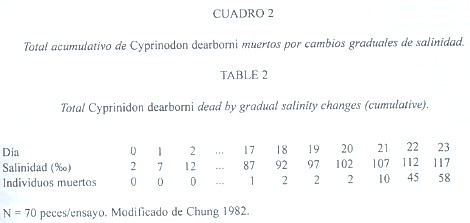
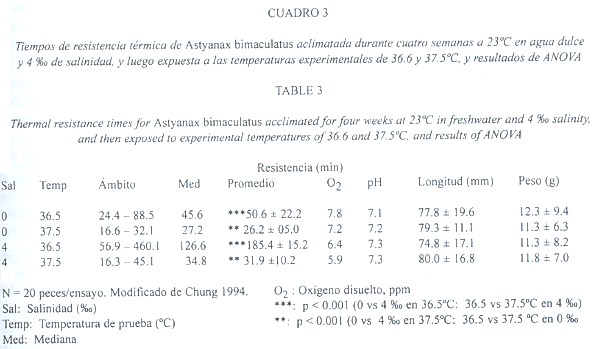
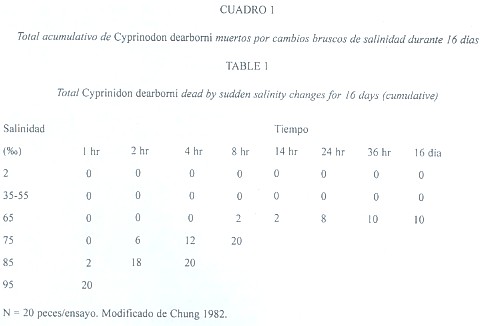
<body><![CDATA[<P><FONT FACE="Arial,Helvetica"><FONT SIZE=-1><B>Key words</B>:&nbsp; Salinity adaptability, salinity tolerance, salinity preference.</FONT></FONT>     <BR><FONT FACE="Arial,Helvetica"><FONT SIZE=-1>&nbsp;</FONT></FONT>      <P><FONT FACE="Arial,Helvetica"><FONT SIZE=-1>La adaptabilidad a cambios de salinidad en los organismos acu&aacute;ticos est&aacute; influenciada por varios par&aacute;metros abi&oacute;ticos y bi&oacute;ticos (<A HREF="#Hutchison">Hutchison 1976</A>, <A HREF="#Chung94a">Chung 1994a</A>). La salinidad y la temperatura de aclimataci&oacute;n son factores claves en la respuesta fisiol&oacute;gica de los organismos acu&aacute;ticos tropicales (<A HREF="#Segnini89">Segnini &amp; Chung 1989, 1991</A>, <A HREF="#Azuaje">Azuaje &amp; Chung 1993</A>, <A HREF="#Chung93">Chung &amp; M&eacute;ndez 1993</A>, <A HREF="#Chung90">Chung 1990</A>, <A HREF="#Chung94b">1994b</A>, <A HREF="#Chung95">1995</A>). Esta aclimataci&oacute;n es m&aacute;s conveniente en el descenso que en el aumento de salinidad (<A HREF="#Chung90">Chung 1990</A>); al contrario de la adaptaci&oacute;n t&eacute;rmica (<A HREF="#Segnini91">Segnini &amp; Chung 1991</A>, <A HREF="#Segnini93">Segnini <I>et al.&nbsp;</I> 1993</A>, <A HREF="#Chung81">Chung 1981</A>, <A HREF="#Chung96">1996</A>). El objetivo de este trabajo es estudiar y resumir los efectos de salinidad sobre la tolerancia, adaptabilidad y preferencia de algunos peces (eurihalinos, oligohalinos y polihalinos), crust&aacute;ceos y bivalvos tropicales de la zona nororiental de Venezuela.</FONT></FONT>      <p><FONT FACE="Arial,Helvetica"><FONT SIZE=-1><b>Materiales y m&eacute;todos</b></FONT></FONT></p/> <FONT FACE="Arial,Helvetica"><FONT SIZE=-1>Se capturaron peces tropicales oligohalinos (querepe, <I>Astyanax bimaculatus </I>y sardina de r&iacute;o, <I>Petenia karussii</I>), polihalinos (petota, <I>Cyprinodon dearborni) </I>y eurihalinlos (tilapia, <I>Oreochromis mossambicus</I>), moluscos (mejill&oacute;n, <I>Perna perna</I>, ostra de mangles, <I>Crassostrea rhizophorae</I> y pepitona, <I>Arca zebra</I>) y crust&aacute;ceos (camar&oacute;n rosado, <I>Penaeus brasiliensis, </I>camar&oacute;n blanco, <I>Penaeus schmitti</I> y camar&oacute;n de r&iacute;o,<I> Macrobrachium carcinus</I>) en el Golfo de Cariaco, La Laguna de Los Patos, R&iacute;o Los Bordones y R&iacute;o Manzanares, Estado Sucre y en La Laguna Restinga, Isla de Margarita, Estado Nueva Esparta, Venezuela (Chung 1980, 1985, 1990, 1994, Graziani <I>et al.&nbsp;</I> 1993, 1995). Se aclimataron los organismos en el laboratorio durante cuatro semanas a varias temperaturas entre 22 y 35&deg;C, que representan las temperaturas m&iacute;nima y m&aacute;xima durante todo el a&ntilde;o en los ambientes naturales para la regi&oacute;n nor-oriental. Se colocaron 20 organismos aclimatados de cada especie en varias salinidades (entre 2 y 96 ‰) para determinar la resistencia salina. De otros grupos aclimatados a baja salinidad de 2 ‰, 70 animales fueron sometidos a un incremento en la salinidad de 5 ‰ por d&iacute;a, para determinar el l&iacute;mite de salinidad letal alta, el m&aacute;ximo salino cr&iacute;tico (<A HREF="#Segnini89">Segnini &amp; Chung 1989</A>, <A HREF="#Azuaje">Azuaje &amp; Chung 1993</A>, <A HREF="#Chung94b">Chung 1994b</A>). Las larvas y juveniles de los crust&aacute;ceos (<I>Penaeus brasiliensis, Penaeus schmitti,</I> y<I> Macrobrachium carcinus</I>) aclimatados en diversas salinidades, se colocaron en numero de 10-20 larvas o juveniles al tanque de gradiente salino sin barrera para determinar la preferencia de salinidad durante el desarrollo larval (<A HREF="#Chung80">Chung 1980</A>, <A HREF="#Azuaje">Azuaje &amp; Chung 1993</A>, <A HREF="#Graziani93">Graziani <I>et al.&nbsp;</I> 1993, 1995</A>). Los tiempos de resistencia t&eacute;rmica en diferentes salinidades fueron obtenidos, colocando los organismos aclimatados en alta temperatura letal, y los resultados fueron analizados mediante ANDEVA de una v&iacute;a.</FONT></FONT>     <BR><FONT FACE="Arial,Helvetica"><FONT SIZE=-1>&nbsp;</FONT></FONT>     <BR><B><FONT FACE="Arial,Helvetica"><FONT SIZE=-1>Resultados</FONT></FONT></B>     <BR><FONT FACE="Arial,Helvetica"><FONT SIZE=-1>&nbsp;</FONT></FONT>     <BR><FONT FACE="Arial,Helvetica"><FONT SIZE=-1>Se determin&oacute; que el nivel de aclimataci&oacute;n fue la causa de mayor influencia en la tolerancia salina de los peces. As&iacute; mismo, se descubri&oacute; que el tipo del cambio (gradual o brusco) fue un factor importante para la tolerancia a la salinidad y el m&aacute;ximo salino cr&iacute;tico (<A HREF="#cuadro1">Cuadros 1</A> y <A HREF="#cuadro2">2</A>). El cambio gradual permiti&oacute; que <I>Cyprinodon dearborni </I>pudiera tolerar m&aacute;s de 100 ‰ y menos de 65 ‰ por el cambio brusco. El orden de sensibilidad general de los peces sometidos a alta temperatura fue de los oligohalinos (los peces de agua dulce), los polihalinos (las especies de agua de mar) y los eurihalinos (los organismos aclimatados en amplios rangos de salinidad). El querepe, <I>Astyanax bimaculatus</I> sometidos a alta temperatura resistieron mas tiempo en agua salada de 4 ‰ que en agua dulce (<A HREF="#cuadro3">Cuadro 3</A>). Los moluscos adaptados en el estado estenohalino, la pepitona <I>Arca zebra</I>, fueron menos resistentes que los aclimatado en el estado eurihalino, el mejill&oacute;n <I>Perna perna</I> y la ostra de mangle <I>Crassostrea rhizophorae</I>. Las concentraciones letales salinas bajas y altas, m&iacute;nimas y m&aacute;ximas salinas cr&iacute;ticas durante 96 horas, que causaron el 50% de la mortalidad de los organismos, fueron 26 y 50 ‰ para la pepitona y 12 y 68 ‰ para el mejill&oacute;n. El osti&oacute;n de mangle sobrevivi&oacute; en el agua dulce a 84 ‰ de salinidad durante 96 horas. El proceso de aclimataci&oacute;n salina fue afectado severamente en el ascenso salino (desde baja a alta salinidad), pero no afect&oacute; mucho en descenso salino (desde alta a baja salinidad) (<A HREF="#cuadro1">Cuadros 1</A> y <A HREF="#cuadro2">2</A>). Las larvas de los camarones blanco y rosado (<I>Penaeus schmitti</I> y <I>Penaeus brasiliensis</I>) aclimatadas en diversas salinidades, escogieron las bajas salinidades (desde 5 hasta 25 ‰), cuando fueron sometidos en el tanque de gradiente salina sin barreras. Por el contrario, las larvas de <I>Macrobrachium</I> colocados en gradiente salino, seleccionaron su preferencia por la salinidad baja (5-15 ‰) durante el desarrollo larval; sin embargo, los juveniles y pre-adultos cambiaron su preferencia a salinidades m&aacute;s bajas (0-5 ‰).</FONT></FONT>     <BR>&nbsp;     <CENTER><A NAME="cuadro1"></A><IMG SRC="/img/fbpe/rbt/v49n1/2320i01.JPG" HEIGHT=326 WIDTH=486></CENTER> <FONT FACE="Arial,Helvetica"><FONT SIZE=-1>&nbsp;</FONT></FONT>     
]]></body>
<body><![CDATA[<CENTER><FONT FACE="Arial,Helvetica"><FONT SIZE=-1>&nbsp;</FONT></FONT><A NAME="cuadro2"></A><IMG SRC="/img/fbpe/rbt/v49n1/2320i02.JPG" HEIGHT=223 WIDTH=470></CENTER> <FONT FACE="Arial,Helvetica"><FONT SIZE=-1>&nbsp;</FONT></FONT>     
<CENTER><A NAME="cuadro3"></A><IMG SRC="/img/fbpe/rbt/v49n1/2320i03.JPG" HEIGHT=349 WIDTH=593></CENTER>       
<P><B><FONT FACE="Arial,Helvetica"><FONT SIZE=-1>Discusi&oacute;n</FONT></FONT></B>     <BR><FONT FACE="Arial,Helvetica"><FONT SIZE=-1>&nbsp;</FONT></FONT>     <BR><FONT FACE="Arial,Helvetica"><FONT SIZE=-1>El nivel de aclimataci&oacute;n caus&oacute; mayor influencia en la tolerancia de salinidad de los organismos. Tambi&eacute;n, el tipo del cambio, gradual o brusco, afect&oacute; la tolerancia a la salinidad y el m&aacute;ximo salino cr&iacute;tico (<A HREF="#cuadro1">Cuadros 1</A> y <A HREF="#cuadro2">2</A>). El cambio gradual les permiti&oacute; a <I>Cyprinodon dearborni </I>tolerar m&aacute;s de 100 ‰. Al contrario, los peces no toleraron mas de 65 ‰ por el cambio brusco. As&iacute; se puede observar que los tiempos de resistencia salina aumentaron a medida de que se incrementaba la salinidad de aclimataci&oacute;n. Este fen&oacute;meno confirm&oacute; que la tolerancia de salinidad de los organismos acu&aacute;ticos es significativamente afectada por la salinidad de aclimataci&oacute;n (<A HREF="#Chung82">Chung 1982</A>, <A HREF="#Chung90">1990</A>). Es interesante notar que, la especie de agua dulce, el querepe, <I>Astyanax bimaculatus</I>, aclimatados en el agua salda de 4 ‰ resistieron mucho m&aacute;s tiempo, que los aclimatados en el agua dulce, cuando fueron expuestos a las temperaturas letales altas, posiblemente debido a menor presi&oacute;n osm&oacute;tica en el agua salada. Tambi&eacute;n la temperatura de preferencia final de <I>Petenia karussii</I> aclimatado en 5-15 ‰ de salinidad fue ligeramente m&aacute;s alto que el pez aclimatado en el agua dulce (<A HREF="#Segnini89">Segnini &amp; Chung 1989</A>).</FONT></FONT>      <P><FONT FACE="Arial,Helvetica"><FONT SIZE=-1>La ostra, experimentada en ambiente eurihalino (amplias salinidades) fue m&aacute;s resistente que la pepitona o el mejill&oacute;n, que las adaptadas en estenohalino (pocas variedades de salinidad), demostrando que el nivel de aclimataci&oacute;n es un factor significativo (<A HREF="#Chung82">Chung 1983</A>). Este fen&oacute;meno es muy importante en los organismos acu&aacute;ticos que residen en los aguas someras de lagunas costeras temporales, lagos, bocas del r&iacute;o, estuarios, etc., permiti&eacute;ndoles aclimatarse a altas salinidades durante el per&iacute;odo sequ&iacute;a y a no perder su nivel de aclimataci&oacute;n durante la &eacute;poca de lluvia. Este comportamiento les ayuda a resistir cambios bruscos de salinidad en ambientes naturales tropicales en el flujo del agua de r&iacute;o a estuarios y/o durante la &eacute;poca de lluvia. Esta adaptabilidad contribuye a la distribuci&oacute;n de los organismos de los aguas saladas a trav&eacute;s de la adaptaci&oacute;n salina de los organismos tropicales (<A HREF="#Chung85">Chung 1989</A>, <A HREF="#Chung94b">1994b</A>).</FONT></FONT>      <P><FONT FACE="Arial,Helvetica"><FONT SIZE=-1>Las larvas de peneidos escogieron bajas salinidades en el tanque gradiente de salinidad&nbsp; (<A HREF="#Chung80">Chung 1980</A>, <A HREF="#Azuaje">Azuaje y Chung 1993</A>). Esta respuesta fisiol&oacute;gica implica que las larvas de los peneidos prefieren las aguas someras de estuarios y bocas del r&iacute;o, adonde fluyen bajas salinidades durante el desarrollo larval, y permanecen all&iacute; hasta el estado juvenil y pre-adulto antes de regresar al mar abierto de altas salinidades. Por el contrario, las larvas de <I>Macrobracium carcinus</I> prefer&iacute;an las salinidades elevadas y las juveniles escogieron en bajas salinidades. Esto implica que, el camar&oacute;n del r&iacute;o, <I>Macrobrachium</I> requiere alta salinidad en su desarrollo larval, y juveniles y adultos prefieren aguaha de poca salinidad o agua dulce (<A HREF="#Graziani93">Graziani <I>et al.&nbsp;</I> 1993, 1995</A>). Este comportamiento fisiol&oacute;gico indica que las larvas del camar&oacute;n de r&iacute;o prefieren las aguas someras de bocas del r&iacute;o, donde la salinidad fluct&uacute;a, y los juveniles y pre-adultos regresan desde la desembocadura de r&iacute;o, confirmando que esta especie requiere ajustarse a diferentes salinidades a lo largo del desarrollo ontongen&eacute;tico (<A HREF="#Graziani93">Graziani <I>et al. </I>1993, 1995</A>).</FONT></FONT>      <P><FONT FACE="Arial,Helvetica"><FONT SIZE=-1>El nivel de aclimataci&oacute;n salina influye en la tolerancia y preferencia de salinidad de los peces,&nbsp; crust&aacute;ceos y moluscos tropicales. El proceso de aclimataci&oacute;n salina afecta m&aacute;s a los organismos tropicales en ascenso salino (desde baja salinidad hacia arriba) que en descenso salino (desde alta salinidad hacia baja). Este fen&oacute;meno contribuye a la adaptaci&oacute;n salina de las larvas y juveniles de los organismos tropicales y a su proliferaci&oacute;n y distribuci&oacute;n en ambientes salinas fluctuantes.</FONT></FONT>      <P><B><FONT FACE="Arial,Helvetica"><FONT SIZE=-1>Agradecimiento</FONT></FONT></B>      <P><FONT FACE="Arial,Helvetica"><FONT SIZE=-1>Al Consejo de Investigaci&oacute;n de la Universidad de Oriente (CI:&nbsp; 05-01803-0790/97-98) por el financiamiento parcial del trabajo, al &Aacute;ngel Ant&oacute;n por su invalorable ayuda en el trabajo de campo y de laboratorio y a Mair&iacute;n Lemus y Marisabel Segnini de B. por su lectura cr&iacute;tica.</FONT></FONT>     ]]></body>
<body><![CDATA[<BR><FONT FACE="Arial,Helvetica"><FONT SIZE=-1>&nbsp;</FONT></FONT>     <BR><B><FONT FACE="Arial,Helvetica"><FONT SIZE=-1>Referencias</FONT></FONT></B>     <BR><FONT FACE="Arial,Helvetica"><FONT SIZE=-1>&nbsp;</FONT></FONT>     <!-- ref --><BR><A NAME="Azuaje"></A><FONT FACE="Arial,Helvetica"><FONT SIZE=-1>Azuaje, O. &amp; K. S. Chung. 1993. Efecto termohalino sobre la preferencia salina, crecimiento y sobrevivencia en larvas del camar&oacute;n blanco, <I>Penaeus schmitti</I>, en el laboratorio. Caribb. J. Sci. 29: 54-60.</FONT></FONT>    &nbsp;&nbsp;&nbsp;&nbsp;&nbsp;&nbsp;&nbsp;&nbsp;[&#160;<a href="javascript:void(0);" onclick="javascript: window.open('/scielo.php?script=sci_nlinks&ref=1343529&pid=S0034-7744200100010000200001&lng=','','width=640,height=500,resizable=yes,scrollbars=1,menubar=yes,');">Links</a>&#160;]<!-- end-ref --><!-- ref --><P><A NAME="Chung80"></A><FONT FACE="Arial,Helvetica"><FONT SIZE=-1>Chung, K. S. 1980. A note on salinity preference of <I>Penaeus brasiliensis</I>. Bull. Jap. Soc. Sci. Fish. 46: 389.</FONT></FONT>    &nbsp;&nbsp;&nbsp;&nbsp;&nbsp;&nbsp;&nbsp;&nbsp;[&#160;<a href="javascript:void(0);" onclick="javascript: window.open('/scielo.php?script=sci_nlinks&ref=1343530&pid=S0034-7744200100010000200002&lng=','','width=640,height=500,resizable=yes,scrollbars=1,menubar=yes,');">Links</a>&#160;]<!-- end-ref --><!-- ref --><P><A NAME="Chung81"></A><FONT FACE="Arial,Helvetica"><FONT SIZE=-1>Chung, K. S. 1981. Rate of acclimation of the tropical fish <I>Cyprinodon dearborni</I> to temperature changes. Hydrobiol. 78: 177-181.</FONT></FONT>    &nbsp;&nbsp;&nbsp;&nbsp;&nbsp;&nbsp;&nbsp;&nbsp;[&#160;<a href="javascript:void(0);" onclick="javascript: window.open('/scielo.php?script=sci_nlinks&ref=1343531&pid=S0034-7744200100010000200003&lng=','','width=640,height=500,resizable=yes,scrollbars=1,menubar=yes,');">Links</a>&#160;]<!-- end-ref --><!-- ref --><P><A NAME="Chung82"></A><FONT FACE="Arial,Helvetica"><FONT SIZE=-1>Chung, K. S. 1982. Salinity tolerance of tropical salt-marsh fish of Los Patos Lagoon, Venezuela. Bull. Jap. Soc. Sci. Fish. 48: 873.</FONT></FONT>    &nbsp;&nbsp;&nbsp;&nbsp;&nbsp;&nbsp;&nbsp;&nbsp;[&#160;<a href="javascript:void(0);" onclick="javascript: window.open('/scielo.php?script=sci_nlinks&ref=1343532&pid=S0034-7744200100010000200004&lng=','','width=640,height=500,resizable=yes,scrollbars=1,menubar=yes,');">Links</a>&#160;]<!-- end-ref --><!-- ref --><P><A NAME="Chung83"></A><FONT FACE="Arial,Helvetica"><FONT SIZE=-1>Chung, K. S. 1983. Salinity tolerance of some tropical marine molluscs. Acta Cient. Venezolana 34: 245-247.</FONT></FONT>    &nbsp;&nbsp;&nbsp;&nbsp;&nbsp;&nbsp;&nbsp;&nbsp;[&#160;<a href="javascript:void(0);" onclick="javascript: window.open('/scielo.php?script=sci_nlinks&ref=1343533&pid=S0034-7744200100010000200005&lng=','','width=640,height=500,resizable=yes,scrollbars=1,menubar=yes,');">Links</a>&#160;]<!-- end-ref --><!-- ref --><P><A NAME="Chung85"></A><FONT FACE="Arial,Helvetica"><FONT SIZE=-1>Chung, K. S. 1985. Adaptabilidad de <I>Oreochromis mossambicus</I> (Peters, 1852) a los cambios de temperatura. Acta Cient. Venezolana 36: 180-190.</FONT></FONT>    &nbsp;&nbsp;&nbsp;&nbsp;&nbsp;&nbsp;&nbsp;&nbsp;[&#160;<a href="javascript:void(0);" onclick="javascript: window.open('/scielo.php?script=sci_nlinks&ref=1343534&pid=S0034-7744200100010000200006&lng=','','width=640,height=500,resizable=yes,scrollbars=1,menubar=yes,');">Links</a>&#160;]<!-- end-ref --><!-- ref --><P><A NAME="Chung90"></A><FONT FACE="Arial,Helvetica"><FONT SIZE=-1>Chung, K. S. 1990. Adaptabilidad de una especie eurihalina <I>Oreochromis mossambicus</I> (Peters, 1852) en aguas saldas de la zona nororiental de Venezuela. Saber 3: 21-30.</FONT></FONT>    &nbsp;&nbsp;&nbsp;&nbsp;&nbsp;&nbsp;&nbsp;&nbsp;[&#160;<a href="javascript:void(0);" onclick="javascript: window.open('/scielo.php?script=sci_nlinks&ref=1343535&pid=S0034-7744200100010000200007&lng=','','width=640,height=500,resizable=yes,scrollbars=1,menubar=yes,');">Links</a>&#160;]<!-- end-ref --><!-- ref --><P><A NAME="Chung93"></A><FONT FACE="Arial,Helvetica"><FONT SIZE=-1>Chung, K. S. &amp; S. M&eacute;ndez. 1993. Tolerancia t&eacute;rmica comparativa en algunos peces tropicales de Venezuela. Ciencia 1: 1-7.</FONT></FONT>    &nbsp;&nbsp;&nbsp;&nbsp;&nbsp;&nbsp;&nbsp;&nbsp;[&#160;<a href="javascript:void(0);" onclick="javascript: window.open('/scielo.php?script=sci_nlinks&ref=1343536&pid=S0034-7744200100010000200008&lng=','','width=640,height=500,resizable=yes,scrollbars=1,menubar=yes,');">Links</a>&#160;]<!-- end-ref --><!-- ref --><P><A NAME="Chung94a"></A><FONT FACE="Arial,Helvetica"><FONT SIZE=-1>Chung, K. S. 1994a. What factors influence the thermal tolerance of estuarine animals? Interpretation of multiple regression analyses. Rev. Biol. Trop. 42: 365-370.</FONT></FONT>    &nbsp;&nbsp;&nbsp;&nbsp;&nbsp;&nbsp;&nbsp;&nbsp;[&#160;<a href="javascript:void(0);" onclick="javascript: window.open('/scielo.php?script=sci_nlinks&ref=1343537&pid=S0034-7744200100010000200009&lng=','','width=640,height=500,resizable=yes,scrollbars=1,menubar=yes,');">Links</a>&#160;]<!-- end-ref --><!-- ref --><P><A NAME="Chung94b"></A><FONT FACE="Arial,Helvetica"><FONT SIZE=-1>Chung, K. S. 1994b. Efecto de termohalino en el pez tropical, <I>Astyanax bimaculatus</I>, de la zona nororiental de Venezuela. Rev. Invest. Cient. Ser. Cien. Mar. 5: 57-63.</FONT></FONT>    &nbsp;&nbsp;&nbsp;&nbsp;&nbsp;&nbsp;&nbsp;&nbsp;[&#160;<a href="javascript:void(0);" onclick="javascript: window.open('/scielo.php?script=sci_nlinks&ref=1343538&pid=S0034-7744200100010000200010&lng=','','width=640,height=500,resizable=yes,scrollbars=1,menubar=yes,');">Links</a>&#160;]<!-- end-ref --><!-- ref --><P><A NAME="Chung95"></A><FONT FACE="Arial,Helvetica"><FONT SIZE=-1>Chung, K. S. 1995. Thermal acclimation rate of the tropical long-whiskered catfish <I>Pimelodella chagresi</I> to high temperature. Caribb. J. Sci. 31: 154-156.</FONT></FONT>    &nbsp;&nbsp;&nbsp;&nbsp;&nbsp;&nbsp;&nbsp;&nbsp;[&#160;<a href="javascript:void(0);" onclick="javascript: window.open('/scielo.php?script=sci_nlinks&ref=1343539&pid=S0034-7744200100010000200011&lng=','','width=640,height=500,resizable=yes,scrollbars=1,menubar=yes,');">Links</a>&#160;]<!-- end-ref --><!-- ref --><P><A NAME="Chung96"></A><FONT FACE="Arial,Helvetica"><FONT SIZE=-1>Chung, K. S. 1996. Gain and loss of heat resistance in the tropical fish <I>Astyanax bimaculatus</I> of Venezuela. P. 113-118 <I>In</I> A. Val, D. Randall &amp; D. MacKinlay (eds.) The Physiology of Tropical Fish Symposium, Proceedings of International Congress on the Biology of Fishes, San Francisco State University, July 14-18, 1996.</FONT></FONT>    &nbsp;&nbsp;&nbsp;&nbsp;&nbsp;&nbsp;&nbsp;&nbsp;[&#160;<a href="javascript:void(0);" onclick="javascript: window.open('/scielo.php?script=sci_nlinks&ref=1343540&pid=S0034-7744200100010000200012&lng=','','width=640,height=500,resizable=yes,scrollbars=1,menubar=yes,');">Links</a>&#160;]<!-- end-ref --><!-- ref --><P><A NAME="Graziani93"></A><FONT FACE="Arial,Helvetica"><FONT SIZE=-1>Graziani, C. A., K. S. Chung &amp; M. De Donato. 1993. Comportamiento reproductivo y fertilidad de <I>Macrobrachium carcinus</I> (Decapoda:&nbsp; Palaemonidea) en Venezuela. Rev. Biol. Trop. 41: 657-665.</FONT></FONT>    &nbsp;&nbsp;&nbsp;&nbsp;&nbsp;&nbsp;&nbsp;&nbsp;[&#160;<a href="javascript:void(0);" onclick="javascript: window.open('/scielo.php?script=sci_nlinks&ref=1343541&pid=S0034-7744200100010000200013&lng=','','width=640,height=500,resizable=yes,scrollbars=1,menubar=yes,');">Links</a>&#160;]<!-- end-ref --><!-- ref --><P><A NAME="Graziani95"></A><FONT FACE="Arial,Helvetica"><FONT SIZE=-1>Graziani, C. A., M. De Donato &amp; K. S. Chung. 1995. Salinidades &oacute;ptimas en larvas y postlarvas de <I>Macrobrachium carcinus</I> (L.) (Decapoda:&nbsp; Palaemonidae). Bol. Inst. Oceanogr. Venezuela 34: 33-40.</FONT></FONT>    &nbsp;&nbsp;&nbsp;&nbsp;&nbsp;&nbsp;&nbsp;&nbsp;[&#160;<a href="javascript:void(0);" onclick="javascript: window.open('/scielo.php?script=sci_nlinks&ref=1343542&pid=S0034-7744200100010000200014&lng=','','width=640,height=500,resizable=yes,scrollbars=1,menubar=yes,');">Links</a>&#160;]<!-- end-ref --><!-- ref --><P><A NAME="Hutchison"></A><FONT FACE="Arial,Helvetica"><FONT SIZE=-1>Hutchison, V. H. 1976. Factors influencing thermal tolerance of individual organisms. P. 10-26<I> In</I> G. W. Esch &amp; W. W MacFarlane (eds.). Thermal Ecology II. Department of Energy Symposium Series (CONF-750425), National Technical Information Service, Springfield, Maryland.</FONT></FONT>    &nbsp;&nbsp;&nbsp;&nbsp;&nbsp;&nbsp;&nbsp;&nbsp;[&#160;<a href="javascript:void(0);" onclick="javascript: window.open('/scielo.php?script=sci_nlinks&ref=1343543&pid=S0034-7744200100010000200015&lng=','','width=640,height=500,resizable=yes,scrollbars=1,menubar=yes,');">Links</a>&#160;]<!-- end-ref --><!-- ref --><P><A NAME="Segnini91"></A><FONT FACE="Arial,Helvetica"><FONT SIZE=-1>Segnini de B., M. I. &amp; K. S. Chung. 1991. Respuestas fisiol&oacute;gicas de <I>Petenia kraussii</I> (Pisces:&nbsp; Cichlidae) sometidos a cambios de temperatura. Bol. Inst. Oceanogr. Venezuela 30: 5-15.</FONT></FONT>    &nbsp;&nbsp;&nbsp;&nbsp;&nbsp;&nbsp;&nbsp;&nbsp;[&#160;<a href="javascript:void(0);" onclick="javascript: window.open('/scielo.php?script=sci_nlinks&ref=1343544&pid=S0034-7744200100010000200016&lng=','','width=640,height=500,resizable=yes,scrollbars=1,menubar=yes,');">Links</a>&#160;]<!-- end-ref --><!-- ref --><P><A NAME="Segnini89"></A><FONT FACE="Arial,Helvetica"><FONT SIZE=-1>Segnini de B., M.I. &amp; K. S. Chung. 1989. Influencia de la salinidad sobre el preferendum final de la mojarra de r&iacute;o (<I>Petenia kraussii</I>) Steindachner 1878 (Perciformes, Cichlidae). Bol. Inst. Oceanogr. Venezuela 28: 145-150.</FONT></FONT>    &nbsp;&nbsp;&nbsp;&nbsp;&nbsp;&nbsp;&nbsp;&nbsp;[&#160;<a href="javascript:void(0);" onclick="javascript: window.open('/scielo.php?script=sci_nlinks&ref=1343545&pid=S0034-7744200100010000200017&lng=','','width=640,height=500,resizable=yes,scrollbars=1,menubar=yes,');">Links</a>&#160;]<!-- end-ref --><!-- ref --><P><A NAME="Segnini93"></A><FONT FACE="Arial,Helvetica"><FONT SIZE=-1>Segnini de B., M. I., K. S. Chung &amp; P. Ciurc&iacute;na. 1993. Tasa de aclimataci&oacute;n de temperatura de <I>Mugil curema</I>. Rev. Biol. Trop. 41: 59-62.</FONT></FONT>    &nbsp;&nbsp;&nbsp;&nbsp;&nbsp;&nbsp;&nbsp;&nbsp;[&#160;<a href="javascript:void(0);" onclick="javascript: window.open('/scielo.php?script=sci_nlinks&ref=1343546&pid=S0034-7744200100010000200018&lng=','','width=640,height=500,resizable=yes,scrollbars=1,menubar=yes,');">Links</a>&#160;]<!-- end-ref --><BR>&nbsp;     <BR><A NAME="A1"></A><FONT FACE="Arial,Helvetica"><FONT SIZE=-1><SUP><A HREF="#R1">1</A></SUP> Instituto Oceanogr&aacute;fico de Venezuela, Universidad de Oriente, Cuman&aacute; 6101, Venezuela. Telefax:&nbsp; (58) 93-516790, Tel. :&nbsp; (58) 93-515283, Correo electr&oacute;nico:&nbsp; <A HREF="mailto:kchung@telcel.net.ve">kchung@telcel.net.ve</A></FONT></FONT>      ]]></body><back>
<ref-list>
<ref id="B1">
<nlm-citation citation-type="journal">
<person-group person-group-type="author">
<name>
<surname><![CDATA[Azuaje]]></surname>
<given-names><![CDATA[O]]></given-names>
</name>
<name>
<surname><![CDATA[Chung]]></surname>
<given-names><![CDATA[K. S]]></given-names>
</name>
</person-group>
<article-title xml:lang="es"><![CDATA[Efecto termohalino sobre la preferencia salina, crecimiento y sobrevivencia en larvas del camarón blanco, Penaeus schmitti, en el laboratorio]]></article-title>
<source><![CDATA[Caribb. J. Sci]]></source>
<year>1993</year>
<volume>29</volume>
<page-range>54-60</page-range></nlm-citation>
</ref>
<ref id="B2">
<nlm-citation citation-type="journal">
<person-group person-group-type="author">
<name>
<surname><![CDATA[Chung]]></surname>
<given-names><![CDATA[K. S]]></given-names>
</name>
</person-group>
<article-title xml:lang="en"><![CDATA[A note on salinity preference of Penaeus brasiliensis]]></article-title>
<source><![CDATA[Bull. Jap. Soc. Sci. Fish]]></source>
<year>1980</year>
<volume>46</volume>
<page-range>389</page-range></nlm-citation>
</ref>
<ref id="B3">
<nlm-citation citation-type="journal">
<person-group person-group-type="author">
<name>
<surname><![CDATA[Chung]]></surname>
<given-names><![CDATA[K. S]]></given-names>
</name>
</person-group>
<article-title xml:lang="en"><![CDATA[Rate of acclimation of the tropical fish Cyprinodon dearborni to temperature changes]]></article-title>
<source><![CDATA[Hydrobiol]]></source>
<year>1981</year>
<volume>78</volume>
<page-range>177-181</page-range></nlm-citation>
</ref>
<ref id="B4">
<nlm-citation citation-type="journal">
<person-group person-group-type="author">
<name>
<surname><![CDATA[Chung]]></surname>
<given-names><![CDATA[K. S]]></given-names>
</name>
</person-group>
<article-title xml:lang="en"><![CDATA[Salinity tolerance of tropical salt-marsh fish of Los Patos Lagoon, Venezuela]]></article-title>
<source><![CDATA[Bull. Jap. Soc. Sci. Fish]]></source>
<year>1982</year>
<volume>48</volume>
<page-range>873</page-range></nlm-citation>
</ref>
<ref id="B5">
<nlm-citation citation-type="journal">
<person-group person-group-type="author">
<name>
<surname><![CDATA[Chung]]></surname>
<given-names><![CDATA[K. S]]></given-names>
</name>
</person-group>
<article-title xml:lang="en"><![CDATA[Salinity tolerance of some tropical marine molluscs]]></article-title>
<source><![CDATA[Acta Cient. Venezolana]]></source>
<year>1983</year>
<volume>34</volume>
<page-range>245-247</page-range></nlm-citation>
</ref>
<ref id="B6">
<nlm-citation citation-type="journal">
<person-group person-group-type="author">
<name>
<surname><![CDATA[Chung]]></surname>
<given-names><![CDATA[K. S]]></given-names>
</name>
</person-group>
<article-title xml:lang="es"><![CDATA[Adaptabilidad de Oreochromis mossambicus (Peters, 1852) a los cambios de temperatura]]></article-title>
<source><![CDATA[Acta Cient. Venezolana]]></source>
<year>1985</year>
<volume>36</volume>
<page-range>180-190</page-range></nlm-citation>
</ref>
<ref id="B7">
<nlm-citation citation-type="journal">
<person-group person-group-type="author">
<name>
<surname><![CDATA[Chung]]></surname>
<given-names><![CDATA[K. S]]></given-names>
</name>
</person-group>
<article-title xml:lang="es"><![CDATA[Adaptabilidad de una especie eurihalina Oreochromis mossambicus (Peters, 1852) en aguas saldas de la zona nororiental de Venezuela]]></article-title>
<source><![CDATA[Saber]]></source>
<year>1990</year>
<volume>3</volume>
<page-range>21-30</page-range></nlm-citation>
</ref>
<ref id="B8">
<nlm-citation citation-type="journal">
<person-group person-group-type="author">
<name>
<surname><![CDATA[Chung]]></surname>
<given-names><![CDATA[K. S]]></given-names>
</name>
<name>
<surname><![CDATA[Méndez]]></surname>
<given-names><![CDATA[S]]></given-names>
</name>
</person-group>
<article-title xml:lang="es"><![CDATA[Tolerancia térmica comparativa en algunos peces tropicales de Venezuela]]></article-title>
<source><![CDATA[Ciencia]]></source>
<year>1993</year>
<volume>1</volume>
<page-range>1-7</page-range></nlm-citation>
</ref>
<ref id="B9">
<nlm-citation citation-type="journal">
<person-group person-group-type="author">
<name>
<surname><![CDATA[Chung]]></surname>
<given-names><![CDATA[K. S]]></given-names>
</name>
</person-group>
<article-title xml:lang="en"><![CDATA[What factors influence the thermal tolerance of estuarine animals? Interpretation of multiple regression analyses]]></article-title>
<source><![CDATA[Rev. Biol. Trop]]></source>
<year>1994</year>
<volume>42</volume>
<page-range>365-370</page-range></nlm-citation>
</ref>
<ref id="B10">
<nlm-citation citation-type="journal">
<person-group person-group-type="author">
<name>
<surname><![CDATA[Chung]]></surname>
<given-names><![CDATA[K. S]]></given-names>
</name>
</person-group>
<article-title xml:lang="es"><![CDATA[Efecto de termohalino en el pez tropical, Astyanax bimaculatus, de la zona nororiental de Venezuela]]></article-title>
<source><![CDATA[Rev. Invest. Cient. Ser. Cien. Mar]]></source>
<year>1994</year>
<volume>5</volume>
<page-range>57-63</page-range></nlm-citation>
</ref>
<ref id="B11">
<nlm-citation citation-type="journal">
<person-group person-group-type="author">
<name>
<surname><![CDATA[Chung]]></surname>
<given-names><![CDATA[K. S]]></given-names>
</name>
</person-group>
<article-title xml:lang="en"><![CDATA[Thermal acclimation rate of the tropical long-whiskered catfish Pimelodella chagresi to high temperature]]></article-title>
<source><![CDATA[Caribb. J. Sci]]></source>
<year>1995</year>
<volume>31</volume>
<page-range>154-156</page-range></nlm-citation>
</ref>
<ref id="B12">
<nlm-citation citation-type="confpro">
<person-group person-group-type="author">
<name>
<surname><![CDATA[Chung]]></surname>
<given-names><![CDATA[K. S]]></given-names>
</name>
</person-group>
<article-title xml:lang="en"><![CDATA[Gain and loss of heat resistance in the tropical fish Astyanax bimaculatus of Venezuela]]></article-title>
<person-group person-group-type="editor">
<name>
<surname><![CDATA[Val]]></surname>
<given-names><![CDATA[A]]></given-names>
</name>
<name>
<surname><![CDATA[Randall]]></surname>
<given-names><![CDATA[D]]></given-names>
</name>
<name>
<surname><![CDATA[MacKinlay]]></surname>
<given-names><![CDATA[D]]></given-names>
</name>
</person-group>
<source><![CDATA[The Physiology of Tropical Fish Symposium]]></source>
<year>1996</year>
<conf-name><![CDATA[ International Congress on the Biology of Fishes]]></conf-name>
<conf-date>July 14-18, 1996</conf-date>
<conf-loc> </conf-loc>
</nlm-citation>
</ref>
<ref id="B13">
<nlm-citation citation-type="journal">
<person-group person-group-type="author">
<name>
<surname><![CDATA[Graziani]]></surname>
<given-names><![CDATA[C. A]]></given-names>
</name>
<name>
<surname><![CDATA[Chung]]></surname>
<given-names><![CDATA[K. S]]></given-names>
</name>
<name>
<surname><![CDATA[De Donato]]></surname>
<given-names><![CDATA[M]]></given-names>
</name>
</person-group>
<article-title xml:lang="es"><![CDATA[Comportamiento reproductivo y fertilidad de Macrobrachium carcinus (Decapoda: Palaemonidea) en Venezuela]]></article-title>
<source><![CDATA[Rev. Biol. Trop]]></source>
<year>1993</year>
<volume>41</volume>
<page-range>657-665</page-range></nlm-citation>
</ref>
<ref id="B14">
<nlm-citation citation-type="journal">
<person-group person-group-type="author">
<name>
<surname><![CDATA[Graziani]]></surname>
<given-names><![CDATA[C. A]]></given-names>
</name>
<name>
<surname><![CDATA[De Donato]]></surname>
<given-names><![CDATA[M.]]></given-names>
</name>
<name>
<surname><![CDATA[Chung]]></surname>
<given-names><![CDATA[K. S]]></given-names>
</name>
</person-group>
<article-title xml:lang="es"><![CDATA[Salinidades óptimas en larvas y postlarvas de Macrobrachium carcinus (L.) (Decapoda: Palaemonidae)]]></article-title>
<source><![CDATA[Bol. Inst. Oceanogr. Venezuela]]></source>
<year>1995</year>
<volume>34</volume>
<page-range>33-40</page-range></nlm-citation>
</ref>
<ref id="B15">
<nlm-citation citation-type="book">
<person-group person-group-type="author">
<name>
<surname><![CDATA[Hutchison]]></surname>
<given-names><![CDATA[V. H]]></given-names>
</name>
</person-group>
<article-title xml:lang="en"><![CDATA[Factors influencing thermal tolerance of individual organisms]]></article-title>
<person-group person-group-type="editor">
<name>
<surname><![CDATA[Esch]]></surname>
<given-names><![CDATA[G. W.]]></given-names>
</name>
<name>
<surname><![CDATA[MacFarlane]]></surname>
<given-names><![CDATA[W. W]]></given-names>
</name>
</person-group>
<source><![CDATA[Thermal Ecology II]]></source>
<year>1976</year>
<publisher-loc><![CDATA[Springfield ]]></publisher-loc>
<publisher-name><![CDATA[National Technical Information Service]]></publisher-name>
</nlm-citation>
</ref>
<ref id="B16">
<nlm-citation citation-type="journal">
<person-group person-group-type="author">
<name>
<surname><![CDATA[Segnini de B]]></surname>
<given-names><![CDATA[M. I]]></given-names>
</name>
<name>
<surname><![CDATA[Chung]]></surname>
<given-names><![CDATA[K. S]]></given-names>
</name>
</person-group>
<article-title xml:lang="es"><![CDATA[Respuestas fisiológicas de Petenia kraussii (Pisces: Cichlidae) sometidos a cambios de temperatura]]></article-title>
<source><![CDATA[Bol. Inst. Oceanogr. Venezuela]]></source>
<year>1991</year>
<volume>30</volume>
<page-range>5-15</page-range></nlm-citation>
</ref>
<ref id="B17">
<nlm-citation citation-type="journal">
<person-group person-group-type="author">
<name>
<surname><![CDATA[Segnini de B]]></surname>
<given-names><![CDATA[M.I]]></given-names>
</name>
<name>
<surname><![CDATA[Chung]]></surname>
<given-names><![CDATA[K. S]]></given-names>
</name>
</person-group>
<article-title xml:lang="es"><![CDATA[Influencia de la salinidad sobre el preferendum final de la mojarra de río (Petenia kraussii) Steindachner 1878 (Perciformes, Cichlidae)]]></article-title>
<source><![CDATA[Bol. Inst. Oceanogr. Venezuela]]></source>
<year>1989</year>
<volume>28</volume>
<page-range>145-150</page-range></nlm-citation>
</ref>
<ref id="B18">
<nlm-citation citation-type="journal">
<person-group person-group-type="author">
<name>
<surname><![CDATA[Segnini de B]]></surname>
<given-names><![CDATA[M. I]]></given-names>
</name>
<name>
<surname><![CDATA[Chung]]></surname>
<given-names><![CDATA[K. S]]></given-names>
</name>
<name>
<surname><![CDATA[Ciurcína]]></surname>
<given-names><![CDATA[P]]></given-names>
</name>
</person-group>
<article-title xml:lang="es"><![CDATA[Tasa de aclimatación de temperatura de Mugil curema]]></article-title>
<source><![CDATA[Rev. Biol. Trop]]></source>
<year>1993</year>
<volume>41</volume>
<page-range>59-62</page-range></nlm-citation>
</ref>
</ref-list>
</back>
</article>