<?xml version="1.0" encoding="ISO-8859-1"?><article xmlns:mml="http://www.w3.org/1998/Math/MathML" xmlns:xlink="http://www.w3.org/1999/xlink" xmlns:xsi="http://www.w3.org/2001/XMLSchema-instance">
<front>
<journal-meta>
<journal-id>0034-7744</journal-id>
<journal-title><![CDATA[Revista de Biología Tropical]]></journal-title>
<abbrev-journal-title><![CDATA[Rev. biol. trop]]></abbrev-journal-title>
<issn>0034-7744</issn>
<publisher>
<publisher-name><![CDATA[Universidad de Costa Rica]]></publisher-name>
</publisher>
</journal-meta>
<article-meta>
<article-id>S0034-77442000000400024</article-id>
<title-group>
<article-title xml:lang="en"><![CDATA[A new species of rainfrog of the Eleutherodactylusmilesi species group (Amphibia: Anura: Leptodactylidae) from Guatemala]]></article-title>
</title-group>
<contrib-group>
<contrib contrib-type="author">
<name>
<surname><![CDATA[Savage]]></surname>
<given-names><![CDATA[Jay M]]></given-names>
</name>
<xref ref-type="aff" rid="A01"/>
</contrib>
</contrib-group>
<aff id="A01">
<institution><![CDATA[,San Diego State University  ]]></institution>
<addr-line><![CDATA[San Diego California]]></addr-line>
<country>USA</country>
</aff>
<pub-date pub-type="pub">
<day>00</day>
<month>12</month>
<year>2000</year>
</pub-date>
<pub-date pub-type="epub">
<day>00</day>
<month>12</month>
<year>2000</year>
</pub-date>
<volume>48</volume>
<numero>4</numero>
<fpage>993</fpage>
<lpage>999</lpage>
<copyright-statement/>
<copyright-year/>
<self-uri xlink:href="http://www.scielo.sa.cr/scielo.php?script=sci_arttext&amp;pid=S0034-77442000000400024&amp;lng=en&amp;nrm=iso"></self-uri><self-uri xlink:href="http://www.scielo.sa.cr/scielo.php?script=sci_abstract&amp;pid=S0034-77442000000400024&amp;lng=en&amp;nrm=iso"></self-uri><self-uri xlink:href="http://www.scielo.sa.cr/scielo.php?script=sci_pdf&amp;pid=S0034-77442000000400024&amp;lng=en&amp;nrm=iso"></self-uri><abstract abstract-type="short" xml:lang="en"><p><![CDATA[A new rainfrog of the Eleutherodactylus milesi group is described from the Sierra de Xucaneb, Guatemala. It is compared to the other 11 upland species from southern Mexico, Guatemala and Honduras referred to the group. Within the milesi group the new species differs from the other five forms which also have toe fringes in size of the finger disks, the snout shape in profile and the amount of toe webbing and dorsal tuberculation. Difficulties in distinguishing among the character states for the tympanum (distinct, indistinct and hidden) and between toe ridges and fringes indicate that very subtle differences separate recognized species.]]></p></abstract>
<abstract abstract-type="short" xml:lang="es"><p><![CDATA[Se describe una especie nueva del grupo Eleutherodactylus milesi hallada en la Sierra de Xucaneb, Guatemala. Se compara con las otras once especies del grupo (alturas de sureste de México, Guatemala y Honduras). Dentro del grupo, difiere de las otras cinco especies que tienen flecos de pulgar en el tamaño de los discos digitales, la forma del hocico visto de perfil y la cantidad de membrana del pulgar y de tubérculos dorsales. La dificultad de distinguir entre características del tímpano (definido, indefinido y oculto) y entre rebordes y flecos del pulgar indican que hay diferencias muy tenues entre las especies actualmente reconocidas.]]></p></abstract>
<kwd-group>
<kwd lng="en"><![CDATA[Amphibia]]></kwd>
<kwd lng="en"><![CDATA[Anura]]></kwd>
<kwd lng="en"><![CDATA[Leptodactylidae]]></kwd>
<kwd lng="en"><![CDATA[Eleutherodactylus]]></kwd>
<kwd lng="es"><![CDATA[Guatemala]]></kwd>
</kwd-group>
</article-meta>
</front><body><![CDATA[ <center><font face="Arial"><b>A new species of rainfrog of the </b><i>Eleutherodactylusmilesi</i><b> species group</b></font>     <br><b><font face="Arial">(Amphibia: Anura: Leptodactylidae) from Guatemala</font></b>     <p><font face="Arial"><font size=-1><sup> </sup><b>Jay M. Savage<a NAME="1"></a></b><sup><a href="#1a">1</a></sup></font></font>     <br>&nbsp;     <p><font face="Arial"><font size=-1>Received: 30-VI-99 Corrected: 13-IV-00 Accepted: 24-V-00</font></font></center>      <p>    <br>     <br>     <p><b><font face="Arial"><font size=-1>Abstract</font></font></b>     <p><font face="Arial"><font size=-1>A new rainfrog of the <i>Eleutherodactylus milesi</i> group is described from the Sierra de Xucaneb, Guatemala. It is compared to the other 11 upland species from southern Mexico, Guatemala and Honduras referred to the group. Within the <i>milesi</i> group the new species differs from the other five forms which also have toe fringes in size of the finger disks, the snout shape in profile and the amount of toe webbing and dorsal tuberculation. Difficulties in distinguishing among the character states for the tympanum (distinct, indistinct and hidden) and between toe ridges and fringes indicate that very subtle differences separate recognized species.</font></font>     ]]></body>
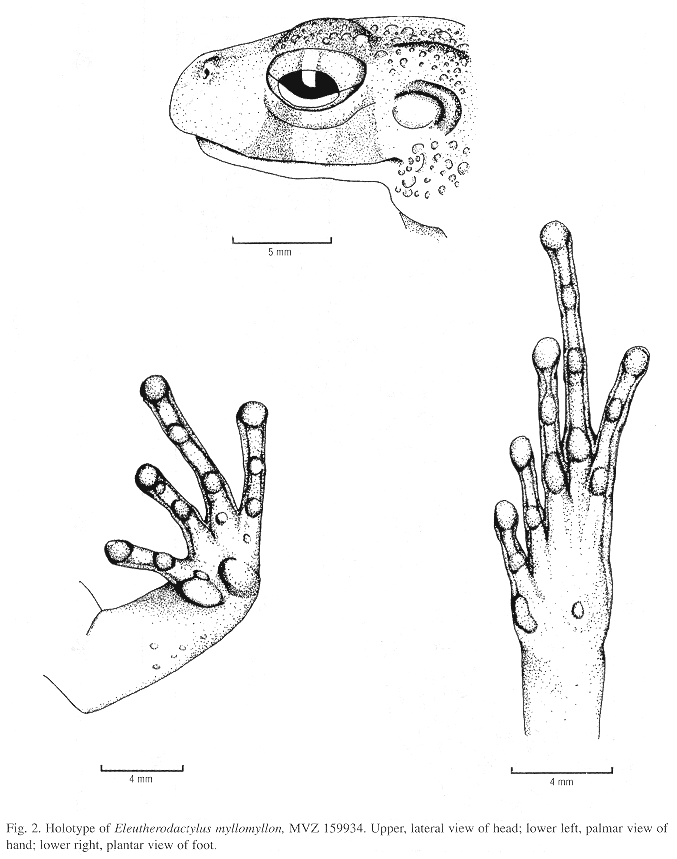
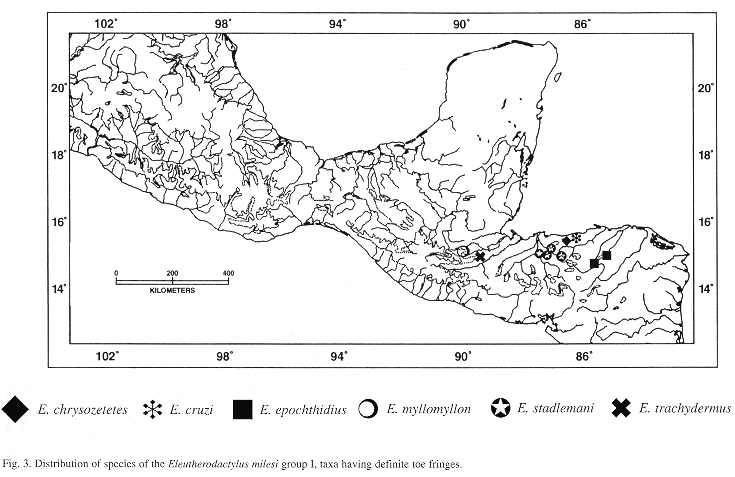
<body><![CDATA[<br>&nbsp;     <p><b><font face="Arial"><font size=-1>Key words</font></font></b>     <p><font face="Arial"><font size=-1>Amphibia, Anura, Leptodactylidae, <i>Eleutherodactylus</i>, Guatemala.</font></font>     <br>&nbsp;     <p><font face="Arial"><font size=-1>Some years ago a single rather ordinary appearing <i>Eleutherodactylus</i> was collected by Robert Seib, then at the University of California, Berkeley, from the Sierra de Xucaneb of Guatemala (<a href="#Savage75">Savage</a> 1975). <a href="#McCranie89">McCranie <i>et al.</i></a><i> </i>(1989) concluded that this specimen belonged to the <i>Eleutherodactylus milesi</i> group (<i>sensu</i> <a href="#Savage87">Savage</a> 1987). Recent reviews of the <i>milesi</i> group (<a href="#Campbell94">Campbell</a> 1994; <a href="#McCranie97">McCranie and Wilson</a> 1997) indicate that this frog differs substantially from all other members of that species group. Since a description of a new species is a hypothesis that material at hand represents an actual entity, it is here proposed that the Guatemalan frog is an example of a distinctive taxon to be known as:</font></font>     <p><b><font face="Arial"><font size=-1><i>Eleutherodactylus myllomyllon</i>, sp. nov.</font></font></b>     <br><font face="Arial"><font size=-1>Figs. <a href="#Fig1">1</a>-<a href="#Fig3">3</a></font></font>     <p><font face="Arial"><font size=-1><b>Holotype</b>: Museum of Vertebrate Zoology, University of California, Berkeley (MVZ) 159934, an immature female from Finca Volcan, Sierra de Xucaneb, Departamento de Alta Verapaz, Guatemala, 875m; collected 31 July 1978 by Robert Seib.</font></font>     <p><font face="Arial"><font size=-1><b>Diagnosis</b>: A member of the <i>Eleutherodactylusmilesi</i> group: <a href="#Savage87">Savage</a> (1987), <a href="#McCranie89">McCranie <i>et al.</i></a><i> </i>(1989), <a href="#Campbell94">Campbell</a> (1994), <a href="#McCranie97">McCranie and Wilson</a> (1997), having toes with moderate amounts of webbing and distinct lateral fringes, smooth and unflared lips, the dorsum covered with widely spaced, moderate-sized tubercles, the tympanum evident but indistinct and the annulus tympanicus hidden in the single known female.</font></font>     <p><font face="Arial"><font size=-1>This species differs from <i>Eleutherodactylus adamastus</i> and <i>E. matudai</i> of Guatemala and <i>E. fecundus, E. milesi, E. omoaensis</i> and <i>E. saltuarius</i> of Honduras in having toe fringes and an obtuse snout profile. The toes are without fringes but sometimes have lateral keels and the snout is rounded to vertical in profile in the six aforementioned forms.</font></font>     ]]></body>
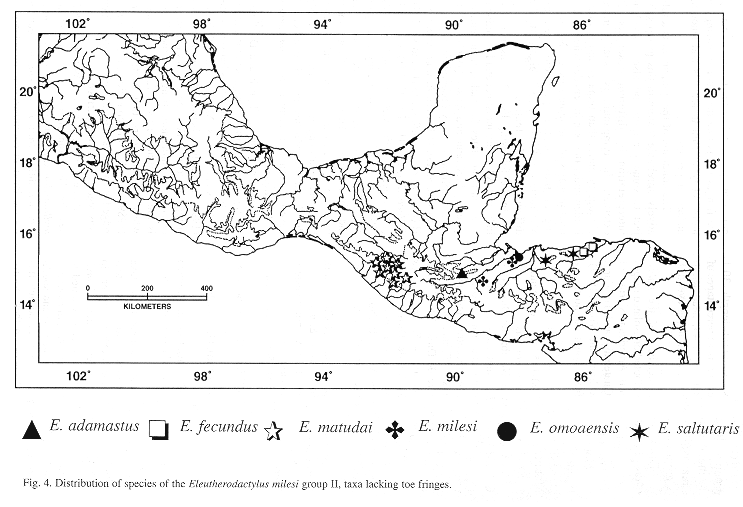
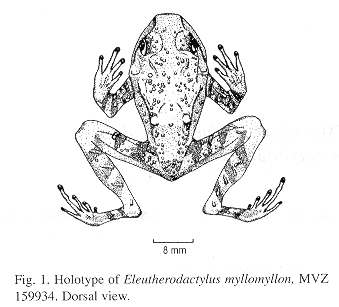
<body><![CDATA[<p><font face="Arial"><font size=-1><i>Eleutherodactylus chrysozetetes, E. cruzi, E. epochthidius</i> and <i>E. stadelmani</i> of Honduras and <i>E. trachydermus</i> of Guatemala, share the toe fringe feature with <i>E. myllomyllon</i>. The new species differs from <i>E. chrysozetetes</i> in having much less toe webbing (toe webbing 4 IV 4 versus 3 1/3 IV 3 1/3 in the latter form), less expanded finger disks (disks little wider than digits versus about twice width of digits) and numerous tubercles on the dorsum (wrinkled, nearly smooth dorsum in the latter species). The new form differs from the other Honduran forms with toe fringes in having the combination of an obtuse snout profile (rounded to vertical in the other species) and the dorsum wrinkled with widely spaced moderate-sized tubercles. In addition, unlike <i>E. epochthidius</i>, it has fringes on toes II-IV not on toes III-IV or only toe IV and the tympanum is evident but indistinct in the female type (hidden in <i>E. cruzi</i> and <i>E. stadelmani</i>). <i>E. myllomyllon</i> is distinguished from <i>E. trachydermus</i> (features for the latter in parentheses) by having moderate, widely scattered tubercles on the dorsum (dense, large tubercles), a smooth, unflared upper lip (margin of lip rough and lip flared under the orbit) and the snout obtuse, in profile (truncate).</font></font>     <p><font face="Arial"><font size=-1><b>Summary of Characteristics</b>: Descriptors throughout this paper follow <a href="#Campbell94">Campbell</a> (1994), and <a href="#McCranie97">McCranie and Wilson</a> (1997). Snout rounded in dorsal outline, obtuse (sloping) in profile; canthus rostralis concave in dorsal outline, rounded in cross-section; loreal area obtuse in cross-section; upper lip smooth; head slightly longer than broad; choanae moderate, ovoid; vomerine odontophores round, slightly larger than choanae, well posterior to choanae and narrowly separated medially; eyelids covered mostly with small low tubercles, cluster of large, low warts at medial posterior margin; tympanum indistinct, annulus not evident; definite supratympanic ridge from eyelid on each side, curving downward behind tympanum to behind axilla; dorsum covered with widely spaced moderate-sized tubercles; prominent paired suprascapular, hour-glass shaped ridges and low presacral ridges present; other short pearl-colored ridges on anterior flanks. Finger II longer than finger I; relative finger lengths: III>IV>II>I; finger disks slightly expanded, disk on finger III 52% of length of tympanum; fingers with lateral keels; subarticular tubercles on all digits, round, flattened; no supernumerary subarticular tubercles on any digits; thenar tubercle, elongate, bifid or double; palmar tubercle round, large; accessory palmar tubercles small; all tubercles under hand low in profile; heel with numerous small tubercles and one large, flat one on dorsal surface; no tarsal fold or tubercles; toe disks slightly larger than finger disks; toes with well-developed lateral fringe; toe webbing moderate, formula: I 2+ - 2 3/4 II 2 - 3 1/2 III 3 - 4 IV 4 - 2 1/2 V; toe III about as long as V; relative toe lengths: IV>III>V>II>I; tiny planter tubercles present; inner metatarsal tubercle, elongate, outer round and smaller; both low in profile; venter coarsely, wrinkled, not areolate.</font></font>     <p><font face="Arial"><font size=-1><b>Coloration: </b>In Preservative: Upper surface brown with tips of tubercles cream; suprascapular and presacral ridges cream, outline by darker brown; light interorbital bar indistinct, demarcated posteriorly by narrow dark brown bar; lip barred but light areas suffused with some brown pigment; supratympanic ridges cream, bordered by dark brown paired dark suprascapular and supra-axillary dark spots; limbs weakly barred with dark bands; posterior thigh surface same color as dorsum, anterior surface light tan; paired paracloacal light stripes present; chin, throat and venter pale cream punctuated with scattered melanophores; undersurfaces of limbs pale cream.</font></font>     <p><font face="Arial"><font size=-1><b>Measurements</b>: Standard length 30.1 mm; all other measurements as percentages of standard length: head length 45; head width 42; tympanum length 8; width upper eyelid 9; tibia length 63.</font></font>     <p><font face="Arial"><font size=-1><b>Remarks</b>: The members of the <i>milesi</i> group are widely distributed on isolated ranges in the North Central American Sierras of Chiapas, Mexico, Guatemala and Honduras (<a href="#Campbell94">Campbell</a>, 1994; <a href="#McCranie97">McCranie and Wilson</a>, 1997).</font></font>     <p><font face="Arial"><font size=-1>Distributions from south to north are (Figs. <a href="#Fig4">4</a>-5):</font></font>     <p><font face="Arial"><font size=-1>Sierra Agalta (700-1450m), eastcentral Honduras -- <i>E.</i> <i>epochthidius</i></font></font>     <br><font face="Arial"><font size=-1>E and C Cordillera de Nombre de Dios (400-1260m), eastern Honduras -- <i>E</i>. <i>fecundus</i></font></font>     <br><font face="Arial"><font size=-1>Mountains of Olancho and Yoro Provinces (1125-1900m), northcentral and northwestern Honduras -- <i>E</i>. <i>stadelmani</i></font></font>     <br><font face="Arial"><font size=-1>C Cordillera de Madre de Dios (880-1130m), northcentral Honduras -- <i>E</i>. <i>chrysozetetes</i></font></font>     ]]></body>
<body><![CDATA[<br><font face="Arial"><font size=-1>C Cordillera de Madre de Dios (1520m), northcentral Honduras -- <i>E</i>. <i>cruzi</i></font></font>     <br><font face="Arial"><font size=-1>C and W Cordillera de Madre de Dios (1550-1800m), northwestern Honduras -- <i>E</i>. <i>saltuarius</i></font></font>     <br><font face="Arial"><font size=-1>Sierras Oma and Espiritu Santo (1050-1720m), northwestern Honduras -- <i>E</i>. <i>milesi</i></font></font>     <br><font face="Arial"><font size=-1>Sierra Omoa (760-1150m), northwestern Honduras -- <i>E</i>. <i>omoaensis</i></font></font>     <br><font face="Arial"><font size=-1>Sierra de las Minas (600-650m), Guatemala -- <i>E</i>. <i>adamastus</i></font></font>     <br><font face="Arial"><font size=-1>Sierra de Xucaneb (875m), Guatemala -- <i>E</i>. <i>myllomyllon</i></font></font>     <br><font face="Arial"><font size=-1>Sierra de Santa Cruz (900m), Guatemala -- <i>E</i>. <i>trachydermus</i></font></font>     <br><font face="Arial"><font size=-1>Pacific Slope (1500-2000m), Chiapas, Mexico and adjacent Guatemala -- <i>E</i>. <i>matudai</i></font></font>     <p><font face="Arial"><font size=-1>Principal differences among these taxa involve subtle distinctions in dorsal skin texture, snout profile, toe webbing, upper lip shape and degree of ear development. <i>E</i>. <i>myllomyllon</i> appears to be most closely allied to the Guatemalan species occurring in mountain ridges to the east (<i>E</i>. <i>trachydemus</i>) and southeast (<i>E</i>. <i>adamastus</i>) of the Sierra Xucaneb. It is somewhat intermediate between these forms, most closely resembling the former in having toe fringes but is like the latter in having an indistinct tympanum in females and smooth, unflared upper lips.</font></font>     <p><font face="Arial"><font size=-1>The condition of the tympanum is a relatively unreliable feature in this group subject to some variation and also individual interpretation by different observers. If external, the tympanum is usually more obvious in males than females and is often hidden under the skin in females when indistinct in males of the same species. My scoring of most of the specimens seen by <a href="#McCranie97">McCranie and Wilson</a> (1997) highlights the difficulty with this feature.</font></font>     ]]></body>
<body><![CDATA[<p><font face="Arial"><font size=-1>In the following list, D = distinct, I = indistinct, VI = very indistinct and H = hidden. The character states for males, then females given by <a href="#McCranie97">McCranie and Wilson</a> (1997) are listed first followed by my observation in parentheses: <i>E. milesi</i>, D-I (I-H); <i>E</i>. <i>stadelmani</i>;, H-H (I-H); <i>E</i>. <i>epochthidius</i>, I to H - I to VI (I-H); <i>E</i>. <i>fecundus</i>, I to H - I to H (I-H). <a href="#Campbell94">Campbell</a> (1994) agreed with <a href="#McCranie97">McCranie and Wilson's</a> (1997) scoring of <i>E</i>. <i>milesi</i> and my scoring of <i>E</i>. <i>stadelmani</i>, noting that some males had indistinct tympana. There is no disagreement in scoring for <i>E</i>. <i>chrysozetetes</i> and <i>E</i>. <i>cruzi</i> between us. I also agree with <a href="#Campbell94">Campbell</a> (1994) that <i>E</i>. <i>trachyderma</i> has the I-H conditions. I have not examined examples of <i>E</i>. <i>omoaensis</i> or <i>E</i>. <i>saltuarius</i>.</font></font>     <p><font face="Arial"><font size=-1>As pointed out by <a href="#Lynch97">Lynch and Duellman</a> (1997), a similar problem relates to the continuum of intermediate conditions between digital keels and fringes. <a href="#McCranie97">McCranie and Wilson's</a> (1997) distinction between <i>E</i>. <i>epochthidius</i> (fringes on toes III-IV or only toe IV) versus <i>E</i>. <i>cruzi</i> and <i>E</i>. <i>stadelmani</i> (fringes on toes II-IV) is rather arbitrary. This is further confirmed when one considers that McCranie <i>et al. </i>(1989) described the condition in <i>E</i>. <i>cruzi</i> as ridged in comparison to <i>E</i>. <i>chrysozetetes</i> which was regarded as having fringes.</font></font>     <p><font face="Arial"><font size=-1>If one uses <a href="#McCranie97">McCranie and Wilson's</a> (1997) key for Honduran forms, <i>Eleutherodactylusmyllomyllon</i> keys out to <i>E</i>. <i>stadelmani</i>. <i>E</i>. <i>myllomyllon</i> differs from <i>E</i>. <i>stadelmani</i> (features for the latter in parentheses) most notably in having a tympanum that is obvious, but covered by tuberculate skin (hidden in females) and an obtuse snout profile (rounded to vertical).</font></font>     <p><font face="Arial"><font size=-1>This new taxon is named in honor of Jonathan A. Campbell of the University of Texas, Arlington, in recognition of his many contributions to our knowledge of the Guatemalan herpetofauna. It is equivalent of the Scottish surname Campbell (wry lip) derived from the Greek <i>myllos</i> (bent) and <i>myllon</i> (lip). Those that know Jonathan well may see a connection between the name and his oral renditions of his Guatemalan adventures.</font></font>     <p><font face="Arial"><font size=-1><b>Distribution</b>: Known only from the Sierra de Xucaneb, Guatemala, in Premontane Wet Forest (875m).</font></font>     <p><b><font face="Arial"><font size=-1>&nbsp;Acknowledgments</font></font></b>     <p><font face="Arial"><font size=-1>David B. Wake of the Museum of Vertebrate Zoology, University of California, Berkeley, kindly made the holotype available for study. The illustrations were prepared by Cristina Ugarte and the maps by Kathy Gibbs Thornton. Their help is greatly appreciated.</font></font>     <p><b><font face="Arial,Helvetica"><font size=-1>&nbsp;Resumen</font></font></b>     <p><font face="Arial,Helvetica"><font size=-1>Se describe una especie nueva del grupo Eleutherodactylus milesi hallada en la Sierra de Xucaneb, Guatemala. Se compara con las otras once especies del grupo (alturas de sureste de M&eacute;xico, Guatemala y Honduras). Dentro del grupo, difiere de las otras cinco especies que&nbsp; tienen flecos de pulgar en el tama&ntilde;o de los discos digitales, la forma del hocico visto de perfil y la cantidad de membrana del pulgar y de tub&eacute;rculos dorsales.&nbsp; La dificultad de distinguir entre caracter&iacute;sticas del t&iacute;mpano (definido, indefinido y oculto) y entre rebordes y flecos del pulgar indican que hay diferencias muy tenues entre las especies actualmente reconocidas.</font></font>     <br>&nbsp;     ]]></body>
<body><![CDATA[<p><b><font face="Arial,Helvetica"><font size=-1>References</font></font></b>     <!-- ref --><p><a NAME="Campbell94"></a><font face="Arial,Helvetica"><font size=-1>Campbell, J. A. 1994. New species of <i>Eleutherodactylus</i> (Anura: Leptodactylidae) of the <i>milesi</i> group from Guatemala. Herpetologica 50: 398-411.</font></font>    &nbsp;&nbsp;&nbsp;&nbsp;&nbsp;&nbsp;&nbsp;&nbsp;[&#160;<a href="javascript:void(0);" onclick="javascript: window.open('/scielo.php?script=sci_nlinks&ref=1342213&pid=S0034-7744200000040002400001&lng=','','width=640,height=500,resizable=yes,scrollbars=1,menubar=yes,');">Links</a>&#160;]<!-- end-ref --><p><a NAME="Lynch97"></a><font face="Arial,Helvetica"><font size=-1>Lynch, J. D. &amp; W. E. Duellman. 1997. Frogs of the genus <i>Eleutherodactylus</i> in western Ecuador. Natural History Museum, University of Kansas Special Publication 23: 1-236, 8 pls.</font></font>     <!-- ref --><p><a NAME="McCranie97"></a><font face="Arial,Helvetica"><font size=-1>McCranie, J. R. &amp; L. D. Wilson. 1997. A review of the <i>Eleutherodactylusmilesi</i> - like frogs (Anura, Leptodactylidae) from Honduras with the description of four new species. Alytes 14: 147-174.</font></font>    &nbsp;&nbsp;&nbsp;&nbsp;&nbsp;&nbsp;&nbsp;&nbsp;[&#160;<a href="javascript:void(0);" onclick="javascript: window.open('/scielo.php?script=sci_nlinks&ref=1342215&pid=S0034-7744200000040002400003&lng=','','width=640,height=500,resizable=yes,scrollbars=1,menubar=yes,');">Links</a>&#160;]<!-- end-ref --><!-- ref --><p><a NAME="McCranie89"></a><font face="Arial,Helvetica"><font size=-1>McCranie, J. R., J. M. Savage &amp; L. D. Wilson. 1989. Description of two new species of the <i>Eleutherodactylus</i> (Amphibia: Anura: Leptodactylidae) from northern Honduras. Proc. Biol. Soc. Washington 102: 483-490.</font></font>    &nbsp;&nbsp;&nbsp;&nbsp;&nbsp;&nbsp;&nbsp;&nbsp;[&#160;<a href="javascript:void(0);" onclick="javascript: window.open('/scielo.php?script=sci_nlinks&ref=1342216&pid=S0034-7744200000040002400004&lng=','','width=640,height=500,resizable=yes,scrollbars=1,menubar=yes,');">Links</a>&#160;]<!-- end-ref --><!-- ref --><p><a NAME="Savage75"></a><font face="Arial,Helvetica"><font size=-1>Savage, J. M. 1975. Systematics and distribution of the Mexican and Central American stream frogs related to <i>Eleutherodactylus</i> <i>rugulosus</i>. Copeia 1975: 254-306.</font></font>    &nbsp;&nbsp;&nbsp;&nbsp;&nbsp;&nbsp;&nbsp;&nbsp;[&#160;<a href="javascript:void(0);" onclick="javascript: window.open('/scielo.php?script=sci_nlinks&ref=1342217&pid=S0034-7744200000040002400005&lng=','','width=640,height=500,resizable=yes,scrollbars=1,menubar=yes,');">Links</a>&#160;]<!-- end-ref --><!-- ref --><p><a NAME="Savage87"></a><font face="Arial,Helvetica"><font size=-1>Savage, J. M. 1987. Systematics and distribution of the Mexican and Central American rainfrogs of the <i>Eleutherodactylusgollmeri</i> group (Amphibia: Leptodactylidae). Fieldiana Zool. n.s. 33: 1-37.</font></font>    &nbsp;&nbsp;&nbsp;&nbsp;&nbsp;&nbsp;&nbsp;&nbsp;[&#160;<a href="javascript:void(0);" onclick="javascript: window.open('/scielo.php?script=sci_nlinks&ref=1342218&pid=S0034-7744200000040002400006&lng=','','width=640,height=500,resizable=yes,scrollbars=1,menubar=yes,');">Links</a>&#160;]<!-- end-ref --><br>&nbsp;     <br>&nbsp;     <br>     ]]></body>
<body><![CDATA[<center>     <p><a NAME="Fig1"></a><img SRC="/img/fbpe/rbt/v48n4/0965i01.GIF" height=307 width=339>     
<br>&nbsp;     <br>&nbsp;     <br>&nbsp;     <br>&nbsp;     <p><a NAME="Fig2"></a><img SRC="/img/fbpe/rbt/v48n4/0965i02.GIF" height=859 width=677>     
<br>&nbsp;     <br>&nbsp;     <p><a NAME="Fig3"></a><img SRC="/img/fbpe/rbt/v48n4/0965i03.GIF" height=477 width=735></center>      
]]></body>
<body><![CDATA[<p>    <br>     <br>     <p><a NAME="Fig4"></a><img SRC="/img/fbpe/rbt/v48n4/0965i04.GIF" height=507 width=743>     
<br>&nbsp;     <br>&nbsp;     <p><a NAME="1a"></a><font size=-1><font face="Arial,Helvetica"><a href="#1">1</a></font><font face="Arial">Department of Biology, San Diego State University, San Diego, California, 92182-4614, USA; Fax: 619/380-3778, E-mail: <a href="mailto:savy1@home.com">savy1@home.com</a></font></font>      ]]></body><back>
<ref-list>
<ref id="B1">
<nlm-citation citation-type="journal">
<person-group person-group-type="author">
<name>
<surname><![CDATA[Campbell]]></surname>
<given-names><![CDATA[J. A]]></given-names>
</name>
</person-group>
<article-title xml:lang="en"><![CDATA[New species of Eleutherodactylus (Anura: Leptodactylidae) of the milesi group from Guatemala]]></article-title>
<source><![CDATA[Herpetologica]]></source>
<year>1994</year>
<volume>50</volume>
<page-range>398-411</page-range></nlm-citation>
</ref>
<ref id="B2">
<nlm-citation citation-type="journal">
<person-group person-group-type="author">
<name>
<surname><![CDATA[Lynch]]></surname>
<given-names><![CDATA[J. D]]></given-names>
</name>
<name>
<surname><![CDATA[Duellman]]></surname>
<given-names><![CDATA[W. E.]]></given-names>
</name>
</person-group>
<article-title xml:lang="en"><![CDATA[Frogs of the genus Eleutherodactylus in western Ecuador]]></article-title>
<source><![CDATA[University of Kansas Special Publication]]></source>
<year>1997</year>
<volume>23</volume>
<page-range>1-236</page-range><publisher-name><![CDATA[Natural History Museum]]></publisher-name>
</nlm-citation>
</ref>
<ref id="B3">
<nlm-citation citation-type="journal">
<person-group person-group-type="author">
<name>
<surname><![CDATA[McCranie]]></surname>
<given-names><![CDATA[J. R]]></given-names>
</name>
<name>
<surname><![CDATA[Wilson]]></surname>
<given-names><![CDATA[L. D]]></given-names>
</name>
</person-group>
<article-title xml:lang="en"><![CDATA[A review of the Eleutherodactylus milesi - like frogs (Anura, Leptodactylidae) from Honduras with the description of four new species]]></article-title>
<source><![CDATA[Alytes]]></source>
<year>1997</year>
<volume>14</volume>
<page-range>147-174</page-range></nlm-citation>
</ref>
<ref id="B4">
<nlm-citation citation-type="journal">
<person-group person-group-type="author">
<name>
<surname><![CDATA[McCranie]]></surname>
<given-names><![CDATA[J. R]]></given-names>
</name>
<name>
<surname><![CDATA[Savage]]></surname>
<given-names><![CDATA[J. M]]></given-names>
</name>
<name>
<surname><![CDATA[Wilson]]></surname>
<given-names><![CDATA[L. D]]></given-names>
</name>
</person-group>
<article-title xml:lang="en"><![CDATA[Description of two new species of the Eleutherodactylus (Amphibia: Anura: Leptodactylidae) from northern Honduras]]></article-title>
<source><![CDATA[Proc. Biol. Soc]]></source>
<year>1989</year>
<volume>102</volume>
<page-range>483-490</page-range><publisher-loc><![CDATA[Washington ]]></publisher-loc>
</nlm-citation>
</ref>
<ref id="B5">
<nlm-citation citation-type="journal">
<person-group person-group-type="author">
<name>
<surname><![CDATA[Savage]]></surname>
<given-names><![CDATA[J. M]]></given-names>
</name>
</person-group>
<article-title xml:lang="en"><![CDATA[Systematics and distribution of the Mexican and Central American stream frogs related to Eleutherodactylus rugulosus]]></article-title>
<source><![CDATA[Copeia]]></source>
<year>1975</year>
<month>19</month>
<day>75</day>
<page-range>254-306</page-range></nlm-citation>
</ref>
<ref id="B6">
<nlm-citation citation-type="journal">
<person-group person-group-type="author">
<name>
<surname><![CDATA[Savage]]></surname>
<given-names><![CDATA[J. M]]></given-names>
</name>
</person-group>
<article-title xml:lang="en"><![CDATA[Systematics and distribution of the Mexican and Central American rainfrogs of the Eleutherodactylusgollmeri group (Amphibia: Leptodactylidae)]]></article-title>
<source><![CDATA[Fieldiana Zool]]></source>
<year>1987</year>
<volume>33</volume>
<page-range>1-37</page-range></nlm-citation>
</ref>
</ref-list>
</back>
</article>