<?xml version="1.0" encoding="ISO-8859-1"?><article xmlns:mml="http://www.w3.org/1998/Math/MathML" xmlns:xlink="http://www.w3.org/1999/xlink" xmlns:xsi="http://www.w3.org/2001/XMLSchema-instance">
<front>
<journal-meta>
<journal-id>0034-7744</journal-id>
<journal-title><![CDATA[Revista de Biología Tropical]]></journal-title>
<abbrev-journal-title><![CDATA[Rev. biol. trop]]></abbrev-journal-title>
<issn>0034-7744</issn>
<publisher>
<publisher-name><![CDATA[Universidad de Costa Rica]]></publisher-name>
</publisher>
</journal-meta>
<article-meta>
<article-id>S0034-77442000000400022</article-id>
<title-group>
<article-title xml:lang="en"><![CDATA[Forager size of the leaf-cutting ant Atta sexdens (Hymenoptera: Formicidae) in a mature eucalyptus forest in Brazil]]></article-title>
</title-group>
<contrib-group>
<contrib contrib-type="author">
<name>
<surname><![CDATA[Tonhasca]]></surname>
<given-names><![CDATA[Athayde]]></given-names>
</name>
<xref ref-type="aff" rid="A01"/>
</contrib>
<contrib contrib-type="author">
<name>
<surname><![CDATA[Lima Bragança]]></surname>
<given-names><![CDATA[Marcos Antonio]]></given-names>
</name>
</contrib>
</contrib-group>
<aff id="A01">
<institution><![CDATA[,Universidade Estadual do Norte Fluminense  ]]></institution>
<addr-line><![CDATA[Campos dos Goytacazes RJ]]></addr-line>
<country>Brazil</country>
</aff>
<pub-date pub-type="pub">
<day>00</day>
<month>12</month>
<year>2000</year>
</pub-date>
<pub-date pub-type="epub">
<day>00</day>
<month>12</month>
<year>2000</year>
</pub-date>
<volume>48</volume>
<numero>4</numero>
<fpage>983</fpage>
<lpage>988</lpage>
<copyright-statement/>
<copyright-year/>
<self-uri xlink:href="http://www.scielo.sa.cr/scielo.php?script=sci_arttext&amp;pid=S0034-77442000000400022&amp;lng=en&amp;nrm=iso"></self-uri><self-uri xlink:href="http://www.scielo.sa.cr/scielo.php?script=sci_abstract&amp;pid=S0034-77442000000400022&amp;lng=en&amp;nrm=iso"></self-uri><self-uri xlink:href="http://www.scielo.sa.cr/scielo.php?script=sci_pdf&amp;pid=S0034-77442000000400022&amp;lng=en&amp;nrm=iso"></self-uri><abstract abstract-type="short" xml:lang="en"><p><![CDATA[We determined the size characteristics of foragers of the leaf-cutting ant Atta sexdens in a mature eucalyptus forest in Campos dos Goytacazes, Rio de Janeiro State, Brazil, at daytime (7: 30 to 10: 00 hr) and nighttime (19: 00 to 23: 00 hr). There were no significant differences between daytime and nighttime ant mass (Ma), but leaf fragment mass (Ml) and burden (B = [Ma + Ml]/Ma), which indicates relative load capacity, were significantly greater at daytime. There was a positive linear relationship between Ma and Ml for the combined daytime and nighttime data, and increases in Ma resulted in lower B. We compared A. sexdens characteristics with published results for Atta cephalotes, a closely related species. A. sexdens is larger and therefore able to carry heavier loads, but its burden is about 72% of the average value for A. cephalotes. We suggest that the lower load capacity of A. sexdens in comparison to A. cephalotes is related to its relatively larger size.]]></p></abstract>
<abstract abstract-type="short" xml:lang="pt"><p><![CDATA[Nós determinamos as características de tamanho de forrageiras da saúva Atta sexdens em uma floresta adulta de eucalipto em Campos dos Goytacazes, estado do Rio de Janeiro, Brasil, nos períodos diurno (7: 30 a 10: 00 hr) e noturno (19: 00 to 23: 00 hr). Não houve diferença significativa entre o dia e a noite para a massa das formigas (Ma), mas a massa dos fragmentos de folhas (Ml) e o esforço ([Ma + Ml]/Ma), o qual indica a capacidade relativa de carga, foram significativamente maiores durante o dia. Houve uma correlação linear positiva entre Ma e Ml para os dados diurnos e noturnos combinados, e o aumento em Ma resultou em esforço menor. Nós comparamos as características de A. sexdens com resultados publicados para Atta cephalotes, uma espécie correlata. A. sexdens é maior e portanto capaz de carregar cargas mais pesadas, mas seu esforço é cerca de 72% do valor médio obtido para A. cephalotes. Nós sugerimos que a menor capacidade de carga de A. sexdens em relação a A. cephalotes é devida ao seu tamanho relativamente maior.]]></p></abstract>
<kwd-group>
<kwd lng="en"><![CDATA[Atta sexdens]]></kwd>
<kwd lng="en"><![CDATA[Atta cephalotes]]></kwd>
<kwd lng="en"><![CDATA[ecology]]></kwd>
<kwd lng="en"><![CDATA[foraging]]></kwd>
<kwd lng="en"><![CDATA[leaf-cutting ants]]></kwd>
</kwd-group>
</article-meta>
</front><body><![CDATA[ <center><b><font face="Arial,Helvetica">Forager size of the leaf-cutting ant <i>Atta sexdens</i> (Hymenoptera: Formicidae) in a mature eucalyptus forest in Brazil</font></b>     <p><font face="Arial,Helvetica"><font size=-1><b>Athayde Tonhasca Jr.<a NAME="1"></a></b><sup><a href="#1a">1</a></sup><b> and Marcos Antonio Lima Bragan&ccedil;a</b></font></font>     <br>&nbsp;     <p><font face="Arial,Helvetica"><font size=-1>&nbsp; Received: 2-XI-99 Corrected: 2-VI-00 Accepted: 16-VI-00</font></font></center>      <p><b><font face="Arial,Helvetica"><font size=-1>Abstract</font></font></b>     <p><font face="Arial,Helvetica"><font size=-1>We determined the size characteristics of foragers of the leaf-cutting ant <i>Atta sexdens</i> in a mature eucalyptus forest in Campos dos Goytacazes, Rio de Janeiro State, Brazil, at daytime (7: 30 to 10: 00 hr) and nighttime (19: 00 to 23: 00 hr). There were no significant differences between daytime and nighttime ant mass (M<sub>a</sub>), but leaf fragment mass (M</font><sub><font size=-2>l</font></sub><font size=-1>) and burden (B = [M<sub>a</sub> + M</font><sub><font size=-2>l</font></sub><font size=-1>]/M<sub>a</sub>), which indicates relative load capacity, were significantly greater at daytime. There was a positive linear relationship between M<sub>a</sub> and M</font><sub><font size=-2>l</font></sub><font size=-1> for the combined daytime and nighttime data, and increases in M<sub>a</sub> resulted in lower B. We compared <i>A. sexdens</i> characteristics with published results for <i>Atta cephalotes</i>, a closely related species. <i>A. sexdens</i> is larger and therefore able to carry heavier loads, but its burden is about 72% of the average value for <i>A. cephalotes</i>. We suggest that the lower load capacity of <i>A. sexdens</i> in comparison to <i>A. cephalotes</i> is related to its relatively larger size.</font></font>     <p><b><font face="Arial,Helvetica"><font size=-1>Key words</font></font></b><i><font face="Arial,Helvetica"><font size=-1></font></font></i>     <p><font face="Arial,Helvetica"><font size=-1><i>Atta sexdens, Atta cephalotes</i>, ecology, foraging, leaf-cutting ants.</font></font>     <br>&nbsp;     <br>&nbsp;     ]]></body>
<body><![CDATA[<p><font face="Arial,Helvetica"><font size=-1>The leaf-cutting ant <i>Atta sexdens</i> (L., 1758) is common in primary forest throughout most of South America, but it readily invades new areas of agriculture or forestry, where it may become a serious pest (<a href="#Cherrett">Cherrett</a> 1986). The range and economical importance of <i>A. sexdens</i> have been increasing, probably because of the decline of native forests (<a href="#Fowler83">Fowler</a> 1983). Foraging of <i>A. sexdens</i> is predominantly nocturnal, although daytime foraging may occur sparsely throughout the day or during short periods of intense activity (personal observation). During daytime foraging, <i>A. sexdens</i> is exposed to harsh climatic conditions such as high temperatures and low humidity (<a href="#Pereira">Pereira da Silva</a> 1975, <a href="#Fowler79">Fowler and Robinson</a> 1979), as well as parasitism from several species of phorid flies (<a href="#Feener">Feener and Moss</a> 1990).</font></font>     <p><font face="Arial,Helvetica"><font size=-1>Because of the high degree of polymorphism of <i>Atta</i> spp. (<a href="#Wilson80a">Wilson</a> 1980a), it could be expected that <i>A. sexdens</i> colonies undergo a reduction in the average size of foragers from nighttime to daytime to cope with higher risks of desiccation (<a href="#Wetterer90">Wetterer</a> 1990) and phorid parasitism (<a href="#Orr">Orr </a>1992). This study was conducted to determine the size characteristics of <i>A. sexdens</i> foragers and whether there were significant differences on mass and load capacity between diurnal and nocturnal foragers. We also compared <i>A. sexdens</i> and <i>Atta cephalotes</i> (L., 1758) regarding the sizes of foragers and their loads. Research on the ecology of <i>Atta</i> spp. has focused mainly on <i>A. cephalotes</i> in natural forests, with considerably less available information on <i>A. sexdens</i> in disturbed habitats. Because both species have the widest distributions of <i>Atta</i> spp. in South America (<a href="#Fowler89">Fowler <i>et al.</i></a><i> </i>1989), we considered these comparisons worthwhile.</font></font>     <br><font face="Arial,Helvetica"><font size=-1></font></font>&nbsp;     <p><b><font face="Arial,Helvetica"><font size=-1>Material and methods</font></font></b>     <p><font face="Arial,Helvetica"><font size=-1>The study was conducted from August 1995 to February 1996 in a forest of eucalyptus (<i>Eucalyptus</i> spp.) of approximately 1,300 ha located 35 km from Campos dos Goytacazes (21<sup>o</sup>48'S, 41<sup>o</sup>20'W), Rio de Janeiro State, Brazil. The forest undergrowth was composed mostly of grasses, which are rarely harvested by <i>A. sexdens</i>. Foraging trails of adult <i>A. sexdens</i> colonies were selected according to the ants' foraging activity, which was determined by the presence of fresh pieces of eucalyptus leaves along trails and around tunnel entrances. Because foraging activity varies among colonies and among trails within colonies, the location of observed trails varied during the study period, but at least five trails from five nests were used at each sampling date.</font></font>     <p><font face="Arial,Helvetica"><font size=-1>Leaf-cutting ants were sampled on three pairs of daytime (from 7: 30 to 10: 00 hr) and nighttime (from 19: 00 to 23: 00 hr) sampling dates: August 29 (n = 51) and 31 (n = 107), September 6 (n = 88) and 5 (n = 80), and February 7 (n = 47) and 6 (n = 107). Additional, non-paired samples were obtained at daytime on August 25 (n = 51), September 27 (n = 38), and February 16 (n = 125), and at nighttime on September 19 (n = 114). Each sample consisted of loaded ants collected randomly at approximately equal numbers from each foraging trail. The same trails were used on each pair of dates. Ants and their loads were placed individually in glass vials, which were held in an ice chest to reduce loss of water of the leaf fragments. In the laboratory, ants and leaf fragments were weighed to the nearest 0.1 mg on a precision balance. The ants' relative load capacity was evaluated with burden (B): B = (M<sub>a</sub> + M<sub>l</sub>)/ M<sub>a</sub>, where M<sub>a</sub> and M<sub>l</sub> are ant and leaf fragment masses, respectively (<a href="#Rissing">Rissing</a> 1982).</font></font>     <p><font face="Arial,Helvetica"><font size=-1>To compare day and night results of M<sub>a</sub>, M<sub>l</sub> and B, we used mixed-model ANOVA's on the paired data only. Periods (day and night) were considered fixed effects and dates were considered blocks of random effects. Thus, F tests for period effects were calculated with the interaction between period and date. When interactions were not significant at a probability level of at least 0.25, interaction and residual mean squares were pooled (<a href="#Sokal">Sokal and Rohlf</a> 1995). Analyses of M<sub>a</sub> and M<sub>l</sub> were done after a log(x) transformation to correct heterogeneity of variances. In the results, means are followed by &plusmn; 1 standard deviation.</font></font>     <p><font face="Arial,Helvetica"><font size=-1>Because division of labor is associated with polymorphism of <i>Atta</i> spp., head size is a good indicator of the workers' foraging capability (Wilson <a href="#Wilson80a">1980a</a>, <a href="#Wilson80b">1980b</a>). Head size of 161 ants selected at random from our samples was measured by the standard head width, which is the greatest width of the head viewed face on (Wilson <a href="#Wilson80a">1980a</a>). Measurements were taken to the nearest 0.1 mm with a dissecting microscope equipped with an ocular micrometer. The values of head size were correlated with mass for determination of an allometric relationship.</font></font>     <br>&nbsp;     <p><b><font face="Arial,Helvetica"><font size=-1>Results</font></font></b>     ]]></body>
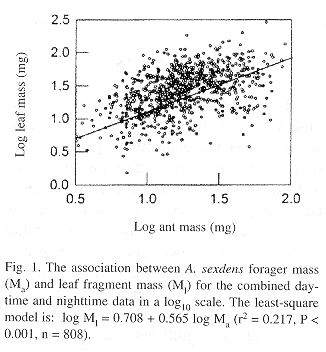
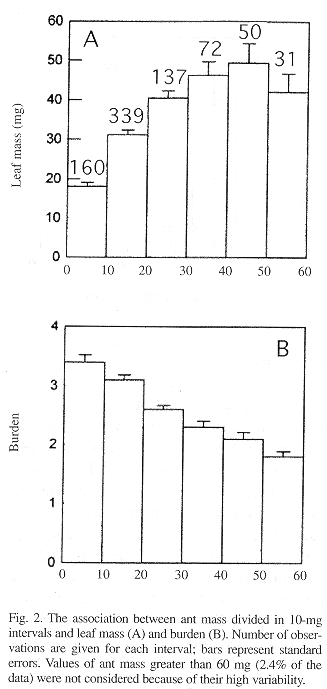
<body><![CDATA[<p><font face="Arial,Helvetica"><font size=-1>The ANOVA’s indicated that the effects of dates were not statistically significant for M<sub>a</sub>, M</font><sub><font size=-2>l</font></sub><font size=-1> or B, but there was a significant interaction period x date for M<sub>a</sub> (F</font><sub><font size=-2>2,474</font></sub><font size=-1> = 6.71, P = 0.001). As the interactions period x date for M</font><sub><font size=-2>l</font></sub><font size=-1>(P = 0.44) and B (P = 0.93) were not significant, residual and interaction mean squares for those variables were pooled. Daytime M<sub>a</sub> was not significantly different from nighttime M<sub>a,</sub> but M</font><sub><font size=-2>l</font></sub><font size=-1> and B were significantly higher during the day (<a href="#TABLE1">Table 1</a>).</font></font>     <p><font face="Arial,Helvetica"><font size=-1>Similar to other leaf-cutting ant species (<a href="#Burd95">Burd</a> 1995 and references therein), there was a positive linear relationship between mass of <i>A. sexdens</i> foragers and their loads (<a href="#Fig1">Fig. 1</a>). The least-squares method was not adequate to describe the association between B and M<sub>a </sub>because regression diagnostics demonstrated that the assumption of homogeneity of variances did not hold despite transformations. However, histograms of M<sub>a</sub> data divided in 10-mg intervals clearly demonstrated that an increase in M<sub>a</sub> resulted in higher M<sub>l</sub> and lower B (<a href="#Fig2">Fig. 2</a>). The frequency of the mass-class distribution of all ants indicates that most foragers are in the 10-20 mg interval (Fig. 3). The allometric relationship between head size (HS) and M<sub>a</sub> for <i>A. sexdens</i> can be expressed as HS = 0.70 + 0.53 M<sub>a</sub></font><sup><font size=-2>1/2</font></sup><font size=-1> (r</font><sup><font size=-2>2</font></sup><font size=-1> = 0.983, P &lt; 0.001, n = 161). By converting mass values to head sizes, we determined that less than 20% of foragers have head widths between 2.2 and 2.6 mm, which was proposed by <a href="#Wilson80b">Wilson</a> (1980b) as the most efficient size for <i>A. sexdens</i> foragers.</font></font>     <p><font face="Arial,Helvetica"><font size=-1>Both <i>A. sexdens</i> and <i>A. cephalotes</i> have reduced transport efficiency with increasing forager size (<a href="#Fig2">Fig. 2</a>; <a href="#Wetterer94">Wetterer </a>1994). However, while <i>A. sexdens</i> foragers carry loads about 50% heavier than <i>A. cephalotes</i>, the average burden of <i>A. sexdens</i> is about 72% of the average value for <i>A. cephalotes</i> (<a href="#TABLE2">Table 2</a>). Additionally, while more than 80% of <i>A. cephalotes</i> foragers carry burdens larger than 1.5 times their body sizes (Rudolph and Loudon 1986, Wetterer 1994), almost half of all <i>A. sexdens</i> foragers (47.2%) had loads smaller than 1.5 times their body sizes, which corresponds to B = 2.5 (<a href="#Fig2">Fig. 2</a>).</font></font>     <br>&nbsp;     <p><b><font face="Arial,Helvetica"><font size=-1>Discussion</font></font></b>     <p><font face="Arial,Helvetica"><font size=-1>The traffic of <i>A. sexdens</i> foragers at daytime was very light and generally stopped abruptly when the temperature approached 30<sup>o</sup> C, a characteristic already described by <a href="#Fowler79">Fowler and Robinson</a> (1979). Despite their low numbers, daytime foragers were not significantly smaller than nighttime foragers. An earlier study in the same area (<a href="#Tonhasca">Tonhasca</a> 1996) also failed to detect any meaningful diel differences for <i>A. sexdens</i> on trails, foragers or not.</font></font>     <p><font face="Arial,Helvetica"><font size=-1><a href="#Wetterer90">Wetterer</a> (1990) and <a href="#Orr">Orr</a> (1992) have proposed that the significant reduction on the average daytime mass of <i>A. cephalotes</i> foragers could be a strategy to escape parasitism from phorid flies, which prefer larger ants. Although we expect a greater impact of phorids on <i>A. sexdens</i> during daytime (<a href="#Bragança">Bragan&ccedil;a <i>et al.</i></a>1998), the effect of these parasitoids in response to diel differences has to be better evaluated, as we have observed strong phorid activity at nighttime (unpublished). The similarity between day and night foragers size may be related to the two-stage foraging system deployed by <i>A. sexdens</i>. While arboreal workers cut the petioles and drop the leaves, other workers cut leaf fragments on the ground and transport them to the nest (<a href="#Fowler79">Fowler and Robinson</a> 1979). Thus, efficient foraging either at daytime or nighttime require workers of a minimum size for cutting the hard tissue of petioles, and this should be particularly important in homogeneous, mature commercial forests. Nonetheless, if foraging during the day is a riskier activity than at night because of greater chances of desiccation or parasitism, it could be expected that foragers optimize their daytime excursions by carrying greater loads. In fact, leaf fragment weight and burden of <i>A. sexdens</i> was heavier for daytime foragers.</font></font>     <p><font face="Arial,Helvetica"><font size=-1>Despite the significant relationship between ant and fragment masses, the linear model was a poor predictor of this relationship, even with a large number of observations and the log scale used. Equivalent results were obtained for <i>A. cephalotes</i> and <i>Atta colombica</i> (Gu&eacute;rin-M&eacute;neville, 1844)(<i>e.g.</i>, <a href="#Wetterer90">Wetterer </a>1990, <a href="#Shutler,">Shutler and Mullie</a> 1991, <a href="#Wetterer94">Wetterer</a> 1994, <a href="#Burd95">Burd</a> 1995). It is clear from field observations that foraging of <i>A. sexdens</i> is subject to a great deal of "noise" from the environment. Ants drop their loads when they are disturbed by high wind speed, other arthropods and by hovering phorid flies (<a href="#Bragança">Bragan&ccedil;a <i>et al. </i></a>1998). Abandoned fragments may be picked up by other ants, and in these cases there is no apparent load size selection. Fragments also are abandoned when they become stuck in obstacles along trails, although occasionally foragers remove pieces of these fragments and resume their trips. As traffic along trails is routinely impaired by litter, larger fragments are more likely to be dropped because of obstacles. It has been demonstrated that leaf-cutting ants carry loads below their capacity, possibly because of a trade off between load mass and ant velocity (<a href="#Rudolph">Rudolph and Loudon </a>1986, <a href="#Lighton">Lighton <i>et al.</i></a><i> </i>1987) or an overall gain of efficiency at the colony level (<a href="#Burd96">Burd</a> 1996). Transport difficulties may be another factor that contribute to the relatively lower burden of larger workers of <i>A. sexdens</i> and <i>A. cephalotes</i> (<a href="#Lighton">Lighton <i>et al. </i></a>1987) and the lower burden of <i>A. sexdens</i> in relationship to <i>A. cephalotes</i>. If that is the case, the lower foraging capacity of <i>A. sexdens</i> in comparison with <i>A. cephalotes</i> is associated with the larger size of <i>A. sexdens</i> foragers.</font></font>     <br>&nbsp;     <p><b><font face="Arial,Helvetica"><font size=-1>Acknowledgements</font></font></b>     ]]></body>
<body><![CDATA[<p><font face="Arial,Helvetica"><font size=-1>Thanks are expressed to Milton Erthal Jr. for helping with the field work. Jackie Blackmer, Gilberto Albuquerque and Og de Souza made important contributions on early drafts of this manuscript. A. Tonhasca Jr. was supported by a grant from the International Foundation for Science.</font></font>     <p><b><font face="Arial,Helvetica"><font size=-1>Resumo</font></font></b>     <p><font face="Arial,Helvetica"><font size=-1>N&oacute;s determinamos as caracter&iacute;sticas de tamanho de forrageiras da sa&uacute;va <i>Atta sexdens</i> em uma floresta adulta de eucalipto em Campos dos Goytacazes, estado do Rio de Janeiro, Brasil, nos per&iacute;odos diurno (7: 30 a 10: 00 hr) e noturno (19: 00 to 23: 00 hr). N&atilde;o houve diferen&ccedil;a significativa entre o dia e a noite para a massa das formigas (M<sub>a</sub>), mas a massa dos fragmentos de folhas (M<sub>l</sub>) e o esfor&ccedil;o ([M<sub>a</sub> + M<sub>l</sub>]/M<sub>a</sub>), o qual indica a capacidade relativa de carga, foram significativamente maiores durante o dia. Houve uma correla&ccedil;&atilde;o linear positiva entre M<sub>a</sub> e M<sub>l</sub> para os dados diurnos e noturnos combinados, e o aumento em M<sub>a</sub> resultou em esfor&ccedil;o menor. N&oacute;s comparamos as caracter&iacute;sticas de <i>A. sexdens</i> com resultados publicados para <i>Atta cephalotes</i>, uma esp&eacute;cie correlata. <i>A. sexdens</i> &eacute; maior e portanto capaz de carregar cargas mais pesadas, mas seu esfor&ccedil;o &eacute; cerca de 72% do valor m&eacute;dio obtido para <i>A. cephalotes</i>. N&oacute;s sugerimos que a menor capacidade de carga de <i>A. sexdens</i> em rela&ccedil;&atilde;o a <i>A. cephalotes</i> &eacute; devida ao seu tamanho relativamente maior.</font></font>     <br>&nbsp;<b><font face="Arial,Helvetica"><font size=-1></font></font></b>     <p><b><font face="Arial,Helvetica"><font size=-1>References</font></font></b>     <!-- ref --><p><a NAME="Bragança"></a><font face="Arial,Helvetica"><font size=-1>Bragan&ccedil;a, M. A. L., A. Tonhasca Jr. &amp; T. M. C. Della Lucia. 1998. Reduction in the foraging activity of the leaf-cutting ant <i>Atta sexdens</i> caused by the phorid <i>Neodohrniphora</i> sp. Entomol. Exp. Appl. 89: 305-311.</font></font>    &nbsp;&nbsp;&nbsp;&nbsp;&nbsp;&nbsp;&nbsp;&nbsp;[&#160;<a href="javascript:void(0);" onclick="javascript: window.open('/scielo.php?script=sci_nlinks&ref=1349139&pid=S0034-7744200000040002200001&lng=','','width=640,height=500,resizable=yes,scrollbars=1,menubar=yes,');">Links</a>&#160;]<!-- end-ref --><!-- ref --><p><a NAME="Burd95"></a><font face="Arial,Helvetica"><font size=-1>Burd, M. 1995. Variable load size-ant size matching in leaf-cutting ants<i>, Atta colombica</i> (Hymenoptera: Formicidae). J. Insect Behav. 8: 715-722.</font></font>    &nbsp;&nbsp;&nbsp;&nbsp;&nbsp;&nbsp;&nbsp;&nbsp;[&#160;<a href="javascript:void(0);" onclick="javascript: window.open('/scielo.php?script=sci_nlinks&ref=1349140&pid=S0034-7744200000040002200002&lng=','','width=640,height=500,resizable=yes,scrollbars=1,menubar=yes,');">Links</a>&#160;]<!-- end-ref --><!-- ref --><p><a NAME="Burd96"></a><font face="Arial,Helvetica"><font size=-1>Burd, M. 1996. Server system and queuing models of leaf harvesting by leaf-cutting ants. Amer. Natur. 148: 613-629.</font></font>    &nbsp;&nbsp;&nbsp;&nbsp;&nbsp;&nbsp;&nbsp;&nbsp;[&#160;<a href="javascript:void(0);" onclick="javascript: window.open('/scielo.php?script=sci_nlinks&ref=1349141&pid=S0034-7744200000040002200003&lng=','','width=640,height=500,resizable=yes,scrollbars=1,menubar=yes,');">Links</a>&#160;]<!-- end-ref --><!-- ref --><p><a NAME="Cherrett"></a><font face="Arial,Helvetica"><font size=-1>Cherrett, J. M. 1986. History of the leaf-cutting ant problem, p. 10-17. <i>In</i> C. S. Lofgren &amp; R. K. Vander Meer (eds.). Fire ants and leaf-cutting ants: biology and management. Westview, Boulder, Colorado.</font></font>    &nbsp;&nbsp;&nbsp;&nbsp;&nbsp;&nbsp;&nbsp;&nbsp;[&#160;<a href="javascript:void(0);" onclick="javascript: window.open('/scielo.php?script=sci_nlinks&ref=1349142&pid=S0034-7744200000040002200004&lng=','','width=640,height=500,resizable=yes,scrollbars=1,menubar=yes,');">Links</a>&#160;]<!-- end-ref --><!-- ref --><p><a NAME="Feener"></a><font face="Arial,Helvetica"><font size=-1>Feener, D. H., Jr. &amp; K. A. G. Moss. 1990. Defense against parasites by hitchhikers in leaf-cutting ants: a quantitative assessment. Behav. Ecol. Sociobiol. 26: 17-29.</font></font>    &nbsp;&nbsp;&nbsp;&nbsp;&nbsp;&nbsp;&nbsp;&nbsp;[&#160;<a href="javascript:void(0);" onclick="javascript: window.open('/scielo.php?script=sci_nlinks&ref=1349143&pid=S0034-7744200000040002200005&lng=','','width=640,height=500,resizable=yes,scrollbars=1,menubar=yes,');">Links</a>&#160;]<!-- end-ref --><!-- ref --><p><a NAME="Fowler83"></a><font face="Arial,Helvetica"><font size=-1>Fowler, H. G. 1983. Distribution patterns of Paraguayan leaf-cutting ants (<i>Atta</i> and <i>Acromyrmex</i>) (Formicidae: Attini). Stud. Neotrop. Fauna Env. 18: 121-138.</font></font>    &nbsp;&nbsp;&nbsp;&nbsp;&nbsp;&nbsp;&nbsp;&nbsp;[&#160;<a href="javascript:void(0);" onclick="javascript: window.open('/scielo.php?script=sci_nlinks&ref=1349144&pid=S0034-7744200000040002200006&lng=','','width=640,height=500,resizable=yes,scrollbars=1,menubar=yes,');">Links</a>&#160;]<!-- end-ref --><!-- ref --><p><a NAME="Fowler79"></a><font face="Arial,Helvetica"><font size=-1>Fowler, H. G. &amp; S. W. Robinson. 1979. Foraging by <i>Atta sexdens</i> (Formicidae: Attini): seasonal patterns, caste and efficiency. Ecol. Entomol. 4: 239-247.</font></font>    &nbsp;&nbsp;&nbsp;&nbsp;&nbsp;&nbsp;&nbsp;&nbsp;[&#160;<a href="javascript:void(0);" onclick="javascript: window.open('/scielo.php?script=sci_nlinks&ref=1349145&pid=S0034-7744200000040002200007&lng=','','width=640,height=500,resizable=yes,scrollbars=1,menubar=yes,');">Links</a>&#160;]<!-- end-ref --><!-- ref --><p><a NAME="Fowler89"></a><font face="Arial,Helvetica"><font size=-1>Fowler, H. G., M. I. Pagani, O. A. Silva, L. C. Forti, V. Pereira da Silva &amp; H. L. Vasconcelos. 1989. A pest is a pest is a pest? The dilemma of Neotropical leaf-cutting ants: keystone taxa of natural ecosystems. Environmental Manage. 13: 671-675.</font></font>    &nbsp;&nbsp;&nbsp;&nbsp;&nbsp;&nbsp;&nbsp;&nbsp;[&#160;<a href="javascript:void(0);" onclick="javascript: window.open('/scielo.php?script=sci_nlinks&ref=1349146&pid=S0034-7744200000040002200008&lng=','','width=640,height=500,resizable=yes,scrollbars=1,menubar=yes,');">Links</a>&#160;]<!-- end-ref --><!-- ref --><p><a NAME="Lighton"></a><font face="Arial,Helvetica"><font size=-1>Lighton, J. B. R., G. A. Bartholomew &amp; D. H. Feener, Jr. 1987. Energetics of locomotion and load carriage and a model of the energy cost of foraging in the leaf-cutting ant <i>Atta colombica</i> Guer. Physiol. Zool. 60: 524-537.</font></font>    &nbsp;&nbsp;&nbsp;&nbsp;&nbsp;&nbsp;&nbsp;&nbsp;[&#160;<a href="javascript:void(0);" onclick="javascript: window.open('/scielo.php?script=sci_nlinks&ref=1349147&pid=S0034-7744200000040002200009&lng=','','width=640,height=500,resizable=yes,scrollbars=1,menubar=yes,');">Links</a>&#160;]<!-- end-ref --><!-- ref --><p><a NAME="Orr"></a><font face="Arial,Helvetica"><font size=-1>Orr, M. R. 1992. Parasitic flies (Diptera: Phoridae) influence foraging rhythms and caste division of labor in the leaf-cutter ant, <i>Atta cephalotes</i> (Hymenoptera: Formicidae). Behav. Ecol. Sociobiol. 30: 395-402.</font></font>    &nbsp;&nbsp;&nbsp;&nbsp;&nbsp;&nbsp;&nbsp;&nbsp;[&#160;<a href="javascript:void(0);" onclick="javascript: window.open('/scielo.php?script=sci_nlinks&ref=1349148&pid=S0034-7744200000040002200010&lng=','','width=640,height=500,resizable=yes,scrollbars=1,menubar=yes,');">Links</a>&#160;]<!-- end-ref --><!-- ref --><p><a NAME="Pereira"></a><font face="Arial,Helvetica"><font size=-1>Pereira da Silva, V. 1975. Contribui&ccedil;&atilde;o ao estudo das popula&ccedil;&otilde;es de <i>Atta sexdens</i> <i>rubropilosa</i> Forel, e <i>Atta laevigata</i> (Fr. Smith) no Estado de S&atilde;o Paulo (Hym.: Formicidae). Stud. Entomol. 18: 201-250.</font></font>    &nbsp;&nbsp;&nbsp;&nbsp;&nbsp;&nbsp;&nbsp;&nbsp;[&#160;<a href="javascript:void(0);" onclick="javascript: window.open('/scielo.php?script=sci_nlinks&ref=1349149&pid=S0034-7744200000040002200011&lng=','','width=640,height=500,resizable=yes,scrollbars=1,menubar=yes,');">Links</a>&#160;]<!-- end-ref --><!-- ref --><p><a NAME="Rissing"></a><font face="Arial,Helvetica"><font size=-1>Rissing, S. W. 1982. Foraging velocity of seed-harvester ants, <i>Veromessor pergandei</i> (Hymenoptera: Formicidae). Environ. Entomol. 11: 905-907.</font></font>    &nbsp;&nbsp;&nbsp;&nbsp;&nbsp;&nbsp;&nbsp;&nbsp;[&#160;<a href="javascript:void(0);" onclick="javascript: window.open('/scielo.php?script=sci_nlinks&ref=1349150&pid=S0034-7744200000040002200012&lng=','','width=640,height=500,resizable=yes,scrollbars=1,menubar=yes,');">Links</a>&#160;]<!-- end-ref --><!-- ref --><p><a NAME="Rudolph"></a><font face="Arial,Helvetica"><font size=-1>Rudolph, S. G. &amp; C. Loudon. 1986. Load size selection by foraging leaf-cutter ants (<i>Atta cephalotes</i>). Ecol. Entomol. 11: 401-410.</font></font>    &nbsp;&nbsp;&nbsp;&nbsp;&nbsp;&nbsp;&nbsp;&nbsp;[&#160;<a href="javascript:void(0);" onclick="javascript: window.open('/scielo.php?script=sci_nlinks&ref=1349151&pid=S0034-7744200000040002200013&lng=','','width=640,height=500,resizable=yes,scrollbars=1,menubar=yes,');">Links</a>&#160;]<!-- end-ref --><!-- ref --><p><a NAME="Shutler,"></a><font face="Arial,Helvetica"><font size=-1>Shutler, D. &amp; A. Mullie. 1991. Size-related foraging behaviour of the leaf-cutting ant <i>Atta colombica</i>. Can. J. Zool. 69: 1530-1533.</font></font>    &nbsp;&nbsp;&nbsp;&nbsp;&nbsp;&nbsp;&nbsp;&nbsp;[&#160;<a href="javascript:void(0);" onclick="javascript: window.open('/scielo.php?script=sci_nlinks&ref=1349152&pid=S0034-7744200000040002200014&lng=','','width=640,height=500,resizable=yes,scrollbars=1,menubar=yes,');">Links</a>&#160;]<!-- end-ref --><!-- ref --><p><a NAME="Sokal"></a><font face="Arial,Helvetica"><font size=-1>Sokal, R. R. &amp; F. J. Rohlf. 1995. Biometry. Freeman, New York. 887 p.</font></font>    &nbsp;&nbsp;&nbsp;&nbsp;&nbsp;&nbsp;&nbsp;&nbsp;[&#160;<a href="javascript:void(0);" onclick="javascript: window.open('/scielo.php?script=sci_nlinks&ref=1349153&pid=S0034-7744200000040002200015&lng=','','width=640,height=500,resizable=yes,scrollbars=1,menubar=yes,');">Links</a>&#160;]<!-- end-ref --><p><a NAME="Tonhasca"></a><font face="Arial,Helvetica"><font size=-1>Tonhasca Jr., A. 1996. Interactions between a parasitic fly, <i>Neodohrniphora declinata</i> (Diptera: Phoridae), and its host, the leaf-cutting ant<i> Atta sexdens rubropilosa</i>. Ecotropica 2: 157-164.</font></font>     <!-- ref --><p><a NAME="Wetterer90"></a><font face="Arial,Helvetica"><font size=-1>Wetterer, J. K. 1990. Diel changes in forager size, activity, and load selectivity in a tropical leaf-cutting ant, <i>Atta cephalotes</i>. Ecol. Entomol. 15: 97-104.</font></font>    &nbsp;&nbsp;&nbsp;&nbsp;&nbsp;&nbsp;&nbsp;&nbsp;[&#160;<a href="javascript:void(0);" onclick="javascript: window.open('/scielo.php?script=sci_nlinks&ref=1349155&pid=S0034-7744200000040002200017&lng=','','width=640,height=500,resizable=yes,scrollbars=1,menubar=yes,');">Links</a>&#160;]<!-- end-ref --><!-- ref --><p><a NAME="Wetterer94"></a><font face="Arial,Helvetica"><font size=-1>Wetterer, J. K. 1994. Forager polymorphism, size-matching, and load delivery in the leaf-cutting ant, <i>Atta cephalotes</i>. Ecol. Entomol. 19: 57-64.</font></font>    &nbsp;&nbsp;&nbsp;&nbsp;&nbsp;&nbsp;&nbsp;&nbsp;[&#160;<a href="javascript:void(0);" onclick="javascript: window.open('/scielo.php?script=sci_nlinks&ref=1349156&pid=S0034-7744200000040002200018&lng=','','width=640,height=500,resizable=yes,scrollbars=1,menubar=yes,');">Links</a>&#160;]<!-- end-ref --><!-- ref --><p><a NAME="Wilson80a"></a><font face="Arial,Helvetica"><font size=-1>Wilson, E. O. 1980a. Caste and division of labor in leaf-cutter ants (Hymenoptera: Formicidae: <i>Atta</i>). I. The overall pattern in <i>A. sexdens</i>. Behav. Ecol. Sociobiol. 7: 143-156.</font></font>    &nbsp;&nbsp;&nbsp;&nbsp;&nbsp;&nbsp;&nbsp;&nbsp;[&#160;<a href="javascript:void(0);" onclick="javascript: window.open('/scielo.php?script=sci_nlinks&ref=1349157&pid=S0034-7744200000040002200019&lng=','','width=640,height=500,resizable=yes,scrollbars=1,menubar=yes,');">Links</a>&#160;]<!-- end-ref --><!-- ref --><p><a NAME="Wilson80b"></a><font face="Arial,Helvetica"><font size=-1>Wilson, E. O. 1980b. Caste and division of labor in leaf-cutter ants (Hymenoptera: Formicidae: <i>Atta</i>). II. The ergonomic optimization of leaf cutting. Behav. Ecol. Sociobiol. 7: 157-165.</font></font>    &nbsp;&nbsp;&nbsp;&nbsp;&nbsp;&nbsp;&nbsp;&nbsp;[&#160;<a href="javascript:void(0);" onclick="javascript: window.open('/scielo.php?script=sci_nlinks&ref=1349158&pid=S0034-7744200000040002200020&lng=','','width=640,height=500,resizable=yes,scrollbars=1,menubar=yes,');">Links</a>&#160;]<!-- end-ref --><br>&nbsp;     <br>&nbsp; <dir> <dir> <dir> <dir> <dir> <dir> <dir> <dir> <dir><a NAME="TABLE1"></a><font face="Arial,Helvetica"><font size=-1>TABLE 1</font></font></dir> </dir> </dir> </dir> </dir> </dir> </dir> </dir> </dir>      <center><font face="Arial,Helvetica"><font size=-1>Comparison of forager and fragment mass (mg) and burden of daytime</font></font>     <br><font face="Arial,Helvetica"><font size=-1>and nighttime A. sexdens foragers. Means are followed by &plusmn; 1 standard deviation.</font></font></center>      <center><table BORDER=0 CELLSPACING=0 CELLPADDING=0 COLS=4 WIDTH="70%" > <tr> <td><font face="Arial,Helvetica"><font size=-1>Period</font></font></td>  <td>     ]]></body>
<body><![CDATA[<center><font face="Arial,Helvetica"><font size=-1>M<sub>a</sub></font></font></center> </td>  <td>     <center><font face="Arial,Helvetica"><font size=-1><sub>&nbsp;</sub>M<sub>l</sub></font></font></center> </td>  <td>     <center><font face="Arial,Helvetica"><font size=-1>B</font></font></center> </td> </tr>  <tr> <td><font face="Arial,Helvetica"><font size=-1>Daytime</font></font></td>  <td>     <center><font face="Arial,Helvetica"><font size=-1>21.8 &plusmn; 15.1</font></font></center> </td>  <td>     <center><font face="Arial,Helvetica"><font size=-1>40.8 &plusmn; 34.5</font></font></center> </td>  <td>     <center><font face="Arial,Helvetica"><font size=-1>3.3 &plusmn; 1.7</font></font></center> </td> </tr>  <tr> <td><font face="Arial,Helvetica"><font size=-1>Nighttime</font></font></td>  <td>     <center><font face="Arial,Helvetica"><font size=-1>21.4 &plusmn; 15.1</font></font></center> </td>  <td>     <center><font face="Arial,Helvetica"><font size=-1>31.6 &plusmn; 22.2</font></font></center> </td>  <td>     <center><font face="Arial,Helvetica"><font size=-1>2.7 &plusmn; 1.1</font></font></center> </td> </tr>  <tr> <td><font face="Arial,Helvetica"><font size=-1>&nbsp;ANOVA</font></font></td>  <td>     <center><font face="Arial,Helvetica"><font size=-1>F</font><sub><font size=-2>1,2</font></sub><font size=-1>=0.02, P=0.9</font></font></center> </td>  <td>     ]]></body>
<body><![CDATA[<center><font face="Arial,Helvetica"><font size=-1>F</font><sub><font size=-2>2,476</font></sub><font size=-1>=4.60, P=0.03</font></font></center> </td>  <td>     <center><font face="Arial,Helvetica"><font size=-1>F</font><sub><font size=-2>2,476</font></sub><font size=-1>=8.60, P=0.004</font></font></center> </td> </tr> </table></center> <font face="Arial,Helvetica"><font size=-1>M<sub>a </sub>= forager mass, M<sub>l</sub> = fragment mass, B = burden = (M<sub>a</sub> + M<sub>l</sub>)/M<sub>a</sub>.</font></font>     <br>&nbsp; <dir> <dir> <dir> <dir> <dir> <dir> <dir> <dir> <dir><a NAME="TABLE2"></a><font face="Arial,Helvetica"><font size=-1>TABLE 2</font></font></dir> </dir> </dir> </dir> </dir> </dir> </dir> </dir> </dir>      <center><font face="Arial,Helvetica"><font size=-1>Comparison of forager and fragment mass (mg) and burden</font></font>     <br><font face="Arial,Helvetica"><font size=-1>of A. cephalotes and A. sexdens. Means are followed by &plusmn; 1 standard deviation.</font></font></center>      <center><table BORDER=0 CELLSPACING=0 CELLPADDING=0 COLS=6 WIDTH="63%" > <tr> <td><font face="Arial,Helvetica"><font size=-1>Species</font></font></td>  <td>     <center><font face="Arial,Helvetica"><font size=-1>M<sub>a</sub></font></font></center> </td>  <td>     <center><font face="Arial,Helvetica"><font size=-1>Range</font></font></center> </td>  <td>     <center><font face="Arial,Helvetica"><font size=-1>M<sub>l</sub></font></font></center> </td>  <td>     <center><font face="Arial,Helvetica"><font size=-1>B</font></font></center> </td>  <td>     ]]></body>
<body><![CDATA[<center><font face="Arial,Helvetica"><font size=-1>n</font></font></center> </td> </tr>  <tr> <td><i><font face="Arial,Helvetica"><font size=-1>A. cephalotes</font></font></i></td>  <td>     <center><font face="Arial,Helvetica"><font size=-1>7.3 &plusmn; 4.1&nbsp;</font></font></center> </td>  <td>     <center><font face="Arial,Helvetica"><font size=-1>1.4 - 32.1&nbsp;</font></font></center> </td>  <td>     <center><font face="Arial,Helvetica"><font size=-1>21.9<sup>a&nbsp;</sup></font></font></center> </td>  <td>     <center><font face="Arial,Helvetica"><font size=-1>4.0 &plusmn; 1.4&nbsp;</font></font></center> </td>  <td>     <center><font face="Arial,Helvetica"><font size=-1>900</font></font></center> </td> </tr>  <tr> <td><i><font face="Arial,Helvetica"><font size=-1>A. sexdens</font></font></i></td>  <td>     <center><font face="Arial,Helvetica"><font size=-1>21.5 &plusmn; 14.6</font></font></center> </td>  <td>     <center><font face="Arial,Helvetica"><font size=-1>2.3 - 90.0</font></font></center> </td>  <td>     <center><font face="Arial,Helvetica"><font size=-1>33.9 &plusmn; 26.4</font></font></center> </td>  <td>     <center><font face="Arial,Helvetica"><font size=-1>2.9 &plusmn; 1.4</font></font></center> </td>  <td>     ]]></body>
<body><![CDATA[<center><font face="Arial,Helvetica"><font size=-1>808</font></font></center> </td> </tr> </table></center> <font face="Arial,Helvetica"><font size=-1>M<sub>a </sub>= forager mass, M</font><sub><font size=-2>I</font></sub><font size=-1> = fragment mass, B = burden = (M<sub>a</sub> + M<sub>l</sub>)/M<sub>a</sub>.</font></font>     <br><font face="Arial,Helvetica"><font size=-1><sup>a</sup> value estimated from Table 1 in Wetterer (1994).</font></font>     <br>&nbsp;     <br>&nbsp;     <br>     <br>     <center>     <p><a NAME="Fig1"></a><img SRC="/img/fbpe/rbt/v48n4/0963i01.GIF" height=352 width=326>     
<p>    <br>     ]]></body>
<body><![CDATA[<p><a NAME="Fig2"></a><img SRC="/img/fbpe/rbt/v48n4/0963i02.GIF" height=689 width=327></center>      
<p>    <br>     <br>     <br>     <p><font face="Arial,Helvetica"><font size=-1>Centro de Ci&ecirc;ncias e Tecnologias Agropecu&aacute;rias, Universidade Estadual do Norte Fluminense, Av. Alberto Lamego, 2000, Campos dos Goytacazes, RJ 28015-620, Brazil.</font></font><font face="Arial,Helvetica"><font size=-1></font></font>     <p><a NAME="1a"></a><font face="Arial,Helvetica"><font size=-1><sup><a href="#1">1</a></sup>corresponding author Athayde Tonhasca Jr. UENF-CCTA. Av. Alberto Lamego, 2000, Campos dos Goytacazes, RJ 28015-620, Brazil. Fax: +55-24-726-3746. E-mail: <a href="mailto:tonhasca@uenf.br">tonhasca@uenf.br</a></font></font>      ]]></body><back>
<ref-list>
<ref id="B1">
<nlm-citation citation-type="journal">
<person-group person-group-type="author">
<name>
<surname><![CDATA[Bragança]]></surname>
<given-names><![CDATA[M. A. L]]></given-names>
</name>
<name>
<surname><![CDATA[Tonhasca]]></surname>
<given-names><![CDATA[A]]></given-names>
</name>
<name>
<surname><![CDATA[Della Lucia]]></surname>
<given-names><![CDATA[T. M. C]]></given-names>
</name>
</person-group>
<article-title xml:lang="en"><![CDATA[Reduction in the foraging activity of the leaf-cutting ant Atta sexdens caused by the phorid Neodohrniphora sp]]></article-title>
<source><![CDATA[Entomol. Exp. Appl]]></source>
<year>1998</year>
<volume>89</volume>
<page-range>305-311</page-range></nlm-citation>
</ref>
<ref id="B2">
<nlm-citation citation-type="journal">
<person-group person-group-type="author">
<name>
<surname><![CDATA[Burd]]></surname>
<given-names><![CDATA[M]]></given-names>
</name>
</person-group>
<article-title xml:lang="en"><![CDATA[Variable load size-ant size matching in leaf-cutting ants, Atta colombica (Hymenoptera: Formicidae)]]></article-title>
<source><![CDATA[J. Insect Behav]]></source>
<year>1995</year>
<volume>8</volume>
<page-range>715-722</page-range></nlm-citation>
</ref>
<ref id="B3">
<nlm-citation citation-type="journal">
<person-group person-group-type="author">
<name>
<surname><![CDATA[Burd]]></surname>
<given-names><![CDATA[M]]></given-names>
</name>
</person-group>
<article-title xml:lang="en"><![CDATA[Server system and queuing models of leaf harvesting by leaf-cutting ants]]></article-title>
<source><![CDATA[Amer. Natur]]></source>
<year>1996</year>
<volume>148</volume>
<page-range>613-629</page-range></nlm-citation>
</ref>
<ref id="B4">
<nlm-citation citation-type="book">
<person-group person-group-type="author">
<name>
<surname><![CDATA[Cherrett]]></surname>
<given-names><![CDATA[J. M]]></given-names>
</name>
</person-group>
<article-title xml:lang="en"><![CDATA[History of the leaf-cutting ant problem]]></article-title>
<person-group person-group-type="editor">
<name>
<surname><![CDATA[Lofgren]]></surname>
<given-names><![CDATA[C. S]]></given-names>
</name>
<name>
<surname><![CDATA[Vander Meer]]></surname>
<given-names><![CDATA[R. K]]></given-names>
</name>
</person-group>
<source><![CDATA[Fire ants and leaf-cutting ants: biology and management]]></source>
<year>1986</year>
<page-range>10-17</page-range><publisher-loc><![CDATA[Boulder^eColorado Colorado]]></publisher-loc>
<publisher-name><![CDATA[Westview]]></publisher-name>
</nlm-citation>
</ref>
<ref id="B5">
<nlm-citation citation-type="journal">
<person-group person-group-type="author">
<name>
<surname><![CDATA[Feener]]></surname>
<given-names><![CDATA[D. H]]></given-names>
</name>
<name>
<surname><![CDATA[Moss]]></surname>
<given-names><![CDATA[K. A. G]]></given-names>
</name>
</person-group>
<article-title xml:lang="en"><![CDATA[Defense against parasites by hitchhikers in leaf-cutting ants: a quantitative assessment]]></article-title>
<source><![CDATA[Behav. Ecol. Sociobiol]]></source>
<year>1990</year>
<volume>26</volume>
<page-range>17-29</page-range></nlm-citation>
</ref>
<ref id="B6">
<nlm-citation citation-type="journal">
<person-group person-group-type="author">
<name>
<surname><![CDATA[Fowler]]></surname>
<given-names><![CDATA[H. G]]></given-names>
</name>
</person-group>
<article-title xml:lang="en"><![CDATA[Distribution patterns of Paraguayan leaf-cutting ants (Atta and Acromyrmex) (Formicidae: Attini)]]></article-title>
<source><![CDATA[Stud. Neotrop. Fauna Env]]></source>
<year>1983</year>
<volume>18</volume>
<page-range>121-138</page-range></nlm-citation>
</ref>
<ref id="B7">
<nlm-citation citation-type="journal">
<person-group person-group-type="author">
<name>
<surname><![CDATA[Fowler]]></surname>
<given-names><![CDATA[H. G]]></given-names>
</name>
<name>
<surname><![CDATA[Robinson]]></surname>
<given-names><![CDATA[S. W]]></given-names>
</name>
</person-group>
<article-title xml:lang="en"><![CDATA[Foraging by Atta sexdens (Formicidae: Attini): seasonal patterns, caste and efficiency]]></article-title>
<source><![CDATA[Ecol. Entomol]]></source>
<year>1979</year>
<volume>4</volume>
<page-range>239-247</page-range></nlm-citation>
</ref>
<ref id="B8">
<nlm-citation citation-type="journal">
<person-group person-group-type="author">
<name>
<surname><![CDATA[Fowler]]></surname>
<given-names><![CDATA[H. G]]></given-names>
</name>
<name>
<surname><![CDATA[Pagani]]></surname>
<given-names><![CDATA[M. I]]></given-names>
</name>
<name>
<surname><![CDATA[Silva]]></surname>
<given-names><![CDATA[O. A]]></given-names>
</name>
<name>
<surname><![CDATA[Forti]]></surname>
<given-names><![CDATA[L. C]]></given-names>
</name>
<name>
<surname><![CDATA[Pereira da Silva]]></surname>
<given-names><![CDATA[V]]></given-names>
</name>
<name>
<surname><![CDATA[Vasconcelos]]></surname>
<given-names><![CDATA[H. L]]></given-names>
</name>
</person-group>
<article-title xml:lang="en"><![CDATA[A pest is a pest is a pest? The dilemma of Neotropical leaf-cutting ants: keystone taxa of natural ecosystems]]></article-title>
<source><![CDATA[Environmental Manage]]></source>
<year>1989</year>
<volume>13</volume>
<page-range>671-675</page-range></nlm-citation>
</ref>
<ref id="B9">
<nlm-citation citation-type="journal">
<person-group person-group-type="author">
<name>
<surname><![CDATA[Lighton]]></surname>
<given-names><![CDATA[J. B. R]]></given-names>
</name>
<name>
<surname><![CDATA[Bartholomew]]></surname>
<given-names><![CDATA[G. A]]></given-names>
</name>
<name>
<surname><![CDATA[Feener]]></surname>
<given-names><![CDATA[D. H]]></given-names>
</name>
</person-group>
<article-title xml:lang="en"><![CDATA[Energetics of locomotion and load carriage and a model of the energy cost of foraging in the leaf-cutting ant Atta colombica Guer]]></article-title>
<source><![CDATA[Physiol. Zool]]></source>
<year>1987</year>
<volume>60</volume>
<page-range>524-537</page-range></nlm-citation>
</ref>
<ref id="B10">
<nlm-citation citation-type="journal">
<person-group person-group-type="author">
<name>
<surname><![CDATA[Orr]]></surname>
<given-names><![CDATA[M. R]]></given-names>
</name>
</person-group>
<article-title xml:lang="en"><![CDATA[Parasitic flies (Diptera: Phoridae) influence foraging rhythms and caste division of labor in the leaf-cutter ant, Atta cephalotes (Hymenoptera: Formicidae)]]></article-title>
<source><![CDATA[Behav. Ecol. Sociobiol]]></source>
<year>1992</year>
<volume>30</volume>
<page-range>395-402</page-range></nlm-citation>
</ref>
<ref id="B11">
<nlm-citation citation-type="journal">
<person-group person-group-type="author">
<name>
<surname><![CDATA[Pereira da Silva]]></surname>
<given-names><![CDATA[V]]></given-names>
</name>
</person-group>
<article-title xml:lang="pt"><![CDATA[Contribuição ao estudo das populações de Atta sexdens rubropilosa Forel, e Atta laevigata (Fr. Smith) no Estado de São Paulo (Hym.: Formicidae)]]></article-title>
<source><![CDATA[Stud. Entomol]]></source>
<year>1975</year>
<volume>18</volume>
<page-range>201-250</page-range></nlm-citation>
</ref>
<ref id="B12">
<nlm-citation citation-type="journal">
<person-group person-group-type="author">
<name>
<surname><![CDATA[Rissing]]></surname>
<given-names><![CDATA[S. W]]></given-names>
</name>
</person-group>
<article-title xml:lang="en"><![CDATA[Foraging velocity of seed-harvester ants, Veromessor pergandei (Hymenoptera: Formicidae)]]></article-title>
<source><![CDATA[Environ. Entomol]]></source>
<year>1982</year>
<volume>11</volume>
<page-range>905-907</page-range></nlm-citation>
</ref>
<ref id="B13">
<nlm-citation citation-type="journal">
<person-group person-group-type="author">
<name>
<surname><![CDATA[Rudolph]]></surname>
<given-names><![CDATA[S. G]]></given-names>
</name>
<name>
<surname><![CDATA[Loudon]]></surname>
<given-names><![CDATA[C]]></given-names>
</name>
</person-group>
<article-title xml:lang="en"><![CDATA[Load size selection by foraging leaf-cutter ants (Atta cephalotes).]]></article-title>
<source><![CDATA[Ecol. Entomol]]></source>
<year>1986</year>
<volume>11</volume>
<page-range>401-410</page-range></nlm-citation>
</ref>
<ref id="B14">
<nlm-citation citation-type="journal">
<person-group person-group-type="author">
<name>
<surname><![CDATA[Shutler]]></surname>
<given-names><![CDATA[D]]></given-names>
</name>
<name>
<surname><![CDATA[Mullie]]></surname>
<given-names><![CDATA[A]]></given-names>
</name>
</person-group>
<article-title xml:lang="en"><![CDATA[Size-related foraging behaviour of the leaf-cutting ant Atta colombica]]></article-title>
<source><![CDATA[Can. J. Zool]]></source>
<year>1991</year>
<volume>69</volume>
<page-range>1530-1533</page-range></nlm-citation>
</ref>
<ref id="B15">
<nlm-citation citation-type="book">
<person-group person-group-type="author">
<name>
<surname><![CDATA[Sokal]]></surname>
<given-names><![CDATA[R. R]]></given-names>
</name>
<name>
<surname><![CDATA[Rohlf]]></surname>
<given-names><![CDATA[F. J]]></given-names>
</name>
</person-group>
<source><![CDATA[Biometry]]></source>
<year>1995</year>
<page-range>887</page-range><publisher-loc><![CDATA[New York ]]></publisher-loc>
<publisher-name><![CDATA[Freeman]]></publisher-name>
</nlm-citation>
</ref>
<ref id="B16">
<nlm-citation citation-type="journal">
<person-group person-group-type="author">
<name>
<surname><![CDATA[Tonhasca]]></surname>
<given-names><![CDATA[A]]></given-names>
</name>
</person-group>
<article-title xml:lang="en"><![CDATA[Interactions between a parasitic fly, Neodohrniphora declinata (Diptera: Phoridae), and its host, the leaf-cutting ant Atta sexdens rubropilosa]]></article-title>
<source><![CDATA[Ecotropica]]></source>
<year>1996</year>
<volume>2</volume>
<page-range>157-164</page-range></nlm-citation>
</ref>
<ref id="B17">
<nlm-citation citation-type="journal">
<person-group person-group-type="author">
<name>
<surname><![CDATA[Wetterer]]></surname>
<given-names><![CDATA[J. K]]></given-names>
</name>
</person-group>
<article-title xml:lang="en"><![CDATA[Diel changes in forager size, activity, and load selectivity in a tropical leaf-cutting ant, Atta cephalotes]]></article-title>
<source><![CDATA[Ecol. Entomol]]></source>
<year>1990</year>
<volume>15</volume>
<page-range>97-104</page-range></nlm-citation>
</ref>
<ref id="B18">
<nlm-citation citation-type="journal">
<person-group person-group-type="author">
<name>
<surname><![CDATA[Wetterer]]></surname>
<given-names><![CDATA[J. K]]></given-names>
</name>
</person-group>
<article-title xml:lang="en"><![CDATA[Forager polymorphism, size-matching, and load delivery in the leaf-cutting ant, Atta cephalotes]]></article-title>
<source><![CDATA[Ecol. Entomol]]></source>
<year>1994</year>
<volume>19</volume>
<page-range>57-64</page-range></nlm-citation>
</ref>
<ref id="B19">
<nlm-citation citation-type="journal">
<person-group person-group-type="author">
<name>
<surname><![CDATA[Wilson]]></surname>
<given-names><![CDATA[E. O]]></given-names>
</name>
</person-group>
<article-title xml:lang="en"><![CDATA[Caste and division of labor in leaf-cutter ants (Hymenoptera: Formicidae: Atta). I. The overall pattern in A. sexdens]]></article-title>
<source><![CDATA[Behav. Ecol. Sociobiol]]></source>
<year>1980</year>
<volume>7</volume>
<page-range>143-156</page-range></nlm-citation>
</ref>
<ref id="B20">
<nlm-citation citation-type="journal">
<person-group person-group-type="author">
<name>
<surname><![CDATA[Wilson]]></surname>
<given-names><![CDATA[E. O]]></given-names>
</name>
</person-group>
<article-title xml:lang="en"><![CDATA[Caste and division of labor in leaf-cutter ants (Hymenoptera: Formicidae: Atta). II. The ergonomic optimization of leaf cutting]]></article-title>
<source><![CDATA[Behav. Ecol. Sociobiol]]></source>
<year>1980</year>
<volume>7</volume>
<page-range>157-165</page-range></nlm-citation>
</ref>
</ref-list>
</back>
</article>
