<?xml version="1.0" encoding="ISO-8859-1"?><article xmlns:mml="http://www.w3.org/1998/Math/MathML" xmlns:xlink="http://www.w3.org/1999/xlink" xmlns:xsi="http://www.w3.org/2001/XMLSchema-instance">
<front>
<journal-meta>
<journal-id>0034-7744</journal-id>
<journal-title><![CDATA[Revista de Biología Tropical]]></journal-title>
<abbrev-journal-title><![CDATA[Rev. biol. trop]]></abbrev-journal-title>
<issn>0034-7744</issn>
<publisher>
<publisher-name><![CDATA[Universidad de Costa Rica]]></publisher-name>
</publisher>
</journal-meta>
<article-meta>
<article-id>S0034-77442000000400021</article-id>
<title-group>
<article-title xml:lang="en"><![CDATA[The species of Phora (Diptera: Phoridae) of Costa Rica]]></article-title>
</title-group>
<contrib-group>
<contrib contrib-type="author">
<name>
<surname><![CDATA[Brown]]></surname>
<given-names><![CDATA[Brian V]]></given-names>
</name>
<xref ref-type="aff" rid="A01"/>
</contrib>
</contrib-group>
<aff id="A01">
<institution><![CDATA[,Natural History Museum of Los Angeles  ]]></institution>
<addr-line><![CDATA[Los Angeles CA]]></addr-line>
<country>USA</country>
</aff>
<pub-date pub-type="pub">
<day>00</day>
<month>12</month>
<year>2000</year>
</pub-date>
<pub-date pub-type="epub">
<day>00</day>
<month>12</month>
<year>2000</year>
</pub-date>
<volume>48</volume>
<numero>4</numero>
<fpage>977</fpage>
<lpage>982</lpage>
<copyright-statement/>
<copyright-year/>
<self-uri xlink:href="http://www.scielo.sa.cr/scielo.php?script=sci_arttext&amp;pid=S0034-77442000000400021&amp;lng=en&amp;nrm=iso"></self-uri><self-uri xlink:href="http://www.scielo.sa.cr/scielo.php?script=sci_abstract&amp;pid=S0034-77442000000400021&amp;lng=en&amp;nrm=iso"></self-uri><self-uri xlink:href="http://www.scielo.sa.cr/scielo.php?script=sci_pdf&amp;pid=S0034-77442000000400021&amp;lng=en&amp;nrm=iso"></self-uri><abstract abstract-type="short" xml:lang="en"><p><![CDATA[The Phora of Costa Rica were reviewed and three species, all belonging to Schmitz's Group III, were recognized: P. americana Schmitz and Wirth, P. truncata new species and P. paramericana new species. Of the three species, P. americana is by far the most abundant, with the other two species being rarely collected. All specimens were collected in the central highlands of the country. The previous record of the Holarctic Region species P. stictica Meigen from Costa Rica was found to be based on a misidentification of P. truncata.]]></p></abstract>
<kwd-group>
<kwd lng="en"><![CDATA[taxonomy]]></kwd>
<kwd lng="en"><![CDATA[Diptera]]></kwd>
<kwd lng="en"><![CDATA[Phoridae]]></kwd>
<kwd lng="en"><![CDATA[Phora]]></kwd>
</kwd-group>
</article-meta>
</front><body><![CDATA[ <center><b><font face="Arial,Helvetica">The species of <i>Phora</i> (Diptera: Phoridae) of Costa Rica</font></b>     <br>&nbsp;     <p><font face="Arial,Helvetica"><font size=-1><b>Brian V. Brown<a NAME="1"></a></b><sup><a href="#1a">1</a></sup><b></b></font></font>     <br>&nbsp;     <p><font face="Arial,Helvetica"><font size=-1>Received: 11-V-1999. Corrected: 5-IV-00 Accepted: 24-III-00</font></font></center>      <p>    <br>     <br>     <p><b><font face="Arial,Helvetica"><font size=-1>Abstract</font></font></b>     <p><font face="Arial,Helvetica"><font size=-1>The <i>Phora</i> of Costa Rica were reviewed and three species, all belonging to Schmitz's Group III, were recognized: <i>P</i>. <i>americana</i> Schmitz and Wirth, <i>P</i>. <i>truncata</i> new species and <i>P</i>. <i>paramericana</i> new species. Of the three species, <i>P. americana </i>is by far the most abundant, with the other two species being rarely collected. All specimens were collected in the central highlands of the country. The previous record of the Holarctic Region species <i>P</i>. <i>stictica</i> Meigen from Costa Rica was found to be based on a misidentification of <i>P. truncata</i>.</font></font>     ]]></body>
<body><![CDATA[<p><b><font face="Arial,Helvetica"><font size=-1>Key words</font></font></b>     <p><font face="Arial,Helvetica"><font size=-1>taxonomy, Diptera, Phoridae, <i>Phora</i></font></font>     <br>&nbsp;     <p><font face="Arial,Helvetica"><font size=-1>The genus <i>Phora</i> is a large group of Phoridae that comprises 53 described species, almost all from the Holarctic Region. There are a few species known from tropical countries, mostly found in high elevation sites: for instance <i>P</i>. <i>congolensis</i> Beyer, 1965 from central Africa and <i>P</i>. <i>americana</i> Schmitz &amp; Wirth, 1954 listed as occurring in Mexico, Colombia and Ecuador (Borgmeier 1968). The life history of <i>Phora</i> species is unknown, except for one Holarctic Region species found to be a predator of root aphids (Yarkulov 1972).</font></font>     <p><font face="Arial,Helvetica"><font size=-1>The <i>Phora</i> of Costa Rica have never been surveyed. The only record of the genus for the country was given by Borgmeier (1968) who listed the presence of <i>P</i>. <i>stictica</i> Meigen, 1830. This record is an error, however, and the fauna actually consists of the three species discussed below.</font></font>     <br>&nbsp;     <p><b><font face="Arial,Helvetica"><font size=-1>Material</font></font></b>     <p><font face="Arial,Helvetica"><font size=-1>The material for this review consists of 136 male specimens. Females cannot be reliably identified to species at this time.</font></font>     <p><font face="Arial,Helvetica"><font size=-1>Terms and specimen treatment are the same as in my previous works (<i>e.g.</i> Brown 1997). Holotypes have catalog numbers from bar coded labels in square brackets.</font></font>     <p><font face="Arial,Helvetica"><font size=-1>Specimens are deposited in the following institutions, whose abbreviations are from Arnett <i>et al. </i>(1993):</font></font>     ]]></body>
<body><![CDATA[<p><font face="Arial,Helvetica"><font size=-1>INBC Instituto Nacional de Biodiversidad, A.P. 22-3100, Santo Domingo, Heredia, Costa Rica (M.Zumbado).</font></font>     <p><font face="Arial,Helvetica"><font size=-1>LACM Entomology Section, Natural History Museum of Los Angeles County, 900 Exposition Boulevard, Los Angeles, CA, 90007, U.S.A. (B.V.Brown).</font></font>     <p><font face="Arial,Helvetica"><font size=-1>MUCR Museo de Insectos, Universidad de Costa Rica, San Pedro, San Jos&eacute;, Costa Rica (P.S.Hanson).</font></font>     <p><font face="Arial,Helvetica"><font size=-1>MZSP Museu de Zoologia, Universidade de S&atilde;o Paulo, Av. Nazar&eacute; 481, CP 7172, 01051 S&atilde;o Paulo, Brazil (F.C. do Val).</font></font>     <p><font face="Arial,Helvetica"><font size=-1>USNM United States National Museum, Smithsonian Institution, Washington, DC, 20560, U.S.A. (on indefinite loan to B.V.Brown).</font></font>     <center>     <p><font face="Arial,Helvetica"><font size=-1>SYSTEMATICS</font></font>     <br><font face="Arial,Helvetica"><font size=-1>Genus <i>Phora</i></font></font></center>  <dir> <dir><font face="Arial,Helvetica"><font size=-1><i>Phora</i> Latreille, 1796: 125. Type species: <i>Musca</i> <i>aterrima</i> Fabricius, 1794 [junior homonym, preoccupied by <i>M</i>. <i>aterrima</i> Villers, 1789, = <i>Trineuraatra</i> Meigen, 1804] (subsequent monotypy, Latreille 1802).</font></font>     <br><font face="Arial,Helvetica"><font size=-1><i>Trineura</i> Meigen, 1803: 276. Type species: <i>Musca</i> <i>aterrima</i> Fabricius, 1794. See note above for homonymy.</font></font>     <br><font face="Arial,Helvetica"><font size=-1><i>Philodendria</i> Rondani, 1856: 137. Type species: <i>Nephritis</i> <i>aterrima</i> Fabricius= <i>Muscaaterrima</i> Fabricius (see notes above).</font></font></dir> </dir> <font face="Arial,Helvetica"><font size=-1>Notes on classification. <a href="#Brown92">Brown</a> (1992) placed <i>Phora</i> in a newly restricted subfamily Phorinae and later (<a href="#Brown94">Brown</a> 1994) suggested that it was closely related to the Oriental Region genus <i>Postoptica</i> Disney.</font></font>     ]]></body>
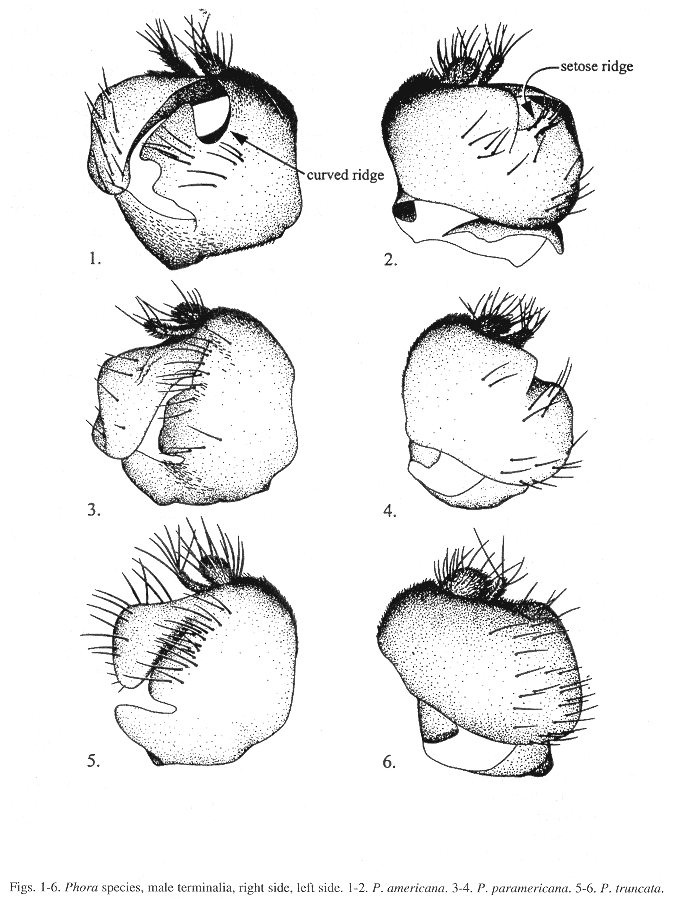
<body><![CDATA[<p><font face="Arial,Helvetica"><font size=-1>There is no published information on relationships within <i>Phora</i>, but Schmitz (i.e. <a href="#Schmitz53">1953</a>, <a href="#Schmitz55">1955</a>) organized the genus into three groups of convenience: group I has the hind tibia with two-three anterobasal setae, group II has the hind tibia with one and the mid tibia with two anterobasal setae and group III with a single anterobasal seta on the mid and hind tibiae. All of the species treated herein would belong to Schmitz's group III, based on the presence of a single anterobasal seta on each of the mid and hind tibia.</font></font>     <p><font face="Arial,Helvetica"><font size=-1>The most recent keys for this genus are for the Palearctic Region (Schmitz <a href="#Schmitz53">1953</a>, <a href="#Schmitz55">1955</a>), Japan (<a href="#Gotô86">Got&ocirc;</a> 1986), North America (<a href="#Borgmeier63">Borgmeier</a> 1963) and England (<a href="#Disney83">Disney</a> 1983). Since then, four further species have been described: <i>P</i>. <i>congolensis</i>, <i>P</i>. <i>greenwoodi</i> Disney, 1989, <i>P</i>. <i>michali</i> Disney, in Disney and Durska 1998, and <i>P</i>. <i>nartshukae</i> Zaitzev, 1977. All belong to group III, except two species that cannot be ascribed to any of the groups: <i>P</i>. <i>congolensis</i> because the hind tibia was not properly described and <i>P</i>. <i>michali</i> Disney because the hind tibiae are missing from the only known specimen. All of these species differ from those treated herein by the structure of the male terminalia.</font></font>     <p><font face="Arial,Helvetica"><font size=-1>Two of the species treated herein, <i>P</i>. <i>americana</i> and <i>P</i>. <i>paramericana</i> new species, share the presence of a longitudinal, setose ridge on the lower lobe of the epandrium (<a href="#Figs1">Fig. 2</a>). This character is also found in <i>P</i>. <i>lacunifera</i> Got&ocirc;, 1984, and is possibly a synapomorphy for this group of three species.</font></font>     <p><font face="Arial,Helvetica"><font size=-1><i>Phora americana</i><b> Schmitz &amp; Wirth, 1954</b></font></font>     <br><font face="Arial,Helvetica"><font size=-1>(<a href="#Figs1">Figs. 1-2</a>)</font></font>     <p><font face="Arial,Helvetica"><font size=-1>Holotype:<img SRC="/img/fbpe/rbt/v48n4/Macho.GIF" height=16 width=16>, MEXICO: Cuernavaca, H.Krauss (USNM) (examined).</font></font>     
<p><font face="Arial,Helvetica"><font size=-1>Species recognition. Among species with a setose ridge on the left side of the epandrium (<a href="#Figs1">Fig. 2</a>), this species can be recognized instantly by the distinctively curved, projecting ridge on the right side of the epandrium (<a href="#Figs1">Fig. 1</a>). Additionally, in Costa Rica, the fore tarsomeres are dark brown, in contrast to those of the other two species. Unfortunately, this distinction does not hold for specimens of <i>P</i>. <i>americana</i> from other parts of its range.</font></font>     <p><font face="Arial,Helvetica"><font size=-1>Costa Rican material examined. COSTA RICA: Cartago: La Cangreja, 9.8&deg; N, 83.97&deg; W, 2<img SRC="/img/fbpe/rbt/v48n4/Macho.GIF" height=16 width=16>, vii.1991, 1<img SRC="/img/fbpe/rbt/v48n4/Macho.GIF" height=16 width=16>, vi-vii.1992, P.Hanson, Malaise trap, 1950 m (LACM); Heredia: Vara Blanca, 10.15&deg; N, 84.15&deg; W, 2<img SRC="/img/fbpe/rbt/v48n4/Macho.GIF" height=16 width=16>, i-ii.1990, P.Hanson, Malaise trap, 2100 m (LACM); Puntarenas: Las Alturas, 8.95&deg; N, 82.83&deg; W, 3<img SRC="/img/fbpe/rbt/v48n4/Macho.GIF" height=16 width=16>, iii.1992, P.Hanson, Malaise trap, 1500 m (LACM); San Jos&eacute;: 20 km S Empalme, 9.63&deg; N, 83.85&deg; W, 1<img SRC="/img/fbpe/rbt/v48n4/Macho.GIF" height=16 width=16>, iii-vi.1990, P.Hanson, Malaise trap, 2800 m (LACM), Zurqu&iacute; de Moravia, 10.05&deg; N, 84.02&deg; W, 1<img SRC="/img/fbpe/rbt/v48n4/Macho.GIF" height=16 width=16>, i.1989, 3<img SRC="/img/fbpe/rbt/v48n4/Macho.GIF" height=16 width=16>, vii.1990, 5<img SRC="/img/fbpe/rbt/v48n4/Macho.GIF" height=16 width=16>, ix-x.1990, 8<img SRC="/img/fbpe/rbt/v48n4/Macho.GIF" height=16 width=16>, x-xii.1990, 4<img SRC="/img/fbpe/rbt/v48n4/Macho.GIF" height=16 width=16>, i.1991, 5<img SRC="/img/fbpe/rbt/v48n4/Macho.GIF" height=16 width=16>, ii.1991, 19<img SRC="/img/fbpe/rbt/v48n4/Macho.GIF" height=16 width=16>, iii.1991, 3<img SRC="/img/fbpe/rbt/v48n4/Macho.GIF" height=16 width=16>, v.1991, 2<img SRC="/img/fbpe/rbt/v48n4/Macho.GIF" height=16 width=16>, vi.1991, 5<img SRC="/img/fbpe/rbt/v48n4/Macho.GIF" height=16 width=16>, vii.1991, 1<img SRC="/img/fbpe/rbt/v48n4/Macho.GIF" height=16 width=16>, iii.1992, 2<img SRC="/img/fbpe/rbt/v48n4/Macho.GIF" height=16 width=16>, vi.1992, 2<img SRC="/img/fbpe/rbt/v48n4/Macho.GIF" height=16 width=16>, vii.1992, 2<img SRC="/img/fbpe/rbt/v48n4/Macho.GIF" height=16 width=16>, iii-iv.1993, 5<img SRC="/img/fbpe/rbt/v48n4/Macho.GIF" height=16 width=16>, iv-v.1993, 10<img SRC="/img/fbpe/rbt/v48n4/Macho.GIF" height=16 width=16>, 1-15.vi.1993, 5<img SRC="/img/fbpe/rbt/v48n4/Macho.GIF" height=16 width=16>, vi.1993, 8<img SRC="/img/fbpe/rbt/v48n4/Macho.GIF" height=16 width=16>, ix-x.1993, 2<img SRC="/img/fbpe/rbt/v48n4/Macho.GIF" height=16 width=16>, ii.1994, 4<img SRC="/img/fbpe/rbt/v48n4/Macho.GIF" height=16 width=16>, iii.1994, 8<img SRC="/img/fbpe/rbt/v48n4/Macho.GIF" height=16 width=16>, v.1994, 3<img SRC="/img/fbpe/rbt/v48n4/Macho.GIF" height=16 width=16>, v.1995, 3<img SRC="/img/fbpe/rbt/v48n4/Macho.GIF" height=16 width=16>, vi.1995, 3<img SRC="/img/fbpe/rbt/v48n4/Macho.GIF" height=16 width=16>, i.1996, P.Hanson, Malaise trap, 1600 m (INBC, LACM, MUCR), 1<img SRC="/img/fbpe/rbt/v48n4/Macho.GIF" height=16 width=16>, 2-8.iii.1995, B.V.Brown, Malaise trap, 1600 m (LACM).</font></font>     
<p><font face="Arial,Helvetica"><font size=-1><i>Phora paramericana</i><b>new species</b></font></font>     <br><font face="Arial,Helvetica"><font size=-1>(<a href="#Figs1">Figs. 3-4</a>)</font></font>     ]]></body>
<body><![CDATA[<p><font face="Arial,Helvetica"><font size=-1>Species recognition. This species is extremely similar to <i>P</i>. <i>americana</i>, but lacks the distinctive ridge on right side of epandrium; furthermore the terminalia are shorter in the new species and there are fewer setae in the setose ridge of the left side of the epandrium.</font></font>     <p><font face="Arial,Helvetica"><font size=-1>In the Palearctic key of <a href="#Schmitz55">Schmitz</a> (1955), this species runs to couplet 4, but does not match either of the choices. In the North American key of <a href="#Borgmeier63">Borgmeier</a> (1963) it keys to <i>P</i>. <i>americana</i>. In the key to Japanese species (<a href="#Gotô86">Got&ocirc;</a> 1986), it keys to <i>P</i>. <i>lacunifera</i>, which it resembles closely. The major differences are that in <i>P</i>. <i>lacunifera</i> the epandrial setae are much longer and more numerous and that in <i>P</i>. <i>paramericana</i> the left process of the right hypandrial lobe is much more elongate and narrower apically. In the key to British species (<a href="#Disney83">Disney</a> 1983) it keys to <i>P</i>. <i>bullata</i> <a href="#Schmitz27">Schmitz</a>, 1927 if one considers the upper lobe of the left side of the epandrium as being as short, although it actually slightly exceeds the level of the hypoproct. However, <i>P</i>. <i>paramericana</i> has a distinctive, setose, longitudinal ridge across the lower lobe of the left side of the epandrium. The terminalia differ from those of all of the species described since these keys were published.</font></font>     <p><font face="Arial,Helvetica"><font size=-1>Description. Male. Body color dark brown to black. Legs dark brown, except fore tibia and tarsomeres, which are light brown.</font></font>     <p><font face="Arial,Helvetica"><font size=-1>Frons slightly convergent dorsally, frontal index (width of frons just below anterior ocellus/ width of head) 0.27-0.36. Frontal setae well-differentiated from sparse frontal setulae.</font></font>     <p><font face="Arial,Helvetica"><font size=-1>Mid tibia with one anterobasal seta; dorsally with 3-6 setae. Hind tibia with one anterobasal seta. Hind femur with ventrobasal expansion small, rounded. Mean costal length 0.53 wing length, range 0.51-0.55. Costal setae short.</font></font>     <p><font face="Arial,Helvetica"><font size=-1>Left side of epandrium (<a href="#Figs1">Fig. 4</a>) divided into small dorsal lobe and larger ventral lobe; ventral lobe with longitudinal, medial, ridge with few setae. Right side of epandrium (<a href="#Figs1">Fig. 3</a>) with posteromedial process; right surstylus elongate, downturned, slightly bulging dorsally. Right hypandrial lobe with long, narrow left process and bilobed right process.</font></font>     <p><font face="Arial,Helvetica"><font size=-1>Derivation of specific name. The name is a combination of the Greek <i>para</i>, for near, and the specific name of the most similar species, <i>P</i>. <i>americana</i>.</font></font>     <p><font face="Arial,Helvetica"><font size=-1>Holotype. _, COSTA RICA: San Jos&eacute;: Zurqu&iacute; de Moravia, 10.05&deg; N, 84.02&deg; W, vi.1995, P.Hanson, Malaise trap, 1600 m [LACM ENT 081865] (LACM).</font></font>     <p><font face="Arial,Helvetica"><font size=-1>Paratypes. COSTA RICA: San Jos&eacute;: Escaz&uacute;, 9.9&deg; N, 84.15&deg; W, 2_, iii.1989, W.Eberhard, Malaise trap, 1300 m (INBC, LACM), Zurqu&iacute; de Moravia, 10.05&deg; N, 84.02&deg; W, 2_, iii.1991, 1_, vii.1991, 1_, 1-15.vi.1993, 1_, vi.1995, P.Hanson, Malaise trap, 1600 m (LACM, MUCR).</font></font>     <p><font face="Arial,Helvetica"><font size=-1><i>Phora truncata</i> <b>new species</b></font></font>     ]]></body>
<body><![CDATA[<br><font face="Arial,Helvetica"><font size=-1>(<a href="#Figs1">Figs. 5-6</a>)</font></font>     <p><font face="Arial,Helvetica"><font size=-1><i>Phora</i> <i>stictica</i>: Borgmeier, 1968: 45. Misidentification.</font></font>     <br><font face="Arial,Helvetica"><font size=-1>Species recognition. In Costa Rica, this species most closely resembles <i>P</i>. <i>paramericana</i> new species, but has the left side of the epandrium completely undivided.</font></font>     <p><font face="Arial,Helvetica"><font size=-1>In the Palearctic key of <a href="#Schmitz55">Schmitz</a> (1955), this species runs to <i>P</i>. <i>bullata</i>, but differs from that species by having a completely undivided left side of the epandrium. In the North American key of <a href="#Borgmeier63">Borgmeier</a> (1963) it keys to couplet 13, but the terminalia differ from either choice. Similarly, this species keys to, but does not resemble, the Japanese species <i>P</i>. <i>lacunifera</i> (<a href="#Gotô86">Got&ocirc;</a> 1986). In the key to British species (<a href="#Disney83">Disney</a> 1983) it keys to couplet 12, but does not match any of the choices in the following couplets. The terminalia differ from those of all of the species described since these keys were published.</font></font>     <p><font face="Arial,Helvetica"><font size=-1>I examined the specimen attributed to <i>P</i>. <i>stictica</i> by <a href="#Borgmeier68">Borgmeier</a> (1968) and found it to belong to this new species.</font></font>     <p><font face="Arial,Helvetica"><font size=-1>Description. Male. Body color dark brown to black. Legs dark brown, except fore tibia and fore tarsomeres, which are light brown in color.</font></font>     <p><font face="Arial,Helvetica"><font size=-1>Frons parallel-sided, frontal index (width of frons just below anterior ocellus/ width of head) 0.29-0.31. Almost all frontal setae lost from specimens, but frontal setulae sparse, markedly shorter and smaller than those frontal setae remaining.</font></font>     <p><font face="Arial,Helvetica"><font size=-1>Foretarsomeres slightly flattened, expanded. Mid tibia with one anterobasal seta, except in holotype, which has an aberrant, extra seta on the left leg; 3-4 dorsal setae present. Hind tibia with one anterobasal seta. Hind femur lacking ventrobasal expansion. Mean costal length 0.49 wing length, range 0.48-0.50. Costal setae short.</font></font>     <p><font face="Arial,Helvetica"><font size=-1>Left side of epandrium (<a href="#Figs1">Fig. 6</a>) undivided, posteriorly truncate, slightly concave at apex. Right side of epandrium (<a href="#Figs1">Fig. 5</a>) relatively unmodified; right surstylus apically directed ventrally, with small dorsal bulge. Right lobe of hypandrium with elongate, broad left process and short, bilobed right process.</font></font>     <p><font face="Arial,Helvetica"><font size=-1>Derivation of specific name. The name is from a Latin word, <i>truncus</i>, meaning cut off, referring to the truncate posterior margin of the left side of the epandrium.</font></font>     ]]></body>
<body><![CDATA[<p><font face="Arial,Helvetica"><font size=-1>Holotype.&nbsp;<img SRC="/img/fbpe/rbt/v48n4/Macho.GIF" height=16 width=16>, COSTA RICA: San Jos&eacute;: Zurqu&iacute; de Moravia, 10.05&deg; N, 84.02&deg; W, iii.1991, P.Hanson, Malaise trap, 1600 m [LACM ENT 063967] (LACM).</font></font>     
<p><font face="Arial,Helvetica"><font size=-1>Paratypes. COSTA RICA: Cartago: La Suiza, 1<img SRC="/img/fbpe/rbt/v48n4/Macho.GIF" height=16 width=16>, i.1924, P.Schild (MZSP) [identified by Borgmeier as <i>P</i>. <i>stictica</i>]; San Jos&eacute;: Escaz&uacute;, 9.9&deg; N, 84.15&deg; W, 1<img SRC="/img/fbpe/rbt/v48n4/Macho.GIF" height=16 width=16>, i-ii.1989, 1<img SRC="/img/fbpe/rbt/v48n4/Macho.GIF" height=16 width=16>, iii.1989 W.Eberhard, Malaise trap, 1300m (INBC, LACM), 26 km N San Isidro, 9.5&deg; N, 83.72&deg; W, 1<img SRC="/img/fbpe/rbt/v48n4/Macho.GIF" height=16 width=16>, ix-x.1992, P.Hanson, Malaise trap, 2100 m (LACM).</font></font>     
<br>&nbsp;     <br>&nbsp;     <br>     <br>     <center>     <p><font face="Arial,Helvetica"><font size=-1>KEY TO MALES OF COSTA RICAN <i>PHORA</i></font></font></center>  <dir> <dir><font face="Arial,Helvetica"><font size=-1>1 Right side of epandrium with prominent, curved ridge (Fig. 1); foretarsomeres dark brown (in Costa Rican specimens) ..........................................................<b><i>P. americana</i> Schmitz &amp; Wirth</b></font></font>     <br><font face="Arial,Helvetica"><font size=-1>- Epandrium without ridge; foretarsomeres yellowish-brown ........................................................ <b>2</b></font></font></dir> </dir>  <dir> <dir><font face="Arial,Helvetica"><font size=-1>2 Left side of epandrium divided into small dorsal and larger ventral lobes (Fig. 4); frons slightly narrowed posteriorly; foretarsomeres more slender ....................................... <b><i>P.paramericana</i> new species</b></font></font>     <br><font face="Arial,Helvetica"><font size=-1>- Left side of epandrium not divided (Fig. 6); frons parallel-sided; foretarsomeres expanded and flattened ...............</font></font>     ]]></body>
<body><![CDATA[<br><font face="Arial,Helvetica"><font size=-1>................................................................................. <b><i>P.truncata</i> new species</b></font></font>     <br>&nbsp;</dir> </dir> <b><font face="Arial,Helvetica"><font size=-1>Acknowledgments</font></font></b>     <p><font face="Arial,Helvetica"><font size=-1>The illustrations were skillfully prepared by Jesse Cantley. I thank Vladimir Berezovskiy for technical help. For assistance and hospitality in Costa Rica I thank Manuel Zumbado and Paul Hanson. This work was supported, in part, by National Science Foundation Grant DEB-9407190.</font></font>     <br>&nbsp;     <p><b><font face="Arial,Helvetica"><font size=-1>References</font></font></b>     <!-- ref --><br><a NAME="Arnett93"></a><font face="Arial,Helvetica"><font size=-1>Arnett, R. H., G. A. Samuelson &amp; G. M. Nishida. 1993. The insect and spider collections of the world. Sandhill Crane, Gainesville, Florida. vi + 310 p.</font></font>    &nbsp;&nbsp;&nbsp;&nbsp;&nbsp;&nbsp;&nbsp;&nbsp;[&#160;<a href="javascript:void(0);" onclick="javascript: window.open('/scielo.php?script=sci_nlinks&ref=1346214&pid=S0034-7744200000040002100001&lng=','','width=640,height=500,resizable=yes,scrollbars=1,menubar=yes,');">Links</a>&#160;]<!-- end-ref --><!-- ref --><p><a NAME="Beyer65"></a><font face="Arial,Helvetica"><font size=-1>Beyer, E. M. 1965. Phoridae. Explor. Parc Nat. Albert Miss. de Witte 1933-1935. 99: 1-211.</font></font>    &nbsp;&nbsp;&nbsp;&nbsp;&nbsp;&nbsp;&nbsp;&nbsp;[&#160;<a href="javascript:void(0);" onclick="javascript: window.open('/scielo.php?script=sci_nlinks&ref=1346215&pid=S0034-7744200000040002100002&lng=','','width=640,height=500,resizable=yes,scrollbars=1,menubar=yes,');">Links</a>&#160;]<!-- end-ref --><!-- ref --><p><a NAME="Borgmeier63"></a><font face="Arial,Helvetica"><font size=-1>Borgmeier, T. 1963. Revision of the North American phorid flies. Part I. The Phorinae, Aenigmatiinae and Metopininae, except <i>Megaselia</i> (Diptera, Phoridae). Studia Ent. 6: 1-256.</font></font>    &nbsp;&nbsp;&nbsp;&nbsp;&nbsp;&nbsp;&nbsp;&nbsp;[&#160;<a href="javascript:void(0);" onclick="javascript: window.open('/scielo.php?script=sci_nlinks&ref=1346216&pid=S0034-7744200000040002100003&lng=','','width=640,height=500,resizable=yes,scrollbars=1,menubar=yes,');">Links</a>&#160;]<!-- end-ref --><!-- ref --><p><a NAME="Borgmeier68"></a><font face="Arial,Helvetica"><font size=-1>Borgmeier, T. 1968. A catalogue of the Phoridae of the World (Diptera, Phoridae). Studia Ent. 11: 1-367.</font></font>    &nbsp;&nbsp;&nbsp;&nbsp;&nbsp;&nbsp;&nbsp;&nbsp;[&#160;<a href="javascript:void(0);" onclick="javascript: window.open('/scielo.php?script=sci_nlinks&ref=1346217&pid=S0034-7744200000040002100004&lng=','','width=640,height=500,resizable=yes,scrollbars=1,menubar=yes,');">Links</a>&#160;]<!-- end-ref --><!-- ref --><p><a NAME="Brown92"></a><font face="Arial,Helvetica"><font size=-1>Brown, B. V. 1992. Generic revision of Phoridae of the Nearctic Region and phylogenetic classification of Phoridae, Sciadoceridae and Ironomyiidae (Diptera: Phoridea). Mem. Ent. Soc. Can. 164: 1-144.</font></font>    &nbsp;&nbsp;&nbsp;&nbsp;&nbsp;&nbsp;&nbsp;&nbsp;[&#160;<a href="javascript:void(0);" onclick="javascript: window.open('/scielo.php?script=sci_nlinks&ref=1346218&pid=S0034-7744200000040002100005&lng=','','width=640,height=500,resizable=yes,scrollbars=1,menubar=yes,');">Links</a>&#160;]<!-- end-ref --><!-- ref --><p><a NAME="Brown94"></a><font face="Arial,Helvetica"><font size=-1>Brown, B. V. 1994. Descriptions and subfamily classification of some unusual Phoridae (Diptera). Can. Ent. 126: 703-707.</font></font>    &nbsp;&nbsp;&nbsp;&nbsp;&nbsp;&nbsp;&nbsp;&nbsp;[&#160;<a href="javascript:void(0);" onclick="javascript: window.open('/scielo.php?script=sci_nlinks&ref=1346219&pid=S0034-7744200000040002100006&lng=','','width=640,height=500,resizable=yes,scrollbars=1,menubar=yes,');">Links</a>&#160;]<!-- end-ref --><!-- ref --><p><a NAME="Brown97"></a><font face="Arial,Helvetica"><font size=-1>Brown, B. V. 1997. Revision of the <i>Apocephalus attophilus</i>-group of ant-decapitating flies (Diptera: Phoridae). Contrib. Sci. 468: 1-60.</font></font>    &nbsp;&nbsp;&nbsp;&nbsp;&nbsp;&nbsp;&nbsp;&nbsp;[&#160;<a href="javascript:void(0);" onclick="javascript: window.open('/scielo.php?script=sci_nlinks&ref=1346220&pid=S0034-7744200000040002100007&lng=','','width=640,height=500,resizable=yes,scrollbars=1,menubar=yes,');">Links</a>&#160;]<!-- end-ref --><!-- ref --><p><a NAME="Disney83"></a><font face="Arial,Helvetica"><font size=-1>Disney, R. H. L. 1983. Scuttle flies - Diptera, Phoridae (except <i>Megaselia</i>). Handbk Ident.Br.Insects. 10: 1-81.</font></font>    &nbsp;&nbsp;&nbsp;&nbsp;&nbsp;&nbsp;&nbsp;&nbsp;[&#160;<a href="javascript:void(0);" onclick="javascript: window.open('/scielo.php?script=sci_nlinks&ref=1346221&pid=S0034-7744200000040002100008&lng=','','width=640,height=500,resizable=yes,scrollbars=1,menubar=yes,');">Links</a>&#160;]<!-- end-ref --><!-- ref --><p><a NAME="Disney89"></a><font face="Arial,Helvetica"><font size=-1>Disney, R. H. L. 1989. A new species of <i>Phora</i> (Dipt., Phoridae) from France. Ent. Mon. Mag. 125: 81-82.</font></font>    &nbsp;&nbsp;&nbsp;&nbsp;&nbsp;&nbsp;&nbsp;&nbsp;[&#160;<a href="javascript:void(0);" onclick="javascript: window.open('/scielo.php?script=sci_nlinks&ref=1346222&pid=S0034-7744200000040002100009&lng=','','width=640,height=500,resizable=yes,scrollbars=1,menubar=yes,');">Links</a>&#160;]<!-- end-ref --><!-- ref --><p><a NAME="Disney98"></a><font face="Arial,Helvetica"><font size=-1>Disney, R. H. L. &amp; E. Durska. 1998. A new genus and new species of Phoridae (Diptera) from Poland. Eur. J. Ent. 95: 437-453.</font></font>    &nbsp;&nbsp;&nbsp;&nbsp;&nbsp;&nbsp;&nbsp;&nbsp;[&#160;<a href="javascript:void(0);" onclick="javascript: window.open('/scielo.php?script=sci_nlinks&ref=1346223&pid=S0034-7744200000040002100010&lng=','','width=640,height=500,resizable=yes,scrollbars=1,menubar=yes,');">Links</a>&#160;]<!-- end-ref --><!-- ref --><p><a NAME="Fabricius"></a><font face="Arial,Helvetica"><font size=-1>Fabricius, J. C. 1794. Entomologia systematica emendata et aucta., Hafniae (=Copenhagen). 472 p.</font></font>    &nbsp;&nbsp;&nbsp;&nbsp;&nbsp;&nbsp;&nbsp;&nbsp;[&#160;<a href="javascript:void(0);" onclick="javascript: window.open('/scielo.php?script=sci_nlinks&ref=1346224&pid=S0034-7744200000040002100011&lng=','','width=640,height=500,resizable=yes,scrollbars=1,menubar=yes,');">Links</a>&#160;]<!-- end-ref --><!-- ref --><p><a NAME="Gotô84"></a><font face="Arial,Helvetica"><font size=-1>Got&ocirc;, T. 1984. Systematic study of the genus <i>Phora</i> Latreille from Japan (Diptera, Phoridae) I. Description of a new species, with discussion on the terminology of the male genitalia. Konty&ucirc; 52: 159-171.</font></font>    &nbsp;&nbsp;&nbsp;&nbsp;&nbsp;&nbsp;&nbsp;&nbsp;[&#160;<a href="javascript:void(0);" onclick="javascript: window.open('/scielo.php?script=sci_nlinks&ref=1346225&pid=S0034-7744200000040002100012&lng=','','width=640,height=500,resizable=yes,scrollbars=1,menubar=yes,');">Links</a>&#160;]<!-- end-ref --><!-- ref --><p><a NAME="Gotô86"></a><font face="Arial,Helvetica"><font size=-1>Got&ocirc;, T. 1986. Systematic study of the genus <i>Phora</i> Latreille from Japan (Diptera, Phoridae) V. Konty&ucirc; 54: 128-142.</font></font>    &nbsp;&nbsp;&nbsp;&nbsp;&nbsp;&nbsp;&nbsp;&nbsp;[&#160;<a href="javascript:void(0);" onclick="javascript: window.open('/scielo.php?script=sci_nlinks&ref=1346226&pid=S0034-7744200000040002100013&lng=','','width=640,height=500,resizable=yes,scrollbars=1,menubar=yes,');">Links</a>&#160;]<!-- end-ref --><!-- ref --><p><a NAME="Latreille96"></a><font face="Arial,Helvetica"><font size=-1>Latreille, P. A. 1796. Pr&eacute;cis des caract&egrave;res g&eacute;n&eacute;riques des Insectes, dispos&eacute;s dans un ordre naturel. Paris. xiii + 179 p.</font></font>    &nbsp;&nbsp;&nbsp;&nbsp;&nbsp;&nbsp;&nbsp;&nbsp;[&#160;<a href="javascript:void(0);" onclick="javascript: window.open('/scielo.php?script=sci_nlinks&ref=1346227&pid=S0034-7744200000040002100014&lng=','','width=640,height=500,resizable=yes,scrollbars=1,menubar=yes,');">Links</a>&#160;]<!-- end-ref --><!-- ref --><p><a NAME="Latreille02"></a><font face="Arial,Helvetica"><font size=-1>Latreille, P. A. 1802. Histoire naturelle, g&eacute;n&eacute;rale et particuli&egrave;re, des Crustac&eacute;s et des Insectes, p. 468. <i>In</i> C. S. Sonnini (ed.). Histoire naturelle par Buffon. Paris.</font></font>    &nbsp;&nbsp;&nbsp;&nbsp;&nbsp;&nbsp;&nbsp;&nbsp;[&#160;<a href="javascript:void(0);" onclick="javascript: window.open('/scielo.php?script=sci_nlinks&ref=1346228&pid=S0034-7744200000040002100015&lng=','','width=640,height=500,resizable=yes,scrollbars=1,menubar=yes,');">Links</a>&#160;]<!-- end-ref --><!-- ref --><p><a NAME="Meigen03"></a><font face="Arial,Helvetica"><font size=-1>Meigen, J. W. 1803. Versuch einer neuen Gattungseintheilung der europ&auml;ischen zweifl&uuml;geligen Insekten. Mag. f. Insektenkunde. 2: 259-281.</font></font>    &nbsp;&nbsp;&nbsp;&nbsp;&nbsp;&nbsp;&nbsp;&nbsp;[&#160;<a href="javascript:void(0);" onclick="javascript: window.open('/scielo.php?script=sci_nlinks&ref=1346229&pid=S0034-7744200000040002100016&lng=','','width=640,height=500,resizable=yes,scrollbars=1,menubar=yes,');">Links</a>&#160;]<!-- end-ref --><!-- ref --><p><a NAME="Meigen04"></a><font face="Arial,Helvetica"><font size=-1>Meigen, J. W. 1804. Beschreibung der europ&auml;ischen zweifl&uuml;geligen Insekten (Diptera Linn.). Braunschweig (=Brunswick). xxviii + 314 p.</font></font>    &nbsp;&nbsp;&nbsp;&nbsp;&nbsp;&nbsp;&nbsp;&nbsp;[&#160;<a href="javascript:void(0);" onclick="javascript: window.open('/scielo.php?script=sci_nlinks&ref=1346230&pid=S0034-7744200000040002100017&lng=','','width=640,height=500,resizable=yes,scrollbars=1,menubar=yes,');">Links</a>&#160;]<!-- end-ref --><!-- ref --><p><a NAME="Meigen30"></a><font face="Arial,Helvetica"><font size=-1>Meigen, J. W. 1830. Systematische Beschreibung der bekannten europaeischen zweifluegeligen Insecten. Hamm. iv + 401 p.</font></font>    &nbsp;&nbsp;&nbsp;&nbsp;&nbsp;&nbsp;&nbsp;&nbsp;[&#160;<a href="javascript:void(0);" onclick="javascript: window.open('/scielo.php?script=sci_nlinks&ref=1346231&pid=S0034-7744200000040002100018&lng=','','width=640,height=500,resizable=yes,scrollbars=1,menubar=yes,');">Links</a>&#160;]<!-- end-ref --><!-- ref --><p><a NAME="Rondani"></a><font face="Arial,Helvetica"><font size=-1>Rondani, C. 1856. Dipterologiae Italicae prodromus. Parmae. 228 p.</font></font>    &nbsp;&nbsp;&nbsp;&nbsp;&nbsp;&nbsp;&nbsp;&nbsp;[&#160;<a href="javascript:void(0);" onclick="javascript: window.open('/scielo.php?script=sci_nlinks&ref=1346232&pid=S0034-7744200000040002100019&lng=','','width=640,height=500,resizable=yes,scrollbars=1,menubar=yes,');">Links</a>&#160;]<!-- end-ref --><!-- ref --><p><a NAME="Schmitz27"></a><font face="Arial,Helvetica"><font size=-1>Schmitz, H. 1927. Die palaearktischen Arten der Gattung <i>Phora</i> Latr. Bestimmungsschluessel und neue Arten. Konowia 6: 144-160.</font></font>    &nbsp;&nbsp;&nbsp;&nbsp;&nbsp;&nbsp;&nbsp;&nbsp;[&#160;<a href="javascript:void(0);" onclick="javascript: window.open('/scielo.php?script=sci_nlinks&ref=1346233&pid=S0034-7744200000040002100020&lng=','','width=640,height=500,resizable=yes,scrollbars=1,menubar=yes,');">Links</a>&#160;]<!-- end-ref --><!-- ref --><p><a NAME="Schmitz53"></a><font face="Arial,Helvetica"><font size=-1>Schmitz, H. 1953. Phoridae, p. 273-320. In Lindner, E. (ed.). Die Fliegen der palaearktischen Region. E. Schweiz., Stuttgart.</font></font>    &nbsp;&nbsp;&nbsp;&nbsp;&nbsp;&nbsp;&nbsp;&nbsp;[&#160;<a href="javascript:void(0);" onclick="javascript: window.open('/scielo.php?script=sci_nlinks&ref=1346234&pid=S0034-7744200000040002100021&lng=','','width=640,height=500,resizable=yes,scrollbars=1,menubar=yes,');">Links</a>&#160;]<!-- end-ref --><!-- ref --><p><a NAME="Schmitz55"></a><font face="Arial,Helvetica"><font size=-1>Schmitz, H. 1955. Phoridae, p. 321-386. In Lindner, E. (ed.). Die Fliegen der palaearktischen Region. E. Schweiz., Stuttgart.</font></font>    &nbsp;&nbsp;&nbsp;&nbsp;&nbsp;&nbsp;&nbsp;&nbsp;[&#160;<a href="javascript:void(0);" onclick="javascript: window.open('/scielo.php?script=sci_nlinks&ref=1346235&pid=S0034-7744200000040002100022&lng=','','width=640,height=500,resizable=yes,scrollbars=1,menubar=yes,');">Links</a>&#160;]<!-- end-ref --><!-- ref --><p><a NAME="Schmitz54"></a><font face="Arial,Helvetica"><font size=-1>Schmitz, H. &amp; W. W. Wirth. 1954. A review of the North American species of the genus <i>Phora</i> Latreille. Wasmann J. Biol. 12: 113-127.</font></font>    &nbsp;&nbsp;&nbsp;&nbsp;&nbsp;&nbsp;&nbsp;&nbsp;[&#160;<a href="javascript:void(0);" onclick="javascript: window.open('/scielo.php?script=sci_nlinks&ref=1346236&pid=S0034-7744200000040002100023&lng=','','width=640,height=500,resizable=yes,scrollbars=1,menubar=yes,');">Links</a>&#160;]<!-- end-ref --><!-- ref --><p><a NAME="Villers"></a><font face="Arial,Helvetica"><font size=-1>Villers, C. J. de. 1789. Caroli Linnaei entomologia, faunae suecicae descriptionibus aucta. Lugduni (=Lyon). 472 p.</font></font>    &nbsp;&nbsp;&nbsp;&nbsp;&nbsp;&nbsp;&nbsp;&nbsp;[&#160;<a href="javascript:void(0);" onclick="javascript: window.open('/scielo.php?script=sci_nlinks&ref=1346237&pid=S0034-7744200000040002100024&lng=','','width=640,height=500,resizable=yes,scrollbars=1,menubar=yes,');">Links</a>&#160;]<!-- end-ref --><!-- ref --><p><a NAME="Yarkulov"></a><font face="Arial,Helvetica"><font size=-1>Yarkulov, F. 1972. <i>Phora holosericea</i> (Diptera, Phoridae), a predator of root aphids. Zool. Zh. 51: 1415-1418.</font></font>    &nbsp;&nbsp;&nbsp;&nbsp;&nbsp;&nbsp;&nbsp;&nbsp;[&#160;<a href="javascript:void(0);" onclick="javascript: window.open('/scielo.php?script=sci_nlinks&ref=1346238&pid=S0034-7744200000040002100025&lng=','','width=640,height=500,resizable=yes,scrollbars=1,menubar=yes,');">Links</a>&#160;]<!-- end-ref --><!-- ref --><p><a NAME="Zaitzev"></a><font face="Arial,Helvetica"><font size=-1>Zaitzev, V. F. 1977. Some phorid flies (Diptera, Phoridae) from Mongolia. Insects Mongolia 5: 694-697    &nbsp;&nbsp;&nbsp;&nbsp;&nbsp;&nbsp;&nbsp;&nbsp;[&#160;<a href="javascript:void(0);" onclick="javascript: window.open('/scielo.php?script=sci_nlinks&ref=1346239&pid=S0034-7744200000040002100026&lng=','','width=640,height=500,resizable=yes,scrollbars=1,menubar=yes,');">Links</a>&#160;]<!-- end-ref -->.</font></font>     <br>&nbsp;     <br>&nbsp;     <br>&nbsp;     <p><a NAME="Figs1"></a><img SRC="/img/fbpe/rbt/v48n4/0962i01.GIF" height=899 width=675>     
<br>&nbsp;     <br>&nbsp;     <p><a NAME="1a"></a><font face="Arial,Helvetica"><font size=-1><sup><a href="#1">1</a></sup> Associate Curator, Entomology Section, Natural History Museum of Los Angeles County, 900 Exposition Boulevard, Los Angeles, CA, 90007 USA. Email- <a href="mailto:bbrown@nhm.org">bbrown@nhm.org</a>. Fax (213) 746-2999.</font></font>      ]]></body><back>
<ref-list>
<ref id="B1">
<nlm-citation citation-type="book">
<person-group person-group-type="author">
<name>
<surname><![CDATA[Arnett]]></surname>
<given-names><![CDATA[R. H]]></given-names>
</name>
<name>
<surname><![CDATA[Samuelson]]></surname>
<given-names><![CDATA[G. A]]></given-names>
</name>
<name>
<surname><![CDATA[Nishida]]></surname>
<given-names><![CDATA[G. M]]></given-names>
</name>
</person-group>
<source><![CDATA[The insect and spider collections of the world]]></source>
<year>1993</year>
<page-range>310</page-range><publisher-loc><![CDATA[Gainesville^eFlorida Florida]]></publisher-loc>
<publisher-name><![CDATA[Sandhill Crane]]></publisher-name>
</nlm-citation>
</ref>
<ref id="B2">
<nlm-citation citation-type="journal">
<person-group person-group-type="author">
<name>
<surname><![CDATA[Beyer]]></surname>
<given-names><![CDATA[E. M]]></given-names>
</name>
</person-group>
<article-title xml:lang="en"><![CDATA[Phoridae]]></article-title>
<source><![CDATA[Explor. Parc Nat. Albert Miss. de Witte 1933-1935]]></source>
<year>1965</year>
<volume>99</volume>
<page-range>1-211</page-range></nlm-citation>
</ref>
<ref id="B3">
<nlm-citation citation-type="journal">
<person-group person-group-type="author">
<name>
<surname><![CDATA[Borgmeier]]></surname>
<given-names><![CDATA[T]]></given-names>
</name>
</person-group>
<article-title xml:lang="en"><![CDATA[Revision of the North American phorid flies. Part I. The Phorinae, Aenigmatiinae and Metopininae, except Megaselia (Diptera, Phoridae)]]></article-title>
<source><![CDATA[Studia Ent]]></source>
<year>1963</year>
<volume>6</volume>
<page-range>1-256</page-range></nlm-citation>
</ref>
<ref id="B4">
<nlm-citation citation-type="journal">
<person-group person-group-type="author">
<name>
<surname><![CDATA[Borgmeier]]></surname>
<given-names><![CDATA[T]]></given-names>
</name>
</person-group>
<article-title xml:lang="en"><![CDATA[A catalogue of the Phoridae of the World (Diptera, Phoridae)]]></article-title>
<source><![CDATA[Studia Ent]]></source>
<year>1968</year>
<volume>11</volume>
<page-range>1-367</page-range></nlm-citation>
</ref>
<ref id="B5">
<nlm-citation citation-type="journal">
<person-group person-group-type="author">
<name>
<surname><![CDATA[Brown]]></surname>
<given-names><![CDATA[B. V]]></given-names>
</name>
</person-group>
<article-title xml:lang="en"><![CDATA[Generic revision of Phoridae of the Nearctic Region and phylogenetic classification of Phoridae, Sciadoceridae and Ironomyiidae (Diptera: Phoridea)]]></article-title>
<source><![CDATA[Mem. Ent. Soc. Can]]></source>
<year>1992</year>
<volume>164</volume>
<page-range>1-144</page-range></nlm-citation>
</ref>
<ref id="B6">
<nlm-citation citation-type="journal">
<person-group person-group-type="author">
<name>
<surname><![CDATA[Brown]]></surname>
<given-names><![CDATA[B. V]]></given-names>
</name>
</person-group>
<article-title xml:lang="en"><![CDATA[Descriptions and subfamily classification of some unusual Phoridae (Diptera)]]></article-title>
<source><![CDATA[Can. Ent]]></source>
<year>1994</year>
<volume>126</volume>
<page-range>703-707</page-range></nlm-citation>
</ref>
<ref id="B7">
<nlm-citation citation-type="journal">
<person-group person-group-type="author">
<name>
<surname><![CDATA[Brown]]></surname>
<given-names><![CDATA[B. V]]></given-names>
</name>
</person-group>
<article-title xml:lang="en"><![CDATA[Revision of the Apocephalus attophilus-group of ant-decapitating flies (Diptera: Phoridae)]]></article-title>
<source><![CDATA[Contrib. Sci]]></source>
<year>1997</year>
<volume>468</volume>
<page-range>1-60</page-range></nlm-citation>
</ref>
<ref id="B8">
<nlm-citation citation-type="journal">
<person-group person-group-type="author">
<name>
<surname><![CDATA[Disney]]></surname>
<given-names><![CDATA[R. H. L]]></given-names>
</name>
</person-group>
<article-title xml:lang="en"><![CDATA[Scuttle flies - Diptera, Phoridae (except Megaselia)]]></article-title>
<source><![CDATA[Handbk Ident.Br.Insects]]></source>
<year>1983</year>
<volume>10</volume>
<page-range>1-81</page-range></nlm-citation>
</ref>
<ref id="B9">
<nlm-citation citation-type="journal">
<person-group person-group-type="author">
<name>
<surname><![CDATA[Disney]]></surname>
<given-names><![CDATA[R. H. L]]></given-names>
</name>
</person-group>
<article-title xml:lang="en"><![CDATA[A new species of Phora (Dipt., Phoridae) from France]]></article-title>
<source><![CDATA[Ent. Mon. Mag]]></source>
<year>1989</year>
<volume>125</volume>
<page-range>81-82</page-range></nlm-citation>
</ref>
<ref id="B10">
<nlm-citation citation-type="journal">
<person-group person-group-type="author">
<name>
<surname><![CDATA[Disney]]></surname>
<given-names><![CDATA[R. H. L]]></given-names>
</name>
<name>
<surname><![CDATA[Durska]]></surname>
<given-names><![CDATA[E]]></given-names>
</name>
</person-group>
<article-title xml:lang="en"><![CDATA[A new genus and new species of Phoridae (Diptera) from Poland]]></article-title>
<source><![CDATA[Eur. J. Ent]]></source>
<year>1998</year>
<volume>95</volume>
<page-range>437-453</page-range></nlm-citation>
</ref>
<ref id="B11">
<nlm-citation citation-type="">
<person-group person-group-type="author">
<name>
<surname><![CDATA[Fabricius]]></surname>
<given-names><![CDATA[J. C]]></given-names>
</name>
</person-group>
<source><![CDATA[Entomologia systematica emendata et aucta., Hafniae (=Copenhagen)]]></source>
<year>1794</year>
<page-range>472</page-range></nlm-citation>
</ref>
<ref id="B12">
<nlm-citation citation-type="journal">
<person-group person-group-type="author">
<name>
<surname><![CDATA[Gotô]]></surname>
<given-names><![CDATA[T]]></given-names>
</name>
</person-group>
<article-title xml:lang="en"><![CDATA[Systematic study of the genus Phora Latreille from Japan (Diptera, Phoridae) I. Description of a new species, with discussion on the terminology of the male genitalia]]></article-title>
<source><![CDATA[Kontyû]]></source>
<year>1984</year>
<volume>52</volume>
<page-range>159-171</page-range></nlm-citation>
</ref>
<ref id="B13">
<nlm-citation citation-type="journal">
<person-group person-group-type="author">
<name>
<surname><![CDATA[Gotô]]></surname>
<given-names><![CDATA[T]]></given-names>
</name>
</person-group>
<source><![CDATA[Kontyû]]></source>
<year></year>
<volume>54</volume>
<page-range>128-142</page-range></nlm-citation>
</ref>
<ref id="B14">
<nlm-citation citation-type="">
<person-group person-group-type="author">
<name>
<surname><![CDATA[Latreille]]></surname>
<given-names><![CDATA[P. A]]></given-names>
</name>
</person-group>
<source><![CDATA[Précis des caractères génériques des Insectes, disposés dans un ordre naturel]]></source>
<year>1796</year>
<page-range>179</page-range><publisher-loc><![CDATA[Paris ]]></publisher-loc>
</nlm-citation>
</ref>
<ref id="B15">
<nlm-citation citation-type="">
<person-group person-group-type="author">
<name>
<surname><![CDATA[Latreille]]></surname>
<given-names><![CDATA[P. A]]></given-names>
</name>
</person-group>
<article-title xml:lang="fr"><![CDATA[Histoire naturelle, générale et particulière, des Crustacés et des Insectes]]></article-title>
<person-group person-group-type="editor">
<name>
<surname><![CDATA[Sonnini]]></surname>
<given-names><![CDATA[C. S]]></given-names>
</name>
</person-group>
<source><![CDATA[Histoire naturelle par Buffon]]></source>
<year>1802</year>
<page-range>468</page-range><publisher-loc><![CDATA[Paris ]]></publisher-loc>
</nlm-citation>
</ref>
<ref id="B16">
<nlm-citation citation-type="journal">
<person-group person-group-type="author">
<name>
<surname><![CDATA[Meigen]]></surname>
<given-names><![CDATA[J. W]]></given-names>
</name>
</person-group>
<article-title xml:lang="de"><![CDATA[Versuch einer neuen Gattungseintheilung der europäischen zweiflügeligen Insekten]]></article-title>
<source><![CDATA[Mag. f. Insektenkunde]]></source>
<year>1803</year>
<volume>2</volume>
<page-range>259-281</page-range></nlm-citation>
</ref>
<ref id="B17">
<nlm-citation citation-type="book">
<person-group person-group-type="author">
<name>
<surname><![CDATA[Meigen]]></surname>
<given-names><![CDATA[J. W]]></given-names>
</name>
</person-group>
<source><![CDATA[Beschreibung der europäischen zweiflügeligen Insekten (Diptera Linn.)]]></source>
<year>1804</year>
<page-range>314</page-range><publisher-name><![CDATA[Braunschweig]]></publisher-name>
</nlm-citation>
</ref>
<ref id="B18">
<nlm-citation citation-type="book">
<person-group person-group-type="author">
<name>
<surname><![CDATA[Meigen]]></surname>
<given-names><![CDATA[J. W]]></given-names>
</name>
</person-group>
<source><![CDATA[Systematische Beschreibung der bekannten europaeischen zweifluegeligen Insecten]]></source>
<year>1830</year>
<page-range>401</page-range><publisher-name><![CDATA[Hamm]]></publisher-name>
</nlm-citation>
</ref>
<ref id="B19">
<nlm-citation citation-type="book">
<person-group person-group-type="author">
<name>
<surname><![CDATA[Rondani]]></surname>
<given-names><![CDATA[C]]></given-names>
</name>
</person-group>
<source><![CDATA[Dipterologiae Italicae prodromus]]></source>
<year>1856</year>
<page-range>228</page-range><publisher-name><![CDATA[Parmae]]></publisher-name>
</nlm-citation>
</ref>
<ref id="B20">
<nlm-citation citation-type="">
<person-group person-group-type="author">
<name>
<surname><![CDATA[Schmitz]]></surname>
<given-names><![CDATA[H]]></given-names>
</name>
</person-group>
<article-title xml:lang="de"><![CDATA[Die palaearktischen Arten der Gattung Phora Latr. Bestimmungsschluessel und neue Arten]]></article-title>
<source><![CDATA[]]></source>
<year>1927</year>
</nlm-citation>
</ref>
<ref id="B21">
<nlm-citation citation-type="book">
<person-group person-group-type="author">
<name>
<surname><![CDATA[Schmitz]]></surname>
<given-names><![CDATA[H]]></given-names>
</name>
</person-group>
<article-title xml:lang="en"><![CDATA[Phoridae]]></article-title>
<person-group person-group-type="editor">
<name>
<surname><![CDATA[Lindner]]></surname>
<given-names><![CDATA[E]]></given-names>
</name>
</person-group>
<source><![CDATA[Die Fliegen der palaearktischen Region]]></source>
<year>1953</year>
<page-range>273-320</page-range><publisher-loc><![CDATA[Stuttgart ]]></publisher-loc>
<publisher-name><![CDATA[E. Schweiz]]></publisher-name>
</nlm-citation>
</ref>
<ref id="B22">
<nlm-citation citation-type="book">
<person-group person-group-type="author">
<name>
<surname><![CDATA[Schmitz]]></surname>
<given-names><![CDATA[H]]></given-names>
</name>
</person-group>
<article-title xml:lang="en"><![CDATA[Phoridae]]></article-title>
<person-group person-group-type="editor">
<name>
<surname><![CDATA[Lindner]]></surname>
<given-names><![CDATA[E]]></given-names>
</name>
</person-group>
<source><![CDATA[Die Fliegen der palaearktischen Region]]></source>
<year>1955</year>
<page-range>321-386</page-range><publisher-loc><![CDATA[Stuttgart ]]></publisher-loc>
<publisher-name><![CDATA[E. Schweiz]]></publisher-name>
</nlm-citation>
</ref>
<ref id="B23">
<nlm-citation citation-type="journal">
<person-group person-group-type="author">
<name>
<surname><![CDATA[Schmitz]]></surname>
<given-names><![CDATA[H]]></given-names>
</name>
<name>
<surname><![CDATA[Wirth]]></surname>
<given-names><![CDATA[W. W]]></given-names>
</name>
</person-group>
<article-title xml:lang="en"><![CDATA[A review of the North American species of the genus Phora Latreille]]></article-title>
<source><![CDATA[Wasmann J. Biol]]></source>
<year>1954</year>
<volume>12</volume>
<page-range>113-127</page-range></nlm-citation>
</ref>
<ref id="B24">
<nlm-citation citation-type="book">
<person-group person-group-type="author">
<name>
<surname><![CDATA[Villers]]></surname>
<given-names><![CDATA[C. J]]></given-names>
</name>
</person-group>
<source><![CDATA[Caroli Linnaei entomologia, faunae suecicae descriptionibus aucta]]></source>
<year>1789</year>
<page-range>472</page-range><publisher-name><![CDATA[Lugduni (=Lyon)]]></publisher-name>
</nlm-citation>
</ref>
<ref id="B25">
<nlm-citation citation-type="journal">
<person-group person-group-type="author">
<name>
<surname><![CDATA[Yarkulov]]></surname>
<given-names><![CDATA[F]]></given-names>
</name>
</person-group>
<article-title xml:lang="en"><![CDATA[Phora holosericea (Diptera, Phoridae), a predator of root aphids]]></article-title>
<source><![CDATA[Zool. Zh]]></source>
<year>1972</year>
<volume>51</volume>
<page-range>1415-1418</page-range></nlm-citation>
</ref>
<ref id="B26">
<nlm-citation citation-type="journal">
<person-group person-group-type="author">
<name>
<surname><![CDATA[Zaitzev]]></surname>
<given-names><![CDATA[V. F]]></given-names>
</name>
</person-group>
<article-title xml:lang="en"><![CDATA[Some phorid flies (Diptera, Phoridae) from Mongolia]]></article-title>
<source><![CDATA[Insects Mongolia]]></source>
<year>1977</year>
<volume>5</volume>
<page-range>694-69</page-range></nlm-citation>
</ref>
</ref-list>
</back>
</article>