<?xml version="1.0" encoding="ISO-8859-1"?><article xmlns:mml="http://www.w3.org/1998/Math/MathML" xmlns:xlink="http://www.w3.org/1999/xlink" xmlns:xsi="http://www.w3.org/2001/XMLSchema-instance">
<front>
<journal-meta>
<journal-id>0034-7744</journal-id>
<journal-title><![CDATA[Revista de Biología Tropical]]></journal-title>
<abbrev-journal-title><![CDATA[Rev. biol. trop]]></abbrev-journal-title>
<issn>0034-7744</issn>
<publisher>
<publisher-name><![CDATA[Universidad de Costa Rica]]></publisher-name>
</publisher>
</journal-meta>
<article-meta>
<article-id>S0034-77442000000400019</article-id>
<title-group>
<article-title xml:lang="en"><![CDATA[Inclusion bodies induced by bean rugose mosaic virus seen under light microscopy]]></article-title>
</title-group>
<contrib-group>
<contrib contrib-type="author">
<name>
<surname><![CDATA[Rivera]]></surname>
<given-names><![CDATA[Carmen]]></given-names>
</name>
<xref ref-type="aff" rid="A02"/>
</contrib>
<contrib contrib-type="author">
<name>
<surname><![CDATA[Moreira Carmona]]></surname>
<given-names><![CDATA[Lisela]]></given-names>
</name>
<xref ref-type="aff" rid="A01"/>
</contrib>
</contrib-group>
<aff id="A01">
<institution><![CDATA[,Centro de Investigación en Biología Celular y Molecular  ]]></institution>
<addr-line><![CDATA[ ]]></addr-line>
</aff>
<aff id="A02">
<institution><![CDATA[,Universidad de Costa Rica  ]]></institution>
<addr-line><![CDATA[San José ]]></addr-line>
<country>Costa Rica</country>
</aff>
<pub-date pub-type="pub">
<day>00</day>
<month>12</month>
<year>2000</year>
</pub-date>
<pub-date pub-type="epub">
<day>00</day>
<month>12</month>
<year>2000</year>
</pub-date>
<volume>48</volume>
<numero>4</numero>
<fpage>955</fpage>
<lpage>959</lpage>
<copyright-statement/>
<copyright-year/>
<self-uri xlink:href="http://www.scielo.sa.cr/scielo.php?script=sci_arttext&amp;pid=S0034-77442000000400019&amp;lng=en&amp;nrm=iso"></self-uri><self-uri xlink:href="http://www.scielo.sa.cr/scielo.php?script=sci_abstract&amp;pid=S0034-77442000000400019&amp;lng=en&amp;nrm=iso"></self-uri><self-uri xlink:href="http://www.scielo.sa.cr/scielo.php?script=sci_pdf&amp;pid=S0034-77442000000400019&amp;lng=en&amp;nrm=iso"></self-uri><abstract abstract-type="short" xml:lang="en"><p><![CDATA[Two types of inclusion bodies were consistently observed under light microscopy in bean (Phaseolus vulgaris) leaf tissue infected with bean rugose mosaic virus (BRMV), a species of the genus Comovirus, family Comoviridae. One type consisted of vacuolated inclusions found mainly in the cytoplasm of epidermal cells. The other type consisted of abundant crystalloid inclusions of different sizes and shapes found consistently in glandular hairs, guard cells, phloem tissue, xylem elements and occasionally in epidermal and mesophyll tissues. The two types of inclusion bodies stained with Azure A and Luxol Brilliant Green Bl-Calcomine Orange 2RS (O-G), and were similar to those seen to be caused by other species of comoviruses.]]></p></abstract>
<abstract abstract-type="short" xml:lang="es"><p><![CDATA[Se observaron dos tipos de inclusiones virales, mediante microscopia de luz, en hojas de plantas de frijol (Phaseolus vulgaris) previamente infectadas con el virus del mosaico rugoso del frijol ("bean rugose mosaic comovirus", BRMV), especie del género Comovirus, familia Comoviridae. Se hallaron inclusiones vesiculadas, principalmente en el citoplasma de células de la epidermis, y abundantes inclusiones cristalinas de diferentes formas y tamańos siempre en células guarda, tricomas glandulares, floema, elementos del xilema y ocasionalmente en células epidérmicas y del mesófilo. Ambos tipos de inclusiones tińeron con Azure A y con la tinción, verde naranja (Luxol Brilliant Green BL-Calcomine Orange 2 RS) conocida como OG, y son similares a las inclusiones inducidas por otras especies del género Comovirus.]]></p></abstract>
<kwd-group>
<kwd lng="en"><![CDATA[Comovirus]]></kwd>
<kwd lng="en"><![CDATA[cytopathology]]></kwd>
<kwd lng="en"><![CDATA[light microscopy]]></kwd>
<kwd lng="en"><![CDATA[diagnosis]]></kwd>
<kwd lng="en"><![CDATA[bean]]></kwd>
</kwd-group>
</article-meta>
</front><body><![CDATA[ <center><b><font face="Arial,Helvetica">Inclusion bodies induced by bean rugose mosaic virus seen under light microscopy</font></b>     <br>&nbsp;     <p><font face="Arial,Helvetica"><font size=-1><b>Carmen Rivera&nbsp;<a NAME="1"></a></b><sup><a href="#1a">1</a>&nbsp;&nbsp;<a NAME="2"></a><a href="#2a">2</a></sup> <b>and Lisela Moreira Carmona<a NAME="1"></a></b><sup><a href="#1a">1</a></sup></font></font>     <p>    <br>     <p><font face="Arial,Helvetica"><font size=-1>Recibido: 1-III-00 Corregido: 16-VI-00 Aceptado: 16-VI-00</font></font></center> <font face="Arial,Helvetica"><font size=-1></font></font>     <p><b><font face="Arial,Helvetica"><font size=-1>Abstract</font></font></b><font face="Arial,Helvetica"><font size=-1></font></font>     <p><font face="Arial,Helvetica"><font size=-1>Two types of inclusion bodies were consistently observed under light microscopy in bean (<i>Phaseolus vulgaris</i>) leaf tissue infected with bean rugose mosaic virus (BRMV), a species of the genus <i>Comovirus</i>, family Comoviridae. One type consisted of vacuolated inclusions found mainly in the cytoplasm of epidermal cells. The other type consisted of abundant crystalloid inclusions of different sizes and shapes found consistently in glandular hairs, guard cells, phloem tissue, xylem elements and occasionally in epidermal and mesophyll tissues. The two types of inclusion bodies stained with Azure A and Luxol Brilliant Green Bl-Calcomine Orange 2RS (O-G), and were similar to those seen to be caused by other species of comoviruses.</font></font>     <br>&nbsp;<b><font face="Arial,Helvetica"><font size=-1></font></font></b>     <p><b><font face="Arial,Helvetica"><font size=-1>Keywords</font></font></b><i><font face="Arial,Helvetica"><font size=-1></font></font></i>     ]]></body>
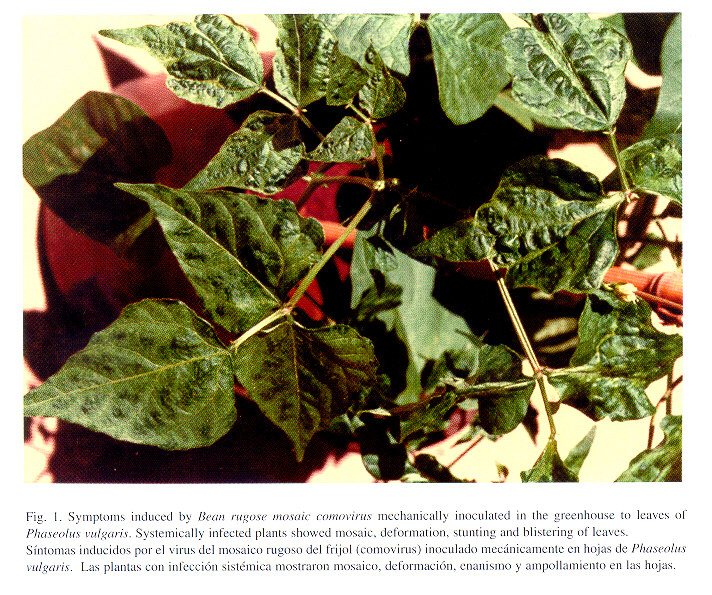
<body><![CDATA[<p><font face="Arial,Helvetica"><font size=-1><i>Comovirus</i>, cytopathology, light microscopy, diagnosis, bean.</font></font>     <br>&nbsp;<font face="Arial,Helvetica"><font size=-1></font></font>     <p><font face="Arial,Helvetica"><font size=-1>Bean rugose mosaic virus (BRMV) belongs to the genus <i>Comovirus</i> and to the family Comoviridae of plant viruses<i>.</i> It was first described infecting beans (<i>Phaseolus vulgaris</i>, L) in Costa Rica (G&aacute;mez <a href="#Gámez72">1972</a>, <a href="#Gámez82">1982</a>); it also occurs in Guatemala (<a href="#Cartín">Cart&iacute;n</a> 1973), El Salvador (<a href="#Gálvez">G&aacute;lvez <i>et al.</i></a>1977), Brazil (<i><a href="#Lin">Lin et al. </a></i>1981), Colombia (<a href="#Acosta">Acosta <i>et al.</i></a><i> </i>1986), Honduras and Nicaragua (<a href="#Gámez77">G&aacute;mez</a> 1977). In bean, it causes a severe mosaic, rugosity and deformation of leaves and pods, and in some cases severe stunting and blistering of leaves. Its host range is restricted to the species <i>Phaseolus</i> <i>vulgaris</i> and <i>Vicia faba, </i>and <i>Chenopodium amaranticolor</i> of the Leguminosae and Chenopodiaceae families respectively, and it is transmitted by leaf-feeding beetles (G&aacute;mez <a href="#Gámez72">1972</a>, <a href="#Gámez82">1982</a>).</font></font>     <p><font face="Arial,Helvetica"><font size=-1>Fifteen species have been identified for the <i>Comovirus</i> genus (<a href="#Murphy">Murphy <i>et al.</i></a><i> </i>1995), eight of which have been studied cytologically. All comoviruses studied thus far induce the formation of two different types of cytoplasmic inclusion bodies: a) crystalline inclusions of various and unusual shapes composed of viral particles, which stain violet in Azure A and green in the OG combination (Luxol Brilliant Green BL-Calcomine Orange 2 RS), and are frequently observed in glandular hair cells, guard cells and phloem tissue and occasionally in the epidermis and mesophyll; and b) vesiculate-vacuolate inclusions observed in the cytoplasm of epidermal cells which stain green in OG and red to magenta in Azure A (<a href="#Gibbs">Gibbs and Paul </a>1970, <a href="#Kim">Kim and Fulton</a> 1972, <a href="#Kitajima">Kitajima <i>et al.</i></a><i> </i>1974, <a href="#Langenberg">Langenberg and Schroeder</a> 1975, <a href="#Bruening">Bruening</a> 1978, <a href="#Edwardson91">Edwardson and Christie</a> 1991). Both types of inclusion bodies and their location are considered to be main diagnostic characteristics of the C<i>omovirus</i> genus (<a href="#Edwardson78">Edwardson and Christie</a> 1978). Xylem elements blocked with masses of virus particles have also been observed in squash mosaic virus and cowpea mosaic virus infections (<a href="#Christie">Christie and Edwardson</a> 1977). In this paper, inclusion bodies observed by light microscopy in BRMV-infected bean leaf tissue are described and compared with those induced by other members of the genus <i>Comovirus.</i></font></font>     <br>&nbsp;     <p><b><font face="Arial,Helvetica"><font size=-1>Materials and Methods</font></font></b>     <p><font face="Arial,Helvetica"><font size=-1><b>Virus isolate: </b>the isolate of BRMV was initially obtained from plants of <i>P. vulgaris</i> infected in the field and later maintained in the greenhouse by mechanical inoculation on bean plants. Leaves from plants showing severe mosaic and leaf deformation, and stunting and blistering of leaves and pods (<a href="#Fig1">Fig. 1</a>) were selected for examination by light microscopy. Healthy leaves from the same bean variety were also examined.</font></font>     <p><font face="Arial,Helvetica"><font size=-1><b>Virus identification: </b>the identity of the virus in all plants selected for light microscopy was confirmed by DAS-ELISA using rabbit polyclonal antibodies produced by C. Rivera, (1990).</font></font>     <p><font face="Arial,Helvetica"><font size=-1><b>Light microscopy: </b>strips from the lower epidermis of the leaves of inoculated and non- inoculated bean plants were removed and stained in 0.1% Azure A and OG (<a href="#Christie">Christie and Edwardson</a> 1977). After removal of the epidermis, the mesophyll was soaked in 2-methoxyethanol for 30 min to remove the chlorophyll and stained with Azure A. The excess stain was removed in 95% ethanol. The tissue was mounted directly in Euparal and observed with a light microscope and photographed.</font></font><b><font face="Arial,Helvetica"><font size=-1></font></font></b>     <p>    ]]></body>
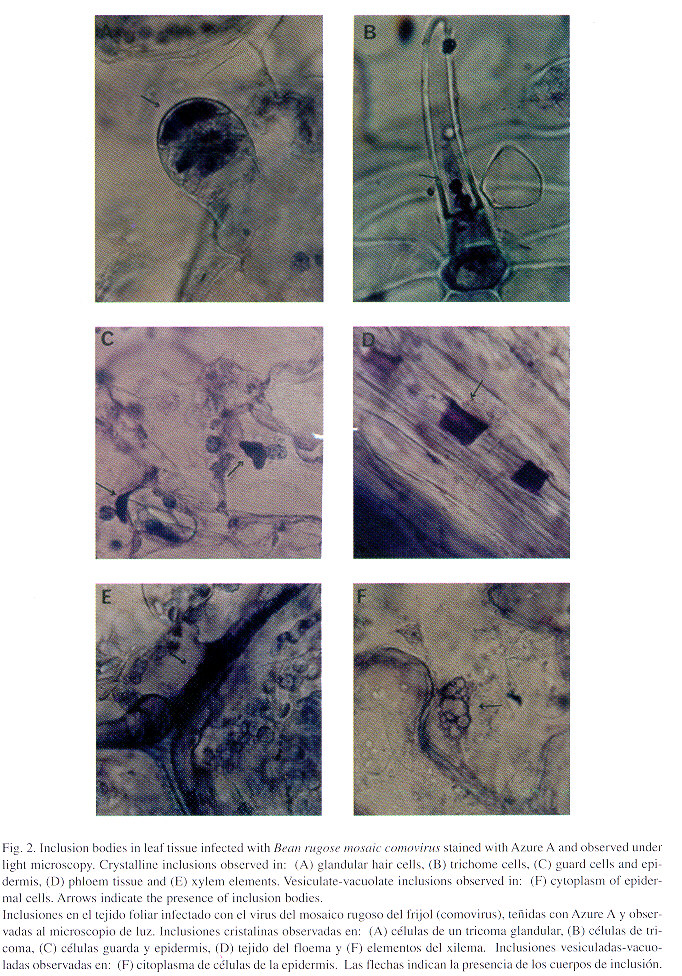
<body><![CDATA[<br><b><font face="Arial,Helvetica"><font size=-1></font></font></b>     <p><b><font face="Arial,Helvetica"><font size=-1>Results</font></font></b>     <p><font face="Arial,Helvetica"><font size=-1>Two types of inclusion bodies were consistently observed by light microscopy in bean leaf tissue infected with bean rugose mosaic comovirus. Crystalline cytoplasmic inclusions of different size and shape were frequently found in glandular hair cells (<a href="#Fig2">Fig. 2 A</a>), trichome cells (<a href="#Fig2">Fig. 2 B</a>), epidermis and guard cells (<a href="#Fig2">Fig. 2 C</a>) and phloem tissue (<a href="#Fig2">Fig. 2 D</a>). The xylem elements observed were blocked with masses of crystalline inclusions (<a href="#Fig2">Fig. 2 E</a>). Vesiculate-vacuolate inclusions were also frequently found in the cytoplasm of epidermal cells (<a href="#Fig2">Fig. 2 F</a>). Both types of inclusions stained with Azure A and OG combination.</font></font><b><font face="Arial,Helvetica"><font size=-1></font></font></b>     <p>    <br><b><font face="Arial,Helvetica"><font size=-1></font></font></b>     <p><b><font face="Arial,Helvetica"><font size=-1>Discussion</font></font></b>     <p><font face="Arial,Helvetica"><font size=-1>All comoviruses studied to date are reported to induce vacuolate-vesiculate inclusions and crystalline inclusions of virus particles. Both types of inclusion bodies are now considered to be main characteristics of the C<i>omovirus</i> genus ( <a href="#Edwardson91">Edwardson and Christie</a> 1991) . Vacuolate-vesiculate inclusions in epidermal cells and crystalline inclusions of virus particles have been described in thrichome cells, spongy parenchyma, phloem, mesophyll cells and xylem elements by electron microscopy of BRMV infected leaves (<a href="#Kitajima">Kitajima <i>et al.</i></a><i> </i>1974, <a href="#Gálvez">G&aacute;lvez<i> et al. </i></a>1977, <a href="#Gámez82">G&aacute;mez</a> 1982, <a href="#Muńoz">Mu&ntilde;oz &amp; Kitajima</a> 1990). Both types of inclusion bodies were easily identified in this research by light microscopy of BRMV-infected tissue stained with Azure A and with O-G. Thus light microscopy should be useful in the diagnosis of BRMV comovirus infections.</font></font><b><font face="Arial,Helvetica"><font size=-1></font></font></b>     <p>    <br><b><font face="Arial,Helvetica"><font size=-1></font></font></b>     <p><b><font face="Arial,Helvetica"><font size=-1>Acknowledgements</font></font></b>     ]]></body>
<body><![CDATA[<p><font face="Arial,Helvetica"><font size=-1>We thank Melanie Hord for review manuscript and William Villalobos for technical assistance. This research was supported by the PCDV-CIBCM (801-94-905).</font></font>     <br><b><font face="Arial,Helvetica"><font size=-1></font></font></b>&nbsp;<b><font face="Arial,Helvetica"><font size=-1></font></font></b>     <p><b><font face="Arial,Helvetica"><font size=-1>Resumen</font></font></b>     <p><font face="Arial,Helvetica"><font size=-1>Se observaron dos tipos de inclusiones virales, mediante microscopia de luz, en hojas de plantas de frijol (<i>Phaseolus vulgaris</i>) previamente infectadas con el virus del mosaico rugoso del frijol ("bean rugose mosaic comovirus", BRMV), especie del g&eacute;nero <i>Comovirus</i>, familia Comoviridae. Se hallaron inclusiones vesiculadas, principalmente en el citoplasma de c&eacute;lulas de la epidermis, y abundantes inclusiones cristalinas de diferentes formas y tama&ntilde;os siempre en c&eacute;lulas guarda, tricomas glandulares, floema, elementos del xilema y ocasionalmente en c&eacute;lulas epid&eacute;rmicas y del mes&oacute;filo. Ambos tipos de inclusiones ti&ntilde;eron con Azure A y con la tinci&oacute;n, verde naranja (Luxol Brilliant Green BL-Calcomine Orange 2 RS) conocida como OG, y son similares a las inclusiones inducidas por otras especies del g&eacute;nero <i>Comovirus</i>.</font></font><b><font face="Arial,Helvetica"><font size=-1></font></font></b>     <p>    <br><b><font face="Arial,Helvetica"><font size=-1></font></font></b>     <p><b><font face="Arial,Helvetica"><font size=-1>References</font></font></b><b><font face="Arial,Helvetica"><font size=-1></font></font></b>     <!-- ref --><p><a NAME="Acosta"></a><font face="Arial,Helvetica"><font size=-1>Acosta O., Alegr&iacute;a A. &amp; R Lastra. 1986. Some biological and physicochemical properties of bean rugose mosaic virus. Phytopathology 76: 1182-1184.</font></font>    &nbsp;&nbsp;&nbsp;&nbsp;&nbsp;&nbsp;&nbsp;&nbsp;[&#160;<a href="javascript:void(0);" onclick="javascript: window.open('/scielo.php?script=sci_nlinks&ref=1336196&pid=S0034-7744200000040001900001&lng=','','width=640,height=500,resizable=yes,scrollbars=1,menubar=yes,');">Links</a>&#160;]<!-- end-ref --><!-- ref --><p><a NAME="Bruening"></a><font face="Arial,Helvetica"><font size=-1>Bruening G. 1978. Bean pod mottle comovirus.<b> </b>CMI/AAB Descriptions of Plant Viruses No. 199, 6 pp.</font></font>    &nbsp;&nbsp;&nbsp;&nbsp;&nbsp;&nbsp;&nbsp;&nbsp;[&#160;<a href="javascript:void(0);" onclick="javascript: window.open('/scielo.php?script=sci_nlinks&ref=1336197&pid=S0034-7744200000040001900002&lng=','','width=640,height=500,resizable=yes,scrollbars=1,menubar=yes,');">Links</a>&#160;]<!-- end-ref --><!-- ref --><p><a NAME="Cartín"></a><font face="Arial,Helvetica"><font size=-1>Cart&iacute;n F. 1973. Caracterizaci&oacute;n de dos nuevas razas del virus del mosaico rugoso del frijol. Tesis de Licenciatura, Facultad de Agronom&iacute;a, Universidad de Costa Rica, San Jos&eacute;, Costa Rica.</font></font>    &nbsp;&nbsp;&nbsp;&nbsp;&nbsp;&nbsp;&nbsp;&nbsp;[&#160;<a href="javascript:void(0);" onclick="javascript: window.open('/scielo.php?script=sci_nlinks&ref=1336198&pid=S0034-7744200000040001900003&lng=','','width=640,height=500,resizable=yes,scrollbars=1,menubar=yes,');">Links</a>&#160;]<!-- end-ref --><!-- ref --><p><a NAME="Christie"></a><font face="Arial,Helvetica"><font size=-1>Christie R.G. &amp; J.R. Edwardson. 1977. Light and electron microscopy of plant virus inclusions. Fla. Agric. Exp. Stn. Monogr. No. 9, 150 p.</font></font>    &nbsp;&nbsp;&nbsp;&nbsp;&nbsp;&nbsp;&nbsp;&nbsp;[&#160;<a href="javascript:void(0);" onclick="javascript: window.open('/scielo.php?script=sci_nlinks&ref=1336199&pid=S0034-7744200000040001900004&lng=','','width=640,height=500,resizable=yes,scrollbars=1,menubar=yes,');">Links</a>&#160;]<!-- end-ref --><!-- ref --><p><a NAME="Edwardson78"></a><font face="Arial,Helvetica"><font size=-1>Edwardson J.R. &amp; R.G. Christie. 1978. Use of virus-induced inclusion bodies in classification and diagnosis. Ann. Rev. Phytopathol. 16: 31-55.</font></font>    &nbsp;&nbsp;&nbsp;&nbsp;&nbsp;&nbsp;&nbsp;&nbsp;[&#160;<a href="javascript:void(0);" onclick="javascript: window.open('/scielo.php?script=sci_nlinks&ref=1336200&pid=S0034-7744200000040001900005&lng=','','width=640,height=500,resizable=yes,scrollbars=1,menubar=yes,');">Links</a>&#160;]<!-- end-ref --><!-- ref --><p><a NAME="Edwardson91"></a><font face="Arial,Helvetica"><font size=-1>Edwardson J.R. &amp; R.G. Christie. 1991.Comoviruses. In: Edwardson &amp; Christie eds., Handbook of viruses infecting legumes, CRC, Boca Raton, Florida, 504 p.</font></font>    &nbsp;&nbsp;&nbsp;&nbsp;&nbsp;&nbsp;&nbsp;&nbsp;[&#160;<a href="javascript:void(0);" onclick="javascript: window.open('/scielo.php?script=sci_nlinks&ref=1336201&pid=S0034-7744200000040001900006&lng=','','width=640,height=500,resizable=yes,scrollbars=1,menubar=yes,');">Links</a>&#160;]<!-- end-ref --><!-- ref --><p><a NAME="Gálvez"></a><font face="Arial,Helvetica"><font size=-1>G&aacute;lvez G.E., Cardenas M., Kitajima E.W., D&iacute;az A.J. &amp; M.P. Nieto. 1977. Purification, serology, electron microscopy, and properties of the Ampollado strain of bean rugose mosaic virus. Turrialba 27: 343-350.</font></font>    &nbsp;&nbsp;&nbsp;&nbsp;&nbsp;&nbsp;&nbsp;&nbsp;[&#160;<a href="javascript:void(0);" onclick="javascript: window.open('/scielo.php?script=sci_nlinks&ref=1336202&pid=S0034-7744200000040001900007&lng=','','width=640,height=500,resizable=yes,scrollbars=1,menubar=yes,');">Links</a>&#160;]<!-- end-ref --><!-- ref --><p><a NAME="Gámez72"></a><font face="Arial,Helvetica"><font size=-1>G&aacute;mez R. 1972. Los virus del frijol en Centro Am&eacute;rica. II. Algunas propiedades y transmisi&oacute;n por crisom&eacute;lidos del virus del mosaico rugoso del frijol. Turrialba 22: 249-257.</font></font>    &nbsp;&nbsp;&nbsp;&nbsp;&nbsp;&nbsp;&nbsp;&nbsp;[&#160;<a href="javascript:void(0);" onclick="javascript: window.open('/scielo.php?script=sci_nlinks&ref=1336203&pid=S0034-7744200000040001900008&lng=','','width=640,height=500,resizable=yes,scrollbars=1,menubar=yes,');">Links</a>&#160;]<!-- end-ref --><!-- ref --><p><a NAME="Gámez77"></a><font face="Arial,Helvetica"><font size=-1>G&aacute;mez R. 1977. Las enfermedades virales como factores limitantes en la producci&oacute;n de frijol (<i>Phaseolus vulgaris</i>) en Am&eacute;rica L&aacute;tina. Fitopatolog&iacute;a 12: 24-27.</font></font>    &nbsp;&nbsp;&nbsp;&nbsp;&nbsp;&nbsp;&nbsp;&nbsp;[&#160;<a href="javascript:void(0);" onclick="javascript: window.open('/scielo.php?script=sci_nlinks&ref=1336204&pid=S0034-7744200000040001900009&lng=','','width=640,height=500,resizable=yes,scrollbars=1,menubar=yes,');">Links</a>&#160;]<!-- end-ref --><!-- ref --><p><a NAME="Gámez82"></a><font face="Arial,Helvetica"><font size=-1>G&aacute;mez R. 1982. Bean rugose mosaic virus. CMI/AAB Descriptions of Plant Viruses No. 246, 4 pp.</font></font>    &nbsp;&nbsp;&nbsp;&nbsp;&nbsp;&nbsp;&nbsp;&nbsp;[&#160;<a href="javascript:void(0);" onclick="javascript: window.open('/scielo.php?script=sci_nlinks&ref=1336205&pid=S0034-7744200000040001900010&lng=','','width=640,height=500,resizable=yes,scrollbars=1,menubar=yes,');">Links</a>&#160;]<!-- end-ref --><!-- ref --><p><a NAME="Gibbs"></a><font face="Arial,Helvetica"><font size=-1>Gibbs A.J. &amp; H.L. Paul. 1970. Broad bean true mosaic comovirus. CMI/AAB Descriptions of Plant Viruses No. 20, 4 pp.</font></font>    &nbsp;&nbsp;&nbsp;&nbsp;&nbsp;&nbsp;&nbsp;&nbsp;[&#160;<a href="javascript:void(0);" onclick="javascript: window.open('/scielo.php?script=sci_nlinks&ref=1336206&pid=S0034-7744200000040001900011&lng=','','width=640,height=500,resizable=yes,scrollbars=1,menubar=yes,');">Links</a>&#160;]<!-- end-ref --><!-- ref --><p><a NAME="Kim"></a><font face="Arial,Helvetica"><font size=-1>Kim K.S. &amp; J.P. Fulton. 1972. Fine structure of plant cells infected with bean pod mottle virus. Virology 49: 112-121.</font></font>    &nbsp;&nbsp;&nbsp;&nbsp;&nbsp;&nbsp;&nbsp;&nbsp;[&#160;<a href="javascript:void(0);" onclick="javascript: window.open('/scielo.php?script=sci_nlinks&ref=1336207&pid=S0034-7744200000040001900012&lng=','','width=640,height=500,resizable=yes,scrollbars=1,menubar=yes,');">Links</a>&#160;]<!-- end-ref --><!-- ref --><p><a NAME="Kitajima"></a><font face="Arial,Helvetica"><font size=-1>Kitajima E.W., Tascon A., G&aacute;mez R. &amp; G.E. G&aacute;lvez. 1974. Ultrastructural studies on bean leaf tissues infected with two strains of bean rugose mosaic virus. Turrialba 24: 393-397.</font></font>    &nbsp;&nbsp;&nbsp;&nbsp;&nbsp;&nbsp;&nbsp;&nbsp;[&#160;<a href="javascript:void(0);" onclick="javascript: window.open('/scielo.php?script=sci_nlinks&ref=1336208&pid=S0034-7744200000040001900013&lng=','','width=640,height=500,resizable=yes,scrollbars=1,menubar=yes,');">Links</a>&#160;]<!-- end-ref --><!-- ref --><p><a NAME="Langenberg"></a><font face="Arial,Helvetica"><font size=-1>Langenberg W.G. &amp; H.F. Schroeder. 1975.The ultrastructural appearance of cowpea mosaic virus in cowpea. J. Ultrastruct. Res. 51: 166-175.</font></font>    &nbsp;&nbsp;&nbsp;&nbsp;&nbsp;&nbsp;&nbsp;&nbsp;[&#160;<a href="javascript:void(0);" onclick="javascript: window.open('/scielo.php?script=sci_nlinks&ref=1336209&pid=S0034-7744200000040001900014&lng=','','width=640,height=500,resizable=yes,scrollbars=1,menubar=yes,');">Links</a>&#160;]<!-- end-ref --><!-- ref --><p><a NAME="Lin"></a><font face="Arial,Helvetica"><font size=-1>Lin M.T., G&aacute;mez R. &amp; E.W. Kitajima. 1981. Bean "mosaico-em-desenho"virus is a member of the bean rugose mosaic serogroup. Fitopatol. Brasil. 6: 293-296.</font></font>    &nbsp;&nbsp;&nbsp;&nbsp;&nbsp;&nbsp;&nbsp;&nbsp;[&#160;<a href="javascript:void(0);" onclick="javascript: window.open('/scielo.php?script=sci_nlinks&ref=1336210&pid=S0034-7744200000040001900015&lng=','','width=640,height=500,resizable=yes,scrollbars=1,menubar=yes,');">Links</a>&#160;]<!-- end-ref --><!-- ref --><p><a NAME="Muńoz"></a><font face="Arial,Helvetica"><font size=-1>Mu&ntilde;oz J. &amp; E.W. Kitajima. 1990. Estudio comparativo da citopatologia induzida por algunos virus do feijoeiro (<i>Phaseolus vulgaris</i>) em infeccoes simples. Fitopatol. Brasil. 15: 276-284.</font></font>    &nbsp;&nbsp;&nbsp;&nbsp;&nbsp;&nbsp;&nbsp;&nbsp;[&#160;<a href="javascript:void(0);" onclick="javascript: window.open('/scielo.php?script=sci_nlinks&ref=1336211&pid=S0034-7744200000040001900016&lng=','','width=640,height=500,resizable=yes,scrollbars=1,menubar=yes,');">Links</a>&#160;]<!-- end-ref --><!-- ref --><p><a NAME="Murphy"></a><font face="Arial,Helvetica"><font size=-1>Murphy F.A., Fauquet C., Bishop D.H.L., Ghabrial, Jarvis A.W., Martelli G.P., Mayo M.A. &amp; M.D. Summers. 1995. Virus Taxonomy. Sixth Report of the International Committee on Taxonomy of Viruses. Springer, Viena, Austria. 586p.</font></font>    &nbsp;&nbsp;&nbsp;&nbsp;&nbsp;&nbsp;&nbsp;&nbsp;[&#160;<a href="javascript:void(0);" onclick="javascript: window.open('/scielo.php?script=sci_nlinks&ref=1336212&pid=S0034-7744200000040001900017&lng=','','width=640,height=500,resizable=yes,scrollbars=1,menubar=yes,');">Links</a>&#160;]<!-- end-ref --><br>&nbsp;     <br>&nbsp;     <br>     <br>     <center>     <p><a NAME="Fig1"></a><img SRC="/img/fbpe/rbt/v48n4/0960i01.JPG" height=595 width=712>     
]]></body>
<body><![CDATA[<p>    <br>     <p><a NAME="Fig2"></a><img SRC="/img/fbpe/rbt/v48n4/0960i02.JPG" height=976 width=682></center>      
<p>    <br>     <br>     <p><a NAME="1a"></a><font face="Arial,Helvetica"><font size=-1><sup><a href="#1">1</a></sup> Centro de Investigaci&oacute;n en Biolog&iacute;a Celular y Molecular (CIBCM)</font></font>     <br><a NAME="2a"></a><font face="Arial,Helvetica"><font size=-1><sup><a href="#2">2</a></sup> Facultad de Microbiolog&iacute;a, Universidad de Costa Rica, San Jos&eacute;, Costa Rica, fax (506) 207 3190, e-mail: <a href="mailto:crivera@sol.racsa.co.cr">crivera@sol.racsa.co.cr</a></font></font>     <br>&nbsp;      ]]></body><back>
<ref-list>
<ref id="B1">
<nlm-citation citation-type="journal">
<person-group person-group-type="author">
<name>
<surname><![CDATA[Acosta]]></surname>
<given-names><![CDATA[O]]></given-names>
</name>
<name>
<surname><![CDATA[Alegría]]></surname>
<given-names><![CDATA[A]]></given-names>
</name>
<name>
<surname><![CDATA[Lastra]]></surname>
<given-names><![CDATA[R]]></given-names>
</name>
</person-group>
<article-title xml:lang="en"><![CDATA[Some biological and physicochemical properties of bean rugose mosaic virus]]></article-title>
<source><![CDATA[Phytopathology]]></source>
<year>1986</year>
<volume>76</volume>
<page-range>1182-1184</page-range></nlm-citation>
</ref>
<ref id="B2">
<nlm-citation citation-type="">
<person-group person-group-type="author">
<name>
<surname><![CDATA[Bruening]]></surname>
<given-names><![CDATA[G]]></given-names>
</name>
</person-group>
<source><![CDATA[Bean pod mottle comovirus]]></source>
<year>1978</year>
<volume>199</volume>
<page-range>6</page-range></nlm-citation>
</ref>
<ref id="B3">
<nlm-citation citation-type="">
<person-group person-group-type="author">
<name>
<surname><![CDATA[Cartín]]></surname>
<given-names><![CDATA[F]]></given-names>
</name>
</person-group>
<source><![CDATA[Caracterización de dos nuevas razas del virus del mosaico rugoso del frijol]]></source>
<year>1973</year>
</nlm-citation>
</ref>
<ref id="B4">
<nlm-citation citation-type="journal">
<person-group person-group-type="author">
<name>
<surname><![CDATA[Christie]]></surname>
<given-names><![CDATA[R.G]]></given-names>
</name>
<name>
<surname><![CDATA[Edwardson]]></surname>
<given-names><![CDATA[J.R]]></given-names>
</name>
</person-group>
<article-title xml:lang="en"><![CDATA[Light and electron microscopy of plant virus inclusions]]></article-title>
<source><![CDATA[Fla. Agric. Exp. Stn. Monogr]]></source>
<year>1977</year>
<volume>9</volume>
<page-range>150</page-range></nlm-citation>
</ref>
<ref id="B5">
<nlm-citation citation-type="journal">
<person-group person-group-type="author">
<name>
<surname><![CDATA[Edwardson]]></surname>
<given-names><![CDATA[J.R]]></given-names>
</name>
<name>
<surname><![CDATA[Christie]]></surname>
<given-names><![CDATA[R.G]]></given-names>
</name>
</person-group>
<article-title xml:lang="en"><![CDATA[Use of virus-induced inclusion bodies in classification and diagnosis]]></article-title>
<source><![CDATA[Ann. Rev. Phytopathol]]></source>
<year>1978</year>
<volume>16</volume>
<page-range>31-55</page-range></nlm-citation>
</ref>
<ref id="B6">
<nlm-citation citation-type="">
<person-group person-group-type="author">
<name>
<surname><![CDATA[Edwardson]]></surname>
<given-names><![CDATA[J.R]]></given-names>
</name>
<name>
<surname><![CDATA[Christie]]></surname>
<given-names><![CDATA[R.G]]></given-names>
</name>
</person-group>
<article-title xml:lang="en"><![CDATA[Comoviruses]]></article-title>
<collab>Edwardson & Christie eds</collab>
<source><![CDATA[Handbook of viruses infecting legumes]]></source>
<year>1991</year>
<page-range>504</page-range><publisher-loc><![CDATA[Boca Raton^eFlorida Florida]]></publisher-loc>
</nlm-citation>
</ref>
<ref id="B7">
<nlm-citation citation-type="journal">
<person-group person-group-type="author">
<name>
<surname><![CDATA[Gálvez]]></surname>
<given-names><![CDATA[G.E]]></given-names>
</name>
<name>
<surname><![CDATA[Cardenas]]></surname>
<given-names><![CDATA[M]]></given-names>
</name>
<name>
<surname><![CDATA[Kitajima]]></surname>
<given-names><![CDATA[E.W]]></given-names>
</name>
<name>
<surname><![CDATA[Díaz]]></surname>
<given-names><![CDATA[A.J]]></given-names>
</name>
<name>
<surname><![CDATA[Nieto]]></surname>
<given-names><![CDATA[M.P]]></given-names>
</name>
</person-group>
<article-title xml:lang="en"><![CDATA[Purification, serology, electron microscopy, and properties of the Ampollado strain of bean rugose mosaic virus]]></article-title>
<source><![CDATA[Turrialba]]></source>
<year>1977</year>
<volume>27</volume>
<page-range>343-350</page-range></nlm-citation>
</ref>
<ref id="B8">
<nlm-citation citation-type="journal">
<person-group person-group-type="author">
<name>
<surname><![CDATA[Gámez]]></surname>
<given-names><![CDATA[R]]></given-names>
</name>
</person-group>
<article-title xml:lang="es"><![CDATA[Los virus del frijol en Centro América. II: Algunas propiedades y transmisión por crisomélidos del virus del mosaico rugoso del frijol]]></article-title>
<source><![CDATA[Turrialba]]></source>
<year>1972</year>
<volume>22</volume>
<page-range>249-257</page-range></nlm-citation>
</ref>
<ref id="B9">
<nlm-citation citation-type="journal">
<person-group person-group-type="author">
<name>
<surname><![CDATA[Gámez]]></surname>
<given-names><![CDATA[R]]></given-names>
</name>
</person-group>
<article-title xml:lang="es"><![CDATA[Las enfermedades virales como factores limitantes en la producción de frijol (Phaseolus vulgaris) en América Látina]]></article-title>
<source><![CDATA[Fitopatología]]></source>
<year>1977</year>
<volume>12</volume>
<page-range>24-27</page-range></nlm-citation>
</ref>
<ref id="B10">
<nlm-citation citation-type="">
<person-group person-group-type="author">
<name>
<surname><![CDATA[Gámez]]></surname>
<given-names><![CDATA[R]]></given-names>
</name>
</person-group>
<source><![CDATA[Bean rugose mosaic virus]]></source>
<year>1982</year>
<volume>246</volume>
<page-range>4</page-range></nlm-citation>
</ref>
<ref id="B11">
<nlm-citation citation-type="">
<person-group person-group-type="author">
<name>
<surname><![CDATA[Gibbs]]></surname>
<given-names><![CDATA[A.J]]></given-names>
</name>
<name>
<surname><![CDATA[Paul]]></surname>
<given-names><![CDATA[H.L]]></given-names>
</name>
</person-group>
<source><![CDATA[Broad bean true mosaic comovirus]]></source>
<year>1970</year>
<volume>20</volume>
<page-range>4</page-range></nlm-citation>
</ref>
<ref id="B12">
<nlm-citation citation-type="journal">
<person-group person-group-type="author">
<name>
<surname><![CDATA[Kim]]></surname>
<given-names><![CDATA[K.S]]></given-names>
</name>
<name>
<surname><![CDATA[Fulton]]></surname>
<given-names><![CDATA[J.P]]></given-names>
</name>
</person-group>
<article-title xml:lang="en"><![CDATA[Fine structure of plant cells infected with bean pod mottle virus]]></article-title>
<source><![CDATA[Virology]]></source>
<year>1972</year>
<volume>49</volume>
<page-range>112-121</page-range></nlm-citation>
</ref>
<ref id="B13">
<nlm-citation citation-type="journal">
<person-group person-group-type="author">
<name>
<surname><![CDATA[Kitajima]]></surname>
<given-names><![CDATA[E.W]]></given-names>
</name>
<name>
<surname><![CDATA[Tascon]]></surname>
<given-names><![CDATA[A]]></given-names>
</name>
<name>
<surname><![CDATA[Gámez]]></surname>
<given-names><![CDATA[R]]></given-names>
</name>
<name>
<surname><![CDATA[Gálvez]]></surname>
<given-names><![CDATA[G.E]]></given-names>
</name>
</person-group>
<article-title xml:lang="en"><![CDATA[Ultrastructural studies on bean leaf tissues infected with two strains of bean rugose mosaic virus]]></article-title>
<source><![CDATA[Turrialba]]></source>
<year>1974</year>
<volume>24</volume>
<page-range>393-397</page-range></nlm-citation>
</ref>
<ref id="B14">
<nlm-citation citation-type="journal">
<person-group person-group-type="author">
<name>
<surname><![CDATA[Langenberg]]></surname>
<given-names><![CDATA[W.G]]></given-names>
</name>
<name>
<surname><![CDATA[Schroeder]]></surname>
<given-names><![CDATA[H.F]]></given-names>
</name>
</person-group>
<article-title xml:lang="en"><![CDATA[The ultrastructural appearance of cowpea mosaic virus in cowpea]]></article-title>
<source><![CDATA[J. Ultrastruct. Res]]></source>
<year>1975</year>
<volume>51</volume>
<page-range>166-175</page-range></nlm-citation>
</ref>
<ref id="B15">
<nlm-citation citation-type="journal">
<person-group person-group-type="author">
<name>
<surname><![CDATA[Lin]]></surname>
<given-names><![CDATA[M.T]]></given-names>
</name>
<name>
<surname><![CDATA[Gámez]]></surname>
<given-names><![CDATA[R]]></given-names>
</name>
<name>
<surname><![CDATA[Kitajima]]></surname>
<given-names><![CDATA[E.W]]></given-names>
</name>
</person-group>
<article-title xml:lang="en"><![CDATA[Bean "mosaico-em-desenho"virus is a member of the bean rugose mosaic serogroup]]></article-title>
<source><![CDATA[Fitopatol]]></source>
<year>1981</year>
<volume>6</volume>
<page-range>293-296</page-range></nlm-citation>
</ref>
<ref id="B16">
<nlm-citation citation-type="journal">
<person-group person-group-type="author">
<name>
<surname><![CDATA[Muńoz]]></surname>
<given-names><![CDATA[J]]></given-names>
</name>
<name>
<surname><![CDATA[Kitajima]]></surname>
<given-names><![CDATA[E.W]]></given-names>
</name>
</person-group>
<article-title xml:lang="es"><![CDATA[Estudio comparativo da citopatologia induzida por algunos virus do feijoeiro (Phaseolus vulgaris) em infeccoes simples]]></article-title>
<source><![CDATA[Fitopatol]]></source>
<year>1990</year>
<volume>15</volume>
<page-range>276-284</page-range></nlm-citation>
</ref>
<ref id="B17">
<nlm-citation citation-type="book">
<person-group person-group-type="author">
<name>
<surname><![CDATA[Murphy]]></surname>
<given-names><![CDATA[F.A]]></given-names>
</name>
<name>
<surname><![CDATA[Fauquet]]></surname>
<given-names><![CDATA[C]]></given-names>
</name>
<name>
<surname><![CDATA[Bishop]]></surname>
<given-names><![CDATA[D.H.L]]></given-names>
</name>
<name>
<surname><![CDATA[Ghabrial, Jarvis]]></surname>
<given-names><![CDATA[A.W]]></given-names>
</name>
<name>
<surname><![CDATA[Martelli]]></surname>
<given-names><![CDATA[G.P]]></given-names>
</name>
<name>
<surname><![CDATA[Mayo]]></surname>
<given-names><![CDATA[M.A]]></given-names>
</name>
<name>
<surname><![CDATA[Summers]]></surname>
<given-names><![CDATA[M.D]]></given-names>
</name>
</person-group>
<source><![CDATA[Virus Taxonomy: Sixth Report of the International Committee on Taxonomy of Viruses]]></source>
<year>1995</year>
<edition>Viena</edition>
<page-range>586</page-range><publisher-name><![CDATA[Springer]]></publisher-name>
</nlm-citation>
</ref>
</ref-list>
</back>
</article>