<?xml version="1.0" encoding="ISO-8859-1"?><article xmlns:mml="http://www.w3.org/1998/Math/MathML" xmlns:xlink="http://www.w3.org/1999/xlink" xmlns:xsi="http://www.w3.org/2001/XMLSchema-instance">
<front>
<journal-meta>
<journal-id>0034-7744</journal-id>
<journal-title><![CDATA[Revista de Biología Tropical]]></journal-title>
<abbrev-journal-title><![CDATA[Rev. biol. trop]]></abbrev-journal-title>
<issn>0034-7744</issn>
<publisher>
<publisher-name><![CDATA[Universidad de Costa Rica]]></publisher-name>
</publisher>
</journal-meta>
<article-meta>
<article-id>S0034-77442000000400011</article-id>
<title-group>
<article-title xml:lang="en"><![CDATA[Does damming of the Colorado River affect the nursery area of blue shrimp Litopenaeus stylirostris (Decapoda: Penaeidae) in the Upper Gulf of California?]]></article-title>
</title-group>
<contrib-group>
<contrib contrib-type="author">
<name>
<surname><![CDATA[Aragón-Noriega]]></surname>
<given-names><![CDATA[Eugenio Alberto]]></given-names>
</name>
<xref ref-type="aff" rid="A02"/>
</contrib>
<contrib contrib-type="author">
<name>
<surname><![CDATA[Calderón-Aguilera]]></surname>
<given-names><![CDATA[Luis Eduardo]]></given-names>
</name>
<xref ref-type="aff" rid="A01"/>
</contrib>
</contrib-group>
<aff id="A01">
<institution><![CDATA[,Centro de Investigación Científica y Educación Superior de Ensenada  ]]></institution>
<addr-line><![CDATA[Ensenada Baja California]]></addr-line>
<country>México</country>
</aff>
<aff id="A02">
<institution><![CDATA[,Centro de Investigaciones Biológicas del Noroeste  ]]></institution>
<addr-line><![CDATA[San Diego CA]]></addr-line>
<country>USA</country>
</aff>
<pub-date pub-type="pub">
<day>00</day>
<month>12</month>
<year>2000</year>
</pub-date>
<pub-date pub-type="epub">
<day>00</day>
<month>12</month>
<year>2000</year>
</pub-date>
<volume>48</volume>
<numero>4</numero>
<fpage>867</fpage>
<lpage>871</lpage>
<copyright-statement/>
<copyright-year/>
<self-uri xlink:href="http://www.scielo.sa.cr/scielo.php?script=sci_arttext&amp;pid=S0034-77442000000400011&amp;lng=en&amp;nrm=iso"></self-uri><self-uri xlink:href="http://www.scielo.sa.cr/scielo.php?script=sci_abstract&amp;pid=S0034-77442000000400011&amp;lng=en&amp;nrm=iso"></self-uri><self-uri xlink:href="http://www.scielo.sa.cr/scielo.php?script=sci_pdf&amp;pid=S0034-77442000000400011&amp;lng=en&amp;nrm=iso"></self-uri><abstract abstract-type="short" xml:lang="en"><p><![CDATA[After damming the Colorado River the freshwater flow was reduced to 1 % of its virgin flow to the Upper Gulf of California (UGC). The ecological effects need to be properly documented. The UGC is the nursery area for Litopenaeus stylirostris, the most profitable fishery in the zone. In order to know the relative abundance of L. stylirostris postlarval stage we conducted a sampled survey every 14 days in 1993, 1994 and 1997, plus an intensive sampling during a complete tide cycle in July 1995 and 1996. We did 10 min trawls each hour during the flood tide. Relative abundance of postlarvae was higher (p<0.05) in those years when freshwater flow reached the UGC.]]></p></abstract>
<abstract abstract-type="short" xml:lang="es"><p><![CDATA[El represamiento del Río Colorado ha ocasionado que el flujo de agua dulce sobre el Alto Golfo de California (AGC) se haya reducido hasta el 1 % del flujo original. Se ha documentado el efecto de la reducción de agua dulce sobre las condiciones hidrográficas del AGC, pero las repercusiones ecológicas no se han descrito apropiadamente. El AGC ha sido área de crianza para especies comerciales como el camarón Litopenaeus stylirostris. Se hicieron recolectas de postlarvas de L. stylirostris en el AGC durante cinco años consecutivos. Los muestreos fueron catorcenalmente en los años de 1993, 1994 y 1997 y se realizó una recolecta diaria durante 15 días consecutivos en los años 1995 y 1996. Para ello se arrastró una red de plancton de 505 &micro; durante 10 min cada hora durante el flujo de marea. La abundancia relativa de las postlarvas de camarón en esta zona viaria considerablemente en años cuando el flujo de agua dulce incrementa. La abundancia es mayor hasta en un 200 % (p < 0.05) cuando existe descarga de agua dulce al AGC.]]></p></abstract>
<kwd-group>
<kwd lng="en"><![CDATA[Upper Gulf of California]]></kwd>
<kwd lng="en"><![CDATA[Colorado River]]></kwd>
<kwd lng="en"><![CDATA[shrimp postlarvae]]></kwd>
<kwd lng="en"><![CDATA[Litopenaeus stylirostris]]></kwd>
<kwd lng="en"><![CDATA[abundance]]></kwd>
</kwd-group>
</article-meta>
</front><body><![CDATA[ <center><b><font face="Arial,Helvetica">Does damming of the Colorado River affect the nursery area of blue shrimp <i>Litopenaeus</i> <i>stylirostris</i>(Decapoda: Penaeidae) in the Upper Gulf of California?</font></b>     <br>&nbsp;     <p><b><font face="Arial,Helvetica"><font size=-1>Eugenio Alberto Arag&oacute;n-Noriega<a NAME="1a"></a></font><sup><font size=-2><a href="#1">1 </a>&nbsp; ,<a NAME="2a"></a><a href="#2">2</a></font></sup><font size=-1>and Luis Eduardo Calder&oacute;n-Aguilera<a NAME="1a"></a></font><sup><font size=-2><a href="#1">1</a></font></sup></font></b>     <br>&nbsp;     <p><font face="Arial,Helvetica"><font size=-1>Received: 4-VIII-99 Corrected: 24-V-00 Accepted: 16-VI-00</font></font></center>      <p>    <br>     <p><b><font face="Arial,Helvetica"><font size=-1>Abstract</font></font></b>     <p><font face="Arial,Helvetica"><font size=-1>After damming the Colorado River the freshwater flow was reduced to 1 % of its virgin flow to the Upper Gulf of California (UGC). The ecological effects need to be properly documented. The UGC is the nursery area for <i>Litopenaeus stylirostris</i>, the most profitable fishery in the zone. In order to know the relative abundance of <i>L. stylirostris</i> postlarval stage we conducted a sampled survey every 14 days in 1993, 1994 and 1997, plus an intensive sampling during a complete tide cycle in July 1995 and 1996. We did 10 min trawls each hour during the flood tide. Relative abundance of postlarvae was higher (p&lt;0.05) in those years when freshwater flow reached the UGC.</font></font>     <br>&nbsp;     ]]></body>
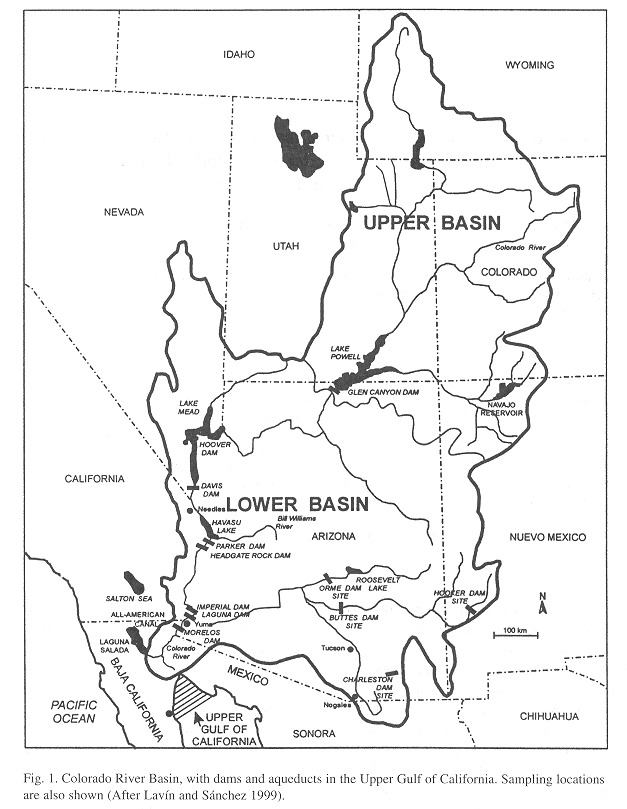
<body><![CDATA[<p><b><font face="Arial,Helvetica"><font size=-1>Key words</font></font></b>     <p><font face="Arial,Helvetica"><font size=-1>Upper Gulf of California, Colorado River, shrimp postlarvae, <i>Litopenaeus stylirostris</i>, abundance</font></font>     <br>&nbsp;     <br>&nbsp;     <p><font face="Arial,Helvetica"><font size=-1>The impact of man-made land forms such a dam can drastically change the condition of any ecosystem. Large reservoirs serve as sediment traps for much of the eroded material, disrupting the sediment budgets of the drainage systems below the dams (<a href="#Dolan">Dolan <i>et al. </i>1974</a>).</font></font>     <p><font face="Arial,Helvetica"><font size=-1>Before the construction of the Hoover Dam, the Colorado River discharged about 16 600 hm<sup>3</sup> of water in the Gulf of California. Today less than 1 % of its virgin flow ever reaches the mouth of the Colorado River (<a href="#Turner80">Turner and Karpiscak 1980</a>). Flow has been regulated since storage began February 1, 1935. Mexico built Morelos Dam at the end of the Colorado River, in 1950. It is 1.1 mi south of the northerly international boundary with Mexico and 21.9 mi north of the southerly international boundary (<a href="#Fig1">Fig. 1</a>).</font></font>     <p><font face="Arial,Helvetica"><font size=-1>It is commonly acknowledged that damming the Colorado River was detrimental to the environment of the Upper Gulf of California (UGC). This is a nursery area for many commercially important species. However, those ecological effects have not been properly documented. <a href="#Alvarez-Borrego">Alvarez-Borrego<i> et al. </i>(1975)</a> and <a href="#Lavín98">Lav&iacute;n <i>et al. </i>(1998)</a> studied the hydrography of the UGC. Those authors reported that, after null input of freshwater, the UGC can be regarded as an inverse estuary, and salinity in these conditions are higher in the North (39 ‰) than in the South (35.5 ‰). However, in a later study it was found that when up stream dams overfill because of abnormal snow melts in the Basin of the Colorado River and/or because heavy rain during El Ni&ntilde;o events, a considerable amount of freshwater discharges in UGC. The hydrography of the area shifts severely to estuary conditions; salinity then is lower (32 ‰) in the North than in the South (35.4 ‰) (<a href="#Lavín99">Lav&iacute;n and S&aacute;nchez 1999</a>).</font></font>     <p><font face="Arial,Helvetica"><font size=-1>The shrimp fishery is the most profitable fishery in the UGC, supported by two species, brown shrimp<i> Farfantepenaeus californiensis</i> (Holmes 1900) and blue shrimp <i>Litopenaeus stylirostris</i> (Stimpson 1871). The latter represent over 80 % of total shrimp catch (<a href="#Mathews81">Mathews 1981</a>). The blue shrimp peak spawning occurs in June and July, and postlarvae use the Colorado River delta as a nursery area.</font></font>     <p><font face="Arial,Helvetica"><font size=-1>It is widely accepted that penaeid shrimp postlarval stage is critical in their life span, because it is affected by higher natural mortality. Consequently, catches depend on the strength of the year class. We, therefore, need to acquire knowledge on the dynamics of the nursery area to understand the dynamics of postlarval development. In order to assess the abundance of blue shrimp postlarvae in the nursery area of the UGC, we conducted a five year sampling survey during the spawning period of shrimp.</font></font>     <br>&nbsp;     ]]></body>
<body><![CDATA[<p><b><font face="Arial,Helvetica"><font size=-1>Materials and methods</font></font></b>     <p><font face="Arial,Helvetica"><font size=-1>Shrimp postlarvae are found in the shallow zone, close to the shore at depth of less than 2.0 m, so they have to be collected manually. We used a custom designed plankton net (505 &micro;m) attached to a stainless steel support, trawled by two persons. The net had a calibrated flowmeter in its mouth to estimate water volume filtered. We did 10 min trawls each hour during the flood tide (tides in the Gulf of California are semi diurnal, so we sampled day and night, <a href="#Fig2">fig 2</a>). Surveys were conducted every 14 days in 1993, 1994 and 1997, plus an intensive sampling during a complete tide cycle from July 12 -27, 1995 and from June 30 - July 16, 1996 in a location on the peninsula near San Felipe, Baja California (<a href="#Fig1">Fig. 1</a>). Species identification was done after <a href="#Mair79">Mair (1979)</a> and <a href="#Calderón-Pérez">Calder&oacute;n-Perez <i>et al. </i>(1989)</a>, checked with lab reared postlarvae from known progenitors.</font></font>     <p><font face="Arial,Helvetica"><font size=-1>Relative abundance of postlarvae (Pl/m<sup>3</sup>) was used to compare differences between years. Data were monthly averages of the spawning peak months, June and July, of each year from 1993 through 1997. A Tukey test or honestly significant difference procedure were performance after a significant ANOVA shows differences in abundance between years.</font></font>     <p><font face="Arial,Helvetica"><font size=-1>Our sampling period included two years (1993, 1997) with river discharge and three years without discharge, a more normal condition. In order to correlate postlarvae relative abundance against Colorado River water flow, we compared the monthly average of Colorado River flow, from January to June with postlarval abundance for 1993 — 1997.</font></font>     <p><font face="Arial,Helvetica"><font size=-1>The Colorado River water flow data at the Southern International Border, were obtained from the United States Bureau of Reclamation, Yuma, Arizona.</font></font>     <br>&nbsp;     <p><b><font face="Arial,Helvetica"><font size=-1>Results</font></font></b>     <p><font face="Arial,Helvetica"><font size=-1>Relative abundance of postlarvae was higher (Tukey p &lt; 0.05) in 1993 than in the other years. Abundances in 1994-1996 were the lowest and formed a different group (<a href="#Table1">Table 1</a>). Lower salinity was on those years where abundance was higher: 1993 and 1997. Temperature was not significantly different for the same months in all five years (ANOVA p = 0.708).</font></font>     <p><font face="Arial,Helvetica"><font size=-1>The Colorado River discharged an unusually high amount of freshwater into the UGC on the years 1993 and 1997. During 1994 to 1996 no discharge was observed. The relative abundance of postlarvae had the same pattern of the river flow. The correlation coefficient was high and significant (r = 0.8815; p &lt; 0.05)</font></font>     <br>&nbsp;     ]]></body>
<body><![CDATA[<p><b><font face="Arial,Helvetica"><font size=-1>Discussion</font></font></b>     <p><font face="Arial,Helvetica"><font size=-1>Undoubtedly the river is responsible for the salinity condition in the UGC. <a href="#Carvajal">Carvajal <i>et al. </i>(1997)</a> developed a numerical model to predict salinity as function of the river flow and to assess the environmental impact of the reduction of river discharge on the area.</font></font>     <p><font face="Arial,Helvetica"><font size=-1>During 1993 and 1997 the amount of freshwater discharged by the river diluted the salinity of the UGC. Low salinity is reported as prefered for blue shrimp on Sinaloan coastal lagoons (<a href="#Mair80">Mair 1980</a>). Studies have shown the effect of salinity on growth rate of penaeid postlarvae (<a href="#Rothlisberg">Rothlisberg 1998</a>).</font></font>     <p><font face="Arial,Helvetica"><font size=-1>On other penaeid shrimps low salinity signals postlarvae to find the way to a nursery area (<a href="#Hughes">Hughes 1969</a>, <a href="#Matthews91">Mathews <i>et al. </i>1991</a>). In the UGC, an inverse estuary, there is no low salinity as a signal, yet postlarvae nurse in that area. <a href="#Mair82">Mair <i>et al. </i>(1982)</a> conducted a laboratory experiment which demostrated that shrimp selected the estuary water over marine water even with the same salinity. They mentioned that the "taste" of water may be important, because terrigenous material is a factor that postlarvae select for within nursery areas where enough food is available. Whether postlarvae are adapted to low salinity or follow the water taste, our data show that river inflow promts shrimp postlarvae to use the improved UGC as a nursery area.</font></font>     <p><font face="Arial,Helvetica"><font size=-1>Another important factor is that expanded habitat is available when the Colorado River flow increases, because freshwater floods areas that are dry on those years when river discharge is null or too low.</font></font>     <p><font face="Arial,Helvetica"><font size=-1>On years 1994 through 1996 the salinity in UGC was higher than marine water. Presence of postlarvae was still observed during this period, but at lower concentration than in those years when the Colorado river discharged water. Even though our data are just for five years and the correlation is weak, there is a significant positive effect of the river water over nursery area. Freshwater discharged by the Colorado river lowers salinity, and possibly expands shrimp postlarvae habitat, which contain more food and sheltered areas.</font></font>     <br>&nbsp;     <p><b><font face="Arial,Helvetica"><font size=-1>Acknowledgments</font></font></b>     <p><font face="Arial,Helvetica"><font size=-1>The authors thank Miguel Cisneros, Artemisa Castro and anonymous reviewers for their comments and suggestions. National Council of Science and Technology of Mexico (REF. CONACYT 3876-T) supported the present study, and granted a fellowship to the first author (CONACYT 92829).</font></font>     <br>&nbsp;     ]]></body>
<body><![CDATA[<p><b><font face="Arial,Helvetica"><font size=-1>Resumen</font></font></b>     <p><font face="Arial,Helvetica"><font size=-1>El represamiento del R&iacute;o Colorado ha ocasionado que el flujo de agua dulce sobre el Alto Golfo de California (AGC) se haya reducido hasta el 1 % del flujo original. Se ha documentado el efecto de la reducci&oacute;n de agua dulce sobre las condiciones hidrogr&aacute;ficas del AGC, pero las repercusiones ecol&oacute;gicas no se han descrito apropiadamente. El AGC ha sido &aacute;rea de crianza para especies comerciales como el camar&oacute;n <i>Litopenaeus stylirostris</i>. Se hicieron recolectas de postlarvas de <i>L. stylirostris</i> en el AGC durante cinco a&ntilde;os consecutivos. Los muestreos fueron catorcenalmente en los a&ntilde;os de 1993, 1994 y 1997 y se realiz&oacute; una recolecta diaria durante 15 d&iacute;as consecutivos en los a&ntilde;os 1995 y 1996. Para ello se arrastr&oacute; una red de plancton de 505 &micro; durante 10 min cada hora durante el flujo de marea. La abundancia relativa de las postlarvas de camar&oacute;n en esta zona viaria considerablemente en a&ntilde;os cuando el flujo de agua dulce incrementa. La abundancia es mayor hasta en un 200 % (p &lt; 0.05) cuando existe descarga de agua dulce al AGC.</font></font>     <br>&nbsp;     <!-- ref --><p><b><font face="Arial,Helvetica"><font size=-1>References</font></font></b> <dir> <dir><a NAME="Alvarez-Borrego"></a><font face="Arial,Helvetica"><font size=-1>Alvarez-Borrego, S., B.P. Flores B&aacute;ez &amp; L. Galindo Bect. 1975. Hidrolog&iacute;a del Alto Golfo de California II. Condiciones durante invierno, primavera y verano. Cien. Mar. 2: 21-36.</font></font>    &nbsp;&nbsp;&nbsp;&nbsp;&nbsp;&nbsp;&nbsp;&nbsp;[&#160;<a href="javascript:void(0);" onclick="javascript: window.open('/scielo.php?script=sci_nlinks&ref=1343453&pid=S0034-7744200000040001100001&lng=','','width=640,height=500,resizable=yes,scrollbars=1,menubar=yes,');">Links</a>&#160;]<!-- end-ref --><!-- ref --><p><a NAME="Calderón-Pérez"></a><font face="Arial,Helvetica"><font size=-1>Calder&oacute;n-P&eacute;rez, J.A., R.E. Mac&iacute;as &amp; R.S. Rend&oacute;n. 1989. Clave de identificaci&oacute;n para los estadios de postlarva y primeros juveniles de camar&oacute;n del g&eacute;nero <i>Penaeus</i> (Crustacea: Decapoda) del Golfo de California. M&eacute;xico. Cien. Mar. 15 : 57-70.</font></font>    &nbsp;&nbsp;&nbsp;&nbsp;&nbsp;&nbsp;&nbsp;&nbsp;[&#160;<a href="javascript:void(0);" onclick="javascript: window.open('/scielo.php?script=sci_nlinks&ref=1343454&pid=S0034-7744200000040001100002&lng=','','width=640,height=500,resizable=yes,scrollbars=1,menubar=yes,');">Links</a>&#160;]<!-- end-ref --><!-- ref --><p><a NAME="Carvajal"></a><font face="Arial,Helvetica"><font size=-1>Carvajal, N., A. Souza &amp; R. Durazo. 1997. Anumerical study of the ex ROFI of Colorado River. J. of Mar. Syst. 12: 17-33.</font></font>    &nbsp;&nbsp;&nbsp;&nbsp;&nbsp;&nbsp;&nbsp;&nbsp;[&#160;<a href="javascript:void(0);" onclick="javascript: window.open('/scielo.php?script=sci_nlinks&ref=1343455&pid=S0034-7744200000040001100003&lng=','','width=640,height=500,resizable=yes,scrollbars=1,menubar=yes,');">Links</a>&#160;]<!-- end-ref --><!-- ref --><p><a NAME="Dolan"></a><font face="Arial,Helvetica"><font size=-1>Dolan, R., A. Howard &amp; A. Galleson. 1974. Man’s Impact on the Colorado River in the Grand Canyon. Amer. Sci.62: 390-401.</font></font>    &nbsp;&nbsp;&nbsp;&nbsp;&nbsp;&nbsp;&nbsp;&nbsp;[&#160;<a href="javascript:void(0);" onclick="javascript: window.open('/scielo.php?script=sci_nlinks&ref=1343456&pid=S0034-7744200000040001100004&lng=','','width=640,height=500,resizable=yes,scrollbars=1,menubar=yes,');">Links</a>&#160;]<!-- end-ref --><!-- ref --><p><a NAME="Hughes"></a><font face="Arial,Helvetica"><font size=-1>Hughes, D.A. 1969. Responses to salinity change as a tidal transport mechanism of pink shrimp, <i>Penaeus duorarum</i>. Biol. Bull. 136: 43-53.</font></font>    &nbsp;&nbsp;&nbsp;&nbsp;&nbsp;&nbsp;&nbsp;&nbsp;[&#160;<a href="javascript:void(0);" onclick="javascript: window.open('/scielo.php?script=sci_nlinks&ref=1343457&pid=S0034-7744200000040001100005&lng=','','width=640,height=500,resizable=yes,scrollbars=1,menubar=yes,');">Links</a>&#160;]<!-- end-ref --><!-- ref --><p><a NAME="Lavín99"></a><font face="Arial,Helvetica"><font size=-1>Lav&iacute;n, M. F. &amp; S. S&aacute;nchez. 1999. On how the Colorado River affected the Hydrography of the Upper Gulf of California. Cont. Shelf Res.19: 1545-1560.</font></font>    &nbsp;&nbsp;&nbsp;&nbsp;&nbsp;&nbsp;&nbsp;&nbsp;[&#160;<a href="javascript:void(0);" onclick="javascript: window.open('/scielo.php?script=sci_nlinks&ref=1343458&pid=S0034-7744200000040001100006&lng=','','width=640,height=500,resizable=yes,scrollbars=1,menubar=yes,');">Links</a>&#160;]<!-- end-ref --><!-- ref --><p><a NAME="Lavín98"></a><font face="Arial,Helvetica"><font size=-1>Lav&iacute;n, M. F., V. M. God&iacute;nez &amp; L. Alvarez. 1998. Inverse-Estuarine features of the upper Gulf of California. Estuarine, Coastal and Shelf Sci. 47: 769-795.</font></font>    &nbsp;&nbsp;&nbsp;&nbsp;&nbsp;&nbsp;&nbsp;&nbsp;[&#160;<a href="javascript:void(0);" onclick="javascript: window.open('/scielo.php?script=sci_nlinks&ref=1343459&pid=S0034-7744200000040001100007&lng=','','width=640,height=500,resizable=yes,scrollbars=1,menubar=yes,');">Links</a>&#160;]<!-- end-ref --><!-- ref --><p><a NAME="Mair79"></a><font face="Arial,Helvetica"><font size=-1>Mair, J. McD. 1979. The identification of postlarvae of four species of <i>Penaeus</i> (CRUSTACEA: DECAPODA) from the Pacific Coast of M&eacute;xico. J. of Zool. 188: 347-351.</font></font>    &nbsp;&nbsp;&nbsp;&nbsp;&nbsp;&nbsp;&nbsp;&nbsp;[&#160;<a href="javascript:void(0);" onclick="javascript: window.open('/scielo.php?script=sci_nlinks&ref=1343460&pid=S0034-7744200000040001100008&lng=','','width=640,height=500,resizable=yes,scrollbars=1,menubar=yes,');">Links</a>&#160;]<!-- end-ref --><!-- ref --><p><a NAME="Mair82"></a><font face="Arial,Helvetica"><font size=-1>Mair, J.McD., J.L. Watkins &amp; D.I. Williamson. 1982. Factors affecting the migration of postlarval Penaeid shrimp into a Mexican Lagoon Syst.. Oceanol. Acta, No. S.P. Proc. Int. Symp.on Coastal Systems. SCOR/IABO/UNESCO; Bordeaux, France. 1981. 339-345.</font></font>    &nbsp;&nbsp;&nbsp;&nbsp;&nbsp;&nbsp;&nbsp;&nbsp;[&#160;<a href="javascript:void(0);" onclick="javascript: window.open('/scielo.php?script=sci_nlinks&ref=1343461&pid=S0034-7744200000040001100009&lng=','','width=640,height=500,resizable=yes,scrollbars=1,menubar=yes,');">Links</a>&#160;]<!-- end-ref --><!-- ref --><p><a NAME="Mair80"></a><font face="Arial,Helvetica"><font size=-1>Mair, J. McD. 1980. Salinity and water type preferences of four species of postlarval (<i>Penaeus</i>) from west M&eacute;xico. J. Exp. Mar. Biol. Ecol. 45: 69-82.</font></font>    &nbsp;&nbsp;&nbsp;&nbsp;&nbsp;&nbsp;&nbsp;&nbsp;[&#160;<a href="javascript:void(0);" onclick="javascript: window.open('/scielo.php?script=sci_nlinks&ref=1343462&pid=S0034-7744200000040001100010&lng=','','width=640,height=500,resizable=yes,scrollbars=1,menubar=yes,');">Links</a>&#160;]<!-- end-ref --><!-- ref --><p><a NAME="Mathews81"></a><font face="Arial,Helvetica"><font size=-1>Mathews, C.P. 1981. A review of the North Amarican penaeid fisheries, with particular reference to Mexico. Kuwait Bull.of Mar. Sci. 2: 325-409.</font></font>    &nbsp;&nbsp;&nbsp;&nbsp;&nbsp;&nbsp;&nbsp;&nbsp;[&#160;<a href="javascript:void(0);" onclick="javascript: window.open('/scielo.php?script=sci_nlinks&ref=1343463&pid=S0034-7744200000040001100011&lng=','','width=640,height=500,resizable=yes,scrollbars=1,menubar=yes,');">Links</a>&#160;]<!-- end-ref --><!-- ref --><p><a NAME="Matthews91"></a><font face="Arial,Helvetica"><font size=-1>Matthews, T.R., W.W. Schoroeder &amp; D.E. Stearns. 1991. Endogenous rhythm, light and salinity effects on postlarval brown shrimp <i>Penaeus aztecus</i> Ives recruitment to estuaries. J. Exp. Mar. Biol. Ecol. 154: 117-189.</font></font>    &nbsp;&nbsp;&nbsp;&nbsp;&nbsp;&nbsp;&nbsp;&nbsp;[&#160;<a href="javascript:void(0);" onclick="javascript: window.open('/scielo.php?script=sci_nlinks&ref=1343464&pid=S0034-7744200000040001100012&lng=','','width=640,height=500,resizable=yes,scrollbars=1,menubar=yes,');">Links</a>&#160;]<!-- end-ref --><!-- ref --><p><a NAME="Turner80"></a><font face="Arial,Helvetica"><font size=-1>Turner, R. M. &amp; M.M. Kapiscak. 1980. Recent vegetation changes along the Colorado River betweenGlen Canyon Dam and Lake Mead Arizona. U. S. Geological Survey Professional paper. Raston, Virginia 125 p.</font></font>    &nbsp;&nbsp;&nbsp;&nbsp;&nbsp;&nbsp;&nbsp;&nbsp;[&#160;<a href="javascript:void(0);" onclick="javascript: window.open('/scielo.php?script=sci_nlinks&ref=1343465&pid=S0034-7744200000040001100013&lng=','','width=640,height=500,resizable=yes,scrollbars=1,menubar=yes,');">Links</a>&#160;]<!-- end-ref --><!-- ref --><p><a NAME="Rothlisberg"></a><font face="Arial,Helvetica"><font size=-1>Rothlisberg, P. C. 1998. Aspects of penaeid biology and ecology of relevance to aquaculture: a review. Aquaculture 164: 49-65.</font></font></dir> </dir>  <dir> <dir>    &nbsp;&nbsp;&nbsp;&nbsp;&nbsp;&nbsp;&nbsp;&nbsp;[&#160;<a href="javascript:void(0);" onclick="javascript: window.open('/scielo.php?script=sci_nlinks&ref=1343466&pid=S0034-7744200000040001100014&lng=','','width=640,height=500,resizable=yes,scrollbars=1,menubar=yes,');">Links</a>&#160;]<!-- end-ref --><center><a NAME="Table1"></a><b><font face="Arial,Helvetica"><font size=-1>Table 1</font></font></b>     <br><b><font face="Arial,Helvetica"><font size=-1><i>Colorado River flow amount crossing Mexico-US border (monthly average from January throughout June) and </i>Litopenaeus stylirostris<i> postlarvae relative abundance (Pl/m<sup>3</sup>) (average of June and July) from 1993 throughout 1997.</i></font></font></b></center> </dir> </dir>      <center><table BORDER=0 CELLSPACING=0 CELLPADDING=0 WIDTH="561" > <tr> <td VALIGN=TOP><font face="Arial,Helvetica"><font size=-1>Year&nbsp;</font></font></td>  <td VALIGN=TOP><font face="Arial,Helvetica"><font size=-1>River flow&nbsp;</font></font>     ]]></body>
<body><![CDATA[<br><font face="Arial,Helvetica"><font size=-1>(X 10<sup>6 </sup>m<sup>3</sup>)</font></font></td>  <td VALIGN=TOP><font face="Arial,Helvetica"><font size=-1>Postlarvae relative&nbsp;</font></font>     <br><font face="Arial,Helvetica"><font size=-1>abundance (Pl/m<sup>3</sup>)</font></font></td>  <td VALIGN=TOP></td> </tr>  <tr> <td></td>  <td><font face="Arial,Helvetica"><font size=-1>Average&nbsp;</font></font></td>  <td><font face="Arial,Helvetica"><font size=-1>Average&nbsp;</font></font></td>  <td><font face="Arial,Helvetica"><font size=-1>Standard error&nbsp;</font></font></td> </tr>  <tr> <td VALIGN=TOP WIDTH="13%"><font face="Arial,Helvetica"><font size=-1>1993&nbsp;</font></font></td>  <td VALIGN=TOP WIDTH="29%"><font face="Arial,Helvetica"><font size=-1>312.01&nbsp;</font></font></td>  <td VALIGN=TOP WIDTH="35%"><font face="Arial,Helvetica"><font size=-1>43.6 a&nbsp;</font></font></td>  <td VALIGN=TOP WIDTH="23%"><font face="Arial,Helvetica"><font size=-1>13.6&nbsp;</font></font></td> </tr>  <tr> <td VALIGN=TOP WIDTH="13%"><font face="Arial,Helvetica"><font size=-1>1994&nbsp;</font></font></td>  <td VALIGN=TOP WIDTH="29%"><font face="Arial,Helvetica"><font size=-1>67.28&nbsp;</font></font></td>  <td VALIGN=TOP WIDTH="35%"><font face="Arial,Helvetica"><font size=-1>11.63 b&nbsp;</font></font></td>  <td VALIGN=TOP WIDTH="23%"><font face="Arial,Helvetica"><font size=-1>1.35&nbsp;</font></font></td> </tr>  <tr> <td VALIGN=TOP WIDTH="13%"><font face="Arial,Helvetica"><font size=-1>1995&nbsp;</font></font></td>  <td VALIGN=TOP WIDTH="29%"><font face="Arial,Helvetica"><font size=-1>76.25&nbsp;</font></font></td>  <td VALIGN=TOP WIDTH="35%"><font face="Arial,Helvetica"><font size=-1>11.20 b&nbsp;</font></font></td>  <td VALIGN=TOP WIDTH="23%"><font face="Arial,Helvetica"><font size=-1>2.25&nbsp;</font></font></td> </tr>  <tr> <td VALIGN=TOP WIDTH="13%"><font face="Arial,Helvetica"><font size=-1>1996&nbsp;</font></font></td>  <td VALIGN=TOP WIDTH="29%"><font face="Arial,Helvetica"><font size=-1>71.42&nbsp;</font></font></td>  <td VALIGN=TOP WIDTH="35%"><font face="Arial,Helvetica"><font size=-1>16.01 b&nbsp;</font></font></td>  <td VALIGN=TOP WIDTH="23%"><font face="Arial,Helvetica"><font size=-1>3.37&nbsp;</font></font></td> </tr>  <tr> <td VALIGN=TOP WIDTH="13%"><font face="Arial,Helvetica"><font size=-1>1997&nbsp;</font></font></td>  <td VALIGN=TOP WIDTH="29%"><font face="Arial,Helvetica"><font size=-1>115.65&nbsp;</font></font></td>  <td VALIGN=TOP WIDTH="35%"><font face="Arial,Helvetica"><font size=-1>33.32 c&nbsp;</font></font></td>  <td VALIGN=TOP WIDTH="23%"><font face="Arial,Helvetica"><font size=-1>8.06&nbsp;</font></font></td> </tr>  <tr> <td VALIGN=TOP WIDTH="13%"><font face="Arial,Helvetica"><font size=-1>&nbsp;</font></font></td>  <td VALIGN=TOP WIDTH="29%"><font face="Arial,Helvetica"><font size=-1>&nbsp;</font></font></td>  <td VALIGN=TOP WIDTH="35%"><font face="Arial,Helvetica"><font size=-1>&nbsp;</font></font></td>  <td VALIGN=TOP WIDTH="23%"><font face="Arial,Helvetica"><font size=-1>&nbsp;</font></font></td> </tr> </table></center> <font face="Arial,Helvetica"><font size=-1>Values with different letters are significantly different at p &lt; 0.05</font></font>     <br>&nbsp;     <br>&nbsp;     <br>     <br>     <center>     <p><a NAME="Fig1"></a><img SRC="/img/fbpe/rbt/v48n4/0952i1.GIF" height=809 width=627></center>      
<p>    <br>     ]]></body>
<body><![CDATA[<br>     <br>     <br>     <p><a NAME="1"></a><font face="Arial,Helvetica"><font size=-1><sup><a href="#1a">1.</a></sup> Centro de Investigaci&oacute;n Cient&iacute;fica y Educaci&oacute;n Superior de Ensenada Km 107 Carr. Tijuana Ensenada, Ensenada, Baja California, 22800 M&eacute;xico.</font></font>     <p><a NAME="2"></a><sup><font face="Arial,Helvetica"><font size=-1><a href="#2a">2</a>.</font></font></sup><font face="Arial,Helvetica"><font size=-1> Centro de Investigaciones Biol&oacute;gicas del Noroeste. Apdo. Postal 349 Guaymas, Sonora, 85400 M&eacute;xico. Mailing Address: P.O. Box 43-4844 San Diego, CA. 92143-4844, USA. Phone 01 52 (6) 174-5050. Fax 01 52 (6) 175 0545. E-mail: <a href="mailto:earagon@cicese.mx">earagon@cicese.mx</a><a href="mailto:aaragon@cibnor.mx">aaragon@cibnor.mx</a></font></font>      ]]></body><back>
<ref-list>
<ref id="B1">
<nlm-citation citation-type="journal">
<person-group person-group-type="author">
<name>
<surname><![CDATA[Alvarez-Borrego]]></surname>
<given-names><![CDATA[S]]></given-names>
</name>
<name>
<surname><![CDATA[Flores Báez]]></surname>
<given-names><![CDATA[B.P]]></given-names>
</name>
<name>
<surname><![CDATA[Galindo Bect]]></surname>
<given-names><![CDATA[L]]></given-names>
</name>
</person-group>
<article-title xml:lang="es"><![CDATA[Hidrología del Alto Golfo de California II. Condiciones durante invierno, primavera y verano]]></article-title>
<source><![CDATA[Cien. Mar]]></source>
<year>1975</year>
<volume>2</volume>
<page-range>21-36</page-range></nlm-citation>
</ref>
<ref id="B2">
<nlm-citation citation-type="journal">
<person-group person-group-type="author">
<name>
<surname><![CDATA[Calderón-Pérez]]></surname>
<given-names><![CDATA[J.A]]></given-names>
</name>
<name>
<surname><![CDATA[Macías]]></surname>
<given-names><![CDATA[R.E]]></given-names>
</name>
<name>
<surname><![CDATA[Rendón]]></surname>
<given-names><![CDATA[R.S]]></given-names>
</name>
</person-group>
<article-title xml:lang="es"><![CDATA[Clave de identificación para los estadios de postlarva y primeros juveniles de camarón del género Penaeus (Crustacea: Decapoda) del Golfo de California. México]]></article-title>
<source><![CDATA[Cien. Mar]]></source>
<year>1989</year>
<volume>15</volume>
<page-range>57-70</page-range></nlm-citation>
</ref>
<ref id="B3">
<nlm-citation citation-type="journal">
<person-group person-group-type="author">
<name>
<surname><![CDATA[Carvajal]]></surname>
<given-names><![CDATA[N]]></given-names>
</name>
<name>
<surname><![CDATA[Souza]]></surname>
<given-names><![CDATA[A]]></given-names>
</name>
<name>
<surname><![CDATA[Durazo]]></surname>
<given-names><![CDATA[R]]></given-names>
</name>
</person-group>
<article-title xml:lang="en"><![CDATA[Anumerical study of the ex ROFI of Colorado River]]></article-title>
<source><![CDATA[J. of Mar. Syst]]></source>
<year>1997</year>
<volume>12</volume>
<page-range>17-33</page-range></nlm-citation>
</ref>
<ref id="B4">
<nlm-citation citation-type="journal">
<person-group person-group-type="author">
<name>
<surname><![CDATA[Dolan]]></surname>
<given-names><![CDATA[R]]></given-names>
</name>
<name>
<surname><![CDATA[Howard]]></surname>
<given-names><![CDATA[A]]></given-names>
</name>
<name>
<surname><![CDATA[Galleson]]></surname>
<given-names><![CDATA[A]]></given-names>
</name>
</person-group>
<article-title xml:lang="en"><![CDATA[Man’s Impact on the Colorado River in the Grand Canyon]]></article-title>
<source><![CDATA[Amer. Sci]]></source>
<year>1974</year>
<volume>62</volume>
<page-range>390-401</page-range></nlm-citation>
</ref>
<ref id="B5">
<nlm-citation citation-type="journal">
<person-group person-group-type="author">
<name>
<surname><![CDATA[Hughes]]></surname>
<given-names><![CDATA[D.A]]></given-names>
</name>
</person-group>
<article-title xml:lang="en"><![CDATA[Responses to salinity change as a tidal transport mechanism of pink shrimp, Penaeus duorarum]]></article-title>
<source><![CDATA[Biol. Bull]]></source>
<year>1969</year>
<volume>136</volume>
<page-range>43-53</page-range></nlm-citation>
</ref>
<ref id="B6">
<nlm-citation citation-type="journal">
<person-group person-group-type="author">
<name>
<surname><![CDATA[Lavín]]></surname>
<given-names><![CDATA[M. F]]></given-names>
</name>
<name>
<surname><![CDATA[Sánchez]]></surname>
<given-names><![CDATA[S]]></given-names>
</name>
</person-group>
<article-title xml:lang="en"><![CDATA[On how the Colorado River affected the Hydrography of the Upper Gulf of California]]></article-title>
<source><![CDATA[Cont. Shelf Res]]></source>
<year>1999</year>
<volume>19</volume>
<page-range>1545-1560</page-range></nlm-citation>
</ref>
<ref id="B7">
<nlm-citation citation-type="journal">
<person-group person-group-type="author">
<name>
<surname><![CDATA[Lavín]]></surname>
<given-names><![CDATA[M. F]]></given-names>
</name>
<name>
<surname><![CDATA[Godínez]]></surname>
<given-names><![CDATA[V. M]]></given-names>
</name>
<name>
<surname><![CDATA[Alvarez]]></surname>
<given-names><![CDATA[L]]></given-names>
</name>
</person-group>
<article-title xml:lang="en"><![CDATA[Inverse-Estuarine features of the upper Gulf of California]]></article-title>
<source><![CDATA[Estuarine, Coastal and Shelf Sci]]></source>
<year>1998</year>
<volume>47</volume>
<page-range>769-795</page-range></nlm-citation>
</ref>
<ref id="B8">
<nlm-citation citation-type="journal">
<person-group person-group-type="author">
<name>
<surname><![CDATA[Mair]]></surname>
<given-names><![CDATA[J. McD]]></given-names>
</name>
</person-group>
<article-title xml:lang="en"><![CDATA[The identification of postlarvae of four species of Penaeus (CRUSTACEA: DECAPODA) from the Pacific Coast of México]]></article-title>
<source><![CDATA[J. of Zool]]></source>
<year>1979</year>
<volume>188</volume>
<page-range>347-351</page-range></nlm-citation>
</ref>
<ref id="B9">
<nlm-citation citation-type="confpro">
<person-group person-group-type="author">
<name>
<surname><![CDATA[Mair]]></surname>
<given-names><![CDATA[J.McD]]></given-names>
</name>
<name>
<surname><![CDATA[Watkins]]></surname>
<given-names><![CDATA[J.L]]></given-names>
</name>
<name>
<surname><![CDATA[Williamson]]></surname>
<given-names><![CDATA[D.I]]></given-names>
</name>
</person-group>
<source><![CDATA[Factors affecting the migration of postlarval Penaeid shrimp into a Mexican Lagoon Syst.. Oceanol]]></source>
<year>1982</year>
<conf-name><![CDATA[ Proc. Int. Symp.on Coastal Systems]]></conf-name>
<conf-date>1981</conf-date>
<conf-loc>Bordeaux </conf-loc>
<page-range>339-345</page-range></nlm-citation>
</ref>
<ref id="B10">
<nlm-citation citation-type="journal">
<person-group person-group-type="author">
<name>
<surname><![CDATA[Mair]]></surname>
<given-names><![CDATA[J. McD]]></given-names>
</name>
</person-group>
<article-title xml:lang="en"><![CDATA[Salinity and water type preferences of four species of postlarval (Penaeus) from west México]]></article-title>
<source><![CDATA[J. Exp. Mar. Biol. Ecol]]></source>
<year>1980</year>
<volume>45</volume>
<page-range>69-82</page-range></nlm-citation>
</ref>
<ref id="B11">
<nlm-citation citation-type="journal">
<person-group person-group-type="author">
<name>
<surname><![CDATA[Mathews]]></surname>
<given-names><![CDATA[C.P]]></given-names>
</name>
</person-group>
<article-title xml:lang="en"><![CDATA[A review of the North Amarican penaeid fisheries, with particular reference to Mexico]]></article-title>
<source><![CDATA[Kuwait Bull.of Mar. Sci]]></source>
<year>1981</year>
<volume>2</volume>
<page-range>325-409</page-range></nlm-citation>
</ref>
<ref id="B12">
<nlm-citation citation-type="journal">
<person-group person-group-type="author">
<name>
<surname><![CDATA[Matthews]]></surname>
<given-names><![CDATA[T.R]]></given-names>
</name>
<name>
<surname><![CDATA[Schoroeder]]></surname>
</name>
<name>
<surname><![CDATA[Stearns]]></surname>
<given-names><![CDATA[D.E]]></given-names>
</name>
</person-group>
<article-title xml:lang="en"><![CDATA[Endogenous rhythm, light and salinity effects on postlarval brown shrimp Penaeus aztecus Ives recruitment to estuaries]]></article-title>
<source><![CDATA[J. Exp. Mar. Biol. Ecol]]></source>
<year>1991</year>
<volume>154</volume>
<page-range>117-189</page-range></nlm-citation>
</ref>
<ref id="B13">
<nlm-citation citation-type="">
<person-group person-group-type="author">
<name>
<surname><![CDATA[Turner]]></surname>
<given-names><![CDATA[R. M]]></given-names>
</name>
<name>
<surname><![CDATA[Kapiscak]]></surname>
<given-names><![CDATA[M.M]]></given-names>
</name>
</person-group>
<source><![CDATA[Recent vegetation changes along the Colorado River betweenGlen Canyon Dam and Lake Mead Arizona. U. S]]></source>
<year>1980</year>
<page-range>125</page-range><publisher-loc><![CDATA[Raston^eVirginia Virginia]]></publisher-loc>
</nlm-citation>
</ref>
<ref id="B14">
<nlm-citation citation-type="journal">
<person-group person-group-type="author">
<name>
<surname><![CDATA[Rothlisberg]]></surname>
<given-names><![CDATA[P. C]]></given-names>
</name>
</person-group>
<article-title xml:lang="en"><![CDATA[Aspects of penaeid biology and ecology of relevance to aquaculture: a review]]></article-title>
<source><![CDATA[Aquaculture]]></source>
<year>1998</year>
<volume>164</volume>
<page-range>49-65</page-range></nlm-citation>
</ref>
</ref-list>
</back>
</article>