<?xml version="1.0" encoding="ISO-8859-1"?><article xmlns:mml="http://www.w3.org/1998/Math/MathML" xmlns:xlink="http://www.w3.org/1999/xlink" xmlns:xsi="http://www.w3.org/2001/XMLSchema-instance">
<front>
<journal-meta>
<journal-id>0034-7744</journal-id>
<journal-title><![CDATA[Revista de Biología Tropical]]></journal-title>
<abbrev-journal-title><![CDATA[Rev. biol. trop]]></abbrev-journal-title>
<issn>0034-7744</issn>
<publisher>
<publisher-name><![CDATA[Universidad de Costa Rica]]></publisher-name>
</publisher>
</journal-meta>
<article-meta>
<article-id>S0034-77442000000400010</article-id>
<title-group>
<article-title xml:lang="en"><![CDATA[Production of the rotifer Brachionus plicatilis (Ploimida: Brachionidae) in a Brazilian coastal lagoon]]></article-title>
</title-group>
<contrib-group>
<contrib contrib-type="author">
<name>
<surname><![CDATA[Maioli Castilho]]></surname>
<given-names><![CDATA[Maria Stela]]></given-names>
</name>
<xref ref-type="aff" rid="A01"/>
</contrib>
<contrib contrib-type="author">
<name>
<surname><![CDATA[Sofia Arcifa]]></surname>
<given-names><![CDATA[Marlene]]></given-names>
</name>
<xref ref-type="aff" rid="A01"/>
</contrib>
</contrib-group>
<aff id="A01">
<institution><![CDATA[,Universidade de São Paulo Departamento de Biologia ]]></institution>
<addr-line><![CDATA[Ribeirão Preto SP]]></addr-line>
<country>Brazil</country>
</aff>
<pub-date pub-type="pub">
<day>00</day>
<month>12</month>
<year>2000</year>
</pub-date>
<pub-date pub-type="epub">
<day>00</day>
<month>12</month>
<year>2000</year>
</pub-date>
<volume>48</volume>
<numero>4</numero>
<fpage>859</fpage>
<lpage>865</lpage>
<copyright-statement/>
<copyright-year/>
<self-uri xlink:href="http://www.scielo.sa.cr/scielo.php?script=sci_arttext&amp;pid=S0034-77442000000400010&amp;lng=en&amp;nrm=iso"></self-uri><self-uri xlink:href="http://www.scielo.sa.cr/scielo.php?script=sci_abstract&amp;pid=S0034-77442000000400010&amp;lng=en&amp;nrm=iso"></self-uri><self-uri xlink:href="http://www.scielo.sa.cr/scielo.php?script=sci_pdf&amp;pid=S0034-77442000000400010&amp;lng=en&amp;nrm=iso"></self-uri><abstract abstract-type="short" xml:lang="en"><p><![CDATA[Secondary production, density and biomass fluctuations, and some reproductive aspects of the rotifer Brachionus plicatilis were studied weekly for two years in a Brazilian coastal lagoon. Food (and secondarily temperature) seemed to be the main factor involved in the summer increments. In the first summer, a mass mortality of fish caused changes in the phytoplankton, which switched from the dominance of Cyanophyceae to Chlorophyceae and other groups. For two months, production, density and biomass were relatively high until the recovery of the Cyanophyceae dominance. In the second summer, peaks of shorter duration and higher values of production, in comparison to the first one, were found. The contribution of resting eggs hatching, in the first summer, and the increment in parthenogenetic reproduction, in the second summer, would account for the population increases observed. Males and mictic females occurred when densities were high.]]></p></abstract>
<kwd-group>
<kwd lng="en"><![CDATA[coastal lagoon]]></kwd>
<kwd lng="en"><![CDATA[zooplankton]]></kwd>
<kwd lng="en"><![CDATA[Brachionus plicatilis]]></kwd>
<kwd lng="en"><![CDATA[secondary production]]></kwd>
<kwd lng="en"><![CDATA[mictic phase]]></kwd>
<kwd lng="en"><![CDATA[South America]]></kwd>
</kwd-group>
</article-meta>
</front><body><![CDATA[ <center><b><font face="Arial,Helvetica">Production of the rotifer <i>Brachionus plicatilis</i> (Ploimida: Brachionidae) in a Brazilian coastal lagoon</font></b>     <br>&nbsp;     <p><font face="Arial,Helvetica"><font size=-1><b>Maria Stela Maioli Castilho and Marlene Sofia Arcifa<a NAME="1a"></a></b><sup><a href="#1b">1</a></sup><b></b></font></font>     <br>&nbsp;     <p><font face="Arial,Helvetica"><font size=-1>Received: 15-VI-00 Corrected: 7-IV-00 Accepted: 24-V-00</font></font></center>      <p>    <br>     <p><b><font face="Arial,Helvetica"><font size=-1>Abstract</font></font></b>     <p><font face="Arial,Helvetica"><font size=-1>Secondary production, density and biomass fluctuations, and some reproductive aspects of the rotifer <i>Brachionus plicatilis</i> were studied weekly for two years in a Brazilian coastal lagoon. Food (and secondarily temperature) seemed to be the main factor involved in the summer increments. In the first summer, a mass mortality of fish caused changes in the phytoplankton, which switched from the dominance of Cyanophyceae to Chlorophyceae and other groups. For two months, production, density and biomass were relatively high until the recovery of the Cyanophyceae dominance. In the second summer, peaks of shorter duration and higher values of production, in comparison to the first one, were found. The contribution of resting eggs hatching, in the first summer, and the increment in parthenogenetic reproduction, in the second summer, would account for the population increases observed. Males and mictic females occurred when densities were high.</font></font>     <br>&nbsp;     ]]></body>
<body><![CDATA[<p><b><font face="Arial,Helvetica"><font size=-1>Key words</font></font></b>     <p><font face="Arial,Helvetica"><font size=-1>coastal lagoon, zooplankton, <i>Brachionus plicatilis</i>, secondary production, mictic phase, South America.</font></font>     <br>&nbsp;     <br>&nbsp;     <br>&nbsp;     <p><b><font face="Arial,Helvetica"><font size=-1>Introduction</font></font></b>     <p><font face="Arial,Helvetica"><font size=-1>The rotifer <i>Brachionusplicatilis </i>(O.F. M&uuml;ller,1786) is a cosmopolitan species (<a href="#Walker81">Walker 1981</a>) commonly used to rear fish larvae, which explains the widespread interest on this organism. However, most publications refer to laboratory experiments and only a few to natural environments (<a href="#Walker73">Walker 1973</a>, <a href="#Walker81">1981</a>). Some aspects studied are: nutrition (<a href="#Vadstein">Vadstein <i>et al. </i>1993</a>, <a href="#Yúfera">Y&uacute;fera and Navarro 1995</a>), physiology (<a href="#Epp78">Epp and Winston 1978</a>, <a href="#Miracle89">Miracle and Serra 1989</a>), reproduction (<a href="#Lubzens">Lubzens <i>et al. </i>1993</a>, <a href="#Carmona">Carmona <i>et al. </i>1995</a>) and genetic variability aspects among populations (<a href="#Serra87">Serra and Miracle 1987</a>).</font></font>     <p><font face="Arial,Helvetica"><font size=-1>Because <i>B. plicatilis</i> tolerates large variations in environmental conditions as an osmoconformist (<a href="#Epp77">Epp and Winston 1977</a>), it is dominant in some stressed environments, such as Barra Lagoon (<a href="#Arcifa">Arcifa <i>et al. </i>1994</a>).</font></font>     <p><font face="Arial,Helvetica"><font size=-1>Zooplankton composition and fluctuations in Barra Lagoon were studied from December 1990 through August 1993, and were partially published (<a href="#Arcifa">Arcifa <i>et al. </i>1994</a>). The present paper focuses on secondary production, density and biomass fluctuations, egg production, and appearance of males and mictic females of <i>Brachionus plicatilis</i>, from December 1990 to May 1992.</font></font>     <br>&nbsp;     ]]></body>
<body><![CDATA[<p><b><font face="Arial,Helvetica"><font size=-1>Materials and methods</font></font></b>     <p><font face="Arial,Helvetica"><font size=-1>Barra Lagoon (22&ordm;57’ S, 42&ordm;47’ W) is part of a coastal lagoon system, the Maric&aacute; System, located in Rio de Janeiro State, Brazil. Due to the influence of the sea and freshwater sources, salinity varies from 3 to 12 ‰ in this lagoon.</font></font>     <p><font face="Arial,Helvetica"><font size=-1>Data presented here refer to the period from December 1990 to May 1992 and are part of a zooplankton study in Barra Lagoon. The study was divided into Period I (December/90 - June/91) and Period II (October/91 - May/92).</font></font>     <p><font face="Arial,Helvetica"><font size=-1>Samples were taken weekly from one station with an electric bilge pump, delivering 30 l/min, and the water (210 l) was filtered through a 60 &micro;m mesh net. Samples were preserved in 4 % formaldehyde.</font></font>     <p><font face="Arial,Helvetica"><font size=-1>Zooplankton organisms were counted in 1 ml subsamples in a counting chamber until attaining at least 60 individuals, as recommended by <a href="#McCauley">McCauley (1984)</a>. Two forms (1 and 2) were identified and counted separately.</font></font>     <p><font face="Arial,Helvetica"><font size=-1>Brood size was evaluated by counting the eggs of 30 randomly chosen egg-bearing females per sample.</font></font>     <p><font face="Arial,Helvetica"><font size=-1>Wet weight biomass was estimated through biovolume, based on the geometric form of the organism, considering density as 1 (<a href="#McCauley">McCauley 1984</a>) and dry weight as 10 % of the wet weight (<a href="#Doohan">Doohan 1973</a>). A total of twenty individuals was measured.</font></font>     <p><font face="Arial,Helvetica"><font size=-1>Secondary production was calculated with the equation proposed by <a href="#Rigler84">Rigler and Downing (1984)</a>.</font></font>     <br>&nbsp;     <p><b><font face="Arial,Helvetica"><font size=-1>Results</font></font></b>     ]]></body>
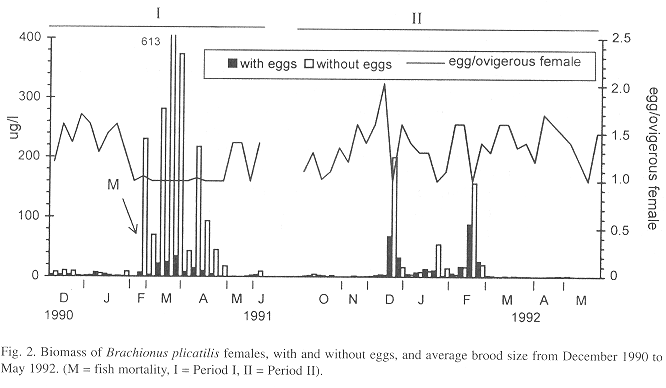
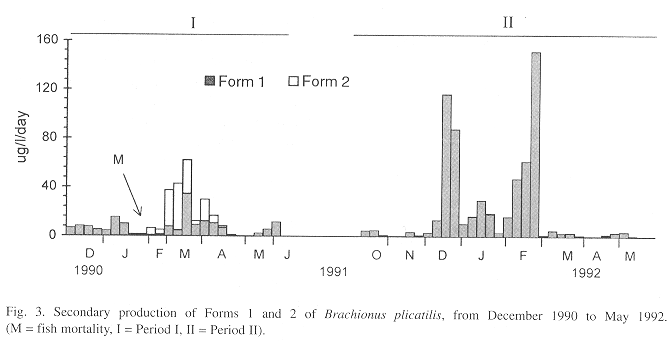
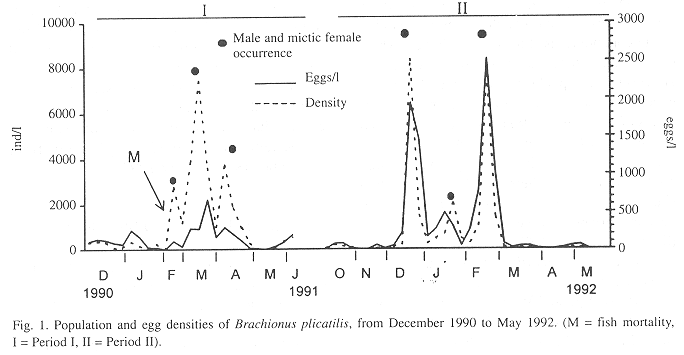
<body><![CDATA[<p><font face="Arial,Helvetica"><font size=-1>Densities and number of eggs of <i>B. plicatilis</i> were low during December 1990 (Period I) (<a href="#Fig1">Fig. 1</a>). In January 1991, the number of eggs increased, but high densities (2774 ind/l) occurred only after a fish mortality in February 9 to 13. In March, after a decrease to <i>ca</i>. 1000 ind/l, population density increased again, reaching 7440 ind/l. In April, a drop to 1000 ind/l was followed by a new population growth, resulting in densities of 3700 ind/l. At the end of this month, density decreased again to 280 ind/l. In this phase (February - April/91) a new larger form of <i>B. plicatilis</i>, Form 2, occurred (<a href="#Table1">Table 1</a>).</font></font>     <p><font face="Arial,Helvetica"><font size=-1>From February to April 1991, in comparison with the high densities (<a href="#Fig1">Fig. 1</a>) and biomass (<a href="#Fig2">Fig. 2</a>), secondary production of the two forms was relatively low (maximum of <i>ca</i>. 60 &micro;g/l/day) (<a href="#Fig3">Fig. 3</a>). Egg production was also low as indicated by the biomass values of egg-bearing females and brood size, which hardly exceeded 1 (<a href="#Fig2">Fig. 2</a>). In May, densities (<a href="#Fig1">Fig. 1</a>), biomass (<a href="#Fig2">Fig. 2</a>), and secondary production (<a href="#Fig3">Fig. 3</a>) were low.</font></font>     <p><font face="Arial,Helvetica"><font size=-1>Period II was also characterized by high <i>B. plicatilis</i> densities and biomass, in summer (December/91 - February/92) (<a href="#Fig1">Figs. 1</a> and <a href="#Fig2">2</a>). The high density of December (8375 ind/l) was followed by a sharp decrease to 208 ind/l. In January, population increased to 2036 ind/l and dropped again to ca. 200 ind/l. In February, a new peak of 7659 ind/l was recorded but, by the end of the month, density dropped to 108 ind/l. In Period II densities were higher than those of Period I, but biomass was lower, due to the absence of Form 2.</font></font>     <p><font face="Arial,Helvetica"><font size=-1>The number of eggs/l was higher in the second period than in the first one (<a href="#Fig1">Fig. 1</a>), resulting in a higher secondary production (<a href="#Fig3">Fig. 3</a>). The contribution of egg-bearing females and brood size were also higher in Period II than in Period I (<a href="#Fig2">Fig. 2</a>).</font></font>     <p><font face="Arial,Helvetica"><font size=-1>Statistically significant inverse Spearman rank correlation was found between number of eggs and Cyanophyceae densities during Period I (r = -0.52; n = 24; P = 0.01) and also between salinity and <i>B. plicatilis</i> density during Period II (r = -0.36; n = 32; P = 0.04). Other correlations between number of eggs and some factors, such as temperature, salinity, Chlorophyceae, Cyanophyceae, and between<i> B. plicatilis </i>density and Cyanophyceae, Chlorophyceae and temperature, were not statistically significant.</font></font>     <br><font face="Arial,Helvetica"><font size=-1>Males and mictic females were found in samples during peaks of population density, in both periods (<a href="#Fig1">Fig. 1</a>).</font></font>     <br>&nbsp;     <p><b><font face="Arial,Helvetica"><font size=-1>Discussion</font></font></b>     <p><font face="Arial,Helvetica"><font size=-1>Comparing Periods I and II, common features were the increase in density, biomass, and production of <i>Brachionus plicatilis</i> during summer, the occurrence of males and mictic females, and a brood size of one egg/female during the population peaks. Other features, such as number of eggs/l, ovigerous female: non-ovigerous female ratio, production and biomass values, and the duration of the summer peaks differed in both periods.</font></font>     <p><font face="Arial,Helvetica"><font size=-1>The average temperatures were relatively high during the whole study period (<a href="#Table2">Table 2</a>), reaching peaks of 30&deg;C during summer. This fact would favour the rotifer population growth in this season, as it is known that higher temperatures promote an increase in population growth, egg production rates, and fertility of <i>B. plicatilis</i> (<a href="#King">King and Miracle 1980</a>,<a href="#Snell86"> Snell 1986</a>, <a href="#Miracle89">Miracle and Serra 1989</a>, <a href="#Serra94">Serra <i>et al. </i>1994</a>,).</font></font>     ]]></body>
<body><![CDATA[<p><font face="Arial,Helvetica"><font size=-1>It is possible, however, that food might be the main factor promoting population and production increases in the lagoon. The mass mortality of fish, in February 1991 (Period I), was responsible for changes in abiotic and biotic factors (<a href="#Carmouze94a">Carmouze <i>et al. </i>1994a</a>, <a href="#Carmouze94b">b</a>; <a href="#Domingos">Domingos <i>et al. </i>1994</a>). In the phytoplankton, the dominant small Cyanophyceae (2.4 &micro;m) - <i>Synechocystis aquatilis</i> f. <i>salina</i> and <i>Synechococcuselongatus</i> - were initially replaced by Chlorophyceae, such as <i>Chlorella vulgaris</i> var. <i>autotrophica</i> and <i>C. minutissima</i> (5.5 &micro;m), and later also by Prasinophyceae, Bacillariophyceae, Cryptophyceae, and Dinophyceae. <i>Chlorella</i>, and part of the other algal groups possibly favoured the maintainance, for two months, of high densities, biomass, and production of <i>Brachionus plicatilis</i>, whose decrease coincided with the recovery of the same former Cyanophyceae, in April (<a href="#Domingos">Domingos <i>et al. </i>1994</a>).</font></font>     <p><font face="Arial,Helvetica"><font size=-1><i>Chlorella</i> has been more successfully used for rearing this rotifer than <i>Synechococcus </i>(<i>e.g.</i><a href="#Snell86">Snell 1986</a>, <a href="#James">James and Abu-Reseq 1988</a>, <a href="#Lubzens">Lubzens <i>et al. </i>1993</a>). Species of the latter, as well as Cyanophyceae in general, are considered a low-quality food, deficient in essential highly unsaturated fatty acids (<a href="#DeMott,">DeMott and M&uuml;ller-Navarra 1997</a>, <a href="#Gulati">Gulati and DeMott 1997</a>). The small size of <i>Synechococcus </i>and <i>Synechocystis </i>could also be inadequate, as preferences for particles in the range of 3 to 10 &micro;m were reported for <i>B</i>. <i>plicatilis</i> (<a href="#Spittler">Spittler and Cruz S. 1988</a>, <a href="#Andres">Andres 1996</a>).</font></font>     <p><font face="Arial,Helvetica"><font size=-1>Increases in density, biomass, and production in the summer of Period II are more difficult to explain based on phytoplankton composition, as it was dominated by the same small Cyanophyceae. But the duration of the peaks was shorter, suggesting suitable but ephemeral conditions, not related to phytoplankton. Possibly, other food resources were exploited.</font></font>     <p><font face="Arial,Helvetica"><font size=-1>The decrease of the average brood size to one egg/female, in both periods, coincided with population increases. In Period I, high total zooplankton densities, resulting in higher grazing pressure, seemed to be responsible for controlling phytoplankton growth, in spite of abiotic suitable conditions, including nutrients (<a href="#Arcifa">Arcifa <i>et al. </i>1994</a>). Even so, relatively high algal densities and biomass were reported - 2.0-3.8 x 10<sup>5</sup> ind.ml<sup>-1</sup> and 2-6 mgC.l<sup>-1</sup>, respectively (<a href="#Domingos">Domingos <i>et al. </i>1994</a>), making unlikely a limiting resource for the rotifer growth or a negative influence on its life table parameters. It is more plausible that a density-dependent control mechanism of the <i>B. plicatilis</i> population occurred, in this period, as well as in Period II.</font></font>     <p><font face="Arial,Helvetica"><font size=-1>It is probable that the appearance of males and mictic females, at the time of high rotifer densities, in both periods, has been caused by overcrowding, according to observations made in experiments (<a href="#Pourriot83">Pourriot and Snell 1983</a>, <a href="#Snell88">Snell and Boyer 1988</a>, <a href="#Lubzens">Lubzens <i>et al. </i>1993</a>), and in the field (<a href="#Walker73">Walker 1973</a>).</font></font>     <p><font face="Arial,Helvetica"><font size=-1>Taking into account both the relatively low number of eggs/l and of egg-bearing females, from February to April 1991, in Period I, it is reasonable to suppose that the contribution of resting eggs hatching of both rotifer forms was fundamental for the high population densities attained at that time. Resting eggs, mixed with mollusc fecal pellets, were found two months before the start of the rotifer increase. The hatching of resting eggs is related to organic matter photolysis by UVB rays, producing OH and resulting in biochemical influences on the eggs (<a href="#Mopper90">Mopper and Zhou 1990</a>, <a href="#Hagiwara">Hagiwara <i>et al. </i>1995</a>). Before fish mortality, dissolved organic carbon increased in the lagoon (<a href="#Carmouze94b">Carmouze <i>et al. </i>1994b</a>), probably favouring the hatching of eggs. According to results of <a href="#Minkoff">Minkoff <i>et al. </i>(1983)</a> and <a href="#Snell89">Snell and Persoone (1989)</a>, light, temperature, and food conditions were also favourable to the hatching. In Period II, on the contrary, both the number of eggs/l and the ovigerous female<b>: </b>non-ovigerous female ratio were high. Therefore, it seems that the significant contribution of resting eggs hatching, in Period I, and the parthenogenetic reproduction, in Period II, would account for the population increases in the lagoon.</font></font>     <p><font face="Arial,Helvetica"><font size=-1>Form 2 was responsible for higher biomass values in Period I, in comparison to Period II. A higher production, in the second period, resulted from a larger number of eggs produced by more reproductive females.</font></font>     <p><font face="Arial,Helvetica"><font size=-1>Although there was a significant negative correlation between <i>B. plicatilis</i> density and salinity, in Period II, it is hard to explain its influence, considering that this rotifer species is euryhaline, surviving in salinities ranging from 1 to 97 ‰ (<a href="#Walker81">Walker 1981</a>).</font></font>     <br>&nbsp;     <p><b><font face="Arial,Helvetica"><font size=-1>Acknowledgements</font></font></b>     ]]></body>
<body><![CDATA[<p><font face="Arial,Helvetica"><font size=-1>We thank J.-P. Carmouze, V.L.M. Huszar, P. Domingos, and M. Bernardes for supplying physical, chemical and biological data. We thank them and the students of the Aquatic Biochemistry Laboratory - Dept. of Geochemistry-UFF, responsible for samplings in Barra Lagoon. We also thank Walter Koste for the rotifer identification, FAPESP (Funda&ccedil;&atilde;o de Amparo &agrave; Pesquisa do Estado de S&atilde;o Paulo) for a research grant to M.S. Arcifa (n&ordm; 91/3873-4), and FAPESP and CAPES (Coordena&ccedil;&atilde;o de Aperfei&ccedil;oamento de Pessoal de N&iacute;vel Superior) for grants to the senior author (M.S.M.Castilho). Finally, we thank the comments of three anonymous referees.</font></font>     <br>&nbsp;     <p><b><font face="Arial,Helvetica"><font size=-1>References</font></font></b>     <!-- ref --><p><a NAME="Arcifa"></a><font face="Arial,Helvetica"><font size=-1>Arcifa, M.S., M.S.M. Castilho &amp; J.-P. Carmouze. 1994. Composition et &eacute;volution du zooplancton dans une lagune tropicale (Br&eacute;sil) au cours d&acute;une p&eacute;riode marqu&eacute;e par une mortalit&eacute; de poissons. Rev. Hydrobiol. trop. 27: 251-263.</font></font>    &nbsp;&nbsp;&nbsp;&nbsp;&nbsp;&nbsp;&nbsp;&nbsp;[&#160;<a href="javascript:void(0);" onclick="javascript: window.open('/scielo.php?script=sci_nlinks&ref=1338977&pid=S0034-7744200000040001000001&lng=','','width=640,height=500,resizable=yes,scrollbars=1,menubar=yes,');">Links</a>&#160;]<!-- end-ref --><!-- ref --><p><a NAME="Andres"></a><font face="Arial,Helvetica"><font size=-1>Andres, N.N. 1996. Cultivo del rot&iacute;fero <i>Brachionus plicatilis</i> O.F. M&uuml;ller alimentado con microalgas liofilizadas. Din&aacute;mica de la poblaci&oacute;n y calidad nutritiva como alimento larvario de peces marinos. Ph.D. Thesis, Universidad de Cadiz, Cadiz, Spain. 257 p.</font></font>    &nbsp;&nbsp;&nbsp;&nbsp;&nbsp;&nbsp;&nbsp;&nbsp;[&#160;<a href="javascript:void(0);" onclick="javascript: window.open('/scielo.php?script=sci_nlinks&ref=1338978&pid=S0034-7744200000040001000002&lng=','','width=640,height=500,resizable=yes,scrollbars=1,menubar=yes,');">Links</a>&#160;]<!-- end-ref --><!-- ref --><p><a NAME="Bernardes"></a><font face="Arial,Helvetica"><font size=-1>Bernardes, M.C. 1995. As atividades biol&oacute;gicas relacionadas com o C, N e P das diferantes fra&ccedil;&otilde;es da mat&eacute;ria org&acirc;nica durante um ciclo anual na Lagoa da Barra, Maric&aacute;, RJ, Brasil. Ms. Thesis, Universidade Federal Fluminense, Niter&oacute;i. Brazil. 138 p.</font></font>    &nbsp;&nbsp;&nbsp;&nbsp;&nbsp;&nbsp;&nbsp;&nbsp;[&#160;<a href="javascript:void(0);" onclick="javascript: window.open('/scielo.php?script=sci_nlinks&ref=1338979&pid=S0034-7744200000040001000003&lng=','','width=640,height=500,resizable=yes,scrollbars=1,menubar=yes,');">Links</a>&#160;]<!-- end-ref --><!-- ref --><p><a NAME="Carmona"></a><font face="Arial,Helvetica"><font size=-1>Carmona, M.J., A. Gomez &amp; M. Serra. 1995. Mictic patterns of the rotifer <i>Brachionus plicatilis</i> M&uuml;ller in small ponds. Hydrobiologia 313/314: 365-371.</font></font>    &nbsp;&nbsp;&nbsp;&nbsp;&nbsp;&nbsp;&nbsp;&nbsp;[&#160;<a href="javascript:void(0);" onclick="javascript: window.open('/scielo.php?script=sci_nlinks&ref=1338980&pid=S0034-7744200000040001000004&lng=','','width=640,height=500,resizable=yes,scrollbars=1,menubar=yes,');">Links</a>&#160;]<!-- end-ref --><!-- ref --><p><a NAME="Carmouze94a"></a><font face="Arial,Helvetica"><font size=-1>Carmouze, J.-P., B. Farias &amp; P. Domingos. 1994<i>a</i>. &Eacute;volution du m&eacute;tabolisme d’une lagune tropicale (Br&eacute;sil) au cours d’une p&eacute;riode marqu&eacute;e par une mortalit&eacute; de poissons. Rev. Hydrobiol. trop. 27: 199-215.</font></font>    &nbsp;&nbsp;&nbsp;&nbsp;&nbsp;&nbsp;&nbsp;&nbsp;[&#160;<a href="javascript:void(0);" onclick="javascript: window.open('/scielo.php?script=sci_nlinks&ref=1338981&pid=S0034-7744200000040001000005&lng=','','width=640,height=500,resizable=yes,scrollbars=1,menubar=yes,');">Links</a>&#160;]<!-- end-ref --><!-- ref --><p><a NAME="Carmouze94b"></a><font face="Arial,Helvetica"><font size=-1>Carmouze, J.-P., C. d’&Eacute;lia Sampaio &amp; P. Domingos. 1994<i>b</i>. &Eacute;volution des stocks de mati&egrave;re organique et de nutriments dans une lagune tropicale (Br&eacute;sil) au cours d’une p&eacute;riode marqu&eacute;e par une mortalit&eacute; de poissons. Rev. Hydrobiol. trop. 27: 217-234.</font></font>    &nbsp;&nbsp;&nbsp;&nbsp;&nbsp;&nbsp;&nbsp;&nbsp;[&#160;<a href="javascript:void(0);" onclick="javascript: window.open('/scielo.php?script=sci_nlinks&ref=1338982&pid=S0034-7744200000040001000006&lng=','','width=640,height=500,resizable=yes,scrollbars=1,menubar=yes,');">Links</a>&#160;]<!-- end-ref --><!-- ref --><p><a NAME="DeMott,"></a><font face="Arial,Helvetica"><font size=-1>DeMott, W.R. &amp; D.C. M&uuml;ller-Navarra. 1997. The importance of highly unsaturated fatty acids in zooplankton nutrition: evidence from experiments with <i>Daphnia</i>, a cyanobacterium and lipid emulsions. Freshwat. Biol. 38: 649-664.</font></font>    &nbsp;&nbsp;&nbsp;&nbsp;&nbsp;&nbsp;&nbsp;&nbsp;[&#160;<a href="javascript:void(0);" onclick="javascript: window.open('/scielo.php?script=sci_nlinks&ref=1338983&pid=S0034-7744200000040001000007&lng=','','width=640,height=500,resizable=yes,scrollbars=1,menubar=yes,');">Links</a>&#160;]<!-- end-ref --><!-- ref --><p><a NAME="Domingos"></a><font face="Arial,Helvetica"><font size=-1>Domingos, P., V.L.M. Huszar &amp; J.-P. Carmouze 1994. Composition et biomasse du phytoplancton d’une lagune tropicale (Br&eacute;sil) au cours d’une p&eacute;riode marqu&eacute;e par une mortalit&eacute; de poissons. Rev. Hydrobiol. trop. 27: 235-250.</font></font>    &nbsp;&nbsp;&nbsp;&nbsp;&nbsp;&nbsp;&nbsp;&nbsp;[&#160;<a href="javascript:void(0);" onclick="javascript: window.open('/scielo.php?script=sci_nlinks&ref=1338984&pid=S0034-7744200000040001000008&lng=','','width=640,height=500,resizable=yes,scrollbars=1,menubar=yes,');">Links</a>&#160;]<!-- end-ref --><!-- ref --><p><a NAME="Doohan"></a><font face="Arial,Helvetica"><font size=-1>Doohan, M. 1973. An energy budget for adult <i>Brachionus plicatilis</i> Muller (Rotatoria). Oecologia (Berl.) 13 : 351-362.</font></font>    &nbsp;&nbsp;&nbsp;&nbsp;&nbsp;&nbsp;&nbsp;&nbsp;[&#160;<a href="javascript:void(0);" onclick="javascript: window.open('/scielo.php?script=sci_nlinks&ref=1338985&pid=S0034-7744200000040001000009&lng=','','width=640,height=500,resizable=yes,scrollbars=1,menubar=yes,');">Links</a>&#160;]<!-- end-ref --><!-- ref --><p><a NAME="Epp77"></a><font face="Arial,Helvetica"><font size=-1>Epp, R. &amp; P.W. Winston. 1977. Osmotic regulation in the brackish water rotifer <i>Brachionus plicatilis</i> (Muller). J. Exp. Biol. 68: 151-156.</font></font>    &nbsp;&nbsp;&nbsp;&nbsp;&nbsp;&nbsp;&nbsp;&nbsp;[&#160;<a href="javascript:void(0);" onclick="javascript: window.open('/scielo.php?script=sci_nlinks&ref=1338986&pid=S0034-7744200000040001000010&lng=','','width=640,height=500,resizable=yes,scrollbars=1,menubar=yes,');">Links</a>&#160;]<!-- end-ref --><!-- ref --><p><a NAME="Epp78"></a><font face="Arial,Helvetica"><font size=-1>Epp, R. &amp; P.W. Winston. 1978. The effect of salinity and pH on the activity and oxygen consumption of <i>Brachionus</i> <i>plicatilis</i> (Rotatoria). Comp. Biochem. Physiol. 59A: 9-12.</font></font>    &nbsp;&nbsp;&nbsp;&nbsp;&nbsp;&nbsp;&nbsp;&nbsp;[&#160;<a href="javascript:void(0);" onclick="javascript: window.open('/scielo.php?script=sci_nlinks&ref=1338987&pid=S0034-7744200000040001000011&lng=','','width=640,height=500,resizable=yes,scrollbars=1,menubar=yes,');">Links</a>&#160;]<!-- end-ref --><!-- ref --><p><a NAME="Gulati"></a><font face="Arial,Helvetica"><font size=-1>Gulati, R.D. &amp; W.R. DeMott. 1997. The role of food quality for zooplankton: remarks on the state-of-the-art, perspectives and priorities. Freshwat. Biol. 38: 753-768.</font></font>    &nbsp;&nbsp;&nbsp;&nbsp;&nbsp;&nbsp;&nbsp;&nbsp;[&#160;<a href="javascript:void(0);" onclick="javascript: window.open('/scielo.php?script=sci_nlinks&ref=1338988&pid=S0034-7744200000040001000012&lng=','','width=640,height=500,resizable=yes,scrollbars=1,menubar=yes,');">Links</a>&#160;]<!-- end-ref --><!-- ref --><p><a NAME="Hagiwara"></a><font face="Arial,Helvetica"><font size=-1>Hagiwara, A., N. Hoshi, F. Kawahara, K. Tominaga &amp; K. Hirayama. 1995. Resting eggs of the marine rotifer <i>Brachionus</i> <i>plicatilis</i> M&uuml;ller: development, and effect of irradiation on hatching. Hydrobiologia 313/314: 223-229.</font></font>    &nbsp;&nbsp;&nbsp;&nbsp;&nbsp;&nbsp;&nbsp;&nbsp;[&#160;<a href="javascript:void(0);" onclick="javascript: window.open('/scielo.php?script=sci_nlinks&ref=1338989&pid=S0034-7744200000040001000013&lng=','','width=640,height=500,resizable=yes,scrollbars=1,menubar=yes,');">Links</a>&#160;]<!-- end-ref --><!-- ref --><p><a NAME="James"></a><font face="Arial,Helvetica"><font size=-1>James, C.M. &amp; T.S. Abu-Rezeq. 1988. Effects of different cell densities of <i>Chlorella capsulata </i>and a marine <i>Chlorella </i>sp for feeding the rotifer <i>Brachionus plicatilis</i>. Aquaculture 69: 43-56.</font></font>    &nbsp;&nbsp;&nbsp;&nbsp;&nbsp;&nbsp;&nbsp;&nbsp;[&#160;<a href="javascript:void(0);" onclick="javascript: window.open('/scielo.php?script=sci_nlinks&ref=1338990&pid=S0034-7744200000040001000014&lng=','','width=640,height=500,resizable=yes,scrollbars=1,menubar=yes,');">Links</a>&#160;]<!-- end-ref --><!-- ref --><p><a NAME="King"></a><font face="Arial,Helvetica"><font size=-1>King, C.E. &amp; M.R.Miracle. 1980. A perspective on aging on rotifers. Hydrobiologia 73: 13-19.</font></font>    &nbsp;&nbsp;&nbsp;&nbsp;&nbsp;&nbsp;&nbsp;&nbsp;[&#160;<a href="javascript:void(0);" onclick="javascript: window.open('/scielo.php?script=sci_nlinks&ref=1338991&pid=S0034-7744200000040001000015&lng=','','width=640,height=500,resizable=yes,scrollbars=1,menubar=yes,');">Links</a>&#160;]<!-- end-ref --><!-- ref --><p><a NAME="Lubzens"></a><font face="Arial,Helvetica"><font size=-1>Lubzens, E., Y. Wax, G. Minko &amp; F. Adler. 1993. A model evaluating the contribution of environmental factors to the production of resting eggs in the rotifer <i>Brachionus plicatilis</i>. Hydrobiologia 255/256: 127-138.</font></font>    &nbsp;&nbsp;&nbsp;&nbsp;&nbsp;&nbsp;&nbsp;&nbsp;[&#160;<a href="javascript:void(0);" onclick="javascript: window.open('/scielo.php?script=sci_nlinks&ref=1338992&pid=S0034-7744200000040001000016&lng=','','width=640,height=500,resizable=yes,scrollbars=1,menubar=yes,');">Links</a>&#160;]<!-- end-ref --><!-- ref --><p><a NAME="McCauley"></a><font face="Arial,Helvetica"><font size=-1>McCauley, E. 1984. The estimation of the abundance and biomass of zooplankton in samples, p.228-265. <i>In</i> J.A. Downing &amp; F.H. Rigler (eds.). A manual on methods for the assessment of secondary productivity in fresh water. Blackwell Scientific, London.</font></font>    &nbsp;&nbsp;&nbsp;&nbsp;&nbsp;&nbsp;&nbsp;&nbsp;[&#160;<a href="javascript:void(0);" onclick="javascript: window.open('/scielo.php?script=sci_nlinks&ref=1338993&pid=S0034-7744200000040001000017&lng=','','width=640,height=500,resizable=yes,scrollbars=1,menubar=yes,');">Links</a>&#160;]<!-- end-ref --><!-- ref --><p><a NAME="Minkoff"></a><font face="Arial,Helvetica"><font size=-1>Minkoff, G., E. Lubzens &amp; D. Kahan. 1983. Environmental factors affecting hatching of rotifers (<i>Brachionus plicatilis</i>) resting eggs. Hydrobiologia 104: 61-69.</font></font>    &nbsp;&nbsp;&nbsp;&nbsp;&nbsp;&nbsp;&nbsp;&nbsp;[&#160;<a href="javascript:void(0);" onclick="javascript: window.open('/scielo.php?script=sci_nlinks&ref=1338994&pid=S0034-7744200000040001000018&lng=','','width=640,height=500,resizable=yes,scrollbars=1,menubar=yes,');">Links</a>&#160;]<!-- end-ref --><!-- ref --><p><a NAME="Miracle89"></a><font face="Arial,Helvetica"><font size=-1>Miracle, M.R. &amp; M. Serra. 1989. Salinity and temperature influence in rotifer life history characteristics. Hydrobiologia 186/187: 81-102.</font></font>    &nbsp;&nbsp;&nbsp;&nbsp;&nbsp;&nbsp;&nbsp;&nbsp;[&#160;<a href="javascript:void(0);" onclick="javascript: window.open('/scielo.php?script=sci_nlinks&ref=1338995&pid=S0034-7744200000040001000019&lng=','','width=640,height=500,resizable=yes,scrollbars=1,menubar=yes,');">Links</a>&#160;]<!-- end-ref --><!-- ref --><p><a NAME="Mopper90"></a><font face="Arial,Helvetica"><font size=-1>Mopper, K &amp; X. Zhou. 1990. Hydroxyl radical photoproduction in the sea and its potential impact on marine processes. Science 250: 661-664.</font></font>    &nbsp;&nbsp;&nbsp;&nbsp;&nbsp;&nbsp;&nbsp;&nbsp;[&#160;<a href="javascript:void(0);" onclick="javascript: window.open('/scielo.php?script=sci_nlinks&ref=1338996&pid=S0034-7744200000040001000020&lng=','','width=640,height=500,resizable=yes,scrollbars=1,menubar=yes,');">Links</a>&#160;]<!-- end-ref --><!-- ref --><p><a NAME="Pourriot83"></a><font face="Arial,Helvetica"><font size=-1>Pourriot, R. &amp; T.W. Snell. 1983. Resting eggs in rotifers. Hydrobiologia 104: 213-224.</font></font>    &nbsp;&nbsp;&nbsp;&nbsp;&nbsp;&nbsp;&nbsp;&nbsp;[&#160;<a href="javascript:void(0);" onclick="javascript: window.open('/scielo.php?script=sci_nlinks&ref=1338997&pid=S0034-7744200000040001000021&lng=','','width=640,height=500,resizable=yes,scrollbars=1,menubar=yes,');">Links</a>&#160;]<!-- end-ref --><!-- ref --><p><a NAME="Rigler84"></a><font face="Arial,Helvetica"><font size=-1>Rigler, F.H. &amp; J.A. Downing. 1984. The calculation of the secondary productivity, p.19-58. <i>In</i>: J.A. Downing &amp; F.H. Rigler (eds.). A manual on methods for the assessment of secondary productivity in fresh water. Blackwell Scientific, London.</font></font>    &nbsp;&nbsp;&nbsp;&nbsp;&nbsp;&nbsp;&nbsp;&nbsp;[&#160;<a href="javascript:void(0);" onclick="javascript: window.open('/scielo.php?script=sci_nlinks&ref=1338998&pid=S0034-7744200000040001000022&lng=','','width=640,height=500,resizable=yes,scrollbars=1,menubar=yes,');">Links</a>&#160;]<!-- end-ref --><!-- ref --><p><a NAME="Serra94"></a><font face="Arial,Helvetica"><font size=-1>Serra, M., M.J. Carmona &amp; M.R. Miracle. 1994. Survival analysis of three clones of <i>Brachionus</i> <i>plicatilis</i> (Rotifera). Hydrobiologia 277: 97-105.</font></font>    &nbsp;&nbsp;&nbsp;&nbsp;&nbsp;&nbsp;&nbsp;&nbsp;[&#160;<a href="javascript:void(0);" onclick="javascript: window.open('/scielo.php?script=sci_nlinks&ref=1338999&pid=S0034-7744200000040001000023&lng=','','width=640,height=500,resizable=yes,scrollbars=1,menubar=yes,');">Links</a>&#160;]<!-- end-ref --><!-- ref --><p><a NAME="Serra87"></a><font face="Arial,Helvetica"><font size=-1>Serra, M. &amp; M.R. Miracle. 1987. Biometric variation in three strains of <i>Brachionus plicatilis</i> as a direct response to abiotic variables. Hydrobiologia 147: 83-89.</font></font>    &nbsp;&nbsp;&nbsp;&nbsp;&nbsp;&nbsp;&nbsp;&nbsp;[&#160;<a href="javascript:void(0);" onclick="javascript: window.open('/scielo.php?script=sci_nlinks&ref=1339000&pid=S0034-7744200000040001000024&lng=','','width=640,height=500,resizable=yes,scrollbars=1,menubar=yes,');">Links</a>&#160;]<!-- end-ref --><!-- ref --><p><a NAME="Snell86"></a><font face="Arial,Helvetica"><font size=-1>Snell, T.W. 1986. Effect of temperature, salinity and food level on sexual and asexual reproduction in <i>Brachionus</i> <i>plicatilis</i> (Rotifera). Mar. Biol. 92: 157-162.</font></font>    &nbsp;&nbsp;&nbsp;&nbsp;&nbsp;&nbsp;&nbsp;&nbsp;[&#160;<a href="javascript:void(0);" onclick="javascript: window.open('/scielo.php?script=sci_nlinks&ref=1339001&pid=S0034-7744200000040001000025&lng=','','width=640,height=500,resizable=yes,scrollbars=1,menubar=yes,');">Links</a>&#160;]<!-- end-ref --><!-- ref --><p><a NAME="Snell88"></a><font face="Arial,Helvetica"><font size=-1>Snell, T.W. &amp; E.M. Boyer. 1988. Thresholds for mictic female production in the rotifer <i>Brachionus plicatilis</i> (Muller). J. Exp. Mar. Biol. Ecol. 124: 73-85.</font></font>    &nbsp;&nbsp;&nbsp;&nbsp;&nbsp;&nbsp;&nbsp;&nbsp;[&#160;<a href="javascript:void(0);" onclick="javascript: window.open('/scielo.php?script=sci_nlinks&ref=1339002&pid=S0034-7744200000040001000026&lng=','','width=640,height=500,resizable=yes,scrollbars=1,menubar=yes,');">Links</a>&#160;]<!-- end-ref --><!-- ref --><p><a NAME="Snell89"></a><font face="Arial,Helvetica"><font size=-1>Snell, T.W. &amp; G. Persoone. 1989. Acute toxicity bioassays using Rotifers. I. A test for brackish and marine environments with <i>Brachionus</i> <i>plicatilis</i>. Aquat. Toxicol. 14: 65-80.</font></font>    &nbsp;&nbsp;&nbsp;&nbsp;&nbsp;&nbsp;&nbsp;&nbsp;[&#160;<a href="javascript:void(0);" onclick="javascript: window.open('/scielo.php?script=sci_nlinks&ref=1339003&pid=S0034-7744200000040001000027&lng=','','width=640,height=500,resizable=yes,scrollbars=1,menubar=yes,');">Links</a>&#160;]<!-- end-ref --><!-- ref --><p><a NAME="Spittler"></a><font face="Arial,Helvetica"><font size=-1>Spittler, P. &amp; Cruz. 1988. La selecci&oacute;n del tama&ntilde;o de las part&iacute;culas alimenticias por <i>Brachionus plicatilis</i> (Rotifera). Rev. Investig. Mar. 9: 91-96.</font></font>    &nbsp;&nbsp;&nbsp;&nbsp;&nbsp;&nbsp;&nbsp;&nbsp;[&#160;<a href="javascript:void(0);" onclick="javascript: window.open('/scielo.php?script=sci_nlinks&ref=1339004&pid=S0034-7744200000040001000028&lng=','','width=640,height=500,resizable=yes,scrollbars=1,menubar=yes,');">Links</a>&#160;]<!-- end-ref --><!-- ref --><p><a NAME="Vadstein"></a><font face="Arial,Helvetica"><font size=-1>Vadstein, O., G. Oie &amp; Y. Olsen. 1993. Particle size dependent feeding by the rotifer <i>Brachionus plicatilis. </i>Hydrobiologia 255/256: 261-267.</font></font>    &nbsp;&nbsp;&nbsp;&nbsp;&nbsp;&nbsp;&nbsp;&nbsp;[&#160;<a href="javascript:void(0);" onclick="javascript: window.open('/scielo.php?script=sci_nlinks&ref=1339005&pid=S0034-7744200000040001000029&lng=','','width=640,height=500,resizable=yes,scrollbars=1,menubar=yes,');">Links</a>&#160;]<!-- end-ref --><!-- ref --><p><a NAME="Walker73"></a><font face="Arial,Helvetica"><font size=-1>Walker, K.F. 1973. Studies on a saline lake ecosystem. Aust. J. Mar. Freshwat. Res. 24: 21-71.</font></font>    &nbsp;&nbsp;&nbsp;&nbsp;&nbsp;&nbsp;&nbsp;&nbsp;[&#160;<a href="javascript:void(0);" onclick="javascript: window.open('/scielo.php?script=sci_nlinks&ref=1339006&pid=S0034-7744200000040001000030&lng=','','width=640,height=500,resizable=yes,scrollbars=1,menubar=yes,');">Links</a>&#160;]<!-- end-ref --><!-- ref --><p><a NAME="Walker81"></a><font face="Arial,Helvetica"><font size=-1>Walker, K.F. 1981. A synopsis of ecological information on the saline lake rotifer <i>Brachionus plicatilis</i> M&uuml;ller 1786. Hydrobiologia 81: 159-167.</font></font>    &nbsp;&nbsp;&nbsp;&nbsp;&nbsp;&nbsp;&nbsp;&nbsp;[&#160;<a href="javascript:void(0);" onclick="javascript: window.open('/scielo.php?script=sci_nlinks&ref=1339007&pid=S0034-7744200000040001000031&lng=','','width=640,height=500,resizable=yes,scrollbars=1,menubar=yes,');">Links</a>&#160;]<!-- end-ref --><!-- ref --><p><a NAME="Yúfera"></a><font face="Arial,Helvetica"><font size=-1>Y&uacute;fera, M. &amp; N. Navarro. 1995. Population growth dynamics of the rotifer <i>Brachionusplicatilis</i> cultured in non-limiting food condition. Hydrobiologia 313/314: 399-405.</font></font>    &nbsp;&nbsp;&nbsp;&nbsp;&nbsp;&nbsp;&nbsp;&nbsp;[&#160;<a href="javascript:void(0);" onclick="javascript: window.open('/scielo.php?script=sci_nlinks&ref=1339008&pid=S0034-7744200000040001000032&lng=','','width=640,height=500,resizable=yes,scrollbars=1,menubar=yes,');">Links</a>&#160;]<!-- end-ref --><br>&nbsp;     <br>&nbsp;     <br>     <br>     <center>     ]]></body>
<body><![CDATA[<p><a NAME="Table1"></a><font face="Arial,Helvetica"><font size=-1>Table 1</font></font>     <br><font face="Arial,Helvetica"><font size=-1>Occurrence and average length and biomass of the two Brachionus</font></font>     <br><font face="Arial,Helvetica"><font size=-1>plicatilis forms from December 1990 to May 1992.</font></font></center>      <p>    <br>     <center><table BORDER=0 CELLSPACING=0 CELLPADDING=0 WIDTH="611" > <tr> <td VALIGN=TOP><font face="Arial,Helvetica"><font size=-1>&nbsp;</font></font></td>  <td VALIGN=TOP>     <center><font face="Arial,Helvetica"><font size=-1>I</font></font></center> </td>  <td>     <center><font face="Arial,Helvetica"><font size=-1>II</font></font></center> </td>  <td VALIGN=TOP><font face="Arial,Helvetica"><font size=-1>Length &plusmn; s (&micro;m) N=20</font></font></td>  <td VALIGN=TOP><font face="Arial,Helvetica"><font size=-1>Biomass &plusmn; s (&micro;g) (dry weight) N=20</font></font></td> </tr>  <tr> <td VALIGN=TOP><font face="Arial,Helvetica"><font size=-1>Rotifera <i>B. plicatilis</i></font></font></td>  <td VALIGN=TOP>&nbsp;</td>  <td></td>  <td VALIGN=TOP WIDTH="24%">&nbsp;</td>  <td VALIGN=TOP WIDTH="33%">&nbsp;</td> </tr>  <tr> <td><font face="Arial,Helvetica"><font size=-1>Form 1</font></font></td>  <td>     <center><font face="Arial,Helvetica"><font size=-1>+&nbsp;</font></font></center> </td>  <td>     <center><font face="Arial,Helvetica"><font size=-1>+&nbsp;</font></font></center> </td>  <td><font face="Arial,Helvetica"><font size=-1>116.72 &plusmn; 10.32</font></font></td>  <td><font face="Arial,Helvetica"><font size=-1>0.035 &plusmn; 0.009&nbsp;</font></font></td> </tr>  <tr> <td><font face="Arial,Helvetica"><font size=-1>Form 2</font></font></td>  <td>     ]]></body>
<body><![CDATA[<center><font face="Arial,Helvetica"><font size=-1>+</font></font></center> </td>  <td>     <center><font face="Arial,Helvetica"><font size=-1>-</font></font></center> </td>  <td><font face="Arial,Helvetica"><font size=-1>171.99 &plusmn; 12.05</font></font></td>  <td><font face="Arial,Helvetica"><font size=-1>0.113 &plusmn; 0.040</font></font></td> </tr> </table></center> <font face="Arial,Helvetica"><font size=-1>I = Period I, II = Period II; + = present, - = absent</font></font>     <center>     <p><a NAME="Table2"></a><font face="Arial,Helvetica"><font size=-1>Table 2</font></font>     <br><font face="Arial,Helvetica"><font size=-1>Month average values of salinity, temperature,</font></font>     <br><font face="Arial,Helvetica"><font size=-1>and phytoplankton density in Periods I and II.</font></font></center>      <p>    <br>     <center><table BORDER=0 CELLSPACING=0 WIDTH="303" > <tr> <td VALIGN=TOP WIDTH="14%" HEIGHT="12"></td>  <td VALIGN=TOP WIDTH="17%" HEIGHT="12">     <center><font face="Arial,Helvetica"><font size=-1>Salinity</font></font></center> </td>  <td VALIGN=TOP WIDTH="28%" HEIGHT="12">     ]]></body>
<body><![CDATA[<center><font face="Arial,Helvetica"><font size=-1>Temperature</font></font></center> </td>  <td VALIGN=TOP COLSPAN="2" WIDTH="33%" HEIGHT="12">     <center><font face="Arial,Helvetica"><font size=-1>Phytoplankton</font></font></center> </td> </tr>  <tr> <td VALIGN=TOP WIDTH="14%" HEIGHT="13"></td>  <td VALIGN=TOP WIDTH="17%" HEIGHT="13">     <center><font face="Arial,Helvetica"><font size=-1>(‰)</font></font></center> </td>  <td VALIGN=TOP WIDTH="28%" HEIGHT="13">     <center><font face="Arial,Helvetica"><font size=-1>(&ordm;C)</font></font></center> </td>  <td VALIGN=TOP COLSPAN="2" WIDTH="33%" HEIGHT="13">     <center><font face="Arial,Helvetica"><font size=-1>(ind x 10<sup>6</sup>/ml)</font></font></center> </td> </tr>  <tr> <td><font face="Arial,Helvetica"><font size=-1>P I</font></font></td>  <td></td>  <td></td>  <td></td> </tr>  <tr> <td VALIGN=TOP WIDTH="14%" HEIGHT="12"><font face="Arial,Helvetica"><font size=-1>Dec/90</font></font></td>  <td VALIGN=TOP WIDTH="17%" HEIGHT="12">     <center><font face="Arial,Helvetica"><font size=-1>4.3</font></font></center> </td>  <td VALIGN=TOP WIDTH="28%" HEIGHT="12">     <center><font face="Arial,Helvetica"><font size=-1>29.8</font></font></center> </td>  <td VALIGN=TOP COLSPAN="2" WIDTH="33%" HEIGHT="12">     <center><font face="Arial,Helvetica"><font size=-1>0.52</font></font></center> </td> </tr>  <tr> <td VALIGN=TOP WIDTH="14%" HEIGHT="12"><font face="Arial,Helvetica"><font size=-1>Jan/91</font></font></td>  <td VALIGN=TOP WIDTH="17%" HEIGHT="12">     <center><font face="Arial,Helvetica"><font size=-1>4.6</font></font></center> </td>  <td VALIGN=TOP WIDTH="28%" HEIGHT="12">     <center><font face="Arial,Helvetica"><font size=-1>27.3</font></font></center> </td>  <td VALIGN=TOP COLSPAN="2" WIDTH="33%" HEIGHT="12">     ]]></body>
<body><![CDATA[<center><font face="Arial,Helvetica"><font size=-1>1.15</font></font></center> </td> </tr>  <tr> <td VALIGN=TOP WIDTH="14%" HEIGHT="12"><font face="Arial,Helvetica"><font size=-1>Feb</font></font></td>  <td VALIGN=TOP WIDTH="17%" HEIGHT="12">     <center><font face="Arial,Helvetica"><font size=-1>5.0</font></font></center> </td>  <td VALIGN=TOP WIDTH="28%" HEIGHT="12">     <center><font face="Arial,Helvetica"><font size=-1>28.6</font></font></center> </td>  <td VALIGN=TOP COLSPAN="2" WIDTH="33%" HEIGHT="12">     <center><font face="Arial,Helvetica"><font size=-1>0.16</font></font></center> </td> </tr>  <tr> <td VALIGN=TOP WIDTH="14%" HEIGHT="12"><font face="Arial,Helvetica"><font size=-1>Mar</font></font></td>  <td VALIGN=TOP WIDTH="17%" HEIGHT="12">     <center><font face="Arial,Helvetica"><font size=-1>6.3</font></font></center> </td>  <td VALIGN=TOP WIDTH="28%" HEIGHT="12">     <center><font face="Arial,Helvetica"><font size=-1>28.2</font></font></center> </td>  <td VALIGN=TOP COLSPAN="2" WIDTH="33%" HEIGHT="12">     <center><font face="Arial,Helvetica"><font size=-1>0.36</font></font></center> </td> </tr>  <tr> <td VALIGN=TOP WIDTH="14%" HEIGHT="12"><font face="Arial,Helvetica"><font size=-1>Apr</font></font></td>  <td VALIGN=TOP WIDTH="17%" HEIGHT="12">     <center><font face="Arial,Helvetica"><font size=-1>3.2</font></font></center> </td>  <td VALIGN=TOP COLSPAN="2" WIDTH="28%" HEIGHT="12">     <center><font face="Arial,Helvetica"><font size=-1>26.4</font></font></center> </td>  <td VALIGN=TOP WIDTH="33%" HEIGHT="12">     <center><font face="Arial,Helvetica"><font size=-1>0.44</font></font></center> </td> </tr>  <tr> <td VALIGN=TOP WIDTH="14%" HEIGHT="12"><font face="Arial,Helvetica"><font size=-1>May</font></font></td>  <td VALIGN=TOP WIDTH="17%" HEIGHT="12">     ]]></body>
<body><![CDATA[<center><font face="Arial,Helvetica"><font size=-1>-</font></font></center> </td>  <td VALIGN=TOP COLSPAN="2" WIDTH="28%" HEIGHT="12">     <center><font face="Arial,Helvetica"><font size=-1>-</font></font></center> </td>  <td VALIGN=TOP WIDTH="33%" HEIGHT="12">     <center><font face="Arial,Helvetica"><font size=-1>0.88</font></font></center> </td> </tr>  <tr> <td VALIGN=TOP WIDTH="14%" HEIGHT="12"></td>  <td VALIGN=TOP WIDTH="17%" HEIGHT="12"></td>  <td VALIGN=TOP WIDTH="28%" HEIGHT="12"></td>  <td VALIGN=TOP COLSPAN="2" WIDTH="33%" HEIGHT="12"></td> </tr>  <tr> <td VALIGN=TOP WIDTH="14%" HEIGHT="12"><font face="Arial,Helvetica"><font size=-1>Oct</font></font></td>  <td VALIGN=TOP WIDTH="17%" HEIGHT="12">     <center><font face="Arial,Helvetica"><font size=-1>4.6</font></font></center> </td>  <td VALIGN=TOP WIDTH="28%" HEIGHT="12">     <center><font face="Arial,Helvetica"><font size=-1>26.1</font></font></center> </td>  <td VALIGN=TOP COLSPAN="2" WIDTH="33%" HEIGHT="12">     <center><font face="Arial,Helvetica"><font size=-1>0.98</font></font></center> </td> </tr>  <tr> <td VALIGN=TOP WIDTH="14%" HEIGHT="12"><font face="Arial,Helvetica"><font size=-1>Nov</font></font></td>  <td VALIGN=TOP WIDTH="17%" HEIGHT="12">     <center><font face="Arial,Helvetica"><font size=-1>5.0</font></font></center> </td>  <td VALIGN=TOP WIDTH="28%" HEIGHT="12">     <center><font face="Arial,Helvetica"><font size=-1>26.5</font></font></center> </td>  <td VALIGN=TOP COLSPAN="2" WIDTH="33%" HEIGHT="12">     <center><font face="Arial,Helvetica"><font size=-1>1.28</font></font></center> </td> </tr>  <tr> <td VALIGN=TOP WIDTH="14%" HEIGHT="12"><font face="Arial,Helvetica"><font size=-1>Dec</font></font></td>  <td VALIGN=TOP WIDTH="17%" HEIGHT="12">     <center><font face="Arial,Helvetica"><font size=-1>6.0</font></font></center> </td>  <td VALIGN=TOP WIDTH="28%" HEIGHT="12">     ]]></body>
<body><![CDATA[<center><font face="Arial,Helvetica"><font size=-1>28.2</font></font></center> </td>  <td VALIGN=TOP COLSPAN="2" WIDTH="33%" HEIGHT="12">     <center><font face="Arial,Helvetica"><font size=-1>1.10</font></font></center> </td> </tr>  <tr> <td VALIGN=TOP WIDTH="14%" HEIGHT="12"><font face="Arial,Helvetica"><font size=-1>Jan/92</font></font></td>  <td VALIGN=TOP WIDTH="17%" HEIGHT="12">     <center><font face="Arial,Helvetica"><font size=-1>7.5</font></font></center> </td>  <td VALIGN=TOP WIDTH="28%" HEIGHT="12">     <center><font face="Arial,Helvetica"><font size=-1>28.4</font></font></center> </td>  <td VALIGN=TOP COLSPAN="2" WIDTH="33%" HEIGHT="12">     <center><font face="Arial,Helvetica"><font size=-1>0.87</font></font></center> </td> </tr>  <tr> <td VALIGN=TOP WIDTH="14%" HEIGHT="12"><font face="Arial,Helvetica"><font size=-1>Feb</font></font></td>  <td VALIGN=TOP WIDTH="17%" HEIGHT="12">     <center><font face="Arial,Helvetica"><font size=-1>8.0</font></font></center> </td>  <td VALIGN=TOP WIDTH="28%" HEIGHT="12">     <center><font face="Arial,Helvetica"><font size=-1>28.0</font></font></center> </td>  <td VALIGN=TOP COLSPAN="2" WIDTH="33%" HEIGHT="12">     <center><font face="Arial,Helvetica"><font size=-1>0.92</font></font></center> </td> </tr>  <tr> <td VALIGN=TOP WIDTH="14%" HEIGHT="12"><font face="Arial,Helvetica"><font size=-1>Mar</font></font></td>  <td VALIGN=TOP WIDTH="17%" HEIGHT="12">     <center><font face="Arial,Helvetica"><font size=-1>9.1</font></font></center> </td>  <td VALIGN=TOP WIDTH="28%" HEIGHT="12">     <center><font face="Arial,Helvetica"><font size=-1>27.8</font></font></center> </td>  <td VALIGN=TOP COLSPAN="2" WIDTH="33%" HEIGHT="12">     ]]></body>
<body><![CDATA[<center><font face="Arial,Helvetica"><font size=-1>0.83</font></font></center> </td> </tr>  <tr> <td VALIGN=TOP WIDTH="14%" HEIGHT="12"><font face="Arial,Helvetica"><font size=-1>Apr</font></font></td>  <td VALIGN=TOP WIDTH="17%" HEIGHT="12">     <center><font face="Arial,Helvetica"><font size=-1>11.5</font></font></center> </td>  <td VALIGN=TOP WIDTH="28%" HEIGHT="12">     <center><font face="Arial,Helvetica"><font size=-1>26.7</font></font></center> </td>  <td VALIGN=TOP COLSPAN="2" WIDTH="33%" HEIGHT="12">     <center><font face="Arial,Helvetica"><font size=-1>0.90</font></font></center> </td> </tr>  <tr> <td VALIGN=TOP WIDTH="14%" HEIGHT="12"><font face="Arial,Helvetica"><font size=-1>May</font></font></td>  <td VALIGN=TOP WIDTH="17%" HEIGHT="12">     <center><font face="Arial,Helvetica"><font size=-1>11.6</font></font></center> </td>  <td VALIGN=TOP WIDTH="28%" HEIGHT="12">     <center><font face="Arial,Helvetica"><font size=-1>25.1</font></font></center> </td>  <td VALIGN=TOP COLSPAN="2" WIDTH="33%" HEIGHT="12">     <center><font face="Arial,Helvetica"><font size=-1>1.10</font></font></center> </td> </tr> </table></center>      <center><font face="Arial,Helvetica"><font size=-1>(Sources: Carmouze et al. 1994a, Domingos et al. 1994, unpublished, Bernardes 1995).</font></font></center>      <p>    <br>     ]]></body>
<body><![CDATA[<br>     <br>     <br>     <br>     <br>     <br>     <p><a NAME="Fig1"></a><img SRC="/img/fbpe/rbt/v48n4/0951i1.GIF" height=355 width=684>     
<br>&nbsp;     <br>&nbsp;     <br>     ]]></body>
<body><![CDATA[<center>     <p><a NAME="Fig2"></a><img SRC="/img/fbpe/rbt/v48n4/0951i2.GIF" height=388 width=666></center>      
<p>    <br>     <br>     <br>     <br>     <br>     <br>     <p><a NAME="Fig3"></a><img SRC="/img/fbpe/rbt/v48n4/0951i3.GIF" height=344 width=672>     
]]></body>
<body><![CDATA[<br>&nbsp;     <br>&nbsp;     <p><a NAME="1b"></a><font face="Arial,Helvetica"><font size=-1><sup><a href="#1a">1</a></sup> Departamento de Biologia, F.F.C.L.R.P., Universidade de S&atilde;o Paulo, Av. Bandeirantes 3900, 14040-901 Ribeir&atilde;o Preto - SP, Brazil. fax: 55-16-602-3832 e-mail: <a href="mailto:mstela@usp.br">mstela@usp.br</a>.</font></font>      ]]></body><back>
<ref-list>
<ref id="B1">
<nlm-citation citation-type="journal">
<person-group person-group-type="author">
<name>
<surname><![CDATA[Arcifa]]></surname>
<given-names><![CDATA[M.S]]></given-names>
</name>
<name>
<surname><![CDATA[Castilho]]></surname>
<given-names><![CDATA[M.S.M]]></given-names>
</name>
<name>
<surname><![CDATA[Carmouze]]></surname>
<given-names><![CDATA[J.-P]]></given-names>
</name>
</person-group>
<article-title xml:lang="en"><![CDATA[Composition et évolution du zooplancton dans une lagune tropicale (Brésil) au cours d&acute;une période marquée par une mortalité de poissons]]></article-title>
<source><![CDATA[Rev. Hydrobiol. trop]]></source>
<year>1994</year>
<volume>27</volume>
<page-range>251-263</page-range></nlm-citation>
</ref>
<ref id="B2">
<nlm-citation citation-type="">
<person-group person-group-type="author">
<name>
<surname><![CDATA[Andres]]></surname>
<given-names><![CDATA[N.N]]></given-names>
</name>
</person-group>
<source><![CDATA[Cultivo del rotífero Brachionus plicatilis O.F. Müller alimentado con microalgas liofilizadas. Dinámica de la población y calidad nutritiva como alimento larvario de peces marinos]]></source>
<year>1996</year>
<page-range>257</page-range></nlm-citation>
</ref>
<ref id="B3">
<nlm-citation citation-type="">
<person-group person-group-type="author">
<name>
<surname><![CDATA[Bernardes]]></surname>
<given-names><![CDATA[M.C]]></given-names>
</name>
</person-group>
<source><![CDATA[As atividades biológicas relacionadas com o C, N e P das diferantes frações da matéria orgânica durante um ciclo anual na Lagoa da Barra, Maricá, RJ, Brasil]]></source>
<year>1995</year>
<page-range>138</page-range></nlm-citation>
</ref>
<ref id="B4">
<nlm-citation citation-type="journal">
<person-group person-group-type="author">
<name>
<surname><![CDATA[Carmona]]></surname>
<given-names><![CDATA[M.J]]></given-names>
</name>
<name>
<surname><![CDATA[Gomez]]></surname>
<given-names><![CDATA[A]]></given-names>
</name>
<name>
<surname><![CDATA[Serra]]></surname>
<given-names><![CDATA[M]]></given-names>
</name>
</person-group>
<article-title xml:lang="en"><![CDATA[Mictic patterns of the rotifer Brachionus plicatilis Müller in small ponds]]></article-title>
<source><![CDATA[Hydrobiologia]]></source>
<year>1995</year>
<volume>313/314</volume>
<page-range>365-371</page-range></nlm-citation>
</ref>
<ref id="B5">
<nlm-citation citation-type="journal">
<person-group person-group-type="author">
<name>
<surname><![CDATA[Carmouze]]></surname>
<given-names><![CDATA[J.-P]]></given-names>
</name>
<name>
<surname><![CDATA[Farias]]></surname>
<given-names><![CDATA[B]]></given-names>
</name>
<name>
<surname><![CDATA[Domingos]]></surname>
<given-names><![CDATA[P.]]></given-names>
</name>
</person-group>
<article-title xml:lang="fr"><![CDATA[Évolution du métabolisme d’une lagune tropicale (Brésil) au cours d’une période marquée par une mortalité de poissons]]></article-title>
<source><![CDATA[Rev. Hydrobiol. trop]]></source>
<year>1994</year>
<volume>27</volume>
<page-range>199-215</page-range></nlm-citation>
</ref>
<ref id="B6">
<nlm-citation citation-type="journal">
<person-group person-group-type="author">
<name>
<surname><![CDATA[Carmouze]]></surname>
<given-names><![CDATA[J.-P]]></given-names>
</name>
<name>
<surname><![CDATA[d’Élia Sampaio]]></surname>
<given-names><![CDATA[C]]></given-names>
</name>
<name>
<surname><![CDATA[Domingos]]></surname>
<given-names><![CDATA[P]]></given-names>
</name>
</person-group>
<article-title xml:lang="en"><![CDATA[Évolution des stocks de matière organique et de nutriments dans une lagune tropicale (Brésil) au cours d’une période marquée par une mortalité de poissons]]></article-title>
<source><![CDATA[Rev. Hydrobiol. trop]]></source>
<year>1994</year>
<volume>27</volume>
<page-range>217-234</page-range></nlm-citation>
</ref>
<ref id="B7">
<nlm-citation citation-type="journal">
<person-group person-group-type="author">
<name>
<surname><![CDATA[DeMott]]></surname>
<given-names><![CDATA[W.R]]></given-names>
</name>
<name>
<surname><![CDATA[Müller-Navarra]]></surname>
<given-names><![CDATA[D.C]]></given-names>
</name>
</person-group>
<article-title xml:lang="en"><![CDATA[The importance of highly unsaturated fatty acids in zooplankton nutrition: evidence from experiments with Daphnia, a cyanobacterium and lipid emulsions]]></article-title>
<source><![CDATA[Freshwat. Biol]]></source>
<year>1997</year>
<volume>38</volume>
<page-range>649-664</page-range></nlm-citation>
</ref>
<ref id="B8">
<nlm-citation citation-type="journal">
<person-group person-group-type="author">
<name>
<surname><![CDATA[Domingos]]></surname>
<given-names><![CDATA[P]]></given-names>
</name>
<name>
<surname><![CDATA[Huszar]]></surname>
<given-names><![CDATA[V.L.M]]></given-names>
</name>
<name>
<surname><![CDATA[Carmouze]]></surname>
<given-names><![CDATA[J.-P]]></given-names>
</name>
</person-group>
<article-title xml:lang="fr"><![CDATA[Composition et biomasse du phytoplancton d’une lagune tropicale (Brésil) au cours d’une période marquée par une mortalité de poissons]]></article-title>
<source><![CDATA[Rev. Hydrobiol. trop]]></source>
<year>1994</year>
<volume>27</volume>
<page-range>235-250</page-range></nlm-citation>
</ref>
<ref id="B9">
<nlm-citation citation-type="journal">
<person-group person-group-type="author">
<name>
<surname><![CDATA[Doohan]]></surname>
<given-names><![CDATA[M]]></given-names>
</name>
</person-group>
<article-title xml:lang="en"><![CDATA[An energy budget for adult Brachionus plicatilis Muller (Rotatoria)]]></article-title>
<source><![CDATA[Oecologia (Berl.)]]></source>
<year>1973</year>
<volume>13</volume>
<page-range>351-362</page-range></nlm-citation>
</ref>
<ref id="B10">
<nlm-citation citation-type="journal">
<person-group person-group-type="author">
<name>
<surname><![CDATA[Epp]]></surname>
<given-names><![CDATA[R]]></given-names>
</name>
<name>
<surname><![CDATA[Winston]]></surname>
<given-names><![CDATA[P.W]]></given-names>
</name>
</person-group>
<article-title xml:lang="en"><![CDATA[Osmotic regulation in the brackish water rotifer Brachionus plicatilis (Muller)]]></article-title>
<source><![CDATA[J. Exp. Biol]]></source>
<year>1977</year>
<volume>68</volume>
<page-range>151-156</page-range></nlm-citation>
</ref>
<ref id="B11">
<nlm-citation citation-type="journal">
<person-group person-group-type="author">
<name>
<surname><![CDATA[Epp]]></surname>
<given-names><![CDATA[R]]></given-names>
</name>
<name>
<surname><![CDATA[Winston]]></surname>
<given-names><![CDATA[P.W]]></given-names>
</name>
</person-group>
<article-title xml:lang="en"><![CDATA[The effect of salinity and pH on the activity and oxygen consumption of Brachionus plicatilis (Rotatoria)]]></article-title>
<source><![CDATA[Comp. Biochem. Physiol]]></source>
<year>1978</year>
<volume>59A</volume>
<page-range>9-12</page-range></nlm-citation>
</ref>
<ref id="B12">
<nlm-citation citation-type="journal">
<person-group person-group-type="author">
<name>
<surname><![CDATA[Gulati]]></surname>
<given-names><![CDATA[R.D]]></given-names>
</name>
<name>
<surname><![CDATA[DeMott]]></surname>
<given-names><![CDATA[W.R]]></given-names>
</name>
</person-group>
<article-title xml:lang="en"><![CDATA[The role of food quality for zooplankton: remarks on the state-of-the-art, perspectives and priorities]]></article-title>
<source><![CDATA[Freshwat. Biol]]></source>
<year>1997</year>
<volume>38</volume>
<page-range>753-768</page-range></nlm-citation>
</ref>
<ref id="B13">
<nlm-citation citation-type="journal">
<person-group person-group-type="author">
<name>
<surname><![CDATA[Hagiwara]]></surname>
<given-names><![CDATA[A]]></given-names>
</name>
<name>
<surname><![CDATA[Hoshi]]></surname>
<given-names><![CDATA[N]]></given-names>
</name>
<name>
<surname><![CDATA[Kawahara]]></surname>
<given-names><![CDATA[F]]></given-names>
</name>
<name>
<surname><![CDATA[Tominaga]]></surname>
<given-names><![CDATA[K]]></given-names>
</name>
<name>
<surname><![CDATA[Hirayama]]></surname>
<given-names><![CDATA[K]]></given-names>
</name>
</person-group>
<article-title xml:lang="en"><![CDATA[Resting eggs of the marine rotifer Brachionus plicatilis Müller: development, and effect of irradiation on hatching]]></article-title>
<source><![CDATA[Hydrobiologia]]></source>
<year>1995</year>
<volume>313/314</volume>
<page-range>223-229</page-range></nlm-citation>
</ref>
<ref id="B14">
<nlm-citation citation-type="journal">
<person-group person-group-type="author">
<name>
<surname><![CDATA[James]]></surname>
<given-names><![CDATA[C.M]]></given-names>
</name>
<name>
<surname><![CDATA[Abu-Rezeq]]></surname>
<given-names><![CDATA[T.S]]></given-names>
</name>
</person-group>
<article-title xml:lang="en"><![CDATA[Effects of different cell densities of Chlorella capsulata and a marine Chlorella sp for feeding the rotifer Brachionus plicatilis]]></article-title>
<source><![CDATA[Aquaculture]]></source>
<year>1988</year>
<volume>69</volume>
<page-range>43-56</page-range></nlm-citation>
</ref>
<ref id="B15">
<nlm-citation citation-type="journal">
<person-group person-group-type="author">
<name>
<surname><![CDATA[King]]></surname>
<given-names><![CDATA[C.E]]></given-names>
</name>
<name>
<surname><![CDATA[Miracle]]></surname>
<given-names><![CDATA[M.R]]></given-names>
</name>
</person-group>
<article-title xml:lang="en"><![CDATA[A perspective on aging on rotifers]]></article-title>
<source><![CDATA[Hydrobiologia]]></source>
<year>1980</year>
<volume>73</volume>
<page-range>13-19</page-range></nlm-citation>
</ref>
<ref id="B16">
<nlm-citation citation-type="journal">
<person-group person-group-type="author">
<name>
<surname><![CDATA[Lubzens]]></surname>
<given-names><![CDATA[E]]></given-names>
</name>
<name>
<surname><![CDATA[Wax]]></surname>
<given-names><![CDATA[Y]]></given-names>
</name>
<name>
<surname><![CDATA[Minko]]></surname>
<given-names><![CDATA[G]]></given-names>
</name>
<name>
<surname><![CDATA[Adler]]></surname>
<given-names><![CDATA[F]]></given-names>
</name>
</person-group>
<article-title xml:lang="en"><![CDATA[A model evaluating the contribution of environmental factors to the production of resting eggs in the rotifer Brachionus plicatilis]]></article-title>
<source><![CDATA[Hydrobiologia]]></source>
<year>1993</year>
<volume>255/256</volume>
<page-range>127-138</page-range></nlm-citation>
</ref>
<ref id="B17">
<nlm-citation citation-type="book">
<person-group person-group-type="author">
<name>
<surname><![CDATA[McCauley]]></surname>
<given-names><![CDATA[E]]></given-names>
</name>
</person-group>
<article-title xml:lang="en"><![CDATA[The estimation of the abundance and biomass of zooplankton in samples]]></article-title>
<person-group person-group-type="editor">
<name>
<surname><![CDATA[Downing]]></surname>
<given-names><![CDATA[J.A]]></given-names>
</name>
<name>
<surname><![CDATA[Rigler]]></surname>
<given-names><![CDATA[F.H]]></given-names>
</name>
</person-group>
<source><![CDATA[A manual on methods for the assessment of secondary productivity in fresh water]]></source>
<year>1984</year>
<page-range>228-265</page-range><publisher-loc><![CDATA[London ]]></publisher-loc>
<publisher-name><![CDATA[Blackwell Scientific]]></publisher-name>
</nlm-citation>
</ref>
<ref id="B18">
<nlm-citation citation-type="journal">
<person-group person-group-type="author">
<name>
<surname><![CDATA[Minkoff]]></surname>
<given-names><![CDATA[G]]></given-names>
</name>
<name>
<surname><![CDATA[Lubzens]]></surname>
<given-names><![CDATA[E]]></given-names>
</name>
<name>
<surname><![CDATA[Kahan]]></surname>
<given-names><![CDATA[D]]></given-names>
</name>
</person-group>
<article-title xml:lang="en"><![CDATA[Environmental factors affecting hatching of rotifers (Brachionus plicatilis) resting eggs]]></article-title>
<source><![CDATA[Hydrobiologia]]></source>
<year>1983</year>
<volume>104</volume>
<page-range>61-69</page-range></nlm-citation>
</ref>
<ref id="B19">
<nlm-citation citation-type="journal">
<person-group person-group-type="author">
<name>
<surname><![CDATA[Miracle]]></surname>
<given-names><![CDATA[M.R]]></given-names>
</name>
<name>
<surname><![CDATA[Serra]]></surname>
<given-names><![CDATA[M]]></given-names>
</name>
</person-group>
<article-title xml:lang="en"><![CDATA[Salinity and temperature influence in rotifer life history characteristics]]></article-title>
<source><![CDATA[Hydrobiologia]]></source>
<year>1989</year>
<volume>186/187</volume>
<page-range>81-102</page-range></nlm-citation>
</ref>
<ref id="B20">
<nlm-citation citation-type="journal">
<person-group person-group-type="author">
<name>
<surname><![CDATA[Mopper]]></surname>
<given-names><![CDATA[K]]></given-names>
</name>
<name>
<surname><![CDATA[Zhou]]></surname>
<given-names><![CDATA[X]]></given-names>
</name>
</person-group>
<article-title xml:lang="en"><![CDATA[Hydroxyl radical photoproduction in the sea and its potential impact on marine processes]]></article-title>
<source><![CDATA[Science]]></source>
<year>1990</year>
<volume>250</volume>
<page-range>661-664</page-range></nlm-citation>
</ref>
<ref id="B21">
<nlm-citation citation-type="journal">
<person-group person-group-type="author">
<name>
<surname><![CDATA[Pourriot]]></surname>
<given-names><![CDATA[R]]></given-names>
</name>
<name>
<surname><![CDATA[Snell]]></surname>
<given-names><![CDATA[T.W]]></given-names>
</name>
</person-group>
<article-title xml:lang="en"><![CDATA[Resting eggs in rotifers]]></article-title>
<source><![CDATA[Hydrobiologia]]></source>
<year>1983</year>
<volume>104</volume>
<page-range>213-224</page-range></nlm-citation>
</ref>
<ref id="B22">
<nlm-citation citation-type="book">
<person-group person-group-type="author">
<name>
<surname><![CDATA[Rigler]]></surname>
<given-names><![CDATA[F.H]]></given-names>
</name>
<name>
<surname><![CDATA[Downing]]></surname>
<given-names><![CDATA[J.A]]></given-names>
</name>
</person-group>
<article-title xml:lang="en"><![CDATA[The calculation of the secondary productivity]]></article-title>
<person-group person-group-type="editor">
<name>
<surname><![CDATA[Downing]]></surname>
<given-names><![CDATA[J.A]]></given-names>
</name>
<name>
<surname><![CDATA[Rigler]]></surname>
<given-names><![CDATA[F.H]]></given-names>
</name>
</person-group>
<source><![CDATA[A manual on methods for the assessment of secondary productivity in fresh water]]></source>
<year>1984</year>
<page-range>19-58</page-range><publisher-loc><![CDATA[London ]]></publisher-loc>
<publisher-name><![CDATA[Blackwell Scientific]]></publisher-name>
</nlm-citation>
</ref>
<ref id="B23">
<nlm-citation citation-type="journal">
<person-group person-group-type="author">
<name>
<surname><![CDATA[Serra]]></surname>
<given-names><![CDATA[M]]></given-names>
</name>
<name>
<surname><![CDATA[Carmona]]></surname>
<given-names><![CDATA[M.J]]></given-names>
</name>
<name>
<surname><![CDATA[Miracle]]></surname>
<given-names><![CDATA[M.R]]></given-names>
</name>
</person-group>
<article-title xml:lang="en"><![CDATA[Survival analysis of three clones of Brachionus plicatilis (Rotifera)]]></article-title>
<source><![CDATA[Hydrobiologia]]></source>
<year>1994</year>
<volume>277</volume>
<page-range>97-105</page-range></nlm-citation>
</ref>
<ref id="B24">
<nlm-citation citation-type="journal">
<person-group person-group-type="author">
<name>
<surname><![CDATA[Serra]]></surname>
<given-names><![CDATA[M]]></given-names>
</name>
<name>
<surname><![CDATA[Miracle]]></surname>
<given-names><![CDATA[M.R]]></given-names>
</name>
</person-group>
<article-title xml:lang="en"><![CDATA[Biometric variation in three strains of Brachionus plicatilis as a direct response to abiotic variables]]></article-title>
<source><![CDATA[Hydrobiologia]]></source>
<year>1987</year>
<volume>147</volume>
<page-range>83-89</page-range></nlm-citation>
</ref>
<ref id="B25">
<nlm-citation citation-type="journal">
<person-group person-group-type="author">
<name>
<surname><![CDATA[Snell]]></surname>
<given-names><![CDATA[T.W]]></given-names>
</name>
</person-group>
<article-title xml:lang="en"><![CDATA[Effect of temperature, salinity and food level on sexual and asexual reproduction in Brachionus plicatilis (Rotifera)]]></article-title>
<source><![CDATA[Mar. Biol]]></source>
<year>1986</year>
<volume>92</volume>
<page-range>157-162</page-range></nlm-citation>
</ref>
<ref id="B26">
<nlm-citation citation-type="journal">
<person-group person-group-type="author">
<name>
<surname><![CDATA[Snell]]></surname>
<given-names><![CDATA[T.W]]></given-names>
</name>
<name>
<surname><![CDATA[Boyer]]></surname>
<given-names><![CDATA[E.M]]></given-names>
</name>
</person-group>
<article-title xml:lang="en"><![CDATA[Thresholds for mictic female production in the rotifer Brachionus plicatilis (Muller)]]></article-title>
<source><![CDATA[J. Exp. Mar. Biol. Ecol]]></source>
<year>1988</year>
<volume>124</volume>
<page-range>73-85</page-range></nlm-citation>
</ref>
<ref id="B27">
<nlm-citation citation-type="journal">
<person-group person-group-type="author">
<name>
<surname><![CDATA[Snell]]></surname>
<given-names><![CDATA[T.W]]></given-names>
</name>
<name>
<surname><![CDATA[Persoone]]></surname>
<given-names><![CDATA[G]]></given-names>
</name>
</person-group>
<article-title xml:lang="en"><![CDATA[Acute toxicity bioassays using Rotifers. I. A test for brackish and marine environments with Brachionus plicatilis]]></article-title>
<source><![CDATA[Aquat. Toxicol]]></source>
<year>1989</year>
<volume>14</volume>
<page-range>65-80</page-range></nlm-citation>
</ref>
<ref id="B28">
<nlm-citation citation-type="journal">
<person-group person-group-type="author">
<name>
<surname><![CDATA[Spittler]]></surname>
<given-names><![CDATA[P]]></given-names>
</name>
<name>
<surname><![CDATA[Cruz]]></surname>
</name>
</person-group>
<article-title xml:lang="es"><![CDATA[La selección del tamaño de las partículas alimenticias por Brachionus plicatilis (Rotifera)]]></article-title>
<source><![CDATA[Rev. Investig. Mar]]></source>
<year>1988</year>
<volume>9</volume>
<page-range>91-96</page-range></nlm-citation>
</ref>
<ref id="B29">
<nlm-citation citation-type="journal">
<person-group person-group-type="author">
<name>
<surname><![CDATA[Vadstein]]></surname>
<given-names><![CDATA[O]]></given-names>
</name>
<name>
<surname><![CDATA[Oie]]></surname>
<given-names><![CDATA[G]]></given-names>
</name>
<name>
<surname><![CDATA[Olsen]]></surname>
<given-names><![CDATA[Y]]></given-names>
</name>
</person-group>
<article-title xml:lang="en"><![CDATA[Particle size dependent feeding by the rotifer Brachionus plicatilis]]></article-title>
<source><![CDATA[Hydrobiologia]]></source>
<year>1993</year>
<volume>255/256</volume>
<page-range>261-267</page-range></nlm-citation>
</ref>
<ref id="B30">
<nlm-citation citation-type="journal">
<person-group person-group-type="author">
<name>
<surname><![CDATA[Walker]]></surname>
<given-names><![CDATA[K.F]]></given-names>
</name>
</person-group>
<article-title xml:lang="en"><![CDATA[Studies on a saline lake ecosystem]]></article-title>
<source><![CDATA[Aust. J. Mar. Freshwat. Res]]></source>
<year>1973</year>
<volume>24</volume>
<page-range>21-71</page-range></nlm-citation>
</ref>
<ref id="B31">
<nlm-citation citation-type="journal">
<person-group person-group-type="author">
<name>
<surname><![CDATA[Walker]]></surname>
<given-names><![CDATA[K.F]]></given-names>
</name>
</person-group>
<article-title xml:lang="en"><![CDATA[A synopsis of ecological information on the saline lake rotifer Brachionus plicatilis Müller 1786]]></article-title>
<source><![CDATA[Hydrobiologia]]></source>
<year>1981</year>
<volume>81</volume>
<page-range>159-167</page-range></nlm-citation>
</ref>
<ref id="B32">
<nlm-citation citation-type="journal">
<person-group person-group-type="author">
<name>
<surname><![CDATA[Yúfera]]></surname>
<given-names><![CDATA[M]]></given-names>
</name>
<name>
<surname><![CDATA[Navarro]]></surname>
<given-names><![CDATA[N]]></given-names>
</name>
</person-group>
<article-title xml:lang="en"><![CDATA[Population growth dynamics of the rotifer Brachionus plicatilis cultured in non-limiting food condition]]></article-title>
<source><![CDATA[Hydrobiologia]]></source>
<year>1995</year>
<volume>313/314</volume>
<page-range>399-405</page-range></nlm-citation>
</ref>
</ref-list>
</back>
</article>