<?xml version="1.0" encoding="ISO-8859-1"?><article xmlns:mml="http://www.w3.org/1998/Math/MathML" xmlns:xlink="http://www.w3.org/1999/xlink" xmlns:xsi="http://www.w3.org/2001/XMLSchema-instance">
<front>
<journal-meta>
<journal-id>0034-7744</journal-id>
<journal-title><![CDATA[Revista de Biología Tropical]]></journal-title>
<abbrev-journal-title><![CDATA[Rev. biol. trop]]></abbrev-journal-title>
<issn>0034-7744</issn>
<publisher>
<publisher-name><![CDATA[Universidad de Costa Rica]]></publisher-name>
</publisher>
</journal-meta>
<article-meta>
<article-id>S0034-77442000000200037</article-id>
<title-group>
<article-title xml:lang="en"><![CDATA[Spider prey (Araneae) of Trypoxylon (Trypargilum) rogenhoferi (Hymenoptera: Sphecidae) in southeastern Brazil]]></article-title>
</title-group>
<contrib-group>
<contrib contrib-type="author">
<name>
<surname><![CDATA[Camillo]]></surname>
<given-names><![CDATA[Evandro]]></given-names>
</name>
<xref ref-type="aff" rid="A01"/>
</contrib>
<contrib contrib-type="author">
<name>
<surname><![CDATA[Brescovit]]></surname>
<given-names><![CDATA[Antonio D]]></given-names>
</name>
<xref ref-type="aff" rid="A02"/>
</contrib>
</contrib-group>
<aff id="A01">
<institution><![CDATA[,Faculdade de Filosofia Ciências e Letras de Ribeirão Departamento de Biologia ]]></institution>
<addr-line><![CDATA[Ribeirão Preto]]></addr-line>
<country>Brasil</country>
</aff>
<aff id="A02">
<institution><![CDATA[,Instituto Butantan Laboratório de Artrópodes Peçonhentos ]]></institution>
<addr-line><![CDATA[São Paulo SP]]></addr-line>
<country>Brasil</country>
</aff>
<pub-date pub-type="pub">
<day>00</day>
<month>06</month>
<year>2000</year>
</pub-date>
<pub-date pub-type="epub">
<day>00</day>
<month>06</month>
<year>2000</year>
</pub-date>
<volume>48</volume>
<numero>2-3</numero>
<fpage>647</fpage>
<lpage>656</lpage>
<copyright-statement/>
<copyright-year/>
<self-uri xlink:href="http://www.scielo.sa.cr/scielo.php?script=sci_arttext&amp;pid=S0034-77442000000200037&amp;lng=en&amp;nrm=iso"></self-uri><self-uri xlink:href="http://www.scielo.sa.cr/scielo.php?script=sci_abstract&amp;pid=S0034-77442000000200037&amp;lng=en&amp;nrm=iso"></self-uri><self-uri xlink:href="http://www.scielo.sa.cr/scielo.php?script=sci_pdf&amp;pid=S0034-77442000000200037&amp;lng=en&amp;nrm=iso"></self-uri><abstract abstract-type="short" xml:lang="en"><p><![CDATA[Fifty five nests and 216 cells of Trypoxylon (Trypargilum) rogenhoferi were obtained from trap-nests (cut bamboo canes) in Santa Carlota Farm (Itaoca Section=IS and Santana Section=SS), Cajuru and on the São Paulo University Campus, Ribeirão Preto (=RP), both in the State of São Paulo, Brazil (Sept. 1993 - Oct. 1995). The prey (spiders) of 40 cells from IS, 58 from SS and 39 from RP were identified. The greatest nesting frequency occurred during the hot and wet season (September to April). T. rogenhoferi preyed upon individuals of five spider families, with Araneidae (orb-weaver spiders) being the most frequent (99.6%). Alpaida aff. negro (58%) was the most frequently collected species in IS, followed by A. alto (24.8%); in SS (59.6%) and RP (64.7%) the most frequent species was A. veniliae, followed in SS by A. aff. negro (14.9%) and in RP by A. leucogramma (13.5%). The size of reproductive niches, H’=1.25 (IS), H’=1.30 (SS) and H’=1.29 (RP) were not significantly different. There was a positive correlation between the reproductive niche width (H’) and evenness.]]></p></abstract>
<kwd-group>
<kwd lng="la"><![CDATA[Araneae]]></kwd>
<kwd lng="en"><![CDATA[evenness]]></kwd>
<kwd lng="en"><![CDATA[reproductive niche]]></kwd>
<kwd lng="en"><![CDATA[trap-nests]]></kwd>
<kwd lng="la"><![CDATA[Sphecidae]]></kwd>
<kwd lng="la"><![CDATA[Trypoxylon]]></kwd>
<kwd lng="en"><![CDATA[wasps]]></kwd>
</kwd-group>
</article-meta>
</front><body><![CDATA[ <center><b><font face="Arial,Helvetica">Spider prey (Araneae) of <i>Trypoxylon (Trypargilum) rogenhoferi</i></font></b>     <br><b><font face="Arial,Helvetica">(Hymenoptera: Sphecidae) in southeastern Brazil</font></b></center>      <blockquote>     <center><b><font face="Arial,Helvetica"><font size=-1>Evandro Camillo<a NAME="1"></a><sup><a href="#1a">1</a></sup> and Antonio D. Brescovit<a NAME="2"></a><sup><a href="#2a">2</a></sup></font></font></b></center> </blockquote>      <center><font face="Arial,Helvetica"><font size=-1>Received 30-VII-1999. Corrected 18-I-2000. Accepted 4-II-2000.</font></font></center>      <p><b><font face="Arial,Helvetica"><font size=-1>Abstract</font></font></b>     <p><font face="Arial,Helvetica"><font size=-1>Fifty five nests and 216 cells of <i>Trypoxylon (Trypargilum) rogenhoferi</i> were obtained from trap-nests (cut bamboo canes) in Santa Carlota Farm (Itaoca Section=IS and Santana Section=SS), Cajuru and on the S&atilde;o Paulo University Campus, Ribeir&atilde;o Preto (=RP), both in the State of S&atilde;o Paulo, Brazil (Sept. 1993 – Oct. 1995). The prey (spiders) of 40 cells from IS, 58 from SS and 39 from RP were identified. The greatest nesting frequency occurred during the hot and wet season (September to April). <i>T. rogenhoferi</i> preyed upon individuals of five spider families, with Araneidae (orb-weaver spiders) being the most frequent (99.6%). <i>Alpaida</i> aff. <i>negro</i> (58%) was the most frequently collected species in IS, followed by <i>A. alto</i> (24.8%); in SS (59.6%) and RP (64.7%) the most frequent species was <i>A. veniliae</i>, followed in SS by <i>A</i>. aff. <i>negro</i> (14.9%) and in RP by <i>A. leucogramma</i> (13.5%). The size of reproductive niches, H’=1.25 (IS), H’=1.30 (SS) and H’=1.29 (RP) were not significantly different. There was a positive correlation between the reproductive niche width (H’) and evenness.</font></font>     <br>&nbsp;     <p><b><font face="Arial,Helvetica"><font size=-1>Key words</font></font></b>     <p><font face="Arial,Helvetica"><font size=-1>Araneae, evenness, reproductive niche, trap-nests, Sphecidae, <i>Trypoxylon</i>, wasps.</font></font>     ]]></body>
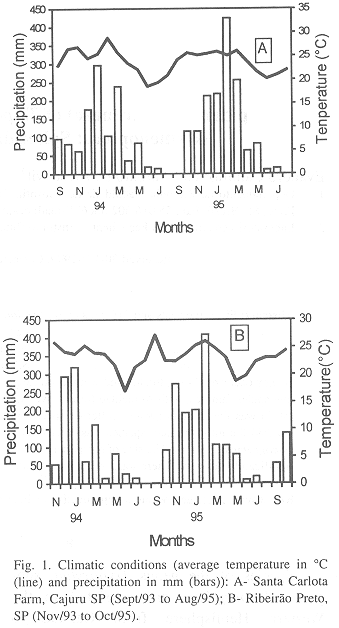
<body><![CDATA[<br>&nbsp;     <br>&nbsp;     <p><font face="Arial,Helvetica"><font size=-1>Species of the genus <i>Trypoxylon</i>, subgenus <i>Trypargilum</i>, are restricted to the Western Hemisphere from Canada to Argentina. The Neotropical region contains most of the species (<a href="#Bohart">Bohart and Menke 1976</a>, <a href="#Coville82">Coville 1982</a>). These wasps are solitary. Each female constructs and provisions the nest with paralyzed spiders. Some species construct mud nests, whereas others utilize pre-existing cavities. Nests consist of linear series of cells that are subdivided by mud partitions, usually followed by an empty vestibular cell and an end plug made of mud (<a href="#Bohart">Bohart and Menke 1976</a>, <a href="#Coville80">Coville and Coville 1980</a>, <a href="#Coville82">Coville 1982</a>).</font></font>     <p><font face="Arial,Helvetica"><font size=-1>One important species characteristic in Sphecidae is the species of prey that females captured. This is important from both evolutionary and taxonomic perspectives. These wasps collect prey in places where people do not normally look (<a href="#Genaro89">Genaro <i>et al</i>. 1989</a>); thus, nests of these wasps can provide vast collections of spiders, including rarely collected species (<a href="#Coville87">Coville 1987</a>).</font></font>     <p><font face="Arial,Helvetica"><font size=-1>The purpose of this paper is to present data on prey species collected by <i>Trypoxylon (Trypargilum) rogenhoferi</i> Kohl, 1884. In addition observations obtained from trap-nests placed in three sites in southeastern Brazil are presented to reveal some parameters of their reproductive niches.</font></font>     <br>&nbsp;     <p><b><font face="Arial,Helvetica"><font size=-1>Materials and Methods</font></font></b>     <p><font face="Arial,Helvetica"><font size=-1><b>Study areas:</b> Area 1- Santa Carlota Farm (SCF), Cajuru, SP (21&deg;18’-27’ S and 47&deg;12’-17’ W). The vegetation consists of semideciduous mesophyll and riparian forests, “cerrados” (s.l.), “cerrad&otilde;es” (<a href="#Rizzini">Rizzini 1979</a>) and various types of plantations. There are also some areas showing several stages of secondary growth of the main vegetation types. Farm altitudes vary from 540 to 944 m. The study sites in the farm, Itaoca Section (=IS) and Santana Section (=SS) (approximately six km from each other), is characterized by abandoned orchards surrounded by sugar cane plantations, pasture and “cerrados” (<i>s.l.</i>) with various abandoned buildings. Semideciduous mesophyll and riparian forests are located approximately 300 m from the orchards. Area 2. Campus of S&atilde;o Paulo University, Ribeir&atilde;o Preto (=RP), SP (21&deg;11’ S and 47&deg;13’ W). The vegetation is formed by small areas of semideciduous forests, grasses, shrubs, ornamental plants, fruit trees and reforested areas with arboreous angiosperms. Altitudes vary from 580 to 620 m.</font></font>     <p><font face="Arial,Helvetica"><font size=-1>Two distinct seasons are recognized in this region: 1- Cold and dry season (May to August) with monthly average temperatures ranging from 18.5 to 22.2 &deg;C (SCF) and from 17 to 23 &deg;C (RP), precipitation from 0 to 84.4 mm (SCF) and from 0 to 82.9 mm (RP); 2- Hot and wet season (September to April) with monthly average temperatures ranging from 23 to 28.8 &deg;C (SCF) and from 22.4 to 27.2 &deg;C (RP), precipitation from 0 to 422.6 mm (SCF) and from 1.4 to 409.4 mm (RP) (<a href="#Fig. 1">Fig. 1</a>).</font></font>     <br>&nbsp;     ]]></body>
<body><![CDATA[<br>&nbsp;     <br>     <center>     <p><a NAME="Fig. 1"></a><img SRC="/img/fbpe/rbt/v48n2-3/0879i01.GIF" height=628 width=339></center>      
<p>    <br>     <br>     <p><font face="Arial,Helvetica"><font size=-1><b>Trap-nests:</b> Bamboo stems (B) were used as trap-nests (TN) with a nodal septum closing one end. The internal diameter of nests ranged from 7 to 25 mm, and nest lengths ranged from 70 to 250 mm. These TN (450 in RP, 450 in SS and 200 in IS) were tied together in batches of six to eight units and placed on the shelves of shelters built at the study locations.</font></font>     <p><font face="Arial,Helvetica"><font size=-1>The TN were inspected at least once a month during the period from September/93 to August/95 at SCF and from November/93 to October/95 in RP. During the inspections, which were performed with the help of an otoscope, the nests that had been recently completed or were being provisioned were collected and transported to the laboratory. Each nest was replaced by a new TN. The nests were opened in the laboratory and the prey (spiders) from cells, which contained eggs, or recently hatched larvae were removed and preserved in 80% alcohol. At least one immature wasp was left in all of these nests so that it could develop fully, thus allowing for determination of the nesting species. All the wasp and spider specimens were deposited in the Entomology Collection of Biology Department-FFCLRP-USP and a portion of the spiders samples was deposited in the arachnological collection of Butantan Institute.</font></font>     <p><font face="Arial,Helvetica"><font size=-1><b>Data analysis:</b> The reproductive niche (following <a href="#Álvarez">&Aacute;lvarez <i>et al</i>. 1988</a>) width was calculated using the number of prey species as well as the Shannon-Weaver Diversity Index H’= -<img SRC="/img/fbpe/rbt/v48n2-3/sumatoria.JPG" height=16 width=13> p<sub>h</sub>. ln p<sub>h</sub>, where p<sub>h</sub> is the proportion of individuals belonging to the h<sup>th</sup> species in the total sample (<a href="#Pielou75">Pielou 1975</a>).</font></font>     
]]></body>
<body><![CDATA[<p><font face="Arial,Helvetica"><font size=-1>The evenness index was calculated according to <a href="#Pielou66">Pielou (1966)</a>: J’= H’ / Hmax, where H’ is the Shannon-Weaver Index and Hmax is the logarithm (ln) of the total number of prey species in the sample. This index varies from zero to one.</font></font>     <p><font face="Arial,Helvetica"><font size=-1>The similarity in species composition among the studied habitats was calculated by the S&ouml;rensen Similarity Quotient (<a href="#Sörensen">S&ouml;rensen 1948</a>): S.Q. = 2J/ a+b, where a and b are the numbers of families, genera and species of collected prey in each of the habitats and J is the number of families, genera and species of collected prey common to all samples. The similarity among the studied communities, considering the number of collected spiders of each sampled species, was calculated by the method of percentage similarity (<a href="#Hanski">Hanski and Koskela 1977</a>) : PS<sub>ij</sub> =&nbsp;<img SRC="/img/fbpe/rbt/v48n2-3/sumatoria.JPG" height=16 width=13> min. (p<sub>ih</sub>, p<sub>jh</sub>), where p<sub>ih</sub> and p<sub>jh</sub> are proportions of the h families, genera or species of collected prey. The “Test for difference between two indices” was used in the statistical analysis of indices (<a href="#Zar">Zar 1984</a>).</font></font>     
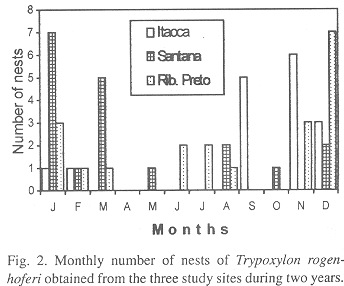
<br>&nbsp;     <p><b><font face="Arial,Helvetica"><font size=-1>Results</font></font></b>     <p><font face="Arial,Helvetica"><font size=-1><b>Number of nests, cells and seasonal abundance:</b> 216 cells of <i>T. rogenhoferi</i> were obtained, 69 were from IS (16 nests), 84 from SS (19 nests) and 63 from RP (20 nests). Prey was collected and identified from 40, 58 and 39 cells, respectively. The nests (19 completed ones and 36 being provisioned) were collected throughout the year, except in April, with the greatest nesting frequency occurring in the hot and wet season (September to April), during which 85.4% of the sampled nests were collected. The months with the greatest nesting frequencies were September and November in IS, January and March in SS and December in RP (<a href="#Fig. 2">Fig. 2</a>).</font></font>     <br>&nbsp;     <br>&nbsp;     <br>     <center>     <p><a NAME="Fig. 2"></a><img SRC="/img/fbpe/rbt/v48n2-3/0879i02.GIF" height=286 width=344></center>      
]]></body>
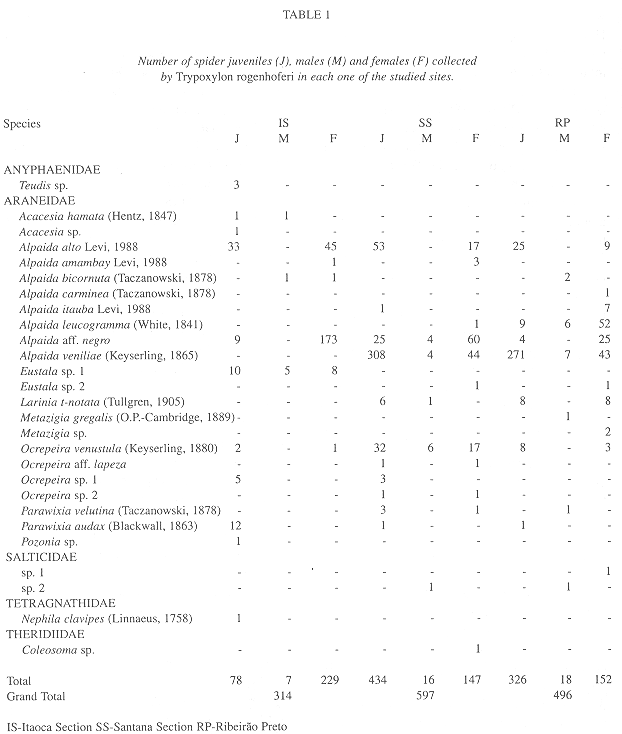
<body><![CDATA[<p>    <br>     <br>     <p><font face="Arial,Helvetica"><font size=-1><b>Collected prey:</b> Five families of spiders were found with Araneidae being the most frequent in all of the sites in number of genera (61.5%), species (81.5%) and individuals (99.4%). Only Araneidae was found at all three sites while Salticidae was found in two (SS and RP), Anyphaenidae and Tetragnathidae were only collected in IS and Theridiidae was collected only in SS (<a href="#Tabla 1">Table 1</a>).</font></font>     <br>&nbsp;     <br>&nbsp;     <br>     <center>     <p><a NAME="Tabla 1"></a><img SRC="/img/fbpe/rbt/v48n2-3/0879i03.GIF" height=734 width=622></center>      
<p>    ]]></body>
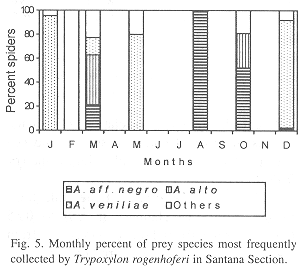
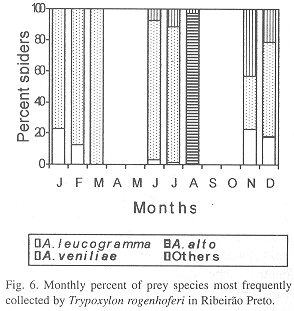
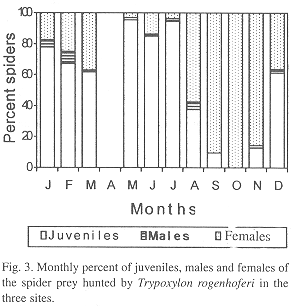
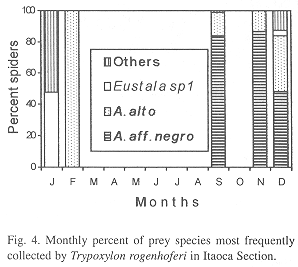
<body><![CDATA[<br>     <br>     <p><font face="Arial,Helvetica"><font size=-1>Araneidae was the most frequent family in the samples. This suggests a strong preference (99.6%) of <i>T. rogenhoferi</i> for species of orb-weaver spiders, <i>Alpaida</i> (88.4%) was the most frequent genus (<a href="#Tabla 1">Table 1</a>).</font></font>     <p><font face="Arial,Helvetica"><font size=-1><i>Alpaida</i> aff. <i>negro</i> (58%) was the most frequent species of prey in IS, followed by <i>Alpaida alto</i> Levi, 1988 (24.8%) and <i>Eustala</i> sp.1 (7.3%); in SS the most frequent was <i>Alpaida veniliae</i> (Keyserling, 1865) (59.6%), followed by <i>A</i>. aff. <i>negro</i> (14.9%) and A. alto (11.7%); in RP <i>A. veniliae</i> was also the most common (64.7%), followed by <i>Alpaida leucogramma</i> (White, 1841) (13.5%) and <i>A. alto</i> (6.8%). Of the 27 prey species collected by <i>T. rogenhoferi</i>, four were found in all three study areas, six only in IS, three in SS and four in RP; two species were common in IS and SS, six in SS and RP and one in IS and RP (<a href="#Tabla 1">Table 1</a>).</font></font>     <p><font face="Arial,Helvetica"><font size=-1><i>T. rogenhoferi</i> captured spider juveniles, males and females of seven prey species, only juveniles of eight, only males of two and only females of six species. Juveniles and females were collected from four species and males and females from one species (<a href="#Tabla 1">Table 1</a>). Juveniles, males and females were collected during nine months of the year, while in October only females were present in the samples. In September males were not found. The percent of females was greater than that of juveniles in August through November, while in the others months, the percentage of juveniles was greater than that of females. The percentage of both, juveniles and females were greater than that of males. The greatest frequencies of juveniles occurred in May (95.4% of the collected spiders), June (84.9%) and July (94.4%); for males the greatest frequency was found in February (7.8%) and August (5%) and for females in September (90.3%), October (100%) and November (85.8%) (Fig. 3). In all locations the juveniles correspond to 59.6%, females to 37.5% and males to 2.9%.</font></font>     <p><font face="Arial,Helvetica"><font size=-1><b>Phenology of three most frequently collected prey species:</b> In IS, <i>A.</i> aff. <i>negro</i> (collected during three months) was the most frequent species in September, November and December, <i>A. alto</i> (collected during four months) in February and <i>Eustala</i> sp.1 (collected during two months) in January (Fig. 4). In SS, A. veniliae (collected during four months) was the most frequent species in January, May and December, A. aff. negro (collected during four months) in August and October, with A. alto (collected in three months) in March (Fig. 5). In RP, A. veniliae (collected during seven months) was preferred in January through March, June, July, November and December, with A. alto (collected in one month) in August (Fig. 6).</font></font>     <br>&nbsp;     <p><a NAME="Fig. 3"></a><img SRC="/img/fbpe/rbt/v48n2-3/0879i04.GIF" height=306 width=291 align=LEFT><a NAME="Fig. 4"></a><img SRC="/img/fbpe/rbt/v48n2-3/0879i05.GIF" height=267 width=298>     
<br>&nbsp;     <br>&nbsp;     ]]></body>
<body><![CDATA[<p><a NAME="Fig. 5"></a><img SRC="/img/fbpe/rbt/v48n2-3/0879i06.GIF" height=271 width=302 align=RIGHT><a NAME="Fig. 6"></a><img SRC="/img/fbpe/rbt/v48n2-3/0879i07.GIF" height=311 width=294 align=LEFT>     
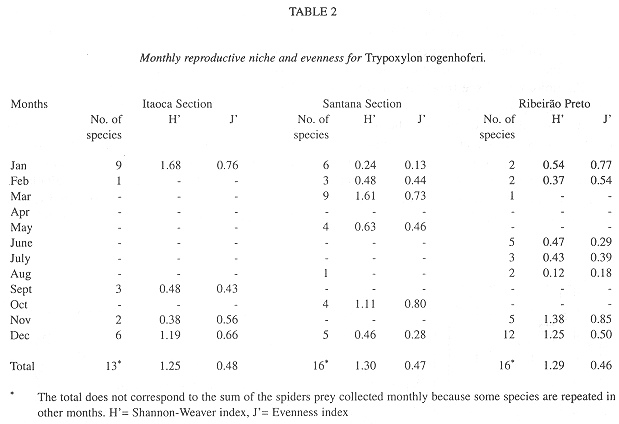
<br>&nbsp;     <br>&nbsp;     <p><font face="Arial,Helvetica"><font size=-1><b>Parameters of the reproductive niche:</b> The monthly reproductive niche width calculated by the number of prey species collected varied from one (February in IS, August in SS and March in RP) to 12 (December in RP), while the total niche width was 13 (IS) and 16 (SS and RP). The monthly reproductive niche width calculated by the Shannon-Weaver Index (H’) varied from 0.12 (August in RP) to 1.68 (January in IS) (Table 2). The total reproductive niche widths, H’= 1.25 (IS), H’= 1.30 (SS) and H’= 1,29 (RP) were not significantly different (P>0.05). The correlation between the indices (number of collected species and H’) was positive and statistically significant (r= 0.73, P&lt;0.01).</font></font>     <br>&nbsp;     <br>&nbsp;     <br>     <center>     <p><a NAME="Tabla 2"></a><img SRC="/img/fbpe/rbt/v48n2-3/0879i08.GIF" height=424 width=619></center>      
<p>    ]]></body>
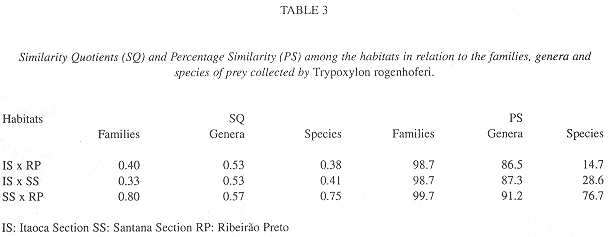
<body><![CDATA[<br>     <br>     <br>     <p><font face="Arial,Helvetica"><font size=-1>The monthly evenness of the collections ranged from 0.13 (January in SS) to 0.85 (November in RP), and the total evenness from 0.46 (RP) to 0.48 (IS). The correlation between the monthly reproductive niche width calculated using the number of collected prey species and evenness (J’) was positive and non-significant (r= 0.18, P>0.05), while the correlation between H’ and J’ was positive and significant (r= 0.75, P&lt;0.01).</font></font>     <p><font face="Arial,Helvetica"><font size=-1>The greatest similarity value at the family level among the sites was observed when comparing SS to RP (SQ= 0.80). At the genus level, the values were similar, and at the species level, the value was greatest when comparing SS to RP (SQ= 0.75). The percentage similarity was markedly high at the family and genus level, moderate at the species level when comparing SS to RP and low when comparing SS to IS and RP to IS (<a href="#Tabla 3">Table 3</a>).</font></font>     <center>     <p><a NAME="Tabla 3"></a><img SRC="/img/fbpe/rbt/v48n2-3/0879i09.GIF" height=237 width=609></center>      
<p>    <br>     <p><b><font face="Arial,Helvetica"><font size=-1>Discussion</font></font></b>     ]]></body>
<body><![CDATA[<p><font face="Arial,Helvetica"><font size=-1>The great preference of <i>T. rogenhoferi </i>for prey of the Araneidae family was also observed in the same three habitats by <a href="#Camillo99a">Camillo and Brescovit (1999a)</a> in relation to <i>T. lactitarse</i> Saussure, 1867 (96.6%). In these habitats <a href="#Camillo94">Camillo <i>et al</i>. (1994)</a> observed in 14 <i>T. rogenhoferi</i> cells that 99.4% of prey were from the family Araneidae. In the Central Amazon, <a href="#Garcia">Garcia and Adis (1995)</a> observed that the females of <i>T. rogenhoferi</i> captured one species of this spider family.</font></font>     <p><font face="Arial,Helvetica"><font size=-1>Some species of the subgenus <i>Trypargilum</i> preyed preferentially upon spiders of the Araneidae family: <i>T. mexicanum</i> Saussure, 1867 (<a href="#Rau">Rau 1943</a>), <i>T. politum</i> Say, 1837 (<a href="#Muma">Muma and Jeffers 1945</a>, <a href="#Cross">Cross <i>et al.</i> 1975</a>, <a href="#Barber">Barber and Matthews 1979</a>, <a href="#Rehnberg">Rehnberg 1987</a>), <i>T. texense</i> Saussure, 1867 (<a href="#Kurczewski">Kurczewski 1963</a>), <i>T. collinum</i> F. Smith, 1856 (<a href="#Krombein">Krombein 1967</a>, Medler 1967), <i>T. lactitarse</i> (<a href="#Krombein">Krombein 1967</a>, <a href="#Coville81">Coville 1981</a>, <a href="#Camillo93">Camillo <i>et al</i>. 1993</a>, <a href="#Camillo99a">Camillo and Brescovit 1999a</a>), <i>T. tridentatum</i> Packard, 1867 (<a href="#Krombein">Krombein 1967</a>, <a href="#Jiménez">Jim&eacute;nez and Tejas 1994</a>), <i>T. orizabense</i> Richards 1934 (<a href="#Coville79">Coville 1979</a>), <i>T. tenoctitlan</i> Richards, 1934 (<a href="#Coville80">Coville and Coville 1980</a>), <i>T. nitidum schultessi</i> Richards, 1936 <i>T. saussurei </i>Rohwer, 1912 (<a href="#Coville81">Coville 1981</a>), <i>T. evansi</i><a href="#Coville82">Coville, 1982</a> <i>T. monteverdae</i><a href="#Coville82">Coville, 1982</a> <i>T. occidentalis</i> Coville, 1982 (<a href="#Coville82">Coville 1982</a>), <i>T. subimpressum</i> F. Smith, 1856 (<a href="#Genaro89">Genaro <i>et al.</i> 1989</a>, <a href="#Genaro94">Genaro and Alay&oacute;n 1994</a>).</font></font>     <p><font face="Arial,Helvetica"><font size=-1><i>A.</i> aff. <i>negro </i>(58% in IS) and <i>A. veniliae</i> (59.6% in SS and 64.7% in RP) were the most frequently captured prey species, whereas <i>T. lactitarse</i> (<a href="#Camillo99a">Camillo and Brescovit 1999a</a>) preferentially captured <i>Eustala</i> sp1 (31.6% in IS, 20.1% in SS and 48.7% in RP). Thus, <i>T. lactitarse</i> (<a href="#Camillo99a">Camillo and Brescovit 1999a</a>) did not capture <i>A. veniliae</i>, and <i>A</i>. aff.<i> negro</i> was represented in the samples by some individuals (15), and <i>T. rogenhoferi</i> preyed upon <i>Eustala</i> sp1 only in IS (23 individuals). <a href="#Garcia">Garcia and Adis (1995)</a> observed, in Central Amazon, that <i>T. rogenhoferi</i> provisioned cells only with <i>A. veniliae.</i></font></font>     <p><font face="Arial,Helvetica"><font size=-1><i>T. rogenhoferi</i> captured more juvenile prey (50.3%) than adult females (34.3%) and males (15.4%). The same fact was observed by <a href="#Camillo99a">Camillo and Brescovit (1999a)</a> for <i>T. lactitarse</i> but in different percentages (59.6%, 37.5% and 2.9%, respectively). Collection of large percentage of juveniles was also observed for <i>T. texense</i> (<a href="#Kurczewski">Kurczewsky 1963</a>), <i>T. politum</i> (<a href="#Barber">Barber and Matthews 1979</a>), <i>T. orizabense</i> (<a href="#Coville80">Coville 1980</a>), <i>T. tenoctitlan</i> (<a href="#Coville80">Coville and Coville 1980</a>), <i>T. nitidum schultessi, T. saussurei</i> (<a href="#Coville81">Coville 1981</a>), <i>T. monteverdae</i> (<a href="#Coville82">Coville 1982</a>, <a href="#Brockmann">Brockmann 1992</a>), <i>T. occidentalis</i> (<a href="#Coville82">Coville 1982</a>), <i>T. subimpressum</i> (<a href="#Genaro94">Genaro and Alay&oacute;n 1994</a>) and <i>T. tridentatum</i> (<a href="#Jiménez">Jim&eacute;nez and Tejas 1994</a>).</font></font>     <p><font face="Arial,Helvetica"><font size=-1>The reproductive niche widths (H’) of <i>T. rogenhoferi</i> in different localities were not significantly different. But when comparing reproductive niche widths with those of <i>T. lactitarse</i> (<a href="#Camillo99a">Camillo and Brescovit 1999a</a>) (H’=2.24 in IS, H’= 2.72 in SS and H’=1.76 in RP) they were smaller. Significant differences were also observed in relation to evenness (J’) which was smaller for <i>T. rogenhoferi</i>.</font></font>     <p><font face="Arial,Helvetica"><font size=-1>Reproductive niche overlap between <i>T. rogenhoferi</i> and <i>T. lactitarse</i> (<a href="#Camillo99a">Camillo and Brescovit 1999a</a>), calculated using the percentage similarity of <a href="#Hanski">Hanski and Koskela (1977)</a> was very low, 0.16 for SI, 0.06 for SS and 0.04 for RP. These results indicate that these species do not compete in any significant manner for food in the three habitats studied, a fact that is easily observed when comparing the most common prey species.</font></font>     <p><font face="Arial,Helvetica"><font size=-1>An estimate of the weight of each prey collected was obtained by dividing the total biomass of the cell group by the total number of prey. Thus, we calculated that the prey collected by T. lactitarse had a lower biomass (22.8 mg, n=1241) than those collected by <i>T. rogenhoferi</i> (33.3 mg, n=1407). This difference is more evident when we consider only the most common prey species. In this case, we observe that the mean individual weight was 48.5 mg (n=108) for <i>A.</i> aff. <i>negro</i> and 26.6 mg (n=212) for <i>A. veniliae</i>, values greater than 14.6 mg (n=93), the weight calculated for <i>Eustala</i> sp1 which was collected by <i>T. lactitarse</i>. The difference in mean weight between <i>A. </i>aff. <i>negro</i> and <i>A. veniliae</i> is related to the different number of prey provisioned per cell (6.7 and 13.2, respectively).</font></font>     <p><font face="Arial,Helvetica"><font size=-1><i>T. rogenhoferi</i> collected heavier prey than <i>T. lactitarse</i> wich is directly related to the size of these species. According to <a href="#Camillo99b">Camillo and Brescovit (1999b)</a>, <i>T. rogenhoferi</i> females are larger than <i>T. lactitarse</i>, and since the transport of prey is carried out in flight, larger individuals are able to carry larger prey. This result clearly shows why there is no overlap of the reproductive niches.</font></font>     <br>&nbsp;     <p><b><font face="Arial,Helvetica"><font size=-1>Acknowledgments</font></font></b>     ]]></body>
<body><![CDATA[<p><font face="Arial,Helvetica"><font size=-1>Special thanks to the owners of Santa Carlota Farm, Cajuru, SP, for allowing us free access to their land. We are especially grateful to Carlos Alberto Gar&oacute;falo for his comments and suggestions and Jos&eacute; Carlos Serrano for technical help.</font></font>     <br>&nbsp;     <p><b><font face="Arial,Helvetica"><font size=-1>References</font></font></b>     <!-- ref --><p><a NAME="Álvarez"></a><font face="Arial,Helvetica"><font size=-1>&Aacute;lvarez, V.B., J.A. Genaro &amp; C.S.S. Alonso. 1988. Nuevas considerations acerca del nicho ecol&oacute;gico. Ciencias Biol&oacute;gicas 19/20: 3-8.</font></font>    &nbsp;&nbsp;&nbsp;&nbsp;&nbsp;&nbsp;&nbsp;&nbsp;[&#160;<a href="javascript:void(0);" onclick="javascript: window.open('/scielo.php?script=sci_nlinks&ref=1205031&pid=S0034-7744200000020003700001&lng=','','width=640,height=500,resizable=yes,scrollbars=1,menubar=yes,');">Links</a>&#160;]<!-- end-ref --><!-- ref --><p><a NAME="Barber"></a><font face="Arial,Helvetica"><font size=-1>Barber, M.C. &amp; R.W. Matthews. 1979. Utilization of trap nests by the pipe-organ mud-dauber, Trypargilum politum (Hymenoptera: Sphecidae). Ann. Entomol. Soc. Am. 72: 260-262.</font></font>    &nbsp;&nbsp;&nbsp;&nbsp;&nbsp;&nbsp;&nbsp;&nbsp;[&#160;<a href="javascript:void(0);" onclick="javascript: window.open('/scielo.php?script=sci_nlinks&ref=1205032&pid=S0034-7744200000020003700002&lng=','','width=640,height=500,resizable=yes,scrollbars=1,menubar=yes,');">Links</a>&#160;]<!-- end-ref --><!-- ref --><p><a NAME="Bohart"></a><font face="Arial,Helvetica"><font size=-1>Bohart, R.M. &amp; A.S. Menke. 1976. Sphecid wasps of the world. University of California, Berkeley. 695 p.</font></font>    &nbsp;&nbsp;&nbsp;&nbsp;&nbsp;&nbsp;&nbsp;&nbsp;[&#160;<a href="javascript:void(0);" onclick="javascript: window.open('/scielo.php?script=sci_nlinks&ref=1205033&pid=S0034-7744200000020003700003&lng=','','width=640,height=500,resizable=yes,scrollbars=1,menubar=yes,');">Links</a>&#160;]<!-- end-ref --><!-- ref --><p><a NAME="Brockmann"></a><font face="Arial,Helvetica"><font size=-1>Brockmann, H.J. 1992. Male behavior, courtship and nesting in Trypoxylon (Trypargilum) monteverdae (Hymenoptera: Sphecidae). J. Kans. Entomol. Soc. 65: 66-84.</font></font>    &nbsp;&nbsp;&nbsp;&nbsp;&nbsp;&nbsp;&nbsp;&nbsp;[&#160;<a href="javascript:void(0);" onclick="javascript: window.open('/scielo.php?script=sci_nlinks&ref=1205034&pid=S0034-7744200000020003700004&lng=','','width=640,height=500,resizable=yes,scrollbars=1,menubar=yes,');">Links</a>&#160;]<!-- end-ref --><!-- ref --><p><a NAME="Camillo93"></a><font face="Arial,Helvetica"><font size=-1>Camillo, E., C.A. Gar&oacute;falo, G. Muccillo, &amp; J.C. Serrano. 1993. Biological observations on <i>Trypoxylon (Trypargilum) lactitarse</i> Saussure in southeastern Brazil (Hymenoptera: Sphecidae). Rev. Bras. Entomol. 37: 769-778.</font></font>    &nbsp;&nbsp;&nbsp;&nbsp;&nbsp;&nbsp;&nbsp;&nbsp;[&#160;<a href="javascript:void(0);" onclick="javascript: window.open('/scielo.php?script=sci_nlinks&ref=1205035&pid=S0034-7744200000020003700005&lng=','','width=640,height=500,resizable=yes,scrollbars=1,menubar=yes,');">Links</a>&#160;]<!-- end-ref --><!-- ref --><p><a NAME="Camillo94"></a><font face="Arial,Helvetica"><font size=-1>Camillo, E., C.A. Gar&oacute;falo &amp; J.C. Serrano. 1994. Observa&ccedil;&otilde;es sobre a biologia de <i>Trypoxylon (Trypargilum) rogenhoferi</i> Kohl (Hymenoptera: Sphecidae). An. Soc. Entomol. Brasil 23: 299-310.</font></font>    &nbsp;&nbsp;&nbsp;&nbsp;&nbsp;&nbsp;&nbsp;&nbsp;[&#160;<a href="javascript:void(0);" onclick="javascript: window.open('/scielo.php?script=sci_nlinks&ref=1205036&pid=S0034-7744200000020003700006&lng=','','width=640,height=500,resizable=yes,scrollbars=1,menubar=yes,');">Links</a>&#160;]<!-- end-ref --><!-- ref --><p><a NAME="Camillo99a"></a><font face="Arial,Helvetica"><font size=-1>Camillo, E. &amp; A.D. Brescovit. 1999a. Spider (Araneae) captured by <i>Trypoxylon (Trypargilum) lactitarse</i> (Hymenoptera: Sphecidae) in southeastern Brazil. Rev. Biol. Trop. 47: 149-160.</font></font>    &nbsp;&nbsp;&nbsp;&nbsp;&nbsp;&nbsp;&nbsp;&nbsp;[&#160;<a href="javascript:void(0);" onclick="javascript: window.open('/scielo.php?script=sci_nlinks&ref=1205037&pid=S0034-7744200000020003700007&lng=','','width=640,height=500,resizable=yes,scrollbars=1,menubar=yes,');">Links</a>&#160;]<!-- end-ref --><!-- ref --><p><a NAME="Camillo99b"></a><font face="Arial,Helvetica"><font size=-1>Camillo, E. &amp; A.D. Brescovit. 1999b. Aspectos biol&oacute;gicos de <i>Trypoxylon (Trypargilum) lactitarse</i> Saussure e <i>Trypoxylon (Trypargilum) rogenhoferi</i> Kohl (Hymenoptera: Sphecidae) em ninhos armadilhas, com especial refer&ecirc;ncia a suas presas. An. Soc. Entomol. Brasil 28: 251-262.</font></font>    &nbsp;&nbsp;&nbsp;&nbsp;&nbsp;&nbsp;&nbsp;&nbsp;[&#160;<a href="javascript:void(0);" onclick="javascript: window.open('/scielo.php?script=sci_nlinks&ref=1205038&pid=S0034-7744200000020003700008&lng=','','width=640,height=500,resizable=yes,scrollbars=1,menubar=yes,');">Links</a>&#160;]<!-- end-ref --><!-- ref --><p><a NAME="Coville79"></a><font face="Arial,Helvetica"><font size=-1>Coville, R.E. 1979. Biological observations on <i>Trypoxylon (Trypargilum) orizabense</i> Richards in Arizona (Hymenoptera: Sphecidae). J. Kans. Entomol. Soc. 52: 613-620.</font></font>    &nbsp;&nbsp;&nbsp;&nbsp;&nbsp;&nbsp;&nbsp;&nbsp;[&#160;<a href="javascript:void(0);" onclick="javascript: window.open('/scielo.php?script=sci_nlinks&ref=1205039&pid=S0034-7744200000020003700009&lng=','','width=640,height=500,resizable=yes,scrollbars=1,menubar=yes,');">Links</a>&#160;]<!-- end-ref --><!-- ref --><p><a NAME="Coville81"></a><font face="Arial,Helvetica"><font size=-1>Coville, R.E. 1981. Biological observations on three <i>Trypoxylon</i> wasps in the subgenus <i>Trypargilum</i> from Costa Rica: <i>T. nitidum schultessi, T. saussurei</i> and <i>T. lactitarse</i> (Hymenoptera: Sphecidae). Pan-Pacif. Ent. 57: 332-340.</font></font>    &nbsp;&nbsp;&nbsp;&nbsp;&nbsp;&nbsp;&nbsp;&nbsp;[&#160;<a href="javascript:void(0);" onclick="javascript: window.open('/scielo.php?script=sci_nlinks&ref=1205040&pid=S0034-7744200000020003700010&lng=','','width=640,height=500,resizable=yes,scrollbars=1,menubar=yes,');">Links</a>&#160;]<!-- end-ref --><!-- ref --><p><a NAME="Coville82"></a><font face="Arial,Helvetica"><font size=-1>Coville, R.E. 1982. Wasps of the genus <i>Trypoxylon</i> subgenus <i>Trypargilum</i> in North America. University of California, Berkeley. 147 p.</font></font>    &nbsp;&nbsp;&nbsp;&nbsp;&nbsp;&nbsp;&nbsp;&nbsp;[&#160;<a href="javascript:void(0);" onclick="javascript: window.open('/scielo.php?script=sci_nlinks&ref=1205041&pid=S0034-7744200000020003700011&lng=','','width=640,height=500,resizable=yes,scrollbars=1,menubar=yes,');">Links</a>&#160;]<!-- end-ref --><!-- ref --><p><a NAME="Coville87"></a><font face="Arial,Helvetica"><font size=-1>Coville, R.E. 1987. Spider-hunting sphecid wasps, p. 309-318. <i>In</i> W. Nentwig (ed.). Ecophysiology of spiders. Springer, Berlin. 448 p.</font></font>    &nbsp;&nbsp;&nbsp;&nbsp;&nbsp;&nbsp;&nbsp;&nbsp;[&#160;<a href="javascript:void(0);" onclick="javascript: window.open('/scielo.php?script=sci_nlinks&ref=1205042&pid=S0034-7744200000020003700012&lng=','','width=640,height=500,resizable=yes,scrollbars=1,menubar=yes,');">Links</a>&#160;]<!-- end-ref --><!-- ref --><p><a NAME="Coville80"></a><font face="Arial,Helvetica"><font size=-1>Coville, R.E. &amp; P.L. Coville. 1980. Nesting biology and male behavior of <i>Trypoxylon (Trypargilum) tenoctitlan</i> in Costa Rica (Hymenoptera: Sphecidae). Ann. Entomol. Soc. Am. 73: 110-119.</font></font>    &nbsp;&nbsp;&nbsp;&nbsp;&nbsp;&nbsp;&nbsp;&nbsp;[&#160;<a href="javascript:void(0);" onclick="javascript: window.open('/scielo.php?script=sci_nlinks&ref=1205043&pid=S0034-7744200000020003700013&lng=','','width=640,height=500,resizable=yes,scrollbars=1,menubar=yes,');">Links</a>&#160;]<!-- end-ref --><!-- ref --><p><a NAME="Cross"></a><font face="Arial,Helvetica"><font size=-1>Cross, E.A., M.G. Stith &amp; T.R. Bauman. 1975. Bionomics of the organ-pipe mud-dauber, <i>Trypoxylon politum</i> (Hymenoptera: Sphecidae). Ann. Entomol. Soc. Am. 68: 901-916.</font></font>    &nbsp;&nbsp;&nbsp;&nbsp;&nbsp;&nbsp;&nbsp;&nbsp;[&#160;<a href="javascript:void(0);" onclick="javascript: window.open('/scielo.php?script=sci_nlinks&ref=1205044&pid=S0034-7744200000020003700014&lng=','','width=640,height=500,resizable=yes,scrollbars=1,menubar=yes,');">Links</a>&#160;]<!-- end-ref --><!-- ref --><p><a NAME="Garcia"></a><font face="Arial,Helvetica"><font size=-1>Garcia, M.V.B. &amp; J. Adis. 1995. Comportamento de nidifica&ccedil;&atilde;o de Trypoxylon (Trypargilum) rogenhoferi Kohl (Hymenoptera, Sphecidae) em uma floresta inund&aacute;vel de v&aacute;rzea na Amaz&ocirc;nia Central. Amazoniana 13: 259-282.</font></font>    &nbsp;&nbsp;&nbsp;&nbsp;&nbsp;&nbsp;&nbsp;&nbsp;[&#160;<a href="javascript:void(0);" onclick="javascript: window.open('/scielo.php?script=sci_nlinks&ref=1205045&pid=S0034-7744200000020003700015&lng=','','width=640,height=500,resizable=yes,scrollbars=1,menubar=yes,');">Links</a>&#160;]<!-- end-ref --><!-- ref --><p><a NAME="Genaro89"></a><font face="Arial,Helvetica"><font size=-1>Genaro, J.A., C.S. Sanchez &amp; G. Alay&oacute;n. 1989. Notas sobre la conducta de nidificaci&oacute;n de <i>Trypoxylon (Trypargilum) subimpressum</i> Smith (Hymenoptera: Sphecidae). Caribbean J. Sci. 25: 228-229.</font></font>    &nbsp;&nbsp;&nbsp;&nbsp;&nbsp;&nbsp;&nbsp;&nbsp;[&#160;<a href="javascript:void(0);" onclick="javascript: window.open('/scielo.php?script=sci_nlinks&ref=1205046&pid=S0034-7744200000020003700016&lng=','','width=640,height=500,resizable=yes,scrollbars=1,menubar=yes,');">Links</a>&#160;]<!-- end-ref --><!-- ref --><p><a NAME="Genaro94"></a><font face="Arial,Helvetica"><font size=-1>Genaro, J.A. &amp; G. Alay&oacute;n. 1994. Las presas (Araneae) de <i>Trypoxylon (Trypargilum) subimpressum</i> (Hymenoptera: Sphecidae) en Cuba. Rev. Biol. Trop. 42: 353-356.</font></font>    &nbsp;&nbsp;&nbsp;&nbsp;&nbsp;&nbsp;&nbsp;&nbsp;[&#160;<a href="javascript:void(0);" onclick="javascript: window.open('/scielo.php?script=sci_nlinks&ref=1205047&pid=S0034-7744200000020003700017&lng=','','width=640,height=500,resizable=yes,scrollbars=1,menubar=yes,');">Links</a>&#160;]<!-- end-ref --><!-- ref --><p><a NAME="Hanski"></a><font face="Arial,Helvetica"><font size=-1>Hanski, I. &amp; H. Koskela. 1977. Niche relations among dung inhabiting beetles. Oecologia 28: 203-231.</font></font>    &nbsp;&nbsp;&nbsp;&nbsp;&nbsp;&nbsp;&nbsp;&nbsp;[&#160;<a href="javascript:void(0);" onclick="javascript: window.open('/scielo.php?script=sci_nlinks&ref=1205048&pid=S0034-7744200000020003700018&lng=','','width=640,height=500,resizable=yes,scrollbars=1,menubar=yes,');">Links</a>&#160;]<!-- end-ref --><!-- ref --><p><a NAME="Jiménez"></a><font face="Arial,Helvetica"><font size=-1>Jim&eacute;nez, M.L. &amp; A. Tejas. 1994. Las ara&ntilde;as presa de la avispa lodera <i>Trypoxylon (Trypargilum) tridentatum tridentatum</i> en Baja California Sur, Mexico. Southwest. Entomol. 19: 173-180.</font></font>    &nbsp;&nbsp;&nbsp;&nbsp;&nbsp;&nbsp;&nbsp;&nbsp;[&#160;<a href="javascript:void(0);" onclick="javascript: window.open('/scielo.php?script=sci_nlinks&ref=1205049&pid=S0034-7744200000020003700019&lng=','','width=640,height=500,resizable=yes,scrollbars=1,menubar=yes,');">Links</a>&#160;]<!-- end-ref --><!-- ref --><p><a NAME="Krombein"></a><font face="Arial,Helvetica"><font size=-1>Krombein, K.V. 1967. Trap-nesting wasps and bees. Life histories, and associates. Smithsonian Institution, Washington, D.C. 570 p.</font></font>    &nbsp;&nbsp;&nbsp;&nbsp;&nbsp;&nbsp;&nbsp;&nbsp;[&#160;<a href="javascript:void(0);" onclick="javascript: window.open('/scielo.php?script=sci_nlinks&ref=1205050&pid=S0034-7744200000020003700020&lng=','','width=640,height=500,resizable=yes,scrollbars=1,menubar=yes,');">Links</a>&#160;]<!-- end-ref --><!-- ref --><p><a NAME="Kurczewski"></a><font face="Arial,Helvetica"><font size=-1>Kurczewski, F.E. 1963. A first Florida record and note on the nesting of <i>Trypoxylon (Trypargilum) texense</i> Saussure (Hymenoptera: Sphecidae). Fla. Entomol. 46: 243-245.</font></font>    &nbsp;&nbsp;&nbsp;&nbsp;&nbsp;&nbsp;&nbsp;&nbsp;[&#160;<a href="javascript:void(0);" onclick="javascript: window.open('/scielo.php?script=sci_nlinks&ref=1205051&pid=S0034-7744200000020003700021&lng=','','width=640,height=500,resizable=yes,scrollbars=1,menubar=yes,');">Links</a>&#160;]<!-- end-ref --><!-- ref --><p><a NAME="Muma"></a><font face="Arial,Helvetica"><font size=-1>Muma, M.H. &amp; W.F. Jeffers. 1945. Studies on the spider prey of several mud-dauber wasps. Ann. Entomol. Soc. Am. 38: 245-255.</font></font>    &nbsp;&nbsp;&nbsp;&nbsp;&nbsp;&nbsp;&nbsp;&nbsp;[&#160;<a href="javascript:void(0);" onclick="javascript: window.open('/scielo.php?script=sci_nlinks&ref=1205052&pid=S0034-7744200000020003700022&lng=','','width=640,height=500,resizable=yes,scrollbars=1,menubar=yes,');">Links</a>&#160;]<!-- end-ref --><!-- ref --><p><a NAME="Pielou66"></a><font face="Arial,Helvetica"><font size=-1>Pielou, E.C. 1966. An introduction to Mathematical Ecology. John Wiley, New York. 286 p.</font></font>    &nbsp;&nbsp;&nbsp;&nbsp;&nbsp;&nbsp;&nbsp;&nbsp;[&#160;<a href="javascript:void(0);" onclick="javascript: window.open('/scielo.php?script=sci_nlinks&ref=1205053&pid=S0034-7744200000020003700023&lng=','','width=640,height=500,resizable=yes,scrollbars=1,menubar=yes,');">Links</a>&#160;]<!-- end-ref --><!-- ref --><p><a NAME="Pielou75"></a><font face="Arial,Helvetica"><font size=-1>Pielou, E.C. 1975. Ecological diversity. John Wiley, New York. 165 p.</font></font>    &nbsp;&nbsp;&nbsp;&nbsp;&nbsp;&nbsp;&nbsp;&nbsp;[&#160;<a href="javascript:void(0);" onclick="javascript: window.open('/scielo.php?script=sci_nlinks&ref=1205054&pid=S0034-7744200000020003700024&lng=','','width=640,height=500,resizable=yes,scrollbars=1,menubar=yes,');">Links</a>&#160;]<!-- end-ref --><!-- ref --><p><a NAME="Rau"></a><font face="Arial,Helvetica"><font size=-1>Rau, P. 1943. The nesting habits of certain sphecid wasps of Mexico, with notes on their parasites. Ann. Entomol. Soc. Am. 36: 647-653.</font></font>    &nbsp;&nbsp;&nbsp;&nbsp;&nbsp;&nbsp;&nbsp;&nbsp;[&#160;<a href="javascript:void(0);" onclick="javascript: window.open('/scielo.php?script=sci_nlinks&ref=1205055&pid=S0034-7744200000020003700025&lng=','','width=640,height=500,resizable=yes,scrollbars=1,menubar=yes,');">Links</a>&#160;]<!-- end-ref --><!-- ref --><p><a NAME="Rehnberg"></a><font face="Arial,Helvetica"><font size=-1>Rehnberg, B.G. 1987. Selection of spider prey by <i>Trypoxylon politum</i> (Say) (Hymenoptera: Sphecidae). Can. Ent. 119: 189-194.</font></font>    &nbsp;&nbsp;&nbsp;&nbsp;&nbsp;&nbsp;&nbsp;&nbsp;[&#160;<a href="javascript:void(0);" onclick="javascript: window.open('/scielo.php?script=sci_nlinks&ref=1205056&pid=S0034-7744200000020003700026&lng=','','width=640,height=500,resizable=yes,scrollbars=1,menubar=yes,');">Links</a>&#160;]<!-- end-ref --><!-- ref --><p><a NAME="Rizzini"></a><font face="Arial,Helvetica"><font size=-1>Rizzini, C.D. 1979. Tratado de fitogeografia do Brasil, Vol. 2. Hucitec, S&atilde;o Paulo. 374 p.</font></font>    &nbsp;&nbsp;&nbsp;&nbsp;&nbsp;&nbsp;&nbsp;&nbsp;[&#160;<a href="javascript:void(0);" onclick="javascript: window.open('/scielo.php?script=sci_nlinks&ref=1205057&pid=S0034-7744200000020003700027&lng=','','width=640,height=500,resizable=yes,scrollbars=1,menubar=yes,');">Links</a>&#160;]<!-- end-ref --><!-- ref --><p><a NAME="Sörensen"></a><font face="Arial,Helvetica"><font size=-1>S&ouml;rensen, T. 1948. A method of establishing group of equal amplitude in plant sociobiology based on similarity of species content and its application to analyses of the vegetation on Danish commons. Kong. Danske Vidensk. Selsk. Biol. Skr. 5: 1-34.</font></font>    &nbsp;&nbsp;&nbsp;&nbsp;&nbsp;&nbsp;&nbsp;&nbsp;[&#160;<a href="javascript:void(0);" onclick="javascript: window.open('/scielo.php?script=sci_nlinks&ref=1205058&pid=S0034-7744200000020003700028&lng=','','width=640,height=500,resizable=yes,scrollbars=1,menubar=yes,');">Links</a>&#160;]<!-- end-ref --><!-- ref --><p><a NAME="Zar"></a><font face="Arial,Helvetica"><font size=-1>Zar, J.H. 1984. Biostatistical analysis. Prentice-Hall, Inglewood Cliffs, New Jersey. 718 p.</font></font>    &nbsp;&nbsp;&nbsp;&nbsp;&nbsp;&nbsp;&nbsp;&nbsp;[&#160;<a href="javascript:void(0);" onclick="javascript: window.open('/scielo.php?script=sci_nlinks&ref=1205059&pid=S0034-7744200000020003700029&lng=','','width=640,height=500,resizable=yes,scrollbars=1,menubar=yes,');">Links</a>&#160;]<!-- end-ref --><p><a NAME="1a"></a><font face="Arial,Helvetica"><font size=-1><sup><a href="#1">1</a></sup>Departamento de Biologia, Faculdade de Filosofia Ci&ecirc;ncias e Letras de Ribeir&atilde;o Preto-USP, 14040-901, Ribeir&atilde;o Preto, SP, Brasil. Fax: 55 016 602 3666. E-mail: <a href="mailto:ecamillo@ffclrp.usp.br">ecamillo@ffclrp.usp.br</a></font></font>     <p><a NAME="2a"></a><font face="Arial,Helvetica"><font size=-1><sup><a href="#2">2</a></sup> Laborat&oacute;rio de Artr&oacute;podes Pe&ccedil;onhentos, Instituto Butantan, Av. Vital Brasil 1500, 05503-900, S&atilde;o Paulo, SP, Brasil.</font></font>      ]]></body><back>
<ref-list>
<ref id="B1">
<nlm-citation citation-type="journal">
<person-group person-group-type="author">
<name>
<surname><![CDATA[Álvarez]]></surname>
<given-names><![CDATA[V.B]]></given-names>
</name>
<name>
<surname><![CDATA[Genaro]]></surname>
<given-names><![CDATA[J.A.]]></given-names>
</name>
<name>
<surname><![CDATA[Alonso]]></surname>
<given-names><![CDATA[C.S.S]]></given-names>
</name>
</person-group>
<article-title xml:lang="es"><![CDATA[Nuevas considerations acerca del nicho ecológico]]></article-title>
<source><![CDATA[Ciencias Biológicas]]></source>
<year>1988</year>
<volume>19/20</volume>
<page-range>3-8</page-range></nlm-citation>
</ref>
<ref id="B2">
<nlm-citation citation-type="journal">
<person-group person-group-type="author">
<name>
<surname><![CDATA[Barber]]></surname>
<given-names><![CDATA[M.C]]></given-names>
</name>
<name>
<surname><![CDATA[Matthews]]></surname>
<given-names><![CDATA[R.W]]></given-names>
</name>
</person-group>
<article-title xml:lang="en"><![CDATA[Utilization of trap nests by the pipe-organ mud-dauber, Trypargilum politum (Hymenoptera: Sphecidae)]]></article-title>
<source><![CDATA[Ann. Entomol. Soc. Am]]></source>
<year>1979</year>
<volume>72</volume>
<page-range>260-262</page-range></nlm-citation>
</ref>
<ref id="B3">
<nlm-citation citation-type="book">
<person-group person-group-type="author">
<name>
<surname><![CDATA[Bohart]]></surname>
<given-names><![CDATA[R.M]]></given-names>
</name>
<name>
<surname><![CDATA[Menke]]></surname>
<given-names><![CDATA[A.S]]></given-names>
</name>
</person-group>
<source><![CDATA[Sphecid wasps of the world]]></source>
<year>1976</year>
<page-range>695</page-range><publisher-loc><![CDATA[Berkeley ]]></publisher-loc>
<publisher-name><![CDATA[University of California]]></publisher-name>
</nlm-citation>
</ref>
<ref id="B4">
<nlm-citation citation-type="journal">
<person-group person-group-type="author">
<name>
<surname><![CDATA[Brockmann]]></surname>
<given-names><![CDATA[H.J]]></given-names>
</name>
</person-group>
<article-title xml:lang="en"><![CDATA[Male behavior, courtship and nesting in Trypoxylon (Trypargilum) monteverdae (Hymenoptera: Sphecidae)]]></article-title>
<source><![CDATA[J. Kans. Entomol. Soc]]></source>
<year>1992</year>
<volume>65</volume>
<page-range>66-84</page-range></nlm-citation>
</ref>
<ref id="B5">
<nlm-citation citation-type="journal">
<person-group person-group-type="author">
<name>
<surname><![CDATA[Camillo]]></surname>
<given-names><![CDATA[E]]></given-names>
</name>
<name>
<surname><![CDATA[Garófalo]]></surname>
<given-names><![CDATA[C.A]]></given-names>
</name>
<name>
<surname><![CDATA[Muccillo]]></surname>
<given-names><![CDATA[G]]></given-names>
</name>
<name>
<surname><![CDATA[Serrano]]></surname>
<given-names><![CDATA[J.C]]></given-names>
</name>
</person-group>
<article-title xml:lang="en"><![CDATA[Biological observations on Trypoxylon (Trypargilum) lactitarse Saussure in southeastern Brazil (Hymenoptera: Sphecidae)]]></article-title>
<source><![CDATA[Rev. Bras. Entomol]]></source>
<year>1993</year>
<volume>37</volume>
<page-range>769-778</page-range></nlm-citation>
</ref>
<ref id="B6">
<nlm-citation citation-type="journal">
<person-group person-group-type="author">
<name>
<surname><![CDATA[Camillo]]></surname>
<given-names><![CDATA[E]]></given-names>
</name>
<name>
<surname><![CDATA[Garófalo]]></surname>
<given-names><![CDATA[C.A]]></given-names>
</name>
<name>
<surname><![CDATA[Serrano]]></surname>
<given-names><![CDATA[J.C]]></given-names>
</name>
</person-group>
<article-title xml:lang="pt"><![CDATA[Observações sobre a biologia de Trypoxylon (Trypargilum) rogenhoferi Kohl (Hymenoptera: Sphecidae)]]></article-title>
<source><![CDATA[An. Soc. Entomol]]></source>
<year>1994</year>
<volume>23</volume>
<page-range>299-310</page-range></nlm-citation>
</ref>
<ref id="B7">
<nlm-citation citation-type="journal">
<person-group person-group-type="author">
<name>
<surname><![CDATA[Camillo]]></surname>
<given-names><![CDATA[E]]></given-names>
</name>
<name>
<surname><![CDATA[Brescovit]]></surname>
<given-names><![CDATA[A.D]]></given-names>
</name>
</person-group>
<article-title xml:lang="en"><![CDATA[Spider (Araneae) captured by Trypoxylon (Trypargilum) lactitarse (Hymenoptera: Sphecidae) in southeastern Brazil]]></article-title>
<source><![CDATA[Rev. Biol. Trop]]></source>
<year>1999</year>
<volume>47</volume>
<page-range>149-160</page-range></nlm-citation>
</ref>
<ref id="B8">
<nlm-citation citation-type="journal">
<person-group person-group-type="author">
<name>
<surname><![CDATA[Camillo]]></surname>
<given-names><![CDATA[E]]></given-names>
</name>
<name>
<surname><![CDATA[Brescovit]]></surname>
<given-names><![CDATA[A.D]]></given-names>
</name>
</person-group>
<article-title xml:lang="es"><![CDATA[Aspectos biológicos de Trypoxylon (Trypargilum) lactitarse Saussure e Trypoxylon (Trypargilum) rogenhoferi Kohl (Hymenoptera: Sphecidae) em ninhos armadilhas, com especial referência a suas presas]]></article-title>
<source><![CDATA[An. Soc. Entomol]]></source>
<year>1999</year>
<volume>28</volume>
<page-range>251-262</page-range></nlm-citation>
</ref>
<ref id="B9">
<nlm-citation citation-type="journal">
<person-group person-group-type="author">
<name>
<surname><![CDATA[Coville]]></surname>
<given-names><![CDATA[R.E]]></given-names>
</name>
</person-group>
<article-title xml:lang="en"><![CDATA[Biological observations on Trypoxylon (Trypargilum) orizabense Richards in Arizona (Hymenoptera: Sphecidae)]]></article-title>
<source><![CDATA[J. Kans. Entomol. Soc]]></source>
<year>1979</year>
<volume>52</volume>
<page-range>613-620</page-range></nlm-citation>
</ref>
<ref id="B10">
<nlm-citation citation-type="journal">
<person-group person-group-type="author">
<name>
<surname><![CDATA[Coville]]></surname>
<given-names><![CDATA[R.E]]></given-names>
</name>
</person-group>
<article-title xml:lang="en"><![CDATA[Biological observations on three Trypoxylon wasps in the subgenus Trypargilum from Costa Rica: T. nitidum schultessi, T. saussurei and T. lactitarse (Hymenoptera: Sphecidae)]]></article-title>
<source><![CDATA[Pan-Pacif. Ent]]></source>
<year>1981</year>
<volume>57</volume>
<page-range>332-340</page-range></nlm-citation>
</ref>
<ref id="B11">
<nlm-citation citation-type="book">
<person-group person-group-type="author">
<name>
<surname><![CDATA[Coville]]></surname>
<given-names><![CDATA[R.E]]></given-names>
</name>
</person-group>
<source><![CDATA[Wasps of the genus Trypoxylon subgenus Trypargilum in North America]]></source>
<year>1982</year>
<page-range>147</page-range><publisher-loc><![CDATA[Berkeley ]]></publisher-loc>
<publisher-name><![CDATA[University of California]]></publisher-name>
</nlm-citation>
</ref>
<ref id="B12">
<nlm-citation citation-type="book">
<person-group person-group-type="author">
<name>
<surname><![CDATA[Coville]]></surname>
<given-names><![CDATA[R.E]]></given-names>
</name>
</person-group>
<article-title xml:lang="en"><![CDATA[Spider-hunting sphecid wasps]]></article-title>
<person-group person-group-type="editor">
<name>
<surname><![CDATA[Nentwig]]></surname>
<given-names><![CDATA[W]]></given-names>
</name>
</person-group>
<source><![CDATA[Ecophysiology of spiders]]></source>
<year>1987</year>
<page-range>309-318</page-range><page-range>448</page-range><publisher-loc><![CDATA[Berlin ]]></publisher-loc>
<publisher-name><![CDATA[Springer]]></publisher-name>
</nlm-citation>
</ref>
<ref id="B13">
<nlm-citation citation-type="journal">
<person-group person-group-type="author">
<name>
<surname><![CDATA[Coville]]></surname>
<given-names><![CDATA[R.E]]></given-names>
</name>
<name>
<surname><![CDATA[Coville]]></surname>
<given-names><![CDATA[P.L]]></given-names>
</name>
</person-group>
<article-title xml:lang="en"><![CDATA[Nesting biology and male behavior of Trypoxylon (Trypargilum) tenoctitlan in Costa Rica (Hymenoptera: Sphecidae)]]></article-title>
<source><![CDATA[Ann. Entomol. Soc. Am]]></source>
<year>1980</year>
<volume>73</volume>
<page-range>110-119</page-range></nlm-citation>
</ref>
<ref id="B14">
<nlm-citation citation-type="journal">
<person-group person-group-type="author">
<name>
<surname><![CDATA[Cross]]></surname>
<given-names><![CDATA[E.A]]></given-names>
</name>
<name>
<surname><![CDATA[Stith]]></surname>
<given-names><![CDATA[M.G]]></given-names>
</name>
<name>
<surname><![CDATA[Bauman]]></surname>
<given-names><![CDATA[T.R]]></given-names>
</name>
</person-group>
<article-title xml:lang="en"><![CDATA[Bionomics of the organ-pipe mud-dauber, Trypoxylon politum (Hymenoptera: Sphecidae)]]></article-title>
<source><![CDATA[Ann. Entomol. Soc. Am]]></source>
<year>1975</year>
<volume>68</volume>
<page-range>901-916</page-range></nlm-citation>
</ref>
<ref id="B15">
<nlm-citation citation-type="journal">
<person-group person-group-type="author">
<name>
<surname><![CDATA[Garcia]]></surname>
<given-names><![CDATA[M.V.B]]></given-names>
</name>
<name>
<surname><![CDATA[Adis]]></surname>
<given-names><![CDATA[J]]></given-names>
</name>
</person-group>
<article-title xml:lang="pt"><![CDATA[Comportamento de nidificação de Trypoxylon (Trypargilum) rogenhoferi Kohl (Hymenoptera, Sphecidae) em uma floresta inundável de várzea na Amazônia Central]]></article-title>
<source><![CDATA[Amazoniana]]></source>
<year>1995</year>
<volume>13</volume>
<page-range>259-282</page-range></nlm-citation>
</ref>
<ref id="B16">
<nlm-citation citation-type="journal">
<person-group person-group-type="author">
<name>
<surname><![CDATA[Genaro]]></surname>
<given-names><![CDATA[J.A]]></given-names>
</name>
<name>
<surname><![CDATA[Sanchez]]></surname>
<given-names><![CDATA[C.S]]></given-names>
</name>
<name>
<surname><![CDATA[Alayón]]></surname>
<given-names><![CDATA[G]]></given-names>
</name>
</person-group>
<article-title xml:lang="es"><![CDATA[Notas sobre la conducta de nidificación de Trypoxylon (Trypargilum) subimpressum Smith (Hymenoptera: Sphecidae)]]></article-title>
<source><![CDATA[Caribbean J. Sci]]></source>
<year>1989</year>
<volume>25</volume>
<page-range>228-229</page-range></nlm-citation>
</ref>
<ref id="B17">
<nlm-citation citation-type="journal">
<person-group person-group-type="author">
<name>
<surname><![CDATA[Genaro]]></surname>
<given-names><![CDATA[J.A]]></given-names>
</name>
<name>
<surname><![CDATA[Alayón]]></surname>
<given-names><![CDATA[G]]></given-names>
</name>
</person-group>
<article-title xml:lang="es"><![CDATA[Las presas (Araneae) de Trypoxylon (Trypargilum) subimpressum (Hymenoptera: Sphecidae) en Cuba]]></article-title>
<source><![CDATA[Rev. Biol. Trop]]></source>
<year>1994</year>
<volume>42</volume>
<page-range>353-356</page-range></nlm-citation>
</ref>
<ref id="B18">
<nlm-citation citation-type="journal">
<person-group person-group-type="author">
<name>
<surname><![CDATA[Hanski]]></surname>
<given-names><![CDATA[I]]></given-names>
</name>
<name>
<surname><![CDATA[Koskela]]></surname>
<given-names><![CDATA[H]]></given-names>
</name>
</person-group>
<article-title xml:lang="en"><![CDATA[Niche relations among dung inhabiting beetles]]></article-title>
<source><![CDATA[Oecologia]]></source>
<year>1977</year>
<volume>28</volume>
<page-range>203-231</page-range></nlm-citation>
</ref>
<ref id="B19">
<nlm-citation citation-type="journal">
<person-group person-group-type="author">
<name>
<surname><![CDATA[Jiménez]]></surname>
<given-names><![CDATA[M.L]]></given-names>
</name>
<name>
<surname><![CDATA[Tejas]]></surname>
<given-names><![CDATA[A.]]></given-names>
</name>
</person-group>
<article-title xml:lang="es"><![CDATA[Las arañas presa de la avispa lodera Trypoxylon (Trypargilum) tridentatum tridentatum en Baja California Sur, Mexico]]></article-title>
<source><![CDATA[Southwest Entomol]]></source>
<year>1994</year>
<volume>19</volume>
<page-range>173-180</page-range></nlm-citation>
</ref>
<ref id="B20">
<nlm-citation citation-type="book">
<person-group person-group-type="author">
<name>
<surname><![CDATA[Krombein]]></surname>
<given-names><![CDATA[K.V]]></given-names>
</name>
</person-group>
<source><![CDATA[Trap-nesting wasps and bees: Life histories, and associates]]></source>
<year>1967</year>
<publisher-loc><![CDATA[^eWashington, D.C Washington, D.C]]></publisher-loc>
<publisher-name><![CDATA[Smithsonian Institution]]></publisher-name>
</nlm-citation>
</ref>
<ref id="B21">
<nlm-citation citation-type="journal">
<person-group person-group-type="author">
<name>
<surname><![CDATA[Kurczewski]]></surname>
<given-names><![CDATA[F.E]]></given-names>
</name>
</person-group>
<article-title xml:lang="en"><![CDATA[A first Florida record and note on the nesting of Trypoxylon (Trypargilum) texense Saussure (Hymenoptera: Sphecidae)]]></article-title>
<source><![CDATA[Fla. Entomol]]></source>
<year>1963</year>
<volume>46</volume>
<page-range>243-245</page-range></nlm-citation>
</ref>
<ref id="B22">
<nlm-citation citation-type="journal">
<person-group person-group-type="author">
<name>
<surname><![CDATA[Muma]]></surname>
<given-names><![CDATA[M.H]]></given-names>
</name>
<name>
<surname><![CDATA[Jeffers]]></surname>
<given-names><![CDATA[W.F]]></given-names>
</name>
</person-group>
<article-title xml:lang="en"><![CDATA[Studies on the spider prey of several mud-dauber wasps]]></article-title>
<source><![CDATA[Ann. Entomol. Soc. Am]]></source>
<year>1945</year>
<volume>38</volume>
<page-range>245-255</page-range></nlm-citation>
</ref>
<ref id="B23">
<nlm-citation citation-type="book">
<person-group person-group-type="author">
<name>
<surname><![CDATA[Pielou]]></surname>
<given-names><![CDATA[E.C]]></given-names>
</name>
</person-group>
<source><![CDATA[An introduction to Mathematical Ecology]]></source>
<year>1966</year>
<page-range>286</page-range><publisher-loc><![CDATA[New York ]]></publisher-loc>
<publisher-name><![CDATA[John Wiley]]></publisher-name>
</nlm-citation>
</ref>
<ref id="B24">
<nlm-citation citation-type="book">
<person-group person-group-type="author">
<name>
<surname><![CDATA[Pielou]]></surname>
<given-names><![CDATA[E.C]]></given-names>
</name>
</person-group>
<source><![CDATA[Ecological diversity]]></source>
<year>1975</year>
<page-range>165</page-range><publisher-loc><![CDATA[New York ]]></publisher-loc>
<publisher-name><![CDATA[John Wiley]]></publisher-name>
</nlm-citation>
</ref>
<ref id="B25">
<nlm-citation citation-type="journal">
<person-group person-group-type="author">
<name>
<surname><![CDATA[Rau]]></surname>
<given-names><![CDATA[P]]></given-names>
</name>
</person-group>
<article-title xml:lang="en"><![CDATA[The nesting habits of certain sphecid wasps of Mexico, with notes on their parasites]]></article-title>
<source><![CDATA[Ann. Entomol. Soc. Am]]></source>
<year>1943</year>
<volume>36</volume>
<page-range>647-653</page-range></nlm-citation>
</ref>
<ref id="B26">
<nlm-citation citation-type="journal">
<person-group person-group-type="author">
<name>
<surname><![CDATA[Rehnberg]]></surname>
<given-names><![CDATA[B.G]]></given-names>
</name>
</person-group>
<article-title xml:lang="en"><![CDATA[Selection of spider prey by Trypoxylon politum (Say) (Hymenoptera: Sphecidae)]]></article-title>
<source><![CDATA[Can. Ent]]></source>
<year>1987</year>
<volume>119</volume>
<page-range>189-194</page-range></nlm-citation>
</ref>
<ref id="B27">
<nlm-citation citation-type="book">
<person-group person-group-type="author">
<name>
<surname><![CDATA[Rizzini]]></surname>
<given-names><![CDATA[C.D]]></given-names>
</name>
</person-group>
<source><![CDATA[Tratado de fitogeografia do Brasil]]></source>
<year>1979</year>
<volume>2</volume>
<page-range>374</page-range><publisher-loc><![CDATA[São Paulo ]]></publisher-loc>
<publisher-name><![CDATA[Hucitec]]></publisher-name>
</nlm-citation>
</ref>
<ref id="B28">
<nlm-citation citation-type="journal">
<person-group person-group-type="author">
<name>
<surname><![CDATA[Sörensen]]></surname>
<given-names><![CDATA[T]]></given-names>
</name>
</person-group>
<article-title xml:lang="en"><![CDATA[A method of establishing group of equal amplitude in plant sociobiology based on similarity of species content and its application to analyses of the vegetation on Danish commons]]></article-title>
<source><![CDATA[Kong. Danske Vidensk. Selsk. Biol. Skr]]></source>
<year>1948</year>
<volume>5</volume>
<page-range>1-34</page-range></nlm-citation>
</ref>
<ref id="B29">
<nlm-citation citation-type="book">
<person-group person-group-type="author">
<name>
<surname><![CDATA[Zar]]></surname>
<given-names><![CDATA[J.H]]></given-names>
</name>
</person-group>
<source><![CDATA[Biostatistical analysis]]></source>
<year>1984</year>
<page-range>718</page-range><publisher-loc><![CDATA[Inglewood Cliffs^eNew Jersey New Jersey]]></publisher-loc>
<publisher-name><![CDATA[Prentice-Hall]]></publisher-name>
</nlm-citation>
</ref>
</ref-list>
</back>
</article>