<?xml version="1.0" encoding="ISO-8859-1"?><article xmlns:mml="http://www.w3.org/1998/Math/MathML" xmlns:xlink="http://www.w3.org/1999/xlink" xmlns:xsi="http://www.w3.org/2001/XMLSchema-instance">
<front>
<journal-meta>
<journal-id>0034-7744</journal-id>
<journal-title><![CDATA[Revista de Biología Tropical]]></journal-title>
<abbrev-journal-title><![CDATA[Rev. biol. trop]]></abbrev-journal-title>
<issn>0034-7744</issn>
<publisher>
<publisher-name><![CDATA[Universidad de Costa Rica]]></publisher-name>
</publisher>
</journal-meta>
<article-meta>
<article-id>S0034-77442000000200036</article-id>
<title-group>
<article-title xml:lang="en"><![CDATA[Fungus-growing ants (Hymenoptera: Formicidae) on Santa Catarina Island, Brazil: patterns of occurrence]]></article-title>
</title-group>
<contrib-group>
<contrib contrib-type="author">
<name>
<surname><![CDATA[Cortês Lopes]]></surname>
<given-names><![CDATA[Benedito]]></given-names>
</name>
<xref ref-type="aff" rid="A01"/>
</contrib>
<contrib contrib-type="author">
<name>
<surname><![CDATA[Gordon Fowler]]></surname>
<given-names><![CDATA[Harold]]></given-names>
</name>
<xref ref-type="aff" rid="A02"/>
</contrib>
</contrib-group>
<aff id="A01">
<institution><![CDATA[,Universidade Federal de Santa Catarina Centro de Ciências Biológicas Departamento de Ecologia e Zoologia]]></institution>
<addr-line><![CDATA[Florianópolis SC]]></addr-line>
<country>Brazil</country>
</aff>
<aff id="A02">
<institution><![CDATA[,UNESP Instituto de Biociências Departamento de Ecologia]]></institution>
<addr-line><![CDATA[Rio Claro SP]]></addr-line>
<country>Brazil</country>
</aff>
<pub-date pub-type="pub">
<day>00</day>
<month>06</month>
<year>2000</year>
</pub-date>
<pub-date pub-type="epub">
<day>00</day>
<month>06</month>
<year>2000</year>
</pub-date>
<volume>48</volume>
<numero>2-3</numero>
<fpage>643</fpage>
<lpage>646</lpage>
<copyright-statement/>
<copyright-year/>
<self-uri xlink:href="http://www.scielo.sa.cr/scielo.php?script=sci_arttext&amp;pid=S0034-77442000000200036&amp;lng=en&amp;nrm=iso"></self-uri><self-uri xlink:href="http://www.scielo.sa.cr/scielo.php?script=sci_abstract&amp;pid=S0034-77442000000200036&amp;lng=en&amp;nrm=iso"></self-uri><self-uri xlink:href="http://www.scielo.sa.cr/scielo.php?script=sci_pdf&amp;pid=S0034-77442000000200036&amp;lng=en&amp;nrm=iso"></self-uri><abstract abstract-type="short" xml:lang="en"><p><![CDATA[A taxonomic survey on fungus-growing ants (Attini) was made at 14 beaches on Santa Catarina Island (SC), Brazil. The samplings were manual, in soil or litterfall, in the following habitats: sandy beach, herbaceous vegetation and shrubby vegetation. From 12 species of Attini (ten of Acromyrmex Mayr and two of Cyphomyrmex Mayr), the most frequent were Cyphomyrmex morschi Emery and Acromyrmex crassispinus Forel, collected, respectively, on eight and ten of the monitored beaches. Altogether, Sorensen’s similarity coefficients were high (range: 0.59-0.80), in spite of the lower numbers of ant species on sandy beaches]]></p></abstract>
<kwd-group>
<kwd lng="en"><![CDATA[Fungus-growing ants]]></kwd>
<kwd lng="en"><![CDATA[beaches]]></kwd>
<kwd lng="en"><![CDATA[Santa Catarina Island]]></kwd>
<kwd lng="en"><![CDATA[Brazil]]></kwd>
<kwd lng="en"><![CDATA[Attini]]></kwd>
</kwd-group>
</article-meta>
</front><body><![CDATA[ <center><b><font face="Arial,Helvetica">Fungus-growing ants (Hymenoptera: Formicidae) on Santa Catarina Island,</font></b>     <br><b><font face="Arial,Helvetica">Brazil: patterns of occurrence</font></b>     <p><b><font face="Arial,Helvetica"><font size=-1>Benedito Cort&ecirc;s Lopes<a NAME="1"></a><sup><a href="#1a">1</a></sup> &amp; Harold Gordon Fowler<a NAME="2"></a><sup><a href="#2a">2</a></sup></font></font></b><font size=-1></font>     <p><font face="Arial,Helvetica"><font size=-1>Received 19-VII-1999 Corrected 18-I-2000 Accepted 4-II-2000.</font></font></center> <font size=-1></font>     <p>    <br><font size=-1></font>     <p><b><font face="Arial,Helvetica"><font size=-1>Abstract</font></font></b><font face="Arial,Helvetica"><font size=-1></font></font>     <p><font face="Arial,Helvetica"><font size=-1>A taxonomic survey on fungus-growing ants (Attini) was made at 14 beaches on Santa Catarina Island (SC), Brazil. The samplings were manual, in soil or litterfall, in the following habitats: sandy beach, herbaceous vegetation and shrubby vegetation. From 12 species of Attini (ten of <i>Acromyrmex</i> Mayr and two of <i>Cyphomyrmex</i> Mayr), the most frequent were <i>Cyphomyrmex morschi</i> Emery and <i>Acromyrmex crassispinus</i> Forel, collected, respectively, on eight and ten of the monitored beaches. Altogether, Sorensen’s similarity coefficients were high (range: 0.59-0.80), in spite of the lower numbers of ant species on sandy beaches.</font></font>     <br><font size=-1></font>&nbsp;<b><font face="Arial,Helvetica"><font size=-1></font></font></b>     <p><b><font face="Arial,Helvetica"><font size=-1>Key word</font></font></b><b><font face="Arial,Helvetica"><font size=-1></font></font></b>     ]]></body>
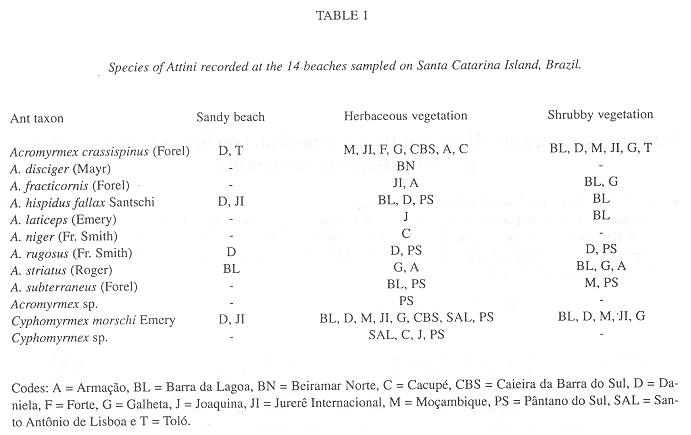
<body><![CDATA[<p><font face="Arial,Helvetica"><font size=-1>Fungus-growing ants, beaches, Santa Catarina Island, Brazil, Attini.</font></font>     <br><font size=-1></font>&nbsp;<font size=-1></font>     <p><font face="Arial,Helvetica"><font size=-1>The tribe Attini, that comprises the fungus-growing ants "and the more specialized leaf-cutters" are restricted to the New World, the majority of species recorded from the Nearctic region (<a href="file:////Scanner/imagenes/rbt48n2/36.html#Weber">Weber 1982</a>, <a href="file:////Scanner/imagenes/rbt48n2/36.html#Fowler83">Fowler 1983</a>, <a href="file:////Scanner/imagenes/rbt48n2/36.html#Mayhé">Mayh&eacute;-Nunes 1995</a>).</font></font><font size=-1></font>     <p><font face="Arial,Helvetica"><font size=-1><a href="file:////Scanner/imagenes/rbt48n2/36.html#Ferreira">Ferreira-Lima (1945)</a> lists six species of <i>Acromyrmex </i>and one of <i>Atta </i>Fabricius for Santa Catarina State. Among these, only <i>Acromyrmex</i> <i>disciger</i> Mayr and <i>Acromyrmex laticeps</i> Emery are mentioned as occurring on Santa Catarina Island. Recently, <a href="file:////Scanner/imagenes/rbt48n2/36.html#Bonnet">Bonnet and Lopes (1993)</a> recorded four species of Attini (<i>Acromyrmex niger</i> (Fr. Smith), <i>Acromyrmex striatus</i> (Roger), <i>Cyphomyrmex morschi</i> and <i>Trachymyrmex iheringi</i> (Emery)) at Joaquina Beach on Santa Catarina Island.</font></font><font size=-1></font>     <p><font face="Arial,Helvetica"><font size=-1>This paper measures species coexistence for attine ants in Santa Catarina Island. We carried out the following: a) a taxonomic inventory of species of Attini at some beaches on Santa Catarina Island (27&ordm; 10’ and 27&ordm; 50’S; 48&ordm; 25’ and 48&ordm; 35’W) and b) an association of species with habitats at the beaches (on the sand, and in both herbaceous and shrubby vegetation).</font></font><font size=-1></font>     <p><font face="Arial,Helvetica"><font size=-1>The samplings were all manual, in soil or litterfall, because the attine ants were not attracted by the usual baits (honey, sardine or tuna paste) (<a href="file:////Scanner/imagenes/rbt48n2/36.html#Silva">Silva and Lopes 1997</a>). These samplings were done from 03.14.1996 to 06.07.1996 at 14 beaches on Santa Catarina Island. The beaches "profiles" varied from zero to five meters above the sea level. The main vegetation species are: <i>Blutaparon portulacoides</i> (St.-Hil.) Mears (Amaranthaceae), <i>Oxypetalum</i> cf. <i>banksii</i> R. &amp; S. (Asclepiadaceae), <i>Conyza</i> cf. <i>canadensis</i> (L.) Cronq., <i>Porophylum</i> <i>ruderale</i> (Jacq.) Cass. (both Compositae), <i>Ipomoea imperati</i> (Vahl) Grisebach, <i>Ipomoea pes-caprae</i> (L.) R. Brown (both Convolvulaceae), <i>Remiria maritima</i> Aubl. (Cyperaceae), <i>Panicum racemosum</i> Spr., <i>Paspalum vaginatum</i> Sw., <i>Spartina ciliata</i> Brong. (both Gramineae), <i>Canavalia rosea</i> (Sw.) DC., <i>Dalbergia ecastophyllum</i> (L.) Taub. (both Leguminosae), <i>Dodonaea viscosa</i> (L.) Jacq. (Sapindaceae) and <i>Hydrocotyle bonariensis</i> Lam. (Umbelliferae) (<a href="file:////Scanner/imagenes/rbt48n2/36.html#Bresolin">Bresolin 1979</a>, <a href="file:////Scanner/imagenes/rbt48n2/36.html#Castellani">Castellani et al. 1999</a>). Each beach was examined for at least three hours in the above-mentioned habitats. The voucher specimens were deposited in the reference collection of the Departamento de Ecologia e Zoologia, CCB/UFSC. The taxonomic identification follows <a href="file:////Scanner/imagenes/rbt48n2/36.html#Gonçalves61">Gon&ccedil;alves (1961)</a>, <a href="file:////Scanner/imagenes/rbt48n2/36.html#Kempf">Kempf (1964)</a>, <a href="file:////Scanner/imagenes/rbt48n2/36.html#Fowler88">Fowler (1988)</a> and <a href="file:////Scanner/imagenes/rbt48n2/36.html#Bolton">Bolton (1994)</a>.</font></font><font size=-1></font>     <p><font face="Arial,Helvetica"><font size=-1>For the faunistic comparison in the three beach habitats, Sorensen’s similarity coefficient was used (<a href="file:////Scanner/imagenes/rbt48n2/36.html#Krebs">Krebs 1989</a>).</font></font><font size=-1></font>     <p><font face="Arial,Helvetica"><font size=-1>We recorded 12 species of Attini, of which ten were <i>Acromyrmex</i> and two <i>Cyphomyrmex</i> (<a href="file:////Scanner/imagenes/rbt48n2/36.html#Tabla1">Table 1</a>).</font></font>     <br><font size=-1></font>&nbsp;<font size=-1></font>     <center>     ]]></body>
<body><![CDATA[<p><a NAME="Tabla1"></a><img SRC="/img/fbpe/rbt/v48n2-3/0878i01.GIF" height=435 width=691></center> <font size=-1></font>     
<p>    <br><font size=-1></font>     <br><font size=-1></font>     <p><font face="Arial,Helvetica"><font size=-1>Only five species were actually present on the sand itself. This is a restricted location for foraging because of vegetation escarcity. In contrast, the beaches with herbaceous vegetation had all 12 species. This is particularly consistent with <i>Acromyrmex</i> preference for open habitats (<a href="file:////Scanner/imagenes/rbt48n2/36.html#Fowler83">Fowler 1983</a>, <a href="file:////Scanner/imagenes/rbt48n2/36.html#Farji">Farji-Brener and Ruggiero 1994</a>).</font></font><font size=-1></font>     <p><font face="Arial,Helvetica"><font size=-1>The values for Sorensen’s similarity coefficients were 0.59 (sand and herbaceous vegetation), 0.77 (sand and shrubby vegetation) and 0.80 (herbaceous vegetation and shrubby vegetation). These high coefficients reflect the fact that all the species that occur on sand, also nest in sections with herbaceous and shrubby vegetation (<a href="file:////Scanner/imagenes/rbt48n2/36.html#Tabla1">Table 1</a>).</font></font><font size=-1></font>     <p><font face="Arial,Helvetica"><font size=-1>The number of <i>Acromyrmex</i> species (ten) is high in comparison with other studies in coastal Brazil: three species were recorded by <a href="file:////Scanner/imagenes/rbt48n2/36.html#Gonçalves84">Gon&ccedil;alves and Nunes (1984)</a>, two by <a href="file:////Scanner/imagenes/rbt48n2/36.html#Bonnet">Bonnet and Lopes (1993)</a> and two by <a href="file:////Scanner/imagenes/rbt48n2/36.html#Fowler96">Fowler and Pesquero (1996)</a>. <i>Acromyrmex fracticornis</i> (Forel) and <i>Acromyrmex rugosus</i> (Fr. Smith) are new records for Santa Catarina State, according to the reference list of <a href="file:////Scanner/imagenes/rbt48n2/36.html#Della">Della Lucia <i>et al</i>. (1993)</a>. <i>Acromyrmex crassispinus</i> was the most frequent species, being collected on ten of the 14 beaches, even at the tideline, while foraging among organic material. This species is referred to by <a href="file:////Scanner/imagenes/rbt48n2/36.html#Gonçalves61">Gon&ccedil;alves (1961)</a> as the "commonest leaf-cutting ant in southern Brazil".</font></font><font size=-1></font>     <p><font face="Arial,Helvetica"><font size=-1>Most <i>Cyphomyrmex</i> were <i>C. morschi</i>. This species commonly appears in other coastal regions inventories (<a href="file:////Scanner/imagenes/rbt48n2/36.html#Kempf">Kempf 1964</a>, <a href="file:////Scanner/imagenes/rbt48n2/36.html#Bonnet">Bonnet and Lopes 1993</a>).</font></font><font size=-1></font>     <p><font face="Arial,Helvetica"><font size=-1>In regard to future work, we suggest an increase in collections at other beaches on Santa Catarina Island as well as collections during other periods of the year.</font></font>     <br><font size=-1></font>&nbsp;<font size=-1></font>     ]]></body>
<body><![CDATA[<p><b><font face="Arial,Helvetica"><font size=-1>References</font></font></b><font size=-1></font>     <!-- ref --><p><a NAME="Bolton"></a><font face="Arial,Helvetica"><font size=-1>Bolton, B. 1994. Identification Guide to the Ant Genera of the World. Harvard&nbsp; University, Cambridge, Massachusetts. 222 p.</font></font><font size=-1></font>    &nbsp;&nbsp;&nbsp;&nbsp;&nbsp;&nbsp;&nbsp;&nbsp;[&#160;<a href="javascript:void(0);" onclick="javascript: window.open('/scielo.php?script=sci_nlinks&ref=1209148&pid=S0034-7744200000020003600001&lng=','','width=640,height=500,resizable=yes,scrollbars=1,menubar=yes,');">Links</a>&#160;]<!-- end-ref --><!-- ref --><p><a NAME="Bonnet"></a><font face="Arial,Helvetica"><font size=-1>Bonnet, A. &amp; B. C. Lopes. 1993. Formigas de dunas e restingas da Praia da Joaquina,&nbsp; Ilha de Santa Catarina, SC (Insecta: Hymenoptera). Biotemas 6: 107-114.</font></font><font size=-1></font>    &nbsp;&nbsp;&nbsp;&nbsp;&nbsp;&nbsp;&nbsp;&nbsp;[&#160;<a href="javascript:void(0);" onclick="javascript: window.open('/scielo.php?script=sci_nlinks&ref=1209149&pid=S0034-7744200000020003600002&lng=','','width=640,height=500,resizable=yes,scrollbars=1,menubar=yes,');">Links</a>&#160;]<!-- end-ref --><!-- ref --><p><a NAME="Bresolin"></a><font face="Arial,Helvetica"><font size=-1>Bresolin, A. 1979. Flora da restinga da Ilha de Santa Catarina. &Iacute;nsula 10: 1-54.</font></font><font size=-1></font>    &nbsp;&nbsp;&nbsp;&nbsp;&nbsp;&nbsp;&nbsp;&nbsp;[&#160;<a href="javascript:void(0);" onclick="javascript: window.open('/scielo.php?script=sci_nlinks&ref=1209150&pid=S0034-7744200000020003600003&lng=','','width=640,height=500,resizable=yes,scrollbars=1,menubar=yes,');">Links</a>&#160;]<!-- end-ref --><!-- ref --><p><a NAME="Castellani"></a><font face="Arial,Helvetica"><font size=-1>Castellani, T. T., C. A. Caus &amp; S. Vieira. 1999. Fenologia de uma comunidade de duna frontal no Sul do Brasil. Acta Bot. Bras. 13: 99-114.</font></font><font size=-1></font>    &nbsp;&nbsp;&nbsp;&nbsp;&nbsp;&nbsp;&nbsp;&nbsp;[&#160;<a href="javascript:void(0);" onclick="javascript: window.open('/scielo.php?script=sci_nlinks&ref=1209151&pid=S0034-7744200000020003600004&lng=','','width=640,height=500,resizable=yes,scrollbars=1,menubar=yes,');">Links</a>&#160;]<!-- end-ref --><!-- ref --><p><a NAME="Della"></a><font face="Arial,Helvetica"><font size=-1>Della Lucia, T. M. C., H. G. Fowler &amp; D. D. O. Moreira. 1993. Esp&eacute;cies de formigas cortadeiras no Brasil, p. 26-31. <i>In</i>: T. M. C. Della Lucia (ed.). As formigas cortadeiras. Sociedade de Investiga&ccedil;&otilde;es Florestais &amp; Universidade Federal de Vi&ccedil;osa, Vi&ccedil;osa, Brasil.</font></font><font size=-1></font>    &nbsp;&nbsp;&nbsp;&nbsp;&nbsp;&nbsp;&nbsp;&nbsp;[&#160;<a href="javascript:void(0);" onclick="javascript: window.open('/scielo.php?script=sci_nlinks&ref=1209152&pid=S0034-7744200000020003600005&lng=','','width=640,height=500,resizable=yes,scrollbars=1,menubar=yes,');">Links</a>&#160;]<!-- end-ref --><!-- ref --><p><a NAME="Farji"></a><font face="Arial,Helvetica"><font size=-1>Farji-Brener, A. G. &amp; A. Ruggiero. 1994. Leaf cutting ants (<i>Atta</i> and <i>Acromyrmex</i>)&nbsp; inhabiting Argentina: patterns in species richness and geographical range sizes. J. Biogeogr. 21: 391-399.</font></font><font size=-1></font>    &nbsp;&nbsp;&nbsp;&nbsp;&nbsp;&nbsp;&nbsp;&nbsp;[&#160;<a href="javascript:void(0);" onclick="javascript: window.open('/scielo.php?script=sci_nlinks&ref=1209153&pid=S0034-7744200000020003600006&lng=','','width=640,height=500,resizable=yes,scrollbars=1,menubar=yes,');">Links</a>&#160;]<!-- end-ref --><!-- ref --><p><a NAME="Ferreira"></a><font face="Arial,Helvetica"><font size=-1>Ferreira-Lima, A. D. 1945. Insetos fit&oacute;fagos de Santa Catarina. Bol. Fitossanit.&nbsp; 2: 233-251.</font></font><font size=-1></font>    &nbsp;&nbsp;&nbsp;&nbsp;&nbsp;&nbsp;&nbsp;&nbsp;[&#160;<a href="javascript:void(0);" onclick="javascript: window.open('/scielo.php?script=sci_nlinks&ref=1209154&pid=S0034-7744200000020003600007&lng=','','width=640,height=500,resizable=yes,scrollbars=1,menubar=yes,');">Links</a>&#160;]<!-- end-ref --><!-- ref --><p><a NAME="Fowler83"></a><font face="Arial,Helvetica"><font size=-1>Fowler, H. G. 1983. Latitudinal gradients and diversity of the leaf-cutting ants (<i>Atta</i> and <i>Acromyrmex</i>) (Hymenoptera: Formicidae). Rev. Biol. Trop. 31: 213-216.</font></font><font size=-1></font>    &nbsp;&nbsp;&nbsp;&nbsp;&nbsp;&nbsp;&nbsp;&nbsp;[&#160;<a href="javascript:void(0);" onclick="javascript: window.open('/scielo.php?script=sci_nlinks&ref=1209155&pid=S0034-7744200000020003600008&lng=','','width=640,height=500,resizable=yes,scrollbars=1,menubar=yes,');">Links</a>&#160;]<!-- end-ref --><!-- ref --><p><a NAME="Fowler88"></a><font face="Arial,Helvetica"><font size=-1>Fowler, H. G. 1988. Taxa of the neotropical grass-cutting ants, <i>Acromyrmex (Moellerius)</i> (Hymenoptera: Formicidae: Attini). Cient&iacute;fica 16: 281-295.</font></font><font size=-1></font>    &nbsp;&nbsp;&nbsp;&nbsp;&nbsp;&nbsp;&nbsp;&nbsp;[&#160;<a href="javascript:void(0);" onclick="javascript: window.open('/scielo.php?script=sci_nlinks&ref=1209156&pid=S0034-7744200000020003600009&lng=','','width=640,height=500,resizable=yes,scrollbars=1,menubar=yes,');">Links</a>&#160;]<!-- end-ref --><!-- ref --><p><a NAME="Fowler96"></a><font face="Arial,Helvetica"><font size=-1>Fowler, H. G. &amp; M. A. Pesquero. 1996. Ant assemblages (Hymenoptera: Formicidae of the Ilha do Cardoso State Park and their relation with vegetation types. Rev. Brasil. Biol. 56: 427-433.</font></font><font size=-1></font>    &nbsp;&nbsp;&nbsp;&nbsp;&nbsp;&nbsp;&nbsp;&nbsp;[&#160;<a href="javascript:void(0);" onclick="javascript: window.open('/scielo.php?script=sci_nlinks&ref=1209157&pid=S0034-7744200000020003600010&lng=','','width=640,height=500,resizable=yes,scrollbars=1,menubar=yes,');">Links</a>&#160;]<!-- end-ref --><!-- ref --><p><a NAME="Gonçalves61"></a><font face="Arial,Helvetica"><font size=-1>Gon&ccedil;alves, C. R. 1961. O g&ecirc;nero <i>Acromyrmex</i> no Brasil (Hymenoptera: Formicidae). Studia Ent. 4: 113-180.</font></font><font size=-1></font>    &nbsp;&nbsp;&nbsp;&nbsp;&nbsp;&nbsp;&nbsp;&nbsp;[&#160;<a href="javascript:void(0);" onclick="javascript: window.open('/scielo.php?script=sci_nlinks&ref=1209158&pid=S0034-7744200000020003600011&lng=','','width=640,height=500,resizable=yes,scrollbars=1,menubar=yes,');">Links</a>&#160;]<!-- end-ref --><!-- ref --><p><a NAME="Gonçalves84"></a><font face="Arial,Helvetica"><font size=-1>Gon&ccedil;alves, C. R. &amp; A. M. Nunes. 1984. Formigas de dunas e restingas do Brasil,&nbsp; p. 93-102. <i>In</i>: L. D. Lacerda, D. S. D. Araujo, R. Cerqueira &amp; B. Turcq&nbsp; (eds.). Restingas: origem, estrutura, processos. Universidade Federal Fluminense, Niter&oacute;i, Brasil.</font></font><font size=-1></font>    &nbsp;&nbsp;&nbsp;&nbsp;&nbsp;&nbsp;&nbsp;&nbsp;[&#160;<a href="javascript:void(0);" onclick="javascript: window.open('/scielo.php?script=sci_nlinks&ref=1209159&pid=S0034-7744200000020003600012&lng=','','width=640,height=500,resizable=yes,scrollbars=1,menubar=yes,');">Links</a>&#160;]<!-- end-ref --><!-- ref --><p><a NAME="Kempf"></a><font face="Arial,Helvetica"><font size=-1>Kempf, W. W. 1964. A revision of the Neotropical fungus-growing ants of the genus <i>Cyphomyrmex</i> Mayr. Part 1: Group of <i>strigatus</i> Mayr (Hym., Formicidae). Studia Ent. 7: 1-44.</font></font><font size=-1></font>    &nbsp;&nbsp;&nbsp;&nbsp;&nbsp;&nbsp;&nbsp;&nbsp;[&#160;<a href="javascript:void(0);" onclick="javascript: window.open('/scielo.php?script=sci_nlinks&ref=1209160&pid=S0034-7744200000020003600013&lng=','','width=640,height=500,resizable=yes,scrollbars=1,menubar=yes,');">Links</a>&#160;]<!-- end-ref --><!-- ref --><p><a NAME="Krebs"></a><font face="Arial,Helvetica"><font size=-1>Krebs, C. J. 1989. Ecological Methodology. Harper &amp; Row, New York, 654 p.</font></font><font size=-1></font>    &nbsp;&nbsp;&nbsp;&nbsp;&nbsp;&nbsp;&nbsp;&nbsp;[&#160;<a href="javascript:void(0);" onclick="javascript: window.open('/scielo.php?script=sci_nlinks&ref=1209161&pid=S0034-7744200000020003600014&lng=','','width=640,height=500,resizable=yes,scrollbars=1,menubar=yes,');">Links</a>&#160;]<!-- end-ref --><!-- ref --><p><a NAME="Mayhé"></a><font face="Arial,Helvetica"><font size=-1>Mayh&eacute;-Nunes, A. J. 1995. Filogen&iacute;a de los Attini (Hym., Formicidae): un aporte al conocimiento de las hormigas fung&iacute;voras. Ph.D. Thesis, Universidad Sim&oacute;n Bol&iacute;var, Caracas, Venezuela.</font></font><font size=-1></font>    &nbsp;&nbsp;&nbsp;&nbsp;&nbsp;&nbsp;&nbsp;&nbsp;[&#160;<a href="javascript:void(0);" onclick="javascript: window.open('/scielo.php?script=sci_nlinks&ref=1209162&pid=S0034-7744200000020003600015&lng=','','width=640,height=500,resizable=yes,scrollbars=1,menubar=yes,');">Links</a>&#160;]<!-- end-ref --><!-- ref --><p><a NAME="Silva"></a><font face="Arial,Helvetica"><font size=-1>Silva, R. R. da &amp; B. C. Lopes. 1997. Ants (Hymenoptera: Formicidae) from Atlantic rainforest at Santa Catarina Island, Brazil: two years of sampling. Rev.&nbsp; Biol. Trop. 45: 1641-1648.</font></font><font size=-1></font>    &nbsp;&nbsp;&nbsp;&nbsp;&nbsp;&nbsp;&nbsp;&nbsp;[&#160;<a href="javascript:void(0);" onclick="javascript: window.open('/scielo.php?script=sci_nlinks&ref=1209163&pid=S0034-7744200000020003600016&lng=','','width=640,height=500,resizable=yes,scrollbars=1,menubar=yes,');">Links</a>&#160;]<!-- end-ref --><!-- ref --><p><a NAME="Weber"></a><font face="Arial,Helvetica"><font size=-1>Weber, N. A. 1982. Fungus ants, p. 255-363. <i>In</i>: H. R. Hermann (ed.). Social Insects,&nbsp; Academic, New York, vol. 4.</font></font><font face="Arial,Helvetica"><font size=-1></font></font>    &nbsp;&nbsp;&nbsp;&nbsp;&nbsp;&nbsp;&nbsp;&nbsp;[&#160;<a href="javascript:void(0);" onclick="javascript: window.open('/scielo.php?script=sci_nlinks&ref=1209164&pid=S0034-7744200000020003600017&lng=','','width=640,height=500,resizable=yes,scrollbars=1,menubar=yes,');">Links</a>&#160;]<!-- end-ref --><p><a NAME="1a"></a><font face="Arial,Helvetica"><font size=-1><sup><a href="#1">1</a></sup> Departamento de Ecologia e Zoologia, Centro de Ci&ecirc;ncias Biol&oacute;gicas, Universidade Federal de Santa Catarina, C.P. 476, Florian&oacute;polis, SC, Brazil, CEP 88010-970, Fax (048) 3319672, e-mail: <a href="mailto:bclopes@ccb.ufsc.br">bclopes@ccb.ufsc.br</a>;</font></font><font size=-1></font>     <p><a NAME="2a"></a><font face="Arial,Helvetica"><font size=-1><sup><a href="#2">2</a></sup> Departamento de Ecologia, Instituto de Bioci&ecirc;ncias, UNESP, Rio Claro, SP, Brazil, CEP 13506-900, e-mail: <a href="mailto:hgfowler@rc.unesp.br">hgfowler@rc.unesp.br</a></font></font>     ]]></body>
<body><![CDATA[ ]]></body><back>
<ref-list>
<ref id="B1">
<nlm-citation citation-type="book">
<person-group person-group-type="author">
<name>
<surname><![CDATA[Bolton]]></surname>
<given-names><![CDATA[B]]></given-names>
</name>
</person-group>
<source><![CDATA[Identification Guide to the Ant Genera of the World]]></source>
<year>1994</year>
<publisher-loc><![CDATA[Cambridge^eMassachusetts Massachusetts]]></publisher-loc>
<publisher-name><![CDATA[Harvard University]]></publisher-name>
</nlm-citation>
</ref>
<ref id="B2">
<nlm-citation citation-type="journal">
<person-group person-group-type="author">
<name>
<surname><![CDATA[Bonnet]]></surname>
<given-names><![CDATA[A]]></given-names>
</name>
<name>
<surname><![CDATA[Lopes]]></surname>
<given-names><![CDATA[B. C]]></given-names>
</name>
</person-group>
<article-title xml:lang="es"><![CDATA[Formigas de dunas e restingas da Praia da Joaquina, Ilha de Santa Catarina, SC (Insecta: Hymenoptera)]]></article-title>
<source><![CDATA[Biotemas]]></source>
<year>1993</year>
<volume>6</volume>
<page-range>107-114</page-range></nlm-citation>
</ref>
<ref id="B3">
<nlm-citation citation-type="journal">
<person-group person-group-type="author">
<name>
<surname><![CDATA[Bresolin]]></surname>
<given-names><![CDATA[A]]></given-names>
</name>
</person-group>
<article-title xml:lang="es"><![CDATA[Flora da restinga da Ilha de Santa Catarina]]></article-title>
<source><![CDATA[Ínsula]]></source>
<year>1979</year>
<volume>10</volume>
<page-range>1-54</page-range></nlm-citation>
</ref>
<ref id="B4">
<nlm-citation citation-type="journal">
<person-group person-group-type="author">
<name>
<surname><![CDATA[Castellani]]></surname>
<given-names><![CDATA[T. T]]></given-names>
</name>
<name>
<surname><![CDATA[Caus]]></surname>
<given-names><![CDATA[C. A]]></given-names>
</name>
<name>
<surname><![CDATA[Vieira]]></surname>
<given-names><![CDATA[S]]></given-names>
</name>
</person-group>
<article-title xml:lang="pt"><![CDATA[Fenologia de uma comunidade de duna frontal no Sul do Brasil]]></article-title>
<source><![CDATA[Acta Bot. Bras]]></source>
<year>1999</year>
<volume>13</volume>
<page-range>99-114</page-range></nlm-citation>
</ref>
<ref id="B5">
<nlm-citation citation-type="book">
<person-group person-group-type="author">
<name>
<surname><![CDATA[Della Lucia]]></surname>
<given-names><![CDATA[T. M. C]]></given-names>
</name>
<name>
<surname><![CDATA[Fowler]]></surname>
<given-names><![CDATA[H. G]]></given-names>
</name>
<name>
<surname><![CDATA[Moreira]]></surname>
<given-names><![CDATA[D. D. O]]></given-names>
</name>
</person-group>
<article-title xml:lang="pt"><![CDATA[Espécies de formigas cortadeiras no Brasil]]></article-title>
<person-group person-group-type="editor">
<name>
<surname><![CDATA[Della Lucia]]></surname>
<given-names><![CDATA[T. M. C]]></given-names>
</name>
</person-group>
<source><![CDATA[As formigas cortadeiras]]></source>
<year>1993</year>
<page-range>26-31</page-range><publisher-loc><![CDATA[Viçosa ]]></publisher-loc>
<publisher-name><![CDATA[Sociedade de Investigações Florestais & Universidade Federal de Viçosa]]></publisher-name>
</nlm-citation>
</ref>
<ref id="B6">
<nlm-citation citation-type="journal">
<person-group person-group-type="author">
<name>
<surname><![CDATA[Farji-Brener]]></surname>
<given-names><![CDATA[A. G]]></given-names>
</name>
<name>
<surname><![CDATA[Ruggiero]]></surname>
<given-names><![CDATA[A]]></given-names>
</name>
</person-group>
<article-title xml:lang="en"><![CDATA[Leaf cutting ants (Atta and Acromyrmex) inhabiting Argentina: patterns in species richness and geographical range sizes]]></article-title>
<source><![CDATA[J. Biogeogr]]></source>
<year>1994</year>
<volume>21</volume>
<page-range>391-399</page-range></nlm-citation>
</ref>
<ref id="B7">
<nlm-citation citation-type="journal">
<person-group person-group-type="author">
<name>
<surname><![CDATA[Ferreira-Lima]]></surname>
<given-names><![CDATA[A. D]]></given-names>
</name>
</person-group>
<article-title xml:lang="es"><![CDATA[Insetos fitófagos de Santa Catarina]]></article-title>
<source><![CDATA[Bol. Fitossanit]]></source>
<year>1945</year>
<volume>2</volume>
<page-range>233-251</page-range></nlm-citation>
</ref>
<ref id="B8">
<nlm-citation citation-type="journal">
<person-group person-group-type="author">
<name>
<surname><![CDATA[Fowler]]></surname>
<given-names><![CDATA[H. G]]></given-names>
</name>
</person-group>
<article-title xml:lang="en"><![CDATA[Latitudinal gradients and diversity of the leaf-cutting ants (Atta and Acromyrmex) (Hymenoptera: Formicidae)]]></article-title>
<source><![CDATA[Rev. Biol. Trop]]></source>
<year>1983</year>
<volume>31</volume>
<page-range>213-216</page-range></nlm-citation>
</ref>
<ref id="B9">
<nlm-citation citation-type="journal">
<person-group person-group-type="author">
<name>
<surname><![CDATA[Fowler]]></surname>
<given-names><![CDATA[H. G]]></given-names>
</name>
</person-group>
<article-title xml:lang="en"><![CDATA[Taxa of the neotropical grass-cutting ants, Acromyrmex (Moellerius) (Hymenoptera: Formicidae: Attini)]]></article-title>
<source><![CDATA[Científica]]></source>
<year>1988</year>
<volume>16</volume>
<page-range>281-295</page-range></nlm-citation>
</ref>
<ref id="B10">
<nlm-citation citation-type="journal">
<person-group person-group-type="author">
<name>
<surname><![CDATA[Fowler]]></surname>
<given-names><![CDATA[H. G]]></given-names>
</name>
<name>
<surname><![CDATA[Pesquero]]></surname>
<given-names><![CDATA[M. A]]></given-names>
</name>
</person-group>
<article-title xml:lang="en"><![CDATA[Ant assemblages (Hymenoptera: Formicidae of the Ilha do Cardoso State Park and their relation with vegetation types]]></article-title>
<source><![CDATA[Rev. Brasil. Biol]]></source>
<year>1996</year>
<volume>56</volume>
<page-range>427-433</page-range></nlm-citation>
</ref>
<ref id="B11">
<nlm-citation citation-type="journal">
<person-group person-group-type="author">
<name>
<surname><![CDATA[Gonçalves]]></surname>
<given-names><![CDATA[C. R]]></given-names>
</name>
</person-group>
<article-title xml:lang="pt"><![CDATA[O gênero Acromyrmex no Brasil (Hymenoptera: Formicidae)]]></article-title>
<source><![CDATA[Studia Ent]]></source>
<year>1961</year>
<volume>4</volume>
<page-range>113-180</page-range></nlm-citation>
</ref>
<ref id="B12">
<nlm-citation citation-type="book">
<person-group person-group-type="author">
<name>
<surname><![CDATA[Gonçalves]]></surname>
<given-names><![CDATA[C. R]]></given-names>
</name>
<name>
<surname><![CDATA[Nunes]]></surname>
<given-names><![CDATA[A. M]]></given-names>
</name>
</person-group>
<article-title xml:lang="pt"><![CDATA[Formigas de dunas e restingas do Brasil]]></article-title>
<person-group person-group-type="editor">
<name>
<surname><![CDATA[Lacerda]]></surname>
<given-names><![CDATA[L. D]]></given-names>
</name>
<name>
<surname><![CDATA[Araujo]]></surname>
<given-names><![CDATA[D. S. D]]></given-names>
</name>
<name>
<surname><![CDATA[Cerqueira]]></surname>
<given-names><![CDATA[R]]></given-names>
</name>
<name>
<surname><![CDATA[Turcq]]></surname>
<given-names><![CDATA[B]]></given-names>
</name>
</person-group>
<source><![CDATA[Restingas: origem, estrutura, processos]]></source>
<year>1984</year>
<page-range>93-102</page-range><publisher-loc><![CDATA[Niterói ]]></publisher-loc>
<publisher-name><![CDATA[Universidade Federal Fluminense]]></publisher-name>
</nlm-citation>
</ref>
<ref id="B13">
<nlm-citation citation-type="journal">
<person-group person-group-type="author">
<name>
<surname><![CDATA[Kempf]]></surname>
<given-names><![CDATA[W. W]]></given-names>
</name>
</person-group>
<article-title xml:lang="en"><![CDATA[A revision of the Neotropical fungus-growing ants of the genus Cyphomyrmex Mayr. Part 1: Group of strigatus Mayr (Hym., Formicidae)]]></article-title>
<source><![CDATA[Studia Ent]]></source>
<year>1964</year>
<volume>7</volume>
<page-range>1-44</page-range></nlm-citation>
</ref>
<ref id="B14">
<nlm-citation citation-type="book">
<person-group person-group-type="author">
<name>
<surname><![CDATA[Krebs]]></surname>
<given-names><![CDATA[C. J]]></given-names>
</name>
</person-group>
<source><![CDATA[Ecological Methodology]]></source>
<year>1989</year>
<page-range>654</page-range><publisher-loc><![CDATA[New York ]]></publisher-loc>
<publisher-name><![CDATA[Harper & Row]]></publisher-name>
</nlm-citation>
</ref>
<ref id="B15">
<nlm-citation citation-type="">
<person-group person-group-type="author">
<name>
<surname><![CDATA[Mayhé-Nunes]]></surname>
<given-names><![CDATA[A. J]]></given-names>
</name>
</person-group>
<source><![CDATA[Filogenía de los Attini (Hym., Formicidae): un aporte al conocimiento de las hormigas fungívoras]]></source>
<year>1995</year>
</nlm-citation>
</ref>
<ref id="B16">
<nlm-citation citation-type="journal">
<person-group person-group-type="author">
<name>
<surname><![CDATA[Silva]]></surname>
<given-names><![CDATA[R. R. da]]></given-names>
</name>
<name>
<surname><![CDATA[Lopes]]></surname>
<given-names><![CDATA[B. C]]></given-names>
</name>
</person-group>
<article-title xml:lang="en"><![CDATA[Ants (Hymenoptera: Formicidae) from Atlantic rainforest at Santa Catarina Island, Brazil: two years of sampling]]></article-title>
<source><![CDATA[Rev. Biol. Trop]]></source>
<year>1997</year>
<volume>45</volume>
<page-range>1641-1648</page-range></nlm-citation>
</ref>
<ref id="B17">
<nlm-citation citation-type="book">
<person-group person-group-type="author">
<name>
<surname><![CDATA[Weber]]></surname>
<given-names><![CDATA[N. A]]></given-names>
</name>
</person-group>
<article-title xml:lang="en"><![CDATA[Fungus ants]]></article-title>
<person-group person-group-type="editor">
<name>
<surname><![CDATA[Hermann]]></surname>
<given-names><![CDATA[H. R]]></given-names>
</name>
</person-group>
<source><![CDATA[Social Insects]]></source>
<year>1982</year>
<volume>4</volume>
<page-range>255-363</page-range><publisher-loc><![CDATA[New York ]]></publisher-loc>
<publisher-name><![CDATA[Academic]]></publisher-name>
</nlm-citation>
</ref>
</ref-list>
</back>
</article>
