<?xml version="1.0" encoding="ISO-8859-1"?><article xmlns:mml="http://www.w3.org/1998/Math/MathML" xmlns:xlink="http://www.w3.org/1999/xlink" xmlns:xsi="http://www.w3.org/2001/XMLSchema-instance">
<front>
<journal-meta>
<journal-id>0034-7744</journal-id>
<journal-title><![CDATA[Revista de Biología Tropical]]></journal-title>
<abbrev-journal-title><![CDATA[Rev. biol. trop]]></abbrev-journal-title>
<issn>0034-7744</issn>
<publisher>
<publisher-name><![CDATA[Universidad de Costa Rica]]></publisher-name>
</publisher>
</journal-meta>
<article-meta>
<article-id>S0034-77442000000200035</article-id>
<title-group>
<article-title xml:lang="en"><![CDATA[The effects of food presentation and microhabitat upon resource monopoly in a ground-foraging ant (Hymenoptera: Formicidae) community]]></article-title>
</title-group>
<contrib-group>
<contrib contrib-type="author">
<name>
<surname><![CDATA[McGlynn]]></surname>
<given-names><![CDATA[Terrence P]]></given-names>
</name>
<xref ref-type="aff" rid="A01"/>
</contrib>
<contrib contrib-type="author">
<name>
<surname><![CDATA[Eben Kirksey]]></surname>
<given-names><![CDATA[S]]></given-names>
</name>
<xref ref-type="aff" rid="A02"/>
</contrib>
</contrib-group>
<aff id="A01">
<institution><![CDATA[,Gettysburg College Department of Biology ]]></institution>
<addr-line><![CDATA[Gettysburg PA]]></addr-line>
<country>USA</country>
</aff>
<aff id="A02">
<institution><![CDATA[,University of South Florida Division of Natural Sciences ]]></institution>
<addr-line><![CDATA[Sarasota Florida]]></addr-line>
</aff>
<pub-date pub-type="pub">
<day>00</day>
<month>06</month>
<year>2000</year>
</pub-date>
<pub-date pub-type="epub">
<day>00</day>
<month>06</month>
<year>2000</year>
</pub-date>
<volume>48</volume>
<numero>2-3</numero>
<fpage>629</fpage>
<lpage>642</lpage>
<copyright-statement/>
<copyright-year/>
<self-uri xlink:href="http://www.scielo.sa.cr/scielo.php?script=sci_arttext&amp;pid=S0034-77442000000200035&amp;lng=en&amp;nrm=iso"></self-uri><self-uri xlink:href="http://www.scielo.sa.cr/scielo.php?script=sci_abstract&amp;pid=S0034-77442000000200035&amp;lng=en&amp;nrm=iso"></self-uri><self-uri xlink:href="http://www.scielo.sa.cr/scielo.php?script=sci_pdf&amp;pid=S0034-77442000000200035&amp;lng=en&amp;nrm=iso"></self-uri><abstract abstract-type="short" xml:lang="en"><p><![CDATA[In Neotropical wet forests several species of omnivorous, resource-defending ants, live and forage in close proximity to one another. Although the forest floor is heterogeneous in microhabitat and food quantity, little is known about the impact of microhabitat and food variation upon resource monopoly among ants. We investigated how food type and microhabitat influence food monopoly in resource-defending ants in old-growth tropical wet forest in the Caribbean lowlands of Costa Rica. We measured several microhabitat characteristics at 66 points in a 0.5 hectare plot, and baited each point with two categories of tuna bait. These baits were presented in "split" and "clumped" arrangements. We measured the frequency of bait monopoly by a single species, as well as the number of recruited ant foragers at a bait. Out of five common species, two (Wasmannia auropunctata and Pheidole simonsi) more frequently monopolized one bait type over the other, and one (P. simonsi) recruited more ants to the split baits. We then considered the recruitment response by all ant species in the community. We found that the frequency of monopoly, sharing, and the absence of ants at a given point in the rainforest differed with bait type. The frequency of monopoly was associated with microhabitat type in two out of eight microhabitat variables (leaf litter depth and palms); variation in two other types (canopy tree distance and leafcutter ant trails) was associated with changes in forager number. In at least two ant species, food presentation affected monopoly at baits; among all resource-defending ants, the microhabitats where ants foraged for food and the type of food located determined in part the frequency of monopoly and the number of foragers at the food item. These results suggest that the location and presentation of food items determines in part which ant species will utilize the resource.]]></p></abstract>
<abstract abstract-type="short" xml:lang="es"><p><![CDATA[En los bosques húmedos de la Región Neotropical conviven varias especies de hormigas omívoras, defensoras de recursos alimenticios. Aunque el suelo del bosque es heterogéneo en microhábitat y alimento, se sabe poco sobre el impacto de ambos en las hormigas. Se investiga cómo influencian el tipo de alimento y el microhábitat la forma en que estas hormigas acaparan el alimento en un bosque húmedo tropical maduro (bajuras de Costa Rica). Se midieron ocho características de microhábitat en 66 puntos de una parcela de 0.5 ha. En cada punto se colocaron dos categorías de cebo (atún): "dividido" y "agrupado." Se midió el acaparamiento de cebo por especie y el número de hormigas por cebo. De cinco especies comunes, dos (Wasmannia auropunctata y Pheidole simonsi) monopolizaron con más frecuencia uno de los dos tipos de cebo, y una (P. simonsi) tuvo más individuos en los cebos divididos. La frecuencia de monopolio, comportamiento, y la ausencia de hormigas en punto dado en el bosque varió con el tipo de cebo. La frecuencia de acaparamiento se asoció con tipo de microhábitat en dos variables de microhábitat: profundidad de la hojarasca y palmas; la variación en distancia de bóvedas de árboles y caminos de hormigas cortadoras de hojas se asoció con cambios en el número de buscadores de alimento. En al menos dos especies la presentación del alimento afectó el acaparamiento; entre todas las hormigas estudiadas, los microhábitats y el tipo de alimento determinan en parte la frecuencia de acaparamiento y el número de individuso que llega al alimento. Estos resultados sugieren que la localización y presentación de alimento determina en parte cual especie de hormiga utilizará el recurso.]]></p></abstract>
<kwd-group>
<kwd lng="en"><![CDATA[Competition]]></kwd>
<kwd lng="en"><![CDATA[recruitment]]></kwd>
<kwd lng="en"><![CDATA[food presentation]]></kwd>
<kwd lng="en"><![CDATA[ant]]></kwd>
<kwd lng="en"><![CDATA[foraging behavior]]></kwd>
<kwd lng="la"><![CDATA[Wasmannia auropunctata]]></kwd>
<kwd lng="la"><![CDATA[Pheidole]]></kwd>
<kwd lng="en"><![CDATA[microhabitat]]></kwd>
</kwd-group>
</article-meta>
</front><body><![CDATA[ <center><b><font face="Arial,Helvetica">The effects of food presentation and microhabitat upon resource monopoly</font></b>     <br><b><font face="Arial,Helvetica">in a ground-foraging ant (Hymenoptera: Formicidae) community</font></b>     <p><b><font face="Arial,Helvetica"><font size=-1>Terrence P. McGlynn<a NAME="1"></a><sup><a href="#1a">1</a></sup> and S. Eben Kirksey<a NAME="2"></a><sup><a href="#2a">2</a></sup></font></font></b><font face="Arial,Helvetica"><font size=-1></font></font>     <p><font face="Arial,Helvetica"><font size=-1>Received 6-IV-1999. Corrected 11-II-2000. Accepted 8-III-2000.</font></font></center> <font size=-1></font>     <p><b><font face="Arial,Helvetica"><font size=-1>Abstract</font></font></b><font face="Arial,Helvetica"><font size=-1></font></font>     <p><font face="Arial,Helvetica"><font size=-1>In Neotropical wet forests several species of omnivorous, resource-defending ants, live and forage in close proximity to one another. Although the forest floor is heterogeneous in microhabitat and food quantity, little is known about the impact of microhabitat and food variation upon resource monopoly among ants. We investigated how food type and microhabitat influence food monopoly in resource-defending ants in old-growth tropical wet forest in the Caribbean lowlands of Costa Rica. We measured several microhabitat characteristics at 66 points in a 0.5 hectare plot, and baited each point with two categories of tuna bait. These baits were presented in "split" and "clumped" arrangements. We measured the frequency of bait monopoly by a single species, as well as the number of recruited ant foragers at a bait. Out of five common species, two (<i>Wasmannia auropunctata</i> and <i>Pheidole simonsi</i>) more frequently monopolized one bait type over the other, and one (<i>P. simonsi</i>) recruited more ants to the split baits. We then considered the recruitment response by all ant species in the community. We found that the frequency of monopoly, sharing, and the absence of ants at a given point in the rainforest differed with bait type. The frequency of monopoly was associated with microhabitat type in two out of eight microhabitat variables (leaf litter depth and palms); variation in two other types (canopy tree distance and leafcutter ant trails) was associated with changes in forager number. In at least two ant species, food presentation affected monopoly at baits; among all resource-defending ants, the microhabitats where ants foraged for food and the type of food located determined in part the frequency of monopoly and the number of foragers at the food item. These results suggest that the location and presentation of food items determines in part which ant species will utilize the resource.</font></font>     <br><font size=-1></font>&nbsp;<font size=-1></font>     <p><b><font face="Arial,Helvetica"><font size=-1>Key words</font></font></b><font face="Arial,Helvetica"><font size=-1></font></font>     <p><font face="Arial,Helvetica"><font size=-1>Competition, recruitment, food presentation, ant, foraging behavior, <i>Wasmannia auropunctata</i>, <i>Pheidole</i>, microhabitat.</font></font>     <br><font size=-1></font>&nbsp;     ]]></body>
<body><![CDATA[<br><font size=-1></font>&nbsp;<font size=-1></font>     <p><font face="Arial,Helvetica"><font size=-1>In ants, food monopoly may play a major role in structuring communities (<a href="#Savolainen88">Savolainen and Vespalainen 1988</a>, <a href="#Hölldobler">H&ouml;lldobler and Wilson 1990</a>, <a href="#Andersen94">Andersen and Patel 1994</a>, <a href="#Gordon">Gordon and Kulig 1996</a>). The monopoly of food resources is an important measure of competition among ants species (<a href="#Andersen92">Andersen 1992</a>; <a href="#Andersen94">Andersen and Patel 1994</a>, <a href="#Tennant">Tennant 1994</a>). Among ants, the frequency of monopoly at food items is determined by preference for the food item, as well as microhabitats where these ants forage for food. Several studies have shown that ants preferentially recruit to and defend high quality foods that are larger or rich in protein and fat (<a href="#Bernstein">Bernstein 1975</a>, <a href="#Davidson77">Davidson 1977</a>, <a href="#Davidson78">1978</a>, <a href="#Adams">Adams and Traniello 1981</a>, <a href="#Traniello">Traniello 1983</a>, <a href="#Biseau">deBiseau et al. 1997</a>). In addition to food quality, microhabitat influences monopoly by ants in Neotropical wet forests by spatially and temporally restricting foraging ranges (<a href="#Levings84">Levings and Windsor, 1984</a>; <a href="#Kaspari93a">Kaspari, 1993a</a>; <a href="#Perfecto96">Perfecto and Vandermeer, 1996</a>).</font></font><font size=-1></font>     <p><font face="Arial,Helvetica"><font size=-1>Food monopoly among ant colonies can occur for two reasons. If more than one colony is feeding at a food item, interspecific interactions can result in the exclusion of competitors. Ants can exclude competitors by using chemical repellents and physical confrontation (reviewed in <a href="#Hölldobler">Holldobler and Wilson 1990</a>).</font></font><font size=-1></font>     <p><font face="Arial,Helvetica"><font size=-1>In a microhabitat where few ants use the food, exploitative competition can result in monopoly because only one colony is taking advantage of the food resource (<a href="#Davidson98">Davidson 1998</a>).</font></font><font size=-1></font>     <p><font face="Arial,Helvetica"><font size=-1>The sizes and types of ant foods in Neotropical rainforests are highly variable (<a href="#Janzen">Janzen 1983</a>); microhabitats are variable in litter depth, plant community composition, and humidity (<a href="#Janzen">Janzen 1983</a>, <a href="#Kaspari93a">Kaspari 1993a</a>). When an ant colony sends out a forager to search for food, the location and type of food resource will determine in part if she recruits nestmates to that site and whether they will monopolize the food item.</font></font><font size=-1></font>     <p><font face="Arial,Helvetica"><font size=-1>Ant community ecologists have sorted resource-defending ants into functional groups within the context of the community. <a href="#Hölldobler">H&ouml;lldobler and Wilson (1990)</a> called resource-defending ants "extirpators" because they excluded other species through interference competition, fighting, and mass recruitment. Andersen (<a href="#Andersen95">1995</a>, 1998) in Australia and North America respectively, and <a href="#Bestelmeyer">Bestelmeyer and Weins (1996)</a> in temperate South America, sorted resource-defending ants into “Dominant Dolichoderines,” “Generalized Myrmicines,” “Subordinate Camoponotini,” and less understood “Cryptic” species. In a European boreal ant community, <a href="#Savolainen88">Savolainen and Vepsalainen (1988)</a> divided resource-defending ants into “territorials” and “encounterers.” The scale of the study and the question posed are important in determining which functional group definitions to use in a given study (<a href="#Andersen97b">Andersen 1997b</a>). In this study, species that recruit to food resources and persisted two hours after bait placement are termed as “resource-defending” ants. In Neotropical leaf litter, resource-defending ants in the genera <i>Pheidole, Solenopsis</i>, and <i>Wasmannia</i> do not defend territories, but nonetheless recruit to and defend food resources close to their nests (<a href="file:////Scanner/imagenes/rbt48n2/35.html#Torres">Torres 1984</a>, <a href="file:////Scanner/imagenes/rbt48n2/35.html#Perfecto94">Perfecto 1994</a>). This profile of non-territoriality with high levels of resource defense is consistent with the concepts of “Generalized Myrmicines” (<a href="file:////Scanner/imagenes/rbt48n2/35.html#Andersen95">Andersen 1995</a>), and “encounterers” (<a href="file:////Scanner/imagenes/rbt48n2/35.html#Savolainen88">Savolainen and Vepsalainen 1988</a>).</font></font><font size=-1></font>     <p><font face="Arial,Helvetica"><font size=-1>Although interspecific competition among resource-defending ants in the wet Neotropics has been well studied (<a href="file:////Scanner/imagenes/rbt48n2/35.html#Torres">Torres 1984</a>, <a href="file:////Scanner/imagenes/rbt48n2/35.html#Byrne">Byrne 1994</a>, <a href="file:////Scanner/imagenes/rbt48n2/35.html#Perfecto94">Perfecto 1994</a>, <a href="file:////Scanner/imagenes/rbt48n2/35.html#Tennant">Tennant 1994</a>), little is known about how these ants select microhabitats for nesting and foraging. In tropical wet forests, several resource defenders may nest next to one another, sometimes within a single square meter (<a href="file:////Scanner/imagenes/rbt48n2/35.html#Byrne">Byrne 1994</a>). Ant nests and foods are unevenly distributed in leaf litter (<a href="file:////Scanner/imagenes/rbt48n2/35.html#Levings82">Levings and Franks 1982</a>, <a href="file:////Scanner/imagenes/rbt48n2/35.html#Janzen">Janzen 1983</a>, <a href="file:////Scanner/imagenes/rbt48n2/35.html#Kaspari96">Kaspari, 1996</a>). Within the patchy environment of tropical leaf litter, we do not know where ants look for food; once they find food, we do not know how a colony decides to recruit to that location and defend it.</font></font><font size=-1></font>     <p><font face="Arial,Helvetica"><font size=-1>Are some ants specialized to exploit certain foods depending upon where the foods are located? We investigated how microhabitat and food presentation influenced food monopoly by ants. We first assessed the impact of bait presentation and microhabitat upon monopoly. We then analyzed ant monopoly patterns considering the interaction between food type and microhabitat, in order to determine if monopoly occurred more frequently at specific combinations of food presentation and h&aacute;bitat. Last, we used forager number as a measure of resource exploitation.</font></font>     <br><font size=-1></font>&nbsp;<font size=-1></font>     <p><b><font face="Arial,Helvetica"><font size=-1>Materials and Methods</font></font></b><font size=-1></font>     ]]></body>
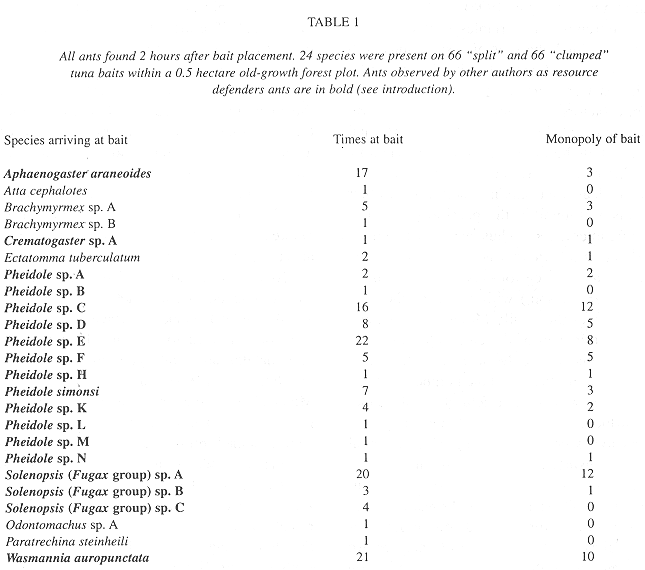
<body><![CDATA[<p><font face="Arial,Helvetica"><font size=-1>This work was carried out at La Selva Biological Station, Sarapiqu&iacute; Canton, Heredia Province, Costa Rica, in the dry season of 1996. La Selva is located in the Atlantic lowland wet tropical forest of northeastern Costa Rica, which receives ca. 4 meters of rainfall each year (<a href="file:////Scanner/imagenes/rbt48n2/35.html#McDade">McDade and Hartshorn 1994</a>). La Selva has many species of resource-defending ants that recruit heavily to bait items (<a href="file:////Scanner/imagenes/rbt48n2/35.html#Kaspari93b">Kaspari 1993b</a>, <a href="file:////Scanner/imagenes/rbt48n2/35.html#Byrne">Byrne 1994</a>, <a href="file:////Scanner/imagenes/rbt48n2/35.html#Tennant">Tennant 1994</a>).</font></font><font size=-1></font>     <p><font face="Arial,Helvetica"><font size=-1>We created a 0.5 hectare grid using the Geographic Information System (GIS) grid at La Selva; the plot was located within the GIS points 1100-1200•800-850, near the intersection of the Camino Cercano Circular and the Sendero Suroeste on the La Selva trail system. Sixty-six points were marked in a grid within the plot, with 10 meters separating each point along each axis. An earlier study at La Selva showed that 10 meters between baits maintained independent discoveries by colonies, because colony densities in the litter frequently exceeded 4 nests per m<sup>2</sup>, and ants rarely moved more than 1 meter from their nest to a bait (<a href="file:////Scanner/imagenes/rbt48n2/35.html#Kaspari96">Kaspari 1996</a>).</font></font><font size=-1></font>     <p><font face="Arial,Helvetica"><font size=-1>Environmental variables scored at each point permitted analyses of associations with the frequency of ants at baits. Microhabitat variables were selected to reflect biotic and abiotic factors that impact ant behavior. We measured leaf litter depth because diurnal variation in humidity is greater in shallow leaf litter (<a href="file:////Scanner/imagenes/rbt48n2/35.html#Kaspari93a">Kaspari1993a</a>). Several observations of leaf litter ants interacting with other organisms supported the possiblity of interspecific interactions. Thus, we determined the presence of a leafcutter ant (<i>Atta cephalotes</i>) trail and carton-nesting termites (<i>Nastutitermes</i> spp.) within 5 m of the bait, and plants of the family Melostomaceae, and palms within 1 m of the bait. Also, we measured the distance to the nearest treefalls, two nearest canopy trees, and the number of stems within 1 m, which are structural variables that can influence where ants nest and forage. We tested for associations among environmental variables using: chi square tests among discrete variables, correlation matrices for continuous variables, and ANOVAs test for assocations between discrete and continuous variables. Because of the number of analyses, we performed a Bonferroni-Dunn correction on ANOVAs to reduce the probability of a type I error. All environmental variables were independent of one another.</font></font><font size=-1></font>     <p><font face="Arial,Helvetica"><font size=-1>Bait consisted of oil-packed tuna. This is a standard bait and represents high-quality food to generalist ants (<a href="file:////Scanner/imagenes/rbt48n2/35.html#Perfecto94">Perfecto 1994</a>, <a href="file:////Scanner/imagenes/rbt48n2/35.html#Tennant">Tennant, 1994</a>). We drained excess oil before placement, so that ants would not be trapped in the bait. Baits were placed on 9.5 cm petri dishes. Two bait categories were used. These differed in position and size of individual food pieces, in order to elicit resource defense based on perceived differences among baits. Both “split” and “clumped” baits contained ca. 7 grams of tuna. Clumped baits contained 7 g of tuna placed in a single pile at the center of the dish, and split baits consisted of a 7 g piece of tuna split into four 1.75 g pieces placed at opposing edges of the dish. When the split baits were prepared, a thin layer of oil was spread over more than half of the area of the dish. The split baits covered a larger area, which may result in a greater likelihood for sharing because ants can exclusively use separate parts of the bait. We randomly assigned initial bait categories for each point on the 0.5 hectare grid. At least 2 days after the initial baiting period, each point was rebaited, such that every point was baited with both split and clumped bait types.</font></font><font size=-1></font>     <p><font face="Arial,Helvetica"><font size=-1>We waited two hours after bait placement before recording the presence and abundance of ants by species. Over the course of two hours in this forest, several species are likely to visit tuna baits at a given site, if is not raining (<a href="file:////Scanner/imagenes/rbt48n2/35.html#Tennant">Tennant 1994</a>). The total number of foraging ants at each bait was analysed to measure the impact of microhabitat and bait type upon the litter-dwelling resource-defending ant community. Monopoly occurred when only one species was present at the bait at sampling. Dead workers were excluded from the data; we assumed they died as a result of interspecific combat or drowned in oil. The number of ants from each species attending a bait was estimated, and representative individuals were collected for identification using keys in <a href="file:////Scanner/imagenes/rbt48n2/35.html#Bolton">Bolton (1994)</a> and <a href="file:////Scanner/imagenes/rbt48n2/35.html#Longino">Longino and Hanson (1995)</a>. Several ants belonged to undescribed species. These were given identification letters for reference. We refer to one of the undescribed species as <i>Pheidole simonsi</i> Wilson and Brown; this is a provisional manuscript name. Its use here does not constitute description of a new species, and is not available in the sense of the International Code of Zoological Nomenclature.</font></font><font size=-1></font>     <p><font face="Arial,Helvetica"><font size=-1>To quantify bait monopoly, baits were placed in one of three categories: 1) no ants; 2) shared among two or more species, or 3) monopolized by a single species. We used the number of ants on a bait as an additional measure of resource exploitation; this is the “forager number.” Resource monopoly indicates that only a single species is exploiting a food resource, while forager number indicates the level of resource exploitation.</font></font>     <br><font size=-1></font>&nbsp;<font size=-1></font>     <p><b><font face="Arial,Helvetica"><font size=-1>Results</font></font></b><font size=-1></font>     <p><font face="Arial,Helvetica"><font size=-1>We found 24 species at baits (<a href="file:////Scanner/imagenes/rbt48n2/35.html#Tabla 1">Table 1</a>). Because many of the ant species are uncommon within the forest, among our 66 sampling sites only five resource-defending species were observed several times. They were <i>Pheidole C</i>, <i>Pheidole E</i>, <i>Pheidole simonsi</i> Wilson and Brown (unpublished manuscript), and <i>Solenopsis A</i>, and <i>Wasmannia auropunctata</i>. These common species were used to determine differences in dominance at different bait categories and in different microhabitats.</font></font>     <br><font size=-1></font>&nbsp;<font size=-1></font>     ]]></body>
<body><![CDATA[<center>     <p><a NAME="Tabla 1"></a><img SRC="/img/fbpe/rbt/v48n2-3/0877i01.GIF" height=570 width=645></center> <font size=-1></font>     
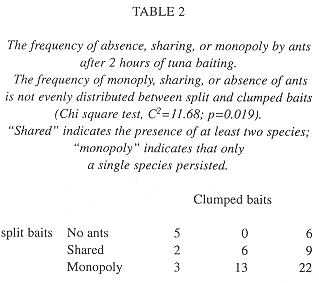
<p>    <br><font size=-1></font>     <br><font size=-1></font>     <br><font size=-1></font>     <p><font face="Arial,Helvetica"><font size=-1><b>Food presentation and monopoly by ant species:</b> Monopoly, sharing, and the absence of ants differed between split vs. clumped baits (<a href="file:////Scanner/imagenes/rbt48n2/35.html#Tabla 2">Table 2</a>). However, the number of foragers recruited to split and clumped baits was equivalent. A mean of 24.4 (4.0 S.E.) ants arrived at clumped baits (n=66), and 21.6 (3.2 S.E.) arrived at split baits (paired t-test, df=64; t=-0.70; p=0.48, ns). In most instances when split and clumped baits were shared by two or more ant species, the areas of the baiting platform utilized by each species where adjacent to one another, which suggests that these species had interacted with one another at the bait.</font></font>     <br><font size=-1></font>&nbsp;<font size=-1></font>     <center>     <p><a NAME="Tabla 2"></a><img SRC="/img/fbpe/rbt/v48n2-3/0877i02.GIF" height=283 width=319></center> <font size=-1></font>     
]]></body>
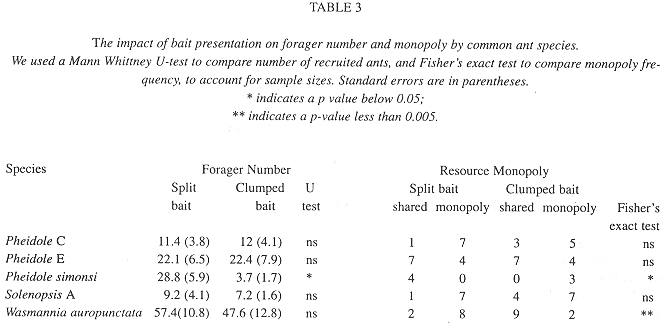
<body><![CDATA[<p>    <br><font size=-1></font>     <br><font size=-1></font>     <p><font face="Arial,Helvetica"><font size=-1>Of the five common resource-defending species, two differed in resource monopoly according to bait presentation (<a href="file:////Scanner/imagenes/rbt48n2/35.html#Tabla 3">Table 3</a>). <i>W. auropunctata</i> monopolized most split baits, but frequently shared clumped baits with other ants. On the other hand, <i>Pheidole simonsi</i> always monopolized clumped baits but shared split baits. When <i>W. auropunctata</i> did not monopolize split baits, the baits were shared with <i>P. simonsi</i>, suggesting that the two species have overlapping foraging preferences. Only one species, <i>P. simonsi</i>, had relatively more foragers at one of the bait types. This species recruited heavily to split baits, but not to clumped baits (<a href="file:////Scanner/imagenes/rbt48n2/35.html#Tabla 3">Table 3</a>). Interestingly, the clumped baits which contained few workers of <i>P. simonsi</i> were monopolized, while the split baits with many <i>P. simonsi</i> workers were shared. This suggests that the presence of interspecific competitors resulted in increased recruitment by <i>P. simonsi</i>.</font></font>     <br><font size=-1></font>&nbsp;<font size=-1></font>     <center>     <p><a NAME="Tabla 3"></a><img SRC="/img/fbpe/rbt/v48n2-3/0877i03.GIF" height=323 width=666 align=CENTER></center> <font size=-1></font>     
<p>    <br><font size=-1></font>     <br><font size=-1></font>     ]]></body>
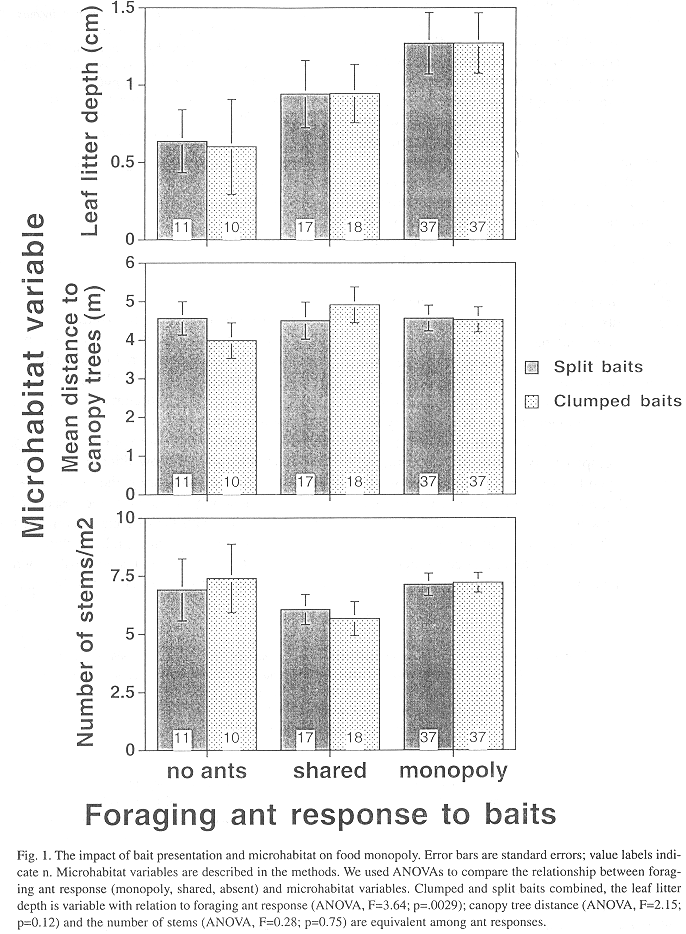
<body><![CDATA[<br><font size=-1></font>     <p><font face="Arial,Helvetica"><font size=-1><b>Interactions between microhabitat and bait presentation: the effect on resource monopoly:</b> Monopoly occurred more frequently than expected in two out of eight microhabitat variables. In both split and clumped baits, ants were more likely to monopolize baits where litter was deepest. Ants were more frequently absent at sites with shallow litter (<a href="file:////Scanner/imagenes/rbt48n2/35.html#Fig. 1">Fig. 1</a>). We performed G-tests comparing the relative frequency of monopoly, sharing, and the absence of ants at bait sites with the discrete microhabitat variables. The only significant relationship suggests a negative relationship between palms and the presence of foraging ants at split baits (p&lt;0.05). Palms were present at only 55 percent of the bait sites; of 11 split baits without ants, palms were absent from only one site. In this forest, palms catch leaf litter from the canopy which often is inhabited by ants who nest in this litter (<a href="file:////Scanner/imagenes/rbt48n2/35.html#Tennant">Tennant 1994</a>, personal observation). The ants in these palms may not recruit to baits placed on the ground, but they may have impacted the foraging behavior of ground-dwelling resource-defending ants. This apparent deterrent effect of palms was not related to the number of stems. The density of stems showed no relationship to ant presence (t-test, t-1.094; p=0.28, ns).</font></font>     <br><font size=-1></font>&nbsp;<font size=-1></font>     <center>     <p><a NAME="Fig. 1"></a><img SRC="/img/fbpe/rbt/v48n2-3/0877i04.GIF" height=934 width=686></center> <font size=-1></font>     
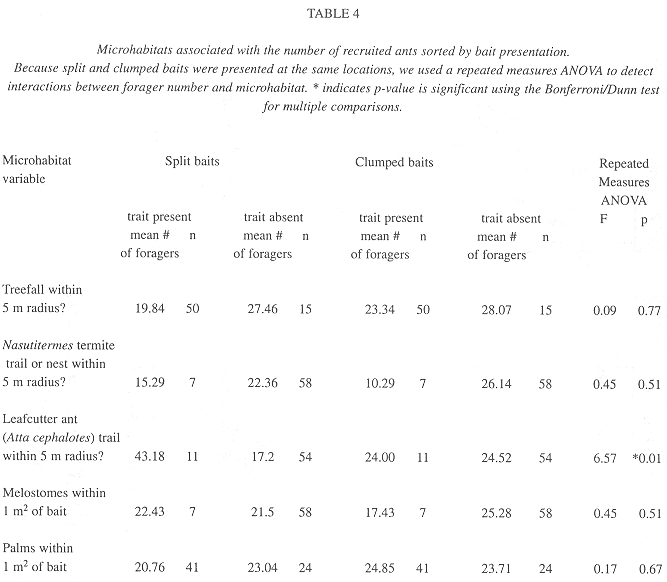
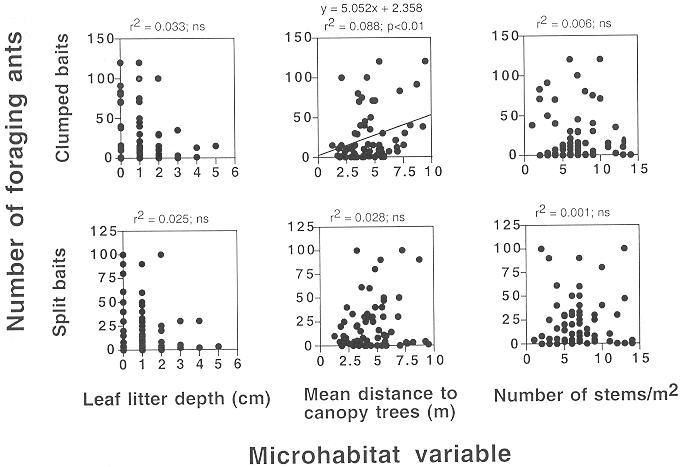
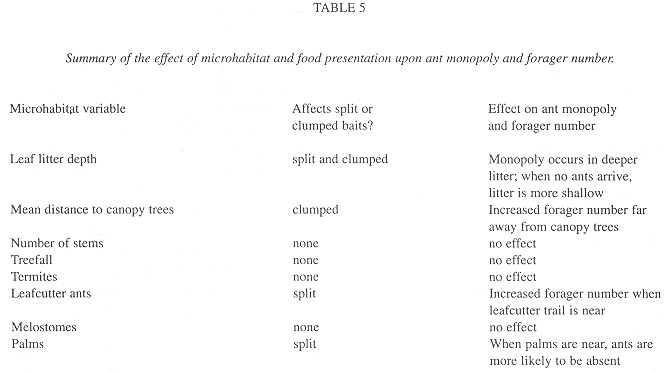
<p>    <br><font size=-1></font>     <br><font size=-1></font>     <p><font face="Arial,Helvetica"><font size=-1><b>Interactions between microhabitat and bait presentation: the effect on forager number:</b> We used a repeated measures ANOVA to test whether discrete microhabitat variables interacted with the level of ant recruitment depending upon the bait category (<a href="file:////Scanner/imagenes/rbt48n2/35.html#Tabla 4">Table 4</a>). Ants recruited more workers to split baits when close to leafcutter ant trails. We performed regression analyses to compare continouous microhabitat variables with forager recruitment at each bait. In <a href="file:////Scanner/imagenes/rbt48n2/35.html#Fig. 1">Fig. 1</a> we present the mean numbers of foraging ants sorted by continuous microhabitat variables for each bait category. When ants foraged at clumped baits, forager number was correlated with canopy tree distance (<a href="file:////Scanner/imagenes/rbt48n2/35.html#Fig. 2">Fig. 2</a>). The impacts of microhabitat and bait type on the presence of resource-defending ants at baits are summarized in <a href="file:////Scanner/imagenes/rbt48n2/35.html#Tabla 5">Table 5</a>.</font></font>     <br><font size=-1></font>&nbsp;<font size=-1></font>     ]]></body>
<body><![CDATA[<center>     <p><a NAME="Tabla 4"></a><img SRC="/img/fbpe/rbt/v48n2-3/0877i05.GIF" height=582 width=667>     
<br><font size=-1></font>&nbsp;<font size=-1></font>     <p><a NAME="Fig. 2"></a><img SRC="/img/fbpe/rbt/v48n2-3/0877i07.GIF" height=467 width=682></center> <font size=-1></font>     
<p>    <br><font size=-1></font>     <blockquote><font face="Arial,Helvetica"><font size=-1>Fig. 2. The impact of bait presentation and microhabitat on forager number. N for each scattergram is 66. While leaf litter depth does not show a linear relationship, there is a significant difference in forager number between 0-2 cm depth and 3-5 cm depth in both split (t-text, p&lt;0.05= and clumped (t-test, p&lt;0.05) baits. Details about measurement of micro-habitat variables are in the methods.</font></font></blockquote> <font size=-1></font>     <center>     <p>    <br><a NAME="Tabla 5"></a><img SRC="/img/fbpe/rbt/v48n2-3/0877i06.GIF" height=372 width=666></center>      
]]></body>
<body><![CDATA[<br><font size=-1></font>&nbsp;<font size=-1></font>     <p><b><font face="Arial,Helvetica"><font size=-1>Discussion</font></font></b><font size=-1></font>     <p><font face="Arial,Helvetica"><font size=-1>Our analysis of the results draws out three major conclusions. First, the manner of food presentation influenced resource monopoly by two out of the five common species in this community, <i>W. auropunctata</i> and <i>Pheidole simonsi</i>. Second, monopoly by ants is more likely to occur in deep leaf litter, while food in shallow litter is least likely to be exploited by ants. Last, within some microhabitats, such as areas near leafcutter ant trails and canopy trees, the number of foragers depends upon the manner of food presentation. These three findings indicate that resource use by ground-foraging tropical ants is dependent upon the distribution of food resources as well as the specific location of food in the forest.</font></font><font size=-1></font>     <p><font face="Arial,Helvetica"><font size=-1>It is remarkable that a slight change in the manner of presentation of food will result in changes of resource monopoly by <i>W. auropunctata</i> and <i>P. simonsi</i>. One of the major components of the diet of these species is arthropods, evidenced by the remains found inside their nests. The foods presented to them in this study are within the size range of foods that they may encounter while foraging. As our our bait types were variable in clump size and presentation, so is the natural avaiability of arthropod food in the forest (<a href="file:////Scanner/imagenes/rbt48n2/35.html#Janzen">Janzen 1983</a>). The variation in monopoly of our baits among ant species is likely to reflect the frequency of food monopoly by ants on naturally available foods.</font></font><font size=-1></font>     <p><font face="Arial,Helvetica"><font size=-1>The effect of leaf litter depth on monopoly by ants is probably tied to microclimatic effects on the foraging behavior of ants. The increased absence of ants on baits placed in shallow litter is consistent with Kaspari’s (1993) finding that small-sized ants are more likely to dessicate in the less humid microclimate of shallow litter. The increased frequency of monopoly in deep leaf litter may be explained by either a more tolerable microclimate, as well as by the increased ant nest density within deep leaf litter (<a href="file:////Scanner/imagenes/rbt48n2/35.html#Kaspari96">Kaspari 1996</a>). Another explanation for more empty baits in shallow litter is that ants avoid foraging in shallow litter to exposure to predators and parasitoids.</font></font><font size=-1></font>     <p><font face="Arial,Helvetica"><font size=-1>Why do ants recruit more heavily to clumped baits far away from canopy trees? The canopy trees themselves probably do not have direct biotic interactions with leaf litter ants. However, they affect the biotic and abiotic environment through sunflecks, litter composition, arboreal arthropod community, and branchfalls. Competition is extremely important in structuring ant communities. The most parsimonious explanation of the effect of canopy tree ants on ant abundance would correlate the distance to canopy trees with variables affecting ant competition. One of us currently is investigating the relationship between nest density and the distance to canopy trees; these may be negatively correlated with one another (<a href="file:////Scanner/imagenes/rbt48n2/35.html#McGlynn">McGlynn 1999</a>). The impact of canopy trees upon leaf litter ants is complex. A simplistic explanation of the effect of canopy tree distance on ant recruitment, could be that areas of low nest density are far away from canopy trees, resulting in reduced local interspecific competition.</font></font><font size=-1></font>     <p><font face="Arial,Helvetica"><font size=-1>Why do resource-defending ants at split baits increase recruitment when the bait is located near leafcutter ants? Resource competition with leafcutting ants is unlikely, because of differences in food habits. However, leafcutter ants significantly impact the abiotic environment around them. Mature <i>Atta </i>nests contain millions of individuals (<a href="file:////Scanner/imagenes/rbt48n2/35.html#Hölldobler">H&ouml;lldobler and Wilson 1990</a>), and they are surrounded by large amounts of excavated dirt that are not covered by leaf litter. In the proximity of leafcutter ant nests, there is less leaf litter. Although there was an effect of leaf litter depth upon food monopoly, there was no effect upon forager number. Although we can rule out the direct effect of leaf litter as an explanation, the relationship between leafcutter trails and resource-defending ant recruitment remains for future study.</font></font><font size=-1></font>     <p><font face="Arial,Helvetica"><font size=-1>The difference in food monopoly based on bait presentation has implications for the other studies that depend upon baiting to study interspecific interactions in ants (some examples are: <a href="file:////Scanner/imagenes/rbt48n2/35.html#Delabie">Delabie <i>et al</i>. 1985</a>, <a href="file:////Scanner/imagenes/rbt48n2/35.html#Savolainen91">Savolainen 1991</a>, <a href="file:////Scanner/imagenes/rbt48n2/35.html#Perfecto94">Perfecto, 1994</a>, <a href="file:////Scanner/imagenes/rbt48n2/35.html#Torres">Torres, 1994</a>, <a href="file:////Scanner/imagenes/rbt48n2/35.html#Human">Human and Gordon 1996</a>). Of the common species in our study, resource exploitation has been studied only in <i>W. auropunctata</i>. This species is a generalist, feeding on extrafloral nectar as well as many resources on the ground. It vigorously defend baits against competing ant species (<a href="file:////Scanner/imagenes/rbt48n2/35.html#Clark">Clark <i>et al</i>. 1982</a>, <a href="file:////Scanner/imagenes/rbt48n2/35.html#Lubin">Lubin, 1985</a>, <a href="file:////Scanner/imagenes/rbt48n2/35.html#Horvitz">Horvitz and Schemske 1990</a>, <a href="file:////Scanner/imagenes/rbt48n2/35.html#Ulloa-Chacon">Ulloa-Chac&oacute;n and Cherix 1990</a>, <a href="file:////Scanner/imagenes/rbt48n2/35.html#Williams">Williams and Whelan 1991</a>, <a href="file:////Scanner/imagenes/rbt48n2/35.html#Tennant">Tennant 1994</a>, <a href="file:////Scanner/imagenes/rbt48n2/35.html#Jourdan">Jourdan 1997</a>). Other research has shown that <i>W. auropunctata</i> can discriminate food based on protein and sugar content (<a href="file:////Scanner/imagenes/rbt48n2/35.html#Williams">Williams and Whelan 1992</a>). Likewise, we know that with very small foods (less than 100 mg), ants discriminate based on food size and food quality whether to recruit colony mates (<a href="file:////Scanner/imagenes/rbt48n2/35.html#Traniello">Traniello 1983</a>). With <i>W. auropuntata</i>, the increasing size of bait pieces is associated with a decrease in food monopoly. We found that <i>W. auropunctata</i> more frequently monopolizes a food when split into smaller pieces. At the same research site, <a href="file:////Scanner/imagenes/rbt48n2/35.html#Tennant">Tennant (1994)</a> found that <i>W. auropunctata</i> monopolized baits nearly 50% of the time when presented with a 4 gram tuna bait supplemented with a separate sugar solution. Considering the high level of monopoly at 1.75 gram pieces of food, and almost no monopoly at a large 7 gram piece of food, the addition of Tennant’s data suggests that the frequency of monopoly is graded in association with food clump size. However, the spatial distribution of food may also be a significant factor in decisions to defend a food resource. Observations of food monopoly may be associated with long-term colony fitness; an ongoing study by one of us (<a href="file:////Scanner/imagenes/rbt48n2/35.html#McGlynn">McGlynn 1999</a>) suggests that long-term addition of clumped food resources results in an increase of reproduction in a common <i>Pheidole</i> species.</font></font><font size=-1></font>     <p><font face="Arial,Helvetica"><font size=-1>The exploitation of food is determined by the availability of food outside the nest (<a href="file:////Scanner/imagenes/rbt48n2/35.html#Oster">Oster and Wilson 1978</a>). Some features of microhabitat, such as litter depth, are directly associated with prey abundance (<a href="file:////Scanner/imagenes/rbt48n2/35.html#Levings84">Levings and Windsor 1984</a>). Because arthropods are not randomly located within leaf litter, ants searching for prey and dead insects probably search in specific microhabitats for specific types of food items. At least one Neotropical resource-defending ant, <i>Ectatomma ruidum</i>, is capable of learning to feed at specialized sites and times associated with high prey availability (<a href="file:////Scanner/imagenes/rbt48n2/35.html#Schatz">Schatz <i>et al</i>. 1994</a>). Ants may select a microhabitat based on the type of resource that is frequent in that microhabitat. If ants enter certain microhabitats with a search image for a specific type of food resource, this may explain microhabitat asymmetries in dominance which occur only at one bait category.</font></font>     <br><font size=-1></font>&nbsp;<font size=-1></font>     ]]></body>
<body><![CDATA[<p><b><font face="Arial,Helvetica"><font size=-1>Acknowledgments</font></font></b><font size=-1></font>     <p><font face="Arial,Helvetica"><font size=-1>This research was supported by funding from the Mellon Foundation and the Organization for Tropical Studies to TPM, and from the New College Alumnae/i Association to SEK. We thank the Organization for Tropical Studies for use of the La Selva Biological Station resources; J. Beck, E. Britton, H. Hoyle, and M. Sherman contributed to field work; J. Longino assisted with ant identification and systematic treatment of undescribed species; M. Breed, D.A. Clark, D.B. Clark, and L. Alonso provided logistic and equipment support. We thank E. O. Wilson and the late Bill Brown for providing systematic data from their forthcoming revision of the Neotropical <i>Pheidole</i>. D. Armstrong, M. Breed, J. Bock, A. Chapman, and an anonymous reviewer shared comments on the manuscript.</font></font>     <br><font size=-1></font>&nbsp;<font size=-1></font>     <p><b><font face="Arial,Helvetica"><font size=-1>Resumen</font></font></b><font size=-1></font>     <p><font face="Arial,Helvetica"><font size=-1>En los bosques h&uacute;medos de la Regi&oacute;n Neotropical conviven varias especies de hormigas om&iacute;voras, defensoras de recursos alimenticios. Aunque el suelo del bosque es heterog&eacute;neo en microh&aacute;bitat y alimento, se sabe poco sobre el impacto de ambos en las hormigas. Se investiga c&oacute;mo influencian el tipo de alimento y el microh&aacute;bitat la forma en que estas hormigas acaparan el alimento en un bosque h&uacute;medo tropical maduro (bajuras de Costa Rica). Se midieron ocho caracter&iacute;sticas de microh&aacute;bitat en 66 puntos de una parcela de 0.5 ha. En cada punto se colocaron dos categor&iacute;as de cebo (at&uacute;n): “dividido” y&nbsp; “agrupado.” Se midi&oacute; el acaparamiento de cebo por especie y el n&uacute;mero de hormigas por cebo. De cinco especies comunes, dos (<i>Wasmannia auropunctata</i> y <i>Pheidole simonsi</i>) monopolizaron con m&aacute;s frecuencia uno de los dos tipos de cebo, y una (<i>P. simonsi</i>) tuvo m&aacute;s individuos en los cebos divididos. La frecuencia de monopolio, comportamiento, y la ausencia de hormigas en punto dado en el bosque vari&oacute; con el tipo de cebo. La frecuencia de acaparamiento se asoci&oacute; con tipo de microh&aacute;bitat en dos variables de microh&aacute;bitat: profundidad de la hojarasca y palmas; la variaci&oacute;n en distancia de b&oacute;vedas de &aacute;rboles y caminos de hormigas cortadoras de hojas se asoci&oacute; con cambios en el n&uacute;mero de buscadores de alimento. En al menos dos especies la presentaci&oacute;n del alimento afect&oacute; el acaparamiento; entre todas las hormigas estudiadas, los microh&aacute;bitats y el tipo de alimento determinan en parte la frecuencia de acaparamiento y el n&uacute;mero de individuso que llega al alimento. Estos resultados sugieren que la localizaci&oacute;n y presentaci&oacute;n de alimento determina en parte cual especie de hormiga utilizar&aacute; el recurso.</font></font>     <br><font size=-1></font>&nbsp;<font size=-1></font>     <p><b><font face="Arial,Helvetica"><font size=-1>References</font></font></b><b><font face="Arial,Helvetica"><font size=-1></font></font></b>     <!-- ref --><p><a NAME="Adams"></a><font face="Arial,Helvetica"><font size=-1>Adams, E.S. &amp;&nbsp; J.F.A. Traniello. 1981. Chemical interference competition by <i>Monomorium minimum</i> (Hymenoptera: Formicidae) Oecologia 51: 265-270.</font></font><font size=-1></font>    &nbsp;&nbsp;&nbsp;&nbsp;&nbsp;&nbsp;&nbsp;&nbsp;[&#160;<a href="javascript:void(0);" onclick="javascript: window.open('/scielo.php?script=sci_nlinks&ref=1199031&pid=S0034-7744200000020003500001&lng=','','width=640,height=500,resizable=yes,scrollbars=1,menubar=yes,');">Links</a>&#160;]<!-- end-ref --><!-- ref --><p><a NAME="Andersen92"></a><font face="Arial,Helvetica"><font size=-1>Andersen, A.N. 1992. Regulation of ‘momentary’ diversity by dominant species in exceptionally rich ant communities of the Australian seasonal tropics. Am. Nat. 140: 401-420.</font></font><font size=-1></font>    &nbsp;&nbsp;&nbsp;&nbsp;&nbsp;&nbsp;&nbsp;&nbsp;[&#160;<a href="javascript:void(0);" onclick="javascript: window.open('/scielo.php?script=sci_nlinks&ref=1199032&pid=S0034-7744200000020003500002&lng=','','width=640,height=500,resizable=yes,scrollbars=1,menubar=yes,');">Links</a>&#160;]<!-- end-ref --><!-- ref --><p><a NAME="Andersen95"></a><font face="Arial,Helvetica"><font size=-1>Andersen, A.N. 1995. A classification of Australian ant communities, based on functional groups which parallel plant life-forms in relation to stress and disturbance. J. Biogeogr. 22: 15-29.</font></font><font size=-1></font>    &nbsp;&nbsp;&nbsp;&nbsp;&nbsp;&nbsp;&nbsp;&nbsp;[&#160;<a href="javascript:void(0);" onclick="javascript: window.open('/scielo.php?script=sci_nlinks&ref=1199033&pid=S0034-7744200000020003500003&lng=','','width=640,height=500,resizable=yes,scrollbars=1,menubar=yes,');">Links</a>&#160;]<!-- end-ref --><!-- ref --><p><a NAME="Andersen97a"></a><font face="Arial,Helvetica"><font size=-1>Andersen, A.N. 1997a. Functional groups and patterns of organization in North American ant communities: a comparison with Australia. J. Biogeogr. 24: 433-460.</font></font><font size=-1></font>    &nbsp;&nbsp;&nbsp;&nbsp;&nbsp;&nbsp;&nbsp;&nbsp;[&#160;<a href="javascript:void(0);" onclick="javascript: window.open('/scielo.php?script=sci_nlinks&ref=1199034&pid=S0034-7744200000020003500004&lng=','','width=640,height=500,resizable=yes,scrollbars=1,menubar=yes,');">Links</a>&#160;]<!-- end-ref --><!-- ref --><p><a NAME="Andersen97b"></a><font face="Arial,Helvetica"><font size=-1>Andersen, A.N. 1997b. Using ants as bioindicators: Multiscale issues in ant community ecology. Conservation Ecology [online] 1(1): 8. Available from the Internet. URL: <a href="file://www.consecol.org/vol1/iss1/art8">http: //www.consecol.org/vol1/iss1/art8</a>.</font></font><font size=-1></font>    &nbsp;&nbsp;&nbsp;&nbsp;&nbsp;&nbsp;&nbsp;&nbsp;[&#160;<a href="javascript:void(0);" onclick="javascript: window.open('/scielo.php?script=sci_nlinks&ref=1199035&pid=S0034-7744200000020003500005&lng=','','width=640,height=500,resizable=yes,scrollbars=1,menubar=yes,');">Links</a>&#160;]<!-- end-ref --><!-- ref --><p><a NAME="Andersen94"></a><font face="Arial,Helvetica"><font size=-1>Andersen, A.N. &amp;&nbsp; A.D. Patel. 1994. Meat ants as dominant members of Australian ant communities: an experimental test of their influence on the foraging success and forager abundance of other species. Oecologia 98: 15-24.</font></font><font size=-1></font>    &nbsp;&nbsp;&nbsp;&nbsp;&nbsp;&nbsp;&nbsp;&nbsp;[&#160;<a href="javascript:void(0);" onclick="javascript: window.open('/scielo.php?script=sci_nlinks&ref=1199036&pid=S0034-7744200000020003500006&lng=','','width=640,height=500,resizable=yes,scrollbars=1,menubar=yes,');">Links</a>&#160;]<!-- end-ref --><!-- ref --><p><a NAME="Bernstein"></a><font face="Arial,Helvetica"><font size=-1>Bernstein, R.A. 1975. Foraging strategies of ants in response to variable food density. Ecology 56: 213-229.</font></font><font size=-1></font>    &nbsp;&nbsp;&nbsp;&nbsp;&nbsp;&nbsp;&nbsp;&nbsp;[&#160;<a href="javascript:void(0);" onclick="javascript: window.open('/scielo.php?script=sci_nlinks&ref=1199037&pid=S0034-7744200000020003500007&lng=','','width=640,height=500,resizable=yes,scrollbars=1,menubar=yes,');">Links</a>&#160;]<!-- end-ref --><!-- ref --><p><a NAME="Bestelmeyer"></a><font face="Arial,Helvetica"><font size=-1>Bestelmeyer, B.T. &amp;&nbsp; J.A. Weins. 1996. The effects of land use on the structure of ground-foraging ant communities in the Argentine chaco. Ecol. Applic. 6: 1225-1240.</font></font><font size=-1></font>    &nbsp;&nbsp;&nbsp;&nbsp;&nbsp;&nbsp;&nbsp;&nbsp;[&#160;<a href="javascript:void(0);" onclick="javascript: window.open('/scielo.php?script=sci_nlinks&ref=1199038&pid=S0034-7744200000020003500008&lng=','','width=640,height=500,resizable=yes,scrollbars=1,menubar=yes,');">Links</a>&#160;]<!-- end-ref --><!-- ref --><p><a NAME="Bolton"></a><font face="Arial,Helvetica"><font size=-1>Bolton, B. 1994. Identification guide to ant genera of the world. Harvard University, Cambridge, Massachusetts, USA.</font></font><font size=-1></font>    &nbsp;&nbsp;&nbsp;&nbsp;&nbsp;&nbsp;&nbsp;&nbsp;[&#160;<a href="javascript:void(0);" onclick="javascript: window.open('/scielo.php?script=sci_nlinks&ref=1199039&pid=S0034-7744200000020003500009&lng=','','width=640,height=500,resizable=yes,scrollbars=1,menubar=yes,');">Links</a>&#160;]<!-- end-ref --><!-- ref --><p><a NAME="Byrne"></a><font face="Arial,Helvetica"><font size=-1>Byrne, M.M. 1994. Ecology of twig-dwellings ants in a wet lowland tropical forest. Biotropica 26: 61-72</font></font><font size=-1></font>    &nbsp;&nbsp;&nbsp;&nbsp;&nbsp;&nbsp;&nbsp;&nbsp;[&#160;<a href="javascript:void(0);" onclick="javascript: window.open('/scielo.php?script=sci_nlinks&ref=1199040&pid=S0034-7744200000020003500010&lng=','','width=640,height=500,resizable=yes,scrollbars=1,menubar=yes,');">Links</a>&#160;]<!-- end-ref --><!-- ref --><p><a NAME="Clark"></a><font face="Arial,Helvetica"><font size=-1>Clark, D.B., C. Guayasm&iacute;n, O. Pazmi&ntilde;o, C. Donoso &amp;&nbsp; Y. P&aacute;ez de Villac&iacute;s. 1982. The tramp ant <i>Wasmannia auropunctata</i>: Autecology and effects on ant diversity and distribution on Santa Cruz Island, Gal&aacute;pagos. Biotropica 14: 196-207.</font></font><font size=-1></font>    &nbsp;&nbsp;&nbsp;&nbsp;&nbsp;&nbsp;&nbsp;&nbsp;[&#160;<a href="javascript:void(0);" onclick="javascript: window.open('/scielo.php?script=sci_nlinks&ref=1199041&pid=S0034-7744200000020003500011&lng=','','width=640,height=500,resizable=yes,scrollbars=1,menubar=yes,');">Links</a>&#160;]<!-- end-ref --><!-- ref --><p><a NAME="Davidson77"></a><font face="Arial,Helvetica"><font size=-1>Davidson, D.W. 1977. Species diversity and community organization in desert seed-eating ants. Ecology 58: 711-724.</font></font><font size=-1></font>    &nbsp;&nbsp;&nbsp;&nbsp;&nbsp;&nbsp;&nbsp;&nbsp;[&#160;<a href="javascript:void(0);" onclick="javascript: window.open('/scielo.php?script=sci_nlinks&ref=1199042&pid=S0034-7744200000020003500012&lng=','','width=640,height=500,resizable=yes,scrollbars=1,menubar=yes,');">Links</a>&#160;]<!-- end-ref --><!-- ref --><p><a NAME="Davidson78"></a><font face="Arial,Helvetica"><font size=-1>Davidson, D.W. 1978. Experimental tests of the optimal diet in two social insects. Behav. Ecol. Sociobiol. 4: 35-41.</font></font><font size=-1></font>    &nbsp;&nbsp;&nbsp;&nbsp;&nbsp;&nbsp;&nbsp;&nbsp;[&#160;<a href="javascript:void(0);" onclick="javascript: window.open('/scielo.php?script=sci_nlinks&ref=1199043&pid=S0034-7744200000020003500013&lng=','','width=640,height=500,resizable=yes,scrollbars=1,menubar=yes,');">Links</a>&#160;]<!-- end-ref --><!-- ref --><p><a NAME="Davidson98"></a><font face="Arial,Helvetica"><font size=-1>Davidson, D.W. 1998. Resource discovery versus resource domination in ants: a functional mechanism for breaking the trade-off. Ecol. Ent. 23: 484-490.</font></font><font size=-1></font>    &nbsp;&nbsp;&nbsp;&nbsp;&nbsp;&nbsp;&nbsp;&nbsp;[&#160;<a href="javascript:void(0);" onclick="javascript: window.open('/scielo.php?script=sci_nlinks&ref=1199044&pid=S0034-7744200000020003500014&lng=','','width=640,height=500,resizable=yes,scrollbars=1,menubar=yes,');">Links</a>&#160;]<!-- end-ref --><!-- ref --><p><font face="Arial,Helvetica"><font size=-1>de&nbsp;<a NAME="Biseau"></a>Biseau, J-C, Y. Quinet, L. Deffernez &amp;&nbsp; J.M. Pasteels. 1997. Explosive food recruitment as a competitive strategy in the ant <i>Myrmica sabuleti</i> (Hymenoptera: Formicidae). Insectes Sociaux 44: 59-73.</font></font><font size=-1></font>    &nbsp;&nbsp;&nbsp;&nbsp;&nbsp;&nbsp;&nbsp;&nbsp;[&#160;<a href="javascript:void(0);" onclick="javascript: window.open('/scielo.php?script=sci_nlinks&ref=1199045&pid=S0034-7744200000020003500015&lng=','','width=640,height=500,resizable=yes,scrollbars=1,menubar=yes,');">Links</a>&#160;]<!-- end-ref --><!-- ref --><p><a NAME="Delabie"></a><font face="Arial,Helvetica"><font size=-1>Delabie, J.H.C., I.C. Do Nascimento, P. Pacheco &amp;&nbsp; A.B. Casimiro. 1995. Community structure of house-infesting ants (Hymenoptera: Formicidae) in southern Bahia, Brazil. Florida Ent. 78: 264-270.</font></font><font size=-1></font>    &nbsp;&nbsp;&nbsp;&nbsp;&nbsp;&nbsp;&nbsp;&nbsp;[&#160;<a href="javascript:void(0);" onclick="javascript: window.open('/scielo.php?script=sci_nlinks&ref=1199046&pid=S0034-7744200000020003500016&lng=','','width=640,height=500,resizable=yes,scrollbars=1,menubar=yes,');">Links</a>&#160;]<!-- end-ref --><!-- ref --><p><a NAME="Gordon"></a><font face="Arial,Helvetica"><font size=-1>Gordon, D.M. &amp;&nbsp; A.W. Kulig. 1996. Founding, foraging, and fighting: colony size and the spatial distribution of harvester ant nests. Ecology 77: 2393-2409.</font></font><font size=-1></font>    &nbsp;&nbsp;&nbsp;&nbsp;&nbsp;&nbsp;&nbsp;&nbsp;[&#160;<a href="javascript:void(0);" onclick="javascript: window.open('/scielo.php?script=sci_nlinks&ref=1199047&pid=S0034-7744200000020003500017&lng=','','width=640,height=500,resizable=yes,scrollbars=1,menubar=yes,');">Links</a>&#160;]<!-- end-ref --><!-- ref --><p><a NAME="Hölldobler"></a><font face="Arial,Helvetica"><font size=-1>H&ouml;lldobler B &amp;&nbsp; E.O. Wilson. 1990. The Ants. Belknap, Cambridge, Massachusetts, USA.</font></font><font size=-1></font>    &nbsp;&nbsp;&nbsp;&nbsp;&nbsp;&nbsp;&nbsp;&nbsp;[&#160;<a href="javascript:void(0);" onclick="javascript: window.open('/scielo.php?script=sci_nlinks&ref=1199048&pid=S0034-7744200000020003500018&lng=','','width=640,height=500,resizable=yes,scrollbars=1,menubar=yes,');">Links</a>&#160;]<!-- end-ref --><!-- ref --><p><a NAME="Horvitz"></a><font face="Arial,Helvetica"><font size=-1>Horvitz, C.C. &amp;&nbsp; D.W. Schemske. 1990. Spatiotemporal variation in insect mutualists of a Neotrpical herb. Ecology 71: 1085-1097.</font></font><font size=-1></font>    &nbsp;&nbsp;&nbsp;&nbsp;&nbsp;&nbsp;&nbsp;&nbsp;[&#160;<a href="javascript:void(0);" onclick="javascript: window.open('/scielo.php?script=sci_nlinks&ref=1199049&pid=S0034-7744200000020003500019&lng=','','width=640,height=500,resizable=yes,scrollbars=1,menubar=yes,');">Links</a>&#160;]<!-- end-ref --><!-- ref --><p><a NAME="Human"></a><font face="Arial,Helvetica"><font size=-1>Human, K. &amp;&nbsp; D. Gordon D. 1996. Exploitative and interference competition between the Argentine ant and native ant species. Oecologia 105: 405-412.</font></font><font size=-1></font>    &nbsp;&nbsp;&nbsp;&nbsp;&nbsp;&nbsp;&nbsp;&nbsp;[&#160;<a href="javascript:void(0);" onclick="javascript: window.open('/scielo.php?script=sci_nlinks&ref=1199050&pid=S0034-7744200000020003500020&lng=','','width=640,height=500,resizable=yes,scrollbars=1,menubar=yes,');">Links</a>&#160;]<!-- end-ref --><!-- ref --><p><a NAME="Janzen"></a><font face="Arial,Helvetica"><font size=-1>Janzen, D.H. 1983. Insects: Introduction. Pages 619-644 in: D. Janzen, editor. Costa Rican Natural History. University of Chicago , Chicago, Illinois, USA.</font></font><font size=-1></font>    &nbsp;&nbsp;&nbsp;&nbsp;&nbsp;&nbsp;&nbsp;&nbsp;[&#160;<a href="javascript:void(0);" onclick="javascript: window.open('/scielo.php?script=sci_nlinks&ref=1199051&pid=S0034-7744200000020003500021&lng=','','width=640,height=500,resizable=yes,scrollbars=1,menubar=yes,');">Links</a>&#160;]<!-- end-ref --><!-- ref --><p><a NAME="Jourdan"></a><font face="Arial,Helvetica"><font size=-1>Jourdan, H. 1997. Threats on Pacific islands: the spread of the tramp ant <i>Wasmannia auropunctata</i> (Hymenoptera: Formicidae). Pac. Cons. Biol. 3: 61-64.</font></font><font size=-1></font>    &nbsp;&nbsp;&nbsp;&nbsp;&nbsp;&nbsp;&nbsp;&nbsp;[&#160;<a href="javascript:void(0);" onclick="javascript: window.open('/scielo.php?script=sci_nlinks&ref=1199052&pid=S0034-7744200000020003500022&lng=','','width=640,height=500,resizable=yes,scrollbars=1,menubar=yes,');">Links</a>&#160;]<!-- end-ref --><!-- ref --><p><a NAME="Kaspari93a"></a><font face="Arial,Helvetica"><font size=-1>Kaspari, M. 1993a. Body size and microclimate use in Neotropical granivorous ants. Oecologia 96: 500-507.</font></font><font size=-1></font>    &nbsp;&nbsp;&nbsp;&nbsp;&nbsp;&nbsp;&nbsp;&nbsp;[&#160;<a href="javascript:void(0);" onclick="javascript: window.open('/scielo.php?script=sci_nlinks&ref=1199053&pid=S0034-7744200000020003500023&lng=','','width=640,height=500,resizable=yes,scrollbars=1,menubar=yes,');">Links</a>&#160;]<!-- end-ref --><!-- ref --><p><a NAME="Kaspari93b"></a><font face="Arial,Helvetica"><font size=-1>Kaspari, M. 1993b. Removal of seeds from Neotropical frugivore droppings: Ant responses to seed number. Oecologia 95: 81-88.</font></font><font size=-1></font>    &nbsp;&nbsp;&nbsp;&nbsp;&nbsp;&nbsp;&nbsp;&nbsp;[&#160;<a href="javascript:void(0);" onclick="javascript: window.open('/scielo.php?script=sci_nlinks&ref=1199054&pid=S0034-7744200000020003500024&lng=','','width=640,height=500,resizable=yes,scrollbars=1,menubar=yes,');">Links</a>&#160;]<!-- end-ref --><!-- ref --><p><a NAME="Kaspari96"></a><font face="Arial,Helvetica"><font size=-1>Kaspari, M. 1996. Testing resource-based models of patchiness in four Neotropical litter ant assemblages. Oikos 76: 443-454.</font></font><font size=-1></font>    &nbsp;&nbsp;&nbsp;&nbsp;&nbsp;&nbsp;&nbsp;&nbsp;[&#160;<a href="javascript:void(0);" onclick="javascript: window.open('/scielo.php?script=sci_nlinks&ref=1199055&pid=S0034-7744200000020003500025&lng=','','width=640,height=500,resizable=yes,scrollbars=1,menubar=yes,');">Links</a>&#160;]<!-- end-ref --><!-- ref --><p><a NAME="Levings82"></a><font face="Arial,Helvetica"><font size=-1>Levings, S.C. &amp;&nbsp; N.R. Franks. 1982. Patterns of nest dispersion in a tropical ground ant community. Ecology 63: 338-344.</font></font><font size=-1></font>    &nbsp;&nbsp;&nbsp;&nbsp;&nbsp;&nbsp;&nbsp;&nbsp;[&#160;<a href="javascript:void(0);" onclick="javascript: window.open('/scielo.php?script=sci_nlinks&ref=1199056&pid=S0034-7744200000020003500026&lng=','','width=640,height=500,resizable=yes,scrollbars=1,menubar=yes,');">Links</a>&#160;]<!-- end-ref --><!-- ref --><p><a NAME="Levings84"></a><font face="Arial,Helvetica"><font size=-1>Levings, S.C., D.M. Windsor. 1984. Litter moisture content as a determinant of litter arthropod distribution and abundance during the dry season on Barro Colorado Island, Panama. Biotropica 16: 125-131.</font></font><font size=-1></font>    &nbsp;&nbsp;&nbsp;&nbsp;&nbsp;&nbsp;&nbsp;&nbsp;[&#160;<a href="javascript:void(0);" onclick="javascript: window.open('/scielo.php?script=sci_nlinks&ref=1199057&pid=S0034-7744200000020003500027&lng=','','width=640,height=500,resizable=yes,scrollbars=1,menubar=yes,');">Links</a>&#160;]<!-- end-ref --><!-- ref --><p><a NAME="Longino"></a><font face="Arial,Helvetica"><font size=-1>Longino, J.T. &amp;&nbsp; P.E. Hanson. 1995. The ants (Formicidae), p. 588-620 <i>In</i> Hanson, P.E. &amp;&nbsp; I.D. Gauld, editors. The Hymenoptera of Costa Rica,Oxford University , Oxford, UK.</font></font><font size=-1></font>    &nbsp;&nbsp;&nbsp;&nbsp;&nbsp;&nbsp;&nbsp;&nbsp;[&#160;<a href="javascript:void(0);" onclick="javascript: window.open('/scielo.php?script=sci_nlinks&ref=1199058&pid=S0034-7744200000020003500028&lng=','','width=640,height=500,resizable=yes,scrollbars=1,menubar=yes,');">Links</a>&#160;]<!-- end-ref --><!-- ref --><p><a NAME="Lubin"></a><font face="Arial,Helvetica"><font size=-1>Lubin, Y.D. 1985. Changes in the native fauna of the Gal&aacute;pagos Islands following invasion by the little red fire ant, <i>Wasmannia auropunctata</i>. Biol. J. Linn. Soc. 21: 229-242.</font></font><font size=-1></font>    &nbsp;&nbsp;&nbsp;&nbsp;&nbsp;&nbsp;&nbsp;&nbsp;[&#160;<a href="javascript:void(0);" onclick="javascript: window.open('/scielo.php?script=sci_nlinks&ref=1199059&pid=S0034-7744200000020003500029&lng=','','width=640,height=500,resizable=yes,scrollbars=1,menubar=yes,');">Links</a>&#160;]<!-- end-ref --><!-- ref --><p><a NAME="McDade"></a><font face="Arial,Helvetica"><font size=-1>McDade, L.A. &amp;&nbsp; G.S. Hartshorn. 1994. La Selva Biological Station. Pages 6-14 in: L.A. McDade, K.S. Bawa, H.A. Hespenheide &amp;&nbsp; G.S. Hartshorn, editors. La Selva: Ecology and natural history of a neotropical rain forest. University of Chicago , Chicago, Illinois, USA.</font></font><font size=-1></font>    &nbsp;&nbsp;&nbsp;&nbsp;&nbsp;&nbsp;&nbsp;&nbsp;[&#160;<a href="javascript:void(0);" onclick="javascript: window.open('/scielo.php?script=sci_nlinks&ref=1199060&pid=S0034-7744200000020003500030&lng=','','width=640,height=500,resizable=yes,scrollbars=1,menubar=yes,');">Links</a>&#160;]<!-- end-ref --><!-- ref --><p><a NAME="McGlynn"></a><font face="Arial,Helvetica"><font size=-1>McGlynn, T.P. 1999. The biogeography, behavior, and ecology of exotic ants. Ph.D. Thesis, University of Colorado, Boulder, Colorado, USA.</font></font><font size=-1></font>    &nbsp;&nbsp;&nbsp;&nbsp;&nbsp;&nbsp;&nbsp;&nbsp;[&#160;<a href="javascript:void(0);" onclick="javascript: window.open('/scielo.php?script=sci_nlinks&ref=1199061&pid=S0034-7744200000020003500031&lng=','','width=640,height=500,resizable=yes,scrollbars=1,menubar=yes,');">Links</a>&#160;]<!-- end-ref --><!-- ref --><p><a NAME="Oster"></a><font face="Arial,Helvetica"><font size=-1>Oster, G.F. &amp;&nbsp; E.O. Wilson. 1978. Caste and ecology in the social insects. Princeton University , Princeton, New Jersey, USA.</font></font><font size=-1></font>    &nbsp;&nbsp;&nbsp;&nbsp;&nbsp;&nbsp;&nbsp;&nbsp;[&#160;<a href="javascript:void(0);" onclick="javascript: window.open('/scielo.php?script=sci_nlinks&ref=1199062&pid=S0034-7744200000020003500032&lng=','','width=640,height=500,resizable=yes,scrollbars=1,menubar=yes,');">Links</a>&#160;]<!-- end-ref --><!-- ref --><p><a NAME="Perfecto94"></a><font face="Arial,Helvetica"><font size=-1>Perfecto, I. 1994. Foraging behavior as a determinant of asymmetric competitive interaction between two ant species in a tropical agroecosystem. Oecologia 98: 184-192.</font></font><font size=-1></font>    &nbsp;&nbsp;&nbsp;&nbsp;&nbsp;&nbsp;&nbsp;&nbsp;[&#160;<a href="javascript:void(0);" onclick="javascript: window.open('/scielo.php?script=sci_nlinks&ref=1199063&pid=S0034-7744200000020003500033&lng=','','width=640,height=500,resizable=yes,scrollbars=1,menubar=yes,');">Links</a>&#160;]<!-- end-ref --><!-- ref --><p><a NAME="Perfecto96"></a><font face="Arial,Helvetica"><font size=-1>Perfecto, I. &amp;&nbsp; J. Vandermeer. 1996. Microclimatic changes and the indirect loss of ant diversity in a tropical agroecosystem. Oecologia 108: 577-582.</font></font><font size=-1></font>    &nbsp;&nbsp;&nbsp;&nbsp;&nbsp;&nbsp;&nbsp;&nbsp;[&#160;<a href="javascript:void(0);" onclick="javascript: window.open('/scielo.php?script=sci_nlinks&ref=1199064&pid=S0034-7744200000020003500034&lng=','','width=640,height=500,resizable=yes,scrollbars=1,menubar=yes,');">Links</a>&#160;]<!-- end-ref --><!-- ref --><p><a NAME="Savolainen91"></a><font face="Arial,Helvetica"><font size=-1>Savolainen, R. 1991. Interference by wood ant influences size selection and retrieval rate of prey by <i>Formica fusca</i>. Behav. Ecol. Sociobiol. 28: 1-7.</font></font><font size=-1></font>    &nbsp;&nbsp;&nbsp;&nbsp;&nbsp;&nbsp;&nbsp;&nbsp;[&#160;<a href="javascript:void(0);" onclick="javascript: window.open('/scielo.php?script=sci_nlinks&ref=1199065&pid=S0034-7744200000020003500035&lng=','','width=640,height=500,resizable=yes,scrollbars=1,menubar=yes,');">Links</a>&#160;]<!-- end-ref --><!-- ref --><p><a NAME="Savolainen88"></a><font face="Arial,Helvetica"><font size=-1>Savolainen, R. &amp;&nbsp; K. Vespalainen. 1988. A competition heirarchy among boreal ants: impact on resource partitioning and community structure. Oikos 51: 135-155.</font></font><font size=-1></font>    &nbsp;&nbsp;&nbsp;&nbsp;&nbsp;&nbsp;&nbsp;&nbsp;[&#160;<a href="javascript:void(0);" onclick="javascript: window.open('/scielo.php?script=sci_nlinks&ref=1199066&pid=S0034-7744200000020003500036&lng=','','width=640,height=500,resizable=yes,scrollbars=1,menubar=yes,');">Links</a>&#160;]<!-- end-ref --><!-- ref --><p><a NAME="Schatz"></a><font face="Arial,Helvetica"><font size=-1>Schatz, B., G. Beugnon &amp;&nbsp; J. Lachaud. 1994. Time-place learning by an invertebrate, the ant <i>Ectatomma ruidum</i> Roger. Animal Behaviour 48: 236-238.</font></font><font size=-1></font>    &nbsp;&nbsp;&nbsp;&nbsp;&nbsp;&nbsp;&nbsp;&nbsp;[&#160;<a href="javascript:void(0);" onclick="javascript: window.open('/scielo.php?script=sci_nlinks&ref=1199067&pid=S0034-7744200000020003500037&lng=','','width=640,height=500,resizable=yes,scrollbars=1,menubar=yes,');">Links</a>&#160;]<!-- end-ref --><!-- ref --><p><a NAME="Tennant"></a><font face="Arial,Helvetica"><font size=-1>Tennant, L.E. 1994. Ecology of a facultative ant-plant "mutualism." Ph.D. Thesis, Harvard University, Cambridge, Massachusetts, USA.</font></font><font size=-1></font>    &nbsp;&nbsp;&nbsp;&nbsp;&nbsp;&nbsp;&nbsp;&nbsp;[&#160;<a href="javascript:void(0);" onclick="javascript: window.open('/scielo.php?script=sci_nlinks&ref=1199068&pid=S0034-7744200000020003500038&lng=','','width=640,height=500,resizable=yes,scrollbars=1,menubar=yes,');">Links</a>&#160;]<!-- end-ref --><!-- ref --><p><a NAME="Torres"></a><font face="Arial,Helvetica"><font size=-1>Torres, J.A. 1984. Niches and coexistence of ant communities in Puerto Rico: repeated patterns. Biotropica 16: 284-295.</font></font><font size=-1></font>    &nbsp;&nbsp;&nbsp;&nbsp;&nbsp;&nbsp;&nbsp;&nbsp;[&#160;<a href="javascript:void(0);" onclick="javascript: window.open('/scielo.php?script=sci_nlinks&ref=1199069&pid=S0034-7744200000020003500039&lng=','','width=640,height=500,resizable=yes,scrollbars=1,menubar=yes,');">Links</a>&#160;]<!-- end-ref --><!-- ref --><p><a NAME="Traniello"></a><font face="Arial,Helvetica"><font size=-1>Traniello, J.F.A. 1983. Social organization and foraging success in <i>Lasius neoniger</i> (Hymenoptera: Formicidae): behavioral and ecological aspects of recruitment communication. Oecologia 59: 94-100.</font></font><font size=-1></font>    &nbsp;&nbsp;&nbsp;&nbsp;&nbsp;&nbsp;&nbsp;&nbsp;[&#160;<a href="javascript:void(0);" onclick="javascript: window.open('/scielo.php?script=sci_nlinks&ref=1199070&pid=S0034-7744200000020003500040&lng=','','width=640,height=500,resizable=yes,scrollbars=1,menubar=yes,');">Links</a>&#160;]<!-- end-ref --><!-- ref --><p><a NAME="Ulloa-Chacon"></a><font face="Arial,Helvetica"><font size=-1>Ulloa-Chacon, P. &amp;&nbsp; D. Cherix 1990. The little fire ant <i>Wasmannia auropunctata</i> (R.) (Hymenoptera: Formicidae), p. 281-289<i> In</i> R.K. Vander Meer, K. Jaffe &amp;&nbsp; A. Cedeno, editors, Applied myrmecology: a world perspective. Westview , Boulder, Colorado, USA.</font></font><font size=-1></font>    &nbsp;&nbsp;&nbsp;&nbsp;&nbsp;&nbsp;&nbsp;&nbsp;[&#160;<a href="javascript:void(0);" onclick="javascript: window.open('/scielo.php?script=sci_nlinks&ref=1199071&pid=S0034-7744200000020003500041&lng=','','width=640,height=500,resizable=yes,scrollbars=1,menubar=yes,');">Links</a>&#160;]<!-- end-ref --><!-- ref --><p><a NAME="Williams"></a><font face="Arial,Helvetica"><font size=-1>Williams, D.F. &amp;&nbsp; P.M. Whelan. 1992. Bait attraction of the introduced pest ant, <i>Wasmannia auropunctata</i> (Hymenoptera: Formicidae) in the Galapagos Islands. J. Ent. Sci 27: 29-34.</font></font><font face="Arial,Helvetica"><font size=-1></font></font>    &nbsp;&nbsp;&nbsp;&nbsp;&nbsp;&nbsp;&nbsp;&nbsp;[&#160;<a href="javascript:void(0);" onclick="javascript: window.open('/scielo.php?script=sci_nlinks&ref=1199072&pid=S0034-7744200000020003500042&lng=','','width=640,height=500,resizable=yes,scrollbars=1,menubar=yes,');">Links</a>&#160;]<!-- end-ref --><p><a NAME="1a"></a><font face="Arial,Helvetica"><font size=-1><sup><a href="#1">1</a></sup> Gettysburg College, Department of Biology, Gettysburg, PA 17325, USA phone: 717-337-6167 fax: 717-337-6666 email: <a href="mailto:tmcglynn@gettysburg.edu">tmcglynn@gettysburg.edu</a></font></font><font size=-1></font>     ]]></body>
<body><![CDATA[<p><a NAME="2a"></a><font face="Arial,Helvetica"><font size=-1><sup><a href="#2">2</a></sup> Division of Natural Sciences, New College of the University of South Florida, 5700 North Tamiami Trail, box 361 Sarasota, Florida 34243 USA</font></font>      ]]></body><back>
<ref-list>
<ref id="B1">
<nlm-citation citation-type="journal">
<person-group person-group-type="author">
<name>
<surname><![CDATA[Adams]]></surname>
<given-names><![CDATA[E.S]]></given-names>
</name>
<name>
<surname><![CDATA[Traniello]]></surname>
<given-names><![CDATA[J.F.A]]></given-names>
</name>
</person-group>
<article-title xml:lang="en"><![CDATA[Chemical interference competition by Monomorium minimum (Hymenoptera: Formicidae)]]></article-title>
<source><![CDATA[Oecologia]]></source>
<year>1981</year>
<volume>51</volume>
<page-range>265-270</page-range></nlm-citation>
</ref>
<ref id="B2">
<nlm-citation citation-type="journal">
<person-group person-group-type="author">
<name>
<surname><![CDATA[Andersen]]></surname>
<given-names><![CDATA[A.N]]></given-names>
</name>
</person-group>
<article-title xml:lang="en"><![CDATA[Regulation of ‘momentary’ diversity by dominant species in exceptionally rich ant communities of the Australian seasonal tropics]]></article-title>
<source><![CDATA[Am. Nat]]></source>
<year>1992</year>
<volume>140</volume>
<page-range>401-420</page-range></nlm-citation>
</ref>
<ref id="B3">
<nlm-citation citation-type="journal">
<person-group person-group-type="author">
<name>
<surname><![CDATA[Andersen]]></surname>
<given-names><![CDATA[A.N]]></given-names>
</name>
</person-group>
<article-title xml:lang="en"><![CDATA[A classification of Australian ant communities, based on functional groups which parallel plant life-forms in relation to stress and disturbance]]></article-title>
<source><![CDATA[J. Biogeogr]]></source>
<year>1995</year>
<volume>22</volume>
<page-range>15-29</page-range></nlm-citation>
</ref>
<ref id="B4">
<nlm-citation citation-type="journal">
<person-group person-group-type="author">
<name>
<surname><![CDATA[Andersen]]></surname>
<given-names><![CDATA[A.N]]></given-names>
</name>
</person-group>
<article-title xml:lang="en"><![CDATA[Functional groups and patterns of organization in North American ant communities: a comparison with Australia]]></article-title>
<source><![CDATA[J. Biogeogr]]></source>
<year>1997</year>
<volume>24</volume>
<page-range>433-460</page-range></nlm-citation>
</ref>
<ref id="B5">
<nlm-citation citation-type="journal">
<person-group person-group-type="author">
<name>
<surname><![CDATA[Andersen]]></surname>
<given-names><![CDATA[A.N]]></given-names>
</name>
</person-group>
<article-title xml:lang="en"><![CDATA[Using ants as bioindicators: Multiscale issues in ant community ecology]]></article-title>
<source><![CDATA[Conservation Ecology]]></source>
<year>1997</year>
<volume>1</volume>
<numero>^s1</numero><numero>^s8</numero>
<issue>^s1</issue><issue>^s8</issue>
<supplement>1</supplement><supplement>8</supplement>
</nlm-citation>
</ref>
<ref id="B6">
<nlm-citation citation-type="journal">
<person-group person-group-type="author">
<name>
<surname><![CDATA[Andersen]]></surname>
<given-names><![CDATA[A.N]]></given-names>
</name>
<name>
<surname><![CDATA[Patel]]></surname>
<given-names><![CDATA[A.D]]></given-names>
</name>
</person-group>
<article-title xml:lang="en"><![CDATA[Meat ants as dominant members of Australian ant communities: an experimental test of their influence on the foraging success and forager abundance of other species]]></article-title>
<source><![CDATA[Oecologia]]></source>
<year>1994</year>
<volume>98</volume>
<page-range>15-24</page-range></nlm-citation>
</ref>
<ref id="B7">
<nlm-citation citation-type="journal">
<person-group person-group-type="author">
<name>
<surname><![CDATA[Bernstein]]></surname>
<given-names><![CDATA[R.A.]]></given-names>
</name>
</person-group>
<article-title xml:lang="en"><![CDATA[Foraging strategies of ants in response to variable food density]]></article-title>
<source><![CDATA[Ecology]]></source>
<year>1975</year>
<volume>56</volume>
<page-range>213-229</page-range></nlm-citation>
</ref>
<ref id="B8">
<nlm-citation citation-type="journal">
<person-group person-group-type="author">
<name>
<surname><![CDATA[Bestelmeyer]]></surname>
<given-names><![CDATA[B.T]]></given-names>
</name>
<name>
<surname><![CDATA[Weins]]></surname>
<given-names><![CDATA[J.A]]></given-names>
</name>
</person-group>
<article-title xml:lang="en"><![CDATA[The effects of land use on the structure of ground-foraging ant communities in the Argentine chaco]]></article-title>
<source><![CDATA[Ecol. Applic]]></source>
<year>1996</year>
<volume>6</volume>
<page-range>1225-1240</page-range></nlm-citation>
</ref>
<ref id="B9">
<nlm-citation citation-type="book">
<person-group person-group-type="author">
<name>
<surname><![CDATA[Bolton]]></surname>
<given-names><![CDATA[B]]></given-names>
</name>
</person-group>
<source><![CDATA[Identification guide to ant genera of the world]]></source>
<year>1994</year>
<publisher-loc><![CDATA[Cambridge^eMassachusetts Massachusetts]]></publisher-loc>
<publisher-name><![CDATA[Harvard University]]></publisher-name>
</nlm-citation>
</ref>
<ref id="B10">
<nlm-citation citation-type="journal">
<person-group person-group-type="author">
<name>
<surname><![CDATA[Byrne]]></surname>
<given-names><![CDATA[M.M]]></given-names>
</name>
</person-group>
<article-title xml:lang="en"><![CDATA[Ecology of twig-dwellings ants in a wet lowland tropical forest]]></article-title>
<source><![CDATA[Biotropica]]></source>
<year>1994</year>
<volume>26</volume>
<page-range>61-72</page-range></nlm-citation>
</ref>
<ref id="B11">
<nlm-citation citation-type="journal">
<person-group person-group-type="author">
<name>
<surname><![CDATA[Clark]]></surname>
<given-names><![CDATA[D.B]]></given-names>
</name>
<name>
<surname><![CDATA[Guayasmín]]></surname>
<given-names><![CDATA[C]]></given-names>
</name>
<name>
<surname><![CDATA[Pazmiño]]></surname>
<given-names><![CDATA[O]]></given-names>
</name>
<name>
<surname><![CDATA[Donoso]]></surname>
<given-names><![CDATA[C]]></given-names>
</name>
<name>
<surname><![CDATA[Páez de Villacís]]></surname>
<given-names><![CDATA[Y]]></given-names>
</name>
</person-group>
<article-title xml:lang="en"><![CDATA[The tramp ant Wasmannia auropunctata: Autecology and effects on ant diversity and distribution on Santa Cruz Island, Galápagos]]></article-title>
<source><![CDATA[Biotropica]]></source>
<year>1982</year>
<volume>14</volume>
<page-range>196-207</page-range></nlm-citation>
</ref>
<ref id="B12">
<nlm-citation citation-type="journal">
<person-group person-group-type="author">
<name>
<surname><![CDATA[Davidson]]></surname>
<given-names><![CDATA[D.W]]></given-names>
</name>
</person-group>
<article-title xml:lang="en"><![CDATA[Species diversity and community organization in desert seed-eating ants]]></article-title>
<source><![CDATA[Ecology]]></source>
<year>1977</year>
<volume>58</volume>
<page-range>711-724</page-range></nlm-citation>
</ref>
<ref id="B13">
<nlm-citation citation-type="journal">
<person-group person-group-type="author">
<name>
<surname><![CDATA[Davidson]]></surname>
<given-names><![CDATA[D.W]]></given-names>
</name>
</person-group>
<article-title xml:lang="en"><![CDATA[Experimental tests of the optimal diet in two social insects]]></article-title>
<source><![CDATA[Behav. Ecol. Sociobiol]]></source>
<year>1978</year>
<volume>4</volume>
<page-range>35-41</page-range></nlm-citation>
</ref>
<ref id="B14">
<nlm-citation citation-type="journal">
<person-group person-group-type="author">
<name>
<surname><![CDATA[Davidson]]></surname>
<given-names><![CDATA[D.W]]></given-names>
</name>
</person-group>
<article-title xml:lang="en"><![CDATA[Resource discovery versus resource domination in ants: a functional mechanism for breaking the trade-off]]></article-title>
<source><![CDATA[Ecol. Ent]]></source>
<year>1998</year>
<volume>23</volume>
<page-range>484-490</page-range></nlm-citation>
</ref>
<ref id="B15">
<nlm-citation citation-type="journal">
<person-group person-group-type="author">
<name>
<surname><![CDATA[de <A NAME="Biseau"></A>Biseau]]></surname>
<given-names><![CDATA[J-C]]></given-names>
</name>
<name>
<surname><![CDATA[Quinet]]></surname>
<given-names><![CDATA[Y]]></given-names>
</name>
<name>
<surname><![CDATA[Deffernez]]></surname>
<given-names><![CDATA[L]]></given-names>
</name>
<name>
<surname><![CDATA[Pasteels]]></surname>
<given-names><![CDATA[J.M]]></given-names>
</name>
</person-group>
<article-title xml:lang="en"><![CDATA[Explosive food recruitment as a competitive strategy in the ant Myrmica sabuleti (Hymenoptera: Formicidae)]]></article-title>
<source><![CDATA[Insectes Sociaux]]></source>
<year>1997</year>
<volume>44</volume>
<page-range>59-73</page-range></nlm-citation>
</ref>
<ref id="B16">
<nlm-citation citation-type="journal">
<person-group person-group-type="author">
<name>
<surname><![CDATA[Delabie]]></surname>
<given-names><![CDATA[J.H.C]]></given-names>
</name>
<name>
<surname><![CDATA[Do Nascimento]]></surname>
<given-names><![CDATA[I. C]]></given-names>
</name>
<name>
<surname><![CDATA[Pacheco]]></surname>
<given-names><![CDATA[P]]></given-names>
</name>
<name>
<surname><![CDATA[Casimiro]]></surname>
<given-names><![CDATA[A.B]]></given-names>
</name>
</person-group>
<article-title xml:lang="en"><![CDATA[Community structure of house-infesting ants (Hymenoptera: Formicidae) in southern Bahia, Brazil]]></article-title>
<source><![CDATA[Florida Ent]]></source>
<year>1995</year>
<volume>78</volume>
<page-range>264-270</page-range></nlm-citation>
</ref>
<ref id="B17">
<nlm-citation citation-type="journal">
<person-group person-group-type="author">
<name>
<surname><![CDATA[Gordon]]></surname>
<given-names><![CDATA[D.M]]></given-names>
</name>
<name>
<surname><![CDATA[Kulig]]></surname>
<given-names><![CDATA[A.W]]></given-names>
</name>
</person-group>
<article-title xml:lang="en"><![CDATA[Founding, foraging, and fighting: colony size and the spatial distribution of harvester ant nests]]></article-title>
<source><![CDATA[Ecology]]></source>
<year>1996</year>
<volume>77</volume>
<page-range>2393-2409</page-range></nlm-citation>
</ref>
<ref id="B18">
<nlm-citation citation-type="">
<person-group person-group-type="author">
<name>
<surname><![CDATA[Hölldobler]]></surname>
<given-names><![CDATA[B]]></given-names>
</name>
<name>
<surname><![CDATA[Wilson]]></surname>
<given-names><![CDATA[E.O]]></given-names>
</name>
</person-group>
<source><![CDATA[The Ants. Belknap]]></source>
<year>1990</year>
<publisher-loc><![CDATA[Cambridge^eMassachusetts Massachusetts]]></publisher-loc>
</nlm-citation>
</ref>
<ref id="B19">
<nlm-citation citation-type="journal">
<person-group person-group-type="author">
<name>
<surname><![CDATA[Horvitz]]></surname>
<given-names><![CDATA[C.C]]></given-names>
</name>
<name>
<surname><![CDATA[Schemske]]></surname>
<given-names><![CDATA[D.W]]></given-names>
</name>
</person-group>
<article-title xml:lang="en"><![CDATA[Spatiotemporal variation in insect mutualists of a Neotrpical herb]]></article-title>
<source><![CDATA[Ecology]]></source>
<year>1990</year>
<volume>71</volume>
<page-range>1085-1097</page-range></nlm-citation>
</ref>
<ref id="B20">
<nlm-citation citation-type="journal">
<person-group person-group-type="author">
<name>
<surname><![CDATA[Human]]></surname>
<given-names><![CDATA[K]]></given-names>
</name>
<name>
<surname><![CDATA[Gordon D]]></surname>
<given-names><![CDATA[D]]></given-names>
</name>
</person-group>
<article-title xml:lang="en"><![CDATA[Exploitative and interference competition between the Argentine ant and native ant species]]></article-title>
<source><![CDATA[Oecologia]]></source>
<year>1996</year>
<volume>105</volume>
<page-range>405-412</page-range></nlm-citation>
</ref>
<ref id="B21">
<nlm-citation citation-type="book">
<person-group person-group-type="author">
<name>
<surname><![CDATA[Janzen]]></surname>
<given-names><![CDATA[D.H]]></given-names>
</name>
</person-group>
<article-title xml:lang="en"><![CDATA[Insects: Introduction]]></article-title>
<person-group person-group-type="editor">
<name>
<surname><![CDATA[Janzen]]></surname>
<given-names><![CDATA[D]]></given-names>
</name>
</person-group>
<source><![CDATA[Costa Rican Natural History]]></source>
<year>1983</year>
<page-range>619-644</page-range><publisher-loc><![CDATA[Chicago^eIllinois Illinois]]></publisher-loc>
<publisher-name><![CDATA[University of Chicago]]></publisher-name>
</nlm-citation>
</ref>
<ref id="B22">
<nlm-citation citation-type="journal">
<person-group person-group-type="author">
<name>
<surname><![CDATA[Jourdan]]></surname>
<given-names><![CDATA[H]]></given-names>
</name>
</person-group>
<article-title xml:lang="en"><![CDATA[Threats on Pacific islands: the spread of the tramp ant Wasmannia auropunctata (Hymenoptera: Formicidae)]]></article-title>
<source><![CDATA[Pac. Cons. Biol]]></source>
<year>1997</year>
<volume>3</volume>
<page-range>61-64</page-range></nlm-citation>
</ref>
<ref id="B23">
<nlm-citation citation-type="journal">
<person-group person-group-type="author">
<name>
<surname><![CDATA[Kaspari]]></surname>
<given-names><![CDATA[M]]></given-names>
</name>
</person-group>
<article-title xml:lang="en"><![CDATA[Body size and microclimate use in Neotropical granivorous ants]]></article-title>
<source><![CDATA[Oecologia]]></source>
<year>1993</year>
<volume>96</volume>
<page-range>500-507</page-range></nlm-citation>
</ref>
<ref id="B24">
<nlm-citation citation-type="journal">
<person-group person-group-type="author">
<name>
<surname><![CDATA[Kaspari]]></surname>
<given-names><![CDATA[M]]></given-names>
</name>
</person-group>
<article-title xml:lang="en"><![CDATA[Removal of seeds from Neotropical frugivore droppings: Ant responses to seed number]]></article-title>
<source><![CDATA[Oecologia]]></source>
<year>1993</year>
<volume>95</volume>
<page-range>81-88</page-range></nlm-citation>
</ref>
<ref id="B25">
<nlm-citation citation-type="journal">
<person-group person-group-type="author">
<name>
<surname><![CDATA[Kaspari]]></surname>
<given-names><![CDATA[M]]></given-names>
</name>
</person-group>
<article-title xml:lang="en"><![CDATA[Testing resource-based models of patchiness in four Neotropical litter ant assemblages]]></article-title>
<source><![CDATA[Oikos]]></source>
<year>1996</year>
<volume>76</volume>
<page-range>443-454</page-range></nlm-citation>
</ref>
<ref id="B26">
<nlm-citation citation-type="journal">
<person-group person-group-type="author">
<name>
<surname><![CDATA[Levings]]></surname>
<given-names><![CDATA[S.C]]></given-names>
</name>
<name>
<surname><![CDATA[Franks]]></surname>
<given-names><![CDATA[N.R]]></given-names>
</name>
</person-group>
<article-title xml:lang="en"><![CDATA[Patterns of nest dispersion in a tropical ground ant community]]></article-title>
<source><![CDATA[Ecology]]></source>
<year>1982</year>
<volume>63</volume>
<page-range>338-344</page-range></nlm-citation>
</ref>
<ref id="B27">
<nlm-citation citation-type="journal">
<person-group person-group-type="author">
<name>
<surname><![CDATA[Levings]]></surname>
<given-names><![CDATA[S.C]]></given-names>
</name>
<name>
<surname><![CDATA[Windsor]]></surname>
<given-names><![CDATA[D.M]]></given-names>
</name>
</person-group>
<article-title xml:lang="en"><![CDATA[Litter moisture content as a determinant of litter arthropod distribution and abundance during the dry season on Barro Colorado Island, Panama]]></article-title>
<source><![CDATA[Biotropica]]></source>
<year>1984</year>
<volume>16</volume>
<page-range>125-131</page-range></nlm-citation>
</ref>
<ref id="B28">
<nlm-citation citation-type="book">
<person-group person-group-type="author">
<name>
<surname><![CDATA[Longino]]></surname>
<given-names><![CDATA[J.T]]></given-names>
</name>
<name>
<surname><![CDATA[Hanson]]></surname>
<given-names><![CDATA[P.E]]></given-names>
</name>
</person-group>
<article-title xml:lang="en"><![CDATA[The ants (Formicidae)]]></article-title>
<person-group person-group-type="editor">
<name>
<surname><![CDATA[Hanson]]></surname>
<given-names><![CDATA[P.E]]></given-names>
</name>
<name>
<surname><![CDATA[Gauld]]></surname>
<given-names><![CDATA[I.D]]></given-names>
</name>
</person-group>
<source><![CDATA[The Hymenoptera of Costa Rica]]></source>
<year>1995</year>
<page-range>588-620</page-range><publisher-loc><![CDATA[Oxford ]]></publisher-loc>
<publisher-name><![CDATA[Oxford University]]></publisher-name>
</nlm-citation>
</ref>
<ref id="B29">
<nlm-citation citation-type="journal">
<person-group person-group-type="author">
<name>
<surname><![CDATA[Lubin]]></surname>
<given-names><![CDATA[Y.D]]></given-names>
</name>
</person-group>
<article-title xml:lang="en"><![CDATA[Changes in the native fauna of the Galápagos Islands following invasion by the little red fire ant, Wasmannia auropunctata]]></article-title>
<source><![CDATA[Biol. J. Linn. Soc]]></source>
<year>1985</year>
<volume>21</volume>
<page-range>229-242</page-range></nlm-citation>
</ref>
<ref id="B30">
<nlm-citation citation-type="book">
<person-group person-group-type="author">
<name>
<surname><![CDATA[McDade]]></surname>
<given-names><![CDATA[L.A]]></given-names>
</name>
<name>
<surname><![CDATA[Hartshorn]]></surname>
<given-names><![CDATA[G.S]]></given-names>
</name>
</person-group>
<article-title xml:lang="en"><![CDATA[La Selva Biological Station]]></article-title>
<person-group person-group-type="editor">
<name>
<surname><![CDATA[McDade]]></surname>
<given-names><![CDATA[L.A]]></given-names>
</name>
<name>
<surname><![CDATA[Bawa]]></surname>
<given-names><![CDATA[K.S]]></given-names>
</name>
<name>
<surname><![CDATA[Hespenheide]]></surname>
<given-names><![CDATA[H.A]]></given-names>
</name>
<name>
<surname><![CDATA[Hartshorn]]></surname>
<given-names><![CDATA[G.S]]></given-names>
</name>
</person-group>
<source><![CDATA[La Selva: Ecology and natural history of a neotropical rain forest]]></source>
<year>1994</year>
<page-range>6-14</page-range><publisher-loc><![CDATA[Chicago^eIllinois Illinois]]></publisher-loc>
<publisher-name><![CDATA[University of Chicago]]></publisher-name>
</nlm-citation>
</ref>
<ref id="B31">
<nlm-citation citation-type="">
<person-group person-group-type="author">
<name>
<surname><![CDATA[McGlynn]]></surname>
<given-names><![CDATA[T.P]]></given-names>
</name>
</person-group>
<source><![CDATA[The biogeography, behavior, and ecology of exotic ants]]></source>
<year>1999</year>
</nlm-citation>
</ref>
<ref id="B32">
<nlm-citation citation-type="book">
<person-group person-group-type="author">
<name>
<surname><![CDATA[Oster]]></surname>
<given-names><![CDATA[G.F]]></given-names>
</name>
<name>
<surname><![CDATA[Wilson]]></surname>
<given-names><![CDATA[E.O]]></given-names>
</name>
</person-group>
<source><![CDATA[Caste and ecology in the social insects]]></source>
<year>1978</year>
<publisher-loc><![CDATA[Princeton^eNew Jersey New Jersey]]></publisher-loc>
<publisher-name><![CDATA[Princeton University]]></publisher-name>
</nlm-citation>
</ref>
<ref id="B33">
<nlm-citation citation-type="journal">
<person-group person-group-type="author">
<name>
<surname><![CDATA[Perfecto]]></surname>
<given-names><![CDATA[I]]></given-names>
</name>
</person-group>
<article-title xml:lang="en"><![CDATA[Foraging behavior as a determinant of asymmetric competitive interaction between two ant species in a tropical agroecosystem]]></article-title>
<source><![CDATA[Oecologia]]></source>
<year>1994</year>
<volume>98</volume>
<page-range>184-192</page-range></nlm-citation>
</ref>
<ref id="B34">
<nlm-citation citation-type="journal">
<person-group person-group-type="author">
<name>
<surname><![CDATA[Perfecto]]></surname>
<given-names><![CDATA[I]]></given-names>
</name>
<name>
<surname><![CDATA[Vandermeer]]></surname>
<given-names><![CDATA[J]]></given-names>
</name>
</person-group>
<article-title xml:lang="en"><![CDATA[Microclimatic changes and the indirect loss of ant diversity in a tropical agroecosystem]]></article-title>
<source><![CDATA[Oecologia]]></source>
<year>1996</year>
<volume>108</volume>
<page-range>577-582</page-range></nlm-citation>
</ref>
<ref id="B35">
<nlm-citation citation-type="journal">
<person-group person-group-type="author">
<name>
<surname><![CDATA[Savolainen]]></surname>
<given-names><![CDATA[R]]></given-names>
</name>
</person-group>
<article-title xml:lang="en"><![CDATA[Interference by wood ant influences size selection and retrieval rate of prey by Formica fusca]]></article-title>
<source><![CDATA[Behav. Ecol. Sociobiol]]></source>
<year>1991</year>
<volume>28</volume>
<page-range>1-7</page-range></nlm-citation>
</ref>
<ref id="B36">
<nlm-citation citation-type="journal">
<person-group person-group-type="author">
<name>
<surname><![CDATA[Savolainen]]></surname>
<given-names><![CDATA[R]]></given-names>
</name>
<name>
<surname><![CDATA[Vespalainen]]></surname>
<given-names><![CDATA[K]]></given-names>
</name>
</person-group>
<article-title xml:lang="en"><![CDATA[A competition heirarchy among boreal ants: impact on resource partitioning and community structure]]></article-title>
<source><![CDATA[Oikos]]></source>
<year>1988</year>
<volume>51</volume>
<page-range>135-155</page-range></nlm-citation>
</ref>
<ref id="B37">
<nlm-citation citation-type="journal">
<person-group person-group-type="author">
<name>
<surname><![CDATA[Schatz]]></surname>
<given-names><![CDATA[B]]></given-names>
</name>
<name>
<surname><![CDATA[Beugnon]]></surname>
<given-names><![CDATA[G]]></given-names>
</name>
<name>
<surname><![CDATA[Lachaud]]></surname>
<given-names><![CDATA[J]]></given-names>
</name>
</person-group>
<article-title xml:lang="en"><![CDATA[Time-place learning by an invertebrate, the ant Ectatomma ruidum Roger]]></article-title>
<source><![CDATA[Animal Behaviour]]></source>
<year>1994</year>
<volume>48</volume>
<page-range>236-238</page-range></nlm-citation>
</ref>
<ref id="B38">
<nlm-citation citation-type="">
<person-group person-group-type="author">
<name>
<surname><![CDATA[Tennant]]></surname>
<given-names><![CDATA[L.E]]></given-names>
</name>
</person-group>
<source><![CDATA[Ecology of a facultative ant-plant "mutualism."]]></source>
<year>1994</year>
</nlm-citation>
</ref>
<ref id="B39">
<nlm-citation citation-type="journal">
<person-group person-group-type="author">
<name>
<surname><![CDATA[Torres]]></surname>
<given-names><![CDATA[J.A]]></given-names>
</name>
</person-group>
<article-title xml:lang="en"><![CDATA[Niches and coexistence of ant communities in Puerto Rico: repeated patterns]]></article-title>
<source><![CDATA[Biotropica]]></source>
<year>1984</year>
<volume>16</volume>
<page-range>284-295</page-range></nlm-citation>
</ref>
<ref id="B40">
<nlm-citation citation-type="journal">
<person-group person-group-type="author">
<name>
<surname><![CDATA[Traniello]]></surname>
<given-names><![CDATA[J.F.A]]></given-names>
</name>
</person-group>
<article-title xml:lang="en"><![CDATA[Social organization and foraging success in Lasius neoniger (Hymenoptera: Formicidae): behavioral and ecological aspects of recruitment communication]]></article-title>
<source><![CDATA[Oecologia]]></source>
<year>1983</year>
<volume>59</volume>
<page-range>94-100</page-range></nlm-citation>
</ref>
<ref id="B41">
<nlm-citation citation-type="">
<person-group person-group-type="author">
<name>
<surname><![CDATA[Ulloa-Chacon]]></surname>
<given-names><![CDATA[P]]></given-names>
</name>
<name>
<surname><![CDATA[Cherix]]></surname>
<given-names><![CDATA[D]]></given-names>
</name>
</person-group>
<article-title xml:lang="en"><![CDATA[The little fire ant Wasmannia auropunctata (R.) (Hymenoptera: Formicidae)]]></article-title>
<person-group person-group-type="editor">
<name>
<surname><![CDATA[Vander Meer]]></surname>
<given-names><![CDATA[R.K.]]></given-names>
</name>
<name>
<surname><![CDATA[Jaffe]]></surname>
<given-names><![CDATA[K]]></given-names>
</name>
<name>
<surname><![CDATA[Cedeno]]></surname>
<given-names><![CDATA[A]]></given-names>
</name>
</person-group>
<source><![CDATA[]]></source>
<year>1990</year>
<page-range>281-289</page-range></nlm-citation>
</ref>
<ref id="B42">
<nlm-citation citation-type="journal">
<person-group person-group-type="author">
<name>
<surname><![CDATA[Williams]]></surname>
<given-names><![CDATA[D.F]]></given-names>
</name>
<name>
<surname><![CDATA[Whelan]]></surname>
<given-names><![CDATA[P.M]]></given-names>
</name>
</person-group>
<article-title xml:lang="en"><![CDATA[Bait attraction of the introduced pest ant, Wasmannia auropunctata (Hymenoptera: Formicidae) in the Galapagos Islands]]></article-title>
<source><![CDATA[J. Ent. Sci]]></source>
<year>1992</year>
<volume>27</volume>
<page-range>29-34</page-range></nlm-citation>
</ref>
</ref-list>
</back>
</article>