<?xml version="1.0" encoding="ISO-8859-1"?><article xmlns:mml="http://www.w3.org/1998/Math/MathML" xmlns:xlink="http://www.w3.org/1999/xlink" xmlns:xsi="http://www.w3.org/2001/XMLSchema-instance">
<front>
<journal-meta>
<journal-id>0034-7744</journal-id>
<journal-title><![CDATA[Revista de Biología Tropical]]></journal-title>
<abbrev-journal-title><![CDATA[Rev. biol. trop]]></abbrev-journal-title>
<issn>0034-7744</issn>
<publisher>
<publisher-name><![CDATA[Universidad de Costa Rica]]></publisher-name>
</publisher>
</journal-meta>
<article-meta>
<article-id>S0034-77442000000200032</article-id>
<title-group>
<article-title xml:lang="en"><![CDATA[The effects of methodological limitations in the study of butterfly behavior and demography: a daily study of Vanessa atalanta (Lepidoptera: Nymphalidae) for 22 years]]></article-title>
</title-group>
<contrib-group>
<contrib contrib-type="author">
<name>
<surname><![CDATA[Swanson]]></surname>
<given-names><![CDATA[Henry F]]></given-names>
</name>
<xref ref-type="aff" rid="A01"/>
</contrib>
<contrib contrib-type="author">
<name>
<surname><![CDATA[Monge-Nájera]]></surname>
<given-names><![CDATA[Julián]]></given-names>
</name>
<xref ref-type="aff" rid="A02"/>
</contrib>
</contrib-group>
<aff id="A01">
<institution><![CDATA[,1531 Norfolk Avenue  ]]></institution>
<addr-line><![CDATA[Winter Park FL]]></addr-line>
<country>USA</country>
</aff>
<aff id="A02">
<institution><![CDATA[,Universidad de Costa Rica  ]]></institution>
<addr-line><![CDATA[San José ]]></addr-line>
<country>Costa Rica</country>
</aff>
<pub-date pub-type="pub">
<day>00</day>
<month>06</month>
<year>2000</year>
</pub-date>
<pub-date pub-type="epub">
<day>00</day>
<month>06</month>
<year>2000</year>
</pub-date>
<volume>48</volume>
<numero>2-3</numero>
<fpage>605</fpage>
<lpage>614</lpage>
<copyright-statement/>
<copyright-year/>
<self-uri xlink:href="http://www.scielo.sa.cr/scielo.php?script=sci_arttext&amp;pid=S0034-77442000000200032&amp;lng=en&amp;nrm=iso"></self-uri><self-uri xlink:href="http://www.scielo.sa.cr/scielo.php?script=sci_abstract&amp;pid=S0034-77442000000200032&amp;lng=en&amp;nrm=iso"></self-uri><self-uri xlink:href="http://www.scielo.sa.cr/scielo.php?script=sci_pdf&amp;pid=S0034-77442000000200032&amp;lng=en&amp;nrm=iso"></self-uri><abstract abstract-type="short" xml:lang="en"><p><![CDATA[Normally, butterfly behavior and population size are studied intensively for brief periods or occasionally for long periods, not in detail for long periods, producing an incomplete view in both cases. How time limitation affects studies has been unknown for a long time. This paper analyses this problem based on an intensive long term study of Vanessa atalanta (L.) that covered nearly 8000 days, most of them consecutive, for 22 years (April 15, 1977-April 14, 1999), in a subtropical habitat near Orlando, Florida. There is no evidence that ethological studies are affected by their normally brief duration (one year or less), but the analysis of yearly values hid the associations of number of individuals and arrival time with climate. In small areas, isolated population counts lasting less than two weeks are not reliable, according to this study. We found no difference in number of visitors for El Niño years. The daily number of visitors was inversely correlated with temperature and precipitation, but arrival time of the first visitor was positively correlated with both. The number of visitors reaches a peak near the end of Winter. The activity period span is greater than in more seasonal climates. Individuals were active even at 10° C and with 9 m/s winds. Individuals with fresh wing condition were most common from January to June. There were 82 atypical cases of individuals arriving before 12:00 hr. Aerial interactions were seen whenever there was more than one individual in the site (i.e. 41 % of days, N=7634 total days). Only once in these 22 years was predation seen.]]></p></abstract>
<kwd-group>
<kwd lng="en"><![CDATA[Long term study]]></kwd>
<kwd lng="en"><![CDATA[population size]]></kwd>
<kwd lng="en"><![CDATA[daily visitation pattern]]></kwd>
<kwd lng="en"><![CDATA[Lepidoptera]]></kwd>
<kwd lng="en"><![CDATA[weather]]></kwd>
<kwd lng="es"><![CDATA[El Niño]]></kwd>
<kwd lng="en"><![CDATA[phenology]]></kwd>
<kwd lng="en"><![CDATA[behavior]]></kwd>
<kwd lng="en"><![CDATA[methodology]]></kwd>
</kwd-group>
</article-meta>
</front><body><![CDATA[ <center><b><font face="Arial,Helvetica">The effects of methodological limitations in the study of butterfly behavior</font></b>     <br><b><font face="Arial,Helvetica">and demography: a daily study of <i>Vanessa atalanta</i> (Lepidoptera:</font></b>     <br><b><font face="Arial,Helvetica">Nymphalidae) for 22 years</font></b>     <p><font face="Arial,Helvetica"><font size=-1><b>Henry F. Swanson<a NAME="1"></a></b><sup><a href="#1a">1</a></sup><b> and Juli&aacute;n Monge-N&aacute;jera<a NAME="2."></a></b><sup><a href="#2a">2</a></sup></font></font></center> <font size=-1></font>     <p>    <br><font size=-1></font>     <p><b><font face="Arial,Helvetica"><font size=-1>Abstract</font></font></b><font face="Arial,Helvetica"><font size=-1></font></font>     <p><font face="Arial,Helvetica"><font size=-1>Normally, butterfly behavior and population size are studied intensively for brief periods or occasionally for long periods, not in detail for long periods, producing an incomplete view in both cases. How time limitation affects studies has been unknown for a long time. This paper analyses this problem based on an intensive long term study of <i>Vanessa atalanta</i> (L.) that covered nearly 8000 days, most of them consecutive, for 22 years (April 15, 1977-April 14, 1999), in a subtropical habitat near Orlando, Florida. There is no evidence that ethological studies are affected by their normally brief duration (one year or less), but the analysis of yearly values hid the associations of number of individuals and arrival time with climate. In small areas, isolated population counts lasting less than two weeks are not reliable, according to this study. We found no difference in number of visitors for El Ni&ntilde;o years. The daily number of visitors was inversely correlated with temperature and precipitation, but arrival time of the first visitor was positively correlated with both. The number of visitors reaches a peak near the end of Winter. The activity period span is greater than in more seasonal climates. Individuals were active even at 10&ordm; C and with 9 m/s winds. Individuals with fresh wing condition were most common from January to June. There were 82 atypical cases of individuals arriving before 12:00 hr. Aerial interactions were seen whenever there was more than one individual in the site (i.e. 41 % of days, N=7634 total days). Only once in these 22 years was predation seen.</font></font>     <br><font size=-1></font>&nbsp;<font size=-1></font>     <p><b><font face="Arial,Helvetica"><font size=-1>Key words</font></font></b><font face="Arial,Helvetica"><font size=-1></font></font>     ]]></body>
<body><![CDATA[<p><font face="Arial,Helvetica"><font size=-1>Long term study, population size, daily visitation pattern, Lepidoptera, weather, El Ni&ntilde;o, phenology, behavior, methodology.</font></font><font size=-1></font>     <p><font face="Arial,Helvetica"><font size=-1>&nbsp;</font></font><font size=-1></font>     <p><font face="Arial,Helvetica"><font size=-1>For economic and logistic reasons, butterfly biology normally is studied by observing a population intensively for short periods (which is satisfactory to solve ethological problems, <a href="#Monge-Nájera">Monge-N&aacute;jera <i>et al.</i> 1998</a>), or through isolated observations over a long time (<i>e.g</i>. <a href="#Stekolnikov">Stekolnikov's 1992</a> study that spanned more than half a century). The effort closest to a long term intensive study may be the British monitoring system (<a href="#Pollard">Pollard <i>et al</i>. 1997</a>), but it also has important methodological limitations (<a href="#Nielssen">Nielsen and Monge-N&aacute;jera 1991</a>). In general, we ignore how the lack of long term intensive studies effects our view of butterfly ecology.</font></font><font size=-1></font>     <p><font face="Arial,Helvetica"><font size=-1>The current view of butterfly population ecology is summarized in the following paragraphs.</font></font><font size=-1></font>     <p><b><font face="Arial,Helvetica"><font size=-1>Density dependent factors (<i>e.g.</i> hostplants): </font></font></b><font face="Arial,Helvetica"><font size=-1>The importance of specific hostplant species, individuals and even plant parts for population size, distribution and genetic variability is controversial (<a href="#Thompson">Thompson 1988</a>, <a href="#Daily">Daily <i>et al</i>. 1991</a> <a href="#Goulson">Goulson <i>et al</i>. 1997</a>) but food abundance generally is associated with population increases (<i>e.g.</i> <a href="#Wickman90">Wickman <i>et al</i>. 1990</a>)</font></font><font size=-1></font>     <p><font face="Arial,Helvetica"><font size=-1>Density independent factors: In tropical areas of varying altitude, warmer and moister periods are associated with butterfly population increases, while in temperate areas, warm weather normally produces premature emergence, additional generations, increased breeding success and larger adult populations (<a href="#Pollard">Pollard <i>et al.</i> 1997</a>, <a href="#Wickman90">Wickman <i>et al</i>. 1990</a>, <a href="#Steiner">Steiner 1991</a>).</font></font><font size=-1></font>     <p><font face="Arial,Helvetica"><font size=-1>How butterflies reduce the effect of ecological factors: Butterflies can control density dependent and density independent factors in two ways: (1) locally by behavioral and physiological mechanisms, and (2) <i>ex situ</i> by migration. Behavioral mechanisms include activity pattern coordination with the hostplant's reactions to climate, while physiological adaptations even involve larval monitoring of daylength to control development (<a href="#Young">Young 1983</a>, <a href="#Kunte">Kunte 1997</a>, <a href="#Nylin">Nylin 1997</a>).</font></font><font size=-1></font>     <p><font face="Arial,Helvetica"><font size=-1><b>Migration:</b> Butterfly travelling varies from small changes in microhabitat distribution to long range migration. Migration seems to be genetically determined and relates with lifespan (<a href="#Baker84">Baker 1984</a>, <a href="#Ehrlich">Ehrlich 1984</a>). While solar radiation, temperature and wind may (<a href="#Calvert">Calvert <i>et al. </i>1992</a>, <a href="#Monge-Nájera">Monge-N&aacute;jera <i>et al.</i> 1998</a>) or may not (<a href="#Frey">Frey <i>et al. </i>1992</a>) help predict the microhabitats where populations concentrate. It seems clear that topography and the microclimate pattern that topography creates affect both butterfly population size and biodiversity (<a href="#Gutiérrez">Guti&eacute;rrez 1997</a>).</font></font><font size=-1></font>     <p><font face="Arial,Helvetica"><font size=-1><b>Mid-range movements:</b> Mid-range movements are associated with isolated habitat patches that predispose a species to the shifting mosaic metapopulation model (<a href="#Harrison">Harrison <i>et al.</i> 1998</a>), with relatively frequent local extinctions and re-establishments. Stepping-stone gene flow is important at least in some metapopulations (<a href="#Neve">Neve <i>et al.</i> 1997</a>, <a href="#Peterson">Peterson 1997</a> <a href="#Singer">Singer and Thomas 1997</a>).</font></font><font size=-1></font>     <p><font face="Arial,Helvetica"><font size=-1><b>Long-range migrations:</b> Long-range migrations are known in tropical and temperate butterflies, among them the Red Admiral, <i>Vanessa atalanta</i> L., a species that appears to fit the requirements for survival in urban areas (<a href="#Swanson">Swanson 1979</a>, <a href="#Kitahara">Kitahara and Fujii 1997</a>, <a href="#Srygley">Srygley <i>et al.</i> 1997</a>, <a href="#Thomas">Thomas 1984</a>). It is a widespread nymphalid found in the American continent from central Canada to Guatemala, often in clearings (<a href="#Bitzer79">Bitzer and Shaw 1979</a>, <a href="#Tuberville">Tuberville <i>et al</i>. 1996</a>).</font></font><font size=-1></font>     ]]></body>
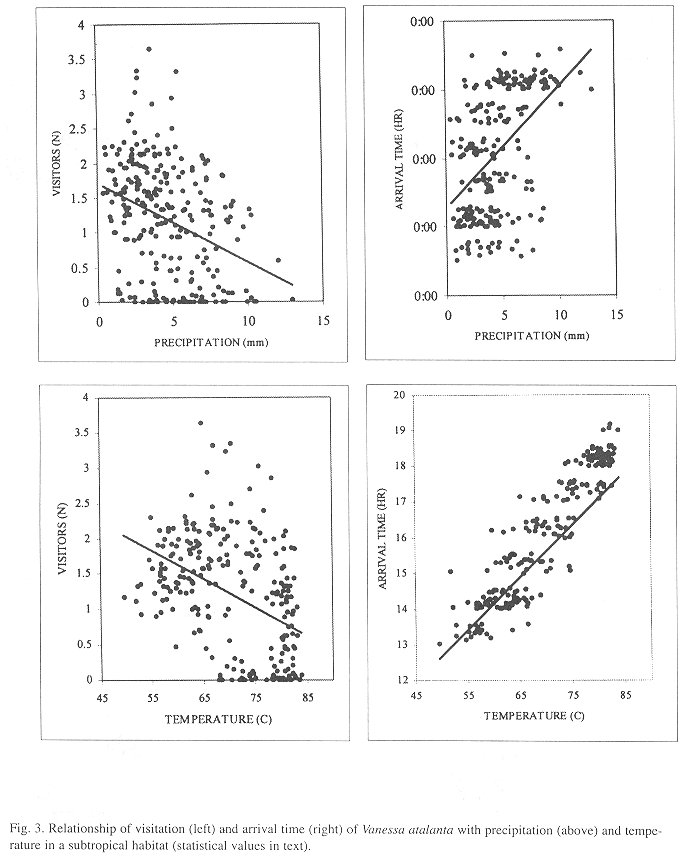
<body><![CDATA[<p><font face="Arial,Helvetica"><font size=-1>This paper reports on an intensive (daily) long term study (22 years) of a <i>V. atalanta</i> population in a subtropical habitat with emphasis on the association of number of individuals and arrival time with climate.</font></font>     <br><font size=-1></font>&nbsp;<font size=-1></font>     <p><b><font face="Arial,Helvetica"><font size=-1>Materials and Methods</font></font></b><font size=-1></font>     <p><font face="Arial,Helvetica"><font size=-1>Individual butterfly visitation records (and a qualitative microclimatic classification) were made by the senior author in an urban clearing devoid of hostplants in Winter Park, near Orlando, Florida, USA (28&deg; 34'57'' N, 81&deg; 20'04'' W) for 22 years (April 15, 1977-April 14, 1999: 8035 days). Details of the site and the unusual conditions that allowed daily observations for such a long period appear in <a href="#Swanson">Swanson (1998)</a>.</font></font><font size=-1></font>     <p><font face="Arial,Helvetica"><font size=-1>Climatic data are from monthly means provided by government databases available in the Internet (<a href="http://water.dnr.state.sc.us/climate/">http://water.dnr.state.sc.us/climate/</a>). Besides the inferential statistics presented here, graphs of daily changes in number of visiting butterflies and their arrival time (available in the on-line edition of this journal) were analyzed visually for non-linear associations (<a href="#Kozlov">Kozlov <i>et al</i>. 1997</a>) but none were found. Non-parametric statistics were used to avoid potential conflict with the less realistic requirements of parametric tests. "Visitation" and "number of daily visitors" are defined as total number of occupants and intruders arriving each day.</font></font>     <br><font size=-1></font>&nbsp;<font size=-1></font>     <p><b><font face="Arial,Helvetica"><font size=-1>Results</font></font></b><font size=-1></font>     <p><font face="Arial,Helvetica"><font size=-1><b>Natural history:</b> Individuals were active even at 10&deg; C and with 9 m/s winds. Individuals with wings in fresh condition were most common in the first half of year (January-June) when they represented roughly three quarters of the population. Smaller individuals (general impression: no measurements were taken) were seen from late December to late March. There were 82 atypical cases of individuals arriving before 1200 hr (not included in the graphs). Aerial interactions were seen whenever there was more than one individual in the site (<i>i.e.</i> 41 % of days, N=7634 total days, <a href="#Fig. 1">Fig. 1</a>).</font></font>     <br><font size=-1></font>&nbsp;<font size=-1></font>     <center>     ]]></body>
<body><![CDATA[<p><a NAME="Fig. 1"></a><img SRC="/img/fbpe/rbt/v48n2-3/0874i01.GIF" height=357 width=616><font size=-1></font>     
<p>    <br><font size=-1></font><font size=-1></font>     <p><a NAME="Fig. 2"></a><img SRC="/img/fbpe/rbt/v48n2-3/0874i02.GIF" height=423 width=612></center> <font size=-1></font>     
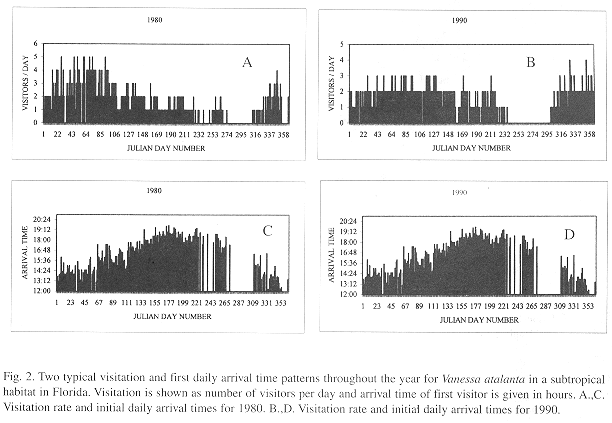
<p>    <br><font size=-1></font>     <br><font size=-1></font>     <p><font face="Arial,Helvetica"><font size=-1>A total of 4 794 visits were recorded, with an overall attendance rate of 59.5 %. During the 2 hr afternoon visit period there were frequently 1-3 individuals in the site, two times there were eight and once (March 15, 1982) there were ten. Only once in these 22 years was predation seen: an individual that flew with difficulty was captured by a bird (<i>Cardinalis cardinalis</i>). Some specimens had missing legs or lacked parts of wings, antennae or proboscis.</font></font><font size=-1></font>     <p><font face="Arial,Helvetica"><font size=-1><b>Visitation pattern:</b> There are no hostplants on the site. The population is composed of visitors that perch and participate in aerial interactions <i>sensu</i> <a href="#Bitzer79">Bitzer and Shaw (1979)</a>. The number of visitors begins to increase in autumn, reaches a peak near the end of winter and decreases almost constantly during the spring and summer (<a href="#Fig. 2">Fig. 2a, 2b</a>). Generally, there are two visitation patterns. Pattern I (1977 to 1985): a marked curve with zero population around October, <i>e.g.</i> <a href="#Fig. 2">Fig. 2a</a>). Pattern II (1986-1996):a flatter curve with 1-5 months without visitors, <i>e.g.</i> <a href="#Fig. 2">Fig. 2b</a>. Arrival time of first individual to enter the area had the same pattern during the study period, with a soft increase from January through June and a soft decline until December (Julian dates, <a href="#Fig. 2">Figs. 2b</a> and <a href="#Fig. 2">2 d</a>).</font></font><font size=-1></font>     <center>     ]]></body>
<body><![CDATA[<p><a NAME="Fig. 3"></a><img SRC="/img/fbpe/rbt/v48n2-3/0874i03.GIF" height=858 width=682></center> <font size=-1></font>     
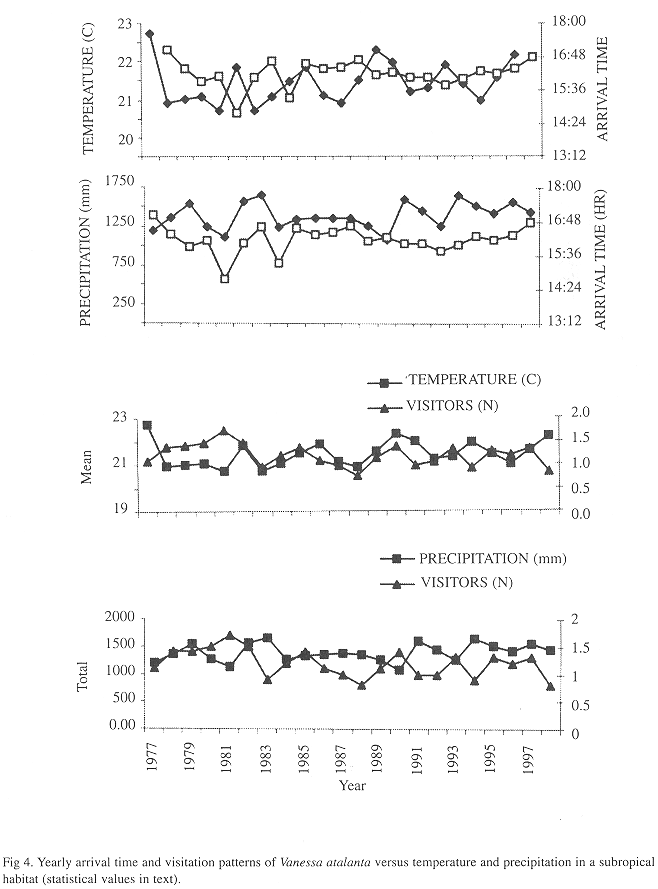
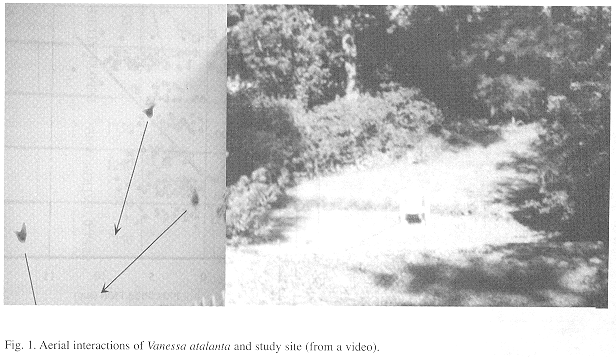
<p>    <br><font size=-1></font>     <br><font size=-1></font>     <p><font face="Arial,Helvetica"><font size=-1>The mean daily number of visitors a particular month was inversely correlated with mean monthly temperature (Spearman Rank Correlation, SRC: r =-0.43, p&lt; 0.01, n=261 months; mean monthly values for number of visitors and climatic factors were used in this and following tests) and precipitation (SRC: r = -0.34, p&lt; 0.01, N=261) (<a href="#Fig. 3">Fig. 3A</a>,<a href="#Fig. 3">C</a>). There were occasional absences of 1-14 days that represented gaps in the general trend mostly during stormy weather (<a href="#Fig. 2">Fig. 2</a> <a href="#Fig. 2">A-D</a>, a few represent the rare instances in which observer was absent). Arrival time of the first visitor was positively correlated with mean monthly temperature (SRC: r = 0.84, p&lt; 0.01, N=238) and with mean monthly precipitation (SRC: r = 0.49, p&lt; 0.01, N=231) (Fig. <a href="#Fig. 3">3B</a>,<a href="#Fig. 3">D</a>). Total daily number of individuals arriving at the site was associated with a subjective classification of climate (Kruskal-Wallis ANOVA, p&lt; 0.0001, N=5658 days; mean ranks: 4229 windy, 3152 good climate, 2614 cold, 743 overcast or rainy) but not with arrival time (Kruskal-Wallis ANOVA 1.7, p=0.63, N=4 681 days).</font></font><font size=-1></font>     <p><font face="Arial,Helvetica"><font size=-1>Yearly mean values were not correlated (SRC values: visitors versus temperature -0.17, visitors versus precipitation -0.40; arrival time versus temperature 0.17, arrival time versus precipitation 0.02; in all cases N=22 years and p> 0.05). (<a href="#Fig. 4">Fig. 4</a>)</font></font>     <br><font face="Arial,Helvetica"><font size=-1></font></font>&nbsp;<font size=-1></font>     <center>     <p><a NAME="Fig. 4"></a><img SRC="/img/fbpe/rbt/v48n2-3/0874i04.GIF" height=889 width=658></center> <font size=-1></font>     
<p>    ]]></body>
<body><![CDATA[<br><font size=-1></font>     <br><font size=-1></font>     <p><font face="Arial,Helvetica"><font size=-1>There was no significant difference in number of visitors between El Ni&ntilde;o (mean 1.13 visitors/day, standard deviation SD 0.21, range 0.90-1.50, N=11, years 1977, 1978, 1982, 1983, 1986, 1987 and 1991-1995) and non-El Ni&ntilde;o years (mean 1.25, SD 0.28, range 0.80-1.70 visitors/day).</font></font>     <br><font size=-1></font>&nbsp;<font size=-1></font>     <p><b><font face="Arial,Helvetica"><font size=-1>Discussion</font></font></b><font face="Arial,Helvetica"><font size=-1></font></font>     <p><font face="Arial,Helvetica"><font size=-1>The migratory routes of <i>V. atalanta</i> in North America are poorly known, but a greater number of studies in Europe have shown that the migratory population follows temperature layers (<a href="#Benvenuti">Benvenuti <i>et al. </i>1996</a>), is subjected to significant wind drift and travels with other species (<a href="#Hansen">Hansen 1997</a>); has time-compensated sun orientation, migrates thousands of kilometers, feeds in winter and sometimes reproduces while traveling northward in the warmer part of the year, around June (<a href="#Baker72">Baker 1972</a>, <a href="#Baker84">1984</a>, <a href="#Stefanescu">Stefanescu <i>et al.</i> 1996</a>, <a href="#Hansen">Hansen 1997</a>, <a href="#Palmqvist">Palmqvist 1998</a>). It is now clear that migrations are bidirectional (<a href="#Benvenuti">Benvenuti <i>et al. </i>1996</a>) but how the travel information is passed among butterfly generations in general is not known (<a href="#Pasteur">Pasteur 1984</a>) and future studies of V. atalanta should stress this aspect.</font></font><font size=-1></font>     <p><font face="Arial,Helvetica"><font size=-1>In this study, seasonal changes in the number of visitors, with fewer visitors in the moister and warmer months and predominance of fresh individuals from January to June suggest that <i>V. atalanta </i>overwinters in Florida and migrates to northerly regions when high summer temperatures affect Florida (R. Bitzer 2000, pers. comm.). A similar migration from Africa to Europe is known (<a href="#Larsen93">Larsen 1993</a>). This would fit with the smaller individuals seen from late December to late March: fresher individuals may emerge in Florida as the offspring of the larger butterflies first seen in late October - early November. These larger individuals could have migrated from more northerly regions earlier in the fall, according to the parallel migration pattern of <i>V. atalanta</i> in Europe described by <a href="#Larsen93">Larsen (1993)</a> and <a href="#Benvenuti">Benvenuti <i>et al.</i> (1996)</a> (R. Bitzer 2000, pers. comm.). For <i>V. atalanta</i> temperature is a more important limiting factor than host plant availability (<a href="#Bryant">Bryant-Simon <i>et al</i>. 1997</a>, <a href="#Maier">Maier and Shreeve 1995</a>).</font></font><font size=-1></font>     <p><font face="Arial,Helvetica"><font size=-1>The activity period span in Florida is greater than in the more seasonal climate of Iowa, where <i>V. atalanta</i> is active from April to October (<a href="#Bitzer79">Bitzer and Shaw 1979</a>, <a href="#Bitzer95">1995</a>). The greater number of visitors on windy days suggests that the site was selected because it was surrounded by vegetation and buildings (see <a href="#Swanson">Swanson 1998</a>).</font></font><font size=-1></font>     <p><font face="Arial,Helvetica"><font size=-1>The El Ni&ntilde;o Migration Model predicts that overpopulation increases butterfly migration to outbreak level during El Ni&ntilde;o years (<a href="#Larsen84">Larsen 1984</a>, <a href="#Myres">Myres 1985</a>). We found no difference in number of visitors for El Ni&ntilde;o years, apparently because <i>V. atalanta</i> is a regular rather than an outbreak migrator.</font></font><font size=-1></font>     <p><font face="Arial,Helvetica"><font size=-1>The limited temperature range that characterizes sites where <i>V. atalanta</i> occurs (<a href="#Bryant">Bryant-Simon <i>et al.</i> 1997</a>, <a href="#Maier">Maier and Shreeve 1995</a>) and butterflies' inability to fly under heavy rain can explain why individuals arrive at their perching spots later in the hot, rainy months. V. atalanta males establish courtship territories 2-4 hours before sunset (<a href="#Wiltshire97">Wiltshire 1997</a>, <a href="#Bitzer79">Bitzer and Shaw 1979</a>, <a href="#Bitzer95">1995</a>) and use neural motion detectors adapted to great speed (<a href="#O'Carroll">O'Carroll <i>et al.</i> 1996</a>) in aerial interactions (<a href="#Bitzer79">Bitzer and Shaw 1979</a>). Territories have distinct characteristics (sunlit clearings and ridge tops) and are used by different individuals over the years (<a href="#Bitzer79">Bitzer and Shaw 1979</a>, <a href="#Wiltshire97">Wiltshire 1997</a>). Despite its methodological difference with previous studies, this study produced the same conclusions about territorial behavior, and also agrees with the ecological model of perching behavior which proposes that perching is associated with relatively high temperature, lekking and long life (<a href="#Wickman92a">Wickman 1992a</a>,<a href="#Wickman92b">b</a>, <a href="#Van-Dyck97a">van Dyck <i>et al.</i> 1997a</a>,<a href="#Van-Dyck97b">b</a>, <a href="#Van-Dyck98">van Dyck and Matthysen 1998</a>. No data are available regarding the wing color and body proportion elements of the model).</font></font><font size=-1></font>     ]]></body>
<body><![CDATA[<p><font face="Arial,Helvetica"><font size=-1>If our results can be generalized (and that will be unknown until more long term intensive studies become available) behavioral studies of butterflies do not suffer from the general impossibility of daily observation for long periods, but at least for small areas, occasional population counts covering less than two weeks are unreliable: even total absence of individuals for such periods can simply represent gaps in the general trend. Furthermore, the analysis of yearly values hid the associations of number of individuals and arrival time with climate that were found when a smaller scale was used. Long term studies based on yearly samplings should be re-evaluated for this aspect.</font></font>     <br><font size=-1></font>&nbsp;<font size=-1></font>     <p><b><font face="Arial,Helvetica"><font size=-1>Acknowledgments</font></font></b><font size=-1></font>     <p><font face="Arial,Helvetica"><font size=-1>We thank Shirley Gregory and Pat Miller for assistance and support, Mar&iacute;a Isabel Gonz&aacute;lez for the statistical analysis, Marisol Rodr&iacute;guez Pacheco and Ana Araya Anchetta for data digitalization and Royce Bitzer, Department of Entomology, Iowa State University, William Ram&iacute;rez, Museo de Insectos, Unversidad de Costa Rica, Per-Olof Wickman, Dpt. Mathematics and Science, Stockholm Institute of Education and one annonymous reviewer, for suggestions that greatly improved the manuscript.</font></font>     <br><font size=-1></font>&nbsp;<font size=-1></font>     <p><b><font face="Arial,Helvetica"><font size=-1>References</font></font></b><font size=-1></font>     <!-- ref --><p><a NAME="Baker72"></a><font face="Arial,Helvetica"><font size=-1>Baker, R.R. 1972. The geographical origin of the British spring individuals of the butterflies <i>Vanessa atalanta </i>(L.) and <i>V. cardui</i> (L.). J. Entomol. (A) 46: 185-196.</font></font><font size=-1></font>    &nbsp;&nbsp;&nbsp;&nbsp;&nbsp;&nbsp;&nbsp;&nbsp;[&#160;<a href="javascript:void(0);" onclick="javascript: window.open('/scielo.php?script=sci_nlinks&ref=1204251&pid=S0034-7744200000020003200001&lng=','','width=640,height=500,resizable=yes,scrollbars=1,menubar=yes,');">Links</a>&#160;]<!-- end-ref --><!-- ref --><p><a NAME="Baker84"></a><font face="Arial,Helvetica"><font size=-1>Baker, R.R. 1984. The dilemma: when and how to go or stay, p. 279-296 . <i>In</i> R.I. Vane-Wright &amp; P.R. Ackery (eds.). The biology of butterflies. Royal Entomological Society, London.</font></font><font size=-1></font>    &nbsp;&nbsp;&nbsp;&nbsp;&nbsp;&nbsp;&nbsp;&nbsp;[&#160;<a href="javascript:void(0);" onclick="javascript: window.open('/scielo.php?script=sci_nlinks&ref=1204252&pid=S0034-7744200000020003200002&lng=','','width=640,height=500,resizable=yes,scrollbars=1,menubar=yes,');">Links</a>&#160;]<!-- end-ref --><!-- ref --><p><a NAME="Benvenuti"></a><font face="Arial,Helvetica"><font size=-1>Benvenuti, S., P. Dall'antonia &amp; P. Ioale. 1996. Directional preferences in the autumn migration of the red admiral (<i>Vanessa atalanta</i>). Ethology 102: 177-186</font></font><font size=-1></font>    &nbsp;&nbsp;&nbsp;&nbsp;&nbsp;&nbsp;&nbsp;&nbsp;[&#160;<a href="javascript:void(0);" onclick="javascript: window.open('/scielo.php?script=sci_nlinks&ref=1204253&pid=S0034-7744200000020003200003&lng=','','width=640,height=500,resizable=yes,scrollbars=1,menubar=yes,');">Links</a>&#160;]<!-- end-ref --><!-- ref --><p><a NAME="Bitzer79"></a><font face="Arial,Helvetica"><font size=-1>Bitzer, R.J. &amp; K.C. Shaw. 1979 (1980). Territorial behavior of the Red Admiral, <i>Vanessa atalanta</i> (L.) (Lepidoptera: Nymphalidae). J. Res. Lepid. 18: 36-49.</font></font><font size=-1></font>    &nbsp;&nbsp;&nbsp;&nbsp;&nbsp;&nbsp;&nbsp;&nbsp;[&#160;<a href="javascript:void(0);" onclick="javascript: window.open('/scielo.php?script=sci_nlinks&ref=1204254&pid=S0034-7744200000020003200004&lng=','','width=640,height=500,resizable=yes,scrollbars=1,menubar=yes,');">Links</a>&#160;]<!-- end-ref --><!-- ref --><p><a NAME="Bitzer95"></a><font face="Arial,Helvetica"><font size=-1>Bitzer, R.J. &amp; K.C. Shaw. 1995. Territorial behavior of the Red Admiral, <i>Vanessa atalanta</i> (Lepidoptera: Nymphalidae). I. The role of climatic factors and early interaction frequency in territorial start time. J. Insect Behav. 8: 47-66.</font></font><font size=-1></font>    &nbsp;&nbsp;&nbsp;&nbsp;&nbsp;&nbsp;&nbsp;&nbsp;[&#160;<a href="javascript:void(0);" onclick="javascript: window.open('/scielo.php?script=sci_nlinks&ref=1204255&pid=S0034-7744200000020003200005&lng=','','width=640,height=500,resizable=yes,scrollbars=1,menubar=yes,');">Links</a>&#160;]<!-- end-ref --><!-- ref --><p><a NAME="Bryant"></a><font face="Arial,Helvetica"><font size=-1>Bryant-Simon, R., D. Thomas-Chris &amp; S. Bale-Jeffrey. 1997. Nettle-feeding nymphalid butterflies: Temperature, development and distribution. Ecol. Ent. 22: 390-398.</font></font><font size=-1></font>    &nbsp;&nbsp;&nbsp;&nbsp;&nbsp;&nbsp;&nbsp;&nbsp;[&#160;<a href="javascript:void(0);" onclick="javascript: window.open('/scielo.php?script=sci_nlinks&ref=1204256&pid=S0034-7744200000020003200006&lng=','','width=640,height=500,resizable=yes,scrollbars=1,menubar=yes,');">Links</a>&#160;]<!-- end-ref --><!-- ref --><p><a NAME="Calvert"></a><font face="Arial,Helvetica"><font size=-1>Calvert, W.H., L.P. Brower &amp; R.O. Lawton. 1992. Mass flight response of overwintering monarch butterflies (Nymphalidae) to cloud-induced changes in solar radiation intensity in Mexico. J. Lepid. Soc. 46: 97-105.</font></font><font size=-1></font>    &nbsp;&nbsp;&nbsp;&nbsp;&nbsp;&nbsp;&nbsp;&nbsp;[&#160;<a href="javascript:void(0);" onclick="javascript: window.open('/scielo.php?script=sci_nlinks&ref=1204257&pid=S0034-7744200000020003200007&lng=','','width=640,height=500,resizable=yes,scrollbars=1,menubar=yes,');">Links</a>&#160;]<!-- end-ref --><!-- ref --><p><a NAME="Daily"></a><font face="Arial,Helvetica"><font size=-1>Daily, G.C., P.R. Ehrlich &amp; D. Wheye. 1991. Determinants of spatial distribution in a population of the subalpine butterfly <i>Oeneis chrysus</i>. Oecologia 88: 587-596.</font></font><font size=-1></font>    &nbsp;&nbsp;&nbsp;&nbsp;&nbsp;&nbsp;&nbsp;&nbsp;[&#160;<a href="javascript:void(0);" onclick="javascript: window.open('/scielo.php?script=sci_nlinks&ref=1204258&pid=S0034-7744200000020003200008&lng=','','width=640,height=500,resizable=yes,scrollbars=1,menubar=yes,');">Links</a>&#160;]<!-- end-ref --><!-- ref --><p><a NAME="Ehrlich"></a><font face="Arial,Helvetica"><font size=-1>Ehrlich, P.R. 1984. The structure and dynamics of butterfly populations, p. 25-40. <i>In</i> R.I. Vane-Wright &amp; P.R. Ackery (eds.). The biology of butterflies. Royal Entomological Society, London.</font></font><font size=-1></font>    &nbsp;&nbsp;&nbsp;&nbsp;&nbsp;&nbsp;&nbsp;&nbsp;[&#160;<a href="javascript:void(0);" onclick="javascript: window.open('/scielo.php?script=sci_nlinks&ref=1204259&pid=S0034-7744200000020003200009&lng=','','width=640,height=500,resizable=yes,scrollbars=1,menubar=yes,');">Links</a>&#160;]<!-- end-ref --><!-- ref --><p><a NAME="Frey"></a><font face="Arial,Helvetica"><font size=-1>Frey, D.K., L.H. Leong, D. Fredericks &amp; S. Raskowitz. 1992. Clustering patterns of monarch butterflies (Lepidoptera: Danaidae) at two California central coast overwintering sites. Ann. Entomol. Soc. Am. 85: 148-153.</font></font><font size=-1></font>    &nbsp;&nbsp;&nbsp;&nbsp;&nbsp;&nbsp;&nbsp;&nbsp;[&#160;<a href="javascript:void(0);" onclick="javascript: window.open('/scielo.php?script=sci_nlinks&ref=1204260&pid=S0034-7744200000020003200010&lng=','','width=640,height=500,resizable=yes,scrollbars=1,menubar=yes,');">Links</a>&#160;]<!-- end-ref --><!-- ref --><p><a NAME="Goulson"></a><font face="Arial,Helvetica"><font size=-1>Goulson-D; J. Ollerton &amp; C. Sluman. 1997. Foraging strategies in the small skipper butterfly, <i>Thymelicus flavus</i>: When to switch? Anim. Behav. 53: 1009-1016</font></font><font size=-1></font>    &nbsp;&nbsp;&nbsp;&nbsp;&nbsp;&nbsp;&nbsp;&nbsp;[&#160;<a href="javascript:void(0);" onclick="javascript: window.open('/scielo.php?script=sci_nlinks&ref=1204261&pid=S0034-7744200000020003200011&lng=','','width=640,height=500,resizable=yes,scrollbars=1,menubar=yes,');">Links</a>&#160;]<!-- end-ref --><!-- ref --><p><a NAME="Gutiérrez"></a><font face="Arial,Helvetica"><font size=-1>Guti&eacute;rrez, D. 1997. Importance of historical factors on species richness and composition of butterfly assemblages (Lepidoptera: Rhopalocera) in a northern Iberian mountain range. J. Biogeogr. 24: 77-88.</font></font><font size=-1></font>    &nbsp;&nbsp;&nbsp;&nbsp;&nbsp;&nbsp;&nbsp;&nbsp;[&#160;<a href="javascript:void(0);" onclick="javascript: window.open('/scielo.php?script=sci_nlinks&ref=1204262&pid=S0034-7744200000020003200012&lng=','','width=640,height=500,resizable=yes,scrollbars=1,menubar=yes,');">Links</a>&#160;]<!-- end-ref --><!-- ref --><p><a NAME="Hansen"></a><font face="Arial,Helvetica"><font size=-1>Hansen, M.D.D. 1997 Observations on the migrations of the Painted Lady <i>Vanessa cardui</i> (L.) in Denmark in 1996: (Lepidoptera: Nymphalidae). Ent. Meddelelser 65: 165-173.</font></font><font size=-1></font>    &nbsp;&nbsp;&nbsp;&nbsp;&nbsp;&nbsp;&nbsp;&nbsp;[&#160;<a href="javascript:void(0);" onclick="javascript: window.open('/scielo.php?script=sci_nlinks&ref=1204263&pid=S0034-7744200000020003200013&lng=','','width=640,height=500,resizable=yes,scrollbars=1,menubar=yes,');">Links</a>&#160;]<!-- end-ref --><!-- ref --><p><a NAME="Harrison"></a><font face="Arial,Helvetica"><font size=-1>Harrison, S., D.D. Murphy &amp; P.R. Ehrlich. 1988. Distribution of the Bay Checkerspot butterfly, <i>Euphydryas editha</i> bayensis: evidence for a metapopulation model. Amer. Nat. 132: 360-382.</font></font><font size=-1></font>    &nbsp;&nbsp;&nbsp;&nbsp;&nbsp;&nbsp;&nbsp;&nbsp;[&#160;<a href="javascript:void(0);" onclick="javascript: window.open('/scielo.php?script=sci_nlinks&ref=1204264&pid=S0034-7744200000020003200014&lng=','','width=640,height=500,resizable=yes,scrollbars=1,menubar=yes,');">Links</a>&#160;]<!-- end-ref --><!-- ref --><p><a NAME="Kitahara"></a><font face="Arial,Helvetica"><font size=-1>Kitahara M. &amp; K. Fuji. 1997. An island biogeographic approach to theanalysis of butterfly community patterns in newly designed parks. Res. Pop. Ecol. (Kyoto) 39: 23-35.</font></font><font size=-1></font>    &nbsp;&nbsp;&nbsp;&nbsp;&nbsp;&nbsp;&nbsp;&nbsp;[&#160;<a href="javascript:void(0);" onclick="javascript: window.open('/scielo.php?script=sci_nlinks&ref=1204265&pid=S0034-7744200000020003200015&lng=','','width=640,height=500,resizable=yes,scrollbars=1,menubar=yes,');">Links</a>&#160;]<!-- end-ref --><!-- ref --><p><a NAME="Kozlov"></a><font face="Arial,Helvetica"><font size=-1>Kozlov, M.V., A.L. Lvovsky &amp; K. Mikkola. 1997. Abundance of day-flying lepidoptera along an air pollution gradient in the northern boreal forest zone. Ent. Fennica 7: 137-144</font></font><font size=-1></font>    &nbsp;&nbsp;&nbsp;&nbsp;&nbsp;&nbsp;&nbsp;&nbsp;[&#160;<a href="javascript:void(0);" onclick="javascript: window.open('/scielo.php?script=sci_nlinks&ref=1204266&pid=S0034-7744200000020003200016&lng=','','width=640,height=500,resizable=yes,scrollbars=1,menubar=yes,');">Links</a>&#160;]<!-- end-ref --><!-- ref --><p><a NAME="Kunte"></a><font face="Arial,Helvetica"><font size=-1>Kunte-Krushnamegh, J. 1997. Seasonal patterns in butterfly abundance and species diversity in four tropical habitats in northern Western Ghats. J. Biosci. Bangalore 22: 593-603.</font></font><font size=-1></font>    &nbsp;&nbsp;&nbsp;&nbsp;&nbsp;&nbsp;&nbsp;&nbsp;[&#160;<a href="javascript:void(0);" onclick="javascript: window.open('/scielo.php?script=sci_nlinks&ref=1204267&pid=S0034-7744200000020003200017&lng=','','width=640,height=500,resizable=yes,scrollbars=1,menubar=yes,');">Links</a>&#160;]<!-- end-ref --><!-- ref --><p><a NAME="Larsen84"></a><font face="Arial,Helvetica"><font size=-1>Larsen, T.B. 1984. Butterflies of Saudi Arabia and its neighbours. Stacey, London, 160 p.</font></font><font size=-1></font>    &nbsp;&nbsp;&nbsp;&nbsp;&nbsp;&nbsp;&nbsp;&nbsp;[&#160;<a href="javascript:void(0);" onclick="javascript: window.open('/scielo.php?script=sci_nlinks&ref=1204268&pid=S0034-7744200000020003200018&lng=','','width=640,height=500,resizable=yes,scrollbars=1,menubar=yes,');">Links</a>&#160;]<!-- end-ref --><!-- ref --><p><a NAME="Larsen93"></a><font face="Arial,Helvetica"><font size=-1>Larsen, T.B. 1993. Butterfly mass transit. Nat. History 102: 30-39.</font></font><font size=-1></font>    &nbsp;&nbsp;&nbsp;&nbsp;&nbsp;&nbsp;&nbsp;&nbsp;[&#160;<a href="javascript:void(0);" onclick="javascript: window.open('/scielo.php?script=sci_nlinks&ref=1204269&pid=S0034-7744200000020003200019&lng=','','width=640,height=500,resizable=yes,scrollbars=1,menubar=yes,');">Links</a>&#160;]<!-- end-ref --><!-- ref --><p><a NAME="Maier"></a><font face="Arial,Helvetica"><font size=-1>Maier, C. &amp; T.G. Shreeve. 1995 (1996) Endothermic heat production in three species of Nymphalidae (Lepidoptera). Nota Lepid. 18: 127-137</font></font><font size=-1></font>    &nbsp;&nbsp;&nbsp;&nbsp;&nbsp;&nbsp;&nbsp;&nbsp;[&#160;<a href="javascript:void(0);" onclick="javascript: window.open('/scielo.php?script=sci_nlinks&ref=1204270&pid=S0034-7744200000020003200020&lng=','','width=640,height=500,resizable=yes,scrollbars=1,menubar=yes,');">Links</a>&#160;]<!-- end-ref --><!-- ref --><p><a NAME="Monge-Nájera"></a><font face="Arial,Helvetica"><font size=-1>Monge-N&aacute;jera, J., F. Hern&aacute;ndez, M.I. Gonz&aacute;lez, J. Soley, J.A. Pochet &amp; S. Zolla. 1998. Spatial distribution and sound production in five species of cryptic tropical butterflies (<i>Hamadryas</i>, Lepidoptera: Nymphalidae): Implication for the industrial melanism debate. Rev. Biol. Trop. 46:.</font></font><font size=-1></font>    &nbsp;&nbsp;&nbsp;&nbsp;&nbsp;&nbsp;&nbsp;&nbsp;[&#160;<a href="javascript:void(0);" onclick="javascript: window.open('/scielo.php?script=sci_nlinks&ref=1204271&pid=S0034-7744200000020003200021&lng=','','width=640,height=500,resizable=yes,scrollbars=1,menubar=yes,');">Links</a>&#160;]<!-- end-ref --><!-- ref --><p><a NAME="Myres"></a><font face="Arial,Helvetica"><font size=-1>Myres, M.T. 1985. A southward return migration of Painted Lady butterflies, <i>Vanessa cardui</i>, over southern Alberta in the fall of 1983, and biometeorological aspects of their outbreaks into North America and Europe. Can. Field-Nat. 99: 147-155.</font></font><font size=-1></font>    &nbsp;&nbsp;&nbsp;&nbsp;&nbsp;&nbsp;&nbsp;&nbsp;[&#160;<a href="javascript:void(0);" onclick="javascript: window.open('/scielo.php?script=sci_nlinks&ref=1204272&pid=S0034-7744200000020003200022&lng=','','width=640,height=500,resizable=yes,scrollbars=1,menubar=yes,');">Links</a>&#160;]<!-- end-ref --><!-- ref --><p><a NAME="Nielssen"></a><font face="Arial,Helvetica"><font size=-1>Nielssen, V. &amp; J. Monge-N&aacute;jera. 1991. A comparison of four methods to evaluate butterfly abundance, using a tropical community. J. Lepid. Soc. 45: 241-243.</font></font><font size=-1></font>    &nbsp;&nbsp;&nbsp;&nbsp;&nbsp;&nbsp;&nbsp;&nbsp;[&#160;<a href="javascript:void(0);" onclick="javascript: window.open('/scielo.php?script=sci_nlinks&ref=1204273&pid=S0034-7744200000020003200023&lng=','','width=640,height=500,resizable=yes,scrollbars=1,menubar=yes,');">Links</a>&#160;]<!-- end-ref --><!-- ref --><p><a NAME="Neve"></a><font face="Arial,Helvetica"><font size=-1>Neve, G., L. Mousson &amp; M. Baguette. 1997. Adult dispersal and genetic structure of butterfly populations in a fragmented landscape. Acta Oecol. 17: 621-626.</font></font><font size=-1></font>    &nbsp;&nbsp;&nbsp;&nbsp;&nbsp;&nbsp;&nbsp;&nbsp;[&#160;<a href="javascript:void(0);" onclick="javascript: window.open('/scielo.php?script=sci_nlinks&ref=1204274&pid=S0034-7744200000020003200024&lng=','','width=640,height=500,resizable=yes,scrollbars=1,menubar=yes,');">Links</a>&#160;]<!-- end-ref --><!-- ref --><p><a NAME="Nylin"></a><font face="Arial,Helvetica"><font size=-1>Nylin, S. 1997. Seasonal adaptations in butterflies: A story on plasticity. Entom. Tidskrift 117: 1-10</font></font><font size=-1></font>    &nbsp;&nbsp;&nbsp;&nbsp;&nbsp;&nbsp;&nbsp;&nbsp;[&#160;<a href="javascript:void(0);" onclick="javascript: window.open('/scielo.php?script=sci_nlinks&ref=1204275&pid=S0034-7744200000020003200025&lng=','','width=640,height=500,resizable=yes,scrollbars=1,menubar=yes,');">Links</a>&#160;]<!-- end-ref --><!-- ref --><p><a NAME="O'Carroll"></a><font face="Arial,Helvetica"><font size=-1>O'Carroll, D.C., N.J. Bidwell, S.B. Laughlin &amp; E.J. Warrant. 1996 Insect motion detectors matched to visual ecology. Nature 382: 63-66</font></font><font size=-1></font>    &nbsp;&nbsp;&nbsp;&nbsp;&nbsp;&nbsp;&nbsp;&nbsp;[&#160;<a href="javascript:void(0);" onclick="javascript: window.open('/scielo.php?script=sci_nlinks&ref=1204276&pid=S0034-7744200000020003200026&lng=','','width=640,height=500,resizable=yes,scrollbars=1,menubar=yes,');">Links</a>&#160;]<!-- end-ref --><!-- ref --><p><a NAME="Pollard"></a><font face="Arial,Helvetica"><font size=-1>Pollard, E; &amp; J-N. Greatorex. 1997. Flight-periods of the small heath butterfly, <i>Coenonympha pamphilus</i> (Linnaeus) (Lepidoptera: Nymphalidae, Satyrinae) on chalk downs and in woodland in southern England. Entom. Gaz. 48: 3-7</font></font><font size=-1></font>    &nbsp;&nbsp;&nbsp;&nbsp;&nbsp;&nbsp;&nbsp;&nbsp;[&#160;<a href="javascript:void(0);" onclick="javascript: window.open('/scielo.php?script=sci_nlinks&ref=1204277&pid=S0034-7744200000020003200027&lng=','','width=640,height=500,resizable=yes,scrollbars=1,menubar=yes,');">Links</a>&#160;]<!-- end-ref --><!-- ref --><p><a NAME="Palmqvist"></a><font face="Arial,Helvetica"><font size=-1>Palmqvist, G. 1998. Remarkable records of Macrolepidoptera in Sweden 1997. Entomol Tidskrift 119: 13-27.</font></font><font size=-1></font>    &nbsp;&nbsp;&nbsp;&nbsp;&nbsp;&nbsp;&nbsp;&nbsp;[&#160;<a href="javascript:void(0);" onclick="javascript: window.open('/scielo.php?script=sci_nlinks&ref=1204278&pid=S0034-7744200000020003200028&lng=','','width=640,height=500,resizable=yes,scrollbars=1,menubar=yes,');">Links</a>&#160;]<!-- end-ref --><!-- ref --><p><a NAME="Pasteur"></a><font face="Arial,Helvetica"><font size=-1>Pasteur, G. 1984. Les migrations du monarque, Lepidoptere Danaide. C.R. Soc. Biog&eacute;ogr. 60: 84.</font></font><font size=-1></font>    &nbsp;&nbsp;&nbsp;&nbsp;&nbsp;&nbsp;&nbsp;&nbsp;[&#160;<a href="javascript:void(0);" onclick="javascript: window.open('/scielo.php?script=sci_nlinks&ref=1204279&pid=S0034-7744200000020003200029&lng=','','width=640,height=500,resizable=yes,scrollbars=1,menubar=yes,');">Links</a>&#160;]<!-- end-ref --><!-- ref --><p><a NAME="Peterson"></a><font face="Arial,Helvetica"><font size=-1>Peterson, M.A. 1997. Host plant phenology and butterfly dispersal: Causes and consequences of uphill movement. Ecology 78: 167-180.</font></font><font size=-1></font>    &nbsp;&nbsp;&nbsp;&nbsp;&nbsp;&nbsp;&nbsp;&nbsp;[&#160;<a href="javascript:void(0);" onclick="javascript: window.open('/scielo.php?script=sci_nlinks&ref=1204280&pid=S0034-7744200000020003200030&lng=','','width=640,height=500,resizable=yes,scrollbars=1,menubar=yes,');">Links</a>&#160;]<!-- end-ref --><!-- ref --><p><a NAME="Stefanescu"></a><font face="Arial,Helvetica"><font size=-1>Stefanescu, C., M. Lockwood &amp; M. Cebolla. 1996. The butterfly assemblages of northeastern Spanish wetlands. Nota Lepid. 19: 165-184</font></font><font size=-1></font>    &nbsp;&nbsp;&nbsp;&nbsp;&nbsp;&nbsp;&nbsp;&nbsp;[&#160;<a href="javascript:void(0);" onclick="javascript: window.open('/scielo.php?script=sci_nlinks&ref=1204281&pid=S0034-7744200000020003200031&lng=','','width=640,height=500,resizable=yes,scrollbars=1,menubar=yes,');">Links</a>&#160;]<!-- end-ref --><!-- ref --><p><a NAME="Steiner"></a><font face="Arial,Helvetica"><font size=-1>Steiner, A. 1991. Unusual flight times of butterflies in 1989 and 1990: Results of the global climatic change? Atalanta 22: 237-244.</font></font><font size=-1></font>    &nbsp;&nbsp;&nbsp;&nbsp;&nbsp;&nbsp;&nbsp;&nbsp;[&#160;<a href="javascript:void(0);" onclick="javascript: window.open('/scielo.php?script=sci_nlinks&ref=1204282&pid=S0034-7744200000020003200032&lng=','','width=640,height=500,resizable=yes,scrollbars=1,menubar=yes,');">Links</a>&#160;]<!-- end-ref --><!-- ref --><p><a NAME="Singer"></a><font face="Arial,Helvetica"><font size=-1>Singer, M.C., Thomas, C.D. 1997. Evolutionary responses of a butterfly metapopulation to human- and climate-caused environmental variation. Am. Nat. 148(Suppl.): S9-S39</font></font><font size=-1></font>    &nbsp;&nbsp;&nbsp;&nbsp;&nbsp;&nbsp;&nbsp;&nbsp;[&#160;<a href="javascript:void(0);" onclick="javascript: window.open('/scielo.php?script=sci_nlinks&ref=1204283&pid=S0034-7744200000020003200033&lng=','','width=640,height=500,resizable=yes,scrollbars=1,menubar=yes,');">Links</a>&#160;]<!-- end-ref --><!-- ref --><p><a NAME="Srygley"></a><font face="Arial,Helvetica"><font size=-1>Srygley, R.B., E.G. Oliveira &amp; R. Dudley. 1997. Wind drift compensation, flyways, and conservation of diurnal, migrant Neotropical Lepidoptera. Proc. Roy. Soc. Lond. Biol. Sci. 263: 1351-1357</font></font><font size=-1></font>    &nbsp;&nbsp;&nbsp;&nbsp;&nbsp;&nbsp;&nbsp;&nbsp;[&#160;<a href="javascript:void(0);" onclick="javascript: window.open('/scielo.php?script=sci_nlinks&ref=1204284&pid=S0034-7744200000020003200034&lng=','','width=640,height=500,resizable=yes,scrollbars=1,menubar=yes,');">Links</a>&#160;]<!-- end-ref --><!-- ref --><p><a NAME="Stekolnikov"></a><font face="Arial,Helvetica"><font size=-1>Stekolnikov, A.A. 1992. Dynamics of some Lepidoptera (Hesperioidea, Papilionoidea, Sphingoidea, etc.) fauna of the protected oak forest "forest of the Vorskla" during 50 years of observation. Vestn. St-Peterburg Univ. Ser. 3 Biol. (2): 28-36.</font></font><font size=-1></font>    &nbsp;&nbsp;&nbsp;&nbsp;&nbsp;&nbsp;&nbsp;&nbsp;[&#160;<a href="javascript:void(0);" onclick="javascript: window.open('/scielo.php?script=sci_nlinks&ref=1204285&pid=S0034-7744200000020003200035&lng=','','width=640,height=500,resizable=yes,scrollbars=1,menubar=yes,');">Links</a>&#160;]<!-- end-ref --><!-- ref --><p><a NAME="Swanson"></a><font face="Arial,Helvetica"><font size=-1>Swanson, H.F. 1998. 20 years of butterfly revelations. E.O. Painter, Winter Park, Florida. 102 p. (Library of Congress LC No. 98090034).</font></font><font size=-1></font>    &nbsp;&nbsp;&nbsp;&nbsp;&nbsp;&nbsp;&nbsp;&nbsp;[&#160;<a href="javascript:void(0);" onclick="javascript: window.open('/scielo.php?script=sci_nlinks&ref=1204286&pid=S0034-7744200000020003200036&lng=','','width=640,height=500,resizable=yes,scrollbars=1,menubar=yes,');">Links</a>&#160;]<!-- end-ref --><!-- ref --><p><a NAME="Thomas"></a><font face="Arial,Helvetica"><font size=-1>Thomas, J.A. 1984. The conservation of butterflies in temperate countries: past efforts and lessons for the future, p. 333-353. <i>In</i> R.I. Vane-Wright &amp; P.R. Ackery (eds.). The biology of butterflies. Royal Entomological Society, London.</font></font><font size=-1></font>    &nbsp;&nbsp;&nbsp;&nbsp;&nbsp;&nbsp;&nbsp;&nbsp;[&#160;<a href="javascript:void(0);" onclick="javascript: window.open('/scielo.php?script=sci_nlinks&ref=1204287&pid=S0034-7744200000020003200037&lng=','','width=640,height=500,resizable=yes,scrollbars=1,menubar=yes,');">Links</a>&#160;]<!-- end-ref --><!-- ref --><p><a NAME="Thompson"></a><font face="Arial,Helvetica"><font size=-1>Thompson, J.N. 1988. Variation in preference and specificity in monophagous and oligophagous swallowtail butterflies. Evolution 42: 118-128.</font></font><font size=-1></font>    &nbsp;&nbsp;&nbsp;&nbsp;&nbsp;&nbsp;&nbsp;&nbsp;[&#160;<a href="javascript:void(0);" onclick="javascript: window.open('/scielo.php?script=sci_nlinks&ref=1204288&pid=S0034-7744200000020003200038&lng=','','width=640,height=500,resizable=yes,scrollbars=1,menubar=yes,');">Links</a>&#160;]<!-- end-ref --><!-- ref --><p><a NAME="Tuberville"></a><font face="Arial,Helvetica"><font size=-1>Tuberville, T.D., P.G. Dudley &amp; A.J. Pollard. 1996. Responses of invertebrate herbivores to stinging trichomes of <i>Urtica dioica</i> and <i>Laportea canadensis</i>. Oikos 75: 83-88.</font></font><font size=-1></font>    &nbsp;&nbsp;&nbsp;&nbsp;&nbsp;&nbsp;&nbsp;&nbsp;[&#160;<a href="javascript:void(0);" onclick="javascript: window.open('/scielo.php?script=sci_nlinks&ref=1204289&pid=S0034-7744200000020003200039&lng=','','width=640,height=500,resizable=yes,scrollbars=1,menubar=yes,');">Links</a>&#160;]<!-- end-ref --><!-- ref --><p><a NAME="Vane-Wright"></a><font face="Arial,Helvetica"><font size=-1>Vane-Wright, R.I. &amp; P.R. Ackery (eds.). 1984. The biology of butterflies. Royal Entomological Society, London. 429 p.</font></font><font size=-1></font>    &nbsp;&nbsp;&nbsp;&nbsp;&nbsp;&nbsp;&nbsp;&nbsp;[&#160;<a href="javascript:void(0);" onclick="javascript: window.open('/scielo.php?script=sci_nlinks&ref=1204290&pid=S0034-7744200000020003200040&lng=','','width=640,height=500,resizable=yes,scrollbars=1,menubar=yes,');">Links</a>&#160;]<!-- end-ref --><!-- ref --><p><a NAME="Wickman92a"></a><font face="Arial,Helvetica"><font size=-1>Wickman, P.O. 1992a. Mating system of <i>Coenonympha butterflies</i> in relation to longevity. Anim. Behav. 44: 141-148.</font></font><font size=-1></font>    &nbsp;&nbsp;&nbsp;&nbsp;&nbsp;&nbsp;&nbsp;&nbsp;[&#160;<a href="javascript:void(0);" onclick="javascript: window.open('/scielo.php?script=sci_nlinks&ref=1204291&pid=S0034-7744200000020003200041&lng=','','width=640,height=500,resizable=yes,scrollbars=1,menubar=yes,');">Links</a>&#160;]<!-- end-ref --><!-- ref --><p><a NAME="Wickman92b"></a><font face="Arial,Helvetica"><font size=-1>Wickman, P.O. 1992b. The influence of temperature on the territorial and mate locating behaviour of the small heath butterfly, <i>Coenonympha pamphilus</i> (l.) (Lepidoptera: Saturidae). Behav. Ecol. Sociobiol. 16: 233-238.</font></font><font size=-1></font>    &nbsp;&nbsp;&nbsp;&nbsp;&nbsp;&nbsp;&nbsp;&nbsp;[&#160;<a href="javascript:void(0);" onclick="javascript: window.open('/scielo.php?script=sci_nlinks&ref=1204292&pid=S0034-7744200000020003200042&lng=','','width=640,height=500,resizable=yes,scrollbars=1,menubar=yes,');">Links</a>&#160;]<!-- end-ref --><!-- ref --><p><a NAME="Wickman90"></a><font face="Arial,Helvetica"><font size=-1>Wickman, P.O., C. Wiklund &amp; B. Karlsson. 1990. Comparative phenology of four satyrine butterflies inhabiting dry grasslands in Sweden. Holarctic Ecol. 13: 238-346.</font></font><font size=-1></font>    &nbsp;&nbsp;&nbsp;&nbsp;&nbsp;&nbsp;&nbsp;&nbsp;[&#160;<a href="javascript:void(0);" onclick="javascript: window.open('/scielo.php?script=sci_nlinks&ref=1204293&pid=S0034-7744200000020003200043&lng=','','width=640,height=500,resizable=yes,scrollbars=1,menubar=yes,');">Links</a>&#160;]<!-- end-ref --><!-- ref --><p><a NAME="Wiltshire97"></a><font face="Arial,Helvetica"><font size=-1>Wiltshire, E.P. 1997. Territorial red admirals: Behaviour of <i>Vanessa atalanta</i> (Lepidoptera, Nymphalidae) in a Berkshire garden during the 1995 heatwave, discussed and compared. Entomologist 116: 58-65.</font></font><font size=-1></font>    &nbsp;&nbsp;&nbsp;&nbsp;&nbsp;&nbsp;&nbsp;&nbsp;[&#160;<a href="javascript:void(0);" onclick="javascript: window.open('/scielo.php?script=sci_nlinks&ref=1204294&pid=S0034-7744200000020003200044&lng=','','width=640,height=500,resizable=yes,scrollbars=1,menubar=yes,');">Links</a>&#160;]<!-- end-ref --><!-- ref --><p><a NAME="Wiltshire97b"></a><font face="Arial,Helvetica"><font size=-1>Wiltshire, E.P. 1997b. Observations of butterfly behavior in 1996 in Berkshire: Interplay between <i>Vanessa atalanta</i> (L.), <i>Cynthia cardui</i> (L.) (Lep.: Nymphalidae) and one gay cat, an (?) alluring predator. Ent. Rec. J. Variat. 109: 255-260.</font></font><font size=-1></font>    &nbsp;&nbsp;&nbsp;&nbsp;&nbsp;&nbsp;&nbsp;&nbsp;[&#160;<a href="javascript:void(0);" onclick="javascript: window.open('/scielo.php?script=sci_nlinks&ref=1204295&pid=S0034-7744200000020003200045&lng=','','width=640,height=500,resizable=yes,scrollbars=1,menubar=yes,');">Links</a>&#160;]<!-- end-ref --><!-- ref --><p><a NAME="Van-Dyck98"></a><font face="Arial,Helvetica"><font size=-1>Van-Dyck, H. &amp; E. Matthysen. 1998. Thermoregulatory differences between phenotypes in the speckled wood butterfly: Hot perchers and cold patrollers? Oecologia 114: 326-334.</font></font><font size=-1></font>    &nbsp;&nbsp;&nbsp;&nbsp;&nbsp;&nbsp;&nbsp;&nbsp;[&#160;<a href="javascript:void(0);" onclick="javascript: window.open('/scielo.php?script=sci_nlinks&ref=1204296&pid=S0034-7744200000020003200046&lng=','','width=640,height=500,resizable=yes,scrollbars=1,menubar=yes,');">Links</a>&#160;]<!-- end-ref --><!-- ref --><p><a NAME="Van-Dyck97a"></a><font face="Arial,Helvetica"><font size=-1>Van-Dyck, H., E. Matthysen &amp; A.A. Dhondt 1997a. The effect of wing colour on male behavioural strategies in the speckled wood butterfly. Anim. Behav. 53: 39-51.</font></font><font size=-1></font>    &nbsp;&nbsp;&nbsp;&nbsp;&nbsp;&nbsp;&nbsp;&nbsp;[&#160;<a href="javascript:void(0);" onclick="javascript: window.open('/scielo.php?script=sci_nlinks&ref=1204297&pid=S0034-7744200000020003200047&lng=','','width=640,height=500,resizable=yes,scrollbars=1,menubar=yes,');">Links</a>&#160;]<!-- end-ref --><!-- ref --><p><a NAME="Van-Dyck97b"></a><font face="Arial,Helvetica"><font size=-1>Van-Dyck, H., E. Matthysen &amp; A.A. Dhondt. 1997b. Mate-locating strategies are related to relative body length and wing colour in the speckled wood butterfly <i>Pararge aegeria</i>. Ecol. Ent. 22: 116-120.</font></font><font size=-1></font>    &nbsp;&nbsp;&nbsp;&nbsp;&nbsp;&nbsp;&nbsp;&nbsp;[&#160;<a href="javascript:void(0);" onclick="javascript: window.open('/scielo.php?script=sci_nlinks&ref=1204298&pid=S0034-7744200000020003200048&lng=','','width=640,height=500,resizable=yes,scrollbars=1,menubar=yes,');">Links</a>&#160;]<!-- end-ref --><!-- ref --><p><a NAME="Young"></a><font face="Arial,Helvetica"><font size=-1>Young, A.M. 1983. Egg placement by Phoebis (Pieridae) on <i>Cassia</i> (Leguminosae) "anticipates" the tropical rainy season. J. Lepid. Soc. 37: 313-317.</font></font><font face="Arial,Helvetica"><font size=-1></font></font>    &nbsp;&nbsp;&nbsp;&nbsp;&nbsp;&nbsp;&nbsp;&nbsp;[&#160;<a href="javascript:void(0);" onclick="javascript: window.open('/scielo.php?script=sci_nlinks&ref=1204299&pid=S0034-7744200000020003200049&lng=','','width=640,height=500,resizable=yes,scrollbars=1,menubar=yes,');">Links</a>&#160;]<!-- end-ref --><p><a NAME="1a"></a><font face="Arial,Helvetica"><font size=-1><sup><a href="#1">1</a></sup> 1531 Norfolk Avenue, Winter Park, FL 32789-5518 USA; <a href="mailto:sgregory@barton.edu">sgregory@barton.edu</a></font></font><font size=-1></font>     <p><a NAME="2a"></a><font face="Arial,Helvetica"><font size=-1><sup><a href="#2.">2</a></sup> Biologia 15, Universidad de Costa Rica, 2060 San Jos&eacute;, Costa Rica. Fax (506)2075550; <a href="mailto:julianmonge@email.com">julianmonge@email.com</a></font></font>     <br><font face="Arial,Helvetica"><font size=-1></font></font>&nbsp;<font size=-1></font>     <p><font face="Arial,Helvetica"><font size=-1>Editor: Jos&eacute; A. Vargas Z.</font></font>     <br><font face="Arial,Helvetica"><font size=-1>Received 2-VI-41999. Corrected 25-III-2000. Accepted 27-IV-2000.</font></font>     ]]></body>
<body><![CDATA[ ]]></body><back>
<ref-list>
<ref id="B1">
<nlm-citation citation-type="journal">
<person-group person-group-type="author">
<name>
<surname><![CDATA[Baker]]></surname>
<given-names><![CDATA[R.R]]></given-names>
</name>
</person-group>
<article-title xml:lang="en"><![CDATA[The geographical origin of the British spring individuals of the butterflies Vanessa atalanta (L.) and V. cardui (L.)]]></article-title>
<source><![CDATA[J. Entomol]]></source>
<year>1972</year>
<volume>46</volume>
<page-range>185-196</page-range></nlm-citation>
</ref>
<ref id="B2">
<nlm-citation citation-type="book">
<person-group person-group-type="author">
<name>
<surname><![CDATA[Baker]]></surname>
<given-names><![CDATA[R.R]]></given-names>
</name>
</person-group>
<article-title xml:lang="en"><![CDATA[The dilemma: when and how to go or stay]]></article-title>
<person-group person-group-type="editor">
<name>
<surname><![CDATA[Vane-Wright]]></surname>
<given-names><![CDATA[R.I]]></given-names>
</name>
<name>
<surname><![CDATA[Ackery]]></surname>
<given-names><![CDATA[P.R]]></given-names>
</name>
</person-group>
<source><![CDATA[The biology of butterflies]]></source>
<year>1984</year>
<page-range>279-296</page-range><publisher-loc><![CDATA[London ]]></publisher-loc>
<publisher-name><![CDATA[Royal Entomological Society]]></publisher-name>
</nlm-citation>
</ref>
<ref id="B3">
<nlm-citation citation-type="journal">
<person-group person-group-type="author">
<name>
<surname><![CDATA[Benvenuti]]></surname>
<given-names><![CDATA[S]]></given-names>
</name>
<name>
<surname><![CDATA[Dall'antonia]]></surname>
<given-names><![CDATA[P]]></given-names>
</name>
<name>
<surname><![CDATA[Ioale]]></surname>
<given-names><![CDATA[P]]></given-names>
</name>
</person-group>
<article-title xml:lang="en"><![CDATA[Directional preferences in the autumn migration of the red admiral (Vanessa atalanta)]]></article-title>
<source><![CDATA[Ethology]]></source>
<year>1996</year>
<volume>102</volume>
<page-range>177-186</page-range></nlm-citation>
</ref>
<ref id="B4">
<nlm-citation citation-type="journal">
<person-group person-group-type="author">
<name>
<surname><![CDATA[Bitzer]]></surname>
<given-names><![CDATA[R.J]]></given-names>
</name>
<name>
<surname><![CDATA[Shaw]]></surname>
<given-names><![CDATA[K.C]]></given-names>
</name>
</person-group>
<article-title xml:lang="en"><![CDATA[Territorial behavior of the Red Admiral, Vanessa atalanta (L.) (Lepidoptera: Nymphalidae)]]></article-title>
<source><![CDATA[J. Res. Lepid]]></source>
<year>1979</year>
<volume>18</volume>
<page-range>36-49</page-range></nlm-citation>
</ref>
<ref id="B5">
<nlm-citation citation-type="journal">
<person-group person-group-type="author">
<name>
<surname><![CDATA[Bitzer]]></surname>
<given-names><![CDATA[R.J]]></given-names>
</name>
<name>
<surname><![CDATA[Shaw]]></surname>
<given-names><![CDATA[K.C]]></given-names>
</name>
</person-group>
<article-title xml:lang="en"><![CDATA[Territorial behavior of the Red Admiral, Vanessa atalanta (Lepidoptera: Nymphalidae). I. The role of climatic factors and early interaction frequency in territorial start time]]></article-title>
<source><![CDATA[J. Insect Behav]]></source>
<year>1995</year>
<volume>8</volume>
<page-range>47-66</page-range></nlm-citation>
</ref>
<ref id="B6">
<nlm-citation citation-type="journal">
<person-group person-group-type="author">
<name>
<surname><![CDATA[Bryant-Simon]]></surname>
<given-names><![CDATA[R.]]></given-names>
</name>
<name>
<surname><![CDATA[Thomas-Chris]]></surname>
<given-names><![CDATA[D]]></given-names>
</name>
<name>
<surname><![CDATA[Bale-Jeffrey]]></surname>
<given-names><![CDATA[S]]></given-names>
</name>
</person-group>
<article-title xml:lang="en"><![CDATA[Nettle-feeding nymphalid butterflies:: Temperature, development and distribution]]></article-title>
<source><![CDATA[Ecol. Ent]]></source>
<year>1997</year>
<volume>22</volume>
<page-range>390-398</page-range></nlm-citation>
</ref>
<ref id="B7">
<nlm-citation citation-type="journal">
<person-group person-group-type="author">
<name>
<surname><![CDATA[Calvert]]></surname>
<given-names><![CDATA[W.H]]></given-names>
</name>
<name>
<surname><![CDATA[Brower]]></surname>
<given-names><![CDATA[L.P]]></given-names>
</name>
<name>
<surname><![CDATA[Lawton]]></surname>
<given-names><![CDATA[R.O]]></given-names>
</name>
</person-group>
<article-title xml:lang="en"><![CDATA[Mass flight response of overwintering monarch butterflies (Nymphalidae) to cloud-induced changes in solar radiation intensity in Mexico]]></article-title>
<source><![CDATA[J. Lepid. Soc]]></source>
<year>1992</year>
<volume>46</volume>
<page-range>97-105</page-range></nlm-citation>
</ref>
<ref id="B8">
<nlm-citation citation-type="journal">
<person-group person-group-type="author">
<name>
<surname><![CDATA[Daily]]></surname>
<given-names><![CDATA[G.C]]></given-names>
</name>
<name>
<surname><![CDATA[Ehrlich]]></surname>
<given-names><![CDATA[P.R]]></given-names>
</name>
<name>
<surname><![CDATA[Wheye]]></surname>
<given-names><![CDATA[D]]></given-names>
</name>
</person-group>
<article-title xml:lang="en"><![CDATA[Determinants of spatial distribution in a population of the subalpine butterfly Oeneis chrysus]]></article-title>
<source><![CDATA[Oecologia]]></source>
<year>1991</year>
<volume>88</volume>
<page-range>587-596</page-range></nlm-citation>
</ref>
<ref id="B9">
<nlm-citation citation-type="book">
<person-group person-group-type="author">
<name>
<surname><![CDATA[Ehrlich]]></surname>
<given-names><![CDATA[P.R]]></given-names>
</name>
</person-group>
<article-title xml:lang="en"><![CDATA[The structure and dynamics of butterfly populations]]></article-title>
<person-group person-group-type="editor">
<name>
<surname><![CDATA[Vane-Wright]]></surname>
<given-names><![CDATA[R.I]]></given-names>
</name>
<name>
<surname><![CDATA[Ackery]]></surname>
<given-names><![CDATA[P.R]]></given-names>
</name>
</person-group>
<source><![CDATA[The biology of butterflies]]></source>
<year>1984</year>
<page-range>25-40</page-range><publisher-loc><![CDATA[London ]]></publisher-loc>
<publisher-name><![CDATA[Royal Entomological Society]]></publisher-name>
</nlm-citation>
</ref>
<ref id="B10">
<nlm-citation citation-type="journal">
<person-group person-group-type="author">
<name>
<surname><![CDATA[Frey]]></surname>
<given-names><![CDATA[D.K]]></given-names>
</name>
<name>
<surname><![CDATA[Leong]]></surname>
<given-names><![CDATA[L.H]]></given-names>
</name>
<name>
<surname><![CDATA[Fredericks]]></surname>
<given-names><![CDATA[D]]></given-names>
</name>
<name>
<surname><![CDATA[Raskowitz]]></surname>
<given-names><![CDATA[S]]></given-names>
</name>
</person-group>
<article-title xml:lang="en"><![CDATA[Clustering patterns of monarch butterflies (Lepidoptera: Danaidae) at two California central coast overwintering sites]]></article-title>
<source><![CDATA[Ann. Entomol. Soc. Am]]></source>
<year>1992</year>
<volume>85</volume>
<page-range>148-153</page-range></nlm-citation>
</ref>
<ref id="B11">
<nlm-citation citation-type="journal">
<person-group person-group-type="author">
<name>
<surname><![CDATA[Goulson]]></surname>
<given-names><![CDATA[D]]></given-names>
</name>
<name>
<surname><![CDATA[Ollerton]]></surname>
<given-names><![CDATA[J]]></given-names>
</name>
<name>
<surname><![CDATA[Sluman]]></surname>
<given-names><![CDATA[C]]></given-names>
</name>
</person-group>
<article-title xml:lang="en"><![CDATA[Foraging strategies in the small skipper butterfly, Thymelicus flavus: When to switch?]]></article-title>
<source><![CDATA[Anim. Behav]]></source>
<year>1997</year>
<volume>53</volume>
<page-range>1009-1016</page-range></nlm-citation>
</ref>
<ref id="B12">
<nlm-citation citation-type="journal">
<person-group person-group-type="author">
<name>
<surname><![CDATA[Gutiérrez]]></surname>
<given-names><![CDATA[D]]></given-names>
</name>
</person-group>
<article-title xml:lang="en"><![CDATA[Importance of historical factors on species richness and composition of butterfly assemblages (Lepidoptera: Rhopalocera) in a northern Iberian mountain range]]></article-title>
<source><![CDATA[J. Biogeogr]]></source>
<year>1997</year>
<volume>24</volume>
<page-range>77-88</page-range></nlm-citation>
</ref>
<ref id="B13">
<nlm-citation citation-type="journal">
<person-group person-group-type="author">
<name>
<surname><![CDATA[Hansen]]></surname>
<given-names><![CDATA[M.D.D]]></given-names>
</name>
</person-group>
<article-title xml:lang="en"><![CDATA[Observations on the migrations of the Painted Lady Vanessa cardui (L.) in Denmark in 1996: (Lepidoptera: Nymphalidae)]]></article-title>
<source><![CDATA[Ent. Meddelelser]]></source>
<year>1997</year>
<volume>65</volume>
<page-range>165-173</page-range></nlm-citation>
</ref>
<ref id="B14">
<nlm-citation citation-type="journal">
<person-group person-group-type="author">
<name>
<surname><![CDATA[Harrison]]></surname>
<given-names><![CDATA[S]]></given-names>
</name>
<name>
<surname><![CDATA[Murphy]]></surname>
<given-names><![CDATA[D.D]]></given-names>
</name>
<name>
<surname><![CDATA[Ehrlich]]></surname>
<given-names><![CDATA[P.R]]></given-names>
</name>
</person-group>
<article-title xml:lang="en"><![CDATA[Distribution of the Bay Checkerspot butterfly, Euphydryas editha bayensis: evidence for a metapopulation model]]></article-title>
<source><![CDATA[Amer. Nat]]></source>
<year>1988</year>
<volume>132</volume>
<page-range>360-382</page-range></nlm-citation>
</ref>
<ref id="B15">
<nlm-citation citation-type="journal">
<person-group person-group-type="author">
<name>
<surname><![CDATA[Kitahara]]></surname>
<given-names><![CDATA[M]]></given-names>
</name>
<name>
<surname><![CDATA[Fuji]]></surname>
<given-names><![CDATA[K]]></given-names>
</name>
</person-group>
<article-title xml:lang="en"><![CDATA[An island biogeographic approach to theanalysis of butterfly community patterns in newly designed parks]]></article-title>
<source><![CDATA[Res. Pop. Ecol]]></source>
<year>1997</year>
<volume>39</volume>
<page-range>23-35</page-range></nlm-citation>
</ref>
<ref id="B16">
<nlm-citation citation-type="journal">
<person-group person-group-type="author">
<name>
<surname><![CDATA[Kozlov]]></surname>
<given-names><![CDATA[M.V]]></given-names>
</name>
<name>
<surname><![CDATA[Lvovsky]]></surname>
<given-names><![CDATA[A.L]]></given-names>
</name>
<name>
<surname><![CDATA[Mikkola]]></surname>
<given-names><![CDATA[K]]></given-names>
</name>
</person-group>
<article-title xml:lang="en"><![CDATA[Abundance of day-flying lepidoptera along an air pollution gradient in the northern boreal forest zone]]></article-title>
<source><![CDATA[Ent. Fennica]]></source>
<year>1997</year>
<volume>7</volume>
<page-range>137-144</page-range></nlm-citation>
</ref>
<ref id="B17">
<nlm-citation citation-type="journal">
<person-group person-group-type="author">
<name>
<surname><![CDATA[Kunte-Krushnamegh]]></surname>
<given-names><![CDATA[J]]></given-names>
</name>
</person-group>
<article-title xml:lang="en"><![CDATA[Seasonal patterns in butterfly abundance and species diversity in four tropical habitats in northern Western Ghats]]></article-title>
<source><![CDATA[J. Biosci. Bangalore]]></source>
<year>1997</year>
<volume>22</volume>
<page-range>593-603</page-range></nlm-citation>
</ref>
<ref id="B18">
<nlm-citation citation-type="book">
<person-group person-group-type="author">
<name>
<surname><![CDATA[Larsen]]></surname>
<given-names><![CDATA[T.B]]></given-names>
</name>
</person-group>
<source><![CDATA[Butterflies of Saudi Arabia and its neighbours]]></source>
<year>1984</year>
<page-range>160</page-range><publisher-loc><![CDATA[London ]]></publisher-loc>
<publisher-name><![CDATA[Stacey]]></publisher-name>
</nlm-citation>
</ref>
<ref id="B19">
<nlm-citation citation-type="journal">
<person-group person-group-type="author">
<name>
<surname><![CDATA[Larsen]]></surname>
<given-names><![CDATA[T.B]]></given-names>
</name>
</person-group>
<article-title xml:lang="en"><![CDATA[Butterfly mass transit]]></article-title>
<source><![CDATA[Nat. History]]></source>
<year>1993</year>
<volume>102</volume>
<page-range>30-39</page-range></nlm-citation>
</ref>
<ref id="B20">
<nlm-citation citation-type="journal">
<person-group person-group-type="author">
<name>
<surname><![CDATA[Maier]]></surname>
<given-names><![CDATA[C]]></given-names>
</name>
<name>
<surname><![CDATA[Shreeve]]></surname>
<given-names><![CDATA[T.G]]></given-names>
</name>
</person-group>
<article-title xml:lang="en"><![CDATA[Endothermic heat production in three species of Nymphalidae (Lepidoptera)]]></article-title>
<source><![CDATA[Nota Lepid]]></source>
<year>1995</year>
<volume>18</volume>
<page-range>127-137</page-range></nlm-citation>
</ref>
<ref id="B21">
<nlm-citation citation-type="journal">
<person-group person-group-type="author">
<name>
<surname><![CDATA[Monge-Nájera]]></surname>
<given-names><![CDATA[J]]></given-names>
</name>
<name>
<surname><![CDATA[Hernández]]></surname>
<given-names><![CDATA[F]]></given-names>
</name>
<name>
<surname><![CDATA[González]]></surname>
<given-names><![CDATA[M.I]]></given-names>
</name>
<name>
<surname><![CDATA[Soley]]></surname>
<given-names><![CDATA[J]]></given-names>
</name>
<name>
<surname><![CDATA[Pochet]]></surname>
<given-names><![CDATA[J.A]]></given-names>
</name>
<name>
<surname><![CDATA[Zolla]]></surname>
<given-names><![CDATA[S]]></given-names>
</name>
</person-group>
<article-title xml:lang="en"><![CDATA[Spatial distribution and sound production in five species of cryptic tropical butterflies (Hamadryas, Lepidoptera: Nymphalidae): Implication for the industrial melanism debate]]></article-title>
<source><![CDATA[Rev. Biol. Trop]]></source>
<year>1998</year>
<volume>46</volume>
</nlm-citation>
</ref>
<ref id="B22">
<nlm-citation citation-type="journal">
<person-group person-group-type="author">
<name>
<surname><![CDATA[Myres]]></surname>
<given-names><![CDATA[M.T]]></given-names>
</name>
</person-group>
<article-title xml:lang="en"><![CDATA[A southward return migration of Painted Lady butterflies, Vanessa cardui, over southern Alberta in the fall of 1983, and biometeorological aspects of their outbreaks into North America and Europe]]></article-title>
<source><![CDATA[Can. Field-Nat]]></source>
<year>1985</year>
<volume>99</volume>
<page-range>147-155</page-range></nlm-citation>
</ref>
<ref id="B23">
<nlm-citation citation-type="journal">
<person-group person-group-type="author">
<name>
<surname><![CDATA[Nielssen]]></surname>
<given-names><![CDATA[V]]></given-names>
</name>
<name>
<surname><![CDATA[Monge-Nájera]]></surname>
<given-names><![CDATA[J]]></given-names>
</name>
</person-group>
<article-title xml:lang="en"><![CDATA[A comparison of four methods to evaluate butterfly abundance, using a tropical community]]></article-title>
<source><![CDATA[J. Lepid. Soc]]></source>
<year>1991</year>
<volume>45</volume>
<page-range>241-243</page-range></nlm-citation>
</ref>
<ref id="B24">
<nlm-citation citation-type="journal">
<person-group person-group-type="author">
<name>
<surname><![CDATA[Neve]]></surname>
<given-names><![CDATA[G]]></given-names>
</name>
<name>
<surname><![CDATA[Mousson]]></surname>
<given-names><![CDATA[L]]></given-names>
</name>
<name>
<surname><![CDATA[Baguette]]></surname>
<given-names><![CDATA[M]]></given-names>
</name>
</person-group>
<article-title xml:lang="en"><![CDATA[Adult dispersal and genetic structure of butterfly populations in a fragmented landscape]]></article-title>
<source><![CDATA[Acta Oecol]]></source>
<year>1997</year>
<volume>17</volume>
<page-range>621-626</page-range></nlm-citation>
</ref>
<ref id="B25">
<nlm-citation citation-type="journal">
<person-group person-group-type="author">
<name>
<surname><![CDATA[Nylin]]></surname>
<given-names><![CDATA[S]]></given-names>
</name>
</person-group>
<article-title xml:lang="en"><![CDATA[Seasonal adaptations in butterflies: A story on plasticity]]></article-title>
<source><![CDATA[Entom. Tidskrift]]></source>
<year>1997</year>
<volume>117</volume>
<page-range>1-10</page-range></nlm-citation>
</ref>
<ref id="B26">
<nlm-citation citation-type="journal">
<person-group person-group-type="author">
<name>
<surname><![CDATA[O'Carroll]]></surname>
<given-names><![CDATA[D.C]]></given-names>
</name>
<name>
<surname><![CDATA[Bidwell]]></surname>
<given-names><![CDATA[N.J]]></given-names>
</name>
<name>
<surname><![CDATA[Laughlin]]></surname>
<given-names><![CDATA[S.B]]></given-names>
</name>
<name>
<surname><![CDATA[Warrant]]></surname>
<given-names><![CDATA[E.J]]></given-names>
</name>
</person-group>
<article-title xml:lang="en"><![CDATA[Insect motion detectors matched to visual ecology]]></article-title>
<source><![CDATA[Nature]]></source>
<year>1996</year>
<volume>382</volume>
<page-range>63-66</page-range></nlm-citation>
</ref>
<ref id="B27">
<nlm-citation citation-type="journal">
<person-group person-group-type="author">
<name>
<surname><![CDATA[Pollard]]></surname>
<given-names><![CDATA[E]]></given-names>
</name>
<name>
<surname><![CDATA[Greatorex]]></surname>
<given-names><![CDATA[J-N]]></given-names>
</name>
</person-group>
<article-title xml:lang="en"><![CDATA[Flight-periods of the small heath butterfly, Coenonympha pamphilus (Linnaeus) (Lepidoptera: Nymphalidae, Satyrinae) on chalk downs and in woodland in southern England]]></article-title>
<source><![CDATA[Entom. Gaz]]></source>
<year>1997</year>
<volume>48</volume>
<page-range>3-7</page-range></nlm-citation>
</ref>
<ref id="B28">
<nlm-citation citation-type="journal">
<person-group person-group-type="author">
<name>
<surname><![CDATA[Palmqvist]]></surname>
<given-names><![CDATA[G]]></given-names>
</name>
</person-group>
<article-title xml:lang="en"><![CDATA[Remarkable records of Macrolepidoptera in Sweden 1997]]></article-title>
<source><![CDATA[Entomol Tidskrift]]></source>
<year>1998</year>
<volume>119</volume>
<page-range>13-27</page-range></nlm-citation>
</ref>
<ref id="B29">
<nlm-citation citation-type="journal">
<person-group person-group-type="author">
<name>
<surname><![CDATA[Pasteur]]></surname>
<given-names><![CDATA[G]]></given-names>
</name>
</person-group>
<article-title xml:lang="fr"><![CDATA[Les migrations du monarque, Lepidoptere Danaide]]></article-title>
<source><![CDATA[C.R. Soc. Biogéogr]]></source>
<year>1984</year>
<volume>60</volume>
<page-range>84</page-range></nlm-citation>
</ref>
<ref id="B30">
<nlm-citation citation-type="journal">
<person-group person-group-type="author">
<name>
<surname><![CDATA[Peterson]]></surname>
<given-names><![CDATA[M.A]]></given-names>
</name>
</person-group>
<article-title xml:lang="en"><![CDATA[Host plant phenology and butterfly dispersal: Causes and consequences of uphill movement]]></article-title>
<source><![CDATA[Ecology]]></source>
<year>1997</year>
<volume>78</volume>
<page-range>167-180</page-range></nlm-citation>
</ref>
<ref id="B31">
<nlm-citation citation-type="journal">
<person-group person-group-type="author">
<name>
<surname><![CDATA[Stefanescu]]></surname>
<given-names><![CDATA[C]]></given-names>
</name>
<name>
<surname><![CDATA[Lockwood]]></surname>
<given-names><![CDATA[M]]></given-names>
</name>
<name>
<surname><![CDATA[Cebolla]]></surname>
<given-names><![CDATA[M]]></given-names>
</name>
</person-group>
<article-title xml:lang="en"><![CDATA[The butterfly assemblages of northeastern Spanish wetlands]]></article-title>
<source><![CDATA[Nota Lepid]]></source>
<year>1996</year>
<volume>19</volume>
<page-range>165-184</page-range></nlm-citation>
</ref>
<ref id="B32">
<nlm-citation citation-type="journal">
<person-group person-group-type="author">
<name>
<surname><![CDATA[Steiner]]></surname>
<given-names><![CDATA[A]]></given-names>
</name>
</person-group>
<article-title xml:lang="en"><![CDATA[Unusual flight times of butterflies in 1989 and 1990: Results of the global climatic change?]]></article-title>
<source><![CDATA[Atalanta]]></source>
<year>1991</year>
<volume>22</volume>
<page-range>237-244</page-range></nlm-citation>
</ref>
<ref id="B33">
<nlm-citation citation-type="journal">
<person-group person-group-type="author">
<name>
<surname><![CDATA[Singer]]></surname>
<given-names><![CDATA[M.C]]></given-names>
</name>
<name>
<surname><![CDATA[Thomas]]></surname>
<given-names><![CDATA[C.D]]></given-names>
</name>
</person-group>
<article-title xml:lang="en"><![CDATA[Evolutionary responses of a butterfly metapopulation to human- and climate-caused environmental variation]]></article-title>
<source><![CDATA[Am. Nat]]></source>
<year>1997</year>
<volume>148</volume>
<numero>^sl</numero>
<issue>^sl</issue>
<supplement>l</supplement>
<page-range>S9-S39</page-range></nlm-citation>
</ref>
<ref id="B34">
<nlm-citation citation-type="journal">
<person-group person-group-type="author">
<name>
<surname><![CDATA[Srygley]]></surname>
<given-names><![CDATA[R.B]]></given-names>
</name>
<name>
<surname><![CDATA[Oliveira]]></surname>
<given-names><![CDATA[E.G]]></given-names>
</name>
<name>
<surname><![CDATA[Dudley]]></surname>
<given-names><![CDATA[R]]></given-names>
</name>
</person-group>
<article-title xml:lang="en"><![CDATA[Wind drift compensation, flyways, and conservation of diurnal, migrant Neotropical Lepidoptera]]></article-title>
<source><![CDATA[Proc. Roy. Soc. Lond. Biol. Sci]]></source>
<year>1997</year>
<volume>263</volume>
<page-range>1351-1357</page-range></nlm-citation>
</ref>
<ref id="B35">
<nlm-citation citation-type="journal">
<person-group person-group-type="author">
<name>
<surname><![CDATA[Stekolnikov]]></surname>
<given-names><![CDATA[A.A]]></given-names>
</name>
</person-group>
<article-title xml:lang="en"><![CDATA[Dynamics of some Lepidoptera (Hesperioidea, Papilionoidea, Sphingoidea, etc.) fauna of the protected oak forest "forest of the Vorskla" during 50 years of observation]]></article-title>
<source><![CDATA[Vestn. St-Peterburg Univ]]></source>
<year>1992</year>
<volume>2</volume>
<page-range>28-36</page-range></nlm-citation>
</ref>
<ref id="B36">
<nlm-citation citation-type="book">
<person-group person-group-type="author">
<name>
<surname><![CDATA[Swanson]]></surname>
<given-names><![CDATA[H.F]]></given-names>
</name>
</person-group>
<source><![CDATA[20 years of butterfly revelations]]></source>
<year>1998</year>
<page-range>102</page-range><publisher-loc><![CDATA[Winter Park^eFlorida Florida]]></publisher-loc>
<publisher-name><![CDATA[E.O. Painter]]></publisher-name>
</nlm-citation>
</ref>
<ref id="B37">
<nlm-citation citation-type="book">
<person-group person-group-type="author">
<name>
<surname><![CDATA[Thomas]]></surname>
<given-names><![CDATA[J.A]]></given-names>
</name>
</person-group>
<article-title xml:lang="en"><![CDATA[The conservation of butterflies in temperate countries: past efforts and lessons for the future]]></article-title>
<person-group person-group-type="editor">
<name>
<surname><![CDATA[Vane-Wright]]></surname>
<given-names><![CDATA[R.I]]></given-names>
</name>
<name>
<surname><![CDATA[Ackery]]></surname>
<given-names><![CDATA[P.R]]></given-names>
</name>
</person-group>
<source><![CDATA[The biology of butterflies]]></source>
<year>1984</year>
<page-range>333-353</page-range><publisher-loc><![CDATA[London ]]></publisher-loc>
<publisher-name><![CDATA[Royal Entomological Society]]></publisher-name>
</nlm-citation>
</ref>
<ref id="B38">
<nlm-citation citation-type="journal">
<person-group person-group-type="author">
<name>
<surname><![CDATA[Thompson]]></surname>
<given-names><![CDATA[J.N]]></given-names>
</name>
</person-group>
<article-title xml:lang="en"><![CDATA[Variation in preference and specificity in monophagous and oligophagous swallowtail butterflies]]></article-title>
<source><![CDATA[Evolution]]></source>
<year>1988</year>
<volume>42</volume>
<page-range>118-128</page-range></nlm-citation>
</ref>
<ref id="B39">
<nlm-citation citation-type="journal">
<person-group person-group-type="author">
<name>
<surname><![CDATA[Tuberville]]></surname>
<given-names><![CDATA[T.D]]></given-names>
</name>
<name>
<surname><![CDATA[Dudley]]></surname>
<given-names><![CDATA[P.G]]></given-names>
</name>
<name>
<surname><![CDATA[Pollard]]></surname>
<given-names><![CDATA[A.J]]></given-names>
</name>
</person-group>
<article-title xml:lang="en"><![CDATA[Responses of invertebrate herbivores to stinging trichomes of Urtica dioica and Laportea canadensis]]></article-title>
<source><![CDATA[Oikos]]></source>
<year>1996</year>
<volume>75</volume>
<page-range>83-88</page-range></nlm-citation>
</ref>
<ref id="B40">
<nlm-citation citation-type="book">
<person-group person-group-type="author">
<name>
<surname><![CDATA[Vane-Wright]]></surname>
<given-names><![CDATA[R.I]]></given-names>
</name>
<name>
<surname><![CDATA[Ackery]]></surname>
<given-names><![CDATA[P.R]]></given-names>
</name>
</person-group>
<source><![CDATA[The biology of butterflies]]></source>
<year>1984</year>
<page-range>429</page-range><publisher-loc><![CDATA[London ]]></publisher-loc>
<publisher-name><![CDATA[Royal Entomological Society]]></publisher-name>
</nlm-citation>
</ref>
<ref id="B41">
<nlm-citation citation-type="journal">
<person-group person-group-type="author">
<name>
<surname><![CDATA[Wickman]]></surname>
<given-names><![CDATA[P.O]]></given-names>
</name>
</person-group>
<article-title xml:lang="en"><![CDATA[Mating system of Coenonympha butterflies in relation to longevity]]></article-title>
<source><![CDATA[Anim. Behav]]></source>
<year>1992</year>
<volume>44</volume>
<page-range>141-148</page-range></nlm-citation>
</ref>
<ref id="B42">
<nlm-citation citation-type="journal">
<person-group person-group-type="author">
<name>
<surname><![CDATA[Wickman]]></surname>
<given-names><![CDATA[P.O]]></given-names>
</name>
</person-group>
<article-title xml:lang="en"><![CDATA[The influence of temperature on the territorial and mate locating behaviour of the small heath butterfly, Coenonympha pamphilus (l.) (Lepidoptera: Saturidae)]]></article-title>
<source><![CDATA[Behav. Ecol. Sociobiol]]></source>
<year>1992</year>
<volume>16</volume>
<page-range>233-238</page-range></nlm-citation>
</ref>
<ref id="B43">
<nlm-citation citation-type="journal">
<person-group person-group-type="author">
<name>
<surname><![CDATA[Wickman]]></surname>
<given-names><![CDATA[P.O]]></given-names>
</name>
<name>
<surname><![CDATA[Wiklund]]></surname>
<given-names><![CDATA[C]]></given-names>
</name>
<name>
<surname><![CDATA[Karlsson]]></surname>
<given-names><![CDATA[B]]></given-names>
</name>
</person-group>
<article-title xml:lang="en"><![CDATA[Comparative phenology of four satyrine butterflies inhabiting dry grasslands in Sweden]]></article-title>
<source><![CDATA[Holarctic Ecol]]></source>
<year>1990</year>
<volume>13</volume>
<page-range>238-346</page-range></nlm-citation>
</ref>
<ref id="B44">
<nlm-citation citation-type="journal">
<person-group person-group-type="author">
<name>
<surname><![CDATA[Wiltshire]]></surname>
<given-names><![CDATA[E.P]]></given-names>
</name>
</person-group>
<article-title xml:lang="en"><![CDATA[Territorial red admirals: Behaviour of Vanessa atalanta (Lepidoptera, Nymphalidae) in a Berkshire garden during the 1995 heatwave, discussed and compared]]></article-title>
<source><![CDATA[Entomologist]]></source>
<year>1997</year>
<volume>116</volume>
<page-range>58-65</page-range></nlm-citation>
</ref>
<ref id="B45">
<nlm-citation citation-type="journal">
<person-group person-group-type="author">
<name>
<surname><![CDATA[Wiltshire]]></surname>
<given-names><![CDATA[E.P]]></given-names>
</name>
</person-group>
<article-title xml:lang="en"><![CDATA[Observations of butterfly behavior in 1996 in Berkshire: Interplay between Vanessa atalanta (L.), Cynthia cardui (L.) (Lep.: Nymphalidae) and one gay cat, an (?) alluring predator]]></article-title>
<source><![CDATA[Ent. Rec. J. Variat]]></source>
<year>1997</year>
<volume>109</volume>
<page-range>255-260</page-range></nlm-citation>
</ref>
<ref id="B46">
<nlm-citation citation-type="journal">
<person-group person-group-type="author">
<name>
<surname><![CDATA[Van-Dyck]]></surname>
<given-names><![CDATA[H]]></given-names>
</name>
<name>
<surname><![CDATA[Matthysen]]></surname>
<given-names><![CDATA[E]]></given-names>
</name>
</person-group>
<article-title xml:lang="en"><![CDATA[Thermoregulatory differences between phenotypes in the speckled wood butterfly: Hot perchers and cold patrollers?]]></article-title>
<source><![CDATA[Oecologia]]></source>
<year>1998</year>
<volume>114</volume>
<page-range>326-334</page-range></nlm-citation>
</ref>
<ref id="B47">
<nlm-citation citation-type="journal">
<person-group person-group-type="author">
<name>
<surname><![CDATA[Van-Dyck]]></surname>
<given-names><![CDATA[H]]></given-names>
</name>
<name>
<surname><![CDATA[Matthysen]]></surname>
<given-names><![CDATA[E]]></given-names>
</name>
<name>
<surname><![CDATA[Dhondt]]></surname>
<given-names><![CDATA[A.A]]></given-names>
</name>
</person-group>
<article-title xml:lang="en"><![CDATA[The effect of wing colour on male behavioural strategies in the speckled wood butterfly]]></article-title>
<source><![CDATA[Anim. Behav]]></source>
<year>1997</year>
<volume>53</volume>
<page-range>39-51</page-range></nlm-citation>
</ref>
<ref id="B48">
<nlm-citation citation-type="journal">
<person-group person-group-type="author">
<name>
<surname><![CDATA[Van-Dyck]]></surname>
<given-names><![CDATA[H]]></given-names>
</name>
<name>
<surname><![CDATA[Matthysen]]></surname>
<given-names><![CDATA[E]]></given-names>
</name>
<name>
<surname><![CDATA[Dhondt]]></surname>
<given-names><![CDATA[A.A]]></given-names>
</name>
</person-group>
<article-title xml:lang="en"><![CDATA[Mate-locating strategies are related to relative body length and wing colour in the speckled wood butterfly Pararge aegeria]]></article-title>
<source><![CDATA[Ecol. Ent]]></source>
<year>1997</year>
<volume>22</volume>
<page-range>116-120</page-range></nlm-citation>
</ref>
<ref id="B49">
<nlm-citation citation-type="journal">
<person-group person-group-type="author">
<name>
<surname><![CDATA[Young]]></surname>
<given-names><![CDATA[A.M]]></given-names>
</name>
</person-group>
<source><![CDATA[J. Lepid. Soc]]></source>
<year>1983</year>
<volume>37</volume>
<page-range>313-317</page-range></nlm-citation>
</ref>
</ref-list>
</back>
</article>