<?xml version="1.0" encoding="ISO-8859-1"?><article xmlns:mml="http://www.w3.org/1998/Math/MathML" xmlns:xlink="http://www.w3.org/1999/xlink" xmlns:xsi="http://www.w3.org/2001/XMLSchema-instance">
<front>
<journal-meta>
<journal-id>0034-7744</journal-id>
<journal-title><![CDATA[Revista de Biología Tropical]]></journal-title>
<abbrev-journal-title><![CDATA[Rev. biol. trop]]></abbrev-journal-title>
<issn>0034-7744</issn>
<publisher>
<publisher-name><![CDATA[Universidad de Costa Rica]]></publisher-name>
</publisher>
</journal-meta>
<article-meta>
<article-id>S0034-77442000000200023</article-id>
<title-group>
<article-title xml:lang="en"><![CDATA[Pectoral spine size in Synodontis schall (Teleostei: Mochokidae) from Asa Lake, Ilorin, Nigeria]]></article-title>
</title-group>
<contrib-group>
<contrib contrib-type="author">
<name>
<surname><![CDATA[Araoye]]></surname>
<given-names><![CDATA[P.A]]></given-names>
</name>
</contrib>
</contrib-group>
<aff id="A01">
<institution><![CDATA[,University Of Ibadan Department Of Zoology Fisheries & Hydrobiology Laboratory]]></institution>
<addr-line><![CDATA[Ilorin ]]></addr-line>
<country>Nigeria</country>
</aff>
<pub-date pub-type="pub">
<day>00</day>
<month>06</month>
<year>2000</year>
</pub-date>
<pub-date pub-type="epub">
<day>00</day>
<month>06</month>
<year>2000</year>
</pub-date>
<volume>48</volume>
<numero>2-3</numero>
<fpage>503</fpage>
<lpage>508</lpage>
<copyright-statement/>
<copyright-year/>
<self-uri xlink:href="http://www.scielo.sa.cr/scielo.php?script=sci_arttext&amp;pid=S0034-77442000000200023&amp;lng=en&amp;nrm=iso"></self-uri><self-uri xlink:href="http://www.scielo.sa.cr/scielo.php?script=sci_abstract&amp;pid=S0034-77442000000200023&amp;lng=en&amp;nrm=iso"></self-uri><self-uri xlink:href="http://www.scielo.sa.cr/scielo.php?script=sci_pdf&amp;pid=S0034-77442000000200023&amp;lng=en&amp;nrm=iso"></self-uri><abstract abstract-type="short" xml:lang="en"><p><![CDATA[The pectoral spines of Synodontis schall (n = 813) were examined for 24 months. Mean length for the right (3.2 cm) and left (3.1 cm) pectoral spines were not significantly different [P 0.05];. However, the male and female pectoral spine lengths were significantly different (P < 0.05). A fractured pectoral spine in one of the specimens was shorter than the other. The fracture which could be deleterious to balancing, feeding and reproductive activities was attributed to an injury rather than to genetic or epigenetic defects.]]></p></abstract>
<kwd-group>
<kwd lng="en"><![CDATA[Synodontis schall]]></kwd>
<kwd lng="en"><![CDATA[spine length]]></kwd>
<kwd lng="en"><![CDATA[fractured spine]]></kwd>
</kwd-group>
</article-meta>
</front><body><![CDATA[ <center><b><font face="Arial,Helvetica">Pectoral spine size in <i>Synodontis schall</i> (Teleostei: Mochokidae) from Asa</font></b>     <br><b><font face="Arial,Helvetica">Lake, Ilorin, Nigeria</font></b>     <p><font face="Arial,Helvetica"><font size=-1><b>P.A. Araoye&nbsp;<a NAME="1"></a></b><sup><a href="#1a">1</a></sup></font></font><font face="Arial,Helvetica"><font size=-1><a href="mailto:araoye@ilorin.skannet.com"></a></font></font>     <p>    <br>     <p><font face="Arial,Helvetica"><font size=-1>Received 27-VIII-1999. Corrected 11-II-2000. Accepted 8-III-2000.</font></font></center>      <p>    <br><font size=-1></font>     <p><b><font face="Arial,Helvetica"><font size=-1>Abstract</font></font></b><font face="Arial,Helvetica"><font size=-1></font></font>     <p><font face="Arial,Helvetica"><font size=-1>The pectoral spines of <i>Synodontis schall</i> (n = 813) were examined for 24 months. Mean length for the right (3.2 cm) and left (3.1 cm) pectoral spines were not significantly different [P > 0.05]. However, the male and female pectoral spine lengths were significantly different (P &lt; 0.05). A fractured pectoral spine in one of the specimens was shorter than the other. The fracture which could be deleterious to balancing, feeding and reproductive activities was attributed to an injury rather than to genetic or epigenetic defects.</font></font><font size=-1></font>     ]]></body>
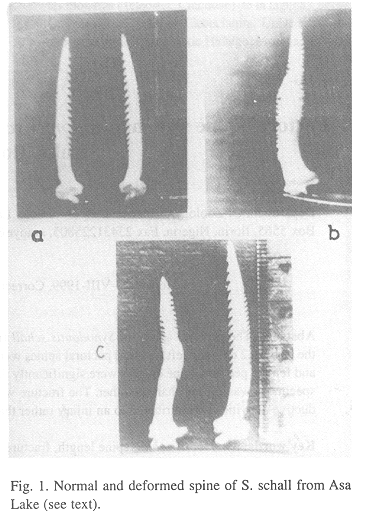
<body><![CDATA[<p><b><font face="Arial,Helvetica"><font size=-1>Key words</font></font></b><i><font face="Arial,Helvetica"><font size=-1></font></font></i>     <p><font face="Arial,Helvetica"><font size=-1><i>Synodontis schall</i>, spine length, fractured spine.</font></font>     <br><font size=-1></font>&nbsp;     <br><font size=-1></font>&nbsp;<font size=-1></font>     <p><font face="Arial,Helvetica"><font size=-1>The genus <i>Synodontis</i> are peculiar in that they are partially armoured because all the members of this genus possess a well developed cephalo-nuchal shield and strong bony spines on the dorsal and pectoral fins (<a href="#Willoughby">Willoughby 1976</a>). However, fishermen cultivated the habit of breaking these spines to ease the process of removal from their nets whenever the fish became entangled.</font></font><font size=-1></font>     <p><font face="Arial,Helvetica"><font size=-1>Fin abnormalities including fin anomalies and fin erosion (fin rot) have been observed in many fish species (<a href="#Berra">Berra and Au 1981</a>, <a href="#Lindesjoo">Lindesjoo and Thulin 1990</a>). Fin anomalies were defined as the absence of a whole or part of a fin (<a href="#Cross">Cross 1985</a>, <a href="#Wiklund">Wiklund and Bylund 1996</a>). Abnormality resulting from an injury on the pectoral spines in Synodontis species has not been reported. This paper reports a fracture on a spine of a <i>Synodontis schall</i>, a rear occurrence around the lake.</font></font><font size=-1></font>     <p><font face="Arial,Helvetica"><font size=-1>The normal pectoral spines of <i>S. schall</i> were slightly curved and serrated by a number of sharp teeth at the ventral surface (<a href="#Fig. 1">Fig.1a</a>). Among the 813 specimens caught and observed during 24 months, only one specimen had a lesion at the mid point of its left pectoral spine, causing a distinct reduction in length by 0.6 cm compared with its other pair (<a href="#Fig. 1">Fig. 1c</a>). Fusion of the bone was twisted at this mid-point, thus the ventral and the dorsal teeth of this spine were dislocated (<a href="#Fig. 1">Fig. 1b</a>). An X-ray photograph also indicated the distortion of the bone structures including the intramedullary cavity (bone marrow) at the mid-region of the spine. This damage could not have originated from a genetic or epigenetic defects from the early development of the fin. Anomalies due to genetic alterations result from mutations or recombination of DNA (<a href="#Berra">Berra and Au 1981</a>). Also anomalies due to epigenetic factors including temperature, salinity, dissolved oxygen, diet, radiation, chemical pollution are developed during the formation of embryo (<a href="#Reash">Reash and Berra 1989</a>). The anomaly observed in the spine of <i>S. schall</i> in this report was likely due to a past injury which probably became infected during healing. Injuries can be caused through accident such as while struggling to disentangle from a net when previously entrapped or during inter and intra-specific competition for space and limited resources within the environment. Although it was not possible to study the behaviour of the affected specimen either in the laboratory or natural environment since it was not caught alive, however such injuries could be inimical to balancing, feeding and reproductive activities of the fish since pectoral spines were used in the preparation of their nest as was reported by <a href="#Bishai">Bishai and Abu Gideiri (1968)</a>.</font></font>     <br><font face="Arial,Helvetica"><font size=-1></font></font>&nbsp;<font size=-1></font>     <center>     <p><a NAME="Fig. 1"></a><img SRC="/img/fbpe/rbt/v48n2-3/0865i01.GIF" height=515 width=368></center> <font size=-1></font>     
]]></body>
<body><![CDATA[<p>    <br><font size=-1></font>     <p><font face="Arial,Helvetica"><font size=-1>I thank S.O. Fagade and C.Y. Jeje both of the Department of Zoology, University of Ibadan, Nigeria, for their assitance.</font></font>     <br><font size=-1></font>&nbsp;<font size=-1></font>     <p><b><font face="Arial,Helvetica"><font size=-1>Referencias</font></font></b><font size=-1></font>     <!-- ref --><p><a NAME="Berra"></a><font face="Arial,Helvetica"><font size=-1>Berra, T.M. &amp; R.J. Au. 1981. Incidence of teratological fishes from cedar Frok Greek, Ohio. Ohio J. Sci. 81: 225-229.</font></font><font size=-1></font>    &nbsp;&nbsp;&nbsp;&nbsp;&nbsp;&nbsp;&nbsp;&nbsp;[&#160;<a href="javascript:void(0);" onclick="javascript: window.open('/scielo.php?script=sci_nlinks&ref=1196717&pid=S0034-7744200000020002300001&lng=','','width=640,height=500,resizable=yes,scrollbars=1,menubar=yes,');">Links</a>&#160;]<!-- end-ref --><!-- ref --><p><a NAME="Bishai"></a><font face="Arial,Helvetica"><font size=-1>Bishai, H.M. &amp; Y.B. Abu Gideiri. 1968. Studies on the biology of the genus <i>Synodontis</i> Khartoum iii-Reproduction. Hydrobiologia 31: 193-202.</font></font><font size=-1></font>    &nbsp;&nbsp;&nbsp;&nbsp;&nbsp;&nbsp;&nbsp;&nbsp;[&#160;<a href="javascript:void(0);" onclick="javascript: window.open('/scielo.php?script=sci_nlinks&ref=1196718&pid=S0034-7744200000020002300002&lng=','','width=640,height=500,resizable=yes,scrollbars=1,menubar=yes,');">Links</a>&#160;]<!-- end-ref --><!-- ref --><p><a NAME="Cross"></a><font face="Arial,Helvetica"><font size=-1>Cross, J.N. 1985. Fin erosion among fishes collected near a Southern California municipal wastewater out-fall. Fish. Bull. 83: 195-206.</font></font><font size=-1></font>    &nbsp;&nbsp;&nbsp;&nbsp;&nbsp;&nbsp;&nbsp;&nbsp;[&#160;<a href="javascript:void(0);" onclick="javascript: window.open('/scielo.php?script=sci_nlinks&ref=1196719&pid=S0034-7744200000020002300003&lng=','','width=640,height=500,resizable=yes,scrollbars=1,menubar=yes,');">Links</a>&#160;]<!-- end-ref --><!-- ref --><p><a NAME="Lindesjoo"></a><font face="Arial,Helvetica"><font size=-1>Lindesjoo, E. &amp; J.Thulin. 1990. Fin erosion of perch <i>Perca fluviatilis</i> and ruffe <i>Gymoncephalus cernna</i> in a pulp mill effluent area. Diseases Aqu. Org. 8: 119-126.</font></font><font size=-1></font>    &nbsp;&nbsp;&nbsp;&nbsp;&nbsp;&nbsp;&nbsp;&nbsp;[&#160;<a href="javascript:void(0);" onclick="javascript: window.open('/scielo.php?script=sci_nlinks&ref=1196720&pid=S0034-7744200000020002300004&lng=','','width=640,height=500,resizable=yes,scrollbars=1,menubar=yes,');">Links</a>&#160;]<!-- end-ref --><!-- ref --><p><a NAME="Reash"></a><font face="Arial,Helvetica"><font size=-1>Reash, R.J. &amp; T.M.Berra. 1989. Incidence of fin erosion and anomalous fishes in a polluted stream and a nearby clean stream. Water Air Soil Poll.&nbsp; 47: 47-63.</font></font><font size=-1></font>    &nbsp;&nbsp;&nbsp;&nbsp;&nbsp;&nbsp;&nbsp;&nbsp;[&#160;<a href="javascript:void(0);" onclick="javascript: window.open('/scielo.php?script=sci_nlinks&ref=1196721&pid=S0034-7744200000020002300005&lng=','','width=640,height=500,resizable=yes,scrollbars=1,menubar=yes,');">Links</a>&#160;]<!-- end-ref --><!-- ref --><p><a NAME="Wiklund"></a><font face="Arial,Helvetica"><font size=-1>Wiklund, T. &amp; G. Bylund. 1996. Fin abnormalities of pike perch in coastal area off&nbsp; the Finnish South coast. J. Fish Biol. 48: 652-657.</font></font><font size=-1></font>    &nbsp;&nbsp;&nbsp;&nbsp;&nbsp;&nbsp;&nbsp;&nbsp;[&#160;<a href="javascript:void(0);" onclick="javascript: window.open('/scielo.php?script=sci_nlinks&ref=1196722&pid=S0034-7744200000020002300006&lng=','','width=640,height=500,resizable=yes,scrollbars=1,menubar=yes,');">Links</a>&#160;]<!-- end-ref --><!-- ref --><p><a NAME="Willoughby"></a><font face="Arial,Helvetica"><font size=-1>Willoughby, N.G. 1976. The buoyancy and orientation of the upside-down catfishes of&nbsp; the genus <i>Synodontis</i> (Pisces: Siluroidei). J. Zool. Lond. 180: 291- 314.</font></font><font face="Arial,Helvetica"><font size=-1></font></font>    &nbsp;&nbsp;&nbsp;&nbsp;&nbsp;&nbsp;&nbsp;&nbsp;[&#160;<a href="javascript:void(0);" onclick="javascript: window.open('/scielo.php?script=sci_nlinks&ref=1196723&pid=S0034-7744200000020002300007&lng=','','width=640,height=500,resizable=yes,scrollbars=1,menubar=yes,');">Links</a>&#160;]<!-- end-ref --><p><a NAME="1a"></a><font face="Arial,Helvetica"><font size=-1><sup><a href="#1">1</a></sup> Department Of Zoology, Fisheries &amp; Hydrobiology Laboratory, University Of Ibadan, Nigeria. Contact Address: P.O. Box 5565, Ilorin, Nigeria. Fax 23431225805, <a href="mailto:araoye@ilorin.skannet.com">araoye@ilorin.skannet.com</a></font></font>      ]]></body><back>
<ref-list>
<ref id="B1">
<nlm-citation citation-type="journal">
<person-group person-group-type="author">
<name>
<surname><![CDATA[Berra]]></surname>
<given-names><![CDATA[T.M]]></given-names>
</name>
<name>
<surname><![CDATA[Au]]></surname>
<given-names><![CDATA[R.J]]></given-names>
</name>
</person-group>
<article-title xml:lang="en"><![CDATA[Incidence of teratological fishes from cedar Frok Greek, Ohio]]></article-title>
<source><![CDATA[Ohio J. Sci]]></source>
<year>1981</year>
<volume>81</volume>
<page-range>225-229</page-range></nlm-citation>
</ref>
<ref id="B2">
<nlm-citation citation-type="journal">
<person-group person-group-type="author">
<name>
<surname><![CDATA[Bishai]]></surname>
<given-names><![CDATA[H.M]]></given-names>
</name>
<name>
<surname><![CDATA[Abu Gideiri]]></surname>
<given-names><![CDATA[Y.B]]></given-names>
</name>
</person-group>
<article-title xml:lang="en"><![CDATA[Studies on the biology of the genus Synodontis Khartoum iii-Reproduction]]></article-title>
<source><![CDATA[Hydrobiologia]]></source>
<year>1968</year>
<volume>31</volume>
<page-range>193-202</page-range></nlm-citation>
</ref>
<ref id="B3">
<nlm-citation citation-type="journal">
<person-group person-group-type="author">
<name>
<surname><![CDATA[Cross]]></surname>
<given-names><![CDATA[J.N]]></given-names>
</name>
</person-group>
<article-title xml:lang="en"><![CDATA[Fin erosion among fishes collected near a Southern California municipal wastewater out-fall]]></article-title>
<source><![CDATA[Fish. Bull]]></source>
<year>1985</year>
<volume>83</volume>
<page-range>195-206</page-range></nlm-citation>
</ref>
<ref id="B4">
<nlm-citation citation-type="journal">
<person-group person-group-type="author">
<name>
<surname><![CDATA[Lindesjoo]]></surname>
<given-names><![CDATA[E]]></given-names>
</name>
<name>
<surname><![CDATA[Thulin]]></surname>
<given-names><![CDATA[J.]]></given-names>
</name>
</person-group>
<source><![CDATA[Diseases Aqu. Org]]></source>
<year>1990</year>
<volume>8</volume>
<page-range>119-126</page-range></nlm-citation>
</ref>
<ref id="B5">
<nlm-citation citation-type="journal">
<person-group person-group-type="author">
<name>
<surname><![CDATA[Reash]]></surname>
<given-names><![CDATA[R.J]]></given-names>
</name>
<name>
<surname><![CDATA[Berra]]></surname>
<given-names><![CDATA[T.M]]></given-names>
</name>
</person-group>
<article-title xml:lang="en"><![CDATA[Incidence of fin erosion and anomalous fishes in a polluted stream and a nearby clean stream]]></article-title>
<source><![CDATA[Water Air Soil Poll]]></source>
<year>1989</year>
<volume>47</volume>
<page-range>47-63</page-range></nlm-citation>
</ref>
<ref id="B6">
<nlm-citation citation-type="journal">
<person-group person-group-type="author">
<name>
<surname><![CDATA[Wiklund]]></surname>
<given-names><![CDATA[T]]></given-names>
</name>
<name>
<surname><![CDATA[Bylund]]></surname>
<given-names><![CDATA[G]]></given-names>
</name>
</person-group>
<article-title xml:lang="en"><![CDATA[Fin abnormalities of pike perch in coastal area off the Finnish South coast]]></article-title>
<source><![CDATA[J. Fish Biol]]></source>
<year>1996</year>
<volume>48</volume>
<page-range>652-657</page-range></nlm-citation>
</ref>
<ref id="B7">
<nlm-citation citation-type="journal">
<person-group person-group-type="author">
<name>
<surname><![CDATA[Willoughby]]></surname>
<given-names><![CDATA[N.G]]></given-names>
</name>
</person-group>
<article-title xml:lang="en"><![CDATA[The buoyancy and orientation of the upside-down catfishes of the genus Synodontis (Pisces: Siluroidei)]]></article-title>
<source><![CDATA[J. Zool. Lond]]></source>
<year>1976</year>
<volume>180</volume>
<page-range>291- 314</page-range></nlm-citation>
</ref>
</ref-list>
</back>
</article>