<?xml version="1.0" encoding="ISO-8859-1"?><article xmlns:mml="http://www.w3.org/1998/Math/MathML" xmlns:xlink="http://www.w3.org/1999/xlink" xmlns:xsi="http://www.w3.org/2001/XMLSchema-instance">
<front>
<journal-meta>
<journal-id>0034-7744</journal-id>
<journal-title><![CDATA[Revista de Biología Tropical]]></journal-title>
<abbrev-journal-title><![CDATA[Rev. biol. trop]]></abbrev-journal-title>
<issn>0034-7744</issn>
<publisher>
<publisher-name><![CDATA[Universidad de Costa Rica]]></publisher-name>
</publisher>
</journal-meta>
<article-meta>
<article-id>S0034-77442000000200019</article-id>
<title-group>
<article-title xml:lang="en"><![CDATA[A management plan for the sport fishery of Parachromis dovii (Pisces: Cichlidae) (Gunther 1864) in Hule lake, Costa Rica]]></article-title>
</title-group>
<contrib-group>
<contrib contrib-type="author">
<name>
<surname><![CDATA[Tabash B]]></surname>
<given-names><![CDATA[Farid A]]></given-names>
</name>
<xref ref-type="aff" rid="A01"/>
</contrib>
<contrib contrib-type="author">
<name>
<surname><![CDATA[Guadamuz S]]></surname>
<given-names><![CDATA[Emilier]]></given-names>
</name>
</contrib>
</contrib-group>
<aff id="A01">
<institution><![CDATA[,Universidad Nacional Estación de Biología Marina ]]></institution>
<addr-line><![CDATA[Puntarenas ]]></addr-line>
<country>Costa Rica</country>
</aff>
<aff id="A02">
<institution><![CDATA[,Instituto Nacional de Aprendizaje Centro Naútico Pesquero ]]></institution>
<addr-line><![CDATA[ ]]></addr-line>
</aff>
<pub-date pub-type="pub">
<day>00</day>
<month>06</month>
<year>2000</year>
</pub-date>
<pub-date pub-type="epub">
<day>00</day>
<month>06</month>
<year>2000</year>
</pub-date>
<volume>48</volume>
<numero>2-3</numero>
<fpage>473</fpage>
<lpage>485</lpage>
<copyright-statement/>
<copyright-year/>
<self-uri xlink:href="http://www.scielo.sa.cr/scielo.php?script=sci_arttext&amp;pid=S0034-77442000000200019&amp;lng=en&amp;nrm=iso"></self-uri><self-uri xlink:href="http://www.scielo.sa.cr/scielo.php?script=sci_abstract&amp;pid=S0034-77442000000200019&amp;lng=en&amp;nrm=iso"></self-uri><self-uri xlink:href="http://www.scielo.sa.cr/scielo.php?script=sci_pdf&amp;pid=S0034-77442000000200019&amp;lng=en&amp;nrm=iso"></self-uri><abstract abstract-type="short" xml:lang="en"><p><![CDATA[A first attempt to regulate the fishing activity while preserving the species and its habitats is presented for Hule lake. We intensively sampled the "guapote" between March 1996 and April 1997 using monofilament gill nets and a floating line, collecting 421 individuals. P. dovii biomass was relatively low; this species had a long life cycle (8-10 years) and the growth oscillation was low (C=0.3). Maximum life expectation was estimated at 12 years and the point of minimum growth coincided with the spawning that takes place between November and December. After spawning, P. dovii take around seven months to reach recruitment size (54.6 mm). The length of first maturation was 134 mm Lt, which indicates that this species is viable for reproduction soon after leaving the protection zones around the lagoon. "Guapote" sport fishing in the Hule lake is in equilibrium, the renewal rate is 80%. An increment in the actual fishery effort is not recommended, since it could seriously affect the natural renewal capacity of the stock.]]></p></abstract>
<abstract abstract-type="short" xml:lang="es"><p><![CDATA[Un primer intento para regular la actividad de la pesca deportiva para el guapote lagunero, Parachromis dovii mediante los resultados de un programa de evaluación del recurso y del estudio de la dinámica poblacional de esta especie se presenta. La biomasa del guapote es relativamente baja. La especie presenta un ciclo de vida largo (8 a 10 años) con una baja oscilación en el crecimiento (C= 0.3), la expectativa de vida máxima estimada fue de 12 años y el punto de mínimo crecimiento coincidió con el período de desove (entre Noviembre y Diciembre). Luego del desove, P. dovii permanece en las áreas protegidas cerca de 7 meses hasta alcanzar la talla de reclutamiento (54.6 mm Lt). La longitud de primera maduración fue de 134 mm Lt, lo que indica que esta especie es apta para reproducirse poco tiempo después de haber abandonado las áreas de protección, ubicadas alrededor de la laguna. También se describen algunos aspectos de su biología. La pesca deportiva del guapote en la laguna Hule mantiene aún a la población en equilibrio, la tasa de renovación natural se estima en 80%, por lo que no se recomienda permitir un incremento en los niveles actuales de esfuerzo pesquero, dado que esto afectaría seriamente la capacidad de renovación natural de P. dovii.]]></p></abstract>
<kwd-group>
<kwd lng="en"><![CDATA[Cichlasoma]]></kwd>
<kwd lng="en"><![CDATA[Parachromis]]></kwd>
<kwd lng="es"><![CDATA[Costa Rica]]></kwd>
<kwd lng="en"><![CDATA[stock assessment]]></kwd>
<kwd lng="en"><![CDATA[management plan]]></kwd>
<kwd lng="en"><![CDATA[conservation]]></kwd>
<kwd lng="en"><![CDATA[sport fishing]]></kwd>
<kwd lng="en"><![CDATA[Hule lake]]></kwd>
</kwd-group>
</article-meta>
</front><body><![CDATA[ <center><b><font face="Arial,Helvetica">A management plan for the sport fishery of <i>Parachromis dovii</i> (Pisces:</font></b>     <br><b><font face="Arial,Helvetica">Cichlidae) (Gunther 1864) in Hule lake, Costa Rica</font></b><font size=-1></font>     <p><font face="Arial,Helvetica"><font size=-1><b>Farid A. Tabash B.<a NAME="1"></a></b><sup><a href="#1a">1</a></sup><b> and Emilier Guadamuz S.<a NAME="2"></a></b><sup><a href="#2a">2</a></sup></font></font><font size=-1></font>     <p><font face="Arial,Helvetica"><font size=-1>Received 28-IV-1999. Corrected 18-I-2000. Accepted 4-II-2000.</font></font></center> <font size=-1></font>     <p>    <br><font size=-1></font>     <p><b><font face="Arial,Helvetica"><font size=-1>Abstract</font></font></b><font face="Arial,Helvetica"><font size=-1></font></font>     <p><font face="Arial,Helvetica"><font size=-1>A first attempt to regulate the fishing activity while preserving the species and its habitats is presented for Hule lake. We intensively sampled the “guapote” between March 1996 and April 1997 using monofilament gill nets and a floating line, collecting 421 individuals. <i>P. dovii</i> biomass was relatively low; this species had a long life cycle (8-10 years) and the growth oscillation was low (C=0.3). Maximum life expectation was estimated at 12 years and the point of minimum growth coincided with the spawning that takes place between November and December. After spawning, <i>P. dovii</i> take around seven months to reach recruitment size (54.6 mm). The length of first maturation was 134 mm Lt, which indicates that this species is viable for reproduction soon after leaving the protection zones around the lagoon. “Guapote” sport fishing in the Hule lake is in equilibrium, the renewal rate is 80%. An increment in the actual fishery effort is not recommended, since it could seriously affect the natural renewal capacity of the stock.</font></font><font size=-1></font>     <p><b><font face="Arial,Helvetica"><font size=-1>Key words</font></font></b><i><font face="Arial,Helvetica"><font size=-1></font></font></i>     <p><font face="Arial,Helvetica"><font size=-1><i>Cichlasoma, Parachromis</i>, Costa Rica, stock assessment, management plan, conservation, sport fishing, Hule lake.</font></font>     ]]></body>
<body><![CDATA[<br><font size=-1></font>&nbsp;     <br><font size=-1></font>&nbsp;<font size=-1></font>     <p><font face="Arial,Helvetica"><font size=-1>The Cichlidae family consists of numerous genera and species distributed in Africa, where their adaptive radiation in the great lakes has been investigated in detail (<a href="#McKaye77">McKaye 1977</a>). In the America’s neotropical zone its distribution extends from Texas, United States, to Chile and Argentina (<a href="#Darlington">Darlington 1957</a>, <a href="#McKaye77">McKaye 1977</a>, <a href="#De Silva">De Silva <i>et al</i>. 1984</a> and <a href="#Bussing89">Bussing 1989</a>).</font></font><font size=-1></font>     <p><font face="Arial,Helvetica"><font size=-1>The majority of the cichlids of Latin America belong to the <i>Parachromis genus</i> (<a href="#Bussing98">Bussing 1998</a>); are extremely heterogeneous in their feeding patterns (<a href="#Yáñez-Arancibia">Ya&ntilde;ez-Arancibia 1978</a>, <a href="#McGinty">McGinthy 1984</a>), habitat selection (McKaye 1977b, <a href="#Rosales">Rosales 1980</a>), morphology (<a href="#Meyer">Meyer 1987</a>) and population dynamics (Fields 1986, <a href="#Gaspar">Gaspar-Dillanes <i>et al.</i> 1995</a> and <a href="#Morales">Morales-Boj&oacute;rquez 1995</a>).</font></font><font size=-1></font>     <p><font face="Arial,Helvetica"><font size=-1><i>P. dovii</i> is distributed in Central America from middle Honduras to the great lakes and lagoons of Nicaragua and the slopes of Costa Rica’s mountain ranges (<a href="#Miller">Miller 1966</a>, <a href="#Alpírez">Alp&iacute;rez 1985</a>). Its common name is “guapote” and it is the largest species of the family, reaching a total length of 650 mm (<a href="#Anonymous">Anonymous 1996</a>).</font></font><font size=-1></font>     <p><font face="Arial,Helvetica"><font size=-1>In lake Arenal, the species prefers moderate currents and rocky areas with bathymetric zonation accordance to the age (<a href="#Bussing77">Bussing and L&oacute;pez 1977</a> and <a href="#Moya">Moya 1979</a>).</font></font><font size=-1></font>     <p><font face="Arial,Helvetica"><font size=-1>In general, <i>P. dovii</i> can be found in environments ranging from shallow waters to rapid currents where it hides behind rocks or overgrowths. It occurs in streams waters and lakes between heights of 0 to 600 m., and tolerates temperatures from 21 to 31 &deg;C. It is highly piscivorous, eating tetras, poeciliids and cichlids, but it also ingest crustaceans and insects (<a href="#Bussing87">Bussing 1987</a>, <a href="#Bussing98">1998</a>).</font></font><font size=-1></font>     <p><font face="Arial,Helvetica"><font size=-1>Most of the investigations on <i>P. dovii</i> refers to taxonomy, biology and ethology. <a href="#Aldave">Aldave (1985)</a> presented some research on “guapote” biology in lake Arenal, including a brief study of their population dynamics. <a href="#Campos">Campos (1986)</a> estimated that the “guapotes” occupy all of lake Arenal, preferring bays with vegetable cover and zones with an abundance of fallen trunks. <a href="#McKaye77">McKaye (1977)</a> reported the reproduction pattern of <i>P. dovii</i> in the lake Jilaloa, Nicaragua.</font></font><font size=-1></font>     <p><font face="Arial,Helvetica"><font size=-1>In this assessment plan we present a first attempt to regulate the fishing activity while, at the same time, preserving the species and its habitat.</font></font>     <br><font size=-1></font>&nbsp;<font size=-1></font>     ]]></body>
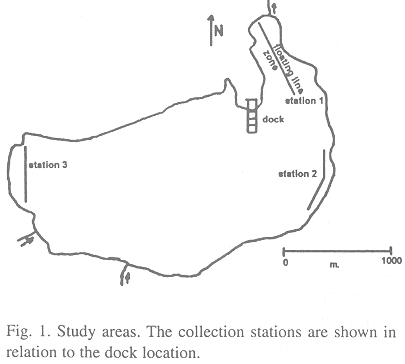
<body><![CDATA[<p><b><font face="Arial,Helvetica"><font size=-1>Materials and Methods</font></font></b><font size=-1></font>     <p><font face="Arial,Helvetica"><font size=-1>Between March 1996 and April 1997, specimens of <i>P. dovii</i> were collected in three sampling zones (<a href="#Fig. 1">Fig.1</a>) in the Hule lake using 0.6 monofilament gill nets with a mesh size of 6.985 and 7.62 cm. with a height of 3.8 m. “Guapotes” were pooled according with the mesh size that they were captured.</font></font>     <br><font size=-1></font>&nbsp;<font size=-1></font>     <center>     <p><a NAME="Fig. 1"></a><img SRC="/img/fbpe/rbt/v48n2-3/0861i01.GIF" height=364 width=405></center> <font size=-1></font>     
<p>    <br><font size=-1></font>     <p><font face="Arial,Helvetica"><font size=-1>Each month the sampling period were 3 days, the nets were placed in each one of the sampling zones during the night. Between 7 a.m and 8 a.m, they were lifted to collect the catch of “guapotes”. Then the net was left in the sampling zone until 4 p.m when it was moved to the following sampling zone, to repeat the procedure.</font></font><font size=-1></font>     <p><font face="Arial,Helvetica"><font size=-1>Parallel to this, a floating line containing 25 fishhooks #7, 25 fishhooks # 8, 25 fishhooks # 9 and 25 fishhooks # 10 placed in alternate form it was located in the west sector of the lagoon, a zone of shallow waters with a dense plant cover and many macroalgae and trunks. The floating line remained in this area during three days. Every 8 hours, the line was checked and the bait (sardine and “guapote”) was changed.</font></font><font size=-1></font>     <p><font face="Arial,Helvetica"><font size=-1>Each captured “guapote” was placed in an ice box and, at the operation center, total length (mm), total weight (g), sex, maturation state, and stomach content were estimated.</font></font><font size=-1></font>     ]]></body>
<body><![CDATA[<p><font face="Arial,Helvetica"><font size=-1>All “guapotes” captured were identified using the keys of <a href="#Astorquí">Astorqui (1971)</a> and <a href="#Bussing77">Bussing (1977)</a>.</font></font><font size=-1></font>     <p><font face="Arial,Helvetica"><font size=-1><b>1. Feeding patterns:</b> In all the “guapotes” analyzed, the gut was removed by dissection. Data on sex and maturity were collected. The gut content was removed directly from the stomach and placed in a vial containing ten-percent formalin as a fixative. Before samples were examined in detail, excess formaldehyde was removed by soaking the samples in several changes of water. Then, the samples were preserved in a 45-70% aqueous solution of alcohol. For quantitative description of the diet, the method of frequency of occurrence was used.</font></font><font size=-1></font>     <p><font face="Arial,Helvetica"><font size=-1><b>2. Sex ratio, maturation patterns and size at first maturity:</b> The mean size at first maturity (M<sub>L</sub>) was determined at 95% confidence limits using the method of Udupa (1986), based on accumulative percentage frequency curve of maturation stages. The maturation stages of each guapote analyzed was determined using the method of <a href="#Holden">Holden and Raitt (1975)</a>.</font></font><font size=-1></font>     <p><font face="Arial,Helvetica"><font size=-1><b>3. Stock assessment:</b> Length frequency analysis was applied to estimate growth parameters, using the von Bertalanffy growth curve incorporated in FiSAT software (<a href="#Gayanillo">Gayanillo <i>et al</i>. 1996</a>). It was assumed that the length frequency data are representative of the population, that the growth patterns are repeated from year to year, that the von Bertalanffy formula describes the mean growth in the population and that all fish in the samples have the same growth parameters. The seasonal oscillation (C) and the point of minimum growth (WP) were also calculated.</font></font><font size=-1></font>     <p><font face="Arial,Helvetica"><font size=-1>Parameters of the length-weight relationship were estimated using least squares regression on log-transformed data with bias correction. A total of 421 fishes ranging from 100-630 mm were used for the analysis.</font></font><font size=-1></font>     <p><font face="Arial,Helvetica"><font size=-1>Total mortality (Z) was estimated from data corrected for gear selectivity using the method of <a href="#Moreau">Moureau (1988)</a>, taking into account the complete length frequency distribution obtained with the gill-net plus the “guapotes” caught with the floating line. Natural mortality (M) was estimated from the empirical equation of Pauly (1980a). Fishing mortality (F) was estimated by subtraction of Z and M. The optimum exploitation rate(E = F/Z), was computed for a preliminary assessment of whether the stock is lightly (E&lt; 0.5) or heavily exploited (E>0.5).</font></font><font size=-1></font>     <p><font face="Arial,Helvetica"><font size=-1>Identification of selection patterns were estimated by backward projection of the straight portion of the catch curve. Recruitment patterns were obtained projecting the length frequency data available backward into the time axis. Estimations of yield and biomass per recruit were plotted.</font></font><font size=-1></font>     <p><font face="Arial,Helvetica"><font size=-1>Using the results of the assessment and statistics on the number of visits by occasional and sport fishermen, recommendations were made for the management of the “guapote” in the Hule lagoon.</font></font>     <br><font size=-1></font>&nbsp;<font size=-1></font>     <p><b><font face="Arial,Helvetica"><font size=-1>Results</font></font></b><font size=-1></font>     ]]></body>
<body><![CDATA[<p><font face="Arial,Helvetica"><font size=-1><b>1. Feeding patterns:</b> Of the six feeding categories that were determined, rest of fishes and insects presented the major frequency of occurrence. The rest of fishes represented 37% of the diet, while the insects presented 26.8% (<a href="#TABLE 1">Table 1</a>). The category, rest of fishes, was composed mainly of tetras (<i>Astyanax aeneus</i>), “olominas” (<i>Poecilia gillii</i>) and juveniles of <i>P. dovii</i>.</font></font>     <br><font size=-1></font>&nbsp;<font size=-1></font>     <center>     <p><a NAME="TABLE 1"></a><font face="Arial,Helvetica"><font size=-1>TABLE 1</font></font><font size=-1></font>     <p><font face="Arial,Helvetica"><font size=-1>Presence of several categories of food in stomach of P. dovii, frecuency of occurrence</font></font>     <br><font face="Arial,Helvetica"><font size=-1>in the Hule lake, during the period March 1996 to April 1997.</font></font></center>      <br><font size=-1></font>&nbsp;     <center><table BORDER=0 CELLSPACING=0 CELLPADDING=0 COLS=3 WIDTH="60%" > <tr> <td><font face="Arial,Helvetica"><font size=-1>Feeding category</font></font></td>  <td>     <center><font face="Arial,Helvetica"><font size=-1>Proportion</font></font></center> </td>  <td>     <center><font face="Arial,Helvetica"><font size=-1>Frecuency of occurrence</font></font></center> </td> </tr>  <tr> <td><font face="Arial,Helvetica"><font size=-1>&nbsp;</font></font></td>  <td>     ]]></body>
<body><![CDATA[<center><font face="Arial,Helvetica"><font size=-1>&nbsp;</font></font></center> </td>  <td>     <center><font face="Arial,Helvetica"><font size=-1>&nbsp;</font></font></center> </td> </tr>  <tr> <td><font face="Arial,Helvetica"><font size=-1>Rest of fishes</font></font></td>  <td>     <center><font face="Arial,Helvetica"><font size=-1>0.09</font></font></center> </td>  <td>     <center><font face="Arial,Helvetica"><font size=-1>175</font></font></center> </td> </tr>  <tr> <td><font face="Arial,Helvetica"><font size=-1>Insects</font></font></td>  <td>     <center><font face="Arial,Helvetica"><font size=-1>0.28</font></font></center> </td>  <td>     <center><font face="Arial,Helvetica"><font size=-1>124</font></font></center> </td> </tr>  <tr> <td><font face="Arial,Helvetica"><font size=-1>Microcrustaceans</font></font></td>  <td>     <center><font face="Arial,Helvetica"><font size=-1>0.23</font></font></center> </td>  <td>     <center><font face="Arial,Helvetica"><font size=-1>39</font></font></center> </td> </tr>  <tr> <td><font face="Arial,Helvetica"><font size=-1>Vegetable tissue</font></font></td>  <td>     <center><font face="Arial,Helvetica"><font size=-1>0.05</font></font></center> </td>  <td>     <center><font face="Arial,Helvetica"><font size=-1>27</font></font></center> </td> </tr>  <tr> <td><font face="Arial,Helvetica"><font size=-1>Sediment</font></font></td>  <td>     ]]></body>
<body><![CDATA[<center><font face="Arial,Helvetica"><font size=-1>0.03</font></font></center> </td>  <td>     <center><font face="Arial,Helvetica"><font size=-1>19</font></font></center> </td> </tr>  <tr> <td><font face="Arial,Helvetica"><font size=-1>Digested material</font></font></td>  <td>     <center><font face="Arial,Helvetica"><font size=-1>0.32</font></font></center> </td>  <td>     <center><font face="Arial,Helvetica"><font size=-1>79</font></font></center> </td> </tr> </table></center> <font size=-1></font><font size=-1></font>     <p><font face="Arial,Helvetica"><font size=-1><i>P. dovii</i> size affected the composition of stomach contents. The juveniles consumed more poecilids and microcrustaceans than the adults, the latter supplemented their diet with insects (<a href="#TABLE 2">Table 2</a>).</font></font>     <br><font size=-1></font>&nbsp;<font size=-1></font>     <center>     <p><a NAME="TABLE 2"></a><font face="Arial,Helvetica"><font size=-1>TABLE 2</font></font><font size=-1></font>     <p><font face="Arial,Helvetica"><font size=-1>Presence of several feeding categories in P. dovii,</font></font>     <br><font face="Arial,Helvetica"><font size=-1>according with the size classes sampled in the Hule lagoon.</font></font></center>      ]]></body>
<body><![CDATA[<br><font size=-1></font>&nbsp;     <center><table BORDER=0 CELLSPACING=0 CELLPADDING=0 COLS=4 WIDTH="70%" > <tr> <td><font face="Arial,Helvetica"><font size=-1>Feeding category</font></font></td>  <td>     <center><font face="Arial,Helvetica"><font size=-1>&lt; 100</font></font></center> </td>  <td>     <center><font face="Arial,Helvetica"><font size=-1>100-400</font></font></center> </td>  <td>     <center><font face="Arial,Helvetica"><font size=-1>400-630</font></font></center> </td> </tr>  <tr> <td>     <center><font face="Arial,Helvetica"><font size=-1>&nbsp;</font></font></center> </td>  <td>     <center><font face="Arial,Helvetica"><font size=-1>&nbsp;</font></font></center> </td>  <td>     <center><font face="Arial,Helvetica"><font size=-1>&nbsp;</font></font></center> </td>  <td>     <center><font face="Arial,Helvetica"><font size=-1>&nbsp;</font></font></center> </td> </tr>  <tr> <td><font face="Arial,Helvetica"><font size=-1>Rest of fishes</font></font></td>  <td>     <center><font face="Arial,Helvetica"><font size=-1>8.6</font></font></center> </td>  <td>     ]]></body>
<body><![CDATA[<center><font face="Arial,Helvetica"><font size=-1>19</font></font></center> </td>  <td>     <center><font face="Arial,Helvetica"><font size=-1>12.2</font></font></center> </td> </tr>  <tr> <td><font face="Arial,Helvetica"><font size=-1>Insects</font></font></td>  <td>     <center><font face="Arial,Helvetica"><font size=-1>65.5</font></font></center> </td>  <td>     <center><font face="Arial,Helvetica"><font size=-1>47.6</font></font></center> </td>  <td>     <center><font face="Arial,Helvetica"><font size=-1>19.5</font></font></center> </td> </tr>  <tr> <td><font face="Arial,Helvetica"><font size=-1>Microcrustaceans</font></font></td>  <td>     <center><font face="Arial,Helvetica"><font size=-1>41.4</font></font></center> </td>  <td>     <center><font face="Arial,Helvetica"><font size=-1>33.3</font></font></center> </td>  <td>     <center><font face="Arial,Helvetica"><font size=-1>18.3</font></font></center> </td> </tr>  <tr> <td><font face="Arial,Helvetica"><font size=-1>Vegetable tissue</font></font></td>  <td>     <center><font face="Arial,Helvetica"><font size=-1>8.6</font></font></center> </td>  <td>     <center><font face="Arial,Helvetica"><font size=-1>14.3</font></font></center> </td>  <td>     ]]></body>
<body><![CDATA[<center><font face="Arial,Helvetica"><font size=-1>4.9</font></font></center> </td> </tr>  <tr> <td><font face="Arial,Helvetica"><font size=-1>Sediment</font></font></td>  <td>     <center><font face="Arial,Helvetica"><font size=-1>1.7</font></font></center> </td>  <td>     <center><font face="Arial,Helvetica"><font size=-1>4.7</font></font></center> </td>  <td>     <center><font face="Arial,Helvetica"><font size=-1>4.6</font></font></center> </td> </tr>  <tr> <td><font face="Arial,Helvetica"><font size=-1>Digested material</font></font></td>  <td>     <center><font face="Arial,Helvetica"><font size=-1>43.1</font></font></center> </td>  <td>     <center><font face="Arial,Helvetica"><font size=-1>47.6</font></font></center> </td>  <td>     <center><font face="Arial,Helvetica"><font size=-1>32.4</font></font></center> </td> </tr> </table></center> <font size=-1></font>     <br><font size=-1></font>&nbsp;<font size=-1></font>     <p><font face="Arial,Helvetica"><font size=-1>The temporal and spatial variations that <i>P. dovii</i> presented in the composition of their diet (<a href="#TABLE 3">Table 3</a>), demostrate that even when the sampling zones are relatively close, the availability of food was different; this could influence the distribution of the population of “guapote” along the sampling stations in the lake. Similar results were reported by <a href="#Aldave">Aldave (1985)</a> in lake Arenal.</font></font><font size=-1></font>     <p><font face="Arial,Helvetica"><font size=-1>Proportions of food categories in the diet tended to change with length class, but there didn’t seems to be a definitive pattern. The number of “guapotes” with empty stomach increased with the maturation stage; maybe the occurrence of prey capture will decreases when the “guapote” approach their maturation peak.</font></font>     ]]></body>
<body><![CDATA[<br><font size=-1></font>&nbsp;<font size=-1></font>     <center>     <p><a NAME="TABLE 3"></a><font face="Arial,Helvetica"><font size=-1>TABLE 3</font></font><font size=-1></font>     <p><font face="Arial,Helvetica"><font size=-1>Proportions of frecuency of occurrence of several food categories in P. dovii</font></font>     <br><font face="Arial,Helvetica"><font size=-1>for the sampling stations ubicated in the Hule lagoon.</font></font></center>      <br><font size=-1></font>&nbsp;     <center><table BORDER=0 CELLSPACING=0 CELLPADDING=0 COLS=4 WIDTH="80%" > <tr> <td><font face="Arial,Helvetica"><font size=-1>Food category</font></font></td>  <td>     <center><font face="Arial,Helvetica"><font size=-1>Station 1</font></font></center> </td>  <td>     <center><font face="Arial,Helvetica"><font size=-1>Station 2</font></font></center> </td>  <td>     <center><font face="Arial,Helvetica"><font size=-1>Station 3</font></font></center> </td> </tr>  <tr> <td>     ]]></body>
<body><![CDATA[<center><font face="Arial,Helvetica"><font size=-1>&nbsp;</font></font></center> </td>  <td>     <center><font face="Arial,Helvetica"><font size=-1>&nbsp;</font></font></center> </td>  <td>     <center><font face="Arial,Helvetica"><font size=-1>&nbsp;</font></font></center> </td>  <td>     <center><font face="Arial,Helvetica"><font size=-1>&nbsp;</font></font></center> </td> </tr>  <tr> <td><font face="Arial,Helvetica"><font size=-1>Rest of fishes</font></font></td>  <td>     <center><font face="Arial,Helvetica"><font size=-1>10.6</font></font></center> </td>  <td>     <center><font face="Arial,Helvetica"><font size=-1>9.4</font></font></center> </td>  <td>     <center><font face="Arial,Helvetica"><font size=-1>8.5</font></font></center> </td> </tr>  <tr> <td><font face="Arial,Helvetica"><font size=-1>Insects</font></font></td>  <td>     <center><font face="Arial,Helvetica"><font size=-1>18.8</font></font></center> </td>  <td>     <center><font face="Arial,Helvetica"><font size=-1>23.7</font></font></center> </td>  <td>     <center><font face="Arial,Helvetica"><font size=-1>18.8</font></font></center> </td> </tr>  <tr> <td><font face="Arial,Helvetica"><font size=-1>Microcrustaceans</font></font></td>  <td>     ]]></body>
<body><![CDATA[<center><font face="Arial,Helvetica"><font size=-1>22.1</font></font></center> </td>  <td>     <center><font face="Arial,Helvetica"><font size=-1>21.2</font></font></center> </td>  <td>     <center><font face="Arial,Helvetica"><font size=-1>16.0</font></font></center> </td> </tr>  <tr> <td><font face="Arial,Helvetica"><font size=-1>Vegetable tissue</font></font></td>  <td>     <center><font face="Arial,Helvetica"><font size=-1>8.2</font></font></center> </td>  <td>     <center><font face="Arial,Helvetica"><font size=-1>4.4</font></font></center> </td>  <td>     <center><font face="Arial,Helvetica"><font size=-1>0</font></font></center> </td> </tr>  <tr> <td><font face="Arial,Helvetica"><font size=-1>Sediment</font></font></td>  <td>     <center><font face="Arial,Helvetica"><font size=-1>6.5</font></font></center> </td>  <td>     <center><font face="Arial,Helvetica"><font size=-1>2.5</font></font></center> </td>  <td>     <center><font face="Arial,Helvetica"><font size=-1>0.9</font></font></center> </td> </tr>  <tr> <td><font face="Arial,Helvetica"><font size=-1>Digested material</font></font></td>  <td>     <center><font face="Arial,Helvetica"><font size=-1>31.1</font></font></center> </td>  <td>     ]]></body>
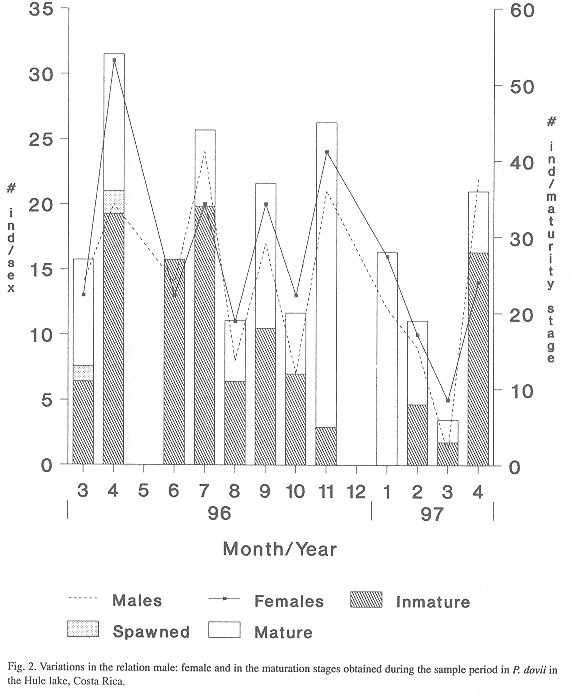
<body><![CDATA[<center><font face="Arial,Helvetica"><font size=-1>41.8</font></font></center> </td>  <td>     <center><font face="Arial,Helvetica"><font size=-1>25.5</font></font></center> </td> </tr> </table></center> <font size=-1></font>     <br><font size=-1></font>&nbsp;<font size=-1></font>     <p><font face="Arial,Helvetica"><font size=-1><b>&nbsp;2. Sex ratio, maturation patterns and size at first maturity:</b> From 421 individuals collected during the sampling period 47% were males and 53% females. The sex ratio in the population sampled was 1: 1 (<a href="#Fig. 2">Fig.2</a>). There were significantly (Mann-Whitney U-test, p&lt; 0.1) more inmature males and females in the sample period in the rainy season than in the transition and dry season (<a href="#TABLE 4">Table 4</a>). With respect to maturity, <i>P. dovii</i> presents successive maturation patterns with seasonal spawning peaks. Sexually mature guapotes made up the largest proportion during November and February. <a href="#McKaye77">McKaye (1977)</a> reported a maturation peak of “guapotes” in Jilaloa lake, Nicaragua during February and April; <a href="#Campos">Campos (1986)</a> in lake Arenal, indicated that <i>P. dovii</i> probably spawn during August or September.</font></font><font size=-1></font>     <center>     <p><a NAME="TABLE 4"></a><font face="Arial,Helvetica"><font size=-1>TABLE 4</font></font><font size=-1></font>     <p><font face="Arial,Helvetica"><font size=-1>Percentage of each gonadic maturation phase in P. dovii population,</font></font>     <br><font face="Arial,Helvetica"><font size=-1>during the sampling period in the Hule lagoon.</font></font></center>      <br><font size=-1></font>&nbsp;     <center><table BORDER=0 CELLSPACING=0 CELLPADDING=0 COLS=5 WIDTH="70%" > <tr> <td><font face="Arial,Helvetica"><font size=-1>Month/Year</font></font></td>  <td>     ]]></body>
<body><![CDATA[<center><font face="Arial,Helvetica"><font size=-1>Phase I</font></font></center> </td>  <td>     <center><font face="Arial,Helvetica"><font size=-1>Phase II</font></font></center> </td>  <td>     <center><font face="Arial,Helvetica"><font size=-1>Phase III</font></font></center> </td>  <td>     <center><font face="Arial,Helvetica"><font size=-1>Phase IV</font></font></center> </td> </tr>  <tr> <td>     <center><font face="Arial,Helvetica"><font size=-1>&nbsp;</font></font></center> </td>  <td>     <center><font face="Arial,Helvetica"><font size=-1>&nbsp;</font></font></center> </td>  <td>     <center><font face="Arial,Helvetica"><font size=-1>&nbsp;</font></font></center> </td>  <td>     <center><font face="Arial,Helvetica"><font size=-1>&nbsp;</font></font></center> </td>  <td>     <center><font face="Arial,Helvetica"><font size=-1>&nbsp;</font></font></center> </td> </tr>  <tr> <td><font face="Arial,Helvetica"><font size=-1>March /96</font></font></td>  <td>     <center><font face="Arial,Helvetica"><font size=-1>5.8</font></font></center> </td>  <td>     ]]></body>
<body><![CDATA[<center><font face="Arial,Helvetica"><font size=-1>0</font></font></center> </td>  <td>     <center><font face="Arial,Helvetica"><font size=-1>8.8</font></font></center> </td>  <td>     <center><font face="Arial,Helvetica"><font size=-1>6.4</font></font></center> </td> </tr>  <tr> <td><font face="Arial,Helvetica"><font size=-1>April</font></font></td>  <td>     <center><font face="Arial,Helvetica"><font size=-1>17.4</font></font></center> </td>  <td>     <center><font face="Arial,Helvetica"><font size=-1>0</font></font></center> </td>  <td>     <center><font face="Arial,Helvetica"><font size=-1>11.3</font></font></center> </td>  <td>     <center><font face="Arial,Helvetica"><font size=-1>7.6</font></font></center> </td> </tr>  <tr> <td><font face="Arial,Helvetica"><font size=-1>May</font></font></td>  <td>     <center><font face="Arial,Helvetica"><font size=-1>-</font></font></center> </td>  <td>     <center><font face="Arial,Helvetica"><font size=-1>0</font></font></center> </td>  <td>     <center><font face="Arial,Helvetica"><font size=-1>-</font></font></center> </td>  <td>     ]]></body>
<body><![CDATA[<center><font face="Arial,Helvetica"><font size=-1>1.2</font></font></center> </td> </tr>  <tr> <td><font face="Arial,Helvetica"><font size=-1>June</font></font></td>  <td>     <center><font face="Arial,Helvetica"><font size=-1>14.2</font></font></center> </td>  <td>     <center><font face="Arial,Helvetica"><font size=-1>0</font></font></center> </td>  <td>     <center><font face="Arial,Helvetica"><font size=-1>0</font></font></center> </td>  <td>     <center><font face="Arial,Helvetica"><font size=-1>0</font></font></center> </td> </tr>  <tr> <td><font face="Arial,Helvetica"><font size=-1>July</font></font></td>  <td>     <center><font face="Arial,Helvetica"><font size=-1>17.9</font></font></center> </td>  <td>     <center><font face="Arial,Helvetica"><font size=-1>0</font></font></center> </td>  <td>     <center><font face="Arial,Helvetica"><font size=-1>6.2</font></font></center> </td>  <td>     <center><font face="Arial,Helvetica"><font size=-1>0</font></font></center> </td> </tr>  <tr> <td><font face="Arial,Helvetica"><font size=-1>August</font></font></td>  <td>     <center><font face="Arial,Helvetica"><font size=-1>5.8</font></font></center> </td>  <td>     ]]></body>
<body><![CDATA[<center><font face="Arial,Helvetica"><font size=-1>0</font></font></center> </td>  <td>     <center><font face="Arial,Helvetica"><font size=-1>5.0</font></font></center> </td>  <td>     <center><font face="Arial,Helvetica"><font size=-1>0</font></font></center> </td> </tr>  <tr> <td><font face="Arial,Helvetica"><font size=-1>September</font></font></td>  <td>     <center><font face="Arial,Helvetica"><font size=-1>9.5</font></font></center> </td>  <td>     <center><font face="Arial,Helvetica"><font size=-1>0</font></font></center> </td>  <td>     <center><font face="Arial,Helvetica"><font size=-1>11.9</font></font></center> </td>  <td>     <center><font face="Arial,Helvetica"><font size=-1>0</font></font></center> </td> </tr>  <tr> <td><font face="Arial,Helvetica"><font size=-1>October</font></font></td>  <td>     <center><font face="Arial,Helvetica"><font size=-1>6.3</font></font></center> </td>  <td>     <center><font face="Arial,Helvetica"><font size=-1>0</font></font></center> </td>  <td>     <center><font face="Arial,Helvetica"><font size=-1>5.0</font></font></center> </td>  <td>     ]]></body>
<body><![CDATA[<center><font face="Arial,Helvetica"><font size=-1>4.6</font></font></center> </td> </tr>  <tr> <td><font face="Arial,Helvetica"><font size=-1>November</font></font></td>  <td>     <center><font face="Arial,Helvetica"><font size=-1>2.6</font></font></center> </td>  <td>     <center><font face="Arial,Helvetica"><font size=-1>0</font></font></center> </td>  <td>     <center><font face="Arial,Helvetica"><font size=-1>25.1</font></font></center> </td>  <td>     <center><font face="Arial,Helvetica"><font size=-1>5.5</font></font></center> </td> </tr>  <tr> <td><font face="Arial,Helvetica"><font size=-1>December</font></font></td>  <td>     <center><font face="Arial,Helvetica"><font size=-1>-</font></font></center> </td>  <td>     <center><font face="Arial,Helvetica"><font size=-1>0</font></font></center> </td>  <td>     <center><font face="Arial,Helvetica"><font size=-1>17.6</font></font></center> </td>  <td>     <center><font face="Arial,Helvetica"><font size=-1>4.6</font></font></center> </td> </tr>  <tr> <td><font face="Arial,Helvetica"><font size=-1>January/97</font></font></td>  <td>     <center><font face="Arial,Helvetica"><font size=-1>0</font></font></center> </td>  <td>     ]]></body>
<body><![CDATA[<center><font face="Arial,Helvetica"><font size=-1>0</font></font></center> </td>  <td>     <center><font face="Arial,Helvetica"><font size=-1>6.9</font></font></center> </td>  <td>     <center><font face="Arial,Helvetica"><font size=-1>25.2</font></font></center> </td> </tr>  <tr> <td><font face="Arial,Helvetica"><font size=-1>February</font></font></td>  <td>     <center><font face="Arial,Helvetica"><font size=-1>4.2</font></font></center> </td>  <td>     <center><font face="Arial,Helvetica"><font size=-1>0</font></font></center> </td>  <td>     <center><font face="Arial,Helvetica"><font size=-1>1.9</font></font></center> </td>  <td>     <center><font face="Arial,Helvetica"><font size=-1>19.8</font></font></center> </td> </tr>  <tr> <td><font face="Arial,Helvetica"><font size=-1>March</font></font></td>  <td>     <center><font face="Arial,Helvetica"><font size=-1>1.6</font></font></center> </td>  <td>     <center><font face="Arial,Helvetica"><font size=-1>0</font></font></center> </td>  <td>     <center><font face="Arial,Helvetica"><font size=-1>5.0</font></font></center> </td>  <td>     ]]></body>
<body><![CDATA[<center><font face="Arial,Helvetica"><font size=-1>12.4</font></font></center> </td> </tr>  <tr> <td><font face="Arial,Helvetica"><font size=-1>April</font></font></td>  <td>     <center><font face="Arial,Helvetica"><font size=-1>14.7</font></font></center> </td>  <td>     <center><font face="Arial,Helvetica"><font size=-1>0</font></font></center> </td>  <td>     <center><font face="Arial,Helvetica"><font size=-1>0</font></font></center> </td>  <td>     <center><font face="Arial,Helvetica"><font size=-1>15.6</font></font></center> </td> </tr> </table></center> <font size=-1></font>     <br><font size=-1></font>&nbsp;<font size=-1></font>     <p><font face="Arial,Helvetica"><font size=-1>However, 42% of the population was immature (phase I), 36% was mature (phase III) and 22% had spawned (phase IV). Phase II is a stage slightly previous to the stage of full maturity, probably this stage overlaps with phase III.</font></font><font size=-1></font>     <p><font face="Arial,Helvetica"><font size=-1>The increments in the frequency of spawned guapotes during December and February, indicate that the more important spawning peak coincides with the transition period between rainy and dry season.</font></font><font size=-1></font>     <p><font face="Arial,Helvetica"><font size=-1>Length at first maturity oscillated for the males between 144 and 154 mm Lt. and for the females between 134 and 142 mm Lt, which corresponds with an age of 8.3 months and 7.6 months respectively. The maximum life expectation was estimated between 10 and 12 years, based on the growth rate calculated from the modal progression analysis.</font></font>     <br><font face="Arial,Helvetica"><font size=-1></font></font>&nbsp;<font size=-1></font>     ]]></body>
<body><![CDATA[<center>     <p><a NAME="Fig. 2"></a><img SRC="/img/fbpe/rbt/v48n2-3/0861i02.GIF" height=694 width=571></center> <font size=-1></font>     
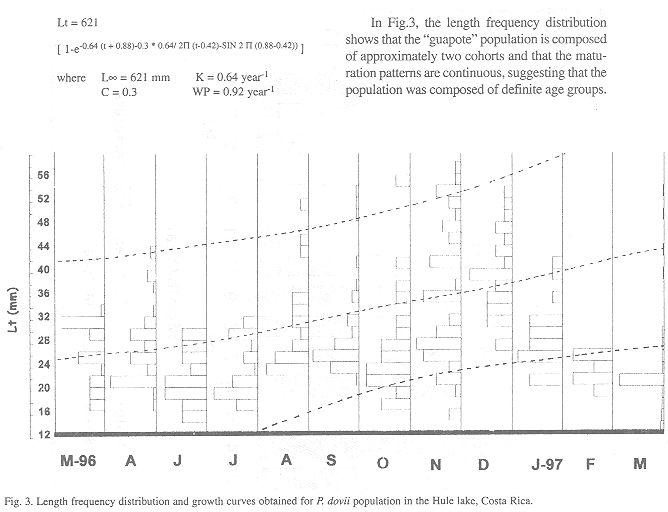
<p>    <br><font size=-1></font>     <br><font size=-1></font>     <p><font face="Arial,Helvetica"><font size=-1><b>3. Stock assessment:</b> According to the growth parameter estimates with the von Bertalanffy growth equation, obtained through the FiSAT program, <i>P. dovii</i> in the Hule lake present a long life span, slow growth rate and weak growth seasonality (C). The period of minimum growth (WP) was between November and December, the same period of maximum maturation stage. The growth equation obtained in <i>P. dovii</i> was:</font></font><font size=-1></font>     <center>     <p><a NAME="Fig. 3"></a><img SRC="/img/fbpe/rbt/v48n2-3/0861i03.GIF" height=512 width=668></center> <font size=-1></font>     
<p>    <br><font size=-1></font>     ]]></body>
<body><![CDATA[<br><font size=-1></font>     <br><font size=-1></font>     <p><font face="Arial,Helvetica"><font size=-1><b>Biometry:</b> <a href="#Hartnoll">Hartnoll (1974)</a> showed that the growth rate of any organ usually changes during ontogeny and that the growth constant is characteristic within each growth phase. For the “guapote” population, the relation was established with 421 data pairs. The minimum length was 120 mm Lt. and the maximum was 560 mm Lt, while the weight oscillated between 41 g. and 2053,6 g. The length-weight relationship was:</font></font><font size=-1></font>     <center>     <p><font face="Arial,Helvetica"><font size=-1>W = 0.0000241 Lt<sup>2.95</sup> (r = 0.98, s.d = 0.19)</font></font></center> <font size=-1></font>     <p>    <br><font size=-1></font>     <p><font face="Arial,Helvetica"><font size=-1><a href="#Aldave">Aldave (1985)</a> and <a href="#Campos">Campos (1986)</a> report similar results in their analyses of the guapotes of lake Arenal. In the females the equation was:</font></font><font size=-1></font>     <center>     <p><font face="Arial,Helvetica"><font size=-1>W = 0. 0000354 Lt<sup>2.96</sup> (r = 0.93, s.d = 0.29)</font></font></center> <font size=-1></font>     ]]></body>
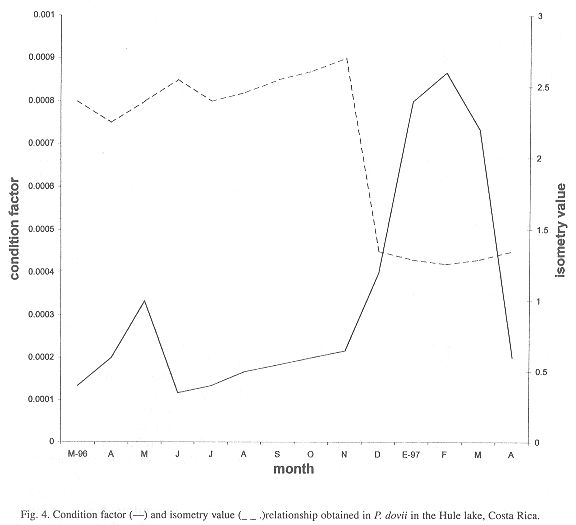
<body><![CDATA[<p>    <br><font size=-1></font>     <p><font face="Arial,Helvetica"><font size=-1>The minimum length was 110 mm Lt. and the maximum 532 Lt., while weight varied from 39 g. to 1741.8 g. In males the lengths varied between 110 mm and 564 mm Lt., corresponding to weight between 37 g. and 2063,6 g. respectively. The length-weight relationship for males was:</font></font><font size=-1></font>     <center>     <p><font face="Arial,Helvetica"><font size=-1>W = 0.0000541 Lt<sup>2.79</sup> (r = 0.95, s.d = 0.19)</font></font></center> <font size=-1></font>     <p>    <br><font size=-1></font>     <p><font face="Arial,Helvetica"><font size=-1>Taking into account that the values “a” and “b” obtained with the exponential equation have a biological interpretation, where “a” is the condition factor and “b” is a relative growth coefficient representing the isometry that each guapote has in its growth, then “a” and “b” show an inverse relationship (<a href="#Fig. 4">Fig. 4</a>).</font></font><font size=-1></font>     <p><font face="Arial,Helvetica"><font size=-1>The condition factor increases from November to February, while the isometry factor decreases, during the months of maximum maturation stage. During those months the guapotes using more energy for the generation of sexual products, and therefore decrease their relative growth.</font></font><font size=-1></font>     <p><font face="Arial,Helvetica"><font size=-1>In terms of resource management, it is possible to detect the maturation and spawning periods and relate them with the monthly variation of the “a” and “b” parameters. This means that in order to control the annual establishment of closed seasons, it is possible to use the biometric relationship. Staff can be easily trained to collect this type of information.</font></font><font size=-1></font>     ]]></body>
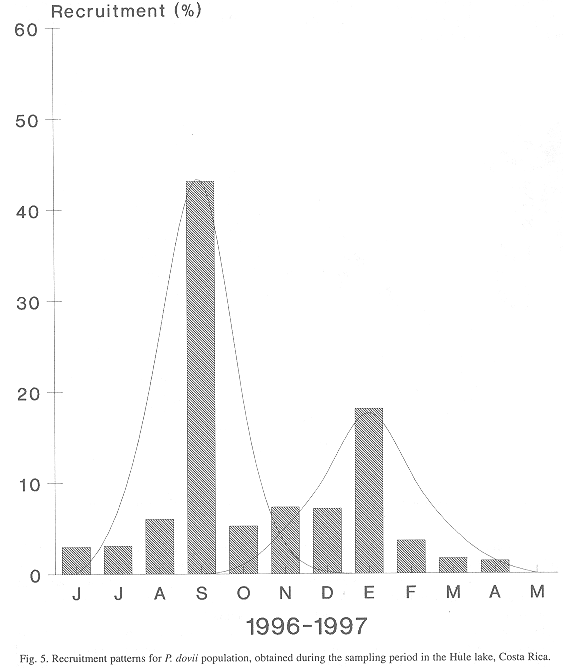
<body><![CDATA[<p><font face="Arial,Helvetica"><font size=-1><b>Mortality and exploitation levels:</b> It is clear that “guapote” biomass initially depends on the level of fishing effort, which increases considerably during the dry season (January to April). During the rainy season (May to October), the survival of the juveniles is relatively stable in the reproduction zones, considering that maximum spawning occurred during the transition of rainy to dry season (November to January) the spawning was presented. Therefore, for a resource management professional to predict with confidence the maximum exploitation levels, it is necessary to predict effectively the annual levels of abundance, on which recruitment patterns are dependent.</font></font><font size=-1></font>     <p><font face="Arial,Helvetica"><font size=-1>Total mortality (Z= 3.14 year <sup>-1</sup>) is quite influenced by fishing than natural mortality (F/M = 0.91 year <sup>-1</sup>) which coincides with the exploitation rate obtained (E= 0.48). It is evident that the population is close to the Maximum Sustainable Yield, in the equilibrium point, this means that recruitment barely replaces the “guapotes” fished.</font></font><font size=-1></font>     <p><font face="Arial,Helvetica"><font size=-1>The length of first capture (Lc<sub>50%</sub>=149.6 mm) was quite close to the female length at first maturation (138 mm) and in the males, is the same length. This is a reflection of the exploitation level that the guapotes are being subjected. The probability that they are fished before reproducing one time in their life is almost 50%.</font></font><font size=-1></font>     <p><font face="Arial,Helvetica"><font size=-1><b>Population/Recruitment relationship:</b> Taking into account that the population of guapote in the Hule lake was exactly in the equilibrium point and that the death probability by different causes than natural mortality is high, the recruitment levels are relatively low. During the year, between August and September, 45% of the recruits enter the population that is subject to fishing. This leads to the estimate that after spawning, larval development in the protected areas of the lake takes approximately seven months until the juvenile stage is reached (<a href="#Fig. 5">Fig. 5</a>).</font></font>     <br><font face="Arial,Helvetica"><font size=-1></font></font>&nbsp;<font size=-1></font>     <center>     <p><a NAME="Fig. 4"></a><img SRC="/img/fbpe/rbt/v48n2-3/0861i04.GIF" height=525 width=576><font size=-1></font>     
<p>    <br><font size=-1></font>     <p><a NAME="Fig. 5"></a><img SRC="/img/fbpe/rbt/v48n2-3/0861i05.GIF" height=668 width=563></center> <font size=-1></font>     
]]></body>
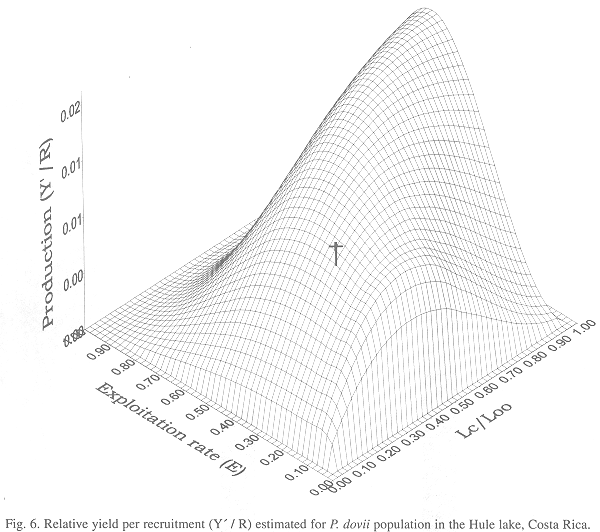
<body><![CDATA[<p>    <br><font size=-1></font>     <p><font face="Arial,Helvetica"><font size=-1><b>Relative Yield and Biomass per Recruit:</b> This assessment and yield model describes changes in the “guapote” stock between 1996 and 1997, as a result of the change in the fishing effort applied during that period. The models of yield per recruit and biomass per recruit explains how recruitment and biomass are affected by an increase in the fishing mortality level (F) or fishing effort (f).</font></font><font size=-1></font>     <p><font face="Arial,Helvetica"><font size=-1>The natural renewal rate under the actual conditions already is about 80%, meaning that under the actual level effort, 80% of the recruits have to replace the “guapotes” fished. Therefore, yield per recruitment under the actual exploitation rate (E) is too low (<a href="#Fig. 6">Fig. 6</a>), according to the fishery effort that at this moment is applied without controls over sport fishing licenses.</font></font><font size=-1></font>     <center>     <p><a NAME="Fig. 6"></a><img SRC="/img/fbpe/rbt/v48n2-3/0861i06.GIF" height=532 width=600></center> <font size=-1></font>     
<p>    <br><font size=-1></font>     <br><font size=-1></font>     <p><b><font face="Arial,Helvetica"><font size=-1>Recommendations for management: Actions suggested.</font></font></b><font size=-1></font>     ]]></body>
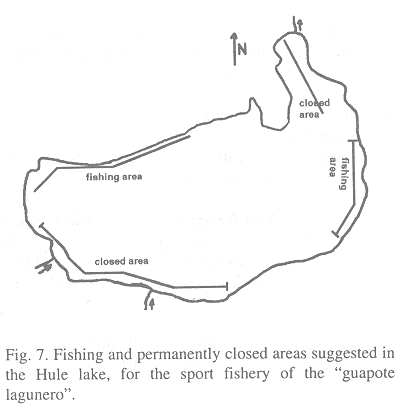
<body><![CDATA[<p><font face="Arial,Helvetica"><font size=-1>1. Assessment of the <i>P. dovii</i> stock should be carried out periodically to detect changes in the dynamics of the stock, including variables like the number of cohorts, the spawning process, growth rate and environmental&nbsp; variables that can serve as "quantitative marks of the state of the "guapote" population.</font></font><font size=-1></font>     <p><font face="Arial,Helvetica"><font size=-1>2. Is necessary to start biomass studies, using a capture-recapture model. This allows to know the abundance level, relative growth and survival of&nbsp; the "guapotes".</font></font><font size=-1></font>     <p><font face="Arial,Helvetica"><font size=-1>3. According with the results of the assessment process, a restocking project will&nbsp; be implemented.</font></font><font size=-1></font>     <p><font face="Arial,Helvetica"><font size=-1>4. The environmental variables that affect the abundance and distribution patterns of <i>P. dovii</i> in the lagoon and their relationship with the dry and rainy season, should be examined.</font></font><font size=-1></font>     <p><font face="Arial,Helvetica"><font size=-1>5. With the cooperation of the Association of Communal Development and the staff of the Area de Conservaci&oacute;n Cordillera Volc&aacute;nica Central (ACCVC) of the Ministerio del Ambiente y Energ&iacute;a (MINAE), a pilot catch and effort data&nbsp; recording system (CEDRS) should be established.</font></font><font size=-1></font>     <p><font face="Arial,Helvetica"><font size=-1>6. The minimum length of capture for the “guapotes” of the Hule lake, should&nbsp; be 150 mm Lt.</font></font><font size=-1></font>     <p><font face="Arial,Helvetica"><font size=-1>7. According to the census of weekly numbers of sport fishers in the lake, carried out during two years (1996-1997), the prime fishing were Saturday and Sunday, with an average of 35 fishermen per day, during the dry season. In the rainy season, the average of number of fishermen for those same days, decreased to 10 per day. This information, related to the analysis of relative yield and biomass per recruit and to the mean number of fish per day/fisherman (3 fishes), allows a maximum number of fishermen per day of 15.</font></font><font size=-1></font>     <p><font face="Arial,Helvetica"><font size=-1>8. The only type of fishhook to be used is the “O&acute;Shaughlessy (1/0 or 2/0); line resistance can be left for the fishermen to choose.</font></font><font size=-1></font>     <p><font face="Arial,Helvetica"><font size=-1>9. A closed season of three months (November 15 to January 15) should be established in 2001. During this closed season, assessment should be started, mainly on maturation and spawning patterns. Depending on the results of this study, in 2002 one or two mobile closed seasons of 1 month each should be established to protect the spawning peaks of the "guapote" stock.</font></font><font size=-1></font>     <p><font face="Arial,Helvetica"><font size=-1>10. The areas of the Hule lake indicated in <a href="#Fig. 7">Fig. 7</a>, should be permanently closed to the sport fishery, because between 25% and 35% of the fingerlings develop in these areas and possibly are reproduction zones.</font></font><font size=-1></font>     ]]></body>
<body><![CDATA[<p><font face="Arial,Helvetica"><font size=-1>11. It is recommended to allow the fishing of guapote only in the sectors indicated (<a href="#Fig. 7">Fig.7</a>).</font></font>     <br><font face="Arial,Helvetica"><font size=-1></font></font>&nbsp;<font size=-1></font>     <center>     <p><a NAME="Fig. 7"></a><img SRC="/img/fbpe/rbt/v48n2-3/0861i07.GIF" height=406 width=402></center> <font size=-1></font>     
<p>    <br><font size=-1></font>     <p><font face="Arial,Helvetica"><font size=-1>12. In each one of these fishing sectors it is recommended to construct two bases of cement with a clearly visible ruler incorporated. The ruler will be of 20 cm. length, highlighting a length of 15 cm, with the legend "length of minimum capture allowed, if your fish doesn’t reach this length, remove the hook and return the fish to the water".</font></font><font size=-1></font>     <p><font face="Arial,Helvetica"><font size=-1>13. It is imperative to construct a control stall, where the park-guard has the allowing responsibilities:</font></font> <ul> <ul><font face="Arial,Helvetica"><font size=-1>-restrict the access of sport fishermen to 15 per day.</font></font>    </ul>     </ul>  <ul> <ul><font face="Arial,Helvetica"><font size=-1>-hand out the control and registration sheet to each sport fisherman.</font></font>    ]]></body>
<body><![CDATA[</ul>     </ul>  <ul> <ul><font face="Arial,Helvetica"><font size=-1>-inform the fishermen about the fishing regulations.</font></font>    </ul>     </ul>  <ul> <ul><font face="Arial,Helvetica"><font size=-1>-collect the basic biometric information on the catches.</font></font>    </ul>     </ul> <font size=-1></font><font size=-1></font>     <p><b><font face="Arial,Helvetica"><font size=-1>Acknowledgments</font></font></b><font size=-1></font>     <p><font face="Arial,Helvetica"><font size=-1>We thank Elizabeth Ram&iacute;rez, head of project : "Use plan of the Hule and R&iacute;o Cuarto lagoons by Sustainable Development" for the grants provided. At Universidad Nacional (UNA) and Instituto Nacional de Aprendizaje (INA) for the financial support and other facilities. To Anne Van Dam and Roxana V&iacute;quez for their suggestions and style corrections.</font></font>     <br><font size=-1></font>&nbsp;<font size=-1></font>     <p><b><font face="Arial,Helvetica"><font size=-1>Resumen</font></font></b><font size=-1></font>     ]]></body>
<body><![CDATA[<p><font face="Arial,Helvetica"><font size=-1>Un primer intento para regular la actividad de la pesca deportiva para el guapote lagunero, <i>Parachromis dovii</i> mediante los resultados de un programa de evaluaci&oacute;n del recurso y del estudio de la din&aacute;mica poblacional de esta especie se presenta. La biomasa del guapote es relativamente baja. La especie presenta un ciclo de vida largo (8 a 10 a&ntilde;os) con una baja oscilaci&oacute;n en el crecimiento (C= 0.3), la expectativa de vida m&aacute;xima estimada fue de 12 a&ntilde;os y el punto de m&iacute;nimo crecimiento coincidi&oacute; con el per&iacute;odo de desove (entre Noviembre y Diciembre). Luego del desove, <i>P. dovii</i> permanece en las &aacute;reas protegidas cerca de 7 meses hasta alcanzar la talla de reclutamiento (54.6 mm Lt). La longitud de primera maduraci&oacute;n fue de 134 mm Lt, lo que indica que esta especie es apta para reproducirse poco tiempo despu&eacute;s de haber abandonado las &aacute;reas de protecci&oacute;n, ubicadas alrededor de la laguna. Tambi&eacute;n se describen algunos aspectos de su biolog&iacute;a. La pesca deportiva del guapote en la laguna Hule mantiene a&uacute;n a la poblaci&oacute;n en equilibrio, la tasa de renovaci&oacute;n natural se estima en 80%, por lo que no se recomienda permitir un incremento en los niveles actuales de esfuerzo pesquero, dado que esto afectar&iacute;a seriamente la capacidad de renovaci&oacute;n natural de <i>P. dovii</i>.</font></font>     <br><font size=-1></font>&nbsp;<font size=-1></font>     <p><b><font face="Arial,Helvetica"><font size=-1>References</font></font></b><b><font face="Arial,Helvetica"><font size=-1></font></font></b>     <p><a NAME="Aldave"></a><font face="Arial,Helvetica"><font size=-1>Aldave, G.T. 1985. Algunos aspectos biol&oacute;gicos del guapote <i>Cichlasoma dovii</i> (Gunther 1864) (Pisces: Cichlidae) en el embalse Arenal, Guanacaste, Costa&nbsp; Rica. Reporte de investigaci&oacute;n, Escuela de Ciencias Biol&oacute;gicas, Universidad Nacional 29 p.</font></font><font size=-1></font>     <!-- ref --><p><a NAME="Alpírez"></a><font face="Arial,Helvetica"><font size=-1>Alp&iacute;rez, O. 1985. Ictiofauna de la vertiente del Pac&iacute;fico de Costa Rica. Brenesia&nbsp; 23: 2-10.</font></font><font size=-1></font>    &nbsp;&nbsp;&nbsp;&nbsp;&nbsp;&nbsp;&nbsp;&nbsp;[&#160;<a href="javascript:void(0);" onclick="javascript: window.open('/scielo.php?script=sci_nlinks&ref=1201223&pid=S0034-7744200000020001900002&lng=','','width=640,height=500,resizable=yes,scrollbars=1,menubar=yes,');">Links</a>&#160;]<!-- end-ref --><!-- ref --><p><a NAME="Anonymous"></a><font face="Arial,Helvetica"><font size=-1>Anonymous. 1996. Concepts, design and data source. ICLARM., Manila, Phillipines. 179 p.</font></font><font size=-1></font>    &nbsp;&nbsp;&nbsp;&nbsp;&nbsp;&nbsp;&nbsp;&nbsp;[&#160;<a href="javascript:void(0);" onclick="javascript: window.open('/scielo.php?script=sci_nlinks&ref=1201224&pid=S0034-7744200000020001900003&lng=','','width=640,height=500,resizable=yes,scrollbars=1,menubar=yes,');">Links</a>&#160;]<!-- end-ref --><!-- ref --><p><a NAME="Astorquí"></a><font face="Arial,Helvetica"><font size=-1>Astorqu&iacute;, I.S. 1971. Peces de la cuenca de los grandes lagos de Nicaragua. Rev. Biol. Trop. 16: 86-99.</font></font><font size=-1></font>    &nbsp;&nbsp;&nbsp;&nbsp;&nbsp;&nbsp;&nbsp;&nbsp;[&#160;<a href="javascript:void(0);" onclick="javascript: window.open('/scielo.php?script=sci_nlinks&ref=1201225&pid=S0034-7744200000020001900004&lng=','','width=640,height=500,resizable=yes,scrollbars=1,menubar=yes,');">Links</a>&#160;]<!-- end-ref --><!-- ref --><p><a NAME="Bertalanffy"></a><font face="Arial,Helvetica"><font size=-1>Bertalanffy, L. von. 1934. Untersuchengen uber die Gesetzlichkeiten des&nbsp; Wachstums. 1. Allgemeine Grundlagen der Theorie. Roux’ Arch. Entwicklungs&nbsp; mech. Org., 131: 613- 653. <i>In</i>: Sparre, P. y S.C. Venema. 1994. Introducci&oacute;n a la&nbsp; evaluaci&oacute;n de recursos pesqueros tropicales. Parte 1. Manual FAO Doc. T&eacute;c.&nbsp; Pesca. No. 306.1. Rev.1. 498 p.</font></font><font size=-1></font>    &nbsp;&nbsp;&nbsp;&nbsp;&nbsp;&nbsp;&nbsp;&nbsp;[&#160;<a href="javascript:void(0);" onclick="javascript: window.open('/scielo.php?script=sci_nlinks&ref=1201226&pid=S0034-7744200000020001900005&lng=','','width=640,height=500,resizable=yes,scrollbars=1,menubar=yes,');">Links</a>&#160;]<!-- end-ref --><!-- ref --><p><a NAME="Beverton"></a><font face="Arial,Helvetica"><font size=-1>Beverton, R.J.H. &amp; S.J. Holt. 1957. On the dynamic of exploited fish&nbsp; populations. Fish. Invest. 2: 533 p.</font></font><font size=-1></font>    &nbsp;&nbsp;&nbsp;&nbsp;&nbsp;&nbsp;&nbsp;&nbsp;[&#160;<a href="javascript:void(0);" onclick="javascript: window.open('/scielo.php?script=sci_nlinks&ref=1201227&pid=S0034-7744200000020001900006&lng=','','width=640,height=500,resizable=yes,scrollbars=1,menubar=yes,');">Links</a>&#160;]<!-- end-ref --><!-- ref --><p><a NAME="Bussing87"></a><font face="Arial,Helvetica"><font size=-1>Bussing, W.A. 1987. Peces de las aguas continentales de Costa Rica. Editorial Uni. Costa Rica., San Jos&eacute;, Costa Rica. 271 p.</font></font><font size=-1></font>    &nbsp;&nbsp;&nbsp;&nbsp;&nbsp;&nbsp;&nbsp;&nbsp;[&#160;<a href="javascript:void(0);" onclick="javascript: window.open('/scielo.php?script=sci_nlinks&ref=1201228&pid=S0034-7744200000020001900007&lng=','','width=640,height=500,resizable=yes,scrollbars=1,menubar=yes,');">Links</a>&#160;]<!-- end-ref --><!-- ref --><p><a NAME="Bussing89"></a><font face="Arial,Helvetica"><font size=-1>Bussing, W.A. 1989. <i>Cichlasoma loisellei</i>, a new nandopsis group cichlid fish from Central America. Rev. Biol. Trop. 37: 153-161.</font></font><font size=-1></font>    &nbsp;&nbsp;&nbsp;&nbsp;&nbsp;&nbsp;&nbsp;&nbsp;[&#160;<a href="javascript:void(0);" onclick="javascript: window.open('/scielo.php?script=sci_nlinks&ref=1201229&pid=S0034-7744200000020001900008&lng=','','width=640,height=500,resizable=yes,scrollbars=1,menubar=yes,');">Links</a>&#160;]<!-- end-ref --><!-- ref --><p><a NAME="Bussing98"></a><font face="Arial,Helvetica"><font size=-1>Bussing, W.A. 1998. Peces de las aguas continentales de Costa Rica / Freshwater&nbsp; fishes of Costa Rica. Editorial de la Universidad de Costa Rica. San Jos&eacute;, Costa&nbsp; Rica. 2da. edici&oacute;n, 468 p.</font></font><font size=-1></font>    &nbsp;&nbsp;&nbsp;&nbsp;&nbsp;&nbsp;&nbsp;&nbsp;[&#160;<a href="javascript:void(0);" onclick="javascript: window.open('/scielo.php?script=sci_nlinks&ref=1201230&pid=S0034-7744200000020001900009&lng=','','width=640,height=500,resizable=yes,scrollbars=1,menubar=yes,');">Links</a>&#160;]<!-- end-ref --><!-- ref --><p><a NAME="Bussing75"></a><font face="Arial,Helvetica"><font size=-1>Bussing, W.A. &amp; M. Martin. 1975. Systematic status, variation and distribution&nbsp; of four Middle American cichlids fishes belonging to the <i>Amphilaphus</i> species&nbsp; group, genus <i>Cichlasoma</i>. Nat. Hist. Mus. L.A. Co., Contrib. Sci. 269: 1-41.</font></font><font size=-1></font>    &nbsp;&nbsp;&nbsp;&nbsp;&nbsp;&nbsp;&nbsp;&nbsp;[&#160;<a href="javascript:void(0);" onclick="javascript: window.open('/scielo.php?script=sci_nlinks&ref=1201231&pid=S0034-7744200000020001900010&lng=','','width=640,height=500,resizable=yes,scrollbars=1,menubar=yes,');">Links</a>&#160;]<!-- end-ref --><!-- ref --><p><a NAME="Bussing77"></a><font face="Arial,Helvetica"><font size=-1>Bussing, W.A. &amp; M.I. L&oacute;pez. 1977. Distribuci&oacute;n y aspectos ecol&oacute;gicos de los peces&nbsp; de las Cuencas hidrogr&aacute;ficas de Arenal, Bebedero y Tempisque, Costa Rica.&nbsp; Rev. Biol. Trop. 25: 13-37.</font></font><font size=-1></font>    &nbsp;&nbsp;&nbsp;&nbsp;&nbsp;&nbsp;&nbsp;&nbsp;[&#160;<a href="javascript:void(0);" onclick="javascript: window.open('/scielo.php?script=sci_nlinks&ref=1201232&pid=S0034-7744200000020001900011&lng=','','width=640,height=500,resizable=yes,scrollbars=1,menubar=yes,');">Links</a>&#160;]<!-- end-ref --><!-- ref --><p><a NAME="Campos"></a><font face="Arial,Helvetica"><font size=-1>Campos, J.A. 1986. El recurso pesquero del guapote (<i>Cichlasoma dovii</i>) en el embalse de Arenal, Costa Rica. Rev. Biol. Trop. 34: 215-219.</font></font><font size=-1></font>    &nbsp;&nbsp;&nbsp;&nbsp;&nbsp;&nbsp;&nbsp;&nbsp;[&#160;<a href="javascript:void(0);" onclick="javascript: window.open('/scielo.php?script=sci_nlinks&ref=1201233&pid=S0034-7744200000020001900012&lng=','','width=640,height=500,resizable=yes,scrollbars=1,menubar=yes,');">Links</a>&#160;]<!-- end-ref --><!-- ref --><p><a NAME="Darlington"></a><font face="Arial,Helvetica"><font size=-1>Darlington, S.L. 1957. Comportamiento parental en <i>Cichlasoma facetum</i> (Jenyns) (Pisces: Cichlidae) Rev. Biol. Urug. 6: 31-38.</font></font><font size=-1></font>    &nbsp;&nbsp;&nbsp;&nbsp;&nbsp;&nbsp;&nbsp;&nbsp;[&#160;<a href="javascript:void(0);" onclick="javascript: window.open('/scielo.php?script=sci_nlinks&ref=1201234&pid=S0034-7744200000020001900013&lng=','','width=640,height=500,resizable=yes,scrollbars=1,menubar=yes,');">Links</a>&#160;]<!-- end-ref --><!-- ref --><p><a NAME="De Silva"></a><font face="Arial,Helvetica"><font size=-1>De Silva, J.T. 1984. Size and shape in ontogeny adn phylogeny of the cichlids in&nbsp; the world. Paleobiology 5: 296-317.</font></font><font size=-1></font>    &nbsp;&nbsp;&nbsp;&nbsp;&nbsp;&nbsp;&nbsp;&nbsp;[&#160;<a href="javascript:void(0);" onclick="javascript: window.open('/scielo.php?script=sci_nlinks&ref=1201235&pid=S0034-7744200000020001900014&lng=','','width=640,height=500,resizable=yes,scrollbars=1,menubar=yes,');">Links</a>&#160;]<!-- end-ref --><!-- ref --><p><a NAME="Gaspar"></a><font face="Arial,Helvetica"><font size=-1>Gaspar-Dillares, M.T., A.S. Iturbide., P.G. Yoval &amp; D.L. Garc&iacute;a. 1995.&nbsp; Din&aacute;mica poblacional y biomasa desovante de la anchoa (<i>Anchoa mitchilli</i>) en&nbsp; la laguna de Tamiahua., Ver., M&eacute;xico en 1985 y 1986. INP-SEMARNAP.,&nbsp; M&eacute;xico.Ciencia Pesquera&nbsp; 11: 21-27.</font></font><font size=-1></font>    &nbsp;&nbsp;&nbsp;&nbsp;&nbsp;&nbsp;&nbsp;&nbsp;[&#160;<a href="javascript:void(0);" onclick="javascript: window.open('/scielo.php?script=sci_nlinks&ref=1201236&pid=S0034-7744200000020001900015&lng=','','width=640,height=500,resizable=yes,scrollbars=1,menubar=yes,');">Links</a>&#160;]<!-- end-ref --><!-- ref --><p><a NAME="Gayanillo"></a><font face="Arial,Helvetica"><font size=-1>Gayanillo, F.C., D. Pauly &amp; P. Sparre. 1994. The FAO-ICLARM Stock&nbsp; Assessment Tools (FiSAT) User’s guide. FAO computerized Information Series&nbsp; (Fisheries)., No. 6. Rome, FAO. 186 p.</font></font><font size=-1></font>    &nbsp;&nbsp;&nbsp;&nbsp;&nbsp;&nbsp;&nbsp;&nbsp;[&#160;<a href="javascript:void(0);" onclick="javascript: window.open('/scielo.php?script=sci_nlinks&ref=1201237&pid=S0034-7744200000020001900016&lng=','','width=640,height=500,resizable=yes,scrollbars=1,menubar=yes,');">Links</a>&#160;]<!-- end-ref --><!-- ref --><p><a NAME="Hartnoll"></a><font face="Arial,Helvetica"><font size=-1>Hartnoll, J.L. 1974. Species interaction in assessment of fish-stocks with special&nbsp; application to the North sea. Dana. 5: 1-44.</font></font><font size=-1></font>    &nbsp;&nbsp;&nbsp;&nbsp;&nbsp;&nbsp;&nbsp;&nbsp;[&#160;<a href="javascript:void(0);" onclick="javascript: window.open('/scielo.php?script=sci_nlinks&ref=1201238&pid=S0034-7744200000020001900017&lng=','','width=640,height=500,resizable=yes,scrollbars=1,menubar=yes,');">Links</a>&#160;]<!-- end-ref --><!-- ref --><p><a NAME="Holden"></a><font face="Arial,Helvetica"><font size=-1>Holden, M.J. y D.F.S. raitt (eds.). 1975. Manual de Ciencia Pesquera. Parte 2.&nbsp; M&eacute;todos para investigar los recursos y su aplicaci&oacute;n. Doc. T&eacute;c. Pesca. FAO.&nbsp; 115: 21 p.</font></font><font size=-1></font>    &nbsp;&nbsp;&nbsp;&nbsp;&nbsp;&nbsp;&nbsp;&nbsp;[&#160;<a href="javascript:void(0);" onclick="javascript: window.open('/scielo.php?script=sci_nlinks&ref=1201239&pid=S0034-7744200000020001900018&lng=','','width=640,height=500,resizable=yes,scrollbars=1,menubar=yes,');">Links</a>&#160;]<!-- end-ref --><!-- ref --><p><a NAME="McGinty"></a><font face="Arial,Helvetica"><font size=-1>McGinty, G.V. 1984. Biological versatility, evolution and food resource exploitation in African cichlids fishes. Amer.Zool. 15: 427-454.</font></font><font size=-1></font>    &nbsp;&nbsp;&nbsp;&nbsp;&nbsp;&nbsp;&nbsp;&nbsp;[&#160;<a href="javascript:void(0);" onclick="javascript: window.open('/scielo.php?script=sci_nlinks&ref=1201240&pid=S0034-7744200000020001900019&lng=','','width=640,height=500,resizable=yes,scrollbars=1,menubar=yes,');">Links</a>&#160;]<!-- end-ref --><!-- ref --><p><a NAME="McKaye77"></a><font face="Arial,Helvetica"><font size=-1>McKaye, K. 1977. Competition of breeding sites between the cichlids fishes of the Lake Jilaloa, Nicaragua., Ecology 58: 291-302.</font></font><font size=-1></font>    &nbsp;&nbsp;&nbsp;&nbsp;&nbsp;&nbsp;&nbsp;&nbsp;[&#160;<a href="javascript:void(0);" onclick="javascript: window.open('/scielo.php?script=sci_nlinks&ref=1201241&pid=S0034-7744200000020001900020&lng=','','width=640,height=500,resizable=yes,scrollbars=1,menubar=yes,');">Links</a>&#160;]<!-- end-ref --><!-- ref --><p><a NAME="McKaye80"></a><font face="Arial,Helvetica"><font size=-1>McKaye, K. 1980. Seasonality in habitat selection by the color morph of <i>Cichlasoma citrinellum</i> and its relevance to sympatric speciation in the family Cichlidae.&nbsp; Env. Biol. Fish. 5: 75-78.</font></font><font size=-1></font>    &nbsp;&nbsp;&nbsp;&nbsp;&nbsp;&nbsp;&nbsp;&nbsp;[&#160;<a href="javascript:void(0);" onclick="javascript: window.open('/scielo.php?script=sci_nlinks&ref=1201242&pid=S0034-7744200000020001900021&lng=','','width=640,height=500,resizable=yes,scrollbars=1,menubar=yes,');">Links</a>&#160;]<!-- end-ref --><!-- ref --><p><a NAME="Meyer"></a><font face="Arial,Helvetica"><font size=-1>Meyer, A. 1987. Firts feeding success with two tytpes of prey by the Central American cichlids fish, <i>Cichlasoma managuense</i> (Pisces: Cichlidae): Morphology&nbsp; versus behaviour. Env. Biol. Fish. 18: 127-134.</font></font><font size=-1></font>    &nbsp;&nbsp;&nbsp;&nbsp;&nbsp;&nbsp;&nbsp;&nbsp;[&#160;<a href="javascript:void(0);" onclick="javascript: window.open('/scielo.php?script=sci_nlinks&ref=1201243&pid=S0034-7744200000020001900022&lng=','','width=640,height=500,resizable=yes,scrollbars=1,menubar=yes,');">Links</a>&#160;]<!-- end-ref --><!-- ref --><p><a NAME="Miller"></a><font face="Arial,Helvetica"><font size=-1>Miller, R.R. 1966. Geographical distribution of Central America freshwater fishes. Copeia 141: 773-802.</font></font><font size=-1></font>    &nbsp;&nbsp;&nbsp;&nbsp;&nbsp;&nbsp;&nbsp;&nbsp;[&#160;<a href="javascript:void(0);" onclick="javascript: window.open('/scielo.php?script=sci_nlinks&ref=1201244&pid=S0034-7744200000020001900023&lng=','','width=640,height=500,resizable=yes,scrollbars=1,menubar=yes,');">Links</a>&#160;]<!-- end-ref --><!-- ref --><p><a NAME="Morales"></a><font face="Arial,Helvetica"><font size=-1>Morales-Boj&oacute;rquez, E. 1995. Estimaci&oacute;n del tama&ntilde;o poblacional y el coeficiente de capturabilidad de la tilapia (<i>Oreochromis aureus</i>) por varios m&eacute;todos de&nbsp; extracci&oacute;n sucesiva. INP-SEMARNAP. Ciencia Pesquera 11 : 40-44.</font></font><font size=-1></font>    &nbsp;&nbsp;&nbsp;&nbsp;&nbsp;&nbsp;&nbsp;&nbsp;[&#160;<a href="javascript:void(0);" onclick="javascript: window.open('/scielo.php?script=sci_nlinks&ref=1201245&pid=S0034-7744200000020001900024&lng=','','width=640,height=500,resizable=yes,scrollbars=1,menubar=yes,');">Links</a>&#160;]<!-- end-ref --><!-- ref --><p><a NAME="Moreau"></a><font face="Arial,Helvetica"><font size=-1>Moreau, J. 1988. Estimation of natural mortality from selection and catch length- frequency data: a modification of Munro’s method and application example.&nbsp; Fishbyte 6: 10-12.</font></font><font size=-1></font>    &nbsp;&nbsp;&nbsp;&nbsp;&nbsp;&nbsp;&nbsp;&nbsp;[&#160;<a href="javascript:void(0);" onclick="javascript: window.open('/scielo.php?script=sci_nlinks&ref=1201246&pid=S0034-7744200000020001900025&lng=','','width=640,height=500,resizable=yes,scrollbars=1,menubar=yes,');">Links</a>&#160;]<!-- end-ref --><!-- ref --><p><a NAME="Moya"></a><font face="Arial,Helvetica"><font size=-1>Moya, M.R. 1979. Estudio sistem&aacute;tico de los guapotes de Am&eacute;rica Central (Osteichthyes: Cichlidae: <i>Cichlasoma</i>). Tesis de grado Universidad de Costa&nbsp; Rica. 79 p.</font></font><font size=-1></font>    &nbsp;&nbsp;&nbsp;&nbsp;&nbsp;&nbsp;&nbsp;&nbsp;[&#160;<a href="javascript:void(0);" onclick="javascript: window.open('/scielo.php?script=sci_nlinks&ref=1201247&pid=S0034-7744200000020001900026&lng=','','width=640,height=500,resizable=yes,scrollbars=1,menubar=yes,');">Links</a>&#160;]<!-- end-ref --><!-- ref --><p><a NAME="Ricker"></a><font face="Arial,Helvetica"><font size=-1>Ricker, W.E. 1975. Computation and interpretation of biological statistics of fish populations. Bull. Fish. Res. Board. Can. 382 p.</font></font><font size=-1></font>    &nbsp;&nbsp;&nbsp;&nbsp;&nbsp;&nbsp;&nbsp;&nbsp;[&#160;<a href="javascript:void(0);" onclick="javascript: window.open('/scielo.php?script=sci_nlinks&ref=1201248&pid=S0034-7744200000020001900027&lng=','','width=640,height=500,resizable=yes,scrollbars=1,menubar=yes,');">Links</a>&#160;]<!-- end-ref --><!-- ref --><p><a NAME="Rosales"></a><font face="Arial,Helvetica"><font size=-1>Rosales, J. 1980. Un estimado preliminar sobre la densidad por unidad de &aacute;rea y selecci&oacute;n del tipo de h&aacute;bitat del guapote tigre <i>Cichlasoma dovii</i> en el sector de Ca&ntilde;o Negro. Trab. Inv. Tut. Esc. Cienc. Biol. Universidad Nacional. 56 p.</font></font><font size=-1></font>    &nbsp;&nbsp;&nbsp;&nbsp;&nbsp;&nbsp;&nbsp;&nbsp;[&#160;<a href="javascript:void(0);" onclick="javascript: window.open('/scielo.php?script=sci_nlinks&ref=1201249&pid=S0034-7744200000020001900028&lng=','','width=640,height=500,resizable=yes,scrollbars=1,menubar=yes,');">Links</a>&#160;]<!-- end-ref --><!-- ref --><p><a NAME="Sparre"></a><font face="Arial,Helvetica"><font size=-1>Sparre, P.E., S.C. Ursin and S.C. Venema. 1989. Introduction to tropical fish stock assessment. Part 1. Manual FAO.Fish. Tech. Pap., No. 306.1., Rome, FAO. 337 p.</font></font><font size=-1></font>    &nbsp;&nbsp;&nbsp;&nbsp;&nbsp;&nbsp;&nbsp;&nbsp;[&#160;<a href="javascript:void(0);" onclick="javascript: window.open('/scielo.php?script=sci_nlinks&ref=1201250&pid=S0034-7744200000020001900029&lng=','','width=640,height=500,resizable=yes,scrollbars=1,menubar=yes,');">Links</a>&#160;]<!-- end-ref --><!-- ref --><p><a NAME="Yáñez-Arancibia"></a><font face="Arial,Helvetica"><font size=-1>Y&aacute;&ntilde;ez-Arancibia, A. 1980. Taxonom&iacute;a, ecolog&iacute;a y estructura de las comunidades de peces en las lagunas costeras con bocas ef&iacute;meras del Pac&iacute;fico de M&eacute;xico. Centro Cienc. Mar. Limnol., UNAM. Publ. Esp.2: 1-306.</font></font><font face="Arial,Helvetica"><font size=-1></font></font>    &nbsp;&nbsp;&nbsp;&nbsp;&nbsp;&nbsp;&nbsp;&nbsp;[&#160;<a href="javascript:void(0);" onclick="javascript: window.open('/scielo.php?script=sci_nlinks&ref=1201251&pid=S0034-7744200000020001900030&lng=','','width=640,height=500,resizable=yes,scrollbars=1,menubar=yes,');">Links</a>&#160;]<!-- end-ref --><p><a NAME="1a"></a><sup><font face="Arial,Helvetica"><font size=-1><a href="#1">1</a> </font></font></sup><font face="Arial,Helvetica"><font size=-1>Estaci&oacute;n de Biolog&iacute;a Marina, Universidad Nacional. P.O.B. 126-5400, Puntarenas, Costa Rica. Fax (506) 661-3635 (<a href="mailto:atabash@una.ac.cr">atabash@una.ac.cr</a>)</font></font><font size=-1></font>     <p><a NAME="2a"></a><font face="Arial,Helvetica"><font size=-1><sup><a href="#2">2</a></sup> Centro Na&uacute;tico Pesquero, Instituto Nacional de Aprendizaje, Puntarenas, Costa Rica.</font></font>      ]]></body><back>
<ref-list>
<ref id="B1">
<nlm-citation citation-type="book">
<person-group person-group-type="author">
<name>
<surname><![CDATA[Aldave]]></surname>
<given-names><![CDATA[G.T]]></given-names>
</name>
</person-group>
<source><![CDATA[Algunos aspectos biológicos del guapote Cichlasoma dovii (Gunther 1864) (Pisces: Cichlidae) en el embalse Arenal, Guanacaste, Costa Rica]]></source>
<year>1985</year>
<publisher-name><![CDATA[Escuela de Ciencias Biológicas, Universidad Nacional]]></publisher-name>
</nlm-citation>
</ref>
<ref id="B2">
<nlm-citation citation-type="journal">
<person-group person-group-type="author">
<name>
<surname><![CDATA[Alpírez]]></surname>
<given-names><![CDATA[O]]></given-names>
</name>
</person-group>
<article-title xml:lang="es"><![CDATA[Ictiofauna de la vertiente del Pacífico de Costa Rica]]></article-title>
<source><![CDATA[Brenesia]]></source>
<year>1985</year>
<volume>23</volume>
<page-range>2-10</page-range></nlm-citation>
</ref>
<ref id="B3">
<nlm-citation citation-type="book">
<person-group person-group-type="author">
<name>
</name>
<name>
</name>
</person-group>
<source><![CDATA[Concepts, design and data source]]></source>
<year>1996</year>
<page-range>179</page-range><publisher-loc><![CDATA[Manila ]]></publisher-loc>
<publisher-name><![CDATA[ICLARM]]></publisher-name>
</nlm-citation>
</ref>
<ref id="B4">
<nlm-citation citation-type="journal">
<person-group person-group-type="author">
<name>
<surname><![CDATA[Astorquí]]></surname>
<given-names><![CDATA[I.S]]></given-names>
</name>
</person-group>
<article-title xml:lang="es"><![CDATA[Peces de la cuenca de los grandes lagos de Nicaragua]]></article-title>
<source><![CDATA[Rev. Biol. Trop]]></source>
<year>1971</year>
<volume>16</volume>
<page-range>86-99</page-range></nlm-citation>
</ref>
<ref id="B5">
<nlm-citation citation-type="journal">
<person-group person-group-type="author">
<name>
<surname><![CDATA[Bertalanffy]]></surname>
<given-names><![CDATA[L. von]]></given-names>
</name>
</person-group>
<article-title xml:lang="de"><![CDATA[Untersuchengen uber die Gesetzlichkeiten des Wachstums. 1. Allgemeine Grundlagen der Theorie]]></article-title>
<person-group person-group-type="editor">
<name>
<surname><![CDATA[Sparre]]></surname>
<given-names><![CDATA[P]]></given-names>
</name>
<name>
<surname><![CDATA[Venema]]></surname>
<given-names><![CDATA[S.C]]></given-names>
</name>
</person-group>
<source><![CDATA[Roux’ Arch. Entwicklungs mech. OrgIntroducción a la evaluación de recursos pesqueros tropicales]]></source>
<year>1934</year>
<month>19</month>
<day>94</day>
<volume>131</volume><volume>306.1</volume>
<page-range>613- 653</page-range><page-range>498</page-range></nlm-citation>
</ref>
<ref id="B6">
<nlm-citation citation-type="journal">
<person-group person-group-type="author">
<name>
<surname><![CDATA[Beverton]]></surname>
<given-names><![CDATA[R.J.H]]></given-names>
</name>
<name>
<surname><![CDATA[Holt]]></surname>
<given-names><![CDATA[S.J]]></given-names>
</name>
</person-group>
<article-title xml:lang="en"><![CDATA[On the dynamic of exploited fish populations]]></article-title>
<source><![CDATA[Fish. Invest]]></source>
<year>1957</year>
<volume>2</volume>
<page-range>533</page-range></nlm-citation>
</ref>
<ref id="B7">
<nlm-citation citation-type="book">
<person-group person-group-type="author">
<name>
<surname><![CDATA[Bussing]]></surname>
<given-names><![CDATA[W.A]]></given-names>
</name>
</person-group>
<source><![CDATA[Peces de las aguas continentales de Costa Rica]]></source>
<year>1987</year>
<page-range>271</page-range><publisher-loc><![CDATA[San José ]]></publisher-loc>
<publisher-name><![CDATA[Editorial Uni. Costa Rica]]></publisher-name>
</nlm-citation>
</ref>
<ref id="B8">
<nlm-citation citation-type="journal">
<person-group person-group-type="author">
<name>
<surname><![CDATA[Bussing]]></surname>
<given-names><![CDATA[W.A]]></given-names>
</name>
</person-group>
<article-title xml:lang="en"><![CDATA[Cichlasoma loisellei, a new nandopsis group cichlid fish from Central America]]></article-title>
<source><![CDATA[Rev. Biol. Trop]]></source>
<year>1989</year>
<volume>37</volume>
<page-range>153-161</page-range></nlm-citation>
</ref>
<ref id="B9">
<nlm-citation citation-type="book">
<person-group person-group-type="author">
<name>
<surname><![CDATA[Bussing]]></surname>
<given-names><![CDATA[W.A]]></given-names>
</name>
</person-group>
<source><![CDATA[Peces de las aguas continentales de Costa Rica / Freshwater fishes of Costa Rica]]></source>
<year>1998</year>
<edition>2da. edición</edition>
<publisher-loc><![CDATA[San José ]]></publisher-loc>
<publisher-name><![CDATA[Editorial de la Universidad de Costa Rica]]></publisher-name>
</nlm-citation>
</ref>
<ref id="B10">
<nlm-citation citation-type="journal">
<person-group person-group-type="author">
<name>
<surname><![CDATA[Bussing]]></surname>
<given-names><![CDATA[W.A]]></given-names>
</name>
<name>
<surname><![CDATA[Martin]]></surname>
<given-names><![CDATA[M]]></given-names>
</name>
</person-group>
<article-title xml:lang="en"><![CDATA[Systematic status, variation and distribution of four Middle American cichlids fishes belonging to the Amphilaphus species group, genus Cichlasoma]]></article-title>
<source><![CDATA[Nat. Hist. Mus. L.A. Co., Contrib. Sci]]></source>
<year>1975</year>
<volume>269</volume>
<page-range>1-41</page-range></nlm-citation>
</ref>
<ref id="B11">
<nlm-citation citation-type="journal">
<person-group person-group-type="author">
<name>
<surname><![CDATA[Bussing]]></surname>
<given-names><![CDATA[W.A]]></given-names>
</name>
<name>
<surname><![CDATA[López]]></surname>
<given-names><![CDATA[M.I.]]></given-names>
</name>
</person-group>
<article-title xml:lang="es"><![CDATA[Distribución y aspectos ecológicos de los peces de las Cuencas hidrográficas de Arenal, Bebedero y Tempisque, Costa Rica]]></article-title>
<source><![CDATA[Rev. Biol. Trop]]></source>
<year>1977</year>
<volume>25</volume>
<page-range>13-37</page-range></nlm-citation>
</ref>
<ref id="B12">
<nlm-citation citation-type="journal">
<person-group person-group-type="author">
<name>
<surname><![CDATA[Campos]]></surname>
<given-names><![CDATA[J.A]]></given-names>
</name>
</person-group>
<article-title xml:lang="es"><![CDATA[El recurso pesquero del guapote (Cichlasoma dovii) en el embalse de Arenal, Costa Rica]]></article-title>
<source><![CDATA[Rev. Biol. Trop]]></source>
<year>1986</year>
<volume>34</volume>
<page-range>215-219</page-range></nlm-citation>
</ref>
<ref id="B13">
<nlm-citation citation-type="journal">
<person-group person-group-type="author">
<name>
<surname><![CDATA[Darlington]]></surname>
<given-names><![CDATA[S.L.]]></given-names>
</name>
</person-group>
<article-title xml:lang="en"><![CDATA[Comportamiento parental en Cichlasoma facetum (Jenyns) (Pisces: Cichlidae)]]></article-title>
<source><![CDATA[Rev. Biol. Urug]]></source>
<year>1957</year>
<volume>6</volume>
<page-range>31-38</page-range></nlm-citation>
</ref>
<ref id="B14">
<nlm-citation citation-type="journal">
<person-group person-group-type="author">
<name>
<surname><![CDATA[De Silva]]></surname>
<given-names><![CDATA[J.T]]></given-names>
</name>
</person-group>
<article-title xml:lang="en"><![CDATA[Size and shape in ontogeny adn phylogeny of the cichlids in the world]]></article-title>
<source><![CDATA[Paleobiology]]></source>
<year>1984</year>
<volume>5</volume>
<page-range>296-317</page-range></nlm-citation>
</ref>
<ref id="B15">
<nlm-citation citation-type="book">
<person-group person-group-type="author">
<name>
<surname><![CDATA[Gaspar-Dillares]]></surname>
<given-names><![CDATA[M.T]]></given-names>
</name>
<name>
<surname><![CDATA[Iturbide]]></surname>
<given-names><![CDATA[A.S]]></given-names>
</name>
<name>
<surname><![CDATA[Yoval]]></surname>
<given-names><![CDATA[P.G.]]></given-names>
</name>
<name>
<surname><![CDATA[García]]></surname>
<given-names><![CDATA[D.L.]]></given-names>
</name>
</person-group>
<source><![CDATA[Dinámica poblacional y biomasa desovante de la anchoa (Anchoa mitchilli) en la laguna de Tamiahua., Ver., México en 1985 y 1986]]></source>
<year>1995</year>
<volume>11</volume>
<page-range>21-27</page-range><publisher-name><![CDATA[INP-SEMARNAP]]></publisher-name>
</nlm-citation>
</ref>
<ref id="B16">
<nlm-citation citation-type="book">
<person-group person-group-type="author">
<name>
<surname><![CDATA[Gayanillo]]></surname>
<given-names><![CDATA[F.C]]></given-names>
</name>
<name>
<surname><![CDATA[Pauly]]></surname>
<given-names><![CDATA[D]]></given-names>
</name>
<name>
<surname><![CDATA[Sparre]]></surname>
<given-names><![CDATA[P]]></given-names>
</name>
</person-group>
<source><![CDATA[The FAO-ICLARM Stock Assessment Tools (FiSAT) User’s guide]]></source>
<year>1994</year>
<volume>6</volume>
<page-range>186</page-range><publisher-loc><![CDATA[Rome ]]></publisher-loc>
<publisher-name><![CDATA[FAO]]></publisher-name>
</nlm-citation>
</ref>
<ref id="B17">
<nlm-citation citation-type="journal">
<person-group person-group-type="author">
<name>
<surname><![CDATA[Hartnoll]]></surname>
<given-names><![CDATA[J.L]]></given-names>
</name>
</person-group>
<article-title xml:lang="en"><![CDATA[Species interaction in assessment of fish-stocks with special application to the North sea]]></article-title>
<source><![CDATA[Dana]]></source>
<year>1974</year>
<volume>5</volume>
<page-range>1-44</page-range></nlm-citation>
</ref>
<ref id="B18">
<nlm-citation citation-type="journal">
<person-group person-group-type="author">
<name>
<surname><![CDATA[Holden]]></surname>
<given-names><![CDATA[M.J]]></given-names>
</name>
<name>
<surname><![CDATA[raitt]]></surname>
<given-names><![CDATA[D.F.S]]></given-names>
</name>
</person-group>
<article-title xml:lang="es"><![CDATA[Manual de Ciencia Pesquera. Parte 2: Métodos para investigar los recursos y su aplicación]]></article-title>
<source><![CDATA[Doc. Téc. Pesca]]></source>
<year>1975</year>
<volume>115</volume>
<page-range>21 p</page-range><publisher-name><![CDATA[FAO]]></publisher-name>
</nlm-citation>
</ref>
<ref id="B19">
<nlm-citation citation-type="journal">
<person-group person-group-type="author">
<name>
<surname><![CDATA[McGinty]]></surname>
<given-names><![CDATA[G.V]]></given-names>
</name>
</person-group>
<article-title xml:lang="en"><![CDATA[Biological versatility, evolution and food resource exploitation in African cichlids fishes]]></article-title>
<source><![CDATA[Amer.Zool]]></source>
<year>1984</year>
<volume>15</volume>
<page-range>427-454</page-range></nlm-citation>
</ref>
<ref id="B20">
<nlm-citation citation-type="journal">
<person-group person-group-type="author">
<name>
<surname><![CDATA[McKaye]]></surname>
<given-names><![CDATA[K]]></given-names>
</name>
</person-group>
<article-title xml:lang="en"><![CDATA[Competition of breeding sites between the cichlids fishes of the Lake Jilaloa, Nicaragua]]></article-title>
<source><![CDATA[Ecology]]></source>
<year>1977</year>
<volume>58</volume>
<page-range>291-302</page-range></nlm-citation>
</ref>
<ref id="B21">
<nlm-citation citation-type="journal">
<person-group person-group-type="author">
<name>
<surname><![CDATA[McKaye]]></surname>
<given-names><![CDATA[K]]></given-names>
</name>
</person-group>
<article-title xml:lang="en"><![CDATA[Seasonality in habitat selection by the color morph of Cichlasoma citrinellum and its relevance to sympatric speciation in the family Cichlidae]]></article-title>
<source><![CDATA[Env. Biol. Fish]]></source>
<year>1980</year>
<volume>5</volume>
<page-range>75-78</page-range></nlm-citation>
</ref>
<ref id="B22">
<nlm-citation citation-type="journal">
<person-group person-group-type="author">
<name>
<surname><![CDATA[Meyer]]></surname>
<given-names><![CDATA[A]]></given-names>
</name>
</person-group>
<article-title xml:lang="en"><![CDATA[Firts feeding success with two tytpes of prey by the Central American cichlids fish, Cichlasoma managuense (Pisces: Cichlidae): Morphology versus behaviour]]></article-title>
<source><![CDATA[Env. Biol. Fish]]></source>
<year>1987</year>
<volume>18</volume>
<page-range>127-134</page-range></nlm-citation>
</ref>
<ref id="B23">
<nlm-citation citation-type="journal">
<person-group person-group-type="author">
<name>
<surname><![CDATA[Miller]]></surname>
<given-names><![CDATA[R.R]]></given-names>
</name>
</person-group>
<article-title xml:lang="en"><![CDATA[Geographical distribution of Central America freshwater fishes]]></article-title>
<source><![CDATA[Copeia]]></source>
<year>1966</year>
<volume>141</volume>
<page-range>773-802</page-range></nlm-citation>
</ref>
<ref id="B24">
<nlm-citation citation-type="book">
<person-group person-group-type="author">
<name>
<surname><![CDATA[Morales-Bojórquez]]></surname>
<given-names><![CDATA[E]]></given-names>
</name>
</person-group>
<source><![CDATA[Estimación del tamaño poblacional y el coeficiente de capturabilidad de la tilapia (Oreochromis aureus) por varios métodos de extracción sucesiva]]></source>
<year>1995</year>
<volume>11</volume>
<page-range>40-44</page-range><publisher-name><![CDATA[INP-SEMARNAP]]></publisher-name>
</nlm-citation>
</ref>
<ref id="B25">
<nlm-citation citation-type="journal">
<person-group person-group-type="author">
<name>
<surname><![CDATA[Moreau]]></surname>
<given-names><![CDATA[J]]></given-names>
</name>
</person-group>
<article-title xml:lang="en"><![CDATA[Estimation of natural mortality from selection and catch length- frequency data: a modification of Munro’s method and application example]]></article-title>
<source><![CDATA[Fishbyte]]></source>
<year>1988</year>
<volume>6</volume>
<page-range>10-12</page-range></nlm-citation>
</ref>
<ref id="B26">
<nlm-citation citation-type="">
<person-group person-group-type="author">
<name>
<surname><![CDATA[Moya]]></surname>
<given-names><![CDATA[M.R]]></given-names>
</name>
</person-group>
<source><![CDATA[Estudio sistemático de los guapotes de América Central (Osteichthyes: Cichlidae: Cichlasoma)]]></source>
<year>1979</year>
<page-range>79</page-range></nlm-citation>
</ref>
<ref id="B27">
<nlm-citation citation-type="journal">
<person-group person-group-type="author">
<name>
<surname><![CDATA[Ricker]]></surname>
<given-names><![CDATA[W.E]]></given-names>
</name>
</person-group>
<article-title xml:lang="en"><![CDATA[Computation and interpretation of biological statistics of fish populations]]></article-title>
<source><![CDATA[Bull. Fish. Res. Board. Can]]></source>
<year>1975</year>
<page-range>382</page-range></nlm-citation>
</ref>
<ref id="B28">
<nlm-citation citation-type="book">
<person-group person-group-type="author">
<name>
<surname><![CDATA[Rosales]]></surname>
<given-names><![CDATA[J]]></given-names>
</name>
</person-group>
<source><![CDATA[Un estimado preliminar sobre la densidad por unidad de área y selección del tipo de hábitat del guapote tigre Cichlasoma dovii en el sector de Caño Negro]]></source>
<year>1980</year>
<publisher-name><![CDATA[Universidad Nacional]]></publisher-name>
</nlm-citation>
</ref>
<ref id="B29">
<nlm-citation citation-type="journal">
<person-group person-group-type="author">
<name>
<surname><![CDATA[Sparre]]></surname>
<given-names><![CDATA[P.E]]></given-names>
</name>
<name>
<surname><![CDATA[Ursin]]></surname>
<given-names><![CDATA[S.C]]></given-names>
</name>
<name>
<surname><![CDATA[Venema]]></surname>
<given-names><![CDATA[S.C]]></given-names>
</name>
</person-group>
<article-title xml:lang="en"><![CDATA[Introduction to tropical fish stock assessment. Part 1]]></article-title>
<source><![CDATA[Manual FAO.Fish. Tech. Pap]]></source>
<year>1989</year>
<volume>306.1</volume>
<page-range>337</page-range><publisher-loc><![CDATA[Rome ]]></publisher-loc>
<publisher-name><![CDATA[FAO]]></publisher-name>
</nlm-citation>
</ref>
<ref id="B30">
<nlm-citation citation-type="journal">
<person-group person-group-type="author">
<name>
<surname><![CDATA[Yáñez-Arancibia]]></surname>
<given-names><![CDATA[A]]></given-names>
</name>
</person-group>
<article-title xml:lang="es"><![CDATA[Taxonomía, ecología y estructura de las comunidades de peces en las lagunas costeras con bocas efímeras del Pacífico de México]]></article-title>
<source><![CDATA[Centro Cienc. Mar. Limnol]]></source>
<year>1980</year>
<volume>2</volume>
<page-range>1-306</page-range><publisher-name><![CDATA[UNAM]]></publisher-name>
</nlm-citation>
</ref>
</ref-list>
</back>
</article>