<?xml version="1.0" encoding="ISO-8859-1"?><article xmlns:mml="http://www.w3.org/1998/Math/MathML" xmlns:xlink="http://www.w3.org/1999/xlink" xmlns:xsi="http://www.w3.org/2001/XMLSchema-instance">
<front>
<journal-meta>
<journal-id>0034-7744</journal-id>
<journal-title><![CDATA[Revista de Biología Tropical]]></journal-title>
<abbrev-journal-title><![CDATA[Rev. biol. trop]]></abbrev-journal-title>
<issn>0034-7744</issn>
<publisher>
<publisher-name><![CDATA[Universidad de Costa Rica]]></publisher-name>
</publisher>
</journal-meta>
<article-meta>
<article-id>S0034-77442000000200016</article-id>
<title-group>
<article-title xml:lang="en"><![CDATA[A new species of Acestrocephalus (Characiformes: Characidae) from Venezuela]]></article-title>
</title-group>
<contrib-group>
<contrib contrib-type="author">
<name>
<surname><![CDATA[Lasso]]></surname>
<given-names><![CDATA[Carlos A]]></given-names>
</name>
<xref ref-type="aff" rid="A01"/>
</contrib>
<contrib contrib-type="author">
<name>
<surname><![CDATA[Taphorn]]></surname>
<given-names><![CDATA[Donald]]></given-names>
</name>
<xref ref-type="aff" rid="A02"/>
</contrib>
</contrib-group>
<aff id="A01">
<institution><![CDATA[,Museo de Historia Natural La Salle  ]]></institution>
<addr-line><![CDATA[Caracas ]]></addr-line>
<country>Venezuela</country>
</aff>
<aff id="A02">
<institution><![CDATA[,Universidad Experimental de los Llanos Ezequiel Zamora  ]]></institution>
<addr-line><![CDATA[Guanare Portuguesa]]></addr-line>
<country>Venezuela</country>
</aff>
<pub-date pub-type="pub">
<day>00</day>
<month>06</month>
<year>2000</year>
</pub-date>
<pub-date pub-type="epub">
<day>00</day>
<month>06</month>
<year>2000</year>
</pub-date>
<volume>48</volume>
<numero>2-3</numero>
<fpage>443</fpage>
<lpage>447</lpage>
<copyright-statement/>
<copyright-year/>
<self-uri xlink:href="http://www.scielo.sa.cr/scielo.php?script=sci_arttext&amp;pid=S0034-77442000000200016&amp;lng=en&amp;nrm=iso"></self-uri><self-uri xlink:href="http://www.scielo.sa.cr/scielo.php?script=sci_abstract&amp;pid=S0034-77442000000200016&amp;lng=en&amp;nrm=iso"></self-uri><self-uri xlink:href="http://www.scielo.sa.cr/scielo.php?script=sci_pdf&amp;pid=S0034-77442000000200016&amp;lng=en&amp;nrm=iso"></self-uri><abstract abstract-type="short" xml:lang="en"><p><![CDATA[A new species of Acestrocephalus is described from 60 specimens collected in the Río Orinoco and Río Negro drainages, Venezuela. This species is distinguished from all other Acestrocephalus by the combination of the following characters: anal rays, 29-36; 63-71 perforated scales on the lateral line; 10-12 scales above and 9-12 below the lateral line; 39-52 teeth on the maxillary; 9-12 premaxillary teeth; 8-12 teeth in the inner row on the dentary; 5-7 gill rakers on the lower part of the first gill arch; humeral, peduncular and caudal blotch absent.]]></p></abstract>
<abstract abstract-type="short" xml:lang="es"><p><![CDATA[Se describe una nueva especie, Acestrocephalus ginesi, con base a 60 ejemplares recolectados en las cuencas del Río Orinoco y Río Negro, Venezuela. Esta especie difiere de otros miembros del género por la siguiente combinación de caracteres: aleta anal, 29-36 radios; 63-71 escamas con poro en la línea lateral; escamas transversales 10-12 / 9-12; 39-52 dientes en el maxilar; 9-12 dientes en el premaxilar; 8-12 dientes en la fila interna del dentario; 5-7 branquispinas en la parte inferior del primer arco branquial; mancha humeral, peduncular y caudal, ausentes.]]></p></abstract>
<kwd-group>
<kwd lng="en"><![CDATA[Characiformes]]></kwd>
<kwd lng="en"><![CDATA[Characidae]]></kwd>
<kwd lng="en"><![CDATA[Acestrocephalus]]></kwd>
<kwd lng="en"><![CDATA[new species]]></kwd>
<kwd lng="es"><![CDATA[Río Orinoco]]></kwd>
<kwd lng="es"><![CDATA[Río Negro]]></kwd>
<kwd lng="es"><![CDATA[Venezuela]]></kwd>
</kwd-group>
</article-meta>
</front><body><![CDATA[ <center><b><font face="Arial,Helvetica">A new species of <i>Acestrocephalus</i> (Characiformes: Characidae)</font></b>     <br><b><font face="Arial,Helvetica">from Venezuela</font></b>     <p><font face="Arial,Helvetica"><font size=-1><b>Carlos A. Lasso<a NAME="1"></a></b><sup><a href="#1a">1</a></sup><b> and Donald Taphorn<a NAME="2"></a></b><sup><a href="#2a">2</a></sup></font></font>     <br><sup><font face="Arial,Helvetica"><font size=-1><a href="#2"></a></font></font></sup>&nbsp;     <p><font face="Arial,Helvetica"><font size=-1>Received 11-VIII-1999. Corrected 11-II-2000. Accepted 24-II-2000.</font></font></center>      <p>    <br>     <p><b><font face="Arial,Helvetica"><font size=-1>Abstract</font></font></b>     <p><font face="Arial,Helvetica"><font size=-1>A new species of <i>Acestrocephalus</i> is described from 60 specimens collected in the R&iacute;o Orinoco and R&iacute;o Negro drainages, Venezuela. This species is distinguished from all other <i>Acestrocephalus</i> by the combination of the following characters: anal rays, 29-36; 63-71 perforated scales on the lateral line; 10-12 scales above and 9-12 below the lateral line; 39-52 teeth on the maxillary; 9-12 premaxillary teeth; 8-12 teeth in the inner row on the dentary; 5-7 gill rakers on the lower part of the first gill arch; humeral, peduncular and caudal blotch absent.</font></font>     <p><b><font face="Arial,Helvetica"><font size=-1>Key words</font></font></b>     ]]></body>
<body><![CDATA[<p><font face="Arial,Helvetica"><font size=-1>Characiformes, Characidae, <i>Acestrocephalus</i>, new species, R&iacute;o Orinoco, R&iacute;o Negro, Venezuela.</font></font>     <br>&nbsp;     <br>&nbsp;     <p><font face="Arial,Helvetica"><font size=-1>The genus <i>Acestrocephalus</i> Eigenmann, 1919 is represented by three species: <i>A. anomalus</i> (Steindachner, 1879) (restricted to the Magdalena Basin), <i>A. sardina</i> (Fowler, 1913) and <i>A. boehlkei</i> (<a href="#Menezes77">Menezes, 1977</a>) (both distributed in the Amazon Basin). Some authors (e. g. <a href="#Géry">G&eacute;ry, 1977</a>) consider Acestrocephalus as a subgenus of the genus <i>Cynopotamus</i> Valenciennes, 1849. <a href="#Menezes76">Menezes (1976)</a> established the subfamily Cynopotaminae and elevated <i>Acestrocephalus</i> to generic status.</font></font>     <br>&nbsp;     <p><b><font face="Arial,Helvetica"><font size=-1>Material and Methods</font></font></b><b><font face="Arial,Helvetica"><font size=-1></font></font></b>     <p><font face="Arial,Helvetica"><font size=-1>Counts and measurements follow Menezes (<a href="#Menezes76">1976</a>, <a href="#Menezes77">1977</a>). Procedures for preparing cleared and stained material follow <a href="#Taylor">Taylor (1967)</a>. Museum abbreviations: MCNG, Museo de Ciencias Naturales de la UNELLEZ en Guanare, Guanare, Estado Portuguesa; MHNLS, Museo de Historia Natural La Salle, Caracas, Venezuela. Morphometric and meristic data for <i>Acestrocephalus anomalus</i>, <i>A. boehlkei</i> and <i>A. sardina</i> are from Menezes (<a href="#Menezes76">1976</a>, <a href="#Menezes77">1977</a>). Data for the Apure drainage population identified as <i>A. afboehlkei</i> are from <a href="#Taphorn">Taphorn (1992)</a> and were reconfirmed using specimens from MCNG and MHNLS.</font></font>     <br>&nbsp;     <p>    <br>     ]]></body>
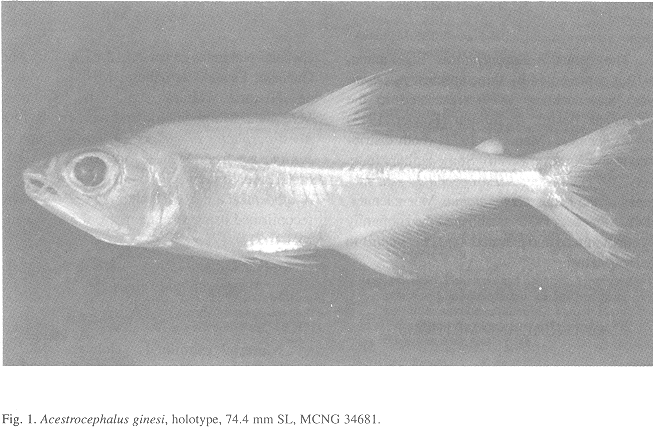
<body><![CDATA[<p><font face="Arial,Helvetica"><font size=-1><i>Acestrocephalus ginesi</i>, s.p. nov.</font></font>     <br><font face="Arial,Helvetica"><font size=-1>(Figs. <a href="#Fig. 1">1</a>-<a href="#2">2</a>, Table <a href="#Tabla 1">1</a>-<a href="#Tabla 2">2</a>)</font></font>     <p><font face="Arial,Helvetica"><font size=-1><b>Material examined</b> - Holotype. MCNG 34681 (74.4 mm SL). Venezuela, Apure State, R&iacute;o Cinaruco, playa en frente de Laguna Larga, Distrito Mu&ntilde;oz (06&ordm; 33' 45'' N - 67&ordm; 24' W). Collected 4 April 1997, D. Jepsen and D. Rodriguez. Paratypes. MCNG 37820, 14 ex. (51.4 - 79.6 mm SL). Same data as holotype. MCNG 17956, 2 ex. (73.9 - 76.3 mm SL). Venezuela, Apure State, R&iacute;o Cinaruco, cerca de la desembocadura con el R&iacute;o Orinoco (aprox. 06&ordm; 41’ N - 67&ordm; 06’ W). Collected 31 December 1986, D.C. Taphorn. MCNG 37821 (55 mm SL, cleared and stained). Same data as MCNG 17956. MHNLS 12762 (52,3 mm SL). Same data as MCNG 17956. MCNG 18029, 4 ex. (51.4 - 53.8 mm SL). Venezuela, Apure State, R&iacute;o Cinaruco, Hacienda El Cocal, Paso de la Chalana (6&ordm; 35' 30'' N - 67&ordm; 14'' W). Collected 30 December 1986, D. C. Taphorn, B. Stergios and P. Stergios. MCNG 23305, 5 ex. (76.9 - 121.8 mm SL). Venezuela, Amazonas State, R&iacute;o Guain&iacute;a en Maroa, Departamento de Casiquiare (2&ordm; 44' 0'' N - 67&ordm; 34' W). Collected 9 August 1989, L. Hoigne and D. C. Taphorn. MCNG 37822, 6 ex. (85.4 - 109.4 mm SL). Venezuela, Amazonas State, R&iacute;o Sipapo a 150 m arriba del Salto Remo, Departamento Atures (4&ordm; 34' 28'' N - 67&ordm; 17' W). Collected 29 May 1989, L. Nico and E. Guayamare. MCNG 12098, 5 ex. (66.5 - 100.7 mm SL). Venezuela, Amazonas State, R&iacute;o Negro, San Carlos de R&iacute;o Negro, Departamento de R&iacute;o Negro (1&ordm; 55' 0'' N - 67&ordm; 04' W). Collected 12 April 1985, L. Nico. MCNG 26048, 3 ex. (59.9 - 73.7 mm SL). Venezuela, Amazonas State, R&iacute;o Siapa a 176 km aguas arriba de la desembocadura con el Ca&ntilde;o Casiquiare, Departamento de Casiquiare (1&ordm; 25' 0'' N - 65&ordm; 41' W). Collected 17 April 1991, A. Barbarino &amp; D. Morillo. MHNLS 12807, 3 ex. (73.4 - 83.7 mm SL). Same data as MCNG 26048. MCNG 37823, 5 ex. (65.7 - 90.3 mm SL). Venezuela, Amazonas State, R&iacute;o Orinoco, playas Isla Trucoapure. Collected 13 February 1991, L. Nico &amp; J. Castillo. MCNG 37825, 5 ex. (57.3 - 94.2 mm SL). Venezuela, Amazonas State, R&iacute;o Orinoco, debajo de la Comunidad Cariche (3&ordm; 2' 00'' N - 66&ordm; 25' W). Collected 20 January 1991, L. Nico &amp; G. Aragua. MCNG 37824, 5 ex. (61.4 - 88.2 mm SL). Venezuela, Amazonas State, R&iacute;o Orinoco, Isla Tigre, entre Macuruco y Guachapana, Departamento Atabapo (3&ordm; 55' 00'' N - 67&ordm; 0' W). Collected 20 February 1991, L. Nico &amp; F. Morillo.</font></font>     <br>&nbsp;     <br>&nbsp;     <br>     <br>     <center>     <p><a NAME="Fig. 1"></a><img SRC="/img/fbpe/rbt/v48n2-3/0858i01.GIF" height=431 width=653></center>      
<p>    ]]></body>
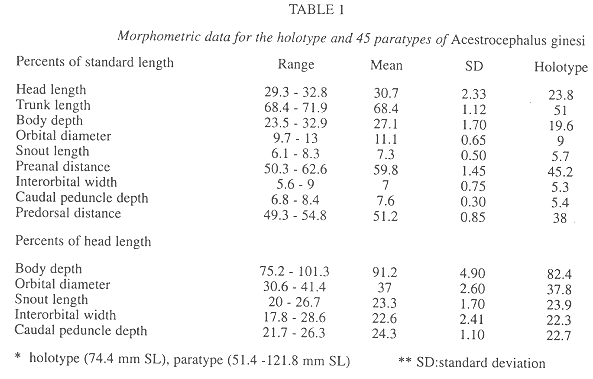
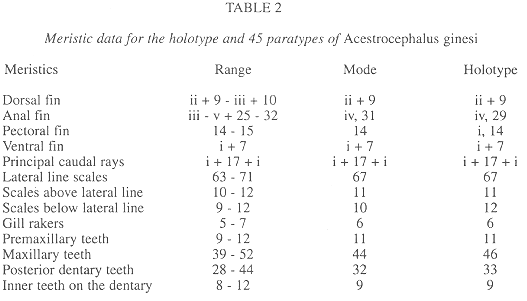
<body><![CDATA[<br>     <br>     <br>     <p><font face="Arial,Helvetica"><font size=-1><b>Etymology. </b>This species is named in honor of Hermano Gin&eacute;s president of the La Salle Natural Science Foundation, in recognition of his outstanding contribution to the study and protection of neotropical ecosystems.</font></font>     <p><font face="Arial,Helvetica"><font size=-1><b>Diagnosis.</b> <i>Acestrocephalus ginesi</i> differs from all other <i>Acestrocephalus</i> species by the combination of the following characters: anal fin, iv + 25 - 32 (iii + 27 in one specimen and v + 25 in other specimen); 63 -71 perforated scales on lateral line; 10 - 12 scales above, 9 - 12 below lateral line; 39 - 52 teeth on maxillary; 9 - 12 premaxillary teeth; 8 - 12 teeth in inner dentary row; 5 - 7 gill rakers on lower part of first gill arch; humeral blotch absent; dark blotch on caudal peduncle fin weak to absent; vestiges of small dark spot at origin of dorsal fin; tip of lower jaw with scattered dark melanophores, especially in small specimens (52 mm SL or less).</font></font>     <p><font face="Arial,Helvetica"><font size=-1><b>Description.</b> Morphometric and meristic data of holotype and 45 paratypes are given in <a href="#Tabla 1">Tables 1</a> and <a href="#Tabla 2">2</a>. Body relatively small (SL 51.4 -121.8 mm); ventral outline slightly more curved than dorsal. Snout rather short, less than orbital diameter. Maxilla with 39 - 52 teeth, its posterior border convex. Premaxilla with 9 - 12 teeth, including anteriormost and posterior canines of external tooth row. First tooth in outer dentary row a large canine followed by two or three conical teeth (first and third smaller and second similar to anteriormost canine) followed by row of 28 - 44 small conical teeth. Inner row on dentary with 8 - 12 teeth. Gill rakers on inferior lobe of first arch: 6 + 0 rudiment (35), 6 + 2 rudiments (2), 7 + 0 rudiments (2) and 7 + 1 rudiment (6).</font></font>     <p><font face="Arial,Helvetica"><font size=-1>Scales relatively large. Lateral line scales: 63 (1), 64 (1), 65 (1), 66 (2), 67 (13), 68 (6), 69 (7), 70 (11) and 71 (4). Scales above lateral line: 10 (7), 11 (32) and 12 (7). Scales below lateral line: 10 (32), 11 (12) and 12 (2). Anal fin base covered by a row of scales that extends to middle of fin.</font></font>     <p><font face="Arial,Helvetica"><font size=-1>Dorsal fin: ii + 9 (45) and iii + 10 (1); first branched ray four times longer than last and first simple ray contained about two times in second unbranched ray. Interradial membranes with sheath of skin that occupies most of interradial space, sheath decreasing in length after third or fourth ray, and becoming unnoticeable on second to last ray. Anal fin: iii + 27 (1), iv + 25 (1), iv + 27 (1), iv + 28 (3), iv + 29 (10), iv + 30 (9), iv + 31 (12), iv + 32 (8) and v + 25 (1); falcate anteriorly (the 4th, 5th and 6th rays are longer than the rest) with sheath of skin covering most of interradial space of first anal rays; origin of anal situated below base of last dorsal ray. Pectoral fin: i + 13 (24) and i + 14 (22); longer than pelvics, longest rays reaching origin of pelvics. Pelvic fin: i + 7 (46); tips of pelvics reaching or passing anus. Principal caudal rays: i + 17 + i (46); caudal fin with inferior lobe a bit larger than upper.</font></font>     <br><font face="Arial,Helvetica"><font size=-1></font></font>&nbsp;     <p>    ]]></body>
<body><![CDATA[<br>     <center>     <p><a NAME="Tabla 1"></a><img SRC="/img/fbpe/rbt/v48n2-3/0858i02.GIF" height=379 width=593>     
<br>&nbsp;     <br>&nbsp;     <p><a NAME="Tabla 2"></a><img SRC="/img/fbpe/rbt/v48n2-3/0858i03.GIF" height=301 width=527></center>      
<p>    <br>     <br>     <br>     ]]></body>
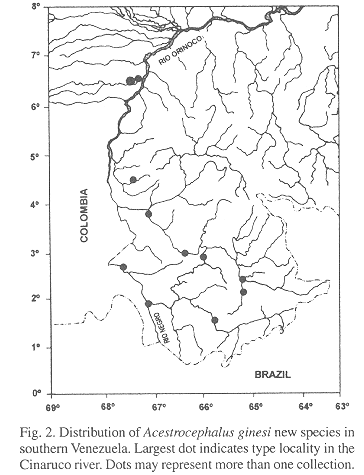
<body><![CDATA[<p><font face="Arial,Helvetica"><font size=-1>General body color in 70% ethanol is pallid yellow. A series of very diffuse melanophores extends from upper angle of opercle to base of caudal fin. Humeral spot absent. Just a few melanophores on inferior part or tip of mandible, more evident in specimens less than 57 mm SL. Fins hyaline.</font></font>     <p><font face="Arial,Helvetica"><font size=-1>Distribution. This species is known only from southern Apure in the Cinaruco river and from the upper Orinoco and Negro drainages in Amazonas state (<a href="#Fig. 2">Fig. 2</a>).</font></font>     <center>     <p><a NAME="Fig. 2"></a><img SRC="/img/fbpe/rbt/v48n2-3/0858i04.GIF" height=475 width=364></center>      
<br>&nbsp;     <p><b><font face="Arial,Helvetica"><font size=-1>Discussion</font></font></b><font face="Arial,Helvetica"><font size=-1></font></font>     <p><font face="Arial,Helvetica"><font size=-1>Five diagnostic characters permit the separation of <i>A. ginesi</i> from the other species: 1) the lower number of total anal rays (29 - 36 vs. 37 - 41 in <i>A. boehlkei </i>and 37 - 39 in <i>A. anomalus</i>), only <i>A. sardina</i> an Amazonian headwater species has 33 - 37 anal rays; 2) a lower number of pored lateral line scales (63-71 vs. 71-78); 3) fewer transverse scales above the lateral line (10-12 vs. 12-14); 4) greater number of maxillary teeth (39-52 vs. 32-44); 5) the absence of a spot on the caudal peduncle and the base of the caudal fin. In addition, <i>A. ginesi</i> differs by the absence of a humeral spot. In <i>A. boehlkei</i> and <i>A. sardina</i> this spot is quite evident. <i>Acestrocephalus anomalus</i> may present only vestiges of the humeral spot. <i>A. ginesi</i> shares with <i>A. boehlkei</i> a small spot at the tip of the lower jaw, a character that is more evident in smaller specimens. This spot is absent in the other two species. This new species also has vestiges of a spot at the origin of the dorsal fin, a character that it shares with the other three. The number of transverse scales below the lateral line (9-12) separates in part <i>A. ginesi</i> from <i>A. boehlkei</i> and <i>A. sardina</i> (12-13), but overlaps with <i>A. anomalus</i> (9-11). The range of the number of premaxillary teeth coincides with <i>A. boehlkei</i> (9-12), but differs from <i>A. sardina</i> and <i>A. anomalus</i> (7-11). <i>Acestrocephalus ginesi</i> has a very large eye, its orbital diameter 30.6 - 41.1 % (mean= 37 %) of the head length, (25.0-34.8 in <i>A. boehlkei</i> as calculated from <a href="#Tabla 2">Table 2</a> in <a href="#Menezes77">Menezes 1977</a>).</font></font>     <p><font face="Arial,Helvetica"><font size=-1>The three described species of the genus <i>Acestrocephalus</i> have either an Amazonian distribution (<i>A. sardina</i> and <i>A. boehlkei</i>) or Magdalenan (<i>A. anomalus</i>) distribution. <i>Acestrocephalus ginesi</i> represents the second report of this genus from the Orinoco Basin. <a href="#Taphorn">Taphorn (1992)</a> indicated the presence of a species tentatively identified as <i>Acestrocephalus cf boehlkei</i> <a href="#Menezes77">Menezes 1977</a> from the Apure River system. That species differs from <i>A. ginesi</i> in having a greater number of branched anal-fin rays (35-38 vs. 29-36) and a greater number of scales on the lateral line (73-76 vs. 63-71). The presence of humeral and caudal spots also distinguishes the Apure form from <i>A. ginesi</i>. The report of <i>A. boehlkei</i> from the Ventuari River (upper Orinoco) of <a href="#Taphorn">Taphorn (1992)</a> requires confirmation.</font></font>     <br>&nbsp;     <p>    ]]></body>
<body><![CDATA[<br>     <p><b><font face="Arial,Helvetica"><font size=-1>Acknowledgements</font></font></b>     <p><font face="Arial,Helvetica"><font size=-1>We thank Oscar Lasso-Alcal&aacute; for taking the photograph; UNELLEZ BioCentro and Fundaci&oacute;n La Salle logistic for support and museum processing; MAC-SARPA for issuing the scientific permits. Antonio Machado-Allison and Francisco Provenzano revised the manuscript.</font></font>     <p>    <br>     <p><b><font face="Arial,Helvetica"><font size=-1>Resumen</font></font></b>     <p><font face="Arial,Helvetica"><font size=-1>Se describe una nueva especie, <i>Acestrocephalus ginesi</i>, con base a 60 ejemplares recolectados en las cuencas del R&iacute;o Orinoco y R&iacute;o Negro, Venezuela. Esta especie difiere de otros miembros del g&eacute;nero por la siguiente combinaci&oacute;n de caracteres: aleta anal, 29-36 radios; 63-71 escamas con poro en la l&iacute;nea lateral; escamas transversales 10-12 / 9-12; 39-52 dientes en el maxilar; 9-12 dientes en el premaxilar; 8-12 dientes en la fila interna del dentario; 5-7 branquispinas en la parte inferior del primer arco branquial; mancha humeral, peduncular y caudal, ausentes.</font></font>     <br>&nbsp;     <p><b><font face="Arial,Helvetica"><font size=-1>References</font></font></b>     <!-- ref --><p><a NAME="Géry"></a><font face="Arial,Helvetica"><font size=-1>G&eacute;ry, J. 1977. Characoids of the World. T. F. H. Neptune City, New Jersey. 672 p.</font></font>    &nbsp;&nbsp;&nbsp;&nbsp;&nbsp;&nbsp;&nbsp;&nbsp;[&#160;<a href="javascript:void(0);" onclick="javascript: window.open('/scielo.php?script=sci_nlinks&ref=1204802&pid=S0034-7744200000020001600001&lng=','','width=640,height=500,resizable=yes,scrollbars=1,menubar=yes,');">Links</a>&#160;]<!-- end-ref --><!-- ref --><p><a NAME="Menezes76"></a><font face="Arial,Helvetica"><font size=-1>Menezes, N. 1976. On Cynopotaminae, a new subfamily of Characidae (Osteichthyes,Ostariophysi, Characoidei). Arq. Zool. 28: 1-91.</font></font>    &nbsp;&nbsp;&nbsp;&nbsp;&nbsp;&nbsp;&nbsp;&nbsp;[&#160;<a href="javascript:void(0);" onclick="javascript: window.open('/scielo.php?script=sci_nlinks&ref=1204803&pid=S0034-7744200000020001600002&lng=','','width=640,height=500,resizable=yes,scrollbars=1,menubar=yes,');">Links</a>&#160;]<!-- end-ref --><!-- ref --><p><a NAME="Menezes77"></a><font face="Arial,Helvetica"><font size=-1>Menezes, N. 1977. <i>Acestrocephalus boehlkei</i>, a new and disjunct Cynopotamine from Ecuadorean and Peruvian Amazon (Osteichthyes, Ostariophysi, Characidae). Pap. Avul. Zool., S. Paulo 30: 185-196.</font></font>    &nbsp;&nbsp;&nbsp;&nbsp;&nbsp;&nbsp;&nbsp;&nbsp;[&#160;<a href="javascript:void(0);" onclick="javascript: window.open('/scielo.php?script=sci_nlinks&ref=1204804&pid=S0034-7744200000020001600003&lng=','','width=640,height=500,resizable=yes,scrollbars=1,menubar=yes,');">Links</a>&#160;]<!-- end-ref --><!-- ref --><p><a NAME="Taphorn"></a><font face="Arial,Helvetica"><font size=-1>Taphorn, D. 1992. The Characiform Fishes of the Apure River Drainage, Venezuela. Biollania 4: 1-537.</font></font>    &nbsp;&nbsp;&nbsp;&nbsp;&nbsp;&nbsp;&nbsp;&nbsp;[&#160;<a href="javascript:void(0);" onclick="javascript: window.open('/scielo.php?script=sci_nlinks&ref=1204805&pid=S0034-7744200000020001600004&lng=','','width=640,height=500,resizable=yes,scrollbars=1,menubar=yes,');">Links</a>&#160;]<!-- end-ref --><!-- ref --><p><a NAME="Taylor"></a><font face="Arial,Helvetica"><font size=-1>Taylor, W. R. 1967. An enzyme method of clearing and staining small vertebrates. Proc. U. S. Nat. Mus. 122: 1-17.</font></font>    &nbsp;&nbsp;&nbsp;&nbsp;&nbsp;&nbsp;&nbsp;&nbsp;[&#160;<a href="javascript:void(0);" onclick="javascript: window.open('/scielo.php?script=sci_nlinks&ref=1204806&pid=S0034-7744200000020001600005&lng=','','width=640,height=500,resizable=yes,scrollbars=1,menubar=yes,');">Links</a>&#160;]<!-- end-ref --><p><a NAME="1a"></a><font face="Arial,Helvetica"><font size=-1><sup><a href="#1">1</a></sup> Museo de Historia Natural La Salle, Apartado 1930, Caracas 1010-A, Venezuela. Fax: 58 2 7937493; e-mail: <a href="mailto:lassoc@usa.net">lassoc@usa.net</a></font></font>     <p><a NAME="2a"></a><font face="Arial,Helvetica"><font size=-1><sup><a href="#2">2</a></sup> Universidad Experimental de los Llanos Ezequiel Zamora, Guanare, Portuguesa 3310, Venezuela. e-mail: <a href="mailto:taphorn@cantv.net">taphorn@cantv.net</a></font></font>     <br><font face="Arial,Helvetica"><font size=-1></font></font>&nbsp;      ]]></body><back>
<ref-list>
<ref id="B1">
<nlm-citation citation-type="book">
<person-group person-group-type="author">
<name>
<surname><![CDATA[Géry]]></surname>
<given-names><![CDATA[J]]></given-names>
</name>
</person-group>
<source><![CDATA[Characoids of the World]]></source>
<year>1977</year>
<publisher-loc><![CDATA[New Jersey ]]></publisher-loc>
<publisher-name><![CDATA[T. F. H. Neptune City]]></publisher-name>
</nlm-citation>
</ref>
<ref id="B2">
<nlm-citation citation-type="journal">
<person-group person-group-type="author">
<name>
<surname><![CDATA[Menezes]]></surname>
<given-names><![CDATA[N]]></given-names>
</name>
</person-group>
<article-title xml:lang="en"><![CDATA[On Cynopotaminae, a new subfamily of Characidae (Osteichthyes,Ostariophysi, Characoidei)]]></article-title>
<source><![CDATA[Arq. Zool]]></source>
<year>1976</year>
<volume>28</volume>
<page-range>1-91</page-range></nlm-citation>
</ref>
<ref id="B3">
<nlm-citation citation-type="journal">
<person-group person-group-type="author">
<name>
<surname><![CDATA[Menezes]]></surname>
<given-names><![CDATA[N]]></given-names>
</name>
</person-group>
<article-title xml:lang="en"><![CDATA[Acestrocephalus boehlkei, a new and disjunct Cynopotamine from Ecuadorean and Peruvian Amazon (Osteichthyes, Ostariophysi, Characidae)]]></article-title>
<source><![CDATA[Pap. Avul. Zool., S. Paulo]]></source>
<year>1977</year>
<volume>30</volume>
<page-range>185-196</page-range></nlm-citation>
</ref>
<ref id="B4">
<nlm-citation citation-type="journal">
<person-group person-group-type="author">
<name>
<surname><![CDATA[Taphorn]]></surname>
<given-names><![CDATA[D]]></given-names>
</name>
</person-group>
<article-title xml:lang="en"><![CDATA[The Characiform Fishes of the Apure River Drainage, Venezuela]]></article-title>
<source><![CDATA[Biollania]]></source>
<year>1992</year>
<volume>4</volume>
<page-range>1-537</page-range></nlm-citation>
</ref>
<ref id="B5">
<nlm-citation citation-type="journal">
<person-group person-group-type="author">
<name>
<surname><![CDATA[Taylor]]></surname>
<given-names><![CDATA[W. R]]></given-names>
</name>
</person-group>
<article-title xml:lang="en"><![CDATA[An enzyme method of clearing and staining small vertebrates]]></article-title>
<source><![CDATA[Proc. U. S. Nat. Mus]]></source>
<year>1967</year>
<volume>122</volume>
<page-range>1-17</page-range></nlm-citation>
</ref>
</ref-list>
</back>
</article>