<?xml version="1.0" encoding="ISO-8859-1"?><article xmlns:mml="http://www.w3.org/1998/Math/MathML" xmlns:xlink="http://www.w3.org/1999/xlink" xmlns:xsi="http://www.w3.org/2001/XMLSchema-instance">
<front>
<journal-meta>
<journal-id>0034-7744</journal-id>
<journal-title><![CDATA[Revista de Biología Tropical]]></journal-title>
<abbrev-journal-title><![CDATA[Rev. biol. trop]]></abbrev-journal-title>
<issn>0034-7744</issn>
<publisher>
<publisher-name><![CDATA[Universidad de Costa Rica]]></publisher-name>
</publisher>
</journal-meta>
<article-meta>
<article-id>S0034-77442000000100027</article-id>
<title-group>
<article-title xml:lang="en"><![CDATA[New species and distribution records of Mesoamerican Ateuchus (Coleoptera:Scarabaeidae)]]></article-title>
</title-group>
<contrib-group>
<contrib contrib-type="author">
<name>
<surname><![CDATA[Kohlmann]]></surname>
<given-names><![CDATA[Bert]]></given-names>
</name>
<xref ref-type="aff" rid="A01"/>
</contrib>
</contrib-group>
<aff id="A01">
<institution><![CDATA[,EARTH  ]]></institution>
<addr-line><![CDATA[ ]]></addr-line>
<country>Costa Rica</country>
</aff>
<pub-date pub-type="pub">
<day>00</day>
<month>03</month>
<year>2000</year>
</pub-date>
<pub-date pub-type="epub">
<day>00</day>
<month>03</month>
<year>2000</year>
</pub-date>
<volume>48</volume>
<numero>1</numero>
<fpage>235</fpage>
<lpage>2446</lpage>
<copyright-statement/>
<copyright-year/>
<self-uri xlink:href="http://www.scielo.sa.cr/scielo.php?script=sci_arttext&amp;pid=S0034-77442000000100027&amp;lng=en&amp;nrm=iso"></self-uri><self-uri xlink:href="http://www.scielo.sa.cr/scielo.php?script=sci_abstract&amp;pid=S0034-77442000000100027&amp;lng=en&amp;nrm=iso"></self-uri><self-uri xlink:href="http://www.scielo.sa.cr/scielo.php?script=sci_pdf&amp;pid=S0034-77442000000100027&amp;lng=en&amp;nrm=iso"></self-uri><abstract abstract-type="short" xml:lang="en"><p><![CDATA[This paper describes three new species of Ateuchus for Mesoamerica. The new taxa are: A. gershensoni (copulatory hooks subequal in size and spinelike), A. perezvelai (small size; frons very convex; one very big copulatory hook and two small spine-like ones associated with a spiny fascies) and A. perpusillus (anterior pronotal margin incomplete; small and compact copulatory hooks, associated with a spiny fascies) from southern Mexico, Guatemala and Honduras. Redescriptions are also given for A. chrysopyge (Bates) (big size; copulatory hooks, one big, a spine-like medium-sized one and a hook-like small one) and A. guatemalensis (Bates) (pronotum punctured; anterior pronotal margin almost effaced; pygidium convex; copulatory hooks, two small and compact and one very thin and curved). New country and distributional records are also registered for Mexico, Guatemala, Belize, Honduras and El Salvador. Distribution map, internal sac of aedeagus illustrations and photographs of dorsal habitus are included, as well as drawings of the dorsal habitus of the three new species. The present work clarifies the situation of the genus in Mesoamerica and updates knowledge of the group in Mexico.]]></p></abstract>
<abstract abstract-type="short" xml:lang="es"><p><![CDATA[Este trabajo describe tres nuevas especies de Ateuchus para Mesoamérica. Los nuevos taxa son: A. gershensoni, A. perezvelai y A.perpusillus del sur de México, Guatemala y Honduras. Se incluyen redescripciones de A. chrysopyge (Bates) y A. guatemalensis (Bates). Se citan nuevos registros de países y de distribución para México, Guatemala, Belice, Honduras y El Salvador. Se incluyen mapas, ilustraciones del saco interno del edeago y fotografías del hábito dorsal, así como ilustraciones del hábito dorsal de las tres nuevas especies. Este estudio representa una extensión del trabajo originalmente realizado para los Ateuchus de Norteamérica (Kohlmann 1984). El trabajo clarifica la situación del género en Mesoamérica. También actualiza el conocimiento del grupo para México al reportar la presencia de cuatro especies más (dos nuevas, gershensoni y perezvelai; y dos nuevos registros para el país, chrysopyge y guatemalensis) y así incrementar el número de especies conocidas de ocho a doce.]]></p></abstract>
<kwd-group>
<kwd lng="la"><![CDATA[Ateuchus]]></kwd>
<kwd lng="la"><![CDATA[Scarabaeinae]]></kwd>
<kwd lng="en"><![CDATA[dung beetles]]></kwd>
<kwd lng="en"><![CDATA[Coleoptera]]></kwd>
<kwd lng="en"><![CDATA[new species]]></kwd>
<kwd lng="en"><![CDATA[Neotropical]]></kwd>
<kwd lng="en"><![CDATA[Mesoamerica]]></kwd>
</kwd-group>
</article-meta>
</front><body><![CDATA[ <center><b><font face="Arial,Helvetica"><font size=-1>New species and distribution records of Mesoamerican<i>Ateuchus</i></font></font></b>     <br><b><font face="Arial,Helvetica"><font size=-1>(Coleoptera:Scarabaeidae)</font></font></b><b><font size=-1></font></b>     <p><font face="Arial,Helvetica"><font size=-1><b>Bert Kohlmann.&nbsp;<a NAME="1"></a></b><sup><a href="#1a">1</a></sup></font></font><font size=-1></font>     <p><font face="Arial,Helvetica"><font size=-1>Received 19-IV-1999. Corrected 21-X-1999. Accepted 28-X-1999.</font></font></center> <font size=-1></font>     <p><b><font face="Arial,Helvetica"><font size=-1>Abstract</font></font></b><font face="Arial,Helvetica"><font size=-1></font></font>     <p><font face="Arial,Helvetica"><font size=-1>This paper describes three new species of <i>Ateuchus</i> for Mesoamerica<i>.</i> The new <i>taxa</i> are: <i>A.</i> <i>gershensoni</i> (copulatory hooks subequal in size and spinelike), <i>A. perezvelai</i> (small size; frons very convex; one very big copulatory hook and two small spine-like ones associated with a spiny fascies) and <i>A. perpusillus</i> (anterior pronotal margin incomplete; small and compact copulatory hooks, associated with a spiny fascies) from southern Mexico, Guatemala and Honduras. Redescriptions are also given for <i>A. chrysopyge</i> (Bates) (big size; copulatory hooks, one big, a spine-like medium-sized one and a hook-like small one) and <i>A. guatemalensis</i> (Bates) (pronotum punctured; anterior pronotal margin almost effaced; pygidium convex; copulatory hooks, two small and compact and one very thin and curved). New country and distributional records are also registered for Mexico, Guatemala, Belize, Honduras and El Salvador. Distribution map, internal sac of aedeagus illustrations and photographs of dorsal habitus are included, as well as drawings of the dorsal habitus of the three new species. The present work clarifies the situation of the genus in Mesoamerica and updates knowledge of the group in Mexico.</font></font>     <br><font size=-1></font>&nbsp;<b><font face="Arial,Helvetica"><font size=-1></font></font></b>     <p><b><font face="Arial,Helvetica"><font size=-1>Key words</font></font></b><i><font face="Arial,Helvetica"><font size=-1></font></font></i>     <p><font face="Arial,Helvetica"><font size=-1><i>Ateuchus</i>, Scarabaeinae, dung beetles, Coleoptera, new species, Neotropical, Mesoamerica</font></font>     <br><font size=-1></font>&nbsp;<font size=-1></font>     ]]></body>
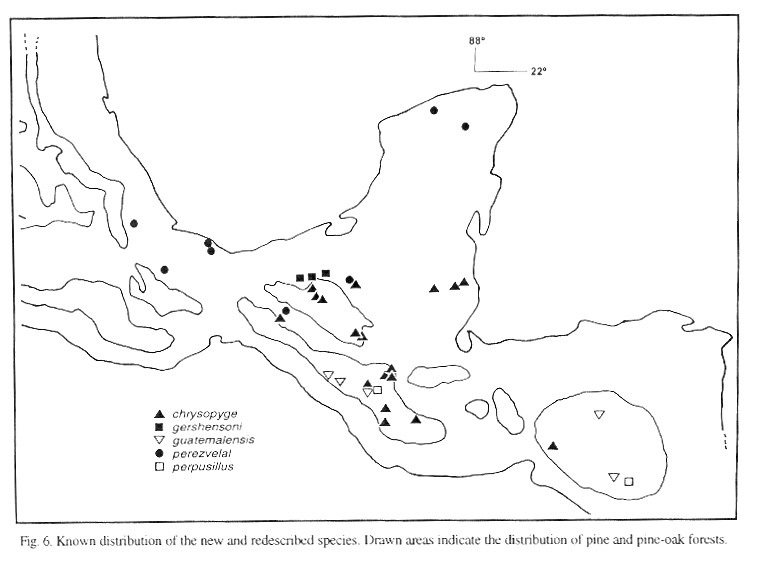
<body><![CDATA[<p><font face="Arial,Helvetica"><font size=-1>This work is an extension of the work originally done on North American <i>Ateuchus</i> (<a href="#Kohlmann84">Kohlmann 1984</a>). It describes three new species from the Mesoamerican area<i>.</i> The new <i>taxa</i> are: <i>A.</i> <i>gershensoni</i>, <i>A.</i> <i>perezvelai</i> and <i>A.</i> <i>perpusillus</i>. It also reports new country and distribution records for Mexico, Guatemala, Belize, Honduras and El Salvador.</font></font><font size=-1></font>     <p><font face="Arial,Helvetica"><font size=-1>This paper attempts also to partially update the knowledge of the North American <i>Ateuchus</i> fauna (<a href="#Kohlmann84">Kohlmann 1984</a>), by reporting the presence of four more species in Mexico (two new species, <i>A.</i> <i>gershensoni</i> and <i>A.</i> <i>perezvelai</i>; and two new country records, <i>A</i>. <i>chrysopyge </i>(<a href="#Bates">Bates</a>) and <i>A:</i> <i>guatemalensis </i>(<a href="#Bates">Bates</a>)) and thus increasing the number of previously known species from this country from eight to twelve. The paper also enlarges the distribution of previously recorded species in Mexico.</font></font><font size=-1></font>     <p><font face="Arial,Helvetica"><font size=-1>A redescription of <i>A.</i> <i>chrysopyge</i> and <i>A.</i> <i>guatemalensis</i> is also given. Since their original description by <a href="#Bates">Bates (1887)</a> no one had reported any information regarding any of the two species. Together with previous information from Costa Rica (<a href="#Kohlmann96">Kohlmann 1996-97</a>) and Panama (<a href="#Howden">Howden and Young 1981</a>), this paper is filling a knowledge gap of the Mesoamerican area, although Nicaragua still remains largely unknown.</font></font><font size=-1></font>     <p><font face="Arial,Helvetica"><font size=-1>Mesoamerican <i>Ateuchus</i> species closely resemble each other and many times it is very difficult to separate them solely on the ground of external morphology. Natural variation compounds this problem further. Without the aid of the analysis of the internal sac of the aedeagus, identification of many species would rest on shaky ground. It is therefore that the internal sacs of all species have to be studied and depicted, as is the case here with these previously unknown <i>taxa</i> and the redescribed ones.</font></font>     <br><font size=-1></font>&nbsp;<font size=-1></font>     <p><b><font face="Arial,Helvetica"><font size=-1>Materials and Methods</font></font></b><font size=-1></font>     <p><font face="Arial,Helvetica"><font size=-1>Specimens came from my personal collection, as well as from the H.F. Howden, Ottawa, Canada; M.A. Mor&oacute;n and C. Deloya, Instituto de Ecolog&iacute;a, Xalapa, M&eacute;xico and R. Cave, Escuela Agr&iacute;cola Panamericana, El Zamorano, Honduras.</font></font>     <br><font size=-1></font>&nbsp;     <br><font size=-1></font>&nbsp;     <br><font size=-1></font>     ]]></body>
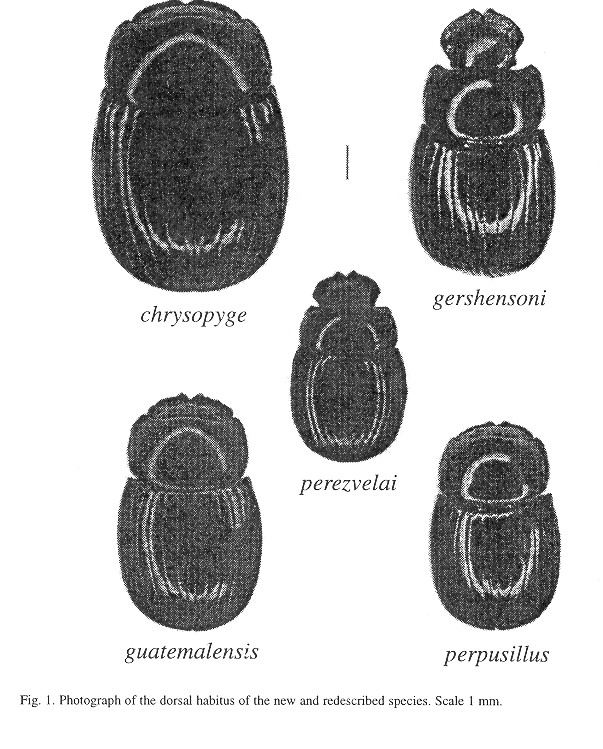
<body><![CDATA[<center>     <p><a NAME="Fig.1"></a><img SRC="/img/fbpe/rbt/v48n1/0471i1.JPG" height=749 width=603><font size=-1></font>     
<p>    <br><font size=-1></font><font size=-1></font>     <p><a NAME="Fig.2"></a><img SRC="/img/fbpe/rbt/v48n1/0471i2.JPG" height=951 width=724></center> <font size=-1></font>     
<p>    <br><font face="Arial,Helvetica"><font size=-1></font></font>     <p><font face="Arial,Helvetica"><font size=-1>The specimens were studied using a stereozoom binocular microscope. Measurements were made to the nearest 0.1 mm using an ocular micrometer. Genital dissections and preparations were done following the techniques described by <a href="#Zunino">Zunino (1978)</a>.</font></font><font size=-1></font>     <p><font face="Arial,Helvetica"><font size=-1>Types and paratypes of the new species are deposited at the Canadian Museum of Nature, Ottawa<i>.</i></font></font>     <br><font size=-1></font>&nbsp;<font size=-1></font>     ]]></body>
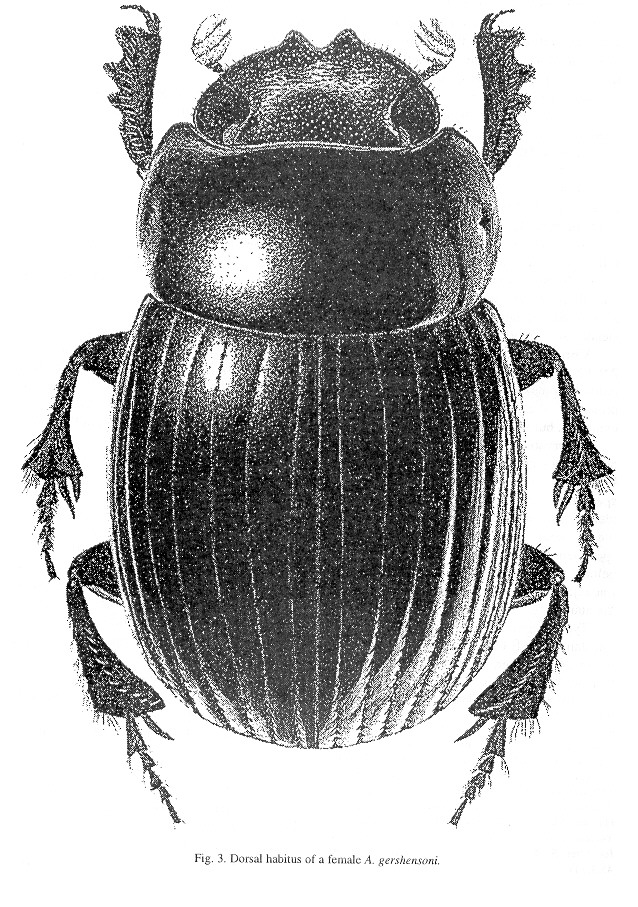
<body><![CDATA[<center>     <p><font face="Arial,Helvetica"><font size=-1>NEW SPECIES</font></font>     <br><font face="Arial,Helvetica"><font size=-1><i>Ateuchus</i> <i>gershensoni</i> n. sp.</font></font>     <br><font face="Arial,Helvetica"><font size=-1>Figs. 1-3, 6</font></font></center> <font size=-1></font>     <p><font face="Arial,Helvetica"><font size=-1>Description- HOLOTYPE. Male. Length 7.4 mm, greatest width 4.7 mm. Medium-sized, convex, oval-ovoid body shape (<a href="#Fig.1">Fig. 1</a>). Dorsally dark brown to black, head and pronotum with a reddish-greenish cast, ventral surface dark brown.</font></font><font size=-1></font>     <p><font face="Arial,Helvetica"><font size=-1>Clypeal margin anteriorly broadly V-shaped, clypeal margin laterally arcuate, clypeal border moderately punctate and wrinkled, frons and vertex feebly tumid and finely punctate, eyes dorsally small.</font></font><font size=-1></font>     <p><font face="Arial,Helvetica"><font size=-1>Anterior pronotal margin complete; midline weakly impressed at base, pronotal surface finely punctate, including the anterior angles. Proepisternum and proepimeron finely granular.</font></font><font size=-1></font>     <p><font face="Arial,Helvetica"><font size=-1>Elytral striae lightly impressed, distinctly so at apex, striae evidently punctate, crenating at apex, intervals feebly convex, surface smooth and finely punctate.</font></font><font size=-1></font>     <p><font face="Arial,Helvetica"><font size=-1>Pygidium almost flat, surface smooth and minutely punctate.</font></font><font size=-1></font>     <p><font face="Arial,Helvetica"><font size=-1>Foretibia with four teeth on outer margin, foretibial spur expanded into a slightly irregular oval shape. Foretibiae and forefemora long and slender. Forefemur smooth with very few coarse punctures at the posterior border. Last abdominal segment slender.</font></font><font size=-1></font>     ]]></body>
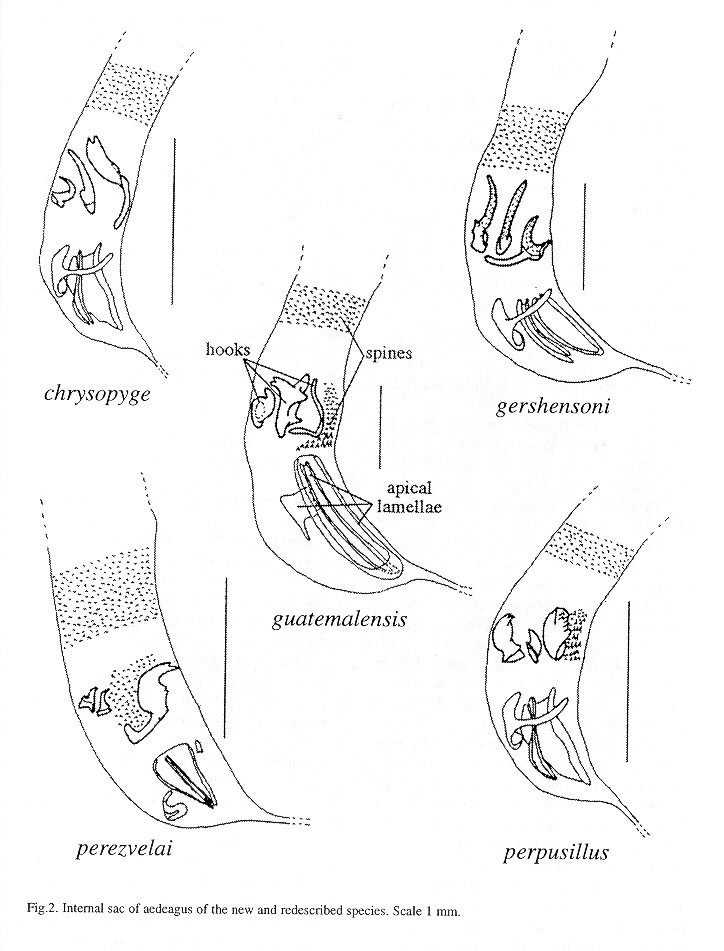
<body><![CDATA[<p><font face="Arial,Helvetica"><font size=-1>The internal sac of the aedeagus with three copulatory hooks (<a href="#Fig.2">Fig. 2</a>), more or less of the same size and spine-like. The apical lamellae are also three (<a href="#Fig.2">Fig. 2</a>).</font></font><font size=-1></font>     <p><font face="Arial,Helvetica"><font size=-1>Allotype- Female. Length 6.9 mm, greatest width 4.4 mm. Same as male, with the following sexual differences: clypeal margin anteriorly, not so broadly V-shaped (<a href="#Fig.3">Fig. 3</a>); lateral pronotal margin not arched; last abdominal segment broader; foretibial spur slender and slightly bent at tip (<a href="#Fig.3">Fig. 3</a>).</font></font><font size=-1></font>     <p><font face="Arial,Helvetica"><font size=-1>Variation: Length: 6.9-7.4 mm. Width: 4.4-4.7 mm. Some specimens do not show the reddish-greenish cast on the head and pronotum; sometimes the anterior margin is not so evident, although it does not become effaced; pronotal surface in some cases with some coarser punctures along the basal and anterior margins.</font></font><font size=-1></font>     <p><font face="Arial,Helvetica"><font size=-1>Type material-</font></font><font size=-1></font>     <p><font face="Arial,Helvetica"><font size=-1>Holotype. Male. Mexico: Chiapas: 20 mi N Bochil, 24/VIII/1971, 5600', A<i>.</i> Newton. Allotype. Female. Same data as holotype.</font></font><font size=-1></font>     <p><font face="Arial,Helvetica"><font size=-1>Parataypes. Mexico: Chiapas: Ocosingo, 6/IX/1947, 1200 m, zona monta&ntilde;osa, bosque primitivo, M. del Toro, (1 specimen); 6.6 mi W El Bosque, 25-29/VIII/1973, 4800', cloud forest, A<i>.</i> Newton, (1); Finca Trinidad, Mpio. El Bosque, 4/IX/1981, 1450 m, bosque mes&oacute;filo, P. Reyes, G. Quintero, J. Valenzuela, (1).</font></font><font size=-1></font>     <p><font face="Arial,Helvetica"><font size=-1>Etymology: This species is named after my good friend, Daniel Gershenson.</font></font><font size=-1></font>     <p><font face="Arial,Helvetica"><font size=-1>Chorology: The species is only known from the mountains of Chiapas at mid-elevations (<a href="#Fig.6">Fig. 6</a>).</font></font><font size=-1></font>     <p><font face="Arial,Helvetica"><font size=-1>Ecology: The species has been found in cloud forest only.</font></font>     <br><font size=-1></font>&nbsp;<font size=-1></font>     ]]></body>
<body><![CDATA[<center>     <p><font face="Arial,Helvetica"><font size=-1><i>Ateuchus&nbsp;</i> <i>perezvelai</i> n. sp.</font></font>     <br><font face="Arial,Helvetica"><font size=-1>Figs. 1, 2, 4, 6</font></font></center> <font size=-1></font>     <p><font face="Arial,Helvetica"><font size=-1><i>Ateuchus klugi </i>(Harold), <a href="#Kohlmann84">Kohlmann 1984</a> (in part).</font></font><font size=-1></font>     <p><font face="Arial,Helvetica"><font size=-1>Description- HOLOTYPE. Male. Length 5.5 mm, greatest width 3.5 mm. Small-sized, convex, oval-ovoid body shape (<a href="#Fig.1">Fig. 1</a>). Dorsally dark brown to black, head and pronotum sometimes with a very faint greenish cast, ventral surface dark brown.</font></font><font size=-1></font>     <p><font face="Arial,Helvetica"><font size=-1>Clypeal margin anteriorly broadly V-shaped, clypeal margin laterally arcuate, clypeal border moderately punctate and wrinkled, frons and vertex tumid and finely punctate, eyes dorsally small.</font></font><font size=-1></font>     <p><font face="Arial,Helvetica"><font size=-1>Anterior pronotal margin complete; midline completely effaced, pronotal surface finely punctate. Proepisternum and proepimeron finely granular.</font></font><font size=-1></font>     <p><font face="Arial,Helvetica"><font size=-1>Elytral striae very lightly impressed, somewhat more impressed at apex, striae lightly punctate, slightly crenating at apex; intervals feebly convex, surface smooth and very finely punctate. Pygidium lightly convex, surface smooth and minutely punctate.</font></font>     <br><font size=-1></font>&nbsp;     <br><font size=-1></font>&nbsp;     ]]></body>
<body><![CDATA[<br><font size=-1></font>     <center>     <p><a NAME="Fig.3"></a><img SRC="/img/fbpe/rbt/v48n1/0471i3.JPG" height=907 width=638></center> <font face="Arial,Helvetica"><font size=-1></font></font>     
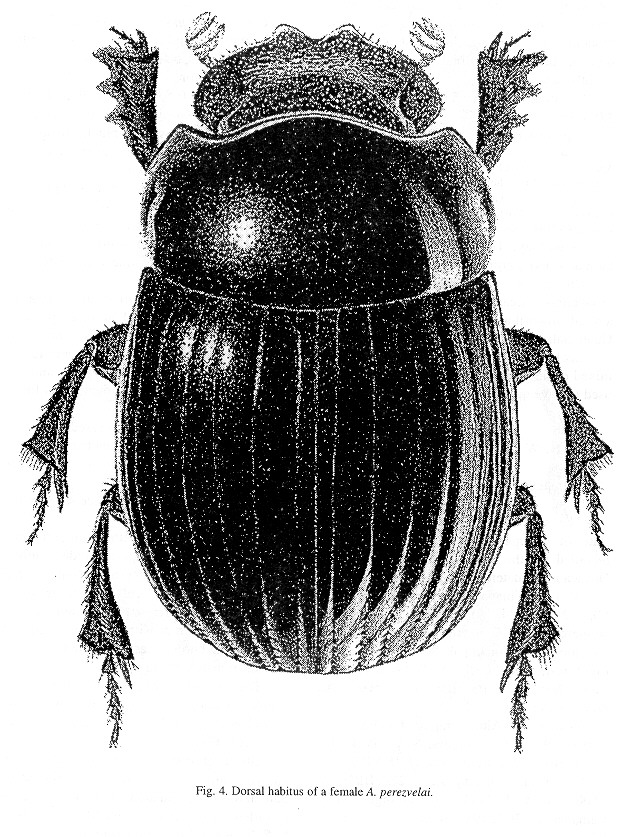
<p>    <br><font face="Arial,Helvetica"><font size=-1></font></font>     <br><font face="Arial,Helvetica"><font size=-1></font></font>     <p><font face="Arial,Helvetica"><font size=-1>Foretibia with four teeth on outer margin, foretibial spur expanded into a slightly irregular oval shape. Foretibiae and forefemora short and stout. Forefemur smooth with very few coarse punctures at apex. Last abdominal segment slender.</font></font><font size=-1></font>     <p><font face="Arial,Helvetica"><font size=-1>The internal sac of the aedeagus has three copulatory hooks (<a href="#Fig.2">Fig. 2</a>), one big and two smaller ones. The apical lamellae are also three (<a href="#Fig.2">Fig. 2</a>).</font></font><font size=-1></font>     <p><font face="Arial,Helvetica"><font size=-1>Allotype: Female. Length 5.5 mm, greatest width 3.5 mm. Same as male, with head and pronotal punctures more evident and a more convex pygidium and with the following sexual differences: clypeal margin anteriorly, not so broadly V-shaped (<a href="#Fig.4">Fig. 4</a>); lateral pronotal margin not arched; last abdominal segment broader; foretibial spur slender and slightly bent at tip (<a href="#Fig.4">Fig. 4</a>).</font></font><font size=-1></font>     <p><font face="Arial,Helvetica"><font size=-1>Variation: Length: 4.8-5.5 mm. Width: 2.9-3.5 mm. Some specimens do not show the reddish-greenish cast on the head and pronotum; the pronotal surface can be more evidently, but still finely punctate.</font></font><font size=-1></font>     ]]></body>
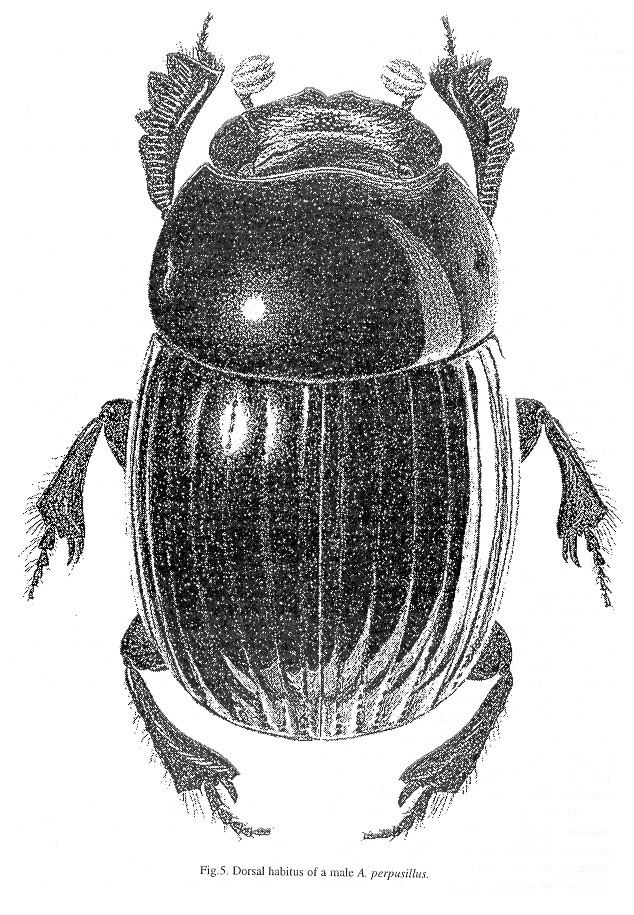
<body><![CDATA[<p><font face="Arial,Helvetica"><font size=-1>Observations: Some specimens of this new species appeared recorded as <i>A.</i> <i>klugi</i> in <a href="#Kohlmann84">Kohlmann (1984)</a>. These were female specimens which are always difficult to identify and which can be easily confused with the females of <i>A.</i> <i>klugi</i>. The following specimens cited as <i>klugi</i> in <a href="#Kohlmann84">Kohlmann (1984)</a> belong to this new species: El Suspiro and Lacanj&aacute;-Chansayab, Chiapas and Temax, Yucat&aacute;n.</font></font><font size=-1></font>     <p><font face="Arial,Helvetica"><font size=-1>Type material- Holotype. Male. Mexico: Yucat&aacute;n: 2 km E Chich&eacute;n-Itz&aacute;, 20/V/1983, 20 m, seas. for. litter, S. &amp; J. Peck. Allotype. Female. Same data as holotype.</font></font><font size=-1></font>     <p><font face="Arial,Helvetica"><font size=-1>Paratypes. Mexico: Chiapas: El Suspiro, 12 km NW de Berrioz&aacute;bal, 1000 m, 2/XI/1974, selva tropical h&uacute;meda, cebo pescado, J. Mateu, (1), Lacanj&aacute;-Chansayab, 25/I/1977, 300 m, selva tropical, P. Reyes, (1), Oaxaca: 9 mi N Valle Nacional, 100', 1/VIII/1971, A<i>.</i> Newton, (2); Veracruz: Lake Catemaco, 1200', 31/VII-4/VIII/1970, A<i>.</i> Newton, (1), 8 mi NW Sontecomapan, 500', 31/VII-4/VIII/1970, A<i>.</i> Newton, (1), R&iacute;o Metlac, 3200', 1/VIII/1973, A<i>.</i> Newton, (1); Yucat&aacute;n: 2 km E Chich&eacute;n-Itz&aacute;, 20/V/1983, 20 m, seas. for. litter, S. &amp; J. Peck, (3); Temax, Gaumer, B.C.A<i>.</i> 45.3, (1).</font></font><font size=-1></font>     <p><font face="Arial,Helvetica"><font size=-1>Etymology: This species is named after my good friend Juan Antonio P&eacute;rez-Vela<i>.</i></font></font><font size=-1></font>     <p><font face="Arial,Helvetica"><font size=-1>Chorology: The species seems to be distributed in south-east Mexico at low and mid-altitudes (<a href="#Fig.6">Fig. 6</a>).</font></font><font size=-1></font>     <p><font face="Arial,Helvetica"><font size=-1>Ecology: The species has been found in tropical evergreen and tropical deciduous forest as well.</font></font>     <br><font size=-1></font>&nbsp;<font size=-1></font>     <center>     <p><font face="Arial,Helvetica"><font size=-1><i>Ateuchus&nbsp;</i> <i>perpusillus</i> n. sp.</font></font></center> <font size=-1></font>     <p><font face="Arial,Helvetica"><font size=-1>Description- HOLOTYPE. Male. Length 6.4 mm, greatest width 3.0 mm. Small-sized, convex, oval-ovoid body shape (<a href="#Fig.1">Fig. 1</a>). Dorsally dark brown to black, head and pronotum with a very evident reddish-coppery cast (<a href="#Fig.5">Fig. 5</a>), ventral surface dark brown.</font></font><font size=-1></font>     ]]></body>
<body><![CDATA[<p><font face="Arial,Helvetica"><font size=-1>Clypeal margin anteriorly broadly V-shaped (<a href="#Fig.5">Fig. 5</a>), clypeal margin laterally arcuate, clypeal border moderately punctate and wrinkled, frons and vertex slightly tumid and finely to moderately punctate, eyes dorsally small.</font></font><font size=-1></font>     <p><font face="Arial,Helvetica"><font size=-1>Anterior pronotal margin incomplete; midline only evident at base, pronotal surface finely punctate, a few coarse punctures present at anterior angles and basal margin. Proepisternum and proepimeron finely granular.</font></font><font size=-1></font>     <p><font face="Arial,Helvetica"><font size=-1>Elytral striae very lightly impressed, somewhat more impressed at apex, striae lightly punctate, slightly crenating at apex; intervals feebly convex, surface smooth and very finely punctate. Pygidium protruding pyramidally, surface smooth and minutely punctate.</font></font><font size=-1></font>     <p><font face="Arial,Helvetica"><font size=-1>Foretibia with three teeth on outer margin, foretibial spur expanded into a slightly irregular oval shape. Foretibiae and forefemora short and stout. Forefemur smooth with very few coarse punctures at apex. Last abdominal segment slender.</font></font><font size=-1></font>     <p><font face="Arial,Helvetica"><font size=-1>The internal sac of the aedeagus has three small copulatory hooks (<a href="#Fig.2">Fig. 2</a>). The apical lamellae are also three (<a href="#Fig.2">Fig. 2</a>).</font></font>     <br><font size=-1></font>&nbsp;     <br><font size=-1></font>&nbsp;     <br><font size=-1></font>     <center>     <p><a NAME="Fig.4"></a><img SRC="/img/fbpe/rbt/v48n1/0471i4.JPG" height=837 width=634></center> <font face="Arial,Helvetica"><font size=-1></font></font>     
]]></body>
<body><![CDATA[<p>    <br><font face="Arial,Helvetica"><font size=-1></font></font>     <br><font face="Arial,Helvetica"><font size=-1></font></font>     <p><font face="Arial,Helvetica"><font size=-1>Allotype. Female. Length 6.4 mm, greatest width 3.5 mm. Same as male, with head and pronotal punctures more evident and a less protruding pygidium and with the following sexual differences: clypeal margin anteriorly, not so broadly V-shaped; lateral pronotal margin not arched; last abdominal segment broader; foretibial spur slender and slightly bent at tip.</font></font><font size=-1></font>     <p><font face="Arial,Helvetica"><font size=-1>Variation: Length: 5.0-5.5 mm. Width: 3.0-3.5 mm.</font></font><font size=-1></font>     <p><font face="Arial,Helvetica"><font size=-1>Type material-</font></font><font size=-1></font>     <p><font face="Arial,Helvetica"><font size=-1>Holotype. Male. Honduras: El Para&iacute;so: Cerro Apagius, Danl&iacute;, 28/II/1988, 900 m, R.D. Cave. Allotype. Female. Same data as holotype.</font></font><font size=-1></font>     <p><font face="Arial,Helvetica"><font size=-1>Paratypes. Guatemala: Guatemala: Zapote, Champion, (2). Honduras: El Para&iacute;so: Cerro Apagius, Danl&iacute;, 28/II/1988, 900 m, R.D. Cave, (1)<i>.</i></font></font><font size=-1></font>     <p><font face="Arial,Helvetica"><font size=-1>Etymology: The name derives from the latin adjective <i>perpusillus</i>, meaning small.</font></font><font size=-1></font>     <p><font face="Arial,Helvetica"><font size=-1>Chorology: The species is found in mountainous areas (<a href="#Fig.6">Fig. 6</a>). Zapote used to be a small town that has now been engulfed by Guatemala-City.</font></font><font size=-1></font>     ]]></body>
<body><![CDATA[<p><font face="Arial,Helvetica"><font size=-1>Ecology: The species has been found in mixed-deciduous forest in Honduras; Zapote used to have oaks and pine-oak forests.</font></font>     <br><font size=-1></font>&nbsp;<font size=-1></font>     <center>     <p><font face="Arial,Helvetica"><font size=-1>NEW COUNTRY RECORDS</font></font>     <br><font face="Arial,Helvetica"><font size=-1><i>Ateuchus</i> <i>candezei</i> (Harold), 1868</font></font></center> <font size=-1></font>     <p><font face="Arial,Helvetica"><font size=-1>The species was only known from the state of Chiapas, Mexico; it is now here recorded for the first time from the state of Oaxaca and Guatemala and Belize as well.</font></font><font size=-1></font>     <p><font face="Arial,Helvetica"><font size=-1>Mexico: Chiapas: Boca de Chajul, NTP-80, 28/V/1984, 110 m, selva alta subperennifolia, necrotrampa, Fragoso-Villalobos, (2); Bonampak, 8/VII/1983, 230 m, rain forest, S. &amp; J. Peck, (1); Oaxaca: 4.5 mi S Valle Nacional, 16/VIII/1973, 1600', A<i>.</i> Newton, (1).</font></font><font size=-1></font>     <p><font face="Arial,Helvetica"><font size=-1>Guatemala: Alta Verapaz: Lanqu&iacute;n, 28-30/VIII/1969, 1000', trop. for., S. &amp; J. Peck, (1).</font></font><font size=-1></font>     <p><font face="Arial,Helvetica"><font size=-1>Belize: Cayo: Belmopan, 11-16/VIII/1972 S. &amp; J. Peck, (4); Augustine, 20/VIII/1972, 1500', S. &amp; J. Peck, (1); Orange Walk: Lamanai, 22-26/II/1989, dung traps at camp, Glen Kit, (6).</font></font>     <br><font size=-1></font>&nbsp;<font size=-1></font>     ]]></body>
<body><![CDATA[<center>     <p><font face="Arial,Helvetica"><font size=-1><i>Ateuchus</i> <i>chrysopyge</i> (Bates), 1887</font></font>     <br><font face="Arial,Helvetica"><font size=-1>Figs. 1, 2, 6</font></font></center> <font size=-1></font>     <p><font face="Arial,Helvetica"><font size=-1><i>Choeridium chrysopyge</i> Bates, 1887. p. 44.</font></font><font size=-1></font>     <p><font face="Arial,Helvetica"><font size=-1>Lectotypes and paralectotypes: London and Paris. Paris specimens examined.</font></font><font size=-1></font>     <p><font face="Arial,Helvetica"><font size=-1>Redescription. Length 7.0-8.5 mm, greatest width 4.0-5.0 mm. Medium to big-sized, convex, oval-ovoid body shape (<a href="#Fig.1">Fig. 1</a>). Dorsally dark brown to black, head and pronotum sometimes with a reddish cast, ventral surface dark brown.</font></font><font size=-1></font>     <p><font face="Arial,Helvetica"><font size=-1>Clypeal margin anteriorly broadly (male,) to moderately (female) V-shaped, clypeal margin laterally arcuate, clypeal border moderately punctate and wrinkled, frons and vertex feebly tumid and finely punctate, eyes dorsally small.</font></font><font size=-1></font>     <p><font face="Arial,Helvetica"><font size=-1>Anterior pronotal margin complete, midline weakly impressed at base, pronotal surface smooth, in some cases with some coarser punctures along the basal and lateral margins, including the basal and anterior angles. Proepisternum and proepimeron finely granular.</font></font><font size=-1></font>     <p><font face="Arial,Helvetica"><font size=-1>Elytral striae lightly impressed, distinctly so at apex, striae evidently punctate, crenating at apex, intervals feebly convex, surface smooth and finely punctate.</font></font><font size=-1></font>     <p><font face="Arial,Helvetica"><font size=-1>Pygidium almost flat, surface smooth and minutely punctate.</font></font><font size=-1></font>     ]]></body>
<body><![CDATA[<p><font face="Arial,Helvetica"><font size=-1>Foretibia with four teeth on outer margin, foretibial spur of males expanded into a slightly irregular oval shape, female spur slender and slightly bent near acute apex. Foretibiae and forefemora longer and slender in males. Forefemur with coarse punctures at the posterior border. Last abdominal segment slender in males, broad in females.</font></font><font size=-1></font>     <p><font face="Arial,Helvetica"><font size=-1>The internal sac of the aedeagus has three copulatory hooks, one bigger, two smaller and very claw-like (<a href="#Fig.2">Fig. 2</a>). The apical lamellae are also three (<a href="#Fig.2">Fig. 2</a>).</font></font><font size=-1></font>     <p><font face="Arial,Helvetica"><font size=-1>Observations: The species was only known from San Ger&oacute;nimo (<i>sic</i>, it should be San Jer&oacute;nimo), Guatemala, and it is now recorded for the first time for Mexico, Belize, El Salvador and Honduras (<a href="#Fig.6">Fig. 6</a>).</font></font>     <br><font face="Arial,Helvetica"><font size=-1></font></font>&nbsp;     <br><font face="Arial,Helvetica"><font size=-1></font></font>&nbsp;     <br><font size=-1></font>     <center>     <p><a NAME="Fig.5"></a><img SRC="/img/fbpe/rbt/v48n1/0471i5.JPG" height=915 width=634></center> <font face="Arial,Helvetica"><font size=-1></font></font>     
<p>    <br><font face="Arial,Helvetica"><font size=-1></font></font>     ]]></body>
<body><![CDATA[<br><font face="Arial,Helvetica"><font size=-1></font></font>     <p><font face="Arial,Helvetica"><font size=-1>Material examined-</font></font><font size=-1></font>     <p><font face="Arial,Helvetica"><font size=-1>M&eacute;xico: Chiapas: Montebello, VI/1967, excr. vaca dentro de bosque, G. Halffter, (2); ibid, 14-17/VIII/1969, 4500', tropical montane forest, S. &amp; J. Peck, (1); Comit&aacute;n, 20/IX/1987, F. Arias, (4); Lacanj&aacute;-Chansayab, 23/VII/1977, 220 m, selva tropical, excr. humano, B. Kohlmann, (1); 12 mi E San Crist&oacute;bal de las Casas, 3/V/1969, H.F. Howden, (5); 9 mi SE Teopisca, Rt. 24, 3/VI/1969, H.F. Howden, (2); Laguna B&eacute;lgica, 16 km NW Ocozocoautla, 13/VI/1990, 970 m, H. &amp; A<i>.</i> Howden, (4); 10 mi E Teopisca, 11-12/V/1969, H.F. Howden, (1); Lagos de Colores, Rt. 17, 1/VI/1969, H. Howden, (2).</font></font><font size=-1></font>     <p><font face="Arial,Helvetica"><font size=-1>Belize: Cayo: Caves Branch, 23-28/VIII/1972, S. &amp; J. Peck, (1); 6 mi S Belmopan, 20/VIII/1972, litter-carrion, S. &amp; J. Peck, (1); Augustine, 1-20/VIII/1972, 1500', S. &amp; J. Peck, (1).</font></font><font size=-1></font>     <p><font face="Arial,Helvetica"><font size=-1>Guatemala: Baja Verapaz: 8 km S Purulh&aacute;, 27/V/1991, 1500 m, H. &amp; A<i>.</i> Howden, (3); 7 km NE Purulh&aacute;, 1/VI/1991, 1500 m, H. &amp; A<i>.</i> Howden, (1); 8.6 km W Chilasc&oacute;, 28/V/1991, 1560 m, H. &amp; A<i>.</i> Howden, (2); San Ger&oacute;nimo (<i>sic</i>, it should be San Jer&oacute;nimo), Champion, (2); Chiquimula: Fca<i>.</i> San Jos&eacute;, 9/VIII/1991, 1385 m, J. Monz&oacute;n, (1); Guatemala: Guatemala, 12/X/1988, trampa pitfall, R. P&eacute;rez, (1), S. J. Pinula, 28/VIII/1984, J. Melgar, (2); Pet&eacute;n: Tikal, 23-26/VIII/1972, dung trap, S. &amp; J. Peck, (1); Progreso: Cerro Pinal&oacute;n, Los Albores, 7/VIII/1990, 1350 m, E. Ordocia, (1).</font></font><font size=-1></font>     <p><font face="Arial,Helvetica"><font size=-1>El Salvador: Santa Ana: Monte Cristo23 km N Metapan, 8-10/V/1971, 2300 m, H.F. Howden, (6).</font></font><font size=-1></font>     <p><font face="Arial,Helvetica"><font size=-1>Honduras: La Paz: Mercedes, R.D. Cave, (1).</font></font>     <br><font size=-1></font>&nbsp;<font size=-1></font>     <center>     <p><font face="Arial,Helvetica"><font size=-1><i>Ateuchus</i> <i>guatemalensis</i> (Bates), 1887</font></font>     ]]></body>
<body><![CDATA[<br><font face="Arial,Helvetica"><font size=-1>Figs. 1, 2, 6</font></font></center> <font size=-1></font>     <p><font face="Arial,Helvetica"><font size=-1><i>Choeridium guatemalense</i> Bates, 1887, p. 45.</font></font><font size=-1></font>     <p><font face="Arial,Helvetica"><font size=-1>Lectotypes and paralectotypes: London and Paris. Paris specimens examined.</font></font><font size=-1></font>     <p><font face="Arial,Helvetica"><font size=-1>Redescription. Length 5.2-6.7 mm, greatest width 3.9-4.2 mm. Small, convex, oval-ovoid body shape (<a href="#Fig.1">Fig. 1</a>). Dorsally dark brown to black, head and pronotum with golden-green cast, ventral surface dark brown.</font></font><font size=-1></font>     <p><font face="Arial,Helvetica"><font size=-1>Clypeal margin anteriorly broadly (male) to moderately (female) V-shaped, clypeal margin laterally arcuale, clypeal border moderately punctate and wrinkled, frons and vertex feebly tumid and finely punctate, eyes dorsally small.</font></font><font size=-1></font>     <p><font face="Arial,Helvetica"><font size=-1>Anterior pronotal margin almost effaced, midline weakly impressed at base, pronotal surface moderately to evidently punctate, females tend to have a coarser punctation. Proepisternum and proepimeron finely granular.</font></font><font size=-1></font>     <p><font face="Arial,Helvetica"><font size=-1>Elytral striae lightly impressed, distinctly so at apex, striae evidently punctate, crenating at apex, intervals feebly convex, surface smooth and finely punctate.</font></font><font size=-1></font>     <p><font face="Arial,Helvetica"><font size=-1>Pygidium very big and convex, surface smooth and minutely punctate.</font></font><font size=-1></font>     <p><font face="Arial,Helvetica"><font size=-1>Foretibia with four teeth on outer margin, foretibial spur of males expanded into a slightly irregular oval shape, female spur slender and slightly bent near acute apex. Foretibiae and forefemora longer and slender in males. Forefemur with some coarse punctures apically and at the posterior border. Last abdominal segment slender in males, broad in females.</font></font><font size=-1></font>     <p><font face="Arial,Helvetica"><font size=-1>The internal sac of the aedeagus has three copulatory hooks. One of them is very peculiar in the form of a long and slender filament (<a href="#Fig.2">Fig. 2</a>). The apical lamellae are also three, one of them has a distinct canoe shape (<a href="#Fig.2">Fig. 2</a>).</font></font><font size=-1></font>     ]]></body>
<body><![CDATA[<p><font face="Arial,Helvetica"><font size=-1>Observations: The species was only known from El Tumbador (<i>sic</i>, it should be El Zumbador), Volc&aacute;n Atitl&aacute;n and Pantale&oacute;n, Guatemala and it is now recorded for the first time for Mexico and Honduras too (<a href="#Fig.6">Fig. 6</a>).</font></font><font size=-1></font>     <p><font face="Arial,Helvetica"><font size=-1>Material examined-</font></font><font size=-1></font>     <p><font face="Arial,Helvetica"><font size=-1>Mexico: Chiapas: Uni&oacute;n Ju&aacute;rez, 29/VI-1-2/VII/1972, ca<i>.</i> 3000', coffee finca, U.V light &amp; litter, P.A<i>.</i> Meyer &amp; G. Ball, (2).</font></font><font size=-1></font>     <p><font face="Arial,Helvetica"><font size=-1>Guatemala: Guatemala: Villanueva, Fca<i>.</i> Para&iacute;so, 9/III/1991, Macuana, (1); San Marcos: El Tumbador (<i>sic</i>, it should be El Zumbador), 2500', Champion, (2).</font></font><font size=-1></font>     <p><font face="Arial,Helvetica"><font size=-1>Honduras: El Para&iacute;so: Yuscar&aacute;n, 1850 m, R.D. Cave, cloud forest, (5), Olancho: La Uni&oacute;n, La Muralla, 1450 m, rainforest dominated by oaks, laurels and liquidambar, R.D. Cave, (5).</font></font><font size=-1></font>     <p><font face="Arial,Helvetica"><font size=-1>Remarks. <a href="#Howden">Howden and Young (1981)</a> cited an <i>A.</i> (near?) <i>guatemalensis</i> in their work on Panamanian Scarabaeinae. Those specimens actually represented a new species, which was later described under the name of <i>A.</i> <i>howdeni </i>(<a href="#Kohlmann96">Kohlmann 1996-1997</a>).</font></font>     <br><font size=-1></font>&nbsp;<font size=-1></font>     <center>     <p><font face="Arial,Helvetica"><font size=-1><i>Ateuchus</i> <i>laetitiae</i> Kohlmann, 1981</font></font></center> <font size=-1></font>     <p><font face="Arial,Helvetica"><font size=-1>This species was only known from the typical locality in Chiapas, its distribution has now been greatly expanded with the knowledge of its presence in the Mexican state of Campeche and in neighbouring Belize. The records are as follows:</font></font>     ]]></body>
<body><![CDATA[<br><font size=-1></font>&nbsp;<font size=-1></font>     <center>     <p><a NAME="Fig.6"></a><img SRC="/img/fbpe/rbt/v48n1/0471i6.JPG" height=582 width=769></center> <font face="Arial,Helvetica"><font size=-1></font></font>     
<p>    <br><font face="Arial,Helvetica"><font size=-1></font></font>     <br><font face="Arial,Helvetica"><font size=-1></font></font>     <p><font face="Arial,Helvetica"><font size=-1>Mexico: Campeche: Chicanna, 10 km W Xpujil, 12-14/VII/1983, 300 m, trop. seas. For. car. tps. S. &amp; J. Peck, (1); Esc&aacute;rcega, 6 km W El Tormento, 23/VII/1983, evergreen trop. forest, fungi &amp; litter Ber., S. &amp; J. Peck, (2).</font></font><font size=-1></font>     <p><font face="Arial,Helvetica"><font size=-1>Belize: Orange Walk: Lamanai, 22-26/II/1980, palm forest trail, Glen Kit, (1).</font></font>     <br><font size=-1></font>&nbsp;<font size=-1></font>     <center>     ]]></body>
<body><![CDATA[<p><font face="Arial,Helvetica"><font size=-1>NEW DISTRIBUTION RECORDS</font></font>     <br><font face="Arial,Helvetica"><font size=-1><i>Ateuchus</i> <i>carolinae</i> Kohlmann, 1981</font></font></center> <font size=-1></font>     <p><font face="Arial,Helvetica"><font size=-1>This is the second known locality for this species in the state of Jalisco.</font></font><font size=-1></font>     <p><font face="Arial,Helvetica"><font size=-1>Mexico: Jalisco: 9 mi NW Barra de Navidad, 17/IX/1971, 700&acute;, A<i>.</i> Newton, (1).</font></font>     <br><font size=-1></font>&nbsp;<font size=-1></font>     <center>     <p><font face="Arial,Helvetica"><font size=-1><i>Ateuchus</i> <i>halffteri </i>Kohlmann, 1981</font></font></center> <font size=-1></font>     <p><font face="Arial,Helvetica"><font size=-1>The species was previously known from the states of Guerrero and Morelos, it has now been found in the state of Puebla as well.</font></font><font size=-1></font>     <p><font face="Arial,Helvetica"><font size=-1>Mexico: Puebla: Tepexco (near Iz&uacute;car de Matamoros), NTP-80, 7-25/V-VI/1989, A<i>.</i>C. Deloya, (43); Guerrero: Acahuizotla, VI-VII/1989, 650 m, NTP-80, bosque tropical mediano subperennifolio, L. Delgado, (37).</font></font>     <br><font size=-1></font>&nbsp;<font size=-1></font>     ]]></body>
<body><![CDATA[<center>     <p><font face="Arial,Helvetica"><font size=-1><i>Ateuchus&nbsp;</i> <i>illaesum </i>(Harold), 1868</font></font></center> <font size=-1></font>     <p><font face="Arial,Helvetica"><font size=-1>The species was previously recorded from the states of Chiapas, Hidalgo, Quer&eacute;taro, San Luis Potos&iacute; and Veracruz in Mexico. There is a new state record for this species from Tamaulipas:</font></font><font size=-1></font>     <p><font face="Arial,Helvetica"><font size=-1>Mexico: Tamaulipas: Rancho El Cielo, G&oacute;mez Far&iacute;as, 1-4/VII/1969, 3700', cloud forest, S. &amp; J. Peck, (8).</font></font>     <br><font size=-1></font>&nbsp;<font size=-1></font>     <center>     <p><font face="Arial,Helvetica"><font size=-1><i>Ateuchus</i> <i>rodriguezi</i> (Preudhomme de Borre), 1886</font></font></center> <font size=-1></font>     <p><font face="Arial,Helvetica"><font size=-1>Although this species was originally described from Guatemala, no precise location was given at the time. Here we give the first detailed localities for this country.</font></font><font size=-1></font>     <p><font face="Arial,Helvetica"><font size=-1>Guatemala: Escuintla: Finca Sta<i>.</i> Cecilia, 29/III/1991, M.E. Gonz&aacute;lez, (1); Guatemala: Sta<i>.</i> Catalina Pinula, Punta Parada, 20/II/1991, P. Broll, (1).</font></font>     <br><font size=-1></font>&nbsp;<font size=-1></font>     ]]></body>
<body><![CDATA[<center>     <p><font face="Arial,Helvetica"><font size=-1><i>Ateuchus texanus </i>(Robinson), 1948</font></font></center> <font size=-1></font>     <p><font face="Arial,Helvetica"><font size=-1>The species is known from Texas, Tamaulipas, Nuevo Le&oacute;n, Veracruz and San Luis Potos&iacute;. It is now recorded for the first time from the state of Quer&eacute;taro.</font></font><font size=-1></font>     <p><font face="Arial,Helvetica"><font size=-1>Mexico: Quer&eacute;taro: 20 mi W Xilitla, Rt. 120, 10-11/VI/1971, 5300', H. Howden, (6).</font></font>     <br><font size=-1></font>&nbsp;<font size=-1></font>     <p><b><font face="Arial,Helvetica"><font size=-1>Final Remarks</font></font></b><font size=-1></font>     <p><font face="Arial,Helvetica"><font size=-1>From the scanty evidence of <i>Ateuchus</i> distribution in Mesoamerica, there seem to emerge certain patterns. A mountainous orofauna (a fauna developed in the area and representing its history) seems to occupy an area starting from southern Nicaragua to Costa Rica and Panama, with as yet not a precisely known southern limit (<a href="#Kohlmann96">Kohlmann 1996-97</a>). Another mountainous orofauna seems to be distributed from northern Nicaragua to Chiapas (<i>A.</i> <i>chrysopyge</i>, <i>A.</i> <i>gershensoni</i>, <i>A.</i> <i>guatemalensis</i>, <i>A.</i> <i>perpusillus</i>). The dry Pacific forests would represent another orofauna (<i>A.</i> <i>rodriguezi</i>). Wet Atlantic and Pacific forests have also their orofauna (<i>A</i>. howdeni, <i>A.</i> <i>laetitiae</i>, <i>A.</i> <i>perezvelai</i>), plus elements representing Amazonian invasions (<i>A.</i> <i>aeneomicans,</i> <i>A.candezei</i>). However, more information is still needed in order to clarify this situation.</font></font>     <br><font size=-1></font>&nbsp;<font size=-1></font>     <p><b><font face="Arial,Helvetica"><font size=-1>Acknowledgements</font></font></b><font size=-1></font>     <p><font face="Arial,Helvetica"><font size=-1>I thank especially A<i>.</i> Sol&iacute;s for his help in the electronic composition of figures. I also thank H.F. Howden (Ottawa, Canada), M.A. Mor&oacute;n and Cuauht&eacute;moc Deloya (Instituto de Ecolog&iacute;a, Xalapa, M&eacute;xico) and R. Cave (Escuela Agr&iacute;cola Panamericana, El Zamorano, Honduras) for lending me their <i>Ateuchus</i> material. I am also grateful to Y. Cambefort for lending me type material. I am especially indebted to C. Arag&oacute;n for the beautiful habitus drawings.</font></font><font size=-1></font>     ]]></body>
<body><![CDATA[<p><font face="Arial,Helvetica"><font size=-1>Last but not least, I am indebted to the Escuela de Agricultura de la Regi&oacute;n Tropical H&uacute;meda for its support during this study.</font></font>     <br><font size=-1></font>&nbsp;<font size=-1></font>     <p><b><font face="Arial,Helvetica"><font size=-1>Resumen</font></font></b><font size=-1></font>     <p><font face="Arial,Helvetica"><font size=-1>Este trabajo describe tres nuevas especies de <i>Ateuchus</i> para Mesoam&eacute;rica<i>.</i> Los nuevos <i>taxa</i> son: <i>A.</i> <i>gershensoni</i>, <i>A.</i> <i>perezvelai</i> y <i>A.perpusillus</i> del sur de M&eacute;xico, Guatemala y Honduras. Se incluyen redescripciones de <i>A.</i> <i>chrysopyge</i> (Bates) y <i>A.guatemalensis</i> (Bates). Se citan nuevos registros de pa&iacute;ses y de distribuci&oacute;n para M&eacute;xico, Guatemala, Belice, Honduras y El Salvador. Se incluyen mapas, ilustraciones del saco interno del edeago y fotograf&iacute;as del h&aacute;bito dorsal, as&iacute; como ilustraciones del h&aacute;bito dorsal de las tres nuevas especies. Este estudio representa una extensi&oacute;n del trabajo originalmente realizado para los <i>Ateuchus</i> de Norteam&eacute;rica (<a href="#Kohlmann84">Kohlmann 1984</a>). El trabajo clarifica la situaci&oacute;n del g&eacute;nero en Mesoam&eacute;rica. Tambi&eacute;n actualiza el conocimiento del grupo para M&eacute;xico al reportar la presencia de cuatro especies m&aacute;s (dos nuevas, <i>gershensoni</i> y <i>perezvelai</i>; y dos nuevos registros para el pa&iacute;s, <i>chrysopyge</i> y <i>guatemalensis</i>) y as&iacute; incrementar el n&uacute;mero de especies conocidas de ocho a doce.</font></font>     <br><font size=-1></font>&nbsp;<font size=-1></font>     <p><b><font face="Arial,Helvetica"><font size=-1>References</font></font></b><font size=-1></font>     <!-- ref --><p><a NAME="Bates"></a><font face="Arial,Helvetica"><font size=-1>Bates, H.W. 1887. Pectinicornia and Lamellicornia<i>.</i> In: Biologia Centrali-Americana<i>.</i> Zoologia<i>.</i> Insecta<i>.</i> Coleoptera<i>.</i> Vol. 2, Part 2. 432 p.</font></font><font size=-1></font>    &nbsp;&nbsp;&nbsp;&nbsp;&nbsp;&nbsp;&nbsp;&nbsp;[&#160;<a href="javascript:void(0);" onclick="javascript: window.open('/scielo.php?script=sci_nlinks&ref=1197791&pid=S0034-7744200000010002700001&lng=','','width=640,height=500,resizable=yes,scrollbars=1,menubar=yes,');">Links</a>&#160;]<!-- end-ref --><!-- ref --><p><a NAME="Howden"></a><font face="Arial,Helvetica"><font size=-1>Howden, H.F. &amp; O.P. Young. 1981. Panamanian Scarabaeinae: Taxonomy, distribution, and habits (Coleoptera, Scarabaeidae). Contr. Am. Ent. Inst. 18: 1-204.</font></font><font size=-1></font>    &nbsp;&nbsp;&nbsp;&nbsp;&nbsp;&nbsp;&nbsp;&nbsp;[&#160;<a href="javascript:void(0);" onclick="javascript: window.open('/scielo.php?script=sci_nlinks&ref=1197792&pid=S0034-7744200000010002700002&lng=','','width=640,height=500,resizable=yes,scrollbars=1,menubar=yes,');">Links</a>&#160;]<!-- end-ref --><!-- ref --><p><a NAME="Kohlmann84"></a><font face="Arial,Helvetica"><font size=-1>Kohlmann, B. 1984. Biosistem&aacute;tica de las especies norteamericanas del g&eacute;nero <i>Ateuchus</i> (Coleoptera: Scarabaeidae: Scarabaeinae). (Published: 15 February, 1985). Folia Ent. Mex. 60: 3-81.</font></font><font size=-1></font>    &nbsp;&nbsp;&nbsp;&nbsp;&nbsp;&nbsp;&nbsp;&nbsp;[&#160;<a href="javascript:void(0);" onclick="javascript: window.open('/scielo.php?script=sci_nlinks&ref=1197793&pid=S0034-7744200000010002700003&lng=','','width=640,height=500,resizable=yes,scrollbars=1,menubar=yes,');">Links</a>&#160;]<!-- end-ref --><!-- ref --><p><a NAME="Kohlmann96"></a><font face="Arial,Helvetica"><font size=-1>Kohlmann, B. 1996-1997. The Costa Rican species of <i>Ateuchus</i> (Coleoptera: Scarabaeidae). Rev. Biol. Trop. 44(3)/45(1): 177-192.</font></font><font size=-1></font>    &nbsp;&nbsp;&nbsp;&nbsp;&nbsp;&nbsp;&nbsp;&nbsp;[&#160;<a href="javascript:void(0);" onclick="javascript: window.open('/scielo.php?script=sci_nlinks&ref=1197794&pid=S0034-7744200000010002700004&lng=','','width=640,height=500,resizable=yes,scrollbars=1,menubar=yes,');">Links</a>&#160;]<!-- end-ref --><!-- ref --><p><a NAME="Zunino"></a><font face="Arial,Helvetica"><font size=-1>Zunino, M. 1978. L’armatura genitale negli Onthophagini: Tecniche di preparazione e criteri di studio. L’informatore del Giovane Entomologo. (supl.) Boll. Mus. Zool. Univ. Torino 90: 1-5.</font></font><font face="Arial,Helvetica"><font size=-1></font></font>    &nbsp;&nbsp;&nbsp;&nbsp;&nbsp;&nbsp;&nbsp;&nbsp;[&#160;<a href="javascript:void(0);" onclick="javascript: window.open('/scielo.php?script=sci_nlinks&ref=1197795&pid=S0034-7744200000010002700005&lng=','','width=640,height=500,resizable=yes,scrollbars=1,menubar=yes,');">Links</a>&#160;]<!-- end-ref --><p><a NAME="1a"></a><sup><font face="Arial,Helvetica"><font size=-1><a href="#1">1</a> </font></font></sup><font face="Arial,Helvetica"><font size=-1>EARTH A<i>.</i>P. 4442-1000 San Jos&eacute;. Costa Rica</font></font>      ]]></body><back>
<ref-list>
<ref id="B1">
<nlm-citation citation-type="">
<person-group person-group-type="author">
<name>
<surname><![CDATA[Bates]]></surname>
<given-names><![CDATA[H.W.]]></given-names>
</name>
</person-group>
<article-title xml:lang="en"><![CDATA[Pectinicornia and Lamellicornia]]></article-title>
<source><![CDATA[]]></source>
<year>1887</year>
<page-range>432</page-range></nlm-citation>
</ref>
<ref id="B2">
<nlm-citation citation-type="journal">
<person-group person-group-type="author">
<name>
<surname><![CDATA[Howden]]></surname>
<given-names><![CDATA[H.F.]]></given-names>
</name>
<name>
<surname><![CDATA[Young]]></surname>
<given-names><![CDATA[O.P.]]></given-names>
</name>
</person-group>
<article-title xml:lang="en"><![CDATA[Panamanian Scarabaeinae: Taxonomy, distribution, and habits (Coleoptera, Scarabaeidae).]]></article-title>
<source><![CDATA[Contr. Am. Ent. Inst.]]></source>
<year>1981</year>
<volume>18</volume>
<page-range>1-204</page-range></nlm-citation>
</ref>
<ref id="B3">
<nlm-citation citation-type="journal">
<person-group person-group-type="author">
<name>
<surname><![CDATA[Kohlmann]]></surname>
<given-names><![CDATA[B.]]></given-names>
</name>
</person-group>
<article-title xml:lang="es"><![CDATA[Biosistemática de las especies norteamericanas del género Ateuchus (Coleoptera: Scarabaeidae: Scarabaeinae)]]></article-title>
<source><![CDATA[Folia Ent. Mex.]]></source>
<year>1984</year>
<volume>60</volume>
<page-range>3-81</page-range></nlm-citation>
</ref>
<ref id="B4">
<nlm-citation citation-type="journal">
<person-group person-group-type="author">
<name>
<surname><![CDATA[Kohlmann]]></surname>
<given-names><![CDATA[B.]]></given-names>
</name>
</person-group>
<article-title xml:lang="en"><![CDATA[The Costa Rican species of Ateuchus (Coleoptera: Scarabaeidae)]]></article-title>
<source><![CDATA[Rev. Biol. Trop.]]></source>
<year>1996</year>
<month>-1</month>
<day>99</day>
<volume>44</volume>
<numero>3</numero>
<issue>3</issue>
<page-range>177-192</page-range></nlm-citation>
</ref>
<ref id="B5">
<nlm-citation citation-type="journal">
<person-group person-group-type="author">
<name>
<surname><![CDATA[Zunino]]></surname>
<given-names><![CDATA[M.]]></given-names>
</name>
</person-group>
<article-title xml:lang="it"><![CDATA[L’armatura genitale negli Onthophagini: Tecniche di preparazione e criteri di studio]]></article-title>
<source><![CDATA[Boll. Mus. Zool. Univ. Torino]]></source>
<year>1978</year>
<volume>90</volume>
<page-range>1-5</page-range></nlm-citation>
</ref>
</ref-list>
</back>
</article>