<?xml version="1.0" encoding="ISO-8859-1"?><article xmlns:mml="http://www.w3.org/1998/Math/MathML" xmlns:xlink="http://www.w3.org/1999/xlink" xmlns:xsi="http://www.w3.org/2001/XMLSchema-instance">
<front>
<journal-meta>
<journal-id>0034-7744</journal-id>
<journal-title><![CDATA[Revista de Biología Tropical]]></journal-title>
<abbrev-journal-title><![CDATA[Rev. biol. trop]]></abbrev-journal-title>
<issn>0034-7744</issn>
<publisher>
<publisher-name><![CDATA[Universidad de Costa Rica]]></publisher-name>
</publisher>
</journal-meta>
<article-meta>
<article-id>S0034-77442000000100020</article-id>
<title-group>
<article-title xml:lang="es"><![CDATA[La comunidad de copépodos (Crustacea) en los giros a mesoescala en el occidente del Golfo de México (julio, 1995)]]></article-title>
</title-group>
<contrib-group>
<contrib contrib-type="author">
<name>
<surname><![CDATA[López-Salgado]]></surname>
<given-names><![CDATA[I.]]></given-names>
</name>
<xref ref-type="aff" rid="A01"/>
</contrib>
<contrib contrib-type="author">
<name>
<surname><![CDATA[Gasca]]></surname>
<given-names><![CDATA[R.]]></given-names>
</name>
<xref ref-type="aff" rid="A02"/>
</contrib>
<contrib contrib-type="author">
<name>
<surname><![CDATA[Suárez-Morales]]></surname>
<given-names><![CDATA[E.]]></given-names>
</name>
<xref ref-type="aff" rid="A02"/>
</contrib>
</contrib-group>
<aff id="A01">
<institution><![CDATA[,Universidad Autónoma de Tamaulipas  ]]></institution>
<addr-line><![CDATA[Cd. Madero Tamaulipas]]></addr-line>
<country>México</country>
</aff>
<aff id="A02">
<institution><![CDATA[,Colegio de la Frontera Sur-Chetumal  ]]></institution>
<addr-line><![CDATA[ ]]></addr-line>
<country>México</country>
</aff>
<pub-date pub-type="pub">
<day>00</day>
<month>03</month>
<year>2000</year>
</pub-date>
<pub-date pub-type="epub">
<day>00</day>
<month>03</month>
<year>2000</year>
</pub-date>
<volume>48</volume>
<numero>1</numero>
<fpage>169</fpage>
<lpage>179</lpage>
<copyright-statement/>
<copyright-year/>
<self-uri xlink:href="http://www.scielo.sa.cr/scielo.php?script=sci_arttext&amp;pid=S0034-77442000000100020&amp;lng=en&amp;nrm=iso"></self-uri><self-uri xlink:href="http://www.scielo.sa.cr/scielo.php?script=sci_abstract&amp;pid=S0034-77442000000100020&amp;lng=en&amp;nrm=iso"></self-uri><self-uri xlink:href="http://www.scielo.sa.cr/scielo.php?script=sci_pdf&amp;pid=S0034-77442000000100020&amp;lng=en&amp;nrm=iso"></self-uri><abstract abstract-type="short" xml:lang="en"><p><![CDATA[The pelagic copepod community of the oceanic area off the Mexican state of Tamaulipas was surveyed in June-July 1995. During the period and area surveyed, two mesoscale gyres, a cyclone and an anticyclone, were detected. The influence of each was related to a particular area. A total of 106 copepod species was determined. Copepod density, diversity, and species richness differed between the areas affected by the cyclone and the anticyclone. The overall density in the two areas was similar, but copepods at the cyclone nucleus were slightly denser than in the anticyclonic nucleus. Diversity and species richness were higher at the relatively more productive cyclone area. Anticyclones are oceanic, oligotrophic systems with a strong Caribbean influence, and the local copepod community structure, dominated by some of the most abundant species in the Caribbean, and with relatively lower diversity and species richness, seemed to agree with the anticyclone features. The copepod fauna of the cyclone, mainly built up by common Gulf water, showed a higher diversity and species richness, and a higher affinity with the fauna of the Gulf. The distributional range of several species is extended in this survey and some are reported herein for the first time in the Gulf of Mexico.]]></p></abstract>
<abstract abstract-type="short" xml:lang="es"><p><![CDATA[Se estudió la comunidad de copépodos pelágicos en la zona oceánica frente Tamaulipas, Mexico durante junio-julio de 1995. En este periodo se detectaron dos giros a mesoescala, uno ciclónico y el otro anticiclónico; su influencia se relacionó a zonas distintas del área de estudio. Se identificaron 106 especies de copépodos; su densidad, diversidad y riqueza de especies varió entre las áreas afectadas por el ciclón y el anticiclón. La densidad general fue similar en los dos sistemas, pero se encontró mayor densidad en el núcleo del ciclón que en el del anticiclón. La diversidad y el número de especies fue mayor en el ciclón, un sistema más productivo. Los anticiclones son sistemas oceánicos, oligotróficos, con aguas del Mar Caribe. La comunidad de copépodos en este giro, dominada por algunas de las más abundantes especies caribeñas, y con una diversidad relativamente menor, tiene más afinidad con las condiciones anticiclónicas. La fauna del ciclón, formada con aguas comunes del Golfo, mostró mayor diversidad y riqueza de especies así como una afinidad cualitativa mayor con la fauna propia del Golfo. El ámbito de distribución de varias especies se extiende en este estudio; para otras, representa el primer reporte para el Golfo de México.]]></p></abstract>
<kwd-group>
<kwd lng="en"><![CDATA[marine zooplankton]]></kwd>
<kwd lng="en"><![CDATA[mesoscale eddies]]></kwd>
<kwd lng="en"><![CDATA[pelagic copepods]]></kwd>
</kwd-group>
</article-meta>
</front><body><![CDATA[ <center><b><font face="Arial,Helvetica"><font size=+1>La comunidad de cop&eacute;podos (Crustacea) en los giros a mesoescala</font></font></b>     <br><b><font face="Arial,Helvetica"><font size=+1>en el occidente del Golfo de M&eacute;xico (julio, 1995)</font></font></b>     <p><font face="Arial,Helvetica"><font size=-1><b>I. L&oacute;pez-Salgado<a NAME="1"></a></b><sup><a href="#1a">1</a></sup>&nbsp;<b> R. Gasca<a NAME="2"></a></b><sup><a href="#2b">2</a></sup> <b>y E. Su&aacute;rez-Morales<a NAME="2a"></a></b><sup><a href="#2b">2</a></sup></font></font></center>      <div class="MsoNormal" style="mso-hyphenate:none;tab-stops:-36.0pt"><font face="Arial,Helvetica"><font size=-1></font></font>&nbsp;</div>      <center><font face="Arial,Helvetica"><font size=-1>Recibido 26-II-1999. Corregido 23-VIII-1999. Aceptado 28-VIII-1999.</font></font></center> <font size=-1></font>     <p><b><font face="Arial,Helvetica"><font size=-1>Abstract</font></font></b><font face="Arial,Helvetica"><font size=-1></font></font>     <p><font face="Arial,Helvetica"><font size=-1>The pelagic copepod community of the oceanic area off the Mexican state of Tamaulipas was surveyed in June-July 1995. During the period and area surveyed, two mesoscale gyres, a cyclone and an anticyclone, were detected. The influence of each was related to a particular area. A total of 106 copepod species was determined. Copepod density, diversity, and species richness differed between the areas affected by the cyclone and the anticyclone. The overall density in the two areas was similar, but copepods at the cyclone nucleus were slightly denser than in the anticyclonic nucleus. Diversity and species richness were higher at the relatively more productive cyclone area. Anticyclones are oceanic, oligotrophic systems with a strong Caribbean influence, and the local copepod community structure, dominated by some of the most abundant species in the Caribbean, and with relatively lower diversity and species richness, seemed to agree with the anticyclone features. The copepod fauna of the cyclone, mainly built up by common Gulf water, showed a higher diversity and species richness, and a higher affinity with the fauna of the Gulf. The distributional range of several species is extended in this survey and some are reported herein for the first time in the Gulf of Mexico.</font></font><font size=-1></font>     <p><b><font face="Arial,Helvetica"><font size=-1>Key Words</font></font></b><font face="Arial,Helvetica"><font size=-1></font></font>     <p><font face="Arial,Helvetica"><font size=-1>marine zooplankton, mesoscale eddies, pelagic copepods</font></font>     <br><font size=-1></font>&nbsp;<font size=-1></font>     ]]></body>
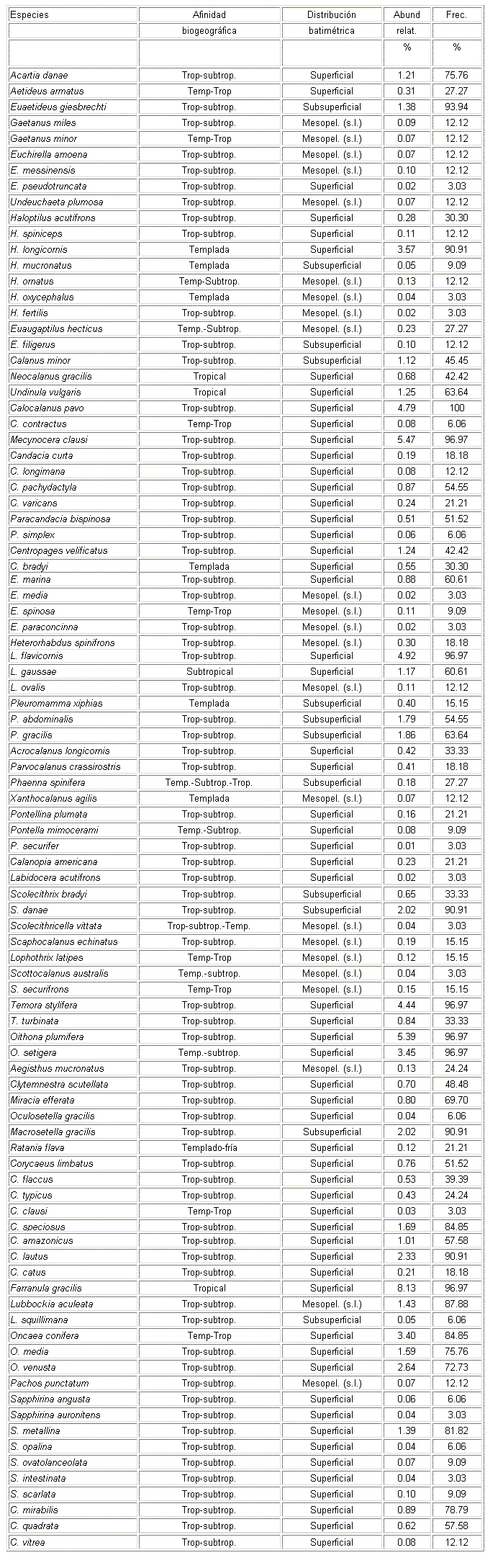
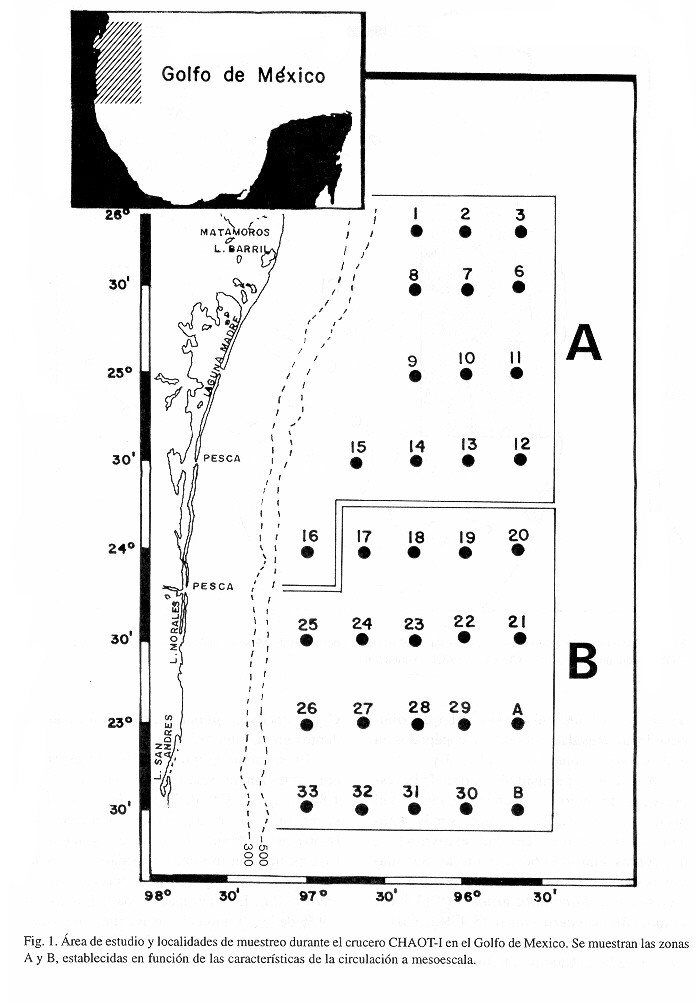
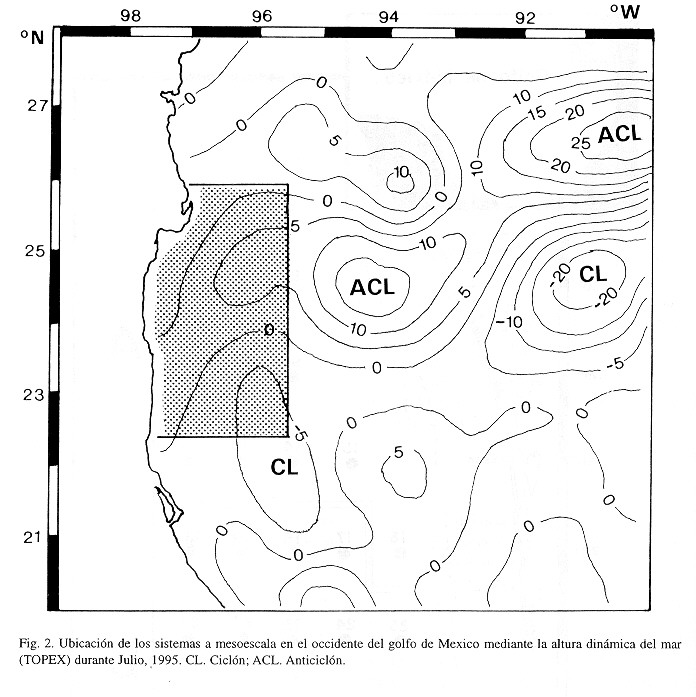
<body><![CDATA[<p><font face="Arial,Helvetica"><font size=-1>En el Golfo de M&eacute;xico ocurren distintos eventos a mesoescala; destacan los giros cicl&oacute;nicos y anticicl&oacute;nicos (<a href="#Merrel">Merrel &amp; V&aacute;zquez 1983</a>, <a href="#Vukovich">Vukovich &amp; Crissman 1986</a>, <a href="#Vidal94">Vidal <i>et al</i>. 1994</a>). Estos fen&oacute;menos son relevantes en el occidente del golfo y afectan la estructura y distribuci&oacute;n del epizooplancton (<a href="#Biggs92">Biggs 1992</a>, <a href="#Biggs97">Biggs <i>et al</i>. 1997</a>). Los cop&eacute;podos son el grupo m&aacute;s numeroso del zooplancton ner&iacute;tico y oce&aacute;nico; han sido estudiados en distintas &aacute;reas del sur del golfo (<a href="#Campos80">Campos 1980</a>, <a href="#Suárez89">Su&aacute;rez-Morales &amp; Gasca 1989</a>, <a href="#Suárez92a">Su&aacute;rez-Morales 1992 a</a>,<a href="#Suárez92b">b</a>, <a href="#Campos94">Campos &amp; Su&aacute;rez-Morales 1994</a>). Las zonas central y occidental est&aacute;n poco estudiadas (<a href="#Suárez90">Su&aacute;rez-Morales <i>et al</i>. 1990</a>, <a href="#López">L&oacute;pez-Salgado &amp; Su&aacute;rez-Morales 1998</a>) y son escasos los trabajos sobre su relaci&oacute;n con la hidrolog&iacute;a en mesoescala (<a href="#Cummings">Cummings 1983</a>, <a href="#Suárez97">Su&aacute;rez-Morales 1997</a>). Se han reconocido cambios de la comunidad en el gradiente costa-zona oce&aacute;nica (<a href="#Bowman">Bowman 1971</a>, <a href="#López">L&oacute;pez-Salgado &amp; Su&aacute;rez-Morales 1998</a>). En este trabajo se analiza la comunidad de cop&eacute;podos en la zona oce&aacute;nica del occidente del Golfo de M&eacute;xico en relaci&oacute;n con los fen&oacute;menos a mesoescala dominantes en la zona.</font></font>     <br><font size=-1></font>&nbsp;<font size=-1></font>     <p><b><font face="Arial,Helvetica"><font size=-1>Materiales y M&eacute;todos</font></font></b><font size=-1></font>     <p><font face="Arial,Helvetica"><font size=-1>La circulaci&oacute;n del Golfo de M&eacute;xico est&aacute; dominada por la corriente del Lazo, una extensi&oacute;n de la de Yucat&aacute;n, que ingresa al golfo v&iacute;a el estrecho de Yucat&aacute;n. Esta corriente genera giros anticicl&oacute;nicos que han sido estudiados por <a href="#Elliot">Elliot (1982)</a>, <a href="#Kirwan">Kirwan <i>et al</i>. (1984)</a> y por <a href="#Vidal92">Vidal <i>et al.</i> (1992)</a>, entre otros. Estos anticiclones promueven la formaci&oacute;n de ciclones de centro fr&iacute;o por fricci&oacute;n con aguas adyacentes o por colisi&oacute;n contra el talud continental occidental del Golfo (<a href="#Vidal94">Vidal <i>et al.</i> 1994</a>).</font></font><font size=-1></font>     <p><font face="Arial,Helvetica"><font size=-1>El &aacute;rea estudiada comprende una franja oce&aacute;nica frente a las costas de Tamaulipas (22&deg; 30' y 25&deg; 50'N; 95&deg; 38' y 96&deg; 58'W), occidente del Golfo de M&eacute;xico. En la &eacute;poca del estudio predomin&oacute; un anticicl&oacute;n que colision&oacute; al nivel de los 22&deg;-23&deg;N; 97&deg;W y transport&oacute; agua oce&aacute;nica hacia la plataforma. Las aguas de estos anticiclones son c&aacute;lidas y oligotr&oacute;ficas pues contienen agua oce&aacute;nica subtropical subsuperficial del Caribe (<a href="#Biggs92">Biggs 1992</a>). Se han reportado ciclones adyacentes a estos sistemas (<a href="#Vidal94">Vidal <i>et al.</i> 1994</a>); recirculan aguas oce&aacute;nicas del golfo en la plataforma continental al N y S del anticicl&oacute;n y reintegran esta mezcla nuevamente hacia la zona oce&aacute;nica frente a Laguna Madre (24-25&deg;30’N). A partir de datos de altura din&aacute;mica del mar obtenidos del sistema TOPEX/Poseidon ERS-1 y 2, Global Mesoscale Historical Data Viewer, Universidad de Colorado (www.ccar.colorado.edu), se ubicaron estos sistemas cicl&oacute;n-anticicl&oacute;n dentro del &aacute;rea estudiada durante las fechas del crucero CHAOT-I (<a href="#Fig.2">Fig. 2</a>). La temperatura superficial vari&oacute; de 25.5&deg; a 29&deg;C y la salinidad de 35.4 a 36.4 PSU durante julio-agosto. El zooplancton se recolect&oacute; durante el crucero CHAOT-I, realizado por la Estaci&oacute;n de Investigaci&oacute;n Oceanogr&aacute;fica de Tampico, a bordo de B/O H-06 "Antares" de la Secretar&iacute;a de Marina. El estudio se efectu&oacute; entre el 30 de junio y el 10 de julio, 1995; se visitaron 33 localidades de muestreo (<a href="#Fig.1">Fig. 1</a>). Los datos hidrogr&aacute;ficos puntuales se encuentran depositados en la Estaci&oacute;n Tampico de la Secretar&iacute;a de Marina y no se consignan aqu&iacute;. Por las caracter&iacute;sticas de la circulaci&oacute;n a mesoescala, el &aacute;rea de estudio se dividi&oacute; en dos zonas: 1) Zona "A": est. 1-16, visitada entre el 30 de junio y el 3 de julio). 2) Zona "B": est. 17-33, A y B; se visit&oacute; entre el 7 y el 10 de julio (<a href="#Fig.1">Fig. 1</a>). El zooplancton se recolect&oacute; mediante arrastres oblicuos en el estrato 0-200 m con una red c&oacute;nica (malla: 0.315 mm). Las muestras se fijaron en formol al 4% amortiguado con borato de sodio. Se obtuvieron al&iacute;cuotas del 25%; se estim&oacute; el volumen de agua filtrado y se obtuvo la densidad (individuos por 1000 m<sup>3</sup>). Se aplic&oacute; la prueba "t" de Student, para comparar las densidades de las dos zonas; se estim&oacute; la frecuencia de las especies. Se calcul&oacute; la diversidad (Shannon-Wiener), se aplic&oacute; la prueba de Intervalo de Varianza (<a href="#Ludwig">Ludwig &amp; Reynolds 1988</a>). Se seleccion&oacute; al grupo de especies con densidad relativa mayor al 0.5% y se obtuvo el Indice de Asociaci&oacute;n de Jaccard para establecer las relaciones entre especies co-ocurrentes y el Indice de Valor de Importancia (IVI). Para ello se us&oacute; el software ANACOM (<a href="#DelaCruz">De la Cruz 1995</a>).</font></font>     <br><font size=-1></font>&nbsp;<font size=-1></font>     <p><b><font face="Arial,Helvetica"><font size=-1>Resultados</font></font></b><font size=-1></font>     <p><font face="Arial,Helvetica"><font size=-1>A partir del an&aacute;lisis de los datos de altura din&aacute;mica del mar en la zona estudiada (TOPEX) se detect&oacute; un anticicl&oacute;n cuyo n&uacute;cleo est&aacute; entre los 24 y 25&deg;N y los 94 y 95&deg;W, con influencia en el &aacute;rea estudiada entre los 25&deg;30’ y 24&deg;15’ N y entre los 95&deg;30’ y 96&deg;30’W (zona "A"). Se ubic&oacute; un cicl&oacute;n que afecta el sur del &aacute;rea estudiada entre los 22&deg;30’ y 23&deg;30’N y entre los 95&deg;30’ y 96&deg;15’ W (zona "B") (<a href="#Fig.2">Fig. 2</a>). Los n&uacute;cleos de estos giros afectan a las est.6 y 9-14 (anticicl&oacute;n), y las est. 22, 28-30, A y B (cicl&oacute;n) (<a href="#Fig.1">Fig. 1</a>). Se determinaron 106 especies agrupadas en 26 familias y 51 g&eacute;neros. El 60% son tropicales-subtropicales y las restantes pertenecen a otras categor&iacute;as (<a href="#CUADRO 1">Cuadro 1</a>).</font></font>     <br><font size=-1></font>&nbsp;     <br><font size=-1></font>&nbsp;     ]]></body>
<body><![CDATA[<br><font size=-1></font>     <center>     <p><a NAME="Fig_1"></a><img SRC="/img/fbpe/rbt/v48n1/0464i1.JPG" height=1003 width=696>     
<br><font size=-1></font>&nbsp;     <br><font size=-1></font>&nbsp;<font size=-1></font>     <p><a NAME="Fig_2"></a><img SRC="/img/fbpe/rbt/v48n1/0464i2.JPG" height=697 width=696></center> <font size=-1></font>     
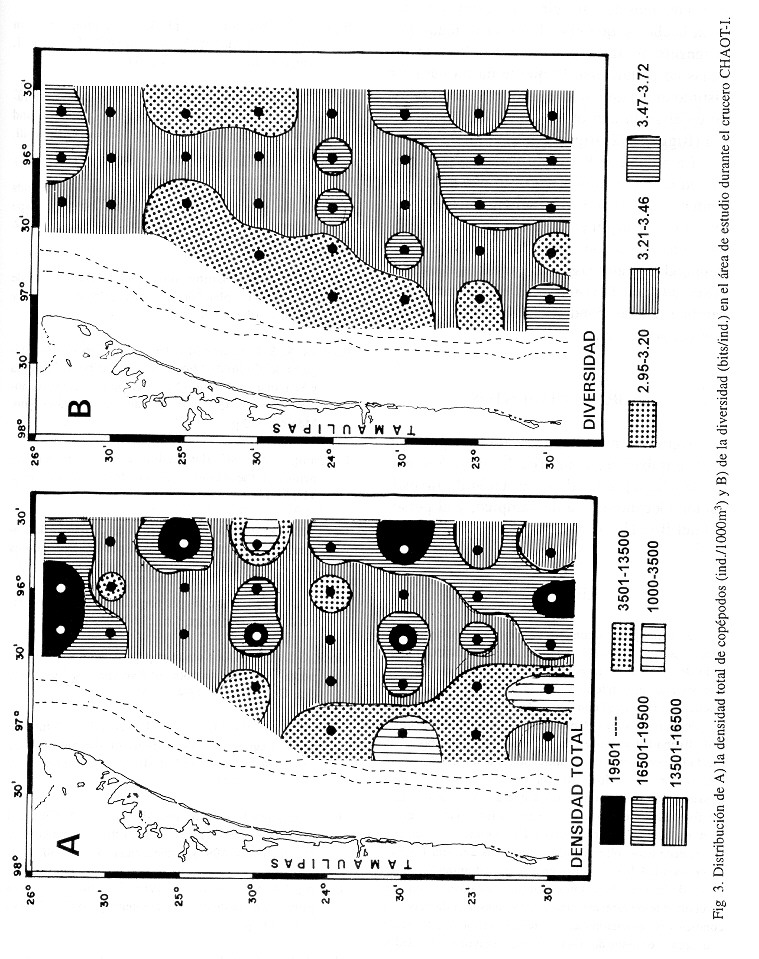
<p>    <br><font size=-1></font>     <p><font face="Arial,Helvetica"><font size=-1>La densidad promedio total en la zona "A", (15,831 ind./1000m<sup>3</sup>), fue similar a la de la zona "B" (16,191 ind./1000m<sup>3</sup>); la prueba "t" de Student no detect&oacute; diferencias significativas entre estas densidades. En los n&uacute;cleos de ambos giros, la densidad promedio en la zona "A" (16,214 ind./1000m<sup>3</sup>) fue 6% menor a la de la "B" (17,306 ind./1000m<sup>3</sup>). La distribuci&oacute;n de las densidades totales de cop&eacute;podos en ambas zonas se muestra en la <a href="#Fig.3">Fig. 3A</a>. Al evaluar la densidad relativa de las especies se definieron 3 grupos (<a href="#CUADRO 2">Cuadro 2</a>); el primero contiene a las 15 especies m&aacute;s abundantes y frecuentes (densidad relativa 2%), que representaron el 60 % del total. Sus m&aacute;ximas densidades ocurrieron en la zona "A" e incluyen a: <i>Farranula gracilis</i> (8.13% del grupo), <i>Mecynocera clausi</i> (5.47%), <i>Oithona plumifera</i> (5.39%) y <i>Clausocalanus furcatus</i> (5.23%) (<a href="#CUADRO 1">Cuadro 1</a>). <i>Temora stylifera, C. furcatus</i> y <i>O. plumifera</i> fueron m&aacute;s abundantes en la zona "A".</font></font>     <br><font size=-1></font>&nbsp;<font size=-1></font>     ]]></body>
<body><![CDATA[<center>     <p><a NAME="CUADRO_1"></a><font face="Arial,Helvetica"><font size=-1>CUADRO 1</font></font>     <br><font face="Arial,Helvetica"><font size=-1>Abundancia relativa y frecuencia de los cop&eacute;podos del occidente del Golfo de M&eacute;xico durante el crucero CHAOT-I. Mesopel.=Mesopel&aacute;gica; s.l.=sentido amplio (0-400m).</font></font><font size=-1></font>     <p><font face="Arial,Helvetica"><font size=-1>TABLE 1</font></font>     <br><font face="Arial,Helvetica"><font size=-1>Relative abundance and frequency of the pelagic copepods collected during the CHAOT I cruise. Mesopel.=mesopelagic; s.l.=sensu lato (400 m).</font></font><font face="Arial,Helvetica"><font size=-1></font></font>     <p><img SRC="/img/fbpe/rbt/v48n1/CUADRO1.GIF" height=2177 width=699><font size=-1></font>     
<p>    <br><font size=-1></font>     <p><a NAME="CUADRO_2"></a><font face="Arial,Helvetica"><font size=-1>CUADRO 2</font></font>     <br><font face="Arial,Helvetica"><font size=-1>Agrupaci&oacute;n de las especies de cop&eacute;podos por intervalos de abundancia relativa.</font></font>     ]]></body>
<body><![CDATA[<br><font face="Arial,Helvetica"><font size=-1>A y B representan las dos zonas establecidas en el &aacute;rea estudiada.</font></font><font size=-1></font>     <p><i><font face="Arial,Helvetica"><font size=-1>TABLE 2</font></font></i>     <br><i><font face="Arial,Helvetica"><font size=-1>Clustering of copepod species by relative abundance ranges.</font></font></i>     <br><i><font face="Arial,Helvetica"><font size=-1>A and B represent the two main zones considered in the surveyed area.</font></font></i></center> <font size=-1></font>     <p>    <br><font size=-1></font>     <center><table BORDER=0 CELLSPACING=0 WIDTH="572" > <tr> <td VALIGN=CENTER>     <center><font face="Arial,Helvetica"><font size=-1>Grupo</font></font></center> </td>  <td VALIGN=CENTER>     <center><font face="Arial,Helvetica"><font size=-1>Intervalo</font></font></center> </td>  <td VALIGN=CENTER>     <center><font face="Arial,Helvetica"><font size=-1>N&uacute;mero&nbsp;</font></font>     ]]></body>
<body><![CDATA[<br><font face="Arial,Helvetica"><font size=-1>de especies</font></font></center> </td>  <td VALIGN=CENTER COLSPAN="2">     <center><font face="Arial,Helvetica"><font size=-1>Densidad total/zona</font></font></center> </td>  <td VALIGN=CENTER COLSPAN="2">     <center><font face="Arial,Helvetica"><font size=-1>Densidad relativa/zona</font></font></center> </td>  <td VALIGN=CENTER>     <center><font face="Arial,Helvetica"><font size=-1>Contribuci&oacute;n total</font></font></center> </td> </tr>  <tr> <td VALIGN=CENTER>     <center><font face="Arial,Helvetica"><font size=-1>&nbsp;</font></font></center> </td>  <td VALIGN=CENTER>     <center><font face="Arial,Helvetica"><font size=-1>(%)</font></font></center> </td>  <td VALIGN=CENTER>     <center><font face="Arial,Helvetica"><font size=-1>&nbsp;</font></font></center> </td>  <td VALIGN=CENTER>     <center><font face="Arial,Helvetica"><font size=-1>A</font></font></center> </td>  <td VALIGN=CENTER>     <center><font face="Arial,Helvetica"><font size=-1>B</font></font></center> </td>  <td VALIGN=CENTER>     <center><font face="Arial,Helvetica"><font size=-1>A</font></font></center> </td>  <td VALIGN=CENTER>     ]]></body>
<body><![CDATA[<center><font face="Arial,Helvetica"><font size=-1>B</font></font></center> </td>  <td VALIGN=CENTER>     <center><font face="Arial,Helvetica"><font size=-1>(%)</font></font></center> </td> </tr>  <tr> <td VALIGN=CENTER>     <center><font face="Arial,Helvetica"><font size=-1>&nbsp;</font></font></center> </td>  <td VALIGN=CENTER>     <center><font face="Arial,Helvetica"><font size=-1>&nbsp;</font></font></center> </td>  <td VALIGN=CENTER>     <center><font face="Arial,Helvetica"><font size=-1>&nbsp;</font></font></center> </td>  <td VALIGN=CENTER>     <center><font face="Arial,Helvetica"><font size=-1>&nbsp;</font></font></center> </td>  <td VALIGN=CENTER>     <center><font face="Arial,Helvetica"><font size=-1>&nbsp;</font></font></center> </td>  <td VALIGN=CENTER>     <center><font face="Arial,Helvetica"><font size=-1>&nbsp;</font></font></center> </td>  <td VALIGN=CENTER>     <center><font face="Arial,Helvetica"><font size=-1>&nbsp;</font></font></center> </td>  <td VALIGN=CENTER>     <center><font face="Arial,Helvetica"><font size=-1>&nbsp;</font></font></center> </td> </tr>  <tr> <td VALIGN=CENTER>     ]]></body>
<body><![CDATA[<center><font face="Arial,Helvetica"><font size=-1>1</font></font></center> </td>  <td VALIGN=CENTER>     <center><font face="Arial,Helvetica"><font size=-1>2-8</font></font></center> </td>  <td VALIGN=CENTER>     <center><font face="Arial,Helvetica"><font size=-1>15</font></font></center> </td>  <td VALIGN=CENTER>     <center><font face="Arial,Helvetica"><font size=-1>164 887</font></font></center> </td>  <td VALIGN=CENTER>     <center><font face="Arial,Helvetica"><font size=-1>153 201</font></font></center> </td>  <td VALIGN=CENTER>     <center><font face="Arial,Helvetica"><font size=-1>51.8</font></font></center> </td>  <td VALIGN=CENTER>     <center><font face="Arial,Helvetica"><font size=-1>48.1</font></font></center> </td>  <td VALIGN=CENTER>     <center><font face="Arial,Helvetica"><font size=-1>60.2</font></font></center> </td> </tr>  <tr> <td VALIGN=CENTER>     <center><font face="Arial,Helvetica"><font size=-1>2</font></font></center> </td>  <td VALIGN=CENTER>     <center><font face="Arial,Helvetica"><font size=-1>0.45-0.18</font></font></center> </td>  <td VALIGN=CENTER>     ]]></body>
<body><![CDATA[<center><font face="Arial,Helvetica"><font size=-1>30</font></font></center> </td>  <td VALIGN=CENTER>     <center><font face="Arial,Helvetica"><font size=-1>77 225</font></font></center> </td>  <td VALIGN=CENTER>     <center><font face="Arial,Helvetica"><font size=-1>91 353</font></font></center> </td>  <td VALIGN=CENTER>     <center><font face="Arial,Helvetica"><font size=-1>45.8</font></font></center> </td>  <td VALIGN=CENTER>     <center><font face="Arial,Helvetica"><font size=-1>54.2</font></font></center> </td>  <td VALIGN=CENTER>     <center><font face="Arial,Helvetica"><font size=-1>31.9</font></font></center> </td> </tr>  <tr> <td VALIGN=CENTER>     <center><font face="Arial,Helvetica"><font size=-1>3</font></font></center> </td>  <td VALIGN=CENTER>     <center><font face="Arial,Helvetica"><font size=-1>0.01-0.44</font></font></center> </td>  <td VALIGN=CENTER>     <center><font face="Arial,Helvetica"><font size=-1>61</font></font></center> </td>  <td VALIGN=CENTER>     <center><font face="Arial,Helvetica"><font size=-1>11 187</font></font></center> </td>  <td VALIGN=CENTER>     ]]></body>
<body><![CDATA[<center><font face="Arial,Helvetica"><font size=-1>30 702</font></font></center> </td>  <td VALIGN=CENTER>     <center><font face="Arial,Helvetica"><font size=-1>26.7</font></font></center> </td>  <td VALIGN=CENTER>     <center><font face="Arial,Helvetica"><font size=-1>73.3</font></font></center> </td>  <td VALIGN=CENTER>     <center><font face="Arial,Helvetica"><font size=-1>7.9</font></font></center> </td> </tr>  <tr> <td VALIGN=CENTER>     <center><font face="Arial,Helvetica"><font size=-1>Total</font></font></center> </td>  <td VALIGN=CENTER>     <center><font face="Arial,Helvetica"><font size=-1>--</font></font></center> </td>  <td VALIGN=CENTER>     <center><font face="Arial,Helvetica"><font size=-1>106</font></font></center> </td>  <td VALIGN=CENTER>     <center><font face="Arial,Helvetica"><font size=-1>253 299</font></font></center> </td>  <td VALIGN=CENTER>     <center><font face="Arial,Helvetica"><font size=-1>275 299</font></font></center> </td>  <td VALIGN=CENTER>     <center><font face="Arial,Helvetica"><font size=-1>47.9</font></font></center> </td>  <td VALIGN=CENTER>     ]]></body>
<body><![CDATA[<center><font face="Arial,Helvetica"><font size=-1>47.9</font></font></center> </td>  <td VALIGN=CENTER>     <center><font face="Arial,Helvetica"><font size=-1>100</font></font></center> </td> </tr>  <tr> <td VALIGN=CENTER>     <center><font face="Arial,Helvetica"><font size=-1>&nbsp;</font></font></center> </td>  <td VALIGN=CENTER>     <center><font face="Arial,Helvetica"><font size=-1>--</font></font></center> </td>  <td VALIGN=CENTER>     <center><font face="Arial,Helvetica"><font size=-1>--</font></font></center> </td>  <td VALIGN=CENTER>     <center><font face="Arial,Helvetica"><font size=-1>x=15 831</font></font></center> </td>  <td VALIGN=CENTER>     <center><font face="Arial,Helvetica"><font size=-1>x=16 191</font></font></center> </td>  <td VALIGN=CENTER>     <center><font face="Arial,Helvetica"><font size=-1>&nbsp;</font></font></center> </td>  <td VALIGN=CENTER>     <center><font face="Arial,Helvetica"><font size=-1>&nbsp;</font></font></center> </td>  <td VALIGN=CENTER>     <center><font face="Arial,Helvetica"><font size=-1>&nbsp;</font></font></center> </td> </tr> </table></center> <font size=-1></font>     ]]></body>
<body><![CDATA[<br><font size=-1></font>&nbsp;<font size=-1></font>     <p><font face="Arial,Helvetica"><font size=-1>El segundo grupo contiene 30 especies con abundancia relativa intermedia (0.45-1.86%); aport&oacute; 32% de la densidad total. Tuvo su mayor abundancia promedio en la zona "B" (4,567 ind./1000m<sup>3</sup>). El tercer grupo contiene 61 especies con m&iacute;nimas densidades relativas(&lt;0.44%) e incluye formas mesopel&aacute;gicas (s.l). Esta agrupaci&oacute;n particip&oacute; con el 7.9 % de la comunidad; sus m&aacute;ximas densidades ocurrieron en la zona "B". Entre estas especies destacan <i>Euchirella pseudotrunca</i>, <i>Euaugaptilus filigerus</i>, <i>Heterorhabdus vipera</i>, <i>Heterostylites major, Scolecithricella vittata</i>, <i>Scaphocalanus echinatus</i> y<i> Ratania flava</i>. En el <a href="#CUADRO 3">Cuadro 3</a> se compara la densidad promedio de las 15 especies m&aacute;s abundantes en los n&uacute;cleos de ambos giros y en la zona intermedia. El Indice de Valor de Importancia (IVI) revel&oacute; como dominantes a: <i>F. gracilis</i> (12.4), <i>M. clausi</i> (9.4), <i>O. plumifera</i> (9.36), <i>C. furcatus</i> (9.17), <i>L. flavicornis</i>, <i>C. pavo</i> y <i>T. stylifera</i>. El Indice de Asociaci&oacute;n global de Radio de Varianza, alcanz&oacute; 6.42. El Indice de Jaccard mostr&oacute; una asociaci&oacute;n global positiva, 70% de las especies tuvo valores sobre 0.50. Las m&iacute;nimas diversidades formaron una franja frente a la plataforma, en la zona "A". La zona "B" tuvo una diversidad promedio mayor a la de la zona "A". Sus m&aacute;ximos (3.47) formaron un n&uacute;cleo en la zona de mayor influencia del cicl&oacute;n (<a href="#Fig.3">Fig. 3B</a>). La riqueza de especies vari&oacute; poco en las zonas "A" (x= 36 especies) y "B" (x= 41 especies); las diferencias se acentuaron en las zonas primarias de anticicl&oacute;n (x= 34) y de cicl&oacute;n (x= 47).</font></font>     <br><font size=-1></font>&nbsp;     <br><font size=-1></font>&nbsp;     <div class=Section1><b><font face="Arial,Helvetica"><font size=-1>Discusi&oacute;n</font></font></b><font size=-1></font>     <p><font face="Arial,Helvetica"><font size=-1>La composici&oacute;n local del grupo es 80-90% similar a la antes registrada (<a href="#Park70">Park 1970</a>, <a href="#Suárez90">Su&aacute;rez-Morales <i>et al</i>. 1990</a>, <a href="#Suárez92a">Su&aacute;rez-Morales 1992a</a>, <a href="#Campos94">Campos y Su&aacute;rez-Morales 1994</a>) en el Golfo de M&eacute;xico y Mar Caribe occidental. Result&oacute; 40-70% similar a la de Florida y zonas adyacentes (<a href="#Owre62">Owre 1962</a>, <a href="#Owre64">Owre y Foyo 1964</a>, <a href="#Bowman">Bowman 1971</a>). Esto confirma la afinidad caribe&ntilde;a de la fauna local (<a href="#Suárez92a">Su&aacute;rez-Morales 1992a</a>). La mayor&iacute;a de las especies (<a href="#CUADRO 1">Cuadro 1</a>) han sido registradas en M&eacute;xico (<a href="#Suárez98">Su&aacute;rez-Morales &amp; Gasca 1998</a>).</font></font>     <br><font size=-1></font>&nbsp;<font size=-1></font>     <center>     <p><a NAME="CUADRO_3"></a><font face="Arial,Helvetica"><font size=-1>CUADRO 3</font></font>     <br><font face="Arial,Helvetica"><font size=-1>Densidades (ind./1000m<sup>3 </sup>) de las 15 especies m&aacute;s abundantes</font></font>     ]]></body>
<body><![CDATA[<br><font face="Arial,Helvetica"><font size=-1>en los n&uacute;cleos de los giros cicl&oacute;nico (CIC) y anticicl&oacute;nico (ACIC)</font></font>     <br><font face="Arial,Helvetica"><font size=-1>y zonas circundantes (ZON-INT) durante el crucero CHAOT-I en el Golfo de M&eacute;xico.</font></font></center> </div> <font size=-1></font>     <center>     <p>    <br><font face="Arial,Helvetica"><font size=-1>TABLE 3</font></font>     <br><font face="Arial,Helvetica"><font size=-1><i>D</i>ensities (ind./1000m<sup>3</sup>) of the 15 most abundant species</font></font>     <br><font face="Arial,Helvetica"><font size=-1>in the cores of the cyclonic (CIC) and anticyclonic (ACIC),</font></font>     <br><font face="Arial,Helvetica"><font size=-1>and adjacent oceanic zones (ZON-INT) during the CHAOT-I cruise in the Gulf of Mexico.</font></font></center>      <br><font size=-1></font>&nbsp;     <br><font size=-1></font>&nbsp;     ]]></body>
<body><![CDATA[<center><table BORDER=0 CELLSPACING=0 WIDTH="376" > <tr> <td VALIGN=CENTER>     <center><font face="Arial,Helvetica"><font size=-1>Especies/Estaciones</font></font></center> </td>  <td VALIGN=CENTER>     <center><font face="Arial,Helvetica"><font size=-1>CIC</font></font></center> </td>  <td VALIGN=CENTER>     <center><font face="Arial,Helvetica"><font size=-1>ACIC</font></font></center> </td>  <td VALIGN=CENTER>     <center><font face="Arial,Helvetica"><font size=-1>ZON-INT</font></font></center> </td> </tr>  <tr> <td VALIGN=CENTER>     <center><font face="Arial,Helvetica"><font size=-1>&nbsp;</font></font></center> </td>  <td VALIGN=CENTER>     <center><font face="Arial,Helvetica"><font size=-1>&nbsp;</font></font></center> </td>  <td VALIGN=CENTER>     <center><font face="Arial,Helvetica"><font size=-1>&nbsp;</font></font></center> </td>  <td VALIGN=CENTER>     <center><font face="Arial,Helvetica"><font size=-1>&nbsp;</font></font></center> </td> </tr>  <tr> <td VALIGN=CENTER><i><font face="Arial,Helvetica"><font size=-1>Farranula gracilis</font></font></i></td>  <td VALIGN=CENTER>     <center><font face="Arial,Helvetica"><font size=-1>1550</font></font></center> </td>  <td VALIGN=CENTER>     ]]></body>
<body><![CDATA[<center><font face="Arial,Helvetica"><font size=-1>1480</font></font></center> </td>  <td VALIGN=CENTER>     <center><font face="Arial,Helvetica"><font size=-1>1514</font></font></center> </td> </tr>  <tr> <td VALIGN=CENTER><i><font face="Arial,Helvetica"><font size=-1>Mecynocera clausi</font></font></i></td>  <td VALIGN=CENTER>     <center><font face="Arial,Helvetica"><font size=-1>761</font></font></center> </td>  <td VALIGN=CENTER>     <center><font face="Arial,Helvetica"><font size=-1>1293</font></font></center> </td>  <td VALIGN=CENTER>     <center><font face="Arial,Helvetica"><font size=-1>850</font></font></center> </td> </tr>  <tr> <td VALIGN=CENTER><i><font face="Arial,Helvetica"><font size=-1>Oithona plumifera</font></font></i></td>  <td VALIGN=CENTER>     <center><font face="Arial,Helvetica"><font size=-1>549</font></font></center> </td>  <td VALIGN=CENTER>     <center><font face="Arial,Helvetica"><font size=-1>1279</font></font></center> </td>  <td VALIGN=CENTER>     <center><font face="Arial,Helvetica"><font size=-1>828</font></font></center> </td> </tr>  <tr> <td VALIGN=CENTER><i><font face="Arial,Helvetica"><font size=-1>Clausocalanus furcatus</font></font></i></td>  <td VALIGN=CENTER>     <center><font face="Arial,Helvetica"><font size=-1>806</font></font></center> </td>  <td VALIGN=CENTER>     <center><font face="Arial,Helvetica"><font size=-1>1049</font></font></center> </td>  <td VALIGN=CENTER>     ]]></body>
<body><![CDATA[<center><font face="Arial,Helvetica"><font size=-1>772</font></font></center> </td> </tr>  <tr> <td VALIGN=CENTER><i><font face="Arial,Helvetica"><font size=-1>Lucicutia flavicornis</font></font></i></td>  <td VALIGN=CENTER>     <center><font face="Arial,Helvetica"><font size=-1>779</font></font></center> </td>  <td VALIGN=CENTER>     <center><font face="Arial,Helvetica"><font size=-1>633</font></font></center> </td>  <td VALIGN=CENTER>     <center><font face="Arial,Helvetica"><font size=-1>790</font></font></center> </td> </tr>  <tr> <td VALIGN=CENTER><i><font face="Arial,Helvetica"><font size=-1>Calocalanus pavo</font></font></i></td>  <td VALIGN=CENTER>     <center><font face="Arial,Helvetica"><font size=-1>577</font></font></center> </td>  <td VALIGN=CENTER>     <center><font face="Arial,Helvetica"><font size=-1>1055</font></font></center> </td>  <td VALIGN=CENTER>     <center><font face="Arial,Helvetica"><font size=-1>820</font></font></center> </td> </tr>  <tr> <td VALIGN=CENTER><i><font face="Arial,Helvetica"><font size=-1>Temora stylifera</font></font></i></td>  <td VALIGN=CENTER>     <center><font face="Arial,Helvetica"><font size=-1>509</font></font></center> </td>  <td VALIGN=CENTER>     <center><font face="Arial,Helvetica"><font size=-1>885</font></font></center> </td>  <td VALIGN=CENTER>     <center><font face="Arial,Helvetica"><font size=-1>639</font></font></center> </td> </tr>  <tr> <td VALIGN=CENTER><i><font face="Arial,Helvetica"><font size=-1>Haloptilus longicornis</font></font></i></td>  <td VALIGN=CENTER>     ]]></body>
<body><![CDATA[<center><font face="Arial,Helvetica"><font size=-1>642</font></font></center> </td>  <td VALIGN=CENTER>     <center><font face="Arial,Helvetica"><font size=-1>527</font></font></center> </td>  <td VALIGN=CENTER>     <center><font face="Arial,Helvetica"><font size=-1>510</font></font></center> </td> </tr>  <tr> <td VALIGN=CENTER><i><font face="Arial,Helvetica"><font size=-1>Oithona setigera</font></font></i></td>  <td VALIGN=CENTER>     <center><font face="Arial,Helvetica"><font size=-1>703</font></font></center> </td>  <td VALIGN=CENTER>     <center><font face="Arial,Helvetica"><font size=-1>658</font></font></center> </td>  <td VALIGN=CENTER>     <center><font face="Arial,Helvetica"><font size=-1>491</font></font></center> </td> </tr>  <tr> <td VALIGN=CENTER><i><font face="Arial,Helvetica"><font size=-1>Oncaea conifera</font></font></i></td>  <td VALIGN=CENTER>     <center><font face="Arial,Helvetica"><font size=-1>607</font></font></center> </td>  <td VALIGN=CENTER>     <center><font face="Arial,Helvetica"><font size=-1>243</font></font></center> </td>  <td VALIGN=CENTER>     <center><font face="Arial,Helvetica"><font size=-1>580</font></font></center> </td> </tr>  <tr> <td VALIGN=CENTER><i><font face="Arial,Helvetica"><font size=-1>Oncaea venusta</font></font></i></td>  <td VALIGN=CENTER>     <center><font face="Arial,Helvetica"><font size=-1>205</font></font></center> </td>  <td VALIGN=CENTER>     ]]></body>
<body><![CDATA[<center><font face="Arial,Helvetica"><font size=-1>498</font></font></center> </td>  <td VALIGN=CENTER>     <center><font face="Arial,Helvetica"><font size=-1>180</font></font></center> </td> </tr>  <tr> <td VALIGN=CENTER><i><font face="Arial,Helvetica"><font size=-1>Subeucalanus subcrassus</font></font></i></td>  <td VALIGN=CENTER>     <center><font face="Arial,Helvetica"><font size=-1>478</font></font></center> </td>  <td VALIGN=CENTER>     <center><font face="Arial,Helvetica"><font size=-1>70</font></font></center> </td>  <td VALIGN=CENTER>     <center><font face="Arial,Helvetica"><font size=-1>587</font></font></center> </td> </tr>  <tr> <td VALIGN=CENTER><i><font face="Arial,Helvetica"><font size=-1>Corycaeus lautus</font></font></i></td>  <td VALIGN=CENTER>     <center><font face="Arial,Helvetica"><font size=-1>263</font></font></center> </td>  <td VALIGN=CENTER>     <center><font face="Arial,Helvetica"><font size=-1>584</font></font></center> </td>  <td VALIGN=CENTER>     <center><font face="Arial,Helvetica"><font size=-1>295</font></font></center> </td> </tr>  <tr> <td VALIGN=CENTER><i><font face="Arial,Helvetica"><font size=-1>Macrosetella gracilis</font></font></i></td>  <td VALIGN=CENTER>     <center><font face="Arial,Helvetica"><font size=-1>193</font></font></center> </td>  <td VALIGN=CENTER>     <center><font face="Arial,Helvetica"><font size=-1>407</font></font></center> </td>  <td VALIGN=CENTER>     ]]></body>
<body><![CDATA[<center><font face="Arial,Helvetica"><font size=-1>342</font></font></center> </td> </tr>  <tr> <td VALIGN=CENTER><i><font face="Arial,Helvetica"><font size=-1>Scolecithrix danae</font></font></i></td>  <td VALIGN=CENTER>     <center><font face="Arial,Helvetica"><font size=-1>442</font></font></center> </td>  <td VALIGN=CENTER>     <center><font face="Arial,Helvetica"><font size=-1>177</font></font></center> </td>  <td VALIGN=CENTER>     <center><font face="Arial,Helvetica"><font size=-1>369</font></font></center> </td> </tr> </table></center> <font size=-1></font><font size=-1></font>     <p><font face="Arial,Helvetica"><font size=-1>Entre las especies m&aacute;s abundantes, <i>F. gracilis</i>, <i>C. furcatus</i> y <i>O. plumifera</i> se han reconocido como frecuentes en la zona centro-occidental del golfo (<a href="#López">L&oacute;pez-Salgado y Su&aacute;rez-Morales 1998</a>), y son t&iacute;picas de aguas oce&aacute;nicas superficiales del Mar Caribe (<a href="#Michel">Michel &amp; Foyo 1976</a>). <i>Haloptilus longicornis</i> y <i>S. danae</i>, localmente frecuentes, son comunes en el Caribe (<a href="#Campos80">Campos 1980</a>, <a href="#Suárez89">Su&aacute;rez-Morales y Gasca 1989</a>). No se detectaron diferencias significativas de densidad entre las zonas "A" y "B" aunque est&aacute;n sometidas a condiciones hidrol&oacute;gicas distintas. Esto no implica necesariamente que las comunidades de ambas zonas sean iguales. En el anticicl&oacute;n algunas de las especies m&aacute;s abundantes son t&iacute;picas de aguas superficiales del Mar Caribe, como <i>C. furcatus</i>, <i>O. plumifera</i> y <i>F</i>. <i>gracilis</i>, que son de las m&aacute;s abundantes en esa zona (<a href="#Michel">Michel &amp; Foyo, 1976</a>). Esto puede estar asociado con el hecho de que el anticicl&oacute;n acarrea aguas oligotr&oacute;ficas poco mezcladas que provienen del Caribe. Ello les da un caracter propio que conservan hasta que chocan con la plataforma y se empiezan a mezclar con el agua circundante (<a href="#Vidal92">Vidal <i>et al</i>. 1992</a>). En el n&uacute;cleo del anticicl&oacute;n, formado por aguas oligotr&oacute;ficas, las densidades son algo menores a las del n&uacute;cleo cicl&oacute;nico. Estos ciclones se asocian con aguas emergentes y son m&aacute;s productivos. Ambas tendencias coinciden con los resultados de <a href="#Biggs92">Biggs (1992)</a> y <a href="#Biggs97">Biggs <i>et al</i>. (1997)</a> al estudiar el zooplancton asociado a ciclones y anticiclones en el golfo.</font></font><font size=-1></font>     <p>    <br><font size=-1></font>     <center>     <p><a NAME="Fig_3"></a><img SRC="/img/fbpe/rbt/v48n1/0464i3.JPG" height=959 width=759></center> <font size=-1></font>     
<p>    ]]></body>
<body><![CDATA[<br><font size=-1></font>     <p><font face="Arial,Helvetica"><font size=-1>En el cicl&oacute;n destac&oacute; la ocurrencia de formas mesopel&aacute;gicas s.l. (<i>Eucalanus elongatus</i>, <i>E. sewelli</i>, <i>Gaetanus miles</i>, <i>G. minor</i>, <i>Haloptilus fertilis</i>, <i>Lucicutia ovalis</i>) que habitan aguas profundas y migran verticalmente (<a href="#Grice">Grice 1963</a>, <a href="#Owre64">Owre &amp; Foyo 1964</a>, <a href="#Park75">Park 1975</a>); su tendencia a presentarse en esta zona podr&iacute;a estar asociada con la influencia de la emergencia de aguas propia de los ciclones (<a href="#Biggs97">Biggs <i>et al</i>. 1997</a>). Tambi&eacute;n asociados al cicl&oacute;n se reportan especies raras propias del golfo (<a href="#Park70">Park 1970</a>). Su distribuci&oacute;n local permite extender su &aacute;mbito conocido m&aacute;s hacia el norte (<i>H. vipera</i>: 23&deg; 30' N; <i>H. major</i>: 24&deg; 0' N; <i>S. echinatus</i>: 23&deg; 00' N; la de <i>E. filigerus</i> se ampl&iacute;a hacia el interior del golfo (24&deg; 0' N 96&deg; 18' W). En general, la presencia de estas especies propias del golfo en el cicl&oacute;n muestra que las aguas de la zona "B" son distintas a las del anticicl&oacute;n y son m&aacute;s afines al agua com&uacute;n del golfo. Aunque predominan diversidades medias en sentido Norte-Sur a lo largo del &aacute;rea de estudio, en general la zona m&aacute;s cercana a la plataforma es menos diversa. La diversidad y la riqueza de especies en el cicl&oacute;n es superior al del anticicl&oacute;n; esta diferencia es m&aacute;s marcada en los n&uacute;cleos de estos giros. Lo anterior se debe al hecho de que el cicl&oacute;n esta formado por la mezcla de aguas propias del golfo con las aguas de plataforma, lo que le da un car&aacute;cter distinto al del anticicl&oacute;n. Esto se ha corroborado en el golfo con otros grupos del zooplancton (<a href="#Biggs92">Biggs 1992</a>, <a href="#Biggs97">Biggs <i>et al</i>. 1997</a>). La prueba de Radio de Varianza se expresa con un valor mayor a 1.0, lo que refleja su tendencia a co-ocurrir (<a href="#Ludwig">Ludwig &amp; Reynolds 1988</a>) y formar un ensamblaje faun&iacute;stico definido que indica homogeneidad global de la comunidad. Sin embargo, las variaciones locales observadas en la comunidad son respuestas a cambios en las condiciones hidrol&oacute;gicas impuestas por los giros.</font></font>     <br><font size=-1></font>&nbsp;<font size=-1></font>     <p><b><font face="Arial,Helvetica"><font size=-1>Agradecimientos</font></font></b><font size=-1></font>     <p><font face="Arial,Helvetica"><font size=-1>Agradecemos el apoyo para la realizaci&oacute;n de este trabajo a las autoridades de la Secretar&iacute;a de Marina, a las de la Estaci&oacute;n de Investigaci&oacute;n Oceanogr&aacute;fica de Tampico, y al personal del B/O H-06 "Antares".</font></font><b><font face="Arial,Helvetica"><font size=-1></font></font></b>     <p><b><font face="Arial,Helvetica"><font size=-1>Resumen</font></font></b><font size=-1></font>     <p><font face="Arial,Helvetica"><font size=-1>Se estudi&oacute; la comunidad de cop&eacute;podos pel&aacute;gicos en la zona oce&aacute;nica frente Tamaulipas, Mexico durante junio-julio de 1995. En este periodo se detectaron dos giros a mesoescala, uno cicl&oacute;nico y el otro anticicl&oacute;nico; su influencia se relacion&oacute; a zonas distintas del &aacute;rea de estudio. Se identificaron 106 especies de cop&eacute;podos; su densidad, diversidad y riqueza de especies vari&oacute; entre las &aacute;reas afectadas por el cicl&oacute;n y el anticicl&oacute;n. La densidad general fue similar en los dos sistemas, pero se encontr&oacute; mayor densidad en el n&uacute;cleo del cicl&oacute;n que en el del anticicl&oacute;n. La diversidad y el n&uacute;mero de especies fue mayor en el cicl&oacute;n, un sistema m&aacute;s productivo. Los anticiclones son sistemas oce&aacute;nicos, oligotr&oacute;ficos, con aguas del Mar Caribe. La comunidad de cop&eacute;podos en este giro, dominada por algunas de las m&aacute;s abundantes especies caribe&ntilde;as, y con una diversidad relativamente menor, tiene m&aacute;s afinidad con las condiciones anticicl&oacute;nicas. La fauna del cicl&oacute;n, formada con aguas comunes del Golfo, mostr&oacute; mayor diversidad y riqueza de especies as&iacute; como una afinidad cualitativa mayor con la fauna propia del Golfo. El &aacute;mbito de distribuci&oacute;n de varias especies se extiende en este estudio; para otras, representa el primer reporte para el Golfo de M&eacute;xico.</font></font>     <br><font size=-1></font>&nbsp;<font size=-1></font>     <p><b><font face="Arial,Helvetica"><font size=-1>Referencias</font></font></b><font size=-1></font>     <!-- ref --><p><a NAME="Biggs92"></a><font face="Arial,Helvetica"><font size=-1>Biggs, D.C. 1992. Nutrients, plankton and productivity in a warm-core Ring in the western Gulf of Mexico. J. Geophys. Res. C2 97:2143-2154.</font></font><font size=-1></font>    &nbsp;&nbsp;&nbsp;&nbsp;&nbsp;&nbsp;&nbsp;&nbsp;[&#160;<a href="javascript:void(0);" onclick="javascript: window.open('/scielo.php?script=sci_nlinks&ref=1195945&pid=S0034-7744200000010002000001&lng=','','width=640,height=500,resizable=yes,scrollbars=1,menubar=yes,');">Links</a>&#160;]<!-- end-ref --><!-- ref --><p><a NAME="Biggs97"></a><font face="Arial,Helvetica"><font size=-1>Biggs, D.C., R.G. Zimmerman, R. Gasca, E. Su&aacute;rez-Morales &amp; I. Castellanos. 1997. Note on plankton and cold-core rings in the Gulf of Mexico. Fish. Bull. 95:356-361.</font></font><font size=-1></font>    &nbsp;&nbsp;&nbsp;&nbsp;&nbsp;&nbsp;&nbsp;&nbsp;[&#160;<a href="javascript:void(0);" onclick="javascript: window.open('/scielo.php?script=sci_nlinks&ref=1195946&pid=S0034-7744200000010002000002&lng=','','width=640,height=500,resizable=yes,scrollbars=1,menubar=yes,');">Links</a>&#160;]<!-- end-ref --><!-- ref --><p><a NAME="Bowman"></a><font face="Arial,Helvetica"><font size=-1>Bowman, T.E. 1971. The distribution of calanoid copepods off the southeastern United States between Cape Hatteras and southern Florida. Smithson. Contr. Zool. 96:1-58.</font></font><font size=-1></font>    &nbsp;&nbsp;&nbsp;&nbsp;&nbsp;&nbsp;&nbsp;&nbsp;[&#160;<a href="javascript:void(0);" onclick="javascript: window.open('/scielo.php?script=sci_nlinks&ref=1195947&pid=S0034-7744200000010002000003&lng=','','width=640,height=500,resizable=yes,scrollbars=1,menubar=yes,');">Links</a>&#160;]<!-- end-ref --><!-- ref --><p><a NAME="Campos80"></a><font face="Arial,Helvetica"><font size=-1>Campos, A. 1980. Distribuci&oacute;n y abundancia relativa de los cop&eacute;podos planct&oacute;nicos en el Golfo de M&eacute;xico y el Mar Caribe. Cienc. Biol. 5:57-74.</font></font><font size=-1></font>    &nbsp;&nbsp;&nbsp;&nbsp;&nbsp;&nbsp;&nbsp;&nbsp;[&#160;<a href="javascript:void(0);" onclick="javascript: window.open('/scielo.php?script=sci_nlinks&ref=1195948&pid=S0034-7744200000010002000004&lng=','','width=640,height=500,resizable=yes,scrollbars=1,menubar=yes,');">Links</a>&#160;]<!-- end-ref --><!-- ref --><p><a NAME="Campos94"></a><font face="Arial,Helvetica"><font size=-1>Campos, A. &amp; E. Su&aacute;rez-Morales. 1994. Cop&eacute;podos pel&aacute;gicos del Golfo de M&eacute;xico y Mar Caribe. I. Biolog&iacute;a y Sistem&aacute;tica. Consejo Nacional de Ciencia y Tecnolog&iacute;a/ Centro de Investigaciones de Quintana Roo. M&eacute;xico. 360 p.</font></font><font size=-1></font>    &nbsp;&nbsp;&nbsp;&nbsp;&nbsp;&nbsp;&nbsp;&nbsp;[&#160;<a href="javascript:void(0);" onclick="javascript: window.open('/scielo.php?script=sci_nlinks&ref=1195949&pid=S0034-7744200000010002000005&lng=','','width=640,height=500,resizable=yes,scrollbars=1,menubar=yes,');">Links</a>&#160;]<!-- end-ref --><!-- ref --><p><a NAME="Cummings"></a><font face="Arial,Helvetica"><font size=-1>Cummings, J.A., 1983. Habitat dimensions of calanoid copepods in the western Gulf of Mexico. J. Mar. Res. 41:163-188.</font></font><font size=-1></font>    &nbsp;&nbsp;&nbsp;&nbsp;&nbsp;&nbsp;&nbsp;&nbsp;[&#160;<a href="javascript:void(0);" onclick="javascript: window.open('/scielo.php?script=sci_nlinks&ref=1195950&pid=S0034-7744200000010002000006&lng=','','width=640,height=500,resizable=yes,scrollbars=1,menubar=yes,');">Links</a>&#160;]<!-- end-ref --><!-- ref --><p><font face="Arial,Helvetica"><font size=-1>De la&nbsp;<a NAME="DelaCruz"></a>Cruz, A. 1995. ANACOM Software. An&aacute;lisis de Comunidades. Centro de Investigaci&oacute;n y Estudios Avanzados (CINVESTAV). M&eacute;rida. M&eacute;xico.</font></font><font size=-1></font>    &nbsp;&nbsp;&nbsp;&nbsp;&nbsp;&nbsp;&nbsp;&nbsp;[&#160;<a href="javascript:void(0);" onclick="javascript: window.open('/scielo.php?script=sci_nlinks&ref=1195951&pid=S0034-7744200000010002000007&lng=','','width=640,height=500,resizable=yes,scrollbars=1,menubar=yes,');">Links</a>&#160;]<!-- end-ref --><!-- ref --><p><a NAME="Elliot"></a><font face="Arial,Helvetica"><font size=-1>Elliot, B.A. 1982. Anticyclonic rings in the Gulf of Mexico. J. Phys. Oceanogr. 12:1292-1309.</font></font><font size=-1></font>    &nbsp;&nbsp;&nbsp;&nbsp;&nbsp;&nbsp;&nbsp;&nbsp;[&#160;<a href="javascript:void(0);" onclick="javascript: window.open('/scielo.php?script=sci_nlinks&ref=1195952&pid=S0034-7744200000010002000008&lng=','','width=640,height=500,resizable=yes,scrollbars=1,menubar=yes,');">Links</a>&#160;]<!-- end-ref --><!-- ref --><p><a NAME="Grice"></a><font face="Arial,Helvetica"><font size=-1>Grice, G.D. 1963. Deep water copepods from the western north Atlantic with notes of five species. Bull. Mar. Sci. Gulf &amp; Carib. 13:493-501.</font></font><font size=-1></font>    &nbsp;&nbsp;&nbsp;&nbsp;&nbsp;&nbsp;&nbsp;&nbsp;[&#160;<a href="javascript:void(0);" onclick="javascript: window.open('/scielo.php?script=sci_nlinks&ref=1195953&pid=S0034-7744200000010002000009&lng=','','width=640,height=500,resizable=yes,scrollbars=1,menubar=yes,');">Links</a>&#160;]<!-- end-ref --><!-- ref --><p><a NAME="Kirwan"></a><font face="Arial,Helvetica"><font size=-1>Kirwan, A.D., W.J. Merrel, J.K. Lewis &amp; R.E. Whitaker. 1984. Lagrangian observations of the anticyclonic ring in the western Gulf of Mexico. J. Geophys. Res. 89C3:3417-3424.</font></font><font size=-1></font>    &nbsp;&nbsp;&nbsp;&nbsp;&nbsp;&nbsp;&nbsp;&nbsp;[&#160;<a href="javascript:void(0);" onclick="javascript: window.open('/scielo.php?script=sci_nlinks&ref=1195954&pid=S0034-7744200000010002000010&lng=','','width=640,height=500,resizable=yes,scrollbars=1,menubar=yes,');">Links</a>&#160;]<!-- end-ref --><!-- ref --><p><a NAME="López"></a><font face="Arial,Helvetica"><font size=-1>L&oacute;pez-Salgado I. y E. Su&aacute;rez-Morales. 1998. Copepod assemblages in surface waters of the western Gulf of Mexico (May, 1993). Crustaceana 71:312-330.</font></font><font size=-1></font>    &nbsp;&nbsp;&nbsp;&nbsp;&nbsp;&nbsp;&nbsp;&nbsp;[&#160;<a href="javascript:void(0);" onclick="javascript: window.open('/scielo.php?script=sci_nlinks&ref=1195955&pid=S0034-7744200000010002000011&lng=','','width=640,height=500,resizable=yes,scrollbars=1,menubar=yes,');">Links</a>&#160;]<!-- end-ref --><!-- ref --><p><a NAME="Ludwig"></a><font face="Arial,Helvetica"><font size=-1>Ludwig, J.A. &amp; J.F. Reynolds. 1988. Statistical ecology: a primer on methods and computing. Wiley, Nueva York. 337 p.</font></font><font size=-1></font>    &nbsp;&nbsp;&nbsp;&nbsp;&nbsp;&nbsp;&nbsp;&nbsp;[&#160;<a href="javascript:void(0);" onclick="javascript: window.open('/scielo.php?script=sci_nlinks&ref=1195956&pid=S0034-7744200000010002000012&lng=','','width=640,height=500,resizable=yes,scrollbars=1,menubar=yes,');">Links</a>&#160;]<!-- end-ref --><!-- ref --><p><a NAME="Merrel"></a><font face="Arial,Helvetica"><font size=-1>Merrel, W.J. &amp; A.M. V&aacute;zquez. 1983. Observations of changing mesoscale circulation patterns in the western Gulf of Mexico. J. Geophys. Res. 88:7721-7723.</font></font><font size=-1></font>    &nbsp;&nbsp;&nbsp;&nbsp;&nbsp;&nbsp;&nbsp;&nbsp;[&#160;<a href="javascript:void(0);" onclick="javascript: window.open('/scielo.php?script=sci_nlinks&ref=1195957&pid=S0034-7744200000010002000013&lng=','','width=640,height=500,resizable=yes,scrollbars=1,menubar=yes,');">Links</a>&#160;]<!-- end-ref --><!-- ref --><p><a NAME="Michel"></a><font face="Arial,Helvetica"><font size=-1>Michel, H.B. &amp; M. Foyo. 1976. Caribbean Zooplankton. Part 1. Siphonophora, Heteropoda, Copepoda, Euphausiacea, Chaetognatha and Salpidae. Office of Naval Research. U.S.A. Dept. of Navy, Washington, D.C. 549 p.</font></font><font size=-1></font>    &nbsp;&nbsp;&nbsp;&nbsp;&nbsp;&nbsp;&nbsp;&nbsp;[&#160;<a href="javascript:void(0);" onclick="javascript: window.open('/scielo.php?script=sci_nlinks&ref=1195958&pid=S0034-7744200000010002000014&lng=','','width=640,height=500,resizable=yes,scrollbars=1,menubar=yes,');">Links</a>&#160;]<!-- end-ref --><!-- ref --><p><a NAME="Owre62"></a><font face="Arial,Helvetica"><font size=-1>Owre, H.B. 1962. Plankton of the Florida Current. Part VIII. A list of the Copepoda. Bull. Mar. Sci. Gulf Carib. 12:489-495.</font></font><font size=-1></font>    &nbsp;&nbsp;&nbsp;&nbsp;&nbsp;&nbsp;&nbsp;&nbsp;[&#160;<a href="javascript:void(0);" onclick="javascript: window.open('/scielo.php?script=sci_nlinks&ref=1195959&pid=S0034-7744200000010002000015&lng=','','width=640,height=500,resizable=yes,scrollbars=1,menubar=yes,');">Links</a>&#160;]<!-- end-ref --><!-- ref --><p><a NAME="Owre64"></a><font face="Arial,Helvetica"><font size=-1>Owre, H.B. &amp; M. Foyo. 1964. Plankton of the Florida Current. Part IX. Additions of the list of Copepoda, with descriptions of two rare species. Bull. Mar. Sci. Gulf Carib. 14:342-358.</font></font><font size=-1></font>    &nbsp;&nbsp;&nbsp;&nbsp;&nbsp;&nbsp;&nbsp;&nbsp;[&#160;<a href="javascript:void(0);" onclick="javascript: window.open('/scielo.php?script=sci_nlinks&ref=1195960&pid=S0034-7744200000010002000016&lng=','','width=640,height=500,resizable=yes,scrollbars=1,menubar=yes,');">Links</a>&#160;]<!-- end-ref --><!-- ref --><p><a NAME="Park70"></a><font face="Arial,Helvetica"><font size=-1>Park, T.S. 1970. Calanoid copepods from the Caribbean Sea and Gulf of Mexico. 2. New species and new records from plankton samples. Bull. Mar. Sci. 20:472-546.</font></font><font size=-1></font>    &nbsp;&nbsp;&nbsp;&nbsp;&nbsp;&nbsp;&nbsp;&nbsp;[&#160;<a href="javascript:void(0);" onclick="javascript: window.open('/scielo.php?script=sci_nlinks&ref=1195961&pid=S0034-7744200000010002000017&lng=','','width=640,height=500,resizable=yes,scrollbars=1,menubar=yes,');">Links</a>&#160;]<!-- end-ref --><!-- ref --><p><a NAME="Park75"></a><font face="Arial,Helvetica"><font size=-1>Park, T.S. 1975. Calanoid copepods of the family Euchaetidae from the Gulf of Mexico and western Caribbean Sea. Smithson. Contr. Zool. 196:1-26.</font></font><font size=-1></font>    &nbsp;&nbsp;&nbsp;&nbsp;&nbsp;&nbsp;&nbsp;&nbsp;[&#160;<a href="javascript:void(0);" onclick="javascript: window.open('/scielo.php?script=sci_nlinks&ref=1195962&pid=S0034-7744200000010002000018&lng=','','width=640,height=500,resizable=yes,scrollbars=1,menubar=yes,');">Links</a>&#160;]<!-- end-ref --><!-- ref --><p><a NAME="Suárez92a"></a><font face="Arial,Helvetica"><font size=-1>Su&aacute;rez-Morales, E. 1992a. Lista faun&iacute;stica de los cop&eacute;podos Calanoideos (Copepoda: Calanoida) del Golfo de M&eacute;xico. consideraciones zoogeogr&aacute;ficas. Cienc. Mar. 18:119-151.</font></font><font size=-1></font>    &nbsp;&nbsp;&nbsp;&nbsp;&nbsp;&nbsp;&nbsp;&nbsp;[&#160;<a href="javascript:void(0);" onclick="javascript: window.open('/scielo.php?script=sci_nlinks&ref=1195963&pid=S0034-7744200000010002000019&lng=','','width=640,height=500,resizable=yes,scrollbars=1,menubar=yes,');">Links</a>&#160;]<!-- end-ref --><!-- ref --><p><a NAME="Suárez92b"></a><font face="Arial,Helvetica"><font size=-1>Su&aacute;rez-Morales, E. 1992b. Cop&eacute;podos planct&oacute;nicos (Crustacea-Copepoda) del estrato 0-50 m en la zona sur del Golfo de M&eacute;xico. Carib. J. Sci. 28:165-172.</font></font><font size=-1></font>    &nbsp;&nbsp;&nbsp;&nbsp;&nbsp;&nbsp;&nbsp;&nbsp;[&#160;<a href="javascript:void(0);" onclick="javascript: window.open('/scielo.php?script=sci_nlinks&ref=1195964&pid=S0034-7744200000010002000020&lng=','','width=640,height=500,resizable=yes,scrollbars=1,menubar=yes,');">Links</a>&#160;]<!-- end-ref --><!-- ref --><p><a NAME="Suárez97"></a><font face="Arial,Helvetica"><font size=-1>Su&aacute;rez-Morales, E. 1997. Pelagic copepod assemblages during spring upwelling off the Yucatan Peninsula (1985). International Oceanographic Commission (UNESCO) Workshop Rep. 142:345-352.</font></font><font size=-1></font>    &nbsp;&nbsp;&nbsp;&nbsp;&nbsp;&nbsp;&nbsp;&nbsp;[&#160;<a href="javascript:void(0);" onclick="javascript: window.open('/scielo.php?script=sci_nlinks&ref=1195965&pid=S0034-7744200000010002000021&lng=','','width=640,height=500,resizable=yes,scrollbars=1,menubar=yes,');">Links</a>&#160;]<!-- end-ref --><!-- ref --><p><a NAME="Suárez89"></a><font face="Arial,Helvetica"><font size=-1>Su&aacute;rez-Morales, E. &amp; R. Gasca. 1989. Cop&eacute;podos epiplanct&oacute;nicos (Crustacea) del Canal de Yucat&aacute;n (mayo-junio, 1984). Carib. J. Sci. 25:196-202.</font></font><font size=-1></font>    &nbsp;&nbsp;&nbsp;&nbsp;&nbsp;&nbsp;&nbsp;&nbsp;[&#160;<a href="javascript:void(0);" onclick="javascript: window.open('/scielo.php?script=sci_nlinks&ref=1195966&pid=S0034-7744200000010002000022&lng=','','width=640,height=500,resizable=yes,scrollbars=1,menubar=yes,');">Links</a>&#160;]<!-- end-ref --><!-- ref --><p><a NAME="Suárez98"></a><font face="Arial,Helvetica"><font size=-1>Su&aacute;rez-Morales, E &amp; R. Gasca. 1998. Updated checklist of the marine Copepoda (Crustacea) of Mexico. An. Inst. Biol. Univ. Nac. Aut&oacute;n. M&eacute;x.,Ser. Zool. 69:105-119.</font></font><font size=-1></font>    &nbsp;&nbsp;&nbsp;&nbsp;&nbsp;&nbsp;&nbsp;&nbsp;[&#160;<a href="javascript:void(0);" onclick="javascript: window.open('/scielo.php?script=sci_nlinks&ref=1195967&pid=S0034-7744200000010002000023&lng=','','width=640,height=500,resizable=yes,scrollbars=1,menubar=yes,');">Links</a>&#160;]<!-- end-ref --><!-- ref --><p><a NAME="Suárez90"></a><font face="Arial,Helvetica"><font size=-1>Su&aacute;rez-Morales, E., R. Gasca y E. Sosa. 1990. Calanoid copepods (Copepoda: Calanoida) from the Western Gulf of Mexico. Carib. J. Sci. 26:122-129.</font></font><font size=-1></font>    &nbsp;&nbsp;&nbsp;&nbsp;&nbsp;&nbsp;&nbsp;&nbsp;[&#160;<a href="javascript:void(0);" onclick="javascript: window.open('/scielo.php?script=sci_nlinks&ref=1195968&pid=S0034-7744200000010002000024&lng=','','width=640,height=500,resizable=yes,scrollbars=1,menubar=yes,');">Links</a>&#160;]<!-- end-ref --><!-- ref --><p><a NAME="Vázquez"></a><font face="Arial,Helvetica"><font size=-1>V&aacute;zquez de la Cerda, A.M. 1975. Current and waters of the upper 1200 meters in the southwestern Gulf of Mexico. M.Sc. Thesis, Texas A&amp;M University. Galveston, 108 p.</font></font><font size=-1></font>    &nbsp;&nbsp;&nbsp;&nbsp;&nbsp;&nbsp;&nbsp;&nbsp;[&#160;<a href="javascript:void(0);" onclick="javascript: window.open('/scielo.php?script=sci_nlinks&ref=1195969&pid=S0034-7744200000010002000025&lng=','','width=640,height=500,resizable=yes,scrollbars=1,menubar=yes,');">Links</a>&#160;]<!-- end-ref --><!-- ref --><p><a NAME="Vidal92"></a><font face="Arial,Helvetica"><font size=-1>Vidal, V.M.V., F.V. Vidal y J.M. P&eacute;rez-Molero. 1992. Collision of a Loop Current anticyclonic ring against the continental shelf slope of the western Gulf of Mexico. J. Geophys. Res. 97:2155-2172.</font></font><font size=-1></font>    &nbsp;&nbsp;&nbsp;&nbsp;&nbsp;&nbsp;&nbsp;&nbsp;[&#160;<a href="javascript:void(0);" onclick="javascript: window.open('/scielo.php?script=sci_nlinks&ref=1195970&pid=S0034-7744200000010002000026&lng=','','width=640,height=500,resizable=yes,scrollbars=1,menubar=yes,');">Links</a>&#160;]<!-- end-ref --><!-- ref --><p><a NAME="Vidal94"></a><font face="Arial,Helvetica"><font size=-1>Vidal, V.M.V., F.V. Vidal y J.M. P&eacute;rez-Molero. 1994. Atlas Oceanogr&aacute;fico del Golfo de M&eacute;xico. Instituto de Investigaciones El&eacute;ctricas, Cuernavaca, M&eacute;xico.Vol.III. 586 p.</font></font><font size=-1></font>    &nbsp;&nbsp;&nbsp;&nbsp;&nbsp;&nbsp;&nbsp;&nbsp;[&#160;<a href="javascript:void(0);" onclick="javascript: window.open('/scielo.php?script=sci_nlinks&ref=1195971&pid=S0034-7744200000010002000027&lng=','','width=640,height=500,resizable=yes,scrollbars=1,menubar=yes,');">Links</a>&#160;]<!-- end-ref --><!-- ref --><p><a NAME="Vukovich"></a><font face="Arial,Helvetica"><font size=-1>Vukovich, F.M. &amp; B.W. Crissman. 1986. Aspects of warm rings in the Gulf of Mexico. J. Geophys. Res. 91:2645-2660.</font></font>    &nbsp;&nbsp;&nbsp;&nbsp;&nbsp;&nbsp;&nbsp;&nbsp;[&#160;<a href="javascript:void(0);" onclick="javascript: window.open('/scielo.php?script=sci_nlinks&ref=1195972&pid=S0034-7744200000010002000028&lng=','','width=640,height=500,resizable=yes,scrollbars=1,menubar=yes,');">Links</a>&#160;]<!-- end-ref --><br><font face="Arial,Helvetica"><font size=-1></font></font>&nbsp;     <div class="MsoNormal" style="mso-hyphenate:none;tab-stops:-36.0pt"><a NAME="1a"></a><font face="Arial,Helvetica"><font size=-1><sup><a href="#1">1</a></sup> Universidad Aut&oacute;noma de Tamaulipas. Cd. Madero, Tamaulipas, M&eacute;xico.</font></font></div>      <div class="MsoNormal" style="mso-hyphenate:none;tab-stops:-36.0pt"><font size=-1></font>&nbsp;     ]]></body>
<body><![CDATA[<br><a NAME="2b"></a><font face="Arial,Helvetica"><font size=-1><sup><a href="#2">2</a></sup> El Colegio de la Frontera Sur-Chetumal. A.P. 424. Chetumal, Quintana Roo 77000. M&eacute;xico. <a href="mailto:rgasca@ecosur-qroo.mx">rgasca@ecosur-qroo.mx</a>; fax:(983)20447.</font></font></div>       ]]></body><back>
<ref-list>
<ref id="B1">
<nlm-citation citation-type="journal">
<person-group person-group-type="author">
<name>
<surname><![CDATA[Biggs]]></surname>
<given-names><![CDATA[D.C.]]></given-names>
</name>
</person-group>
<article-title xml:lang="en"><![CDATA[Nutrients, plankton and productivity in a warm-core Ring in the western Gulf of Mexico]]></article-title>
<source><![CDATA[J. Geophys. Res. C2]]></source>
<year>1992</year>
<volume>97</volume>
<page-range>2143-2154</page-range></nlm-citation>
</ref>
<ref id="B2">
<nlm-citation citation-type="journal">
<person-group person-group-type="author">
<name>
<surname><![CDATA[Biggs]]></surname>
<given-names><![CDATA[D.C.]]></given-names>
</name>
<name>
<surname><![CDATA[Zimmerman]]></surname>
<given-names><![CDATA[R.G.]]></given-names>
</name>
<name>
<surname><![CDATA[Gasca]]></surname>
<given-names><![CDATA[R.]]></given-names>
</name>
<name>
<surname><![CDATA[Suárez-Morales]]></surname>
<given-names><![CDATA[E.]]></given-names>
</name>
<name>
<surname><![CDATA[Castellanos]]></surname>
<given-names><![CDATA[I.]]></given-names>
</name>
</person-group>
<article-title xml:lang="en"><![CDATA[Note on plankton and cold-core rings in the Gulf of Mexico]]></article-title>
<source><![CDATA[Fish. Bull.]]></source>
<year>1997</year>
<volume>95</volume>
<page-range>356-361</page-range></nlm-citation>
</ref>
<ref id="B3">
<nlm-citation citation-type="journal">
<person-group person-group-type="author">
<name>
<surname><![CDATA[Bowman]]></surname>
<given-names><![CDATA[T.E.]]></given-names>
</name>
</person-group>
<article-title xml:lang="en"><![CDATA[The distribution of calanoid copepods off the southeastern United States between Cape Hatteras and southern Florida]]></article-title>
<source><![CDATA[Smithson. Contr. Zool.]]></source>
<year>1971</year>
<volume>96</volume>
<page-range>1-58</page-range></nlm-citation>
</ref>
<ref id="B4">
<nlm-citation citation-type="journal">
<person-group person-group-type="author">
<name>
<surname><![CDATA[Campos]]></surname>
<given-names><![CDATA[A.]]></given-names>
</name>
</person-group>
<article-title xml:lang="es"><![CDATA[Distribución y abundancia relativa de los copépodos planctónicos en el Golfo de México y el Mar Caribe]]></article-title>
<source><![CDATA[Cienc. Biol.]]></source>
<year>1980</year>
<volume>5</volume>
<page-range>57-74</page-range></nlm-citation>
</ref>
<ref id="B5">
<nlm-citation citation-type="book">
<person-group person-group-type="author">
<name>
<surname><![CDATA[Campos]]></surname>
<given-names><![CDATA[A.]]></given-names>
</name>
<name>
<surname><![CDATA[Suárez-Morales]]></surname>
<given-names><![CDATA[E.]]></given-names>
</name>
</person-group>
<source><![CDATA[Copépodos pelágicos del Golfo de México y Mar Caribe: I. Biología y Sistemática]]></source>
<year>1994</year>
<page-range>360</page-range><publisher-name><![CDATA[Consejo Nacional de Ciencia y Tecnología/ Centro de Investigaciones de Quintana Roo]]></publisher-name>
</nlm-citation>
</ref>
<ref id="B6">
<nlm-citation citation-type="journal">
<person-group person-group-type="author">
<name>
<surname><![CDATA[Cummings]]></surname>
<given-names><![CDATA[J.A.]]></given-names>
</name>
</person-group>
<article-title xml:lang="en"><![CDATA[Habitat dimensions of calanoid copepods in the western Gulf of Mexico]]></article-title>
<source><![CDATA[J. Mar. Res.]]></source>
<year>1983</year>
<volume>41</volume>
<page-range>163-188</page-range></nlm-citation>
</ref>
<ref id="B7">
<nlm-citation citation-type="book">
<person-group person-group-type="author">
<name>
<surname><![CDATA[De la <A NAME="DelaCruz"></A>Cruz]]></surname>
<given-names><![CDATA[A.]]></given-names>
</name>
</person-group>
<source><![CDATA[ANACOM Software: Análisis de Comunidades]]></source>
<year>1995</year>
<publisher-loc><![CDATA[Mérida ]]></publisher-loc>
<publisher-name><![CDATA[Centro de Investigación y Estudios Avanzados (CINVESTAV)]]></publisher-name>
</nlm-citation>
</ref>
<ref id="B8">
<nlm-citation citation-type="journal">
<person-group person-group-type="author">
<name>
<surname><![CDATA[Elliot]]></surname>
<given-names><![CDATA[B.A.]]></given-names>
</name>
</person-group>
<article-title xml:lang="en"><![CDATA[Anticyclonic rings in the Gulf of Mexico]]></article-title>
<source><![CDATA[J. Phys. Oceanogr.]]></source>
<year>1982</year>
<volume>12</volume>
<page-range>1292-1309</page-range></nlm-citation>
</ref>
<ref id="B9">
<nlm-citation citation-type="journal">
<person-group person-group-type="author">
<name>
<surname><![CDATA[Grice]]></surname>
<given-names><![CDATA[G.D.]]></given-names>
</name>
</person-group>
<article-title xml:lang="en"><![CDATA[Deep water copepods from the western north Atlantic with notes of five species]]></article-title>
<source><![CDATA[Bull. Mar. Sci. Gulf & Carib.]]></source>
<year>1963</year>
<volume>13</volume>
<page-range>493-501</page-range></nlm-citation>
</ref>
<ref id="B10">
<nlm-citation citation-type="journal">
<person-group person-group-type="author">
<name>
<surname><![CDATA[Kirwan]]></surname>
<given-names><![CDATA[A.D.]]></given-names>
</name>
<name>
<surname><![CDATA[Merrel]]></surname>
<given-names><![CDATA[W.J.]]></given-names>
</name>
<name>
<surname><![CDATA[Lewis]]></surname>
<given-names><![CDATA[J.K.]]></given-names>
</name>
<name>
<surname><![CDATA[Whitaker]]></surname>
<given-names><![CDATA[R.E.]]></given-names>
</name>
</person-group>
<article-title xml:lang="en"><![CDATA[Lagrangian observations of the anticyclonic ring in the western Gulf of Mexico]]></article-title>
<source><![CDATA[J. Geophys. Res.]]></source>
<year>1984</year>
<volume>89C3</volume>
<page-range>3417-3424</page-range></nlm-citation>
</ref>
<ref id="B11">
<nlm-citation citation-type="journal">
<person-group person-group-type="author">
<name>
<surname><![CDATA[López-Salgado]]></surname>
<given-names><![CDATA[I.]]></given-names>
</name>
<name>
<surname><![CDATA[Suárez-Morales]]></surname>
<given-names><![CDATA[E.]]></given-names>
</name>
</person-group>
<article-title xml:lang="en"><![CDATA[Copepod assemblages in surface waters of the western Gulf of Mexico (May, 1993)]]></article-title>
<source><![CDATA[Crustaceana]]></source>
<year>1998</year>
<volume>71</volume>
<page-range>312-330</page-range></nlm-citation>
</ref>
<ref id="B12">
<nlm-citation citation-type="book">
<person-group person-group-type="author">
<name>
<surname><![CDATA[Ludwig]]></surname>
<given-names><![CDATA[J.A.]]></given-names>
</name>
<name>
<surname><![CDATA[Reynolds]]></surname>
<given-names><![CDATA[J.F.]]></given-names>
</name>
</person-group>
<source><![CDATA[Statistical ecology: a primer on methods and computing]]></source>
<year>1988</year>
<page-range>337</page-range><publisher-loc><![CDATA[Nueva York ]]></publisher-loc>
<publisher-name><![CDATA[Wiley]]></publisher-name>
</nlm-citation>
</ref>
<ref id="B13">
<nlm-citation citation-type="journal">
<person-group person-group-type="author">
<name>
<surname><![CDATA[Merrel]]></surname>
<given-names><![CDATA[W.J.]]></given-names>
</name>
<name>
<surname><![CDATA[Vázquez]]></surname>
<given-names><![CDATA[A.M.]]></given-names>
</name>
</person-group>
<article-title xml:lang="en"><![CDATA[Observations of changing mesoscale circulation patterns in the western Gulf of Mexico]]></article-title>
<source><![CDATA[J. Geophys. Res.]]></source>
<year>1983</year>
<volume>88</volume>
<page-range>7721-7723</page-range></nlm-citation>
</ref>
<ref id="B14">
<nlm-citation citation-type="book">
<person-group person-group-type="author">
<name>
<surname><![CDATA[Michel]]></surname>
<given-names><![CDATA[H.B.]]></given-names>
</name>
<name>
<surname><![CDATA[Foyo]]></surname>
<given-names><![CDATA[M.]]></given-names>
</name>
</person-group>
<source><![CDATA[Caribbean Zooplankton: Part 1. Siphonophora, Heteropoda, Copepoda, Euphausiacea, Chaetognatha and Salpidae]]></source>
<year>1976</year>
<page-range>549</page-range><publisher-loc><![CDATA[Washington, D.C. ]]></publisher-loc>
<publisher-name><![CDATA[Office of Naval Research. U.S.A. Dept. of Navy]]></publisher-name>
</nlm-citation>
</ref>
<ref id="B15">
<nlm-citation citation-type="journal">
<person-group person-group-type="author">
<name>
<surname><![CDATA[Owre]]></surname>
<given-names><![CDATA[H.B.]]></given-names>
</name>
</person-group>
<article-title xml:lang="en"><![CDATA[Plankton of the Florida Current: Part VIII. A list of the Copepoda]]></article-title>
<source><![CDATA[Bull. Mar. Sci. Gulf Carib.]]></source>
<year>1962</year>
<volume>12</volume>
<page-range>489-495</page-range></nlm-citation>
</ref>
<ref id="B16">
<nlm-citation citation-type="journal">
<person-group person-group-type="author">
<name>
<surname><![CDATA[Owre]]></surname>
<given-names><![CDATA[H.B.]]></given-names>
</name>
<name>
<surname><![CDATA[Foyo]]></surname>
<given-names><![CDATA[M.]]></given-names>
</name>
</person-group>
<article-title xml:lang="en"><![CDATA[Plankton of the Florida Current: Part IX. Additions of the list of Copepoda, with descriptions of two rare species]]></article-title>
<source><![CDATA[Bull. Mar. Sci. Gulf Carib.]]></source>
<year>1964</year>
<volume>14</volume>
<page-range>342-358</page-range></nlm-citation>
</ref>
<ref id="B17">
<nlm-citation citation-type="journal">
<person-group person-group-type="author">
<name>
<surname><![CDATA[Park]]></surname>
<given-names><![CDATA[T.S.]]></given-names>
</name>
</person-group>
<article-title xml:lang="en"><![CDATA[Calanoid copepods from the Caribbean Sea and Gulf of Mexico: 2. New species and new records from plankton samples]]></article-title>
<source><![CDATA[Bull. Mar. Sci.]]></source>
<year>1970</year>
<volume>20</volume>
<page-range>472-546</page-range></nlm-citation>
</ref>
<ref id="B18">
<nlm-citation citation-type="journal">
<person-group person-group-type="author">
<name>
<surname><![CDATA[Park]]></surname>
<given-names><![CDATA[T.S.]]></given-names>
</name>
</person-group>
<article-title xml:lang="en"><![CDATA[Calanoid copepods of the family Euchaetidae from the Gulf of Mexico and western Caribbean Sea]]></article-title>
<source><![CDATA[Smithson. Contr. Zool.]]></source>
<year>1975</year>
<volume>196</volume>
<page-range>1-26</page-range></nlm-citation>
</ref>
<ref id="B19">
<nlm-citation citation-type="journal">
<person-group person-group-type="author">
<name>
<surname><![CDATA[Suárez-Morales]]></surname>
<given-names><![CDATA[E.]]></given-names>
</name>
</person-group>
<article-title xml:lang="es"><![CDATA[Lista faunística de los copépodos Calanoideos (Copepoda: Calanoida) del Golfo de México: consideraciones zoogeográficas]]></article-title>
<source><![CDATA[Cienc. Mar.]]></source>
<year>1992</year>
<volume>18</volume>
<page-range>119-151</page-range></nlm-citation>
</ref>
<ref id="B20">
<nlm-citation citation-type="journal">
<person-group person-group-type="author">
<name>
<surname><![CDATA[Suárez-Morales]]></surname>
<given-names><![CDATA[E.]]></given-names>
</name>
</person-group>
<article-title xml:lang="es"><![CDATA[Copépodos planctónicos (Crustacea-Copepoda) del estrato 0-50 m en la zona sur del Golfo de México]]></article-title>
<source><![CDATA[Carib. J. Sci.]]></source>
<year>1992</year>
<volume>28</volume>
<page-range>165-172</page-range></nlm-citation>
</ref>
<ref id="B21">
<nlm-citation citation-type="journal">
<person-group person-group-type="author">
<name>
<surname><![CDATA[Suárez-Morales]]></surname>
<given-names><![CDATA[E.]]></given-names>
</name>
</person-group>
<article-title xml:lang="en"><![CDATA[Pelagic copepod assemblages during spring upwelling off the Yucatan Peninsula (1985)]]></article-title>
<source><![CDATA[International Oceanographic Commission (UNESCO) Workshop Rep.]]></source>
<year>1997</year>
<volume>142</volume>
<page-range>345-352</page-range></nlm-citation>
</ref>
<ref id="B22">
<nlm-citation citation-type="journal">
<person-group person-group-type="author">
<name>
<surname><![CDATA[Suárez-Morales]]></surname>
<given-names><![CDATA[E.]]></given-names>
</name>
<name>
<surname><![CDATA[Gasca]]></surname>
<given-names><![CDATA[R.]]></given-names>
</name>
</person-group>
<article-title xml:lang="es"><![CDATA[Copépodos epiplanctónicos (Crustacea) del Canal de Yucatán (mayo-junio, 1984)]]></article-title>
<source><![CDATA[Carib. J. Sci.]]></source>
<year>1989</year>
<volume>25</volume>
<page-range>196-202</page-range></nlm-citation>
</ref>
<ref id="B23">
<nlm-citation citation-type="journal">
<person-group person-group-type="author">
<name>
<surname><![CDATA[Suárez-Morales]]></surname>
<given-names><![CDATA[E]]></given-names>
</name>
<name>
<surname><![CDATA[Gasca]]></surname>
<given-names><![CDATA[R.]]></given-names>
</name>
</person-group>
<article-title xml:lang="en"><![CDATA[Updated checklist of the marine Copepoda (Crustacea) of Mexico]]></article-title>
<source><![CDATA[Ser. Zool.]]></source>
<year>1998</year>
<volume>69</volume>
<page-range>105-119</page-range></nlm-citation>
</ref>
<ref id="B24">
<nlm-citation citation-type="journal">
<person-group person-group-type="author">
<name>
<surname><![CDATA[Suárez-Morales]]></surname>
<given-names><![CDATA[E.]]></given-names>
</name>
<name>
<surname><![CDATA[Gasca]]></surname>
<given-names><![CDATA[R.]]></given-names>
</name>
<name>
<surname><![CDATA[Sosa]]></surname>
<given-names><![CDATA[E.]]></given-names>
</name>
</person-group>
<article-title xml:lang="en"><![CDATA[Calanoid copepods (Copepoda: Calanoida) from the Western Gulf of Mexico]]></article-title>
<source><![CDATA[Carib. J. Sci.]]></source>
<year>1990</year>
<volume>26</volume>
<page-range>122-129</page-range></nlm-citation>
</ref>
<ref id="B25">
<nlm-citation citation-type="">
<person-group person-group-type="author">
<name>
<surname><![CDATA[Vázquez de la Cerda]]></surname>
<given-names><![CDATA[A.M.]]></given-names>
</name>
</person-group>
<source><![CDATA[Current and waters of the upper 1200 meters in the southwestern Gulf of Mexico]]></source>
<year>1975</year>
<page-range>108</page-range><publisher-loc><![CDATA[Galveston ]]></publisher-loc>
</nlm-citation>
</ref>
<ref id="B26">
<nlm-citation citation-type="journal">
<person-group person-group-type="author">
<name>
<surname><![CDATA[Vidal]]></surname>
<given-names><![CDATA[V.M.V.]]></given-names>
</name>
<name>
<surname><![CDATA[Vidal]]></surname>
<given-names><![CDATA[F.V.]]></given-names>
</name>
<name>
<surname><![CDATA[Pérez-Molero]]></surname>
<given-names><![CDATA[J.M.]]></given-names>
</name>
</person-group>
<article-title xml:lang="en"><![CDATA[Collision of a Loop Current anticyclonic ring against the continental shelf slope of the western Gulf of Mexico]]></article-title>
<source><![CDATA[J. Geophys. Res.]]></source>
<year>1992</year>
<volume>97</volume>
<page-range>2155-2172</page-range></nlm-citation>
</ref>
<ref id="B27">
<nlm-citation citation-type="book">
<person-group person-group-type="author">
<name>
<surname><![CDATA[Vidal]]></surname>
<given-names><![CDATA[V.M.V.]]></given-names>
</name>
<name>
<surname><![CDATA[Vidal]]></surname>
<given-names><![CDATA[F.V.]]></given-names>
</name>
<name>
<surname><![CDATA[Pérez-Molero]]></surname>
<given-names><![CDATA[J.M.]]></given-names>
</name>
</person-group>
<source><![CDATA[Atlas Oceanográfico del Golfo de México]]></source>
<year>1994</year>
<volume>Vol.III</volume>
<page-range>586</page-range><publisher-loc><![CDATA[Cuernavaca ]]></publisher-loc>
<publisher-name><![CDATA[Instituto de Investigaciones Eléctricas]]></publisher-name>
</nlm-citation>
</ref>
<ref id="B28">
<nlm-citation citation-type="journal">
<person-group person-group-type="author">
<name>
<surname><![CDATA[Vukovich]]></surname>
<given-names><![CDATA[F.M.]]></given-names>
</name>
<name>
<surname><![CDATA[Crissman]]></surname>
<given-names><![CDATA[B.W.]]></given-names>
</name>
</person-group>
<article-title xml:lang="en"><![CDATA[Aspects of warm rings in the Gulf of Mexico]]></article-title>
<source><![CDATA[J. Geophys. Res.]]></source>
<year>1986</year>
<volume>91</volume>
<page-range>2645-2660</page-range></nlm-citation>
</ref>
</ref-list>
</back>
</article>