<?xml version="1.0" encoding="ISO-8859-1"?><article xmlns:mml="http://www.w3.org/1998/Math/MathML" xmlns:xlink="http://www.w3.org/1999/xlink" xmlns:xsi="http://www.w3.org/2001/XMLSchema-instance">
<front>
<journal-meta>
<journal-id>0034-7744</journal-id>
<journal-title><![CDATA[Revista de Biología Tropical]]></journal-title>
<abbrev-journal-title><![CDATA[Rev. biol. trop]]></abbrev-journal-title>
<issn>0034-7744</issn>
<publisher>
<publisher-name><![CDATA[Universidad de Costa Rica]]></publisher-name>
</publisher>
</journal-meta>
<article-meta>
<article-id>S0034-77442000000100009</article-id>
<title-group>
<article-title xml:lang="en"><![CDATA[Population dynamics and spatial distribution of the terrestrial snail Ovachlamys fulgens (Stylommatophora: Helicarionidae) in a tropical environment]]></article-title>
</title-group>
<contrib-group>
<contrib contrib-type="author">
<name>
<surname><![CDATA[Barrientos]]></surname>
<given-names><![CDATA[Zaidett]]></given-names>
</name>
<xref ref-type="aff" rid="A01"/>
</contrib>
</contrib-group>
<aff id="A01">
<institution><![CDATA[,Instituto Nacional de Biodiversidad (INBio) Departamento de Malacología ]]></institution>
<addr-line><![CDATA[Sto. Domingo Heredia]]></addr-line>
<country>Costa Rica</country>
</aff>
<pub-date pub-type="pub">
<day>00</day>
<month>03</month>
<year>2000</year>
</pub-date>
<pub-date pub-type="epub">
<day>00</day>
<month>03</month>
<year>2000</year>
</pub-date>
<volume>48</volume>
<numero>1</numero>
<fpage>71</fpage>
<lpage>87</lpage>
<copyright-statement/>
<copyright-year/>
<self-uri xlink:href="http://www.scielo.sa.cr/scielo.php?script=sci_arttext&amp;pid=S0034-77442000000100009&amp;lng=en&amp;nrm=iso"></self-uri><self-uri xlink:href="http://www.scielo.sa.cr/scielo.php?script=sci_abstract&amp;pid=S0034-77442000000100009&amp;lng=en&amp;nrm=iso"></self-uri><self-uri xlink:href="http://www.scielo.sa.cr/scielo.php?script=sci_pdf&amp;pid=S0034-77442000000100009&amp;lng=en&amp;nrm=iso"></self-uri><abstract abstract-type="short" xml:lang="en"><p><![CDATA[The introduced snail Ovachlamys fulgens (Stylommatophora: Helicarionidae) occurs on cultivated land habitats in Costa Rica, where its macrodistribution seems to be limited by annual mean temperature (20 - 27.6°C) and annual precipitation (1 530 - 3 034 and 3 420 - 8 000 mm, with no more than six dry months). This species can be found in litter and on vegetation up to 70 cm tall. Random quadrat field sampling was done in leaf litter and understory plants every three months for a total of five dates in Central Costa Rica. At least 150 plots of 25x25 cm were analyzed on each date. Abundance of living specimens and eggs was positively correlated with (1) litter abundance and depth, (2) litter and soil humidity, (3) relative humidity and (4) early morning temperature (6:30 AM), and negatively correlated with temperature later in the morning (10:00 AM). Besides these factors, living snail abundance was correlated with thickness of the herbaceous vegetation and with the occurrence of Yucca elephantiphes (in litter and understory). Egg abundance was also correlated with the sampling date, apparently because of changes in humidity. The correlation pattern of shell abundance was opposite to that of living specimens. Population size and number of empty shells throughout the year parallel the rainfall pattern. Reproduction takes place between May and November (wet season); and up to 92% of the specimens can be found aestivating between December and April (dry season). Clutch size averages three eggs. The maximum density of living specimens was reached in December (43.41 ind/m²) and the minimum in March (8.30 ind/m²). Shells decompose in an average of five months.]]></p></abstract>
<abstract abstract-type="short" xml:lang="es"><p><![CDATA[El caracol introducido Ovachlamys fulgens (Stylommatophora: Helicarionidae) habita regiones cultivadas de Costa Rica y su distribución está limitada por temperaturas anuales entre 20 y 27.6ºC y precipitaciones anuales entre 1530-3034 y 3420-8000 mm con no más de seis meses secos. Esta especie habita en la hojarasca y en la cobertura herbácea hasta a 70 cm de altura. Se realizaron cinco muestreos; uno cada tres meses. En cada muestreo se analizaron un mínimo de 150 parcelas aleatorias de 25 x25 cm. Los factores que determinan la abundancia de individuos y huevos fueron la abundancia y profundidad de la hojarasca, la humedad del mantillo y del suelo, y la humedad relativa. Éstos a su vez estuvieron positivamente correlacionados con la temperatura a primeras horas de la mañana (6:30 am) y negativamente con la temperatura a media mañana (10:00 am). Aparte de estos factores, los caracoles tambien estuvieron correlacionados con el grosor de la capa herbácea y con la presencia deYucca elephantipes tanto en el mantillo como en la vegetación. Los huevos tambien se vieron afectados por la época del año, debido a su propiedad higroscópica. La abundancia de conchas se correlacionó únicamente con la temperatura, en patrón contrario al de los los huevos. Tanto la población como la cantidad de conchas siguieron, con un leve retraso, la curva de lluvias de la zona a lo largo del año. La época reproductiva abarca los meses de mayo a noviembre (época lluviosa); y durante los meses de diciembre a abril (época seca) se puede encontrar hasta el 92% de los especímenes estivando. En condiciones naturales la camada promedio tiene tres huevos. Los caracoles vivos tuvieron una densidad máxima de 12.92 ind/m² (en diciembre) y mínima de 2.47 ind/m² (en marzo; estos valores deben multiplicarse por el factor de corrección 3.36). En condiciones experimentales las conchas tardaron intactas dos meses y su descomposición total se produjo en cinco meses en promedio.]]></p></abstract>
<kwd-group>
<kwd lng="en"><![CDATA[Land snail]]></kwd>
<kwd lng="en"><![CDATA[distribution]]></kwd>
<kwd lng="en"><![CDATA[microdistribution]]></kwd>
<kwd lng="la"><![CDATA[Ovachlamys]]></kwd>
<kwd lng="en"><![CDATA[Helicarionidae]]></kwd>
<kwd lng="en"><![CDATA[reproduction]]></kwd>
<kwd lng="en"><![CDATA[demography]]></kwd>
<kwd lng="en"><![CDATA[shell decomposition]]></kwd>
<kwd lng="en"><![CDATA[Costa Rica]]></kwd>
</kwd-group>
</article-meta>
</front><body><![CDATA[ <div class="Section1">      <div class="MsoNormal" style="margin-right: 2.45pt; ">      <center><b><font face="Arial,Helvetica">&nbsp;Population dynamics and spatial  distribution of the terrestrial snail</font></b></center>        <center><b><font face="Arial,Helvetica">&nbsp;<i>Ovachlamys fulgens&nbsp;</i>  (Stylommatophora: Helicarionidae) in a tropical</font></b></center>        <center><b><font face="Arial,Helvetica">environment.</font></b></center>         <p>&nbsp;</p> </div>        <div class="MsoNormal" style="margin-right: 2.45pt; ">      <center><font face="Arial,Helvetica"><font size="-1"><b>Zaidett Barrientos&nbsp;<a name="1"></a> </b><sup><a href="#1a">1</a> </sup></font></font></center>         <p>&nbsp;</p> </div>        <div class="MsoNormal" style="margin-right: 2.45pt; ">      ]]></body>
<body><![CDATA[<center><font face="Arial,Helvetica"><font size="-1">Received 8-VI-1999. Corrected 9-XI-1999. Accepted 20-XI-1999.</font></font></center>  </div>        <div class="MsoNormal" style="margin-right: 2.45pt; ">&nbsp;       <p><b><font face="Arial,Helvetica"><font size="-1">Abstract</font></font></b>   </p>     <p><font face="Arial,Helvetica"><font size="-1">The introduced snail <i>Ovachlamys  fulgens</i> (Stylommatophora: Helicarionidae) occurs on cultivated land habitats in Costa Rica, where its macrodistribution seems to be limited by annual mean temperature (20 - 27.6&deg;C) and annual precipitation (1 530 - 3 034 and 3 420 - 8 000 mm, with no more than six dry months). This species can be found in litter and on vegetation up to 70 cm tall. Random quadrat field sampling was done in leaf litter and understory plants every three months for a total of five dates in Central Costa Rica. At least 150 plots of 25x25 cm were analyzed on each date. Abundance of living specimens and eggs was positively correlated with (1) litter abundance and depth, (2) litter and soil humidity, (3) relative humidity and (4) early morning temperature (6:30 AM), and negatively correlated with temperature later in the morning (10:00 AM). Besides these factors, living snail abundance was correlated with thickness of the herbaceous vegetation and with the occurrence of <i>Yucca elephantiphes</i>  (in litter and understory). Egg abundance was also correlated with the sampling date, apparently because of changes in humidity. The correlation pattern of shell abundance was opposite to that of living specimens. Population size and number of empty shells throughout the year parallel the rainfall pattern. Reproduction takes place between May and November (wet season); and up to 92% of the specimens can be found aestivating between December and April (dry season). Clutch size averages three eggs. The maximum density of living specimens was reached in December (43.41 ind/m<sup>2</sup>) and the minimum in March (8.30 ind/m<sup>2</sup>). Shells decompose in an average of five months.</font></font></p> </div>        <div class="MsoNormal" style="margin-right: 2.45pt; ">&nbsp;       <p><b><font face="Arial,Helvetica"><font size="-1">Key words</font></font></b>   </p>     <p><font face="Arial,Helvetica"><font size="-1">Land snail, distribution,  microdistribution, <i>Ovachlamys</i>, Helicarionidae, reproduction, demography,  shell decomposition, Costa Rica.</font></font></p> </div>  &nbsp;     <br> &nbsp;      <div class="MsoNormal" style="margin-right: 2.45pt; "><font face="Arial,Helvetica"><font size="-1"> In Costa Rica, as in many other places, increased human activity has accelerated  the introduction of snail species, enhancing the need to study the niches  they occupy as well as the adaptations that allow their establishment in tropical countries. <i>Ovachlamys fulgens</i> was originally described from Loo Choo (<a href="#Gude">Gude 1900</a> ) an archipelago also known as Liu Chi or Ryukyu Islands (Okinawa being the largest island of it). The archipelago is currently administrated by Japan (h<a href="ttp://is3.hk.super.net/%7Ecsjwv/dyt-f.html">ttp://is3.hk.super.net/~csjwv/dyt-f.html</a> ), its subtropical weather has the following ranges: average temperature 22.4<sup>o</sup>C, minimum 13.6-26.1<sup>o</sup>C, maximum 18.6-31.1<sup> o</sup>C, yearly precipitation 2 036.8mm without dry months (data from Naha City, Okinawa Island) (http://jin.jcic.or.jp/stat/stats/01CEN12.html). This species has entered other countries in shipments of ornamental plants (F.G. Thompson, pers. comm. 1995). It may have become established in Costa Rica in the last 15-20 years, with the massive cultivation of native and introduced  ornamental plants. Currently, <i>O. fulgens</i> is considered an agricultural  pest (<a href="#Monge">Monge-N&aacute;jera 1996</a> ), but with the exception of a few discussions about its taxonomic classification and its life cycle, there appears to be no information on the ecology of the species.    <br> &nbsp; &nbsp; &nbsp;    ]]></body>
<body><![CDATA[<br> </font></font></div>        <div class="MsoNormal" style="margin-right: 2.45pt; "><font face="Arial,Helvetica"><font size="-1"> Studies done in temperate habitats found that the microdistribution of leaf litter pulmonates depends on the amount of litter (<a href="#Boag82">Boag and Wishart 1982</a> , <a href="#Locasciulli">Locasciulli and Boag 1987</a> ) and humidity (<a href="#Boag85">Boag 1985</a> ). The scanty information about tropical snails suggests that well-drained soils are also important (<a href="#Peake">Peake 1968</a> ). This paper about Costa Rican <i>O. fulgens</i> reports on: 1- macrodistribution of the species, 2- microdistribution of individuals, shells and eggs, 3- the yearly changes in abundance, 4- reliability of the sampling procedure and 5- shell decay.    <br> &nbsp;     <br> &nbsp; &nbsp;    <br> </font></font></div>  <b><font face="Arial,Helvetica"><font size="-1">Materials and Methods</font></font></b>        <p class="MsoNormal" style="margin-right: 2.45pt; "><font face="Arial,Helvetica"><font size="-1"><b> Macrodistribution:</b></font></font></p>     <p class="MsoNormal" style="margin-right: 2.45pt; "><font face="Arial,Helvetica"><font size="-1"> The geographic distribution was plotted from the database of the Department  of Malacology, Instituto Nacional de Biodiversidad (INBio) in Heredia, Costa Rica. Collecting sites include forested and cultivated areas.</font></font>   </p>     <p class="MsoNormal" style="margin-right: 2.45pt; "><b><font face="Arial,Helvetica"><font size="-1"> Microdistribution:</font></font></b>  </p>     <p class="MsoNormal" style="margin-right: 2.45pt; "><b><font face="Arial,Helvetica"><font size="-1"> Study area<i>:</i></font></font></b><font face="Arial,Helvetica"><font size="-1">  Field work was done in an urban lot (12x18m<sup>2</sup>) in Pavas, San Jos&eacute;, Costa Rica (9<sup>o</sup>56'45"N, 84<sup>o</sup>07'15"W, 1075 masl). The biotic area classification is &#8220;subtropical, tropical, moist with 5-6 dry months&#8221; (<a href="#Herrera">Herrera and G&oacute;mez 1993</a> ). The soil is slightly alkaline (pH = 6.6) and calcium-rich (Ca<sup>+</sup> =17.1 cmol(+)/l) (Centro de Investigaciones Agron&oacute;micas, Universidad de Costa Rica). The site, originally cleared for a coffee plantation, became  an urban lot with secondary growth and grasses (<i>Pennisetum purpureum</i> ). In 1982 an orchard was planted, mainly: <i>Persea americana</i> (avocado),  <i>Citrus </i>spp. (lemon, tangerine, sour orange), <i>Mangifera indica</i>  (mango), <i>Musa </i>sp. (plantain), <i>Psidium guajava</i> (guava), <i> Psidium friedrichsthalianum</i> (sour guava), <i>Yucca elephantipes</i> (yucca),  <i>Annona muricata</i> (guanabana) and<i> Acnistus arborescens</i> (g&uuml;itite).  The only maintenance was mechanical mowing (about four times a year). The  site was selected because it was the only Costa Rican habitat of <i>O. fulgens</i>  known when the study began.    <br> &nbsp;     ]]></body>
<body><![CDATA[<br> </font></font>  </p>     <p class="MsoNormal" style="margin-right: 2.45pt; "><font face="Arial,Helvetica"><font size="-1"><b><i> Field methods:</i></b> </font></font></p>     <p class="MsoNormal" style="margin-right: 2.45pt; "><font face="Arial,Helvetica"><font size="-1"> &nbsp;     <br> Considering the body size of <i>O. fulgens</i>, site characteristics, ecological variables and time availability, the lot was divided into 3 984 quadrats (25x25cm<sup>2</sup>). Sample size was determined by preliminary sampling and the equation presented by <a href="#Southwood">Southwood (1978)</a> . Five samplings of at least 150 quadrats each were done every three months  with the assistance of a random number generator. Sampling was done in the following dates:</font></font>&nbsp;</p>     <blockquote>       <p class="MsoNormal" style="margin-right: 2.45pt; "><font face="Arial,Helvetica"><font size="-1"> 1= December 18; 1992 (beginning of dry season), 159 quadrats.</font></font></p>       <div class="MsoNormal" style="margin-right: 2.45pt; "><font face="Arial,Helvetica"><font size="-1"> 2= March 6-14; 1993 (dry season), 153 quadrats.</font></font></div>          <div class="MsoNormal" style="margin-right: 2.45pt; "><font face="Arial,Helvetica"><font size="-1"> 3= June 8-18; 1993 (wet season), 150 quadrats.</font></font></div>          <div class="MsoNormal" style="margin-right: 2.45pt; "><font face="Arial,Helvetica"><font size="-1"> 4= September 7-14; 1993 (wet season), 150 quadrats.</font></font></div>          <div class="MsoNormal" style="margin-right: 2.45pt; "><font face="Arial,Helvetica"><font size="-1"> 1= December 7-19; 1993 (beginning of dry season), 150 quadrats.</font></font></div>   </blockquote>          ]]></body>
<body><![CDATA[<div class="MsoNormal" style="margin-right: 2.45pt; "><font face="Arial,Helvetica"><font size="-1"> In each quadrat, quantitative and qualitative variables that potentially affected the abundance (or presence) of snails, shells and eggs were measured (Tables <a href="#Tabla2">2</a> -<a href="#Tabla5-6">6</a> ). All molluscs seen without special optical equipment were collected for 5 min in each quadrat (see <a href="#Villalobos">Villalobos <i>et al</i>. 1995</a> , <a href="#Emberton">Emberton <i>et al</i>. 1996</a> ). The number of live individuals, shells and eggs of <i>O. fulgens</i> were recorded in each quadrat, as was the shell diameter of dead and live individuals (classified as "active" or "aestivating"). Live <i>O. fulgens </i>were returned to the original site after measuring. Plant cover was measured with a fixed point pattern (1cm between points) and soil moisture by weight difference after oven drying for 48hr at 90<sup>o</sup>C (moist weight divided by dry weight). Litter was divided in three levels: Z1 closest to the soil, leaves were black and retained more humidity and could only be classified as monocotyledons and dicotyledons because of decomposition, Z2 brown dead leaves identifiable to family or species level; and Z3 freshly fallen leaves, green-yellow-brown, in many cases the layer was artificially produced when trees were routinely pruned. To analyze the effect of plants, only the most abundant species of each quadrat was considered. When abundance was assessed the following rating was used 0=absent, 1=absent-scarce, 2=scarce, 3=scarce-regular, 4=regular, 5=regular-abundant, 6=abundant, 7=very abundant. Abundance of fungal hyphae was limited to those visible to the naked eye.    <br> &nbsp; &nbsp; &nbsp;     <br>   </font></font></div>          <div class="MsoNormal" style="margin-right: 2.45pt; "><font face="Arial,Helvetica"><font size="-1"> Microhabitat temperature was measured on each sampling day at around 06:30 and 10:00 hours on areas with trees and without them at four levels: 1) in air 1 m above ground, 2) in herbaceous vegetation 3 cm above ground, 3) inside  litter and 4) at a depth of 0.5 cm in the soil.    <br> &nbsp; &nbsp; &nbsp;     <br>   </font></font></div>          <div class="MsoNormal" style="margin-right: 2.45pt; "><font face="Arial,Helvetica"><font size="-1"> Spearman&acute;s correlations were applied to estimate the correlation of the 34 quantitative variables with the number of shells, living snails and eggs of <i>O. fulgens</i> per quadrat. Chi-square was used for the analysis of the qualitative variables, but as the amount of cells with less than five data was high the data were modified as follows: the dependent variables were classified as 0 = absent and 1 = present, all grasses were merged into a single category, the same was done for Myrtaceae species, and categories with low frequencies were discarded.    <br> &nbsp; &nbsp; &nbsp;    <br>   </font></font></div>          <div class="MsoNormal" style="margin-right: 2.45pt; "><font face="Arial,Helvetica"><font size="-1"><b> Demography: </b>The snails were classified as: Neonates (shell diameter <u> &lt;</u>2.5mm), Juveniles (shell diameter 2.6 - 4.9 mm) and Adults (shell diameter <u>&gt;</u> 5.0mm) (<a href="#Barrientos96">Barrientos 1996</a> , <a href="#Barrientos98">1998</a> ). Living individuals were recorded separately from shells. Statistical analysis  between the population demography and precipitation and temperature was not possible because only five data were available. For the comparison only precipitation and maximum temperature were considered, as these had the greatest range. The variation of the minimum temperature was of only 0.9 <sup>o</sup>C (17.9-18.8<sup> o</sup>C) and average temperature varied 1.2<sup>o</sup>C while the maximum temperature varied 2<sup>o</sup>C (25.9-27.9<sup>o</sup>C).    ]]></body>
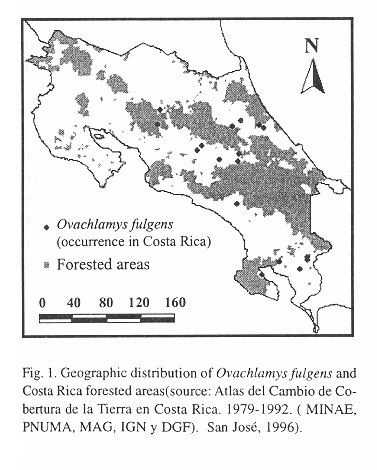
<body><![CDATA[<br> &nbsp; &nbsp; &nbsp;    <br>   </font></font></div>          <div class="MsoNormal" style="margin-right: 2.45pt; "><font face="Arial,Helvetica"><font size="-1"><b><i> Correction factor:</i></b> The reliability of the sampling procedure was tested in December, 1993, on 39 randomly selected 25x25cm<sup>2</sup> quadrats. After the standard visual count, all the vegetation and soil to a depth of 1 cm were collected and examined in the laboratory under 10x magnification.  The correction factor was calculated as the total number of specimens divided  by the mean number of visually counted specimens.    <br> &nbsp; &nbsp; &nbsp;    <br>   </font></font></div>          <div class="MsoNormal" style="margin-right: 2.45pt; "><font face="Arial,Helvetica"><font size="-1"><b><i> Shell decomposition: </i></b>The decomposition time was measured for 23 shells,  5 mm or more in diameter, placed simultaneously in a mesh cage left in the field; this prevented exposure to macrofauna yet allowed the action of water and other climatic factors. Shells were examined monthly and classified as either intact, faded or broken.</font></font></div>          <div class="MsoNormal" style="margin-right: 2.45pt; "><font face="Arial,Helvetica"><font size="-1"> Voucher <i>O. fulgens</i> were deposited in the Museum of Natural History, University of Florida and Instituto Nacional de Biodiversidad (INBio) catalogue numbers 1474249 (17 specimens) and 1474252 (19 specimens). Summary statistics follow this format: mean (sample size, <u>+</u>standard deviation, minimum-maximum).</font></font>      <br> &nbsp; &nbsp;    <br> &nbsp;</div>  <b><font face="Arial,Helvetica"><font size="-1">Results</font></font></b>          <p class="MsoNormal" style="margin-right: 2.45pt; "><font face="Arial,Helvetica"><font size="-1"><b> Macrodistribution:</b> The distribution of <i>O. fulgens</i> in Costa Rica (<a href="#Fig.1">Fig. 1</a> ) is correlated with human presence and specially with agriculture (<a href="#Tabla1"> Table 1</a> ). Only in Pejibaye de Cartago and in R&iacute;o Claro de Puntarenas (<a href="#Tabla1"> Table 1</a> ) was it found in a secondary forest, other samples were collected in gardens or plantations. In<a href="#Fig.1"> Fig. 1</a> , specimens collected in San Ram&oacute;n (see <a href="#Tabla1">Table 1</a> ) seem to be inside a forested area, but it is crossed over by a road where plantations occur on both sides.</font></font>  </p>       ]]></body>
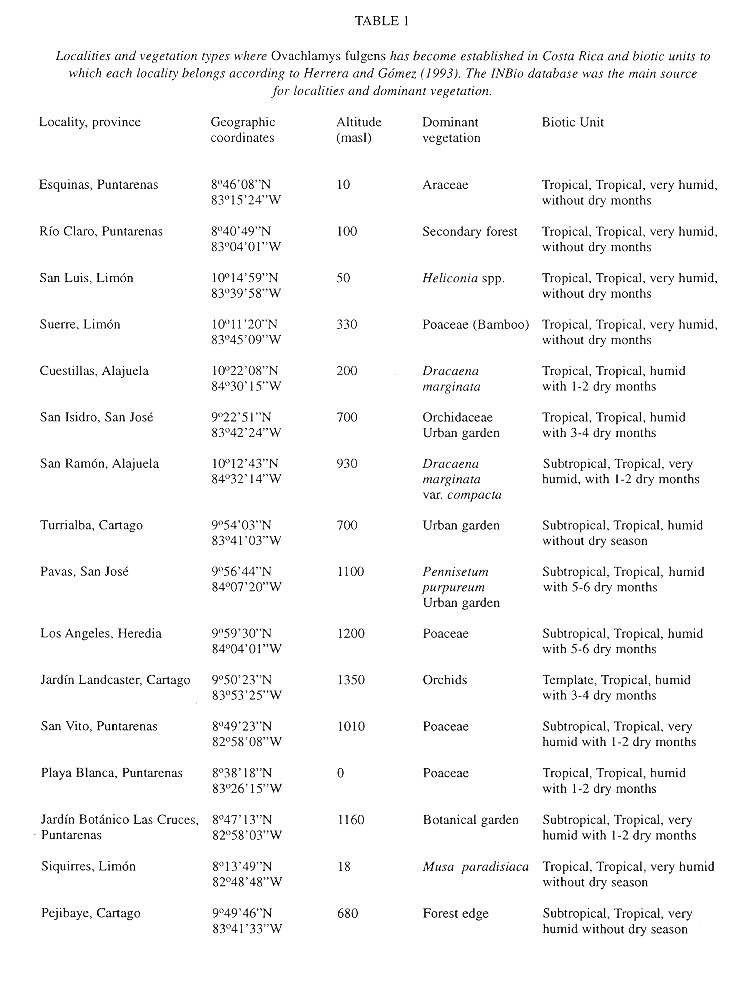
<body><![CDATA[<p class="MsoNormal" style="margin-right: 2.45pt; "><font face="Arial,Helvetica"><font size="-1"> According to <a href="#Herrera">Herrera and G&oacute;mez (1993)</a>  the biotic units where <i>O. fulgens</i> has become established are &#8220;tropical&#8221;, &#8220;subtropical&#8221; and &#8220;temperate&#8221; thermic provinces with the following annual means: 20-27.6<sup>o</sup>C, minimum 14.8-22.2<sup>o</sup>C and maximum 24.3-33.1<sup> o</sup>C. These are &#8220;humid&#8221; and &#8220;very humid&#8221; provinces with a hydric index of 20-300% and with precipitation that ranges between 1 530 - 3 034 mm and 3 420 - 8 000 mm and no more than six dry months (<a href="#Herrera">Herrera and G&oacute;mez 1993</a> ).</font></font>     <br> &nbsp;     <br> &nbsp; </p>       <center><a name="Tabla1"></a>   <img src="/img/fbpe/rbt/v48n1/0453i1.JPG" height="991" width="739">   </center>          
<center><a name="Fig.1"></a>   </center>          <center>&nbsp;</center>          <center><img src="/img/fbpe/rbt/v48n1/0453i2.JPG" height="470" width="377">   </center>  &nbsp;     
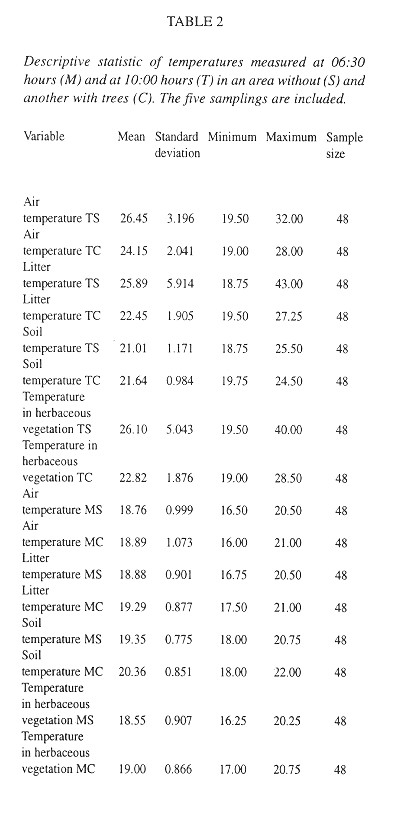
<br> &nbsp;         <p class="MsoNormal" style="margin-right: 2.45pt; "><font face="Arial,Helvetica"><font size="-1"><b> Microdistribution:</b> For equivalent horizontal level and shading conditions, temperatures are higher at 10:00 than at 06:30 hours (<a href="#Tabla2">Table 2</a> ). At 06:30 hours locations with trees have higher temperatures than those without trees, but the reverse is true at 10:00 hours (<a href="#Tabla2"> Table 2</a> ). The temperature depends on time of day and tree cover (<a href="#Tabla2"> Table 2</a> ). At 10:00, everywhere the temperature decreases in the following sequence: air &gt; herbaceous vegetation &gt; litter &gt; soil. At 06:30 hours locations  with trees have this temperature sequence: soil &gt; litter &gt; herbaceous vegetation &gt; air. In the tree-less locations the sequence at this time is: soil &gt; litter &gt; air &gt; herbaceous vegetation (<a href="#Tabla2"> Table 2</a> ). The thermically most stable location is the soil under trees, followed by soil without trees, litter with trees, herbaceous vegetation with trees, air in locations with trees, litter without trees, herbaceous vegetation without trees and finally the least stable temperatures were recorded in air from the tree-less locations.</font></font>     <br> &nbsp; </p>       ]]></body>
<body><![CDATA[<center><a name="Tabla2"></a>   <img src="/img/fbpe/rbt/v48n1/0453i3.JPG" height="826" width="402">   </center>  &nbsp;     
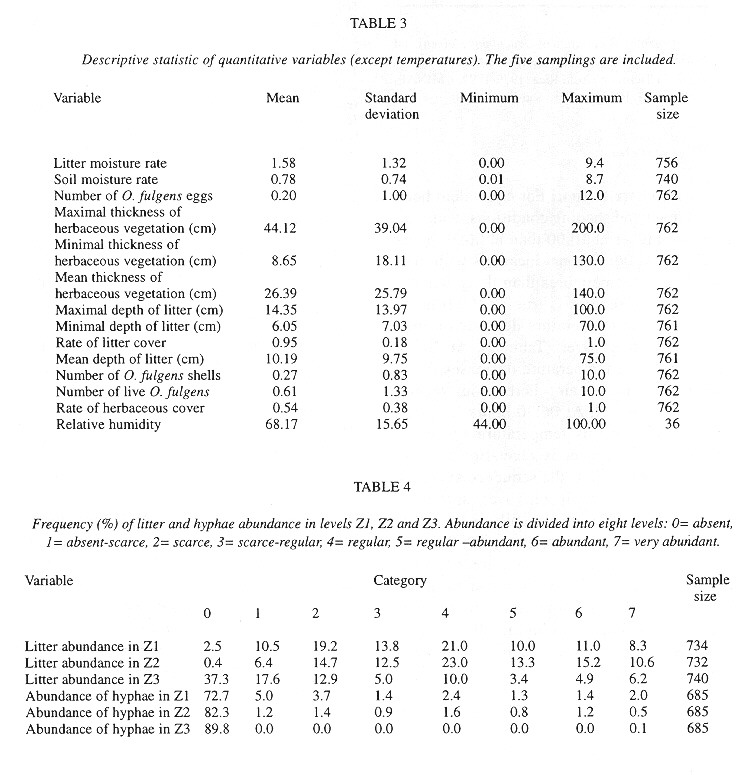
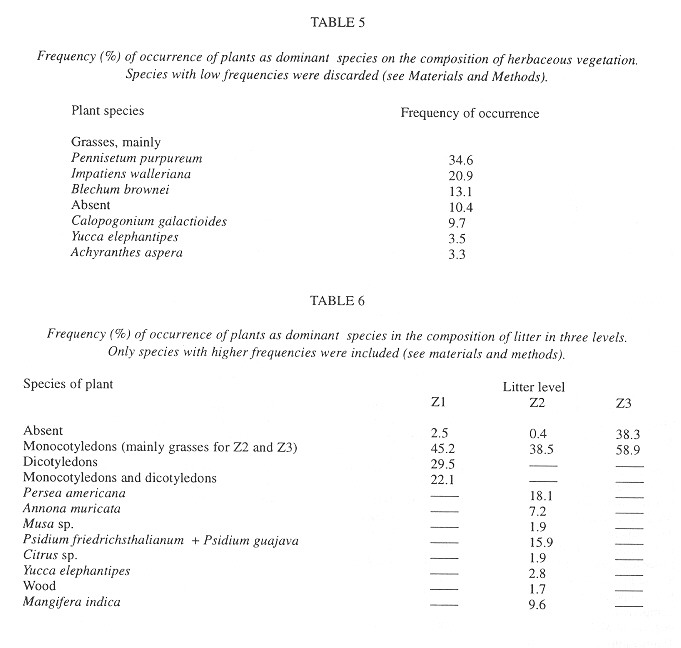
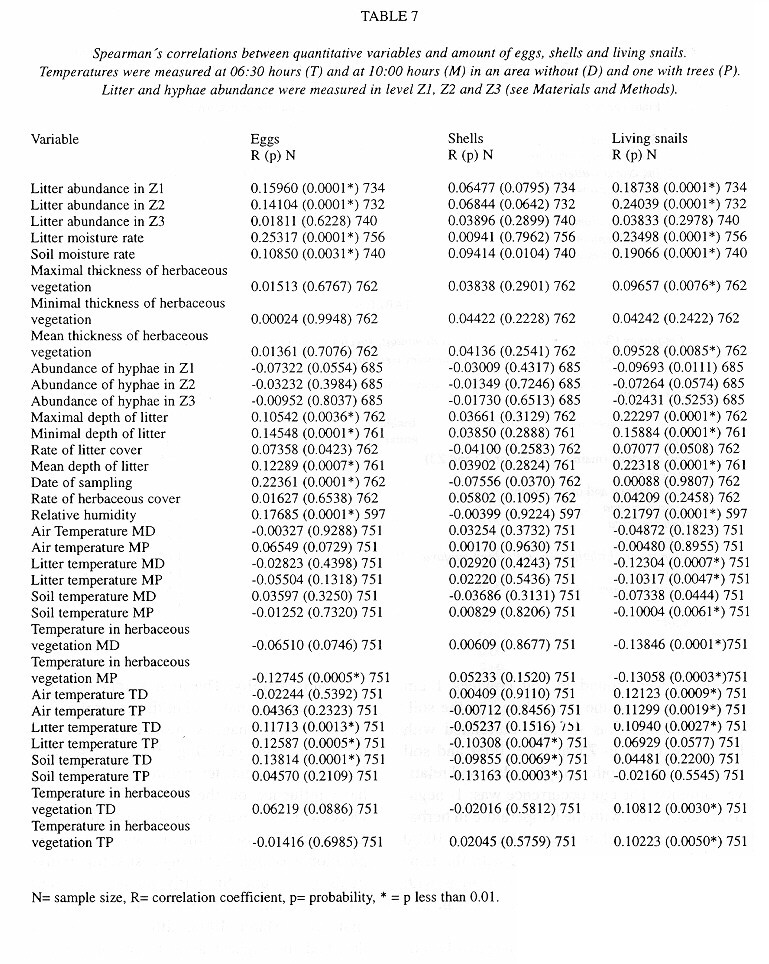
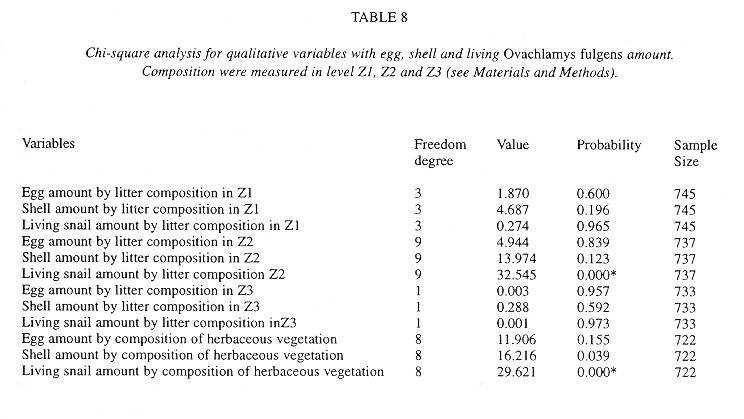
<br> &nbsp;         <p><font face="Arial,Helvetica"><font size="-1">Quadrats were almost (95  %) completely covered by litter, but only 54 % of them had herbs (<a href="#Tabla3-4"> Table 3</a> ). The litter has twice as much humidity as the soil (<a href="#Tabla3-4"> Table 3</a> ). Relatively few quadrats had visible fungal hyphae and these were almost exclusively in the lower litter layers (<a href="#Tabla3-4">Table 4</a> ). The herbs were mainly <i>P. purpureum</i>, <i>Impatiens walleriana</i>  and <i>Blechum brownei</i>. (<a href="#Tabla5-6">Table 5</a> ). Litter was dominated by grass blades and leaves of <i>P. americana</i>  and <i>P. friedrichsthalianum</i> (<a href="#Tabla5-6">Table 6</a> ).</font></font> </p>       <div class="MsoNormal" style="margin-right: 2.45pt; ">&nbsp;</div>          <div class="MsoNormal" style="margin-right: 2.45pt; "><font face="Arial,Helvetica"><font size="-1"> Most live specimens were found in litter and on herbaceous vegetation in the first 50 cm above ground, while none were found inside the soil or at more than 70 cm above ground. Snail abundance was similar in the sections with and without trees (chi-quadrate x<sup>2</sup>, p &gt; 0.05). The factors most strongly correlated with the abundance of live snails were litter abundance  in Z1 and Z2, litter and soil humidity, litter depth, herbaceous vegetation  thickness, relative humidity (<a href="#Tabla7">Table 7</a> ) and the herbaceous vegetation and litter (in Z2) composition (<a href="#Tabla8"> Table 8</a> ). In the last two cases snails seem to be more abundant in areas where <i> Y. elephantipes</i> occurs. The presence of live snails was: 1-negatively  correlated with the temperature at 10:00am in the litter and vegetation of areas with trees and without them and in the soil of areas with trees, and 2- positively correlated with the temperature at 6:30 am in the air and herbaceous vegetation of areas with and without trees, and in the litter of areas without trees (<a href="#Tabla7">Table 7</a> ).</font></font></div>          <center><a name="Tabla3-4"></a>   <img src="/img/fbpe/rbt/v48n1/0453i4.JPG" height="775" width="749">   </center>          
<center>&nbsp;</center>          <center>&nbsp;</center>          <center><a name="Tabla5-6"></a>   <img src="/img/fbpe/rbt/v48n1/0453i5.JPG" height="678" width="693">   </center>  &nbsp;     
<br> &nbsp;         ]]></body>
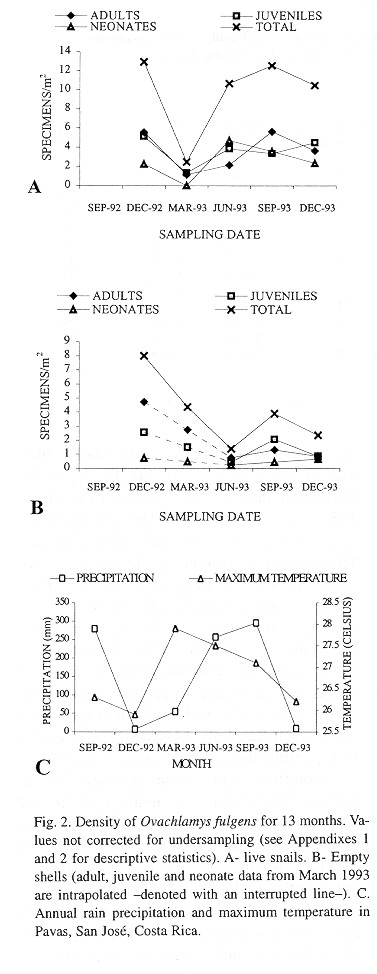
<body><![CDATA[<p class="MsoNormal" style="margin-right: 2.45pt; "><font face="Arial,Helvetica"><font size="-1"> Eggs were found in soil crevices 1 cm deep or less or in the litter closest  to the soil. Egg abundance was strongly correlated with litter abundance in Z1 and Z2, litter and soil humidity, litter depth, sampling date and relative humidity. The egg occurrence was: 1- negatively correlated with the temperature in herbaceous vegetation of an area with trees at 10:00 am and 2- positively correlated with the temperature at 6:30 am in the litter of areas with trees and without trees and in the soil in an area without trees (<a href="#Tabla7"> Table 7</a> ).</font></font>  </p>       <p class="MsoNormal" style="margin-right: 2.45pt; "><font face="Arial,Helvetica"><font size="-1"> The factors most strongly (negatively) correlated with the presence of shells  were the temperature at 6:30 am in the soil and litter of areas with trees  and in the soil of areas without trees (<a href="#Tabla7">Table 7</a> ).</font></font>  </p>       <p class="MsoNormal" style="margin-right: 2.45pt; "><font face="Arial,Helvetica"><font size="-1"><b> Demography:</b> The small sample size prevented statistic analysis but the general pattern of population dynamics shows correlation with the annual rain cycle (<a href="#Fig.2">Fig. 2</a> ), with some time lag. The maximum temperature also seems to have influence on the population dynamics. December 1992 was a very dry and cool month as well as the onset of the dry season, snail population was high, but many aestivating individuals were found. Similarly, the population increase became noteworthy shortly after the first rains. March 1993, although wetter less dry, had the highest temperature of the year and also the fewest amount of live snails. In June 1993 precipitation as well as the snail population rose and the temperature decreased. The same pattern was kept in September 1993.</font></font>  </p>       <center><a name="Tabla7"></a>   <img src="/img/fbpe/rbt/v48n1/0453i6.JPG" height="964" width="769">   </center>          
<div class="MsoNormal" style="margin-right: 2.45pt; ">&nbsp;        <center><a name="Tabla8"></a>   <img src="/img/fbpe/rbt/v48n1/0453i7.JPG" height="419" width="744">   </center>  &nbsp;     
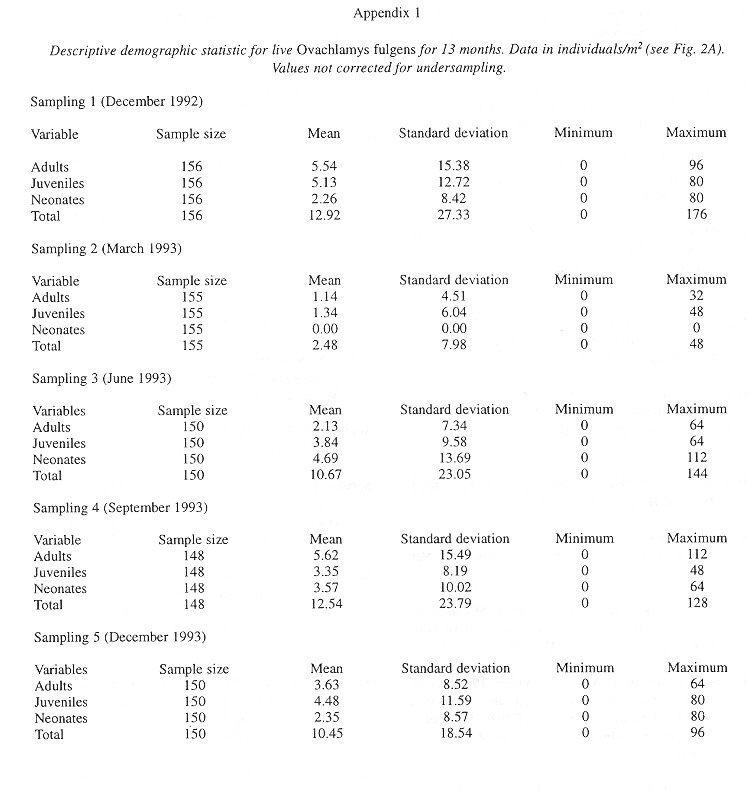
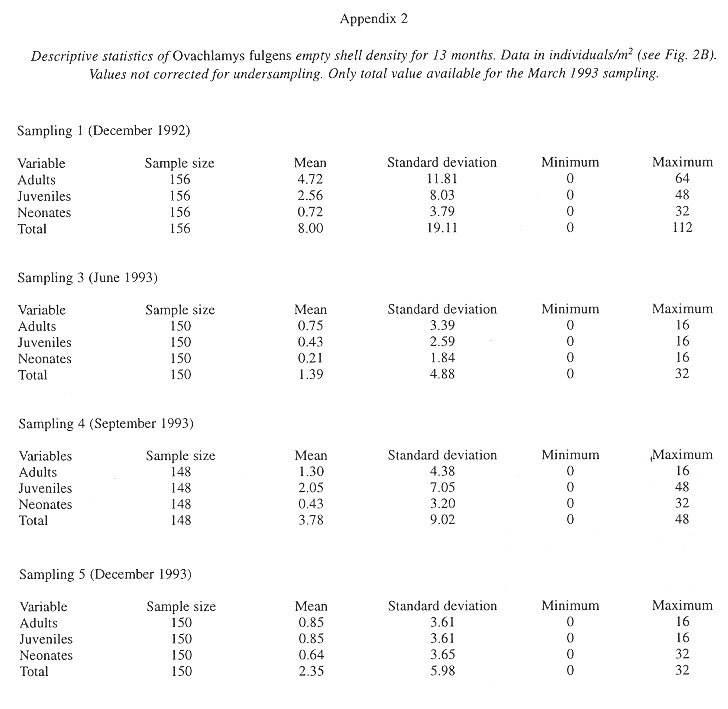
<br> &nbsp;         <p><font face="Arial,Helvetica"><font size="-1">Neonates is the group that  during the dry season decreases most and also the one that increases most  dramatically (followed by juveniles) with the rains. Neonates and juveniles  decrease proportionatelly as they are recruited to the adult class (<a href="#Fig.2"> Fig. 2</a> ).</font></font></p>   </div>          <div class="MsoNormal" style="margin-right: 2.45pt; "><font face="Arial,Helvetica"><font size="-1"> Empty shell density has two important differences from the living population  (<a href="#Fig.2">Fig. 2</a> ): 1) between the second and third sampling it decreased as the population increased and 2) it never recovered its initial level. Nevertheless, the general empty shell density parallels the curve of living animal density (<a href="#Fig.2">Fig. 2</a> ). Live snail density ranged from 8.30 ind/m<sup>2</sup> in March to 43.41 ind/m<sup>2</sup> in December.    <br> &nbsp; &nbsp; &nbsp;    ]]></body>
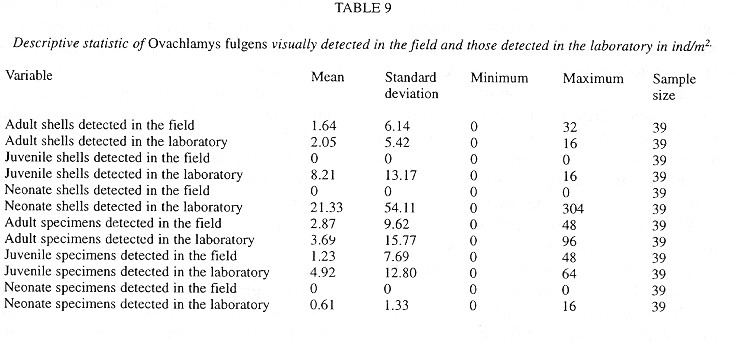
<body><![CDATA[<br>   </font></font></div>          <div class="MsoNormal" style="margin-right: 2.45pt; "><font face="Arial,Helvetica"><font size="-1"> The presence of <i>O. fulgens</i> eggs is also affected by rain: 57.2% of eggs were found in the September 1993 sampling, 34.9% in June 1993 and only  7.9% in December 1992 (n=152). The mean clutch size was 2.6 eggs (60, <u> +</u>0.978, 1-5 eggs).</font></font></div>          <div class="MsoNormal" style="margin-right: 2.45pt; "><font face="Arial,Helvetica"><font size="-1"> The lowest proportion of aestivating individuals was recorded in June (1.0%;  n= 100) and September 1993 (0.9%, n=116). The proportion increased for the December (1992 and 1993) samplings, that is the dry season onsets: 12.7% (n=126) and 18.4% (n=98) respectively. The greatest proportion was in March 1993 with 91.7% aestivating (n= 24). To prepare for aestivation, these molluscs retract the head and then the foot into the shell. They are found adhering to litter leaves and grass blades. The adherent mucus is limited to the aperture edge and does not form an epiphragm (n= 58). They could end aestivation abruptly, becoming active almost immediately (5 - 10 sec) when experimentally separated from the substrate.    <br> &nbsp; &nbsp;     <br>   </font></font></div>          <div class="MsoNormal" style="margin-right: 2.45pt; "><font face="Arial,Helvetica"><font size="-1"> A single case of predation was observed: an ant carrying an <i>O. fulgens</i>  egg (some endoparasites were also observed but these in specimens collected  in San Luis, Lim&oacute;n province (<a href="#Tabla1">Table 1</a> ). Courtship and copulation were not seen.    <br> &nbsp; &nbsp;     <br>   </font></font></div>          <div class="MsoNormal" style="margin-right: 2.45pt; "><font face="Arial,Helvetica"><font size="-1"><b><i> Sampling correction factor: </i></b>Visual counts underestimated the number of live and dead <i>O. fulgens</i> in the field, nevertheless it was statistically  different only with dead neonates (U-Mann-Whitney for neonates shells, n-shells found in the field= 39, n-shells found in the laboratory = 39, p= 0.0065*). The correction factor for live animals is 3.36 and for shells 15.33. Dead neonates were the most likely to be misrepresented in the counts; adult counts were closer to the real numbers (<a href="#Tabla9">Table 9</a> ).</font></font>     <br> &nbsp;     ]]></body>
<body><![CDATA[<br> &nbsp;</div>          <center><a name="Fig.2"></a>   <img src="/img/fbpe/rbt/v48n1/0453i8.JPG" height="974" width="377">   </center>          
<center>&nbsp;</center>          <center>&nbsp;</center>          <center><a name="Fig.3"></a>   </center>          <center>&nbsp;<img src="/img/fbpe/rbt/v48n1/0453i9.JPG" border="0" height="332" width="368">   </center>           
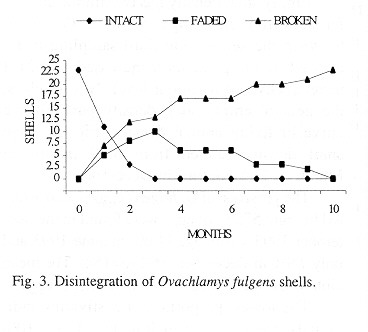
<p>&nbsp;     <br> &nbsp;     <br> &nbsp;  </p>       <p class="MsoNormal" style="margin-right: 2.45pt; "><font face="Arial,Helvetica"><font size="-1"><b><i> Shell decomposition:</i></b> Shell decomposition is a gradual process that begins with death. The decomposing soft parts often leave a black stain in the first body whorls; the stain is gradually reduced and finally disappears.  At this time the periostracum is not decomposed and the shells are translucent  amber in color. This part of the process was labeled "intact" and takes tree months (Fig. 3). Next, the shells "faded", the periostracum is lost, beginning at the apex (only once was a shell totally white before it began to break apart). Then the apex is lost; the process lasts ten months and follows a normal curve (Fig. 3) although the curve ascent occurs in the first three months. The third or "broken" stage occurs after the apex is broken, the shells lose the periostracum and fragments to disappearance. The 23 shells sample required more than ten months for all to disintegrate (Fig. 3); the mean was 147.5 days (23, <u>+</u>102.6, 28-310 days).</font></font>     ]]></body>
<body><![CDATA[<br> &nbsp; </p>       <center><a name="Tabla9"></a>   <img src="/img/fbpe/rbt/v48n1/0453i10.JPG" height="342" width="739">   </center>  &nbsp;     
<br> &nbsp;         <p><b><font face="Arial,Helvetica"><font size="-1">Discussion</font></font></b>   </p>       <p class="MsoNormal" style="margin-right: 2.45pt; "><font face="Arial,Helvetica"><font size="-1"><b> Macrodistribution: </b>In Costa Rica <i>O. fulgens</i> is correlated with agricultural plantations and with secondary growth vegetation; thus it is probably benefited by deforestation. Nevertheless, it may also become established in forest remnants close to plantations.</font></font>  </p>       <p class="MsoNormal" style="margin-right: 2.45pt; "><font face="Arial,Helvetica"><font size="-1"> The macrodistribution of <i>O. fulgens</i> appears to be limited by temperature  and humidity because it has not been found in regions with annual means below 20<sup>o</sup>C and above 27.6<sup>o</sup>C and annual precipitation below 1530mm. The data from Naha (the only city in the Liu Chiu Islands with meteorological data available) fully agree with these ranges. For this reason, the species will probably fail to colonize the northern Pacific region (Nicoya, basically), and the highlands above 1700masl. The only biotic zones still open to establishment are those classified as "temperate, tropical very humid" mainly on the bases of the mountain ranges in the center and south of Costa Rica.</font></font>   </p>       <p class="MsoNormal" style="margin-right: 2.45pt; "><font face="Arial,Helvetica"><font size="-1"><b> Microdistribution:</b> According to this study the number of eggs and live snails of <i>O. fulgens</i> increase with the increase of temperature during the morning (6:30 am) and with the decrease of temperature later in the morning (10:00am) showing a tendency to thermic stability. Exactly the opposite situation was found in the case of empty shell, a fact which supports the last conclusion.  Apparently the thermic stability that tree cover gives is not significant  for the abundance of <i>O. fulgens</i>, making the species more suitable to colonize cultivated areas. Similarly to the findings of <a href="#Boag85"> Boag (1985)</a> , thermic stability appears to determine substrate selection of adults.</font></font>   </p>       <p class="MsoNormal" style="margin-right: 2.45pt; "><font face="Arial,Helvetica"><font size="-1"> Other factors clearly correlated with occurrence of eggs and live snails were humidity of litter and soil and season (for eggs only), as reported for temperate species (<a href="#Boag85">Boag 1985</a> , <a href="#Locasciulli">Locasciulli and Boag 1987</a> , <a href="#Nilsson">Nilsson <i>et al.</i> 1988</a> ). High relative humidity is also an important factor for snail and egg abundance,  an expected result due to the hygroscopic nature of the eggs and to the snails&#8217; slime trail production. This study suggests that <i>O. fulgens</i> lays eggs in the soil probably not only because it is, thermically, the most stable microhabitat available, but also because these can take advantage of the increased moisture during the rainy season (see <a href="#Barrientos98">Barrientos  1998</a> ). <a href="#Degen">Degen <i>et al</i>. 1992</a>  found that the desert snail <i>Trochoidea seetzenii</i> markedly selects microhabitats with stable humidity, but this study suggests that <i>O. fulgens</i>  prefers moister soil and litter, not the more stable. The results of this study do not support <a href="#Peake">Peake`s (1968)</a>  opinion that well drained soils favor the presence of molluscs.</font></font>   </p>       <p class="MsoNormal" style="margin-right: 2.45pt; "><font face="Arial,Helvetica"><font size="-1"> Litter depth and abundance also affected eggs and living <i>O. fulgens</i>  abundance. <a href="#Abramsky90">Abramsky<i> et al</i>. (1990</a> , <a href="#Abramsky92">1992</a> ) stated that the factors determining abundance of desert species are predation,  oviposition sites and habitat heterogeneity. <a href="#Brown">Brown and Lodge (1993)</a>  stressed the relationship between abundance and habitat structural complexity, the latter increases the area that can be colonized. In the present study, the factors listed by <a href="#Abramsky90">Abramsky <i>et al.</i> (1990</a> , <a href="#Abramsky92">1992</a> ) and <a href="#Brown">Brown and Lodge (1993)</a>  are the result of litter depth and abundance because thicker litter has more sites to colonize, lay eggs in and hide from predators.</font></font>      <br> &nbsp; </p>       ]]></body>
<body><![CDATA[<div class="MsoNormal" style="margin-right: 2.45pt; "><font face="Arial,Helvetica"><font size="-1"> It has been shown that the litter from each tree species generates significant  differences in the soil composition (<i>e.g.</i> phosphorus concentrations,  pH values, etc.) (<a href="#Orians">Orians <i>et al.</i> 1996</a> ) and that some types of leaf litter leaves are not adequate for snail oviposition  (<a href="#Barrientos96">Barrientos 1996</a> , <a href="#Barrientos98">1998</a> ) or feeding (<a href="#VanEs">Van Es and Boag 1981</a> , <a href="#Boag82">Boag and Wishart 1982</a> , <a href="#Molgaard">Molgaard 1986</a> , <a href="#Laurens">Laurens <i>et al.</i> 1987</a> , <a href="#Speiser">Speiser and Rowell-Rahier 1991</a> , <a href="#Stamol">Stamol 1993</a> ).<b> </b>Besides this, <a href="#Chatfield">Chatfield (1975)</a>  found that <i>Discus rotundatus</i> feeds mainly on green algae. On the contrary, the same author found that in high density populations of Helicid snails the most frequent food plants were usually the common ones in the plant community, in a more opportunistic way. <a href="#Chatfield">Chatfield&#8217;s  (1975)</a>  findings support an extrapolation: more diverse forests (or litter layers) make specialization less desirable, although this could also be true in a tropical forest due to its high diversity, in this study the taxonomic composition of the litter apparently had a significant effect on the microdistribution of <i>O. fulgens</i>. Although not the most abundant plant,<i> Y. elephantipes</i>  litter was very abundant, had &#8220;long live&#8221; and kept high moisture levels (of the layers not exposed to sun), any of these factors could favor the abundance of <i>O. fulgens</i>. Before establishing if this result was produced due to dietary needs or to any of the other characteristics mentioned above, laboratory experiments should be conducted.<a href="#Chatfield">Chatfield  (1975)</a>  and <a href="#Locasciulli">Locasciulli and Boag (1987)</a>  suggested that litter molluscs benefit from the presence of fungal hyphae but for <i>O. fulgens</i> seems to have no effect on them (<a href="#Barrientos96"> Barrientos 1996</a> , <a href="#Barrientos98">1998</a> ), at least for hyphae visible to the naked eye.    <br> &nbsp; &nbsp; &nbsp;    <br>   </font></font></div>          <div class="MsoNormal" style="margin-right: 2.45pt; "><font face="Arial,Helvetica"><font size="-1"> The different results of the analysis of living snails&#8217; and shells&#8217; tendencies  suggest that those categories should not be considered together as some authors have done (see <a href="#Coppois">Coppois 1984</a> ). Shell occurrence can be the result of factors that operated in the past but that may be currently absent such as foliage shadow, litter accumulation and transport by water currents or predators (<a href="#Abramsky90">Abramsky   <i>et al</i>. 1990</a> ).    <br> &nbsp; &nbsp; &nbsp;     <br>   </font></font></div>          <div class="MsoNormal" style="margin-right: 2.45pt; "><font face="Arial,Helvetica"><font size="-1"><b> Demography:</b> The density curve for live snails has the expected shape: it follows, with some lag, the precipitation curve and is inverse to the maximum temperature curve. A similar pattern was found by <a href="#Kralka"> Kralka (1986)</a>  for <i>Euconulus fulvus</i>, <i>Nesovitrea electrina</i>, <i>Discus cronkhiteri</i>  and <i>Vertigo gouldii</i> for precipitation and population dynamics in north temperate zones. In Cuba <a href="#Alonso">Alonso and Berovides (1991)</a>  found for <i>Zachrysia guanensis</i> that the higher the moisture and temperature  the greater its abundance. Costa Rican <i>O. fulgens</i> are more abundant  when daily temperature variation is minimal, not during periods of high temperature. In fact, low precipitation (followed by high temperature) seems to have ahigher impact in the population demography. The species is abundant but does not reach the extremely high densities of 2500ind/m<sup>2 </sup>reported for   <i>Bradybaena similaris</i> in southern Brazil (<a href="#Reichholf">Reichholf  1986</a> ).    <br> &nbsp; &nbsp; &nbsp;    <br>   </font></font></div>          <div class="MsoNormal" style="margin-right: 2.45pt; "><font face="Arial,Helvetica"><font size="-1"> The density of dead snails (empty shells) does not fluctuate as expected because, if shells require a mean of five months to disintegrate, the curve should climb in the dry season, remain stable the next five months and progressively  decline until the next dry season. However, the shell curve follows, with  some lag, that of living snails, suggesting that in nature the shells disintegrate  in less than five months. Shell density should not be used for extrapolation  of live snail demography until more species with different shell sizes and thickness as well as larger samplings are tested.    ]]></body>
<body><![CDATA[<br> &nbsp; &nbsp; &nbsp;    <br>   </font></font></div>          <div class="MsoNormal" style="margin-right: 2.45pt; "><font face="Arial,Helvetica"><font size="-1"> The timing of egg laying correlates with high humidity, consistent with the  need of recently laid eggs to absorb water from the surroundings (<a href="#Barrientos96"> Barrientos 1996</a> , <a href="#Barrientos98">1998</a> ). Most stylommatophorans behave similarly; for example, <i>Sphincterochila zonata</i>, <i>S. prophetarumare</i> and <i>Helminthoglypta arrosa</i> prepare physiologically while aestivating to lay eggs with the first spring rains (<a href="#VanderLaan">Van der Laan 1981</a> , <a href="#Hodgson">Hodgson and Shachak 1991</a> ). Field clutches have fewer eggs than laboratory clutches (<a href="#Barrientos96"> Barrientos 1996</a> , <a href="#Barrientos98">1998</a> ), possiblly reflecting the effect of predators and competition in the field.    <br> &nbsp; &nbsp; &nbsp;     <br>   </font></font></div>          <div class="MsoNormal" style="margin-right: 2.45pt; "><font face="Arial,Helvetica"><font size="-1"> Aestivation is similar to that of other terrestrial molluscs and represents a physiological defense against environmentally difficult periods, for instance low humidity in Mediterranean and Caribbean species (<a href="#Hyman">Hyman 1967</a> , <a href="#Lazaridou">Lazaridou-Dimitriadou and Saunders 1986</a> , <a href="#Dallas">Dallas <i>et al.</i> 1991</a> , <a href="#Bidart">Bidart <i>et al</i>. 1992</a> , <a href="#Ward">Ward and Slotow 1992</a> ). Apparently, in the field <i>O. fulgens</i> also begins aestivation when humidity decreases significantly. <i>O. fulgens</i> reproduced and did not aestivate during the dry months when kept in moist terraria (<a href="#Barrientos96"> Barrientos 1996</a> , <a href="#Barrientos98">1998</a> ), but a different behavior has been reported for other species like <i>Trochoidea seetzeni</i> (<a href="#Ward">Ward and Slotow 1992</a> ). This makes of <i>O. fulgens</i> a very successful pest in artificially irrigated plantations. In the dry season the most affected group was that of snails with a shell diameter under 2.5mm; the most probable reason being that their volume/surface ratio is lower and thus water loss higher (see   <a href="#Waite">Waite 1987</a> ). The reason for lack of an epiphragm requires more research because it could be an alternate system to close the shell aperture, as in members of the genera <i>Pararhytida</i> and <i>Rhytidopsis</i> (Charopidae), which have pseudo-opercules (<a href="#Solem">Solem <i>et al.</i> 1984</a> ).    <br> &nbsp; &nbsp; &nbsp;    <br>   </font></font></div>          <div class="MsoNormal" style="margin-right: 2.45pt; "><font face="Arial,Helvetica"><font size="-1"> The underestimation of live and dead <i>O. fulgens</i> was not as high as in <i>Succinea costaricana</i> (<a href="#Villalobos">Villalobos <i>et al.</i>  1995</a> ). These results suggest that, when shells smaller than 2.5 mm in diameter want to be included in the analysis, ecological samplings should be done by collecting the soil and plants and sorting them in the laboratory.    <br> &nbsp; &nbsp; &nbsp;    ]]></body>
<body><![CDATA[<br>   </font></font></div>          <div class="MsoNormal" style="margin-right: 2.45pt; "><font face="Arial,Helvetica"><font size="-1"> Only two types of predators (ants and nematodes) were seen in the field but    <i>O. fulgens</i> populations may be controlled by rodents, lizards, birds  and carabid coleopterans, known to feed on other snails (<a href="#Sirby"> Sirby 1984</a> , <a href="#Bishton">Bishton 1986</a> , <a href="#Abramsky92">Abramsky <i>et al.</i> 1992</a> , <a href="#Digweed">Digweed 1993</a> ). Some molluscs attacked by ants have developed defensive behaviors (<a href="#Gotwald"> Gotwald 1972</a> ) and <i>O. fulgens</i> shields itself with the shell when disturbed (pers. observ.) or jumps using its caudal horn and the posterior part of the foot as a catapult (<a href="#Barrientos98">Barrientos 1998</a> ).</font></font></div>           <p>&nbsp;  </p>       <p><b><font face="Arial,Helvetica"><font size="-1">Resumen</font></font></b>   </p>       <p><font face="Arial,Helvetica"><font size="-1">El caracol introducido   <i>Ovachlamys fulgens</i> (Stylommatophora: Helicarionidae) habita regiones cultivadas de Costa Rica y su distribuci&oacute;n est&aacute; limitada por temperaturas anuales entre 20 y 27.6<sup>o</sup>C y precipitaciones anuales entre 1530-3034 y 3420-8000 mm con no m&aacute;s de seis meses secos. Esta especie habita en la hojarasca y en la cobertura herb&aacute;cea hasta a 70 cm de altura. Se realizaron cinco muestreos; uno cada tres meses. En cada muestreo se analizaron un m&iacute;nimo de 150 parcelas aleatorias de 25 x25 cm. Los factores que determinan la abundancia de individuos y huevos fueron la abundancia y profundidad de la hojarasca, la humedad del mantillo y del suelo, y la humedad relativa. &Eacute;stos a su vez estuvieron positivamente  correlacionados con la temperatura a primeras horas de la ma&ntilde;ana (6:30 am) y negativamente con la temperatura a media ma&ntilde;ana (10:00 am). Aparte de estos factores, los caracoles tambien estuvieron correlacionados  con el grosor de la capa herb&aacute;cea y con la presencia de<i>Yucca elephantipes</i>  tanto en el mantillo como en la vegetaci&oacute;n. Los huevos tambien se vieron afectados por la &eacute;poca del a&ntilde;o, debido a su propiedad higrosc&oacute;pica. La abundancia de conchas se correlacion&oacute; &uacute;nicamente con la temperatura, en patr&oacute;n contrario al de los los huevos. Tanto la poblaci&oacute;n como la cantidad de conchas siguieron, con un leve retraso, la curva de lluvias de la zona a lo largo del a&ntilde;o. La &eacute;poca reproductiva abarca los meses de mayo a noviembre (&eacute;poca lluviosa); y durante los meses de diciembre a abril (&eacute;poca seca) se puede encontrar hasta el 92% de los espec&iacute;menes estivando. En condiciones naturales la camada promedio tiene tres huevos. Los caracoles vivos tuvieron una densidad m&aacute;xima de 12.92 ind/m<sup>2</sup> (en diciembre) y m&iacute;nima de 2.47 ind/m<sup>2</sup> (en marzo; estos valores deben multiplicarse por el factor de correcci&oacute;n 3.36). En condiciones experimentales las conchas tardaron intactas dos meses y su descomposici&oacute;n total se produjo en cinco meses en promedio.</font></font>     <br> &nbsp;  </p>       <p><b><font face="Arial,Helvetica"><font size="-1">Acknowledgements</font></font></b>   </p>       <p class="MsoNormal" style="margin-right: 2.45pt; "><font size="-1"><font face="Arial,Helvetica"> This study was financed by the author, by Consejo Nacional para Investigaciones  Cient&iacute;ficas y Tecnol&oacute;gicas (CONICIT) project 94-520-BID and  by Netherlands Development Assistance (NEDA).</font> <font face="Arial,Helvetica"> Instituto Nacional de Biodiversidad (INBio) provided time and facilities to finish it. I thank Fernando Barrientos H. and Lilia Llosa for allowing work on their property. Fernando Barrientos Ll., Jos&eacute; Franco (Coalici&oacute;n  Nacional de Iniciativas de Desarrollo), Vernon Arias (Universidad de Costa  Rica: UCR), Richard Helling, Carlos Porras, Julio Maga&ntilde;a (INBio), Marianella Segura (INBio), Franscisco Quesada (INBio), Mario Chinchilla (INBio), Eida Fletes (INBio), Kattya Quesada (INBio), Socorro Avila (INBio), Marcos Castro (INBio) and Luis Murcia (INBio) assisted field and laboratory work. Plant identification was done by Qu&iacute;rico Jim&eacute;nez (INBio), Carlos Morales (UCR) and Nelson Zamora (INBio). The departments of genetics and entomology of Escuela de Biolog&iacute;a (UCR) lent some equipment. David Boag, Marco de la Torre and two other anonymous reviewers read the manuscript and improved the language. Mar&iacute;a Isabel Gonz&aacute;lez (UCR) and Juan Bautista Chavarr&iacute;a (UCR) provided statistical assistance and Randall Wong made the statistical analysis. I specially thank Fred G. Thompson (University of Florida) for taxonomic advice and Juli&aacute;n Monge-N&aacute;jera (UCR) for providing unconditional assistance in several stages of this paper. This manuscript is part of a M.Sc. thesis presented at the University of Costa Rica.</font></font>     <br> &nbsp;  </p>       <p><b><font face="Arial,Helvetica"><font size="-1">References</font></font></b>   </p>       ]]></body>
<body><![CDATA[<!-- ref --><p class="MsoNormal" style="margin-right: 2.45pt; "><a name="Abramsky90"></a>   <font face="Arial,Helvetica"><font size="-1">Abramsky, Z., H. Alfia, M. Shachak &amp; S. Brand. 1990. Predation by rodents and the distribution and abundance of the snail <i>Trochoidea seetzenii</i> in the Central Negev Desert of Israel. Oikos 59: 225-235.</font></font>  &nbsp;&nbsp;&nbsp;&nbsp;&nbsp;&nbsp;&nbsp;&nbsp;[&#160;<a href="javascript:void(0);" onclick="javascript: window.open('/scielo.php?script=sci_nlinks&ref=1193046&pid=S0034-7744200000010000900001&lng=','','width=640,height=500,resizable=yes,scrollbars=1,menubar=yes,');">Links</a>&#160;]<!-- end-ref --><!-- ref --><p class="MsoNormal" style="margin-right: 2.45pt; "><a name="Abramsky92"></a>   <font face="Arial,Helvetica"><font size="-1">Abramsky, Z., M. Shachak, A. Subach, S. Brand &amp; H. Alfia. 1992. Predator-prey relationships: Rodent-snail interactions in the Central Negev Desert of Israel. Oikos 65: 128-133.</font></font>   &nbsp;&nbsp;&nbsp;&nbsp;&nbsp;&nbsp;&nbsp;&nbsp;[&#160;<a href="javascript:void(0);" onclick="javascript: window.open('/scielo.php?script=sci_nlinks&ref=1193047&pid=S0034-7744200000010000900002&lng=','','width=640,height=500,resizable=yes,scrollbars=1,menubar=yes,');">Links</a>&#160;]<!-- end-ref --><!-- ref --><p class="MsoNormal" style="margin-right: 2.45pt; "><a name="Alonso"></a>   <font face="Arial,Helvetica"><font size="-1">Alonso S., M.A. &amp; V. Berovides A. 1991. Densidad y variaci&oacute;n morfol&oacute;gica de <i>Zachrysia guanensis</i>  (Gastropoda: Camaenidae) en Pinar del R&iacute;o, Cuba. Rev. Biol&oacute;gica 5: 97- 105.</font></font>  &nbsp;&nbsp;&nbsp;&nbsp;&nbsp;&nbsp;&nbsp;&nbsp;[&#160;<a href="javascript:void(0);" onclick="javascript: window.open('/scielo.php?script=sci_nlinks&ref=1193048&pid=S0034-7744200000010000900003&lng=','','width=640,height=500,resizable=yes,scrollbars=1,menubar=yes,');">Links</a>&#160;]<!-- end-ref --><!-- ref --><p class="MsoNormal" style="margin-right: 2.45pt; "><a name="Barrientos96"></a>   <font face="Arial,Helvetica"><font size="-1">Barrientos, Z. 1996. Ciclo de vida y comportamiento del caracol terrestre <i>Ovachlamys fulgens</i> (Gude, 1900) (Stylommatophora: Helicarionidae) en el laboratorio. Tesis de Maestr&iacute;a, Universidad de Costa Rica, San Jos&eacute; (cap. 2).</font></font>   &nbsp;&nbsp;&nbsp;&nbsp;&nbsp;&nbsp;&nbsp;&nbsp;[&#160;<a href="javascript:void(0);" onclick="javascript: window.open('/scielo.php?script=sci_nlinks&ref=1193049&pid=S0034-7744200000010000900004&lng=','','width=640,height=500,resizable=yes,scrollbars=1,menubar=yes,');">Links</a>&#160;]<!-- end-ref --><!-- ref --><p class="MsoNormal" style="margin-right: 2.45pt; "><a name="Barrientos98"></a>   <font face="Arial,Helvetica"><font size="-1">Barrientos, Z. 1998. Life history of the terrestrial snail <i>Ovachlamys fulgens</i> (Stylommatophora: Helicarionidae) under laboratroy conditions. Rev. Biol. Trop. 46(2): 369-384.</font></font>   &nbsp;&nbsp;&nbsp;&nbsp;&nbsp;&nbsp;&nbsp;&nbsp;[&#160;<a href="javascript:void(0);" onclick="javascript: window.open('/scielo.php?script=sci_nlinks&ref=1193050&pid=S0034-7744200000010000900005&lng=','','width=640,height=500,resizable=yes,scrollbars=1,menubar=yes,');">Links</a>&#160;]<!-- end-ref --><!-- ref --><p class="MsoNormal" style="margin-right: 2.45pt; "><a name="Bidart"></a>   <font face="Arial,Helvetica"><font size="-1">Bidart, L., M. Osorio &amp; E. Reinaldo. 1992. Ecolog&iacute;a de <i>Polymita muscarum</i> en la localidad &uml;El Yayal&uml;, provincia de Holgu&iacute;n. Reporte de investigaci&oacute;n del Instituto de Ecolog&iacute;a and Sistem&aacute;tica. Academia de Ciencia de Cuba. Ser. Zool. 17: 3-14.</font></font>  &nbsp;&nbsp;&nbsp;&nbsp;&nbsp;&nbsp;&nbsp;&nbsp;[&#160;<a href="javascript:void(0);" onclick="javascript: window.open('/scielo.php?script=sci_nlinks&ref=1193051&pid=S0034-7744200000010000900006&lng=','','width=640,height=500,resizable=yes,scrollbars=1,menubar=yes,');">Links</a>&#160;]<!-- end-ref --><!-- ref --><p class="MsoNormal" style="margin-right: 2.45pt; "><a name="Bishton"></a>   <font face="Arial,Helvetica"><font size="-1">Bishton, G. 1986. The diet and foraging behavior of the Dunnock <i>Prunella modularis</i> in a hedgerow habitat. Ibis 128: 526-539.</font></font>  &nbsp;&nbsp;&nbsp;&nbsp;&nbsp;&nbsp;&nbsp;&nbsp;[&#160;<a href="javascript:void(0);" onclick="javascript: window.open('/scielo.php?script=sci_nlinks&ref=1193052&pid=S0034-7744200000010000900007&lng=','','width=640,height=500,resizable=yes,scrollbars=1,menubar=yes,');">Links</a>&#160;]<!-- end-ref --><!-- ref --><p class="MsoNormal" style="margin-right: 2.45pt; "><a name="Boag85"></a>   <font face="Arial,Helvetica"><font size="-1">Boag, D.A. 1985. Microdistribution of three genera of small terrestrial snails (Stylommatophora: Pulmonata). Can. J. Zool. 63: 1089-1095.</font></font>  &nbsp;&nbsp;&nbsp;&nbsp;&nbsp;&nbsp;&nbsp;&nbsp;[&#160;<a href="javascript:void(0);" onclick="javascript: window.open('/scielo.php?script=sci_nlinks&ref=1193053&pid=S0034-7744200000010000900008&lng=','','width=640,height=500,resizable=yes,scrollbars=1,menubar=yes,');">Links</a>&#160;]<!-- end-ref --><!-- ref --><p class="MsoNormal" style="margin-right: 2.45pt; "><a name="Boag82"></a>   <font face="Arial,Helvetica"><font size="-1">Boag, D.A. &amp; W.D. Wishart. 1982. Distribution and abundance of terrestrial gastropods on a winter range of bighorn sheep in southwestern Alberta. Can. J. Zool. 60: 2633-2640.</font></font>   &nbsp;&nbsp;&nbsp;&nbsp;&nbsp;&nbsp;&nbsp;&nbsp;[&#160;<a href="javascript:void(0);" onclick="javascript: window.open('/scielo.php?script=sci_nlinks&ref=1193054&pid=S0034-7744200000010000900009&lng=','','width=640,height=500,resizable=yes,scrollbars=1,menubar=yes,');">Links</a>&#160;]<!-- end-ref --><!-- ref --><p class="MsoNormal" style="margin-right: 2.45pt; "><a name="Brown"></a>   <font face="Arial,Helvetica"><font size="-1">Brown, K. &amp; D.M. Lodge. 1993. Gastropod abundance in vegetated habitats: The importance of specifying null models. Limnol. Oceanogr. 38: 217-225.</font></font>  &nbsp;&nbsp;&nbsp;&nbsp;&nbsp;&nbsp;&nbsp;&nbsp;[&#160;<a href="javascript:void(0);" onclick="javascript: window.open('/scielo.php?script=sci_nlinks&ref=1193055&pid=S0034-7744200000010000900010&lng=','','width=640,height=500,resizable=yes,scrollbars=1,menubar=yes,');">Links</a>&#160;]<!-- end-ref --><!-- ref --><p class="MsoNormal" style="margin-right: 2.45pt; "><a name="Chatfield"></a>   <font face="Arial,Helvetica"><font size="-1">Chatfield, J. E. 1975. A summary on studies on food and feeding in some European land snails. Malacol. Review 8: 123-125.</font></font>  &nbsp;&nbsp;&nbsp;&nbsp;&nbsp;&nbsp;&nbsp;&nbsp;[&#160;<a href="javascript:void(0);" onclick="javascript: window.open('/scielo.php?script=sci_nlinks&ref=1193056&pid=S0034-7744200000010000900011&lng=','','width=640,height=500,resizable=yes,scrollbars=1,menubar=yes,');">Links</a>&#160;]<!-- end-ref --><!-- ref --><p class="MsoNormal" style="margin-right: 2.45pt; "><a name="Coppois"></a>   <font face="Arial,Helvetica"><font size="-1">Coppois, G. 1984. Distribution of bulimulid land snails on the northern slope of Santa Cruz Island, Galapagos. Biol. J. Linn. Soc. 21: 217-227.</font></font>  &nbsp;&nbsp;&nbsp;&nbsp;&nbsp;&nbsp;&nbsp;&nbsp;[&#160;<a href="javascript:void(0);" onclick="javascript: window.open('/scielo.php?script=sci_nlinks&ref=1193057&pid=S0034-7744200000010000900012&lng=','','width=640,height=500,resizable=yes,scrollbars=1,menubar=yes,');">Links</a>&#160;]<!-- end-ref --><!-- ref --><p class="MsoNormal" style="margin-right: 2.45pt; "><a name="Dallas"></a>   <font face="Arial,Helvetica"><font size="-1">Dallas, H.F., B.A. Curtis &amp; D. Ward. 1991. Water exchange, temperature tolerance, oxygen consumption and activity of the Namib Desert snail, <i>Trigonephrus</i> sp. J. Moluscan Stud. 57: 359-366.</font></font>  &nbsp;&nbsp;&nbsp;&nbsp;&nbsp;&nbsp;&nbsp;&nbsp;[&#160;<a href="javascript:void(0);" onclick="javascript: window.open('/scielo.php?script=sci_nlinks&ref=1193058&pid=S0034-7744200000010000900013&lng=','','width=640,height=500,resizable=yes,scrollbars=1,menubar=yes,');">Links</a>&#160;]<!-- end-ref --><!-- ref --><p class="MsoNormal" style="margin-right: 2.45pt; "><a name="Degen"></a>   <font face="Arial,Helvetica"><font size="-1">Degen, A.A., A. Leeper &amp; M. Shachak. 1992. The effect of slope direction and population density on water influx in a desert snail, <i>Trochoidea seetzenii</i>. Funct. Ecol. 6: 160-166.</font></font>  &nbsp;&nbsp;&nbsp;&nbsp;&nbsp;&nbsp;&nbsp;&nbsp;[&#160;<a href="javascript:void(0);" onclick="javascript: window.open('/scielo.php?script=sci_nlinks&ref=1193059&pid=S0034-7744200000010000900014&lng=','','width=640,height=500,resizable=yes,scrollbars=1,menubar=yes,');">Links</a>&#160;]<!-- end-ref --><!-- ref --><p class="MsoNormal" style="margin-right: 2.45pt; "><a name="Digweed"></a>   <font face="Arial,Helvetica"><font size="-1">Digweed, S.C. 1993. Selection of terrestrial gastropod prey by cychrine and pterostichine ground beetles (Coleoptera: Carabidae). Can. Entomol. 125: 463-472.</font></font>  &nbsp;&nbsp;&nbsp;&nbsp;&nbsp;&nbsp;&nbsp;&nbsp;[&#160;<a href="javascript:void(0);" onclick="javascript: window.open('/scielo.php?script=sci_nlinks&ref=1193060&pid=S0034-7744200000010000900015&lng=','','width=640,height=500,resizable=yes,scrollbars=1,menubar=yes,');">Links</a>&#160;]<!-- end-ref --><!-- ref --><p class="MsoNormal" style="margin-right: 2.45pt; "><a name="Emberton"></a>   <font face="Arial,Helvetica"><font size="-1">Emberton, K.C., T.A. Pearce &amp; R. Randalana. 1996. Quantitatively sampling land-snail species richness in Madagascan rainforests. Malacologia 38: 203-212.</font></font>  &nbsp;&nbsp;&nbsp;&nbsp;&nbsp;&nbsp;&nbsp;&nbsp;[&#160;<a href="javascript:void(0);" onclick="javascript: window.open('/scielo.php?script=sci_nlinks&ref=1193061&pid=S0034-7744200000010000900016&lng=','','width=640,height=500,resizable=yes,scrollbars=1,menubar=yes,');">Links</a>&#160;]<!-- end-ref --><!-- ref --><p class="MsoNormal" style="margin-right: 2.45pt; "><a name="Gotwald"></a>   <font face="Arial,Helvetica"><font size="-1">Gotwald, W.H.Jr. 1972. Analogous prey escape mechanisms in a pulmonate mollusk and lepidopterous larvae. N. AND. Entomol. Soc. 80: 111-113.</font></font>  &nbsp;&nbsp;&nbsp;&nbsp;&nbsp;&nbsp;&nbsp;&nbsp;[&#160;<a href="javascript:void(0);" onclick="javascript: window.open('/scielo.php?script=sci_nlinks&ref=1193062&pid=S0034-7744200000010000900017&lng=','','width=640,height=500,resizable=yes,scrollbars=1,menubar=yes,');">Links</a>&#160;]<!-- end-ref --><!-- ref --><p class="MsoNormal" style="margin-right: 2.45pt; "><a name="Gude"></a>   <font face="Arial,Helvetica"><font size="-1">Gude, G.K. 1900. Further notes on Helicoid Land Shells from Japan, The Loo-Choo, and Bonin Islands, with descriptions of seven new species. Proc. Malacol. Soc. 4: 70-80.</font></font>   &nbsp;&nbsp;&nbsp;&nbsp;&nbsp;&nbsp;&nbsp;&nbsp;[&#160;<a href="javascript:void(0);" onclick="javascript: window.open('/scielo.php?script=sci_nlinks&ref=1193063&pid=S0034-7744200000010000900018&lng=','','width=640,height=500,resizable=yes,scrollbars=1,menubar=yes,');">Links</a>&#160;]<!-- end-ref --><!-- ref --><p class="MsoNormal" style="margin-right: 2.45pt; "><a name="Herrera"></a>   <font face="Arial,Helvetica"><font size="-1">Herrera S., W. &amp; L. D. G&oacute;mez P. 1993. Mapa de Unidades Bi&oacute;ticas de Costa Rica. Incafo S.A. <i>et al.</i> San Jos&eacute;, Costa Rica. 1: 685 000.</font></font>   &nbsp;&nbsp;&nbsp;&nbsp;&nbsp;&nbsp;&nbsp;&nbsp;[&#160;<a href="javascript:void(0);" onclick="javascript: window.open('/scielo.php?script=sci_nlinks&ref=1193064&pid=S0034-7744200000010000900019&lng=','','width=640,height=500,resizable=yes,scrollbars=1,menubar=yes,');">Links</a>&#160;]<!-- end-ref --><!-- ref --><p class="MsoNormal" style="margin-right: 2.45pt; "><a name="Hodgson"></a>   <font face="Arial,Helvetica"><font size="-1">Hodgson, A.N. &amp; M. Shachak. 1991. The spermatogenic cycle and role of the hermaphrodite duct in sperm storage in two desert snails. Invertebr. Reprod. Dev. 20: 125-136.</font></font>   &nbsp;&nbsp;&nbsp;&nbsp;&nbsp;&nbsp;&nbsp;&nbsp;[&#160;<a href="javascript:void(0);" onclick="javascript: window.open('/scielo.php?script=sci_nlinks&ref=1193065&pid=S0034-7744200000010000900020&lng=','','width=640,height=500,resizable=yes,scrollbars=1,menubar=yes,');">Links</a>&#160;]<!-- end-ref --><!-- ref --><p class="MsoNormal" style="margin-right: 2.45pt; "><a name="Hyman"></a>   <font face="Arial,Helvetica"><font size="-1">Hyman, L.H. 1967. The invertebrates Vol. 6: Mollusca I. McGraw-Hill, New York. 791p.</font></font>  &nbsp;&nbsp;&nbsp;&nbsp;&nbsp;&nbsp;&nbsp;&nbsp;[&#160;<a href="javascript:void(0);" onclick="javascript: window.open('/scielo.php?script=sci_nlinks&ref=1193066&pid=S0034-7744200000010000900021&lng=','','width=640,height=500,resizable=yes,scrollbars=1,menubar=yes,');">Links</a>&#160;]<!-- end-ref --><!-- ref --><p class="MsoNormal" style="margin-right: 2.45pt; "><a name="Kralka"></a>   <font face="Arial,Helvetica"><font size="-1">Kralka, R. 1986. Population characteristics of terrestrial gastropods in boreal forest habitats. Am. Nidl. Nat. 115: 156-164.</font></font>  &nbsp;&nbsp;&nbsp;&nbsp;&nbsp;&nbsp;&nbsp;&nbsp;[&#160;<a href="javascript:void(0);" onclick="javascript: window.open('/scielo.php?script=sci_nlinks&ref=1193067&pid=S0034-7744200000010000900022&lng=','','width=640,height=500,resizable=yes,scrollbars=1,menubar=yes,');">Links</a>&#160;]<!-- end-ref --><!-- ref --><p class="MsoNormal" style="margin-right: 2.45pt; "><a name="Laurens"></a>   <font face="Arial,Helvetica"><font size="-1">Laurens, A., J. Belot &amp; C. Delorme. 1987. Molluscicidal activity of <i>Anacardium occidentale</i>  L. (Anacardiaceae). Ann. Pharm. Fr. 45: 471-473.</font></font>  &nbsp;&nbsp;&nbsp;&nbsp;&nbsp;&nbsp;&nbsp;&nbsp;[&#160;<a href="javascript:void(0);" onclick="javascript: window.open('/scielo.php?script=sci_nlinks&ref=1193068&pid=S0034-7744200000010000900023&lng=','','width=640,height=500,resizable=yes,scrollbars=1,menubar=yes,');">Links</a>&#160;]<!-- end-ref --><!-- ref --><p class="MsoNormal" style="margin-right: 2.45pt; "><a name="Lazaridou"></a>   <font face="Arial,Helvetica"><font size="-1">Lazaridou-Dimitriadou, M. &amp; D.S. Sauders. 1986. The influence of humidity, photoperiod, and temperature on the dormancy and activity of <i>Helix lucorum</i> L. (Gastropoda, Pulmonata) J. Molluscan Stud. 52: 180-189.</font></font>  &nbsp;&nbsp;&nbsp;&nbsp;&nbsp;&nbsp;&nbsp;&nbsp;[&#160;<a href="javascript:void(0);" onclick="javascript: window.open('/scielo.php?script=sci_nlinks&ref=1193069&pid=S0034-7744200000010000900024&lng=','','width=640,height=500,resizable=yes,scrollbars=1,menubar=yes,');">Links</a>&#160;]<!-- end-ref --><!-- ref --><p class="MsoNormal" style="margin-right: 2.45pt; "><a name="Locasciulli"></a>   <font face="Arial,Helvetica"><font size="-1">Locasciulli, O. &amp; D.A. Boag. 1987. Microdistribution of terrestrial snails (Stylommatophora) in forest litter. Can. Field-Nat. 101: 76-81.</font></font>  &nbsp;&nbsp;&nbsp;&nbsp;&nbsp;&nbsp;&nbsp;&nbsp;[&#160;<a href="javascript:void(0);" onclick="javascript: window.open('/scielo.php?script=sci_nlinks&ref=1193070&pid=S0034-7744200000010000900025&lng=','','width=640,height=500,resizable=yes,scrollbars=1,menubar=yes,');">Links</a>&#160;]<!-- end-ref --><!-- ref --><p class="MsoNormal" style="margin-right: 2.45pt; "><a name="Molgaard"></a>   <font face="Arial,Helvetica"><font size="-1">Molgaard, P. 1986. Food plant preferences by slugs and snails: A simple method to evaluate the relative palatability of the food plants. Biochem. Syst. Ecol. 14: 113-122.</font></font>   &nbsp;&nbsp;&nbsp;&nbsp;&nbsp;&nbsp;&nbsp;&nbsp;[&#160;<a href="javascript:void(0);" onclick="javascript: window.open('/scielo.php?script=sci_nlinks&ref=1193071&pid=S0034-7744200000010000900026&lng=','','width=640,height=500,resizable=yes,scrollbars=1,menubar=yes,');">Links</a>&#160;]<!-- end-ref --><!-- ref --><p class="MsoNormal" style="margin-right: 2.45pt; "><a name="Monge"></a>   <font face="Arial,Helvetica"><font size="-1">Monge-N&aacute;jera, J. 1996. Molluscs of economic and sanitary importance in the Tropics The Costa Rican experience. Universidad de Costa Rica, San Jos&eacute;. 166p.</font></font>   &nbsp;&nbsp;&nbsp;&nbsp;&nbsp;&nbsp;&nbsp;&nbsp;[&#160;<a href="javascript:void(0);" onclick="javascript: window.open('/scielo.php?script=sci_nlinks&ref=1193072&pid=S0034-7744200000010000900027&lng=','','width=640,height=500,resizable=yes,scrollbars=1,menubar=yes,');">Links</a>&#160;]<!-- end-ref --><!-- ref --><p class="MsoNormal" style="margin-right: 2.45pt; "><a name="Nilsson"></a>   <font face="Arial,Helvetica"><font size="-1">Nilsson, S.G., J. Bengtsson &amp; S. As. 1988. Habitat diversity or area <i>per se</i>? Species richness of woody plants, carabid beetles and land snails on islands. J. Anim. Ecol. 57: 685-704.</font></font>  &nbsp;&nbsp;&nbsp;&nbsp;&nbsp;&nbsp;&nbsp;&nbsp;[&#160;<a href="javascript:void(0);" onclick="javascript: window.open('/scielo.php?script=sci_nlinks&ref=1193073&pid=S0034-7744200000010000900028&lng=','','width=640,height=500,resizable=yes,scrollbars=1,menubar=yes,');">Links</a>&#160;]<!-- end-ref --><!-- ref --><p class="MsoNormal" style="margin-right: 2.45pt; "><a name="Orians"></a>   <font face="Arial,Helvetica"><font size="-1">Orians, G.H., R. Dirzo &amp; J.H. Cushman (eds.). 1996. Biodiversity and Ecosystem Processes in Tropical Forests. Springer, Berlin. (Ecological Studies Vol. 122) 229 p.</font></font>   &nbsp;&nbsp;&nbsp;&nbsp;&nbsp;&nbsp;&nbsp;&nbsp;[&#160;<a href="javascript:void(0);" onclick="javascript: window.open('/scielo.php?script=sci_nlinks&ref=1193074&pid=S0034-7744200000010000900029&lng=','','width=640,height=500,resizable=yes,scrollbars=1,menubar=yes,');">Links</a>&#160;]<!-- end-ref --><!-- ref --><p class="MsoNormal" style="margin-right: 2.45pt; "><a name="Peake"></a>   <font face="Arial,Helvetica"><font size="-1">Peake, J. F. 1968. Habitat distribution of Solomon Island Land Mollusca. Symp. zool. Soc. London 22: 319-346.</font></font>  &nbsp;&nbsp;&nbsp;&nbsp;&nbsp;&nbsp;&nbsp;&nbsp;[&#160;<a href="javascript:void(0);" onclick="javascript: window.open('/scielo.php?script=sci_nlinks&ref=1193075&pid=S0034-7744200000010000900030&lng=','','width=640,height=500,resizable=yes,scrollbars=1,menubar=yes,');">Links</a>&#160;]<!-- end-ref --><!-- ref --><p class="MsoNormal" style="margin-right: 2.45pt; "><a name="Reichholf"></a>   <font face="Arial,Helvetica"><font size="-1">Reichholf, J. 1986. Density, activity and composition of a local population of the bush snail <i>Bradybaena similaris</i> in southern Brazil. Mitt. Dtsch. Malakozool. Ges. 0(38): 31-44.</font></font>   &nbsp;&nbsp;&nbsp;&nbsp;&nbsp;&nbsp;&nbsp;&nbsp;[&#160;<a href="javascript:void(0);" onclick="javascript: window.open('/scielo.php?script=sci_nlinks&ref=1193076&pid=S0034-7744200000010000900031&lng=','','width=640,height=500,resizable=yes,scrollbars=1,menubar=yes,');">Links</a>&#160;]<!-- end-ref --><!-- ref --><p class="MsoNormal" style="margin-right: 2.45pt; "><a name="Sirby"></a>   <font face="Arial,Helvetica"><font size="-1">Sirby, D.F. 1984. Food of the sand lizard (<i>Lacerta agilis</i>). Stud. Univ. Babes-Bolyai Biol. 29: 18-21.</font></font>  &nbsp;&nbsp;&nbsp;&nbsp;&nbsp;&nbsp;&nbsp;&nbsp;[&#160;<a href="javascript:void(0);" onclick="javascript: window.open('/scielo.php?script=sci_nlinks&ref=1193077&pid=S0034-7744200000010000900032&lng=','','width=640,height=500,resizable=yes,scrollbars=1,menubar=yes,');">Links</a>&#160;]<!-- end-ref --><!-- ref --><p class="MsoNormal" style="margin-right: 2.45pt; "><a name="Solem"></a>   <font face="Arial,Helvetica"><font size="-1">Solem, A., S. Tillier &amp; P. Mordan. 1984. Pseudo-operculate pulmonate land snails from New Caledonia. The Veliger 27: 193-199.</font></font>  &nbsp;&nbsp;&nbsp;&nbsp;&nbsp;&nbsp;&nbsp;&nbsp;[&#160;<a href="javascript:void(0);" onclick="javascript: window.open('/scielo.php?script=sci_nlinks&ref=1193078&pid=S0034-7744200000010000900033&lng=','','width=640,height=500,resizable=yes,scrollbars=1,menubar=yes,');">Links</a>&#160;]<!-- end-ref --><!-- ref --><p class="MsoNormal" style="margin-right: 2.45pt; "><a name="Southwood"></a>   <font face="Arial,Helvetica"><font size="-1">Southwood, T.R.E. 1978. Ecological Methods. Chapman and Hall, Cambridge. 524p.</font></font>  &nbsp;&nbsp;&nbsp;&nbsp;&nbsp;&nbsp;&nbsp;&nbsp;[&#160;<a href="javascript:void(0);" onclick="javascript: window.open('/scielo.php?script=sci_nlinks&ref=1193079&pid=S0034-7744200000010000900034&lng=','','width=640,height=500,resizable=yes,scrollbars=1,menubar=yes,');">Links</a>&#160;]<!-- end-ref --><!-- ref --><p class="MsoNormal" style="margin-right: 2.45pt; "><a name="Speiser"></a>   <font face="Arial,Helvetica"><font size="-1">Speiser, B. &amp; M. Rowell-Rahier. 1991. Effects of food availability, nutritional value, and alkaloids on food choice in the generalist herbivore <i>Ariantaarbustorum</i> (Gastropoda: Helicidae). Oikos 62: 306-318.</font></font>  &nbsp;&nbsp;&nbsp;&nbsp;&nbsp;&nbsp;&nbsp;&nbsp;[&#160;<a href="javascript:void(0);" onclick="javascript: window.open('/scielo.php?script=sci_nlinks&ref=1193080&pid=S0034-7744200000010000900035&lng=','','width=640,height=500,resizable=yes,scrollbars=1,menubar=yes,');">Links</a>&#160;]<!-- end-ref --><!-- ref --><p class="MsoNormal" style="margin-right: 2.45pt; "><a name="Stamol"></a>   <font face="Arial,Helvetica"><font size="-1">Stamol, V. 1993. The influence of the ecological characteristics of phytocoenoses on the percentage proportions of zoogeographical elements in the malacocoenoses of land snails (Mollusca: Gastropoda terrestria). Vegetatio 109: 71-80.</font></font>  &nbsp;&nbsp;&nbsp;&nbsp;&nbsp;&nbsp;&nbsp;&nbsp;[&#160;<a href="javascript:void(0);" onclick="javascript: window.open('/scielo.php?script=sci_nlinks&ref=1193081&pid=S0034-7744200000010000900036&lng=','','width=640,height=500,resizable=yes,scrollbars=1,menubar=yes,');">Links</a>&#160;]<!-- end-ref --><!-- ref --><p class="MsoNormal" style="margin-right: 2.45pt; "><a name="VanderLaan"></a>   <font face="Arial,Helvetica"><font size="-1">Van der Laan, K.L. 1981. Terrestrial pulmonate reproduction: seasonal and annual variation and environmental factors in <i>Helminthoglypata arrosa</i> (Binney) (Pulmonata: Helicidae). The Veliger 23: 48-54.</font></font>  &nbsp;&nbsp;&nbsp;&nbsp;&nbsp;&nbsp;&nbsp;&nbsp;[&#160;<a href="javascript:void(0);" onclick="javascript: window.open('/scielo.php?script=sci_nlinks&ref=1193082&pid=S0034-7744200000010000900037&lng=','','width=640,height=500,resizable=yes,scrollbars=1,menubar=yes,');">Links</a>&#160;]<!-- end-ref --><!-- ref --><p class="MsoNormal" style="margin-right: 2.45pt; "><a name="VanEs"></a>   <font face="Arial,Helvetica"><font size="-1">Van Es, J. &amp; D.A. Boag. 1981. Terrestrial molluscs of central Alberta. Can. Field-Nat. 95: 75-79.</font></font>   &nbsp;&nbsp;&nbsp;&nbsp;&nbsp;&nbsp;&nbsp;&nbsp;[&#160;<a href="javascript:void(0);" onclick="javascript: window.open('/scielo.php?script=sci_nlinks&ref=1193083&pid=S0034-7744200000010000900038&lng=','','width=640,height=500,resizable=yes,scrollbars=1,menubar=yes,');">Links</a>&#160;]<!-- end-ref --><!-- ref --><p class="MsoNormal" style="margin-right: 2.45pt; "><a name="Villalobos"></a>   <font face="Arial,Helvetica"><font size="-1">Villalobos M., C., J. Monge-N&aacute;jera, Z. Barrientos &amp; J. Franco. 1995. Life cycle and field abundance of the snail <i>Succinea costaricana</i> (Stylommatophora: Succineidae), a tropical pest. Rev. Biol. Trop. 43: 181-188.</font></font>  &nbsp;&nbsp;&nbsp;&nbsp;&nbsp;&nbsp;&nbsp;&nbsp;[&#160;<a href="javascript:void(0);" onclick="javascript: window.open('/scielo.php?script=sci_nlinks&ref=1193084&pid=S0034-7744200000010000900039&lng=','','width=640,height=500,resizable=yes,scrollbars=1,menubar=yes,');">Links</a>&#160;]<!-- end-ref --><!-- ref --><p class="MsoNormal" style="margin-right: 2.45pt; "><a name="Waite"></a>   <font face="Arial,Helvetica"><font size="-1">Waite, T.A. 1987. Behavioral control of water loss in the terrestrial slug <i>Deroceras reticulatum</i>  (M&uuml;ller): Body-size constraints. The Veliger 30: 134-137.</font></font>   &nbsp;&nbsp;&nbsp;&nbsp;&nbsp;&nbsp;&nbsp;&nbsp;[&#160;<a href="javascript:void(0);" onclick="javascript: window.open('/scielo.php?script=sci_nlinks&ref=1193085&pid=S0034-7744200000010000900040&lng=','','width=640,height=500,resizable=yes,scrollbars=1,menubar=yes,');">Links</a>&#160;]<!-- end-ref --><!-- ref --><p class="MsoNormal" style="margin-right: 2.45pt; "><a name="Ward"></a>   <font face="Arial,Helvetica"><font size="-1">Ward, D. &amp; R. Slotow. 1992. The effects of water availability on the life history of the desert snail, <i>Trochoidea seetzeni</i>. Oecologia 90: 572-580.</font></font>    &nbsp;&nbsp;&nbsp;&nbsp;&nbsp;&nbsp;&nbsp;&nbsp;[&#160;<a href="javascript:void(0);" onclick="javascript: window.open('/scielo.php?script=sci_nlinks&ref=1193086&pid=S0034-7744200000010000900041&lng=','','width=640,height=500,resizable=yes,scrollbars=1,menubar=yes,');">Links</a>&#160;]<!-- end-ref --><br> &nbsp;  </p>       <p class="MsoNormal" style="margin-right: 2.45pt; "><img src="/img/fbpe/rbt/v48n1/0453i11.JPG" height="790" width="749">  </p>       
<div class="MsoNormal" style="margin-right: 2.45pt; ">&nbsp;</div>  &nbsp;        <div class="MsoNormal" style="margin-right: 2.45pt; ">&nbsp;<img src="/img/fbpe/rbt/v48n1/0453i12.JPG" height="709" width="728">   </div>           
<p>&nbsp;  </p>       <p><a name="1a"></a>   <font face="Arial,Helvetica"><font size="-1"><sup><a href="#1">1</a>   </sup> Departamento de Malacolog&iacute;a, Instituto Nacional de Biodiversidad  (INBio), Apdo. 22-3100 Sto. Domingo, Heredia, Costa Rica. Fax (506)2442816,  E-mail: <a href="mailto:zbarr@inbio.ac.cr">zbarr@inbio.ac.cr</a>   </font></font></p>   </div>           ]]></body><back>
<ref-list>
<ref id="B1">
<nlm-citation citation-type="journal">
<person-group person-group-type="author">
<name>
<surname><![CDATA[Abramsky]]></surname>
<given-names><![CDATA[Z.]]></given-names>
</name>
<name>
<surname><![CDATA[Alfia]]></surname>
<given-names><![CDATA[H.]]></given-names>
</name>
<name>
<surname><![CDATA[Shachak]]></surname>
<given-names><![CDATA[M.]]></given-names>
</name>
<name>
<surname><![CDATA[Brand]]></surname>
<given-names><![CDATA[S.]]></given-names>
</name>
</person-group>
<article-title xml:lang="en"><![CDATA[Predation by rodents and the distribution and abundance of the snail Trochoidea seetzenii in the Central Negev Desert of Israel]]></article-title>
<source><![CDATA[Oikos]]></source>
<year>1990</year>
<volume>59</volume>
<page-range>225-235</page-range></nlm-citation>
</ref>
<ref id="B2">
<nlm-citation citation-type="journal">
<person-group person-group-type="author">
<name>
<surname><![CDATA[Abramsky]]></surname>
<given-names><![CDATA[Z.]]></given-names>
</name>
<name>
<surname><![CDATA[Shachak]]></surname>
<given-names><![CDATA[M.]]></given-names>
</name>
<name>
<surname><![CDATA[Subach]]></surname>
<given-names><![CDATA[A.]]></given-names>
</name>
<name>
<surname><![CDATA[Brand]]></surname>
<given-names><![CDATA[S.]]></given-names>
</name>
<name>
<surname><![CDATA[Alfia]]></surname>
<given-names><![CDATA[H.]]></given-names>
</name>
</person-group>
<article-title xml:lang="en"><![CDATA[Predator-prey relationships: Rodent-snail interactions in the Central Negev Desert of Israel]]></article-title>
<source><![CDATA[Oikos]]></source>
<year>1992</year>
<volume>65</volume>
<page-range>128-133</page-range></nlm-citation>
</ref>
<ref id="B3">
<nlm-citation citation-type="journal">
<person-group person-group-type="author">
<name>
<surname><![CDATA[Alonso]]></surname>
<given-names><![CDATA[S.]]></given-names>
</name>
<name>
<surname><![CDATA[Berovides A]]></surname>
<given-names><![CDATA[V.]]></given-names>
</name>
</person-group>
<article-title xml:lang="es"><![CDATA[Densidad y variación morfológica de Zachrysia guanensis (Gastropoda: Camaenidae) en Pinar del Río, Cuba]]></article-title>
<source><![CDATA[Rev. Biológica]]></source>
<year>1991</year>
<volume>5</volume>
<page-range>97- 105</page-range></nlm-citation>
</ref>
<ref id="B4">
<nlm-citation citation-type="">
<person-group person-group-type="author">
<name>
<surname><![CDATA[Barrientos]]></surname>
<given-names><![CDATA[Z.]]></given-names>
</name>
</person-group>
<source><![CDATA[Ciclo de vida y comportamiento del caracol terrestre Ovachlamys fulgens (Gude, 1900) (Stylommatophora: Helicarionidae) en el laboratorio]]></source>
<year>1996</year>
</nlm-citation>
</ref>
<ref id="B5">
<nlm-citation citation-type="journal">
<person-group person-group-type="author">
<name>
<surname><![CDATA[Barrientos]]></surname>
<given-names><![CDATA[Z.]]></given-names>
</name>
</person-group>
<article-title xml:lang="en"><![CDATA[Life history of the terrestrial snail Ovachlamys fulgens (Stylommatophora: Helicarionidae) under laboratroy conditions]]></article-title>
<source><![CDATA[Rev. Biol. Trop.]]></source>
<year>1998</year>
<volume>46</volume>
<numero>2</numero>
<issue>2</issue>
<page-range>369-384</page-range></nlm-citation>
</ref>
<ref id="B6">
<nlm-citation citation-type="journal">
<person-group person-group-type="author">
<name>
<surname><![CDATA[Bidart]]></surname>
<given-names><![CDATA[L.]]></given-names>
</name>
<name>
<surname><![CDATA[Osorio]]></surname>
<given-names><![CDATA[M.]]></given-names>
</name>
<name>
<surname><![CDATA[Reinaldo]]></surname>
<given-names><![CDATA[E.]]></given-names>
</name>
</person-group>
<article-title xml:lang="es"><![CDATA[Ecología de Polymita muscarum en la localidad &uml;El Yayal&uml;, provincia de Holguín: Reporte de investigación del Instituto de Ecología and Sistemática]]></article-title>
<source><![CDATA[Ser. Zool.]]></source>
<year>1992</year>
<volume>17</volume>
<page-range>3-14</page-range></nlm-citation>
</ref>
<ref id="B7">
<nlm-citation citation-type="journal">
<person-group person-group-type="author">
<name>
<surname><![CDATA[Bishton]]></surname>
<given-names><![CDATA[G.]]></given-names>
</name>
</person-group>
<article-title xml:lang="en"><![CDATA[The diet and foraging behavior of the Dunnock Prunella modularis in a hedgerow habitat]]></article-title>
<source><![CDATA[Ibis]]></source>
<year>1986</year>
<volume>128</volume>
<page-range>526-539</page-range></nlm-citation>
</ref>
<ref id="B8">
<nlm-citation citation-type="journal">
<person-group person-group-type="author">
<name>
<surname><![CDATA[Boag]]></surname>
<given-names><![CDATA[D.A.]]></given-names>
</name>
</person-group>
<article-title xml:lang="en"><![CDATA[Microdistribution of three genera of small terrestrial snails (Stylommatophora: Pulmonata)]]></article-title>
<source><![CDATA[Can. J. Zool.]]></source>
<year>1985</year>
<volume>63</volume>
<page-range>1089-1095</page-range></nlm-citation>
</ref>
<ref id="B9">
<nlm-citation citation-type="journal">
<person-group person-group-type="author">
<name>
<surname><![CDATA[Boag]]></surname>
<given-names><![CDATA[D.A.]]></given-names>
</name>
<name>
<surname><![CDATA[Wishart]]></surname>
<given-names><![CDATA[W.D.]]></given-names>
</name>
</person-group>
<article-title xml:lang="en"><![CDATA[Distribution and abundance of terrestrial gastropods on a winter range of bighorn sheep in southwestern Alberta]]></article-title>
<source><![CDATA[Can. J. Zool.]]></source>
<year>1982</year>
<volume>60</volume>
<page-range>2633-2640</page-range></nlm-citation>
</ref>
<ref id="B10">
<nlm-citation citation-type="journal">
<person-group person-group-type="author">
<name>
<surname><![CDATA[Brown]]></surname>
<given-names><![CDATA[K.]]></given-names>
</name>
<name>
<surname><![CDATA[Lodge]]></surname>
<given-names><![CDATA[D.M.]]></given-names>
</name>
</person-group>
<article-title xml:lang="en"><![CDATA[Gastropod abundance in vegetated habitats: The importance of specifying null models.]]></article-title>
<source><![CDATA[Limnol. Oceanogr.]]></source>
<year>1993</year>
<volume>38</volume>
<page-range>217-225</page-range></nlm-citation>
</ref>
<ref id="B11">
<nlm-citation citation-type="journal">
<person-group person-group-type="author">
<name>
<surname><![CDATA[Chatfield]]></surname>
<given-names><![CDATA[J. E.]]></given-names>
</name>
</person-group>
<article-title xml:lang="en"><![CDATA[A summary on studies on food and feeding in some European land snails]]></article-title>
<source><![CDATA[Malacol. Review]]></source>
<year>1975</year>
<volume>8</volume>
<page-range>123-125</page-range></nlm-citation>
</ref>
<ref id="B12">
<nlm-citation citation-type="journal">
<person-group person-group-type="author">
<name>
<surname><![CDATA[Coppois]]></surname>
<given-names><![CDATA[G.]]></given-names>
</name>
</person-group>
<article-title xml:lang="en"><![CDATA[Distribution of bulimulid land snails on the northern slope of Santa Cruz Island, Galapagos.]]></article-title>
<source><![CDATA[Biol. J. Linn. Soc.]]></source>
<year>1984</year>
<volume>21</volume>
<page-range>217-227</page-range></nlm-citation>
</ref>
<ref id="B13">
<nlm-citation citation-type="journal">
<person-group person-group-type="author">
<name>
<surname><![CDATA[Dallas]]></surname>
<given-names><![CDATA[H.F.]]></given-names>
</name>
<name>
<surname><![CDATA[Curtis]]></surname>
<given-names><![CDATA[B.A.]]></given-names>
</name>
<name>
<surname><![CDATA[Ward]]></surname>
<given-names><![CDATA[D.]]></given-names>
</name>
</person-group>
<article-title xml:lang="en"><![CDATA[Water exchange, temperature tolerance, oxygen consumption and activity of the Namib Desert snail, Trigonephrus sp]]></article-title>
<source><![CDATA[J. Moluscan Stud.]]></source>
<year>1991</year>
<volume>57</volume>
<page-range>359-366</page-range></nlm-citation>
</ref>
<ref id="B14">
<nlm-citation citation-type="journal">
<person-group person-group-type="author">
<name>
<surname><![CDATA[Degen]]></surname>
<given-names><![CDATA[A.A.]]></given-names>
</name>
<name>
<surname><![CDATA[Leeper]]></surname>
<given-names><![CDATA[A.]]></given-names>
</name>
<name>
<surname><![CDATA[Shachak]]></surname>
<given-names><![CDATA[M.]]></given-names>
</name>
</person-group>
<article-title xml:lang="en"><![CDATA[The effect of slope direction and population density on water influx in a desert snail, Trochoidea seetzenii.]]></article-title>
<source><![CDATA[Funct. Ecol.]]></source>
<year>1992</year>
<volume>6</volume>
<page-range>160-166</page-range></nlm-citation>
</ref>
<ref id="B15">
<nlm-citation citation-type="journal">
<person-group person-group-type="author">
<name>
<surname><![CDATA[Digweed]]></surname>
<given-names><![CDATA[S.C.]]></given-names>
</name>
</person-group>
<article-title xml:lang="en"><![CDATA[Selection of terrestrial gastropod prey by cychrine and pterostichine ground beetles (Coleoptera: Carabidae)]]></article-title>
<source><![CDATA[Can. Entomol.]]></source>
<year>1993</year>
<volume>125</volume>
<page-range>463-472</page-range></nlm-citation>
</ref>
<ref id="B16">
<nlm-citation citation-type="journal">
<person-group person-group-type="author">
<name>
<surname><![CDATA[Emberton]]></surname>
<given-names><![CDATA[K.C.]]></given-names>
</name>
<name>
<surname><![CDATA[Pearce]]></surname>
<given-names><![CDATA[T.A.]]></given-names>
</name>
<name>
<surname><![CDATA[Randalana]]></surname>
<given-names><![CDATA[R.]]></given-names>
</name>
</person-group>
<article-title xml:lang="en"><![CDATA[Quantitatively sampling land-snail species richness in Madagascan rainforests]]></article-title>
<source><![CDATA[Malacologia]]></source>
<year>1996</year>
<volume>38</volume>
<page-range>203-212</page-range></nlm-citation>
</ref>
<ref id="B17">
<nlm-citation citation-type="journal">
<person-group person-group-type="author">
<name>
<surname><![CDATA[Gotwald]]></surname>
<given-names><![CDATA[W.H.Jr]]></given-names>
</name>
</person-group>
<article-title xml:lang="en"><![CDATA[Analogous prey escape mechanisms in a pulmonate mollusk and lepidopterous larvae]]></article-title>
<source><![CDATA[Entomol. Soc.]]></source>
<year>1972</year>
<volume>80</volume>
<page-range>111-113</page-range></nlm-citation>
</ref>
<ref id="B18">
<nlm-citation citation-type="journal">
<person-group person-group-type="author">
<name>
<surname><![CDATA[Gude]]></surname>
<given-names><![CDATA[G.K.]]></given-names>
</name>
</person-group>
<article-title xml:lang="en"><![CDATA[Further notes on Helicoid Land Shells from Japan, The Loo-Choo, and Bonin Islands, with descriptions of seven new species]]></article-title>
<source><![CDATA[Proc. Malacol. Soc.]]></source>
<year>1900</year>
<volume>4</volume>
<page-range>70-80</page-range></nlm-citation>
</ref>
<ref id="B19">
<nlm-citation citation-type="book">
<person-group person-group-type="author">
<name>
<surname><![CDATA[Herrera]]></surname>
<given-names><![CDATA[S.]]></given-names>
</name>
<name>
<surname><![CDATA[Gómez P]]></surname>
<given-names><![CDATA[W. & L. D.]]></given-names>
</name>
</person-group>
<source><![CDATA[Mapa de Unidades Bióticas de Costa Rica]]></source>
<year>1993</year>
<publisher-loc><![CDATA[^eSan José San José]]></publisher-loc>
<publisher-name><![CDATA[Incafo S.A.]]></publisher-name>
</nlm-citation>
</ref>
<ref id="B20">
<nlm-citation citation-type="journal">
<person-group person-group-type="author">
<name>
<surname><![CDATA[Hodgson]]></surname>
<given-names><![CDATA[A.N.]]></given-names>
</name>
<name>
<surname><![CDATA[Shachak]]></surname>
<given-names><![CDATA[M.]]></given-names>
</name>
</person-group>
<article-title xml:lang="en"><![CDATA[The spermatogenic cycle and role of the hermaphrodite duct in sperm storage in two desert snails]]></article-title>
<source><![CDATA[Invertebr. Reprod. Dev.]]></source>
<year>1991</year>
<volume>20</volume>
<page-range>125-136</page-range></nlm-citation>
</ref>
<ref id="B21">
<nlm-citation citation-type="book">
<person-group person-group-type="author">
<name>
<surname><![CDATA[Hyman]]></surname>
<given-names><![CDATA[L.H.]]></given-names>
</name>
</person-group>
<source><![CDATA[The invertebrates: Vol. 6: Mollusca I]]></source>
<year>1967</year>
<publisher-loc><![CDATA[^eNew York New York]]></publisher-loc>
<publisher-name><![CDATA[McGraw-Hill]]></publisher-name>
</nlm-citation>
</ref>
<ref id="B22">
<nlm-citation citation-type="journal">
<person-group person-group-type="author">
<name>
<surname><![CDATA[Kralka]]></surname>
<given-names><![CDATA[R.]]></given-names>
</name>
</person-group>
<article-title xml:lang="en"><![CDATA[Population characteristics of terrestrial gastropods in boreal forest habitats]]></article-title>
<source><![CDATA[Am. Nidl. Nat.]]></source>
<year>1986</year>
<volume>115</volume>
<page-range>156-164</page-range></nlm-citation>
</ref>
<ref id="B23">
<nlm-citation citation-type="journal">
<person-group person-group-type="author">
<name>
<surname><![CDATA[Laurens]]></surname>
<given-names><![CDATA[A.]]></given-names>
</name>
<name>
<surname><![CDATA[Belot]]></surname>
<given-names><![CDATA[J.]]></given-names>
</name>
<name>
<surname><![CDATA[Delorme]]></surname>
<given-names><![CDATA[C.]]></given-names>
</name>
</person-group>
<article-title xml:lang="en"><![CDATA[Molluscicidal activity of Anacardium occidentale L. (Anacardiaceae)]]></article-title>
<source><![CDATA[Ann. Pharm. Fr.]]></source>
<year>1987</year>
<volume>45</volume>
<page-range>471-473</page-range></nlm-citation>
</ref>
<ref id="B24">
<nlm-citation citation-type="journal">
<person-group person-group-type="author">
<name>
<surname><![CDATA[Lazaridou-Dimitriadou]]></surname>
<given-names><![CDATA[M.]]></given-names>
</name>
<name>
<surname><![CDATA[Sauders]]></surname>
<given-names><![CDATA[D.S.]]></given-names>
</name>
</person-group>
<article-title xml:lang="en"><![CDATA[The influence of humidity, photoperiod, and temperature on the dormancy and activity of Helix lucorum L. (Gastropoda, Pulmonata)]]></article-title>
<source><![CDATA[J. Molluscan Stud.]]></source>
<year>1986</year>
<volume>52</volume>
<page-range>180-189</page-range></nlm-citation>
</ref>
<ref id="B25">
<nlm-citation citation-type="journal">
<person-group person-group-type="author">
<name>
<surname><![CDATA[Locasciulli]]></surname>
<given-names><![CDATA[O.]]></given-names>
</name>
<name>
<surname><![CDATA[Boag]]></surname>
<given-names><![CDATA[D.A.]]></given-names>
</name>
</person-group>
<article-title xml:lang="en"><![CDATA[Microdistribution of terrestrial snails (Stylommatophora) in forest litter]]></article-title>
<source><![CDATA[Can. Field-Nat.]]></source>
<year>1987</year>
<volume>101</volume>
<page-range>76-81</page-range></nlm-citation>
</ref>
<ref id="B26">
<nlm-citation citation-type="journal">
<person-group person-group-type="author">
<name>
<surname><![CDATA[Molgaard]]></surname>
<given-names><![CDATA[P.]]></given-names>
</name>
</person-group>
<article-title xml:lang="en"><![CDATA[Food plant preferences by slugs and snails: A simple method to evaluate the relative palatability of the food plants]]></article-title>
<source><![CDATA[Biochem. Syst. Ecol.]]></source>
<year>1986</year>
<volume>14</volume>
<page-range>113-122</page-range></nlm-citation>
</ref>
<ref id="B27">
<nlm-citation citation-type="book">
<person-group person-group-type="author">
<name>
<surname><![CDATA[Monge-Nájera]]></surname>
<given-names><![CDATA[J.]]></given-names>
</name>
</person-group>
<source><![CDATA[Molluscs of economic and sanitary importance in the Tropics The Costa Rican experience]]></source>
<year>1996</year>
<publisher-loc><![CDATA[^eSan José San José]]></publisher-loc>
<publisher-name><![CDATA[Universidad de Costa Rica]]></publisher-name>
</nlm-citation>
</ref>
<ref id="B28">
<nlm-citation citation-type="journal">
<person-group person-group-type="author">
<name>
<surname><![CDATA[Nilsson]]></surname>
<given-names><![CDATA[S.G.]]></given-names>
</name>
<name>
<surname><![CDATA[Bengtsson]]></surname>
<given-names><![CDATA[J.]]></given-names>
</name>
<name>
<surname><![CDATA[As]]></surname>
<given-names><![CDATA[S.]]></given-names>
</name>
</person-group>
<article-title xml:lang="en"><![CDATA[Habitat diversity or area per se? Species richness of woody plants, carabid beetles and land snails on islands]]></article-title>
<source><![CDATA[J. Anim. Ecol.]]></source>
<year>1988</year>
<volume>57</volume>
<page-range>685-704</page-range></nlm-citation>
</ref>
<ref id="B29">
<nlm-citation citation-type="">
<person-group person-group-type="author">
<name>
<surname><![CDATA[Orians]]></surname>
<given-names><![CDATA[G.H.]]></given-names>
</name>
<name>
<surname><![CDATA[Dirzo]]></surname>
<given-names><![CDATA[R.]]></given-names>
</name>
<name>
<surname><![CDATA[Cushman]]></surname>
<given-names><![CDATA[J.H.]]></given-names>
</name>
</person-group>
<source><![CDATA[Biodiversity and Ecosystem Processes in Tropical Forests]]></source>
<year>1996</year>
<page-range>229</page-range><publisher-loc><![CDATA[Berlin ]]></publisher-loc>
</nlm-citation>
</ref>
<ref id="B30">
<nlm-citation citation-type="journal">
<person-group person-group-type="author">
<name>
<surname><![CDATA[Peake]]></surname>
<given-names><![CDATA[J. F.]]></given-names>
</name>
</person-group>
<article-title xml:lang="en"><![CDATA[Habitat distribution of Solomon Island Land Mollusca]]></article-title>
<source><![CDATA[Symp. zool. Soc. London]]></source>
<year>1968</year>
<volume>22</volume>
<page-range>319-346</page-range></nlm-citation>
</ref>
<ref id="B31">
<nlm-citation citation-type="journal">
<person-group person-group-type="author">
<name>
<surname><![CDATA[Reichholf]]></surname>
<given-names><![CDATA[J.]]></given-names>
</name>
</person-group>
<article-title xml:lang="en"><![CDATA[Density, activity and composition of a local population of the bush snail Bradybaena similaris in southern Brazil]]></article-title>
<source><![CDATA[Mitt. Dtsch. Malakozool. Ges.]]></source>
<year>1986</year>
<volume>0</volume>
<numero>38</numero>
<issue>38</issue>
<page-range>31-44</page-range></nlm-citation>
</ref>
<ref id="B32">
<nlm-citation citation-type="journal">
<person-group person-group-type="author">
<name>
<surname><![CDATA[Sirby]]></surname>
<given-names><![CDATA[D.F.]]></given-names>
</name>
</person-group>
<article-title xml:lang="en"><![CDATA[Food of the sand lizard (Lacerta agilis)]]></article-title>
<source><![CDATA[Stud. Univ. Babes-Bolyai Biol.]]></source>
<year>1984</year>
<volume>29</volume>
<page-range>18-21</page-range></nlm-citation>
</ref>
<ref id="B33">
<nlm-citation citation-type="journal">
<person-group person-group-type="author">
<name>
<surname><![CDATA[Solem]]></surname>
<given-names><![CDATA[A.]]></given-names>
</name>
<name>
<surname><![CDATA[Tillier]]></surname>
<given-names><![CDATA[S.]]></given-names>
</name>
<name>
<surname><![CDATA[Mordan]]></surname>
<given-names><![CDATA[P.]]></given-names>
</name>
</person-group>
<article-title xml:lang="en"><![CDATA[Pseudo-operculate pulmonate land snails from New Caledonia]]></article-title>
<source><![CDATA[The Veliger]]></source>
<year>1984</year>
<volume>27</volume>
<page-range>193-199.</page-range></nlm-citation>
</ref>
<ref id="B34">
<nlm-citation citation-type="book">
<person-group person-group-type="author">
<name>
<surname><![CDATA[Southwood]]></surname>
<given-names><![CDATA[T.R.E.]]></given-names>
</name>
</person-group>
<source><![CDATA[Ecological Methods]]></source>
<year>1978</year>
<page-range>524</page-range><publisher-loc><![CDATA[Cambridge ]]></publisher-loc>
<publisher-name><![CDATA[Chapman and Hall]]></publisher-name>
</nlm-citation>
</ref>
<ref id="B35">
<nlm-citation citation-type="journal">
<person-group person-group-type="author">
<name>
<surname><![CDATA[Speiser]]></surname>
<given-names><![CDATA[B.]]></given-names>
</name>
<name>
<surname><![CDATA[Rowell-Rahier]]></surname>
<given-names><![CDATA[M.]]></given-names>
</name>
</person-group>
<article-title xml:lang="en"><![CDATA[Effects of food availability, nutritional value, and alkaloids on food choice in the generalist herbivore Arianta arbustorum (Gastropoda: Helicidae)]]></article-title>
<source><![CDATA[Oikos]]></source>
<year>1991</year>
<volume>62</volume>
<page-range>306-318</page-range></nlm-citation>
</ref>
<ref id="B36">
<nlm-citation citation-type="journal">
<person-group person-group-type="author">
<name>
<surname><![CDATA[Stamol]]></surname>
<given-names><![CDATA[V.]]></given-names>
</name>
</person-group>
<article-title xml:lang="en"><![CDATA[The influence of the ecological characteristics of phytocoenoses on the percentage proportions of zoogeographical elements in the malacocoenoses of land snails (Mollusca: Gastropoda terrestria)]]></article-title>
<source><![CDATA[Vegetatio]]></source>
<year>1993</year>
<volume>109</volume>
<page-range>71-80</page-range></nlm-citation>
</ref>
<ref id="B37">
<nlm-citation citation-type="journal">
<person-group person-group-type="author">
<name>
<surname><![CDATA[Van der Laan]]></surname>
<given-names><![CDATA[K.L.]]></given-names>
</name>
</person-group>
<article-title xml:lang="en"><![CDATA[Terrestrial pulmonate reproduction: seasonal and annual variation and environmental factors in Helminthoglypata arrosa (Binney) (Pulmonata: Helicidae)]]></article-title>
<source><![CDATA[The Veliger]]></source>
<year>1981</year>
<volume>23</volume>
<page-range>48-54</page-range></nlm-citation>
</ref>
<ref id="B38">
<nlm-citation citation-type="journal">
<person-group person-group-type="author">
<name>
<surname><![CDATA[Van Es]]></surname>
<given-names><![CDATA[J.]]></given-names>
</name>
<name>
<surname><![CDATA[Boag]]></surname>
<given-names><![CDATA[D.A.]]></given-names>
</name>
</person-group>
<article-title xml:lang="en"><![CDATA[Terrestrial molluscs of central Alberta]]></article-title>
<source><![CDATA[Can. Field-Nat.]]></source>
<year>1981</year>
<volume>95</volume>
<page-range>75-79</page-range></nlm-citation>
</ref>
<ref id="B39">
<nlm-citation citation-type="journal">
<person-group person-group-type="author">
<name>
<surname><![CDATA[Villalobos]]></surname>
<given-names><![CDATA[M., C.]]></given-names>
</name>
<name>
<surname><![CDATA[Monge-Nájera]]></surname>
<given-names><![CDATA[J.]]></given-names>
</name>
<name>
<surname><![CDATA[Barrientos]]></surname>
<given-names><![CDATA[Z.]]></given-names>
</name>
<name>
<surname><![CDATA[Franco]]></surname>
<given-names><![CDATA[J.]]></given-names>
</name>
</person-group>
<article-title xml:lang="en"><![CDATA[Life cycle and field abundance of the snail Succinea costaricana (Stylommatophora: Succineidae), a tropical pest]]></article-title>
<source><![CDATA[Rev. Biol. Trop.]]></source>
<year>1995</year>
<volume>43</volume>
<page-range>181-188</page-range></nlm-citation>
</ref>
<ref id="B40">
<nlm-citation citation-type="journal">
<person-group person-group-type="author">
<name>
<surname><![CDATA[Waite]]></surname>
<given-names><![CDATA[T.A.]]></given-names>
</name>
</person-group>
<article-title xml:lang="en"><![CDATA[Behavioral control of water loss in the terrestrial slug Deroceras reticulatum (Müller): Body-size constraints]]></article-title>
<source><![CDATA[The Veliger]]></source>
<year>1987</year>
<volume>30</volume>
<page-range>134-137</page-range></nlm-citation>
</ref>
<ref id="B41">
<nlm-citation citation-type="journal">
<person-group person-group-type="author">
<name>
<surname><![CDATA[Ward]]></surname>
<given-names><![CDATA[D.]]></given-names>
</name>
<name>
<surname><![CDATA[Slotow]]></surname>
<given-names><![CDATA[R.]]></given-names>
</name>
</person-group>
<article-title xml:lang="en"><![CDATA[The effects of water availability on the life history of the desert snail, Trochoidea seetzeni]]></article-title>
<source><![CDATA[Oecologia]]></source>
<year>1992</year>
<volume>90</volume>
<page-range>572-580</page-range></nlm-citation>
</ref>
</ref-list>
</back>
</article>