<?xml version="1.0" encoding="ISO-8859-1"?><article xmlns:mml="http://www.w3.org/1998/Math/MathML" xmlns:xlink="http://www.w3.org/1999/xlink" xmlns:xsi="http://www.w3.org/2001/XMLSchema-instance">
<front>
<journal-meta>
<journal-id>0034-7744</journal-id>
<journal-title><![CDATA[Revista de Biología Tropical]]></journal-title>
<abbrev-journal-title><![CDATA[Rev. biol. trop]]></abbrev-journal-title>
<issn>0034-7744</issn>
<publisher>
<publisher-name><![CDATA[Universidad de Costa Rica]]></publisher-name>
</publisher>
</journal-meta>
<article-meta>
<article-id>S0034-77441999000400046</article-id>
<title-group>
<article-title xml:lang="es"><![CDATA[Una nueva especie de Tepuihyla (Anura: Hylidae) del noroeste de Venezuela, con comentarios sobre su biogeografía]]></article-title>
</title-group>
<contrib-group>
<contrib contrib-type="author">
<name>
<surname><![CDATA[Mijares-Urrutia]]></surname>
<given-names><![CDATA[Abraham]]></given-names>
</name>
<xref ref-type="aff" rid="A01"/>
</contrib>
<contrib contrib-type="author">
<name>
<surname><![CDATA[Manzanilla-Puppo]]></surname>
<given-names><![CDATA[Jesús]]></given-names>
</name>
<xref ref-type="aff" rid="A02"/>
</contrib>
<contrib contrib-type="author">
<name>
<surname><![CDATA[La Marca]]></surname>
<given-names><![CDATA[Enrique]]></given-names>
</name>
<xref ref-type="aff" rid="A03"/>
</contrib>
</contrib-group>
<aff id="A01">
<institution><![CDATA[,Universidad Francisco de Miranda Centro de Investigaciones en Ecología y Zonas Áridas ]]></institution>
<addr-line><![CDATA[Coro ]]></addr-line>
<country>Venezuela</country>
</aff>
<aff id="A02">
<institution><![CDATA[,Universidad Central de Venezuela Estación Biológica Alberto Fernández Yépez ]]></institution>
<addr-line><![CDATA[Maracay ]]></addr-line>
<country>Venezuela</country>
</aff>
<aff id="A03">
<institution><![CDATA[,Universidad de Los Andes Laboratorio de Biogeografía ]]></institution>
<addr-line><![CDATA[Mérida ]]></addr-line>
<country>Venezuela</country>
</aff>
<pub-date pub-type="pub">
<day>00</day>
<month>12</month>
<year>1999</year>
</pub-date>
<pub-date pub-type="epub">
<day>00</day>
<month>12</month>
<year>1999</year>
</pub-date>
<volume>47</volume>
<numero>4</numero>
<fpage>1099</fpage>
<lpage>1110</lpage>
<copyright-statement/>
<copyright-year/>
<self-uri xlink:href="http://www.scielo.sa.cr/scielo.php?script=sci_arttext&amp;pid=S0034-77441999000400046&amp;lng=en&amp;nrm=iso"></self-uri><self-uri xlink:href="http://www.scielo.sa.cr/scielo.php?script=sci_abstract&amp;pid=S0034-77441999000400046&amp;lng=en&amp;nrm=iso"></self-uri><self-uri xlink:href="http://www.scielo.sa.cr/scielo.php?script=sci_pdf&amp;pid=S0034-77441999000400046&amp;lng=en&amp;nrm=iso"></self-uri><abstract abstract-type="short" xml:lang="en"><p><![CDATA[A new species of treefrog, Tepuihyla celsae (Hylidae), is described based on 11 specimens from cloud-forests (1250 m) of the Sierra de San Luis, state of Falcón, northwestern Venezuela. The new species is distinguished from its congeners by dorsal pattern dark-brown with some few, small and scattered white spots, upper lip immaculate white, dorsum strongly tuberculated in both sexes, dorsal spicules absent, eye-naris distance longer than horizontal length of eye, fingers lacking webbing, axillary membrane absent. This new Tepuihyla extend the known range of the genus more than 500 km northwesterward, and is the first report of the genus outside the Guyanan masif, adding new evidence to support a close biogeographic affinity among the Sierra de San Luís and the Cordillera de la Costa with the highlands of the Guyanan región.]]></p></abstract>
<abstract abstract-type="short" xml:lang="es"><p><![CDATA[Se describe una nueva especie de rana arborícola, Tepuihyla celsae (Hylidae), proveniente del bosque nublado (1250 m) de la Sierra de San Luis, Estado Falcón, noroeste de Venezuela. Esta nueva especie se distingue de sus congéneres principalmente por el color dorsal castaño oscuro con unas pocas manchas blancas pequeñas y dispersas, labio superior blanco inmaculado, piel dorsal densamente tuberculosa en ambos sexos, distancia ojo-narina más corta que la longitud horizontal del ojo, dedos de la mano sin membrana, membrana axilar ausente. Esta nueva Tepuihyla representa el registro más septentrional del género, aportando evidencias para establecer una afinidad biogeográfica del conjunto Sierra de San Luís y Cordillera de la Costa con la región guyano-amazónica.]]></p></abstract>
<kwd-group>
<kwd lng="en"><![CDATA[Amphibia]]></kwd>
<kwd lng="en"><![CDATA[Anura]]></kwd>
<kwd lng="en"><![CDATA[Hylidae]]></kwd>
<kwd lng="en"><![CDATA[Biogeography]]></kwd>
<kwd lng="en"><![CDATA[Falcón]]></kwd>
<kwd lng="en"><![CDATA[Tepuihyla celsae sp. nov]]></kwd>
<kwd lng="es"><![CDATA[Venezuela]]></kwd>
<kwd lng="en"><![CDATA[Taxonomy]]></kwd>
</kwd-group>
</article-meta>
</front><body><![CDATA[ <CENTER><B><FONT FACE="Arial,Helvetica">Una nueva especie de <I>Tepuihyla</I> (Anura: Hylidae) del noroeste de Venezuela, con comentarios sobre su biogeograf&iacute;a</FONT></B></CENTER> <FONT SIZE=-1>&nbsp;</FONT>     <CENTER><FONT FACE="Arial,Helvetica"><FONT SIZE=-1><B>Abraham Mijares-Urrutia<A NAME="1"></A></B><SUP><A HREF="#1a">1</A></SUP>&nbsp;<B> Jes&uacute;s Manzanilla-Puppo<A NAME="2"></A></B><SUP><A HREF="#2a">2</A></SUP><B>&nbsp;&nbsp; Enrique La Marca<A NAME="3"></A></B><SUP><A HREF="#3a">3</A></SUP></FONT></FONT></CENTER> <FONT SIZE=-1>&nbsp;</FONT>     <CENTER><FONT FACE="Arial,Helvetica"><FONT SIZE=-1>Recibido 20-VIII-1998 Corregido 07-IV-1999 Aceptado 16-IV-1999</FONT></FONT></CENTER> <FONT SIZE=-1>&nbsp;</FONT>     <BR><B><FONT FACE="Arial,Helvetica"><FONT SIZE=-1>Abstract</FONT></FONT></B>      <P><FONT FACE="Arial,Helvetica"><FONT SIZE=-1>A new species of treefrog, <I>Tepuihyla celsae</I> (Hylidae), is described based on 11 specimens from cloud-forests (1250 m) of the Sierra de San Luis, state of Falc&oacute;n, northwestern Venezuela. The new species is distinguished from its congeners by dorsal pattern dark-brown with some few, small and scattered white spots, upper lip immaculate white, dorsum strongly tuberculated in both sexes, dorsal spicules absent, eye-naris distance longer than horizontal length of eye, fingers lacking webbing, axillary membrane absent. This new <I>Tepuihyla</I> extend the known range of the genus more than 500 km northwesterward, and is the first report of the genus outside the Guyanan masif, adding new evidence to support a close biogeographic affinity among the Sierra de San Lu&iacute;s and the Cordillera de la Costa with the highlands of the Guyanan regi&oacute;n.</FONT></FONT>     <BR>&nbsp;      <P><B><FONT FACE="Arial,Helvetica"><FONT SIZE=-1>Key words</FONT></FONT></B>      <P><FONT FACE="Arial,Helvetica"><FONT SIZE=-1>Amphibia, Anura, Hylidae, Biogeography, Falc&oacute;n, <I>Tepuihyla celsae</I> sp. nov., Venezuela, Taxonomy.</FONT></FONT>      <P><FONT FACE="Arial,Helvetica"><FONT SIZE=-1>&nbsp;</FONT></FONT>     <BR><FONT FACE="Arial,Helvetica"><FONT SIZE=-1>Hace treinta a&ntilde;os que <A HREF="#Rivero">Rivero (1968)</A> describi&oacute; a <I>Hyla rodriguezi</I> a partir de ejemplares provenientes de la Sierra de Lema (Gran Sabana, sureste de Venezuela). Desde entonces las relaciones intragen&eacute;ricas de <I>H. rodriguezi</I> permanecieron ambiguas (Frost 1985, <A HREF="#La Marca92">La Marca 1992</A>), hasta que en fecha reciente Duellman &amp; Hoogmoed (1992) transfirieron esta especie al g&eacute;nero <I>Osteocephalus</I>. Sin embargo, estos autores debieron modificar la definici&oacute;n de este &uacute;ltimo g&eacute;nero para ajustarlo a ciertas caracter&iacute;sticas &uacute;nicas de <I>H. rodriguezi</I> (e.g. la escasa palmeadura en manos y pies). Casi simult&aacute;neamente, <A HREF="#Ayarzagüena92a">Ayarzag&uuml;ena <I>et al</I>. (1992a)</A> describieron cinco especies de <I>Osteocephalus</I> (<I>O. aecii</I>,<I> O. edelcae</I>,<I> O. galani</I>,<I> O. luteolabris</I> y <I>O. rimarum</I>) que consideraron estrechamente emparentadas con <I>O. rodriguezi</I>, proponiendo reunirlas dentro del grupo de "<I>O. rodriguezi</I>", al que juzgan monofil&eacute;tico con base en la reducida f&oacute;rmula de palmeadura manual y pedal (<A HREF="#Ayarzagüena92a">Ayarzag&uuml;ena <I>et al</I>. 1992a</A>: 137). Subsecuentemente, <A HREF="#Ayarzagüena92b">Ayarzag&uuml;ena <I>et al</I>. (1992b)</A> erigieron el g&eacute;nero <I>Tepuihyla</I> para designar a los miembros del grupo de <I>O. rodriguezi</I> al que definieron (entre otras caracter&iacute;sticas) por poseer la cabeza tan ancha como larga, carecer o tener rudimentos de membranas en las manos, pies 1/2 a 1/3 palmeados, membrana entre los dos primeros dedos pedales inexistente o muy reducida, espermatozoides con cabeza filiforme y dos flagelos. M&aacute;s recientemente, <A HREF="#Duellman96">Duellman &amp; Yoshpa (1996)</A> adicionan una nueva especie de <I>Tepuihyla</I>, elevando a siete los componentes de este g&eacute;nero.</FONT></FONT>      ]]></body>
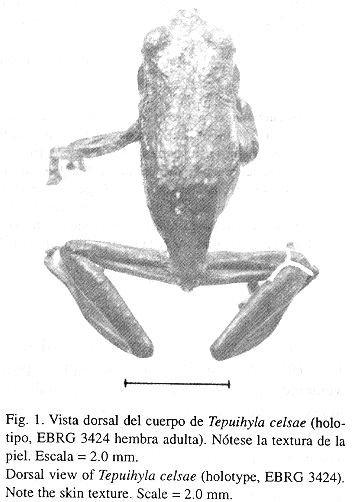
<body><![CDATA[<P><FONT FACE="Arial,Helvetica"><FONT SIZE=-1>Tiempo atr&aacute;s el encargado de la colecci&oacute;n herpetol&oacute;gica de la Estaci&oacute;n Biol&oacute;gica de Rancho Grande (EBRG), inform&oacute; sobre unas ranas no identificadas provenientes de la Sierra de San Luis, estado Falc&oacute;n, noroeste de Venezuela. Las caracter&iacute;ticas morfol&oacute;gicas de estas ranas coincid&iacute;an con las descritas para el g&eacute;nero <I>Tepuihyla</I>, consideradas end&eacute;micas de las cimas o alturas medias de los tepuyes en Venezuela y Guyana (<A HREF="#Ayarzagüena92b">Ayarzag&uuml;ena <I>et al</I>. 1992b</A>, <A HREF="#Duellman96">Duellman &amp; Yoshpa 1996</A>). No obstante, los ejemplares falconianos se diferencian claramente de los ejemplares del sur. Como prop&oacute;sito de este trabajo tenemos: (1) rese&ntilde;ar e ilustrar la nueva especie de <I>Tepuihyla</I> y (2) comentar sobre la biogeograf&iacute;a y relaciones intergen&eacute;ricas del g&eacute;nero <I>Tepuihyla</I>.</FONT></FONT>     <BR><B><FONT FACE="Arial,Helvetica"><FONT SIZE=-1></FONT></FONT></B>&nbsp;<B><FONT FACE="Arial,Helvetica"><FONT SIZE=-1></FONT></FONT></B>      <P><B><FONT FACE="Arial,Helvetica"><FONT SIZE=-1>Materiales y M&eacute;todos</FONT></FONT></B>      <P><FONT FACE="Arial,Helvetica"><FONT SIZE=-1>La terminolog&iacute;a, medidas y caracteres empleados en la descripci&oacute;n son una combinaci&oacute;n de las propuestas de <A HREF="#Ayarzagüena92a">Ayarzag&uuml;ena <I>et al</I>. (1992a)</A> y <A HREF="#Heyer">Heyer <I>et al</I>. (1990)</A>; la f&oacute;rmula que describe la extensi&oacute;n de membrana interdigital pedal sigue la proposici&oacute;n de <A HREF="#La Marca94">La Marca (1994)</A>. Las medidas se tomaron con un vernier (&plusmn; 0.1 mm de apreciaci&oacute;n) bajo una lupa de disecci&oacute;n de la siguiente manera: longitud rostro-cloacal (LRC, desde la punta del hocico hasta la abertura cloacal), largo cabeza (LCB, desde la punta del hocico hasta la comisura de la boca), ancho cabeza (ACB, distancia transversal de la cabeza a nivel de la comisura de la boca), longitud de la tibia (TIB, medida entre la coyuntura tibio-femoral y la coyuntura tibio-tarsal), longitud de la pata (PAT, longitud medida desde el borde posterior del tub&eacute;rculo metat&aacute;rsico interno hasta el borde externo de la almohadilla del dedo pedal m&aacute;s largo), longitud de la mano (MAN, medida desde el borde posterior del tub&eacute;rculo palmar hasta el borde externo de la almohadilla del dedo manual m&aacute;s largo), distancia hocico-ojo (DHO, desde la punta del hocico hasta el borde anterior del ojo), distancia ojo-narina (DON, distancia entre el borde anterior del ojo y la abertura narinal), longitud horizontal del ojo (LHO, longitud entre los bordes anterior y posterior del ojo), longitud horizontal del t&iacute;mpano (LHT, longitud antre los bordes anterior y posterior del t&iacute;mpano, incluyendo el anillo). La determinaci&oacute;n de sexo se hizo por examen directo de las g&oacute;nadas; como criterio de adultez se consider&oacute; la presencia de huevos maduros en las hembras y test&iacute;culos agrandados y/o hendiduras vocales abiertas en los machos. Los ejemplares estudiados (N = 11) se encuentran depositados en la colecci&oacute;n de la Estaci&oacute;n Biol&oacute;gica de Rancho Grande, Ministerio del Ambiente y de los Recursos Naturales Renovables, Maracay, Venezuela (EBRG).</FONT></FONT>     <CENTER><FONT SIZE=-1></FONT>&nbsp;</CENTER>      <CENTER><FONT SIZE=-1></FONT></CENTER>      <CENTER><FONT SIZE=-1>&nbsp;</FONT></CENTER>      <CENTER><A NAME="fig1"></A><IMG SRC="/img/fbpe/rbt/v47n4/0436i1.GIF" HEIGHT=502 WIDTH=355></CENTER>      
<CENTER><FONT SIZE=-1>&nbsp;</FONT></CENTER>      <CENTER>&nbsp;</CENTER>      ]]></body>
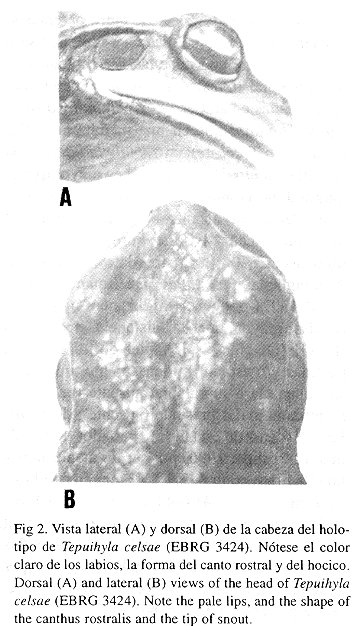
<body><![CDATA[<CENTER></CENTER> <B><FONT FACE="Arial,Helvetica"><FONT SIZE=-1>Resultados</FONT></FONT></B>     <BR><FONT SIZE=-1>&nbsp;</FONT>     <BR><FONT FACE="Arial,Helvetica"><FONT SIZE=-1><B>Holotipo:</B> EBRG 3424, hembra adulta, proveniente de Cerro Galicia (11&deg;10’ N, 69&deg;42’ W), Curimagua, Sierra de San Luis, Municipio Miranda, estado Falc&oacute;n, Venezuela, aproximadamente 1250 m. Recolector: G. P&eacute;rez. Fecha: mayo, 1987.</FONT></FONT>      <P><FONT FACE="Arial,Helvetica"><FONT SIZE=-1><B>Paratopotipos:</B> EBRG 3423, 3425-26, 3430, 3432 (hembras adultas) y 3422 (hembra inmadura), EBRG 3427-3429 (machos adultos), EBRG 3431 (juvenil, sexo indefinido), todos con los mismos datos que el holotipo.</FONT></FONT>      <P><FONT FACE="Arial,Helvetica"><FONT SIZE=-1><B>Definici&oacute;n y diagnosis:</B> Esta nueva especie habita en el bosque nublado de la Sierra de San Luis (todos los ejemplares conocidos fueron encontrados a 1250 m de altitud) y se distingue de sus cong&eacute;neres por la siguiente combinaci&oacute;n de caracter&iacute;sticas: (1) color dorsal pardo oscuro con unas pocas manchas blancas diminutas y dispersas, (2) labio superior blanco inmaculado, (3) superficie dorsal de los muslos sin barras transversales, (4) hocico corto, semicircular en vista dorsal, (5) talones alcanzan hasta el borde posterior del t&iacute;mpano cuando estos se extienden hacia adelante, (6) tub&eacute;rculo subarticular distales del III dedo manual b&iacute;fido o doble, (7) tub&eacute;rculo subarticular del IV dedo de la mano dividido, (8) tama&ntilde;o relativamente grande (longitud rostro-cloacal <I>0 </I>=52.1 mm en hembras, <I>0</I> =42.8 mm en machos), (9) f&oacute;rmula de la membrana interdigital del pie <B>I</B>0.5-0.0<B>II</B>(1.0-2.0)-1.0<B>III</B>(2.5-3.0)-(2.0-2.5)<B>IV</B>(2.0-3.0)-(2.5-3.0)<B>V</B>, (10) membrana axilar ausente, (11) cabeza ligeramente m&aacute;s ancha que larga, (12) abertura cloacal bordeada ventralmente por dos tub&eacute;rculos situados lateralmente a la abertura cloacal, grandes, obtusos, con muchos y profundos pliegues, (12) discos terminales de los dedos pedales <B>II</B> y <B>III</B> con surcos antero-ventrales en forma de "m".</FONT></FONT>      <P><FONT FACE="Arial,Helvetica"><FONT SIZE=-1>Tepuihyla celsae se distingue f&aacute;cilmente de casi todos sus cong&eacute;neres por su mayor tama&ntilde;o (LRC en <I>T. celsae</I>, machos 41.6-44.0 mm, hembras 43.5-56.2; <I>T. aecii</I>, machos 28.1-34 mm, hembra 36.8 mm; <I>T. edelcae</I>, machos 30.0-40.2 mm, hembras 32.0-45.7 mm; <I>T. galani</I>, machos 36.8-40.0 mm, hembra 49.5 mm; <I>T. rimarum</I>, machos 27.0-31.8 mm, hembras 30.0-44.6 mm; <I>T. rodriguesi</I>, machos 27.6-34.7 mm, hembras 35.9-38.1 mm; <I>T. talbergae</I>, macho 32.7 mm, hembra 29.1 mm). Adem&aacute;s, se diferencia de <I>T. aecii</I>,<I> T. edelcae</I>,<I> T. galani</I> y <I>T. rimarum</I> (datos tomados de Ayarzag&uuml;ena <I>et al</I>. 1992a; datos de <I>T. celsae</I> entre par&eacute;ntesis) por tener la piel dorsal lisa en hembras, lisa u ocasionalmente con p&uacute;stulas y/o esp&iacute;culas en machos (piel dorsal densamente tuberculosa, sin esp&iacute;culas en ambos sexos); <I>Tepuihyla edelcae</I> y <I>T. galani </I>poseen una membrana axilar (ausente en <I>T. celsae</I>); en <I>Tepuihyla luteolabris</I> la distancia ojo-narina [DON] es mayor que la longitud horizontal del ojo [LHO] (DON &lt; LHO), el tobillo alcanza hasta la regi&oacute;n loreal (el tobillo alcanza hasta el borde posterior del t&iacute;mpano); de <I>T. rodriguezi</I> (datos tomados de <A HREF="#Ayarzagüena92a">Ayarzag&uuml;ena <I>et al</I>. 1992a</A>; <A HREF="#Duellman92">Duellman &amp; Hoogmoed 1992</A>) por tener la distancia ojo-narina [DON] mayor que la distancia hocico-ojo [DHO] (DON &lt; DOH), piel dorsal lisa con p&uacute;stulas y/o esp&iacute;culas (densamente tuberculosa), l&iacute;nea clara supralabial ausente (presente), membrana axilar presente (ausente); de <I>T. talbergae</I> (datos de esta &uacute;ltima tomados de <A HREF="#Duellman96">Duellman &amp; Yoshpa, 1996</A>) por ser de menor tama&ntilde;o (29.1 mm contra 43.5-56.2 mm en hembras, 32.7 mm contra 41.6-44.0 mm en machos), piel dorsal lisa con esp&iacute;culas dispersas en el macho (densamente tuberculosa sin esp&iacute;culas en machos), tobillo se extiende hasta algo por delante de la punta del hocico (s&oacute;lo hasta el borde posterior del t&iacute;mpano).</FONT></FONT>      <P><FONT FACE="Arial,Helvetica"><FONT SIZE=-1>Las especies de <I>Phrynohyas</I> y <I>Osteocephalus</I> muestran una apariencia externa superficialmente similar a la nueva especie de <I>Tepuihyla</I>. Sin embargo <I>T. celsae</I> se distingue de cualquiera de las especies registradas en Venezuela para ambos g&eacute;neros (<A HREF="#La Marca97c">La Marca, 1997c</A>), por las ausencia de palmeadura en las manos y entre los dedos pedales I y II.</FONT></FONT>      <P><FONT FACE="Arial,Helvetica"><FONT SIZE=-1><B>Descripci&oacute;n del holotipo:</B> Cabeza apenas ligeramente m&aacute;s ancha que larga, corta (32.8% de la longitud rostro cloacal); hocico corto (DON/DHO >> 1), semicircular en vista dorsal, redondeado en vista lateral; regi&oacute;n interorbital algo c&oacute;ncava; longitud horizontal del ojo ligeramente mayor que la distancia ojo-narina; narina 2.7 veces m&aacute;s cerca de la punta del hocico que del borde anterior del ojo; distancia interorbital 1.3 veces mayor que el ancho del p&aacute;rpado superior, casi 1.5 veces mayor que la distancia internarinal; anillo timp&aacute;nico casi 3/4 de la longitud horizontal del ojo, ambos separados por una distancia igual a 1.5 veces la longitud horizontal del anillo timp&aacute;nico; anillo timp&aacute;nico con rebordes gruesos y ligeramente elevados, borde superior cubierto por un pliegue glandular que recorre hasta el hombro; lengua redondeada, tan larga como ancha, entera, aproximadamente 1/5 posterior libre; odontoides vomerianos en dos grupos transversos situados entre y detr&aacute;s de las coanas; canto rostral redondeado; regi&oacute;n loreal moderadamente inclinada, c&oacute;ncavo. Piel dorsal densamente tuberculosa, glandular; densidad de tub&eacute;rculos es mayor en la regi&oacute;n cef&aacute;lica (inclusive sobre los p&aacute;rpados) que en el resto del dorso; tub&eacute;rculos pronunciados; flancos igual que dorso; gl&aacute;ndulas parotoides presentes, alargadas, estrechas, situadas algo posteriormente y por encima del t&iacute;mpano; piel dorsal de los miembros corrugada, apenas con algunos tub&eacute;rculos; toda la regi&oacute;n ventral fuertemente areolada. Pupila horizontal. Abertura cloacal situada por encima de la l&iacute;nea media de los muslos, dirigida ventralmente, cubierta parcialmente por un pliegue dorsal grueso, con bordes algo irregulares; dos protuberancias carnosas, elevadas, arrugadas, situadas lateralmente a la abertura cloacal y ventral al borde del pliegue cloacal, y entre ambas un surco muy profundo que no alcanza el borde ventroposterior del cuerpo. Dientes premaxilares y maxilares presentes, cubiertos por un pliegue labial, mucho m&aacute;s peque&ntilde;os que los dientes vomerianos.</FONT></FONT>     <BR><FONT SIZE=-1>&nbsp;</FONT>     <CENTER><A NAME="fig2"></A><IMG SRC="/img/fbpe/rbt/v47n4/0436i2.GIF" HEIGHT=626 WIDTH=361></CENTER> <FONT SIZE=-1>&nbsp;</FONT>     
]]></body>
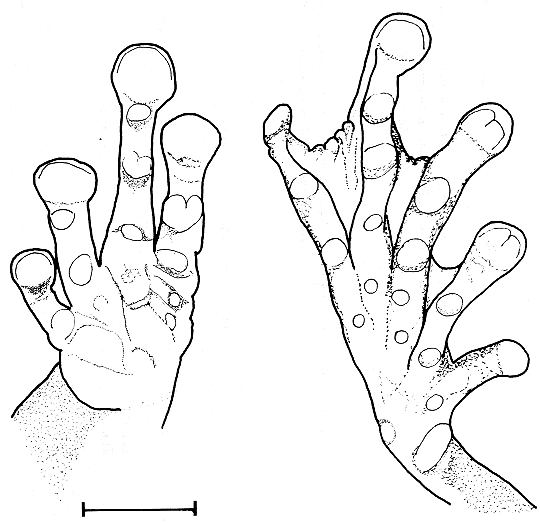
<body><![CDATA[<BR>&nbsp;      <P><FONT FACE="Arial,Helvetica"><FONT SIZE=-1>Miembros delanteros largos, delgados; manos grandes, 30.8% de la longitud rostro-cloacal (LRC); patas peque&ntilde;as, delgadas, cortas; pata trasera 36.6% de LRC; f&eacute;mur 45% de LRC; rudimento de p&oacute;lex visible externamente; tub&eacute;rculos supernumerarios presentes, peque&ntilde;os, redondeados, achatados; tub&eacute;rculos subarticulares grandes, prominentes (en vista lateral); tub&eacute;rculos subarticulares b&iacute;fidos, el pen&uacute;ltimo del dedo III de la mano, y el &uacute;ltimo del dedo IV de la mano; primer dedo de la mano mucho m&aacute;s corto que el segundo; tama&ntilde;o relativo de los dedos de la mano I&lt;II&lt;IV&lt;III; dedos de la mano sin membrana interdigital evidente; rebordes laterales ausentes; dedos de la mano con discos redondeados, grandes, 2.0 veces m&aacute;s anchos que las falanges adyacentes; disco mayor en el tercer dedo, ligeramente de menor que la longitud horizontal del t&iacute;mpano cuando se coloca sobre este; discos con una hendidura profunda alrededor del margen distal; tub&eacute;rculo metat&aacute;rsico interno mucho m&aacute;s largo que ancho (2.7 veces m&aacute;s largo), margen libre redondeado, protuberante; tub&eacute;rculo metat&aacute;rsico externo 2.0 veces m&aacute;s peque&ntilde;o que el tub&eacute;rculo metat&aacute;rsico externo, ligeramente m&aacute;s largo que ancho, redondeado en vista dorsal, achatado; tub&eacute;rculos supernumerarios presentes, peque&ntilde;os, redondeados, achatados; tub&eacute;rculos subarticulares grandes, redondeados, achatados (en vista dorsal), subc&oacute;nicos en vista lateral, presentes s&oacute;lo en la palma del pie; dedos del pie terminan en un disco redondeado grande, 1.9 veces m&aacute;s ancho que la falange adyacente; disco mayor en el tercer dedo del pie, ligeramente menos ancho que la longitud horizontal del t&iacute;mpano cuando se coloca encima de &eacute;ste; discos con una hendidura profunda alrededor del margen distal; dedos del pie II y III con una hendidura media y transversal a la anterior, menos profunda, formando una "m"; dedos del pie presentan la membrana interdigital como sigue: <B>I</B>1.0-1.5<B>II</B>2.5-2.0<B>III</B>3.5-3.0<B>IV</B>4.0-4.0<B>V</B>; tama&ntilde;o relativo de los dedos del pie <B>I</B>&lt;<B>II</B>&lt;<B>III</B>=<B>V</B>&lt;<B>IV</B>; pliegue tarsal ausente; el tal&oacute;n apenas llega hasta el borde posterior del anillo timp&aacute;nico cuando las patas traseras se estiran hacia adelante.</FONT></FONT>     <BR><FONT SIZE=-1>&nbsp;</FONT>     <BR>&nbsp;     <CENTER><A NAME="fig3"></A><IMG SRC="/img/fbpe/rbt/v47n4/0436i3.GIF" HEIGHT=523 WIDTH=540></CENTER> &nbsp;     
<BR>&nbsp;      <P><FONT FACE="Arial,Helvetica"><FONT SIZE=-1>Fig. 3. Dibujo esquem&aacute;tico de la mano (A) y pie (B) en vista ventral, respectivamente, de <I>Tepuihyla celsae</I> (EBRG 3424). Escala = 5.0 mm.</FONT></FONT>     <BR><FONT FACE="Arial,Helvetica"><FONT SIZE=-1>Drawings of the hand (A) and the foot (B) in ventral view of <I>Tepuihyla celsae</I> (EBRG 3424). Scale bar = 5.0 mm.</FONT></FONT>     <BR><FONT SIZE=-1>&nbsp;</FONT>      <P><FONT FACE="Arial,Helvetica"><FONT SIZE=-1><B>Coloraci&oacute;n en preservativo:</B> Superficie dorsal casta&ntilde;o oscuro, con unas pocas manchas blancas, peque&ntilde;as, dispersas, en la cabeza y dorso; cabeza m&aacute;s p&aacute;lida que el dorso; labio superior blanco inmaculado; labio inferior con borde anterior blanco cremoso, borde inferior pardo oscuro; vientre blanco cremoso; superficie ventral de los miembros traseros crema anaranjado p&aacute;lido; tal&oacute;n manchado de crema blancuzco. Iris negro; membrana palpebral con los bordes pardo oscuro; resto de la membrana transl&uacute;cida.</FONT></FONT>      ]]></body>
<body><![CDATA[<P><FONT FACE="Arial,Helvetica"><FONT SIZE=-1><B>Medidas del holotipo:</B> El onomat&oacute;foro es una hembra adulta (huevos ov&aacute;ricos presentes) con las siguientes medidas (en mm): longitud rostro-cloacal 54.8, longitud cabeza 18.0, ancho cabeza 20.1, longitud tibia 27.2, longitud pata 20.1, longitud mano 16.9, longitud horizontal del ojo 5.8, longitud horizontal del t&iacute;mpano 4.3, distancia ojo-narina 5.4, distancia hocico-ojo 7.4. En el <A HREF="#CUADRO1">Cuadro I</A> se presentan las medidas de la serie de paratopotipos.</FONT></FONT>     <BR>&nbsp;     <CENTER><A NAME="CUADRO1"></A><FONT FACE="Arial,Helvetica"><FONT SIZE=-1>CUADRO I</FONT></FONT></CENTER>      <CENTER><FONT SIZE=-1>&nbsp;</FONT></CENTER>      <CENTER><FONT FACE="Arial,Helvetica"><FONT SIZE=-1>Medidas (en mm) de la serie tipo de Tepuihyla celsae<I>. Las medidas se mencionan como sigue: media &plusmn; error est&aacute;ndar, amplitud de variaci&oacute;n. Las abreviaturas son las mismas que las empleadas para las medidas del holotipo (ver Materiales y M&eacute;todos).</I></FONT></FONT></CENTER>      <CENTER><FONT SIZE=-1>&nbsp;</FONT></CENTER>      <CENTER><FONT FACE="Arial,Helvetica"><FONT SIZE=-1></FONT></FONT>&nbsp;</CENTER>      <CENTER><FONT FACE="Arial,Helvetica"><FONT SIZE=-1></FONT></FONT></CENTER>      <CENTER><FONT FACE="Arial,Helvetica"><FONT SIZE=-1>TABLE 1</FONT></FONT></CENTER>      <CENTER><FONT SIZE=-1>&nbsp;</FONT></CENTER>      ]]></body>
<body><![CDATA[<CENTER><FONT FACE="Arial,Helvetica"><FONT SIZE=-1>Measurements (in mm) of the type series of Tepuihyla celsae<I>. The measurements are mentioned as follow: mean &plusmn; standard error (range). The abbreviations are the same as used for the holotype (see Material and Methods).</I></FONT></FONT></CENTER> <FONT SIZE=-1>&nbsp;</FONT>     <BR><FONT SIZE=-1>&nbsp;</FONT> <TABLE BORDER=0 CELLSPACING=0 CELLPADDING=0 WIDTH="748" > <TR> <TD VALIGN=TOP WIDTH="9%"><FONT FACE="Arial,Helvetica"><FONT SIZE=-1>&nbsp;</FONT></FONT></TD>  <TD VALIGN=TOP WIDTH="11%">     <CENTER><FONT FACE="Arial,Helvetica"><FONT SIZE=-1>LRC</FONT></FONT></CENTER> </TD>  <TD VALIGN=TOP WIDTH="10%">     <CENTER><FONT FACE="Arial,Helvetica"><FONT SIZE=-1>LCB</FONT></FONT></CENTER> </TD>  <TD VALIGN=TOP WIDTH="10%">     <CENTER><FONT FACE="Arial,Helvetica"><FONT SIZE=-1>ACB</FONT></FONT></CENTER> </TD>  <TD VALIGN=TOP WIDTH="10%">     <CENTER><FONT FACE="Arial,Helvetica"><FONT SIZE=-1>TIB</FONT></FONT></CENTER> </TD>  <TD VALIGN=TOP WIDTH="11%">     <CENTER><FONT FACE="Arial,Helvetica"><FONT SIZE=-1>PAT</FONT></FONT></CENTER> </TD>  <TD VALIGN=TOP WIDTH="10%">     <CENTER><FONT FACE="Arial,Helvetica"><FONT SIZE=-1>MAN</FONT></FONT></CENTER> </TD>  <TD VALIGN=TOP WIDTH="9%">     <CENTER><FONT FACE="Arial,Helvetica"><FONT SIZE=-1>LHO</FONT></FONT></CENTER> </TD>  <TD VALIGN=TOP WIDTH="9%">     <CENTER><FONT FACE="Arial,Helvetica"><FONT SIZE=-1>LHT</FONT></FONT></CENTER> </TD>  <TD VALIGN=TOP WIDTH="9%">     ]]></body>
<body><![CDATA[<CENTER><FONT FACE="Arial,Helvetica"><FONT SIZE=-1>DON</FONT></FONT></CENTER> </TD> </TR>  <TR> <TD VALIGN=TOP WIDTH="9%">     <CENTER><FONT FACE="Arial,Helvetica"><FONT SIZE=-1>Juvenil&nbsp;</FONT></FONT></CENTER>      <CENTER><FONT FACE="Arial,Helvetica"><FONT SIZE=-1>n = 1</FONT></FONT></CENTER> </TD>  <TD VALIGN=TOP WIDTH="11%">     <CENTER><FONT FACE="Arial,Helvetica"><FONT SIZE=-1>30.0</FONT></FONT></CENTER> </TD>  <TD VALIGN=TOP WIDTH="10%">     <CENTER><FONT FACE="Arial,Helvetica"><FONT SIZE=-1>10.5</FONT></FONT></CENTER> </TD>  <TD VALIGN=TOP WIDTH="10%">     <CENTER><FONT FACE="Arial,Helvetica"><FONT SIZE=-1>11.4</FONT></FONT></CENTER> </TD>  <TD VALIGN=TOP WIDTH="10%">     <CENTER><FONT FACE="Arial,Helvetica"><FONT SIZE=-1>15.5</FONT></FONT></CENTER> </TD>  <TD VALIGN=TOP WIDTH="11%">     <CENTER><FONT FACE="Arial,Helvetica"><FONT SIZE=-1>9.7</FONT></FONT></CENTER> </TD>  <TD VALIGN=TOP WIDTH="10%">     <CENTER><FONT FACE="Arial,Helvetica"><FONT SIZE=-1>8.5</FONT></FONT></CENTER> </TD>  <TD VALIGN=TOP WIDTH="9%">     <CENTER><FONT FACE="Arial,Helvetica"><FONT SIZE=-1>3.7</FONT></FONT></CENTER> </TD>  <TD VALIGN=TOP WIDTH="9%">     ]]></body>
<body><![CDATA[<CENTER><FONT FACE="Arial,Helvetica"><FONT SIZE=-1>1.8</FONT></FONT></CENTER> </TD>  <TD VALIGN=TOP WIDTH="9%">     <CENTER><FONT FACE="Arial,Helvetica"><FONT SIZE=-1>3.2</FONT></FONT></CENTER> </TD> </TR>  <TR> <TD VALIGN=TOP WIDTH="9%">     <CENTER><FONT FACE="Arial,Helvetica"><FONT SIZE=-1>Hembras&nbsp;</FONT></FONT></CENTER>      <CENTER><FONT FACE="Arial,Helvetica"><FONT SIZE=-1>n=7</FONT></FONT></CENTER> </TD>  <TD VALIGN=TOP WIDTH="11%">     <CENTER><FONT FACE="Arial,Helvetica"><FONT SIZE=-1>50.9 &plusmn; 5.35&nbsp;</FONT></FONT></CENTER>      <CENTER><FONT FACE="Arial,Helvetica"><FONT SIZE=-1>41.6-56.2</FONT></FONT></CENTER> </TD>  <TD VALIGN=TOP WIDTH="10%">     <CENTER><FONT FACE="Arial,Helvetica"><FONT SIZE=-1>17.0 &plusmn;1.53&nbsp;</FONT></FONT></CENTER>      <CENTER><FONT FACE="Arial,Helvetica"><FONT SIZE=-1>13.7-18.8</FONT></FONT></CENTER> </TD>  <TD VALIGN=TOP WIDTH="10%">     <CENTER><FONT FACE="Arial,Helvetica"><FONT SIZE=-1>19.2 &plusmn;1.56&nbsp;</FONT></FONT></CENTER>      <CENTER><FONT FACE="Arial,Helvetica"><FONT SIZE=-1>16.5-21.2</FONT></FONT></CENTER> </TD>  <TD VALIGN=TOP WIDTH="10%">     ]]></body>
<body><![CDATA[<CENTER><FONT FACE="Arial,Helvetica"><FONT SIZE=-1>26.6 &plusmn;2.4&nbsp;</FONT></FONT></CENTER>      <CENTER><FONT FACE="Arial,Helvetica"><FONT SIZE=-1>22.4-29.7</FONT></FONT></CENTER> </TD>  <TD VALIGN=TOP WIDTH="11%">     <CENTER><FONT FACE="Arial,Helvetica"><FONT SIZE=-1>19.4 &plusmn;1.98&nbsp;</FONT></FONT></CENTER>      <CENTER><FONT FACE="Arial,Helvetica"><FONT SIZE=-1>15.9-22.4</FONT></FONT></CENTER> </TD>  <TD VALIGN=TOP WIDTH="10%">     <CENTER><FONT FACE="Arial,Helvetica"><FONT SIZE=-1>15.9 &plusmn;1.59&nbsp;</FONT></FONT></CENTER>      <CENTER><FONT FACE="Arial,Helvetica"><FONT SIZE=-1>13.3-18.0</FONT></FONT></CENTER> </TD>  <TD VALIGN=TOP WIDTH="9%">     <CENTER><FONT FACE="Arial,Helvetica"><FONT SIZE=-1>5.5 &plusmn;0.39&nbsp;</FONT></FONT></CENTER>      <CENTER><FONT FACE="Arial,Helvetica"><FONT SIZE=-1>5.1-6.1</FONT></FONT></CENTER> </TD>  <TD VALIGN=TOP WIDTH="9%">     <CENTER><FONT FACE="Arial,Helvetica"><FONT SIZE=-1>3.6 &plusmn;0.5&nbsp;</FONT></FONT></CENTER>      <CENTER><FONT FACE="Arial,Helvetica"><FONT SIZE=-1>2.7-4.3</FONT></FONT></CENTER> </TD>  <TD VALIGN=TOP WIDTH="9%">     ]]></body>
<body><![CDATA[<CENTER><FONT FACE="Arial,Helvetica"><FONT SIZE=-1>4.9 &plusmn;0.49&nbsp;</FONT></FONT></CENTER>      <CENTER><FONT FACE="Arial,Helvetica"><FONT SIZE=-1>4.5-5.6</FONT></FONT></CENTER> </TD> </TR>  <TR> <TD VALIGN=TOP WIDTH="9%">     <CENTER><FONT FACE="Arial,Helvetica"><FONT SIZE=-1>Machos&nbsp;</FONT></FONT></CENTER>      <CENTER><FONT FACE="Arial,Helvetica"><FONT SIZE=-1>n=3</FONT></FONT></CENTER> </TD>  <TD VALIGN=TOP WIDTH="11%">     <CENTER><FONT FACE="Arial,Helvetica"><FONT SIZE=-1>44.0 &plusmn;2.45&nbsp;</FONT></FONT></CENTER>      <CENTER><FONT FACE="Arial,Helvetica"><FONT SIZE=-1>41.6-46.5</FONT></FONT></CENTER> </TD>  <TD VALIGN=TOP WIDTH="10%">     <CENTER><FONT FACE="Arial,Helvetica"><FONT SIZE=-1>14.4 &plusmn;0.62&nbsp;</FONT></FONT></CENTER>      <CENTER><FONT FACE="Arial,Helvetica"><FONT SIZE=-1>13.7-14.9</FONT></FONT></CENTER> </TD>  <TD VALIGN=TOP WIDTH="10%">     <CENTER><FONT FACE="Arial,Helvetica"><FONT SIZE=-1>15.9 &plusmn;0.66&nbsp;</FONT></FONT></CENTER>      <CENTER><FONT FACE="Arial,Helvetica"><FONT SIZE=-1>15.2-16.4</FONT></FONT></CENTER> </TD>  <TD VALIGN=TOP WIDTH="10%">     ]]></body>
<body><![CDATA[<CENTER><FONT FACE="Arial,Helvetica"><FONT SIZE=-1>22.3 &plusmn;1.32&nbsp;</FONT></FONT></CENTER>      <CENTER><FONT FACE="Arial,Helvetica"><FONT SIZE=-1>20.8-23.3</FONT></FONT></CENTER> </TD>  <TD VALIGN=TOP WIDTH="11%">     <CENTER><FONT FACE="Arial,Helvetica"><FONT SIZE=-1>16.4 &plusmn;0.79&nbsp;</FONT></FONT></CENTER>      <CENTER><FONT FACE="Arial,Helvetica"><FONT SIZE=-1>15.5-17.0</FONT></FONT></CENTER> </TD>  <TD VALIGN=TOP WIDTH="10%">     <CENTER><FONT FACE="Arial,Helvetica"><FONT SIZE=-1>13.4 &plusmn;0.66&nbsp;</FONT></FONT></CENTER>      <CENTER><FONT FACE="Arial,Helvetica"><FONT SIZE=-1>12.7-13.9</FONT></FONT></CENTER> </TD>  <TD VALIGN=TOP WIDTH="9%">     <CENTER><FONT FACE="Arial,Helvetica"><FONT SIZE=-1>5.3 &plusmn;0.51&nbsp;</FONT></FONT></CENTER>      <CENTER><FONT FACE="Arial,Helvetica"><FONT SIZE=-1>4.9-5.9</FONT></FONT></CENTER> </TD>  <TD VALIGN=TOP WIDTH="9%">     <CENTER><FONT FACE="Arial,Helvetica"><FONT SIZE=-1>3.3 &plusmn;0.05&nbsp;</FONT></FONT></CENTER>      <CENTER><FONT FACE="Arial,Helvetica"><FONT SIZE=-1>3.3-3.4</FONT></FONT></CENTER> </TD>  <TD VALIGN=TOP WIDTH="9%">     ]]></body>
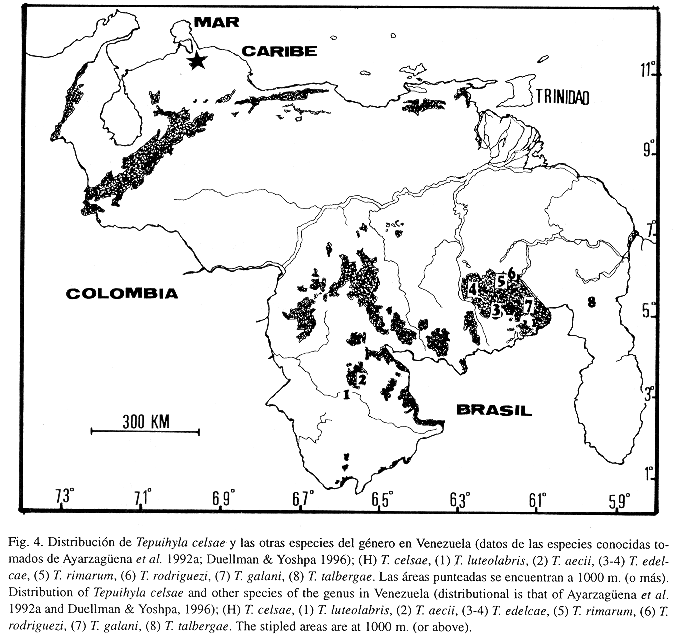
<body><![CDATA[<CENTER><FONT FACE="Arial,Helvetica"><FONT SIZE=-1>4.0 &plusmn;0.26&nbsp;</FONT></FONT></CENTER>      <CENTER><FONT FACE="Arial,Helvetica"><FONT SIZE=-1>3.8-4.3</FONT></FONT></CENTER> </TD> </TR> </TABLE> <FONT SIZE=-1>&nbsp;</FONT>     <BR><FONT SIZE=-1>&nbsp;</FONT>     <BR><FONT FACE="Arial,Helvetica"><FONT SIZE=-1><B>Variaci&oacute;n:</B> Todos los ejemplares muestran el labio superior blanco o crema inmaculado. El ejemplar EBRG 3422, una hembra inmadura (con oviductos no convolutos), posee una banda dorsolateral pardo cremosa algo difusa desde el borde posterior del ojo hasta la mitad del cuerpo; lo mismo se observa en el juvenil EBRG 3431, excepto que en &eacute;ste el color blanco se extiende un poco m&aacute;s all&aacute; de la mitad del cuerpo y presenta el vientre de un tono m&aacute;s anaranjado que en los adultos. En los ejemplares EBRG 3426 y 3432 (hembras adultas) tambi&eacute;n muestran las l&iacute;neas p&aacute;lidas indistintas. El ejemplar EBRG 3432, tiene una coloraci&oacute;n dorsal gris cremoso p&aacute;lido con los flancos ligeramente m&aacute;s oscuros que el dorso. El ejemplar EBRG 3426 exhibe unas pocas manchas p&aacute;lidas dorsalmente. El vientre var&iacute;a entre crema inmaculado hasta crema anaranjado mate; en algunos ejemplares se transparenta la coloraci&oacute;n negra del contenido estomacal o los huevos oscuros contenidos en la cavidad abdominal. La lengua es generalmente redondeada, en un ejemplar es cordiforme (EBRG 3423) y en otros dos (EBRG 3426, 3432) presenta una peque&ntilde;a escotadura en su extremo posterior. Todos los ejemplares muestran la abertura cloacal cubierta dorsalmente por un pliegue carnoso y dos tub&eacute;rculos grandes, romos, separados por un profundo surco medio ventral. En unos pocos ejemplares se observaron un par de tub&eacute;rculos grandes y elevados en el v&eacute;rtice dorso-posterior de la regi&oacute;n p&uacute;bica, algo por encima de la regi&oacute;n cloacal. Los tub&eacute;rculos subarticulares de los dedos de la mano III y IV var&iacute;an entre sencillos, b&iacute;fidos o divididos en una o ambas manos a la vez. Todo los ejemplares presentaron una mancha redondeada, blanca, peque&ntilde;a, en la cara dorso-posterior del muslo, pr&oacute;ximo a la articulaci&oacute;n tibio-femoral; igualmente, todos los ejemplares mostraron el tal&oacute;n manchado de blanco sucio. El rudimento de polex es visible en machos y hembras sin evidencias de queratinizaci&oacute;n.</FONT></FONT>      <P><FONT FACE="Arial,Helvetica"><FONT SIZE=-1>Todos los animales muestran la caracter&iacute;stica del hocico corto y de forma semicircular en vista dorsal. La distancia ojo-narina es siempre menor que la distancia hocico-ojo, excepto en el ejemplar EBRG 3426, en el cual ambas dimensiones son pr&aacute;cticamente iguales. La relaci&oacute;n DON/DHO en siete ejemplares (no se incluy&oacute; a EBRG 3426) es 0.85 &plusmn; 0.06 (0.75-0.93).</FONT></FONT>      <P><FONT FACE="Arial,Helvetica"><FONT SIZE=-1>Distribuci&oacute;n e historia natural: Actualmente la especie s&oacute;lo se conoce de la localidad tipo (ver <A HREF="#fig4">Fig. 4</A>). <A HREF="#Huber">Huber &amp; Alarc&oacute;n (1988)</A> clasificaron esta &aacute;rea como "Bosque Nublado Costero", presente desde los 1000 m hacia arriba. Adem&aacute;s, seg&uacute;n <A HREF="#Huber">Huber &amp; Alarc&oacute;n (1988)</A>, la Sierra de San Luis est&aacute; rodeada por amplias zonas de "Arbustales xer&oacute;filos espinosos", "Tierras agr&iacute;colas" fuertemente perturbadas y por "Bosques trop&oacute;filos bajos y medios, deciduos". Estas condiciones sugieren la posibilidad de que <I>T. celsae</I> sea end&eacute;mica de la Sierra de San Luis.</FONT></FONT>      <P><FONT FACE="Arial,Helvetica"><FONT SIZE=-1>El holotipo y cuatro paratipos (EBRG 3423-26, 3430, 3432), presentan los oviductos con huevos maduros, bicoloreados pardo oscuro y crema. No se midieron ni se contaron. Una hembra (EBRG 3422) conten&iacute;a huevos peque&ntilde;os de color casta&ntilde;o p&aacute;lido. En tres ejemplares (EBRG 3427-3429), no se detectaron hendiduras vocales ("vocal slits"), pero los test&iacute;culos son enormes (la longitud de los test&iacute;culos vari&oacute; entre 5.8 y 7.5 mm), lo que representa entre el 13.1% y 18.2% de la LRC de los machos. En EBRG 3431, no se observaron las g&oacute;nadas ni ning&uacute;n otro caracter sexual secundario, lo que sugiere es un juvenil. No se conoce el renacuajos ni el canto.</FONT></FONT>      <P><FONT FACE="Arial,Helvetica"><FONT SIZE=-1>A un ejemplar (EBRG 3423) present&oacute; amputaci&oacute;n completa del cuarto dedo manual izquierdo; se puede observar, en el lugar de la inserci&oacute;n del dedo, el tejido cicatrizado con los bordes irregulares por lo que, presumimos, este ejemplar sobrevivi&oacute; a un evento de depredaci&oacute;n.</FONT></FONT>      <P><FONT FACE="Arial,Helvetica"><FONT SIZE=-1>Etimolog&iacute;a: El nombre de la especie, "<I>celsae</I>", es un matron&iacute;mico en reconocimiento a J. Celsa Se&ntilde;aris, quien es coautora de la revisi&oacute;n que culmin&oacute; en la descripci&oacute;n del g&eacute;nero <I>Tepuihyla</I>, por su incansable y destacada labor investigadora de la anurofauna tepuyana y a la incondicional amistad y generosa colaboraci&oacute;n que siempre le ha brindado a los autores.</FONT></FONT>     <CENTER><FONT SIZE=-1>&nbsp;</FONT></CENTER>      ]]></body>
<body><![CDATA[<CENTER><FONT SIZE=-1></FONT></CENTER>      <CENTER><FONT SIZE=-1>&nbsp;</FONT></CENTER>      <CENTER><A NAME="fig4"></A><IMG SRC="/img/fbpe/rbt/v47n4/0436i4.GIF" HEIGHT=634 WIDTH=682></CENTER>      
<CENTER><FONT SIZE=-1>&nbsp;</FONT></CENTER>      <CENTER><FONT SIZE=-1>&nbsp;</FONT></CENTER> <B><FONT FACE="Arial,Helvetica"><FONT SIZE=-1>Discussion</FONT></FONT></B>      <P><FONT FACE="Arial,Helvetica"><FONT SIZE=-1>El hecho de que <I>Tepuihyla celsae</I> no haya sido detectada, luego de varios a&ntilde;os de muestreo en la zona, sugiere que es una especie escasa, o que prefiere microh&aacute;bitats espec&iacute;ficos o de dif&iacute;cil acceso dentro del bosque nublado o exhiba un comportamiento sumamente discreto (o incluso una combinaci&oacute;n de todas las posibilidades mencionadas). Lamentablemente, no se conocen detalles acerca de las condiciones de colecta ni del microh&aacute;bitat de la especie. Probablemente se trate de una especie end&eacute;mica a las partes m&aacute;s altas de la Sierra de San Luis. Las siete especies hasta hoy conocidas de <I>Tepuihyla</I> han sido encontradas dentro de plantas de <I>Bromelia</I> (Bromeliaceae) terrestres o en hendiduras en las rocas (<A HREF="#Ayarzagüena92a">Ayarzag&uuml;ena <I>et al</I>, 1992a</A>; <A HREF="#Duellman96">Duellman &amp; Yoshpa 1996</A>).</FONT></FONT>      <P><FONT FACE="Arial,Helvetica"><FONT SIZE=-1>Las relaciones interespec&iacute;ficas en <I>Tepuihyla</I> se mantienen indefinidas. <I>Tepuihyla luteolabris</I> y <I>T. celsae</I> comparten la textura tuberculosa de la piel, la ausencia de esp&iacute;culas y la presencia de una notable banda p&aacute;lida supralabial (esta &uacute;ltima caracter&iacute;stica presente tambi&eacute;n en <I>T. aecii</I>, y <I>T. talbergae</I>). <I>Tepuihyla luteolabris</I> se conoce actualmente s&oacute;lo de las partes altas (> 2000 m) del Cerro Marahuaca, en el estado Amazonas, al sur de Venezuela (<A HREF="#Ayarzagüena92a">Ayarzag&uuml;ena <I>et al</I>. 1992a</A>).</FONT></FONT>      <P><FONT FACE="Arial,Helvetica"><FONT SIZE=-1>Las relaciones intergen&eacute;ricas de <I>Tepuihyla</I>, <A HREF="#Ayarzagüena92b">Ayarzag&uuml;ena <I>et al</I>. (1992b)</A> vinculan estrechamente a &eacute;sta con <I>Scinax</I> a partir de la peculiar f&oacute;rmula de palmeadura manual y pedal, las proporciones del cr&aacute;neo, la forma de los discos terminales de los d&iacute;gitos y el esperma con doble filamento; Duellman &amp; Yoshpa (1996) consideraron que la morfolog&iacute;a del esperma con doble filamento era la &uacute;nica sinapomorfia que relacionar&iacute;a a <I>Tepuihyla</I> con <I>Scinax</I> y <I>Sphaenorhynchus</I> y que, la osteolog&iacute;a y la presencia de un saco vocal b&iacute;fido coloca a <I>Tepuihyla</I> en una situaci&oacute;n intermedia entre <I>Hyla</I> y <I>Osteocephalus</I>, concluyendo que al menos una de las dos condiciones debe ser producto de convergencia evolutiva.</FONT></FONT>      <P><FONT FACE="Arial,Helvetica"><FONT SIZE=-1>Una radiograf&iacute;a del holotipo de <I>T. celsae</I> revela que las diap&oacute;fisis sacras son estrechas e inclinadas hacia atr&aacute;s, similares a la ilustraci&oacute;n de <A HREF="#Duellman92. J.J.Wiens">Duellman &amp; Wiens</A> (1992: 11, Fig. 5B) para el g&eacute;nero <I>Scinax</I> y considerado como una entre tres sinapomorfias del clado <I>Scinas-Scarthyla-Sphaenorhynchus</I>. Duellman &amp; Yoshpa (1996), aparentemente no tomaron en cuenta los discos terminales dilatados, truncados, m&aacute;s anchos que largos y la ausencia de palmeadura entre los dedos pedales I y II descritos para <I>Tepuihyla</I>, pero que tambi&eacute;n fueron postulados por <A HREF="#Duellman92. J.J.Wiens">Duellman &amp; Wiens (1992)</A>, como sinapomorfias (adem&aacute;s de la regi&oacute;n loreal deprimida) que definen la monofilia de <I>Scinax.</I> A pesar que las relaciones del g&eacute;nero <I>Tepuihyla</I> parecen confusas, la informaci&oacute;n publicada y las pocas evidencias disponibles sugieren una estrecha relaci&oacute;n entre <I>Tepuihyla</I> y el clado <I>Scinax-Scarthyla-Sphaenorhynchus</I> y que, en consecuencia, el saco vocal b&iacute;fido (&uacute;nica semejanza que lo vincular&iacute;a con <I>Osteocephalus</I>) ser&iacute;a el resultado de convergencia evolutiva.</FONT></FONT>      <P><FONT FACE="Arial,Helvetica"><FONT SIZE=-1>Biogeograf&iacute;a: A pesar de las distancias relativamente equidistantes, la Sierra de San Lu&iacute;s parece haber tenido una relaci&oacute;n biogeogr&aacute;fica m&aacute;s estrecha con la Cordillera de la Costa que con los Andes. Esta relaci&oacute;n es notable desde el punto de vista flor&iacute;stico, por el gran n&uacute;mero de plantas end&eacute;micas compartidas. La segunda relaci&oacute;n es la afinidad de plantas con distribuciones disyuntas entre la regi&oacute;n guyano-amaz&oacute;nica y el conjunto monta&ntilde;oso del norte de Venezuela conformado por la Sierra de San Luis y la Cordillera de la Costa. Estas afinidades van desde las m&aacute;s d&eacute;biles en el Oeste, hasta las m&aacute;s pronunciadas en la Pen&iacute;nsula de Paria, al Este, sobre todo en los Cerros El Humo y Patao, que destacan por su estrecha afinidad flor&iacute;stica con la regi&oacute;n guyano-amaz&oacute;nica (<A HREF="#Steyermark79">Steyermark 1979</A>).</FONT></FONT>      ]]></body>
<body><![CDATA[<P><FONT FACE="Arial,Helvetica"><FONT SIZE=-1>Las afinidades biogeogr&aacute;ficas del conjunto Sierra de San Lu&iacute;s y Cordillera de la Costa pueden clasificarse en un patr&oacute;n disyunto con dos categor&iacute;as principales. La primera incluye animales y plantas que no se han diferenciado espec&iacute;fica o subespec&iacute;ficamente, y que presentan una distribuci&oacute;n disyunta con poblaciones de la regi&oacute;n guyano-amaz&oacute;nica. Ejemplo de ello son, seg&uacute;n Steyermark (<A HREF="#Steyermark79">1979</A>, <A HREF="#Steyermark86">1986</A>), las plantas <I>Cespedesia spathulata</I>, <I>Gloespermiun sphaerocarpum</I>, <I>Graffenriela weddellii</I>, <I>Platycentrum clidemioides</I>,<I> Anomospermum reticulata</I>, <I>Macrolobium colombianum</I>, <I>Quiina cruegeriana</I> y <I>Schlegelia parviflora</I>. Sobre la fauna, las distribuciones de aves en <A HREF="#Meyer">Meyer &amp; Phelps (1978)</A> sugieren que los pericos <I>Pyrrhura leucotis</I> y <I>Nannopsittaca panychlora</I>, el saltar&iacute;n verde (<I>Pipitres chloris</I>) y el atrapamoscas verdoso <I>Xanthiomyias virescens </I>(= <I>Phyllomyias virescens</I> seg&uacute;n <A HREF="#Lentino">Lentino 1997</A>) se ajustan a este patr&oacute;n. <A HREF="#Müller">M&uuml;ller (1973)</A> not&oacute; que 21 de las 77 aves end&eacute;micas de los tepuyes en la Guayana venezolana ten&iacute;an parientes m&aacute;s cercanos en la porci&oacute;n central de la Cordillera de la Costa, a altitudes sobre 1400-1500. En los mam&iacute;feros este mismo patr&oacute;n disyunto es exhibido por algunos marsupiales (<I>Caluromys philander</I>,<I> Marmosops parvidens</I> y <I>Gracilianus emiliae</I> [<A HREF="#Linares">Linares 1998</A>, <A HREF="#Pérez">P&eacute;rez-Hern&aacute;ndez <I>et al</I>. 1994</A>]) y un artiod&aacute;ctilo<I> </I>(<I>Mazama gouazoubira</I> [<A HREF="#Linares">Linares 1998</A>]); y entre las serpientes (<A HREF="#Roze">Roze 1966</A>), por <I>Pseustes sulphureus</I> y <I>Xenodon severus</I>. <I>Gonatodes humeralis</I> es una lagartija que, aunque tiene una distribuci&oacute;n predominantemente amaz&oacute;nica (<A HREF="#Ávila">Avila-Pires 1995</A>), extiende su &aacute;rea de distribuci&oacute;n hasta la porci&oacute;n central de la Cordillera de la Costa, en los estados Miranda, Aragua y Falc&oacute;n (<A HREF="#Rivero">Rivero-Blanco 1979</A>, <A HREF="#Manzanilla96">Manzanilla <I>et al</I>. 1996</A>); otro ejemplo de distribuci&oacute;n similar lo presenta <I>Plica plica</I> (<A HREF="#Manzanilla96">Manzanilla <I>et al</I>. 1996</A>, A. Mijares-Urrutia datos no publicados). <I>Hyla luteoocellata</I> y <I>Phyllomedusa trinitatis</I> muestran una distribuci&oacute;n principal en la Cordillera de la Costa (<A HREF="#La Marca92">La Marca 1992</A>, <A HREF="#Manzanilla95">Manzanilla <I>et al</I>. 1995</A>), pero alcanzan la regi&oacute;n de Guayana.</FONT></FONT>      <P><FONT FACE="Arial,Helvetica"><FONT SIZE=-1>La segunda categor&iacute;a incluye g&eacute;neros con por lo menos una especie diferenciada en la Cordillera de la Costa y con el resto de taxa relacionados en la regi&oacute;n guyano-amaz&oacute;nica. Entre las plantas destacan <I>Hedyosmum gentryi</I> var. A, <I>Rhynchospora nardifolia</I> y <I>Fimbristylis aspera</I> (Robert Wingfield comunicaci&oacute;n personal). Entre los anfibios, adem&aacute;s de la nueva <I>Tepuihyla </I>descrita aqu&iacute;, destaca <I>Colostethus</I> sp., mencionado previamente en la literatura como <I>C</I>. <I>brunneus</I> y que se refiere en realidad a una especie de la Amazon&iacute;a con la que parece estar m&aacute;s estrechamente relacionada filogen&eacute;ticamente (<A HREF="#La marca97n">La Marca 1997b</A>).</FONT></FONT>      <P><FONT FACE="Arial,Helvetica"><FONT SIZE=-1>Otro caso que pudiera considerarse dentro de esta segunda categoria ser&iacute;an el de especies en el g&eacute;nero <I>Flectonotus</I>, cuya distribuci&oacute;n abarca la Serran&iacute;a de Paria (extremo oriental de Venezuela, <I>F. fitzgeraldi</I>) y la Cordillera de la Costa, Sierra de San Luis y los Andes de Venezuela (<I>F. pygmaeus</I>), y que est&aacute;n m&aacute;s estrechamente relacionadas con el g&eacute;nero <I>Stefania</I>, reconocido como end&eacute;mico de las cumbras tepuyanas o bosques bajos adyacentes en Venezuela y Guyana (sensu <A HREF="#Duellman83">Duellman &amp; Gray 1983</A>, <A HREF="#Duellman84">Duellman &amp; Hoogmoed 1984</A>, <A HREF="#Señaris">Se&ntilde;aris <I>et al</I>. 1997</A> ["1996"]).</FONT></FONT>      <P><FONT FACE="Arial,Helvetica"><FONT SIZE=-1>Estas distribuciones y afinidades indican una conexi&oacute;n remota entre las biotas de la Cordillera de la Costa y la del sur de Venezuela. &Eacute;sta se estableci&oacute; presumiblemente (<A HREF="#Steyermark79">Steyermark 1979</A>) durante una de las fases h&uacute;medas del Pleistoceno, a trav&eacute;s de "lenguas" y remanentes de selvas de galer&iacute;a, persistentes en sectores no inundados de los Llanos y/o el drenaje Orinoco-R&iacute;o Negro. Seg&uacute;n <A HREF="#Steyermark79">Steyermark (1979)</A>, durante los estad&iacute;os interglaciales m&aacute;s c&aacute;lidos, la biota de tierras bajas emigrar&iacute;a hacia las tierras altas, encontrando ambientes m&aacute;s fr&iacute;os pero igualmente h&uacute;medos en las cumbres con selvas nubladas de la Cordillera de la Costa. La dispersi&oacute;n de elementos de ambientes h&uacute;medos entre la regi&oacute;n andina y la Cordillera de la Costa y/o la regi&oacute;n guyano-amaz&oacute;nica probablemente estuvo retardada o impedida por condiciones &aacute;ridas y semi&aacute;ridas de la depresi&oacute;n de Lara-Yaracuy, y de los Llanos, respectivamente, durante las fases m&aacute;s fr&iacute;as y secas del Pleistoceno. No descartamos la posibilidad que la conexi&oacute;n entre la Cordillera de la Costa y el sur de Venezuela se haya dado en forma de "Arco", trav&eacute;s de las zonas boscosas del delta del Orinoco.</FONT></FONT>      <P><FONT FACE="Arial,Helvetica"><FONT SIZE=-1>El registro f&oacute;sil ofrece indicios de la existencia de una gran y &uacute;nica paleo-provincia ambiental en funci&oacute;n del contenido faun&iacute;stico existente en la zona de Falc&oacute;n, el cual era muy similar al conocido actualmente en los r&iacute;os Orinoco y Amazonas (<A HREF="#Audemard">Audemard 1997</A>).</FONT></FONT>     <CENTER><FONT FACE="Arial,Helvetica"><FONT SIZE=-1></FONT></FONT>&nbsp;</CENTER>      <CENTER><FONT FACE="Arial,Helvetica"><FONT SIZE=-1></FONT></FONT></CENTER> <B><FONT FACE="Arial,Helvetica"><FONT SIZE=-1>Agradecimientos</FONT></FONT></B>      <P><FONT FACE="Arial,Helvetica"><FONT SIZE=-1>Agradecemos a Ram&oacute;n Rivero y Francisco Bisbal por el pr&eacute;stamo de los ejemplares estudiados y su permanente colaboraci&oacute;n. A Juan Alfredo Mirt y Johnny Y&aacute;nez del Centro de Microscop&iacute;a Electr&oacute;nica de la Universidad Francisco de Miranda por su valiosa ayuda con las fotograf&iacute;as. Angela Cirilli permiti&oacute; una radiograf&iacute;a del holotipo. William E. Duellman hizo comentarios valiosos sobre la taxonom&iacute;a de esta nueva especie. Celsi Se&ntilde;aris confirm&oacute; la identidad gen&eacute;rica. La serie tipo fue coleccionada por personal de la Colecci&oacute;n de Aves W. H. Phelps, Caracas, y cedida a la Colecci&oacute;n de Vertebrados de la Estaci&oacute;n Biol&oacute;gica de Rancho Grande; a Ram&oacute;n A. Rivero (EBRG) por comunicar la existencia de estos ejemplares. Robert Wingfield colabor&oacute; con comentarios de especies bot&aacute;nicas de la Sierra de San Luis. Este trabajo es parte del proyecto S1-9112-030, financiado parcialmente por Fundacite-Falc&oacute;n (para AMU).</FONT></FONT>     <BR><B><FONT FACE="Arial,Helvetica"><FONT SIZE=-1></FONT></FONT></B>&nbsp;<B><FONT FACE="Arial,Helvetica"><FONT SIZE=-1></FONT></FONT></B>      <P><B><FONT FACE="Arial,Helvetica"><FONT SIZE=-1>Resumen</FONT></FONT></B>      ]]></body>
<body><![CDATA[<P><FONT FACE="Arial,Helvetica"><FONT SIZE=-1>Se describe una nueva especie de rana arbor&iacute;cola, <I>Tepuihyla celsae</I> (Hylidae), proveniente del bosque nublado (1250 m) de la Sierra de San Luis, Estado Falc&oacute;n, noroeste de Venezuela. Esta nueva especie se distingue de sus cong&eacute;neres principalmente por el color dorsal casta&ntilde;o oscuro con unas pocas manchas blancas peque&ntilde;as y dispersas, labio superior blanco inmaculado, piel dorsal densamente tuberculosa en ambos sexos, distancia ojo-narina m&aacute;s corta que la longitud horizontal del ojo, dedos de la mano sin membrana, membrana axilar ausente. Esta nueva <I>Tepuihyla</I> representa el registro m&aacute;s septentrional del g&eacute;nero, aportando evidencias para establecer una afinidad biogeogr&aacute;fica del conjunto Sierra de San Lu&iacute;s y Cordillera de la Costa con la regi&oacute;n guyano-amaz&oacute;nica.</FONT></FONT>     <BR><B><FONT FACE="Arial,Helvetica"><FONT SIZE=-1></FONT></FONT></B>&nbsp;<B><FONT FACE="Arial,Helvetica"><FONT SIZE=-1></FONT></FONT></B>      <P><B><FONT FACE="Arial,Helvetica"><FONT SIZE=-1>Referencias</FONT></FONT></B>      <!-- ref --><P><A NAME="Audemard"></A><FONT FACE="Arial,Helvetica"><FONT SIZE=-1>Audemard, F. 1997. Importancia geol&oacute;gica del Estado Falc&oacute;n. Abran Paso (Venezuela) 2: 31-32.</FONT></FONT>    &nbsp;&nbsp;&nbsp;&nbsp;&nbsp;&nbsp;&nbsp;&nbsp;[&#160;<a href="javascript:void(0);" onclick="javascript: window.open('/scielo.php?script=sci_nlinks&ref=1191376&pid=S0034-7744199900040004600001&lng=','','width=640,height=500,resizable=yes,scrollbars=1,menubar=yes,');">Links</a>&#160;]<!-- end-ref --><!-- ref --><P><A NAME="Ávila"></A><FONT FACE="Arial,Helvetica"><FONT SIZE=-1>&Aacute;vila-Pires, T.C.S. 1995. Lizards of Brazilian Amazonia (Reptilia: Squamata). Zool. Verh. Leiden 299: 1-706.</FONT></FONT>    &nbsp;&nbsp;&nbsp;&nbsp;&nbsp;&nbsp;&nbsp;&nbsp;[&#160;<a href="javascript:void(0);" onclick="javascript: window.open('/scielo.php?script=sci_nlinks&ref=1191377&pid=S0034-7744199900040004600002&lng=','','width=640,height=500,resizable=yes,scrollbars=1,menubar=yes,');">Links</a>&#160;]<!-- end-ref --><!-- ref --><P><A NAME="Ayarzagüena92a"></A><FONT FACE="Arial,Helvetica"><FONT SIZE=-1>Ayarzag&uuml;ena, J., J. C. Se&ntilde;aris &amp; S. Gorzula. 1992a. El grupo <I>Osteocephalus rodriguezi</I> de las tierras altas de la Guayana Venezolana: descripci&oacute;n de cinco especies nuevas. Mem. Soc. Cienc. Nat. La Salle 52: 113-142.</FONT></FONT>    &nbsp;&nbsp;&nbsp;&nbsp;&nbsp;&nbsp;&nbsp;&nbsp;[&#160;<a href="javascript:void(0);" onclick="javascript: window.open('/scielo.php?script=sci_nlinks&ref=1191378&pid=S0034-7744199900040004600003&lng=','','width=640,height=500,resizable=yes,scrollbars=1,menubar=yes,');">Links</a>&#160;]<!-- end-ref --><!-- ref --><P><A NAME="Ayarzagüena92b"></A><FONT FACE="Arial,Helvetica"><FONT SIZE=-1>Ayarzag&uuml;ena, J., J. C. Se&ntilde;aris &amp; S. Gorzula. 1992b. Un nuevo g&eacute;nero para las especies del "grupo <I>Osteocephalus rodriguezi</I>" (Anura: Hylidae). Mem. Soc. Cienc. Nat. La Salle 52: 213-221.</FONT></FONT>    &nbsp;&nbsp;&nbsp;&nbsp;&nbsp;&nbsp;&nbsp;&nbsp;[&#160;<a href="javascript:void(0);" onclick="javascript: window.open('/scielo.php?script=sci_nlinks&ref=1191379&pid=S0034-7744199900040004600004&lng=','','width=640,height=500,resizable=yes,scrollbars=1,menubar=yes,');">Links</a>&#160;]<!-- end-ref --><!-- ref --><P><A NAME="Burke"></A><FONT FACE="Arial,Helvetica"><FONT SIZE=-1>Burke, K., C. Cooper, J. F. Dewey, P. Mann &amp; J. L. Pindell. 1984. Caribbean tectonics and relative plate motions. p. 31-64. <I>In</I> W. E. Bonini, R. B. Hargraves &amp; R. Shagam (eds.). The Caribbean-South America Plate Boundary and Regional Tectonics. Memoirs Geol. Soc. Amer., 162.</FONT></FONT>    &nbsp;&nbsp;&nbsp;&nbsp;&nbsp;&nbsp;&nbsp;&nbsp;[&#160;<a href="javascript:void(0);" onclick="javascript: window.open('/scielo.php?script=sci_nlinks&ref=1191380&pid=S0034-7744199900040004600005&lng=','','width=640,height=500,resizable=yes,scrollbars=1,menubar=yes,');">Links</a>&#160;]<!-- end-ref --><!-- ref --><P><A NAME="Díaz"></A><FONT FACE="Arial,Helvetica"><FONT SIZE=-1>D&iacute;az de Gamero, L. 1977. Estratigraf&iacute;a y micropaleontolog&iacute;a del Oligoceno y Mioceno inferior del centro de la Cuenca de Falc&oacute;n, Venezuela. Geos 22: 2-50.</FONT></FONT>    &nbsp;&nbsp;&nbsp;&nbsp;&nbsp;&nbsp;&nbsp;&nbsp;[&#160;<a href="javascript:void(0);" onclick="javascript: window.open('/scielo.php?script=sci_nlinks&ref=1191381&pid=S0034-7744199900040004600006&lng=','','width=640,height=500,resizable=yes,scrollbars=1,menubar=yes,');">Links</a>&#160;]<!-- end-ref --><!-- ref --><P><A NAME="Duellman83"></A><FONT FACE="Arial,Helvetica"><FONT SIZE=-1>Duellman, W. E. &amp; P. Gray. 1983. Developmental biology and systematics of the egg-brooding hylid frogs, genera <I>Flectonotus</I> and <I>Fritziana</I>. Herpetologica 39: 333-359.</FONT></FONT>    &nbsp;&nbsp;&nbsp;&nbsp;&nbsp;&nbsp;&nbsp;&nbsp;[&#160;<a href="javascript:void(0);" onclick="javascript: window.open('/scielo.php?script=sci_nlinks&ref=1191382&pid=S0034-7744199900040004600007&lng=','','width=640,height=500,resizable=yes,scrollbars=1,menubar=yes,');">Links</a>&#160;]<!-- end-ref --><!-- ref --><P><A NAME="Duellman84"></A><FONT FACE="Arial,Helvetica"><FONT SIZE=-1>Duellman, W. E. &amp; M. S. Hoogmoed. 1984. The taxonomy and phylogenetic relationships of the hylid frog genus <I>Stefania</I>. Misc. Publ. Univ. Kansas Mus. Nat. Hist. 75: 1-39.</FONT></FONT>    &nbsp;&nbsp;&nbsp;&nbsp;&nbsp;&nbsp;&nbsp;&nbsp;[&#160;<a href="javascript:void(0);" onclick="javascript: window.open('/scielo.php?script=sci_nlinks&ref=1191383&pid=S0034-7744199900040004600008&lng=','','width=640,height=500,resizable=yes,scrollbars=1,menubar=yes,');">Links</a>&#160;]<!-- end-ref --><!-- ref --><P><A NAME="Duellman92"></A><FONT FACE="Arial,Helvetica"><FONT SIZE=-1>Duellman, W. E. &amp; M. S. Hoogmoed. 1992. Some hylid frogs from the Guiana highlands, northeastern South America: new species, distributional records, and a generic reallocation. Occas. Pap. Mus. Nat. Hist. Univ. Kansas 147: 1-21.</FONT></FONT>    &nbsp;&nbsp;&nbsp;&nbsp;&nbsp;&nbsp;&nbsp;&nbsp;[&#160;<a href="javascript:void(0);" onclick="javascript: window.open('/scielo.php?script=sci_nlinks&ref=1191384&pid=S0034-7744199900040004600009&lng=','','width=640,height=500,resizable=yes,scrollbars=1,menubar=yes,');">Links</a>&#160;]<!-- end-ref --><!-- ref --><P><A NAME="Duellman92. J.J.Wiens"></A><FONT FACE="Arial,Helvetica"><FONT SIZE=-1>Duellman, W. E. &amp; J. J. Wiens. 1992. The status of the hylid frog genus <I>Ololygon</I> and the recognition of <I>Scinax</I> Wagler, 1830. Occas. Pap. Mus. Nat. Hist. Univ. Kansas 151: 1-23.</FONT></FONT>    &nbsp;&nbsp;&nbsp;&nbsp;&nbsp;&nbsp;&nbsp;&nbsp;[&#160;<a href="javascript:void(0);" onclick="javascript: window.open('/scielo.php?script=sci_nlinks&ref=1191385&pid=S0034-7744199900040004600010&lng=','','width=640,height=500,resizable=yes,scrollbars=1,menubar=yes,');">Links</a>&#160;]<!-- end-ref --><!-- ref --><P><A NAME="Duellman96"></A><FONT FACE="Arial,Helvetica"><FONT SIZE=-1>Duellman, W. E. &amp; M. Yoshpa. 1996. A new species of <I>Tepuihyla</I> (Anura: Hylidae) from Guyana. Herpetologica 52: 275-281.</FONT></FONT>    &nbsp;&nbsp;&nbsp;&nbsp;&nbsp;&nbsp;&nbsp;&nbsp;[&#160;<a href="javascript:void(0);" onclick="javascript: window.open('/scielo.php?script=sci_nlinks&ref=1191386&pid=S0034-7744199900040004600011&lng=','','width=640,height=500,resizable=yes,scrollbars=1,menubar=yes,');">Links</a>&#160;]<!-- end-ref --><!-- ref --><P><A NAME="González"></A><FONT FACE="Arial,Helvetica"><FONT SIZE=-1>Gonz&aacute;lez de Juana, C., J. Iturralde &amp; X. Picard. 1980. Geolog&iacute;a de Venezuela y de sus cuencas petrol&iacute;feras. Edit. Foninves, Caracas. Vol. 1: 407 p. <I>et</I> Vol 2: 624 p.</FONT></FONT>    &nbsp;&nbsp;&nbsp;&nbsp;&nbsp;&nbsp;&nbsp;&nbsp;[&#160;<a href="javascript:void(0);" onclick="javascript: window.open('/scielo.php?script=sci_nlinks&ref=1191387&pid=S0034-7744199900040004600012&lng=','','width=640,height=500,resizable=yes,scrollbars=1,menubar=yes,');">Links</a>&#160;]<!-- end-ref --><!-- ref --><P><A NAME="Heyer"></A><FONT FACE="Arial,Helvetica"><FONT SIZE=-1>Heyer, `W. R., A. S. Rand, C. A. G. da Cruz, O. L. Peixoto &amp; C. E. Nelson. 1990. Frogs of Borac&eacute;ia. Arq. Zool., S&atilde;o Paulo 31: 231-410.</FONT></FONT>    &nbsp;&nbsp;&nbsp;&nbsp;&nbsp;&nbsp;&nbsp;&nbsp;[&#160;<a href="javascript:void(0);" onclick="javascript: window.open('/scielo.php?script=sci_nlinks&ref=1191388&pid=S0034-7744199900040004600013&lng=','','width=640,height=500,resizable=yes,scrollbars=1,menubar=yes,');">Links</a>&#160;]<!-- end-ref --><!-- ref --><P><A NAME="Huber"></A><FONT FACE="Arial,Helvetica"><FONT SIZE=-1>Huber, O. &amp; C. A. Alarc&oacute;n. 1988. Mapa de Vegetaci&oacute;n de Venezuela. Caracas. Escala 1: 2.000.000, 95x70.5 cm.</FONT></FONT>    &nbsp;&nbsp;&nbsp;&nbsp;&nbsp;&nbsp;&nbsp;&nbsp;[&#160;<a href="javascript:void(0);" onclick="javascript: window.open('/scielo.php?script=sci_nlinks&ref=1191389&pid=S0034-7744199900040004600014&lng=','','width=640,height=500,resizable=yes,scrollbars=1,menubar=yes,');">Links</a>&#160;]<!-- end-ref --><!-- ref --><P><A NAME="La Marca92"></A><FONT FACE="Arial,Helvetica"><FONT SIZE=-1>La Marca, E., 1992. Cat&aacute;logo taxon&oacute;mico, biogeogr&aacute;fico y bibliogr&aacute;fico de las ranas de Venezuela. Cuadernos Geogr&aacute;ficos (Univ. Los Andes, M&eacute;rida) 9: 1-197.</FONT></FONT>    &nbsp;&nbsp;&nbsp;&nbsp;&nbsp;&nbsp;&nbsp;&nbsp;[&#160;<a href="javascript:void(0);" onclick="javascript: window.open('/scielo.php?script=sci_nlinks&ref=1191390&pid=S0034-7744199900040004600015&lng=','','width=640,height=500,resizable=yes,scrollbars=1,menubar=yes,');">Links</a>&#160;]<!-- end-ref --><!-- ref --><P><A NAME="La Marca94"></A><FONT FACE="Arial,Helvetica"><FONT SIZE=-1>La Marca, E., 1994.- Taxonomy of the frogs of the genus <I>Mannophryne</I> (Amphibia: Anura: Dendrobatidae). Publ. Soc. Amigos de Do&ntilde;ana 4: 1-75.</FONT></FONT>    &nbsp;&nbsp;&nbsp;&nbsp;&nbsp;&nbsp;&nbsp;&nbsp;[&#160;<a href="javascript:void(0);" onclick="javascript: window.open('/scielo.php?script=sci_nlinks&ref=1191391&pid=S0034-7744199900040004600016&lng=','','width=640,height=500,resizable=yes,scrollbars=1,menubar=yes,');">Links</a>&#160;]<!-- end-ref --><!-- ref --><P><A NAME="La Marca97a"></A><FONT FACE="Arial,Helvetica"><FONT SIZE=-1>La Marca, E. 1997a. Origen y Evoluci&oacute;n Geol&oacute;gica de la Cordillera de M&eacute;rida, Andes de Venezuela. Cuadernos de la Escuela de Geograf&iacute;a (Segunda Etapa, Univ. Los Andes, M&eacute;rida) 1: 110.</FONT></FONT>    &nbsp;&nbsp;&nbsp;&nbsp;&nbsp;&nbsp;&nbsp;&nbsp;[&#160;<a href="javascript:void(0);" onclick="javascript: window.open('/scielo.php?script=sci_nlinks&ref=1191392&pid=S0034-7744199900040004600017&lng=','','width=640,height=500,resizable=yes,scrollbars=1,menubar=yes,');">Links</a>&#160;]<!-- end-ref --><!-- ref --><P><A NAME="La marca97n"></A><FONT FACE="Arial,Helvetica"><FONT SIZE=-1>La Marca, E. 1997b ("1996"). Ranas del g&eacute;nero <I>Colostethus</I> (Amphibia : Anura; Dendrobatidae) de la Guayana venezolana, con la descripci&oacute;n de siete especies nuevas. Publ. Asoc. Amigos de Do&ntilde;ana 9: 1-64.</FONT></FONT>    &nbsp;&nbsp;&nbsp;&nbsp;&nbsp;&nbsp;&nbsp;&nbsp;[&#160;<a href="javascript:void(0);" onclick="javascript: window.open('/scielo.php?script=sci_nlinks&ref=1191393&pid=S0034-7744199900040004600018&lng=','','width=640,height=500,resizable=yes,scrollbars=1,menubar=yes,');">Links</a>&#160;]<!-- end-ref --><!-- ref --><P><A NAME="La Marca97c"></A><FONT FACE="Arial,Helvetica"><FONT SIZE=-1>La Marca, E. 1997c. Lista actualizada de los anfibios de Venezuela. p. 103-120. <I>In</I> E. La Marca (ed.). Vertebrados Actuales y F&oacute;siles de Venezuela. Museo de Ciencia y Tecnolog&iacute;a, M&eacute;rida, Venezuela.</FONT></FONT>    &nbsp;&nbsp;&nbsp;&nbsp;&nbsp;&nbsp;&nbsp;&nbsp;[&#160;<a href="javascript:void(0);" onclick="javascript: window.open('/scielo.php?script=sci_nlinks&ref=1191394&pid=S0034-7744199900040004600019&lng=','','width=640,height=500,resizable=yes,scrollbars=1,menubar=yes,');">Links</a>&#160;]<!-- end-ref --><!-- ref --><P><A NAME="Lentino"></A><FONT FACE="Arial,Helvetica"><FONT SIZE=-1>Lentino, M. 1997. Lista actualizada de las aves de Venezuela. p. 145-202. <I>In </I>E. La Marca (ed.). Vertebrados Actuales y F&oacute;siles de Venezuela. Museo de Ciencia y Tecnolog&iacute;a, M&eacute;rida, Venezuela.</FONT></FONT>    &nbsp;&nbsp;&nbsp;&nbsp;&nbsp;&nbsp;&nbsp;&nbsp;[&#160;<a href="javascript:void(0);" onclick="javascript: window.open('/scielo.php?script=sci_nlinks&ref=1191395&pid=S0034-7744199900040004600020&lng=','','width=640,height=500,resizable=yes,scrollbars=1,menubar=yes,');">Links</a>&#160;]<!-- end-ref --><!-- ref --><P><A NAME="Linares"></A><FONT FACE="Arial,Helvetica"><FONT SIZE=-1>Linares, O. J. 1998. Mam&iacute;feros de Venezuela. Sociedad Conservacionista Audubon de Venezuela, Caracas. 691 p.</FONT></FONT>    &nbsp;&nbsp;&nbsp;&nbsp;&nbsp;&nbsp;&nbsp;&nbsp;[&#160;<a href="javascript:void(0);" onclick="javascript: window.open('/scielo.php?script=sci_nlinks&ref=1191396&pid=S0034-7744199900040004600021&lng=','','width=640,height=500,resizable=yes,scrollbars=1,menubar=yes,');">Links</a>&#160;]<!-- end-ref --><!-- ref --><P><A NAME="Mann"></A><FONT FACE="Arial,Helvetica"><FONT SIZE=-1>Mann, P., C. Schubert &amp; K. Burke. 1990. Review of Caribbean neotectonics. p. 307-338. <I>In</I> The Geology of North America. Vol. H. The Caribbean Region. The Geological Society of America.</FONT></FONT>    &nbsp;&nbsp;&nbsp;&nbsp;&nbsp;&nbsp;&nbsp;&nbsp;[&#160;<a href="javascript:void(0);" onclick="javascript: window.open('/scielo.php?script=sci_nlinks&ref=1191397&pid=S0034-7744199900040004600022&lng=','','width=640,height=500,resizable=yes,scrollbars=1,menubar=yes,');">Links</a>&#160;]<!-- end-ref --><!-- ref --><P><A NAME="Manzanilla95"></A><FONT FACE="Arial,Helvetica"><FONT SIZE=-1>Manzanilla Puppo, J., A. Fern&aacute;ndez Badillo, E. La Marca &amp; R. Visbal Garc&iacute;a. 1995. Fauna del Parque Nacional Henri Pittier, Venezuela: composici&oacute;n y distribuci&oacute;n de los anfibios. Acta Cient. Venez. 46: 1-9.</FONT></FONT>    &nbsp;&nbsp;&nbsp;&nbsp;&nbsp;&nbsp;&nbsp;&nbsp;[&#160;<a href="javascript:void(0);" onclick="javascript: window.open('/scielo.php?script=sci_nlinks&ref=1191398&pid=S0034-7744199900040004600023&lng=','','width=640,height=500,resizable=yes,scrollbars=1,menubar=yes,');">Links</a>&#160;]<!-- end-ref --><!-- ref --><P><A NAME="Manzanilla96"></A><FONT FACE="Arial,Helvetica"><FONT SIZE=-1>Manzanilla Puppo, J., A. Fern&aacute;ndez Badillo &amp; R. Visbal Garc&iacute;a. 1996. Fauna del Parque Nacional Henri Pittier, Venezuela: composici&oacute;n y distribuci&oacute;n de los reptiles. Acta Cient. Venez. 47: 1-12.</FONT></FONT>    &nbsp;&nbsp;&nbsp;&nbsp;&nbsp;&nbsp;&nbsp;&nbsp;[&#160;<a href="javascript:void(0);" onclick="javascript: window.open('/scielo.php?script=sci_nlinks&ref=1191399&pid=S0034-7744199900040004600024&lng=','','width=640,height=500,resizable=yes,scrollbars=1,menubar=yes,');">Links</a>&#160;]<!-- end-ref --><!-- ref --><P><A NAME="Meyer"></A><FONT FACE="Arial,Helvetica"><FONT SIZE=-1>Meyer de Schauense, R. &amp; W. H. Phelps, Jr. 1978. A Guide to the Birds of Venezuela<I>.</I> Princeton Univ.. Princeton, Nueva Jersey. 424 p.</FONT></FONT>    &nbsp;&nbsp;&nbsp;&nbsp;&nbsp;&nbsp;&nbsp;&nbsp;[&#160;<a href="javascript:void(0);" onclick="javascript: window.open('/scielo.php?script=sci_nlinks&ref=1191400&pid=S0034-7744199900040004600025&lng=','','width=640,height=500,resizable=yes,scrollbars=1,menubar=yes,');">Links</a>&#160;]<!-- end-ref --><!-- ref --><P><A NAME="Müller"></A><FONT FACE="Arial,Helvetica"><FONT SIZE=-1>M&uuml;ller, P. 1973. The dispersal centres of terrestrial vertebrates in the Neotropical Realm. A study in the evolution of the biota and its native landscapes. Biogeographica 2. The Junk, La Haya.</FONT></FONT>    &nbsp;&nbsp;&nbsp;&nbsp;&nbsp;&nbsp;&nbsp;&nbsp;[&#160;<a href="javascript:void(0);" onclick="javascript: window.open('/scielo.php?script=sci_nlinks&ref=1191401&pid=S0034-7744199900040004600026&lng=','','width=640,height=500,resizable=yes,scrollbars=1,menubar=yes,');">Links</a>&#160;]<!-- end-ref --><!-- ref --><P><A NAME="Pérez"></A><FONT FACE="Arial,Helvetica"><FONT SIZE=-1>P&eacute;rez-Hern&aacute;ndez, R., P. Soriano &amp; D. Lew. 1994. Marsupiales de Venezuela. Cuadernos Lagoven, Caracas. 73 p.</FONT></FONT>    &nbsp;&nbsp;&nbsp;&nbsp;&nbsp;&nbsp;&nbsp;&nbsp;[&#160;<a href="javascript:void(0);" onclick="javascript: window.open('/scielo.php?script=sci_nlinks&ref=1191402&pid=S0034-7744199900040004600027&lng=','','width=640,height=500,resizable=yes,scrollbars=1,menubar=yes,');">Links</a>&#160;]<!-- end-ref --><!-- ref --><P><A NAME="Rivero"></A><FONT FACE="Arial,Helvetica"><FONT SIZE=-1>Rivero, J. A. 1968. A new species of <I>Hyla</I> (Amphibia, Salientia) from the Venezuelan Guayana. Breviora, Mus. Comp. Zool., Harvard 307: 1-5.</FONT></FONT>    &nbsp;&nbsp;&nbsp;&nbsp;&nbsp;&nbsp;&nbsp;&nbsp;[&#160;<a href="javascript:void(0);" onclick="javascript: window.open('/scielo.php?script=sci_nlinks&ref=1191403&pid=S0034-7744199900040004600028&lng=','','width=640,height=500,resizable=yes,scrollbars=1,menubar=yes,');">Links</a>&#160;]<!-- end-ref --><!-- ref --><P><A NAME="Rivero-Blanco"></A><FONT FACE="Arial,Helvetica"><FONT SIZE=-1>Rivero-Blanco, C. 1979. The neotropical lizards genus <I>Gonatodes</I> (Sauria: Sphaerodactylinae). Tesis Doctoral, Texas A &amp; M University, Station College. 233 p.</FONT></FONT>    &nbsp;&nbsp;&nbsp;&nbsp;&nbsp;&nbsp;&nbsp;&nbsp;[&#160;<a href="javascript:void(0);" onclick="javascript: window.open('/scielo.php?script=sci_nlinks&ref=1191404&pid=S0034-7744199900040004600029&lng=','','width=640,height=500,resizable=yes,scrollbars=1,menubar=yes,');">Links</a>&#160;]<!-- end-ref --><!-- ref --><P><A NAME="Roze"></A><FONT FACE="Arial,Helvetica"><FONT SIZE=-1>Roze, J.A. 1966. La taxonom&iacute;a y zoogeograf&iacute;a de los ofidios de Venezuela. Ediciones de la Biblioteca, Universidad Central de Venezuela, Caracas. 362 p.</FONT></FONT>    &nbsp;&nbsp;&nbsp;&nbsp;&nbsp;&nbsp;&nbsp;&nbsp;[&#160;<a href="javascript:void(0);" onclick="javascript: window.open('/scielo.php?script=sci_nlinks&ref=1191405&pid=S0034-7744199900040004600030&lng=','','width=640,height=500,resizable=yes,scrollbars=1,menubar=yes,');">Links</a>&#160;]<!-- end-ref --><!-- ref --><P><A NAME="Señaris"></A><FONT FACE="Arial,Helvetica"><FONT SIZE=-1>Se&ntilde;aris, J. C., J. Ayarzag&uuml;ena &amp; S. Gorzula. 1997 ("1996"). Revisi&oacute;n taxon&oacute;mica del g&eacute;nero <I>Stefania</I> (Anura: Hylidae) en Venezuela con la descripci&oacute;n de cinco especies. Publ. Asoc. Amigos de Do&ntilde;ana 7: 1-57.</FONT></FONT>    &nbsp;&nbsp;&nbsp;&nbsp;&nbsp;&nbsp;&nbsp;&nbsp;[&#160;<a href="javascript:void(0);" onclick="javascript: window.open('/scielo.php?script=sci_nlinks&ref=1191406&pid=S0034-7744199900040004600031&lng=','','width=640,height=500,resizable=yes,scrollbars=1,menubar=yes,');">Links</a>&#160;]<!-- end-ref --><!-- ref --><P><A NAME="Steyermark79"></A><FONT FACE="Arial,Helvetica"><FONT SIZE=-1>Steyermark, J. 1979. Plant refuge and dispersal centres in Venezuela : their relict and endemic element. p. 185-221. <I>In</I> K. Larsen &amp; L. B. Holm-Nielsen (eds.). Tropical Botany. Acad.. Londres.</FONT></FONT>    &nbsp;&nbsp;&nbsp;&nbsp;&nbsp;&nbsp;&nbsp;&nbsp;[&#160;<a href="javascript:void(0);" onclick="javascript: window.open('/scielo.php?script=sci_nlinks&ref=1191407&pid=S0034-7744199900040004600032&lng=','','width=640,height=500,resizable=yes,scrollbars=1,menubar=yes,');">Links</a>&#160;]<!-- end-ref --><!-- ref --><P><A NAME="Steyermark86"></A><FONT FACE="Arial,Helvetica"><FONT SIZE=-1>Steyermark, J. 1986. Speciation and endemism in the flora of the Venezuelan tepuis. p. 317-373. <I>In </I>F. Vuilleumier &amp; M. Monasterio (eds.). High Altitude Tropical Biogeography. Oxford Univ., Nueva York.</FONT></FONT>    &nbsp;&nbsp;&nbsp;&nbsp;&nbsp;&nbsp;&nbsp;&nbsp;[&#160;<a href="javascript:void(0);" onclick="javascript: window.open('/scielo.php?script=sci_nlinks&ref=1191408&pid=S0034-7744199900040004600033&lng=','','width=640,height=500,resizable=yes,scrollbars=1,menubar=yes,');">Links</a>&#160;]<!-- end-ref --><P><A NAME="1a"></A><FONT FACE="Arial,Helvetica"><FONT SIZE=-1><SUP><A HREF="#1">1</A></SUP>&nbsp; Centro de Investigaciones en Ecolog&iacute;a y Zonas &Aacute;ridas (CIEZA), Universidad Francisco de Miranda,</FONT></FONT>     <BR><FONT FACE="Arial,Helvetica"><FONT SIZE=-1>&nbsp;&nbsp;&nbsp; Apartado 7506, Coro 4101-A, Venezuela. Fax 58-68-524922. Correo-electr&oacute;nico: <A HREF="mailto:amijares@funflc.org.ve">amijares@funflc.org.ve</A></FONT></FONT>      <P><A NAME="2a"></A><FONT FACE="Arial,Helvetica"><FONT SIZE=-1><SUP><A HREF="#2">2</A></SUP>&nbsp; Estaci&oacute;n Biol&oacute;gica "Dr. Alberto Fern&aacute;ndez Y&eacute;pez", Instituto de Zoolog&iacute;a Agr&iacute;cola, Facultad de Agronom&iacute;a,</FONT></FONT>     <BR><FONT FACE="Arial,Helvetica"><FONT SIZE=-1>&nbsp;&nbsp;&nbsp; Universidad Central de Venezuela, Apartado 4579, Maracay 2101-A, Venezuela. Fax 58-43-453242.</FONT></FONT>     ]]></body>
<body><![CDATA[<BR><FONT FACE="Arial,Helvetica"><FONT SIZE=-1>&nbsp;&nbsp;&nbsp; Correo-electr&oacute;nico: <A HREF="mailto:jmanzanil@yahoo.com">jmanzanil@yahoo.com</A></FONT></FONT>      <P><A NAME="3a"></A><FONT FACE="Arial,Helvetica"><FONT SIZE=-1><SUP><A HREF="#3">3</A></SUP>&nbsp; Laboratorio de Biogeograf&iacute;a, Facultad de Ciencias Forestales y Ambientales, Universidad de Los</FONT></FONT>     <BR><FONT FACE="Arial,Helvetica"><FONT SIZE=-1>&nbsp;&nbsp;&nbsp;&nbsp;&nbsp;&nbsp;&nbsp;&nbsp; Andes,&nbsp;&nbsp; Apartado 116, M&eacute;rida 5101-A, Venezuela. Correo-electr&oacute;nico: <A HREF="mailto:lamarca57@cantv.net">lamarca57@cantv.net</A></FONT></FONT>      ]]></body><back>
<ref-list>
<ref id="B1">
<nlm-citation citation-type="journal">
<person-group person-group-type="author">
<name>
<surname><![CDATA[Audemard]]></surname>
<given-names><![CDATA[F]]></given-names>
</name>
</person-group>
<article-title xml:lang="es"><![CDATA[Importancia geológica del Estado Falcón]]></article-title>
<source><![CDATA[Abran Paso]]></source>
<year>1997</year>
<volume>2</volume>
<page-range>31-32</page-range></nlm-citation>
</ref>
<ref id="B2">
<nlm-citation citation-type="journal">
<person-group person-group-type="author">
<name>
<surname><![CDATA[Ávila-Pires]]></surname>
<given-names><![CDATA[T.C.S]]></given-names>
</name>
</person-group>
<article-title xml:lang="en"><![CDATA[Lizards of Brazilian Amazonia (Reptilia: Squamata)]]></article-title>
<source><![CDATA[Zool. Verh. Leiden]]></source>
<year>1995</year>
<volume>299</volume>
<page-range>1-706</page-range></nlm-citation>
</ref>
<ref id="B3">
<nlm-citation citation-type="journal">
<person-group person-group-type="author">
<name>
<surname><![CDATA[Ayarzagüena]]></surname>
<given-names><![CDATA[J]]></given-names>
</name>
<name>
<surname><![CDATA[Señaris]]></surname>
<given-names><![CDATA[J. C]]></given-names>
</name>
<name>
<surname><![CDATA[Gorzula]]></surname>
<given-names><![CDATA[S]]></given-names>
</name>
</person-group>
<article-title xml:lang="es"><![CDATA[El grupo Osteocephalus rodriguezi de las tierras altas de la Guayana Venezolana: descripción de cinco especies nuevas]]></article-title>
<source><![CDATA[Mem. Soc. Cienc. Nat. La Salle]]></source>
<year>1992</year>
<volume>52</volume>
<page-range>113-142</page-range></nlm-citation>
</ref>
<ref id="B4">
<nlm-citation citation-type="journal">
<person-group person-group-type="author">
<name>
<surname><![CDATA[Ayarzagüena]]></surname>
<given-names><![CDATA[J]]></given-names>
</name>
<name>
<surname><![CDATA[Señaris]]></surname>
<given-names><![CDATA[J. C]]></given-names>
</name>
<name>
<surname><![CDATA[Gorzula]]></surname>
<given-names><![CDATA[S]]></given-names>
</name>
</person-group>
<article-title xml:lang="es"><![CDATA[Un nuevo género para las especies del "grupo Osteocephalus rodriguezi" (Anura: Hylidae)]]></article-title>
<source><![CDATA[Mem. Soc. Cienc. Nat. La Salle]]></source>
<year>1992</year>
<volume>52</volume>
<page-range>213-221</page-range></nlm-citation>
</ref>
<ref id="B5">
<nlm-citation citation-type="book">
<person-group person-group-type="author">
<name>
<surname><![CDATA[Burke]]></surname>
<given-names><![CDATA[K]]></given-names>
</name>
<name>
<surname><![CDATA[Cooper]]></surname>
<given-names><![CDATA[C]]></given-names>
</name>
<name>
<surname><![CDATA[Dewey]]></surname>
<given-names><![CDATA[J. F]]></given-names>
</name>
<name>
<surname><![CDATA[Mann]]></surname>
<given-names><![CDATA[P]]></given-names>
</name>
<name>
<surname><![CDATA[Pindell]]></surname>
<given-names><![CDATA[J. L]]></given-names>
</name>
</person-group>
<article-title xml:lang="en"><![CDATA[Caribbean tectonics and relative plate motions]]></article-title>
<person-group person-group-type="editor">
<name>
<surname><![CDATA[Bonini]]></surname>
<given-names><![CDATA[W. E]]></given-names>
</name>
<name>
<surname><![CDATA[Hargraves]]></surname>
<given-names><![CDATA[R. B]]></given-names>
</name>
<name>
<surname><![CDATA[Shagam]]></surname>
<given-names><![CDATA[R]]></given-names>
</name>
</person-group>
<source><![CDATA[The Caribbean-South America Plate Boundary and Regional Tectonics]]></source>
<year>1984</year>
<page-range>31-64</page-range><publisher-name><![CDATA[Memoirs Geol. Soc. Amer]]></publisher-name>
</nlm-citation>
</ref>
<ref id="B6">
<nlm-citation citation-type="journal">
<person-group person-group-type="author">
<name>
<surname><![CDATA[Díaz de Gamero]]></surname>
<given-names><![CDATA[L]]></given-names>
</name>
</person-group>
<article-title xml:lang="es"><![CDATA[Estratigrafía y micropaleontología del Oligoceno y Mioceno inferior del centro de la Cuenca de Falcón, Venezuela]]></article-title>
<source><![CDATA[Geos]]></source>
<year>1977</year>
<volume>22</volume>
<page-range>2-50</page-range></nlm-citation>
</ref>
<ref id="B7">
<nlm-citation citation-type="journal">
<person-group person-group-type="author">
<name>
<surname><![CDATA[Duellman]]></surname>
<given-names><![CDATA[W. E]]></given-names>
</name>
<name>
<surname><![CDATA[Gray]]></surname>
<given-names><![CDATA[P]]></given-names>
</name>
</person-group>
<article-title xml:lang="en"><![CDATA[Developmental biology and systematics of the egg-brooding hylid frogs, genera Flectonotus and Fritziana]]></article-title>
<source><![CDATA[Herpetologica]]></source>
<year>1983</year>
<volume>39</volume>
<page-range>333-359</page-range></nlm-citation>
</ref>
<ref id="B8">
<nlm-citation citation-type="journal">
<person-group person-group-type="author">
<name>
<surname><![CDATA[Duellman]]></surname>
<given-names><![CDATA[W. E]]></given-names>
</name>
<name>
<surname><![CDATA[Hoogmoed]]></surname>
<given-names><![CDATA[M. S]]></given-names>
</name>
</person-group>
<article-title xml:lang="en"><![CDATA[The taxonomy and phylogenetic relationships of the hylid frog genus Stefania]]></article-title>
<source><![CDATA[Misc. Publ. Univ. Kansas Mus. Nat. Hist]]></source>
<year>1984</year>
<volume>75</volume>
<page-range>1-39</page-range></nlm-citation>
</ref>
<ref id="B9">
<nlm-citation citation-type="journal">
<person-group person-group-type="author">
<name>
<surname><![CDATA[Duellman]]></surname>
<given-names><![CDATA[W. E]]></given-names>
</name>
<name>
<surname><![CDATA[Hoogmoed]]></surname>
<given-names><![CDATA[M. S]]></given-names>
</name>
</person-group>
<article-title xml:lang="en"><![CDATA[Some hylid frogs from the Guiana highlands, northeastern South America: new species, distributional records, and a generic reallocation]]></article-title>
<source><![CDATA[Occas. Pap. Mus. Nat. Hist. Univ. Kansas]]></source>
<year>1992</year>
<volume>147</volume>
<page-range>1-21</page-range></nlm-citation>
</ref>
<ref id="B10">
<nlm-citation citation-type="journal">
<person-group person-group-type="author">
<name>
<surname><![CDATA[Duellman]]></surname>
<given-names><![CDATA[W. E]]></given-names>
</name>
<name>
<surname><![CDATA[Wiens]]></surname>
<given-names><![CDATA[J. J]]></given-names>
</name>
</person-group>
<article-title xml:lang="en"><![CDATA[The status of the hylid frog genus Ololygon and the recognition of Scinax Wagler, 1830]]></article-title>
<source><![CDATA[Occas. Pap. Mus. Nat. Hist. Univ. Kansas]]></source>
<year>1992</year>
<volume>151</volume>
<page-range>1-23</page-range></nlm-citation>
</ref>
<ref id="B11">
<nlm-citation citation-type="journal">
<person-group person-group-type="author">
<name>
<surname><![CDATA[Duellman]]></surname>
<given-names><![CDATA[W. E]]></given-names>
</name>
<name>
<surname><![CDATA[Yoshpa]]></surname>
<given-names><![CDATA[M]]></given-names>
</name>
</person-group>
<article-title xml:lang="en"><![CDATA[A new species of Tepuihyla (Anura: Hylidae) from Guyana]]></article-title>
<source><![CDATA[Herpetologica]]></source>
<year>1996</year>
<volume>52</volume>
<page-range>275-281</page-range></nlm-citation>
</ref>
<ref id="B12">
<nlm-citation citation-type="book">
<person-group person-group-type="author">
<name>
<surname><![CDATA[González de Juana]]></surname>
<given-names><![CDATA[C]]></given-names>
</name>
<name>
<surname><![CDATA[Iturralde]]></surname>
<given-names><![CDATA[J]]></given-names>
</name>
<name>
<surname><![CDATA[Picard]]></surname>
<given-names><![CDATA[X]]></given-names>
</name>
</person-group>
<source><![CDATA[Geología de Venezuela y de sus cuencas petrolíferas]]></source>
<year>1980</year>
<volume>1</volume><volume>2</volume>
<page-range>407</page-range><publisher-loc><![CDATA[Caracas ]]></publisher-loc>
<publisher-name><![CDATA[Edit. Foninves]]></publisher-name>
</nlm-citation>
</ref>
<ref id="B13">
<nlm-citation citation-type="journal">
<person-group person-group-type="author">
<name>
<surname><![CDATA[Heyer]]></surname>
<given-names><![CDATA[`W. R]]></given-names>
</name>
<name>
<surname><![CDATA[Rand]]></surname>
<given-names><![CDATA[A. S]]></given-names>
</name>
<name>
<surname><![CDATA[da Cruz]]></surname>
<given-names><![CDATA[C. A. G]]></given-names>
</name>
<name>
<surname><![CDATA[Peixoto]]></surname>
<given-names><![CDATA[O. L]]></given-names>
</name>
<name>
<surname><![CDATA[Nelson]]></surname>
<given-names><![CDATA[C. E]]></given-names>
</name>
</person-group>
<article-title xml:lang="pt"><![CDATA[Frogs of Boracéia]]></article-title>
<source><![CDATA[Arq. Zool., São Paulo]]></source>
<year>1990</year>
<volume>31</volume>
<page-range>231-410</page-range></nlm-citation>
</ref>
<ref id="B14">
<nlm-citation citation-type="">
<person-group person-group-type="author">
<name>
<surname><![CDATA[Huber]]></surname>
<given-names><![CDATA[O]]></given-names>
</name>
<name>
<surname><![CDATA[Alarcón]]></surname>
<given-names><![CDATA[C. A]]></given-names>
</name>
</person-group>
<source><![CDATA[Mapa de Vegetación de Venezuela]]></source>
<year>1988</year>
<publisher-loc><![CDATA[Caracas ]]></publisher-loc>
</nlm-citation>
</ref>
<ref id="B15">
<nlm-citation citation-type="journal">
<person-group person-group-type="author">
<name>
<surname><![CDATA[La Marca]]></surname>
<given-names><![CDATA[E]]></given-names>
</name>
</person-group>
<article-title xml:lang="es"><![CDATA[Catálogo taxonómico, biogeográfico y bibliográfico de las ranas de Venezuela]]></article-title>
<source><![CDATA[Cuadernos Geográficos]]></source>
<year>1992</year>
<volume>9</volume>
<page-range>1-197</page-range><publisher-loc><![CDATA[Mérida ]]></publisher-loc>
<publisher-name><![CDATA[Univ. Los Andes]]></publisher-name>
</nlm-citation>
</ref>
<ref id="B16">
<nlm-citation citation-type="book">
<person-group person-group-type="author">
<name>
<surname><![CDATA[La Marca]]></surname>
<given-names><![CDATA[E]]></given-names>
</name>
</person-group>
<article-title xml:lang="en"><![CDATA[Taxonomy of the frogs of the genus Mannophryne (Amphibia: Anura: Dendrobatidae)]]></article-title>
<source><![CDATA[]]></source>
<year>1994</year>
<volume>4</volume>
<page-range>1-75</page-range><publisher-name><![CDATA[Publ. Soc. Amigos de Doñana]]></publisher-name>
</nlm-citation>
</ref>
<ref id="B17">
<nlm-citation citation-type="journal">
<person-group person-group-type="author">
<name>
<surname><![CDATA[La Marca]]></surname>
<given-names><![CDATA[E]]></given-names>
</name>
</person-group>
<article-title xml:lang="es"><![CDATA[Origen y Evolución Geológica de la Cordillera de Mérida, Andes de Venezuela]]></article-title>
<source><![CDATA[Cuadernos de la Escuela de Geografía]]></source>
<year>1997</year>
<volume>1</volume>
<page-range>110</page-range><publisher-loc><![CDATA[Mérida ]]></publisher-loc>
<publisher-name><![CDATA[Univ. Los Andes]]></publisher-name>
</nlm-citation>
</ref>
<ref id="B18">
<nlm-citation citation-type="book">
<person-group person-group-type="author">
<name>
<surname><![CDATA[La Marca]]></surname>
<given-names><![CDATA[E]]></given-names>
</name>
</person-group>
<article-title xml:lang="es"><![CDATA[Ranas del género Colostethus (Amphibia : Anura; Dendrobatidae) de la Guayana venezolana, con la descripción de siete especies nuevas]]></article-title>
<source><![CDATA[]]></source>
<year>1997</year>
<volume>9</volume>
<page-range>1-64</page-range><publisher-name><![CDATA[Publ. Asoc. Amigos de Doñana]]></publisher-name>
</nlm-citation>
</ref>
<ref id="B19">
<nlm-citation citation-type="book">
<person-group person-group-type="author">
<name>
<surname><![CDATA[La Marca]]></surname>
<given-names><![CDATA[E]]></given-names>
</name>
</person-group>
<article-title xml:lang="es"><![CDATA[Lista actualizada de los anfibios de Venezuela]]></article-title>
<person-group person-group-type="editor">
<name>
<surname><![CDATA[La Marca]]></surname>
<given-names><![CDATA[E]]></given-names>
</name>
</person-group>
<source><![CDATA[Vertebrados Actuales y Fósiles de Venezuela]]></source>
<year>1997</year>
<page-range>103-120</page-range><publisher-loc><![CDATA[Mérida ]]></publisher-loc>
<publisher-name><![CDATA[Museo de Ciencia y Tecnología]]></publisher-name>
</nlm-citation>
</ref>
<ref id="B20">
<nlm-citation citation-type="book">
<person-group person-group-type="author">
<name>
<surname><![CDATA[Lentino]]></surname>
<given-names><![CDATA[M]]></given-names>
</name>
</person-group>
<article-title xml:lang="es"><![CDATA[Lista actualizada de las aves de Venezuela]]></article-title>
<person-group person-group-type="editor">
<name>
<surname><![CDATA[La Marca]]></surname>
<given-names><![CDATA[E]]></given-names>
</name>
</person-group>
<source><![CDATA[Vertebrados Actuales y Fósiles de Venezuela]]></source>
<year>1997</year>
<page-range>145-202</page-range><publisher-loc><![CDATA[Mérida ]]></publisher-loc>
<publisher-name><![CDATA[Museo de Ciencia y Tecnología]]></publisher-name>
</nlm-citation>
</ref>
<ref id="B21">
<nlm-citation citation-type="book">
<person-group person-group-type="author">
<name>
<surname><![CDATA[Linares]]></surname>
<given-names><![CDATA[O. J]]></given-names>
</name>
</person-group>
<source><![CDATA[Mamíferos de Venezuela]]></source>
<year>1998</year>
<publisher-loc><![CDATA[Caracas ]]></publisher-loc>
<publisher-name><![CDATA[Sociedad Conservacionista Audubon de Venezuela]]></publisher-name>
</nlm-citation>
</ref>
<ref id="B22">
<nlm-citation citation-type="book">
<person-group person-group-type="author">
<name>
<surname><![CDATA[Mann]]></surname>
<given-names><![CDATA[P]]></given-names>
</name>
<name>
<surname><![CDATA[Schubert]]></surname>
<given-names><![CDATA[C]]></given-names>
</name>
<name>
<surname><![CDATA[Burke]]></surname>
<given-names><![CDATA[K]]></given-names>
</name>
</person-group>
<article-title xml:lang="en"><![CDATA[Review of Caribbean neotectonics]]></article-title>
<source><![CDATA[The Caribbean Region]]></source>
<year>1990</year>
<volume>H</volume>
<page-range>307-338</page-range><publisher-name><![CDATA[The Geological Society of America]]></publisher-name>
</nlm-citation>
</ref>
<ref id="B23">
<nlm-citation citation-type="journal">
<person-group person-group-type="author">
<name>
<surname><![CDATA[Manzanilla Puppo]]></surname>
<given-names><![CDATA[J]]></given-names>
</name>
<name>
<surname><![CDATA[Fernández Badillo]]></surname>
<given-names><![CDATA[A]]></given-names>
</name>
<name>
<surname><![CDATA[La Marca]]></surname>
<given-names><![CDATA[E]]></given-names>
</name>
<name>
<surname><![CDATA[Visbal García]]></surname>
<given-names><![CDATA[R]]></given-names>
</name>
</person-group>
<article-title xml:lang="es"><![CDATA[Fauna del Parque Nacional Henri Pittier, Venezuela: composición y distribución de los anfibios]]></article-title>
<source><![CDATA[Acta Cient. Venez]]></source>
<year>1995</year>
<volume>46</volume>
<page-range>1-9</page-range></nlm-citation>
</ref>
<ref id="B24">
<nlm-citation citation-type="journal">
<person-group person-group-type="author">
<name>
<surname><![CDATA[Manzanilla Puppo]]></surname>
<given-names><![CDATA[J]]></given-names>
</name>
<name>
<surname><![CDATA[Fernández Badillo]]></surname>
<given-names><![CDATA[A]]></given-names>
</name>
<name>
<surname><![CDATA[Visbal García]]></surname>
<given-names><![CDATA[R]]></given-names>
</name>
</person-group>
<article-title xml:lang="es"><![CDATA[Fauna del Parque Nacional Henri Pittier, Venezuela: composición y distribución de los reptiles]]></article-title>
<source><![CDATA[Acta Cient. Venez]]></source>
<year>1996</year>
<volume>47</volume>
<page-range>1-12</page-range></nlm-citation>
</ref>
<ref id="B25">
<nlm-citation citation-type="book">
<person-group person-group-type="author">
<name>
<surname><![CDATA[Meyer de Schauense]]></surname>
<given-names><![CDATA[R]]></given-names>
</name>
<name>
<surname><![CDATA[Phelps]]></surname>
<given-names><![CDATA[W. H]]></given-names>
</name>
</person-group>
<source><![CDATA[A Guide to the Birds of Venezuela]]></source>
<year>1978</year>
<publisher-loc><![CDATA[Princeton^eNueva Jersey Nueva Jersey]]></publisher-loc>
<publisher-name><![CDATA[Princeton Univ]]></publisher-name>
</nlm-citation>
</ref>
<ref id="B26">
<nlm-citation citation-type="book">
<person-group person-group-type="author">
<name>
<surname><![CDATA[Müller]]></surname>
<given-names><![CDATA[P]]></given-names>
</name>
</person-group>
<source><![CDATA[The dispersal centres of terrestrial vertebrates in the Neotropical Realm: A study in the evolution of the biota and its native landscapes]]></source>
<year>1973</year>
<publisher-loc><![CDATA[La Haya ]]></publisher-loc>
<publisher-name><![CDATA[The Junk]]></publisher-name>
</nlm-citation>
</ref>
<ref id="B27">
<nlm-citation citation-type="book">
<person-group person-group-type="author">
<name>
<surname><![CDATA[Pérez-Hernández]]></surname>
<given-names><![CDATA[R]]></given-names>
</name>
<name>
<surname><![CDATA[Soriano]]></surname>
<given-names><![CDATA[P]]></given-names>
</name>
<name>
<surname><![CDATA[Lew]]></surname>
<given-names><![CDATA[D]]></given-names>
</name>
</person-group>
<source><![CDATA[Marsupiales de Venezuela]]></source>
<year>1994</year>
<publisher-loc><![CDATA[Caracas ]]></publisher-loc>
<publisher-name><![CDATA[Cuadernos Lagoven]]></publisher-name>
</nlm-citation>
</ref>
<ref id="B28">
<nlm-citation citation-type="journal">
<person-group person-group-type="author">
<name>
<surname><![CDATA[Rivero]]></surname>
<given-names><![CDATA[J. A]]></given-names>
</name>
</person-group>
<article-title xml:lang="en"><![CDATA[A new species of Hyla (Amphibia, Salientia) from the Venezuelan Guayana]]></article-title>
<source><![CDATA[Breviora, Mus. Comp. Zool., Harvard]]></source>
<year>1968</year>
<volume>307</volume>
<page-range>1-5</page-range></nlm-citation>
</ref>
<ref id="B29">
<nlm-citation citation-type="">
<person-group person-group-type="author">
<name>
<surname><![CDATA[Rivero-Blanco]]></surname>
<given-names><![CDATA[C]]></given-names>
</name>
</person-group>
<source><![CDATA[The neotropical lizards genus Gonatodes (Sauria: Sphaerodactylinae)]]></source>
<year>1979</year>
</nlm-citation>
</ref>
<ref id="B30">
<nlm-citation citation-type="book">
<person-group person-group-type="author">
<name>
<surname><![CDATA[Roze]]></surname>
<given-names><![CDATA[J.A]]></given-names>
</name>
</person-group>
<source><![CDATA[La taxonomía y zoogeografía de los ofidios de Venezuela]]></source>
<year>1966</year>
<publisher-loc><![CDATA[Caracas ]]></publisher-loc>
<publisher-name><![CDATA[Universidad Central de Venezuela]]></publisher-name>
</nlm-citation>
</ref>
<ref id="B31">
<nlm-citation citation-type="journal">
<person-group person-group-type="author">
<name>
<surname><![CDATA[Señaris]]></surname>
<given-names><![CDATA[J. C]]></given-names>
</name>
<name>
<surname><![CDATA[Ayarzagüena]]></surname>
<given-names><![CDATA[J]]></given-names>
</name>
<name>
<surname><![CDATA[Gorzula]]></surname>
<given-names><![CDATA[S]]></given-names>
</name>
</person-group>
<source><![CDATA[Publ. Asoc. Amigos de DoñanaRevisión taxonómica del género Stefania (Anura: Hylidae) en Venezuela con la descripción de cinco especies]]></source>
<year>1997</year>
<volume>7</volume>
<page-range>1-57</page-range></nlm-citation>
</ref>
<ref id="B32">
<nlm-citation citation-type="book">
<person-group person-group-type="author">
<name>
<surname><![CDATA[Steyermark]]></surname>
<given-names><![CDATA[J]]></given-names>
</name>
</person-group>
<article-title xml:lang="en"><![CDATA[Plant refuge and dispersal centres in Venezuela: their relict and endemic element]]></article-title>
<person-group person-group-type="editor">
<name>
<surname><![CDATA[Larsen]]></surname>
<given-names><![CDATA[K]]></given-names>
</name>
<name>
<surname><![CDATA[Holm-Nielsen]]></surname>
<given-names><![CDATA[L. B]]></given-names>
</name>
</person-group>
<source><![CDATA[Tropical Botany]]></source>
<year>1979</year>
<page-range>185-221</page-range><publisher-name><![CDATA[Acad.. Londres]]></publisher-name>
</nlm-citation>
</ref>
<ref id="B33">
<nlm-citation citation-type="book">
<person-group person-group-type="author">
<name>
<surname><![CDATA[Steyermark]]></surname>
<given-names><![CDATA[J]]></given-names>
</name>
</person-group>
<article-title xml:lang="en"><![CDATA[Speciation and endemism in the flora of the Venezuelan tepuis]]></article-title>
<person-group person-group-type="editor">
<name>
<surname><![CDATA[Vuilleumier]]></surname>
<given-names><![CDATA[F]]></given-names>
</name>
<name>
<surname><![CDATA[Monasterio]]></surname>
<given-names><![CDATA[M]]></given-names>
</name>
</person-group>
<source><![CDATA[High Altitude Tropical Biogeography]]></source>
<year>1986</year>
<page-range>317-373</page-range><publisher-loc><![CDATA[Nueva York ]]></publisher-loc>
<publisher-name><![CDATA[Oxford Univ]]></publisher-name>
</nlm-citation>
</ref>
</ref-list>
</back>
</article>