<?xml version="1.0" encoding="ISO-8859-1"?><article xmlns:mml="http://www.w3.org/1998/Math/MathML" xmlns:xlink="http://www.w3.org/1999/xlink" xmlns:xsi="http://www.w3.org/2001/XMLSchema-instance">
<front>
<journal-meta>
<journal-id>0034-7744</journal-id>
<journal-title><![CDATA[Revista de Biología Tropical]]></journal-title>
<abbrev-journal-title><![CDATA[Rev. biol. trop]]></abbrev-journal-title>
<issn>0034-7744</issn>
<publisher>
<publisher-name><![CDATA[Universidad de Costa Rica]]></publisher-name>
</publisher>
</journal-meta>
<article-meta>
<article-id>S0034-77441999000400035</article-id>
<title-group>
<article-title xml:lang="en"><![CDATA[The male of Nancyana curva (Homoptera: Cicadellidae) from southeastern Brazil]]></article-title>
</title-group>
<contrib-group>
<contrib contrib-type="author">
<name>
<surname><![CDATA[Nova Coelho]]></surname>
<given-names><![CDATA[Luci Boa]]></given-names>
</name>
<xref ref-type="aff" rid="A01"/>
</contrib>
</contrib-group>
<aff id="A01">
<institution><![CDATA[,Universidade Federal do Rio de Janeiro Departamento de Zoologia ]]></institution>
<addr-line><![CDATA[Rio de Janeiro ]]></addr-line>
<country>Brasil</country>
</aff>
<pub-date pub-type="pub">
<day>00</day>
<month>12</month>
<year>1999</year>
</pub-date>
<pub-date pub-type="epub">
<day>00</day>
<month>12</month>
<year>1999</year>
</pub-date>
<volume>47</volume>
<numero>4</numero>
<fpage>1021</fpage>
<lpage>1023</lpage>
<copyright-statement/>
<copyright-year/>
<self-uri xlink:href="http://www.scielo.sa.cr/scielo.php?script=sci_arttext&amp;pid=S0034-77441999000400035&amp;lng=en&amp;nrm=iso"></self-uri><self-uri xlink:href="http://www.scielo.sa.cr/scielo.php?script=sci_abstract&amp;pid=S0034-77441999000400035&amp;lng=en&amp;nrm=iso"></self-uri><self-uri xlink:href="http://www.scielo.sa.cr/scielo.php?script=sci_pdf&amp;pid=S0034-77441999000400035&amp;lng=en&amp;nrm=iso"></self-uri><abstract abstract-type="short" xml:lang="en"><p><![CDATA[The adult male of Nancyana curva is described and illustrated for the first time, based on four specimens from the states of Rio de Janeiro and Minas Gerais. Male diagnostic characters include the presence of a pair of inner projections on the dorsal lobe of the pygofer, and a dorsal pair of short subapical processes on the aedeagus. The female color pattern is similar to that of male, with dark brown bands on torax not so clear.]]></p></abstract>
<kwd-group>
<kwd lng="en"><![CDATA[Insecta]]></kwd>
<kwd lng="en"><![CDATA[Homoptera]]></kwd>
<kwd lng="en"><![CDATA[leafhopper]]></kwd>
<kwd lng="en"><![CDATA[taxonomy]]></kwd>
<kwd lng="en"><![CDATA[neotropics]]></kwd>
</kwd-group>
</article-meta>
</front><body><![CDATA[ <div class=Section1>     <center><b><font face="Arial,Helvetica">The male of <i>Nancyana curva</i> (Homoptera: Cicadellidae)</font></b>     <br><b><font face="Arial,Helvetica">from southeastern Brazil</font></b>     <br><font face="Arial,Helvetica"><font size=-1><b>Luci Boa Nova Coelho&nbsp;<a NAME="1"></a></b><sup><a href="#1a">1</a></sup></font></font><font size=-1></font>     <p><font face="Arial,Helvetica"><font size=-1>Received March 16, 1999. Corrected 5-VIII-1999. Accepted 12-VIII-1999.</font></font></center> <font size=-1></font>      <p class="MsoNormal"><b><font face="Arial,Helvetica"><font size=-1>Abstract</font></font></b>     <div class="MsoNormal"><font face="Arial,Helvetica"><font size=-1></font></font></div>       <p class="MsoNormal"><font face="Arial,Helvetica"><font size=-1>The adult male of <i>Nancyana curva</i> is described and illustrated for the first time, based on four specimens from the states of Rio de Janeiro and Minas Gerais. Male diagnostic characters include the presence of a pair of inner projections on the dorsal lobe of the pygofer, and a dorsal pair of short subapical processes on the aedeagus. The female color pattern is similar to that of male, with dark brown bands on torax not so clear.</font></font>     <br><font size=-1></font>&nbsp;<font size=-1></font>      <p class="MsoNormal"><b><font face="Arial,Helvetica"><font size=-1>Key words</font></font></b>     ]]></body>
<body><![CDATA[<div class="MsoNormal"><font face="Arial,Helvetica"><font size=-1></font></font></div>       <p class="MsoNormal"><font face="Arial,Helvetica"><font size=-1>Insecta, Homoptera, leafhopper, taxonomy, neotropics.</font></font>     <br><font size=-1></font>&nbsp;<font size=-1></font>     <p><font face="Arial,Helvetica"><font size=-1>The genus <i>Nancyana</i> Freytag is comprised of eleven known species (two of them previously described in <i>Rhogosana</i>Osborn, 1938) and is recorded from Venezuela, Argentina and Guyana. Only one species has been described from both sexes; in four of them only the male is known, and the descriptions of the remaining five species are based on females (<a href="#Freytag">Freytag 1990</a>). Nancyana<b> </b>curvaFreytag was described based on a single female from Guyana, and is related to <i>N.<b> </b>aldeia<b> </b></i>(DeLong) according to <a href="#Freytag">Freytag (1990)</a>. <i>N. curva </i>was diagnosed by the presence of a conspicuous semicircular dark spot on forewings, by larger body size and by shape of the seventh sternite (<a href="#Freytag">Freytag 1990</a>).&nbsp; In this paper the male of <i>N<b>. </b>curva</i> is described and new morphological characters of the female are presented. The specimens used in this study were collected in the states of Minas Gerais (MG) and Rio de Janeiro (RJ), Brazil and are deposited in the Museu Regional de Entomologia, Universidade Federal de Vi&ccedil;osa, MG (UFV), andin the Instituto Oswaldo Cruz, Rio de Janeiro, RJ (IOC). This is the first record of <i>Nancyana</i> from Brazil.</font></font><font size=-1></font>     <center>     <p><font face="Arial,Helvetica"><font size=-1><b><i>Nancyana curva </i></b><a href="#Freytag">Freytag, 1990</a></font></font></center> <font size=-1></font>      <p class="MsoNormal"><font face="Arial,Helvetica"><font size=-1><i>Nancyana curva</i> Freytag, Proc. Entomol.&nbsp;&nbsp; Soc. Wash. 92: 530.</font></font>     <center><img SRC="/img/fbpe/rbt/v47n4/0425i1.GIF" height=1005 width=759></center> <font size=-1></font>     
<p>    <br><font size=-1></font>      ]]></body>
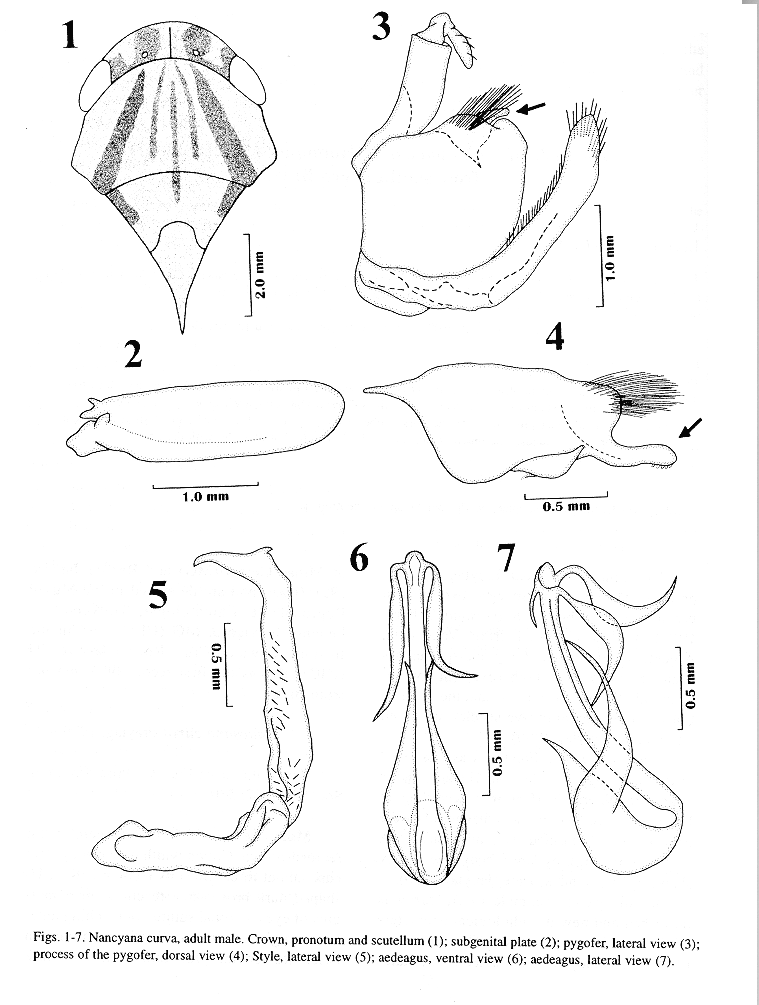
<body><![CDATA[<p class="MsoNormal"><font face="Arial,Helvetica"><font size=-1><b>Male</b>. Length 15.5 mm. General color reddish-brown. Crown width between eyes, at base, about three times its median length; U-shaped dark brown spot reaching inner margins of eyes; coronal suture not reaching anterior margin of crown. Width of pronotum twice its length; pronotum with five dark brown stripes; the median stripe not reaching anterior margin of pronotum and crossing the anterior margin of scutellum; two narrow stripes adjacent to median stripe not attaining posterior margin of pronotum; other wider remanescent stripes extending from an area behind ocelli to lateral margin of scutellum before scutellar suture. Forewings similar to female: general color brown with pale yellow spots, median region with dark brown semicircular spot following costal margin with its largest width reaching claval suture; apical cells suffused with dark brown spots, oval shaped dark spot close to apex of claval suture; veins brown, with small bristles. Hindwings dark.</font></font><font size=-1></font>      <p class="MsoNormal"><font face="Arial,Helvetica"><font size=-1><b>Genitalia</b>. Subgenital plates approximately three times as long as their maximum width, with apex rounded, innerly excavated, with bristles on apical region and on outer lateral margin originating mainly on inner surface. Pygofer robust, with apical margin bilobed, dorsal lobe with brush of bristles externally and internally with finger-like prolongation, apex indented on the inner margin. Styles with apical arm approximately seven times as long as its maximum width, with small sparse bristles; apex foot-shaped, directed dorsally, with short ventral spine. Aedeagus with long stem, concavely depressed on ventral surface and with two pairs of subapical processes: lateroventral pair curved to stem base, with median region enlarged and narrowed to apex, laterally curved, reaching approximately half of length of stem; short dorsal pair with narrowed apex curved toward stem base. Basal processes enlarged at base, abruptly narrowed from the apical third, surpassing half of the stem length.</font></font><font size=-1></font>      <p class="MsoNormal"><font face="Arial,Helvetica"><font size=-1><b>Female</b>. Length 17.0-18.5 mm. Crown approximately three times as wide between eyes, at base, as median length, with uniform brown color pattern. Genae with many bristles outlining eye margins. Pronotum with maximum width approximately twice median length, color pattern similar to that of male, three central dark brown bands and scutellar bands unclear.</font></font><font size=-1></font>      <p class="MsoNormal"><font face="Arial,Helvetica"><font size=-1><b>Studied</b> <b>specimens</b>. 1 male - Brazil, state of Minas Gerais, Vi&ccedil;osa, 1935, E.J. Hambleton leg. (UFV); 1 female - Brazil, state of Minas Gerais, Vi&ccedil;osa, Mata do Para&iacute;so, 1988, P.S.F. Ferreira leg. (UFV); 1 male- Brazil, state of Rio de Janeiro, Itatiaia, 23/XII/1935, J.F. Zik&aacute;n leg. (IOC); 1 female - Brazil, state of Rio de Janeiro, Itatiaia, 21/I/1939, J.F. Zik&aacute;n leg. (IOC).</font></font>     <br><font size=-1></font>&nbsp;<font size=-1></font>     <p><b><font face="Arial,Helvetica"><font size=-1>Discussion</font></font></b><font size=-1></font>      <p class="MsoNormal" style="text-indent:36.0pt"><font face="Arial,Helvetica"><font size=-1>In relation to the male genitalia, <i>N. curva</i> can<i> </i>be differentiated from the other species of <i>Nancyana</i> by the presence of a pair of inner projections on the dorsal lobe of the pygofer, and by a dorsal pair of short subapical processes on the aedeagus.</font></font><font size=-1></font>      <p class="MsoNormal" style="text-indent:36.0pt"><font face="Arial,Helvetica"><font size=-1>According to label data, the female specimen from the state of Rio de Janeiro was collected on “whip-horse” (<i>Luehea divaricata</i> Mart., Tiliaceae), a forest tree (<a href="#Joly">Joly 1987</a>). This is the only host known plant recorded for <i>N. curva</i>.</font></font><font size=-1></font>      <p class="BodyText"><font face="Arial,Helvetica"><font size=-1>I thank Elidiomar R. Da-Silva (Universidade do Rio de Janeiro), Jorge L. Nessimian, Alcimar L. Carvalho, Gabriel L.F. Mejdalani, and M&aacute;rcio E. Felix (Universidade Federal do Rio de Janeiro) for critical reading of this paper. I am also very grateful to Paulo S.F. Ferreira (UFV) and Sebasti&atilde;o de Oliveira (IOC) for loading the studied specimens. This research was partially funded by the CAPES/PICD/UFRJ.</font></font>     <br><font size=-1></font>&nbsp;<font size=-1></font>     ]]></body>
<body><![CDATA[<p><b><font face="Arial,Helvetica"><font size=-1>References</font></font></b><font size=-1></font>      <!-- ref --><p class="MsoNormal" style="margin-left:14.2pt;text-indent:-14.2pt"><a NAME="Freytag"></a><font face="Arial,Helvetica"><font size=-1>Freytag, P.H. 1990. The new genus <i>Nancyana </i>and nine new species with the review of the related genus <i>Rhogosana</i> (Homoptera: Cicadellidae). Proc. Entomol. Soc. Wash. 92: 530-537.</font></font><font size=-1></font>    &nbsp;&nbsp;&nbsp;&nbsp;&nbsp;&nbsp;&nbsp;&nbsp;[&#160;<a href="javascript:void(0);" onclick="javascript: window.open('/scielo.php?script=sci_nlinks&ref=1179801&pid=S0034-7744199900040003500001&lng=','','width=640,height=500,resizable=yes,scrollbars=1,menubar=yes,');">Links</a>&#160;]<!-- end-ref --><!-- ref --><p class="MsoNormal" style="margin-left:14.2pt;text-indent:-14.2pt"><a NAME="Joly"></a><font face="Arial,Helvetica"><font size=-1>Joly, A.B. 1987. Bot&acirc;nica: introdu&ccedil;&atilde;o &agrave; taxonomia vegetal. Editora Nacional, S&atilde;o Paulo. 777 p.</font></font>    &nbsp;&nbsp;&nbsp;&nbsp;&nbsp;&nbsp;&nbsp;&nbsp;[&#160;<a href="javascript:void(0);" onclick="javascript: window.open('/scielo.php?script=sci_nlinks&ref=1179802&pid=S0034-7744199900040003500002&lng=','','width=640,height=500,resizable=yes,scrollbars=1,menubar=yes,');">Links</a>&#160;]<!-- end-ref --><div class="MsoNormal" style="margin-left:14.2pt;text-indent:-14.2pt"><font face="Arial,Helvetica"><font size=-1></font></font></div>       <p class="BodyText"><a NAME="1a"></a><font face="Arial,Helvetica"><font size=-1><sup><a href="#1">1</a></sup> Departamento de Zoologia, Instituto de Biologia, Universidade Federal do Rio de Janeiro, Caixa Postal 68044, 21944-970, Rio de Janeiro, RJ, Brasil. Telefax: 55-21-5605993. E-mail: <a href="lbcoelho@acd.ufrj.br">lbcoelho@acd.ufrj.br</a></font></font></div>       ]]></body><back>
<ref-list>
<ref id="B1">
<nlm-citation citation-type="journal">
<person-group person-group-type="author">
<name>
<surname><![CDATA[Freytag]]></surname>
<given-names><![CDATA[P.H]]></given-names>
</name>
</person-group>
<article-title xml:lang="en"><![CDATA[The new genus Nancyana and nine new species with the review of the related genus Rhogosana (Homoptera: Cicadellidae)]]></article-title>
<source><![CDATA[Proc. Entomol. Soc. Wash]]></source>
<year>1990</year>
<volume>92</volume>
<page-range>530-537</page-range></nlm-citation>
</ref>
<ref id="B2">
<nlm-citation citation-type="book">
<person-group person-group-type="author">
<name>
<surname><![CDATA[Joly]]></surname>
<given-names><![CDATA[A.B]]></given-names>
</name>
</person-group>
<source><![CDATA[Botânica: introdução à taxonomia vegetal]]></source>
<year>1987</year>
<page-range>777</page-range><publisher-loc><![CDATA[São Paulo ]]></publisher-loc>
<publisher-name><![CDATA[Editora Nacional]]></publisher-name>
</nlm-citation>
</ref>
</ref-list>
</back>
</article>
