<?xml version="1.0" encoding="ISO-8859-1"?><article xmlns:mml="http://www.w3.org/1998/Math/MathML" xmlns:xlink="http://www.w3.org/1999/xlink" xmlns:xsi="http://www.w3.org/2001/XMLSchema-instance">
<front>
<journal-meta>
<journal-id>0034-7744</journal-id>
<journal-title><![CDATA[Revista de Biología Tropical]]></journal-title>
<abbrev-journal-title><![CDATA[Rev. biol. trop]]></abbrev-journal-title>
<issn>0034-7744</issn>
<publisher>
<publisher-name><![CDATA[Universidad de Costa Rica]]></publisher-name>
</publisher>
</journal-meta>
<article-meta>
<article-id>S0034-77441999000400033</article-id>
<title-group>
<article-title xml:lang="en"><![CDATA[Parasitism of stink bug eggs (Hemiptera: Pentatomidae) of soybean fields in the Triângulo Mineiro, Minas Gerais, Brazil]]></article-title>
</title-group>
<contrib-group>
<contrib contrib-type="author">
<name>
<surname><![CDATA[Venzon]]></surname>
<given-names><![CDATA[Madelaine]]></given-names>
</name>
<xref ref-type="aff" rid="A01"/>
</contrib>
<contrib contrib-type="author">
<name>
<surname><![CDATA[Ferreira]]></surname>
<given-names><![CDATA[João A. M]]></given-names>
</name>
<xref ref-type="aff" rid="A02"/>
</contrib>
<contrib contrib-type="author">
<name>
<surname><![CDATA[Ripposati]]></surname>
<given-names><![CDATA[João G]]></given-names>
</name>
<xref ref-type="aff" rid="A01"/>
</contrib>
</contrib-group>
<aff id="A01">
<institution><![CDATA[,Agriculture and Livestock Research Enterprise of Minas Gerais  ]]></institution>
<addr-line><![CDATA[Uberaba Minas Gerais]]></addr-line>
<country>Brazil</country>
</aff>
<aff id="A02">
<institution><![CDATA[,Federal University of Viçosa  ]]></institution>
<addr-line><![CDATA[Viçosa Minas Gerais]]></addr-line>
<country>Brazil</country>
</aff>
<pub-date pub-type="pub">
<day>00</day>
<month>12</month>
<year>1999</year>
</pub-date>
<pub-date pub-type="epub">
<day>00</day>
<month>12</month>
<year>1999</year>
</pub-date>
<volume>47</volume>
<numero>4</numero>
<fpage>1007</fpage>
<lpage>1013</lpage>
<copyright-statement/>
<copyright-year/>
<self-uri xlink:href="http://www.scielo.sa.cr/scielo.php?script=sci_arttext&amp;pid=S0034-77441999000400033&amp;lng=en&amp;nrm=iso"></self-uri><self-uri xlink:href="http://www.scielo.sa.cr/scielo.php?script=sci_abstract&amp;pid=S0034-77441999000400033&amp;lng=en&amp;nrm=iso"></self-uri><self-uri xlink:href="http://www.scielo.sa.cr/scielo.php?script=sci_pdf&amp;pid=S0034-77441999000400033&amp;lng=en&amp;nrm=iso"></self-uri><abstract abstract-type="short" xml:lang="en"><p><![CDATA[A survey of the seasonal occurrence of stink bug egg parasitoids was carried out in soybean fields in the Triângulo Mineiro region, Minas Gerais state, Brazil. Collections of egg masses of stink bugs and monitoring of population levels of mobile stages were done weekly during the 1993/94 and 1994/95 soybean seasons. Piezodorus guildinii and Euschistus heros were the most abundant stink bugs throughout the survey. Rates of parasitism in P. guildinii eggs ranged from 50.2 to 77% in 1993/94 and from 31.3 to 44.1% in the 1994/95 soybean season. Parasitism in E. heros eggs ranged from 50.6 to 64.7 % in 1993/94 but no parasitized eggs were found in 1994/95. Telenomus podisi was the main parasitoid collected and the only species found to parasitize E. heros eggs. Trissolcus brochymenae and Ooencyrtus sp. were found attacking P. guildinii eggs, but at low levels. We discuss the contribution of egg parasitoids to natural control of stink bugs.]]></p></abstract>
<kwd-group>
<kwd lng="en"><![CDATA[Soybean]]></kwd>
<kwd lng="en"><![CDATA[Cerrado]]></kwd>
<kwd lng="en"><![CDATA[Pentatomidae]]></kwd>
<kwd lng="en"><![CDATA[Euschistus heros]]></kwd>
<kwd lng="en"><![CDATA[Piezodorus guildinii]]></kwd>
<kwd lng="en"><![CDATA[Telenomus podis i]]></kwd>
</kwd-group>
</article-meta>
</front><body><![CDATA[ <center><b><font face="Arial,Helvetica">Parasitism of stink bug eggs (Hemiptera: Pentatomidae) of soybean fields in</font></b>     <br><b><font face="Arial,Helvetica">the Tri&acirc;ngulo Mineiro, Minas Gerais, Brazil</font></b>     <p><font face="Arial,Helvetica"><font size=-1><b>Madelaine Venzon&nbsp;<a NAME="*1"></a></b><sup><a href="#*">*1</a></sup><b> Jo&atilde;o A. M. Ferreira<a NAME="2"></a></b><sup><a href="#2a">2</a></sup><b> &amp; Jo&atilde;o G. Ripposati<a NAME="1b"></a></b><sup><a href="#1a">1</a></sup></font></font>     <p><font face="Arial,Helvetica"><font size=-1>Received 4-III-1999. Corrected 5-VIII-1999. Accepted 12-VIII-1999.</font></font></center>      <p><b><font face="Arial,Helvetica"><font size=-1>Abstract</font></font></b>     <p><font face="Arial,Helvetica"><font size=-1>A survey of the seasonal occurrence of stink bug egg parasitoids was carried out in soybean fields in the Tri&acirc;ngulo Mineiro region, Minas Gerais state, Brazil. Collections of egg masses of stink bugs and monitoring of population levels of mobile stages were done weekly during the 1993/94 and 1994/95 soybean seasons. <i>Piezodorus guildinii</i> and <i>Euschistus heros</i> were the most abundant stink bugs throughout the survey. Rates of parasitism in <i>P. guildinii</i> eggs ranged from 50.2 to 77% in 1993/94 and from 31.3 to 44.1% in the 1994/95 soybean season. Parasitism in <i>E. heros</i> eggs ranged from 50.6 to 64.7 % in 1993/94 but no parasitized eggs were found in 1994/95.<i> Telenomus podisi</i> was the main parasitoid collected and the only species found to parasitize<i> E. heros</i> eggs. <i>Trissolcus brochymenae</i> and <i>Ooencyrtus</i> sp. were found attacking <i>P. guildinii</i> eggs, but at low levels. We discuss the contribution of egg parasitoids to natural control of stink bugs.</font></font>     <br>&nbsp;     <p><b><font face="Arial,Helvetica"><font size=-1>Key words</font></font></b>     <p><font face="Arial,Helvetica"><font size=-1>Soybean, Cerrado, Pentatomidae, <i>Euschistus heros</i>, <i>Piezodorus guildinii</i>, <i>Telenomus podisi</i>.</font></font>     <br>&nbsp;     ]]></body>
<body><![CDATA[<p><font face="Arial,Helvetica"><font size=-1>Pentatomids are the main soybean pests in almost all areas where the crop is grown in Brazil. Adults and nymphs of this pest complex may cause severe damage through seed-feeding thereby reducing the yield and<b> </b>seed quality (<a href="#Gazzoni">Gazzoni <i>et al.</i> 1994</a>). In Brazil, the control of these pests has been done mostly by insecticides except in some areas in the states of Paran&aacute; and Rio Grande do Sul, where they are successfully controlled by releases of the egg parasitoid <i>Trissolcus basalis</i> (Wollaston) (Hymenoptera: Scelionidae) (<a href="#Corrêa93">Corr&ecirc;a-Ferreira 1993</a>).</font></font>     <p><font face="Arial,Helvetica"><font size=-1>Hymenopterous egg parasitoids are the most important factor of natural mortality of stink bugs worldwide (<a href="#Hokyo">Hokyo <i>et al.</i> 1966</a>,<a href="#Yeargan"> Yeargan 1979</a>, <a href="#Orr86">Orr <i>et al.</i> 1986</a>, <a href="#Corrêa86">Corr&ecirc;a-Ferreira 1986</a>, <a href="#Jones">Jones 1988</a>). Their high search and reproductive rates, their synchrony with host development rate, the possibility of mass production and the absence of hyperparasitoids make these insects suitable agents for biological control (<a href="#Orr88">Orr 1988</a>). Besides the Brazilian program, there are examples of successful biological control programs of phytophagous pentatomids by egg parasitoids in other countries (<a href="#Orr88">Orr 1988</a>, <a href="#Clarke">Clarke 1990</a>).</font></font>     <p><font face="Arial,Helvetica"><font size=-1>In the majority of cases, where oophagous parasitoids have been used to control stink bugs, the most common target species has been <i>Nezara viridula</i> (L.). Although this species is considered to be the most important pest of soybean in the southern temperate areas of Brazil, in the central tropical region, mainly in the Cerrado, <i>Piezodorus guildinii</i> (Westwood) and <i>Euschistus heros</i> (Fabricius) are the most abundant pentatomid soybean pests (<a href="#Corrêa77">Corr&ecirc;a <i>et al.</i> 1977</a>, <a href="#Jones">Jones 1988</a>, <a href="#Gazzoni">Gazzoni <i>et al.</i><b> </b>1994</a>). In contrast to comprehensive reports on natural enemies of stink bugs in the traditional soybean region in the South of Brazil (<a href="#Panizzi">Panizzi and Smith 1976</a>; Villas Boas and Panizzi 1980, <a href="#Corrêa86">Corr&ecirc;a-Ferreira 1986</a>, <a href="#Moreira">Moreira and Becker 1986</a>, <a href="#Foerster">Foester and Queiroz 1990</a>, <a href="#Corrêa95">Corr&ecirc;a-Ferreira and Moscardi 1995</a>), there is little information related to stink bug enemies for soybean areas in the Brazilian Cerrado. <a href="#Kobayashi">Kobayashi and Cosenza (1987)</a> report on the release of an egg parasitoid species from Japan, <i>Trissolcus mitsukurii</i> (Ashmead), in the Brazilian Cerrado for improvement of the control<b> </b>by native<b> </b>parasitoids, the scelionids <i>T.</i> <i>basalis</i> and <i>Telenomus podisi </i>Ashmead (cited as <i>Telenomus mormidae</i>). They show that egg parasitism increased by about 20% after the introduction of the exotic species and the total percentage of parasitism was as high as 70%. High rates of parasitism in <i>E. heros</i> eggs by <i>T. podisi</i> were observed by <a href="#Ávila">&Aacute;vila and Godoy (1995)</a> in surveys conducted in soybean fields in the Cerrado area of Mato Grosso do Sul. <i>Telenomus podisi</i> was also reported by <a href="#Medeiros">Medeiros <i>et al</i>. (1997)</a> as the main parasitoid of <i>E. heros</i> eggs in sunflowers, which is cultivated after the soybean season, in the Cerrado of the Federal District, Brazil.</font></font>     <p><font face="Arial,Helvetica"><font size=-1>There are no data available for natural mortality of stink bugs in soybean areas in the state of Minas Gerais. In the Tri&acirc;ngulo Mineiro, a region located in the Cerrado and responsible for 58% of soybean production in the state (EMATER, unpublished), pest species of economic importance are <i>P. guildinii</i> and <i>E. heros</i> (<a href="#Correia82">Correia 1982</a>, <a href="#Venzon">Venzon and Martins Filho 1995</a>). To obtain more information about the species composition of egg parasitoids of stink bugs, we carried out surveys on their seasonal occurrence in soybean fields in the Tri&acirc;ngulo Mineiro region.</font></font>     <br>&nbsp;     <br>&nbsp;     <p><b><font face="Arial,Helvetica"><font size=-1>Materials and Methods</font></font></b>     <p><font face="Arial,Helvetica"><font size=-1>Egg masses of stink bugs were collected weekly during the growing season from soybean fields in the region of theTri&acirc;ngulo Mineiro, Minas Gerais state. In 1993/94 the masses were collected from fields in Uberaba, Conquista and Sacramento. In 1994/95 samples were collected from Conquista and Uberaba. Each soybean field measured 1.0 ha. Standard cultivation practices were used in all fields, but no pesticides were applied. The sampling procedure consisted of<b> </b>collecting pentatomid eggs found on five row-sections of soybean plants. Each section was 5 m long. The sections were chosen randomly throughout the field and care was taken to choose different sections in the following weeks. Egg masses were placed individually in glass tubes (2.5 x 8.5 cm) containing moist filter paper in the bottom. The tubes were sealed with Parafilm and kept in the laboratory at ambient conditions. The numbers of parasitoids and stink bug nymphs which emerged were scored daily. Intact eggs were dissected and examined for parasitoids after three weeks. Total parasitism was defined as the sum of eggs from which parasitoids emerged and eggs that were parasitized but did not result in parasitoid emergence. All parasitoids, naturally emerged or removed from intact eggs, were separated by collection site, date and host species, and kept in alcohol for identification. The population level of stink bugs was monitored in all fields by applying the ground cloth method (<a href="#Gazzoni">Gazzoni <i>et al.</i> 1994</a>). The samples were taken before the egg masses were collected from the same five sections of row mentioned above. We considered only large nymphs (> 0.5 cm) and adults of stink bugs in our survey because younger stages do not damage the seeds and are not taken into account when the economic threshold is calculated (<a href="#Gazzoni">Gazzoni <i>et al</i>. 1994</a>).</font></font>     <br>&nbsp;     <p><b><font face="Arial,Helvetica"><font size=-1>Results</font></font></b>     ]]></body>
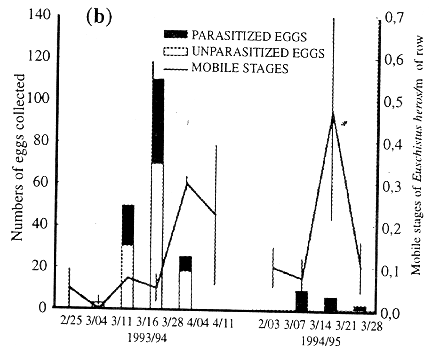
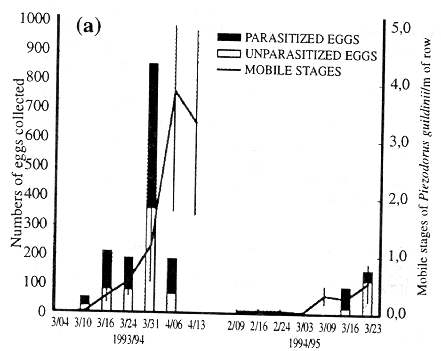
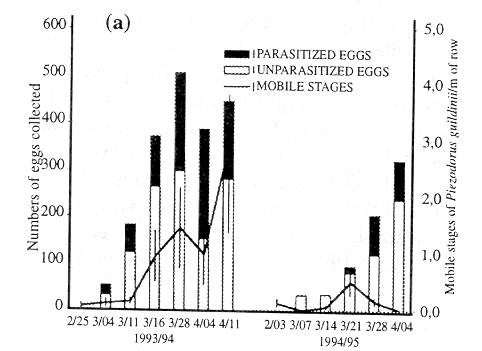
<body><![CDATA[<p><font face="Arial,Helvetica"><font size=-1>Two stink bug species were found consistently during the survey: <i>P. guildini</i> and <i>E. heros</i>. Although other pentatomids were observed during monitoring, they were not included in the study, either because their numbers were very low or because no egg masses of these species were found. Only one egg mass from <i>N. viridula</i> was collected in Conquista in 1993/94 and it was not parasitized.</font></font>     <p><font face="Arial,Helvetica"><font size=-1>A total of 118 egg masses was collected in Conquista in the 1993/94 season. Of these, 26.3% were of <i>E. heros</i> and 73.7% of <i>P. guidinii</i> (<a href="#TABLE1">Table 1</a>). In 1994/95, the total number of egg masses collected was 39: 10.2% of <i>E. heros</i> and 89.7% of <i>P. guildinii</i> (<a href="#TABLE2">Table 2</a>). The population level of both species was higher during the first year of the study than during the second. Numbers of <i>P. guildinii</i> were higher than those of <i>E. heros</i> in 1993/94, but both population reached similar numbers in 1994/95 (<a href="#fig1a">Fig. 1a</a> <a href="#fig1b">b</a>). <i>Telenomus podisi</i> was the only species that successfully attacked<i> E. heros</i> eggs: it parasitized 62.9% of all eggs in 1993/94, but no parasitized eggs were found in 1994/95. A total of 810 (50.2%)<b> </b>and 182 (31.3%) eggs of <i>P. guildinii</i> were parasitized in 1993/94 and 1994/95 respectively. The predominant parasitoid species was <i>T. podisi</i>, but we also found <i>Trissolcus brochymenae</i> (Ashmead) and <i>Ooencyrtus</i> sp. attacking the stink bug eggs .</font></font>     <br>&nbsp;     <br>&nbsp; <ul> <ul>     <center><a NAME="TABLE1"></a><font face="Arial,Helvetica"><font size=-1>TABLE 1</font></font></center>     </ul> <font face="Arial,Helvetica"><font size=-1>Parasitism of stink bug eggs collected in the 1993/94 soybean season in the Tri&acirc;ngulo Mineiro, state of Minas Gerais, Brazil.</font></font>    </ul>      <center><table BORDER=0 CELLSPACING=0 CELLPADDING=7 WIDTH="711" > <tr> <td VALIGN=TOP WIDTH="23%" HEIGHT="40"><font face="Arial,Helvetica"><font size=-1>Host species&nbsp;</font></font>     <p><font face="Arial,Helvetica"><font size=-1>Locality</font></font></td>  <td VALIGN=TOP WIDTH="14%" HEIGHT="40">     <center><font face="Arial,Helvetica"><font size=-1>Total number of egg masses collected</font></font></center> </td>  <td VALIGN=TOP WIDTH="14%" HEIGHT="40">     ]]></body>
<body><![CDATA[<center><font face="Arial,Helvetica"><font size=-1>Egg masses parasitized (%)</font></font></center> </td>  <td VALIGN=TOP WIDTH="15%" HEIGHT="40">     <center><font face="Arial,Helvetica"><font size=-1>Total number of eggs collected</font></font></center> </td>  <td VALIGN=TOP WIDTH="13%" HEIGHT="40">     <center><font face="Arial,Helvetica"><font size=-1>Eggs parasitized (%)</font></font></center> </td>  <td VALIGN=TOP COLSPAN="3" WIDTH="21%" HEIGHT="40">     <center><font face="Arial,Helvetica"><font size=-1>Parasitoid species composition1</font></font></center> </td> </tr>  <tr> <td VALIGN=TOP WIDTH="23%" HEIGHT="40"></td>  <td VALIGN=TOP WIDTH="14%" HEIGHT="40"></td>  <td VALIGN=TOP WIDTH="14%" HEIGHT="40"></td>  <td VALIGN=TOP WIDTH="15%" HEIGHT="40"></td>  <td VALIGN=TOP WIDTH="13%" HEIGHT="40"></td>  <td VALIGN=TOP WIDTH="10%" HEIGHT="40">     <center><font face="Arial,Helvetica"><font size=-1>Tp</font></font></center> </td>  <td VALIGN=TOP COLSPAN="2" WIDTH="10%" HEIGHT="40">     <center><font face="Arial,Helvetica"><font size=-1>Tb</font></font></center> </td> </tr>  <tr> <td VALIGN=TOP WIDTH="23%"><font face="Arial,Helvetica"><font size=-1>Euschistus heros</font></font></td>  <td VALIGN=TOP WIDTH="14%"><font face="Arial,Helvetica"><font size=-1>&nbsp;</font></font></td>  <td VALIGN=TOP WIDTH="14%"><font face="Arial,Helvetica"><font size=-1>&nbsp;</font></font></td>  <td VALIGN=TOP WIDTH="15%"><font face="Arial,Helvetica"><font size=-1>&nbsp;</font></font></td>  <td VALIGN=TOP WIDTH="13%"><font face="Arial,Helvetica"><font size=-1>&nbsp;</font></font></td>  <td VALIGN=TOP COLSPAN="3" WIDTH="21%"><font face="Arial,Helvetica"><font size=-1>&nbsp;</font></font></td> </tr>  <tr> <td VALIGN=TOP WIDTH="23%"><font face="Arial,Helvetica"><font size=-1>Conquista</font></font></td>  <td VALIGN=TOP WIDTH="14%">     <div align=right><font face="Arial,Helvetica"><font size=-1>31</font></font></div> </td>  <td VALIGN=TOP WIDTH="14%">     <div align=right><font face="Arial,Helvetica"><font size=-1>61.3</font></font></div> </td>  <td VALIGN=TOP WIDTH="15%">     <div align=right><font face="Arial,Helvetica"><font size=-1>120</font></font></div> </td>  <td VALIGN=TOP WIDTH="13%">     <center><font face="Arial,Helvetica"><font size=-1>62.5</font></font></center> </td>  <td VALIGN=TOP COLSPAN="2" WIDTH="12%"><font face="Arial,Helvetica"><font size=-1>100.0%</font></font></td>  <td VALIGN=TOP WIDTH="9%">     ]]></body>
<body><![CDATA[<center><font face="Arial,Helvetica"><font size=-1>-</font></font></center> </td> </tr>  <tr> <td VALIGN=TOP WIDTH="23%"><font face="Arial,Helvetica"><font size=-1>Uberaba</font></font></td>  <td VALIGN=TOP WIDTH="14%">     <div align=right><font face="Arial,Helvetica"><font size=-1>4</font></font></div> </td>  <td VALIGN=TOP WIDTH="14%">     <div align=right><font face="Arial,Helvetica"><font size=-1>75.0</font></font></div> </td>  <td VALIGN=TOP WIDTH="15%">     <div align=right><font face="Arial,Helvetica"><font size=-1>17</font></font></div> </td>  <td VALIGN=TOP WIDTH="13%">     <center><font face="Arial,Helvetica"><font size=-1>64.7</font></font></center> </td>  <td VALIGN=TOP COLSPAN="2" WIDTH="12%"><font face="Arial,Helvetica"><font size=-1>100.0%</font></font></td>  <td VALIGN=TOP WIDTH="9%">     <center><font face="Arial,Helvetica"><font size=-1>-</font></font></center> </td> </tr>  <tr> <td VALIGN=TOP WIDTH="23%"><font face="Arial,Helvetica"><font size=-1>Sacramento</font></font></td>  <td VALIGN=TOP WIDTH="14%">     <div align=right><font face="Arial,Helvetica"><font size=-1>169</font></font></div> </td>  <td VALIGN=TOP WIDTH="14%">     <div align=right><font face="Arial,Helvetica"><font size=-1>53.8</font></font></div> </td>  <td VALIGN=TOP WIDTH="15%">     <div align=right><font face="Arial,Helvetica"><font size=-1>626</font></font></div> </td>  <td VALIGN=TOP WIDTH="13%">     <center><font face="Arial,Helvetica"><font size=-1>50.6</font></font></center> </td>  <td VALIGN=TOP COLSPAN="2" WIDTH="12%"><font face="Arial,Helvetica"><font size=-1>100.0 %</font></font></td>  <td VALIGN=TOP WIDTH="9%">     ]]></body>
<body><![CDATA[<center><font face="Arial,Helvetica"><font size=-1>-</font></font></center> </td> </tr>  <tr> <td VALIGN=TOP WIDTH="23%"><font face="Arial,Helvetica"><font size=-1>&nbsp;</font></font></td>  <td VALIGN=TOP WIDTH="14%"><font face="Arial,Helvetica"><font size=-1>&nbsp;</font></font></td>  <td VALIGN=TOP WIDTH="14%"><font face="Arial,Helvetica"><font size=-1>&nbsp;</font></font></td>  <td VALIGN=TOP WIDTH="15%"><font face="Arial,Helvetica"><font size=-1>&nbsp;</font></font></td>  <td VALIGN=TOP WIDTH="13%"><font face="Arial,Helvetica"><font size=-1>&nbsp;</font></font></td>  <td VALIGN=TOP COLSPAN="2" WIDTH="12%"><font face="Arial,Helvetica"><font size=-1>&nbsp;</font></font></td>  <td VALIGN=TOP WIDTH="9%"><font face="Arial,Helvetica"><font size=-1>&nbsp;</font></font></td> </tr>  <tr> <td VALIGN=TOP WIDTH="23%"><font face="Arial,Helvetica"><font size=-1>Piezodorus guildinii</font></font></td>  <td VALIGN=TOP WIDTH="14%"><font face="Arial,Helvetica"><font size=-1>&nbsp;</font></font></td>  <td VALIGN=TOP WIDTH="14%"><font face="Arial,Helvetica"><font size=-1>&nbsp;</font></font></td>  <td VALIGN=TOP WIDTH="15%"><font face="Arial,Helvetica"><font size=-1>&nbsp;</font></font></td>  <td VALIGN=TOP WIDTH="13%"><font face="Arial,Helvetica"><font size=-1>&nbsp;</font></font></td>  <td VALIGN=TOP COLSPAN="2" WIDTH="12%"><font face="Arial,Helvetica"><font size=-1>&nbsp;</font></font></td>  <td VALIGN=TOP WIDTH="9%"><font face="Arial,Helvetica"><font size=-1>&nbsp;</font></font></td> </tr>  <tr> <td VALIGN=TOP WIDTH="23%"><font face="Arial,Helvetica"><font size=-1>Conquista</font></font></td>  <td VALIGN=TOP WIDTH="14%">     <div align=right><font face="Arial,Helvetica"><font size=-1>87</font></font></div> </td>  <td VALIGN=TOP WIDTH="14%">     <div align=right><font face="Arial,Helvetica"><font size=-1>71.3</font></font></div> </td>  <td VALIGN=TOP WIDTH="15%">     <div align=right><font face="Arial,Helvetica"><font size=-1>1613</font></font></div> </td>  <td VALIGN=TOP WIDTH="13%">     <center><font face="Arial,Helvetica"><font size=-1>50.2</font></font></center> </td>  <td VALIGN=TOP COLSPAN="2" WIDTH="12%">     <div align=right><font face="Arial,Helvetica"><font size=-1>90.5%</font></font></div> </td>  <td VALIGN=TOP WIDTH="9%">     <div align=right><font face="Arial,Helvetica"><font size=-1>9.5%</font></font></div> </td> </tr>  <tr> <td VALIGN=TOP WIDTH="23%"><font face="Arial,Helvetica"><font size=-1>Uberaba</font></font></td>  <td VALIGN=TOP WIDTH="14%">     <div align=right><font face="Arial,Helvetica"><font size=-1>81</font></font></div> </td>  <td VALIGN=TOP WIDTH="14%">     <div align=right><font face="Arial,Helvetica"><font size=-1>72.8</font></font></div> </td>  <td VALIGN=TOP WIDTH="15%">     <div align=right><font face="Arial,Helvetica"><font size=-1>1500</font></font></div> </td>  <td VALIGN=TOP WIDTH="13%">     ]]></body>
<body><![CDATA[<center><font face="Arial,Helvetica"><font size=-1>59.7</font></font></center> </td>  <td VALIGN=TOP COLSPAN="2" WIDTH="12%">     <div align=right><font face="Arial,Helvetica"><font size=-1>94.4%</font></font></div> </td>  <td VALIGN=TOP WIDTH="9%">     <div align=right><font face="Arial,Helvetica"><font size=-1>5.6%</font></font></div> </td> </tr>  <tr> <td VALIGN=TOP WIDTH="23%"><font face="Arial,Helvetica"><font size=-1>Sacramento</font></font></td>  <td VALIGN=TOP WIDTH="14%">     <div align=right><font face="Arial,Helvetica"><font size=-1>48</font></font></div> </td>  <td VALIGN=TOP WIDTH="14%">     <div align=right><font face="Arial,Helvetica"><font size=-1>77.1</font></font></div> </td>  <td VALIGN=TOP WIDTH="15%">     <div align=right><font face="Arial,Helvetica"><font size=-1>479</font></font></div> </td>  <td VALIGN=TOP WIDTH="13%">     <center><font face="Arial,Helvetica"><font size=-1>77.0</font></font></center> </td>  <td VALIGN=TOP COLSPAN="2" WIDTH="12%">     <div align=right><font face="Arial,Helvetica"><font size=-1>100.0 %</font></font></div> </td>  <td VALIGN=TOP WIDTH="9%">     <center><font face="Arial,Helvetica"><font size=-1>-</font></font></center> </td> </tr> </table></center> <font face="Arial,Helvetica"><font size=-1>1 Tp = <i>Telenomus podisi</i> and Tb = <i>Trissolcus brochymenae</i></font></font>     <br>&nbsp;     ]]></body>
<body><![CDATA[<br>&nbsp; <ul>     <center><a NAME="TABLE2"></a><font face="Arial,Helvetica"><font size=-1>TABLE 2</font></font></center>      <p><font face="Arial,Helvetica"><font size=-1>Parasitism of stink bug eggs collected in the 1994/95 soybean season in the Tri&acirc;ngulo Mineiro, state of Minas Gerais, Brazil.</font></font>    </ul>      <center><table BORDER=0 CELLSPACING=0 CELLPADDING=7 WIDTH="695" > <tr> <td VALIGN=TOP WIDTH="21%" HEIGHT="26"><font face="Arial,Helvetica"><font size=-1>Host species&nbsp;</font></font>     <br><font face="Arial,Helvetica"><font size=-1>Locality</font></font></td>  <td VALIGN=TOP WIDTH="15%" HEIGHT="26">     <center><font face="Arial,Helvetica"><font size=-1>Total number of egg masses collected</font></font></center> </td>  <td VALIGN=TOP WIDTH="13%" HEIGHT="26">     <center><font face="Arial,Helvetica"><font size=-1>Egg masses parasitized (%)</font></font></center> </td>  <td VALIGN=TOP WIDTH="15%" HEIGHT="26">     <center><font face="Arial,Helvetica"><font size=-1>Total number of eggs collected</font></font></center> </td>  <td VALIGN=TOP WIDTH="15%" HEIGHT="26">     <center><font face="Arial,Helvetica"><font size=-1>Eggs parasitized (%)</font></font></center> </td>  <td VALIGN=TOP COLSPAN="2" WIDTH="21%" HEIGHT="26">     ]]></body>
<body><![CDATA[<center><font face="Arial,Helvetica"><font size=-1>Parasitoid species composition1</font></font></center> </td> </tr>  <tr> <td VALIGN=TOP WIDTH="21%" HEIGHT="26"></td>  <td VALIGN=TOP WIDTH="15%" HEIGHT="26"></td>  <td VALIGN=TOP WIDTH="13%" HEIGHT="26"></td>  <td VALIGN=TOP WIDTH="15%" HEIGHT="26"></td>  <td VALIGN=TOP WIDTH="15%" HEIGHT="26"></td>  <td VALIGN=TOP WIDTH="11%" HEIGHT="26">     <center><font face="Arial,Helvetica"><font size=-1>Tp</font></font></center> </td>  <td VALIGN=TOP WIDTH="11%" HEIGHT="26">     <center><font face="Arial,Helvetica"><font size=-1>Osp</font></font></center> </td> </tr>  <tr> <td VALIGN=TOP WIDTH="21%"><font face="Arial,Helvetica"><font size=-1>Euschistus heros</font></font></td>  <td VALIGN=TOP WIDTH="15%"><font face="Arial,Helvetica"><font size=-1>&nbsp;</font></font></td>  <td VALIGN=TOP WIDTH="13%"><font face="Arial,Helvetica"><font size=-1>&nbsp;</font></font></td>  <td VALIGN=TOP WIDTH="15%"><font face="Arial,Helvetica"><font size=-1>&nbsp;</font></font></td>  <td VALIGN=TOP WIDTH="15%"><font face="Arial,Helvetica"><font size=-1>&nbsp;</font></font></td>  <td VALIGN=TOP WIDTH="11%"><font face="Arial,Helvetica"><font size=-1>&nbsp;</font></font></td>  <td VALIGN=TOP WIDTH="11%"><font face="Arial,Helvetica"><font size=-1>&nbsp;</font></font></td> </tr>  <tr> <td VALIGN=TOP WIDTH="21%"><font face="Arial,Helvetica"><font size=-1>Conquista</font></font></td>  <td VALIGN=TOP WIDTH="15%">     <div align=right><font face="Arial,Helvetica"><font size=-1>4</font></font></div> </td>  <td VALIGN=TOP WIDTH="13%">     <div align=right><font face="Arial,Helvetica"><font size=-1>0</font></font></div> </td>  <td VALIGN=TOP WIDTH="15%">     <div align=right><font face="Arial,Helvetica"><font size=-1>17</font></font></div> </td>  <td VALIGN=TOP WIDTH="15%">     <center><font face="Arial,Helvetica"><font size=-1>0</font></font></center> </td>  <td VALIGN=TOP WIDTH="11%">     <center><font face="Arial,Helvetica"><font size=-1>-</font></font></center> </td>  <td VALIGN=TOP WIDTH="11%">     <center><font face="Arial,Helvetica"><font size=-1>-</font></font></center> </td> </tr>  <tr> <td VALIGN=TOP WIDTH="21%"><font face="Arial,Helvetica"><font size=-1>Uberaba</font></font></td>  <td VALIGN=TOP WIDTH="15%">     <div align=right><font face="Arial,Helvetica"><font size=-1>1</font></font></div> </td>  <td VALIGN=TOP WIDTH="13%">     ]]></body>
<body><![CDATA[<div align=right><font face="Arial,Helvetica"><font size=-1>0</font></font></div> </td>  <td VALIGN=TOP WIDTH="15%">     <div align=right><font face="Arial,Helvetica"><font size=-1>2</font></font></div> </td>  <td VALIGN=TOP WIDTH="15%">     <center><font face="Arial,Helvetica"><font size=-1>0</font></font></center> </td>  <td VALIGN=TOP WIDTH="11%">     <center><font face="Arial,Helvetica"><font size=-1>-</font></font></center> </td>  <td VALIGN=TOP WIDTH="11%">     <center><font face="Arial,Helvetica"><font size=-1>-</font></font></center> </td> </tr>  <tr> <td VALIGN=TOP WIDTH="21%"><font face="Arial,Helvetica"><font size=-1>&nbsp;</font></font></td>  <td VALIGN=TOP WIDTH="15%"><font face="Arial,Helvetica"><font size=-1>&nbsp;</font></font></td>  <td VALIGN=TOP WIDTH="13%"><font face="Arial,Helvetica"><font size=-1>&nbsp;</font></font></td>  <td VALIGN=TOP WIDTH="15%"><font face="Arial,Helvetica"><font size=-1>&nbsp;</font></font></td>  <td VALIGN=TOP WIDTH="15%"><font face="Arial,Helvetica"><font size=-1>&nbsp;</font></font></td>  <td VALIGN=TOP WIDTH="11%"><font face="Arial,Helvetica"><font size=-1>&nbsp;</font></font></td>  <td VALIGN=TOP WIDTH="11%"><font face="Arial,Helvetica"><font size=-1>&nbsp;</font></font></td> </tr>  <tr> <td VALIGN=TOP WIDTH="21%"><font face="Arial,Helvetica"><font size=-1>Piezodorus guildinii</font></font></td>  <td VALIGN=TOP WIDTH="15%"><font face="Arial,Helvetica"><font size=-1>&nbsp;</font></font></td>  <td VALIGN=TOP WIDTH="13%"><font face="Arial,Helvetica"><font size=-1>&nbsp;</font></font></td>  <td VALIGN=TOP WIDTH="15%"><font face="Arial,Helvetica"><font size=-1>&nbsp;</font></font></td>  <td VALIGN=TOP WIDTH="15%"><font face="Arial,Helvetica"><font size=-1>&nbsp;</font></font></td>  <td VALIGN=TOP WIDTH="11%"><font face="Arial,Helvetica"><font size=-1>&nbsp;</font></font></td>  <td VALIGN=TOP WIDTH="11%"><font face="Arial,Helvetica"><font size=-1>&nbsp;</font></font></td> </tr>  <tr> <td VALIGN=TOP WIDTH="21%"><font face="Arial,Helvetica"><font size=-1>Conquista</font></font></td>  <td VALIGN=TOP WIDTH="15%">     <div align=right><font face="Arial,Helvetica"><font size=-1>35</font></font></div> </td>  <td VALIGN=TOP WIDTH="13%">     <div align=right><font face="Arial,Helvetica"><font size=-1>45.7</font></font></div> </td>  <td VALIGN=TOP WIDTH="15%">     <div align=right><font face="Arial,Helvetica"><font size=-1>581</font></font></div> </td>  <td VALIGN=TOP WIDTH="15%">     <center><font face="Arial,Helvetica"><font size=-1>31.3</font></font></center> </td>  <td VALIGN=TOP WIDTH="11%">     <center><font face="Arial,Helvetica"><font size=-1>91.8 %</font></font></center> </td>  <td VALIGN=TOP WIDTH="11%">     ]]></body>
<body><![CDATA[<center><font face="Arial,Helvetica"><font size=-1>8.2 %</font></font></center> </td> </tr>  <tr> <td VALIGN=TOP WIDTH="21%"><font face="Arial,Helvetica"><font size=-1>Uberaba</font></font></td>  <td VALIGN=TOP WIDTH="15%">     <div align=right><font face="Arial,Helvetica"><font size=-1>14</font></font></div> </td>  <td VALIGN=TOP WIDTH="13%">     <div align=right><font face="Arial,Helvetica"><font size=-1>50.0</font></font></div> </td>  <td VALIGN=TOP WIDTH="15%">     <div align=right><font face="Arial,Helvetica"><font size=-1>245</font></font></div> </td>  <td VALIGN=TOP WIDTH="15%">     <center><font face="Arial,Helvetica"><font size=-1>44.1</font></font></center> </td>  <td VALIGN=TOP WIDTH="11%">     <center><font face="Arial,Helvetica"><font size=-1>100.0%</font></font></center> </td>  <td VALIGN=TOP WIDTH="11%">     <center><font face="Arial,Helvetica"><font size=-1>-</font></font></center> </td> </tr> </table></center> <font face="Arial,Helvetica"><font size=-1>1 Tp = <i>Telenomus podisi</i> and Osp = <i>Ooencyrtus</i> sp.</font></font>     <br>&nbsp;     <br>&nbsp;     <br>     ]]></body>
<body><![CDATA[<center>     <p><a NAME="fig1a"></a><img SRC="/img/fbpe/rbt/v47n4/0423i1.GIF" height=351 width=482>     
<p><a NAME="fig1b"></a><img SRC="/img/fbpe/rbt/v47n4/0423i2.GIF" height=349 width=433></center>      
<p><font face="Arial,Helvetica"><font size=-1>Fig. 1. Seasonal abundance of eggs and mobile stages of stink bugs (nymphs > 0.5 cm and adults sampled with the ground cloth) in soybean fields at Conquista, Minas Gerais, Brazil. (a) <i>Piezodorus guildinii</i>. (b) <i>Euschistus heros</i>. Note the different scale of the two graphs.</font></font>     <center>     <p><a NAME="fig2a"></a><img SRC="/img/fbpe/rbt/v47n4/0423i3.GIF" height=351 width=441>     
<p><a NAME="fig2b"></a><img SRC="/img/fbpe/rbt/v47n4/0423I4.GIF" height=358 width=455></center>      
<p>    <br>     <br>     ]]></body>
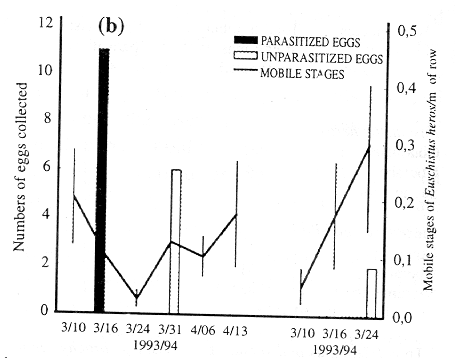
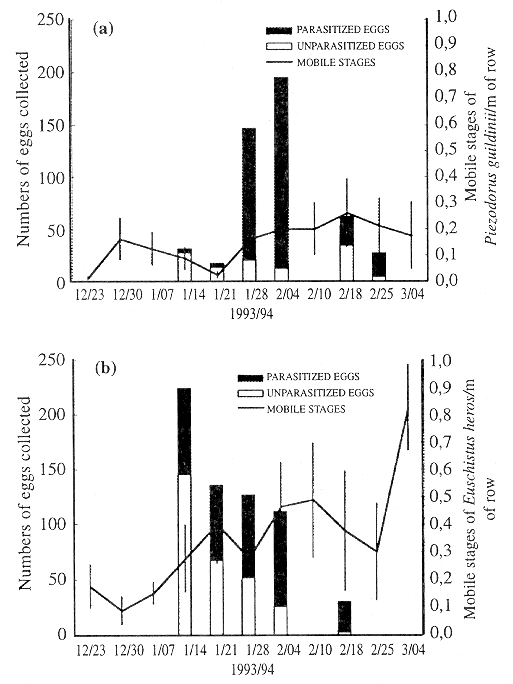
<body><![CDATA[<p><font face="Arial,Helvetica"><font size=-1>Fig. 2. Seasonal abundance of eggs and mobile stages of stink bugs (nymphs > 0.5 cm and adults sampled with the ground cloth) in soybean fields at Uberaba, Minas Gerais, Brazil. (a) <i>Piezodorus guildinii</i>. (b) <i>Euschistus heros</i>. Note the different scale of the two graphs.</font></font>     <br>&nbsp;     <br>&nbsp;     <p><font face="Arial,Helvetica"><font size=-1>In Uberaba, the situation was similar to that in Conquista.<i> Piezodorus guildinii</i> was predominant both in the number of egg masses and in the number of nymphs and adults sampled (<a href="#fig2a">Fig.2a</a>&nbsp; <a href="#fig2b">b</a>). A total of 85 egg masses was collected in 1993/94 consisting of 4.7% <i>E. heros</i> and 95.3% <i>P. guidinii</i>. The parasitoid identified in eggs of the former species was <i>T. podisi</i>, whereas in the second host species we found both <i>T. podisi</i> and<i> T.</i> <i>brochymenae </i>(<a href="#TABLE1">Table 1</a>). Only one of 15 egg masses collected in 1994/95 was from<i> E. heros</i> and it was not parasitized. In<i> </i>parasitized eggs of <i>P. guidinii </i>(44.1%) in 1994/95 we only found <i>T. podisi.</i></font></font>     <p><font face="Arial,Helvetica"><font size=-1>In Sacramento, the survey was carried out only during the 1993/94 soybean season (<a href="#fig3">Fig.3ab</a>), and unlike the two previous places, <i>E. heros</i> was the predominant stink bug, representing 77.6% of egg masses. The parasitoid species identified from<b> </b>all parasitized host eggs was <i>T. podisi</i> (<a href="#TABLE1">Table 1</a>).</font></font>     <br>&nbsp;     <p>    <br>     <center>     <p><a NAME="fig3"></a><img SRC="/img/fbpe/rbt/v47n4/0423i5.GIF" height=684 width=513></center>      
]]></body>
<body><![CDATA[<p>    <br>     <br>     <p><font face="Arial,Helvetica"><font size=-1>Fig. 3. Seasonal abundance of eggs and mobile stages of stink bugs (nymphs > 0.5 cm and adults sampled with the ground cloth) in soybean fields at Sacramento, Minas Gerais, Brazil. (a) <i>Piezodorus guildinii</i>. (b) <i>Euschistus heros</i>.</font></font>     <br>&nbsp;     <p><b><font face="Arial,Helvetica"><font size=-1>Discussion</font></font></b>     <p><font face="Arial,Helvetica"><font size=-1><i>Telenomus podisi</i> was the most abundant parasitoid collected in our study and the only species found to parasitize <i>E. heros</i> eggs. This scelionid was also reported as the predominant parasitoid attacking eggs of <i>E. heros</i> in south and central Brazilian soybean areas, as well as eggs of other <i>Euschistu</i>s species in the United States (<a href="#Yeargan">Yeargan 1979</a>, <a href="#Orr86">Orr <i>et al</i>. 1986</a>, <a href="#Foerster">Foester and Queiroz 1990</a>, <a href="#Corrêa95">Corr&ecirc;a-Ferreira and Moscardi 1995</a>, <a href="#Ávila">&Aacute;vila and Godoy 1995</a>, <a href="#Medeiros">Medeiros <i>et al</i>. 1997</a>). Despite its predominance, it is not the only species reported in <i>E. heros</i> eggs. Multiparasitism and the occurrence of other Scelionidae (<i>T. basalis</i>, <i>T. brochymenae</i>, <i>Trissolcus urichi</i> Crawford, <i>Trisssolcus teretis</i> Johnson, <i>Trissolcus scuticarinatus</i> Costa Lima, <i>Trissolcus</i> sp. and<i> Gryon obesum</i> Masner), Encyrtidae (<i>Ooencyrtus</i> sp.), Eurytomidae (<i>Neorileya</i> sp.) and Eupelmidae (<i>Eupelmus</i> sp.) species were also found in the eggs of this host (<a href="#Corrêa86">Corr&ecirc;a-Ferreira 1986</a>, <a href="#Foerster">Foester and Queiroz 1990</a>, <a href="#Corrêa95">Corr&ecirc;a-Ferreira and Moscardi 1995</a>, <a href="#Ávila">&Aacute;vila and Godoy 1995</a>, <a href="#Medeiros">Medeiros <i>et al</i>. 1997</a>).</font></font>     <p><font face="Arial,Helvetica"><font size=-1><i>Telenomus podisi</i> was responsible for 94% of<b> </b>parasitism of all parasitized eggs of <i>P. guildinii</i>. Similar percentages were observed by <a href="#Panizzi">Panizzi and Smith (1976)</a>, <a href="#Corrêa86">Corr&ecirc;a-Ferreira (1986)</a> and <a href="#Foerster">Foester and Queiroz (1990)</a> in surveys carried out in the state of Paran&aacute;. However, in a more recent survey conducted in the same area, <a href="#Corrêa95">Corr&ecirc;a-Ferreira and Moscardi (1995)</a> found that <i>T. podisi</i> was responsible for only 40% of the observed parasitism whereas <i>T.</i> <i>basalis</i> caused 44% of it. The authors suggested that the increased field releases of <i>T.basalis </i>in that region<i> </i>were responsible for the change in composition of parasitoid species attacking <i>P. guildinii</i> eggs.</font></font>     <p><font face="Arial,Helvetica"><font size=-1>Parasitism of <i>P. guildinii</i> eggs by <i>Ooencyrtus</i> sp. and <i>T. brochymenae</i> was very low and was absent in <i>E. heros</i> eggs. This suggests that both parasitoids use other hosts rather than <i>P. guildinii</i>, and they probably use the latter as an alternative host. <i>Ooencyrtus</i> species have been reported as having a wide host range, including both phytophagous and predatory Pentatomidae, Coreidae and Rhopalidae (<a href="#Jones">Jones 1988</a>) and all of these<b> </b>insects occur in the<b> </b>Cerrado soybean agroecosystem in Minas Gerais state (Venzon, unpublished). <i>Trissolcus brochymenae </i>was mostly reported attacking predators and phytophagous pentatomid eggs, but always<b> </b>as a minor component of the parasitoid complex (<a href="#Jones">Jones 1988</a>, <a href="#Corrêa95">Corr&ecirc;a-Ferreira and Moscardi 1995</a>, <a href="#Torres">Torres <i>et al</i>. 1996)</a>.</font></font>     <p><font face="Arial,Helvetica"><font size=-1>The total percentage of parasitism is a useful indicator for identifying species of parasitoids attacking specific host species at particular locations, at specific times, and it can be used to rank the relative commonness of the species observed, but it is usually inadequate to assess the impact of parasitoids on the population dynamics of the host (<a href="#van Driesche">van Driesche 1983</a>). To attempt this one may look at the seasonal distribution of parasitized eggs and mobile stages of hosts. Although more data are needed to show any parasitoid-stink bug population correlation, as an example we can look at the samples taken from Conquista (<a href="#fig1a">Fig.1</a>). For <i>P. guildinii</i> in the 1993/94 season, we observed that since the first eggs were found (<a href="#fig1a">Fig.1a</a>), some of them (40.4%)<b> </b>were already parasitized and the percentage of eggs parasitized increased in the subsequent sampling date. But if we look at population level of <i>P</i>. <i>guildinii</i> we also see an increase of number of mobile stages towards the end of the cropping season. The initial portion of eggs that were not parasitized yield juvenile and adults that will remain harmful to the crop at least during 60 days (<a href="#Cividanes">Cividanes and Parra 1994</a>). A higher percentage of parasitized eggs from the beginning of the appearance of stink bugs in the fields seems to keep their population at low level. For this reason, for biological control of stink bugs by oophagous parasitoids it is advised to release parasitoids during the soybean flowering period, when the first hosts start to colonize the fields (<a href="#Corrêa93">Corr&ecirc;a-Ferreira 1993</a>).</font></font>     ]]></body>
<body><![CDATA[<br>&nbsp;     <br>&nbsp;     <br>&nbsp;     <p><b><font face="Arial,Helvetica"><font size=-1>Acknowledgments</font></font></b>     <p><font face="Arial,Helvetica"><font size=-1>We thank FAPEMIG (Minas Gerais State Research Foundation) for financial support, Jos&eacute; Henrique Vir&iacute;ssimo for his technical assistance, Jonadan Hsuan Min Ma and C&eacute;sar Adalberto Piraja Figueiredo for providing the work areas. We are grateful to Beatriz S. Corr&ecirc;a-Ferreira from CNPSo/EMBRAPA for identification of the parasitoid species, Sam Elliot and Arne Janssen from the University of Amsterdam for comments and review of the manuscript.</font></font>     <br>&nbsp;     <p><b><font face="Arial,Helvetica"><font size=-1>References</font></font></b>     <!-- ref --><p><a NAME="Ávila"></a><font face="Arial,Helvetica"><font size=-1>&Aacute;vila, C.J &amp; K.B. Godoy. 1995. Levantamento quali-quantitativo de parasitismo de ovos de percevejos <i>Piezodorus guildinii</i> e <i>Euschistus heros</i> na regi&atilde;o de Dourados, MS. 17&ordm; Reuni&atilde;o de pesquisa de soja da regi&atilde;o central do Brasil, EMGOPA, Goi&acirc;nia. p.141.</font></font>    &nbsp;&nbsp;&nbsp;&nbsp;&nbsp;&nbsp;&nbsp;&nbsp;[&#160;<a href="javascript:void(0);" onclick="javascript: window.open('/scielo.php?script=sci_nlinks&ref=1181579&pid=S0034-7744199900040003300001&lng=','','width=640,height=500,resizable=yes,scrollbars=1,menubar=yes,');">Links</a>&#160;]<!-- end-ref --><!-- ref --><p><a NAME="Cividanes"></a><font face="Arial,Helvetica"><font size=-1>Cividanes, F.J. &amp; Parra, J.R.P. 1994. Biologia em diferentes temperaturas e exig&ecirc;ncias t&eacute;rmicas de percevejos pragas da soja. III. <i>Piezodorus guildinii</i> (West., 1837) (Heteroptera: Pentatomidae). Cient&iacute;fica 22: 177-186.</font></font>    &nbsp;&nbsp;&nbsp;&nbsp;&nbsp;&nbsp;&nbsp;&nbsp;[&#160;<a href="javascript:void(0);" onclick="javascript: window.open('/scielo.php?script=sci_nlinks&ref=1181580&pid=S0034-7744199900040003300002&lng=','','width=640,height=500,resizable=yes,scrollbars=1,menubar=yes,');">Links</a>&#160;]<!-- end-ref --><!-- ref --><p><a NAME="Clarke"></a><font face="Arial,Helvetica"><font size=-1>Clarke, A.R. 1990. The control of <i>Nezara viridula</i> L. with introduced egg parasitoids in Australia: A review of a landmark example of classical biological control. Aust. J. Agric. Res. 41: 1127-1146.</font></font>    &nbsp;&nbsp;&nbsp;&nbsp;&nbsp;&nbsp;&nbsp;&nbsp;[&#160;<a href="javascript:void(0);" onclick="javascript: window.open('/scielo.php?script=sci_nlinks&ref=1181581&pid=S0034-7744199900040003300003&lng=','','width=640,height=500,resizable=yes,scrollbars=1,menubar=yes,');">Links</a>&#160;]<!-- end-ref --><!-- ref --><p><a NAME="Corrêa86"></a><font face="Arial,Helvetica"><font size=-1>Corr&ecirc;a-Ferreira, B.S. 1986. Ocorr&ecirc;ncia natural do complexo de parasit&oacute;ides de percevejos da soja no Paran&aacute;. An. Soc. Entomol. Brasil 15:189-199.</font></font>    &nbsp;&nbsp;&nbsp;&nbsp;&nbsp;&nbsp;&nbsp;&nbsp;[&#160;<a href="javascript:void(0);" onclick="javascript: window.open('/scielo.php?script=sci_nlinks&ref=1181582&pid=S0034-7744199900040003300004&lng=','','width=640,height=500,resizable=yes,scrollbars=1,menubar=yes,');">Links</a>&#160;]<!-- end-ref --><!-- ref --><p><a NAME="Corrêa93"></a><font face="Arial,Helvetica"><font size=-1>Corr&ecirc;a-Ferreira, B.S. 1993. Utiliza&ccedil;&atilde;o do parasit&oacute;ide <i>Trissolcus basalis</i> (Wollaston) no controle de percevejos da soja. EMBRAPA/CNPSo, Londrina, Circ. T&eacute;c.11. 40p.</font></font>    &nbsp;&nbsp;&nbsp;&nbsp;&nbsp;&nbsp;&nbsp;&nbsp;[&#160;<a href="javascript:void(0);" onclick="javascript: window.open('/scielo.php?script=sci_nlinks&ref=1181583&pid=S0034-7744199900040003300005&lng=','','width=640,height=500,resizable=yes,scrollbars=1,menubar=yes,');">Links</a>&#160;]<!-- end-ref --><!-- ref --><p><a NAME="Corrêa95"></a><font face="Arial,Helvetica"><font size=-1>Corr&ecirc;a-Ferreira, B.S. &amp; F. Moscardi. 1995.<b> </b>Seasonal occurrence and host spectrum of egg parasitoids associated with soybean stink bugs. Biol. Control5: 196-202.</font></font>    &nbsp;&nbsp;&nbsp;&nbsp;&nbsp;&nbsp;&nbsp;&nbsp;[&#160;<a href="javascript:void(0);" onclick="javascript: window.open('/scielo.php?script=sci_nlinks&ref=1181584&pid=S0034-7744199900040003300006&lng=','','width=640,height=500,resizable=yes,scrollbars=1,menubar=yes,');">Links</a>&#160;]<!-- end-ref --><!-- ref --><p><a NAME="Corrêa77"></a><font face="Arial,Helvetica"><font size=-1>Corr&ecirc;a, B.S., A.R. Panizzi, G.G. Newman &amp; S.G. Turnipseed. 1977. Distribui&ccedil;&atilde;o geogr&aacute;fica a abund&acirc;ncia estacional dos principais insetos-pragas da soja e seus predadores. An. Soc. Entomol. Brasil 6: 40-50</font></font>    &nbsp;&nbsp;&nbsp;&nbsp;&nbsp;&nbsp;&nbsp;&nbsp;[&#160;<a href="javascript:void(0);" onclick="javascript: window.open('/scielo.php?script=sci_nlinks&ref=1181585&pid=S0034-7744199900040003300007&lng=','','width=640,height=500,resizable=yes,scrollbars=1,menubar=yes,');">Links</a>&#160;]<!-- end-ref --><!-- ref --><p><a NAME="Correia82"></a><font face="Arial,Helvetica"><font size=-1>Correia, A. C. B. 1982. Manejo Integrado de Pragas. Inf. Agropec. 8: 47-56.</font></font>    &nbsp;&nbsp;&nbsp;&nbsp;&nbsp;&nbsp;&nbsp;&nbsp;[&#160;<a href="javascript:void(0);" onclick="javascript: window.open('/scielo.php?script=sci_nlinks&ref=1181586&pid=S0034-7744199900040003300008&lng=','','width=640,height=500,resizable=yes,scrollbars=1,menubar=yes,');">Links</a>&#160;]<!-- end-ref --><!-- ref --><p><a NAME="Foerster"></a><font face="Arial,Helvetica"><font size=-1>Foerster, L.A. &amp; J.M. Queiroz. 1990. Incid&ecirc;ncia natural de parasitismo em ovos de pentatom&iacute;deos da soja no Centro-Sul do Paran&aacute;. An. Soc. Entomol. Brasil 19: 221-232.</font></font>    &nbsp;&nbsp;&nbsp;&nbsp;&nbsp;&nbsp;&nbsp;&nbsp;[&#160;<a href="javascript:void(0);" onclick="javascript: window.open('/scielo.php?script=sci_nlinks&ref=1181587&pid=S0034-7744199900040003300009&lng=','','width=640,height=500,resizable=yes,scrollbars=1,menubar=yes,');">Links</a>&#160;]<!-- end-ref --><!-- ref --><p><a NAME="Gazzoni"></a><font face="Arial,Helvetica"><font size=-1>Gazzoni, D.L., D.R. Sosa G&oacute;mez, F. Moscardi, C.B. Hoffmann-Campo, B.S. Corr&ecirc;a-Ferreira, L.J. Oliveira &amp; I.C. Corso. 1994. Insects, p. 81-108. In EMBRAPA-CNPSo (ed), Tropical soybean: improvement and production. Rome, FAO Plant Production and Protection Series 27.</font></font>    &nbsp;&nbsp;&nbsp;&nbsp;&nbsp;&nbsp;&nbsp;&nbsp;[&#160;<a href="javascript:void(0);" onclick="javascript: window.open('/scielo.php?script=sci_nlinks&ref=1181588&pid=S0034-7744199900040003300010&lng=','','width=640,height=500,resizable=yes,scrollbars=1,menubar=yes,');">Links</a>&#160;]<!-- end-ref --><!-- ref --><p><a NAME="Hokyo"></a><font face="Arial,Helvetica"><font size=-1>Hokyo, N., K. Kiritani, F. Nakasuji &amp; M. Shiga. 1966.<b> </b>Comparative biology of two scelionid egg parasites of <i>Nezara viridula</i> L. (Hemiptera: Pentatomidae). Appl. Entomol. Zool. 1: 94-102.</font></font>    &nbsp;&nbsp;&nbsp;&nbsp;&nbsp;&nbsp;&nbsp;&nbsp;[&#160;<a href="javascript:void(0);" onclick="javascript: window.open('/scielo.php?script=sci_nlinks&ref=1181589&pid=S0034-7744199900040003300011&lng=','','width=640,height=500,resizable=yes,scrollbars=1,menubar=yes,');">Links</a>&#160;]<!-- end-ref --><!-- ref --><p><a NAME="Jones"></a><font face="Arial,Helvetica"><font size=-1>Jones, W.A. 1988. World review of the parasitoids of the southern green stink bug, <i>Nezara viridula</i> (L.) (Heteroptera: Pentatomidae). Ann. Entomol. Soc. Am. 81: 262-273.</font></font>    &nbsp;&nbsp;&nbsp;&nbsp;&nbsp;&nbsp;&nbsp;&nbsp;[&#160;<a href="javascript:void(0);" onclick="javascript: window.open('/scielo.php?script=sci_nlinks&ref=1181590&pid=S0034-7744199900040003300012&lng=','','width=640,height=500,resizable=yes,scrollbars=1,menubar=yes,');">Links</a>&#160;]<!-- end-ref --><!-- ref --><p><a NAME="Kobayashi"></a><font face="Arial,Helvetica"><font size=-1>Kobayashi, T. &amp; G.W. Cosenza. 1987. Integrated control of soybean stink bugs in the Cerrados. Japan Agric. Res. Q. 20: 229-236.</font></font>    &nbsp;&nbsp;&nbsp;&nbsp;&nbsp;&nbsp;&nbsp;&nbsp;[&#160;<a href="javascript:void(0);" onclick="javascript: window.open('/scielo.php?script=sci_nlinks&ref=1181591&pid=S0034-7744199900040003300013&lng=','','width=640,height=500,resizable=yes,scrollbars=1,menubar=yes,');">Links</a>&#160;]<!-- end-ref --><!-- ref --><p><a NAME="Medeiros"></a><font face="Arial,Helvetica"><font size=-1>Medeiros, M.A., F.V.G. Schimidt, M.S. Loi&aacute;cono, V.F. Carvalho &amp; M. Borges.1997. Parasitismo e preda&ccedil;&atilde;o em ovos de <i>Euschistus heros</i> (Fab.) (Heteroptera: Pentatomidae) no Distrito Federal, Brasil. An. Soc. Entomol. Brasil 26: 397-401.</font></font>    &nbsp;&nbsp;&nbsp;&nbsp;&nbsp;&nbsp;&nbsp;&nbsp;[&#160;<a href="javascript:void(0);" onclick="javascript: window.open('/scielo.php?script=sci_nlinks&ref=1181592&pid=S0034-7744199900040003300014&lng=','','width=640,height=500,resizable=yes,scrollbars=1,menubar=yes,');">Links</a>&#160;]<!-- end-ref --><!-- ref --><p><a NAME="Moreira"></a><font face="Arial,Helvetica"><font size=-1>Moreira, G.R.P &amp; M. Becker. 1986. Mortalidade de <i>Nezara viridula</i> (Linnaeus, 1758) (Heteroptera: Pentatomidae) no est&aacute;gio de ovo na cultura da soja: II - Parasit&oacute;ides. An. Soc. Entomol. Brasil 15: 291-308.</font></font>    &nbsp;&nbsp;&nbsp;&nbsp;&nbsp;&nbsp;&nbsp;&nbsp;[&#160;<a href="javascript:void(0);" onclick="javascript: window.open('/scielo.php?script=sci_nlinks&ref=1181593&pid=S0034-7744199900040003300015&lng=','','width=640,height=500,resizable=yes,scrollbars=1,menubar=yes,');">Links</a>&#160;]<!-- end-ref --><!-- ref --><p><a NAME="Orr88"></a><font face="Arial,Helvetica"><font size=-1>Orr, D. B. 1988. Scelionid wasps as biological control agents: a review. Fla Entomol. 71: 506-528.</font></font>    &nbsp;&nbsp;&nbsp;&nbsp;&nbsp;&nbsp;&nbsp;&nbsp;[&#160;<a href="javascript:void(0);" onclick="javascript: window.open('/scielo.php?script=sci_nlinks&ref=1181594&pid=S0034-7744199900040003300016&lng=','','width=640,height=500,resizable=yes,scrollbars=1,menubar=yes,');">Links</a>&#160;]<!-- end-ref --><!-- ref --><p><a NAME="Orr86"></a><font face="Arial,Helvetica"><font size=-1>Orr, D.B., J.S. Russin, D.J. Boethel &amp; W.A. Jones. 1986. Stink bug (Hemiptera: Pentatomidae) egg parasitism in Lousiana soybeans. Environ. Entomol. 15: 1250-1254.</font></font>    &nbsp;&nbsp;&nbsp;&nbsp;&nbsp;&nbsp;&nbsp;&nbsp;[&#160;<a href="javascript:void(0);" onclick="javascript: window.open('/scielo.php?script=sci_nlinks&ref=1181595&pid=S0034-7744199900040003300017&lng=','','width=640,height=500,resizable=yes,scrollbars=1,menubar=yes,');">Links</a>&#160;]<!-- end-ref --><!-- ref --><p><a NAME="Panizzi"></a><font face="Arial,Helvetica"><font size=-1>Panizzi, A.R. &amp; J.G. Smith. 1976. Observa&ccedil;&otilde;es sobre inimigos naturais de <i>Piezodorus</i> <i>guildinii</i> (Westwood, 1837) (Hemiptera: Pentatomidae) em soja. An. Soc. Entomol. Brasil 5: 11-17.</font></font>    &nbsp;&nbsp;&nbsp;&nbsp;&nbsp;&nbsp;&nbsp;&nbsp;[&#160;<a href="javascript:void(0);" onclick="javascript: window.open('/scielo.php?script=sci_nlinks&ref=1181596&pid=S0034-7744199900040003300018&lng=','','width=640,height=500,resizable=yes,scrollbars=1,menubar=yes,');">Links</a>&#160;]<!-- end-ref --><!-- ref --><p><a NAME="Torres"></a><font face="Arial,Helvetica"><font size=-1>Torres, J.B., J.C. Zanuncio, P.R. Cecon &amp; W.L. Gasperazzo. 1996. Mortalidade de <i>Podisus nigrispinus</i> (Dallas) por parasit&oacute;ides de ovos em &aacute;reas de eucalipto. An. Soc. Entomol. Brasil 25: 463-471.</font></font>    &nbsp;&nbsp;&nbsp;&nbsp;&nbsp;&nbsp;&nbsp;&nbsp;[&#160;<a href="javascript:void(0);" onclick="javascript: window.open('/scielo.php?script=sci_nlinks&ref=1181597&pid=S0034-7744199900040003300019&lng=','','width=640,height=500,resizable=yes,scrollbars=1,menubar=yes,');">Links</a>&#160;]<!-- end-ref --><!-- ref --><p><a NAME="van Driesche"></a><font face="Arial,Helvetica"><font size=-1>van Driesche, R.G. 1983. Meaning of "percentage parasitism" in studies of insect parasitoids. Environ. Entom. 12: 1611-1622.</font></font>    &nbsp;&nbsp;&nbsp;&nbsp;&nbsp;&nbsp;&nbsp;&nbsp;[&#160;<a href="javascript:void(0);" onclick="javascript: window.open('/scielo.php?script=sci_nlinks&ref=1181598&pid=S0034-7744199900040003300020&lng=','','width=640,height=500,resizable=yes,scrollbars=1,menubar=yes,');">Links</a>&#160;]<!-- end-ref --><!-- ref --><p><a NAME="Venzon"></a><font face="Arial,Helvetica"><font size=-1>Venzon, M. &amp; S. Martins Filho. 1995. Abund&acirc;ncia de insetos-pragas e seus inimigos naturais na cultura da soja no Tri&acirc;ngulo Mineiro. Rev. Agric.Trop. 1: 79-91.</font></font>    &nbsp;&nbsp;&nbsp;&nbsp;&nbsp;&nbsp;&nbsp;&nbsp;[&#160;<a href="javascript:void(0);" onclick="javascript: window.open('/scielo.php?script=sci_nlinks&ref=1181599&pid=S0034-7744199900040003300021&lng=','','width=640,height=500,resizable=yes,scrollbars=1,menubar=yes,');">Links</a>&#160;]<!-- end-ref --><!-- ref --><p><a NAME="Villas"></a><font face="Arial,Helvetica"><font size=-1>Villas-B&ocirc;as, G.L &amp; A.R. Panizzi. 1980. Biologia de<i> Euschistus heros</i> (Fabricius, 1798) em soja (<i>Glycine max</i> (L.) Merril). An. Soc. Entomol. Brasil 9: 105-113.</font></font>    &nbsp;&nbsp;&nbsp;&nbsp;&nbsp;&nbsp;&nbsp;&nbsp;[&#160;<a href="javascript:void(0);" onclick="javascript: window.open('/scielo.php?script=sci_nlinks&ref=1181600&pid=S0034-7744199900040003300022&lng=','','width=640,height=500,resizable=yes,scrollbars=1,menubar=yes,');">Links</a>&#160;]<!-- end-ref --><!-- ref --><p><a NAME="Yeargan"></a><font face="Arial,Helvetica"><font size=-1>Yeargan, K.V. 1979. Parasitism and predation of stink bugs eggs in soybean and alfafa fields. Environ. Entomol. 8: 715-719.</font></font>    &nbsp;&nbsp;&nbsp;&nbsp;&nbsp;&nbsp;&nbsp;&nbsp;[&#160;<a href="javascript:void(0);" onclick="javascript: window.open('/scielo.php?script=sci_nlinks&ref=1181601&pid=S0034-7744199900040003300023&lng=','','width=640,height=500,resizable=yes,scrollbars=1,menubar=yes,');">Links</a>&#160;]<!-- end-ref --><p><a NAME="1a"></a><font face="Arial,Helvetica"><font size=-1><sup><a href="#1b">1</a></sup>&nbsp; Agriculture and Livestock Research Enterprise of Minas Gerais (EPAMIG), 38001-970, Uberaba, Minas</font></font>     <br><font face="Arial,Helvetica"><font size=-1>&nbsp;&nbsp;&nbsp; Gerais, Brazil.</font></font>     <br><font face="Arial,Helvetica"><font size=-1>&nbsp;&nbsp;&nbsp; Fax: (55) 34 333 6734, E-mail: <a href="mailto:venzon@bio.uva.nl">venzon@bio.uva.nl</a>.</font></font>     <p><a NAME="2a"></a><font face="Arial,Helvetica"><font size=-1><sup><a href="#2">2</a></sup> Federal University of Vi&ccedil;osa, 36571-000, Vi&ccedil;osa, Minas Gerais, Brazil. E-mail: <a href="mailto:">jam@alunos.ufv.br</a>.</font></font>     <p><a NAME="*"></a><font face="Arial,Helvetica"><font size=-1><sup><a href="#*1">*</a></sup> To whom correspondence should be addressed.</font></font>      ]]></body><back>
<ref-list>
<ref id="B1">
<nlm-citation citation-type="">
<person-group person-group-type="author">
<name>
<surname><![CDATA[Ávila]]></surname>
<given-names><![CDATA[C.J]]></given-names>
</name>
<name>
<surname><![CDATA[Godoy]]></surname>
<given-names><![CDATA[K.B]]></given-names>
</name>
</person-group>
<source><![CDATA[Levantamento quali-quantitativo de parasitismo de ovos de percevejos Piezodorus guildinii e Euschistus heros na região de Dourados, MS. 17° Reunião de pesquisa de soja da região central do Brasil]]></source>
<year>1995</year>
<page-range>141</page-range><publisher-loc><![CDATA[Goiânia ]]></publisher-loc>
</nlm-citation>
</ref>
<ref id="B2">
<nlm-citation citation-type="journal">
<person-group person-group-type="author">
<name>
<surname><![CDATA[Cividanes]]></surname>
<given-names><![CDATA[F.J]]></given-names>
</name>
<name>
<surname><![CDATA[Parra]]></surname>
<given-names><![CDATA[J.R.P]]></given-names>
</name>
</person-group>
<article-title xml:lang="pt"><![CDATA[Biologia em diferentes temperaturas e exigências térmicas de percevejos pragas da soja. III. Piezodorus guildinii (West., 1837) (Heteroptera: Pentatomidae)]]></article-title>
<source><![CDATA[Científica]]></source>
<year>1994</year>
<volume>22</volume>
<page-range>177-186</page-range></nlm-citation>
</ref>
<ref id="B3">
<nlm-citation citation-type="journal">
<person-group person-group-type="author">
<name>
<surname><![CDATA[Clarke]]></surname>
<given-names><![CDATA[A.R]]></given-names>
</name>
</person-group>
<article-title xml:lang="en"><![CDATA[The control of Nezara viridula L. with introduced egg parasitoids in Australia: A review of a landmark example of classical biological control]]></article-title>
<source><![CDATA[Aust. J. Agric. Res]]></source>
<year>1990</year>
<volume>41</volume>
<page-range>1127-1146</page-range></nlm-citation>
</ref>
<ref id="B4">
<nlm-citation citation-type="journal">
<person-group person-group-type="author">
<name>
<surname><![CDATA[Corrêa-Ferreira]]></surname>
<given-names><![CDATA[B.S]]></given-names>
</name>
</person-group>
<article-title xml:lang="pt"><![CDATA[Ocorrência natural do complexo de parasitóides de percevejos da soja no Paraná]]></article-title>
<source><![CDATA[An. Soc. Entomol. Brasil]]></source>
<year>1986</year>
<volume>15</volume>
<page-range>189-199</page-range></nlm-citation>
</ref>
<ref id="B5">
<nlm-citation citation-type="book">
<person-group person-group-type="author">
<name>
<surname><![CDATA[Corrêa-Ferreira]]></surname>
<given-names><![CDATA[B.S]]></given-names>
</name>
</person-group>
<source><![CDATA[Utilização do parasitóide Trissolcus basalis (Wollaston) no controle de percevejos da soja]]></source>
<year>1993</year>
<publisher-name><![CDATA[EMBRAPA/CNPSo, Londrina, Circ. Téc.11]]></publisher-name>
</nlm-citation>
</ref>
<ref id="B6">
<nlm-citation citation-type="journal">
<person-group person-group-type="author">
<name>
<surname><![CDATA[Corrêa-Ferreira]]></surname>
<given-names><![CDATA[B.S]]></given-names>
</name>
<name>
<surname><![CDATA[Moscardi]]></surname>
<given-names><![CDATA[F]]></given-names>
</name>
</person-group>
<article-title xml:lang="en"><![CDATA[Seasonal occurrence and host spectrum of egg parasitoids associated with soybean stink bugs]]></article-title>
<source><![CDATA[Biol. Control]]></source>
<year>1995</year>
<volume>5</volume>
<page-range>196-202</page-range></nlm-citation>
</ref>
<ref id="B7">
<nlm-citation citation-type="journal">
<person-group person-group-type="author">
<name>
<surname><![CDATA[Corrêa]]></surname>
<given-names><![CDATA[B.S]]></given-names>
</name>
<name>
<surname><![CDATA[Panizzi]]></surname>
<given-names><![CDATA[A.R]]></given-names>
</name>
<name>
<surname><![CDATA[Newman]]></surname>
<given-names><![CDATA[G.G]]></given-names>
</name>
<name>
<surname><![CDATA[Turnipseed]]></surname>
<given-names><![CDATA[S.G]]></given-names>
</name>
</person-group>
<article-title xml:lang="pt"><![CDATA[Distribuição geográfica a abundância estacional dos principais insetos-pragas da soja e seus predadores]]></article-title>
<source><![CDATA[An. Soc. Entomol. Brasil]]></source>
<year>1977</year>
<volume>6</volume>
<page-range>40-50</page-range></nlm-citation>
</ref>
<ref id="B8">
<nlm-citation citation-type="journal">
<person-group person-group-type="author">
<name>
<surname><![CDATA[Correia]]></surname>
<given-names><![CDATA[A. C. B]]></given-names>
</name>
</person-group>
<article-title xml:lang="es"><![CDATA[Manejo Integrado de Pragas]]></article-title>
<source><![CDATA[Inf. Agropec]]></source>
<year>1982</year>
<volume>8</volume>
<page-range>47-56</page-range></nlm-citation>
</ref>
<ref id="B9">
<nlm-citation citation-type="journal">
<person-group person-group-type="author">
<name>
<surname><![CDATA[Foerster]]></surname>
<given-names><![CDATA[L.A]]></given-names>
</name>
<name>
<surname><![CDATA[Queiroz]]></surname>
<given-names><![CDATA[J.M]]></given-names>
</name>
</person-group>
<article-title xml:lang="pt"><![CDATA[Incidência natural de parasitismo em ovos de pentatomídeos da soja no Centro-Sul do Paraná]]></article-title>
<source><![CDATA[An. Soc. Entomol. Brasil]]></source>
<year>1990</year>
<volume>19</volume>
<page-range>221-232</page-range></nlm-citation>
</ref>
<ref id="B10">
<nlm-citation citation-type="book">
<person-group person-group-type="author">
<name>
<surname><![CDATA[Gazzoni]]></surname>
<given-names><![CDATA[D.L]]></given-names>
</name>
<name>
<surname><![CDATA[Sosa Gómez]]></surname>
<given-names><![CDATA[D.R]]></given-names>
</name>
<name>
<surname><![CDATA[Moscardi]]></surname>
<given-names><![CDATA[F]]></given-names>
</name>
<name>
<surname><![CDATA[Hoffmann-Campo]]></surname>
<given-names><![CDATA[C.B]]></given-names>
</name>
<name>
<surname><![CDATA[Corrêa-Ferreira]]></surname>
<given-names><![CDATA[B.S]]></given-names>
</name>
<name>
<surname><![CDATA[Oliveira]]></surname>
<given-names><![CDATA[L.J]]></given-names>
</name>
<name>
<surname><![CDATA[Corso]]></surname>
<given-names><![CDATA[I.C]]></given-names>
</name>
</person-group>
<article-title xml:lang="en"><![CDATA[Insects]]></article-title>
<source><![CDATA[Tropical soybean: improvement and production]]></source>
<year>1994</year>
<page-range>81-108</page-range><publisher-loc><![CDATA[Rome ]]></publisher-loc>
<publisher-name><![CDATA[EMBRAPA-CNPSo]]></publisher-name>
</nlm-citation>
</ref>
<ref id="B11">
<nlm-citation citation-type="journal">
<person-group person-group-type="author">
<name>
<surname><![CDATA[Hokyo]]></surname>
<given-names><![CDATA[N]]></given-names>
</name>
<name>
<surname><![CDATA[Kiritani]]></surname>
<given-names><![CDATA[K]]></given-names>
</name>
<name>
<surname><![CDATA[Nakasuji]]></surname>
<given-names><![CDATA[F]]></given-names>
</name>
<name>
<surname><![CDATA[Shiga]]></surname>
<given-names><![CDATA[M]]></given-names>
</name>
</person-group>
<article-title xml:lang="en"><![CDATA[Comparative biology of two scelionid egg parasites of Nezara viridula L. (Hemiptera: Pentatomidae)]]></article-title>
<source><![CDATA[Appl. Entomol. Zool]]></source>
<year>1966</year>
<volume>1</volume>
<page-range>94-102</page-range></nlm-citation>
</ref>
<ref id="B12">
<nlm-citation citation-type="journal">
<person-group person-group-type="author">
<name>
<surname><![CDATA[Jones]]></surname>
<given-names><![CDATA[W.A]]></given-names>
</name>
</person-group>
<article-title xml:lang="en"><![CDATA[World review of the parasitoids of the southern green stink bug, Nezara viridula (L.) (Heteroptera: Pentatomidae)]]></article-title>
<source><![CDATA[Ann. Entomol. Soc. Am]]></source>
<year>1988</year>
<volume>81</volume>
<page-range>262-273</page-range></nlm-citation>
</ref>
<ref id="B13">
<nlm-citation citation-type="journal">
<person-group person-group-type="author">
<name>
<surname><![CDATA[Kobayashi]]></surname>
<given-names><![CDATA[T]]></given-names>
</name>
<name>
<surname><![CDATA[Cosenza]]></surname>
<given-names><![CDATA[G.W]]></given-names>
</name>
</person-group>
<article-title xml:lang="en"><![CDATA[Integrated control of soybean stink bugs in the Cerrados]]></article-title>
<source><![CDATA[Japan Agric. Res. Q]]></source>
<year>1987</year>
<volume>20</volume>
<page-range>229-236</page-range></nlm-citation>
</ref>
<ref id="B14">
<nlm-citation citation-type="journal">
<person-group person-group-type="author">
<name>
<surname><![CDATA[Medeiros]]></surname>
<given-names><![CDATA[M.A]]></given-names>
</name>
<name>
<surname><![CDATA[Schimidt]]></surname>
<given-names><![CDATA[F.V.G]]></given-names>
</name>
<name>
<surname><![CDATA[Loiácono]]></surname>
<given-names><![CDATA[M.S]]></given-names>
</name>
<name>
<surname><![CDATA[Carvalho]]></surname>
<given-names><![CDATA[V.F]]></given-names>
</name>
<name>
<surname><![CDATA[Borges]]></surname>
<given-names><![CDATA[M]]></given-names>
</name>
</person-group>
<article-title xml:lang="pt"><![CDATA[Parasitismo e predação em ovos de Euschistus heros (Fab.) (Heteroptera: Pentatomidae) no Distrito Federal, Brasil]]></article-title>
<source><![CDATA[An. Soc. Entomol. Brasil]]></source>
<year>1997</year>
<volume>26</volume>
<page-range>397-401</page-range></nlm-citation>
</ref>
<ref id="B15">
<nlm-citation citation-type="journal">
<person-group person-group-type="author">
<name>
<surname><![CDATA[Moreira]]></surname>
<given-names><![CDATA[G.R.P]]></given-names>
</name>
<name>
<surname><![CDATA[Becker]]></surname>
<given-names><![CDATA[M]]></given-names>
</name>
</person-group>
<article-title xml:lang="pt"><![CDATA[Mortalidade de Nezara viridula (Linnaeus, 1758) (Heteroptera: Pentatomidae) no estágio de ovo na cultura da soja: II - Parasitóides]]></article-title>
<source><![CDATA[An. Soc. Entomol. Brasil]]></source>
<year>1986</year>
<volume>15</volume>
<page-range>291-308</page-range></nlm-citation>
</ref>
<ref id="B16">
<nlm-citation citation-type="journal">
<person-group person-group-type="author">
<name>
<surname><![CDATA[Orr]]></surname>
<given-names><![CDATA[D. B]]></given-names>
</name>
</person-group>
<article-title xml:lang="en"><![CDATA[Scelionid wasps as biological control agents: a review]]></article-title>
<source><![CDATA[Fla Entomol]]></source>
<year>1988</year>
<volume>71</volume>
<page-range>506-528</page-range></nlm-citation>
</ref>
<ref id="B17">
<nlm-citation citation-type="journal">
<person-group person-group-type="author">
<name>
<surname><![CDATA[Orr]]></surname>
<given-names><![CDATA[D.B]]></given-names>
</name>
<name>
<surname><![CDATA[Russin]]></surname>
<given-names><![CDATA[J.S]]></given-names>
</name>
<name>
<surname><![CDATA[Boethel]]></surname>
<given-names><![CDATA[D.J]]></given-names>
</name>
<name>
<surname><![CDATA[Jones]]></surname>
<given-names><![CDATA[W.A]]></given-names>
</name>
</person-group>
<article-title xml:lang="pt"><![CDATA[Stink bug (Hemiptera: Pentatomidae) egg parasitism in Lousiana soybeans]]></article-title>
<source><![CDATA[Environ. Entomol]]></source>
<year>1986</year>
<volume>15</volume>
<page-range>1250-1254</page-range></nlm-citation>
</ref>
<ref id="B18">
<nlm-citation citation-type="journal">
<person-group person-group-type="author">
<name>
<surname><![CDATA[Panizzi]]></surname>
<given-names><![CDATA[A.R]]></given-names>
</name>
<name>
<surname><![CDATA[Smith]]></surname>
<given-names><![CDATA[J.G]]></given-names>
</name>
</person-group>
<article-title xml:lang="pt"><![CDATA[Observações sobre inimigos naturais de Piezodorus guildinii (Westwood, 1837) (Hemiptera: Pentatomidae) em soja]]></article-title>
<source><![CDATA[An. Soc. Entomol. Brasil]]></source>
<year>1976</year>
<volume>5</volume>
<page-range>11-17</page-range></nlm-citation>
</ref>
<ref id="B19">
<nlm-citation citation-type="journal">
<person-group person-group-type="author">
<name>
<surname><![CDATA[Torres]]></surname>
<given-names><![CDATA[J.B]]></given-names>
</name>
<name>
<surname><![CDATA[Zanuncio]]></surname>
<given-names><![CDATA[J.C]]></given-names>
</name>
<name>
<surname><![CDATA[Cecon]]></surname>
<given-names><![CDATA[P.R]]></given-names>
</name>
<name>
<surname><![CDATA[Gasperazzo]]></surname>
<given-names><![CDATA[W.L]]></given-names>
</name>
</person-group>
<article-title xml:lang="pt"><![CDATA[Mortalidade de Podisus nigrispinus (Dallas) por parasitóides de ovos em áreas de eucalipto]]></article-title>
<source><![CDATA[An. Soc. Entomol. Brasil]]></source>
<year>1996</year>
<volume>25</volume>
<page-range>463-471</page-range></nlm-citation>
</ref>
<ref id="B20">
<nlm-citation citation-type="journal">
<person-group person-group-type="author">
<name>
<surname><![CDATA[van Driesche]]></surname>
<given-names><![CDATA[R.G]]></given-names>
</name>
</person-group>
<article-title xml:lang="en"><![CDATA[Meaning of "percentage parasitism" in studies of insect parasitoids]]></article-title>
<source><![CDATA[Environ. Entom]]></source>
<year>1983</year>
<volume>12</volume>
<page-range>1611-1622</page-range></nlm-citation>
</ref>
<ref id="B21">
<nlm-citation citation-type="journal">
<person-group person-group-type="author">
<name>
<surname><![CDATA[Venzon]]></surname>
<given-names><![CDATA[M]]></given-names>
</name>
<name>
<surname><![CDATA[Martins Filho]]></surname>
<given-names><![CDATA[S]]></given-names>
</name>
</person-group>
<article-title xml:lang="pt"><![CDATA[Abundância de insetos-pragas e seus inimigos naturais na cultura da soja no Triângulo Mineiro]]></article-title>
<source><![CDATA[Rev. Agric. Trop]]></source>
<year>1995</year>
<volume>1</volume>
<page-range>79-91</page-range></nlm-citation>
</ref>
<ref id="B22">
<nlm-citation citation-type="journal">
<person-group person-group-type="author">
<name>
<surname><![CDATA[Villas-Bôas]]></surname>
<given-names><![CDATA[G.L]]></given-names>
</name>
<name>
<surname><![CDATA[Panizzi]]></surname>
<given-names><![CDATA[A.R]]></given-names>
</name>
</person-group>
<article-title xml:lang="pt"><![CDATA[Biologia de Euschistus heros (Fabricius, 1798) em soja (Glycine max (L.) Merril)]]></article-title>
<source><![CDATA[An. Soc. Entomol. Brasil]]></source>
<year>1980</year>
<volume>9</volume>
<page-range>105-113</page-range></nlm-citation>
</ref>
<ref id="B23">
<nlm-citation citation-type="journal">
<person-group person-group-type="author">
<name>
<surname><![CDATA[Yeargan]]></surname>
<given-names><![CDATA[K.V]]></given-names>
</name>
</person-group>
<article-title xml:lang="en"><![CDATA[Parasitism and predation of stink bugs eggs in soybean and alfafa fields]]></article-title>
<source><![CDATA[Environ. Entomol]]></source>
<year>1979</year>
<volume>8</volume>
<page-range>715-719</page-range></nlm-citation>
</ref>
</ref-list>
</back>
</article>