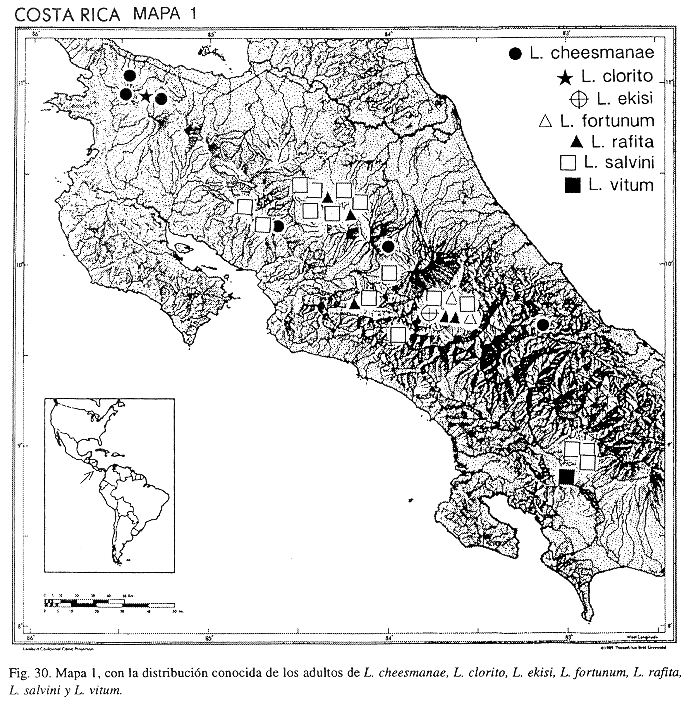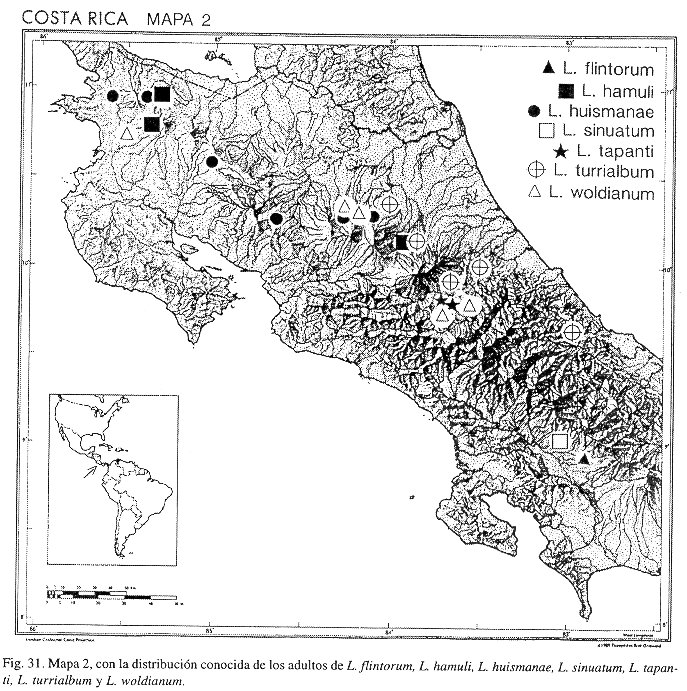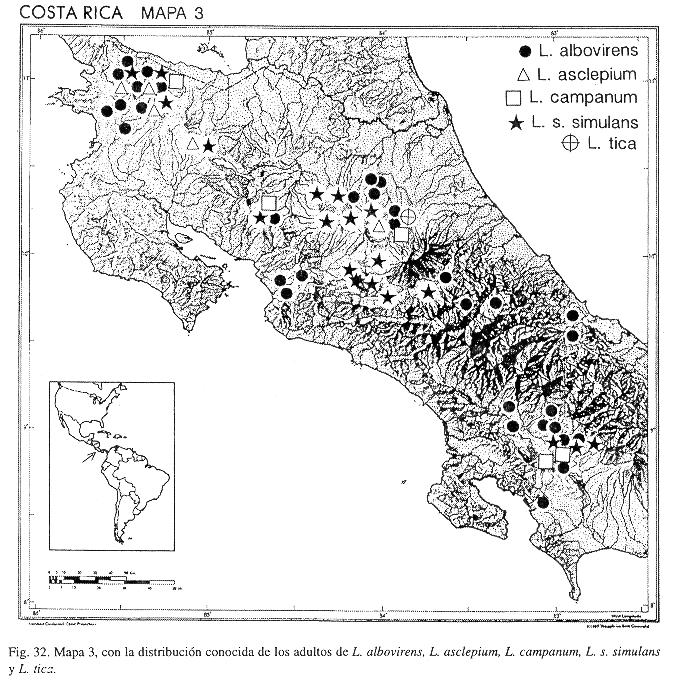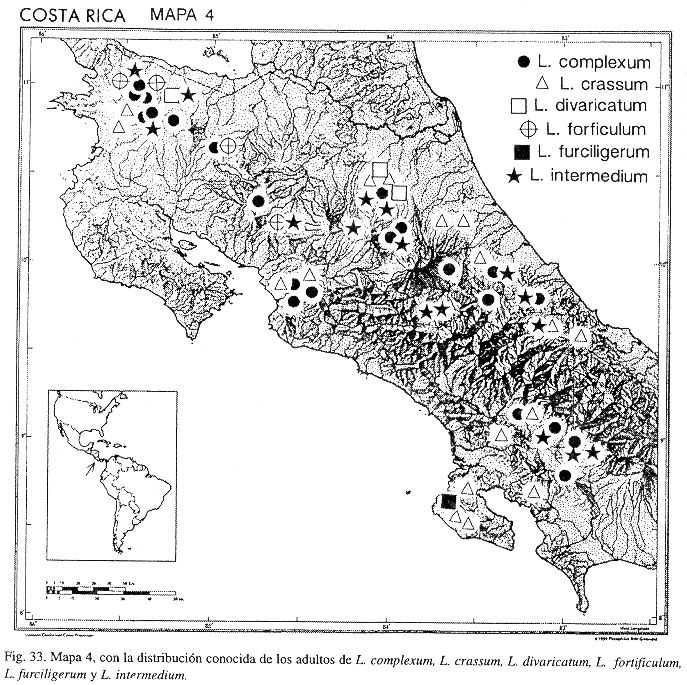
<?xml version="1.0" encoding="ISO-8859-1"?><article xmlns:mml="http://www.w3.org/1998/Math/MathML" xmlns:xlink="http://www.w3.org/1999/xlink" xmlns:xsi="http://www.w3.org/2001/XMLSchema-instance">
<front>
<journal-meta>
<journal-id>0034-7744</journal-id>
<journal-title><![CDATA[Revista de Biología Tropical]]></journal-title>
<abbrev-journal-title><![CDATA[Rev. biol. trop]]></abbrev-journal-title>
<issn>0034-7744</issn>
<publisher>
<publisher-name><![CDATA[Universidad de Costa Rica]]></publisher-name>
</publisher>
</journal-meta>
<article-meta>
<article-id>S0034-77441999000400032</article-id>
<title-group>
<article-title xml:lang="es"><![CDATA[El género Leptonema (Trichoptera: Hydropsychidae) en Costa Rica, con la descripción de una nueva especie]]></article-title>
</title-group>
<contrib-group>
<contrib contrib-type="author">
<name>
<surname><![CDATA[Muñoz-Quesada]]></surname>
<given-names><![CDATA[Fernando]]></given-names>
</name>
<xref ref-type="aff" rid="A01"/>
</contrib>
</contrib-group>
<aff id="A01">
<institution><![CDATA[,University of Minnesota Department of Entomology ]]></institution>
<addr-line><![CDATA[St. Paul MN]]></addr-line>
<country>EUA</country>
</aff>
<pub-date pub-type="pub">
<day>00</day>
<month>12</month>
<year>1999</year>
</pub-date>
<pub-date pub-type="epub">
<day>00</day>
<month>12</month>
<year>1999</year>
</pub-date>
<volume>47</volume>
<numero>4</numero>
<fpage>959</fpage>
<lpage>1006</lpage>
<copyright-statement/>
<copyright-year/>
<self-uri xlink:href="http://www.scielo.sa.cr/scielo.php?script=sci_arttext&amp;pid=S0034-77441999000400032&amp;lng=en&amp;nrm=iso"></self-uri><self-uri xlink:href="http://www.scielo.sa.cr/scielo.php?script=sci_abstract&amp;pid=S0034-77441999000400032&amp;lng=en&amp;nrm=iso"></self-uri><self-uri xlink:href="http://www.scielo.sa.cr/scielo.php?script=sci_pdf&amp;pid=S0034-77441999000400032&amp;lng=en&amp;nrm=iso"></self-uri><abstract abstract-type="short" xml:lang="en"><p><![CDATA[The genus Leptonema Guérin 1843 (Trichoptera: Hydropsychidae: Macronematinae) is one of the best known and most easily recognized of the Neotropical caddisflies. In the New World, the genus is widely distributed from southern North America through Central and South America, including the Antilles, but excluding souther Chile and adjacent Argentina. The adults of Leptonema are large (10-40 mm) with light brown to light green translucent wings. Some species have small black or dark spots or patterns on the forewings. Larvae of Leptonema build refuges with small silken nets, and this way feed by filtering fine organic particles from the water. The refuges and nets are built with small gravel, sand, and silk. In 1914, Banks reported L. albovirens from Costa Rica, the first record of the genus for Costa Rica. In 1987, Flint et al. provided an exhaustive taxonomic review of the world species, and recognized 15 species groups, five of which were present in Costa Rica. In addition, they described 48 new species, four from Costa Rica, and reported five additional records. Holzenthal added six additional species records, and Muñoz-Q. described five new species, of these L. tapanti is the first species in the stigmosum Group defined by Flint et al. and present in the country. In total, 24 species of Leptonema have been previously recorded in Costa Rica. For this research, collections of Leptonema specimens in the University of Minnesota Insect Collection, St. Paul, MN and the National Museum of Natural History, Smithsonian Institution, Washington, DC. were examined. In this paper, one additional undescribed species from Costa Rica is diagnosed, described and illustrated: Leptonema tica. Diagnoses and illustrations of the male genitalia of the other species are presented. Figures of the larva and adult, as well as aspects of natural history of the genus are included. Finally, an identification key in English and Spanish is provided, together with distribution record maps of all species in Costa Rica are included.]]></p></abstract>
<abstract abstract-type="short" xml:lang="es"><p><![CDATA[El género Leptonema Guérin 1943 (Hydropsychidae: Macronematinae) es uno de los géneros de Trichoptera más abundantes y más ampliamente distribuidos en el Nuevo Mundo. En Costa Rica son conocidas 24 especies. El presente trabajo incluye la descripción e ilustración del genital del macho de una especie no descrita para Costa Rica: Leptonema tica. Además de la descripción diagnóstica y ilustración de la larva, se incorporan las descripciones diagnósticas e ilustraciones del phallus de los machos de las otras 24 especies. Anotaciones de la historia natural del adulto y la larva del género son incluidas. Finalmente, se incluyen una clave de identificación en inglés y español de las especies conocidas de Leptonema para Costa Rica y se ilustran sus registros de distribución en Costa Rica.]]></p></abstract>
<kwd-group>
<kwd lng="en"><![CDATA[Leptonema]]></kwd>
<kwd lng="en"><![CDATA[Trichoptera]]></kwd>
<kwd lng="en"><![CDATA[caddisfly]]></kwd>
<kwd lng="en"><![CDATA[new species]]></kwd>
<kwd lng="en"><![CDATA[life stages]]></kwd>
<kwd lng="en"><![CDATA[key]]></kwd>
<kwd lng="es"><![CDATA[Costa Rica]]></kwd>
<kwd lng="en"><![CDATA[Neotropics]]></kwd>
</kwd-group>
</article-meta>
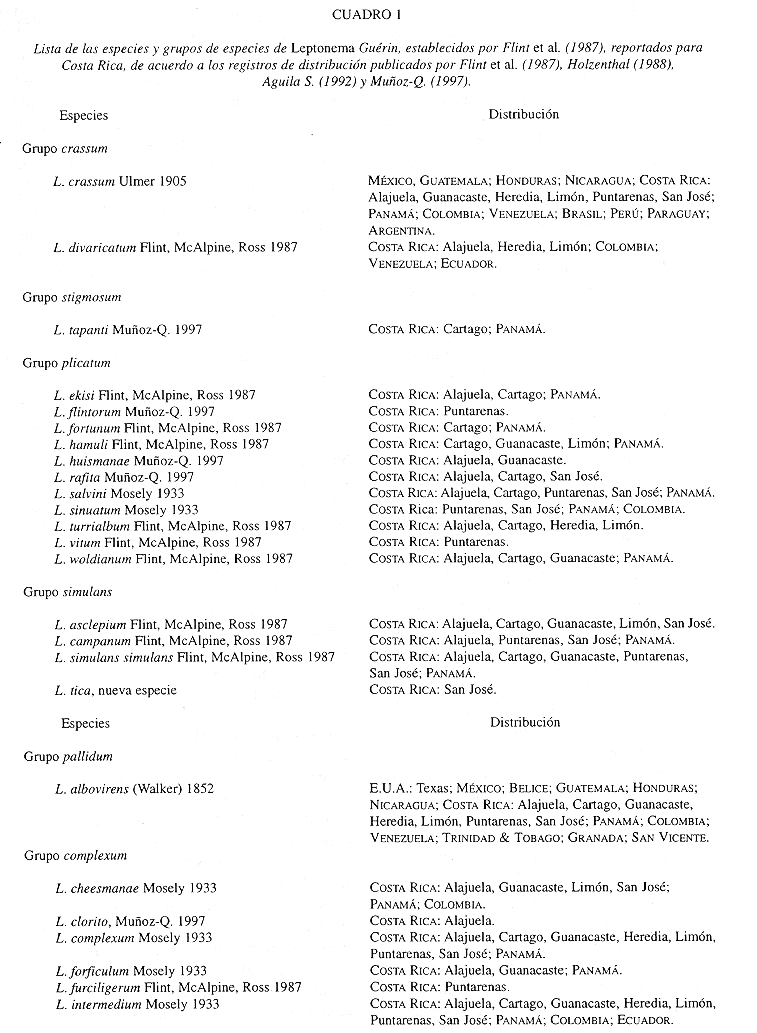
</front><body><![CDATA[ <center><b><font face="Arial,Helvetica">El g&eacute;nero <i>Leptonema</i> (Trichoptera: Hydropsychidae) en Costa Rica,</font></b>     <br><b><font face="Arial,Helvetica">con la descripci&oacute;n de una nueva especie</font></b>     <br><font face="Arial,Helvetica"><font size=-1><b>Fernando Mu&ntilde;oz-Quesada<a NAME="1"></a></b><sup><a href="#1a"> 1</a></sup></font></font><font size=-1></font>     <p><font face="Arial,Helvetica"><font size=-1>Recibido 2-XII-1998. Corregido 13-IV-1999. Aceptado 16-IV-1999.</font></font></center> <font size=-1></font>     <p><b><font face="Arial,Helvetica"><font size=-1>Abstract</font></font></b><font face="Arial,Helvetica"><font size=-1></font></font>     <p><font face="Arial,Helvetica"><font size=-1>The genus<i> Leptonema</i> Gu&eacute;rin 1843 (Trichoptera: Hydropsychidae: Macronematinae) is one of the best known and most easily recognized of the Neotropical caddisflies. In the New World, the genus is widely distributed from southern North America through Central and South America, including the Antilles, but excluding souther Chile and adjacent Argentina. The adults of <i>Leptonema</i> are large (10-40 mm) with light brown to light green translucent wings. Some species have small black or dark spots or patterns on the forewings. Larvae of <i>Leptonema</i> build refuges with small silken nets, and this way feed by filtering fine organic particles from the water. The refuges and nets are built with small gravel, sand, and silk. In 1914, Banks reported <i>L</i>. <i>albovirens</i> from Costa Rica, the first record of the genus for Costa Rica. In 1987, Flint <i>et</i> <i>al</i>. provided an exhaustive taxonomic review of the world species, and recognized 15 species groups, five of which were present in Costa Rica. In addition, they described 48 new species, four from Costa Rica, and reported five additional records. Holzenthal added six additional species records, and Mu&ntilde;oz-Q. described five new species, of these <i>L</i>. <i>tapanti</i> is the first species in the <i>stigmosum</i> Group defined by Flint <i>et</i> <i>al</i>. and present in the country. In total, 24 species of <i>Leptonema</i> have been previously recorded in Costa Rica. For this research, collections of <i>Leptonema</i> specimens in the University of Minnesota Insect Collection, St. Paul, MN and the National Museum of Natural History, Smithsonian Institution, Washington, DC. were examined. In this paper, one additional undescribed species from Costa Rica is diagnosed, described and illustrated: <i>Leptonema</i> <i>tica</i>. Diagnoses and illustrations of the male genitalia of the other species are presented. Figures of the larva and adult, as well as aspects of natural history of the genus are included. Finally, an identification key in English and Spanish is provided, together with distribution record maps of all species in Costa Rica are included.</font></font>     <br><font size=-1></font>&nbsp;<font size=-1></font>     <p><font face="Arial,Helvetica"><font size=-1><b>Key</b><i> </i><b>words</b></font></font><b><font face="Arial,Helvetica"><font size=-1></font></font></b>     <p><font face="Arial,Helvetica"><font size=-1><b> </b><i>Leptonema</i>, Trichoptera, caddisfly, new species, life stages, key, Costa Rica, Neotropics.</font></font><font size=-1></font>     <p><font face="Arial,Helvetica"><font size=-1>El g&eacute;nero <i>Leptonema</i> Gu&eacute;rin 1843 (Hydropsychidae: Macronematinae) es uno de los g&eacute;neros de Trichoptera m&aacute;s abundantes y m&aacute;s ampliamente distribuidos en Latinoam&eacute;rica. Las especies de este g&eacute;nero se distribuyen principalmente en el Nuevo Mundo, desde el sur de EUA, hasta el norte de Chile y centro de Argentina, incluyendo las Antillas, sumando 99 especies (2 especies son consideradas <i>Nomina</i> <i>dubia</i>, <a href="#Flint87">Flint <i>et</i> <i>al</i>. 1987</a>, <a href="#Flint91">Flint 1991</a>, <a href="#Muñoz">Mu&ntilde;oz-Q. 1997</a>), mientras que 10 son conocidas en &Aacute;frica y 6 en Madagascar (<a href="#Flint87">Flint <i>et</i> <i>al</i>. 1987</a>). En Costa Rica, <i>Leptonema</i> es uno de los g&eacute;neros m&aacute;s com&uacute;nmente recolectados y m&aacute;s ampliamente distribuidos dentro del orden Trichoptera. Los individuos adultos de este g&eacute;nero son grandes (10-40 mm), con alas transl&uacute;cidas de color verde claro a pardo claro; las alas anteriores de muchas especies presentan patrones de pelillos oscuros (<a href="#Flint87">Flint <i>et</i> <i>al</i>. 1987</a>).</font></font><font size=-1></font>     ]]></body>
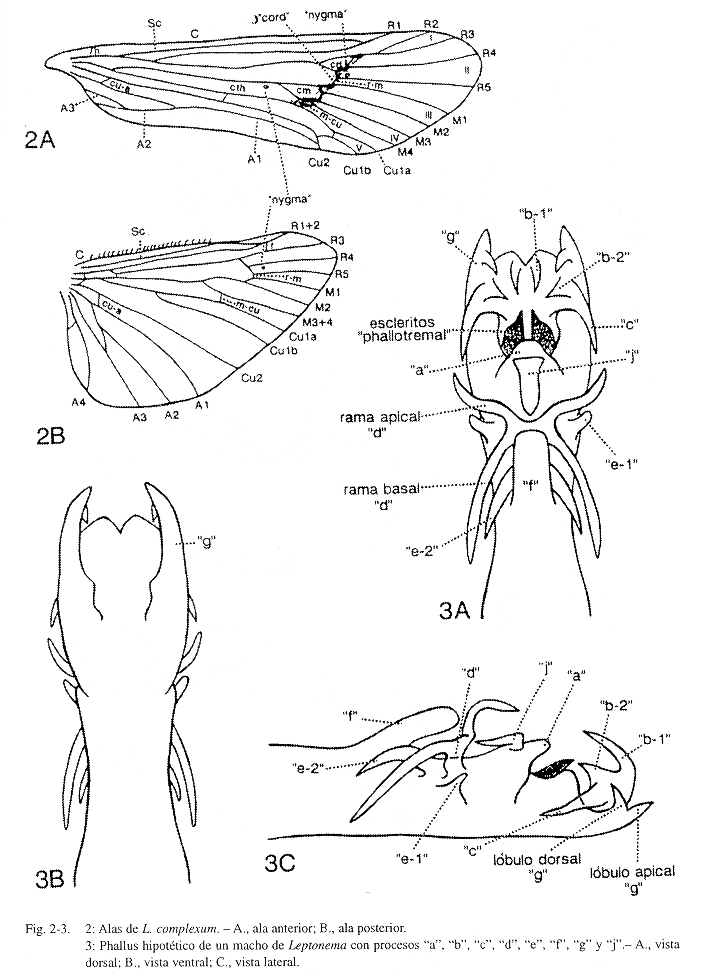
<body><![CDATA[<p><font face="Arial,Helvetica"><font size=-1>El g&eacute;nero fue establecido por Gu&eacute;rin en 1843 al describir <i>L</i>. <i>pallidum</i> de Brasil. En 1914,<a href="#Banks14"> Banks</a> report&oacute; el primer registro de distribuci&oacute;n de una especie de este g&eacute;nero en Costa Rica, <i>L</i>. <i>albovirens</i> (Walker). <a href="#Mosely33">Mosely (1933)</a> en su revisi&oacute;n del g&eacute;nero comunic&oacute; dos registros de distribuci&oacute;n m&aacute;s para el pa&iacute;s. Posteriormente, <a href="#Flint87">Flint <i>etal</i>. (1987)</a> realizaron una revisi&oacute;n taxon&oacute;mica completa de la fauna mundial del g&eacute;nero, donde adem&aacute;s, trataron aspectos biogeogr&aacute;ficos y filogen&eacute;ticos. En dicha revisi&oacute;n establecieron 15 grupos de especies, de los cuales, s&oacute;lo cinco ten&iacute;an especies presentes en Costa Rica, y adem&aacute;s describieron 48 nuevas especies, cuatro de las cuales fueron para este pa&iacute;s, lo mismo que cinco nuevos registros de distribuci&oacute;n. <a href="#Holzenthal">Holzenthal (1988)</a> agreg&oacute; seis nuevos registros de distribuci&oacute;n para esta regi&oacute;n. Finalmente, <a href="#Muñoz">Mu&ntilde;oz-Q. (1997)</a> describi&oacute; cinco nuevas especies, entre ellas <i>L</i>. <i>tapanti</i>, la primera especie del Grupo <i>stigmosum</i> en Costa Rica, e incluy&oacute; los primeros registros de distribuci&oacute;n para <i>L</i>. <i>cheesmanae</i> Mosely en Costa Rica. En el proceso de revisi&oacute;n de espec&iacute;menes para esta investigaci&oacute;n se encontr&oacute; una especie no descrita perteneciente al Grupo <i>simulans</i>. En total, en Costa Rica son conocidas actualmente 25 especies, distribuidas en seis de los grupos de especies definidos por <a href="#Flint87">Flint <i>et</i> <i>al</i>. (1987)</a> (<a href="#CUADRO1">Cuadro 1</a>).</font></font><font size=-1></font>     <p><font face="Arial,Helvetica"><font size=-1>En el presente estudio se ofrece la descripci&oacute;n de esta especie no descrita, as&iacute; como las descripciones diagn&oacute;sticas de las otras 24 especies conocidas del g&eacute;nero <i>Leptonema</i> para Costa Rica, bas&aacute;ndose estas descripciones en los genitales de los machos, espec&iacute;ficamente en el <i>phallus</i>. Adem&aacute;s, se ilustra el <i>phallus</i> de cada una de las especies y se presenta una clave en espa&ntilde;ol e ingl&eacute;s para la identificaci&oacute;n de todas estas especies conocidas. Se provee la ilustraci&oacute;n de la larva y del adulto de <i>Leptonema</i>, y anotaciones sobre aspectos de la historia natural del g&eacute;nero en Costa Rica. Se incluyen mapas con los datos de la distribuci&oacute;n conocida de estas especies.</font></font><font size=-1></font>     <p><font face="Arial,Helvetica"><font size=-1>Este trabajo presenta parte de los resultados del Proyecto "Inventario de los Trichoptera de Costa Rica" apoyado por la Colecci&oacute;n de Insectos de la Universidad de Minnesota ("<i>InsectCollection</i>", UMSP), St. Paul, MN, EUA, la "<i>U</i>.<i>S</i>. <i>NationalScience</i> <i>Foundation</i>" (USNSF), Washington, DC, EUA, y en la etapa inicial, con el apoyo del Instituto Nacional de Biodiversidad (INBio), Costa Rica, para recolectar, describir y catalogar la fauna de los tric&oacute;pteros de Costa Rica.</font></font>     <br><b><font face="Arial,Helvetica"><font size=-1></font></font></b>&nbsp;<b><font face="Arial,Helvetica"><font size=-1></font></font></b>     <p><b><font face="Arial,Helvetica"><font size=-1>Materiales y M&eacute;todos</font></font></b><font size=-1></font>     <p><font face="Arial,Helvetica"><font size=-1>Los adultos se recolectaron de dos maneras. La primera, y la m&aacute;s general, consiste en utilizar luces ultravioleta y/o luces blancas suspendidas frente a una pantalla o s&aacute;bana blanca. Este equipo es colocado a un lado del r&iacute;o o quebrada, preferiblemente con las luces de frente al cauce del agua y encendidas desde las 18: 00 (o al atardecer) hasta las 22: 00 horas aproximadamente; los tric&oacute;pteros son as&iacute; atra&iacute;dos por la luz a la pantalla, donde son recolectados con frascos de cianuro. Posteriormente, los espec&iacute;menes son montados en alfileres entomol&oacute;gicos y guardados en una caja herm&eacute;tica. En el laboratorio, se separan las hembras de los machos, con la ayuda de un microscopio de disecci&oacute;n (estereoscopio). Los tric&oacute;pteros machos son colocados en una c&aacute;mara h&uacute;meda para que se flexibilizen. Una vez flexibles los espec&iacute;menes, se les separa el abdomen (se puede cortar preferiblemente desde la base del abdomen o desde el segundo segmento), el cual contiene los genitales para ser aclarados. Para tal fin, los genitales son introducidos en KOH al 10% (aproximadamente de 5 a 10 minutos en KOH al 10 % caliente, de 4 a 6 horas en KOH al 10% a temperatura ambiente), se colocan en agua para limpiarlos internamente con la ayuda de una jeringa de punta muy fina bajo el estereoscopio, se colocan posteriormente en alcohol &aacute;cido por un minuto, despu&eacute;s en alcohol et&iacute;lico al 80% por otro minuto, y por &uacute;ltimo, en glicerina para su observaci&oacute;n e identificaci&oacute;n. Para su dep&oacute;sito final, se guardan en un microvial con glicerina junto al resto del cuerpo del tric&oacute;ptero (de preferencia en el mismo alfiler).</font></font>     <br><font size=-1></font>&nbsp;<font size=-1></font>     <p><a NAME="CUADRO1"></a><img SRC="/img/fbpe/rbt/v47n4/0422i1.GIF" height=1033 width=757>     
<br><font size=-1></font>&nbsp;<font size=-1></font>     <p><font face="Arial,Helvetica"><font size=-1>Los adultos tambi&eacute;n pueden ser recolectados con trampas de alcohol. Dichas trampas consisten de un recipiente amplio de 5 a 10 cm de profundidad, con el fondo de color blanco y un cedazo en la parte superior (de 1 cm<sup>2</sup> de malla, con este tama&ntilde;o de abertura se evita la ca&iacute;da en el fondo de la trampa de cole&oacute;pteros, lepid&oacute;pteros y otros individuos grandes que da&ntilde;ar&iacute;an a los tric&oacute;pteros). Un 70% del recipiente se llena con alcohol et&iacute;lico al 70% y sobre el cedazo se coloca un tubo de luz fluorescente ultravioleta o/y blanca. Todo el equipo se coloca a unos metros al lado del cauce del agua, de las 18: 00 horas (o al atardecer) hasta las 06: 00 horas del otro d&iacute;a. Inmediatamente despu&eacute;s, el material recolectado se deposita en alcohol et&iacute;lico al 90%. En el laboratorio se obtienen los tric&oacute;pteros machos para aclarar los genitales e identificarlos siguiendo el mismo procedimiento mencionado anteriormente, solamente que los genitales se depositan finalmente en un microvial con alcohol et&iacute;lico al 80% junto al resto del cuerpo.</font></font><font size=-1></font>     ]]></body>
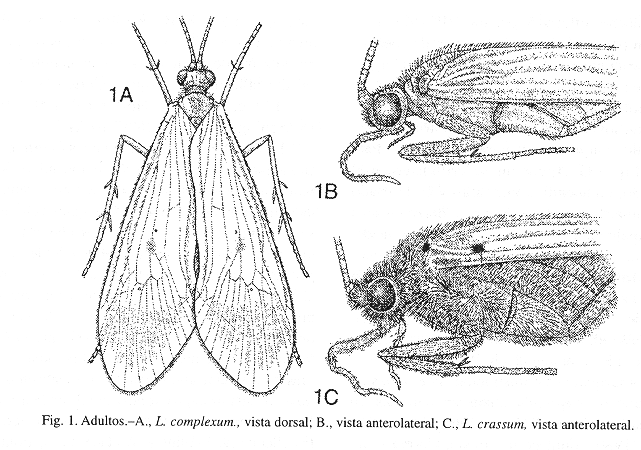
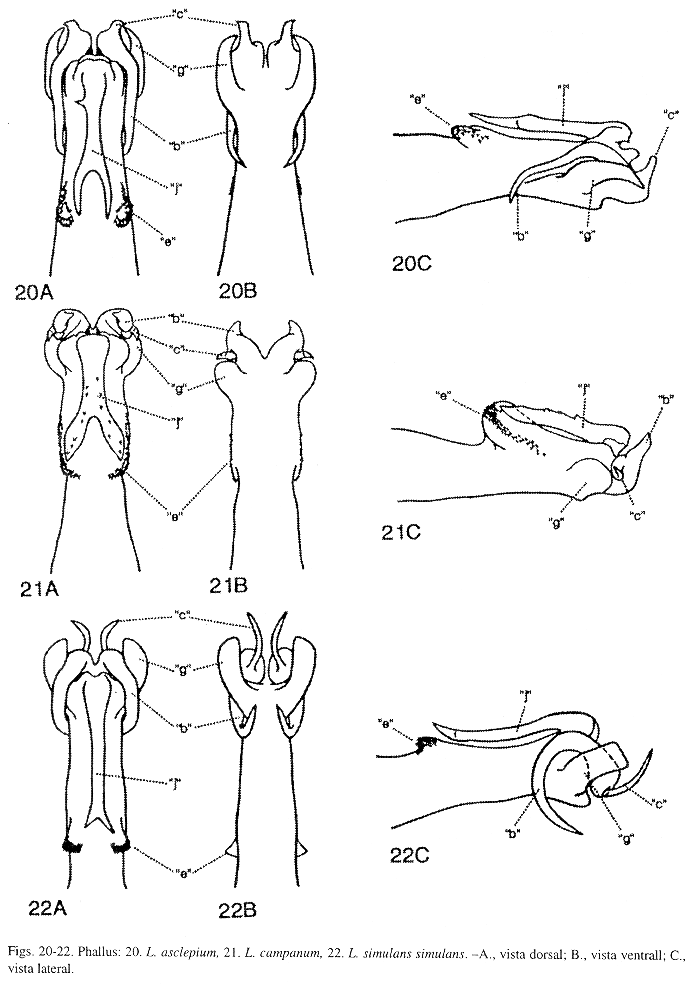
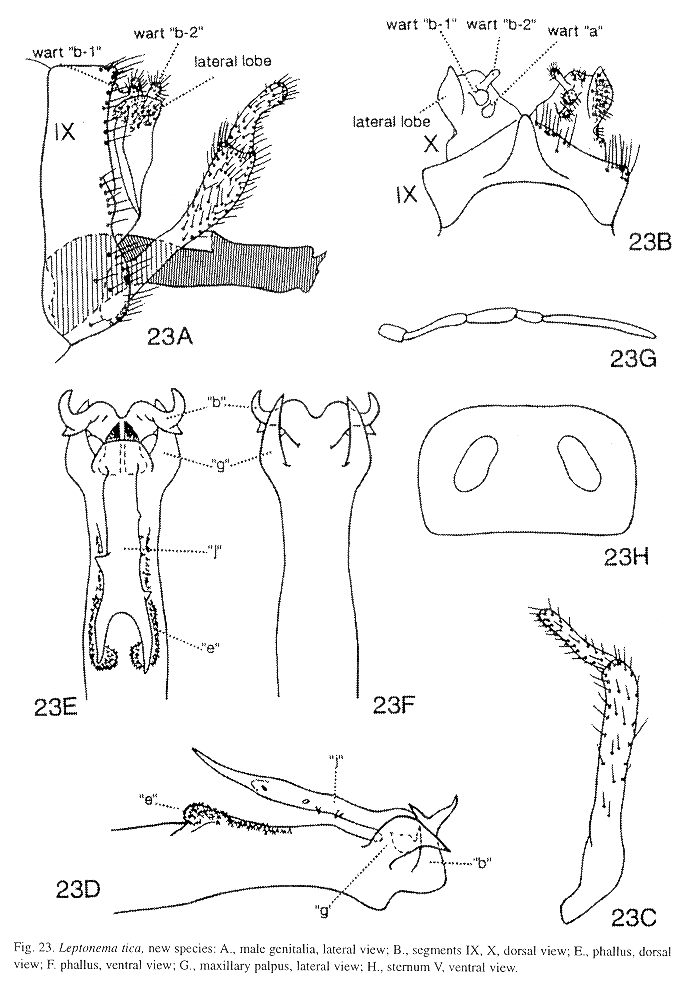
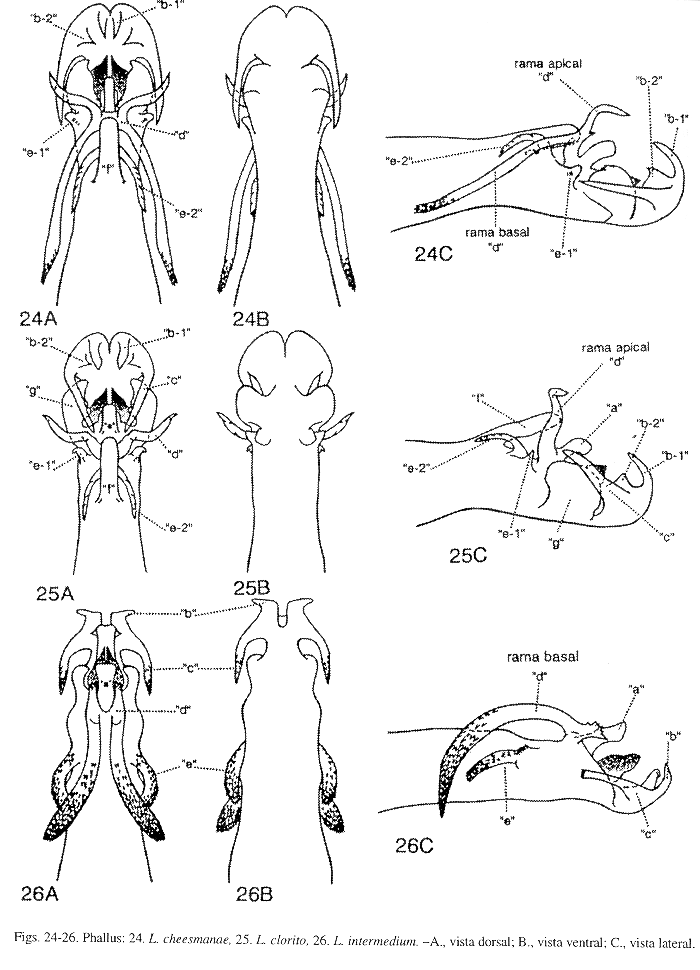
<body><![CDATA[<p><font face="Arial,Helvetica"><font size=-1>Esta revisi&oacute;n se fundament&oacute; estrictamente en la morfolog&iacute;a del <i>phallus</i> para identificar y diagnosticar las especies de <i>Leptonema</i> conocidas a la fecha en Costa Rica. Se sigue la terminolog&iacute;a propuesta por <a href="#Flint87">Flint <i>et</i> <i>al</i>. (1987)</a> para las estructuras del &oacute;rgano genital masculino; la <a href="#fig2,3">Fig. 3</a> muestra las vistas dorsal, lateral y ventral de un <i>phallus</i> hipot&eacute;tico con las respectivas estructuras o procesos rotulados. Para los dem&aacute;s t&eacute;rminos morfol&oacute;gicos mencionados de los adultos, se consult&oacute; la terminolog&iacute;a utilizada por <a href="#Ross">Ross (1982)</a>, <a href="#Torre">Torre-Bueno (1989)</a>, <a href="#Neboiss">Neboiss y Dean (1991)</a>, <a href="#Angrisano">Angrisano (1995)</a> y <a href="#Wiggins96b">Wiggins (1996b)</a>. A pesar de que los caracteres diagn&oacute;sticos est&aacute;n basados en la morfolog&iacute;a del <i>phallus</i>, se ofrecen breves descripciones del patr&oacute;n de coloraci&oacute;n de la ala anterior siguiendo el diagrama que se presenta en la <a href="#fig2,3">Fig. 2 A</a>. Por concordancia etimol&oacute;gica con el nombre del orden Trichoptera, cuyo significado es: "ala con pelos" (del griego, "<i>trichos</i>"= pelos, "<i>pteron</i>"= ala), se utilizan los t&eacute;rminos "pelos" o "pelillos" de las alas, de las patas, etc., de las larvas y adultos, en el entendido de que estas estructuras son morfol&oacute;gicamente "sedas" o "setas" (ingl&eacute;s: "<i>seta</i>", plural: "<i>setae</i>"; lat&iacute;n: "<i>seta</i>", "<i>saeta</i>"; <a href="#Williams">Williams y Wiggins 1981</a>, <a href="#Torre">Torre-Bueno 1989</a>, <a href="#Snodgrass">Snodgrass 1993</a>; <a href="#Ross">Ross 1982</a>, fig. 100, utiliza "seda", sin embargo otros autores usan "seta": <a href="#Quintanilla">Quintanilla y Fraga 1969</a>, <a href="#Greiff">Greiff 1985</a>, <a href="#Correa88">Correa G. 1988</a>, <a href="#Angrisano">Angrisano 1995</a>). El t&eacute;rmino "branquia" aqu&iacute; corresponde a los t&eacute;rminos morfol&oacute;gicos en ingl&eacute;s "<i>gill</i>" y "<i>traqueal</i> <i>gill</i>" (<a href="#Torre">Torre-Bueno 1989</a>, <a href="#Morse">Morse y Holzenthal 1996</a>, <a href="#Wiggins96a">Wiggins 1996a</a>, <a href="#Wiggins96b">1996b</a>), como es usado por <a href="#Ross">Ross 1982</a>, <a href="#Angrisano">Angrisano 1995</a>, sin embargo otros autores en espa&ntilde;ol usan los t&eacute;rminos "agalla branquial" (<a href="#Correa88">Correa G. 1988</a>), o "traqueobranquia". Una branquia doble corresponde a dos branquias simples que comparten una misma base (<a href="#Scott">Scott 1983</a>, fig. 168). Terminolog&iacute;a morfol&oacute;gica de los estados inmaduros de tric&oacute;pteros puede ser encontrada en <a href="#McCafferty">McCafferty (1983)</a>, <a href="#Correa88">Correa G. (1988)</a>, <a href="#Neboiss">Neboiss y Dean (1991)</a>, <a href="#Angrisano">Angrisano (1995)</a>, <a href="#Morse">Morse y Holzenthal (1996)</a> y Wiggins (<a href="#Wiggins96a">1996a</a>, <a href="#Wiggins96b">1996b</a>). Se utiliza el t&eacute;rmino en lat&iacute;n cuando no existe el correspondiente en espa&ntilde;ol, tales son los casos de "<i>cord</i>", por el cual se entiende el &aacute;rea que va sobre las venas transversales desde la "<i>r</i><sub>3</sub>-<i>r</i><sub>4</sub>" hasta la "<i>m</i>-<i>cu</i>" de la ala anterior; "<i>nygma</i>" (plural: "<i>nygmata</i>") punto sensorial localizado basalmente entre las venas "<i>R</i>4 y <i>R</i>5" en las alas anterior y posterior, y apicalmente en la celda tiridial (<i>cth</i>) de la ala anterior (<a href="#fig2,3">Fig. 2</a>).</font></font><font size=-1></font>     <p><font face="Arial,Helvetica"><font size=-1>El material examinado fue recolectado principalmente por Holzenthal y sus colegas durante 1986 a 1992 y est&aacute; depositado mayormente en la Colecci&oacute;n de Insectos de la Universidad de Minnesota ("<i>Insect</i> <i>Collection</i>", UMSP) St. Paul, MN, EUA, en caso contrario, se indicar&aacute; las siglas de la instituci&oacute;n donde el material est&aacute; depositado. Las siglas utilizadas de las Intituciones o Museos que custodian los holotipos y dem&aacute;s material examinado corresponden a: <b>BMNH</b>, British Museum of Natural History (Londres, Inglaterra); <b>DEI</b>, Institut f&uuml;r Pflanzenschutzforschung der Akademie der Landwirtswissenschaften, Abteilung der Inserkten, Eberswalde (Alemania); <b>INBio</b>, Instituto Nacional de Biodiversidad (Costa Rica); <b>MCZ</b>, Museum of Comparative Zoology, Harvard University, Cambridge (Massachussets, E.U.A.); <b>MNHNP</b>, Mus&eacute;um National d'Historie Naturelle, Paris (Francia); <b>NMNH</b>, National Museum of Natural History, Smithsonian Institution (Washington, DC, E.U.A.; anteriomente abreviado <b>USNM</b>, United States National Museum); <b>UMSP</b>, Insect Collection of the University of Minnesota, St. Paul (Minnesota, E.U.A.); <b>ZSZMH</b>, Zoologisches Staatsinstitut und Zoologisches Museum, Hamburg (Alemania).</font></font><font size=-1></font>     <p><font face="Arial,Helvetica"><font size=-1>El esquema de presentaci&oacute;n de las especies en el presente trabajo es el siguiente: las especies se agruparon alfab&eacute;ticamente dentro de su grupo de especies correspondiente, y los grupos de especies se ordenaron de acuerdo al orden filogen&eacute;tico presentado por <a href="#Flint87">Flint <i>et</i> <i>al</i>. (1987)</a>, como se muestra en el <a href="#CUADRO1">Cuadro 1</a>.</font></font><font size=-1></font>     <p><font face="Arial,Helvetica"><font size=-1>Posterior a la descripci&oacute;n en ingl&eacute;s de <i>L</i>. <i>tica</i>, nueva especie, se adjunta su respectiva descripci&oacute;n diagn&oacute;stica en espa&ntilde;ol. Finalmente, se presenta una clave para la identificaci&oacute;n de los machos de las especies conocidas de <i>Leptonema</i> en Costa Rica basada en el <i>phallus</i>, dicha clave est&aacute; en espa&ntilde;ol e ingl&eacute;s.</font></font>     <br><font size=-1></font>&nbsp;<font size=-1></font>     <center>     <p><font face="Arial,Helvetica"><font size=-1>Leptonema Gu&eacute;rin</font></font></center> <font face="Arial,Helvetica"><font size=-1>Leptonema <a href="#Guérin">Gu&eacute;rin 1843</a>: 165, 396; <a href="#Ulmer07a">Ulmer 1907a</a>: 44-61; <a href="#Ulmer07b">1907b</a>: 162-163; <a href="#Ulmer57">1957</a>: 346-348, 352, 354; <a href="#Mosely33">Mosely 1933</a>: 1-69; <a href="#Fischer47">Fischer 1947</a>: 313-315: <a href="#Fischer63">1963</a>: 165-174; <a href="#Fischer72">1972</a>: 156,157; <a href="#Marlier">Marlier 1962</a>: 133-135; <a href="#Scott">Scott 1983</a>: 389-398; <a href="#Flint87">Flint, McAlpine y Ross 1987</a>: 1-193. (Especie tipo <i>Leptonema</i> <i>pallida</i> Gu&eacute;rin, monob&aacute;sica).</font></font><font size=-1></font>     <p><font face="Arial,Helvetica"><font size=-1>Neoleptonema <a href="#Ulmer07a">Ulmer 1907a</a>: 61-62 (Especie tipo, <i>Neoleptonema</i> <i>aspersum</i> Ulmer, monob&aacute;sica); <a href="#Flint74a">Flint 1974a</a>: 103; <a href="#Flint87">Flint, McAlpine y Ross 1987</a>: 1-193 (sinonimia).</font></font><font size=-1></font>     <p><font face="Arial,Helvetica"><font size=-1><b>Diagnosis.</b>-<b>Adultos</b> (<a href="#fig1">Fig. 1</a>; <a href="#Flint87">Flint <i>et</i> <i>al</i>. 1987</a>, figs. 1-8): Longitud de 10 mm a 40 mm. Cabeza y sus ap&eacute;ndices ligeramente cubiertos dorsalmente con pelillos pardos claros; antenas largas, usualmente m&aacute;s largas que las alas anteriores; escapo corto y grueso; flagelo delgado; ocelos ausentes; palpos maxilares con cinco segmentos, el segmento apical (5to) el m&aacute;s largo; palpos labiales con tres segmentos. T&oacute;rax cubierto ligeramente con pelillos pardos (densamente en algunas especies, como <i>L</i>. <i>divaricatum</i> y <i>L</i>. <i>crassum</i>, <a href="#fig1">Fig. 1</a> C); patas largas y fuertes; f&oacute;rmula de las espinas tibiales: 1-4-4 o 2-2-4 (esta &uacute;ltima para las especies conocidas en Costa Rica); alas transl&uacute;cidas de color verde claro a pardo cubiertas ligeramente con pelillos pardos y con "<i>nygmata</i>" presentes; alas anteriores a veces con variados patrones peque&ntilde;os de pelillos m&aacute;s oscuros y con ramificaciones apicales 1, 2, 3, 4 y 5, celdas discoidal (<i>cd</i>), medial (<i>cm</i>) y tiridial (<i>cth</i>)<b> </b>presentes (<a href="#fig2,3">Fig. 2 A</a>); alas posteriores m&aacute;s anchas, peque&ntilde;as y p&aacute;lidas que las anteriores, y con ramificaciones apicales 1, 2, 3 y 5 (<a href="#fig2,3">Fig. 2 B</a>).</font></font><font size=-1></font>     <p><font face="Arial,Helvetica"><font size=-1><b>Macho: </b>Aparato genital (<a href="#fig23">Fig. 23</a>) en vista lateral, con el segmento abdominal IX generalmente alargado dorsoventralmente, en vista dorsal, generalmente con una proyecci&oacute;n superficial y semejante a una "V" invertida (<a href="#fig23">Fig. 23 B</a>). Segmento abdominal X de aspecto membranoso y generalmente con varios elementos, en vista lateral, generalmente triangular (<a href="#fig23">Fig. 23 A</a>). Ap&eacute;ndice inferior ("<i>clasper</i>") bisegmentado, largo, tubular y con setas peque&ntilde;as principalmente en el margen interno del segmento apical, este &uacute;ltimo generalmente m&aacute;s peque&ntilde;o que el basal (<a href="#fig23">Fig. 23 C</a>). <i>Phallus</i> de aspecto tubular, delgado y alargado, la secci&oacute;n apical con la mayor&iacute;a de los procesos "<i>a</i>-<i>j</i>" (<a href="#fig2,3">Fig. 3</a>; <a href="#Flint87">Flint <i>et</i> <i>al</i>. 1987</a>, figs. 9-12).</font></font><font size=-1></font>     ]]></body>
<body><![CDATA[<p><font face="Arial,Helvetica"><font size=-1><b>Hembra: </b>Aparato genital (<a href="#Flint87">Flint <i>et</i> <i>al</i>. 1987</a>, fig. 13) con el segmento abdominal VIII dividido ventralmente en dos placas o valvas con setas peque&ntilde;as. Segmento abdominal IX (tergo) simple, subtriangular y dirigido posteriormente, con filas de setas en cada lado posterodorsalmente, a cada lado posteroventralmente con un recept&aacute;culo y un surco para el acople del ap&eacute;ndice inferior ("<i>clasper</i>") del macho. Segmento abdominal X (tergo) peque&ntilde;o, angosto y apicolateralmente, con cercos y un par de papilas.</font></font><font size=-1></font>     <p><font face="Arial,Helvetica"><font size=-1><b>Pupa: </b>Placas dorsoabdominales con procesos esclerotizados peque&ntilde;os en forma de ganchos o garfios, distribuidas anteriormente en segmentos II o III-VIII, y posteriormente en el segmento III (<a href="#Flint80">Flint y Wallace 1980</a>; <a href="#Flint87">Flint, <i>et</i> <i>al</i>., 1987</a>). Descripciones e ilustraciones de pupas de especies de <i>Leptonema</i> son encontradas en <a href="#Flint80">Flint y Wallace (1980)</a>, <a href="#Flint87">Flint <i>et</i> <i>al</i>. (1987)</a> y <a href="#Scott">Scott (1983)</a>.</font></font><font size=-1></font>     <p><font face="Arial,Helvetica"><font size=-1>DIAGNOSIS: Pupas de <i>Calosopsyche</i> (<a href="#Flint, Bueno87">Flint y Bueno-Soria 1987</a>) y <i>Smicridea</i> (<a href="#Flint64">Flint 1964</a>, <a href="#Flint68">1968</a>, <a href="#Flint74b">1974b</a>, <a href="#Flint89">1989</a>), son similares a la de <i>Leptonema</i>, sin embargo difieren en la distribuci&oacute;n de las placas dorsoabdominales con procesos esclerosados. En <i>Calosopsyche</i> y <i>Smicridea</i>, la distribuci&oacute;n de las placas dorsoabdominales es la siguiente: anteriormente en segmentos II-VIII, y posteriormente en segmentos III-IV.</font></font><font size=-1></font>     <p><font face="Arial,Helvetica"><font size=-1><b>Larva </b>(<a href="#fig4">Fig. 4</a>): Cuerpo robusto, redondeado y cubierto densamente por setas de tama&ntilde;o regular, oscuras, delgadas y tubulares, semejantes a un pelo; en general, las partes esclerosadas de color pardo oscuro. Cabeza (<a href="#fig4">Fig. 4 A, B, C</a>) esclerotizada, alargada y convexa ligeramente; en vista dorsal, suturas cl&iacute;peofrontal y coronal tenues, esta &uacute;ltima curvada levemente; apotema cl&iacute;peofrontal triangular, alargado y puntiagudo posteriormente, el margen anterior aserrado ligeramente; en vista ventral (<a href="#fig4">Fig. 4 C</a>), el margen anterior escotado irregularmente, y el margen posterior redondeado con una hendidura mesial; sutura ecdisial tenue y dividiendo totalmente la gena; subment&oacute;n esclerosado, subtriangular y c&oacute;ncavo anteromesalmente; apotema anteroventral esclerosado, triangular y conspicuo; apotema posteroventral esclerotizado, triangular y diminuto o inconspicuo. Antena no distinguible; labrum semiovalado; mand&iacute;bulas esclerosadas fuertemente y asim&eacute;tricas. T&oacute;rax (<a href="#fig4">Fig. 4 A, B</a>). Prot&oacute;rax con el pronoto esclerotizado, &eacute;ste &uacute;ltimo, con los marg&eacute;nes posterolateral oscuro y el anterior con pelos peque&ntilde;os; pata protor&aacute;cica (<a href="#fig4">Fig. 4 E, F</a>) m&aacute;s peque&ntilde;a, robusta y oscura que las otras patas; trocant&iacute;n esclerosado, puntiagudo, no bifurcado y con setas; coxa esclerotizada con setas mesodorsales y sin ning&uacute;n l&oacute;bulo mesodistal; f&eacute;mur y tibia con pelos finos y principalmente esparcidos mesialmente; f&eacute;mur esclerotizado, alargado y rectangular, el margen dorsomesial con un proceso raspador (<a href="#fig4">Fig. 4 F</a>); tibia y tarso esclerosados; u&ntilde;a tarsal esclerosada, curvada y puntiaguda; prot&oacute;rax en vista dorsal (<a href="#fig4">Fig. 4 B</a>), subcuadrado ligeramente, con el margen posterior c&oacute;ncavo ligeramente y con un par de setas posteromesales largas; l&iacute;nea ecdisio-mediodorsal tenue; en vista ventral (<a href="#fig4">Fig. 4 D</a>), proesternito con una placa proesternal esclerosada, rectangular y seguida de un esclerito semiovalado; branquias ausentes. Mesot&oacute;rax con el mesonoto esclerosado, &eacute;ste &uacute;ltimo, con los marg&eacute;nes posterolateral oscuro y el anterior con pelos peque&ntilde;os; pata mesotor&aacute;cica similar en forma y tama&ntilde;o a la pata metator&aacute;cica, delgadas, alargadas y con pelos finos mesialmente; mesot&oacute;rax en vista dorsal, subcuadrado, con una proyecci&oacute;n posteromesal y con setas largas posteriormente; en vista ventral, con una branquia (ventrolateral) simple en la base de cada pata. Metat&oacute;rax con el metanoto esclerotizado, &eacute;ste &uacute;ltimo, con los marg&eacute;nes posterolateral oscuro y el anterior con pelos peque&ntilde;os; metat&oacute;rax en vista dorsal, subcuadrado, con el margen posterior c&oacute;ncavo levemente y con setas largas posteriormente; en vista ventral, con una branquia (ventrolateral) simple en la base de cada pata y un par de branquias ventrales simples anteromesialmente. Abdomen (<a href="#fig4">Fig. 4 A, G, H</a>) robusto, tubular y largo, hasta dos veces la longitud de la cabeza y el t&oacute;rax juntos, cubierto dorsolateralmente de setas delgadas, tubulares y de tama&ntilde;o regular, semejantes a un pelo; ventral y ventrolateralmente con branquias simples y dobles, las branquias con muchos filamentos branquiales distribuidos uniformente a todo lo largo del tallo de la branquia (una branquia doble consiste de dos branquias simples que comparten una misma base, <a href="#fig4">Fig. 4 A</a>; <a href="#Scott">Scott 1983</a>, fig. 168). La distribuci&oacute;n de las branquias abdominales en vista ventral, es como sigue: segmento I, con una branquia ventrolateral simple a cada lado y un par de branquias ventrales simples anteromesialmente; segmentos II-VI, con una branquia ventrolateral doble a cada lado y un par de branquias ventrales simples anteromesialmente; segmento VII, con una branquia ventrolateral doble a cada lado. Segmentos abdominales III-VI o VII, presentan un proceso lateral alargado de pelos pardos, semejante a un penacho o fleco. Segmento VIII (<a href="#fig4">Fig. 4 H</a>) con un par de escleritos mesoventrales peque&ntilde;os y triangulares con setas posteriores largas. Segmento IX (<a href="#fig4">Fig. 4 G, H</a>) con un penacho posterolateral de setas largas, y un par de escleritos mesoventrales conspicuos y triangulares con setas largas en el margen posterior. Pata anal (<a href="#fig4">Fig. 4 G, H</a>) con un esclerito laterobasal curvado, un ap&eacute;ndice anal largo y esclerosado dorsalmente con setas largas y dorsoapicales principalmente, y una u&ntilde;a anal esclerotizada, robusta, curvada y puntiaguda.</font></font><font size=-1></font>     <p><font face="Arial,Helvetica"><font size=-1><b>Material</b> <b>examinado: </b>COSTA RICA: <b>San</b> <b>Jos&eacute;</b>: Parque Nacional Braulio Carrillo, 6.2 km NE de Oficinas Administrativas, 10.09&Uacute;N, 83.97&Uacute;W, el. 1100 m, 6.ii.1986, Holzenthal y Morse, 13 larvas (en alcohol) (UMSP).</font></font><font size=-1></font>     <p><font face="Arial,Helvetica"><font size=-1>Descripciones e ilustraciones de larvas de especies de <i>Leptonema</i> son encontradas en Flint (<a href="#Flint64">1964</a>, <a href="#Flint68">1968</a>), <a href="#Flint80">Flint y Wallace (1980)</a>, <a href="#Flint87">Flint <i>et</i> <i>al</i>. (1987)</a>, <a href="#Correa81">Correa <i>et</i> <i>al</i>. (1981)</a>, <a href="#Correa88">Correa G. (1988)</a>, <a href="#Scott">Scott (1983)</a>, <a href="#Angrisano">Angrisano (1995)</a>, <a href="#Morse">Morse y Holzenthal (1996)</a> y <a href="#Wiggins96a">Wiggins (1996a)</a>.</font></font><font size=-1></font>     <p><font face="Arial,Helvetica"><font size=-1>DIAGNOSIS: Larvas de <i>Calosopsyche</i> (<a href="#Flint, Bueno87">Flint y Bueno-Soria 1987</a>) y <i>Smicridea</i> (<a href="#Flint74b">Flint 1974b</a>, <a href="#Flint89">1989</a>, <a href="#Correa88">Correa G. 1988</a>, <a href="#Angrisano">Angrisano 1995</a>, <a href="#Morse">Morse y Holzenthal 1996</a>, <a href="#Wiggins96a">Wiggins 1996a</a>), son similares a las de <i>Leptonema</i>, sin embargo difieren en la forma de las setas que cubren el cuerpo, en la forma y distribuci&oacute;n de las branquias, y en la forma de los procesos laterales de los segmentos abdominales III-VI o VII.</font></font><font size=-1></font>     <p><font face="Arial,Helvetica"><font size=-1>Las setas que cubren el cuerpo, y principalmente el abdomen en <i>Leptonema</i> y <i>Calosopsyche</i>, son similares, de tama&ntilde;o regular, oscuras, tubulares y en forma de pelo (<a href="#Morse">Morse y Holzenthal 1996</a>, figs. 18.68-69, "<i>plain</i> <i>hair</i>"); y en <i>Smicridea</i>, son de tama&ntilde;o regular, aplanadas, m&aacute;s anchas apicalmente que basalmente, en forma de escama (<a href="#Morse">Morse y Holzenthal 1996</a>, fig. 18.68, "<i>scale</i> <i>hair</i>"; <a href="#Wiggins96a">Wiggins 1996a</a>, fig. 7.10 A).</font></font><font size=-1></font>     <p><font face="Arial,Helvetica"><font size=-1>Las branquias en <i>Leptonema</i> y <i>Calosopsyche</i>, son similares en la aparencia, con muchos filamentos branquiales distribuidos uniformente a todo lo largo del tallo de la branquia (Fig. 4 A; <a href="#Correa88">Correa G. 1988</a>, fig. 119 c; <a href="#Morse">Morse y Holzenthal 1996</a>, fig. 18.47; <a href="#Wiggins96a">Wiggins 1996a</a>, fig. 7.6 A); y en <i>Smicridea</i>, &eacute;stas tienen pocos filamentos branquiales localizados y distribuidos irregularmente, principalmente en la mitad apical del tallo de la branquia (<a href="#Correa88">Correa G. 1988</a>, fig. 120 c; <a href="#Morse">Morse y Holzenthal 1996</a>, fig. 18.48; <a href="#Wiggins96a">Wiggins 1996a</a>, fig. 7.10 A)</font></font><font size=-1></font>     <p><font face="Arial,Helvetica"><font size=-1>La distribuci&oacute;n de las branquias es diferente en <i>Leptonema</i> y <i>Calosopsyche</i>, el metat&oacute;rax presenta en <i>Leptonema</i>, un par de branquias ventrolaterales simples y un par de branquias ventrales simples, mientras que en <i>Calosopsyche</i>, presenta un par de branquias ventrolaterales dobles y un par de branquias ventrales simples; el segmento abdominal I presenta en <i>Leptonema</i>, un par de branquias ventrolaterales simples y un par de branquias ventrales simples, en tanto que en <i>Calosopsyche</i>, solamente un par de branquias simples; el segmento abdominal VII presenta en <i>Leptonema</i>, una branquia ventrolateral doble a cada lado, mientras que en <i>Calosopsyche</i>, est&aacute;n ausentes (<a href="#Scott">Scott 1983</a>, <a href="#Flint80">Flint y Wallace 1980</a>, <a href="#Flint, Bueno87">Flint y Bueno 1987</a>, <a href="#Flint87">Flint <i>et</i> <i>al</i>. 1987</a>). Las distribuci&oacute;nes de las branquias en <i>Leptonema</i> y <i>Smicridea</i>, son similares, sin embargo difieren en que el metat&oacute;rax presenta en <i>Leptonema</i>, dos pares de branquias, y en <i>Smicridea</i>, pueden ser uno o dos pares de branquias (<a href="#Flint74b">Flint 1974b</a>, <a href="#Flint89">1989</a>, <a href="#Flint80">Flint y Wallace 1980</a>, <a href="#Flint87">Flint <i>et</i> <i>al</i>. 1987</a>, <a href="#Scott">Scott 1983</a>).</font></font><font size=-1></font>     ]]></body>
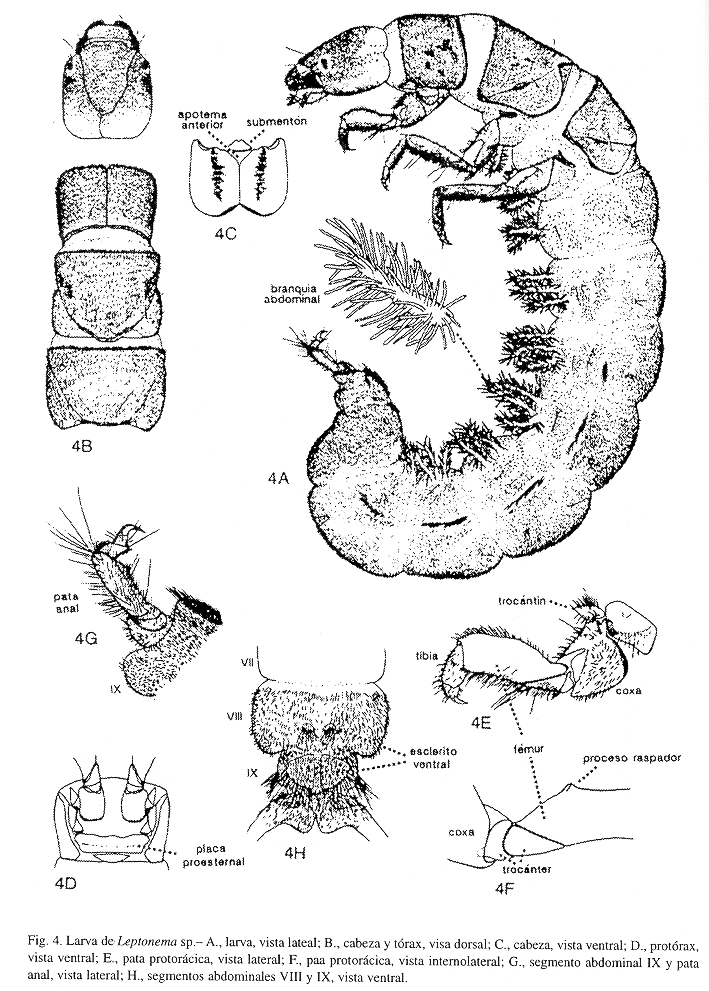
<body><![CDATA[<p><font face="Arial,Helvetica"><font size=-1>En <i>Leptonema</i>, los segmentos abdominales III-VI o VII presentan un proceso lateral alargado de pelos pardos semejante a un penacho o fleco en cada segmento (<a href="#fig4">Fig. 4 A</a>; <a href="#Correa88">Correa G. 1988</a>, figs. 119 a; <a href="#Wiggins96a">Wiggins 1996a</a>, fig. 7.6 A); en <i>Calosopsyche</i>, los segmentos abdominales III-VII presentan de uno a tres peque&ntilde;os procesos membranosos laterales en cada segmento (<a href="#Flint, Bueno87">Flint y Bueno 1987</a>, fig. 7); y en <i>Smicridea</i>, los segmentos abdominales III-VII presentan de uno a tres procesos filamentosos laterales en cada segmento (fig.1 en <a href="#Flint74b">Flint 1974b</a>, <a href="#Flint89">1989</a>).</font></font><font size=-1></font>     <p><font face="Arial,Helvetica"><font size=-1>Finalmente, en la pata anal, el penacho de pelos o setas largas es mucho m&aacute;s abundante y desarrollado en <i>Calosopsyche</i> (<a href="#Flint, Bueno87">Flint y Bueno 1987</a>, fig. 7) y <i>Smicridea</i> (fig. 1 en <a href="#Flint74b">Flint 1974b</a>, <a href="#Flint89">1989</a>; <a href="#Wiggins96a">Wiggins 1996a</a>, fig. 7.10 A), que en <i>Leptonema</i> (<a href="#fig4">Fig. 4 G</a>; Wiggins 1996, fig. 7.6 A).</font></font><font size=-1></font>     <p><font face="Arial,Helvetica"><font size=-1>La Fig. 120 de <a href="#Correa88">Correa G. (1988)</a> corresponde al subg&eacute;nero <i>S</i>. (<i>Rhyacophylax</i>) que presenta dos escleritos mesoventrales en el segmento abdominal VIII, en tanto que el subg&eacute;nero <i>S</i>. (<i>Smicridea</i>), presenta un esclerito mesoventral en el segmento abdominal VIII (<a href="#Wiggins96a">Wiggins 1996a</a>, fig. 7.10 E).</font></font>     <br><font face="Arial,Helvetica"><font size=-1></font></font>&nbsp;<font size=-1></font>     <center>     <p><a NAME="fig1"></a><img SRC="/img/fbpe/rbt/v47n4/0422i2.GIF" height=450 width=641></center> <font size=-1></font>     
<p>    <br><font size=-1></font>     <p><font face="Arial,Helvetica"><font size=-1><b>Biolog&iacute;a: </b>Las larvas y adultos de <i>Leptonema</i> habitan durante todo el a&ntilde;o en bosques de 15 a 2 000 m de altura con vegetaci&oacute;n arb&oacute;rea abundante y masas de aguas poco contaminadas, aunque <i>L</i>. <i>albovirens</i> ha mostrado ser tolerante a niveles considerables de contaminaci&oacute;n causada por aguas residuales dom&eacute;sticas y por carga org&aacute;nica residual de las poblaciones aleda&ntilde;as (obs. pers.). Las larvas de <i>Leptonema</i> son encontradas usualmente en r&iacute;os, quebradas, acequias, riachuelos con aguas de poca corriente a corriente constante, con arena, piedras y rocas en el lecho, y con hojas, palos y troncos entre las piedras y rocas. Las larvas construyen los refugios o casas con arena, fragmentos de material org&aacute;nico y minerales, los cuales los adhieren fuertemente con seda que ellas producen a las superficies de las piedras, rocas, y palos o troncos sumergidos. Asimismo, junto a los refugios, las larvas construyen con seda peque&ntilde;as redes para atrapar alimento (invertebrados peque&ntilde;os, algas, material vegetal). Las larvas al alcanzar su madurez construyen un pupario con seda, fragmentos de material org&aacute;nico y minerales, el cual adhieren fuertemente y usualmente debajo de rocas o piedras. Los adultos emergen a la superficie y permanecen en la vegetaci&oacute;n para copular. Las hembras depositan los huevos fertilizados en la superficie del agua, aunque algunas especies se sumergen y depositan o adhieren los huevos en el fondo o a objetos sumergidos, para lo cual presentan tibias aplanadas y acanaladas en la superficie interna como remos, y el cuerpo densamente cubierto de pelos que les permiten nadar dentro del agua, como en <i>L</i>. <i>crassum</i> (<a href="#fig1">Fig. 1C</a>). Los adultos son usualmente recolectados al atardecer y en las primeras horas de la noche cuando son m&aacute;s activos y vuelan hacia las trampas de luz (ultravioleta o/y blanca) atra&iacute;dos por la luz.</font></font>     <br><font size=-1></font>&nbsp;     ]]></body>
<body><![CDATA[<br><font size=-1></font>&nbsp;     <br><font size=-1></font>     <center>     <p><a NAME="fig2,3"></a><img SRC="/img/fbpe/rbt/v47n4/0422i3.GIF" height=979 width=706>     
<br><font size=-1></font>&nbsp;     <br><font size=-1></font>&nbsp;     <br><font size=-1></font>&nbsp;<font size=-1></font>     <p><a NAME="fig4"></a><img SRC="/img/fbpe/rbt/v47n4/0422i4.GIF" height=991 width=709>     
<br><font size=-1></font>&nbsp;     <br><font size=-1></font>&nbsp;     ]]></body>
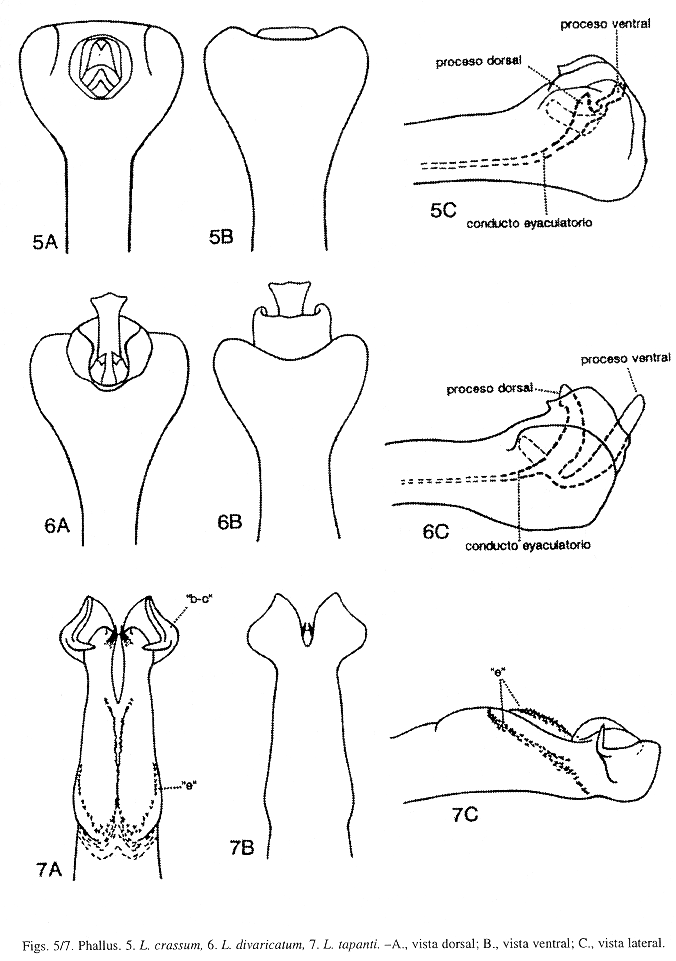
<body><![CDATA[<br><font size=-1></font>&nbsp;<font size=-1></font>     <p><a NAME="fig5,6,7"></a><img SRC="/img/fbpe/rbt/v47n4/0422i5.GIF" height=961 width=676>     
<br><font size=-1></font>&nbsp;     <br><font size=-1></font>&nbsp;<font size=-1></font>     <p><font face="Arial,Helvetica"><font size=-1>Leptonema crassum Ulmer</font></font>     <br><font face="Arial,Helvetica"><font size=-1><a href="#fig1">Figs. 1 C</a>, <a href="#fig5,6,7">5</a>; <a href="#fig33map4">Mapa 4</a>.</font></font></center> <font face="Arial,Helvetica"><font size=-1>Leptonema crassum<u> </u><a href="#Ulmer05">Ulmer 1905</a>: 58-59, Pl. II, figs. 52-53,&nbsp;<img SRC="/img/fbpe/rbt/v47n4/Macho.GIF" height=18 width=20>, Brasil: Esp&iacute;ritu Santo (ZSZMH, holotipo&nbsp;<img SRC="/img/fbpe/rbt/v47n4/Macho.GIF" height=18 width=20> destru&iacute;do en 1943); <a href="#Mosely33">Mosely 1933</a>: 12-13, figs. 1-3; <a href="#Fischer63">Fischer 1963</a>: 168; <a href="#Fischer72">1972</a>: 156; <a href="#Weidner">Weidner 1964</a>: 84; <a href="#Flint66">Flint 1966</a>: 5; <a href="#Flint72">1972</a>: 235 [Argentina]; <a href="#Flint78">1978</a>: 385; <a href="#Bueno">Bueno-Soria y Flint 1978</a>: 209; <a href="#Flint87">Flint, McAlpine y Ross 1987</a>: 34-36, figs. 226-233; <a href="#Holzenthal">Holzenthal 1988</a>: 66.</font></font><font size=-1></font>     
<p><font face="Arial,Helvetica"><font size=-1>Leptonema radiale <a href="#Navás27">Nav&aacute;s 1927</a>: 42,&nbsp;<img SRC="/img/fbpe/rbt/v47n4/Hembra.GIF" height=21 width=15>, Brasil: Minas Gerais (DEI); <a href="#Flint78">Flint 1978</a>: 385 (sinonimia).</font></font><font size=-1></font>     
<p><font face="Arial,Helvetica"><font size=-1>Leptonema grisolinum<u> </u><a href="#Navás33">Nav&aacute;s 1933a</a>: 312-313, fig. 23,&nbsp;<img SRC="/img/fbpe/rbt/v47n4/Macho.GIF" height=18 width=20>, Venezuela: Caucagua (MNHNP); <a href="#Flint87">Flint, McAlpine y Ross 1987</a>: 34-36 (sinonimia).</font></font><font size=-1></font>     
<p><font face="Arial,Helvetica"><font size=-1><b>Diagnosis.</b>-<b>Adultos</b> (<a href="#fig1">Fig. 1 C</a>): Moderamente grandes y robustos. Cabeza, t&oacute;rax y patas cubiertos densamente de pelillos pardos, y con las alas transl&uacute;cidas de color pardo. Ala anterior de 16 a 20 mm de longitud, con dos puntos peque&ntilde;os y oscuros, uno sobre la base de la vena costa y el otro sub-basalmente en la vena subcosta, el margen anterior ligeramente cubierto apicalmente de pelillos oscuros, y una banda de pelillos pardo oscuros sobre el "<i>cord</i>".</font></font><font size=-1></font>     <p><font face="Arial,Helvetica"><font size=-1><b><i>Phallus</i></b> (<a href="#fig5,6,7">Fig. 5</a>): Esta especie y <i>L</i>. <i>divaricatum</i> Flint, McAlpine y Ross, son muy similares, sin embargo pueden ser reconocidas por la forma de la secci&oacute;n apical del <i>phallus</i>, y por la forma y tama&ntilde;o de los procesos dorsal y ventral del conducto eyaculatorio del <i>phallus</i>, como se detalla en la diagnosis de <i>L</i>. <i>divaricatum</i>. De acuerdo con los datos de distribuci&oacute;n, estas dos especies solapan sus &aacute;reas de distribuci&oacute;n, siendo <i>L</i>. <i>crassum</i> m&aacute;s frecuente en tierras bajas, como fue se&ntilde;alado por <a href="#Flint87">Flint <i>et</i> <i>al</i>. (1987</a>). Asimismo, las colectas examinadas para esta revisi&oacute;n, indican que esta especie fue mucho m&aacute;s abundante que <i>L</i>. <i>divaricatum</i>. Procesos "<i>a</i>", "<i>b</i>", "<i>c</i>", "<i>d</i>", "<i>e</i>", "<i>f</i>", "<i>g</i>" y "<i>j</i>" ausentes en <i>L</i>. <i>crassum</i>.</font></font><font size=-1></font>     ]]></body>
<body><![CDATA[<p><font face="Arial,Helvetica"><font size=-1><b>Distribuci&oacute;n: </b>M&eacute;xico; Guatemala; Honduras; Nicaragua; Costa Rica (Alajuela, Guanacaste, Heredia, Lim&oacute;n, Puntarenas, San Jos&eacute;); Panam&aacute;; Colombia; Venezuela; Brasil; Per&uacute;; Paraguay; Argentina.</font></font><font size=-1></font>     <p><font face="Arial,Helvetica"><font size=-1><b>Material</b> <b>examinado: </b>COSTA RICA: <b>Guanacaste: </b>R&iacute;o Tempisquito, ca. 3 km S route 1, 10.790&deg;N, 85.552&deg;W, el. 75 m, 6.iii.1986, Holzenthal, Fasth, 3&nbsp;<img SRC="/img/fbpe/rbt/v47n4/Macho.GIF" height=18 width=20> (1&nbsp;<img SRC="/img/fbpe/rbt/v47n4/Macho.GIF" height=18 width=20>, 1&nbsp;<img SRC="/img/fbpe/rbt/v47n4/Hembra.GIF" height=21 width=15>en alcohol); igual pero, 10.847&deg;N, 85.561&deg;W, el. 95 m, 18.vii.1987, Holzenthal, Morse, de la Rosa, 35&nbsp;<img SRC="/img/fbpe/rbt/v47n4/Macho.GIF" height=18 width=20>, 19&nbsp;<img SRC="/img/fbpe/rbt/v47n4/Hembra.GIF" height=21 width=15>; 6.vi.1988, E. de la Rosa, 25&nbsp;<img SRC="/img/fbpe/rbt/v47n4/Macho.GIF" height=18 width=20> (en alcohol); P. N. Sta. Rosa, R&iacute;o Poza Salada, 10.799&deg;N, 85.652&deg;W, el. 10 m, 24.vii.1987, Holzenthal, Morse, Clausen, 1&nbsp;<img SRC="/img/fbpe/rbt/v47n4/Macho.GIF" height=18 width=20>, 1<img SRC="/img/fbpe/rbt/v47n4/Hembra.GIF" height=21 width=15>; <b>Heredia: </b>R&iacute;o Sarapiqu&iacute;, 7 km W Pto Viejo, 10.452&deg;N, 84.067&deg;W, el. 50 m, 11.ii.1986, Holzenthal, Morse, Fasth, 6&nbsp;<img SRC="/img/fbpe/rbt/v47n4/Macho.GIF" height=18 width=20>, 2&nbsp;<img SRC="/img/fbpe/rbt/v47n4/Hembra.GIF" height=21 width=15>; R&iacute;o Sarapiqu&iacute;, 300 m S de Chilamate, 10.451&deg;N, 84.064&deg;W, el. 40 m, 30.vi.1992, Mu&ntilde;oz, 3&nbsp;<img SRC="/img/fbpe/rbt/v47n4/Macho.GIF" height=18 width=20>, 2&nbsp;<img SRC="/img/fbpe/rbt/v47n4/Hembra.GIF" height=21 width=15>; Est. Biol. La Selva, R&iacute;o Puerto Viejo, 10.440&deg;N, 84.012&deg;W, el. 30 m, 10-11.ii.1986, Holzenthal, Morse, Fasth, 28&nbsp;<img SRC="/img/fbpe/rbt/v47n4/Macho.GIF" height=18 width=20>, 17&nbsp;<img SRC="/img/fbpe/rbt/v47n4/Hembra.GIF" height=21 width=15>; igual pero, 19.vi.1986, Holzenthal, Heyn, Armitage, 6&nbsp;<img SRC="/img/fbpe/rbt/v47n4/Macho.GIF" height=18 width=20>; 10.ix.1986, M.M. Chavarr&iacute;a, 5&nbsp;<img SRC="/img/fbpe/rbt/v47n4/Macho.GIF" height=18 width=20>, 3&nbsp;<img SRC="/img/fbpe/rbt/v47n4/Hembra.GIF" height=21 width=15>; xii.1986, 6&nbsp;<img SRC="/img/fbpe/rbt/v47n4/Macho.GIF" height=18 width=20>; i.1987, 6&nbsp;<img SRC="/img/fbpe/rbt/v47n4/Macho.GIF" height=18 width=20>, 5&nbsp;<img SRC="/img/fbpe/rbt/v47n4/Hembra.GIF" height=21 width=15>; <b>Lim&oacute;n: </b>R&iacute;o Telire and small trib., SE Suretka, 9.554&deg;N, 82.892&deg;W, el. 48 m, 1.ii.1986, Holzenthal, Morse, Fasth, 7&nbsp;<img SRC="/img/fbpe/rbt/v47n4/Macho.GIF" height=18 width=20>, 13&nbsp;<img SRC="/img/fbpe/rbt/v47n4/Hembra.GIF" height=21 width=15> (1&nbsp;<img SRC="/img/fbpe/rbt/v47n4/Macho.GIF" height=18 width=20>, 6&nbsp;<img SRC="/img/fbpe/rbt/v47n4/Hembra.GIF" height=21 width=15> en alcohol); Res. Biol. Hitoy Cerere, R&iacute;o Cerere, 9.671&deg;N, 83.028&deg;W, el. 90 m, 23-24.iii.1987, Holzenthal, Hamilton, Heyn, 1&nbsp;<img SRC="/img/fbpe/rbt/v47n4/Macho.GIF" height=18 width=20>, 3&nbsp;<img SRC="/img/fbpe/rbt/v47n4/Hembra.GIF" height=21 width=15>; R&iacute;o Barbilla, ca. 8 km W B-Line, 10.067&deg;N, 83.369&deg;W, el. 30 m, 31.i.1986, Holzenthal, Morse, Fasth, 1&nbsp;<img SRC="/img/fbpe/rbt/v47n4/Macho.GIF" height=18 width=20>(en alcohol); E.A.R.T.H., R&iacute;o Dos Novillos, 10.220&deg;N, 83.591&deg;W, el. 20 m, 3.ii.1992, Holzenthal, Mu&ntilde;oz, Kjer, 4&nbsp;<img SRC="/img/fbpe/rbt/v47n4/Macho.GIF" height=18 width=20>, 4&nbsp;<img SRC="/img/fbpe/rbt/v47n4/Hembra.GIF" height=21 width=15>; igual pero, R&iacute;o Parismina, 10.248&deg;N, 83.570&deg;W, el. 5 m, 4.ii.1992, Holzenthal, Mu&ntilde;oz, Kjer, 2&nbsp;<img SRC="/img/fbpe/rbt/v47n4/Macho.GIF" height=18 width=20> (en alcohol); <b>Puntarenas: </b>Queb. Pita, ca. 3 km (air) W Golfito, 8.642&deg;N, 83.193&deg;W, el. 15 m, 15.ii.1986, Holzenthal, Morse, Fasth, 4&nbsp;<img SRC="/img/fbpe/rbt/v47n4/Macho.GIF" height=18 width=20> (1 en alcohol); R&iacute;o Rinc&oacute;n, 6.5 km (air) S Rinc&oacute;n, 8.638&deg;N, 83.480&deg;W, el. 20 m, 7.iv.1987, Holzenthal, Hamilton, Heyn, 34&nbsp;<img SRC="/img/fbpe/rbt/v47n4/Macho.GIF" height=18 width=20>, 5&nbsp;<img SRC="/img/fbpe/rbt/v47n4/Hembra.GIF" height=21 width=15>; R&iacute;o Catarata, 5.5 km S El Brujo (ca. Zona Sur), 9.064&deg;N, 83.272&deg;W, el. 120 m, 6-7.vii.1992, Mu&ntilde;oz, 1&nbsp;<img SRC="/img/fbpe/rbt/v47n4/Macho.GIF" height=18 width=20>, 1&nbsp;<img SRC="/img/fbpe/rbt/v47n4/Hembra.GIF" height=21 width=15>; P. N. Corcovado, R&iacute;o Claro, 1.5 km SE Sirena, 8.472&deg;N, 83.588&deg;W, el. 15 m, 8.iv.1989, Holzenthal, Blahnik, 9&nbsp;<img SRC="/img/fbpe/rbt/v47n4/Macho.GIF" height=18 width=20>, 2&nbsp;<img SRC="/img/fbpe/rbt/v47n4/Hembra.GIF" height=21 width=15>; Est. Sirena, R&iacute;o Camaronal, 8.481&deg;N, 83.594&deg;W, el. 5 m, 12-13.iv.1989, Holzenthal, Blahnik, 3&nbsp;<img SRC="/img/fbpe/rbt/v47n4/Macho.GIF" height=18 width=20> (en alcohol); igual pero, 8.482&deg;N, 83.589&deg;W, el. 30 m, 13.iv.1989, 2&nbsp;<img SRC="/img/fbpe/rbt/v47n4/Macho.GIF" height=18 width=20>; Pen&iacute;nsula de Osa, 4-12.v.1979, D.H. Janzen, 3&nbsp;<img SRC="/img/fbpe/rbt/v47n4/Macho.GIF" height=18 width=20>, 1 hembra (s); Res. Biol. Carara, R&iacute;o Carara, 4.3 km (rd) E Costanera Sur, 9.810&deg;N, 84.572&deg;W, el. 20 m, 12.iii.1991, Holzenthal, Mu&ntilde;oz, Huisman, 1&nbsp;<img SRC="/img/fbpe/rbt/v47n4/Macho.GIF" height=18 width=20>; R&iacute;o Platanar, Salitre, 6.5 km NE Buenos Aires, 9.115&deg;N, 83.281&deg;W, el. 450 m, 8-9.vi.1992, Mu&ntilde;oz, 1&nbsp;<img SRC="/img/fbpe/rbt/v47n4/Macho.GIF" height=18 width=20>, 2&nbsp;<img SRC="/img/fbpe/rbt/v47n4/Hembra.GIF" height=21 width=15>; <b>San</b> <b>Jos&eacute;: </b>Res. Biol. Carara, R&iacute;o Carara in Carara, 9.778&deg;N, 84.531&deg;W, el. 200 m, 14.iii.1991, Holzenthal, Mu&ntilde;oz, Huisman, 1&nbsp;<img SRC="/img/fbpe/rbt/v47n4/Macho.GIF" height=18 width=20>, 3&nbsp;<img SRC="/img/fbpe/rbt/v47n4/Hembra.GIF" height=21 width=15>.</font></font>     
<br><font size=-1></font>&nbsp;<font size=-1></font>     <center>     <p><font face="Arial,Helvetica"><font size=-1>Leptonema divaricatum Flint, McAlpine y Ross</font></font>     <br><font face="Arial,Helvetica"><font size=-1><a href="#fig5,6,7">Fig. 6</a>; <a href="#fig33map4">Mapa 4</a>.</font></font></center> <font face="Arial,Helvetica"><font size=-1>Leptonema divaricatum <a href="#Flint87">Flint, McAlpine y Ross 1987</a>: 36, figs. 234-242,&nbsp;<img SRC="/img/fbpe/rbt/v47n4/Macho.GIF" height=18 width=20>, Ecuador: Pichincha (NMNH); <a href="#Holzenthal">Holzenthal 1988</a>: 67.</font></font><font size=-1></font>     
<p><font face="Arial,Helvetica"><font size=-1>Leptonema crassum <a href="#Mosely33">Mosely 1933</a>: 12-13 (identificaci&oacute;n err&oacute;nea de espec&iacute;menes de Cachab&eacute;, Ecuador, seg&uacute;n <a href="#Flint87">Flint <i>etal</i>., 1987</a>); <a href="#Fischer47">Fischer 1947</a>: 313-315 (identificaci&oacute;n err&oacute;nea, seg&uacute;n <a href="#Flint87">Flint <i>et</i> <i>al</i>., 1987</a>); <a href="#Schmid">Schmid 1964</a>: 317 (identificaci&oacute;n err&oacute;nea, seg&uacute;n <a href="#Flint87">Flint <i>et</i> <i>al</i>., 1987</a>); <a href="#Flint81">Flint 1981</a>: 20, figs. 71-72 (identificaci&oacute;n err&oacute;nea, seg&uacute;n <a href="#Flint87">Flint <i>et</i> <i>al</i>., 1987</a>).</font></font><font size=-1></font>     <p><font face="Arial,Helvetica"><font size=-1><b>Diagnosis. -Adultos: </b>Moderamente grandes y robustos. Cabeza, t&oacute;rax y patas cubiertos densamente de pelillos pardos, y con las alas transl&uacute;cidas de color pardo. Ala anterior de 16 a 20 mm de longitud, con dos puntos peque&ntilde;os y oscuros, uno sobre la base de la vena costa y el otro sub-basalmente en la vena subcosta, el margen anterior ligeramente cubierto apicalmente de pelillos oscuros, y una banda de pelillos pardo oscuros sobre el "<i>cord</i>" (similar a <i>L</i>. <i>crassum</i>, <a href="#fig1">Fig. 1 C</a>).</font></font><font size=-1></font>     <p><b><font face="Arial,Helvetica"><font size=-1><i>Phallus</i> </font></font></b><font face="Arial,Helvetica"><font size=-1>(<a href="#fig5,6,7">Fig. 6</a>): Esta especie aunque muy similar a <i>L</i>. <i>crassum</i> Ulmer (<a href="#fig5,6,7">Fig. 5</a>), puede distinguirse por la forma de la secci&oacute;n apical del <i>phallus</i>, y por la forma y tama&ntilde;o de los procesos dorsal y ventral del conducto eyaculatorio del <i>phallus</i>. Secci&oacute;n apical del <i>phallus</i>, en<i> L</i>. <i>divaricatum</i>, en vista posterodorsal, con una abertura dorsoapical, redondeada y bordeada por una membrana conspicua, erguida y dirigida posteriormente, exhibiendo una hendidura mesodorsal delante de los procesos dorsal y ventral del conducto eyaculatorio; conducto eyaculatorio en vista lateral, mesial, tubular y bifurcado apicalmente; proceso dorsal en vista posterodorsal, mesial, corto y en forma de una "U", con los &aacute;pices puntiagudos, en vista lateral, curvado levemente y alargado, sobrepasando levemente el margen dorsal del <i>phallus</i>; proceso ventral en vista posterodorsal, mesial, ancho, largo y truncado levemente, en vista lateral, fuertemente curvado basalmente y seguidamente erguido, digitiforme y largo, m&aacute;s largo que el proceso dorsal y sobrepasa el margen dorsoapical del <i>phallus</i>. Secci&oacute;n apical del <i>phallus</i>, en <i>L</i>. <i>crassum</i>, en vista posterodorsal, con una abertura dorsoapical, redondeada y bordeada por una membrana corta, empeque&ntilde;ecida mesodorsalmente delante de los procesos dorsal y ventral del conducto eyaculatorio; conducto eyaculatorio en vista lateral, mesial, tubular y bifurcado apicalmente; proceso dorsal en vista posterodorsal, mesial, corto y subtriangular, en vista lateral, corto y dirigido dorsalmente sin alcanzar el margen dorsal del <i>phallus</i>; proceso ventral en vista posterodorsal, mesial, corto y subtriangular, en vista lateral, sinuoso levemente, angular en la mitad y proyectado posterodorsalmente, apenas alcanza el margen dorsoapical del <i>phallus</i> (m&aacute;s largo que el proceso dorsal, pero m&aacute;s corto que el proceso ventral de<i> L</i>. <i>divaricatum</i>). Estas dos especies solapan sus &aacute;mbitos de distribuci&oacute;n, como es comentado en la diagnosis de <i>L</i>. <i>crassum</i>. En <i>L</i>. <i>divaricatum</i>, procesos "<i>a</i>", "<i>b</i>", "<i>c</i>", "<i>d</i>", "<i>e</i>", "<i>f</i>", "<i>g</i>" y "<i>j</i>" ausentes.</font></font><font size=-1></font>     <p><font face="Arial,Helvetica"><font size=-1><b>Distribuci&oacute;n: </b>COSTA RICA (Alajuela, Heredia, Lim&oacute;n); COLOMBIA; VENEZUELA; ECUADOR.</font></font><font size=-1></font>     ]]></body>
<body><![CDATA[<p><font face="Arial,Helvetica"><font size=-1><b>Material</b> <b>examinado: </b>COSTA RICA: <b>Alajuela: </b>R&iacute;o Pizote, ca. 5 km N Dos R&iacute;os, 10.948&deg;N, 85.291&deg;W, el. 470 m, 9.iii.1986, Holzenthal, Fasth, 1&nbsp;<img SRC="/img/fbpe/rbt/v47n4/Macho.GIF" height=18 width=20>; <b>Heredia: </b>P. N. Braulio Carrillo, Est. Magsasay, R&iacute;o Peje, 10.402&deg;N, 84.050&deg;W, el. 130 m, 25-26.viii.1990, Holzenthal, Blahnik, Huisman, 1&nbsp;<img SRC="/img/fbpe/rbt/v47n4/Macho.GIF" height=18 width=20>, 2<img SRC="/img/fbpe/rbt/v47n4/Hembra.GIF" height=21 width=15> ; R&iacute;o Sarapiqu&iacute;, 300 m S de Chilamate, 10.451&deg;N, 84.064&deg;W, el. 40 m, 30.vi.1992, Mu&ntilde;oz, 1&nbsp;<img SRC="/img/fbpe/rbt/v47n4/Macho.GIF" height=18 width=20>.</font></font>     
<br><font size=-1></font>&nbsp;<font size=-1></font>     <center>     <p><font face="Arial,Helvetica"><font size=-1>Leptonema <i>tapanti</i> Mu&ntilde;oz-Q.</font></font>     <br><font face="Arial,Helvetica"><font size=-1><a href="#fig5,6,7">Fig. 7</a>; <a href="#fig31map2">Mapa 2</a>.</font></font></center> <font face="Arial,Helvetica"><font size=-1>Leptonema <i>tapanti</i> <a href="#Muñoz">Mu&ntilde;oz-Q. 1997</a>: 127-130, fig. 5,&nbsp;<img SRC="/img/fbpe/rbt/v47n4/Macho.GIF" height=18 width=20>, Costa Rica: Cartago<b> </b>(NMNH).</font></font><font size=-1></font>     
<p><font face="Arial,Helvetica"><font size=-1><b>Diagnosis. -Adultos: </b>Moderamente grandes y con las alas transl&uacute;cidas de color pardo claro. Ala anterior de 17 a 20 mm de longitud, cubierta ligeramente de pelillos pardos principalmente entre las venas anales, y con un parche peque&ntilde;o y redondeado de pelillos pardo oscuros sobre cada "<i>nygma</i>".</font></font><font size=-1></font>     <p><font face="Arial,Helvetica"><font size=-1><b><i>Phallus</i></b> (<a href="#fig5,6,7">Fig. 7</a>): Es <i>L</i>. <i>tapanti</i> la primera especie del Grupo <i>stigmosum</i> presente en Costa Rica. Esta especie difiere de <i>L</i>. <i>auriculatum</i> Flint, McAlpine y Ross del mismo Grupo, y de las siguientes especies del Grupo <i>plicatum</i>: <i>L</i>. <i>michoacanense</i> Flint, McAlpine y Ross, <i>L</i>. <i>plicatum</i> Mosely, y<i> L</i>. <i>simplex</i> Mosely, por la forma de los procesos "<i>b</i>", "<i>c</i>" y "<i>e</i>", y por la presencia de los procesos "<i>d</i>" y "<i>g</i>". En <i>L</i>. <i>tapanti</i>, procesos "<i>b</i>" y "<i>c</i>" est&aacute;n fusionados en un l&oacute;bulo apicolateral pareado ("<i>b-c</i>"), en vista dorsal, la parte media del l&oacute;bulo "<i>b-c</i>" es c&oacute;ncava dorsolateralmente, el margen lateral curvado convexamente y ensanchado con el &aacute;pice puntiagudo levemente y dirigido posteriormente, semejando una oreja, con una proyecci&oacute;n mediolateral, delgada, alargada, curvada y proyectada mesialmente. En las otras especies, procesos "<i>b</i>" y "<i>c</i>" no est&aacute;n fusionados y sin ninguna proyecci&oacute;n mediolateral. Proceso "<i>d</i>", en <i>L</i>. <i>tapanti</i>,<i> L</i>. <i>michoacanense</i>, <i>L</i>. <i>plicatum</i> y <i>L</i>. <i>simplex</i>, ausente; y en <i>L</i>. <i>auriculatum</i>, es mesodorsal y rudimentario. Proceso "<i>e</i>", en esta especie, aparece dorsolateral y desarrollado en tres filas alargadas de espinas peque&ntilde;as y fusionadas a la secci&oacute;n media del <i>phallus</i>; la fila mesodorsal en forma de "Y", las otras, dos dorsolaterales y con los extremos anteriores desarrollados en l&oacute;bulos membranosos y redondeados; en <i>L</i>. <i>auriculatum</i>, es dorsolateral y muy peque&ntilde;o; en <i>L</i>. <i>michoacanense</i> y <i>L</i>. <i>plicatum</i>, un l&oacute;bulo dorsolateral, alargado sin espinas peque&ntilde;as y fusionado a la secci&oacute;n media del <i>phallus</i>; y en <i>L</i>. <i>simplex</i>, ausente. Proceso "<i>g</i>", en <i>L</i>. <i>tapanti</i>, ausente; en <i>L</i>. <i>michoacanense</i> y <i>L</i>. <i>plicatum</i>, un l&oacute;bulo apicolateral y ensanchado; y en <i>L</i>. <i>simplex</i>, un l&oacute;bulo lateral, truncado y ensanchado. En <i>L</i>. <i>tapanti</i>, procesos "<i>d</i>", "<i>f</i>", "<i>g</i>" y "<i>j</i>" ausentes.</font></font><font size=-1></font>     <p><font face="Arial,Helvetica"><font size=-1><b>Distribuci&oacute;n: </b>COSTA RICA (Cartago); PANAM&Aacute;.</font></font><font size=-1></font>     <p><font face="Arial,Helvetica"><font size=-1><b>Material</b> <b>examinado: </b>COSTA RICA: <b>Cartago</b>: Res. Tapant&iacute;, Queb. Palmitos and falls, 9.72&deg;N, 83.78&deg;W, 1400 m, 24-25.iii.1991, Holzenthal, Mu&ntilde;oz, Huisman,&nbsp;<img SRC="/img/fbpe/rbt/v47n4/Macho.GIF" height=18 width=20>, holotipo (NMNH); igual pero, 10<img SRC="/img/fbpe/rbt/v47n4/Macho.GIF" height=18 width=20>, 2&nbsp;<img SRC="/img/fbpe/rbt/v47n4/Hembra.GIF" height=21 width=15>; 21.ii.1992, Holzenthal, Mu&ntilde;oz, Kjer, 1&nbsp;<img SRC="/img/fbpe/rbt/v47n4/Macho.GIF" height=18 width=20>, 3&nbsp;<img SRC="/img/fbpe/rbt/v47n4/Hembra.GIF" height=21 width=15> (INBio); R&iacute;o Grande de Orosi, 9.686&deg;N, 83.756&deg;W, el. 1650 m, 18-21.iii.1987, Holzenthal, Hamilton, Heyn, 1&nbsp;<img SRC="/img/fbpe/rbt/v47n4/Macho.GIF" height=18 width=20>, 1&nbsp;<img SRC="/img/fbpe/rbt/v47n4/Hembra.GIF" height=21 width=15>; R&iacute;o Dos Amigos and falls, ca. 6 km (road) NW tunnel, 9.704&deg;N, 83.783&deg;W, el. 1500 m, 23.iii.1991, Holzenthal, Mu&ntilde;oz, Huisman, 1&nbsp;<img SRC="/img/fbpe/rbt/v47n4/Macho.GIF" height=18 width=20>, 1&nbsp;<img SRC="/img/fbpe/rbt/v47n4/Hembra.GIF" height=21 width=15>.</font></font>     
<br><font size=-1></font>&nbsp;<font size=-1></font>     ]]></body>
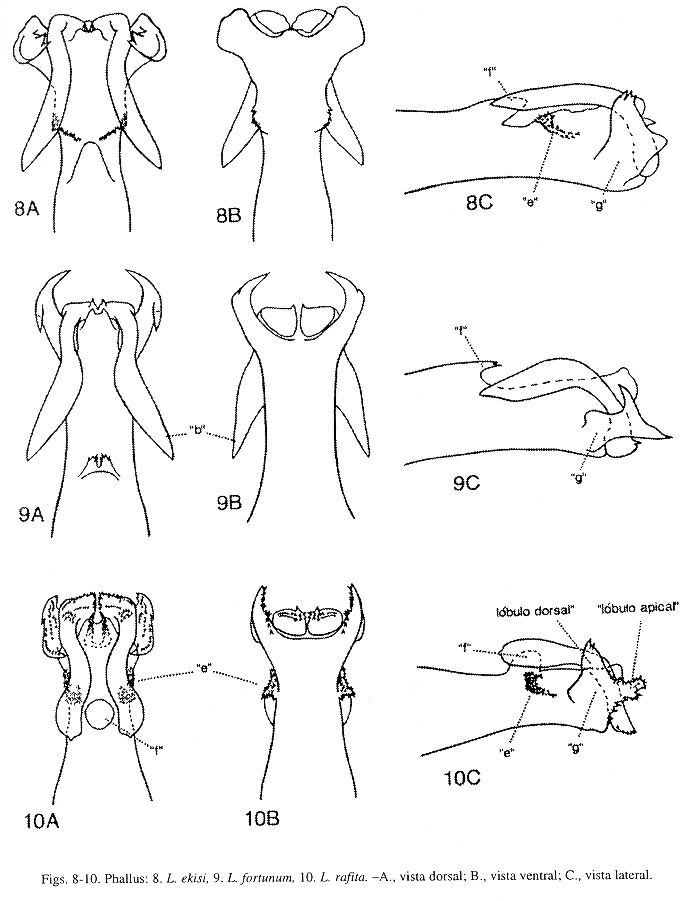
<body><![CDATA[<center>     <p><font face="Arial,Helvetica"><font size=-1>Leptonema ekisi Flint, McAlpine y Ross</font></font>     <br><font face="Arial,Helvetica"><font size=-1><a href="#fig8,9,10">Fig. 8</a>; <a href="#fig30map1">Mapa 1</a>.</font></font></center> <font face="Arial,Helvetica"><font size=-1>Leptonema ekisi<b> </b><a href="#Flint87">Flint, McAlpine y Ross 1987</a>: 54, figs. 463-470,&nbsp;<img SRC="/img/fbpe/rbt/v47n4/Macho.GIF" height=18 width=20>, Panam&aacute;: Chiriqu&iacute; (NMNH); <a href="#Holzenthal">Holzenthal 1988</a>: 67.</font></font><font size=-1></font>     
<p><font face="Arial,Helvetica"><font size=-1>Leptonema salvini Mosely 1993: 64 (identificaci&oacute;n err&oacute;nea del paratipo&nbsp;<img SRC="/img/fbpe/rbt/v47n4/Macho.GIF" height=18 width=20> de Orosi, Cartago, Costa Rica, seg&uacute;n <a href="#Flint87">Flint <i>etal</i>., 1987</a>).</font></font><font size=-1></font>     
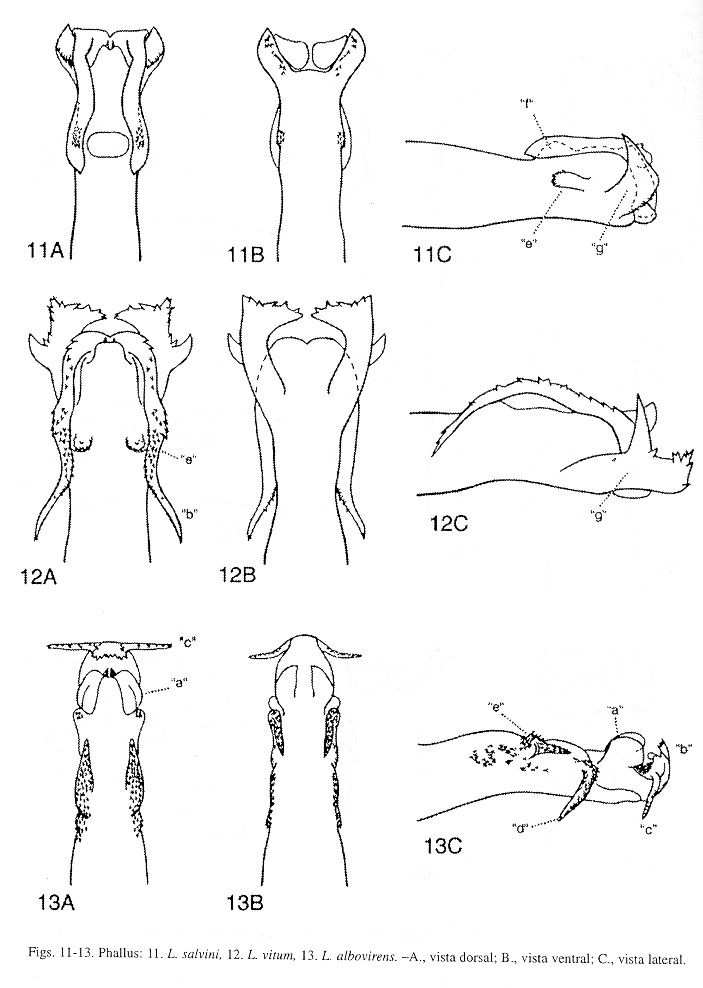
<p><font face="Arial,Helvetica"><font size=-1><b>Diagnosis.</b>-<b>Adultos: </b>Grandes y con las alas transl&uacute;cidas de color pardo. Ala anterior de 22 a 29 mm de longitud, con tres parches peque&ntilde;os y redondeados de pelillos pardo oscuros, uno sobre cada "<i>nygma</i>" y el tercero sobre la vena transversal "<i>m2-m3</i>".</font></font><font size=-1></font>     <p><font face="Arial,Helvetica"><font size=-1><b><i>Phallus</i></b> (<a href="#fig8,9,10">Fig. 8</a>): Esta especie, <i>L</i>. <i>fortunum</i> Flint, McAlpine y Ross, <i>L</i>. <i>rafita</i> Mu&ntilde;oz-Q., <i>L</i>. <i>salvini</i> Mosely, y <i>L</i>. <i>vitum</i> Flint, McAlpine y Ross, pueden ser distinguidas por la forma y tama&ntilde;o de los procesos "<i>e</i>", "<i>f</i>" y "<i>g</i>" como se comenta en la diagnosis de <i>L</i>. <i>rafita</i>. Procesos "<i>c</i>", "<i>d</i>" y "<i>j</i>" ausentes en esta especie.</font></font><font size=-1></font>     <p><font face="Arial,Helvetica"><font size=-1><b>Distribuci&oacute;n: </b>COSTA RICA (Alajuela, Cartago); PANAM&Aacute;.</font></font><font size=-1></font>     <p><font face="Arial,Helvetica"><font size=-1><b>Material</b> <b>examinado: </b>COSTA RICA: <b>Cartago: </b>Res. Tapant&iacute;, R&iacute;o Grande de Orosi, 9.686&deg;N, 83.756&deg;W, el. 1650 m, 8-9.vii.1986, Holzenthal, Heyn, Armitage, 1&nbsp;<img SRC="/img/fbpe/rbt/v47n4/Macho.GIF" height=18 width=20>, 11&nbsp;<img SRC="/img/fbpe/rbt/v47n4/Hembra.GIF" height=21 width=15>; igual pero, 18-21.iii.1987, Holzenthal, Hamilton, Heyn, 16&nbsp;<img SRC="/img/fbpe/rbt/v47n4/Macho.GIF" height=18 width=20>, 13<img SRC="/img/fbpe/rbt/v47n4/Hembra.GIF" height=21 width=15>; 15-16.vii.1987, Holzenthal, Morse, Clausen, 1&nbsp;<img SRC="/img/fbpe/rbt/v47n4/Macho.GIF" height=18 width=20>, 1&nbsp;<img SRC="/img/fbpe/rbt/v47n4/Hembra.GIF" height=21 width=15> (en alcohol).</font></font>     
<br><font size=-1></font>&nbsp;<font size=-1></font>     <center>     ]]></body>
<body><![CDATA[<p><a NAME="fig8,9,10"></a><img SRC="/img/fbpe/rbt/v47n4/0422i6.GIF" height=901 width=691>     
<br><font size=-1></font>&nbsp;     <br><font size=-1></font>&nbsp;<font size=-1></font>     <p><a NAME="fig11,12,13"></a><img SRC="/img/fbpe/rbt/v47n4/0422i7.GIF" height=988 width=703>     
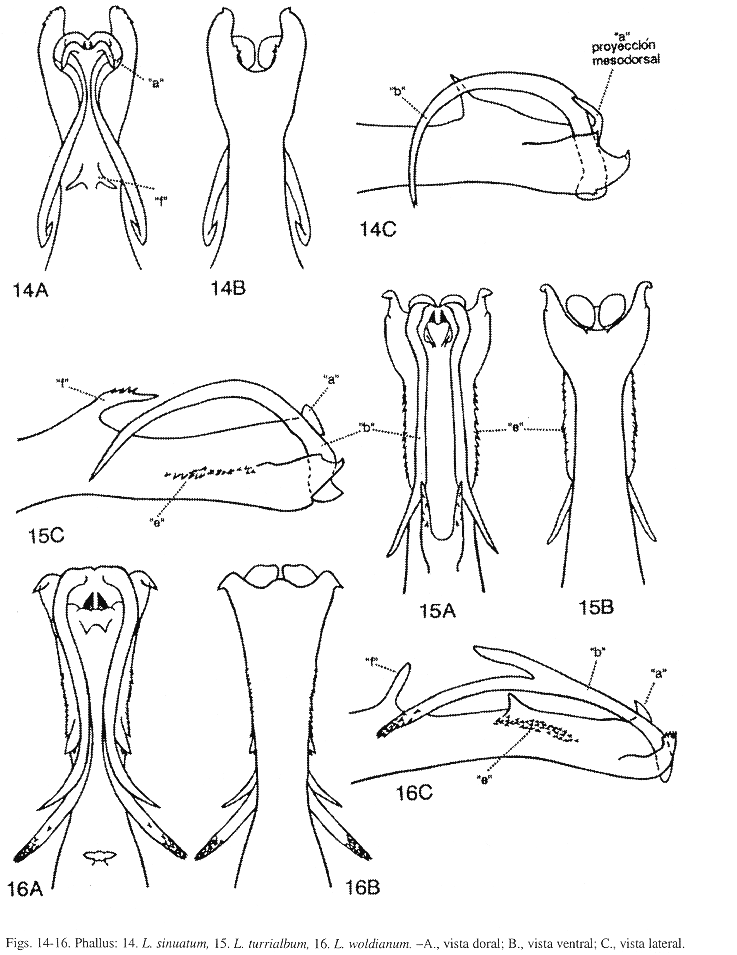
<br><font size=-1></font>&nbsp;     <br><font size=-1></font>&nbsp;     <br><font size=-1></font>&nbsp;<font size=-1></font>     <p><a NAME="fig14,15,16"></a><img SRC="/img/fbpe/rbt/v47n4/0422i8.GIF" height=955 width=737>     
<br><font size=-1></font>&nbsp;<font size=-1></font>     <p><font face="Arial,Helvetica"><font size=-1>Leptonema&nbsp; <i>flintorum</i> Mu&ntilde;oz-Q.</font></font>     ]]></body>
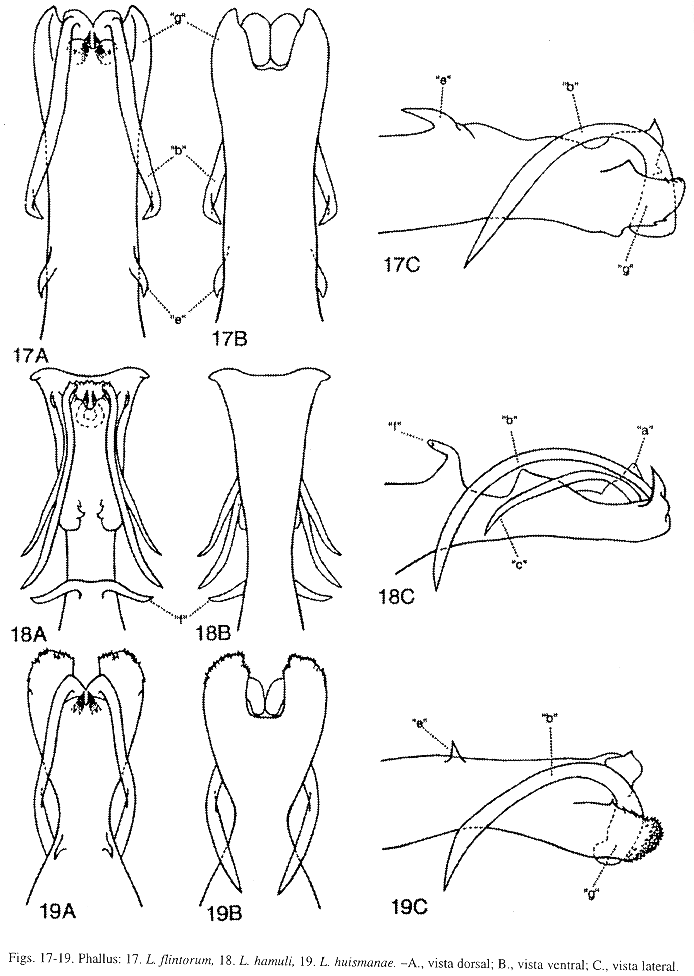
<body><![CDATA[<br><font face="Arial,Helvetica"><font size=-1><a href="#FIG17-18-19">Fig. 17</a>; <a href="#fig31map2">Mapa 2</a>.</font></font></center> <font face="Arial,Helvetica"><font size=-1>Leptonema <i>flintorum </i><a href="#Muñoz">Mu&ntilde;oz-Q. 1997</a>: 119-120, fig. 2,&nbsp;<img SRC="/img/fbpe/rbt/v47n4/Macho.GIF" height=18 width=20>, Costa Rica: Puntarenas (NMNH).</font></font><font size=-1></font>     
<p><font face="Arial,Helvetica"><font size=-1><b>Diagnosis.</b>-<b>Adultos: </b>Moderamente grandes y con las alas transl&uacute;cidas de color pardo claro. Ala anterior de 20 a 22 mm de longitud, con pelillos pardo oscuros a lo largo de las venas "<i>A<sub>1</sub></i>" y "<i>A</i><sub>2</sub>", y una banda de pelillos pardo oscuros sobre el "<i>cord</i>".</font></font><font size=-1></font>     <p><font face="Arial,Helvetica"><font size=-1><b><i>Phallus</i></b> (<a href="#FIG17-18-19">Fig. 17</a>): Esta especie aunque muy similar a <i>L</i>. <i>huismanae</i> Mu&ntilde;oz-Q. (<a href="#FIG17-18-19">Fig. 19</a>), difiere en el tama&ntilde;o de la secci&oacute;n media del <i>phallus</i> y del proceso "<i>e</i>", y en la forma y tama&ntilde;o del proceso "<i>g</i>". Secci&oacute;n media del <i>phallus</i>, en <i>L</i>. <i>flintorum</i>, levemente m&aacute;s angosta que la secci&oacute;n apical del <i>phallus</i>, esta &uacute;ltima secci&oacute;n es menos de 1.5 veces el ancho de la secci&oacute;n media; y en <i>L</i>. <i>huismanae</i>, notablemente m&aacute;s estrecha que la secci&oacute;n apical del <i>phallus</i>, esta &uacute;ltima secci&oacute;n es m&aacute;s de 2 veces el ancho de la secci&oacute;n media. Proceso "<i>e</i>", en <i>L</i>. <i>flintorum</i>, robusto y conspicuo, en vista lateral, la altura de la secci&oacute;n media del <i>phallus</i> es menos de 2.5 veces el largo del proceso "<i>e</i>"; y en <i>L</i>. <i>huismanae</i>, de peque&ntilde;o a diminuto, en vista lateral, la altura de la secci&oacute;n media del <i>phallus</i> es m&aacute;s de 3 veces el largo del proceso "<i>e</i>". Proceso "<i>g</i>", en esta especie, en vista dorsal, angosto, fuertemente c&oacute;ncavo dorsalmente y alargado, alcanza el margen posterior del proceso "<i>b</i>", en vista lateral, el &aacute;pice aserrado levemente y redondeado levemente; y en <i>L</i>. <i>huismanae</i>, en vista dorsal, ensanchado, levemente c&oacute;ncavo dorsalmente y alargado, casi siempre proyectado m&aacute;s all&aacute; del margen posterior del proceso "<i>b</i>" (en algunos ejemplares, &eacute;ste llega hasta el margen posterior del proceso "<i>b</i>"), el &aacute;pice aserrado, amplio y truncado ligeramente. Estas dos especies pueden ser separadas de <i>L</i>. <i>sinuatum</i> Mosely (<a href="#fig14,15,16">Fig. 14</a>), por la forma del proceso "<i>a</i>" y por la presencia de los procesos "<i>e</i>" y "<i>f</i>", estos dos &uacute;ltimos procesos tambi&eacute;n la distinguen de <i>L</i>. <i>hamuli</i> Flint, McApline y Ross (<a href="#FIG17-18-19">Fig. 18</a>). Proceso "<i>a</i>", en <i>L</i>. <i>flintorum</i> y <i>L</i>.<u> </u><i>huismanae</i>, sin ninguna proyecci&oacute;n mesodorsal, como s&iacute; aparece y se describe en la diagnosis de<i> L</i>. <i>sinuatum</i>. Proceso "<i>e</i>", en<i> L</i>. <i>flintorum</i> y <i>L</i>.<u> </u><i>huismanae</i>, semeja una espina con el &aacute;pice dirigido anterodorsalmente; en <i>L</i>. <i>sinuatum</i> y <i>L</i>. <i>hamuli</i>, ausente. Proceso "<i>f</i>", en<i> L</i>. <i>flintorum</i> y <i>L</i>.<u> </u><i>huismanae</i>, ausente; en <i>L</i>. <i>sinuatum</i> y <i>L</i>. <i>hamuli</i>, en vista dorsal, bifurcado y con las ramas dirigidas lateralmente. En <i>L</i>. <i>flintorum</i>, procesos "<i>c</i>", "<i>d</i>", "<i>f</i>" y "<i>j</i>" ausentes.</font></font><font size=-1></font>     <p><font face="Arial,Helvetica"><font size=-1><b>Distribuci&oacute;n: </b>COSTA RICA (Puntarenas).</font></font><font size=-1></font>     <p><font face="Arial,Helvetica"><font size=-1><b>Material</b> <b>examinado: </b>COSTA RICA: <b>Puntarenas</b>: R&iacute;o Bellavista, ca. 1.5 km NW Las Alturas, 8.951&deg;N, 82.846&deg;W, el. 1400 m, 16-17.iii.1991, Holzenthal, Mu&ntilde;oz, Huisman,&nbsp;<img SRC="/img/fbpe/rbt/v47n4/Macho.GIF" height=18 width=20>, holotipo (NMNH); igual pero, 1&nbsp;<img SRC="/img/fbpe/rbt/v47n4/Macho.GIF" height=18 width=20>, 4&nbsp;<img SRC="/img/fbpe/rbt/v47n4/Hembra.GIF" height=21 width=15>; trib. R&iacute;o Bellavista, Las Alturas (road to quarry) 8.952&deg;N, 82.848&deg;W, el. 1480 m, 19.iii.1991, Holzenthal, Mu&ntilde;oz, Huisman, 1&nbsp;<img SRC="/img/fbpe/rbt/v47n4/Macho.GIF" height=18 width=20>.</font></font>     
<br><font size=-1></font>&nbsp;<font size=-1></font>     <center>     <p><font face="Arial,Helvetica"><font size=-1>Leptonema fortunum Flint, McAlpine y Ross</font></font>     <br><font face="Arial,Helvetica"><font size=-1><a href="#fig8,9,10">Fig. 9</a>; <a href="#fig30map1">Mapa 1</a>.</font></font></center> <font face="Arial,Helvetica"><font size=-1>Leptonema fortunum <a href="#Flint87">Flint, McAlpine y Ross 1987</a>: 54-55, figs. 471-478, macho (s), Panam&aacute;: Chiriqu&iacute; (NMNH); <a href="#McElravy81">McElravy <i>et</i> <i>al</i>. 1981</a>: 153; <a href="#McElravy82">1982</a>: 307, 310, 312 (especie "A" de <i>Leptonema</i> no descrita); <a href="#Holzenthal">Holzenthal 1988</a>: 67.</font></font><font size=-1></font>     <p><font face="Arial,Helvetica"><font size=-1><b>Diagnosis. -Adultos: </b>De tama&ntilde;o mediano y con las alas transl&uacute;cidas de color pardo. Ala anterior de 15 a 19 mm de longitud, con un parche peque&ntilde;o y redondeado de pelillos pardo oscuros sobre las venas transversales "<i>m<sub>2</sub>-m<sub>3</sub></i>" y "<i>m</i><sub>3</sub>-m<sub>4</sub>".</font></font><font size=-1></font>     ]]></body>
<body><![CDATA[<p><font face="Arial,Helvetica"><font size=-1><b><i>Phallus</i></b> (<a href="#fig8,9,10">Fig. 9</a>): Esta especie, <i>L</i>. <i>ekisi</i> Flint, McAlpine y Ross, <i>L</i>. <i>rafita</i> Mu&ntilde;oz-Q., <i>L</i>. <i>salvini</i> Mosely, y <i>L</i>. <i>vitum</i> Flint, McAlpine y Ross, pueden ser separadas por la forma y tama&ntilde;o de los procesos "<i>e</i>", "<i>f</i>" y "<i>g</i>", como se especifica en la diagnosis de <i>L</i>. <i>rafita</i>. Procesos "<i>c</i>", "<i>d</i>", "<i>e</i>" y "<i>j</i>" ausentes en <i>L</i>. <i>fortunum</i>.</font></font><font size=-1></font>     <p><font face="Arial,Helvetica"><font size=-1><b>Distribuci&oacute;n: </b>COSTA RICA (Cartago); PANAM&Aacute;.</font></font><font size=-1></font>     <p><font face="Arial,Helvetica"><font size=-1><b>Material</b> <b>examinado: </b>COSTA RICA: <b>Cartago: </b>Res. Tapant&iacute;, Queb. Segunda, @ administration building, 9.761&deg;N, 83.787&deg;W, el. 1250 m, 9-10.v.1990, Holzenthal, Blahnik, 2&nbsp;<img SRC="/img/fbpe/rbt/v47n4/Macho.GIF" height=18 width=20>; igual pero, Queb. Palmitos &amp; falls, 9.72&deg;N, 83.78&deg;W, el. 1400 m, 24-25.iii.1991, Holzenthal, Mu&ntilde;oz, Huisman, 4&nbsp;<img SRC="/img/fbpe/rbt/v47n4/Macho.GIF" height=18 width=20>.</font></font>     
<br><font size=-1></font>&nbsp;<font size=-1></font>     <center>     <p><font face="Arial,Helvetica"><font size=-1>Leptonema hamuli Flint, McAlpine y Ross</font></font>     <br><font face="Arial,Helvetica"><font size=-1><a href="#FIG17-18-19">Fig. 18</a>; <a href="#fig31map2">Mapa 2</a>.</font></font></center> <font face="Arial,Helvetica"><font size=-1>Leptonema hamuli <a href="#Flint87">Flint, McAlpine y Ross 1987</a>: 55, figs. 479-486,&nbsp;<img SRC="/img/fbpe/rbt/v47n4/Macho.GIF" height=18 width=20>, Panam&aacute;: Isla Barro del Colorado (NMNH); <a href="#Holzenthal">Holzenthal 1988</a>: 67.</font></font><font size=-1></font>     
<p><font face="Arial,Helvetica"><font size=-1><b>Diagnosis. -Adultos: </b>Peque&ntilde;os y con las alas transl&uacute;cidas de color pardo claro. Ala anterior de 14 a 17 mm de longitud, y con una banda tenue de pelillos pardos sobre el "<i>cord</i>".</font></font><font size=-1></font>     <p><font face="Arial,Helvetica"><font size=-1><b><i>Phallus</i></b> (<a href="#FIG17-18-19">Fig. 18</a>): Esta especie es parecida a <i>L</i>. <i>sinuatum</i> Mosely (<a href="#fig14,15,16">Fig. 14</a>), pero distinguible por la forma y tama&ntilde;o de los procesos "<i>a</i>", "<i>b</i>" y "<i>c</i>". Proceso "<i>a</i>", en <i>L</i>. <i>hamuli</i>, aparece membranoso y sin proyecciones mesodorsales; y en <i>L</i>. <i>sinuatum</i>, con un par de proyecciones mesodorsales. Proceso "<i>b</i>", en <i>L</i>. <i>hamuli</i>, mesoapical, delgado y sinuoso levemente, en vista lateral, arqueado, m&aacute;s largo que el proceso "<i>c</i>" y apenas alcanza la base del proceso "<i>f</i>"; y en <i>L</i>. <i>sinuatum</i>, apicoventral, delgado y sinuoso, en vista lateral, arqueado, largo y sobrepasa la base del proceso "<i>f</i>". Proceso "<i>c</i>", en <i>L</i>. <i>hamuli</i>, apicolateral, delgado, curvado levemente y dirigido anteroventralmente; y en <i>L</i>. <i>sinuatum</i>, ausente. Esta especie se diferencia de <i>L</i>. <i>flintorum</i> Mu&ntilde;oz-Q. y <i>L</i>. <i>huismanae</i> Mu&ntilde;oz-Q., por la presencia de los procesos "<i>e</i>" y "<i>f</i>", como se detalla en la diagnosis de <i>L</i>. <i>flintorum</i>. Procesos "<i>e</i>" y "<i>j</i>" ausentes en <i>L</i>. <i>hamuli</i>.</font></font><font size=-1></font>     <p><font face="Arial,Helvetica"><font size=-1><b>Distribuci&oacute;n: </b>COSTA RICA (Cartago, Guanacaste, Lim&oacute;n); PANAM&Aacute;.</font></font><font size=-1></font>     ]]></body>
<body><![CDATA[<p><font face="Arial,Helvetica"><font size=-1><b>Material</b> <b>examinado: </b>COSTA RICA: <b>Guanacaste: </b>R&iacute;o Los Ahogados, 11.3 km ENE Quebrada Grande, 10.865&deg;N, 85.423&deg;W, el. 470 m, 26.vi.1986, Holzenthal, Heyn, Armitage, 2&nbsp;<img SRC="/img/fbpe/rbt/v47n4/Macho.GIF" height=18 width=20>; P. N. Guanacaste, Est. Pitilla, R&iacute;o Oros&iacute;, 10.991&deg;N, 85.428&deg;W, el. 700 m, 22-25.v.1990, Holzenthal, Blahnik, 17&nbsp;<img SRC="/img/fbpe/rbt/v47n4/Macho.GIF" height=18 width=20>, 6&nbsp;<img SRC="/img/fbpe/rbt/v47n4/Hembra.GIF" height=21 width=15>; <b>Lim&oacute;n: </b>P. N. Braulio Carrillo, Queb. Gonz&aacute;lez, 10.160&deg;N, 83.939&deg;W, el. 480 m, 12-14.v.1990, Holzenthal, Blahnik, 2&nbsp;<img SRC="/img/fbpe/rbt/v47n4/Macho.GIF" height=18 width=20> (1 en alcohol).</font></font>     
<br><font size=-1></font>&nbsp;<font size=-1></font>     <center>     <p><font face="Arial,Helvetica"><font size=-1>Leptonema <i>huismanae</i> Mu&ntilde;oz-Q.</font></font>     <br><font face="Arial,Helvetica"><font size=-1><a href="#FIG17-18-19">Fig. 19</a>; <a href="#fig31map2">Mapa 2</a>.</font></font></center> <font face="Arial,Helvetica"><font size=-1>Leptonema <i>huismanae </i><a href="#Muñoz">Mu&ntilde;oz-Q.1997</a>: 122-124, fig. 3,&nbsp;<img SRC="/img/fbpe/rbt/v47n4/Macho.GIF" height=18 width=20>, Costa Rica: Alajuela<b> </b>(NMNH).</font></font><font size=-1></font>     
<p><font face="Arial,Helvetica"><font size=-1><b>Diagnosis. -Adultos: </b>Moderamente grandes y con las alas transl&uacute;cidas de color pardo claro. Ala anterior de 17 a 20 mm de longitud, con una banda peque&ntilde;a y transversal de pelillos pardo oscuros sobre el tercio basal de la ala, otra banda m&aacute;s oscura de pelillos pardos oscuros sobre el "<i>cord</i>" y sobre los m&aacute;rgenes de la celda medial (<i>cm</i>).</font></font><font size=-1></font>     <p><font face="Arial,Helvetica"><font size=-1><b><i>Phallus</i></b> (<a href="#FIG17-18-19">Fig. 19</a>): Esta especie y<i> L</i>. <i>flintorum</i> Mu&ntilde;oz-Q. son muy parecidas, sin embargo pueden ser reconocidas por el tama&ntilde;o de la secci&oacute;n media del <i>phallus</i> y del proceso "<i>e</i>", y por la forma y tama&ntilde;o del proceso "<i>g</i>", como se comenta en la diagnosis de <i>L</i>. <i>flintorum</i>. Estas dos especies difieren de <i>L</i>. <i>sinuatum</i> Mosely, por la forma del proceso "<i>a</i>" y por la presencia de los procesos "<i>e</i>" y "<i>f</i>", estos dos &uacute;ltimos procesos la distinguen de <i>L</i>. <i>hamuli</i> Flint, McAlpine y Ross, como se especifica en las diagnosis de <i>L</i>. <i>flintorum</i> y <i>L</i>. <i>sinuatum</i>. Procesos "<i>c</i>", "<i>d</i>", "<i>f</i>" y "<i>j</i>" ausentes en <i>L</i>. <i>huismanae</i>.</font></font><font size=-1></font>     <p><font face="Arial,Helvetica"><font size=-1><b>Distribuci&oacute;n: </b>COSTA RICA (Alajuela, Guanacaste).</font></font><font size=-1></font>     <p><font face="Arial,Helvetica"><font size=-1><b>Material</b> <b>examinado: </b>COSTA RICA: <b>Alajuela</b>: Res. Forestal San Ram&oacute;n, R&iacute;o San Lorencito and tribs., 10.216&deg;N, 84.607&deg;W, el. 980 m, 6-10.iii.1991, Holzenthal, Mu&ntilde;oz, Huisman,&nbsp;<img SRC="/img/fbpe/rbt/v47n4/Macho.GIF" height=18 width=20>, holotipo (NMNH); igual pero, 7&nbsp;<img SRC="/img/fbpe/rbt/v47n4/Macho.GIF" height=18 width=20>, 10&nbsp;<img SRC="/img/fbpe/rbt/v47n4/Hembra.GIF" height=21 width=15>; 13-16.vi.1986, C.M. &amp; O.S. Flint, Holzenthal, 11<img SRC="/img/fbpe/rbt/v47n4/Macho.GIF" height=18 width=20>, 2&nbsp;<img SRC="/img/fbpe/rbt/v47n4/Hembra.GIF" height=21 width=15> (NMNH); 2-4.vii.1986, Holzenthal, Heyn, Armitage, 3&nbsp;<img SRC="/img/fbpe/rbt/v47n4/Macho.GIF" height=18 width=20>, 3&nbsp;<img SRC="/img/fbpe/rbt/v47n4/Hembra.GIF" height=21 width=15>; 5-9.vii.1986, I. &amp; A. Chac&oacute;n, 6&nbsp;<img SRC="/img/fbpe/rbt/v47n4/Macho.GIF" height=18 width=20>, 2&nbsp;<img SRC="/img/fbpe/rbt/v47n4/Hembra.GIF" height=21 width=15>; 2-6.ix.1986, 1&nbsp;<img SRC="/img/fbpe/rbt/v47n4/Macho.GIF" height=18 width=20>, 1&nbsp;<img SRC="/img/fbpe/rbt/v47n4/Hembra.GIF" height=21 width=15>; 24-27.ii.1987, 3&nbsp;<img SRC="/img/fbpe/rbt/v47n4/Macho.GIF" height=18 width=20>, 1&nbsp;<img SRC="/img/fbpe/rbt/v47n4/Hembra.GIF" height=21 width=15>; 30.iii.-1.iv.1987, Holzenthal, Halmilton, Heyn, 11&nbsp;<img SRC="/img/fbpe/rbt/v47n4/Macho.GIF" height=18 width=20> (4 en alcohol), 5&nbsp;<img SRC="/img/fbpe/rbt/v47n4/Hembra.GIF" height=21 width=15>; 1-4.v.1990, Holzenthal, Blahnik, 5&nbsp;<img SRC="/img/fbpe/rbt/v47n4/Macho.GIF" height=18 width=20> (1 en alcohol), 12&nbsp;<img SRC="/img/fbpe/rbt/v47n4/Hembra.GIF" height=21 width=15>; 28-30.vii.1990, Holzenthal, Blahnik, Mu&ntilde;oz, 1&nbsp;<img SRC="/img/fbpe/rbt/v47n4/Macho.GIF" height=18 width=20>, 1&nbsp;<img SRC="/img/fbpe/rbt/v47n4/Hembra.GIF" height=21 width=15> (en alcohol); R&iacute;o Sarapiqu&iacute;, ca. 2 km SE Cariblanco, 10.299&deg;N, 84.172&deg;W, el. 710 m, 22.iii.1986, Holzenthal, Fasth, 1&nbsp;<img SRC="/img/fbpe/rbt/v47n4/Macho.GIF" height=18 width=20>; igual pero, 6.ii.1987, I. &amp; A. Chac&oacute;n, 2&nbsp;<img SRC="/img/fbpe/rbt/v47n4/Macho.GIF" height=18 width=20>, 2&nbsp;<img SRC="/img/fbpe/rbt/v47n4/Hembra.GIF" height=21 width=15>; R&iacute;o Agrio, ca. 3.5 km NE Bajos del Toro, 10.243&deg;N, 84.279&deg;W, el. 1290 m, 20.viii.1990, Holzenthal <i>et</i> <i>al</i>., 1&nbsp;<img SRC="/img/fbpe/rbt/v47n4/Macho.GIF" height=18 width=20>; <b>Guanacaste</b>: P. N. Guanacaste, R&iacute;o San Josecito, Est. Mengo [Est. Cacao], 10.922&deg;N, 85.470&deg;W, el. 960 m, 28-29.vii.1987, Holzenthal, Morse, Clausen, 8&nbsp;<img SRC="/img/fbpe/rbt/v47n4/Macho.GIF" height=18 width=20>, 4&nbsp;<img SRC="/img/fbpe/rbt/v47n4/Hembra.GIF" height=21 width=15>; Est. Cacao, lado suroeste del Volc&aacute;n Cacao, [10.56&deg;N, 85.26&deg;W], el. 1000-1400 m, ix-xii.1989, URCG, R. Blanco, C. Ch&aacute;vez, 3&nbsp;<img SRC="/img/fbpe/rbt/v47n4/Macho.GIF" height=18 width=20> (INBio); igual pero, vi.1990, II Curso de Paratax&oacute;nomos, 14&nbsp;<img SRC="/img/fbpe/rbt/v47n4/Macho.GIF" height=18 width=20>, 12<img SRC="/img/fbpe/rbt/v47n4/Hembra.GIF" height=21 width=15> (INBio); Zona Protectora Tenorio, tribs. R&iacute;o San Lorenzo, 6 km NW Tierras Morenas, 10.61&Uacute;N, 84.98&Uacute;W, el. 900 m, 17-19.ii.1992, Holzenthal, Mu&ntilde;oz, Kjer, 3&nbsp;<img SRC="/img/fbpe/rbt/v47n4/Macho.GIF" height=18 width=20>, 10&nbsp;<img SRC="/img/fbpe/rbt/v47n4/Hembra.GIF" height=21 width=15>.</font></font>     
<br><font size=-1></font>&nbsp;     ]]></body>
<body><![CDATA[<br><font size=-1></font>&nbsp;     <br><font size=-1></font>     <br><font size=-1></font>     <center>     <p><a NAME="FIG17-18-19"></a><a href="fig17-18-19"><img SRC="/img/fbpe/rbt/v47n4/0422i9.GIF" BORDER=0 height=976 width=694></a>     
<br><font size=-1></font>&nbsp;     <br><font size=-1></font>&nbsp;<font size=-1></font>     <p><font face="Arial,Helvetica"><font size=-1>Leptonema <i>rafita</i> Mu&ntilde;oz-Q.</font></font>     <br><font face="Arial,Helvetica"><font size=-1><a href="#fig8,9,10">Fig. 10</a>; <a href="#fig30map1">Mapa 1</a>.</font></font></center> <font size=-1></font>     <p><font face="Arial,Helvetica"><font size=-1>Leptonema <i>rafita </i><a href="#Muñoz">Mu&ntilde;oz-Q. 1997</a>: 124-127, fig. 4,&nbsp;<img SRC="/img/fbpe/rbt/v47n4/Macho.GIF" height=18 width=20>, Costa Rica: Alajuela<b> </b>(NMNH).</font></font><font size=-1></font>     
]]></body>
<body><![CDATA[<p><font face="Arial,Helvetica"><font size=-1><b>Diagnosis. Adultos: </b>Grandes y con las alas transl&uacute;cidas de color pardo. Ala anterior de 20 a 23 mm de longitud, con un parche peque&ntilde;o y redondeado de pelillos pardo oscuros sobre el margen posterior de celda medial (<i>cm</i>).</font></font><font size=-1></font>     <p><font face="Arial,Helvetica"><font size=-1><b><i>Phallus</i></b> (<a href="#fig8,9,10">Fig. 10</a>): Esta especie, <i>L</i>. <i>ekisi</i> Flint, McAlpine y Ross (<a href="#fig8,9,10">Fig. 8</a>), <i>L</i>. <i>fortunum</i> Flint, McAlpine y Ross (<a href="#fig8,9,10">Fig. 9</a>), <i>L</i>. <i>salvini</i> Mosely (<a href="#fig11,12,13">Fig. 11</a>) y <i>L</i>. <i>vitum</i> Flint, McAlpine y Ross (<a href="#fig11,12,13">Fig. 12</a>), pueden ser diferenciadas por la forma y tama&ntilde;o de los procesos "<i>e</i>", "<i>f</i>"y "<i>g</i>". Proceso "<i>e</i>", en <i>L</i>. <i>rafita</i>y <i>L</i>. <i>salvini</i>, en vista dorsal, un l&oacute;bulo dorsolateral con min&uacute;sculas puntas superficiales y fusionado a la base del <i>phallus</i>, en vista lateral, proyectado anteriormente alcanzando la base del proceso "<i>f</i>"; en <i>L</i>. <i>ekisi</i>, en vista dorsal, un l&oacute;bulo dorsolateral con min&uacute;sculas puntas superficiales y fusionado a la base del <i>phallus</i>, en vista lateral, corto y dirigido anteriormente sin alcanzar la base del proceso "<i>f</i>"; en <i>L</i>. <i>fortunum</i>, ausente; y en <i>L</i>. <i>vitum</i>, en vista dorsal, un l&oacute;bulo dorsal peque&ntilde;o y redondeado, en vista lateral, corto y dirigido dorsalmente. Proceso "<i>f</i>", en esta especie, en vista dorsal, redondeado, en vista lateral, corto y erguido, con el &aacute;pice redondeado moderadamente y dirigido dorsalmente; en <i>L</i>. <i>ekisi</i>, en vista dorsal, alargado y con el &aacute;pice dirigido posteriormente, semejando una lengua; en <i>L</i>. <i>fortunum</i>, en vista dorsal, peque&ntilde;o y dirigido posteriormente, con el &aacute;pice bifurcado levemente y las puntas aserradas tenuamente; en <i>L</i>. <i>salvini</i>, en vista dorsal, ovalado, en vista lateral, corto, con el &aacute;pice redondeado ligeramente y dirigido dorsalmente; y en <i>L</i>. <i>vitum</i>, ausente. Proceso "<i>g</i>", en <i>L</i>.<i>rafita</i>, corto y bilobulado; el l&oacute;bulo apical, en vista lateral, erguido, subtriangular, aserrado fuertemente y con un par de puntas apicales peque&ntilde;as, que alcanzan el margen posterior del proceso "<i>b</i>"; el l&oacute;bulo dorsal erguido, subtriangular, aserrado y dirigido dorsalmente con el &aacute;pice puntiagudo. En <i>L</i>. <i>ekisi</i>, proceso "<i>g</i>" corto y bilobulado apicalmente; el l&oacute;bulo apical corto, redondeado levemente, no aserrado y apenas alcanza el margen posterior del proceso "<i>b</i>"; el l&oacute;bulo dorsal erguido, subtriangular y dirigido dorsalmente con unas puntas peque&ntilde;as y apicales. En <i>L</i>. <i>fortunum</i>, proceso "<i>g</i>" bilobulado apicalmente, alargado y sobrepasa el margen posterior del proceso "<i>b</i>"; el l&oacute;bulo apical, en vista lateral, subtriangular, erguido, no aserrado y con el &aacute;pice puntiagudo; l&oacute;bulo dorsal erguido, delgado, no aserrado, con el &aacute;pice puntiagudo y dirigido dorsalmente. En <i>L</i>. <i>salvini</i>, proceso "<i>g</i>" unilobulado, en vista lateral, corto y alcanza el margen posterior del proceso "<i>b</i>", el margen posteroventral aserrado ligeramente; s&oacute;lo el l&oacute;bulo dorsal, en vista lateral, dorsoapical, subtriangular, erguido, no aserrado, con el &aacute;pice puntiagudo y dirigido dorsalmente. En <i>L</i>. <i>vitum</i>, proceso "<i>g</i>" bilobulado, alargado y sobrepasa el margen posterior del proceso "<i>b</i>"; el l&oacute;bulo apical, en vista lateral, conspicuo, subcuadrado y aserrado posterodorsalmente; el l&oacute;bulo dorsal lateromedial, en vista lateral, erguido, delgado, subtriangular y dirigido dorsalmente. Margen apical del proceso "<i>g</i>" difiere en estas especies cuando es visto ventralmente, en <i>L</i>. <i>rafita</i>, con una hendidura profunda, amplia y aserrada lateralmente semejando una "U"; en <i>L</i>. <i>ekisi</i>, con hendidura superficial, ensanchada y no aserrada con una proyecci&oacute;n peque&ntilde;a y mesoapical; en <i>L</i>. <i>fortunum</i>, con una hendidura profunda y no aserrada, semejando una "U" levemente cerrada apicalmente; en <i>L</i>. <i>salvini</i>, con una hendidura amplia y no aserrada, semejando una "U"; y en <i>L</i>. <i>vitum</i>, con una hendidura profunda, convexa lateralmente, sub-acorazonada y no aserrada. Procesos "<i>c</i>", "<i>d</i>", "<i>j</i>" ausentes en <i>L</i>. <i>rafita</i>.</font></font><font size=-1></font>     <p><font face="Arial,Helvetica"><font size=-1><b>Distribuci&oacute;n: </b>COSTA RICA (Alajuela, Cartago, San Jos&eacute;).</font></font><font size=-1></font>     <p><font face="Arial,Helvetica"><font size=-1><b>Material</b> <b>examinado: </b>COSTA RICA: <b>Alajuela</b>: R&iacute;o Peje and falls, ca. 1 km SE San Vicente, Ciudad Quesada, 10.277&deg;N, 84.388&deg;W, el. 1450 m, 14-15.ii.1992, Holzenthal, Mu&ntilde;oz, Kjer,&nbsp;<img SRC="/img/fbpe/rbt/v47n4/Macho.GIF" height=18 width=20>, holotipo (NMNH); igual pero, 4&nbsp;<img SRC="/img/fbpe/rbt/v47n4/Macho.GIF" height=18 width=20>, 4&nbsp;<img SRC="/img/fbpe/rbt/v47n4/Hembra.GIF" height=21 width=15>; R&iacute;o Toro, 3.0 km (road) SW Bajos del Toro, 10.204&deg;N, 84.316&deg;W, el. 1530 m, 11.ii.1992, Holzenthal, Mu&ntilde;oz, Kjer, 1&nbsp;<img SRC="/img/fbpe/rbt/v47n4/Macho.GIF" height=18 width=20>; <b>Cartago</b>: Res. Tapant&iacute;, R&iacute;o Grande de Orosi, 9.686&deg;N, 83.756&deg;W, el. 1650 m, 15-16.vii.1987, Holzenthal, Morse, Clausen, 1<img SRC="/img/fbpe/rbt/v47n4/Macho.GIF" height=18 width=20>; igual pero, Queb. Palmitos and falls, 9.72&deg;N, 83.78&deg;W, el. 1400 m, 1-2.viii.1990, Holzenthal, Blahnik, Mu&ntilde;oz, 1&nbsp;<img SRC="/img/fbpe/rbt/v47n4/Macho.GIF" height=18 width=20>, 1&nbsp;<img SRC="/img/fbpe/rbt/v47n4/Hembra.GIF" height=21 width=15>; 21.ii.1992, Holzenthal, Mu&ntilde;oz, Kjer, 1&nbsp;<img SRC="/img/fbpe/rbt/v47n4/Macho.GIF" height=18 width=20>, 1&nbsp;<img SRC="/img/fbpe/rbt/v47n4/Hembra.GIF" height=21 width=15> (INBio); waterfalls, ca. 1 km (road) NW tunnel, 9.69&deg;N, 83.76&deg;W, el. 1600 m, 2-3.viii.1990, Holzenthal, Blahnik, Mu&ntilde;oz, 1&nbsp;<img SRC="/img/fbpe/rbt/v47n4/Macho.GIF" height=18 width=20> (NMNH); <b>San</b> <b>Jos&eacute;</b>: trib. to Queb. Caraigres 3.6 km (road) SW La Legua, 9.728&deg;N, 84.125&deg;W, el. 1650 m, 23.i.1992, Holzenthal, Kjer, Quesada, 2&nbsp;<img SRC="/img/fbpe/rbt/v47n4/Macho.GIF" height=18 width=20>.</font></font>     
<br><font size=-1></font>&nbsp;<font size=-1></font>     <center>     <p><font face="Arial,Helvetica"><font size=-1>Leptonema salvini Mosely</font></font>     <br><font face="Arial,Helvetica"><font size=-1><a href="#fig11,12,13">Fig. 11</a>;<a href="#fig30map1"> Mapa 1</a>.</font></font></center> <font face="Arial,Helvetica"><font size=-1>Leptonema salvini <a href="#Mosely33">Mosely 1933</a>: 62-64, figs. 196-200,&nbsp;<img SRC="/img/fbpe/rbt/v47n4/Macho.GIF" height=18 width=20>, Panam&aacute;: Chiriqu&iacute; (BMNH); <a href="#Fischer63">Fischer 1963</a>:</font></font>     
<br><font face="Arial,Helvetica"><font size=-1>172; <a href="#Flint87">Flint, McAlpine y Ross 1987</a>: 57, figs. 525-531; <a href="#Holzenthal">Holzenthal 1988</a>: 67.</font></font><font size=-1></font>     <p><font face="Arial,Helvetica"><font size=-1><b>Diagnosis. -Adultos: </b>Ligeramente grandes y con las alas transl&uacute;cidas de color pardo claro. Ala anterior de 15 a 21 mm de longitud, con un parche peque&ntilde;o y redondeado de pelillos pardos oscuros sobre el &aacute;ngulo anterior de la celda medial (<i>cm</i>), y una banda de pelillos pardo oscuros sobre el "<i>cord</i>".</font></font><font size=-1></font>     ]]></body>
<body><![CDATA[<p><font face="Arial,Helvetica"><font size=-1><b><i>Phallus</i></b> (<a href="#fig11,12,13">Fig. 11</a>): Esta especie es muy abundante en el pa&iacute;s y se distingue de <i>L</i>. <i>ekisi</i> Flint, McAlpine y Ross, <i>L</i>. <i>fortunum</i> Flint, McAlpine y Ross, <i>L</i>. <i>rafita</i> Mu&ntilde;oz-Q., y <i>L</i>. <i>vitum</i> Flint, McAlpine y Ross, por la forma y tama&ntilde;o de los procesos "<i>e</i>", "<i>f</i>" y "<i>g</i>", como se menciona en la diagnosis de <i>L</i>. <i>rafita</i>. En <i>L</i>. <i>salvini</i>, procesos "<i>c</i>", "<i>d</i>" y "<i>j</i>", ausentes.</font></font><font size=-1></font>     <p><font face="Arial,Helvetica"><font size=-1><b>Distribuci&oacute;n: </b>COSTA RICA (Alajuela, Cartago, Puntarenas, San Jos&eacute;); PANAM&Aacute;.</font></font><font size=-1></font>     <p><font face="Arial,Helvetica"><font size=-1><b>Material</b> <b>examinado:     </b>COSTA RICA: <b>Alajuela: </b>R&iacute;o La Paz Peque&ntilde;a, route     9, 7.8 km N Vara Blanca, 10.211&deg;N, 84.166&deg;W, el. 1230 m, 13.ii.1986,     Holzenthal, Morse, Fasth, 10&nbsp;<img SRC="/img/fbpe/rbt/v47n4/Macho.GIF" height=18 width=20>,     
30&nbsp;<img SRC="/img/fbpe/rbt/v47n4/Hembra.GIF" height=21 width=15>; R&iacute;o Sarapiqu&iacute;,     
ca. 2 km SE Cariblanco, 10.299&deg;N, 84.172&deg;W, el. 710 m, 22.iii.1986,     Holzenthal, Fasth, 15&nbsp;<img SRC="/img/fbpe/rbt/v47n4/Macho.GIF" height=18 width=20> (en     
alcohol); Res. Forestal San Ram&oacute;n, R&iacute;o San Lorencito &amp;     ]]></body>
<body><![CDATA[tribs., 10.216&deg;N, 84.607&deg;W, el. 980 m, 1-4.v.1990, Holzenthal,     Blahnik, 1&nbsp;<img SRC="/img/fbpe/rbt/v47n4/Macho.GIF" height=18 width=20>, 2<img SRC="/img/fbpe/rbt/v47n4/Hembra.GIF" height=21 width=15>;     
igual pero, 6-10.iii.1991, Holzenthal, Mu&ntilde;oz, Huisman, 1&nbsp;<img SRC="/img/fbpe/rbt/v47n4/Macho.GIF" height=18 width=20>,     
4&nbsp;<img SRC="/img/fbpe/rbt/v47n4/Hembra.GIF" height=21 width=15>; R&iacute;o Agrio, ca.     
3.5 km NE Bajos del Toro, 10.243&deg;N, 84.279&deg;W, el. 1290 m, 20.viii.1990,     Holzenthal <i>et</i> <i>al</i>, 8&nbsp;<img SRC="/img/fbpe/rbt/v47n4/Macho.GIF" height=18 width=20>,     
2&nbsp;<img SRC="/img/fbpe/rbt/v47n4/Hembra.GIF" height=21 width=15>; Queb. Latas, 8.9 km NE     
Bajos del Toro, 10.269&deg;N, 84.260&deg;W, el. 1030 m, 6.ix.1990, Holzenthal,     Blahnik, Huisman, 23&nbsp;<img SRC="/img/fbpe/rbt/v47n4/Macho.GIF" height=18 width=20>, 13&nbsp;<img SRC="/img/fbpe/rbt/v47n4/Hembra.GIF" height=21 width=15>;     
R&iacute;o Toro, 3.0 km (road) SW Bajos del Toro, 10.204&deg;N, 84.316&deg;W,     ]]></body>
<body><![CDATA[el. 1530 m, 3-4.ix.1990, Holzenthal, Blahnik, Huisman, 10&nbsp;<img SRC="/img/fbpe/rbt/v47n4/Macho.GIF" height=18 width=20>,     
13&nbsp;<img SRC="/img/fbpe/rbt/v47n4/Hembra.GIF" height=21 width=15>; igual pero, 11.ii.1992,     
Holzenthal, Mu&ntilde;oz, Kjer, 2&nbsp;<img SRC="/img/fbpe/rbt/v47n4/Macho.GIF" height=18 width=20>     
4&nbsp;<img SRC="/img/fbpe/rbt/v47n4/Hembra.GIF" height=21 width=15>; R&iacute;o Peje &amp;     
falls, ca. 1 km SE San Vicente, 10.277&deg;N, 84.388&deg;W, el. 1450 m,     14-15.ii.1992, Holzenthal, Mu&ntilde;oz, Kjer, 2&nbsp;<img SRC="/img/fbpe/rbt/v47n4/Macho.GIF" height=18 width=20>;     
R&iacute;o Peje &amp; falls, ca. 1 km SE San Vicente, 10.277&deg;N, 84.388&deg;W,     el. 1450 m, 14-15.ii.1992, Holzenthal, Mu&ntilde;oz, Kjer, 1&nbsp;<img SRC="/img/fbpe/rbt/v47n4/Macho.GIF" height=18 width=20>,     
3&nbsp;<img SRC="/img/fbpe/rbt/v47n4/Hembra.GIF" height=21 width=15>; R&iacute;o Peje &amp;     
falls, ca. 1 km SE San Vicente, 10.277&deg;N, 84.388&deg;W, el. 1450 m,     ]]></body>
<body><![CDATA[14-15.ii.1992, Holzenthal, Mu&ntilde;oz, Kjer, 1&nbsp;<img SRC="/img/fbpe/rbt/v47n4/Macho.GIF" height=18 width=20>,     
3&nbsp;<img SRC="/img/fbpe/rbt/v47n4/Hembra.GIF" height=21 width=15>; <b>Cartago: </b>Res.     
Tapant&iacute;, Queb. Segunda, @ administration building, 9.761&deg;N,     83.787&deg;W, el. 1250 m, 9-10.v.1990, Holzenthal, Blahnik, 13&nbsp;<img SRC="/img/fbpe/rbt/v47n4/Macho.GIF" height=18 width=20>;     
igual pero, Queb. Palmitos &amp; falls, 9.72&deg;N, 83.78&deg;W, el. 1400     m, 2-3.vi.1990, Holzenthal, Blahnik, Mu&ntilde;oz, 11&nbsp;<img SRC="/img/fbpe/rbt/v47n4/Macho.GIF" height=18 width=20>,     
15&nbsp;<img SRC="/img/fbpe/rbt/v47n4/Hembra.GIF" height=21 width=15>; 24-25.iii.1991, Holzenthal,     
Mu&ntilde;oz, Huisman, 4&nbsp;<img SRC="/img/fbpe/rbt/v47n4/Macho.GIF" height=18 width=20>;     
<b>Puntarenas:     </b>Res. Bosque Nuboso Monteverde, Queb. Cuecha, 10.31&deg;N, 84.79&deg;W,     ]]></body>
<body><![CDATA[el. 1550 m, 28.ii.1986, Holzenthal, Fasth, 1&nbsp;<img SRC="/img/fbpe/rbt/v47n4/Macho.GIF" height=18 width=20>;     
R&iacute;o Bellavista, ca. 1.5 km NW Las Alturas, 8.951&deg;N, 82.846&deg;W,     el. 1400 m, 15-17.vi.1986, Holzenthal, Heyn, Armitage, 13&nbsp;<img SRC="/img/fbpe/rbt/v47n4/Macho.GIF" height=18 width=20>,     
9&nbsp;<img SRC="/img/fbpe/rbt/v47n4/Hembra.GIF" height=21 width=15> (1&nbsp;<img SRC="/img/fbpe/rbt/v47n4/Macho.GIF" height=18 width=20>,     
1&nbsp;<img SRC="/img/fbpe/rbt/v47n4/Hembra.GIF" height=21 width=15> en alcohol); igual pero,     
8-9.iv.1987, Holzenthal, Hamilton, Heyn, 41&nbsp;<img SRC="/img/fbpe/rbt/v47n4/Macho.GIF" height=18 width=20>,     
57&nbsp;<img SRC="/img/fbpe/rbt/v47n4/Hembra.GIF" height=21 width=15> (14&nbsp;<img SRC="/img/fbpe/rbt/v47n4/Macho.GIF" height=18 width=20>,     
12&nbsp;<img SRC="/img/fbpe/rbt/v47n4/Hembra.GIF" height=21 width=15> en alcohol); 2-3.viii.1987,     
Holzenthal, Morse, Clausen, 8&nbsp;<img SRC="/img/fbpe/rbt/v47n4/Macho.GIF" height=18 width=20>,     
8&nbsp;<img SRC="/img/fbpe/rbt/v47n4/Hembra.GIF" height=21 width=15> (4&nbsp;<img SRC="/img/fbpe/rbt/v47n4/Macho.GIF" height=18 width=20>,     
]]></body>
<body><![CDATA[3&nbsp;<img SRC="/img/fbpe/rbt/v47n4/Hembra.GIF" height=21 width=15> en alcohol); 10-11.viii.1990,     
Holzenthal, Blahnik, Mu&ntilde;oz, 21&nbsp;<img SRC="/img/fbpe/rbt/v47n4/Macho.GIF" height=18 width=20>,     
49&nbsp;<img SRC="/img/fbpe/rbt/v47n4/Macho.GIF" height=18 width=20> (2&nbsp;<img SRC="/img/fbpe/rbt/v47n4/Macho.GIF" height=18 width=20>,     
12&nbsp;<img SRC="/img/fbpe/rbt/v47n4/Macho.GIF" height=18 width=20> en alcohol); 16-17.iii.1991,     
Holzenthal, Mu&ntilde;oz, Huisman, 71&nbsp;<img SRC="/img/fbpe/rbt/v47n4/Macho.GIF" height=18 width=20>,     
28&nbsp;<img SRC="/img/fbpe/rbt/v47n4/Hembra.GIF" height=21 width=15>; trib. to R&iacute;o     
Bellavista in Las Alturas (road to quarry), 8.952&deg;N, 82.848&deg;W,     el. 1480 m, 13-14.viii.1990, Holzenthal, Blahnik, Mu&ntilde;oz, 43<img SRC="/img/fbpe/rbt/v47n4/Macho.GIF" height=18 width=20>,     
29&nbsp;<img SRC="/img/fbpe/rbt/v47n4/Hembra.GIF" height=21 width=15> (3&nbsp;<img SRC="/img/fbpe/rbt/v47n4/Macho.GIF" height=18 width=20>),     
1&nbsp;<img SRC="/img/fbpe/rbt/v47n4/Hembra.GIF" height=21 width=15> en alcohol); igual pero,     
]]></body>
<body><![CDATA[19.iii.1991, Holzenthal, Mu&ntilde;oz, Huisman, 15&nbsp;<img SRC="/img/fbpe/rbt/v47n4/Macho.GIF" height=18 width=20>,     
11&nbsp;<img SRC="/img/fbpe/rbt/v47n4/Hembra.GIF" height=21 width=15>; Z. P. Las Tablas, R&iacute;o     
Cot&oacute;n, Sitio Cot&oacute;n, 8.941&deg;N, 82.787&deg;W, el. 1460 m,     15.iv.1989, Holzenthal, Blahnik, 50&nbsp;<img SRC="/img/fbpe/rbt/v47n4/Macho.GIF" height=18 width=20>,     
16&nbsp;<img SRC="/img/fbpe/rbt/v47n4/Hembra.GIF" height=21 width=15>; R&iacute;o Cot&oacute;n,     
in Las Alturas, 8.938&deg;N, 82.826&deg;W, el. 1360 m, 16.ii.1986, Holzenthal,     Morse, Fasth, 1&nbsp;<img SRC="/img/fbpe/rbt/v47n4/Macho.GIF" height=18 width=20>, 2&nbsp;<img SRC="/img/fbpe/rbt/v47n4/Hembra.GIF" height=21 width=15>;     
igual pero, 12.viii.1990, Holzenthal, Blahnik, Mu&ntilde;oz, 31&nbsp;<img SRC="/img/fbpe/rbt/v47n4/Macho.GIF" height=18 width=20>,     
8&nbsp;<img SRC="/img/fbpe/rbt/v47n4/Hembra.GIF" height=21 width=15> (30&nbsp;<img SRC="/img/fbpe/rbt/v47n4/Macho.GIF" height=18 width=20>,     
4&nbsp;<img SRC="/img/fbpe/rbt/v47n4/Hembra.GIF" height=21 width=15> en alcohol); 18.iii.1991,     
]]></body>
<body><![CDATA[Holzenthal, Mu&ntilde;oz, Huisman, 174&nbsp;<img SRC="/img/fbpe/rbt/v47n4/Macho.GIF" height=18 width=20>,     
12&nbsp;<img SRC="/img/fbpe/rbt/v47n4/Hembra.GIF" height=21 width=15> (51&nbsp;<img SRC="/img/fbpe/rbt/v47n4/Macho.GIF" height=18 width=20>),     
4&nbsp;<img SRC="/img/fbpe/rbt/v47n4/Hembra.GIF" height=21 width=15> en alcohol); 24.ix.1991,     
Mu&ntilde;oz, 12&nbsp;<img SRC="/img/fbpe/rbt/v47n4/Macho.GIF" height=18 width=20>, 7<img SRC="/img/fbpe/rbt/v47n4/Hembra.GIF" height=21 width=15>     
(en alcohol); small spring seep to R&iacute;o Cot&oacute;n in Las Alturas,     8.938&deg;N, 82.824&deg;W, el. 1380 m, 14.viii.1990, Holzenthal, Blahnik,     Mu&ntilde;oz, 35&nbsp;<img SRC="/img/fbpe/rbt/v47n4/Macho.GIF" height=18 width=20>(en alcohol);     
<b>San</b>     <b>Jos&eacute;: </b>P. N. Braulio Carrillo, park headquares, 10.059&deg;N,     84.017&deg;W, el. 1650 m, 7.vii.1986, Holzenthal, Heyn, Armitage, 3&nbsp;<img SRC="/img/fbpe/rbt/v47n4/Macho.GIF" height=18 width=20>;     
]]></body>
<body><![CDATA[R&iacute;o Parrita Chiquito, rt. 12, 6.5 km SW jct. rt. 2, 9.703&deg;N,     83.970&deg;W, el. 1990 m, 18.vi.1986, Holzenthal, Heyn, Armitage, 5&nbsp;<img SRC="/img/fbpe/rbt/v47n4/Macho.GIF" height=18 width=20>;     
Queb. Caraigres, 2.5 km (rd) SW La Legua, 9.734&deg;N, 84.120&deg;W, el.     1470 m, 22.i.1992, Holzenthal, Kjer, Quesada, 1&nbsp;<img SRC="/img/fbpe/rbt/v47n4/Macho.GIF" height=18 width=20>;     
trib to Queb. Caraigres, 3.6 km (rd) SW La Legua, 9.728&deg;N, 84.125&deg;W,     el. 1650 m, 23.i.1992, Holzenthal, Kjer, Quesada, 2&nbsp;<img SRC="/img/fbpe/rbt/v47n4/Macho.GIF" height=18 width=20>,     
3&nbsp;<img SRC="/img/fbpe/rbt/v47n4/Hembra.GIF" height=21 width=15>.</font></font>     
<br><font size=-1></font>&nbsp;<font size=-1></font>     <center>     <p><font face="Arial,Helvetica"><font size=-1>Leptonema sinuatum Mosely</font></font>     ]]></body>
<body><![CDATA[<br><font face="Arial,Helvetica"><font size=-1><a href="#fig14,15,16">Fig. 14</a>; <a href="#fig31map2">Mapa 2</a>.</font></font></center> <font face="Arial,Helvetica"><font size=-1>Leptonema sinuatum <a href="#Mosely33">Mosely 1933</a>: 59-61, figs. 184-189,&nbsp;<img SRC="/img/fbpe/rbt/v47n4/Macho.GIF" height=18 width=20>, Colombia: Isla Gorgona (BMNH); <a href="#Fischer63">Fischer 1963</a>: 172; <a href="#Flint87">Flint, McAlpine y Ross 1987</a>: 57-58, figs. 539-545; <a href="#Holzenthal">Holzenthal 1988</a>: 68.</font></font><font size=-1></font>     
<p><font face="Arial,Helvetica"><font size=-1><b>Diagnosis.-Adultos: </b>Peque&ntilde;os y con las alas transl&uacute;cidas de color pardo claro. Ala anterior de 13 a 15 mm de longitud, y con una banda tenue de pelillos pardo oscuros sobre el "<i>cord</i>".</font></font><font size=-1></font>     <p><font face="Arial,Helvetica"><font size=-1><b><i>Phallus</i></b> (<a href="#fig14,15,16">Fig. 14</a>): Esta especie se reconoce de <i>L</i>. <i>flintorum</i> Mu&ntilde;oz-Q. (<a href="#FIG17-18-19">Fig. 17</a>), <i>L</i>. <i>hamuli </i>Flint, McAlpine y Ross (<a href="#FIG17-18-19">Fig. 18</a>), <i>L</i>. <i>huismanae</i> Mu&ntilde;oz-Q. (<a href="#FIG17-18-19">Fig. 19</a>), <i>L</i>. <i>turrialbum</i>Flint, McAlpine y Ross (<a href="#fig14,15,16">Fig. 15</a>) y <i>L</i>. <i>woldianum</i> Flint, McAlpine y Ross (<a href="#fig14,15,16">Fig. 16</a>), por la forma del proceso "<i>a</i>". Proceso "<i>a</i>", en <i>L</i>. <i>sinuatum</i>, en vista dorsal, con un par de proyecciones mesodorsales, conspicuas y delgadas, en vista lateral, curvadas basalmente y dirigidas anteriormente; y en las otras especies, sin proyecciones mesodorsales. Tambi&eacute;n, <i>L</i>. <i>sinuatum</i> se distingue por la forma y tama&ntilde;o de los procesos "<i>b</i>", "<i>c</i>", "<i>e</i>" y "<i>f</i>", como se detalla en las diagnosis de <i>L</i>. <i>hamuli</i>, <i>L</i>. <i>flintorum</i> y <i>L</i>. <i>turrialbum</i>. En <i>L</i>. <i>sinuatum</i>, procesos "<i>c</i>", "<i>d</i>", "<i>e</i>" y "<i>j</i>" ausentes.</font></font><font size=-1></font>     <p><font face="Arial,Helvetica"><font size=-1><b>Distribuci&oacute;n: </b>COSTA RICA (Puntarenas, San Jos&eacute;); PANAM&Aacute;; COLOMBIA.</font></font><font size=-1></font>     <p><font face="Arial,Helvetica"><font size=-1><b>Material</b> <b>examinado: </b>COSTA RICA: <b>Puntarenas: </b>R&iacute;o Guineal, ca 1 km (air) E Finca Helechales, 9.076&deg;N, 83.092&deg;W, el. 840 m, 4.viii.1987, Holzenthal, Morse, Clausen, 1&nbsp;<img SRC="/img/fbpe/rbt/v47n4/Macho.GIF" height=18 width=20>, 3&nbsp;<img SRC="/img/fbpe/rbt/v47n4/Hembra.GIF" height=21 width=15>.</font></font>     
<br><font size=-1></font>&nbsp;<font size=-1></font>     <center>     <p><font face="Arial,Helvetica"><font size=-1>Leptonema turrialbum Flint, McAlpine y Ross</font></font>     <br><font face="Arial,Helvetica"><font size=-1><a href="#fig14,15,16">Fig. 15</a>; <a href="#fig31map2">Mapa 2</a>.</font></font></center> <font face="Arial,Helvetica"><font size=-1>Leptonema turrialbum <a href="#Flint87">Flint, McAlpine y Ross 1987</a>: 58, figs. 546-553,<img SRC="/img/fbpe/rbt/v47n4/Macho.GIF" height=18 width=20>, Costa Rica: Cartago (NMNH); <a href="#Holzenthal">Holzenthal 1988</a>: 68.</font></font><font size=-1></font>     
<p><font face="Arial,Helvetica"><font size=-1><b>Diagnosis.</b>-<b>Adultos: </b>Peque&ntilde;os y con las alas transl&uacute;cidas de color pardo. Ala anterior de 13 a 17 mm de longitud, con un punto peque&ntilde;o y oscuro sobre la base de la vena costa, una banda peque&ntilde;a y transversal de pelillos pardo oscuros sobre la uni&oacute;n de las venas "<i>A<sub>1</sub></i>" y "<i>A</i><sub>2</sub>", y otra banda de pelillos pardo oscuros sobre el "<i>cord</i>".</font></font><font size=-1></font>     ]]></body>
<body><![CDATA[<p><font face="Arial,Helvetica"><font size=-1><b><i>Phallus</i></b> (<a href="#fig14,15,16">Fig. 15</a>): Esta especie end&eacute;mica aunque similar a <i>L</i>. <i>sinuatum</i> Mosely (<a href="#fig14,15,16">Fig. 14</a>) y <i>L</i>. <i>woldianum</i> Flint, McAlpine y Ross (<a href="#fig14,15,16">Fig. 16</a>), difiere en la forma y tama&ntilde;o de los procesos " <i>a</i>", "<i>b</i>", "<i>e</i>" y "<i>f</i>". Proceso "<i>a</i>", en <i>L</i>. <i>turrialbum</i> y <i>L</i>. <i>woldianum</i>, sin proyecciones mesodorsales, s&iacute; presentes en <i>L</i>. <i>sinuatum</i> (como se describe en la diagnosis de esa especie). Proceso "<i>b</i>", en <i>L</i>. <i>turrialbum</i>, delgado y largo, en vista dorsal, con una curva peque&ntilde;a y cerrada basalmente, en vista lateral, arqueado, no bifurcado y alcanzando la base del proceso "<i>f</i>"; en <i>L</i>. <i>sinuatum</i>, delgado y largo, en vista dorsal, sinuoso, en vista lateral, arqueado, no bifurcado y sobrepasa la base del proceso "<i>f</i>"; y en <i>L</i>. <i>woldianum</i>, delgado, largo, en vista dorsal, sinuoso levemente, en vista lateral, arqueado y bifurcado profundamente, con la rama dorsal m&aacute;s corta que la ventral, la rama ventral alcanza la base del proceso "<i>f</i>". Proceso "<i>e</i>", en <i>L</i>. <i>turrialbum</i>, fusionado a la base del <i>phallus</i>, en vista lateral, a manera de una fila larga de espinas peque&ntilde;as; en <i>L</i>. <i>sinuatum</i>, ausente; y en <i>L</i>. <i>woldianum</i>, fusionado a la base del <i>phallus</i>, en vista lateral, desarrollado en una fila larga de espinas peque&ntilde;as, el extremo anterior con un l&oacute;bulo subtriangular y dirigido dorsalmente. Proceso "<i>f</i>", en <i>L</i>. <i>turrialbum</i>, en vista dorsal, alargado, bifurcado y con las ramas dirigidas posteriormente, en vista lateral, robusto, curvado y aserrado; en <i>L</i>. <i>sinuatum</i>, en vista dorsal, bifurcado y con las ramas dirigidas lateralmente; y en <i>L</i>. <i>woldianum</i>, en vista dorsal, bifurcado levemente y con las ramas peque&ntilde;as y dirigidas lateralmente. En <i>L</i>. <i>turrialbum</i>, procesos "<i>c</i>", "<i>d</i>" y "<i>j</i>" ausentes.</font></font><font size=-1></font>     <p><font face="Arial,Helvetica"><font size=-1><b>Distribuci&oacute;n: </b>COSTA RICA (Alajuela, Cartago, Heredia, Lim&oacute;n).</font></font><font size=-1></font>     <p><font face="Arial,Helvetica"><font size=-1><b>Material</b> <b>examinado: </b>COSTA RICA: <b>Cartago: </b>R&iacute;o Chitar&iacute;a, rt 10, 10 km NW R&iacute;o Reventaz&oacute;n, 9.920&deg;N, 83.604&deg;W, el. 740 m, 21.iii.1991, Holzenthal, Mu&ntilde;oz, Huisman, 2&nbsp;<img SRC="/img/fbpe/rbt/v47n4/Macho.GIF" height=18 width=20>, 7&nbsp;<img SRC="/img/fbpe/rbt/v47n4/Hembra.GIF" height=21 width=15>; <b>Heredia: </b>P. N. Braulio Carrillo, Est. El Ceibo, R&iacute;o Peje, 10.327&deg;N, 84.078&deg;W, el. 480 m, 29-31.v.1990, Holzenthal, Blahnik, Mu&ntilde;oz, 2&nbsp;<img SRC="/img/fbpe/rbt/v47n4/Macho.GIF" height=18 width=20>, 2&nbsp;<img SRC="/img/fbpe/rbt/v47n4/Hembra.GIF" height=21 width=15>; Puerto Viejo, R&iacute;o Chilamate, 10.490&deg;N, 84.100&deg;W, el. 75 m, vi.1990, Fdo Mu&ntilde;oz, 1&nbsp;<img SRC="/img/fbpe/rbt/v47n4/Macho.GIF" height=18 width=20>, 1&nbsp;<img SRC="/img/fbpe/rbt/v47n4/Hembra.GIF" height=21 width=15> (en alcohol); <b>Lim&oacute;n: </b>Res. Biol. Hitoy Cerere, R&iacute;o Cerere, 9.671&deg;N, 83.028&deg;W, el. 90 m, 23-24.iii.1987, Holzenthal, Hamilton, Heyn, 1&nbsp;<img SRC="/img/fbpe/rbt/v47n4/Macho.GIF" height=18 width=20>, 1&nbsp;<img SRC="/img/fbpe/rbt/v47n4/Hembra.GIF" height=21 width=15>; P. N. Braulio Carrillo, Queb. Gonz&aacute;lez, 10.160&deg;N, 83.939&deg;W, el. 480 m, 12-14.v.1990, Holzenthal, Blahnik, 3&nbsp;<img SRC="/img/fbpe/rbt/v47n4/Macho.GIF" height=18 width=20>, 11&nbsp;<img SRC="/img/fbpe/rbt/v47n4/Hembra.GIF" height=21 width=15> (1&nbsp;<img SRC="/img/fbpe/rbt/v47n4/Macho.GIF" height=18 width=20>, 5&nbsp;<img SRC="/img/fbpe/rbt/v47n4/Hembra.GIF" height=21 width=15> en alcohol); Res. Biol. Barbilla, R&iacute;o Dantas, 15 km (rd) S Pacuarito, 9.994&deg;N, 83.443&deg;W, el. 300 m, 27-30.i.1992, Holzenthal, Mu&ntilde;oz, Kjer, 1&nbsp;<img SRC="/img/fbpe/rbt/v47n4/Macho.GIF" height=18 width=20>, 1&nbsp;<img SRC="/img/fbpe/rbt/v47n4/Hembra.GIF" height=21 width=15> (en alcohol).</font></font>     
<br><font size=-1></font>&nbsp;<font size=-1></font>     <center>     <p><font face="Arial,Helvetica"><font size=-1>Leptonema vitum Flint, McAlpine y Ross</font></font>     <br><font face="Arial,Helvetica"><font size=-1><a href="#fig11,12,13">Fig. 12</a>; <a href="#fig30map1">Mapa 1</a>.</font></font></center> <font face="Arial,Helvetica"><font size=-1>Leptonema vitum <a href="#Flint87">Flint, McAlpine y Ross 1987</a>: 58-59, figs. 554-560,&nbsp;<img SRC="/img/fbpe/rbt/v47n4/Macho.GIF" height=18 width=20>, Costa Rica: Puntarenas (NMNH); <a href="#Holzenthal">Holzenthal 1988</a>: 68.</font></font><font size=-1></font>     
<p><font face="Arial,Helvetica"><font size=-1><b>Diagnosis.</b>-<b>Adultos: </b>Peque&ntilde;os y con las alas transl&uacute;cidas de color pardo. Ala anterior de 14 a 15 mm de longitud, y con una banda de pelillos pardo oscuros sobre el "<i>cord</i>".</font></font><font size=-1></font>     <p><font face="Arial,Helvetica"><font size=-1><b><i>Phallus</i></b> (<a href="#fig11,12,13">Fig. 12</a>): Esta especie end&eacute;mica puede ser reconocida de <i>L</i>. <i>ekisi</i> Flint, McAlpine y Ross,<i> L</i>. <i>fortunum</i> Flint, McAlpine y Ross, <i>L</i>. <i>rafita</i> Mu&ntilde;oz-Q. y <i>L</i>. <i>salvini</i> Mosely, por la forma y tama&ntilde;o de los procesos "<i>e</i>", "<i>f</i>" y "<i>g</i>", como se detalla en la diagnosis de <i>L</i>. <i>rafita</i>. Procesos "<i>c</i>", "<i>d</i>", "<i>f</i>" y "<i>j</i>" ausentes en <i>L</i>. <i>vitum</i>.</font></font><font size=-1></font>     <p><font face="Arial,Helvetica"><font size=-1><b>Distribuci&oacute;n: </b>COSTA RICA (Puntarenas).</font></font><font size=-1></font>     ]]></body>
<body><![CDATA[<p><font face="Arial,Helvetica"><font size=-1><b>Material</b> <b>examinado: </b>COSTA RICA: <b>Puntarenas</b>: Las Cruces, cerca de San Vito [8.79&deg;N, 82.97&deg;W, el. 1150 m], 24.iv.1965, S.S. &amp; W.D. Duckworth,&nbsp;<img SRC="/img/fbpe/rbt/v47n4/Macho.GIF" height=18 width=20>, holotipo (USNM).</font></font>     
<br><font size=-1></font>&nbsp;<font size=-1></font>     <center>     <p><font face="Arial,Helvetica"><font size=-1>Leptonema woldianum Flint, McAlpine y Ross.</font></font>     <br><font face="Arial,Helvetica"><font size=-1><a href="#fig14,15,16">Fig. 16</a>; <a href="#fig31map2">Mapa 2</a>.</font></font></center> <font face="Arial,Helvetica"><font size=-1>Leptonema woldianum <a href="#Flint87">Flint, McAlpine y Ross 1987</a>: 59, figs. 561-568,&nbsp;<img SRC="/img/fbpe/rbt/v47n4/Macho.GIF" height=18 width=20>, Panam&aacute;: Chiriqu&iacute; (NMNH); <a href="#McElravy81">McElravy <i>etal</i>. 1981</a>; 153; <a href="#McElravy82">1982</a>: 307 (especie "B" de <i>Leptonema</i> no descrita); <a href="#Holzenthal">Holzenthal 1988</a>: 68.</font></font><font size=-1></font>     
<p><font face="Arial,Helvetica"><font size=-1><b>Diagnosis.</b>-<b>Adultos: </b>Moderamente grandes y con las alas transl&uacute;cidas de color pardo. Ala anterior de 18 a 21 mm de longitud, con un parche peque&ntilde;o y redondeado de pelillos pardo oscuros sobre la vena tranversal "<i>m<sub>3</sub></i>-<i>m</i><sub>4</sub>".</font></font><font size=-1></font>     <p><font face="Arial,Helvetica"><font size=-1><b><i>Phallus</i></b> (<a href="#fig14,15,16">Fig. 16</a>): Esta especie est&aacute; relacionada con <i>L</i>. <i>sinuatum</i> Mosely y <i>L</i>. <i>turrialbum</i><b><u> </u></b>Flint, McAlpine y Ross, sin embargo difiere en la forma y tama&ntilde;o de los procesos "<i>a</i>", "<i>b</i>", "<i>e</i>" y "<i>f</i>" como se detalla en las diagnosis de esas especies. Procesos "<i>c</i>", "<i>d</i>" y "<i>j</i>" ausentes en <i>L</i>. <i>woldianum</i>.</font></font><font size=-1></font>     <p><font face="Arial,Helvetica"><font size=-1><b>Distribuci&oacute;n: </b>COSTA RICA (Alajuela, Cartago, Guanacaste); PANAM&Aacute;.</font></font><font size=-1></font>     <p><font face="Arial,Helvetica"><font size=-1><b>Material</b> <b>examinado: </b>COSTA RICA: <b>Alajuela: </b>R&iacute;o Toro, 3.0 km (road) SW Bajos del Toro, 10.204&deg;N, 84.316&deg;W, el. 1530 m, 3-4.ix.1990, Holzenthal,, Blahnik, Huisman, 1&nbsp;<img SRC="/img/fbpe/rbt/v47n4/Macho.GIF" height=18 width=20>, 1&nbsp;<img SRC="/img/fbpe/rbt/v47n4/Hembra.GIF" height=21 width=15>; Queb. Virgencita, 10.2 km S Bajos del Toro, 10.168&deg;N, 84.326&deg;W, el. 1780 m, 10.ii.1992, Holzenthal, Mu&ntilde;oz, Kjer, 2&nbsp;<img SRC="/img/fbpe/rbt/v47n4/Macho.GIF" height=18 width=20>, 1<img SRC="/img/fbpe/rbt/v47n4/Hembra.GIF" height=21 width=15>; <b>Cartago: </b>Res. Tapant&iacute;, Queb. Segunda, @ administration building, 9.761&deg;N, 83.787&deg;W, el. 1250 m, 9-10.v.1990, Holzenthal, Blahnik, 1&nbsp;<img SRC="/img/fbpe/rbt/v47n4/Macho.GIF" height=18 width=20>, 1&nbsp;<img SRC="/img/fbpe/rbt/v47n4/Hembra.GIF" height=21 width=15>; igual pero, Queb. Palmitos &amp; falls, 9.72&deg;N, 83.78&deg;W, el. 1400 m, 24-25.iii.1991, Holzenthal, Mu&ntilde;oz, Huisman, 2&nbsp;<img SRC="/img/fbpe/rbt/v47n4/Macho.GIF" height=18 width=20>; <b>Guanacaste</b>: P. N. Guanacaste, Sta. Rosa, el. 300 m, iv.1985, D.H. Janzen, W. Hallwachs, 4&nbsp;<img SRC="/img/fbpe/rbt/v47n4/Macho.GIF" height=18 width=20>, 6&nbsp;<img SRC="/img/fbpe/rbt/v47n4/Hembra.GIF" height=21 width=15>.</font></font>     
<br><font size=-1></font>&nbsp;<font size=-1></font>     ]]></body>
<body><![CDATA[<center>     <p><font face="Arial,Helvetica"><font size=-1>Leptonema asclepium Flint, McAlpine y Ross</font></font>     <br><font face="Arial,Helvetica"><font size=-1><a href="#fig20,21,22">Fig. 20</a>; <a href="#fig32map3">Mapa 3</a>.</font></font></center> <font face="Arial,Helvetica"><font size=-1>Leptonema asclepium <a href="#Flint87">Flint, McAlpine y Ross 1987</a>: 60, figs. 569-576,&nbsp;<img SRC="/img/fbpe/rbt/v47n4/Macho.GIF" height=18 width=20>, Costa Rica: Cartago (NMNH); <a href="#Holzenthal">Holzenthal 1988</a>: 66.</font></font><font size=-1></font>     
<p><font face="Arial,Helvetica"><font size=-1><b>Diagnosis.</b>-<b>Adultos: </b>Peque&ntilde;os y con las alas transl&uacute;cidas de color pardo claro (en algunos espec&iacute;menes, verde claro basalmente). Ala anterior de 14 a 16 mm de longitud, y con pelillos pardo claros sin ning&uacute;n patr&oacute;n particular.</font></font><font size=-1></font>     <p><font face="Arial,Helvetica"><font size=-1><b><i>Phallus</i></b> (<a href="#fig20,21,22">Fig. 20</a>): Esta especie, end&eacute;mica y cercana a <i>L</i>. <i>campanum</i> Flint, McAlpine y Ross (<a href="#fig20,21,22">Fig. 21</a>), <i>L</i>. <i>championi</i> Mosely, y <i>L</i>. <i>dyeri</i> Flint, McAlpine y Ross, se puede reconocer por el tama&ntilde;o del proceso "<i>b</i>". Proceso "<i>b</i>", en <i>L</i>. <i>asclepium</i>, en vista lateral, mucho m&aacute;s largo que el proceso "<i>c</i>", curvado ligeramente y dirigido anteroventralmente alcanzando el margen ventral del <i>phallus</i>; en <i>L</i>. <i>campanum</i> y <i>L</i>. <i>championi</i>, igual o ligeramente m&aacute;s largo que el proceso "<i>c</i>" y dirigido posterodorsalmente; y en <i>L</i>. <i>dyeri</i>, m&aacute;s largo que el proceso "<i>c</i>", dirigido anteriormente y no alcanza el margen ventral del <i>phallus</i>. Proceso "<i>e</i>", en <i>L</i>. <i>asclepium</i>, con puntas min&uacute;sculas y superficiales; y en <i>L</i>. <i>dyeri</i>, &eacute;stas est&aacute;n ausentes. Esta especie difiere de <i>L</i>. <i>simulans</i> <i>mayanum</i> Flint, McAlpine y Ross, <i>L</i>. <i>simulans</i> <i>simulans</i> Mosely, y <i>L</i>. <i>tica</i>, nueva especie, por la forma de los procesos "<i>b</i>", "<i>c</i>", "<i>g</i>" y "<i>j</i>", como se describe en las diagnosis de <i>L</i>. <i>simulanssimulans</i> y <i>L</i>. <i>tica</i>. En <i>L</i>. <i>asclepium</i>, procesos "<i>d</i>", "<i>f</i>" ausentes.</font></font><font size=-1></font>     <p><font face="Arial,Helvetica"><font size=-1><b>Distribuci&oacute;n: </b>COSTA RICA (Alajuela, Cartago, Guanacaste, Lim&oacute;n, San Jos&eacute;).</font></font><font size=-1></font>     <p><font face="Arial,Helvetica"><font size=-1><b>Material</b> <b>examinado: </b>COSTA RICA: <b>Alajuela: </b>Cerro Campana, R&iacute;o Bochinche trib., ca. 6 km (air) NW Dos R&iacute;os, 10.945&deg;N, 85.413&deg;W, el. 600 m, 22-23.vii.1987, Holzenthal, Morse, Clausen, 1&nbsp;<img SRC="/img/fbpe/rbt/v47n4/Macho.GIF" height=18 width=20>, 1&nbsp;<img SRC="/img/fbpe/rbt/v47n4/Hembra.GIF" height=21 width=15> (en alcohol); <b>Guanacaste</b>: R&iacute;o Los Ahogados, 11.3 km ENE Quebrada Grande, 10.865&deg;N, 85.423&deg;W, el. 470 m, 26.vi.1986, Holzenthal, Heyn, Armitage, 2&nbsp;<img SRC="/img/fbpe/rbt/v47n4/Macho.GIF" height=18 width=20>; P. N. Guanacaste, Est. Maritza, R&iacute;o Tempisquito, 10.958&deg;N, 85.497&deg;W, el. 550 m, 19-20.vii.1987, Holzenthal, Morse, Clausen, 1&nbsp;<img SRC="/img/fbpe/rbt/v47n4/Macho.GIF" height=18 width=20> (en alcohol); igual pero, 13-16.vii.1992, Mu&ntilde;oz, 1<img SRC="/img/fbpe/rbt/v47n4/Macho.GIF" height=18 width=20>, 3&nbsp;<img SRC="/img/fbpe/rbt/v47n4/Hembra.GIF" height=21 width=15>; Est. Pitilla, R&iacute;o Oros&iacute;, 10.991&deg;N, 85.428&deg;W, el. 700 m, 22-25.v.1990, Holzenthal, Blahnik, 4&nbsp;<img SRC="/img/fbpe/rbt/v47n4/Macho.GIF" height=18 width=20>; Z. P. Tenorio, tribs. to R&iacute;o San Lorenzo, 6 km NW Tierras Morenas, 10.61&deg;N, 84.98&deg;W, el. 900 m, 17-19.ii.1992, Holzenthal, Mu&ntilde;oz, Kjer, 1<img SRC="/img/fbpe/rbt/v47n4/Macho.GIF" height=18 width=20>; <b>Lim&oacute;n</b>: P. N. Braulio Carrillo, Queb. Gonz&aacute;lez, 10.160&deg;N, 83.939&deg;W, el. 480 m, 12-14.v.1990, Holzenthal, Blahnik, 6&nbsp;<img SRC="/img/fbpe/rbt/v47n4/Macho.GIF" height=18 width=20>, 9&nbsp;<img SRC="/img/fbpe/rbt/v47n4/Hembra.GIF" height=21 width=15> (2&nbsp;<img SRC="/img/fbpe/rbt/v47n4/Macho.GIF" height=18 width=20>, 3&nbsp;<img SRC="/img/fbpe/rbt/v47n4/Hembra.GIF" height=21 width=15> en alcohol).</font></font>     
<br><font size=-1></font>&nbsp;     <br><font size=-1></font>&nbsp;     <br><font size=-1></font>     ]]></body>
<body><![CDATA[<center>     <p><a NAME="fig20,21,22"></a><img SRC="/img/fbpe/rbt/v47n4/0422i10.GIF" height=988 width=697><font size=-1></font>     
<p><font face="Arial,Helvetica"><font size=-1>Leptonema campanum Flint, McAlpine y Ross</font></font>     <br><font face="Arial,Helvetica"><font size=-1><a href="#fig20,21,22">Fig. 21</a>; <a href="#fig32map3">Mapa 3</a>.</font></font></center> <font face="Arial,Helvetica"><font size=-1>Leptonema campanum<b> </b><a href="#Flint87">Flint, McAlpine y Ross 1987</a>: 60, figs. 577-583,&nbsp;<img SRC="/img/fbpe/rbt/v47n4/Macho.GIF" height=18 width=20>, Panam&aacute;: Panam&aacute; (NMNH); <a href="#Holzenthal">Holzenthal 1988</a>: 66.</font></font><font size=-1></font>     
<p><font face="Arial,Helvetica"><font size=-1><b>Diagnosis.</b>-<b>Adultos: </b>Peque&ntilde;os y con las alas transl&uacute;cidas de color pardo claro (en algunos espec&iacute;menes, verde claro basalmente). Ala anterior de 14 a 17 mm de longitud, y con una banda de pelillos pardo oscuros sobre el "<i>cord</i>".</font></font><font size=-1></font>     <p><font face="Arial,Helvetica"><font size=-1><b><i>Phallus</i></b> (<a href="#fig20,21,22">Fig. 21</a>): Esta especie se distingue de <i>L</i>. <i>championi</i> Mosely, y <i>L</i>. <i>dyeri</i> Flint, McAlpine y Ross, por la forma y tama&ntilde;o del proceso "<i>g</i>". Proceso "<i>g</i>", en <i>L</i>. <i>campanum</i>, en vista ventral, corto, ventrolateral y con el &aacute;pice redondeado alcanzando la base de los procesos "<i>b</i>" y "<i>c</i>"; en <i>L</i>. <i>championi</i>, en vista ventral, con una proyecci&oacute;n apicolateral, puntiaguda y dirigida mesialmente; y en <i>L</i>. <i>dyeri</i>, en vista ventral, semeja un gancho alargado que alcanza el margen posterior del proceso "<i>b</i>". Esta especie difiere de <i>L</i>. <i>asclepium</i> Flint, McAlpine y Ross, <i>L</i>. <i>simulans</i> <i>simulans</i> Mosely, y <i>L</i>. <i>tica</i>, nueva especie, por la forma y tama&ntilde;o de los procesos "<i>b</i>", "<i>c</i>" y "<i>g</i>", como se menciona en las diagnosis de esas especies. Procesos "<i>d</i>" y "<i>f</i>" ausentes en <i>L</i>. <i>campanum</i>.</font></font><font size=-1></font>     <p><font face="Arial,Helvetica"><font size=-1><b>Distribuci&oacute;n: </b>COSTA RICA (Alajuela, Puntarenas, San Jos&eacute;); PANAM&Aacute;.</font></font><font size=-1></font>     <p><font face="Arial,Helvetica"><font size=-1><b>Material</b> <b>examinado: </b>COSTA RICA: <b>Alajuela: </b>Cerro Campana, ca. 6 km (air) NW Dos R&iacute;os, 10.9&deg;N, 85.4&deg;W, el. 640 m, 15-16.iii.1986, Holzenthal, Fasth, 1&nbsp;<img SRC="/img/fbpe/rbt/v47n4/Macho.GIF" height=18 width=20>; Res. Forestal San Ram&oacute;n, R&iacute;o San Lorencito &amp; tribs., 10.216&deg;N, 84.607&deg;W, el. 980 m, 2-4.vii.1986, Holzenthal, Heyn, Armitage, 16&nbsp;<img SRC="/img/fbpe/rbt/v47n4/Macho.GIF" height=18 width=20>, 19&nbsp;<img SRC="/img/fbpe/rbt/v47n4/Hembra.GIF" height=21 width=15>; igual pero, 2-6.ix.1986, I. &amp; A. Chac&oacute;n, 1&nbsp;<img SRC="/img/fbpe/rbt/v47n4/Macho.GIF" height=18 width=20>; 24-27.ii.1987, 1&nbsp;<img SRC="/img/fbpe/rbt/v47n4/Macho.GIF" height=18 width=20>, 3&nbsp;<img SRC="/img/fbpe/rbt/v47n4/Hembra.GIF" height=21 width=15>; 30.iii.-1.iv.1987, Holzenthal, Hamilton, Heyn, 21&nbsp;<img SRC="/img/fbpe/rbt/v47n4/Macho.GIF" height=18 width=20> (1 en alcohol), 18&nbsp;<img SRC="/img/fbpe/rbt/v47n4/Hembra.GIF" height=21 width=15>; 1-4.v.1990, Holzenthal, Blahnik, 7&nbsp;<img SRC="/img/fbpe/rbt/v47n4/Macho.GIF" height=18 width=20>, 40&nbsp;<img SRC="/img/fbpe/rbt/v47n4/Hembra.GIF" height=21 width=15> (1&nbsp;<img SRC="/img/fbpe/rbt/v47n4/Macho.GIF" height=18 width=20>, 9&nbsp;<img SRC="/img/fbpe/rbt/v47n4/Hembra.GIF" height=21 width=15> en alcohol); 28-30.vii.1990, Holzenthal, Blahnik, Mu&ntilde;oz, 1&nbsp;<img SRC="/img/fbpe/rbt/v47n4/Macho.GIF" height=18 width=20>, 9&nbsp;<img SRC="/img/fbpe/rbt/v47n4/Hembra.GIF" height=21 width=15>; 6-10.iii.1991, Holzenthal, Mu&ntilde;oz, Huisman, 11&nbsp;<img SRC="/img/fbpe/rbt/v47n4/Macho.GIF" height=18 width=20>, 21<img SRC="/img/fbpe/rbt/v47n4/Hembra.GIF" height=21 width=15>; <b>Puntarenas: </b>R&iacute;o Jaba, 2.4 km (air) NW San Vito, 8.832&deg;N, 82.991&deg;W, el. 970 m, 13.vi.1986, Holzenthal, Heyn, Armitage, 1&nbsp;<img SRC="/img/fbpe/rbt/v47n4/Macho.GIF" height=18 width=20>, 1&nbsp;<img SRC="/img/fbpe/rbt/v47n4/Hembra.GIF" height=21 width=15>; R&iacute;o Jaba, at rock quarry 1.4 km (air) W Las Cruces, 8.79&deg;N, 82.97&deg;W, el. 1150 m, 9.viii.1990, Holzenthal, Blahnik, Mu&ntilde;oz, 4&nbsp;<img SRC="/img/fbpe/rbt/v47n4/Macho.GIF" height=18 width=20>, 2&nbsp;<img SRC="/img/fbpe/rbt/v47n4/Hembra.GIF" height=21 width=15>; Las Cruces, Jard&iacute;n Bot&aacute;nico, R. &amp; C. Wilson, 8.79&deg;N, 82.97&deg;W, el. 1200 m, 15.iv.1989, Holzenthal, Blahnik, 1&nbsp;<img SRC="/img/fbpe/rbt/v47n4/Macho.GIF" height=18 width=20>; <b>San</b> <b>Jos&eacute;: </b>P. N. Braulio Carrillo, Queb. Sanguijuela, Est. Carrillo, 10.160&deg;N, 83.963&deg;W, el. 800 m, 27.iii.1987, Holzenthal, Hamilton, Heyn, 1&nbsp;<img SRC="/img/fbpe/rbt/v47n4/Macho.GIF" height=18 width=20>.</font></font>     
<br><font size=-1></font>&nbsp;<font size=-1></font>     <center>     ]]></body>
<body><![CDATA[<p><font face="Arial,Helvetica"><font size=-1>Leptonema simulans simulans Mosely</font></font>     <br><font face="Arial,Helvetica"><font size=-1><a href="#fig20,21,22">Fig. 22</a>; <a href="#fig32map3">Mapa 3</a>.</font></font></center> <font face="Arial,Helvetica"><font size=-1>Leptonema simulans<b> </b>simulans <a href="#Mosely33">Mosely 1933</a>: 32-34, figs. 74-80,&nbsp;<img SRC="/img/fbpe/rbt/v47n4/Macho.GIF" height=18 width=20>, Panam&aacute;: Chiriqu&iacute; (BMNH); <a href="#Fischer63">Fischer 1963</a>: 172; <a href="#Fischer72">1972</a>: 156; <a href="#Weidner">Weidner 1964</a>: 84; <a href="#McElravy81">McElravy <i>et</i> <i>al</i>. 1981</a>: 153; <a href="#McElravy82">1982</a>: 307, 310, 312; <a href="#Flint87">Flint, McAlpine y Ross 1987</a>: 62, figs. 600-607; <a href="#Holzenthal">Holzenthal 1988</a>: 67.</font></font><font size=-1></font>     
<p><font face="Arial,Helvetica"><font size=-1><b>Diagnosis.</b>-<b>Adultos: </b>Moderamente grandes y con las alas transl&uacute;cidas de color pardo claro a verde claro. Ala anterior de 18 a 21 mm de longitud, y con una banda tenue de pelillos pardo oscuros sobre el "<i>cord</i>".</font></font><font size=-1></font>     <p><font face="Arial,Helvetica"><font size=-1><b><i>Phallus</i></b> (<a href="#fig20,21,22">Fig. 22</a>): Esta especie es ampliamente distribuida en el pa&iacute;s y similar a <i>L</i>. <i>asclepium</i> Flint, McApine y Ross (<a href="#fig20,21,22">Fig. 20</a>) y <i>L</i>. <i>campanum</i> Flint, McAlpine y Ross (<a href="#fig20,21,22">Fig. 21</a>), pero reconocible por la forma de los procesos "<i>b</i>", "<i>c</i>", "<i>g</i>" y "<i>j</i>". Proceso "<i>b</i>", en <i>L</i>. <i>s</i>. <i>simulans</i>, m&aacute;s largo que el proceso "<i>c</i>", en vista lateral, fuertemente curvado basalmente, casi circular y con el &aacute;pice proyectado posteroventralmente sobrepasando el margen ventral del <i>phallus</i>; en <i>L</i>. <i>asclepium</i>, m&aacute;s largo que el proceso "<i>c</i>", en vista lateral, arqueado levemente y proyectado anteroventralmente alcanzando el margen ventral del <i>phallus</i>; y en <i>L</i>. <i>campanum</i>, corto, en vista lateral, subtriangular y dirigido posterodorsalmente. Proceso "<i>c</i>", en esta especie, en vista lateral, emerge en el margen ventrobasal del proceso "<i>b</i>", delgado, curvado, puntiagudo y dirigido dorsalmente; en<i> L</i>. <i>asclepium</i>, corto y robusto, en vista lateral, emerge en el margen posterobasal del proceso "<i>b</i>", subtriangular y dirigido posterodorsalmente, en vista ventral, erguido, con el &aacute;pice curvado y dirigido lateralmente; y en <i>L</i>. <i>campanum</i>, corto, en vista lateral, emerge en el margen laterobasal del proceso "<i>b</i>", y dirigido lateralmente. Proceso "<i>g</i>", en<i> L</i>. <i>s</i>. <i>simulans</i>, un l&oacute;bulo lateroapical, en vista lateral, alargado y subcuadrado, en vista ventral, semeja un gancho con el &aacute;pice redondeado levemente que sobrepasa la base de los procesos "<i>b</i>" y "<i>c</i>"; en<i> L</i>. <i>asclepium</i>, un l&oacute;bulo lateroapical, en vista lateral, alargado y subtriangular, en vista ventral, semeja un gancho con el &aacute;pice puntiagudo y dirigido mesialmente que sobrepasa la base de los procesos "<i>b</i>" y "<i>c</i>"; y en <i>L</i>. <i>campanum</i>, un l&oacute;bulo lateroventral, en vista ventral, corto, globular con el &aacute;pice redondeado y apenas alcanza la base de los procesos "<i>b</i>" y "<i>c</i>". Proceso "<i>j</i>", en<i> L</i>. <i>asclepium</i>, con una o m&aacute;s proyecciones laterales peque&ntilde;as; en <i>L</i>. <i>s</i>. <i>simulans</i> y <i>L</i>. <i>s</i>. <i>mayanum</i> Flint, McAlpine y Ross, sin proyecciones laterales. El tama&ntilde;o de la bifurcaci&oacute;n apical del proceso "<i>j</i>", es el &uacute;nico rasgo que nos permite separar a <i>L</i>. <i>s</i>. <i>simulans</i> de <i>L</i>. <i>s</i>. <i>mayanum</i>. La bifurcaci&oacute;n apical del proceso "<i>j</i>", en<i> L</i>. <i>s</i>. <i>simulans</i>,<i> </i>en vista dorsal, leve, a lo sumo alcanza 1/4 del largo del proceso "<i>j</i>"; en <i>L</i>. <i>s</i>. <i>mayanum</i> y<i> L</i>. <i>asclepium</i>, m&aacute;s grande, alcanza m&aacute;s de 1/3 del largo del proceso "<i>j</i>". Esta especie difiere de <i>L</i>. <i>tica</i>, nueva especie, por la forma y tama&ntilde;o de los procesos "<i>b</i>" y "<i>c</i>", como se detalla en la diagnosis de esa especie. Procesos "<i>d</i>" y "<i>f</i>" ausentes en <i>L</i>. <i>s</i>. <i>simulans</i>.</font></font><font size=-1></font>     <p><font face="Arial,Helvetica"><font size=-1><b>Distribuci&oacute;n: </b>COSTA RICA (Alajuela, Cartago, Guanacaste, Puntarenas, San Jos&eacute;); PANAM&Aacute;.</font></font><font size=-1></font>     <p><font face="Arial,Helvetica"><font size=-1><b>Material</b> <b>examinado:     </b>COSTA RICA: <b>Alajuela: </b>R&iacute;o La Paz Peque&ntilde;a, route     9, 7.8 km N Vara Blanca, 10.211&deg;N, 84.166&deg;W, el. 1230 m, 13.ii.1986,     Holzenthal, Morse, Fasth, 1&nbsp;<img SRC="/img/fbpe/rbt/v47n4/Macho.GIF" height=18 width=20>;     
R&iacute;o Sarapiqu&iacute;, ca. 2 km SE Cariblanco, 10.299&deg;N, 84.172&deg;W,     ]]></body>
<body><![CDATA[el. 710 m, 6.ii.1986, I. &amp; A. Chac&oacute;n, 3&nbsp;<img SRC="/img/fbpe/rbt/v47n4/Macho.GIF" height=18 width=20>,     
5<img SRC="/img/fbpe/rbt/v47n4/Hembra.GIF" height=21 width=15>; Cerro Campana, R&iacute;o Bochinche     
trib., ca. 6 km (air) NW Dos R&iacute;os, 10.945&deg;N, 85.413&deg;W, el.     600 m, 22-23.vii.1987, Holzenthal, Morse, Clausen, 1&nbsp;<img SRC="/img/fbpe/rbt/v47n4/Macho.GIF" height=18 width=20>;     
Res. Forestal San Ram&oacute;n, R&iacute;o San Lorencito &amp; tribs.,     10.216&deg;N, 84.607&deg;W, el. 980 m, 2-6.ix.1986, I. &amp; A. Chac&oacute;n,     1&nbsp;<img SRC="/img/fbpe/rbt/v47n4/Macho.GIF" height=18 width=20>; igual pero, 24-27.ii.1987,     
1&nbsp;<img SRC="/img/fbpe/rbt/v47n4/Macho.GIF" height=18 width=20>, 4&nbsp;<img SRC="/img/fbpe/rbt/v47n4/Hembra.GIF" height=21 width=15>;     
30.iii.-1.iv.1987, Holzenthal, Hamilton, Heyn, 2&nbsp;<img SRC="/img/fbpe/rbt/v47n4/Macho.GIF" height=18 width=20>;     
1-4.v.1990, Holzenthal, Blahnik, 5&nbsp;<img SRC="/img/fbpe/rbt/v47n4/Macho.GIF" height=18 width=20>     
]]></body>
<body><![CDATA[(3 en alcohol), 2&nbsp;<img SRC="/img/fbpe/rbt/v47n4/Hembra.GIF" height=21 width=15>; 6-10.iii.1991,     
Holzenthal, Mu&ntilde;oz, Huisman, 2&nbsp;<img SRC="/img/fbpe/rbt/v47n4/Macho.GIF" height=18 width=20>,     
2&nbsp;<img SRC="/img/fbpe/rbt/v47n4/Hembra.GIF" height=21 width=15>;<b> </b>Queb. Virgencita,     
10.2 km S Bajos del Toro, 10.168&deg;N, 84.326&deg;W, el. 1780 m, 5-6.ix.1990,     Holzenthal, Blahnik, Huisman, 3&nbsp;<img SRC="/img/fbpe/rbt/v47n4/Macho.GIF" height=18 width=20>,     
5&nbsp;<img SRC="/img/fbpe/rbt/v47n4/Hembra.GIF" height=21 width=15>; igual pero, 10.ii.1992,     
Holzenthal, Mu&ntilde;oz, Kjer, 2&nbsp;<img SRC="/img/fbpe/rbt/v47n4/Macho.GIF" height=18 width=20>,     
3&nbsp;<img SRC="/img/fbpe/rbt/v47n4/Hembra.GIF" height=21 width=15>; Queb. Latas, 8.9 km NE     
Bajos del Toro, 10.269&deg;N, 84.260&deg;W, el. 1030 m, 6.ix.1990, Holzenthal,     Blahnik, Huisman, 1&nbsp;<img SRC="/img/fbpe/rbt/v47n4/Macho.GIF" height=18 width=20>; R&iacute;o     
]]></body>
<body><![CDATA[Toro, 3.0 km (road) SW Bajos del Toro, 10.204&deg;N, 84.316&deg;W, el.     1530 m, 3-4.ix.1990, Holzenthal, Blahnik, Huisman, 4&nbsp;<img SRC="/img/fbpe/rbt/v47n4/Macho.GIF" height=18 width=20>,     
3&nbsp;<img SRC="/img/fbpe/rbt/v47n4/Hembra.GIF" height=21 width=15>; igual pero, 11.ii.1992,     
Holzenthal, Mu&ntilde;oz, Kjer, 2&nbsp;<img SRC="/img/fbpe/rbt/v47n4/Macho.GIF" height=18 width=20>     
(1 en alcohol), 1&nbsp;<img SRC="/img/fbpe/rbt/v47n4/Hembra.GIF" height=21 width=15>; R&iacute;o     
Peje &amp; falls, ca. 1 km SE San Vicente, 10.277&deg;N, 84.388&deg;W,     el. 1450 m, 14-15.ii.1992, Holzenthal, Mu&ntilde;oz, Kjer, 1&nbsp;<img SRC="/img/fbpe/rbt/v47n4/Macho.GIF" height=18 width=20>,     
3&nbsp;<img SRC="/img/fbpe/rbt/v47n4/Hembra.GIF" height=21 width=15>; <b>Cartago: </b>Res.     
Tapant&iacute;, Queb. Segunda, @ administration building, 9.761&deg;N,     83.787&deg;W, el. 1250 m, 9-10.v.1990, Holzenthal, Blahnik, 7&nbsp;<img SRC="/img/fbpe/rbt/v47n4/Macho.GIF" height=18 width=20>,     
]]></body>
<body><![CDATA[8&nbsp;<img SRC="/img/fbpe/rbt/v47n4/Hembra.GIF" height=21 width=15> (1&nbsp;<img SRC="/img/fbpe/rbt/v47n4/Macho.GIF" height=18 width=20>,     
3&nbsp;<img SRC="/img/fbpe/rbt/v47n4/Hembra.GIF" height=21 width=15> en alcohol); <b>Guanacaste:     
</b>P.     N. Rinc&oacute;n de la Vieja, R&iacute;o Negro, 10.765&deg;N, 85.313&deg;W,     el. 810 m, 3.iii.1986, Holzenthal, Fasth, 16&nbsp;<img SRC="/img/fbpe/rbt/v47n4/Macho.GIF" height=18 width=20>,     
13&nbsp;<img SRC="/img/fbpe/rbt/v47n4/Hembra.GIF" height=21 width=15>; igual pero, Queb. Zopilote,     
10.765&deg;N, 85.309&deg;W, el. 785 m, 3.iii.1986, Holzenthal, 16&nbsp;<img SRC="/img/fbpe/rbt/v47n4/Macho.GIF" height=18 width=20>,     
10&nbsp;<img SRC="/img/fbpe/rbt/v47n4/Hembra.GIF" height=21 width=15> (en alcohol); P. N. Guanacaste,     
R&iacute;o San Josecito, Est. Mengo [Est. Cacao], 10.922&deg;N, 85.470&deg;W,     el. 960 m, 3-4.iv.1987, Holzenthal, Hamilton, Heyn, 13&nbsp;<img SRC="/img/fbpe/rbt/v47n4/Macho.GIF" height=18 width=20>,     
]]></body>
<body><![CDATA[24&nbsp;<img SRC="/img/fbpe/rbt/v47n4/Hembra.GIF" height=21 width=15>; igual pero, 28-29.vii.1987,     
Holzenthal, Morse, Clausen, 7&nbsp;<img SRC="/img/fbpe/rbt/v47n4/Macho.GIF" height=18 width=20>,     
24&nbsp;<img SRC="/img/fbpe/rbt/v47n4/Hembra.GIF" height=21 width=15>(1&nbsp;<img SRC="/img/fbpe/rbt/v47n4/Macho.GIF" height=18 width=20>,     
8&nbsp;<img SRC="/img/fbpe/rbt/v47n4/Hembra.GIF" height=21 width=15> en alcohol); Est. Maritza,     
R&iacute;o Tempisquito, 10.958&deg;N, 85.497&deg;W, el. 550 m, 19-20.vii.1987,     Holzenthal, Morse, Clausen, 10&nbsp;<img SRC="/img/fbpe/rbt/v47n4/Macho.GIF" height=18 width=20>(1     
en alcohol); igual pero, 13-16.vii.1992, Mu&ntilde;oz, 1&nbsp;<img SRC="/img/fbpe/rbt/v47n4/Macho.GIF" height=18 width=20>,     
2&nbsp;<img SRC="/img/fbpe/rbt/v47n4/Hembra.GIF" height=21 width=15>; R&iacute;o Tempisquito     
Sur, 10.95&deg;N, 85.48&deg;W, el. 600 m, 30.viii.1990, Huisman, Quesada,     3&nbsp;<img SRC="/img/fbpe/rbt/v47n4/Macho.GIF" height=18 width=20>, 2&nbsp;<img SRC="/img/fbpe/rbt/v47n4/Hembra.GIF" height=21 width=15>     
]]></body>
<body><![CDATA[(en alcohol); Est. Pitilla, R&iacute;o Oros&iacute;, 10.991&deg;N, 85.428&deg;W,     el. 700 m, 22-25.v.1990, Holzenthal, Blahnik, 1&nbsp;<img SRC="/img/fbpe/rbt/v47n4/Macho.GIF" height=18 width=20>;     
igual pero, 2.vi.1986, D.H. Janzen, 4&nbsp;<img SRC="/img/fbpe/rbt/v47n4/Macho.GIF" height=18 width=20>,     
5&nbsp;<img SRC="/img/fbpe/rbt/v47n4/Hembra.GIF" height=21 width=15> (en alcohol); Z. P. Tenorio,     
tribs. to R&iacute;o San Lorenzo, 6 km NW Tierras Morenas, 10.61&deg;N,     84.98&deg;W, el. 900 m, 17-19.ii.1992, Holzenthal, Mu&ntilde;oz, Kjer,     1&nbsp;<img SRC="/img/fbpe/rbt/v47n4/Macho.GIF" height=18 width=20>, 1&nbsp;<img SRC="/img/fbpe/rbt/v47n4/Hembra.GIF" height=21 width=15>;     
<b>Puntarenas:     </b>R&iacute;o Bellavista, ca. 1.5 km NW Las Alturas, 8.951&deg;N, 82.846&deg;W,     el. 1400 m, 2-3.viii.1987, Holzenthal, Morse, Clausen, 1&nbsp;<img SRC="/img/fbpe/rbt/v47n4/Macho.GIF" height=18 width=20>;     
]]></body>
<body><![CDATA[igual pero, 10-11.viii.1990, Holzenthal, Blahnik, Mu&ntilde;oz, 1&nbsp;<img SRC="/img/fbpe/rbt/v47n4/Macho.GIF" height=18 width=20>,     
1&nbsp;<img SRC="/img/fbpe/rbt/v47n4/Hembra.GIF" height=21 width=15>; 16-17.iii.1991, Holzenthal,     
Mu&ntilde;oz, Huisman, 1<img SRC="/img/fbpe/rbt/v47n4/Macho.GIF" height=18 width=20>; trib.     
to R&iacute;o Bellavista in Las Alturas (road to quarry), 8.952&deg;N,     82.848&deg;W, el. 1480 m, 13-14.viii.1990, Holzenthal, Blahnik, Mu&ntilde;oz,     5&nbsp;<img SRC="/img/fbpe/rbt/v47n4/Macho.GIF" height=18 width=20>, 4&nbsp;<img SRC="/img/fbpe/rbt/v47n4/Hembra.GIF" height=21 width=15>     
(1&nbsp;<img SRC="/img/fbpe/rbt/v47n4/Macho.GIF" height=18 width=20>, 1&nbsp;<img SRC="/img/fbpe/rbt/v47n4/Hembra.GIF" height=21 width=15>     
en alcohol); igual pero, 19.iii.1991, Holzenthal, Mu&ntilde;oz, Huisman,     3&nbsp;<img SRC="/img/fbpe/rbt/v47n4/Macho.GIF" height=18 width=20>; Z. P. Las Tablas, R&iacute;o     
Cot&oacute;n, Sitio Cot&oacute;n, 8.941&deg;N, 82.787&deg;W, el. 1460 m,     ]]></body>
<body><![CDATA[15.iv.1989, Holzenthal, Blahnik, 2&nbsp;<img SRC="/img/fbpe/rbt/v47n4/Macho.GIF" height=18 width=20>,     
4&nbsp;<img SRC="/img/fbpe/rbt/v47n4/Hembra.GIF" height=21 width=15>; small spring seep to     
R&iacute;o Cot&oacute;n in Las Alturas, 8.938&deg;N, 82.824&deg;W, el.     1380 m, 14.viii.1990, Holzenthal, Blahnik, Mu&ntilde;oz, 1&nbsp;<img SRC="/img/fbpe/rbt/v47n4/Macho.GIF" height=18 width=20>     
(en alcohol); R&iacute;o Cot&oacute;n, in Las Alturas, 8.938&deg;N, 82.826&deg;W,     el. 1360 m, 12.viii.1990, Holzenthal, Blahnik, Mu&ntilde;oz, 1&nbsp;<img SRC="/img/fbpe/rbt/v47n4/Macho.GIF" height=18 width=20>,     
2&nbsp;<img SRC="/img/fbpe/rbt/v47n4/Hembra.GIF" height=21 width=15> (en alcohol); <b>SanJos&eacute;:     
</b>Escaz&uacute;, el. 1300 m, 20-27.v.1987, H. &amp; M. Townes, 2&nbsp;<img SRC="/img/fbpe/rbt/v47n4/Macho.GIF" height=18 width=20>,     
3&nbsp;<img SRC="/img/fbpe/rbt/v47n4/Hembra.GIF" height=21 width=15>(en alcohol); P. N. Braulio     
Carrillo, Zurqu&iacute;, Moravia, el. 1600 m, xi.1988, P. Hanson, 1&nbsp;<img SRC="/img/fbpe/rbt/v47n4/Macho.GIF" height=18 width=20>,     
]]></body>
<body><![CDATA[1&nbsp;<img SRC="/img/fbpe/rbt/v47n4/Hembra.GIF" height=21 width=15> (en alcohol); R&iacute;o     
Parrita Chiquito, rt. 12, 6.5 km SW jct. rt. 2, 9.703&deg;N, 83.970&deg;W,     el. 1990 m, 18.vi.1986, Holzenthal, Heyn, Armitage, 2&nbsp;<img SRC="/img/fbpe/rbt/v47n4/Macho.GIF" height=18 width=20>,     
3&nbsp;<img SRC="/img/fbpe/rbt/v47n4/Hembra.GIF" height=21 width=15>; igual pero, 10.iv.1987,     
Holzenthal,Hamilton, Heyn, 7&nbsp;<img SRC="/img/fbpe/rbt/v47n4/Macho.GIF" height=18 width=20>,     
4&nbsp;<img SRC="/img/fbpe/rbt/v47n4/Hembra.GIF" height=21 width=15>; El Salvaje, R&iacute;o     
Tabarcia, 8 km (rd.) E Palmichal, 9.847&deg;N, 84.164&deg;W, el. 1650 m,     19-21.i.1992, Holzenthal, Kjer, Quesada, 4&nbsp;<img SRC="/img/fbpe/rbt/v47n4/Macho.GIF" height=18 width=20>,     
6&nbsp;<img SRC="/img/fbpe/rbt/v47n4/Hembra.GIF" height=21 width=15>; Queb. Caraigres, 2.5     
km (rd) SW La Legua, 9.734&deg;N, 84.120&deg;W, el. 1470 m, 22.i.1992,     ]]></body>
<body><![CDATA[Holzenthal, Kjer, Quesada, 1&nbsp;<img SRC="/img/fbpe/rbt/v47n4/Macho.GIF" height=18 width=20>.</font></font>     
<br><font size=-1></font>&nbsp;<font size=-1></font>     <center>     <p><b><font face="Arial,Helvetica"><font size=-1>Leptonema <i>tica</i> Mu&ntilde;oz-Q.,</font></font></b>     <br><b><font face="Arial,Helvetica"><font size=-1>New Species</font></font></b>     <br><font face="Arial,Helvetica"><font size=-1><a href="#fig23">Fig. 23</a>; <a href="#fig32map3">Map 3</a>.</font></font></center> <font size=-1></font>     <p><font face="Arial,Helvetica"><font size=-1><b>Diagnosis: </b>This species belongs within the <i>simulans</i> Group, as defined by <a href="#Flint87">Flint <i>et al.</i> (1987)</a>. It is similar to <i>L</i>. <i>asclepium</i> Flint, McAlpine, and Ross (<a href="#fig20,21,22">Fig. 20</a>), <i>L</i>. <i>campanum</i> Flint, McAlpine and Ross (<a href="#fig20,21,22">Fig. 21</a>), and <i>L</i>. <i>s</i>. <i>simulans</i> Mosely (<a href="#fig20,21,22">Fig. 22</a>) differing from those species by the shape of process "<i>b</i>" and the absence of process "<i>c</i>" of the phallus. <b>Process "<i>b</i>"</b>, in the new species arises ventromesally, is short, directed dorsally, and bifurcated apically; in <i>L</i>. <i>asclepium</i>, it arises apicomesally, is long, slender, arched, projected anteroventrally beyond the base of process "<i>g</i>", and unforked; in <i>L</i>. <i>campanum</i>, it arises apicolaterally, is short, directed posterodorsally, and unforked; and in <i>L</i>. <i>s</i>. <i>simulans</i>, it arises apicomesally, is short, slender, directed posterodorsally, and unforked. <b>Process "<i>c</i>"</b>, in <i>L</i>. <i>tica</i>, is absent; in <i>L</i>. <i>asclepium</i>, <i>L</i>. <i>campanum</i>, and <i>L</i>. <i>s</i>. <i>simulans</i>, it is present.</font></font><font size=-1></font>     <p><font face="Arial,Helvetica"><font size=-1><b>Description.</b>-<b>Male: </b>Length of forewing 16 mm. Body sclerites pale yellow. Dorsum of head pale yellow, with short, light brown setae. Legs with fine, yellowish setae. Wings pale yellow, translucent; forewing covered with fine, short, yellowish setae. Maxillary palpus with fifth segment about 2/3 length of basal 4 segments combined. Process of sternum V large, oval. <b>Genitalia: </b>(<a href="#fig23">Fig. 23</a>)<b> </b>Segment IX, as viewed laterally, narrow, elongate; as viewed dorsally, with V-shaped dorsal keel. Segment X with warts "<i>a</i>", "<i>b</i>-<i>1</i>", and "<i>b</i>-<i>2</i>" occurring close together, each elongate, their bases narrow, apices bulbous, with small setae; wart "<i>c</i>" absent; lateral lobes, as viewed dorsally, with lateral margin slightly sinuous, bearing short setae, apex pointed, projecting posteriorly. Inferior appendage two segmented, basal segment less than 3 times length of apical segment; apical segment with short setae on inner margin.<b> Phallus</b> with midsection long, tubular; apical section bearing two, triangular, sharply pointed, phallotremal sclerites behind process "<i>a</i>", visible in dorsal view; <b>process "<i>a</i>"</b> visible in dorsal view, membranous, arising dorsomesally, subtriangular, broad, apex rounded, slightly narrower than base of process; <b>process "<i>b</i>"</b> lightly sclerotized, arising ventromesally; as viewed laterally, short, stout, directed dorsally, bifurcated apically, with apices subtriangular, slender, sharply pointed; as viewed dorsally, process "<i>b</i>" directed laterally, sinuous, bifurcated; posterior apex curved, hooklike; anterior apex short, subtriangular, pointed; as viewed ventrally, apical margin of process "<i>b</i>" sinuous, emarginate apicomesally; <b>process "<i>e</i>"</b> dorsolateral, fused to midsection of <i>phallus</i>; as viewed dorsally, developed into two elongate rows of spicules, ending in rounded, membranous, dorsal and anteriorly directed lobes, with small spicules; <b>process "<i>g</i>"</b> subapicolateral; as viewed laterally, stout, broad, curved<b> </b>at middle, projecting dorsoposteriorly, apex sharply pointed, reaching apical margin of process "<i>b</i>"; as viewed dorsally and ventrally, lateral margin of process "<i>g</i>" convex; internal margin of process "<i>g</i>" slightly concave, apex pointed; <b>process "<i>j</i>"</b> lightly sclerotized, tubular, elongate, stout; as viewed dorsally, arising dorsomesally above phallotremal sclerites and at base of process "<i>a</i>", projected anteriorly, reaching dorsal lobes of process "<i>e</i>"; with several, stout, spinelike, lateral projections; with conspicuous, apical bifurcation, being 1/3 total length of process "<i>j</i>"; apical projections slender, slightly curved, pointed; processes "<i>c</i>", "<i>d</i>", and "<i>f</i>" absent.</font></font><font size=-1></font>     <p><font face="Arial,Helvetica"><font size=-1><b>Type</b> <b>material: </b>HOLOTYPE:&nbsp;<img SRC="/img/fbpe/rbt/v47n4/Macho.GIF" height=18 width=20>, COSTA RICA: <b>San</b> <b>Jos&eacute;</b>: Parque Nacional Braulio Carrillo: Estaci&oacute;n Carrillo, Quebrada Sanguijuela, 10.160&deg;N, 83.963&deg;W, el. 800 m, 25.v.1992, F. Mu&ntilde;oz Q. (NMNH).</font></font><font size=-1></font>     
<p><font face="Arial,Helvetica"><font size=-1><b>Etymology:</b> Dedicated to Costa Rican women, who are known as "Ticas".</font></font><font size=-1></font>     ]]></body>
<body><![CDATA[<p><font face="Arial,Helvetica"><font size=-1><b>Diagnosis.</b>-<b>Adultos: </b>Peque&ntilde;os y con las alas transl&uacute;cidas de color amarillo p&aacute;lido. Ala anterior de 16 mm de longitud, y cubierta de pelillos amarillos.</font></font><font size=-1></font>     <p><font face="Arial,Helvetica"><font size=-1><b><i>Phallus</i></b> (<a href="#fig23">Fig. 23</a>): Esta nueva especie difiere de <i>L</i>. <i>asclepium</i> Flint, McAlpine y Ross (<a href="#fig20,21,22">Fig. 20)</a>, <i>L</i>. <i>campanum</i> Flint, McAlpine y Ross (<a href="#fig20,21,22">Fig. 21</a>) y <i>L</i>. <i>s</i>. <i>simulans</i> Mosely (<a href="#fig20,21,22">Fig. 22</a>), por la forma del proceso "<i>b</i>" y la presencia del proceso "<i>c</i>". <b>Proceso "<i>b</i>"</b>, en <i>L</i>. <i>tica</i>, apical, emerge mesoventralmente, en vista lateral, corto, robusto, dirigido dorsalmente y bifurcado apicalmente; en <i>L</i>. <i>asclepium</i>, emerge mesoapicalmente, en vista lateral, largo, delgado, arqueado, dirigido anteroventralmente y no bifurcado; en <i>L</i>. <i>campanum</i>, emerge lateroapicalmente, en vista lateral, corto, subtriangular, dirigido posterodorsalmente y no bifurcado; y en <i>L</i>. <i>s</i>. <i>simulans</i>, emerge mesoapicalmente, en vista lateral, largo, delgado, fuertemente curvado, casi circular, dirigido posteroventralmente y no bifurcado.<b> Proceso "<i>c</i>"</b>, en <i>L</i>. <i>tica</i>, ausente; y en las otras especies, presente. En <i>L</i>. <i>tica</i>, procesos "<i>c</i>", "<i>d</i>" y "<i>f</i>", ausentes.</font></font>     <br><font size=-1></font>&nbsp;     <br><font size=-1></font>&nbsp;     <br><font size=-1></font>     <center>     <p><a NAME="fig23"></a><img SRC="/img/fbpe/rbt/v47n4/0422I17.GIF" height=982 width=682>     
<br><font size=-1></font>&nbsp;<font size=-1></font>     <p><font face="Arial,Helvetica"><font size=-1>Leptonema albovirens (Walker)</font></font>     <br><font face="Arial,Helvetica"><font size=-1><a href="#fig11,12,13">Fig. 13</a>; <a href="#fig32map3">Mapa 3</a>.</font></font></center> <font face="Arial,Helvetica"><font size=-1>Leptonema albovirens <a href="#Walker">(Walker) 1852</a>: 76, lectotipo&nbsp;<img SRC="/img/fbpe/rbt/v47n4/Macho.GIF" height=18 width=20>, Venezuela (<i>Macronema</i>) (BMNH); <a href="#Banks14">Banks 1914</a>: 150; <a href="#Mosely33">Mosely 1933</a>: 45, figs. 123-130; <a href="#Betten">Betten y Mosely 1940</a>: 188, fig. 93 (<img SRC="/img/fbpe/rbt/v47n4/Macho.GIF" height=18 width=20>); <a href="#Fischer63">Fischer 1963</a>: 166; <a href="#Flint67">Flint 1967</a>: 8; <a href="#Flint68">1968</a>: 31, 32; <a href="#Flint81">1981</a>: 19; <a href="#Bueno">Bueno-Soria y Flint 1978</a>: 208-209; <a href="#Harrison">Harrison y Rankin 1976</a>: 275-311; <a href="#Flint87">Flint, McAlpine y Ross 1987</a>: 65, figs. 1, 4-6, 13, 637-646; <a href="#Holzenthal">Holzenthal 1988</a>: 66.</font></font><font size=-1></font>     
]]></body>
<body><![CDATA[<p><font face="Arial,Helvetica"><font size=-1>Leptonema guatemalum <a href="#Banks13">Banks 1913</a>: 89, Pl. IV: figs. 9-11,&nbsp;<img SRC="/img/fbpe/rbt/v47n4/Macho.GIF" height=18 width=20>; <a href="#Flint67">Flint 1967</a>: 8 (sinonimia).</font></font><font size=-1></font>     
<p><font face="Arial,Helvetica"><font size=-1><b>Diagnosis.</b>-<b>Adultos: </b>Peque&ntilde;os y con las alas transl&uacute;cidas de color pardo claro a verde claro. Ala anterior de 12 a 17 mm de longitud, y cubierta tenuamente con pelillos amarillos.</font></font><font size=-1></font>     <p><font face="Arial,Helvetica"><font size=-1><b><i>Phallus</i></b> (<a href="#fig11,12,13">Fig. 13</a>): Esta especie ha sido la m&aacute;s abundante en las recolectas examinadas y m&aacute;s ampliamente dispersa en el pa&iacute;s. Es la &uacute;nica especie del Grupo <i>pallidum</i> presente en Costa Rica, y aunque semejante a <i>L</i>. <i>moselyi</i> Flint, McAlpine y Ross, <i>L</i>. <i>ramosum</i> Flint, McAlpine y Ross, y <i>L</i>. <i>viridianum</i> N&aacute;vas, se reconoce por la forma y tama&ntilde;o de los procesos "<i>a</i>" y "<i>d</i>". Proceso "<i>a</i>", en <i>L</i>. <i>albovirens</i> y <i>L</i>. <i>moselyi</i>, en vista lateral, robusto, corto, truncado y archeado sin proyecciones o crestas dorsoapicales; en <i>L</i>. <i>ramosum</i> y <i>L</i>. <i>viridianum</i>, con proyecciones o crestas dorsoapicales. Proceso "<i>d</i>", en <i>L</i>. <i>albovirens</i>, en vista lateral, con numerosas espinas peque&ntilde;as, la base curvada fuertemente, largo y dirigido posteroventralmente sobrepasando el margen ventral del <i>phallus</i>; en <i>L</i>. <i>moselyi</i>, corto, curvado levemente y dirigido posteriormente; en <i>L</i>. <i>ramosum</i> y <i>L</i>. <i>viridianum</i>, sin espinas peque&ntilde;as, curvado ligeramente, dirigido posteroventralmente y corto, apenas alcanza el margen ventral del <i>phallus</i>. En <i>L</i>. <i>albovirens</i>, procesos "<i>f</i>", "<i>g</i>" y "<i>j</i>" ausentes.</font></font><font size=-1></font>     <p><font face="Arial,Helvetica"><font size=-1><b>Distribuci&oacute;n: EUA </b>(Texas); M&Eacute;XICO; BELICE; GUATEMALA; HONDURAS; NICARAGUA; COSTA RICA (Alajuela, Cartago, Guanacaste, Heredia, Lim&oacute;n, Puntarenas, San Jos&eacute;); PANAM&Aacute;; COLOMBIA; VENEZUELA; TRINIDAD Y TOBAGO; GRANADA; SAN VICENTE.</font></font><font size=-1></font>     <p><font face="Arial,Helvetica"><font size=-1><b>Material examinado</b>: COSTA RICA: Alajuela: R&iacute;o Pizote, ca. 5 km N Dos R&iacute;os, 10.948&deg;N, 85.291&deg;W, el.</font></font>     <br><font face="Arial,Helvetica"><font size=-1>470 m, 9.iii.1986, Holzenthal, Fasth, 21&nbsp;<img SRC="/img/fbpe/rbt/v47n4/Macho.GIF" height=18 width=20>, 29 H (5&nbsp;<img SRC="/img/fbpe/rbt/v47n4/Macho.GIF" height=18 width=20>, 12&nbsp;<img SRC="/img/fbpe/rbt/v47n4/Hembra.GIF" height=21 width=15>en alcohol); R&iacute;o Pizote, ca. 5 km (air) S. Brasilia, 10.972&deg;N, 85.345&deg;W, el. 390 m, 12.iii.1986, Holzenthal, Heyn, Fasth, 36<img SRC="/img/fbpe/rbt/v47n4/Macho.GIF" height=18 width=20>, 55 H (13&nbsp;<img SRC="/img/fbpe/rbt/v47n4/Macho.GIF" height=18 width=20>, 41 H en alcohol); Cerro Campana, ca. 6 km (air) NW Dos R&iacute;os, 10.9&deg;N, 85.4&deg;W, el. 640 m, 15-16.iii.1986, Holzenthal, Fasth, 3&nbsp;<img SRC="/img/fbpe/rbt/v47n4/Macho.GIF" height=18 width=20>; Cerro Campana, R&iacute;o Bochinche trib., ca. 6 km (air) NW Dos R&iacute;os, 10.945&deg;N, 85.413&deg;W, el. 600 m, 22-23.vii.1987, Holzenthal, Morse, Clausen, 1&nbsp;<img SRC="/img/fbpe/rbt/v47n4/Macho.GIF" height=18 width=20>; Res. Forestal San Ram&oacute;n, R&iacute;o San Lorencito &amp; tribs., 10.216&deg;N, 84.607&deg;W, el. 980 m, 2-4.vii.1986, Holzenthal, Heyn, Armitage, 3&nbsp;<img SRC="/img/fbpe/rbt/v47n4/Macho.GIF" height=18 width=20>; igual pero, 5-9.vii.1986, I. &amp; A. Chac&oacute;n, 1&nbsp;<img SRC="/img/fbpe/rbt/v47n4/Macho.GIF" height=18 width=20> ; 2-6.ix.1986, 3&nbsp;<img SRC="/img/fbpe/rbt/v47n4/Macho.GIF" height=18 width=20>; 1-4.x.1986, 4&nbsp;<img SRC="/img/fbpe/rbt/v47n4/Macho.GIF" height=18 width=20>, 2&nbsp;<img SRC="/img/fbpe/rbt/v47n4/Hembra.GIF" height=21 width=15>; 24-27.ii.1987, 4&nbsp;<img SRC="/img/fbpe/rbt/v47n4/Macho.GIF" height=18 width=20>; 30.iii.-1.iv.1987, Holzenthal, Hamilton, Heyn, 11&nbsp;<img SRC="/img/fbpe/rbt/v47n4/Macho.GIF" height=18 width=20>(4 en alcohol); 28-30.vii.1990, Holzenthal, Blahnik, Mu&ntilde;oz, 1&nbsp;<img SRC="/img/fbpe/rbt/v47n4/Macho.GIF" height=18 width=20>, 5&nbsp;<img SRC="/img/fbpe/rbt/v47n4/Hembra.GIF" height=21 width=15>; Cartago: R&iacute;o Platanillo, 2.2 km E Tayutic, 9.82&deg;N, 83.55&deg;W, el. 730 m, 30.i.1986, Holzenthal, Morse, Fasth, 12&nbsp;<img SRC="/img/fbpe/rbt/v47n4/Macho.GIF" height=18 width=20>, 8&nbsp;<img SRC="/img/fbpe/rbt/v47n4/Hembra.GIF" height=21 width=15> (5&nbsp;<img SRC="/img/fbpe/rbt/v47n4/Macho.GIF" height=18 width=20>, 2&nbsp;<img SRC="/img/fbpe/rbt/v47n4/Hembra.GIF" height=21 width=15> en alcohol); Queb. Platanillo, ca 5 km E Moravia de Chirrip&oacute;, 9.821&deg;N, 83.407&deg;W, el. 1130 m, 6.viii.1987, Holzenthal, Morse, Clausen, 3&nbsp;<img SRC="/img/fbpe/rbt/v47n4/Macho.GIF" height=18 width=20>, 1<img SRC="/img/fbpe/rbt/v47n4/Hembra.GIF" height=21 width=15>; R&iacute;o Reventaz&oacute;n in CATIE [Turrialba], along Sendero Espaveles, 9.893&deg;N, 83.651&deg;W, el. 500 m, 22.iii.1991, Fdo. Mu&ntilde;oz-Q., 13<img SRC="/img/fbpe/rbt/v47n4/Macho.GIF" height=18 width=20>, 21 H; Guanacaste: R&iacute;o Tempisquito, ca. 3 km S route 1, 10.790&deg;N, 85.552&deg;W, el. 75 m, 6.iii.1986, Holzenthal, Fasth, 7&nbsp;<img SRC="/img/fbpe/rbt/v47n4/Macho.GIF" height=18 width=20>, 6 H (5&nbsp;<img SRC="/img/fbpe/rbt/v47n4/Macho.GIF" height=18 width=20>, 3 H en alcohol); Queb. Garc&iacute;a, 10.6 km ENE Quebrada Grande, 10.862&deg;N, 85.428&deg;W, el. 470 m, 8.iii.1986, Holzenthal, Fasth, 11&nbsp;<img SRC="/img/fbpe/rbt/v47n4/Macho.GIF" height=18 width=20>; R&iacute;o Mena, 4.2 km W Sta. Cecilia, 11.059&deg;N, 85.448&deg;W, el. 260 m, 11.iii.1986, Holzenthal, Fasth, 23&nbsp;<img SRC="/img/fbpe/rbt/v47n4/Macho.GIF" height=18 width=20>, 14&nbsp;<img SRC="/img/fbpe/rbt/v47n4/Hembra.GIF" height=21 width=15> (12&nbsp;<img SRC="/img/fbpe/rbt/v47n4/Macho.GIF" height=18 width=20>, 11&nbsp;<img SRC="/img/fbpe/rbt/v47n4/Hembra.GIF" height=21 width=15> en alcohol); R&iacute;o Los Ahogados, 11.3 km ENE Quebrada Grande, 10.865&deg;N, 85.423&deg;W, el. 470 m, 7.iii.1986, Holzenthal, Fasth, 3&nbsp;<img SRC="/img/fbpe/rbt/v47n4/Macho.GIF" height=18 width=20> (1&nbsp;<img SRC="/img/fbpe/rbt/v47n4/Macho.GIF" height=18 width=20>, 3&nbsp;<img SRC="/img/fbpe/rbt/v47n4/Hembra.GIF" height=21 width=15> en alcohol); igual pero, 26.vi.1986, Holzenthal, Heyn,</font></font>     
<br><font face="Arial,Helvetica"><font size=-1>Armitage, 18&nbsp;<img SRC="/img/fbpe/rbt/v47n4/Macho.GIF" height=18 width=20>, 16<img SRC="/img/fbpe/rbt/v47n4/Hembra.GIF" height=21 width=15>; R&iacute;o Tizate, 7.2 km NE Ca&ntilde;as Dulces, 10.773&deg;N, 85.449&deg;W, el. 275 m, 28.vi.1986, Holzenthal, Heyn, Armitage, 37&nbsp;<img SRC="/img/fbpe/rbt/v47n4/Macho.GIF" height=18 width=20>, 15&nbsp;<img SRC="/img/fbpe/rbt/v47n4/Hembra.GIF" height=21 width=15> (6<img SRC="/img/fbpe/rbt/v47n4/Macho.GIF" height=18 width=20>, 9&nbsp;<img SRC="/img/fbpe/rbt/v47n4/Hembra.GIF" height=21 width=15> en alcohol); R&iacute;o G&oacute;ngora, (sulfur mine) 4 km (air) NE Quebrada Grande, 10.887&deg;N, 85.470&deg;W, el. 590 m, 21.vii.1987, Holzenthal, Morse, Clausen, 67&nbsp;<img SRC="/img/fbpe/rbt/v47n4/Macho.GIF" height=18 width=20>, 53&nbsp;<img SRC="/img/fbpe/rbt/v47n4/Hembra.GIF" height=21 width=15> (21&nbsp;<img SRC="/img/fbpe/rbt/v47n4/Macho.GIF" height=18 width=20>, 18&nbsp;<img SRC="/img/fbpe/rbt/v47n4/Hembra.GIF" height=21 width=15> en alcohol); P. N. Guanacaste, El Hacha, Queb. Alcornoque, 11.009&deg;N, 85.577&deg;W, el. 250 m, 26.vii.1987, Holzenthal, Morse, Clausen, 5&nbsp;<img SRC="/img/fbpe/rbt/v47n4/Macho.GIF" height=18 width=20>, 11&nbsp;<img SRC="/img/fbpe/rbt/v47n4/Hembra.GIF" height=21 width=15> (3<img SRC="/img/fbpe/rbt/v47n4/Macho.GIF" height=18 width=20>, 4&nbsp;<img SRC="/img/fbpe/rbt/v47n4/Hembra.GIF" height=21 width=15> en alcohol); El Hacha, Queb. Pedregal, 10.983&deg;N, 85.539&deg;W, el. 300 m, 27.vii.1987, Holzenthal, Morse, Clausen, 1&nbsp;<img SRC="/img/fbpe/rbt/v47n4/Macho.GIF" height=18 width=20>, 2&nbsp;<img SRC="/img/fbpe/rbt/v47n4/Hembra.GIF" height=21 width=15>; Queb. El Duende, nr La Casona, 10.838&deg;N, 85.614&deg;W, el. 280 m, 29.vi.1986, Holzenthal, Heyn, Armitage, 1&nbsp;<img SRC="/img/fbpe/rbt/v47n4/Macho.GIF" height=18 width=20>; R&iacute;o Tempisquito, Hda Tempisquito (Pel&oacute;n de la Altura), 1 km NE km 265, rt 1, 10.84&deg;N, 85.56&deg;W, el. 100 m, 18.vii.1987, Holzenthal, Morse, Clausen, 18&nbsp;<img SRC="/img/fbpe/rbt/v47n4/Macho.GIF" height=18 width=20>, 8&nbsp;<img SRC="/img/fbpe/rbt/v47n4/Hembra.GIF" height=21 width=15> (5<img SRC="/img/fbpe/rbt/v47n4/Macho.GIF" height=18 width=20>, 1&nbsp;<img SRC="/img/fbpe/rbt/v47n4/Hembra.GIF" height=21 width=15> en alcohol); igual pero, 10.847&deg;N, 85.561&deg;W, el. 95 m, 6.vi.1988, E. de la Rosa, 4<img SRC="/img/fbpe/rbt/v47n4/Macho.GIF" height=18 width=20>, 12&nbsp;<img SRC="/img/fbpe/rbt/v47n4/Hembra.GIF" height=21 width=15>; P. N. Guanacaste, Est. Pitilla, R&iacute;o Oros&iacute;, 10.991&deg;N, 85.428&deg;W, el. 700 m, 22-25.v.1990, Holzenthal, Blahnik, 12&nbsp;<img SRC="/img/fbpe/rbt/v47n4/Macho.GIF" height=18 width=20>, 6&nbsp;<img SRC="/img/fbpe/rbt/v47n4/Hembra.GIF" height=21 width=15>; Est. Maritza, R&iacute;o Tempisquito, 10.958&deg;N, 85.497&deg;W, el. 550 m, 19-20.vii.1987,Holzenthal, Morse, Clausen, 1&nbsp;<img SRC="/img/fbpe/rbt/v47n4/Macho.GIF" height=18 width=20>, 9&nbsp;<img SRC="/img/fbpe/rbt/v47n4/Hembra.GIF" height=21 width=15>; igual pero, 30-31.viii.1990, Huisman, Blahnik, Quesada; 16&nbsp;<img SRC="/img/fbpe/rbt/v47n4/Macho.GIF" height=18 width=20> (7 en alcohol), 18<img SRC="/img/fbpe/rbt/v47n4/Hembra.GIF" height=21 width=15>; ca. 0.7 km N Est. Maritza, 10.96&deg;N, 85.50&deg;W, el. 550 m, 31.viii.90, Huisman, Quesada, 3&nbsp;<img SRC="/img/fbpe/rbt/v47n4/Macho.GIF" height=18 width=20>; Heredia: R&iacute;o Bijagual, on road to Magsasay, 10.408&deg;N, 84.076&deg;W, el. 140 m, 12.ii.1986, Holzenthal, Morse, Fasth, 7&nbsp;<img SRC="/img/fbpe/rbt/v47n4/Macho.GIF" height=18 width=20>, 6&nbsp;<img SRC="/img/fbpe/rbt/v47n4/Hembra.GIF" height=21 width=15> (3&nbsp;<img SRC="/img/fbpe/rbt/v47n4/Macho.GIF" height=18 width=20>, 1&nbsp;<img SRC="/img/fbpe/rbt/v47n4/Hembra.GIF" height=21 width=15> en alcohol); R&iacute;o Sarapiqu&iacute;, 7 km W Pto Viejo, 10.452&deg;N, 84.067&deg;W, el. 50 m, 11.ii.1986, Holzenthal, Morse, Fasth, 6&nbsp;<img SRC="/img/fbpe/rbt/v47n4/Macho.GIF" height=18 width=20>, 12&nbsp;<img SRC="/img/fbpe/rbt/v47n4/Hembra.GIF" height=21 width=15> (4&nbsp;<img SRC="/img/fbpe/rbt/v47n4/Macho.GIF" height=18 width=20>, 5&nbsp;<img SRC="/img/fbpe/rbt/v47n4/Hembra.GIF" height=21 width=15> en alcohol); Est. Biol. La Selva, Queb.</font></font>     
<br><font size=-1><font face="Arial,Helvetica">Sura, 10.437&deg;N, 84.010&deg;W, el. 50 m, 20-21.vi.1986, Holzenthal, Heyn, Armitage, 29&nbsp;<img SRC="/img/fbpe/rbt/v47n4/Macho.GIF" height=18 width=20>, 12&nbsp;<img SRC="/img/fbpe/rbt/v47n4/Hembra.GIF" height=21 width=15> (3&nbsp;<img SRC="/img/fbpe/rbt/v47n4/Macho.GIF" height=18 width=20>, 1&nbsp;<img SRC="/img/fbpe/rbt/v47n4/Hembra.GIF" height=21 width=15> en alcohol); igual pero, R&iacute;o Puerto Viejo, 10.440&deg;N, 84.012&deg;W, el. 30 m, 10-11.ii.1986, Holzenthal, Morse, Fasth, 2&nbsp;<img SRC="/img/fbpe/rbt/v47n4/Macho.GIF" height=18 width=20>, 1&nbsp;<img SRC="/img/fbpe/rbt/v47n4/Hembra.GIF" height=21 width=15>; 19.vi.1986, Holzenthal, Heyn, Armitage, 2<img SRC="/img/fbpe/rbt/v47n4/Macho.GIF" height=18 width=20>, 4&nbsp;<img SRC="/img/fbpe/rbt/v47n4/Hembra.GIF" height=21 width=15>; 10.ix.1986, M.M. Chavarr&iacute;a, 3<img SRC="/img/fbpe/rbt/v47n4/Macho.GIF" height=18 width=20>, 1&nbsp;<img SRC="/img/fbpe/rbt/v47n4/Hembra.GIF" height=21 width=15>; xi.1986, 1&nbsp;<img SRC="/img/fbpe/rbt/v47n4/Macho.GIF" height=18 width=20>; xii.1986, 3<img SRC="/img/fbpe/rbt/v47n4/Macho.GIF" height=18 width=20>; P. N. Braulio Carrillo, Est. El Ceibo, R&iacute;o Peje, 10.327&deg;N, 84.078&deg;W, el. 480 m, 29-31.v.1990, Holzenthal, Blahnik, Mu&ntilde;oz, 22<img SRC="/img/fbpe/rbt/v47n4/Macho.GIF" height=18 width=20>, 33<img SRC="/img/fbpe/rbt/v47n4/Hembra.GIF" height=21 width=15> (2&nbsp;<img SRC="/img/fbpe/rbt/v47n4/Macho.GIF" height=18 width=20>, 6&nbsp;<img SRC="/img/fbpe/rbt/v47n4/Hembra.GIF" height=21 width=15> en alcohol); Est. Magsasay, R&iacute;o Peje, 10.402&deg;N, 84.050&deg;W, el. 130 m, 25-26.viii.1990, Holzenthal, Blahnik, Huisman, 14&nbsp;<img SRC="/img/fbpe/rbt/v47n4/Macho.GIF" height=18 width=20>, 89&nbsp;<img SRC="/img/fbpe/rbt/v47n4/Hembra.GIF" height=21 width=15> (5&nbsp;<img SRC="/img/fbpe/rbt/v47n4/Macho.GIF" height=18 width=20>, 79&nbsp;<img SRC="/img/fbpe/rbt/v47n4/Hembra.GIF" height=21 width=15> en alcohol); Lim&oacute;n: R&iacute;o Telire and small trib., SE Suretka, 9.554&deg;N, 82.892&deg;W, el. 48 m, 1.ii.1986, Holzenthal, Morse, Fasth, 1&nbsp;<img SRC="/img/fbpe/rbt/v47n4/Macho.GIF" height=18 width=20>, 1<img SRC="/img/fbpe/rbt/v47n4/Hembra.GIF" height=21 width=15>; R&iacute;o</font> <font face="Arial,Helvetica">Uatsi, ca. 8 km (air) W Bribri, 9.62&deg;N, 82.90&deg;W, el. 60 m, 25.iii.1987, Holzenthal,Hamilton, Heyn, 2&nbsp;<img SRC="/img/fbpe/rbt/v47n4/Macho.GIF" height=18 width=20>,</font></font>     
<br><font face="Arial,Helvetica"><font size=-1>7&nbsp;<img SRC="/img/fbpe/rbt/v47n4/Hembra.GIF" height=21 width=15> (1&nbsp;<img SRC="/img/fbpe/rbt/v47n4/Macho.GIF" height=18 width=20>, 2&nbsp;<img SRC="/img/fbpe/rbt/v47n4/Hembra.GIF" height=21 width=15>en alcohol); P. N. Braulio Carrillo, Queb. Gonz&aacute;lez, 10.160&deg;N, 83.939&deg;W, el. 480 m, 12-14.v.1990, Holzenthal, Blahnik, 17&nbsp;<img SRC="/img/fbpe/rbt/v47n4/Macho.GIF" height=18 width=20>, 31<img SRC="/img/fbpe/rbt/v47n4/Hembra.GIF" height=21 width=15> (5&nbsp;<img SRC="/img/fbpe/rbt/v47n4/Macho.GIF" height=18 width=20>, 16&nbsp;<img SRC="/img/fbpe/rbt/v47n4/Hembra.GIF" height=21 width=15> en alcohol); Puntarenas: Queb. Pita, ca. 3 km (air) W Golfito, 8.642&deg;N, 83.193&deg;W, el. 15 m, 15.ii.1986, Holzenthal, Morse, Fasth, 9&nbsp;<img SRC="/img/fbpe/rbt/v47n4/Macho.GIF" height=18 width=20>, 14&nbsp;<img SRC="/img/fbpe/rbt/v47n4/Hembra.GIF" height=21 width=15> (3&nbsp;<img SRC="/img/fbpe/rbt/v47n4/Macho.GIF" height=18 width=20>, 6&nbsp;<img SRC="/img/fbpe/rbt/v47n4/Hembra.GIF" height=21 width=15> en alcohol); R&iacute;o Negro, ca. 10 km (air) SSW Las Alturas, 8.950&deg;N, 82.851&deg;W, el. 1035 m, 17.ii.1986, Holzenthal, Morse, Fasth, 1&nbsp;<img SRC="/img/fbpe/rbt/v47n4/Macho.GIF" height=18 width=20>; R&iacute;o Ceibo, route 2, ca. 6 km W rd to Buenos Aires, 9.149&deg;N, 83.377&deg;W, el. 250 m, 20.ii.1986, Holzenthal, Morse, Fasth, 1&nbsp;<img SRC="/img/fbpe/rbt/v47n4/Macho.GIF" height=18 width=20>, 27&nbsp;<img SRC="/img/fbpe/rbt/v47n4/Hembra.GIF" height=21 width=15> (en alcohol); Queb. Tusa, route 2, ca. 3.5 km S Brujo, 9.064&deg;N, 83.274&deg;W, el. 180 m, 21.ii.1986, Holzenthal, Morse, Fasth, 1&nbsp;<img SRC="/img/fbpe/rbt/v47n4/Macho.GIF" height=18 width=20>, 3&nbsp;<img SRC="/img/fbpe/rbt/v47n4/Hembra.GIF" height=21 width=15>(en alcohol); R&iacute;o Singr&iacute;, ca. 2 km (air) S Finca Helechales, 9.057&deg;N, 83.082&deg;W, el. 720 m, 21.ii.1986, Holzenthal, Morse, Fasth, 2&nbsp;<img SRC="/img/fbpe/rbt/v47n4/Macho.GIF" height=18 width=20>; R&iacute;o Guineal, ca 1 km (air) E Finca Helechales, 9.076&deg;N, 83.092&deg;W, el. 840 m, 4.viii.1987, Holzenthal, Morse, Clausen, 1&nbsp;<img SRC="/img/fbpe/rbt/v47n4/Macho.GIF" height=18 width=20>, 3&nbsp;<img SRC="/img/fbpe/rbt/v47n4/Hembra.GIF" height=21 width=15>; R&iacute;o Jaba, at rock quarry 1.4 km (air) W Las Cruces, 8.79&deg;N, 82.97&deg;W, el. 1150 m, 14.vi.1986, Holzenthal, Heyn, Armitage, 3&nbsp;<img SRC="/img/fbpe/rbt/v47n4/Macho.GIF" height=18 width=20>, 4&nbsp;<img SRC="/img/fbpe/rbt/v47n4/Hembra.GIF" height=21 width=15>; igual pero, 9.viii.1990, Holzenthal, Blahnik, Mu&ntilde;oz, 5&nbsp;<img SRC="/img/fbpe/rbt/v47n4/Macho.GIF" height=18 width=20>, 4&nbsp;<img SRC="/img/fbpe/rbt/v47n4/Hembra.GIF" height=21 width=15>; 15.iii.1991, Holzenthal, Mu&ntilde;oz, Huisman, 3<img SRC="/img/fbpe/rbt/v47n4/Macho.GIF" height=18 width=20>, 6&nbsp;<img SRC="/img/fbpe/rbt/v47n4/Hembra.GIF" height=21 width=15>; R&iacute;o Bellavista, ca. 1.5 km NW Las Alturas, 8.951&deg;N, 82.846&deg;W, el. 1400 m,</font></font>     
<br><font face="Arial,Helvetica"><font size=-1>8-9.iv.1987, Holzenthal, Hamilton, Heyn, 1&nbsp;<img SRC="/img/fbpe/rbt/v47n4/Macho.GIF" height=18 width=20>; igual pero, 16-17.iii.1991, Holzenthal, Mu&ntilde;oz, Huisman, 2</font></font>     
]]></body>
<body><![CDATA[<br><img SRC="/img/fbpe/rbt/v47n4/Macho.GIF" height=18 width=20><font face="Arial,Helvetica"><font size=-1>, 3&nbsp;<img SRC="/img/fbpe/rbt/v47n4/Hembra.GIF" height=21 width=15>; trib. to R&iacute;o Bellavista in Las Alturas (road to quarry), 8.952&deg;N, 82.848&deg;W, el. 1480 m,</font></font>     
<br><font face="Arial,Helvetica"><font size=-1>13-14.viii.1990, Holzenthal, Blahnik, Mu&ntilde;oz, 1&nbsp;<img SRC="/img/fbpe/rbt/v47n4/Macho.GIF" height=18 width=20> (en alcohol); R&iacute;o Cot&oacute;n, in Las Alturas, 8.938&deg;N,</font></font>     
<br><font face="Arial,Helvetica"><font size=-1>82.826&deg;W, el. 1360 m, 12.viii.1990, Holzenthal, Blahnik, Mu&ntilde;oz, 1&nbsp;<img SRC="/img/fbpe/rbt/v47n4/Macho.GIF" height=18 width=20> (en alcohol); Res. Biol. Carara,</font></font>     
<br><font face="Arial,Helvetica"><font size=-1>Queb. Bonita, 9.775&deg;N, 84.605&deg;W, el. 35 m, 18-20.v.1990, Holzenthal, Blahnik, 6&nbsp;<img SRC="/img/fbpe/rbt/v47n4/Macho.GIF" height=18 width=20>, 21<img SRC="/img/fbpe/rbt/v47n4/Hembra.GIF" height=21 width=15> (2</font></font>     
<br><img SRC="/img/fbpe/rbt/v47n4/Macho.GIF" height=18 width=20><font face="Arial,Helvetica"><font size=-1>, 12<img SRC="/img/fbpe/rbt/v47n4/Hembra.GIF" height=21 width=15> en alcohol); igual pero, 11.iii.1991, Holzenthal, Mu&ntilde;oz, Huisman, 2&nbsp;<img SRC="/img/fbpe/rbt/v47n4/Macho.GIF" height=18 width=20>, 4<img SRC="/img/fbpe/rbt/v47n4/Hembra.GIF" height=21 width=15>; R&iacute;o Carara, 4.3 km (rd) E Costanera Sur, 9.810&deg;N, 84.572&deg;W, el. 20 m, 12.iii.1991, Holzenthal, Mu&ntilde;oz, Huisman, 1&nbsp;<img SRC="/img/fbpe/rbt/v47n4/Macho.GIF" height=18 width=20>; San Jos&eacute;: P. N. Braulio Carrillo, Est. Carrillo, Queb. El Molinete, 10.16&deg;N, 83.96&deg;W, el. 700 m, 22-28.viii.1986, I. &amp; A. Chac&oacute;n, 11&nbsp;<img SRC="/img/fbpe/rbt/v47n4/Macho.GIF" height=18 width=20>, 7&nbsp;<img SRC="/img/fbpe/rbt/v47n4/Hembra.GIF" height=21 width=15>; Res. Biol. Carara, R&iacute;o Carara in Carara, 9.778&deg;N, 84.531&deg;W, el. 200 m, 14.iii.1991, Holzenthal, Mu&ntilde;oz, Huisman, 3&nbsp;<img SRC="/img/fbpe/rbt/v47n4/Macho.GIF" height=18 width=20>, 6&nbsp;<img SRC="/img/fbpe/rbt/v47n4/Hembra.GIF" height=21 width=15>.</font></font>     
<br><font size=-1></font>&nbsp;<font size=-1></font>     <center>     <p><font face="Arial,Helvetica"><font size=-1>Leptonema cheesmanae Mosely</font></font>     <br><font face="Arial,Helvetica"><font size=-1><a href="#fig24-25-26">Fig. 24</a>; <a href="#fig30map1">Mapa 1</a>.</font></font></center> <font face="Arial,Helvetica"><font size=-1>Leptonema cheesmanae<b> </b><a href="#Mosely33">Mosely 1933</a>: 51, 52, figs. 148-153,&nbsp;<img SRC="/img/fbpe/rbt/v47n4/Macho.GIF" height=18 width=20>, Colombia: Isla Gorgona. (BMNH); <a href="#Fischer63">Fischer 1963</a>: 167; <a href="#McElravy81">McElravy <i>et</i> <i>al</i>. 1981</a>: 153; <a href="#McElravy82">1982</a>: 307; <a href="#Flint87">Flint, McAlpine y Ross 1987</a>: 72, figs. 711-717; <a href="#Muñoz">Mu&ntilde;oz-Q. 1997</a>: 130, fig. 6.</font></font><font size=-1></font>     
<p><font face="Arial,Helvetica"><font size=-1><b>Diagnosis.</b>-<b>Adultos: </b>Peque&ntilde;os y con las alas transl&uacute;cidas de color pardo claro a verde claro. Ala anterior de 14 a 18 mm de longitud, con un parche peque&ntilde;o y redondeado de pelillos de color pardo oscuro sobre el &aacute;rea que rodea el &aacute;ngulo anterior de la celda media (<i>cm</i>), y el tercio apical cubierto levemente con pelillos pardo oscuros.</font></font><font size=-1></font>     ]]></body>
<body><![CDATA[<p><font face="Arial,Helvetica"><font size=-1><b><i>Phallus</i></b> (<a href="#fig24-25-26">Fig 24</a>): Esta especie y <i>L</i>. <i>clorito</i><u> </u>Mu&ntilde;oz-Q. se caracterizan por la presencia de los procesos "<i>b-1</i>", "<i>b-2</i>", "<i>e-1</i>" y "<i>e-2</i>", sin embargo difieren en la forma del proceso "<i>d</i>", como se explica en la diagnosis de <i>L</i>. <i>clorito</i>. Estas dos especies se distinguen de <i>L</i>. <i>harpagum</i> Flint, McAlpine y Ross, por la forma del proceso "<i>a</i>". Proceso "<i>a</i>", en <i>L</i>. <i>cheesmanae</i> y <i>L</i>. <i>clorito</i>, unilobulado, alargado, delgado, truncado y digitiforme; en <i>L</i>. <i>harpagum</i>, bilobulado y prominente. Proceso "<i>j</i>" ausente en <i>L</i>. <i>cheesmanae</i>.</font></font><font size=-1></font>     <p><font face="Arial,Helvetica"><font size=-1><b>Distribuci&oacute;n: </b>COSTA RICA (Alajuela, Guanacaste, Lim&oacute;n, San Jos&eacute;); PANAM&Aacute;; COLOMBIA.</font></font><font size=-1></font>     <p><font face="Arial,Helvetica"><font size=-1><b>Material</b> <b>examinado: </b>COSTA RICA: Alajuela: Cerro Campana, ca. 6 km (air) NW Dos R&iacute;os, 10.9&deg;N,</font></font>     <br><font face="Arial,Helvetica"><font size=-1>85.4&deg;W, el. 640 m, 15-16.iii.1986, Holzenthal, Fasth, 1&nbsp;<img SRC="/img/fbpe/rbt/v47n4/Macho.GIF" height=18 width=20>; Res. Forestal San Ram&oacute;n, R&iacute;o San Lorencito and tribs., 10.216&deg;N, 84.607&deg;W, el. 980 m, 2-4.vii.1986, Holzenthal, Heyn, Armitage, 5&nbsp;<img SRC="/img/fbpe/rbt/v47n4/Macho.GIF" height=18 width=20>; igual pero, 5-9.vii.1986, I. &amp; A. Chac&oacute;n, 1&nbsp;<img SRC="/img/fbpe/rbt/v47n4/Macho.GIF" height=18 width=20>; 2-6.ix.1986, 9&nbsp;<img SRC="/img/fbpe/rbt/v47n4/Macho.GIF" height=18 width=20>, 11<img SRC="/img/fbpe/rbt/v47n4/Hembra.GIF" height=21 width=15>; 1-4.vii.1986, 2&nbsp;<img SRC="/img/fbpe/rbt/v47n4/Macho.GIF" height=18 width=20>, 1&nbsp;<img SRC="/img/fbpe/rbt/v47n4/Hembra.GIF" height=21 width=15>; 24-27.ii.1987, 2&nbsp;<img SRC="/img/fbpe/rbt/v47n4/Macho.GIF" height=18 width=20>; 30.iii.1987, Holzenthal, Hamilton, Heyn, 2&nbsp;<img SRC="/img/fbpe/rbt/v47n4/Macho.GIF" height=18 width=20>(en alcohol) (INBio); 1-4.v.1990, Holzenthal, Blahnik, 28&nbsp;<img SRC="/img/fbpe/rbt/v47n4/Macho.GIF" height=18 width=20> (10 en alcohol), 3&nbsp;<img SRC="/img/fbpe/rbt/v47n4/Hembra.GIF" height=21 width=15>; 28-30.vii.1990, Holzenthal, Blahnik, Mu&ntilde;oz, 3&nbsp;<img SRC="/img/fbpe/rbt/v47n4/Macho.GIF" height=18 width=20>, 12&nbsp;<img SRC="/img/fbpe/rbt/v47n4/Hembra.GIF" height=21 width=15>; 6-10.iii.1991, olzenthal, Mu&ntilde;oz, Huisman, 4&nbsp;<img SRC="/img/fbpe/rbt/v47n4/Macho.GIF" height=18 width=20>, 9&nbsp;<img SRC="/img/fbpe/rbt/v47n4/Hembra.GIF" height=21 width=15>; Guanacaste: P. N. Guanacaste, Est. Pitilla, R&iacute;o Orosi, 10.991&deg;N, 85.428&deg;W, el. 700 m, 22-25.v.1990, Holzenthal, Blahnik, 1&nbsp;<img SRC="/img/fbpe/rbt/v47n4/Macho.GIF" height=18 width=20>; Est. Maritza, R&iacute;o Tempisquito, 10.958&deg;N, 85.497&deg;W, el. 550 m, 16.ii.1994, Mu&ntilde;oz, 4&nbsp;<img SRC="/img/fbpe/rbt/v47n4/Macho.GIF" height=18 width=20>, 3<img SRC="/img/fbpe/rbt/v47n4/Hembra.GIF" height=21 width=15> (en alcohol) (INBio); Lim&oacute;n: Res. Biol. Hitoy Cerere, Est. Miramar, 9.671&deg;N, 83.030&deg;W, el. 550 m, 11.xii.1990, Mu&ntilde;oz, 1&nbsp;<img SRC="/img/fbpe/rbt/v47n4/Macho.GIF" height=18 width=20>; San Jos&eacute;: P. N. Braulio Carrillo, Est. Carrillo, Queb. Sanguijuela, 10.160&deg;N, 83.963&deg;W, el. 800 m, 22-28.viii.1986, I. &amp; A. Chac&oacute;n, 3&nbsp;<img SRC="/img/fbpe/rbt/v47n4/Macho.GIF" height=18 width=20>, 1&nbsp;<img SRC="/img/fbpe/rbt/v47n4/Hembra.GIF" height=21 width=15>; igual pero, 27.iii.1987, Holzenthal, Hamilton, Heyn, 4&nbsp;<img SRC="/img/fbpe/rbt/v47n4/Macho.GIF" height=18 width=20>.</font></font>     
<br><font size=-1></font>&nbsp;     <br><font size=-1></font>&nbsp;     <br><font size=-1></font>     <center>     <p><a NAME="fig24-25-26"></a><img SRC="/img/fbpe/rbt/v47n4/0422i11.GIF" height=970 width=700>     
<br><font size=-1></font>&nbsp;<font size=-1></font>     ]]></body>
<body><![CDATA[<p><font face="Arial,Helvetica"><font size=-1>Leptonema <i>clorito</i> Mu&ntilde;oz-Q.</font></font>     <br><font face="Arial,Helvetica"><font size=-1><a href="#fig24-25-26">Fig. 25</a>; <a href="#fig30map1">Mapa 1</a>.</font></font></center> <font face="Arial,Helvetica"><font size=-1>Leptonema <i>clorito</i> <a href="#Muñoz">Mu&ntilde;oz-Q. 1997</a>: 117-119, fig. 1,&nbsp;<img SRC="/img/fbpe/rbt/v47n4/Macho.GIF" height=18 width=20>, Costa Rica: Alajuela (NMNH).</font></font><font size=-1></font>     
<p><font face="Arial,Helvetica"><font size=-1><b>Diagnosis.</b>-<b>Adultos: </b>Peque&ntilde;os y con las alas transl&uacute;cidas de color verde claro. Ala anterior de 17 mm de longitud, con un parche peque&ntilde;o y redondeado de pelillos de color pardo oscuro sobre el &aacute;rea que rodea el &aacute;ngulo anterior de la celda medial (<i>cm</i>), y el tercio apical levemente con pelillos pardo oscuros.</font></font><font size=-1></font>     <p><font face="Arial,Helvetica"><font size=-1><b><i>Phallus</i></b> (<a href="#fig24-25-26">Fig. 25</a>): Esta especie es muy similar a <i>L</i>. <i>cheesmanae</i> Mosely (<a href="#fig24-25-26">Fig. 24</a>), en ambas especies est&aacute;n presentes los procesos "<i>b-1</i>", "<i>b-2</i>", "<i>e-1</i>" y "<i>e-2</i>", sin embargo difieren en la forma del proceso "<i>d</i>". Proceso "<i>d</i>", en <i>L</i>. <i>clorito</i>, uniramificado, en vista lateral, consiste de una base delgada y dirigida dorsalmente, de donde emerge solamente la rama apical; la rama apical, en vista dorsal, bifurcada basalmente, las extensiones delgadas, sinuosas y dirigidas posterolateralmente. En <i>L</i>. <i>cheesmanae</i>, proceso "<i>d</i>" biramificado, en vista lateral, consiste de una base delgada, curvada ligeramente y dirigida dorsalmente, de donde emergen las ramas apical y basal; la rama apical, en vista lateral, curvada y delgada, en vista dorsal, bifurcada basalmente, las extensiones sinuosas y dirigidas posterolateralmente; la rama basal, en vista dorsal, bifurcada basalmente, en vista lateral, delgada y dirigida anteroventralmente, m&aacute;s larga que la rama apical y sobrepasa la base del proceso "<i>f</i>". Proceso "<i>j</i>" ausente en <i>L</i>. <i>clorito</i>.</font></font><font size=-1></font>     <p><font face="Arial,Helvetica"><font size=-1><b>Distribuci&oacute;n: </b>COSTA RICA (Alajuela).</font></font><font size=-1></font>     <p><font face="Arial,Helvetica"><font size=-1><b>Material</b> <b>examinado: </b>COSTA RICA: <b>Alajuela</b>: Cerro Campana, ca. 6 km (air) NW Dos R&iacute;os, 10.9&deg;N, 85.4&deg;W, el. 640 m, 15-16.iii.1986, Holzenthal, Fasth,&nbsp;<img SRC="/img/fbpe/rbt/v47n4/Macho.GIF" height=18 width=20>, holotipo (NMNH).</font></font>     
<br><font size=-1></font>&nbsp;<font size=-1></font>     <center>     <p><font face="Arial,Helvetica"><font size=-1>Leptonema complexum Mosely</font></font>     <br><font face="Arial,Helvetica"><font size=-1><a href="#fig1">Figs. 1 A, B</a>, <a href="#fig27-28-29">27</a>; <a href="#fig33map4">Mapa 4</a>.</font></font></center> <font face="Arial,Helvetica"><font size=-1>Leptonema complexum <a href="#Mosely33">Mosely 1933</a>: 54-55, figs. 160-165,&nbsp;<img SRC="/img/fbpe/rbt/v47n4/Macho.GIF" height=18 width=20>, Panam&aacute;: Bugaba (BMNH); <a href="#Fischer63">Fischer 1963</a>: 168; <a href="#Flint87">Flint, McAlpine y Ross 1987</a>: 72-73, figs. 718-724; <a href="#Holzenthal">Holzenthal 1988</a>: 66.</font></font><font size=-1></font>     
]]></body>
<body><![CDATA[<p><font face="Arial,Helvetica"><font size=-1><b>Diagnosis.</b>-<b>Adultos</b> (<a href="#fig1">Figs. 1 A, B</a>): Peque&ntilde;os y con las alas transl&uacute;cidas de color pardo claro a verde claro, principalmente basalmente. Ala anterior de 14 a 18 mm de longitud, con un parche peque&ntilde;o, tenue y redondeado de pelillos pardos sobre el &aacute;ngulo anterior de la celda medial (<i>cm</i>).</font></font><font size=-1></font>     <p><font face="Arial,Helvetica"><font size=-1><b><i>Phallus</i></b> (<a href="#fig27-28-29">Fig. 27</a>): Esta especie del Grupo <i>complexum</i> est&aacute; ampliamente distribuida por el pa&iacute;s y muy similar a <i>L</i>. <i>forficulum</i> Mosely (<a href="#fig27-28-29">Fig. 28</a>), pero difiere en la forma del proceso "<i>e</i>". Proceso "<i>e</i>", en <i>L</i>. <i>complexum</i>, con uno o m&aacute;s procesos basodorsales, &eacute;stos de muy peque&ntilde;os a conspicuos, y en forma de espinas; y en <i>L</i>. <i>forficulum</i>, sin procesos basodorsales. Seg&uacute;n <a href="#Flint87">Flint <i>etal</i>. (1987)</a>, la forma de la rama apical del proceso "<i>d</i>", difiere en estas dos especies. Espec&iacute;menes de <i>L</i>. <i>complexum</i> examinados para esta revisi&oacute;n presentaron variaci&oacute;n en la forma de la rama apical del proceso "<i>d</i>", esta variaci&oacute;n se solapa con la descripci&oacute;n dada por Flint <i>et</i> <i>al</i>. para la rama apical de <i>L</i>. <i>forficulum</i>, lo que no nos permiti&oacute; utilizarla como un car&aacute;cter diagn&oacute;stico. Por las recolectas revisadas, se observ&oacute; que <i>L</i>. <i>complexum</i> es mucho m&aacute;s abundante que <i>L</i>. <i>forficulum</i>. Estas dos especies se distinguen de <i>L</i>. <i>furciligerum</i> Flint, McAlpine y Ross, por la forma y origen del proceso "<i>e</i>", como se indica en la diagnosis de esta &uacute;ltima especie. En <i>L</i>. <i>complexum</i>, procesos "<i>f</i>" y "<i>j</i>" ausentes.</font></font><font size=-1></font>     <p><font face="Arial,Helvetica"><font size=-1><b>Distribuci&oacute;n: </b>COSTA RICA (Alajuela, Cartago, Guanacaste, Heredia, Lim&oacute;n, Puntarenas, San Jos&eacute;); PANAM&Aacute;.</font></font><font size=-1></font>     <p><font face="Arial,Helvetica"><font size=-1><b>Material</b> <b>examinado:     </b>COSTA RICA: <b>Alajuela: </b>P. N. Rinc&oacute;n de la Vieja, Queb.     Provisi&oacute;n, 10.769&deg;N, 85.281&deg;W, el. 810 m, 4.iii.1986, Holzenthal,     Fasth, 3&nbsp;<img SRC="/img/fbpe/rbt/v47n4/Macho.GIF" height=18 width=20>, 12&nbsp;<img SRC="/img/fbpe/rbt/v47n4/Hembra.GIF" height=21 width=15>     
(2&nbsp;<img SRC="/img/fbpe/rbt/v47n4/Macho.GIF" height=18 width=20>, 4&nbsp;<img SRC="/img/fbpe/rbt/v47n4/Hembra.GIF" height=21 width=15>     
en alcohol); Cerro Campana, ca. 6 km (air) NW Dos R&iacute;os, 10.9&deg;N,     85.4&deg;W, el. 640 m, 15-16.iii.1986, Holzenthal, Fasth, 2&nbsp;<img SRC="/img/fbpe/rbt/v47n4/Macho.GIF" height=18 width=20>,     
]]></body>
<body><![CDATA[15&nbsp;<img SRC="/img/fbpe/rbt/v47n4/Hembra.GIF" height=21 width=15>; Cerro Campana, R&iacute;o     
Bochinche trib., ca. 6 km (air) NW Dos R&iacute;os, 10.945&deg;N, 85.413&deg;W,     el. 600 m, 22-23.vii.1987, Holzenthal, Morse, Clausen, 31&nbsp;<img SRC="/img/fbpe/rbt/v47n4/Macho.GIF" height=18 width=20>,     
42&nbsp;<img SRC="/img/fbpe/rbt/v47n4/Hembra.GIF" height=21 width=15> (3&nbsp;<img SRC="/img/fbpe/rbt/v47n4/Macho.GIF" height=18 width=20>,     
7&nbsp;<img SRC="/img/fbpe/rbt/v47n4/Hembra.GIF" height=21 width=15> en alcohol); Res. Forestal     
San Ram&oacute;n, R&iacute;o San Lorencito &amp; tribs., 10.216&deg;N,     84.607&deg;W, el. 980 m, 5-9.vii.1986, I. &amp; A. Chac&oacute;n, 19&nbsp;<img SRC="/img/fbpe/rbt/v47n4/Macho.GIF" height=18 width=20>,     
18&nbsp;<img SRC="/img/fbpe/rbt/v47n4/Hembra.GIF" height=21 width=15>; igual pero, 2-6.ix.1986,     
40&nbsp;<img SRC="/img/fbpe/rbt/v47n4/Macho.GIF" height=18 width=20>, 31<img SRC="/img/fbpe/rbt/v47n4/Hembra.GIF" height=21 width=15>;     
1-4.x.1986, 12&nbsp;<img SRC="/img/fbpe/rbt/v47n4/Macho.GIF" height=18 width=20>, 21&nbsp;<img SRC="/img/fbpe/rbt/v47n4/Hembra.GIF" height=21 width=15>);     
]]></body>
<body><![CDATA[xii.1986, 1&nbsp;<img SRC="/img/fbpe/rbt/v47n4/Macho.GIF" height=18 width=20>, 2&nbsp;<img SRC="/img/fbpe/rbt/v47n4/Hembra.GIF" height=21 width=15>;     
24-27.ii.1987, 4&nbsp;<img SRC="/img/fbpe/rbt/v47n4/Macho.GIF" height=18 width=20>, 12&nbsp;<img SRC="/img/fbpe/rbt/v47n4/Hembra.GIF" height=21 width=15>;     
30.iii.-1.iv.1987, Holzenthal, Hamilton, Heyn, 70&nbsp;<img SRC="/img/fbpe/rbt/v47n4/Macho.GIF" height=18 width=20>,     
67&nbsp;<img SRC="/img/fbpe/rbt/v47n4/Hembra.GIF" height=21 width=15> (12&nbsp;<img SRC="/img/fbpe/rbt/v47n4/Macho.GIF" height=18 width=20>,     
5&nbsp;<img SRC="/img/fbpe/rbt/v47n4/Hembra.GIF" height=21 width=15> en alcohol); 1-4.v.1990,     
Holzenthal, Blahnik, 27<img SRC="/img/fbpe/rbt/v47n4/Macho.GIF" height=18 width=20>, 41&nbsp;<img SRC="/img/fbpe/rbt/v47n4/Hembra.GIF" height=21 width=15>     
(11&nbsp;<img SRC="/img/fbpe/rbt/v47n4/Macho.GIF" height=18 width=20>, 3&nbsp;<img SRC="/img/fbpe/rbt/v47n4/Hembra.GIF" height=21 width=15>     
en alcohol); 28-30.vii.1990, Holzenthal, Blahnik, Mu&ntilde;oz, 19&nbsp;<img SRC="/img/fbpe/rbt/v47n4/Macho.GIF" height=18 width=20>,     
42&nbsp;<img SRC="/img/fbpe/rbt/v47n4/Hembra.GIF" height=21 width=15>); 6-10.iii.1991, Holzenthal,     
Mu&ntilde;oz, Huisman, 25&nbsp;<img SRC="/img/fbpe/rbt/v47n4/Macho.GIF" height=18 width=20>,     
]]></body>
<body><![CDATA[56&nbsp;<img SRC="/img/fbpe/rbt/v47n4/Hembra.GIF" height=21 width=15> (10&nbsp;<img SRC="/img/fbpe/rbt/v47n4/Macho.GIF" height=18 width=20>,     
14&nbsp;<img SRC="/img/fbpe/rbt/v47n4/Hembra.GIF" height=21 width=15> en alcohol); <b>Cartago:     
</b>R&iacute;o     Chitar&iacute;a, rt 10, 10 km NW R&iacute;o Reventaz&oacute;n, el. 740     m, 9.920&deg;N, 83.604&deg;W, 21.iii.1991, Holzenthal, Mu&ntilde;oz, Huisman,     22&nbsp;<img SRC="/img/fbpe/rbt/v47n4/Macho.GIF" height=18 width=20>, 17&nbsp;<img SRC="/img/fbpe/rbt/v47n4/Hembra.GIF" height=21 width=15>;     
Queb. Platanillo, ca 5 km E Moravia de Chirrip&oacute;, 9.821&deg;N, 83.407&deg;W,     el. 1130 m, 6.viii.1987, Holzenthal, Morse, Clausen, 6&nbsp;<img SRC="/img/fbpe/rbt/v47n4/Macho.GIF" height=18 width=20>,     
9 hembra (s) (2&nbsp;<img SRC="/img/fbpe/rbt/v47n4/Macho.GIF" height=18 width=20>, 7&nbsp;<img SRC="/img/fbpe/rbt/v47n4/Hembra.GIF" height=21 width=15>     
en alcohol); <b>Guanacaste: </b>Queb. Garc&iacute;a, 10.6 km ENE Quebrada     ]]></body>
<body><![CDATA[Grande, 10.862&deg;N, 85.428&deg;W, el. 470 m, 8.iii.1986, Holzenthal,     Fasth, 18&nbsp;<img SRC="/img/fbpe/rbt/v47n4/Macho.GIF" height=18 width=20>; R&iacute;o Los     
Ahogados, 11.3 km ENE Quebrada Grande, 10.865&deg;N, 85.423&deg;W, el.     470 m, 7.iii.1986, Holzenthal, Fasth, 6&nbsp;<img SRC="/img/fbpe/rbt/v47n4/Macho.GIF" height=18 width=20>,     
6&nbsp;<img SRC="/img/fbpe/rbt/v47n4/Hembra.GIF" height=21 width=15> (1&nbsp;<img SRC="/img/fbpe/rbt/v47n4/Macho.GIF" height=18 width=20>,     
3&nbsp;<img SRC="/img/fbpe/rbt/v47n4/Hembra.GIF" height=21 width=15> en alcohol); igual pero,     
26.vi.1986, Holzenthal, Heyn, Armitage, 1&nbsp;<img SRC="/img/fbpe/rbt/v47n4/Macho.GIF" height=18 width=20>;     
P. N. Guanacaste, Est. Maritza, R&iacute;o Tempisquito, 10.958&deg;N, 85.497&deg;W,     el. 550 m, 19-20.vii.1987, Holzenthal, Morse, Clausen, 15&nbsp;<img SRC="/img/fbpe/rbt/v47n4/Macho.GIF" height=18 width=20>     
(2 en alcohol), 17&nbsp;<img SRC="/img/fbpe/rbt/v47n4/Hembra.GIF" height=21 width=15>; igual     
]]></body>
<body><![CDATA[pero, 30-31.viii.1990, Huisman, Blahnik, Quesada, 19&nbsp;<img SRC="/img/fbpe/rbt/v47n4/Macho.GIF" height=18 width=20>,     
12&nbsp;<img SRC="/img/fbpe/rbt/v47n4/Hembra.GIF" height=21 width=15> (15&nbsp;<img SRC="/img/fbpe/rbt/v47n4/Macho.GIF" height=18 width=20>,     
10&nbsp;<img SRC="/img/fbpe/rbt/v47n4/Hembra.GIF" height=21 width=15> en alcohol); Est. Maritza,     
Volc&aacute;n Oros&iacute;, 2.vi.1986, D.H. Janzen, 1&nbsp;<img SRC="/img/fbpe/rbt/v47n4/Macho.GIF" height=18 width=20>;     
Est. Pitilla, R&iacute;o Oros&iacute;, 10.991&deg;N, 85.428&deg;W, el.     700 m, 22-25.v.1990, Holzenthal, Blahnik, 33&nbsp;<img SRC="/img/fbpe/rbt/v47n4/Macho.GIF" height=18 width=20>;     
Z. P. Tenorio, tribs. to R&iacute;o San Lorenzo, 6 km NW Tierras Morenas,     10.61&deg;N, 84.98&deg;W, el. 900 m, 17-19.ii.1992, Holzenthal, Mu&ntilde;oz,     Kjer, 1&nbsp;<img SRC="/img/fbpe/rbt/v47n4/Macho.GIF" height=18 width=20>, 1&nbsp;<img SRC="/img/fbpe/rbt/v47n4/Hembra.GIF" height=21 width=15>;     
<b>Heredia:     ]]></body>
<body><![CDATA[</b>P. N. Braulio Carrillo, Est. Magsasay, R&iacute;o Peje, 10.402&deg;N,     84.050&deg;W, el. 130 m, 25-26.viii.1990, Holzenthal, Blahnik, Huisman,     12&nbsp;<img SRC="/img/fbpe/rbt/v47n4/Macho.GIF" height=18 width=20>, 22&nbsp;<img SRC="/img/fbpe/rbt/v47n4/Hembra.GIF" height=21 width=15>     
(2&nbsp;<img SRC="/img/fbpe/rbt/v47n4/Macho.GIF" height=18 width=20>, 1<img SRC="/img/fbpe/rbt/v47n4/Hembra.GIF" height=21 width=15>     
en alcohol); <b>Lim&oacute;n: </b>R&iacute;o Banano, 16 km WSW Bomba, 9.888&deg;N,     83.167&deg;W, el. 150 m, 26.iii.1987, Holzenthal, Hamilton, Heyn, 2&nbsp;<img SRC="/img/fbpe/rbt/v47n4/Macho.GIF" height=18 width=20>;     
P. N. Braulio Carrillo, Queb. Gonz&aacute;lez, 10.160&deg;N, 83.939&deg;W,     el. 480 m, 12-14.v.1990, Holzenthal, Blahnik, 19&nbsp;<img SRC="/img/fbpe/rbt/v47n4/Macho.GIF" height=18 width=20>,     
16&nbsp;<img SRC="/img/fbpe/rbt/v47n4/Hembra.GIF" height=21 width=15> (1<img SRC="/img/fbpe/rbt/v47n4/Macho.GIF" height=18 width=20>,     
8&nbsp;<img SRC="/img/fbpe/rbt/v47n4/Hembra.GIF" height=21 width=15> en alcohol); Res. Biol.     
]]></body>
<body><![CDATA[Barbilla, R&iacute;o Dantas, 15 km (rd) S Pacuarito, 9.994&deg;N, 83.443&deg;W,     el. 300 m, 27-30.i.1992, Holzenthal, Mu&ntilde;oz, Kjer, 2&nbsp;<img SRC="/img/fbpe/rbt/v47n4/Macho.GIF" height=18 width=20>,     
2<img SRC="/img/fbpe/rbt/v47n4/Hembra.GIF" height=21 width=15>; <b>Puntarenas: </b>R&iacute;o     
Guineal, ca. 1 km (air) E Finca Helechales, 9.076&deg;N, 83.092&deg;W,     el. 840 m, 22.ii.1986, Holzenthal, Morse, Fasth, 1&nbsp;<img SRC="/img/fbpe/rbt/v47n4/Macho.GIF" height=18 width=20>,     
2&nbsp;<img SRC="/img/fbpe/rbt/v47n4/Hembra.GIF" height=21 width=15> (en alcohol); igual pero,     
4.viii.1987, Holzenthal, Morse, Clausen, 2&nbsp;<img SRC="/img/fbpe/rbt/v47n4/Macho.GIF" height=18 width=20>);     
R&iacute;o Jaba, at rock quarry 1.4 km (air) W Las Cruces, 8.79&deg;N,     82.97&deg;W, el. 1150 m, 15.iii.1991, Holzenthal, Mu&ntilde;oz, Huisman,     1&nbsp;<img SRC="/img/fbpe/rbt/v47n4/Macho.GIF" height=18 width=20>, 1&nbsp;<img SRC="/img/fbpe/rbt/v47n4/Hembra.GIF" height=21 width=15>;     
]]></body>
<body><![CDATA[Res. Biol. Carara, Queb. Bonita, 9.775&deg;N, 84.605&deg;W, el. 35 m, 18-20.v.1990,     Holzenthal, Blahnik, 2&nbsp;<img SRC="/img/fbpe/rbt/v47n4/Macho.GIF" height=18 width=20>; igual     
pero, 11.iii.1991, Holzenthal, Mu&ntilde;oz, Huisman, 1&nbsp;<img SRC="/img/fbpe/rbt/v47n4/Macho.GIF" height=18 width=20>;     
R&iacute;o Cot&oacute;n, in Las Alturas, 8.938&deg;N, 82.826&deg;W, el.     1360 m, 16.ii.1986, Holzenthal, Morse, Fasth, 9&nbsp;<img SRC="/img/fbpe/rbt/v47n4/Macho.GIF" height=18 width=20>,     
4&nbsp;<img SRC="/img/fbpe/rbt/v47n4/Hembra.GIF" height=21 width=15> (en alcohol); R&iacute;o     
Platanar, Salitre, 6.5 km NE Buenos Aires, 9.115&deg;N, 83.281&deg;W, el.     450 m, 8-9.vi.1992, Mu&ntilde;oz, 3&nbsp;<img SRC="/img/fbpe/rbt/v47n4/Macho.GIF" height=18 width=20>;     
<b>San</b>     <b>Jos&eacute;: </b>P. N. Braulio Carrillo, Queb. El Molinete, 10.16&deg;N,     ]]></body>
<body><![CDATA[83.96&deg;W, el. 700 m, 22-28.viii.1986, I. &amp; A. Chac&oacute;n, 1&nbsp;<img SRC="/img/fbpe/rbt/v47n4/Macho.GIF" height=18 width=20>;     
Queb. Sanguijuela, Est. Carrillo, 10.160&deg;N, 83.963&deg;W, el. 800 m,     27.iii.1987, Holzenthal, Hamilton, Heyn, 3&nbsp;<img SRC="/img/fbpe/rbt/v47n4/Macho.GIF" height=18 width=20>,     
2<img SRC="/img/fbpe/rbt/v47n4/Hembra.GIF" height=21 width=15>; Res. Biol. Carara, R&iacute;o     
del Sur, 1.5 km (rd.) S of Carara, 9.769&deg;N, 84.531&deg;W, el. 160 m,     13.iii.1991, Holzenthal, Mu&ntilde;oz, Huisman, 2&nbsp;<img SRC="/img/fbpe/rbt/v47n4/Macho.GIF" height=18 width=20>     
(1 en alcohol), 2&nbsp;<img SRC="/img/fbpe/rbt/v47n4/Hembra.GIF" height=21 width=15>; R&iacute;o     
Carara in Carara, 9.778&deg;N, 84.531&deg;W, el. 200 m, 14.iii.1991, Holzenthal,     Mu&ntilde;oz, Huisman, 2&nbsp;<img SRC="/img/fbpe/rbt/v47n4/Macho.GIF" height=18 width=20>,     
1&nbsp;<img SRC="/img/fbpe/rbt/v47n4/Hembra.GIF" height=21 width=15> (en alcohol).</font></font>     
]]></body>
<body><![CDATA[<br><font size=-1></font>&nbsp;     <br><font size=-1></font>&nbsp;     <br><font size=-1></font>     <center>     <p><a NAME="fig27-28-29"></a><img SRC="/img/fbpe/rbt/v47n4/0422i12.GIF" height=964 width=718>     
<br><font size=-1></font>&nbsp;<font size=-1></font>     <p><font face="Arial,Helvetica"><font size=-1>Leptonema forficulum Mosely</font></font>     <br><font face="Arial,Helvetica"><font size=-1><a href="#fig27-28-29">Fig. 28</a>; <a href="#fig33map4">Mapa 4</a>.</font></font></center> <font face="Arial,Helvetica"><font size=-1>Leptonema forficulum <a href="#Mosely33">Mosely 1933</a>: 52-54, figs. 154-159 (como <i>L</i>. <i>forficula</i>), macho (s), Panam&aacute;: Cabima (MCZ); <a href="#Fischer63">Fischer 1963</a>: 168; <a href="#Flint87">Flint, McAlpine y Ross 1987</a>: 73, figs. 725-730; <a href="#Holzenthal">Holzenthal 1988</a>: 67.</font></font><font size=-1></font>     <p><font face="Arial,Helvetica"><font size=-1><b>Diagnosis.</b>-<b>Adultos: </b>Peque&ntilde;os y con las alas transl&uacute;cidas de color pardo claro a verde claro, principalmente basalmente. Ala anterior de 14 a 18 mm de longitud, con un parche peque&ntilde;o, tenue y redondeado de pelillos pardos sobre el &aacute;ngulo anterior de la celda medial (<i>cm</i>).</font></font><font size=-1></font>     <p><font face="Arial,Helvetica"><font size=-1><b><i>Phallus</i></b> (<a href="#fig27-28-29">Fig. 28</a>): Esta especie, <i>L</i>. <i>complexum</i> Mosely, y <i>L</i>. <i>furciligerum</i> Flint, McAlpine y Ross, son similares, sin embargo difieren en la forma del proceso "<i>e</i>", como se especifica en las diagnosis de esas especies. En <i>L</i>. <i>forficulum</i>, procesos "<i>f</i>" y "<i>j</i>" ausentes.</font></font><font size=-1></font>     ]]></body>
<body><![CDATA[<p><font face="Arial,Helvetica"><font size=-1><b>Distribuci&oacute;n: </b>COSTA RICA (Alajuela, Guanacaste); PANAM&Aacute;.</font></font><font size=-1></font>     <p><font face="Arial,Helvetica"><font size=-1><b>Material</b> <b>examinado: </b>COSTA RICA: <b>Alajuela: </b>Cerro Campana, ca. 6 km (air) NW Dos R&iacute;os, 10.9&deg;N, 85.4&deg;W, el. 640 m, 15-16.iii.1986, Holzenthal, Fasth, 1&nbsp;<img SRC="/img/fbpe/rbt/v47n4/Macho.GIF" height=18 width=20>; Res. Forestal San Ram&oacute;n, R&iacute;o San Lorencito &amp; tribs., 10.216&deg;N, 84.607&deg;W, el. 980 m, 2-6.ix.1986, I. &amp; A. Chac&oacute;n, 1&nbsp;<img SRC="/img/fbpe/rbt/v47n4/Macho.GIF" height=18 width=20>; igual pero, 30.iii.-1.iv.1987, Holzenthal, Hamilton, Heyn, 2&nbsp;<img SRC="/img/fbpe/rbt/v47n4/Macho.GIF" height=18 width=20>; <b>Guanacaste: </b>P. N. Guanacaste, Est. Maritza, R&iacute;o Tempisquito, 10.958&deg;N, 85.497&deg;W, el. 550 m, 13-16.vii.1992, Mu&ntilde;oz, 1&nbsp;<img SRC="/img/fbpe/rbt/v47n4/Macho.GIF" height=18 width=20>; igual pero, 19-20.vii.1987, Holzenthal, Morse, Clausen, 2&nbsp;<img SRC="/img/fbpe/rbt/v47n4/Macho.GIF" height=18 width=20>; Zona Protectora Tenorio, tribs. to R&iacute;o San Lorenzo, 6 km NW Tierras Morenas, 10.61&deg;N, 84.98&deg;W, el. 900 m, 17-19.ii.1992, Holzenthal, Mu&ntilde;oz, Kjer, 1&nbsp;<img SRC="/img/fbpe/rbt/v47n4/Macho.GIF" height=18 width=20>.</font></font>     
<br><font size=-1></font>&nbsp;     <br><font size=-1></font>&nbsp;     <br><font size=-1></font>     <center>     <p><font face="Arial,Helvetica"><font size=-1>Leptonema furciligerum Flint, McAlpine y Ross</font></font>     <br><font face="Arial,Helvetica"><font size=-1><a href="#fig27-28-29">Fig. 29</a>; <a href="#fig33map4">Mapa 4</a>.</font></font></center> <font face="Arial,Helvetica"><font size=-1>Leptonema furciligerum<b> </b><a href="#Flint87">Flint, McAlpine y Ross 1987</a>: 73-74, figs. 731-738,&nbsp;<img SRC="/img/fbpe/rbt/v47n4/Macho.GIF" height=18 width=20>, Costa Rica: Puntarenas (NMNH); <a href="#Holzenthal">Holzenthal 1988</a>: 67.</font></font><font size=-1></font>     
<p><font face="Arial,Helvetica"><font size=-1><b>Diagnosis.</b>-<b>Adultos: </b>Peque&ntilde;os y con las alas transl&uacute;cidas de color pardo claro y verde claro basalmente. Ala anterior de 12 a 16 mm de longitud, con un parche peque&ntilde;o y redondeado de pelillos pardo oscuros sobre el "<i>nygma</i>" (entre las venas <i>R4</i>-<i>R</i>5), y otro parche peque&ntilde;o y redondeado de pelillos pardo oscuros sobre el &aacute;ngulo anterior de la celda medial ("<i>cm</i>").</font></font><font size=-1></font>     <p><font face="Arial,Helvetica"><font size=-1><b><i>Phallus</i></b> (<a href="#fig27-28-29">Fig. 29</a>): Esta especie, <i>L</i>. <i>complexum</i> Mosely (<a href="#fig27-28-29">Fig. 27</a>) y <i>L</i>. <i>forficulum</i> Mosely (<a href="#fig27-28-29">Fig. 28</a>), aunque parecidas, se distinguen por la forma y origen del proceso "<i>e</i>". Proceso "<i>e</i>", en <i>L</i>. <i>furciligerum</i>, en vista lateral, emerge lateralmente, dirigido anteroventralmente y dividido apicalmente; en <i>L</i>. <i>complexum</i> y <i>L</i>. <i>forficulum</i>, emerge dorsolateralmente, dirigido ventralmente y no dividido apicalmente. Procesos "<i>f</i>" y "<i>j</i>" ausentes en <i>L</i>. <i>furciligerum</i>.</font></font><font size=-1></font>     ]]></body>
<body><![CDATA[<p><font face="Arial,Helvetica"><font size=-1><b>Distribuci&oacute;n: </b>COSTA RICA (Puntarenas).</font></font><font size=-1></font>     <p><font face="Arial,Helvetica"><font size=-1><b>Material</b> <b>examinado: </b>COSTA RICA: <b>Puntarenas: </b>P. N. Corcovado, Piedra el Arco, 8.582&deg;N, 83.709&deg;W, el. 20 m, 10-11.iv.1989, Holzenthal, Blahnik, 4&nbsp;<img SRC="/img/fbpe/rbt/v47n4/Macho.GIF" height=18 width=20>, 1&nbsp;<img SRC="/img/fbpe/rbt/v47n4/Hembra.GIF" height=21 width=15>.</font></font>     
<br><font size=-1></font>&nbsp;<font size=-1></font>     <center>     <p><font face="Arial,Helvetica"><font size=-1>Leptonema intermedium Mosely</font></font>     <br><font face="Arial,Helvetica"><font size=-1><a href="#fig24-25-26">Fig. 26</a>; <a href="#fig33map4">Mapa 4</a>.</font></font></center> <font face="Arial,Helvetica"><font size=-1>Leptonema intermedium<b> </b><a href="#Mosely33">Mosely 1933</a>: 48-49, figs. 137-141,&nbsp;<img SRC="/img/fbpe/rbt/v47n4/Macho.GIF" height=18 width=20>, Ecuador: Chimbo (ZSZMH); <a href="#Fischer63">Fischer 1963</a>: 169; <a href="#Fischer72">1972</a>: 156; <a href="#Weidner">Wiedner 1964</a>: 84; <a href="#McElravy81">McElravy <i>et</i> <i>al</i>. 1981</a>: 153; <a href="#McElravy82">1982</a>: 307, 310, 312; <a href="#Flint87">Flint, McAlpine y Ross 1987</a>: 74-75, figs. 754-760; <a href="#Holzenthal">Holzenthal 1988</a>: 67.</font></font><font size=-1></font>     
<p><font face="Arial,Helvetica"><font size=-1><b>Diagnosis.</b>-<b>Adultos: </b>Peque&ntilde;os y con las alas transl&uacute;cidas de color pardo claro a verde claro. Ala anterior de 13 a 16 mm de longitud, con un parche peque&ntilde;o y tenue de pelillos pardos oscuros sobre el &aacute;ngulo anterior de la celda medial (<i>cm</i>), y el tercio apical con pelillos pardos.</font></font><font size=-1></font>     <p><b><font face="Arial,Helvetica"><font size=-1><i>Phallus</i>: </font></font></b><font face="Arial,Helvetica"><font size=-1>(<a href="#fig24-25-26">Fig. 26</a>): Esta especie se diferencia de <i>L</i>. <i>rosenbergi</i> Mosely por la presencia de los procesos "<i>e</i>" y "<i>f</i>". Proceso "<i>e</i>", en <i>L</i>. <i>intermedium</i>, tubular, alargado, curvado y con espinas peque&ntilde;as; y en <i>L</i>. <i>rosenbergi</i>, ausente. Proceso "<i>f</i>", en <i>L</i>. <i>intermedium</i>, ausente; y en <i>L</i>. <i>rosenbergi</i>, mesodorsal, corto y dirigido dorsalmente. Procesos "<i>c</i>", "<i>d</i>", "<i>f</i>", "<i>j</i>" ausentes en <i>L</i>. <i>intermedium</i>.</font></font><font size=-1></font>     <p><font face="Arial,Helvetica"><font size=-1><b>Distribuci&oacute;n: </b>COSTA RICA (Alajuela, Cartago, Guanacaste, Heredia, Lim&oacute;n, Puntarenas, San Jos&eacute;); PANAM&Aacute;; COLOMBIA, ECUADOR.</font></font><font size=-1></font>     <p><font face="Arial,Helvetica"><font size=-1><b>Material</b> <b>examinado: </b>COSTA RICA: <b>Alajuela: </b>R&iacute;o Pizote, ca. 5 km N Dos R&iacute;os, 10.948&deg;N, 85.291&deg;W, el.</font></font>     ]]></body>
<body><![CDATA[<br><font size=-1><font face="Arial,Helvetica">470 m, 9.iii.1986, Holzenthal, Fasth, 2&nbsp;<img SRC="/img/fbpe/rbt/v47n4/Macho.GIF" height=18 width=20>; Cerro Campana, ca. 6 km (air) NW Dos R&iacute;os, 10.9&deg;N,&nbsp;</font> <font face="Arial,Helvetica">85.4&deg;W, el. 640 m, 15-16.iii.1986, Holzenthal, Fasth, 2&nbsp;<img SRC="/img/fbpe/rbt/v47n4/Macho.GIF" height=18 width=20>; Cerro Campana, R&iacute;o Bochinche trib., ca. 6</font> <font face="Arial,Helvetica">km (air) NW Dos R&iacute;os, 10.945&deg;N, 85.413&deg;W, el. 600 m, 22-23.vii.1987, Holzenthal, Morse, Clausen, 2&nbsp;<img SRC="/img/fbpe/rbt/v47n4/Macho.GIF" height=18 width=20>; R&iacute;o Sarapiqu&iacute;, ca. 2 km SE Cariblanco, 10.299&deg;N, 84.172&deg;W, el. 710 m, 22.iii.1986, Holzenthal, Fasth, 4<img SRC="/img/fbpe/rbt/v47n4/Macho.GIF" height=18 width=20>; igual pero, 22.vi.1986, Holzenthal, Heyn, Armitage, 1&nbsp;<img SRC="/img/fbpe/rbt/v47n4/Macho.GIF" height=18 width=20>, 3&nbsp;<img SRC="/img/fbpe/rbt/v47n4/Hembra.GIF" height=21 width=15> (en alcohol); Res.Forestal San Ram&oacute;n, R&iacute;o San Lorencito &amp; tribs., 10.216&deg;N, 84.607&deg;W, el. 980 m, 2-4.vii.1986, Holzenthal,</font> <font face="Arial,Helvetica">Heyn, Armitage, 24&nbsp;<img SRC="/img/fbpe/rbt/v47n4/Macho.GIF" height=18 width=20>, 33&nbsp;<img SRC="/img/fbpe/rbt/v47n4/Hembra.GIF" height=21 width=15>; Queb. Latas, 8.9 km NE Bajos del Toro, 10.269&deg;N, 84.260&deg;W, el. 1030 m, 6.ix.1990, Holzenthal, Blahnik, Huisman, 2&nbsp;<img SRC="/img/fbpe/rbt/v47n4/Macho.GIF" height=18 width=20>, 1&nbsp;<img SRC="/img/fbpe/rbt/v47n4/Hembra.GIF" height=21 width=15>; Cartago: Res. Tapant&iacute;, Queb.</font> <font face="Arial,Helvetica">Segunda, @ administration building, 9.761&deg;N, 83.787&deg;W, el. 1250 m, 9-10.v.1990, Holzenthal, Blahnik, 1<img SRC="/img/fbpe/rbt/v47n4/Macho.GIF" height=18 width=20>; igual pero, Queb. Palmitos &amp; falls, 9.72&deg;N, 83.78&deg;W, el. 1400 m, 1-2.viii.1990, Holzenthal, Blahnik,</font> <font face="Arial,Helvetica">Mu&ntilde;oz, 1&nbsp;<img SRC="/img/fbpe/rbt/v47n4/Macho.GIF" height=18 width=20>, 2 H; Guanacaste: R&iacute;o Los Ahogados, 11.3 km ENE Quebrada Grande,</font> <font face="Arial,Helvetica">10.865&deg;N, 85.423&deg;W, el. 470 m, 26.vi.1986, Holzenthal, Heyn, Armitage, 2&nbsp;<img SRC="/img/fbpe/rbt/v47n4/Macho.GIF" height=18 width=20>; Queb. Garc&iacute;a, 10.6 km</font></font>     
<br><font size=-1><font face="Arial,Helvetica">ENE Quebrada Grande, 10.862&deg;N, 85.428&deg;W, el. 470 m, 8.iii.1986, Holzenthal, Fasth, 10&nbsp;<img SRC="/img/fbpe/rbt/v47n4/Macho.GIF" height=18 width=20> (9&nbsp;<img SRC="/img/fbpe/rbt/v47n4/Macho.GIF" height=18 width=20>, 3&nbsp;<img SRC="/img/fbpe/rbt/v47n4/Hembra.GIF" height=21 width=15> en alcohol); P. N. Guanacaste, Est. Maritza, R&iacute;o Tempisquito, 10.958&deg;N, 85.497&deg;W, el. 550</font> <font face="Arial,Helvetica">m, 13-16.vii.1992, Mu&ntilde;oz, 1&nbsp;<img SRC="/img/fbpe/rbt/v47n4/Macho.GIF" height=18 width=20>; Est. Pitilla, R&iacute;o Oros&iacute;, 10.991&deg;N, 85.428&deg;W, el. 700 m, 22-25.v.1990,Holzenthal, Blahnik, 2&nbsp;<img SRC="/img/fbpe/rbt/v47n4/Macho.GIF" height=18 width=20>; Heredia: R&iacute;o Bijagual, on road to Magsasay, 10.408&deg;N, 84.076&deg;W, el. 140</font> <font face="Arial,Helvetica">m, 12.ii.1986, Holzenthal, Morse, Fasth, 1&nbsp;<img SRC="/img/fbpe/rbt/v47n4/Macho.GIF" height=18 width=20> (en alcohol); R&iacute;o Sarapiqu&iacute;, 7 km W Pto Viejo, 10.452&deg;N, 84.067&deg;W, el. 50 m, 11.ii.1986, Holzenthal, Morse, Fasth, 1&nbsp;<img SRC="/img/fbpe/rbt/v47n4/Macho.GIF" height=18 width=20>, 1&nbsp;<img SRC="/img/fbpe/rbt/v47n4/Hembra.GIF" height=21 width=15> (en alcohol); Est. Biol. La</font> <font face="Arial,Helvetica">Selva, Queb. Sura, 10.437&deg;N, 84.010&deg;W, el. 50 m, 20-21.vi.1986, Holzenthal, Heyn, Armitage, 3&nbsp;<img SRC="/img/fbpe/rbt/v47n4/Macho.GIF" height=18 width=20> (2<img SRC="/img/fbpe/rbt/v47n4/Macho.GIF" height=18 width=20>, 5&nbsp;<img SRC="/img/fbpe/rbt/v47n4/Hembra.GIF" height=21 width=15> en alcohol); P. N. Braulio Carrillo, Est. El Ceibo, R&iacute;o Peje, 10.327&deg;N, 84.078&deg;W, el.</font> <font face="Arial,Helvetica">480 m, 29-31.v.1990, Holzenthal, Blahnik, Mu&ntilde;oz, 6&nbsp;<img SRC="/img/fbpe/rbt/v47n4/Macho.GIF" height=18 width=20>, 13&nbsp;<img SRC="/img/fbpe/rbt/v47n4/Hembra.GIF" height=21 width=15>; Est. Magsasay, R&iacute;o Peje,</font> <font face="Arial,Helvetica">10.402&deg;N, 84.050&deg;W, el. 130 m, 25-26.viii.1990, Holzenthal, Blahnik, Huisman, 15&nbsp;<img SRC="/img/fbpe/rbt/v47n4/Macho.GIF" height=18 width=20>, 10&nbsp;<img SRC="/img/fbpe/rbt/v47n4/Hembra.GIF" height=21 width=15></font> <font face="Arial,Helvetica">(en alcohol); Lim&oacute;n: Res. Biol. Hitoy Cerere, R&iacute;o Cerere, 9.671&deg;N, 83.028&deg;W, el. 90 m, xii.1990, Mu&ntilde;oz, 1</font></font>     
<br><img SRC="/img/fbpe/rbt/v47n4/Macho.GIF" height=18 width=20><font size=-1><font face="Arial,Helvetica">, 8&nbsp;<img SRC="/img/fbpe/rbt/v47n4/Hembra.GIF" height=21 width=15> (en alcohol); P. N. Braulio Carrillo, Queb. Gonz&aacute;lez, 10.160&deg;N, 83.939&deg;W, el. 480 m,12-14.v.1990, Holzenthal, Blahnik, 6&nbsp;<img SRC="/img/fbpe/rbt/v47n4/Macho.GIF" height=18 width=20> (3 en alcohol), 7&nbsp;<img SRC="/img/fbpe/rbt/v47n4/Hembra.GIF" height=21 width=15>; Res. Biol. Barbilla, R&iacute;o Dantas, 15</font> <font face="Arial,Helvetica">km (rd) S Pacuarito, 9.994&deg;N, 83.443&deg;W, el. 300 m, 27-30.i.1992, Holzenthal, Mu&ntilde;oz, Kjer, 3<img SRC="/img/fbpe/rbt/v47n4/Macho.GIF" height=18 width=20>, 1<img SRC="/img/fbpe/rbt/v47n4/Hembra.GIF" height=21 width=15>; R&iacute;o Banano, 16 km WSW Bomba, 9.888&deg;N, 83.167&deg;W, el. 150 m, 26.iii.1987, Holzenthal,</font> <font face="Arial,Helvetica">Hamilton, Heyn, 1&nbsp;<img SRC="/img/fbpe/rbt/v47n4/Macho.GIF" height=18 width=20>; Puntarenas: R&iacute;o Negro, ca. 10 km (air) SSW Las Alturas, 8.950&deg;N, 82.851&deg;W,</font>  <font face="Arial,Helvetica">el. 1035 m, 17.ii.1986, Holzenthal, Morse, Fasth, 1&nbsp;<img SRC="/img/fbpe/rbt/v47n4/Macho.GIF" height=18 width=20>, 10&nbsp;<img SRC="/img/fbpe/rbt/v47n4/Hembra.GIF" height=21 width=15>; R&iacute;o Singr&iacute;, ca. 2 km (air) S Finca</font> <font face="Arial,Helvetica">Helechales, 9.057&deg;N, 83.082&deg;W, el. 720 m, 21.ii.1986, Holzenthal, Morse, Fasth, 19&nbsp;<img SRC="/img/fbpe/rbt/v47n4/Macho.GIF" height=18 width=20>, 29&nbsp;<img SRC="/img/fbpe/rbt/v47n4/Hembra.GIF" height=21 width=15>(9&nbsp;<img SRC="/img/fbpe/rbt/v47n4/Macho.GIF" height=18 width=20>, 25&nbsp;<img SRC="/img/fbpe/rbt/v47n4/Hembra.GIF" height=21 width=15> en alcohol); R&iacute;o Guineal, ca. 1 km (air) E Finca Helechales, 9.076&deg;N, 83.092&deg;W,</font></font>     
<br><font size=-1><font face="Arial,Helvetica">el. 840 m, 22.ii.1986, Holzenthal, Morse, Fasth, 4&nbsp;<img SRC="/img/fbpe/rbt/v47n4/Macho.GIF" height=18 width=20> (1 en alcohol), 4&nbsp;<img SRC="/img/fbpe/rbt/v47n4/Hembra.GIF" height=21 width=15>; igual pero, 4.viii.1987,Holzenthal, Morse, Clausen, 19&nbsp;<img SRC="/img/fbpe/rbt/v47n4/Macho.GIF" height=18 width=20>, 5&nbsp;<img SRC="/img/fbpe/rbt/v47n4/Hembra.GIF" height=21 width=15>; R&iacute;o Cot&oacute;n, in Las Alturas, 8.938&deg;N, 82.826&deg;W, el.</font> <font face="Arial,Helvetica">1360 m, 16.ii.1986, Holzenthal, Morse, Fasth, 38&nbsp;<img SRC="/img/fbpe/rbt/v47n4/Macho.GIF" height=18 width=20>, 42&nbsp;<img SRC="/img/fbpe/rbt/v47n4/Hembra.GIF" height=21 width=15> (3&nbsp;<img SRC="/img/fbpe/rbt/v47n4/Macho.GIF" height=18 width=20>, 7&nbsp;<img SRC="/img/fbpe/rbt/v47n4/Hembra.GIF" height=21 width=15> en</font> <font face="Arial,Helvetica">alcohol); igual pero, 12.viii.1990, Holzenthal, Blahnik, Mu&ntilde;oz, 6&nbsp;<img SRC="/img/fbpe/rbt/v47n4/Macho.GIF" height=18 width=20>, 8&nbsp;<img SRC="/img/fbpe/rbt/v47n4/Hembra.GIF" height=21 width=15> (1&nbsp;<img SRC="/img/fbpe/rbt/v47n4/Macho.GIF" height=18 width=20>, 5&nbsp;<img SRC="/img/fbpe/rbt/v47n4/Hembra.GIF" height=21 width=15> en alcohol); 18.iii.1991, Holzenthal, Mu&ntilde;oz, Huisman, 1&nbsp;<img SRC="/img/fbpe/rbt/v47n4/Macho.GIF" height=18 width=20>, 9&nbsp;<img SRC="/img/fbpe/rbt/v47n4/Hembra.GIF" height=21 width=15>; R&iacute;o Bellavista, ca. 1.5 km</font> <font face="Arial,Helvetica">NW Las Alturas, 8.951&deg;N, 82.846&deg;W, el. 1400 m, 8-9.iv.1987, Holzenthal, Hamilton, Heyn, 53&nbsp;<img SRC="/img/fbpe/rbt/v47n4/Macho.GIF" height=18 width=20>, 41<img SRC="/img/fbpe/rbt/v47n4/Hembra.GIF" height=21 width=15> (10&nbsp;<img SRC="/img/fbpe/rbt/v47n4/Macho.GIF" height=18 width=20>, 20&nbsp;<img SRC="/img/fbpe/rbt/v47n4/Hembra.GIF" height=21 width=15> en alcohol); trib. to R&iacute;o Bellavista in Las Alturas (road to quarry),8.952&deg;N, 82.848&deg;W, el. 1480 m, 19.iii.1991, Holzenthal, Mu&ntilde;oz, Huisman, 4&nbsp;<img SRC="/img/fbpe/rbt/v47n4/Macho.GIF" height=18 width=20>, 7&nbsp;<img SRC="/img/fbpe/rbt/v47n4/Hembra.GIF" height=21 width=15>.</font></font>     
<br><font size=-1></font>&nbsp;     <br><font size=-1></font>&nbsp;     <br><font size=-1></font>     <center>     <p><a NAME="fig30map1"></a><img SRC="/img/fbpe/rbt/v47n4/0422i13.GIF" height=707 width=697>     
<br><font size=-1></font>&nbsp;     ]]></body>
<body><![CDATA[<br><font size=-1></font>&nbsp;<font size=-1></font>     <p><a NAME="fig31map2"></a><img SRC="/img/fbpe/rbt/v47n4/0422i14.GIF" height=691 width=687>     
<br><font size=-1></font>&nbsp;<font size=-1></font>     <p><a NAME="fig32map3"></a><img SRC="/img/fbpe/rbt/v47n4/0422i15.GIF" height=681 width=675>     
<br><font size=-1></font>&nbsp;<font size=-1></font>     <p><a NAME="fig33map4"></a><img SRC="/img/fbpe/rbt/v47n4/0422i16.GIF" height=685 width=687>     
<br><font size=-1></font>&nbsp;     <br><font size=-1></font>&nbsp;<font size=-1></font>     <p><font face="Arial,Helvetica"><font size=-1>Clave para la identificaci&oacute;n de los machos de las especies conocidas de</font></font>     <br><font face="Arial,Helvetica"><font size=-1>Leptonema Gu&eacute;rin, en Costa Rica (basada en el <i>phallus</i>)</font></font></center> <font size=-1></font>     ]]></body>
<body><![CDATA[<p>    <br><font size=-1></font>     <br><font size=-1></font>&nbsp;     <center><table BORDER=0 CELLSPACING=0 CELLPADDING=0 WIDTH="100%" > <tr> <td><b><font face="Arial,Helvetica"><font size=-1>1.</font></font></b></td>  <td><font face="Arial,Helvetica"><font size=-1>-<i>Phallus</i> tubular, sin procesos "<i>a</i>", "<i>b</i>", "<i>c</i>", "<i>d</i>", "<i>e</i>", "<i>f</i>", "<i>g</i>", "<i>j</i>"..........................................................................................2</font></font>     <br><font face="Arial,Helvetica"><font size=-1>-<i>Phallus</i> tubular, sin procesos "<i>a</i>", "<i>b</i>", "<i>c</i>", "<i>d</i>", "<i>e</i>", "<i>f</i>", "<i>g</i>", "<i>j</i>" .........................................................................................3</font></font></td> </tr>  <tr> <td><font size=-1></font><font size=-1></font>     <p><font size=-1>&nbsp;<b><font face="Arial,Helvetica">2.</font></b></font>     <br><font size=-1></font>&nbsp;     <br><font size=-1></font>&nbsp;     <br><font size=-1></font>&nbsp;<font size=-1></font>     <p><font size=-1>&nbsp;</font></td>  <td><font face="Arial,Helvetica"><font size=-1>-Proceso dorsal del conducto eyaculatorio en vista lateral, subtriangular, corto, no alcanza el margen dorsal del <i>phallus</i>;</font></font>     ]]></body>
<body><![CDATA[<br><font size=-1><font face="Arial,Helvetica">proceso ventral del conducto eyaculatorio en vista lateral, sinuoso, &aacute;pice apenas alcanza el margen apical del <i>phallus</i> (<a href="#fig5,6,7">Fig. 5</a>, <a href="#fig33map4">Mapa 4</a>) ......................................................................................................................................................<b><i>L</i>.<i>crassum</i></b></font>&nbsp;</font>     <br><font face="Arial,Helvetica"><font size=-1>- Proceso dorsal del conducto eyaculatorio en vista lateral, curvado ligeramente, alargado, alcanza el margen dorsal del <i>phallus</i>; proceso ventral del conducto eyaculatorio en vista lateral, curvado basalmente, erguido, digitiforme, largo, sobrepasa el margen dorsoapical del <i>phallus</i> (<a href="#fig5,6,7">Fig. 6</a>, <a href="#fig33map4">Mapa 4</a>).................................................................................................... <b><i>L.</i></b> <b><i>divaricatum</i></b></font></font></td> </tr>  <tr> <td><b><font face="Arial,Helvetica"><font size=-1>3.</font></font></b>     <br><font size=-1>&nbsp;</font></td>  <td><font face="Arial,Helvetica"><font size=-1>-Proceso "<i>j</i>" presente......................................................................................................................................................4</font></font>     <br><font face="Arial,Helvetica"><font size=-1>-Proceso "<i>j</i>" ausente...................................................................................................................................................... 7</font></font></td> </tr>  <tr> <td><b><font face="Arial,Helvetica"><font size=-1>4.</font></font></b></td>  <td><font size=-1><font face="Arial,Helvetica">-Proceso "<i>c</i>" ausente (<a href="#fig23">Fig. 23</a>, <a href="#fig32map3">Mapa 3</a>) .................................................................................................................<b><i>L</i>. <i>tica</i></b></font>&nbsp;</font>     <br><font size=-1><font face="Arial,Helvetica">- Proceso "<i>c</i>" presente ................................................................................................................................................</font>.&nbsp; 5&nbsp;</font></td> </tr>  <tr> <td><font size=-1></font>     <br><font size=-1>&nbsp;<b><font face="Arial,Helvetica">5.</font></b></font>     <br><font size=-1>&nbsp;</font></td>  <td><font size=-1><font face="Arial,Helvetica">-Proceso "<i>b</i>" corto, dirigido posterodorsalmente (<a href="#fig20,21,22">Fig. 21</a>, <a href="#fig32map3">Mapa 3</a>)................................................................. <b><i>L.</i></b> <b><i>campanum</i></b></font>&nbsp;</font>     <br><font size=-1><font face="Arial,Helvetica">- Proceso "<i>b</i>" largo, dirigido anteroventralmente, alcanza el margen ventral del <i>phallus</i> ......................................................</font> <font face="Arial,Helvetica">6</font></font></td> </tr>  <tr> <td><b><font face="Arial,Helvetica"><font size=-1>6.</font></font></b>     <br><font size=-1></font>&nbsp;     <br><font size=-1></font>&nbsp;<font size=-1></font>     ]]></body>
<body><![CDATA[<p><font size=-1>&nbsp;</font></td>  <td><font face="Arial,Helvetica"><font size=-1>-Proceso "<i>b</i>" en vista lateral, arqueado; proceso "<i>g</i>" en vista lateral, con el &aacute;pice puntiagudo; proceso "<i>j</i>" en vista dorsal,&nbsp;</font></font>     <br><font face="Arial,Helvetica"><font size=-1>con una o m&aacute;s proyecciones laterales, profundamente bifurcado apicalmente (m&aacute;s de 1/3 del largo del proceso) (<a href="#fig20,21,22">Fig. 20</a>,&nbsp;</font></font>     <br><font face="Arial,Helvetica"><font size=-1><a href="#fig32map3">Mapa3</a>)..................................................................................................................................................... <b><i>L.</i></b> <b><i>asclepium</i></b></font></font>     <br><font face="Arial,Helvetica"><font size=-1>- Proceso "<i>b</i>" en vista lateral, curvado fuertemente; proceso "<i>g</i>" en vista lateral, con el &aacute;pice truncado; proceso "<i>j</i>" en&nbsp;</font></font>     <br><font face="Arial,Helvetica"><font size=-1>vista dorsal, sin proyecciones laterales, levemente bifurcado apicalmente (a lo sumo 1/4 del largo del proceso) (<a href="#fig20,21,22">Fig. 22</a>,&nbsp;</font></font>     <br><font face="Arial,Helvetica"><font size=-1><a href="#fig32map3">Mapa 3</a>) .......................................................................................................................................<b><i>L.simulans</i></b> <b><i>simulans</i></b></font></font></td> </tr>  <tr> <td><b><font face="Arial,Helvetica"><font size=-1>7.</font></font></b></td>  <td><font size=-1><font face="Arial,Helvetica">-Procesos "<i>b-1</i>", "<i>b-2</i>", "<i>e-1</i>" y "<i>e</i>-<i>2</i>" ausentes.................................................................................................................8</font>&nbsp;</font>     <br><font face="Arial,Helvetica"><font size=-1>- Procesos "<i>b-1</i>", "<i>b-2</i>", "<i>e-1</i>" y "<i>e</i>-<i>2</i>" presentes..............................................................................................................24</font></font></td> </tr>  <tr> <td><b><font face="Arial,Helvetica"><font size=-1>8.</font></font></b></td>  <td><font face="Arial,Helvetica"><font size=-1>-Proceso "<i>c</i>" ausente....................................................................................................................................................9</font></font>     <br><font face="Arial,Helvetica"><font size=-1>- Proceso "<i>c</i>" presente o fusionado al proceso "<i>b</i>" ...........................................................................................................18</font></font></td> </tr>  <tr> <td><b><font face="Arial,Helvetica"><font size=-1>9.</font></font></b></td>  <td><font face="Arial,Helvetica"><font size=-1>-Proceso "<i>f</i>" presente....................................................................................................................................................10</font></font>     <br><font face="Arial,Helvetica"><font size=-1>- Proceso "<i>f</i>" ausente ...................................................................................................................................................16</font></font></td> </tr>  <tr> <td><b><font face="Arial,Helvetica"><font size=-1>10.</font></font></b></td>  <td><font face="Arial,Helvetica"><font size=-1>-Proceso "<i>b</i>" en vista lateral, profundamente bifurcado medialmente; rama ventral m&aacute;s larga que la dorsal (<a href="#fig14,15,16">Fig. 16</a>, <a href="#fig31map2">Mapa&nbsp;</a></font></font>     <br><font face="Arial,Helvetica"><font size=-1><a href="#fig31map2">2</a>)............................................................................................................................................................ <b><i>L.</i></b> <b><i>woldianum</i></b></font></font>     ]]></body>
<body><![CDATA[<br><font face="Arial,Helvetica"><font size=-1>- Proceso "<i>b</i>" no bifurcado .......................................................................................................................................... 11</font></font></td> </tr>  <tr> <td><b><font face="Arial,Helvetica"><font size=-1>11.</font></font></b></td>  <td><font face="Arial,Helvetica"><font size=-1>-Proceso "<i>e</i>" desarrollado en una fila o l&oacute;bulo dorsolateral con espinas peque&ntilde;as, fusionadas a la secci&oacute;n media del&nbsp;</font></font>     <br><font face="Arial,Helvetica"><font size=-1><i>phallus </i>.....................................................................................................................................................................<i> 12</i></font></font>     <br><font face="Arial,Helvetica"><font size=-1>- Proceso "<i>e</i>" ausente ................................................................................................................................................15</font></font></td> </tr>  <tr> <td><b><font face="Arial,Helvetica"><font size=-1>12.</font></font></b></td>  <td><font face="Arial,Helvetica"><font size=-1>-Proceso "<i>f</i>" bifurcado, &aacute;pices dirigidos posteriormente (<a href="#fig14,15,16">Fig. 15</a>, <a href="#fig31map2">Mapa 2</a>) .......................................................<b><i>L.turrialbum</i></b></font></font>     <br><font face="Arial,Helvetica"><font size=-1>- Proceso "<i>f</i>" no bifurcado, &aacute;pice dirigido posterior o dorsalmente ...................................................................................13&nbsp;</font></font></td> </tr>  <tr> <td><b><font face="Arial,Helvetica"><font size=-1>13.</font></font></b></td>  <td><font face="Arial,Helvetica"><font size=-1>-Proceso "<i>f</i>" ovalado; proceso "<i>g</i>" unilobulado (<a href="#fig11,12,13">Fig. 11</a>, <a href="#fig30map1">Mapa 1</a>) ........................................................................... <b><i>L.</i></b> <b><i>salvini</i></b></font></font>     <br><font face="Arial,Helvetica"><font size=-1>- Proceso "<i>f</i>" en vista dorsal, lenguado o redondeado; proceso "<i>g</i>" bilobulado ..................................................................14</font></font></td> </tr>  <tr> <td><b><font face="Arial,Helvetica"><font size=-1>14.</font></font></b><font size=-1></font>     <p><font size=-1>&nbsp;</font></td>  <td><font face="Arial,Helvetica"><font size=-1>.-Proceso "<i>f</i>" en vista dorsal, semeja una lengua, dirigido posteriormente; margen apical del proceso "<i>g</i>" en vista ventral,&nbsp;</font></font>     <br><font face="Arial,Helvetica"><font size=-1>con una hendidura superficial, ensanchada, no aserrada, con una proyecci&oacute;n peque&ntilde;a, puntiaguda mesalmente (<a href="#fig8,9,10">Fig. 8</a>, <a href="#fig30map1">Mapa&nbsp;</a></font></font>     <br><font size=-1><font face="Arial,Helvetica"><a href="#fig30map1">1</a>) .................................................................................................................................................................. <b><i>L.</i></b> <b><i>ekisi</i></b></font>&nbsp;</font>     <br><font face="Arial,Helvetica"><font size=-1>- Proceso "<i>f</i>" en vista dorsal, redondeado, corto, dirigido dorsalmente; margen apical del proceso "<i>g</i>" en vista ventral, con una hendidura profunda, amplia, aserrada lateralmente, en forma de "U" (<a href="#fig8,9,10">Fig. 10</a>, <a href="#fig30map1">Mapa 1</a>) ........................................... <b><i>L.</i></b> <b><i>rafita</i></b></font></font></td> </tr>  <tr> <td><b><font face="Arial,Helvetica"><font size=-1>15.</font></font></b>     <br><font size=-1>&nbsp;</font></td>  <td><font size=-1><font face="Arial,Helvetica">-Proceso "<i>a</i>" sin proyecciones dorsales; proceso "<i>b</i>" sinuoso, robusto, corto, alcanza la base del proceso "<i>f</i>"; proceso "<i>f</i>" bifurcado ligeramente, &aacute;pices dirigidos posteriormente (<a href="#fig8,9,10">Fig. 9</a>, <a href="#fig30map1">Mapa 1</a>) ...........................................................<b><i>L.fortunum</i></b></font>&nbsp;</font>     ]]></body>
<body><![CDATA[<br><font face="Arial,Helvetica"><font size=-1>- Proceso "<i>a</i>" con proyecciones dorsales dirigidas anterodorsalmente; proceso "<i>b</i>" sinuoso, delgado, largo, sobrepasa la base del proceso "<i>f</i>"; proceso "<i>f</i>" bifurcado profundamente, &aacute;pices dirigidos lateralmente (<a href="#fig14,15,16">Fig. 14</a>, <a href="#fig31map2">Mapa 2</a>).................<b><i>L.sinuatum</i></b></font></font></td> </tr>  <tr> <td><b><font face="Arial,Helvetica"><font size=-1>16.</font></font></b>     <br><font size=-1>&nbsp;</font></td>  <td><font face="Arial,Helvetica"><font size=-1>-Proceso "<i>b</i>" con espinas peque&ntilde;as; proceso "<i>e</i>" dorsal, redondeado, dirigido dorsalmente; proceso "<i>g</i>" bilobular, margen&nbsp;</font></font>     <br><font size=-1><font face="Arial,Helvetica">apical en vista ventral, con una hendidura profunda, sub-acorazonada, no aserrada (<a href="#fig11,12,13">Fig. 12</a>, <a href="#fig30map1">Mapa 1</a>) .....................<b><i>L.vitum</i></b></font>&nbsp;</font>     <br><font face="Arial,Helvetica"><font size=-1>- Proceso "<i>b</i>" sin espinas; proceso "<i>e</i>" dorsolateral, semeja un gancho o espina, dirigido anterodorsalmente; proceso "<i>g</i>" unilobular, margen apical en vistal ventral, con una hendidura profunda en forma de "U" ....................................................17</font></font></td> </tr>  <tr> <td><b><font face="Arial,Helvetica"><font size=-1>17.</font></font></b>     <br><font size=-1></font>&nbsp;     <br><font size=-1></font>&nbsp;     <br><font size=-1></font>&nbsp;<font size=-1></font>     <p><font size=-1>&nbsp;</font></td>  <td><font size=-1><font face="Arial,Helvetica">-Secci&oacute;n media del <i>phallus</i> ligeramente m&aacute;s angosta que la apical; proceso "<i>e</i>" robusto, conspicuo; proceso "<i>g</i>" angosto, notablemente c&oacute;ncavo dorsalmente, alargado, alcanza el margen posterior del proceso "<i>b</i>", &aacute;pice aserrado levemente, puntiagudo (<a href="#FIG17-18-19">Fig. 17</a>, <a href="#fig31map2">Mapa 2</a>)</font> <font face="Arial,Helvetica">........................................................................................................................<b><i>L.flintorum</i></b>- -Secci&oacute;n media del <i>phallus</i> notablemente m&aacute;s estrecha que la apical; proceso "<i>e</i>" de peque&ntilde;o a diminuto; proceso "<i>g</i>" ensanchado, ligeramente c&oacute;ncavo dorsalmente, alargado, usualmente sobrepasa el margen posterior del proceso "<i>b</i>", &aacute;pice aserrado, amplio, truncado levemente (<a href="#FIG17-18-19">Fig. 19</a>, <a href="#fig31map2">Mapa 2</a>) ..............................................................................<b><i>L.huismanae</i></b></font>&nbsp;</font></td> </tr>  <tr> <td><b><font face="Arial,Helvetica"><font size=-1>18.</font></font></b>     <br><font size=-1></font>&nbsp;<font size=-1></font>     <p><font size=-1>&nbsp;</font></td>  <td><font face="Arial,Helvetica"><font size=-1>-Proceso "<i>c</i>" fusionado al "<i>b</i>" en un l&oacute;bulo pareado ("<i>b-c</i>"), apicolateral, ensanchado, semeja una oreja, con una proyecci&oacute;n mediolateral, curvada, puntiaguda, proyectada mesialmente; proceso "<i>g</i>" ausente (<a href="#fig5,6,7">Fig. 7</a>, <a href="#fig31map2">Mapa 2</a>)........................ <b><i>L.tapanti</i></b></font></font>     ]]></body>
<body><![CDATA[<br><font face="Arial,Helvetica"><font size=-1>- Proceso "<i>c</i>" no fusionado al proceso "<i>b</i>" ......................................................................................................................19</font></font></td> </tr>  <tr> <td><b><font face="Arial,Helvetica"><font size=-1>19.</font></font></b>     <br><font size=-1>&nbsp;</font></td>  <td><font size=-1><font face="Arial,Helvetica">-Proceso "<i>b</i>" en vista lateral, alargado, sobrepasa la base de procesos "<i>a</i>" y "<i>d</i>"; proceso "<i>d</i>" subdesarrollado; proceso "<i>e</i>" ausente; proceso "<i>f</i>" mesodorsal, bifurcado, &aacute;pices dirigidos lateralmente (<a href="#FIG17-18-19">Fig. 18</a>, <a href="#fig31map2">Mapa 2</a>) ................................. <b><i>L.</i></b> <b><i>hamuli</i></b></font>&nbsp;</font>     <br><font face="Arial,Helvetica"><font size=-1>- Proceso "<i>b</i>" en vista lateral, no alcanza la base de procesos "<i>a</i>", "<i>d</i>"; proceso "<i>d</i>" bien desarrollado; proceso "<i>e</i>" presente; proceso "<i>f</i>" ausente .....................................................................................................................................................20</font></font></td> </tr>  <tr> <td><b><font face="Arial,Helvetica"><font size=-1>20.</font></font></b></td>  <td><font size=-1><font face="Arial,Helvetica">-Proceso "<i>d</i>" en vista lateral, uniramificado (<a href="#fig11,12,13">Fig. 13</a>, <a href="#fig32map3">Mapa 3</a>) ......................................................................... <b><i>L. albovirens</i></b></font>&nbsp;</font>     <br><font face="Arial,Helvetica"><font size=-1>- Proceso "<i>d</i>" biramificado, asim&eacute;trico; rama basal m&aacute;s larga que la apical ......................................................................21</font></font></td> </tr>  <tr> <td><b><font face="Arial,Helvetica"><font size=-1>21.</font></font></b>     <br><font size=-1></font>&nbsp;     <br><font size=-1></font>&nbsp;<font size=-1></font>     <p><font size=-1>&nbsp;</font></td>  <td><font size=-1><font face="Arial,Helvetica">-Proceso "<i>d</i>" mesodorsal; en vista lateral, reducida, aserrada apicalmente; rama basal robusta, en vista dorsal, bifurcada basalmente, sinuosa, con espinas peque&ntilde;as medianoapicalmente, en vista lateral, arqueada, &aacute;pice dirigido ventralmente (<a href="#fig24-25-26">Fig. 26</a>, <a href="#fig33map4">Mapa 4</a>) ..........................................................................................................................................<b><i>L.intermedium</i></b></font>&nbsp;</font>     <br><font face="Arial,Helvetica"><font size=-1>- Proceso "<i>d</i>" laterodorsal; rama apical en vista lateral, alargada, pero m&aacute;s peque&ntilde;a que la basal; esta &uacute;ltima en vista lateral, delgada, arqueada, no bifurcada, &aacute;pice con peque&ntilde;as espinas, dirigido anteroventralmente ...............................................22</font></font></td> </tr>  <tr> <td><b><font face="Arial,Helvetica"><font size=-1>22.</font></font></b>     <br><font size=-1></font>&nbsp;<font size=-1></font>     <p><font size=-1>&nbsp;</font></td>  <td><font face="Arial,Helvetica"><font size=-1>-Proceso "<i>e</i>" lateral, en vista lateral, dirigido anteroventralmente, notablemente dividido apicalmente (<a href="#fig27-28-29">Fig. 29</a>, <a href="#fig33map4">Mapa 4</a>)&nbsp;</font></font>     ]]></body>
<body><![CDATA[<br><font size=-1><font face="Arial,Helvetica">.............................................................................................................................................................<b><i>L.furciligerum</i></b></font>&nbsp;</font>     <br><font face="Arial,Helvetica"><font size=-1>- Proceso "<i>e</i>" dorsolateral, fuertemente curvado basalmente, dirigido ventralmente, no dividido apicalmente .........................23</font></font></td> </tr>  <tr> <td><b><font face="Arial,Helvetica"><font size=-1>23.</font></font></b><font size=-1></font>     <p><font size=-1>&nbsp;</font></td>  <td><font face="Arial,Helvetica"><font size=-1>-Proceso "<i>e</i>" con uno o m&aacute;s procesos basodorsales (<a href="#fig27-28-29">Fig. 27</a>, <a href="#fig33map4">Mapa 4</a>) ......................................................... <b><i>L.</i></b> <b><i>complexum</i></b></font></font>     <br><font face="Arial,Helvetica"><font size=-1>- Proceso "<i>e</i>" sin ning&uacute;n proceso basodorsal (<a href="#fig27-28-29">Fig. 28</a>, <a href="#fig33map4">Mapa 4</a>) ...................................................................... <b><i>L.</i></b> <b><i>forficulum</i></b></font></font></td> </tr>  <tr> <td><b><font face="Arial,Helvetica"><font size=-1>24.</font></font></b><font size=-1></font>     <p><font size=-1>&nbsp;</font></td>  <td><font face="Arial,Helvetica"><font size=-1>-Proceso "<i>d</i>" con ramas apical y basal (<a href="#fig24-25-26">Fig. 24</a>, <a href="#fig30map1">Mapa 1</a>) ........................................................................... <b><i>L.</i></b> <b><i>cheesmanae</i></b></font></font>     <br><font face="Arial,Helvetica"><font size=-1>- Proceso "<i>d</i>" con solo la rama apical (<a href="#fig24-25-26">Fig. 25</a>, <a href="#fig30map1">Mapa 1</a>) ..................................................................................... <b><i>L.</i></b> <b><i>clorito</i></b></font></font></td> </tr> </table></center> <font size=-1></font>     <center>     <p><font face="Arial,Helvetica"><font size=-1>Key for identification of the males of known Costa Rican <i>Leptonema</i> Gu&eacute;rin</font></font>     <br><font face="Arial,Helvetica"><font size=-1>(based on <i>phallus</i>)</font></font></center> <font size=-1></font>     <p>    ]]></body>
<body><![CDATA[<br><font size=-1></font>     <br><font size=-1></font>&nbsp;     <center><table BORDER=0 CELLSPACING=0 CELLPADDING=0 WIDTH="100%" > <tr> <td><b><font face="Arial,Helvetica"><font size=-1>1.</font></font></b></td>  <td><font face="Arial,Helvetica"><font size=-1>-<i>Phallus</i> tubular, without processes "<i>a</i>", "<i>b</i>", "<i>c</i>", "<i>d</i>", "<i>e</i>", "<i>f</i>", "<i>g</i>", "<i>j</i>" .............................................................................&nbsp;&nbsp; 2</font></font>     <br><font face="Arial,Helvetica"><font size=-1>- <i>Phallus</i> tubular, with one or more of processes "<i>a</i>", "<i>b</i>", "<i>c</i>", "<i>d</i>", "<i>e</i>", "<i>f</i>", "<i>g</i>", "<i>j</i>" ...........................................................&nbsp;&nbsp; 3</font></font></td> </tr>  <tr> <td><font size=-1></font>     <br><font size=-1>&nbsp;<b><font face="Arial,Helvetica">2.</font></b></font>     <br><font size=-1></font>&nbsp;     <br><font size=-1></font>&nbsp;<font size=-1></font>     <p><font size=-1>&nbsp;</font></td>  <td><font face="Arial,Helvetica"><font size=-1>-Dorsal process of ejaculatory duct, as viewed laterally, subtriangular, short, not reaching dorsal margin of <i>phallus</i>;&nbsp;</font></font>     <br><font face="Arial,Helvetica"><font size=-1>ventral process of ejaculatory duct, as viewed laterally, sinuous, apex barely reaching apical margin of <i>phallus</i> (<a href="#fig5,6,7">Fig. 5</a>, <a href="#fig33map4">Map</a></font></font>     <br><font face="Arial,Helvetica"><font size=-1><a href="#fig33map4">4</a>) ............................................................................................................................................................... <b><i>L. crassum</i></b></font></font>     ]]></body>
<body><![CDATA[<br><font face="Arial,Helvetica"><font size=-1>-Dorsal process of ejaculatory duct, as viewed laterally, curved slightly, elongated, reaching dorsal margin of <i>phallus</i>; ventral process of ejaculatory duct, as viewed laterally, curved basally, erect, fingerlike, long, extending beyond apicodorsal margin of <i>phallus</i> (<a href="#fig5,6,7">Fig. 6</a>, <a href="#fig33map4">Map 4</a>) ............................................................................................................................ <b><i>L.</i></b> <b><i>divaricatum</i></b></font></font></td> </tr>  <tr> <td><b><font face="Arial,Helvetica"><font size=-1>3.</font></font></b></td>  <td><font face="Arial,Helvetica"><font size=-1>-Process "<i>j</i>" present ...................................................................................................................................................&nbsp; 4</font></font>     <br><font face="Arial,Helvetica"><font size=-1>- Process "<i>j</i>" absent ...................................................................................................................................................&nbsp; 7</font></font></td> </tr>  <tr> <td><b><font face="Arial,Helvetica"><font size=-1>4.</font></font></b>     <br><font size=-1>&nbsp;</font></td>  <td><font size=-1><font face="Arial,Helvetica">-Process "<i>c</i>" absent (<a href="#fig23">Fig. 23</a>, <a href="#fig32map3">Map 3</a>) ....................................................................................................................<b><i>L</i>. <i>tica</i></b></font>&nbsp;</font>     <br><font face="Arial,Helvetica"><font size=-1>- Process "<i>c</i>" present .................................................................................................................................................&nbsp; 5</font></font></td> </tr>  <tr> <td><b><font face="Arial,Helvetica"><font size=-1>5.</font></font></b></td>  <td><font size=-1><font face="Arial,Helvetica">-Process "<i>b</i>" short, directed posterodorsally (<a href="#fig20,21,22">Fig. 21</a>, <a href="#fig32map3">Map 3</a>) ....................................................................... <b><i>L.</i></b> <b><i>campanum</i></b></font>&nbsp;</font>     <br><font size=-1><font face="Arial,Helvetica">- Process "<i>b</i>" long, directed anteroventrally, reaching ventral margin of <i>phallus</i>..................................................................</font>&nbsp;&nbsp; 6</font></td> </tr>  <tr> <td><b><font face="Arial,Helvetica"><font size=-1>6.</font></font></b>     <br><font size=-1></font>&nbsp;<font size=-1></font>     <p><font size=-1>&nbsp;</font></td>  <td><font face="Arial,Helvetica"><font size=-1>-Process "<i>b</i>", as viewed laterally, arched; process "<i>g</i>", as viewed laterally, curved, apex pointed; process "<i>j</i>", as viewed&nbsp;</font></font>     <br><font face="Arial,Helvetica"><font size=-1>dorsally, with one or more lateral projections, deeply bifurcated apically (more than 1/3 total length of the process) (<a href="#fig20,21,22">Fig. 20</a>,&nbsp;</font></font>     <br><font face="Arial,Helvetica"><font size=-1><a href="#fig32map3">Map 3</a>) .....................................................................................................................................................<b><i>L.asclepium</i></b></font></font>     <br><font face="Arial,Helvetica"><font size=-1>- Process "<i>b</i>" as viewed laterally, curved rigidly; process "<i>g</i>", as viewed laterally, curved, apex truncate; process "<i>j</i>", as</font></font>     ]]></body>
<body><![CDATA[<br><font face="Arial,Helvetica"><font size=-1>viewed dorsally, without lateral projections, shallowly bifurcated apically (at least 1/4 total length of the process) (<a href="#fig20,21,22">Fig. 22</a>,&nbsp;</font></font>     <br><font face="Arial,Helvetica"><font size=-1><a href="#fig32map3">Map 3</a>) ........................................................................................................................................ <b><i>L.</i></b> <b><i>simulans</i></b> <b><i>simulans</i></b></font></font></td> </tr>  <tr> <td><b><font face="Arial,Helvetica"><font size=-1>7.</font></font></b></td>  <td><font size=-1><font face="Arial,Helvetica">-Processes "<i>b-1</i>", "<i>b-2</i>", "<i>e-1</i>" and "<i>e</i>-<i>2</i>" absent ..........................................................................................................&nbsp;&nbsp; 8&nbsp;</font>&nbsp;</font>     <br><font face="Arial,Helvetica"><font size=-1>- Processes "<i>b-1</i>", "<i>b-2</i>", "<i>e-1</i>" and "<i>e</i>-<i>2</i>" present .......................................................................................................... 24</font></font></td> </tr>  <tr> <td><b><font face="Arial,Helvetica"><font size=-1>8.</font></font></b></td>  <td><font face="Arial,Helvetica"><font size=-1>-Process "<i>c</i>" absent ................................................................................................................................................... 9</font></font>     <br><font face="Arial,Helvetica"><font size=-1>- Process "<i>c</i>" present ................................................................................................................................................ 18</font></font></td> </tr>  <tr> <td><b><font face="Arial,Helvetica"><font size=-1>9.</font></font></b></td>  <td><font size=-1><font face="Arial,Helvetica">-Process "<i>f</i>" present ..................................................................................................................................................</font>  <font face="Arial,Helvetica">10</font></font>     <br><font face="Arial,Helvetica"><font size=-1>- Process "<i>f</i>" absent ................................................................................................................................................... 16</font></font></td> </tr>  <tr> <td><b><font face="Arial,Helvetica"><font size=-1>10.</font></font></b></td>  <td><font face="Arial,Helvetica"><font size=-1>-Process "<i>b</i>", as viewed laterally, long, deeply bifurcated medially; ventral branch longer than dorsal branch (<a href="#fig14,15,16">Fig. 16</a>, <a href="#fig31map2">Map&nbsp;</a></font></font>     <br><font face="Arial,Helvetica"><font size=-1><a href="#fig31map2">2</a>) .............................................................................................................................................................<b><i>L.woldianum</i></b></font></font>     <br><font face="Arial,Helvetica"><font size=-1>- Process "<i>b</i>" not bifurcate .........................................................................................................................................&nbsp; 11</font></font></td> </tr>  <tr> <td><b><font face="Arial,Helvetica"><font size=-1>11.</font></font></b></td>  <td><font face="Arial,Helvetica"><font size=-1>-Process "<i>e</i>" developed into rows or lobes of spicules fused to midsection of <i>phallus</i> ........................................................ 12</font></font>     <br><font size=-1><font face="Arial,Helvetica">- Process "<i>e</i>" absent ..................................................................................................................................................</font>  <font face="Arial,Helvetica">15</font></font></td> </tr>  <tr> <td><b><font face="Arial,Helvetica"><font size=-1>12.</font></font></b></td>  <td><font size=-1><font face="Arial,Helvetica">-Process "<i>f</i>" bifurcate, apices directed posteriorly (<a href="#fig14,15,16">Fig. 15</a>, <a href="#fig31map2">Map 2</a>) ............................................................... <b><i>L.</i></b> <b><i>turrialbum</i></b></font>&nbsp;</font>     <br><font face="Arial,Helvetica"><font size=-1>- Process "<i>f</i>" not bifurcate, apex directed posterior or dorsally ........................................................................................ 13</font></font></td> </tr>  <tr> <td><b><font face="Arial,Helvetica"><font size=-1>13.</font></font></b></td>  <td><font face="Arial,Helvetica"><font size=-1>-Process "<i>f</i>" oval, directed dorsally; process "<i>g</i>" unilobed (<a href="#fig11,12,13">Fig. 11</a>, <a href="#fig30map1">Map 1</a>) ............................................................<b><i>L</i>.<i>salvini</i></b></font></font>     <br><font face="Arial,Helvetica"><font size=-1>- Process "<i>f</i>" tonguelike or rounded; process "<i>g</i>" bilobed ..............................................................................................&nbsp;&nbsp; 14</font></font></td> </tr>  <tr> <td><b><font face="Arial,Helvetica"><font size=-1>14</font></font></b><font size=-1></font>     ]]></body>
<body><![CDATA[<p><b><font face="Arial,Helvetica"><font size=-1>.</font></font></b></td>  <td><font face="Arial,Helvetica"><font size=-1>-Process "<i>f</i>", as viewed dorsally, elongate, tonguelike, directed posteriorly; apical margin of process "<i>g</i>", as viewed ventrally,&nbsp;</font></font>     <br><font size=-1><font face="Arial,Helvetica">with shallow emargination, elongate, unserrated, with short, pointed, mesal projection (<a href="#fig8,9,10">Fig. 8</a>, <a href="#fig30map1">Map 1</a>) ...................... <b><i>L.ekisi</i></b></font>&nbsp;</font>     <br><font face="Arial,Helvetica"><font size=-1>- Process "<i>f</i>", as viewed dorsally, rounded, short, directed dorsally; apical margin of process "<i>g</i>", as viewed ventrally, with</font></font>     <br><font face="Arial,Helvetica"><font size=-1>deep, wide, serrated laterally, U-shaped emargination (<a href="#fig8,9,10">Fig. 10</a>, <a href="#fig30map1">Map 1</a>) .................................................................. <b><i>L.</i></b> <b><i>rafita</i></b></font></font></td> </tr>  <tr> <td><b><font face="Arial,Helvetica"><font size=-1>15</font></font></b><font size=-1></font>     <p><b><font face="Arial,Helvetica"><font size=-1>.</font></font></b></td>  <td><font face="Arial,Helvetica"><font size=-1>-Process "<i>a</i>" without dorsal projections; process "<i>b</i>" sinuous, stout, short, reaching base of process "<i>f</i>"; process "<i>f</i>"&nbsp;</font></font>     <br><font size=-1><font face="Arial,Helvetica">bifurcated slightly, apices directed posteriorly (<a href="#fig8,9,10">Fig. 9</a>, <a href="#fig30map1">Map 1</a>) .........................................................................<b><i>L.</i></b> <b><i>fortunum</i></b></font>&nbsp;</font>     <br><font face="Arial,Helvetica"><font size=-1>- Process "<i>a</i>" with dorsal projections directed anterodorsally; process "<i>b</i>" sinuous, slender, elongate, extending beyond base</font></font>     <br><font face="Arial,Helvetica"><font size=-1>of process "<i>f</i>"; process "<i>f</i>" bifurcate, apices directed laterally (<a href="#fig14,15,16">Fig. 14</a>, <a href="#fig31map2">Map 2</a>) ................................................. <b><i>L.</i></b> <b><i>sinuatum</i></b></font></font></td> </tr>  <tr> <td><b><font face="Arial,Helvetica"><font size=-1>16.</font></font></b>     <br><font size=-1></font>&nbsp;     <br><font size=-1></font>&nbsp;<font size=-1></font>     ]]></body>
<body><![CDATA[<p><font size=-1>&nbsp;</font></td>  <td><font size=-1><font face="Arial,Helvetica">-Process "<i>b</i>" with spicules; process "<i>e</i>" dorsal, rounded, directed dorsally; process "<i>g</i>" bilobed, apical margin, as viewed ventrally, with deep, unserrated, subheartlike emargination (Fig. 12, Map 1) ........................................................ <b><i>L.</i></b> <b><i>vitum</i></b></font>&nbsp;</font>     <br><font face="Arial,Helvetica"><font size=-1>- Process "<i>b</i>" without spicules; process "<i>e</i>" dorsolateral, hooklike or spinelike, directed anterodorsally; process "<i>g</i>" unilobed, apical margin as viewed ventrally with deep, U-shaped emargination ..............................................................................17</font></font></td> </tr>  <tr> <td><b><font face="Arial,Helvetica"><font size=-1>17.</font></font></b>     <br><font size=-1></font>&nbsp;     <br><font size=-1></font>&nbsp;     <br><font size=-1></font>&nbsp;<font size=-1></font>     <p><font size=-1>&nbsp;</font></td>  <td><font face="Arial,Helvetica"><font size=-1>-Midsection of <i>phallus</i> slightly narrower than apical section; process "<i>e</i>" stout, conspicuous; process "<i>g</i>" narrow, distinctly concave dorsally, elongate, barely reaching posterior margin of process "<i>b</i>", apex slightly serrated, pointed (<a href="#FIG17-18-19">Fig. 17</a>, <a href="#fig31map2">Map</a></font></font>     <br><font size=-1><font face="Arial,Helvetica"><a href="#fig31map2">2</a>) ............................................................................................................................................................<b><i>L.flintorum</i></b></font>&nbsp;</font>     <br><font face="Arial,Helvetica"><font size=-1>- Midsection of <i>phallus</i> distinctly narrower than apical section; process "<i>e</i>" short to minute; process "<i>g</i>" enlarged, slightly concave middorsally, elongate, usually extending beyond posterior margin of process "<i>b</i>", apex serrated, wide, slightly&nbsp;</font></font>     <br><font size=-1><font face="Arial,Helvetica">truncated (<a href="#FIG17-18-19">Fig. 19</a>, <a href="#fig31map2">Map 2</a>)</font>&nbsp; <font face="Arial,Helvetica">......................................................................................................................<b><i>L.huismanae</i></b></font></font></td> </tr>  <tr> <td><b><font face="Arial,Helvetica"><font size=-1>18.</font></font></b></td>  <td><font face="Arial,Helvetica"><font size=-1>-Process "<i>c</i>" fused to "<i>b</i>" into apicolateral inflated, paired lobes ("<i>b-c</i>"), with slender, curved, midlateral projection with pointed apex, directed mesally; process "<i>g</i>" absent (<a href="#fig5,6,7">Fig. 7</a>, <a href="#fig31map2">Map 2</a>) .............................................................................. <b><i>L.</i></b> <b><i>tapanti</i></b></font></font>     <br><font face="Arial,Helvetica"><font size=-1>- Process "<i>c</i>" not fuse to process "<i>b</i>" ....................................................................................................................... 19</font></font></td> </tr>  <tr> <td><b><font face="Arial,Helvetica"><font size=-1>19.</font></font></b>     ]]></body>
<body><![CDATA[<br><font size=-1>&nbsp;</font></td>  <td><font size=-1><font face="Arial,Helvetica">-Process "<i>b</i>" elongate, extending beyond base of process "<i>a</i>; and "d"; process "<i>d</i>" subdeveloped; process "<i>e</i>" absent; process "<i>f</i>" dorsomesal, bifurcate, apices directed laterally (<a href="#FIG17-18-19">Fig. 18</a>, <a href="#fig31map2">Map 2</a>) .................................................................. <b><i>L.</i></b> <b><i>hamuli</i></b></font>&nbsp;</font><font size=-1></font>     <p><font face="Arial,Helvetica"><font size=-1>- Process "<i>b</i>" short, not reaching base of processes "<i>a</i>", "<i>d</i>"; process "<i>d</i>" well developed; process "<i>f</i>" absent ................... 20</font></font></td> </tr>  <tr> <td><b><font face="Arial,Helvetica"><font size=-1>20.</font></font></b></td>  <td><font size=-1><font face="Arial,Helvetica">-Process "<i>d</i>", as viewed laterally, unibranched, strongly curved basally, directed ventrally (<a href="#fig11,12,13">Fig. 13</a>, <a href="#fig32map3">Map 3</a>) ........<b><i>L</i>.<i>albovirens</i></b></font>&nbsp;</font>     <br><font face="Arial,Helvetica"><font size=-1>- Process "<i>d</i>" bibranched, asymmetric; basal branch longer than apical branch .............................................................. 21</font></font></td> </tr>  <tr> <td><b><font face="Arial,Helvetica"><font size=-1>21.</font></font></b><font size=-1></font>     <p><font size=-1>&nbsp;</font></td>  <td><font face="Arial,Helvetica"><font size=-1>-Process "<i>d</i>" dorsomesal, apical branch reduced, serrated apically; basal branch of process "<i>d</i>", as viewed dorsally, stout, bifurcated basally, sinuous, with small spines apicomiddly, as viewed laterally, arched, apex directed ventrally (<a href="#fig24-25-26">Fig. 26</a>,&nbsp;</font></font>     <br><font size=-1><font face="Arial,Helvetica"><a href="#fig33map4">Map 4</a>) ............................................................................................................................................. <b><i>L.</i></b> <b><i>intermedium</i></b></font>&nbsp;</font>     <br><font face="Arial,Helvetica"><font size=-1>- Process "<i>d</i>" dorsolateral, apical branch elongate, shorter than basal branch; basal branch of process "<i>d</i>", as viewed laterally, slender, arched, not bifurcate, apex with small spines, directed anteroventrally ............................................................. 22&nbsp;</font></font></td> </tr>  <tr> <td><b><font face="Arial,Helvetica"><font size=-1>22.</font></font></b></td>  <td><font size=-1><font face="Arial,Helvetica">-Process "<i>e</i>" lateral, as viewed laterally, directed anteroventrally, deeply divided apically (<a href="#fig27-28-29">Fig. 29</a>, <a href="#fig33map4">Map 4</a>) ......<b><i>L.furciligerum</i></b></font>&nbsp;</font>     <br><font size=-1><font face="Arial,Helvetica">- Process "<i>e</i>" dorsolateral, rigidly curved basally, directed ventrally, not divided apically&nbsp;</font> ................................................................. <font face="Arial,Helvetica">23</font></font></td> </tr>  <tr> <td><b><font face="Arial,Helvetica"><font size=-1>23.</font></font></b></td>  <td><font size=-1><font face="Arial,Helvetica">-Process "<i>e</i>" with one or more basodorsal processes (<a href="#fig27-28-29">Fig. 27</a>, <a href="#fig33map4">Map 4</a>) </font>............................................................................<font face="Arial,Helvetica"><b><i>L.</i></b> <b><i>complexum</i></b></font></font>     <br><font size=-1><font face="Arial,Helvetica">- Process "<i>e</i>" without basodorsal processes (<a href="#fig27-28-29">Fig. 28</a>, <a href="#fig33map4">Map 4</a>)&nbsp; </font>............................................................................................... <font face="Arial,Helvetica"><b><i>L.</i></b> <b><i>forficulum</i></b></font></font></td> </tr>  <tr> <td><b><font face="Arial,Helvetica"><font size=-1>24.</font></font></b></td>  <td><font size=-1><font face="Arial,Helvetica">-Process "<i>d</i>" with apical and basal branches (<a href="#fig24-25-26">Fig. 24</a>, <a href="#fig30map1">Map 1</a>) </font>............................................................................................<b><i><font face="Arial,Helvetica">L.cheesmanae</font></i></b>&nbsp;</font>     <br><font size=-1><font face="Arial,Helvetica">- Process "<i>d</i>" only with apical branch (<a href="#fig24-25-26">Fig. 25</a>, <a href="#fig30map1">Map 1</a>) </font>......................................................................................................................<b><i><font face="Arial,Helvetica">L.clorito</font></i></b></font></td> </tr> </table></center> <font size=-1></font><font size=-1></font>     <p><b><font face="Arial,Helvetica"><font size=-1>Agradecimientos</font></font></b><font size=-1></font>     ]]></body>
<body><![CDATA[<p><font face="Arial,Helvetica"><font size=-1>Se agradece los valiosos comentarios y sugerencias de Oliver S. Flint, Jr., Ralph W. Holzenthal, Atilano Contreras Ramos, Roger J. Blahnik y de los revisores an&oacute;nimos. Agradecimientos a O. S. Flint, Jr. por el pr&eacute;stamo de espec&iacute;menes del Museo Nacional de Historia Natural (NMHN, "<i>Smithsonian</i> <i>Institution</i>"), a Krista Kurda por las ilustraciones de la Fig. 4, a Julie J. Mart&iacute;nez por las ilustraciones de la Fig. 1, y a Ingrid Gibson por su colaboraci&oacute;n bibliogr&aacute;fica. Reconocimiento y profunda gratitud a Ralph W. Holzenthal por su gu&iacute;a, apoyo constante, y quien concibi&oacute; el Proyecto "Inventario de los Trichoptera de Costa Rica", el presente manuscrito es parte de los resultados de este Proyecto apoyado por la "<i>U</i>.<i>S</i>. <i>National</i> <i>Science</i> <i>Foundation</i>" (USNSF, donaciones BSR-8917684 y DEB-9400632). A Gloria Stella Santacruz M. por su valiosa colaboraci&oacute;n y apoyo. Finalmente, a todos los amigos bi&oacute;logos, ec&oacute;logos y limn&oacute;logos en Latinoam&eacute;rica que han presionado y ayudado para ver publicada esta investigaci&oacute;n. Este escrito es el n&uacute;mero 98117-0018 de la serie de publicaciones "<i>Scientific</i> <i>JournalSeries</i>" de la Estaci&oacute;n Experimental de Agricultura de Minnesota, St. Paul, Minnesota, E.U.A.</font></font>     <br><b><font face="Arial,Helvetica"><font size=-1></font></font></b>&nbsp;<b><font face="Arial,Helvetica"><font size=-1></font></font></b>     <p><b><font face="Arial,Helvetica"><font size=-1>Resumen</font></font></b><font size=-1></font>     <p><font face="Arial,Helvetica"><font size=-1>El g&eacute;nero <i>Leptonema</i><a href="#Guérin">Gu&eacute;rin 1843</a> (Hydropsychidae: Macronematinae) es uno de los g&eacute;neros de Trichoptera m&aacute;s abundantes y m&aacute;s ampliamente distribuidos en el Nuevo Mundo. En Costa Rica son conocidas 24 especies. El presente trabajo incluye la descripci&oacute;n e ilustraci&oacute;n del genital del macho de una especie no descrita para Costa Rica: <i>Leptonematica</i>. Adem&aacute;s de la descripci&oacute;n diagn&oacute;stica y ilustraci&oacute;n de la larva, se incorporan las descripciones diagn&oacute;sticas e ilustraciones del <i>phallus</i> de los machos de las otras 24 especies. Anotaciones de la historia natural del adulto y la larva del g&eacute;nero son incluidas. Finalmente, se incluyen una clave de identificaci&oacute;n en ingl&eacute;s y espa&ntilde;ol de las especies conocidas de <i>Leptonema</i> para Costa Rica y se ilustran sus registros de distribuci&oacute;n en Costa Rica.</font></font><font size=-1></font><b><font face="Arial,Helvetica"><font size=-1></font></font></b>     <p><b><font face="Arial,Helvetica"><font size=-1>Referencias</font></font></b>     <!-- ref --><p><a NAME="Aguila"></a><font face="Arial,Helvetica"><font size=-1>Aguila S., Y. 1992. Systematic catalogue of the caddisflies of Panama (Trichoptera), p. 532-548. <i>In</i> D. Quintero &amp; A. Aiello (eds.). Insects of Panama and Mesoamerica: Selected studies. Oxford Univ., Oxford.</font></font><font size=-1></font>    &nbsp;&nbsp;&nbsp;&nbsp;&nbsp;&nbsp;&nbsp;&nbsp;[&#160;<a href="javascript:void(0);" onclick="javascript: window.open('/scielo.php?script=sci_nlinks&ref=1181262&pid=S0034-7744199900040003200001&lng=','','width=640,height=500,resizable=yes,scrollbars=1,menubar=yes,');">Links</a>&#160;]<!-- end-ref --><!-- ref --><p><a NAME="Angrisano"></a><font face="Arial,Helvetica"><font size=-1>Angrisano, E. B. 1995. Insecta Trichoptera, p. 1199-1237, Tomo III. <i>In</i> E.C. Lopretto &amp; G. Tell (dirs.). Ecosistemas de aguas continentales: Metodolog&iacute;as para su estudio. Ed. Sur, Argentina.</font></font><font size=-1></font>    &nbsp;&nbsp;&nbsp;&nbsp;&nbsp;&nbsp;&nbsp;&nbsp;[&#160;<a href="javascript:void(0);" onclick="javascript: window.open('/scielo.php?script=sci_nlinks&ref=1181263&pid=S0034-7744199900040003200002&lng=','','width=640,height=500,resizable=yes,scrollbars=1,menubar=yes,');">Links</a>&#160;]<!-- end-ref --><!-- ref --><p><a NAME="Banks13"></a><font face="Arial,Helvetica"><font size=-1>Banks, N. 1913. Neuropteroid insects from Brazil. Psyche 20: 83-89.</font></font><font size=-1></font>    &nbsp;&nbsp;&nbsp;&nbsp;&nbsp;&nbsp;&nbsp;&nbsp;[&#160;<a href="javascript:void(0);" onclick="javascript: window.open('/scielo.php?script=sci_nlinks&ref=1181264&pid=S0034-7744199900040003200003&lng=','','width=640,height=500,resizable=yes,scrollbars=1,menubar=yes,');">Links</a>&#160;]<!-- end-ref --><!-- ref --><p><a NAME="Banks14"></a><font face="Arial,Helvetica"><font size=-1>Banks, N. 1914. Neuroptera and Trichoptera from Costa Rica. Entomol. News 25: 149-150.</font></font><font size=-1></font>    &nbsp;&nbsp;&nbsp;&nbsp;&nbsp;&nbsp;&nbsp;&nbsp;[&#160;<a href="javascript:void(0);" onclick="javascript: window.open('/scielo.php?script=sci_nlinks&ref=1181265&pid=S0034-7744199900040003200004&lng=','','width=640,height=500,resizable=yes,scrollbars=1,menubar=yes,');">Links</a>&#160;]<!-- end-ref --><!-- ref --><p><a NAME="Betten"></a><font face="Arial,Helvetica"><font size=-1>Betten, C. &amp; M.E. Mosley. 1940. The Francis Walker types of Trichoptera in the British Museum. Brit. Mus. (Nat. Hist.). 248p.</font></font><font size=-1></font>    &nbsp;&nbsp;&nbsp;&nbsp;&nbsp;&nbsp;&nbsp;&nbsp;[&#160;<a href="javascript:void(0);" onclick="javascript: window.open('/scielo.php?script=sci_nlinks&ref=1181266&pid=S0034-7744199900040003200005&lng=','','width=640,height=500,resizable=yes,scrollbars=1,menubar=yes,');">Links</a>&#160;]<!-- end-ref --><!-- ref --><p><a NAME="Bueno"></a><font face="Arial,Helvetica"><font size=-1>Bueno-Soria, J. &amp; O.S. Flint, Jr. 1978. Cat&aacute;logo sistem&aacute;tico de los tric&oacute;pteros de M&eacute;xico (Insecta: Trichoptera), con algunos registros de Norte, Centro y Sudam&eacute;rica. An. Inst. Biol. Univ. Aut&oacute;n. M&eacute;xico 49, Ser. Zool. (1): 189-218.</font></font><font size=-1></font>    &nbsp;&nbsp;&nbsp;&nbsp;&nbsp;&nbsp;&nbsp;&nbsp;[&#160;<a href="javascript:void(0);" onclick="javascript: window.open('/scielo.php?script=sci_nlinks&ref=1181267&pid=S0034-7744199900040003200006&lng=','','width=640,height=500,resizable=yes,scrollbars=1,menubar=yes,');">Links</a>&#160;]<!-- end-ref --><!-- ref --><p><a NAME="Correa88"></a><font face="Arial,Helvetica"><font size=-1>Correa G., M.M. 1988. Trichoptera, p. 145-168. <i>In</i> G. Rold&aacute;n P&eacute;rez (ed.). Gu&iacute;a para el estudio de macroinvertebrados acu&aacute;ticos del Departamento de Antioquia. Colciencias. Antioquia, Colombia.</font></font><font size=-1></font>    &nbsp;&nbsp;&nbsp;&nbsp;&nbsp;&nbsp;&nbsp;&nbsp;[&#160;<a href="javascript:void(0);" onclick="javascript: window.open('/scielo.php?script=sci_nlinks&ref=1181268&pid=S0034-7744199900040003200007&lng=','','width=640,height=500,resizable=yes,scrollbars=1,menubar=yes,');">Links</a>&#160;]<!-- end-ref --><!-- ref --><p><a NAME="Correa81"></a><font face="Arial,Helvetica"><font size=-1>Correa, M., T. Machado &amp; G. Rold&aacute;n. 1981. Taxonom&iacute;a y ecolog&iacute;a del orden Trichoptera en el Departamento de Antioquia en diferentes pisos altitudinales. Actual. Biol. 10 (36): 35-48.</font></font><font size=-1></font>    &nbsp;&nbsp;&nbsp;&nbsp;&nbsp;&nbsp;&nbsp;&nbsp;[&#160;<a href="javascript:void(0);" onclick="javascript: window.open('/scielo.php?script=sci_nlinks&ref=1181269&pid=S0034-7744199900040003200008&lng=','','width=640,height=500,resizable=yes,scrollbars=1,menubar=yes,');">Links</a>&#160;]<!-- end-ref --><!-- ref --><p><a NAME="Fischer47"></a><font face="Arial,Helvetica"><font size=-1>Fischer, F.C.J. 1947. De <i>Leptonema</i> soorten van het Leidsch Museum (Trichoptera). Tijdschr. Entomol. 88: 313-315.</font></font><font size=-1></font>    &nbsp;&nbsp;&nbsp;&nbsp;&nbsp;&nbsp;&nbsp;&nbsp;[&#160;<a href="javascript:void(0);" onclick="javascript: window.open('/scielo.php?script=sci_nlinks&ref=1181270&pid=S0034-7744199900040003200009&lng=','','width=640,height=500,resizable=yes,scrollbars=1,menubar=yes,');">Links</a>&#160;]<!-- end-ref --><!-- ref --><p><a NAME="Fischer63"></a><font face="Arial,Helvetica"><font size=-1>Fischer, F.C.J. 1963. Trichopterum Catalogus IV. Hydropsychidae, Arctopsychidae. Ned. Entomol. Veren., Amsterdam. 223p.</font></font><font size=-1></font>    &nbsp;&nbsp;&nbsp;&nbsp;&nbsp;&nbsp;&nbsp;&nbsp;[&#160;<a href="javascript:void(0);" onclick="javascript: window.open('/scielo.php?script=sci_nlinks&ref=1181271&pid=S0034-7744199900040003200010&lng=','','width=640,height=500,resizable=yes,scrollbars=1,menubar=yes,');">Links</a>&#160;]<!-- end-ref --><!-- ref --><p><a NAME="Fischer72"></a><font face="Arial,Helvetica"><font size=-1>Fischer, F.C. 1972. Trichopterum Catalogus XIII. Supplemento de Vol&uacute;menes III y IV. Ned. Entomol. Veren., Amsterdam. 172p.</font></font><font size=-1></font>    &nbsp;&nbsp;&nbsp;&nbsp;&nbsp;&nbsp;&nbsp;&nbsp;[&#160;<a href="javascript:void(0);" onclick="javascript: window.open('/scielo.php?script=sci_nlinks&ref=1181272&pid=S0034-7744199900040003200011&lng=','','width=640,height=500,resizable=yes,scrollbars=1,menubar=yes,');">Links</a>&#160;]<!-- end-ref --><!-- ref --><p><a NAME="Flint64"></a><font face="Arial,Helvetica"><font size=-1>Flint, O.S., Jr. 1964. The caddisflies (Trichoptera) of Puerto Rico. Univ. Puerto Rico, Agr. Exp. Sta., Tech. Pap. 40: 1-80.</font></font><font size=-1></font>    &nbsp;&nbsp;&nbsp;&nbsp;&nbsp;&nbsp;&nbsp;&nbsp;[&#160;<a href="javascript:void(0);" onclick="javascript: window.open('/scielo.php?script=sci_nlinks&ref=1181273&pid=S0034-7744199900040003200012&lng=','','width=640,height=500,resizable=yes,scrollbars=1,menubar=yes,');">Links</a>&#160;]<!-- end-ref --><!-- ref --><p><a NAME="Flint66"></a><font face="Arial,Helvetica"><font size=-1>Flint, O.S., Jr. 1966. Studies of Neotropical caddisflies, III: Types of some species described by Ulmer and Brauer. Proc. U. S. Nat. Mus. 120 (3559): 1-20.</font></font><font size=-1></font>    &nbsp;&nbsp;&nbsp;&nbsp;&nbsp;&nbsp;&nbsp;&nbsp;[&#160;<a href="javascript:void(0);" onclick="javascript: window.open('/scielo.php?script=sci_nlinks&ref=1181274&pid=S0034-7744199900040003200013&lng=','','width=640,height=500,resizable=yes,scrollbars=1,menubar=yes,');">Links</a>&#160;]<!-- end-ref --><!-- ref --><p><a NAME="Flint67"></a><font face="Arial,Helvetica"><font size=-1>Flint, O.S., Jr. 1967. Studies of Neotropical caddisflies, V: Types of the species described by Banks and Hagen. Proc. U. S. Nat. Mus. 123 (3619): 1-37.</font></font><font size=-1></font>    &nbsp;&nbsp;&nbsp;&nbsp;&nbsp;&nbsp;&nbsp;&nbsp;[&#160;<a href="javascript:void(0);" onclick="javascript: window.open('/scielo.php?script=sci_nlinks&ref=1181275&pid=S0034-7744199900040003200014&lng=','','width=640,height=500,resizable=yes,scrollbars=1,menubar=yes,');">Links</a>&#160;]<!-- end-ref --><!-- ref --><p><a NAME="Flint68"></a><font face="Arial,Helvetica"><font size=-1>Flint, O.S., Jr. 1968. Bredin-Archbold-Smithsonian biological survey of Dominica, 9. The Trichoptera (caddisflies) of the Lesser Antilles. Proc. U. S. Nat. Mus. 125 (3665): 1-86.</font></font><font size=-1></font>    &nbsp;&nbsp;&nbsp;&nbsp;&nbsp;&nbsp;&nbsp;&nbsp;[&#160;<a href="javascript:void(0);" onclick="javascript: window.open('/scielo.php?script=sci_nlinks&ref=1181276&pid=S0034-7744199900040003200015&lng=','','width=640,height=500,resizable=yes,scrollbars=1,menubar=yes,');">Links</a>&#160;]<!-- end-ref --><!-- ref --><p><a NAME="Flint72"></a><font face="Arial,Helvetica"><font size=-1>Flint, O.S., Jr. 1972. Studies of Neotropical caddisflies, XIV: On a collection from northern Argentina. Proc. Biol. Soc. Wash. 85: 223-248.</font></font><font size=-1></font>    &nbsp;&nbsp;&nbsp;&nbsp;&nbsp;&nbsp;&nbsp;&nbsp;[&#160;<a href="javascript:void(0);" onclick="javascript: window.open('/scielo.php?script=sci_nlinks&ref=1181277&pid=S0034-7744199900040003200016&lng=','','width=640,height=500,resizable=yes,scrollbars=1,menubar=yes,');">Links</a>&#160;]<!-- end-ref --><!-- ref --><p><a NAME="Flint74a"></a><font face="Arial,Helvetica"><font size=-1>Flint, O.S., Jr. 1974a. Studies of Neotropical caddisflies, XV: The Trichoptera of Suriname. Stud. Fauna Suriname other Guyanas 14: 1-151.</font></font><font size=-1></font>    &nbsp;&nbsp;&nbsp;&nbsp;&nbsp;&nbsp;&nbsp;&nbsp;[&#160;<a href="javascript:void(0);" onclick="javascript: window.open('/scielo.php?script=sci_nlinks&ref=1181278&pid=S0034-7744199900040003200017&lng=','','width=640,height=500,resizable=yes,scrollbars=1,menubar=yes,');">Links</a>&#160;]<!-- end-ref --><!-- ref --><p><a NAME="Flint74b"></a><font face="Arial,Helvetica"><font size=-1>Flint, O.S., Jr. 1974b. Studies of Neotropical caddisflies, XVII: The genus <i>Smicridea</i> from North and Central America (Trichoptera: Hydropsychidae). Smithson. Contrib. Zool. 167: 1-65.</font></font><font size=-1></font>    &nbsp;&nbsp;&nbsp;&nbsp;&nbsp;&nbsp;&nbsp;&nbsp;[&#160;<a href="javascript:void(0);" onclick="javascript: window.open('/scielo.php?script=sci_nlinks&ref=1181279&pid=S0034-7744199900040003200018&lng=','','width=640,height=500,resizable=yes,scrollbars=1,menubar=yes,');">Links</a>&#160;]<!-- end-ref --><!-- ref --><p><a NAME="Flint78"></a><font face="Arial,Helvetica"><font size=-1>Flint, O.S., Jr. 1978. Studies of Neotropical caddisflies, XXII: Hydropsychidae of the Amazon Basin (Trichoptera). Amazonia 6: 373-421.</font></font><font size=-1></font>    &nbsp;&nbsp;&nbsp;&nbsp;&nbsp;&nbsp;&nbsp;&nbsp;[&#160;<a href="javascript:void(0);" onclick="javascript: window.open('/scielo.php?script=sci_nlinks&ref=1181280&pid=S0034-7744199900040003200019&lng=','','width=640,height=500,resizable=yes,scrollbars=1,menubar=yes,');">Links</a>&#160;]<!-- end-ref --><!-- ref --><p><a NAME="Flint81"></a><font face="Arial,Helvetica"><font size=-1>Flint, O.S., Jr. 1981. Studies of Neotropical caddisflies, XXVIII: The Trichoptera of the R&iacute;o Limon Basin, Venezuela. Smithson. Contrib. Zool. 330: 1-61.</font></font><font size=-1></font>    &nbsp;&nbsp;&nbsp;&nbsp;&nbsp;&nbsp;&nbsp;&nbsp;[&#160;<a href="javascript:void(0);" onclick="javascript: window.open('/scielo.php?script=sci_nlinks&ref=1181281&pid=S0034-7744199900040003200020&lng=','','width=640,height=500,resizable=yes,scrollbars=1,menubar=yes,');">Links</a>&#160;]<!-- end-ref --><!-- ref --><p><a NAME="Flint89"></a><font face="Arial,Helvetica"><font size=-1>Flint, O.S., Jr. 1989. Studies of Neotropical caddisflies, XXXIX: The genus <i>Smicridea</i> in the Chilean Subregion (Trichoptera: Hydropsychidae). Smithson. Contrib. Zool. 472: 1-45.</font></font><font size=-1></font>    &nbsp;&nbsp;&nbsp;&nbsp;&nbsp;&nbsp;&nbsp;&nbsp;[&#160;<a href="javascript:void(0);" onclick="javascript: window.open('/scielo.php?script=sci_nlinks&ref=1181282&pid=S0034-7744199900040003200021&lng=','','width=640,height=500,resizable=yes,scrollbars=1,menubar=yes,');">Links</a>&#160;]<!-- end-ref --><!-- ref --><p><a NAME="Flint91"></a><font face="Arial,Helvetica"><font size=-1>Flint, O.S., Jr. 1991. Studies of Neotropical caddisflies, XLV: The taxonomy, phenology, and faunistics of the Trichoptera of Antioquia, Colombia. Smithson. Contrib. Zool. 520: 1-113.</font></font><font size=-1></font>    &nbsp;&nbsp;&nbsp;&nbsp;&nbsp;&nbsp;&nbsp;&nbsp;[&#160;<a href="javascript:void(0);" onclick="javascript: window.open('/scielo.php?script=sci_nlinks&ref=1181283&pid=S0034-7744199900040003200022&lng=','','width=640,height=500,resizable=yes,scrollbars=1,menubar=yes,');">Links</a>&#160;]<!-- end-ref --><!-- ref --><p><a NAME="Flint80"></a><font face="Arial,Helvetica"><font size=-1>Flint, O.S., Jr. &amp; J.B. Wallace. 1980. Studies of Neotropical caddisflies, XXV: The inmature stages of <i>Blepharopus</i> <i>diaphanus</i> and <i>Leptonemacolumbianum</i> (Trichoptera: Hydropsychidae). Proc. Biol. Soc. Wash. 93: 178-193.</font></font><font size=-1></font>    &nbsp;&nbsp;&nbsp;&nbsp;&nbsp;&nbsp;&nbsp;&nbsp;[&#160;<a href="javascript:void(0);" onclick="javascript: window.open('/scielo.php?script=sci_nlinks&ref=1181284&pid=S0034-7744199900040003200023&lng=','','width=640,height=500,resizable=yes,scrollbars=1,menubar=yes,');">Links</a>&#160;]<!-- end-ref --><!-- ref --><p><a NAME="Flint, Bueno87"></a><font face="Arial,Helvetica"><font size=-1>Flint, O.S., Jr. &amp; J. Bueno-Soria. 1987. Studies of Neotropical caddisflies, XXXVII: The genus <i>Calosopsyche</i> in Central America, with descriptions of its inmature stages (Trichoptera: Hydropsychidae), p. 29-37. <i>In</i> M. Bournaud &amp; H. Tachet (eds.). Proc. 5th Int. Symp. Trichoptera. Junk, La Haya.</font></font><font size=-1></font>    &nbsp;&nbsp;&nbsp;&nbsp;&nbsp;&nbsp;&nbsp;&nbsp;[&#160;<a href="javascript:void(0);" onclick="javascript: window.open('/scielo.php?script=sci_nlinks&ref=1181285&pid=S0034-7744199900040003200024&lng=','','width=640,height=500,resizable=yes,scrollbars=1,menubar=yes,');">Links</a>&#160;]<!-- end-ref --><!-- ref --><p><a NAME="Flint87"></a><font face="Arial,Helvetica"><font size=-1>Flint, O.S., Jr., J.F. McAlpine &amp; H.H. Ross. 1987. A revision of the genus <i>Leptonema</i> (Trichoptera: Hydropsychidae: Macronematinae). Smithson. Contrib. Zool. 450: 1-193.</font></font><font size=-1></font>    &nbsp;&nbsp;&nbsp;&nbsp;&nbsp;&nbsp;&nbsp;&nbsp;[&#160;<a href="javascript:void(0);" onclick="javascript: window.open('/scielo.php?script=sci_nlinks&ref=1181286&pid=S0034-7744199900040003200025&lng=','','width=640,height=500,resizable=yes,scrollbars=1,menubar=yes,');">Links</a>&#160;]<!-- end-ref --><!-- ref --><p><a NAME="Greiff"></a><font face="Arial,Helvetica"><font size=-1>Greiff, M. 1985. Spanish-English-Spanish. Lexicon of entomological and related terms. CAB, Comm. Inst. Entomol., Londres. 102 p. Index I, 1-115 p. Index II, 1-43 p.</font></font><font size=-1></font>    &nbsp;&nbsp;&nbsp;&nbsp;&nbsp;&nbsp;&nbsp;&nbsp;[&#160;<a href="javascript:void(0);" onclick="javascript: window.open('/scielo.php?script=sci_nlinks&ref=1181287&pid=S0034-7744199900040003200026&lng=','','width=640,height=500,resizable=yes,scrollbars=1,menubar=yes,');">Links</a>&#160;]<!-- end-ref --><!-- ref --><p><a NAME="Guérin"></a><font face="Arial,Helvetica"><font size=-1>Gu&eacute;rin-Meneville, M.F.E. 1843. Insecta: Trichoptera, 3b, p. 395-397. <i>In</i> Cuvier. Iconographie du R&eacute;gne Animal. Paris.</font></font><font size=-1></font>    &nbsp;&nbsp;&nbsp;&nbsp;&nbsp;&nbsp;&nbsp;&nbsp;[&#160;<a href="javascript:void(0);" onclick="javascript: window.open('/scielo.php?script=sci_nlinks&ref=1181288&pid=S0034-7744199900040003200027&lng=','','width=640,height=500,resizable=yes,scrollbars=1,menubar=yes,');">Links</a>&#160;]<!-- end-ref --><!-- ref --><p><a NAME="Harrison"></a><font face="Arial,Helvetica"><font size=-1>Harrison, A.D. &amp; J.J. Rankin. 1976. Hydrobiological studies of eastern Lesser Antillean Islands, II, St. Vincent: Freshwater fauna—its distribution, tropical river zonation and biogeography. Arch. Hydrobiol., Suppl. 50: 275-311.</font></font><font size=-1></font>    &nbsp;&nbsp;&nbsp;&nbsp;&nbsp;&nbsp;&nbsp;&nbsp;[&#160;<a href="javascript:void(0);" onclick="javascript: window.open('/scielo.php?script=sci_nlinks&ref=1181289&pid=S0034-7744199900040003200028&lng=','','width=640,height=500,resizable=yes,scrollbars=1,menubar=yes,');">Links</a>&#160;]<!-- end-ref --><!-- ref --><p><a NAME="Holzenthal"></a><font face="Arial,Helvetica"><font size=-1>Holzenthal, R.W. 1988. Cat&aacute;logo sistem&aacute;tico de los tric&oacute;pteros de Costa Rica (Insecta: Trichoptera). Brenesia 29: 51-82.</font></font><font size=-1></font>    &nbsp;&nbsp;&nbsp;&nbsp;&nbsp;&nbsp;&nbsp;&nbsp;[&#160;<a href="javascript:void(0);" onclick="javascript: window.open('/scielo.php?script=sci_nlinks&ref=1181290&pid=S0034-7744199900040003200029&lng=','','width=640,height=500,resizable=yes,scrollbars=1,menubar=yes,');">Links</a>&#160;]<!-- end-ref --><!-- ref --><p><a NAME="Marlier"></a><font face="Arial,Helvetica"><font size=-1>Marlier, G. 1962. G&egrave;n&egrave;ra des trichopt&egrave;res de l’Afrique. Ann. Mus. Roy. Afri. Cent. Sci. Zool., S&eacute;rie 8vo, 109: 1-263.</font></font><font size=-1></font>    &nbsp;&nbsp;&nbsp;&nbsp;&nbsp;&nbsp;&nbsp;&nbsp;[&#160;<a href="javascript:void(0);" onclick="javascript: window.open('/scielo.php?script=sci_nlinks&ref=1181291&pid=S0034-7744199900040003200030&lng=','','width=640,height=500,resizable=yes,scrollbars=1,menubar=yes,');">Links</a>&#160;]<!-- end-ref --><!-- ref --><p><a NAME="McCafferty"></a><font face="Arial,Helvetica"><font size=-1>McCafferty, W.P. 1983. Caddisflies (Order Trichoptera), p. 237-273. <i>In</i> W.P. McCaferty. Aquatic Entomology. 3ra. ed. Jones &amp; Bartlett, Boston.</font></font><font size=-1></font>    &nbsp;&nbsp;&nbsp;&nbsp;&nbsp;&nbsp;&nbsp;&nbsp;[&#160;<a href="javascript:void(0);" onclick="javascript: window.open('/scielo.php?script=sci_nlinks&ref=1181292&pid=S0034-7744199900040003200031&lng=','','width=640,height=500,resizable=yes,scrollbars=1,menubar=yes,');">Links</a>&#160;]<!-- end-ref --><!-- ref --><p><a NAME="McElravy81"></a><font face="Arial,Helvetica"><font size=-1>McElravy, E.P., V.H. Resh, H. Wolda &amp; O.S. Flint, Jr. 1981. Diversity of adult Trichoptera in a "non-seasonal" tropical environmental, p. 149-156. <i>In</i> G.P. Moretti (ed.). Proc. 3rd. Int. Symp. Trichoptera. Junk, La Haya.</font></font><font size=-1></font>    &nbsp;&nbsp;&nbsp;&nbsp;&nbsp;&nbsp;&nbsp;&nbsp;[&#160;<a href="javascript:void(0);" onclick="javascript: window.open('/scielo.php?script=sci_nlinks&ref=1181293&pid=S0034-7744199900040003200032&lng=','','width=640,height=500,resizable=yes,scrollbars=1,menubar=yes,');">Links</a>&#160;]<!-- end-ref --><!-- ref --><p><a NAME="McElravy82"></a><font face="Arial,Helvetica"><font size=-1>McElravy, E.P., H. Wolda &amp; V.H. Resh. 1982. Seasonality and annual variability of caddisfly adults (Trichoptera) in a "non-seasonal" tropical environmental. Arch. Hydrobiol. 94: 302-317.</font></font><font size=-1></font>    &nbsp;&nbsp;&nbsp;&nbsp;&nbsp;&nbsp;&nbsp;&nbsp;[&#160;<a href="javascript:void(0);" onclick="javascript: window.open('/scielo.php?script=sci_nlinks&ref=1181294&pid=S0034-7744199900040003200033&lng=','','width=640,height=500,resizable=yes,scrollbars=1,menubar=yes,');">Links</a>&#160;]<!-- end-ref --><!-- ref --><p><a NAME="Morse"></a><font face="Arial,Helvetica"><font size=-1>Morse, J.C. &amp; R.W. Holzenthal. 1996. Trichoptera Genera, p. 350-386. <i>In</i> R.W. Merritt &amp; K.W. Cummins (eds.). An introduction to the aquatic insects of North America. 3ra. ed. Kendall/Hunt Publ. Co., Dubuque, Iowa.</font></font><font size=-1></font>    &nbsp;&nbsp;&nbsp;&nbsp;&nbsp;&nbsp;&nbsp;&nbsp;[&#160;<a href="javascript:void(0);" onclick="javascript: window.open('/scielo.php?script=sci_nlinks&ref=1181295&pid=S0034-7744199900040003200034&lng=','','width=640,height=500,resizable=yes,scrollbars=1,menubar=yes,');">Links</a>&#160;]<!-- end-ref --><!-- ref --><p><a NAME="Mosely33"></a><font face="Arial,Helvetica"><font size=-1>Mosely, M.E. 1933. A revision of the genus <i>Leptonema</i>. Brit. Mus. (Nat. Hist.), Londres. 69 p.</font></font><font size=-1></font>    &nbsp;&nbsp;&nbsp;&nbsp;&nbsp;&nbsp;&nbsp;&nbsp;[&#160;<a href="javascript:void(0);" onclick="javascript: window.open('/scielo.php?script=sci_nlinks&ref=1181296&pid=S0034-7744199900040003200035&lng=','','width=640,height=500,resizable=yes,scrollbars=1,menubar=yes,');">Links</a>&#160;]<!-- end-ref --><!-- ref --><p><a NAME="Mosely39"></a><font face="Arial,Helvetica"><font size=-1>Mosely, M.E. 1939. <i>Leptonema</i> <i>pallidum</i> Gu&eacute;rin (Trichoptera). Ann. Mag. Nat. Hist. Ser. 11, 4: 310-314.</font></font><font size=-1></font>    &nbsp;&nbsp;&nbsp;&nbsp;&nbsp;&nbsp;&nbsp;&nbsp;[&#160;<a href="javascript:void(0);" onclick="javascript: window.open('/scielo.php?script=sci_nlinks&ref=1181297&pid=S0034-7744199900040003200036&lng=','','width=640,height=500,resizable=yes,scrollbars=1,menubar=yes,');">Links</a>&#160;]<!-- end-ref --><!-- ref --><p><a NAME="Muñoz"></a><font face="Arial,Helvetica"><font size=-1>Mu&ntilde;oz-Quesada, F. 1997. Five new species and a record of Costa Rican <i>Leptonema</i> (Trichoptera: Hydropsychidae). Proc. Entomol. Soc. Wash. 99: 115-132.</font></font><font size=-1></font>    &nbsp;&nbsp;&nbsp;&nbsp;&nbsp;&nbsp;&nbsp;&nbsp;[&#160;<a href="javascript:void(0);" onclick="javascript: window.open('/scielo.php?script=sci_nlinks&ref=1181298&pid=S0034-7744199900040003200037&lng=','','width=640,height=500,resizable=yes,scrollbars=1,menubar=yes,');">Links</a>&#160;]<!-- end-ref --><!-- ref --><p><a NAME="Navás27"></a><font face="Arial,Helvetica"><font size=-1>Nav&aacute;s, L. 1927. Neuropteren, Megalopteren, Plecopteren und Trichopteren aus dem Deutsch. Entomol. Inst. (Berlin-Darhlem). Entomol. Mitt. 16: 37-43.</font></font><font size=-1></font>    &nbsp;&nbsp;&nbsp;&nbsp;&nbsp;&nbsp;&nbsp;&nbsp;[&#160;<a href="javascript:void(0);" onclick="javascript: window.open('/scielo.php?script=sci_nlinks&ref=1181299&pid=S0034-7744199900040003200038&lng=','','width=640,height=500,resizable=yes,scrollbars=1,menubar=yes,');">Links</a>&#160;]<!-- end-ref --><!-- ref --><p><a NAME="Navás33"></a><font face="Arial,Helvetica"><font size=-1>Nav&aacute;s, L. 1933. Insectos Suramericanos. S&eacute;ptima Ser. Rev. Acad. Cien. Madrid 30: 303-314.</font></font><font size=-1></font>    &nbsp;&nbsp;&nbsp;&nbsp;&nbsp;&nbsp;&nbsp;&nbsp;[&#160;<a href="javascript:void(0);" onclick="javascript: window.open('/scielo.php?script=sci_nlinks&ref=1181300&pid=S0034-7744199900040003200039&lng=','','width=640,height=500,resizable=yes,scrollbars=1,menubar=yes,');">Links</a>&#160;]<!-- end-ref --><!-- ref --><p><a NAME="Neboiss"></a><font face="Arial,Helvetica"><font size=-1>Neboiss, A. &amp; J.C. Dean. 1991. Trichoptera, p. 787-816, Volumen II. <i>In</i> CSIRO (ed.). The insects of Australia. 2da. ed. Cornell Univ., Ithaca, Nueva York.</font></font><font size=-1></font>    &nbsp;&nbsp;&nbsp;&nbsp;&nbsp;&nbsp;&nbsp;&nbsp;[&#160;<a href="javascript:void(0);" onclick="javascript: window.open('/scielo.php?script=sci_nlinks&ref=1181301&pid=S0034-7744199900040003200040&lng=','','width=640,height=500,resizable=yes,scrollbars=1,menubar=yes,');">Links</a>&#160;]<!-- end-ref --><!-- ref --><p><a NAME="Quintanilla"></a><font face="Arial,Helvetica"><font size=-1>Quintanilla, R.H. &amp; C.P. Fraga. 1969. Glosario de t&eacute;rminos entomol&oacute;gicos. EUDEBA, Buenos Aires. 106 p.</font></font><font size=-1></font>    &nbsp;&nbsp;&nbsp;&nbsp;&nbsp;&nbsp;&nbsp;&nbsp;[&#160;<a href="javascript:void(0);" onclick="javascript: window.open('/scielo.php?script=sci_nlinks&ref=1181302&pid=S0034-7744199900040003200041&lng=','','width=640,height=500,resizable=yes,scrollbars=1,menubar=yes,');">Links</a>&#160;]<!-- end-ref --><!-- ref --><p><a NAME="Ross"></a><font face="Arial,Helvetica"><font size=-1>Ross, H.H. 1982. Introducci&oacute;n a la entomolog&iacute;a general y aplicada. 5ta. ed. Ed. Omega, Barcelona. 536 p.</font></font><font size=-1></font>    &nbsp;&nbsp;&nbsp;&nbsp;&nbsp;&nbsp;&nbsp;&nbsp;[&#160;<a href="javascript:void(0);" onclick="javascript: window.open('/scielo.php?script=sci_nlinks&ref=1181303&pid=S0034-7744199900040003200042&lng=','','width=640,height=500,resizable=yes,scrollbars=1,menubar=yes,');">Links</a>&#160;]<!-- end-ref --><!-- ref --><p><a NAME="Schmid"></a><font face="Arial,Helvetica"><font size=-1>Schmid, F. 1964. Contribution a l’&Eacute;tude des Trichopt&eacute;res Neotropicaux, V. Tijdschr. Entomol. 107: 307-339.</font></font><font size=-1></font>    &nbsp;&nbsp;&nbsp;&nbsp;&nbsp;&nbsp;&nbsp;&nbsp;[&#160;<a href="javascript:void(0);" onclick="javascript: window.open('/scielo.php?script=sci_nlinks&ref=1181304&pid=S0034-7744199900040003200043&lng=','','width=640,height=500,resizable=yes,scrollbars=1,menubar=yes,');">Links</a>&#160;]<!-- end-ref --><!-- ref --><p><a NAME="Scott"></a><font face="Arial,Helvetica"><font size=-1>Scott, K.M.F. 1983. On the Hydropsychidae (Trichoptera) of southern Africa with keys to African genera of imagos, larvae and pupae and species lists. Ann. Cape Prov. Mus. (Nat. Hist.). 14: 299-422.</font></font><font size=-1></font>    &nbsp;&nbsp;&nbsp;&nbsp;&nbsp;&nbsp;&nbsp;&nbsp;[&#160;<a href="javascript:void(0);" onclick="javascript: window.open('/scielo.php?script=sci_nlinks&ref=1181305&pid=S0034-7744199900040003200044&lng=','','width=640,height=500,resizable=yes,scrollbars=1,menubar=yes,');">Links</a>&#160;]<!-- end-ref --><!-- ref --><p><a NAME="Snodgrass"></a><font face="Arial,Helvetica"><font size=-1>Snodgrass, R.E. 1993. Principles of insect morphology. Cornell Univ., Ithaca, Nueva York. 667p.</font></font><font size=-1></font>    &nbsp;&nbsp;&nbsp;&nbsp;&nbsp;&nbsp;&nbsp;&nbsp;[&#160;<a href="javascript:void(0);" onclick="javascript: window.open('/scielo.php?script=sci_nlinks&ref=1181306&pid=S0034-7744199900040003200045&lng=','','width=640,height=500,resizable=yes,scrollbars=1,menubar=yes,');">Links</a>&#160;]<!-- end-ref --><!-- ref --><p><a NAME="Torre"></a><font face="Arial,Helvetica"><font size=-1>Torre-Bueno, J.R. de la. 1989. The Torre-Bueno Glossary of Entomology. New York Entomol. Soc., Nueva York. 840 p.</font></font><font size=-1></font>    &nbsp;&nbsp;&nbsp;&nbsp;&nbsp;&nbsp;&nbsp;&nbsp;[&#160;<a href="javascript:void(0);" onclick="javascript: window.open('/scielo.php?script=sci_nlinks&ref=1181307&pid=S0034-7744199900040003200046&lng=','','width=640,height=500,resizable=yes,scrollbars=1,menubar=yes,');">Links</a>&#160;]<!-- end-ref --><!-- ref --><p><a NAME="Ulmer05"></a><font face="Arial,Helvetica"><font size=-1>Ulmer, G. 1905. Zur Kenntniss aussereurop&auml;ischer Trichopteren. Stett. Entomol. Ziet. 66: 1-119.</font></font><font size=-1></font>    &nbsp;&nbsp;&nbsp;&nbsp;&nbsp;&nbsp;&nbsp;&nbsp;[&#160;<a href="javascript:void(0);" onclick="javascript: window.open('/scielo.php?script=sci_nlinks&ref=1181308&pid=S0034-7744199900040003200047&lng=','','width=640,height=500,resizable=yes,scrollbars=1,menubar=yes,');">Links</a>&#160;]<!-- end-ref --><!-- ref --><p><a NAME="Ulmer07a"></a><font face="Arial,Helvetica"><font size=-1>Ulmer, G. 1907a. Monographie der Macronematinae, Trichoptera, Fasc. 6 (2): p. 1-121. <i>In</i> Collections Zoologiques du Baron Edm. de Selys Longchamps. Bruselas.</font></font><font size=-1></font>    &nbsp;&nbsp;&nbsp;&nbsp;&nbsp;&nbsp;&nbsp;&nbsp;[&#160;<a href="javascript:void(0);" onclick="javascript: window.open('/scielo.php?script=sci_nlinks&ref=1181309&pid=S0034-7744199900040003200048&lng=','','width=640,height=500,resizable=yes,scrollbars=1,menubar=yes,');">Links</a>&#160;]<!-- end-ref --><!-- ref --><p><a NAME="Ulmer07b"></a><font face="Arial,Helvetica"><font size=-1>Ulmer, G. 1907b. Trichoptera, 60: p. 1-259. <i>In</i> P. Wytsman (ed.). Genera Insectorum. Bruselas.</font></font><font size=-1></font>    &nbsp;&nbsp;&nbsp;&nbsp;&nbsp;&nbsp;&nbsp;&nbsp;[&#160;<a href="javascript:void(0);" onclick="javascript: window.open('/scielo.php?script=sci_nlinks&ref=1181310&pid=S0034-7744199900040003200049&lng=','','width=640,height=500,resizable=yes,scrollbars=1,menubar=yes,');">Links</a>&#160;]<!-- end-ref --><!-- ref --><p><a NAME="Ulmer57"></a><font face="Arial,Helvetica"><font size=-1>Ulmer, G. 1957. K&ouml;cherfliegen (Trichopteren) von den Suinda-Insel (Teil 3). Arch. Hydrobiol., Suppl. 23: 109-470.</font></font><font size=-1></font>    &nbsp;&nbsp;&nbsp;&nbsp;&nbsp;&nbsp;&nbsp;&nbsp;[&#160;<a href="javascript:void(0);" onclick="javascript: window.open('/scielo.php?script=sci_nlinks&ref=1181311&pid=S0034-7744199900040003200050&lng=','','width=640,height=500,resizable=yes,scrollbars=1,menubar=yes,');">Links</a>&#160;]<!-- end-ref --><!-- ref --><p><a NAME="Walker"></a><font face="Arial,Helvetica"><font size=-1>Walker, F. 1852. Catalogue of the neuropterous insects in the collection of the British Museum, Part I: Phryganides-Perlides. Londres. 192 p.</font></font><font size=-1></font>    &nbsp;&nbsp;&nbsp;&nbsp;&nbsp;&nbsp;&nbsp;&nbsp;[&#160;<a href="javascript:void(0);" onclick="javascript: window.open('/scielo.php?script=sci_nlinks&ref=1181312&pid=S0034-7744199900040003200051&lng=','','width=640,height=500,resizable=yes,scrollbars=1,menubar=yes,');">Links</a>&#160;]<!-- end-ref --><!-- ref --><p><a NAME="Weidner"></a><font face="Arial,Helvetica"><font size=-1>Weidner, H. 1964. Die Entomologischen Sammlungen des Zoologischen Staatsinstituts und Zoologischen Museums Hamburg. Mitt. Hamburg. Zool. Mus. Inst. 62: 55-100.</font></font><font size=-1></font>    &nbsp;&nbsp;&nbsp;&nbsp;&nbsp;&nbsp;&nbsp;&nbsp;[&#160;<a href="javascript:void(0);" onclick="javascript: window.open('/scielo.php?script=sci_nlinks&ref=1181313&pid=S0034-7744199900040003200052&lng=','','width=640,height=500,resizable=yes,scrollbars=1,menubar=yes,');">Links</a>&#160;]<!-- end-ref --><!-- ref --><p><a NAME="Wiggins96a"></a><font face="Arial,Helvetica"><font size=-1>Wiggins, G.B. 1996a. Larvae of the North American Caddisfly Genera (Trichoptera). 2da. ed. Univ. Toronto, Toronto. 457p.</font></font><font size=-1></font>    &nbsp;&nbsp;&nbsp;&nbsp;&nbsp;&nbsp;&nbsp;&nbsp;[&#160;<a href="javascript:void(0);" onclick="javascript: window.open('/scielo.php?script=sci_nlinks&ref=1181314&pid=S0034-7744199900040003200053&lng=','','width=640,height=500,resizable=yes,scrollbars=1,menubar=yes,');">Links</a>&#160;]<!-- end-ref --><!-- ref --><p><a NAME="Wiggins96b"></a><font face="Arial,Helvetica"><font size=-1>Wiggins, G.B. 1996b. Trichoptera Families, p. 309-349. <i>In</i> R.W. Merritt &amp; K.W. Cummins (eds.). An introduction to the aquatic insects of North America. 3ra. ed. Kendall/Hunt Publ. Co., Dubuque, Iowa.</font></font><font size=-1></font>    &nbsp;&nbsp;&nbsp;&nbsp;&nbsp;&nbsp;&nbsp;&nbsp;[&#160;<a href="javascript:void(0);" onclick="javascript: window.open('/scielo.php?script=sci_nlinks&ref=1181315&pid=S0034-7744199900040003200054&lng=','','width=640,height=500,resizable=yes,scrollbars=1,menubar=yes,');">Links</a>&#160;]<!-- end-ref --><!-- ref --><p><a NAME="Williams"></a><font face="Arial,Helvetica"><font size=-1>Williams, N.E. &amp; G.B. Wiggins. 1981. A proposed setal nomenclature and homology for larval Trichoptera, p. 421-429. <i>In</i> G.P. Moretti (ed.). Proc. 3rd. Int. Symp. Trichoptera. Junk, La Haya.</font></font><font face="Arial,Helvetica"><font size=-1></font></font>    &nbsp;&nbsp;&nbsp;&nbsp;&nbsp;&nbsp;&nbsp;&nbsp;[&#160;<a href="javascript:void(0);" onclick="javascript: window.open('/scielo.php?script=sci_nlinks&ref=1181316&pid=S0034-7744199900040003200055&lng=','','width=640,height=500,resizable=yes,scrollbars=1,menubar=yes,');">Links</a>&#160;]<!-- end-ref --><p><a NAME="1a"></a><font face="Arial,Helvetica"><font size=-1><sup><a href="#1">1</a></sup> Department of Entomology, University of Minnesota, 1980 Folwell Ave., St. Paul, MN 55108, EUA, Correo electr&oacute;nico <a href="munoz001@gold.tc.umn.edu">munoz001@gold.tc.umn.edu</a></font></font>      ]]></body><back>
<ref-list>
<ref id="B1">
<nlm-citation citation-type="book">
<person-group person-group-type="author">
<name>
<surname><![CDATA[Aguila S]]></surname>
<given-names><![CDATA[Y]]></given-names>
</name>
</person-group>
<article-title xml:lang="en"><![CDATA[Systematic catalogue of the caddisflies of Panama (Trichoptera)]]></article-title>
<person-group person-group-type="editor">
<name>
<surname><![CDATA[Quintero]]></surname>
<given-names><![CDATA[D]]></given-names>
</name>
<name>
<surname><![CDATA[Aiello]]></surname>
<given-names><![CDATA[A]]></given-names>
</name>
</person-group>
<source><![CDATA[Insects of Panama and Mesoamerica: Selected studies]]></source>
<year>1992</year>
<page-range>532-548</page-range><publisher-loc><![CDATA[Oxford ]]></publisher-loc>
<publisher-name><![CDATA[Oxford Univ]]></publisher-name>
</nlm-citation>
</ref>
<ref id="B2">
<nlm-citation citation-type="book">
<person-group person-group-type="author">
<name>
<surname><![CDATA[Angrisano]]></surname>
<given-names><![CDATA[E. B]]></given-names>
</name>
</person-group>
<article-title xml:lang="en"><![CDATA[Insecta Trichoptera]]></article-title>
<person-group person-group-type="editor">
<name>
<surname><![CDATA[Lopretto]]></surname>
<given-names><![CDATA[E.C]]></given-names>
</name>
<name>
<surname><![CDATA[Tell]]></surname>
<given-names><![CDATA[G]]></given-names>
</name>
</person-group>
<source><![CDATA[Ecosistemas de aguas continentales: Metodologías para su estudio]]></source>
<year>1995</year>
<page-range>1199-1237</page-range><publisher-name><![CDATA[Ed. Sur]]></publisher-name>
</nlm-citation>
</ref>
<ref id="B3">
<nlm-citation citation-type="journal">
<person-group person-group-type="author">
<name>
<surname><![CDATA[Banks]]></surname>
<given-names><![CDATA[N]]></given-names>
</name>
</person-group>
<article-title xml:lang="en"><![CDATA[Neuropteroid insects from Brazil]]></article-title>
<source><![CDATA[Psyche]]></source>
<year>1913</year>
<volume>20</volume>
<page-range>83-89</page-range></nlm-citation>
</ref>
<ref id="B4">
<nlm-citation citation-type="journal">
<person-group person-group-type="author">
<name>
<surname><![CDATA[Banks]]></surname>
<given-names><![CDATA[N]]></given-names>
</name>
</person-group>
<article-title xml:lang="en"><![CDATA[Neuroptera and Trichoptera from Costa Rica]]></article-title>
<source><![CDATA[Entomol. News]]></source>
<year>1914</year>
<volume>25</volume>
<page-range>149-150</page-range></nlm-citation>
</ref>
<ref id="B5">
<nlm-citation citation-type="book">
<person-group person-group-type="author">
<name>
<surname><![CDATA[Betten]]></surname>
<given-names><![CDATA[C]]></given-names>
</name>
<name>
<surname><![CDATA[Mosley]]></surname>
<given-names><![CDATA[M.E]]></given-names>
</name>
</person-group>
<source><![CDATA[The Francis Walker types of Trichoptera in the British Museum]]></source>
<year>1940</year>
<page-range>248</page-range><publisher-name><![CDATA[Brit. Mus. (Nat. Hist.)]]></publisher-name>
</nlm-citation>
</ref>
<ref id="B6">
<nlm-citation citation-type="journal">
<person-group person-group-type="author">
<name>
<surname><![CDATA[Bueno-Soria]]></surname>
<given-names><![CDATA[J]]></given-names>
</name>
<name>
<surname><![CDATA[Flint]]></surname>
<given-names><![CDATA[O.S]]></given-names>
</name>
</person-group>
<article-title xml:lang="es"><![CDATA[Catálogo sistemático de los tricópteros de México (Insecta: Trichoptera), con algunos registros de Norte, Centro y Sudamérica]]></article-title>
<source><![CDATA[An. Inst. Biol. Univ. Autón. México 49, Ser. Zool]]></source>
<year>1978</year>
<volume>1</volume>
<page-range>189-218</page-range></nlm-citation>
</ref>
<ref id="B7">
<nlm-citation citation-type="book">
<person-group person-group-type="author">
<name>
<surname><![CDATA[Correa G]]></surname>
<given-names><![CDATA[M.M]]></given-names>
</name>
</person-group>
<article-title xml:lang="es"><![CDATA[Trichoptera]]></article-title>
<person-group person-group-type="editor">
<name>
<surname><![CDATA[Roldán Pérez]]></surname>
<given-names><![CDATA[G]]></given-names>
</name>
</person-group>
<source><![CDATA[Guía para el estudio de macroinvertebrados acuáticos del Departamento de Antioquia]]></source>
<year>1988</year>
<page-range>145-168</page-range><publisher-loc><![CDATA[Antioquia ]]></publisher-loc>
<publisher-name><![CDATA[Colciencias]]></publisher-name>
</nlm-citation>
</ref>
<ref id="B8">
<nlm-citation citation-type="journal">
<person-group person-group-type="author">
<name>
<surname><![CDATA[Correa]]></surname>
<given-names><![CDATA[M]]></given-names>
</name>
<name>
<surname><![CDATA[Machado]]></surname>
<given-names><![CDATA[T]]></given-names>
</name>
<name>
<surname><![CDATA[Roldán]]></surname>
<given-names><![CDATA[G]]></given-names>
</name>
</person-group>
<article-title xml:lang="es"><![CDATA[Taxonomía y ecología del orden Trichoptera en el Departamento de Antioquia en diferentes pisos altitudinales]]></article-title>
<source><![CDATA[Actual. Biol]]></source>
<year>1981</year>
<volume>36</volume>
<numero>^s10</numero>
<issue>^s10</issue>
<supplement>10</supplement>
<page-range>35-48</page-range></nlm-citation>
</ref>
<ref id="B9">
<nlm-citation citation-type="journal">
<person-group person-group-type="author">
<name>
<surname><![CDATA[Fischer]]></surname>
<given-names><![CDATA[F.C.J]]></given-names>
</name>
</person-group>
<article-title xml:lang="nl"><![CDATA[De Leptonema soorten van het Leidsch Museum (Trichoptera)]]></article-title>
<source><![CDATA[Tijdschr. Entomol]]></source>
<year>1947</year>
<volume>88</volume>
<page-range>313-315</page-range></nlm-citation>
</ref>
<ref id="B10">
<nlm-citation citation-type="book">
<person-group person-group-type="author">
<name>
<surname><![CDATA[Fischer]]></surname>
<given-names><![CDATA[F.C.J]]></given-names>
</name>
</person-group>
<source><![CDATA[Trichopterum Catalogus IV. Hydropsychidae, Arctopsychidae]]></source>
<year>1963</year>
<publisher-loc><![CDATA[Amsterdam ]]></publisher-loc>
<publisher-name><![CDATA[Ned. Entomol. Veren]]></publisher-name>
</nlm-citation>
</ref>
<ref id="B11">
<nlm-citation citation-type="book">
<person-group person-group-type="author">
<name>
<surname><![CDATA[Fischer]]></surname>
<given-names><![CDATA[F.C]]></given-names>
</name>
</person-group>
<source><![CDATA[Trichopterum Catalogus XIII]]></source>
<year>1972</year>
<volume>III y IV</volume>
<publisher-loc><![CDATA[Amsterdam ]]></publisher-loc>
<publisher-name><![CDATA[Ned. Entomol. Veren]]></publisher-name>
</nlm-citation>
</ref>
<ref id="B12">
<nlm-citation citation-type="journal">
<person-group person-group-type="author">
<name>
<surname><![CDATA[Flint]]></surname>
<given-names><![CDATA[O.S]]></given-names>
</name>
</person-group>
<article-title xml:lang="en"><![CDATA[The caddisflies (Trichoptera) of Puerto Rico]]></article-title>
<source><![CDATA[Univ. Puerto Rico, Agr. Exp. Sta., Tech. Pap]]></source>
<year>1964</year>
<volume>40</volume>
<page-range>1-80</page-range></nlm-citation>
</ref>
<ref id="B13">
<nlm-citation citation-type="journal">
<person-group person-group-type="author">
<name>
<surname><![CDATA[Flint]]></surname>
<given-names><![CDATA[O.S]]></given-names>
</name>
</person-group>
<article-title xml:lang="en"><![CDATA[Studies of Neotropical caddisflies, III: Types of some species described by Ulmer and Brauer]]></article-title>
<source><![CDATA[Proc. U. S. Nat. Mus]]></source>
<year>1966</year>
<volume>3559</volume>
<numero>^s120</numero>
<issue>^s120</issue>
<supplement>120</supplement>
<page-range>1-20</page-range></nlm-citation>
</ref>
<ref id="B14">
<nlm-citation citation-type="journal">
<person-group person-group-type="author">
<name>
<surname><![CDATA[Flint]]></surname>
<given-names><![CDATA[O.S]]></given-names>
</name>
</person-group>
<article-title xml:lang="en"><![CDATA[Studies of Neotropical caddisflies, V: Types of the species described by Banks and Hagen]]></article-title>
<source><![CDATA[Proc. U. S. Nat. Mus]]></source>
<year>1967</year>
<volume>3619</volume>
<page-range>1-37</page-range><publisher-name><![CDATA[123]]></publisher-name>
</nlm-citation>
</ref>
<ref id="B15">
<nlm-citation citation-type="journal">
<person-group person-group-type="author">
<name>
<surname><![CDATA[Flint]]></surname>
<given-names><![CDATA[O.S]]></given-names>
</name>
</person-group>
<article-title xml:lang="en"><![CDATA[Bredin-Archbold-Smithsonian biological survey of Dominica, 9. The Trichoptera (caddisflies) of the Lesser Antilles]]></article-title>
<source><![CDATA[Proc. U. S. Nat. Mus]]></source>
<year>1968</year>
<volume>3665</volume>
<numero>^s125</numero>
<issue>^s125</issue>
<supplement>125</supplement>
<page-range>1-86</page-range></nlm-citation>
</ref>
<ref id="B16">
<nlm-citation citation-type="journal">
<person-group person-group-type="author">
<name>
<surname><![CDATA[Flint]]></surname>
<given-names><![CDATA[O.S]]></given-names>
</name>
</person-group>
<article-title xml:lang="en"><![CDATA[Studies of Neotropical caddisflies, XIV: On a collection from northern Argentina]]></article-title>
<source><![CDATA[Proc. Biol. Soc. Wash]]></source>
<year>1972</year>
<volume>85</volume>
<page-range>223-248</page-range></nlm-citation>
</ref>
<ref id="B17">
<nlm-citation citation-type="journal">
<person-group person-group-type="author">
<name>
<surname><![CDATA[Flint]]></surname>
<given-names><![CDATA[O.S]]></given-names>
</name>
</person-group>
<article-title xml:lang="en"><![CDATA[Studies of Neotropical caddisflies, XV: The Trichoptera of Suriname]]></article-title>
<source><![CDATA[Stud. Fauna Suriname other Guyanas]]></source>
<year>1974</year>
<volume>14</volume>
<page-range>1-151</page-range></nlm-citation>
</ref>
<ref id="B18">
<nlm-citation citation-type="journal">
<person-group person-group-type="author">
<name>
<surname><![CDATA[Flint]]></surname>
<given-names><![CDATA[O.S]]></given-names>
</name>
</person-group>
<article-title xml:lang="en"><![CDATA[Studies of Neotropical caddisflies, XVII: The genus Smicridea from North and Central America (Trichoptera: Hydropsychidae)]]></article-title>
<source><![CDATA[Smithson. Contrib. Zool]]></source>
<year>1974</year>
<volume>167</volume>
<page-range>1-65</page-range></nlm-citation>
</ref>
<ref id="B19">
<nlm-citation citation-type="journal">
<person-group person-group-type="author">
<name>
<surname><![CDATA[Flint]]></surname>
<given-names><![CDATA[O.S]]></given-names>
</name>
</person-group>
<article-title xml:lang="en"><![CDATA[Studies of Neotropical caddisflies, XXII: Hydropsychidae of the Amazon Basin (Trichoptera)]]></article-title>
<source><![CDATA[Amazonia]]></source>
<year>1978</year>
<volume>6</volume>
<page-range>373-421</page-range></nlm-citation>
</ref>
<ref id="B20">
<nlm-citation citation-type="journal">
<person-group person-group-type="author">
<name>
<surname><![CDATA[Flint]]></surname>
<given-names><![CDATA[O.S]]></given-names>
</name>
</person-group>
<article-title xml:lang="en"><![CDATA[Studies of Neotropical caddisflies, XXVIII: The Trichoptera of the Río Limon Basin, Venezuela]]></article-title>
<source><![CDATA[Smithson. Contrib. Zool]]></source>
<year>1981</year>
<volume>330</volume>
<page-range>1-61</page-range></nlm-citation>
</ref>
<ref id="B21">
<nlm-citation citation-type="journal">
<person-group person-group-type="author">
<name>
<surname><![CDATA[Flint]]></surname>
<given-names><![CDATA[O.S]]></given-names>
</name>
</person-group>
<article-title xml:lang="en"><![CDATA[Studies of Neotropical caddisflies, XXXIX: The genus Smicridea in the Chilean Subregion (Trichoptera: Hydropsychidae)]]></article-title>
<source><![CDATA[Smithson. Contrib. Zool]]></source>
<year>1989</year>
<volume>472</volume>
<page-range>1-45</page-range></nlm-citation>
</ref>
<ref id="B22">
<nlm-citation citation-type="journal">
<person-group person-group-type="author">
<name>
<surname><![CDATA[Flint]]></surname>
<given-names><![CDATA[O.S]]></given-names>
</name>
</person-group>
<article-title xml:lang="en"><![CDATA[Studies of Neotropical caddisflies, XLV: The taxonomy, phenology, and faunistics of the Trichoptera of Antioquia, Colombia]]></article-title>
<source><![CDATA[Smithson. Contrib. Zool]]></source>
<year>1991</year>
<volume>520</volume>
<page-range>1-113</page-range></nlm-citation>
</ref>
<ref id="B23">
<nlm-citation citation-type="journal">
<person-group person-group-type="author">
<name>
<surname><![CDATA[Flint]]></surname>
<given-names><![CDATA[O.S]]></given-names>
</name>
<name>
<surname><![CDATA[Wallace]]></surname>
<given-names><![CDATA[J.B]]></given-names>
</name>
</person-group>
<article-title xml:lang="en"><![CDATA[Studies of Neotropical caddisflies, XXV: The inmature stages of Blepharopus diaphanus and Leptonema columbianum (Trichoptera: Hydropsychidae)]]></article-title>
<source><![CDATA[Proc. Biol. Soc. Wash]]></source>
<year>1980</year>
<volume>93</volume>
<page-range>178-193</page-range></nlm-citation>
</ref>
<ref id="B24">
<nlm-citation citation-type="confpro">
<person-group person-group-type="author">
<name>
<surname><![CDATA[Flint]]></surname>
<given-names><![CDATA[O.S]]></given-names>
</name>
<name>
<surname><![CDATA[Bueno-Soria]]></surname>
<given-names><![CDATA[J]]></given-names>
</name>
</person-group>
<article-title xml:lang="en"><![CDATA[Studies of Neotropical caddisflies, XXXVII: The genus Calosopsyche in Central America, with descriptions of its inmature stages (Trichoptera: Hydropsychidae)]]></article-title>
<person-group person-group-type="editor">
<name>
<surname><![CDATA[Bournaud]]></surname>
<given-names><![CDATA[M]]></given-names>
</name>
<name>
<surname><![CDATA[Tachet]]></surname>
<given-names><![CDATA[H]]></given-names>
</name>
</person-group>
<source><![CDATA[]]></source>
<year>1987</year>
<conf-name><![CDATA[5th Int. Symp. Trichoptera]]></conf-name>
<conf-loc>La Haya </conf-loc>
<page-range>29-37</page-range></nlm-citation>
</ref>
<ref id="B25">
<nlm-citation citation-type="journal">
<person-group person-group-type="author">
<name>
<surname><![CDATA[Flint]]></surname>
<given-names><![CDATA[O.S]]></given-names>
</name>
<name>
<surname><![CDATA[McAlpine]]></surname>
<given-names><![CDATA[J.F]]></given-names>
</name>
<name>
<surname><![CDATA[Ross]]></surname>
<given-names><![CDATA[H.H]]></given-names>
</name>
</person-group>
<article-title xml:lang="en"><![CDATA[A revision of the genus Leptonema (Trichoptera: Hydropsychidae: Macronematinae)]]></article-title>
<source><![CDATA[Smithson. Contrib. Zool]]></source>
<year>1987</year>
<volume>450</volume>
<page-range>1-193</page-range></nlm-citation>
</ref>
<ref id="B26">
<nlm-citation citation-type="book">
<person-group person-group-type="author">
<name>
<surname><![CDATA[Greiff]]></surname>
<given-names><![CDATA[M]]></given-names>
</name>
</person-group>
<source><![CDATA[Spanish-English-Spanish. Lexicon of entomological and related terms]]></source>
<year>1985</year>
<volume>I</volume><volume>II</volume>
<page-range>1-115</page-range><page-range>1-43</page-range><publisher-loc><![CDATA[Londres ]]></publisher-loc>
<publisher-name><![CDATA[CAB, Comm. Inst. Entomol]]></publisher-name>
</nlm-citation>
</ref>
<ref id="B27">
<nlm-citation citation-type="">
<person-group person-group-type="author">
<name>
<surname><![CDATA[Guérin-Meneville]]></surname>
<given-names><![CDATA[M.F.E]]></given-names>
</name>
</person-group>
<article-title xml:lang="en"><![CDATA[Insecta: Trichoptera]]></article-title>
<person-group person-group-type="editor">
<name>
<surname><![CDATA[Cuvier]]></surname>
</name>
</person-group>
<source><![CDATA[Iconographie du Régne Animal]]></source>
<year>1843</year>
<page-range>395-397</page-range><publisher-loc><![CDATA[Paris ]]></publisher-loc>
</nlm-citation>
</ref>
<ref id="B28">
<nlm-citation citation-type="journal">
<person-group person-group-type="author">
<name>
<surname><![CDATA[Harrison]]></surname>
<given-names><![CDATA[A.D]]></given-names>
</name>
<name>
<surname><![CDATA[Rankin]]></surname>
<given-names><![CDATA[J.J]]></given-names>
</name>
</person-group>
<article-title xml:lang="en"><![CDATA[Hydrobiological studies of eastern Lesser Antillean Islands: II, St. Vincent: Freshwater fauna-its distribution, tropical river zonation and biogeography]]></article-title>
<source><![CDATA[Arch. Hydrobiol]]></source>
<year>1976</year>
<numero>^s50</numero>
<issue>^s50</issue>
<supplement>50</supplement>
<page-range>275-311</page-range></nlm-citation>
</ref>
<ref id="B29">
<nlm-citation citation-type="journal">
<person-group person-group-type="author">
<name>
<surname><![CDATA[Holzenthal]]></surname>
<given-names><![CDATA[R.W]]></given-names>
</name>
</person-group>
<article-title xml:lang="es"><![CDATA[Catálogo sistemático de los tricópteros de Costa Rica (Insecta: Trichoptera)]]></article-title>
<source><![CDATA[Brenesia]]></source>
<year>1988</year>
<volume>29</volume>
<page-range>51-82</page-range></nlm-citation>
</ref>
<ref id="B30">
<nlm-citation citation-type="journal">
<person-group person-group-type="author">
<name>
<surname><![CDATA[Marlier]]></surname>
<given-names><![CDATA[G]]></given-names>
</name>
</person-group>
<article-title xml:lang="fr"><![CDATA[Gènèra des trichoptères de l’Afrique]]></article-title>
<source><![CDATA[Ann. Mus. Roy. Afri. Cent. Sci. Zool., Série 8vo]]></source>
<year>1962</year>
<volume>109</volume>
<page-range>1-263</page-range></nlm-citation>
</ref>
<ref id="B31">
<nlm-citation citation-type="book">
<person-group person-group-type="author">
<name>
<surname><![CDATA[McCafferty]]></surname>
<given-names><![CDATA[W.P]]></given-names>
</name>
</person-group>
<article-title xml:lang="en"><![CDATA[Caddisflies (Order Trichoptera)]]></article-title>
<person-group person-group-type="editor">
<name>
<surname><![CDATA[McCaferty]]></surname>
<given-names><![CDATA[W.P]]></given-names>
</name>
</person-group>
<source><![CDATA[Aquatic Entomology]]></source>
<year>1983</year>
<edition>3ra</edition>
<page-range>237-273</page-range><publisher-loc><![CDATA[Boston ]]></publisher-loc>
<publisher-name><![CDATA[Jones & Bartlett]]></publisher-name>
</nlm-citation>
</ref>
<ref id="B32">
<nlm-citation citation-type="confpro">
<person-group person-group-type="author">
<name>
<surname><![CDATA[McElravy]]></surname>
<given-names><![CDATA[E.P]]></given-names>
</name>
<name>
<surname><![CDATA[Resh]]></surname>
<given-names><![CDATA[V.H]]></given-names>
</name>
<name>
<surname><![CDATA[Wolda]]></surname>
<given-names><![CDATA[H]]></given-names>
</name>
<name>
<surname><![CDATA[Flint]]></surname>
<given-names><![CDATA[O.S]]></given-names>
</name>
</person-group>
<article-title xml:lang="en"><![CDATA[Diversity of adult Trichoptera in a "non-seasonal" tropical environmental]]></article-title>
<person-group person-group-type="editor">
<name>
<surname><![CDATA[Moretti]]></surname>
<given-names><![CDATA[G.P]]></given-names>
</name>
</person-group>
<source><![CDATA[]]></source>
<year>1981</year>
<conf-name><![CDATA[3rd Int. Symp. Trichoptera]]></conf-name>
<conf-loc>La Haya </conf-loc>
<page-range>149-156</page-range></nlm-citation>
</ref>
<ref id="B33">
<nlm-citation citation-type="journal">
<person-group person-group-type="author">
<name>
<surname><![CDATA[McElravy]]></surname>
<given-names><![CDATA[E.P]]></given-names>
</name>
<name>
<surname><![CDATA[Wolda]]></surname>
<given-names><![CDATA[H]]></given-names>
</name>
<name>
<surname><![CDATA[Resh]]></surname>
<given-names><![CDATA[V.H]]></given-names>
</name>
</person-group>
<article-title xml:lang="en"><![CDATA[Seasonality and annual variability of caddisfly adults (Trichoptera) in a "non-seasonal" tropical environmental]]></article-title>
<source><![CDATA[Arch. Hydrobiol]]></source>
<year>1982</year>
<volume>94</volume>
<page-range>302-317</page-range></nlm-citation>
</ref>
<ref id="B34">
<nlm-citation citation-type="book">
<person-group person-group-type="author">
<name>
<surname><![CDATA[Morse]]></surname>
<given-names><![CDATA[J.C]]></given-names>
</name>
<name>
<surname><![CDATA[Holzenthal]]></surname>
<given-names><![CDATA[R.W]]></given-names>
</name>
</person-group>
<article-title xml:lang="en"><![CDATA[Trichoptera Genera]]></article-title>
<person-group person-group-type="editor">
<name>
<surname><![CDATA[Merritt]]></surname>
<given-names><![CDATA[R.W]]></given-names>
</name>
<name>
<surname><![CDATA[Cummins]]></surname>
<given-names><![CDATA[K.W]]></given-names>
</name>
</person-group>
<source><![CDATA[An introduction to the aquatic insects of North America]]></source>
<year>1996</year>
<edition>3ra</edition>
<page-range>350-386</page-range><publisher-loc><![CDATA[Dubuque^eIowa Iowa]]></publisher-loc>
<publisher-name><![CDATA[Kendall/Hunt Publ. Co]]></publisher-name>
</nlm-citation>
</ref>
<ref id="B35">
<nlm-citation citation-type="book">
<person-group person-group-type="author">
<name>
<surname><![CDATA[Mosely]]></surname>
<given-names><![CDATA[M.E]]></given-names>
</name>
</person-group>
<source><![CDATA[A revision of the genus Leptonema]]></source>
<year>1933</year>
<publisher-loc><![CDATA[Londres ]]></publisher-loc>
<publisher-name><![CDATA[Brit. Mus. (Nat. Hist.)]]></publisher-name>
</nlm-citation>
</ref>
<ref id="B36">
<nlm-citation citation-type="journal">
<person-group person-group-type="author">
<name>
<surname><![CDATA[Mosely]]></surname>
<given-names><![CDATA[M.E]]></given-names>
</name>
</person-group>
<article-title xml:lang="en"><![CDATA[Leptonema pallidum Guérin (Trichoptera)]]></article-title>
<source><![CDATA[Ann. Mag. Nat. Hist. Ser]]></source>
<year>1939</year>
<volume>4</volume>
<page-range>310-314</page-range></nlm-citation>
</ref>
<ref id="B37">
<nlm-citation citation-type="journal">
<person-group person-group-type="author">
<name>
<surname><![CDATA[Muñoz-Quesada]]></surname>
<given-names><![CDATA[F]]></given-names>
</name>
</person-group>
<article-title xml:lang="en"><![CDATA[Five new species and a record of Costa Rican Leptonema (Trichoptera: Hydropsychidae)]]></article-title>
<source><![CDATA[Proc. Entomol. Soc. Wash]]></source>
<year>1997</year>
<volume>99</volume>
<page-range>115-132</page-range></nlm-citation>
</ref>
<ref id="B38">
<nlm-citation citation-type="journal">
<person-group person-group-type="author">
<name>
<surname><![CDATA[Navás]]></surname>
<given-names><![CDATA[L]]></given-names>
</name>
</person-group>
<article-title xml:lang="ca"><![CDATA[Neuropteren, Megalopteren, Plecopteren und Trichopteren aus dem Deutsch]]></article-title>
<source><![CDATA[Entomol. Inst. (Berlin-Darhlem). Entomol. Mitt]]></source>
<year>1927</year>
<volume>16</volume>
<page-range>37-43</page-range></nlm-citation>
</ref>
<ref id="B39">
<nlm-citation citation-type="journal">
<person-group person-group-type="author">
<name>
<surname><![CDATA[Navás]]></surname>
<given-names><![CDATA[L]]></given-names>
</name>
</person-group>
<article-title xml:lang="es"><![CDATA[Insectos Suramericanos]]></article-title>
<source><![CDATA[Séptima Ser. Rev. Acad. Cien. Madrid]]></source>
<year>1933</year>
<volume>30</volume>
<page-range>303-314</page-range></nlm-citation>
</ref>
<ref id="B40">
<nlm-citation citation-type="book">
<person-group person-group-type="author">
<name>
<surname><![CDATA[Neboiss]]></surname>
<given-names><![CDATA[A]]></given-names>
</name>
<name>
<surname><![CDATA[Dean]]></surname>
<given-names><![CDATA[J.C]]></given-names>
</name>
</person-group>
<article-title xml:lang="en"><![CDATA[Trichoptera]]></article-title>
<person-group person-group-type="editor">
<name>
<surname><![CDATA[CSIRO]]></surname>
</name>
</person-group>
<source><![CDATA[The insects of Australia]]></source>
<year>1991</year>
<edition>2da</edition>
<page-range>787-816</page-range><publisher-name><![CDATA[Cornell Univ]]></publisher-name>
</nlm-citation>
</ref>
<ref id="B41">
<nlm-citation citation-type="book">
<person-group person-group-type="author">
<name>
<surname><![CDATA[Quintanilla]]></surname>
<given-names><![CDATA[R.H]]></given-names>
</name>
<name>
<surname><![CDATA[Fraga]]></surname>
<given-names><![CDATA[C.P]]></given-names>
</name>
</person-group>
<source><![CDATA[Glosario de términos entomológicos]]></source>
<year>1969</year>
<page-range>106</page-range><publisher-loc><![CDATA[Buenos Aires ]]></publisher-loc>
<publisher-name><![CDATA[EUDEBA]]></publisher-name>
</nlm-citation>
</ref>
<ref id="B42">
<nlm-citation citation-type="book">
<person-group person-group-type="author">
<name>
<surname><![CDATA[Ross]]></surname>
<given-names><![CDATA[H.H]]></given-names>
</name>
</person-group>
<source><![CDATA[Introducción a la entomología general y aplicada]]></source>
<year>1982</year>
<edition>5ta</edition>
<page-range>536</page-range><publisher-loc><![CDATA[Barcelona ]]></publisher-loc>
<publisher-name><![CDATA[Ed. Omega]]></publisher-name>
</nlm-citation>
</ref>
<ref id="B43">
<nlm-citation citation-type="journal">
<person-group person-group-type="author">
<name>
<surname><![CDATA[Schmid]]></surname>
<given-names><![CDATA[F]]></given-names>
</name>
</person-group>
<article-title xml:lang="fr"><![CDATA[Contribution a l’Étude des Trichoptéres Neotropicaux, V]]></article-title>
<source><![CDATA[Tijdschr. Entomol]]></source>
<year>1964</year>
<volume>107</volume>
<page-range>307-339</page-range></nlm-citation>
</ref>
<ref id="B44">
<nlm-citation citation-type="journal">
<person-group person-group-type="author">
<name>
<surname><![CDATA[Scott]]></surname>
<given-names><![CDATA[K.M.F]]></given-names>
</name>
</person-group>
<article-title xml:lang="en"><![CDATA[On the Hydropsychidae (Trichoptera) of southern Africa with keys to African genera of imagos, larvae and pupae and species lists]]></article-title>
<source><![CDATA[Ann. Cape Prov. Mus. (Nat. Hist.)]]></source>
<year>1983</year>
<volume>14</volume>
<page-range>299-422</page-range></nlm-citation>
</ref>
<ref id="B45">
<nlm-citation citation-type="book">
<person-group person-group-type="author">
<name>
<surname><![CDATA[Snodgrass]]></surname>
<given-names><![CDATA[R.E]]></given-names>
</name>
</person-group>
<source><![CDATA[Principles of insect morphology]]></source>
<year>1993</year>
<publisher-loc><![CDATA[Ithaca^eNueva York Nueva York]]></publisher-loc>
<publisher-name><![CDATA[Cornell Univ]]></publisher-name>
</nlm-citation>
</ref>
<ref id="B46">
<nlm-citation citation-type="book">
<person-group person-group-type="author">
<name>
<surname><![CDATA[Torre-Bueno]]></surname>
<given-names><![CDATA[J.R. de la]]></given-names>
</name>
</person-group>
<source><![CDATA[The Torre-Bueno Glossary of Entomology]]></source>
<year>1989</year>
<page-range>840</page-range><publisher-loc><![CDATA[Nueva York ]]></publisher-loc>
<publisher-name><![CDATA[New York Entomol. Soc]]></publisher-name>
</nlm-citation>
</ref>
<ref id="B47">
<nlm-citation citation-type="journal">
<person-group person-group-type="author">
<name>
<surname><![CDATA[Ulmer]]></surname>
<given-names><![CDATA[G]]></given-names>
</name>
</person-group>
<article-title xml:lang="ca"><![CDATA[Zur Kenntniss aussereuropäischer Trichopteren]]></article-title>
<source><![CDATA[Stett. Entomol. Ziet]]></source>
<year>1905</year>
<volume>66</volume>
<page-range>1-119</page-range></nlm-citation>
</ref>
<ref id="B48">
<nlm-citation citation-type="">
<person-group person-group-type="author">
<name>
<surname><![CDATA[Ulmer]]></surname>
<given-names><![CDATA[G]]></given-names>
</name>
</person-group>
<article-title xml:lang="fr"><![CDATA[Monographie der Macronematinae, Trichoptera]]></article-title>
<source><![CDATA[Collections Zoologiques du Baron Edm. de Selys Longchamps]]></source>
<year>1907</year>
<volume>2</volume>
<numero>6</numero>
<issue>6</issue>
<page-range>1-121</page-range><publisher-loc><![CDATA[Bruselas ]]></publisher-loc>
</nlm-citation>
</ref>
<ref id="B49">
<nlm-citation citation-type="">
<person-group person-group-type="author">
<name>
<surname><![CDATA[Ulmer]]></surname>
<given-names><![CDATA[G]]></given-names>
</name>
</person-group>
<article-title xml:lang="en"><![CDATA[Trichoptera]]></article-title>
<person-group person-group-type="editor">
<name>
<surname><![CDATA[Wytsman]]></surname>
<given-names><![CDATA[P]]></given-names>
</name>
</person-group>
<source><![CDATA[Genera Insectorum]]></source>
<year>1907</year>
<page-range>1-259</page-range><publisher-loc><![CDATA[Bruselas ]]></publisher-loc>
</nlm-citation>
</ref>
<ref id="B50">
<nlm-citation citation-type="journal">
<person-group person-group-type="author">
<name>
<surname><![CDATA[Ulmer]]></surname>
<given-names><![CDATA[G]]></given-names>
</name>
</person-group>
<article-title xml:lang="de"><![CDATA[Köcherfliegen (Trichopteren) von den Suinda-Insel (Teil 3)]]></article-title>
<source><![CDATA[Arch. Hydrobiol., Suppl]]></source>
<year>1957</year>
<volume>23</volume>
<page-range>109-470</page-range></nlm-citation>
</ref>
<ref id="B51">
<nlm-citation citation-type="">
<person-group person-group-type="author">
<name>
<surname><![CDATA[Walker]]></surname>
<given-names><![CDATA[F]]></given-names>
</name>
</person-group>
<source><![CDATA[Catalogue of the neuropterous insects in the collection of the British Museum: Part I: Phryganides-Perlides]]></source>
<year>1852</year>
<publisher-loc><![CDATA[Londres ]]></publisher-loc>
</nlm-citation>
</ref>
<ref id="B52">
<nlm-citation citation-type="journal">
<person-group person-group-type="author">
<name>
<surname><![CDATA[Weidner]]></surname>
<given-names><![CDATA[H]]></given-names>
</name>
</person-group>
<article-title xml:lang="de"><![CDATA[Die Entomologischen Sammlungen des Zoologischen Staatsinstituts und Zoologischen Museums Hamburg]]></article-title>
<source><![CDATA[Mitt. Hamburg. Zool. Mus. Inst]]></source>
<year>1964</year>
<volume>62</volume>
<page-range>55-100</page-range></nlm-citation>
</ref>
<ref id="B53">
<nlm-citation citation-type="book">
<person-group person-group-type="author">
<name>
<surname><![CDATA[Wiggins]]></surname>
<given-names><![CDATA[G.B]]></given-names>
</name>
</person-group>
<source><![CDATA[Larvae of the North American Caddisfly Genera (Trichoptera)]]></source>
<year>1996</year>
<edition>2da</edition>
<publisher-loc><![CDATA[^eToronto Toronto]]></publisher-loc>
<publisher-name><![CDATA[Univ. Toronto]]></publisher-name>
</nlm-citation>
</ref>
<ref id="B54">
<nlm-citation citation-type="book">
<person-group person-group-type="author">
<name>
<surname><![CDATA[Wiggins]]></surname>
<given-names><![CDATA[G.B]]></given-names>
</name>
</person-group>
<article-title xml:lang="en"><![CDATA[Trichoptera Families]]></article-title>
<person-group person-group-type="editor">
<name>
<surname><![CDATA[Merritt]]></surname>
<given-names><![CDATA[R.W]]></given-names>
</name>
<name>
<surname><![CDATA[Cummins]]></surname>
<given-names><![CDATA[K.W]]></given-names>
</name>
</person-group>
<source><![CDATA[An introduction to the aquatic insects of North America]]></source>
<year>1996</year>
<edition>3ra</edition>
<page-range>309-349</page-range><publisher-loc><![CDATA[Dubuque^eIowa Iowa]]></publisher-loc>
<publisher-name><![CDATA[Kendall/Hunt Publ. Co]]></publisher-name>
</nlm-citation>
</ref>
<ref id="B55">
<nlm-citation citation-type="confpro">
<person-group person-group-type="author">
<name>
<surname><![CDATA[Williams]]></surname>
<given-names><![CDATA[N.E]]></given-names>
</name>
<name>
<surname><![CDATA[Wiggins]]></surname>
<given-names><![CDATA[G.B]]></given-names>
</name>
</person-group>
<article-title xml:lang="en"><![CDATA[A proposed setal nomenclature and homology for larval Trichoptera]]></article-title>
<person-group person-group-type="editor">
<name>
<surname><![CDATA[Moretti]]></surname>
</name>
</person-group>
<source><![CDATA[]]></source>
<year>1981</year>
<conf-name><![CDATA[3rd Int. Symp. Trichoptera]]></conf-name>
<conf-loc>La Haya </conf-loc>
<page-range>421-429</page-range></nlm-citation>
</ref>
</ref-list>
</back>
</article>