<?xml version="1.0" encoding="ISO-8859-1"?><article xmlns:mml="http://www.w3.org/1998/Math/MathML" xmlns:xlink="http://www.w3.org/1999/xlink" xmlns:xsi="http://www.w3.org/2001/XMLSchema-instance">
<front>
<journal-meta>
<journal-id>0034-7744</journal-id>
<journal-title><![CDATA[Revista de Biología Tropical]]></journal-title>
<abbrev-journal-title><![CDATA[Rev. biol. trop]]></abbrev-journal-title>
<issn>0034-7744</issn>
<publisher>
<publisher-name><![CDATA[Universidad de Costa Rica]]></publisher-name>
</publisher>
</journal-meta>
<article-meta>
<article-id>S0034-77441999000400030</article-id>
<title-group>
<article-title xml:lang="en"><![CDATA[Activity cycle of the pollen wasp, Trimeria howardi (Hymenoptera: Vespidae) in Southeastern Brasil]]></article-title>
</title-group>
<contrib-group>
<contrib contrib-type="author">
<name>
<surname><![CDATA[Mech]]></surname>
<given-names><![CDATA[Maria Rita]]></given-names>
</name>
<xref ref-type="aff" rid="A01"/>
</contrib>
</contrib-group>
<aff id="A01">
<institution><![CDATA[,Universidade de São Paulo Departamento de Biología ]]></institution>
<addr-line><![CDATA[Ribeirão Preto ]]></addr-line>
<country>Brasil</country>
</aff>
<pub-date pub-type="pub">
<day>00</day>
<month>12</month>
<year>1999</year>
</pub-date>
<pub-date pub-type="epub">
<day>00</day>
<month>12</month>
<year>1999</year>
</pub-date>
<volume>47</volume>
<numero>4</numero>
<fpage>939</fpage>
<lpage>948</lpage>
<copyright-statement/>
<copyright-year/>
<self-uri xlink:href="http://www.scielo.sa.cr/scielo.php?script=sci_arttext&amp;pid=S0034-77441999000400030&amp;lng=en&amp;nrm=iso"></self-uri><self-uri xlink:href="http://www.scielo.sa.cr/scielo.php?script=sci_abstract&amp;pid=S0034-77441999000400030&amp;lng=en&amp;nrm=iso"></self-uri><self-uri xlink:href="http://www.scielo.sa.cr/scielo.php?script=sci_pdf&amp;pid=S0034-77441999000400030&amp;lng=en&amp;nrm=iso"></self-uri><abstract abstract-type="short" xml:lang="en"><p><![CDATA[Among the wasps, the Masarinae are a peculiar subfamily. It is the only group of wasps that provisions brood cells with pollen and nectar. The studied species Trimeria howardi Bertoni, 1911, was until recently abundant in Ribeirão Preto, São Paulo, southeastern Brazil. This paper deals with plant species visited by T. howardi, in relation to the species’ annual cycle of activity, based on periods of nest foundation, flight activity, and development stages of immatures present in the cells. During the study period (five years) T. howardi visited four species of plants in two botanical families: Bidens pilosa L.(Asteraceae); Xanthium spinosum L. (Asteraceae); Stylosanthes guianensis (Aulb). Sw. (Leguminosae), and Zornia diphylla (L.) Pers. (Leguminosae). Based on the number of visited families, T. howardi can be considered a narrow polylectic species. In general, the species annual activity cycle consists of three phases: Active phase: January to July; Inactive phase: August - September; Active phase: October to December. The annual cycle is bivoltine or multivoltine and the diapause is facultative, because it occurs in a single generation during the year.]]></p></abstract>
<kwd-group>
<kwd lng="en"><![CDATA[Hymenoptera]]></kwd>
<kwd lng="en"><![CDATA[Vespidae]]></kwd>
<kwd lng="en"><![CDATA[Trimeria howardi]]></kwd>
<kwd lng="en"><![CDATA[phenology]]></kwd>
<kwd lng="en"><![CDATA[annual cycle]]></kwd>
<kwd lng="en"><![CDATA[Asteraceae]]></kwd>
<kwd lng="en"><![CDATA[Leguminosae]]></kwd>
</kwd-group>
</article-meta>
</front><body><![CDATA[ <center><font face="Arial,Helvetica"><font size=-1><b>Activity cycle of the pollen wasp, </b><i>Trimeria howardi</i></font></font>     <br><b><font face="Arial,Helvetica"><font size=-1>(Hymenoptera: Vespidae) in Southeastern Brasil</font></font></b>     <p><font face="Arial,Helvetica"><font size=-1><b>Maria Rita Mechi&nbsp;<a NAME="1"></a></b><sup><a href="#1a">1</a></sup></font></font>     <p><font face="Arial,Helvetica"><font size=-1>Received 16-XI-1998. Corrected 14-VI-1999. Accepted 16-VI-1999.</font></font></center>      <p><b><font face="Arial,Helvetica"><font size=-1>Abstract</font></font></b>     <p><font face="Arial,Helvetica"><font size=-1>Among the wasps, the Masarinae are a peculiar subfamily. It is the only group of wasps that provisions brood cells with pollen and nectar. The studied species <i>Trimeria howardi</i> Bertoni, 1911, was until recently abundant in Ribeir&atilde;o Preto, S&atilde;o Paulo, southeastern Brazil. This paper deals with plant species visited by <i>T. howardi, </i>in relation to the species’ annual cycle of activity, based on periods of nest foundation, flight activity, and development stages of immatures present in the cells. During the study period (five years) <i>T. howardi</i> visited four species of plants in two botanical families: <i>Bidens pilosa </i>L.(Asteraceae); <i>Xanthium spinosum </i>L. (Asteraceae); <i>Stylosanthes</i> <i>guianensis </i>(Aulb). Sw. (Leguminosae), and <i>Zornia diphylla </i>(L.) Pers. (Leguminosae). Based on the number of visited families, <i>T. howardi </i>can be considered a narrow polylectic species. In general, the species annual activity cycle consists of three phases: Active phase: January to July; Inactive phase: August - September; Active phase: October to December. The annual cycle is bivoltine or multivoltine and the diapause is facultative, because it occurs in a single generation during the year.</font></font>     <br>&nbsp;     <p><b><font face="Arial,Helvetica"><font size=-1>Key words</font></font></b>     <p><font face="Arial,Helvetica"><font size=-1>Hymenoptera, Vespidae, <i>Trimeria howardi</i>, phenology, annual cycle, Asteraceae, Leguminosae.</font></font>     <br>&nbsp;     ]]></body>
<body><![CDATA[<p><font face="Arial,Helvetica"><font size=-1>Divided into two tribes: Gayellini (two genera), and Masarini (11 genera), the subfamily Masarinae (<i>sensu</i><a href="#Carpenter93">Carpenter 1993</a>) is relatively small, with no more than 300 described species (<a href="#Gess96">Gess 1996</a>).</font></font>     <p><font face="Arial,Helvetica"><font size=-1>While the tribe Gayellini is restricted to the Neotropical Region, the tribe Masarini is much more widespread, being represented in the Neartic, Neotropical, Palearctic, Afrotropical, and Australian Regions (<a href="#Carpenter93">Carpenter 1993</a>, <a href="#Gess96">Gess 1996</a>). The genus <i>Trimeria </i>belongs to the Masarini and its distribution is restricted to the Neotropical Region.</font></font>     <p><font face="Arial,Helvetica"><font size=-1>Masarinae, within the Vespoidea, are a peculiar subfamily, because they wasps feeds the immatures with pollen and nectar, as bees do; while the remaining wasps nourish their brood with animal protein. Besides, Masarinae wasps transport their provisions in the crop, a character of scarce occurence among bees. Indeed, only Colletidae bees (Hylaeinae and Euryglossinae) and <i>Lestrimelitta</i> (Apidae: Meliponinae) are exclusive crop pollen transporters (<a href="#Michener">Michener 1974</a>). Equally notable in the group are the morphological modifications associated with nectar collection: a prolonged and retractile proboscis (<a href="#Carpenter97">Carpenter 1997</a>). The pollen wasps, like the long-tongued bees, therefore have the potential to obtain nectar from a wider range of flower forms than do short-tongued wasps and bees. However, the Masarinae are associated with a relatively small range of flower families visited by aculeata Hymenoptera (<a href="#Gess96">Gess 1996</a>).</font></font>     <p><font face="Arial,Helvetica"><font size=-1>Pollen-wasps nest in cavities built in the soil, in pre-existing cavities, or build cell groups fastened to rocks or branches (<a href="#Malyshev">Malyshev 1968</a>, <a href="#Gess96">Gess 1996</a>).</font></font>     <p><font face="Arial,Helvetica"><font size=-1><i>Trimeria howardi</i> nests in the soil, in burrows dug by a female solitarily. The preferences are for areas where the vegetation is sparse, that is, quite sunny in well-drained soil (Mechi, in press).</font></font>     <p><font face="Arial,Helvetica"><font size=-1>This paper reports on plant species visited by <i>T. howardi, </i>and describes the species’ annual life cycle, based on the periods of nest foundation, flight activity, and the developmental stages of the immatures found in the cells, throughout the year.</font></font>     <br>&nbsp;     <br>&nbsp;     <p><b><font face="Arial,Helvetica"><font size=-1>Materials and Methods</font></font></b>     <p><font face="Arial,Helvetica"><font size=-1>The research was done for five years in the University of S&atilde;o Paulo Campus at Ribeir&atilde;o Preto, S&atilde;o Paulo State, southeast Brazil (21&deg;11’S 47&deg;48’W, 500 to 700 m alt. and 581.53 ha). The climate is savanna tropical dry winter (AW, according to Koeppen’s classification), which is characterized by a very dry winter, and a hot and humid summer. The original vegetation was Cerrado (Brazilian savanna) and Semi-deciduous Mesophic Forest. Presently, the Campus area is covered by gardens, allied to reforestation with native plants, "capoeira" and discontinuous patches of very disturbed primitive semideciduous Mesophic Forest.</font></font>     ]]></body>
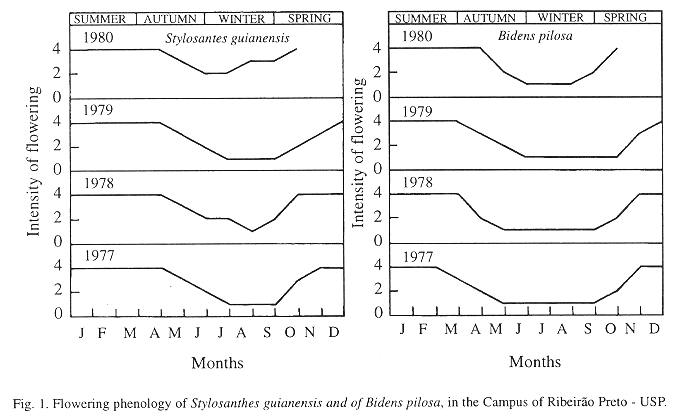
<body><![CDATA[<p><font face="Arial,Helvetica"><font size=-1>Plants visited by <i>Trimeria howardi </i>were censured by sweeping the plants with flowers according to <a href="#Sakagami">Sakagami &amp; Matsumura (1967)</a>.</font></font>     <p><font face="Arial,Helvetica"><font size=-1>The flowering intensity was rated as: 1- rare; 2- some; 3- quite, and 4- large number of plants with flowers.</font></font>     <p><font face="Arial,Helvetica"><font size=-1>The frequency of nests of <i>T. howardi</i> was estimated by a monthly census in five nesting sites. For this, quadrats were set as follows: analysis 40 quadrats of<i> </i>1 600 m2 (site A), 16 of 400 m2 (site B), 66 of 400 m<sup>2 </sup>(site C), 25 of 25 m<sup>2</sup> (site D) and 20 of 25 m<sup>2</sup> (site E).</font></font>     <p><font face="Arial,Helvetica"><font size=-1>Each nest found was coded, mapped, enumerated with a plastic plate and afterwards fixed near the nest. In the initial phase of this investigation the old nests (commonly scars) were marked with a nail close to the nests to record probable reactivations.</font></font>     <p><font face="Arial,Helvetica"><font size=-1>All new nests recorded after each census were considered new foundations and "active nests" were those with adults (males or females). In this species, the adults lack diapause in all periods of the year.</font></font>     <p><font face="Arial,Helvetica"><font size=-1>The seasonal variations of the stages of development of the immature presents in the nests, as well as of the flight of the wasps were registered through daily observations and periodic excavations of the nests.</font></font>     <p><font face="Arial,Helvetica"><font size=-1>To verify if there were differences among the proportions of founded nests according to the rainfall (or temperature) and the year under consideration was calculated: X<sup>2</sup>, Pearson's contingency coefficient (C), and Goodman’s test.</font></font>     <p><font face="Arial,Helvetica"><font size=-1>Months classification was based on monthly mean temperatures, and in the Index of effectiveness of the rainfall.</font></font>     <p><font face="Arial,Helvetica"><font size=-1>The monthly activity index was calculated by dividing daily flights frequency, to the frequency of monthly observations. Observations were organized fortnightly (during winter) and weekly (others seasons). Every daily observation period involved twelve hours (6:00 AM to 18:00 PM).</font></font>     <p><font face="Arial,Helvetica"><font size=-1>The area maps containning the nesting sites, and nests location can be seen in <a href="#Mechi81">Mechi (1981)</a>, and <a href="#Mechi83">Mechi (in press)</a>.</font></font>     ]]></body>
<body><![CDATA[<p><font face="Arial,Helvetica"><font size=-1>The specimens of the <i>T. howardi</i> was deposited by Soichi F. Sakagami at Hyogo University Agriculture Museum of Kobe University, Japan.</font></font>     <br>&nbsp;     <p><b><font face="Arial,Helvetica"><font size=-1>Results</font></font></b>     <p><font face="Arial,Helvetica"><font size=-1>Visited plants: During the present study, <i>Trimeria howardi </i>visited four species of plants, of two botanical families: <i>Bidens pilosa </i>L. (Asteraceae); <i>Xanthium spinosum </i>L. (Asteraceae); <i>Stylosanthes guianensis </i>(Aulb.) Sw. (Leguminosae), and <i>Zornia diphylla </i>(L.) Pers. (Leguminosae). <i>B. pilosa </i>and <i>S. guianensis</i> were the species of plants more visited by <i>T. howardi.</i></font></font>     <p><font face="Arial,Helvetica"><font size=-1>The largest flowering intensities of <i>S. guianensis </i>and of <i>B. pilosa </i>occurred in the spring and summer, periods peak activity of the species (<a href="#fig1">Fig. 1</a>).</font></font>     <br>&nbsp;     <br>&nbsp;     <br>     <center>     <p><a NAME="fig1"></a><img SRC="/img/fbpe/rbt/v47n4/0420i1.GIF" height=418 width=678></center>      
]]></body>
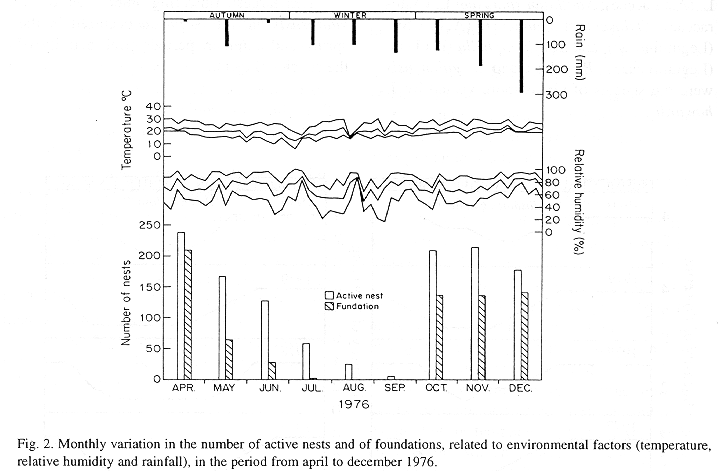
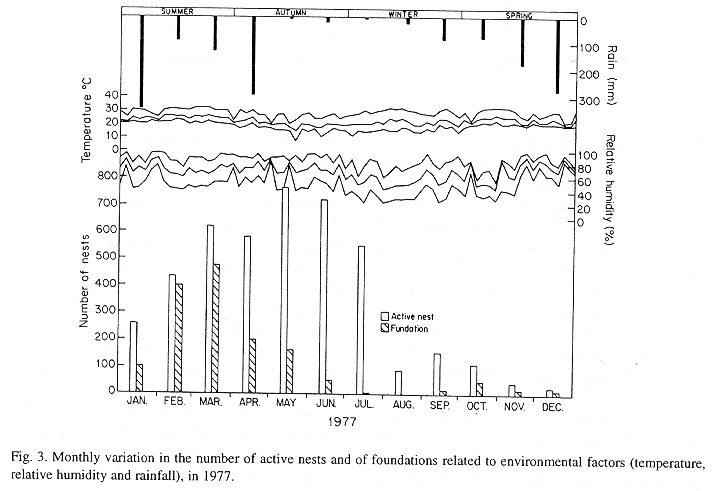
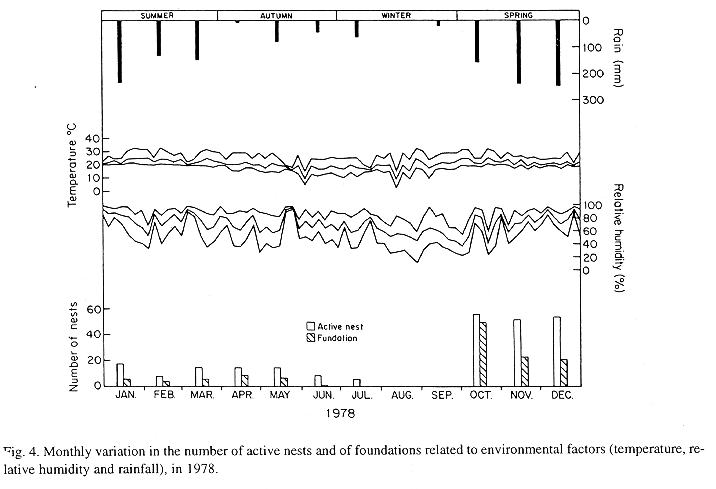
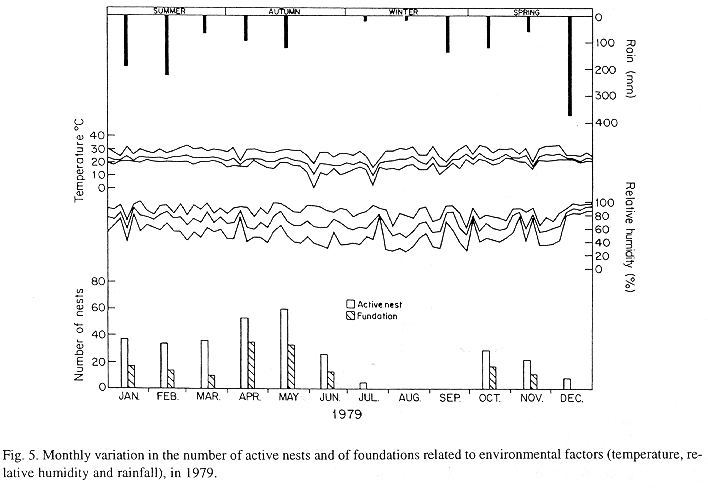
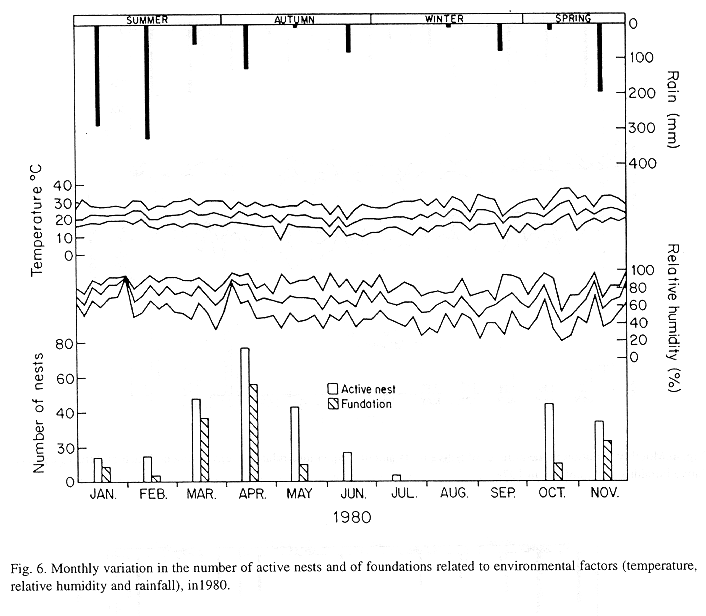
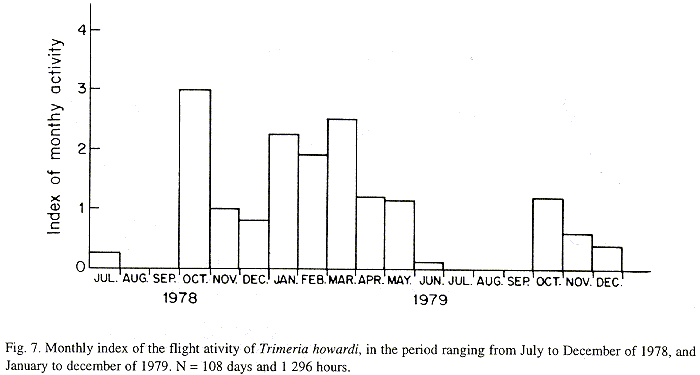
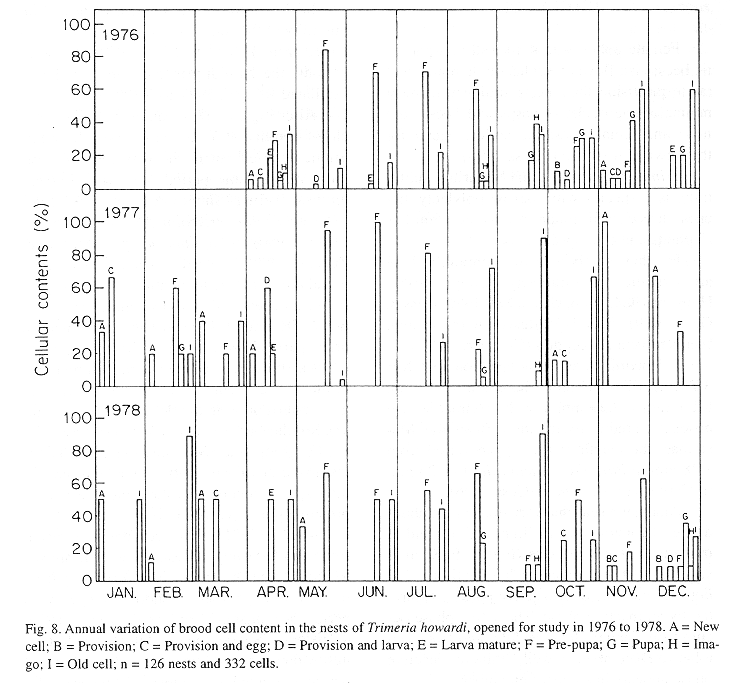
<body><![CDATA[<p>    <br>     <br>     <br>     <p><font face="Arial,Helvetica"><font size=-1><b>Annual cycle of activity:</b> Along the study 2739 nests were studied , in 5 nesting sites,with the following distribution: 2598 nests (Area A); 90(B); 11(C); 26(D), and 14(E).</font></font>     <p><font face="Arial,Helvetica"><font size=-1>The monthly variations in the number of active nests and of foundations, related with the environmental factors ( rainfall, temperature and relative humidity), are shown in the Figs.<a href="#fig2"> 2</a> to <a href="#fig6">6</a>. In addition, monthly indexes of flight activity, and monthly variations on immature development stages present in cells are shown in the<a href="#fig7"> Figs. 7</a> and <a href="#fig8">8</a>, respectively.</font></font>     <p><font face="Arial,Helvetica"><font size=-1>In general, a relatively large number of active nests, foundations, immature in several developmental stages, and high flight activity were observed during the spring, summer and autumn. Conversely, low frequency or absence of foundations, and flight activity was verified in the winter (<a href="#fig2">Figs. 2</a> to <a href="#fig8">8</a>). At winter beginning, only immatures in the pre-pupa stage, were found in cell. At the end of this period, retaking on the development of the immature, starts. Effectively, immature in the pre-pupa stage, pupa and imago appear (<a href="#fig8">Fig. 8</a>).</font></font>     <p><font face="Arial,Helvetica"><font size=-1>Trying to verify relationships between period of abundance of foundations and environmental factors, statistical tests, were used. The analysis of the association test between year and rainfall in relation to founded nests, showed that association exists between year, rainfall and frequency of founded nests (X<sup>2</sup> calculated = 385.72 X<sup>2</sup> critical = 15.51), but the association degree was little pronounced (C = 0.36).</font></font>     <p><font face="Arial,Helvetica"><font size=-1>On the other hand, analysis of the association between year and classified temperature, in relation to founded nests, it showed that association exists between year, temperature, and founded nests (X<sup>2</sup> calculated = 178.0852 X<sup>2</sup> critical = 9.49), but the association degree was little pronounced (C = 0.2209).</font></font>     <p><font face="Arial,Helvetica"><font size=-1>The results of the contrast among proportions of founded nests, in relationship to rainfall, inside each of the multinomials (year), were as proceed: For 1976, the proportion of founded nests follows the following order: Very humid arid humid. In 1977, humid very humid arid. For the very humid 1978 year, (humid =arid). In relation to 1979, arid (very humid =humid). For 1980, very humid humid arid.</font></font>     ]]></body>
<body><![CDATA[<p><font face="Arial,Helvetica"><font size=-1>The test of the contrast among proportions of foundations in relation to classified temperature, inside each multinomials (year) presented the following results: For 1976, the proportion of founded nests was higher in the periods classified as tropical. In 1977, the proportions did not differ from tropical to sub-tropical. In the tropical year of 1978, sub-tropical. Whereas, in 1978, sub-tropical tropical. Finally , in 1989, tropical sub-tropical.</font></font>     <br>&nbsp;     <br>&nbsp;     <p><a NAME="fig2"></a><img SRC="/img/fbpe/rbt/v47n4/0420i2.GIF" height=471 width=718>     
<br>&nbsp;     <br>&nbsp;     <br>     <center>     <p><a NAME="fig3"></a><img SRC="/img/fbpe/rbt/v47n4/0420i3.GIF" height=491 width=714>     
<br>&nbsp;     ]]></body>
<body><![CDATA[<br>&nbsp;     <br>&nbsp;     <br>&nbsp;     <p><a NAME="fig4"></a><img SRC="/img/fbpe/rbt/v47n4/0420i4.GIF" height=489 width=716>     
<br>&nbsp;     <br>&nbsp;     <p><a NAME="fig5"></a><img SRC="/img/fbpe/rbt/v47n4/0420i5.GIF" height=488 width=708>     
<br>&nbsp;     <br>&nbsp;     <p><a NAME="fig6"></a><img SRC="/img/fbpe/rbt/v47n4/0420i6.GIF" height=616 width=706>     
]]></body>
<body><![CDATA[<br>&nbsp;     <br>&nbsp;     <br>&nbsp;     <br>&nbsp;     <p><a NAME="fig7"></a><img SRC="/img/fbpe/rbt/v47n4/0420i7.GIF" height=375 width=700>     
<br>&nbsp;     <br>&nbsp;     <p><a NAME="fig8"></a><img SRC="/img/fbpe/rbt/v47n4/0420i8.GIF" height=683 width=731></center>      
<p>    <br>     ]]></body>
<body><![CDATA[<br>     <p><b><font face="Arial,Helvetica"><font size=-1>Discussion</font></font></b>     <p><font face="Arial,Helvetica"><font size=-1>Female pollen wasps, like all non-parasitic bees, visit flower to collect pollen and nectar to provision their nests similarly to most nonmasarinae aculeate wasps and bees, both male and female masarine collect nectar for their own nourishment (<a href="#Gess96">Gess 1996</a>).</font></font>     <p><font face="Arial,Helvetica"><font size=-1><i>Trimeria howardi</i>, in the Masarinae subfamily, is a species with narrow polylecty, because it collected pollen in only two families of plants and four species.</font></font>     <p><font face="Arial,Helvetica"><font size=-1>In other members of this subfamily there are evidence of oligolecty (<a href="#Cooper">Cooper 1952</a>, <a href="#Houston84">Houston 1984</a>, <a href="#Houston86">1986</a>, <a href="#Gess92">Gess 1992</a>, <a href="#Gess96">1996</a>, <a href="#Gess89">Gess &amp; Gess 1989</a>). Brood polylecty, in this group, seems to be an exception (<a href="#Gess96">Gess 1996</a>).</font></font>     <p><font face="Arial,Helvetica"><font size=-1><i>T. howardi</i> have a prolonged tongue (`X = 3,74 mm, SD = 0,25 mm; Maximum = 4,37mm, Minimum = 3,29 mm, n = 82), retractile proboscis, and reduced paraglossa. In another Masarinae, the length of the tongue varied from 1.48 mm in <i>Paragia odyneuroides</i> to 6.23 mm in <i>Ceramius metanotalis</i> (<a href="#Gess96">Gess 1996</a>).</font></font>     <p><font face="Arial,Helvetica"><font size=-1>Analysing seasonal variations in the abundance of foundations, in flight activity and in immatures stages in nests (<a href="#fig2">Figs. 2</a> to <a href="#fig8">8</a>), it is sugested that the annual cycle of activity of <i>T. howardi </i>consists of two active phases, separated by an inactive phase. The active phase occurs from January to June-July, and from October to December, as well; while the inactive phase appears in August-September.</font></font>     <p><font face="Arial,Helvetica"><font size=-1>In the active phases, nest foundations occur allied to flight activity and immatures’ presence according to various developmented stages. Conversely, in the inactive phase were noticed absence of foundations and of flight activity (<a href="#fig2">Figs. 2</a> to<a href="#fig8"> 8</a>) were the rule. In general, active nests collected in the winter contained senile females or males, and the new nests contained only a shaft (<a href="#Mechi81">Mechi, 1981</a>).</font></font>     <p><font face="Arial,Helvetica"><font size=-1>The results of the tests among the proportions of founded nests, in relation to rainfall and temperature, inside each year (multinomials), showed that larger proportions of founded nests happened in the periods classified as very humid, humid and tropical.</font></font>     <p><font face="Arial,Helvetica"><font size=-1>In the periods with absence of nests, the humidity of the soil (from surface 20 cm deep) varied from 13.7 % to 17.10 % . In the other periods, the humidity in the same soil layer, oscillated from 12.59 % to 51.09 %.</font></font>     ]]></body>
<body><![CDATA[<p><font face="Arial,Helvetica"><font size=-1>After <a href="#fig2">Figs. 2</a> to<a href="#fig7">7</a>, it can be stated that cycle of activity of <i>T. howardi</i> is synchronous. Studies carried out in the Ribeir&atilde;o Preto region, in the same period, involving <i>Polybia paulista </i>Ihering(<a href="#Simões">Sim&otilde;es &amp; Mechi 1983</a>), <i>Polistes versicolor versicolor </i>(Olivier)(<a href="#Gobbi">Gobbi &amp; Zucchi 1980</a>) and <i>Spilomena sp</i>. (<a href="#Carvalho">Carvalho &amp; Zucchi 1989</a>) showed asynchronous nest’s foundation, that is, foundations occur all year round independently of environmental conditions. Decreased foundations abundance in driest periods, were observed in those groups.</font></font>     <p><font face="Arial,Helvetica"><font size=-1>The presence of only pre-pupa immatures in the period of June- July in <i>T. howardi,</i> suggests interruption in the development (diapause). Similar fact occurs in the other Masarinae. In the group, the overwintering stage is the last-instar larva, which after it has finished feeding spin a cocoon and then enters a resting prepupal phase (<a href="#Gess96">Gess 1996</a>).</font></font>     <p><font face="Arial,Helvetica"><font size=-1><a href="#Mechi81">Mechi (1981)</a> evidences diapause occurrence, in the study of nests’ cicle in <i>T. howardi. </i>Nests founded in the period ranging from october to may presented shorter ontogenetical period, as immatures’ emergence accurred after 4-16 days when the founder female had left the nest.Moreover, nests founded at the end of that period presented an enlarged ontogenesis. Indeed, in some nests emergence of the immature occurred from 87-132 days after the founder had left the nest. So, in this species, the life cycle is bivoltine (<a href="#Zucchi">Zucchi et al 1976</a>) or multivoltine. Diapause, however is facultative, because it happens in only a generation during the year.</font></font>     <p><font face="Arial,Helvetica"><font size=-1>The life cycle pollen wasps in general, appears to be univoltine. The fligth period in winter-rainfall areas was spring to early summer, and in areas receiving spring and autumn or summer rainfall it is early summer to late summer (<a href="#Gess96">Gess 1996</a>).</font></font>     <p><font face="Arial,Helvetica"><font size=-1>Several factors have been suggested as responsible for the diapause: Temperature, humidity, photoperiod, quality and quantity of food, physiology of the female, competition for food, etc.</font></font>     <p><font face="Arial,Helvetica"><font size=-1>In temperate regions diapause is generally concerned with survival during cold winters when normal growth is not possible. In the tropics it may facilitates survival during the dry season, which is characterised by a lack of moisture and food (<a href="#Chapman">Chapman 1988</a>).</font></font>     <p><font face="Arial,Helvetica"><font size=-1>It is important to point out, that during the period when diapause happened, the values of the relative humidity and of the temperature were lower (even so, inside of the limits of the development of insects), the rain-fall was lowers (<a href="#fig2">Figs. 2</a> to<a href="#fig6"> 6</a>), food was scarce (<a href="#fig1">Fig. 1</a>), and soil dry (13.77% to 17.10%).</font></font>     <p><font face="Arial,Helvetica"><font size=-1>Besides, flutuation in the abundance of active nests and of foundations, along the year, these factors also varied from one year to another.</font></font>     <p><font face="Arial,Helvetica"><font size=-1>Several factors can be pointed as responsible for these variations: Abundance of nests in the precedent period, populational density of each nest and its composition, predators and parasites attacks, anthropic action, dispersion rates, environmental factors, etc.</font></font>     <p><font face="Arial,Helvetica"><font size=-1>In relation to the climatic factors, association tests among year, temperature, and rainfall in relation to foundations, by means of Pearson&cent;s Contingency Coefficient showed that an association exists among these variables, but association degree among them is not very stronger. The fall in the number of foundations per year, results from interactions between biotic and abiotic factors.</font></font>     ]]></body>
<body><![CDATA[<p><font face="Arial,Helvetica"><font size=-1>Ecologically it is difficult to differentiate effect-cause, and many causes that seemingly are natural consequences of the population cycles, can be just collateral effects of the cyclic changes of the population (<a href="#Pianka">Pianka 1974</a>).</font></font>     <p><font face="Arial,Helvetica"><font size=-1>High frequency of nests that are abandoned without leaving descendants (107 foundations in a sample of 116), a number relatively big of nests (26 nests and 50 cells in a sample of 119) with cell wholesales for parasites and predators, and great number of nests with offspring that were only constituted for males, can be some indicators of the variations. In this species, every females is a potential founder.</font></font>     <p><font face="Arial,Helvetica"><font size=-1>Absence of <i>T. howardi</i> in this campus, where was abundant before, is important. Although causes of such drastic changes are unknown, removal of host plants (to plant other garden species) and excessive grass trimming in the main nesting spots may have played a role.</font></font>     <br>&nbsp;     <br>&nbsp;     <br>&nbsp;     <p><b><font face="Arial,Helvetica"><font size=-1>Acknowledgements</font></font></b>     <p><font face="Arial,Helvetica"><font size=-1>This research is a part of a project financied by Funda&ccedil;&atilde;o de Amparo &agrave; Pesquisa do Estado de S&atilde;o Paulo (FAPESP), and Conselho Nacional de Desenvolvimento Cient&iacute;fico e Tecnol&oacute;gico (CNPq). Special thanks are given to Ronaldo Zucchi for his corrections on the typescript, Paulo Roberto Curi for statistical analysis, Soichi F. Sakagami (in memoriam) and Abrahan Willink (in memoriam) for identification of the species. We are also grateful to Jos&eacute; Carlos Serrano for field aid and M&aacute;rio Valentim Baio typing of the paper.</font></font>     <br>&nbsp;     <p><b><font face="Arial,Helvetica"><font size=-1>References</font></font></b>     ]]></body>
<body><![CDATA[<!-- ref --><p><a NAME="Carpenter93"></a><font face="Arial,Helvetica"><font size=-1>Carpenter, J.M. 1993. Biogeographic pattern in the Vespidae: Two views of Africa and South America 139-155. <i>In</i> P. Goldblatt (ed). Biological relationships between Africa and South America. Yale, New Haven, Connetticutt.</font></font>    &nbsp;&nbsp;&nbsp;&nbsp;&nbsp;&nbsp;&nbsp;&nbsp;[&#160;<a href="javascript:void(0);" onclick="javascript: window.open('/scielo.php?script=sci_nlinks&ref=1179981&pid=S0034-7744199900040003000001&lng=','','width=640,height=500,resizable=yes,scrollbars=1,menubar=yes,');">Links</a>&#160;]<!-- end-ref --><!-- ref --><p><a NAME="Carpenter97"></a><font face="Arial,Helvetica"><font size=-1>Carpenter, J.M. 1997. Generic classification of the Australian pollen wasps (Hymenoptera: Vespidae; Masarinae). J. Ent. Soc. 69: 384-400.</font></font>    &nbsp;&nbsp;&nbsp;&nbsp;&nbsp;&nbsp;&nbsp;&nbsp;[&#160;<a href="javascript:void(0);" onclick="javascript: window.open('/scielo.php?script=sci_nlinks&ref=1179982&pid=S0034-7744199900040003000002&lng=','','width=640,height=500,resizable=yes,scrollbars=1,menubar=yes,');">Links</a>&#160;]<!-- end-ref --><!-- ref --><p><a NAME="Carvalho"></a><font face="Arial,Helvetica"><font size=-1>Carvalho, L.M. &amp; R. Zucchi. 1989. Aspectos fenol&oacute;gicos de <i>Spilomena sp</i> (Hymenoptera, Sphecidae, Pemphredoninae). Rev. Brasil. Biol. 49: 799-807.</font></font>    &nbsp;&nbsp;&nbsp;&nbsp;&nbsp;&nbsp;&nbsp;&nbsp;[&#160;<a href="javascript:void(0);" onclick="javascript: window.open('/scielo.php?script=sci_nlinks&ref=1179983&pid=S0034-7744199900040003000003&lng=','','width=640,height=500,resizable=yes,scrollbars=1,menubar=yes,');">Links</a>&#160;]<!-- end-ref --><!-- ref --><p><a NAME="Chapman"></a><font face="Arial,Helvetica"><font size=-1>Chapman, R.F. 1988. Structure and Function. Elsevier, New York. 819 p.</font></font>    &nbsp;&nbsp;&nbsp;&nbsp;&nbsp;&nbsp;&nbsp;&nbsp;[&#160;<a href="javascript:void(0);" onclick="javascript: window.open('/scielo.php?script=sci_nlinks&ref=1179984&pid=S0034-7744199900040003000004&lng=','','width=640,height=500,resizable=yes,scrollbars=1,menubar=yes,');">Links</a>&#160;]<!-- end-ref --><!-- ref --><p><a NAME="Cooper"></a><font face="Arial,Helvetica"><font size=-1>Cooper, K.W. 1952. Records and flower preferences of Masaridae wasps. II. Polytropy or oligotropy in <i>Pseudomasaris</i> (Hymenoptera, Vespidae). Amer. Midland Nat. 48:103-110.</font></font>    &nbsp;&nbsp;&nbsp;&nbsp;&nbsp;&nbsp;&nbsp;&nbsp;[&#160;<a href="javascript:void(0);" onclick="javascript: window.open('/scielo.php?script=sci_nlinks&ref=1179985&pid=S0034-7744199900040003000005&lng=','','width=640,height=500,resizable=yes,scrollbars=1,menubar=yes,');">Links</a>&#160;]<!-- end-ref --><!-- ref --><p><a NAME="Gess92"></a><font face="Arial,Helvetica"><font size=-1>Gess, S.K. 1992. Biogeography of the masarine wasps (Hymenoptera: Vespidae: Masaridae), With particular emphasis on the southern African taxa and on correlations between masarine and forage plant distributions. J. Biogeogr. 19: 491-503.</font></font>    &nbsp;&nbsp;&nbsp;&nbsp;&nbsp;&nbsp;&nbsp;&nbsp;[&#160;<a href="javascript:void(0);" onclick="javascript: window.open('/scielo.php?script=sci_nlinks&ref=1179986&pid=S0034-7744199900040003000006&lng=','','width=640,height=500,resizable=yes,scrollbars=1,menubar=yes,');">Links</a>&#160;]<!-- end-ref --><!-- ref --><p><a NAME="Gess96"></a><font face="Arial,Helvetica"><font size=-1>Gess, S.K. 1996. The pollen wasps. Ecology and Natural History of the Masarinae. Harvard University, Cambridge. 340 p.</font></font>    &nbsp;&nbsp;&nbsp;&nbsp;&nbsp;&nbsp;&nbsp;&nbsp;[&#160;<a href="javascript:void(0);" onclick="javascript: window.open('/scielo.php?script=sci_nlinks&ref=1179987&pid=S0034-7744199900040003000007&lng=','','width=640,height=500,resizable=yes,scrollbars=1,menubar=yes,');">Links</a>&#160;]<!-- end-ref --><!-- ref --><p><a NAME="Gess89"></a><font face="Arial,Helvetica"><font size=-1>Gess, S.K. &amp; F.W. Gess, 1989. Flower visiting by masarid wasps in Southern Africa (Hymenoptera: Vespidae: Masarinae). Ann. Cape Prov. Mus. (Nat. Hist.) 18: 95-134.</font></font>    &nbsp;&nbsp;&nbsp;&nbsp;&nbsp;&nbsp;&nbsp;&nbsp;[&#160;<a href="javascript:void(0);" onclick="javascript: window.open('/scielo.php?script=sci_nlinks&ref=1179988&pid=S0034-7744199900040003000008&lng=','','width=640,height=500,resizable=yes,scrollbars=1,menubar=yes,');">Links</a>&#160;]<!-- end-ref --><!-- ref --><p><a NAME="Gobbi"></a><font face="Arial,Helvetica"><font size=-1>Gobbi, N.&amp; R. Zucchi. 1980. On the ecology of <i>Polistes versicolor versicolor</i> (Oliver) in southern Brasil. I – Phenological account. Naturalia 5: 97-104.</font></font>    &nbsp;&nbsp;&nbsp;&nbsp;&nbsp;&nbsp;&nbsp;&nbsp;[&#160;<a href="javascript:void(0);" onclick="javascript: window.open('/scielo.php?script=sci_nlinks&ref=1179989&pid=S0034-7744199900040003000009&lng=','','width=640,height=500,resizable=yes,scrollbars=1,menubar=yes,');">Links</a>&#160;]<!-- end-ref --><!-- ref --><p><a NAME="Houston84"></a><font face="Arial,Helvetica"><font size=-1>Houston, T.F. 1984. Bionomic of a pollen-collecting wasp, <i>Paragia tricolor</i> wasps (Hymenoptera: Vespidae; Masarinae) in Western Australia. Rec. West. Aust. Mus. 11: 141-151.</font></font>    &nbsp;&nbsp;&nbsp;&nbsp;&nbsp;&nbsp;&nbsp;&nbsp;[&#160;<a href="javascript:void(0);" onclick="javascript: window.open('/scielo.php?script=sci_nlinks&ref=1179990&pid=S0034-7744199900040003000010&lng=','','width=640,height=500,resizable=yes,scrollbars=1,menubar=yes,');">Links</a>&#160;]<!-- end-ref --><!-- ref --><p><a NAME="Houston86"></a><font face="Arial,Helvetica"><font size=-1>Houston, T.F. 1986. Biological notes on the pollen wasp, <i>Paragia</i> <i>(Cygnaea) vespiforms</i> (Hymenoptera: Vespidae: Masarinae) with description of a nest. Aust. Ent. Mag. 12: 115-119.</font></font>    &nbsp;&nbsp;&nbsp;&nbsp;&nbsp;&nbsp;&nbsp;&nbsp;[&#160;<a href="javascript:void(0);" onclick="javascript: window.open('/scielo.php?script=sci_nlinks&ref=1179991&pid=S0034-7744199900040003000011&lng=','','width=640,height=500,resizable=yes,scrollbars=1,menubar=yes,');">Links</a>&#160;]<!-- end-ref --><!-- ref --><p><a NAME="Malyshev"></a><font face="Arial,Helvetica"><font size=-1>Malyshev, S.I. 1968. Genesis of the Hymenoptera and phase of their evolution. Methuen, London. 319p.</font></font>    &nbsp;&nbsp;&nbsp;&nbsp;&nbsp;&nbsp;&nbsp;&nbsp;[&#160;<a href="javascript:void(0);" onclick="javascript: window.open('/scielo.php?script=sci_nlinks&ref=1179992&pid=S0034-7744199900040003000012&lng=','','width=640,height=500,resizable=yes,scrollbars=1,menubar=yes,');">Links</a>&#160;]<!-- end-ref --><!-- ref --><p><a NAME="Mechi81"></a><font face="Arial,Helvetica"><font size=-1>Mechi, M.R. 1981. Estudo da ecologia de <i>Trimeria howardi</i> (Masaridae, Vespoidea). Tese de Mestrado em Ecologia e Recursos Naturais, Universidade Ferderal de S&atilde;o Carlos, S&atilde;o Carlos, S&atilde;o Paulo, Brasil.</font></font>    &nbsp;&nbsp;&nbsp;&nbsp;&nbsp;&nbsp;&nbsp;&nbsp;[&#160;<a href="javascript:void(0);" onclick="javascript: window.open('/scielo.php?script=sci_nlinks&ref=1179993&pid=S0034-7744199900040003000013&lng=','','width=640,height=500,resizable=yes,scrollbars=1,menubar=yes,');">Links</a>&#160;]<!-- end-ref --><!-- ref --><p><a NAME="Mechi83"></a><font face="Arial,Helvetica"><font size=-1>Mechi, M.R. 1983. Nesting behavior and ditribution of nests in the pollen wasp <i>Trimeria howardi</i> (Masarinae – Vespoidea). Naturalia, in press.</font></font>    &nbsp;&nbsp;&nbsp;&nbsp;&nbsp;&nbsp;&nbsp;&nbsp;[&#160;<a href="javascript:void(0);" onclick="javascript: window.open('/scielo.php?script=sci_nlinks&ref=1179994&pid=S0034-7744199900040003000014&lng=','','width=640,height=500,resizable=yes,scrollbars=1,menubar=yes,');">Links</a>&#160;]<!-- end-ref --><!-- ref --><p><a NAME="Michener"></a><font face="Arial,Helvetica"><font size=-1>Michener, C.D. 1974. The social behavior or the bees. A comparative study. Belcknap, Cambridge. 404p.</font></font>    &nbsp;&nbsp;&nbsp;&nbsp;&nbsp;&nbsp;&nbsp;&nbsp;[&#160;<a href="javascript:void(0);" onclick="javascript: window.open('/scielo.php?script=sci_nlinks&ref=1179995&pid=S0034-7744199900040003000015&lng=','','width=640,height=500,resizable=yes,scrollbars=1,menubar=yes,');">Links</a>&#160;]<!-- end-ref --><!-- ref --><p><a NAME="Pianka"></a><font face="Arial,Helvetica"><font size=-1>Pianka, R.E. 1974. Evolutionary ecology. Harper, New York. 356 p.</font></font>    &nbsp;&nbsp;&nbsp;&nbsp;&nbsp;&nbsp;&nbsp;&nbsp;[&#160;<a href="javascript:void(0);" onclick="javascript: window.open('/scielo.php?script=sci_nlinks&ref=1179996&pid=S0034-7744199900040003000016&lng=','','width=640,height=500,resizable=yes,scrollbars=1,menubar=yes,');">Links</a>&#160;]<!-- end-ref --><!-- ref --><p><a NAME="Sakagami"></a><font face="Arial,Helvetica"><font size=-1>Sakagami, S. &amp; T. Matsumura. 1967. Relative abundance, Phenology and preference of andrenid bees in Sapporo, north Japan (Hymenoptera, Apoidea). Jap. J. Ecol. 17: 237-251.</font></font>    &nbsp;&nbsp;&nbsp;&nbsp;&nbsp;&nbsp;&nbsp;&nbsp;[&#160;<a href="javascript:void(0);" onclick="javascript: window.open('/scielo.php?script=sci_nlinks&ref=1179997&pid=S0034-7744199900040003000017&lng=','','width=640,height=500,resizable=yes,scrollbars=1,menubar=yes,');">Links</a>&#160;]<!-- end-ref --><!-- ref --><p><a NAME="Simões"></a><font face="Arial,Helvetica"><font size=-1>Sim&otilde;es, D. &amp; M.R. Mechi. 1983. Estudo sobre a fenologia de <i>Polybia (Myapetra) paulista</i> Ihering, 1896 (Hymenoptera, Vespidae). Naturalia 8: 185-191.</font></font>    &nbsp;&nbsp;&nbsp;&nbsp;&nbsp;&nbsp;&nbsp;&nbsp;[&#160;<a href="javascript:void(0);" onclick="javascript: window.open('/scielo.php?script=sci_nlinks&ref=1179998&pid=S0034-7744199900040003000018&lng=','','width=640,height=500,resizable=yes,scrollbars=1,menubar=yes,');">Links</a>&#160;]<!-- end-ref --><!-- ref --><p><a NAME="Zucchi"></a><font face="Arial,Helvetica"><font size=-1>Zucchi, R., S. Yamane &amp; S. Sakagami. 1976. Preliminary notes on the habits of <i>Trimeria howardi</i> a neotropical communal masarid wasp, with description of the mature larva (Hymenoptera: Vespoidea). Ins. Matsum. 8: 47-57.</font></font>    &nbsp;&nbsp;&nbsp;&nbsp;&nbsp;&nbsp;&nbsp;&nbsp;[&#160;<a href="javascript:void(0);" onclick="javascript: window.open('/scielo.php?script=sci_nlinks&ref=1179999&pid=S0034-7744199900040003000019&lng=','','width=640,height=500,resizable=yes,scrollbars=1,menubar=yes,');">Links</a>&#160;]<!-- end-ref --><p><a NAME="1a"></a><font face="Arial,Helvetica"><font size=-1><sup><a href="#1">1</a></sup> Departamento de Biologia, Faculdade de Filosofia Ci&ecirc;ncias e Letras de Ribeir&atilde;o Preto, Universidade de</font></font>     ]]></body>
<body><![CDATA[<br><font face="Arial,Helvetica"><font size=-1>&nbsp;&nbsp; S&atilde;o Paulo, 14040-901, Ribeir&atilde;o Preto, SP, Brasil. Fax (016) 633 5015. E-mail: <a href="mailto:baiomv@usp.br">baiomv@usp.br</a></font></font>      ]]></body><back>
<ref-list>
<ref id="B1">
<nlm-citation citation-type="book">
<person-group person-group-type="author">
<name>
<surname><![CDATA[Carpenter]]></surname>
<given-names><![CDATA[J.M]]></given-names>
</name>
</person-group>
<article-title xml:lang="en"><![CDATA[Biogeographic pattern in the Vespidae: Two views of Africa and South America]]></article-title>
<person-group person-group-type="editor">
<name>
<surname><![CDATA[Goldblatt]]></surname>
<given-names><![CDATA[P]]></given-names>
</name>
</person-group>
<source><![CDATA[Biological relationships between Africa and South America]]></source>
<year>1993</year>
<page-range>139-155</page-range><publisher-loc><![CDATA[New Haven^eConnetticutt Connetticutt]]></publisher-loc>
<publisher-name><![CDATA[Yale]]></publisher-name>
</nlm-citation>
</ref>
<ref id="B2">
<nlm-citation citation-type="journal">
<person-group person-group-type="author">
<name>
<surname><![CDATA[Carpenter]]></surname>
<given-names><![CDATA[J.M]]></given-names>
</name>
</person-group>
<article-title xml:lang="en"><![CDATA[Generic classification of the Australian pollen wasps (Hymenoptera: Vespidae; Masarinae)]]></article-title>
<source><![CDATA[J. Ent. Soc]]></source>
<year>1997</year>
<volume>69</volume>
<page-range>384-400</page-range></nlm-citation>
</ref>
<ref id="B3">
<nlm-citation citation-type="journal">
<person-group person-group-type="author">
<name>
<surname><![CDATA[Carvalho]]></surname>
<given-names><![CDATA[L.M]]></given-names>
</name>
<name>
<surname><![CDATA[Zucchi]]></surname>
<given-names><![CDATA[R]]></given-names>
</name>
</person-group>
<article-title xml:lang="es"><![CDATA[Aspectos fenológicos de Spilomena sp (Hymenoptera, Sphecidae, Pemphredoninae)]]></article-title>
<source><![CDATA[Rev. Brasil. Biol]]></source>
<year>1989</year>
<volume>49</volume>
<page-range>799-807</page-range></nlm-citation>
</ref>
<ref id="B4">
<nlm-citation citation-type="book">
<person-group person-group-type="author">
<name>
<surname><![CDATA[Chapman]]></surname>
<given-names><![CDATA[R.F]]></given-names>
</name>
</person-group>
<source><![CDATA[Structure and Function]]></source>
<year>1988</year>
<publisher-loc><![CDATA[New York ]]></publisher-loc>
<publisher-name><![CDATA[Elsevier]]></publisher-name>
</nlm-citation>
</ref>
<ref id="B5">
<nlm-citation citation-type="journal">
<person-group person-group-type="author">
<name>
<surname><![CDATA[Cooper]]></surname>
<given-names><![CDATA[K.W]]></given-names>
</name>
</person-group>
<article-title xml:lang="en"><![CDATA[Records and flower preferences of Masaridae wasps. II. Polytropy or oligotropy in Pseudomasaris (Hymenoptera, Vespidae)]]></article-title>
<source><![CDATA[Amer. Midland Nat]]></source>
<year>1952</year>
<volume>48</volume>
<page-range>103-110</page-range></nlm-citation>
</ref>
<ref id="B6">
<nlm-citation citation-type="journal">
<person-group person-group-type="author">
<name>
<surname><![CDATA[Gess]]></surname>
<given-names><![CDATA[S.K]]></given-names>
</name>
</person-group>
<article-title xml:lang="en"><![CDATA[Biogeography of the masarine wasps (Hymenoptera: Vespidae: Masaridae), With particular emphasis on the southern African taxa and on correlations between masarine and forage plant distributions]]></article-title>
<source><![CDATA[J. Biogeogr]]></source>
<year>1992</year>
<volume>19</volume>
<page-range>491-503</page-range></nlm-citation>
</ref>
<ref id="B7">
<nlm-citation citation-type="book">
<person-group person-group-type="author">
<name>
<surname><![CDATA[Gess]]></surname>
<given-names><![CDATA[S.K]]></given-names>
</name>
</person-group>
<source><![CDATA[The pollen wasps. Ecology and Natural History of the Masarinae]]></source>
<year>1996</year>
<publisher-loc><![CDATA[Cambridge ]]></publisher-loc>
<publisher-name><![CDATA[Harvard University]]></publisher-name>
</nlm-citation>
</ref>
<ref id="B8">
<nlm-citation citation-type="journal">
<person-group person-group-type="author">
<name>
<surname><![CDATA[Gess]]></surname>
<given-names><![CDATA[S.K]]></given-names>
</name>
<name>
<surname><![CDATA[Gess]]></surname>
<given-names><![CDATA[F.W]]></given-names>
</name>
</person-group>
<article-title xml:lang="en"><![CDATA[Flower visiting by masarid wasps in Southern Africa (Hymenoptera: Vespidae: Masarinae)]]></article-title>
<source><![CDATA[Ann. Cape Prov. Mus. (Nat. Hist.)]]></source>
<year>1989</year>
<volume>18</volume>
<page-range>95-134</page-range></nlm-citation>
</ref>
<ref id="B9">
<nlm-citation citation-type="journal">
<person-group person-group-type="author">
<name>
<surname><![CDATA[Gobbi]]></surname>
<given-names><![CDATA[N]]></given-names>
</name>
<name>
<surname><![CDATA[Zucchi]]></surname>
<given-names><![CDATA[R]]></given-names>
</name>
</person-group>
<article-title xml:lang="en"><![CDATA[On the ecology of Polistes versicolor versicolor (Oliver) in southern Brasil: I - Phenological account]]></article-title>
<source><![CDATA[Naturalia]]></source>
<year>1980</year>
<volume>5</volume>
<page-range>97-104</page-range></nlm-citation>
</ref>
<ref id="B10">
<nlm-citation citation-type="journal">
<person-group person-group-type="author">
<name>
<surname><![CDATA[Houston]]></surname>
<given-names><![CDATA[T.F]]></given-names>
</name>
</person-group>
<article-title xml:lang="en"><![CDATA[Bionomic of a pollen-collecting wasp, Paragia tricolor wasps (Hymenoptera: Vespidae; Masarinae) in Western Australia]]></article-title>
<source><![CDATA[Rec. West. Aust. Mus]]></source>
<year>1984</year>
<volume>11</volume>
<page-range>141-151</page-range></nlm-citation>
</ref>
<ref id="B11">
<nlm-citation citation-type="journal">
<person-group person-group-type="author">
<name>
<surname><![CDATA[Houston]]></surname>
<given-names><![CDATA[T.F]]></given-names>
</name>
</person-group>
<article-title xml:lang="en"><![CDATA[Biological notes on the pollen wasp, Paragia (Cygnaea) vespiforms (Hymenoptera: Vespidae: Masarinae) with description of a nest]]></article-title>
<source><![CDATA[Aust. Ent. Mag]]></source>
<year>1986</year>
<volume>12</volume>
<page-range>115-119</page-range></nlm-citation>
</ref>
<ref id="B12">
<nlm-citation citation-type="book">
<person-group person-group-type="author">
<name>
<surname><![CDATA[Malyshev]]></surname>
<given-names><![CDATA[S.I]]></given-names>
</name>
</person-group>
<source><![CDATA[Genesis of the Hymenoptera and phase of their evolution]]></source>
<year>1968</year>
<publisher-loc><![CDATA[London ]]></publisher-loc>
<publisher-name><![CDATA[Methuen]]></publisher-name>
</nlm-citation>
</ref>
<ref id="B13">
<nlm-citation citation-type="">
<person-group person-group-type="author">
<name>
<surname><![CDATA[Mechi]]></surname>
<given-names><![CDATA[M.R]]></given-names>
</name>
</person-group>
<source><![CDATA[Estudo da ecologia de Trimeria howardi (Masaridae, Vespoidea)]]></source>
<year>1981</year>
</nlm-citation>
</ref>
<ref id="B14">
<nlm-citation citation-type="journal">
<person-group person-group-type="author">
<name>
<surname><![CDATA[Mechi]]></surname>
<given-names><![CDATA[M.R]]></given-names>
</name>
</person-group>
<article-title xml:lang="en"><![CDATA[Nesting behavior and ditribution of nests in the pollen wasp Trimeria howardi (Masarinae - Vespoidea)]]></article-title>
<source><![CDATA[Naturalia]]></source>
<year>1983</year>
</nlm-citation>
</ref>
<ref id="B15">
<nlm-citation citation-type="book">
<person-group person-group-type="author">
<name>
<surname><![CDATA[Michener]]></surname>
<given-names><![CDATA[C.D]]></given-names>
</name>
</person-group>
<source><![CDATA[The social behavior or the bees. A comparative study]]></source>
<year>1974</year>
<page-range>404</page-range><publisher-loc><![CDATA[Cambridge ]]></publisher-loc>
<publisher-name><![CDATA[Belcknap]]></publisher-name>
</nlm-citation>
</ref>
<ref id="B16">
<nlm-citation citation-type="book">
<person-group person-group-type="author">
<name>
<surname><![CDATA[Pianka]]></surname>
<given-names><![CDATA[R.E]]></given-names>
</name>
</person-group>
<source><![CDATA[Evolutionary ecology]]></source>
<year>1974</year>
<page-range>356</page-range><publisher-loc><![CDATA[New York ]]></publisher-loc>
<publisher-name><![CDATA[Harper]]></publisher-name>
</nlm-citation>
</ref>
<ref id="B17">
<nlm-citation citation-type="journal">
<person-group person-group-type="author">
<name>
<surname><![CDATA[Sakagami]]></surname>
<given-names><![CDATA[S]]></given-names>
</name>
<name>
<surname><![CDATA[Matsumura]]></surname>
<given-names><![CDATA[T]]></given-names>
</name>
</person-group>
<article-title xml:lang="en"><![CDATA[Relative abundance, Phenology and preference of andrenid bees in Sapporo, north Japan (Hymenoptera, Apoidea)]]></article-title>
<source><![CDATA[Jap. J. Ecol]]></source>
<year>1967</year>
<volume>17</volume>
<page-range>237-251</page-range></nlm-citation>
</ref>
<ref id="B18">
<nlm-citation citation-type="journal">
<person-group person-group-type="author">
<name>
<surname><![CDATA[Simões]]></surname>
<given-names><![CDATA[D]]></given-names>
</name>
<name>
<surname><![CDATA[Mechi]]></surname>
<given-names><![CDATA[M.R]]></given-names>
</name>
</person-group>
<article-title xml:lang="pt"><![CDATA[Estudo sobre a fenologia de Polybia (Myapetra) paulista Ihering, 1896 (Hymenoptera, Vespidae)]]></article-title>
<source><![CDATA[Naturalia]]></source>
<year>1983</year>
<volume>8</volume>
<page-range>185-191</page-range></nlm-citation>
</ref>
<ref id="B19">
<nlm-citation citation-type="journal">
<person-group person-group-type="author">
<name>
<surname><![CDATA[Zucchi]]></surname>
<given-names><![CDATA[R]]></given-names>
</name>
<name>
<surname><![CDATA[Yamane]]></surname>
<given-names><![CDATA[S]]></given-names>
</name>
<name>
<surname><![CDATA[Sakagami]]></surname>
<given-names><![CDATA[S]]></given-names>
</name>
</person-group>
<article-title xml:lang="en"><![CDATA[Preliminary notes on the habits of Trimeria howardi a neotropical communal masarid wasp, with description of the mature larva (Hymenoptera: Vespoidea)]]></article-title>
<source><![CDATA[Ins. Matsum]]></source>
<year>1976</year>
<volume>8</volume>
<page-range>47-57</page-range></nlm-citation>
</ref>
</ref-list>
</back>
</article>