<?xml version="1.0" encoding="ISO-8859-1"?><article xmlns:mml="http://www.w3.org/1998/Math/MathML" xmlns:xlink="http://www.w3.org/1999/xlink" xmlns:xsi="http://www.w3.org/2001/XMLSchema-instance">
<front>
<journal-meta>
<journal-id>0034-7744</journal-id>
<journal-title><![CDATA[Revista de Biología Tropical]]></journal-title>
<abbrev-journal-title><![CDATA[Rev. biol. trop]]></abbrev-journal-title>
<issn>0034-7744</issn>
<publisher>
<publisher-name><![CDATA[Universidad de Costa Rica]]></publisher-name>
</publisher>
</journal-meta>
<article-meta>
<article-id>S0034-77441999000400020</article-id>
<title-group>
<article-title xml:lang="en"><![CDATA[Ultrastructure of the optic gland of the squid Sepiotheutis sepioidea (Cephalopoda: Loliginidae)]]></article-title>
</title-group>
<contrib-group>
<contrib contrib-type="author">
<name>
<surname><![CDATA[Arrieche]]></surname>
<given-names><![CDATA[Dwight]]></given-names>
</name>
<xref ref-type="aff" rid="A01"/>
</contrib>
</contrib-group>
<aff id="A01">
<institution><![CDATA[,Universidad de Oriente Instituto de Investigaciones en Biomedicina y Ciencias Aplicadas ]]></institution>
<addr-line><![CDATA[Cumaná Sucre]]></addr-line>
<country>Venezuela</country>
</aff>
<pub-date pub-type="pub">
<day>00</day>
<month>12</month>
<year>1999</year>
</pub-date>
<pub-date pub-type="epub">
<day>00</day>
<month>12</month>
<year>1999</year>
</pub-date>
<volume>47</volume>
<numero>4</numero>
<fpage>831</fpage>
<lpage>842</lpage>
<copyright-statement/>
<copyright-year/>
<self-uri xlink:href="http://www.scielo.sa.cr/scielo.php?script=sci_arttext&amp;pid=S0034-77441999000400020&amp;lng=en&amp;nrm=iso"></self-uri><self-uri xlink:href="http://www.scielo.sa.cr/scielo.php?script=sci_abstract&amp;pid=S0034-77441999000400020&amp;lng=en&amp;nrm=iso"></self-uri><self-uri xlink:href="http://www.scielo.sa.cr/scielo.php?script=sci_pdf&amp;pid=S0034-77441999000400020&amp;lng=en&amp;nrm=iso"></self-uri><abstract abstract-type="short" xml:lang="en"><p><![CDATA[I describe the fine structure of the optic gland (OG) in the tropical squid Sepiotheutis sepioidea at different sexual maturity stages. Squids were collected in Mochima National Park, Venezuela (10°; 20' 22 " - 10°; 24' N; 64° 19' - 64 ° 22' W). Morphometric characteristics and the development of reproductive organs at different sexual maturity stages (female n = 101; male n = 105), were significantly different (ANOVA, p < 0.001). The female gonadal index mean (GI = (ovary weight / body weight) x 100) between 0.1 - 2.95 %, and the male GI mean (GI = (testicule weight / body weight) x 100) oscillated between 0.22 - 1.38 %. The OG are a pair of oval organs located at the posterior edge of the optic tract of the cephalopod brain. The OG showed the same cellular types described in other cephalopods, with slight differences. The secretory cells in young individuals present a dendritic profile with thin cytoplasmic processes, numerous circular mitochondriae with tubular crests and abundant ribosomes. At the last stage of maturity the secretory cells contain rough endoplasmic reticulum in the form of dilated cisternae, with an active Golgi apparatus, secreting electron dense granules. Mitochondriae are scarce and lipofuchsin granules show an increase in size. Secretory cell nucleus length and organelle abundance showed oscillations associated with the life cycle.]]></p></abstract>
<abstract abstract-type="short" xml:lang="es"><p><![CDATA[Se examinó la ultraestructura fina de la glándula óptica (GO) en varios estadios de desarrollo sexual del calamar tropical Sepiotheutis sepioidea, proveniente de las costas de la Bahía de Mochima, Venezuela (10° 20' 22 " - 10° 24' N; 64° 19' - 64° 22' W). Los parámetros morfométricos y de los órganos reproductivos (hembras n = 101; machos n = 105), presentaron diferencias significativas entre los estados de maduración sexual (ANOVA, p < 0.001), el índice gonadal promedio en las hembras osciló entre 0.1 - 2.95 %, y en los machos entre 0.22 - 1.38 %. La GO son un par de órganos ovales ubicados en el borde posterior del tracto óptico en el cerebro de los cefalópodos, ésta posee los mismos tipos de células descritos en otros cefalópodos con algunas leves diferencias. La célula principal en el estadio de maduración juvenil posee un perfil dendrítico con delgados procesos del citoplasma, abundantes ribosomas, mitocondrias circulares con crestas tubulares, y un núcleo prominente eucromatínico; en el estadio de adulto las células principales presentan las cisternas del retículo endoplasmático rugoso dilatadas concéntricamente en la célula, el aparato de Golgi es activo con abundantes gránulos electron densos de secreción, las mitocondrias son escasas, y el gránulo de lipofucsina es de mayor tamaño. La dimensión del núcleo de la célula principal y la abundancia de organelos, presentaron oscilaciones en las etapas del ciclo de vida.]]></p></abstract>
<kwd-group>
<kwd lng="en"><![CDATA[Optic gland]]></kwd>
<kwd lng="en"><![CDATA[cephalopod]]></kwd>
<kwd lng="en"><![CDATA[Sepiotheutis sepioidea]]></kwd>
<kwd lng="en"><![CDATA[ultrastructure]]></kwd>
</kwd-group>
</article-meta>
</front><body><![CDATA[ <center><font face="Arial,Helvetica"><b>Ultrastructure of the optic gland of the squid </b><i>Sepiotheutis sepioidea</i></font>     <br><b><font face="Arial,Helvetica">(Cephalopoda: Loliginidae)</font></b><b><font face="Arial,Helvetica"><font size=-1></font></font></b>     <p><font face="Arial,Helvetica"><font size=-1><b>Dwight Arrieche&nbsp;<a NAME="1"></a></b><sup><a href="#1a">1</a></sup></font></font><font size=-1></font>     <p><font face="Arial,Helvetica"><font size=-1>Received. 9- II-1998. Corrected. 07-IV-1999 Accepted. 16-IV-1999</font></font></center> <font size=-1></font>     <p>    <br><font size=-1></font>     <p><b><font face="Arial,Helvetica"><font size=-1>Abstract</font></font></b><font face="Arial,Helvetica"><font size=-1></font></font>     <p><font face="Arial,Helvetica"><font size=-1>I describe the fine structure of the optic gland (OG) in the tropical squid <i>Sepiotheutis sepioidea</i> at different sexual maturity stages. Squids were collected in Mochima National Park, Venezuela (10&ordm; 20' 22 " — 10&ordm; 24' N; 64&ordm; 19' — 64&ordm; 22' W). Morphometric characteristics and the development of reproductive organs at different sexual maturity stages (female n = 101; male n = 105), were significantly different (ANOVA, p &lt; 0.001). The female gonadal index mean (GI = (ovary weight / body weight) x 100) between 0.1 - 2.95 %, and the male GI mean (GI = (testicule weight / body weight) x 100) oscillated between 0.22 - 1.38 %. The OG are a pair of oval organs located at the posterior edge of the optic tract of the cephalopod brain. The OG showed the same cellular types described in other cephalopods, with slight differences. The secretory cells in young individuals present a dendritic profile with thin cytoplasmic processes, numerous circular mitochondriae with tubular crests and abundant ribosomes. At the last stage of maturity the secretory cells contain rough endoplasmic reticulum in the form of dilated cisternae, with an active Golgi apparatus, secreting electron dense granules. Mitochondriae are scarce and lipofuchsin granules show an increase in size. Secretory cell nucleus length and organelle abundance showed oscillations associated with the life cycle.</font></font>     <br><font size=-1></font>&nbsp;<b><font face="Arial,Helvetica"><font size=-1></font></font></b>     <p><b><font face="Arial,Helvetica"><font size=-1>Key words</font></font></b><font face="Arial,Helvetica"><font size=-1></font></font>     ]]></body>
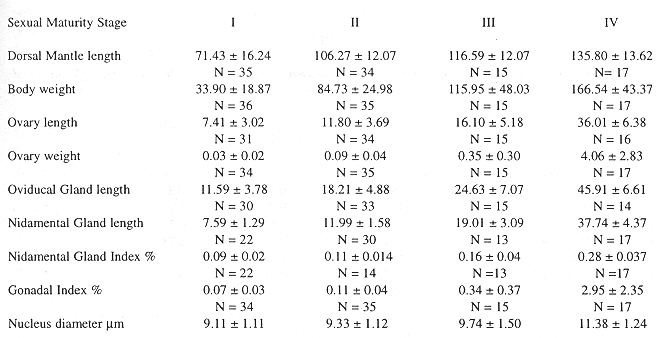
<body><![CDATA[<p><font face="Arial,Helvetica"><font size=-1>Optic gland, cephalopod, <i>Sepiotheutis sepioidea</i>, ultrastructure.</font></font>     <br><font size=-1></font>&nbsp;<font size=-1></font>     <p><font face="Arial,Helvetica"><font size=-1>In cephalopods the optic glands (OG) form a pair of oval organs located at the posterior edge of the optic brain tract, above the <i>hilum</i> of the optic lobes (<a href="#Boycott">Boycott &amp; Young 1956</a>). OG histology has been described for <i>Loligo opalescens</i>, <i>Octopus vulgaris</i>, <i>O. bimaculatus, Eledone moschata</i> and <i>Sepia officinalis</i>. The OG<i> </i>consists of main or secretory cells, blood vessels, nerve cells and support cells (<a href="#Björkman">Bj&ouml;rkman 1963</a>, <a href="#Nishioka66">Nishioka <i>et al.</i> 1966</a>, <a href="#Barber">Barber 1967</a>, <a href="#Bonichon">Bonichon 1967</a>, <a href="#Froesch74">Froesch 1974</a> and <a href="#Mangold77">Mangold &amp; Froesch 1977</a>).</font></font><font size=-1></font>     <p><font face="Arial,Helvetica"><font size=-1>The role of the OG in the cephalopod life cycle is analogous to that of the hypophysis which controls sexual development in vertebrates (<a href="#Wells59">Wells &amp; Wells, 1959</a>, <a href="#Wells69">1969</a>, <a href="#Wells60">Wells 1960</a> and <a href="#Wells75">Wells <i>et al.</i> 1975</a>). These glands also regulate protein synthesis in the ovaries, stimulate gonadal mitosis, mating behavior, feeding and longevity (<a href="#Durchon">Durchon &amp; Richard 1967</a>, <a href="#O´Dor">O&acute;Dor &amp; Wells 1973</a>, <a href="#Wells75">Wells <i>et al.</i> 1975</a>, <a href="#Wodinsky">Wodinsky 1977</a> and <a href="#Mangold87">Mangold 1987</a>). The OG hormone is species specific, not sex specific (<a href="#Wells75">Wells &amp; Wells 1975</a>), and glandular secretions have periodic oscillations associated with temperature and photoperiod (<a href="#Defretin">Defretin &amp; Richard 1967</a> and <a href="#Richard66">Richard 1966</a>, <a href="#Richard67a">1967 a</a>, <a href="#Richard67b">b</a>, <a href="#Richard70">1970</a>). The glands are controlled by a reactive peptidergic inervation (<a href="#Le Gall">Le Gall <i>et al.</i> 1988</a>), and their activity varies during the life cycle, associated with the multiplication of reproductive cells (<a href="#Koueta95">Koueta <i>et al. </i>1995</a>).</font></font><font size=-1></font>     <p><font face="Arial,Helvetica"><font size=-1>The fine structure of the gland suggests that it has several functions. <a href="#Björkman">Bj&ouml;rkman (1963)</a> suggested that the secretory cells had a high rate of synthesis. The presence of abundant mitochondriae implies that the gland may secrete a steroid hormone (<a href="#Froesch79">Froesch 1979</a>). In <i>S. officinalis</i>, however a peptidic like hormone was shown to be present in the OG and hemolymph (<a href="#Koueta92">Koueta <i>et al.</i> 1992</a>). The lipofuchsin granules have been related to the resorption of metabolic residues inside the secretory cells (<a href="#Froesch76">Froesch &amp; Mangold 1976</a>, <a href="#Mangold77">Mangold &amp; Froesch 1977</a> and Froesch <i>et al.</i> 1987).</font></font><font size=-1></font>     <p><font face="Arial,Helvetica"><font size=-1>In this study the fine ultrastructure of the tropical squid <i>Sepiotheutis sepioidea</i> (Blainville, 1823) (Cephalopoda: Loliginidae) was examined in both sexes at different sexual maturity stages, using Transmission Electron Microscope (TEM) in order to compare secretory cell changes during the life cycle of this specie.</font></font>     <br><font size=-1></font>&nbsp;<font size=-1></font>     <p><b><font face="Arial,Helvetica"><font size=-1>Materials and Methods</font></font></b><font size=-1></font>     <p><font face="Arial,Helvetica"><font size=-1>206 individuals of <i>S. sepioidea</i> were caught (net mesh size 20 mm &Oslash;) in Mochima National Park, Venezuela (10&ordm; 20' 22 " — 10&ordm; 24' N; 64&ordm; 19' — 64&ordm; 22' W). They were acclimatized in tanks (1 500 L) with running sea water, and fed <i>ad lib.</i> for at least a week (Estaci&oacute;n Jos&eacute; G. Hern&aacute;ndez, IDEA—Fundaciencias). Each specimen was weighed (body weight BW &plusmn; 0.05 g) and the dorsal mantle length (DML &plusmn; 0.1 cm) was measured before decapitation, followed by dissection of the OG, with the aid of a stereomicroscope. The OG was preserved by immersion as quoted below for light microscopy (LM) and TEM.</font></font><font size=-1></font>     <p><font face="Arial,Helvetica"><font size=-1>The mantle with the reproductive organs was preserved with 4% formalin (24 h), and then washed in running tap water and the reproductive organs were removed and measured (&plusmn; 0.05 cm; &plusmn; 0.0001 g). The sexual maturity stage was determined for each specimen as follows: juvenile (I), immature (II), in maturation (III), mature (IV), and post-reproductive (V). This last was identified only in copulating males, and post-reproductive females were not captured. The sexual maturity stages were determined using the measurements of reproductive organs quoted for this species (<a href="#Robaina">Robaina &amp; Voglar 1986</a>, <a href="#Voglar">Voglar &amp; Robaina 1987</a>), and the female sexual maturity stages were estimated using the nidamental gland index (NGI = (Nidamental Gland length/ Dorsal Mantle length)) (<a href="#Durward">Durward <i>et al</i>. 1979</a>). Gonadal index (GI) was estimated as the relationship between gonad weight and body weight, in the females the gonadal index was calculated using the formula (GI = (ovary weight / body weight) x 100), and in the males this was calculated as (GI = (testicule weight / body weight) x 100). An analysis of variance (ANOVA) was used to test for significant differences in the biometric parameters between the sexual maturity stages (females) and the dorsal mantle length intervals (males), these data were compared using an <i>a posteriori</i> Scheffe test (<a href="#Sokal">Sokal &amp; Rohlf 1981</a>).</font></font><font size=-1></font>     ]]></body>
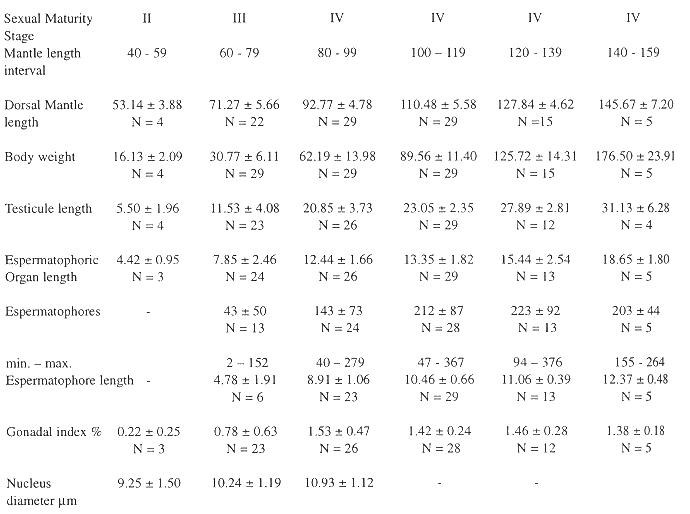
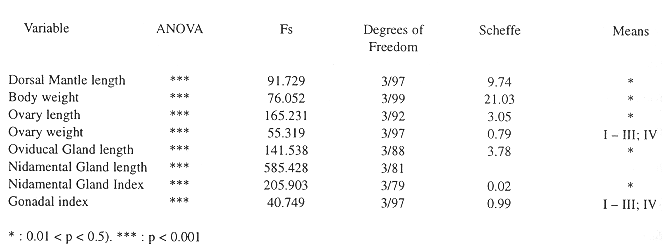
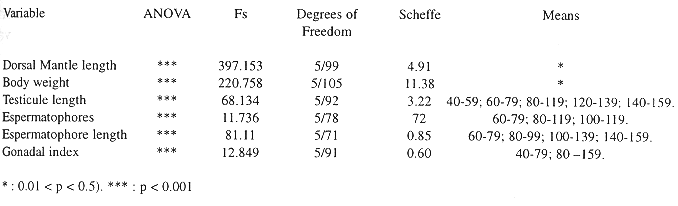
<body><![CDATA[<p><font face="Arial,Helvetica"><font size=-1>For LM, samples including the optic lobe and the optic stalk were immersed in Gilson fixative (2 - 6 h), and then well washed in running tap water, dehydrated and embedded in paraffin. Paraffin sections (6 &micro;m) were stained with Hematoxilyn-Eosin (HE), Periodic acid Schift reaction (PAS) and Herlant tetrachromic stain (Humason 1979). LM sections were analyzed using an image analysis system (Javelin Smart Cam) adapted to a light microscope, with a digital micrometer.</font></font><font size=-1></font>     <p><font face="Arial,Helvetica"><font size=-1>For TEM, the brain was prefixed by immersion in either of the following fixatives (30 min.) with some drops of 0.1% (w/v) methylene blue (vital stain)(Bern, H., pers. com.): 2.5% glutaraldehyde (GA) in 0.1M phosphate buffer saline pH 7.8; 2.5 % GA in 0.1M sodium cacodylate buffer pH 7.8; 3% GA, 20% sucrose (w/v), 0.5% CaCl<sub>2</sub>, 1% K<sub>2</sub>Cr<sub>2</sub>O<sub>7</sub>, 0.1% picric acid in 0.1 M sodium cacodylate buffer (<a href="#Evans">Evans <i>at al.</i> 1976</a>). The brain was then washed in the same buffer, and the OG dissected from the cerebral tissue followed by one hour fixation in fresh fixative. The OG was washed, post-fixed (1% OsO<sub>4</sub>, 90 min.), <i>in bloc</i> stained (2% uranyl acetate, 30 min.), and processed for conventional TEM. Thin sections were contrasted with uranyl acetate and lead citrate (<a href="#Reynolds">Reynolds 1963</a>), and observed in a H-600 TEM.</font></font>     <br><font size=-1></font>&nbsp;<font size=-1></font>     <p><b><font face="Arial,Helvetica"><font size=-1>Results</font></font></b><font size=-1></font>     <p><font face="Arial,Helvetica"><font size=-1>The OG is located over the optic stalk close to the optic lobe, it is covered by a fine connective layer, and has an elongate shape. The OG histology is well differentiated from the cerebral tissue, the OG cells are in a compact mass, whereas cerebral cells are larger, and form layers surrounding eosinophylic nerve fibers (<a href="#fig1-6">Fig. 1</a>). At the juvenile maturity stage the OG is almost undifferentiated from the cerebral tissue under a stereoscope, having a reddish coloration in individuals with a larger dorsal mantle length, mainly mature females. The female gonadal index (GI) oscillated between 0.1 - 2.95 %, and the nidamental gland index between 0.9 - 0.28 %, with significant differences between the sexual maturity stages (<a href="#TABLE1">Table 1</a>). The reproductive organs in the males showed a tendency to increase with dorsal mantle length, but the spermatophore number was associated with reproductive behaviour, GI oscillated between 0.22 - 1.38 % (<a href="#TABLE2">Table 2</a>). These data had significant differences (ANOVA, p &lt; 0.001), but in an <i>a posteriori</i> Scheffe test the means did not differ (<a href="#TABLE3">Table 3</a>, <a href="#TABLE4">4</a>).</font></font>     <br><font face="Arial,Helvetica"><font size=-1></font></font>&nbsp;<font face="Arial,Helvetica"><font size=-1></font></font>     <center>     <p><a NAME="TABLE1"></a><font face="Arial,Helvetica"><font size=-1>TABLE 1</font></font></center> <font size=-1></font>     <p><font face="Arial,Helvetica"><font size=-1>Biometric parameters of the female reproductive organs in the different sexual maturity stages (average &plusmn; standard deviation; N = sample size<i>). The reproductive organs show a tendency for linear increase in size between the sexual maturity stages, including the diameter of the nucleus. Sample size is indicated below the mean and standard deviation.</i></font></font>     <br><i><font face="Arial,Helvetica"><font size=-1></font></font></i>&nbsp;     ]]></body>
<body><![CDATA[<br><i><font face="Arial,Helvetica"><font size=-1></font></font></i>&nbsp;     <br><i><font face="Arial,Helvetica"><font size=-1></font></font></i>     <center>     <p><img SRC="/img/fbpe/rbt/v47n4/0410i1.GIF" height=338 width=661><font size=-1></font>     
<p>    <br><font size=-1></font>     <p><a NAME="TABLE2"></a><font face="Arial,Helvetica"><font size=-1>TABLE 2</font></font></center> <font size=-1></font>     <p><font face="Arial,Helvetica"><font size=-1>Biometric parameters of the male reproductive organs in the different sexual maturity stages. The individuals were grouped in mantle length intervals, the nucleus diameter was averaged at the fourth maturity stage. The oscillation of the espermatophores at the fourth maturity stage is associated with copulation. Sample size is indicated below the mean and standard deviation.</font></font>     <br><font face="Arial,Helvetica"><font size=-1></font></font>&nbsp;     <br><font face="Arial,Helvetica"><font size=-1></font></font>&nbsp;     ]]></body>
<body><![CDATA[<br><font face="Arial,Helvetica"><font size=-1></font></font>     <center>     <p><img SRC="/img/fbpe/rbt/v47n4/0410i2.GIF" height=514 width=690>     
<br>&nbsp;     <p><a NAME="TABLE3"></a><font face="Arial,Helvetica"><font size=-1>TABLE 3</font></font></center> <font size=-1></font>     <p><font face="Arial,Helvetica"><font size=-1>Analysis of variance (ANOVA) and a posteriori Scheffe test of female morphometric parameters at the different sexual</font></font>     <br><font face="Arial,Helvetica"><font size=-1>maturity stages.</font></font>     <br><font face="Arial,Helvetica"><font size=-1></font></font>&nbsp;<font face="Arial,Helvetica"><font size=-1></font></font>     <center>     <p><img SRC="/img/fbpe/rbt/v47n4/0410i3.GIF" height=249 width=663>     
]]></body>
<body><![CDATA[<br><font size=-1></font>&nbsp;     <p><a NAME="TABLE4"></a><font face="Arial,Helvetica"><font size=-1>TABLE 4</font></font></center> <font size=-1></font>     <p><font face="Arial,Helvetica"><font size=-1>Analysis of variance (ANOVA) and a posteriori Scheffe test of the males morphometric parameters at the different sexual maturity stages.</font></font>     <br><font face="Arial,Helvetica"><font size=-1></font></font>&nbsp;<font face="Arial,Helvetica"><font size=-1></font></font>     <center>     <p><img SRC="/img/fbpe/rbt/v47n4/0410i4.GIF" height=206 width=678></center> <font size=-1></font>     
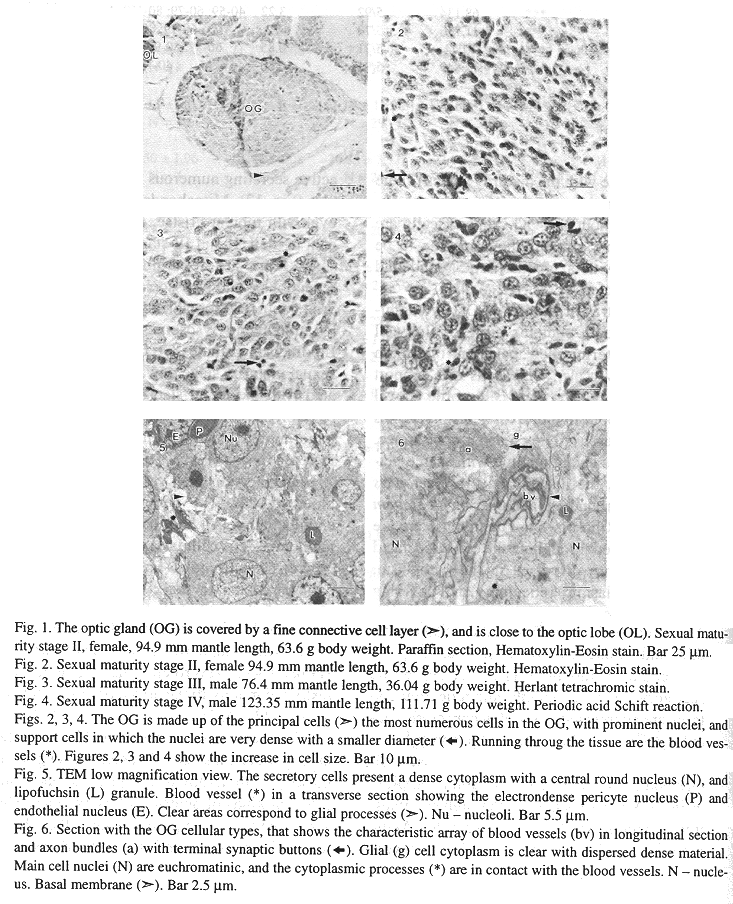
<p>    <br><font size=-1></font>     <br><font size=-1></font>     <p><font face="Arial,Helvetica"><font size=-1>Paraffin sections give a clear picture of OG organization. The secretory cells are the most numerous cells, they are ovoid with cytoplasmic processes (18.5 — 25.6 *m), and the nucleus (9.11 — 11.38 *m) is circular with a dense nucleoli, both showing a tendency to increase in size with the maturity stages (<a href="#TABLE1">Table 1</a>, <a href="#TABLE2">2</a>). The blood vessels are prominently dispersed throughout the OG. Support cells are scarce, in some sections they are seen to be aggregated, with a characteristic round and basophilic nucleus (<a href="#fig1-6">Figs. 1</a>, <a href="#fig1-6">2</a>, <a href="#fig1-6">3</a>, <a href="#fig1-6">4</a>).</font></font><font size=-1></font>     ]]></body>
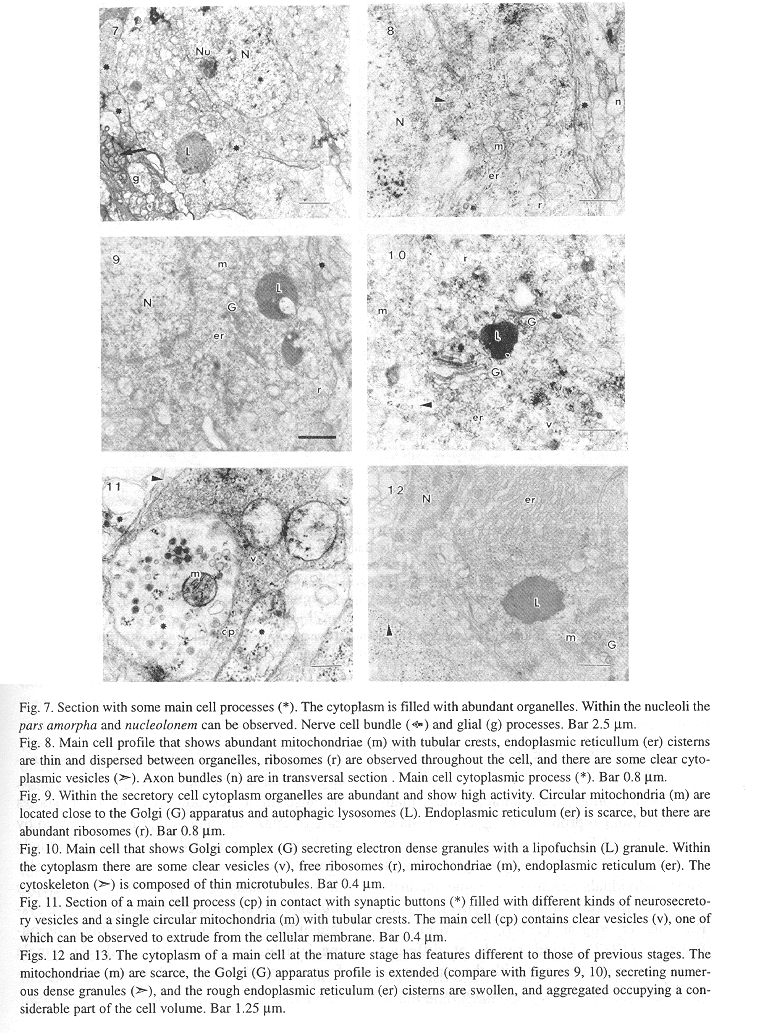
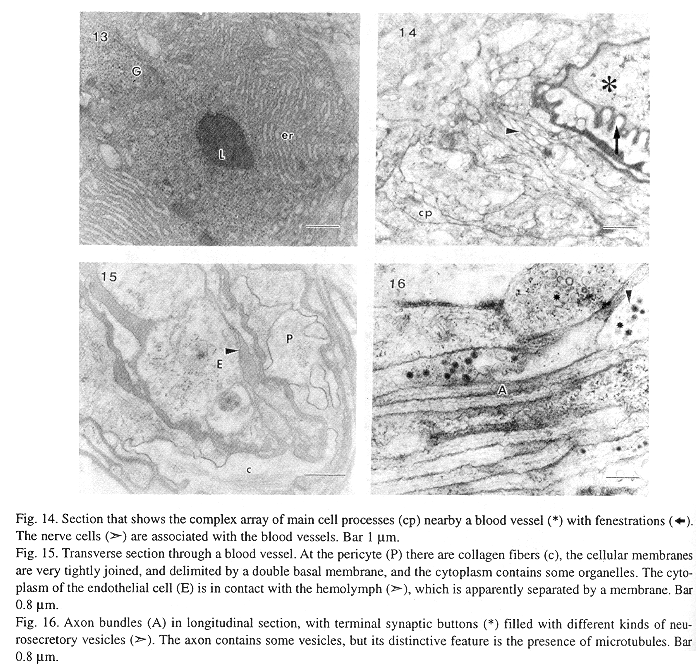
<body><![CDATA[<p><font face="Arial,Helvetica"><font size=-1>At the ultrastructural level OG cytoarchitecture denotes a complex array of fine cell processes intermingled between the main cells, blood vessels, nerve cells and support cells (<a href="#fig1-6">Figs. 5</a>, <a href="#fig1-6">6</a>). The main cell profile is oval with thin cytoplasmic processes, its organelles are very numerous giving a dense appearance. The nucleus is euchromatinic with scarce heterochromatin, the nucleoli have a clear <i>pars amorpha</i> surrounding a darker <i>nucleolonem</i> (<a href="#fig1-6">Figs. 5</a>, <a href="#fig7-13">7</a>). Ribosomes are numerous, and are found dispersed throughout the cell, associated with polysomes dispersed in the cytoplasm, rough endoplasmic reticulum, and covering clear cytoplasmic vesicles (<a href="#fig7-13">Figs. 8</a>, <a href="#fig7-13">10</a>, <a href="#fig7-13">11</a>). The rough endoplasmic reticulum cisterns are thin, and extend from the nuclear envelope to the cellular membrane (<a href="#fig7-13">Figs. 8</a>,<a href="#fig7-13"> 9</a>, <a href="#fig14-16">19</a>), at the secretory stage the endoplasmic reticulum cisterns are aggregated in swollen concentric saccules (<a href="#fig7-13">Figs. 12</a>, <a href="#fig14-16">13</a>). The Golgi apparatus is active, it secretes clear and electrondense vesicles and there are at least two Golgi complexes in each cell associated with rough endoplasmic reticulum, and lipofuchsin granules. At the mature sexual stage (IV) the Golgi is very active secreting numerous electrondense granules (<a href="#fig7-13">Fig. 12</a>). Mitochondriae are elongated or oval with tubular cristae, they are very abundant in the I, II and III stages, whilst in the IV stage there are few mitochondriae. These reductions could be associated with mitochondrial matrix desorganization and destruction by autophagic lysosomes (<a href="#fig7-13">Figs. 8</a>, <a href="#fig7-13">9</a>, <a href="#fig7-13">12</a>). Lipofuchsin granules are found from the third sexual maturity stage onwards, and are associated with the Golgi stacks, these profiles are electron dense with clear inclusions, and in the larger mantle length specimens they shown an increase in size (<a href="#fig7-13">Figs. 7</a>, <a href="#fig7-13">9</a>, <a href="#fig7-13">12</a>).</font></font><font size=-1></font>     <p><font face="Arial,Helvetica"><font size=-1>This gland is well vascularized with large blood vessels. The pericyte cells cover the endothelial cells, and have a double basal membrane. The cellular membranes are tightly joined in an irregular fashion, and there are collagen fibers in the cytoplasm. The cytoplasm of the endothelial cells is not easily identified because the lumen has an electrondense hemolymph which occupies nearly the entire space. Nevertheles the organelles are restricted mainly to the area close to the nucleus (<a href="#fig14-16">Fig. 13</a>, <a href="#fig14-16">14</a>, <a href="#fig14-16">15</a>).</font></font><font size=-1></font>     <p><font face="Arial,Helvetica"><font size=-1>The nerve cells are distributed between the principal cells and blood vessels in long axon bundles with terminal synaptic buttons with different kinds of neurosecretory vesicles. The axon bundles are tightly packed, they have long microtubules, and some microvesicles. The synaptic buttons are in contact with axon bundles, secretory cells and blood vessels, and there were no synaptic electron dense contacts identified. The neurosecretory vesicles were classified according to electron density and size in: small agranular (35 - 70 nm), agranular (90 - 150 nm), moderate to very dense (95 - 130 nm) and dense with a smooth limiting membrane (90 - 170 nm) (<a href="#fig1-6">Figs. 6</a>, <a href="#fig7-13">11</a>, <a href="#fig14-16">14</a>, <a href="#fig14-16">16</a>). Glial cells are intermingled between the OG cells, with long cytoplasmic processes, their cytoplasm is clear with a particulate material and few organelles, some mitochondriae, vacuoles and vesicles (<a href="#fig1-6">Figs. 6</a>, <a href="#fig7-13">11</a>, <a href="#fig14-16">16</a>).</font></font>     <br><font size=-1></font>&nbsp;     <br><font size=-1></font>&nbsp;<font size=-1></font>     <p><a NAME="fig1-6"></a><img SRC="/img/fbpe/rbt/v47n4/0410i5.GIF" height=904 width=733>     
<br><font size=-1></font>&nbsp;     <br><font size=-1></font>&nbsp;     <br><font size=-1></font>     <center>     ]]></body>
<body><![CDATA[<p><a NAME="fig7-13"></a><img SRC="/img/fbpe/rbt/v47n4/0410i6.GIF" height=1033 width=760></center> <font size=-1></font>     
<p>    <br><font size=-1></font>     <br><font size=-1></font>     <p><a NAME="fig14-16"></a><img SRC="/img/fbpe/rbt/v47n4/0410i7.GIF" height=706 width=753>     
<br><font size=-1></font>&nbsp;<font size=-1></font>     <p><b><font face="Arial,Helvetica"><font size=-1>Discussion</font></font></b><font size=-1></font>     <p><font face="Arial,Helvetica"><font size=-1>The morphological characteristics (mantle length and reproductive organs) in males and females of <i>S. sepioidea</i> were good indicators of the sexual maturity stage, although some individuals reached the same maturity stage at different mantle length intervals. <a href="#Robaina">Robaina &amp; Voglar (1986)</a> and <a href="#Voglar">Voglar &amp; Robaina (1987)</a> found squids at different stages of sexual maturity with the same mantle lengths. In this study it was not possible to examine the OG of females during the spawning period or at the post-spawning stage, because their reproductive behavior shows care of eggs until hatching, this is followed by a short resting period in which the female broods most of the mature eggs and finally dies. <a href="#Wodinsky">Wodinsky (1977)</a> quoted in <i>Octopus humeelincki</i> an apparently self destructive system of the OG which inhibits feeding in brooding females, preventing the predatory female from eating the eggs, and thus ensuring juvenile survival.</font></font><font size=-1></font>     <p><font face="Arial,Helvetica"><font size=-1>The OG shows a highly vascularized tissue and fine structure sections from <i>S. Sepioidea </i>were improved by modifying some combinations of fixatives and schedules. The fixer quoted by <a href="#Evans">Evans <i>et al</i>. (1976)</a> followed by extensive washings gave the best tissue preservation, while the aldehyde prepared in phosphate buffer saline with filtered sea water resulted in a bad preservation. Problems were also reported with <i>O. vulgaris</i> and <i>S. officinalis</i> OG fine structure by <a href="#Defretin">Defretin &amp; Richard (1967)</a> and <a href="#Nishioka70">Nishioka <i>et al.</i> (1970)</a>. In <i>S. Sepioidea</i> a hematonervous barrier built by the cellular wall, and gap junctions (<i>zonula ocludens</i>) between the endothelial cell and the perycite may halt the difussion of the fixative in the squid giant axon (Villegas &amp; Villegas 1968). Villegas (pers. com.) obtained the best preservation by immersion instead of perfusion, this latter being the suggested procedure for delicate tissues.</font></font><font size=-1></font>     <p><font face="Arial,Helvetica"><font size=-1>The fine structure of the tropical squid <i>S. sepioidea</i> OG, showed the same cellular types described in other cephalopods, with some distinctive features. <i>S. sepioidea</i> secretory cells showed differences in organelle abundance between the sexual maturity stages: at the juvenile and immature stages there are numerous mitochondriae, endoplasmic reticulum cisterns are thin and dispersed in the cytoplasm, the Golgi apparatus has a curved profile and actively secretes granules of different densities, whilst in the IV maturation stage (females) and reproductive individuals (males) secretory cells are almost depleted of mitochondriae, endoplasmic reticulum cisterns are dilated and well developed in a concentric fashion, and the Golgi complex actively secretes electron dense granules which are dispersed in the cytoplasm. Some of these are close to the lipofuchsin granules and to the cellular membrane, suggesting a possible secretory mechanism through the blood vessels.</font></font><font size=-1></font>     ]]></body>
<body><![CDATA[<p><font face="Arial,Helvetica"><font size=-1>S. sepioidea OG secretory activity was demonstrated by the production of electron dense secretory granules in the sexually mature stage (<a href="#fig7-13">Figs. 12</a>, <a href="#fig7-13">13</a>). However, the presence of clear vesicles, some of them associated with polysomes, could indicate the existence of other secretory processes in the life cycle, as seen by the extrusion of a clear vesicle close to a synaptic button (<a href="#fig7-13">Fig. 11</a>). Moreover, the cellular characteristics indicate active cells, with euchromatinic nuclei, an abundance of organelles, and an increase in lipofuchsin volume and cell size with dorsal mantle length.</font></font><font size=-1></font>     <p><font face="Arial,Helvetica"><font size=-1><a href="#Defretin">Defretin &amp; Richard (1967)</a> demonstrated that when <i>S. officinalis</i> is kept in a dark photoperiod the OG secretory cells produce three kinds of secretory granules, suggesting that they are filled with the same product in different stages of synthesis. <i>Octopus vulgaris</i> OG enlargment occurred both in the nucleus and secretory cell cytoplasm after cerebral surgery (Wells 1964). <i>Eledone cirrhosa</i> OG enlargement was statisticaly associated with female gonad maturation, and it is suspected that this process occurs normally (<a href="#Boyle">Boyle &amp; Thorpe 1984</a>). <a href="#Koueta95">Koueta <i>et al</i>.(1995)</a> described cellular changes in <i>S. officinalis</i> OG histology during sexual maturation; and found that main cell secretory activity was correlated with a peak of mitogenic activity in both sexes.</font></font><font size=-1></font>     <p><font face="Arial,Helvetica"><font size=-1>Lipofuchsin granules in the OG of some octopods are numerous, and measured up to several micrometers in diameter. <a href="#Mangold77">Mangold &amp; Froesch (1977)</a> did not find a correlation between the size of lipofuchsin granules and sexual development in females. Lipofuchsin granules are implicated in the defense mechanism of <i>O. vulgaris</i> in the presence of high molecular weight molecules in the blood stream (<a href="#Froesch76">Froesch &amp; Mangold 1976</a>, <a href="#Froesch78">Froesch <i>et al</i>. 1978</a> and <a href="#Froesch79">Froesch 1979</a>). In <i>S. sepiodea</i> a lipofuchsin granule engulfing a degenerated mitochondriae was observed.</font></font><font size=-1></font>     <p><font face="Arial,Helvetica"><font size=-1>The presence of different types of neurosecretory microvesicles in the axon bundles and synaptic buttons in the OG of <i>S. sepioidea</i> indicates the existence of different stimuli controlling OG activity. These stimuli were reported as excitatory or inhibitory (<a href="#Nishioka66">Nishioka <i>et al</i>. 1966</a> and <a href="#Froesch74">Froesch 1974</a>). In the stellate ganglion of <i>S. sepioidea</i> the neurosecretory microvesicles are small and agranular (50 - 80 nm) (<a href="#Castejón">Castej&oacute;n &amp; Villegas 1964</a>), in the stellate ganglion of<i> Loligo vulgaris</i> there are both small agranular vesicles (40 - 60 nm) and large agranular vesicles (average 65 nm) (<a href="#Gervasio">Gervasio <i>et al</i>. 1971</a>). In the OG of <i>Loligo opalescens</i> the more common granular vesicles have a loose limiting membrane (80 - 160 nm), and a few axon-like processes containing dense vesicles (100 - 300 nm) with a smooth limiting membrane (<a href="#Nishioka70">Nishioka <i>et al.</i> 1970</a>).</font></font><font size=-1></font>     <p><font face="Arial,Helvetica"><font size=-1>Field populations of <i>S. sepioidea</i> have a steady increase of the OG secretory cell diameter in both sexes. Sexual maturation in octopus was associated with a gross enlargment of the OG and a change in colour from cream to bright orange after optic nerve surgery (<a href="#Wells59">Wells &amp; Wells 1959</a>). In <i>S. officinalis</i> growth and sexual development was stimuled by a dark photoperiod and high temperature (<a href="#Richard66">Richard 1966</a>, <a href="#Richard67a">1967 a</a>, <a href="#Richard67b">b</a>, <a href="#Defretin">Defretin &amp; Richard 1967</a>). Likewise <i>O. vulgaris</i> mature individuals showed more intense histological reactions, and an increase in size in cytoplasm, nucleus and granules in the principal cells (<a href="#Bonichon">Bonichon 1967</a>). <i>Eledone cirrhosa</i> OG enlargment was statistically associated with the weight of the ovary and oviducal glands (<a href="#Boyle">Boyle &amp; Thorpe 1984</a>). Lipofuchsin granules and octopus body weight were well correlated, but the secretory mechanism was not demonstrated (<a href="#Mangold77">Mangold &amp; Froesch 1977</a>).</font></font>     <br><font size=-1></font>&nbsp;<font size=-1></font>     <p><b><font face="Arial,Helvetica"><font size=-1>Acknowledgements</font></font></b><font size=-1></font>     <p><font face="Arial,Helvetica"><font size=-1>I thank "Estaci&oacute;n Experimental Jos&eacute; Gregorio Hern&aacute;ndez, Fundaciencias - IDEA", Jes&uacute;s Rodr&iacute;guez, Susan Tai, Gilma Hern&aacute;ndez de A., Frances Osborn and Osmar Nusetti.</font></font>     <br><font size=-1></font>&nbsp;<font size=-1></font>     <p><b><font face="Arial,Helvetica"><font size=-1>Resumen</font></font></b><font size=-1></font>     ]]></body>
<body><![CDATA[<p><font face="Arial,Helvetica"><font size=-1>Se examin&oacute; la ultraestructura fina de la gl&aacute;ndula &oacute;ptica (GO) en varios estadios de desarrollo sexual del calamar tropical <i>Sepiotheutis sepioidea</i>, proveniente de las costas de la Bah&iacute;a de Mochima, Venezuela (10&ordm; 20' 22 " — 10&ordm; 24' N; 64&ordm; 19' — 64&ordm; 22' W). Los par&aacute;metros morfom&eacute;tricos y de los &oacute;rganos reproductivos (hembras n = 101; machos n = 105), presentaron diferencias significativas entre los estados de maduraci&oacute;n sexual (ANOVA, p &lt; 0.001), el &iacute;ndice gonadal promedio en las hembras oscil&oacute; entre 0.1 - 2.95 %, y en los machos entre 0.22 - 1.38 %. La GO son un par de &oacute;rganos ovales ubicados en el borde posterior del tracto &oacute;ptico en el cerebro de los cefal&oacute;podos, &eacute;sta posee los mismos tipos de c&eacute;lulas descritos en otros cefal&oacute;podos con algunas leves diferencias. La c&eacute;lula principal en el estadio de maduraci&oacute;n juvenil posee un perfil dendr&iacute;tico con delgados procesos del citoplasma, abundantes ribosomas, mitocondrias circulares con crestas tubulares, y un n&uacute;cleo prominente eucromat&iacute;nico; en el estadio de adulto las c&eacute;lulas principales presentan las cisternas del ret&iacute;culo endoplasm&aacute;tico rugoso dilatadas conc&eacute;ntricamente en la c&eacute;lula, el aparato de Golgi es activo con abundantes gr&aacute;nulos electron densos de secreci&oacute;n, las mitocondrias son escasas, y el gr&aacute;nulo de lipofucsina es de mayor tama&ntilde;o. La dimensi&oacute;n del n&uacute;cleo de la c&eacute;lula principal y la abundancia de organelos, presentaron oscilaciones en las etapas del ciclo de vida.</font></font><font size=-1></font>     <p><font face="Arial,Helvetica"><font size=-1>&nbsp;</font></font>     <br><b><font face="Arial,Helvetica"><font size=-1>References</font></font></b><font size=-1></font>     <!-- ref --><p><a NAME="Barber"></a><font face="Arial,Helvetica"><font size=-1>Barber, V. 1967. A neurosecretory tissue in <i>Octopus</i>. Nature 213:1042-1043.</font></font><font size=-1></font>    &nbsp;&nbsp;&nbsp;&nbsp;&nbsp;&nbsp;&nbsp;&nbsp;[&#160;<a href="javascript:void(0);" onclick="javascript: window.open('/scielo.php?script=sci_nlinks&ref=1177462&pid=S0034-7744199900040002000001&lng=','','width=640,height=500,resizable=yes,scrollbars=1,menubar=yes,');">Links</a>&#160;]<!-- end-ref --><!-- ref --><p><a NAME="Björkman"></a><font face="Arial,Helvetica"><font size=-1>Bj&ouml;rkman, N. 1963. On the ultrastructure of the optic gland in <i>Octopus</i>. J. Ultrastruct. Res. 8:195.</font></font><font size=-1></font>    &nbsp;&nbsp;&nbsp;&nbsp;&nbsp;&nbsp;&nbsp;&nbsp;[&#160;<a href="javascript:void(0);" onclick="javascript: window.open('/scielo.php?script=sci_nlinks&ref=1177463&pid=S0034-7744199900040002000002&lng=','','width=640,height=500,resizable=yes,scrollbars=1,menubar=yes,');">Links</a>&#160;]<!-- end-ref --><!-- ref --><p><a NAME="Bonichon"></a><font face="Arial,Helvetica"><font size=-1>Bonichon, A. 1967. Contribution &agrave; l&acute;etude de la neuros&eacute;cretion et de l&acute;endocrinologie chez les C&eacute;phalpodes. I. <i>Octopus vulgaris</i>. Vie Milieu 18:27-263.</font></font><font size=-1></font>    &nbsp;&nbsp;&nbsp;&nbsp;&nbsp;&nbsp;&nbsp;&nbsp;[&#160;<a href="javascript:void(0);" onclick="javascript: window.open('/scielo.php?script=sci_nlinks&ref=1177464&pid=S0034-7744199900040002000003&lng=','','width=640,height=500,resizable=yes,scrollbars=1,menubar=yes,');">Links</a>&#160;]<!-- end-ref --><!-- ref --><p><a NAME="Boycott"></a><font face="Arial,Helvetica"><font size=-1>Boycott, B. B. &amp; J. Z. Young. 1956. The subpedunculate body and nerve and other organs associated with the optic tracts of cephalopods. Bertil Hanstr&ouml;m Zoological Papers 76-105 p.</font></font><font size=-1></font>    &nbsp;&nbsp;&nbsp;&nbsp;&nbsp;&nbsp;&nbsp;&nbsp;[&#160;<a href="javascript:void(0);" onclick="javascript: window.open('/scielo.php?script=sci_nlinks&ref=1177465&pid=S0034-7744199900040002000004&lng=','','width=640,height=500,resizable=yes,scrollbars=1,menubar=yes,');">Links</a>&#160;]<!-- end-ref --><!-- ref --><p><a NAME="Boyle"></a><font face="Arial,Helvetica"><font size=-1>Boyle, P. R. &amp; R. Thorpe. 1984. Optic gland enlargement and female gonad maturation in a population of the octopus <i>Eledone cirrhosa</i>: a multivariate analysis. Mar. Biol. 79:127-132.</font></font><font size=-1></font>    &nbsp;&nbsp;&nbsp;&nbsp;&nbsp;&nbsp;&nbsp;&nbsp;[&#160;<a href="javascript:void(0);" onclick="javascript: window.open('/scielo.php?script=sci_nlinks&ref=1177466&pid=S0034-7744199900040002000005&lng=','','width=640,height=500,resizable=yes,scrollbars=1,menubar=yes,');">Links</a>&#160;]<!-- end-ref --><!-- ref --><p><a NAME="Castejón"></a><font face="Arial,Helvetica"><font size=-1>Castej&oacute;n, O. &amp; G. M. Villegas. 1964, Fine structure of the synaptic contacts in the stellate ganglion of the squid. J. Ultrastruct. Res. 10:585-598.</font></font><font size=-1></font>    &nbsp;&nbsp;&nbsp;&nbsp;&nbsp;&nbsp;&nbsp;&nbsp;[&#160;<a href="javascript:void(0);" onclick="javascript: window.open('/scielo.php?script=sci_nlinks&ref=1177467&pid=S0034-7744199900040002000006&lng=','','width=640,height=500,resizable=yes,scrollbars=1,menubar=yes,');">Links</a>&#160;]<!-- end-ref --><!-- ref --><p><a NAME="Defretin"></a><font face="Arial,Helvetica"><font size=-1>Defretin, R. &amp; A. Richard 1967. Ultrastructure de la glande optique de <i>Sepia officinalis</i> L. (Mollusques; C&eacute;phalopode). Mise en evidence de la s&eacute;cr&eacute;tion et de son controle photop&eacute;riodique. C. R. Acad. Sci., Paris. D. 265:1415-1418.</font></font><font size=-1></font>    &nbsp;&nbsp;&nbsp;&nbsp;&nbsp;&nbsp;&nbsp;&nbsp;[&#160;<a href="javascript:void(0);" onclick="javascript: window.open('/scielo.php?script=sci_nlinks&ref=1177468&pid=S0034-7744199900040002000007&lng=','','width=640,height=500,resizable=yes,scrollbars=1,menubar=yes,');">Links</a>&#160;]<!-- end-ref --><!-- ref --><p><a NAME="Durchon"></a><font face="Arial,Helvetica"><font size=-1>Durchon, M. &amp; A. Richard. 1967. &Eacute;tude en culture organotypique du r&ocirc;le endocrine de la glandule optique dans la maturation ovarienne chez <i>Sepia officinalis</i> L. (Mollusque: C&eacute;phalopode). C. R. Acad. Sci., Paris. D. 264:1497-1500.</font></font><font size=-1></font>    &nbsp;&nbsp;&nbsp;&nbsp;&nbsp;&nbsp;&nbsp;&nbsp;[&#160;<a href="javascript:void(0);" onclick="javascript: window.open('/scielo.php?script=sci_nlinks&ref=1177469&pid=S0034-7744199900040002000008&lng=','','width=640,height=500,resizable=yes,scrollbars=1,menubar=yes,');">Links</a>&#160;]<!-- end-ref --><!-- ref --><p><a NAME="Durward"></a><font face="Arial,Helvetica"><font size=-1>Durward, R., T. Amaratunga &amp; R. O&acute;Dor. 1979. Maturation index and fecundity for the female squid <i>Illex illecebrosus</i>. ICNAF Res. Bull. 14:67-72.</font></font><font size=-1></font>    &nbsp;&nbsp;&nbsp;&nbsp;&nbsp;&nbsp;&nbsp;&nbsp;[&#160;<a href="javascript:void(0);" onclick="javascript: window.open('/scielo.php?script=sci_nlinks&ref=1177470&pid=S0034-7744199900040002000009&lng=','','width=640,height=500,resizable=yes,scrollbars=1,menubar=yes,');">Links</a>&#160;]<!-- end-ref --><!-- ref --><p><a NAME="Evans"></a><font face="Arial,Helvetica"><font size=-1>Evans, P., E. Kravitz &amp; B. Talamo. 1976. Octopamine release at two points along lobster nerve trunks. J. Physiol. 262:71-89.</font></font><font size=-1></font>    &nbsp;&nbsp;&nbsp;&nbsp;&nbsp;&nbsp;&nbsp;&nbsp;[&#160;<a href="javascript:void(0);" onclick="javascript: window.open('/scielo.php?script=sci_nlinks&ref=1177471&pid=S0034-7744199900040002000010&lng=','','width=640,height=500,resizable=yes,scrollbars=1,menubar=yes,');">Links</a>&#160;]<!-- end-ref --><!-- ref --><p><a NAME="Froesch74"></a><font face="Arial,Helvetica"><font size=-1>Froesch, D. 1974. The subpedunculate lobe of the octopus brain: evidence for dual function. Brain Res. 75:277-285.</font></font><font size=-1></font>    &nbsp;&nbsp;&nbsp;&nbsp;&nbsp;&nbsp;&nbsp;&nbsp;[&#160;<a href="javascript:void(0);" onclick="javascript: window.open('/scielo.php?script=sci_nlinks&ref=1177472&pid=S0034-7744199900040002000011&lng=','','width=640,height=500,resizable=yes,scrollbars=1,menubar=yes,');">Links</a>&#160;]<!-- end-ref --><!-- ref --><p><a NAME="Froesch79"></a><font face="Arial,Helvetica"><font size=-1>Froesch, D. 1979. Antigen-induced secretion in the optic gland of <i>Octopus vulgaris</i>. Proc. R. Soc. Lond. B. 205:379-384.</font></font><font size=-1></font>    &nbsp;&nbsp;&nbsp;&nbsp;&nbsp;&nbsp;&nbsp;&nbsp;[&#160;<a href="javascript:void(0);" onclick="javascript: window.open('/scielo.php?script=sci_nlinks&ref=1177473&pid=S0034-7744199900040002000012&lng=','','width=640,height=500,resizable=yes,scrollbars=1,menubar=yes,');">Links</a>&#160;]<!-- end-ref --><!-- ref --><p><a NAME="Froesch76"></a><font face="Arial,Helvetica"><font size=-1>Froesch, D. &amp; K. Mangold. 1976. Uptake of ferritin by the cephalopod optic gland. Cell Tiss. Res. 170:549-551.</font></font><font size=-1></font>    &nbsp;&nbsp;&nbsp;&nbsp;&nbsp;&nbsp;&nbsp;&nbsp;[&#160;<a href="javascript:void(0);" onclick="javascript: window.open('/scielo.php?script=sci_nlinks&ref=1177474&pid=S0034-7744199900040002000013&lng=','','width=640,height=500,resizable=yes,scrollbars=1,menubar=yes,');">Links</a>&#160;]<!-- end-ref --><!-- ref --><p><a NAME="Froesch78"></a><font face="Arial,Helvetica"><font size=-1>Froesch, D., K. Mangold &amp; W. Fritz. 1978. On the turnover of exogenous ferritin in the cephalopod optic gland. A microprobe. Experientia 34:116-117.</font></font><font size=-1></font>    &nbsp;&nbsp;&nbsp;&nbsp;&nbsp;&nbsp;&nbsp;&nbsp;[&#160;<a href="javascript:void(0);" onclick="javascript: window.open('/scielo.php?script=sci_nlinks&ref=1177475&pid=S0034-7744199900040002000014&lng=','','width=640,height=500,resizable=yes,scrollbars=1,menubar=yes,');">Links</a>&#160;]<!-- end-ref --><!-- ref --><p><a NAME="Gervasio"></a><font face="Arial,Helvetica"><font size=-1>Gervasio, A., R. Martin &amp; A. Miralto. 1971. Fine structure of synaptic contacts in the first order giant fiber system of the squid. Z. Zellforsch. 112:85-96.</font></font><font size=-1></font>    &nbsp;&nbsp;&nbsp;&nbsp;&nbsp;&nbsp;&nbsp;&nbsp;[&#160;<a href="javascript:void(0);" onclick="javascript: window.open('/scielo.php?script=sci_nlinks&ref=1177476&pid=S0034-7744199900040002000015&lng=','','width=640,height=500,resizable=yes,scrollbars=1,menubar=yes,');">Links</a>&#160;]<!-- end-ref --><!-- ref --><p><a NAME="Humason"></a><font face="Arial,Helvetica"><font size=-1>Humason, G. 1979. Animal Tissue Techniques. W. H. Freeman, San Francisco, California p. 456-461.</font></font><font size=-1></font>    &nbsp;&nbsp;&nbsp;&nbsp;&nbsp;&nbsp;&nbsp;&nbsp;[&#160;<a href="javascript:void(0);" onclick="javascript: window.open('/scielo.php?script=sci_nlinks&ref=1177477&pid=S0034-7744199900040002000016&lng=','','width=640,height=500,resizable=yes,scrollbars=1,menubar=yes,');">Links</a>&#160;]<!-- end-ref --><!-- ref --><p><a NAME="Koueta95"></a><font face="Arial,Helvetica"><font size=-1>Koueta, N., E. Boucaud-Camou &amp; A. M. Renou. 1995. Gonadotropic mitogenic activity of the optic gland of the cuttlefish <i>Sepia officinalis</i>, during sexual maturation. J. Mar. Biol. Ass. U. K. 75:391-404.</font></font><font size=-1></font>    &nbsp;&nbsp;&nbsp;&nbsp;&nbsp;&nbsp;&nbsp;&nbsp;[&#160;<a href="javascript:void(0);" onclick="javascript: window.open('/scielo.php?script=sci_nlinks&ref=1177478&pid=S0034-7744199900040002000017&lng=','','width=640,height=500,resizable=yes,scrollbars=1,menubar=yes,');">Links</a>&#160;]<!-- end-ref --><!-- ref --><p><a NAME="Koueta92"></a><font face="Arial,Helvetica"><font size=-1>Koueta, N., I. Robbins &amp; E. Boucaud-Camou. 1992. Partial characterization of a gonadotropic, mitogenic factor from the optic gland and hemolymph of the cuttlefish <i>Sepia officinalis</i>. L. Comp. Biochem. Physiol. 102A:224-234.</font></font><font size=-1></font>    &nbsp;&nbsp;&nbsp;&nbsp;&nbsp;&nbsp;&nbsp;&nbsp;[&#160;<a href="javascript:void(0);" onclick="javascript: window.open('/scielo.php?script=sci_nlinks&ref=1177479&pid=S0034-7744199900040002000018&lng=','','width=640,height=500,resizable=yes,scrollbars=1,menubar=yes,');">Links</a>&#160;]<!-- end-ref --><!-- ref --><p><a NAME="Le Gall"></a><font face="Arial,Helvetica"><font size=-1>Le Gall, S., C. Feral, J. VanMinnen &amp; C. Marchand. 1988. Evidence for peptidergic innervation of the endocrine optic gland in <i>Sepia</i> by neurons showing FMRF amide like immunoreactivity. Brain Res. 462:82-88.</font></font><font size=-1></font>    &nbsp;&nbsp;&nbsp;&nbsp;&nbsp;&nbsp;&nbsp;&nbsp;[&#160;<a href="javascript:void(0);" onclick="javascript: window.open('/scielo.php?script=sci_nlinks&ref=1177480&pid=S0034-7744199900040002000019&lng=','','width=640,height=500,resizable=yes,scrollbars=1,menubar=yes,');">Links</a>&#160;]<!-- end-ref --><!-- ref --><p><a NAME="Mangold87"></a><font face="Arial,Helvetica"><font size=-1>Mangold, K. 1987. Reproduction. Chapter X. In "Cephalopod Life Cycles". Academic, New York. p. 157-200.</font></font><font size=-1></font>    &nbsp;&nbsp;&nbsp;&nbsp;&nbsp;&nbsp;&nbsp;&nbsp;[&#160;<a href="javascript:void(0);" onclick="javascript: window.open('/scielo.php?script=sci_nlinks&ref=1177481&pid=S0034-7744199900040002000020&lng=','','width=640,height=500,resizable=yes,scrollbars=1,menubar=yes,');">Links</a>&#160;]<!-- end-ref --><!-- ref --><p><a NAME="Mangold77"></a><font face="Arial,Helvetica"><font size=-1>Mangold, K. &amp; D. Froesch. 1977. A reconsideration of factors associated with sexual maturation. Symp. Zool. Soc. Lond. 38:541-555.</font></font><font size=-1></font>    &nbsp;&nbsp;&nbsp;&nbsp;&nbsp;&nbsp;&nbsp;&nbsp;[&#160;<a href="javascript:void(0);" onclick="javascript: window.open('/scielo.php?script=sci_nlinks&ref=1177482&pid=S0034-7744199900040002000021&lng=','','width=640,height=500,resizable=yes,scrollbars=1,menubar=yes,');">Links</a>&#160;]<!-- end-ref --><!-- ref --><p><a NAME="Nishioka70"></a><font face="Arial,Helvetica"><font size=-1>Nishioka, R., H. Bern &amp; D. Golding. 1970. Innervation of the cephalopod optic gland. In "Aspects of neuroendocrinology". W. Bargman &amp; B. Schaer (eds). Springer, Berlin. p. 47-54.</font></font><font size=-1></font>    &nbsp;&nbsp;&nbsp;&nbsp;&nbsp;&nbsp;&nbsp;&nbsp;[&#160;<a href="javascript:void(0);" onclick="javascript: window.open('/scielo.php?script=sci_nlinks&ref=1177483&pid=S0034-7744199900040002000022&lng=','','width=640,height=500,resizable=yes,scrollbars=1,menubar=yes,');">Links</a>&#160;]<!-- end-ref --><!-- ref --><p><a NAME="Nishioka66"></a><font face="Arial,Helvetica"><font size=-1>Nishioka, R. S., I Yasumasu, A. Packard, H. Bern &amp; J. Z. Young. 1966. Nature of vesicles associated with the nervous system of cephalopods. Z. Zellforsch. 75:301-316.</font></font><font size=-1></font>    &nbsp;&nbsp;&nbsp;&nbsp;&nbsp;&nbsp;&nbsp;&nbsp;[&#160;<a href="javascript:void(0);" onclick="javascript: window.open('/scielo.php?script=sci_nlinks&ref=1177484&pid=S0034-7744199900040002000023&lng=','','width=640,height=500,resizable=yes,scrollbars=1,menubar=yes,');">Links</a>&#160;]<!-- end-ref --><!-- ref --><p><a NAME="O´Dor"></a><font face="Arial,Helvetica"><font size=-1>O&acute;Dor, R. &amp; M. J. Wells. 1973. Yolk protein synthesis in the ovary of <i>Octopus vulgaris </i>and its control by the optic gland gonadotropin. J. Exp. Biol 59:665-674.</font></font><font size=-1></font>    &nbsp;&nbsp;&nbsp;&nbsp;&nbsp;&nbsp;&nbsp;&nbsp;[&#160;<a href="javascript:void(0);" onclick="javascript: window.open('/scielo.php?script=sci_nlinks&ref=1177485&pid=S0034-7744199900040002000024&lng=','','width=640,height=500,resizable=yes,scrollbars=1,menubar=yes,');">Links</a>&#160;]<!-- end-ref --><!-- ref --><p><a NAME="Reynolds"></a><font face="Arial,Helvetica"><font size=-1>Reynolds, 1963. The use of lead citrate of high pH as an electron opaque stain in electron microscopy. J. Cell Biol. 17:208-212.</font></font><font size=-1></font>    &nbsp;&nbsp;&nbsp;&nbsp;&nbsp;&nbsp;&nbsp;&nbsp;[&#160;<a href="javascript:void(0);" onclick="javascript: window.open('/scielo.php?script=sci_nlinks&ref=1177486&pid=S0034-7744199900040002000025&lng=','','width=640,height=500,resizable=yes,scrollbars=1,menubar=yes,');">Links</a>&#160;]<!-- end-ref --><!-- ref --><p><a NAME="Richard66"></a><font face="Arial,Helvetica"><font size=-1>Richard, A. 1966. La temp&eacute;rature, facteur essentiel de croissance pour le C&eacute;phalopode <i>Sepia officinalis</i>. C. R. Acad. Sci., Paris. D. 263:1138-1141.</font></font><font size=-1></font>    &nbsp;&nbsp;&nbsp;&nbsp;&nbsp;&nbsp;&nbsp;&nbsp;[&#160;<a href="javascript:void(0);" onclick="javascript: window.open('/scielo.php?script=sci_nlinks&ref=1177487&pid=S0034-7744199900040002000026&lng=','','width=640,height=500,resizable=yes,scrollbars=1,menubar=yes,');">Links</a>&#160;]<!-- end-ref --><!-- ref --><p><a NAME="Richard67a"></a><font face="Arial,Helvetica"><font size=-1>Richard, A. 1967a. Action de la temp&eacute;rature sur l&acute;evolution g&eacute;nitale de <i>Sepia officinalis.</i> C. R. Acad. Sci., Paris. D 263:1998-2001.</font></font><font size=-1></font>    &nbsp;&nbsp;&nbsp;&nbsp;&nbsp;&nbsp;&nbsp;&nbsp;[&#160;<a href="javascript:void(0);" onclick="javascript: window.open('/scielo.php?script=sci_nlinks&ref=1177488&pid=S0034-7744199900040002000027&lng=','','width=640,height=500,resizable=yes,scrollbars=1,menubar=yes,');">Links</a>&#160;]<!-- end-ref --><!-- ref --><p><a NAME="Richard67b"></a><font face="Arial,Helvetica"><font size=-1>Richard, A. 1967b. R&ocirc;le de la photop&eacute;riode dans le determinisme de la maturation g&eacute;nitale femelle de C&eacute;phalopode <i>Sepia officinalis</i> L. C. R. Acad. Sci., Paris. D 265:1315-1318..</font></font><font size=-1></font>    &nbsp;&nbsp;&nbsp;&nbsp;&nbsp;&nbsp;&nbsp;&nbsp;[&#160;<a href="javascript:void(0);" onclick="javascript: window.open('/scielo.php?script=sci_nlinks&ref=1177489&pid=S0034-7744199900040002000028&lng=','','width=640,height=500,resizable=yes,scrollbars=1,menubar=yes,');">Links</a>&#160;]<!-- end-ref --><!-- ref --><p><a NAME="Richard70"></a><font face="Arial,Helvetica"><font size=-1>Richard, A. 1970. Differentiation sexuelle de C&eacute;phalopodes en culture <i>in vitro</i>. Ann. Biol. IX(7, 9-10):409-415.</font></font><font size=-1></font>    &nbsp;&nbsp;&nbsp;&nbsp;&nbsp;&nbsp;&nbsp;&nbsp;[&#160;<a href="javascript:void(0);" onclick="javascript: window.open('/scielo.php?script=sci_nlinks&ref=1177490&pid=S0034-7744199900040002000029&lng=','','width=640,height=500,resizable=yes,scrollbars=1,menubar=yes,');">Links</a>&#160;]<!-- end-ref --><!-- ref --><p><a NAME="Robaina"></a><font face="Arial,Helvetica"><font size=-1>Robaina, G. &amp; J. F. Voglar. 1986. Maduraci&oacute;n sexual de las hembras de <i>Sepiotheutis sepioidea</i> (Blainville, 1823) (Cephalopoda: Loliginidae) en las costas Venezolanas. Inv. Pesq. 50:57-68.</font></font><font size=-1></font>    &nbsp;&nbsp;&nbsp;&nbsp;&nbsp;&nbsp;&nbsp;&nbsp;[&#160;<a href="javascript:void(0);" onclick="javascript: window.open('/scielo.php?script=sci_nlinks&ref=1177491&pid=S0034-7744199900040002000030&lng=','','width=640,height=500,resizable=yes,scrollbars=1,menubar=yes,');">Links</a>&#160;]<!-- end-ref --><!-- ref --><p><a NAME="Sokal"></a><font face="Arial,Helvetica"><font size=-1>Sokal, R. &amp; F. Rohlf. 1981. Biometry. W. H. Freeman, San Francisco, California, 859 p.</font></font><font size=-1></font>    &nbsp;&nbsp;&nbsp;&nbsp;&nbsp;&nbsp;&nbsp;&nbsp;[&#160;<a href="javascript:void(0);" onclick="javascript: window.open('/scielo.php?script=sci_nlinks&ref=1177492&pid=S0034-7744199900040002000031&lng=','','width=640,height=500,resizable=yes,scrollbars=1,menubar=yes,');">Links</a>&#160;]<!-- end-ref --><!-- ref --><p><a NAME="Voglar"></a><font face="Arial,Helvetica"><font size=-1>Voglar, J. F. &amp; G. Robaina. 1987. Maduraci&oacute;n sexual de los machos del calamar <i>Sepiotheutis sepioidea</i> (Blainville, 1823) en las costas del nororiente Venezolano. Contr. Cient. Ctro. de Invest. Cient. UDO 11:40 pp.</font></font><font size=-1></font>    &nbsp;&nbsp;&nbsp;&nbsp;&nbsp;&nbsp;&nbsp;&nbsp;[&#160;<a href="javascript:void(0);" onclick="javascript: window.open('/scielo.php?script=sci_nlinks&ref=1177493&pid=S0034-7744199900040002000032&lng=','','width=640,height=500,resizable=yes,scrollbars=1,menubar=yes,');">Links</a>&#160;]<!-- end-ref --><!-- ref --><p><a NAME="Wells60"></a><font face="Arial,Helvetica"><font size=-1>Wells, M. J. 1960. Optic glands implants and the ovary of <i>Octopus</i>. Symp. Zool. Soc. Lond. 2:87-107.</font></font><font size=-1></font>    &nbsp;&nbsp;&nbsp;&nbsp;&nbsp;&nbsp;&nbsp;&nbsp;[&#160;<a href="javascript:void(0);" onclick="javascript: window.open('/scielo.php?script=sci_nlinks&ref=1177494&pid=S0034-7744199900040002000033&lng=','','width=640,height=500,resizable=yes,scrollbars=1,menubar=yes,');">Links</a>&#160;]<!-- end-ref --><!-- ref --><p><a NAME="Wells75"></a><font face="Arial,Helvetica"><font size=-1>Wells, M., R. O&acute;Dor &amp; S. Buckley. 1975. An <i>in vitro</i> bioassay for a molluscan gonadotropin. J. Exp. Biol. 62:433-436.</font></font><font size=-1></font>    &nbsp;&nbsp;&nbsp;&nbsp;&nbsp;&nbsp;&nbsp;&nbsp;[&#160;<a href="javascript:void(0);" onclick="javascript: window.open('/scielo.php?script=sci_nlinks&ref=1177495&pid=S0034-7744199900040002000034&lng=','','width=640,height=500,resizable=yes,scrollbars=1,menubar=yes,');">Links</a>&#160;]<!-- end-ref --><!-- ref --><p><a NAME="Wells59"></a><font face="Arial,Helvetica"><font size=-1>Wells, M. &amp; J. Wells. 1959. Hormonal control of sexual maturity in Octopus. J. Exp. Biol. 36:1-33.</font></font><font size=-1></font>    &nbsp;&nbsp;&nbsp;&nbsp;&nbsp;&nbsp;&nbsp;&nbsp;[&#160;<a href="javascript:void(0);" onclick="javascript: window.open('/scielo.php?script=sci_nlinks&ref=1177496&pid=S0034-7744199900040002000035&lng=','','width=640,height=500,resizable=yes,scrollbars=1,menubar=yes,');">Links</a>&#160;]<!-- end-ref --><!-- ref --><p><a NAME="Wells69"></a><font face="Arial,Helvetica"><font size=-1>Wells, M. &amp; J. Wells. 1969. Pituitary analogue in the O<i>ctopus</i>. Nature 222:293-294.</font></font><font size=-1></font>    &nbsp;&nbsp;&nbsp;&nbsp;&nbsp;&nbsp;&nbsp;&nbsp;[&#160;<a href="javascript:void(0);" onclick="javascript: window.open('/scielo.php?script=sci_nlinks&ref=1177497&pid=S0034-7744199900040002000036&lng=','','width=640,height=500,resizable=yes,scrollbars=1,menubar=yes,');">Links</a>&#160;]<!-- end-ref --><!-- ref --><p><a NAME="Wells75"></a><font face="Arial,Helvetica"><font size=-1>Wells, M. &amp; J. Wells. 1975. Optic glands implants and their effects on the gonads of <i>Octopus</i>. J. Exp. Biol. 62:579-588.</font></font><font size=-1></font>    &nbsp;&nbsp;&nbsp;&nbsp;&nbsp;&nbsp;&nbsp;&nbsp;[&#160;<a href="javascript:void(0);" onclick="javascript: window.open('/scielo.php?script=sci_nlinks&ref=1177498&pid=S0034-7744199900040002000037&lng=','','width=640,height=500,resizable=yes,scrollbars=1,menubar=yes,');">Links</a>&#160;]<!-- end-ref --><!-- ref --><p><a NAME="Wodinsky"></a><font face="Arial,Helvetica"><font size=-1>Wodinsky, J. 1977. Hormonal inhibition of feeding in <i>Octopus</i> control by optic gland secretion. Science 198:948-951.</font></font><font face="Arial,Helvetica"><font size=-1></font></font>    &nbsp;&nbsp;&nbsp;&nbsp;&nbsp;&nbsp;&nbsp;&nbsp;[&#160;<a href="javascript:void(0);" onclick="javascript: window.open('/scielo.php?script=sci_nlinks&ref=1177499&pid=S0034-7744199900040002000038&lng=','','width=640,height=500,resizable=yes,scrollbars=1,menubar=yes,');">Links</a>&#160;]<!-- end-ref --><p><a NAME="1a"></a><font face="Arial,Helvetica"><font size=-1><sup><a href="#1">1</a></sup> Instituto de Investigaciones en Biomedicina y Ciencias Aplicadas, Universidad de Oriente. Cuman&aacute;, Sucre, Venezuela. Fax 58-93-514023. Tel. 58-93-514185. E-mail: <a href="mailto:darriech@cumana.sucre.udo.edu.ve">darriech@cumana.sucre.udo.edu.ve</a></font></font>      ]]></body><back>
<ref-list>
<ref id="B1">
<nlm-citation citation-type="journal">
<person-group person-group-type="author">
<name>
<surname><![CDATA[Barber]]></surname>
<given-names><![CDATA[V]]></given-names>
</name>
</person-group>
<article-title xml:lang="en"><![CDATA[A neurosecretory tissue in Octopus]]></article-title>
<source><![CDATA[Nature]]></source>
<year>1967</year>
<volume>213</volume>
<page-range>1042-1043</page-range></nlm-citation>
</ref>
<ref id="B2">
<nlm-citation citation-type="journal">
<person-group person-group-type="author">
<name>
<surname><![CDATA[Björkman]]></surname>
<given-names><![CDATA[N]]></given-names>
</name>
</person-group>
<article-title xml:lang="en"><![CDATA[On the ultrastructure of the optic gland in Octopus]]></article-title>
<source><![CDATA[J. Ultrastruct. Res]]></source>
<year>1963</year>
<volume>8</volume>
<page-range>195</page-range></nlm-citation>
</ref>
<ref id="B3">
<nlm-citation citation-type="journal">
<person-group person-group-type="author">
<name>
<surname><![CDATA[Bonichon]]></surname>
<given-names><![CDATA[A]]></given-names>
</name>
</person-group>
<article-title xml:lang="fr"><![CDATA[Contribution à l&acute;etude de la neurosécretion et de l&acute;endocrinologie chez les Céphalpodes: I. Octopus vulgaris]]></article-title>
<source><![CDATA[Vie Milieu]]></source>
<year>1967</year>
<volume>18</volume>
<page-range>27-263</page-range></nlm-citation>
</ref>
<ref id="B4">
<nlm-citation citation-type="journal">
<person-group person-group-type="author">
<name>
<surname><![CDATA[Boycott]]></surname>
<given-names><![CDATA[B. B]]></given-names>
</name>
<name>
<surname><![CDATA[Young]]></surname>
<given-names><![CDATA[J. Z]]></given-names>
</name>
</person-group>
<article-title xml:lang="en"><![CDATA[The subpedunculate body and nerve and other organs associated with the optic tracts of cephalopods]]></article-title>
<source><![CDATA[Bertil Hanström Zoological Papers]]></source>
<year>1956</year>
<page-range>76-105</page-range></nlm-citation>
</ref>
<ref id="B5">
<nlm-citation citation-type="journal">
<person-group person-group-type="author">
<name>
<surname><![CDATA[Boyle]]></surname>
<given-names><![CDATA[P. R]]></given-names>
</name>
<name>
<surname><![CDATA[Thorpe]]></surname>
<given-names><![CDATA[R]]></given-names>
</name>
</person-group>
<article-title xml:lang="en"><![CDATA[Optic gland enlargement and female gonad maturation in a population of the octopus Eledone cirrhosa: a multivariate analysis]]></article-title>
<source><![CDATA[Mar. Biol]]></source>
<year>1984</year>
<volume>79</volume>
<page-range>127-132</page-range></nlm-citation>
</ref>
<ref id="B6">
<nlm-citation citation-type="journal">
<person-group person-group-type="author">
<name>
<surname><![CDATA[Castejón]]></surname>
<given-names><![CDATA[O]]></given-names>
</name>
<name>
<surname><![CDATA[Villegas]]></surname>
<given-names><![CDATA[G. M]]></given-names>
</name>
</person-group>
<article-title xml:lang="en"><![CDATA[Fine structure of the synaptic contacts in the stellate ganglion of the squid]]></article-title>
<source><![CDATA[J. Ultrastruct. Res]]></source>
<year>1964</year>
<volume>10</volume>
<page-range>585-598</page-range></nlm-citation>
</ref>
<ref id="B7">
<nlm-citation citation-type="journal">
<person-group person-group-type="author">
<name>
<surname><![CDATA[Defretin]]></surname>
<given-names><![CDATA[R]]></given-names>
</name>
<name>
<surname><![CDATA[Richard]]></surname>
<given-names><![CDATA[A]]></given-names>
</name>
</person-group>
<article-title xml:lang="fr"><![CDATA[Ultrastructure de la glande optique de Sepia officinalis L. (Mollusques; Céphalopode). Mise en evidence de la sécrétion et de son controle photopériodique]]></article-title>
<source><![CDATA[C. R. Acad. Sci., Paris. D]]></source>
<year>1967</year>
<volume>265</volume>
<page-range>1415-1418</page-range></nlm-citation>
</ref>
<ref id="B8">
<nlm-citation citation-type="journal">
<person-group person-group-type="author">
<name>
<surname><![CDATA[Durchon]]></surname>
<given-names><![CDATA[M]]></given-names>
</name>
<name>
<surname><![CDATA[Richard]]></surname>
<given-names><![CDATA[A]]></given-names>
</name>
</person-group>
<article-title xml:lang="fr"><![CDATA[Étude en culture organotypique du rôle endocrine de la glandule optique dans la maturation ovarienne chez Sepia officinalis L. (Mollusque: Céphalopode)]]></article-title>
<source><![CDATA[C. R. Acad. Sci., Paris. D]]></source>
<year>1967</year>
<volume>264</volume>
<page-range>1497-1500</page-range></nlm-citation>
</ref>
<ref id="B9">
<nlm-citation citation-type="journal">
<person-group person-group-type="author">
<name>
<surname><![CDATA[Durward]]></surname>
<given-names><![CDATA[R]]></given-names>
</name>
<name>
<surname><![CDATA[Amaratunga]]></surname>
<given-names><![CDATA[T]]></given-names>
</name>
<name>
<surname><![CDATA[O&acute;Dor]]></surname>
<given-names><![CDATA[R]]></given-names>
</name>
</person-group>
<article-title xml:lang="en"><![CDATA[Maturation index and fecundity for the female squid Illex illecebrosus]]></article-title>
<source><![CDATA[ICNAF Res. Bull]]></source>
<year>1979</year>
<volume>14</volume>
<page-range>67-72</page-range></nlm-citation>
</ref>
<ref id="B10">
<nlm-citation citation-type="journal">
<person-group person-group-type="author">
<name>
<surname><![CDATA[Evans]]></surname>
<given-names><![CDATA[P]]></given-names>
</name>
<name>
<surname><![CDATA[Kravitz]]></surname>
<given-names><![CDATA[E]]></given-names>
</name>
<name>
<surname><![CDATA[Talamo]]></surname>
<given-names><![CDATA[B]]></given-names>
</name>
</person-group>
<article-title xml:lang="en"><![CDATA[Octopamine release at two points along lobster nerve trunks]]></article-title>
<source><![CDATA[J. Physiol]]></source>
<year>1976</year>
<volume>262</volume>
<page-range>71-89</page-range></nlm-citation>
</ref>
<ref id="B11">
<nlm-citation citation-type="journal">
<person-group person-group-type="author">
<name>
<surname><![CDATA[Froesch]]></surname>
<given-names><![CDATA[D]]></given-names>
</name>
</person-group>
<article-title xml:lang="en"><![CDATA[The subpedunculate lobe of the octopus brain: evidence for dual function]]></article-title>
<source><![CDATA[Brain Res]]></source>
<year>1974</year>
<volume>75</volume>
<page-range>277-285</page-range></nlm-citation>
</ref>
<ref id="B12">
<nlm-citation citation-type="journal">
<person-group person-group-type="author">
<name>
<surname><![CDATA[Froesch]]></surname>
<given-names><![CDATA[D]]></given-names>
</name>
</person-group>
<article-title xml:lang="en"><![CDATA[Antigen-induced secretion in the optic gland of Octopus vulgaris]]></article-title>
<source><![CDATA[Proc. R. Soc. Lond. B]]></source>
<year>1979</year>
<volume>205</volume>
<page-range>379-384</page-range></nlm-citation>
</ref>
<ref id="B13">
<nlm-citation citation-type="journal">
<person-group person-group-type="author">
<name>
<surname><![CDATA[Froesch]]></surname>
<given-names><![CDATA[D]]></given-names>
</name>
<name>
<surname><![CDATA[Mangold]]></surname>
<given-names><![CDATA[K]]></given-names>
</name>
</person-group>
<article-title xml:lang="en"><![CDATA[Uptake of ferritin by the cephalopod optic gland]]></article-title>
<source><![CDATA[Cell Tiss. Res]]></source>
<year>1976</year>
<volume>170</volume>
<page-range>549-551</page-range></nlm-citation>
</ref>
<ref id="B14">
<nlm-citation citation-type="journal">
<person-group person-group-type="author">
<name>
<surname><![CDATA[Froesch]]></surname>
<given-names><![CDATA[D]]></given-names>
</name>
<name>
<surname><![CDATA[Mangold]]></surname>
<given-names><![CDATA[K]]></given-names>
</name>
<name>
<surname><![CDATA[Fritz]]></surname>
<given-names><![CDATA[W]]></given-names>
</name>
</person-group>
<article-title xml:lang="en"><![CDATA[On the turnover of exogenous ferritin in the cephalopod optic gland: A microprobe]]></article-title>
<source><![CDATA[Experientia]]></source>
<year>1978</year>
<volume>34</volume>
<page-range>116-117</page-range></nlm-citation>
</ref>
<ref id="B15">
<nlm-citation citation-type="journal">
<person-group person-group-type="author">
<name>
<surname><![CDATA[Gervasio]]></surname>
<given-names><![CDATA[A]]></given-names>
</name>
<name>
<surname><![CDATA[Martin]]></surname>
<given-names><![CDATA[R]]></given-names>
</name>
<name>
<surname><![CDATA[Miralto]]></surname>
<given-names><![CDATA[A]]></given-names>
</name>
</person-group>
<article-title xml:lang="en"><![CDATA[Fine structure of synaptic contacts in the first order giant fiber system of the squid]]></article-title>
<source><![CDATA[Z. Zellforsch]]></source>
<year>1971</year>
<volume>112</volume>
<page-range>85-96</page-range></nlm-citation>
</ref>
<ref id="B16">
<nlm-citation citation-type="book">
<person-group person-group-type="author">
<name>
<surname><![CDATA[Humason]]></surname>
<given-names><![CDATA[G]]></given-names>
</name>
</person-group>
<source><![CDATA[Animal Tissue Techniques]]></source>
<year>1979</year>
<page-range>456-461</page-range><publisher-loc><![CDATA[San Francisco^eCalifornia California]]></publisher-loc>
<publisher-name><![CDATA[W. H. Freeman]]></publisher-name>
</nlm-citation>
</ref>
<ref id="B17">
<nlm-citation citation-type="journal">
<person-group person-group-type="author">
<name>
<surname><![CDATA[Koueta]]></surname>
<given-names><![CDATA[N]]></given-names>
</name>
<name>
<surname><![CDATA[Boucaud-Camou]]></surname>
<given-names><![CDATA[E]]></given-names>
</name>
<name>
<surname><![CDATA[Renou]]></surname>
<given-names><![CDATA[A. M]]></given-names>
</name>
</person-group>
<article-title xml:lang="en"><![CDATA[Gonadotropic mitogenic activity of the optic gland of the cuttlefish Sepia officinalis, during sexual maturation]]></article-title>
<source><![CDATA[. Mar. Biol. Ass. U. K]]></source>
<year>1995</year>
<volume>75</volume>
<page-range>391-404</page-range></nlm-citation>
</ref>
<ref id="B18">
<nlm-citation citation-type="journal">
<person-group person-group-type="author">
<name>
<surname><![CDATA[Koueta]]></surname>
<given-names><![CDATA[N]]></given-names>
</name>
<name>
<surname><![CDATA[Robbins]]></surname>
<given-names><![CDATA[I]]></given-names>
</name>
<name>
<surname><![CDATA[Boucaud-Camou]]></surname>
<given-names><![CDATA[E]]></given-names>
</name>
</person-group>
<article-title xml:lang="en"><![CDATA[Partial characterization of a gonadotropic, mitogenic factor from the optic gland and hemolymph of the cuttlefish Sepia officinalis]]></article-title>
<source><![CDATA[L. Comp. Biochem. Physiol]]></source>
<year>1992</year>
<volume>102A</volume>
<page-range>224-234</page-range></nlm-citation>
</ref>
<ref id="B19">
<nlm-citation citation-type="journal">
<person-group person-group-type="author">
<name>
<surname><![CDATA[Le Gall]]></surname>
<given-names><![CDATA[S]]></given-names>
</name>
<name>
<surname><![CDATA[Feral]]></surname>
<given-names><![CDATA[C]]></given-names>
</name>
<name>
<surname><![CDATA[VanMinnen]]></surname>
<given-names><![CDATA[J]]></given-names>
</name>
<name>
<surname><![CDATA[Marchand]]></surname>
<given-names><![CDATA[C]]></given-names>
</name>
</person-group>
<article-title xml:lang="en"><![CDATA[Evidence for peptidergic innervation of the endocrine optic gland in Sepia by neurons showing FMRF amide like immunoreactivity]]></article-title>
<source><![CDATA[Brain Res]]></source>
<year>1988</year>
<volume>462</volume>
<page-range>82-88</page-range></nlm-citation>
</ref>
<ref id="B20">
<nlm-citation citation-type="book">
<person-group person-group-type="author">
<name>
<surname><![CDATA[Mangold]]></surname>
<given-names><![CDATA[K]]></given-names>
</name>
</person-group>
<source><![CDATA[Reproduction]]></source>
<year>1987</year>
<page-range>157-200</page-range><publisher-loc><![CDATA[New York ]]></publisher-loc>
<publisher-name><![CDATA[Academic]]></publisher-name>
</nlm-citation>
</ref>
<ref id="B21">
<nlm-citation citation-type="journal">
<person-group person-group-type="author">
<name>
<surname><![CDATA[Mangold]]></surname>
<given-names><![CDATA[K]]></given-names>
</name>
<name>
<surname><![CDATA[Froesch]]></surname>
<given-names><![CDATA[D]]></given-names>
</name>
</person-group>
<article-title xml:lang="en"><![CDATA[A reconsideration of factors associated with sexual maturation]]></article-title>
<source><![CDATA[Symp. Zool. Soc. Lond]]></source>
<year>1977</year>
<volume>38</volume>
<page-range>541-555</page-range></nlm-citation>
</ref>
<ref id="B22">
<nlm-citation citation-type="book">
<person-group person-group-type="author">
<name>
<surname><![CDATA[Nishioka]]></surname>
<given-names><![CDATA[R]]></given-names>
</name>
<name>
<surname><![CDATA[Bern]]></surname>
<given-names><![CDATA[H]]></given-names>
</name>
<name>
<surname><![CDATA[Golding]]></surname>
<given-names><![CDATA[D]]></given-names>
</name>
</person-group>
<article-title xml:lang="en"><![CDATA[Innervation of the cephalopod optic gland]]></article-title>
<person-group person-group-type="editor">
<name>
<surname><![CDATA[Bargman]]></surname>
<given-names><![CDATA[W]]></given-names>
</name>
<name>
<surname><![CDATA[Schaer]]></surname>
<given-names><![CDATA[B]]></given-names>
</name>
</person-group>
<source><![CDATA[Aspects of neuroendocrinology]]></source>
<year>1970</year>
<page-range>47-54</page-range><publisher-loc><![CDATA[Berlin ]]></publisher-loc>
<publisher-name><![CDATA[Springer]]></publisher-name>
</nlm-citation>
</ref>
<ref id="B23">
<nlm-citation citation-type="journal">
<person-group person-group-type="author">
<name>
<surname><![CDATA[Nishioka]]></surname>
<given-names><![CDATA[R. S]]></given-names>
</name>
<name>
<surname><![CDATA[Yasumasu]]></surname>
<given-names><![CDATA[I]]></given-names>
</name>
<name>
<surname><![CDATA[Packard]]></surname>
<given-names><![CDATA[A]]></given-names>
</name>
<name>
<surname><![CDATA[Bern]]></surname>
<given-names><![CDATA[H]]></given-names>
</name>
<name>
<surname><![CDATA[Young]]></surname>
<given-names><![CDATA[J. Z]]></given-names>
</name>
</person-group>
<article-title xml:lang="en"><![CDATA[Nature of vesicles associated with the nervous system of cephalopods]]></article-title>
<source><![CDATA[Z. Zellforsch]]></source>
<year>1966</year>
<volume>75</volume>
<page-range>301-316</page-range></nlm-citation>
</ref>
<ref id="B24">
<nlm-citation citation-type="journal">
<person-group person-group-type="author">
<name>
<surname><![CDATA[O&acute;Dor]]></surname>
<given-names><![CDATA[R]]></given-names>
</name>
<name>
<surname><![CDATA[Wells]]></surname>
<given-names><![CDATA[M. J]]></given-names>
</name>
</person-group>
<article-title xml:lang="en"><![CDATA[Yolk protein synthesis in the ovary of Octopus vulgaris and its control by the optic gland gonadotropin]]></article-title>
<source><![CDATA[J. Exp. Biol]]></source>
<year>1973</year>
<volume>59</volume>
<page-range>665-674</page-range></nlm-citation>
</ref>
<ref id="B25">
<nlm-citation citation-type="journal">
<person-group person-group-type="author">
<name>
<surname><![CDATA[Reynolds]]></surname>
</name>
</person-group>
<article-title xml:lang="en"><![CDATA[The use of lead citrate of high pH as an electron opaque stain in electron microscopy]]></article-title>
<source><![CDATA[J. Cell Biol]]></source>
<year>1963</year>
<volume>17</volume>
<page-range>208-212</page-range></nlm-citation>
</ref>
<ref id="B26">
<nlm-citation citation-type="journal">
<person-group person-group-type="author">
<name>
<surname><![CDATA[Richard]]></surname>
<given-names><![CDATA[A]]></given-names>
</name>
</person-group>
<article-title xml:lang="fr"><![CDATA[La température, facteur essentiel de croissance pour le Céphalopode Sepia officinalis]]></article-title>
<source><![CDATA[C. R. Acad. Sci., Paris. D]]></source>
<year>1966</year>
<volume>263</volume>
<page-range>1138-1141</page-range></nlm-citation>
</ref>
<ref id="B27">
<nlm-citation citation-type="journal">
<person-group person-group-type="author">
<name>
<surname><![CDATA[Richard]]></surname>
<given-names><![CDATA[A]]></given-names>
</name>
</person-group>
<article-title xml:lang="fr"><![CDATA[Action de la température sur l&acute;evolution génitale de Sepia officinalis]]></article-title>
<source><![CDATA[C. R. Acad. Sci., Paris. D]]></source>
<year>1967</year>
<volume>263</volume>
<page-range>1998-2001</page-range></nlm-citation>
</ref>
<ref id="B28">
<nlm-citation citation-type="journal">
<person-group person-group-type="author">
<name>
<surname><![CDATA[Richard]]></surname>
<given-names><![CDATA[A]]></given-names>
</name>
</person-group>
<article-title xml:lang="fr"><![CDATA[Rôle de la photopériode dans le determinisme de la maturation génitale femelle de Céphalopode Sepia officinalis L]]></article-title>
<source><![CDATA[C. R. Acad. Sci., Paris. D]]></source>
<year>1967</year>
<volume>265</volume>
<page-range>1315-1318</page-range></nlm-citation>
</ref>
<ref id="B29">
<nlm-citation citation-type="journal">
<person-group person-group-type="author">
<name>
<surname><![CDATA[Richard]]></surname>
<given-names><![CDATA[A]]></given-names>
</name>
</person-group>
<article-title xml:lang="en"><![CDATA[Differentiation sexuelle de Céphalopodes en culture in vitro]]></article-title>
<source><![CDATA[Ann. Biol. IX]]></source>
<year>1970</year>
<volume>7, 9-10</volume>
<page-range>409-415</page-range></nlm-citation>
</ref>
<ref id="B30">
<nlm-citation citation-type="journal">
<person-group person-group-type="author">
<name>
<surname><![CDATA[Robaina]]></surname>
<given-names><![CDATA[G]]></given-names>
</name>
<name>
<surname><![CDATA[Voglar]]></surname>
<given-names><![CDATA[J. F]]></given-names>
</name>
</person-group>
<article-title xml:lang="es"><![CDATA[Maduración sexual de las hembras de Sepiotheutis sepioidea (Blainville, 1823) (Cephalopoda: Loliginidae) en las costas Venezolanas]]></article-title>
<source><![CDATA[Inv. Pesq]]></source>
<year>1986</year>
<volume>50</volume>
<page-range>57-68</page-range></nlm-citation>
</ref>
<ref id="B31">
<nlm-citation citation-type="book">
<person-group person-group-type="author">
<name>
<surname><![CDATA[Sokal]]></surname>
<given-names><![CDATA[R]]></given-names>
</name>
<name>
<surname><![CDATA[Rohlf]]></surname>
<given-names><![CDATA[F]]></given-names>
</name>
</person-group>
<source><![CDATA[Biometry]]></source>
<year>1981</year>
<page-range>859</page-range><publisher-loc><![CDATA[San Francisco^eCalifornia California]]></publisher-loc>
<publisher-name><![CDATA[W. H. Freeman]]></publisher-name>
</nlm-citation>
</ref>
<ref id="B32">
<nlm-citation citation-type="journal">
<person-group person-group-type="author">
<name>
<surname><![CDATA[Voglar]]></surname>
<given-names><![CDATA[J. F]]></given-names>
</name>
<name>
<surname><![CDATA[Robaina]]></surname>
<given-names><![CDATA[G]]></given-names>
</name>
</person-group>
<article-title xml:lang="es"><![CDATA[Maduración sexual de los machos del calamar Sepiotheutis sepioidea (Blainville, 1823) en las costas del nororiente Venezolano]]></article-title>
<source><![CDATA[Contr. Cient. Ctro. de Invest. Cient. UDO]]></source>
<year>1987</year>
<volume>11</volume>
<page-range>40</page-range></nlm-citation>
</ref>
<ref id="B33">
<nlm-citation citation-type="journal">
<person-group person-group-type="author">
<name>
<surname><![CDATA[Wells]]></surname>
<given-names><![CDATA[M. J]]></given-names>
</name>
</person-group>
<article-title xml:lang="en"><![CDATA[Optic glands implants and the ovary of Octopus]]></article-title>
<source><![CDATA[Symp. Zool. Soc. Lond]]></source>
<year>1960</year>
<volume>2</volume>
<page-range>87-107</page-range></nlm-citation>
</ref>
<ref id="B34">
<nlm-citation citation-type="journal">
<person-group person-group-type="author">
<name>
<surname><![CDATA[Wells]]></surname>
<given-names><![CDATA[M]]></given-names>
</name>
<name>
<surname><![CDATA[O&acute;Dor]]></surname>
<given-names><![CDATA[R]]></given-names>
</name>
<name>
<surname><![CDATA[Buckley]]></surname>
<given-names><![CDATA[S]]></given-names>
</name>
</person-group>
<article-title xml:lang="en"><![CDATA[An in vitro bioassay for a molluscan gonadotropin]]></article-title>
<source><![CDATA[J. Exp. Biol]]></source>
<year>1975</year>
<volume>62</volume>
<page-range>433-436</page-range></nlm-citation>
</ref>
<ref id="B35">
<nlm-citation citation-type="journal">
<person-group person-group-type="author">
<name>
<surname><![CDATA[Wells]]></surname>
<given-names><![CDATA[M]]></given-names>
</name>
<name>
<surname><![CDATA[Wells]]></surname>
<given-names><![CDATA[J]]></given-names>
</name>
</person-group>
<article-title xml:lang="en"><![CDATA[Hormonal control of sexual maturity in Octopus]]></article-title>
<source><![CDATA[J. Exp. Biol]]></source>
<year>1959</year>
<volume>36</volume>
<page-range>1-33</page-range></nlm-citation>
</ref>
<ref id="B36">
<nlm-citation citation-type="journal">
<person-group person-group-type="author">
<name>
<surname><![CDATA[Wells]]></surname>
<given-names><![CDATA[M]]></given-names>
</name>
<name>
<surname><![CDATA[Wells]]></surname>
<given-names><![CDATA[J]]></given-names>
</name>
</person-group>
<article-title xml:lang="en"><![CDATA[Pituitary analogue in the Octopus]]></article-title>
<source><![CDATA[Nature]]></source>
<year>1969</year>
<volume>222</volume>
<page-range>293-294</page-range></nlm-citation>
</ref>
<ref id="B37">
<nlm-citation citation-type="journal">
<person-group person-group-type="author">
<name>
<surname><![CDATA[Wells]]></surname>
<given-names><![CDATA[M]]></given-names>
</name>
<name>
<surname><![CDATA[Wells]]></surname>
<given-names><![CDATA[J]]></given-names>
</name>
</person-group>
<article-title xml:lang="en"><![CDATA[Optic glands implants and their effects on the gonads of Octopus]]></article-title>
<source><![CDATA[J. Exp. Biol]]></source>
<year>1975</year>
<volume>62</volume>
<page-range>579-588</page-range></nlm-citation>
</ref>
<ref id="B38">
<nlm-citation citation-type="journal">
<person-group person-group-type="author">
<name>
<surname><![CDATA[Wodinsky]]></surname>
<given-names><![CDATA[J]]></given-names>
</name>
</person-group>
<article-title xml:lang="en"><![CDATA[Hormonal inhibition of feeding in Octopus control by optic gland secretion]]></article-title>
<source><![CDATA[Science]]></source>
<year>1977</year>
<volume>198</volume>
<page-range>948-951</page-range></nlm-citation>
</ref>
</ref-list>
</back>
</article>