<?xml version="1.0" encoding="ISO-8859-1"?><article xmlns:mml="http://www.w3.org/1998/Math/MathML" xmlns:xlink="http://www.w3.org/1999/xlink" xmlns:xsi="http://www.w3.org/2001/XMLSchema-instance">
<front>
<journal-meta>
<journal-id>0034-7744</journal-id>
<journal-title><![CDATA[Revista de Biología Tropical]]></journal-title>
<abbrev-journal-title><![CDATA[Rev. biol. trop]]></abbrev-journal-title>
<issn>0034-7744</issn>
<publisher>
<publisher-name><![CDATA[Universidad de Costa Rica]]></publisher-name>
</publisher>
</journal-meta>
<article-meta>
<article-id>S0034-77441999000400016</article-id>
<title-group>
<article-title xml:lang="es"><![CDATA[Morfogénesis de la fase sexual del helecho Arachniodes denticulata (Dryopteridaceae)]]></article-title>
</title-group>
<contrib-group>
<contrib contrib-type="author">
<name>
<surname><![CDATA[Mendoza]]></surname>
<given-names><![CDATA[Aniceto]]></given-names>
</name>
<xref ref-type="aff" rid="A01"/>
</contrib>
<contrib contrib-type="author">
<name>
<surname><![CDATA[Pérez-García]]></surname>
<given-names><![CDATA[Blanca]]></given-names>
</name>
<xref ref-type="aff" rid="A01"/>
</contrib>
<contrib contrib-type="author">
<name>
<surname><![CDATA[Riba]]></surname>
<given-names><![CDATA[Ramón]]></given-names>
</name>
<xref ref-type="aff" rid="A01"/>
</contrib>
</contrib-group>
<aff id="A01">
<institution><![CDATA[,Universidad Autónoma Metropolitana Departamento de Biología ]]></institution>
<addr-line><![CDATA[Iztapalapa México, D. F]]></addr-line>
</aff>
<pub-date pub-type="pub">
<day>00</day>
<month>12</month>
<year>1999</year>
</pub-date>
<pub-date pub-type="epub">
<day>00</day>
<month>12</month>
<year>1999</year>
</pub-date>
<volume>47</volume>
<numero>4</numero>
<fpage>791</fpage>
<lpage>797</lpage>
<copyright-statement/>
<copyright-year/>
<self-uri xlink:href="http://www.scielo.sa.cr/scielo.php?script=sci_arttext&amp;pid=S0034-77441999000400016&amp;lng=en&amp;nrm=iso"></self-uri><self-uri xlink:href="http://www.scielo.sa.cr/scielo.php?script=sci_abstract&amp;pid=S0034-77441999000400016&amp;lng=en&amp;nrm=iso"></self-uri><self-uri xlink:href="http://www.scielo.sa.cr/scielo.php?script=sci_pdf&amp;pid=S0034-77441999000400016&amp;lng=en&amp;nrm=iso"></self-uri><abstract abstract-type="short" xml:lang="en"><p><![CDATA[Spore morphology and sexual fase development of Arachniodes denticulata (Sw.) Ching are described from material collected in states of Hidalgo, Oaxaca and Veracruz, Mexico (one sample from each locality). The spores were sown in Thompson medium with agar (30 Petri dishes). The spores are monolete, with perine, ellipsoid in shape and non chlorophyllic. The germination is Vittaria-type and the prothallial development Aspidium-type; the gametophytes are cordiform-spatulate to cordiform-reniform in shape, with unicellular capitate trichome in margin and surface; rhizoids without chloroplasts; gametangia are the common type in leptosporangiate homosporous ferns. No sporophytes were observed after 200 days of culture. It is concluded that A. denticulata share common characteristics with A. aristata, A. assamica and species of the genera Cyrtomium, Dryopteris and Polystichum, such as type of spore germination, prothallial development and, in early stages of prothallial growth formation of trichomes. Didymochlaena truncatula differ from those species in prothallial development Adiantum-type and naked prothalli]]></p></abstract>
<abstract abstract-type="short" xml:lang="es"><p><![CDATA[Se describe la morfología de la espora y desarrollo de la fase sexual de Arachniodes denticulata (Sw.) Ching. El material fue recolectado en los estados de Hidalgo, Oaxaca y Veracruz, México (una muestra por cada localidad). Las esporas fueron sembradas en medio de Thompson con agar (30 cajas). Sus esporas son monoletes con perina, elipsoidales, no clorofílicas. Su germinación es tipo Vittaria y su desarrollo protálico tipo Aspidium, el gametofito adulto es cordiforme-espatulado a cordiforme-reniforme; presentan tricomas marginales y superficiales, unicelulares, capitados; los rizoides no tienen cloroplastos; sus gametangios son del tipo común de los helechos leptosporangiados. Después de 200 días de haber sido sembradas las esporas, no se formaron esporofitos. Se concluye que A. denticulata comparte características comunes con A. aristata, A. assamica y con especies de los géneros Cyrtomium, Dryopteris, Polystichum, como son el tipo de germinación y desarrollo protálico, así como la presencia de tricomas unicelulares desde jóvenes protalos. Mientras que Didymochlaena truncatula difiere de las anteriores por presentar un patrón de desarrollo protálico tipo Adiantum y por la ausencia de tricomas en toda su fase sexual.]]></p></abstract>
<kwd-group>
<kwd lng="en"><![CDATA[Arachniodes]]></kwd>
<kwd lng="en"><![CDATA[Dryopteridaceae]]></kwd>
<kwd lng="en"><![CDATA[gametophytes]]></kwd>
<kwd lng="es"><![CDATA[México]]></kwd>
<kwd lng="en"><![CDATA[morphogenesis]]></kwd>
<kwd lng="en"><![CDATA[prothallus]]></kwd>
</kwd-group>
</article-meta>
</front><body><![CDATA[ <center><b><font face="Arial,Helvetica">Morfog&eacute;nesis de la fase sexual del helecho <i>Arachniodes denticulata</i></font></b>     <br><b><font face="Arial,Helvetica">(Dryopteridaceae)</font></b>     <p><font face="Arial,Helvetica"><font size=-1>A<b>niceto Mendoza<a NAME="1"></a></b><sup><a href="#1ab">1</a></sup><b> Blanca P&eacute;rez-Garc&iacute;a<a NAME="1a"></a></b><sup><a href="#1ab">1</a></sup><b> y Ram&oacute;n Riba<a NAME="1b"></a></b><sup><a href="#1ab">1</a></sup></font></font>     <p><font face="Arial,Helvetica"><font size=-1>Recibido 25-II-1999. Corregido 21-VI-1999. Aceptado 24-VI-1999.</font></font></center>      <p><b><font face="Arial,Helvetica"><font size=-1>Abstract</font></font></b>     <p><font face="Arial,Helvetica"><font size=-1>Spore morphology and sexual fase development of <i>Arachniodes denticulata</i> (Sw.) Ching are described from material collected in states of Hidalgo, Oaxaca and Veracruz, Mexico (one sample from each locality). The spores were sown in Thompson medium with agar (30 Petri dishes). The spores are monolete, with perine, ellipsoid in shape and non chlorophyllic. The germination is <b>Vittaria</b>-type and the prothallial development <b>Aspidium</b>-type; the gametophytes are cordiform-spatulate to cordiform-reniform in shape, with unicellular capitate trichome in margin and surface; rhizoids without chloroplasts; gametangia are the common type in leptosporangiate homosporous ferns. No sporophytes were observed after 200 days of culture. It is concluded that <i>A. denticulata</i> share common characteristics with <i>A. aristata</i>, <i>A. assamica</i> and species of the genera <i>Cyrtomium</i>, <i>Dryopteris</i> and <i>Polystichum</i>, such as type of spore germination, prothallial development and, in early stages of prothallial growth formation of trichomes. <i>Didymochlaena truncatula</i> differ from those species in prothallial development <b>Adiantum</b>-type and naked prothalli.</font></font>     <p><b><font face="Arial,Helvetica"><font size=-1>Key words</font></font></b>     <p><font face="Arial,Helvetica"><font size=-1><i>Arachniodes</i>, Dryopteridaceae, gametophytes, M&eacute;xico, morphogenesis, prothallus.</font></font>     <br>&nbsp;     <p><font face="Arial,Helvetica"><font size=-1>Arachniodes Blume, es un g&eacute;nero conformado por 50 a 55 especies (<a href="#Tindale">Tindale 1961</a>), principalmente asi&aacute;ticas, con unas cuantas especies en &Aacute;frica y en Am&eacute;rica. Las especies americanas son cuatro (<a href="#Morton">Morton 1960</a>), de las cuales solamente <i>Arachniodes denticulata</i> (Sw.) Ching est&aacute; presente desde M&eacute;xico (Chiapas, Guerrero, Hidalgo, Oaxaca, Puebla y Veracruz) hasta el sur de Brasil, incluyendo Cuba y Jamaica; se encuentra en bosques mes&oacute;filos de monta a, bosques de pino, bosques de pino-encino y vegetaci&oacute;n secundaria derivada de estos bosques, en altitudes de 1200-2900 m. Es terrestre con rizoma erecto o decumbente, pec&iacute;olo de media a dos veces m&aacute;s largo que la l&aacute;mina; l&aacute;mina 15-35 cm largo, tres a cinco pinnada, firme cart&aacute;cea a subcori&aacute;cea, esporas monoletes con perina, cromosomas: <i>n</i>=41 (<a href="#Gibby">Gibby <i>et al</i>. 1992,<i> </i>Moran 1995</a>).</font></font>     ]]></body>
<body><![CDATA[<p><font face="Arial,Helvetica"><font size=-1>Algunos g&eacute;neros de la familia Dryopteridaceae que crecen en M&eacute;xico han sido estudiados desde el punto de vista taxon&oacute;mico por <a href="#Moran">Moran (1995)</a>, <a href="#Yatskievych">Yatskievych (1996)</a>. Desde el punto de vista flor&iacute;stico, <a href="#Riba">Riba y P&eacute;rez-Garc&iacute;a (1999)</a> hacen un estudio de la familia para M&eacute;xico. Las afinidades de <i>Arachniodes </i>son probablemente con <i>Dryopteris</i> y <i>Polystichum</i> (<a href="#Tindale">Tindale 1961</a>), o quiz&aacute; con <i>Ctenitis</i> (<a href="#Morton">Morton 1960</a>).</font></font>     <p><font face="Arial,Helvetica"><font size=-1>Con respecto a la morfog&eacute;nesis de la fase sexual, s&oacute;lo hay estudios para especies de la familia Dryopteridaceae principalmente del Viejo Mundo y algunas del Nuevo Mundo como: <i>Arachniodes, Cyrtomium, Polystichum</i> (<a href="#Chandra">Chandra y Nayar 1970</a>, <a href="#Atkinson73">Atkinson 1973</a>), <i>Didymochlaena</i> (<a href="#Stokey">Stokey y Atkinson 1954</a>, <a href="#Mendoza">Mendoza <i>et al</i>. 1999)</a> y <i>Dryopteris</i> (<a href="#Atkinson64">Atkinson y Stokey 1964</a>, <a href="#Cousens">Cousens 1975</a>, <a href="#Kaur">Kaur 1977</a>, <a href="#Pérez">P&eacute;rez-Garc&iacute;a <i>et al. </i>1999</a>).</font></font>     <p><font face="Arial,Helvetica"><font size=-1>Este trabajo complementa la informaci&oacute;n existente sobre la morfog&eacute;nesis de la fase gametof&iacute;tica del g&eacute;nero <i>Arachniodes</i>, esperando con ello contribuir al conocimiento de la fase sexual de las especies que crecen en M&eacute;xico.</font></font>     <br>&nbsp;     <p><b><font face="Arial,Helvetica"><font size=-1>Materiales y M&eacute;todos</font></font></b>     <p><font face="Arial,Helvetica"><font size=-1>Las esporas se obtuvieron, de guardar en bolsas de papel pinnas f&eacute;rtiles, obtenidas de ejemplares de <i>A. denticulata</i>, recolectadas en el campo en las siguentes localidades: La Monta&ntilde;a, cinco km al norte de Tlanchinol rumbo a Huejutla, Municipio de Huejutla de Reyes, Estado de Hidalgo. Un km despu&eacute;s de Paz de Enr&iacute;quez, rumbo a Misantla, Mpio. Yecuatla, Edo. de Veracruz y Campamento Vista Hermosa, Carretera Oaxaca-Tuxtepec, Edo. de Oaxaca. Los ejemplares de respaldo se encuentran depositados en el Herbario UAMIZ, bajo las siglas AMR 193, AMR 252 y AMR 282 respectivamente.</font></font>     <p><font face="Arial,Helvetica"><font size=-1>Una vez liberadas las esporas, se tamizaron con una malla met&aacute;lica con poros de 0.074 mm de di&aacute;metro, para eliminar restos de esporangios e indusios. Las esporas fueron sembradas en 30 cajas de Petri de cinco cm de di&aacute;metro, que conten&iacute;an medio de cultivo de Thompson en agar previamente esterilizado (<a href="#Klekowski">Klekowski 1969</a>) y se esparcieron con un pincel de pocas cerdas sobre la superficie del medio solidificado, con una densidad promedio de 150-200 esporas por cm2.</font></font>     <p><font face="Arial,Helvetica"><font size=-1>Los cajas se mantuvieron en condiciones de laboratorio dentro de bolsas de polietileno transparente, para evitar contaminaci&oacute;n y desecaci&oacute;n, con un fotoperiodo de 12 hrs luz-oscuridad con luz artificial (l&aacute;mparas Solar 75 Watts, luz de d&iacute;a), a una temperatura de 20-28 &deg;C; tres cajas se mantuvieron en la obscuridad para determinar fotoblastismo (<a href="#Mendoza">Mendoza <i>et al. </i>1999</a>).</font></font>     <p><font face="Arial,Helvetica"><font size=-1>Las fotomicrograf&iacute;as fueron tomadas de material vivo.</font></font>     <br>&nbsp;     ]]></body>
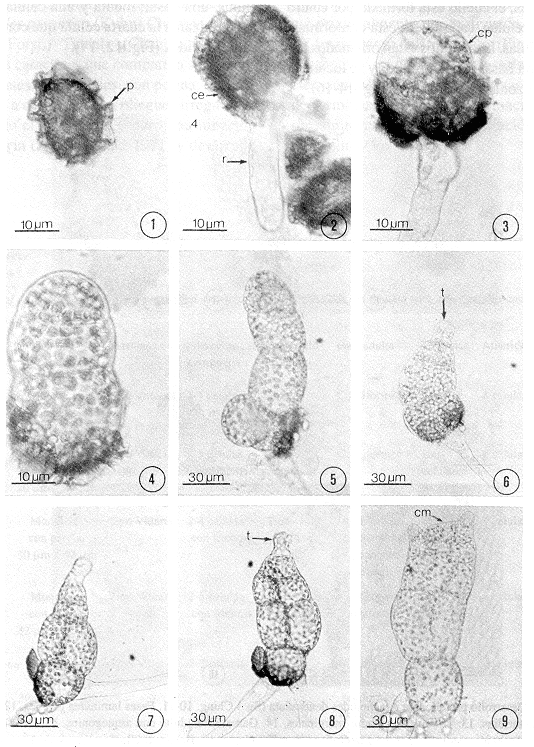
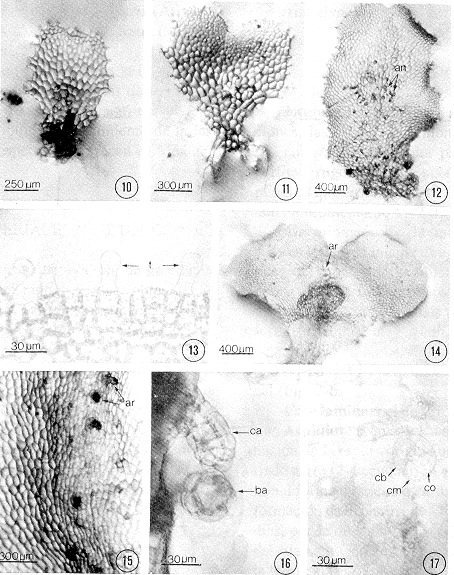
<body><![CDATA[<p><b><font face="Arial,Helvetica"><font size=-1>Resultados</font></font></b>     <p><font face="Arial,Helvetica"><font size=-1><b>Esporas:</b> de acuerdo a nuestras observaciones, las esporas son monoletes, elipsoidales, con perina y de color pardo obscuro, superficie rugosa a tuberculada, formada por pliegues que terminan en picos irregulares, miden en promedio 30 x 42 &micro;m (<a href="#fig1">Fig. 1</a>).</font></font>     <p><font face="Arial,Helvetica"><font size=-1><b>Germinaci&oacute;n:</b> es de tipo <b>Vittaria</b> (<a href="#Nayar71">Nayar y Kaur 1971</a>), se inicia entre los 9-14 d&iacute;as despu&eacute;s de haber sido sembradas las esporas y donde se desarrolla primero la c&eacute;lula rizoidal unicelular, corta y hialina; posteriormente se forma la c&eacute;lula prot&aacute;lica con abundantes cloroplastos, que finalmente origina un filamento uniseriado de 2-4 c&eacute;lulas, con un tricoma apical (<a href="#fig1">Fig. 2-6</a>).</font></font>     <p><font face="Arial,Helvetica"><font size=-1><b>Fase laminar:</b> el desarrollo prot&aacute;lico es de tipo <b>Aspidium</b> (<a href="#Nayar69">Nayar y Kaur 1969</a>). La germinaci&oacute;n de la espora origina un filamento uniseriado corto (2-4 c&eacute;lulas), en el que la c&eacute;lula terminal forma un tricoma en su &aacute;pice (<a href="#fig1">Fig. 6</a>). La formaci&oacute;n de la l&aacute;mina se inicia entre los 18-30 d&iacute;as, por la divisi&oacute;n de las c&eacute;lulas intermedias del filamento, que est&aacute;n por debajo de la c&eacute;lula terminal (<a href="#fig1">Fig. 6-8</a>); o bien a partir de la c&eacute;lula terminal del filamento, despu&eacute;s de haber formado el tricoma, la cual se divide longitudinalmente de tal forma que el tricoma queda colocado sobre una de las c&eacute;lulas hijas. M&aacute;s tarde se diferencia la c&eacute;lula meristem&aacute;tica que, mediante divisiones longitudinales y transversales, va a formar una l&aacute;mina joven entre los 30-50 d&iacute;as con una ala ligeramente m&aacute;s grande que la otra; esta forma asim&eacute;trica se pierde cuando se forma el cojinete (<a href="#fig1">Fig. 9</a>-<a href="#fig2">11</a>). Los protalos adultos son cordiformes-espatulados a cordiforme-reniforme, con abundantes tricomas unicelulares alargados, capitados, que se distribuyen tanto en el margen como en la superficie de la l&aacute;mina (<a href="#fig2">Fig.12-13</a>).</font></font>     <br>&nbsp;     <br>&nbsp;     <br>     <center>     <p><a NAME="fig1"></a><img SRC="/img/fbpe/rbt/v47n4/0406i1.GIF" height=747 width=534></center>      
<p>    ]]></body>
<body><![CDATA[<br>     <br>     <p><font face="Arial,Helvetica"><font size=-1>Figs. 1-9. Desarrollo prot&aacute;lico de <i>Arachniodes denticulata</i> (Sw.) Ching. 1. Espora. 2.- Germinaci&oacute;n tipo <b>Vittaria</b>, 3-5. Fases filamentosas (2-4 c&eacute;lulas). 6-9. Formaci&oacute;n de la l&aacute;mina prot&aacute;lica (4-12 c&eacute;lulas). <b>ce</b>= cubierta de la espora, <b>cm= </b>c&eacute;lula meristem&aacute;tica, <b>cp</b>= c&eacute;lula prot&aacute;lica, <b>p</b>= perina, <b>r</b>= rizoide, <b>t</b>= tricoma.</font></font>     <p><font face="Arial,Helvetica"><font size=-1>Figs. 1-9.- Prothallial development of <i>Arachniodes denticulata</i> (Sw.) Ching. 1.- Spore, 2.- <b>Vittaria</b>-type germination, 3-5.- Filament stages (2-4 cells), 6-9.- Prothallial plate development (4-12 cells). <b>ce</b>= spore coat,</font></font>     <br><font face="Arial,Helvetica"><font size=-1><b>cm</b>= meritematic cell, <b>cp</b>= prothallial cell, <b>p</b>= perine, <b>r</b>= rhizoid, <b>t</b>= trichomes.</font></font>     <br><font face="Arial,Helvetica"><font size=-1><b>Gametangios: </b>son del tipo com&uacute;n de los helechos leptosporangiados, se diferenciaron entre los 100-150 d&iacute;as.</font></font>     <br>&nbsp;     <p><font face="Arial,Helvetica"><font size=-1>Los arquegonios se formaron entre los 100-110 d&iacute;as, el cuello est&aacute; formado por cuatro hileras de c&eacute;lulas, cada hilera est&aacute; conformada por 4-6 c&eacute;lulas. Los cuellos est&aacute;n orientados hacia la regi&oacute;n basal de los protalos y se localizan cerca de la zona meristem&aacute;tica (<a href="#fig2">Fig. 14-16</a>).</font></font>     <p><font face="Arial,Helvetica"><font size=-1>Los anteridios se diferenciaron alrededor de 110-150 d&iacute;as y se localizan en la regi&oacute;n media basal de los gametofitos entre los rizoides; son globosos y est&aacute;n formados por cuatro c&eacute;lulas, una basal, media y una c&eacute;lula opercular que rodean a la cuarta c&eacute;lula que contiene a los anterozoides (<a href="#fig2">Fig. 12, 17</a>).</font></font>     <br>&nbsp;     ]]></body>
<body><![CDATA[<br>&nbsp;     <br>     <center>     <p><a NAME="fig2"></a><img SRC="/img/fbpe/rbt/v47n4/0406i2.GIF" height=575 width=454></center>      
<p>    <br>     <br>     <br>     <p><font face="Arial,Helvetica"><font size=-1>Figs. 10-17. Desarrollo prot&aacute;lico de <i>Arachniodes denticulata</i> (Sw.) Ching. 10-11. Fases laminares j&oacute;venes. 12. Gametofito adulto con anteridios. 13. Tricomas capitados marginales. 14. Gametofito adulto con arquegonios. 15. Distribuci&oacute;n de arquegonios en la regi&oacute;n media central del gametofito sobre el cojinete. 16. Boca y cuello de arquegonio 17. anteridios. <b>an</b>= anteridios, <b>ar</b>= arquegonios, <b>ba</b>= boca de arquegonio, <b>ca</b>= cuello de arquegonio, <b>cb</b>= c&eacute;lula basal, <b>cm</b>= c&eacute;lula media, <b>co</b>= c&eacute;lula opercular, <b>t</b>= tricomas capitados.</font></font>     <p><font face="Arial,Helvetica"><font size=-1>Figs. 10-17. Prothallial development of <i>Arachniodes denticulata</i> (Sw.) Ching. 10-11. Young plate stage. 12. Adult gametophyte with antheridia. 13. Marginal capitate trichomes. 14. Adult gametophyte with archegonia. 15. Archegonia in the medial central region of the gametophyte, on the cushion. 16. Mouth and neck of archegonium. 17. Antheridia. <b>an</b>= antheridia, <b>ar</b>= archegonia, <b>ba</b>= mouth of archegonia, <b>ca</b>= neck of archegonia, <b>cb</b>= basal cell, <b>cm</b>= medium cell, <b>co</b>= opercular cell, <b>t</b>= capitate trichomes.</font></font>     ]]></body>
<body><![CDATA[<br>&nbsp;     <p><b><font face="Arial,Helvetica"><font size=-1>Discusi&oacute;n y Conclusi&oacute;n</font></font></b>     <p><font face="Arial,Helvetica"><font size=-1>La fase gametof&iacute;tica de <i>Arachniodes denticulata</i> que crece en M&eacute;xico, comparte caracter&iacute;sticas similares con las especies asi&aacute;ticas <i>Arachniodes assamica</i> (Kuhn) Ching y <i>A. aristata </i>(G. Forst.) Tindale (<a href="#Chandra">Chandra y Nayar 1970</a>). Los caracteres que comparten son: esporas monoletes, elipsoidales, con perina, superficie rugosa a ondulada, con pliegues irregulares, color pardo claro a pardo oscuro; germinaci&oacute;n tipo <b>Vittaria</b> (Nayar y Kaur 1971) y desarrollo prot&aacute;lico tipo <b>Aspidium</b> (<a href="#Nayar69">Nayar y Kaur 1969</a>), como rasgo distintivo de los gametofitos de <i>A. denticulata</i>, <i>A. assamica</i> y <i>A. aristata</i> es que el filamento germinal termina com&uacute;nmente en un tricoma unicelular, y la l&aacute;mina prot&aacute;lica se forma principalmente por la divisi&oacute;n de las c&eacute;lulas intercalares del filamento (<a href="#fig1">Figs. 6-8</a>). Las diferencias encontradas entre estas tres especies, aunque no muy significativas son: tiempo de germinaci&oacute;n, tiempo de formaci&oacute;n de protalos adultos, as&iacute; como diferenciaci&oacute;n de los gametangios (V&eacute;ase <a href="#CUADRO1">cuadro 1</a>).</font></font>     <br>&nbsp;     <br>&nbsp;     <br>     <br>     <center>     <p><a NAME="CUADRO1"></a><font face="Arial,Helvetica"><font size=-1>CUADRO 1</font></font></center> <font face="Arial,Helvetica"><font size=-1><i>Comparaci&oacute;n de las distintas fases de desarrollo prot&aacute;lico de </i>Arachniodes denticulata<i> con otros g&eacute;neros y especies de la familia Dryopteridaceae.</i></font></font>     <br>&nbsp;     ]]></body>
<body><![CDATA[<br>&nbsp;     <br>     <center>     <p><font face="Arial,Helvetica"><font size=-1>TABLE 1</font></font></center> <font face="Arial,Helvetica"><font size=-1><i>Comparison of differentes stages of the prothallial development of </i>Arachniodes denticulata<i> with other genera and species of Dryoteridaceae.</i></font></font>     <br>&nbsp;     <center><table BORDER=0 CELLSPACING=0 CELLPADDING=8 WIDTH="739" > <tr> <td VALIGN=TOP WIDTH="10%" HEIGHT="26">     <center><font face="Arial,Helvetica"><font size=-1>Taxa/</font></font>     <br><font face="Arial,Helvetica"><font size=-1>caracteres</font></font></center> </td>  <td VALIGN=TOP WIDTH="14%" HEIGHT="26">     <center><font face="Arial,Helvetica"><font size=-1>Tipo de espora</font></font></center> </td>  <td VALIGN=TOP WIDTH="9%" HEIGHT="26">     <center><font face="Arial,Helvetica"><font size=-1>Germinaci&oacute;n</font></font></center> </td>  <td VALIGN=TOP WIDTH="10%" HEIGHT="26">     ]]></body>
<body><![CDATA[<center><font face="Arial,Helvetica"><font size=-1>Filamento germinativo</font></font></center> </td>  <td VALIGN=TOP WIDTH="10%" HEIGHT="26">     <center><font face="Arial,Helvetica"><font size=-1>Desarrollo prot&aacute;lico</font></font></center> </td>  <td VALIGN=TOP WIDTH="17%" HEIGHT="26">     <center><font face="Arial,Helvetica"><font size=-1>Fase adulta</font></font></center> </td>  <td VALIGN=TOP WIDTH="10%" HEIGHT="26">     <center><font face="Arial,Helvetica"><font size=-1>Tricomas</font></font></center> </td>  <td VALIGN=TOP WIDTH="7%" HEIGHT="26">     <center><font face="Arial,Helvetica"><font size=-1>Anteridios</font></font></center> </td>  <td VALIGN=TOP WIDTH="12%" HEIGHT="26">     <center><font face="Arial,Helvetica"><font size=-1>Arquegonios</font></font></center> </td> </tr>  <tr> <td VALIGN=TOP WIDTH="10%" HEIGHT="26"><font face="Arial,Helvetica"><font size=-1>Arachniodes aristata<sup>1</sup></font></font></td>  <td VALIGN=TOP WIDTH="14%" HEIGHT="26"><font face="Arial,Helvetica"><font size=-1>Monoletes con perina, 30 &micro;m x 42 &micro;m</font></font></td>  <td VALIGN=TOP WIDTH="9%" HEIGHT="26"><font face="Arial,Helvetica"><font size=-1>Tipo Vittaria</font></font></td>  <td VALIGN=TOP WIDTH="10%" HEIGHT="26"><font face="Arial,Helvetica"><font size=-1>2-5 c&eacute;lulas, con tricoma</font></font></td>  <td VALIGN=TOP WIDTH="10%" HEIGHT="26"><font face="Arial,Helvetica"><font size=-1>Tipo Aspidium</font></font></td>  <td VALIGN=TOP WIDTH="17%" HEIGHT="26"><font face="Arial,Helvetica"><font size=-1>Cordiformes</font></font></td>  <td VALIGN=TOP WIDTH="10%" HEIGHT="26"><font face="Arial,Helvetica"><font size=-1>Unicelulares papilados</font></font></td>  <td VALIGN=TOP WIDTH="7%" HEIGHT="26"><font face="Arial,Helvetica"><font size=-1>4 c&eacute;lulas</font></font></td>  <td VALIGN=TOP WIDTH="12%" HEIGHT="26"><font face="Arial,Helvetica"><font size=-1>4 hileras de c&eacute;lulas</font></font></td> </tr>  <tr> <td VALIGN=TOP WIDTH="10%" HEIGHT="26"><font face="Arial,Helvetica"><font size=-1>A. assamica<sup>1</sup></font></font></td>  <td VALIGN=TOP WIDTH="14%" HEIGHT="26"><font face="Arial,Helvetica"><font size=-1>Monolete con perina,&nbsp;</font></font>     <p><font face="Arial,Helvetica"><font size=-1>20 &micro;m x 30 &micro;m</font></font></td>  <td VALIGN=TOP WIDTH="9%" HEIGHT="26"><font face="Arial,Helvetica"><font size=-1>Tipo Vittaria</font></font></td>  <td VALIGN=TOP WIDTH="10%" HEIGHT="26"><font face="Arial,Helvetica"><font size=-1>2-5 c&eacute;lula con tricoma</font></font></td>  <td VALIGN=TOP WIDTH="10%" HEIGHT="26"><font face="Arial,Helvetica"><font size=-1>Tipo Aspidium</font></font></td>  <td VALIGN=TOP WIDTH="17%" HEIGHT="26"><font face="Arial,Helvetica"><font size=-1>Cordiformes</font></font></td>  <td VALIGN=TOP WIDTH="10%" HEIGHT="26"><font face="Arial,Helvetica"><font size=-1>Unicelulares papilados</font></font></td>  <td VALIGN=TOP WIDTH="7%" HEIGHT="26"><font face="Arial,Helvetica"><font size=-1>4 c&eacute;lulas</font></font></td>  <td VALIGN=TOP WIDTH="12%" HEIGHT="26"><font face="Arial,Helvetica"><font size=-1>4 hileras de c&eacute;lulas</font></font></td> </tr>  <tr> <td VALIGN=TOP WIDTH="10%" HEIGHT="26"><b><font face="Arial,Helvetica"><font size=-1>A. denticulata</font></font></b></td>  <td VALIGN=TOP WIDTH="14%" HEIGHT="26"><font face="Arial,Helvetica"><font size=-1>Monoletes con perina,&nbsp;</font></font>     <p><font face="Arial,Helvetica"><font size=-1>30 &micro;m x 42 &micro;m</font></font></td>  <td VALIGN=TOP WIDTH="9%" HEIGHT="26"><font face="Arial,Helvetica"><font size=-1>Tipo Vittaria</font></font></td>  <td VALIGN=TOP WIDTH="10%" HEIGHT="26"><font face="Arial,Helvetica"><font size=-1>2-4 c&eacute;lulas con tricoma</font></font></td>  <td VALIGN=TOP WIDTH="10%" HEIGHT="26"><font face="Arial,Helvetica"><font size=-1>Tipo Aspidium</font></font></td>  <td VALIGN=TOP WIDTH="17%" HEIGHT="26"><font face="Arial,Helvetica"><font size=-1>Cordiformes, con margen ligeramente lacerado</font></font></td>  <td VALIGN=TOP WIDTH="10%" HEIGHT="26"><font face="Arial,Helvetica"><font size=-1>Unicelulares papilados</font></font></td>  <td VALIGN=TOP WIDTH="7%" HEIGHT="26"><font face="Arial,Helvetica"><font size=-1>4 c&eacute;lulas</font></font></td>  <td VALIGN=TOP WIDTH="12%" HEIGHT="26"><font face="Arial,Helvetica"><font size=-1>4 hileras de c&eacute;lulas</font></font></td> </tr>  <tr> <td VALIGN=TOP WIDTH="10%" HEIGHT="26"><font face="Arial,Helvetica"><font size=-1>Cyrtomium<sup>1</sup></font></font></td>  <td VALIGN=TOP WIDTH="14%" HEIGHT="26"><font face="Arial,Helvetica"><font size=-1>Monoletes con perina,&nbsp;</font></font>     <p><font face="Arial,Helvetica"><font size=-1>32 &micro;m x 45 &micro;m</font></font></td>  <td VALIGN=TOP WIDTH="9%" HEIGHT="26"><font face="Arial,Helvetica"><font size=-1>Tipo Vittaria</font></font></td>  <td VALIGN=TOP WIDTH="10%" HEIGHT="26"><font face="Arial,Helvetica"><font size=-1>2-5 c&eacute;lulas con tricoma</font></font></td>  <td VALIGN=TOP WIDTH="10%" HEIGHT="26"><font face="Arial,Helvetica"><font size=-1>Tipo Aspidium</font></font></td>  <td VALIGN=TOP WIDTH="17%" HEIGHT="26"><font face="Arial,Helvetica"><font size=-1>Cordiformes,&nbsp;</font></font>     <br><font face="Arial,Helvetica"><font size=-1>apogamico</font></font></td>  <td VALIGN=TOP WIDTH="10%" HEIGHT="26"><font face="Arial,Helvetica"><font size=-1>Unicelulares papilados</font></font></td>  <td VALIGN=TOP WIDTH="7%" HEIGHT="26"><font face="Arial,Helvetica"><font size=-1>4 c&eacute;lulas</font></font></td>  <td VALIGN=TOP WIDTH="12%" HEIGHT="26"><font face="Arial,Helvetica"><font size=-1>4 hileras de c&eacute;lulas</font></font></td> </tr>  <tr> <td VALIGN=TOP WIDTH="10%" HEIGHT="26"><font face="Arial,Helvetica"><font size=-1>Didymochlaena truncatula<sup>2</sup></font></font></td>  <td VALIGN=TOP WIDTH="14%" HEIGHT="26"><font face="Arial,Helvetica"><font size=-1>Monoletes con perina,&nbsp;</font></font>     ]]></body>
<body><![CDATA[<p><font face="Arial,Helvetica"><font size=-1>30 &micro;m x 37 &micro;m</font></font></td>  <td VALIGN=TOP WIDTH="9%" HEIGHT="26"><font face="Arial,Helvetica"><font size=-1>Tipo Vittaria</font></font></td>  <td VALIGN=TOP WIDTH="10%" HEIGHT="26"><font face="Arial,Helvetica"><font size=-1>2-3 c&eacute;lulas</font></font></td>  <td VALIGN=TOP WIDTH="10%" HEIGHT="26"><font face="Arial,Helvetica"><font size=-1>Tipo Adiantum</font></font></td>  <td VALIGN=TOP WIDTH="17%" HEIGHT="26"><font face="Arial,Helvetica"><font size=-1>Cordiformes-</font></font>     <br><font face="Arial,Helvetica"><font size=-1>espatulados a reniformes, margenes lisos</font></font></td>  <td VALIGN=TOP WIDTH="10%" HEIGHT="26"><font face="Arial,Helvetica"><font size=-1>Ausentes</font></font></td>  <td VALIGN=TOP WIDTH="7%" HEIGHT="26"><font face="Arial,Helvetica"><font size=-1>4 c&eacute;lulas</font></font></td>  <td VALIGN=TOP WIDTH="12%" HEIGHT="26"><font face="Arial,Helvetica"><font size=-1>4 hileras de c&eacute;lulas</font></font></td> </tr>  <tr> <td VALIGN=TOP WIDTH="10%" HEIGHT="26"><font face="Arial,Helvetica"><font size=-1>Dryopteris<sup>3</sup></font></font></td>  <td VALIGN=TOP WIDTH="14%" HEIGHT="26"><font face="Arial,Helvetica"><font size=-1>Monoletes con perina,&nbsp;</font></font>     <p><font face="Arial,Helvetica"><font size=-1>35 &micro;m x 45 &micro;m</font></font></td>  <td VALIGN=TOP WIDTH="9%" HEIGHT="26"><font face="Arial,Helvetica"><font size=-1>Tipo Vittaria</font></font></td>  <td VALIGN=TOP WIDTH="10%" HEIGHT="26"><font face="Arial,Helvetica"><font size=-1>2-5 c&eacute;lulas con tricoma</font></font></td>  <td VALIGN=TOP WIDTH="10%" HEIGHT="26"><font face="Arial,Helvetica"><font size=-1>Tipo Aspidium</font></font></td>  <td VALIGN=TOP WIDTH="17%" HEIGHT="26"><font face="Arial,Helvetica"><font size=-1>Cordiformes a reniformes</font></font></td>  <td VALIGN=TOP WIDTH="10%" HEIGHT="26"><font face="Arial,Helvetica"><font size=-1>Unicelulares papilados</font></font></td>  <td VALIGN=TOP WIDTH="7%" HEIGHT="26"><font face="Arial,Helvetica"><font size=-1>4 c&eacute;lulas</font></font></td>  <td VALIGN=TOP WIDTH="12%" HEIGHT="26"><font face="Arial,Helvetica"><font size=-1>4 hileras de c&eacute;lulas</font></font></td> </tr>  <tr> <td VALIGN=TOP WIDTH="10%" HEIGHT="26"><font face="Arial,Helvetica"><font size=-1>Polystichum<sup>1</sup></font></font></td>  <td VALIGN=TOP WIDTH="14%" HEIGHT="26"><font face="Arial,Helvetica"><font size=-1>Monoletes con perina,&nbsp;</font></font>     <p><font face="Arial,Helvetica"><font size=-1>34 &micro;m x 45 &micro;m</font></font></td>  <td VALIGN=TOP WIDTH="9%" HEIGHT="26"><font face="Arial,Helvetica"><font size=-1>Tipo Vittaria</font></font></td>  <td VALIGN=TOP WIDTH="10%" HEIGHT="26"><font face="Arial,Helvetica"><font size=-1>2-8 c&eacute;lulas</font></font></td>  <td VALIGN=TOP WIDTH="10%" HEIGHT="26"><font face="Arial,Helvetica"><font size=-1>Tipo Aspidium</font></font></td>  <td VALIGN=TOP WIDTH="17%" HEIGHT="26"><font face="Arial,Helvetica"><font size=-1>Cordiformes con tricomas</font></font></td>  <td VALIGN=TOP WIDTH="10%" HEIGHT="26"><font face="Arial,Helvetica"><font size=-1>Unicelulares papilados</font></font></td>  <td VALIGN=TOP WIDTH="7%" HEIGHT="26"><font face="Arial,Helvetica"><font size=-1>4-5 c&eacute;lulas</font></font></td>  <td VALIGN=TOP WIDTH="12%" HEIGHT="26"><font face="Arial,Helvetica"><font size=-1>4 hileras de c&eacute;lulas</font></font></td> </tr> </table></center> <font face="Arial,Helvetica"><font size=-1><sup>1 </sup>Chandra y Nayar 1970, <sup>2 </sup>Mendoza <i>et al. </i>1999, <sup>3</sup> P&eacute;rez-Garc&iacute;a <i>et al</i>. 1999.</font></font>     <br>&nbsp;     <p><font face="Arial,Helvetica"><font size=-1>Comparando el desarrollo prot&aacute;lico de las especies de <i>Arachniodes</i> con algunas especies de <i>Cyrtomium</i> (<a href="#Chandra">Chandra y Nayar 1970</a>), <i>Dryopteris</i> (<a href="#Pérez">P&eacute;rez-Garc&iacute;a <i>et al</i>. 1999</a>), <i>Polystichum</i> (<a href="#Chandra">Chandra y Nayar 1970</a>) todos ellos de la familia Dryopteridaceae, encontramos que comparten el mismo patr&oacute;n de germinaci&oacute;n de la espora y desarrollo prot&aacute;lico.</font></font>     <p><font face="Arial,Helvetica"><font size=-1>Por otro lado <i>Didymochlaena truncatula </i>(Sw.) J. Sm.,<i> </i>a pesar de que se encuentra dentro de la misma familia, s&oacute;lo comparte el mismo patr&oacute;n de germinaci&oacute;n, pero difiere del resto de los g&eacute;neros mencionados anteriormente, porque presenta un patr&oacute;n de desarrollo prot&aacute;lico tipo <b>Adiantum</b>, que se caracteriza por la diferenciaci&oacute;n de una c&eacute;lula meristem&aacute;tica apical en etapas tempranas durante la formaci&oacute;n de la l&aacute;mina prot&aacute;lica, los protalos adultos son glabros, en comparaci&oacute;n con los gametofitos de los otros g&eacute;neros, que presentan numerosos tricomas tanto marginales como en ambas superficies de la l&aacute;mina (<a href="#Mendoza">Mendoza <i>et al</i>. 1999</a>).</font></font>     <p><font face="Arial,Helvetica"><font size=-1>Pero a nivel de gametangios, encontramos que son muy similares en cuanto al n&uacute;mero de c&eacute;lulas que presentan los anteridios y los arquegonios.</font></font>     <p><font face="Arial,Helvetica"><font size=-1>Se puede concluir que <i>Arachniodes denticulata</i> comparte caracter&iacute;sticas comunes con <i>A. aristata</i>, <i>A. assamica</i> y con especies de los g&eacute;neros <i>Cyrtomium </i>(<a href="#Chandra">Chandra y Nayar 1970</a>), <i>Dryopteris</i> (<a href="#Pérez">P&eacute;rez-Garc&iacute;a <i>et al. </i>1999</a>), <i>Polystichum</i> (<a href="#Chandra">Chandra y Nayar 1970</a>), como son el patr&oacute;n de germinaci&oacute;n y desarrollo prot&aacute;lico, as&iacute; como la presencia de tricomas unicelulares desde etapas tempranas del desarrollo de los protalos. Por su parte <i>Didymochlaena truncatula</i> difiere de las anteriores por presentar un patr&oacute;n de desarrollo prot&aacute;lico distinto y por la ausencia de tricomas en toda su fase sexual.</font></font>     <br>&nbsp;     ]]></body>
<body><![CDATA[<p><b><font face="Arial,Helvetica"><font size=-1>Agradecimientos</font></font></b>     <p><font face="Arial,Helvetica"><font size=-1>Se agradece a Judith M&aacute;rquez y David D&iacute;az Pontones sus sugerencias y comentarios sobre el manuscrito, as&iacute; como a Jorge Lodigiani por el procesamiento del material fotogr&aacute;fico y a los revisores externos por sus cr&iacute;ticas. Este trabajo forma parte de la tesis titulada: "Morfog&eacute;nesis de la fase sexual de pteridofitas mexicanas: familia Dryopteridaceae", para obtener el grado de Maestro en Ciencias (Biolog&iacute;a Vegetal) del primer autor, que fue desarrollada en el Laboratorio AS-102 de la Universidad Aut&oacute;noma Metropolitana, Iztapalapa.</font></font>     <br>&nbsp;     <p><b><font face="Arial,Helvetica"><font size=-1>Resumen</font></font></b>     <p><font face="Arial,Helvetica"><font size=-1>Se describe la morfolog&iacute;a de la espora y desarrollo de la fase sexual de <i>Arachniodes denticulata</i> (Sw.) Ching. El material fue recolectado en los estados de Hidalgo, Oaxaca y Veracruz, M&eacute;xico (una muestra por cada localidad). Las esporas fueron sembradas en medio de Thompson con agar (30 cajas). Sus esporas son monoletes con perina, elipsoidales, no clorof&iacute;licas. Su germinaci&oacute;n es tipo <b>Vittaria</b> y su desarrollo prot&aacute;lico tipo <b>Aspidium</b>, el gametofito adulto es cordiforme-espatulado a cordiforme-reniforme; presentan tricomas marginales y superficiales, unicelulares, capitados; los rizoides no tienen cloroplastos; sus gametangios son del tipo com&uacute;n de los helechos leptosporangiados. Despu&eacute;s de 200 d&iacute;as de haber sido sembradas las esporas, no se formaron esporofitos. Se concluye que <i>A. denticulata</i> comparte caracter&iacute;sticas comunes con <i>A. aristata</i>, <i>A. assamica</i> y con especies de los g&eacute;neros <i>Cyrtomium</i>, <i>Dryopteris</i>, <i>Polystichum</i>, como son el tipo de germinaci&oacute;n y desarrollo prot&aacute;lico, as&iacute; como la presencia de tricomas unicelulares desde j&oacute;venes protalos. Mientras que <i>Didymochlaena truncatula</i> difiere de las anteriores por presentar un patr&oacute;n de desarrollo prot&aacute;lico tipo <b>Adiantum</b> y por la ausencia de tricomas en toda su fase sexual.</font></font>     <br>&nbsp;     <p><b><font face="Arial,Helvetica"><font size=-1>Refencias</font></font></b>     <!-- ref --><br><a NAME="Atkinson73"></a><font face="Arial,Helvetica"><font size=-1>Atkinson, L.R. 1973. The gametophyte and family relationships, p. 73-90. <i>In</i> A.C. Jermy, J.A. Crabbe &amp; B.A. Thomas (eds.) The phylogeny and classification of the ferns. Academic, Nueva York.</font></font>    &nbsp;&nbsp;&nbsp;&nbsp;&nbsp;&nbsp;&nbsp;&nbsp;[&#160;<a href="javascript:void(0);" onclick="javascript: window.open('/scielo.php?script=sci_nlinks&ref=1181162&pid=S0034-7744199900040001600001&lng=','','width=640,height=500,resizable=yes,scrollbars=1,menubar=yes,');">Links</a>&#160;]<!-- end-ref --><!-- ref --><p><a NAME="Atkinson64"></a><font face="Arial,Helvetica"><font size=-1>Atkinson, L.R. &amp; A.G. Stokey. 1964. Comparative morphology of the gametophyte of homosporous ferns. Phytomorphology 14: 51-70.</font></font>    &nbsp;&nbsp;&nbsp;&nbsp;&nbsp;&nbsp;&nbsp;&nbsp;[&#160;<a href="javascript:void(0);" onclick="javascript: window.open('/scielo.php?script=sci_nlinks&ref=1181163&pid=S0034-7744199900040001600002&lng=','','width=640,height=500,resizable=yes,scrollbars=1,menubar=yes,');">Links</a>&#160;]<!-- end-ref --><!-- ref --><p><a NAME="Chandra"></a><font face="Arial,Helvetica"><font size=-1>Chandra, P. &amp; B.K. Nayar. 1970. Morphology of some polystichoid ferns. I. The gametophytes of <i>Arachniodes</i>, <i>Cyrtomium</i> and <i>Polystichum</i>. J. Linn. Soc. Bot. 63: 265-276.</font></font>    &nbsp;&nbsp;&nbsp;&nbsp;&nbsp;&nbsp;&nbsp;&nbsp;[&#160;<a href="javascript:void(0);" onclick="javascript: window.open('/scielo.php?script=sci_nlinks&ref=1181164&pid=S0034-7744199900040001600003&lng=','','width=640,height=500,resizable=yes,scrollbars=1,menubar=yes,');">Links</a>&#160;]<!-- end-ref --><!-- ref --><p><a NAME="Gibby"></a><font face="Arial,Helvetica"><font size=-1>Gibby, M., H. Rasbach, T. Reichstein, C.J. Wid&eacute;n &amp; R.L. Viane. 1992. Micromorphology, chromosome numbers and phloroglucinols of <i>Arachniodes foliosa</i> and <i>A. webbiana</i> (Dryopteridaceae, Pterophyta). Bot. Helv. 102: 229-245.</font></font>    &nbsp;&nbsp;&nbsp;&nbsp;&nbsp;&nbsp;&nbsp;&nbsp;[&#160;<a href="javascript:void(0);" onclick="javascript: window.open('/scielo.php?script=sci_nlinks&ref=1181165&pid=S0034-7744199900040001600004&lng=','','width=640,height=500,resizable=yes,scrollbars=1,menubar=yes,');">Links</a>&#160;]<!-- end-ref --><!-- ref --><p><a NAME="Cousens"></a><font face="Arial,Helvetica"><font size=-1>Cousens, M.I. 1975. Gametophyte sex expression in some species of <i>Dryopteris</i>. Amer. Fern J. 60: 13-27.</font></font>    &nbsp;&nbsp;&nbsp;&nbsp;&nbsp;&nbsp;&nbsp;&nbsp;[&#160;<a href="javascript:void(0);" onclick="javascript: window.open('/scielo.php?script=sci_nlinks&ref=1181166&pid=S0034-7744199900040001600005&lng=','','width=640,height=500,resizable=yes,scrollbars=1,menubar=yes,');">Links</a>&#160;]<!-- end-ref --><!-- ref --><p><a NAME="Kaur"></a><font face="Arial,Helvetica"><font size=-1>Kaur, S. 1977. Morphology of the prothallus and juvenile sporophytes of some species of <i>Dryopteris</i>. Proc. Indian Acad. Sci. 85: 163-171.</font></font>    &nbsp;&nbsp;&nbsp;&nbsp;&nbsp;&nbsp;&nbsp;&nbsp;[&#160;<a href="javascript:void(0);" onclick="javascript: window.open('/scielo.php?script=sci_nlinks&ref=1181167&pid=S0034-7744199900040001600006&lng=','','width=640,height=500,resizable=yes,scrollbars=1,menubar=yes,');">Links</a>&#160;]<!-- end-ref --><!-- ref --><p><a NAME="Klekowski"></a><font face="Arial,Helvetica"><font size=-1>Klekowski, E.J. Jr. 1969. Reproductive biology of the pteridophyta. III. A study of the Blechnaceae. J. Linn. Soc. 62: 361-377.</font></font>    &nbsp;&nbsp;&nbsp;&nbsp;&nbsp;&nbsp;&nbsp;&nbsp;[&#160;<a href="javascript:void(0);" onclick="javascript: window.open('/scielo.php?script=sci_nlinks&ref=1181168&pid=S0034-7744199900040001600007&lng=','','width=640,height=500,resizable=yes,scrollbars=1,menubar=yes,');">Links</a>&#160;]<!-- end-ref --><!-- ref --><p><a NAME="Mendoza"></a><font face="Arial,Helvetica"><font size=-1>Mendoza, A., B. P&eacute;rez-Garc&iacute;a &amp; R. Riba. 1999. Morfolog&iacute;a y anatom&iacute;a del gametofito de <i>Didymochlaena truncatula</i> (Dryopteridaceae). Rev. Biol. Trop. 47: 87-93.</font></font>    &nbsp;&nbsp;&nbsp;&nbsp;&nbsp;&nbsp;&nbsp;&nbsp;[&#160;<a href="javascript:void(0);" onclick="javascript: window.open('/scielo.php?script=sci_nlinks&ref=1181169&pid=S0034-7744199900040001600008&lng=','','width=640,height=500,resizable=yes,scrollbars=1,menubar=yes,');">Links</a>&#160;]<!-- end-ref --><!-- ref --><p><a NAME="Moran"></a><font face="Arial,Helvetica"><font size=-1>Moran, R.C. 1995. Dryopteridaceae, p. 210-226. <i>In</i> R.C. Moran &amp; R. Riba (eds.). Flora Mesoamericana. Instituto de Biolog&iacute;a (UNAM), Jard&iacute;n Bot&aacute;nico de Misuri y Museo de Historia Natural de Londres. Ciudad Universitaria, M&eacute;xico, D. F.</font></font>    &nbsp;&nbsp;&nbsp;&nbsp;&nbsp;&nbsp;&nbsp;&nbsp;[&#160;<a href="javascript:void(0);" onclick="javascript: window.open('/scielo.php?script=sci_nlinks&ref=1181170&pid=S0034-7744199900040001600009&lng=','','width=640,height=500,resizable=yes,scrollbars=1,menubar=yes,');">Links</a>&#160;]<!-- end-ref --><!-- ref --><p><a NAME="Morton"></a><font face="Arial,Helvetica"><font size=-1>Morton, C.V. 1960. Observations on cultivated ferns VI. The ferns currently known as <i>Rumohra.</i> Amer. Fern J. 50: 145-155.</font></font>    &nbsp;&nbsp;&nbsp;&nbsp;&nbsp;&nbsp;&nbsp;&nbsp;[&#160;<a href="javascript:void(0);" onclick="javascript: window.open('/scielo.php?script=sci_nlinks&ref=1181171&pid=S0034-7744199900040001600010&lng=','','width=640,height=500,resizable=yes,scrollbars=1,menubar=yes,');">Links</a>&#160;]<!-- end-ref --><!-- ref --><p><a NAME="Nayar69"></a><font face="Arial,Helvetica"><font size=-1>Nayar, B.K. &amp; S. Kaur. 1969. Types of prothallial development in homosporous ferns. Phytomorphology 19: 179-188.</font></font>    &nbsp;&nbsp;&nbsp;&nbsp;&nbsp;&nbsp;&nbsp;&nbsp;[&#160;<a href="javascript:void(0);" onclick="javascript: window.open('/scielo.php?script=sci_nlinks&ref=1181172&pid=S0034-7744199900040001600011&lng=','','width=640,height=500,resizable=yes,scrollbars=1,menubar=yes,');">Links</a>&#160;]<!-- end-ref --><!-- ref --><p><a NAME="Nayar71"></a><font face="Arial,Helvetica"><font size=-1>Nayar, B.K. &amp; S. Kaur. 1971. Gametophytes of homosporous ferns. Bot. Rev. 37: 295-396.</font></font>    &nbsp;&nbsp;&nbsp;&nbsp;&nbsp;&nbsp;&nbsp;&nbsp;[&#160;<a href="javascript:void(0);" onclick="javascript: window.open('/scielo.php?script=sci_nlinks&ref=1181173&pid=S0034-7744199900040001600012&lng=','','width=640,height=500,resizable=yes,scrollbars=1,menubar=yes,');">Links</a>&#160;]<!-- end-ref --><!-- ref --><p><a NAME="Pérez"></a><font face="Arial,Helvetica"><font size=-1>P&eacute;rez-Garc&iacute;a, B., A. Mendoza, I. Reyes Jaramillo &amp; R. Riba. 1999. Morfog&eacute;nesis de la fase sexual de seis especies mexicanas del g&eacute;nero <i>Dryopteris</i> (Dryopteridaceae). Rev. Biol. Trop. 74: 63-75.</font></font>    &nbsp;&nbsp;&nbsp;&nbsp;&nbsp;&nbsp;&nbsp;&nbsp;[&#160;<a href="javascript:void(0);" onclick="javascript: window.open('/scielo.php?script=sci_nlinks&ref=1181174&pid=S0034-7744199900040001600013&lng=','','width=640,height=500,resizable=yes,scrollbars=1,menubar=yes,');">Links</a>&#160;]<!-- end-ref --><!-- ref --><p><a NAME="Riba"></a><font face="Arial,Helvetica"><font size=-1>Riba, R. &amp; B. P&eacute;rez-Garc&iacute;a. 1999. Dryopteridaceae. Consejo Nacional de la Flora de M&eacute;xico, A. C. 6: 1-48.</font></font>    &nbsp;&nbsp;&nbsp;&nbsp;&nbsp;&nbsp;&nbsp;&nbsp;[&#160;<a href="javascript:void(0);" onclick="javascript: window.open('/scielo.php?script=sci_nlinks&ref=1181175&pid=S0034-7744199900040001600014&lng=','','width=640,height=500,resizable=yes,scrollbars=1,menubar=yes,');">Links</a>&#160;]<!-- end-ref --><!-- ref --><p><a NAME="Stokey"></a><font face="Arial,Helvetica"><font size=-1>Stokey, A.G. &amp; L.R. Atkinson. 1954. The gametophyte of <i>Didymochlaena sinuata</i> Desv. Phytomorphology 4: 310-315.</font></font>    &nbsp;&nbsp;&nbsp;&nbsp;&nbsp;&nbsp;&nbsp;&nbsp;[&#160;<a href="javascript:void(0);" onclick="javascript: window.open('/scielo.php?script=sci_nlinks&ref=1181176&pid=S0034-7744199900040001600015&lng=','','width=640,height=500,resizable=yes,scrollbars=1,menubar=yes,');">Links</a>&#160;]<!-- end-ref --><!-- ref --><p><a NAME="Tindale"></a><font face="Arial,Helvetica"><font size=-1>Tindale, M.D. 1961. Studies in Australian pteridophytes. No. 3. Contr. New South Wales Natl. Herb., Fl. Ser. 3: 88-92.</font></font>    &nbsp;&nbsp;&nbsp;&nbsp;&nbsp;&nbsp;&nbsp;&nbsp;[&#160;<a href="javascript:void(0);" onclick="javascript: window.open('/scielo.php?script=sci_nlinks&ref=1181177&pid=S0034-7744199900040001600016&lng=','','width=640,height=500,resizable=yes,scrollbars=1,menubar=yes,');">Links</a>&#160;]<!-- end-ref --><!-- ref --><p><a NAME="Yatskievych"></a><font face="Arial,Helvetica"><font size=-1>Yatskievych, G. 1996. Revision of the ferns genus <i>Phanerophlebia</i> (Dryopteridaceae). Ann. Missouri Bot. Gard. 83: 168-199.</font></font>    &nbsp;&nbsp;&nbsp;&nbsp;&nbsp;&nbsp;&nbsp;&nbsp;[&#160;<a href="javascript:void(0);" onclick="javascript: window.open('/scielo.php?script=sci_nlinks&ref=1181178&pid=S0034-7744199900040001600017&lng=','','width=640,height=500,resizable=yes,scrollbars=1,menubar=yes,');">Links</a>&#160;]<!-- end-ref --><p><a NAME="1ab"></a><sup><font face="Arial,Helvetica"><font size=-1><a href="#1">1</a>&nbsp;</font></font></sup><font face="Arial,Helvetica"><font size=-1> Departamento de Biolog&iacute;a, &Aacute;rea de Bot&aacute;nica Estructural y Sistem&aacute;tica, Universidad Aut&oacute;noma Metropolitana, Iztapalapa.</font></font>     <br><font face="Arial,Helvetica"><font size=-1>&nbsp;&nbsp;&nbsp;&nbsp; Apartado Postal 55-535, 09340 M&eacute;xico, D. F. Fax: (92) 5 724 4688, correo electr&oacute;nico: <a href="mailto:amr@xanum.uam.mx">amr@xanum.uam.mx</a></font></font>      ]]></body><back>
<ref-list>
<ref id="B1">
<nlm-citation citation-type="book">
<person-group person-group-type="author">
<name>
<surname><![CDATA[Atkinson]]></surname>
<given-names><![CDATA[L.R]]></given-names>
</name>
</person-group>
<article-title xml:lang="en"><![CDATA[The gametophyte and family relationships]]></article-title>
<person-group person-group-type="editor">
<name>
<surname><![CDATA[Jermy]]></surname>
<given-names><![CDATA[A.C]]></given-names>
</name>
<name>
<surname><![CDATA[Crabbe]]></surname>
<given-names><![CDATA[J.A]]></given-names>
</name>
<name>
<surname><![CDATA[Thomas]]></surname>
<given-names><![CDATA[B.A]]></given-names>
</name>
</person-group>
<source><![CDATA[The phylogeny and classification of the ferns]]></source>
<year>1973</year>
<page-range>73-90</page-range><publisher-loc><![CDATA[Nueva York ]]></publisher-loc>
<publisher-name><![CDATA[Academic]]></publisher-name>
</nlm-citation>
</ref>
<ref id="B2">
<nlm-citation citation-type="journal">
<person-group person-group-type="author">
<name>
<surname><![CDATA[Atkinson]]></surname>
<given-names><![CDATA[L.R]]></given-names>
</name>
<name>
<surname><![CDATA[Stokey]]></surname>
<given-names><![CDATA[A.G]]></given-names>
</name>
</person-group>
<article-title xml:lang="en"><![CDATA[Comparative morphology of the gametophyte of homosporous ferns]]></article-title>
<source><![CDATA[Phytomorphology]]></source>
<year>1964</year>
<volume>14</volume>
<page-range>51-70</page-range></nlm-citation>
</ref>
<ref id="B3">
<nlm-citation citation-type="journal">
<person-group person-group-type="author">
<name>
<surname><![CDATA[Chandra]]></surname>
<given-names><![CDATA[P]]></given-names>
</name>
<name>
<surname><![CDATA[Nayar]]></surname>
<given-names><![CDATA[B.K]]></given-names>
</name>
</person-group>
<article-title xml:lang="en"><![CDATA[Morphology of some polystichoid ferns. I. The gametophytes of Arachniodes, Cyrtomium and Polystichum]]></article-title>
<source><![CDATA[J. Linn. Soc. Bot]]></source>
<year>1970</year>
<volume>63</volume>
<page-range>265-276</page-range></nlm-citation>
</ref>
<ref id="B4">
<nlm-citation citation-type="journal">
<person-group person-group-type="author">
<name>
<surname><![CDATA[Gibby]]></surname>
<given-names><![CDATA[M]]></given-names>
</name>
<name>
<surname><![CDATA[Rasbach]]></surname>
<given-names><![CDATA[H]]></given-names>
</name>
<name>
<surname><![CDATA[Reichstein]]></surname>
<given-names><![CDATA[T]]></given-names>
</name>
<name>
<surname><![CDATA[Widén]]></surname>
<given-names><![CDATA[C.J]]></given-names>
</name>
<name>
<surname><![CDATA[Viane]]></surname>
<given-names><![CDATA[R.L]]></given-names>
</name>
</person-group>
<article-title xml:lang="en"><![CDATA[Micromorphology, chromosome numbers and phloroglucinols of Arachniodes foliosa and A. webbiana (Dryopteridaceae, Pterophyta)]]></article-title>
<source><![CDATA[Bot. Helv]]></source>
<year>1992</year>
<volume>102</volume>
<page-range>229-245</page-range></nlm-citation>
</ref>
<ref id="B5">
<nlm-citation citation-type="journal">
<person-group person-group-type="author">
<name>
<surname><![CDATA[Cousens]]></surname>
<given-names><![CDATA[M.I]]></given-names>
</name>
</person-group>
<article-title xml:lang="en"><![CDATA[Gametophyte sex expression in some species of Dryopteris]]></article-title>
<source><![CDATA[Amer. Fern J]]></source>
<year>1975</year>
<volume>60</volume>
<page-range>13-27</page-range></nlm-citation>
</ref>
<ref id="B6">
<nlm-citation citation-type="journal">
<person-group person-group-type="author">
<name>
<surname><![CDATA[Kaur]]></surname>
<given-names><![CDATA[S]]></given-names>
</name>
</person-group>
<article-title xml:lang="en"><![CDATA[Morphology of the prothallus and juvenile sporophytes of some species of Dryopteris]]></article-title>
<source><![CDATA[Proc. Indian Acad. Sci]]></source>
<year>1977</year>
<volume>85</volume>
<page-range>163-171</page-range></nlm-citation>
</ref>
<ref id="B7">
<nlm-citation citation-type="journal">
<person-group person-group-type="author">
<name>
<surname><![CDATA[Klekowski]]></surname>
<given-names><![CDATA[E.J]]></given-names>
</name>
</person-group>
<article-title xml:lang="en"><![CDATA[Reproductive biology of the pteridophyta. III. A study of the Blechnaceae]]></article-title>
<source><![CDATA[J. Linn. Soc]]></source>
<year>1969</year>
<volume>62</volume>
<page-range>361-377</page-range></nlm-citation>
</ref>
<ref id="B8">
<nlm-citation citation-type="journal">
<person-group person-group-type="author">
<name>
<surname><![CDATA[Mendoza]]></surname>
<given-names><![CDATA[A]]></given-names>
</name>
<name>
<surname><![CDATA[Pérez-García]]></surname>
<given-names><![CDATA[B]]></given-names>
</name>
<name>
<surname><![CDATA[Riba]]></surname>
<given-names><![CDATA[R]]></given-names>
</name>
</person-group>
<article-title xml:lang="es"><![CDATA[Morfología y anatomía del gametofito de Didymochlaena truncatula (Dryopteridaceae)]]></article-title>
<source><![CDATA[Rev. Biol. Trop]]></source>
<year>1999</year>
<volume>47</volume>
<page-range>87-93</page-range></nlm-citation>
</ref>
<ref id="B9">
<nlm-citation citation-type="book">
<person-group person-group-type="author">
<name>
<surname><![CDATA[Moran]]></surname>
<given-names><![CDATA[R.C]]></given-names>
</name>
</person-group>
<article-title xml:lang="en"><![CDATA[Dryopteridaceae]]></article-title>
<person-group person-group-type="editor">
<name>
<surname><![CDATA[Moran]]></surname>
<given-names><![CDATA[R.C]]></given-names>
</name>
<name>
<surname><![CDATA[Riba]]></surname>
<given-names><![CDATA[R]]></given-names>
</name>
</person-group>
<source><![CDATA[Flora Mesoamericana]]></source>
<year>1995</year>
<page-range>210-226</page-range><publisher-loc><![CDATA[Ciudad Universitaria^eMéxico, D. F México, D. F]]></publisher-loc>
<publisher-name><![CDATA[Instituto de Biología (UNAM), Jardín Botánico de Misuri y Museo de Historia Natural de Londres]]></publisher-name>
</nlm-citation>
</ref>
<ref id="B10">
<nlm-citation citation-type="journal">
<person-group person-group-type="author">
<name>
<surname><![CDATA[Morton]]></surname>
<given-names><![CDATA[C.V]]></given-names>
</name>
</person-group>
<article-title xml:lang="en"><![CDATA[Observations on cultivated ferns VI. The ferns currently known as Rumohra]]></article-title>
<source><![CDATA[Amer. Fern J]]></source>
<year>1960</year>
<volume>50</volume>
<page-range>145-155</page-range></nlm-citation>
</ref>
<ref id="B11">
<nlm-citation citation-type="journal">
<person-group person-group-type="author">
<name>
<surname><![CDATA[Nayar]]></surname>
<given-names><![CDATA[B.K]]></given-names>
</name>
<name>
<surname><![CDATA[Kaur]]></surname>
<given-names><![CDATA[S]]></given-names>
</name>
</person-group>
<article-title xml:lang="en"><![CDATA[Types of prothallial development in homosporous ferns]]></article-title>
<source><![CDATA[Phytomorphology]]></source>
<year>1969</year>
<volume>19</volume>
<page-range>179-188</page-range></nlm-citation>
</ref>
<ref id="B12">
<nlm-citation citation-type="journal">
<person-group person-group-type="author">
<name>
<surname><![CDATA[Nayar]]></surname>
<given-names><![CDATA[B.K]]></given-names>
</name>
<name>
<surname><![CDATA[Kaur]]></surname>
<given-names><![CDATA[S]]></given-names>
</name>
</person-group>
<article-title xml:lang="en"><![CDATA[Gametophytes of homosporous ferns]]></article-title>
<source><![CDATA[Bot. Rev]]></source>
<year>1971</year>
<volume>37</volume>
<page-range>295-396</page-range></nlm-citation>
</ref>
<ref id="B13">
<nlm-citation citation-type="journal">
<person-group person-group-type="author">
<name>
<surname><![CDATA[Pérez-García]]></surname>
<given-names><![CDATA[B]]></given-names>
</name>
<name>
<surname><![CDATA[Mendoza]]></surname>
<given-names><![CDATA[A]]></given-names>
</name>
<name>
<surname><![CDATA[Reyes Jaramillo]]></surname>
<given-names><![CDATA[I]]></given-names>
</name>
<name>
<surname><![CDATA[Riba]]></surname>
<given-names><![CDATA[R]]></given-names>
</name>
</person-group>
<article-title xml:lang="es"><![CDATA[Morfogénesis de la fase sexual de seis especies mexicanas del género Dryopteris (Dryopteridaceae)]]></article-title>
<source><![CDATA[Rev. Biol. Trop]]></source>
<year>1999</year>
<volume>74</volume>
<page-range>63-75</page-range></nlm-citation>
</ref>
<ref id="B14">
<nlm-citation citation-type="book">
<person-group person-group-type="author">
<name>
<surname><![CDATA[Riba]]></surname>
<given-names><![CDATA[R]]></given-names>
</name>
<name>
<surname><![CDATA[Pérez-García]]></surname>
<given-names><![CDATA[B]]></given-names>
</name>
</person-group>
<source><![CDATA[Dryopteridaceae]]></source>
<year>1999</year>
<volume>6</volume>
<page-range>1-48</page-range><publisher-name><![CDATA[Consejo Nacional de la Flora de México, A. C]]></publisher-name>
</nlm-citation>
</ref>
<ref id="B15">
<nlm-citation citation-type="journal">
<person-group person-group-type="author">
<name>
<surname><![CDATA[Stokey]]></surname>
<given-names><![CDATA[A.G]]></given-names>
</name>
<name>
<surname><![CDATA[Atkinson]]></surname>
<given-names><![CDATA[L.R]]></given-names>
</name>
</person-group>
<article-title xml:lang="en"><![CDATA[The gametophyte of Didymochlaena sinuata Desv]]></article-title>
<source><![CDATA[Phytomorphology]]></source>
<year>1954</year>
<volume>4</volume>
<page-range>310-315</page-range></nlm-citation>
</ref>
<ref id="B16">
<nlm-citation citation-type="journal">
<person-group person-group-type="author">
<name>
<surname><![CDATA[Tindale]]></surname>
<given-names><![CDATA[M.D]]></given-names>
</name>
</person-group>
<article-title xml:lang="en"><![CDATA[Studies in Australian pteridophytes. No. 3]]></article-title>
<source><![CDATA[Fl. Ser]]></source>
<year>1961</year>
<publisher-name><![CDATA[Contr. New South Wales Natl. Herb]]></publisher-name>
</nlm-citation>
</ref>
<ref id="B17">
<nlm-citation citation-type="journal">
<person-group person-group-type="author">
<name>
<surname><![CDATA[Yatskievych]]></surname>
<given-names><![CDATA[G]]></given-names>
</name>
</person-group>
<article-title xml:lang="en"><![CDATA[Revision of the ferns genus Phanerophlebia (Dryopteridaceae)]]></article-title>
<source><![CDATA[Ann. Missouri Bot. Gard]]></source>
<year>1996</year>
<volume>83</volume>
<page-range>168-199</page-range></nlm-citation>
</ref>
</ref-list>
</back>
</article>