<?xml version="1.0" encoding="ISO-8859-1"?><article xmlns:mml="http://www.w3.org/1998/Math/MathML" xmlns:xlink="http://www.w3.org/1999/xlink" xmlns:xsi="http://www.w3.org/2001/XMLSchema-instance">
<front>
<journal-meta>
<journal-id>0034-7744</journal-id>
<journal-title><![CDATA[Revista de Biología Tropical]]></journal-title>
<abbrev-journal-title><![CDATA[Rev. biol. trop]]></abbrev-journal-title>
<issn>0034-7744</issn>
<publisher>
<publisher-name><![CDATA[Universidad de Costa Rica]]></publisher-name>
</publisher>
</journal-meta>
<article-meta>
<article-id>S0034-77441999000400009</article-id>
<title-group>
<article-title xml:lang="en"><![CDATA[Anti-inflammatory activity of aqueous extracts of five Costa Rican medicinal plants in Sprague-Dawley rats]]></article-title>
</title-group>
<contrib-group>
<contrib contrib-type="author">
<name>
<surname><![CDATA[Badilla]]></surname>
<given-names><![CDATA[Beatriz]]></given-names>
</name>
<xref ref-type="aff" rid="A01"/>
</contrib>
<contrib contrib-type="author">
<name>
<surname><![CDATA[Mora]]></surname>
<given-names><![CDATA[Gerardo]]></given-names>
</name>
<xref ref-type="aff" rid="A02"/>
</contrib>
<contrib contrib-type="author">
<name>
<surname><![CDATA[Poveda]]></surname>
<given-names><![CDATA[Luis Jorge]]></given-names>
</name>
<xref ref-type="aff" rid="A03"/>
</contrib>
</contrib-group>
<aff id="A01">
<institution><![CDATA[,Universidad de Costa Rica instituto de Investigación en Ciencias Farmacéuticas ]]></institution>
<addr-line><![CDATA[San José ]]></addr-line>
<country>Costa Rica</country>
</aff>
<aff id="A02">
<institution><![CDATA[,Universidad de Costa Rica Centro de Investigación en Productos Naturales ]]></institution>
<addr-line><![CDATA[San José ]]></addr-line>
<country>Costa Rica</country>
</aff>
<aff id="A03">
<institution><![CDATA[,Universidad Nacional Escuela de Ciencias Ambientales ]]></institution>
<addr-line><![CDATA[ ]]></addr-line>
<country>Costa Rica</country>
</aff>
<pub-date pub-type="pub">
<day>00</day>
<month>12</month>
<year>1999</year>
</pub-date>
<pub-date pub-type="epub">
<day>00</day>
<month>12</month>
<year>1999</year>
</pub-date>
<volume>47</volume>
<numero>4</numero>
<fpage>723</fpage>
<lpage>727</lpage>
<copyright-statement/>
<copyright-year/>
<self-uri xlink:href="http://www.scielo.sa.cr/scielo.php?script=sci_arttext&amp;pid=S0034-77441999000400009&amp;lng=en&amp;nrm=iso"></self-uri><self-uri xlink:href="http://www.scielo.sa.cr/scielo.php?script=sci_abstract&amp;pid=S0034-77441999000400009&amp;lng=en&amp;nrm=iso"></self-uri><self-uri xlink:href="http://www.scielo.sa.cr/scielo.php?script=sci_pdf&amp;pid=S0034-77441999000400009&amp;lng=en&amp;nrm=iso"></self-uri><abstract abstract-type="short" xml:lang="en"><p><![CDATA[The anti-inflammatory properties of Loasa speciosa and Loasa triphylla (Loasaceae), Urtica leptuphylla and Urera baccifera (Urticaceae), and Chaptalia nutans (Asteraceae) were studied using the carregeenan induced rat paw edema model. Aqueous extracts of each plant were made according to the ethnobotanical use. The hippocratic assay was made with female rats; the dose used was 500 mg/kg i.p. and the control group received 0.5 ml of n.s.s.. All the animals treated showed hipothermia, and those treated with the extracts of Chaptalia nutans, Urera baccifera and Urtica leptuphylla showed an increased colinergic activity. Acute toxicities of the aqueous extracts were studied in mice an the mean lethal doses ranged between 1.0226 and 1.2022 g/kg. The extracts of Urera baccifera, Chaptalia nutans, Loasa speciosa and Loasa triphylla (500 mg/kg i.p.) showed an anti-inflammatory activity comparable with that of indomethacin. The extracts of U. baccifera and C. nutans, which showed the greatest anti-inflammatory activity, did not show it when used orally (500 mg/kg p.o.).]]></p></abstract>
<kwd-group>
<kwd lng="en"><![CDATA[Medicinal plants]]></kwd>
<kwd lng="en"><![CDATA[anti-inflammmatory agent]]></kwd>
<kwd lng="en"><![CDATA[edema]]></kwd>
<kwd lng="en"><![CDATA[Urticaceae]]></kwd>
<kwd lng="en"><![CDATA[Asteraceae]]></kwd>
<kwd lng="en"><![CDATA[Loasaceae]]></kwd>
</kwd-group>
</article-meta>
</front><body><![CDATA[ <center><b><font face="Arial,Helvetica">Anti-inflammatory activity of aqueous extracts of five Costa Rican</font></b>     <br><b><font face="Arial,Helvetica">medicinal plants in Sprague-Dawley rats</font></b>     <p><font face="Arial,Helvetica"><font size=-1><b>Beatriz Badilla<a NAME="1"></a></b><sup><a href="#1a">1</a></sup><b> Gerardo.Mora&nbsp;<a NAME="2"></a></b><sup><a href="#2a">2</a></sup><b>y Luis Jorge Poveda<a NAME="3"></a></b><sup><a href="#3a">3</a></sup></font></font>     <p><font face="Arial,Helvetica"><font size=-1>Received 14- Xi-1998. Corrected 13-Iv-1999 Accepted 16-Iv-1999</font></font></center>      <p><b><font face="Arial,Helvetica"><font size=-1>Abstract</font></font></b>     <p><font face="Arial,Helvetica"><font size=-1>The anti-inflammatory properties of <i>Loasa speciosa </i>and <i>Loasa triphylla</i> (Loasaceae), <i>Urtica leptuphylla</i> and <i>Urera baccifera</i> (Urticaceae), and <i>Chaptalia nutans</i> (Asteraceae) were studied using the carregeenan induced rat paw edema model. Aqueous extracts of each plant were made according to the ethnobotanical use. The hippocratic assay was made with female rats; the dose used was 500 mg/kg i.p. and the control group received 0.5 ml of n.s.s.. All the animals treated showed hipothermia, and those treated with the extracts of <i>Chaptalia nutans, Urera baccifera</i> and <i>Urtica leptuphylla</i> showed an increased colinergic activity. Acute toxicities of the aqueous extracts were studied in mice an the mean lethal doses ranged between 1.0226 and 1.2022 g/kg. The extracts of <i>Urera baccifera, Chaptalia nutans, Loasa speciosa</i> and <i>Loasa triphylla</i> (500 mg/kg i.p.) showed an anti-inflammatory activity comparable with that of indomethacin. The extracts of <i>U. baccifera and C. nutans,</i> which showed the greatest anti-inflammatory activity, did not show it when used orally (500 mg/kg p.o.).</font></font>     <br>&nbsp;     <p><b><font face="Arial,Helvetica"><font size=-1>Key words</font></font></b>     <p><font face="Arial,Helvetica"><font size=-1>Medicinal plants, anti-inflammmatory agent, edema, Urticaceae, Asteraceae, Loasaceae.</font></font>     <br>&nbsp;     ]]></body>
<body><![CDATA[<p><font face="Arial,Helvetica"><font size=-1>In traditional practice, medicinal plants are used to control inflammation in many countries. This has caused an increase in the number of experimental and clinical investigations directed towards the validation of the anti-inflammatory properties which are putatively attributed to these remedies (<a href="#Girón">Gir&oacute;n <i>et al.</i> 1991</a>, <a href="#Kumar">Kumar and Basu 1994</a>). Leaf infusion of <i>U. baccifera</i> is emplyed on rheumatic pains (<a href="#Morton">Morton 1981</a>) and decoction of <i>C. nutans</i> actually is employed for soaking sore feet (<a href="#Morton">Morton 1981</a>).</font></font>     <p><font face="Arial,Helvetica"><font size=-1>This paper reports the results of a general hippocratic screening, the toxicity tests and the experimental validation of the anti-inflammatory activity of five plants used empirically by the Costa Rican population as anti-inflammatory remedies.</font></font>     <br>&nbsp;     <p><b><font face="Arial,Helvetica"><font size=-1>Materials and Methods</font></font></b>     <p><font face="Arial,Helvetica"><font size=-1><b>Plant materials:</b> Based on ethnobotanical information, leaves of the plants <i>Loasa speciosa</i> and <i>Loasa triphylla</i> (Loasaceae), <i>Urtica leptuphylla</i> and <i>Urera baccifera</i> (Urticaceae), and <i>Chaptalia nutans</i> (Asteraceae) were selected to validate their anti-inflammatory activity. The plants were botanically identified by one of the authors (L.J.P.) and voucher samples were deposited in the Herbarium of the Universidad Nacional with the following numbers: JVR 7001, JVR 6998, JVR. 6996, JVR 6997 and JVR 6995.</font></font>     <p><font face="Arial,Helvetica"><font size=-1>L.speciosa and .L.<i> triphylla</i> were collected in San Ram&oacute;n de Tres R&iacute;os (Cartago), in January 1994. <i>U</i>.<i> leptuphylla</i> and <i>U. baccifera</i> were collected in San Gerardo de Dota (San Jos&eacute;) in march 1994. <i>C</i>.<i> nutans</i> were collected in the campus of the University of Costa Rica (San Jos&eacute;) in April 1994.</font></font>     <p><font face="Arial,Helvetica"><font size=-1>Leaves were chopped and dried at 40 C. for 3 days. Decoctions were prepared in the following proportional manner: 10 g of dried plant material were extracted by infusion with 100 ml of water at 70C for 30 min. The extracts were filtered, vacuum-concentrated and lyophilized. Yields of the dry extracts, on the basis of dry plant material, were as follows: <i>L. triphylla</i>,<i> </i>3.61%; <i>U. baccifera</i>, 9.0%; <i>L. leptuphylla</i>, 7.12%; C.<i> nutans</i>, 11.61%, and L.<i> speciosa</i>, 12.78%.</font></font>     <p><font face="Arial,Helvetica"><font size=-1><b>Experimental animals:</b>The animals used were adult male Sprague-Dawley rats (<i>Rattus norvegicus)</i> with a body weight ranging from 180 g to 220 g and adult male mice (<i>Mus musculus)</i> with a body weight from 25 g to 35 g, supplied by the Animal Care Unit of the University of Costa Rica. All animals had free access to food and water and were kept on a 12/12 h light-dark cycle. Before each study, animals were submitted to fasting for at least 12 hours.</font></font>     <p><b><font face="Arial,Helvetica"><font size=-1>Drugs and chemicals<i>:</i></font></font></b><font face="Arial,Helvetica"><font size=-1> Indomethacin (Merck), lambda-carrageenan (Sigma)and sodium chloride).</font></font>     <p><font face="Arial,Helvetica"><font size=-1><b>Hippocratic screening:</b>Non-fasted female Sprague-Dawley rats were used according to modifications made by Sandberg (1976) to the original method of <a href="#Malone">Malone and Robichaud (1962)</a>. Five groups of six rats were used. The control group was given a normal saline solution (n.s.s.). The experimental group was treated with 500 mg/kg of extract dissolved in n.s.s. Doses were intraperitoneally (i.p.) applied. Animals were evaluated at 5, 15, 30, and 60 minutes and 2, 4, 6, 24, 48 and 72 hours after administration. The observed symptoms were recorded according to <a href="#Malone">Malone and Robichaud (1962)</a>.. During the second and third day, the animals were observed once a day. The tests were carried out at the same time of the day to avoid the variability induced bay circadian rhytms.</font></font>     ]]></body>
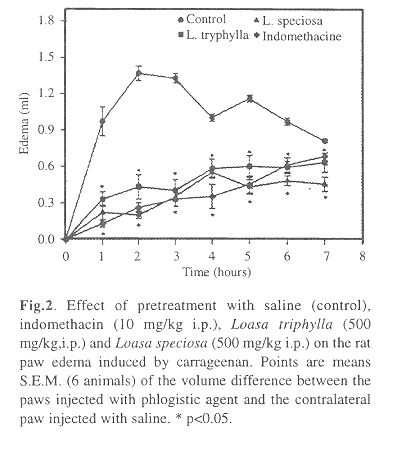
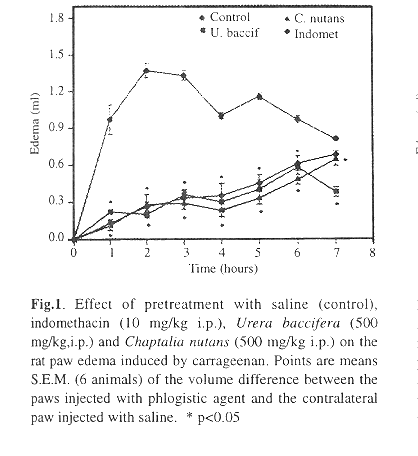
<body><![CDATA[<p><font face="Arial,Helvetica"><font size=-1><b>Anti-inflammatory activity:</b>The anti-inflammatory properties were investigated by using the carrageenan-induced edema model. Rats were given n.s.s., indomethacin (10 mg/kg i.p.) or aqueous extract (500 mg/kg i.p.) 1 h before administration of an intradermal injection of carrageenan (0.1 ml of a 1% solution in 0.9% saline) into the plantar surface of the rigth hind paw. The contralateral paw was injected with 0.1 ml n.s.s. The paw volume was measured immediately before and each hour for 6 hours after treatment by means of volume displacement methods (<a href="#Winter">Winter <i>et al</i>. 1962</a>, <a href="#Di Rosa">Di Rosa <i>et al</i>.1971</a>) using a 7140 Ugo Basile Plesthysmometer. The difference between the left paw and right paw volumes indicated the degree of inflammation. The average percentage increase in paw volume of each group was calculated and compared with the control group (saline) and the indomethacin group. Extracts of <i>C. nutans</i> and <i>U. baccifera</i> were also investigated using 500 mg/kg orally (p.o.).</font></font>     <p><font face="Arial,Helvetica"><font size=-1><b>Mean lethal dose:</b>Six male mice were used for each group study. Doses were applied i.p. The aqueous extracts were dissolved in normal saline solution. Animals were observed at 6,12, 24 and 48 hours after administration and results were evaluated according to <a href="#Malone">Malone and Robichaud (1962)</a>.</font></font>     <p><font face="Arial,Helvetica"><font size=-1><b>Statistical analysis:</b>Data are expressed as a mean S.E.M., and a Student’s "t" test was used for comparing the data of the control and standard groups. Probabilities of &lt; 0.05 were considered as a significant. Comparison between extracts was made according to the Duncan Test.</font></font>     <br>&nbsp;     <p><b><font face="Arial,Helvetica"><font size=-1>Results</font></font></b>     <p><font face="Arial,Helvetica"><font size=-1><b>Hippocratic screening:</b> Animals treated with all aqueous extracts showed diminished body temperature as measured by inserting the sensor probe of a digital thermometer 1 cm into the rectum. A central nervous system depression was also observed, characterized by loss of motor activity and a diminished alarm reaction. Animals treated with <i>C. nutans</i>, <i>U. baccifera</i> and <i>U. leptuphylla</i> showed abdominal cramps. Those treated with <i>U. baccifera</i> showed analgesia.</font></font>     <p><font face="Arial,Helvetica"><font size=-1><b>Anti-inflammatory activity: </b>The intraplantar injection of the hind paw induced a progressive edema reaching a maximum after 3 h. Animals treated with <i>U. baccifera</i>, <i>C. nutans,L. triphylla</i> and<i> L. speciosa</i>, showed an anti-inflammatory activity comparable with that induced by indomethacin (<a href="#fig1">Fig.1</a>,<a href="#fig2">2</a>). Those treated with <i>U. leptophylla</i> did not influence the paw edema model. The results with <i>U. baccifera</i> and <i>C. nutan</i>s (500 mg/kg i.p.) were not statistically different according to Statistical Duncan Test. When <i>U. baccifera</i> and <i>C. nutans</i> were used orally (500 mg/kg ) the anti-inflammatory activity was not different from the control group.</font></font>     <br>&nbsp;     <br>&nbsp;     <br>     ]]></body>
<body><![CDATA[<center>     <p><a NAME="fig1"></a><img SRC="/img/fbpe/rbt/v47n4/0399i1.GIF" height=456 width=418></center>      
<p>    <br>     <p><font face="Arial,Helvetica"><font size=-1><b>Mean lethal dose:</b>The mean lethal dose of aqueous extracts of plants were: <i>Chaptalia nutans</i> 1.0226 g/kg, i.p., <i>Loasa triphylla</i>1.0260 g/kg,i.p., <i>Loasa speciosa</i> 1.1249 g/kg,i.p., <i>Urera baccifera</i> 1.2247 g/kg,i.p. and <i>Urtica leptuphylla</i> 1.2022 g/kg, i.p.</font></font>     <br>&nbsp;     <br>&nbsp;     <br>     <center>     <p><a NAME="fig2"></a><img SRC="/img/fbpe/rbt/v47n4/0399i2.GIF" height=456 width=418></center>      
]]></body>
<body><![CDATA[<br>&nbsp;     <p><b><font face="Arial,Helvetica"><font size=-1>Discussion</font></font></b>     <p><font face="Arial,Helvetica"><font size=-1>The pharmacological screening was carried out in order to determine if the aqueous extracts of the leaves of the plants had any other activity that might be considered of interest and to establish general effects of the extracts. Some of the observed effects can be explained by the irritation associated with the intraperitoneal administration (<a href="#Gibaldi82">Gibaldi and Perrier 1982</a>; <a href="#Gibaldi84">Gibaldi 1984</a>). The hypothermic effect was evident and could suggest a Central Nervous System (CNS) mediated mechanism, since the control of body temperature in narrow limits for homeoterms is under direct CNS control (<a href="#Rothwell">Rothwell 1992</a>). The observation of abdominal cramps and defecation actions with extracts of<i> C. nutans</i>, <i>U. baccifera</i> and <i>U. leptuphylla</i> could be explained apparently by a colinergic activity due to an increase in tone, amplitude of contractions and peristaltic activity of the gastrointestinal tract. The enhanced motility may be accompanied by intestinal cramps an defecation (<a href="#Goodman">Goodman &amp; Gillman1996</a>).</font></font>     <p><font face="Arial,Helvetica"><font size=-1>Carrageenan-induced inflammation is useful to detect anti-inflammatory agents. (<a href="#Di Rosa">Di Rosa <i>et al.</i>1971</a>). The development of edema in the paw of the rat has been described by <a href="#Vinegar">Vinegar <i>et al.</i> (1969)</a> as a biphasic event. The initial phase is atributed to the release of histamine and serotonine (<a href="#Crunkhon">Crunkhon and Meacock 1971</a>). The second, accelerating, phase of swelling is due to release of prostaglandin like substance (<a href="#Vinegar">Vinegar <i>et al.</i>1969</a>). It has been reported that the second phase of edema is sensitive to both clinically useful steroidal and non-steroidal anti-inflammatory agents (<a href="#Vinegar">Vinegar <i>et al</i>.1969</a>, <a href="#Di Rosa">Di Rosa <i>et</i> <i>al.</i>1971</a>) and they are releated to COX inhibition, specially COX-2. Aqueous extracts of leaves of C.<i> nutans, U. baccifera</i> and <i>L. speciosa</i>, at a dose of 500 mg/kg, i.p. showed anti-inflammatory activity comparable to that induced by indomethacin. <i>L. triphylla</i> shows similar anti-inflammatory activity with the exception of the measurement at 4 hours, which is not different from the control. <i>U. leptuphylla</i> did not influence the paw edema model.</font></font>     <p><font face="Arial,Helvetica"><font size=-1>When the data were analyzed with the Duncan Test it was possible to establish that the anti-inflammatory activity observed for the extacts of <i>U. baccifera</i> and<i> C. nutans</i> were similar to that obtained with indomethacin. The extracts of <i>U. baccifera</i> and <i>C. nutans</i> do not have any anti-inflammatory activity when administered orally. This is probably due to its physico-chemical properties that do not allow absorption from the gastro-intestinal tract (<a href="#Gibaldi84">Gibaldi 1984</a>). Due to their anti-inflammatory characteristics it may be of interest to continue the biodirected fractionation of <i>Urera baccifera</i> and <i>Chaptalia nutans</i>.</font></font>     <p><font face="Arial,Helvetica"><font size=-1>According to the toxicity classification of <a href="#Williams">Williams and Burson (1985)</a> the aqueous extracts of the plants studied can be classified as "mildly toxic" as those substances whose LD50 in mice are 5.0 g/kg.</font></font>     <br>&nbsp;     <p>    <br>     <p><b><font face="Arial,Helvetica"><font size=-1>Acknowledgements</font></font></b>     ]]></body>
<body><![CDATA[<p><font face="Arial,Helvetica"><font size=-1>This project had financial support from the Vicerrector&iacute;a de Investigaci&oacute;n from Universidad de Costa Rica (N 410-95-561) and the Consejo Nacional para Investigaciones Cientificas y Tecnol&oacute;gicas (CONICIT) FR 198-09. We thank to J.C. Brenes (CIPRONA) and G. Ramirez (INIFAR) for technical support.</font></font>     <br>&nbsp;     <p>    <br>     <p><b><font face="Arial,Helvetica"><font size=-1>References</font></font></b>     <!-- ref --><p><a NAME="Crunkhon"></a><font face="Arial,Helvetica"><font size=-1>Crunkhon, P.&amp; S.E.R Meaccock. 1971. Mediators of the inflammation induced in the rat paw by carrageenan. Brit. J. Pharmacol. 42:392-402.</font></font>    &nbsp;&nbsp;&nbsp;&nbsp;&nbsp;&nbsp;&nbsp;&nbsp;[&#160;<a href="javascript:void(0);" onclick="javascript: window.open('/scielo.php?script=sci_nlinks&ref=1173758&pid=S0034-7744199900040000900001&lng=','','width=640,height=500,resizable=yes,scrollbars=1,menubar=yes,');">Links</a>&#160;]<!-- end-ref --><!-- ref --><p><a NAME="Di Rosa"></a><font face="Arial,Helvetica"><font size=-1>Di Rosa, M., P.J.Giroud &amp; D.A. Willoughby. 1971. Studies of the mediators of acute inflammatory response induced in rats in different sites by carrageenan and turpine. J. Pathol. 101:15-29.</font></font>    &nbsp;&nbsp;&nbsp;&nbsp;&nbsp;&nbsp;&nbsp;&nbsp;[&#160;<a href="javascript:void(0);" onclick="javascript: window.open('/scielo.php?script=sci_nlinks&ref=1173759&pid=S0034-7744199900040000900002&lng=','','width=640,height=500,resizable=yes,scrollbars=1,menubar=yes,');">Links</a>&#160;]<!-- end-ref --><!-- ref --><p><a NAME="Gibaldi84"></a><font face="Arial,Helvetica"><font size=-1>Gibaldi M. 1984. Biopharmaceutics and Clinical Pharmacokineics.Philadelphia Penn. 11-15,17.</font></font>    &nbsp;&nbsp;&nbsp;&nbsp;&nbsp;&nbsp;&nbsp;&nbsp;[&#160;<a href="javascript:void(0);" onclick="javascript: window.open('/scielo.php?script=sci_nlinks&ref=1173760&pid=S0034-7744199900040000900003&lng=','','width=640,height=500,resizable=yes,scrollbars=1,menubar=yes,');">Links</a>&#160;]<!-- end-ref --><!-- ref --><p><a NAME="Gibaldi82"></a><font face="Arial,Helvetica"><font size=-1>Gibaldi M. &amp; Perrier D. 1982. Farmacocin&eacute;tica. Barcelona, p. 149-162.</font></font>    &nbsp;&nbsp;&nbsp;&nbsp;&nbsp;&nbsp;&nbsp;&nbsp;[&#160;<a href="javascript:void(0);" onclick="javascript: window.open('/scielo.php?script=sci_nlinks&ref=1173761&pid=S0034-7744199900040000900004&lng=','','width=640,height=500,resizable=yes,scrollbars=1,menubar=yes,');">Links</a>&#160;]<!-- end-ref --><!-- ref --><p><a NAME="Girón"></a><font face="Arial,Helvetica"><font size=-1>Gir&oacute;n L.M., V. Freire, A. Alonzo &amp; A. C&aacute;ceres. 1991. Botanical survey of medicinal flora used by the caribs. J. Ethnopharmacol. 28: 1956-1961.</font></font>    &nbsp;&nbsp;&nbsp;&nbsp;&nbsp;&nbsp;&nbsp;&nbsp;[&#160;<a href="javascript:void(0);" onclick="javascript: window.open('/scielo.php?script=sci_nlinks&ref=1173762&pid=S0034-7744199900040000900005&lng=','','width=640,height=500,resizable=yes,scrollbars=1,menubar=yes,');">Links</a>&#160;]<!-- end-ref --><!-- ref --><p><a NAME="Goodman"></a><font face="Arial,Helvetica"><font size=-1>Goodman Gilman, A. 1966. The Pharmacological Basis of Therapeutics. McGraw-Hill, New York. 144.</font></font>    &nbsp;&nbsp;&nbsp;&nbsp;&nbsp;&nbsp;&nbsp;&nbsp;[&#160;<a href="javascript:void(0);" onclick="javascript: window.open('/scielo.php?script=sci_nlinks&ref=1173763&pid=S0034-7744199900040000900006&lng=','','width=640,height=500,resizable=yes,scrollbars=1,menubar=yes,');">Links</a>&#160;]<!-- end-ref --><!-- ref --><p><a NAME="Kumar"></a><font face="Arial,Helvetica"><font size=-1>Kumar V.L. &amp; N. Basu. 1994. Anti-inflammatory activity of the latex of <i>Calotropis procera</i>. J. Ethnopharmacol. 44: 123-125.</font></font>    &nbsp;&nbsp;&nbsp;&nbsp;&nbsp;&nbsp;&nbsp;&nbsp;[&#160;<a href="javascript:void(0);" onclick="javascript: window.open('/scielo.php?script=sci_nlinks&ref=1173764&pid=S0034-7744199900040000900007&lng=','','width=640,height=500,resizable=yes,scrollbars=1,menubar=yes,');">Links</a>&#160;]<!-- end-ref --><!-- ref --><p><a NAME="Malone"></a><font face="Arial,Helvetica"><font size=-1>Malone, M.R. &amp; R.V. Robichaud. 1962. A Hippocratic screening for pure or crude drug material. Lloydia 25: 320-332.</font></font>    &nbsp;&nbsp;&nbsp;&nbsp;&nbsp;&nbsp;&nbsp;&nbsp;[&#160;<a href="javascript:void(0);" onclick="javascript: window.open('/scielo.php?script=sci_nlinks&ref=1173765&pid=S0034-7744199900040000900008&lng=','','width=640,height=500,resizable=yes,scrollbars=1,menubar=yes,');">Links</a>&#160;]<!-- end-ref --><!-- ref --><p><a NAME="Morton"></a><font face="Arial,Helvetica"><font size=-1>Morton J. 1981. Atlas of Medicinal Plants of Middle America. Charles Thomas,Chicago. Ill. 154, 917.</font></font>    &nbsp;&nbsp;&nbsp;&nbsp;&nbsp;&nbsp;&nbsp;&nbsp;[&#160;<a href="javascript:void(0);" onclick="javascript: window.open('/scielo.php?script=sci_nlinks&ref=1173766&pid=S0034-7744199900040000900009&lng=','','width=640,height=500,resizable=yes,scrollbars=1,menubar=yes,');">Links</a>&#160;]<!-- end-ref --><!-- ref --><p><a NAME="Rothwell"></a><font face="Arial,Helvetica"><font size=-1>Rothwell N.J. 1992. Eicosanoids, Thermogenesis and Thermoregulation. Prost. Lts. Ess. Fat.Ac. 46:1-7.</font></font>    &nbsp;&nbsp;&nbsp;&nbsp;&nbsp;&nbsp;&nbsp;&nbsp;[&#160;<a href="javascript:void(0);" onclick="javascript: window.open('/scielo.php?script=sci_nlinks&ref=1173767&pid=S0034-7744199900040000900010&lng=','','width=640,height=500,resizable=yes,scrollbars=1,menubar=yes,');">Links</a>&#160;]<!-- end-ref --><!-- ref --><p><a NAME="Sandbeg"></a><font face="Arial,Helvetica"><font size=-1>Sandbeg, F.1967. Pharmacological Screening of Medicinal Plants.Government,Colombo, Ceylon. 31-34.</font></font>    &nbsp;&nbsp;&nbsp;&nbsp;&nbsp;&nbsp;&nbsp;&nbsp;[&#160;<a href="javascript:void(0);" onclick="javascript: window.open('/scielo.php?script=sci_nlinks&ref=1173768&pid=S0034-7744199900040000900011&lng=','','width=640,height=500,resizable=yes,scrollbars=1,menubar=yes,');">Links</a>&#160;]<!-- end-ref --><!-- ref --><p><a NAME="Vinegar"></a><font face="Arial,Helvetica"><font size=-1>Vinegar, R., W. Schreiber &amp; R. Hugo. 1969. Biphasic development of carrageenan edema in rats. J. Pharmacol. Exp.Therapeutics 166:96-103.</font></font>    &nbsp;&nbsp;&nbsp;&nbsp;&nbsp;&nbsp;&nbsp;&nbsp;[&#160;<a href="javascript:void(0);" onclick="javascript: window.open('/scielo.php?script=sci_nlinks&ref=1173769&pid=S0034-7744199900040000900012&lng=','','width=640,height=500,resizable=yes,scrollbars=1,menubar=yes,');">Links</a>&#160;]<!-- end-ref --><!-- ref --><p><a NAME="Winter"></a><font face="Arial,Helvetica"><font size=-1>Winter, C.A., E.A. Risley &amp; G.W. Nuss. 1962. Carrageenan-induced oedema in hind paw of rat as an assay for antiinflammatory drugs. Proc. Soc. Exp. Biol. and Med<i>.</i> 111: 544-547.</font></font>    &nbsp;&nbsp;&nbsp;&nbsp;&nbsp;&nbsp;&nbsp;&nbsp;[&#160;<a href="javascript:void(0);" onclick="javascript: window.open('/scielo.php?script=sci_nlinks&ref=1173770&pid=S0034-7744199900040000900013&lng=','','width=640,height=500,resizable=yes,scrollbars=1,menubar=yes,');">Links</a>&#160;]<!-- end-ref --><!-- ref --><p><a NAME="Williams"></a><font face="Arial,Helvetica"><font size=-1>Williams P. &amp; J. Burson. 1985. Industrial toxicology safety and health. Ed. Van Nostrand Rein Hold, New York. 5-6.</font></font>    &nbsp;&nbsp;&nbsp;&nbsp;&nbsp;&nbsp;&nbsp;&nbsp;[&#160;<a href="javascript:void(0);" onclick="javascript: window.open('/scielo.php?script=sci_nlinks&ref=1173771&pid=S0034-7744199900040000900014&lng=','','width=640,height=500,resizable=yes,scrollbars=1,menubar=yes,');">Links</a>&#160;]<!-- end-ref --><p><a NAME="1a"></a><font face="Arial,Helvetica"><font size=-1><sup><a href="#1">1</a></sup> Instituto de Investigaci&oacute;n en Ciencias Farmac&eacute;uticas (INIFAR), Facultad de Farmacia,.Universidad de</font></font>     ]]></body>
<body><![CDATA[<br><font face="Arial,Helvetica"><font size=-1>&nbsp;&nbsp;&nbsp; Costa&nbsp; Rica.2060 San Jos&eacute; Costa Rica. Fax (506) 225-35-74.E-mail: <a href="mailto:bbadilla@cariari.ucr.ac.cr">bbadilla@cariari.ucr.ac.cr</a></font></font>     <p><a NAME="2a"></a><font face="Arial,Helvetica"><font size=-1><sup><a href="#2">2</a></sup> Centro de Investigaci&oacute;n en Productos Naturales (CIPRONA) y Facultadd de Farmacia ,Universidad de</font></font>     <br><font face="Arial,Helvetica"><font size=-1>&nbsp;&nbsp;&nbsp; Costa Rica. 2060 San Jos&eacute; Costa Rica. Email: <a href="mailto:gamora@cariari.ucr.ac.cr">gamora@cariari.ucr.ac.cr</a></font></font>     <p><a NAME="3a"></a><font face="Arial,Helvetica"><font size=-1><sup><a href="#3">3</a></sup> Escuela de Ciencias Ambientales, Facultad de Ciencias de la Tierra y el Mar, Universidad</font></font>     <br><font face="Arial,Helvetica"><font size=-1>&nbsp;&nbsp;&nbsp; Nacional,Heredia,Costa Rica.</font></font>      ]]></body><back>
<ref-list>
<ref id="B1">
<nlm-citation citation-type="journal">
<person-group person-group-type="author">
<name>
<surname><![CDATA[Crunkhon]]></surname>
<given-names><![CDATA[P]]></given-names>
</name>
<name>
<surname><![CDATA[Meaccock]]></surname>
<given-names><![CDATA[S.E.R]]></given-names>
</name>
</person-group>
<article-title xml:lang="en"><![CDATA[Mediators of the inflammation induced in the rat paw by carrageenan]]></article-title>
<source><![CDATA[Brit. J. Pharmacol]]></source>
<year>1971</year>
<volume>42</volume>
<page-range>392-402</page-range></nlm-citation>
</ref>
<ref id="B2">
<nlm-citation citation-type="journal">
<person-group person-group-type="author">
<name>
<surname><![CDATA[Di Rosa]]></surname>
<given-names><![CDATA[M]]></given-names>
</name>
<name>
<surname><![CDATA[Giroud]]></surname>
<given-names><![CDATA[P.J]]></given-names>
</name>
<name>
<surname><![CDATA[Willoughby]]></surname>
<given-names><![CDATA[D.A]]></given-names>
</name>
</person-group>
<article-title xml:lang="en"><![CDATA[Studies of the mediators of acute inflammatory response induced in rats in different sites by carrageenan and turpine]]></article-title>
<source><![CDATA[J. Pathol]]></source>
<year>1971</year>
<volume>101</volume>
<page-range>15-29</page-range></nlm-citation>
</ref>
<ref id="B3">
<nlm-citation citation-type="">
<person-group person-group-type="author">
<name>
<surname><![CDATA[Gibaldi]]></surname>
<given-names><![CDATA[M]]></given-names>
</name>
</person-group>
<source><![CDATA[Biopharmaceutics and Clinical Pharmacokineics]]></source>
<year>1984</year>
<publisher-loc><![CDATA[Philadelphia Penn ]]></publisher-loc>
</nlm-citation>
</ref>
<ref id="B4">
<nlm-citation citation-type="">
<person-group person-group-type="author">
<name>
<surname><![CDATA[Gibaldi]]></surname>
<given-names><![CDATA[M]]></given-names>
</name>
<name>
<surname><![CDATA[Perrier]]></surname>
<given-names><![CDATA[D]]></given-names>
</name>
</person-group>
<source><![CDATA[Farmacocinética]]></source>
<year>1982</year>
<page-range>149-162</page-range><publisher-loc><![CDATA[Barcelona ]]></publisher-loc>
</nlm-citation>
</ref>
<ref id="B5">
<nlm-citation citation-type="journal">
<person-group person-group-type="author">
<name>
<surname><![CDATA[Girón]]></surname>
<given-names><![CDATA[L.M]]></given-names>
</name>
<name>
<surname><![CDATA[Freire]]></surname>
<given-names><![CDATA[V]]></given-names>
</name>
<name>
<surname><![CDATA[Alonzo]]></surname>
<given-names><![CDATA[A]]></given-names>
</name>
<name>
<surname><![CDATA[Cáceres]]></surname>
<given-names><![CDATA[A]]></given-names>
</name>
</person-group>
<article-title xml:lang="en"><![CDATA[Botanical survey of medicinal flora used by the caribs]]></article-title>
<source><![CDATA[J. Ethnopharmacol]]></source>
<year>1991</year>
<volume>28</volume>
<page-range>1956-1961</page-range></nlm-citation>
</ref>
<ref id="B6">
<nlm-citation citation-type="book">
<person-group person-group-type="author">
<name>
<surname><![CDATA[Goodman Gilman]]></surname>
<given-names><![CDATA[A]]></given-names>
</name>
</person-group>
<source><![CDATA[The Pharmacological Basis of Therapeutics]]></source>
<year>1966</year>
<page-range>144</page-range><publisher-loc><![CDATA[New York ]]></publisher-loc>
<publisher-name><![CDATA[McGraw-Hill]]></publisher-name>
</nlm-citation>
</ref>
<ref id="B7">
<nlm-citation citation-type="journal">
<person-group person-group-type="author">
<name>
<surname><![CDATA[Kumar]]></surname>
<given-names><![CDATA[V.L]]></given-names>
</name>
<name>
<surname><![CDATA[Basu]]></surname>
<given-names><![CDATA[N]]></given-names>
</name>
</person-group>
<article-title xml:lang="en"><![CDATA[Anti-inflammatory activity of the latex of Calotropis procera]]></article-title>
<source><![CDATA[J. Ethnopharmacol]]></source>
<year>1994</year>
<volume>44</volume>
<page-range>123-125</page-range></nlm-citation>
</ref>
<ref id="B8">
<nlm-citation citation-type="journal">
<person-group person-group-type="author">
<name>
<surname><![CDATA[Malone]]></surname>
<given-names><![CDATA[M.R]]></given-names>
</name>
<name>
<surname><![CDATA[Robichaud]]></surname>
<given-names><![CDATA[R.V]]></given-names>
</name>
</person-group>
<article-title xml:lang="en"><![CDATA[A Hippocratic screening for pure or crude drug material]]></article-title>
<source><![CDATA[Lloydia]]></source>
<year>1962</year>
<volume>25</volume>
<page-range>320-332</page-range></nlm-citation>
</ref>
<ref id="B9">
<nlm-citation citation-type="book">
<person-group person-group-type="author">
<name>
<surname><![CDATA[Morton]]></surname>
<given-names><![CDATA[J]]></given-names>
</name>
</person-group>
<source><![CDATA[Atlas of Medicinal Plants of Middle America]]></source>
<year>1981</year>
<volume>Ill</volume>
<page-range>154, 917</page-range><publisher-loc><![CDATA[Chicago ]]></publisher-loc>
<publisher-name><![CDATA[Charles Thomas]]></publisher-name>
</nlm-citation>
</ref>
<ref id="B10">
<nlm-citation citation-type="journal">
<person-group person-group-type="author">
<name>
<surname><![CDATA[Rothwell]]></surname>
<given-names><![CDATA[N.J]]></given-names>
</name>
</person-group>
<article-title xml:lang="en"><![CDATA[Eicosanoids, Thermogenesis and Thermoregulation]]></article-title>
<source><![CDATA[Prost. Lts. Ess. Fat.Ac]]></source>
<year>1992</year>
<volume>46</volume>
<page-range>1-7</page-range></nlm-citation>
</ref>
<ref id="B11">
<nlm-citation citation-type="book">
<person-group person-group-type="author">
<name>
<surname><![CDATA[F]]></surname>
<given-names><![CDATA[Sandbeg]]></given-names>
</name>
</person-group>
<source><![CDATA[Pharmacological Screening of Medicinal Plants]]></source>
<year>1967</year>
<page-range>31-34</page-range><publisher-loc><![CDATA[Colombo^eCeylon Ceylon]]></publisher-loc>
<publisher-name><![CDATA[Government]]></publisher-name>
</nlm-citation>
</ref>
<ref id="B12">
<nlm-citation citation-type="journal">
<person-group person-group-type="author">
<name>
<surname><![CDATA[Vinegar]]></surname>
<given-names><![CDATA[R]]></given-names>
</name>
<name>
<surname><![CDATA[Schreiber]]></surname>
<given-names><![CDATA[W]]></given-names>
</name>
<name>
<surname><![CDATA[Hugo]]></surname>
<given-names><![CDATA[R]]></given-names>
</name>
</person-group>
<article-title xml:lang="en"><![CDATA[Biphasic development of carrageenan edema in rats]]></article-title>
<source><![CDATA[J. Pharmacol. Exp.Therapeutics]]></source>
<year>1969</year>
<volume>166</volume>
<page-range>96-103</page-range></nlm-citation>
</ref>
<ref id="B13">
<nlm-citation citation-type="journal">
<person-group person-group-type="author">
<name>
<surname><![CDATA[Winter]]></surname>
<given-names><![CDATA[C.A]]></given-names>
</name>
<name>
<surname><![CDATA[Risley]]></surname>
<given-names><![CDATA[E.A]]></given-names>
</name>
<name>
<surname><![CDATA[Nuss]]></surname>
<given-names><![CDATA[G.W]]></given-names>
</name>
</person-group>
<article-title xml:lang="en"><![CDATA[Carrageenan-induced oedema in hind paw of rat as an assay for antiinflammatory drugs]]></article-title>
<source><![CDATA[Proc. Soc. Exp. Biol. and Med]]></source>
<year>1962</year>
<volume>111</volume>
<page-range>544-547</page-range></nlm-citation>
</ref>
<ref id="B14">
<nlm-citation citation-type="book">
<person-group person-group-type="author">
<name>
<surname><![CDATA[Williams]]></surname>
<given-names><![CDATA[P]]></given-names>
</name>
<name>
<surname><![CDATA[Burson]]></surname>
<given-names><![CDATA[J]]></given-names>
</name>
</person-group>
<source><![CDATA[Industrial toxicology safety and health]]></source>
<year>1985</year>
<publisher-loc><![CDATA[New York ]]></publisher-loc>
<publisher-name><![CDATA[Ed. Van Nostrand Rein Hold]]></publisher-name>
</nlm-citation>
</ref>
</ref-list>
</back>
</article>