<?xml version="1.0" encoding="ISO-8859-1"?><article xmlns:mml="http://www.w3.org/1998/Math/MathML" xmlns:xlink="http://www.w3.org/1999/xlink" xmlns:xsi="http://www.w3.org/2001/XMLSchema-instance">
<front>
<journal-meta>
<journal-id>0034-7744</journal-id>
<journal-title><![CDATA[Revista de Biología Tropical]]></journal-title>
<abbrev-journal-title><![CDATA[Rev. biol. trop]]></abbrev-journal-title>
<issn>0034-7744</issn>
<publisher>
<publisher-name><![CDATA[Universidad de Costa Rica]]></publisher-name>
</publisher>
</journal-meta>
<article-meta>
<article-id>S0034-77441999000400005</article-id>
<title-group>
<article-title xml:lang="en"><![CDATA[Richness and abundance of caterpillars on Byrsonima (Malpighiaceae) species in an area of cerrado vegetation in Central Brazil]]></article-title>
</title-group>
<contrib-group>
<contrib contrib-type="author">
<name>
<surname><![CDATA[Andrade]]></surname>
<given-names><![CDATA[Isabel]]></given-names>
</name>
<xref ref-type="aff" rid="A01"/>
</contrib>
<contrib contrib-type="author">
<name>
<surname><![CDATA[Morais]]></surname>
<given-names><![CDATA[Helena C]]></given-names>
</name>
<xref ref-type="aff" rid="A01"/>
</contrib>
<contrib contrib-type="author">
<name>
<surname><![CDATA[Diniz]]></surname>
<given-names><![CDATA[Ivone R]]></given-names>
</name>
<xref ref-type="aff" rid="A02"/>
</contrib>
<contrib contrib-type="author">
<name>
<surname><![CDATA[van den Berg]]></surname>
<given-names><![CDATA[Cássio]]></given-names>
</name>
<xref ref-type="aff" rid="A03"/>
</contrib>
</contrib-group>
<aff id="A01">
<institution><![CDATA[,Universidade de Brasília Departamento de Ecologia ]]></institution>
<addr-line><![CDATA[Brasília ]]></addr-line>
<country>Brazil</country>
</aff>
<aff id="A02">
<institution><![CDATA[,Universidade de Brasília Departamento de Zoologia ]]></institution>
<addr-line><![CDATA[Brasília ]]></addr-line>
<country>Brazil</country>
</aff>
<aff id="A03">
<institution><![CDATA[,Universidade Estadual de Campinas Pós-Graduação em Ecologia ]]></institution>
<addr-line><![CDATA[Campinas ]]></addr-line>
<country>Brazil</country>
</aff>
<pub-date pub-type="pub">
<day>00</day>
<month>12</month>
<year>1999</year>
</pub-date>
<pub-date pub-type="epub">
<day>00</day>
<month>12</month>
<year>1999</year>
</pub-date>
<volume>47</volume>
<numero>4</numero>
<fpage>691</fpage>
<lpage>695</lpage>
<copyright-statement/>
<copyright-year/>
<self-uri xlink:href="http://www.scielo.sa.cr/scielo.php?script=sci_arttext&amp;pid=S0034-77441999000400005&amp;lng=en&amp;nrm=iso"></self-uri><self-uri xlink:href="http://www.scielo.sa.cr/scielo.php?script=sci_abstract&amp;pid=S0034-77441999000400005&amp;lng=en&amp;nrm=iso"></self-uri><self-uri xlink:href="http://www.scielo.sa.cr/scielo.php?script=sci_pdf&amp;pid=S0034-77441999000400005&amp;lng=en&amp;nrm=iso"></self-uri><abstract abstract-type="short" xml:lang="en"><p><![CDATA[We sampled lepidopteran caterpillars on three Byrsonima species (Malpighiaceae) in Central Brazil: Byrsonima crassa , Byrsonima verbascifolia and Byrsonima coccolobifolia between May 1993 and July 1994. Fifteen individuals of each plant species were censused weekly. Our main goal was to estimate the abundance and richness of lepidopteran larvae within each plant species. Only 13% of the 1 621 sampled plants had caterpillars on their leaves. This percentage was similar within each plant species. We found a pattern of low abundance and high richness of lepidopteran species associated with Byrsonima. There were 48 morphospecies and 46% of them occurred just once. There was a higher similarity between the fauna of B. crassa and B. verbascifolia than between these and B. coccolobifolia. Once it is known that hairy leaves can affect herbivore colonization and foraging strategy, we suggest that differences in the lepidopteran community associated with Byrsonima spp. are linked with different levels of pubescence on the leaf surface of each plant species. This tendency in Byrsonima is supported by the small number of caterpillars found on young leaves of B. crassa and B. verbascifolia, which are quite hairy.]]></p></abstract>
<abstract abstract-type="short" xml:lang="es"><p><![CDATA[Hicimos un registro cuantitativo de larvas de Lepidoptera que se alimentán de tres espécies de Byrsonima (Malpighiaceae) que ocurren en el Brasil Central: B. crassa Nied , B. verbascifolia L. Rich and B. coccolobifolia (Spr.) Kunth. Nuestro principal objetivo fué estimar la abundancia y riqueza de orugas en cada una de las espécies de planta. Encontramos un patrón de baja abundancia y alta riqueza de espécies de orugas asociadas a las espécies de Byrsonima. Verificamos, todavía, que la similaridade entre la fauna de B. crassa y B. verbascifolia fué más alta que entre estas espécies y B. coccolobifolia. Una vez que se sabe que hojas con mayor cantidad de vellos pueden afectar la colonización y estratégias de forrageo de herbívoros, sugerimos que las diferencias en la comunidade de orugas asociadas a las distintas espécies de Byrsonima están relacionadas con los diferentes niveles de vellosidad apresentados por cada una de las espécies de plantas. Esta tendencia en Byrsonima es apoyada por el bajo número de orugas encontradas en hojas jóvenes de B. crassa y B. verbascifolia que tienen muchos pelos.]]></p></abstract>
<kwd-group>
<kwd lng="en"><![CDATA[Insect herbivory]]></kwd>
<kwd lng="en"><![CDATA[Byrsonima]]></kwd>
<kwd lng="en"><![CDATA[Lepidoptera]]></kwd>
<kwd lng="en"><![CDATA[richness]]></kwd>
<kwd lng="en"><![CDATA[community structure]]></kwd>
<kwd lng="en"><![CDATA[plant defenses]]></kwd>
<kwd lng="en"><![CDATA[cerrado vegetation]]></kwd>
</kwd-group>
</article-meta>
</front><body><![CDATA[ <center><b><font face="Arial,Helvetica">Richness and abundance of caterpillars on <i>Byrsonima</i> (Malpighiaceae) species in an area of cerrado vegetation in Central Brazil</font></b><font size=-1></font>     <p><font face="Arial,Helvetica"><font size=-1><b>Isabel Andrade&nbsp;<a NAME="1"></a></b><sup><a href="#1b">1<b>&nbsp;</b></a><b>&nbsp;&nbsp;<a NAME="3"></a></b><a href="#3b">3</a></sup><b> Helena C. Morais&nbsp;<a NAME="1a"></a></b><sup><a href="#1b">1&nbsp;</a><b> </b></sup><b>Ivone R. Diniz&nbsp;<a NAME="2"></a></b><sup><a href="#2b">2</a><b> </b></sup><b>and C&aacute;ssio van den Berg&nbsp;<a NAME="3a"></a></b><sup><a href="#3b">3</a></sup></font></font><font size=-1></font>     <p><font face="Arial,Helvetica"><font size=-1>Received 21-VI-1999. Corrected 2-VII-1999. Accepted 7-VII-1999.</font></font></center> <font size=-1></font>     <p><b><font face="Arial,Helvetica"><font size=-1>Abstract</font></font></b><font face="Arial,Helvetica"><font size=-1></font></font>     <p><font face="Arial,Helvetica"><font size=-1>We sampled lepidopteran caterpillars on three <i>Byrsonima</i> species (Malpighiaceae) in Central Brazil: <i>Byrsonima crassa</i> , <i>Byrsonima verbascifolia</i> and <i>Byrsonima coccolobifolia</i> between May 1993 and July 1994. Fifteen individuals of each plant species were censused weekly. Our main goal was to estimate the abundance and richness of lepidopteran larvae within each plant species. Only 13% of the 1 621 sampled plants had caterpillars on their leaves. This percentage was similar within each plant species. We found a pattern of low abundance and high richness of lepidopteran species associated with <i>Byrsonima</i>. There were 48 morphospecies and 46% of them occurred just once. There was a higher similarity between the fauna of <i>B. crassa</i> and <i>B. verbascifolia</i> than between these and <i>B. coccolobifolia</i>. Once it is known that hairy leaves can affect herbivore colonization and foraging strategy, we suggest that differences in the lepidopteran community associated with <i>Byrsonima</i> spp. are linked with different levels of pubescence on the leaf surface of each plant species. This tendency in <i>Byrsonima</i> is supported by the small number of caterpillars found on young leaves of <i>B. crassa</i> and<i> B. verbascifolia</i>, which are quite hairy.</font></font>     <br><font size=-1></font>&nbsp;<b><font face="Arial,Helvetica"><font size=-1></font></font></b>     <p><b><font face="Arial,Helvetica"><font size=-1>Key words</font></font></b><font face="Arial,Helvetica"><font size=-1></font></font>     <p><font face="Arial,Helvetica"><font size=-1>Insect herbivory, <i>Byrsonima</i>, Lepidoptera, richness, community structure, plant defenses, cerrado vegetation.</font></font>     <br><font size=-1></font>&nbsp;<font size=-1></font>     <p><font face="Arial,Helvetica"><font size=-1>The distribution and abundance of species in nature are determined by factors such as natural enemies, competitors and resources. Recently, many ecologists have embraced a view that patterns of diversity are caused by a variety of ecological and evolutionary processes, historical events, and geographical circumstances (<a href="#Schluter">Schluter and Ricklefs 1993</a>). However, there is a lack of baseline data such as species lists, guild structure and morphological diversity that would allow researchers to relate species richness to the occupation and utilization of ecological resources.</font></font><font size=-1></font>     ]]></body>
<body><![CDATA[<p><font face="Arial,Helvetica"><font size=-1>For instance, the knowledge of the composition of a herbivore fauna for individual plant species allows us to distinguish the importance of morphological and phenological plant traits on its associated fauna. However, information on the species richness of phytophagous insects associated with different plant species is often obtained from literature food-plant lists and it has been suggested that this method can produce biased data (<a href="#Fielding">Fielding and Coulson 1995</a>, but see <a href="#Sowthwood82">Southwood <i>et al.</i> 1982</a>).</font></font><font size=-1></font>     <p><font face="Arial,Helvetica"><font size=-1>The empirical basis for our present understanding of plant-herbivore interactions comes largely from studies in temperate regions. Few works depicting the fauna associated with particular plant species have been published in the tropics (e.g., <a href="#Lewinsohn">Lewinsohn 1991</a>, <a href="#Marquis91">Marquis 1991</a>, <a href="#Loyola">Loyola and Fernandes 1993</a>, <a href="#Marquis94">Marquis and Braker 1994</a>, <a href="#Price">Price <i>et al.</i> 1995</a>, <a href="#Diniz">Diniz and Morais 1997</a>). Indeed a major part of the host-plants used by lepidopteran caterpillars is still unknown (<a href="#De Vries">De Vries 1987</a>).</font></font><font size=-1></font>     <p><font face="Arial,Helvetica"><font size=-1>We carried out a quantitative survey of lepidopteran caterpillars associated with three species of <i>Byrsonima</i> (Malpighiaceae) in Central Brazil. Our main goal was to estimate the abundance and richness of lepidopteran larvae within each plant species and to relate them to the morphological traits and abundance of the plants. We have chosen caterpillars for their slow-moving habits, and because local expertise provided a much higher probability of identifying insect species than for other herbivore taxa.</font></font>     <br><b><font face="Arial,Helvetica"><font size=-1></font></font></b>&nbsp;<b><font face="Arial,Helvetica"><font size=-1></font></font></b>     <p><b><font face="Arial,Helvetica"><font size=-1>Methods</font></font></b><font size=-1></font>     <p><font face="Arial,Helvetica"><font size=-1>We conducted the study at the University of Bras&iacute;lia Experimental Farm (Fazenda &Aacute;gua Limpa, 15&ordm;55'S, 47&ordm;55'W) between May 1993 and July 1994. The area is covered by cerrado sensu stricto, a savanna-like vegetation. Central Brazil has a sharp seasonal climate of five dry months, from May to September.</font></font><font size=-1></font>     <p><font face="Arial,Helvetica"><font size=-1>Byrsonima crassa Nied , <i>Byrsonima verbascifolia</i> L. Rich and <i>Byrsonima coccolobifolia</i> (Spr.) Kunth are shrubs or small trees (0.5-4.5 m tall). While <i>B. crassa</i> and <i>B. verbascifolia</i> have tough, hairy leaves, <i>B. coccolobifolia</i> has smooth, glabrous leaves. The plants are deciduous and change their leaves during the dry season (<a href="#Morais">Morais <i>et al.</i> 1995</a>). The number of individual plants counted in 0.25 ha was as follows: <i>B. crassa</i> 37, <i>B. verbascifolia</i> 15, and <i>B. coccolobifolia</i> 16. Despite this, in a regional distribution sense, <i>B. crassa</i> has the smallest geographical range (<a href="#Ratter">Ratter and Dargie 1992</a>).</font></font><font size=-1></font>     <p><font face="Arial,Helvetica"><font size=-1>We sampled lepidopteran larvae weekly, searching on the old and the new foliage of 15 individuals of each <i>Byrsonima</i> species (&lt;2.5 m tall). The study area was located within a 1 ha block divided into quarters, with one quadrate used at one sampling time. Subsequent samples used the other quarter in rotation. We collected the larvae, established morphospecies and reared them in the laboratory. Adults were sent to specialists for identification.</font></font><font size=-1></font>     <p><font face="Arial,Helvetica"><font size=-1>We performed multivariate analysis on caterpillar abundance data to extract the relationship between the host-plant species and its associated fauna. At first, we did a cluster analysis on non-standardized data and constructed a dendrogram with the <i>Byrsonima</i> species. Then we proceeded to a Principal Component Analysis (PCA) based on covariance square matrix to identify the general pattern of association of caterpillars with plant species. Through the use of non-standardized data and covariance matrix each species have a weight in the analysis proportional to its abundance-rarity.</font></font>     <br><font size=-1></font>&nbsp;<font size=-1></font>     ]]></body>
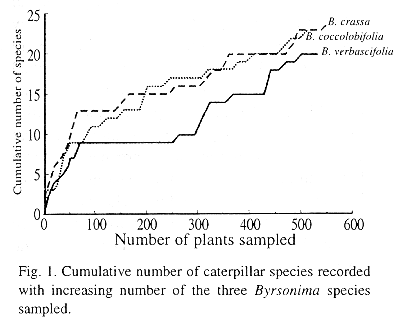
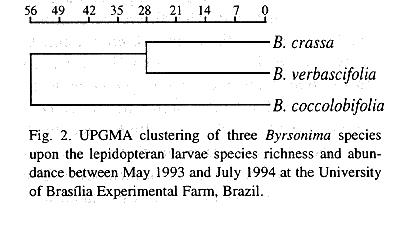
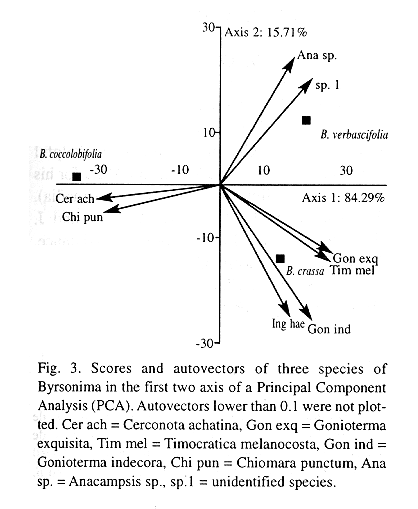
<body><![CDATA[<p><b><font face="Arial,Helvetica"><font size=-1>Results</font></font></b><font size=-1></font>     <p><font face="Arial,Helvetica"><font size=-1>Only 13% of the 1,621 sampled plants had caterpillars on their leaves. This percentage was similar within each plant species (<a href="#TABLE1">Table 1</a>).</font></font><font size=-1></font>     <p><font face="Arial,Helvetica"><font size=-1>There were 48 morphospecies and 46% of them occurred just once. Only six species of lepidopteran larvae were collected more than 15 times: <i>Cerconota achatina</i> Zeller (109 times), <i>Gonioterma indecora</i> Zeller (50), <i>Gonioterma exquisita</i> Duckworth (35) and <i>Timocratica melanocosta</i> Becker (24) (Oecophoridae), <i>Chiomara punctum</i> Mabille (16) (Hesperiidae), and <i>Anacampsis</i> sp. (16) (Gelechiidae). Also, the accumulation of new lepidopteran species with the increase number of plants sampled showed positive, non-asymptotic curves indicating that additional sampling would continue to yield new species (<a href="#fig1">Fig. 1</a>).</font></font><font size=-1></font>     <p><font face="Arial,Helvetica"><font size=-1>There was a higher similarity between the fauna of <i>B. crassa</i> and <i>B. verbascifolia</i> than between these and <i>B. coccolobifolia</i> (<a href="#fig2">Fig. 2</a>). The PCA biplot (<a href="#fig3">Fig. 3</a>) explains the similarity pattern found. The first axis (84.29% of the variance) contrasts <i>B. coccolobifolia</i> against <i>B. crassa</i> and <i>B. verbascifolia.</i> The second axis (15.71% of the variance) shows <i>G. indecora</i> associated with <i>B. crassa</i> and the exclusive <i>Anacampsis</i> sp. associated with <i>B. verbascifolia</i>.</font></font><font size=-1></font><font size=-1></font>     <center>     <p><a NAME="TABLE1"></a><font face="Arial,Helvetica"><font size=-1>TABLE 1</font></font>     <br><font face="Arial,Helvetica"><font size=-1>Total number of Byrsonima sampled plants, number of plants with caterpillars, and species richness within each plant</font></font>     <br><font face="Arial,Helvetica"><font size=-1>species between May 1993 and July 1995&nbsp; at the University of Bras&iacute;lia Experimntal Farm, Brazil</font></font></center>      <br><font size=-1></font>&nbsp;     <center><table BORDER CELLSPACING=0 CELLPADDING=0 COLS=4 WIDTH="81%" > <tr> <td><font size=-1>H<font face="Arial,Helvetica">ost plant species</font></font></td>  <td><font face="Arial,Helvetica"><font size=-1>Number of plants sampled</font></font></td>  <td>     ]]></body>
<body><![CDATA[<center><font face="Arial,Helvetica"><font size=-1>% of plants with caterpillars</font></font></center> </td>  <td>     <center><font face="Arial,Helvetica"><font size=-1>Lepidopteran&nbsp;</font></font>     <br><font face="Arial,Helvetica"><font size=-1>species richness</font></font></center> </td> </tr>  <tr> <td><font face="Arial,Helvetica"><font size=-1>Byrsonima crassa</font></font></td>  <td>     <center><font face="Arial,Helvetica"><font size=-1>573</font></font></center> </td>  <td>     <center><font face="Arial,Helvetica"><font size=-1>12.7</font></font></center> </td>  <td>     <center><font face="Arial,Helvetica"><font size=-1>24</font></font></center> </td> </tr>  <tr> <td><font face="Arial,Helvetica"><font size=-1>Byrsonima verbascifolia</font></font></td>  <td>     <center><font face="Arial,Helvetica"><font size=-1>534</font></font></center> </td>  <td>     <center><font face="Arial,Helvetica"><font size=-1>11.6</font></font></center> </td>  <td>     <center><font face="Arial,Helvetica"><font size=-1>21</font></font></center> </td> </tr>  <tr> <td><font face="Arial,Helvetica"><font size=-1>Byrsonima coccolobifolia</font></font></td>  <td>     <center><font face="Arial,Helvetica"><font size=-1>514</font></font></center> </td>  <td>     ]]></body>
<body><![CDATA[<center><font face="Arial,Helvetica"><font size=-1>14.9</font></font></center> </td>  <td>     <center><font face="Arial,Helvetica"><font size=-1>23</font></font></center> </td> </tr>  <tr> <td><font face="Arial,Helvetica"><font size=-1>Total</font></font></td>  <td>     <center><font face="Arial,Helvetica"><font size=-1>1,621</font></font></center> </td>  <td>     <center><font face="Arial,Helvetica"><font size=-1>13.0</font></font></center> </td>  <td>     <center><font face="Arial,Helvetica"><font size=-1>48</font></font></center> </td> </tr> </table></center> <font size=-1></font>     <br><font size=-1></font>&nbsp;<font size=-1></font>     <center>     <p><a NAME="fig1"></a><img SRC="/img/fbpe/rbt/v47n4/0395i1.GIF" height=342 width=407><font size=-1></font>     
<p><a NAME="fig2"></a><img SRC="/img/fbpe/rbt/v47n4/0395i3.GIF" height=249 width=397><font size=-1></font>     
<p><a NAME="fig3"></a><img SRC="/img/fbpe/rbt/v47n4/0395i2.GIF" BORDER=0 height=509 width=418></center> <font size=-1></font>     
]]></body>
<body><![CDATA[<p>    <br><font size=-1></font>     <br><font size=-1></font>     <p><b><font face="Arial,Helvetica"><font size=-1>Discussion</font></font></b><font size=-1></font>     <p><font face="Arial,Helvetica"><font size=-1>We found a pattern of low abundance and high richness of lepidopteran larvae associated with <i>Byrsonima</i>. <a href="#Price">Price <i>et al.</i> (1995) </a>found a similar pattern for <i>Erythroxylum</i> (Erythroxylaceae) species in the same study area. Moreover, lepidopteran species richness within each individual <i>Byrsonima </i>species was notably high (<a href="#TABLE1">Table 1</a>) considering the size of the study area and the sampling time. For instance, <a href="#Janzen">Janzen's (1988)</a> unique data set for the Lepidoptera in a tropical locality (Santa Rosa National Park, Costa Rica) reported no more than 20 species per host plant after six years of exhaustive sampling.</font></font><font size=-1></font>     <p><font face="Arial,Helvetica"><font size=-1>Some studies have shown a relationship between local and geographical abundance of plant hosts and richness of the herbivore fauna (<a href="#Neuvonen">Neuvonen and Niemel&auml; 1981</a>, <a href="#Lawton">Lawton 1982</a>, <a href="#Leather">Leather 1986</a>, <a href="#Marquis91">Marquis 1991</a>). The richness of <i>Byrsonima</i>'s lepidopteran fauna was similar for the three plant species despite their regional and local abundance. However, the range of local abundance among the three <i>Byrsonima</i> species is only about two-fold. For instance, in the study done by <a href="#Neuvonen">Neuvonen and Niemel&auml; (1981)</a> the host's local frequency varied from 0.3 to 39 (over 100-fold variation).</font></font><font size=-1></font>     <p><font face="Arial,Helvetica"><font size=-1>As the three plant species have a large number of exclusive and rare caterpillar species [<i>B. crassa</i> (9 species), <i>B. verbascifolia</i> (9), and <i>B. coccolobifolia</i> (13)], the higher similarity between the fauna of <i>B. crassa</i> and <i>B. verbascifolia</i> than between these and <i>B. coccolobifolia</i> (<a href="#fig2">Fig. 2</a>) may be explained by the occurrence of the most abundant species.</font></font><font size=-1></font>     <p><font face="Arial,Helvetica"><font size=-1>The PCA biplot (<a href="#fig3">Fig. 3</a>) explains the similarity pattern found<b>. </b>The difference contrasting <i>B. coccolobifolia</i> against <i>B. crassa</i> and <i>B. verbascifolia</i> (<a href="#fig3">Fig. 3 </a>- first axis)<b> </b>is evidenced mostly due to the exclusive <i>C. punctum</i>, to <i>C. achatina</i> that has a clear preference for <i>B. coccolobifolia</i> (<a href="#Andrade">Andrade <i>et al</i>. 1996</a>), and to <i>T. melanocosta</i> and<i> G. exquisita</i> that are associated with <i>B. crassa</i> and <i>B. verbascifolia</i>. The second axis shows <i>G. indecora</i> associated with <i>B. crassa</i> and the exclusive <i>Anacampsis</i> sp. associated with <i>B. verbascifolia</i>.</font></font><font size=-1></font>     <p><font face="Arial,Helvetica"><font size=-1>Some morphological traits of the host-plant species can be responsible for the pattern shown above. The key characteristic seems to be the presence of hairs on the leaf surface. Several works showed an association between hairy leaves and low attack by herbivores (see <a href="#Southwood86">Southwood 1986</a> and included references). This tendency in <i>Byrsonima</i> is supported by the small number of caterpillars found on young leaves of <i>B</i>. <i>crassa</i> and <i>B</i>. <i>verbascifolia</i> (<a href="#TABLE2">Table 2</a>), which are quite hairy. <i>G.</i> <i>exquisita</i> and <i>Anacampsis</i> sp., which forage on mature leaves of these plants, also use the hairs for building shelters. <i>G.</i> <i>exquisita</i> construct very hard shelters and cover then with the host plant’s hairs while <i>Anacampsis</i> sp. use the leaf trichomes to construct a soft tube. Shelters can provide favorable microhabitats for caterpillars (<a href="#Cappuccino">Capuccinno 1993</a>) and this may be crucial for caterpillars under the dry conditions of the cerrado vegetation increasing the protection against desiccation (<a href="#Diniz">Diniz and Morais 1997</a>).</font></font>     <p>    ]]></body>
<body><![CDATA[<br>     <center>     <p><a NAME="TABLE2"></a><font face="Arial,Helvetica"><font size=-1>TABLE 2</font></font>     <br><font face="Arial,Helvetica"><font size=-1>Number of caterpillars&nbsp; found on young and mature leaves of three Byrsonima species between May 1993</font></font>     <br><font face="Arial,Helvetica"><font size=-1>and July 1994 at the University of brasi&iacute;lia Experimental Farm; Brazil</font></font>     <br><font face="Arial,Helvetica"><font size=-1>(X<sup>2</sup> = 22.47, p &lt; 0.001).</font></font></center>      <br><font face="Arial,Helvetica"><font size=-1></font></font>&nbsp;     <center><table BORDER CELLSPACING=0 CELLPADDING=0 WIDTH="402" > <tr> <td VALIGN=TOP WIDTH="36%"><font face="Arial,Helvetica"><font size=-1>Host plant species</font></font></td>  <td VALIGN=TOP>     <center><font face="Arial,Helvetica"><font size=-1>Young leaves</font></font></center> </td>  <td VALIGN=TOP>     <center><font face="Arial,Helvetica"><font size=-1>Mature leaves&nbsp;</font></font></center> </td> </tr>  <tr> <td VALIGN=TOP><font face="Arial,Helvetica"><font size=-1>Byrsonima crassa</font></font></td>  <td VALIGN=TOP WIDTH="29%">     ]]></body>
<body><![CDATA[<center><font face="Arial,Helvetica"><font size=-1>05</font></font></center> </td>  <td VALIGN=TOP WIDTH="36%">     <center><font face="Arial,Helvetica"><font size=-1>44</font></font></center> </td> </tr>  <tr> <td VALIGN=TOP WIDTH="100%"><font face="Arial,Helvetica"><font size=-1>Byrsonima verbascifolia</font></font></td>  <td VALIGN=TOP WIDTH="29%">     <center><font face="Arial,Helvetica"><font size=-1>00</font></font></center> </td>  <td VALIGN=TOP WIDTH="36%">     <center><font face="Arial,Helvetica"><font size=-1>42</font></font></center> </td> </tr>  <tr> <td VALIGN=TOP WIDTH="36%"><font face="Arial,Helvetica"><font size=-1>Byrsonima coccolobifolia</font></font></td>  <td VALIGN=TOP WIDTH="29%">     <center><font face="Arial,Helvetica"><font size=-1>22</font></font></center> </td>  <td VALIGN=TOP WIDTH="36%">     <center><font face="Arial,Helvetica"><font size=-1>44</font></font></center> </td> </tr> </table></center> <font size=-1></font><font size=-1></font>     <p><font face="Arial,Helvetica"><font size=-1>Our study suggests that the morphological differences among <i>Byrsonima</i> species may markedly determine their associated herbivore community. This pattern is apparently linked to the herbivores' sheltering strategies (<a href="#Diniz">Diniz and Morais 1997</a>). However, more studies evaluating the physiological and chemical characteristics of the plants are needed for a better understanding of the existing patterns. Further investigation on the mechanisms mediating such a high richness with low abundance per herbivore species is also needed for the cerrado vegetation.</font></font>     <br><font size=-1></font>&nbsp;<font size=-1></font>     <p><b><font face="Arial,Helvetica"><font size=-1>Aknowledgements</font></font></b><font size=-1></font>     <p><font face="Arial,Helvetica"><font size=-1>&nbsp;We thank V. O. Becker (University of Bras&iacute;lia) and K. S. Brown (University of Campinas) for identifying the lepidopteran species; P. S. Oliveira and T. M. Lewinsohn (University of Campinas) for their helpful comments on the manuscript; Jair Maia for his help on some figures (University of Bras&iacute;lia). We also thank C. Dias, N. Menezes and J. Silva for their field and laboratory assistance. Brazilian Research Council (CNPq) and FAPESP supported I. Andrade, and C. van den Berg was supported by CAPES.</font></font>     ]]></body>
<body><![CDATA[<br><font size=-1></font>&nbsp;<font size=-1></font>     <p><b><font face="Arial,Helvetica"><font size=-1>Resumen</font></font></b><font size=-1></font>     <p><font face="Arial,Helvetica"><font size=-1>Hicimos un registro cuantitativo de larvas de Lepidoptera que se aliment&aacute;n de tres esp&eacute;cies de <i>Byrsonima</i> (Malpighiaceae) que ocurren en el Brasil Central: <i>B. crassa</i> Nied , <i>B. verbascifolia</i> L. Rich and <i>B. coccolobifolia</i> (Spr.) Kunth. Nuestro principal objetivo fu&eacute; estimar la abundancia y riqueza de orugas en cada una de las esp&eacute;cies de planta. Encontramos un patr&oacute;n de baja abundancia y alta riqueza de esp&eacute;cies de orugas asociadas a las esp&eacute;cies de <i>Byrsonima</i>. Verificamos, todav&iacute;a, que la similaridade entre la fauna de <i>B</i>. <i>crassa</i> y <i>B</i>. <i>verbascifolia </i>fu&eacute; m&aacute;s alta que entre estas esp&eacute;cies y <i>B</i>. <i>coccolobifolia</i>. Una vez que se sabe que hojas con mayor cantidad de vellos pueden afectar la colonizaci&oacute;n y estrat&eacute;gias de forrageo de herb&iacute;voros, sugerimos que las diferencias en la comunidade de orugas asociadas a las distintas esp&eacute;cies de <i>Byrsonima </i>est&aacute;n relacionadas con los diferentes niveles de vellosidad apresentados por cada una de las esp&eacute;cies de plantas. Esta tendencia en <i>Byrsonima</i> es apoyada por el bajo n&uacute;mero de orugas encontradas en hojas j&oacute;venes de <i>B</i>. <i>crassa</i> y <i>B</i>. <i>verbascifolia</i> que tienen muchos pelos.</font></font><font size=-1></font><b><font face="Arial,Helvetica"><font size=-1></font></font></b>     <p><b><font face="Arial,Helvetica"><font size=-1>References</font></font></b><b><font face="Arial,Helvetica"><font size=-1></font></font></b>     <p><a NAME="Andrade"></a><font face="Arial,Helvetica"><font size=-1>Andrade, I., I. R. Diniz &amp; H. C. Morais. 1996. A lagarta de <i>Cerconota</i> <i>achatina</i>: biologia e ocorr&ecirc;ncia em</font></font><font size=-1></font>     <!-- ref --><p><a NAME="Cappuccino"></a><font face="Arial,Helvetica"><font size=-1>Cappuccino, N. 1993. Mutual use of leaf-shelters by lepidopteran larvae on paper birch. Ecol. Entomol. 18: 287-292.</font></font><font size=-1></font>    &nbsp;&nbsp;&nbsp;&nbsp;&nbsp;&nbsp;&nbsp;&nbsp;[&#160;<a href="javascript:void(0);" onclick="javascript: window.open('/scielo.php?script=sci_nlinks&ref=1170668&pid=S0034-7744199900040000500002&lng=','','width=640,height=500,resizable=yes,scrollbars=1,menubar=yes,');">Links</a>&#160;]<!-- end-ref --><!-- ref --><p><a NAME="De Vries"></a><font face="Arial,Helvetica"><font size=-1>De Vries P. J. 1987. The butterflies of Costa Rica. Princenton University Press, New Jersey, 327 p.</font></font><font size=-1></font>    &nbsp;&nbsp;&nbsp;&nbsp;&nbsp;&nbsp;&nbsp;&nbsp;[&#160;<a href="javascript:void(0);" onclick="javascript: window.open('/scielo.php?script=sci_nlinks&ref=1170669&pid=S0034-7744199900040000500003&lng=','','width=640,height=500,resizable=yes,scrollbars=1,menubar=yes,');">Links</a>&#160;]<!-- end-ref --><!-- ref --><p><a NAME="Diniz"></a><font face="Arial,Helvetica"><font size=-1>Diniz, I. R. &amp; H. C. Morais. 1997. Lepidopteran caterpillar fauna of cerrado host plants. Biodiv. Conserv. 6: 817-836.</font></font><font size=-1></font>    &nbsp;&nbsp;&nbsp;&nbsp;&nbsp;&nbsp;&nbsp;&nbsp;[&#160;<a href="javascript:void(0);" onclick="javascript: window.open('/scielo.php?script=sci_nlinks&ref=1170670&pid=S0034-7744199900040000500004&lng=','','width=640,height=500,resizable=yes,scrollbars=1,menubar=yes,');">Links</a>&#160;]<!-- end-ref --><!-- ref --><p><a NAME="Fielding"></a><font face="Arial,Helvetica"><font size=-1>Fielding, C. A. &amp; J. C.Coulson. 1995. A test of the validity of insect food-plant and life history records: Lepidoptera on heather (<i>Calluna vulgaris</i>). Ecol. Entomol. 20: 343-350.</font></font><font size=-1></font>    &nbsp;&nbsp;&nbsp;&nbsp;&nbsp;&nbsp;&nbsp;&nbsp;[&#160;<a href="javascript:void(0);" onclick="javascript: window.open('/scielo.php?script=sci_nlinks&ref=1170671&pid=S0034-7744199900040000500005&lng=','','width=640,height=500,resizable=yes,scrollbars=1,menubar=yes,');">Links</a>&#160;]<!-- end-ref --><!-- ref --><p><a NAME="Janzen"></a><font face="Arial,Helvetica"><font size=-1>Janzen, D. H. 1988. Ecological characterization of a Costa Rican Dry Forest caterpillar fauna. Biotropica 20: 120-135.</font></font><font size=-1></font>    &nbsp;&nbsp;&nbsp;&nbsp;&nbsp;&nbsp;&nbsp;&nbsp;[&#160;<a href="javascript:void(0);" onclick="javascript: window.open('/scielo.php?script=sci_nlinks&ref=1170672&pid=S0034-7744199900040000500006&lng=','','width=640,height=500,resizable=yes,scrollbars=1,menubar=yes,');">Links</a>&#160;]<!-- end-ref --><!-- ref --><p><a NAME="Lawton"></a><font face="Arial,Helvetica"><font size=-1>Lawton, J. H. 1982. Vacant niches and unsaturated communities: a comparison of bracken herbivores at sites on two continents. J. Anim. Ecol. 51: 573-595.</font></font><font size=-1></font>    &nbsp;&nbsp;&nbsp;&nbsp;&nbsp;&nbsp;&nbsp;&nbsp;[&#160;<a href="javascript:void(0);" onclick="javascript: window.open('/scielo.php?script=sci_nlinks&ref=1170673&pid=S0034-7744199900040000500007&lng=','','width=640,height=500,resizable=yes,scrollbars=1,menubar=yes,');">Links</a>&#160;]<!-- end-ref --><!-- ref --><p><a NAME="Leather"></a><font face="Arial,Helvetica"><font size=-1>Leather, S. R. 1986. Insect species richness of the British Rosaceae: the importance of host range, plant architecture, age of establishment, taxonomic isolation and species-area relationships. J. Anim. Ecol. 55: 841-860.</font></font><font size=-1></font>    &nbsp;&nbsp;&nbsp;&nbsp;&nbsp;&nbsp;&nbsp;&nbsp;[&#160;<a href="javascript:void(0);" onclick="javascript: window.open('/scielo.php?script=sci_nlinks&ref=1170674&pid=S0034-7744199900040000500008&lng=','','width=640,height=500,resizable=yes,scrollbars=1,menubar=yes,');">Links</a>&#160;]<!-- end-ref --><!-- ref --><p><a NAME="Lewinsohn"></a><font face="Arial,Helvetica"><font size=-1>Lewinsohn, T. M. 1991. Insects in flower heads of Asteraceae in southeast Brazil: a case study on tropical species richness, p. 525-560. In Price P. W, T. M. Lewinsohn, G. W. Fernandes &amp; W. W. Benson (eds.). Plant-animal interactions: evolutionary ecology in tropical and temperate regions. John Wiley &amp; Sons, New York.</font></font><font size=-1></font>    &nbsp;&nbsp;&nbsp;&nbsp;&nbsp;&nbsp;&nbsp;&nbsp;[&#160;<a href="javascript:void(0);" onclick="javascript: window.open('/scielo.php?script=sci_nlinks&ref=1170675&pid=S0034-7744199900040000500009&lng=','','width=640,height=500,resizable=yes,scrollbars=1,menubar=yes,');">Links</a>&#160;]<!-- end-ref --><!-- ref --><p><a NAME="Loyola"></a><font face="Arial,Helvetica"><font size=-1>Loyola, R. &amp; G. W. Fernandes. 1993. Herbivoria em <i>Kielmeyera coriacea</i> (Guttiferae): efeitos da idade da planta, desenvolvimento e aspectos qualitativos de folhas. Rev. Bras. Biol. 53: 295-304.</font></font><font size=-1></font>    &nbsp;&nbsp;&nbsp;&nbsp;&nbsp;&nbsp;&nbsp;&nbsp;[&#160;<a href="javascript:void(0);" onclick="javascript: window.open('/scielo.php?script=sci_nlinks&ref=1170676&pid=S0034-7744199900040000500010&lng=','','width=640,height=500,resizable=yes,scrollbars=1,menubar=yes,');">Links</a>&#160;]<!-- end-ref --><!-- ref --><p><a NAME="Marquis91"></a><font face="Arial,Helvetica"><font size=-1>Marquis, R. J. 1991. Herbivore fauna of <i>Piper</i> (Piperaceae) in a Costa Rican Wet Forest: Diversity, specificity and impact. p. 179-205. In P. W. Price, T. M. Lewinsohn, G. W. Fernandes &amp; W. W. Benson (eds.). Plant-animal interactions: evolutionary ecology in tropical and temperate regions. John Wiley &amp; Sons, New York.</font></font><font size=-1></font>    &nbsp;&nbsp;&nbsp;&nbsp;&nbsp;&nbsp;&nbsp;&nbsp;[&#160;<a href="javascript:void(0);" onclick="javascript: window.open('/scielo.php?script=sci_nlinks&ref=1170677&pid=S0034-7744199900040000500011&lng=','','width=640,height=500,resizable=yes,scrollbars=1,menubar=yes,');">Links</a>&#160;]<!-- end-ref --><!-- ref --><p><a NAME="Marquis94"></a><font face="Arial,Helvetica"><font size=-1>Marquis, R. J. &amp; H. E. Braker. 1994. Plant-herbivory interactions: diversity, specificity and impact, p. 261-281. In L. M. McDade, K. S. Bawa, H. A. Hespenheide &amp; G. S. Hartshorn (eds.). La Selva: ecology and natural history of a neotropical rain forest. The University of Chicago Press, Chicago.</font></font><font size=-1></font>    &nbsp;&nbsp;&nbsp;&nbsp;&nbsp;&nbsp;&nbsp;&nbsp;[&#160;<a href="javascript:void(0);" onclick="javascript: window.open('/scielo.php?script=sci_nlinks&ref=1170678&pid=S0034-7744199900040000500012&lng=','','width=640,height=500,resizable=yes,scrollbars=1,menubar=yes,');">Links</a>&#160;]<!-- end-ref --><!-- ref --><p><a NAME="Morais"></a><font face="Arial,Helvetica"><font size=-1>Morais, H. C., I. R. Diniz &amp; L. C. Baumgarten. 1995. Padr&otilde;es de produ&ccedil;&atilde;o de folhas e sua utiliza&ccedil;&atilde;o por larvas de Lepidoptera em um Cerrado de Bras&iacute;lia, DF. Rev. Bras. Bot. 18:165-172.</font></font><font size=-1></font>    &nbsp;&nbsp;&nbsp;&nbsp;&nbsp;&nbsp;&nbsp;&nbsp;[&#160;<a href="javascript:void(0);" onclick="javascript: window.open('/scielo.php?script=sci_nlinks&ref=1170679&pid=S0034-7744199900040000500013&lng=','','width=640,height=500,resizable=yes,scrollbars=1,menubar=yes,');">Links</a>&#160;]<!-- end-ref --><!-- ref --><p><a NAME="Neuvonen"></a><font face="Arial,Helvetica"><font size=-1>Neuvonen, S. &amp; P. Niemel&auml;. 1981. Species richness of macrolepidoptera on Finnish deciduous trees and shrubs. Oecologia 51: 364-370.</font></font><font size=-1></font>    &nbsp;&nbsp;&nbsp;&nbsp;&nbsp;&nbsp;&nbsp;&nbsp;[&#160;<a href="javascript:void(0);" onclick="javascript: window.open('/scielo.php?script=sci_nlinks&ref=1170680&pid=S0034-7744199900040000500014&lng=','','width=640,height=500,resizable=yes,scrollbars=1,menubar=yes,');">Links</a>&#160;]<!-- end-ref --><!-- ref --><p><a NAME="Price"></a><font face="Arial,Helvetica"><font size=-1>Price, P. W., I. R. Diniz, H. C. Morais &amp; E. S. A. Marques. 1995. The abundance of insect herbivore species in the tropics: the high local richness of rare species. Biotropica 27: 468-478.</font></font><font size=-1></font>    &nbsp;&nbsp;&nbsp;&nbsp;&nbsp;&nbsp;&nbsp;&nbsp;[&#160;<a href="javascript:void(0);" onclick="javascript: window.open('/scielo.php?script=sci_nlinks&ref=1170681&pid=S0034-7744199900040000500015&lng=','','width=640,height=500,resizable=yes,scrollbars=1,menubar=yes,');">Links</a>&#160;]<!-- end-ref --><!-- ref --><p><a NAME="Ratter"></a><font face="Arial,Helvetica"><font size=-1>Ratter &amp; Dargie. 1992. An analysis of the floristic composition of 26 cerrado areas in Brazil. Edinburgh J. Bot. 49: 235-250.</font></font><font size=-1></font>    &nbsp;&nbsp;&nbsp;&nbsp;&nbsp;&nbsp;&nbsp;&nbsp;[&#160;<a href="javascript:void(0);" onclick="javascript: window.open('/scielo.php?script=sci_nlinks&ref=1170682&pid=S0034-7744199900040000500016&lng=','','width=640,height=500,resizable=yes,scrollbars=1,menubar=yes,');">Links</a>&#160;]<!-- end-ref --><!-- ref --><p><a NAME="Schluter"></a><font face="Arial,Helvetica"><font size=-1>Schluter, D. &amp; R. E. Ricklefs. 1993. Species diversity: an introduction to the problem, p. 1-10. In R. E. Ricklefs, &amp; D. Schluter (eds.). Species diversity in ecological communities: historical and geographical perspectives. The University of Chicago Press, Chicago.</font></font><font size=-1></font>    &nbsp;&nbsp;&nbsp;&nbsp;&nbsp;&nbsp;&nbsp;&nbsp;[&#160;<a href="javascript:void(0);" onclick="javascript: window.open('/scielo.php?script=sci_nlinks&ref=1170683&pid=S0034-7744199900040000500017&lng=','','width=640,height=500,resizable=yes,scrollbars=1,menubar=yes,');">Links</a>&#160;]<!-- end-ref --><!-- ref --><p><a NAME="Sowthwood82"></a><font face="Arial,Helvetica"><font size=-1>Sowthwood, T. R. E., V. C. Moran &amp; C. E. J. Kennedy. 1982. The assessment of arboreal insect fauna: comparisons of knockdown sampling and faunal lists. Ecol. Entomol. 7: 331-340.</font></font><font size=-1></font>    &nbsp;&nbsp;&nbsp;&nbsp;&nbsp;&nbsp;&nbsp;&nbsp;[&#160;<a href="javascript:void(0);" onclick="javascript: window.open('/scielo.php?script=sci_nlinks&ref=1170684&pid=S0034-7744199900040000500018&lng=','','width=640,height=500,resizable=yes,scrollbars=1,menubar=yes,');">Links</a>&#160;]<!-- end-ref --><!-- ref --><p><a NAME="Southwood86"></a><font face="Arial,Helvetica"><font size=-1>Southwood, T. R. E. 1986. Plant surfaces and insects - an overview, p. 1-22. In B. Juniper&amp; R. Sowthwood (eds.). Insects and the plant surface. Edward Arnold, Baltimore.</font></font>    &nbsp;&nbsp;&nbsp;&nbsp;&nbsp;&nbsp;&nbsp;&nbsp;[&#160;<a href="javascript:void(0);" onclick="javascript: window.open('/scielo.php?script=sci_nlinks&ref=1170685&pid=S0034-7744199900040000500019&lng=','','width=640,height=500,resizable=yes,scrollbars=1,menubar=yes,');">Links</a>&#160;]<!-- end-ref --><br><font face="Arial,Helvetica"><font size=-1>Table 1. Total number of <i>Byrsonima</i> sampled plants, number of plants with caterpillars, and species richness within each plant species between May 1993 and July 1995 at the University of Bras&iacute;lia Experimental Farm, Brazil.</font></font><font face="Arial,Helvetica"><font size=-1></font></font>     <p><a NAME="1b"></a><font face="Arial,Helvetica"><font size=-1><sup><a href="#1">1</a></sup> Departamento de Ecologia, Universidade de Brasil&iacute;a, Bras&iacute;lia, DF, Brazil. E-mail:<a href="mailto:morais@unb.br">morais@unb.br</a></font></font>     <p><a NAME="2b"></a><sup><font face="Arial,Helvetica"><font size=-1><a href="#2">2</a> </font></font></sup><font face="Arial,Helvetica"><font size=-1>Departamento de Zoologia, Universidade de Bras&iacute;lia, Bras&iacute;lia, DF, Brazil. Fax (061)2741141.</font></font>     <br><font face="Arial,Helvetica"><font size=-1>&nbsp;&nbsp;&nbsp; E-mail:<a href="mailto:ivone@rudah.com.br">ivone@rudah.com.br</a></font></font>     <p><a NAME="3b"></a><sup><font face="Arial,Helvetica"><font size=-1><a href="#3">3</a> </font></font></sup><font face="Arial,Helvetica"><font size=-1>P&oacute;s-Gradua&ccedil;&atilde;o em Ecologia, Universidade Estadual de Campinas, Campinas, SP, Brazil.</font></font>      ]]></body><back>
<ref-list>
<ref id="B1">
<nlm-citation citation-type="journal">
<person-group person-group-type="author">
<name>
<surname><![CDATA[Andrade]]></surname>
<given-names><![CDATA[I]]></given-names>
</name>
<name>
<surname><![CDATA[Diniz]]></surname>
<given-names><![CDATA[I. R]]></given-names>
</name>
<name>
<surname><![CDATA[Morais]]></surname>
<given-names><![CDATA[H. C]]></given-names>
</name>
</person-group>
<article-title xml:lang="pt"><![CDATA[A lagarta de Cerconota achatina: biologia e ocorrência em plantas hospedeiras do gênero Byrsonima (Malpighiaceae)]]></article-title>
<source><![CDATA[Rev. Bras. Zool]]></source>
<year>1996</year>
<volume>12</volume>
<page-range>735-741</page-range></nlm-citation>
</ref>
<ref id="B2">
<nlm-citation citation-type="journal">
<person-group person-group-type="author">
<name>
<surname><![CDATA[Cappuccino]]></surname>
<given-names><![CDATA[N]]></given-names>
</name>
</person-group>
<article-title xml:lang="en"><![CDATA[Mutual use of leaf-shelters by lepidopteran larvae on paper birch]]></article-title>
<source><![CDATA[Ecol. Entomol]]></source>
<year>1993</year>
<volume>18</volume>
<page-range>287-292</page-range></nlm-citation>
</ref>
<ref id="B3">
<nlm-citation citation-type="book">
<person-group person-group-type="author">
<name>
<surname><![CDATA[De Vries]]></surname>
<given-names><![CDATA[P. J]]></given-names>
</name>
</person-group>
<source><![CDATA[The butterflies of Costa Rica]]></source>
<year>1987</year>
<page-range>327</page-range><publisher-loc><![CDATA[New Jersey ]]></publisher-loc>
<publisher-name><![CDATA[Princenton University Press]]></publisher-name>
</nlm-citation>
</ref>
<ref id="B4">
<nlm-citation citation-type="journal">
<person-group person-group-type="author">
<name>
<surname><![CDATA[Diniz]]></surname>
<given-names><![CDATA[I. R]]></given-names>
</name>
<name>
<surname><![CDATA[Morais]]></surname>
<given-names><![CDATA[H. C.]]></given-names>
</name>
</person-group>
<article-title xml:lang="en"><![CDATA[Lepidopteran caterpillar fauna of cerrado host plants]]></article-title>
<source><![CDATA[Biodiv. Conserv]]></source>
<year>1997</year>
<volume>6</volume>
</nlm-citation>
</ref>
<ref id="B5">
<nlm-citation citation-type="journal">
<person-group person-group-type="author">
<name>
<surname><![CDATA[Fielding]]></surname>
<given-names><![CDATA[C. A]]></given-names>
</name>
<name>
<surname><![CDATA[Coulson]]></surname>
<given-names><![CDATA[J. C]]></given-names>
</name>
</person-group>
<article-title xml:lang="en"><![CDATA[A test of the validity of insect food-plant and life history records: Lepidoptera on heather (Calluna vulgaris)]]></article-title>
<source><![CDATA[Ecol. Entomol]]></source>
<year>1995</year>
<volume>20</volume>
<page-range>343-350</page-range></nlm-citation>
</ref>
<ref id="B6">
<nlm-citation citation-type="journal">
<person-group person-group-type="author">
<name>
<surname><![CDATA[Janzen]]></surname>
<given-names><![CDATA[D. H]]></given-names>
</name>
</person-group>
<article-title xml:lang="en"><![CDATA[Ecological characterization of a Costa Rican Dry Forest caterpillar fauna]]></article-title>
<source><![CDATA[Biotropica]]></source>
<year>1988</year>
<volume>20</volume>
<page-range>120-135</page-range></nlm-citation>
</ref>
<ref id="B7">
<nlm-citation citation-type="journal">
<person-group person-group-type="author">
<name>
<surname><![CDATA[Lawton]]></surname>
<given-names><![CDATA[J. H]]></given-names>
</name>
</person-group>
<article-title xml:lang="en"><![CDATA[Vacant niches and unsaturated communities: a comparison of bracken herbivores at sites on two continents]]></article-title>
<source><![CDATA[J. Anim. Ecol]]></source>
<year>1982</year>
<volume>51</volume>
<page-range>573-595</page-range></nlm-citation>
</ref>
<ref id="B8">
<nlm-citation citation-type="journal">
<person-group person-group-type="author">
<name>
<surname><![CDATA[Leather]]></surname>
<given-names><![CDATA[S. R]]></given-names>
</name>
</person-group>
<article-title xml:lang="en"><![CDATA[Insect species richness of the British Rosaceae: the importance of host range, plant architecture, age of establishment, taxonomic isolation and species-area relationships]]></article-title>
<source><![CDATA[J. Anim. Ecol]]></source>
<year>1986</year>
<volume>55</volume>
<page-range>841-860</page-range></nlm-citation>
</ref>
<ref id="B9">
<nlm-citation citation-type="book">
<person-group person-group-type="author">
<name>
<surname><![CDATA[Lewinsohn]]></surname>
<given-names><![CDATA[T. M]]></given-names>
</name>
</person-group>
<article-title xml:lang="en"><![CDATA[Insects in flower heads of Asteraceae in southeast Brazil: a case study on tropical species richness]]></article-title>
<person-group person-group-type="editor">
<name>
<surname><![CDATA[Price]]></surname>
<given-names><![CDATA[P. W]]></given-names>
</name>
<name>
<surname><![CDATA[Lewinsohn]]></surname>
<given-names><![CDATA[T. M]]></given-names>
</name>
<name>
<surname><![CDATA[Fernandes]]></surname>
<given-names><![CDATA[G. W]]></given-names>
</name>
<name>
<surname><![CDATA[Benson]]></surname>
<given-names><![CDATA[W. W]]></given-names>
</name>
</person-group>
<source><![CDATA[Plant-animal interactions: evolutionary ecology in tropical and temperate regions]]></source>
<year>1991</year>
<page-range>525-560</page-range><publisher-loc><![CDATA[New York ]]></publisher-loc>
<publisher-name><![CDATA[John Wiley & Sons]]></publisher-name>
</nlm-citation>
</ref>
<ref id="B10">
<nlm-citation citation-type="journal">
<person-group person-group-type="author">
<name>
<surname><![CDATA[Loyola]]></surname>
<given-names><![CDATA[R]]></given-names>
</name>
<name>
<surname><![CDATA[Fernandes]]></surname>
<given-names><![CDATA[G. W]]></given-names>
</name>
</person-group>
<article-title xml:lang="pt"><![CDATA[Herbivoria em Kielmeyera coriacea (Guttiferae): efeitos da idade da planta, desenvolvimento e aspectos qualitativos de folhas]]></article-title>
<source><![CDATA[Rev. Bras. Biol]]></source>
<year>1993</year>
<volume>53</volume>
<page-range>295-304</page-range></nlm-citation>
</ref>
<ref id="B11">
<nlm-citation citation-type="book">
<person-group person-group-type="author">
<name>
<surname><![CDATA[Marquis]]></surname>
<given-names><![CDATA[R. J]]></given-names>
</name>
</person-group>
<article-title xml:lang="en"><![CDATA[Herbivore fauna of Piper (Piperaceae) in a Costa Rican Wet Forest: Diversity, specificity and impact]]></article-title>
<person-group person-group-type="editor">
<name>
<surname><![CDATA[Price]]></surname>
<given-names><![CDATA[P. W]]></given-names>
</name>
<name>
<surname><![CDATA[Lewinsohn]]></surname>
<given-names><![CDATA[T. M]]></given-names>
</name>
<name>
<surname><![CDATA[Fernandes]]></surname>
<given-names><![CDATA[G. W]]></given-names>
</name>
<name>
<surname><![CDATA[Benson]]></surname>
<given-names><![CDATA[W. W]]></given-names>
</name>
</person-group>
<source><![CDATA[Plant-animal interactions: evolutionary ecology in tropical and temperate regions]]></source>
<year>1991</year>
<page-range>179-205</page-range><publisher-loc><![CDATA[New York ]]></publisher-loc>
<publisher-name><![CDATA[John Wiley & Sons]]></publisher-name>
</nlm-citation>
</ref>
<ref id="B12">
<nlm-citation citation-type="book">
<person-group person-group-type="author">
<name>
<surname><![CDATA[Marquis]]></surname>
<given-names><![CDATA[R. J]]></given-names>
</name>
<name>
<surname><![CDATA[Braker]]></surname>
<given-names><![CDATA[H. E]]></given-names>
</name>
</person-group>
<article-title xml:lang="en"><![CDATA[Plant-herbivory interactions: diversity, specificity and impact]]></article-title>
<person-group person-group-type="editor">
<name>
<surname><![CDATA[McDade]]></surname>
<given-names><![CDATA[L. M]]></given-names>
</name>
<name>
<surname><![CDATA[Bawa]]></surname>
<given-names><![CDATA[K. S]]></given-names>
</name>
<name>
<surname><![CDATA[Hespenheide]]></surname>
<given-names><![CDATA[H. A]]></given-names>
</name>
<name>
<surname><![CDATA[Hartshorn]]></surname>
<given-names><![CDATA[G. S]]></given-names>
</name>
</person-group>
<source><![CDATA[La Selva: ecology and natural history of a neotropical rain forest]]></source>
<year>1994</year>
<page-range>261-281</page-range><publisher-loc><![CDATA[Chicago ]]></publisher-loc>
<publisher-name><![CDATA[The University of Chicago Press]]></publisher-name>
</nlm-citation>
</ref>
<ref id="B13">
<nlm-citation citation-type="journal">
<person-group person-group-type="author">
<name>
<surname><![CDATA[Morais]]></surname>
<given-names><![CDATA[H. C]]></given-names>
</name>
<name>
<surname><![CDATA[Diniz]]></surname>
<given-names><![CDATA[I. R]]></given-names>
</name>
<name>
<surname><![CDATA[Baumgarten]]></surname>
<given-names><![CDATA[L. C]]></given-names>
</name>
</person-group>
<article-title xml:lang="pt"><![CDATA[Padrões de produção de folhas e sua utilização por larvas de Lepidoptera em um Cerrado de Brasília, DF]]></article-title>
<source><![CDATA[Rev. Bras. Bot]]></source>
<year>1995</year>
<volume>18</volume>
<page-range>165-172</page-range></nlm-citation>
</ref>
<ref id="B14">
<nlm-citation citation-type="journal">
<person-group person-group-type="author">
<name>
<surname><![CDATA[Neuvonen]]></surname>
<given-names><![CDATA[S]]></given-names>
</name>
<name>
<surname><![CDATA[Niemelä]]></surname>
<given-names><![CDATA[P]]></given-names>
</name>
</person-group>
<article-title xml:lang="en"><![CDATA[Species richness of macrolepidoptera on Finnish deciduous trees and shrubs]]></article-title>
<source><![CDATA[Oecologia]]></source>
<year>1981</year>
<volume>51</volume>
<page-range>364-370</page-range></nlm-citation>
</ref>
<ref id="B15">
<nlm-citation citation-type="journal">
<person-group person-group-type="author">
<name>
<surname><![CDATA[Price]]></surname>
<given-names><![CDATA[P. W]]></given-names>
</name>
<name>
<surname><![CDATA[Diniz]]></surname>
<given-names><![CDATA[I. R]]></given-names>
</name>
<name>
<surname><![CDATA[Morais]]></surname>
<given-names><![CDATA[H. C]]></given-names>
</name>
<name>
<surname><![CDATA[Marques]]></surname>
<given-names><![CDATA[E. S. A]]></given-names>
</name>
</person-group>
<article-title xml:lang="en"><![CDATA[The abundance of insect herbivore species in the tropics: the high local richness of rare species]]></article-title>
<source><![CDATA[Biotropica]]></source>
<year>1995</year>
<volume>27</volume>
<page-range>468-478</page-range></nlm-citation>
</ref>
<ref id="B16">
<nlm-citation citation-type="journal">
<person-group person-group-type="author">
<name>
<surname><![CDATA[Ratter]]></surname>
</name>
<name>
<surname><![CDATA[Dargie]]></surname>
</name>
</person-group>
<article-title xml:lang="en"><![CDATA[An analysis of the floristic composition of 26 cerrado areas in Brazil]]></article-title>
<source><![CDATA[Edinburgh J. Bot]]></source>
<year>1992</year>
<volume>49</volume>
<page-range>235-250</page-range></nlm-citation>
</ref>
<ref id="B17">
<nlm-citation citation-type="book">
<person-group person-group-type="author">
<name>
<surname><![CDATA[Schluter]]></surname>
<given-names><![CDATA[D]]></given-names>
</name>
<name>
<surname><![CDATA[Ricklefs]]></surname>
<given-names><![CDATA[R. E]]></given-names>
</name>
</person-group>
<article-title xml:lang="en"><![CDATA[Species diversity: an introduction to the problem]]></article-title>
<person-group person-group-type="editor">
<name>
<surname><![CDATA[Ricklefs]]></surname>
<given-names><![CDATA[R. E]]></given-names>
</name>
<name>
<surname><![CDATA[Schluter]]></surname>
<given-names><![CDATA[D]]></given-names>
</name>
</person-group>
<source><![CDATA[Species diversity in ecological communities: historical and geographical perspectives]]></source>
<year>1993</year>
<page-range>1-10</page-range><publisher-loc><![CDATA[Chicago ]]></publisher-loc>
<publisher-name><![CDATA[The University of Chicago Press]]></publisher-name>
</nlm-citation>
</ref>
<ref id="B18">
<nlm-citation citation-type="journal">
<person-group person-group-type="author">
<name>
<surname><![CDATA[Sowthwood]]></surname>
<given-names><![CDATA[T. R. E]]></given-names>
</name>
<name>
<surname><![CDATA[Moran]]></surname>
<given-names><![CDATA[V. C]]></given-names>
</name>
<name>
<surname><![CDATA[Kennedy]]></surname>
<given-names><![CDATA[C. E. J]]></given-names>
</name>
</person-group>
<article-title xml:lang="en"><![CDATA[The assessment of arboreal insect fauna: comparisons of knockdown sampling and faunal lists]]></article-title>
<source><![CDATA[Ecol. Entomol]]></source>
<year>1982</year>
<volume>7</volume>
<page-range>331-340</page-range></nlm-citation>
</ref>
<ref id="B19">
<nlm-citation citation-type="book">
<person-group person-group-type="author">
<name>
<surname><![CDATA[Southwood]]></surname>
<given-names><![CDATA[T. R. E]]></given-names>
</name>
</person-group>
<article-title xml:lang="en"><![CDATA[Plant surfaces and insects - an overview]]></article-title>
<person-group person-group-type="editor">
<name>
<surname><![CDATA[Juniper]]></surname>
<given-names><![CDATA[B]]></given-names>
</name>
<name>
<surname><![CDATA[Sowthwood]]></surname>
<given-names><![CDATA[R]]></given-names>
</name>
</person-group>
<source><![CDATA[Insects and the plant surface]]></source>
<year>1986</year>
<page-range>1-22</page-range><publisher-loc><![CDATA[Baltimore ]]></publisher-loc>
<publisher-name><![CDATA[Edward Arnold]]></publisher-name>
</nlm-citation>
</ref>
</ref-list>
</back>
</article>