<?xml version="1.0" encoding="ISO-8859-1"?><article xmlns:mml="http://www.w3.org/1998/Math/MathML" xmlns:xlink="http://www.w3.org/1999/xlink" xmlns:xsi="http://www.w3.org/2001/XMLSchema-instance">
<front>
<journal-meta>
<journal-id>0034-7744</journal-id>
<journal-title><![CDATA[Revista de Biología Tropical]]></journal-title>
<abbrev-journal-title><![CDATA[Rev. biol. trop]]></abbrev-journal-title>
<issn>0034-7744</issn>
<publisher>
<publisher-name><![CDATA[Universidad de Costa Rica]]></publisher-name>
</publisher>
</journal-meta>
<article-meta>
<article-id>S0034-77441999000300038</article-id>
<title-group>
<article-title xml:lang="en"><![CDATA[Cystine nephrolithiasis in an endangered canid, Chrysocyon brachyurus (Carnivora: Canidae)]]></article-title>
</title-group>
<contrib-group>
<contrib contrib-type="author">
<name>
<surname><![CDATA[Mussart]]></surname>
<given-names><![CDATA[Norma B.]]></given-names>
</name>
<xref ref-type="aff" rid="A01"/>
</contrib>
<contrib contrib-type="author">
<name>
<surname><![CDATA[Coppo]]></surname>
<given-names><![CDATA[José A.]]></given-names>
</name>
<xref ref-type="aff" rid="A01"/>
</contrib>
</contrib-group>
<aff id="A01">
<institution><![CDATA[,Universidad Nacional del Nordeste (UNNE) Cát. Fisiología ]]></institution>
<addr-line><![CDATA[ ]]></addr-line>
<country>Argentina</country>
</aff>
<pub-date pub-type="pub">
<day>00</day>
<month>09</month>
<year>1999</year>
</pub-date>
<pub-date pub-type="epub">
<day>00</day>
<month>09</month>
<year>1999</year>
</pub-date>
<volume>47</volume>
<numero>3</numero>
<fpage>623</fpage>
<lpage>626</lpage>
<copyright-statement/>
<copyright-year/>
<self-uri xlink:href="http://www.scielo.sa.cr/scielo.php?script=sci_arttext&amp;pid=S0034-77441999000300038&amp;lng=en&amp;nrm=iso"></self-uri><self-uri xlink:href="http://www.scielo.sa.cr/scielo.php?script=sci_abstract&amp;pid=S0034-77441999000300038&amp;lng=en&amp;nrm=iso"></self-uri><self-uri xlink:href="http://www.scielo.sa.cr/scielo.php?script=sci_pdf&amp;pid=S0034-77441999000300038&amp;lng=en&amp;nrm=iso"></self-uri><abstract abstract-type="short" xml:lang="es"><p><![CDATA[Se halló cálculos de cistina en la pelvis renal de un ejemplar adulto de Chrysocyon brachyurus (aguará-guazú), cuya muerte había ocurrido en el zoológico de Sáenz Peña (Chaco). El diagnóstico fue realizado por el método colorimétrico del nitroprusiato. La presencia de cristales microscópicos hexagonales en el cálculo pulverizado confirmó la presunción de cistina. La cistinuria es una aminoaciduria hereditaria que a largo plazo produce nefrolitiasis. El aguará-guazú puede padecer esta metabolopatía, por lo que durante su cautiverio la orina de este animal debería ser investigada para detectar la presencia de cristales de cistina; un tratamiento oportuno puede salvarle la vida. En Argentina, el número de C. brachyurus no superaría los 1000 ejemplares, en peligro de extinción.]]></p></abstract>
<kwd-group>
<kwd lng="la"><![CDATA[Chrysocyon brachyurus]]></kwd>
<kwd lng="en"><![CDATA[cystinuria]]></kwd>
<kwd lng="en"><![CDATA[nephrolithiasis]]></kwd>
<kwd lng="en"><![CDATA[prevention]]></kwd>
</kwd-group>
</article-meta>
</front><body><![CDATA[ <center><b><font face="Arial,Helvetica">Cystine nephrolithiasis in an endangered canid,</font></b>     <br><b><font face="Arial,Helvetica"><i>Chrysocyon brachyurus</i> (Carnivora: Canidae)</font></b><font size=-1></font>     <p><font face="Arial,Helvetica"><font size=-1><b>Norma B. Mussart and Jos&eacute; A. Coppo&nbsp;<a NAME="1"></a></b><sup><a href="#1a">1</a></sup></font></font><font face="Arial,Helvetica"><font size=-1><a href="mailto:jcoppo@vet.unne.edu.ar."></a></font></font>     <p><font face="Arial,Helvetica"><font size=-1>Recibido 7-VII-1998. Corregido 7-XII-1998. Aceptado 16-XII-1998.</font></font></center> <font size=-1></font>     <p><b><font face="Arial,Helvetica"><font size=-1>Resumen</font></font></b><font face="Arial,Helvetica"><font size=-1></font></font>     <p><font face="Arial,Helvetica"><font size=-1>Se hall&oacute; c&aacute;lculos de cistina en la pelvis renal de un ejemplar adulto de <i>Chrysocyon brachyurus </i>(aguar&aacute;-guaz&uacute;), cuya muerte hab&iacute;a ocurrido en el zool&oacute;gico de S&aacute;enz Pe&ntilde;a (Chaco). El diagn&oacute;stico fue realizado por el m&eacute;todo colorim&eacute;trico del nitroprusiato. La presencia de cristales microsc&oacute;picos hexagonales en el c&aacute;lculo pulverizado confirm&oacute; la presunci&oacute;n de cistina. La cistinuria es una aminoaciduria hereditaria que a largo plazo produce nefrolitiasis. El aguar&aacute;-guaz&uacute; puede padecer esta metabolopat&iacute;a, por lo que durante su cautiverio la orina de este animal deber&iacute;a ser investigada para detectar la presencia de cristales de cistina; un tratamiento oportuno puede salvarle la vida. En Argentina, el n&uacute;mero de<i> C. brachyurus </i>no superar&iacute;a los 1000 ejemplares, en peligro de extinci&oacute;n.</font></font>     <br><font size=-1></font>&nbsp;<b><font face="Arial,Helvetica"><font size=-1></font></font></b>     <p><b><font face="Arial,Helvetica"><font size=-1>Key words</font></font></b><i><font face="Arial,Helvetica"><font size=-1></font></font></i>     <p><font face="Arial,Helvetica"><font size=-1><i>Chrysocyon brachyurus</i>, cystinuria, nephrolithiasis, prevention.</font></font>     <br><font size=-1></font>&nbsp;<font size=-1></font>     ]]></body>
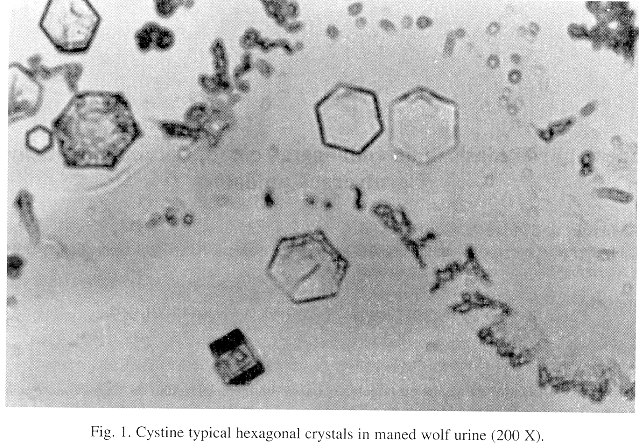
<body><![CDATA[<p><font face="Arial,Helvetica"><font size=-1><i>Chrysocyon brachyurus </i>Illiger 1811 (maned wolf, aguar&aacute;-guaz&uacute;) is a carnivorous mammalian of the <i>Canidae</i> family, which inhabits in the east of Bolivia, south and center of Brazil and Paraguay, as well in the north-east of Argentine. A long brown-reddish fur (mane) is its principal characteristic. It reaches a weight of 25 kg and its length is approximately 1.40 m. With a longevity of 16 years, it is a swift runner of lone and nocturnal customs. Little animals, eggs and fruits are their main food. In our country its number could be no more than 1000 specimens, in extinction risk (<a href="#Chebez">Chebez 1994</a>).</font></font><font size=-1></font>     <p><font face="Arial,Helvetica"><font size=-1>In addition to its habitat reduction, maned wolf was indiscriminatelly hunted to be saled in hundreds to zoological parks from South-America, the United States of America, and Europe, where its captive breeding is difficult (<a href="#Beccaceci">Beccaceci 1990</a>).</font></font><font size=-1></font>     <p><font face="Arial,Helvetica"><font size=-1>We report the finding of six cystine calculi incrusted in the renal pelvis of an adult <i>C. brachryurus</i> whose death at the zoological park in S&aacute;enz Pe&ntilde;a (Chaco Province, Argentine), was preceded by respiratory problems. Probable urinary obstruction, azoic retention and metabolic acidosis are not discarded; its compensation (pulmonary hyperventilation) could explain the unique premortal sign (<a href="#Medway">Medway <i>et al. </i>1980</a>).</font></font><font size=-1></font>     <p><font face="Arial,Helvetica"><font size=-1>The stones were brown-yellowish, irregular in shape, with coralline surface and waxen consistency, diameters up to 2 cm. Laboratory tests (Biopur kits) indicated cystine presence (magenta coloration to the nitroprussiate trial) in both peripheral and nuclear calculus zones (<a href="#Pesce">Pesce &amp; Kaplan 1990</a>).</font></font><font size=-1></font>     <p><font face="Arial,Helvetica"><font size=-1>The ammonia dissolving of the pulverized stone revealed microscopic hexagonal colorless crystals (<a href="#Fig. 1">Fig. 1</a>), confirming the cystine presumption (<a href="#Graff">Graff 1987</a>). This amino acid normally does not exist in urine (<a href="#Hutter">Hutter 1995</a>). Uric acid traces were also revealed, but phosphate, oxalate, ammonium, calcium, and magnesium tests resulted negatives.</font></font>     <br><font size=-1></font>&nbsp;     <br><font size=-1></font>&nbsp;     <br><font size=-1></font>     <center>     <p><a NAME="Fig. 1"></a><img SRC="/img/fbpe/rbt/v47n3/0573i01.GIF" height=445 width=642></center> <font size=-1></font>     
]]></body>
<body><![CDATA[<p>    <br><font size=-1></font>     <br><font size=-1></font>     <p><font face="Arial,Helvetica"><font size=-1>Cystine nephrolithiasis is the consequence of a previous metabolic failure in the certain amino acids renal resorption (cystine, arginine, lysine and ornithine). Cystinuria is a hereditary amino-aciduria (autosomal recessive transmission) characterized by the cystine tubular resorption absence. Cystine, the most insoluble of the amino acids, precipitates in acid urine and forms calculus (<a href="#Smith">Smith &amp; Thier 1983</a>).</font></font><font size=-1></font>     <p><font face="Arial,Helvetica"><font size=-1>In a previous publication we reported a cystine urolithiasis frequency of 3% in domestic canines (<a href="#Coppo">Coppo 1991</a>). Other authors reported rate of 18% in dogs (<a href="#Medway">Medway <i>et al.</i> 1980</a>). Human prevalence is 1% (<a href="#Smith">Smith &amp; Thier 1983</a>).</font></font><font size=-1></font>     <p><font face="Arial,Helvetica"><font size=-1>Surprisingly, a cystinuria prevalence of 80% was reported in captive maned wolves, which also can suffer another renal disease caused by the worm <i>Dioctophyma renale </i>(<a href="#Beccaceci">Beccaceci 1990</a>, <a href="#Chebez">Chebez 1994</a>).</font></font><font size=-1></font>     <p><font face="Arial,Helvetica"><font size=-1>To improve the health care of this carnivore, cystine crystals in urine should be monitored. The urinary sediment exam is also useful to detect <i>Dioctophyma renale </i>eggs (<a href="#Medway">Medway <i>et al. </i>1980</a>). Preventive steps such as urinary alkalinization (bicarbonate) and/or D-penicillamine ingeston (cystine solubilization) can avoid this dangerous nephrolithiasis (<a href="#Hutter">Hutter 1995</a>).</font></font><font size=-1></font>     <p><font face="Arial,Helvetica"><font size=-1>Efforts must be carried out to save this species from extinction: the maned wolf is the largest, and to some, the most beautiful South-american carnivores (<a href="#Chebez">Chebez 1994</a>).</font></font><font size=-1></font>     <p><font face="Arial,Helvetica"><font size=-1>I thank Lucrecia Felquer (CONICET) for the English revision.</font></font>     <br><font size=-1></font>&nbsp;<font size=-1></font>     ]]></body>
<body><![CDATA[<p><b><font face="Arial,Helvetica"><font size=-1>References</font></font></b><font size=-1></font>     <!-- ref --><p><a NAME="Beccaceci"></a><font face="Arial,Helvetica"><font size=-1>Beccaceci, M. 1990. First finding in Argentina of the parasite Dioctophyma renale (Goeze 1872) in a maned wolf (<i>Chrysocyon brachyurus</i>) in the wild. IUCN/SSC Vet. Group Newsletter 5: 8-10.</font></font><font size=-1></font>    &nbsp;&nbsp;&nbsp;&nbsp;&nbsp;&nbsp;&nbsp;&nbsp;[&#160;<a href="javascript:void(0);" onclick="javascript: window.open('/scielo.php?script=sci_nlinks&ref=1317762&pid=S0034-7744199900030003800001&lng=','','width=640,height=500,resizable=yes,scrollbars=1,menubar=yes,');">Links</a>&#160;]<!-- end-ref --><!-- ref --><p><a NAME="Chebez"></a><font face="Arial,Helvetica"><font size=-1>Chebez, J.C. 1994. Los que se van. Especies argentinas en peligro. Albatros, Buenos Aires. 604p.</font></font><font size=-1></font>    &nbsp;&nbsp;&nbsp;&nbsp;&nbsp;&nbsp;&nbsp;&nbsp;[&#160;<a href="javascript:void(0);" onclick="javascript: window.open('/scielo.php?script=sci_nlinks&ref=1317763&pid=S0034-7744199900030003800002&lng=','','width=640,height=500,resizable=yes,scrollbars=1,menubar=yes,');">Links</a>&#160;]<!-- end-ref --><!-- ref --><p><a NAME="Coppo"></a><font face="Arial,Helvetica"><font size=-1>Coppo, J.A. 1991. H&auml;ufigkeit der urolithiasis bei haustieren im nordosten argentiniens. Vet. Med. Nachricht. 61: 24-29.</font></font><font size=-1></font>    &nbsp;&nbsp;&nbsp;&nbsp;&nbsp;&nbsp;&nbsp;&nbsp;[&#160;<a href="javascript:void(0);" onclick="javascript: window.open('/scielo.php?script=sci_nlinks&ref=1317764&pid=S0034-7744199900030003800003&lng=','','width=640,height=500,resizable=yes,scrollbars=1,menubar=yes,');">Links</a>&#160;]<!-- end-ref --><!-- ref --><p><a NAME="Graff"></a><font face="Arial,Helvetica"><font size=-1>Graff, S.L. 1987. An&aacute;lisis de orina. Panamericana, Buenos Aires. 222p.</font></font><font size=-1></font>    &nbsp;&nbsp;&nbsp;&nbsp;&nbsp;&nbsp;&nbsp;&nbsp;[&#160;<a href="javascript:void(0);" onclick="javascript: window.open('/scielo.php?script=sci_nlinks&ref=1317765&pid=S0034-7744199900030003800004&lng=','','width=640,height=500,resizable=yes,scrollbars=1,menubar=yes,');">Links</a>&#160;]<!-- end-ref --><!-- ref --><p><a NAME="Hutter"></a><font face="Arial,Helvetica"><font size=-1>Hutter, E.R. 1995. Enfermedades de los ri&ntilde;ones y v&iacute;as urinarias en caninos y felinos. Graffo’s, Buenos Aires. 239p.</font></font><font size=-1></font>    &nbsp;&nbsp;&nbsp;&nbsp;&nbsp;&nbsp;&nbsp;&nbsp;[&#160;<a href="javascript:void(0);" onclick="javascript: window.open('/scielo.php?script=sci_nlinks&ref=1317766&pid=S0034-7744199900030003800005&lng=','','width=640,height=500,resizable=yes,scrollbars=1,menubar=yes,');">Links</a>&#160;]<!-- end-ref --><!-- ref --><p><a NAME="Medway"></a><font face="Arial,Helvetica"><font size=-1>Medway, W., J.E. Prier, &amp; J.S. Wilkinson. 1980. Veterinary Clinical Pathology. Williams &amp; Wilkins, Baltimore. 532p.</font></font><font size=-1></font>    &nbsp;&nbsp;&nbsp;&nbsp;&nbsp;&nbsp;&nbsp;&nbsp;[&#160;<a href="javascript:void(0);" onclick="javascript: window.open('/scielo.php?script=sci_nlinks&ref=1317767&pid=S0034-7744199900030003800006&lng=','','width=640,height=500,resizable=yes,scrollbars=1,menubar=yes,');">Links</a>&#160;]<!-- end-ref --><!-- ref --><p><a NAME="Pesce"></a><font face="Arial,Helvetica"><font size=-1>Pesce, A.J., &amp; L.A. Kaplan. 1990. Methods in Clinical Chemistry. Mosby. New York. 1380p.</font></font><font size=-1></font>    &nbsp;&nbsp;&nbsp;&nbsp;&nbsp;&nbsp;&nbsp;&nbsp;[&#160;<a href="javascript:void(0);" onclick="javascript: window.open('/scielo.php?script=sci_nlinks&ref=1317768&pid=S0034-7744199900030003800007&lng=','','width=640,height=500,resizable=yes,scrollbars=1,menubar=yes,');">Links</a>&#160;]<!-- end-ref --><!-- ref --><p><a NAME="Smith"></a><font face="Arial,Helvetica"><font size=-1>Smith, L.H., &amp; S.O. Thier. 1983. Pathophysiology. The Biological Principles of Disease. Saunders, Philadelphia. 1509p.</font></font><font face="Arial,Helvetica"><font size=-1></font></font>    &nbsp;&nbsp;&nbsp;&nbsp;&nbsp;&nbsp;&nbsp;&nbsp;[&#160;<a href="javascript:void(0);" onclick="javascript: window.open('/scielo.php?script=sci_nlinks&ref=1317769&pid=S0034-7744199900030003800008&lng=','','width=640,height=500,resizable=yes,scrollbars=1,menubar=yes,');">Links</a>&#160;]<!-- end-ref --><p><a NAME="1a"></a><font face="Arial,Helvetica"><font size=-1><sup><a href="#1">1</a></sup> C&aacute;t. Fisiolog&iacute;a, Fac. Ciencias Exactas, Universidad Nacional del Nordeste (UNNE), Sargento Cabral 2139, Corrientes (3400), Argentina. E-mail <a href="mailto:jcoppo@vet.unne.edu.ar.">jcoppo@vet.unne.edu.ar.</a></font></font>     ]]></body>
<body><![CDATA[ ]]></body><back>
<ref-list>
<ref id="B1">
<nlm-citation citation-type="journal">
<person-group person-group-type="author">
<name>
<surname><![CDATA[Beccaceci]]></surname>
<given-names><![CDATA[M.]]></given-names>
</name>
</person-group>
<article-title xml:lang="en"><![CDATA[First finding in Argentina of the parasite Dioctophyma renale (Goeze 1872) in a maned wolf (Chrysocyon brachyurus) in the wild]]></article-title>
<source><![CDATA[IUCN/SSC Vet. Group Newsletter]]></source>
<year>1990</year>
<volume>5</volume>
<page-range>8-10</page-range></nlm-citation>
</ref>
<ref id="B2">
<nlm-citation citation-type="book">
<person-group person-group-type="author">
<name>
<surname><![CDATA[Chebez]]></surname>
<given-names><![CDATA[J.C.]]></given-names>
</name>
</person-group>
<source><![CDATA[Los que se van: Especies argentinas en peligro]]></source>
<year>1994</year>
<page-range>604</page-range><publisher-loc><![CDATA[^eBuenos Aires Buenos Aires]]></publisher-loc>
<publisher-name><![CDATA[Albatros]]></publisher-name>
</nlm-citation>
</ref>
<ref id="B3">
<nlm-citation citation-type="journal">
<person-group person-group-type="author">
<name>
<surname><![CDATA[Coppo]]></surname>
<given-names><![CDATA[J.A.]]></given-names>
</name>
</person-group>
<article-title xml:lang="de"><![CDATA[Häufigkeit der urolithiasis bei haustieren im nordosten argentiniens]]></article-title>
<source><![CDATA[Vet. Med. Nachricht.]]></source>
<year>1991</year>
<volume>61</volume>
<page-range>24-29</page-range></nlm-citation>
</ref>
<ref id="B4">
<nlm-citation citation-type="book">
<person-group person-group-type="author">
<name>
<surname><![CDATA[Graff]]></surname>
<given-names><![CDATA[S.L.]]></given-names>
</name>
</person-group>
<source><![CDATA[Análisis de orina]]></source>
<year>1987</year>
<page-range>222</page-range><publisher-loc><![CDATA[Buenos Aires ]]></publisher-loc>
<publisher-name><![CDATA[Panamericana]]></publisher-name>
</nlm-citation>
</ref>
<ref id="B5">
<nlm-citation citation-type="book">
<person-group person-group-type="author">
<name>
<surname><![CDATA[Hutter]]></surname>
<given-names><![CDATA[E.R.]]></given-names>
</name>
</person-group>
<source><![CDATA[Enfermedades de los riñones y vías urinarias en caninos y felinos]]></source>
<year>1995</year>
<page-range>239</page-range><publisher-loc><![CDATA[Buenos Aires ]]></publisher-loc>
<publisher-name><![CDATA[Graffo’s]]></publisher-name>
</nlm-citation>
</ref>
<ref id="B6">
<nlm-citation citation-type="book">
<person-group person-group-type="author">
<name>
<surname><![CDATA[Medway]]></surname>
<given-names><![CDATA[W.]]></given-names>
</name>
<name>
<surname><![CDATA[Prier]]></surname>
<given-names><![CDATA[J.E.]]></given-names>
</name>
<name>
<surname><![CDATA[Wilkinson]]></surname>
<given-names><![CDATA[J.S.]]></given-names>
</name>
</person-group>
<source><![CDATA[Veterinary Clinical Pathology]]></source>
<year>1980</year>
<page-range>532</page-range><publisher-loc><![CDATA[Baltimore ]]></publisher-loc>
<publisher-name><![CDATA[Williams & Wilkins]]></publisher-name>
</nlm-citation>
</ref>
<ref id="B7">
<nlm-citation citation-type="book">
<person-group person-group-type="author">
<name>
<surname><![CDATA[Pesce]]></surname>
<given-names><![CDATA[A.J.]]></given-names>
</name>
<name>
<surname><![CDATA[Kaplan]]></surname>
<given-names><![CDATA[L.A.]]></given-names>
</name>
</person-group>
<source><![CDATA[Methods in Clinical Chemistry]]></source>
<year>1990</year>
<page-range>1380</page-range><publisher-loc><![CDATA[^eNew York New York]]></publisher-loc>
<publisher-name><![CDATA[Mosby]]></publisher-name>
</nlm-citation>
</ref>
<ref id="B8">
<nlm-citation citation-type="book">
<person-group person-group-type="author">
<name>
<surname><![CDATA[Smith]]></surname>
<given-names><![CDATA[L.H.]]></given-names>
</name>
<name>
<surname><![CDATA[Thier]]></surname>
<given-names><![CDATA[S.O.]]></given-names>
</name>
</person-group>
<source><![CDATA[Pathophysiology: The Biological Principles of Disease]]></source>
<year>1983</year>
<page-range>1509</page-range><publisher-loc><![CDATA[Philadelphia ]]></publisher-loc>
<publisher-name><![CDATA[Saunders]]></publisher-name>
</nlm-citation>
</ref>
</ref-list>
</back>
</article>