<?xml version="1.0" encoding="ISO-8859-1"?><article xmlns:mml="http://www.w3.org/1998/Math/MathML" xmlns:xlink="http://www.w3.org/1999/xlink" xmlns:xsi="http://www.w3.org/2001/XMLSchema-instance">
<front>
<journal-meta>
<journal-id>0034-7744</journal-id>
<journal-title><![CDATA[Revista de Biología Tropical]]></journal-title>
<abbrev-journal-title><![CDATA[Rev. biol. trop]]></abbrev-journal-title>
<issn>0034-7744</issn>
<publisher>
<publisher-name><![CDATA[Universidad de Costa Rica]]></publisher-name>
</publisher>
</journal-meta>
<article-meta>
<article-id>S0034-77441999000300025</article-id>
<title-group>
<article-title xml:lang="en"><![CDATA[Taxonomic review of Costa Rican Pipunculidae (Insecta: Diptera)]]></article-title>
</title-group>
<contrib-group>
<contrib contrib-type="author">
<name>
<surname><![CDATA[Rafael]]></surname>
<given-names><![CDATA[J. A.]]></given-names>
</name>
<xref ref-type="aff" rid="A01"/>
</contrib>
<contrib contrib-type="author">
<name>
<surname><![CDATA[da S. Menezes]]></surname>
<given-names><![CDATA[M. D.]]></given-names>
</name>
<xref ref-type="aff" rid="A01"/>
</contrib>
</contrib-group>
<aff id="A01">
<institution><![CDATA[,Instituto Nacional de Pesquisas da Amazônia (INPA)  ]]></institution>
<addr-line><![CDATA[ ]]></addr-line>
<country>Brazil</country>
</aff>
<pub-date pub-type="pub">
<day>00</day>
<month>09</month>
<year>1999</year>
</pub-date>
<pub-date pub-type="epub">
<day>00</day>
<month>09</month>
<year>1999</year>
</pub-date>
<volume>47</volume>
<numero>3</numero>
<fpage>513</fpage>
<lpage>534</lpage>
<copyright-statement/>
<copyright-year/>
<self-uri xlink:href="http://www.scielo.sa.cr/scielo.php?script=sci_arttext&amp;pid=S0034-77441999000300025&amp;lng=en&amp;nrm=iso"></self-uri><self-uri xlink:href="http://www.scielo.sa.cr/scielo.php?script=sci_abstract&amp;pid=S0034-77441999000300025&amp;lng=en&amp;nrm=iso"></self-uri><self-uri xlink:href="http://www.scielo.sa.cr/scielo.php?script=sci_pdf&amp;pid=S0034-77441999000300025&amp;lng=en&amp;nrm=iso"></self-uri><abstract abstract-type="short" xml:lang="en"><p><![CDATA[Twenty nine species and ten genera of Pipunculidae are reported from Costa Rica, including eight previously recorded species, thirteen new species and eight new records. The following species are described and illustrated: Cephalosphaera guanacastensis, C. procera, C. zumbadoi, Eudorylas abnormalis, E. echinatus, E. falx, E. moragai, E. serratus, Elmohardyia adunca, E. bifida, E. costaricana, E. galeata and E. maculata. The new records are Chalarus connexus Rafael, Parapipunculus elegantulus (Williston), Cephalosphaera jamaicensis (Johnson), C. macroctenia Rafael, C. panamaensis Hardy, Microcephalops williamsi (Hardy), Eudorylas vidali Rafael and Basileunculus rex (Curran). Parapipunculus elegantulus (Williston) is redescribed from the holotype. The previously unknown females of P. elegantulus and C. jamaicensis are described. All Costa Rican species are listed. Keys to the species of Cephalosphaera Enderlein and Elmohardyia Rafael are presented.]]></p></abstract>
<abstract abstract-type="short" xml:lang="es"><p><![CDATA[Se informa de la presencia de veintinueve especies y diez géneros de Pipunculidae en Costa Rica, con ocho especies previamente registradas, trece nuevas y ocho nuevos registros. Se describen e ilustran las seguientes especies: Cephalosphaera guanacastensis, C. procera, C. zumbadoi, Eudorylas abnormalis, E. echinatus, E. falx, E. moragai, E. serratus, Elmohardyia adunca, E. bifida, E. costaricana, E. galeata y E. maculata. Los nuevos registros son Chalarus connexus Rafael, Parapipunculus elegantulus (Williston), Cephalosphaera jamaicensis (Johnson), C. macroctenia Rafael, C. panamaensis Hardy, Microcephalops williamsi (Hardy), Eudorylas vidali Rafael y Basileunculus rex (Curran). Parapipunculus elegantulus (Williston) es redescrito a partir del holotipo. Se describen las hembras previamente desconocidas de P. elegantulus y C. jamaicensis. Se presenta la lista de todas las especies costarricensis y claves para las especies de Cephalosphaera Enderlein y Elmohardyia Rafael.]]></p></abstract>
<kwd-group>
<kwd lng="en"><![CDATA[Costa Rica]]></kwd>
<kwd lng="en"><![CDATA[Diptera]]></kwd>
<kwd lng="en"><![CDATA[Pipunculidae]]></kwd>
<kwd lng="en"><![CDATA[Taxonomy]]></kwd>
</kwd-group>
</article-meta>
</front><body><![CDATA[ <center><b><font face="Arial,Helvetica">&nbsp;Taxonomic review of Costa Rican Pipunculidae (Insecta: Diptera)</font></b><font size=-1></font>     <p><font face="Arial,Helvetica"><font size=-1><b>J. A. Rafael and M. D. da S. Menezes</b>&nbsp;<a NAME="1"></a><sup><a href="#1a">1</a></sup></font></font></center>  <ul> <ul> <ul> <ul><font face="Arial,Helvetica"><font size=-1>Received 16-VI-1998. Corrected 18-I-1999. Accepted 2-II-1999.</font></font>    </ul>     </ul>     </ul>     </ul> <b><font face="Arial,Helvetica"><font size=-1>Abstract</font></font></b><font face="Arial,Helvetica"><font size=-1></font></font>     <p><font face="Arial,Helvetica"><font size=-1>Twenty nine species and ten genera of Pipunculidae are reported from Costa Rica, including eight previously recorded species, thirteen new species and eight new records. The following species are described and illustrated: <i>Cephalosphaera guanacastensis</i>, <i>C. procera, C. zumbadoi, Eudorylas abnormalis, E. echinatus, E. falx, E. moragai, E. serratus, Elmohardyia adunca, E. bifida, E. costaricana, E. galeata</i> and <i>E. maculata</i>. The new records are <i>Chalarus connexus</i> Rafael, <i>Parapipunculus elegantulus</i> (Williston), <i>Cephalosphaera jamaicensis</i> (Johnson), <i>C. macroctenia</i> Rafael, <i>C. panamaensis</i> Hardy, <i>Microcephalops williamsi</i> (Hardy), <i>Eudorylas vidali</i> Rafael and <i>Basileunculus rex</i> (Curran). <i>Parapipunculus elegantulus</i> (Williston) is redescribed from the holotype. The previously unknown females of <i>P. elegantulus</i> and <i>C. jamaicensis</i> are described. All Costa Rican species are listed. Keys to the species of <i>Cephalosphaera</i> Enderlein and <i>Elmohardyia</i> Rafael are presented.</font></font>     <br><font size=-1></font>&nbsp;<font size=-1></font>     <p><b><font face="Arial,Helvetica"><font size=-1>Key words</font></font></b><font face="Arial,Helvetica"><font size=-1></font></font>     <p><font face="Arial,Helvetica"><font size=-1>Costa Rica, Diptera, Pipunculidae, Taxonomy.</font></font>     ]]></body>
<body><![CDATA[<br><font face="Arial,Helvetica"><font size=-1>&nbsp;</font></font><font size=-1></font>     <p><font face="Arial,Helvetica"><font size=-1>Pipunculidae are closely related to the Syrphidae. Together they are grouped in the Syrphoidea, sister group of Schizophora (<a href="#Cumming">Cumming <i>et al.,</i> 1995</a>). The phylogeny and classification of Pipunculidae were proposed by <a href="#Rafael/De Meyer, 1992.">Rafael &amp; De Meyer (1992)</a>. The Neotropical species have been revised by the senior author since 1986 and all papers concerning the fauna from Mexico, Central America and West Indies are referred by <a href="#Rafael96">Rafael (1996)</a> and along this paper. This family was poorly represented in the Costa Rican fauna, with the following eight recorded species by <a href="#De Meyer96">De Meyer (1996)</a> in his world catalogue: <i>Eudorylas cinctus subtilis</i> (Hardy), <i>E. willistoni</i> (Kert&eacute;sz), <i>Metadorylas spinosus</i> (Hardy), <i>Elmohardyia arnaudi</i> Rafael, <i>E. gowdeyi</i> (Curran), <i>Tomosvaryella lynchi</i> (Shannon), <i>T. tuberculata</i> Hardy and <i>T. subvirescens</i> (Loew). Besides the previously recorded species, this study revealed thirteen undescribed species and new distribution records for eight more species.</font></font><font size=-1></font>     <p><font face="Arial,Helvetica"><font size=-1>The small studied collection of the Instituto Nacional de Biodiversidad (INBio), showed high diversity of pipunculid species. It is inevitable that additional species and records will be found when more collections are made.</font></font>     <br><font size=-1></font>&nbsp;<font size=-1></font>     <p><b><font face="Arial,Helvetica"><font size=-1>Materials and Methods</font></font></b><font size=-1></font>     <p><font face="Arial,Helvetica"><font size=-1>A short diagnoses precedes each species description. Descriptions of new species are made from the holotype and the opposite sex from the paratype. One wing and male terminalia were studied by removing them from the holotype, after which the wing was mounted on a microslide with balsam and the terminalia was placed in a microvial with glycerin and both pinned along with the specimen. Primary types are deposited in the collections of the Instituto Nacional de Biodiversidad (INBio), Santo Domingo, Costa Rica and paratypes and other specimens have been deposited at INBio and at Instituto Nacional de Pesquisas da Amaz&ocirc;nia (INPA), Manaus, Brazil.</font></font><font size=-1></font>     <p><font face="Arial,Helvetica"><font size=-1>The generic classification adopted here follows <a href="#Rafael/De Meyer, 1992.">Rafael &amp; De Meyer (1992)</a>. The following is primarily a taxonomic study and should provide a foundation for future systematic research.</font></font><font size=-1></font>     <p><font face="Arial,Helvetica"><font size=-1>Female specimens not associated with males were not identified. Terminology is based on <a href="#McAlpine">McAlpine (1981)</a> except for those specific pipunculid structures that were labeled according to <a href="#Rafael87">Rafael (1987)</a>. Abbreviations used in the text are: BL = bar label, F = female, Fig = figure, ht = holotype, pt = paratype; lv = lateral view, vv = ventral view, dv = dorsal view; LN = Lambert North, LS = Lambert South (these are coordinates in the 1: 50,000 topographic map of Costa Rica).</font></font><font size=-1></font>     <p><font face="Arial,Helvetica"><font size=-1>The climate and vegetation of Costa Rica have been discussed by <a href="#Murillo">Murillo &amp; Zeledon (1985)</a>, <a href="#Boza">Boza &amp; Mendoza (1981)</a>, <a href="#Gomez">Gomez (1986)</a>, <a href="#Herrera">Herrera (1986)</a>, <a href="#Stiles">Stiles &amp; Skutch (1989)</a>, <a href="#Gauld">Gauld (1997)</a> and details are not repeated here.</font></font><font size=-1></font>     <p><font face="Arial,Helvetica"><font size=-1>In order to save space codes are used, under Material, only for repetitive specimens collected at Estaci&oacute;n Pitilla; San Luis, Monteverde; Estaci&oacute;n Las Pailas and Estaci&oacute;n Sirena:</font></font><font size=-1></font>     ]]></body>
<body><![CDATA[<p><font face="Arial,Helvetica"><font size=-1>Code 1: COSTA RICA, Estaci&oacute;n Pitilla, 9 km South Santa Cecilia, Parque Nacional Guanacaste, Provincia Guanacaste, 700 m, LN 330200-380200;</font></font><font size=-1></font>     <p><font face="Arial,Helvetica"><font size=-1>Code 2: COSTA RICA, San Luis, Monteverde, Provincia Puntarenas, 1000-1350 m, LN 449250-250850;</font></font><font size=-1></font>     <p><font face="Arial,Helvetica"><font size=-1>Code 3: COSTA RICA, Estaci&oacute;n Las Pailas, Parque Nacional Rinc&oacute;n de La Vieja, Provincia Guanacaste, 800-1000 m, LN 306300-388600;</font></font><font size=-1></font>     <p><font face="Arial,Helvetica"><font size=-1>Code 4: COSTA RICA, Estaci&oacute;n Sirena, Parque Nacional Corcovado, Provincia Puntarenas, 0-100 m, LS 270500-508300.</font></font><font size=-1></font>     <p><font face="Arial,Helvetica"><font size=-1>The information between brackets, under Material, contains data not included on the labels.</font></font><font size=-1></font>     <p><font face="Arial,Helvetica"><font size=-1>Genera occurring in Costa Rica can be keyed using <a href="#Rafael96">Rafael (1996)</a>.</font></font>     <br><font size=-1></font>&nbsp;     <p>    <br><font size=-1></font>     <p><b><font face="Arial,Helvetica"><font size=-1>Results</font></font></b><font face="Arial,Helvetica"><font size=-1></font></font>     ]]></body>
<body><![CDATA[<center>     <p><font face="Arial,Helvetica"><font size=-1>Genus <i>Chalarus</i> Walker</font></font></center> <font size=-1></font>     <p><font face="Arial,Helvetica"><font size=-1>This genus is cosmopolitan. The Neotropical species were revised and keyed by <a href="#Rafael90a">Rafael (1990a)</a>. The West Indian species were keyed by <a href="#Rafael96">Rafael (1996)</a>.</font></font><font size=-1></font>     <center>     <p><font face="Arial,Helvetica"><font size=-1><i>Chalarus connexus</i> Rafael</font></font></center> <font face="Arial,Helvetica"><font size=-1><i>Chalarus connexus</i> <a href="#Rafael88a">Rafael, 1988a</a>: 6</font></font><font size=-1></font>     <p><font face="Arial,Helvetica"><font size=-1><i>C. connexus</i>, described from Brazil and Trinidad, is the only <i>Chalarus</i> species that has been recorded from Costa Rica. It is easily identified by having the cell r1 closed. There are at least two more species but they cannot be identified at the specific level because there are no male specimens associated with females.</font></font><font size=-1></font>     <p><font face="Arial,Helvetica"><font size=-1>Material. Code 1, May 1994, P. Rios, Malaise, # 2896, BL CRI001 878718 (1 M INBio); Code 1, Jul 1994, C. Moraga, # 3158, BL CRI002 001359 (1 M INPA).</font></font><font size=-1></font>     <center>     <p><font face="Arial,Helvetica"><font size=-1>Genus <i>Parapipunculus</i> Rafael</font></font></center> <font size=-1></font>     <p><font face="Arial,Helvetica"><font size=-1>This small genus is distributed mainly in the Nearctic Region and the four species were keyed by <a href="#Rafael86">Rafael (1986)</a>. Subsequently, <a href="#De Meyer89">De Meyer (1989)</a> transferred <i>P. appendiculatus</i> to the genus <i>Cephalops</i>.</font></font><font size=-1></font>     ]]></body>
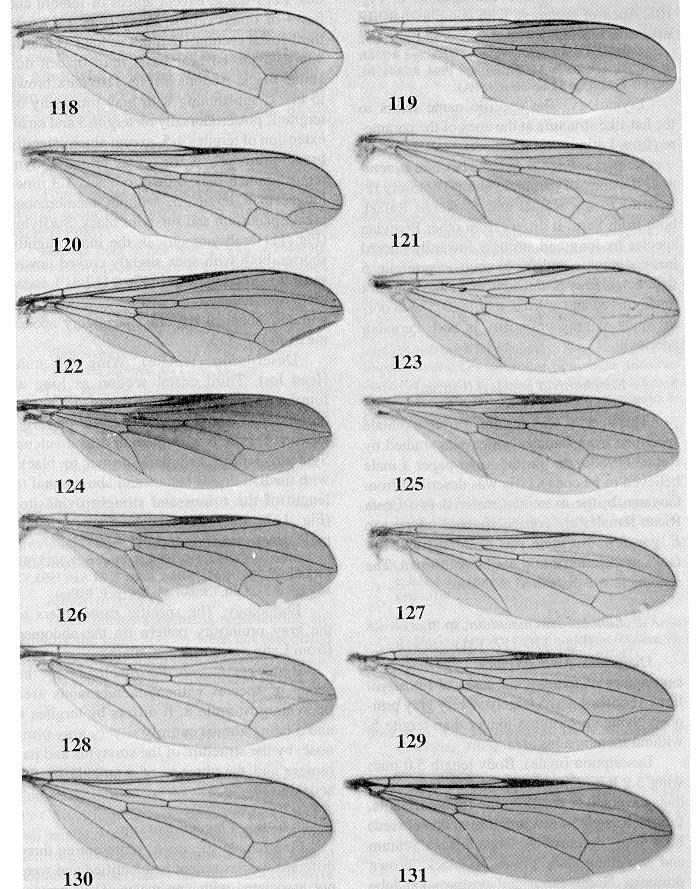
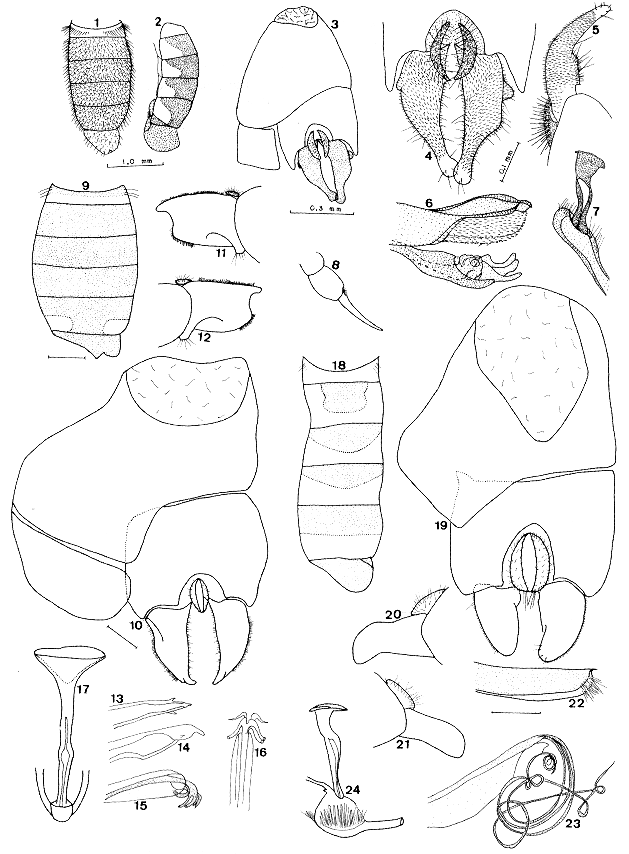
<body><![CDATA[<center>     <p><font face="Arial,Helvetica"><font size=-1><i>Parapipunculus elegantulus</i> (Williston)</font></font>     <br><font face="Arial,Helvetica"><font size=-1>(<a href="#Figs. 1-23">Figs. 1-8</a>, <a href="#Figs. 118-131">118</a>)</font></font></center> <font size=-1></font>     <p><font face="Arial,Helvetica"><font size=-1><i>Pipunculus elegantulus</i><a href="#Williston">Williston, 1892</a>: 87; <a href="#Cresson">Cresson, 1911</a>: 296.</font></font><font size=-1></font>     <p><font face="Arial,Helvetica"><font size=-1><i>Cephalosphaera elegantula</i>; <a href="#Hardy43">Hardy, 1943</a>: 50; <a href="#Aczél48">Acz&eacute;l, 1948</a>: 26, 73; <a href="#Aczél52">1952</a>: 240.</font></font><font size=-1></font>     <p><font face="Arial,Helvetica"><font size=-1><i>Pipunculus</i> (<i>Cephalosphaera</i>) <i>elegantula</i>; Hardy, 1966: 2</font></font><font size=-1></font>     <p><font face="Arial,Helvetica"><font size=-1><i>Parapipunculus elegantulus</i>; <a href="#Rafael86">Rafael, 1986</a>: 421.</font></font><font size=-1></font>     <p><font face="Arial,Helvetica"><font size=-1>This species has not been revised in the previous pipunculid papers of the senior author so the subsequent citation is given above. This is the only Neotropical species of the genus, described originally from Mexico, and the record in Costa Rica is the most southerly. It was known only from the male holotype, redescribed below. One female sharing some characters of the male characters belongs here and it is being described below.</font></font><font size=-1></font>     <p><font face="Arial,Helvetica"><font size=-1>Redescription (holotype male). Body length 4.5 mm; wing 5.3 mm. Eyes contiguous on frons for a distance slightly greater than length of frontal triangle. Front and face silvery gray pruinose. Scape and pedicel brown, flagellum rounded below, brown with yellow margin. Scutum and scutellum densely bristled, subshining black, sparsely brown pruinose. Notopleuron gray pruinose, densely bristled. Postpronotal lobe yellow. Propleural fan with whitish bristles. Mesopleuron and postnotum black, gray pruinose. Legs yellow, except coxae dark brown to black; femora dark brown to black medially and distal tarsomeres brown; hind trochanter with slender ventral bristles; all femora with ventral ctenidium and hind femur with posterior row of short black bristles and a pair of subapical anterior and posterior black bristles; tibiae without apical bristles and hind tibia with two erect posterior bristles. Wing (<a href="#Figs. 118-131">Fig 118</a>) with vein r-m placed near basal fourth of cell dm; vein M2 short. Halter yellow. Abdomen (<a href="#Figs. 1-23">Fig 1</a>, <a href="#Figs. 1-23">2</a>) densely bristled, shining black with gray pruinosity on tergite 1 and laterally on tergites 2-5 with pruinescence triangularly produced on each tergite posteriorly. Syntergosternite 8 about equal to the length of tergite 5, slightly inclined to the right, with a small membranous area distally. Epandrium and surstylus (<a href="#Figs. 1-23">Fig 3</a>) yellow. Surstylus (<a href="#Figs. 1-23">Figs 4</a>-<a href="#Figs. 1-23">5</a>) asymmetrical. Paramere and aedeagus as in <a href="#Figs. 1-23">Fig 6</a>. Ejaculatory apodeme as in <a href="#Figs. 1-23">Fig 7</a>.</font></font><font size=-1></font>     <p><font face="Arial,Helvetica"><font size=-1>Female. Body length 4.6 mm; wing 4.9 mm. Frons entirely silvery gray pruinose. Pedicel yellow to brown, flagellum yellow. Femora yellow with small black spot on anterior side; hind femur without posterior row of black spines, either subapical or posterior bristles; hind tibia without erect posterior bristles medially. In other respects as in male. Terminalia (<a href="#Figs. 1-23">Fig 8</a>) mainly yellow except syntergosternite 7+8 partially shining black dorsally, slightly shorter than ovipositor; the latter slightly curved outward.</font></font><font size=-1></font>     ]]></body>
<body><![CDATA[<p><font face="Arial,Helvetica"><font size=-1>Material. MEXICO, Guerrero, Chilpancingo, 4.600 ft, June, H. H. Smith (ht M, Natural History Museum, London; right wing partially damaged); Code 1, 9-20 Ene 1994, P. Rios, # 2561, BL CRI001 844273 (1F INBio).</font></font><font size=-1></font>     <p>    <br><font size=-1></font>     <center>     <p><img SRC="/img/fbpe/rbt/v47n3/0560i08.GIF" height=344 width=672>     
<br><font size=-1></font>&nbsp;     <br><font size=-1></font>&nbsp;<font size=-1></font>     <p><font face="Arial,Helvetica"><font size=-1>Genus <i>Cephalosphaera</i> Enderlein</font></font></center> <font size=-1></font>     <p><font face="Arial,Helvetica"><font size=-1>The Neotropical species were revised and keyed by <a href="#Rafael92">Rafael (1992)</a>. Two recently created subgenera by <a href="#De Meyer94">De Meyer (1994)</a> were keyed by <a href="#Rafael96">Rafael (1996)</a> and both occur in Costa Rica.</font></font><font size=-1></font>     <center>     ]]></body>
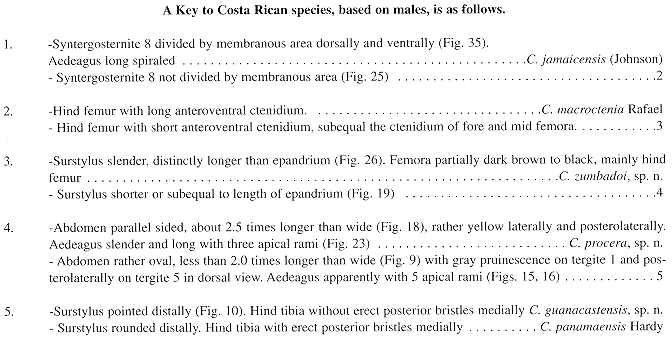
<body><![CDATA[<p><i><font face="Arial,Helvetica"><font size=-1>Cephalosphaera (Cephalosphaera)</font></font></i>     <br><font face="Arial,Helvetica"><font size=-1><i>guanacastensis</i>, sp. n.</font></font>     <br><font face="Arial,Helvetica"><font size=-1>(<a href="#Figs. 1-23">Figs 9-17</a>, <a href="#Figs. 118-131">119</a>)</font></font></center> <font size=-1></font>     <p><font face="Arial,Helvetica"><font size=-1>Diagnoses. Legs mainly yellow. Scutellum concolorous with scutum. Abdomen with gray pruinosity on distal half of tergite 1 and posterolaterally on tergite 5. Syntergosternite 8 shorter than tergite 5, not divided by membranous area. Surstylus almost symmetrical.</font></font><font size=-1></font>     <p><font face="Arial,Helvetica"><font size=-1>Description (male only, female unknown). Wing 6.0 mm. Head lost. Scutum, postpronotal lobe and scutellum dark brown to black, brown pruinose. Notopleuron, mesopleuron, subscutellum and laterotergite gray pruinose. Scutellum with two black spine-like bristles at posterior margin. Legs yellow, except mid and hind coxa and fifth tarsomere brown; hind tibia without erect posterior bristles medially. Wing (<a href="#Figs. 118-131">Fig 119</a>) hyaline; base with two strong short black spines; section between cell dm and vein M1 longer than vein dm-cu, the latter slightly sinuous. Halter yellow, with small dark spot on knob. Abdomen (<a href="#Figs. 1-23">Fig 9</a>) dark brown to black, subshining, brown pruinose with gray pruinosity on distal half of tergite 1 and posterolaterally on tergite 5. Syntergosternite 8 dark brown to black, shorter than tergite 5, with membranous area distally. Epandrium dark brown to black and surstylus yellow. Surstylus (<a href="#Figs. 1-23">Fig 10</a>) subsymmetrical; in lateral view as in <a href="#Figs. 1-23">Figs 11-12</a>. Paramere and aedeagus as in <a href="#Figs. 1-23">Figs 13-16</a>. Paramere with short subapical lateral projection. Aedeagus with two additional branches, giving the false impression of being five branched. Ejaculatory apodeme as in <a href="#Figs. 1-23">Fig 17</a>.</font></font><font size=-1></font>     <p><font face="Arial,Helvetica"><font size=-1>Material. Code 1, Ene 1994, C. Moraga, # 2563, BL CRI001 828733 (ht M, head lost, INBio).</font></font><font size=-1></font>     <p><font face="Arial,Helvetica"><font size=-1>Etymology. The specific name refers to Guanacaste Province where the specimen was collected.</font></font><font size=-1></font>     <p><font face="Arial,Helvetica"><font size=-1>Remarks. <i>C. guanacastensis</i> runs to the couplet of <i>C. panamaensis</i> and <i>C. boutropis</i> in the key of <a href="#Rafael92">Rafael (1992)</a>. From the Argentinean <i>C. boutropis</i> it differs by having syntergosternite 8 not being divided by a membranous area; from <i>panamaensis</i> it differs by the following: scutellum with two black bristles at the margin, hind tibia without erect posterior bristles medially and paramere with a subapical lateral projection.</font></font><font size=-1></font>     <center>     <p><i><font face="Arial,Helvetica"><font size=-1>Cephalosphaera (Cephalosphaera) procera</font></font></i><font face="Arial,Helvetica"><font size=-1>,</font></font>     ]]></body>
<body><![CDATA[<br><font face="Arial,Helvetica"><font size=-1>sp. n.</font></font>     <br><font face="Arial,Helvetica"><font size=-1>(<a href="#Figs. 1-23">Figs 18-24</a>, <a href="#Figs. 118-131">120</a>)</font></font></center> <font size=-1></font>     <p><font face="Arial,Helvetica"><font size=-1>Diagnoses. Antenna, postpronotal lobe, legs and halter yellow; flagellum short acute. Abdomen partially yellow to light brown. Surstylus subsymmetrical, shorter than epandrium. Aedeagus thin and very elongated.</font></font><font size=-1></font>     <p><font face="Arial,Helvetica"><font size=-1>Description (male only, female unknown). Body length 6.3 mm; wing 6.9 mm. Eyes contiguous on frons for a distance slightly greater than length of frontal triangle. Frontal triangle and face silvery gray pubescent. Antenna yellow, flagellum short acute. Scutum dark brown to black, brown pruinose. Scutellum brown with small bristles laterally. Postpronotal lobe yellow. Notopleuron gray pruinose. Mesopleuron light brown, sparsely brown pruinose, except proepisternum and anterior region of the anepisternum black, sparsely gray pruinose. Subscutellum and laterotergite gray pruinose in posterior view. Legs yellow except mid and hind coxa, apices of mid and hind femur and distal tarsomeres brown. Hind tibia without erect posterior bristles medially. Wing (<a href="#Figs. 118-131">Fig 120</a>) hyaline with two strong short bristles at base; third costal section about 1.2 times as long as fourth; section between cell dm and vein M2 longer than vein dm-cu. Halter yellow. Abdomen (<a href="#Figs. 1-23">Fig. 18</a>) rather parallel sided. Tergite 1 with 4-5 longer bristles laterally, opaque brown to black on bases of tergites 2-5, this color being larger on posterior tergites and subshining, rather yellow to light brown on all of tergite 1 and on lateral and posterior margins of posterior tergites, being these yellow regions gray pruinose in posterior view. Tergite 5 longer than tergite 4. Syntegosternite 8 dark brown to black, shorter than tergite 5, with distal membranous area. Epandrium and surstylus (<a href="#Figs. 1-23">Fig 19</a>) brown. Surstylus subsymmetrical, in lateral view as in <a href="#Figs. 1-23">Fig 20-21</a>. Paramere as in <a href="#Figs. 1-23">Fig 22</a>. Aedeagus (<a href="#Figs. 1-23">Fig 23</a>) thin and elongated. Ejaculatory apodeme as in <a href="#Figs. 1-23">Fig 24</a>.</font></font><font size=-1></font>     <p><font face="Arial,Helvetica"><font size=-1>Material. COSTA RICA, Fila Matahambre, F[in]ca La Purruja, Cerro La Torre, Pen[insula] Osa, Prov[incia] Punta[renas], 200 m, May 1994, J. F. Quesada, LN 277000-527000, # 2922, BL CRI001 964775 (ht M, INBio).</font></font><font size=-1></font>     <p><font face="Arial,Helvetica"><font size=-1>Etymology. The specific name refers to the elongated abdomen (from Latin <i>procerus</i> = long).</font></font><font size=-1></font>     <p><font face="Arial,Helvetica"><font size=-1>Remarks. <i>C. procera</i> runs to <i>C. panamaensis</i> in the key of <a href="#Rafael92">Rafael (1992)</a>. It differs by the entirely yellow antenna, hind tibia without erect posterior bristles medially, a large pair of light brown spot on all tergites, surstylus shorter than epandrium, aedeagus thin and elongated, and paramere bristled distally. <i>C. panamaensis</i> has the pedicel brown, flagellum yellow, hind tibia with erect posterior bristles medially, no yellow or light brown coloration on the abdomen, surstylus about equal to the length of epandrium, aedeagus short and paramere not bristled at apex.</font></font>     <br><font size=-1></font>&nbsp;     <br><font size=-1></font>&nbsp;     <br><font size=-1></font>     ]]></body>
<body><![CDATA[<center>     <p><a NAME="Figs. 1-23"></a><img SRC="/img/fbpe/rbt/v47n3/0560i01.GIF" height=854 width=629></center> <font size=-1></font>     
<p>    <br><font size=-1></font>     <p><font face="Arial,Helvetica"><font size=-1>&nbsp;&nbsp;&nbsp; Figs. 1-8. <i>Parapipunculus elegantulus</i> ht M (except Fig 8): 1 male abdomen dv; 2 idem lv; 3 terminalia; 4 surstylus; 5 outer</font></font>     <br><font face="Arial,Helvetica"><font size=-1>&nbsp;&nbsp;&nbsp; surstyluslv; 6 paramere and aedeagus; 7 ejaculatory apodeme; 8 female terminalia. 9-17 <i>Cephalosphaera</i> (C.) <i>guanacestensis</i></font></font>     <br><font face="Arial,Helvetica"><font size=-1>&nbsp;&nbsp;&nbsp; ht M: 9 abdomen dv; 10 terminalia; 11 outer surtylus lv; 12 inner surtylus lv; 13 paramere vv; 14 paramere lv; 15 aedeagus lv;</font></font>     <br><font face="Arial,Helvetica"><font size=-1>&nbsp;&nbsp;&nbsp; 16 idem vv; 17 ejaculatory apodeme. 18-24 <i>C.</i> (C.) <i>procera</i> ht M: 18 abdomen dv; 19 terminalia; 20 outer surstylus lv; 21 inner</font></font>     <br><font face="Arial,Helvetica"><font size=-1>&nbsp;&nbsp;&nbsp; surstylus lv; 22 paramere lv; 23 aedeagus lv; 24 ejaculatory apodeme. Scales: 0.5 mm: figs. 8-9,18; 0.2 mm: 10-12, 19-21;</font></font>     <br><font face="Arial,Helvetica"><font size=-1>&nbsp;&nbsp;&nbsp; 0.1 mm: 4-7, 13-17, 22-24.</font></font>     ]]></body>
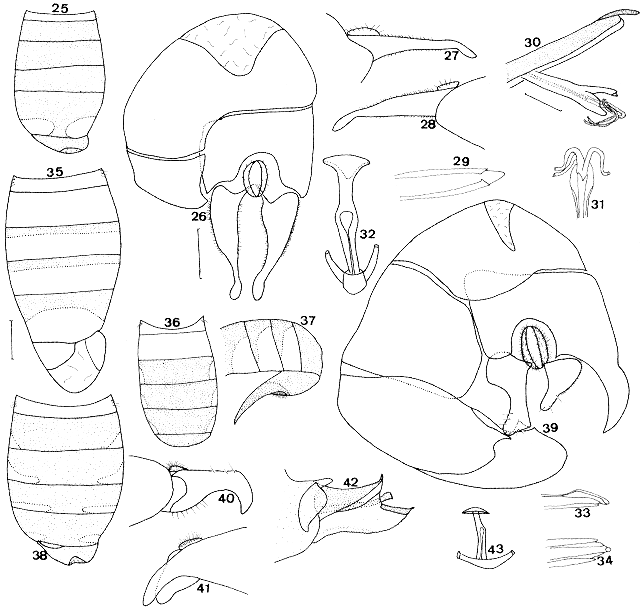
<body><![CDATA[<br><font size=-1></font>&nbsp;     <p>    <br><font size=-1></font>     <center>     <p><font face="Arial,Helvetica"><font size=-1><i>Cephalosphaera (Cephalosphaera) zumbadoi</i>,</font></font>     <br><font face="Arial,Helvetica"><font size=-1>sp. n.</font></font>     <br><font face="Arial,Helvetica"><font size=-1>(<a href="#Figs. 25-43">Figs 25-32</a>, <a href="#Figs. 118-131">121</a>)</font></font></center> <font size=-1></font>     <p><font face="Arial,Helvetica"><font size=-1>Diagnoses. Scape and pedicel black, flagellum yellow, long acute. All femora black medially, hind femur shining black on posterior side. Scutellum with two short black bristles at margin. Tergite 1 without long bristles. Syntergosternite 8 shorter than tergite 5. Surstylus elongated. Aedeagus with small projection dorsally.</font></font><font size=-1></font>     <p><font face="Arial,Helvetica"><font size=-1>Description (male only, female unknown). Body length 4.6 mm, wing 5.8 mm. Junction of compound eyes about as long as frontal triangle. Frontal triangle and face silvery gray pubescent. Scape and pedicel dark brown to black; flagellum yellow with apex long acute. Scutum and scutellum dark brown to black, brown pruinose. Notopleuron gray pruinose. Postpronotal lobe yellow. Propleuron black. Mesopleuron partially black on anepisternum, sparsely gray pruinose on black coloration. Scutellum with two black bristles at posterior margin. Subscutellum and laterotergite dark brown to black, gray pruinose. Legs with all coxae brown and all femora dark brown to black, except wide bases and narrow apices yellow. Hind femur with ventral ctenidium larger than anterior ones, shining black on posterior and on ventral side. Wing (<a href="#Figs. 118-131">Fig 121</a>) hyaline with two black spines at base; third costal section nearly two times longer than fourth. Section between cell dm and vein M2 longer than vein dm-cu. Halter yellow with small dark spot on knob. Abdomen (<a href="#Figs. 25-43">Fig 25</a>) dark brown to black, gray pruinose on tergite 1 and posterolaterally on tergite 5. Tergite 1 without strong bristles laterally. Syntergosternite 8 about one third shorter than length of tergite 5, with distal membranous area. Epandrium brown and surstylus yellow. Surstylus (<a href="#Figs. 25-43">Fig 26</a>) subsymmetrical, elongated; in lateral view as in <a href="#Figs. 25-43">Figs 27-28</a>. Paramere and aedeagus as in <a href="#Figs. 25-43">Figs 29-31</a>. Paramere with distal projection and aedeagus short ramified, with small bifid projection dorsally. Ejaculatory apodeme as in <a href="#Figs. 25-43">Fig 32</a>.</font></font><font size=-1></font>     <p><font face="Arial,Helvetica"><font size=-1>Material. COSTA RICA, Fila Casa Loma, [Peninsula] Osa, Prov[incia] Punta[renas], 200-500 m, 28 Dic 1993, M. Zumbado, LS 514300-296300, # 2668, BL CRI001 725975 (ht M, INBio).</font></font><font size=-1></font>     ]]></body>
<body><![CDATA[<p><font face="Arial,Helvetica"><font size=-1>Etymology. The specific name is in honor of Mr. Manuel Zumbado who collected the specimen described here.</font></font><font size=-1></font>     <p><font face="Arial,Helvetica"><font size=-1>Remarks. <i>C. zumbadoi</i> is most closely related to <i>C. mocaensis</i>, from Dominican Republic, and it runs to couplet this species in couplet 8 in the key of <a href="#Rafael92">Rafael (1992)</a>. It can be separated only by characters of the terminalia, namely: surstylus more elongated and slender and aedeagus with small bifid projection dorsally.</font></font><font size=-1></font>     <center>     <p><i><font face="Arial,Helvetica"><font size=-1>Cephalosphaera (Cephalosphaera)</font></font></i>     <br><font face="Arial,Helvetica"><font size=-1><i>macroctenia</i> Rafael</font></font>     <br><font face="Arial,Helvetica"><font size=-1>(<a href="#Figs. 25-43">Figs 33-34</a>)</font></font></center> <font size=-1></font>     <p><font face="Arial,Helvetica"><font size=-1><i>Cephalosphaera macroctenia</i><a href="#Rafael92">Rafael, 1992</a>: 641.</font></font><font size=-1></font>     <p><font face="Arial,Helvetica"><font size=-1>This species was described from the State of Par&aacute;, Brazil. The Costa Rican specimen represents the first record subsequent to its original description. One male specimen is conspecific, except that the paramere (<a href="#Figs. 25-43">Figs 33-34</a>) is slightly different from those represented in the original description.</font></font><font size=-1></font>     <p><font face="Arial,Helvetica"><font size=-1>Material. Code 2, Feb 1994, Z. Fuentes, # 2615, BL CRI001 962287 (1 M, INBio).</font></font><font size=-1></font>     <center>     ]]></body>
<body><![CDATA[<p><i><font face="Arial,Helvetica"><font size=-1>Cephalosphaera (Cephalosphaera)</font></font></i>     <br><font face="Arial,Helvetica"><font size=-1><i>panamaensis</i> Hardy</font></font></center> <font size=-1></font>     <p><font face="Arial,Helvetica"><font size=-1><i>Cephalosphaera panamaensis</i> <a href="#Hardy48a">Hardy, 1948a</a>: 8.</font></font><font size=-1></font>     <p><font face="Arial,Helvetica"><font size=-1>According to <a href="#Rafael96">Rafael (1996)</a> the Panamanian female specimen was originally incorrectly associated with the male; to date, this male has no associated female. Here, two males were identified.</font></font><font size=-1></font>     <p><font face="Arial,Helvetica"><font size=-1>Material. Code 1, Jul 1994, C. Moraga, # 3158, BL CRI002 001475 (1 M, INBio); Code 4, A. G. Fonseca, Jun 1991, BL CRI000 670783 (1 M, INPA).</font></font><font size=-1></font>     <center>     <p><i><font face="Arial,Helvetica"><font size=-1>Cephalosphaera (Neocephalosphaera)</font></font></i>     <br><font face="Arial,Helvetica"><font size=-1><i>jamaicensis</i> (Johnson)</font></font>     <br><font face="Arial,Helvetica"><font size=-1>(<a href="#Figs. 25-43">Figs 35-37</a>)</font></font></center> <font size=-1></font>     <p><font face="Arial,Helvetica"><font size=-1><i>Pipunculus jamaicensis</i><a href="#Johnson">Johnson, 1919</a>: 433.</font></font><font size=-1></font>     ]]></body>
<body><![CDATA[<p><font face="Arial,Helvetica"><font size=-1>This is the first record subsequent to its original description from the Jamaica. The male specimen from Costa Rica differs from Jamaican specimen by having the flagellum and legs mainly yellow (mainly brown in the Jamaican specimen), the third costal section is as long as the fourth (longer in the Jamaican specimen) and abdomen (<a href="#Figs. 25-43">Fig 35</a>) brown pruinose on all of tergites 1-2 and across posterior margin of tergites 3-5, more so on tergite 5 (tergite 2 not entirely brown pruinose, being opaque black at base in Jamaican specimen).</font></font><font size=-1></font>     <p><font face="Arial,Helvetica"><font size=-1>The following is the first description of the female: Body 4.4 mm; wing 5.6 mm. Frons and face silvery gray pruinose. Antenna entirely yellow, flagellum long acute. Legs yellow, except coxae and distal tarsomeres brown. Abdomen (<a href="#Figs. 25-43">Fig 36</a>) dark brown to black, sparsely gray pruinose dorsally on tergite 2 and laterally on all tergites. In others respects as in original description of male. Terminalia (<a href="#Figs. 25-43">Fig 37</a>) with syntergosternite 7+8 brown, shorter than ovipositor, the latter yellow, curved outward.</font></font><font size=-1></font>     <p><font face="Arial,Helvetica"><font size=-1>Material. Code 4, A. G. Fonseca, Jun 1991, BL CRI000 670783 (1 F, INBio); Code 3, 17-23 Jul 1993, K. Taylor, # 2238, BL CRI001 133169 (1 M, INBio)</font></font><font size=-1></font>     <center>     <p><font face="Arial,Helvetica"><font size=-1><i>Cephalosphaera</i> spp.</font></font></center> <font size=-1></font>     <p><font face="Arial,Helvetica"><font size=-1>Four female specimens were not associated with any male and cannot be identified to species. Two different females have a straight ovipositor equal to the length of the syntergosternite. The other two female specimens have a straight ovipositor that is longer than syntergosternite. All specimens are deposited at INBio.</font></font><font size=-1></font>     <p>    <br><font size=-1></font>     <center>     <p><font face="Arial,Helvetica"><font size=-1>Genus <i>Cephalops</i> Fall&eacute;n</font></font></center> <font size=-1></font>     ]]></body>
<body><![CDATA[<p><font face="Arial,Helvetica"><font size=-1>The Neotropical species were revised and keyed by <a href="#Rafael91">Rafael (1991)</a>. Recently <a href="#De Meyer94">De Meyer (1994)</a> created four subgenera. The two subgenera occurring in the New World were keyed by <a href="#Rafael96">Rafael (1996)</a>.</font></font><font size=-1></font>     <center>     <p><font face="Arial,Helvetica"><font size=-1><i>Cephalops</i> spp.</font></font></center> <font size=-1></font>     <p><font face="Arial,Helvetica"><font size=-1>Six female specimens representing at least two different species were not associated with males and cannot be identified Four females have antenna brown, legs black, third costal section 1.5 times longer than fourth section and abdomen dark brown to black with gray pruinosity on tergites 1-2. Two females have antenna and legs entirely yellow and abdomen partially yellow. All specimens are deposited at INBio.</font></font><font size=-1></font>     <p>    <br><font size=-1></font>     <center>     <p><font face="Arial,Helvetica"><font size=-1>Genus <i>Microcephalops</i> De Meyer</font></font></center> <font size=-1></font>     <p><font face="Arial,Helvetica"><font size=-1>The Neotropical species were revised by <a href="#Rafael91">Rafael (1991)</a> under the name <i>Cephalops</i>, group <i>latifrons</i>, and latter transferred to the genus <i>Microcephalops</i> by <a href="#Rafael91">Rafael (1996)</a>.</font></font><font size=-1></font>     <center>     ]]></body>
<body><![CDATA[<p><font face="Arial,Helvetica"><font size=-1><i>Microcephalops williamsi</i> (Hardy)</font></font></center> <font size=-1></font>     <p><font face="Arial,Helvetica"><font size=-1><i>Dorilas (Dorilas) williamsi</i><a href="#Hardy54">Hardy, 1954</a>: 54.</font></font><font size=-1></font>     <p><font face="Arial,Helvetica"><font size=-1>This species is widespread across the Neotropical Region (<a href="#Rafael96">Rafael, 1996</a>), being recorded in Brazil, Colombia, Dominican Republic and now in Costa Rica.</font></font><font size=-1></font>     <p><font face="Arial,Helvetica"><font size=-1>Material. Code 1, 6-17 Set 1993, C. Moraga, # 2344, BL CRI001 614789 (1 M, INBio); Ene 1994, C. Moraga, # 2563, BL CRI001 828751 (1 F, INBio); Jun 1994, P. Rios, # 2996, BL CRI001 883789 (1 F, INPA).</font></font><font size=-1></font>     <center>     <p><font face="Arial,Helvetica"><font size=-1><i>Microcephalops</i> spp.</font></font></center> <font size=-1></font>     <p><font face="Arial,Helvetica"><font size=-1>Three female specimens representing two different species and not associated with males cannot be identified. They present different pattern of coloration and different ovipositor shape. All specimens are deposited at INBio.</font></font><font size=-1></font>     <center>     <p><font face="Arial,Helvetica"><font size=-1>Genus <i>Eudorylas</i> Acz&eacute;l</font></font></center> <font size=-1></font>     <p><font face="Arial,Helvetica"><font size=-1>The eleven previously recorded Mexican and Central American species were studied but not keyed by <a href="#Rafael93">Rafael (1993)</a>. It is the largest genus of the family and contains very heterogeneous species. In light of present knowledge it is premature to present a key to Costa Rican species because we believe many more species remain undiscovered and the key would soon be obsolete. The eight Costa Rican species can be separated by the short diagnoses and figures presented here and by <a href="#Rafael93">Rafael (1993)</a>.</font></font><font size=-1></font>     ]]></body>
<body><![CDATA[<center>     <p><font face="Arial,Helvetica"><font size=-1><i>Eudorylas abnormalis</i>, sp. n.</font></font>     <br><font face="Arial,Helvetica"><font size=-1>(<a href="#Figs. 25-43">Figs 38-43</a>, <a href="#Figs. 118-131">122</a>)</font></font></center> <font size=-1></font>     <p><font face="Arial,Helvetica"><font size=-1>Diagnoses. Antenna dark brown to black, flagellum acute. Third costal section as long as fourth. Legs yellow, except coxae black and femora black dorsally. Tergite 6 visible dorsally. Outer side of epandrium protracted.</font></font><font size=-1></font>     <p><font face="Arial,Helvetica"><font size=-1>Description (male only, female unknown). Body length 5.1 mm; wing 5.7 mm. Eyes contiguous on frons for a distance greater than length of frontal triangle. Frontal triangle and face gray pruinose. Antenna dark brown to black, flagellum acute. Thorax dark brown to black with scutum, scutellum and postpronotal lobe brown pruinose. Notopleuron partially, mesopleuron, subscutellum and laterotergite gray pruinose. Legs yellow, except coxae dark brown to black on dorsal half and tarsi dark brown to black. Midfemur with ventral ctenidium. Tibia without distinct bristles, either distally or medially. Wing (<a href="#Figs. 118-131">Fig 122</a>) with third costal section as long as fourth; vein r-m placed near basal third of cell dm; vein M1 slightly sinuous; vein dm-cu straight, as long as vein CuA1. Halter with stem brown, knob black. Abdomen (<a href="#Figs. 25-43">Fig. 38</a>) dark brown to black with gray pruinosity on all tergite 1 and posterolaterally on tergites 2-5. Syntergosternite 8 brown pruinose, shorter than tergite 5, with distal membranous area. Epandrium and surstylus (<a href="#Figs. 25-43">Fig 39</a>) brown to black. Epandrium protracted on outer side. Surstylus asymmetrical, being the inner longer than outer surstylus; in lateral view as in <a href="#Figs. 25-43">Figs 40-41</a>. Paramere and aedeagus as in <a href="#Figs. 25-43">Fig 42</a>. Aedeagus simple. Ejaculatory apodeme as in <a href="#Figs. 25-43">Fig. 43</a>.</font></font><font size=-1></font>     <p><font face="Arial,Helvetica"><font size=-1>Material. COSTA RICA, F[in]ca G&eacute;nesis II, A[rea] C[onservacion] Amistad, Prov[incia] Carta[go], 2300 m, 9-10 Jun 1994, M. A. Zumbado, LN 188600-545900, # 2918, BL CRI001 964519 (ht M, INBio).</font></font><font size=-1></font>     <p><font face="Arial,Helvetica"><font size=-1>Etymology. The specific name refers to the unusual characters that this species presents. See remarks below (from Latin <i>abnormalis</i> = unusual).</font></font><font size=-1></font>     <p><font face="Arial,Helvetica"><font size=-1>Remarks. This species differs from other species of <i>Eudorylas</i> by characters unusual in the genus, namely: tergite 6 visible dorsally, epandrium projecting laterally and aedeagus without apical rami.</font></font>     <br><font size=-1></font>&nbsp;     <p>    ]]></body>
<body><![CDATA[<br><font size=-1></font>     <center>     <p><font face="Arial,Helvetica"><font size=-1><i>Eudorylas cinctus</i> (Banks)</font></font></center> <font size=-1></font>     <p><font face="Arial,Helvetica"><font size=-1><i>Pipunculus cinctus</i><a href="#Banks">Banks, 1915</a>: 169.</font></font><font size=-1></font>     <p><font face="Arial,Helvetica"><font size=-1>This species has been treated as two subspecies: <i>E. c. cinctus </i>and <i>E. c. subtilis</i> (Hardy). The first one has been recorded in USA, Mexico and now in Costa Rica. The second one has been recorded in USA, Mexico and Costa Rica (<a href="#De Meyer96">De Meyer, 1996</a>). The two taxa therefore appear to be sympatric and the subspecific status within this species is no more considered.</font></font><font size=-1></font>     <p><font face="Arial,Helvetica"><font size=-1>Material. COSTA RICA, Monumento Nacional Guayabo, A[rea] C[onservaci&oacute;n] Amistad, Prov[incia] Carta[go], 1100 m, Jun 1994, C. Fonseca, LN 217400-570000, # 2989, BL CRI001 881465 (1 M, INBio).</font></font>     <br><font size=-1></font>&nbsp;     <br><font size=-1></font>&nbsp;     <br><font size=-1></font>     <center>     ]]></body>
<body><![CDATA[<p><a NAME="Figs. 25-43"></a><img SRC="/img/fbpe/rbt/v47n3/0560i02.GIF" height=609 width=644></center> <font size=-1></font>     
<p>    <br><font size=-1></font>     <p><font face="Arial,Helvetica"><font size=-1>&nbsp;&nbsp;&nbsp; Figs. 25-32. <i>Cephalosphera</i> (C.) <i>zumbadoi</i> ht M: 25 abdomen dv; 26 terminalia; 27 inner surstylus lv; 28 outer surstylus lv;</font></font>     <br><font face="Arial,Helvetica"><font size=-1>&nbsp;&nbsp;&nbsp; 29 paramere vv; 30 paramere and aedeagus lv; 31 aedeagus vv; 32 ejaculatory apodeme. 33-34 <i>C. </i>(C.) <i>macrotecnia</i>: 33</font></font>     <br><font face="Arial,Helvetica"><font size=-1>&nbsp;&nbsp;&nbsp; paramere lv; 34 idemvv. 35-37 <i>C. </i>(C.) <i>jamaicensis</i>: 35 male abdomen dv; 36 female abdomen dv; 37 female terminalia lv.</font></font>     <br><font face="Arial,Helvetica"><font size=-1>&nbsp;&nbsp;&nbsp; 38-43 <i>Eudorylas abnormalis</i> ht M: 38 abdomen dv; 39 terminalia; 40 outer surstylus lv; 42 paramere and aedeagus lv;</font></font>     <br><font face="Arial,Helvetica"><font size=-1>&nbsp;&nbsp;&nbsp; 43 ejaculatory apodeme. Scales: 0.5 mm: figs. 25, 35-38; 0.2 mm: 26-28, 39-41; 0.1 mm: 29-34, 42-43.</font></font><font size=-1></font>     <p>    <br><font size=-1></font>     ]]></body>
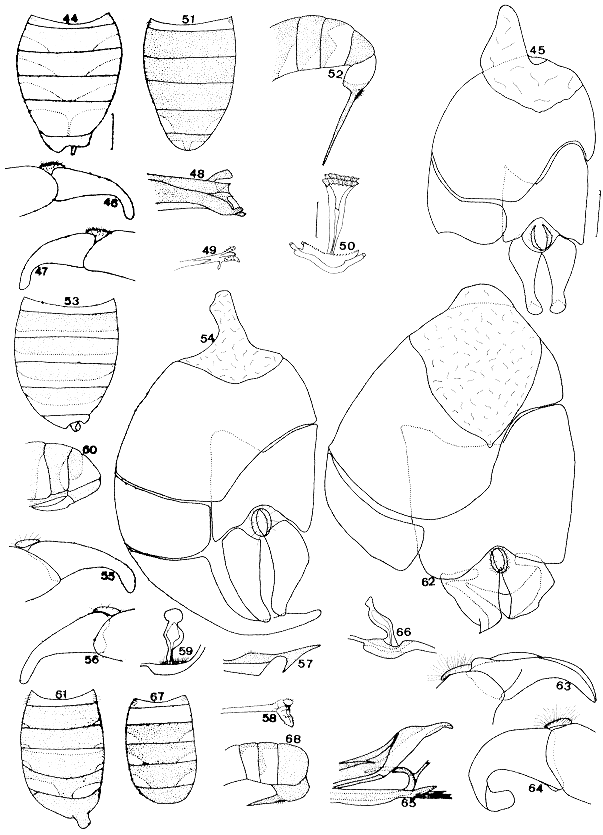
<body><![CDATA[<center>     <p><font face="Arial,Helvetica"><font size=-1><i>Eudorylas echinatus</i>, sp. n.</font></font>     <br><font face="Arial,Helvetica"><font size=-1>(<a href="#Figs. 44-68">Figs 44-52</a>, <a href="#Figs. 118-131">123</a>)</font></font></center> <font size=-1></font>     <p><font face="Arial,Helvetica"><font size=-1>Diagnoses. Antenna and legs mainly black. Third costal section slightly shorter than fourth. Syntergosternite 8 shorter than tergite 5, with distal membranous area.</font></font><font size=-1></font>     <p><font face="Arial,Helvetica"><font size=-1>Description (male). Body length 3.9 mm; wing 4.4 mm. Junction of compound eyes shorter than length of frontal triangle; the latter black, sub-shining medially, brown pruinose in frontal view, gray in dorsal view. Face gray pruinose. Thorax dark brown to black with scutum and scutellum brown pruinose. Notopleuron, postpronotal lobe, mesopleuron, subscutellum and laterotergite gray pruinose. Legs black, except apices of femora and bases of tibiae yellow. All femora with ventral ctenidium, inconspicuous on fore and hind pair. Tibiae without distinct bristles either distally or medially. Wing (<a href="#Figs. 118-131">Fig 123</a>) hyaline with third costal section slightly shorter than fourth; vein r-m placed near basal two fifths of cell dm. Halter with stem chestnut, knob black. Abdomen (<a href="#Figs. 44-68">Fig 44</a>) dark brown to black with 4-5 lateral bristles on tergite 1 and gray pruinescence on tergite 1 and posterolaterally on tergites 2-5, more so on tergite 5. Syntergosternite 8 sparsely brown pruinose, shorter than tergite 5, with apical membranous area. Epandrium and surstylus (<a href="#Figs. 44-68">Fig 45</a>) black. Surstylus subsymmetrical, downcurved distally; in lateral view as in <a href="#Figs. 44-68">Figs 46-47</a>. Paramere as in <a href="#Figs. 44-68">Fig 48</a>. Aedeagus (<a href="#Figs. 44-68">Fig 49</a>) short ramified, each rami with small recurved spines. Ejaculatory apodeme with a row of small spines in the sperm sac (<a href="#Figs. 44-68">Fig 50</a>).</font></font><font size=-1></font>     <p><font face="Arial,Helvetica"><font size=-1>Female. Body length 4.5 mm; wing 4.7 mm. Identical to description of male, except in the following respects: frons shining black on dorsal half, gray on ventral half. Tarsomeres mainly yellow. Abdomen (<a href="#Figs. 44-68">Fig 51</a>), in dorsal view, entirely black with gray pruinosity on tergite 1 dorsally and tergites 2-6 laterally. syntergosternite 7+8 (<a href="#Figs. 44-68">Fig 52</a>) 2.5 times shorter than ovipositor, being the latter yellow to rufous.</font></font><font size=-1></font>     <p><font face="Arial,Helvetica"><font size=-1>Material. COSTA RICA, 3 km NO de Nacaome, 100 m, P[arque] N[acional] Barra Honda, Prov[incia] Guana[caste], 3-30 May 1993, M. Reyes, LN 239000-386000, BL CRI001 401888 (ht M, INBio); Code 1, 18 Abr-19 May 1993, P. Rios, BL CRI001 396442 (pt F, INBio).</font></font><font size=-1></font>     <p><font face="Arial,Helvetica"><font size=-1>Etymology. The specific name refers to the row of spines on the sperm sac of the ejaculatory apodeme (from Latin <i>echinatus</i> = spiny).</font></font><font size=-1></font>     <p><font face="Arial,Helvetica"><font size=-1>Remarks. <i>E. echinatus</i> differs from all other Neotropical species by the aedeagus having small subapical protuberance and the sperm sac with a row of small spines.</font></font>     <br><font size=-1></font>&nbsp;<font size=-1></font>     ]]></body>
<body><![CDATA[<center>     <p><font face="Arial,Helvetica"><font size=-1><i>Eudorylas falx</i>, sp. n.</font></font>     <br><font face="Arial,Helvetica"><font size=-1>(<a href="#Figs. 44-68">Figs 53-60</a>, <a href="#Figs. 118-131">124</a>)</font></font></center> <font size=-1></font>     <p><font face="Arial,Helvetica"><font size=-1>Diagnoses. Frontal triangle brown pruinose. Antenna black, with flagellum short acute. Wing brown infuscated. Third costal section slightly longer than fourth. Legs mainly black without ventral ctenidium on hind femur and without erect posterior bristles medially on hind tibia. Syntergosternite 8 shorter than tergite 5 with membranous area. Surstylus subsymmetrical.</font></font><font size=-1></font>     <p><font face="Arial,Helvetica"><font size=-1>Description (male). Body length 4.3 mm; wing 5.0 mm. Eyes contiguous on frons for distance slightly greater than length of frontal triangle. Frontal triangle black, subshining medially, brown pruinose in dorsal view, black in frontal view. Face gray-brown pruinose in dorsal view. Antenna black with flagellum short acute. Thorax dark brown to black, brown pruinose. Scutum, scutellum, notopleuron, subscutellum and postpronotal lobe brown pruinose. Mesopleuron and laterotergite gray pruinose. Legs black, except trochanter-femora and femora-tibiae articulations yellow, notably on tibiae. Fore and mid tibia with inconspicuous ctenidium on anteroventral side and hind tibia without erect posterior bristles medially. Wing (<a href="#Figs. 118-131">Fig 124</a>) distinctly brown infuscated. Third costal section slightly longer than fourth; vein r-m placed near middle of cell dm; vein M1 sinuous; vein dm-cu slightly curved, about as long as vein CuA1. Halter black slightly yellow on stem. Abdomen (<a href="#Figs. 44-68">Fig 53</a>) dark brown to black. Tergite 1 with 5-6 lateral bristles. Tergite 1 gray-brown pruinose and tergites 2-5 brown pruinose across posterior margins 2-5 in dorsal view; the later gray pruinose posterolaterally in lateral view. Syntergosternite 8 brown pruinose, shorter than tergite 5, rather strongly compressed to right and with large apical membranous area. Epandrium and surstylus (<a href="#Figs. 44-68">Fig. 54</a>) yellow. Surstylus subsymmetrical, the inner one slightly longer; in lateral view as in <a href="#Figs. 44-68">Figs 55-56</a>. Paramere (<a href="#Figs. 44-68">Fig. 57</a>) sickle-shaped. Aedeagus (<a href="#Figs. 44-68">Fig 58</a>) apparently without rami, membranous distally and with an inconspicuous collar of small spines at apex. Ejaculatory apodeme as in <a href="#Figs. 44-68">Fig 59</a>.</font></font><font size=-1></font>     <p><font face="Arial,Helvetica"><font size=-1>Female. One female fits male description and probably belongs here. Frons shining black medially. Vein r-m placed near basal third of cell dm. Syntergosternite 7+8 (<a href="#Figs. 44-68">Fig 60</a>) black, ovipositor yellow, curved inward.</font></font><font size=-1></font>     <p><font face="Arial,Helvetica"><font size=-1>Material. Code 3, Sendero Catarata, 11-12 Ene 1994, M. Zumbado, # 2666, BL CRI001 725841 (ht M, right posterior leg lost, INBio); Code 3, BL CRI001 725842 (pt M, INPA); Code 1, 22 Ago 1993, C. Moraga, # 2322, BL CRI001 638793 (1 F, INBio).</font></font><font size=-1></font>     <p><font face="Arial,Helvetica"><font size=-1>Etymology. From Latin <i>Falx</i> (= sickle) referring to the shape of the paramere.</font></font><font size=-1></font>     <p><font face="Arial,Helvetica"><font size=-1>Remarks. <i>E. falx</i> is similar to <i>E. devius</i> (Hardy), from Argentina, in the coloration, shape of antenna, abdominal pattern and aedeagus apparently without rami. It differs by having no erect posterior bristle on the hind tibia and by the sickle-shaped paramere.</font></font>     <br><font size=-1></font>&nbsp;     ]]></body>
<body><![CDATA[<br><font size=-1></font>&nbsp;     <br><font size=-1></font>     <center>     <p><a NAME="Figs. 44-68"></a><img SRC="/img/fbpe/rbt/v47n3/0560i03.GIF" height=835 width=603></center> <font size=-1></font>     
<p>    <br><font size=-1></font>     <p><font face="Arial,Helvetica"><font size=-1>&nbsp;&nbsp;&nbsp; Figs. 44-52. <i>Eudorylas echinatus</i> ht M (except figs 51-52 pt F): 44 abdmonen dv; 45 terminalia; 46 inner surstylus lv; 47</font></font>     <br><font face="Arial,Helvetica"><font size=-1>&nbsp;&nbsp;&nbsp; outer surstylus lv; 48 paramere lv; 49 aedeagus lv; 50 ejaculatory apodeme; 51 female abdomen dv; 52 terminalia lv. 53-60.</font></font>     <br><font face="Arial,Helvetica"><font size=-1><i>&nbsp;&nbsp;&nbsp; E. falx</i> ht M (except fig. 60 pt F): 53 abdomen dv; 54 terminalia; 55 inner surstylus lv; 56 outer surstylus lv; 57 paramere; 58</font></font>     <br><font face="Arial,Helvetica"><font size=-1>&nbsp;&nbsp;&nbsp; aedeagus; 59 ejaculatory apodeme; 60 female terminalia. 61-68 <i>E. moragai</i> ht M (except figs 67-68 pt F): 61 abdomen dv;</font></font>     ]]></body>
<body><![CDATA[<br><font face="Arial,Helvetica"><font size=-1>&nbsp;&nbsp;&nbsp; 62 terminalia; 63 inner surstylus lv; 64 outer surstylus lv; 65 paramere and aedeagus lv; 66 ejaculatory apodeme; 67 female</font></font>     <br><font face="Arial,Helvetica"><font size=-1>&nbsp;&nbsp;&nbsp; abdomen dv; 68 terminalia lv.&nbsp; Scales: 0.5 mm: figs. 44, 51-53, 60-61, 67-68; 0.2 mm: 45-47, 54-56, 62-64; 0.1 mm: 48-50,</font></font>     <br><font face="Arial,Helvetica"><font size=-1>&nbsp;&nbsp;&nbsp; 57-59, 65-66.</font></font><font size=-1></font>     <center>     <p><font face="Arial,Helvetica"><font size=-1><i>Eudorylas moragai</i>, sp. n.</font></font>     <br><font face="Arial,Helvetica"><font size=-1>(<a href="#Figs. 44-68">Figs 61-68</a>, <a href="#Figs. 118-131">125</a>)</font></font></center> <font size=-1></font>     <p><font face="Arial,Helvetica"><font size=-1>Diagnoses. Scape and pedicel dark brown, flagellum yellow with apex acute. Third costal section 1.5 times longer than fourth. Postpronotal lobe and legs yellow. Surstylus downcurved distally. Aedeagus with trifid recurved lateral process. Syntergosternite 8 black, brown pruinose, with large membranous area almost dividing the segment ventrally.</font></font><font size=-1></font>     <p><font face="Arial,Helvetica"><font size=-1>Description (male). Body length 4.1 mm; wing 5.1 mm. Eyes contiguous on frons for a distance slightly greater than length of frontal triangle. Frontal triangle black, sparsely gray pruinose in dorsal view. Face gray pruinose in dorsal view. Antenna with scape and pedicel brown, flagellum yellow with apex long acute. Thorax dark brown to black, entirely pruinose. Legs yellow, except coxae black and fifth tarsomere brown. All femora with ventral ctenidium, inconspicuous on hind pair. Tibiae without apical bristles and hind tibia without erect posterior bristles. Wing (<a href="#Figs. 118-131">Fig 125</a>) with third costal section 1.5 times as long as fourth; vein r-m placed near basal two fifth of cell dm; vein M1 sinuous; vein dm-cu slightly curved and slightly about as long as vein CuA1. Halter yellow. Abdomen (<a href="#Figs. 44-68">Fig 61</a>) dark brown to black, brown pruinose, except tergite 1 entirely gray pruinose and tergites 2-5 gray pruinose posterolaterally, with larger spots on tergite 5. Syntergosternite 8 brown pruinose, about equal to the length of tergite 5, with large membranous area dividing the segment ventrally (<a href="#Figs. 44-68">Fig 62</a>). Epandrium and surstylus dark brown to black. Surstylus asymmetrical; in lateral view downcurved (<a href="#Figs. 44-68">Figs 63-64</a>). Paramere and aedeagus as in <a href="#Figs. 44-68">Fig. 65</a>. Aedeagus with a recurved trifid dorsal process. Ejaculatory apodeme as in <a href="#Figs. 44-68">Fig. 66</a>.</font></font><font size=-1></font>     <p><font face="Arial,Helvetica"><font size=-1>Female. Body length 4.0 mm; wing 5.0 mm. Identical to male description, except in the following respects: frons shining black on upper two third and gray on ventral third. Abdomen (<a href="#Figs. 44-68">Fig 67</a>) gray pruinose on tergites 1-2 and laterally and posterolaterally on tergites 3-5. Syntergosternite 7+8 (<a href="#Figs. 44-68">Fig 68</a>) brown dorsally, yellow ventrally, with distinct ventral protuberance and slightly shorter than the yellow and straight ovipositor.</font></font><font size=-1></font>     <p><font face="Arial,Helvetica"><font size=-1>Material. Code 1, C. Moraga, # 2563, BL CRI001 828761 (ht M, anterior pair of legs lost, INBio); Code 1, Jun 1994, P. Rios, # 2996, BL CRI001 883791 (pt F, INBio); Code 1, #2560, BL CRI001 818550 (pt F, INBio); Code 1, May 1994, P. Rios, Malaise, # 2896, BL CRI001 878226 (pt F, INPA); Code 1, BL CRI001 878228 (pt F, INBio).</font></font><font size=-1></font>     ]]></body>
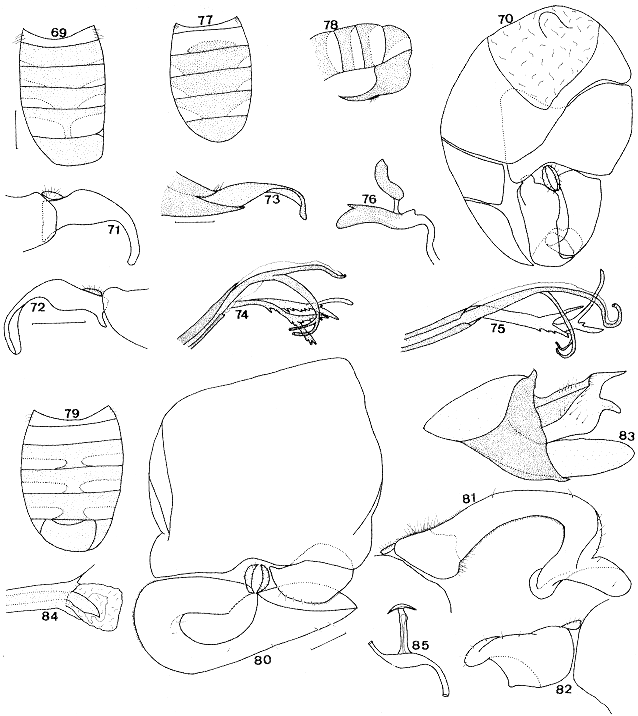
<body><![CDATA[<p><font face="Arial,Helvetica"><font size=-1>Etymology. The specific name is in honor of Mr. C. Moraga, who collected the specimens described here.</font></font><font size=-1></font>     <p><font size=-1><font face="Arial,Helvetica">Remarks. <i>E. moragai</i> belongs to the group of species with a lateral processes on the aedeagus. It is near <i>E. serratus</i> described below but differs by the shape of the paramere, the aedeagus has a dorsal process that is trifid and recurved and the surstyli are more distinctly downcurved, notably the outer surstylus.</font> }</font><font size=-1></font>     <center>     <p><font face="Arial,Helvetica"><font size=-1><i>Eudorylas serratus</i>, sp. n.</font></font>     <br><font face="Arial,Helvetica"><font size=-1>(<a href="#Figs. 69-85">Figs. 69-78</a>, <a href="#Figs. 118-131">126</a>)</font></font></center> <font size=-1></font>     <p><font face="Arial,Helvetica"><font size=-1>Diagnoses. Scape and pedicel dark brown to black, flagellum yellow with apex subfiliform. Third costal section near two times longer than fourth. Legs mainly yellow. Surstylus downcurved distally. Lateral process of aedeagus serrated.</font></font><font size=-1></font>     <p><font face="Arial,Helvetica"><font size=-1>Description (male). Body length 4.2 mm; wing 5.0 mm. Eyes contiguous on frons for a distance that is twice the length of frontal triangle. Frontal triangle brown pruinose in dorsal view. Face gray pruinose in dorsal view. Scape and pedicel brown to black, flagellum yellow with apex subfiliform. Thorax dark brown to black, brown pruinose, except laterotergite and scutellum gray pruinose. Scutellum with inconspicuous bristles. Legs yellow, except coxae brown. All femora with ventral ctenidium, inconspicuous on hind pair. Tibiae without distinct bristles either apically or medially. Wing (<a href="#Figs. 118-131">Fig 126</a>) with third costal section nearly 2.0 times longer than fourth; vein M1 slightly sinuous; vein dm-cu slightly curved, about as long as vein CuA1; vein A1 short. Halter with stem yellow, knob brown. Abdomen (<a href="#Figs. 69-85">Fig. 69</a>) dark brown to black, brown pruinose, except tergite 1 entirely gray pruinose and tergites 2-5 gray pruinose posterolaterally, more extensive on tergite 5. Syntergosternite 8 brown pruinose, about equal to the length of tergite 5, with ventral membranous area at right. Epandrium and surstylus (<a href="#Figs. 69-85">Fig 70</a>) brown. Surstylus downcurved in lateral view (<a href="#Figs. 69-85">Figs 71, 72</a>). Paramere as in <a href="#Figs. 69-85">Fig. 73</a>. Aedeagus (<a href="#Figs. 69-85">Fig 74</a>) with serrated lateral process. Ejaculatory apodeme as in <a href="#Figs. 69-85">Fig. 76</a>.</font></font><font size=-1></font>     <p><font face="Arial,Helvetica"><font size=-1>Female. Body length 3.9 mm; wing 4.3 mm. Frons gray pruinose. Abdomen (<a href="#Figs. 69-85">Fig 77</a>) gray pruinose on tergites 1-2, except tergite 2 posteriorly brown pruinose; all tergites gray pruinose posterolaterally. Syntergosternite 7+8 and ovipositor (<a href="#Figs. 69-85">Fig 78</a>) brown, the latter curved inward, 1.2 times greater than syntergosternite. In others respects identical to description of male.</font></font><font size=-1></font>     <p><font face="Arial,Helvetica"><font size=-1>Material. Code 1, Jul 1994, C. Moraga, # 3158, BL CRI002 001368 (ht M, right wing lost, INBio); Code 1, 22 Ago 1993, # 2322, BL CRI001 638791 (pt F, INBio); May 1994, P. Rios, Malaise, # 2896, BL CRI001 878489 (pt F, INPA).</font></font><font size=-1></font>     <p><font face="Arial,Helvetica"><font size=-1>Etymology. The specific name refers to the lateral process of the aedeagus which is toothed like a saw (from Latin <i>serra</i> = saw).</font></font><font size=-1></font>     ]]></body>
<body><![CDATA[<p><font face="Arial,Helvetica"><font size=-1>Remarks. <i>E. serratus</i> belongs to the group of species with a lateral process on the aedeagus. It is near <i>E. moragai</i> described above. It differs by having a simple paramere, the lateral process of aedeagus toothed like a saw and the surstylus less downcurved.</font></font><font size=-1></font>     <p>    <br><font size=-1></font>     <center>     <p><a NAME="Figs. 69-85"></a><img SRC="/img/fbpe/rbt/v47n3/0560i04.GIF" height=716 width=638></center> <font face="Arial,Helvetica"><font size=-1></font></font>     
<p><font face="Arial,Helvetica"><font size=-1>&nbsp;&nbsp;&nbsp; Figs. 69-78.<i>&nbsp; Eudorylas serratus</i> ht M (except figs 77-78 pt F): 69 abdomen dv; 70 terminalia; 71 inner surstylus lv; 72</font></font>     <br><font face="Arial,Helvetica"><font size=-1>&nbsp;&nbsp;&nbsp; outer surstylus lv; 73 paramere lv; 74 aedeagus lv; 75 idem vv; 76 ejaculatory apodeme; 77 female abdomen dv; 78</font></font>     <br><font face="Arial,Helvetica"><font size=-1>&nbsp;&nbsp;&nbsp; terminalia Iv. 79-85 <i>Elmohardyia adunca</i> ht M: 79 abdomen dv; 80 terminalia; 81 inner surstylus lv; 82 outer surstylus lv;</font></font>     <br><font face="Arial,Helvetica"><font size=-1>&nbsp;&nbsp;&nbsp; 83 paramere lv; 84 aedeagus; 85 ejaculatory apodeme. Scales: 0.5 mm: figs 69, 77-79; 0.2 mm: 70-72, 80-82; 0.1 mm: 73-76,</font></font><font size=-1></font>     <p>    ]]></body>
<body><![CDATA[<br><font size=-1></font>     <center>     <p><font face="Arial,Helvetica"><font size=-1><i>Eudorylas vidali </i>Rafael</font></font></center> <i><font face="Arial,Helvetica"><font size=-1>Eudorylas vidali</font></font></i><font face="Arial,Helvetica"><font size=-1> <a href="#Rafael95">Rafael, 1995</a>: 831, figs 172-176, 222.</font></font><font size=-1></font>     <p><font face="Arial,Helvetica"><font size=-1>One specimen fits the description of this species described from Brazil and Trinidad (<a href="#Rafael95">Rafael, 1995</a>).</font></font><font size=-1></font>     <p><font face="Arial,Helvetica"><font size=-1>Material. COSTA RICA, F[in]ca Cafrosa, Est[aci&oacute;n] las Mellizas, P[arque] N[acional] Amistad, Prov[incia] Punta[renas], M. Ramirez, Abr 1991, LS 316100-596100, BL CRI000 292421 (1 M, INBio).</font></font><font size=-1></font>     <center>     <p><font face="Arial,Helvetica"><font size=-1><i>Eudorylas willistoni</i> (Kert&eacute;sz)</font></font></center> <font size=-1></font>     <p><font face="Arial,Helvetica"><font size=-1><i>Pipunculus willistoni</i><a href="#Kertész">Kert&eacute;sz, 1900</a>: 244 (n. n. for <i>aculeatus</i><a href="#Williston">Williston, 1892</a>: 88, preocc. <a href="#Loew58">Loew 1858</a>).</font></font><font size=-1></font>     <p><font face="Arial,Helvetica"><font size=-1>This species has been previously recorded from Costa Rica (<a href="#De Meyer96">De Meyer, 1996</a>) but it was not represented in the examined material.</font></font><font size=-1></font>     <center>     ]]></body>
<body><![CDATA[<p><font face="Arial,Helvetica"><font size=-1><i>&nbsp; Eudorylas</i> spp</font></font></center> <font size=-1></font>     <p><font face="Arial,Helvetica"><font size=-1>Fourteen specimens could not be associated with males and seem to belong to many different species. All specimens are deposited at INBio.</font></font><font size=-1></font>     <center>     <p><font face="Arial,Helvetica"><font size=-1>Genus <i>Basileunculus</i> Rafael</font></font></center> <font size=-1></font>     <p><font face="Arial,Helvetica"><font size=-1>This genus was revised and keyed by <a href="#Rafael87">Rafael (1987)</a>. It probably occurs in the Nearctic Region. This is the first record from Costa Rica.</font></font><font size=-1></font>     <center>     <p><font face="Arial,Helvetica"><font size=-1><i>Basileunculus rex</i> (Curran)</font></font></center> <font size=-1></font>     <p><font face="Arial,Helvetica"><font size=-1><i>Pipunculus rex</i> <a href="#Curran34">Curran, 1934</a>: 416.</font></font><font size=-1></font>     <p><font face="Arial,Helvetica"><font size=-1>This species was re-characterized by <a href="#Rafael87">Rafael (1987)</a>. Three specimens are referred to <i>B. rex.</i> This species has already been recorded from Brazil and Guyana (<a href="#De Meyer96">De Meyer, 1996</a>).</font></font><font size=-1></font>     <p><font face="Arial,Helvetica"><font size=-1>Material. COSTA RICA, Rancho Quemado, 200 m, Peninsula de Osa, Prov[incia] Puntarenas, K. Flores, Abr 1992, LS 292500-511000, BL CRI000 773514 (1 M, INBio); BL CRI000 773502 (1 F, INBio); Est[acion] S[an]ta Rosa, 300 m, P[arque] N[acional] Santa Rosa, Prov[incia] Guanacaste, M. A. Zumbado, Ene 1991, LN 313000-359800, BL CRI000 793355 (1 F, INPA).</font></font><font size=-1></font>     ]]></body>
<body><![CDATA[<p>    <br><font size=-1></font>     <center>     <p><font face="Arial,Helvetica"><font size=-1>Genus <i>Metadorylas</i> Rafael</font></font></center> <font size=-1></font>     <p><font face="Arial,Helvetica"><font size=-1>The Neotropical species were revised and keyed by <a href="#Rafael90b">Rafael (1990b)</a>. This genus is limited to the New World. It is best known in the Neotropical Region. Here it is represented by only one species.</font></font><font size=-1></font>     <center>     <p><font face="Arial,Helvetica"><font size=-1><i>Metadorylas spinosus</i> (Hardy)</font></font></center> <font size=-1></font>     <p><font face="Arial,Helvetica"><font size=-1><i>Dorylas (Eudorylas) spinosus</i><a href="#Hardy48a">Hardy, 1948a</a>: 4.</font></font><font size=-1></font>     <p><font face="Arial,Helvetica"><font size=-1>One specimen is referred to this species which has been recorded in the Neotropical Region from widespread localities, Mexico, Costa Rica, Grenada, Trinidad, Colombia, Ecuador, Brazil and Argentina (<a href="#De Meyer96">De Meyer, 1996</a>).</font></font><font size=-1></font>     <p><font face="Arial,Helvetica"><font size=-1>Material. COSTA RICA, Bosque Esquinas, Pen[insula] Osa, Prov[incia] Punta[renas], 200 m, Mar 1994, M. Segura, LS 301400-542200, # 2776, BL CRI001 758100 (1 M, INBio).</font></font>     ]]></body>
<body><![CDATA[<br><font size=-1></font>&nbsp;     <p>    <br><font size=-1></font>     <center>     <p><font face="Arial,Helvetica"><font size=-1>Genus <i>Elmohardyia</i> Rafael</font></font></center> <font size=-1></font>     <p><font face="Arial,Helvetica"><font size=-1><i>Elmohardyia</i> was revised by <a href="#Rafael88b">Rafael (1988b)</a> and it is well represented in Costa Rican material with five new species and at least three more species represented only by unidentified females. Two species have been previously recorded from Costa Rica.</font></font>     <br><font face="Arial,Helvetica"><font size=-1></font></font>&nbsp;     <p>    <br><font size=-1></font>     <center>     ]]></body>
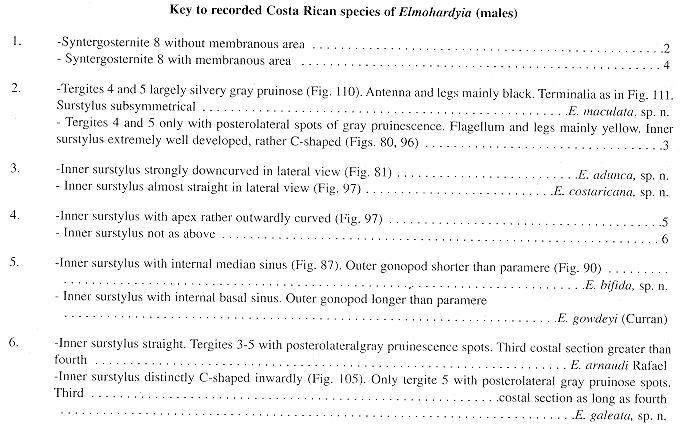
<body><![CDATA[<p><img SRC="/img/fbpe/rbt/v47n3/0560i09.GIF" height=427 width=680>     
<br><font size=-1></font>&nbsp;<font size=-1></font>     <p><font face="Arial,Helvetica"><font size=-1><i>Elmohardyia adunca</i>, sp. n.</font></font>     <br><font face="Arial,Helvetica"><font size=-1>(<a href="#Figs. 69-85">Figs 79-85</a>, <a href="#Figs. 118-131">127</a>)</font></font></center> <font size=-1></font>     <p><font face="Arial,Helvetica"><font size=-1>Diagnoses. Scape and pedicel dark brown to black, flagellum yellow. Third costal section about as long as fourth. Abdomen entirely gray pruinose on tergites 1 and 2 and posterolaterally on tergites 3-5. Syntergosternite 8 without membranous area. Inner surstylus strongly curved inward, longer than outer surstylus.</font></font><font size=-1></font>     <p><font face="Arial,Helvetica"><font size=-1>Description (male only, female unknown). Body length 4.5 mm; wing 4.7 mm. Eyes narrowly dichoptic. Frontal triangle and face with gray pruinosity. Scape and pedicel dark brown to black, flagellum yellow. Scutum and scutellum dark brown to black, brown pruinose. Notopleuron, postpronotal lobe, mesopleuron and small part of scutellum gray pruinose. Scutellum with inconspicuous bristles. Legs yellow, except coxae black, all femora largely dark discolored and distal tarsomeres brown. Wing (<a href="#Figs. 118-131">Fig 127</a>) with third costal section as long as fourth; vein r-m placed near basal third of cell dm. Halter with stem yellow, knob black. Abdomen (<a href="#Figs. 69-85">Fig 79</a>) dark brown to black, subshining, gray pruinose on tergite 1 and 2 and posterolaterally on tergites 3-5; tergite 1 with 3-4 small bristles laterally. Syntergosternite 8 black, longer than tergite 5, without membranous area. Epandrium and surstylus (<a href="#Figs. 69-85">Fig 80</a>) yellow. Surstylus asymmetrical, the inner strongly curved in and downward, longer than outer surstylus; in lateral view as in <a href="#Figs. 69-85">Figs 81-82</a>. Paramere as in <a href="#Figs. 69-85">Fig 83</a>. Aedeagus as in <a href="#Figs. 69-85">Fig 84</a>. Ejaculatory apodeme as in <a href="#Figs. 69-85">Fig. 85</a>.</font></font><font size=-1></font>     <p><font face="Arial,Helvetica"><font size=-1>Material. Code 2, Feb 1994, Z. Fuentes, # 2615, BL CRI001 962298 (ht M, INBio).</font></font><font size=-1></font>     <p><font face="Arial,Helvetica"><font size=-1>Etymology. The specific name refers to the inner surstylus strongly inwardly curved (from Latin <i>aduncus</i> = bent inward).</font></font><font size=-1></font>     <p><font face="Arial,Helvetica"><font size=-1>Remarks. <i>E. adunca</i> is near <i>E. costaricana</i> described below and both belong to the group without membranous area on syntegosternite 8. <i>E. adunca</i> is different by the shape of the inner surstylus which is strongly downcurved in lateral view and by having simple paramere, while <i>E. costaricana</i> has the inner surstylus almost straight in lateral view and more complex paramere.</font></font><font size=-1></font>     <center>     ]]></body>
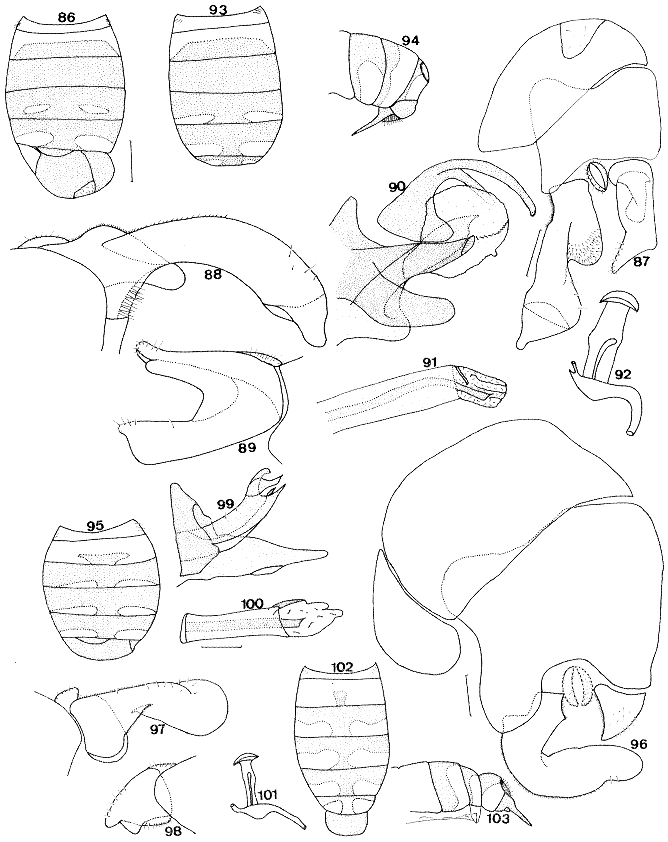
<body><![CDATA[<p><font face="Arial,Helvetica"><font size=-1><i>Elmohardyia arnaudi</i> Rafael</font></font></center> <font size=-1></font>     <p><font face="Arial,Helvetica"><font size=-1><i>Elmohardyia arnaudi</i> <a href="#Rafael88b">Rafael, 1988b</a>: 229.</font></font><font size=-1></font>     <p><font face="Arial,Helvetica"><font size=-1>This species was described originally from Mexico and Costa Rica. It was not represented in the studied material.</font></font><font size=-1></font>     <center>     <p><font face="Arial,Helvetica"><font size=-1><i>Elmohardyia bifida</i>, sp. n.</font></font>     <br><font face="Arial,Helvetica"><font size=-1>(<a href="#Figs. 86-103">Figs 86-94</a>, <a href="#Figs. 118-131">128</a>)</font></font></center> <font size=-1></font>     <p><font face="Arial,Helvetica"><font size=-1>Diagnoses. Scape and pedicel dark brown to black. Legs yellow. Abdomen with gray pruinosity on tergite 1, on basal half of tergite 2 and posterolaterally on tergites 4 and 5. Syntergosternite 8 with distal membranous area on the right. Epandrium and surstylus brown. Surstylus asymmetrical, the inner being slightly curved outward.</font></font><font size=-1></font>     <p><font face="Arial,Helvetica"><font size=-1>Description (male). Body length 4.9 mm; wing 5.7 mm. Junction of compound eyes slightly shorter than length of frontal triangle. Frons and face pruinose. Scape and pedicel black, flagellum lost. Scutum, scutellum and subscutellum dark brown to black, brown pruinose. Postpronotal lobe sparsely gray pruinose. Notopleuron partially gray pruinose in certain light. Mesopleuron gray pruinose. Legs yellow, except coxae black and tarsomeres dark brown to black. Wing (<a href="#Figs. 118-131">Fig 128</a>) with third costal section about as long as fourth; vein r-m placed near basal third of cell dm. Halter with stem yellow, knob black. Abdomen (<a href="#Figs. 86-103">Fig. 86</a>) black, subshining, gray pruinose on tergite 1, on basal half of tergite 2 and posterolaterally on tergites 4-5, more extensive on the later. Syntergosternite 8 slightly larger than tergite 5, with membranous area on the right. Epandrium and surstylus (<a href="#Figs. 86-103">Fig 87</a>) brown. Surstylus asymmetrical, the inner 1.3 times longer than outer surstylus; in lateral view as in <a href="#Figs. 86-103">Figs 88-89</a>. Paramere (<a href="#Figs. 86-103">Fig 90</a>) with a dorsal process that is bifid at apex. Aedeagus as in <a href="#Figs. 86-103">Fig 91</a>. Ejaculatory apodeme as in <a href="#Figs. 86-103">Fig 92</a>.</font></font><font size=-1></font>     <p><font face="Arial,Helvetica"><font size=-1>Female. Body length 4.4 mm; wing 5.4 mm. Scape and pedicel black, flagellum yellow. Frons entirely silvery gray pruinose. Abdomen with the same pruinosity pattern as in male, also without spots of gray pruinosity on tergite 3. In others respects identical to the male description. Abdomen (<a href="#Figs. 86-103">Fig 93</a>). Tergite 6 (<a href="#Figs. 86-103">Fig 94</a>) dark brown to black, gray pruinose posterolaterally and with median dorsal sulcus. Syntergosternite 7+8 dark brown to black, shorter than the yellow to rufous ovipositor.</font></font><font size=-1></font>     <p><font face="Arial,Helvetica"><font size=-1>Material. Code 3, 10 Ene 1994, M. Zumbado, # 2665, BL CRI001 725723 (ht M, INBio); Code 1, 21 Mar-06 Abr 1993, C. Moraga, BL CRI001 391164 (pt F, INBio); Jul 1994, # 3158, BL CRI002 001387 (pt F, headless, INBio); Ene 1994, # 2563, BL CRI001 828793 (pt F, INPA).</font></font><font size=-1></font>     ]]></body>
<body><![CDATA[<p><font face="Arial,Helvetica"><font size=-1>Etymology. The specific name refers to the bifurcation at the apex of the dorsal process of the paramere in the male terminalia (from Latin <i>bifidus</i> = bifurcated.</font></font><font size=-1></font>     <p><font face="Arial,Helvetica"><font size=-1>Remarks. <i>E. bifida</i> differs from other Neotropical species by tergite 2 gray pruinose on its basal half, inner surstylus rather outwardly curved and particularly by the dorsal process of the paramere which is bifid at the apex.</font></font>     <br><font size=-1></font>&nbsp;     <br><font size=-1></font>&nbsp;     <br><font size=-1></font>     <center>     <p><a NAME="Figs. 86-103"></a><img SRC="/img/fbpe/rbt/v47n3/0560i05.GIF" height=842 width=668></center> <font size=-1></font>     
<p><font face="Arial,Helvetica"><font size=-1>&nbsp;&nbsp;&nbsp; Figs. 86-94. <i>Elmohardyia bifida</i> ht M (except figs 93-94 pt F): 86 abdomen dv; 87 terminalia; 88 inner surstylus lv; 89 outer</font></font>     <br><font face="Arial,Helvetica"><font size=-1>&nbsp;&nbsp;&nbsp; surstylus lv; 90 paramere lv; 91 aedeagus lv; 92 ejaculatory apodeme; 93 femaleabdomen; 94 terminalia Iv. 95-103</font></font>     <br><font face="Arial,Helvetica"><font size=-1><i>&nbsp;&nbsp;&nbsp; E. costaricana</i> ht M (except figs. 102-103 pt F): 95 abdomen dv; 96terminalia; 97 inner surstylus lv; 98 outer surstylus lv;</font></font>     ]]></body>
<body><![CDATA[<br><font size=-1><font face="Arial,Helvetica">&nbsp;&nbsp;&nbsp; 99 paramere lv; 100 aedeagus lv; 101 ejaculatory</font> <font face="Arial,Helvetica">apodeme; 102 female abdomen; 103 terminalia Iv.&nbsp; Scales: 0.5 mm: figs</font></font>     <br><font size=-1><font face="Arial,Helvetica">&nbsp;&nbsp;&nbsp; 86, 93-95, 102-103; 0.3 mm:</font> <font face="Arial,Helvetica">87; 0.2 min: 88-89, 96-98; 0.1 mm: 90-92, 99-101.</font></font><font size=-1></font>     <p>    <br><font size=-1></font>     <br><font size=-1></font>     <center>     <p><font face="Arial,Helvetica"><font size=-1><i>Elmohardyia costaricana</i>, sp. n.</font></font>     <br><font face="Arial,Helvetica"><font size=-1>(<a href="#Figs. 86-103">Figs 95-103</a>, <a href="#Figs. 118-131">129</a>)</font></font></center> <font size=-1></font>     <p><font face="Arial,Helvetica"><font size=-1>Diagnoses. Scape and pedicel dark brown to black. Legs mainly yellow. Abdomen dark brown to black, subshining. Tergites 1 and 2 largely gray pruinose and tergites 3-5 gray pruinose posterolaterally. Syntergosternite 8 without membranous area.</font></font><font size=-1></font>     <p><font size=-1><font face="Arial,Helvetica">Description (male). Wing 5.0 mm. Eyes contiguous on frons for a short distance. Frontal triangle greasy (probably gray pruinose). Face gray pruinose. Scape and pedicel dark brown to black (flagellum lost). Scutum and scutellum dark brown to black, brown pruinose. Notopleuron, postpronotal lobe, anepisternun, mesopleuron, subscutellum and laterotergite gray pruinose. Scutellum with inconspicuous bristles. Legs yellow, except coxae black, femora slightly dark discolored medially and distal tarsomeres dark brown to black. Wing (<a href="#Figs. 118-131">Fig 129</a>) with third costal section about as long as fourth; vein r-m placed near basal third of cell dm. Halter with stem yellow, knob black. Abdomen (<a href="#Figs. 86-103">Fig 95</a>) dark brown to black, subshining, gray pruinose on tergite 1, most of tergite 2 and posterolaterally on tergites 3-5, with larger</font> <font face="Arial,Helvetica">spots on tergite 5. Tergite 1 with small bristles laterally. Syntergosternite 8 as long as tergite 5, without membranous area. Epandrium and surstylus (<a href="#Figs. 86-103">Fig 96</a>) brown. Surstylus asymmetrical, the inner inwardly curved and longer than outer surstylus; in lateral view as in <a href="#Figs. 86-103">Figs 97-98</a>. Paramere as in <a href="#Figs. 86-103">Fig 99</a>. Aedeagus as in <a href="#Figs. 86-103">Fig 100</a>. Ejaculatory apodeme as in <a href="#Figs. 86-103">Fig 101</a>.</font></font><font size=-1></font>     ]]></body>
<body><![CDATA[<p><font face="Arial,Helvetica"><font size=-1>Female. Body length 4.3 mm; Wing 5.0 mm. Scape and pedicel black, flagellum yellow. Frons and face silvery gray pruinose. Abdomen (<a href="#Figs. 86-103">Fig 102</a>) with larger gray pruinosity on tergites 3-6. In other respects identical to the male description. Syntergosternite 7+8 (<a href="#Figs. 86-103">Fig 103</a>) black dorsally, rufous ventrally, as long as the straight rufous colored ovipositor.</font></font><font size=-1></font>     <p><font face="Arial,Helvetica"><font size=-1>Material. Code 1, Jul 1994, C. Moraga, # 3158, BL CRI002 001502 (ht M, INBio: head lost after description; flagellum and right wing lost); 21 Mar-07 Abr 1993, P. Rios, BL CRI001 828807 (pt F, INBio).</font></font><font size=-1></font>     <p><font face="Arial,Helvetica"><font size=-1>Etymology. The specific name refers to the country Costa Rica.</font></font><font size=-1></font>     <p><font face="Arial,Helvetica"><font size=-1>Remarks. See remarks under <i>E. adunca</i> described above.</font></font><font size=-1></font>     <center>     <p><font face="Arial,Helvetica"><font size=-1><i>Elmohardyia galeata</i>, sp. n.</font></font>     <br><font face="Arial,Helvetica"><font size=-1>(<a href="#Figs. 104-115">Figs 104-109</a>, <a href="#Figs. 118-131">130</a>)</font></font></center> <font size=-1></font>     <p><font face="Arial,Helvetica"><font size=-1>Diagnoses. Scape and pedicel black, flagellum yellow. Third costal section as long as fourth. Legs yellow. Tergite 5 with gray pruinosity posterolaterally. Inner surstylus strongly curved inward, about two times longer than outer surstylus.</font></font><font size=-1></font>     <p><font face="Arial,Helvetica"><font size=-1>Description (Male only, female unknown). Body length 4.9 mm; wing 5.5 mm. Eyes contiguous on frons for short distance. Scape and pedicel black, flagellum yellow. Frontal triangle and face silvery gray pruinose. Scutum and scutellum dark brown to black, brown pruinose. Notopleuron partially gray pruinose under certain lights. Postpronotal lobe and mesopleuron gray pruinose. Scutellum with inconspicuous bristles. Subscutellum brown, sparsely brown pruinose. Legs yellow, except coxae black, femora slightly brown medially and last tarsomeres black. Wing (<a href="#Figs. 118-131">Fig 130</a>) with third costal section as long as fourth; vein r-m placed near basal third of cell dm. Halter with stem yellow, knob brown. Abdomen (<a href="#Figs. 104-115">Fig 104</a>) dark brown to black, subshining, brown pruinose, except on tergite 1 and posterolaterally on tergite 5 gray pruinose; tergite 1 with 2-3 lateral bristles. Syntergosternite 8 slightly longer than tergite 5, with membranous area on the right. Epandrium and surstylus yellow. Surstylus (<a href="#Figs. 104-115">Fig 105</a>) asymmetrical, the inner strongly curved inwardly, more than two times longer than outer surstylus; in lateral view as in <a href="#Figs. 104-115">Figs 106-107</a>. Paramere and aedeagus as in <a href="#Figs. 104-115">Fig 108</a>. Apex of paramere with complex hat-like structure. Ejaculatory apodeme as in <a href="#Figs. 104-115">Fig 109</a>.</font></font><font size=-1></font>     <p><font face="Arial,Helvetica"><font size=-1>Material. Code 1, 22 Ago 1993, C. Moraga, # 2322, BL CRI001 638403 (ht M, INBio); Apr 1994, # 2841, BL CRI001 789257 (pt M, headless, INPA).</font></font><font size=-1></font>     ]]></body>
<body><![CDATA[<p><font face="Arial,Helvetica"><font size=-1>Etymology. The specific name refers to the hat-like structure at the apex of the paramere (from Latin <i>galea = </i>helmet).</font></font><font size=-1></font>     <p><font face="Arial,Helvetica"><font size=-1>Remarks. <i>E. galeata</i> has a hat-like structure at the apex of paramere and it is closely related to <i>E. arx</i> Rafael and <i>E. merga</i> Rafael, both from Peru. It differs from other Peruvian species by long and strongly inwardly curved inner surstylus and by having only tergite 5 with dorsal gray pruinosity (inner surstylus not inner curved and at least, tergites 3-5 with dorsal spots of gray pruinosity in both Peruvian species).</font></font><font size=-1></font>     <center>     <p><font face="Arial,Helvetica"><font size=-1><i>Elmohardyia gowdeyi</i> (Curran)</font></font></center> <font size=-1></font>     <p><font face="Arial,Helvetica"><font size=-1><i>Pipunculus gowdeyi</i><a href="#Curran28">Curran, 1928</a>: 36.</font></font><font size=-1></font>     <p><font face="Arial,Helvetica"><font size=-1>This species was described from a female specimen from Jamaica which was studied by <a href="#Rafael88b">Rafael (1988b)</a> and in the same paper a male believed to be conspecific was described from Guyana. In the examined material two Costa Rican females are conspecific and referred to <i>E. gowdeyi</i>. No male was examined and Rafael’s association could not be confirmed. The specimens are deposited at INBio.</font></font><font size=-1></font>     <center>     <p><font face="Arial,Helvetica"><font size=-1><i>Elmohardyia maculata</i>, sp. n.</font></font>     <br><font face="Arial,Helvetica"><font size=-1>(<a href="#Figs. 104-115">Figs 110-117</a>, <a href="#Figs. 118-131">131</a>)</font></font></center> <font size=-1></font>     <p><font face="Arial,Helvetica"><font size=-1>Diagnoses. Antenna black. Legs black, except apices of femora and bases of tibiae yellow. Tergites 4 and 5 largely silvery gray pruinose. Syntergosternite 8 longer than tergite 5, without membranous area.</font></font><font size=-1></font>     ]]></body>
<body><![CDATA[<p><font face="Arial,Helvetica"><font size=-1>Description (male). Body length 5.0 mm; wing 5.9 mm. Eyes contiguous on frons for a distance equal to length of the frontal triangle. Frontal triangle brown pruinose in dorsal view. Face gray pruinose. Antenna black. Scutum and scutellum dark brown to black, brown pruinose. Notopleuron and postpronotal lobe partially gray pruinose. Subscutellum brown pruinose. Mesopleuron and laterotergite gray pruinose. Scutellum with inconspicuous bristles. Legs black, except apices of femora and bases of tibiae yellow. Wing (<a href="#Figs. 118-131">Fig 131</a>) with third costal section 1.2 times as long as fourth; vein r-m placed near basal third of cell dm. Halter black. Abdomen (<a href="#Figs. 104-115">Fig 110</a>) dark brown to black, sub-shining with gray pruinosity on tergite 1, posterodorsally on tergite 3 and on all extension of tergites 4-5, except anterolaterally brown pruinose. Tergite 6 gray pruinose. Syntergosternite 8 dark brown to black, 1.3 times longer than tergite 5, without membranous area. Epandrium and surstylus black. Surstylus (<a href="#Figs. 104-115">Fig 111</a>) subsymmetrical, the inner slightly shorter, both with apex slightly curved downward. In lateral view as in <a href="#Figs. 104-115">Figs 112-113</a>. Paramere and aedeagus as in <a href="#Figs. 104-115">Fig 114</a>. Aedeagus without subapical spicula. Ejaculatory apodeme as in <a href="#Figs. 104-115">Fig 115</a>.</font></font><font size=-1></font>     <p><font face="Arial,Helvetica"><font size=-1>Description (female). Wing 4.8 mm. Head lost. Third costal section as long as fourth. Abdomen (<a href="#Figs. 104-115">Fig 116</a>) gray pruinosity on tergites 1-2 and posterolaterally on tergites 3-6. Tergite 6 with median dorsal sulcus. Syntergosternite 7+8 dark brown to black, with median dorsal sulcus and about equal to length of the rufous and straight ovipositor (<a href="#Figs. 104-115">Fig 117</a>). In other respects identical to the male description.</font></font><font size=-1></font>     <p><font face="Arial,Helvetica"><font size=-1>Material. Code 2, Feb 1994, Z. Fuentes, # 2615, BL CRI001 962374 (ht M, INBio); Code 1, 22 Ago 1993, C. Moraga, # 2322, BL CRI001 638724 (pt F, INBio).</font></font><font size=-1></font>     <p><font face="Arial,Helvetica"><font size=-1>Etymology. The specific name refers to the gray pruinosity pattern on the abdomen (from Latin <i>macula</i> = spot, mark).</font></font>     <br><font size=-1></font>&nbsp;<font size=-1></font>     <center>     <p><a NAME="Figs. 104-115"></a><img SRC="/img/fbpe/rbt/v47n3/0560i06.GIF" height=742 width=643></center> <font size=-1></font>     
<p>    <br><font size=-1></font>     <p><font face="Arial,Helvetica"><font size=-1>&nbsp;&nbsp;&nbsp; Figs. 104-109. <i>Elmohardyia galeata</i> ht M: 104 abdomen dv; 105 terminalia; 106 inner surstylus lv; 107 outer surstylus lv;</font></font>     ]]></body>
<body><![CDATA[<br><font face="Arial,Helvetica"><font size=-1>&nbsp;&nbsp;&nbsp; 108 paramere and aedeagus lv; 109 ejaculatory apodeme. 110-117 <i>E. maculata</i> ht M (except figs. 116-117 pt F): 110</font></font>     <br><font face="Arial,Helvetica"><font size=-1>&nbsp;&nbsp;&nbsp; abdomen dv; 111 terminalia; 112 inner surstylus lv; 113 outer surstylus lv; 114 paramere and aedeagus lv; 115 ejaculatory</font></font>     <br><font face="Arial,Helvetica"><font size=-1>&nbsp;&nbsp;&nbsp; apodeme; 116 female abdomen; 117 terminalia Iv.&nbsp; Scales: 0.5 mm: figs 104,110,116-117; 0.3 mm: 105-107; 0.2 mm:</font></font>     <br><font face="Arial,Helvetica"><font size=-1>&nbsp;&nbsp;&nbsp; 111-113; 0.1 mm: 108-109, 114-115.</font></font>     <br><font size=-1></font>&nbsp;     <br><font size=-1></font>&nbsp;     <br><font size=-1></font>&nbsp;<font size=-1></font>     <p><font face="Arial,Helvetica"><font size=-1>Remarks. <i>E. maculata</i> belongs to the group of species without membranous area on syntergosternite 8. It differs by tergites 4 and 5 being almost entirely silvery gray pruinose, by the structure of the surstylus and paramere and the absence of a spicula on the aedeagus.</font></font><font size=-1></font>     <center>     <p><font face="Arial,Helvetica"><font size=-1><i>Elmohardyia</i> spp.</font></font></center> <font size=-1></font>     ]]></body>
<body><![CDATA[<p><font face="Arial,Helvetica"><font size=-1>Five female specimens representing three different species cannot be identified and were not associated with any males. They present different coloration patterns on antennae, legs, abdomens and the ovipositors. All specimens are deposited at INBio.</font></font><font size=-1></font>     <center>     <p><font face="Arial,Helvetica"><font size=-1>Genus <i>Tomosvaryella</i> Acz&eacute;l</font></font></center> <font size=-1></font>     <p><font face="Arial,Helvetica"><font size=-1>The species from Mexico, Central America and the West Indies were revised and keyed by <a href="#Ale-Rocha">Ale-Rocha &amp; Rafael (1995)</a>. The West Indian species were keyed by <a href="#Rafael96">Rafael (1996)</a>. Three species have been recorded in Costa Rica.</font></font>     <center><font face="Arial,Helvetica"><font size=-1><i>Tomosvaryella lynchi</i> (Shannon)</font></font></center> <font size=-1></font>     <p><font face="Arial,Helvetica"><font size=-1><i>Pipunculus lynchi</i><a href="#Shannon">Shannon, 1927</a>: 38.</font></font><font size=-1></font>     <p><font face="Arial,Helvetica"><font size=-1>This species is widespread across New World, occurring from USA to Argentina (<a href="#De Meyer96">De Meyer, 1996</a>).</font></font><font size=-1></font>     <p><font face="Arial,Helvetica"><font size=-1>Material. Code 1, Abr 1994, P. Rios, # 2844, BL CRI001 794473 (1 M, INBio); COSTA RICA, Estac[i&oacute;n] Mengo, 1100 m, SW side Volcan Cacao, Guanac[aste], Feb 1989, GNP Biodiversity Survey, 852810W-105543N, BL CRI001 053950 (1 M, INPA).</font></font><font size=-1></font>     <center>     <p><font face="Arial,Helvetica"><font size=-1><i>Tomosvaryella subvirescens</i> (Loew)</font></font></center> <font size=-1></font>     ]]></body>
<body><![CDATA[<p><font face="Arial,Helvetica"><font size=-1><i>Pipunculus subvirescens</i><a href="#Loew72">Loew, 1872</a>: 87.</font></font><font size=-1></font>     <p><font face="Arial,Helvetica"><font size=-1>This species is cosmopolitan and it has previously been recorded from Costa Rica (<a href="#Aczél52">Acz&eacute;l, 1952</a>; <a href="#De Meyer96">De Meyer, 1996</a>).</font></font>     <center><font face="Arial,Helvetica"><font size=-1><i>Tomosvaryella tuberculata</i> Hardy</font></font></center> <font size=-1></font>     <p><font face="Arial,Helvetica"><font size=-1><i>Tomosvaryella tuberculata</i> <a href="#Hardy48a">Hardy, 1948a</a>: 11.</font></font><font size=-1></font>     <p><font face="Arial,Helvetica"><font size=-1>This species is widespread across Central America and the West Indies and it has also previously been recorded from Costa Rica (<a href="#Ale-Rocha">Ale-Rocha &amp; Rafael, 1995</a>).</font></font>     <br><font size=-1></font>&nbsp;<font size=-1></font>     <p><i><font face="Arial,Helvetica"><font size=-1>Tomosvaryella spp</font></font></i><font size=-1></font>     <p><font face="Arial,Helvetica"><font size=-1>Three female specimens representing apparently the same species were not associated with males and cannot be identified.</font></font><font size=-1></font>     <p><font face="Arial,Helvetica"><font size=-1>All specimens are deposited at INBio.</font></font>     <br><font face="Arial,Helvetica"><font size=-1></font></font>&nbsp;<font size=-1></font>     ]]></body>
<body><![CDATA[<center>     <p><a NAME="Figs. 118-131"></a><img SRC="/img/fbpe/rbt/v47n3/0560i07.GIF" height=889 width=696></center> <font face="Arial,Helvetica"><font size=-1>&nbsp;&nbsp;&nbsp; Figs. 118-131. Holotype wings. 119 <i>Parapipunculus elegantulus</i>; 119 <i>Cephalosphaera</i> (C.) <i>guanacastensis</i>; 120 <i>C.</i> (C.)</font></font>     
<br><font face="Arial,Helvetica"><font size=-1><i>&nbsp;&nbsp;&nbsp; procera</i>; 121 <i>C.</i> (C.) <i>zumbadoi</i>; 122 <i>Eudorylas abnormalis</i>; 123 <i>E. echinatus</i>; 124 <i>E. falx</i>; 125 <i>E. moragai</i>; 126 <i>E. serratus</i>;</font></font>     <br><font face="Arial,Helvetica"><font size=-1>&nbsp;&nbsp;&nbsp; 127 <i>Elmohardyia adunca</i>; 128 <i>E. bifida</i>; 129 <i>E. costaricana</i>; 130 <i>E. galeat</i>a; 131 <i>E. maculata</i>.</font></font>     <br><font size=-1></font>&nbsp;<font size=-1></font>     <p><b><font face="Arial,Helvetica"><font size=-1>Acknowledgements</font></font></b><font size=-1></font>     <p><font face="Arial,Helvetica"><font size=-1>We extend our sincere thanks to Manuel Zumbado, INBio, for the opportunity to study the Costa Rican pipunculids and to the Costa Rican parataxonomists for their valuable contribution to global scientific knowledge and natural resources conservation through their collective efforts in the Conservation Areas. In addition, we are grateful to D. M. Wood (CNC) and J. R. Vockeroth (CNC) who offered valuable comments on the manuscript. The senior author is Fellow of the Conselho Nacional de Desenvolvimento Cient&iacute;fico e Tecnol&oacute;gico, CNPq, Brazil.</font></font>     <br><font size=-1></font>&nbsp;<font size=-1></font>     <p><b><font face="Arial,Helvetica"><font size=-1>Resumen</font></font></b><font size=-1></font>     <p><font face="Arial,Helvetica"><font size=-1>Se informa de la presencia de veintinueve especies y diez g&eacute;neros de Pipunculidae en Costa Rica, con ocho especies previamente registradas, trece nuevas y ocho nuevos registros. Se describen e ilustran las seguientes especies: <i>Cephalosphaera guanacastensis</i>, <i>C. procera, C. zumbadoi, Eudorylas abnormalis, E. echinatus, E. falx, E. moragai, E. serratus, Elmohardyia adunca, E. bifida, E. costaricana, E. galeata</i> y <i>E. maculata</i>. Los nuevos registros son <i>Chalarus connexus</i> Rafael, <i>Parapipunculus elegantulus</i> (Williston), <i>Cephalosphaera jamaicensis</i> (Johnson), <i>C. macroctenia</i> Rafael, <i>C. panamaensis</i> Hardy, <i>Microcephalops williamsi</i> (Hardy), <i>Eudorylas vidali</i> Rafael y <i>Basileunculus rex</i> (Curran). <i>Parapipunculus elegantulus</i> (Williston) es redescrito a partir del holotipo. Se describen las hembras previamente desconocidas de <i>P. elegantulus</i> y <i>C. jamaicensis</i>. Se presenta la lista de todas las especies costarricensis y claves para las especies de <i>Cephalosphaera</i> Enderlein y <i>Elmohardyia</i> Rafael.</font></font>     ]]></body>
<body><![CDATA[<br><font size=-1></font>&nbsp;<font size=-1></font>     <p><b><font size=-1>&nbsp;<font face="Arial,Helvetica">References</font></font></b><font size=-1></font>     <!-- ref --><p><a NAME="Aczél48"></a><font face="Arial,Helvetica"><font size=-1>Acz&eacute;l, M. 1948. Grundlagen einer Monographie der Dorilaiden Diptera). Dorilaiden Studien VI. Acta zool. lilloana, 6: 5-198.</font></font><font size=-1></font>    &nbsp;&nbsp;&nbsp;&nbsp;&nbsp;&nbsp;&nbsp;&nbsp;[&#160;<a href="javascript:void(0);" onclick="javascript: window.open('/scielo.php?script=sci_nlinks&ref=1319670&pid=S0034-7744199900030002500001&lng=','','width=640,height=500,resizable=yes,scrollbars=1,menubar=yes,');">Links</a>&#160;]<!-- end-ref --><!-- ref --><p><a NAME="Aczél52"></a><font face="Arial,Helvetica"><font size=-1>Acz&eacute;l, M. 1952. Catalogo de la familia Dorilaidae (Pipunculidae) de la regi&oacute;n Neotropical. Rev. Soc. ent. argent. 31(4): 237-250.</font></font><font size=-1></font>    &nbsp;&nbsp;&nbsp;&nbsp;&nbsp;&nbsp;&nbsp;&nbsp;[&#160;<a href="javascript:void(0);" onclick="javascript: window.open('/scielo.php?script=sci_nlinks&ref=1319671&pid=S0034-7744199900030002500002&lng=','','width=640,height=500,resizable=yes,scrollbars=1,menubar=yes,');">Links</a>&#160;]<!-- end-ref --><!-- ref --><p><a NAME="Ale-Rocha"></a><font face="Arial,Helvetica"><font size=-1>Ale-Rocha, R. &amp; J. A. Rafael 1995. <i>Tomosvaryella</i> Acz&eacute;l do M&eacute;xico, Am&eacute;rica Central e Antilhas (Diptera, Pipunculidae). Revta bras. Zool. 12(2): 407-427.</font></font><font size=-1></font>    &nbsp;&nbsp;&nbsp;&nbsp;&nbsp;&nbsp;&nbsp;&nbsp;[&#160;<a href="javascript:void(0);" onclick="javascript: window.open('/scielo.php?script=sci_nlinks&ref=1319672&pid=S0034-7744199900030002500003&lng=','','width=640,height=500,resizable=yes,scrollbars=1,menubar=yes,');">Links</a>&#160;]<!-- end-ref --><!-- ref --><p><a NAME="Banks"></a><font face="Arial,Helvetica"><font size=-1>Banks, N, 1915. Notes and description of Pipunculidae. Psyche 22: 166-170.</font></font><font size=-1></font>    &nbsp;&nbsp;&nbsp;&nbsp;&nbsp;&nbsp;&nbsp;&nbsp;[&#160;<a href="javascript:void(0);" onclick="javascript: window.open('/scielo.php?script=sci_nlinks&ref=1319673&pid=S0034-7744199900030002500004&lng=','','width=640,height=500,resizable=yes,scrollbars=1,menubar=yes,');">Links</a>&#160;]<!-- end-ref --><!-- ref --><p><a NAME="Boza"></a><font face="Arial,Helvetica"><font size=-1>Boza, M. A. &amp; R. Mendoza 1981. The National Parks of Costa Rica. 310 pp. Madrid.</font></font><font size=-1></font>    &nbsp;&nbsp;&nbsp;&nbsp;&nbsp;&nbsp;&nbsp;&nbsp;[&#160;<a href="javascript:void(0);" onclick="javascript: window.open('/scielo.php?script=sci_nlinks&ref=1319674&pid=S0034-7744199900030002500005&lng=','','width=640,height=500,resizable=yes,scrollbars=1,menubar=yes,');">Links</a>&#160;]<!-- end-ref --><!-- ref --><p><a NAME="Cresson"></a><font face="Arial,Helvetica"><font size=-1>Cresson, E. T. 1911. Studies in North American Dipterology: Pipunculidae. Trans. Am. ent. Soc. 36: 267-329.</font></font><font size=-1></font>    &nbsp;&nbsp;&nbsp;&nbsp;&nbsp;&nbsp;&nbsp;&nbsp;[&#160;<a href="javascript:void(0);" onclick="javascript: window.open('/scielo.php?script=sci_nlinks&ref=1319675&pid=S0034-7744199900030002500006&lng=','','width=640,height=500,resizable=yes,scrollbars=1,menubar=yes,');">Links</a>&#160;]<!-- end-ref --><!-- ref --><p><a NAME="Cumming"></a><font face="Arial,Helvetica"><font size=-1>Cumming, J. M.; B. J. Sinclair &amp; D. M. Wood 1995. Homology and phylogenetic implications of male genitalia in Diptera-Eremoneura. Ent. scand. 26: 120-151.</font></font><font size=-1></font>    &nbsp;&nbsp;&nbsp;&nbsp;&nbsp;&nbsp;&nbsp;&nbsp;[&#160;<a href="javascript:void(0);" onclick="javascript: window.open('/scielo.php?script=sci_nlinks&ref=1319676&pid=S0034-7744199900030002500007&lng=','','width=640,height=500,resizable=yes,scrollbars=1,menubar=yes,');">Links</a>&#160;]<!-- end-ref --><!-- ref --><p><a NAME="Curran28"></a><font face="Arial,Helvetica"><font size=-1>Curran, C. H. 1928. Registros and descriptions of Diptera, mostly from Jamaica. In: Catalogus Insectorum Jamaicensis. Gowdey, C. C. (ed.) Ent. Bull. Dept. Agric. 4: 36 [appendix].</font></font><font size=-1></font>    &nbsp;&nbsp;&nbsp;&nbsp;&nbsp;&nbsp;&nbsp;&nbsp;[&#160;<a href="javascript:void(0);" onclick="javascript: window.open('/scielo.php?script=sci_nlinks&ref=1319677&pid=S0034-7744199900030002500008&lng=','','width=640,height=500,resizable=yes,scrollbars=1,menubar=yes,');">Links</a>&#160;]<!-- end-ref --><!-- ref --><p><a NAME="Curran34"></a><font face="Arial,Helvetica"><font size=-1>Curran, C. H. 1934. The families and genera of North American Diptera. New York, Ballou Press, 512 pp.</font></font><font size=-1></font>    &nbsp;&nbsp;&nbsp;&nbsp;&nbsp;&nbsp;&nbsp;&nbsp;[&#160;<a href="javascript:void(0);" onclick="javascript: window.open('/scielo.php?script=sci_nlinks&ref=1319678&pid=S0034-7744199900030002500009&lng=','','width=640,height=500,resizable=yes,scrollbars=1,menubar=yes,');">Links</a>&#160;]<!-- end-ref --><!-- ref --><p><a NAME="De Meyer89"></a><font face="Arial,Helvetica"><font size=-1>De Meyer, M. 1989. Systematics of Nearctic species of the genus <i>Cephalops</i> Fall&eacute;n (Diptera, Pipunculidae). Bull. Inst. r. Sci. nat. Belg. (Ent.) 59: 99-130.</font></font><font size=-1></font>    &nbsp;&nbsp;&nbsp;&nbsp;&nbsp;&nbsp;&nbsp;&nbsp;[&#160;<a href="javascript:void(0);" onclick="javascript: window.open('/scielo.php?script=sci_nlinks&ref=1319679&pid=S0034-7744199900030002500010&lng=','','width=640,height=500,resizable=yes,scrollbars=1,menubar=yes,');">Links</a>&#160;]<!-- end-ref --><!-- ref --><p><a NAME="De Meyer94"></a><font face="Arial,Helvetica"><font size=-1>De Meyer, M. 1994. Phylogenetic relationship within the Cephalopsini (Diptera, Pipunculidae). Bull. Ann. Soc. r. belg. Ent. 130: 7-18.</font></font><font size=-1></font>    &nbsp;&nbsp;&nbsp;&nbsp;&nbsp;&nbsp;&nbsp;&nbsp;[&#160;<a href="javascript:void(0);" onclick="javascript: window.open('/scielo.php?script=sci_nlinks&ref=1319680&pid=S0034-7744199900030002500011&lng=','','width=640,height=500,resizable=yes,scrollbars=1,menubar=yes,');">Links</a>&#160;]<!-- end-ref --><!-- ref --><p><a NAME="De Meyer96"></a><font face="Arial,Helvetica"><font size=-1>De Meyer, M. 1996. World catalogue of Pipunculidae (Diptera). Studiendocumenten van Het K.B.I.N. 86: 1-127</font></font><font size=-1></font>    &nbsp;&nbsp;&nbsp;&nbsp;&nbsp;&nbsp;&nbsp;&nbsp;[&#160;<a href="javascript:void(0);" onclick="javascript: window.open('/scielo.php?script=sci_nlinks&ref=1319681&pid=S0034-7744199900030002500012&lng=','','width=640,height=500,resizable=yes,scrollbars=1,menubar=yes,');">Links</a>&#160;]<!-- end-ref --><!-- ref --><p><a NAME="Gauld"></a><font face="Arial,Helvetica"><font size=-1>Gauld, I. 1997. The Ichneumonidae of Costa Rica, 2. Mem. Amer. Ent. Soc. 57: 1-478.</font></font><font size=-1></font>    &nbsp;&nbsp;&nbsp;&nbsp;&nbsp;&nbsp;&nbsp;&nbsp;[&#160;<a href="javascript:void(0);" onclick="javascript: window.open('/scielo.php?script=sci_nlinks&ref=1319682&pid=S0034-7744199900030002500013&lng=','','width=640,height=500,resizable=yes,scrollbars=1,menubar=yes,');">Links</a>&#160;]<!-- end-ref --><!-- ref --><p><a NAME="Gomez"></a><font face="Arial,Helvetica"><font size=-1>Gomez, L. D. 1986. Vegetaci&oacute;n y clima de Costa Rica. 327 pp, EUED, San Jos&eacute;.</font></font><font size=-1></font>    &nbsp;&nbsp;&nbsp;&nbsp;&nbsp;&nbsp;&nbsp;&nbsp;[&#160;<a href="javascript:void(0);" onclick="javascript: window.open('/scielo.php?script=sci_nlinks&ref=1319683&pid=S0034-7744199900030002500014&lng=','','width=640,height=500,resizable=yes,scrollbars=1,menubar=yes,');">Links</a>&#160;]<!-- end-ref --><!-- ref --><p><a NAME="Hardy43"></a><font face="Arial,Helvetica"><font size=-1>Hardy, D. E. 1943. A revision of Nearctic Dorilaidae (Pipunculidae). Univ. Kansas Sci. Bull. 29(1): 1-231.</font></font><font size=-1></font>    &nbsp;&nbsp;&nbsp;&nbsp;&nbsp;&nbsp;&nbsp;&nbsp;[&#160;<a href="javascript:void(0);" onclick="javascript: window.open('/scielo.php?script=sci_nlinks&ref=1319684&pid=S0034-7744199900030002500015&lng=','','width=640,height=500,resizable=yes,scrollbars=1,menubar=yes,');">Links</a>&#160;]<!-- end-ref --><!-- ref --><p><a NAME="Hardy48a"></a><font face="Arial,Helvetica"><font size=-1>Hardy, D. E. 1948a. Neotropical Dorilaidae (Pipunculidae) studies, Part 1 (Diptera). Psyche 55(1): 1-15.</font></font><font size=-1></font>    &nbsp;&nbsp;&nbsp;&nbsp;&nbsp;&nbsp;&nbsp;&nbsp;[&#160;<a href="javascript:void(0);" onclick="javascript: window.open('/scielo.php?script=sci_nlinks&ref=1319685&pid=S0034-7744199900030002500016&lng=','','width=640,height=500,resizable=yes,scrollbars=1,menubar=yes,');">Links</a>&#160;]<!-- end-ref --><!-- ref --><p><a NAME="Hardy48b"></a><font face="Arial,Helvetica"><font size=-1>Hardy, D. E. 1948b. New and little known Neotropical Dorilaidae (Pipunculidae-Diptera). J. Kans. ent. Soc. 21(4): 124-133.</font></font><font size=-1></font>    &nbsp;&nbsp;&nbsp;&nbsp;&nbsp;&nbsp;&nbsp;&nbsp;[&#160;<a href="javascript:void(0);" onclick="javascript: window.open('/scielo.php?script=sci_nlinks&ref=1319686&pid=S0034-7744199900030002500017&lng=','','width=640,height=500,resizable=yes,scrollbars=1,menubar=yes,');">Links</a>&#160;]<!-- end-ref --><!-- ref --><p><a NAME="Hardy54"></a><font face="Arial,Helvetica"><font size=-1>Hardy, D. E. 1954. Neotropical Dorilaidae studies, Part III. Brazilian species and key to the known species of <i>Dorilas</i> sens. lat. Bol. Mus. Nac., Zool. 123: 1-60.</font></font><font size=-1></font>    &nbsp;&nbsp;&nbsp;&nbsp;&nbsp;&nbsp;&nbsp;&nbsp;[&#160;<a href="javascript:void(0);" onclick="javascript: window.open('/scielo.php?script=sci_nlinks&ref=1319687&pid=S0034-7744199900030002500018&lng=','','width=640,height=500,resizable=yes,scrollbars=1,menubar=yes,');">Links</a>&#160;]<!-- end-ref --><!-- ref --><p><a NAME="Hardy60"></a><font face="Arial,Helvetica"><font size=-1>Hardy, D. E. 1960. Family Pipunculidae (Dorilaidae), In: Museu de Zoologia, Universidade de S&atilde;o Paulo. A catalogue of the Diptera of the Americas South of the United States, 45: 1-15.</font></font><font size=-1></font>    &nbsp;&nbsp;&nbsp;&nbsp;&nbsp;&nbsp;&nbsp;&nbsp;[&#160;<a href="javascript:void(0);" onclick="javascript: window.open('/scielo.php?script=sci_nlinks&ref=1319688&pid=S0034-7744199900030002500019&lng=','','width=640,height=500,resizable=yes,scrollbars=1,menubar=yes,');">Links</a>&#160;]<!-- end-ref --><!-- ref --><p><a NAME="Herrera"></a><font face="Arial,Helvetica"><font size=-1>Herrera, W. 1986. Clima de Costa Rica, pp: 1-118. In: Gomez, L. D. (ed.) Vegetaci&oacute;n y Clima de Costa Rica 2, 118 pp, San Jos&eacute;.</font></font><font size=-1></font>    &nbsp;&nbsp;&nbsp;&nbsp;&nbsp;&nbsp;&nbsp;&nbsp;[&#160;<a href="javascript:void(0);" onclick="javascript: window.open('/scielo.php?script=sci_nlinks&ref=1319689&pid=S0034-7744199900030002500020&lng=','','width=640,height=500,resizable=yes,scrollbars=1,menubar=yes,');">Links</a>&#160;]<!-- end-ref --><!-- ref --><p><a NAME="Johnson"></a><font face="Arial,Helvetica"><font size=-1>Johnson, C. W. 1919. A revised list of the Diptera of Jamaica. Bull. Am. Mus. nat. Hist. 41(8): 421-449.</font></font><font size=-1></font>    &nbsp;&nbsp;&nbsp;&nbsp;&nbsp;&nbsp;&nbsp;&nbsp;[&#160;<a href="javascript:void(0);" onclick="javascript: window.open('/scielo.php?script=sci_nlinks&ref=1319690&pid=S0034-7744199900030002500021&lng=','','width=640,height=500,resizable=yes,scrollbars=1,menubar=yes,');">Links</a>&#160;]<!-- end-ref --><!-- ref --><p><a NAME="Kertész"></a><font face="Arial,Helvetica"><font size=-1>Kert&eacute;sz, K. 1900. Bemerkungen ueber Pipunculiden (Dipt.). Wien Ent. Zeit. 19: 244-245.</font></font><font size=-1></font>    &nbsp;&nbsp;&nbsp;&nbsp;&nbsp;&nbsp;&nbsp;&nbsp;[&#160;<a href="javascript:void(0);" onclick="javascript: window.open('/scielo.php?script=sci_nlinks&ref=1319691&pid=S0034-7744199900030002500022&lng=','','width=640,height=500,resizable=yes,scrollbars=1,menubar=yes,');">Links</a>&#160;]<!-- end-ref --><!-- ref --><p><a NAME="Loew58"></a><font face="Arial,Helvetica"><font size=-1>Loew, E. 1858. Bidrag till k&auml;nnedomen om Afrikas Diptera [part.]. &Ouml;fvers. K. VetenskAkad. F&ouml;rh. Stockh. 14: 337-383.</font></font><font size=-1></font>    &nbsp;&nbsp;&nbsp;&nbsp;&nbsp;&nbsp;&nbsp;&nbsp;[&#160;<a href="javascript:void(0);" onclick="javascript: window.open('/scielo.php?script=sci_nlinks&ref=1319692&pid=S0034-7744199900030002500023&lng=','','width=640,height=500,resizable=yes,scrollbars=1,menubar=yes,');">Links</a>&#160;]<!-- end-ref --><!-- ref --><p><a NAME="Loew72"></a><font face="Arial,Helvetica"><font size=-1>Loew, E. 1872. Diptera Americae septentrionalis indigena. Centuria decima. Berl. Ent. Zeitschr. 16: 49-115.</font></font><font size=-1></font>    &nbsp;&nbsp;&nbsp;&nbsp;&nbsp;&nbsp;&nbsp;&nbsp;[&#160;<a href="javascript:void(0);" onclick="javascript: window.open('/scielo.php?script=sci_nlinks&ref=1319693&pid=S0034-7744199900030002500024&lng=','','width=640,height=500,resizable=yes,scrollbars=1,menubar=yes,');">Links</a>&#160;]<!-- end-ref --><!-- ref --><p><a NAME="McAlpine"></a><font face="Arial,Helvetica"><font size=-1>McAlpine, J. F. 1981. Morphology and terminology, pp: 9-63. In: Manual of Nearctic Diptera 1: 674 pp. McAlpine, J. F. et all. (eds.). Monogr. Nr 27, Res. Branch, Agriculture Canada.</font></font><font size=-1></font>    &nbsp;&nbsp;&nbsp;&nbsp;&nbsp;&nbsp;&nbsp;&nbsp;[&#160;<a href="javascript:void(0);" onclick="javascript: window.open('/scielo.php?script=sci_nlinks&ref=1319694&pid=S0034-7744199900030002500025&lng=','','width=640,height=500,resizable=yes,scrollbars=1,menubar=yes,');">Links</a>&#160;]<!-- end-ref --><!-- ref --><p><a NAME="Murillo"></a><font face="Arial,Helvetica"><font size=-1>Murillo, J. &amp; R. Zeledon 1985. Fleb&oacute;tomos de Costa Rica. Brenesia 23 (supl.): 1-137.</font></font><font size=-1></font>    &nbsp;&nbsp;&nbsp;&nbsp;&nbsp;&nbsp;&nbsp;&nbsp;[&#160;<a href="javascript:void(0);" onclick="javascript: window.open('/scielo.php?script=sci_nlinks&ref=1319695&pid=S0034-7744199900030002500026&lng=','','width=640,height=500,resizable=yes,scrollbars=1,menubar=yes,');">Links</a>&#160;]<!-- end-ref --><!-- ref --><p><a NAME="Rafael86"></a><font face="Arial,Helvetica"><font size=-1>Rafael, J. A. 1986. <i>Parapipunculus</i>, a new genus of Pipunculidae (Diptera) from the Nearctic Region and Mexico. Revta bras. Ent. 30(2): 421-424.</font></font><font size=-1></font>    &nbsp;&nbsp;&nbsp;&nbsp;&nbsp;&nbsp;&nbsp;&nbsp;[&#160;<a href="javascript:void(0);" onclick="javascript: window.open('/scielo.php?script=sci_nlinks&ref=1319696&pid=S0034-7744199900030002500027&lng=','','width=640,height=500,resizable=yes,scrollbars=1,menubar=yes,');">Links</a>&#160;]<!-- end-ref --><!-- ref --><p><a NAME="Rafael87"></a><font face="Arial,Helvetica"><font size=-1>Rafael, J. A. 1987. <i>Basileunculus</i>, um g&ecirc;nero novo de Pipunculidae (Diptera) da regi&atilde;o Neotropical, com chave para as esp&eacute;cies. Acta Amazonica 16/17 (nr &uacute;nico): 627-634.</font></font><font size=-1></font>    &nbsp;&nbsp;&nbsp;&nbsp;&nbsp;&nbsp;&nbsp;&nbsp;[&#160;<a href="javascript:void(0);" onclick="javascript: window.open('/scielo.php?script=sci_nlinks&ref=1319697&pid=S0034-7744199900030002500028&lng=','','width=640,height=500,resizable=yes,scrollbars=1,menubar=yes,');">Links</a>&#160;]<!-- end-ref --><!-- ref --><p><a NAME="Rafael88a"></a><font face="Arial,Helvetica"><font size=-1>Rafael, J. A. 1988a. Pipunculidae (Diptera) da regi&atilde;o Neotropical. I. Redescri&ccedil;&atilde;o de <i>Chalarus chilensis</i> Collin, comb.n. e descric&atilde;o de duas esp&eacute;cies novas da Amaz&ocirc;nia. Revta bras. Zool. 5(1): 1-9.</font></font><font size=-1></font>    &nbsp;&nbsp;&nbsp;&nbsp;&nbsp;&nbsp;&nbsp;&nbsp;[&#160;<a href="javascript:void(0);" onclick="javascript: window.open('/scielo.php?script=sci_nlinks&ref=1319698&pid=S0034-7744199900030002500029&lng=','','width=640,height=500,resizable=yes,scrollbars=1,menubar=yes,');">Links</a>&#160;]<!-- end-ref --><!-- ref --><p><a NAME="Rafael88b"></a><font face="Arial,Helvetica"><font size=-1>Rafael, J. A. 1988b. Pipunculidae (Diptera) neotropicais do g&ecirc;nero <i>Elmohardyia</i> Rafael. Acta Amazonica 18(1-2): 223-264.</font></font><font size=-1></font>    &nbsp;&nbsp;&nbsp;&nbsp;&nbsp;&nbsp;&nbsp;&nbsp;[&#160;<a href="javascript:void(0);" onclick="javascript: window.open('/scielo.php?script=sci_nlinks&ref=1319699&pid=S0034-7744199900030002500030&lng=','','width=640,height=500,resizable=yes,scrollbars=1,menubar=yes,');">Links</a>&#160;]<!-- end-ref --><!-- ref --><p><a NAME="Rafael90a"></a><font face="Arial,Helvetica"><font size=-1>Rafael, J. A. 1990a. Revis&atilde;o das esp&eacute;cies neotropicais do g&ecirc;nero <i>Chalarus</i> Walker, 1834 (Diptera: Pipunculidae). Iheringia, S&eacute;r. Zool. 70: 45-53.</font></font><font size=-1></font>    &nbsp;&nbsp;&nbsp;&nbsp;&nbsp;&nbsp;&nbsp;&nbsp;[&#160;<a href="javascript:void(0);" onclick="javascript: window.open('/scielo.php?script=sci_nlinks&ref=1319700&pid=S0034-7744199900030002500031&lng=','','width=640,height=500,resizable=yes,scrollbars=1,menubar=yes,');">Links</a>&#160;]<!-- end-ref --><!-- ref --><p><a NAME="Rafael90b"></a><font face="Arial,Helvetica"><font size=-1>Rafael, J. A. 1990b. As esp&eacute;cies neotropicais de <i>Metadorylas</i> Rafael (Diptera: Pipunculidae). Bolm Mus. Para. Em&iacute;lio Goeldi, s&eacute;r. Zool. 6(2): 127-164.</font></font><font size=-1></font>    &nbsp;&nbsp;&nbsp;&nbsp;&nbsp;&nbsp;&nbsp;&nbsp;[&#160;<a href="javascript:void(0);" onclick="javascript: window.open('/scielo.php?script=sci_nlinks&ref=1319701&pid=S0034-7744199900030002500032&lng=','','width=640,height=500,resizable=yes,scrollbars=1,menubar=yes,');">Links</a>&#160;]<!-- end-ref --><!-- ref --><p><a NAME="Rafael91"></a><font face="Arial,Helvetica"><font size=-1>Rafael, J. A. 1991. Revis&atilde;o das esp&eacute;cies neotropicais do g&ecirc;nero <i>Cephalops</i> Fall&eacute;n (Diptera: Pipunculidae). Acta Amazonica 20 (nr &uacute;nico): 353-390</font></font><font size=-1></font>    &nbsp;&nbsp;&nbsp;&nbsp;&nbsp;&nbsp;&nbsp;&nbsp;[&#160;<a href="javascript:void(0);" onclick="javascript: window.open('/scielo.php?script=sci_nlinks&ref=1319702&pid=S0034-7744199900030002500033&lng=','','width=640,height=500,resizable=yes,scrollbars=1,menubar=yes,');">Links</a>&#160;]<!-- end-ref --><!-- ref --><p><a NAME="Rafael92"></a><font face="Arial,Helvetica"><font size=-1>Rafael, J. A. 1992. Chapter 42. A review of the Neotropical species of big-headed flies, genus <i>Cephalosphaera</i> (Diptera, Pipunculidae), pp: 631-646. In: D. Quintero &amp; A. Aiello (eds.): Insects of Panama and Mesoamaerica: Selected studies, xxii + 692 pp. Oxford University Press.</font></font><font size=-1></font>    &nbsp;&nbsp;&nbsp;&nbsp;&nbsp;&nbsp;&nbsp;&nbsp;[&#160;<a href="javascript:void(0);" onclick="javascript: window.open('/scielo.php?script=sci_nlinks&ref=1319703&pid=S0034-7744199900030002500034&lng=','','width=640,height=500,resizable=yes,scrollbars=1,menubar=yes,');">Links</a>&#160;]<!-- end-ref --><!-- ref --><p><a NAME="Rafael93"></a><font face="Arial,Helvetica"><font size=-1>Rafael, J. A. 1993. Esp&eacute;cies de <i>Eudorylas</i> Acz&eacute;l (Diptera, Pipunculidae) do M&eacute;xico e Am&eacute;rica Central. Revta bras. Ent.37(4): 751-762</font></font><font size=-1></font>    &nbsp;&nbsp;&nbsp;&nbsp;&nbsp;&nbsp;&nbsp;&nbsp;[&#160;<a href="javascript:void(0);" onclick="javascript: window.open('/scielo.php?script=sci_nlinks&ref=1319704&pid=S0034-7744199900030002500035&lng=','','width=640,height=500,resizable=yes,scrollbars=1,menubar=yes,');">Links</a>&#160;]<!-- end-ref --><!-- ref --><p><a NAME="Rafael95"></a><font face="Arial,Helvetica"><font size=-1>Rafael, J. A. 1995. Esp&eacute;cies de <i>Eudorylas</i> Acz&eacute;l (Diptera, Pipunculidae) da Am&eacute;rica do Sul. Revta bras. Ent. 39(4): 793-838.</font></font><font size=-1></font>    &nbsp;&nbsp;&nbsp;&nbsp;&nbsp;&nbsp;&nbsp;&nbsp;[&#160;<a href="javascript:void(0);" onclick="javascript: window.open('/scielo.php?script=sci_nlinks&ref=1319705&pid=S0034-7744199900030002500036&lng=','','width=640,height=500,resizable=yes,scrollbars=1,menubar=yes,');">Links</a>&#160;]<!-- end-ref --><!-- ref --><p><a NAME="Rafael96"></a><font face="Arial,Helvetica"><font size=-1>Rafael, J. A. 1996. Pipunculidae (Insecta: Diptera) of the Dominican Republic: New registros and description of new species. Ann. Carnegie Mus. 65(4): 363-381</font></font><font size=-1></font>    &nbsp;&nbsp;&nbsp;&nbsp;&nbsp;&nbsp;&nbsp;&nbsp;[&#160;<a href="javascript:void(0);" onclick="javascript: window.open('/scielo.php?script=sci_nlinks&ref=1319706&pid=S0034-7744199900030002500037&lng=','','width=640,height=500,resizable=yes,scrollbars=1,menubar=yes,');">Links</a>&#160;]<!-- end-ref --><!-- ref --><p><a NAME="Rafael/De Meyer, 1992."></a><font face="Arial,Helvetica"><font size=-1>Rafael, J. A. &amp; M. De Meyer, 1992. Generic classification of the family Pipunculidae (Diptera): a cladistic analysis. J. Nat. Hist. 26: 637-658.</font></font><font size=-1></font>    &nbsp;&nbsp;&nbsp;&nbsp;&nbsp;&nbsp;&nbsp;&nbsp;[&#160;<a href="javascript:void(0);" onclick="javascript: window.open('/scielo.php?script=sci_nlinks&ref=1319707&pid=S0034-7744199900030002500038&lng=','','width=640,height=500,resizable=yes,scrollbars=1,menubar=yes,');">Links</a>&#160;]<!-- end-ref --><!-- ref --><p><a NAME="Shannon"></a><font face="Arial,Helvetica"><font size=-1>Shannon, R. C. 1927. Some new Diptera from Argentina. Rev. Soc. ent. argent. II(4): 31-42.</font></font><font size=-1></font>    &nbsp;&nbsp;&nbsp;&nbsp;&nbsp;&nbsp;&nbsp;&nbsp;[&#160;<a href="javascript:void(0);" onclick="javascript: window.open('/scielo.php?script=sci_nlinks&ref=1319708&pid=S0034-7744199900030002500039&lng=','','width=640,height=500,resizable=yes,scrollbars=1,menubar=yes,');">Links</a>&#160;]<!-- end-ref --><!-- ref --><p><a NAME="Stiles"></a><font face="Arial,Helvetica"><font size=-1>Stiles, F. G. &amp; A. F. Skutch, 1989. A Guide to the Birds of Costa Rica, 511 pp. Cornell Univ. Press, Ithaca.</font></font><font size=-1></font>    &nbsp;&nbsp;&nbsp;&nbsp;&nbsp;&nbsp;&nbsp;&nbsp;[&#160;<a href="javascript:void(0);" onclick="javascript: window.open('/scielo.php?script=sci_nlinks&ref=1319709&pid=S0034-7744199900030002500040&lng=','','width=640,height=500,resizable=yes,scrollbars=1,menubar=yes,');">Links</a>&#160;]<!-- end-ref --><!-- ref --><p><a NAME="Williston"></a><font face="Arial,Helvetica"><font size=-1>Williston, S. W. 1892. Pipunculidae (Insecta, Diptera), 86-88. In: Godman, F. D. &amp; O. Salvin (eds.). Biologia Centrali Americana, Zoologia.</font></font><font face="Arial,Helvetica"><font size=-1></font></font>    &nbsp;&nbsp;&nbsp;&nbsp;&nbsp;&nbsp;&nbsp;&nbsp;[&#160;<a href="javascript:void(0);" onclick="javascript: window.open('/scielo.php?script=sci_nlinks&ref=1319710&pid=S0034-7744199900030002500041&lng=','','width=640,height=500,resizable=yes,scrollbars=1,menubar=yes,');">Links</a>&#160;]<!-- end-ref --><p><font face="Arial,Helvetica"><font size=-1><sup><a href="#1">1<a NAME="1a"></a></a></sup> Instituto Nacional de Pesquisas da Amaz&ocirc;nia (INPA), Caixa Postal 478, CEP 69011-970, Manaus, Amazonas, Brazil. E-mail: <a href="mailto:jarafael@inpa.gov.br">jarafael@inpa.gov.br</a></font></font>      ]]></body><back>
<ref-list>
<ref id="B1">
<nlm-citation citation-type="journal">
<person-group person-group-type="author">
<name>
<surname><![CDATA[Aczél]]></surname>
<given-names><![CDATA[M.]]></given-names>
</name>
</person-group>
<article-title xml:lang="de"><![CDATA[Grundlagen einer Monographie der Dorilaiden Diptera): Dorilaiden Studien VI]]></article-title>
<source><![CDATA[Acta zool. lilloana]]></source>
<year>1948</year>
<volume>6</volume>
<page-range>5-198</page-range></nlm-citation>
</ref>
<ref id="B2">
<nlm-citation citation-type="journal">
<person-group person-group-type="author">
<name>
<surname><![CDATA[Aczél]]></surname>
<given-names><![CDATA[M.]]></given-names>
</name>
</person-group>
<article-title xml:lang="es"><![CDATA[Catalogo de la familia Dorilaidae (Pipunculidae) de la región Neotropical]]></article-title>
<source><![CDATA[Rev. Soc. ent. argent.]]></source>
<year>1952</year>
<volume>31</volume>
<numero>^s4</numero>
<issue>^s4</issue>
<supplement>4</supplement>
<page-range>237-250</page-range></nlm-citation>
</ref>
<ref id="B3">
<nlm-citation citation-type="journal">
<person-group person-group-type="author">
<name>
<surname><![CDATA[Ale-Rocha]]></surname>
<given-names><![CDATA[R.]]></given-names>
</name>
<name>
<surname><![CDATA[Rafael]]></surname>
<given-names><![CDATA[J. A.]]></given-names>
</name>
</person-group>
<article-title xml:lang="es"><![CDATA[Tomosvaryella Aczél do México, América Central e Antilhas (Diptera, Pipunculidae)]]></article-title>
<source><![CDATA[Revta bras. Zool.]]></source>
<year>1995</year>
<volume>12</volume>
<numero>^s2</numero>
<issue>^s2</issue>
<supplement>2</supplement>
<page-range>407-427</page-range></nlm-citation>
</ref>
<ref id="B4">
<nlm-citation citation-type="journal">
<person-group person-group-type="author">
<name>
<surname><![CDATA[Banks]]></surname>
<given-names><![CDATA[N,]]></given-names>
</name>
</person-group>
<article-title xml:lang="en"><![CDATA[Notes and description of Pipunculidae]]></article-title>
<source><![CDATA[Psyche]]></source>
<year>1915</year>
<volume>22</volume>
<page-range>166-170</page-range></nlm-citation>
</ref>
<ref id="B5">
<nlm-citation citation-type="">
<person-group person-group-type="author">
<name>
<surname><![CDATA[Boza]]></surname>
<given-names><![CDATA[M. A.]]></given-names>
</name>
<name>
<surname><![CDATA[Mendoza]]></surname>
<given-names><![CDATA[R.]]></given-names>
</name>
</person-group>
<source><![CDATA[The National Parks of Costa Rica]]></source>
<year>1981</year>
<page-range>310</page-range><publisher-loc><![CDATA[Madrid ]]></publisher-loc>
</nlm-citation>
</ref>
<ref id="B6">
<nlm-citation citation-type="journal">
<person-group person-group-type="author">
<name>
<surname><![CDATA[Cresson]]></surname>
<given-names><![CDATA[E. T.]]></given-names>
</name>
</person-group>
<article-title xml:lang="en"><![CDATA[Studies in North American Dipterology: Pipunculidae]]></article-title>
<source><![CDATA[Trans. Am. ent. Soc.]]></source>
<year>1911</year>
<volume>36</volume>
<page-range>267-329</page-range></nlm-citation>
</ref>
<ref id="B7">
<nlm-citation citation-type="journal">
<person-group person-group-type="author">
<name>
<surname><![CDATA[Cumming]]></surname>
<given-names><![CDATA[J. M.]]></given-names>
</name>
<name>
<surname><![CDATA[Sinclair]]></surname>
<given-names><![CDATA[B. J.]]></given-names>
</name>
<name>
<surname><![CDATA[Wood]]></surname>
<given-names><![CDATA[D. M.]]></given-names>
</name>
</person-group>
<article-title xml:lang="en"><![CDATA[Homology and phylogenetic implications of male genitalia in Diptera-Eremoneura]]></article-title>
<source><![CDATA[Ent. scand.]]></source>
<year>1995</year>
<volume>26</volume>
<page-range>120-151</page-range></nlm-citation>
</ref>
<ref id="B8">
<nlm-citation citation-type="">
<person-group person-group-type="author">
<name>
<surname><![CDATA[Curran]]></surname>
<given-names><![CDATA[C. H.]]></given-names>
</name>
</person-group>
<article-title xml:lang="en"><![CDATA[Registros and descriptions of Diptera, mostly from Jamaica]]></article-title>
<person-group person-group-type="editor">
<name>
<surname><![CDATA[Gowdey]]></surname>
<given-names><![CDATA[C. C]]></given-names>
</name>
</person-group>
<source><![CDATA[Catalogus Insectorum Jamaicensis]]></source>
<year>1928</year>
<volume>4</volume>
<page-range>36</page-range></nlm-citation>
</ref>
<ref id="B9">
<nlm-citation citation-type="book">
<person-group person-group-type="author">
<name>
<surname><![CDATA[Curran]]></surname>
<given-names><![CDATA[C. H.]]></given-names>
</name>
</person-group>
<source><![CDATA[The families and genera of North American Diptera]]></source>
<year>1934</year>
<page-range>512</page-range><publisher-loc><![CDATA[New York ]]></publisher-loc>
<publisher-name><![CDATA[Ballou Press]]></publisher-name>
</nlm-citation>
</ref>
<ref id="B10">
<nlm-citation citation-type="journal">
<person-group person-group-type="author">
<name>
<surname><![CDATA[De Meyer]]></surname>
<given-names><![CDATA[M.]]></given-names>
</name>
</person-group>
<article-title xml:lang="en"><![CDATA[Systematics of Nearctic species of the genus Cephalops Fallén (Diptera, Pipunculidae)]]></article-title>
<source><![CDATA[Bull. Inst. r. Sci. nat. Belg. (Ent.)]]></source>
<year>1989</year>
<volume>59</volume>
<page-range>99-130</page-range></nlm-citation>
</ref>
<ref id="B11">
<nlm-citation citation-type="journal">
<person-group person-group-type="author">
<name>
<surname><![CDATA[De Meyer]]></surname>
<given-names><![CDATA[M.]]></given-names>
</name>
</person-group>
<article-title xml:lang="en"><![CDATA[Phylogenetic relationship within the Cephalopsini (Diptera, Pipunculidae)]]></article-title>
<source><![CDATA[Bull. Ann. Soc. r. belg. Ent.]]></source>
<year>1994</year>
<volume>130</volume>
<page-range>7-18</page-range></nlm-citation>
</ref>
<ref id="B12">
<nlm-citation citation-type="journal">
<person-group person-group-type="author">
<name>
<surname><![CDATA[De Meyer]]></surname>
<given-names><![CDATA[M.]]></given-names>
</name>
</person-group>
<article-title xml:lang="en"><![CDATA[World catalogue of Pipunculidae (Diptera)]]></article-title>
<source><![CDATA[Studiendocumenten van Het K.B.I.N.]]></source>
<year>1996</year>
<volume>86</volume>
<page-range>1-127</page-range></nlm-citation>
</ref>
<ref id="B13">
<nlm-citation citation-type="journal">
<person-group person-group-type="author">
<name>
<surname><![CDATA[Gauld]]></surname>
<given-names><![CDATA[I.]]></given-names>
</name>
</person-group>
<article-title xml:lang="en"><![CDATA[The Ichneumonidae of Costa Rica]]></article-title>
<source><![CDATA[2. Mem. Amer. Ent. Soc.]]></source>
<year>1997</year>
<volume>57</volume>
<page-range>1-478</page-range></nlm-citation>
</ref>
<ref id="B14">
<nlm-citation citation-type="book">
<person-group person-group-type="author">
<name>
<surname><![CDATA[Gomez]]></surname>
<given-names><![CDATA[L. D.]]></given-names>
</name>
</person-group>
<source><![CDATA[Vegetación y clima de Costa Rica]]></source>
<year>1986</year>
<page-range>327</page-range><publisher-loc><![CDATA[San José ]]></publisher-loc>
<publisher-name><![CDATA[EUED]]></publisher-name>
</nlm-citation>
</ref>
<ref id="B15">
<nlm-citation citation-type="journal">
<person-group person-group-type="author">
<name>
<surname><![CDATA[Hardy]]></surname>
<given-names><![CDATA[D. E.]]></given-names>
</name>
</person-group>
<article-title xml:lang="en"><![CDATA[A revision of Nearctic Dorilaidae (Pipunculidae)]]></article-title>
<source><![CDATA[Univ. Kansas Sci. Bull.]]></source>
<year>1943</year>
<volume>29</volume>
<numero>^s1</numero>
<issue>^s1</issue>
<supplement>1</supplement>
<page-range>1-231</page-range></nlm-citation>
</ref>
<ref id="B16">
<nlm-citation citation-type="journal">
<person-group person-group-type="author">
<name>
<surname><![CDATA[Hardy]]></surname>
<given-names><![CDATA[D. E.]]></given-names>
</name>
</person-group>
<article-title xml:lang="en"><![CDATA[Neotropical Dorilaidae (Pipunculidae) studies: Part 1 (Diptera)]]></article-title>
<source><![CDATA[Psyche]]></source>
<year>1948</year>
<month>a</month>
<volume>55</volume>
<page-range>1</page-range><page-range>1-15</page-range></nlm-citation>
</ref>
<ref id="B17">
<nlm-citation citation-type="journal">
<person-group person-group-type="author">
<name>
<surname><![CDATA[Hardy]]></surname>
<given-names><![CDATA[D. E.]]></given-names>
</name>
</person-group>
<article-title xml:lang="en"><![CDATA[New and little known Neotropical Dorilaidae (Pipunculidae-Diptera)]]></article-title>
<source><![CDATA[J. Kans. ent. Soc.]]></source>
<year>1948</year>
<month>b</month>
<volume>21</volume>
<numero>^s4</numero>
<issue>^s4</issue>
<supplement>4</supplement>
<page-range>124-133</page-range></nlm-citation>
</ref>
<ref id="B18">
<nlm-citation citation-type="journal">
<person-group person-group-type="author">
<name>
<surname><![CDATA[Hardy]]></surname>
<given-names><![CDATA[D. E.]]></given-names>
</name>
</person-group>
<article-title xml:lang="en"><![CDATA[Neotropical Dorilaidae studies: Part III. Brazilian species and key to the known species of Dorilas sens. lat]]></article-title>
<source><![CDATA[Bol. Mus. Nac., Zool.]]></source>
<year>1954</year>
<volume>123</volume>
<page-range>1-60</page-range></nlm-citation>
</ref>
<ref id="B19">
<nlm-citation citation-type="">
<person-group person-group-type="author">
<name>
<surname><![CDATA[Hardy]]></surname>
<given-names><![CDATA[D. E.]]></given-names>
</name>
</person-group>
<article-title xml:lang="en"><![CDATA[Family Pipunculidae (Dorilaidae)]]></article-title>
<source><![CDATA[A catalogue of the Diptera of the Americas South of the United States]]></source>
<year>1960</year>
<volume>45</volume>
<page-range>1-15</page-range></nlm-citation>
</ref>
<ref id="B20">
<nlm-citation citation-type="">
<person-group person-group-type="author">
<name>
<surname><![CDATA[Herrera]]></surname>
<given-names><![CDATA[W.]]></given-names>
</name>
</person-group>
<article-title xml:lang="es"><![CDATA[Clima de Costa Rica]]></article-title>
<person-group person-group-type="editor">
<name>
<surname><![CDATA[Gomez]]></surname>
<given-names><![CDATA[L. D.]]></given-names>
</name>
</person-group>
<source><![CDATA[Vegetación y Clima de Costa Rica 2]]></source>
<year>1986</year>
<page-range>1-118</page-range><page-range>118</page-range><publisher-loc><![CDATA[San José ]]></publisher-loc>
</nlm-citation>
</ref>
<ref id="B21">
<nlm-citation citation-type="journal">
<person-group person-group-type="author">
<name>
<surname><![CDATA[Johnson]]></surname>
<given-names><![CDATA[C. W.]]></given-names>
</name>
</person-group>
<article-title xml:lang="en"><![CDATA[A revised list of the Diptera of Jamaica]]></article-title>
<source><![CDATA[Bull. Am. Mus. nat. Hist.]]></source>
<year>1919</year>
<volume>41</volume>
<page-range>8</page-range><page-range>421-449</page-range></nlm-citation>
</ref>
<ref id="B22">
<nlm-citation citation-type="journal">
<person-group person-group-type="author">
<name>
<surname><![CDATA[Kertész]]></surname>
<given-names><![CDATA[K.]]></given-names>
</name>
</person-group>
<article-title xml:lang="de"><![CDATA[Bemerkungen ueber Pipunculiden (Dipt.)]]></article-title>
<source><![CDATA[Wien Ent. Zeit.]]></source>
<year>1900</year>
<volume>19</volume>
<page-range>244-245</page-range></nlm-citation>
</ref>
<ref id="B23">
<nlm-citation citation-type="journal">
<person-group person-group-type="author">
<name>
<surname><![CDATA[Loew]]></surname>
<given-names><![CDATA[E.]]></given-names>
</name>
</person-group>
<article-title xml:lang="de"><![CDATA[Bidrag till kännedomen om Afrikas Diptera [part.].]]></article-title>
<source><![CDATA[Öfvers. K. VetenskAkad. Förh. Stockh.]]></source>
<year>1858</year>
<volume>14</volume>
<page-range>337-383</page-range></nlm-citation>
</ref>
<ref id="B24">
<nlm-citation citation-type="journal">
<person-group person-group-type="author">
<name>
<surname><![CDATA[Loew]]></surname>
<given-names><![CDATA[E.]]></given-names>
</name>
</person-group>
<article-title xml:lang="en"><![CDATA[Diptera Americae septentrionalis indigena. Centuria decima]]></article-title>
<source><![CDATA[Berl. Ent. Zeitschr.]]></source>
<year>1872</year>
<volume>16</volume>
<page-range>49-115</page-range></nlm-citation>
</ref>
<ref id="B25">
<nlm-citation citation-type="book">
<person-group person-group-type="author">
<name>
<surname><![CDATA[McAlpine]]></surname>
<given-names><![CDATA[J. F.]]></given-names>
</name>
</person-group>
<article-title xml:lang="en"><![CDATA[Morphology and terminology]]></article-title>
<person-group person-group-type="editor">
<name>
<surname><![CDATA[McAlpine]]></surname>
<given-names><![CDATA[J. F]]></given-names>
</name>
</person-group>
<source><![CDATA[Manual of Nearctic Diptera]]></source>
<year>1981</year>
<volume>1</volume>
<page-range>9-63</page-range><page-range>674</page-range><publisher-name><![CDATA[Agriculture Canada]]></publisher-name>
</nlm-citation>
</ref>
<ref id="B26">
<nlm-citation citation-type="journal">
<person-group person-group-type="author">
<name>
<surname><![CDATA[Murillo]]></surname>
<given-names><![CDATA[J.]]></given-names>
</name>
<name>
<surname><![CDATA[Zeledon]]></surname>
<given-names><![CDATA[R.]]></given-names>
</name>
</person-group>
<article-title xml:lang="es"><![CDATA[Flebótomos de Costa Rica]]></article-title>
<source><![CDATA[Brenesia]]></source>
<year>1985</year>
<volume>23</volume>
<page-range>1-137</page-range></nlm-citation>
</ref>
<ref id="B27">
<nlm-citation citation-type="journal">
<person-group person-group-type="author">
<name>
<surname><![CDATA[Rafael]]></surname>
<given-names><![CDATA[J. A.]]></given-names>
</name>
</person-group>
<article-title xml:lang="en"><![CDATA[Parapipunculus, a new genus of Pipunculidae (Diptera) from the Nearctic Region and Mexico]]></article-title>
<source><![CDATA[Revta bras. Ent.]]></source>
<year>1986</year>
<volume>30</volume>
<numero>^s2</numero>
<issue>^s2</issue>
<supplement>2</supplement>
<page-range>421-424</page-range></nlm-citation>
</ref>
<ref id="B28">
<nlm-citation citation-type="journal">
<person-group person-group-type="author">
<name>
<surname><![CDATA[Rafael]]></surname>
<given-names><![CDATA[J. A.]]></given-names>
</name>
</person-group>
<article-title xml:lang="pt"><![CDATA[Basileunculus, um gęnero novo de Pipunculidae (Diptera) da regiăo Neotropical, com chave para as espécies]]></article-title>
<source><![CDATA[Acta Amazonica]]></source>
<year>1987</year>
<volume>16/17</volume>
<page-range>627-634</page-range></nlm-citation>
</ref>
<ref id="B29">
<nlm-citation citation-type="journal">
<person-group person-group-type="author">
<name>
<surname><![CDATA[Rafael]]></surname>
<given-names><![CDATA[J. A.]]></given-names>
</name>
</person-group>
<article-title xml:lang="pt"><![CDATA[Pipunculidae (Diptera) da regiăo Neotropical: I. Redescriçăo de Chalarus chilensis Collin, comb.n. e descricăo de duas espécies novas da Amazônia]]></article-title>
<source><![CDATA[Revta bras. Zool.]]></source>
<year>1988</year>
<month>a</month>
<volume>5</volume>
<numero>^s1</numero>
<issue>^s1</issue>
<supplement>1</supplement>
<page-range>1-9</page-range></nlm-citation>
</ref>
<ref id="B30">
<nlm-citation citation-type="journal">
<person-group person-group-type="author">
<name>
<surname><![CDATA[Rafael]]></surname>
<given-names><![CDATA[J. A.]]></given-names>
</name>
</person-group>
<article-title xml:lang="pt"><![CDATA[Pipunculidae (Diptera) neotropicais do gęnero Elmohardyia Rafael]]></article-title>
<source><![CDATA[Acta Amazonica]]></source>
<year>1988</year>
<month>b</month>
<volume>18</volume>
<numero>^s1-2</numero>
<issue>^s1-2</issue>
<supplement>1-2</supplement>
<page-range>223-264</page-range></nlm-citation>
</ref>
<ref id="B31">
<nlm-citation citation-type="journal">
<person-group person-group-type="author">
<name>
<surname><![CDATA[Rafael]]></surname>
<given-names><![CDATA[J. A.]]></given-names>
</name>
</person-group>
<article-title xml:lang="pt"><![CDATA[Revisăo das espécies neotropicais do gęnero Chalarus Walker, 1834 (Diptera: Pipunculidae)]]></article-title>
<source><![CDATA[Iheringia, Sér. Zool.]]></source>
<year>1990</year>
<month>a</month>
<volume>70</volume>
<page-range>45-53</page-range></nlm-citation>
</ref>
<ref id="B32">
<nlm-citation citation-type="journal">
<person-group person-group-type="author">
<name>
<surname><![CDATA[Rafael]]></surname>
<given-names><![CDATA[J. A.]]></given-names>
</name>
</person-group>
<article-title xml:lang="pt"><![CDATA[As espécies neotropicais de Metadorylas Rafael (Diptera: Pipunculidae)]]></article-title>
<source><![CDATA[Bolm Mus. Para. Emílio Goeldi, sér. Zool.]]></source>
<year>1990</year>
<month>b</month>
<volume>6</volume>
<numero>^s2</numero>
<issue>^s2</issue>
<supplement>2</supplement>
<page-range>127-164</page-range></nlm-citation>
</ref>
<ref id="B33">
<nlm-citation citation-type="journal">
<person-group person-group-type="author">
<name>
<surname><![CDATA[Rafael]]></surname>
<given-names><![CDATA[J. A.]]></given-names>
</name>
</person-group>
<article-title xml:lang="pt"><![CDATA[Revisăo das espécies neotropicais do gęnero Cephalops Fallén (Diptera: Pipunculidae)]]></article-title>
<source><![CDATA[Acta Amazonica]]></source>
<year>1991</year>
<volume>20</volume>
<page-range>353-390</page-range></nlm-citation>
</ref>
<ref id="B34">
<nlm-citation citation-type="book">
<person-group person-group-type="author">
<name>
<surname><![CDATA[Rafael]]></surname>
<given-names><![CDATA[J. A.]]></given-names>
</name>
</person-group>
<article-title xml:lang="en"><![CDATA[Chapter 42. A review of the Neotropical species of big-headed flies, genus Cephalosphaera (Diptera, Pipunculidae)]]></article-title>
<person-group person-group-type="editor">
<name>
<surname><![CDATA[Quintero]]></surname>
<given-names><![CDATA[D.]]></given-names>
</name>
<name>
<surname><![CDATA[Aiello]]></surname>
<given-names><![CDATA[A.]]></given-names>
</name>
</person-group>
<source><![CDATA[Insects of Panama and Mesoamaerica: Selected studies]]></source>
<year>1992</year>
<page-range>631-646</page-range><page-range>692</page-range><publisher-name><![CDATA[Oxford University Press]]></publisher-name>
</nlm-citation>
</ref>
<ref id="B35">
<nlm-citation citation-type="journal">
<person-group person-group-type="author">
<name>
<surname><![CDATA[Rafael]]></surname>
<given-names><![CDATA[J. A.]]></given-names>
</name>
</person-group>
<article-title xml:lang="pt"><![CDATA[Espécies de Eudorylas Aczél (Diptera, Pipunculidae) do México e América Central]]></article-title>
<source><![CDATA[Revta bras. Ent.]]></source>
<year>1993</year>
<volume>37</volume>
<page-range>4</page-range><page-range>751-762</page-range></nlm-citation>
</ref>
<ref id="B36">
<nlm-citation citation-type="journal">
<person-group person-group-type="author">
<name>
<surname><![CDATA[Rafael]]></surname>
<given-names><![CDATA[J. A.]]></given-names>
</name>
</person-group>
<article-title xml:lang="pt"><![CDATA[Espécies de Eudorylas Aczél (Diptera, Pipunculidae) da América do Sul]]></article-title>
<source><![CDATA[Revta bras. Ent.]]></source>
<year>1995</year>
<volume>39</volume>
<numero>^s4</numero>
<issue>^s4</issue>
<supplement>4</supplement>
<page-range>793-838</page-range></nlm-citation>
</ref>
<ref id="B37">
<nlm-citation citation-type="journal">
<person-group person-group-type="author">
<name>
<surname><![CDATA[Rafael]]></surname>
<given-names><![CDATA[J. A.]]></given-names>
</name>
</person-group>
<article-title xml:lang="en"><![CDATA[Pipunculidae (Insecta: Diptera) of the Dominican Republic: New registros and description of new species]]></article-title>
<source><![CDATA[Ann. Carnegie Mus.]]></source>
<year>1996</year>
<volume>65</volume>
<numero>^s4</numero>
<issue>^s4</issue>
<supplement>4</supplement>
<page-range>363-381</page-range></nlm-citation>
</ref>
<ref id="B38">
<nlm-citation citation-type="journal">
<person-group person-group-type="author">
<name>
<surname><![CDATA[Rafael]]></surname>
<given-names><![CDATA[J. A.]]></given-names>
</name>
<name>
<surname><![CDATA[De Meyer]]></surname>
<given-names><![CDATA[M.]]></given-names>
</name>
</person-group>
<article-title xml:lang="en"><![CDATA[Generic classification of the family Pipunculidae (Diptera): a cladistic analysis]]></article-title>
<source><![CDATA[J. Nat. Hist.]]></source>
<year>1992</year>
<volume>26</volume>
<page-range>637-658</page-range></nlm-citation>
</ref>
<ref id="B39">
<nlm-citation citation-type="journal">
<person-group person-group-type="author">
<name>
<surname><![CDATA[Shannon]]></surname>
<given-names><![CDATA[R. C.]]></given-names>
</name>
</person-group>
<article-title xml:lang="en"><![CDATA[Some new Diptera from Argentina]]></article-title>
<source><![CDATA[Rev. Soc. ent. argent.]]></source>
<year>1927</year>
<volume>II</volume>
<numero>^s4</numero>
<issue>^s4</issue>
<supplement>4</supplement>
<page-range>31-42</page-range></nlm-citation>
</ref>
<ref id="B40">
<nlm-citation citation-type="book">
<person-group person-group-type="author">
<name>
<surname><![CDATA[Stiles]]></surname>
<given-names><![CDATA[F. G.]]></given-names>
</name>
<name>
<surname><![CDATA[Skutch]]></surname>
<given-names><![CDATA[A. F.]]></given-names>
</name>
</person-group>
<source><![CDATA[A Guide to the Birds of Costa Rica]]></source>
<year>1989</year>
<page-range>511</page-range><publisher-loc><![CDATA[Ithaca ]]></publisher-loc>
<publisher-name><![CDATA[Cornell Univ. Press]]></publisher-name>
</nlm-citation>
</ref>
<ref id="B41">
<nlm-citation citation-type="">
<person-group person-group-type="author">
<name>
<surname><![CDATA[Williston]]></surname>
<given-names><![CDATA[S. W.]]></given-names>
</name>
</person-group>
<article-title xml:lang="en"><![CDATA[Pipunculidae (Insecta, Diptera)]]></article-title>
<person-group person-group-type="editor">
<name>
<surname><![CDATA[Godman]]></surname>
<given-names><![CDATA[F. D.]]></given-names>
</name>
<name>
<surname><![CDATA[Salvin]]></surname>
<given-names><![CDATA[O]]></given-names>
</name>
</person-group>
<source><![CDATA[Biologia Centrali Americana, Zoologia]]></source>
<year>1892</year>
<page-range>86-88</page-range></nlm-citation>
</ref>
</ref-list>
</back>
</article>