<?xml version="1.0" encoding="ISO-8859-1"?><article xmlns:mml="http://www.w3.org/1998/Math/MathML" xmlns:xlink="http://www.w3.org/1999/xlink" xmlns:xsi="http://www.w3.org/2001/XMLSchema-instance">
<front>
<journal-meta>
<journal-id>0034-7744</journal-id>
<journal-title><![CDATA[Revista de Biología Tropical]]></journal-title>
<abbrev-journal-title><![CDATA[Rev. biol. trop]]></abbrev-journal-title>
<issn>0034-7744</issn>
<publisher>
<publisher-name><![CDATA[Universidad de Costa Rica]]></publisher-name>
</publisher>
</journal-meta>
<article-meta>
<article-id>S0034-77441999000300022</article-id>
<title-group>
<article-title xml:lang="es"><![CDATA[Comunidades de la mesofauna edáfica en una selva baja inundable de la Reseva de la Biósfera de Sian Kaan, Quintana Roo, México]]></article-title>
</title-group>
<contrib-group>
<contrib contrib-type="author">
<name>
<surname><![CDATA[Prieto Trueba]]></surname>
<given-names><![CDATA[Dania]]></given-names>
</name>
<xref ref-type="aff" rid="A01"/>
</contrib>
<contrib contrib-type="author">
<name>
<surname><![CDATA[Vázquez González]]></surname>
<given-names><![CDATA[Ma. Magdalena]]></given-names>
</name>
<xref ref-type="aff" rid="A02"/>
</contrib>
<contrib contrib-type="author">
<name>
<surname><![CDATA[Rodríguez Aragonés]]></surname>
<given-names><![CDATA[Carlos]]></given-names>
</name>
<xref ref-type="aff" rid="A01"/>
</contrib>
</contrib-group>
<aff id="A01">
<institution><![CDATA[,Universidad de La Habana Departamento de Biología Animal y Humana ]]></institution>
<addr-line><![CDATA[Ciudad de La Habana ]]></addr-line>
<country>Cuba</country>
</aff>
<aff id="A02">
<institution><![CDATA[,Universidad de Quintana Roo  ]]></institution>
<addr-line><![CDATA[ ]]></addr-line>
<country>México</country>
</aff>
<pub-date pub-type="pub">
<day>00</day>
<month>09</month>
<year>1999</year>
</pub-date>
<pub-date pub-type="epub">
<day>00</day>
<month>09</month>
<year>1999</year>
</pub-date>
<volume>47</volume>
<numero>3</numero>
<fpage>489</fpage>
<lpage>492</lpage>
<copyright-statement/>
<copyright-year/>
<self-uri xlink:href="http://www.scielo.sa.cr/scielo.php?script=sci_arttext&amp;pid=S0034-77441999000300022&amp;lng=en&amp;nrm=iso"></self-uri><self-uri xlink:href="http://www.scielo.sa.cr/scielo.php?script=sci_abstract&amp;pid=S0034-77441999000300022&amp;lng=en&amp;nrm=iso"></self-uri><self-uri xlink:href="http://www.scielo.sa.cr/scielo.php?script=sci_pdf&amp;pid=S0034-77441999000300022&amp;lng=en&amp;nrm=iso"></self-uri><abstract abstract-type="short" xml:lang="en"><p><![CDATA[The flood lowland forest is a typical ecosystem of the Sian Kaan Biosphere in southeast Mexico. Two soil dwelling microarthropod samples were taken from areas with different topographies, one in the dry season (March 1995) and one in the rainy season (July 1995). In the rainy season, mean density was three times higher. Numerically, the Oribatid mites predominate, followed by Collembola and Pauropoda, regardless of the season or location. In March, the communities are concentrated in the soil, while the July sample showed a migration to the leaf litter. There was no significant seasonal difference in densities. The proportion Acarida: Collembola and the value of the Green Agregation Index for Collembola shows the marked effect of dry soils for this group.]]></p></abstract>
<kwd-group>
<kwd lng="en"><![CDATA[Flood forest]]></kwd>
<kwd lng="en"><![CDATA[microarthropods]]></kwd>
<kwd lng="en"><![CDATA[Oribatid mites]]></kwd>
<kwd lng="en"><![CDATA[Collembola]]></kwd>
<kwd lng="en"><![CDATA[Pauropoda]]></kwd>
</kwd-group>
</article-meta>
</front><body><![CDATA[ <CENTER><B><FONT FACE="Arial,Helvetica">Comunidades de la mesofauna ed&aacute;fica en una selva baja inundable</FONT></B></CENTER>      <CENTER><B><FONT FACE="Arial,Helvetica">de la Reseva de la Bi&oacute;sfera de Sian Kaan, Quintana Roo, M&eacute;xico</FONT></B></CENTER> <FONT FACE="Arial,Helvetica"><FONT SIZE=-1>&nbsp;</FONT></FONT><FONT FACE="Arial,Helvetica"><FONT SIZE=-1></FONT></FONT>     <CENTER><B><FONT FACE="Arial,Helvetica"><FONT SIZE=-1>Dania Prieto Trueba<A NAME="1a"></A><SUP><A HREF="#1">1</A></SUP>, Ma. Magdalena V&aacute;zquez Gonz&aacute;lez<SUP><A HREF="#2">2</A></SUP> y Carlos Rodr&iacute;guez Aragon&eacute;s<SUP><A HREF="#1">1</A></SUP></FONT></FONT></B></CENTER> &nbsp;      <P><FONT FACE="Arial,Helvetica"><FONT SIZE=-1>&nbsp;</FONT></FONT>     <CENTER><FONT FACE="Arial,Helvetica"><FONT SIZE=-1>Recibido 20-VIII-1998. Corregido 11-I-1999. Aceptado 15-I-1999</FONT></FONT></CENTER> <FONT FACE="Arial,Helvetica"><FONT SIZE=-1>&nbsp;</FONT></FONT><FONT FACE="Arial,Helvetica"><FONT SIZE=-1></FONT></FONT>      <P><B><FONT FACE="Arial,Helvetica"><FONT SIZE=-1>Abstract</FONT></FONT></B><FONT FACE="Arial,Helvetica"><FONT SIZE=-1></FONT></FONT>      <P><FONT FACE="Arial,Helvetica"><FONT SIZE=-1>The flood lowland forest is a typical ecosystem of the Sian Kaan Biosphere in southeast Mexico. Two soil dwelling microarthropod samples were taken from areas with different topographies, one in the dry season (March 1995) and one in the rainy season (July 1995). In the rainy season, mean density was three times higher. Numerically, the Oribatid mites predominate, followed by Collembola and Pauropoda, regardless of the season or location. In March, the communities are concentrated in the soil, while the July sample showed a migration to the leaf litter. There was no significant seasonal difference in densities. The proportion Acarida: Collembola and the value of the Green Agregation Index for Collembola shows the marked effect of dry soils for this group.</FONT></FONT><FONT FACE="Arial,Helvetica"><FONT SIZE=-1></FONT></FONT>      <P><B><FONT FACE="Arial,Helvetica"><FONT SIZE=-1>Key words</FONT></FONT></B><FONT FACE="Arial,Helvetica"><FONT SIZE=-1></FONT></FONT>      <P><FONT FACE="Arial,Helvetica"><FONT SIZE=-1>Flood forest, microarthropods, Oribatid mites, Collembola, Pauropoda.</FONT></FONT>     <BR><FONT FACE="Arial,Helvetica"><FONT SIZE=-1>&nbsp;</FONT></FONT><FONT FACE="Arial,Helvetica"><FONT SIZE=-1></FONT></FONT>      ]]></body>
<body><![CDATA[<P><FONT FACE="Arial,Helvetica"><FONT SIZE=-1>La importancia de la mesofauna ed&aacute;fica en un ecosistema radica en su diversidad estructural y funcional al contribuir, en interacci&oacute;n con la microflora, a la descomposici&oacute;n de la materia org&aacute;nica y al ciclo de nutrientes. Sus representantes han mostrado ser, adem&aacute;s, indicadores excelentes de la calidad del suelo (<A HREF="#Paoletti">Paoletti <I>et al</I>. 1991</A>).</FONT></FONT><FONT FACE="Arial,Helvetica"><FONT SIZE=-1></FONT></FONT>      <P><FONT FACE="Arial,Helvetica"><FONT SIZE=-1>En ecosistemas tropicales las evaluaciones de la composici&oacute;n y estructura de las comunidades de la mesofauna son a&uacute;n muy limitadas. En lo que respecta a la Reserva de la Bi&oacute;sfera de Sian Kaan, Quintana Roo, s&oacute;lo se registran resultados preliminares de un estudio sobre la &aacute;carofauna ed&aacute;fica realizado por <A HREF="#Vázquez">V&aacute;zquez (1994)</A>. Las caracter&iacute;sticas peculiares de su vegetaci&oacute;n y suelos, su riqueza y extrema fragilidad (<A HREF="#Salazar-Vallejo">Salazar-Vallejo y Gonz&aacute;lez 1994</A>) justifican investigaciones de este tipo que contribuyan a la protecci&oacute;n y conservaci&oacute;n de la gran diversidad bi&oacute;tica presente en la Reserva.</FONT></FONT><FONT FACE="Arial,Helvetica"><FONT SIZE=-1></FONT></FONT>      <P><FONT FACE="Arial,Helvetica"><FONT SIZE=-1>En el trabajo se ofrece una caracterizaci&oacute;n de la mesofauna presente en un &aacute;rea correspondiente a la selva baja inundable, ecosistema t&iacute;pico de la pen&iacute;nsula de Yucat&aacute;n (<A HREF="#Olmsted">Olmsted <I>et al</I>. 1995</A>) y se analiza el comportamiento de su densidad y distribuci&oacute;n espacial desde el punto de vista estacional, en un an&aacute;lisis preliminar.</FONT></FONT><FONT FACE="Arial,Helvetica"><FONT SIZE=-1></FONT></FONT>      <P><FONT FACE="Arial,Helvetica"><FONT SIZE=-1>Se realizaron dos muestreos en &eacute;pocas diferentes: seca (marzo 1995) y lluvia (julio 1995) en dos parcelas de 12 x 12 m con distinta ubicaci&oacute;n topogr&aacute;fica, una de ellas (I) cerca a un &aacute;rea donde se acumula agua durante el per&iacute;odo lluvioso y la otra (II) en una zona m&aacute;s alta.</FONT></FONT><FONT FACE="Arial,Helvetica"><FONT SIZE=-1></FONT></FONT>      <P><FONT FACE="Arial,Helvetica"><FONT SIZE=-1>Cada parcela se dividi&oacute; en cuatro cuadrantes y se tomaron dos muestras de 20 x 20 cm por cuadrante de forma aleatoria a nivel de la superficie (litera) y en los primeros 10 cm de suelo, siendo un total de ocho por estrato en cada parcela. Simult&aacute;neamente se recogieron cinco muestras de suelo en los primeros 10 cm para el c&aacute;lculo de la humedad.</FONT></FONT><FONT FACE="Arial,Helvetica"><FONT SIZE=-1></FONT></FONT>      <P><FONT FACE="Arial,Helvetica"><FONT SIZE=-1>En el laboratorio los ejemplares se extrajeron mediante embudos Tullgren para su posterior cuantificaci&oacute;n. La humedad del suelo se determin&oacute; mediante el m&eacute;todo de doble pesada.</FONT></FONT><FONT FACE="Arial,Helvetica"><FONT SIZE=-1></FONT></FONT>      <P><FONT FACE="Arial,Helvetica"><FONT SIZE=-1>El tratamiento estad&iacute;stico se hizo con los datos transformados mediante log (x + 1). Se utiliz&oacute; un an&aacute;lisis de varianza trifactorial para evaluar las diferencias en la densidad entre parcelas, estratos y &eacute;pocas de muestreo. Las medias muestrales se compararon con la prueba de rangos m&uacute;ltiples de Duncan.</FONT></FONT><FONT FACE="Arial,Helvetica"><FONT SIZE=-1></FONT></FONT>      <P><FONT FACE="Arial,Helvetica"><FONT SIZE=-1>La determinaci&oacute;n del tipo de distribuci&oacute;n horizontal en &aacute;caros y col&eacute;mbolos se hizo mediante el c&aacute;lculo del coeficiente de <A HREF="#Green">Green (1966)</A>:</FONT></FONT> <DIR> <DIR> <DIR> <DIR> <DIR> <DIR><FONT FACE="Arial,Helvetica"><FONT SIZE=-1>Cx =[ (S2/x)-1] / X-1</FONT></FONT><FONT FACE="Arial,Helvetica"><FONT SIZE=-1></FONT></FONT>      <P><FONT FACE="Arial,Helvetica"><FONT SIZE=-1>x = n&uacute;mero medio de individuos</FONT></FONT><FONT FACE="Arial,Helvetica"><FONT SIZE=-1></FONT></FONT>      <P><FONT FACE="Arial,Helvetica"><FONT SIZE=-1>S2 = varianza</FONT></FONT><FONT FACE="Arial,Helvetica"><FONT SIZE=-1></FONT></FONT>      ]]></body>
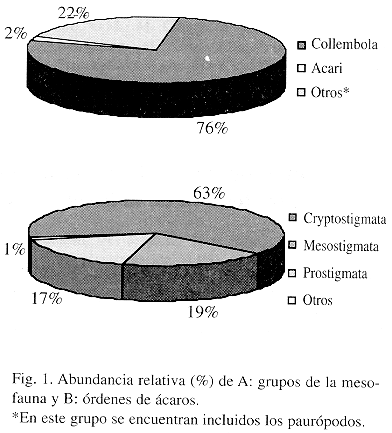
<body><![CDATA[<P><FONT FACE="Arial,Helvetica"><FONT SIZE=-1>X = n&uacute;mero total de individuos en la muestra</FONT></FONT></DIR> </DIR> </DIR> </DIR> </DIR> </DIR> <FONT FACE="Arial,Helvetica"><FONT SIZE=-1>Este &iacute;ndice oscila de 0 (distribuci&oacute;n al azar) a 1 (agregaci&oacute;n) m&aacute;xima).</FONT></FONT><FONT FACE="Arial,Helvetica"><FONT SIZE=-1></FONT></FONT>      <P><FONT FACE="Arial,Helvetica"><FONT SIZE=-1>La mesofauna estuvo representada en ambas parcelas por Collembola, Protura, Psocoptera. Polyxenida, Pauropoda y los &oacute;rdenes de &aacute;caros Cryptostigmata (Oribatei), Mesostigmata, Prostigmata, Astigmata y Notostigmata.</FONT></FONT><FONT FACE="Arial,Helvetica"><FONT SIZE=-1></FONT></FONT>      <P><FONT FACE="Arial,Helvetica"><FONT SIZE=-1>Del total de individuos, el mayor porcentaje correspode a los &aacute;caros debido a la notable contribuci&oacute;n de los orib&aacute;tidos a los valores de la abundancia relativa (<A HREF="#Fig. 1">Fig. 1</A>). El predominio num&eacute;rico (13653 ind/m<SUP>2</SUP>) se corresponde con los resultados registrados en la mayor&iacute;a de los suelos (<A HREF="#Wallwork">Wallwork 1976</A>). El segundo lugar lo ocupan los col&eacute;mbolos cuya densidad promedio, 3 975 ind/m<SUP>2</SUP>, es relativamente baja, aunque se encuentra dentro del &aacute;mbito registrado para las selvas tropicales (<A HREF="#Petersen">Petersen y Luxton 1982</A>). A pesar de que a los col&eacute;mbolos le siguen los paur&oacute;podos, el valor promedio de densidad para este grupo s&oacute;lo alcanza 128 ind/m<SUP>2</SUP>. Se evidencian diferencias altamente significativas entre muestreos, parcelas y estratos (Anova, F= 41.77, p&lt;0.001). En Julio el valor promedio de la densidad (434 125 ind/m<SUP>2</SUP>) es tres veces superior al registrado en &eacute;poca de seca (142 450 ind/m<SUP>2</SUP>) y representa una diferencia m&aacute;s marcada que la registrada por <A HREF="#Adis">Adis <I>et al</I>. (1989)</A> al comparar estacionalmente la abundancia de artr&oacute;podos ed&aacute;ficos en una selva de Manaus, Brasil.</FONT></FONT>     <BR><FONT FACE="Arial,Helvetica"><FONT SIZE=-1>&nbsp;</FONT></FONT>     <BR><FONT FACE="Arial,Helvetica"><FONT SIZE=-1>&nbsp;</FONT></FONT>     <BR><FONT FACE="Arial,Helvetica"><FONT SIZE=-1>&nbsp;</FONT></FONT>     <CENTER><A NAME="Fig. 1"></A><IMG SRC="/img/fbpe/rbt/v47n3/0557i01.GIF" HEIGHT=433 WIDTH=392></CENTER> <FONT FACE="Arial,Helvetica"><FONT SIZE=-1>&nbsp;</FONT></FONT>     
<BR><FONT FACE="Arial,Helvetica"><FONT SIZE=-1>&nbsp;</FONT></FONT><FONT FACE="Arial,Helvetica"><FONT SIZE=-1></FONT></FONT>      <P><FONT FACE="Arial,Helvetica"><FONT SIZE=-1>Es posible relacionar los valores promedio de densidad por &eacute;poca con los valores promedio de humedad del suelo, 21.76 % en marzo, mientras que en julio ascendi&oacute; a 41.43 %. La desigual disponibilidad de agua entre las dos parcelas es m&aacute;s marcada en Marzo, de ah&iacute; que no existan diferencias significativas en la densidad registrada en ambas parcelas en julio donde probablemente el aumento de humedad favorece a ambos sitios independientemente de su topograf&iacute;a (<A HREF="#CUADRO 1">Cuadro 1</A>).</FONT></FONT>     <BR><FONT FACE="Arial,Helvetica"><FONT SIZE=-1>&nbsp;</FONT></FONT>     ]]></body>
<body><![CDATA[<CENTER><A NAME="CUADRO 1"></A><B><FONT FACE="Arial,Helvetica"><FONT SIZE=-1>CUADRO 1</FONT></FONT></B></CENTER> <FONT FACE="Arial,Helvetica"><FONT SIZE=-1>&nbsp;</FONT></FONT>     <CENTER><FONT FACE="Arial,Helvetica"><FONT SIZE=-1>Valores de la prueba de rangos m&uacute;ltiples de Duncan para la interacci&oacute;n de tratamientos (meses-parcelas-estratos)</FONT></FONT></CENTER>      <CENTER><FONT FACE="Arial,Helvetica"><FONT SIZE=-1>en la densidad de la mesofauna ed&aacute;fica presente en una selva baja inundables de la Reserva de la Bi&oacute;sfera de Sian Kaan</FONT></FONT></CENTER> <FONT FACE="Arial,Helvetica"><FONT SIZE=-1>&nbsp;</FONT></FONT>     <BR><FONT FACE="Arial,Helvetica"><FONT SIZE=-1>&nbsp;</FONT></FONT>     <CENTER><TABLE BORDER=0 CELLSPACING=0 CELLPADDING=0 COLS=3 WIDTH="90%" > <TR> <TD><FONT FACE="Arial,Helvetica"><FONT SIZE=-1>Tratamientos</FONT></FONT></TD>  <TD>     <CENTER><FONT FACE="Arial,Helvetica"><FONT SIZE=-1>Abundancia promedio [log (x+1)]</FONT></FONT></CENTER> </TD>  <TD>     <CENTER><FONT FACE="Arial,Helvetica"><FONT SIZE=-1>Significaci&oacute;n</FONT></FONT></CENTER> </TD> </TR>  <TR> <TD><FONT FACE="Arial,Helvetica"><FONT SIZE=-1></FONT></FONT></TD>  <TD><FONT FACE="Arial,Helvetica"><FONT SIZE=-1></FONT></FONT></TD>  <TD><FONT FACE="Arial,Helvetica"><FONT SIZE=-1></FONT></FONT></TD> </TR>  <TR> <TD><FONT FACE="Arial,Helvetica"><FONT SIZE=-1>Marzo-Parcela I</FONT></FONT></TD>  <TD>     <CENTER><FONT FACE="Arial,Helvetica"><FONT SIZE=-1>1.992</FONT></FONT></CENTER> </TD>  <TD>     <CENTER><FONT FACE="Arial,Helvetica"><FONT SIZE=-1>a</FONT></FONT></CENTER> </TD> </TR>  <TR> <TD><FONT FACE="Arial,Helvetica"><FONT SIZE=-1>Marzo-Parcela II</FONT></FONT></TD>  <TD>     <CENTER><FONT FACE="Arial,Helvetica"><FONT SIZE=-1>1.388</FONT></FONT></CENTER> </TD>  <TD>     ]]></body>
<body><![CDATA[<CENTER><FONT FACE="Arial,Helvetica"><FONT SIZE=-1>b</FONT></FONT></CENTER> </TD> </TR>  <TR> <TD><FONT FACE="Arial,Helvetica"><FONT SIZE=-1>Julio-Parcela I</FONT></FONT></TD>  <TD>     <CENTER><FONT FACE="Arial,Helvetica"><FONT SIZE=-1>2.711</FONT></FONT></CENTER> </TD>  <TD>     <CENTER><FONT FACE="Arial,Helvetica"><FONT SIZE=-1>c</FONT></FONT></CENTER> </TD> </TR>  <TR> <TD><FONT FACE="Arial,Helvetica"><FONT SIZE=-1>Julio-Parcela II</FONT></FONT></TD>  <TD>     <CENTER><FONT FACE="Arial,Helvetica"><FONT SIZE=-1>2.444</FONT></FONT></CENTER> </TD>  <TD>     <CENTER><FONT FACE="Arial,Helvetica"><FONT SIZE=-1>c</FONT></FONT></CENTER> </TD> </TR>  <TR> <TD><FONT FACE="Arial,Helvetica"><FONT SIZE=-1>Marzo-Hojarasca&nbsp;</FONT></FONT></TD>  <TD>     <CENTER><FONT FACE="Arial,Helvetica"><FONT SIZE=-1>0.978</FONT></FONT></CENTER> </TD>  <TD>     <CENTER><FONT FACE="Arial,Helvetica"><FONT SIZE=-1>a</FONT></FONT></CENTER> </TD> </TR>  <TR> <TD><FONT FACE="Arial,Helvetica"><FONT SIZE=-1>Marzo-Suelo</FONT></FONT></TD>  <TD>     <CENTER><FONT FACE="Arial,Helvetica"><FONT SIZE=-1>2.402</FONT></FONT></CENTER> </TD>  <TD>     <CENTER><FONT FACE="Arial,Helvetica"><FONT SIZE=-1>b</FONT></FONT></CENTER> </TD> </TR>  <TR> <TD><FONT FACE="Arial,Helvetica"><FONT SIZE=-1>Julio-Hojarasca</FONT></FONT></TD>  <TD>     <CENTER><FONT FACE="Arial,Helvetica"><FONT SIZE=-1>2.783</FONT></FONT></CENTER> </TD>  <TD>     ]]></body>
<body><![CDATA[<CENTER><FONT FACE="Arial,Helvetica"><FONT SIZE=-1>c</FONT></FONT></CENTER> </TD> </TR>  <TR> <TD><FONT FACE="Arial,Helvetica"><FONT SIZE=-1>Julio-Suelo</FONT></FONT></TD>  <TD>     <CENTER><FONT FACE="Arial,Helvetica"><FONT SIZE=-1>2.372</FONT></FONT></CENTER> </TD>  <TD>     <CENTER><FONT FACE="Arial,Helvetica"><FONT SIZE=-1>b</FONT></FONT></CENTER> </TD> </TR> </TABLE></CENTER> <FONT FACE="Arial,Helvetica"><FONT SIZE=-1>&nbsp;</FONT></FONT><FONT FACE="Arial,Helvetica"><FONT SIZE=-1></FONT></FONT>      <P><FONT FACE="Arial,Helvetica"><FONT SIZE=-1>El efecto de la humedad se manifiesta en la din&aacute;mica de las poblaciones microbianas que constituyen recursos alimentarios para una gran parte de los invertebrados ed&aacute;ficos. Reddy y Venkataiah (1990) se&ntilde;alan que Acari, Collembola, Protura, Pauropoda y Psocoptera responden positivamente a cambios en los niveles de humedad, aunque otros factores pueden estar tambi&eacute;n involucrados.</FONT></FONT><FONT FACE="Arial,Helvetica"><FONT SIZE=-1></FONT></FONT>      <P><FONT FACE="Arial,Helvetica"><FONT SIZE=-1>El an&aacute;lisis de la distribuci&oacute;n vertical evidenci&oacute; migraciones de los organismos atribuibles igualmente a las condiciones ambientales y disponibilidad de recursos. En el muestreo de marzo se observ&oacute; que las comunidades se concentraron de modo notable en el suelo y m&aacute;s del 50 % de los ejemplares colectados en la hojarasca de ambas parcelas fueron &aacute;caros orib&aacute;tidos, lo cual pudiera explicarse porque ciertos representantes de este grupo son resistentes al efecto negativo provocados por las condiciones x&eacute;ricas del sustrato.</FONT></FONT><FONT FACE="Arial,Helvetica"><FONT SIZE=-1></FONT></FONT>      <P><FONT FACE="Arial,Helvetica"><FONT SIZE=-1>La ausencia de col&eacute;mbolos en la parcela II en el muestreo de marzo corrobora el se&ntilde;alamiento de que los col&eacute;mbolos son m&aacute;s sensibles que los &aacute;caros a un d&eacute;ficit de agua disponible en el suelo (<A HREF="#Serra">Serra <I>et al</I>. 1992</A>), de ah&iacute; la notable diferencia entre la relaci&oacute;n &aacute;caros/col&eacute;mbolos en Marzo (Ac/Co = 37.12) y en Julio (Ac/Co = 2.45). Esta relaci&oacute;n ha sido utilizada como indicadora de inestabilidad en el ambiente (<A HREF="#Asikidis">Asikidis y Stamou 1991</A>; <A HREF="#Serra">Serra<I> et al</I>. 1992</A>).</FONT></FONT><FONT FACE="Arial,Helvetica"><FONT SIZE=-1></FONT></FONT>      <P><FONT FACE="Arial,Helvetica"><FONT SIZE=-1>A la inversa, en &eacute;poca de lluvia las poblaciones de la mayor&iacute;a de los grupos se concentraron en la hojarasca de modo que las densidades registradas en el suelo no difieren significativamente en marzo y julio (<A HREF="#CUADRO 1">Cuadro 1</A>). En un estudio sobre comunidades de col&eacute;mbolos, <A HREF="#Miranda">Miranda y Palacios-Vargas (1992)</A> atribuyen resultados similares a la retenci&oacute;n del agua de las precipitaciones en la hojarasca lo que retarda su paso al suelo. Esta situaci&oacute;n pudiera explicar la presencia de paur&oacute;podos en la hojarasca examinada en julio, por ser un grupo que habita preferentemente en las capas m&aacute;s profundas del suelo y es muy susceptible a la desecaci&oacute;n (<A HREF="#Lagerlof">Lagerlof y Scheller 1987</A>).</FONT></FONT><FONT FACE="Arial,Helvetica"><FONT SIZE=-1></FONT></FONT>      <P><FONT FACE="Arial,Helvetica"><FONT SIZE=-1>Por otra parte, aunque la capa de hojarasca se encuentra expuesta a las oscilaciones microclim&aacute;ticas, a la acci&oacute;n del viento y al arrastre por el agua, el n&uacute;mero de nichos se incrementa con la presencia de la litera y esto implica a un aumento de la heterogeneidad del h&aacute;bitat que favorece el mantenimiento de densidades relativamente altas.</FONT></FONT><FONT FACE="Arial,Helvetica"><FONT SIZE=-1></FONT></FONT>      <P><FONT FACE="Arial,Helvetica"><FONT SIZE=-1>Los valores m&aacute;s elevados del coeficiente de Green corresponden a col&eacute;mbolos en Marzo (<A HREF="#CUADRO 2">Cuadro 2</A>) y reflejan el efecto de la escasa disponibilidad de microh&aacute;bitats adecuados sobre la distribuci&oacute;n de sus poblaciones, ya que mientras m&aacute;s severas sean las condiciones ambientales los grupos faun&iacute;sticos, y particularmente aquellos susceptibles, est&aacute;n m&aacute;s restringidos a sitios favorables (<A HREF="#Thomas">Thomas y MacLean 1988</A>).</FONT></FONT>     <BR><FONT FACE="Arial,Helvetica"><FONT SIZE=-1>&nbsp;</FONT></FONT>     ]]></body>
<body><![CDATA[<CENTER><FONT FACE="Arial,Helvetica"><FONT SIZE=-1>&nbsp;</FONT></FONT></CENTER>      <CENTER><A NAME="CUADRO 2"></A><B><FONT FACE="Arial,Helvetica"><FONT SIZE=-1>CUADRO 2</FONT></FONT></B></CENTER>      <CENTER><FONT FACE="Arial,Helvetica"><FONT SIZE=-1>&nbsp;</FONT></FONT></CENTER>      <CENTER><I><FONT FACE="Arial,Helvetica"><FONT SIZE=-1>Valores del &iacute;ndice de agregaci&oacute;n de Green para la fauna de &aacute;caros y col&eacute;mbolos de una selva baja inundable</FONT></FONT></I></CENTER>      <CENTER><I><FONT FACE="Arial,Helvetica"><FONT SIZE=-1>de la Reserva de la Bi&oacute;sfera de Sian Ka'an. (H: hojarasca, S: suelo.)</FONT></FONT></I></CENTER>      <CENTER><FONT FACE="Arial,Helvetica"><FONT SIZE=-1>&nbsp;</FONT></FONT></CENTER>      <CENTER><FONT FACE="Arial,Helvetica"><FONT SIZE=-1>&nbsp;</FONT></FONT></CENTER>      <CENTER><TABLE BORDER=0 CELLSPACING=0 CELLPADDING=0 WIDTH="618" > <TR> <TD VALIGN=TOP WIDTH="16%"><FONT FACE="Arial,Helvetica"><FONT SIZE=-1>&nbsp;</FONT></FONT></TD>  <TD VALIGN=TOP COLSPAN="4" WIDTH="42%">     <CENTER><FONT FACE="Arial,Helvetica"><FONT SIZE=-1>Marzo</FONT></FONT></CENTER> </TD>  <TD VALIGN=TOP COLSPAN="4" WIDTH="42%">     <CENTER><FONT FACE="Arial,Helvetica"><FONT SIZE=-1>Julio</FONT></FONT></CENTER> </TD> </TR>  <TR> <TD VALIGN=TOP WIDTH="16%"><FONT FACE="Arial,Helvetica"><FONT SIZE=-1>&nbsp;</FONT></FONT></TD>  <TD VALIGN=TOP COLSPAN="2" WIDTH="21%">     ]]></body>
<body><![CDATA[<CENTER><FONT FACE="Arial,Helvetica"><FONT SIZE=-1>Parcela I</FONT></FONT></CENTER> </TD>  <TD VALIGN=TOP COLSPAN="2" WIDTH="21%">     <CENTER><FONT FACE="Arial,Helvetica"><FONT SIZE=-1>Parcela II</FONT></FONT></CENTER> </TD>  <TD VALIGN=TOP COLSPAN="2" WIDTH="21%">     <CENTER><FONT FACE="Arial,Helvetica"><FONT SIZE=-1>Parcela I</FONT></FONT></CENTER> </TD>  <TD VALIGN=TOP COLSPAN="2" WIDTH="21%">     <CENTER><FONT FACE="Arial,Helvetica"><FONT SIZE=-1>Parcela II</FONT></FONT></CENTER> </TD> </TR>  <TR> <TD VALIGN=TOP WIDTH="16%"><FONT FACE="Arial,Helvetica"><FONT SIZE=-1>&nbsp;</FONT></FONT></TD>  <TD VALIGN=TOP WIDTH="11%">     <CENTER><FONT FACE="Arial,Helvetica"><FONT SIZE=-1>H</FONT></FONT></CENTER> </TD>  <TD VALIGN=TOP WIDTH="11%">     <CENTER><FONT FACE="Arial,Helvetica"><FONT SIZE=-1>S</FONT></FONT></CENTER> </TD>  <TD VALIGN=TOP WIDTH="11%">     <CENTER><FONT FACE="Arial,Helvetica"><FONT SIZE=-1>H</FONT></FONT></CENTER> </TD>  <TD VALIGN=TOP WIDTH="11%">     <CENTER><FONT FACE="Arial,Helvetica"><FONT SIZE=-1>S</FONT></FONT></CENTER> </TD>  <TD VALIGN=TOP WIDTH="11%">     <CENTER><FONT FACE="Arial,Helvetica"><FONT SIZE=-1>H</FONT></FONT></CENTER> </TD>  <TD VALIGN=TOP WIDTH="11%">     <CENTER><FONT FACE="Arial,Helvetica"><FONT SIZE=-1>S</FONT></FONT></CENTER> </TD>  <TD VALIGN=TOP WIDTH="11%">     ]]></body>
<body><![CDATA[<CENTER><FONT FACE="Arial,Helvetica"><FONT SIZE=-1>H</FONT></FONT></CENTER> </TD>  <TD VALIGN=TOP WIDTH="11%">     <CENTER><FONT FACE="Arial,Helvetica"><FONT SIZE=-1>S</FONT></FONT></CENTER> </TD> </TR>  <TR> <TD VALIGN=TOP WIDTH="16%"><FONT FACE="Arial,Helvetica"><FONT SIZE=-1>Collembola</FONT></FONT></TD>  <TD VALIGN=TOP WIDTH="11%">     <CENTER><FONT FACE="Arial,Helvetica"><FONT SIZE=-1>0.89</FONT></FONT></CENTER> </TD>  <TD VALIGN=TOP WIDTH="11%">     <CENTER><FONT FACE="Arial,Helvetica"><FONT SIZE=-1>0.03</FONT></FONT></CENTER> </TD>  <TD VALIGN=TOP WIDTH="11%">     <CENTER><FONT FACE="Arial,Helvetica"><FONT SIZE=-1>-</FONT></FONT></CENTER> </TD>  <TD VALIGN=TOP WIDTH="11%">     <CENTER><FONT FACE="Arial,Helvetica"><FONT SIZE=-1>0.51</FONT></FONT></CENTER> </TD>  <TD VALIGN=TOP WIDTH="11%">     <CENTER><FONT FACE="Arial,Helvetica"><FONT SIZE=-1>0.05</FONT></FONT></CENTER> </TD>  <TD VALIGN=TOP WIDTH="11%">     <CENTER><FONT FACE="Arial,Helvetica"><FONT SIZE=-1>0.14</FONT></FONT></CENTER> </TD>  <TD VALIGN=TOP WIDTH="11%">     <CENTER><FONT FACE="Arial,Helvetica"><FONT SIZE=-1>0.05</FONT></FONT></CENTER> </TD>  <TD VALIGN=TOP WIDTH="11%">     <CENTER><FONT FACE="Arial,Helvetica"><FONT SIZE=-1>0.04</FONT></FONT></CENTER> </TD> </TR>  <TR> <TD VALIGN=TOP WIDTH="16%"><FONT FACE="Arial,Helvetica"><FONT SIZE=-1>Acari</FONT></FONT></TD>  <TD VALIGN=TOP WIDTH="11%">     ]]></body>
<body><![CDATA[<CENTER><FONT FACE="Arial,Helvetica"><FONT SIZE=-1>0.11</FONT></FONT></CENTER> </TD>  <TD VALIGN=TOP WIDTH="11%">     <CENTER><FONT FACE="Arial,Helvetica"><FONT SIZE=-1>0.02</FONT></FONT></CENTER> </TD>  <TD VALIGN=TOP WIDTH="11%">     <CENTER><FONT FACE="Arial,Helvetica"><FONT SIZE=-1>0.03</FONT></FONT></CENTER> </TD>  <TD VALIGN=TOP WIDTH="11%">     <CENTER><FONT FACE="Arial,Helvetica"><FONT SIZE=-1>0.11</FONT></FONT></CENTER> </TD>  <TD VALIGN=TOP WIDTH="11%">     <CENTER><FONT FACE="Arial,Helvetica"><FONT SIZE=-1>0.08</FONT></FONT></CENTER> </TD>  <TD VALIGN=TOP WIDTH="11%">     <CENTER><FONT FACE="Arial,Helvetica"><FONT SIZE=-1>0.04</FONT></FONT></CENTER> </TD>  <TD VALIGN=TOP WIDTH="11%">     <CENTER><FONT FACE="Arial,Helvetica"><FONT SIZE=-1>0.05</FONT></FONT></CENTER> </TD>  <TD VALIGN=TOP WIDTH="11%">     <CENTER><FONT FACE="Arial,Helvetica"><FONT SIZE=-1>0.07</FONT></FONT></CENTER> </TD> </TR> </TABLE></CENTER> <FONT FACE="Arial,Helvetica"><FONT SIZE=-1>&nbsp;</FONT></FONT>     <BR><FONT FACE="Arial,Helvetica"><FONT SIZE=-1>&nbsp;</FONT></FONT>     <BR><FONT FACE="Arial,Helvetica"><FONT SIZE=-1>&nbsp;</FONT></FONT>     ]]></body>
<body><![CDATA[<BR><B><FONT FACE="Arial,Helvetica"><FONT SIZE=-1>Referencias</FONT></FONT></B><FONT FACE="Arial,Helvetica"><FONT SIZE=-1></FONT></FONT>      <!-- ref --><P><A NAME="Adis"></A><FONT FACE="Arial,Helvetica"><FONT SIZE=-1>Adis, J., E.F. Ribeiro, J.W. Morais &amp; E.T.S. Cavalcante. 1989. Vertical distribution and abundance of arthropods from white sand soil of a neotropical campinarema forest during the dry season. Stud. Neotrop. fauna Envir. 24 (4): 201-211.</FONT></FONT><FONT FACE="Arial,Helvetica"><FONT SIZE=-1></FONT></FONT>    &nbsp;&nbsp;&nbsp;&nbsp;&nbsp;&nbsp;&nbsp;&nbsp;[&#160;<a href="javascript:void(0);" onclick="javascript: window.open('/scielo.php?script=sci_nlinks&ref=1332335&pid=S0034-7744199900030002200001&lng=','','width=640,height=500,resizable=yes,scrollbars=1,menubar=yes,');">Links</a>&#160;]<!-- end-ref --><!-- ref --><P><A NAME="Asikidis"></A><FONT FACE="Arial,Helvetica"><FONT SIZE=-1>Asikidis, M.D. &amp; G.P. Stamou. 1991. Spatial and temporal patterns of an oribatid mite community in an evergreen-sclerophyllous formation (Hortiatis, Greece). Pedobiologia 35: 53 -63.</FONT></FONT><FONT FACE="Arial,Helvetica"><FONT SIZE=-1></FONT></FONT>    &nbsp;&nbsp;&nbsp;&nbsp;&nbsp;&nbsp;&nbsp;&nbsp;[&#160;<a href="javascript:void(0);" onclick="javascript: window.open('/scielo.php?script=sci_nlinks&ref=1332336&pid=S0034-7744199900030002200002&lng=','','width=640,height=500,resizable=yes,scrollbars=1,menubar=yes,');">Links</a>&#160;]<!-- end-ref --><!-- ref --><P><A NAME="Green"></A><FONT FACE="Arial,Helvetica"><FONT SIZE=-1>Green, R.H. 1966. Measurement of non-randomness in spatial distributions. Res. Popul. Ecol. 8: 1 -7.</FONT></FONT><FONT FACE="Arial,Helvetica"><FONT SIZE=-1></FONT></FONT>    &nbsp;&nbsp;&nbsp;&nbsp;&nbsp;&nbsp;&nbsp;&nbsp;[&#160;<a href="javascript:void(0);" onclick="javascript: window.open('/scielo.php?script=sci_nlinks&ref=1332337&pid=S0034-7744199900030002200003&lng=','','width=640,height=500,resizable=yes,scrollbars=1,menubar=yes,');">Links</a>&#160;]<!-- end-ref --><!-- ref --><P><A NAME="Lagerlof"></A><FONT FACE="Arial,Helvetica"><FONT SIZE=-1>Lagerlof, J. &amp; U. Scheller. 1987. Abundance and activity of Pauropoda and Symphyla (Myriapoda) under four arable crops. <I>In</I> J. Lagerlof (ed.) Ecology of soil fauna in arable land. Dynamic and activity of microarthropods and enchytraeids in four cropping systems. Uppsala, 357 pp.</FONT></FONT><FONT FACE="Arial,Helvetica"><FONT SIZE=-1></FONT></FONT>    &nbsp;&nbsp;&nbsp;&nbsp;&nbsp;&nbsp;&nbsp;&nbsp;[&#160;<a href="javascript:void(0);" onclick="javascript: window.open('/scielo.php?script=sci_nlinks&ref=1332338&pid=S0034-7744199900030002200004&lng=','','width=640,height=500,resizable=yes,scrollbars=1,menubar=yes,');">Links</a>&#160;]<!-- end-ref --><!-- ref --><P><A NAME="Miranda"></A><FONT FACE="Arial,Helvetica"><FONT SIZE=-1>Miranda, A. y J.G. Palacios-Vargas. 1992. Estudio comparativo de las comunidades de col&eacute;mbolos ed&aacute;ficos de bosque de <I>Abies religiosa</I> y cultivo de haba (<I>Vicia faba</I>). Agrociencia ser. Prot. Veg. 3: 7 -18.</FONT></FONT><FONT FACE="Arial,Helvetica"><FONT SIZE=-1></FONT></FONT>    &nbsp;&nbsp;&nbsp;&nbsp;&nbsp;&nbsp;&nbsp;&nbsp;[&#160;<a href="javascript:void(0);" onclick="javascript: window.open('/scielo.php?script=sci_nlinks&ref=1332339&pid=S0034-7744199900030002200005&lng=','','width=640,height=500,resizable=yes,scrollbars=1,menubar=yes,');">Links</a>&#160;]<!-- end-ref --><!-- ref --><P><A NAME="Olmsted"></A><FONT FACE="Arial,Helvetica"><FONT SIZE=-1>Olmsted, I., R. Dur&aacute;n, J.A. Gonz&aacute;lez-Iturbe, J. Granados, J.C. Trejos, D. Zizumbo, G. Campos &amp; G. Ibarra. 1995. Diagn&oacute;stico del conocimiento y manejo de las selvas de la pen&iacute;nsula de Yucat&aacute;n, p. 139 -162. <I>In</I> H. Delfin, H. et al. (eds.). Conocimiento y manejo de las selvas de la pen&iacute;nsula de Yucat&aacute;n, Universidad Aut&oacute;noma de Yucat&aacute;n, M&eacute;rida,</FONT></FONT><FONT FACE="Arial,Helvetica"><FONT SIZE=-1></FONT></FONT>    &nbsp;&nbsp;&nbsp;&nbsp;&nbsp;&nbsp;&nbsp;&nbsp;[&#160;<a href="javascript:void(0);" onclick="javascript: window.open('/scielo.php?script=sci_nlinks&ref=1332340&pid=S0034-7744199900030002200006&lng=','','width=640,height=500,resizable=yes,scrollbars=1,menubar=yes,');">Links</a>&#160;]<!-- end-ref --><!-- ref --><P><A NAME="Paoletti"></A><FONT FACE="Arial,Helvetica"><FONT SIZE=-1>Paoletti, M.G., M.R. Favretto, B.R. Stinner, F.F. Purrington &amp; J.E. Bater. 1991. Invertebrates as bioindicators of soil use. p. 341 -362. In D.A. Crossley Jr., et al. (eds.). Modern techniques in soil ecology. Elsevier, Nueva York, p</FONT></FONT><FONT FACE="Arial,Helvetica"><FONT SIZE=-1></FONT></FONT>    &nbsp;&nbsp;&nbsp;&nbsp;&nbsp;&nbsp;&nbsp;&nbsp;[&#160;<a href="javascript:void(0);" onclick="javascript: window.open('/scielo.php?script=sci_nlinks&ref=1332341&pid=S0034-7744199900030002200007&lng=','','width=640,height=500,resizable=yes,scrollbars=1,menubar=yes,');">Links</a>&#160;]<!-- end-ref --><!-- ref --><P><A NAME="Petersen"></A><FONT FACE="Arial,Helvetica"><FONT SIZE=-1>Petersen, H. &amp; M. Luxton. 1982. A comparative anlysis of soil fauna populations and their role in decomposition processes. Oikos 39: 288-387.</FONT></FONT><FONT FACE="Arial,Helvetica"><FONT SIZE=-1></FONT></FONT>    &nbsp;&nbsp;&nbsp;&nbsp;&nbsp;&nbsp;&nbsp;&nbsp;[&#160;<a href="javascript:void(0);" onclick="javascript: window.open('/scielo.php?script=sci_nlinks&ref=1332342&pid=S0034-7744199900030002200008&lng=','','width=640,height=500,resizable=yes,scrollbars=1,menubar=yes,');">Links</a>&#160;]<!-- end-ref --><!-- ref --><P><A NAME="Salazar-Vallejo"></A><FONT FACE="Arial,Helvetica"><FONT SIZE=-1>Salazar-Vallejo, S.I. &amp; N.E. Gonz&aacute;lez. 1994. La Reserva de Sian Kaan y su biodiversidad. Ava. Cient. 8: 14-20.</FONT></FONT><FONT FACE="Arial,Helvetica"><FONT SIZE=-1></FONT></FONT>    &nbsp;&nbsp;&nbsp;&nbsp;&nbsp;&nbsp;&nbsp;&nbsp;[&#160;<a href="javascript:void(0);" onclick="javascript: window.open('/scielo.php?script=sci_nlinks&ref=1332343&pid=S0034-7744199900030002200009&lng=','','width=640,height=500,resizable=yes,scrollbars=1,menubar=yes,');">Links</a>&#160;]<!-- end-ref --><!-- ref --><P><A NAME="Serra"></A><FONT FACE="Arial,Helvetica"><FONT SIZE=-1>Serra, A., E. Mateos, X. Perra &amp; V. Sarie. 1992. Estudio de los efectos de un incendio forestal sobre poblaciones de artr&oacute;podos ed&aacute;ficos. Historia Animalium 1: 41-62.</FONT></FONT><FONT FACE="Arial,Helvetica"><FONT SIZE=-1></FONT></FONT>    &nbsp;&nbsp;&nbsp;&nbsp;&nbsp;&nbsp;&nbsp;&nbsp;[&#160;<a href="javascript:void(0);" onclick="javascript: window.open('/scielo.php?script=sci_nlinks&ref=1332344&pid=S0034-7744199900030002200010&lng=','','width=640,height=500,resizable=yes,scrollbars=1,menubar=yes,');">Links</a>&#160;]<!-- end-ref --><!-- ref --><P><A NAME="Thomas"></A><FONT FACE="Arial,Helvetica"><FONT SIZE=-1>Thomas, R.H. &amp; S.F. MacLean, Jr. 1988. Community structure in soil Acari along a latitudinal transect on Tundra sites in Northern Alaska. Pedobiologia 31: 113-138.</FONT></FONT><FONT FACE="Arial,Helvetica"><FONT SIZE=-1></FONT></FONT>    &nbsp;&nbsp;&nbsp;&nbsp;&nbsp;&nbsp;&nbsp;&nbsp;[&#160;<a href="javascript:void(0);" onclick="javascript: window.open('/scielo.php?script=sci_nlinks&ref=1332345&pid=S0034-7744199900030002200011&lng=','','width=640,height=500,resizable=yes,scrollbars=1,menubar=yes,');">Links</a>&#160;]<!-- end-ref --><!-- ref --><P><A NAME="Vázquez"></A><FONT FACE="Arial,Helvetica"><FONT SIZE=-1>V&aacute;zquez, M.M. 1994. Composici&oacute;n faun&iacute;stica ed&aacute;fica en las selvas tropicales de Quintana Roo. Ava. Cient. 8: 21-25.</FONT></FONT><FONT FACE="Arial,Helvetica"><FONT SIZE=-1></FONT></FONT>    &nbsp;&nbsp;&nbsp;&nbsp;&nbsp;&nbsp;&nbsp;&nbsp;[&#160;<a href="javascript:void(0);" onclick="javascript: window.open('/scielo.php?script=sci_nlinks&ref=1332346&pid=S0034-7744199900030002200012&lng=','','width=640,height=500,resizable=yes,scrollbars=1,menubar=yes,');">Links</a>&#160;]<!-- end-ref --><!-- ref --><P><A NAME="Wallwork"></A><FONT FACE="Arial,Helvetica"><FONT SIZE=-1>Wallwork, J.A. 1976. The distribution and diversity of the soil fauna. Academic, Londres. 355 p.</FONT></FONT>    &nbsp;&nbsp;&nbsp;&nbsp;&nbsp;&nbsp;&nbsp;&nbsp;[&#160;<a href="javascript:void(0);" onclick="javascript: window.open('/scielo.php?script=sci_nlinks&ref=1332347&pid=S0034-7744199900030002200013&lng=','','width=640,height=500,resizable=yes,scrollbars=1,menubar=yes,');">Links</a>&#160;]<!-- end-ref --><BR><FONT FACE="Arial,Helvetica"><FONT SIZE=-1></FONT></FONT>&nbsp;<FONT FACE="Arial,Helvetica"><FONT SIZE=-1></FONT></FONT>      <P><A NAME="1"></A><FONT FACE="Arial,Helvetica"><FONT SIZE=-1><A HREF="#1a">1</A> Departamento de Biolog&iacute;a Animal y Humana, Facultad de Biolog&iacute;a, Universidad de La Habana, Ciudad de La Habana, Cuba.</FONT></FONT><FONT FACE="Arial,Helvetica"><FONT SIZE=-1></FONT></FONT>      <P><A NAME="2"></A><FONT FACE="Arial,Helvetica"><FONT SIZE=-1><A HREF="#1a">2</A> Universidad de Quintana Roo, Chetumal, Quintana Roo, M&eacute;xico. Fax (983)29656.</FONT></FONT>     <BR><FONT FACE="Arial,Helvetica"><FONT SIZE=-1></FONT></FONT>&nbsp;      ]]></body><back>
<ref-list>
<ref id="B1">
<nlm-citation citation-type="journal">
<person-group person-group-type="author">
<name>
<surname><![CDATA[Adis]]></surname>
<given-names><![CDATA[J.]]></given-names>
</name>
<name>
<surname><![CDATA[Ribeiro]]></surname>
<given-names><![CDATA[E.F.]]></given-names>
</name>
<name>
<surname><![CDATA[Morais]]></surname>
<given-names><![CDATA[J.W.]]></given-names>
</name>
<name>
<surname><![CDATA[Cavalcante]]></surname>
<given-names><![CDATA[E.T.S.]]></given-names>
</name>
</person-group>
<article-title xml:lang="en"><![CDATA[Vertical distribution and abundance of arthropods from white sand soil of a neotropical campinarema forest during the dry season]]></article-title>
<source><![CDATA[Stud. Neotrop. fauna Envir.]]></source>
<year>1989</year>
<volume>24</volume>
<numero>^s4</numero>
<issue>^s4</issue>
<supplement>4</supplement>
<page-range>201-211</page-range></nlm-citation>
</ref>
<ref id="B2">
<nlm-citation citation-type="journal">
<person-group person-group-type="author">
<name>
<surname><![CDATA[Asikidis]]></surname>
<given-names><![CDATA[M.D.]]></given-names>
</name>
<name>
<surname><![CDATA[Stamou]]></surname>
<given-names><![CDATA[G.P.]]></given-names>
</name>
</person-group>
<article-title xml:lang="en"><![CDATA[Spatial and temporal patterns of an oribatid mite community in an evergreen-sclerophyllous formation (Hortiatis, Greece)]]></article-title>
<source><![CDATA[Pedobiologia]]></source>
<year>1991</year>
<volume>35</volume>
<page-range>53 -63</page-range></nlm-citation>
</ref>
<ref id="B3">
<nlm-citation citation-type="journal">
<person-group person-group-type="author">
<name>
<surname><![CDATA[Green]]></surname>
<given-names><![CDATA[R.H.]]></given-names>
</name>
</person-group>
<article-title xml:lang="en"><![CDATA[Measurement of non-randomness in spatial distributions]]></article-title>
<source><![CDATA[Res. Popul. Ecol.]]></source>
<year>1966</year>
<volume>8</volume>
<page-range>1 -7</page-range></nlm-citation>
</ref>
<ref id="B4">
<nlm-citation citation-type="">
<person-group person-group-type="author">
<name>
<surname><![CDATA[Lagerlof]]></surname>
<given-names><![CDATA[J.]]></given-names>
</name>
<name>
<surname><![CDATA[Scheller]]></surname>
<given-names><![CDATA[U.]]></given-names>
</name>
</person-group>
<article-title xml:lang="en"><![CDATA[Abundance and activity of Pauropoda and Symphyla (Myriapoda) under four arable crops]]></article-title>
<person-group person-group-type="editor">
<name>
<surname><![CDATA[Lagerlof]]></surname>
<given-names><![CDATA[J.]]></given-names>
</name>
</person-group>
<source><![CDATA[Ecology of soil fauna in arable land: Dynamic and activity of microarthropods and enchytraeids in four cropping systems]]></source>
<year>1987</year>
<page-range>357</page-range></nlm-citation>
</ref>
<ref id="B5">
<nlm-citation citation-type="journal">
<person-group person-group-type="author">
<name>
<surname><![CDATA[Miranda]]></surname>
<given-names><![CDATA[A.]]></given-names>
</name>
<name>
<surname><![CDATA[Palacios-Vargas]]></surname>
<given-names><![CDATA[J.G.]]></given-names>
</name>
</person-group>
<article-title xml:lang="es"><![CDATA[Estudio comparativo de las comunidades de colémbolos edáficos de bosque de Abies religiosa y cultivo de haba (Vicia faba)]]></article-title>
<source><![CDATA[Agrociencia ser. Prot. Veg.]]></source>
<year>1992</year>
<volume>3</volume>
<page-range>7 -18</page-range></nlm-citation>
</ref>
<ref id="B6">
<nlm-citation citation-type="book">
<person-group person-group-type="author">
<name>
<surname><![CDATA[Olmsted]]></surname>
<given-names><![CDATA[I.]]></given-names>
</name>
<name>
<surname><![CDATA[Durán]]></surname>
<given-names><![CDATA[R.]]></given-names>
</name>
<name>
<surname><![CDATA[González-Iturbe]]></surname>
<given-names><![CDATA[J.A.]]></given-names>
</name>
<name>
<surname><![CDATA[Granados]]></surname>
<given-names><![CDATA[J.]]></given-names>
</name>
<name>
<surname><![CDATA[Trejos]]></surname>
<given-names><![CDATA[J.C.]]></given-names>
</name>
<name>
<surname><![CDATA[Zizumbo]]></surname>
<given-names><![CDATA[D.]]></given-names>
</name>
<name>
<surname><![CDATA[Campos]]></surname>
<given-names><![CDATA[G.]]></given-names>
</name>
<name>
<surname><![CDATA[Ibarra]]></surname>
<given-names><![CDATA[G.]]></given-names>
</name>
</person-group>
<article-title xml:lang="es"><![CDATA[Diagnóstico del conocimiento y manejo de las selvas de la península de Yucatán]]></article-title>
<person-group person-group-type="editor">
<name>
<surname><![CDATA[H. Delfin]]></surname>
<given-names><![CDATA[H.]]></given-names>
</name>
</person-group>
<source><![CDATA[Conocimiento y manejo de las selvas de la península de Yucatán]]></source>
<year>1995</year>
<page-range>139 -162</page-range><publisher-loc><![CDATA[Mérida ]]></publisher-loc>
<publisher-name><![CDATA[Universidad Autónoma de Yucatán]]></publisher-name>
</nlm-citation>
</ref>
<ref id="B7">
<nlm-citation citation-type="book">
<person-group person-group-type="author">
<name>
<surname><![CDATA[Paoletti]]></surname>
<given-names><![CDATA[M.G.]]></given-names>
</name>
<name>
<surname><![CDATA[Favretto]]></surname>
<given-names><![CDATA[M.R.]]></given-names>
</name>
<name>
<surname><![CDATA[Stinner]]></surname>
<given-names><![CDATA[B.R.]]></given-names>
</name>
<name>
<surname><![CDATA[Purrington]]></surname>
<given-names><![CDATA[F.F.]]></given-names>
</name>
<name>
<surname><![CDATA[Bater]]></surname>
<given-names><![CDATA[J.E.]]></given-names>
</name>
</person-group>
<article-title xml:lang="en"><![CDATA[Invertebrates as bioindicators of soil use]]></article-title>
<person-group person-group-type="editor">
<name>
<surname><![CDATA[Crossley Jr.]]></surname>
<given-names><![CDATA[D.A.]]></given-names>
</name>
</person-group>
<source><![CDATA[Modern techniques in soil ecology]]></source>
<year>1991</year>
<page-range>341 -362</page-range><publisher-loc><![CDATA[^eNueva York Nueva York]]></publisher-loc>
<publisher-name><![CDATA[Elsevier]]></publisher-name>
</nlm-citation>
</ref>
<ref id="B8">
<nlm-citation citation-type="journal">
<person-group person-group-type="author">
<name>
<surname><![CDATA[Petersen]]></surname>
<given-names><![CDATA[H.]]></given-names>
</name>
<name>
<surname><![CDATA[Luxton]]></surname>
<given-names><![CDATA[M.]]></given-names>
</name>
</person-group>
<article-title xml:lang="en"><![CDATA[A comparative anlysis of soil fauna populations and their role in decomposition processes]]></article-title>
<source><![CDATA[Oikos]]></source>
<year>1982</year>
<volume>39</volume>
<page-range>288-387</page-range></nlm-citation>
</ref>
<ref id="B9">
<nlm-citation citation-type="journal">
<person-group person-group-type="author">
<name>
<surname><![CDATA[Salazar-Vallejo]]></surname>
<given-names><![CDATA[S.I.]]></given-names>
</name>
<name>
<surname><![CDATA[González]]></surname>
<given-names><![CDATA[N.E.]]></given-names>
</name>
</person-group>
<article-title xml:lang="es"><![CDATA[La Reserva de Sian Kaan y su biodiversidad]]></article-title>
<source><![CDATA[Ava. Cient.]]></source>
<year>1994</year>
<volume>8</volume>
<page-range>14-20</page-range></nlm-citation>
</ref>
<ref id="B10">
<nlm-citation citation-type="journal">
<person-group person-group-type="author">
<name>
<surname><![CDATA[Serra]]></surname>
<given-names><![CDATA[A.]]></given-names>
</name>
<name>
<surname><![CDATA[Mateos]]></surname>
<given-names><![CDATA[E.]]></given-names>
</name>
<name>
<surname><![CDATA[Perra]]></surname>
<given-names><![CDATA[X.]]></given-names>
</name>
<name>
<surname><![CDATA[Sarie]]></surname>
<given-names><![CDATA[V.]]></given-names>
</name>
</person-group>
<article-title xml:lang="es"><![CDATA[Estudio de los efectos de un incendio forestal sobre poblaciones de artrópodos edáficos]]></article-title>
<source><![CDATA[Historia Animalium]]></source>
<year>1992</year>
<volume>1</volume>
<page-range>41-62</page-range></nlm-citation>
</ref>
<ref id="B11">
<nlm-citation citation-type="journal">
<person-group person-group-type="author">
<name>
<surname><![CDATA[Thomas]]></surname>
<given-names><![CDATA[R.H.]]></given-names>
</name>
<name>
<surname><![CDATA[MacLean, Jr.]]></surname>
<given-names><![CDATA[S.F.]]></given-names>
</name>
</person-group>
<article-title xml:lang="en"><![CDATA[Community structure in soil Acari along a latitudinal transect on Tundra sites in Northern Alaska]]></article-title>
<source><![CDATA[Pedobiologia]]></source>
<year>1988</year>
<volume>31</volume>
<page-range>113-138</page-range></nlm-citation>
</ref>
<ref id="B12">
<nlm-citation citation-type="journal">
<person-group person-group-type="author">
<name>
<surname><![CDATA[Vázquez]]></surname>
<given-names><![CDATA[M.M.]]></given-names>
</name>
</person-group>
<article-title xml:lang="es"><![CDATA[Composición faunística edáfica en las selvas tropicales de Quintana Roo]]></article-title>
<source><![CDATA[Ava. Cient.]]></source>
<year>1994</year>
<volume>8</volume>
<page-range>21-25</page-range></nlm-citation>
</ref>
<ref id="B13">
<nlm-citation citation-type="book">
<person-group person-group-type="author">
<name>
<surname><![CDATA[Wallwork]]></surname>
<given-names><![CDATA[J.A.]]></given-names>
</name>
</person-group>
<source><![CDATA[The distribution and diversity of the soil fauna]]></source>
<year>1976</year>
<page-range>355</page-range><publisher-loc><![CDATA[Londres ]]></publisher-loc>
<publisher-name><![CDATA[Academic]]></publisher-name>
</nlm-citation>
</ref>
</ref-list>
</back>
</article>
