<?xml version="1.0" encoding="ISO-8859-1"?><article xmlns:mml="http://www.w3.org/1998/Math/MathML" xmlns:xlink="http://www.w3.org/1999/xlink" xmlns:xsi="http://www.w3.org/2001/XMLSchema-instance">
<front>
<journal-meta>
<journal-id>0034-7744</journal-id>
<journal-title><![CDATA[Revista de Biología Tropical]]></journal-title>
<abbrev-journal-title><![CDATA[Rev. biol. trop]]></abbrev-journal-title>
<issn>0034-7744</issn>
<publisher>
<publisher-name><![CDATA[Universidad de Costa Rica]]></publisher-name>
</publisher>
</journal-meta>
<article-meta>
<article-id>S0034-77441999000300020</article-id>
<title-group>
<article-title xml:lang="en"><![CDATA[Taxonomic and ecological observations on the scorpions collected in the Forest of Ankazomivady-Ambositra and on the «RS d’Ivohibe», Madagascar]]></article-title>
</title-group>
<contrib-group>
<contrib contrib-type="author">
<name>
<surname><![CDATA[Lourenço]]></surname>
<given-names><![CDATA[Wilson R.]]></given-names>
</name>
<xref ref-type="aff" rid="A01"/>
</contrib>
<contrib contrib-type="author">
<name>
<surname><![CDATA[Goodman]]></surname>
<given-names><![CDATA[Steven M.]]></given-names>
</name>
<xref ref-type="aff" rid="A02"/>
</contrib>
</contrib-group>
<aff id="A01">
<institution><![CDATA[,M.N.H.N Laboratoire de Zoologie (Arthropodes) ]]></institution>
<addr-line><![CDATA[Paris ]]></addr-line>
<country>France</country>
</aff>
<aff id="A02">
<institution><![CDATA[,Field Museum of Natural History  ]]></institution>
<addr-line><![CDATA[ ]]></addr-line>
<country>U.S.A.</country>
</aff>
<pub-date pub-type="pub">
<day>00</day>
<month>09</month>
<year>1999</year>
</pub-date>
<pub-date pub-type="epub">
<day>00</day>
<month>09</month>
<year>1999</year>
</pub-date>
<volume>47</volume>
<numero>3</numero>
<fpage>475</fpage>
<lpage>482</lpage>
<copyright-statement/>
<copyright-year/>
<self-uri xlink:href="http://www.scielo.sa.cr/scielo.php?script=sci_arttext&amp;pid=S0034-77441999000300020&amp;lng=en&amp;nrm=iso"></self-uri><self-uri xlink:href="http://www.scielo.sa.cr/scielo.php?script=sci_abstract&amp;pid=S0034-77441999000300020&amp;lng=en&amp;nrm=iso"></self-uri><self-uri xlink:href="http://www.scielo.sa.cr/scielo.php?script=sci_pdf&amp;pid=S0034-77441999000300020&amp;lng=en&amp;nrm=iso"></self-uri><abstract abstract-type="short" xml:lang="en"><p><![CDATA[During the three months of field work between October and December 1997 by the junior author in the in the Réserve Spéciale d’Ivohibe and in the Forêt d’Ankazomivady-Ambositra, Province of Fianarantsoa, a collection of scorpions was made, mainly with the use of pitfall buckets. The species collected were Grosphus limbatus (Pocock), Grosphus madagascariensis (Gervais), and new species of Tityobuthus Pocock (Scorpiones, Buthidae), which is described from Ivohibe based on two female specimens. Tityobuthus ivohibe n. sp., is the eleventh species described in the genus from Madagascar. Some comments concerning the taxonomic position of the new species are also presented.]]></p></abstract>
<kwd-group>
<kwd lng="en"><![CDATA[Scorpiones]]></kwd>
<kwd lng="en"><![CDATA[Buthidae]]></kwd>
<kwd lng="la"><![CDATA[Tityobuthus]]></kwd>
<kwd lng="la"><![CDATA[Grosphus]]></kwd>
<kwd lng="en"><![CDATA[Ivohibe]]></kwd>
<kwd lng="en"><![CDATA[Madagascar]]></kwd>
<kwd lng="en"><![CDATA[New species]]></kwd>
</kwd-group>
</article-meta>
</front><body><![CDATA[ <DIV class=Section1>     <CENTER><B><FONT FACE="Arial,Helvetica">Taxonomic and ecological observations on the scorpions collected in the</FONT></B></CENTER>      <CENTER><B><FONT FACE="Arial,Helvetica">Forest of Ankazomivady-Ambositra and on the &laquo;RS d’Ivohibe&raquo;,</FONT></B></CENTER>      <CENTER><B><FONT FACE="Arial,Helvetica">Madagascar</FONT></B></CENTER> <FONT SIZE=-1><FONT FACE="Arial,Helvetica">&nbsp;</FONT></FONT>     <BR><FONT SIZE=-1><FONT FACE="Arial,Helvetica">&nbsp;</FONT></FONT><FONT SIZE=-1></FONT>     <CENTER><A NAME="*a"></A><B><FONT SIZE=-1><FONT FACE="Arial,Helvetica"><A HREF="#*">*</A> Wilson R. Louren&ccedil;o &amp; <A HREF="#**">**</A> Steven M. Goodman</FONT></FONT></B></CENTER>      <CENTER><B><FONT SIZE=-1>&nbsp;</FONT></B></CENTER>      <CENTER><B><FONT SIZE=-1>&nbsp;</FONT></B></CENTER> <FONT SIZE=-1></FONT>      <P><FONT SIZE=-1>&nbsp;</FONT>     <BR><B><FONT FACE="Arial,Helvetica"><FONT SIZE=-1>Abstract</FONT></FONT></B><FONT FACE="Arial,Helvetica"><FONT SIZE=-1></FONT></FONT>      ]]></body>
<body><![CDATA[<P><FONT SIZE=-1><FONT FACE="Arial,Helvetica">During the three months of field work between October and December 1997 by the junior author in the in the R&eacute;serve Sp&eacute;ciale d’Ivohibe and in the For&ecirc;t d’Ankazomivady-Ambositra, Province of Fianarantsoa, a collection of scorpions was made, mainly with the use of pitfall buckets. The species collected were <I>Grosphus limbatus</I> (Pocock), <I>Grosphus madagascariensis</I> (Gervais), and new species of <I>Tityobuthus</I> Pocock<I> </I>(Scorpiones, Buthidae), which is described from Ivohibe based on two female specimens. <I>Tityobuthus ivohibe</I> n. sp., is the eleventh species described in the genus from Madagascar. Some comments concerning the taxonomic position of the new species are also presented.</FONT></FONT>     <BR><FONT SIZE=-1>&nbsp;</FONT>     <BR><B><FONT FACE="Arial,Helvetica"><FONT SIZE=-1>Key words</FONT></FONT></B><FONT FACE="Arial,Helvetica"><FONT SIZE=-1></FONT></FONT>      <P><FONT SIZE=-1><FONT FACE="Arial,Helvetica">Scorpiones, Buthidae, <I>Tityobuthus</I>, <I>Grosphus</I>, Ivohibe, Madagascar, New species.</FONT></FONT>     <BR><FONT SIZE=-1>&nbsp;</FONT><FONT SIZE=-1></FONT>      <P><B><FONT SIZE=-1>&nbsp;<FONT FACE="Arial,Helvetica">Introduction</FONT></FONT></B><FONT SIZE=-1></FONT>      <P><FONT SIZE=-1><FONT FACE="Arial,Helvetica">During three months of field work done between October and December 1997 by the junior author in the R&eacute;serve Sp&eacute;ciale (RS) d’Ivohibe and in the For&ecirc;t d’Ankazomivady-Ambositra, both in the Province de Fianarantsoa, a reasonable number of scorpions were collected, mainly with the use of pitfall trap lines. Part of this material was studied by the senior author while on a short visit to the Field Museum and the rest was brought to the Paris Museum for further analysis.</FONT></FONT>     <BR><FONT SIZE=-1>&nbsp;</FONT>     <BR><FONT SIZE=-1><FONT FACE="Arial,Helvetica">These collections contain three species of scorpions, all belonging to the family Buthidae. Two represent already known species in the genus <I>Grosphus</I> Simon 1880, and the third one has been identified as a new species in the genus <I>Tityobuthus</I> Pocock 1893. With the description of this new species, the total number in the genus <I>Tityobuthus</I> is raised to eleven. The increasing number of new species within <I>Tityobuthus</I> suggests that this genus, which can be included among the micro-scorpion genera, may be very rich in species. A similar phenomenon has already been observed in other micro-scorpion genera such as <I>Ananteris</I> Thorell 1891 of the neotropics, in which the number of described species increased from 3 to 19 in the space of twelve years (<A HREF="#Lourenço93">Louren&ccedil;o 1993</A>, <A HREF="#Lourenço94">1994</A>). In fact, since the publication of the Scorpion Fauna of Madagascar (<A HREF="#Lourenço96">Louren&ccedil;o 1996</A>), other new species of <I>Tityobuthus</I>, <I>Microcharmus</I> Louren&ccedil;o 1995 and <I>Pseudouroplectes</I> Louren&ccedil;o 1995 have been discovered and described (<A HREF="#Lourenço97">Louren&ccedil;o 1997</A>, <A HREF="#Lourenço98">1998</A>; <A HREF="#Lourenço(press)">Louren&ccedil;o &amp; Goodman in press</A>). This situation suggests that the scorpion fauna of Madagascar is still far from being well known and that many new taxa remain to be discovered.</FONT></FONT>     <BR><FONT SIZE=-1>&nbsp;</FONT>     ]]></body>
<body><![CDATA[<BR><FONT SIZE=-1>&nbsp;</FONT>     <BR><B><FONT FACE="Arial,Helvetica"><FONT SIZE=-1>Methods</FONT></FONT></B>     <CENTER><FONT SIZE=-1>&nbsp;</FONT></CENTER> <FONT SIZE=-1><FONT FACE="Arial,Helvetica">One technique that has proven effective to capture scorpions on Madagascar consists of pit-fall traps with drift fences. These devices are largely put in place to capture small mammals, reptiles and amphibians. In all of the elevational sites surveyed, separate pit-fall lines were installed in three different topographic settings (valley bottom, slope, and ridge crest). Each line was 100 m long and consisted of 11 buckets (275 mm deep, 290 mm top internal diameter, 220 mm botton internal diameter), 10 m apart, generally in operation for a minimum of seven nights. Small holes (2 mm diameter) were drilled in the bottom to allow water drainage. Buckets were sunk to a depth where the rim was even with ground-level. A barrier (drift fence) made from plastic sheeting (0,5 m high and 100 m long) was stapled in a vertical position to thin wooden stakes. The drift fence bisected all of the buckets in the line (<A HREF="#Voss96">Voss &amp; Emmons 1996</A>, <A HREF="#Fig. 5-9">fig. 7</A>). A flange of about 50 mm at the bottom of the standing plastic fence was covered with soil and leaf litter to block animals from moving under the barrier.</FONT></FONT>     <BR><FONT SIZE=-1>&nbsp;</FONT>     <BR><FONT SIZE=-1>&nbsp;</FONT>     <CENTER><B><FONT FACE="Arial,Helvetica"><FONT SIZE=-1>1. Forest of Ankazomivady-Ambositra</FONT></FONT></B></CENTER>      <CENTER><FONT FACE="Arial,Helvetica"><FONT SIZE=-1>- <I>Grosphus limbatus</I> (Pocock 1889)</FONT></FONT></CENTER> <FONT SIZE=-1></FONT>      <P><FONT SIZE=-1><FONT FACE="Arial,Helvetica">Madagascar, Province de Fianarantsoa, 28 km SSW Ambositra, 4.7 km SW Ambalamanakana, For&ecirc;t d’Ankazomivady, 20 46.5 S ; 47 10,1 E (1700 m), 6-15/I/1998 (S.M. Goodman). 3 adult females ; one of the females with a brood composed of 8 males and 6 females.</FONT></FONT>     <BR><FONT SIZE=-1>&nbsp;</FONT>     <BR><FONT SIZE=-1><FONT FACE="Arial,Helvetica">The majority of specimens were collected on hills exposed rock and were found below rock. These hillrocks were out of the forested zone and were generally surrounded by open grasslands composed of introduced species of Graminaceae. This site of collection probably corresponds to the highest one known for scorpions in Madagascar.</FONT></FONT>     ]]></body>
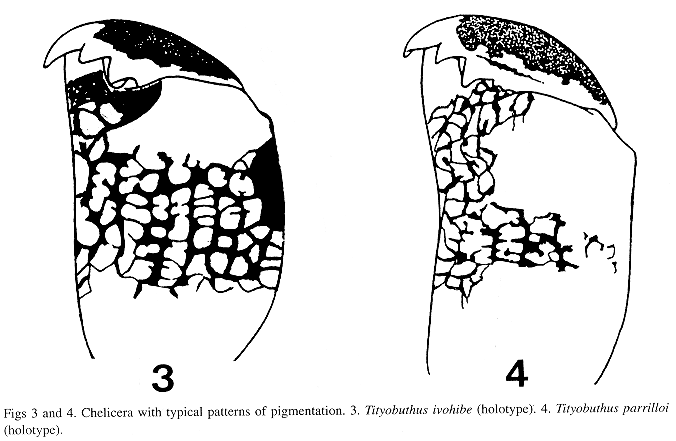
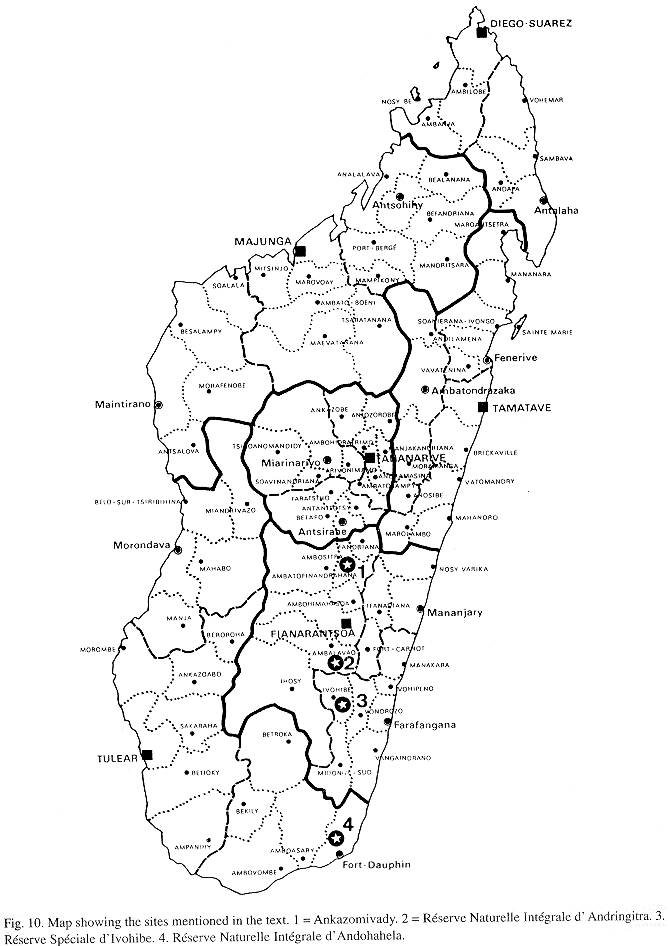
<body><![CDATA[<BR><FONT SIZE=-1>&nbsp;</FONT>     <CENTER><B><FONT FACE="Arial,Helvetica"><FONT SIZE=-1>2. R&eacute;serve Sp&eacute;ciale d’Ivohibe</FONT></FONT></B></CENTER>      <CENTER><FONT FACE="Arial,Helvetica"><FONT SIZE=-1><I>Grosphus madagascariensis</I> (Gervais 1844)</FONT></FONT></CENTER> <FONT SIZE=-1></FONT>      <P><FONT SIZE=-1><FONT FACE="Arial,Helvetica">Madagascar, Province de Fianarantsoa, exterior northern limit of R&eacute;serve Sp&eacute;ciale d’Ivohibe, along the Hefitany River, 7,5 km ENE Ivohibe, 22 28,2’ S - 46 57,6’ E (900 m), camp 1, 6-13/X/1997 (S. M. Goodman, coll.). 6 adult males and 1 juvenile female.</FONT></FONT>     <BR><FONT SIZE=-1>&nbsp;</FONT>     <BR><FONT SIZE=-1><FONT FACE="Arial,Helvetica">As for <I>Grosphus limbatus</I>, specimens were found under rocks.</FONT></FONT>     <BR><FONT SIZE=-1>&nbsp;</FONT>     <BR><FONT SIZE=-1>&nbsp;</FONT>     <CENTER><FONT FACE="Arial,Helvetica"><FONT SIZE=-1>-<I> Tityobuthus ivohibe</I></FONT></FONT></CENTER>      <CENTER><FONT FACE="Arial,Helvetica"><FONT SIZE=-1>new species (Figs. <A HREF="#Fig. 1-2">1</A> to <A HREF="#Fig. 3-4">3</A> and <A HREF="#Fig. 5-9">5 to 9</A>)</FONT></FONT></CENTER> <FONT SIZE=-1></FONT>      ]]></body>
<body><![CDATA[<P><FONT SIZE=-1><FONT FACE="Arial,Helvetica">Holotype female : Madagascar, Province de Fianarantsoa, exterior northern limit of R&eacute;serve Sp&eacute;ciale d’Ivohibe, along Hefitany river, 7,5 km ENE Ivohibe, 22 28,2’ S - 46 57,6’ E (900 m), camp 1, 6-13/X/1997 (S. Goodman, coll.).</FONT></FONT>     <CENTER><A NAME="Fig. 1-2"></A><IMG SRC="/img/fbpe/rbt/v47n3/0555i01.GIF" HEIGHT=803 WIDTH=382></CENTER> <FONT SIZE=-1>&nbsp;</FONT><FONT SIZE=-1></FONT>      
<P><FONT SIZE=-1>&nbsp;</FONT><FONT SIZE=-1></FONT>      <P><FONT SIZE=-1><FONT FACE="Arial,Helvetica">Deposited in the Field Museum of Natural History, Chicago, USA.</FONT></FONT>     <BR><FONT SIZE=-1>&nbsp;</FONT>     <BR><FONT SIZE=-1><FONT FACE="Arial,Helvetica">Etymology: The specific name is a name placed in apposition to the generic name and makes reference to the type-locality.</FONT></FONT>     <BR><FONT SIZE=-1>&nbsp;</FONT>     <BR><FONT SIZE=-1><FONT FACE="Arial,Helvetica">Description based on female holotype. Measurements presented in <A HREF="#TABLE 1">Table I</A>.</FONT></FONT>     <BR><FONT SIZE=-1>&nbsp;</FONT>     <BR><FONT SIZE=-1><FONT FACE="Arial,Helvetica">Coloration. Basically yellowish, symmetrically marbled with dark brown, producing an overall spotted appearence. Prosoma: carapace yellowish, heavily spotted; eyes surrounded by black pigment. Mesosoma: yellowish with four longitudinal brown stripes. Metasoma: segments I to V yellowish; vesicle yellowish but lighter than segment V. Venter yellow with several spots on all sternites. Sternite III with a very small bright white zone in the posterior region. Chelicerae reddish-yellow with dark spots on the median zone; fingers reddish. Pedipalps yellowish with several spots on femur and tibia; chelae less densely spotted; fingers darker, reddish. Legs yellowish with diffuse fuscous spots.</FONT></FONT>     ]]></body>
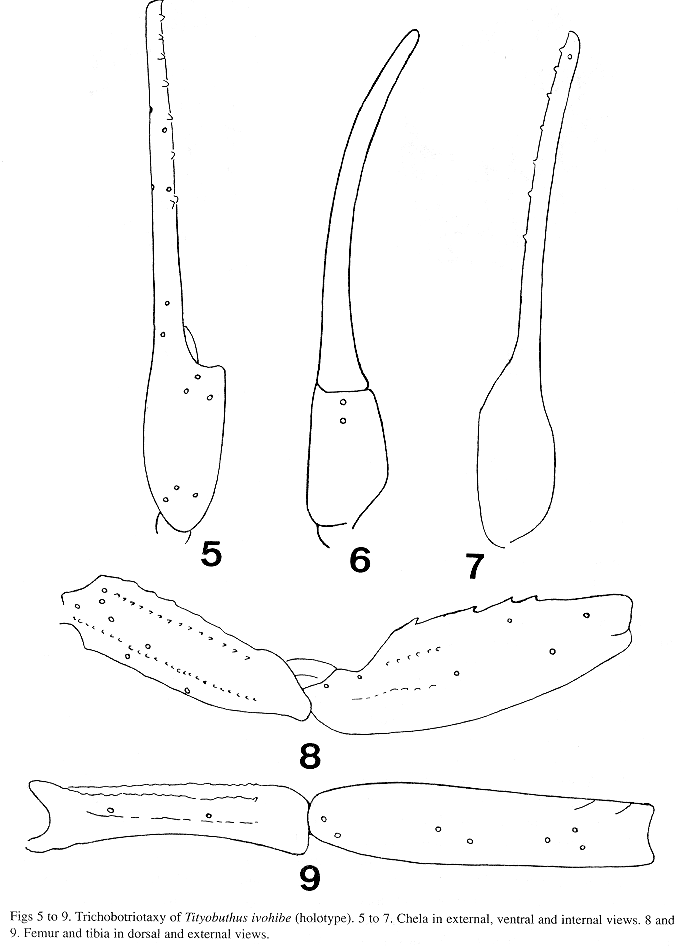
<body><![CDATA[<BR><FONT SIZE=-1>&nbsp;</FONT>     <BR><FONT SIZE=-1><FONT FACE="Arial,Helvetica">Morphology. Carapace moderately to feebly granular; anterior margin with a median concavity. Anterior median superciliary and posterior median keels moderate to feeble. All furrows moderate to feeble. Median ocular tubercle distinctly anterior to the center; median eyes separated by one ocular diameter. Three pairs of lateral eyes. Sternum subtriangular to pentagonal. Mesosoma: tergites feebly granular. Median keel moderate to feeble in all tergites. Tergite VII pentacarinate. Venter: genital operculum divided longitudinally. Pectines: pectinal tooth count 11-11; basal middle lamellae of the pectines not dilated; fulcra present. Sternites smooth with moderately elongate stigmata; VII without keels. Metasoma: segments I to III with 10 keels, crenulate. Lateral inframedian keels on segments I and II complete, crenulate; incomplet on III. Intercarinal spaces moderate to feebly granular. Segment V feebly granular, almost smooth and rounded. Telson smooth with a moderately long and moderately curved aculeus; subaculear tooth strong and spinoid. Cheliceral dentition characteristic of the genus <I>Tityobuthus</I> (<A HREF="#Vachon63">Vachon 1963</A>); ventral aspect of both finger and manus with dense, long setae. Pedipalps: femur pentacarinate; tibia and chelae with some keels but moderately crenulate; internal face of tibia with four spinoid granules; all faces moderate to feebly granular. Movable fingers with 9 oblique rows of granules; internal and external accessory granules present. Trichobothriotaxy; orthobothriotaxy A- (<A HREF="#Vachon73">Vachon 1973</A>, <A HREF="#Vachon75">1975</A>). Legs: tarsus with very numerous median fine setae ventrally. Tibial spurs present.</FONT></FONT>     <BR><FONT SIZE=-1>&nbsp;</FONT>     <BR><FONT SIZE=-1><FONT FACE="Arial,Helvetica">Paratype female: Similar to the holotype female with respect to both coloration and morphology. Pectinal tooth count 11-11. Data for female paratype, same as for the holotype. Deposited in the Mus&eacute;um National d’Histoire Naturelle, Paris.</FONT></FONT><FONT SIZE=-1></FONT>      <P><FONT SIZE=-1>&nbsp;</FONT>     <CENTER><A NAME="Fig. 3-4"></A><IMG SRC="/img/fbpe/rbt/v47n3/0555i02.GIF" HEIGHT=441 WIDTH=676></CENTER> <FONT SIZE=-1>&nbsp;</FONT><FONT SIZE=-1></FONT>      
<P><FONT SIZE=-1>&nbsp;</FONT>     <BR><FONT SIZE=-1><B><FONT FACE="Arial,Helvetica">Taxonomic position of the new species</FONT></B></FONT>     <BR><FONT SIZE=-1>&nbsp;</FONT>     <BR><FONT SIZE=-1><FONT FACE="Arial,Helvetica">According to the key presented by <A HREF="#Lourenço96">Louren&ccedil;o (1996)</A> for the various species in the genus <I>Tityobuthus</I>, the new species <I>T. ivohibe</I> appears to be most closed related to <I>T. parrilloi </I><A HREF="#Lourenço96">Louren&ccedil;o 1996</A>. This latter species is only known from the lowland humid forests of the RNI d’Andohahela in the extreme Southeastern portion of the country. The two species can, however, be readily distinguished by the following features: (i) a different pattern of pigmentation of the chelicera (see <A HREF="#Fig. 3-4">Figs 3 and 4</A>); (ii) a different pectinal tooth count: 13/14 in <I>T. parrilloi</I>, and 11 in <I>T. ivohibe</I>; (iii) metasomal segments III of <I>T. parrilloi</I> with 8 keels, whereas in the new species segment III has 10 keels; and (iv) pronounced differences in morphometric values (see <A HREF="#TABLE 1">Table I</A>).</FONT></FONT>     ]]></body>
<body><![CDATA[<BR><FONT SIZE=-1>&nbsp;</FONT><FONT SIZE=-1></FONT>      <P><FONT SIZE=-1>&nbsp;</FONT>     <CENTER><B><FONT FACE="Arial,Helvetica"><FONT SIZE=-1>&nbsp;<A NAME="TABLE 1"></A>TABLE 1</FONT></FONT></B></CENTER>      <CENTER><FONT SIZE=-1>&nbsp;</FONT></CENTER>      <CENTER><I><FONT FACE="Arial,Helvetica"><FONT SIZE=-1>Comparative morphometric measurements (in mm) of the female holotype of</FONT></FONT></I></CENTER>      <CENTER><FONT FACE="Arial,Helvetica"><FONT SIZE=-1>Tityobuthus ivohibe <I>new species and the female allotype of</I>&nbsp; T. parrilloi</FONT></FONT></CENTER>      <CENTER><FONT SIZE=-1>&nbsp;</FONT></CENTER> <FONT SIZE=-1>&nbsp;</FONT>     <CENTER><TABLE BORDER=0 CELLSPACING=0 CELLPADDING=0 COLS=3 WIDTH="70%" > <TR> <TD><FONT SIZE=-1></FONT></TD>  <TD>     <CENTER><I><FONT FACE="Arial,Helvetica"><FONT SIZE=-1>T. ivohibe</FONT></FONT></I></CENTER> </TD>  <TD>     <CENTER><I><FONT FACE="Arial,Helvetica"><FONT SIZE=-1>T. parrilloi</FONT></FONT></I></CENTER> </TD> </TR>  <TR> <TD><FONT FACE="Arial,Helvetica"><FONT SIZE=-1>Carapace:</FONT></FONT></TD>  <TD><FONT SIZE=-1></FONT></TD>  <TD><FONT SIZE=-1></FONT></TD> </TR>  <TR> <TD><FONT FACE="Arial,Helvetica"><FONT SIZE=-1>-length</FONT></FONT></TD>  <TD>     ]]></body>
<body><![CDATA[<CENTER><FONT FACE="Arial,Helvetica"><FONT SIZE=-1>3.0</FONT></FONT></CENTER> </TD>  <TD>     <CENTER><FONT FACE="Arial,Helvetica"><FONT SIZE=-1>2.2</FONT></FONT></CENTER> </TD> </TR>  <TR> <TD><FONT FACE="Arial,Helvetica"><FONT SIZE=-1>-anterior width</FONT></FONT></TD>  <TD>     <CENTER><FONT FACE="Arial,Helvetica"><FONT SIZE=-1>2.4</FONT></FONT></CENTER> </TD>  <TD>     <CENTER><FONT FACE="Arial,Helvetica"><FONT SIZE=-1>1.9</FONT></FONT></CENTER> </TD> </TR>  <TR> <TD><FONT FACE="Arial,Helvetica"><FONT SIZE=-1>-posterior width</FONT></FONT></TD>  <TD>     <CENTER><FONT FACE="Arial,Helvetica"><FONT SIZE=-1>3.3</FONT></FONT></CENTER> </TD>  <TD>     <CENTER><FONT FACE="Arial,Helvetica"><FONT SIZE=-1>2.6</FONT></FONT></CENTER> </TD> </TR>  <TR> <TD><FONT FACE="Arial,Helvetica"><FONT SIZE=-1>Metasomal segment I:</FONT></FONT></TD>  <TD><FONT SIZE=-1></FONT></TD>  <TD><FONT SIZE=-1></FONT></TD> </TR>  <TR> <TD><FONT FACE="Arial,Helvetica"><FONT SIZE=-1>-length</FONT></FONT></TD>  <TD>     <CENTER><FONT FACE="Arial,Helvetica"><FONT SIZE=-1>1.6</FONT></FONT></CENTER> </TD>  <TD>     <CENTER><FONT FACE="Arial,Helvetica"><FONT SIZE=-1>1.0</FONT></FONT></CENTER> </TD> </TR>  <TR> <TD><FONT FACE="Arial,Helvetica"><FONT SIZE=-1>-width</FONT></FONT></TD>  <TD>     <CENTER><FONT FACE="Arial,Helvetica"><FONT SIZE=-1>1.7</FONT></FONT></CENTER> </TD>  <TD>     <CENTER><FONT FACE="Arial,Helvetica"><FONT SIZE=-1>1.5</FONT></FONT></CENTER> </TD> </TR>  <TR> <TD><FONT FACE="Arial,Helvetica"><FONT SIZE=-1>Metasomal segment V:</FONT></FONT></TD>  <TD><FONT SIZE=-1></FONT></TD>  <TD><FONT SIZE=-1></FONT></TD> </TR>  <TR> <TD><FONT FACE="Arial,Helvetica"><FONT SIZE=-1>-length</FONT></FONT></TD>  <TD>     ]]></body>
<body><![CDATA[<CENTER><FONT FACE="Arial,Helvetica"><FONT SIZE=-1>3.9</FONT></FONT></CENTER> </TD>  <TD>     <CENTER><FONT FACE="Arial,Helvetica"><FONT SIZE=-1>2.9</FONT></FONT></CENTER> </TD> </TR>  <TR> <TD><FONT FACE="Arial,Helvetica"><FONT SIZE=-1>-width</FONT></FONT></TD>  <TD>     <CENTER><FONT FACE="Arial,Helvetica"><FONT SIZE=-1>1.4</FONT></FONT></CENTER> </TD>  <TD>     <CENTER><FONT FACE="Arial,Helvetica"><FONT SIZE=-1>1.2</FONT></FONT></CENTER> </TD> </TR>  <TR> <TD><FONT FACE="Arial,Helvetica"><FONT SIZE=-1>-depth</FONT></FONT></TD>  <TD>     <CENTER><FONT FACE="Arial,Helvetica"><FONT SIZE=-1>1.3</FONT></FONT></CENTER> </TD>  <TD>     <CENTER><FONT FACE="Arial,Helvetica"><FONT SIZE=-1>1.1</FONT></FONT></CENTER> </TD> </TR>  <TR> <TD><FONT FACE="Arial,Helvetica"><FONT SIZE=-1>Vesicle:</FONT></FONT></TD>  <TD><FONT SIZE=-1></FONT></TD>  <TD><FONT SIZE=-1></FONT></TD> </TR>  <TR> <TD><FONT FACE="Arial,Helvetica"><FONT SIZE=-1>-width</FONT></FONT></TD>  <TD>     <CENTER><FONT FACE="Arial,Helvetica"><FONT SIZE=-1>1.1</FONT></FONT></CENTER> </TD>  <TD>     <CENTER><FONT FACE="Arial,Helvetica"><FONT SIZE=-1>0.8</FONT></FONT></CENTER> </TD> </TR>  <TR> <TD><FONT FACE="Arial,Helvetica"><FONT SIZE=-1>-depth</FONT></FONT></TD>  <TD>     <CENTER><FONT FACE="Arial,Helvetica"><FONT SIZE=-1>1.2</FONT></FONT></CENTER> </TD>  <TD>     <CENTER><FONT FACE="Arial,Helvetica"><FONT SIZE=-1>0.9</FONT></FONT></CENTER> </TD> </TR>  <TR> <TD><FONT FACE="Arial,Helvetica"><FONT SIZE=-1>Pedipalp:</FONT></FONT></TD>  <TD><FONT SIZE=-1></FONT></TD>  <TD><FONT SIZE=-1></FONT></TD> </TR>  <TR> <TD><FONT FACE="Arial,Helvetica"><FONT SIZE=-1>-Femur length</FONT></FONT></TD>  <TD>     ]]></body>
<body><![CDATA[<CENTER><FONT FACE="Arial,Helvetica"><FONT SIZE=-1>2.8</FONT></FONT></CENTER> </TD>  <TD>     <CENTER><FONT FACE="Arial,Helvetica"><FONT SIZE=-1>2.0</FONT></FONT></CENTER> </TD> </TR>  <TR> <TD><FONT FACE="Arial,Helvetica"><FONT SIZE=-1>-Femur width</FONT></FONT></TD>  <TD>     <CENTER><FONT FACE="Arial,Helvetica"><FONT SIZE=-1>0.9</FONT></FONT></CENTER> </TD>  <TD>     <CENTER><FONT FACE="Arial,Helvetica"><FONT SIZE=-1>0.6</FONT></FONT></CENTER> </TD> </TR>  <TR> <TD><FONT FACE="Arial,Helvetica"><FONT SIZE=-1>-Tibia length</FONT></FONT></TD>  <TD>     <CENTER><FONT FACE="Arial,Helvetica"><FONT SIZE=-1>3.6</FONT></FONT></CENTER> </TD>  <TD>     <CENTER><FONT FACE="Arial,Helvetica"><FONT SIZE=-1>2.4</FONT></FONT></CENTER> </TD> </TR>  <TR> <TD><FONT FACE="Arial,Helvetica"><FONT SIZE=-1>-Tibia width</FONT></FONT></TD>  <TD>     <CENTER><FONT FACE="Arial,Helvetica"><FONT SIZE=-1>1.2</FONT></FONT></CENTER> </TD>  <TD>     <CENTER><FONT FACE="Arial,Helvetica"><FONT SIZE=-1>0.9</FONT></FONT></CENTER> </TD> </TR>  <TR> <TD><FONT FACE="Arial,Helvetica"><FONT SIZE=-1>-Chelae length</FONT></FONT></TD>  <TD>     <CENTER><FONT FACE="Arial,Helvetica"><FONT SIZE=-1>5.4</FONT></FONT></CENTER> </TD>  <TD>     <CENTER><FONT FACE="Arial,Helvetica"><FONT SIZE=-1>4.0</FONT></FONT></CENTER> </TD> </TR>  <TR> <TD><FONT FACE="Arial,Helvetica"><FONT SIZE=-1>-Chelae width</FONT></FONT></TD>  <TD>     ]]></body>
<body><![CDATA[<CENTER><FONT FACE="Arial,Helvetica"><FONT SIZE=-1>1.0</FONT></FONT></CENTER> </TD>  <TD>     <CENTER><FONT FACE="Arial,Helvetica"><FONT SIZE=-1>0.8</FONT></FONT></CENTER> </TD> </TR>  <TR> <TD><FONT FACE="Arial,Helvetica"><FONT SIZE=-1>-Chelae depth</FONT></FONT></TD>  <TD>     <CENTER><FONT FACE="Arial,Helvetica"><FONT SIZE=-1>1.0</FONT></FONT></CENTER> </TD>  <TD>     <CENTER><FONT FACE="Arial,Helvetica"><FONT SIZE=-1>0.7</FONT></FONT></CENTER> </TD> </TR>  <TR> <TD><FONT FACE="Arial,Helvetica"><FONT SIZE=-1>Movable finger:</FONT></FONT></TD>  <TD><FONT SIZE=-1></FONT></TD>  <TD><FONT SIZE=-1></FONT></TD> </TR>  <TR> <TD><FONT FACE="Arial,Helvetica"><FONT SIZE=-1>-length</FONT></FONT></TD>  <TD>     <CENTER><FONT FACE="Arial,Helvetica"><FONT SIZE=-1>3.6</FONT></FONT></CENTER> </TD>  <TD>     <CENTER><FONT FACE="Arial,Helvetica"><FONT SIZE=-1>2.9</FONT></FONT></CENTER> </TD> </TR> </TABLE></CENTER> <FONT SIZE=-1>&nbsp;</FONT>     <BR><FONT SIZE=-1>&nbsp;</FONT>     <BR><FONT SIZE=-1>&nbsp;</FONT><FONT SIZE=-1></FONT>      <P><FONT SIZE=-1><B><FONT FACE="Arial,Helvetica">Notes on the habitat of <I>Tityobuthus ivohibe</I> n. sp.</FONT></B></FONT>     <BR><FONT SIZE=-1>&nbsp;</FONT>     ]]></body>
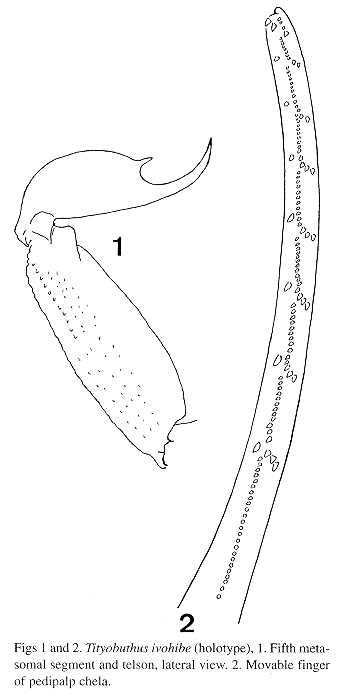
<body><![CDATA[<BR><FONT SIZE=-1><FONT FACE="Arial,Helvetica">The vegetation of the zone where <I>T. ivohibe</I> was captured at 900 m consists of largely undisturbed lowland humid forest. The site is a few hundred meters from the northwestern edge of the R&eacute;serve Sp&eacute;ciale (RS) d’Ivohibe and falls within a continuous forested corridor between this reserve and the R&eacute;serve Naturelle Int&eacute;grale (RNI) d’Andringitra to the north. In the lowland forest of the RNI d’Andringitra, at approximately the same altitude as the site at Ivohibe, the dominante large or emergent trees consist of <I>Sloanea rhodantha</I> var. <I>rhodantha</I> (Elaeocarpaceae) and <I>Canarium madagascariense</I> (Burseraceae) and the canopy and understory trees of members of the Lauraceae, Myrtaceae, Violaceae (<I>Rinorea</I>), Monimiaceae (<I>Tambourissa</I>, <I>Ephippiandra</I>, and <I>Decarydendron</I>) (<A HREF="#Lewis">Lewis <I>et al</I>. 1996</A>).</FONT></FONT>     <BR><FONT SIZE=-1>&nbsp;</FONT><FONT SIZE=-1></FONT>     <CENTER><A NAME="Fig. 5-9"></A><IMG SRC="/img/fbpe/rbt/v47n3/0555i03.GIF" HEIGHT=948 WIDTH=678><FONT SIZE=-1></FONT></CENTER> <FONT SIZE=-1>&nbsp;</FONT>     
<BR><FONT SIZE=-1>&nbsp;</FONT><FONT SIZE=-1></FONT>      <P><FONT SIZE=-1><FONT FACE="Arial,Helvetica">In the vicinity of the 900 m site at the edge of the RS d’Ivohibe, down large trees, in various stages of decay, were relatively common and soil litter or the organic layer was not extensive. During the inventory of this site, little rain fell and the upper soil layer was distinctly dry.</FONT></FONT>     <BR><FONT SIZE=-1>&nbsp;</FONT>     <BR><FONT SIZE=-1><FONT FACE="Arial,Helvetica">The intent of the 1997 inventory of the forested Ivohibe region was to assess the elevational distribution of plants and animals along a transect of the slopes of Pic Ivohibe and the importance of the forested corridor between the RS d’Ivohibe and the RNI d’Andringitra. Sites were surveyed at 900 m (just outside the reserve), at 1200 and 1575 m within the reserve, and at 900 and 1200 m in the corridor. Both 1200 m sites surveyed on Pic Ivohibe contained numerous montane elements, and was distinctly different from the 900 m sites.</FONT></FONT><FONT SIZE=-1></FONT>      <P><FONT SIZE=-1>&nbsp;</FONT><FONT SIZE=-1></FONT>     <CENTER><A NAME="Fig. 10"></A><IMG SRC="/img/fbpe/rbt/v47n3/0555i04.GIF" HEIGHT=946 WIDTH=669><FONT SIZE=-1></FONT></CENTER> <FONT SIZE=-1>&nbsp;</FONT><FONT SIZE=-1></FONT>      
<P><FONT SIZE=-1><FONT FACE="Arial,Helvetica"><I>Tityobuthus ivohibe</I> was only found at the 900 m just outside the reserve and not at any other of the sites surveyed. Further, this species was not recorded during an intensive four month inventory of the RNI d’Andringitra in 1993, although similar pitfall techniques were used. We presume that this species is relatively uncommon, or at least difficult to capture using pitfall techniques, rather than having a very limited distribution.</FONT></FONT>     ]]></body>
<body><![CDATA[<BR><FONT SIZE=-1>&nbsp;</FONT>     <BR><FONT SIZE=-1><FONT FACE="Arial,Helvetica">There is a continuous band of extant forest that runs from Pic d’Ivohibe north to the RNI d’Andringitra, and then in a northeasterly direction through the Ikongo Forest to the area surrounding the Parc National de Ranomafana. Although <I>Tityobuthus ivohibe</I> is currently only known from 900 m at the edge of the RS d’Ivohibe, we strongly suspect that it occurs in the lowland forest across this zone. This habitat type is severely threatened in the region, largely for slash and burn agricultural practices. If indeed this species is limited to lowland forest, a considerable portion of its habitat has already been destroyed.</FONT></FONT>     <BR><FONT SIZE=-1>&nbsp;</FONT>     <BR><FONT SIZE=-1>&nbsp;</FONT>     <BR><B><FONT FACE="Arial,Helvetica"><FONT SIZE=-1>Acknowledgements</FONT></FONT></B>     <BR><B><FONT FACE="Arial,Helvetica"><FONT SIZE=-1>&nbsp;</FONT></FONT></B>     <BR><FONT SIZE=-1><FONT FACE="Arial,Helvetica">Permits to conduct these inventories were kindly granted by the Direction des Eaux et For&ecirc;ts and Association National pour la Gestion des Aires Prot&eacute;g&eacute;es. To officials of these organizations we are grateful. The inventory of the Ivohibe Forest was in the context of a WWF integrated conservation and development project in the Andringitra/Ivohibe region and we benefited enormously by the aid of colleagues based in Ambalavao. The field study at the For&ecirc;t d’Ankazomivady was financed by a grant from the John D. and Catherine T. MacArthur Foundation.</FONT></FONT>     <BR><FONT SIZE=-1>&nbsp;</FONT><FONT FACE="Arial,Helvetica"><FONT SIZE=-1></FONT></FONT>      <P><B><FONT FACE="Arial,Helvetica"><FONT SIZE=-1>References</FONT></FONT></B><FONT SIZE=-1></FONT>      <!-- ref --><P><A NAME="Lewis"></A><FONT SIZE=-1><FONT FACE="Arial,Helvetica">Lewis, B.A., P.B. Phillipson, M. Andrianarisata, G. Rahajasoa, P.J. Rakotomalaza, M. Randriambololona &amp; J.F. McDonagh, 1996. A study of the botanical structure, composition, and diversity of the eastern slopes of the R&eacute;serve Naturelle Int&eacute;grale d’Andringitra, Madagascar, pp. 24-72. <I>In</I>: Goodman, S. M., ed., A flora and fauna inventory of the eastern slopes of the R&eacute;serve Naturelle Int&eacute;grale d’Andringitra, Madagascar: with reference to elevational variation. Fieldiana: Zoology, new series, N&deg; 85.</FONT></FONT>    &nbsp;&nbsp;&nbsp;&nbsp;&nbsp;&nbsp;&nbsp;&nbsp;[&#160;<a href="javascript:void(0);" onclick="javascript: window.open('/scielo.php?script=sci_nlinks&ref=1311312&pid=S0034-7744199900030002000001&lng=','','width=640,height=500,resizable=yes,scrollbars=1,menubar=yes,');">Links</a>&#160;]<!-- end-ref --><BR><FONT SIZE=-1>&nbsp;</FONT>     <!-- ref --><BR><A NAME="Lourenço93"></A><FONT SIZE=-1><FONT FACE="Arial,Helvetica">Louren&ccedil;o, W.R., 1993. A review of the geographical distribution of the genus <I>Ananteris</I> Thorell (Scorpiones: Buthidae), with description of a new species. Rev. Biol. Trop., 41(3): 697-701.</FONT></FONT>    &nbsp;&nbsp;&nbsp;&nbsp;&nbsp;&nbsp;&nbsp;&nbsp;[&#160;<a href="javascript:void(0);" onclick="javascript: window.open('/scielo.php?script=sci_nlinks&ref=1311314&pid=S0034-7744199900030002000002&lng=','','width=640,height=500,resizable=yes,scrollbars=1,menubar=yes,');">Links</a>&#160;]<!-- end-ref --><BR><FONT SIZE=-1>&nbsp;</FONT>     <!-- ref --><BR><A NAME="Lourenço94"></A><FONT SIZE=-1><FONT FACE="Arial,Helvetica">Louren&ccedil;o, W.R., 1994. Scorpions (Chelicerata) de Colombie. VI. Quatre nouvelles esp&egrave;ces de Buthidae des regions amazonienne, sud-pacifique et de la cordill&egrave;re orientale. Rev. Acad. Colomb. Cienc.,<I> </I>19 (73): 387-392.</FONT></FONT>    &nbsp;&nbsp;&nbsp;&nbsp;&nbsp;&nbsp;&nbsp;&nbsp;[&#160;<a href="javascript:void(0);" onclick="javascript: window.open('/scielo.php?script=sci_nlinks&ref=1311316&pid=S0034-7744199900030002000003&lng=','','width=640,height=500,resizable=yes,scrollbars=1,menubar=yes,');">Links</a>&#160;]<!-- end-ref --><BR><FONT SIZE=-1>&nbsp;</FONT>     <!-- ref --><BR><A NAME="Lourenço96"></A><FONT SIZE=-1><FONT FACE="Arial,Helvetica">Louren&ccedil;o, W.R., 1996. Scorpions. <I>In</I>: Faune de Madagascar. N 87. Mus&eacute;um national d’Histoire naturelle, Paris: 102 pp.</FONT></FONT>    &nbsp;&nbsp;&nbsp;&nbsp;&nbsp;&nbsp;&nbsp;&nbsp;[&#160;<a href="javascript:void(0);" onclick="javascript: window.open('/scielo.php?script=sci_nlinks&ref=1311318&pid=S0034-7744199900030002000004&lng=','','width=640,height=500,resizable=yes,scrollbars=1,menubar=yes,');">Links</a>&#160;]<!-- end-ref --><BR><FONT SIZE=-1>&nbsp;</FONT>     <!-- ref --><BR><A NAME="Lourenço97"></A><FONT SIZE=-1><FONT FACE="Arial,Helvetica">Louren&ccedil;o, W.R., 1997. Another new species of <I>Tityobuthus</I> from Madagascar (Scorpiones, Buthidae). Entomol. Mitt. zool. Mus. Hamburg, 12 (155): 147-151.</FONT></FONT>    &nbsp;&nbsp;&nbsp;&nbsp;&nbsp;&nbsp;&nbsp;&nbsp;[&#160;<a href="javascript:void(0);" onclick="javascript: window.open('/scielo.php?script=sci_nlinks&ref=1311320&pid=S0034-7744199900030002000005&lng=','','width=640,height=500,resizable=yes,scrollbars=1,menubar=yes,');">Links</a>&#160;]<!-- end-ref --><BR><FONT SIZE=-1>&nbsp;</FONT>     <!-- ref --><BR><A NAME="Lourenço98"></A><FONT SIZE=-1><FONT FACE="Arial,Helvetica">Louren&ccedil;o, W.R., 1998. Description of a new species of scorpion from the R&eacute;serve Sp&eacute;ciale d’Anjanaharibe-Sud, Madagascar, pp. 69-72. <I>In</I>: Goodman, S.M., ed., A floral and faunal inventory of the R&eacute;serve Sp&eacute;ciale d’Anjanaharibe-Sud, Madagascar: with reference to elevational variation. Fieldiana: Zoology, new series, N 90.</FONT></FONT>    &nbsp;&nbsp;&nbsp;&nbsp;&nbsp;&nbsp;&nbsp;&nbsp;[&#160;<a href="javascript:void(0);" onclick="javascript: window.open('/scielo.php?script=sci_nlinks&ref=1311322&pid=S0034-7744199900030002000006&lng=','','width=640,height=500,resizable=yes,scrollbars=1,menubar=yes,');">Links</a>&#160;]<!-- end-ref --><BR><FONT SIZE=-1>&nbsp;</FONT>     <!-- ref --><BR><A NAME="Lourenço(press)"></A><FONT SIZE=-1><FONT FACE="Arial,Helvetica">Louren&ccedil;o, W.R. &amp; S. M. Goodman (in press). Taxonomic and ecological observations on the scorpions collected in the R&eacute;serve Naturelle Int&eacute;grale d’Andohahela, Madagascar. Fieldiana: Zoology, new series. 94: 149-153.</FONT></FONT>    &nbsp;&nbsp;&nbsp;&nbsp;&nbsp;&nbsp;&nbsp;&nbsp;[&#160;<a href="javascript:void(0);" onclick="javascript: window.open('/scielo.php?script=sci_nlinks&ref=1311324&pid=S0034-7744199900030002000007&lng=','','width=640,height=500,resizable=yes,scrollbars=1,menubar=yes,');">Links</a>&#160;]<!-- end-ref --><BR><FONT SIZE=-1>&nbsp;</FONT>     <!-- ref --><BR><A NAME="Vachon63"></A><FONT SIZE=-1><FONT FACE="Arial,Helvetica">Vachon, M., 1963. De l'utilit&eacute;, en syst&eacute;matique, d'une nomenclature des dents des ch&eacute;lic&egrave;res chez les Scorpions. Bull. Mus. natn. Hist. nat., Paris 2&egrave; s&eacute;r., 35(2): 161-166.</FONT></FONT>    &nbsp;&nbsp;&nbsp;&nbsp;&nbsp;&nbsp;&nbsp;&nbsp;[&#160;<a href="javascript:void(0);" onclick="javascript: window.open('/scielo.php?script=sci_nlinks&ref=1311326&pid=S0034-7744199900030002000008&lng=','','width=640,height=500,resizable=yes,scrollbars=1,menubar=yes,');">Links</a>&#160;]<!-- end-ref --><BR><FONT SIZE=-1>&nbsp;</FONT>     <!-- ref --><BR><A NAME="Vachon73"></A><FONT SIZE=-1><FONT FACE="Arial,Helvetica">Vachon, M., 1973. Etude des caract&egrave;res utilis&eacute;s pour classer les familles et les genres de Scorpions (Arachnides). 1. La trichobothriotaxie en arachnologie. Sigles trichobothriaux et types de trichobothriotaxie chez les Scorpions. Bull. Mus. natn. Hist. nat., Paris, 3&egrave; s&eacute;r., n 140, Zool., 104: 857-958.</FONT></FONT>    &nbsp;&nbsp;&nbsp;&nbsp;&nbsp;&nbsp;&nbsp;&nbsp;[&#160;<a href="javascript:void(0);" onclick="javascript: window.open('/scielo.php?script=sci_nlinks&ref=1311328&pid=S0034-7744199900030002000009&lng=','','width=640,height=500,resizable=yes,scrollbars=1,menubar=yes,');">Links</a>&#160;]<!-- end-ref --><BR><FONT SIZE=-1>&nbsp;</FONT>     <!-- ref --><BR><A NAME="Vachon75"></A><FONT SIZE=-1><FONT FACE="Arial,Helvetica">Vachon, M., 1975. Sur l'utilisation de la trichobothriotaxie du bras des p&eacute;dipalpes des Scorpions (Arachnides) dans le classement des genres de la famille des Buthidae Simon. C.R. s&eacute;an. Acad. sci., Paris, s&eacute;r. D, 281: 1597-1599.</FONT></FONT>    &nbsp;&nbsp;&nbsp;&nbsp;&nbsp;&nbsp;&nbsp;&nbsp;[&#160;<a href="javascript:void(0);" onclick="javascript: window.open('/scielo.php?script=sci_nlinks&ref=1311330&pid=S0034-7744199900030002000010&lng=','','width=640,height=500,resizable=yes,scrollbars=1,menubar=yes,');">Links</a>&#160;]<!-- end-ref --><BR><FONT SIZE=-1>&nbsp;</FONT>     <!-- ref --><BR><A NAME="Voss96"></A><FONT FACE="Arial,Helvetica"><FONT SIZE=-1>Voss, R.S. &amp; L.H. Emmons, 1996. Mammalian diversity in Neotropical lowland rainforests: a preliminary assessment. Bulletin of the American Museum of Natural History, 230: 1-115.</FONT></FONT>    &nbsp;&nbsp;&nbsp;&nbsp;&nbsp;&nbsp;&nbsp;&nbsp;[&#160;<a href="javascript:void(0);" onclick="javascript: window.open('/scielo.php?script=sci_nlinks&ref=1311332&pid=S0034-7744199900030002000011&lng=','','width=640,height=500,resizable=yes,scrollbars=1,menubar=yes,');">Links</a>&#160;]<!-- end-ref --><BR><FONT FACE="Arial,Helvetica"><FONT SIZE=-1></FONT></FONT>&nbsp;     <BR><FONT FACE="Arial,Helvetica"><FONT SIZE=-1></FONT></FONT>&nbsp;     <DIV class="MsoNormal"><A NAME="*"></A><FONT FACE="Arial,Helvetica"><FONT SIZE=-1><A HREF="#*a">*</A> Laboratoire de Zoologie (Arthropodes), M.N.H.N., 61 rue de Buffon 75005, Paris, France: e-mail. <A HREF="mailto:arachne@mnhn.fr">arachne@mnhn.fr</A></FONT></FONT>     <BR><FONT FACE="Arial,Helvetica"><FONT SIZE=-1><A HREF="mailto:arachne@mnhn.fr"></A></FONT></FONT>&nbsp;</DIV> <A NAME="**"></A><FONT SIZE=-1><FONT FACE="Arial,Helvetica"><A HREF="#*a">**</A> Field Museum of Natural History, Roosevelt Road at Lake Shore Drive, Chicago, Illinois 60605, U.S.A., and WWF, BP 738, Antananarivo (101) Madagascar.</FONT></FONT></DIV>       ]]></body><back>
<ref-list>
<ref id="B1">
<nlm-citation citation-type="">
<person-group person-group-type="author">
<name>
<surname><![CDATA[Lewis]]></surname>
<given-names><![CDATA[B.A.]]></given-names>
</name>
<name>
<surname><![CDATA[Phillipson]]></surname>
<given-names><![CDATA[P.B.]]></given-names>
</name>
<name>
<surname><![CDATA[Andrianarisata]]></surname>
<given-names><![CDATA[M.]]></given-names>
</name>
<name>
<surname><![CDATA[Rahajasoa]]></surname>
<given-names><![CDATA[G.]]></given-names>
</name>
<name>
<surname><![CDATA[Rakotomalaza]]></surname>
<given-names><![CDATA[P.J.]]></given-names>
</name>
<name>
<surname><![CDATA[Randriambololona]]></surname>
<given-names><![CDATA[M.]]></given-names>
</name>
<name>
<surname><![CDATA[McDonagh]]></surname>
<given-names><![CDATA[J.F.]]></given-names>
</name>
</person-group>
<article-title xml:lang="en"><![CDATA[A study of the botanical structure, composition, and diversity of the eastern slopes of the Réserve Naturelle Intégrale d’Andringitra, Madagascar]]></article-title>
<person-group person-group-type="editor">
<name>
<surname><![CDATA[Goodman]]></surname>
<given-names><![CDATA[S. M.]]></given-names>
</name>
</person-group>
<source><![CDATA[A flora and fauna inventory of the eastern slopes of the Réserve Naturelle Intégrale d’Andringitra, Madagascar: with reference to elevational variation]]></source>
<year>1996</year>
<volume>85</volume>
<page-range>24-72</page-range></nlm-citation>
</ref>
<ref id="B2">
<nlm-citation citation-type="journal">
<person-group person-group-type="author">
<name>
<surname><![CDATA[Lourenço]]></surname>
<given-names><![CDATA[W.R.]]></given-names>
</name>
</person-group>
<article-title xml:lang="en"><![CDATA[A review of the geographical distribution of the genus Ananteris Thorell (Scorpiones: Buthidae), with description of a new species]]></article-title>
<source><![CDATA[Rev. Biol. Trop.]]></source>
<year>1993</year>
<volume>41</volume>
<numero>^s3</numero>
<issue>^s3</issue>
<supplement>3</supplement>
<page-range>697-701</page-range></nlm-citation>
</ref>
<ref id="B3">
<nlm-citation citation-type="journal">
<person-group person-group-type="author">
<name>
<surname><![CDATA[Lourenço]]></surname>
<given-names><![CDATA[W.R.]]></given-names>
</name>
</person-group>
<article-title xml:lang="en"><![CDATA[Scorpions (Chelicerata) de Colombie: VI. Quatre nouvelles espèces de Buthidae des regions amazonienne, sud-pacifique et de la cordillère orientale]]></article-title>
<source><![CDATA[Rev. Acad. Colomb. Cienc.]]></source>
<year>1994</year>
<volume>19</volume>
<numero>^s73</numero>
<issue>^s73</issue>
<supplement>73</supplement>
<page-range>387-392</page-range></nlm-citation>
</ref>
<ref id="B4">
<nlm-citation citation-type="book">
<person-group person-group-type="author">
<name>
<surname><![CDATA[Lourenço]]></surname>
<given-names><![CDATA[W.R.]]></given-names>
</name>
</person-group>
<article-title xml:lang="en"><![CDATA[Scorpions]]></article-title>
<source><![CDATA[Faune de Madagascar]]></source>
<year>1996</year>
<volume>87</volume>
<page-range>102</page-range><publisher-loc><![CDATA[Paris ]]></publisher-loc>
<publisher-name><![CDATA[Muséum national d’Histoire naturelle]]></publisher-name>
</nlm-citation>
</ref>
<ref id="B5">
<nlm-citation citation-type="journal">
<person-group person-group-type="author">
<name>
<surname><![CDATA[Lourenço]]></surname>
<given-names><![CDATA[W.R.]]></given-names>
</name>
</person-group>
<article-title xml:lang="en"><![CDATA[Another new species of Tityobuthus from Madagascar (Scorpiones, Buthidae)]]></article-title>
<source><![CDATA[Entomol. Mitt. zool. Mus. Hamburg]]></source>
<year>1997</year>
<volume>12</volume>
<numero>^s155</numero>
<issue>^s155</issue>
<supplement>155</supplement>
<page-range>147-151</page-range></nlm-citation>
</ref>
<ref id="B6">
<nlm-citation citation-type="">
<person-group person-group-type="author">
<name>
<surname><![CDATA[Lourenço]]></surname>
<given-names><![CDATA[W.R.]]></given-names>
</name>
</person-group>
<article-title xml:lang="en"><![CDATA[Description of a new species of scorpion from the Réserve Spéciale d’Anjanaharibe-Sud, Madagascar]]></article-title>
<person-group person-group-type="editor">
<name>
<surname><![CDATA[Goodman]]></surname>
<given-names><![CDATA[S.M.]]></given-names>
</name>
</person-group>
<source><![CDATA[A floral and faunal inventory of the Réserve Spéciale d’Anjanaharibe-Sud, Madagascar: with reference to elevational variation]]></source>
<year>1998</year>
<volume>90</volume>
<page-range>69-72</page-range></nlm-citation>
</ref>
<ref id="B7">
<nlm-citation citation-type="journal">
<person-group person-group-type="author">
<name>
<surname><![CDATA[Lourenço]]></surname>
<given-names><![CDATA[W.R.]]></given-names>
</name>
<name>
<surname><![CDATA[Goodman]]></surname>
<given-names><![CDATA[S. M.]]></given-names>
</name>
</person-group>
<article-title xml:lang="en"><![CDATA[Taxonomic and ecological observations on the scorpions collected in the Réserve Naturelle Intégrale d’Andohahela, Madagascar]]></article-title>
<source><![CDATA[Fieldiana: Zoology, new series]]></source>
<year></year>
<volume>94</volume>
<page-range>149-153</page-range></nlm-citation>
</ref>
<ref id="B8">
<nlm-citation citation-type="journal">
<person-group person-group-type="author">
<name>
<surname><![CDATA[Vachon]]></surname>
<given-names><![CDATA[M.]]></given-names>
</name>
</person-group>
<article-title xml:lang="fr"><![CDATA[De l'utilité, en systématique, d'une nomenclature des dents des chélicères chez les Scorpions]]></article-title>
<source><![CDATA[Bull. Mus. natn. Hist. nat.]]></source>
<year>1963</year>
<volume>35</volume>
<numero>^s2</numero>
<issue>^s2</issue>
<supplement>2</supplement>
<page-range>161-166</page-range></nlm-citation>
</ref>
<ref id="B9">
<nlm-citation citation-type="journal">
<person-group person-group-type="author">
<name>
<surname><![CDATA[Vachon]]></surname>
<given-names><![CDATA[M.]]></given-names>
</name>
</person-group>
<article-title xml:lang="fr"><![CDATA[Etude des caractères utilisés pour classer les familles et les genres de Scorpions (Arachnides). 1. La trichobothriotaxie en arachnologie. Sigles trichobothriaux et types de trichobothriotaxie chez les Scorpions]]></article-title>
<source><![CDATA[Bull. Mus. natn. Hist. nat.]]></source>
<year>1973</year>
<volume>104</volume>
<page-range>857-958</page-range></nlm-citation>
</ref>
<ref id="B10">
<nlm-citation citation-type="journal">
<person-group person-group-type="author">
<name>
<surname><![CDATA[Vachon]]></surname>
<given-names><![CDATA[M.]]></given-names>
</name>
</person-group>
<article-title xml:lang="fr"><![CDATA[Sur l'utilisation de la trichobothriotaxie du bras des pédipalpes des Scorpions (Arachnides) dans le classement des genres de la famille des Buthidae Simon]]></article-title>
<source><![CDATA[C.R. séan. Acad. sci.]]></source>
<year></year>
<volume>281</volume>
<page-range>1597-1599</page-range></nlm-citation>
</ref>
<ref id="B11">
<nlm-citation citation-type="journal">
<person-group person-group-type="author">
<name>
<surname><![CDATA[Voss]]></surname>
<given-names><![CDATA[R.S.]]></given-names>
</name>
<name>
<surname><![CDATA[Emmons]]></surname>
<given-names><![CDATA[L.H.]]></given-names>
</name>
</person-group>
<article-title xml:lang="en"><![CDATA[Mammalian diversity in Neotropical lowland rainforests: a preliminary assessment]]></article-title>
<source><![CDATA[Bulletin of the American Museum of Natural History]]></source>
<year>1996</year>
<volume>230</volume>
<page-range>1-115</page-range></nlm-citation>
</ref>
</ref-list>
</back>
</article>