<?xml version="1.0" encoding="ISO-8859-1"?><article xmlns:mml="http://www.w3.org/1998/Math/MathML" xmlns:xlink="http://www.w3.org/1999/xlink" xmlns:xsi="http://www.w3.org/2001/XMLSchema-instance">
<front>
<journal-meta>
<journal-id>0034-7744</journal-id>
<journal-title><![CDATA[Revista de Biología Tropical]]></journal-title>
<abbrev-journal-title><![CDATA[Rev. biol. trop]]></abbrev-journal-title>
<issn>0034-7744</issn>
<publisher>
<publisher-name><![CDATA[Universidad de Costa Rica]]></publisher-name>
</publisher>
</journal-meta>
<article-meta>
<article-id>S0034-77441999000300017</article-id>
<title-group>
<article-title xml:lang="es"><![CDATA[Efecto de la macroalga Caulerpa sertularioides en el desarrollo del camarón Penaeus californiensis (Decapoda: Peneidae)]]></article-title>
</title-group>
<contrib-group>
<contrib contrib-type="author">
<name>
<surname><![CDATA[Porchas Cornejo]]></surname>
<given-names><![CDATA[Marco Antonio]]></given-names>
</name>
<xref ref-type="aff" rid="A01"/>
</contrib>
<contrib contrib-type="author">
<name>
<surname><![CDATA[Martínez Córdova]]></surname>
<given-names><![CDATA[Luis]]></given-names>
</name>
<xref ref-type="aff" rid="A02"/>
</contrib>
<contrib contrib-type="author">
<name>
<surname><![CDATA[Magallón Barajas]]></surname>
<given-names><![CDATA[Francisco]]></given-names>
</name>
<xref ref-type="aff" rid="A03"/>
</contrib>
<contrib contrib-type="author">
<name>
<surname><![CDATA[Naranjo Páramo]]></surname>
<given-names><![CDATA[José]]></given-names>
</name>
<xref ref-type="aff" rid="A01"/>
</contrib>
<contrib contrib-type="author">
<name>
<surname><![CDATA[Portillo Clark]]></surname>
<given-names><![CDATA[Guillermo]]></given-names>
</name>
<xref ref-type="aff" rid="A03"/>
</contrib>
</contrib-group>
<aff id="A01">
<institution><![CDATA[,Centro de Investigaciones Biológicas del Noroeste Centro de Investigaciones Biológicas del Noroeste ]]></institution>
<addr-line><![CDATA[ Sonora]]></addr-line>
<country>México</country>
</aff>
<aff id="A02">
<institution><![CDATA[,Universidad de Sonora Departamento DICTUS ]]></institution>
<addr-line><![CDATA[ Sonora]]></addr-line>
<country>México</country>
</aff>
<aff id="A03">
<institution><![CDATA[,Centro de Investigaciones Biológicas del Noroeste  ]]></institution>
<addr-line><![CDATA[ ]]></addr-line>
<country>México</country>
</aff>
<pub-date pub-type="pub">
<day>00</day>
<month>09</month>
<year>1999</year>
</pub-date>
<pub-date pub-type="epub">
<day>00</day>
<month>09</month>
<year>1999</year>
</pub-date>
<volume>47</volume>
<numero>3</numero>
<fpage>437</fpage>
<lpage>442</lpage>
<copyright-statement/>
<copyright-year/>
<self-uri xlink:href="http://www.scielo.sa.cr/scielo.php?script=sci_arttext&amp;pid=S0034-77441999000300017&amp;lng=en&amp;nrm=iso"></self-uri><self-uri xlink:href="http://www.scielo.sa.cr/scielo.php?script=sci_abstract&amp;pid=S0034-77441999000300017&amp;lng=en&amp;nrm=iso"></self-uri><self-uri xlink:href="http://www.scielo.sa.cr/scielo.php?script=sci_pdf&amp;pid=S0034-77441999000300017&amp;lng=en&amp;nrm=iso"></self-uri><abstract abstract-type="short" xml:lang="en"><p><![CDATA[The effect of the macroalga Caulerpa sertularioides on the growth, survival and yield of captive yellowleg shrimp Penaeus californiensis (Holmes, 1900) at winter temperatures (14 to 21°C) was studied at La Paz, B.C.S., México. Nine experimental units (three per treatment) consisting in 150 l-fiberglass tanks were used. Shrimp growth with macroalgal presence was 3.98 ± 0.4 g after 10 weeks, survival was 100% and yield 36.24 ± 4.3 g. These results were better than those obtained with indirect presence, and absence of the macroalga, which were not different among themselves. Under indirect macroalgal presence growth, survival and yield were 0.73 ± 0.4 g, 75± 10% and 7.8 ± 1.2 g. Without macroalgae, corresponding values were 0.46 ± 0.4 g, 68.7 ± 12% and 5.6 ±1.1 g. Significant differences were found between "absence" and "indirect presence". The macroalgae possitively affect the development of this shrimp in captivity.]]></p></abstract>
<abstract abstract-type="short" xml:lang="es"><p><![CDATA[El efecto de la macroalga Caulerpa sertularioides sobre el crecimiento, sobrevivencia y producción en cautiverio del camarón café Penaeus californiensis (Holmes, 1900) a temperaturas invernales (14 a 21°C) se estudió en La Paz, B.C.S., México. Se utilizaron nueve unidades experimentales (Tres por el tratamiento) consistiendo en tanques plásticos de150 l de capacidad. El crecimiento del camarón con la presencia directa de la macroalga fue de 3.98 ± 0.4 g después de 10 semanas de cultivo, la sobrevivencia fue del 100 % y el rendimiento de 36.24 ± 4.3 g. Estos resultados fueron significativamente más altos que los obtenidos en presencia indirecta, y en ausencia de la macroalga, los cuales no presentaron diferencias significativas entre sí. El crecimiento, sobrevivencia y producción en la presencia indirecta de la macroalga fueron de 0.73 ± 0.4 g, 75± 10% and 7.8 + 1.2 g respectivamente. En ausencia de la macroalga, se obtuvieron valores de 0.46 ± 0.4 g, 68.7 ± 12% y 5.6 ±1.1 g. La presencia directa de la macroalga tiene un efecto positivo y significativo en el desarrollo del camarón café en cautiverio.]]></p></abstract>
<kwd-group>
<kwd lng="en"><![CDATA[Yellowleg shrimp]]></kwd>
<kwd lng="la"><![CDATA[Penaeus californiensis]]></kwd>
<kwd lng="en"><![CDATA[Macroalgae]]></kwd>
<kwd lng="la"><![CDATA[Caulerpa sertularioides]]></kwd>
<kwd lng="en"><![CDATA[shrimp mariculture]]></kwd>
<kwd lng="en"><![CDATA[Mexico]]></kwd>
</kwd-group>
</article-meta>
</front><body><![CDATA[ <CENTER><B><FONT FACE="Arial,Helvetica">Efecto de la macroalga <I>Caulerpa sertularioides</I> en el desarrollo del camar&oacute;n</FONT></B></CENTER>      <CENTER><B><FONT FACE="Arial,Helvetica"><I>Penaeus californiensis </I>(Decapoda: Peneidae)</FONT></B></CENTER> <FONT FACE="Arial,Helvetica"><FONT SIZE=-1>&nbsp;</FONT></FONT>     <BR><FONT FACE="Arial,Helvetica"><FONT SIZE=-1>&nbsp;</FONT></FONT>     <CENTER><B><FONT FACE="Arial,Helvetica"><FONT SIZE=-1>Marco Antonio Porchas Cornejo<A NAME="1a"></A><SUP><A HREF="#1">1</A></SUP>, Luis Mart&iacute;nez C&oacute;rdova<SUP><A HREF="#2">2</A></SUP>, Francisco Magall&oacute;n Barajas<SUP><A HREF="#3">3</A></SUP>,</FONT></FONT></B></CENTER>      <CENTER><B><FONT FACE="Arial,Helvetica"><FONT SIZE=-1>Jos&eacute; Naranjo P&aacute;ramo<SUP><A HREF="#1">1</A></SUP> y Guillermo Portillo Clark<SUP><A HREF="#3">3</A></SUP></FONT></FONT></B></CENTER>      <CENTER>&nbsp;</CENTER>      <CENTER>&nbsp;</CENTER> &nbsp;      <P><FONT FACE="Arial,Helvetica"><FONT SIZE=-1>&nbsp;</FONT></FONT>     <CENTER><FONT FACE="Arial,Helvetica"><FONT SIZE=-1>Recibido 25-VIII-1998. Corregido 26-I-1999. Aceptado 2-II-1999.</FONT></FONT></CENTER> <FONT FACE="Arial,Helvetica"><FONT SIZE=-1>&nbsp;</FONT></FONT>      <P><B><FONT FACE="Arial,Helvetica"><FONT SIZE=-1>Abstract</FONT></FONT></B>      ]]></body>
<body><![CDATA[<P><FONT FACE="Arial,Helvetica"><FONT SIZE=-1>The effect of the macroalga <I>Caulerpa sertularioides</I> on the growth, survival and yield of captive yellowleg shrimp <I>Penaeus californiensis</I> (Holmes, 1900) at winter temperatures (14 to 21&deg;C) was studied at La Paz, B.C.S., M&eacute;xico. Nine experimental units (three per treatment) consisting in 150 l-fiberglass tanks were used. Shrimp growth with macroalgal presence was 3.98 &plusmn; 0.4 g after 10 weeks, survival was 100% and yield 36.24 &plusmn; 4.3 g. These results were better than those obtained with indirect presence, and absence of the macroalga, which were not different among themselves. Under indirect macroalgal presence growth, survival and yield were 0.73 &plusmn; 0.4 g, 75&plusmn; 10% and 7.8 &plusmn; 1.2 g. Without macroalgae, corresponding values were 0.46 &plusmn; 0.4 g, 68.7 &plusmn; 12% and 5.6 &plusmn;1.1 g. Significant differences were found between "absence" and "indirect presence". The macroalgae possitively affect the development of this shrimp in captivity.</FONT></FONT>      <P><B><FONT FACE="Arial,Helvetica"><FONT SIZE=-1>Key words</FONT></FONT></B>      <P><FONT FACE="Arial,Helvetica"><FONT SIZE=-1>Yellowleg shrimp, <I>Penaeus californiensis</I>, Macroalgae, <I>Caulerpa sertularioides</I>, shrimp mariculture, Mexico.</FONT></FONT>      <P><FONT FACE="Arial,Helvetica"><FONT SIZE=-1>&nbsp;</FONT></FONT>     <BR><FONT FACE="Arial,Helvetica"><FONT SIZE=-1>El camar&oacute;n caf&eacute; <I>Penaeus californiensis</I> (Holmes, 1900) es una especie nativa del Pac&iacute;fico mexicano, que se distribuye desde la Bah&iacute;a de San Francisco en EEUU hasta las costas del Per&uacute;, incluyendo la totalidad del Golfo de California e Islas Gal&aacute;pagos (<A HREF="#Hendrickx86">Hendrickx 1986</A>, <A HREF="#Hendrickx96">1996)</A>. Esta especie constituye la base de las pesquer&iacute;as de camar&oacute;n del Pac&iacute;fico Mexicano, junto con el camar&oacute;n blanco <I>Penaeus vannamei</I> y el camar&oacute;n azul <I>Penaeus stylirostris</I>. El camar&oacute;n caf&eacute; esta siendo objeto de estudio como una especie potencial para cultivo en zonas semitropicales y templadas, debido a su capacidad de poder crecer a bajas temperaturas (<A HREF="#Magallón">Magall&oacute;n <I>et al.</I> 1994</A>). Desde principios de la d&eacute;cada de los setentas, el Centro de Investigaciones Cient&iacute;ficas y Tecnol&oacute;gicas de la Universidad de Sonora, llev&oacute; a cabo una serie de estudios que finalmente condujeron a la creaci&oacute;n de tecnolog&iacute;as para el cultivo de camarones peneidos. Estos estudios se encuentran resumidos en dos libros publicados (<A HREF="#Anónimo">An&oacute;nimo 1984</A>, <A HREF="#Martínez">Mart&iacute;nez 1994</A>). La primera de las especies probadas fue el camar&oacute;n caf&eacute;. Posteriormente esta especie fue sustituida por el camar&oacute;n azul, debido principalmente a razones de tipo econ&oacute;mico, por el mejor precio de este &uacute;ltimo en el mercado internacional. Sin embargo las especies tropicales y subtropicales como el camar&oacute;n blanco y camar&oacute;n azul, solamente pueden ser cultivadas a temperaturas superiores a los 20 o 22 &deg;C.</FONT></FONT>      <P><FONT FACE="Arial,Helvetica"><FONT SIZE=-1>En M&eacute;xico, la camaronicultura se est&aacute; desarrollando principalmente en la regi&oacute;n noroeste, sobre todo en los estados de Sinaloa, Sonora, Nayarit y Baja California Sur. Esta es una regi&oacute;n semi&aacute;rida con un r&eacute;gimen extremoso de temperaturas. Espec&iacute;ficamente en los estados de Sonora, Baja California Sur y norte de Sinaloa, se presentan temperaturas superiores a los 20 &deg;C, solamente de mediados de marzo a mediados de noviembre. Esto significa que de cuatro a cinco meses de a&ntilde;o no son aptos para el cultivo de las especies tropicales, y por lo tanto, en las granjas que se est&aacute;n cultivando estas especies, las instalaciones permanecen ociosas durante ese tiempo, con la consiguiente repercusi&oacute;n en la rentabilidad del cultivo.</FONT></FONT>      <P><FONT FACE="Arial,Helvetica"><FONT SIZE=-1>Es por ello que se ha vuelto la atenci&oacute;n hacia otras especies que sean m&aacute;s tolerantes a las bajas temperaturas y que puedan ser cultivadas en la &eacute;poca invernal en esas regiones. El camar&oacute;n caf&eacute; ya ha sido cultivado a nivel experimental a bajas temperaturas obteni&eacute;ndose crecimientos, que si bien no son tan buenos como el de las especies tropicales en las &eacute;pocas c&aacute;lidas, s&iacute; superan a estos en la &eacute;poca invernal (<A HREF="#Campos">Campos <I>et al.</I> 1994</A>, <A HREF="#Magallón">Magall&oacute;n <I>et al.</I> 1994</A>). Inclusive recientemente se ha llevado a cabo un cultivo comercial de esta especie con resultados promisorios (<A HREF="#Figueroa">Figueroa 1996</A>).</FONT></FONT>      <P><FONT FACE="Arial,Helvetica"><FONT SIZE=-1>El objetivo ahora es llevar estudios sistem&aacute;ticos tendientes a optimizar la tecnolog&iacute;a de cultivo de esta especie. Uno de los aspectos prioritarios es lograr mejores tasas de crecimiento en la &eacute;poca invernal.</FONT></FONT>      <P><FONT FACE="Arial,Helvetica"><FONT SIZE=-1>Emp&iacute;ricamente se han hecho observaciones en las que crecimientos m&aacute;s acelerados del camar&oacute;n caf&eacute; se asocian a la presencia de ciertas macroalgas en los estanques de cultivo. Espec&iacute;ficamente se ha observado que cuando <I>Caulerpa sertularioides</I> est&aacute; presente, se obtienen crecimientos mejores que cuando no se encuentra (Magall&oacute;n 1997 comunicaci&oacute;n personal).</FONT></FONT>      <P><FONT FACE="Arial,Helvetica"><FONT SIZE=-1>Reproductores y juveniles de camar&oacute;n caf&eacute;, han sido capturados del medio natural mayormente en &aacute;reas en donde existe la presencia de la mencionada macroalga, por lo que se deduce que existe alguna preferencia por ella (Porchas 1997 experiencia personal).</FONT></FONT>      ]]></body>
<body><![CDATA[<P><FONT FACE="Arial,Helvetica"><FONT SIZE=-1><I>C. sertularioides</I> es una clorofita que se encuentra frecuentemente en la zona intermareal alta, as&iacute; como en esteros, lagunas costeras e incluso en estanques utilizados para acuicultura, en el Golfo de California. Recientemente se han llevado a cabo estudios para evaluar cient&iacute;ficamente la relaci&oacute;n entre esta macroalga y el desarrollo del camar&oacute;n caf&eacute; (<A HREF="#Porchas">Porchas <I>et al.</I> 1994</A>). El presente estudio va tambi&eacute;n encaminado en ese sentido.</FONT></FONT>      <P><FONT FACE="Arial,Helvetica"><FONT SIZE=-1>El objetivo es verificar si existe una relaci&oacute;n directa entre la macroalga y el camar&oacute;n, es decir si aquella constituye un elemento de la alimentaci&oacute;n de &eacute;ste; o bien alguna relaci&oacute;n indirecta, como pudiera ser el hecho de que la macroalga afectara de alguna manera la composici&oacute;n del agua y esto a su vez influyera en el crecimiento del camar&oacute;n.</FONT></FONT>      <P><FONT FACE="Arial,Helvetica"><FONT SIZE=-1>Otra probabilidad de un efecto indirecto, es que fuera sustrato de organismos que pudieran servir de alimento al camar&oacute;n. Estos organismos pueden estar directamente adheridos a la macroalga o bien desprenderse de ella al medio adyacente.</FONT></FONT>      <P><FONT FACE="Arial,Helvetica"><FONT SIZE=-1>El camar&oacute;n caf&eacute; es un organismo omn&iacute;voro que incluye varios elementos en su alimentaci&oacute;n (detritus, organismos zooplact&oacute;nicos, macroalgas, etc.). Es probable entonces que la presencia de macroalgas en su h&aacute;bitat represente un elemento que influya directamente en su crecimiento, ya sea por su valor nutricional en s&iacute;, o por contener alg&uacute;n factor de crecimiento, o por constituir un sustrato o refugio para otros organismos que pudieran servir de alimento al camar&oacute;n.</FONT></FONT>     <BR><FONT FACE="Arial,Helvetica"><FONT SIZE=-1>&nbsp;</FONT></FONT>     <BR><FONT FACE="Arial,Helvetica"><FONT SIZE=-1>&nbsp;</FONT></FONT>     <BR><B><FONT FACE="Arial,Helvetica"><FONT SIZE=-1>Materiales y m&eacute;todos</FONT></FONT></B>      <P><FONT FACE="Arial,Helvetica"><FONT SIZE=-1>El estudio se llev&oacute; a cabo en el laboratorio de cultivos marinos del Centro de Investigaciones biol&oacute;gicas del Noroeste, en La Paz B.C.S., M&eacute;xico. Se hizo un dise&ntilde;o experimental simple en un arreglo completamente al azar con tres repeticiones. Se probaron tres tratamientos que consistieron en lo siguiente:</FONT></FONT>      <P><FONT FACE="Arial,Helvetica"><FONT SIZE=-1>Tratamiento uno: Camarones cultivados sin la presencia directa ni indirecta de la macroalga, m&aacute;s alimento peletizado y fresco.</FONT></FONT>      <P><FONT FACE="Arial,Helvetica"><FONT SIZE=-1>Tratamiento dos: Camarones cultivados en agua pasada por un tanque con macroalgas (presencia indirecta de macroalga), m&aacute;s alimento peletizado y fresco.</FONT></FONT>      ]]></body>
<body><![CDATA[<P><FONT FACE="Arial,Helvetica"><FONT SIZE=-1>Tratamiento tres: Camarones cultivados en tanques junto con macroalgas, m&aacute;s alimento peletizado y fresco.</FONT></FONT>      <P><FONT FACE="Arial,Helvetica"><FONT SIZE=-1>Las unidades experimentales consistieron en dos cilindros de pl&aacute;stico de.285 m de di&aacute;metro cada uno, interconectados con manguera de pl&aacute;stico flexible, de tal manera de poder recircular agua entre ellos, utilizando inyecci&oacute;n de aire en las mangueras. Se manej&oacute; un nivel de operaci&oacute;n de 150 l por cilindro. En el tratamiento uno solamente se utiliz&oacute; agua en los dos cilindros. En el tratamiento dos, se colocaron macroalgas en uno de los cilindros y los camarones en el otro; no hab&iacute;a un filtro en la conexi&oacute;n de los dos cilindros de tal manera que sustancias u organismos desprendidos del manto de macroalgas pod&iacute;an f&aacute;cilmente pasar al otro cilindro. En el tratamiento tres, se coloc&oacute; un manto de macroalga <I>C. sertularioides</I> en cada uno de los cilindros, en el cilindro dos se colocaron adem&aacute;s los camarones.</FONT></FONT>      <P><FONT FACE="Arial,Helvetica"><FONT SIZE=-1>Se utilizaron ocho camarones juveniles <I>de P.californiensis</I> (Ref. Hendrickx 1995 a, No. 488) por cada unidad experimental (24 por tratamiento). Estos camarones fueron capturados en la Bah&iacute;a de La Paz, seleccionados los de tama&ntilde;o homog&eacute;neo y sorteados al azar en las unidades experimentales. En un an&aacute;lisis de varianza no se encontraron diferencias significativas en la talla de los camarones utilizados para cada tratamiento. La duraci&oacute;n del experimento fue de diez semanas.</FONT></FONT>      <P><FONT FACE="Arial,Helvetica"><FONT SIZE=-1>Se hizo un recambio de agua diario de un10 % de los cilindros. Se utiliz&oacute; un sif&oacute;n para eliminar agua del fondo con heces y restos de alimento, la cual fue repuesta con agua limpia filtrada.</FONT></FONT>      <P><FONT FACE="Arial,Helvetica"><FONT SIZE=-1>Los camarones fueron alimentados dos veces al d&iacute;a, utilizando dos dietas: un alimento comercial granulado seco con 35 % de prote&iacute;na (camaronina 35) y un alimento natural como: pescado fresco, ol&aacute;n de almejas o calamar.</FONT></FONT>      <P><FONT FACE="Arial,Helvetica"><FONT SIZE=-1>La composici&oacute;n bromatol&oacute;gica del alimento granulado, del alimento natural y de la macroalga, se presenta en el <A HREF="#CUADRO 1">Cuadro 1</A>. La raci&oacute;n alimenticia fue del 10 al 15 % de la biomasa del camar&oacute;n por d&iacute;a.</FONT></FONT>     <BR><FONT FACE="Arial,Helvetica"><FONT SIZE=-1>&nbsp;</FONT></FONT>     <BR><FONT FACE="Arial,Helvetica"><FONT SIZE=-1>&nbsp;</FONT></FONT>     <CENTER><A NAME="CUADRO 1"></A><B><FONT FACE="Arial,Helvetica"><FONT SIZE=-1>CUADRO 1</FONT></FONT></B></CENTER>      <CENTER><FONT FACE="Arial,Helvetica"><FONT SIZE=-1>&nbsp;</FONT></FONT></CENTER>      ]]></body>
<body><![CDATA[<CENTER><I><FONT FACE="Arial,Helvetica"><FONT SIZE=-1>Valores promedio y &aacute;mbitos de temperatura, salinidad y ox&iacute;geno disuelto durante el desarrollo del experimento</FONT></FONT></I></CENTER>      <CENTER><FONT FACE="Arial,Helvetica"><FONT SIZE=-1><I>en</I> Penaeus californiensis<I>.</I></FONT></FONT></CENTER>      <CENTER><FONT FACE="Arial,Helvetica"><FONT SIZE=-1>&nbsp;</FONT></FONT></CENTER>      <CENTER><FONT FACE="Arial,Helvetica"><FONT SIZE=-1><I>Mean values and ranges of temperature, salinity and disolved oxygen during the experiment with</I> Penaeus californiensis<I>.</I></FONT></FONT></CENTER> <FONT FACE="Arial,Helvetica"><FONT SIZE=-1>&nbsp;</FONT></FONT>     <BR><FONT FACE="Arial,Helvetica"><FONT SIZE=-1>&nbsp;</FONT></FONT>     <CENTER><TABLE BORDER=0 CELLSPACING=0 CELLPADDING=0 WIDTH="90%" > <TR> <TD VALIGN=TOP WIDTH="25%"><FONT FACE="Arial,Helvetica"><FONT SIZE=-1>&nbsp;</FONT></FONT></TD>  <TD VALIGN=TOP WIDTH="25%">     <CENTER><FONT FACE="Arial,Helvetica"><FONT SIZE=-1>Tratamiento 1&nbsp;</FONT></FONT></CENTER>      <CENTER><FONT FACE="Arial,Helvetica"><FONT SIZE=-1>Sin macroalga</FONT></FONT></CENTER> </TD>  <TD VALIGN=TOP WIDTH="25%">     <CENTER><FONT FACE="Arial,Helvetica"><FONT SIZE=-1>Tratamiento 2&nbsp;</FONT></FONT></CENTER>      <CENTER><FONT FACE="Arial,Helvetica"><FONT SIZE=-1>Efecto indirecto</FONT></FONT></CENTER> </TD>  <TD VALIGN=TOP WIDTH="25%">     ]]></body>
<body><![CDATA[<CENTER><FONT FACE="Arial,Helvetica"><FONT SIZE=-1>Tratamiento 1&nbsp;</FONT></FONT></CENTER>      <CENTER><FONT FACE="Arial,Helvetica"><FONT SIZE=-1>Con macroalga</FONT></FONT></CENTER> <FONT FACE="Arial,Helvetica"><FONT SIZE=-1>&nbsp;</FONT></FONT></TD> </TR>  <TR> <TD VALIGN=TOP WIDTH="25%"><FONT FACE="Arial,Helvetica"><FONT SIZE=-1>Temperatura</FONT></FONT></TD>  <TD VALIGN=TOP WIDTH="25%">     <CENTER><FONT FACE="Arial,Helvetica"><FONT SIZE=-1>17.5 (14.5-20.5)</FONT></FONT></CENTER> </TD>  <TD VALIGN=TOP WIDTH="25%">     <CENTER><FONT FACE="Arial,Helvetica"><FONT SIZE=-1>17.5 (14.4-20.6)</FONT></FONT></CENTER> </TD>  <TD VALIGN=TOP WIDTH="25%">     <CENTER><FONT FACE="Arial,Helvetica"><FONT SIZE=-1>17.5 (14.4-20.5)</FONT></FONT></CENTER> </TD> </TR>  <TR> <TD VALIGN=TOP WIDTH="25%"><FONT FACE="Arial,Helvetica"><FONT SIZE=-1>Salinidad (ppmil)</FONT></FONT></TD>  <TD VALIGN=TOP WIDTH="25%">     <CENTER><FONT FACE="Arial,Helvetica"><FONT SIZE=-1>36.0 (36.0-36.0)</FONT></FONT></CENTER> </TD>  <TD VALIGN=TOP WIDTH="25%">     <CENTER><FONT FACE="Arial,Helvetica"><FONT SIZE=-1>36.0 (36.0-36.0)</FONT></FONT></CENTER> </TD>  <TD VALIGN=TOP WIDTH="25%">     <CENTER><FONT FACE="Arial,Helvetica"><FONT SIZE=-1>36.0 (36.0-36.0)</FONT></FONT></CENTER> </TD> </TR>  <TR> <TD VALIGN=TOP WIDTH="25%"><FONT FACE="Arial,Helvetica"><FONT SIZE=-1>OD 9mg/l)</FONT></FONT></TD>  <TD VALIGN=TOP WIDTH="25%">     <CENTER><FONT FACE="Arial,Helvetica"><FONT SIZE=-1>7.02 (6.5-7.3)</FONT></FONT></CENTER> </TD>  <TD VALIGN=TOP WIDTH="25%">     <CENTER><FONT FACE="Arial,Helvetica"><FONT SIZE=-1>7.02 (6.4-7.4)</FONT></FONT></CENTER> </TD>  <TD VALIGN=TOP WIDTH="25%">     ]]></body>
<body><![CDATA[<CENTER><FONT FACE="Arial,Helvetica"><FONT SIZE=-1>6.93 (6.3-7.3)</FONT></FONT></CENTER> </TD> </TR> </TABLE></CENTER> <FONT FACE="Arial,Helvetica"><FONT SIZE=-1>&nbsp;</FONT></FONT>     <BR><FONT FACE="Arial,Helvetica"><FONT SIZE=-1>&nbsp;</FONT></FONT>     <BR><FONT FACE="Arial,Helvetica"><FONT SIZE=-1>&nbsp;</FONT></FONT>      <P><FONT FACE="Arial,Helvetica"><FONT SIZE=-1>Se llev&oacute; un registro diario de los principales par&aacute;metros fisiscoqu&iacute;micos en las unidades experimentales: temperatura, salinidad y ox&iacute;geno disuelto, utilizando para ello: term&oacute;metro de cubeta, refract&oacute;metro y ox&iacute;metro de membrana respectivamente.</FONT></FONT>      <P><FONT FACE="Arial,Helvetica"><FONT SIZE=-1>Semanalmente se realizaron biometr&iacute;as de longitud y de peso, mediante el uso de una regla milim&eacute;trica y una balanza digital con precisi&oacute;n de 0.001 g. Los camarones muertos en el transcurso del experimento fueron reemplazados por otros de aproximadamente el peso promedio del lote correspondiente, a fin de mantener una misma densidad en todos los tratamientos. Se hizo un an&aacute;lisis de varianza para detectar diferencias en: ganancia en peso, sobrevivencia y biomasa final obtenida entre los tratamientos. Una prueba Tukey fue utilizada para comparaci&oacute;n y ordenaci&oacute;n de medias.</FONT></FONT>     <BR><FONT FACE="Arial,Helvetica"><FONT SIZE=-1>&nbsp;</FONT></FONT>     <BR><FONT FACE="Arial,Helvetica"><FONT SIZE=-1>&nbsp;</FONT></FONT>     <BR><B><FONT FACE="Arial,Helvetica"><FONT SIZE=-1>Resultados</FONT></FONT></B>      <P><FONT FACE="Arial,Helvetica"><FONT SIZE=-1>En el <A HREF="#CUADRO 2">Cuadro 2</A> se presentan los valores de temperatura, salinidad y ox&iacute;geno disuelto durante el desarrollo del experimento. La temperatura present&oacute; valores desde 14.5 hasta 20.5 &deg;C. No se observaron diferencias significativas entre los tratamientos respecto a la temperatura (p>0.05). La salinidad permaneci&oacute; constante en todos los tratamientos a 36 partes por mil. Respecto al ox&iacute;geno disuelto, el tratamiento tres present&oacute; un valor promedio de 6.93 mg/l, el cual no fue estad&iacute;sticamente diferente del promedio presentado en los tratamientos uno y dos, que fue de 7.02 mg/l.</FONT></FONT>     <BR><FONT FACE="Arial,Helvetica"><FONT SIZE=-1>&nbsp;</FONT></FONT>     ]]></body>
<body><![CDATA[<CENTER><A NAME="CUADRO 2"></A><B><FONT FACE="Arial,Helvetica"><FONT SIZE=-1>CUADRO 2</FONT></FONT></B></CENTER>      <CENTER><FONT FACE="Arial,Helvetica"><FONT SIZE=-1>&nbsp;</FONT></FONT></CENTER>      <CENTER><I><FONT FACE="Arial,Helvetica"><FONT SIZE=-1>Valores promedio de crecimiento total, sobrevivencia y biomasa del camar&oacute;n</FONT></FONT></I></CENTER>      <CENTER><FONT FACE="Arial,Helvetica"><FONT SIZE=-1>Penaeus californiensis<I> en los tres tratamientos.</I></FONT></FONT></CENTER>      <CENTER><FONT FACE="Arial,Helvetica"><FONT SIZE=-1>&nbsp;</FONT></FONT></CENTER>      <CENTER><FONT FACE="Arial,Helvetica"><FONT SIZE=-1><I>Mean growth, survival and yield of brown shrimp</I> Penaeus californiensis<I> in the three treatments</I>.</FONT></FONT></CENTER>      <CENTER><FONT FACE="Arial,Helvetica"><FONT SIZE=-1>&nbsp;</FONT></FONT></CENTER>      <CENTER><FONT FACE="Arial,Helvetica"><FONT SIZE=-1>&nbsp;</FONT></FONT></CENTER>      <CENTER><TABLE BORDER=0 CELLSPACING=0 CELLPADDING=0 WIDTH="85%" > <TR> <TD VALIGN=TOP WIDTH="25%"><FONT FACE="Arial,Helvetica"><FONT SIZE=-1>&nbsp;</FONT></FONT></TD>  <TD VALIGN=TOP WIDTH="25%">     <CENTER><FONT FACE="Arial,Helvetica"><FONT SIZE=-1>Tratamiento 1&nbsp;</FONT></FONT></CENTER>      ]]></body>
<body><![CDATA[<CENTER><FONT FACE="Arial,Helvetica"><FONT SIZE=-1>Sin macroalga</FONT></FONT></CENTER> </TD>  <TD VALIGN=TOP WIDTH="25%">     <CENTER><FONT FACE="Arial,Helvetica"><FONT SIZE=-1>Tratamiento 2&nbsp;</FONT></FONT></CENTER>      <CENTER><FONT FACE="Arial,Helvetica"><FONT SIZE=-1>Efecto indirecto</FONT></FONT></CENTER> </TD>  <TD VALIGN=TOP WIDTH="25%">     <CENTER><FONT FACE="Arial,Helvetica"><FONT SIZE=-1>Tratamiento 1&nbsp;</FONT></FONT></CENTER>      <CENTER><FONT FACE="Arial,Helvetica"><FONT SIZE=-1>Con macroalga</FONT></FONT></CENTER> <FONT FACE="Arial,Helvetica"><FONT SIZE=-1>&nbsp;</FONT></FONT></TD> </TR>  <TR> <TD VALIGN=TOP WIDTH="25%"><FONT FACE="Arial,Helvetica"><FONT SIZE=-1>Crecimiento (g)</FONT></FONT></TD>  <TD VALIGN=TOP WIDTH="25%">     <CENTER><FONT FACE="Arial,Helvetica"><FONT SIZE=-1>0.46&plusmn;0.4 (a)</FONT></FONT></CENTER> </TD>  <TD VALIGN=TOP WIDTH="25%">     <CENTER><FONT FACE="Arial,Helvetica"><FONT SIZE=-1>0.73&plusmn;0.4 (a)</FONT></FONT></CENTER> </TD>  <TD VALIGN=TOP WIDTH="25%">     <CENTER><FONT FACE="Arial,Helvetica"><FONT SIZE=-1>3.98&plusmn;0.4 (b)</FONT></FONT></CENTER> </TD> </TR>  <TR> <TD VALIGN=TOP WIDTH="25%"><FONT FACE="Arial,Helvetica"><FONT SIZE=-1>Sobrevivencia (%)</FONT></FONT></TD>  <TD VALIGN=TOP WIDTH="25%">     <CENTER><FONT FACE="Arial,Helvetica"><FONT SIZE=-1>68.7&plusmn; 12 (a)</FONT></FONT></CENTER> </TD>  <TD VALIGN=TOP WIDTH="25%">     <CENTER><FONT FACE="Arial,Helvetica"><FONT SIZE=-1>75.0&plusmn; 10 (a)</FONT></FONT></CENTER> </TD>  <TD VALIGN=TOP WIDTH="25%">     ]]></body>
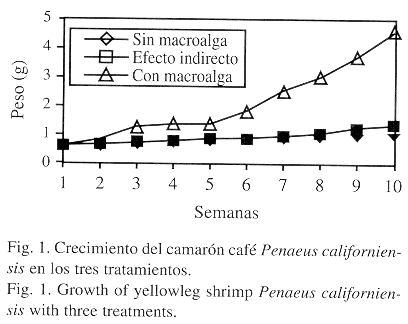
<body><![CDATA[<CENTER><FONT FACE="Arial,Helvetica"><FONT SIZE=-1>100 (b)</FONT></FONT></CENTER> </TD> </TR>  <TR> <TD VALIGN=TOP WIDTH="25%"><FONT FACE="Arial,Helvetica"><FONT SIZE=-1>Biomasa (g)</FONT></FONT></TD>  <TD VALIGN=TOP WIDTH="25%">     <CENTER><FONT FACE="Arial,Helvetica"><FONT SIZE=-1>5.6 &plusmn; 1.1 (a)</FONT></FONT></CENTER> </TD>  <TD VALIGN=TOP WIDTH="25%">     <CENTER><FONT FACE="Arial,Helvetica"><FONT SIZE=-1>7.8 &plusmn; 1.2 (a)</FONT></FONT></CENTER> </TD>  <TD VALIGN=TOP WIDTH="25%">     <CENTER><FONT FACE="Arial,Helvetica"><FONT SIZE=-1>36.42 &plusmn; 4.3 (a)</FONT></FONT></CENTER> </TD> </TR> </TABLE></CENTER> <FONT FACE="Arial,Helvetica"><FONT SIZE=-1>&nbsp;</FONT></FONT>     <BR><FONT FACE="Arial,Helvetica"><FONT SIZE=-1>&nbsp;&nbsp;&nbsp;&nbsp;&nbsp;&nbsp;&nbsp;&nbsp;&nbsp;&nbsp;&nbsp;&nbsp;&nbsp;&nbsp;&nbsp; Misma letra significan promedios con diferencias no significativas</FONT></FONT>     <BR><FONT FACE="Arial,Helvetica"><FONT SIZE=-1>&nbsp;</FONT></FONT>     <BR><FONT FACE="Arial,Helvetica"><FONT SIZE=-1>&nbsp;</FONT></FONT>      <P><FONT FACE="Arial,Helvetica"><FONT SIZE=-1>El <A HREF="#CUADRO 3">Cuadro 3</A> presenta los resultados de crecimiento, sobrevivencia y biomasa obtenida en los tres tratamientos. Como se puede observar el crecimiento promedio total en el tratamiento tres, con la presencia directa de la macroalga fue de casi 4 g, significativamente superior (p&lt;0.005) al obtenido en los tratamientos uno y dos que fue de 0.46 y 0.73 g respectivamente. Esto comenz&oacute; a manifestarse casi desde el inicio del experimento, como lo muestra la <A HREF="#Fig. 1">Fig. 1</A>. La sobrevivencia en el tratamiento tres, fue del 100 %; este valor es significativamente m&aacute;s alto (p>0.05) en comparaci&oacute;n con los promedios de 68.7 y 75 % obtenida en los tratamientos uno y dos, los cuales no presentaron diferencias significativas entre s&iacute;. Respecto de la biomasa obtenida, el valor mayor se registr&oacute; tambi&eacute;n en el tratamiento tres con un promedio de 36.24 g, significativamente mayor (p&lt;0.001) a los promedios de los tratamientos uno y dos que fueron de 5.6 y 7.8 g respectivamente.</FONT></FONT>     <BR><FONT FACE="Arial,Helvetica"><FONT SIZE=-1>&nbsp;</FONT></FONT>     <CENTER><A NAME="CUADRO 3"></A><B><FONT FACE="Arial,Helvetica"><FONT SIZE=-1>CUADRO 3</FONT></FONT></B></CENTER>      ]]></body>
<body><![CDATA[<CENTER><FONT FACE="Arial,Helvetica"><FONT SIZE=-1>&nbsp;</FONT></FONT></CENTER>      <CENTER><FONT FACE="Arial,Helvetica"><FONT SIZE=-1><I>Composici&oacute;n de los alimentos proporcionados al camar&oacute;n</I> Penaeus californiensis<I> en el desarrollo del experimento.</I></FONT></FONT></CENTER>      <CENTER><I><FONT FACE="Arial,Helvetica"><FONT SIZE=-1>&nbsp;</FONT></FONT></I></CENTER>      <CENTER><FONT FACE="Arial,Helvetica"><FONT SIZE=-1><I>Composition of feeds supplied to</I> Penaeus californiensis<I> during the experiment.</I></FONT></FONT></CENTER>      <CENTER><FONT FACE="Arial,Helvetica"><FONT SIZE=-1>&nbsp;</FONT></FONT></CENTER>      <CENTER><FONT FACE="Arial,Helvetica"><FONT SIZE=-1>&nbsp;</FONT></FONT></CENTER>      <CENTER><TABLE BORDER=0 CELLSPACING=0 CELLPADDING=0 WIDTH="93%" > <TR> <TD VALIGN=TOP WIDTH="20%"><FONT FACE="Arial,Helvetica"><FONT SIZE=-1>Alimento</FONT></FONT></TD>  <TD VALIGN=TOP WIDTH="20%">     <CENTER><FONT FACE="Arial,Helvetica"><FONT SIZE=-1>Humedad(%)</FONT></FONT></CENTER> </TD>  <TD VALIGN=TOP WIDTH="20%">     <CENTER><FONT FACE="Arial,Helvetica"><FONT SIZE=-1>Prote&iacute;na (%)</FONT></FONT></CENTER> </TD>  <TD VALIGN=TOP WIDTH="20%">     <CENTER><FONT FACE="Arial,Helvetica"><FONT SIZE=-1>L&iacute;pidos (%)</FONT></FONT></CENTER> </TD>  <TD VALIGN=TOP WIDTH="20%">     ]]></body>
<body><![CDATA[<CENTER><FONT FACE="Arial,Helvetica"><FONT SIZE=-1>Cenizas (%)</FONT></FONT></CENTER> </TD> </TR>  <TR> <TD VALIGN=TOP WIDTH="20%"><FONT FACE="Arial,Helvetica"><FONT SIZE=-1>Camaronina 35<A HREF="#3*">*</A></FONT></FONT></TD>  <TD VALIGN=TOP WIDTH="20%">     <CENTER><FONT FACE="Arial,Helvetica"><FONT SIZE=-1>8.75</FONT></FONT></CENTER> </TD>  <TD VALIGN=TOP WIDTH="20%">     <CENTER><FONT FACE="Arial,Helvetica"><FONT SIZE=-1>35.00</FONT></FONT></CENTER> </TD>  <TD VALIGN=TOP WIDTH="20%">     <CENTER><FONT FACE="Arial,Helvetica"><FONT SIZE=-1>8.60</FONT></FONT></CENTER> </TD>  <TD VALIGN=TOP WIDTH="20%">     <CENTER><FONT FACE="Arial,Helvetica"><FONT SIZE=-1>12.3</FONT></FONT></CENTER> </TD> </TR>  <TR> <TD VALIGN=TOP WIDTH="20%"><FONT FACE="Arial,Helvetica"><FONT SIZE=-1>Calamar<A HREF="#3*">*</A></FONT></FONT></TD>  <TD VALIGN=TOP WIDTH="20%">     <CENTER><FONT FACE="Arial,Helvetica"><FONT SIZE=-1>79.70</FONT></FONT></CENTER> </TD>  <TD VALIGN=TOP WIDTH="20%">     <CENTER><FONT FACE="Arial,Helvetica"><FONT SIZE=-1>15.90</FONT></FONT></CENTER> </TD>  <TD VALIGN=TOP WIDTH="20%">     <CENTER><FONT FACE="Arial,Helvetica"><FONT SIZE=-1>2.70</FONT></FONT></CENTER> </TD>  <TD VALIGN=TOP WIDTH="20%">     <CENTER><FONT FACE="Arial,Helvetica"><FONT SIZE=-1>1.7</FONT></FONT></CENTER> </TD> </TR>  <TR> <TD VALIGN=TOP WIDTH="20%"><FONT FACE="Arial,Helvetica"><FONT SIZE=-1>Almeja<A HREF="#3*">*</A></FONT></FONT></TD>  <TD VALIGN=TOP WIDTH="20%">     <CENTER><FONT FACE="Arial,Helvetica"><FONT SIZE=-1>81.30</FONT></FONT></CENTER> </TD>  <TD VALIGN=TOP WIDTH="20%">     ]]></body>
<body><![CDATA[<CENTER><FONT FACE="Arial,Helvetica"><FONT SIZE=-1>12.60</FONT></FONT></CENTER> </TD>  <TD VALIGN=TOP WIDTH="20%">     <CENTER><FONT FACE="Arial,Helvetica"><FONT SIZE=-1>3.60</FONT></FONT></CENTER> </TD>  <TD VALIGN=TOP WIDTH="20%">     <CENTER><FONT FACE="Arial,Helvetica"><FONT SIZE=-1>2.5</FONT></FONT></CENTER> </TD> </TR>  <TR> <TD VALIGN=TOP WIDTH="20%"><FONT FACE="Arial,Helvetica"><FONT SIZE=-1>Pescado fresco<A HREF="#3*">*</A></FONT></FONT></TD>  <TD VALIGN=TOP WIDTH="20%">     <CENTER><FONT FACE="Arial,Helvetica"><FONT SIZE=-1>75.90</FONT></FONT></CENTER> </TD>  <TD VALIGN=TOP WIDTH="20%">     <CENTER><FONT FACE="Arial,Helvetica"><FONT SIZE=-1>14.90</FONT></FONT></CENTER> </TD>  <TD VALIGN=TOP WIDTH="20%">     <CENTER><FONT FACE="Arial,Helvetica"><FONT SIZE=-1>6.40</FONT></FONT></CENTER> </TD>  <TD VALIGN=TOP WIDTH="20%">     <CENTER><FONT FACE="Arial,Helvetica"><FONT SIZE=-1>2.7</FONT></FONT></CENTER> </TD> </TR>  <TR> <TD VALIGN=TOP WIDTH="20%"><FONT FACE="Arial,Helvetica"><FONT SIZE=-1>Caulerpa sertularioides<A HREF="#3**">**</A></FONT></FONT></TD>  <TD VALIGN=TOP WIDTH="20%">     <CENTER><FONT FACE="Arial,Helvetica"><FONT SIZE=-1>91.10</FONT></FONT></CENTER> </TD>  <TD VALIGN=TOP WIDTH="20%">     <CENTER><FONT FACE="Arial,Helvetica"><FONT SIZE=-1>2.38</FONT></FONT></CENTER> </TD>  <TD VALIGN=TOP WIDTH="20%">     <CENTER><FONT FACE="Arial,Helvetica"><FONT SIZE=-1>0.53</FONT></FONT></CENTER> </TD>  <TD VALIGN=TOP WIDTH="20%">     ]]></body>
<body><![CDATA[<CENTER><FONT FACE="Arial,Helvetica"><FONT SIZE=-1>2.2</FONT></FONT></CENTER> </TD> </TR> </TABLE></CENTER> <FONT FACE="Arial,Helvetica"><FONT SIZE=-1>&nbsp;</FONT></FONT>     <BR><FONT FACE="Arial,Helvetica"><FONT SIZE=-1>&nbsp;<A NAME="3*"></A>*DICTUS, Universidad de Sonora&nbsp;<A NAME="3**"></A>**Instituto Tecnol&oacute;gico de La Paz</FONT></FONT>     <BR><FONT FACE="Arial,Helvetica"><FONT SIZE=-1>&nbsp;</FONT></FONT>     <BR><FONT FACE="Arial,Helvetica"><FONT SIZE=-1>&nbsp;</FONT></FONT>     <BR><FONT FACE="Arial,Helvetica"><FONT SIZE=-1>&nbsp;</FONT></FONT>     <CENTER><A NAME="Fig. 1"></A><IMG SRC="/img/fbpe/rbt/v47n3/0552i01.GIF" HEIGHT=324 WIDTH=408></CENTER> <FONT FACE="Arial,Helvetica"><FONT SIZE=-1>&nbsp;</FONT></FONT>     
<BR><FONT FACE="Arial,Helvetica"><FONT SIZE=-1>&nbsp;</FONT></FONT>     <BR><B><FONT FACE="Arial,Helvetica"><FONT SIZE=-1>Discusi&oacute;n</FONT></FONT></B>      <P><FONT FACE="Arial,Helvetica"><FONT SIZE=-1>Las temperaturas a las cuales se llev&oacute; a cabo el presente experimento, son significativamente menores que las registradas en el cultivo de la mayor&iacute;a de las especies comerciales de camar&oacute;n y solamente comparables con los que se utilizan para <I>Penaeus chinensis</I>, la especie que actualmente es cultivada a las temperaturas m&aacute;s bajas (<A HREF="#Lee">Lee and Wickins 1992</A>). La salinidad permaneci&oacute; pr&aacute;cticamente constante en 36 ppm; esta salinidad se encuentra dentro del rango considerado adecuado para el cultivo de la mayor&iacute;a de las especies de peneidos cultivados comercialmente (<A HREF="#Wickins">Wickins 1982</A>, <A HREF="#Huner">Huner y Evan Brown 1985</A>). Los valores de ox&iacute;geno disuelto que se registraron en el desarrollo del experimento est&aacute;n dentro del rango considerado adecuado para el cultivo de camarones peneidos (<A HREF="#Huner">Huner y Evan Brown 1985</A>, <A HREF="#Tseng">Tseng 1988</A>).</FONT></FONT>      <P><FONT FACE="Arial,Helvetica"><FONT SIZE=-1>El crecimiento obtenido en los tratamientos uno y dos, es decir sin la presencia y con la presencia indirecta de la macroalga, fueron muy bajos y esto se debi&oacute; b&aacute;sicamente a que los camarones en estos dos tratamientos consumieron menos alimento, tanto fresco como granulado seco. Estos crecimientos se pueden considerar como inaceptables para fines de cultivos comerciales, mientras que el obtenido en el tratamiento tres, aunque ligeramente bajo comparado con los cultivos de especies tropicales realizados en &eacute;pocas c&aacute;lidas (<A HREF="#Lawrence">Lawrence <I>et al.</I> 1985</A>, <A HREF="#Clifford">Clifford 1994</A>), se puede considerar como bastante aceptable para temperaturas invernales como en las que se llev&oacute; a cabo el presente experimento. Esto sugiere que la macroalga contiene alg&uacute;n factor de crecimiento o alg&uacute;n elemento que hace que el camar&oacute;n caf&eacute; coma m&aacute;s y como consecuencia crezca m&aacute;s.</FONT></FONT>      ]]></body>
<body><![CDATA[<P><FONT FACE="Arial,Helvetica"><FONT SIZE=-1>Las sobrevivencias registradas en cultivos comerciales de diferentes especies de peneidos, se consideran aceptables por arriba de 60 %, (<A HREF="#Clifford">Clifford 1994</A>, <A HREF="#Ochoa">Ochoa 1994</A>). Esta sobrevivencia fue rebasada en los tres tratamientos.</FONT></FONT>      <P><FONT FACE="Arial,Helvetica"><FONT SIZE=-1>Dif&iacute;cilmente se pueden hacer comparaciones con cultivos comerciales en el caso de la biomasa ya que las condiciones en que se llev&oacute; a cabo el experimento corresponder&iacute;an a las de un cultivo hiperintensivo. La biomasa obtenida en el tratamiento tres, extrapolada a 1 hect&aacute;rea, ser&iacute;a de 1294 kg, que es un valor aceptable para un cultivo semi-intensivo (<A HREF="#Martínez">Mart&iacute;nez 1994</A>).</FONT></FONT>      <P><FONT FACE="Arial,Helvetica"><FONT SIZE=-1>De los resultados obtenidos en el experimento se puede concluir lo siguiente:</FONT></FONT>      <P><FONT FACE="Arial,Helvetica"><FONT SIZE=-1>1.- La presencia de la macroalga <I>Caulerpa sertularioides</I>, tiene un efecto directo en el crecimiento, sobrevivencia y biomasa del camar&oacute;n caf&eacute; <I>Penaeus californiensis</I> en condiciones de laboratorio.</FONT></FONT>      <P><FONT FACE="Arial,Helvetica"><FONT SIZE=-1>2.- No se encontraron evidencias de alg&uacute;n efecto indirecto de dicha macroalga en ninguno de los par&aacute;metros considerados (alguna sustancia que modificara la composici&oacute;n del agua, o de organismos que dependieran de la macroalga y se incorporaran al agua y pasaran al cilindro en donde estaban los camarones).</FONT></FONT>      <P><FONT FACE="Arial,Helvetica"><FONT SIZE=-1>3.- La sobrevivencia, el crecimiento y la biomasa de camar&oacute;n <I>P. californiensis</I> con la presencia directa de la macroalga se pueden considerar como aceptables en relaci&oacute;n con cultivos comerciales, sobre todo si se toma en cuenta que el experimento se llev&oacute; a cabo a temperaturas invernales.</FONT></FONT>      <P><FONT FACE="Arial,Helvetica"><FONT SIZE=-1>4.- Se requiere la realizaci&oacute;n de estudios complementarios para determinar en forma m&aacute;s precisa de que manera la macroalga influye en el desarrollo del camar&oacute;n. Pudiera sugerirse por ejemplo la formulaci&oacute;n de dietas utilizando diferentes proporciones de la macroalga para evaluar su efecto en el crecimiento, sobrevivencia y biomasa del camar&oacute;n de esta especie y de otras.</FONT></FONT>      <P><FONT FACE="Arial,Helvetica"><FONT SIZE=-1>&nbsp;</FONT></FONT>     <BR><B><FONT FACE="Arial,Helvetica"><FONT SIZE=-1>Resumen</FONT></FONT></B>      <P><FONT FACE="Arial,Helvetica"><FONT SIZE=-1>El efecto de la macroalga <I>Caulerpa sertularioides</I> sobre el crecimiento, sobrevivencia y producci&oacute;n en cautiverio del camar&oacute;n caf&eacute; <I>Penaeus californiensis</I> (Holmes, 1900) a temperaturas invernales (14 a 21&deg;C) se estudi&oacute; en La Paz, B.C.S., M&eacute;xico. Se utilizaron nueve unidades experimentales (Tres por el tratamiento) consistiendo en tanques pl&aacute;sticos de150 l de capacidad. El crecimiento del camar&oacute;n con la presencia directa de la macroalga fue de 3.98 &plusmn; 0.4 g despu&eacute;s de 10 semanas de cultivo, la sobrevivencia fue del 100 % y el rendimiento de 36.24 &plusmn; 4.3 g. Estos resultados fueron significativamente m&aacute;s altos que los obtenidos en presencia indirecta, y en ausencia de la macroalga, los cuales no presentaron diferencias significativas entre s&iacute;. El crecimiento, sobrevivencia y producci&oacute;n en la presencia indirecta de la macroalga fueron de 0.73 &plusmn; 0.4 g, 75&plusmn; 10% and 7.8 &plusmn; 1.2 g respectivamente. En ausencia de la macroalga, se obtuvieron valores de 0.46 &plusmn; 0.4 g, 68.7 &plusmn; 12% y 5.6 &plusmn;1.1 g. La presencia directa de la macroalga tiene un efecto positivo y significativo en el desarrollo del camar&oacute;n caf&eacute; en cautiverio.</FONT></FONT>      ]]></body>
<body><![CDATA[<P><FONT FACE="Arial,Helvetica"><FONT SIZE=-1>&nbsp;</FONT></FONT>     <BR><B><FONT FACE="Arial,Helvetica"><FONT SIZE=-1>Referencias</FONT></FONT></B>      <!-- ref --><P><A NAME="Anónimo"></A><FONT FACE="Arial,Helvetica"><FONT SIZE=-1>An&oacute;nimo. 1984. El cultivo del camar&oacute;n azul Penaeus stylirostris, C.I.C.T.U.S., Universidad de Sonora.126 p.</FONT></FONT>    &nbsp;&nbsp;&nbsp;&nbsp;&nbsp;&nbsp;&nbsp;&nbsp;[&#160;<a href="javascript:void(0);" onclick="javascript: window.open('/scielo.php?script=sci_nlinks&ref=1311229&pid=S0034-7744199900030001700001&lng=','','width=640,height=500,resizable=yes,scrollbars=1,menubar=yes,');">Links</a>&#160;]<!-- end-ref --><!-- ref --><P><A NAME="Campos"></A><FONT FACE="Arial,Helvetica"><FONT SIZE=-1>Campos, R., F. Magall&oacute;n, G. Portillo, Porchas, M.A.&amp; J. Naranjo. 1994. Efecto de la presencia de la macroalga <I>Caulerpa sertulariodes</I> en el crecimiento y sobrevivencia de <I>P. vannamei</I> y <I>P. californiensis</I> durante el invierno.<B> </B>Memorias, X Simposium Internacional de Biolog&iacute;a Marina. 13-17 junio,. Ensenada, B.C. M&eacute;xico. Res&uacute;men C-061.</FONT></FONT>    &nbsp;&nbsp;&nbsp;&nbsp;&nbsp;&nbsp;&nbsp;&nbsp;[&#160;<a href="javascript:void(0);" onclick="javascript: window.open('/scielo.php?script=sci_nlinks&ref=1311230&pid=S0034-7744199900030001700002&lng=','','width=640,height=500,resizable=yes,scrollbars=1,menubar=yes,');">Links</a>&#160;]<!-- end-ref --><!-- ref --><P><A NAME="Clifford"></A><FONT FACE="Arial,Helvetica"><FONT SIZE=-1>Clifford, H.C. 1994. El manejo de estanques camaroneros. Memorias del seminario Internacional de camaronicultura, Camar&oacute;n 94'. Mazatl&aacute;n Sinaloa, M&eacute;xico.</FONT></FONT>    &nbsp;&nbsp;&nbsp;&nbsp;&nbsp;&nbsp;&nbsp;&nbsp;[&#160;<a href="javascript:void(0);" onclick="javascript: window.open('/scielo.php?script=sci_nlinks&ref=1311231&pid=S0034-7744199900030001700003&lng=','','width=640,height=500,resizable=yes,scrollbars=1,menubar=yes,');">Links</a>&#160;]<!-- end-ref --><!-- ref --><P><A NAME="Figueroa"></A><FONT FACE="Arial,Helvetica"><FONT SIZE=-1>Figueroa, J. 1996. Es el camar&oacute;n caf&eacute; (P. californiensis) una alternativa de producci&oacute;n. Panorama Acu&iacute;cola. 1: 4-5.</FONT></FONT>    &nbsp;&nbsp;&nbsp;&nbsp;&nbsp;&nbsp;&nbsp;&nbsp;[&#160;<a href="javascript:void(0);" onclick="javascript: window.open('/scielo.php?script=sci_nlinks&ref=1311232&pid=S0034-7744199900030001700004&lng=','','width=640,height=500,resizable=yes,scrollbars=1,menubar=yes,');">Links</a>&#160;]<!-- end-ref --><!-- ref --><P><A NAME="Hendrickx86"></A><FONT FACE="Arial,Helvetica"><FONT SIZE=-1>Hendrickx, M. 1986. Distribuci&oacute;n y abundancia de los camarones peneidos (Crustacea: Decapoda). Ann. Inst. Cien. Mar Limnol. Univ. Auton. M&eacute;xico 13:345-368.</FONT></FONT>    &nbsp;&nbsp;&nbsp;&nbsp;&nbsp;&nbsp;&nbsp;&nbsp;[&#160;<a href="javascript:void(0);" onclick="javascript: window.open('/scielo.php?script=sci_nlinks&ref=1311233&pid=S0034-7744199900030001700005&lng=','','width=640,height=500,resizable=yes,scrollbars=1,menubar=yes,');">Links</a>&#160;]<!-- end-ref --><!-- ref --><P><A NAME="Hendrickx96"></A><FONT FACE="Arial,Helvetica"><FONT SIZE=-1>Hendrickx, M. 1996. Los camarones peneoidea bent&oacute;nicos del pac&iacute;fico M&eacute;xicano. Comisi&oacute;n Nacional para la Biodiversidad-Universidad Nacional aut&oacute;noma de M&eacute;xico. M&eacute;xico p. 35-38.</FONT></FONT>    &nbsp;&nbsp;&nbsp;&nbsp;&nbsp;&nbsp;&nbsp;&nbsp;[&#160;<a href="javascript:void(0);" onclick="javascript: window.open('/scielo.php?script=sci_nlinks&ref=1311234&pid=S0034-7744199900030001700006&lng=','','width=640,height=500,resizable=yes,scrollbars=1,menubar=yes,');">Links</a>&#160;]<!-- end-ref --><!-- ref --><P><A NAME="Lawrence"></A><FONT FACE="Arial,Helvetica"><FONT SIZE=-1>Lawrence, A.L., J.P. McVey &amp; J.V. Huner. 1985. Crustacean and Mollusk Aquaculture in the United States. Huner. p. 127-157.</FONT></FONT>    &nbsp;&nbsp;&nbsp;&nbsp;&nbsp;&nbsp;&nbsp;&nbsp;[&#160;<a href="javascript:void(0);" onclick="javascript: window.open('/scielo.php?script=sci_nlinks&ref=1311235&pid=S0034-7744199900030001700007&lng=','','width=640,height=500,resizable=yes,scrollbars=1,menubar=yes,');">Links</a>&#160;]<!-- end-ref --><!-- ref --><P><A NAME="Huner"></A><FONT FACE="Arial,Helvetica"><FONT SIZE=-1>Huner, J.V. &amp; E. Evan Brown. 1985. Crustacean and Mollusk Aquacuture in the United States. USA. p</FONT></FONT>    &nbsp;&nbsp;&nbsp;&nbsp;&nbsp;&nbsp;&nbsp;&nbsp;[&#160;<a href="javascript:void(0);" onclick="javascript: window.open('/scielo.php?script=sci_nlinks&ref=1311236&pid=S0034-7744199900030001700008&lng=','','width=640,height=500,resizable=yes,scrollbars=1,menubar=yes,');">Links</a>&#160;]<!-- end-ref --><!-- ref --><P><A NAME="Lee"></A><FONT FACE="Arial,Helvetica"><FONT SIZE=-1>Lee, D. O`C. &amp; J.F. Wickins. 1992. Crustacean Farming. Wiley. p. 278.</FONT></FONT>    &nbsp;&nbsp;&nbsp;&nbsp;&nbsp;&nbsp;&nbsp;&nbsp;[&#160;<a href="javascript:void(0);" onclick="javascript: window.open('/scielo.php?script=sci_nlinks&ref=1311237&pid=S0034-7744199900030001700009&lng=','','width=640,height=500,resizable=yes,scrollbars=1,menubar=yes,');">Links</a>&#160;]<!-- end-ref --><!-- ref --><P><A NAME="Magallón"></A><FONT FACE="Arial,Helvetica"><FONT SIZE=-1>Magall&oacute;n, B.F., G. Portillo, R. Campos, M.A. Porchas, J. Naranjo &amp; A. Muhlia. 1994. <I>Penaeus californiensis</I> as a cold tolerant species in Baja California Sur, M&eacute;xico. Book of Abstracts. Aquaculture'94: W.A.S. Nueva Orleans, USA p. 84.</FONT></FONT>    &nbsp;&nbsp;&nbsp;&nbsp;&nbsp;&nbsp;&nbsp;&nbsp;[&#160;<a href="javascript:void(0);" onclick="javascript: window.open('/scielo.php?script=sci_nlinks&ref=1311238&pid=S0034-7744199900030001700010&lng=','','width=640,height=500,resizable=yes,scrollbars=1,menubar=yes,');">Links</a>&#160;]<!-- end-ref --><!-- ref --><P><A NAME="Martínez"></A><FONT FACE="Arial,Helvetica"><FONT SIZE=-1>Mart&iacute;nez C.L.R. 1994. Camaronicultura. Bases t&eacute;cnicas y cient&iacute;ficas para el cultivo de camarones peneidos. AGT Editor. M&eacute;xico. 233 p.</FONT></FONT>    &nbsp;&nbsp;&nbsp;&nbsp;&nbsp;&nbsp;&nbsp;&nbsp;[&#160;<a href="javascript:void(0);" onclick="javascript: window.open('/scielo.php?script=sci_nlinks&ref=1311239&pid=S0034-7744199900030001700011&lng=','','width=640,height=500,resizable=yes,scrollbars=1,menubar=yes,');">Links</a>&#160;]<!-- end-ref --><!-- ref --><P><A NAME="Ochoa"></A><FONT FACE="Arial,Helvetica"><FONT SIZE=-1>Ochoa M.V.J. 1994. Situaci&oacute;n de la camaronicultura en M&eacute;xico. Memorias del Seminario Internacional de Camaronicultura, Camar&oacute;n 94`. Mazatl&aacute;n Sinaloa, M&eacute;xico.</FONT></FONT>    &nbsp;&nbsp;&nbsp;&nbsp;&nbsp;&nbsp;&nbsp;&nbsp;[&#160;<a href="javascript:void(0);" onclick="javascript: window.open('/scielo.php?script=sci_nlinks&ref=1311240&pid=S0034-7744199900030001700012&lng=','','width=640,height=500,resizable=yes,scrollbars=1,menubar=yes,');">Links</a>&#160;]<!-- end-ref --><!-- ref --><P><A NAME="Porchas"></A><FONT FACE="Arial,Helvetica"><FONT SIZE=-1>Porchas, M.A, F.J. Magall&oacute;n, G. Portillo, J. Naranjo, R. Campos &amp; H. Villarreal. 1995. Direct and indirect effect of the macroalgae <I>Caulerpa sertulariodes </I>in the growth and survival of brown shrimp <I>Penaeus californiensis</I> reared at reduced temperatures. Book of Abstracts. Aquaculture'95: W.A.S. San Diego, California. USA, p. 234.</FONT></FONT>    &nbsp;&nbsp;&nbsp;&nbsp;&nbsp;&nbsp;&nbsp;&nbsp;[&#160;<a href="javascript:void(0);" onclick="javascript: window.open('/scielo.php?script=sci_nlinks&ref=1311241&pid=S0034-7744199900030001700013&lng=','','width=640,height=500,resizable=yes,scrollbars=1,menubar=yes,');">Links</a>&#160;]<!-- end-ref --><!-- ref --><P><A NAME="Tseng"></A><FONT FACE="Arial,Helvetica"><FONT SIZE=-1>Tseng, W. 1988. Shrimp Mariculture: A practical Manual. Canaan Itl. Pty Ltd. Australia. 290 p.</FONT></FONT>    &nbsp;&nbsp;&nbsp;&nbsp;&nbsp;&nbsp;&nbsp;&nbsp;[&#160;<a href="javascript:void(0);" onclick="javascript: window.open('/scielo.php?script=sci_nlinks&ref=1311242&pid=S0034-7744199900030001700014&lng=','','width=640,height=500,resizable=yes,scrollbars=1,menubar=yes,');">Links</a>&#160;]<!-- end-ref --><!-- ref --><P><A NAME="Wickins"></A><FONT FACE="Arial,Helvetica"><FONT SIZE=-1>Wickins, J.F. 1982. Opportunities for farming crustacean in western temperate regions. Muir. Recent advances in Aquaculture. Croom Helms, londres, Inglateerra.</FONT></FONT>    &nbsp;&nbsp;&nbsp;&nbsp;&nbsp;&nbsp;&nbsp;&nbsp;[&#160;<a href="javascript:void(0);" onclick="javascript: window.open('/scielo.php?script=sci_nlinks&ref=1311243&pid=S0034-7744199900030001700015&lng=','','width=640,height=500,resizable=yes,scrollbars=1,menubar=yes,');">Links</a>&#160;]<!-- end-ref --><BR>&nbsp;      <P><A NAME="1"></A><FONT FACE="Arial,Helvetica"><FONT SIZE=-1><A HREF="#1a">1</A> Centro de Investigaciones Biol&oacute;gicas del Noroeste, S.C. Unidad Guaymas, Apdo postal 349, Guaymas, Sonora 85400, M&eacute;xico. Fax. (622)12238, email: <A HREF="mailto:mporchas@cibnor.mx">mporchas@cibnor.mx</A>.</FONT></FONT>     <BR><FONT FACE="Arial,Helvetica"><FONT SIZE=-1>&nbsp;</FONT></FONT>     ]]></body>
<body><![CDATA[<BR><A NAME="2"></A><FONT FACE="Arial,Helvetica"><FONT SIZE=-1><A HREF="#1a">2</A> Departamento DICTUS, Universidad de Sonora, Apdo postal 1819, Hermosillo, Sonora, 83000, M&eacute;xico.</FONT></FONT>     <BR><FONT FACE="Arial,Helvetica"><FONT SIZE=-1>&nbsp;</FONT></FONT>     <BR><A NAME="3"></A><FONT FACE="Arial,Helvetica"><FONT SIZE=-1><A HREF="#1a">3</A> Centro de Investigaciones Biol&oacute;gicas del Noroeste, S.C. Apdo postal 128, La Paz B.C.S., M&eacute;xico.</FONT></FONT>      ]]></body><back>
<ref-list>
<ref id="B1">
<nlm-citation citation-type="book">
<person-group person-group-type="author">
<name>
</name>
<name>
</name>
</person-group>
<source><![CDATA[El cultivo del camarón azul Penaeus stylirostris]]></source>
<year>1984</year>
<page-range>126</page-range><publisher-name><![CDATA[C.I.C.T.U.S., Universidad de Sonora]]></publisher-name>
</nlm-citation>
</ref>
<ref id="B2">
<nlm-citation citation-type="confpro">
<person-group person-group-type="author">
<name>
<surname><![CDATA[Campos]]></surname>
<given-names><![CDATA[R.]]></given-names>
</name>
<name>
<surname><![CDATA[Magallón]]></surname>
<given-names><![CDATA[F.]]></given-names>
</name>
<name>
<surname><![CDATA[Portillo]]></surname>
<given-names><![CDATA[G.]]></given-names>
</name>
<name>
<surname><![CDATA[Porchas]]></surname>
<given-names><![CDATA[M.A.]]></given-names>
</name>
<name>
<surname><![CDATA[Naranjo]]></surname>
<given-names><![CDATA[J.]]></given-names>
</name>
</person-group>
<source><![CDATA[Efecto de la presencia de la macroalga Caulerpa sertulariodes en el crecimiento y sobrevivencia de P. vannamei y P. californiensis durante el invierno]]></source>
<year>1994</year>
<conf-name><![CDATA[ X Simposium Internacional de Biología Marina]]></conf-name>
<conf-date>13-17 junio</conf-date>
<conf-loc>Ensenada </conf-loc>
</nlm-citation>
</ref>
<ref id="B3">
<nlm-citation citation-type="confpro">
<person-group person-group-type="author">
<name>
<surname><![CDATA[Clifford]]></surname>
<given-names><![CDATA[H.C.]]></given-names>
</name>
</person-group>
<source><![CDATA[El manejo de estanques camaroneros]]></source>
<year>1994</year>
<conf-name><![CDATA[ Memorias del seminario Internacional de camaronicultura, Camarón 94']]></conf-name>
<conf-loc> </conf-loc>
</nlm-citation>
</ref>
<ref id="B4">
<nlm-citation citation-type="journal">
<person-group person-group-type="author">
<name>
<surname><![CDATA[Figueroa]]></surname>
<given-names><![CDATA[J.]]></given-names>
</name>
</person-group>
<article-title xml:lang="es"><![CDATA[Es el camarón café (P. californiensis) una alternativa de producción]]></article-title>
<source><![CDATA[Panorama Acuícola]]></source>
<year>1996</year>
<volume>1</volume>
<page-range>4-5</page-range></nlm-citation>
</ref>
<ref id="B5">
<nlm-citation citation-type="journal">
<person-group person-group-type="author">
<name>
<surname><![CDATA[Hendrickx]]></surname>
<given-names><![CDATA[M.]]></given-names>
</name>
</person-group>
<article-title xml:lang="es"><![CDATA[Distribución y abundancia de los camarones peneidos (Crustacea: Decapoda)]]></article-title>
<source><![CDATA[Ann. Inst. Cien. Mar Limnol. Univ. Auton. México]]></source>
<year>1986</year>
<volume>13</volume>
<page-range>345-368</page-range></nlm-citation>
</ref>
<ref id="B6">
<nlm-citation citation-type="book">
<person-group person-group-type="author">
<name>
<surname><![CDATA[Hendrickx]]></surname>
<given-names><![CDATA[M.]]></given-names>
</name>
</person-group>
<source><![CDATA[Los camarones peneoidea bentónicos del pacífico Méxicano]]></source>
<year>1996</year>
<page-range>35-38</page-range><publisher-name><![CDATA[Comisión Nacional para la Biodiversidad-Universidad Nacional autónoma de México]]></publisher-name>
</nlm-citation>
</ref>
<ref id="B7">
<nlm-citation citation-type="book">
<person-group person-group-type="author">
<name>
<surname><![CDATA[Lawrence]]></surname>
<given-names><![CDATA[A.L.]]></given-names>
</name>
<name>
<surname><![CDATA[McVey]]></surname>
<given-names><![CDATA[J.P.]]></given-names>
</name>
<name>
<surname><![CDATA[Huner]]></surname>
<given-names><![CDATA[J.V.]]></given-names>
</name>
</person-group>
<source><![CDATA[Crustacean and Mollusk Aquaculture in the United States]]></source>
<year>1985</year>
<page-range>127-157</page-range><publisher-name><![CDATA[Huner]]></publisher-name>
</nlm-citation>
</ref>
<ref id="B8">
<nlm-citation citation-type="">
<person-group person-group-type="author">
<name>
<surname><![CDATA[Huner]]></surname>
<given-names><![CDATA[J.V.]]></given-names>
</name>
<name>
<surname><![CDATA[Brown]]></surname>
<given-names><![CDATA[E. Evan]]></given-names>
</name>
</person-group>
<source><![CDATA[Crustacean and Mollusk Aquacuture in the United States]]></source>
<year>1985</year>
</nlm-citation>
</ref>
<ref id="B9">
<nlm-citation citation-type="book">
<person-group person-group-type="author">
<name>
<surname><![CDATA[Lee]]></surname>
<given-names><![CDATA[D. O`C.]]></given-names>
</name>
<name>
<surname><![CDATA[Wickins]]></surname>
<given-names><![CDATA[J.F.]]></given-names>
</name>
</person-group>
<source><![CDATA[Crustacean Farming]]></source>
<year>1992</year>
<page-range>278</page-range><publisher-name><![CDATA[Wiley]]></publisher-name>
</nlm-citation>
</ref>
<ref id="B10">
<nlm-citation citation-type="">
<person-group person-group-type="author">
<name>
<surname><![CDATA[Magallón]]></surname>
<given-names><![CDATA[B.F.]]></given-names>
</name>
<name>
<surname><![CDATA[Portillo]]></surname>
<given-names><![CDATA[G.]]></given-names>
</name>
<name>
<surname><![CDATA[Campos]]></surname>
<given-names><![CDATA[R.]]></given-names>
</name>
<name>
<surname><![CDATA[Porchas]]></surname>
<given-names><![CDATA[M.A.]]></given-names>
</name>
<name>
<surname><![CDATA[Naranjo]]></surname>
<given-names><![CDATA[J.]]></given-names>
</name>
<name>
<surname><![CDATA[Muhlia]]></surname>
<given-names><![CDATA[A.]]></given-names>
</name>
</person-group>
<source><![CDATA[Penaeus californiensis as a cold tolerant species in Baja California Sur, México]]></source>
<year>1994</year>
</nlm-citation>
</ref>
<ref id="B11">
<nlm-citation citation-type="book">
<person-group person-group-type="author">
<name>
<surname><![CDATA[Martínez]]></surname>
<given-names><![CDATA[C.L.R.]]></given-names>
</name>
</person-group>
<source><![CDATA[Camaronicultura: Bases técnicas y científicas para el cultivo de camarones peneidos]]></source>
<year>1994</year>
<publisher-name><![CDATA[AGT Editor]]></publisher-name>
</nlm-citation>
</ref>
<ref id="B12">
<nlm-citation citation-type="">
<person-group person-group-type="author">
<name>
<surname><![CDATA[Ochoa]]></surname>
<given-names><![CDATA[M.V.J.]]></given-names>
</name>
</person-group>
<source><![CDATA[Situación de la camaronicultura en México.: Memorias del Seminario Internacional de Camaronicultura, Camarón 94`]]></source>
<year>1994</year>
</nlm-citation>
</ref>
<ref id="B13">
<nlm-citation citation-type="">
<person-group person-group-type="author">
<name>
<surname><![CDATA[Porchas]]></surname>
<given-names><![CDATA[M.A]]></given-names>
</name>
<name>
<surname><![CDATA[Magallón]]></surname>
<given-names><![CDATA[F.J.]]></given-names>
</name>
<name>
<surname><![CDATA[Portillo]]></surname>
<given-names><![CDATA[G.]]></given-names>
</name>
<name>
<surname><![CDATA[Naranjo]]></surname>
<given-names><![CDATA[J.]]></given-names>
</name>
<name>
<surname><![CDATA[Campos]]></surname>
<given-names><![CDATA[R.]]></given-names>
</name>
<name>
<surname><![CDATA[Villarreal]]></surname>
<given-names><![CDATA[H.]]></given-names>
</name>
</person-group>
<source><![CDATA[Direct and indirect effect of the macroalgae Caulerpa sertulariodes in the growth and survival of brown shrimp Penaeus californiensis reared at reduced temperatures]]></source>
<year>1995</year>
<page-range>234</page-range><publisher-loc><![CDATA[San Diego^eCalifornia California]]></publisher-loc>
</nlm-citation>
</ref>
<ref id="B14">
<nlm-citation citation-type="book">
<person-group person-group-type="author">
<name>
<surname><![CDATA[Tseng]]></surname>
<given-names><![CDATA[W.]]></given-names>
</name>
</person-group>
<source><![CDATA[Shrimp Mariculture: A practical Manual]]></source>
<year>1988</year>
<page-range>290</page-range><publisher-name><![CDATA[Canaan Itl. Pty Ltd]]></publisher-name>
</nlm-citation>
</ref>
<ref id="B15">
<nlm-citation citation-type="book">
<person-group person-group-type="author">
<name>
<surname><![CDATA[Wickins]]></surname>
<given-names><![CDATA[J.F.]]></given-names>
</name>
</person-group>
<source><![CDATA[Opportunities for farming crustacean in western temperate regions: Muir. Recent advances in Aquaculture]]></source>
<year>1982</year>
<publisher-loc><![CDATA[londres ]]></publisher-loc>
<publisher-name><![CDATA[Croom Helms]]></publisher-name>
</nlm-citation>
</ref>
</ref-list>
</back>
</article>
